Haplogroups: DNA SNPs Are Breadcrumbs – Follow Their Path

Recently a reader asked some great questions.

If Y-DNA is unchanged, then why isn’t the Y-DNA of every man the same today? And if it’s not the same, then how do we know that all men descend from Y-Adam? Are the scientists just guessing?

The scientists aren’t guessing, and the recent scientific innovations behind how this works is pretty amazing, so let’s unravel these questions one at a time.

The first thing we need to understand is how Y-DNA is inherited differently from autosomal DNA, and how it mutates.

First, a reminder that:

  • Y-DNA tests the Y chromosome passed from father to son in every generation, unmixed with any DNA of the mother. This article focuses on Y-DNA.
  • Mitochondrial DNA tests the mitochondria passed from mothers to all of their children, but is only passed on by the females, unmixed with the DNA of the father. This article also pertains to mitochondrial SNPS, but we will cover that more specifically later in another article.
  • Autosomal DNA is passed from both parents to their children. Each child inherits half of each parent’s autosomal DNA.

Let’s look at how this works.

Autosomal vs Y-DNA Inheritance

Click on image to enlarge

Autosomal DNA, shown here with the green (male) and pink (female) images, divides in each generation as it’s passed from the parent to their child. Each child inherits half of each parent’s autosomal DNA, meaning chromosomes 1-22. For this discussion, each descendant shown above is a male and has a Y chromosome.

This means that in the first generation, which would be the great-grandfather, about 700,000 locations of his green autosomal DNA are tested for genealogy purposes.

His female partner (pink) also has about 700,000 locations. During recombination, they each contribute about 350,000 SNPs (Single Nucleotide Polymorphisms) of autosomal DNA to their child. Their offspring then has a total of 700,000 SNPs, 350,000 green and 350,000 pink contributed by each parent.

This process is repeated for each child, whether male or female (with the exception of the X chromosome, which is beyond the scope of this article), but each child does not receive exactly the same half of their parents’ autosomal DNA. Recombination is random.

In the four generations shown above, the green autosomal DNA of generation one, the great-grandfather, has been divided and recombined three times. The original 700,000 locations of great-grandfather’s green DNA has now been whittled down to about 87,500 locations of his green DNA.

Y-DNA in the Same Generation

Looking now at the blue Y-DNA at left, the Y-DNA remains the same in each generation with the exception of one mutation approximately every two or three generations.

As you can see in the chart, in the exact same number of generations, the Y-DNA of each male, which he inherited from his father:

  • Never recombines with any DNA from the mother
  • Never divides and gets smaller in subsequent generations
  • Remains essentially unchanged in each generation

The key word here is “essentially.”

Y-DNA

The Y chromosome consists of about 59 million locations or SNPs of DNA. STR tests, Short Tandem Repeats, which are essentially insertions and deletions, test limited numbers of carefully curated markers selected for the fact that they mutate in a genealogically relevant timeframe. These markers are combined in panels of either 67 or 111 marker tests available for purchase at FamilyTreeDNA today, or historically 12, 25, 37, 67, and 111 marker panels. The STR test was the original Y-DNA test for genealogy and is still used as an introductory test or to see if a male matches a specific line, or not.

From the STR tests, in addition to matching, FamilyTreeDNA can reliably predict a relatively high-level haplogroup, or genetic clan, based on the frequency of the combinations of those marker values in specific STR locations.

SNPs are much more reliable than STRs, which tend to be comparatively unstable, mutating at an unreliable rate, and back mutating, which can be very disconcerting for genealogy. We need reliable consistency to be able to assign a male tester to a specific lineage with confidence. We can, however, find genealogically relevant matches that may be quite important, so I never disregard STR tests or testers. STR tests aren’t relevant for deeper history, nor can they reliably discern a specific lineage within a surname. SNP tests can and do.

The Big Y-700 SNP test gives us that and more, along with the earlier Big Y-500 test which scanned about 30 million locations. The Big Y-700 is a significant improvement; men can upgrade from the Big Y-500 or STR tests.

The Big Y-700 test scans about 50 million Y-DNA locations, known as the gold standard region, for all mutations. It reports 700 or more STR markers for matching, but more importantly, it scans for all SNP mutations in those 50 million locations.

All mutations are confirmed by at least five positive repeat scans and are then assigned a haplogroup name if found in two or more men.

Y-DNA Testing

If Y-DNA remained exactly the same, then the Y-DNA of men today would be entirely indistinguishable from each other – essentially all matching humankind’s first common ancestor. With no changes, Y-DNA would not be useful for genealogy. We need inherited mutations to be able to compare men and determine their level of relatedness to each other.

Fortunately, Y-DNA SNPs do mutate. Y-DNA is never divided or combined, so it stays essentially the same except for occasional mutations which are inherited by the following generations.

Using SNP markers scanned in the Big Y test, one new mutation happens on the average of every two or three generations. Of course, that means that sometimes there are no mutations for a few generations, and sometimes there are two mutations between father and son.

What this does, though, very effectively, is provide a trail of SNP mutations – breadcrumbs essentially – that we can use for matching, AND for tracking our mutations, which equate to ancestors, back in time.

Estes Male Breadcrumb Trail

I’ve tested several Estes men of known lineage, so I’m going to use this line as an example of how mutations act as breadcrumbs, allowing us to track our ancestors back in time and across the globe.

Multiple cousins in my Estes line have taken the Big Y-700 test.

My closest male cousin matches two other men on a unique mutation. That SNP has been named haplogroup R-ZS3700.

We know, based on our genealogy, that this mutation occurred in Virginia and is found in the sons of Moses Estes born in 1711.

How do we know that?

We know that because three of Moses’s descendants have tested and all three of those men have the same mutation, R-ZS3700, and none of the sons of Moses’s brothers have that mutation.

I’ve created a chart to illustrate the Estes pedigree chart, and the haplogroups assigned to those men. So, it’s a DNA pedigree chart too. This is exactly what the Big-Y DNA test does for us.

In the red-bordered block of testers, you can see the three men that all have R-ZS3700 (in red), and all are sons of Moses born in 1711. I have not typed the names of all the men in each generation because, for purposes of this illustration, names aren’t important. However, the concept and the fact that we have been able to connect them genealogically, either before or because of Y-DNA testing, is crucial.

Directly above Moses born in 1711, you can see his father Abraham born in 1647, along with Moses’ brothers at right and left; John, Richard, Sylvester, and Elisha whose descendants have taken the Big Y-700 test. Moses’s brothers’ descendants all have haplogroup R-BY490 (in blue), but NOT R-ZS3700. That tells us that the mutation responsible for R-ZS3700 happened between Abraham born in 1647, and Moses born in 1711. Otherwise, Moses’s brothers would have the mutation if his father had the mutation.

Moses’s descendants also have R-BY490, but it’s NOT the last SNP or haplogroup in their lineage. For Moses’s descendants, R-ZS3700 occurred after R-BY490.

You can see haplogroup R-BY490 boxed in blue.

We know that Moses and his father, Abraham, both have haplogroup R-BY490 because all of Abraham’s sons have this haplogroup. Additionally, we know that Abraham’s father, Silvester also had haplogroup R-BY490.

How do we know that?

Abraham’s brother, Richard’s descendant, tested and he has haplogroup R-BY490.

However, Silvester’s father, Robert born in 1555 did NOT have R-BY490, so it formed between him and his son, Silvester.

How do we know that?

Robert’s other son, Robert born in 1603 has a descendant who tested and has haplogroup R-BY482, but does NOT have R-BY490 or R-ZS3700.

All of the other Eates testers also have R-BY482, blocked in green, in addition to R-BY490, so we know that the mutation of R-BY490 developed between Robert born in 1555 and his son, Silvester born in 1600, because his other son’s descendant does not have it.

Looking at only the descent of the haplogroups, in order, we have

  • R-BY482 (green) found in Robert born in 1555 and all of his descendants.
  • R-BY490 (blue) found in Silvester born in 1600 and all of his descendants, but not his brother
  • R-ZS3700 (red) found in Moses born in 1711 and all of his descendants, but not his brothers

If we had Estes men who descend from the two additional documented generations upstream of Robert born in 1555, we might discover when R-BY482 occurred, but to date, we don’t have any additional testers from those lines.

Now that we understand the genesis of these three haplogroups in the Estes lineage, what else can we discover through our haplogroup breadcrumbs?

The Discover Reports

By entering the haplogroup in the Discover tool, either on the public page, here, or clicking on Discover on your personal page at FamilyTreeDNA if you’ve taken the Big-Y test, you will see several reports for your haplogroup.

I strongly suggest reviewing each category, because they cumulatively act as chapters to the book of your haplogroup story, but we’re going to skip directly to the breadcrumbs, which is called the Ancestral Path.

The Ancestral Path begins with your haplogroup in Line 1 then lists the first upstream or parent haplogroup in Line 2. In this case, the haplogroup I entered is R-ZS3700.

You can see the estimated age of the haplogroup, meaning when it formed, at about 1700 CE. Moses Estes who was born in 1711 is the first Estes man to carry haplogroup R-ZS3700, so that’s extremely close.

Line 2, R-BY490 occurred or was born about 1650, and we know that it actually occurred between Robert and Silvester born in 1600, so that’s close too.

Scanning down to Line 3, R-BY482 is estimated to have occurred about 1500 CE, and we know for sure it had occurred by 1555 when Robert was born.

We see the parent haplogroup of R-BY487 on Line 4, dating from about 750 CE. Of course, if more men test, it’s possible that more haplogroups will emerge between BY482 and BY487, forming a new branch. Given the time involved, those men wouldn’t be expected to carry the Estes surname, as surnames hadn’t yet been adopted in that timeframe.

Moving down to Line 9, we see R-ZP18 from 2250 BCE, or about 4250 years ago. Looking at the right column, there’s one ancient sample with that haplogroup. The location of ancient samples anchors haplogroups definitively in a particular location at a specific time.

Haplogroup by haplogroup, step by step, we can follow the breadcrumbs back in time to Y-Adam, the first homo sapiens male known to have descendants today, meaning he’s the MRCA, or most recent common ancestor for all men.

Neanderthals and Denisovans follow, but their Y-DNA is only available through ancient samples. They have no known direct male survivors, but someday, maybe someone will test and their Y-DNA will be found to descend from Neanderthals or Denisovans.

Now that we know when those haplogroups occurred, how did our ancestors get from Africa 232,000 years ago to Kent, England, in the 1400s? What path did they take?

The new Globetrekker tool answers that question.

The Breadcrumb Trail

In Globetrekker, each haplogroup’s location is placed by a combination of testers’ results, their identified earliest known ancestor (EKA) country and location, combined with ancient samples, climatic factors like glaciers and sea levels, and geographic features. You can read about Globetrekker here and here.

To view the Globetrekker tool, you must sign it to an account that has taken the Big Y test. It’s a tool exclusively provided for Big-Y testers.

You can click at the bottom of your Globetrekker map to play the animated video.

Beginning in Africa, our ancestors began their journey with Y-Adam, then migrated through the Near East, South Asia, East Asia, then west through central Asia into Europe. The Estes ancestors crossed the English Channel and migrated around what is now England before settling in Deal, on the east coast.

Clicking on any haplogroup provides a description of that haplogroup and how it was placed in that location.

Enabling the option for ancient DNA shows those locations as well, near the haplogroups they represent when the animation is playing.

Clicking on the shovel icon explains about that particular ancient DNA sample, what is known, and how it relates to the haplogroup it’s connected to by a dotted line on the map.

Pretty cool, huh!!

End to End

As you can see from this example, Big Y results are an end-to-end tool.

We can use the Big Y-700 haplogroups very successfully for recent genealogy – assigning testers to specific lines in a genealogy timeframe. Some haplogroups are so specific that, without additional information, we can place a man in his exact generation, or within a generation or two.

Not shown in my Estes pedigree chart is an adoptee with a different surname, of course. We know that he descends from Moses’s line because he carries haplogroup R-ZS3700, but we are still working on the more recent generations using autosomal DNA to connect him accurately.  If more of Moses’s descendants tested, we could probably place him very specifically. Without the Big Y-700 test, he wouldn’t know his biological surname or that he descends from Moses. That’s a HUGE breakthrough for him.

There’s more about the Estes line to learn, however.

If our Estes cousins tested their brothers, uncles or other Estes males in their line, they would likely receive a more refined haplogroup that’s relevant only to that line.

Using Big-Y test results, we can place men within a couple of generations and identify a common ancestor, even when all men within a haplogroup don’t know their genealogical lineage. Using those same test results, we can follow the breadcrumbs all 50 steps back in time more than 230,000 years to Y-Adam.

End to end, the Big-Y test coupled with breadcrumbs in Discover, Globetrekker, and other amazing tools is absolutely the most informative and powerful test available to male testers for their paternal line genealogy.

These amazing innovations tracking more than 50,000 haplogroups across the globe answer the original questions about how we know.

The more people who take or upgrade to the Big Y-700 test, the more haplogroup branches will be added, and the more refined the breadcrumbs, ages, and maps will become. In other words, there’s still more to learn.

Test if you haven’t, and check back often for new matches and breadcrumbs, aka updates.

_____________________________________________________________

Follow DNAexplain on Facebook, here.

Share the Love!

You’re always welcome to forward articles or links to friends and share on social media.

If you haven’t already subscribed (it’s free,) you can receive an email whenever I publish by clicking the “follow” button on the main blog page, here.

You Can Help Keep This Blog Free

I receive a small contribution when you click on some of the links to vendors in my articles. This does NOT increase the price you pay but helps me to keep the lights on and this informational blog free for everyone. Please click on the links in the articles or to the vendors below if you are purchasing products or DNA testing.

Thank you so much.

DNA Purchases and Free Uploads

Genealogy Products and Services

My Book


Genealogy Books

  • com – Lots of wonderful genealogy research books
  • American Ancestors – Wonderful selection of genealogy books

Genealogy Research


Globetrekker™ – A New Feature for Big Y Customers From FamilyTreeDNA

FamilyTreeDNA recently released Globetrekker™, a great new feature for Big Y customers as part of the Discover tools. You can read about the Discover tools, here.

What Is Globetrekker™?

Globetrekker™ is a new mapping feature that maps your Y-DNA ancestral migration path from Y-Adam in Africa born about 200,000 years ago to where your direct paternal ancestors are found most recently based on:

  • The earliest known ancestor (EKA) locations of you, your matches and other testers
  • Ancient DNA samples
  • Various geographic criteria including elevation, migration corridors, sea levels, and glaciers.

This data-driven model also includes sea levels over time and some climate factors, such as glaciation. Clearly, our ancestors needed access to clean water, food and an environment where they weren’t going to freeze to death. If they had to choose between migrating along a lower level coastal region, or heading straight across the high mountains into the unknown, it’s more likely that they took the lower elevation coastal route with assured food.

Globetrekker™ displays the “most likely” corridors for you to review.

While you only see your Y-DNA line initially, the map includes 48,000 migration paths for all haplogroups spread across each continent. If you’ve taken the Big Y test, you can view any of the haplogroups in Discover.

And, there’s an integrated tree browser, too.

You can read FamilyTreeDNA’s blog article, written by Goran Runfeldt, head of R&D, here.

Please Note

  • Everyone must sign into their own account to use the new Globetrekker™
    tool. To use the rest of the Discover features, everyone can use the public version of the tool, but Globetrekker™ is for Big Y customers only, which is why you need to sign in. You’ll also receive more information in other categories, such as Notable and Ancient Connections, if you access Discover through your account. The free public version is limited.
  • If you’re a project administrator and you normally view your project members’ results through your project (with member-granted authorization, of course) you can’t do that yet with Globetrekker™.
  • This means that every tester has to sign on using their own kit number and password. FamilyTreeDNA is working on Group Administrator access, so don’t despair if you normally depend on your volunteer administrator to handle things for you and explain. It’s coming.
  • The migration map includes only pre-Columbian migrations. In other words, if your EKA is not Native American and is brick-walled in the US, you won’t see it on the map. You’ll see your closest haplogroup location before about 1500.
  • These routes will change over time with additional testers whose results will shift and refine the paths.

Best Thing You Can Do

The best things you can do, aside from taking (or upgrading to) a Big Y-700 test are:

  • Complete your earliest known ancestor (EKA) information.
  • Be SURE to include a country AND a location of origin because that’s the data Globetrekker™ draws from.
  • If your cousins test too, you may be assigned a new, more refined haplogroup, so recruit people. If you don’t know anyone specific, looking at your STR matches is a good resource to find candidates.

Adding Your EKA

To add your EKA and their geographic location, sign in to your account and click on your name, which will display a menu.

Select Account Settings.

Select Genealogy, then Earliest Known Ancestors, then complete the information, including Country, which assigns the flag, among other things. Click on update location to complete or change this location.

Search or place the pin in the correct location. Then click Save.

There are three very important pieces of EKA information that need to be completed to reap all the benefits of the Matches Map, Discover, the Time Tree, the Group Time Tree that includes ancestors, and Globetrekker™.

  1. EKA Name and birth/death date
  2. Country of Origin field using the dropdown (Please note Native American entries for proven Native ancestors/haplogroups)
  3. Ancestral Location for specific locations for the Matches Map

While you’re here, enter your direct matrilineal ancestor’s information too – that’s your mother’s mother’s mother’s line, which you’ll need for mitochondrial DNA..

Then, click the orange Save button at the bottom of the page.

Your map location will also appear on your STR Matches Map. You may find relevant matches there, even if they haven’t taken the Big Y test.

There’s immense power in collaboration.

I often reach out to STR panel (12-111 markers) matches and men with the same or similar surnames, asking if they will consider upgrading to the Big Y, sometimes providing testing scholarships. The only way to obtain the most refined haplogroup possible and the most accurate migration path is for multiple people in the same lineage to test AND complete the location information.

Now that we’ve completed our housekeeping, let’s look at Globetrekker™.

Globetrekker™ Quick Test Drive

I’ll be writing about Globetrekker™ results in detail soon, but for right now, let’s just take a quick spin.

Click on any image to enlarge

Sign in to your account and click on the Discover Haplogroup Reports under Y-DNA Results and Tools.

You’ll see your Haplogroup Story, of course, and on the left side, you’ll see the Globetrekker™ link. Click on Globetrekker™.

It Takes Two to Tango

Please note the introduction at the top of the Globetrekker™ page, and don’t get drawn into the beautiful map without reading this part first, along with the Release Announcement, Caveats, and Survey. Please take the survey after you’ve used Globetrekker.

Click on image to enlarge

  • In order to RECEIVE a detailed haplogroup, it takes at least two people with the variant (mutation) that is then named and becomes the same haplogroup. This is why we recommend that men ask a cousin from the same paternal line to test, or even a father/brother/uncle.
  • To MAP the location of a haplogroup on Globetrekker™, it takes at least two people with the same haplogroup who have selected a location. Looking at my cousin’s results, I had already entered his EKA and location, but apparently his Big Y matches have not, so there are not two men with R-ZS3700 who have locations specified. I need to contact his matches.

Be sure to enter all of your EKA info. If your cousins have tested, they need to enter their information as well.

  • Globetrekker™ cannot use results for the mapping function without locations.
  • Globetrekker™ cannot use non-Native American haplogroups that are recorded with a location in the Americas. Globetrekker™ does provide Native American mapping in North and South America when the haplogroup is Native and a location is provided.
  • Globetrekker™ CAN utilize coordinates in the Americas, but a country of origin in Europe or elsewhere pre-Columbus. Globetrekker™ defaults to the country of origin. Please make sure this information is accurate and not just a guess or oral history.

Locations or at least countries need to be as accurate as possible. If there are only two men with a specific haplogroup, for example, and one enters England and the other enters France, Globetrekker™ tries to plot the location of that haplogroup someplace in the middle. In this circumstance, probably neither person is happy – both complaining about inaccuracy. Yet another reason why it’s a good thing to help your fellow genealogists.

Therefore, if you notice that you have a Big Y match on either your Big Y match list, or your STR (12-111 panel) matches, and they don’t have an EKA and country listed, with a location displayed on the matches map, PLEASE email them and ask nicely if they will add that info. You can send them a link to this article to explain why providing that information is critically important for them AND the people they match, just like your information is crucial to them. Without location data, Globetrekker™ paths can’t be calculated correctly, and sometimes not at all. The more data, the greater the accuracy.

After you enter your EKA information and after Big Y results are back, it will be a week or so before Discover and Globetrekker™ are up to date. Discover is updated weekly, and if a new haplogroup is added, Globetrekker™ will be up to date the following week.

Drum Roll Please…..

Here it is. The new highly refined Globetrekker™ migration map. It’s a beauty!

Your end-of-line haplogroup, or the closest one that can be calculated, will be shown in orange. In this case, it’s R-BY490 (circa 1650 CE) because the location of R-ZS3700 (circa 1700 CE) can’t be calculated.

On the map, you can see the various haplogroups that are upstream of haplogroup R-BY490, meaning parent haplogroups.

The path from Y-Adam in Africa is mapped, with the color changing to represent the birth of each major haplogroup in the migration path.

For example, I clicked on the pin for haplogroup CF, which expanded that haplogroup to CF-P143 and showed information about how the haplogroup pin was located on the map – plus the age and sea level difference at the time.

Scroll down on the map until you see the play button. Clicking on that button animates the migration path, beginning with Y-Adam, then progressing to the most current pre-Columbian migration.

In this case, I paused the video at the formation of haplogroup R1.

Notice the glaciation that both forms and recedes. Clearly, your ancestors weren’t living there during glaciation, but humans moved into those areas after the glaciers thawed and retreated.

You may be surprised at the path your ancient ancestors took, so I encourage you to spend some time with this map, reviewing the approximate path and your parental haplogroups with an open mind.

A legend is located in the far right upper corner to help explain the map details, including Ocean Currents and the various sea level colors.

Notice Doggerland, in dark green, which was a land mass when some haplogroups arrived in what is now the British Isles. Doggerland flooded sometime between 6500 and 6200 BCE, or about 8500 years ago, so it’s sea today. In other coastal locations, some previous land areas are covered by water today. Note the Baltic above, for example. Truthfully, that explains a lot. I knew about Doggerland but not about many of the other coastal regions around the world.

Pay close attention to what’s happening on the map. I noticed that my red pin for the current haplogroup is found in Deal, England, but so is an earlier haplogroup, so the later pin obscures the earlier pin. I enlarged the map and paused the video at 1400 CE so the red pin doesn’t form yet, then clicked on haplogroup R-Z290 that arrived from across the English Channel.

The R-Z290 pin location tells me that my Estes male ancestors arrived from continental Europe around 4650 years ago. My assumption (there’s that word again) had been that the original Estes ancestors arrived, then stayed right in Deal, a coastal village very near Dover, the closest point to the European mainland. According to Globetrekker™, that wasn’t at all what happened.

I was initially somewhat skeptical, but then looking at all of the upstream haplogroups, I realized that those 17 haplogroups upstream of R-BY490 had to get into the other parts of the British Isles somehow – and my ancestor clearly descends from those men.

Could my ancestors have crossed back over to the European mainland at some point, then recrossed into Deal? Yes, of course, but without any genetic or other evidence, that’s speculation ONLY, with nothing at all to support it. In other words, that speculation would be based on what I believed all these years and nothing more.

The data-driven genetic scientific evidence tells us that our Estes ancestor arrived in what is today England about 4500 years ago. As you can see, there are a total of 17 points in England that have been reliably placed, not just one or two that might be open to speculation. Additionally, we have ancient DNA evidence.

Notice the functions at the top of the map. Turn on Ancient Connections. You’ll see the little shovels appear when their timeframe and location are relevant to the map migration, then disappear when it isn’t.

Pause the map again, and click on the shovel to display relevant information about the archaeology dig that produced Y-DNA results of sufficient quality to be included. Those ancient samples often anchor haplogroups in a known place at a specific time.

While you’re enjoying different views, try the other options at the top of the Globetrekker™ map.

Integrated Tree Browser

Scroll down beneath the map to view the integrated tree browser.

This is VERY cool because the tree browser moves in tandem with the map above.

You can see that the migration map shows R-BY487, and on the timeline below, R-BY487 is showing at the top, along with the downstream haplogroups.

R-BY482 (circa 1500 CE), R-BY490 (circa 1650 CE), and R-ZS3700 (circa 1700 CE) are all Estes surname haplogroups. Prior to that, R-BY487 (circa 750 CE) has no associated surname. Surnames hadn’t been adopted yet, but we know approximately where they were living just the same. We can now reference the appropriate historical period in England to determine what was happening when they lived there.

Why the Big Y?

The Big Y test does five things extremely well:

  1. Scans millions of locations on the Y chromosome looking for mutations that, when compared with other Big Y testers, places men conclusively on their branch, and sometimes on their twig and leaf of the Y-DNA haplotree. Men carrying previously undiscovered mutations from the same line establish a newly named haplogroup.
  2. Unambiguously matches testers with men who descend from a common ancestor. SNPs, the mutations measured in the Big Y test are not subject to back-mutations and other occasional instabilities that plague the STR markers in the 12-111 panel tests.
  3. Provides matching to both STR and SNP markers, allowing genealogical connections to men who have taken either type of test. Some people who have taken STR tests have either chosen not to upgrade (yet) or may have passed away. With the Big Y test, those legacy tests, some of which are more than 20 years old, are still useful.
  4. Provides an estimated date of when the common ancestor lived.
  5. Reaches reliably back in time, before the age of surnames, allowing testers to peer into the past based on a combination of genetics and history.

In other words, the Big Y test provides the best of both worlds, genealogy for close surname matches and anthropology for ancient matching and migration.

Lots to Explore

Globetrekker™ results are available to men who took either the Big Y-500 or the Big Y-700. Those who took the Big Y-500 can upgrade for significantly more refinement and potentially new haplogroups. Men who have not yet tested, or who just ordered one of the STR panels can upgrade to learn about your matches, your haplogroup, and the migration path through history your ancestor trod to arrive where your EKA lived.

I’m looking forward to reviewing all of the kits I manage that have taken the Big Y test. Let me know what you think about your Globetrekker™ results, and be sure to complete the survey and let FamilyTreeDNA know too.

If you’d like to learn more about your Big Y results, be sure to check out both Discover and Globetrekker™. Discover is public, but Big Y testers will receive more information. Globetrekker™ is for Big Y customers only.

Remember, both will change as more people test and new results come in, so check back often.

The FamilyTreeDNA Big Y Facebook Group

A few weeks ago, FamilyTreeDNA introduced their FamilyTreeDNA Big Y Group on Facebook. As of today, just shy of 8000 people have joined. You do have to agree to follow the rules, but you don’t need to have taken a Big Y test. Lots of people join to learn, including many women who manage Y-DNA tests for family members or people who just want to understand more about one of the three types of tests for genetic genealogy.

You’re welcome to join too, here.

The Summer Sale

Several people have asked when the Big Y or the upgrades would be on sale. The summer sale runs from August 1-31, and all Y-DNA tests and upgrades are included, here.

If you’ve already taken one of the STR panel tests, or the Big Y-500, the Big Y-700 is less expensive when you upgrade. Just sign in to your account and click on the orange Add Ons and Upgrades button at the top right of your page, then on “Upgrades.”

Click here to purchase or upgrade.

_____________________________________________________________

Follow DNAexplain on Facebook, here.

Share the Love!

You’re always welcome to forward articles or links to friends and share on social media.

If you haven’t already subscribed (it’s free,) you can receive an email whenever I publish by clicking the “follow” button on the main blog page, here.

You Can Help Keep This Blog Free

I receive a small contribution when you click on some of the links to vendors in my articles. This does NOT increase the price you pay but helps me to keep the lights on and this informational blog free for everyone. Please click on the links in the articles or to the vendors below if you are purchasing products or DNA testing.

Thank you so much.

DNA Purchases and Free Uploads

Genealogy Products and Services

My Book

Genealogy Books

Genealogy Research

Gateway Ancestors Leading to Royal and Noble Lines

Many people descend from either royalty or nobility. Of course, figuring out if you’re one of those people, and how you connect, is the challenge. Ancestors who have been proven to connect to royalty or nobility, often across the pond, are known as gateway ancestors.

Back in 2013, geneticists Peter Ralph and Graham Coop, in a paper in Nature, showed that almost all Europeans are descended from the same ancestors. In essence, everyone who lived in the ninth century and left any descendants is the ancestor of almost every living person with European heritage today. That includes Charlemagne and many noble or royal families who collectively have millions of descendants.

Before we talk more about how to find and identify gateway ancestors, let me tell you about the Vernoe/de Vernon family who lived in Vernon, France in the 1000s and 1100s. If you recall, in 1066, William the Conqueror of Normandy became the English King following the Battle of Hastings. Many of the French nobles, especially from Normandy, subsequently became the new noble class of England. England and France are inextricably connected.

William de Vernon, or, “of Vernon,” (born circa 1021 – died before 1089,) lived in Vernon and had his children baptized in the local Catholic Church, the Collégiale Notre-Dame de Vernon, dedicated in 1072 to “the Holy Mother of God.” William’s sons fought with William the Conqueror, and I descend from two of his children, Adela and Richard.

I recently returned from a trip to France where I was fortunate enough to visit the churches where some of my noble families were baptized, worshipped, or were buried.

I was very excited to visit Vernon, a beautiful, quaint village in Normandy on the Seine River which was the main “road” of western France. Come along with me!

Historic Vernon

We’re visiting the medieval church in Vernon, but many of the churches in the villages scattered throughout Europe hail from this period and have many of the same characteristics.

This glorious Gothic church stands sentry just up the street a block or so from the banks of the Seine.

Being able to literally walk in my ancestor’s footsteps was incredibly moving, as was sitting in the church where they sat, or stood, depending on their status.

The incredibly beautiful Gothic church beckons parishioners and visitors alike.

If you’re fortunate and time your arrival correctly, you may hear the church bells summoning worshipers, just like they did all those generations ago. I was extremely lucky.

Close your eyes, and you can hear the local peasants and nobility alike, hurrying along the cobblestone streets to services.

The church may be open, or a service may be getting ready to commence, and you can join in, just as your ancestors did.

These historic structures have withstood the ravages of time, and the passageways remind us of those who walked these steps hundreds of years ago. Their descendants still climb them today.

Much of the stained glass is original, at least for the churches that escaped both fire and the bombings of WWII.

While most of the churches remain Catholic, everyone is welcome to light a candle for goodwill and say a prayer, if you’re so inclined. I like to participate in the customs that my ancestors did. It connects me to them in a spiritual way. Often the side chapels have candles burning on altars, with the flames flickering beautifully, harkening back to distant times.

The small donation for the candle contributes to the maintenance of the church.

Fonts, holding holy water, and piscinas are in evidence throughout the church, especially in the little side chapels and near the doors.

Piscinas are usually shallow basins or decorative divots in the wall used for washing communion vessels or disposing of holy water or consecrated sacramental wine. There is a hole in the bottom allowing the liquid to drain into the earth inside the sheltering walls of the church, so that the sacred liquids remain in consecrated ground.

The church was always located in the center of the town, as it was the center of the life of the residents. Baptisms, marriages, communion, confessions, and funerals all took place there, as did regular sermons, given in Latin by the priest, encouraging their flock to remain true to the tenets of the Catholic faith.

Small streets, sometimes only a few feet wide, separated the neighboring houses from the church.

Many of the beautiful Medieval half-timbered buildings still stand, especially in the small villages like Vernon. The street in front of the church leads uphill to the remains of the castle, including the keep.

If your ancestor lived here, they walked these uneven cobblestone streets and were very likely in these very buildings, although some structures, like the castle, are in ruins today.

This is known as Philippe Auguste’s Keep. He was the King of France from 1180-1223. The French Kings prior to Philippe were known as the kings of the Franks.

We could see the castle and walls from a distance, but we had difficulty finding it among the maze of ancient streets, some of which are closed to through traffic today because they aren’t wide enough for vehicles or because modern buildings have been built across some ancient pathways.

The land along the old city wall has been reclaimed for vineyards, along with their ever-present roses that alert vinedressers to the presence of pests. Much like the canary in the coal mine.

I’m sure that at the time my ancestors lived there, all homes were within the protective city walls, and the hillsides were lush with vineyards. Wine was much safer to drink than water which could easily be contaminated by either animals or humans, delivering dysentery and cholera.

Many times, you’ll find portions of the old city wall built into or closely adjacent current structures. In some locations, the old walls are incorporated into the interior of contemporary buildings. This practice isn’t unusual, but normal in Roman-age Medieval towns and cities.

The walls were defensive, of course. Notice how thick the walls were, some as much as 10 feet thick.

Portions of old city walls or remains of historically significant buildings may simply be free-standing, part of the everyday life of the current residents, many of whom are probably related to the people who lived here hundreds of years ago.

History is in evidence everywhere!

By Philippe Alès – Own work, CC BY-SA 4.0, https://commons.wikimedia.org/w/index.php?curid=35337173

Today, pillars of the old medieval bridge crossing the Seine remain. Historically, bridges were difficult to build across large expanses of water, so Vernon was strategically important, in part because it had a bridge.

The old mill remains perched upon the first piling that connects the bridge to the land across the river from Vernon, very close to Monet’s famous gardens. A newer castle is mostly hidden behind the trees, with the white limestone cliffs soaring above the Seine.

Vernon today, viewed from the Seine waterway at the approximate location of the old medieval bridge near the old mill. The church can be seen at left, and the castle keep, at right, with the flags flying on top.

Controlling passage across the river and defending the village from invaders arriving on the river were priorities.

Whoever controlled the rivers controlled access to everything, ruled the people, and controlled the economy.

Finding a Gateway Ancestor

How do you find a noble or royal link, and how do you know that your connection is accurate?

Great questions.

In my case, my Muncy (Munsy, Munsey) line out of Lee County, Virginia, and Claiborne County, Tennessee, works its way back in time to Sarah Ludlow.

Sarah Ludlow’s father is a gateway ancestor – meaning the first ancestor to immigrate whose lineage is documented to descend from royal or noble lines.

As you can see, Sarah’s line quickly connects with Edith de Windsor, of the House of Windsor. Yes, this is the lineage of Queen Elizabeth II as well as the current King Charles III. The good news is that once you’ve connected, there are many well-documented resources for noble lines.

In this case, I’m using WikiTree to view the direct relationship between Edith (de) Windsor and William (de) Vernon.

Due to their age, some ancestors’ profiles are managed by the Magna Carta Project or the Medieval Project with specific training and documentation requirements.

Strategy

You, of course, are responsible for doing the research to connect back to the gateway ancestor(s) whom others have connected back further in line.

In order to connect with a peerage line of some sort, you generally need to work your proven genealogy back several generations. In the US, this normally means into the 1600s or early 1700s.

I caution skepticism about personal online trees. You might want to use those as hints, but copy/paste is far too easy, so don’t. You never really know what the other person did, unless you know them and they are an expert. The good news is that genealogists have several good resources available.

I would suggest beginning by comparing your end-of-line ancestors to the gateway ancestors listed on these sites, then check out the books from both Genealogical.com and American Ancestors.

Noble Lineage Resources

There are several resources available to identify or connect with gateway ancestors and noble lineages.

It’s always wonderful when you find a noble or notable connection because it often means the work has been done for you – although – as always, verify.

Research and Reference Books

If you think you might be or wonder if you are descended from Charlemagne, Genealogical.com wrote a wonderful blog article that includes several of their books:

Check out Genealogical.com’s books here.

American Ancestors has a nice selection too, including these collections:

View their books, here.

Y-DNA

Of course, I had to check to see if the Y-DNA of the Vernon family line is represented, and lucky for me, it is.

The Varner DNA Project includes the surname Vernon, and the volunteer administrators have created a James Vernon (born circa 1616 in England) subgroup.

Using that information, plus the other earliest known ancestors, we can determine that this lineage represents the de Vernon family of Vernon, France with haplogroup J-FT118973. Thanks to Y-DNA matching, men today can figure out how they fit into this family.

These very refined haplogroups and high-resolution matching are only available through the Big Y-700 DNA test at FamilyTreeDNA.

Using the FamilyTreeDNA Discover tool, we learn that this haplogroup was formed about the year 1569, so well after the lineage was established in England.

The Ancient Connections tell us that other men whose haplogroups are related to the Vernon haplogroup are found in:

  • Albania and Serbia, and share a common ancestor about 1350 BCE (or about 3350 years ago) in the Bronze Age
  • Montenegro, Yorkshire (England,) and Hungary about 1500 BCE
  • Rome, Montenegro, Croatia, and Lower Saxony (Germany,) twice, about 1950 BCE.

Looking at these locations on a map, it appears that the Vernon haplogroup, which of course wouldn’t adopt the Vernon surname for another two thousand years, appear to have migrated along the Mediterranean coastline, then perhaps either worked their way into Germany and England, or followed the coastline all the way around Spain. The new Globetrekker tool which will be released from FamilyTreeDNA soon (you didn’t hear that from me), will provide a LOT more specific information.

Of course, we’ll never be able to follow the paper trail or even historical genealogy much beyond William de Vernon who would have been called by the place name where he lived, which morphed into his surname. However, using his descendants’ Y-DNA haplogroup, available as a result of the Big Y-700 test, we can reach MUCH further back in time, unveiling the distant past of the Vernon male ancestors.

Your Turn

Who are your gateway, noble, and royal ancestors? What can you discover?

_____________________________________________________________

Follow DNAexplain on Facebook, here.

Share the Love!

You’re always welcome to forward articles or links to friends and share on social media.

If you haven’t already subscribed (it’s free,) you can receive an email whenever I publish by clicking the “follow” button on the main blog page, here.

You Can Help Keep This Blog Free

I receive a small contribution when you click on some of the links to vendors in my articles. This does NOT increase the price you pay but helps me to keep the lights on and this informational blog free for everyone. Please click on the links in the articles or to the vendors below if you are purchasing products or DNA testing.

Thank you so much.

DNA Purchases and Free Uploads

Genealogy Products and Services

My Book

Genealogy Books

Genealogy Research

FamilyTreeDNA’s New Big-Y Group on Facebook

FamilyTreeDNA recently created a private Big Y Facebook group.

This group is different than others because it’s focused solely on the Big Y product and how to use it for genealogy, and it’s run by FamilyTreeDNA. Additionally, several knowledgeable community members are administrators and moderators. (Full disclosure – I’m a moderator.)

The new group has been around for only a few days, and already there are some very interesting postings.

For example, I asked earlier in the day how people go about recruiting men, especially from other countries, to take a Big Y test. Everyone who lives in a diaspora region wants to know where their ancestors are from. We want to connect with our homeland, find their communities, and, if we are lucky, walk in their footsteps.

In the past four hours, there have been 13 very well-thought-out responses that include several ideas and examples. I encourage you to join and participate. Here’s the link to the Big Y group, and here’s the link to that posting. Perhaps you have an idea to add, you need ideas, or both.

You don’t have to be a male or to have taken a Big Y test to join, but you do have to answer questions. Please don’t invite your friends to join because people must request to join themselves to be able to answer the mandatory questions.

Anyone who does not answer all of the questions will not be approved. We are trying to restrict admission to non-trolls and people who are actually interested in the topic at hand to assure a good experience for everyone.

I’m very excited about this new educational opportunity. It’s unusual for a vendor to create a resource where you are interacting with their staff, so take a Big Y test, or purchase one for your toughest lineage, and join the Big Y Group. Please either use this direct link to join, or be sure you are joining the group with the image, above, because there are a couple with similar names.

We are already having fun, and collaboration is often the key to success!

_____________________________________________________________

Follow DNAexplain on Facebook, here.

Share the Love!

You’re always welcome to forward articles or links to friends and share on social media.

If you haven’t already subscribed (it’s free,) you can receive an email whenever I publish by clicking the “follow” button on the main blog page, here.

You Can Help Keep This Blog Free

I receive a small contribution when you click on some of the links to vendors in my articles. This does NOT increase the price you pay but helps me to keep the lights on and this informational blog free for everyone. Please click on the links in the articles or to the vendors below if you are purchasing products or DNA testing.

Thank you so much.

DNA Purchases and Free Uploads

Genealogy Products and Services

My Book

Genealogy Books

Genealogy Research

Which DNA Test Should I Buy? And Why?

Which DNA test should I buy, and why?

I receive questions like this often. As a reminder, I don’t take private clients anymore, which means I don’t provide this type of individual consulting or advice. However, I’m doing the next best thing! In this article, I’m sharing the step-by-step process that I utilize to evaluate these questions so you can use the process too.

It’s important to know what questions to ask and how to evaluate each situation to arrive at the best answer for each person.

Here’s the question I received from someone I’ll call John. I’ve modified the wording slightly and changed the names for privacy.

I’m a male, and my mother was born in Charleston, SC. My maternal grandmother’s maiden name was Jones and a paternal surname was Davis. The family was supposed to have been Black, Dutch, Pennsylvania Dutch, and Scots-Irish…only once was I told I was 3/16 Indian, with Davis being 3/4 and Jones being full Indian.

Do I have enough reasonable information to buy a test, and which one?

Please note that it’s common for questions to arrive without all the information you need to provide a sound answer – so it’s up to you to ask those questions and obtain clarification.

Multiple Questions

There are actually multiple questions here, so let me parse this a bit.

  1. John never mentioned what his testing goal was.
  2. He also never exactly said how the paternal line of Davis was connected, so I’ve made an assumption. For educational purposes, it doesn’t matter because we’re going to walk through the evaluation process, which is the same regardless.
  3. John did not include a tree or a link to a tree, so I created a rudimentary tree to sort through this. I need the visuals and normally just sketch it out on paper quickly.
  4. Does John have enough information to purchase a test?
  5. If so, which test?

There is no “one size fits all” answer, so let’s discuss these one by one.

Easy Answers First

The answer to #4 is easy.

Anyone with any amount of information can purchase a DNA test. Adoptees do it all the time, and they have no prior information.

So, yes, John can purchase a test.

The more difficult question is which test, because that answer depends on John’s goals and whether he’s just looking for some quick information or really wants to delve into genealogy and learn. Neither approach is wrong.

Many people think they want a quick answer –  and then quickly figure out that they really want to know much more about their ancestors.

I wrote an article titled DNA Results – First Glances at Ethnicity and Matching for new testers, here.

Goals

Based on what John said, I’m going to presume his goals are probably:

  • To prove or disprove the family oral history of Black, Dutch, Pennsylvania Dutch (which is actually German,) Scots-Irish, and potentially Native American.
  • John didn’t mention actual genealogy, which would include DNA matches and trees, so we will count that as something John is interested in secondarily. However, he may need genealogy records to reach his primary goal.

If you’re thinking, “The process of answering this seemingly easy question is more complex than I thought,” you’d be right.

Ethnicity in General

It sounds like John is interested in ethnicity testing. Lots of people think that “the answer” will be found there – and sometimes they are right. Often not so much. It depends.

The great news is that John really doesn’t need any information at all to take an autosomal DNA test, and it doesn’t matter if the test-taker is male or female.

To calculate each tester’s ethnicity, every testing company compiles their own reference populations, and John will receive different results at each of the major companies. Each company updates their ethnicity results from time to time as well, and they will change.

Additionally, each company provides different tools for their customers.

The ethnicity results at different companies generally won’t match each other exactly, and sometimes the populations look quite different.

Normally, DNA from a specific ancestor can be found for at least 5 or 6 generations. Of course, that means their DNA, along with the DNA from all of your other ancestors is essentially combined in a communal genetic “pot” of your chromosomes, and the DNA testing company needs to sort it out and analyze your DNA for ethnicity.

DNA descended from ancestors, and their populations, further back in people’s trees may not be discerned at all using autosomal DNA tests.

A much more specific “ethnicity” can be obtained for both the Y-DNA line, which is a direct patrilineal line for men (blue arrow,) and the mitochondrial DNA line (pink arrows,) which is a direct matrilineal line for everyone, using those specific tests.

We will discuss both of those tests after we talk about the autosomal tests available from the four major genealogy DNA testing companies. All of these tools can and should be used together.

Let’s Start with Native American

Let’s evaluate the information that John provided.

John was told that he “was 3/16 Indian, with Davis being 3/4 and Jones being full Indian.”

We need to evaluate this part of his question slightly differently.

I discussed this in the article, Ancestral DNA Percentages – How Much of Them is in You?

First, we need to convert generations to 16ths.

You have two ancestors in your parent’s generation, four in your grandparents, and so forth. You have 16 great-great-grandparents. So, if John was 3/16th Native, then three of his great-great-grandparents would have been fully Native, or an equivalent percentage. In other words, six ancestors in that generation could have been half-Native. Based on what John said, they would have come from his mother’s side of the tree. John is fortunate to have that much information to work with.

He told us enough about his tree that we can evaluate the statement that he might be 3/16ths Native.

Here’s the tree I quickly assembled in a spreadsheet based on John’s information.

His father, at left, is not part of the equation based on the information John provided.

On his mother’s side, John said that Grandfather Davis is supposed to be three-quarters Native, which translates to 12/16ths. Please note that it would be extremely beneficial to find a Y-DNA tester from his Davis line, like one of his mother’s brothers, for example.

John said that his Grandmother Jones is supposed to be 100% Native, so 16/16ths.

Added together, those sum to 28/32, which reduces down to 14/16th or 7/8th for John’s mother.

John would have received half of his autosomal DNA from his mother and half from his non-Native father. That means that if John’s father is 100% non-Native, John would be half of 14/16ths or 7/16ths, so just shy of half Native.

Of course, we know that we don’t always receive exactly 50% of each of our ancestors’ DNA (except for our parents,) but we would expect to see something in the ballpark of 40-45% Native for John if his grandmother was 100% Native and his grandfather was 75%.

Using simple logic here, for John’s grandmother to be 100% Native, she would almost assuredly have been a registered tribal member, and the same if his grandfather was 75% Native. I would think that information would be readily available and well-known to the family – so I doubt that this percentage is accurate. It would be easy to check, though, on various census records during their lifetimes where they would likely have been recorded as “Indian.” They might have been in the special “Indian Census” taken and might be living on a reservation.

It should also be relatively easy to find their parents since all family members were listed every ten years in the US beginning with the 1850 census.

The simple answer is that if John’s grandparents had as much Native as reported, he would be more than 3/16th – so both of these factoids cannot simultaneously be accurate. But that does NOT mean neither is accurate.

John could be 7/8th or 40ish%, 3/16th or 18ish%, or some other percentage. Sometimes, where there is smoke, there is fire. And that seems to be the quandary John is seeking to resolve.

Would  Ethnicity/Population Tests Show This Much Native?

Any of the four major testing companies would show Native for someone whose percentage would be in the 40% or 18% ballpark.

The easiest ethnicities to tell apart from one another are continental-level populations. John also stated that he thinks he may also have Black ancestry, plus Dutch, Pennsylvania Dutch (German), and Scots-Irish. It’s certainly possible to verify that using genealogy, but what can DNA testing alone tell us?

How far back can we expect to find ethnicities descending from particular ancestors?

In this table, you can see at each generation how many ancestors you have in that generation, plus the percentage of DNA, on average, you would inherit from each ancestor.

All of the major DNA testing companies can potentially pick up small trace percentages, but they don’t always. Sometimes one company does, and another doesn’t. So, if John has one sixth-generation Native American ancestor, he would carry about 1.56% Native DNA, if any.

  • Sometimes a specific ethnicity is not found because, thanks to random recombination, you didn’t inherit any of that DNA from those ancestors. This is why testing your parents, grandparents, aunts, uncles, and siblings can be very important. They share your same ancestors and may have inherited DNA that you didn’t that’s very relevant to your search.
  • Sometimes it’s not found because the reference populations and algorithms at that testing company aren’t able to detect that population or identify it accurately, especially at trace levels. Every DNA testing company establishes their own reference populations and writes internal, proprietary ethnicity analysis algorithms.
  • Sometimes it’s not found because your ancestor wasn’t Native or from that specific population.
  • Sometimes it’s there, but your population is called something you don’t expect.

For example, you may find Scandinavian when your ancestor was from England or Ireland. The Vikings raided the British Isles, so while some small amount of Scandinavian is not what you expect, that doesn’t mean it‘s wrong. However, if all of your family is from England, it’s not reasonable to have entirely Scandinavian ethnicity results.

It’s also less likely as each generation passes by that the information about their origins gets handed down accurately to following generations. Most non-genealogists don’t know the names of their great-grandparents, let alone where their ancestors were from.

Using a 25-year average generation length, by the 4th generation, shown in the chart above, you have 16 ancestors who lived approximately 100 years before your parents were born, so someplace in the mid-1800s. It’s unlikely for oral history from that time to survive intact. It’s even less likely from a century years earlier, where in the 7th generation, you have 128 total ancestors.

The best way to validate the accuracy of your ethnicity estimates is by researching your genealogy. Of course, you need to take an ethnicity test, or two, in order to have results to validate.

Ethnicity has a lot more to offer than just percentages.

Best Autosomal Tests for Native Ethnicity

Based on my experience with people who have confirmed Native ancestry, the two best tests to detect Native American ethnicity, especially in smaller percentages, are both FamilyTreeDNA and 23andMe.

Click images to enlarge

In addition to percentages, both 23andMe and FamilyTreeDNA provide chromosome painting for ethnicity, along with segment information in download files. In other words, they literally paint your ethnicity results on your chromosomes.

They then provide you with a file with the “addresses” of those ethnicities on your chromosomes, which means you can figure out which ancestors contributed those ethnicity segments.

The person in the example above, a tester at FamilyTreeDNA, is highly admixed with ancestors from European regions, African regions and Native people from South America.

Trace amounts of Native American with a majority of European heritage would appear more like this.

You can use this information to paint your chromosome segments at DNAPainter, along with your matching segments to other testers where you can identify your common ancestors. This is why providing trees is critically important – DNA plus ancestor identification with our matches is how we confirm our ancestry.

This combination allows you to identify which Native (or another ethnicity) segments descended from which ancestors. I was able to determine which ancestor provided that pink Native American segment on chromosome 1 on my mother’s side.

I’ve provided instructions for painting ethnicity segments to identify their origins in specific ancestors, here.

Autosomal and Genealogy

You may have noticed that we’ve now drifted into the genealogy realm of autosomal DNA testing. Ethnicity is nice, but if you want to know who those segments came from, you’ll need:

  • Autosomal test matching to other people
  • To identify your common ancestor with as many matches as you can
  • To match at a company who provides you with segment information for each match
  • To work with DNAPainter, which is very easy

The great news is that you can do all of that using the autosomal tests you took for ethnicity, except at Ancestry who does not provide segment information.

Best Autosomal Test for Matching Other Testers

The best autosomal test for matching may be different for everyone. Let’s look at some of the differentiators and considerations.

If you’re basing a testing recommendation solely on database size, which will probably correlate to more matches, then the DNA testing vendors fall into this order:

If you’re basing that recommendation on the BEST, generally meaning the closest matches for you, there’s no way of knowing ahead of time. At each of the four DNA testing companies, I have very good matches who have not tested elsewhere. If I weren’t in all four databases, I would have missed many valuable matches.

If you’re basing that recommendation on which vendor began testing earliest, meaning they have many tests from people who are now deceased, so you won’t find their autosomal tests in other databases that don’t accept uploads, the recommended testing company order would be:

If you’re basing that recommendation on matches to people who live in other countries, the order would be:

Ancestry and 23andMe are very distant third/fourth because they did not sell widely outside the US initially and still don’t sell in as many countries as the others, meaning their testers’ geography is more limited. However, Ancestry is also prevalent in the UK.

If you’re basing that recommendation on segment information and advanced tools that allow you to triangulate and confirm your genetic link to specific ancestors, the order would be:

Ancestry does NOT provide any segment information.

If you’re basing that recommendation on unique tools provided by each vendor, every vendor has something very beneficial that the others don’t.

In other words, there’s really no clear-cut answer for which single autosomal DNA test to order. The real answer is to be sure you’re fishing in all the ponds. The fish are not the same. Unique people test at each of those companies daily who will never be found in the other databases.

Test at or upload your DNA to all four DNA testing companies, plus GEDmatch. Step-by-step instructions for downloading your raw data file and uploading it to the DNA testing companies who accept uploads can be found, here.

Test or Upload

Not all testing companies accept uploads of raw autosomal DNA data files from other companies. The good news is that some do, and it’s free to upload and receive matches.

Two major DNA testing companies DO NOT accept uploads from other companies. In other words, you have to test at that company:

Two testing companies DO accept uploads from the other three companies. Uploads and matching are free, and advanced features can be unlocked very cost effectively.

  • FamilyTreeDNA – free matching and $19 unlock for advanced features
  • MyHeritage – free matching and $29 unlock.for advanced features

I recommend testing at both 23andMe and Ancestry and uploading one of those files to both FamilyTreeDNA and MyHeritage, then purchasing the respective unlocks.

GEDmatch

GEDmatch is a third-party matching site, not a DNA testing company. Consider uploading to GEDmatch because you may find matches from Ancestry who have uploaded to GEDmatch, giving you access to matching segment information.

Other Types of DNA

John provided additional information that may prove to be VERY useful. Both Y-DNA and mitochondrial DNA can be tested as well and may prove to be more useful than autosomal to positively identify the origins of those two specific lines.

Let’s assume that John takes an autosomal test and discovers that indeed, the 3/16th Native estimate was close. 3/16th equates to about 18% Native which would mean that three of his 16 great-great-grandparents were Native.

John told us that his Grandmother Jones was supposed to be 100% Native.

At the great-great-grandparent level, John has 16 ancestors, so eight on his mother’s side, four from maternal grandmother Jones and four from his maternal grandfather Davis.

John carries the mitochondrial DNA of his mother (red boxes and arrows,) and her mother, through a direct line of females back in time. John also carries the Y-DNA of his father (dark blue box, at left above, and blue arrows below.)

Unlike autosomal DNA which is admixed in every generation, mitochondrial DNA (red arrows) is inherited from that direct matrilineal line ONLY and never combines with the DNA of the father. Mothers give their mitochondrial DNA to both sexes of their children, but men never contribute their mitochondrial DNA to offspring. Everyone has their mother’s mitochondrial DNA.

Because it never recombines with DNA from the father, so is never “watered down,” we can “see” much further back in time, even though we can’t yet identify those ancestors.

However, more importantly, in this situation, John can test his own mitochondrial DNA that he inherited from his mother, who inherited it from her mother, to view her direct matrilineal line.

John’s mitochondrial DNA haplogroup that will be assigned during testing tells us unquestionably whether or not his direct matrilineal ancestor was Native on her mother’s line, or not. If not, it may well tell us where that specific line originated.

You can view the countries around the world where Y-DNA haplogroups are found, here, and mitochondrial haplogroups, here.

If John’s mitochondrial DNA haplogroup is Native, that confirms that one specific line is Native. If he can find other testers in his various lines to test either their Y-DNA or mitochondrial DNA, John can determine if other ancestors were Native too. If not, those tests will reveal the origins of that line, separate from the rest of his genealogical lines.

Although John didn’t mention his father’s line, if he takes a Y-DNA test, especially at the Big Y-700 level, that will also reveal the origins of his direct paternal line. Y-DNA doesn’t combine with the other parent’s DNA either, so it reaches far back in time too.

Y-DNA and mitochondrial DNA tests are laser-focused on one line each, and only one line. You don’t have to try to sort it out of the ethnicity “pot,” wondering which ancestor was or was not Native.

My Recommendation

When putting together a testing strategy, I recommend taking advantage of free uploads and inexpensive unlocks when possible.

  • To confirm Native American ancestry via ethnicity testing, I recommend testing at 23andMe and uploading to FamilyTreeDNA, then purchasing the $19 unlock. The free upload and $19 unlock are less expensive than testing there directly.
  • For matching, I recommend testing at Ancestry and uploading to MyHeritage, then unlocking the MyHeritage advanced features for $29, which is less expensive than retesting. Ancestry does not provide segment information, but MyHeritage (and the others) do.

At this point, John will have taken two DNA tests, but is now in all four databases, plus GEDmatch if he uploads there.

  • For genealogy research on John’s lines to determine whether or not his mother’s lines were Native, I recommend an Ancestry and a MyHeritage records subscription, plus using WikiTree, which is free.
  • To determine if John’s mother’s direct matrilineal female line was Native, I recommend that John order the mitochondrial DNA test at FamilyTreeDNA.
  • When ordering multiple tests, or uploading at FamilyTreeDNA, be sure to upload/order all of one person’s tests on the same DNA kit so that those results can be used in combination with each other.

Both males and females can take autosomal and mitochondrial DNA tests.

  • To discover what he doesn’t know about his direct paternal, meaning John’s surname line – I recommend the Big Y-700 test at FamilyTreeDNA.

Only males can take a Y-DNA test, so women would need to ask their father, brother, or paternal uncle, for example, to test their direct paternal line.

  • If John can find a male Davis from his mother’s line, I recommend that he purchase the Big Y-700 test at FamilyTreeDNA for that person, or check to see if someone from his Davis line may have already tested by viewing the Davis DNA Project. Like with mitochondrial DNA, the Y-DNA haplogroup will tell John the origins of his direct Davis male ancestor – plus matching of course. He will be able to determine if they were Native, and if not, discover the origins of the Davis line.
  • For assigning segments to ancestors and triangulating to confirm descent from a common ancestor, I recommend 23andMe, MyHeritage, FamilyTreeDNA and GEDmatch, paired with DNAPainter as a tool.

Shopping and Research List

Here are the tests and links recommended above:

More Than He Asked

I realize this answer is way more than John expected or even knew to ask. That’s because there is often no “one” or “one best” answer. There are many ways to approach the question after the goal is defined, and the first “answer” received may be a bit out of context.

For example, let’s say John has 2% Native ancestry and took a test at a vendor who didn’t detect it. John would believe he had none. But a different vendor might find that 2%. If it’s on his mother’s direct matrilineal line, mitochondrial DNA testing will confirm, or refute Native, beyond any doubt, regardless of autosomal ethnicity results – but only for that specific ancestral line.

Autosomal DNA can suggest Native across all your DNA, but Y-DNA and mitochondrial DNA confirm it for each individual ancestor.

Even when autosomal testing does NOT show Native American, or African, for example, it’s certainly possible that it’s just too far back in time or has not been passed down during random recombination, but either Y-DNA or mitochondrial DNA will unquestionably confirm (or refute) the ancestry in question if the right person is tested.

This is exactly why I attempt to find a cousin who descends appropriately from every ancestor and provide testing scholarships. It’s important to obtain Y-DNA and mitochondrial DNA information for each ancestor.

Which Test Should I Order?

What steps will help you decide which test or tests to take?

  1. Define your testing goal.
  2. Determine if your Y-DNA or mitochondrial DNA will help answer the question.
  3. Determine if you need to find ancestors another generation or two back in time to get the most benefit from DNA testing. In our example, if John discovered that both of his grandparents were enrolled tribal members, that’s huge, and the tribe might have additional information about his family.
  4. Subscribe to Ancestry and MyHeritage records collections as appropriate to perform genealogical research. Additional information not only provides context for your family, it also provides you with the ability to confirm or better understand your ethnicity results.
  5. Extend your tree so that you can obtain the best results from the three vendors who support trees; Ancestry, FamilyTreeDNA, and MyHeritage. All three use trees combined with DNA tests to provide you with additional information.
  6. Order 23andMe and Ancestry autosomal DNA tests.
  7. Either test at or upload one of those tests to MyHeritage, FamilyTreeDNA, and GEDmatch.
  8. If a male, order the Big Y-700 DNA test. Or, find a male from your ancestral line who has taken or will take that test. I always offer a testing scholarship and, of course, share the exciting results!
  9. Order a mitochondrial DNA test for yourself and for appropriately descended family members to represent other ancestors. Remember that your father (and his siblings) all carry your paternal grandmother’s mitochondrial DNA. That’s often a good place to start after testing your own DNA.
  10. If your parents or grandparents are alive, or aunts and uncles, test their autosomal DNA too. They are (at least) one generation closer to your ancestors than you are and will carry more of your ancestors’ DNA.
  11. Your siblings will carry some of your ancestors’ DNA that you do not, so test them too if both of your parents aren’t available for testing.

Enjoy!!!

_____________________________________________________________

Follow DNAexplain on Facebook, here.

Share the Love!

You’re always welcome to forward articles or links to friends and share on social media.

If you haven’t already subscribed (it’s free,) you can receive an email whenever I publish by clicking the “follow” button on the main blog page, here.

You Can Help Keep This Blog Free

I receive a small contribution when you click on some of the links to vendors in my articles. This does NOT increase the price you pay but helps me to keep the lights on and this informational blog free for everyone. Please click on the links in the articles or to the vendors below if you are purchasing products or DNA testing.

Thank you so much.

DNA Purchases and Free Uploads

Genealogy Products and Services

My Book

Genealogy Books

Genealogy Research

Comparing DNA Results – Different Tests at the Same Testing Company

Several people have asked about different tests at the same DNA testing company. They wondered if matching is affected, meaning whether your matches are different if you have two different tests at the same company. Specifically, they asked if you are better off purchasing a test AT a DNA testing vendor that allows uploads, rather than uploading a test from a different vendor. Does it make a difference to the tester or their matches? Do they have the same matches?

These are great questions, and the answer isn’t conclusive. It varies based on several factors.

Having multiple tests at the same DNA testing company can occur in three ways:

  • The same person tests twice at the same DNA testing company.
  • The same person tests once at the DNA testing company and uploads a test from a different testing company. Only two of the primary four DNA testing companies accept uploads from other vendors – FamilyTreeDNA and MyHeritage.
  • The same person uploads two different files from other DNA testing companies to the DNA testing company in question. For example, the DNA company could be FamilyTreeDNA and the two uploaded DNA files could be from either MyHeritage, 23andMe or Ancestry.

All DNA testing companies allow users to download their raw DNA data files. This enables the tester to upload their DNA file to the vendors who accept uploaded files. Both FamilyTreeDNA and MyHeritage provide matching for free, but advanced tools require a small unlock fee of $19 and $29, respectively.

Testing Company Accepts Uploads from Other Companies Download Upload Instructions
23andMe No Instructions here
Ancestry No Instructions here
FamilyTreeDNA Yes, some Instructions here
MyHeritage Yes, some Instructions here

I wrote about developing a DNA testing and transfer/upload strategy, here, and about which companies accept which tests, here.

Not all DNA files are created equal. Therefore, not all files from vendors are compatible with other vendors for various reasons.

Multiple Tests at the Same DNA Testing Company

I have at least two tests at each of the four major vendors. I did this for research purposes, meaning to write articles to share with you.

If you actually test twice at a vendor, meaning purchase two separate tests and take them yourself, you will have two test results at that testing company. At some companies, specifically 23andMe, if you purchase a new test through their “upgrade” procedure, you won’t have two tests, just the newer one.

However, if you’re testing at the DNA testing company, and also uploading, I generally don’t recommend more than one test at each vendor. All it really does is clog up people’s match lists with no or little additional benefit. At 23andMe, with their restrictions on the size of your match list, if everyone had two tests, the effective match limit would be half of their stated limit of about 1500 matches for earlier testers and about 5000 for current testers with subscriptions.

So, in essence, I’m telling you to “do as I say, not as I do.” We all have better things to do with our money rather pay for the same test twice. If you haven’t tested your Y-DNA or mitochondrial DNA, that’s much more beneficial than two autosomal tests at one vendor.

Chips and Chip Evolution

Before we begin the side-by-side comparison, let’s briefly discuss DNA testing chips and how they work.

Each DNA testing company purchases DNA processing equipment. Illumina is the big dog in this arena. Illumina defines the capacity and structure of each chip. In part, how the testing companies use that capacity, or space on each chip, is up to each company. This means that the different testing companies test many of the same autosomal DNA SNP locations, but not all of the same locations.

Furthermore, the individual testing companies can specify a number of “other” locations to be included on their chip, up to the chip maximum size limit. The testing companies who offer Y-DNA or mitochondrial DNA haplogroups from autosomal tests use part of their chip array space for selected known haplogroup-defining SNP locations. This does NOT mean that Y-DNA or mitochondrial DNA is autosomal, just that the testing company used part of their chip array space to target these SNPs in your genome. Of course, for your most refined haplogroup and Y-DNA or mitochondrial DNA matching, you have to take those specific tests at FamilyTreeDNA .

This means that each testing company includes and reports many of the same, but also some different SNP locations when they scan your DNA.

In the lab, after your DNA is extracted from either your saliva or the cheek swab, it’s placed on this array chip which is then placed in the processing equipment.

There are several steps in processing your DNA. Each DNA location specified on the chip is scanned and read multiple times, and the results are recorded. The final output is the raw DNA results file that you see if/when you download your raw DNA file.

Here’s an example from my file. The RSID is the reference SNP cluster ID which is the naming convention used for specific SNPs. It’s not relevant to you, but it is to the lab, along with the chromosome number and position, which is in essence the address on the chromosome.

In the Result column, your file reports one nucleotide (T, A, C or G) that you inherited from each parent at each tested position. They are not listed in “parent order” because your DNA is not organized in that fashion. There’s no way for the lab to know which nucleotide came from which parent, unless they are the same, of course. You can read about nucleotides, here.

When you upload your raw DNA file to a different DNA testing company (vendor), they have to work with a file that isn’t entirely compatible with the files they generate, or the other files uploaded from other DNA testing companies.

In addition to dealing with different file formats and contents from multiple DNA vendors, companies change their own chips and file structure from time to time. In some cases, it’s a forced change by the chip manufacturer. Other times, the vendors want to include different locations or make improvements. For example, with 23andMe’s focus on health, they probably add new medically related SNP locations regularly. Regardless of why, some DNA files include locations not included in other files and are not 100% compatible.

Looking at the first few entries in my example file above, let’s say that the testing vendor included the first ten positions, but an uploaded file from another company did not. Or perhaps the chip changed, and a different version of the company’s own file contains different positions.

DNA testing companies have to “fill in the blanks” for compatibility, and they do this using a technique called imputation. Illumina forced their customers to adopt imputation in 2017 when they dropped the capacity of their chip. I was initially quite skeptical, but imputation has worked surprisingly well. Some of the matching differences you will see when comparing the results of two different DNA files is a result of imputation.

I wrote about imputation in an early article here. Please note the companies have fixed many issues with imputation and improved matching greatly, but the concepts and imputation processes still apply. The downloaded raw data files are your results BEFORE imputation, meaning that it’s up to any company where you upload to process your raw file in the same way they would process a file that they generated. A lot goes on behind the scenes when you upload a file to a DNA testing company.

At both 23andMe and Ancestry, you know that all of your matches tested there, meaning they did not upload a file from another testing company. You don’t know and can’t tell what chip was utilized when your matches tested. The only way to determine a chip testing version, aside from knowing the date or remembering the chip version from when you tested, is to look at the beginning of the raw data download file, although not all files contain that information.

Ok, now that you understand the landscape, let’s look at my results at each company.

23andMe

I tested twice at 23andMe on two different chip versions, V3 and V4, which tested some different locations of my DNA. Neither of these chips is the current version. I originally tested twice to evaluate the differences between the two test versions which you can read about, here.

23andMe named their ethnicity results Ancestry Composition.

They last updated my V3 test’s Ancestry Composition results on July 28, 2021.

The percentages are shown at left, and the country locations are highlighted at right for my 23andMe V3 test.

Click to enlarge any graphic

The 23andMe V4 test was also updated for the last time on July 28, 2021.

The ethnicity results differ substantially between the two chip versions, even though they were both updated on the same date.

In October of 2020, in an effort to “encourage” their customers to pay for a new test on their V5 chip, 23andMe announced that there would be no ethnicity updates on older tests. So, I really don’t know for sure when my tests were actually updated. Just note how different the results are. It’s also worth mentioning that 23andMe does not show trace amounts on their map, so even though my Indigenous American results were found, they aren’t displayed on the map.

Indigenous is, however, shown in yellow on their DNA Chromosome Painting.

No other testing company restricts updates, penalizing their customers who purchased earlier versions of tests.

Matches at 23andMe

23andMe limits your matches to about 1500 unless you have purchased the current test, including health AND pay for an annual $69 subscription which buys you about 5000 matches. I have not purchased this test.

Your number of actual matches displayed/retained is also affected by how many people you have communicated with, or at least initiated communications with. 23andMe does not roll those people off of your match list.

I have 1803 matches on both of my tests, meaning I’ve reached out to about 300 people who would have otherwise been removed from my match list. 23andMe retains your highest matches, deleting lower matches after you reach the maximum match threshold.

I’ve randomly evaluated several of the same matches at each vendor, at least five maternal and five paternal, separated by a blank row. I wanted to determine whether they match me on the same number of centimorgans, meaning the same amount of DNA, on both tests, and the same number of segments.

Match 23and Me V3 23and Me V4
Patricia 292 cM – 12 segments Same as V3
Joe 148 cM, 8 segments Same
Emily 73 cM, 4 segs 72 cM, 4 seg
Roland 27 cM, 1 seg Same
Ian 62 cM, 4 seg Same
Stacy 469 cM, 16 segments 482 cM, 16 segments
Harold 134 cM, 6 segments Same
Dean 69 cM, 3 seg Same
Carl 95 cM, 4 seg Same
Debbie 83 cM, 4 seg 84 cM, 4 seg

As you can see, the matches are either exact or xclose.

Please note that bolded matches are also found at another company. I will include a summary table at the end comparing the same match across multiple vendors.

23and Me Summary

The 23andMe V3 and V4 match results are very close. Since the match limit is the same, and the results are so close between tests, they are essentially identical in terms of matching.

The ethnicity results are similar, but the V4 test reflects a broader region. Italian baffles me in both versions.

Ethnicity should never be taken at face value at any DNA testing company, especially with smaller percentages which could be noise or a combination of other regions which just happens to resemble Italy, in my case.

I don’t know what type of comparison the current chip would yield since I suspect it has more medical and less genealogical SNPs on board.

Reprocessing Tests

This is probably a good place to note that it’s very expensive for any company to update their customer’s ethnicity results because every single customer’s DNA results file must be completely rerun. Note that this does not mean their DNA itself is retested. The output raw data file is reprocessed using a new algorithm.

Rerunning means reprocessing that specific portion of every test, meaning the vendors must rent “time in the cloud.” We are talking millions of dollars for each run. I don’t know how much it costs per test, but think about the expense if it takes $1 to rerun each test in the vendor’s database. Ancestry has more than 20 million tests.

While we, as consumers, are always chomping at the bit for new and better ethnicity results – the testing companies need to be sure it really is “better,” not just different before they invest the money to reprocess and update results.

This is probably why 23andMe decided to cease updating older kits. The newer tests require a subscription which is recurring revenue.

The same is true when DNA testing companies need to rematch their entire user base. This happens when the criteria for matching changes. For example, Ancestry purged a large number of matches for all of their customers back in 2020. While match algorithm changes necessitate rematching, with associated costs, this change also provided Ancestry with the huge benefit of eliminating approximately half of their customer’s matches. This freed up storage space, either physically in their data center or space rented in the cloud, representing substantial cost-savings.

How long can a DNA testing company reasonably be expected to continue investing in a product which never generates additional revenue but for which the maintenance and reinvestment costs never end?

Ancestry and MyHeritage both hope to offset the expenses of maintaining their customer’s DNA tests and providing free updates by selling subscriptions to their record services. 23andMe wants you to purchase a new test and a yearly subscription. FamilyTreeDNA wants you to purchase a Big Y-DNA and mitochondrial DNA test.

OK, now let’s look at my matches at Ancestry.

Ancestry

I’ve taken two Ancestry tests, V1 and V2. There were some differences, which I wrote about here and here. V2 is no longer the current chip.

Except for 23andMe who wants their customers to purchase their most current test, the other companies no longer routinely announce new chip versions. They just go about their business. The only way you know that a vendor actually changed something is when the other companies who accept uploads suddenly encounter an issue with file formats. It always takes a few weeks to sort that out.

My Ancestry V1 test’s ethnicity results don’t show my Native American ethnicity.

Ancestry results were updated in June 2022

However, my V2 results do include Native American ethnicity.

Matches at Ancestry

I have many more matches on my V1 test at Ancestry because I took steps to preserve my smaller matches when Ancestry initiated its massive purge in 2020. I wrote about that here and here.

Ancestry’s SideView breaks matches down into maternal, paternal, and unassigned based on your side selection. You tell Ancestry which side is which. You may be able to determine which “side” is maternal or paternal either by your ethnicity or shared matches. While SideView is not always accurate, it’s a good place to begin.

Match Category Ancestry V1 Test Ancestry V2 Test
Maternal 15,587 15,116
Paternal 42,247 41,870
Both 2 2
Unassigned 48,999 4,127
Total 106,835 61,115

Ancestry either displays all your matches or your matches by side, which I used to compile the table above. I suspect that Ancestry is not assigning any of the smaller preserved matches to “sides” based on the numbers above.

Ancestry implemented a process called Timber that removes DNA that they feel is “too matchy,” meaning you match enough people in this region that they think it’s a pileup region for you personally, and therefore not useful. In some cases, enough DNA is removed causing that person to no longer be considered a match because they fall beneath the match threshold. I am not a fan of Timber.

Your match amount shown is AFTER Timber has removed those segments. Unweighted shared DNA is your pre-Timber match amount.

You can view the Unweighted shared DNA by clicking on the amount of shared DNA on your match list.

You can read Ancestry’s Matching White Paper, here.

Let’s take a look at my matches. I’ve listed both weighted and unweighted where they are different.

Match Ancestry V1 Ancestry V2
Michael 755 cM, 35 seg 737 cM, 33 seg
Edward 66 cM, 4 seg (unweighted 86 cM) 65 cM, 4 seg (unweighted 86 cM)
Tom 59 cM, 3 seg (unweighted 63) Same
Jonathon 43 cM, 4 seg, (unweighted 52 cM) Same
Matthew 20 cM, 2 seg (unweighted 35 cM) Same
Harold 132 cM, 7 seg 135 cM, 6 seg
Dean 67 cM, 4 seg (unweighted 78 cM) 66 cM, 4 seg (unweighted 78 cM)
Debbie 93 cM, 5 seg Same
Valli 142 cM, 3 seg Same
Jared 20 cM, 1 seg (unweighted 22 cM) Same

Timber only removes DNA when the match is under 90 cM. Almost every match under 90 cM has some DNA removed.

Ancestry Summary

The results of the two Ancestry tests are very close.

In some circumstances, no DNA is removed by Timber, so the unweighted is the same as the weighted. However, in other cases, a significant amount is removed. 15 cM of Matthew’s 35 cM was removed by Timber, reducing his total to 20 cM.

Remember that Ancestry does not show shared matches unless they are greater than 20 cM, which is different than any other DNA testing company.

At one point, Ancestry was selling a health test that was also a genealogy test. That test utilized a different chip that is not accepted for uploads by other vendors. The results of that test might well be different that the “normal” Ancestry tests focused on genealogy. The Ancestry health test is no longer offered.

Companies that Accept Uploads

DNA testing companies that accept uploaded DNA files from other DNA testing companies need to process the uploaded file, just like a file that is generated in their own lab. Of course, they must deal with the differences between uploaded files and their own file format. The processing includes imputation and formulates the uploaded file so that it works with the tools that they provide for their customers, including ethnicity (by whatever name they use) matching, family matching (bucketing), advanced matching, the match matrix, triangulation, AutoClusters, Theories of Family Relativity, and other advanced tools.

Of course, the testing company accepting uploads can only work with the DNA locations provided by the original DNA testing company in the uploaded file.

Matching and some additional tools are free to uploaders, but advanced tools require an inexpensive unlock.

FamilyTreeDNA

I took a test at FamilyTreeDNA, plus uploaded a copy of both of my Ancestry DNA files.

FamilyTreeDNA named their population (ethnicity) test myOrigins and the current version is V3. I wrote about the rollout and comparison in September of 2020, here.

My DNA test taken at FamilyTreeDNA, above, reveals Native American segments that match reference populations found both in North and South America and the Caribbean Islands.

At FamilyTreeDNA, my Ancestry V1 uploaded file results show Native American population matches only in North America.

Interestingly, my Ancestry V1 file processed AT Ancestry did not reveal Native American ancestry, but the same file uploaded to and processed at FamilyTreeDNA did show Native American results, reflecting the difference between the vendors’ internal algorithms and reference populations utilized.

My myOrigins results from my Ancestry V2 uploaded file at FamilyTreeDNA also include my North American Native American segments. The V2 test also showed Native American ethnicity at Ancestry, so clearly something changed in Ancestry’s algorithm, locations tested, and/or reference populations between V1 and V2.

Fortunately, FamilyTreeDNA provides both chromosome painting and a population download file so I can match those Native segments with my autosomal matches to identify which of my ancestors contributed those specific segments.

One of my Native segments is shown in pink on Chromosome1. My mother has a Native segment in exactly the same location, so I know that this segment originated with my mother’s ancestors.

I downloaded the myOrigins population segment file and painted my results at DNAPainter, along with the matches where I can identify our common ancestor. This allowed me to pinpoint the ancestral line that contributed this Native segment in my maternal line. You can read about using DNAPainter, here.

FamilyTreeDNA Matches

I have significantly more matches at FamilyTreeDNA on their test than on either of my Ancestry tests that I uploaded. However, nearly the same number are maternally or paternally assigned through Family Matching, with the remainder unassigned. You can read about Family Matching here.

Match Category FamilyTreeDNA Test Ancestry V1 at FamilyTreeDNA Ancestry V2 at FamilyTreeDNA
Paternal 3,479 3,572 3,422
Maternal 1,549 1,536 1,477
Both 3 3 3
All 8,154 6,397 6,579

Family matching, aka bucketing, automatically assigns my matches as maternal and paternal by linking known relatives to their place in my tree.

I completed the following match chart using my original test taken at FamilyTreeDNA, plus the same match at FamilyTreeDNA for both of my Ancestry tests.

In other words, Cheryl matched me at 467 cM on 21 segments on the original test taken at FamilyTreeDNA. She matched me on 473 cM and 21 segments on my Ancestry V1 test uploaded to FamilyTreeDNA and on 483 cM and 22 segments on the Ancestry V2 test uploaded to FamilyTreeDNA.

Match FamilyTreeDNA Ancestry V1 at FTDNA Ancestry V2 at FTDNA
Cheryl 467 cM, 21 seg 473 cM, 21 seg 483 cM, 22 seg
Patricia 195 cM, 11 seg 189 cM, 11 seg 188 cM, 11 seg
Tom 77 cM, 4 seg 71 cM, 4 seg 76 cM, 4 seg
Thomas 72 cM, 3 seg 71 cM, 3 seg 74 cM, 3 seg
Roland 29 cM, 1 seg 35 cM, 2 seg 35 cM, 2 seg
Rex 62 cM, 4 seg 55 cM, 3 seg 57 cM, 3 seg
Don 395 cM, 18 seg 362 cM, 15 seg 398 cM, 18 seg
Ian 64 cM, 4 seg 56 cM, 4 seg 64 cM, 4 seg
Stacy 490 cM, 18 seg 494 cM, 15 seg 489 cM, 14 seg
Harold 127 cM, 5 cM 133 cM, 6 seg 143 cM, 6 seg
Dean 81 cM, 4 seg 75 cM, 3 seg 83 cM, 4 seg
Carl 103 cM, 4 seg 101 cM, 4 seg 102 cM, 4 seg
Debbie 99 cM, 5 seg 97 cM, 5 seg 99 cM, 5 seg
David 373 cM, 16 seg 435 cM, 19 seg 417 cM, 18 seg
Amos 176 cM, 7 seg 177 cM. 8 seg 177 cM, 7 seg
Buster 387 cM, 15 seg 396 cM, 16 seg 402 cM, 17 seg
Charlene 461 cM, 21 seg 450 cM, 21 seg 448 cM, 20 seg
Carol 65 cM, 6 seg 64 cM, 6 seg 65 cM, 6 seg

I have tested many of my cousins at FamilyTreeDNA and encouraged others to test or upload. I’ve attempted to include enough people so that I can have common matches at least at one other DNA testing company for comparison.

FamilyTreeDNA Summary

The matches are relatively close, with a few being exact.

Interestingly, some of the segment counts are different. In most cases, this results from one segment being broken into multiple segments by one or more of the tests, but not always. In the couple that I checked, the entire segment seems to descend from the same ancestral couple, so the break is likely a result of not all of the same DNA locations being tested, plus the limits of imputation.

MyHeritage

I have two tests at MyHeritage. One taken at MyHeritage, and an uploaded file from FamilyTreeDNA.

MyHeritage displays both ethnicity results and Genetic Groups which maps groups of people that you match. I left the Genetic Groups setting at the highest confidence level. Shifting it to lower displays additional Genetic Groups, some of which overlap with or are within ethnicity regions.

My test taken at MyHeritage, above, shows several ethnicities and Genetic Groups, but no Native American.

My FamilyTreeDNA kit processed at MyHeritage shows the same ethnicity regions, one additional Genetic Group, plus Native American heritage in the Amazon which is rather surprising given that I don’t show Native in North American regions where I’m positive my Native ancestors lived.

MyHeritage Matching

At MyHeritage, I compared the results of the test I took with MyHeritage, and a test I uploaded from FamilyTreeDNA. Fewer than half of my matches can be assigned to a parent via shared matching.

Matches MyHeritage Test FamilyTreeDNA at MyHeritage
Paternal 4,422 6,501
Maternal 2,660 3,655
Total 13,233 16,147

I have rounded my matches at MyHeritage to the closest cM.

Match MyHeritage Test FamilyTreeDNA at MyHeritage
Michael 801 cM, 32 seg 823 cM, 31 segments
Cheryl 467 cM, 23 seg 477 cM, 23 seg
Roland No match 28 cM, 1 seg
Patty 156 cM, 9 seg 151 cM, 9 seg
Rex 43 cM, 4 seg 53 cM, 3 seg
Don 369 cM, 16 seg 382 cM, 17 seg
 
David 449 cM, 17 seg 460 cM, 17 seg
Charlene 454 cM, 23 seg 477 cM, 24 seg
Buster 408 cM, 15 seg 410 cM, 16 seg
Amos 183 cM, 8 seg Same
Carol 78 cM, 6 seg 87 cM, 7 seg

MyHeritage Summary

I was surprised to discover that Roland had no match with the MyHeritage test, but did with the FamilyTreeDNA test. I wonder if this is a searching or matching glitch, especially since both companies use the same chip. 28 cM in one segment is a reasonably large match, and even if it was divided in two, it would still be over the matching threshold. I know this is a valid match because Roland triangulates with me and several cousins, I’m positive of our common ancestor, and he also matches me at both FamilyTreeDNA and 23andMe.

Other than that, the matches are reasonably close, with one being exact.

Your Matches Aren’t Everyplace

I unsuccessfully searched for someone who was a match to me in all four databases. Ancestry does not permit match downloads, so I had to search manually. People don’t always use the same names in different databases.

Surprisingly, I was unable to find one match who is in all of the databases. Many people only suggest testing at Ancestry because they have the largest database, but if you look at the following comparison chart that I’ve created, you’ll see that 16 of 26 people, or 62% were not at Ancestry. Conversely, many people were at Ancestry and not elsewhere. I could not find five maternal and five paternal matches at Ancestry that I could identify as matches in another database. 40% were not elsewhere.

If you think for one minute that it doesn’t matter for genealogy if you’re in all four major databases, please reconsider. It surely does matter.

Every single vendor has matches that the others don’t. Substantial, important matches. I have found first and second-cousin matches in every database that weren’t elsewhere.

Many of the original testers have passed away and can’t test again. My mother can never test at either 23andMe or Ancestry, but she is at both FamilyTreeDNA and MyHeritage because I could upgrade her kit at FamilyTreeDNA after she died. I uploaded her to MyHeritage. Of course, because she is a generation closer to our ancestors, she has many valuable matches that I don’t.

Each vendor provides either an email address or a messaging platform for you to contact your matches. Don’t be discouraged if they don’t answer. Just today, I received a reply that was years in the making.

Genealogists hope for immediate gratification, but we are actually in this for the long game. Play it with every tool at your disposal.

The Answer

Does it matter if you test at a DNA testing company, or upload a file?

I know this was a very long answer to what my readers hoped was a simple yes or no question.

There is no consistent answer at either FamilyTreeDNA or MyHeritage, the two DNA testing companies that accept uploads. Be sure you’re in both databases. My closest two matches that I did not test were found at MyHeritage. Here’s a direct link to upload at MyHeritage.

Of the vendors, those two should be the closest to each other because they are both processed in the GenebyGene lab, but again, the actual chip version, when the test was originally taken, and each vendor’s internal processing will result in differences. Neither the original test at the DNA testing company nor the uploaded files have consistently higher or lower matches. Neither type of test or upload appears to be universally more or less accurate. Differences in either direction seem to occur on a match-by-match basis. Many are so close as to be virtually equivalent, with a few seemingly random exceptions. Of course, we always have to consider Timber.

If you upload, unlock the advanced features at both FamilyTreeDNA and MyHeritage.

If you upload to a DNA testing company, you may discover in the future that some features and functions will only be available to original testers.

Personally, if I had the option, I would test at the company directly simply because it eliminates or at least reduces the possibility of future incompatibilities – with the exception of 23andMe which has chosen to not provide consistent updates to older tests. I’m incredibly grateful I didn’t test my mother or now deceased family members at 23andMe, and only there. I would be heartsick, heartbroken, and furious.

Our DNA is an extremely valuable resource for our genealogy. It’s the gift that truly keeps on giving, day after day, even when other records don’t exist. Be sure you and your family members are in each database one way or another, and test your Y-DNA (for males) and mitochondrial DNA (for everyone) to have a complete arsenal at your disposal.

_____________________________________________________________

Follow DNAexplain on Facebook, here.

Share the Love!

You’re always welcome to forward articles or links to friends and share on social media.

If you haven’t already subscribed (it’s free,) you can receive an email whenever I publish by clicking the “follow” button on the main blog page, here.

You Can Help Keep This Blog Free

I receive a small contribution when you click on some of the links to vendors in my articles. This does NOT increase the price you pay but helps me to keep the lights on and this informational blog free for everyone. Please click on the links in the articles or to the vendors below if you are purchasing products or DNA testing.

Thank you so much.

DNA Purchases and Free Uploads

Genealogy Products and Services

My Book

Genealogy Books

Genealogy Research

Mother’s Day Visitation Two Decades Out

I hope that you are enjoying Mother’s Day, whether you’re the Mom being honored, you’re honoring your mother, or you’re one of the millions who “mother” and love others, one way or another.

I didn’t have time to complete my normal article for today, but I certainly didn’t want to let Mother’s Day pass without acknowledgment.

I didn’t get my article finished because, let’s just say, I’ve been extremely busy with something VERY interesting.

I can’t tell you everything, but I can tell you a little!

Just a couple of days ago, I was able to visit Mom once again in the freezer at FamilyTreeDNA.

Mom’s DNA has been housed there since 2003, when she swabbed for her first DNA test. It’s so hard to believe that was two decades ago. So much has changed.

That stored DNA sample allowed me to upgrade Mom to the Family Finder test in 2012, six years after she passed away.

In 2013, I visited Mom at FamilyTreeDNA in the freezer and realized, as I looked in that little window, that there was more of my mother in that freezer than anywhere else on earth. My DNA is in there too, with her, just sayin’. I won’t be buried beside her in the soil, but I am near her in that freezer every day. Somebody has to keep an eye on her!

In intervening years, FamilyTreeDNA purchased a larger freezer and moved Mom from the earlier location across the room to the larger cryo-preservation cemetery – I mean freezer.

Now, Mom, with a few million of her friends and several thousand of our relatives, is partying it up in there when no one is looking.

Time Capsule

Every time I stare through that window, it’s like peering backward into a time capsule. I wonder, if all the Y-DNA was processed at the Big Y-700 level, how much of the entire Y-DNA phylogenetic tree would we be able to reconstruct?

People often skip testing mitochondrial DNA, passed from mothers to all their children, thinking it won’t be genealogically useful. I assure you, that’s not always the case. Furthermore, if you don’t test, DNA can never be useful. Every single person has mitochondrial DNA, so just imagine how much of the mitochondrial tree would be created if every one of those samples was tested at or upgraded to the full sequence level.

How many dead ends are in that freezer, meaning no living people carry that line anymore? I’m one of those people because I have no grandchildren through my daughter. Mom’s, her mother’s, and my mitochondrial DNA dies with my generation.

Based on my mitochondrial DNA sequence, meaning my mutations, I’ll VERY likely have a new haplogroup when the Million Mito Project rolls out, and even more likely that it will be at least three branches down the tree, closer in time.

What pieces of our human history will be lost if the people in that freezer don’t test their mitochondrial DNA at the full sequence level? The full sequence is needed to construct the mitochondrial tree of all humanity.

How many more matches would we have if everyone in that freezer had a Family Finder test? How many brick walls would fall? How many mysteries would be solved? Would we be able to reconstruct the DNA of our ancestors from their descendants?

What happens if we never open that time capsule, individually and collectively?

“Just Do It”

I had to pinch myself, though. As I stood in that lab, viewing through that window what I considered a sacred and hallowed space for Mom and humanity as well, I was reminded of what Mom said to me not long before she died. In fact, I can hear her frail voice.

“You need to do that.” 

What was “that”?

“That” was transforming her DNA results into a story – her story, her history and genealogy – and how she connected with the story of all humankind. Her “story” revealed her history, our history, even before genealogy, connecting with her soul. She could touch people whose names she would never know, but who contributed their mitochondrial DNA to her. It brought them alive.

I had an entire litany of sensible, level-headed reasons why I could never “do that,” beginning with the fact that I already had a career and owned a business. I had a family, children, and responsibilities – nope – no can do, Mom.

Not to be deterred, Mom gently stopped me in the process of listing all the perfectly logical and valid reasons why that would never work and told me that all of that was just preparing me for what I was “supposed to do,” and I needed to “just do it.” This was nothing like the mother I knew, always conservative in her advice and never wanting me to step out, even a little bit, onto an unstable limb. Let alone leap off the cliff of uncertainty with absolutely no safety net.

What had happened to my mother?

I simply couldn’t make her understand – all those years ago.

Then, my gaze drifts back to the present, and I remember that I’m staring into a freezer, not a time machine. Mom has already had all the tests available today. But many of her frozen neighbors have not.

As I stood, looking into that window, into the past, and perhaps into the future, I was afraid to turn around.

People were standing behind me, filming. I didn’t want anyone to see those tears slipping down my cheeks. After all, I had simply been looking at a window, right? Just a window. Not a cemetery. Not a portal. Not a time machine, no reason for tears – unless you understand the magnitude of what the freezer holds.

I so hoped that those hot tears didn’t entirely ruin my makeup, or that I could at least escape to the restroom to fix it without being noticed.

The Greatest Journey

On the way to the restroom, I saw this framed magazine, a wink and a nod from Mom, I’m sure. Indeed, our DNA is the greatest journey ever told, ever embarked upon, and the story is not yet entirely written. Mom said DNA would change the world as we know it, and she was right.

Mom, I found a way – or maybe fate found me back in 2004. That fateful fork in the road, although I’m not sure I even realized I had slipped onto that road untaken until it was too late to turn back.

Maybe Mom pushed those buttons from the other side, because I’ve been passionately “doing that” one way or another now for almost two decades. And finally, finally, we are going to be able to tell a larger story.

You and me, Mom. Hand in hand with our cousins. All of them – on every continent around the world.

Making history is on the horizon. DNA rocks. Here’s to all the mothers!!!

Thank You

Happy Mother’s Day, Mom. I love and miss you oh so much. And, while I wasn’t at the time, I’m – ahem – so incredibly grateful for the swift kick in the behind called encouragement.

But then, isn’t that the age-old story of motherhood?

Until next time Mom, you behave in there!

_____________________________________________________________

Follow DNAexplain on Facebook, here.

Share the Love!

You’re always welcome to forward articles or links to friends and share on social media.

If you haven’t already subscribed (it’s free,) you can receive an email whenever I publish by clicking the “follow” button on the main blog page, here.

You Can Help Keep This Blog Free

I receive a small contribution when you click on some of the links to vendors in my articles. This does NOT increase the price you pay but helps me to keep the lights on and this informational blog free for everyone. Please click on the links in the articles or to the vendors below if you are purchasing products or DNA testing.

Thank you so much.

DNA Purchases and Free Uploads

Genealogy Products and Services

My Book

Genealogy Books

Genealogy Research

What Is a Sibling Anyway? Full, Half, Three-Quarters, Step, Adopted, Donor-Conceived & Twins

I’ve seen the term sibling used many different ways, sometimes incorrectly.

When referring to their own siblings, people usually use the term brother or sister, regardless of whether they are talking about a full, half or step-sibling. It’s a term of heart or description. It’s often genealogists who are focused on which type of sibling. As far as I’m concerned, my brother is my brother, regardless of which type of brother. But in terms of genetics, and genealogy, there’s a huge difference. How we feel about our sibling(s) and how we are biologically related are two different things.

Let’s cover the various types of siblingship and how to determine which type is which.

  • Full Siblings – Share both parents
  • Half-Siblings – Share only one parent
  • Three-Quarter Siblings – It’s complicated
  • Adopted Siblings
  • Donor-Conceived
  • Step-Siblings – Share no biological parent
  • Twins – Fraternal and Identical

Full Siblings

Full siblings share both parents and share approximately 50% of their DNA with each other.

You can tell if you are full siblings with a match in various ways.

  1. You share the same fairly close matches on both parents’ sides. For example, aunts or uncles or their descendants.

Why do I say close matches? You could share one parent and another more distant relative on the other parent’s side. Matching with close relatives like aunts, uncles or first cousins at the appropriate level is an excellent indicator unless your parents or grandparents are available for testing. If you are comparing to grandparents, be sure to confirm matches to BOTH grandparents on each side.

  1. Full siblings will share in the ballpark of 2600 cM, according to DNAPainter’s Shared cM Tool.

Keep in mind that you can share more or less DNA, hence the range. It’s also worth noting that some people who reported themselves as full siblings in the Shared cM project were probably half siblings and didn’t realize it.

  1. Full siblings will share a significant amount of fully identical regions (FIR) of DNA with each other, meaning they share DNA at the same DNA address from both parents, as illustrated above. Shared DNA with each other inherited from Mom and Dad are blocked in green. The fully identical regions, shared with both parents, are bracketed in purple. You can’t make this determination at FamilyTreeDNA, MyHeritage or Ancestry, but you can at both 23andMe and GEDmatch.

At GEDmatch, the large fully green areas in the chromosome browser “graphics and positions” display indicates full siblings, where DNA is shared from both parents at that location.

I wrote about the details of how to view fully identical regions (FIR) versus half identical regions (HIR) in the article, DNA: In Search of…Full and Half-Siblings.

  1. If your parents/grandparents have tested, you and your full sibling will both match both parents/grandparents. Yes, I know this sounds intuitive, but sometimes it’s easy to miss the obvious.

At FamilyTreeDNA, you can use the matrix tool to see who matches each other in a group of people that you can select. In this case, both siblings are compared to the father, but if the father isn’t available, a close paternal relative could substitute. Remember that all people who are 2nd cousins or closer will match.

  1. At Ancestry, full siblings will be identified as either “brother” or “sister,” while half-siblings do not indicate siblingship. Half-siblings are called “close family” and a range of possible relationships is given. Yes, Ancestry, is looking under the hood at FIR/HIR regions. I have never seen a full sibling misidentified as anything else at Ancestry. Unfortunately, Ancestry does not give customers access to their matching chromosome segment location data.
  2. Y-DNA of males who are full siblings will match but may have some slight differences. Y-DNA alone cannot prove a specific relationship, with very rare exceptions, but can easily disprove a relationship if two males do not match. Y-DNA should be used in conjunction with autosomal DNA for specific relationship prediction when Y-DNA matches.
  3. Y-DNA testing is available only through FamilyTreeDNA, but high-level haplogroup-only estimates are available through 23andMe. Widely divergent haplogroups, such as E versus R, can be considered a confirmed non-match. Different haplogroups within the same base haplogroup, such as R, but obtained from different vendors or different testing levels may still be a match if they test at the Big Y-700 level at FamilyTreeDNA.
  4. Mitochondrial DNA, inherited matrilineally from the mother, will match for full siblings (barring unusual mutations such as heteroplasmies) but cannot be used in relationship verification other than to confirm nonmatches. For both Y-DNA and mitochondrial DNA, it’s possible to have a lineage match that is not the result of a direct parental relationship.
  5. Mitochondrial DNA testing is available only through FamilyTreeDNA, but haplogroup-only estimates are included at 23andMe. Different base haplogroups such as H and J can be considered a non-match.
  6. A difference in ethnicity is NOT a reliable indicator of half versus full siblings.

Half-Siblings

Half-siblings share only one parent, but not both, and usually share about 25% of their DNA with each other.

You will share as much DNA with a half-sibling as you do some other close matches, so it’s not always possible for DNA testing companies to determine the exact relationship.

Referencing the MyHeritage cM Explainer tool, you can see that people who share 1700 cM of DNA could be related in several ways. I wrote about using the cM Explainer tool here.

Hints that you are only half-siblings include:

  1. At testing vendors, including Ancestry, a half-sibling will not be identified as a sibling but as another type of close match.
  2. If your parents or grandparents have tested, you will only match one parent or one set of grandparents or their descendants.
  3. You will not have shared matches on one parent’s side. If you know that specific, close relatives have tested on one parent’s side, and you don’t match them, but your other family members do, that’s a very big hint. Please note that you need more than one reference point, because it’s always possible that the other person has an unknown parentage situation.
  4. At 23andMe, you will not show fully identical regions (FIR).
  5. At GEDmatch, you will show only very minimal FIR.

Scattered, very small green FIR locations are normal based on random recombination. Long runs of green indicate that significant amounts of DNA was inherited from both parents. The example above is from half-siblings.

  1. At FamilyTreeDNA and 23andMe, most men who share a mother will also share an X chromosome match since men only inherit their X chromosome from their mother. However, it is possible for the mother to give one son her entire X chromosome from her father, and give the other son her entire X chromosome from her mother. Therefore, two men who do share a mother but don’t have an X chromosome match could still be siblings. The X is not an entirely reliable relationship predictor. However, if two men share an entire X chromosome match, it’s very likely that they are siblings on their mother’s side, or that their mothers are very close relatives.

Three-Quarter Siblings

This gets a little more complicated.

Three-quarter siblings occur when one parent is the same, and the other parents are siblings to each other.

Let’s use a real-life example.

A couple marries and has children. The mother dies, and the father marries the mother’s sister and has additional children. Those children are actually less than full siblings, but more than half-siblings.

Conversely, a woman has children by two brothers and those children are three-quarter siblings.

These were common situations in earlier times when a man needed a female companion to raise children and women needed a male companion to work on the farm. Neither one could perform both childcare and the chores necessary to earn a living in an agricultural society, and your deceased spouse’s family members were already people you knew. They already loved your children too.

Neither of these situations is historically unusual, but both are very difficult to determine using genetics alone, even in the current generation.

Neither X-DNA nor mitochondrial DNA will be helpful, and Y-DNA will generally not be either.

Unfortunately, three-quarter siblings’ autosomal DNA will fall in the range of both half and full siblings, although not at the bottom of the half-sibling range, nor at the top of the full sibling range – but that leaves a lot of middle ground.

I’ve found it almost impossible to prove this scenario without prior knowledge, and equally as impossible to determine which of multiple brothers is the father unless there is a very strong half-sibling match in addition.

The DNA-Sci blog discusses this phenomenon, but I can’t utilize comparison screenshots according to their terms of service.

Clearly, what we need are more known three-quarter siblings to submit data to be studied in order to (possibly) facilitate easier determination, probably based on the percentage frequency distribution of FIR/HIR segments. Regardless, it’s never going to be 100% without secondary genealogical information.

Three-quarter siblings aren’t very common today, but they do exist. If you suspect something of this nature, really need the answer, and have exhausted all other possibilities, I recommend engaging a very experienced genetic genealogist with experience in this type of situation. However, given the random nature of recombination in humans, we may never be able to confirm using any methodology, with one possible exception.

There’s one possibility using Y-DNA if the parents in question are two brothers. If one brother has a Y-DNA SNP mutation that the other does not have, and this can be verified by testing either the brothers who are father candidates or their other known sons via the Big Y-700 test – the father of the siblings could then be identified by this SNP mutation as well. Yes, it’s a long shot.

Three-quarter sibling situations are very challenging.

Step-siblings, on the other hand, are easy.

Step-Siblings

Step-siblings don’t share either parent, so their DNA will not match to each other unless their parents are somehow related to each other. Please note that this means either of their parents, not just the parents who marry each other.

One child’s parent marries the other child’s parent, resulting in a blended family. The children then become step-siblings to each other.

The terms step-sibling and half-sibling are often used interchangeably, and they are definitely NOT the same.

Adopted Siblings

Adopted siblings may not know they are adopted and believe, until DNA testing, that they are biological siblings.

Sometimes adopted siblings are either half-siblings or are otherwise related to each other but may not be related to either of their adoptive parents. Conversely, adopted siblings, one or both, may be related to one of their adoptive parents.

The same full and half-sibling relationship genetic clues apply to adopted siblings, as well as the tools and techniques in the In Search of Unknown Family series of articles.

Donor-Conceived Siblings

Donor-conceived siblings could be:

  • Half-siblings if the donor is the same father but a different mother.
  • Half-siblings if they share an egg donor but not a father.
  • Full siblings if they are full biological siblings to each other, meaning both donors are the same but not related to the woman into whom the fertilized egg was implanted, nor to her partner, their legal parents.
  • Not biologically related to each other or either legal parent.
  • Biologically related to one or both legal parents when a family member is either an egg or sperm donor.

Did I cover all of the possible scenarios? The essence is that we literally know nothing and should assume nothing.

I have known of situations where the brother (or brothers) of the father was the sperm donor, so the resulting child or children appear to be full or three-quarters siblings to each other. They are related to their legal father who is the mother’s partner. In other words, in this situation, the mother’s husband was infertile, and his brother(s) donated sperm resulting in multiple births. The children from this family who were conceived through different brothers and had very close (half-sibling) matches to their “uncles'” children were very confused until they spoke with their parents about their DNA results.

The same techniques to ascertain relationships would be used with donor-conceived situations. Additionally, if it appears that a biological relationship exists, but it’s not a full or half-sibling relationship, I recommend utilizing other techniques described in the In Search of Unknown Family series.

Twins or Multiple Birth Siblings

Two types of twin or multiple birth scenarios exist outside of assisted fertilization.

Fraternal twins – With fraternal or dizygotic twins, two eggs are fertilized independently by separate sperm. Just view this as one pregnancy with two siblings occupying the same space for the same 9 months of gestation. Fraternal twins can be male, female or one of each sex.

Fraternal twins are simply siblings that happen to gestate together and will match in the same way that full siblings match.

Please note that it’s possible for two of a woman’s eggs to be fertilized at different times during the same ovulation cycle, potentially by different men, resulting in twins who are actually half-siblings.

A difference in ethnicity is NOT a reliable indicator of fraternal or identical twins. Submitting your own DNA twice often results in slightly different ethnicity results.

Identical twins – Identical or monozygotic twins occur when one egg is fertilized by one sperm and then divides into multiple embryos that develop into different children. Those children are genetically identical since they were both developed from the same egg and sperm.

Two of the most famous identical twins are astronauts Mark and Scott Kelly.

Identical twins are the same sex and will look the same because they have the same DNA, except for epigenetic changes, but of course external factors such as haircuts, clothes and weight can make identical twins physically distinguishable from each other.

DNA testing companies will either identify identical twins as “self,” “identical twin” or “parent/child” due to the highest possible shared cM count plus fully matching FIR regions.

For identical twins, checking the FIR versus HIR is a positive identification as indicated above at GEDmatch with completely solid green FIR regions. Do not assume twins that look alike are identical twins.

Siblings

Whoever thought there would be so many kinds of siblings!

If you observe the need to educate about either sibling terminology or DNA identification methodologies, feel free to share this article. When identifying relationships, never assume anything, and verify everything through multiple avenues.

_____________________________________________________________

Follow DNAexplain on Facebook, here or follow me on Twitter, here.

Share the Love!

You’re always welcome to forward articles or links to friends and share on social media.

If you haven’t already subscribed (it’s free,) you can receive an email whenever I publish by clicking the “follow” button on the main blog page, here.

You Can Help Keep This Blog Free

I receive a small contribution when you click on some of the links to vendors in my articles. This does NOT increase the price you pay but helps me to keep the lights on and this informational blog free for everyone. Please click on the links in the articles or to the vendors below if you are purchasing products or DNA testing.

Thank you so much.

DNA Purchases and Free Uploads

Genealogy Products and Services

My Book

Genealogy Books

Genealogy Research

DNA: In Search Of…Your Grandparents

Are you searching for an unknown relative or trying to unravel and understand unexpected results? Maybe you discovered that one or both of your parents is not your biological parent. Maybe one of your siblings might be a half-sibling instead. Or maybe you suddenly have an unexpected match that looks to be an unknown close relative, possibly a half-sibling. Perhaps there’s a close match you can’t place.

Or, are you searching for the identity of your grandparent or grandparents? If you’re searching for your parent or parents, often identifying your grandparents is a necessary step to narrow the parent-candidates.

I’ve written an entire series of “In Search of Unknown Family” articles, permanently listed together, here. They will step you through the search process and help you understand how to unravel your results. If you’re new, reading these, in order, before proceeding, would be a good idea.

Identifying a Grandparent

I saved this “grandparents” article for later in the series because you will need the tools and techniques I’ve introduced in the earlier articles. Identifying grandparents is often the most challenging of any of the relationships we’ve covered so far. In part because each of those four individuals occupies a different place in your tree, meaning their X, Y-DNA and mitochondrial DNA is carried by different, and not all, descendants. This means we sometimes have to utilize different tools and techniques.

If you’re trying to identify any of your four grandparents, females are sometimes more challenging than males.

Why?

Women don’t have a Y chromosome to test. This can be a double handicap. Female testers can’t test a Y chromosome, and maternal ancestors don’t have a Y chromosome to match.

Of course, every circumstance differs. You may not have a male to test for paternal lines either.

The maternal grandfather can be uniquely challenging, because two types of DNA, Y-DNA and mitochondrial DNA matching are immediately eliminated for all testers.

While I’ve focused on the maternal grandfather in this example, these techniques can be utilized for all four grandparents as well as for parents. At the end, I’ll review other grandparent relationships and additional tools you might be able to utilize for each one.

In addition to autosomal DNA, we can also utilize mitochondrial DNA, Y-DNA and sometimes X DNA in certain situations.

Testing, Tests and Vendors

As you recall, only men have a Y chromosome (blue arrow), so only genetic males can take a Y-DNA test. Men pass their Y chromosome from father to son in each generation. Daughters don’t receive a Y chromosome.

Everyone has their mother’s mitochondrial DNA (pink arrow.) Women pass their mitochondrial DNA to both sexes of their children, but only females pass it on. In the current generation, represented by the son and daughter, above, the mother’s yellow heart-shaped mitochondrial DNA is inherited by both sexes of her children. In the current generation, males and females can both test for their mother’s mitochondrial DNA.

Of course, everyone has autosomal DNA, inherited from all of their ancestral lines through at least the 5th or 6th generation, and often further back in time. Autosomal DNA is divided in half in each generation, as children inherit half of each parents’ autosomal DNA (with the exception of the X chromosome, which males only inherit from their mother.)

The four major vendors, Ancestry, 23andMe, FamilyTreeDNA and MyHeritage sell autosomal DNA tests, but only FamilyTreeDNA sells Y-DNA and mitochondrial DNA tests.

Only 23andMe and FamilyTreeDNA report X matching.

All vendors except Ancestry provide segment location information along with a chromosome browser.

You can read about the vendor’s strengths and weaknesses in the third article, here.

Ordering Y and Mitochondrial DNA Tests

If you’re seeking the identities of grandparents, the children and parents, above, can test for the following types of DNA in addition to autosomal:

Person in Pedigree Y-DNA Mitochondrial
Son His father’s blue star His mother’s pink heart
Daughter None Her mother’s pink heart
Father His father’s blue star His mother’s gold heart
Mother None Her mother’s pink heart

Note that none of the people shown above in the direct pedigree line carry the Y-DNA of the green maternal grandfather. However, if the mother has a full sibling, the green “Male Child,” he will carry the Y-DNA of the maternal grandfather. Just be sure the mother and her brother are full siblings, because otherwise, the brother’s Y-DNA may not have been inherited from your mother’s father. I wrote about full vs half sibling determination, here.

Let’s view this from a slightly different perspective. For each grandparent in the tree, which of the two testers, son or daughter, if either, carry that ancestor’s DNA of the types listed in the columns.

Ancestor in Tree Y-DNA Mitochondrial DNA Autosomal DNA X DNA
Paternal Grandfather Son Neither Son, daughter Neither
Paternal Grandmother Has no Y chromosome None (father has it, doesn’t pass it on to son or daughter) Son, daughter Daughter (son does not receive father’s X chromosome)
Maternal Grandfather Neither Neither Son, daughter Son, daughter (potentially)
Maternal Grandmother Has no Y chromosome Son, daughter Son, daughter Son, daughter (potentially)

Obtaining the Y-DNA and mitochondrial DNA of those grandparents from their descendants will provide hints and may be instrumental in identifying the grandparent.

FamilyTreeDNA

You’ll need to order Y-DNA (males only) and mitochondrial DNA tests separately from autosomal DNA tests. They are three completely different tests.

At FamilyTreeDNA, the autosomal DNA test is called Family Finder to differentiate it from their Y-DNA and mitochondrial DNA tests.

Their autosomal test is called Family Finder whether you order a test from FamilyTreeDNA, or upload your results to their site from another vendor (instructions here.)

I recommend ordering the Big Y-700 Y-DNA test if possible, and if not, the highest resolution Y-DNA test you can afford. The Big Y-700 is the most refined Y-DNA test available, includes multiple tools and places Big Y-700 testers on the Time Tree through the Discover tool, providing relatively precise estimates of when those men shared a common ancestor. If you’ve already purchased a lower-precision Y-DNA test at FamilyTreeDNA, you can easily upgrade.

I wrote about using the Discover tool here. The recently added Group Time Tree draws a genetic Y-DNA tree of Big-Y testers in common projects, showing earliest known ancestors and the date of the most recent common ancestor.

You need to make sure your Family Finder, mitochondrial DNA and Y-DNA (if you’re a male) tests are ordered from the same account at FamilyTreeDNA.

You want all 3 of your tests on the same account (called a kit number) so that you can use the advanced search features that display people who match you on combinations of multiple kinds of tests. For example, if you’re a male, do your Y-DNA matches also match you on the autosomal Family Finder test, and if so, how closely? Advanced matching also provides X matching tools.

X DNA is included in autosomal tests. X DNA has a distinct matching pattern for males and females which makes it uniquely useful for genealogy. I wrote about X DNA matching here.

If you upload your autosomal results to FamilyTreeDNA from another company, you’re only uploading a raw DNA file, not the DNA itself, so FamilyTreeDNA will need to send you a swab kit to test your Y-DNA and mitochondrial DNA. If you upload your autosomal DNA, simply sign in to your kit, purchase the Y-DNA and/or mitochondrial DNA tests and they will send you a swab kit.

If you test directly at FamilyTreeDNA, you can add any test easily by simply signing in and placing an order. They will use your archived DNA from your swab sample, as long as there’s enough left and it’s of sufficient quality.

Fish In All Ponds

The first important thing to do in your grandparent search is to be sure you’re fishing in all ponds. In other words, be sure you’ve tested at all 4 vendors, or uploaded files to FamilyTreeDNA and MyHeritage.

When you upload files to those vendors, be sure to purchase the unlock for their advanced tools, because you’re going to utilize everything possible.

If you have relatively close matches at other vendors, ask if they will upload their files too. The upload is free. Not only will they receive additional matches, and another set of ethnicity results, their results will help you by associating your matches with specific sides of your family.

Why Order Multiple Tests Now Instead of Waiting?

I encourage testers to order their tests at the beginning of their journey, not one at a time. Each new test from a vendor takes about 6-8 weeks from the time you initially order – they send the test, you swab or spit, return it, and they process your DNA. Of course, uploading takes far less time.

If you’re adding elapsed time, two autosomal tests (Ancestry and 23andMe), two uploads (FamilyTreeDNA and MyHeritage,) a Y-DNA and a mitochondrial DNA test, if all purchased serially, one after the other, means you’ll be waiting about 6-8 months.

Do you want to wait 6-8 months? Can you afford to?

Part of that answer has to do with what, exactly, you’re seeking.

A Name or Information?

Are you seeking the name of a person, or are you seeking information about that person? With grandparents, you may be hoping to meet them, and time may be of the essence. Time delayed may not be able to be recovered or regained.

Most people don’t just want to put a name to the person they are seeking – they want to learn about them. You will have different matches at each company. Even after you identify the person you seek, the people you match at each company may have information about them, their photos, know about their life, family, and their ancestors. They may be able and willing to facilitate an introduction if that’s what you seek.

One cousin that I assisted discovered that his father had died just 6 weeks before he made the connection. He was heartsick.

Having data from all vendors simultaneously will allow you to compile that data and work with it together as well as separately. Using your “best” matches at each company, augmented by both Y-DNA and mitochondrial DNA can make MUCH shorter work of this search.

Your Y-DNA, if you’re a male will give you insights into your surname line, and the Big-Y test now comes with estimates of how far in the past you share a common ancestor with other men that have taken the Big-Y test. This can be a HUGE boon to a male trying to figure out his surname line.

Y-DNA and mitochondrial DNA, respectively, will eliminate many people from being your mother or father, or your direct paternal or direct maternal line ancestor. Both provide insights into which population and where that population originated as well. In other words, it provides you lineage-specific information not available elsewhere.

Your Y-DNA and mitochondrial DNA can also provide critically important information about whether that direct line ancestor belonged to an endogamous population, and where they came from.

Strategies

You may be tempted to think that you only need to test at one vendor, or at the vendor with the largest database, but that’s not necessarily true.

Here’s a table of my closest matches at the 4 vendors.

Vendor Closest Maternal Closest Paternal Comments
Ancestry 1C, 1C1R Half 1C, 2C I recognized both of the maternal and neither of the paternal.
23andMe 2C, 2C 1C1R, half-gr-niece Recognized both maternal, one paternal
MyHeritage Mother uploaded, 1C Half-niece, half 1C Recognized both maternal, one paternal
FamilyTreeDNA Mother tested, 1C1R Parent/child, half-gr-niece Recognized all 4

To be clear, I tested my mother at FamilyTreeDNA before she passed away, but if I was an adoptee searching for my mother, that’s the first database she would be in. As her family, we were able to order the Family Finder test from her archived DNA after she had passed away. I then uploaded her DNA file to MyHeritage, but she’ll never be at either 23andMe or Ancestry because they don’t accept uploads and she clearly can’t test.

Additionally, being able to identify maternal matches by viewing shared matches with my mother separates out close matches from my paternal side.

Let’s put this another way, I stand a MUCH BETTER chance of unraveling this mystery with the combined closest matches of all 4 databases instead of the top ones from just one database.

I’m providing analysis methodologies for working with results from all of the vendors together, in case your answer is not immediately obvious. Taking multiple tests facilitates using all of these tools immediately, not months later. Solving the puzzle sooner means you may not miss valuable connection opportunities.

You may also discover that the door slams shut with some people, but another match may be unbelievably helpful. Don’t unnecessarily limit your possibilities.

Here’s the testing and upload strategy I recommend.

What When Ancestry 23andMe MyHeritage FamilyTreeDNA GEDmatch
Order autosomal test Initially Yes Yes Upload Upload Upload
Order Big-Y DNA test if male Initially Yes
Order mitochondrial DNA test Initially Yes
Upload free autosomal file From Ancestry or 23andMe Yes Yes Yes
Unlock Advanced Tools When upload file $29 $19 $9.95 month
Includes X Matching No Yes No Yes Yes
Chromosome Browser, segment location information No Yes Yes Yes Yes

When you upload a DNA file to a vendor site, only upload one file per site, per tester. Otherwise, multiple tests simply glom up everyone’s match list with multiple matches to the same person and can be very confusing.

  • One person took an autosomal test at a company that accepts uploads, forgot about it, uploaded a file from another vendor later, and immediately thought she had found her parent. She had not. She “found” herself.
  • Another person though she had found two sisters, but one person had uploaded their own file from two different vendors.

Multiple vendor sites reveal multiple close matches to different people which increase your opportunity to discover INFORMATION about your family, not just the identity of the person.

Match Ranges

Given that we are searching for an unknown maternal grandfather, your mother may not have had any (known) full siblings. The “best” match would be to a full or half siblings to your parents, or their descendants, depending on how old your grandparents would be.

Let’s take the “worst case” scenario, meaning there are no full siblings AND there are many possible generations between you and the people you may match.

Now, let’s look at DNAPainter’s Shared cM tool.

You’re going to be looking for someone who is either your mother’s half sibling on her father’s side, or who is a full sibling.

If your mother is adopted, it’s possible that she has or had full siblings. If your mother was born circa 1920, it’s likely that you will be matching the next generation, or two, or three.

However, if your mother was born later, you could be matching her siblings directly.

I’m going to assume half siblings for this example, because they are more difficult than full siblings.

Full sibling relationships for your mother’s siblings are listed at right. Your full aunt or uncle at top, then their descendant generations below.

At left, in red, are the half-sibling relationships and the matching amounts.

You can see that if you’re dealing with half 1C3R (half first cousin three times removed,) you may not match.

Therefore, in order to isolate matches, it’s imperative to test every relevant relative possible.

Who’s Relevant for DNA Testing?

Who is relevant to test If you’re attempting to identify your maternal grandfather?

The goal is to be able to assign matches to the most refined ancestor possible. In other words, if you can assign someone to either your grandmother’s line, or your grandfather’s line, that’s better than assigning the person to your grandparents jointly.

Always utilize the tests of the people furthest up the tree, meaning the oldest generations. Their DNA is less-diluted, meaning it has been divided fewer times. Think about who is living and might be willing to test.

You need to be able to divide your matches between your parents, and then between your grandparents on your mother’s side.

  • Test your parents, of course, and any of their known siblings, half or full.
  • If those siblings have passed away, test as many of their children as you can.
  • If any of your grandparents are living, test them
  • If BOTH of your grandparents on the same side aren’t available to test, test any, preferably all, living aunts or uncles.
  • If your maternal grandmother had siblings, test them or their descendants if they are deceased.
  • If your parents are deceased, test your aunts, uncles, full siblings and half-siblings on your mother’s side. (Personally, I’d test all half-siblings, not just maternal.)
  • Half-siblings are particularly valuable because there is no question which “side” your shared DNA came from. They will match people you don’t because they received part of your parent’s DNA that you did not.

Furthermore, shared matches to half-siblings unquestionably identify which parent those matches are through.

Essentially, you’re trying to account for all matches that can be assigned to your grandparents whose identities you know – leaving only people who descend from your unknown maternal grandfather.

Testing your own descendants will not aid your quest. There is no need to test them for this purpose, given that they received half of your DNA.

I wrote about why testing close relatives is important in the article Superpower: Your Aunts’ and Uncles’ DNA is Your DNA Too – Maximize Those Matches!

Create or Upload a Tree

Three of the four major vendors, plus GEDMatch, support and utilize family trees.

You’ll want to either upload or create a tree at each of the vendor sites.

You can either upload a GEDCOM file from your home computer genealogy software, or you can create a tree at one of the vendors, download it, and upload to the others. I described that process at Ancestry, here.

Goal

Your goal is to work with your highest matches first to determine how they are related to you, thereby eliminating matches to known lineages.

Assuming you’re only searching for the identity of one grandparent, it’s beneficial to have done enough of your genealogy on your three known grandparents to be able to assign matches from those lines to those sides.

Step 1 is to check each vendor for close matches that might fall into that category.

The Top 15 at Each Vendor

Your closest several autosomal matches are the most important and insightful. I begin with the top 15 autosomal results at each vendor, initially, which provides me with the best chance of meaningful close relationship discoveries.

Create a Spreadsheet or Chart

I hate to use that S word (spreadsheet), because I don’t want non-technical people to be discouraged. So, I’m going to show you how I set up a spreadsheet and you can simply create a chart or even draw this out on paper if you wish.

I’ve color-coded columns for each of my 4 grandparents. The green column is the target Maternal Grandfather whose identity I’m seeking.

I match our first example; Erik, at 417 cM. Based on various pieces of information, taken together, I’ve determined that I’m Erik’s half 1C1R. His 8 great-grandparent surnames, or the ones he has provided, indicate that I’m related to Eric on my paternal grandfather’s line.

You’ll want to record your closest matches in this fashion.

Let’s look at how to find this information and work with the tools at the individual vendors.

23andMe

Let’s start at 23andMe, because they create a potential genetic tree for you, which may or may not be accurate.

I have two separate tests at 23andMe. One is a V3 and one is a V4 test. I keep one in its pristine state, and I work with the second one. You’ll see two of “me” in the tree, and that’s why.

23andMe makes it easy to see estimated relationships, although they are not always correct. Generally, they are close, and they can be quite valuable.

Click on any image to enlarge

The maternal and paternal “sides” may not be positioned where genealogists are used to seeing them. Remember, 23andMe has no genealogy trees, so they are attempting to construct a genetic tree based on how people are related to you and to each other, with no prior knowledge. They do sometimes have issues with half-relationships, so I’d encourage you to use this tree to isolate people to the three grandparents you know.

In my case, I was able to determine the maternal and paternal sides easily based on known cousins. This is the perfect example of why it’s important to test known relatives from both sides of your family.

My paternal side, at right, in blue, was easy because I recognized my half-sister’s family, and because of known cousins who I recognized from having tested elsewhere. I’ve worked with them for years. The blue stars show people I could identify, mostly second cousins.

My maternal side is at left, in red. Normally, for genealogists, the maternal side is at right, and the paternal at left, so don’t make assumptions, and don’t let this positioning throw you.

I’m pretending I don’t know who my maternal grandfather is. I was able to identify my maternal grandmother’s side based on a known second cousin.

That leaves my target – my maternal grandfather’s line.

All of the matches to the left of the red circle would, by process of elimination, be on my maternal grandfather’s side.

The next step would be to figure out how the 5 people descending from my maternal grandfather’s line are related to each other – through which of their ancestors.

On the DNA Relatives match list, here’s what needs to be checked:

  • Do your matches share surnames with you or your ancestors?
  • Do they show surnames in common with each other?
  • Is there a common location?
  • Birth year which helps you understand their potential generation.
  • Did they list their grandparents’ birthplaces?
  • Did they provide a family tree link?
  • Do they also match each other using the Relatives in Common feature?
  • Do they triangulate, indicated by “DNA Overlap” in Relatives in Common?
  • Who else is on the Relatives in Common list, and what do they have in common with each other?
  • Looking at your Ancestry Composition compared with theirs, what are your shared populations, and are they relevant? If you are both 100% European, then shared populations aren’t useful, but if both people share the same minority ancestry, especially on the same segments, it may indeed be relevant – especially if it can’t be accounted for on the known sides of the family.

Reach out to these people and see what they know about their genealogy, if they have tested elsewhere, and if they have a genealogy tree someplace that you can view.

If they can tell you their grandparents’ names, birth and death dates and locations, you can check public sources like WikiTree, FamilySearch and Geni, or build trees for them. You can also use Newspaper resources, like Newspapers.com, NewspaperArchive and the newspapers at MyHeritage.

I added the top 15 23andMe matches into the spreadsheet I created.

You’ll notice that not many people at 23andMe enter surnames. However, if you can identify individuals from your 3 known lines, you can piggyback the rest by using Relatives in Common in conjunction with the genetic tree placement.

Be sure to check all the people that are connected to the target line in your genetic tree.

You’ll want to harvest your DNA segments to paint at DNAPainter if you don’t solve this mystery with initial reviews at each vendor.

Ancestry

Let’s move to Ancestry next.

At Ancestry, you’ll want to start with your closest matches on your match list.

Ancestry classifies “Close Matches” as anyone 200 cM or greater, which probably won’t reach as far down as the matches we’ll want to include.

Some of the categories in the Shared cM Chart from DNAPainter, above, don’t work based on ages, so I’ve eliminated those. I also know, for example, that someone who could fall in the grandparent/grandchild category (blue star,) in my case, does not, so must be a different relationship.

Second cousins, who share great-grandparents, can be expected to share about 229 cM of DNA on average, or between 41 and 592 cM. First cousins share 866 cM, and half first cousins share 449 cM on average.

I have 13 close matches (over 200 cM), but I’m including my top 15 at each vendor, so I added two more. You can always go back and add more matches if necessary. Just keep in mind that the smaller the match, the greater the probability that it came from increasingly distant generations before your grandparents. Your sweet spot to identify grandparents is between 1C and 2C.

I need to divide my close matches into 4 groups, each one equating to a grandparent. Record this on your spreadsheet.

You can group your matches at Ancestry using colored dots, which means you can sort by those groups.

You can also select a “side” for a match by clicking on “Yes” under the question, “Do you recognize them?”

Initially, you want to determine if this person is related to you on your mother’s or father side, and hopefully, through which grandparent.

Recently, Ancestry added a feature called SideView which allows testers to indicate, based on ethnicity, which side is “parent 1” and which side is “parent 2.” I wrote about that, here.

Make your selection, assuming you can tell which “side” of you descends from which parent based on ethnicity and/or shared matches. How you label “parent 1,” meaning either maternal or paternal, determines how Ancestry assigns your matches, when possible.

Using these tools, which may not be completely accurate, plus shared matches with people you can identify, divide your matches among your three known grandparents, meaning that the people you cannot assign will be placed in the fourth “unknown” column.

On my spreadsheet, I assign all of my closest matches to one of my grandparents. Michael is my first cousin (1C) and we share both maternal grandparents, so he’s not helpful in the division because he can’t be assigned to only one grandparent.

The green maternal grandfather is who I’m attempting to identify.

There are 4 people, highlighted in yellow, who don’t fall into the other three grandparent lines, so they get added to the green column and will be my focus.

I would be inclined to continue adding matches using a process known as the Leeds Method, until I had several people in each category. Looking back at the DNAPainter cM chart, at this point, we don’t have anyone below 200 cM and the matches we need might be below that threshold. The more matches you have to work with, the better.

At Ancestry, you cannot download your matches into a spreadsheet, nor can you work with other clustering tools such as Genetic Affairs, so you’ll have to build out your spreadsheet manually.

Check for the same types of information that I reviewed at 23andMe:

  • Review trees, if your matches have them, minimally recording the surnames of their 8 great-grandparents.
  • Review shared matches, looking for common names in the trees in recent generations.
  • View shared matches with people with whom you have a “Common Ancestor” indication, which means a ThruLine. You won’t have Thrulines with your target grandparent, of course, but Thrulines will allow you to place the match in one of the other columns. I wrote about ThruLines here, here and here.
  • ThruLines sometimes suggests ancestors based on other people’s trees, so be EXCEEDINGLY careful with potential ancestor suggestions. That’s not to say you should discount those suggestions. Just treat them as tree hints that may have been copy/pasted hundreds of times, because that’s what they are.

I make notes on each match so I can easily see the connection by scanning without opening the match.

Now, I have a total of 30 entries on my spreadsheet, 15 from 23and Me and 15 from Ancestry.

Why Not Use Autosclusters?

Even with vendors who allow or provide cluster tools, I don’t use an automated autocluster tool at this point. Autocluster tools often omit your closest matches because your closest matches would be in nearly half of all your clusters, which isn’t exactly informative. However, for this purpose, those are the very matches we need to evaluate.

After identifying groups of people that represent the missing grandparent, using our spreadsheet methodology, autoclusters could be useful to identify common surnames and even to compare the trees of our matches using AutoTree, AutoPedigree and AutoKinship. AutoClusters cannot be utilized at Ancestry, but is available through MyHeritage and at GEDmatch, or through Genetic Affairs for 23andMe and FamilyTreeDNA.

Next, let’s move to FamilyTreeDNA.

FamilyTreeDNA

FamilyTreeDNA is the only vendor that provides Family Matching, also known as “bucketing.” FamilyTreeDNA assigns your matches to either a paternal or maternal bucket, or both, based on triangulated matches with someone you’ve linked to a profile in your tree.

The key to Family Matching is to link known Family Finder matches to their profile cards in your tree.

Clicking on the Family Tree link at the top of your personal page allows you to link your matches to the profile cards of your matches.

FamilyTreeDNA utilizes these linked matches to assign those people, and matches who match you and those people, both, on at least one common segment, to the maternal or paternal tabs on your match list.

Always link as many known people as possible (red stars) which will result in more matches being bucketed and assigned to parents’ sides for you, even if neither parent is available to test.

I wrote about Triangulation in Action at FamilyTreeDNA, here.
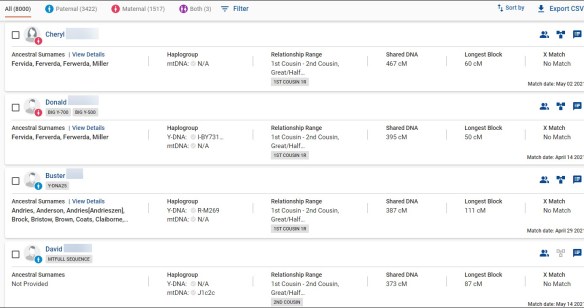
You can see at the top of my match list that I have a total of 8000 matches of which 3422 are paternal, 1517 are maternal and 3 match on both sides. Full siblings, their (and my) children and their descendants will always match on both sides. People with endogamy across both parents may have several matches on both sides.

If your relevant parent has tested, always work from their test.

Because we are searching for the maternal grandfather, in this case, we can ignore all tests that are bucketed as paternal matches.

Given that we are searching for my maternal grandfather, I probably have not been able to link as many maternal matches, other than possibly ones from my maternal grandmother. This means that the maternal grandfather’s matches are not bucketed because there are no identified matches to link on that side of my tree.

If you sort by maternal and paternal tabs, you’ll miss people who aren’t bucketed, meaning they have no maternal or paternal icon, so I recommend simply scanning down the list and processing maternal matches and non-bucketed matches.

By being able to confidently ignore paternally bucketed matches and only processing maternal and non-assigned matches, this is equivalent to processing the first 48 total matches. If I were to only look at the first 15 matches, 12 were paternal and only 3 are maternal.

Using bucketing at FamilyTreeDNA is very efficient and saves a lot of work.

Omitting paternal matches also means we are including smaller matches which could potentially be from common ancestors further back in the tree. Or, they could be younger testers. Or simply smaller by the randomness of recombination.

FamilyTreeDNA is a goldmine, with 16 of 20 maternal matches being from the unknown maternal grandfather.

Next, let’s see what’s waiting at MyHeritage.

MyHeritage

MyHeritage is particularly useful if your lineage happens to be from Europe. Of course, if you’re searching for an unknown person, you probably have no idea where they or their ancestors are from. Two of my best matches first appeared at MyHeritage.

Of course, your matches with people who descend from your unknown maternal grandfather won’t have any Theories of Family Relativity, as that tool is based on BOTH a DNA match plus a tree or document match. However, Theories is wonderful to group your matches to your other three grandparents.

MyHeritage provides a great deal of information for each match, including common surnames with your tree. If you recognize the surnames (and shared matches) as paternal or maternal, then you can assign the match. However, the matches you’re most interested in are the highest matches without any surnames in common with you – which likely point to the missing maternal grandfather.

However, those people may, and probably do, have surnames in common with each other.

Of the matches who aren’t attributed to the other three grandparents, the name Ferverda arises again and again. So does Miller, which suggests the grandparent or great-grandparent couple may well be Ferverda/Miller.

Let’s continue working through the process with our spreadsheet and see what we can discover about those surnames.

Our 60 Results

Of the 60 total results, 15 from each vendor, a total of 24 cannot be assigned to other columns through bucketing or shared matches, so are associated with the maternal grandfather. Of course, Michael who descends from both of my maternal grandparents won’t be helpful initially.

Cheryl, Donald and Michael are duplicates at different vendors, but the rest are not.

Of the relevant matches, the majority, 12 are from FamilyTreeDNA, four each are from Ancestry and MyHeritage, and three are from 23andMe.

Of the names provided in the surname fields of matches, in matches’ trees in the first few generations, and the testers’ surnames, Ferverda is repeated 12 times, for 50% of the time. Miller is repeated 9 times, so it’s likely that either of those are the missing grandfather’s surname. Of course, if we had Y-DNA, we’d know the answer to that immediately.

Comparing trees of my matches, we find John Ferverda as the common ancestor between two different matches. John is the son of Hiram Ferverda and Eva Miller who are found in several trees.

That’s a great hint. But is this the breakthrough I need?

What’s Next?

The next step is to look for connections between the maternal grandmother, Edith Lore, who is known in our example, and a Ferverda male. He is probably one of the sons of Hiram Ferverda and Eva Miller. Do they lived in the same area? In close proximity? Do they attend the same church or school? Are they neighbors or live close to the family or some of their relatives? Does she have connections with Ferverda family members? We are narrowing in.

Some of Hiram and Eva’s sons might be able to be eliminated based on age or other factors, or at least be less likely candidates. Any of their children who had moved out of state when the child was conceived would be less likely candidates. Age would be a factor, as would opportunity.

Target testing of the Ferverda sons’ children, or the descendants of their children would (probably) be able to pinpoint which of their sons is more closely related to me (or my mother) than the rest.

In our case, indeed, John Ferverda is the son we are searching for and his descendant, Michael is the highest match on the list. Cheryl and Donald descend from John’s brother, which eliminates him as a candidate. Another tester descends from a third Ferverda son, which eliminates that son as well.

Michael, my actual first cousin with a 755 cM match at one vendor, and 822 cM at a second vendor, is shown by the MyHeritage cM Explainer with an 88% probability that he is my first cousin.

However, when I’m trying to identify the maternal grandfather, which is half of that couple, I need to focus one generation further back in time to eliminate other candidates.

The second and third closest matches are both Donald at 395 cM and Cheryl at 467 cM who also share the same Ferverda/Miller lineage and are the children of my maternal grandfather’s brother.

On the spreadsheet, I need to look at the trees of people who have both Ferverda and Miller, which brought me to both Cheryl and Donald, then Michael, which allowed me to identify John Ferverda, unquestionably, as my grandfather based on the cM match amounts.

Cheryl and Donald, who are confirmed full siblings, and my mother either have to be first cousins, or half siblings. Their match with mother is NOT in the half-sibling range for one sibling, and on the lower edge with the other. Mother also matches Michael as a nephew, not more distantly as she would if he were a first cousin once removed (1C1R) instead of a nephew.

Evaluating these matches combined confirms that my maternal grandfather is indeed John Ferverda.

What About X DNA?

The X chromosome has a unique inheritance path which is sometimes helpful in this circumstance, especially to males.

Women inherit an X chromosome from both parents, but males inherit an X chromosome from ONLY their mother. A male inherits a Y chromosome from his father which is what makes him male. Women inherit two X chromosomes, one from each parent, and no Y, which is what makes them female.

Therefore, if you are a male and are struggling with which side of your tree matches are associated with, the X chromosome may be of help.

Your mother passed her X chromosome to you, which could be:

  • Her entire maternal X, meaning your maternal grandmother’s X chromosome
  • Her entire paternal X, meaning your maternal grandfather’s X chromosome (which descends from his mother)
  • Some combination of your maternal grandmother and maternal grandfather’s chromosomes

One thing we know positively is that a male’s X matches are ALWAYS from their maternal side only, so that should help when dividing a male’s matches maternally or paternally. Note – be aware of potential pedigree collapse, endogamy and identical-by-chance matches if it looks like a male has a X match on his father’s side.

Unfortunately, the X chromosome cannot assist females in the same way, because females inherit an X from both parents. Therefore, they can match people in the same was as a male, but also in additional ways.

  • Females will match their paternal grandmother on her entire X chromosome, and will match one or both of their maternal grandparents on the X chromosome.
  • Females will NEVER match their paternal grandfather’s X chromosome because their father did not inherit an X chromosome from his father.
  • Males will match one or both of their maternal grandparents on their X chromosome.
  • Males will NEVER match their paternal grandparents, because males do not receive an X chromosome from their father.

The usefulness of X DNA matching depends on the inheritance path of both the tester AND their match.

When Can Y-DNA or Mitochondrial DNA Help with Grandparent Identification?

If you recall, I selected the maternal grandfather as the person to seek because no tester carries either the Y-DNA or mitochondrial DNA of their maternal grandfather. In other words, this was the most difficult identification, meaning that any of the other three grandparents would be, or at least could be, easier with the benefit of Y-DNA and/or mitochondrial DNA testing.

In addition to matching, both Y-DNA and mitochondrial DNA will provide testers with location origins, both continental and often much more specific locations based on where other testers and matches are from.

Y-DNA often provides a surname.

Let’s see how these tests, matches and results can assist us.

  • Paternal grandfather – If I was a male descended from John Ferverda paternally, I could have tested both my autosomal DNA PLUS my Y-DNA, which would have immediately revealed the Ferverda surname via Y-DNA. Two Ferverda men are shown in the Ferverda surname DNA project, above.

That revelation would have confirmed the Ferverda surname when combined with the high frequency of Ferverda found among autosomal matches on the spreadsheet.

  • Maternal grandmother – If we were searching for a maternal grandmother, both the male and female sibling testers (as shown in the pedigree chart) would have her mitochondrial DNA which could provide matches to relevant descendants. Mitochondrial DNA at both FamilyTreeDNA and 23andMe could also eliminate anyone who does not match on a common haplogroup, when comparing 23andMe results to 23andMe results, and FamilyTreeDNA to FamilyTreeDNA results at the same level.

At 23andMe, only base level haplogroups are provided, but they are enough to rule out a direct matrilineal line ancestor.

At FamilyTreeDNA, the earlier HVR1 and HVR2 tests provide base level haplogroups, while full sequence testing provides granular, specific haplogroups. Full sequence is the recommended testing level.

  • Paternal grandmother – If we were searching for a paternal grandmother, testers would, of course, need either their father to test his mitochondrial DNA, or for one of his siblings to test which could be used in the same way as described for maternal grandmother matching.

Summary

Successfully identifying a grandparent is dependent on many factors. Before you make that identification, it’s very difficult to know which are more or less important.

For example, if the grandparent is from a part of the world with few testers, you will have far fewer matches, potentially, than other lines from more highly tested regions. In my case, two of my four grandparents’ families, including Ferverda, immigrated in the 1850s, so they had fewer matches than families that have been producing large families in the US for generations.

Endogamy may be a factor.

Family size in past and current generations may be a factor.

Simple luck may be a factor.

Therefore, it’s always wise to test your DNA, and that of your parents and close relatives if possible, and upload to all of the autosomal databases. Then construct an analysis plan based on:

  • How you descend from the grandparent in question, meaning do you carry their X DNA, Y-DNA or mitochondrial DNA.
  • Who else is available to test their autosomal DNA to assist with shared matches and the process of elimination.
  • Who else is available to test for Y-DNA and/or mitochondrial DNA of the ancestor in question.

If you don’t find the answer initially, schedule a revisit of your matches periodically and update your spreadsheet. Sometimes DNA and genealogy is a waiting same.

Just remember, luck always favors the prepared!

Resources

You may find the following resource articles beneficial in addition to the links provided throughout this article.

_____________________________________________________________

Follow DNAexplain on Facebook, here or follow me on Twitter, here.

Share the Love!

You’re always welcome to forward articles or links to friends and share on social media.

If you haven’t already subscribed (it’s free,) you can receive an email whenever I publish by clicking the “follow” button on the main blog page, here.

You Can Help Keep This Blog Free

I receive a small contribution when you click on some of the links to vendors in my articles. This does NOT increase the price you pay but helps me to keep the lights on and this informational blog free for everyone. Please click on the links in the articles or to the vendors below if you are purchasing products or DNA testing.

Thank you so much.

DNA Purchases and Free Uploads

Genealogy Products and Services

My Book

Genealogy Books

Genealogy Research

Who is Peter Johnson’s Ancestor – Peter Jochimsson (Yocum) or Mathias Jönsson alias Hutt? Or Neither? – 52 Ancestors #391

Peter Johnson (c1720-1790) is making me crazy. To refresh your memory, Peter’s early life, including his parents, are shrouded in mystery. I wrote about him here and here. My ancestor is Dorcas Johnson who married Jacob Dobkins. I strongly believe Dorcas to be Peter Johnson’s daughter, for a myriad of reasons, supported by evidence of various types, including paper-trail and genetic, but I’m still seeking that elusive nail in the coffin – pardon the pun. I wrote about Dorcas here and here.

I’m comfortable with assigning Peter Johnson as Dorcas’s father, although I’d love just one conclusive piece of proof. However, Peter’s parents are another matter entirely and one very tough nut.

I’ve been digging like a dog with a bone, and so far, I’ve unearthed conflicting evidence. So now I have two bones and no idea which one is accurate. Wasn’t counting on that – but it sure makes for an interesting article!

I did, however, discover an absolutely WONDERFUL book in Salt Lake City recently. My husband scanned the entire book for me. Let’s start with the 1693 Census of the Swedes on the Delaware.

1693 Census of the Swedes on the Delaware

According to the 1693 Census of the Swedes on the Delaware authored in 1993 and published by Peter Stebbins Craig, J.D., between 1637 and 1655, Sweden equipped thirteen passenger voyages for the South Delaware River, with about 800 prospective settlers. Eleven ships with 600 passengers actually arrived.

The first ship deposited 24 men at Fort Christina, now Wilmington, Delaware. The second and third expeditions brought families. In 1644, Sweden and Denmark were at war, so immigration was suspended until 1647.

In 1651, the Dutch erected a fortified town and fort Casimir at present day New Castle, and the Swedes were disgusted. Several returned to Sweden and others left for neighboring Maryland.

In 1653, 22 Swedes presented a petition to the Swedish Governor Johan Printz, complaining of his aristocratic rule. One Peeter Jochim and one Claes Johansson were among the petitioners. The descendants of Claes, according to Peter Craig, use the Johnson surname in Pennsylvania, and Classon in Delaware and Maryland. Nothing confusing here!

Printz accused the petitioners of mutiny and returned in a huff to Sweden, but a new governor was soon dispatched, along with more settlers. Sailing into the Delaware River, the new Governor, Johan Rising, demanded that the Dutch Fort Casimir surrender – which it did because it had no gunpowder.

The Dutch at Fort Trinity (Fort Casimir, now New Castle) returned north to New Netherlands, but more Swedes moved to Maryland. You can read about Fort Trinity/Fort Casimir archaeology excavations, here.

Craig estimates that about 300 people, including wives and children, remained in New Sweden in 1655 when the Dutch governor Peter Stuyvesant sailed up the Delaware with 7 armed ships and 317 soldiers. The 50 Swedish solders were divided between two fortresses. Both Fort Trinity and Fort Christina (now Wilmington) surrendered on September 15, 1655. You can see a reconstructed Swedish village, here.

At this point, a few Swedes returned to the old country, but most remained, influenced strongly by Peter Stuyvesant’s conciliatory attitude. In a surprise move, he offered to return the colony to Governor Rising, but would retain Fort Casimir (New Castle). Governor Rising declined and left, but Stuyvesant made the same offer to the remaining settlers, offering them the opportunity to govern themselves by a court of their own choosing, continue their religion, have their own militia, continue trading with the Indians and retain their land. In return, they had to pledge loyalty to New Netherlands and Stuyvesant reserved the right to approve their officers. That seemed like a pretty good deal, all things considered, so the Swedes accepted, although they remained stubbornly independent.

Another voyage was already underway though, and in March of 1656, an additional 106 people arrived from the province of Varmland, Sweden, sailing out of Gothenburg.

The new “Swedish Nation” was formed in August 1656, with two courts. One was “Upland,” north of New Castle, and the other functioned on the other side of the Cristina River. The Delaware River was the highway and transportation was primarily by dugout canoe, exactly like the Native people. Hunting was achieved using Native paths. Some farming was undertaken, but mostly, only enough to feed families.

By 1680, life was changing for the Swedish families along the Delaware and many Englishmen were settling in the region. In 1681, William Penn received his charter for Pennsylvania, quickly followed by 23 ships from England carrying his Quaker followers. The three “lower counties” of Pennsylvania were present-day Delaware. By 1682, no longer holding a majority, the Swedish courts were no longer in session.

Penn was very complimentary of the Swedes, said they were welcoming and helpful to the English, got along very well with the Native people, and “strong of body…they have fine children, and almost every house full; rare to find one of them without 3 or 4 boys and as many girls; some six, seven and eight sons.”

By this time, given that 40+ years had elapsed since the first Swedes settled in New Sweden, the third generation was beginning – grandchildren of those original settlers were being born.

One of their English neighbors described the Swedes as ingenious, speaking English, Swedish, Finnish, Dutch and Indian. He described their efficiency, stating that one man could cut down a tree, two would quickly rend the tree into planks using only an ax and wooden wedges. No iron. The women spun linen and wove it into clothe and then made clothes. Swedish families ate rye instead of white bread.

The Swedes introduced log cabins to the colony – structures that would sustain pioneers on the ever-westward-moving frontiers for centuries to come.

The Nothnagle cabin,above, in Gibbstown, NJ, built in 1638 (attached to a 1738 structure) is reputed to be the oldest house in New Jersey.

The cabin is a few miles downstream from present-day Philadelphia, across the river from Tinicum Island, about four miles northeast of Raccoon Creek. This is important because it tell us where Swedes were living at the early date.

After William Penn obtained his charter, he cultivated the friendship of the Swedes to help his English settlers. Among others, Peter Petersson Yocum served as an interpreter, assisting Penn when purchasing land from the Indians.

Unfortunately, the Swedes had already purchased this land, as attested to by depositions from 7 “Antient Swedes” stating that they had purchased and occupied that land since 1638. Eventually, the Swedes provided Penn with the land that would become Philadelphia.

Given that Finland was part of Sweden at this time, no differentiation was made between Swedes and Finns, and both were included. Craig says that if the term Finns was used, it was specifically referring to people who spoke primarily Finnish. People who spoke primarily Swedish were not called Finns. Spelling was not standardized, but neither was it for English. This seems to be a politically challenging time in Scandinavia and results in confusion when looking back and trying to unravel New Sweden’s settlers. Additionally, patronymics, followed by the gradual adoption of surnames make both history and genealogy exceedingly difficult.

In 1693, a “census” of the Swedes was taken, thankfully, and appended to a letter. In 1693, the Swedes were still living below the fall line. In later years, they would settle in tracts granted to them by Penn in Upper Merions Township in Montgomery County, PA and Manatawny, present day Amity Township in Berks County.

Some Swedes settled at Sahakitko, a trading center for the Susquehanna (Minquas) Indians located at the head of the Elk River, now Elkton, Maryland. These traders traveled extensively, hunting, trapping, moving among and trading with various Indian tribes.

Peter Craig spent his retirement visiting these locations, along with archives and universities in Sweden and Finland, ferreting out information about these families. To him, we owe a massive debt of gratitude, because without his work we would be left with only shreds to try to reweave back into a piece of whole cloth. I’ll spare you the details about the mistakes with early 1693 census publications, but suffice it to say that Craig located and reassembled the information. The order of recording is important as well and provided information about where the families lived. The area was called “New Sweden in Pennsylvania on the Delaware River” and in 1693, the number of people in each household was recorded.

By 1693, not everyone was Swedish or Finnish. Dutch, English and German immigrants had intermarried with the Swedish colonists. Conversely, some of the Swedes were found in Maryland and no longer associated with the Swedish churches. Both of the Swedish churches were without pastors and had requested replacements. A 1697 list of parishioners includes people not listed in 1693 and a population estimate of about 1200.

The total 1693 census was 972 individuals, and within the Swedes community, our Peter Johnson’s ancestor is found – someplace.

Peter Craig listed the Swedes along with the number of souls shown in the census, but due to the changing nature of patronymics, it’s very difficult, without additional information to move further than this.

Thankfully, in the remainder of the book, Craig fleshed out each family, as best he could based on documents retrieved from many locations.

By now, you’re probably wondering why I’ve provided all this background.

Peter Johnson (c1720-1790)

I wrote about “my” Peter Johnson, here and here. We know some things, unquestionably, about Peter Johnson (c1720-1790.)

There is absolutely NO question that Peter Johnson’s descendants are related to the descendants of BOTH Jacob Dobkins who married Dorcas (Darkus) Johnson and Evan Dobkins who married Margaret Johnson.

Three distinct types of genetic evidence come into play.

Genetic Evidence

The mitochondrial DNA descendants of both Dorcas Johnson and Margaret Johnson match each other, confirming that they indeed descend from a common maternal ancestor. Mitochondrial DNA can’t prove actual parentage, but it can certainly rule it out. An exact match is strong evidence. Multiple pieces of evidence point to Darcus/Dorcas and Margaret being sisters. I wrote about this family and their challenges, here.

Even stronger evidence would be to find a mitochondrial DNA descendant of Peter Johnson’s wife, reportedly Mary Polly Philips, through another daughter, descending through all females to the current generation which can be male or female. If the descendant of Mary’s other daughter through all females to the current generation, which can be male, matches both Dorcas and Margaret’s descendants’ mitochondrial DNA, we’ve added another very important piece of evidence that Dorcas and Margaret are daughters of Peter Johnson and his wife. I’m offering a fully paid DNA testing scholarship for a qualifying person.

Using autosomal DNA, descendants of Peter Johnson through multiple other children match dozens of people descended from both Dobkins/Johnson couples.

Click to enlarge

Here’s one example using Ancestry’s ThruLines. How could I match descendants of six of Peter’s other children if I wasn’t descended through Peter or his ancestral line? By ancestral line, I mean that this same phenomenon could happen if I was descended from, say, Peter’s sibling.

Let’s look at another example from the perspective of someone descended from one of Peter Johnson’s other children.

Click to enlarge

This confirmed descendant of Peter Johnson through son James matches several descendants through Peter’s other children, plus 4 through Dorcas Johnson and Jacob Dobkins, plus 21 through Margaret Johnson and Evan Dobkins. How could this person who is descended through Peter’s son James match 25 people descended through Dorcas and Margaret who married the Dobkins boys if Dorcas and Margaret weren’t Peter’s daughters or blood relatives?

Jacob Dobkins and Evan Dobkins are confirmed brothers through John Dobkins and wife Elizabeth, and Dorcas Johnson and Margaret Johnson are believed to be sisters. The Bible of Peter Johnson’s son, Solomon, records two of his sisters marrying Dobkins men. It’s important to note that this record comes from descendants of Peter, through another branch of Peter Johnson’s family, and not from descendants of those two Dobkins/Johnson couples.

A third piece of genetic evidence is the Y-DNA of Peter Johnson.

Several men who descend from Peter and other Johnson males have tested and match each other, including three Big Y-700 testers.

I’ve spent an incredible amount of time recently evaluating Y-DNA and autosomal DNA matches, from tests taken by both Johnson and Yokum testers, or similarly spelled surnames. Some men have completely different Y-DNA, but claim to descend from the same lines. Clearly, we have conflicting evidence to resolve.

Another piece of information of which I’m confident is that our Peter Johnson’s ancestors were indeed Swedish, and I agree with Eric and other Johnson researchers who believe Peter descended from one of the founders of the early Swedish Colony along the Delaware River in the 1600s. Now you know exactly why I’ve shared this information from Peter Craig’s book.

Before we review additional DNA information, I’d like to continue with information about both the Johnson and Yocum lines, extracted from Peter’s comprehensive book. I’ve provided map locations which will aid with locations and proximity.

Peter Petersson Yocum

Page 25-26: Peter Yocum was a member of the Wicaco church when on the last day of May in 1693, 26 members of the Swedish congregation gathered at the log church to sign the letter to Sweden requesting new ministers.

The church faced the Delaware River at the present location of Gloria Dei (Old Swedes) Church in Philadelphia and had originally been built in 1677 to serve the Swedes living above the Schuylkill River, with the 1646 church at Tinicum Island continuing to serve members located between the Schuylkill and Marcus Hook.

When Tinicum Island passed out of Swedish ownership in 1683, the church at Tinicum was abandoned. By 1693, the Wicaco congregation embraced 102 Swedish households extending from Neshaminy Creek in Bucks County to Marcus Hook, on the Pennsylvania side of the Delaware, and from Pennsauken Creek in Burlington County to the southern boundary of Gloucester County (Oldmans Creek) on the New Jersey side of the river.

Identification of the 554 Swedish church members living within this area is facilitated by the fact that in 1697 the new Wicaco minister, Andreas Rudman, made a house-by-house enumeration of his congregation, which was later copied and preserved. This chapter focused on the first 37 Wicaco households listed in the 1693 census. The household’s location is shown as evidenced by contemporary land records. Additionally, the value or size of each property is shown in pounds or acres as reported in contemporary tax records.

Page 43, person #35* – Peter Petersson Yocum (Aronameck, 100 pounds): Peter was born in New Sweden about 1652. His father, a soldier named Peter Jochimsson from Schlesvig in Holsstein, had arrived in New Sweden on the Swan in 1643 and became a freeman on November 1, 1652. He was one of the 22 freemen signing the 1653 complaint against Governor Printz. In the summer of 1654, Governor Rising chose him to go to New Amsterdam (now Manhattan in New York City) on a diplomatic and spying mission to deliver a letter. Peter Jochimsson died there. Thereafter, his widow, aged 20 with 2 children at his death, known in 1693 as Ella Steelman, (#54), married Hans Mansson who raised Peter Petersson as his own son. Peter Petersson who adopted the surname Jochim (Yocum) about 1675 married Judith, daughter of Jonas Nilsson (322), and had seven children by May of 1693: Peter born 1677, Mans born 1678, Catharine born 1681, Charles born 1682, Sven born 1685, Julia born 1687, and Jonas born in 1689. Peter Petersson Yocum who had been prominent as an Indian trader and as an Indian interpreter for William Penn died in 1702. His widow thereafter moved with her younger sons to Manatawny (Berks County) where she died in 1727. Their descendants used the surname of Yocum or Yocom.

Craig provides the following footnote: Subsequent children: Anders (Craig’s ancestor) born 1693, John born 1696 and Maria. For additional references to Peter’s father, Peter Jochimson, see Huygen, 63, MGB 23, 78; Rising 93, 107, 111, 112, 163, 165, 183, 195. Peter Jochimsson also had a daughter, Elisabeth born about 1654 who married an English soldier, John Ogle. Yocum, 270, n24; Stille, 147-149.

*Please note that Craig’s numbers, such as #35, reference their position on the 1693 census. Peter is recorded as “Petter Yocomb – 9” meaning 9 people in the family as of that date.

Mathias Hutt Jönsson

Raccoon Creek is about two miles north of Oldmans Creek, shown at the top of the map below.

Mathias Jönsson alias Hutt, living someplace on or near Salem Creek in New Jersey (upper red arrow,) fell under the Crane Hook Congregation across the river on the Pennsylvania side in what is now Wilmington.

Click to enlarge

His son, Oliver, and possibly other sons would eventually live in the Indian trading village of Sahakitko at Head of Elk, now Elkton, Maryland.

Craig tells us that the migration of families from New Castle County across the Delaware River to Penn’s Neck in Salem County began in 1671. By the time of the 1693 census, the Crane Hook Church counted 130 members living on “the other side” of the Delaware.

Penn’s Neck was bounded by the Delaware River on the west and extended from Oldmans Creek on the north to Salem Creek on the south. The eastern boundary was also Salem Creek to its northern bend, then extending overland northeast to Oldman’s Creek. It derived its name from the fact that William Penn, proprietor of Pennsylvania, also acquired proprietorship of this area in 1683 from its first English claimant, John Fenwick. The church census identifies the households in Penn’s Neck beginning at its northernmost settlement.

Page 104, footnote 58 on Olle Thomasson #113 – partially reads: On August 25, 1685, “Wooley Thomason of Pennsylvania” (which then included Delaware,) and Wooley Peterson of Boughttown (#80) were named co-administrators of the estate of “Matthias Unson” of Salem Creek in Penn’s Neck. NJA, 23:474. The deceased whose full name was Matthias Jönsson alias Hutt, directed that his son Michael should live with Wooley Thompson. Salem Co. wills, 2:16-17, NJA 23:474; 1730 accounting by William Peterson, surviving executor, Salem County probate records 503Q, NJA, 23:263-64.

This next portion loops in another Jönsson family and is confusing. I apologize in advance.

The Jönsson or Halton Family – The probable progenitor of the Halton family was Jons Jönsson, a Finn from Letstigen, Varmland, who was listed in October 1655 as about to go to New Sweden on the Mercurius with his wife and 6 children. Later records disclose the presence of Olle, Peter and Mans Jönsson whose patronymic was later replaced by Halton. Along with Nils Larsson France (see #85), Olle Rawson (#135) and their associated, Olle Jönsson (also known as “Carringa Olle”) was licensed by the New Jersey governor in 1668 to buy Indian lands on the east side of the Delaware River. The subsequent purchase agreement, executed Nov. 15, 1676, conveyed the lands to Hans Hoffman and Peter Jönsson. In 1684, Peter Jönsson moved to Penn’s Neck, Salen County, dying in 1692. He called himself Peter Halton in his will, naming his wife as Mary and his children as Frederick, Andrew and Brita.

Page 79 #78 – Lasse Halton (Raccoon Creek, 100 acres): Born about 1668, Lasse Halton was the eldest son of Olle Jönsson (“Carringa Olle”) and in 1693 was probably residing with his brother Hans and Carl Halton. Lasse later married a daughter of Matthias Jönsson of Penn’s Neck. The names of their children, if any, are uncertain. He moved to Piles Grove, Salem County, around 1707, after selling his Raccoon Creek Plantation to his brother Hans.

The 100 acres occupied by Lasse Halton was taxed to his mother, “Madlen Janson” in 1687. Her name was replaced with his on the 1690 and 1694 tax lists.

The final accounting of the estate of Matthias Jönsson, filed in 1730, showed a payment to Lausy Halton for his wife’s filial portion NJA, 21:263-264. He had picked out his grave site at Raccoon church in 1724. RPN, 27.

Carl (Charles) Halton married Maria, daughter of Matthias Jönsson (NJA, 23:263-64) and following her death, Gunnilla Fransson. Charles Halton died at Penn’s Neck in 1738.

Page 148, #173 Anders Anderson Weinam (150 aces): (The first portion regarding his name omitted.)

It is uncertain whether Anders Andersson Weinam was a son of a settler or New Sweden named Anders or whether he was among the 1663-1664 arrivals under Dutch rule. Anders was fined 50 guilders in the 1669 Long Finn Rebellion. By 1677 he had moved to Crane Hook. In 1679, he joined Matthias Jönsson, Lars Corneliusson (see #174-75) and widow Annika Hendricks (see #176) in obtaining the original 600 acre grant at Chestnut Neck between Parting Creek and Bastowe (sauna) Creek. In 1690 Nicholas Philpot purchased 50 acres from Anders Andersson’s original 150 acres. Meanwhile, in partnership with Peter Bilderback, Anderson acquired a nearby tract of 100 acres from William Penn. In 1697 Anders Weinam pledged 18 shillings for the new church at Christina and in 1699 both Anders Vinam and his wife were assigned pews at Holy Trinity. The will of Anders Andersson of Penn’s Neck, dated July 9, 1719, gave his entire estate to his wife Anna. Her will, proved the following year, made her brother Henery Boasman (Hendrick Batsman), sold heir, which identifies her as the daughter of Joran Joransson Batsman (see #151.) She and Anders had no children. Their household of four probably included two of the children of Matthias Jönsson Hutt.

Matthias Jönsson alias Hutt had been granted a patent for 100 acres at Feren Hook in 1669. Fined in 1675 in the dike rebellion, he remained at that location until 1679 when he moved to Chestnut Neck. When he died in 1685, he left nine orphan children. The two youngest of his sons, Eric and Eskil Jönsson or Johnson, also known as Erik and Eskil Hutton or Hotton, remained in Penn’s Neck and probably were members of Anders Andersson’s household in 1693.

Will – 1684-5 Feb. 14 – Unson, Mathias, of Castiana Neck on Fenwick’s River alias Salem Greek, Salem Tenth, planter; will of. Gives real and personal estate to his nine children, of whom only the following names are given; Woola Matheson, who is to live with Lause Powleson, Michael, the third son, to live with Wooley Thompson, the fourth son, Erick, to live with Andrea Anderson. Witnesses – Peeter Billderbeck and William Wilkinson. Proved August 11, 1685

1730 <no date> – Johnson, Mathias, of Pen’s Neck, Salem Co., yeoman. Account of the estate of £75.9, by the surviving executor, William Peterson, who has paid to Lausey Halton £8.5 in full of his wife’s filial portion, to Mary, wife of Chas. Halton £6 as her portion, to Samuel Walcott and wife Katharine £8.5, the filial portion of Erick Johnson, said Katherine’s former husband, to Oliver Johnson £6.3, to Eskell Johnson £6.3, to Michael Johnson £4.17.6, to Henry Johnson £6.3, Margaret Johnson £6.3, all filial portions. [No will on record or on file.]

Footnote 46 – DYR, 137, NYHM, 20:22; 21:104; NCR, 1:160, 163; NJA, 21:544, 568, 574; will of Matthis Unson of Castiana Neck on Salem Creek, dated Feb 14, 1684/5 and proved May 11 1685, Salem County wills, 2:16, and final accounting of estate of Matthias Johnson by William Peterson, surviving executor, filed 1730, Salem County wills, 503-Q. The eldest son, Olle, later known as Oliver, was to stay with Lars Palsson Kampe (#147), Henrick with Lars’ father Pal Larsson and Michael with Olle Thompson (#113). They all died at Sahakitko (Elkton), Cecil County. See, e.g., MCW, 7:219. Eric was to live with Anders Andersson and Eskil was unassigned. Eric and Eskil Hutton or Hotten both pledged money and contributed labor for the building of Holy Trinity Church and were assigned pews in that church in 1699. Eric as Eric Jansson or Johnson married Catharine Gillijohnson and died at Penn’s Neck in 1719. Eskil as Ezekiel Jansson or Johnson worked on the glebe house for Penn’s Neck church in 1721 and died intestate in Penn’s Neck in 1726. According to the accounting, one daughter married Lars Halton (#78), another, Maria, married Lars Halton’s brother Charles Halton. A third was named Margaret Johnson in the account. The fourth, Catherine Johnson and her newborn child were maintained by Olle (William) Peterson of Gloucester County (#80) for 13 months.

Information for Lars Palsson Kampe (#147) (Sahakitko): This man’s father, Pal Larsson had been granted a patent at Feren Hook in 1668, was fined 100 guilders in the 1669 Long Finn Rebellion and 20 guilders in the 1675 dike rebellion. The will of Paul Larson dated March 7, 1685, witnessed by Olle Palsson and Eskil Andersson, left his “house and lands whereon I now live” to his wife Magdalena for life, then to his daughters – unnamed. He left to his sons Lawrence and Matthias “my land which is now in Elk River, which is 200 acres,” with directions that Lawrence keep and maintain Matthias. On October 20, 1685, Paul sold his 200-acre home plantation at Feren Hook to Justa Andersson and apparently moved to Elk River, Cecil County where his will was proved June 3, 1692. His eldest son, Lars Palsson chose the surname Kampe, warrior in Swedish, as illustrated in this census. In 1693 his household included his wife (name unknown,) their first children and perhaps his brother Matthias. Lars had three children who later moved to Gloucester County: John, Paul and Brigitta Kampe, also written as Camp.

These families were neighbors and eventually, related. Their lives were intertwined and the survival of the colony depended on the cooperation of many.

In Peter Stebbins Craig’s book, 1671 Census of the Delaware, he states that Feren Hook, meaning Pink Hook, appears to have been settled in 1663 by Swedes and Finns arriving from Sweden via Christiania (now Oslo,) Norway, and Amsterdam in the time of d’Hinojossa. Transcription here.

The Quandary

Now, of course, the quandary.

My Johnson cousins Y-DNA matches a few other Johnson men and one Yocum male.

The Yokum male shows his ancestor as Peter Jochimsson born in 1620 and died in 1702. That, of course would be the father of Peter Petersson Yocum.

At first glance, this looks like a slam dunk, meaning our Johnson line is Yocum, descended from Peter Jochimsson, but it isn’t.

Eric Johnson, who is descended from “our” Peter Johnson who was born circa 1720 and died in 1790 in Allegheny County, PA, worked with Dr. Peter Craig before his death who provided Eric with information suggesting that our Peter Johnson is descended from Mathias Jönsson alias Hutt, through his son Oliver (Olle) who had son Peter in 1720 in Cecil County, MD, near Head of Elk, now Elkton.

I found a record in 1740 in Cecil County, MD for 3 Johnson men, Oliver, Simon and Peter, members of the foot company militia under the command of Capt. Zebulon Hollingsworth. Is this “our” Peter as a young man, or a different Peter. I don’t know.

Also in Cecil County, one Peter Johnson’s will is probated in 1747, and we know that our Peter had moved to the border of Pennsylvania and Maryland by 1742, near Hagerstown. Later deeds tie Peter in Allegheny County, PA to the Peter in Franklin Co., PA.

The records for Peter Johnson (c1720-1790) begin in April of 1742 when he obtained land in Lancaster County, PA, the portion that became Cumberland County in 1750, then Franklin County in 1784. If he was born in 1720, he would only have been 22 at the time, which isn’t impossible but young based on the customs of the time. This land was actually on or very near the Maryland/Pennsylvania border, just above Frederick County, MD, close to Hagerstown.

Hence, the suggestion that our Peter Johnson descended from Elkton in Cecil County seems reasonable.

One thing is certain. Our Johnson and Yocum men DO share a common ancestor as confirmed by Big Y-700 DNA testing.

The question is, of course, whether the Yocum male has documentation confirming that he descends from Peter Jochimsson, the father of Peter Petersson Yocum (#35) or if that was an assumption by someone based on the Yocum surname? If not, what type of source information exists and is it conclusive and incontrovertible?

What are the Possibilities?

Unfortunately, we now have some contradictory evidence to resolve.

  • It’s possible that the Yocum male who matches our Johnson line very closely does have solid, confirmed genealogy descending from Peter Jochimsson. If that’s the case, can each successive generation be confirmed? How strong is the evidence?
  • If our Yocum male’s line can be confirmed, then our ancestor is also very likely Peter Jochimsson.

However, there’s a plot twist.

  • There’s another group of about 10 Yocum men who match each other, two of who claim to descend from Peter Jochimsson as well. These men do not match “our Yocum” male, nor do they match any Johnsons. Their haplogroup is in an entirely different branch of the tree.

These groups of men cannot BOTH be directly paternally descended from Peter Jochimsson.

  • It’s possible that our Johnson/Yokum line is indeed descended from Mathias Jönsson alias Hutt. If that’s the case, then someplace, Jönsson became Yokum several generations back in time for at least one male whose descendant tested today, while the rest remained or became Johnson/Johnston.
  • Its not possible for our Johnson line to descend from Mathias Jönsson/Hutt and the Yokum man who matches the Johnson Y-DNA to descend from Peter Jochimsson, unless of course these ancestral men were closely related to each other, sharing a common paternal ancestor.

Peter Jochimsson and Mathias Jönsson/Hutt sharing a common paternal ancestor is certainly not impossible, but in New Sweden, they don’t live very close to each other. Initially, they were about 40 miles distant. So, if they were related, it’s either in the first generation or two, before 1702, or reaches back to the old country. However, that isn’t what the Y-DNA suggests.

Craig says that Mathias Jochimsson came from Schlesvig in Holsstein, the northern portion of Germany that abuts Denmark, and the settlers in Feren Hook were from near Oslo. Of course, that’s not absolute given that Craig never found a specific origin for Mathias Jönsson/Hutt.

We also don’t know when Mathias Johnsson/Hutt arrived, or where he came from. We know for sure a group of settlers arrived in 1656. According to Amandus Johnson in The Swedes on the Delaware 1638-1664, a final group of Finnish families from Sweden landed in Holland in 1664, en route for New Sweden, but it’s unclear whether they were allowed to proceed to the colonies. We know for sure that Mathias Jönsson/Hutt was in Feren Hook by 1669.

It’s worth noting that little is known about Peter Jochimsson, the original settler, aside from his one son, Peter Petersson Yocum and a daughter reported by Craig. He was either unmarried upon arrival and didn’t marry until he gained his freedom in 1652, or he had more children that died, or he had more children that we don’t know about. Craig reports his widow to have been 20 at his death, with two children which opens the possibility that she was a second wife.

It’s also worth noting that we have the other Otto Jönsson “Carringa Olle” who reportedly took the surname Halton. That line also contains a Peter.

The Y DNA

Two Johnson men and the Yocum tester have taken the Big Y-700 test which has a very distinct aging ability. They have the same haplogroup which is shown on the public Discover haplotree, here.

The most recent common ancestor of these men is estimated to have been born about 1750, which would be roughly the generation of our Peter Johnson who was born before 1720 and died in 1790. Given that we don’t know for sure who Peter’s father was, it’s very likely that our Peter Johnson (possibly the son of Oliver) had siblings and uncles, so Johnson becoming phonetically spelled Yocum or vice versa wouldn’t be the least bit surprising in that era, or in the generation(s) prior.

The confidence range and associated dates suggest that the common ancestor of these Johnson/Yokum men was born in New Sweden. If that is accurate, that means that both the Yocum and Johnson testers are either descended from one ancestor in New Sweden, meaning either Peter Jochimsson or Mathias Johnson alias Hutt (assuming the ancestor is one of those two men.) It likely removes the possibility that those two men were related in the old country, especially given that Craig identified Jochimsson’s origins in Schleswig-Holsstein and suggests that Mathias Jönsson/Hutt may have originated near Oslo.

It may be worth mentioning at this point that, according to the mitochondrial DNA matches of Dorcas Johnson and Margaret Johnson, the daughter of Peter Johnson and his wife, Mary Polly Phillips (if that was her name,) their closest matches are clustered in Finland.

That, of course, strongly suggests that Peter Johnson (c1720-1790) probably married the daughter of one of the settler families wherever he was living in the early 1740s when he would have been marrying.

Let’s hope we find that someone descended from another daughter of Peter Johnson and Mary Polly Philips, through all females to the current generation, which can be male or female, to take a mitochondrial DNA test. That match would solidify the relationship of Dorcas and Margaret to Peter Johnson and Mary.

Now, to determine Peter’s ancestors…

Research Activities

Recently, I extracted records for Maryland and Virginia Counties when I visited the FamilySearch Library in Salt Lake City. Why Maryland and Virginia? John Dobkins, the father of Jacob and Evan Dobkins is first found in the Monocacy Valley of Maryland before migrating in the early 1730s to what was at that time Frederick County, VA with Jost Hite, one of the early land speculators. Frederick County became Augusta and Dunmore, which eventually became Shenandoah County. John Dobkins lived in Dunmore which is where both Darcus Johnson married Jacob Dobkins and Margaret Johnson married Evan Dobkins in 1775. The Dobkins family is connected with (and probably related to) the Riley Moore family who was found in Prince George’s County, MD, adjacent to Cecil County. Frederick County, MD was once part of Prince George’s County, and Frederick County MD is where Peter Johnson (c1720-1790) is found owning land, on the border with Pennsylvania – Josh Hite’s stomping ground.

Frederick County, VA is chocked full of settlers from Cecil County, Prince George’s County and Frederick County, MD. Furthermore, many New Jersey Quakers moved to Frederick County, VA and established the Hopewell Meeting House. It would make sense that Peter Johnson’s family, perhaps him or maybe his siblings and uncles would make their way down that same path leading to land on the next frontier.

I was tracking Johnsons by the first names we’re familiar with, plus Isaac Johnson who is found associated with John Dobkins in Shenandoah County, VA, as was John Johnson. I found two other records for Isaac Johnson in Frederick County, one in 1751 as a witness to the will of Adam Warner, and one in 1769 as a legatee of Ralph Thompson who also had a son named Isaac. Additionally, there’s an Isaac Johnson in Cumberland County, PA but there’s nothing to suggest that these are the same man. John Johnson was a very common name and I ran out of time.

Somehow, Peter Johnson HAD to be in the Dunmore County neighborhood in 1775 for his two daughters to marry John Dobkins’ sons. There is no record of Peter in Dunmore County in 1775, but the existing records are incomplete. In 1778, Dunmore became Shenandoah.

Was Peter related to either Isaac or John Johnson who were associated with John Dobkins? I wish I had the answer to that. Two of one’s daughters did not marry two sons of a family you weren’t acquainted with, in a location where you weren’t living. Courting required proximity. Of course, the Revolutionary War was interfering with just about everything, so who knows why Peter Johnson might have been in Virginia in 1775. The county records are incomplete during this time, and the entire country was in an uproar.

Peter Johnson sold his land on the Pennsylvania/Maryland border in 1769 and 1770 although his adult son Richard (Derrick) remained in that location, at least for a while. Peter’s Brethren neighbors in Maryland moved to Holman Creek in Dunmore/Shenandoah County, directly adjacent John Dobkins, becoming his neighbors.

One Peter Johnson is found in Bedford County, PA in 1772, but it’s doubtful that this is the same man since he’s listed as a single freeman. Other than that, Peter’s entirely missing from 1773 when he’s found in Rostravener Township, PA, which is all of SW Pennsylvania, until 1783 when he’s found again in the same location. Part of Rostravener became Allegheny County in 1780, where Peter Johnson eventually settled and died a decade later.

In 1776, one Peter Johnson swears an oath of allegiance in Cumberland Co., PA, but our Peter had already left. Peter Johnson is not a terribly unusual name.

One of the earlier Johnson books states that Peter came from Winchester, VA which is found in Frederick Co., VA where there is an early mention of a Peter Johnson. In 1773, according to Eric Johnson, one Richard and Priscilla Johnson mention their son Peter in a deed, although that may well be a younger man. I do not have that record, nor know where they lived.

In other words, the very best clue we have as to where Peter Johnson was found in 1775 is where his two daughters were married to Dobkins men.

In addition to these recent research activities, I have a friend who has been helping me search for tidbits high and low. I’m still processing the information she has sent. Maybe there’s something more hidden there.

Followup

I’ve written to the matches of my Johnson cousins asking if they will share their genealogy, or at least as much as they know.

I’d surely love to see additional Johnson and Yokum men take Y-DNA tests, and those who match our line upgrade to the Big Y-700. Perhaps, between more refined time tree placement in addition to jointly working on genealogy and sharing resources, we can isolate one lineage and eliminate the other. That alone would be a victory!

I’m still chiseling at this brick wall, bit by bit!

_____________________________________________________________

Follow DNAexplain on Facebook, here or follow me on Twitter, here.

Share the Love!

You’re always welcome to forward articles or links to friends and share on social media.

If you haven’t already subscribed (it’s free,) you can receive an email whenever I publish by clicking the “follow” button on the main blog page, here.

You Can Help Keep This Blog Free

I receive a small contribution when you click on some of the links to vendors in my articles. This does NOT increase the price you pay but helps me to keep the lights on and this informational blog free for everyone. Please click on the links in the articles or to the vendors below if you are purchasing products or DNA testing.

Thank you so much.

DNA Purchases and Free Uploads

Genealogy Products and Services

My Book

Genealogy Books

Genealogy Research