
The first actual record we find of Antoine Gougeon is the 1671 Acadian census record, where he is enumerated in Port Royal, Acadia.

Click on any image to enlarge
The area included in Port Royal wasn’t just the town, but the fertile tidal marshes and communities all up and down la Rivière du Dauphin, today’s Annapolis River.

Antoine Gougeon is listed as a farmer, age 45, with his wife, Jeanne Chebrat, who is also 45, and their daughter Huguette, age 14. They have 20 cattle and 17 sheep on 10 arpents of land.
It’s difficult to determine exactly where the family was living, because listed next to them is Barbe Bajolet, a widow who had married Savien de Courpon in La Rochelle, France. He was a mariner and sea captain. We don’t know where Barbe lived in Port Royal, but it was probably in or near the actual town. She had some cattle and sheep, but no land.
Next to Barbe we find Michel Poirier, a bachelor, aged 20, son of the deceased Jehan Poirier, with 2 cattle, no sheep, and no cultivated land.
Michel Poirier is reported to be the son of Jeanne Chebrat, which would mean he’s Antoine’s stepson, but I’m not entirely convinced.

Next on the census is Daniel LeBlanc, the founder of the LeBlanc Village at Belle Isle. Now that’s a HUGE clue, because we know where Daniel lives – upriver at Belle Isle.

Pierre Commeau, an aged cooper, is listed on the other side of Antoine Gougeon. We know the Commeau family lives on the south side of the river, about 3 or 4 miles upriver from Port Royal, while Daniel LeBlanc lived 9 or 10 miles upriver on the north side of the river.
I’m not convinced that the 1671 census is listed in house-by-house order, although some portions may be.
What Does the 1671 Census Tell Us?
The 1671 census tells us that both Antoine and Jeanne were born around 1626, before Isaac de Razilly brought the first Acadian settler families in 1632, so they were both born in France.
It also tells us that Antoine and Jeanne were married by about 1656, given that their daughter is listed as age 14, which puts her birth around 1657. In later census years, Huguette’s age was fairly consistently given with her birth year as 1655, so they were probably married about 1654ish.
Regardless, this census tells us that Antoine and Jeanne have been married at least 15 years.
It’s curious that they don’t have any other children. I would have expected additional children aged 12, 10, 8, 6, probably 4, and maybe 2.
We also know that Antoine was in Acadia before July of 1654 when the English attacked Port Royal and defeated the French. From 1654 until 1670, Acadia was in the possession of the English, and no French settlers arrived from France during that time.
Therefore, Antoine had to have already been in Acadia before then, and he wasn’t an unmarried soldier, or he would have been shipped back to France in 1654 when the fort and the rest of Acadia fell.
Port Royal Falls
Antoine may or may not have been married by July of 1654 when Puritan English Colonel Robert Sedgwick sailed into the river basin, below the fort at Port Royal. Planning to attack the Dutch at New York, his plans were foiled when peace was unexpectedly declared, so he decided to attack Acadia instead. Not only was he “all dressed up with no place to go,” as a merchant, he wanted to secure the fur trade and fishing resources for New England, and by proxy, England.
Sedgwick commanded some 750 soldiers who greatly outnumbered the 133 French soldiers quartered at the fort in Port Royal. Needless to say, Port Royal, and by extension, the rest of Acadia, was in an indefensible position.
The official Governor, Charles de La Tour, had surrendered at his own fort on the St. Jean River and was taken captive by Sedgwick. The garrison at Port Royal knew it.
Therefore, with their Governor already held captive, Emmanuel Le Borgne de Belle-Isle and Germain Doucet de la Verdure negotiated surrender terms.
Le Borgne was a wealthy and corrupt French merchant banker who was in Port Royal attempting to collect Charles d’Aulnay’s debts, then owed by Charles de La Tour following his 1653 marriage to d’Aulnay’s widow.
Doucet did the best he could under the circumstances, but he was sent back to France with the soldiers, while Le Borgne, who was believed to be treasonous and in cahoots with the English, negotiated extremely lucrative terms for himself. He was allowed to keep his ship that was filled with valuable alcohol, and all of his land. His sons were allowed to stay “as hostages” to watch over his property and business interests.
The surrender terms included that the Acadians’ property would remain in their possession and undamaged, but unfortunately, the English did not honor their promises. Port Royal was plundered and burned, including their beloved Catholic church.
Of course, we don’t know if Antoine had already married and might have been upriver working his land, or if he was in Port Royal.
If he was upriver, the English didn’t venture that far during their rampage, so he would have been discouraged and depressed, but safe.
Later that summer, English pirates visited again and killed whatever livestock was left. It was going to be a very rough winter.
What Else Do We Know About Acadia Around 1654?
Nicolas Denys, a French merchant and early Acadian settler was assaulted, chained and held captive at the fort in Port Royal in 1653 and 1654 by Le Borgne as a result of violent regional trade wars. During that time, he kept journals where he recorded that:
“There are numbers of meadows on both shores, and two islands which possess meadows, and which are 3 or 4 leagues from the fort in ascending. There is a great extent of meadows which the sea used to cover, and which the Sieur d’Aulnay had drained. It bears now fine and good wheat, and since the English have been masters of the country, the residents who were lodged near the fort have for the most part abandoned there houses and have gone to settle on the upper part of the river. They have made their clearings below and above this great meadow, which belongs at present to Madame de La Tour. There they have again drained other lands which bear wheat in much greater abundance than those which they cultivated round the fort, good though those were. All the inhabitants there are the ones whome Monsieur le Commandeur de Razilly had brought from France to La Have; since that time they have multiplied much at Port Royal, where they have a great number of cattle and swine.”
The “great meadow” is Belle Isle which was, in fact, owned by d’Aulnay’s widow, who was at that time Madame de La Tour.
Additionally, Denys estimated that there were about 270 residents in 1654, which would translate to maybe a total of 38 or 39 families if each family had an average of five children.
We know that between 1651 and 1654, Emmanuel Le Borgne (Jr.) granted land that had been dyked and drained at Belle Isle by Charles d’Aulnay before his untimely death in 1650.
We also know that in 1671, Antoine Gougeon was farming land, but until recently, we didn’t know when or how he acquired that land. Had it been granted to him, or perhaps to Jeanne Chebrat’s first husband, assuming she was the wife of Jehan Poirier?
Antoine Gougeon’s Land
In 1994, Stephen White prepared a “37 Families” document for the Acadian Congress, which was essentially a large family reunion where Acadian descendants from around the world reunited. Lucie LeBlanc Consentino, on her website, translated a portion of Stephen’s document, as follows:
The jointly-owned land mentioned below leads researchers to believe that there existed a bond of some kind between Antoine Gougeon and his son-in-law Guillaume Blanchard on one side of the family and with Daniel LeBlanc on the other. The nature of the connection is unknown.
When I wrote the article about Guillaume Blanchard and tallied his land, it appeared that he might have wound up with the land that Antoine was farming.
But White provides another tidbit, which I’ve reformatted according to his commentary here about the 1734 English Rent Roll records.
| First Grantees | 1734 Present Possessors | |
| Land Tract 1 | Daniel LeBlanc and Guillaume Blanchard | John Prince (probably Jean LePrince) and Pierre Godet |
| Land Tract 2 | Daniel LeBlanc and Antoine Goujon pay one Den par Arpent | Guillaume Blanchard, Joseph LeBlanc and his brethren |
It’s worth noting that I don’t have access to those rent rolls and if we did, we might be able to extract additional valuable information.
Land Labeled as Tract 1
Land that I’ve labeled as Land Tract 1 was originally granted to Daniel LeBlanc (c1626-c1698) and Guillaume Blanchard (c1650-c1717), the father, not to be confused with Guillaume’s son by the same name.
Guillaume Blanchard’s wife, Huguette Gougeon, was the daughter of Antoine Gougeon and Jeanne Chebrat.

Guillaume Blanchard was the son of Jean Blanchard and Radegonde Lambert.
Daniel LeBlanc, whose parents are unknown, was married to Françoise Gaudet, the daughter of Jean Gaudet (c1575-after 1671) and an unknown mother.

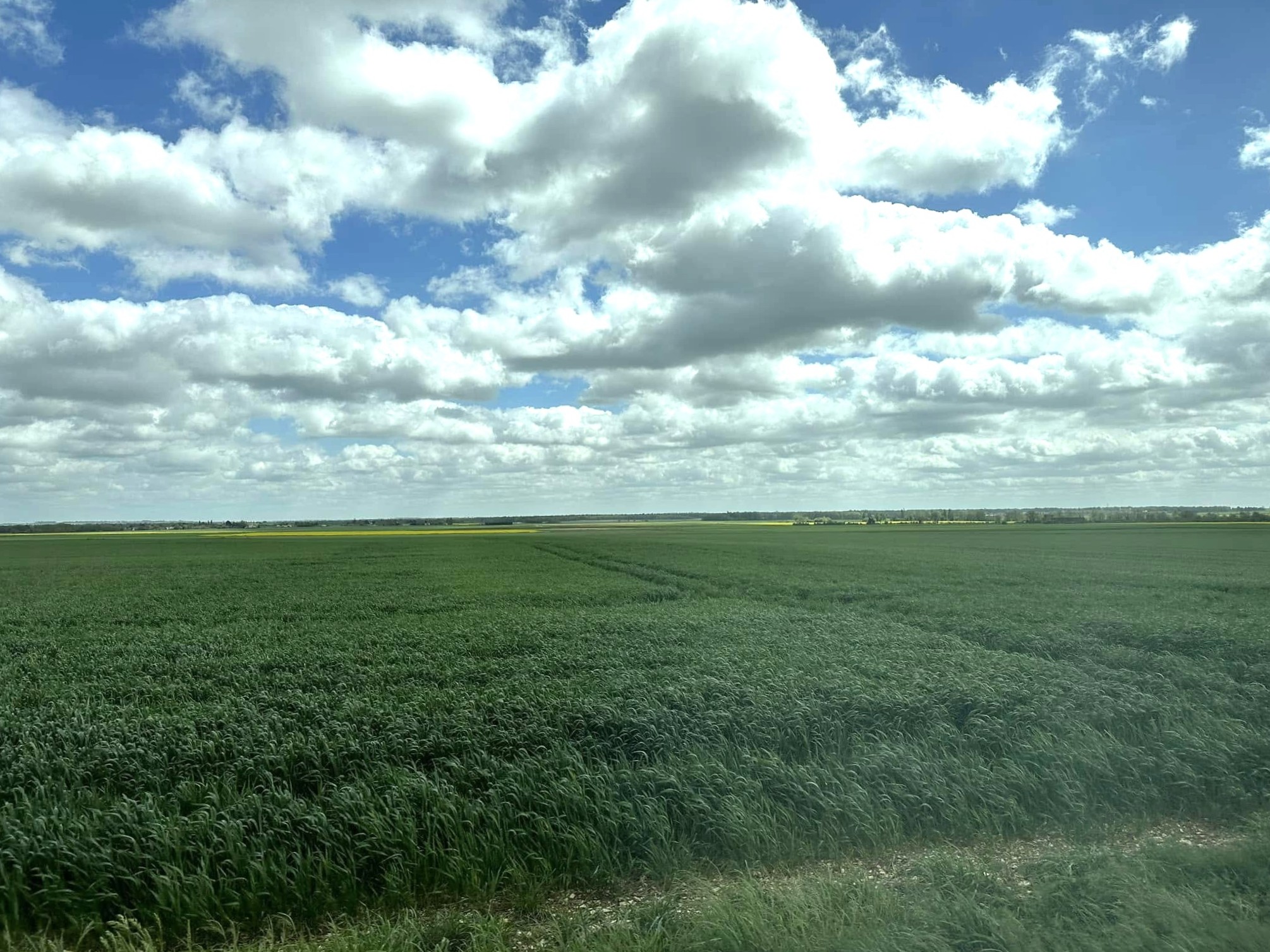
We know where this beautiful land was located at Belle Isle. I took this panoramic view standing near Hebb’s Landing, just upriver from the Gougeon/Blanchard land. We are standing where they stood, looking across the river.
By 1734, this tract had passed into the hands of Jean LePrince (1692-1750/1762) and Pierre Gaudet/Godet (1654-1741), the grandson of Jean Gaudet. Jean LePrince was the son-in-law of Guillaume Blanchard.
Pierre Gaudet married Marie Blanchard (1656-1714), Guillaume Blanchard’s sister. So, both families were in this area quite early.

According to this 1757 map, drawn from a 1733 map with additional information added, Jean LePrince’s land is across the river from Gaudet Village, the original land granted to Jean Gaudet. This could explain the 1734 land possession, perhaps, and might also be a clue about the multiple lawsuits that Jean LePrince was engaged in – all having to do with property.
Jean LePrince (also spelled Le Prince, Prince, and similar variants) purchased land in 1731 at or near Paradis Terrestre, at far right, above, near where he already lived. Paradis Terrestre is mentioned on the rent rolls, but only as an existing “village,” but it’s not clear how it’s associated with the land owners.

Jean LePrince’s grandmother was Marie Gaudet, the daughter of Jean Gaudet. She had married Étienne Hébert, and the Héberts originally lived on the south side of the river, but in time expanded to both sides.
Land Labeled as Tract 2
The 1734 rent roll shows that Antoine Gougeon and Daniel LeBlanc originally held a joint land interest in Tract 2 that later passed to Guillaume Blanchard (c1690-1752), the son, and to Joseph LeBlanc and his brethren, who would be Daniel LeBlanc’s heirs, sometime before 1734. There were three Joseph LeBlanc males living at that time, but two were in Grand Pré. The third, Joseph LeBlanc, born in 1698, was the son of Pierre LeBlanc, the son of Daniel LeBlanc – all of whom lived at Belle Isle.
Daniel LeBlanc and Antoine Gougeon were contemporaries, both born in France, and unfortunately, we don’t know why they obtained a joint interest in this land. It could have been coincidence, or convenience, a financial deal, or it could have been something more.
The information recorded by Nicolas Denys may provide some indirect insight into how long Antoine Gougeon had actually been in Acadia. We know that de Razilly brought the initial settlers between 1632 and 1635, when he died, and Charles d’Aulnay became his successor. Antoine, born about 1626, was far too young to come by himself at that time.
At about 15, Antoine was still too young to come alone when d’Aulnay brought 20 more families in 1641, unless he came with his parents, who died before he came of age, and left no other children with the Gougeon surname. Antoine could also have arrived as a servant.
Depending on when Antoine arrived, he may or may not have fought in the Acadian Civil War when Charles LaTour and Charles d’Aulnay waged their final battle for control of Acadia in 1645. If so, he would have been about 19.
Daniel LeBlanc was born about the same time, 1626, and married Françoise Gaudet (1623-1699) around 1650.
Guillaume Blanchard, Antoine Gougeon’s son-in-law, was born about 1650 to Jean Blanchard and Radegonde Lambert. Jean and Radegonde lived near the fort in Port Royal, but the 1678 census shows them living with Guillaume and Huguette upriver by the LeBlanc family. This land-grant history makes perfect sense, especially when you consider that the details were being recalled in 1734, some 80 years later.
Questions
All of that said, I am left with a quandary. If Tract 1 was originally granted to Guillaume Blanchard and Daniel LeBlanc, this means it was granted to Guillaume after he married, which is when Acadian males moved from their parents’ homes. In the 1671 census, Guillaume is living with his parents, so had not yet married.
That would place the Tract 1 land grant around 1673 when he and Huguette married. Why wasn’t this land granted to Guillaume’s father, Jean, who was still living at that time? Jean is listed first, before Guillaume, in the 1678 census, inferring he is the head of household – but that could simply be circumstantial.
Why was this prime farmland not granted in the 1650s or 1660s? Why was it granted what appears to be a generation later than Tract 2 that was granted to Daniel LeBlanc and Antoine Gougeon? This would make sense if Guillaume Blanchard had married Daniel LeBlanc’s daughter, but he didn’t.
Given that Le Borgne Jr., who was doing the granting, was known to drink – a lot – and even spent some time in jail in 1689 due to his drunken land deals, maybe we’ll just have to chalk this up to way too much wine.
A Hint from France
One hint about the Acadians that might provide insight into both Antoine Gougeon and Daniel LeBlanc is found in a paper published by Gregory Kennedy.
Kennedy asks questions about why the founding Acadian group chose the rare occupation of marshland farming, and how they knew how to do it. Kennedy says:
Early colonial leaders Isaac de Rasilly and Charles de Menou hired a group of salt-making experts in 1635, but this does not explain why virtually all of the colonists chose to pursue and expand marshland farming around the Bay of Fundy. It was in many ways a strange choice. It took years to drain and desalinate the marshland, and the fields were perpetually vulnerable to breaches in the dykes caused by storms or raiders. It also required technical expertise as well as careful planning and regular upkeep. Surely the colonists must have had some previous knowledge of marshland farming?
Kennedy found his answer on early maps of similar marshlands in Martaizé, the heartland of where we now know many of the original Acadian families lived – in the parishes of Aulnay, La Chaussée, and Martaizé. Both Isaac de Razilly and Charles de Menou d’Aulnay were the Seigneurs of La Chaussée and recruited settlers from there.
Kennedy found evidence of these Martaizé marshes on multiple historic French maps, along with further evidence that the land was drained, then leased out to wealthy families for cultivation using the same methods employed by Acadians.

Many Acadian families originated in La Chaussée, having been recruited by d’Aulnay, including the parents of Antoine Gougeon’s wife, Jeanne Chebrat. I wrote about Acadian families and La Chaussee, here.
Are Daniel LeBlanc and Antoine Gougeon Related?
Since their tract of land was awarded jointly, Daniel LeBlanc and Antoine Gougeon may have been related or allied through connections back in France.
Dispensations of consanguinity would be our telltale clue. If Acadians related as closely as 3rd cousins wished to marry, canonical law required them to receive a priest’s dispensation before the marriage could take place.
Dispensations of Consanguinity
Fortunately, when priests granted dispensations of consanguinity, they recorded them in the marriage record. When the parish register still exists, we can find that information. These are genealogy goldmines!
Dispensations of consanguinity can be a bit confusing, so I created a reference chart. Please note that this does not imply that a dispensation would ever be granted for full siblings to marry. That was strictly forbidden, but dispensations were granted for first cousins to marry. This table depicts how the dispensation and relationship counting works.
| Bride/Groom Relationship | Direct Common Ancestor | Generational Distance | Degree of Consanguinity |
| Full Siblings | Parents | 1 gen | 1st degree |
| 1st Cousins (1C) | Grandparents | 2 gen | 2nd degree |
| 2C | Great-grandparents | 3 gen | 3rd degree |
| 3C | GG-grandparents | 4 gen | 4th degree |
| 4C (dispensation not required) | GGG-grandparents | 5 gen | 5th degree (not required) |
In circumstances where the number of generations to the common ancestor is uneven, so one person is at the 4th generation (3C) level, where a dispensation would be necessary, but the other is at the 5th generation, where a dispensation would not be necessary, the priest counts the longest leg. So, in this example, the couple would NOT need a dispensation, although I have seen some granted at that level.
If the couple shares two different couples as common ancestors, say at the 4th generation level, the priest notes two impediments and grants dispensations for each one separately.
Back to Daniel and Antoine
Since it’s safe to say that Antoine Gougeon and Daniel LeBlanc aren’t full siblings, and extremely unlikely to be paternal half-siblings, let’s say their mothers were sisters, which would make them first cousins.
Antoine and Daniel’s grandchildren would be 3rd cousins and would still need dispensations to marry. By the time either the bride or groom reached the fifth generation, or 4th cousins, no dispensation was required.
Figuring dispensations must have been the bane of priests, because it certainly is for genealogists.
For genealogists, it means looking up all the children and grandchildren of both Antoine and Daniel, along with their spouses. Each spouse’s ancestors also have to be checked to see if they have the other family in their line.
Antoine only had one child, Huguette, but Daniel had six children that lived to adulthood and gave him 50 grandchildren who lived to marry and have children of their own.
Finding intermarriages between the two families before 1702 doesn’t matter in this case, because unfortunately, the Acadian parish records prior to 1702 no longer exist, so any dispensations of consanguinity between any of their descendants who married don’t exist either.
However, some of their grandchildren were married later when parish registers do exist.
So yes, I spent several days chasing the descendants of both men.
Given the intermarriage patterns of the Belle Isle families, it’s hard to believe that I did not find one single intermarriage between the descendants of Daniel LeBlanc and Antoine Gougeon’s daughter, Huguette, who married Guillaume Blanchard.
I did find six intermarriages with people who descended from Guillaume Blanchard’s sister, Marguerite. Of those, only two took place at a time and in a place that have extant parish records. Those two were in Port Royal, and the dispensation was as expected for their common relationship in the Blanchard line through Guillaume’s sister. Unfortunately, this tells us nothing about any relationship with Antoine Gougeon or Huguette.
A seventh marriage, between Madeleine Bourg and Jean LePrince in 1762 in Bécancour, Quebec, held promise.

Thankfully, the parish record exists, and the priest granted a 3rd degree dispensation.
Year 1762, the fifteenth of February, after having published three banns of marriage between Jean LePrince, son of Jean LePrince and of Jeanne Blanchard, deceased of Port-Royal, his father and mother, and Marie Madeleine Bourg, widow of Pierre Richard, daughter of Michel Bourg and of Marie Cormier, her father and mother, also deceased, residents of Beaubassin, after having obtained dispensation for the third degree [of consanguinity], we received their mutual consent of marriage and gave them the nuptial blessing, in the presence of the parents and a large number of other persons, they declared not knowing how to sign.
By comparing their genealogy, I should be able to find their common ancestor three generations back in time. I’m so excited. Maybe the answer lies here!
The wonderful news is that all of the ancestors of Madeleine Bourg have been documented through the 5th generation, which is one generation beyond where dispensations are required!

Using this WikiTree Ancestor’s view, their common ancestor should be found in the 4th column.
Now for Jean-Baptiste’s list.

Here we go! Who matches in the 4th column?
No one.
Wait?! What?
There is only one possible connection. Since we know who Madeleine’s ancestors are, and we know all but two of Jean-Baptiste LePrince’s ancestors at this level, their common ancestor COULD BE one or both of the missing LePrince couple. This means the male would carry the LePrince surname, which none of Madeleine’s ancestors do. So, could one of Madeleine’s female ancestors have been married twice? Let’s look at each one and see if that’s possible.
Jacques LePrince was born about 1646, possibly in France, and he had married Marguerite Hébert by 1671. So, his father would have been born no later than 1626, and his mother probably no later than 1630. They would have married by about 1645.
So, checking Madeleine’s female ancestors three generations back in time, we have as candidates:
- Marguerite Boudrot was born in 1648, so she’s eliminated.
- Marie Dugas was also born about 1648, so she’s eliminated.
- Marie Madeleine Girouard was born about 1654, so she’s eliminated.
- Catherine Hébert was born about 1656, so she’s eliminated.
Ok, so let’s look one generation further out, in the last column, just in case.
| Madeleine Bourg’s side | Jean-Baptiste LePrince’s side |
| Daniel LeBlanc | |
| Françoise Gaudet | Jean Gaudet, father of Marie Gaudet, his ancestor, and also Françoise Gaudet |
| Antoine Hébert | Unknown Hébert, father of Étienne Hébert, his ancestor, and also Antoine Hébert |
| Genevieve Lefranc (not LeBlanc) |
For dispensations, this generation doesn’t matter, but I have to know. There are still no common ancestors, but there are common families offset by a generation. This is may well be the source of the confusion.
As we sit here scratching our heads, let’s think about the circumstances under which these people married in Quebec in 1762.
They had both been caught up in the devastating expulsion of 1755 when they were ripped from their homes and families and lost literally everything. They had somehow managed to survive inhumane, horrific circumstances. Each had lost their spouse, and they probably lost children.
Based on what we know about Madeleine, after her husband, Pierre Richard, was deported to South Carolina without his family, she fled with her three small children, seeking safety. After multiple stops, she found her way to Prince Edward Island, where Pierre somehow made his way back and located her. They boarded a ship for Quebec, but a smallpox epidemic was raging, and he died there in 1758. She went on to Bécancour and was, with her siblings, one of that city’s founders.
Jean-Baptiste LePrince probably crossed the frozen North Mountain in Acadia in December of 1755 and survived that horrible, starvation winter encamped on the beach at Morton. From there, in the spring of 1756, he and his three small children, possibly accompanied by his wife, made their way across the bay, then somehow across Quebec. His wife perished sometime between 1753, when their last child was baptized at Port Royal, and September of 1756 when his child died in the smallpox epidemic that ravaged the Acadian population in Quebec City. The fact that there is no burial at Port Royal suggests that his wife was pregnant during their escape or had a newborn infant. I can’t even begin to imagine what she endured. Jean-Baptiste made his way from Quebec City to Bécancour by 1762 when he married Madeleine.
These people had been severely traumatized!
The priest in Bécancour didn’t know their families, so he would have needed to rely on their collective family memories about their ancestors.
In 1762, after everything they had been through, they were trying to remember who their great-grandparents were, people who had been born in the 1640s and early 1650s. More than a century earlier. They probably both knew that they descended from the Hébert and Gaudet families, 3 or 4 generations earlier in Acadia, but perhaps they couldn’t remember exactly how. The priest probably figured better safe than sorry and granted the third-degree dispensation, just in case.
So much for unraveling the mystery of whether Antoine Gougeon and Daniel LeBlanc were related. This well has run dry. Short of discovering records in France that connect Daniel LeBlanc and Antoine Gougeon, we’ll never know.
Please forgive that very long detour. At least we know we’ve left no stone unturned on this particular rocky path. And you know how to do this yourself now too!
The 1678 Census
In the 1678 census, Jeanne Chebrat is only listed as “the widow Gougeon.” She has six cattle, but no sheep and no arpents of land.
If she was 45 in 1671, she would have been 52 in 1678. Her daughter Huguette had already married Guillaume Blanchard around 1673.
There are two boys and a girl enumerated with Jeanne Chebrat, aka Widow Gougeon, but they cannot be her children based on their omission from the 1671 census. The girl, age 6, had not yet been born in 1671, and it’s highly unlikely that Jeanne had her final child at age 46.
I reconciled the 1671 and 1678 censuses, and even looked at the 1686 census, and the most logical explanation is that some of Jeanne’s Blanchard grandchildren, Huguette’s children, who lived on the same property, managed to be enumerated with her. It’s also possible that she had taken in orphans to raise.
In any case, they aren’t Antoine Gougeon’s children.
Antoine Is Gone
We don’t know when Antoine died, other than it was between the 1671 and 1678 censuses and he was between 45 and 52 – certainly too young for “old age” to take him.
While there were armed conflicts in both 1645 and 1654, there was nothing of this nature between 1671 and 1678 that would hint at his death.
We also know Antoine lived upriver because he’s listed as one of the original grantees of the Belle Isle marshland, and we recognize the neighbors.
St. Laurent Church and Cemetery
The St. Laurent church was built at Belle Isle sometime around 1654, after the English took Port Royal and burned the church beside the fort, so the Gougeon family would have worshiped at St. Laurent and buried family members in the cemetery beside the little church.
The church in Port Royal wasn’t rebuilt until sometime after 1673, and by then, their home church would clearly have been St. Laurent for almost two decades. It was nearby, it was theirs, and it might have been built on their land.

The parish record is long gone, but Antoine would have been laid to rest here, just beyond the bend in the river where the St. Laurent Mass House was located.
The church and cemetery are lost forever, but Antoine Gougeon’s memory is not. He still rests here in peaceful, serene Belle Isle, near or perhaps on the land that he and Daniel LeBlanc once farmed together. The world has moved on, but time is frozen here, where Antoine is still at home.
Share this:

Discover more from DNAeXplained - Genetic Genealogy
Subscribe to get the latest posts sent to your email.