FOCUS – A New Series Focused on Breaking Down Brick Walls

When I teach about genetic genealogy, people often ask, “What’s next? How can I break down my brick wall?” Sometimes I can reply that a Y-DNA test or mitochondrial DNA will help them under specific circumstances. But more often than not, what they really need is a precise, step-by-step methodology that includes autosomal DNA and utilizes multiple tools and techniques across vendors.

Even after people have taken Y-DNA and/or mitochondrial DNA tests PLUS autosomal tests at the major vendors, we still need a methodology to work with combinations of those results. Often, the answers we need aren’t just sitting there like a pretty rock, waiting to be picked up and admired, but depend on us using the results and matches as tools to help focus our search in the right direction.

It’s more like a scavenger hunt than a single discovery.

Focus

Sometimes I feel like a fish out of water – flip-flopping from ancestor to ancestor, match to match and hint to hint, hoping that the magic bullet will fall into my lap, but that almost never happens.

By this point in my research, I’ve perused all the easy records and many of the not-so-easy ones. If you don’t have a surname, or you don’t have a first name, or worse yet, you don’t have either, how is one supposed to search for records?

The good news is that you still carry at least one record in your own body and/or the bodies of your relatives. The DNA of your ancestors.

This is where we’re going to focus our efforts – hence FOCUS, the name of this new series.

Everyone is going to select their closest, or one of their closest, brick-walled ancestors, and we’re going to use several methods and tools to focus on identifying that ancestor.

Prepare

Before I publish the next article in the series, there are a few things that I’d like you to think about and do in preparation.

  • First, there’s no guarantee that you’ll break through your brick wall during this series. You might, and you also might not. You stand a much better chance of breaking through that brick wall if you focus and follow these steps than if you don’t.

Keep in mind that even negative evidence is evidence, and just because you don’t break through right away doesn’t mean you won’t. New people test everyday and new records become available too. If nothing else, your ancestor will have more meat on their bones, and you’ll have a process to build upon.

  • Second, if your brick wall is very close in time, meaning parents or grandparents, you’ll want the already-written “In Search Of Unknown Family” series, which you can find, here.
  • Third, you’ll need to keep a research journal or log by ancestor, family or location, which will also include your other related ancestors. For example, if you’re looking for Lucy whose surname you don’t know, but you know that she married William Moore, then your research journal will apply to William Moore too, and other people including their children and either spouse’s parents and siblings, whether that was your intention or not. The neighbors are probably relevant as well.

That “it takes a village” saying is particularly relevant here. People didn’t tend to move to the next location alone, and often their community consisted of their cousins and relatives – who are also your relatives, and hold clues to the identity of your ancestor. When I’m extracting records for the Moore surname in Halifax County, VA, for example, I extract everything for that and similarly spelled surnames, not just one particular person, so I don’t have to replow that field.

Tracking and Recording Your Research

If you don’t already have a research journal methodology, I would suggest a spreadsheet.

Here’s a screenshot of two rows in my “Halifax County” spreadsheet where I’ve recorded separate rows for each person in every record. Note that I started this spreadsheet years ago and omitted some columns that I later wished I had included, like the access date.

You’ll want to record:

  • Item number beginning with 1. In the example above, the item number is 6, and it’s 6 for every person in that record. Each person in this transaction gets their own separate row, with the same item number. The next record I extracted would be item 7.
  • Access date (date you found and retrieved the record)
  • Last name
  • First name
  • State (add a column for country if multiple countries are relevant for this family)
  • County
  • Town, township or city
  • Geographic places like road or creek names (these can be VERY important)
  • Year, month and day that the record occurred
  • Record repository or source (including a link if applicable – you may want to add a separate column for the link)
  • Record type (deed, will, tax list, etc.)
  • Role of individual (buyer, seller, witness, etc.)
  • Names of additional people in the record (I retain the same item number and other information, changing the name of the person, their role and sometimes an associated comment)
  • Transcribed text of the record itself
  • Comment, which can include things like the name of an image, something about what you were searching for when you found the record, links, or anything else relevant

You will want to be able to sort and filter this spreadsheet when you are finished. Hint – be sure your date fields and formats are sortable in the way you wish. I normally use filters instead of the sort feature.

The goal isn’t just to record your findings, but to make this spreadsheet as useful as possible to make discoveries that are only available by comparing and incorporating multiple records.

For example, let’s say that you’re extracting all of the Moore records in a Halifax County, VA deed book, and you want to know how many times the surname Henderson is found in the Moore deeds or in conjunction with the Moore family. Is there a pattern? You won’t recognize a pattern from any ONE record, but you may eventually wonder if the Henderson’s are related to the Moore family, and if so, how.

You’ll also want to record nonproductive or negative evidence. For example, let’s say you searched the Halifax County Plea Book for William Moore (including More and Mohr) and found no occurrences. That’s important, because otherwise you‘ll eventually search again, so enter that as a record item.

Note that with the full text search feature introduced by FamilySearch a couple of years ago, if you extracted records from a book that did NOT include every-name indexing including property lines, creek names and witnesses – you’ll want to redo that search using the full text feature at FamilySearch. There’s often LOTS of valuable information buried in records that won’t be found if you’re only viewing records indexed by buyer and seller, for example.

Your To-Do List Before the Series Begins

The In Search Of Unknown Family Series introduces important concepts, so reading that series is your first assignment in preparation for the upcoming FOCUS articles.

Test Your DNA With the Major Vendors

It’s important to test with the major vendors. Each vendor has matches and tools that the others don’t, and we need to identify and work with as many relevant matches as possible.

If you have NOT taken an autosomal DNA test at the first three following vendors, order these tests now so you have results to work with.

  1. AncestryDNA
  2. FamilyTreeDNA – Purchase a Family Finder test or upgrade an earlier Family Finder test to the new Family Finder NGS test. You should upgrade if you uploaded your autosomal DNA file from another vendor at any time, or tested at FamilyTreeDNA directly before March of 2026. The upgrade is only $29.
  3. MyHeritage DNA
  4. A fourth vendor, 23andMe, is optional, but testing there certainly won’t hurt.

23andMe Sidebar

I have an issue with 23andMe’s policy of forcing customers to repurchase a DNA test at $199 PLUS a subscription at $149 for the first year, renewable at $69 per year, in order to obtain any of their latest tools. This happened around the time of their data breach and subsequent bankruptcy.

I would feel much better about the situation as a whole if a new owner had taken the wheel, but the original owner resigned from the 23andMe board, formed another corporation, and was allowed to buy 23andMe out of the bankruptcy that occurred on her watch.

Furthermore, 23andMe does not support genealogy trees, nor do they have Y-DNA or mitochondrial DNA testing and matching, or research records.

I have (begrudgingly) ordered an upgrade for my own 23andMe test in order to include accurate information in these articles, but I won’t be focusing on 23andMe specifically aside from any unique feature. You can apply the same concepts and techniques to results at 23andMe where possible.

Test Your Relatives

If you have close upstream relatives, such as parents, grandparents, aunts, uncles, and cousins who also descend from your brick-walled ancestor, please ask them to test too.

I explain what I’m trying to achieve, why their test is important, and offer scholarships to sweeten the pie. I view purchasing their DNA tests in the same way I view purchasing a rare research book that I KNOW includes my ancestors but it not available anyplace else.

Your shared matches are extremely important and may provide that brick-wall-breaker. Perhaps even more importantly, they will have relevant matches that you don’t.

So how do you know who to test? You certainly want to test everyone relevant, without wasting money.
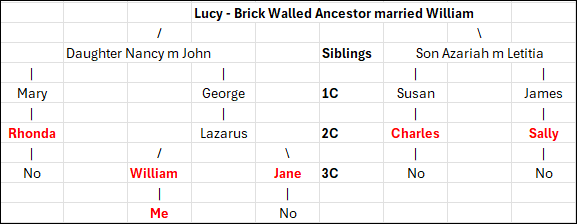
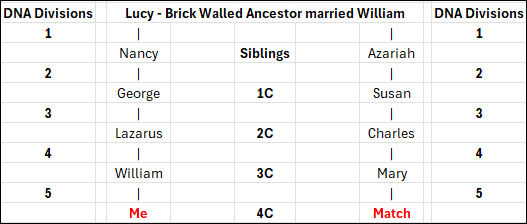
Let’s look at this example where Lucy is the brick-walled ancestor I’m seeking to identify. Her children (labeled siblings) and grandchildren (1C) are all deceased, but second cousins (2C), Rhonda, Charles and Sally are all available to test. Test each of them because they will all have some different segments of DNA from Lucy that the others don’t have.

Lazarus is also a second cousin, but he’s deceased. However, William, my father (in this example, not my real pedigree), and his sister, Jane are both available to test.

You ALWAYS want to test both of your parents and every available grandparent or direct ancestor. In this example, I’ll only inherit some portion of Lucy’s DNA that my father has, but Jane, my aunt, will carry segments of Lucy’s DNA that my father didn’t inherit from Lazarus. Jane’s matches on those segments that neither my father nor I have may be just what we need to identify Lucy.

If Lazarus has other children not shown in this example, we certainly want to test them too.

If the relevant parent has tested, you don’t need to test any of their children. However, if the parent hasn’t tested, absolutely test as many of their children or descendants as possible.

In this case, Rhonda, Jane, Charles and Sally have all tested, so I don’t need to test their children. Their children can only have as much of Lucy’s DNA as their parents had.

However, if any of them had been deceased, then I should test as many of their children as I can to “gather up” as much of Lucy’s DNA as possible.

If any of the people upstream of the bold red people have other children, those children or their descendants would be testing candidates too. Ideally, you want as many descendant testers as possible to increase your chances of identifying that ancestor.

Selecting Your Brick-Wall Ancestor

I want you to be successful, so you’re going to select your closest brick-walled ancestor within certain parameters. If you have multiple brick-walled ancestors at the at the same genealogical distance, you’ll choose one to focus on.

Why your closest brick-walled ancestor? If your brick wall is 5 generations back from you, and they are 5 generations back from your DNA match as well, that means you’re dealing with a 4th cousin match.
This also means that ancestor’s DNA has been divided a total of 10 times – five times on the path of descent to you, and five times on the path of descent to your match.

A 4th cousin match is likely to be in the 35 cM range. You can view the matching ranges for various relationships at DNAPainter, here.

The entire 4th cousin (4C) matching range is 0-139 cM. You won’t match all of your 4th cousins and are likely to match only 50-70% of your 4th cousins.

That said, the average person has between 1,500 and 4,000 4th cousins. At the 4th cousin level, you have 32 ancestors, so only between 46 and125 4th cousins will descend from any given ancestor, and of those, only a few will have taken a DNA test. The more children that ancestor had that lived to marry and have children of their own, the better your chances of more matches.

The Selection Process

I’m going to be stepping through the ancestor selection process with you, discussing who is and isn’t a good candidate, and why. I’m also going to be using this same methodology to (hopefully) identify one of my own mystery ancestors too.

I have no brick walls closer than 4th cousins. If I did, I’d choose the closest brick wall. You should too in order to have the best chance of solving this puzzle. The further back in time, the more difficult the solve will be.

In my tree, I have four mystery ancestors at the 5X great-grandparent level on my father’s side, and one on my mother’s side.

Those will be the four ancestors I consider selecting. And no, before you do it, I don’t recommend working on all four of them at the same time. Remember, the purpose is to FOCUS.

  • Select an ancestor as close generationally as possible, because it’s more likely that both you and other people will carry at least some of their DNA, and the same segment(s) of DNA. Matches closer in time generally carry more total DNA in common, which means better matching and more shared matches.
  • Given that the majority of testers are from the US, and assuming you are from the US too, I don’t recommend selecting an ancestor from another country unless you are very comfortable with that language and working with those records. Generally, there will be fewer people who have tested from other countries. If you are going to work with an ancestor from another country, be sure you are in both the MyHeritage and FamilyTreeDNA databases.

My mother’s entire paternal line is either Dutch or German Brethren, and her Dutch ancestors only immigrated in the mid 1800s, so have few descendants in the databases.

My closest brick wall on her paternal line is Traut Enterlein, a German man who was named in an out-of-wedlock baptism for his daughter in Germany in 1823. He is not found in any other records in that part of Germany, so actually identifying “who he is”, even with a name, would be extremely difficult, and I have nothing to “anchor to” here.  He is eliminated as a candidate because he’s found in a country where I don’t speak the language, where fewer people have taken DNA tests, and we’ve already spent a substantial amount of time trying to identify him in the records.

Brick-walled ancestors on Mom’s maternal side are two generations further back in time. Half are German and the other half are a combination of English and Acadian.

  • Avoid both endogamy and pedigree collapse, if possible. I don’t recommend a line with baked-in challenges that will make DNA more difficult.

Acadians are heavily endogamous and often suffer from pedigree collapse since there were so few founding families in the mid-1600s. The same goes for Brethren families who immigrated in the early 1700s. Those lines are too far back generationally anyway, so they have already been eliminated, but if they weren’t, I’d eliminate them because of heavy endogamy and pedigree collapse, both, not to mention record loss.

My father’s side has much better candidates.

  • Try to select an ancestor where you have some familiarity with the location, the culture, and the records. If you have printed resources at the ready, possibly ones that are not online, that’s a plus.
  • When you’re trying to decide between ancestors, select one whose spouse you are sure of, and who has children you can document. Do you know important things about them like their religion, where they lived during specific times, and who their neighbors were? If not, take some time now to brush up on what you do know about their spouse and children.
  • Check back at all of the records vendors and resources, including Ancestry, MyHeritage, WikiTree, and FamilySearch, to see if anything new is easily available for either your brick-wall candidate or their spouse.
  • I do NOT recommend selecting an ancestral couple, neither of whom you can identify, unless you’re “lucky” enough to have no other brick-walled ancestors to choose from. It’s possible to solve this “double-blind” couple, but it’s substantially more difficult because you have no same-generation anchor.

My Candidates

I’m selecting one of my brick walls and hope to solve it during this process. Let’s run through the decision-making process so you’ll understand some of the considerations and why they weigh as factors. I wish I didn’t have so many choices, and I’d like to solve them all, but my best chance is to work on one at a time.

Most candidates are women because their birth surnames tend to easily become lost after they marry, and with their surname, their parents are lost too. Given how little we know, we have to presume (dangerous word), at least for now, that your missing female ancestor was the mother of all of their husband’s children, unless we know or subsequently prove otherwise.

Let’s review my candidates.

  1. Lucy was born about 1754, probably in Virginia, and died in 1832 in Halifax County, VA. She married William Moore between 1772 and 1774, who may or may not have been a circuit-riding minister at that time. She is found under her own name on the 1830 census, there’s an 1826 chancery suit, and I know who her children and neighbors are, so she might be a good candidate. One vote against selecting Lucy is that I don’t know where she was born, nor do I know where they were married, although there’s a very strong possibility that it took place in Halifax County. The fact that he was a circuit-rider means he could have met her anyplace. If they were married in Halifax County, their families could have been allied before arriving there. William Moore’s family came from Prince Edward County about 1770, and we know who his parents were. One good thing is that Lucy is a fairly uncommon name, but there are multiple William Moores in Halifax County, and there are two other Lucy Moores. One is her daughter, and one is her daughter-in-law. The fact that Lucy and William Moore had 12 known children, with at least 8 who married, means there is a good chance of matching at least some descendants. Unfortunately, I don’t have her mitochondrial DNA, which removes one possible tool unless I can find a tester.
  2. Jane, born about 1760 in an unknown location, but probably Virginia, was the wife of Lazarus Dodson. They moved across multiple frontiers into what would become early Tennessee, an area that sustained substantial record loss. Jane died between 1830 and 1840. There’s a lot of uncertainty about Jane’s life. She probably had at least 8 children, and we know something about six of them. Given that we already have a better candidate with Lucy, I’ll eliminate Jane for now.
  3. William Crumley’s wife, whose name I don’t know, was born around 1765 or 1770, possibly in Virginia. She was married to William Crumley around 1786 or 1787, probably in Frederick County, VA, or nearby. I do have her mitochondrial DNA and we know the family was Quaker which are both benefits. I’ve been working with a cousin who has delved deeply into Quaker records, and I have some records from a trip to the FamilySearch Library in Salt Lake City that I have not yet processed. She and William had at least 10 children who married, and I know quite a bit about them. She would probably be an excellent choice. For lack of another name, I’ve been calling her H2a1, her legacy mitochondrial haplogroup before Mitotree, but she has a much more complete haplogroup now. She would be a good candidate, and I REALLY want to identify her.
  4. Mary, wife of John Harrold (by various spellings), was born about 1750, possibly in Ireland, although it would be unusual for a first-generation Irish immigrant to end up deep in the Appalachian frontier. Mary died in 1826 in Wilkes County, NC. We know nothing about John’s background, other than he served in the Revolutionary War, in Virginia. He may have been living in Botetourt County, although we don’t know for sure, and there are multiple men by that name. Mary had at least 7 children, six of whom were married. We do not have her mitochondrial DNA. Given that we know so little about John, and we have better candidates with both Lucy, William Moore’s wife, and William Crumley’s wife, I’m eliminating Mary for now.
  5. Isabel, the wife of Michael McDowell – another couple from Wilkes County, NC. Their daughter married the son of Mary and John Harrold. Isabel was probably born about 1750, someplace in Virginia. We don’t know where they were married, but it could have been in Franklin County, VA. They lived in Wilkes County for several decades before moving on to Claiborne County, TN. We know very little about Michael’s early life, other than his Revolutionary War service, although I’ve written about him four times as additional information dribbles out. They had at least 8 children, and a deposition after Michael’s death tells us where they moved and settled, which is a very big plus. We know her first name thanks to a 1793 deed. Isabel is a reasonable candidate, but I eliminated her after comparison to the other candidates, in part because of multiple frontier moves with few records and no known point of origin.
  6. Elizabeth, wife of Andrew McKee, was born about 1767, possibly someplace in Virginia. They were in Washington Co., VA by 1789, although we don’t know where either originated. They may have married before they moved to Washington County, where we find several records. They had 14 children. Twelve are known to have married, and the other two probably did as well. We know who their neighbors were. We also have Elizabeth’s mitochondrial DNA. Unfortunately, we know nothing about Andrew McKee’s family or where he was from. However, Elizabeth is a strong candidate because so many records exist in Washington County, they had a large number of children, and many continued to live in Washington County or nearby, making them easier to track.
  7. If I didn’t already have good candidates, there’s one more ancestor I’d consider, even though James Lee Claxton/Clarkson is a generation further back in my tree, born about 1775, and his unknown parents are the brick walls. I know I just told you NOT to do this, so I won’t either, but the reason I might have considered his parents, or more specifically his father, as a strong candidate is because we have several Y-DNA matches, including Big-Y testers, and we know the ancestors of his matches came from NC. We also have many autosomal testers and matches, which would help immensely, and there’s a Clarkson/Claxton DNA Surname Project. A contiguous surname is a HUGE benefit not available with female ancestors, and I just feel that I’m SO CLOSE to solving this mystery. For now, James’s parents are eliminated because they are two generations further back in time than our other candidates, we know nothing about either of them, except Y-DNA results, and we have better candidates for this exercise.

After evaluation, I still have two candidates in the running – Lucy, wife of William Moore, and H2a1, William Crumley’s wife. I haven’t decided for sure yet, but right now, William Crumley’s wife is leading because I have an amazing collaborator along with some unprocessed records that may hold important information. I know there probably aren’t any smoking guns there, but when combined with DNA, we may well ignite that gunpowder.

FOCUS

Are you ready to focus?

Let’s get our ducks in a row.

  • Order any DNA tests you need to order for yourself and relatives now.
  • Select your ancestor.
  • Prepare your research journal by reviewing which records you’ve already researched and record what you have.
  • Refamiliarize yourself. Take a look at those results again with fresh eyes. It helps when reviewing match results to be able to view surnames in your matches trees and recall that you’ve seen that name before, and where.
  • Check to see if any new records or resources are now available.

Who do you want to find?

_____________________________________________________________

Share the Love!

You’re always welcome to forward articles or links to friends and share on social media.

Subscribe!

If you haven’t already subscribed, it’s free. You’ll receive an e-mail whenever I publish by clicking the “follow” button at the top of the main blog page, here.

Help Keep This Blog Free

I receive a small commission when you click a vendor link in my articles and purchase that item. This does NOT increase your price but helps me keep the lights on and this informational blog free for everyone. Please click on the affiliate links in the articles or to the vendors below if you are purchasing products or DNA testing.

Thank you so much.

DNA Purchases and Free Uploads

Genealogy Products and Services

My Books

Genealogy Books

Genealogy Research

The New Family Finder NGS Test Results, Comparison, and Preparation

This article is focused on two things.

  1. Comparison of my new NGS and the earlier Family Finder tests
  2. How to prepare for yours if you’ve ordered the upgrade

I compared my results from my older Family Finder test with my new NGS Family Finder test results. As an early beta tester, I have two separate tests, a strategy that is not recommended because it causes duplicate matches for people within the database. Additionally, multiple kits for one person doubles the results and could skew future ethnicity research for myOrigins.

Therefore, FamilyTreeDNA has announced very attractively priced upgrades at $29 for both:

  • People who have taken Family Finder test directly at FamilyTreeDNA
  • People who have uploaded their DNA files into Family Finder from other companies

After seeing my comparison, you may want to compare your own results when they arrive, so I’ve documented that process. Warning: this took between 4 and five days because I was working with a spreadsheet with more than 15,000 rows, and I had to write scripts to perform multiple functions. It was NOT fun and I do not recommend it.

Personally, had I known then what I know now about how reliable the new NGS test is, I wouldn’t have bothered with the comparison. However, I would have downloaded my original match list for posterity, just in case.

If you purchase an upgrade to the new NGS Family Finder, your new test results will replace your older Family Finder test results, but will preserve important account features such as linked matches, any notes you have taken, and more. That’s another reason to upgrade rather than order a separate new test. They’ve done the heavy lifting, not to mention that you’ll save about $50 when compared to the price of a new test.

Why is the New NGS Family Finder Test Better?

The new NGS test holds immense promise for the future. This includes better matching, beginning now. Essentially, FamilyTreeDNA is skating to where the puck is going to be (hockey analogy) and preparing for future tools. That future is not far away!

An amazing new set of tools is goaled for release around the end of the year. And I do mean amazing. They are being beta-tested internally now.

Dave Vance spoke about the new Family Finder NGS test at the ECGGC conference in late August, which you can view through the end of 2026 if you register for the virtual  conference, here, and watch the recorded sessions. You’re looking for the DNA Academy on Saturday evening. I can’t share specific preview slides with you as they are noted in his presentation as “not for distribution,” so my pen is capped for now.

All I can say is that after seeing what’s in store, people were literally throwing their billfold at the folks at the FamilyTreeDNA booth – and I do mean literally. “Here – take my money, please!” as the billfold went sailing. We all had a good laugh, but he was serious.

One presenter (not me, just in case you are wondering) left her credit card and a list of tests to upgrade while she was presenting.

They ran out of swab kits at the conference shortly after Dave’s presentation about what the future holds.

Additionally, you will also be treated to THE absolute best presentation I’ve ever seen about what NGS testing is, how it works, and how it compares to traditional tests, low-pass whole-genome tests, and medical-grade whole-genome tests.

You’ll be a passenger on the Genome Valley train, so climb aboard!

So, without spilling any beans, what’s so great about the NGS test?

To begin with, the older Family Finder tests won’t be able to provide everything the new NGS test will be able to offer – and those completely new tools are in active development today.

Why?

The NGS test targets over 280 million base pairs, up from the currently available 700,000.

That’s more than 400 TIMES the coverage.

This increases coverage in the human genome from about .02% to about 9%.

To quote FamilyTreeDNA, “This change allows us to deliver more precise autosomal results today while creating a strong foundation for future reports and tools.”

You can read the FamilyTreeDNA FAQ here.

Before we move on to the comparison, let’s talk for a minute about test types and uploads from other vendors.

Tests and Uploads

All new Family Finder tests purchased at FamilyTreeDNA since March 2, 2026 have been tested using Next Generation Sequencing (NGS), so the following matrix does not apply to those tests. Those tests don’t need to be upgraded.

If you sign on to your account, on the Family Ancestry dashboard, and see that your NGS button is grey, then you have not upgraded. Click on that grey button to read more and to upgrade. Right now the upgrade is $29, but I don’t know if that is a promotional price or permanent.

If you tested at FamilyTreeDNA prior to March 2, 2026, or uploaded a DNA file from another vendor, your test will fall into one of the following upgrade path categories.

Tested at FamilyTreeDNA before March 2, 2026 Uploaded and purchased the Unlock Uploaded but did not purchase the Unlock
Upgrade Path Can use sample stored in lab if enough DNA remains* If you purchased any other type of test at FamilyTreeDNA, they will use DNA stored in the lab if enough remains. Otherwise, you will be sent swabs. If you purchased any other type of test at FamilyTreeDNA, they will use DNA stored in the lab if enough remains. Otherwise, you will be sent swabs.
New Swabs* If needed, they will notify you Yes, if needed, will notify or send swabs if you have not taken a direct test at FamilyTreeDNA Yes, if needed, will notify or send swabs if you have not taken a direct test at FamilyTreeDNA
NGS Results Will replace existing results Will replace existing results Will replace existing results

*You will be notified if enough DNA does not remain, and you will be sent new swabs. Be sure your address is current.

One of the reasons the NGS test performs better, even with existing matches from earlier tests, is because less imputation is involved. Let’s talk for a minute about imputation and how it works.

The Concept of Imputation

Most vendors change chips internally from time to time, and FamilyTreeDNA is no different. The difference this time is that the new NGS test covers exponentially more DNA than any earlier test, and all earlier tests combined. This means more than 400 times greater coverage, which in turn means less imputation is needed to compensate for the inevitable no-reads and to be compatible with files that tested different DNA locations.

Imputation is also used when comparing DNA files between vendors who don’t test the same locations.

Click to enlarge any image

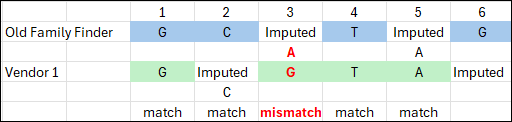
Here’s an illustration of the concept of how imputation works.

All of the FamilyTreeDNA chip versions over the years have included about 700,000 locations, as have most other vendors. But the locations tested are not universally the same.

In our simplified concept example, FamilyTreeDNA’s tested “locations” are shown with blue cells.

The total of 20 squares shows the maximum amount of DNA tested by any of the three vendors shown, combined.

Green Vendor 1 in our illustration tests the same amount of DNA that FamilyTreeDNA tests, 12 squares, but some locations are the same and some are different. Of the 12 colored squares for both vendors, seven are the same locations, and five are not. The locations that are the same can be compared directly, but the locations that are different have to undergo special handling called imputation.

Looking at any location in our DNA, one of four nucleotides, or letters, can be present: T, A, C or G on each strand of our chromosomes, although we are only looking at one strand in our example.

Using a very simplified model of imputation, think of imputation as “filling in the blanks” using clues from surrounding letters – kind of like a crossword puzzle.

When two vendors’ data doesn’t overlap, imputation is used to fill in the blanks, as accurately as possible, for the missing data.

Using a word analogy, for vendors one and two only, we see that blue location three has no Family Finder data, where green Vendor 1 does, and the same with location five. If blue locations two and four are C and T, and three has to make a word, then there are few options. In this case, let’s say it’s cat, and location five is imputed to an A too.

Now moving to green Vendor 1, their locations two and five need to be imputed. Moving away from the word analogy, let’s look to the human genome, and let’s say that most of the time, location two is a C if location one and three are Gs. So green location two is imputed to C.

If there’s not enough quality surrounding data, imputation can’t be performed reliably. Hence, location six is still in limbo here.

You can see that in our scenario, location three is the only mismatch, out of three imputed locations. Does location three mismatch because imputation was wrong? We don’t know. Do locations two and five match because imputation was wrong? We don’t know.

All things considered, imputation is based on the science of probability, and is usually relatively reliable, but it’s still not the same as comparing actual data. The more locations that have to be imputed, and the longer the stretch, the greater the possibility of error. Every vendor implements imputation differently too. Even vendors who don’t and have never accepted uploads still use imputation internally to equalize their own legacy files from earlier test versions.

Stepping back once again to compare the four vendors, you’ll notice that pink Vendor 3 only tested half as much DNA as the blue Family Finder test and green Vendor 1, and again, not all of the same locations. That’s exactly what happened with one of the vendors last December – they dropped the number of DNA locations tested to about 400,000 from about 700,000. In our example, you can see how much would have to be imputed. Locations 11, 15, 19 and 20 can’t be imputed for the pink vendor’s file because there’s no surrounding DNA. Location 17 can’t be imputed for the green vendor for the same reason.

When vendors impute to match multiple versions of other vendors’ uploaded files, it can quickly become messy.

The answer, of course, is a “supertest,” which tests all of the locations that overlap everyone, including that vendor’s own earlier tests.

Welcome to Family Finder NGS, shown in orange at the bottom of our example comparison.

As you can see, the orange NGS test covers all of the locations tested by all of the other tests.

NGS is targeted testing for a specific set of locations that are known to undergo mutations in the human genome and provides extremely high-quality results. Imputation for the NGS file is rarely necessary, although imputation for the other vendors’ and earlier file versions is still required for them to match to each other.

This is exactly why the upgrade is recommended, and why there’s no benefit to retaining your old test. The NGS test tests far more data and provides much more reliable matching.

NGS is the great equalizer.

NGS Test Comparison Process

I took my NGS test during the initial R&D development and testing phase, so my original Family Finder test was not upgraded. This afforded me the opportunity to compare the two results.

I downloaded the match files for both of my tests, the original Family Finder and the new NGS Family Finder test, color-coded the background of the cells, not the text inside the cells, and dropped them into a single combined spreadsheet.

It doesn’t matter what colors you choose, but be sure you can easily see the difference. I used apricot for the original Family Finder test matches and light purple for the new NGS test.

As we walk through these results together, you’ll notice that I continue to refer to them by color. In part, that’s so I can maintain my own sanity as I compare results. When I write these types of articles, I have to check and recheck results.

When the same person showed as a match to both tests (meaning they had both an apricot and purple row), I calculated the difference in matching amounts of DNA (cMs) between the match’s results on both tests. I added several calculation columns, which are not shown above.

I’ll tell you, this was not a trivial exercise. It was painful and I really don’t recommend it.

Let’s take a look at the results.

Total Matches

I have some matches with the new NGS test that I do not have with the legacy Family Finder, and I have some matches on the older test that are no longer present on the NGS test.

  Old Family Finder (apricot) NGS Family Finder (purple) Difference
Total Matches 9014 7719 1,295
Maternal 1665 Not linked
Paternal 3783 Not linked
X-Matches 2198 1849 349

I have not yet linked the same matches in my NGS test, so I can’t compare the number of maternal and paternal matches. Fortunately, when you upgrade an existing test, FamilyTreeDNA preserves your linked matches, so you won’t need to relink.

Relationship Estimates

  Old Family Finder (apricot) NGS Family Finder (purple)
1st-2nd cousins, Great/Half Uncle/Aunt/Niece/Nephew, Great-Grandparent/Grandchild 6 6
1st-3rd cousin 1 1
2nd-3rd cousin 5 4
2nd-4th cousin 127 132
3rd-5th cousin 1937 1900
4th to remote 6938 5676
Total 9014 7719

The closest relationships remained the same. One 2nd-3rd cousin moved to the 2nd-4th cousin range by losing 10 cM, 194 cM to 184 cM, but they were apparently on the threshold anyway. That match is actually my second cousin, so both ranges are accurate. It was also a transfer kit, so they did not test at FamilyTreeDNA. This revised match is probably the difference between actual reads and imputed reads in some regions, meaning the match is now more accurate.

275 matches had a predicted relationship change, but not uniformly in one direction, and no one moved more than one category in either direction. This all makes sense.

Match Differences

  Number
Matches found in both the apricot and purple spreadsheets 7,352
Unique (comparable) matches in both spreadsheets 7,174
Matches in original Family Finder apricot only 1,681
Matches in NGS purple only 400

A total of 7,352 matches appear in both spreadsheets, meaning the apricot and purple names matched exactly.

Unfortunately, some people had multiple tests, so I couldn’t always compare apples to apples because they appear three times or more on the combined spreadsheet, and I don’t know which of their kits are which.

If someone with the same exact name had more than one match for either or both tests, I did not compare them because their matching amounts were different, and I didn’t know which one(s) my old test matched, versus which one(s) my new test matched. Usually, one was an upload and one was a test at FamilyTreeDNA, but not always. I excluded those 178 match rows from the analysis.

Therefore, 7,174 matches could be directly compared.

There were 1,681 people who match ONLY on the old Family Finder test, and 400 that match only on the new NGS test. And yes, I downloaded the match files at the same time on the same day, so this comparison was controlled for any time difference.

cM Differences

  Number
Largest apricot match not in purple (NGS) list 26.3 cM
Largest purple (NGS) match not in apricot list 27.63 cM
Largest difference 69.86 cM NGS kit more
NGS detected greater over 10 cMs 19
NGS detected less over 10 cM 7
Total NGS greater 2,924
Total NGS less 3,040
No change 1,090

The largest value difference where a match appeared in the original apricot Family Finder test, and not in the purple NGS test, was 26.3 cMs.

The largest value difference where a match appeared in the NGS purple Family Finder test, and not in the apricot original Family Finder test was 27.63 cMs.

The largest difference between the two tests was 69.86 cMs larger detected by the NGS test. This match was a known second cousin whose matching cMs went from 373.06 to 442.92, but the longest block only increased a negligible amount from 87.47 to 87.69.

The next largest difference was with a 1C1R with a 41.56 cMs difference, also with the NGS-detected value being larger.

In all cases where the number of differing cMs was 16 or greater, the NGS had detected more.

There were very few tests that differed more than 10 cMs. In 19 cases, the NGS test detected a greater difference of 10 cMs or higher, meaning if the original test value was 100 cMs, in the NGS test, it was 110 cMs or greater.

In 7 cases the NGS test detected a smaller difference of 10 cMs or more, meaning that if the original test value was 100 cMs, in the NGS test, it was 90 cMs or smaller.

Out of the 7,174 tests being compared, 19 tests with greater than a 10 cM variation isn’t very many, around 0.26%.

In total, 1,090 matches had no change at all, while 2,924 NGS matches had more matching DNA detected, and 3,160 matches had less.

All but 287 of those differences were less than 5 cMs, and 6778 were less than 1 cM. In other words, literally not worth counting.

myOrigins Ethnicity

We all know to expect changes in our ethnicity from time to time at all vendors. The NGS test is exciting because it covers a much larger portion of our genome. As more people test, the reference library also becomes larger, which means that the ethnicity predictions can and will become more refined too

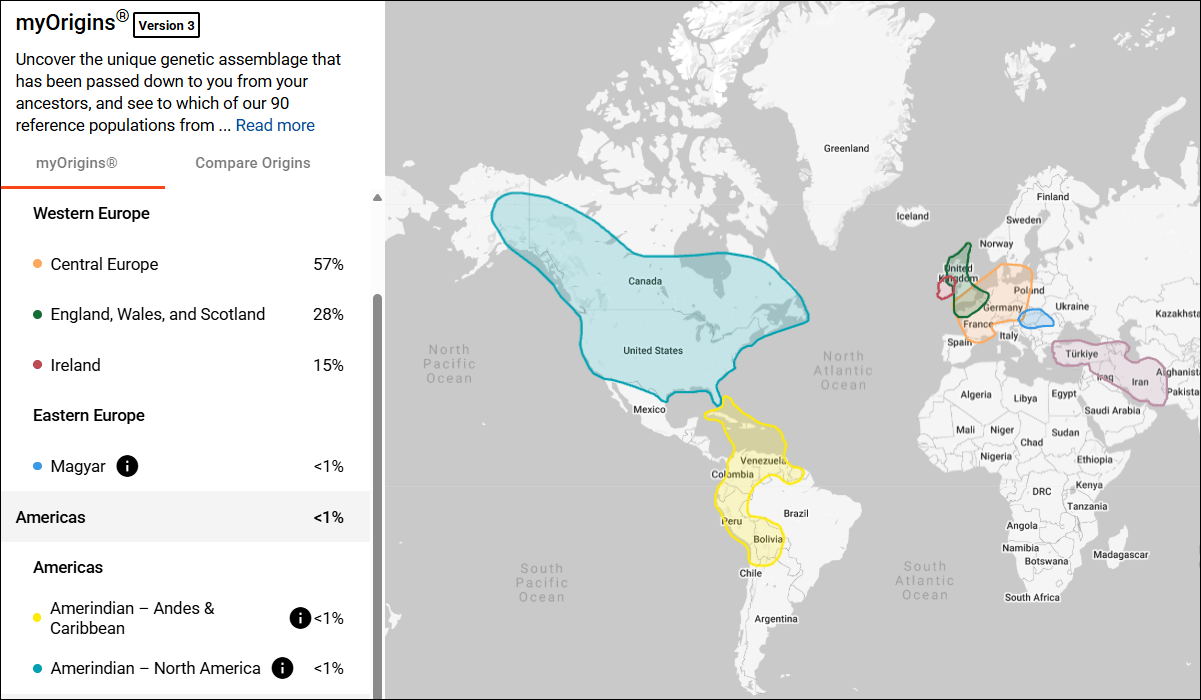
myOrigins Old Family Finder (apricot) NGS Family Finder (purple)
Central Europe 57% 52%
England, Wales, Scotland 28% 33%
Ireland 15% 14%
Magyar <1% <2%
AmerIndian Andes and Caribbean <1 (see below) N/A
AmerIndian North America <1% (chr 1 & 13) <1 (chr 1 & 2)
Anatolia, Armenia, Mesopotamia, North Africa <1 (chr 13) <1% (chr 10)

None of my major categories changed, but the amounts attributed to each category changed somewhat.

Trace regions, which are less than 1%, shifted some as well, as did their chromosome locations.

For me, this is particularly interesting, because I paint my ethnicity segments at DNAPainter in order to overlay my Native American segments over the matches with whom I’ve identified common ancestors.

Those segments, matches, and ancestors, taken together, help identify the source of the Native American segments.

My Native segment on chromosome one stayed essentially the same, but the Native segment on chromosome 13 is not present on the new NGS test. However, a new Native American segment is now shown on chromosome 2 in the same location that 23andMe also shows a Native American segment.

Chromosome one has already been proven to a Native American ancestor on my mother’s side, but I have hit a brick wall on the chromosome 13 segment. Now, I’ve painted the Native Segment on chromosome 2 and it aligns with the same ancestral line as my Native American segment on chromosome 1.

My Middle Eastern/North African segment still exists, but the location has changed. This segment was adjacent to my Native American segment on chromosome 13 before, on my father’s side, which suggested a history of enslavement. I thought I knew which ancestral line they both descend from, but now I need to review my matches and reconsider.

Unfortunately, my parents are both deceased and there’s no DNA available, so I cannot upgrade their tests or purchase new ones for them. No aunts or uncles are available either. In this case, cousin matches and their associated genealogy on those segments become critically important.

Native American and African American segments are often the best, and sometimes the only hints we have to find and identify those ancestors.

Preparing for Your NGS Results

To be very clear, you don’t necessarily need to compare or prepare, BUT, if you order an upgrade to an existing test, your old match list will be replaced with the new one. Your old match list will not be preserved unless you do it.

What may change?

  • Your ethnicity results will probably change somewhat
  • You will have matches you did not have before
  • Some existing matches, especially at low matching levels, will no longer be there
  • The amount of DNA you share with some people will change

Important: Any notes you have recorded on your matches and any matches that you have linked will be preserved and carried over to your new results when your new test is complete.

If you want to preserve your matches from your earlier test, or your myOrigins results, you’ll need to download your match list, and either download or take screenshots of your ethnicity information.

Ability to Download Tested at FamilyTreeDNA before March 2, 2026 Uploaded and purchased the Unlock Uploaded but did not purchase the Unlock
myOrigins Can download Can download Cannot download
Chromosome Painter (ethnicity) Can download Can download Cannot download
Match list with segment and other information Can download Can download Cannot download
Raw data file Can download Cannot download* Cannot download*

*On tests you uploaded, you don’t need to download the raw data file because you already have it from the originating vendor.

What information is included in your Match List download file?

  • Match name
  • Relationship Range
  • Shared Data cMs
  • Longest Block cMs
  • Linked Relationship (if you linked them in your tree) – this feature is what allows FamilyTreeDNA to assign your matches maternally, paternally or to both sides using triangulation
  • Ancestral Surnames that they’ve entered
  • Y-DNA Haplogroup if applicable
  • mtDNA Haplogroup if applicable
  • Notes
  • Paternal/Maternal or Both side(s) match (if you’ve linked people and this match can be assigned using triangulation. (This is why it’s important to link as many people as possible to their place in your tree.)
  • X-Match cMs
  • Autosomal Transfer yes/no

If you match the same person on the NGS test, this information is preserved for that match.

Where to Download

You must have 2FA (Two-Factor Authentication) enabled for all downloads.

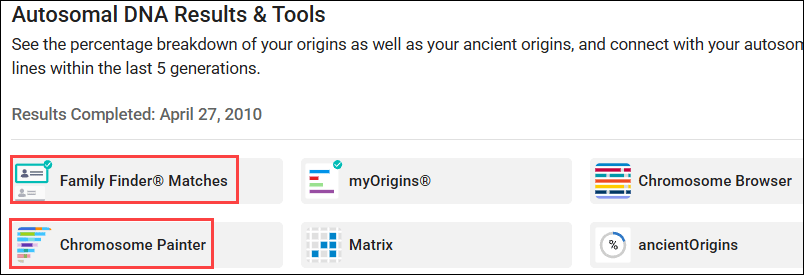
The files you may want to download are found on your dashboard in two locations.

  • Family Finder Matches
  • Chromosome Painter (ethnicity)

Family Finder Matches Download

To download your list of matches with their complete information, click on Family Finder Matches on the dashboard, then on “Export CSV.”

This download provides all the fields mentioned above, whereas the Chromosome Browser segment download provides only your matching segment data, without the additional information.

Download MyOrigins Ethnicity Segment Data

To download your myOrigins ethnicity segments, click on Chromosome Painter on your dashboard, then on “Download Segments.” You can also view or copy those segments by viewing the Detailed Segments tab.

I paint these segments at DNAPainter so that I can correlate my ethnicity regions with my ancestors’ segments.

To assign segments accurately, it helps immensely to have at least one parent’s DNA results too, and preferably both.

You may also want to take a screenshot of your myOrigins map. Note the left-side scroll bar when you’re taking screenshots.

What’s Next?

What else can you do at FamilyTreeDNA to benefit your genealogy?

  • If you haven’t already, upload a GEDCOM file or create a tree at MyHeritage, and link your Family Finder test to your results.
  • Link your individual matches to their place in your tree. This allows FamilyTreeDNA to use segments triangulated with linked matches to assign other matches to either the maternal or paternal side of your tree, or both.
  • Add your line to WikiTree. It’s easy. Begin with yourself and add ancestors until you connect with someone who is already in WikiTree. For me, it was the grandparent level.
  • Add your WikiTree link to your FamilyTreeDNA account under the gear in the upper right-hand corner, then Genealogy, then Family Tree. This gives your matches an easy way to identify common ancestors by using WikiTree’s Find Relationships feature, and provides two types of tree resources for you and your matches – MyHeritage and WikiTree.
  • Make sure your Earliest Known Ancestor information is correct and up-to-date with your most recent research, including a specific map location. You’ll find that under the gear too, then Genealogy, then Earliest Known Ancestors.
  • Add your surname list to your profile under the gear, Genealogy, Surnames tab.
  • Use the Matrix tool at FamilyTreeDNA to see how much DNA your shared matches share with each other.
  • Y-DNA – If you’re a male, test your Y-DNA, which is your father’s direct paternal line. The Big Y-700 test provides you with matches and the most detailed information possible.
  • mtDNA – Everyone can take a mitochondrial DNA test, which shows matches and provides information about your mother’s direct matrilineal line.
  • Use Advanced Matching, found under Additional Tests and Tools on your dashboard page, near the bottom, which allows you to select from multiple tests to see who matches you on both types of tests. For example, those who match you on both your full sequence mtDNA test and your Family Finder test.
  • Join projects relevant to your family surname, geography or broader interests. You’ll find Group Projects in the top banner of your dashboard page after signing in.
  • Utilize the Discover tools for both Y-DNA and mitochondrial DNA results.

Check your matches often to see who is new and what might have changed as people upgrade to the new NGS test and more people test.

_____________________________________________________________

Share the Love!

You’re always welcome to forward articles or links to friends and share on social media.

Subscribe!

If you haven’t already subscribed, it’s free. You’ll receive an e-mail whenever I publish by clicking the “follow” button at the top of the main blog page, here.

Help Keep This Blog Free

I receive a small commission when you click a vendor link in my articles and purchase that item. This does NOT increase your price but helps me keep the lights on and this informational blog free for everyone. Please click on the affiliate links in the articles or to the vendors below if you are purchasing products or DNA testing.

Thank you so much.

DNA Purchases and Free Uploads

Genealogy Products and Services

My Books

Genealogy Books

Genealogy Research

Autosomal DNA Unlock at FamilyTreeDNA to Be Retired August 18th

The autosomal unlock for transferred (uploaded) DNA files at FamilyTreeDNA is being discontinued (retired) on August 18th.

In a nutshell, this means that if you uploaded or transferred a test from another vendor and DID NOT purchase the unlock for the advanced tools, you only have a few days left to purchase that unlock if you (or the tester) can’t retest and don’t have a usable stored sample at FamilyTreeDNA.

If the tester has previously submitted a sample and cannot retest, contact FamilyTreeDNA support to confirm that a sample is still available. Of course, DNA tests can fail, especially on older samples.

The reason for the unlock retirement is because the new Family Finder NGS test provides substantially more coverage than a transfer test, and an upgrade will be offered at a special price beginning the 18th.

Upcoming features, including Family Finder Discover, developed around the new Family Finder platform, cannot be supported on files from other vendors. Additionally, many files from other vendors cannot be transferred to FamilyTreeDNA.

A new test with better coverage and more features is great news if the tester is living and can submit a new sample, but for those who cannot retest and do not have a stored sample, I strongly recommend that you sign in and purchase the $19 unlock for those tests now.

Why purchase something that is being retired?

Having access to advanced tools is better than not having access, and these tools still work fine. You won’t be able to receive all future features, but at least you’ll have access to what is available today, especially segment and chromosome browser information. Your relatives’ tests can be just as important to your genealogy as your own test, because they carry different segments of your ancestors’ DNA.

What Features Are Included in the Unlock?

This chart shows features included in the free autosomal transfer versus with the unlock:

Feature Free Transfer – No Unlock With the $19 Unlock
Matching Yes Yes
Matrix (which matches also match each other) Yes Yes
Shared matches Yes Yes
Segment data download Yes Yes
myOrigins (ethnicity) No Yes
myOrigins segment data No Yes
Chromosome Browser No Yes
Chromosome Painter No Yes
Y-DNA Haplogroups No When SNPs are available in the other vendor’s file
ancientOrigins No Yes

This Only Pertains to Transfers Without an Unlock

To be crystal clear – This only pertains to transferred (uploaded) autosomal files from other vendors that HAVE NOT previously purchased the unlock.

  • If you have an uploaded or transferred autosomal file from another vendor and have already purchased the unlock, you won’t have received the email, and it doesn’t pertain to you.
  • If an uploaded or transferred autosomal file registered to your email has not been unlocked, you should have received this email.

It’s always better to test ON any vendor’s platform rather than upload a file from another vendor. If your tester can, and is willing to provide a new sample, or already has one on file, don’t purchase the unlock today. Wait until the 18th and purchase the Family Finder test at the special upgrade price.

If your tester does not have stored DNA and cannot retest, purchase the unlock NOW. You won’t be able to after August 17th

The Email

People who have uploaded an autosomal DNA file and have not purchased the unlock received an email with the following information:

The current Family Finder test will provide better results and new tools that another vendor’s file cannot support. Other vendors don’t test the same DNA locations as FamilyTreeDNA, and the Family Finder NGS test generates 400 times more autosomal data than the older chip technologies used for transfer files.

The Family Finder NGS upgrade will be offered for transfer files beginning on August 18th. If the tester doesn’t have a viable sample in storage, a new collection kit will need to be sent to the tester. If this pertains to you, and you or the tester can upgrade, that is absolutely the way to proceed – and $29 is a great price.

The only people who should purchase the unlock now are those who don’t have a sample in place and can’t retest. Otherwise, wait until the 18th and order the Family Finder upgrade.

_____________________________________________________________

Share the Love!

You’re always welcome to forward articles or links to friends and share on social media.

Subscribe!

If you haven’t already subscribed, it’s free. You’ll receive an e-mail whenever I publish by clicking the “follow” button at the top of the main blog page, here.

Help Keep This Blog Free

I receive a small commission when you click a vendor link in my articles and purchase that item. This does NOT increase your price but helps me keep the lights on and this informational blog free for everyone. Please click on the affiliate links in the articles or to the vendors below if you are purchasing products or DNA testing.

Thank you so much.

DNA Purchases and Free Uploads

Genealogy Products and Services

My Books

Genealogy Books

Genealogy Research

FamilyTreeDNA Summer Sale Ends Soon

Rarely does FamilyTreeDNA put all of their products on sale at the same time, but this Summer Sale is a notable exception.

Not only are all new tests on sale, but so are upgrades, including mitochondrial and Y-DNA STR to Big Y-700 upgrades. So, if you’ve tested at the Y-DNA 37, 67, or 111 marker level, this is the perfect opportunity to discover more.

Plus, there are GREAT prices on bundles of multiple tests. If you aren’t sure which tests are beneficial for what, the article, 4 Kinds of DNA for Genetic Genealogy will help you sort things out.

If you’ve been considering a test or an upgrade for yourself or another family member, now’s a great time. I asked permission to upgrade a cousin’s Y-DNA just this morning, and he gladly agreed. I added a Family Finder test, too, because knowing who else in our study group he matches will help determine how closely people are related.

This sale ends in 5 days, August 31st at 1:59 am CDT, so don’t miss this opportunity.

Just the Facts, Please

Here’s the non-marketing “just the facts” list of regular and sale prices for comparison.

Are you seeing someone over the upcoming holiday weekend that would be a good testing candidate? What brick walls might be broken down?

Single Products
Product Regular Price Sale Price
Family Finder $79 $49
Autosomal Transfer Unlock  $19 $10
Mitochondrial mtFull Sequence  $159 $129
Y-37 $119 $99
Y-111 $249 $209
Big Y-700 $449 $399
Bundles
Bundle Regular Price Sale Price
Family Finder + mtFull Sequence  $238 $169
Family Finder + Y-37 $198 $139
Family Finder + Y-111 $328 $249
Family Finder + Big Y-700 $528 $439
mtFull Sequence + Y-37 $278 $219
mtFull Sequence + Y-111 $408 $329
mtFull Sequence + Big Y-700 $608 $499
Family Finder + mtFull Sequence + Y-37 $357 $259
Family Finder + mtFull Sequence + Y-111 $487 $369
Family Finder + mtFull Sequence + Big Y-700 $687 $507
Upgrades
Upgrade Regular Price Sale Price
Y-12 to Y-37 $79 $59
Y-12 to Y-67 $149 $139
Y-12 to Y-111 $199 $159
Y-12 to Big Y-700 $399 $339
Y-25 to Y-37 $49 $39
Y-25 to Y-67 $119 $109
Y-25 to Y-111 $189 $139
Y-25 to Big Y-700 $389 $339
Y-37 to Y-67 $89 $69
Y-37 to Y-111 $139 $119
Y-37 to Big Y-700 $339 $299
Y-67 to Y-111 $89 $79
Y-67 to Big Y-700 $279 $229
Y-111 to Big Y-700 $239 $189
Big Y-500 to Big Y-700 $209 $189
Mitochondrial mtDNA to mtFull Sequence $119 $79
Mitochondrial mtDNA+ to mtFull Sequence $119 $79

_____________________________________________________________

DNA Purchases and Free Uploads

Genealogy Products and Services

My Books

Genealogy Books

Genealogy Research

Holiday DNA Sales Are Here!!!

I apologize for the brevity of this posting, but I came home from the FamilyTreeDNA Conference this past weekend with “conference crud.”

I’ll catch you up on that great conference later, but sales won’t wait, and the holiday sales have already begun. This is a great time to order. These prices are the lowest ever.

MyHeritage

The MyHeritage autosomal test is only $36, and shipping is free if you order two or more DNA tests. That’s a GREAT deal. Click here to order.

If you’ve already tested elsewhere, you can upload your raw DNA file from that vendor to MyHeritage, here. I’ve provided step-by-step instructions, here. After you’ve uploaded, be sure to purchase the $29 unlock for advanced autosomal features, including the MyHeritage chromosome browser and Theories of Family Relativity, which shows you how you connect with DNA matches who share the same ancestor in MyHeritage’s collection of 52 million trees.

If you’re new to MyHeritage, you can also purchase a data or records subscription here, including a free trial.

I use this combination of DNA, trees, and tools almost daily and love that MyHeritage sends me regular record matches from their billions of genealogy records.

FamilyTreeDNA

Every test is on sale at FamilyTreeDNA.

As you know, FamilyTreeDNA provides Y-DNA, mitochondrial, and autosomal testing through their Family Finder test. They also accept autosomal DNA file uploads from Ancestry and MyHeritage. You’ll find easy download and upload instructions for each vendor, here. The advanced feature unlock is on sale now for just $9!

You can order each test individually or bundle tests for a better price.

Note that the introductory Y-DNA 37-marker test is available for $99, and can later be upgraded to the Big-Y test. However, the Big Y-700 is on sale for $399 which is a great price. Y-DNA testing unlocks your paternal ancestor’s history revealed in FamilyTreeDNA‘s world-class Discover tools.

If you’ve already tested at FamilyTreeDNA and would like to add another test for yourself or upgrade, say to the Big-Y test, just click here, sign on, and click on the Add Ons and Upgrade button in the upper right-hand corner.

I hope I’m not spilling the beans, but all sale prices, including upgrades and autosomal transfer unlocks, are shown below:

Genealogy Goals

The holidays are coming! Take a look at what you need for your genealogy.

I decided a long time ago it’s absolutely fine to “gift myself” with purchases and upgrades for my cousins. Especially the Big Y-700 at FamilyTreeDNA and the mitochondrial DNA test, which is vastly underutilized. This helps my genealogy immensely, as well as theirs. Most people are happy to swab, especially if you’re doing the genealogy work.

My goal is to:

  • Have the autosomal DNA of each of my family members and cousins in both databases that provide chromosome browsers so that I can confirm ancestors at FamilyTreeDNA and MyHeritage.
  • Find male cousins to test for the Y-DNA, the surname lineage of each of my ancestral lines. Males who descend paternally from each male ancestor can usually be tracked by their surname.
  • Mitochondrial DNA for each of my ancestors. For mitochondrial DNA testing, we need testers descended through all females from each female ancestor, although males in the current generation can test. Everyone has their mother’s direct matrilineal line mitochondrial DNA.

To find testing candidates for your lineages, check projects at FamilyTreeDNA, autosomal matches at all vendors, your ancestors at WikiTree, ThruLines at Ancestry, even though ThruLines is still having issues, and Theories of Family Relativity at MyHeritage.

With DNAtests on sale right now, this is a great time to purchase tests at MyHeritage and FamilyTreeDNA.

_____________________________________________________________

Follow DNAexplain on Facebook, here.

Share the Love!

You’re always welcome to forward articles or links to friends and share on social media.

If you haven’t already subscribed (it’s free,) you can receive an email whenever I publish by clicking the “follow” button on the main blog page, here.

You Can Help Keep This Blog Free

I receive a small contribution when you click on some of the links to vendors in my articles. This does NOT increase your price but helps me keep the lights on, and this informational blog free for everyone. Please click on the links in the articles or to the vendors below if you are purchasing products or DNA testing.

Thank you so much.

DNA Purchases and Free Uploads

Genealogy Products and Services

My Book

Genealogy Books

Genealogy Research

Which DNA Test Should I Buy? And Why?

Which DNA test should I buy, and why?

I receive questions like this often. As a reminder, I don’t take private clients anymore, which means I don’t provide this type of individual consulting or advice. However, I’m doing the next best thing! In this article, I’m sharing the step-by-step process that I utilize to evaluate these questions so you can use the process too.

It’s important to know what questions to ask and how to evaluate each situation to arrive at the best answer for each person.

Here’s the question I received from someone I’ll call John. I’ve modified the wording slightly and changed the names for privacy.

I’m a male, and my mother was born in Charleston, SC. My maternal grandmother’s maiden name was Jones and a paternal surname was Davis. The family was supposed to have been Black, Dutch, Pennsylvania Dutch, and Scots-Irish…only once was I told I was 3/16 Indian, with Davis being 3/4 and Jones being full Indian.

Do I have enough reasonable information to buy a test, and which one?

Please note that it’s common for questions to arrive without all the information you need to provide a sound answer – so it’s up to you to ask those questions and obtain clarification.

Multiple Questions

There are actually multiple questions here, so let me parse this a bit.

  1. John never mentioned what his testing goal was.
  2. He also never exactly said how the paternal line of Davis was connected, so I’ve made an assumption. For educational purposes, it doesn’t matter because we’re going to walk through the evaluation process, which is the same regardless.
  3. John did not include a tree or a link to a tree, so I created a rudimentary tree to sort through this. I need the visuals and normally just sketch it out on paper quickly.
  4. Does John have enough information to purchase a test?
  5. If so, which test?

There is no “one size fits all” answer, so let’s discuss these one by one.

Easy Answers First

The answer to #4 is easy.

Anyone with any amount of information can purchase a DNA test. Adoptees do it all the time, and they have no prior information.

So, yes, John can purchase a test.

The more difficult question is which test, because that answer depends on John’s goals and whether he’s just looking for some quick information or really wants to delve into genealogy and learn. Neither approach is wrong.

Many people think they want a quick answer –  and then quickly figure out that they really want to know much more about their ancestors.

I wrote an article titled DNA Results – First Glances at Ethnicity and Matching for new testers, here.

Goals

Based on what John said, I’m going to presume his goals are probably:

  • To prove or disprove the family oral history of Black, Dutch, Pennsylvania Dutch (which is actually German,) Scots-Irish, and potentially Native American.
  • John didn’t mention actual genealogy, which would include DNA matches and trees, so we will count that as something John is interested in secondarily. However, he may need genealogy records to reach his primary goal.

If you’re thinking, “The process of answering this seemingly easy question is more complex than I thought,” you’d be right.

Ethnicity in General

It sounds like John is interested in ethnicity testing. Lots of people think that “the answer” will be found there – and sometimes they are right. Often not so much. It depends.

The great news is that John really doesn’t need any information at all to take an autosomal DNA test, and it doesn’t matter if the test-taker is male or female.

To calculate each tester’s ethnicity, every testing company compiles their own reference populations, and John will receive different results at each of the major companies. Each company updates their ethnicity results from time to time as well, and they will change.

Additionally, each company provides different tools for their customers.

The ethnicity results at different companies generally won’t match each other exactly, and sometimes the populations look quite different.

Normally, DNA from a specific ancestor can be found for at least 5 or 6 generations. Of course, that means their DNA, along with the DNA from all of your other ancestors is essentially combined in a communal genetic “pot” of your chromosomes, and the DNA testing company needs to sort it out and analyze your DNA for ethnicity.

DNA descended from ancestors, and their populations, further back in people’s trees may not be discerned at all using autosomal DNA tests.

A much more specific “ethnicity” can be obtained for both the Y-DNA line, which is a direct patrilineal line for men (blue arrow,) and the mitochondrial DNA line (pink arrows,) which is a direct matrilineal line for everyone, using those specific tests.

We will discuss both of those tests after we talk about the autosomal tests available from the four major genealogy DNA testing companies. All of these tools can and should be used together.

Let’s Start with Native American

Let’s evaluate the information that John provided.

John was told that he “was 3/16 Indian, with Davis being 3/4 and Jones being full Indian.”

We need to evaluate this part of his question slightly differently.

I discussed this in the article, Ancestral DNA Percentages – How Much of Them is in You?

First, we need to convert generations to 16ths.

You have two ancestors in your parent’s generation, four in your grandparents, and so forth. You have 16 great-great-grandparents. So, if John was 3/16th Native, then three of his great-great-grandparents would have been fully Native, or an equivalent percentage. In other words, six ancestors in that generation could have been half-Native. Based on what John said, they would have come from his mother’s side of the tree. John is fortunate to have that much information to work with.

He told us enough about his tree that we can evaluate the statement that he might be 3/16ths Native.

Here’s the tree I quickly assembled in a spreadsheet based on John’s information.

His father, at left, is not part of the equation based on the information John provided.

On his mother’s side, John said that Grandfather Davis is supposed to be three-quarters Native, which translates to 12/16ths. Please note that it would be extremely beneficial to find a Y-DNA tester from his Davis line, like one of his mother’s brothers, for example.

John said that his Grandmother Jones is supposed to be 100% Native, so 16/16ths.

Added together, those sum to 28/32, which reduces down to 14/16th or 7/8th for John’s mother.

John would have received half of his autosomal DNA from his mother and half from his non-Native father. That means that if John’s father is 100% non-Native, John would be half of 14/16ths or 7/16ths, so just shy of half Native.

Of course, we know that we don’t always receive exactly 50% of each of our ancestors’ DNA (except for our parents,) but we would expect to see something in the ballpark of 40-45% Native for John if his grandmother was 100% Native and his grandfather was 75%.

Using simple logic here, for John’s grandmother to be 100% Native, she would almost assuredly have been a registered tribal member, and the same if his grandfather was 75% Native. I would think that information would be readily available and well-known to the family – so I doubt that this percentage is accurate. It would be easy to check, though, on various census records during their lifetimes where they would likely have been recorded as “Indian.” They might have been in the special “Indian Census” taken and might be living on a reservation.

It should also be relatively easy to find their parents since all family members were listed every ten years in the US beginning with the 1850 census.

The simple answer is that if John’s grandparents had as much Native as reported, he would be more than 3/16th – so both of these factoids cannot simultaneously be accurate. But that does NOT mean neither is accurate.

John could be 7/8th or 40ish%, 3/16th or 18ish%, or some other percentage. Sometimes, where there is smoke, there is fire. And that seems to be the quandary John is seeking to resolve.

Would  Ethnicity/Population Tests Show This Much Native?

Any of the four major testing companies would show Native for someone whose percentage would be in the 40% or 18% ballpark.

The easiest ethnicities to tell apart from one another are continental-level populations. John also stated that he thinks he may also have Black ancestry, plus Dutch, Pennsylvania Dutch (German), and Scots-Irish. It’s certainly possible to verify that using genealogy, but what can DNA testing alone tell us?

How far back can we expect to find ethnicities descending from particular ancestors?

In this table, you can see at each generation how many ancestors you have in that generation, plus the percentage of DNA, on average, you would inherit from each ancestor.

All of the major DNA testing companies can potentially pick up small trace percentages, but they don’t always. Sometimes one company does, and another doesn’t. So, if John has one sixth-generation Native American ancestor, he would carry about 1.56% Native DNA, if any.

  • Sometimes a specific ethnicity is not found because, thanks to random recombination, you didn’t inherit any of that DNA from those ancestors. This is why testing your parents, grandparents, aunts, uncles, and siblings can be very important. They share your same ancestors and may have inherited DNA that you didn’t that’s very relevant to your search.
  • Sometimes it’s not found because the reference populations and algorithms at that testing company aren’t able to detect that population or identify it accurately, especially at trace levels. Every DNA testing company establishes their own reference populations and writes internal, proprietary ethnicity analysis algorithms.
  • Sometimes it’s not found because your ancestor wasn’t Native or from that specific population.
  • Sometimes it’s there, but your population is called something you don’t expect.

For example, you may find Scandinavian when your ancestor was from England or Ireland. The Vikings raided the British Isles, so while some small amount of Scandinavian is not what you expect, that doesn’t mean it‘s wrong. However, if all of your family is from England, it’s not reasonable to have entirely Scandinavian ethnicity results.

It’s also less likely as each generation passes by that the information about their origins gets handed down accurately to following generations. Most non-genealogists don’t know the names of their great-grandparents, let alone where their ancestors were from.

Using a 25-year average generation length, by the 4th generation, shown in the chart above, you have 16 ancestors who lived approximately 100 years before your parents were born, so someplace in the mid-1800s. It’s unlikely for oral history from that time to survive intact. It’s even less likely from a century years earlier, where in the 7th generation, you have 128 total ancestors.

The best way to validate the accuracy of your ethnicity estimates is by researching your genealogy. Of course, you need to take an ethnicity test, or two, in order to have results to validate.

Ethnicity has a lot more to offer than just percentages.

Best Autosomal Tests for Native Ethnicity

Based on my experience with people who have confirmed Native ancestry, the two best tests to detect Native American ethnicity, especially in smaller percentages, are both FamilyTreeDNA and 23andMe.

Click images to enlarge

In addition to percentages, both 23andMe and FamilyTreeDNA provide chromosome painting for ethnicity, along with segment information in download files. In other words, they literally paint your ethnicity results on your chromosomes.

They then provide you with a file with the “addresses” of those ethnicities on your chromosomes, which means you can figure out which ancestors contributed those ethnicity segments.

The person in the example above, a tester at FamilyTreeDNA, is highly admixed with ancestors from European regions, African regions and Native people from South America.

Trace amounts of Native American with a majority of European heritage would appear more like this.

You can use this information to paint your chromosome segments at DNAPainter, along with your matching segments to other testers where you can identify your common ancestors. This is why providing trees is critically important – DNA plus ancestor identification with our matches is how we confirm our ancestry.

This combination allows you to identify which Native (or another ethnicity) segments descended from which ancestors. I was able to determine which ancestor provided that pink Native American segment on chromosome 1 on my mother’s side.

I’ve provided instructions for painting ethnicity segments to identify their origins in specific ancestors, here.

Autosomal and Genealogy

You may have noticed that we’ve now drifted into the genealogy realm of autosomal DNA testing. Ethnicity is nice, but if you want to know who those segments came from, you’ll need:

  • Autosomal test matching to other people
  • To identify your common ancestor with as many matches as you can
  • To match at a company who provides you with segment information for each match
  • To work with DNAPainter, which is very easy

The great news is that you can do all of that using the autosomal tests you took for ethnicity, except at Ancestry who does not provide segment information.

Best Autosomal Test for Matching Other Testers

The best autosomal test for matching may be different for everyone. Let’s look at some of the differentiators and considerations.

If you’re basing a testing recommendation solely on database size, which will probably correlate to more matches, then the DNA testing vendors fall into this order:

If you’re basing that recommendation on the BEST, generally meaning the closest matches for you, there’s no way of knowing ahead of time. At each of the four DNA testing companies, I have very good matches who have not tested elsewhere. If I weren’t in all four databases, I would have missed many valuable matches.

If you’re basing that recommendation on which vendor began testing earliest, meaning they have many tests from people who are now deceased, so you won’t find their autosomal tests in other databases that don’t accept uploads, the recommended testing company order would be:

If you’re basing that recommendation on matches to people who live in other countries, the order would be:

Ancestry and 23andMe are very distant third/fourth because they did not sell widely outside the US initially and still don’t sell in as many countries as the others, meaning their testers’ geography is more limited. However, Ancestry is also prevalent in the UK.

If you’re basing that recommendation on segment information and advanced tools that allow you to triangulate and confirm your genetic link to specific ancestors, the order would be:

Ancestry does NOT provide any segment information.

If you’re basing that recommendation on unique tools provided by each vendor, every vendor has something very beneficial that the others don’t.

In other words, there’s really no clear-cut answer for which single autosomal DNA test to order. The real answer is to be sure you’re fishing in all the ponds. The fish are not the same. Unique people test at each of those companies daily who will never be found in the other databases.

Test at or upload your DNA to all four DNA testing companies, plus GEDmatch. Step-by-step instructions for downloading your raw data file and uploading it to the DNA testing companies who accept uploads can be found, here.

Test or Upload

Not all testing companies accept uploads of raw autosomal DNA data files from other companies. The good news is that some do, and it’s free to upload and receive matches.

Two major DNA testing companies DO NOT accept uploads from other companies. In other words, you have to test at that company:

Two testing companies DO accept uploads from the other three companies. Uploads and matching are free, and advanced features can be unlocked very cost effectively.

  • FamilyTreeDNA – free matching and $19 unlock for advanced features
  • MyHeritage – free matching and $29 unlock.for advanced features

I recommend testing at both 23andMe and Ancestry and uploading one of those files to both FamilyTreeDNA and MyHeritage, then purchasing the respective unlocks.

GEDmatch

GEDmatch is a third-party matching site, not a DNA testing company. Consider uploading to GEDmatch because you may find matches from Ancestry who have uploaded to GEDmatch, giving you access to matching segment information.

Other Types of DNA

John provided additional information that may prove to be VERY useful. Both Y-DNA and mitochondrial DNA can be tested as well and may prove to be more useful than autosomal to positively identify the origins of those two specific lines.

Let’s assume that John takes an autosomal test and discovers that indeed, the 3/16th Native estimate was close. 3/16th equates to about 18% Native which would mean that three of his 16 great-great-grandparents were Native.

John told us that his Grandmother Jones was supposed to be 100% Native.

At the great-great-grandparent level, John has 16 ancestors, so eight on his mother’s side, four from maternal grandmother Jones and four from his maternal grandfather Davis.

John carries the mitochondrial DNA of his mother (red boxes and arrows,) and her mother, through a direct line of females back in time. John also carries the Y-DNA of his father (dark blue box, at left above, and blue arrows below.)

Unlike autosomal DNA which is admixed in every generation, mitochondrial DNA (red arrows) is inherited from that direct matrilineal line ONLY and never combines with the DNA of the father. Mothers give their mitochondrial DNA to both sexes of their children, but men never contribute their mitochondrial DNA to offspring. Everyone has their mother’s mitochondrial DNA.

Because it never recombines with DNA from the father, so is never “watered down,” we can “see” much further back in time, even though we can’t yet identify those ancestors.

However, more importantly, in this situation, John can test his own mitochondrial DNA that he inherited from his mother, who inherited it from her mother, to view her direct matrilineal line.

John’s mitochondrial DNA haplogroup that will be assigned during testing tells us unquestionably whether or not his direct matrilineal ancestor was Native on her mother’s line, or not. If not, it may well tell us where that specific line originated.

You can view the countries around the world where Y-DNA haplogroups are found, here, and mitochondrial haplogroups, here.

If John’s mitochondrial DNA haplogroup is Native, that confirms that one specific line is Native. If he can find other testers in his various lines to test either their Y-DNA or mitochondrial DNA, John can determine if other ancestors were Native too. If not, those tests will reveal the origins of that line, separate from the rest of his genealogical lines.

Although John didn’t mention his father’s line, if he takes a Y-DNA test, especially at the Big Y-700 level, that will also reveal the origins of his direct paternal line. Y-DNA doesn’t combine with the other parent’s DNA either, so it reaches far back in time too.

Y-DNA and mitochondrial DNA tests are laser-focused on one line each, and only one line. You don’t have to try to sort it out of the ethnicity “pot,” wondering which ancestor was or was not Native.

My Recommendation

When putting together a testing strategy, I recommend taking advantage of free uploads and inexpensive unlocks when possible.

  • To confirm Native American ancestry via ethnicity testing, I recommend testing at 23andMe and uploading to FamilyTreeDNA, then purchasing the $19 unlock. The free upload and $19 unlock are less expensive than testing there directly.
  • For matching, I recommend testing at Ancestry and uploading to MyHeritage, then unlocking the MyHeritage advanced features for $29, which is less expensive than retesting. Ancestry does not provide segment information, but MyHeritage (and the others) do.

At this point, John will have taken two DNA tests, but is now in all four databases, plus GEDmatch if he uploads there.

  • For genealogy research on John’s lines to determine whether or not his mother’s lines were Native, I recommend an Ancestry and a MyHeritage records subscription, plus using WikiTree, which is free.
  • To determine if John’s mother’s direct matrilineal female line was Native, I recommend that John order the mitochondrial DNA test at FamilyTreeDNA.
  • When ordering multiple tests, or uploading at FamilyTreeDNA, be sure to upload/order all of one person’s tests on the same DNA kit so that those results can be used in combination with each other.

Both males and females can take autosomal and mitochondrial DNA tests.

  • To discover what he doesn’t know about his direct paternal, meaning John’s surname line – I recommend the Big Y-700 test at FamilyTreeDNA.

Only males can take a Y-DNA test, so women would need to ask their father, brother, or paternal uncle, for example, to test their direct paternal line.

  • If John can find a male Davis from his mother’s line, I recommend that he purchase the Big Y-700 test at FamilyTreeDNA for that person, or check to see if someone from his Davis line may have already tested by viewing the Davis DNA Project. Like with mitochondrial DNA, the Y-DNA haplogroup will tell John the origins of his direct Davis male ancestor – plus matching of course. He will be able to determine if they were Native, and if not, discover the origins of the Davis line.
  • For assigning segments to ancestors and triangulating to confirm descent from a common ancestor, I recommend 23andMe, MyHeritage, FamilyTreeDNA and GEDmatch, paired with DNAPainter as a tool.

Shopping and Research List

Here are the tests and links recommended above:

More Than He Asked

I realize this answer is way more than John expected or even knew to ask. That’s because there is often no “one” or “one best” answer. There are many ways to approach the question after the goal is defined, and the first “answer” received may be a bit out of context.

For example, let’s say John has 2% Native ancestry and took a test at a vendor who didn’t detect it. John would believe he had none. But a different vendor might find that 2%. If it’s on his mother’s direct matrilineal line, mitochondrial DNA testing will confirm, or refute Native, beyond any doubt, regardless of autosomal ethnicity results – but only for that specific ancestral line.

Autosomal DNA can suggest Native across all your DNA, but Y-DNA and mitochondrial DNA confirm it for each individual ancestor.

Even when autosomal testing does NOT show Native American, or African, for example, it’s certainly possible that it’s just too far back in time or has not been passed down during random recombination, but either Y-DNA or mitochondrial DNA will unquestionably confirm (or refute) the ancestry in question if the right person is tested.

This is exactly why I attempt to find a cousin who descends appropriately from every ancestor and provide testing scholarships. It’s important to obtain Y-DNA and mitochondrial DNA information for each ancestor.

Which Test Should I Order?

What steps will help you decide which test or tests to take?

  1. Define your testing goal.
  2. Determine if your Y-DNA or mitochondrial DNA will help answer the question.
  3. Determine if you need to find ancestors another generation or two back in time to get the most benefit from DNA testing. In our example, if John discovered that both of his grandparents were enrolled tribal members, that’s huge, and the tribe might have additional information about his family.
  4. Subscribe to Ancestry and MyHeritage records collections as appropriate to perform genealogical research. Additional information not only provides context for your family, it also provides you with the ability to confirm or better understand your ethnicity results.
  5. Extend your tree so that you can obtain the best results from the three vendors who support trees; Ancestry, FamilyTreeDNA, and MyHeritage. All three use trees combined with DNA tests to provide you with additional information.
  6. Order 23andMe and Ancestry autosomal DNA tests.
  7. Either test at or upload one of those tests to MyHeritage, FamilyTreeDNA, and GEDmatch.
  8. If a male, order the Big Y-700 DNA test. Or, find a male from your ancestral line who has taken or will take that test. I always offer a testing scholarship and, of course, share the exciting results!
  9. Order a mitochondrial DNA test for yourself and for appropriately descended family members to represent other ancestors. Remember that your father (and his siblings) all carry your paternal grandmother’s mitochondrial DNA. That’s often a good place to start after testing your own DNA.
  10. If your parents or grandparents are alive, or aunts and uncles, test their autosomal DNA too. They are (at least) one generation closer to your ancestors than you are and will carry more of your ancestors’ DNA.
  11. Your siblings will carry some of your ancestors’ DNA that you do not, so test them too if both of your parents aren’t available for testing.

Enjoy!!!

_____________________________________________________________

Follow DNAexplain on Facebook, here.

Share the Love!

You’re always welcome to forward articles or links to friends and share on social media.

If you haven’t already subscribed (it’s free,) you can receive an email whenever I publish by clicking the “follow” button on the main blog page, here.

You Can Help Keep This Blog Free

I receive a small contribution when you click on some of the links to vendors in my articles. This does NOT increase the price you pay but helps me to keep the lights on and this informational blog free for everyone. Please click on the links in the articles or to the vendors below if you are purchasing products or DNA testing.

Thank you so much.

DNA Purchases and Free Uploads

Genealogy Products and Services

My Book

Genealogy Books

Genealogy Research