

Ancient Connections, a report found on FamilyTreeDNA’s Discover platform for both Y-DNA and mitochondrial DNA (mtDNA), can be used in multiple ways to enhance your genealogy and unlock secrets.
It’s exciting to examine ancient burials linked to our ancestors and understand how we connect to them. Ancient Connections offer a wealth of information, providing clues that can help unravel long-standing mysteries.
Today, there are more than 12,960 Y-DNA Ancient Connections in Discover, along with more than 25,310 mitochondrial Ancient Connections, and that number increases weekly.
Why the disparity, you ask? Remember, everyone has mitochondrial DNA, but only males have Y-DNA.
In addition to matches, your DNA results hold something even more powerful – evidence of where your ancestors and their cousins lived in the distant past, when they lived, and the cultural context surrounding them. These essential insights are unavailable through any other means. Ancient Connections help us answer the age-old question, “Where did I come from?”
Could These People Be My Ancestors?
I’ll show you how to answer another question, too. Which of these Ancient Connections could potentially be your ancestors, and which ones are your “haplo-cousins”?
Regardless, they all help us understand our ancestors’ past, and that of their descendants.
Discover is for Everyone
FamilyTreeDNA provides a free version of Discover that everyone can use. There’s also an enriched version with additional information for their customers who have purchased Y-DNA and mitochondrial DNA tests.
Discover has something to offer for everyone.

Mitochondrial DNA is passed from mothers to all of their children of both sexes – unmixed with the DNA of the father.

Everyone has their mother’s mitochondrial DNA, which is passed intact, except for an occasional mutation, directly down through generations of mothers. It’s not admixed like autosomal DNA, so we don’t lose some portion in each generation. This is exactly why we can track mitochondrial DNA infinitely far back in time and why it’s so crucial for understanding the origins of your mother’s specific line.
Y-DNA is passed from fathers only to their sons, which is what makes males male. Like mitochondrial DNA, Y-DNA is not admixed with any DNA from the mother, so we get a laser line-of-sight view of the direct patrilineal line back in time. The Y-DNA direct paternal line is the male’s surname line in cultures where males carry their father’s surname.
If you’ve tested at or upgraded to either the Big Y-700 level or the mtFull, full mitochondrial sequence test, you will receive the most granular haplogroup possible, meaning the closest in time and most informative. You’ll also match with other testers who have taken the less-refined lower-level tests.
The most informative and precise results occur when both people have taken the premium tests. As more people test and science advances, you may receive a new haplogroup from time to time when you and another tester share a rare mutation – so these tests are evergreen.
Both Y-DNA and mitochondrial DNA testers at any level have access to Discover on their dashboard for those products, although the results of lower-level tests provide less information.
The Free Version of Discover Compared to the Premium Version for Testers
Here’s a comparison of lower-level Y-DNA tests and the Big Y-700.

Click any image to enlarge
Y-DNA testers who have only taken the 12-111 STR panel tests receive a predicted haplogroup, and when clicking through to Discover, receive up to 10 Ancient Connections.
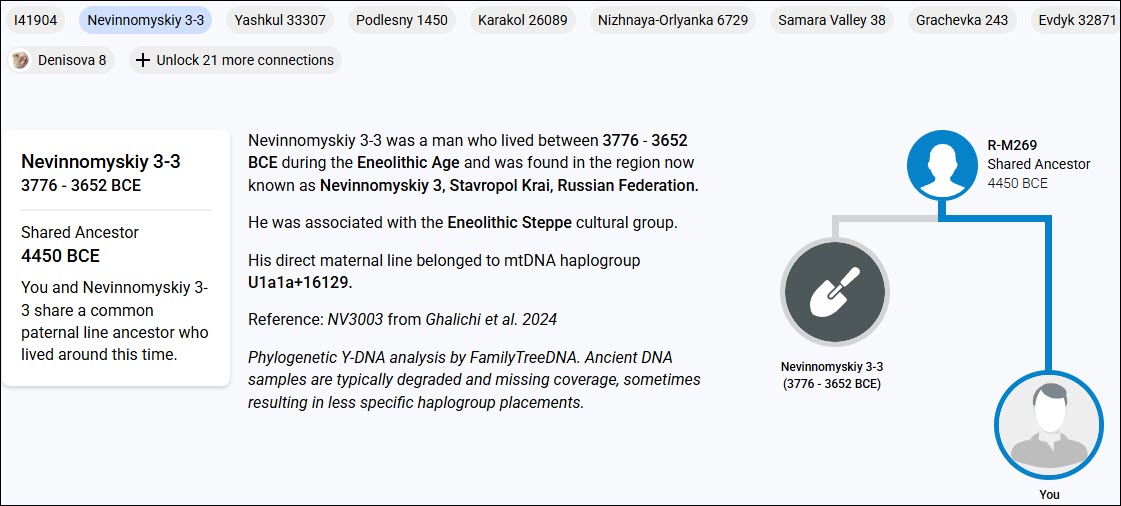
For example, If your Y-DNA haplogroup is predicted as R-M269, the most common male lineage in Europe that arose some 6450 years ago, your Ancient Connections begin with the closest genetic match to R-M269. Viewing Ancient Connections that are 6500 years ago will certainly be interesting, so please do look, but probably not terribly useful for genealogy.
However, if that same person were to upgrade to the Big Y-700, they would receive a much more recent haplogroup, and along with it, up to 30 Ancient Connections within their major haplogroup lineage, R in this case, plus the oldest sample in the database. For some haplogroups, there may not yet be 30 Ancient Connections, although new ancient samples are added weekly for both Y-DNA and mitochondrial DNA.
All Ancient Connections begin with the matches who are genetically closest to the haplogroup requested.

The same scenario holds true for mitochondrial DNA testers who previously tested at the HVR1/HVR2 level, but not at the full sequence level, which is the only test available today.
This article focuses on testers at the higher levels, meaning the Big Y-700 and the mtFull tests, and how to utilize their 30 closest Ancient Connections. We’ll walk through step-by-step examples using both.
However, before we begin evaluating our Ancient Connections, we need to cover two fundamental concepts.
BCE, CE and Converting to “Years Ago”
It’s helpful to understand date structures and how they are used.
It’s easy to get confused when seeing the dates of CE, current era, and BCE, before current era, which means we misinterpret the information.
For example, the year 100 CE is the year 100 that occurred roughly 1900 years ago. We round 2026 to 2000 for these types of calculations. The year 100 BCE, before current era, occurred approximately 2100 years ago. I often prefer to work in “years ago”, because it equalizes the numbers, meaning you’re less likely to get confused about how long ago someone lived or something happened.
To do the calculations from BCE dates to “years ago,” add 2000, so 2250 BCE equals 4250 years ago.
For CE dates, subtract from 2000. The date 500 CE occurred 1500 years ago.
This can be especially confusing when you’re dealing with the same number on either side of the current era, which began in the year 1. There is no year zero. For example, we need to be vigilant not to confuse 500 BCE, which was 2500 years ago, and 500 CE, which was 1500 years ago.
Now, on to our second concept.
Haplogroup Age and Burial Age Are Not the Same
When viewing Ancient Connections, the genetic age of the haplogroup, meaning when it was formed, and age of the burial are two different things.

Haplogroup R-ZP18 is about 4250 years old, and this Late Iron Age, pre-Roman burial which is also R-ZP18, occurred about between 2337 and 2043 years ago.
Haplogroup ages and the date they emerged, which show on the Timeline, sometimes mature and are refined with additional testers and branching.

Burials are dated using various techniques, and sometimes the ages provided in the academic papers are earlier than the genetic age of the haplogroup, shown on the Timeline at the bottom of the Connections page.
Discover makes no attempt to “fix” this situation, because it’s unclear which age should be changed. It’s not unusual to be unable to fully analyze ancient remains. For example, let’s say a sample is determined to have the SNP for R-ZP18, but simultaneously lacks downstream SNPs and some upstream SNPs, and the burial was dated from surrounding soil or artifacts. In that case, it would be impossible to know what is precisely “accurate”, but the sample is accurate enough to be included in Ancient Connections. This is also why some samples aren’t included in Globetrekker™ calculations. Some low-quality samples are excluded entirely.
Every ancient sample is individually analyzed by R&D team members before being included in the phylogenetic tree and Ancient Connections. Sometimes, the scientists at FamilyTreeDNA can assign a more specific haplogroup than was available to the paper authors at the time of publication because the tree has since branched.
As you receive new Ancient Connections, your older ones, except your final or oldest connection, will roll off of your list.
That’s one reason I devised a process for analyzing and recording my Ancient Connections, and for determining which ones might be actual ancestors – or at least aren’t precluded from it.
First Peek at Ancient Connections

Sign in to your FamilyTreeDNA account and click on the Discover link on the dashboard for the type of test you wish to view.

In the Y-DNA example, I’m using my male Estes cousins. As a female, I can’t test for the Estes Y chromosome, so I recruited others to represent my line. You can see the results in the Estes DNA project.

After signing in, click on Discover, then on Ancient Connections.
Y-DNA Ancient Connections
It’s a bonanza!
Your Ancient Connections are displayed at the top of the page, ordered from genetically closest to most distant. These are archaeological samples whose data has been extracted from academic papers and analyzed before being include in Discover.
You’ll see a description of the first sample, or any sample you click on. The Timeline for that sample, along with your haplogroup and your common ancestor’s haplogroup, is displayed at the bottom of the page.

The first, meaning closest, Ancient Connection is highlighted, so let’s take a look.
- “You” are shown in the dark purple frame (with purple arrows) at right, with your haplogroup, in this case R-ZS3700, which is placed on the Timeline at the bottom of the page in the appropriate location.
- The Ancient Connection named “North Berwick 16499”, whose name was taken from the academic paper in which it was found, is shown in a red frame and placed on the timeline based on information provided in the paper.
“North Berwick” has been assigned to haplogroup R-ZP18, either in the paper, or by the FamilyTreeDNA R&D team if a more refined haplogroup can be determined, and is this tester’s closest Ancient Connection based on its position on the list.
Note that you may have other Ancient Connections who are genetically equivalent in age, meaning they too would be R-ZP18. In our case, only one sample is assigned to that haplogroup.
- Your Shared Ancestor, in the green frame, is the first man who carried R-ZP18, which emerged about 2250 BCE, or 4250 years ago.
Notice that I said, “the first man.” That man’s sons, grandsons and so forth were also haplogroup R-ZP18. Some went on to develop new downstream haplogroups, but apparently, North Berwick, by the time he lived, had not. Either that, or a downstream haplogroup cannot yet be determined due to a lack of other testers in that lineage.
Men with downstream SNPs (mutations), meaning downstream haplogroups, also descended from R-ZP18. Those SNP mutations become downstream haplogroups when two or more men who carry the same SNP mutation match each other. For example, our Estes ancestor who carries haplogroup R-ZS3700 descends from R-ZP18 through a distinct series of downstream SNPs (mutations). While we carry R-ZP18 in our lineage, it’s not our most refined haplogroup.
However, for North Berwick, haplogroup R-ZP18 is his most refined haplogroup.
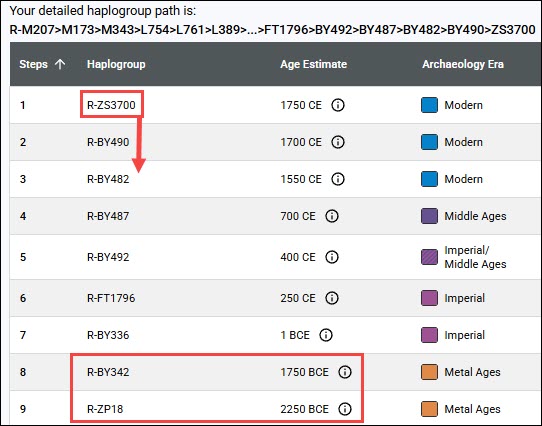
Because of this, we know for sure that North Berwick and the Estes men both descend from the original R-ZP18 man who lived about 4250 years ago, but we can’t tell when they shared a common ancestor between 4250 years ago and 3750 years ago when the next downstream haplogroup R-BY342, was formed in the Estes lineage.
Because North Berwick does not belong to a different downstream haplogroup, it’s genetically possible that the Estes men could descend from him during that 500-year timeframe. There’s nothing to exclude that possibility based on his haplogroup alone, but looking at when North Berwick lived is another matter.
North Berwick lived between 2337 and 2043 years ago, which is 1400 years LATER than when the first downstream haplogroup, R-BY342 was formed, about 3750 year ago, in the Estes lineage. This precludes North Berwick from being our direct ancestor. Instead, he’s our “haplocousin.” We share a common upstream ancestor.
What we absolutely CAN confirm, though, is that between 500 and 1300 years earlier than North Berwick lived, between when haplogroups R-BY342 and R-ZP18 were formed, both North Berwick and our Estes ancestor descended from the same man.
This kind of information is like waving a red flag in a genealogist’s face. We immediately need to know more.
This is just the beginning, and we have so many questions!
Revealing More Information
Did our common ancestor live in or near North Berwick, or someplace else? What do we know about the history of North Berwick?
What can we discern about North Berwick?
- When did this man live, and where?
- What do we know about him?
- Who was he?
- Did he live close to where my earliest known ancestor in this line is found?
- What can I tell about his culture?
- Were there grave goods that provide at least a peek into his life?
So many questions!
Discover tells us that he lived between 337 and 43 BCE, so between 2337 and 2043 years ago, during the Late Iron Age, and is associated with the Iron Age Britain cultural group.
The Ancient Connections “Reference” provides information about the paper where the North Berwick sample was found. No links are provided because sometimes the paper is behind a paywall, and you can’t access it without paying, and sometimes it’s a preprint and will appear later elsewhere. Sometimes one paper actually uses data from an earlier paper, and it gets complicated.
The first thing I do is Google the paper – Patterson et al. 2022. Google provides two links – one that’s free, and one that isn’t. Many times, the sample data is found in the supplementary material, which may also be behind a paywall, even if the paper isn’t.
I know you’re going to think it’s a pain, but I strongly encourage you to read every paper, though sometimes they can be challenging to understand, so read them when you’re fresh, not tired, and can concentrate. If nothing else, at least read the abstract. There’s so much great information buried in academic papers, including nice maps and discussions of the burial site. You can also learn more sometimes by Googling the burial site itself.
Let me give you an example from this paper’s abstract. I’ve added the brackets [ ] for clarity, from the body of the paper:
Between 1000 and 875 BC[E], EEF [Early European Farmer] ancestry increased in southern Britain [England and Wales] but not northern Britain [Scotland] due to incorporation of migrants who arrived at this time and over previous centuries, and who were genetically most similar to ancient individuals from France. These migrants contributed about half the ancestry of people of England and Wales from the Iron Age, thereby creating a plausible vector for the spread of early Celtic languages into Britain.
How does this information align with our North Berwick man? He lived between 2337 and 2043 years ago, and the EEF ancestry increased in southern Britain between 3000 and 2875 years ago. The authors do add “over previous centuries” which probably accounts for the 500-year gap and gets closer to when R-ZP18 lived. North Berwick is found in Scotland, not England or Wales, so not part of the group of people most closely aligned with the ancient French migrants from this timeframe. Maps in the paper confirm this as well.
Googling the paper and sample name provided additional sourced information. This paper incorporates samples from earlier papers and performed a different type of analysis.
Ironically, I wrote about this in detail in 2022, here, before Discover was introduced, so I had absolutely no idea that North Berwick 16499, discovered on Law Road in North Berwick, was related to my ancestors, and therefore, to me.

In that article, I researched and mapped the samples. North Berwick 16499 is located on the coast, along the harbour, not far from Edinburgh.

The burial was excavated in the cemetery of the original St. Andrew’s Church in North Berwick, originally built in the 1100s, but now in ruins.

This paper’s supplementary material explains that:
Excavation of a substantial square cist at Law Road, North Berwick, uncovered the remains of four inhumations of Late Iron Age date (Richardson et al. 2005). Two adult males 3603 (Skeletons C46 and C51) and a female around 16–18 years of age at death (Skeleton C50) appeared to have been displaced for the burial of an adult female (Skeleton C47), wearing an iron brooch. One of the males (C46) had been buried with a bone-handled iron knife.
What I wouldn’t give to see that iron brooch and bone-handled knife.
C51 is North Berwick 16499, “our” skeleton. A cist grave is a small, stone-lined burial box, and this one was preserved beneath medieval deposits.
That reference gave the even more precise location of Law Road and St. Andrews Street and informs us that the remains are held by National Museums Scotland. Checking their collections confirms that they hold these items, plus the bones. However, there are no photos shown. Contacting them for images might yield results.
What the paper did not say is that little was known prior to these excavations about early North Berwick.

By Stefan Schäfer, Lich – Own work, CC BY-SA 3.0, https://commons.wikimedia.org/w/index.php?curid=19450589
North Berwick was known to exist as a ferry landing from the 7th century, but an archaeological survey of Berwick Law, a hill that overlooks the town, revealed much earlier information:
The earliest features on North Berwick Law comprise a pair of newly discovered cup-marked rocks and the scanty remains of a prehistoric hilltop fort discovered by RCAHMS (1957, xv), whose outworks appear to be more limited than suggested by previous authorities (Feachem 1963, 119; OS 1975). The lower SW flank of the Law is dotted with the remains of a prehistoric settlement comprising at least 12 hut circles or house platforms and fragments of an associated field system of small cairns and banks.

Unfortunately, the perimeters of Berwick Law have been settled and farmed since, and the hilltop has served recently in the same capacity as it probably served initially – as a lookout across the firth. The residents would have been watching from this highest point for invaders arriving by sea.

By Colin Smith, CC BY-SA 2.0, https://commons.wikimedia.org/w/index.php?curid=770573
It’s about half a mile from the foot of the hill to the burial cist.
The survey also mentioned that they found “stray bronze age finds” that had likely been disrupted by subsequent settlement. The bronze age in Northern Scotland began about 4200 years ago, about the time that R-ZP18 lived, until about 2800 years ago. Whoever North Berwick 16499 was, the man who was buried here some 2400 years ago, he was probably associated with this hilltop fort, perhaps farming at the base, probably living in one of those huts or nearby. His body wouldn’t have been taken far for burial.
We are left to wonder how long his family had lived here, and how they had arrived. Was his cist burial a sign of status? Was he sent to commend the fort, or had his family settled here centuries earlier? Did our ancestor descend from this location, too?
After our analysis, we know that our ancestor did not descend from North Berwick 16499 himself, but North Berwick definitely descended from our ancestor.
If you’re thinking this is a rabbit hole, it definitely is – but what a rabbit hole! There is so much to be gleaned from these Connections.
The Evaluation Process
I needed a process to keep track of these Ancient Connections, my findings, and how they relate to my Estes ancestors. Who begat, or might have begat whom, and where?
I created a spreadsheet as I read and analyzed each Ancient Connection relative to my ancestral line. I include what I know about it, and what I THINK I know about it. Those can be two vastly different things. I follow this same process for every ancestral line where I can find a representative Y-DNA or mitochondrial DNA tester.
For example, there’s a persistent rumor that the Estes family line descends from the d’Este family of Italy. That rumor was spun up long before we had genetic proof that our line was found in Kent, England, in records dating back to about 1495. Fortunately, church records, for the most part, and some civil records still exist.
The first known record is the will of our Nycholas Ewstas written on January 1, 1533/1534 in Deal, Kent, England. We confirmed that this is our Estes line by testing the Y-DNA of his descendant who still lives a few miles up the road, compared with the descendants of Abraham Estes (1647-1720), the man who immigrated to Virginia in 1673. We believed that Abraham Estes, who married in 1672, then immigrated 14 months later, was one and the same person.
Based on the details of the d’Este rumor, the Estes line was supposed to descend from one Francesco d’Este (Esteuse), an illegitimate royal son, exiled to France about 1471 after the death of his father, Azzo VI of Este, by a jealous half-brother, complete with a royal allowance. There are mentions of him in the Dutch and French courts, then nothing. Silence.
Apparently, various Estes lines in England liked the idea that he crossed the English Channel and settled in the fishing village of Deal, with his descendants carrying the surname Estes, a derivative of d’Este. King James apparently believed there was a connection and made that suggestion himself in one instance, although it’s unclear if that Estes man was from our Estes line.
It’s difficult to prove a negative, so we need to rely on the evidence we do have, much of which has been discovered and accumulated in more recent years, since the genesis of that rumor which was widely believed.
To begin with, it makes no sense that between 1471 and 1495, the family suddenly went from being a wealthy exiled royal circulating at court in France and the Netherlands, to peasant fishermen on the coast across the channel.
There is a legitimate royal lineage that does descend from the d’Este family in Italy, but until and unless someone who is a descendant of the direct male line of the House of Hanover, which reaches back to the Azzo line of Ferrara, takes the Y-DNA test, there’s no proof positive. Either their Y-DNA would match the Estes line, or not. I’d wager that it does not, but I’d love to find out for sure.
I’m hopeful that some nugget in Ancient Connections might add weight to either side of the argument.
Creating a Spreadsheet
First, I’ll show you the Ancient Connections spreadsheet built for the Estes line, then I’ll demonstrate how to build it.

Here’s the finished spreadsheet. Every haplogroup’s spreadsheet will be different.
I placed the four confirmed Estes haplogroups at the bottom because that’s the base from which the Ancient Connections are built, beginning with the closest Connection first.
“My” haplogroup, meaning for my ancestor’s Estes male line, is R-ZS3700, but there’s one additional downstream haplogroup, which I’ve included for completeness.
Let me alert you now that you WILL receive new Ancient Connections, which means that for every new Connection you receive, one more distant Connection rolls off the end because it’s outside of your 30 genetically closest Connections threshold. I’ve received new Ancient Connections in the past three months, between the time I originally began gathering this information and when I published this article.
The underlying message, in addition to maintaining your spreadsheet, is to set a calendar alert to check your Ancient Connections regularly. One rolled off that was more distant genetically, but was located only 10 miles away from where my Estes ancestors originated in Deal, England.
We’ll build the spreadsheet so you can easily expand it as new Connections are added.
Also, note that you may receive multiple matches from the same archaeological excavation site, which, of course, is highly suggestive of a family. If the multiple burials are in the same exact location and from roughly the same timeframe, I only record them on the spreadsheet once to reduce clutter, but I add a note that there are multiples.
The Build Process
Referencing the image above, haplogroups in the column directly above the originating haplogroup, R-BY154784, then R-ZS3700, colored apricot, are parent haplogroups – meaning that these haplogroups descend from the haplogroups above them. Look at R-ZP18, North Berwick, above R-BY482 as an example. This means two things.
- It’s possible that my ancestors could descend from these individuals in this column. However, all things considered, it’s more likely that they are a “cousin” of my ancestor who lived at that time and carried that haplogroup before a new mutation happened and branched into a new downstream haplogroup. That’s exactly what we proved about North Berwick based on when he lived and our downstream haplogroup formation date.
- Every man who shares that haplogroup, R-ZP18, absolutely DOES descend from the original man who carried that haplogroup-defining mutation that arose about 2250 BCE or about 4250 years ago. That one man in whom R-ZP18 occurred is noted above North Berwick, in red, indicating that both North Berwick and the Estes men descend from the man whose name is now R-ZP18.
On my spreadsheet, I’ve colored the cells of the haplogroups that I do descend from, and the burials I might descend from, apricot. The common haplogroups that burials and contemporary testers downstream descend from are in bold red text (R-ZP18 and R-DF49).

Burials who carry a different branching haplogroup, meaning they aren’t R-ZP18, but branch FROM from R-ZP18, are shown with their branches in blue. My ancestors cannot descend from blue haplogroups because we are on different branches of R-ZP18. Our branch is apricot.
Let’s add the next Ancient Connection.

Here’s the Time Tree Timeline of the second Ancient Connection, named Mount Pleasant 746, found at All Saints, Cambridgeshire, England, who lived between 940 and 1365 CE.
This shows two things.
- My R-ZS3700 ancestor cannot descend from the Mount Pleasant burial, since R-ZS3700 doesn’t carry the mutation for R-BY173525, found in the Mount Pleasant burial.
- However, since R-BY173525 branched from R-ZP18, we DO SHARE a common ancestor who lived about 4250 years ago. This means that between 4250 years ago and 940-1385 CE, the man found in Cambridgeshire, and my ancestor found in Kent around 1495 CE, both migrated in different directions from where their common ancestor, R-ZP18, lived, wherever that was.
The next closest Ancient Connection is Vor Frue Kirkegård 336, buried in the yard of a former monastic church in Vor Frue Kirkegård, Aalborg, Denmark, which dates from the 12th century. This man lived between 1536 and 1806 CE.

Again, my Estes ancestor who carries R-ZS3700 can’t descend directly from this man. Three things preclude Vor Frue Kirkegård 336 from being our ancestor:
- The fact that Vor Frue Kirkegard 336 carries R-BY203953, but the Estes line does not.
- Vor Frue Kirkegard 336 does not carry, R-BY342, the next downstream SNP for the Estes line.
- Vor Frue Kirkegard 336 lived between 1536 and 1806 CE, which is contemporary with or after the earliest documented Estes ancestor was living in Kent, England circa 1495.

In this case, the locations are not in close proximity, over 500 miles apart by a combination of land and water. This distance would be less compelling as an elimination factor if the men were further separated by time.
In this case, any one of the first three pieces of evidence, alone, would preclude Vor Frue Kirkegard from being our ancestor.
Once again, R-ZS3700 shares the common ancestor of R-ZP18 with Vor Frue Kirkegård 336, along with Mount Pleasant 746 and North Berwick 16499. All of those men shared one common ancestor 4250 years ago.

Now, we have the bottom portion of our tree built out – meaning everyone who either carries haplogroup R-ZP18 as their primary haplogroup, or descends from that man.

Moving up the tree in the apricot column, you’ll notice that I’ve left spaces that leave room for the branching haplogroups in blue on the right. You won’t know how many spaces you need or the configuration until you start building the tree in your spreadsheet.
I listed both “5 haplogroups” and “3 haplogroups,” in the apricot column. You can spell those haplogroups out if you wish, but for my Ancient Connections, they didn’t matter. They may matter in the future, though, if you have an Ancient Connection who descends from or branches from one of them.
If you need an easy way to determine your ancestral lineage, the Ancestral Path is just the thing for you and will help build your spreadsheet.
Your Ancestral Path

It’s easy to view which haplogroups are in your direct ancestral line. Just click on the “Ancestral Path” link in Discover’s sidebar.

Your haplogroup is shown at the top, with the parent haplogroups in order beneath. I’ve boxed the “5 haplogroups” between R-BY482 and R-ZP18 here, and then the “3 haplogroups” between R-ZP18 and R-DF49, which is where we find the next closest Ancient Connections.
One bonus of the Ancestral Path display is that you can see how many Ancient Connections are in the database for each haplogroup, at far right.
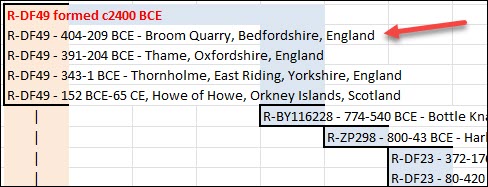
As I continue to build out my spreadsheet, the next four burials are all R-DF49, a haplogroup that was formed about 4400 years ago. Three of those burials are in England, and the fourth is in the Orkney Islands. They are all apricot, meaning:
- They don’t carry any downstream haplogroups
- They all descend from R-DF49
- Based on haplogroups alone, nothing precludes the Estes line from descending from any of those men
Evaluating each Ancient Connection in the same way we did for North Berwick, when they lived, as compared to our Estes men, and where, may eliminate some of these burials as possible direct ancestors.
The balance of the Ancient Connections descend from R-DF49 through different branches and are colored blue, removing them as possible ancestors of R-ZS3700.
Regardless, we all share an ancestor, R-DF49, about 4400 years ago, just shortly before R-ZP18 lived some 4250 years ago. It would make sense that R-DF49 and R-ZP18 lived in relatively close proximity, given that they only lived about 200 years apart.
What else can we learn about these Ancient Connections?
Migration Map

To view all of your Ancient Connections on a map, just click on “Migration Map” in Discover’s sidebar.
The haplogroup whose path you are viewing, in this case, R-DF13, is the red dot on the bar at the top and is shown on the map with a red circle, but is mostly obscured here by the blue and red circles with numbers in the British Isles.

That haplogroup’s migration map, and your Ancient Connections, are displayed together. Individual burials not in close proximity to others are shown with individual trowels, and multiple burials are shown with blue and red circles, with the number indicating how many burials are found at that location.

Expanding the map shows more detail. I placed a red star to indicate the Estes lineage in Deal, at the bottom right.
Many of the blue and red circles have expanded, too.

By clicking on the blue circle, you can see which samples are found there. In this case, these 7 matching samples were all found in the same archaeological dig.

By clicking on any sample, you’ll see additional information.
One of my original questions was whether or not there was any indication whatsoever, even a smidgen of possibility that the d’Este rumor might be true. Some Estes researchers are not convinced by other arguments.
Given that our closest Ancient Connection lived about 2000 years ago in the British Isles, as do most, but not all, of the other Ancient Connections, it’s exceptionally unlikely that the progenitor of the Estes lineage was living in Italy in the 1400s, just a generation before our Estes ancestors are found in the records in Deal, and some 2000 years after the parent haplogroups of R-ZS3700 were already well-established in the British Isles.
There’s another place to check for additional information.
Notable Connections
Sometimes Notable Connections includes people who are either “ancient” themselves, and whose haplogroups have been identified through their descendants, or are from burials, or a combination of both. The difference is that their identity is not entirely a mystery.

When evaluating Notable Connections for genealogy, focus on:
- Their haplogroup
- Your shared haplogroup
- When and where they lived
- Any precluding factors like we found when analyzing North Berwick
Notable Connections are all interesting, but only a few may be relevant to your genealogy or your ancestors’ journey to where you first found them.
Speaking of their journey, Globetrekker™ shows you the most likely path of your ancestor’s haplogroup over time.
Globetrekker™
Globetrekker™ is currently only available for Y-DNA, and only for those who have taken the Big Y test.

Clicking on Globetrekker™ through my cousin’s account shows the path of his haplogroup, through Europe, in this case, into England and, if I enable them, includes relevant Ancient Connections. One Ancient Connection, Mount Pleasant 746, at Cambridgeshire, is found on the estimated genetic haplogroup path.
We’ve already determined that the Estes line cannot descend from Mount Pleasant 746, but the locations of the descendants of our common ancestor, R-ZP18 can still provide substantial clues about where our common ancestor might have lived, and his culture.
I’ve also enabled Globetrekker™’s “Sibling Lines” which indicate haplogroup siblings with the thinner lines. These display options are easy to toggle on and off.
Note that this is an estimated genetic path. In other words, it’s not exact. Especially, paths of the newer haplogroups can and will change over time as more testers test, and earliest known ancestors (EKAs) are added. I wrote about how to add EKAs in the article, “Earliest Known Ancestors” at FamilyTreeDNA in 3 Easy Steps. Please add yours, along with their location.
Sometimes the most refined haplogroup did not emerge in England, R-ZS3700 in this case, but in America. However, since the descendants have noted their EKA correctly as originating in England, that’s where the most refined haplogroup is also shown.
Furthermore, other than for Native Americans who are indigenous to the Americas, Globetrekker™ and the Migration Map both stop at the originating land mass for both Y-DNA and mitochondrial DNA.
You can read more about Globetrekker™, here.
What About the d’Este Family Story?
Now, about that d’Este family story.

Globetrekker™ utilizes the “least cost” migration methodology, which means the easiest, least risky, route of passage from place to place for our ancestors. The Strait of Dover is the closest link to the European mainland, and was shallower at that time as well.
There’s absolutely no genetic evidence that points to Italy or anyplace south for the Estes ancestral line. In fact, haplogroup R-S552 emerged about 4650 years ago, and appeared about the time that this lineage crossed from continental Europe into what is today England. There’s no evidence that this line back-migrated to the continent, to then remigrate back to the British Isles after 1471.
Ancient Connections show us that there’s evidence of the Estes ancestral haplogroups in many locations across the British Isles, long before Frencesco d’Este was being exiled from Italy. Multiple Estes family members appear in the earliest records in the Deal area, so it’s certain that they were well established and probably fishing on those same shores hundreds, if not thousands, of years earlier, based on Ancient Connections these various migration maps.
These provide one more very large nail in the coffin of that much-loved but extremely unlikely family story.
The final piece of evidence would be if a proven male descendant of the d’Este line tested and did or didn’t match. I’m not holding my breath.
Mitochondrial DNA
The methodology for building your Ancient Connections spreadsheet is exactly the same for mitochondrial DNA, with one exception.
You immediately know that you cannot descend from any male burial, because men don’t pass their mitochondrial DNA on to their children of either sex. You could, however, potentially be descended from his mother, or sister, or cousin, etc. Otherwise, the guidelines are the same.
Sometimes, Ancient Connections can resolve long-standing conflicts.
The Conflict Surrounding Radegonde Lambert
For a very long time, it was believed that Radegonde Lambert, an early Acadian woman born around 1621, was Native American because there were no known people, other than her, with that surname in Acadia. Based on the birth years of her children, she married Jean Blanchard, a French man, around 1642.
It doesn’t help any that French soldiers arrived in 1632, family settlement began about 1636, but there are virtually no records until the 1671 census, nearly 40 years later. Lots of people perished during that 40 year window.
Radegonde could have married before her arrival in Acadia, and Lambert may not be spelled accurately. We are fortunate that French women are referenced by their birth surnames, not their married surnames, so she is listed as Radegonde Lambert, the wife of Jean Blanchard on the 1671, 1678 and 1686 censuses.
Based on the conflict swirling around her presumed Native American ancestry, plus early mitochondrial DNA HVR1/HVR2 results that pointed to haplogroup “X”, which has both Native American and European branches, Radegonde began to be reported as “DNA confirmed Native”. However, that was incorrect, and she was NOT DNA confirmed as Native. Haplogroup X2a and subclades are Native American, while other haplogroup X AND X2 subclades are European, as can be viewed in the Acadian AmerIndian DNA Project.
By the time full mitochondrial sequence testing became available, that incorrect “confirmation” was firmly entrenched in family trees and among researchers, leading me to pen the article, Haplogroup X2b4 is European, Not Native American.
While ho-hum with a yawn today, it was radical at the time and greeted with quite the kerfluffle. After all, Radegonde was proven Native and HOW DARE ME! 😊
Prior to Mitotree, Radegonde’s haplogroup was X2b4, but now it’s been extended to X2b4t2, which arose about the year 500, or around 1500 years ago.

X2b4 and subclades are quite rare, with only 353 descendants today, including subclades.

X2b4t2 only has 65 members.
Clicking on the “Other Countries” link takes you to the Country Frequency report.

Click on “Table View.”
Note that the 36 “Other Countries” includes people who have listed “Unknown Origin,” who are counted individually. People listing United States often mean they are brick walled here. Some people interpret this as Native American, but there is a separate United States Native American category. Not everyone selects the correct category.
These locations are user-reported in the Earliest Known Ancestor (EKA) information, which is critical for Discover reports. I wrote about how to complete that information in 3 easy steps, here. Please add yours, including location!
One person has reported that Radegonde Lambert is “United States Native American.” She’s not Native, and she never lived in the United States either. During her lifetime, Acadians lived in Nova Scotia, where three censuses accurately reflect her residence. Perhaps that incorrect information was entered by someone years ago, and never changed. Most people don’t think to update their EKA information.
Unfortunately, when misinformation is provided, or not corrected after we learn more, new testers view that as nuggets of evidence, and the misinformation cycle continues.
One of the benefits of Ancient Connections is that they are NOT based on trees, historical records, or genealogy of any sort. Ancient Connections are based on archaeological digs, and the location of the excavation is not subject to question.
So, let’s take a quick look at Radegonde Lambert’s Ancient Connections and see what we find.
A Quick Sneak Preview
Because I’m interested primarily in a quick view of locations, I’m skipping right to the Migration Map where all of the Ancient Connections are shown.

Radegonde’s Ancient Connections are scattered all over Europe, but there’s absolutely nothing in the Americas.
Given that Native burial excavations are culturally frowned upon in many locations, we might not see any in the US, but we also wouldn’t see any recent burials in Europe, given that the Native people have been in the Americas for well over 10,000 years.
Generally, even when Ancient Connections are missing in the US, we still find some contemporary testers with proven genealogy who carry that haplogroup, and at least a few ancient burials in Canada, Mexico, Central and South America.

The first seven Ancient Connection matches carry haplogroup X2b4, and the rest are European subgroups of X2b4. There are no closer matches as of today, but that doesn’t mean there won’t be eventually.
X2b4 emerged sometime before 5200 years ago, clearly someplace in Europe, possibly central Europe.
Radegonde’s X2b4 match locations are:
- Malá Ohrada site in Prague – the individual lived 5800-5400 years ago
- Hetty Peglers Tump, Gloucestershire, England – lived 5639-5383 years ago
- Sorsum, Hildesheim, Lower Saxony, Germany – lived 5350-5100 years ago
- Passage Tomb, Carrowkeel, Cairn K, Sligo, Ireland – lived 5100-4600 years ago
- Kolín I-7b, Bohemia, Czech Republic – lived 4835-4485 years ago
- De Tuithoorn, Oostwoud, Netherlands – lived 4579-4421 years ago
It’s unquestionable that X2b4 was found across Europe, not in the Americas, 5000 years ago.

This image is NOT from Radegonde Lambert’s Ancient Connections. I’ve included it to illustrate a Native American branch of haplogroup X2.
The descendants of Native American haplogroup X2a, shown above, match Kennewick Man, who is also X2a, as their closest Ancient Connection. He lived between 9250 and 8390 years ago along the river in present-day Kennewick, Washington. Their second-closest Ancient Connection is with an X2a1 burial found in Windsor, Ontario, who lived between 1223 and 1384 CE.
Neither of these unquestionably Native burials are found in the Ancient Connections of Radegonde Lambert’s descendants.
It’s worth noting here that when evaluating rare haplogroups, their Ancient Connections may reach far back in time. For example, if a Native American haplogroup only has a few Ancient Connections within the Americas, the rest of their Ancient Connections, if any, will be found on another continent. Failing to read the results thoroughly and thoughtfully could lead to an inappropriate and incorrect conclusion.
For example, haplogroup X is found in Eurasia prior to the migrated of people across Beringia, the now-submerged landmass connecting Asia with Alaska, to become the indigenous people of the Americas. Therefore, if there are less than 30 closer X2a Ancient Connections, one would expect to find Ancient Connections reflecting that continental Asian, or even Eurasian, heritage far back in time.
Notable Connections
One final tip for both Y-DNA and mitochondrial DNA is to check Notable Connections and selectively add them to your spreadsheet, if appropriate. Sometimes you’ll find people there that are both Notable and Ancient.

Not that we need more evidence about whether Radegonde Lambert’s matrilineal ancestors were Native or European, but Notable Connections provides us with one more corroborating piece of evidence.
Cangrande della Scala was an Italian nobleman who lived around 1300. He and Radegonde share a haplogroup X2b1″79 ancestor in Europe around 9000 years ago, which was after the Native people had crossed Siberia and Beringia to begin settling Canada and the Americas.
If there was any question left about Radegonde Lambert’s origins, Ancient Connections resolved it, with a backup volley from Notable Connections.
Radegonde Lambert was my ancestor, so I’m going to build her Ancient Connections spreadsheet and savor every discovery, but if I were simply seeking confirmation of or the answer to the question of whether Radegonde Lambert was Native American or European, I need look no further.
Mitochondrial DNA Case Study
In the article, Mitochondrial DNA A-Z: A Step-by-Step Guide to Matches, Mitotree and mtDNA Discover, I wrote in detail about utilizing mitochondrial DNA to break through genealogy brick walls.
My goal was to detremine if Catherine LeJeune, Edmee LeJeune and Jeanne LeJeune dit Briard were sisters or at least matrilineal relatives. Fortunately, we had several testers.
As it turned out, Catherine and Edmee were European sisters, but Jeanne did not share a matrilineal ancestor with Catherine and Edmee. Jeanne was Native American.
Next, we wanted to discover as much information about the LeJeune sisters as possible.
I created an Ancient Connections spreadsheet for the LeJeune sisters and included those results in my analysis, so please take a look. Their Ancient Connections were unexpected and simply astounding.
You literally never know who is waiting for you, nor the message they hold, just waiting to be delivered.
Ancient Connections are clues from your ancestors.

_____________________________________________________________
Share the Love!
You’re always welcome to forward articles or links to friends and share on social media.
Subscribe!
If you haven’t already subscribed, it’s free. You’ll receive an e-mail whenever I publish by clicking the “follow” button at the top of the main blog page, here.
Help Keep This Blog Free
I receive a small commission when you click a vendor link in my articles and purchase that item. This does NOT increase your price but helps me keep the lights on and this informational blog free for everyone. Please click on the affiliate links in the articles or to the vendors below if you are purchasing products or DNA testing.
Thank you so much.
DNA Purchases and Free Uploads
- FamilyTreeDNA – Y-DNA, mitochondrial and autosomal DNA testing
- MyHeritage DNA – Autosomal DNA test
- AncestryDNA – Autosomal DNA test
- AncestryDNA Plus Traits
- 23andMe Ancestry – Autosomal DNA only, no Health
- 23andMe Ancestry Plus Health
Genealogy Products and Services
- MyHeritage Subscription with Free Trial
- Legacy Family Tree Webinars – Genealogy and DNA classes, subscription-based, some free
- Legacy Family Tree Software – Genealogy software for your computer
- OldNews – Old Newspapers with links to save to MyHeritage trees
- MyHeritage Omni comprehensive “everything included” subscription plan
- Newspapers.com – Search newspapers for your ancestors
- NewspaperArchive – Search different newspapers for your ancestors
My Books
- DNA for Native American Genealogy – by Roberta Estes, for those ordering the e-book from anyplace, or paperback within the United States
- DNA for Native American Genealogy – for those ordering the paperback outside the US
- The Complete Guide to FamilyTreeDNA – Y-DNA, Mitochondrial, Autosomal and X-DNA – for those ordering the e-book from anyplace, or paperback within the United States
- The Complete Guide to FamilyTreeDNA – Y-DNA, Mitochondrial, Autosomal and X-DNA for those ordering the paperback from outside the US
Genealogy Books
- Genealogical.com – Lots of wonderful genealogy research books
- American Ancestors – Wonderful selection of genealogy books
Genealogy Research
- Legacy Tree Genealogists – Professional genealogy research
Share this:

Discover more from DNAeXplained - Genetic Genealogy
Subscribe to get the latest posts sent to your email.
Fascinating! I am X2b26 and my 9x great-grandmother went from Paris to Montreal in 1620. I did an mtDNA test before AT was available and always welcome learning something new.
My Mtdna haplogroup L2a1c3b2a is from Africa yet my rare ancient connections show Jewish “Germany”, Iberian Bronze Age “Jewish Community” and Enslaved African American “Charleston South Carolina”. I know my maternal line has connections to South Carolina via the family that had enslaved them but it is very interesting to see the other two connections. Thank you for letting us know about the disappearing ancient connections. Only after reading your blog did I log on to see that some of mine had indeed disappeared.
Archaelogist and linguist J. P. Mallory’s The Indo-Europeans Rediscovered, offers an overview of all the efforts in different disciplines to locate the homeland of the Indo-Europeans. He examines the different means which different disciplines use to place it and why they arrive at different and contradictory conclusions and maintains that there is still no definitive answer. Part 3 of the book, six weighty chapters, examines the light that DNA evidence casts on the matter. Just started reading it, so don’t yet know how he handles that evidence, yet it certainly fits in to the theme of this post. His analysis actually reminds me of the interweaving of different strands of evidence in your work on the Lost Colony. In any case, if you have not already encountered it, I thought it would be of great interest to you and others interested in ancient origins.
A work-around for the limitation of 30 (or 10) Ancient Connections and the roll-off issue is to look at the Classic Tree.
While I see 30 mtDNA Ancient Connections on that tab, I see almost 200 under the Classic Tree. There is a different format so there are some pluses and minuses. The Classic Tree has Display Options which are helpful.
Roberta – thanks for the deep dive you’ve done here. It really helps the rest of us to make sense of things.
Something that I still don’t fully understand: Kennewick man is listed in my ancient connections but I’m not native American. Maybe we both descend from someone further back in time, is that what the AC page is suggesting?
Dee O’Neill
Yes, probably. I can’t tell you for sure without looking, but based on your other matches and using the technique I did, you can probably figure it out.
I have seen this type of scenario before when there were a lot of other matches so AC reached that far back.
Oh yes, I see now – Kennewick man and I do share a common ancestor, but we both branch off downstream of X2.
My new sub clade naming had me confused at first. My haplo was X2-G225A-T16223C but has recently been revised to X2ax1. I think that even though it has a tiny ‘a’ in it, it’s not part of X2a.
My ancient connections are Kennewick man and 10 Çatalhöyük samples as well as some other Turkish sites.
I only have one exact match (England) and 15 distant matches (ekma Turkey, Syria, Europe).
Dee
Aren’t these exciting!
Yes indeed 🙂
Great post.
My mtDNA’s last CA with an ancient sample is theoretically before Abraham, which is humbling.
My YDNA is a rare branch of a rare haplogroup, so there is not much recent that’s of use. The CA to the ancient samples is much further back. It’s still interesting, but I need to set up an alert for any more finds that might bring me more way points. Get digging you archaeologists!
Oh, and while I think of it; I need to get back to chasing test candidates to work on more recent Y branching. 30 years ago with less privacy constraints, finding people was easier, but there was no Y700 DNA test to use when I did!