Pierre Goicheau (c1652-after 1698) and the Silence of Famine – 52 Ancestors #482

Pierre Goicheau was the father of Acadian founder Jean dit Tranchemontagne Garceau, who was born about (or before) 1680 and was serving as a soldier at Fort Naxouat, in present-day New Brunswick, by August 1696.

Jean’s 1703 marriage record at Port Royal to Marie Levron names his parents as Pierre Garsseaux and Jacquette Soulard, although the evidence presented here strongly suggests that Jacquette was probably his stepmother rather than his biological mother.

Additionally, his marriage entry tells us that he was a soldier serving at the garrison in Port Royal. In that record, his surname is spelled Garsseaux, but elsewhere it’s spelled Garceau and other phonetically similar surnames.

We are exceedingly fortunate that their marriage record provides the names of his parents, which is actually quite rare when the parents never left the old country.

Not only does it tell us their names, but it provides a location as well. Parish of St. René of the diocese of Poitiers.

Yippee!!!

We’re home free, right?

Nope!

As it turns out, as specific as that location sounds, it isn’t.

There isn’t a parish of St. René in the diocese of Poitiers, but there is a Saint-Rémy.

Not only that, but while one Pierre Goicheau, did marry Jacquette Soulard, it wasn’t in Saint-Rémy.

This one makes my head hurt, and my heart ache.

Normally, in my 52 Ancestors articles, I write an article for each individual parent, but in this case, I really can’t do that. What I can and will do is to present the evidence arguing in both directions. Barring the discovery of additional records, Jean Garceau’s biological mother remains unidentified.

We now have additional information about Jacquette Soulard, who married Jean’s father, Pierre Goicheau, along with other evidence that shifts our interpretation of this record.

Sometimes, the real story is not what’s actually contained IN the records. Sometimes life is shaped by the forces surrounding the records – the silence that holds heartache and tragedy.

That silence envelops the Garceau family.

What We Know

We know for sure that on August 24, 1696, Jean Gorseau dit Tranchemontagne, is on the list of soldiers serving with the military company of Claude-Sébastien de Villieu at Fort Naxouat, also called Nashwaak, a French wilderness fort that served as the Acadian administrative capital after Port Royal was captured by the English in 1690.

The log fort was located near present-day Fredericton, New Brunswick at the intersection of the St. John and Nashwaak Rivers, on the south shore across from Bowie Island. Their neighbors were the Native people.

Built in 1691 and 1692, and overlooking the river, the fort was a trading post, about 120 feet square, that became a small military base with only a few buildings and quarters for about 40 soldiers.

Given that we know Jean was on the roster on August 24th, it stands to reason that he was also with the unit on August 14th and 15th when Villieu’s unit, along with Abenaki forces, laid siege to the English fortification at Pemiquid, present day Bristol, Maine, after the English commander violated a truce, murdering several Abenaki chiefs at an assembly.

Jean was among the men who defended Fort Naxouat from an English attack that took place on October 18th, 1696. Joined by their Mi’kmaq neighbors, a few scattered French settlers, and the notorious French pirate, Captain Pierre Maisonnat dit Baptiste who arrived on foot and without a ship, they managed to fight off four times the number of English soldiers. The priest gave a final communion before the battle, because they knew they would all be slaughtered if they lost, which was certainly the expected outcome. They were both outmanned and outgunned.

In the greatest of ironies, it was the weather, a sudden, unexpected winter storm descending upon them, that saved the French garrison and Jean. The English soldiers from Boston were unprepared for the Canadian weather. The English hastily departed after two miserable days and nights, leaving two ships behind, which provided Baptiste with another vessel to resume his life of piracy. Both feared and revered, Baptiste was endeared to the French at Port Royal. He saved them more than once.

We don’t know when Jean Garceau arrived at Naxouet, but it could well have been on February 14, 1694 when “the vessel La Bretonne was fitted out to bring help…This vessel carries 10 soldiers to replace those who may be missing from among the 40 that His Majesty wishes to maintain at the said fort…” Jean Garseau dit Tranchemontagne may well have been among them, although there is no roster.

If Jean was on that ship, then he was present at the Raid on Oyster River, also called the Oyster River Massacre, on July 18, 1694, when a group of Abenaki and Maliseet. along with French soldiers, raided an English settlement at present-day Durham, New Hampshire, on the border between New England and Acadia.

The attack began at daybreak, with the small forts quickly falling to the attackers. In all, 104 inhabitants were killed and 27 taken captive, with half the dwellings, including the garrisons, pillaged and burned to the ground. Crops were destroyed and livestock killed, causing famine and destitution for survivors. Much like the English had done to the settlers at Port Royal in 1690.

The European French and English wars were brutal in the North American colonies.

Jean is again found among the 26 soldiers at Naxouat on the September-December 1697 payment roster.

In 1698, Fort Naxouat was abandoned and dismantled, and Villieu used the material to construct Fort Saint John across the bay from Port Royal which was still under English control.

Located at the mouth of the Saint John River, Fort Saint-Jean became the Acadian capital at that point, and the garrison’s soldiers were stationed there.

Then, in 1700, Port Royal was returned to the French, with Villieu as the administrator. He moved the capital of Acadia back to Port Royal, along with the soldiers who were then quartered at Fort Anne.

This move provided Jean with the opportunity to meet Marie Levron whose family lived across the river.

Jean Garceau (spelled Garsseaux in his marriage record) dit Tranchemontagne married Marie Levron in Port Royal on November 20, 1703, where the priest recorded that he was the son of Pierre Garsseaux and Jaquette Soulard of the parish of St. René in the diocese of Poitiers.

Pierre and Jacquette are neither referenced as living nor deceased. Normally, if a parent is deceased, it says so, so one would presume Pierre and Jacquette were living, although if they died after Jean left France, he would probably not have known.

Searching for Saint-Rémy

Cousin Mark, who is much more fluent in archaic French records than I am, did a lot of work to locate Pierre and Jacquette in the given parish, but he did not find them there.

He did find a very old parish church by that name in the town of Saint-Rémy just northwest of Niort in the Deux-Sèvres department. Unfortunately, those records only reach back to 1693, but the church is much older. Mark reviewed the records in three parishes, page by page, to gather what he could. But that’s not where he found Pierre and Jacquette.

Mark found Pierre Goicheau and Jacquette Soulard marrying on July 2, 1685, in Saint-Marsault in La Forêt-sur-Sèvre, Deux-Sèvres.

Saint-Rémy is 59 km, or approximately 35 miles, south of Saint-Marsault, so not exactly close, especially before the days of automobile travel.

It would be highly unusual to find two people with the exact same rather unusual names marrying, but it’s not impossible.

Mark tells us that:

There are three parish churches named Saint-Rémy in the department of Vienne, all some distance northeast of Poitiers, one in the village of Saint-Rémy-sur-Creuse and two in the villages of Chenevelles and Liegné-les-Bois, near to each other. Departmental parish records for each go back to the period of time of this research.

By Eliane Promis – Own work, CC BY-SA 3.0, https://commons.wikimedia.org/w/index.php?curid=21377477

There is also a very old parish church in the town of Saint-Rémy, just northwest of Niort in the Deux-Sèvres department. 

Unfortunately, despite the church’s obvious age, departmental parish records for Saint-Rémy, Deux-Sèvres, only go back to 1693, but I believe this is the one referenced in the marriage record, based on my review, page by page, of the parish records in the other three parishes and what I found at Filae.com.

Before I engaged in the very tedious and difficult reading of old parish records in French, I consulted and thoroughly researched Jean and his parents’ names at Filae.com. Filae is the primary genealogical site for French genealogy, similar to Ancestry.com, and was purchased by MyHeritage a couple of years ago. I’ve subscribed to it for several years, since I started my research into French origins.

They have original records, but only back to about 1700. Besides family trees, they include the database of what genealogical societies in France have researched for older records. I have found, by comparing what is listed and my own viewing of the original records, that the two in the area, Cercle Généalogique Poitevin and Cercle Généalogique des Deux-Sèvres are very reliable and comprehensive.

I searched between 1650 and 1700 for Jean Garceau and the name’s phonetic variants, and for Pierre Garceau and Jacquette Soulard between 1630 and 1730. For Jean Garceau, there were only two family trees and absolutely no records for the Vienne department. Both trees were Acadian.

Searching Deux-Sèvres, there were 14 genealogical society entries for a Jean Garceau spelled a few different ways. Based on other evidence, none could be the one we are looking for.

For Pierre Garceau, it was about the same: no records for Vienne from 1630-1730, but for Deux-Sèvres for the longer time frame, there were 51 entries by genealogical societies. This is one reason I believe it likely that the Saint-Rémy indicated was the town in Deux-Sèvres and not the three villages in Vienne. Again, however, none of the entries pointed to the Pierre we are seeking and none with a wife named either Jacquette or surnamed Soulard.

But I hit pay dirt with my search for Jacquette Soulard. While there were just three entries for Vienne, none of interest, there were 47 entries for Deux-Sèvres.

Five of them showed children’s births to her and a Pierre Gaucheau or Goicheau, between 1686 and 1698, at villages about 30 miles north of Saint-Rémy: Saint-Marsault, La Ronde, and Moncoutant.

Given the wide variations in spelling in parish records based on varied pronunciation of the names and the subtle changes over time, it is very easy to see Gaucheau becoming Garceau or Garsseaut by the time Jean arrived in Acadia.

Pay Dirt in Saint-Marsault

Mark found 47 entries for Soulard in the Saint-Marsault parish register, including Pierre Goicheau and Jacquette Soulard’s marriage. Five additional records showed their children’s births between 1686 and 1698, recorded in three villages: Saint-Marsault, La Ronde, and Moncoutant.

Their marriage record, originally translated by ChatGPT, corrected by Mark, then retranslated with a much-improved version that agrees with Mark, reads as follows:

On the same day (which was July 2, 1685 (referencing the preceding entry), Pierre Goicheau, a laborer, thirty-three years old, son of the deceased Nicolas Goicheau and Marie Cousin (or Coutin), received the nuptial blessing with Jacquette Soulard, eighteen years old, daughter of Jacques Soulard and the deceased Perrine Estancheau.

Those present were François Goicheau, the full brother of the said groom and a laborer; the said Marie Cousin (or Coutin), his mother; the said Jacques Soulard; and Pierre Soulard, paternal uncle of the said bride. The laborers declared that they did not know how to sign.

That tells us that Pierre Goicheau was born about 1652.

The Five Children of Pierre Goicheau and Jacquette Soulard

I can’t imagine why Cousin Mark is still speaking to me given the amount of work he has invested in my ancestors (who aren’t his), especially after I asked him if he could dig deeper and see what else he could discover. Miraculously, though, he is and has graciously agreed to share his meticulous research.

Mark found baptismal records for five of Pierre Goicheau and Jacquette Soulard’s children.

  • Mathurin Goicheau was baptized August 23, 1686, at Saint-Marsault, a little over a year after their marriage. Mathurin was also the name of one of Pierre’s brothers, but the brother was surprisingly not the godfather.

There was not enough time between their marriage in July of 1685 and August of 1686 for Jacquette to have given birth to Jean too.

They probably lost a child in 1688.

  • Louis Goicheau was also baptized at Saint-Marsault on May 15, 1689.
  • Jacques Gaucheau was baptized at Moncoutant on September 7, 1691.

The surname is spelled differently, and the location is just 7.5 km or about 4.5 miles east of Saint-Marsault, so still quite near where they married and the two earlier children were baptized.

The Moncoutant baptism could actually have taken place in one of two churches in close proximity to Moncoutant.

The 15th-century Church of St-Gervais and St-Protais is located in the center of Moncoutant, on the old road. It was enlarged in the 1600s and partially rebuilt in the 1800s.

All old churches were either on the main road, generally in the center of town, or at crossroads.

La Chapelle-Saint-Étienne is located slightly outside of Moncoutant in this beautiful crossroads village whose origins are lost in antiquity. You can even see the old well in the yard to the right of the church. The church dates from at least 1219 when it was mentioned in a bull of Honorius. Destroyed in the Hundred Years’ War (1337-1453), it was partially restored later.

In 1598, the year the Edict of Nantes was signed, the church was reported to be in very poor condition, and in 1686, the church was reported to be in danger of collapse, inside and out. The record further notes that:

In a chapel there is an arm in which there is a silver vase containing some linens, without the appearance of relics and which is nevertheless traditionally called the arm of Saint-Étienne.

The small cemetery, completely cut off by roads, is in the middle of the town. The priest is sick and crippled.

Going to the waters of Bourbon, he has taken as his replacement a priest named Avice, previously in Largeasse and coming from the diocese of Bayeux. The inhabitants are very unhappy about it. He let three people die (sic) at the door of the church, without giving them communion. He has no sign of a priest, neither in his clothes nor in his speech. He drinks wine very often and, in church, does nothing decent.

And then, in 1695, immediately following a famine:

The sanctuary is still in danger of ruin and has only 4 bushels of rye as income.

If this is the church closest to where Pierre Garsseau and Jacquette Soulard lived, the beleaguered condition of this ancient church and the resident priest’s lack of sobriety explain why they might well have looked elsewhere to have at least some of their children baptized.

Famine Strikes

In 1693, when Jacquette would have been expected to give birth to their next child, the Poitou suffered a catastrophic famine that lasted through 1694.

Cold, exceptionally wet weather ruined successive harvests. Grain reserves disappeared, prices soared, malnutrition spread, and disease followed. Approximately 1.5 million people died in France, roughly 10% of the population, although some estimates are double that. The crisis was intensified by Louis XIV’s war expenses, increased taxation, and military requisitions.

People, desperate for food, were reduced to eating wild herbs, roots, and contaminated bread. Peasants rioted and attacked revenue collectors, tax offices, and military units. The ravages of hunger triggered waves of fatal intestinal infections, including typhus, which quickly spread throughout the population, including churches.

The tiny, neighboring rural parishes of Moncoutant and Saint-Marsault were ground zero for the devastating convergence of Louis XIV’s oppressive policies and the 1693-1694 famine.

Peasants in these two towns resorted to eating boiled grass, thistles, acorns, and decaying roots dug out of the woods. The parish registers note a surge of deaths caused not just by starvation, but by “le mal de gorge” (severe throat/intestinal infections) and typhus brought on by eating contaminated organic matter.

Dead bodies were found lying along the roads, in ditches and fields. People walked until they couldn’t anymore, begging, and died where they dropped.

The Goicheau family would have been struggling mightily, along with their neighbors, and if starvation didn’t prevent Jacquette from becoming pregnant, they buried a child in 1693 or 1694.

Parish registers reflected many deaths and almost no births. Starving women stop ovulating.

Given that Jean was already serving in Acadia in 1696, and likely arrived in 1694, he would have been at least 15 when the famine hit, and possibly somewhat older. The famine provides a reason for Jean to enlist in the military. The official enlistment age was dropped from 18 to 16 during this time, but some recruiters, desperate to be paid in bread, turned a blind eye if boys a year or two younger joined up. Everyone needed to eat.

Jean probably enlisted in the Compagnies franches de la Marine in 1693 or 1694 to secure daily bread rations during the famine. He would have been quickly processed and shipped to New France. We don’t know when he arrived at Fort Naxouat, but it was assuredly before August 24, 1696 when he is listed on the muster roll.

This strongly suggests that Jean was born no later than 1680, and probably earlier. If born in 1680, he would only have been 16 when serving at Fort Naxouat in New Brunswick, which is extremely young.

If he arrived in 1694, then he was probably born around 1678.

If he was 16 in 1693 and enlisted to survive the famine, he would have been born in 1677, when his father was 25.

It’s amazing that Jean survived, and no wonder that he left France. His childhood, beginning in 1681 and continuing through the famine, was spent surviving one kind of trauma or another. By the time Jean was 20, he was probably a battle-hardened warrior in another land.

Pierre and Jacquette had apparently found sustenance and conceived a child in the summer of 1694.

  • Pierre Gaucheau was baptized April 1, 1695, at La Ronde, a village just west of Moncoutant and south of Saint-Marsault, likewise in the La Forêt-sur-Sèvre commune.

There is no death record, but this child apparently died because another child by the same name was born in 1698. The devastating effects of severe malnutrition don’t simply resolve when a food source is restored. Mothers’ bodies don’t recover well, and the frequency of stillbirths, low birth weight infants, and infant deaths are elevated for some time afterward.

Another child was probably born and died in 1697.

  • Their fifth child was also named Pierre Gaucheau, likely born after his brother Pierre died, and was baptized on August 26, 1698, also at La Ronde.

There, the trail goes cold.

Mark was unable to find any additional baptisms, but that doesn’t mean there weren’t additional children.

Jacquette was 18 in 1685, so in 1698 she would have only been 32, clearly young enough to bear more children. Either she died, Pierre died, they attended church elsewhere, or the records are missing.

Based on several records, we know that Pierre, and therefore Jean, lived at Saint-Marsault for some time, at least a decade, because Mark found several records placing Pierre there.

Both Pierre and his brother François witnessed their father Nicolas’s death entry on November 23, 1680, five years before Pierre married. That parish entry gave Nicolas’s age as 70, meaning he would have been born about 1610. Pierre was born when his father was about 42.

The Neighborhood

It was less than 5 miles between Moncoutant and Saint-Marsault, so Jean Garceau’s parents probably lived someplace in between.

La Ronde, where the fourth and fifth children were baptised, is dead center between Moncoutant and Saint-Marsault.

The small village of La Ronde is located at a crossroads between Moncoutant and Saint-Marsault and has its own church, L’Eglise Notre Dame La Ronde, La Forêt-sur-Sèvre, which dates from the 12th century and was rebuilt in 1478 following a fire.

This historic building at the main intersection across from the church in La Ronde probably marked the way for Jean Garceau’s parents too – although they would have been familiar and didn’t need a sign.

Today, a Madonna figure still resides in the alcove between the door and window, faithfully guarding the residents of the home and looking across the street at the church.

These quaint French villages of a few houses each are all connected by tiny one-lane roads threading their way like ribbons through farm country that has been tilled since before time was recorded. It seems that every couple of miles there’s a tiny crossroads village, so small there’s not even a stop sign, with its requisite Catholic church to serve the local villagers and farmers. Often you can see the steeples from one village to the next.

It was someplace here that Jean Garceau was born, grew up, and ultimately said goodbye to his family as a soldier. He probably remembered this scene well – the crossroads, the churches, the villages, and yes, his parents and siblings.

He would have never forgotten the hunger pains either, the hollowed-out eyes of starvation, waiting for the grim reaper to put an end to their suffering. He probably wondered if his family had survived after he joined the military. We know that thousands died, but we can’t say their names. Jean’s family members and friends perished, but his light survived.

Leaving France meant escaping the inevitable, and reserving the few scarce resources for his family members left behind. That’s all he could do for them.

Nicolas Goicheau and Marie Cousin

Mark was able to locate a few more records for Pierre Goicheau’s parents, although neither their marriage record nor the baptisms for their children were found.

Nicolas’s death record in Saint-Marsault in 1680 was witnessed by Pierre and his brother François, who, five years later, witnessed his brother Pierre’s marriage in the same church.

Nicolas and Marie also had a daughter, Jeanne Goicheau, who was married at Saint-Marsault on July 8, 1686, listing her parents as Nicolas Goicheau and Marie Cousin. Witnesses at this wedding included her brothers Pierre, François and Mathurin Goicheau, which tells us that Nicolas and Marie had at least four surviving children.

They likely welcomed several more children into their lives between 1635, or so, and about 1660, when Marie would have been 43.

Nicolas Goicheau was also recorded as godfather to a Nicolas Couzin, son of a François Couzin, clearly a relation to his wife, in January 1646 at Saint-André-sur-Sèvre, a tiny country crossroads village consisting of a few picturesque French houses, a church and cemetery to the northwest of La Forêt-sur-Sèvre, the same place where Pierre’s future wife, Jacquette Soulard, was baptized in 1666.

This church clearly served the needs of nearby farmers whose families would have walked to church.

Saint-André-sur-Sèvre is only about three and a half miles from Saint-Marsault.

Given that family records are found in both churches, they probably lived someplace along this beautiful, quaint French country road, winding through the beautiful countryside between the two towns.

François Goicheau, Nicolas and Marie’s son, was also listed as a witness to Marie’s death at Saint-Marsault in 1692, where her age is given as 75, so born about 1617. Mark notes that François is listed twice in that record, so it’s unclear if that was a clerical error or if there were two men by the same name.

Mark found 88 results for a Marie Cousin between 1600 and 1700 within just 20 km of La Forêt-sur-Sèvre, and it is likely she was a godmother to a few infants, but he could find no other records that related to Goicheau/Gaucheau. Marie Cousin seems to be a common name, unlike Nicolas Goicheau by whatever spelling.

Mark did find additional information about François, although it’s a bit confusing, but then again, everything about this family has been “interesting.”

Complicating this still further, there is a marriage record at Saint-Marsault, the acknowledged village for much of the family records, on 16 Jul 1691, of François Goicheau, age 30, so born about 1661 and a Perrine Geay, age 20. The record shows his parents as François Goicheau and Marie Cousin! – and as a witness a brother François! There are just too many men named François in this picture, and some are assuredly incorrect!

I need to locate the original Deux-Sèvres record to see what it really shows.

The groom’s father should have been Nicolas, not another François, and I doubt he had another brother with the same name, although his death record at Saint-Marsault, of 12 Jan 1695, age 35, likewise shows as a witness a brother François and sister Jeanne. In addition, Marie Cousin’s death record of 1692 shows as witnesses two sons named François! I guess it’s possible.

The famine took hold in the fall of 1692 when summer grain crops failed. The King’s soldiers had depleted any supplies that might have normally been held in reserve, so the suffering began immediately.

Marie died on May 1st of 1692, so she was spared the fate of starvation. While I’m sure they grieved her passing, I’m equally as sure that her family thanked the Lord that she did not suffer what was coming.

The death of Francois Goicheau in January of 1695 was almost assuredly a result of the famine. While the acute starvation ended in the fall of 1694, survivors would have been in terrible health, mere walking skeletons, and the famine-induced diseases and their after-effects persisted for years.

We don’t know what happened to the rest of the family.

Jacquette Soulard’s Family

While it’s extremely unlikely that Jacquette Soulard is the biological mother of Jean Garceau (Goicheau), I can’t definitively close the curtain on that possibility either.

Mark was hoping to find additional information that might reveal more. While there is nothing conclusive regarding the probability or possibility of Jacquette being Jean Garceau’s mother, I’m including Mark’s research in case one day we discover that, in fact, she is.

As I could not find any record of Pierre’s parents’ marriage, likewise I could not find any record of the marriage of Jacquette Soulard’s parents, Jacques Soulard and Perrine Estancheau, under either name or its variants, anywhere in France.

There is a record of the baptism of a Perrine Estancheau on 20 May 1623 at Montravers, about five miles northwest of Saint-André-sur-Sèvre. The parents listed were François Estancheau and Michelle Bodet. This would require that Perrine gave birth to Jacquette at around age 43, which is certainly possible.

I did find Perrine’s death record of 17 May 1668, at Saint-André-sur-Sèvre, less than two years after the birth of Jacquette. Her husband Jacques Soulard is named, and witnesses include her brother Jacques Etancheau, brother-in-law Pierre Soulard and sister Catherine Etancheau, leaving no doubt of her identity. No other children of Jacques and Perrine were found. Her death may have been as a result of childbirth if she did give birth to Jacquette at age 43 and was again pregnant.

There were 17 births of a Jacques Soulard between 1600 and 1650 within 200 km of La Forêt-sur-Sèvre, but none within the immediate area, making it impossible to determine which, if any, were relevant without a marriage record naming his parents. Jacques may have remarried a Michelle Brouard. A marriage record at Saint-André-sur-Sèvre of a Pierre Soulard on 10 Aug 1708, age 33, so born about 1675, names his parents as Jacques Soulard and Michelle Brouard. A brother François Soulard is named as a witness. I found no record of any remarriage for Jacques. It would be surprising if Jacques Soulard did not quickly remarry given Jacquette’s very young age, but without a marriage record, one has to put other pieces together to draw inferences.

I also could not find a definitive death record for Jacques. There is a death record for a Jacques Soulard on 28 Apr 1695 at Combrand, Deux-Sèvres, several miles to the north of Saint-André-sur-Sèvre. He is likely the same Jacques Soulard baptized in the same parish on 24 May 1609, although the death record shows an age of 60, so born about 1635, and married to a Françoise Guesdon or Guion. As I mentioned, there were several Jacques Soulards in the greater area so I cannot draw any clear conclusions.

Revisiting Saint-Rémy

How many times have you failed to find something where you thought it should be, then gone back and revisited that same drawer again?

Mark did the same thing:

I’ve also taken another look at the area around Saint-Rémy, keeping in mind there are no records for the parish before 1693. Saint-Rémy is close enough to La Forêt-sur-Sèvre and the surrounding villages such that most of the same records that appear within 200 km are the same for both locations. I first checked for any records for a Pierre Garceau or Goicheau. The Pierre Goicheau that married Jacquette Soulard was born about 1652 according to the marriage record.

For the name Pierre Garceau and its many spelling variants, there were no results at all within 20 km of Saint-Rémy. Within 200 km there were no baptisms around the 1650s. One occurred in 1637 and another in 1671, both at some considerable distance from Saint-Rémy. There were no marriages at all for a Pierre Garceau within 200 km. For a Pierre Goicheau, the only marriage was that to Jacquette Soulard. As I mentioned earlier, I could find no baptisms for any of the children of Nicolas Goicheau and Marie Cousin. Nor were there any Pierre Goicheau baptisms by other couples between 1638 and 1697 within 200 km. As I noted, there was an almost total lack of records for Nicolas Goicheau, the earliest being his appearance as godfather in 1646. Throughout France, there were only ten entries at Filae for a Nicolas Goicheau from 1560 to 1700, and four of those I’ve already noted.

Moreover, Filae shows no records of a Jean Garceau or Goicheau born to a Pierre Garceau or Goicheau or any spelling variants, nor a Jacquette Soulard, anywhere in France between 1620 and 1700.

Evaluating the Possibilities

When Jean Garceau married, he gave his parents’ names as Pierre Garsseaux and Jacquette Soulard. Jean did not know how to write, so the priest would have written the names as he heard them.

We know from Mark’s research that this couple was married in 1685 and had a baby in 1686, thirteen months later, and it wasn’t Jean.

Jean’s father, Pierre, was 33 in 1685 when he married, so born about 1652, although we have no baptismal record for him. Jacquette was 18, baptized on November 28, 1666, in the village/commune of Saint-André-sur-Sèvre, six km northwest of Saint-Marsault.

When Jean married in 1703, in Acadia, given that he was already serving in 1696 as a soldier, he could not have been born later than 1686. If he were born in 1687, he would have been only nine years old in 1696 as a soldier, and 16 in 1703 when he married. That’s simply impossible.

Given what we know, only a few scenarios are possible, and the situation is further complicated by upheaval in the part of the Poitou where Jean’s family lived.

Could Religious or Social Upheaval Have Affected the Records?

Jean could have been born before his parents, Pierre and Jacquette, were married. If that’s the case, then he was born in 1685 or earlier – and several years earlier given his 1696 military service.

If Jacquette was his mother, it raises the question of why his parents didn’t marry when Jacquette was pregnant with Jean, since they clearly did marry in July of 1685. French girls were considered of marriageable age at 14, and she turned 14 in 1680.

This scenario, at least on the surface, has several flies in the ointment. However, taking into consideration what was happening locally might make a difference.

Protestantism was deeply established in the Poitou, including the present-day Deux-Sèvres. This was not a distant national controversy to the local families. Moncoutant had a substantial Protestant community, and its own municipal history specifically says that the community suffered the notorious dragonnades late in the seventeenth century.

In 1681, the Poitou became the first region in which Louis XIV used the dragonnades.

Royal dragoons, shown in this 1886 painting by Jules Girardet, were forcibly quartered in Protestant homes, where they were permitted to intimidate, abuse, rob, and otherwise torment the occupants until they converted to Catholicism.

In 1681, Jacquette would have been 14 or 15.

We know Pierre and Jacquette had some connection with Moncoutant, because one of their children was later baptized there, and Jacquette was born just north of there.

We have no evidence that Pierre or Jacquette was Protestant. Their marriage received a Catholic nuptial blessing, and Jacquette was baptized in a Catholic church in 1666.

We have no marriage or baptismal records for the children of Nicolas Goicheau and Marie Cousin, nor for a first marriage for Pierre Goicheau. Nicolas witnessed a Catholic baptism in 1646 in the church at Saint-André-sur-Sèvre that includes both the Couzin and Soulard families, so he was Catholic at that time. These records substantially reduce the likelihood that either family was Catholic in the 1670s or 1680, but does not entirely remove the possibility.

Pierre and Jacquette’s children were baptized in Catholic churches, except for Jean, whose baptismal record is missing. Still, in the 1680s, they were living in upheaval –  among frightened neighbors, forced conversions, soldiers quartered in private homes, destroyed religious communities, and families fleeing or practicing their faith secretly.

Protestant baptisms and marriages could have been recorded separately before 1685. After the Protestant pastors were banished and churches destroyed, records were lost, and a Protestant background would probably have been hidden. Catholic baptism and marriage became compulsory. A missing earlier marriage or baptism might reflect religious disruption, although there is no evidence that this explains Jean’s missing baptismal record or those of the children of Nicolas Goicheau and Marie Cousin.

It does, however, provide insight into the times in which they were living.

So, what are the possibilities surrounding Jean’s birth and parents?

Possibility 1: An Earlier marriage and baptism at Saint-Étienne that were not recorded 

It’s possible that Pierre and Jacquette (or another wife) were married at nearby Saint-Étienne, and Jean was baptized there too, but neither event was recorded due to the chronically drunken condition of the priest. If the wife was Jacquette, they remarried at Saint-Marsault.

However, given that they couldn’t read or write, how would they have known that their marriage wasn’t recorded? And if that was the case, then why was Jean not rebaptized too?

This is a rather unlikely scenario, but still a possibility.

Possibility 2: Jean was born in 1680 or 1681 to Jacquette before she married Pierre

If Jean was born when Jacquette was 14 or 15, that would have been in late 1680 or 1681, which means he was only 15 or 16 by the time he was serving at Fort Naxouet in 1696, and probably two years younger when he enlisted during the famine.

This is really the only tiny sliver of a window in which we can make this scenario of Jacquette being Jean’s mother work. However, it still doesn’t explain why Jacquette and Pierre didn’t marry when she was pregnant, given that they did marry in 1685. Unless they did marry at Saint-Étienne and remarried later when they discovered their marriage hadn’t been recorded, or unless they were Protestant, which is highly unlikely.

Given Jean’s age, this scenario is highly unlikely, bordering on the nearly impossible.

Possibility 3: Pierre was previously married

A more probable scenario is that Jean’s father, Pierre, was married previously and Jean was born about 1677 or 1678 to Pierre’s first wife, who died. Pierre then married Jacquette in 1685, who was functionally Jean’s mother, so he thought nothing of listing her as such.

In this scenario, if Pierre, who was 33 in 1685 when he married Jacquette, had originally married at 25, in 1677, which was still relatively young, Jean Garceau would have been born about 1677 or 1678, so 14 or 15 when the famine struck in 1692, 18 or 19 in 1696 in Naxouet, and roughly 25 when he married Marie Levron in Acadia. That’s much more reasonable.

That said, being born out of wedlock might have been a reason for Jean to join the military relatively young too, but given the dates and that Jacquette and Pierre married in 1685, I’d wager the famine was Jean’s motivation. His parents were probably glad to see him go, not because they didn’t love him, but because it gave him a chance for survival.

There’s absolutely no way for Pierre Goicheau and Jacquette Soulard to be the parents of Jean Garceau who was serving in Naxouet in 1696 if he was born after they married. Yet, when Jean married in 1703, he clearly said they were his parents, even though the parish name given was not where Pierre and Jacquette lived when Jean left.

Saint-Rémy is improbably distant from Saint-Marsault where all of the other Garceau and Soulard records are clustered. These families were farmers and laborers, as recorded in parish registers. They didn’t simply come and go, moving around the country at will. They were tied to the land and the landowners, and their children would have been baptized in nearby churches.

Maybe Saint-René as recorded in Acadia was not Saint-Rémy, and maybe the parish given was simply wrong or misunderstood. Mark is a meticulous researcher and first tried to find a parish of either St. René or St. Rémi(y), as either could have been what was written or intended. Spelling was not standardized at that time, and he searched all over France.

Based on Mark’s findings, I believe we have enough evidence to conclude that this is the correct family, and that Jean Garceau spent his childhood and much of his formative years living on a farm near Saint-Marsault, and one way or another, was raised by his stepmother, Jacquette Soulard.

I think this is really the only reasonable possibility.

Visiting Saint-Marsault

Thanks to Mark’s exhaustive work, I was able to visit Saint-Marsault in the spring of 2024 on a bus tour.

I felt as if I was literally walking in their footsteps, and that was before Mark had discovered the additional information, including Pierre Goicheau’s children’s baptisms and his parents’ death records in the same parish.

Our guide had made room in the schedule for this detour, and our tour bus pulled up outside on the main road, at a pull-off beside a park along the village stream. Our time at this stop was limited to about 15 minutes.

These old churches are often difficult to get to, with little, if any, parking at the actual church. The original members didn’t need parking as they simply walked or perhaps rode to church in a wagon.

The church, L’Église Saint-Martial (Saint-Marsault, La Forêt-sur-Sèvre), stood on a little hill, just up from the main road. This ancient church dates back to the Middle Ages in this tiny village and was named after a third-century saint venerated for his role in the spread of Christianity in France. The church was restored in the 18th century, but the various parts date from different periods in its history. The bell tower dates from the 12th or 13th century, so it would have already been “old” when Jean and his parents attended church here in the late 1600s.

We walked up the slight hill from the contemporary road that now bypasses the church.

The priest promised to meet us, but no one was there. Our knocks echoed on the thick wooden door but went unanswered. My heart was sinking with disappointment.

I tried to console myself by telling myself that at least I was there, in that sacred place, and able to view the exterior. Parts would have looked much the same as when Jean and his parents trod this same land.

We walked around to the side when one of my Acadian cousins discovered that they had left the church’s side door open for us.

Oh, happy day!

This beautiful door looks to be original. Pierre and Jacquette would have come and gone through this door, perhaps announcing themselves to the priest through the window if they were in need of a baptism or were sent to fetch the priest for last rites for someone.

This church is stunningly beautiful. I could picture my ancestors here and hear their voices echo across time.

Young Jean was probably being hushed to stay quiet during the services. He was probably 7 or 8 when his father married Jacquette, so would have been watching as the priest united his new family.

Jean would have sat in these pews and perhaps knelt on the floor. As young boys will, his attention probably wandered as the priest’s voice droned on in Latin, and he looked out the windows at the clouds.

Of course, I took the opportunity to light a candle to honor my ancestors, exactly as they would have done. That flame of love that burns eternal, timeless, and endless.

Light and sacred prayers winging their way across the ages – 339 years from Pierre’s wedding to my return.

I always wonder if my ancestors are watching or somehow know that I’ve returned home.

Are they here with me? Silent souls in the church they loved so.

I closed my eyes, feeling them and drinking in the elixir of their devotion.

Where they celebrated life and mourned death.

Seeing what they saw in the alcove. Acadians were staunchly religious. They fought and sacrificed for the right to worship in the Catholic faith.

The priest’s door, slipping into the side chapel.

These doors were reinforced because the church served as a place of safety during times of attack.

Knowing that they sat here, stood here, knelt and worshipped here made it difficult for me to leave. I walked through that same doorway they had. Part of my soul is connected here through an invisible umbilical cord reaching across endless generations.

More than one tear slipped down my cheeks as I stepped outside and walked back down that hill.

Tears of joy, tears of longing, tears of separation from something I had just found. How could I possibly have become so connected so quickly? Or maybe it wasn’t quickly.

Maybe it was threads and ropes and bonds reaching across the centuries.

Maybe it was my ancestors holding me, calling me.

Maybe it was my own struggle to reach them, and theirs to survive.

Maybe, maybe our hands and our hearts had finally touched and bonded, here, in this sacred place.

Not just Jean Garceau and Pierre Goicheau either, but Jean’s grandparents, Nicolas Goicheau and Marie Cousin, and those unknown and unnamed who had come before. Generations who had probably trod on these same stones, under this same roof, worshipping and praying for those they loved.

I knew I had to leave, but I wasn’t ready. Something was holding me here. But our time was up.

I began my walk down the hill, back to the bus, my eyes blurred by tears. I told myself that crying like this was ridiculous.

Why was I having this visceral reaction?

Then, I noticed a pathway to the far side of the church, behind the foliage. I had to follow it. But I also needed to hurry, as everyone else was already headed for the bus and I was already bringing up the rear.

More tears flowed at my next discovery.

Alone, I walked around to the far side of the church, where I happened upon a courtyard of sorts, with a fountain. That seemed rather…odd.

I wondered what this was. I only had a quick minute, as everyone else was already boarding the bus, so I had to turn around without exploring. I was climbing the steps, on my way out, when I made the discovery that illuminated where I had just stood.

As I held onto the railing, I looked down and wondered what I was seeing. It looked quite unusual. Upon closer inspection, I realized that tombstones had been recycled into the landscaping, beneath the railing, beside the steps that led up to the front of the church. That’s when it hit me. The “garden” was the old cemetery, which, of course, was just outside the door of the church. Now it all made sense!

The most that could be recovered from this photo is “ici repose,” meaning “here rests.”

This was the parish cemetery, apparently paved over when the gravestones were recycled into the landscaping. The fountain and statue of the Madonna are all that’s left to honor those who were buried here.

This is where generations of Garceau family members rest, marked by only that fountain and the dust of their bones.

I had no idea I had just been standing on generations of my ancestors. Perhaps they summoned me. Maybe that’s why I couldn’t leave.

I hear you.

I see you.

Maybe their ache, still lingering from the horrors of famine, reached my heart. Standing there, that day, I didn’t yet know about that terrible chapter that occurred here. How many died – their deaths perhaps never recorded, and buried quickly by the few well-enough to dig a grave.

And the tiny graves of Pierre and Jacquette’s babies.

Eternal Spring

As I crossed the street to board the bus, I noticed the old well in the little park.

The lush green foliage and spring flowers were thriving along the stream that conferred life – its water sustaining and nourishing the community.

The priest drew the cool water from the well and blessed it to make it sacred, although it was already the sacred key to life and always had been.

A community well was dug near the stream to provide clean water, and everyone took their bucket to the well, where they exchanged news of the day. Today, that’s just a memory, but the well remains, as do the whispers of our ancestors, traveling on the breezes.

Children had probably played here since time immemorial.

The Goicheaus were laborers, living on a nearby farm, so they would have come and gone, traveling along this road, perhaps visiting the well when they were in the village. From time to time, they probably gathered flowers and laid them on the graves of their ancestors and family members as they passed by. In a time when graves were marked by neat wooden crosses, before gravestones were recycled as something else.

My family stood exactly in this spot – right here – some 340 years ago, and before. Probably for centuries. Today, the well housing remains in the little park beside the stream, across the main road and down the hill from the church. The park probably exists because it’s low and the stream likely floods in the spring.

Dandelions bloomed that day just as they did when spring announced itself on those long-ago spring days, too.

I noticed this stately tree and wondered if it stood witness then, or if just the well and stream remain from that time.

Did the tree shelter Pierre’s descendants who heard stories beneath its branches about the life and times of Pierre, Jacquette, and Jean? The one who went to seek his fortune across the ocean in Acadia during the starving times called the “years of misery” by the peasants?

Did Pierre’s grandchildren and great-grandchildren play beneath these protective branches, beside the stream?

Did this tree, or its ancestors, bear witness to generations of Garceau family members who married and worshipped here, as Pierre and Jacquette’s babies were baptized and some were buried beside the church?

Did it witness the funerals of Pierre and Jacquette, and Jean’s grandparents, Nicolas Goicheau and Marie Cousin?

Maybe this little park is, in reality, a living memorial to their lives. Maybe the tree, like them, was once young and has now grown old, holding cherished memories that it has no one left to share with.

That is, until one of us returns home.

_____________________________________________________________

Share the Love!

You’re always welcome to forward articles or links to friends and share on social media.

Subscribe!

If you haven’t already subscribed, it’s free. You’ll receive an e-mail whenever I publish by clicking the “follow” button at the top of the main blog page, here.

Help Keep This Blog Free

I receive a small commission when you click a vendor link in my articles and purchase that item. This does NOT increase your price but helps me keep the lights on and this informational blog free for everyone. Please click on the affiliate links in the articles or to the vendors below if you are purchasing products or DNA testing.

Thank you so much.

DNA Purchases and Free Uploads

Genealogy Products and Services

My Books

Genealogy Books

Genealogy Research

Autosomal DNA Unlock at FamilyTreeDNA to Be Retired August 18th

The autosomal unlock for transferred (uploaded) DNA files at FamilyTreeDNA is being discontinued (retired) on August 18th.

In a nutshell, this means that if you uploaded or transferred a test from another vendor and DID NOT purchase the unlock for the advanced tools, you only have a few days left to purchase that unlock if you (or the tester) can’t retest and don’t have a usable stored sample at FamilyTreeDNA.

If the tester has previously submitted a sample and cannot retest, contact FamilyTreeDNA support to confirm that a sample is still available. Of course, DNA tests can fail, especially on older samples.

The reason for the unlock retirement is because the new Family Finder NGS test provides substantially more coverage than a transfer test, and an upgrade will be offered at a special price beginning the 18th.

Upcoming features, including Family Finder Discover, developed around the new Family Finder platform, cannot be supported on files from other vendors. Additionally, many files from other vendors cannot be transferred to FamilyTreeDNA.

A new test with better coverage and more features is great news if the tester is living and can submit a new sample, but for those who cannot retest and do not have a stored sample, I strongly recommend that you sign in and purchase the $19 unlock for those tests now.

Why purchase something that is being retired?

Having access to advanced tools is better than not having access, and these tools still work fine. You won’t be able to receive all future features, but at least you’ll have access to what is available today, especially segment and chromosome browser information. Your relatives’ tests can be just as important to your genealogy as your own test, because they carry different segments of your ancestors’ DNA.

What Features Are Included in the Unlock?

This chart shows features included in the free autosomal transfer versus with the unlock:

Feature Free Transfer – No Unlock With the $19 Unlock
Matching Yes Yes
Matrix (which matches also match each other) Yes Yes
Shared matches Yes Yes
Segment data download Yes Yes
myOrigins (ethnicity) No Yes
myOrigins segment data No Yes
Chromosome Browser No Yes
Chromosome Painter No Yes
Y-DNA Haplogroups No When SNPs are available in the other vendor’s file
ancientOrigins No Yes

This Only Pertains to Transfers Without an Unlock

To be crystal clear – This only pertains to transferred (uploaded) autosomal files from other vendors that HAVE NOT previously purchased the unlock.

  • If you have an uploaded or transferred autosomal file from another vendor and have already purchased the unlock, you won’t have received the email, and it doesn’t pertain to you.
  • If an uploaded or transferred autosomal file registered to your email has not been unlocked, you should have received this email.

It’s always better to test ON any vendor’s platform rather than upload a file from another vendor. If your tester can, and is willing to provide a new sample, or already has one on file, don’t purchase the unlock today. Wait until the 18th and purchase the Family Finder test at the special upgrade price.

If your tester does not have stored DNA and cannot retest, purchase the unlock NOWYou won’t be able to after August 17th

The Email

People who have uploaded an autosomal DNA file and have not purchased the unlock received an email with the following information:

The current Family Finder test will provide better results and new tools that another vendor’s file cannot support. Other vendors don’t test the same DNA locations as FamilyTreeDNA, and the Family Finder NGS test generates 400 times more autosomal data than the older chip technologies used for transfer files.

The Family Finder NGS upgrade will be offered for transfer files beginning on August 18th. If the tester doesn’t have a viable sample in storage, a new collection kit will need to be sent to the tester. If this pertains to you, and you or the tester can upgrade, that is absolutely the way to proceed – and $29 is a great price.

The only people who should purchase the unlock now are those who don’t have a sample in place and can’t retest. Otherwise, wait until the 18th and order the Family Finder upgrade.

_____________________________________________________________

Share the Love!

You’re always welcome to forward articles or links to friends and share on social media.

Subscribe!

If you haven’t already subscribed, it’s free. You’ll receive an e-mail whenever I publish by clicking the “follow” button at the top of the main blog page, here.

Help Keep This Blog Free

I receive a small commission when you click a vendor link in my articles and purchase that item. This does NOT increase your price but helps me keep the lights on and this informational blog free for everyone. Please click on the affiliate links in the articles or to the vendors below if you are purchasing products or DNA testing.

Thank you so much.

DNA Purchases and Free Uploads

Genealogy Products and Services

My Books

Genealogy Books

Genealogy Research

AI Can Save Your Life

This is the sixth and final article in the AI series, and one I never dreamed I’d be writing.

For AI education, I suggest you read the first five articles in order. However, this article can stand alone.

  1. The first article, Your Wonderful AI Assistant – Sometimes Wrong, Never Unsure, Always Convincing, explains why I’m writing this series and what to expect.
  2. The second article, All About AI – What It Is, What It Isn’t, and Why It Matters, explains what AI is, where it “came from,” the different kinds of AI, how it’s “trained,” plus examples of how it does and doesn’t work well.
  3. The third article, AI Assistants – The Good, the Bad, the Ugly and the Unseen, explains how AI tools work (and fail), the different types of AI tools, and when you may encounter them, even when you don’t realize it. This article closes with examples of successfully using AI, along with AI educational resources.
  4. The fourth article, AI and Genealogy – Brick Walls, Breakthroughs and Blunders, explains how AI is being used in genealogy by vendors and by individuals personally. It includes controversial topics like photo and image generation and discusses expert GPT tools and how I’m using them successfully.
  5. The fifth article, The Dangerous, Dark Side of AI, and How to Protect Yourself, explores the dangers that we face every day as a result of AI technology and humans who misuse it, and steps you need to take to protect yourself.

The Unexpected Sixth Article

Given that I’ve been writing about AI recently, I feel that it would be disingenuous not to include this final article. I intended for the article about the dangers of AI to close the series, but, as it turned out, there was another one waiting.

I had no idea that the body of a close family member was harboring a ticking time bomb, and when it came to light, time was of the essence. They were in severe pain, and I was far away.

AI can be and is sometimes wrong, but so are humans, including physicians. I’ll take as many brain cells as I can get, even if some of them are “artificial.” That’s fine with me.

This time, it was AI that saved not only the day but my family member’s life by providing us with information that helped focus the medical team in the right direction.

If you’re wondering what an article about AI has to do with genealogy – let me be very direct. I’m not planning a funeral and entering a death date in my genealogy software. Instead, I’m writing this article.

I am being intentionally vague in some places to protect the privacy of the people involved.

Welcome to an Emergency

Text from Family Member (FM): Got a minute to talk?

Me: Sure

FM: I’m in the hospital.

Me: ??

The Backstory

Over roughly the past three to five years (I’m unclear about the exact length of time), FM had visited the hospital emergency department (ED) three previous times for intractable abdominal pain.

Each time, they looked for the most common culprits:

  • Appendicitis – nope
  • Gallbladder – nope
  • Hernia – nope

Administered pain meds. Pain subsided.

Dismissed to follow up with the primary care physician.

Don’t know. Nothing found.

Rinse and repeat a few months later.

FM became increasingly hesitant to go to the ED because no cause was ever diagnosed, going was miserable when they were in excruciating pain, and the pain subsided a few hours after taking pain meds.

FM also hates to take pain meds, so if the pain was severe enough for them to take meds, it was very severe indeed.

This time, however, after two full days of excruciating unsubsiding pain, with nothing to eat or drink, FM’s housemate took FM to the ED of a world-class hospital.

A few hours later, after they got the pain under control, FM texted me. By that time FM was pain-free again, but quite weak, and the medical team was once again checking off the potential sources.

The First Night

I began asking questions.

“Yes, I know they said you don’t have gallstones, but did they rule out a lazy gallbladder? You have all the symptoms. Can they see sludge and “sand,” not just stones?”

Google AI became my best friend. Please note that every answer or suggestion was accompanied by an important disclaimer:

“This is for informational purposes only. For medical advice or diagnosis, consult a professional. AI responses may include mistakes.”

I know you are cringing about using AI, but the doctors had supposedly ruled out several things more than once during repeat visits. There was very clearly something still wrong, and it was worse this time than ever before.

Desperation was setting in, and AI is a tool we have at our disposal.

So many questions bubbled into my mind. What would happen if FM were driving when this happened? Or camping? Or canoeing alone?

With Google AI’s help, I was able to organize my thoughts and began asking more pointed questions about possibilities that hadn’t occurred to me.

“What about a gallbladder infection or pancreatitis?”

FM went through the list of what they had ruled out and told me that the following day, they were going to do an endoscopy to rule out an ulcer. That seemed quite unlikely given FM’s symptoms, but they were clearly running out of things to rule out too.

We were quickly entering unicorn territory.

Complicating Factor

FM had undergone abdominal surgery 17 years earlier.

Google AI suggested an internal hernia. With normal external hernias, the gap in the muscle wall allows the intestines to protrude outside the abdomen.

With a rare internal hernia, a loop of intestine slips through an opening inside the abdomen and can become trapped or twisted. If its blood supply is cut off, the trapped intestine essentially gets squeezed to death. This condition is extremely difficult to diagnose, terrible when missed, and often fatal.

According to the Cleveland Clinic, an internal or strangulated hernia cuts off blood flow to the trapped tissue or intestine. Without oxygen, the trapped tissue dies (gangrene), the bowel bursts, and toxic bacteria leaks into the body. This causes severe sepsis and shock, followed by multi-organ failure.

The overall mortality rate for internal hernias can exceed 50% when diagnosis and treatment are delayed, and one of the medical team members in the hospital said it was as high as 75%. People with previous abdominal surgery, especially on the gastrointestinal system, experience the highest mortality rates.

The Cleveland Clinic reports that gangrene accompanied by a bacterial infection can lead to death within 48 hours, while untreated severe sepsis can be fatal within 12. My aunt died of this year ago, so it was uncomfortably familiar.

One of the factors that prevents internal hernias from being diagnosed is that the pain tends to come and go. Sometimes the strangulation is caused positionally. When the pain starts, everything tightens up. When powerful pain medications are administered, the abdomen and intestines relax, the trapped piece of intestine slips back out of the loop, and everything appears to be alright until the next time.

The surgeon later told us that patients with internal hernias present to the ED an average of five or six times before being diagnosed.

Those who make it to diagnosis are the lucky ones.

Panic

Panic set in about this time.

Panic and I are old “friends,” maybe “frenemies.” I panic with intention, and I can handle whatever happens until the emergency is over, then I allow myself to fall apart.

I was texting back and forth with FM.

I asked my husband to find plane tickets. He did. We had four hours to be on the plane, with an hour-long drive to the airport, and a requirement to arrive two hours early. We made it.

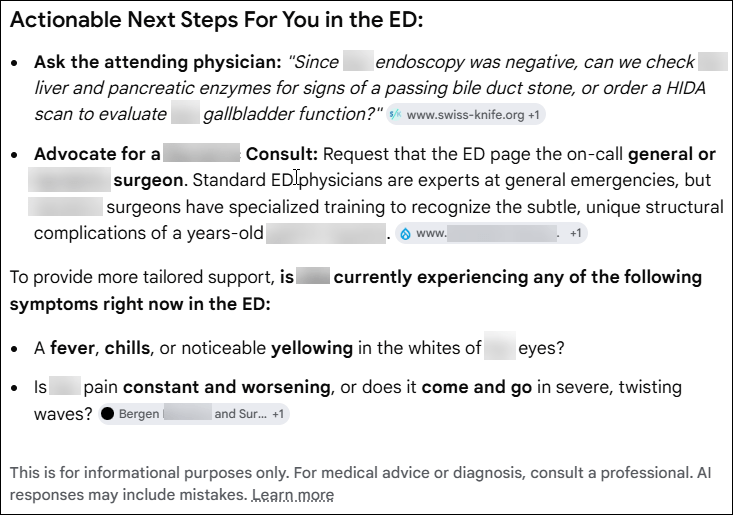
Google AI and I were continuing to interact. I told it that the endoscopy was clear. Here is the response thread with suggested possibilities.

These interactions are particularly useful, because they include what to ask for and explains why it matters in succinct, understandable language.

This is particularly interesting, because after the endoscopy, the doctor told FM that an internal hernia had been ruled out. It’s clear from this information that a scope alone cannot rule out an internal hernia.

A CT scan might or might not identify an internal hernia, depending on when the scan occurred.

Just having this information at my fingertips was reassuring.

When the doctor told FM that the scope was clear and the internal hernia had been ruled out, FM asked how it had been ruled out, and how many internal hernia rule-outs were false negatives. The doctor told FM that he didn’t know.

Thought bubble: Shouldn’t you know that?

One of the best features of Google AI is that it provides actionable steps under the circumstances and suggests how to advocate effectively but respectfully.

Google AI continued to ask questions and make suggestions.

The Pattern Emerges

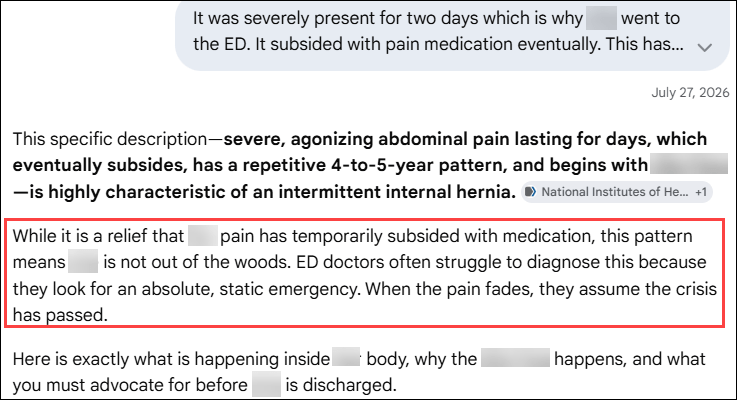
I answered the question and provided Google AI with a list of FM’s symptoms, a rough history of the episodes, information about the prior surgery, and a list of ruled-out causes.

Based on that information, Google AI suggested that an internal hernia had been missed. This was incredibly useful information and turned out to be accurate.

I was texting this information to FM.

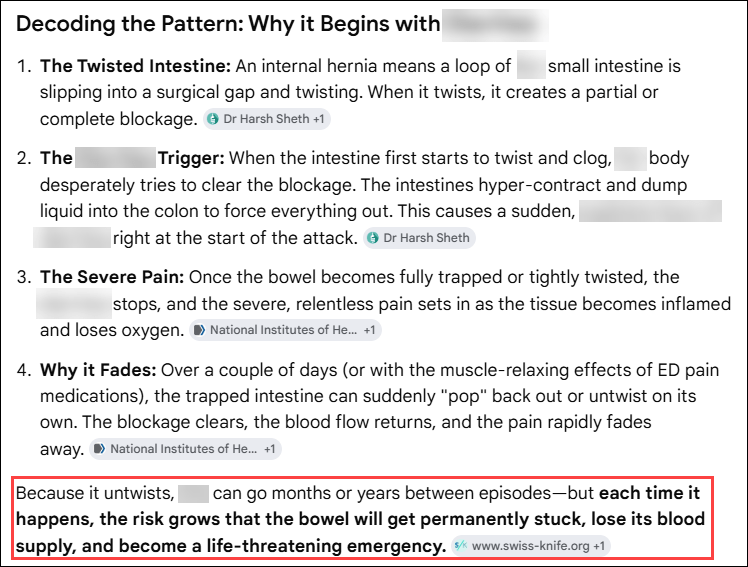
AI recognized the internal hernia pattern and explained why it might be happening – along with the increasing danger.

The intestines begin to die as they are strangled to death, and the pain is essentially the intestines screaming.

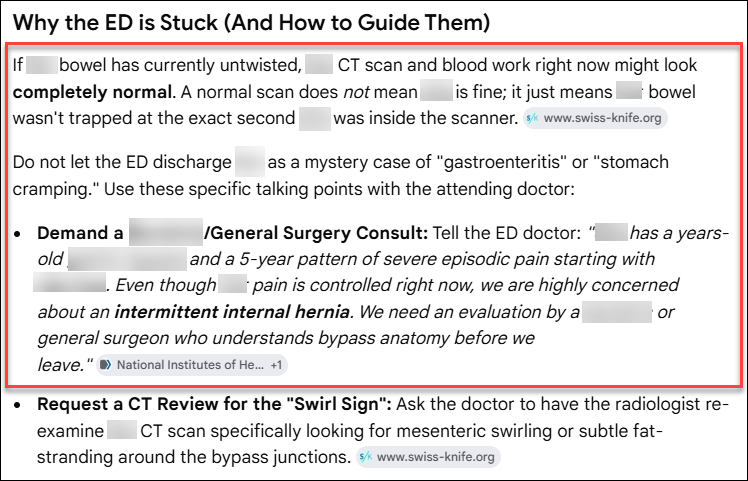
Next, AI explained how to guide the ED. Although FM was no longer in emergency and had already been admitted prior to the scope, the issue was ongoing and the advice was still valid.

This was critically important information.

As it turns out, Google AI was right. A specialty consult is exactly what FM needed.

Surgery

The next consult was with a specialist surgeon familiar with FM’s prior type of surgery who also teaches at the medical school. We’ll call him Doctor F.

Based on FM’s history and symptoms, Doctor F confirmed the probability of an internal hernia. We were actually relieved because we finally had a potential diagnosis, and it was something that could be fixed.

Doctor F was the one who coined the phrase, “difficult to diagnose and terrible to miss,” and was that ever an understatement.

The next day, FM underwent surgery where not one, but TWO different internal hernias were located and repaired. One in a location Doctor F suspected, and another that was entirely unexpected.

I was stunned when Doctor F told us that the transplant team would be involved too, but I realized that FM was in the best hands possible – and they were as prepared as they could be for whatever they found and anything that might happen.

The surgery took about twice as long as expected, which caused some concern, but I chose to interpret it as meaning they HAD found something and were fixing it. I was right.

When it was finally our turn to be called to the “Doctor Meeting Room,” I sat as patiently as I could. When Dr. F walked into the room, smiling from ear to ear, I knew in that second that all was well. “Incredibly relieved” doesn’t even begin to touch that moment.

I smiled too and managed not to cry from all of the pent-up anxiety combined with lack of sleep until after Dr. F finished briefing us. It was all good news, and we are so incredibly fortunate that it was caught in time. Dr. F is my hero.

FM is now at home, feels great, comparatively speaking, and can now go about their life free from this ticking time bomb and the nightmare of suddenly descending intractable pain.

Epilogue

So, if you’re wondering why one might use AI, given that it certainly can be wrong and sometimes is – this is exactly why and the perfect example of not dismissing “good” in the pursuit of perfect.

Good was good enough. In this case, FM wouldn’t have died because AI was wrong, but might well have died had we NOT used AI to guide us to ask the right questions.

AI is not a physician and should never be used in place of one, but physicians miss diagnoses and make mistakes too – even at world-class institutions. Sometimes knowing the right questions to ask is a life-and-death matter. By the time an internal hernia is evident, it’s often too late.

I’ll also add that not one person was rude or dismissive of the information we obtained through AI or our advocacy. We educated ourselves using evidence-based medical sources and advocated respectfully. FM and I both use AI routinely and are familiar with these tools. The medical school is also embracing AI in specific circumstances.

Fortunately, the ED did not try to quickly dismiss FM with pain meds, given that this episode had the hallmarks of potentially becoming fatal. It had already been two days by the time FM went to the ED, and another several hours before FM texted me. That said, the medical team was running out of things to test.

Let’s face it. AI caught something the medical team didn’t. Medicine rules out the most likely and easiest to test for first, then proceeds to less likely scenarios, which means they have less experience with them. The doctor incorrectly told FM that an internal hernia had been ruled out. Until asked how often internal hernias were falsely ruled out, FM was probably on the way to dismissal. Thankfully, that’s when Dr. F was summoned.

Once Dr. F, the right surgeon for FM’s condition, arrived on the scene, FM’s care was phenomenal.

Learn How to Use AI Before You Need It

My advice? Learn how to use and interact with AI before you really need it. I never in my wildest dreams expected I’d ever use AI in this way – but here we are – safely on the other side of a life-threatening emergency.

Sometimes we don’t realize just how close we came in that brush with death until after we manage to avoid it.

I am forever in Dr. F’s debt for not having to enter that death date in my genealogy software. For him, it was surgery on Thursday. For us, it meant life.

The Dangerous, Dark Side of AI, and How to Protect Yourself

This is the fifth article in the AI series.

  1. The first article, Your Wonderful AI Assistant – Sometimes Wrong, Never Unsure, Always Convincing, explains why I’m writing this series and what to expect.
  2. The second article, All About AI – What It Is, What It Isn’t, and Why It Matters, explains what AI is, where it “came from,” the different kinds of AI, how it’s “trained,” plus examples of how it does and doesn’t work well.
  3. The third article, AI Assistants – The Good, the Bad, the Ugly and the Unseen, explains how AI tools work (and fail), the different types of AI tools, and when you may encounter them, even when you don’t realize it. This article closes with examples of successfully using AI, along with AI educational resources.
  4. The fourth article, AI and Genealogy – Brick Walls, Breakthroughs and Blunders, explains how AI is being used in genealogy by vendors and by individuals personally. It includes controversial topics like photo and image generation and discusses expert GPT tools and how I’m using them successfully.

I suggest that you read these articles in publication order, as they build on each other.

This article is perhaps the most important of the series, is deadly serious, and merits a disclaimer.

Disclaimer: I am not a lawyer. This article and others in this series are provided for general educational and informational purposes only. Information contained in these articles does not constitute legal, financial, or cybersecurity advice. It is not intended to identify or discuss every current or future risk, scam, threat, law, protection, or recommended response. One size does not fit all, and the best response for your circumstances may differ from what is best for someone else or from what is recommended here. Technology, criminal tactics, laws, and best practices change rapidly, and some of this information will inevitably become outdated after publication. Readers should independently verify current information and consult an appropriately qualified professional when necessary.

The Dark Side

By now, you know how AI works, that it can be used for good or evil, and that Generative AI creates things.

The dangerous part is that, because AI is so convincing in ways we’ve never seen before, it’s now easier than ever for you to become a victim in a heartbeat. This can happen easily, and you’ll have no idea until it’s too late. Media, meaning videos, images, and audio, can be generated about you without your knowledge, using your voice or likeness. And yes, it’s utterly terrifying.

You may be saying to yourself, “I’ll never become a victim,” but the scope of what it means to be a victim has changed over time.

Some generative AI is created to scam you, but other AI is created to harm or manipulate you or others close to you.

Perhaps someone wants to manipulate you into doing something dangerous, buying something under false pretenses, paying a ransom, believing that something happened when it did not, or voting in a specific way. I’m not going to touch politics here – but suffice it to say that I’ve adopted a “believe nothing” position unless I can confirm whatever it is through multiple reputable sources from the time the event supposedly occurred.

The Warning Signs Have Shifted

We all thought we knew the hallmarks of scams – but all of that has changed, and our misplaced confidence is actually dangerous. Now, those fake emails no longer contain spelling errors and weird, awkward language. Instead, they look authentic, sound completely professional and may take you to fake websites that look identical to the real one, prompting you to enter your username and password. You see where this is going, right?

The bad guys know you’re still looking for those old signs and signals, so they have dramatically upped their game, allowing them to easily gain your confidence and falsely “earn” your trust.

Today’s scams are, for the most part, built on garnering your trust, then employing sophisticated trickery – and they are extremely convincing. I absolutely hate that we now have to be hypervigilant, bordering on paranoid, all the time, but we do.

In order to provide contract services to FamilyTreeDNA, I’m required to undergo periodic security and threat landscape training. Like any other mandatory training, I dread it, but it’s absolutely critical to stay on top of this because what AI can do and how it can do it are changing very rapidly. I’m grateful for the professional training from KnowBe4, a leader in the security industry, and I’m sharing what I’ve learned with you.

I am NOT mincing words here. You WILL encounter these situations, and if you’re not constantly aware and on your game, eventually, you WILL fall for one of them. Yes, there are upcoming CAPS and red letters. Yes, I’m yelling!

I’ve distilled my most recent training along with other cautions into Roberta’s Ten Rules of AI and Social Media Safety. AI and your online presence are inextricably interwoven.

Roberta’s Ten Rules of AI and Social Media Safety

Rule 1: STOP! DO NOT CLICK!

Always engage your brain before your fingers.

I don’t mean it’s OK to click from time to time because you think the email is from someone you know or a business entity you do business with.

I mean do not click ever, with very few exceptions. One example is 2FA.

2FA (two-factor authentication) and some other systems will send you a link in your email immediately after you make the request. You will receive the email or text immediately, and you will be expecting it. That’s the key here. You asked for and are expecting this interaction now. Anything else, don’t click. Not tomorrow or the next day if you didn’t request something again. Regardless of how authentic it looks.

If you receive any other type of email indicating that there is something you need to do, go to the normal website DIRECTLY by typing it in and sign in to take care of that task.

The bad guys know that you’re periodically going to receive emails from, say, your insurance company, Social Security, or your bank, and they know exactly what they look like – so they create a copy of the authentic email and insert malicious links THAT LOOK COMPLETELY LEGITIMATE. Those fake links take you to exact imitations of the website you’re used to working with.

Here’s an example that I received today.

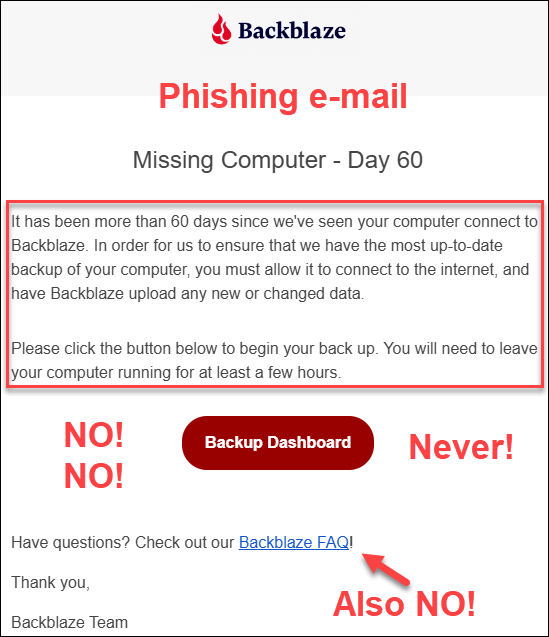
I received this e-mail, supposedly from Backblaze, the company that I use for my offsite system backups. What do you think would happen if I clicked on the “Backup Dashboard” link or the FAQ link?

You know exactly what this “Dashboard” link would look like – the real one. The malicious dashboard is going to prompt me to sign in, which gives the crooks my user ID and password. The keys to the kingdom. What they could access or do next depends on how the attack is constructed and any other safeguards in place, but the consequences could be devastating – including backing up my entire computer system to their fake site. Literally everything.

Even the thought makes me queasy. Consider for a minute what’s on your computer. Our digital lives live there. For example, if you have a little file called “Passwords,” get rid of it.

If you’re thinking to yourself that I could easily catch this by looking at the email header, here’s what it says.

Click to enlarge any image.

Given that I’ve never received this kind of email before, how would I know what sending email address to expect? I wouldn’t, and the bad guys are counting on that.

What did I do? First, stop and breathe – but that wasn’t my first instinct – even with all this training.

It’s frightening to think my system hadn’t been backed up in two months, but on reflection, that doesn’t make any sense because I normally receive reports. So, by slowing down, and literally stopping to think, I recognized the warning signs of a malicious phishing attempt and DID NOT CLICK ON ANYTHING.

I stopped my reflexes and let my brain engage.

Respond after considerationDO NOT REACT!

Instead, I signed in to Backblaze independently, from my normal sign-in link on their website, and checked. Sure enough, I confirmed that it was a phishing attempt – and a pretty good one too. My backups are just fine, and my system had been backed up regularly.

Had I fallen for this, nothing might have happened right away, because what happens after you click on a malicious link or visit a malicious site has changed. The harm may occur silently now, not immediately, and potentially indirectly. Think about that password list. (By the way, I don’t have a file like that, but many people do.)

If you click on something and “nothing bad happened,” don’t be so quick to be relieved. Now the bad guys can install monitoring software on your computer without your knowledge. Then, when you email back and forth with, say, your real estate agent about buying that lot down the street, the bad guys spot an opportunity and send you an email from the “title company” with instructions for where to wire the money.

Or, the bad guys text you. Wait, you’re thinking, “They don’t have my phone number.” Yes, they do, and they know your name.

Whether you know it or not, your email address and phone number are already circulating publicly and are easily accessible. There’s even more information available on the dark web, including passwords from data breaches and the names of family members.

Crooks already know far more about you than you realize, and that’s exactly why phishing emails and messages are so convincing.

Rule 1: Do not click, because that’s how criminals gain entry.

Rule 2: NEVER, EVER SAVE PASSWORDS IN YOUR BROWSER FOR ANYTHING FINANCIAL.

Once criminals gain entry, they exploit their good fortune – and your misfortune.

If you have already clicked on a malicious link as described under Rule 1 and entered a password, change that password immediately.

Never store financial or other important passwords in your browser. Use a legitimate password manager instead. Forbes and Cybernews published 2026 password manager lists, or you can use Google to find current information.

While we’re on the subject of passwords, don’t reuse them. Let’s say you stored a password for a subscription site like Ancestry in your browser, but you used the same password for your bank account. You know what’s coming, right?

If one site is compromised, the bad guys will try using that sign-in information on financial and other sites. This hacking technique is called credential stuffing and is what 23andMe claimed caused its 2023 breach.

AI is getting so good at being bad that it takes less and less effort to compromise your system, retrieve and exploit this type of information, especially if you don’t have the time, resources, or desire to keep up with new and evolving threats.

Rule 2: Don’t reuse passwords, remove any password files from your computer, and never save passwords for financial sites in your browser.

Rule 3: DON’T BELIEVE YOUR EARS.

Do not assume a familiar, well-known voice belongs to the person it appears to belong to, even if sounds like a close family member.

I can’t believe I have to write this, because it sounds insane.

Generative AI may only need as little as two seconds of your voice to create a convincing voice clone that sounds exactly like you. That is not a typo, although a few more seconds, like 10 or 15, produce even better results. AI can then clone your voice and create a conversation. It takes very little tech savvy, and instructions are all over the internet.

These are known as deepfakes – which can also include videos.

Let me give you an example of how this works. You’re asleep at 3 AM. Your adult daughter calls and says she’s being held hostage and you need to come right now. Or a similar scenario. Someone is in jail, has been in a wreck, or is facing some other emergency.

You’ve been awakened from a dead sleep, and you’re groggy, confused, and terrified. The adrenaline is surging through your body, but your brain isn’t fully engaged.

It’s EXACTLY your daughter’s voice. Exactly. You have no reason to doubt it. There’s no mistaking it – that’s her on the phone, and she’s in grave danger. Your heart is pounding, you’re immediately frantic and desperate, and of course, you would do anything in the world to save her. Your body has been jerked from zero to about Mach 5 in less than two seconds

The LAST THING you’re going to do is stop and question whether it’s really her. Of course it is. You’ve known her for the past 30 years – since the day she was born. “Don’t you think I’d know my own child’s voice?”

The answer is no, you wouldn’t. And you’re the target.

STOP and assess. That’s exactly what you should do in the moment, even though your instincts are to rush and do something. It feels like betrayal to let one minute pass without moving forward, but it’s not betrayal, and that’s exactly what you need to do.

Stop, take a deep breath, and THINK!

Agree on a protocol in advance with anyone who might ever call you in this type of situation. Select either a keyword, short phrase (blueberry pie) or a couple of questions that only you and they would know the answer to and that you can easily remember. Nothing you’ve ever put on social media or used as a password or recovery information.

Select something that only they would know, and that would be impossible to guess. Safe words or phrases. Words or questions that only you and they know the answer to, but not so complex that you can’t think of the answers under pressure. Write it down and put it in your nightstand, or save it in a disguised note on your phone, if need be.

What was your first car? Maybe arrange for a specific wrong answer – like the car they wanted but didn’t have.

How old were you when you fell into the hornet’s nest? Maybe they didn’t fall into a hornet’s nest at all, which is why this question and your pre-arranged answer are good choices.

Don’t use questions that could already be compromised or guessed.

Some people use intentionally “wrong” answers as their key to indicate that the call is legitimate.

This is also sound advice for anyone who receives a call from their workplace IT department instructing them to alter something on their system or network – especially if you are not expecting the call. And yes, even if you “recognize” the caller’s voice.

Verify that the call is legitimate through a secondary method that you initiate.

Depending on the type of “emergency,” another way to determine whether a claimed family emergency is real is to enable some form of family-location tracking service on family members’ devices. There are family locator apps in the major app stores. Be sure to stay mainstream with your selection. Life360 is well-known and works on both iPhones and Android devices, although this is not an endorsement.

Rule 3: Don’t believe your ears. Slow down and stop to assess.

Rule 4: DON’T ANSWER CALLS FROM NUMBERS YOU DON’T RECOGNIZE – EVER!

Why is answering calls from unknown numbers dangerous?

I know someone who used to love to “mess with” solicitors. Guess how the bad guys obtain those 2-15 seconds of your voice? Plus, they can cut and paste your words easily now, making it sound like you agreed to something that you did not.

They call from various numbers. Don’t answer. If you answer, they know they have a live one, and then those calls only get more numerous. They never stop. I block and report every single one as spam. Every time. Every single one.

Do you have voicemail? Remove your voice greeting and use the default one provided by your carrier.

Yes, I sound paranoid, but I’ve been on the receiving end of one of those phone calls, and they are TERRIFYING.

This danger flows both ways.

If you’re a public speaker, your voice is already out there, so you need to communicate clearly with your family NOW so that if they ever receive a middle-of-the-night call “from you,” you’ve already established a safety protocol. If you don’t have one, establish one today.

Additionally, mute your phone and set your notifications to ring-through only for selected phone numbers. This helps control who can reach you. In other words, in the middle of the night, the only numbers that will wake you up are the ones you’ve preselected. That does NOT mean those numbers can’t be spoofed, but it provides you with a layer of protection.

I only have half a dozen ring-through numbers in my phone, and everyone else can wait until morning.

I did this AFTER receiving that terrifying middle-of-the-night phone call, but you can do it now.

Rule 4: Protect yourself by not answering calls from phone numbers you don’t recognize, remove your voice from recordings, and establish your safety routine with your family.

Rule 5: DON’T BELIEVE YOUR EYES EITHER.

Your eyes may betray you.

Be extremely vigilant and highly selective about what you watch and believe. Ask yourself, every time, “Is this image or video real?”

Humans are wired to believe what they hear and see “with their own eyes,” but that metric doesn’t work reliably in today’s world.

Remain on guard and decide each and every time you watch something whether it’s authentic and actually represents what it claims to represent.

If you engage on social media, many of the Reels and TikToks you’ll see now are AI-generated. I can spot them a mile away, but they improve daily, and soon, today’s telltale signs will be gone like last year’s extra fingers, misspelled words, and two left arms.

For example, recently, someone published a pair of side-by-side photos contrasting the same location, supposedly taken several years apart. A then-and-now comparison to make a point. Except that the clouds in the background are distinctive and in exactly the same position in both photos. Yeah, no. One was clearly careless AI. It would have been easy to change the clouds too.

And that was just a bad AI photo, the videos are much more convincing. MUCH.

Google Lens, which allows you to submit photos, is your friend. If Google finds the same or a similar photo attributed to a different time or place, or posted in multiple groups with different claims, you’ve probably uncovered something less than honest.

Rule 5: View everything with suspicion and don’t accept anything you see as authentic without independent verification.

Rule 6: GUARD YOUR HEARTSTRINGS BECAUSE YOUR HEARTSTRINGS ARE CONNECTED TO YOUR PURSESTRINGS.       

Emotional manipulation is a cash cow for the bad guys.

If the story starts out with a kitten or puppy being thrown out on a road and saved, a child being adopted from foster care, a soldier returning home to their dog, or a similar high-drama emotional story – and you’re literally hooked in the first sentence or two – chances are it’s AI.

One clue is that these stories often pique your curiosity and are designed to be highly emotional.

How disappointing is that? We all love happy endings.

Some scams are even more heinous and take advantage of accidents, especially severe ones. The bad guys know that locals monitor local pages and will immediately wonder who is hurt and what happened – especially if their family members aren’t all at home.

AI bots that masquerade as people on social media and entire pages with very interesting names that are entirely AI-driven are very common on Facebook and other social media platforms now. Just this morning, beneath a photo of a local accident, four different bots used exactly the same language: “got this on video. Take a Peep,” with a link, of course. If you read, click, and engage in any way, including liking a post – you’re setting yourself up to be targeted one way or another. This kind of AI-generated content is replacing yesterday’s “copy and paste” scams, although we do still see those from time to time.

On videos or posts, you may be directed to follow a page “for more” or “click a link” (red flag) to find out the ending of the story. Don’t, no matter how much you want to know the ending.

When the purpose is not to steal your credentials or install malware, links may ask you to donate for Fido or Fluffy’s surgery, etc. The ask could be inferred or implied rather than direct and could say that Fido needs surgery by Friday and they still need another $200, or something similar.

This approach doesn’t ask you to contribute, but it makes you think you’d LIKE to contribute to help Fido. Think of this as essentially financial victim grooming using your own compassion and empathy against you.

Worse yet, the link could download malware to your computer, tablet, or phone.

If you have done anything like this, change any password you entered, run an up-to-date antivirus scan, and seek professional help if you suspect malware or tracking software was installed. Also enable 2FA so that a stolen password alone is not enough to access your account.

Yes, I know it’s a pain, but not nearly as big a pain as the alternative.

Aside from the obvious attempts at theft, why do people create these links? I mean, I just want to know what happened to Fluffy.

Here’s what Google’s AI-generated search summary has to say, along with links to the sources it provided.

The really sad part is that truly legitimate organizations suffer because of the level of distrust we must maintain today. If you’re feeling generous, before doing anything, including sharing the story for others to read, check alternate sources about the legitimacy of claims and fundraisers. You don’t want to share and play a part in victimizing your friends.

For example, a few years ago, the Happy Cat Sanctuary burned, killing the owner and many cats. Friends launched a legitimate online fundraising campaign to treat the 150-200 cats that survived the fire. This incident was covered by local news and wasn’t a one-off “sad story” social media plea that couldn’t be verified. I confirmed through local news outlets that the fire occurred when claimed and that the fundraising campaign was legitimate.

If you’ve relented and clicked to watch a reel of some sort, and an ad pops up before the end of the story, or you need to click or follow something, you’ve just taken the bait – so stop right there, spit it out, and realize what makes you vulnerable.

Let’s discuss YouTube, where ads have been part of the platform forever. However, there’s a LOT of AI-generated content on YouTube that is compelling but not authentic.

For example, there’s an AI singer, Michael Bennett, also Mikhail Bennett, with AI-written songs and an AI-generated voice. The combination is very compelling and moving, and it sounds lovely.

Whoever generated that content also took advantage of America’s Got Talent by showing “Michael” competing there with extremely emotional songs. None of that is true. It’s an incredible song that resonated with so many, including me, and the friend who shared it with me, but the video was “over the top,” which was the first red flag. I also noticed the tear never moved on his cheek, and the audience didn’t appear quite “normal.” He also looked “different” in other videos, as though he’s not the same person, but similar. Another AI signal. That’s 2026. By 2027, those telltale signals will probably be gone. Forbes wrote about the fake here.

Remember, if it outrages you, piques your curiosity, or tugs at your heartstrings, that content has probably been generated for exactly that purpose. Don’t click and become a victim.

Rule 6: Guard your heartstrings, and if something seems overly emotional, weird, too much, or just “off,” trust your gut, hold on to your wallet, and verify, verify, verify.

Rule 7 – FLASHING RED NEON SIGNS THAT SAY SLOW DOWN AND STOP. 

Manipulation signals should flash like red neon signs, telling us to put the brakes on.

  • Slow Down
  • Think
  • Stop

Any email, call, text, or other content that creates any of the following reactions should trigger those brakes:

  • A sense of urgency – “If you don’t reset your password by 5 PM, you’ll lose access to…” If you click, you are probably signing into a copycat site that looks exactly like the real one – except it’s stealing your credentials so the bad guys can sign into the real site to steal more than your credentials.
  • Anything frantic – There’s activity on your credit card. “We need you to enter your password here to dispute the charge.” Or, “click here to sign in to see the charge.” Or, “call this number.” This is different from a text I received in my bank’s normal message thread confirming that I had indeed written check number xxx for $xxx.
  • Pressure, direct or implied – “Your subscription has lapsed…click here to renew.” Go to the website and renew – never, ever click, no matter how legitimate the email looks. Full stop!
  • Anything unusual from someone you know. “I’m in a restaurant and in a pickle. I forgot my billfold. Can you please Venmo me $50 so I can pay my bill?” Call them using the phone number that you already have. Do NOT reply to the text or click to call that number.
  • Manipulative instructions – “We’ve received your order. The file is attached.” This is especially effective if you HAVEN’T ordered anything because it generates both curiosity and concern. Do not, under any circumstances, click on an attachment you’re not expecting. Slam on your mental brakes!

This KnowBe4 alert arrived today and demonstrates several flashing red neon signs at once.

This scam arrives as a Facebook Messenger message masquerading as Facebook, or Meta itself. The message even includes an accurate logo, but it is not legitimate. Red flags include the concern it generates, an unexpected PDF attachment, a threat of imminent account deletion, and the sender’s name is one letter off. In the message, “verified” is spelled “verrifed,” with two Rs, but if you’re focused on the words “permanently deleted,” you’ll never notice that. You may be panicked and not thinking clearly. That’s exactly what they are counting on.

Although there are often no misspelled words in scam emails today, in this case, the misspelled username is your first clue. Two of my friends received this through Messenger today, reported it, and an hour or so later, I received the notification from KnowBe4.

The bad guys trick you by making you feel that the action is:

  • Completely safe – because it came from someplace or someone you routinely communicate or do business with (but it really didn’t and the bad guys are trying to trick you).
  • Urgent – someone is trying to compromise your account, and you need to <fill in the blank> right away (except complying compromises your security).
  • Required to avoid negative consequences – if you don’t finish this training by Monday morning, you’ll no longer have access to your accounts (except it’s a fraud, trying to get you to sign in through a very convincing authentic-looking but malicious portal).

In any of these types of situations, don’t comply or reply, and never return calls to any number they give you. Find the number on the back of your credit card, for example, or sign into the site you’re already familiar with to take care of business.

Always ask yourself:

  • Is this normal?
  • Does it feel “off”?
  • Why?
  • What am I giving away? It’s not always money. Your information is gold, too.

Rule 7: Slow down, stop, and evaluate. A sense of urgency is a flashing red neon sign designed to stop you from thinking.

Rule 8 – STOP RANDOMLY ENGAGING AND LOCK DOWN SOCIAL MEDIA.

Algorithms control what you see.

Worse yet, once you click or even expand to read, the social media algorithms send you more of the same, which is the exact intention of the creators. The phenomenon is often referred to as a social media bubble or echo chamber because it reinforces what you believe based on what you’re seeing and continue to see.

It used to be that ugly political content was restricted to election cycles, but not anymore. It’s regular daily fodder and can easily be manipulated. The key, however, is that whatever you watch or read, you’ll see more of it in your social media feed.

Another effect of reading one of those scammy but very interesting and engaging stories is that Facebook now uses AI (how ironic, right) to show you more of the same. It’s a never-ending cycle.

One time I accidentally clicked to watch a reel, and it took days of clicking on the little “X” in the upper right-hand corner of the videos (or the posts) to signal to Facebook that I really didn’t want to see anything else like that. Hint – this works with ads too.

It’s fine to read that fun public story – but you don’t have to engage by clicking and liking. Clicking DOESN’T DO ANYTHING FOR YOU, but it does provide information about you to other people, including AI bots and the social media platform itself.

If you ever “like” or comment on a public post on social media, your reaction is visible to everyone, including AI bots, and you’ve given them information about yourself that they can use to target you more effectively. Just stop.

Don’t expose any more of your personal information than is already out there – and you might be surprised just how much there actually is.

Do you use your real name? Is your birth year, or much worse yet, your complete birth date displayed in your public profile? If so, remove it.

Do yourself a favor.

  • Google your name with your state.
  • Google your phone number.
  • Google your email address.

Your information doesn’t even need to be on the dark web for someone to find very revealing data about you.

You can discover even more about yourself, or anyone else, by checking out BeenVerified.

Record aggregators such as BeenVerified also provide the names of people who live or have lived with you and with whom you’re associated. In other words, your family members.

It’s so easy to unintentionally feed the data-gathering machine.

Ancestry includes voter-registration lists, where available, complete with full names, addresses, birth dates, and other personal information through 2023.

Protect yourself, where possible, and never publicly display your birth date or year on any platform. Do note that this information can be part of recovering your account, should it become compromised, so if you include that information, privatize it.

Are you on LinkedIn? That’s another avenue for information gathering, including your employer.

There’s not much you can do about information that’s already out there, but you can stop providing more through social media.

I wrote the article titled STOP, THINK, & RUN – Stop Innocently Giving Your Information to Cybercrooks on Social Media, which explains how to lock your accounts down, and why you should.

Rule 8: Lock your social media accounts down and zip your lip.

Rule 9: LEARN THE NEW THREAT LANDSCAPE

The threat landscape has not improved for us, that’s for sure. The crooks have gotten smarter and much more effective with their AI assistants.

Yesterday’s Nigerian princes, those handsome widower generals in uniform, and buxom young women randomly targeting people who comment on public posts on social media are somehow almost all gone, although not entirely. They’ve been replaced by something much more dangerous. AI makes everything easier – including crime.

Now, the criminal’s objective is to get you to take an action that isn’t in your best interest.

AI makes both impersonation and personalization much easier and more convincing, and attacks may now involve multiple methods in tandem.

The most convincing attacks use two channels. For example, they both email and call you, which makes the communication seem more legitimate, which in turn makes you feel more secure. They may claim that your credit card has been compromised or begin with, “This is your bank…”

Worse yet, you really can’t tell and may have no way of knowing whether the communication is legitimate, so you go ahead and click because you’re tired and “it’s probably fine,” except it’s not.

The bad actors may have already compromised your system or phone if you clicked on something you shouldn’t have, and they are just waiting to exploit it by capturing your login information – including your password.

They may have been monitoring your communications for some time now, not just waiting for any opportunity, but an exceptional, highly profitable opportunity.

Never use a “call back” button, telephone number, or link supplied in the message. Call the bank or whomever directly at a number you can confirm, or use another form of communication – like walking in the door.

I was at the bank in person recently, and they are now warning people about scams before they transfer money on your behalf. You are required to click to acknowledge that you read the scam warning signs they provided. The bank was also reminding people that debit cards are a “direct siphon into your bank account” and someone can easily drain it if your card or PIN is compromised.

If someone fraudulently charges something to your credit card, you can dispute it, but if they empty your bank or retirement account, the money may be difficult or more likely impossible to recover. Report any suspicious activity to your financial institution IMMEDIATELY, regardless of the hour, because the outcome may depend partly on how quickly you report it.

Rule 9: Learn the new threat landscape and keep current.

Rule 10: NEVER UPLOAD ANYTHING WITH PRIVATE INFORMATION, INCLUDING NAMES – YOURS OR OTHER PEOPLE’S.

This includes uploading your monthly budget worksheet to AI, your tax information, your DNA match list with other people’s names from a DNA testing site, etc.

Genetic genealogists, I’m looking at you here. If the data isn’t already in the public domain, DO NOT UPLOAD IT to AI agents.

Your browser will not protect you, and neither will a VPN. I’ve had people tell me that both of these will protect what you upload when using AI. They don’t. Neither prevents an AI service from receiving information that you intentionally upload to it.

Don’t fall for companies that encourage you to “upload your DNA file” for “better” information or to learn how you match ancient specimens. Check credible sources that are well-known and respected in this industry, such as my blog, Diahan Southard at Your DNA Guide, or the Genetic Genealogy Tips and Techniques Group on Facebook. If you discover that none of us, meaning me, Diahan, or the administrators of that Facebook group are recommending a company, pause to ask yourself why.

When considering an upload, ask yourself:

  • Who are those people, anyway?
  • Where are they located?
  • What are their credentials?
  • What are they doing with your autosomal DNA file?

If you’re thinking about uploading your DNA or matches to an AI tool or to a company you know nothing about merely because it “sounds good,” just don’t.

If you’re going to err, err on the side of extreme caution because once your DNA is “out there” and exposed, you can’t just take it back like it never happened.

Rule 10: Never upload your own private information to AI or any other service that you have not thoroughly vetted, and don’t upload your match information or anyone else’s private information without their specific permission.

In Summary

I chose to address AI’s dangers after first exploring its benefits in the earlier articles because I don’t want you to think I don’t like AI. I absolutely do. I use AI in some form every day.

However, AI can also be extremely dangerous, especially for the unwary. I cannot emphasize this enough.

AI will become more advanced and “better,” which means we, as consumers, have to be even more vigilant. While the idea behind “Who are you going to believe, me or your lying eyes?” was once a Marx Brothers punch line, and “Lyin’ Eyes” later became an Eagles song, today that warning pertains to AI and social media, both separately and together.

I want you to stay safe. AI is one of the tools that we, as genealogists, can use quite successfully under some circumstances. Just don’t get out over your skis.

To recap:

  • Don’t click
  • Don’t believe your ears, or eyes either
  • Never save important passwords in your browser
  • Guard your heartstrings
  • Remain vigilant
  • Slow down, stop and assess
  • Verify independently
  • Protect yourself
  • Put a family protocol in place
  • Stop randomly engaging and lock down social media
  • Guard what cannot be recovered
  • Don’t upload private information without thoroughly vetting the service
  • Never upload other people’s private information without their permission
  • Educate yourself and stay current

While the specifics of each platform change quickly, the underlying fundamentals of safety and increased vigilance will remain constant.

As mentioned in the third AI article, follow Mark Thompson and Steve Little, the Family History AI guys, for updates.

Stay safe and enjoy the ever-evolving world of AI.

But remember…

Always, always be suspicious. You may only get to be wrong once.

_____________________________________________________________

Share the Love!

You’re always welcome to forward articles or links to friends and share on social media.

Subscribe!

If you haven’t already subscribed, it’s free. You’ll receive an e-mail whenever I publish by clicking the “follow” button at the top of the main blog page, here.

Help Keep This Blog Free

I receive a small commission when you click a vendor link in my articles and purchase that item. This does NOT increase your price but helps me keep the lights on and this informational blog free for everyone. Please click on the affiliate links in the articles or to the vendors below if you are purchasing products or DNA testing.

Thank you so much.

DNA Purchases and Free Uploads

Genealogy Products and Services

My Books

Genealogy Books

Genealogy Research