FOCUS: Step 1 – Seven Solutions for DNA Matches with Absent or Shrunken Trees

This is the second article in the FOCUS series.

You can read the first article, FOCUS – A New Series Focused on Breaking Down Brick Walls, here.

DNA matches without trees, or bare-bones shrunken trees, can be a significant roadblock whether you’re looking at autosomal, Y-DNA, or mitochondrial DNA matches. To help resolve that issue, I’ve listed seven ways you can create or expand those trees. Not every methodology works every time, but none will work if you don’t invest the effort to try them.

I’ll probably say this in every article because it bears repeating. Everything we are working with is a hint. Breadcrumbs along the way. Sometimes they lead to the next wonderful breadcrumb. Sometimes to a dead end. Sometimes they look like useful breadcrumbs, but they are red herrings and not relevant. And sometimes they are simply wrong. Do not throw the baby out with the bathwater. Also, do not think every hint is accurate, because they aren’t, and many rely upon other people.

Our goal in the FOCUS series is to accrue evidence from multiple sources, tools and methodologies that leads us to our ancestor. So let’s start with trees.

Trees, Trees, But Not Everywhere

DNA testing relies on trees to identify our common ancestors, at least with matches beyond the closest generation or two.

This is true at all vendors, which is why all of the main vendors, except 23andMe, integrate with or provide trees as part of their platform.

Because we need to work with trees for all types of DNA testing and matching, I’m going to share various ways to overcome partial trees or even no tree at all. I’m intentionally using examples from multiple vendors throughout this series.

23andMe is omitted in this article because they don’t support trees, although testers can include a link to a tree elsewhere.

GEDmatch is omitted in this article because they are not a testing company. They are a DNA upload and matching site, so everyone at GEDmatch has tested elsewhere and probably has a tree there. You can upload a GEDCOM file to GEDmatch, though, so it never hurts to check and see if your match is there too.

Some of these techniques are vendor specific, and others can be applied broadly.

What Is a Shrunken Tree?

A shrunken tree is a small tree in which your DNA match has included only a few people. Small or missing trees tend to frustrate genealogists – a lot. I remind myself that these folks maybe seeking their family or new genealogists, trying to piece their tree together themselves.

This is a tree provided by one of my matches. Their mother is deceased, but it’s recent enough that I’ve chosen to obfuscate her name as well, and it’s not relevant to the next steps.

There’s not a lot to work with here, but as it turns out, there’s enough.

Based on this tree, we have no idea where in their tree our Most Recent Common Ancestor (MRCA) is found, so let’s look at a few ways to indirectly expand their tree in order to find our common ancestor.

Step 1 – Check Your Own Tree

I know this sounds like a “duh” moment, but always remember to check your own tree to see if you’ve expanded that branch to include your match’a ancestors and completely forgotten about it. I maintain my primary tree on my computer with lots of notes and information that I’m not comfortable uploading to a public space. I maintain smaller public trees with a couple thousand people at both Ancestry and MyHeritage, along with a link to my ancestors at WikiTree.

If your match is a female, they may be using a married surname, so always keep that in mind. I try their complete name first. Then I search for their surname to see if it’s a “married-in” name – and cross my fingers that it’s not Smith. If they have any ancestors in their tree, I try their oldest generation next.

Step 2 – Reach Out to Your Match

Every vendor provides some way of communicating with your matches. You can either message or email, depending on the vendor, and your match may be very willing to share more about their genealogy. They may have a better tree elsewhere that they will share with you, or may know more than is in their tree.

An Ancestry survey showed that about 53% of Americans can’t name all four grandparents, and only 47% can correctly name all four. Only 4% can name all eight great-grandparents. In the Rolland tree, the tester knew more about their mother’s side, and only knew the first name of their paternal grandmother.

So while shrunken trees are exasperating, they are probably more normal that we think, and we all have to start someplace. Your match might well appreciate some help.

Step 3 – Check Other DNA Testing Sites

If your match has a real name (meaning not just initials or something indecipherable), such as Heather Jacobs (made-up name), who is predicted to be your third cousin and shares 100 cM of (unweighted) DNA at one vendor, sign on to your accounts at the other vendors and see if Heather is a match there.

You’re looking for a Heather, or maybe HJacobs or something similar, who’s approximately a 3C with roughly the same amount of shared DNA. The exact relationship prediction may not match, but it should be close, and the amount of shared DNA may not be identical either. If it varies substantially, it may not be the same person, so exercise care.

Every vendor provides the ability to search for matches by name, and if you can’t find them by name, begin paging until you reach matches at the approximate predicted relationship level. In Heather’s case, that’s third cousins. Beyond third cousins, this paging technique quickly becomes too laborious.

At Ancestry

Only one vendor, Ancestry, “downweights” your DNA with your matches, meaning that they may remove some amount of DNA that they consider “too matchy.” In my case, this is often DNA from my Acadian lines, which collectively forms pileup regions. This does NOT mean those aren’t useful, but that’s not relevant for this discussion other than to alert you that you need to check both the assigned amount of DNA and your unweighted shared DNA with a match when you’re trying to verify that the match is the same person at two vendors.

Assuming you find “HeatherJ” at Ancestry, you’ll want to verify that it’s the same person as Heather Jacobs at the other vendor.

Is your amount of shared DNA roughly the same?

Click on the relationship link to view the amount of unweighted DNA. In this case, weighted and unweighted is the same, and Heather Jacobs matches you with 100 cM at the other vendor.

Heather has a public tree here, and it’s the same size. It’s probably the same person, but check anyway.

Heather’s tree at Ancestry is exactly the same as it was at the other vendor, so this confirms it’s the same person.

There’s an important hint here, and let me emphasize the word HINT.

While Heather’s actual 15-person tree does NOT extend to our common ancestor, Ancestry has pieced together other trees that include and extend beyond her ancestors to show my (purported) common ancestor with Heather. Click on Common Ancestor, which takes you to ThruLines.

This new version of ThruLines has now replaced the older version. Unfortunately it does not show Heather’s path back to our common ancestor, Hiram Bauke Ferverda.

Click on “View all ancestors” in the upper left-hand corner.
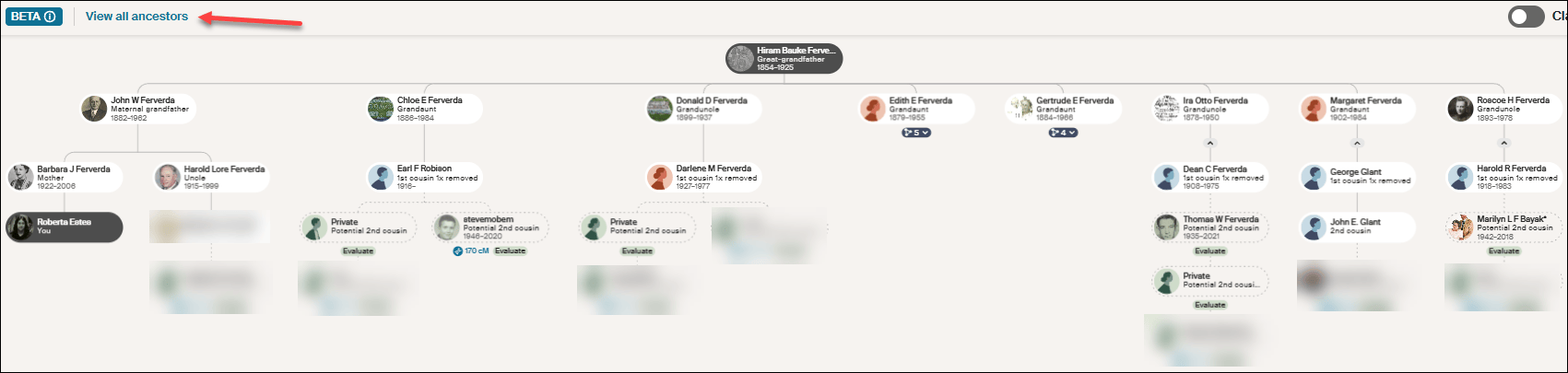
Click on any image to enlarge

After clicking on “View all ancestors,” click on Hiram Bauke Ferverda to see the DNA matches who descend from him. Despite what Ancestry provided under my “Common ancestor” with Heather, she isn’t shown anyplace here. This could be a bug, given that I later confirmed this common ancestor using other techniques.

Regardless of the problem, this IS a hint, so don’t disregard it entirely. Just keep your “skeptic” hat handy and wear it liberally. You’ll need to use Ancestry searches and hints, including possibly Quick and Dirty Trees, to piece together the possibilities.

Make a note on Heather’s match at Ancestry so that you know what you found this time through. We’re not done with Heather. Move on to another vendor to see if Heather has tested and has a better tree elsewhere. We’re gathering evidence.

At MyHeritage

Heather is not at MyHeritage, so I’ll use a different example.

Let’s look for Cathy, a 3C match who has no tree at another vendor. I found her at MyHeritage with the same first and last name and approximately the same amount of shared DNA, so I’m confident it’s the same person.

Fortunately, at MyHeritage, Cathy has a tree, which is the first step, of course, but no common ancestor is shown in her tree.

MyHeritage has a wonderful feature called Theory of Family Relativity which are often based on “Smart Matches.” Click on “View theory.”

Click to enlarge

MyHeritage has found five possible paths to a common ancestor based on multiple documents and trees. In this case, Surrilda Claxton in my tree is the same person as Surelda Clarkson in Cathy’s tree, and MyHeritage made that connection correctly.

I confirmed this Theory at MyHeritage as accurate, and now I know how Cathy at the other vendor with no tree is related to me. I made a note about Cathy at MyHeritage on my match with Cathy at the other vendor too about our common ancestor AND where Cathy’s tree can be found. Add Cathy to her proper place in your trees.

Step 4 – Sleuth at the Same Vendor

At FamilyTreeDNA, when I find a match with no tree, I do two things.

Looking at Patricia’s profile, I immediately see that she has been assigned to the maternal side of my tree. I’ve linked other known matches which allows FamilyTreeDNA to use triangulation to assign Patricia to the proper side.

Then, I notice that even though Patricia doesn’t have a tree, she has provided her ancestral surnames.
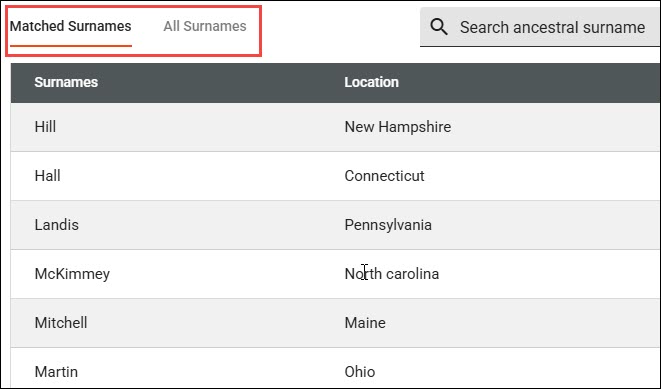
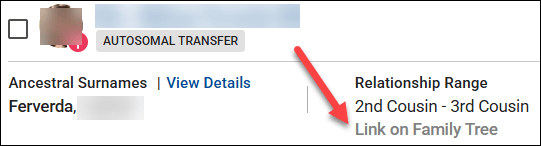
Clicking on “View Details,” I can see if any of them match my surnames, or I can view all of her surnames.

Given that this is my mother’s side, these shared surnames give me an idea of a shared lineage.

Next, look for your closest shared match WITH a tree. Clicking on the two little people at far right displays your shared matches which are labeled “in common with.”

I share 122 matches in common with with Patricia, and our closest shared match, other than my mother who is not shown here, is Dennis. Dennis happens to be a known relative, which is why he already has a note.

But for purposes of this exercise, let’s say that I haven’t already figured out how Dennis and I are related. Viewing Dennis’s tree, I see that our common ancestors are Anthony (Antoine) Lore and Rachel Levina Hill. Hmmm, Hill is on Patricia’s list of surnames.

Sleuthing at the same vendor is MUCH EASIER when your matches have at least a couple of generations in a small tree. Having no tree is the most difficult situation at every vendor, but there are multiple ways to begin building a tree for your DNA match, or to expand a shrunken tree.

Step 5 – Google Is Your Friend

Google is your friend. Google cannot reach behind paywalled sites, so you won’t find records other than records from free indexes at Ancestry or MyHeritage in Google searches, but you will find information about people from other genealogy sites.

Let’s go back to Rolland Robison who died in 1963 and his wife, Chloe. And let’s also consider that his surname is often spelled RobiNson. We know from our match’s tree that Rolland’s wife’s first name is Chloe.

Look closely at the search box in the image below. By structuring the query as “rolland robison died 1963 wife chloe”, we combine a full name, a specific vital event year, and a spouse’s first name. This gives Google just enough precise detail to hopefully filter out (most) noise.

That’s interesting. It looks like Rolland can be spelled two ways too.

Not only is there an article (yes, I wrote about this previously), BUT there’s also an obituary and estate distribution in a local newspaper that I have never seen before.

Rolland’s wife’s birth surname is given in his obituary, even though her first name is misspelled. This is the link I need to establish our common ancestor, because Chloe is my grandfather’s sister.

Google can provide you with important links to information and articles that are not yet in genealogical databases, such as:

  • Facebook accounts for individuals: Useful for finding the tester, relatives or family connections.
  • Facebook groups and pages: Forums that contain local historical information and shared community memories.
  • LinkedIn & Instagram accounts: Social footprints that often reveal professional histories, geographic locations, and birth surnames.
  • Mentions elsewhere: Local newspaper archives, digital press releases, and published legal notices regarding estate partitions or land records.
  • Obituaries: Printed family notices that explicitly list surviving family names and relationships along with the Legacy.com tribute archives.
  • Public websites & genealogy blogs: Independent sites where genealogists sometimes publish deep-dive ancestral lineages. Always verify.

Google also provides an easy way to find free resources in public databases without having to search each one individually, including:

  • Collaborative family trees: WikiTree, FamilySearch, and Geni trees.
  • Cemetery registries: FindAGrave and BillionGraves.
  • Digital libraries: Internet Archive and Google Books, which hold a vast assortment of historical information like out-of-print town and county histories.
  • Open-Access portals: The Library of Congress (LOC) and the Digital Public Library of America (DPLA), which pulls photos, maps, and civic documents from libraries across the US.
  • Volunteer projects: Regional repositories like GenWeb.
  • Directories: Local alumni directories and digitized historical yearbooks.

Pro Tip: Resurrecting Old RootsWeb and Genealogy.com Breadcrumbs

RootsWeb was a wonderful resource for genealogists until Ancestry began systematically dismantling it in 2023.

While Google is fantastic at finding obscure text, it will occasionally point you to an old, broken RootsWeb link. Because Ancestry has frozen or removed much of the old platform, don’t let that 404 error stop you in your tracks. Copy the dead URL from Google and paste it into the Internet Archive Wayback Machine where you can sometimes resurrect the exact information you need!

The same methodology applies to the old message board, Genealogy.com.

Step 6 – Search Old Emails and Files On Your Own Computer

I know this probably sounds either ridiculous or incredibly obvious, but if you’re a typical genealogist, you probably have a quarter century of emails on your computer, not to mention reams of photos that you saved because someone gave them to you and you “might need them someday.”

I’ve never thought of myself as the family archivist, but I clearly must be, which is another name for the family packrat. Long live the packrats.

I’ve learned that I need to search all of my email folders for the names in someone’s shrunken tree. I’ve been shocked at what I’ve found there.

Don’t just search for full names. For example, Rolland Robison or Chloe Ferverda. Search for the names individually too. So, Rolland, Roland, Robison, Robinson, and Chloe. I didn’t know Chloe was a Ferverda yet when I was initially searching for her identity.

A middle-of-the-night insomnia-induced epiphany struck – “search your emails.” Who needs sleep? It’s overrated! I hopped right up, searched my emails and my computer and found even more.

As it turns out, I attended a Ferverda family reunion in 2010 where I only knew two people. Thankfully, cousin Cheryl thought to invite me, because someone brought an old photo album AND an old Ferverda family Bible. I took photos of everything in the album even though I had no idea who most of those people were and neither did the album’s owner.

Many photos had no surnames at all, or they were recorded as Mr. and Mrs. SoAndSo.

Here are “Chloe and Rolland” as they were named in the photo, with no last name or additional information.

Here are Mr and Mrs. Rolland Vincent Robison. I carelessly saved this one as Rolland RobiNson. My bad.

A search for just “Rolland” found both, which is exactly why you need to search creatively.

Finding those initially still wouldn’t have told me who they were, but I would have at least had some family context, given that a Ferverda descendant brought the album to the Ferverda reunion.

However, this article about Rolland and Chloe’s 50th wedding anniversary from that same album would have provided that missing context.

My emails revealed now-deceased cousin Cheryl referring to Aunt Chloey, but with nothing else to identify her. A search for simply “Chloe” found Cheryl’s emails.

More tidbits of evidence.

I did a very poor job of saving these images with useful names because they weren’t relevant at the time, although I did store them in a “Ferverda Reunion” folder. Now, I’m going to attach them to Chloe and Rolland’s profiles in my tree at both Ancestry and MyHeritage to make sure they don’t disappear forever.

I’m also going to send them to my match with the abbreviated tree. As Rolland and Chloe’s grandchild, if they don’t have these pictures, I’m positive they will want them.

I’m sure you’ve noticed that I got VERY squirreled during this process, but utilizing all of our resources is exactly how we make discoveries – and sometimes that includes chasing squirrels.

This is also why our research journals are important – so we don’t chase the same squirrel over and over.

Step 7 – Quick and Dirty Trees

I used the Robison example in an earlier article discussing how to build a “quick and dirty” tree. I use quick and dirty trees often because it’s the easiest way to keep track of informational tidbits from different places, including multiple vendors, during the research process.

I’ll say it again here. Quick and dirty trees aren’t meant to be public. They aren’t gospel. They are a structure for you to work through the various hints provided and to evaluate them to see if they are of sufficient quality for you to identify a common ancestor with a DNA tester who provided a minimal tree.

You can read about these investigative workbenches in the article, What is a Quick and Dirty Tree, and When Might I Need One?

What’s Next?

Have you decided which of your brick walls you’re going to focus on? Last week’s article discussed some of the criteria you might want to consider and how to prepare.

Select your ancestor, because next week, we’re going to begin using a variety of tools and techniques to track that ancestor. Bit by bit, we’re going to gather evidence that will hopefully lead to a breakthrough.


FOCUS – A New Series Focused on Breaking Down Brick Walls

When I teach about genetic genealogy, people often ask, “What’s next? How can I break down my brick wall?” Sometimes I can reply that a Y-DNA test or mitochondrial DNA will help them under specific circumstances. But more often than not, what they really need is a precise, step-by-step methodology that includes autosomal DNA and utilizes multiple tools and techniques across vendors.

Even after people have taken Y-DNA and/or mitochondrial DNA tests PLUS autosomal tests at the major vendors, we still need a methodology to work with combinations of those results. Often, the answers we need aren’t just sitting there like a pretty rock, waiting to be picked up and admired, but depend on us using the results and matches as tools to help focus our search in the right direction.

It’s more like a scavenger hunt than a single discovery.

Focus

Sometimes I feel like a fish out of water – flip-flopping from ancestor to ancestor, match to match and hint to hint, hoping that the magic bullet will fall into my lap, but that almost never happens.

By this point in my research, I’ve perused all the easy records and many of the not-so-easy ones. If you don’t have a surname, or you don’t have a first name, or worse yet, you don’t have either, how is one supposed to search for records?

The good news is that you still carry at least one record in your own body and/or the bodies of your relatives. The DNA of your ancestors.

This is where we’re going to focus our efforts – hence FOCUS, the name of this new series.

Everyone is going to select their closest, or one of their closest, brick-walled ancestors, and we’re going to use several methods and tools to focus on identifying that ancestor.

Prepare

Before I publish the next article in the series, there are a few things that I’d like you to think about and do in preparation.

  • First, there’s no guarantee that you’ll break through your brick wall during this series. You might, and you also might not. You stand a much better chance of breaking through that brick wall if you focus and follow these steps than if you don’t.

Keep in mind that even negative evidence is evidence, and just because you don’t break through right away doesn’t mean you won’t. New people test everyday and new records become available too. If nothing else, your ancestor will have more meat on their bones, and you’ll have a process to build upon.

  • Second, if your brick wall is very close in time, meaning parents or grandparents, you’ll want the already-written “In Search Of Unknown Family” series, which you can find, here.
  • Third, you’ll need to keep a research journal or log by ancestor, family or location, which will also include your other related ancestors. For example, if you’re looking for Lucy whose surname you don’t know, but you know that she married William Moore, then your research journal will apply to William Moore too, and other people including their children and either spouse’s parents and siblings, whether that was your intention or not. The neighbors are probably relevant as well.

That “it takes a village” saying is particularly relevant here. People didn’t tend to move to the next location alone, and often their community consisted of their cousins and relatives – who are also your relatives, and hold clues to the identity of your ancestor. When I’m extracting records for the Moore surname in Halifax County, VA, for example, I extract everything for that and similarly spelled surnames, not just one particular person, so I don’t have to replow that field.

Tracking and Recording Your Research

If you don’t already have a research journal methodology, I would suggest a spreadsheet.

Here’s a screenshot of two rows in my “Halifax County” spreadsheet where I’ve recorded separate rows for each person in every record. Note that I started this spreadsheet years ago and omitted some columns that I later wished I had included, like the access date.

You’ll want to record:

  • Item number beginning with 1. In the example above, the item number is 6, and it’s 6 for every person in that record. Each person in this transaction gets their own separate row, with the same item number. The next record I extracted would be item 7.
  • Access date (date you found and retrieved the record)
  • Last name
  • First name
  • State (add a column for country if multiple countries are relevant for this family)
  • County
  • Town, township or city
  • Geographic places like road or creek names (these can be VERY important)
  • Year, month and day that the record occurred
  • Record repository or source (including a link if applicable – you may want to add a separate column for the link)
  • Record type (deed, will, tax list, etc.)
  • Role of individual (buyer, seller, witness, etc.)
  • Names of additional people in the record (I retain the same item number and other information, changing the name of the person, their role and sometimes an associated comment)
  • Transcribed text of the record itself
  • Comment, which can include things like the name of an image, something about what you were searching for when you found the record, links, or anything else relevant

You will want to be able to sort and filter this spreadsheet when you are finished. Hint – be sure your date fields and formats are sortable in the way you wish. I normally use filters instead of the sort feature.

The goal isn’t just to record your findings, but to make this spreadsheet as useful as possible to make discoveries that are only available by comparing and incorporating multiple records.

For example, let’s say that you’re extracting all of the Moore records in a Halifax County, VA deed book, and you want to know how many times the surname Henderson is found in the Moore deeds or in conjunction with the Moore family. Is there a pattern? You won’t recognize a pattern from any ONE record, but you may eventually wonder if the Henderson’s are related to the Moore family, and if so, how.

You’ll also want to record nonproductive or negative evidence. For example, let’s say you searched the Halifax County Plea Book for William Moore (including More and Mohr) and found no occurrences. That’s important, because otherwise you‘ll eventually search again, so enter that as a record item.

Note that with the full text search feature introduced by FamilySearch a couple of years ago, if you extracted records from a book that did NOT include every-name indexing including property lines, creek names and witnesses – you’ll want to redo that search using the full text feature at FamilySearch. There’s often LOTS of valuable information buried in records that won’t be found if you’re only viewing records indexed by buyer and seller, for example.

Your To-Do List Before the Series Begins

The In Search Of Unknown Family Series introduces important concepts, so reading that series is your first assignment in preparation for the upcoming FOCUS articles.

Test Your DNA With the Major Vendors

It’s important to test with the major vendors. Each vendor has matches and tools that the others don’t, and we need to identify and work with as many relevant matches as possible.

If you have NOT taken an autosomal DNA test at the first three following vendors, order these tests now so you have results to work with.

  1. AncestryDNA
  2. FamilyTreeDNA – Purchase a Family Finder test or upgrade an earlier Family Finder test to the new Family Finder NGS test. You should upgrade if you uploaded your autosomal DNA file from another vendor at any time, or tested at FamilyTreeDNA directly before March of 2026. The upgrade is only $29.
  3. MyHeritage DNA
  4. A fourth vendor, 23andMe, is optional, but testing there certainly won’t hurt.

23andMe Sidebar

I have an issue with 23andMe’s policy of forcing customers to repurchase a DNA test at $199 PLUS a subscription at $149 for the first year, renewable at $69 per year, in order to obtain any of their latest tools. This happened around the time of their data breach and subsequent bankruptcy.

I would feel much better about the situation as a whole if a new owner had taken the wheel, but the original owner resigned from the 23andMe board, formed another corporation, and was allowed to buy 23andMe out of the bankruptcy that occurred on her watch.

Furthermore, 23andMe does not support genealogy trees, nor do they have Y-DNA or mitochondrial DNA testing and matching, or research records.

I have (begrudgingly) ordered an upgrade for my own 23andMe test in order to include accurate information in these articles, but I won’t be focusing on 23andMe specifically aside from any unique feature. You can apply the same concepts and techniques to results at 23andMe where possible.

Test Your Relatives

If you have close upstream relatives, such as parents, grandparents, aunts, uncles, and cousins who also descend from your brick-walled ancestor, please ask them to test too.

I explain what I’m trying to achieve, why their test is important, and offer scholarships to sweeten the pie. I view purchasing their DNA tests in the same way I view purchasing a rare research book that I KNOW includes my ancestors but it not available anyplace else.

Your shared matches are extremely important and may provide that brick-wall-breaker. Perhaps even more importantly, they will have relevant matches that you don’t.

So how do you know who to test? You certainly want to test everyone relevant, without wasting money.

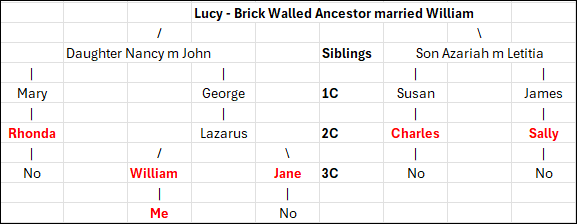
Let’s look at this example where Lucy is the brick-walled ancestor I’m seeking to identify. Her children (labeled siblings) and grandchildren (1C) are all deceased, but second cousins (2C), Rhonda, Charles and Sally are all available to test. Test each of them because they will all have some different segments of DNA from Lucy that the others don’t have.

Lazarus is also a second cousin, but he’s deceased. However, William, my father (in this example, not my real pedigree), and his sister, Jane are both available to test.

You ALWAYS want to test both of your parents and every available grandparent or direct ancestor. In this example, I’ll only inherit some portion of Lucy’s DNA that my father has, but Jane, my aunt, will carry segments of Lucy’s DNA that my father didn’t inherit from Lazarus. Jane’s matches on those segments that neither my father nor I have may be just what we need to identify Lucy.

If Lazarus has other children not shown in this example, we certainly want to test them too.

If the relevant parent has tested, you don’t need to test any of their children. However, if the parent hasn’t tested, absolutely test as many of their children or descendants as possible.

In this case, Rhonda, Jane, Charles and Sally have all tested, so I don’t need to test their children. Their children can only have as much of Lucy’s DNA as their parents had.

However, if any of them had been deceased, then I should test as many of their children as I can to “gather up” as much of Lucy’s DNA as possible.

If any of the people upstream of the bold red people have other children, those children or their descendants would be testing candidates too. Ideally, you want as many descendant testers as possible to increase your chances of identifying that ancestor.

Selecting Your Brick-Wall Ancestor

I want you to be successful, so you’re going to select your closest brick-walled ancestor within certain parameters. If you have multiple brick-walled ancestors at the at the same genealogical distance, you’ll choose one to focus on.

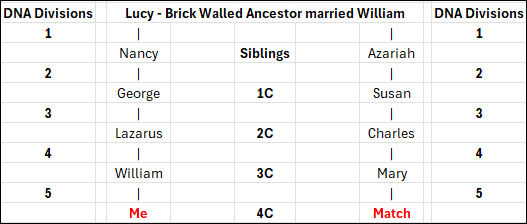
Why your closest brick-walled ancestor? If your brick wall is 5 generations back from you, and they are 5 generations back from your DNA match as well, that means you’re dealing with a 4th cousin match.

This also means that ancestor’s DNA has been divided a total of 10 times – five times on the path of descent to you, and five times on the path of descent to your match.

A 4th cousin match is likely to be in the 35 cM range. You can view the matching ranges for various relationships at DNAPainter, here.

The entire 4th cousin (4C) matching range is 0-139 cM. You won’t match all of your 4th cousins and are likely to match only 50-70% of your 4th cousins.

That said, the average person has between 1,500 and 4,000 4th cousins. At the 4th cousin level, you have 32 ancestors, so only between 46 and125 4th cousins will descend from any given ancestor, and of those, only a few will have taken a DNA test. The more children that ancestor had that lived to marry and have children of their own, the better your chances of more matches.

The Selection Process

I’m going to be stepping through the ancestor selection process with you, discussing who is and isn’t a good candidate, and why. I’m also going to be using this same methodology to (hopefully) identify one of my own mystery ancestors too.

I have no brick walls closer than 4th cousins. If I did, I’d choose the closest brick wall. You should too in order to have the best chance of solving this puzzle. The further back in time, the more difficult the solve will be.

In my tree, I have four mystery ancestors at the 5X great-grandparent level on my father’s side, and one on my mother’s side.

Those will be the four ancestors I consider selecting. And no, before you do it, I don’t recommend working on all four of them at the same time. Remember, the purpose is to FOCUS.

  • Select an ancestor as close generationally as possible, because it’s more likely that both you and other people will carry at least some of their DNA, and the same segment(s) of DNA. Matches closer in time generally carry more total DNA in common, which means better matching and more shared matches.
  • Given that the majority of testers are from the US, and assuming you are from the US too, I don’t recommend selecting an ancestor from another country unless you are very comfortable with that language and working with those records. Generally, there will be fewer people who have tested from other countries. If you are going to work with an ancestor from another country, be sure you are in both the MyHeritage and FamilyTreeDNA databases.

My mother’s entire paternal line is either Dutch or German Brethren, and her Dutch ancestors only immigrated in the mid 1800s, so have few descendants in the databases.

My closest brick wall on her paternal line is Traut Enterlein, a German man who was named in an out-of-wedlock baptism for his daughter in Germany in 1823. He is not found in any other records in that part of Germany, so actually identifying “who he is”, even with a name, would be extremely difficult, and I have nothing to “anchor to” here.  He is eliminated as a candidate because he’s found in a country where I don’t speak the language, where fewer people have taken DNA tests, and we’ve already spent a substantial amount of time trying to identify him in the records.

Brick-walled ancestors on Mom’s maternal side are two generations further back in time. Half are German and the other half are a combination of English and Acadian.

  • Avoid both endogamy and pedigree collapse, if possible. I don’t recommend a line with baked-in challenges that will make DNA more difficult.

Acadians are heavily endogamous and often suffer from pedigree collapse since there were so few founding families in the mid-1600s. The same goes for Brethren families who immigrated in the early 1700s. Those lines are too far back generationally anyway, so they have already been eliminated, but if they weren’t, I’d eliminate them because of heavy endogamy and pedigree collapse, both, not to mention record loss.

My father’s side has much better candidates.

  • Try to select an ancestor where you have some familiarity with the location, the culture, and the records. If you have printed resources at the ready, possibly ones that are not online, that’s a plus.
  • When you’re trying to decide between ancestors, select one whose spouse you are sure of, and who has children you can document. Do you know important things about them like their religion, where they lived during specific times, and who their neighbors were? If not, take some time now to brush up on what you do know about their spouse and children.
  • Check back at all of the records vendors and resources, including Ancestry, MyHeritage, WikiTree, and FamilySearch, to see if anything new is easily available for either your brick-wall candidate or their spouse.
  • I do NOT recommend selecting an ancestral couple, neither of whom you can identify, unless you’re “lucky” enough to have no other brick-walled ancestors to choose from. It’s possible to solve this “double-blind” couple, but it’s substantially more difficult because you have no same-generation anchor.

My Candidates

I’m selecting one of my brick walls and hope to solve it during this process. Let’s run through the decision-making process so you’ll understand some of the considerations and why they weigh as factors. I wish I didn’t have so many choices, and I’d like to solve them all, but my best chance is to work on one at a time.

Most candidates are women because their birth surnames tend to easily become lost after they marry, and with their surname, their parents are lost too. Given how little we know, we have to presume (dangerous word), at least for now, that your missing female ancestor was the mother of all of their husband’s children, unless we know or subsequently prove otherwise.

Let’s review my candidates.

  1. Lucy was born about 1754, probably in Virginia, and died in 1832 in Halifax County, VA. She married William Moore between 1772 and 1774, who may or may not have been a circuit-riding minister at that time. She is found under her own name on the 1830 census, there’s an 1826 chancery suit, and I know who her children and neighbors are, so she might be a good candidate. One vote against selecting Lucy is that I don’t know where she was born, nor do I know where they were married, although there’s a very strong possibility that it took place in Halifax County. The fact that he was a circuit-rider means he could have met her anyplace. If they were married in Halifax County, their families could have been allied before arriving there. William Moore’s family came from Prince Edward County about 1770, and we know who his parents were. One good thing is that Lucy is a fairly uncommon name, but there are multiple William Moores in Halifax County, and there are two other Lucy Moores. One is her daughter, and one is her daughter-in-law. The fact that Lucy and William Moore had 12 known children, with at least 8 who married, means there is a good chance of matching at least some descendants. Unfortunately, I don’t have her mitochondrial DNA, which removes one possible tool unless I can find a tester.
  2. Jane, born about 1760 in an unknown location, but probably Virginia, was the wife of Lazarus Dodson. They moved across multiple frontiers into what would become early Tennessee, an area that sustained substantial record loss. Jane died between 1830 and 1840. There’s a lot of uncertainty about Jane’s life. She probably had at least 8 children, and we know something about six of them. Given that we already have a better candidate with Lucy, I’ll eliminate Jane for now.
  3. William Crumley’s wife, whose name I don’t know, was born around 1765 or 1770, possibly in Virginia. She was married to William Crumley around 1786 or 1787, probably in Frederick County, VA, or nearby. I do have her mitochondrial DNA and we know the family was Quaker which are both benefits. I’ve been working with a cousin who has delved deeply into Quaker records, and I have some records from a trip to the FamilySearch Library in Salt Lake City that I have not yet processed. She and William had at least 10 children who married, and I know quite a bit about them. She would probably be an excellent choice. For lack of another name, I’ve been calling her H2a1, her legacy mitochondrial haplogroup before Mitotree, but she has a much more complete haplogroup now. She would be a good candidate, and I REALLY want to identify her.
  4. Mary, wife of John Harrold (by various spellings), was born about 1750, possibly in Ireland, although it would be unusual for a first-generation Irish immigrant to end up deep in the Appalachian frontier. Mary died in 1826 in Wilkes County, NC. We know nothing about John’s background, other than he served in the Revolutionary War, in Virginia. He may have been living in Botetourt County, although we don’t know for sure, and there are multiple men by that name. Mary had at least 7 children, six of whom were married. We do not have her mitochondrial DNA. Given that we know so little about John, and we have better candidates with both Lucy, William Moore’s wife, and William Crumley’s wife, I’m eliminating Mary for now.
  5. Isabel, the wife of Michael McDowell – another couple from Wilkes County, NC. Their daughter married the son of Mary and John Harrold. Isabel was probably born about 1750, someplace in Virginia. We don’t know where they were married, but it could have been in Franklin County, VA. They lived in Wilkes County for several decades before moving on to Claiborne County, TN. We know very little about Michael’s early life, other than his Revolutionary War service, although I’ve written about him four times as additional information dribbles out. They had at least 8 children, and a deposition after Michael’s death tells us where they moved and settled, which is a very big plus. We know her first name thanks to a 1793 deed. Isabel is a reasonable candidate, but I eliminated her after comparison to the other candidates, in part because of multiple frontier moves with few records and no known point of origin.
  6. Elizabeth, wife of Andrew McKee, was born about 1767, possibly someplace in Virginia. They were in Washington Co., VA by 1789, although we don’t know where either originated. They may have married before they moved to Washington County, where we find several records. They had 14 children. Twelve are known to have married, and the other two probably did as well. We know who their neighbors were. We also have Elizabeth’s mitochondrial DNA. Unfortunately, we know nothing about Andrew McKee’s family or where he was from. However, Elizabeth is a strong candidate because so many records exist in Washington County, they had a large number of children, and many continued to live in Washington County or nearby, making them easier to track.
  7. If I didn’t already have good candidates, there’s one more ancestor I’d consider, even though James Lee Claxton/Clarkson is a generation further back in my tree, born about 1775, and his unknown parents are the brick walls. I know I just told you NOT to do this, so I won’t either, but the reason I might have considered his parents, or more specifically his father, as a strong candidate is because we have several Y-DNA matches, including Big-Y testers, and we know the ancestors of his matches came from NC. We also have many autosomal testers and matches, which would help immensely, and there’s a Clarkson/Claxton DNA Surname Project. A contiguous surname is a HUGE benefit not available with female ancestors, and I just feel that I’m SO CLOSE to solving this mystery. For now, James’s parents are eliminated because they are two generations further back in time than our other candidates, we know nothing about either of them, except Y-DNA results, and we have better candidates for this exercise.

After evaluation, I still have two candidates in the running – Lucy, wife of William Moore, and H2a1, William Crumley’s wife. I haven’t decided for sure yet, but right now, William Crumley’s wife is leading because I have an amazing collaborator along with some unprocessed records that may hold important information. I know there probably aren’t any smoking guns there, but when combined with DNA, we may well ignite that gunpowder.

FOCUS

Are you ready to focus?

Let’s get our ducks in a row.

  • Order any DNA tests you need to order for yourself and relatives now.
  • Select your ancestor.
  • Prepare your research journal by reviewing which records you’ve already researched and record what you have.
  • Refamiliarize yourself. Take a look at those results again with fresh eyes. It helps when reviewing match results to be able to view surnames in your matches trees and recall that you’ve seen that name before, and where.
  • Check to see if any new records or resources are now available.

Who do you want to find?

_____________________________________________________________

Share the Love!

You’re always welcome to forward articles or links to friends and share on social media.

Subscribe!

If you haven’t already subscribed, it’s free. You’ll receive an e-mail whenever I publish by clicking the “follow” button at the top of the main blog page, here.

Help Keep This Blog Free

I receive a small commission when you click a vendor link in my articles and purchase that item. This does NOT increase your price but helps me keep the lights on and this informational blog free for everyone. Please click on the affiliate links in the articles or to the vendors below if you are purchasing products or DNA testing.

Thank you so much.

DNA Purchases and Free Uploads

Genealogy Products and Services

My Books

Genealogy Books

Genealogy Research

What is a Quick-and-Dirty Tree, and When Might I Need One?

You may have heard genealogists talk about creating a quick-and-dirty tree.

What is that, exactly? When and why would you want one?

Good questions.

Matches and Trees

DNA matches don’t always have useful trees.

They might have:

  • No tree
  • A partial tree with only a few people in the closest generation or two
  • A tree with some lines built out, but others not so much

What’s a genealogist to do? After all, it’s your match’s tree, not your tree, and you have no way to expand their tree.

Except, you do.

It’s called a quick-and-dirty tree.

Quick-and-Dirty Trees

A quick-and-dirty tree is essentially a “throw-away” tree that you construct at Ancestry with the express purpose of obtaining hints, including potential parents, in order to quickly build your matches tree backwards in time until you (hopefully) reach a common ancestor.

And yes, of course trees, hints and suggestions of any kind can be wrong – but that doesn’t mean they’re always wrong, and you’re not adding anything from your quick-and-dirty tree to your tree – or even displaying it publicly.

You’re simply trying to find a common ancestor by using what your match has provided in their tree. Think of a quick-and-dirty tree as a scratch pad of sorts.

Let’s work through an example.

Initial Analysis

In this example, Ancestry has already told me that this match is most probably my half-second-cousin (half 2C) or second-cousin-once-removed (2C1R) based on the amount of DNA that we share, although the full relationship range includes several more options.

Ancestry also tells me that this match is on my maternal side. There’s no information provided about whether this match is on their maternal or paternal side, or even both.

A second-cousin (2C) relationship means that we share great-grandparents, and once removed means that one of us is one step further down the tree than the other person.

In other words, I’m 2C with my match’s parents, or my match is 2C with my mother. I wrote about this in the article, Concepts: What Does a Cousin “Once Removed” Mean?

I see that my match has a public linked tree with 7 people, which probably isn’t going to be terribly helpful.

Of course, the first thing to do is to review my match’s tree and see if I recognize either their surname or the names in their tree.

This tree only reaches back two generations, and our common ancestor, based on the relationships predicted by shared DNA, would be another generation, or two, further removed.

I don’t recognize any of these names, although I’ll review each person for a location to see if I can narrow the scope to the couple most likely to lead to our common ancestor.

On my mother’s side, one of her parents is from northern Indiana, and one is from southern Indiana, but not everyone enters locations in their trees, and they aren’t necessarily accurate.

The list of “all people” in my match’s tree, under “Find in tree”, at far right, provides additional information. Unfortunately, this tree shows Earl Townsend’s wife’s name as Mildred Ideal Thorstenson Townsend Smith here and in her profile, but the name order differs. To begin, I’ll enter Thorstenson Smith, not her married name of Townsend, in the quick-and-dirty tree I’m building. You can refine this shortly.

In this case, it looks like the Townsend line is most promising to find a common ancestor, given that Fulton County is in northern Indiana, but we’ll find out that this isn’t the case when we construct our quick-and-dirty tree.

Building the Quick-and-Dirty Tree

You need to build a new tree, NOT add to your “real” tree.

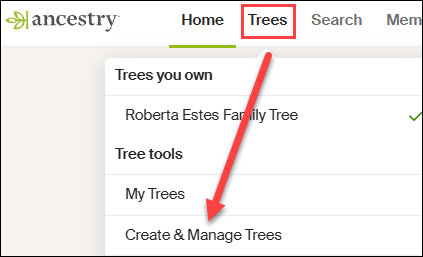
At Ancestry, go to Trees in the top banner, then click on “Create and Manage Trees.”

You’ll see the list of trees that you own. This is where all of the trees that you create live.

At the far bottom, you’ll see the prompt to create a new tree. Click there.

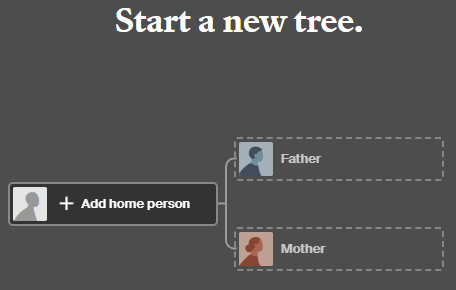
Next, you’ll see a blank tree.

For the home person, you can enter your match’s name, but be sure to list them as living so you’re not revealing private information.

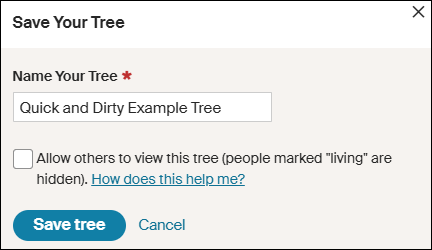
After adding one parent, you’ll be prompted to save and name the tree. Both the tester, who is designated as male by the Ancestry icon, and his father are either both living, or private, so I’m simply entering the surname of Robinson based on the grandfather’s surname. That could be incorrect of course, but it’s all I have to go on – yet.

Ironically, their grandfather’s surname was spelled Robison, without the “n”, not Robinson, but I accidentally entered Robinson and still got where I needed to go.

Clearly, I’m not going to allow this tree to be viewed by others, aka public, so I’m not checking that box. If it’s checked by default, uncheck it.

I don’t make my quick-and-dirty trees public because they are entirely unproven and unverified. I’m literally quickly searching for hints with every intention of abandoning the tree when I’m finished. If you want to clean the tree up later, you have the option to change the tree’s privacy settings.

Information in Your Match’s Tree Might Be Wrong

Complete the tree to be the same as your match’s tree. After saving your tree, click on the individuals you’ve added to view their hints.

Let’s start with Earl Townsend who appears to be our best candidate based on location.

Earl Russell Townsend has 13 hints, including a marriage license that confirms his birth date and location and provides the names of his parents, plus his wife’s name as Mildred Thorstenson. Based on what we know already, this is probably the correct Earl Townsend.

Of course, the wife’s surname could be incorrect. It could be her first or second marriage, or she could have been a widow when they married, so this surname might not be her birth surname.

Look for additional records in Earl’s hints.

Russell’s death certificate confirms that information, as do the birth and death certificates of their children.

Accept those hints.

If you determine that the original information in your match’s tree is incorrect, you’ll want to correct it in your quick-and-dirty tree. Remember, this is a scratch pad – you can’t hurt this tree.

Let’s change Mildred’s name to reflect her birth surname.

I refined Earl’s wife’s name to Mildred Thorstenson, which then produced 12 hints for her, including her marriage and Social Security record, with her birth and death dates, and her parents’ names. Her name in my match’s tree of Mildred Ideal Thorstenson Townsend Smith had produced zero hints.

Additionally, census records showed Mildred with her parents.

These seem to align, so accept those hints.

Looking at the pedigree view of my quick-and-dirty tree, we now see that both Russell and Mildred’s parents identified in the records are suggested as their potential parents.

Review each suggestion. If they look accurate based on the records identified, accept those potential parents in order to view the next generation.

Based on these names and census information, I can eliminate the Thorstenson line. It’s Swedish, not German or Dutch, which comprise my mother’s northern Indiana lines, My mother has no known Swedish ancestors, and we have proven her Indiana lineage in this timeframe.

Accepting the hints for the parents of both Earl Townsend and Mildred Thorstenson, parent hints appear for John Townsend and Eva Martin.

Now we’re viewing the next group of hints, which would be the great-great-grandparent generation. If these are our common ancestor, that would mean that I’m third cousins with my match, which is beyond the predicted relationship range. Third cousins is not impossible, but it’s beyond the probable match level based on the amount of shared DNA. furthermore, I don’t recognize any surnames.

So, let’s move to the Robison (incorrectly spelled Robinson) line and step through the same process. We can always come back and work with more parental hints on the Townsend/Martin line if we need to.

Rolland Robison only has a death year in my match’s tree, and that combined with the misspelled surname meant he had no hints on Ancestry, so I clicked on “Search” in my quick-and-dirty tree.

I’m searching for a man by this name, with a wife whose first name is Chloe.

AHA!

There it is! Note that Ancestry found Rolland Robison, not Robinson, married to Chloe.

Chloe was a Ferverda. My mother’s father was John Ferverda, and the location is correct for this family.

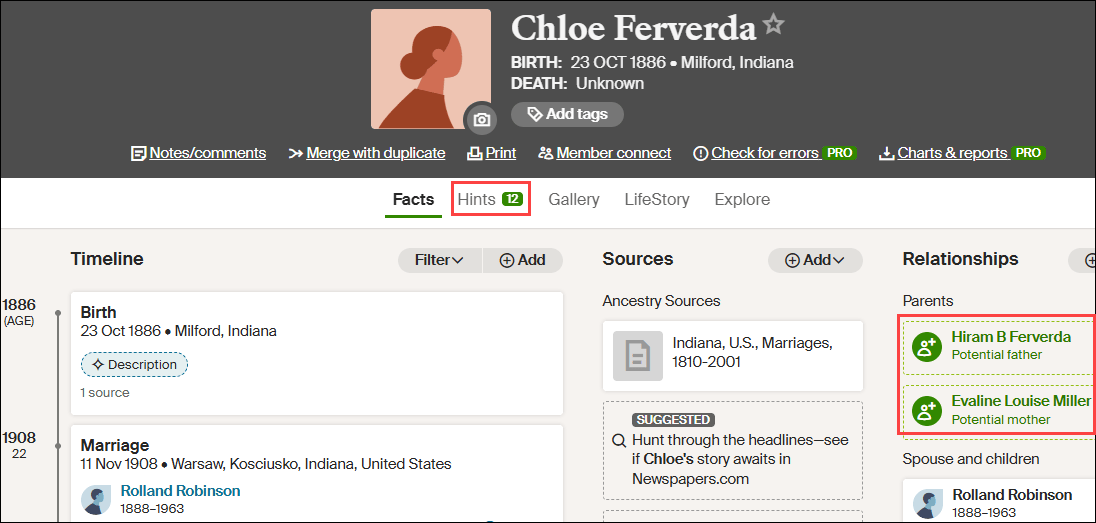
I saved this record to Rolland Robinson and added Ferverda as Chloe’s surname in our quick-and-dirty tree. This provided Rolland with 12 hints.

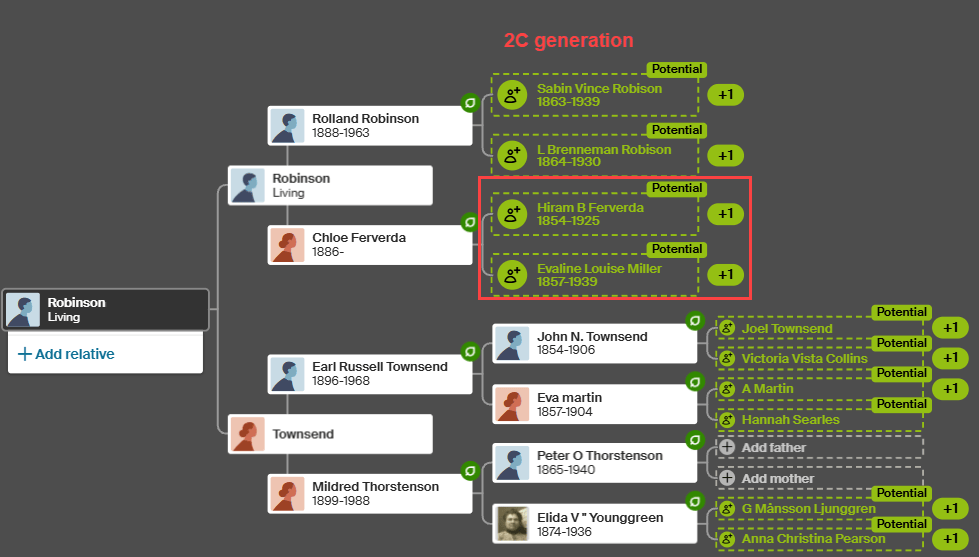
Adding Ferverda as Chloe’s surname provides her with a dozen hints too, including potential parents, Hiram B. Ferverda and Evaline Louise Miller – my great-great-grandparents who are indeed the 2C generation.

These common ancestors fall within the expected amount of shared DNA for second cousins, so this aligns well.

My quick-and-dirty tree has revealed at least one pair of common ancestors. Could there be more common lineages? Yes. I would continue building out this quick-and-dirty tree for (at least) another couple of generations on the other lines just to be sure.

What Next?

That depends on what you want to accomplish and your genealogy goals.

I used a DNA match at Ancestry in this example, but your match might be at a different vendor. Regardless, you’ll still want to use Ancestry to build your quick-and-dirty tree based on how they present hints and potential ancestors.

Now that you know how your DNA match connects:

  • Minimally, make a note on the match that indicates the most recent common ancestor(s) identified. I include a link to the quick-and-dirty tree I’ve created.
  • You can add your match and their ancestral path to your common ancestor into your own tree at whichever vendor where the match occurs.
  • If you match at either FamilyTreeDNA or MyHeritage, both of whom provide segment information, I suggest painting your matching segments to DNAPainter.

Painting your segments identifies your matching segments as descending from those ancestors and makes it easier to identify the shared ancestral lineage of anyone else who shares that segment on the same side of your tree (maternal or paternal).

Word of caution here: You can potentially share multiple ancestral paths with any match, so different segments with one match can descend from different ancestors.

  • If your match is at FamilyTreeDNA, you’ll want to link your match to their place in your tree.

Using triangulation, FamilyTreeDNA utilizes linked matches to assign matches who share the same segments to the maternal or paternal side of your tree (or both) using triangulation.

  • You may be trying to break through a brick wall by identifying common ancestors BETWEEN your shared matches that aren’t in your own tree.

This approach is obviously easier the closer your brick wall is in time to the present. Great-grandparents, at the second-cousin level, and great-great-grandparents at the third-cousin level are much easier than 5th- or 6th-generation ancestors who lived before birth and death certificates and detailed census records existed.

Furthermore, the further back in time, the more likely that you may encounter:

  • Pedigree collapse, where the same ancestors appear more than once in your tree
  • Or you share multiple common ancestors with your matches

Of course, there’s always the possibility of endogamy too, where you descend from a historically heavily-intermarried population, such as Ashkenazi Jews or the Amish, for example, which means you may share segments passed down within the population from distant common ancestors you won’t be able to identify. While endogamy in your lineages may increase the amount of shared DNA, which in turn can skew relationship estimates, it won’t prevent you from using quick-and-dirty trees to locate common ancestors.

And finally, unexpected parentage or issues like record destruction may impede your progress, but you’ll never know if you don’t try, which brings us back to the purpose of quick-and-dirty trees.

Building a quick-and-dirty tree is the easiest way to grow your matches’ trees to reveal your common ancestors.

_____________________________________________________________

Share the Love!

You’re always welcome to forward articles or links to friends and share on social media.

Subscribe!

If you haven’t already subscribed, it’s free. You’ll receive an e-mail whenever I publish by clicking the “follow” button at the top of the main blog page, here.

Help Keep This Blog Free

I receive a small commission when you click a vendor link in my articles and purchase that item. This does NOT increase your price but helps me keep the lights on and this informational blog free for everyone. Please click on the affiliate links in the articles or to the vendors below if you are purchasing products or DNA testing.

Thank you so much.

DNA Purchases and Free Uploads

Genealogy Products and Services

My Books

Genealogy Books

Genealogy Research

Robert Vernon Estes (1931-1951): DNA and Hope for Military Repatriation

Robert Vernon Estes was my first cousin, my father’s brother’s son. I’m named after him, but I never knew him. He died years before I was born.

Robert, known as Bobby, was born on March 27, 1931 in White County, Indiana. He, along with his unit, were captured near Kunu-ri in North Korea on November 30, 1950, and he died as a prisoner-of-war around January 31, 1951 – at least that’s the date officially assigned to his death.

Truth be told, his death date is an estimate based on the recollections of men who survived the horrific deprivation, freezing temperatures, and starvation endured by the captured soldiers. He was likely buried in a mass grave outside the compound where Bobby, along with most of the other US soldiers who were held there, died.

Bobby was posthumously awarded the rank of Corporal. 

The Korean conflict active combat operations ended on July 27, 1953, when an Armistice agreement was signed between the US, North Korea, and China. A demilitarized zone (DMZ) was established, but a peace treaty was never signed, so technically, the US and North Korea are still at war. The two countries do not maintain diplomatic relations, and their relationship could be described as “frosty” at best.

While some military personnel from both the US and our ally, South Korea, have been repatriated, a long history of hostility and other challenges, including the remains of US soldiers being used as bargaining chips, have prevented the return of more than 5300 service members whose remains are still essentially being held hostage in Korea. If I sound bitter, that’s because I am.

Beginning in 1954, some remains have been brought home, but identification from the beginning was difficult, often due to comingled remains resulting from mass burials. Those remains were identified when possible, using techniques available at the time, and all remains were honorably buried.

Recently, due to advances in processing forensic remains and autosomal DNA matching, another 100 people have been identified from 55 boxes of mixed remains turned over following the 2018 Singapore Summit. Those boxes are believed to hold bones from roughly 250 distinct individuals, so the majority have yet to be identified.

Unidentified remains are buried at the Punchbowl, the National Memorial Cemetery of the Pacific, in Honolulu, Hawaii. More than 800 graves are marked as “Unknown” from the Korean War and await exhumation for advanced DNA testing.

By Gage Skidmore from Surprise, AZ, United States of America – National Memorial Cemetery of the Pacific, CC BY-SA 2.0, https://commons.wikimedia.org/w/index.php?curid=115138509

While there is no burial, missing service members are honored in the Honolulu Memorial within the cemetery. 

The names of the missing are etched on the walls of the Courts of the Missing.

Bobby’s name was also engraved on the Wall of Remembrance at the National Korean War Veterans Memorial in Washington DC when they included the names of the missing in 2022.  

Here’s a closeup.

Because Bobby was held above the DMZ, in North Korea proper, in a deserted mining camp called the Pukchin Camp, nicknamed Death Valley, and because the North Koreans were uncooperative, Bobby’s remains were classified as “nonrecoverable” in January 1956.

Hope Rekindled

Unrecoverable in 1956 based on political circumstances and lack of information about which soldiers had been captured, where they were held, when they died, and where burials for that facility occurred, doesn’t necessarily mean unrecoverable forever.

Today, Bobby’s status has been updated to “deferred” which isn’t quite as final and hopeless as “nonrecoverable.”

In 1956, they had no way of knowing about DNA and technology that would become available decades in the future.

Unfortunately, the political environment has remained essentially unchanged now for 70 years, but 70 years isn’t forever.

Yes, I know that identifying Bobby’s remains and bringing him home are both extremely unlikely, but a very low probability is not zero.

As genetic genealogists, we understand that with the passage of generations, the amount of shared autosomal DNA decreases with each generational recombination, so it was important for me to work with AFDIL to preserve my DNA in the hope of one day identifying Bobby – even after I’m gone from this mortal realm.

I might not be able to stand in Arlington, honoring Bobby as he is buried, but maybe my daughter will. Hope springs eternal!

DNA Analysis

The military began collecting DNA samples using bloodstain cards in 1992. For soldiers who served before that and whose remains needed to be identified, various types of forensic analysis were performed.

In the 1990s, when DNA first began to be used for service member identification, DNA matching was performed using mitochondrial DNA because there are hundreds of copies of mitochondria in the cytoplasm of each cell, which means mitochondrial DNA is easier to recover in degraded remains.

This also meant that a sample was needed from the soldier’s mother, sibling, or a relative in the soldier’s direct matrilineal line, not interrupted by a male. Women contribute their mitochondrial DNA to children of both sexes, not intermixed with any DNA from the father, but males do not pass it on to their children.

Around 2010, Y-DNA, passed from father to son, began to be used by AFDIL as well.

At that time, the remains were not processed to extract DNA for autosomal matching, as ancient or forensic DNA extraction technology did not yet exist – and has only been refined for widespread utilization in the past few years. Initially, autosomal matches for repatriation were only used to match immediate family members, so DNA testing was unavailable to cousins of soldiers.

Men who died in WWI, WWII, Korea, and Vietnam may not have immediate family members left – and that number dwindles daily.

  • Bobby had no children.
  • Bobby’s mother, Lucille Latta, was born in 1906 and died in 1952. She had only one sibling, a brother who died in 1966, and their mother was adopted, so there was no source to obtain Bobby’s mitochondrial DNA for matching.
  • Bobby’s only sibling, a brother who had no sons, died in 1986, and their father, Joseph Estes, died in 1994, eliminating the possibility of Y-DNA matching.

This means that there were no immediate or appropriately related family members available for either mitochondrial or Y-DNA testing – effectively slamming the door on the possibility of identification.

The DNA results of soldiers’ remains, and their family members, are held separately from any commercial or law-enforcement databases, so without an appropriately descended family member’s DNA test submitted for this specific purpose, there is no opportunity to identify the soldier.

Until recently, more distant family members were precluded from participating.

The AFDIL Team

In 2023 and 2024, I was privileged to work with the AFDIL team on the Washington Family Project. This was a proof-of-concept project, of sorts. AFDIL undertook this project in the process of refining their methodologies for working with badly degraded remains. The Washington Project was perfect because we knew who was supposed to be buried in each location. The team authored an exciting paper detailing the results.

It gives me cold chills to realize that I was a small part of the effort to open the door for more distant family members to submit autosomal results to identify their missing service members. When we started working together, they had no idea that I’m a Gold Star family member, representing Bobby, and I had no idea the doors this project would open.

Today, those efforts have borne fruit. AFDIL has expanded its family participation policies and guidelines.

Needless to say, I’m thrilled.

Swabbing for Bobby

I requested my swab kit as soon as possible.

I was so excited the day the package arrived.

In addition to swabs, the package included a letter plus several pages of information and instructions.

For notification, be sure that someone living and reliable is listed as the primary contact for your soldier. We discovered that no one was listed for Bobby, but now I’m his official contact and I’m also his closest living next-of-kin.

Oh good, now we’re getting to the DNA swabbing part! Not that I’m anxious or anything!

I had to sit down and really study this chart, which was difficult given my level of excitement. I needed to make sure I really qualified. I mean, I knew I was supposed to – but this was the hard line do-not-pass-go paper right here. A tiny part of me was terrified that something had gone wrong and I wouldn’t be accepted.

The missing soldier is the blue center. I labeled “Me” four images to the right.

AFDIL invested a lot of time in creating this chart that includes autosomal candidates in yellow, mitochondrial candidates with red borders, and Y-DNA candidates with thick dark blue borders.

They had put an oval around “me” on the chart based on their understanding of our relationship from previously submitted documentation. In the paperwork, they asked me to confirm the relationship again.

Next came the swab kit and the labels.

Now I’ve swabbed and labeled everything, following the instructions.

Popping them into the included FedEx envelope.

All I had to do was find a FedEx shipping location and drop the envelope off. I cried as I did the handoff – praying that someday these little vials will provide the key to identifying Bobby.

A week or so later, I received an email stating that my sample had been received and was being processed.

They would be in touch if anything else was needed from me, or, if anything was found.

Now…we wait. Perhaps forever.

But maybe not.

I’ve now preserved the possibility of identifying Bobby’s remains if they are ever returned. And a tiny part of me has my fingers crossed that some of his bones were in that mixed sample, simply waiting for the technology to catch up.

This Memorial Day Weekend

This Memorial Day weekend, in addition to writing this article, I’m working on a wall-hanging to honor Bobby and his ultimate sacrifice.

I’ve been working on this for a while, but it’s so emotionally intense for me that I have to put it away and give myself a break from time to time.

Obviously, I’m working on the layout and I’ve laid these blocks alongside the panel to illustrate. When finished, there will be two rows of stars that function as borders surrounding the center panel.

I’m debating whether I should put a gold star in the center of both sides, or a smaller gold star in the center of a star block, or maybe gold stars of some sort in all four corners. I’m also considering having Bobby’s name, along with his birth and death dates, embroidered near the boots.

After my death and my daughter’s, I’ve left instructions for this quilt to be donated to the Indiana Soldiers’ and Sailors’ Monument, if they want it, where the brick honoring Bobby’s service was laid in the summer of 2021.

You can read more about Bobby in these articles:

Honoring Bobby and Other Unrecovered Soldiers

For years, it has been my dream to attend Bobby’s military burial at Arlington National Cemetery. He has earned that, and it seems that’s the least, the very least, we could do for him. Of course, part of warfare is psychological, not just physical, and refusing to return the remains of those killed is part of that. Even worse is knowing how he was tortured and died.

My heart still bleeds for him and his mother.

We don’t know if Bobby’s remains will ever be “discovered” and brought home. I’d say it’s extremely unlikely.

We don’t know if, by some miracle, Bobby’s remains are among those unidentified mixed samples already buried in Hawaii. That too is unlikely because Bobby was held in a remote location and his remains, wherever they actually lie, are not easily accessible.

As each generation dies, and as Bobby’s bones age, the chance of obtaining a quality DNA match decreases.

While I can’t do anything about the passage of time, nor about Bobby’s bones deteriorating, I can make sure my own DNA is preserved in AFDIL’s Family Reference Database, maintained by the Family Reference Sample Laboratory, a division of the Armed Forces Medical Examiner System’s DNA Identification Laboratory (AFMES-AFDIL). You can read more here and here.

You can search for a POW/MIA service member, here.

If you qualify to submit a sample for a deceased service member whose remains have yet to be identified, you can’t order a DNA sample kit directly like we do from testing companies. You need to request a DNA sample kit after providing information about how you and the soldier are related. You’ll be assigned a case number and a case worker.

Click on this link for more information, including websites, or call the appropriate number below to determine if you qualify and to request a DNA kit.

  • United States Army: (800) 892-2490
  • United States Marine Corps: (800) 847-1597
  • United States Navy: (800) 443-9298
  • United States Air Force: (800) 531-5501
  • Department of State: (202) 485-6106

This Memorial Day, please remember the sacrifices of our fallen heroes, those veterans who never came home, and their families who never stopped waiting.

The New FamilyTreeDNA NGS Family Finder Test

Click on any image to enlarge

Recently, in a press release, FamilyTreeDNA announced a new version of their Family Finder autosomal test that increases coverage from about .02% to about 9% of the human genome. Increasing coverage to this level using precision genomics holds great promise for the future.

Everyone who has purchased a Family Finder test since the beginning of March is automatically tested using the new technology – and it doesn’t cost any more than the earlier test.

Image not to scale because if it was, you would be able to see the bottom line at all:) This is meant to convey the message of more data!

As shown in this slide presented by Dave Vance, Senior VP and General Manager at FamilyTreeDNA, the new test covers 400 times more DNA locations than the industry-standard microarray chip-based test.

The typical vendor microarray autosomal DNA test covers somewhere between 400,000 and 750,000 locations.

Utilizing this new technology is an investment in the future.

You Don’t Know What You Don’t Know

To quote Dave:

Two numbers I want you to remember.

0.02 is the percent of your whole genome reported by standard autosomal tests today. All of your ancestry estimates, shared segments, and autosomal matches come from that small fraction.

9 is the percent of your genome that our new Family Finder test reports at high quality coverage. Starting right now — that’s over 400 times more data, from the very same test.

And the real point isn’t the number. It’s what that data makes possible. This gives us the foundation to unlock deeper, more meaningful insights — not just today, but for years to come. And when it becomes possible to go even further, I want FamilyTreeDNA to lead the way.

But what does that 9% mean for your genealogy research?

It means fewer unexplained matches, a clearer understanding of how people are related, and more confidence in the conclusions you draw from your autosomal DNA. Moving from connections to explanations, and from data to answers.

And until we can start rolling out those deeper insights, for now you’ll still get the same trusted Family Finder experience you’re used to — but you’ll also have the benefit of data that’s ready to unlock even more as new insights become possible.

In fact, you can watch Dave for yourself, at RootsTech, on the mainstage, here, having the unenviable position of following the Irish-step-dancing Gardiner Brothers. Yea, Dave, I didn’t get that gene either!

What makes NGS sequencing so special?

Sequencing Types

NGS is the abbreviation for Next Generation Sequencing, also called massive parallel sequencing. Rather than using individual probes, NGS is a high-throughput technology that simultaneously sequences millions of DNA fragments while still allowing targeting of specific regions.

Dave wrote about the differences between different types of sequencing, here.

All vendors select or target locations in the human genome that are most relevant for their product set, purpose or goals.

The older microarray sequencing machines have been in use for many years. They use probes to read specific targeted addresses, one by one, identifying which of four nucleotides is present at each location on your two copies of each chromosome.

The four nucleotides, adenine (A), thymine (T), cytosine (C), and guanine (G) are the building blocks of DNA, and you receive one from each parent at every location on chromosomes 1-22. Chromosome 23, the sex selection chromosome is a little bit different due to X-DNA and Y-DNA, but the locations are still read the same way using NGS technology.

The results of DNA testing are essentially a downloadable output file with the following information for each read:

  • The RSID SNP cluster ID chromosome
  • The chromosome number
  • The position (think street address) on the chromosome
  • The results, which are the abbreviations for the nucleotide found on the first and second strands of your DNA at that location

In autosomal DNA testing, positions on strands cannot inherently be identified as maternal or paternal without additional techniques such as parental comparison or phasing.

This data file is not meant for you to analyze, but for computers to compare to other DNA testers. Needless to say, the power of the data lies in the information it holds, such as ethnicity, haplogroup-identifying mutations, and matching with other testers.

The output files must be compatible with each other, or the vendors must make accommodations for any incompatibility.

Regardless of the sequencing type, currently, all genetic genealogy vendors’ download files use this same pattern.

The difference between the files and file types from each vendor is:

  • The technology used for the test
  • How much DNA is tested
  • How many rows of data are provided in the download file
  • The quality of the results

Sequencing Type Differences

Let’s put this in terms that we all understand.

With microarray sequencing, a utility worker is sent to each address to read the two nucleotides.

With both NGS and whole-genome sequencing, many addresses are read at the same time. Think of a fleet of drones flying over a neighborhood and reading what is written on the rooftops of each house address.

The difference between the type of NGS sequencing utilized by FamilyTreeDNA, and whole-genome sequencing is threefold:

  1. NGS targets specific addresses and neighborhoods in a controlled manner, because we know they are useful and are specifically interested in the data at those locations. In other words, it omits oceans, deserts, and other places that we know aren’t useful for genealogy.
  2. Whole-genome sequencing covers the majority of the genome, even though more than 90% of the genome is identical in all humans. In other words, the fleet of whole-genome sequencing drones flies over everything, including oceans and deserts, reading and storing everything.
  3. The number of times the drones fly over each address.

For example, a low-pass whole-genome test would fly over the entire world (your genome), scanning it once or twice, but there will be cloud cover and weather in some locations. Typically, you want at least two complete reads from each address to compare to ensure a minimum level of quality. The missed areas need to be estimated with tools like imputation to fill in the blanks.

The breadth of DNA covered is known as “coverage”, or “pass coverage”. So, whole-genome testing covers all or most of the genome, including more than 90% that is not genealogically relevant because it’s identical in all humans.

With NGS sequencing, you specify which locations or neighborhoods you want the drones to read, and you instruct them to fly over just those regions, say, 5 or 10 times. Even if there’s weather or another issue, chances are that at least some of those passes will be able to read both nucleotides.

How many times a particular location, or base, is read is known as “read depth” or “sequencing depth”. The greater the depth, the higher the quality and accuracy of the targeted locations, which means less imputation or “fixing” is needed.

Within the industry, confidence to coverage correlation is about 93% confidence of accuracy for both alleles at a given location at a depth of 5X, which rises to about 99% accuracy at a depth of 10X.

Using our examples, whole-genome sequencing covers about 98% of the genome, at a depth specified by the vendor. Low-pass whole-genome testing is typically performed at a depth of 2X, meaning each location is scanned twice.

NGS combines the best aspects of both “drone style” and “targeted” reads, providing the highest accuracy for the areas that are most important for genetic genealogy at an affordable price, while also targeting enough of the human genome to allow for new discoveries that may be important to either population genetics for ethnicity identification, or to identify your own family lineage mutations.

Yes, you can get both high coverage and very deep reads. That’s called medical-grade whole-genome sequencing, where your entire genome is sequenced to a depth of at least 30X, but it’s both expensive and not useful for genealogy. None of the genealogy vendors are prepared to, or need to, process the massive amount of data generated by a medical-grade whole-genome test, so there is no benefit to taking that type of test for genealogical purposes.

Why is NGS Sequencing Important?

FamilyTreeDNA has moved from the 700,000+ SNPs previously read on their microarray chip, to more than 280 million base pairs. So, from about .02% to about 9% of the 3.1 billion base pairs of the human genome.

Technology has improved to the point where NGS sequencing is no more expensive than microarray sequencing and provides substantially more results.

In other words, there’s no reason NOT to implement this technology now. The new Family Finder test is fully compatible with their earlier Family Finder tests, so everything is painless.

Plus, NGS allows FamilyTreeDNA to target specific locations that benefit their customers, such as both Y-DNA and mitochondrial DNA SNPs. Of course, you’ll still need to take the Big Y-700 or the full sequence mitochondrial DNA (mtDNA) test for full results and matching – but males will receive a confirmed Y-DNA mid-level haplogroup now, with midrange mtDNA haplogroups coming in the future for Family Finder testers. This is a feature that other vendors don’t target or provide at the same level.

I’m very hopeful that these foundation haplogroups will serve as an “appetizer” and will encourage more people to take both the Big Y-700 (males only) and the mtFull test (for everyone), as applicable, to receive those types of specific matches and learn more about their ancestors.

Speaking of the future, how do you future-proof your DNA?

Future-Proofing Your DNA

If you’ve already tested, should you purchase a new Family Finder test for yourself now?

No.

I know you didn’t expect that answer, but here’s why.

Everyone who purchases a Family Finder test, which uses NGS technology, receives the same matching and features as the legacy test.

FamilyTreeDNA doesn’t yet know the benefits and discoveries that will eventually be available, and they won’t know until after they have results of customers to work with.

Having said that, you will definitely want to future-proof your DNA and the results of anyone whose results you count on to help sort through your own.

So, let’s make a plan!

Assuring Future Compatibility

Plan 1 – Test Your Relatives:

Your closest relatives are your best assets. They help you determine how you match others, who you share ancestors with, and the identities of those ancestors. You absolutely need to test the following relatives if they are available:

  • Parents
  • Grandparents
  • Siblings, both full and half – test all of them if both parents aren’t available for testing.
  • If your sibling(s) are deceased or not available, their children carry half of their DNA, but not the same half, so test everyone available. You don’t need to test your siblings’ children if that sibling is available to test.
  • Aunts and uncles, or their descendants if they are not available
  • Great-aunts and uncles, or their descendants if they are not available
  • First and second cousins

Plan 2 – Person Has Never Tested:

Plan 3 – Already Tested at FamilyTreeDNA:

  • If they or you have already taken a Family Finder test at FamilyTreeDNA, an upgrade offer will be forthcoming soon. You don’t need to do anything now.
  • If the person is critical for your research, elderly, or there is some other reason for concern, the tester or kit manager can contact FamilyTreeDNA customer support now and inquire whether or not there is an unopened vial of DNA.
  • To assure that there is enough DNA left for the future, or that the DNA sample is not too old, you can request that a “C/D vial” set be sent to you/them just in case. Be sure the current address is valid.
  • This is also a good time to be sure that your/their Beneficiary Information and/or Kit Manager information is current as well. You’ll find both under Account Settings beside the name in the upper right corner of the page.

Plan 4 – Uploaded From Another Vendor:

  • If you uploaded your DNA file to FamilyTreeDNA from another vendor instead of testing there, hold your horses for now. You’ll clearly have to swab, because when you do an upload, only the data file is uploaded. No DNA is actually transferred or uploaded. I’m not sure what process will be put in place for transfer/uploaded testers, but FamilyTreeDNA will let you know when something is available.

What NOT to Do

I contacted FamilyTreeDNA and this is what they ask customers NOT to do:

  1. Don’t request that your current test be deleted so you can order a new one. This removes everything – linkages, trees, family matching, permissions, project membership, other tests, and notes. Not just for you, but for your matches who have done work on their match with you as well.
  2. Don’t order a second kit, which causes “twins” in the system. I don’t have inside knowledge, but I’ll bet there will be special upgrade pricing if you just wait a bit!

I’m Excited

I don’t know what the future holds, but I’m hoping for:

  • More granular ethnicity (we always want that, right?)
  • More confident matching
  • Improved relationship identification
  • Additional tools to identify descendants of specific ancestors
  • Tools to identify missing ancestors

As a contract member of the R&D team, I’ll let you know when my NGS results are back and how they compare to my matches on the current chip. You know I’m building that spreadsheet already!!

_____________________________________________________________

Share the Love!

You’re always welcome to forward articles or links to friends and share on social media.

Subscribe!

If you haven’t already subscribed, it’s free. You’ll receive an e-mail whenever I publish by clicking the “follow” button at the top of the main blog page, here.

Help Keep This Blog Free

I receive a small commission when you click a vendor link in my articles and purchase that item. This does NOT increase your price but helps me keep the lights on and this informational blog free for everyone. Please click on the affiliate links in the articles or to the vendors below if you are purchasing products or DNA testing.

Thank you so much.

DNA Purchases and Free Uploads

Genealogy Products and Services

My Books

Genealogy Books

Genealogy Research

RootsTech 2026 – The Wind Beneath Our Wings

I started writing this article on Sunday evening, the day after RootsTech ended, and I’m basking in the afterglow. Also, my back and feet may never forgive me.

As a tongue-in-cheek comment, I think someone coined the word “exhausterwhelmulated” and defined it as being exhausted, overwhelmed, and overstimulated all at once. Yep, that’s me.

However, I need to add another couple of words to this – gratitude and joy.

Gratitude and Joy

I’m going to try to express this without sounding too sappy.

Do you recall the joy you used to feel when you spotted a relative you loved dearly but didn’t get to see often? Think of the unbridled joy as you piled out of your parents’ car and spotted your grandmother coming out of the door because she saw the car pull up. You ran as fast as your little legs could carry you directly into her arms, and got hugged so tightly it nearly squeezed the breath out of you.

I don’t know what the word for that would be, but it’s similar to how RootsTech feels.

Let me explain. Continue reading →

MyHeritage Whole Genome Sequencing (WGS) Results and Comparison

I’m excited to receive my low-pass whole-genome sequencing test results from MyHeritage. When MyHeritage initially introduced their new test, I wrote about what that means in the article, MyHeritage Introduces a Low-Pass Whole Genome Autosomal DNA Test and Why It Matters.

In that article, I said I was ordering a WGS test and would publish a comparison of the new test with the two tests I’ve previously taken with MyHeritage, plus a test I uploaded to MyHeritage from FamilyTreeDNA in 2016.

Before I review these comparative results with you, I want to properly set expectations.

What To Expect from the MyHeritage Whole Genome Sequence (WGS) Test

From Ran Snir, Vice President of Product Management for MyHeritage DNA:

  1. Those who take a MyHeritage DNA test now are all sequenced with WGS and will receive the same access to features and results as those who have taken a MyHeritage DNA test and were genotyped with an old chip in the past. In fact, all samples processed by the lab in December were already processed with WGS.
  2. The transition to WGS does not introduce new features and capabilities immediately.
  3. The new WGS technology has minor implications when it comes to the ethnicity estimate results and DNA Matches, but people should not expect to get “something completely different”.
  4. The transition to WGS and having more people processed with it opens the door for deeper research and more insights. It will allow MyHeritage to drastically improve its phasing, imputation and matching algorithms. This will take time as MyHeritage needs to amass a lot of data first. In the long run, MyHeritage plans to improve the product, build new features and introduce new capabilities which will be based on learnings from WGS.

Thank you, Ran.

In this article, I am not focusing on ethnicity, but on DNA matches, which I depend on to help me unravel those pesky genealogy puzzles.

Also, please note, some features I’m discussing here are free with the purchase of a DNA test, and others require a subscription at some level. I have a subscription, and I use it nearly every day.

Coupon Code for a $20 DNA Test

That said, if you already know you want to order the WGS test, or you’re a new tester, use this special coupon code at checkout to reduce the test to $20 through the end of February 2026. That’s a great value!

Coupon Code: RobertaFeb26

Now, let’s look at my results when comparing the WGS test to the results of my other three tests at MyHeritage.

How does the new WGS test fare?

My Results

Before ordering my WGS test from MyHeritage, I already had three tests at MyHeritage to choose from.

MyHeritage allows you to select between different tests, including uploads and tests you’ve taken at MyHeritage at different times. There’s absolutely no need to delete older tests there, and in fact, I recommend that you don’t. This article illustrates why.

My four tests include:

  • FamilyTreeDNA (FTDNA) test uploaded to MyHeritage in 2016
  • MyHeritage health test taken in 2019
  • MyHeritage test taken in June 2024
  • MyHeritage low-pass whole genome test (WGS) taken in December 2025
FTDNA 2016 MH Health 2019 MH 2024 MH WGS
Total Matches 19,722 17,179 17,767 17,676
TOFR 128 111 108 Not ready

This chart shows the total number of matches and Theories of Family Relativity for each test in January 2026.

What Are Theories of Family Relativity (TOFR)?

I have several very useful Theories of Family Relativity (TOFR) where MyHeritage uses trees and other documentation, such as census records, to connect you and your DNA matches to common ancestors. TOFR is one of MyHeritage’s most beneficial tools.

In this example, my match only provided their father’s name, but that name was linked to our common ancestors by connecting through a FamilySearch tree. Often, multiple potential relationships and paths are shown. Like with any other tool, each theory needs to be reviewed for accuracy.

Please note that TOFR is only run periodically and has not yet been calculated for the WGS test results. I’m sure that will happen soon.

Evaluating Matches

I wanted to know if (and how) the same people matched me on the different tests, including the new low-pass whole genome (WGS).

  • Are there differences?
  • Are the differences slight or pronounced?
  • Do some people match me on some tests, and not others?
  • Do some people match me on earlier tests, but not the WGS?
  • Do some people match me on the WGS, but not earlier tests?
  • What is the takeaway from all of this?

To compare the results of all four tests, I created a side-by-side comparison spreadsheet.

The Spreadsheet

I created a spreadsheet where I recorded 434 individual matches by entering information in the following columns:

  • A – Match number that I assigned
  • B – Match source (more about this in a minute)
  • C – FTDNA 2016 test matching number of cMs
  • D – MH 2019 matching number of cMs
  • E – MH 2024 Health matching number of cMs
  • F – MH Low Pass Whole Genome Sequencing (WGS) matching number of cMs
  • G – Relationship if known
  • H – Common Ancestor if known

I included several other columns in my spreadsheet for my own genealogical research purposes that show my matches’ tree size, and the actual lineage from them to our common ancestor couple. However, for comparing matches and accuracy, I’ve utilized the columns indicated above.

Match Sources

I wanted to compare different types of matches, meaning not just the closest or the most distant, or only the matches I can identify. These are the sources of the matches I compared.

  • Cousin Finder – I actually started a spreadsheet back in October 2025 when I was using Cousin Finder to find cousins, meaning people with common ancestors identified by MyHeritage. Twenty-eight of the 378 people that MyHeritage identified as cousins are DNA matches, so those were the first matches I entered into this comparison spreadsheet, along with our most recent common ancestors.
  • TOFR – All Theories of Family Relativity begin with DNA matches, then connect you and your matches together using trees and/or documents, when possible. Because matches vary with each of the tests, so do the TOFRs. WGS theories aren’t yet calculated, but the matches are, so I’ve included TOFR matches here.
  • Family Kits – These 15 matches are family members’ tests that I manage and match, so I clearly know how we’re related.
  • Top 100/150 – The first group of matches, other than the above categories, were the top 100 matches using the FamilyTreeDNA 2016 kit, which was my first test at MyHeritage. All tests continue to accumulate matches over time, so it just made sense to start here.

However, after I finished transcribing each of those 100 matches into the spreadsheet and started transcribing the top 100 matches for the MyHeritage 2019 test, I quickly realized that the top 100 matches were not the same between tests. Therefore, I used the top 100 matches from all 4 tests. For every name included from any test in the top 100, I included the matching cM amount from all four tests. This means that in total, there are more than 100 in the “Top 100”, so now it’s called the Top 100/150, but all of the top 100 matches from each of the four tests are included in the spreadsheet. In total, there are about 220 in that category.

  • Bottom 100 – Last, I included the bottom 100 matches on the FTDNA 2016 kit, meaning I listed those and searched for them on the other tests. If I had included the bottom 100 from all four tests, it would have been more like the bottom 350.

When I finished listing all of these matches, I had 434 to work with for this comparison. .

Minimum Matching

The minimum MyHeritage reported match is 8 cM, and at that level, a surprising number of tests don’t match either parent, although some clearly match with close relatives on that parent’s side, which means that either:

  • Those tests (either mine or the match’s, or both) were uploaded and imputed
  • Some portion of the parents’ test did not read
  • These are not valid matches, meaning they are identical by chance, not by descent.

About Imputation

Imputation is a widely used technology among vendors to bridge small sections of unread DNA. This is useful when comparing files from different vendors for matching.

Vendors use imputation internally too.

For example, vendors often use different DNA chips in the lab. They sometimes change chips internally, as well, for a variety of reasons. Regardless of why, the same locations aren’t always read, or aren’t read successfully. Imputation levels the playing field, allowing backwards compatibility, and compatibility for matching across platforms. Imputation fills in the blanks to equalize those files, allowing them to be compared for matching.

Let me give you an example. Let’s say you have the letters c_t, where the middle letter between c and t is missing. In English, there are a limited number of letters that can be. To begin with, it must be a vowel. In this case, it has to be either a, o or u. Next, looking at context, if the surrounding words are “the c_t chased a mouse,” the missing word is not cut or cot. It’s almost certainly cat, so the “a” is filled in using imputation.

Imputation usually works well, but occasionally it can extend matching areas improperly. This has always been true, and it’s still true with the new low-pass WGS test. The new WGS test only scans the genome twice to keep the test affordable. Any “no read” area must be imputed. I wrote about imputation here.

Ok, back to the MyHeritage comparison!

Test Comparison Methodology

If you’re recreating this process with your own results:

  • Color-code the column headers for the various tests
  • Label them clearly so you can easily differentiate between tests
  • Freeze your top row

Select the test you want to search for matches, and record the people you want to cross-check. I began the process with my FTDNA test that I uploaded to MyHeritage in 2016.

I entered the matches on my spreadsheet, recording the matching cM amount. Then I selected the other tests, one by one, and searched for the same match name.

In this case, I started with the FTDNA 2016 test. Jane Jones (not her real name) matched me at 744 cM.

Then I selected the MyHeritage 2019 test, searched for Jane’s name, and recorded the match amount – 739 cM. I did the same with the 2024 test, and last, the WGS test.

When searching by surname at MyHeritage, don’t always expect the person to be at the top of the list where you might expect. Be sure to scroll down a bit, even to page two, especially with common names. MyHeritage also displays people with the same surname in their trees.

Match Analysis

As we work through these match results, keep in mind that the comparison percentage numbers only pertain to the 434 people that I’ve selected to compare across all four tests. This is NOT the total amount in any category for all of my matches. There’s no way to make that determination without manually comparing every single match for all four tests – which is why I selected what I felt was a representative sample.

You’ll quickly discover that many people DON’T MATCH you on all the DNA tests. You’ll notice as I give examples that I’ve colored coded some cells for my own use in both interpreting matches as well as sorting them. For example, People who don’t match on that test were labeled “none” and colored bright blue. Eventually, I simply entered “0” instead of the word “none” so I could perform math functions on those cells. I retained the blue so I could filter by cell color. You get the idea.

Using the new WGS test, 16 people (3.7% of 434) match me ONLY on the WGS test, but do NOT match me on any of the other tests.

Interestingly enough, they are all in the Top 100/150 category for the WGS test. Those match results range from 45 cMs to 53 cMs.

That’s NOT a trivial amount of DNA. It’s rather confusing how someone could match at that level on the WGS test, but not at all on the others.

Equally as interesting is that two of those 16 WGS matches don’t match either of my parents.

So, let’s say this another way to be clear – I only see these matches on the WGS test, and none of the other tests.

How Many People Match Me on Only One Test?

Ok, so how many people match me on ONLY one test?

FTDNA 2016 Only Matches MH 2019 Only Matches MH 2024 Only Matches MH WGS Only Matches
44 (10.1%) 3 (0.7%) 3 (0.7%) 16 (3.7%)
  • 44 people match me ONLY on the FamilyTreeDNA 2016 uploaded test.
  • 3 people match me ONLY on the MyHeritage 2019 and 2024 tests, respectively, but not the same three people
  • 16 people match me ONLY on the MyHeritage WGS test

Extrapolating these percentages to the rest of my matches suggests the following number of people would match ONLY on this test in the entire match list for each test.

FTDNA 2016 MH Health 2019 MH 2024 MH WGS
Total Matches 19,722 17,179 17,767 17,676
Extrapolated Matches on Only This Test 10.1% or 1992 matches 0.7% or 120 matches 0.7% or 124 matches 3.7% or 654 matches

 How Many People DON’T Match Me on a Specific Test?

Now, how many people DON’T match me on a specific test?

No FTDNA Match No MH 2019 Match No MH 2024 Match No MH WGS Match
36 (8.3%) 117 (27%) 126 (30%) 96 (22%)
  • 36 people don’t match me on the FamilyTreeDNA test, but do match me on at least one other test at MyHeritage
  • 117 people don’t match on the 2019 MyHeritage test, but do match on at least one other test at MyHeritage
  • 126 people don’t match on the 2024 MyHeritage test, but do match on at least one other test at MyHeritage
  • 96 people don’t match me on the WGS test, but do match me on at least one other test at MyHeritage

Extrapolating these percentages provides an extrapolated number of matches that I don’t match on any specific test, but that I do match on at least one other test.

FTDNA 2016 MH Health 2019 MH 2024 MH WGS
Total Matches 19,722 17,179 17,767 17,676
Extrapolated # That Don’t Match on This Test 8.3% or 1637 matches 27% or 4638 matches 39% or 5330 matches 22% or 3,889 matches

How Many Match Me On All Tests

  • 195 matches, or 44.9%, nearly half of my matches, match on all four tests at some level.
  • Out of those, 68, or 15.7% of the total number of matches match me at exactly the same cM level across all 4 tests. That’s pretty remarkable.

The Largest Differences Between Tests

Another question might be how large the difference is between the various matches.

I calculated the largest differences between the highest and lowest match values between the four tests, and placed that value in column G. This means that I subtracted the lowest value of the four tests on this particular match, from the highest value.

In the first row, that means I subtracted 0, the MH 2019 test value, from 75, the WGS test value. The difference between the lowest and highest values is 75 cMs.

Next, I sorted, highest to lowest in column G, so the largest difference is displayed at the top.

I was VERY surprised to see a difference as high as 75 cM, so let’s evaluate the results where the difference is 50 cM or greater. Thirteen matches fall into this category.

  • Entry 168 – The largest difference at 75 cM. This person matches me at 70, 74 and 75 cM, but not at all on the 2019 test, which caused me to go back and check again. Did I spell the name correctly? Yes, I did. We don’t know why I don’t match this person on the 2019 test, but the other matching cM values are very close so they look to be correct.
  • Entry 183 – I match this person on both the FamilyTreeDNA uploaded test at 71 cMs, and the WGS test at 35 cMs, around half as much on the WGS test as the FamilyTreeDNA test. I don’t match them at all on either the MyHeritage 2019 or 2024 kits. I have no explanation.
  • Entry 186 – Like entry 168, we match on three of four tests at 62, 63 and 67 cMs, with the non-matching test being the 2019 test. I would presume that this match is accurate as well.
  • Entry 191 – This one is interesting because I match this person on the FamilyTreeDNA uploaded test at 64 cMs, but none of the other tests.
  • Entry 192 – We match at 57 cMs on both the WGS and the 2024 tests, but not the 2019 test, where we don’t match at all. The match on the FamilyTreeDNA test is 11 cMs lower, at 46 cMs.
  • Entry 228 – This person is my half 1C1R, and I match them on all the tests, of course. However, there’s a 53 cM difference between the WGS and the FamilyTreeDNA uploaded test. In a relationship this close, 53 cM is a small percentage and won’t affect matching, but it’s not an insignificant amount of DNA.
  • Entries 233, 247, 248 and 283 – I match these people ONLY on the WGS test at 50, 52 and 53 cMs, so if I hadn’t taken the WGS test, I wouldn’t match them at all. Without additional research, we can’t tell if this is a legitimate match or not, but 50-53 cM would be a lot to be imputed or to be identical by chance. These people also match one of my parents’ tests, which eliminates the identical by chance possibility, meaning some of the DNA matches my mother and some matches my father – at least on my end. We can’t determine if this match is identical by chance on their side. I’ve never seen a 50+ cM segment (or even close) that is identical by chance, though.
  • Entry 249 – Matches on the FamilyTreeDNA test at 15 cM, and the MyHeritage 2024 test at 52 cM, but not the others.
  • Entry 250 – Matches at 51 cM on the FamilyTreeDNA test, but not on any of the MyHeritage tests.
  • Entry 279 – Matches only on the MyHeritage 2019 test at 50 cM.

Difference Range

Next, let’s review the entire range of differences, meaning the largest matching difference for any one person across all four tests, by group. I’m including all 434 here so you can judge for yourself.

  • 50-75 cM difference – 13 matches analyzed above

  • 45-49 cM difference – 22 matches

  • 40-44 cM difference – 11 matches

  • 35-39 cM difference – 9 matches

  • 30-34 cM difference – 10 matches

  • 25-29 cM difference – 12 matches

  • 20-24 cM difference – 26 matches

  • 16-19 cM difference – 28 matches

  • 13-15 cM difference – 29 matches

  • 9-12 cM difference – 29 matches

  • 8 cM difference – 78 matches

The 8 cM difference has the most of any value or category because this is the lowest level of matching at MyHeritage. Many tests have a minimum level match on a test or tests, and no others.

  • 6-7 cM match difference – 41 matches

The match differences at 5 cM and below are inconsequential. 57 matches fall into this category.

Commentary

One of the indicators of a valid match is if a parent has tested and also matches,

Of these 434 matches, 35 match neither parent, and most of those are at the smallest match level, meaning 8 cM. Of all the match amounts, that would be the least reliable, and most likely to be a false positive match, or identical by chance.

However, that’s not universally the case. Some WGS results match people at significantly higher levels, but don’t match parents. Two WGS matches match people at 47 and 49 cMs, respectively, and not on any of the other tests. Those two WGS matches don’t match either parent.

After reviewing all 434 selected matches, it appears that both the FamilyTreeDNA 2016 test, and the WGS test produce the most consistent and reliable results of the four tests.

44 people, or 10%, match on BOTH the WGS and the FTDNA tests, but neither of the other two tests. A total of 13.8% match EITHER the FTDNA test OR the WGS test, but not the others.

Conclusions

I think we can draw several conclusions from this comparison.

First, let’s evaluate the number of matches. Looking at the differences between the total number of matches between the various tests, especially the three MyHeritage tests, over time, isn’t that great. That’s exactly why you can’t depend on these numbers as an accurate comparison.

FTDNA 2016 MH Health 2019 MH 2024 MH WGS
Total Matches 19,722 17,179 17,767 17,676

There are only a few hundred differences between the three MyHeritage tests, and about 2000 between the FamilyTreeDNA test uploaded in 2016 and the various MyHeritage tests. That’s a substantial difference.

The difference number of matches between tests may seem irrelevant, especially the MyHeritage tests, until you realize that those who match AREN’T ALL THE SAME PEOPLE. In other words, comparing the MyHeritage 2024 test with the WGS test only shows a difference of 91 matches. This DOES NOT mean that the MyHeritage 2024 test and the WGS test have 17,676 of the same people who match both tests, and that the 2024 test simply has 91 more matches than the WGS test.

As we’ve seen, many people who appear on any one match list don’t appear on other match lists.

Our analysis showed that 44.9% of my 434 matches compared appear on all match lists, which means that more than half of my matches appear on one or more match lists, and not the others. Therefore, just comparing the number of matches isn’t really relevant. You need to compare the people included on all the different tests, which is why I created my spreadsheet and included people from a wide variety of sources.

3.7% of my matches on the WGS test were not on any other test, which extrapolates to approximately 654 of my total WGS matches that I wouldn’t receive any other way.

I care a great deal about those matches, especially since at least some appear to be high value.

Yes, I absolutely, positively want those matches, especially when you consider that some of the matching differences are as high as 75 cM. A 75 cM match can be in the second, third or fourth cousin range.

Realistically, they may or may not be valid or useful matches – but if I don’t have the opportunity to compare them, I’ll never know.

Should You Purchase the WGS Test If You’ve Already Tested?

So, now for the question you’re surely asking yourself.

Truthfully, when I ordered my test back in December, I was ambivalent. I only ordered it to do this comparison for my blog readers – and I really dislike spending money on something that I don’t think will benefit me.

Note the words “don’t think.”

I’ve changed my mind, for several reasons, and I’m glad I ordered the test.

The thing that changed my mind was that I received a nontrivial amount of matches on the WGS test that I didn’t receive on any of the others – even if some of them turn out to be identical by chance.

Since we can’t go back in time and take the earlier tests, and MyHeritage no longer accepts uploads from other vendors, our decision now is whether or not we should take the new WGS test, or not, especially if we already have a DNA test at MyHeritage.

If you’re a new tester, by all means, test at all four of the main vendors. DNA matching is the best thing since sliced bread.

However, the people I’m really speaking to here are those who already have a test of some sort at MyHeritage.

Here’s the bottom line:

  • You will receive WGS matches that you didn’t receive on your other test – and vice versa, so don’t delete your older test at MyHeritage
  • Some of those new WGS matches may well be high-value matches – as was illustrated in the “differences” I discovered.
  • Given the differences in who is included in the match list, your TOFR will be different too – perhaps leading to a brick wall breakthrough. I have two that I’m just itching to solve.
  • Use matches, shared matches and TOFR from ALL of your tests at MyHeritage.

My Biggest Regret

As Ran Snir said, new features and developments at MyHeritage will be based on the WGS test. We don’t know what those developments might be, or when they will become available. But it’s very clear that while testers on the older testing platforms will receive as much as MyHeritage can give them, the MyHeritage DNA future is being build on the WGS platform. I want to be there and benefit from new discoveries.

My biggest regret is that my parents aren’t around to take the new WGS test – and neither are several other family members.

Of the 15 family members whose tests I manage at MyHeritage, 9 are deceased, and I think that four more are as well. Two others are now quite elderly and are no longer able to consent or retest.

Your closest family members are your DNA anchors, identifying lineages and pointing you in specific directions, guiding your research.

The very best thing you can do for your genetic genealogy is to test your grandparents if they are living, and your parents. If they aren’t available, test your closest relatives such as grandparents, siblings, aunts, uncles and first cousins.

Preparing for the Future

So, here’s my advice:

  • Take the WGS test yourself in order to glean as much information as possible and to benefit from future developments.
  • Retest any relatives whose tests you manage on the WGS platform, if possible.
  • Test your close family members and anyone you know whose DNA test could help you identify ancestral lineages.

Why is testing your relatives important?

Close relatives will carry some of the DNA from your mutual ancestors that you don’t.

Having the known DNA of your ancestors means that you can evaluate and analyze the trees of the entire group of people who match those identified DNA segments to see if you can break down an upstream brick wall.

I’ve been successful doing this for some time – and am in the process again by combining DNA matches and traditional records research.

Coupon Code for $20 DNA Test

MyHeritage has been kind enough to provide a limited-time coupon code (RobertaFeb26) for my readers which DROPS YOUR PRICE for the DNA test to $20 through February 28th at midnight.

This is the absolute lowest price I’ve ever seen for a DNA test.

You’ll receive the following features that are included with every test:

  • Ethnicity and ethnicity map
  • DNA matches and the ability to contact them
  • Shared ancestral surnames
  • Chromosome browser
  • cM Explainer

In addition, with this code you’ll receive both Shared DNA Matches and Shared Ancestral Places that usually require a subscription.

Normally, a subscription is required to access:

  • Trees of DNA matches
  • Shared DNA Matches (free now with the coupon code)
  • Shared ancestral places (free now with the coupon code)
  • AutoClusters
  • Theory of Family Relativity (TOFR)

If you’re interested in trying a subscription, click here to purchase a MyHeritage subscription with a free trial.

Here’s the link to purchase the DNA test, and here’s the coupon code to enter at checkout: RobertaFeb26

And yes, absolutely feel free to share the coupon code with your family, friends, and anyone else who might benefit.

Let me know how your results compare when you receive them.

_____________________________________________________________

Share the Love!

You’re always welcome to forward articles or links to friends and share on social media.

Subscribe!

If you haven’t already subscribed, it’s free. You’ll receive an e-mail whenever I publish by clicking the “follow” button at the top of the main blog page, here.

Help Keep This Blog Free

I receive a small commission when you click a vendor link in my articles and purchase that item. This does NOT increase your price but helps me keep the lights on and this informational blog free for everyone. Please click on the affiliate links in the articles or to the vendors below if you are purchasing products or DNA testing.

Thank you so much.

DNA Purchases and Free Uploads

Genealogy Products and Services

My Books

Genealogy Books

Genealogy Research

2025 Genetic Genealogy Retrospective: Wow – What a Year!

2025 has been quite a year in genetic genealogy. Genetic genealogy, per se, really isn’t a separate “thing” anymore. DNA testing is now an integral part of genealogy, with the potential to answer questions that nothing else can!

The 76 articles I wrote in 2025 fall into multiple categories and focus on different topics based on what was happening in the industry.

From my perspective, here are the most notable announcements and trends in genetic genealogy, and genealogy more broadly.

#1 for 2025 – Mitochondrial DNA: The Million Mito Project Released the New Mitotree, Updates, and mtDNA Discover

The biggest genealogy news items this year, both industry-wide and genealogy-changing are definitely the release of the new Mitotree, plus two tree updates. But that’s not all.

In addition, full sequence mitochondrial DNA testers received new Mitotree haplogroups, if appropriate, and everyone received a haplotype – a new feature. Along with Mitotree, FamilyTreeDNA introduced mtDNA Discover which provides 13 individual reports based on your haplogroup and matches.

It’s no wonder that mitochondrial DNA articles led the pack with the most views based on the eleven articles about that topic. If you haven’t yet tested your mitochondrial DNA at FamilyTreeDNA, there’s no better time! You never know what you’re going to discover and the more testers, the more matches for everyone.

You don’t know what you don’t know, and you’ll never know if you don’t test. Remember, mitochondrial DNA is for both males and females and tests your mother’s direct matrilineal line (mother to mother to mother, etc.) – reaching beyond known surnames.  Click here to order or upgrade.

#2 – MyHeritage Low Pass Whole Genome Sequence Test Charges into the Future

Another big hitter is the new MyHeritage low-pass whole genome test (WGS) test. It’s new and innovative, but we haven’t seen comparative results yet.

My results from the new low-pass whole genome test just came back, and I haven’t had the opportunity to review them yet, as compared to the earlier tests. That said, I do have roughly the same number of matches, but I need to determine if they are the same matches, and how well they track. I’ll be working on that review soon.

The new whole genome test may be more about future proofing and preparedness than additional current benefit – but we will see. I definately wanted to take the whole genome test so I can receive and benefit from whatever new is coming down the pike.

MyHeritage allows you to maintain multiple DNA tests on your account, so the new whole genome won’t “replace” your older or uploaded test. That way, you can easily compare the results of the whole genome against any DNA test that you curently have at MyHeritage.

Click here to order the new test.

#3 – 23andMe Experiences Problems

On a less positive note, but still quite newsworthy is the bankruptcy of 23andMe and subsequent repurchase of 23andMe by the original founder after setting up a new nonprofit. I have real mixed feelings about this topic. However, 23andMe was really never about genealogy, and now, matching segment information is no longer available. Those searching for unknown parents or family may want to test there if they are unsuccessful elsewhere.

Best Genealogy Tool

The FamilySearch full text search continues to have a HUGE impact for genealogists. This tool is not one-and-done, but provides increasing amounts of rich information as more records are added to the “fully scanned” collection. If you haven’t tried it, please do. It’s a game-changer and continues to improve.

A Cautionary Word About AI – Artificial Intelligence

AI is such a hot topic right now that I feel it needs to be included.

The FamilySearch full text search uses a form of AI. However, you’ll quickly notice that it can’t read everything, gets words and names wrong, and if you actually need to fully depend on it for accuracy, you cannot. (That said, it’s still an amazing tool, and I’m not picking on FamilySearch.)

Aside from FamilySearch, AI in its current form is both wonderful and terrible. I’ll be writing about AI in the new year, but for now, don’t ever rely on AI for anything that you can’t verity. It’s your assistant, not an expert, no matter how insistent it is. Never trust and always verify.

This is ESPECIALLY TRUE WHEN RELATED TO GENETICS and genetic related topics. I can’t even begin to tell you how very wrong it has been, and how much people fall in love with inaccurate results. No, just no – at least for now.

You need to know your AI tool, your skill set, your understanding of AI broadly, the tool’s limitations, and yours, and that’s all before verifying the actual AI results. If you want to educate yourself, and everyone should, treat yourself to anything, anyplace by either Mark Thompson or Steve Little, the dynamic AI duo. They offer YouTube videos and classes in a wide variety of places – but keep in mind that AI tools and technology literally change every few weeks.

AI is, indeed, a specialty all unto itself, much like genetic genealogy. And right now, it’s not soup yet, but it is cooking.

Tried and True Genetic Genealogy Staples – DNAPrint and Genetic Affairs

I haven’t written about either one this year, but I use both DNAPainter and Genetic Affairs regularly.

I consistently paint segments from matches at both MyHeritage, FamilyTreeDNA, and GEDmatch that are newly identified to an ancestor or ancestral couple at DNAPainter.

Unfortunately, neither Ancestry nor 23andMe provide matching cM location information for your matches (chromosome browser), but you may find some people who have tested at those companies at both FamilyTreeDNA and GEDmatch if they have uploaded to either of those vendors. Both vendors provide segment information and a Chromosome Browser, enabling you to paint that information to DNAPainter when you can identify your common ancestor.

MyHeritage also provides a Chromosome Browser, but unfortunately, no longer accepts uploads from any other vendor. You can paint segments from MyHeritage, but no longer upload DNA files to MyHeritage.

Thanks to DNAPainter, I have 90% of my segments identified to specific ancestors – which is actually rather remarkable given that my mother’s grandfather was a Dutch immigrant, and her great-grandparents on her other side were German immigrants, meaning we don’t have many matches on either of those lines.

Genetic Affairs continues to develop new, advanced clustering tools, one of which I’ll be reviewing soon.

Major Vendor Releases

Aside from what’s listed above, most of the major vendors released new features.

MyHeritage released a VERY COOL new tool called Cousin Finder that finds your relatives in the MyHeritage database, whether they match you on a DNA test, or not. They may not have even taken a DNA test. Cousin Finder identifies your common ancestor and shows your relationships. It’s a wonderful way to initiate communications, discuss your common ancestors, and ask about DNA testing.

Of my 378 Cousin Finder matches, only 23 (about 6%) are on my DNA match list, so that leaves 355 people to message, several of whom represent Y-DNA and mtDNA lines I don’t have. You can bet I’ll be offering testing scholarships.

Additionally, MyHeritage released a new ethnicity version.

FamilyTreeDNA, in addition to the new Mitotree, Discover, and associated features, released a new match matrix so you can see if and how selected matches are related to each other in a grid format. In other words, you can create your own cluster.

A new built-in “Share” feature blurs private information to make sharing easier both on the website and in Discover.

Discover improvements include thousands of new Y-DNA and mtDNA tree branches, plus thousands of new Ancient DNA samples. Discover is evergreen, so once you’ve taken that Big Y-700 test or the mitochondrial DNA test, your learning never stops as more content is added.

Tree integration with WikiTree is super-easy and means you don’t have to choose between trees. You can choose to retain your archived tree at FamilyTreeDNA, or move your tree to MyHeritage, PLUS link yourself to your family at WikiTree.

Ancestry released match clustering and a new beta pedigree view of ThruLines, but that’s back in the shop for more work. I’d expect to see it rereleased in 2026.

Conferences

RootsTech is the granddaddy of genealogy conferences, and it’s always fun to attend and write about the experience. Many vendors release new tools or products during the conference.

The ECGGC (East Coast Genetic Genealogy Conference), held in the fall, is the only conference that focuses entirely on genetic genealogy, new tools, how to use existing tools, and more. The 2025 conference was virtual and provided a great deal of focused content. Attendees particularly appreciate the deep dive in a particular topic presented in DNA Academy.

I’ll be at RootsTech in 2026, will write about that soon, and hope to see you there.

Concepts, Techniques and Plain Old Genealogy

In the past, my Concepts series and genealogy “how to” articles have been very popular, so, in 2025, I penned a half-dozen articles focusing on frequently asked questions about relationships and DNA.

For example, how does one go about finding DNA testing candidates? The number of options may surprise you and includes both Cousin Finder and Relatives at RootsTech.

By testing ONE PERSON for either Y-DNA or mitochondrial DNA that represents an ancestor, you actually receive information about that entire lineage of ancestors. So, on my Estes line, by locating an Estes male from my line to test, I received relevant information for every Estes male in my line, back to and beyond the progenitor.

Eventually, we hit a brick wall in every line, and those tools are the perfect way to break through those brick walls.

Other articles discuss things like how to use Discover’s Ancient Connections, and the difference between half and full relationships, both in your tree and genetically. Plus, what does a cousin “once removed” mean anyway? And why do I care?

Another question I receive is how far back, based on the shared amount of DNA, should I look in my matches’ trees for our common ancestor? In other words, how many generations back should I click? That article was fun and produced some unexpected results.

Memorial Articles

Because we are part of a community, I write memorial articles when one of our friends passes on. This year, sadly, Schelly Talalay Dardashti, well-known Jewish genealogist, and another very close friend joined the ancestors, so I’ve recognized the best in both of their lives which constitutes their legacy.

Be the Storyteller

Last, but not least, I wrote about my ancestors in the “52 Ancestors” series, which launched several years ago with Amy Johnson Crow’s challenge to write about one ancestor per week. She hosts this every year, and you can join (free) now.

I’m now on ancestor #467, so yes, it’s addictive, but it’s also AMAZING how many wonderful cousins I’ve met who have information that I did not. Not only that, but after publishing about an ancestor, I’ve discovered that I’m related to people I’ve known for years. We were SOOOooo excited!

I’ve been writing about the lives of my ancestors for several years now, and the articles include attempts to identify Y-DNA and mtDNA testers for each ancestor, where appropriate. There’s so much to learn that can’t be revealed any other way.

Plus, people seem to like the “mystery” and “short story” aspect, and I salt each story with the history of the region and relevant historical events of the timeframe. You might find your ancestors here too, or other helpful information.

Find a way to share about your ancestors!

Do You Have Suggestions for 2026 Topics?

Do you have suggestions or requests for article topics in 2026? If so, please comment on this article and let me know.

Check Out the 2025 List

Here’s the list of the 2025 articles. Did you miss something fun? Enjoy!

  Title Category Date Link
1 Welcome to 2025 – Opportunities and New Genetic Genealogy Articles Welcome, general 1-2-2025 https://dna-explained.com/2025/01/02/welcome-to-2025-opportunities-and-new-genetic-genealogy-articles/
2 Anne Doucet (1713-1791), Oceans, Rivers, and Perseverance – 52 Ancestors #438 52 Ancestors 1-4-2025 https://dna-explained.com/2025/01/04/anne-doucet-1713-1791-oceans-rivers-and-perseverance-52-ancestors-438/
3 Register for RootsTech 2025 Now RootsTech 1-16-2025 https://dna-explained.com/2025/01/16/register-for-rootstech-2025-now/
4 What IS the McNeil Family History, by George Franklin McNeil – 52 Ancestors #439 52 Ancestors 1-19-2025 https://dna-explained.com/2025/01/20/what-is-the-mcneil-family-history-by-george-franklin-mcneil-52-ancestors-439/
5 Jean Garceau dit Tranchemontagne (c1785-1711), Soldier from Saint Marseault – 52 Ancestors #440 52 Ancestors 1-29-2025 https://dna-explained.com/2025/01/29/jean-garceau-dit-tranchemontagne-c1785-1711-soldier-from-saint-marseault-52-ancestors-440/
6 Memories Resurface When the Old Family Home Gets a Facelift Genealogy 2-3-2025 https://dna-explained.com/2025/02/03/memories-resurface-when-the-old-family-home-gets-a-facelift/
7 MyHeritage Introduces Ethnicity v2.5 MyHeritage 2-6-2025 https://dna-explained.com/2025/02/06/myheritage-introduces-ethnicity-v2-5/
8 Relatives at RootsTech Reveals Cousins and Provides DNA Candidates RootsTech, techniques 2-8-2025 https://dna-explained.com/2025/02/08/relatives-at-rootstech-reveals-cousins-and-provides-dna-candidates/
9 FamilyTreeDNA’s New Matrix Shows How Your Matches Are Related to Each Other FamilyTreeDNA 2-12-2025 https://dna-explained.com/2025/02/12/familytreednas-new-matrix-shows-how-your-matches-are-related-to-each-other/
10 René Doucet (c1680-c1731), Lifetime of Incessant Upheaval – 52 Ancestors #441 52 Ancestors 2-15-2024 https://dna-explained.com/2025/02/16/rene-doucet-c1680-c1731-lifetime-of-incessant-upheaval-52-ancestors-441/
11 Lineages Versus Ancestors – How to Find and Leverage Yours Techniques 2-23-2025 https://dna-explained.com/2025/02/23/lineages-versus-ancestors-how-to-find-and-leverage-yours/
12 Mitotree is Born Mitochondrial DNA 2-25-2025 https://dna-explained.com/2025/02/25/mitotree-is-born/
13 RootsTech 2025 – The Year of Discover and the New Mitotree RootsTech, Mitochondrial DNA 3-14-2025 https://dna-explained.com/2025/03/15/rootstech-2025-the-year-of-discover-and-the-new-mitotree/
14 Pierre Doucet (c1621-1713), Walking History Book Lived to Nearly 100 – 52 Ancestors #442 3-16-2025 https://dna-explained.com/2025/03/16/pierre-doucet-c1621-1713-walking-history-book-lived-to-nearly-!100-52-ancestors-442/
15 Welcome to the New FamilyTreeDNA mtDNA Group Mitochondrial DNA 3-17-2025 https://dna-explained.com/2025/03/17/welcome-to-the-new-familytreedna-mtdna-group/
16 23andMe Files for Bankruptcy – What You Need to Know! 23andMe 3-24-2025 https://dna-explained.com/2025/03/25/23andme-files-for-bankruptcy-what-you-need-to-know/
17 New “Share” Features at FamilyTreeDNA Blur Match Information and Make Sharing Easy FamilyTreeDNA 4-1-2025 https://dna-explained.com/2025/04/01/new-share-features-at-familytreedna-blur-match-information-and-make-sharing-easy/
18 The Chauvet Cave: Trip Back in Time with Prehistoric European Humans – Are We Related? History, DNA 4-6-2025 https://dna-explained.com/2025/04/06/the-chauvet-cave-trip-back-in-time-with-prehistoric-european-humans-are-we-related/
19 DNA for Native American Genealogy Webinar & Companion Book Native American 4-8-2025 https://dna-explained.com/2025/04/08/dna-for-native-american-genealogy-webinar-companion-book/
20 Marie Levron (c1686-1727), Tragedy from Cradle to Grave – 52 Ancestors #443 52 Ancestors 4-14-2025 https://dna-explained.com/2025/04/14/marie-levron-c1686-1727-tragedy-from-cradle-to-grave-52-ancestors-443/
21 Mitochondrial DNA: What is a Haplotype Cluster and How Do I Find and Use Mine Mitochondrial DNA 4-14-2025 https://dna-explained.com/2025/04/14/mitochondrial-dna-what-is-a-haplotype-cluster-and-how-do-i-find-and-use-mine/
22 New Mitotree Haplogroups and How to Utilize Them for Genealogy Mitochondrial DNA 4-23-2025 https://dna-explained.com/2025/04/23/new-mitotree-haplogroups-and-how-to-utilize-them-for-genealogy/
23 Sir Francois Levron dit Nantois(c1651-1714), and Acadia’s Pirate – 52 Ancestors #444 52 Ancestors 4-26-2025 https://dna-explained.com/2025/04/27/sir-francois-levron-dit-nantois-c1651-1714-and-acadias-pirate-52-ancestors-444/
24 Catherine Savoie (c1661-c1722/25), Whispered Threads Weave a Tapestry of Life – 52 Ancestors #445 52 Ancestors 5-4-2025 https://dna-explained.com/2025/05/04/catherine-savoie-c1661-c1722-5-whispered-threads-weave-a-tapestry-of-life-52-ancestors-445/
25 Discover’s Ancient Connections – How Are You Related? Discover, Ancient DNA 5-8-2025 https://dna-explained.com/2025/05/08/discovers-ancient-connections-how-are-you-related/
26 Mother’s Day and Legacies 52 Ancestors, Genealogy 5-10-2025 https://dna-explained.com/2025/05/11/mothers-day-and-legacies/
27 The Mystery of the Blue Fugates and Smiths: A Study in Blue Genes and Pedigree Collapse Genetics, Genealogy 5-18-1015 https://dna-explained.com/2025/05/19/the-mystery-of-the-blue-fugates-and-smiths-a-study-in-blue-genes-and-pedigree-collapse/
28 Regeneron Wins Bid for Bankrupt 23andMe – Wedding Planned 23andMe 5-19-2023 https://dna-explained.com/2025/05/19/regeneron-wins-bid-for-bankrupt-23andme-wedding-planned/
29 Francois Savoie’s Homestead Rediscovered – 52 Ancestors #446 52 Ancestors 5-24-2025 https://dna-explained.com/2025/05/24/francois-savoies-homestead-rediscovered-52-ancestors-446/
30 Memorial Day – Some Gave All Memorial 5-25-2025 https://dna-explained.com/2025/05/25/memorial-day-some-gave-all/
31 Mitotree Webinar – What It Is, How We Did It, and What Mitotree Means to You Mitochondrial DNA 6-4-2025 https://dna-explained.com/2025/06/04/mitotree-webinar-what-it-is-how-we-did-it-and-what-mitotree-means-to-you/
32 Catherine LeJeune (c1633-1671/1686), Meet Your Grandchildren – 52 Ancestors #447 52 Ancestors 6-7-2025 https://dna-explained.com/2025/06/07/catherine-lejeune-c1633-1671-1686-meet-your-grandchildren-52-ancestors-447/
33 Mitotree Q&A for Everyone Mitochondrial DNA 6-11-2025 https://dna-explained.com/2025/06/11/mitotree-qa-for-everyone/
34 Father’s Day: Bravery and Love 52 Ancestors, Genealogy 6-14-2025 https://dna-explained.com/2025/06/14/fathers-day-bravery-and-love/
35 Francoise Bourgeois (c1659-1693/1697), High Drama in Beaubassin and Terror at Port Royal – 52 Ancestors #448 52 Ancestors 6-16-2025 https://dna-explained.com/2025/06/16/francoise-bourgeois-c1659-1693-97-high-drama-in-beaubassin-and-terror-at-port-royal-52-ancestors-448/
36 Requesting Suggestions for RootsTech 2026 Topics RootsTech 6-18-2025 https://dna-explained.com/2025/06/18/requesting-suggestions-for-rootstech-2026-topics/
37 FamilyTreeDNA and WikiTree Collaboration – In Two Easy Steps!! FamilyTreeDNA, WikiTree 6-25-2025 https://dna-explained.com/2025/06/25/familytreedna-and-wikitree-collaboration-in-two-easy-steps/
38 Jacques Bourgeois (c1620-c1700), Surgeon of Port Royal – 52 Ancestors #449 52 Ancestors 7-1-2025 https://dna-explained.com/2025/07/01/jacques-bourgeois-c1620-c1700-surgeon-of-port-royal-52-ancestors-449/
39 TTAM, a Nonprofit Formed by 23andMe’s Founder Now Plans to Buy 23andMe 23andMe 7-1-2025 https://dna-explained.com/2025/07/01/ttam-a-nonprofit-formed-by-23andmes-founder-now-plans-to-buy-23andme/
40 Jacques Bourgeois: Complex Acadian, Founder of Beaubassin – 52 Ancestors #450 52 Ancestors 7-6-2025 https://dna-explained.com/2025/07/06/jacques-bourgeois-complex-acadian-founder-of-beaubassin-52-ancestors-450/
41 How to Use Ancestry’s New Match Clusters and What They Mean Ancestry 7-10-2025 https://dna-explained.com/2025/07/10/how-to-use-ancestrys-new-match-clusters-and-what-they-mean/
42 Walk with Your Ancestors: Peace, Light and Healing in an Abandoned Medieval Village History 7-21-2025 https://dna-explained.com/2025/07/21/walk-with-your-ancestors-peace-light-and-healing-in-an-abandoned-medieval-village/
43 Jeanne Trahan (c1629-c1699), Life in Chinon, La Heve, Port Royal, and Beaubassin – 52 Ancestors #451 52 Ancestors 8-2-2025 https://dna-explained.com/2025/07/28/jeanne-trahan-c1629-c1699-life-in-chinon-la-heve-port-royal-and-beaubassin-52-ancestors-451/
44 Wherefore Art Thou, Oh Ancestor – New Generation Tree Chart Suggests Where to Look in Your Matches’ Trees Techniques, Genetics, Genealogy 8-2-2025 https://dna-explained.com/2025/08/02/wherefore-art-thou-oh-ancestor-new-generation-tree-chart-suggests-where-to-look-in-your-matches-trees/
45 Guillaume Trahan (c1601-1625), More Than Meets the Eye – 52 Ancestors #452 52 Ancestors 8-13-2025 https://dna-explained.com/2025/08/13/guillaume-trahan-c1601-c1684-more-than-meets-the-eye-52-ancestor-452/ 
46 The East Coast Genetic Genealogy Conference – ECGGC – Register Now for the Best of the Best ECGGC Conference 8-14-2025 https://dna-explained.com/2025/08/14/the-east-coast-genetic-genealogy-conference-ecggc-register-now-for-the-best-of-the-best/
47 Schelly Talalay Dardashti – May Her Memory Be a Blessing Memorial 8-17-2025 https://dna-explained.com/2025/08/17/schelly-talalay-dardashti-may-her-memory-be-a-blessing/
48 Francoise Corbineau (c1609-c1665), Bride in Chinon, Founder of Acadia – 52 Ancestors #453 52 Ancestors 8-25-2025 https://dna-explained.com/2025/08/23/francoise-corbineau-c1609-c1665-bride-in-chinon-founder-of-acadia-52-ancestors-453/
49 Nicolas Trahan (c1570->1632), Life in the Heart of French Wine Country – 52 Ancestors #454 52 Ancestors 8-31-2015 https://dna-explained.com/2025/08/31/nicolas-trahan-c1570-1632-life-in-the-heart-of-french-wine-country-52-ancestors-454/
50 Mitochondrial DNA A-Z: A Step-by-Step Guide to Matches, Mitotree, and mtDNA Discover Mitochondrial DNA, Discover, Genealogy, Techniques 10-2-2025 https://dna-explained.com/2025/09/02/mitochondrial-dna-a-z-a-step-by-step-guide-to-matches-mitotree-and-mtdna-discover/
51 Renée Desloges (c1570-1627/1632), Fragments of Life in Montreuil-Bellay – 52 Ancestors #454 (this is actually 455) 52 Ancestors 9-6-2025 https://dna-explained.com/2025/09/06/renee-desloges-c1570-1627-1632-fragments-of-life-in-montreuil-bellay-52-ancestors-454/
52 Best Mitochondrial DNA Presentation EVER – You’re Invited to DNA Academy!! Mitochondrial DNA 9-9-2025 https://dna-explained.com/2025/09/09/best-mitochondrial-dna-presentation-ever-youre-invited-to-dna-academy/
53 Unfillable Shoes Memorial – Douglas Rhodenbaugh 9-14-2025 https://dna-explained.com/2025/09/14/unfillable-shoes/
54 Concepts: What Does a Cousin “Once Removed” Mean? Concepts, Genealogy 9-24-2025 https://dna-explained.com/2025/09/24/concepts-what-does-a-cousin-once-removed-mean/
55 Daniel Vannoy (1752-after 1820), “Lived in the Boundary of the Cherokee Indians” – Say What??? 52 Ancestors 9-29-2025 https://dna-explained.com/2025/09/29/daniel-vannoy-1752-after-1820-lived-in-the-boundary-of-the-cherokee-indians-say-what/
56 Daniel Vannoy and the Strange Case of the Two Sarahs – 52 Ancestors #457 52 Ancestors 10-5-2025 https://dna-explained.com/2025/10/06/daniel-vannoy-and-the-strange-case-of-the-two-sarahs-52-ancestors-457/
57 Cousin Finder – MyHeritage’s Innovative New Tool Finds Your Relatives MyHeritage 10-9-2025 https://dna-explained.com/2025/10/09/cousin-finder-myheritages-innovative-new-tool-finds-your-relatives/
58 Sarah Hickerson Vannoy (c1761 – after 1826), Threw More than Shade – 52 Ancestors #458 52 Ancestors https://dna-explained.com/2025/10/13/sarah-hickerson-vannoy-c1761-after-1826-threw-more-than-shade-52-ancestors-458/
59 MyHeritage Introduces a Low-Pass Whole Genome Autosomal DNA Test & Why It Matters MyHeritage 10-14-2025 https://dna-explained.com/2025/10/14/myheritage-introduces-a-low-pass-whole-genome-autosomal-dna-test-why-it-matters/
60 Henriette Pelletret (c1640 – before 1694), Life Death in the Shadow of the Fort – 52 Ancestors #459 52 Ancestors 10-21-2025 https://dna-explained.com/2025/10/21/henriette-pelletret-c1640-before-1694-life-and-death-in-the-shadow-of-the-fort-52-ancestor-459/
61 Cheat Sheet: Mitochondrial Matches, Haplotype Clusters, and Haplogroups Mitochondrial DNA 10-22-2025 https://dna-explained.com/2025/10/22/cheat-sheet-mitochondrial-matches-haplotype-clusters-and-haplogroups/
62 Simon Pelletret (1610-1642/1645): A Walk Through Port Royal – 52 Ancestors #460 52 Ancestors 10-27-2025 https://dna-explained.com/2025/10/27/simon-pelletret-c1610-1642-1645-a-walk-through-port-royal-52-ancestors-460/
63 Perrine Bourg (c1626-1693/1698): Phoenix Rising from the Ashes – 52 Ancestors #461 52 Ancestors 11-2-2025 https://dna-explained.com/2025/11/02/perrine-bourg-c1626-1693-1698-phoenix-rising-from-the-ashes-52-ancestors-461/
64 Concepts: What is a Half Relationships, Life Half First Cousins, Anyway? Concepts, Genealogy 11-4-2025 https://dna-explained.com/2025/11/04/concepts-what-is-a-half-relationship-like-half-first-cousins-anyway/
65 Marie Broussard (1686-after 1752), Life Across the River from Port Royal – 52 Ancestors #462 52 Ancestors 11-10-2025 https://dna-explained.com/2025/11/10/marie-broussard-1686-after-1752-life-across-the-river-from-port-royal-52-ancestors-462/
66 Francois Broussard (1653-1716), Intractable Acadian – 52 Ancestors #463 52 Ancestors 11-22-2025 https://dna-explained.com/2025/11/22/francois-broussard-1653-1716-intractable-acadian-52-ancestors-463/
67 Mitotree Sprouts 12,773 New Branches and Includes Ancient DNA Mitochondrial DNA 11-24-2025 https://dna-explained.com/2025/11/24/mitotree-sprouts-12773-new-branches-and-includes-ancient-dna/
68 Catherine Richard (c1663 – after 1714), Mother of Beausoleil, Acadian Freedom Fighters – 52 Ancestors #464 52 Ancestors 11-29-2025 https://dna-explained.com/2025/11/29/catherine-richard-c1663-after-1714-mother-of-beausoleil-acadian-freedom-fighters-52-ancestors-464/
69 Ancestry’s ThruLines Has a New Pedigree View Ancestry 12-2-2025 https://dna-explained.com/2025/12/03/ancestrys-thrulines-has-a-new-pedigree-view/
70 Ancestry Reverts ThruLines to the Original View Ancestry 12-6-2025 https://dna-explained.com/2025/12/06/ancestry-reverts-thrulines-to-the-original-view/
71 Michel Richard (c1630-1686/1689), Carefree Acadian – 52 Ancestors #465 52 Ancestors 12-7-2025 https://dna-explained.com/2025/12/08/michel-richard-dit-sansoucy-c1630-1686-1689-carefree-acadian-52-ancestors-465/ 
72 Mitochondrial DNA: How Do I Know if I’m a Candidate to Receive a New Haplogroup? Mitochondrial DNA 12-9-2025 https://dna-explained.com/2025/12/09/mitochondrial-dna-how-do-i-know-if-im-a-candidate-to-receive-a-new-haplogroup/
73 Heavens Ablaze: the 1833 Leonid Meteor Storm and Your Ancestors History, Genealogy 12-15-2025 https://dna-explained.com/2025/12/15/heavens-ablaze-the-1833-leonid-meteor-storm-and-your-ancestors/
74 Madelaine Blanchard (c1643 – 1678/1683), Gone Too Soon – 52 Ancestors #466 52 Ancestors 12-20-2025 https://dna-explained.com/2025/12/20/madelaine-blanchard-c1643-1678-1683-gone-too-soon-52-ancestors-466/
75 Soar Inspiration 12-24-2025 https://dna-explained.com/2025/12/24/soar/

_____________________________________________________________

Share the Love!

You’re always welcome to forward articles or links to friends and share on social media.

Subscribe!

If you haven’t already subscribed, it’s free. You’ll receive an e-mail whenever I publish by clicking the “follow” button at the top of the main blog page, here.

Help Keep This Blog Free

I receive a small commission when you click a vendor link in my articles and purchase that item. This does NOT increase your price but helps me keep the lights on and this informational blog free for everyone. Please click on the affiliate links in the articles or to the vendors below if you are purchasing products or DNA testing.

Thank you so much.

DNA Purchases and Free Uploads

Genealogy Products and Services

My Books

Genealogy Books

Genealogy Research

Wherefore Art Thou, Oh Ancestor? – New Generation Tree Chart Suggests Where to Look in Your Matches’ Trees

When you see a DNA match, do you wonder how far back in your trees your common ancestors live? How do you know where to search?

I’ve been working through my DNA match list person by person, reviewing the information and trees for each match, searching for common ancestors.

Whether you’re looking at individual matches, shared matches, clusters or triangulation groups, trees are essential for finding common ancestors.

My favorite vendor-provided tree is my MyHeritage tree. They’ve done a great job, so I’m using their tree for my examples today.

Here’s the question I’m trying to answer – based on how much DNA I share with someone, how far up that person’s tree, roughly, do I need to look for our most recent common ancestor? And, is there something else I can tell?

Tree Size Matters aka How Far Up the Tree Do I Need to Look?

So, if you click on your matches’ trees, how far up their tree do you need to look for a common ancestor? How many times will you need to click to expand their tree beyond the 4 (Ancestry) or 5 (MyHeritage) generations initially displayed, assuming your match has a tree that size? How far out, meaning how many generations do you need to hope and pray they have extended their tree?

Conversely, how many generations do YOU need to include for your tree to be useful for:

  • Other testers to find common ancestors with you
  • Theories of Family Relativity provided by MyHeritage, suggesting common ancestors with other testers
  • ThruLines at Ancestry
  • Family Matching (bucketing) at FamilyTreeDNA which assigns your matches either maternally or paternally. (Note – FamilyTreeDNA is transitioning their trees to the MyHeritage platform.)

If you’re thinking that the size of YOUR tree doesn’t matter, think again.

Not only can the vendors not help you effectively without a tree – genealogy is a collaborative sport. Other people NEED the generations in your tree to locate your common ancestors, just like you NEED to see as many generations in their tree as possible. The vendors NEED as complete a tree as you can provide to help you further.

DNA+Trees Bulldoze Brick Walls

But maybe the most important aspect is that you NEED trees to break through brick walls – especially in conjunction with DNA and tools like clustering that show you visual images of genetic commonality.

We all need to be team players when we have that option – meaning we know who are ancestors are. Our brick walls can be solved, and you can be a puzzle piece of solving brick walls for others too.

Some of my closest friends and cousins are a direct result of DNA matches and genealogy collaboration over the years. (You know who you are!) I’ve even discovered that several friends are cousins too – which I would never have happened without DNA and trees.

Guidelines for What’s Reasonable

What is a reasonable number of generations to peruse for common ancestors?

The answer is – it depends! (I’m sorry…)

Let’s sort through this.

Given that, on AVERAGE, inherited autosomal DNA from a particular ancestor is halved in each successive generation during recombination between the parents, we can calculate the expected average. However, in reality – DNA isn’t always halved. Sometimes segments are passed intact, divided but not in half, or not inherited at all. That’s why you may not match some third cousins, but match some 7th cousins. Random recombination is, in fact, random.

Every segment has its own individual history.

That’s part of the reason we use triangulation, to confirm that a specific segment originated with a particular couple or ancestral line.

Here are a few rules of thumb, with links to articles that explain the various terms and concepts:

  • There are no known instances of second cousins or closer NOT matching.
  • Some (but not all) people find their common ancestor in the first 5 or 6 generations.
  • Many people have proven, triangulated matches to the 10th generation, but those are more difficult to prove, often due to incomplete trees (brick walls) at that distance on either your side, your match’s side, or both. I have no brick walls at 5 generations, counting my parents as generation 1, but I have 6 female brick walls in the 6th generation.
  • If you’re lucky, you can spot your common ancestral surname on the first page of your match’s tree – and follow that line back. Note that there may be additional common ancestors, so view each of their lines to the end. The MyHeritage tree makes this super easy!
  • Pedigree collapse, where you, and/or the other person share multiple lines, known or unknown, is a complicating factor. Pedigree collapse often means you share more DNA than would be expected for a specific relationship.
  • Endogamy, which is pedigree collapse on steroids, is real and will cause many smaller matches.
  • Based on the number of distant versus close cousins you have, you will have MANY more smaller matches than larger ones.
  • And last, but not least, some matches, especially smaller ones, are identical by chance (IBC), not identical by descent (IBD).

All of that said, we can estimate the number of generations back in our matches’ trees where we might need to look for that common ancestor.

As I’ve been reviewing all of my matches, I realized that I can look at the match cM size and mentally size up just about where in their tree I will find our common ancestor. In essence, I’ve “bottled that” for you, here.

Using Trees Effectively

One of the reasons I love the MyHeritage tree is that as you need to click further back in trees beyond the generations initially displayed, which occurs often – the next generations open to the right, the earlier generations just shift left and they all remain visible.

I know that might not sound important, but it is – incredibly – especially when you’re evaluating several matches. Otherwise, it’s easy to lose track of where you are in someone’s tree. I have 9 generations open, above, and I can just keep going – with the more recent generations just shifting left.

But there’s more!

When viewing matches’ trees, I can also click on anyone in their tree, and a profile box opens to the left with additional information about that person, leaving the tree open so I don’t lose my place and have to click around to find it again. I can’t even begin to tell you how wonderful this is, and it’s unique to MyHeritage. You can tell the MyHeritage tree was designed by actual genealogists.

This feature is incredibly useful because many, if not most, of the common ancestors with your matches will be beyond the first page displayed.

Thank you, thank you, MyHeritage!!!

Estimating the Number of Generations by the Amount of Shared DNA

How far up the tree you’ll need to look can be estimated by the amount of DNA that you share with a particular match.

Vendors estimate the relationship of DNA matches by either the percentage of shared DNA or the number of shared centimorgans (cMs), but there’s no quick reference to show you, generationally, where to focus in you and your matches’ trees for your common ancestor.

That’s the handy reference Generation Tree Chart that I’ve created here.

In the article, Shared cM Project 2020 Analysis, Comparison and Handy Reference Charts, I compiled information from multiple sources into one chart detailing HOW MUCH DNA can be expected to be shared at various relationship levels. Shared cM Project information is also visualized at DNAPainter

What I need to know now, though, isn’t an estimate of how closely we are related, but how many generations back to look for our common ancestor in my and their trees.

As I’m clicking through my matches, the majority, by far, are smaller than larger. That makes sense, of course, because we have many more distant relatives than close relatives.

At FamilyTreeDNA, I have 8758 matches who are not immediate or close family.

Number of Matches Relationship Range cM Range
10 Half-1C and 1C1R 318-637 cM
4 2C and equivalent 159-318 cM
7 Between 2C-3C, such as half-2C 80-159 cM
79 3C and equivalent 40-80 cM
814 3C-4C and equivalent 20-40 cM
7548 4C and equivalent 9-20 cM
293 Below 4C and equivalent 7-9 cM

I know the people in the first two categories and some of the people in the third category, but the genetic/ancestral scavenger hunt begins there.

All Cousins Are Not Equivalent

You’re probably wondering about the word “equivalent.” Genetically, people of different relationships carry the same amount of expected DNA. We not only have 5th cousins (5C), for example, we have:

  • Half-fifth-cousins
  • Fifth-cousins-once-removed (5C1R)
  • Fifth-cousins-twice-removed (5C2R)
  • And so forth

I wrote about determining cousin relationships, meaning halves and removed,here.

Genetically speaking, a 5C2R carries the same expected amount of shared DNA as a 6C, so they are functional equivalents. How do we resolve this and where do we look in our trees for our common ancestors?

I’m so glad you asked!

Where Do Various Cousin Levels Fall in My Tree?

We know that first cousins share grandparents, but as we get further back in our tree, it’s difficult to remember or calculate how many generations back a 6th cousin is in our tree.

I’ve used my MyHeritage tree to display 1st through 10th cousins, labeled in red, and the generation number they represent, in black. So, my common ancestors with my second cousins are found 3 generations out in my tree.

Making things more challenging, however, is that unless we know the match already, we’re trying to figure out how closely the match is actually related to us based on their DNA. Not all cousins of any level share the same amount of DNA, so the best vendors can do is provide an estimate or relationship range.

To determine our actual relationship, we need to find our most recent common ancestor.

Where, approximately, in my tree would I look for each category of match, especially that huge group of 7548 people?

Good question!

The Generation Tree Chart is Born

I needed a quick reference for approximately how many generations back in time our common ancestors existed by how much DNA we share, so I know how far back in someone’s tree I need to look.

I’ve reorganized the data from my earlier articles and created a new resource.

The Generation Tree Chart

The Generation Tree Chart:

  • Is not meant to identify parents or close relatives.
  • Does not include parents or grandparents.
  • Counts your parents as generation 1. Some people count themselves as generation 1. If you’re discussing this table, keep in mind that you may be one generation “off” in your discussions with someone who counts differently.
  • This chart clusters the relationships according to color, based on how much DNA people of that relationship are expected to share. For example, a first-cousin-twice-removed (1C2R) shares the same expected amount of DNA with you as a second-cousin (2C).
  • All cousin relationships that are expected to share the same amount of DNA are in the same color band.
  • If you’re using this chart with Ancestry’s numbers, use the unweighted (pre-Timber) amount of DNA.

The colored bands correlate to shared DNA, but the shared ancestor isn’t necessarily the same generation back in time.

This is my “show your work” chart. You’ll notice a few things.

  • The “Avg % Shared” column is the amount of shared DNA expected based on a 50% division (recombination) in each generation, which almost never happens exactly.
  • The “Expected cM” column is the expected cM amount based a 50% division in each generation.
  • I’ve incorporated the DNAPainter mean, low and high range for each relationship.
  • The expected number of shared cMs, in the “Expected cM” column is almost always smaller than the “cM Mean” from DNAPainter. The mean is the midpoint reported in the Shared cM Project for all respondents of that relationship who reported their shared DNA – minus the outliers.

This fact that reported is often significantly higher than expected is particularly interesting. In the closer generations, it doesn’t really matter, but beginning about the 6th blue band and the 7th red band in the chart, the mean is often twice the expected amount.

Remember that DNAPainter numbers are based on the Shared cM Project which relies on user-reported relationships and their associated cM match amounts. You can view Blaine Bettinger’s paper about the most recent Shared cM Project version (2020) and his methodologies here.

My theory is that the more distantly people match, the less likely they are to report the relationship accurately. They may be reporting the relationship they believe to be accurate, life a full versus a half cousin, but that’s not actually the case. It’s also possible that there are multiple unknown relationships or pedigree collapse, or both.

Furthermore, from the red band to the end of the chart, the reported amounts are significantly higher than expected, which is probably a function, in part, of “all or nothing” segment transmission. In other words, if someone’s parent carries a 10 cM segment, you’re probably going to inherit all of it or none of it. If it’s actually divided to 5 and 5 cM, you’re not going to see it on any match list.

In my case, I have several 8 cM triangulated matches who descend from common Dodson ancestors whose descendants intermarried a couple of generations later. Therefore, these matches are, respectively, both my 6C2R and 7C3R from the same line (20 cM total match), two matches at 6C1R (66 cM and 19 cM), and one 6C (51 cM). These people also triangulate on multiple segments. Given the high amount of shared DNA for this relationship level, I suspect additional pedigree collapse someplace. At least one person also matches on an unrelated line that I never realized before doing this match-by-match analysis, which opens up new possibilities.

Next, the meat of this chart.

  • The “Generations Back in Tree” column shows where your common ancestor with someone in that cousin generation would be expected. For example, in the first three bands, all of the first cousin variants are found two generations back, and your grandparents are your common ancestors.

All of the 2C variants descend through great-grandparents, which are 3 generations back in your tree.

Plase note that you can easily find the amount of DNA that you share with a match in the “Expected cM” and “Mean” Columns, and look to the right to see the Generations Back in Tree. 

For example, if I have a match where I share 20 cM of DNA, I’m going to be looking between the red band and the second white band. The generations back in tree range from 4-6, or the common ancestor could potentially be further back. In other words, if I’m lucky, I’ll spot common ancestors on the first tree page displayed, but I may well need to display additional generations.

  • The “Common Ancestors” column displays the common ancestor with anyone in that cousin generation. So, anyone in any variation of 3C shares great-great-grandparents with you.
  • “How Many” shows how many great-great-grandparents you have – 8.

Color Bands and Generations

Color bands represent the same amount of expected DNA, but the various relationships that are included in those bands represent at least two different “Generations Back in Tree.”

For example, looking at the green band, the half 1C3R will be found in the grandparents generation, or generation 2, the 2C2R and half 2C1R are in the great-grandparents, or generation 3, and the 3C is found in the great-great-grandparents, or generation 4.

Where I really needed this chart, though, was in the more distant generations. While we are clearly dealing with a range, if I see a match with 11 or 12 cM, our common ancestor is nearly always at least 6 generations out, and often more.

The Net-Net of This Exercise

The majority of my matches, 7548, fall into the red band of 9-20 cM, which should be the 4th or 5th generation, either great-great or GGG-grandparents, but in reality, common ancestors will often be found more distantly in matches’ trees.

Most of your matches will be 20 cM or below, meaning they are at least 4/5 generations distant, or further – which translates to NOT the first tree page displayed. This why using the MyHeritage tree is so convenient, because when you click to the next generations, they just open and it’s VERY easy to quickly click and expand every generation with no back-clicking needed. Tip – when viewing profile cards for their ancestors, be sure to note locations which are important hints too. You can also click to “research this person.”

If your match doesn’t have a tree developed to at least 5 generations, it’s unlikely that you will be able to find a common ancestor for someone with less than a 20 cM match. However, all is not lost because you may recognize a surname, and if you build out the tree for your match, you may find your common ancestor. I build out my matches’ trees often! (Yes, it’s painful and irritating, but just do it! After all, we’re genealogists. We got this.)

For people with smaller cM matches, you may be looking even further out. I have some solid triangulated matches with multiple people at 6 and 7 generations..

The further out in time, the more triangulated people you need to be confident that your common ancestor who contributed that segment is identified correctly. At that distance, most people will have dead end lines and brick walls, probably yourself included.

However, my research methodology has the potential to break through brick walls.

Brick Walls Breakers

When I’m working on match and triangulation clusters, not only am I looking for MY known ancestors, I’m also looking for common surnames, or more specifically, common ancestors between my matches trees.

In some cases, common ancestors only mean that I’m viewing first cousins to each other, but in other cases, those common ancestors between my matches, but not me, MAY POINT DIRECTLY TO A MISSING BRICK WALL ancestor of mine.

Another hint that this might be the case is when the shared cMs seem high relative to how far back your common identified ancestor is in your tree – which is the case with my Dodson cluster. There may be a second relationship obscured there, especially if they match each other more “normally” and it’s only my matches that are higher than expected with multiple people in this cluster.

Research Methodology

If you’re wondering how I approach this process, I use a spreadsheet organized by triangulation cluster because everyone in a triangulation cluster matches each other on a particular segment. This means that the triangulated segment comes from a common ancestor (or is idencal by chance.) Each match has it’s own row in the cluster on my spreadsheet.

This spreadsheet could also be organized by shared match or matrix cluster, but I prefer smaller triangulation clusters where everyone matches each other and me on the same segment – because it points to ONE shared souce of the DNA – meaning one ancestor or ancestral couple.

I downloaded my match list at FamilyTreeDNA where I can see which matches are assigned either maternally or paternally based on identified, linked relationships, and who matches on the same segments. I used that spreadsheet as the foundation of this spreadsheet, but I could also add people who match on that segment and triangulate from other vendors who provide matching segment information, such as MyHeritage.

Using my Dodson example group, this group of people above, on my father’s side, hence the blue color, also triangulates on other segments. Other clusters are significantly larger, with around 50 cluster members.

One person, JA, descends from Dodson cousins who intermarried, which is pedigree collapse, so they may carry more Dodson/Durham DNA than they would otherwise.

If someone has a small tree, I often use traditional genealogy resources to expand their tree if I recognize a surname.

I track my other ancestors’ surnames that I notice in their trees, which provides a clue for additional ancestors. Of course, common surnames sometimes aren’t useful. However, one match, JC, found in this group is a proven Crumley line cousin who has colonial Virginia ancestors, but no prior knowledge of a Dodson/Durham line – so this could be a HUGE hint for one of JC’s brick walls.

This example cluster from my mother’s side includes my mother, who I haven’t listed, and also RM, a known second cousin who I tested. Based on his known common ancestors with me, I know immediately that these segment matches all track to John David Miller and Margaret Elizabeth Lentz, or beyond. Sure enough DW has a tree where our common ancestor is David Miller, father of John David Miller, and TK is related to DW based on an obituary. So far, we know this segment originated with David Miller and his wife, Catherine Schaeffer, but we don’t know if the segment originated with the Miller or Schaeffer parent.

One additional cluster member shows a Cyrus Miller out of Pennsylvania and my initial attempt at extending their tree using WikiTree, MyHeritage and Ancestry to find a common ancestor was not fruitful, but a deep dive might well produce more, or the common ancestor could reach back into Europe.

As new people test and match, I can add them to the spreadsheet in the clusters where they fit.

Summary Generation Tree Chart

Here’s a summary version of the Generation Tree Chart for you to use, without the cM high and low ranges, and without the red boxes. This is the one I use the most.

Here’s the full chart, including the ranges, but with no red boxes.

The Bottom Line

To derive the most benefit, we all need to develop our trees as far as possible, and share with others. A rising tide lifts all ships!

It’s impossible to identify common ancestors without trees, which means it’s also impossible to use genetic genealogy to break through brick walls.

Please check your trees at the various vendors, if you have multiple trees, and at WikiTree, to be sure you’ve added your most distant known ancestor in each line.

Link your known relatives to their position in your tree at FamilyTreeDNA, which allows them to triangulate behind the scenes and assign (bucket) your matches either maternally or paternally on your match list.

What new information is waiting for you in your matches? Do you have brick walls that need to fall?

_____________________________________________________________

Share the Love!

You’re always welcome to forward articles or links to friends and share on social media.

If you haven’t already subscribed (it’s free,) you can receive an e-mail whenever I publish by clicking the “follow” button on the main blog page, here.

You Can Help Keep This Blog Free

I receive a small contribution when you click on some of the links to vendors in my articles. This does NOT increase your price but helps me keep the lights on and this informational blog free for everyone. Please click on the affiliate links in the articles or to the vendors below if you are purchasing products or DNA testing.

Thank you so much.

DNA Purchases and Free Uploads

Genealogy Products and Services

My Books

Genealogy Books

Genealogy Research

FamilyTreeDNA’s New Matrix Shows How Your Matches Are Related to Each Other

Click on any image to enlarge

FamilyTreeDNA’s new reworked Matrix includes relationships, in other words, how your matches are related to each other. But there’s more. It also includes the number of shared segments and the number of cMs shared between your matches.

You can then push those matches through to the chromosome browser to see exactly which segments overlap between you and your matches.

This is a game-changer!!

Why Are These Features Important?

For genealogists, knowing how your matches are related to each other, or not, is a HUGE clue about your common ancestor. Clusters of people who match each other are an important road sign directing you to a specific ancestor who contributed the same DNA segment or segments to all of you.

FamilyTreeDNA just released several VERY cool updates for their Matrix comparison tool. Plus, you get to select a group of 10 people to compare.

The purpose of the Matrix tool is to select Family Finder autosomal matches who are then displayed in a grid matrix for comparison, showing if and how those matches match each other.

Specifically:

  • Do your matches match each other?
  • What is their estimated relationship to each other?
  • How many segments of DNA do they share with each other?
  • How many cMs (centiMorgans) of DNA do they share with each other?

You can then push 7 matches through to the chromosome browser to see if they match on any of the same segments.

Automated Triangulation

If you are comparing bucketed (maternal or paternal) matches, or matches known to belong to the same side of your tree, the shared segments are automatically triangulated.

How cool is this?!!!

Keep in mind, though, that you may be related to someone through multiple ancestors, and they could be from both parent’s sides, so pay attention to the ancestral segment history.

Remember, every segment has its own unique history.

Let’s step through the new Matrix features and see how they work.

Select the Matrix

Navigate to the Matrix tool under “See More” under Autosomal DNA Results and Tools.

Under “Select Matches” you can select “All Matches” to choose from all of your matches, or you can select a grouping of matches to be displayed in the menu, below.

These groupings are shortcuts for you so you don’t have to pick everyone individually. You can also search for a name.

Click on the individuals you want to compare in the Matrix. The people you’ve selected from the group, at left, will appear in the box, at right. That’s who will be compared to each other.

Next, select which type of data will be compared.

I’m selecting “Close Relatives” for this example and “Relationship range.” First, I added my mother so I could see who matches with her.

Then I added the rest of the people I want to compare. In this case, I’ve added my closest matches, even though they are from both sides of my tree.

Relationship Range

I’ve selected “Relationship range,” which will show me how my matches estimated relationships to each other.

Based on the identity of these matches, and how they match each other, I can now determine their ancestral connection.

If I didn’t know who was related maternally and paternally, this grid would remove all doubt became I’m comparing to one of my parents.

If you don’t have a parent, adding close, known relatives on one or both sides will help immensely.

Be sure to make notes about what you’ve discovered on your matches page, and paint to DNAPainter if that’s how you’re tracking your segments to ancestors.

Number of Segments Shared

Now, I’ve selected “Number of segments shared” to compare the same group of people.

You can see the number of shared segments between Mom’s matches. Donald and Cheryl are full siblings.

The display shows how these people match Mom, and each other.

Melissa is Mom’s paternal second cousin. I was able to piece this together with the help of how she matches Mom and Mom’s known paternal first cousins, Cheryl and Donald.

Total cMs Shared

Next, I’m selecting “Total cMs shared” for comparison.

Looking at the number of shared cMs, even if I didn’t know that Donald and Cheryl were full siblings, I would now.

You can also push these through to the chromosome browser. I’ll illustrate in a minute.

Bucketed or Parental Side Matching

My favorite groupings for the new Matrix are the bucketed, meaning parental or maternal “side” matching.”

When your matches are already bucketed, thanks to having linked known matches to their profile card in your tree, the system does a lot of the “side” work for you behind the scenes.

When you select “Maternal, “Paternal” or “Paternal and Maternal” matches, the people who have been bucket to either side, or those related to you on both sides, are listed in the selection box.

I’m selecting 7 of my maternal bucketed matches because I’m going to push them through to the chromosome browser for additional evaluation. I’m not including my mother because I already know these people are related to both me and her, because they are bucketed maternally.

They’re compared in the various matrix configurations.

From the Shared cM comparison table, I can easily click to display matches in the chromosome browser.

If you’re comparing more than 7 people, you’ll need to reduce it to 7. I excluded my Mom because I already know she matches all of them.

Click on the Compare Chromosome Browser at the bottom for the 7 people selected.

I know that cousin Charles descends from Mom’s paternal Lentz line, and has no other connection, so I know that these other cousins who also match me on that same segment are also from Mom’s Lentz line.

I can also tell that the shared segments on chromosome 1 are from Mom’s maternal Lore line.

Shown here are the common ancestors in Mom’s pedigree chart. They are 4 and 5 generations back in time for me.

Look how easy that was!

I love this new Matrix tool.

Triangulation

Because three or more people, including me, match on the same segments, this means they also triangulate.

In the example above, we have two distinct triangulation groups. I’m only showing chromosomes 1-3 for illustration purposes, but there are also more triangulation groups on the other chromosomes. If I add other people, new triangulation groups will form!

Of course, these are my maternal bucketed matches, so I’m safe to reach that conclusion. If my father’s matches were also loaded here, I would have to check the matrix and see if these people also matched each other before I could determine that they triangulate.

Check Your Matches and Upload

Be sure to upload any tests to FamilyTreeDNA that you manage at other vendors, and encourage your cousins to upload too.

This combination of features is unique to FamilyTreeDNA. The more relatives you have available to match, especially when you already know the common ancestor, the better. Be sure to link your matches to their placard in your tree so that FamilyTreeDNA can do the bucketing for you.

Even if you don’t link people, you can still benefit greatly from the new matrix tool by just having your DNA available for matching. The matrix will help you sort out matches and identify who is related to whom, and how.

Take a look! What are you discovering?

_____________________________________________________________

Share the Love!

You’re always welcome to forward articles or links to friends and share on social media.

If you haven’t already subscribed (it’s free,) you can receive an e-mail whenever I publish by clicking the “follow” button on the main blog page, here.

You Can Help Keep This Blog Free

I receive a small contribution when you click on some of the links to vendors in my articles. This does NOT increase your price but helps me keep the lights on and this informational blog free for everyone. Please click on the links in the articles or to the vendors below if you are purchasing products or DNA testing.

Thank you so much.

DNA Purchases and Free Uploads

Genealogy Products and Services

My Books

Genealogy Books

Genealogy Research