
This is the sixth and final article in the AI series, and one I never dreamed I’d be writing.
For AI education, I suggest you read the first five articles in order. However, this article can stand alone.
- The first article, Your Wonderful AI Assistant – Sometimes Wrong, Never Unsure, Always Convincing, explains why I’m writing this series and what to expect.
- The second article, All About AI – What It Is, What It Isn’t, and Why It Matters, explains what AI is, where it “came from,” the different kinds of AI, how it’s “trained,” plus examples of how it does and doesn’t work well.
- The third article, AI Assistants – The Good, the Bad, the Ugly and the Unseen, explains how AI tools work (and fail), the different types of AI tools, and when you may encounter them, even when you don’t realize it. This article closes with examples of successfully using AI, along with AI educational resources.
- The fourth article, AI and Genealogy – Brick Walls, Breakthroughs and Blunders, explains how AI is being used in genealogy by vendors and by individuals personally. It includes controversial topics like photo and image generation and discusses expert GPT tools and how I’m using them successfully.
- The fifth article, The Dangerous, Dark Side of AI, and How to Protect Yourself, explores the dangers that we face every day as a result of AI technology and humans who misuse it, and steps you need to take to protect yourself.
The Unexpected Sixth Article
Given that I’ve been writing about AI recently, I feel that it would be disingenuous not to include this final article. I intended for the article about the dangers of AI to close the series, but, as it turned out, there was another one waiting.
I had no idea that the body of a close family member was harboring a ticking time bomb, and when it came to light, time was of the essence. They were in severe pain, and I was far away.
AI can be and is sometimes wrong, but so are humans, including physicians. I’ll take as many brain cells as I can get, even if some of them are “artificial.” That’s fine with me.
This time, it was AI that saved not only the day but my family member’s life by providing us with information that helped focus the medical team in the right direction.
If you’re wondering what an article about AI has to do with genealogy – let me be very direct. I’m not planning a funeral and entering a death date in my genealogy software. Instead, I’m writing this article.
I am being intentionally vague in some places to protect the privacy of the people involved.
Welcome to an Emergency
Text from Family Member (FM): Got a minute to talk?
Me: Sure
FM: I’m in the hospital.
Me: ??
The Backstory
Over roughly the past three to five years (I’m unclear about the exact length of time), FM had visited the hospital emergency department (ED) three previous times for intractable abdominal pain.
Each time, they looked for the most common culprits:
- Appendicitis – nope
- Gallbladder – nope
- Hernia – nope
Administered pain meds. Pain subsided.
Dismissed to follow up with the primary care physician.
Don’t know. Nothing found.
Rinse and repeat a few months later.
FM became increasingly hesitant to go to the ED because no cause was ever diagnosed, going was miserable when they were in excruciating pain, and the pain subsided a few hours after taking pain meds.
FM also hates to take pain meds, so if the pain was severe enough for them to take meds, it was very severe indeed.
This time, however, after two full days of excruciating unsubsiding pain, with nothing to eat or drink, FM’s housemate took FM to the ED of a world-class hospital.
A few hours later, after they got the pain under control, FM texted me. By that time FM was pain-free again, but quite weak, and the medical team was once again checking off the potential sources.
The First Night
I began asking questions.
“Yes, I know they said you don’t have gallstones, but did they rule out a lazy gallbladder? You have all the symptoms. Can they see sludge and “sand,” not just stones?”
Google AI became my best friend. Please note that every answer or suggestion was accompanied by an important disclaimer:
“This is for informational purposes only. For medical advice or diagnosis, consult a professional. AI responses may include mistakes.”
I know you are cringing about using AI, but the doctors had supposedly ruled out several things more than once during repeat visits. There was very clearly something still wrong, and it was worse this time than ever before.
Desperation was setting in, and AI is a tool we have at our disposal.
So many questions bubbled into my mind. What would happen if FM were driving when this happened? Or camping? Or canoeing alone?
With Google AI’s help, I was able to organize my thoughts and began asking more pointed questions about possibilities that hadn’t occurred to me.
“What about a gallbladder infection or pancreatitis?”
FM went through the list of what they had ruled out and told me that the following day, they were going to do an endoscopy to rule out an ulcer. That seemed quite unlikely given FM’s symptoms, but they were clearly running out of things to rule out too.
We were quickly entering unicorn territory.
Complicating Factor
FM had undergone abdominal surgery 17 years earlier.
Google AI suggested an internal hernia. With normal external hernias, the gap in the muscle wall allows the intestines to protrude outside the abdomen.
With a rare internal hernia, a loop of intestine slips through an opening inside the abdomen and can become trapped or twisted. If its blood supply is cut off, the trapped intestine essentially gets squeezed to death. This condition is extremely difficult to diagnose, terrible when missed, and often fatal.
According to the Cleveland Clinic, an internal or strangulated hernia cuts off blood flow to the trapped tissue or intestine. Without oxygen, the trapped tissue dies (gangrene), the bowel bursts, and toxic bacteria leaks into the body. This causes severe sepsis and shock, followed by multi-organ failure.
The overall mortality rate for internal hernias can exceed 50% when diagnosis and treatment are delayed, and one of the medical team members in the hospital said it was as high as 75%. People with previous abdominal surgery, especially on the gastrointestinal system, experience the highest mortality rates.
The Cleveland Clinic reports that gangrene accompanied by a bacterial infection can lead to death within 48 hours, while untreated severe sepsis can be fatal within 12. My aunt died of this year ago, so it was uncomfortably familiar.
One of the factors that prevents internal hernias from being diagnosed is that the pain tends to come and go. Sometimes the strangulation is caused positionally. When the pain starts, everything tightens up. When powerful pain medications are administered, the abdomen and intestines relax, the trapped piece of intestine slips back out of the loop, and everything appears to be alright until the next time.
The surgeon later told us that patients with internal hernias present to the ED an average of five or six times before being diagnosed.
Those who make it to diagnosis are the lucky ones.
Panic
Panic set in about this time.
Panic and I are old “friends,” maybe “frenemies.” I panic with intention, and I can handle whatever happens until the emergency is over, then I allow myself to fall apart.
I was texting back and forth with FM.
I asked my husband to find plane tickets. He did. We had four hours to be on the plane, with an hour-long drive to the airport, and a requirement to arrive two hours early. We made it.
Google AI and I were continuing to interact. I told it that the endoscopy was clear. Here is the response thread with suggested possibilities.

These interactions are particularly useful, because they include what to ask for and explains why it matters in succinct, understandable language.

This is particularly interesting, because after the endoscopy, the doctor told FM that an internal hernia had been ruled out. It’s clear from this information that a scope alone cannot rule out an internal hernia.
A CT scan might or might not identify an internal hernia, depending on when the scan occurred.
Just having this information at my fingertips was reassuring.
When the doctor told FM that the scope was clear and the internal hernia had been ruled out, FM asked how it had been ruled out, and how many internal hernia rule-outs were false negatives. The doctor told FM that he didn’t know.
Thought bubble: Shouldn’t you know that?
One of the best features of Google AI is that it provides actionable steps under the circumstances and suggests how to advocate effectively but respectfully.
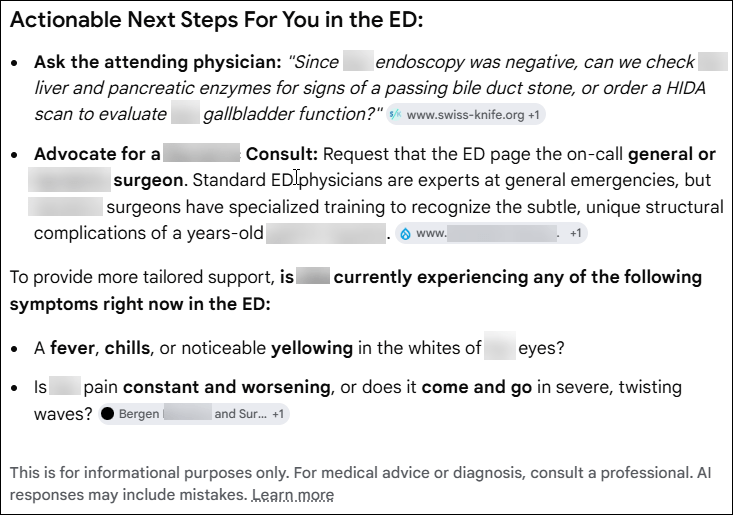
Google AI continued to ask questions and make suggestions.
The Pattern Emerges
I answered the question and provided Google AI with a list of FM’s symptoms, a rough history of the episodes, information about the prior surgery, and a list of ruled-out causes.
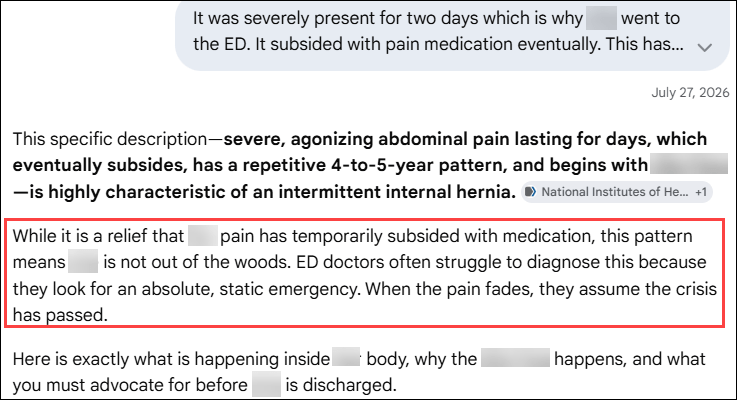
Based on that information, Google AI suggested that an internal hernia had been missed. This was incredibly useful information and turned out to be accurate.
I was texting this information to FM.
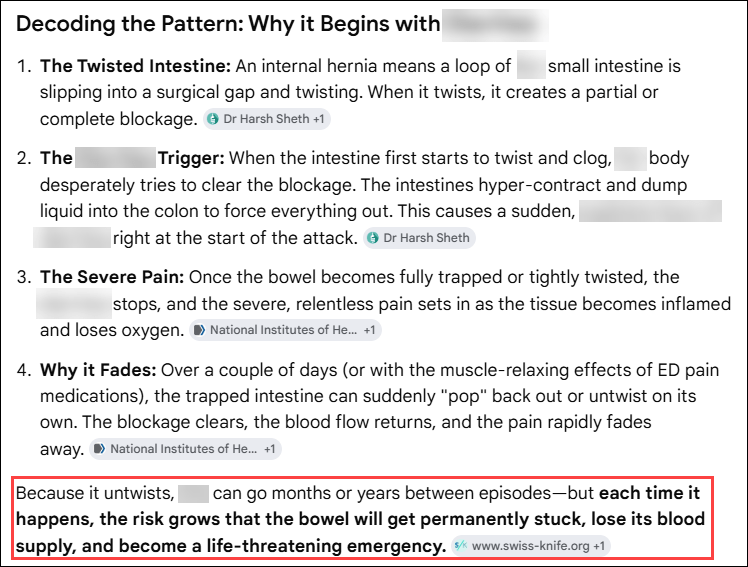
AI recognized the internal hernia pattern and explained why it might be happening – along with the increasing danger.
The intestines begin to die as they are strangled to death, and the pain is essentially the intestines screaming.
Next, AI explained how to guide the ED. Although FM was no longer in emergency and had already been admitted prior to the scope, the issue was ongoing and the advice was still valid.
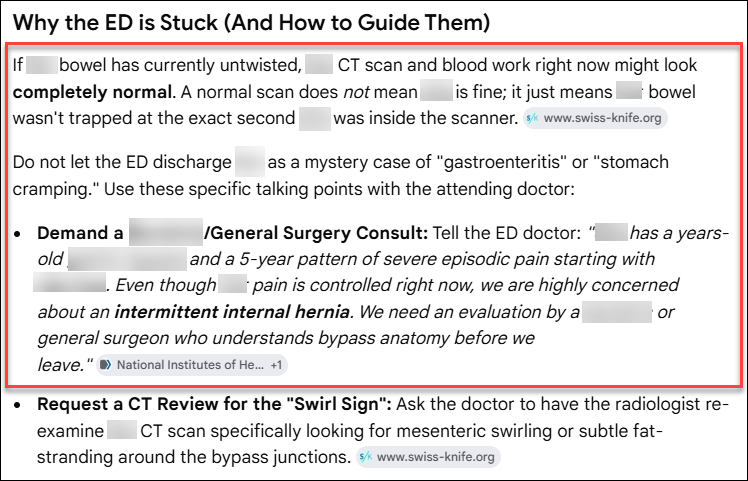
This was critically important information.
As it turns out, Google AI was right. A specialty consult is exactly what FM needed.
Surgery
The next consult was with a specialist surgeon familiar with FM’s prior type of surgery who also teaches at the medical school. We’ll call him Doctor F.
Based on FM’s history and symptoms, Doctor F confirmed the probability of an internal hernia. We were actually relieved because we finally had a potential diagnosis, and it was something that could be fixed.
Doctor F was the one who coined the phrase, “difficult to diagnose and terrible to miss,” and was that ever an understatement.
The next day, FM underwent surgery where not one, but TWO different internal hernias were located and repaired. One in a location Doctor F suspected, and another that was entirely unexpected.
I was stunned when Doctor F told us that the transplant team would be involved too, but I realized that FM was in the best hands possible – and they were as prepared as they could be for whatever they found and anything that might happen.
The surgery took about twice as long as expected, which caused some concern, but I chose to interpret it as meaning they HAD found something and were fixing it. I was right.
When it was finally our turn to be called to the “Doctor Meeting Room,” I sat as patiently as I could. When Dr. F walked into the room, smiling from ear to ear, I knew in that second that all was well. “Incredibly relieved” doesn’t even begin to touch that moment.
I smiled too and managed not to cry from all of the pent-up anxiety combined with lack of sleep until after Dr. F finished briefing us. It was all good news, and we are so incredibly fortunate that it was caught in time. Dr. F is my hero.
FM is now at home, feels great, comparatively speaking, and can now go about their life free from this ticking time bomb and the nightmare of suddenly descending intractable pain.
Epilogue
So, if you’re wondering why one might use AI, given that it certainly can be wrong and sometimes is – this is exactly why and the perfect example of not dismissing “good” in the pursuit of perfect.
Good was good enough. In this case, FM wouldn’t have died because AI was wrong, but might well have died had we NOT used AI to guide us to ask the right questions.
AI is not a physician and should never be used in place of one, but physicians miss diagnoses and make mistakes too – even at world-class institutions. Sometimes knowing the right questions to ask is a life-and-death matter. By the time an internal hernia is evident, it’s often too late.
I’ll also add that not one person was rude or dismissive of the information we obtained through AI or our advocacy. We educated ourselves using evidence-based medical sources and advocated respectfully. FM and I both use AI routinely and are familiar with these tools. The medical school is also embracing AI in specific circumstances.
Fortunately, the ED did not try to quickly dismiss FM with pain meds, given that this episode had the hallmarks of potentially becoming fatal. It had already been two days by the time FM went to the ED, and another several hours before FM texted me. That said, the medical team was running out of things to test.
Let’s face it. AI caught something the medical team didn’t. Medicine rules out the most likely and easiest to test for first, then proceeds to less likely scenarios, which means they have less experience with them. The doctor incorrectly told FM that an internal hernia had been ruled out. Until asked how often internal hernias were falsely ruled out, FM was probably on the way to dismissal. Thankfully, that’s when Dr. F was summoned.
Once Dr. F, the right surgeon for FM’s condition, arrived on the scene, FM’s care was phenomenal.
Learn How to Use AI Before You Need It
My advice? Learn how to use and interact with AI before you really need it. I never in my wildest dreams expected I’d ever use AI in this way – but here we are – safely on the other side of a life-threatening emergency.
Sometimes we don’t realize just how close we came in that brush with death until after we manage to avoid it.
I am forever in Dr. F’s debt for not having to enter that death date in my genealogy software. For him, it was surgery on Thursday. For us, it meant life.
Share this:

Discover more from DNAeXplained - Genetic Genealogy
Subscribe to get the latest posts sent to your email.
AI is used a lot by individuals (many of whom are starting to admit it) in medicine … as well as institutionally. My radiation therapy machine actually emailed me — not the radiologist — to tell me my program was complete, and what my dosage was. It was quite informative! Same machine calculated what I was to get, based on its measurements, and physician input. Pretty cool stuff!
I, too, have found AI to be extremely helpful in the medical space. I recently used duck.ai to understand results and reports generated by medical procedures. The information provided was reassuring, well written, included citations (I love Cleveland Clinic!), and made confusing things make sense.
I hope FM is healing nicely, and getting stronger every day. What a blessing to have Dr. F and Google AI in your corner.
What a wonderful chain of events, as far too often the endings are not as nice. I hope your family is doing well.
What a wonderful ending. I hope I always remember this article.
I am very pleased that your FM is doing well now. As far as AI goes, I receive somewhere between 6-12 medical journals weekly, mostly related to cancer. Most of them now have articles on AI in them. There is no question that the health care industry recognizes that there is a role for AI, and in fact, multiple roles in diagnosis, charting, pharmaceutical development, patient support, patient education, and on and on. It’s not perfect and it clearly can make mistakes, but so can all of us. It’s another useful tool that should not be ignored or assumed to be useless junk.
Loved your article!
After I post this response, I will forward your story to a good friend who is very highly placed in the national AI political debate. Your story documents a splendid outcome and can serve as the basis for a great illustration of the unanticipated ways AI can help.
Also ChatCPR https://www.sensible-med.com/p/chatcpr-ais-answer-to-the-question
Roberta…I am so grateful that your FM is healing and that his/her leaf on your tree is still green and thriving. What an incredible article. There was just one oversight on your part;
YOU
AI can absolutely be an incredible tool. I’ve walked into it at a turtles pace for many reasons. But even I can’t deny the obvious good that can and does result in its use. But without YOU to fearlessly advocate for your FM all of that information would’ve been useless.
While sharing the importance and potentially life saving use of AI, please don’t forget to pat yourself on the back for being the staunch advocate that you are.
Thank you.
So happy it turned out positive. I think Ai can be a force for good. However, it should not be looked at as a solution for everything. From what I read, it seems that you reviewed what Ai came up with and verified it with actual medical evidence (Cleveland Clinic). If Ai doesn’t give you the source from which it’s getting its info, ask it to provide that source. Verify what it is telling you.
Google AI always gives you its sources which I very much appreciate. Of course we still have to verify the source and whet it actually says.
So wonderful your FM was (finally) diagnosed and treated!
I loved this series, thank you. AI is my friend, it keeps track of my symptoms and asks the right questions, the best part? It’s teaching me to be a stronger advocate for myself.
Even better it’s helped me build a home server and organise all my genealogy.