FOCUS – A New Series Focused on Breaking Down Brick Walls

When I teach about genetic genealogy, people often ask, “What’s next? How can I break down my brick wall?” Sometimes I can reply that a Y-DNA test or mitochondrial DNA will help them under specific circumstances. But more often than not, what they really need is a precise, step-by-step methodology that includes autosomal DNA and utilizes multiple tools and techniques across vendors.

Even after people have taken Y-DNA and/or mitochondrial DNA tests PLUS autosomal tests at the major vendors, we still need a methodology to work with combinations of those results. Often, the answers we need aren’t just sitting there like a pretty rock, waiting to be picked up and admired, but depend on us using the results and matches as tools to help focus our search in the right direction.

It’s more like a scavenger hunt than a single discovery.

Focus

Sometimes I feel like a fish out of water – flip-flopping from ancestor to ancestor, match to match and hint to hint, hoping that the magic bullet will fall into my lap, but that almost never happens.

By this point in my research, I’ve perused all the easy records and many of the not-so-easy ones. If you don’t have a surname, or you don’t have a first name, or worse yet, you don’t have either, how is one supposed to search for records?

The good news is that you still carry at least one record in your own body and/or the bodies of your relatives. The DNA of your ancestors.

This is where we’re going to focus our efforts – hence FOCUS, the name of this new series.

Everyone is going to select their closest, or one of their closest, brick-walled ancestors, and we’re going to use several methods and tools to focus on identifying that ancestor.

Prepare

Before I publish the next article in the series, there are a few things that I’d like you to think about and do in preparation.

  • First, there’s no guarantee that you’ll break through your brick wall during this series. You might, and you also might not. You stand a much better chance of breaking through that brick wall if you focus and follow these steps than if you don’t.

Keep in mind that even negative evidence is evidence, and just because you don’t break through right away doesn’t mean you won’t. New people test everyday and new records become available too. If nothing else, your ancestor will have more meat on their bones, and you’ll have a process to build upon.

  • Second, if your brick wall is very close in time, meaning parents or grandparents, you’ll want the already-written “In Search Of Unknown Family” series, which you can find, here.
  • Third, you’ll need to keep a research journal or log by ancestor, family or location, which will also include your other related ancestors. For example, if you’re looking for Lucy whose surname you don’t know, but you know that she married William Moore, then your research journal will apply to William Moore too, and other people including their children and either spouse’s parents and siblings, whether that was your intention or not. The neighbors are probably relevant as well.

That “it takes a village” saying is particularly relevant here. People didn’t tend to move to the next location alone, and often their community consisted of their cousins and relatives – who are also your relatives, and hold clues to the identity of your ancestor. When I’m extracting records for the Moore surname in Halifax County, VA, for example, I extract everything for that and similarly spelled surnames, not just one particular person, so I don’t have to replow that field.

Tracking and Recording Your Research

If you don’t already have a research journal methodology, I would suggest a spreadsheet.

Here’s a screenshot of two rows in my “Halifax County” spreadsheet where I’ve recorded separate rows for each person in every record. Note that I started this spreadsheet years ago and omitted some columns that I later wished I had included, like the access date.

You’ll want to record:

  • Item number beginning with 1. In the example above, the item number is 6, and it’s 6 for every person in that record. Each person in this transaction gets their own separate row, with the same item number. The next record I extracted would be item 7.
  • Access date (date you found and retrieved the record)
  • Last name
  • First name
  • State (add a column for country if multiple countries are relevant for this family)
  • County
  • Town, township or city
  • Geographic places like road or creek names (these can be VERY important)
  • Year, month and day that the record occurred
  • Record repository or source (including a link if applicable – you may want to add a separate column for the link)
  • Record type (deed, will, tax list, etc.)
  • Role of individual (buyer, seller, witness, etc.)
  • Names of additional people in the record (I retain the same item number and other information, changing the name of the person, their role and sometimes an associated comment)
  • Transcribed text of the record itself
  • Comment, which can include things like the name of an image, something about what you were searching for when you found the record, links, or anything else relevant

You will want to be able to sort and filter this spreadsheet when you are finished. Hint – be sure your date fields and formats are sortable in the way you wish. I normally use filters instead of the sort feature.

The goal isn’t just to record your findings, but to make this spreadsheet as useful as possible to make discoveries that are only available by comparing and incorporating multiple records.

For example, let’s say that you’re extracting all of the Moore records in a Halifax County, VA deed book, and you want to know how many times the surname Henderson is found in the Moore deeds or in conjunction with the Moore family. Is there a pattern? You won’t recognize a pattern from any ONE record, but you may eventually wonder if the Henderson’s are related to the Moore family, and if so, how.

You’ll also want to record nonproductive or negative evidence. For example, let’s say you searched the Halifax County Plea Book for William Moore (including More and Mohr) and found no occurrences. That’s important, because otherwise you‘ll eventually search again, so enter that as a record item.

Note that with the full text search feature introduced by FamilySearch a couple of years ago, if you extracted records from a book that did NOT include every-name indexing including property lines, creek names and witnesses – you’ll want to redo that search using the full text feature at FamilySearch. There’s often LOTS of valuable information buried in records that won’t be found if you’re only viewing records indexed by buyer and seller, for example.

Your To-Do List Before the Series Begins

The In Search Of Unknown Family Series introduces important concepts, so reading that series is your first assignment in preparation for the upcoming FOCUS articles.

Test Your DNA With the Major Vendors

It’s important to test with the major vendors. Each vendor has matches and tools that the others don’t, and we need to identify and work with as many relevant matches as possible.

If you have NOT taken an autosomal DNA test at the first three following vendors, order these tests now so you have results to work with.

  1. AncestryDNA
  2. FamilyTreeDNA – Purchase a Family Finder test or upgrade an earlier Family Finder test to the new Family Finder NGS test. You should upgrade if you uploaded your autosomal DNA file from another vendor at any time, or tested at FamilyTreeDNA directly before March of 2026. The upgrade is only $29.
  3. MyHeritage DNA
  4. A fourth vendor, 23andMe, is optional, but testing there certainly won’t hurt.

23andMe Sidebar

I have an issue with 23andMe’s policy of forcing customers to repurchase a DNA test at $199 PLUS a subscription at $149 for the first year, renewable at $69 per year, in order to obtain any of their latest tools. This happened around the time of their data breach and subsequent bankruptcy.

I would feel much better about the situation as a whole if a new owner had taken the wheel, but the original owner resigned from the 23andMe board, formed another corporation, and was allowed to buy 23andMe out of the bankruptcy that occurred on her watch.

Furthermore, 23andMe does not support genealogy trees, nor do they have Y-DNA or mitochondrial DNA testing and matching, or research records.

I have (begrudgingly) ordered an upgrade for my own 23andMe test in order to include accurate information in these articles, but I won’t be focusing on 23andMe specifically aside from any unique feature. You can apply the same concepts and techniques to results at 23andMe where possible.

Test Your Relatives

If you have close upstream relatives, such as parents, grandparents, aunts, uncles, and cousins who also descend from your brick-walled ancestor, please ask them to test too.

I explain what I’m trying to achieve, why their test is important, and offer scholarships to sweeten the pie. I view purchasing their DNA tests in the same way I view purchasing a rare research book that I KNOW includes my ancestors but it not available anyplace else.

Your shared matches are extremely important and may provide that brick-wall-breaker. Perhaps even more importantly, they will have relevant matches that you don’t.

So how do you know who to test? You certainly want to test everyone relevant, without wasting money.

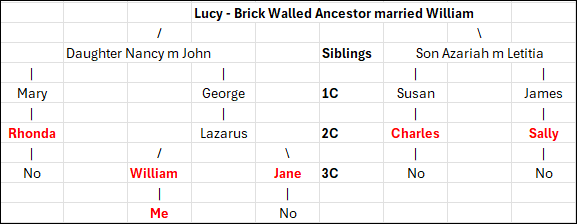
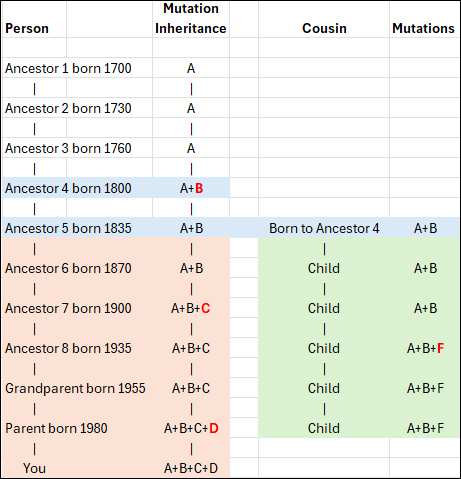
Let’s look at this example where Lucy is the brick-walled ancestor I’m seeking to identify. Her children (labeled siblings) and grandchildren (1C) are all deceased, but second cousins (2C), Rhonda, Charles and Sally are all available to test. Test each of them because they will all have some different segments of DNA from Lucy that the others don’t have.

Lazarus is also a second cousin, but he’s deceased. However, William, my father (in this example, not my real pedigree), and his sister, Jane are both available to test.

You ALWAYS want to test both of your parents and every available grandparent or direct ancestor. In this example, I’ll only inherit some portion of Lucy’s DNA that my father has, but Jane, my aunt, will carry segments of Lucy’s DNA that my father didn’t inherit from Lazarus. Jane’s matches on those segments that neither my father nor I have may be just what we need to identify Lucy.

If Lazarus has other children not shown in this example, we certainly want to test them too.

If the relevant parent has tested, you don’t need to test any of their children. However, if the parent hasn’t tested, absolutely test as many of their children or descendants as possible.

In this case, Rhonda, Jane, Charles and Sally have all tested, so I don’t need to test their children. Their children can only have as much of Lucy’s DNA as their parents had.

However, if any of them had been deceased, then I should test as many of their children as I can to “gather up” as much of Lucy’s DNA as possible.

If any of the people upstream of the bold red people have other children, those children or their descendants would be testing candidates too. Ideally, you want as many descendant testers as possible to increase your chances of identifying that ancestor.

Selecting Your Brick-Wall Ancestor

I want you to be successful, so you’re going to select your closest brick-walled ancestor within certain parameters. If you have multiple brick-walled ancestors at the at the same genealogical distance, you’ll choose one to focus on.

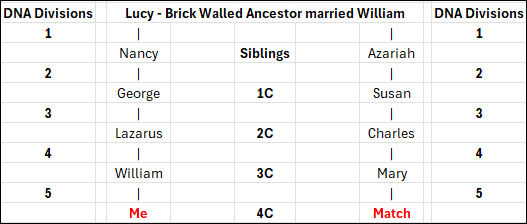
Why your closest brick-walled ancestor? If your brick wall is 5 generations back from you, and they are 5 generations back from your DNA match as well, that means you’re dealing with a 4th cousin match.

This also means that ancestor’s DNA has been divided a total of 10 times – five times on the path of descent to you, and five times on the path of descent to your match.

A 4th cousin match is likely to be in the 35 cM range. You can view the matching ranges for various relationships at DNAPainter, here.

The entire 4th cousin (4C) matching range is 0-139 cM. You won’t match all of your 4th cousins and are likely to match only 50-70% of your 4th cousins.

That said, the average person has between 1,500 and 4,000 4th cousins. At the 4th cousin level, you have 32 ancestors, so only between 46 and125 4th cousins will descend from any given ancestor, and of those, only a few will have taken a DNA test. The more children that ancestor had that lived to marry and have children of their own, the better your chances of more matches.

The Selection Process

I’m going to be stepping through the ancestor selection process with you, discussing who is and isn’t a good candidate, and why. I’m also going to be using this same methodology to (hopefully) identify one of my own mystery ancestors too.

I have no brick walls closer than 4th cousins. If I did, I’d choose the closest brick wall. You should too in order to have the best chance of solving this puzzle. The further back in time, the more difficult the solve will be.

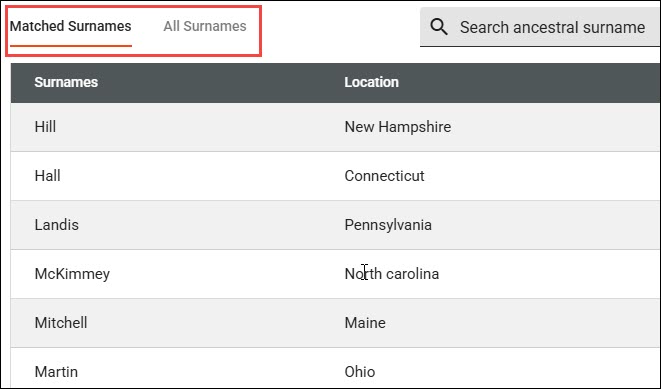
In my tree, I have four mystery ancestors at the 5X great-grandparent level on my father’s side, and one on my mother’s side.

Those will be the four ancestors I consider selecting. And no, before you do it, I don’t recommend working on all four of them at the same time. Remember, the purpose is to FOCUS.

  • Select an ancestor as close generationally as possible, because it’s more likely that both you and other people will carry at least some of their DNA, and the same segment(s) of DNA. Matches closer in time generally carry more total DNA in common, which means better matching and more shared matches.
  • Given that the majority of testers are from the US, and assuming you are from the US too, I don’t recommend selecting an ancestor from another country unless you are very comfortable with that language and working with those records. Generally, there will be fewer people who have tested from other countries. If you are going to work with an ancestor from another country, be sure you are in both the MyHeritage and FamilyTreeDNA databases.

My mother’s entire paternal line is either Dutch or German Brethren, and her Dutch ancestors only immigrated in the mid 1800s, so have few descendants in the databases.

My closest brick wall on her paternal line is Traut Enterlein, a German man who was named in an out-of-wedlock baptism for his daughter in Germany in 1823. He is not found in any other records in that part of Germany, so actually identifying “who he is”, even with a name, would be extremely difficult, and I have nothing to “anchor to” here.  He is eliminated as a candidate because he’s found in a country where I don’t speak the language, where fewer people have taken DNA tests, and we’ve already spent a substantial amount of time trying to identify him in the records.

Brick-walled ancestors on Mom’s maternal side are two generations further back in time. Half are German and the other half are a combination of English and Acadian.

  • Avoid both endogamy and pedigree collapse, if possible. I don’t recommend a line with baked-in challenges that will make DNA more difficult.

Acadians are heavily endogamous and often suffer from pedigree collapse since there were so few founding families in the mid-1600s. The same goes for Brethren families who immigrated in the early 1700s. Those lines are too far back generationally anyway, so they have already been eliminated, but if they weren’t, I’d eliminate them because of heavy endogamy and pedigree collapse, both, not to mention record loss.

My father’s side has much better candidates.

  • Try to select an ancestor where you have some familiarity with the location, the culture, and the records. If you have printed resources at the ready, possibly ones that are not online, that’s a plus.
  • When you’re trying to decide between ancestors, select one whose spouse you are sure of, and who has children you can document. Do you know important things about them like their religion, where they lived during specific times, and who their neighbors were? If not, take some time now to brush up on what you do know about their spouse and children.
  • Check back at all of the records vendors and resources, including Ancestry, MyHeritage, WikiTree, and FamilySearch, to see if anything new is easily available for either your brick-wall candidate or their spouse.
  • I do NOT recommend selecting an ancestral couple, neither of whom you can identify, unless you’re “lucky” enough to have no other brick-walled ancestors to choose from. It’s possible to solve this “double-blind” couple, but it’s substantially more difficult because you have no same-generation anchor.

My Candidates

I’m selecting one of my brick walls and hope to solve it during this process. Let’s run through the decision-making process so you’ll understand some of the considerations and why they weigh as factors. I wish I didn’t have so many choices, and I’d like to solve them all, but my best chance is to work on one at a time.

Most candidates are women because their birth surnames tend to easily become lost after they marry, and with their surname, their parents are lost too. Given how little we know, we have to presume (dangerous word), at least for now, that your missing female ancestor was the mother of all of their husband’s children, unless we know or subsequently prove otherwise.

Let’s review my candidates.

  1. Lucy was born about 1754, probably in Virginia, and died in 1832 in Halifax County, VA. She married William Moore between 1772 and 1774, who may or may not have been a circuit-riding minister at that time. She is found under her own name on the 1830 census, there’s an 1826 chancery suit, and I know who her children and neighbors are, so she might be a good candidate. One vote against selecting Lucy is that I don’t know where she was born, nor do I know where they were married, although there’s a very strong possibility that it took place in Halifax County. The fact that he was a circuit-rider means he could have met her anyplace. If they were married in Halifax County, their families could have been allied before arriving there. William Moore’s family came from Prince Edward County about 1770, and we know who his parents were. One good thing is that Lucy is a fairly uncommon name, but there are multiple William Moores in Halifax County, and there are two other Lucy Moores. One is her daughter, and one is her daughter-in-law. The fact that Lucy and William Moore had 12 known children, with at least 8 who married, means there is a good chance of matching at least some descendants. Unfortunately, I don’t have her mitochondrial DNA, which removes one possible tool unless I can find a tester.
  2. Jane, born about 1760 in an unknown location, but probably Virginia, was the wife of Lazarus Dodson. They moved across multiple frontiers into what would become early Tennessee, an area that sustained substantial record loss. Jane died between 1830 and 1840. There’s a lot of uncertainty about Jane’s life. She probably had at least 8 children, and we know something about six of them. Given that we already have a better candidate with Lucy, I’ll eliminate Jane for now.
  3. William Crumley’s wife, whose name I don’t know, was born around 1765 or 1770, possibly in Virginia. She was married to William Crumley around 1786 or 1787, probably in Frederick County, VA, or nearby. I do have her mitochondrial DNA and we know the family was Quaker which are both benefits. I’ve been working with a cousin who has delved deeply into Quaker records, and I have some records from a trip to the FamilySearch Library in Salt Lake City that I have not yet processed. She and William had at least 10 children who married, and I know quite a bit about them. She would probably be an excellent choice. For lack of another name, I’ve been calling her H2a1, her legacy mitochondrial haplogroup before Mitotree, but she has a much more complete haplogroup now. She would be a good candidate, and I REALLY want to identify her.
  4. Mary, wife of John Harrold (by various spellings), was born about 1750, possibly in Ireland, although it would be unusual for a first-generation Irish immigrant to end up deep in the Appalachian frontier. Mary died in 1826 in Wilkes County, NC. We know nothing about John’s background, other than he served in the Revolutionary War, in Virginia. He may have been living in Botetourt County, although we don’t know for sure, and there are multiple men by that name. Mary had at least 7 children, six of whom were married. We do not have her mitochondrial DNA. Given that we know so little about John, and we have better candidates with both Lucy, William Moore’s wife, and William Crumley’s wife, I’m eliminating Mary for now.
  5. Isabel, the wife of Michael McDowell – another couple from Wilkes County, NC. Their daughter married the son of Mary and John Harrold. Isabel was probably born about 1750, someplace in Virginia. We don’t know where they were married, but it could have been in Franklin County, VA. They lived in Wilkes County for several decades before moving on to Claiborne County, TN. We know very little about Michael’s early life, other than his Revolutionary War service, although I’ve written about him four times as additional information dribbles out. They had at least 8 children, and a deposition after Michael’s death tells us where they moved and settled, which is a very big plus. We know her first name thanks to a 1793 deed. Isabel is a reasonable candidate, but I eliminated her after comparison to the other candidates, in part because of multiple frontier moves with few records and no known point of origin.
  6. Elizabeth, wife of Andrew McKee, was born about 1767, possibly someplace in Virginia. They were in Washington Co., VA by 1789, although we don’t know where either originated. They may have married before they moved to Washington County, where we find several records. They had 14 children. Twelve are known to have married, and the other two probably did as well. We know who their neighbors were. We also have Elizabeth’s mitochondrial DNA. Unfortunately, we know nothing about Andrew McKee’s family or where he was from. However, Elizabeth is a strong candidate because so many records exist in Washington County, they had a large number of children, and many continued to live in Washington County or nearby, making them easier to track.
  7. If I didn’t already have good candidates, there’s one more ancestor I’d consider, even though James Lee Claxton/Clarkson is a generation further back in my tree, born about 1775, and his unknown parents are the brick walls. I know I just told you NOT to do this, so I won’t either, but the reason I might have considered his parents, or more specifically his father, as a strong candidate is because we have several Y-DNA matches, including Big-Y testers, and we know the ancestors of his matches came from NC. We also have many autosomal testers and matches, which would help immensely, and there’s a Clarkson/Claxton DNA Surname Project. A contiguous surname is a HUGE benefit not available with female ancestors, and I just feel that I’m SO CLOSE to solving this mystery. For now, James’s parents are eliminated because they are two generations further back in time than our other candidates, we know nothing about either of them, except Y-DNA results, and we have better candidates for this exercise.

After evaluation, I still have two candidates in the running – Lucy, wife of William Moore, and H2a1, William Crumley’s wife. I haven’t decided for sure yet, but right now, William Crumley’s wife is leading because I have an amazing collaborator along with some unprocessed records that may hold important information. I know there probably aren’t any smoking guns there, but when combined with DNA, we may well ignite that gunpowder.

FOCUS

Are you ready to focus?

Let’s get our ducks in a row.

  • Order any DNA tests you need to order for yourself and relatives now.
  • Select your ancestor.
  • Prepare your research journal by reviewing which records you’ve already researched and record what you have.
  • Refamiliarize yourself. Take a look at those results again with fresh eyes. It helps when reviewing match results to be able to view surnames in your matches trees and recall that you’ve seen that name before, and where.
  • Check to see if any new records or resources are now available.

Who do you want to find?

_____________________________________________________________

Share the Love!

You’re always welcome to forward articles or links to friends and share on social media.

Subscribe!

If you haven’t already subscribed, it’s free. You’ll receive an e-mail whenever I publish by clicking the “follow” button at the top of the main blog page, here.

Help Keep This Blog Free

I receive a small commission when you click a vendor link in my articles and purchase that item. This does NOT increase your price but helps me keep the lights on and this informational blog free for everyone. Please click on the affiliate links in the articles or to the vendors below if you are purchasing products or DNA testing.

Thank you so much.

DNA Purchases and Free Uploads

Genealogy Products and Services

My Books

Genealogy Books

Genealogy Research

The New Family Finder NGS Test Results, Comparison, and Preparation

This article is focused on two things.

  1. Comparison of my new NGS and the earlier Family Finder tests
  2. How to prepare for yours if you’ve ordered the upgrade

I compared my results from my older Family Finder test with my new NGS Family Finder test results. As an early beta tester, I have two separate tests, a strategy that is not recommended because it causes duplicate matches for people within the database. Additionally, multiple kits for one person doubles the results and could skew future ethnicity research for myOrigins.

Therefore, FamilyTreeDNA has announced very attractively priced upgrades at $29 for both:

  • People who have taken Family Finder test directly at FamilyTreeDNA
  • People who have uploaded their DNA files into Family Finder from other companies

After seeing my comparison, you may want to compare your own results when they arrive, so I’ve documented that process. Warning: this took between 4 and five days because I was working with a spreadsheet with more than 15,000 rows, and I had to write scripts to perform multiple functions. It was NOT fun and I do not recommend it.

Personally, had I known then what I know now about how reliable the new NGS test is, I wouldn’t have bothered with the comparison. However, I would have downloaded my original match list for posterity, just in case.

If you purchase an upgrade to the new NGS Family Finder, your new test results will replace your older Family Finder test results, but will preserve important account features such as linked matches, any notes you have taken, and more. That’s another reason to upgrade rather than order a separate new test. They’ve done the heavy lifting, not to mention that you’ll save about $50 when compared to the price of a new test.

Why is the New NGS Family Finder Test Better?

The new NGS test holds immense promise for the future. This includes better matching, beginning now. Essentially, FamilyTreeDNA is skating to where the puck is going to be (hockey analogy) and preparing for future tools. That future is not far away!

An amazing new set of tools is goaled for release around the end of the year. And I do mean amazing. They are being beta-tested internally now.

Dave Vance spoke about the new Family Finder NGS test at the ECGGC conference in late August, which you can view through the end of 2026 if you register for the virtual  conference, here, and watch the recorded sessions. You’re looking for the DNA Academy on Saturday evening. I can’t share specific preview slides with you as they are noted in his presentation as “not for distribution,” so my pen is capped for now.

All I can say is that after seeing what’s in store, people were literally throwing their billfold at the folks at the FamilyTreeDNA booth – and I do mean literally. “Here – take my money, please!” as the billfold went sailing. We all had a good laugh, but he was serious.

One presenter (not me, just in case you are wondering) left her credit card and a list of tests to upgrade while she was presenting.

They ran out of swab kits at the conference shortly after Dave’s presentation about what the future holds.

Additionally, you will also be treated to THE absolute best presentation I’ve ever seen about what NGS testing is, how it works, and how it compares to traditional tests, low-pass whole-genome tests, and medical-grade whole-genome tests.

You’ll be a passenger on the Genome Valley train, so climb aboard!

So, without spilling any beans, what’s so great about the NGS test?

To begin with, the older Family Finder tests won’t be able to provide everything the new NGS test will be able to offer – and those completely new tools are in active development today.

Why?

The NGS test targets over 280 million base pairs, up from the currently available 700,000.

That’s more than 400 TIMES the coverage.

This increases coverage in the human genome from about .02% to about 9%.

To quote FamilyTreeDNA, “This change allows us to deliver more precise autosomal results today while creating a strong foundation for future reports and tools.”

You can read the FamilyTreeDNA FAQ here.

Before we move on to the comparison, let’s talk for a minute about test types and uploads from other vendors.

Tests and Uploads

All new Family Finder tests purchased at FamilyTreeDNA since March 2, 2026 have been tested using Next Generation Sequencing (NGS), so the following matrix does not apply to those tests. Those tests don’t need to be upgraded.

If you sign on to your account, on the Family Ancestry dashboard, and see that your NGS button is grey, then you have not upgraded. Click on that grey button to read more and to upgrade. Right now the upgrade is $29, but I don’t know if that is a promotional price or permanent.

If you tested at FamilyTreeDNA prior to March 2, 2026, or uploaded a DNA file from another vendor, your test will fall into one of the following upgrade path categories.

Tested at FamilyTreeDNA before March 2, 2026 Uploaded and purchased the Unlock Uploaded but did not purchase the Unlock
Upgrade Path Can use sample stored in lab if enough DNA remains* If you purchased any other type of test at FamilyTreeDNA, they will use DNA stored in the lab if enough remains. Otherwise, you will be sent swabs. If you purchased any other type of test at FamilyTreeDNA, they will use DNA stored in the lab if enough remains. Otherwise, you will be sent swabs.
New Swabs* If needed, they will notify you Yes, if needed, will notify or send swabs if you have not taken a direct test at FamilyTreeDNA Yes, if needed, will notify or send swabs if you have not taken a direct test at FamilyTreeDNA
NGS Results Will replace existing results Will replace existing results Will replace existing results

*You will be notified if enough DNA does not remain, and you will be sent new swabs. Be sure your address is current.

One of the reasons the NGS test performs better, even with existing matches from earlier tests, is because less imputation is involved. Let’s talk for a minute about imputation and how it works.

The Concept of Imputation

Most vendors change chips internally from time to time, and FamilyTreeDNA is no different. The difference this time is that the new NGS test covers exponentially more DNA than any earlier test, and all earlier tests combined. This means more than 400 times greater coverage, which in turn means less imputation is needed to compensate for the inevitable no-reads and to be compatible with files that tested different DNA locations.

Imputation is also used when comparing DNA files between vendors who don’t test the same locations.

Click to enlarge any image

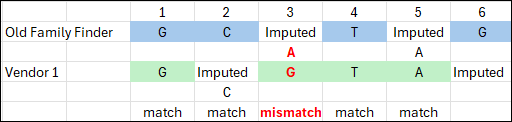
Here’s an illustration of the concept of how imputation works.

All of the FamilyTreeDNA chip versions over the years have included about 700,000 locations, as have most other vendors. But the locations tested are not universally the same.

In our simplified concept example, FamilyTreeDNA’s tested “locations” are shown with blue cells.

The total of 20 squares shows the maximum amount of DNA tested by any of the three vendors shown, combined.

Green Vendor 1 in our illustration tests the same amount of DNA that FamilyTreeDNA tests, 12 squares, but some locations are the same and some are different. Of the 12 colored squares for both vendors, seven are the same locations, and five are not. The locations that are the same can be compared directly, but the locations that are different have to undergo special handling called imputation.

Looking at any location in our DNA, one of four nucleotides, or letters, can be present: T, A, C or G on each strand of our chromosomes, although we are only looking at one strand in our example.

Using a very simplified model of imputation, think of imputation as “filling in the blanks” using clues from surrounding letters – kind of like a crossword puzzle.

When two vendors’ data doesn’t overlap, imputation is used to fill in the blanks, as accurately as possible, for the missing data.

Using a word analogy, for vendors one and two only, we see that blue location three has no Family Finder data, where green Vendor 1 does, and the same with location five. If blue locations two and four are C and T, and three has to make a word, then there are few options. In this case, let’s say it’s cat, and location five is imputed to an A too.

Now moving to green Vendor 1, their locations two and five need to be imputed. Moving away from the word analogy, let’s look to the human genome, and let’s say that most of the time, location two is a C if location one and three are Gs. So green location two is imputed to C.

If there’s not enough quality surrounding data, imputation can’t be performed reliably. Hence, location six is still in limbo here.

You can see that in our scenario, location three is the only mismatch, out of three imputed locations. Does location three mismatch because imputation was wrong? We don’t know. Do locations two and five match because imputation was wrong? We don’t know.

All things considered, imputation is based on the science of probability, and is usually relatively reliable, but it’s still not the same as comparing actual data. The more locations that have to be imputed, and the longer the stretch, the greater the possibility of error. Every vendor implements imputation differently too. Even vendors who don’t and have never accepted uploads still use imputation internally to equalize their own legacy files from earlier test versions.

Stepping back once again to compare the four vendors, you’ll notice that pink Vendor 3 only tested half as much DNA as the blue Family Finder test and green Vendor 1, and again, not all of the same locations. That’s exactly what happened with one of the vendors last December – they dropped the number of DNA locations tested to about 400,000 from about 700,000. In our example, you can see how much would have to be imputed. Locations 11, 15, 19 and 20 can’t be imputed for the pink vendor’s file because there’s no surrounding DNA. Location 17 can’t be imputed for the green vendor for the same reason.

When vendors impute to match multiple versions of other vendors’ uploaded files, it can quickly become messy.

The answer, of course, is a “supertest,” which tests all of the locations that overlap everyone, including that vendor’s own earlier tests.

Welcome to Family Finder NGS, shown in orange at the bottom of our example comparison.

As you can see, the orange NGS test covers all of the locations tested by all of the other tests.

NGS is targeted testing for a specific set of locations that are known to undergo mutations in the human genome and provides extremely high-quality results. Imputation for the NGS file is rarely necessary, although imputation for the other vendors’ and earlier file versions is still required for them to match to each other.

This is exactly why the upgrade is recommended, and why there’s no benefit to retaining your old test. The NGS test tests far more data and provides much more reliable matching.

NGS is the great equalizer.

NGS Test Comparison Process

I took my NGS test during the initial R&D development and testing phase, so my original Family Finder test was not upgraded. This afforded me the opportunity to compare the two results.

I downloaded the match files for both of my tests, the original Family Finder and the new NGS Family Finder test, color-coded the background of the cells, not the text inside the cells, and dropped them into a single combined spreadsheet.

It doesn’t matter what colors you choose, but be sure you can easily see the difference. I used apricot for the original Family Finder test matches and light purple for the new NGS test.

As we walk through these results together, you’ll notice that I continue to refer to them by color. In part, that’s so I can maintain my own sanity as I compare results. When I write these types of articles, I have to check and recheck results.

When the same person showed as a match to both tests (meaning they had both an apricot and purple row), I calculated the difference in matching amounts of DNA (cMs) between the match’s results on both tests. I added several calculation columns, which are not shown above.

I’ll tell you, this was not a trivial exercise. It was painful and I really don’t recommend it.

Let’s take a look at the results.

Total Matches

I have some matches with the new NGS test that I do not have with the legacy Family Finder, and I have some matches on the older test that are no longer present on the NGS test.

  Old Family Finder (apricot) NGS Family Finder (purple) Difference
Total Matches 9014 7719 1,295
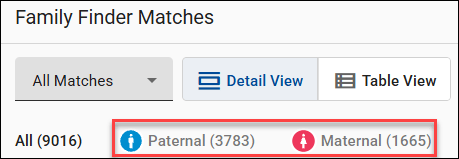
Maternal 1665 Not linked
Paternal 3783 Not linked
X-Matches 2198 1849 349

I have not yet linked the same matches in my NGS test, so I can’t compare the number of maternal and paternal matches. Fortunately, when you upgrade an existing test, FamilyTreeDNA preserves your linked matches, so you won’t need to relink.

Relationship Estimates

  Old Family Finder (apricot) NGS Family Finder (purple)
1st-2nd cousins, Great/Half Uncle/Aunt/Niece/Nephew, Great-Grandparent/Grandchild 6 6
1st-3rd cousin 1 1
2nd-3rd cousin 5 4
2nd-4th cousin 127 132
3rd-5th cousin 1937 1900
4th to remote 6938 5676
Total 9014 7719

The closest relationships remained the same. One 2nd-3rd cousin moved to the 2nd-4th cousin range by losing 10 cM, 194 cM to 184 cM, but they were apparently on the threshold anyway. That match is actually my second cousin, so both ranges are accurate. It was also a transfer kit, so they did not test at FamilyTreeDNA. This revised match is probably the difference between actual reads and imputed reads in some regions, meaning the match is now more accurate.

275 matches had a predicted relationship change, but not uniformly in one direction, and no one moved more than one category in either direction. This all makes sense.

Match Differences

  Number
Matches found in both the apricot and purple spreadsheets 7,352
Unique (comparable) matches in both spreadsheets 7,174
Matches in original Family Finder apricot only 1,681
Matches in NGS purple only 400

A total of 7,352 matches appear in both spreadsheets, meaning the apricot and purple names matched exactly.

Unfortunately, some people had multiple tests, so I couldn’t always compare apples to apples because they appear three times or more on the combined spreadsheet, and I don’t know which of their kits are which.

If someone with the same exact name had more than one match for either or both tests, I did not compare them because their matching amounts were different, and I didn’t know which one(s) my old test matched, versus which one(s) my new test matched. Usually, one was an upload and one was a test at FamilyTreeDNA, but not always. I excluded those 178 match rows from the analysis.

Therefore, 7,174 matches could be directly compared.

There were 1,681 people who match ONLY on the old Family Finder test, and 400 that match only on the new NGS test. And yes, I downloaded the match files at the same time on the same day, so this comparison was controlled for any time difference.

cM Differences

  Number
Largest apricot match not in purple (NGS) list 26.3 cM
Largest purple (NGS) match not in apricot list 27.63 cM
Largest difference 69.86 cM NGS kit more
NGS detected greater over 10 cMs 19
NGS detected less over 10 cM 7
Total NGS greater 2,924
Total NGS less 3,040
No change 1,090

The largest value difference where a match appeared in the original apricot Family Finder test, and not in the purple NGS test, was 26.3 cMs.

The largest value difference where a match appeared in the NGS purple Family Finder test, and not in the apricot original Family Finder test was 27.63 cMs.

The largest difference between the two tests was 69.86 cMs larger detected by the NGS test. This match was a known second cousin whose matching cMs went from 373.06 to 442.92, but the longest block only increased a negligible amount from 87.47 to 87.69.

The next largest difference was with a 1C1R with a 41.56 cMs difference, also with the NGS-detected value being larger.

In all cases where the number of differing cMs was 16 or greater, the NGS had detected more.

There were very few tests that differed more than 10 cMs. In 19 cases, the NGS test detected a greater difference of 10 cMs or higher, meaning if the original test value was 100 cMs, in the NGS test, it was 110 cMs or greater.

In 7 cases the NGS test detected a smaller difference of 10 cMs or more, meaning that if the original test value was 100 cMs, in the NGS test, it was 90 cMs or smaller.

Out of the 7,174 tests being compared, 19 tests with greater than a 10 cM variation isn’t very many, around 0.26%.

In total, 1,090 matches had no change at all, while 2,924 NGS matches had more matching DNA detected, and 3,160 matches had less.

All but 287 of those differences were less than 5 cMs, and 6778 were less than 1 cM. In other words, literally not worth counting.

myOrigins Ethnicity

We all know to expect changes in our ethnicity from time to time at all vendors. The NGS test is exciting because it covers a much larger portion of our genome. As more people test, the reference library also becomes larger, which means that the ethnicity predictions can and will become more refined too

myOrigins Old Family Finder (apricot) NGS Family Finder (purple)
Central Europe 57% 52%
England, Wales, Scotland 28% 33%
Ireland 15% 14%
Magyar <1% <2%
AmerIndian Andes and Caribbean <1 (see below) N/A
AmerIndian North America <1% (chr 1 & 13) <1 (chr 1 & 2)
Anatolia, Armenia, Mesopotamia, North Africa <1 (chr 13) <1% (chr 10)

None of my major categories changed, but the amounts attributed to each category changed somewhat.

Trace regions, which are less than 1%, shifted some as well, as did their chromosome locations.

For me, this is particularly interesting, because I paint my ethnicity segments at DNAPainter in order to overlay my Native American segments over the matches with whom I’ve identified common ancestors.

Those segments, matches, and ancestors, taken together, help identify the source of the Native American segments.

My Native segment on chromosome one stayed essentially the same, but the Native segment on chromosome 13 is not present on the new NGS test. However, a new Native American segment is now shown on chromosome 2 in the same location that 23andMe also shows a Native American segment.

Chromosome one has already been proven to a Native American ancestor on my mother’s side, but I have hit a brick wall on the chromosome 13 segment. Now, I’ve painted the Native Segment on chromosome 2 and it aligns with the same ancestral line as my Native American segment on chromosome 1.

My Middle Eastern/North African segment still exists, but the location has changed. This segment was adjacent to my Native American segment on chromosome 13 before, on my father’s side, which suggested a history of enslavement. I thought I knew which ancestral line they both descend from, but now I need to review my matches and reconsider.

Unfortunately, my parents are both deceased and there’s no DNA available, so I cannot upgrade their tests or purchase new ones for them. No aunts or uncles are available either. In this case, cousin matches and their associated genealogy on those segments become critically important.

Native American and African American segments are often the best, and sometimes the only hints we have to find and identify those ancestors.

Preparing for Your NGS Results

To be very clear, you don’t necessarily need to compare or prepare, BUT, if you order an upgrade to an existing test, your old match list will be replaced with the new one. Your old match list will not be preserved unless you do it.

What may change?

  • Your ethnicity results will probably change somewhat
  • You will have matches you did not have before
  • Some existing matches, especially at low matching levels, will no longer be there
  • The amount of DNA you share with some people will change

Important: Any notes you have recorded on your matches and any matches that you have linked will be preserved and carried over to your new results when your new test is complete.

If you want to preserve your matches from your earlier test, or your myOrigins results, you’ll need to download your match list, and either download or take screenshots of your ethnicity information.

Ability to Download Tested at FamilyTreeDNA before March 2, 2026 Uploaded and purchased the Unlock Uploaded but did not purchase the Unlock
myOrigins Can download Can download Cannot download
Chromosome Painter (ethnicity) Can download Can download Cannot download
Match list with segment and other information Can download Can download Cannot download
Raw data file Can download Cannot download* Cannot download*

*On tests you uploaded, you don’t need to download the raw data file because you already have it from the originating vendor.

What information is included in your Match List download file?

  • Match name
  • Relationship Range
  • Shared Data cMs
  • Longest Block cMs
  • Linked Relationship (if you linked them in your tree) – this feature is what allows FamilyTreeDNA to assign your matches maternally, paternally or to both sides using triangulation
  • Ancestral Surnames that they’ve entered
  • Y-DNA Haplogroup if applicable
  • mtDNA Haplogroup if applicable
  • Notes
  • Paternal/Maternal or Both side(s) match (if you’ve linked people and this match can be assigned using triangulation. (This is why it’s important to link as many people as possible to their place in your tree.)
  • X-Match cMs
  • Autosomal Transfer yes/no

If you match the same person on the NGS test, this information is preserved for that match.

Where to Download

You must have 2FA (Two-Factor Authentication) enabled for all downloads.

The files you may want to download are found on your dashboard in two locations.

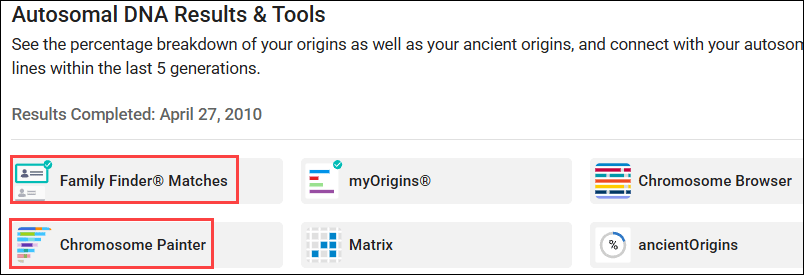
  • Family Finder Matches
  • Chromosome Painter (ethnicity)

Family Finder Matches Download

To download your list of matches with their complete information, click on Family Finder Matches on the dashboard, then on “Export CSV.”

This download provides all the fields mentioned above, whereas the Chromosome Browser segment download provides only your matching segment data, without the additional information.

Download MyOrigins Ethnicity Segment Data

To download your myOrigins ethnicity segments, click on Chromosome Painter on your dashboard, then on “Download Segments.” You can also view or copy those segments by viewing the Detailed Segments tab.

I paint these segments at DNAPainter so that I can correlate my ethnicity regions with my ancestors’ segments.

To assign segments accurately, it helps immensely to have at least one parent’s DNA results too, and preferably both.

You may also want to take a screenshot of your myOrigins map. Note the left-side scroll bar when you’re taking screenshots.

What’s Next?

What else can you do at FamilyTreeDNA to benefit your genealogy?

  • If you haven’t already, upload a GEDCOM file or create a tree at MyHeritage, and link your Family Finder test to your results.
  • Link your individual matches to their place in your tree. This allows FamilyTreeDNA to use segments triangulated with linked matches to assign other matches to either the maternal or paternal side of your tree, or both.
  • Add your line to WikiTree. It’s easy. Begin with yourself and add ancestors until you connect with someone who is already in WikiTree. For me, it was the grandparent level.
  • Add your WikiTree link to your FamilyTreeDNA account under the gear in the upper right-hand corner, then Genealogy, then Family Tree. This gives your matches an easy way to identify common ancestors by using WikiTree’s Find Relationships feature, and provides two types of tree resources for you and your matches – MyHeritage and WikiTree.
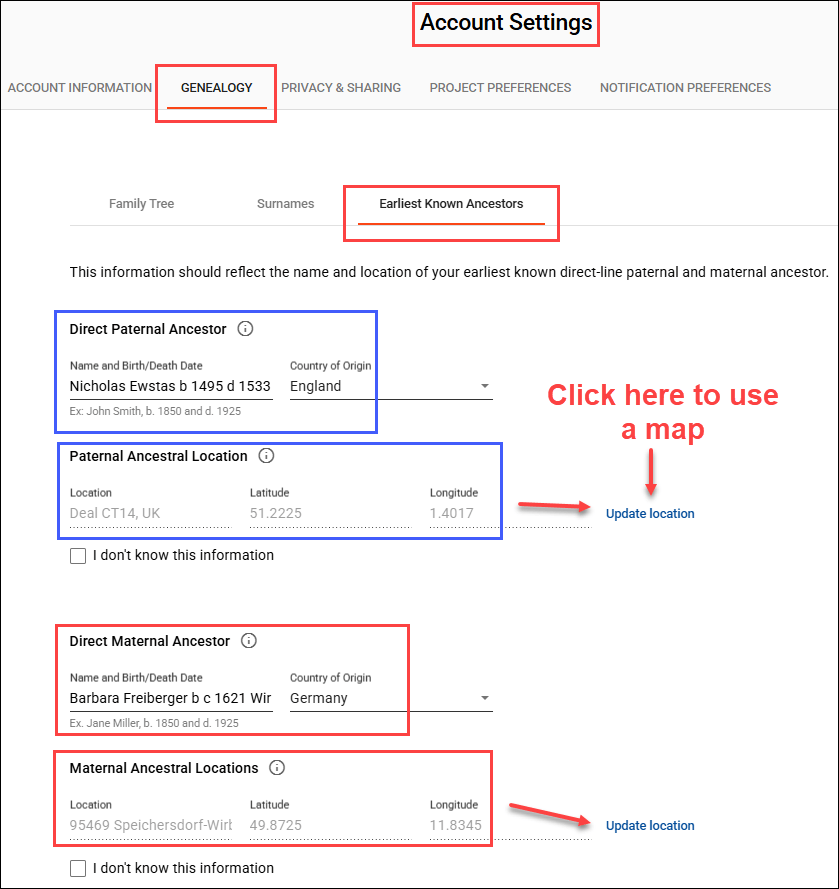
  • Make sure your Earliest Known Ancestor information is correct and up-to-date with your most recent research, including a specific map location. You’ll find that under the gear too, then Genealogy, then Earliest Known Ancestors.
  • Add your surname list to your profile under the gear, Genealogy, Surnames tab.
  • Use the Matrix tool at FamilyTreeDNA to see how much DNA your shared matches share with each other.
  • Y-DNA – If you’re a male, test your Y-DNA, which is your father’s direct paternal line. The Big Y-700 test provides you with matches and the most detailed information possible.
  • mtDNA – Everyone can take a mitochondrial DNA test, which shows matches and provides information about your mother’s direct matrilineal line.
  • Use Advanced Matching, found under Additional Tests and Tools on your dashboard page, near the bottom, which allows you to select from multiple tests to see who matches you on both types of tests. For example, those who match you on both your full sequence mtDNA test and your Family Finder test.
  • Join projects relevant to your family surname, geography or broader interests. You’ll find Group Projects in the top banner of your dashboard page after signing in.
  • Utilize the Discover tools for both Y-DNA and mitochondrial DNA results.

Check your matches often to see who is new and what might have changed as people upgrade to the new NGS test and more people test.

_____________________________________________________________

Share the Love!

You’re always welcome to forward articles or links to friends and share on social media.

Subscribe!

If you haven’t already subscribed, it’s free. You’ll receive an e-mail whenever I publish by clicking the “follow” button at the top of the main blog page, here.

Help Keep This Blog Free

I receive a small commission when you click a vendor link in my articles and purchase that item. This does NOT increase your price but helps me keep the lights on and this informational blog free for everyone. Please click on the affiliate links in the articles or to the vendors below if you are purchasing products or DNA testing.

Thank you so much.

DNA Purchases and Free Uploads

Genealogy Products and Services

My Books

Genealogy Books

Genealogy Research

What is a Quick-and-Dirty Tree, and When Might I Need One?

You may have heard genealogists talk about creating a quick-and-dirty tree.

What is that, exactly? When and why would you want one?

Good questions.

Matches and Trees

DNA matches don’t always have useful trees.

They might have:

  • No tree
  • A partial tree with only a few people in the closest generation or two
  • A tree with some lines built out, but others not so much

What’s a genealogist to do? After all, it’s your match’s tree, not your tree, and you have no way to expand their tree.

Except, you do.

It’s called a quick-and-dirty tree.

Quick-and-Dirty Trees

A quick-and-dirty tree is essentially a “throw-away” tree that you construct at Ancestry with the express purpose of obtaining hints, including potential parents, in order to quickly build your matches tree backwards in time until you (hopefully) reach a common ancestor.

And yes, of course trees, hints and suggestions of any kind can be wrong – but that doesn’t mean they’re always wrong, and you’re not adding anything from your quick-and-dirty tree to your tree – or even displaying it publicly.

You’re simply trying to find a common ancestor by using what your match has provided in their tree. Think of a quick-and-dirty tree as a scratch pad of sorts.

Let’s work through an example.

Initial Analysis

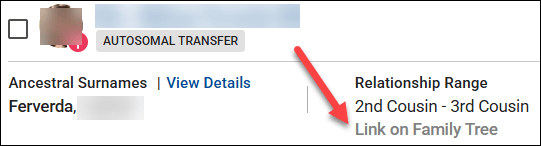
In this example, Ancestry has already told me that this match is most probably my half-second-cousin (half 2C) or second-cousin-once-removed (2C1R) based on the amount of DNA that we share, although the full relationship range includes several more options.

Ancestry also tells me that this match is on my maternal side. There’s no information provided about whether this match is on their maternal or paternal side, or even both.

A second-cousin (2C) relationship means that we share great-grandparents, and once removed means that one of us is one step further down the tree than the other person.

In other words, I’m 2C with my match’s parents, or my match is 2C with my mother. I wrote about this in the article, Concepts: What Does a Cousin “Once Removed” Mean?

I see that my match has a public linked tree with 7 people, which probably isn’t going to be terribly helpful.

Of course, the first thing to do is to review my match’s tree and see if I recognize either their surname or the names in their tree.

This tree only reaches back two generations, and our common ancestor, based on the relationships predicted by shared DNA, would be another generation, or two, further removed.

I don’t recognize any of these names, although I’ll review each person for a location to see if I can narrow the scope to the couple most likely to lead to our common ancestor.

On my mother’s side, one of her parents is from northern Indiana, and one is from southern Indiana, but not everyone enters locations in their trees, and they aren’t necessarily accurate.

The list of “all people” in my match’s tree, under “Find in tree”, at far right, provides additional information. Unfortunately, this tree shows Earl Townsend’s wife’s name as Mildred Ideal Thorstenson Townsend Smith here and in her profile, but the name order differs. To begin, I’ll enter Thorstenson Smith, not her married name of Townsend, in the quick-and-dirty tree I’m building. You can refine this shortly.

In this case, it looks like the Townsend line is most promising to find a common ancestor, given that Fulton County is in northern Indiana, but we’ll find out that this isn’t the case when we construct our quick-and-dirty tree.

Building the Quick-and-Dirty Tree

You need to build a new tree, NOT add to your “real” tree.

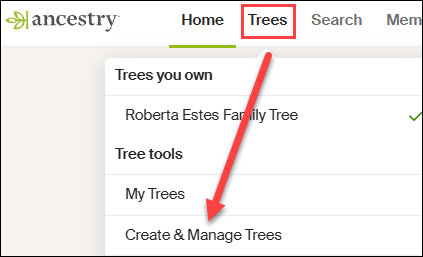
At Ancestry, go to Trees in the top banner, then click on “Create and Manage Trees.”

You’ll see the list of trees that you own. This is where all of the trees that you create live.

At the far bottom, you’ll see the prompt to create a new tree. Click there.

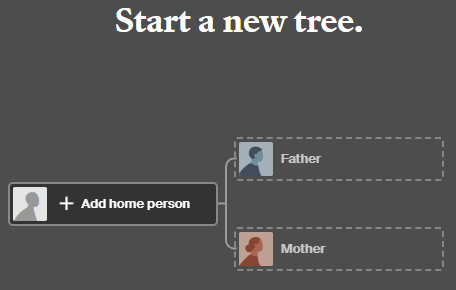
Next, you’ll see a blank tree.

For the home person, you can enter your match’s name, but be sure to list them as living so you’re not revealing private information.

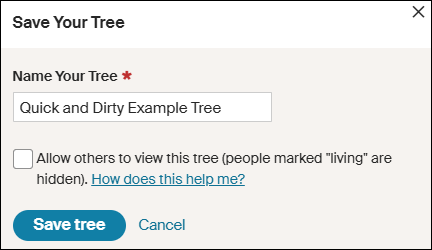
After adding one parent, you’ll be prompted to save and name the tree. Both the tester, who is designated as male by the Ancestry icon, and his father are either both living, or private, so I’m simply entering the surname of Robinson based on the grandfather’s surname. That could be incorrect of course, but it’s all I have to go on – yet.

Ironically, their grandfather’s surname was spelled Robison, without the “n”, not Robinson, but I accidentally entered Robinson and still got where I needed to go.

Clearly, I’m not going to allow this tree to be viewed by others, aka public, so I’m not checking that box. If it’s checked by default, uncheck it.

I don’t make my quick-and-dirty trees public because they are entirely unproven and unverified. I’m literally quickly searching for hints with every intention of abandoning the tree when I’m finished. If you want to clean the tree up later, you have the option to change the tree’s privacy settings.

Information in Your Match’s Tree Might Be Wrong

Complete the tree to be the same as your match’s tree. After saving your tree, click on the individuals you’ve added to view their hints.

Let’s start with Earl Townsend who appears to be our best candidate based on location.

Earl Russell Townsend has 13 hints, including a marriage license that confirms his birth date and location and provides the names of his parents, plus his wife’s name as Mildred Thorstenson. Based on what we know already, this is probably the correct Earl Townsend.

Of course, the wife’s surname could be incorrect. It could be her first or second marriage, or she could have been a widow when they married, so this surname might not be her birth surname.

Look for additional records in Earl’s hints.

Russell’s death certificate confirms that information, as do the birth and death certificates of their children.

Accept those hints.

If you determine that the original information in your match’s tree is incorrect, you’ll want to correct it in your quick-and-dirty tree. Remember, this is a scratch pad – you can’t hurt this tree.

Let’s change Mildred’s name to reflect her birth surname.

I refined Earl’s wife’s name to Mildred Thorstenson, which then produced 12 hints for her, including her marriage and Social Security record, with her birth and death dates, and her parents’ names. Her name in my match’s tree of Mildred Ideal Thorstenson Townsend Smith had produced zero hints.

Additionally, census records showed Mildred with her parents.

These seem to align, so accept those hints.

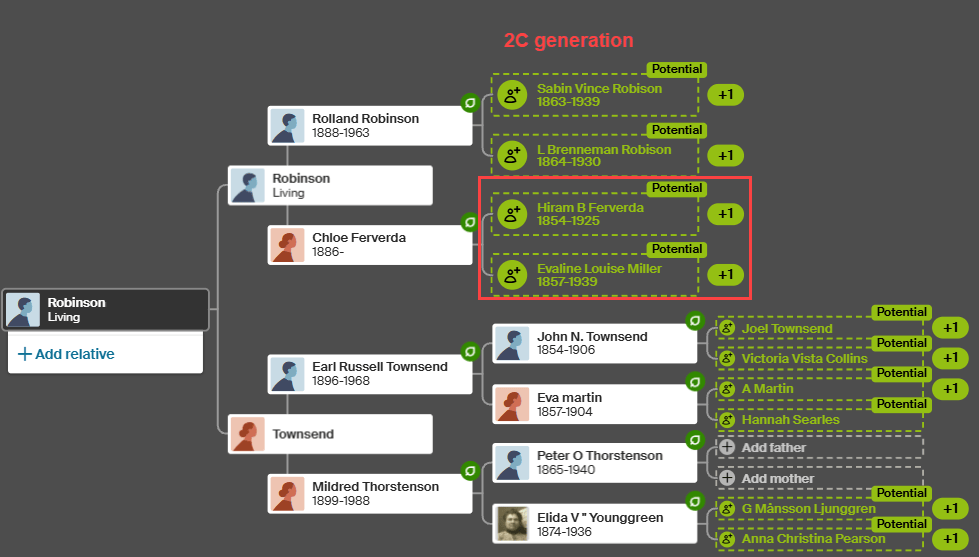
Looking at the pedigree view of my quick-and-dirty tree, we now see that both Russell and Mildred’s parents identified in the records are suggested as their potential parents.

Review each suggestion. If they look accurate based on the records identified, accept those potential parents in order to view the next generation.

Based on these names and census information, I can eliminate the Thorstenson line. It’s Swedish, not German or Dutch, which comprise my mother’s northern Indiana lines, My mother has no known Swedish ancestors, and we have proven her Indiana lineage in this timeframe.

Accepting the hints for the parents of both Earl Townsend and Mildred Thorstenson, parent hints appear for John Townsend and Eva Martin.

Now we’re viewing the next group of hints, which would be the great-great-grandparent generation. If these are our common ancestor, that would mean that I’m third cousins with my match, which is beyond the predicted relationship range. Third cousins is not impossible, but it’s beyond the probable match level based on the amount of shared DNA. furthermore, I don’t recognize any surnames.

So, let’s move to the Robison (incorrectly spelled Robinson) line and step through the same process. We can always come back and work with more parental hints on the Townsend/Martin line if we need to.

Rolland Robison only has a death year in my match’s tree, and that combined with the misspelled surname meant he had no hints on Ancestry, so I clicked on “Search” in my quick-and-dirty tree.

I’m searching for a man by this name, with a wife whose first name is Chloe.

AHA!

There it is! Note that Ancestry found Rolland Robison, not Robinson, married to Chloe.

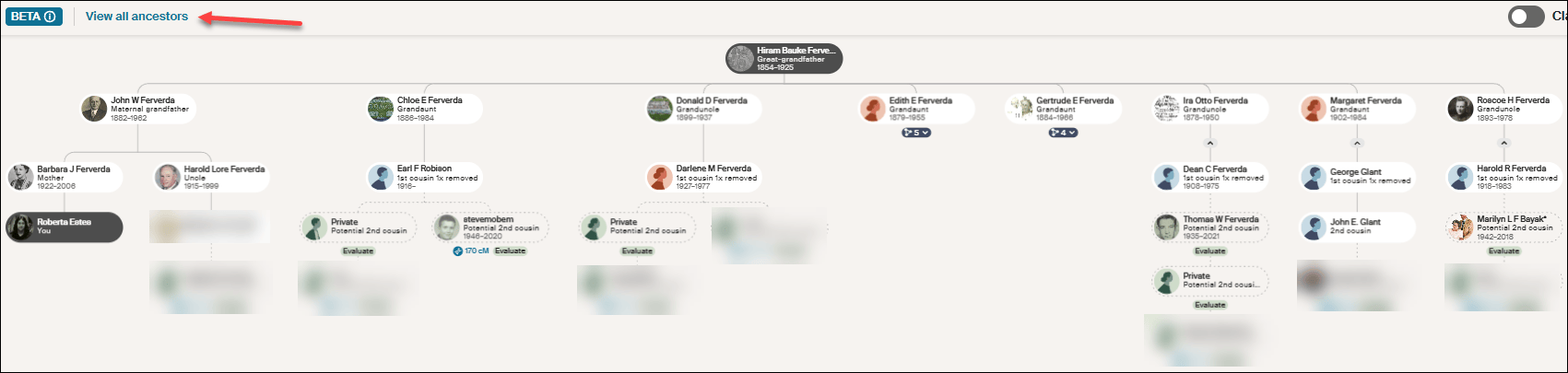
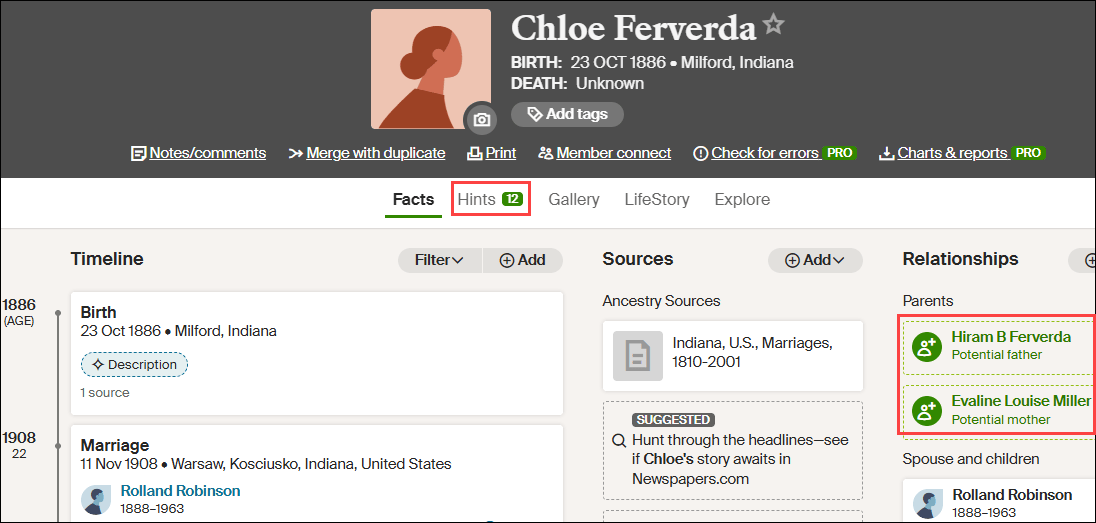
Chloe was a Ferverda. My mother’s father was John Ferverda, and the location is correct for this family.

I saved this record to Rolland Robinson and added Ferverda as Chloe’s surname in our quick-and-dirty tree. This provided Rolland with 12 hints.

Adding Ferverda as Chloe’s surname provides her with a dozen hints too, including potential parents, Hiram B. Ferverda and Evaline Louise Miller – my great-great-grandparents who are indeed the 2C generation.

These common ancestors fall within the expected amount of shared DNA for second cousins, so this aligns well.

My quick-and-dirty tree has revealed at least one pair of common ancestors. Could there be more common lineages? Yes. I would continue building out this quick-and-dirty tree for (at least) another couple of generations on the other lines just to be sure.

What Next?

That depends on what you want to accomplish and your genealogy goals.

I used a DNA match at Ancestry in this example, but your match might be at a different vendor. Regardless, you’ll still want to use Ancestry to build your quick-and-dirty tree based on how they present hints and potential ancestors.

Now that you know how your DNA match connects:

  • Minimally, make a note on the match that indicates the most recent common ancestor(s) identified. I include a link to the quick-and-dirty tree I’ve created.
  • You can add your match and their ancestral path to your common ancestor into your own tree at whichever vendor where the match occurs.
  • If you match at either FamilyTreeDNA or MyHeritage, both of whom provide segment information, I suggest painting your matching segments to DNAPainter.

Painting your segments identifies your matching segments as descending from those ancestors and makes it easier to identify the shared ancestral lineage of anyone else who shares that segment on the same side of your tree (maternal or paternal).

Word of caution here: You can potentially share multiple ancestral paths with any match, so different segments with one match can descend from different ancestors.

  • If your match is at FamilyTreeDNA, you’ll want to link your match to their place in your tree.

Using triangulation, FamilyTreeDNA utilizes linked matches to assign matches who share the same segments to the maternal or paternal side of your tree (or both) using triangulation.

  • You may be trying to break through a brick wall by identifying common ancestors BETWEEN your shared matches that aren’t in your own tree.

This approach is obviously easier the closer your brick wall is in time to the present. Great-grandparents, at the second-cousin level, and great-great-grandparents at the third-cousin level are much easier than 5th- or 6th-generation ancestors who lived before birth and death certificates and detailed census records existed.

Furthermore, the further back in time, the more likely that you may encounter:

  • Pedigree collapse, where the same ancestors appear more than once in your tree
  • Or you share multiple common ancestors with your matches

Of course, there’s always the possibility of endogamy too, where you descend from a historically heavily-intermarried population, such as Ashkenazi Jews or the Amish, for example, which means you may share segments passed down within the population from distant common ancestors you won’t be able to identify. While endogamy in your lineages may increase the amount of shared DNA, which in turn can skew relationship estimates, it won’t prevent you from using quick-and-dirty trees to locate common ancestors.

And finally, unexpected parentage or issues like record destruction may impede your progress, but you’ll never know if you don’t try, which brings us back to the purpose of quick-and-dirty trees.

Building a quick-and-dirty tree is the easiest way to grow your matches’ trees to reveal your common ancestors.

_____________________________________________________________

Share the Love!

You’re always welcome to forward articles or links to friends and share on social media.

Subscribe!

If you haven’t already subscribed, it’s free. You’ll receive an e-mail whenever I publish by clicking the “follow” button at the top of the main blog page, here.

Help Keep This Blog Free

I receive a small commission when you click a vendor link in my articles and purchase that item. This does NOT increase your price but helps me keep the lights on and this informational blog free for everyone. Please click on the affiliate links in the articles or to the vendors below if you are purchasing products or DNA testing.

Thank you so much.

DNA Purchases and Free Uploads

Genealogy Products and Services

My Books

Genealogy Books

Genealogy Research

AI and Genealogy – Brick Walls, Breakthroughs and Blunders

This is the fourth article in the AI series.

I suggest that you read these articles in publication order, as they build on each other.

AI and Genealogy

Most genealogy vendors use AI in one way or another. Like with everything else, there’s yin and yang to AI and genealogy – but for the most part, sprinkled with a little salt, I love the advances.

Let’s survey the genealogy landscape.

FamilySearch is my go-to for document images, especially now. One of the absolute best things to happen in the genealogy field has been the FamilySearch implementation of full-text searches, which they are rolling out across all of their imaged records. I wrote about the rollout here, and it’s only gotten better in the two years since.

For their latest update, including search hints, watch the video FamilySearch Full-Text Search – Your Golden Path to Ancestral Discovery.

May I live long enough to go back and search for information about each one of my ancestors.

Some of what I’ve already found is, well, shocking and sure does make my ancestors more human. Often, only the primary records like deeds, wills and marriage records have been transcribed, indexed and are online, if that much. Some other records have been published, but you have to know to look in a specific county’s records and have access to the published book. If you were trying to “find your way back in time” to where your ancestor came from, before full-text searching, you were out of luck. Now it’s easy to search across time and locations. Let’s just hope you’re not searching for a common name. Sympathies if you have John Smith.

Is full-text search an application of AI? Absolutely – and it’s wonderful. Is it always accurate? Not by a long shot – but it’s much MUCH better than nothing, and if it’s enough to “get you there,” as genealogists, we can deal with the rest.

Don’t let the pursuit of perfect be the enemy of good!

MyHeritage has been leading the pack with AI for some time now. Initially with their newspaper scans and OCR transcriptions, followed by photo restoration tools, and AI Time Machine. Next, they introduced Tribute Reels, which I wrote about here. Tribute Reels allows you to select photos and then animates them to bring your ancestor to life.

MyHeritage has also recently released Scribe AI, which is now one of my favorites. Scribe AI helps to decipher, translate, transcribe, and interpret old documents, photos, and more. I have not written about Scribe AI yet, but you can read the MyHeritage introduction article here, and try it for yourself here.

As an experiment, I selected a document at random from my saved photos at MyHeritage to see what Scribe AI could tell me. This is a French parish marriage record from 1721. Yes, I submitted something difficult, on purpose, but Scribe AI did not disappoint.

Not only did I receive a historical explanation of what this document is, I received the details, key findings, suggested next steps, a full text transcription in French, PLUS a translation to English, my language of choice.

I have been using ChatGPT for this, but sometimes different AI tools stumble over bad handwriting and such. Mied versus Mius, for example. Now I have two “go-to” tools for translations and transcriptions – both ChatGPT and Scribe AI. Hopefully, if one stumbles over something, the other won’t stumble in the same place.

This is EXACTLY the kind of help that genealogists need.

At RootsTech, MyHeritage announced that they will be introducing GAIA, a genealogy AI assistant, soon. I can’t wait.

Ancestry has been using OCR for their newspaper articles and indexes too, and including items such as wedding announcements and obituaries in your hints. They’ve also implemented AI for LifeStory.

I wanted to see what Ancestry had to say about the LifeStory of William George Estes, who lived in Lynch, Kentucky.

On the next screen, I selected “What might William George have done for entertainment while living here?”

This absolutely cracked me up, because William George Estes was, among other things, a notorious bootlegger. I never heard of him setting foot in a church – not once – nor a library.

Lynch actually didn’t have a library, but it did benefit from the Pack Horse Library Project, where librarians on horses brought the library to remote schools and residents in their saddlebags. Now that would have been both interesting and much more accurate.

Generally, though, this description was relatively accurate. These types of activities were available to people in Lynch, a segregated coal-mining town established and owned by the mining company.

Limited drinking spots? William George counted on that, and it’s exactly how he made his living!

Another recent AI beta tool, “Ideas” has been added and can be found in the upper toolbar of any ancestor’s profile.

I tried “Ideas” for Ollie Florence Bolton because of missing chapters in her story that I’d love to fill.

I was excited. I have already looked for these items, but maybe they are available now, or Ollie’s record can be located. I clicked on “Start researching” for her death certificate.

Was I EVER disappointed. Ancestry, whose primary offering is records, has just told me to search records that IT ALREADY HAS. Ancestry owns Newspapers.com, for Pete’s sake. SEARCH THE DOGGONE RECORDS FOR ME!

As I’ve been using Ancestry over the past few days, I’ve noticed the little Ancestry AI diamond pop up from time to time asking if I’d like help with something. What I wish Ancestry would do is transcribe text in the documents shown, beside the document itself, similar to FamilySearch and MyHeritage.

Across Vendors

One place where we see AI across vendors today is for customer support.

All genealogy vendors and most other businesses now use AI chatbots to answer questions that are asked repeatedly.

AI is the way of the future, and eventually, AI will be able to guide us through records and collections relevant to our ancestors. One day soon, AI will know where to look next and will look there on our behalf, providing an accurate analysis of the results. At least that’s my dream.

Everybody has to crawl before they can walk, so let’s keep moving forward and verifying.

Generating Ancestors

Modifying, enhancing, or even creating photographs of our ancestors is certainly of interest to genealogists. If you haven’t encountered this yet, you will.

I submitted a family picture of the children of Hiram Bauke Ferverda and Evaline Miller to ChatGPT. I asked it to create a likeness of the parents of their adult children, who were standing, and to completely ignore the two seated people. I did not tell ChatGPT that the seated people were Hiram and Evaline.

ChatGPT indicated that it could do as I asked, but cautioned:

  • It won’t be historically accurate in a forensic sense—it’s an informed visual estimate based on facial features the siblings share.
  • If there are both brothers and sisters, I can usually generate separate likely father and mother composites.

Here’s the output.

Notice that ChatGPT “cleaned up” the images of the children. That means it actually recreated them behind the scenes.

Here’s the second image that is different yet.

Here’s the original for comparison.

Here’s the question we need to ask ourselves and answer.

As ChatGPT cautioned, the images aren’t accurate – and I must add, they are especially inaccurate after ChatGPT “fixed” the original.

Should genealogists do this and attach reconstituted AI images to their trees?

I don’t think so, as they fall into the same category as supposed photos of Revolutionary War soldiers who died in 1800, decades before cameras existed. At least, in that circumstance, with a little bit of applied knowledge and logic, the discrepancy quickly becomes clear.

If an AI-generated image is attached, it clearly needs to be marked “AI-generated” across the photo in a prominent location, larger than in my example, such that the watermark or label can’t easily be removed as the photo is copied from tree to tree in the future.

AI genealogy expert, Stephen Little points to the Coalition for Responsible AI in Genealogy‘s statement on “Protecting Trust in Historical Images” which suggests that we “always label, always cite, and use for illustration not evidence.” It further states that images generated by AI should not be used as historical documents.

Here’s the bottom line. If you put any of these images in your trees, anyplace other than on your own computer (assuming you don’t sync with an online tree), you’ve released it into the wild because it will spread, often as the result of “hints.” Other people will copy and save it, and it will be represented as the real McCoy, either intentionally or otherwise.

We all need to be hypervigilant when evaluating photos, now and in the future.

Custom GPTs and Experts

Some people write “Expert GPTs”. Think of AI, generally, as a general practitioner. An expert GPT is written by someone who either is an expert in that field or thinks they are.

Like everything else with AI, remain cognizant of your surroundings. I mention this because I’m aware of an instance where someone who was very excited and well-intentioned about a topic wrote a GPT that was inaccurate – and if you trusted that GPT as an expert, you would be wrong and unintentionally spreading misinformation too.

If you find an expert GPT, validate that the author actually IS an expert in the topic at hand.

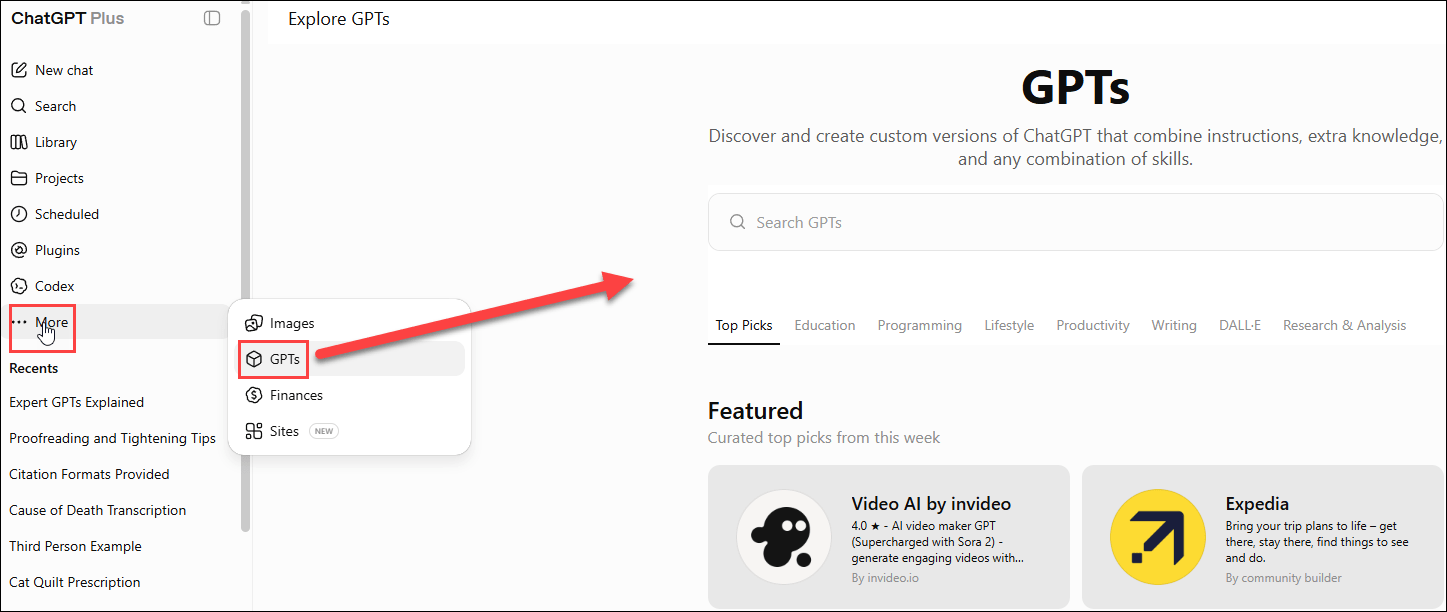
There are several custom GPTs available under the “More” button in the ChatGPT sidebar. You can search by topic or keyword or scroll and view by category.

I searched for Y-GPT, about Y-DNA, because I know positively that Dave Vance is an expert and that the answers his Y-GPT provides can be trusted.

Scroll to the bottom and just click “Start Chat.”

In fact, Dave has pre-loaded his GPT with the most common questions.

Dave’s Y-GPT is a great resource, and I recommend it, but all GPTs are not created equal. Fortunately, there are experts like Dave who freely share their knowledge. Just because someone writes a GPT or THINKS they’re an expert does not make them one. Know your author and their level of expertise before you rely on anything.

Special Project – How I’m Using AI Right Now

I want to share a special project I’m currently working on and how I’m using AI to assist. Actually, AI has saved my bacon.

I’m planning to visit my ancestors’ locations in Massachusetts this year. When I began preparing, I discovered that I have 100 ancestors who hail from 45 different Massachusetts towns. Nobody seemed to stay put. Various reasons existed for moving on. More or better land, marrying someone from another town, religious tiffs within the church, change of religion, or simply the lure of the next frontier.

I’ve compiled research into a document for each individual that includes dates and locations for the following facts, when known:

  • Birth
  • Marriage
  • Childrens’ births and marriages
  • Land grants and ownership, including purchases, sales, and inheritance
  • Military service
  • Civic service or appointments, such as selectmen or jury members
  • Church membership
  • Wills and estates, particularly land distribution
  • Death
  • Burial
  • Anything else that is location-specific, unique, or particularly interesting, such as if they helped to found a town, a church, or built a fort

If you’ve read any of my 52 Ancestors articles, you’re aware that I enjoy visiting where my ancestors lived, and “being” with them where the events in their lives took place.

That meant that after I compiled the information about each ancestor, I had to reorganize it by town because that’s how the trip would be laid out. Furthermore, in each location, I wanted to find my ancestor’s land, today. This recent article about William and Nehemiah Hunt, who owned Punkatasset Hill, and its connection to the Revolutionary War is a good example.

At this point, I have more ancestors whose land I need to find than I have time to complete the detailed research – and I was beginning to feel incredibly discouraged.

I Accidentally Turned to Google AI

When I say accidentally, I mean I never realized just how useful Google’s AI could be until I submitted William Hunt’s name, birth and death dates, and location to see what other resources Google’s search engine might turn up. When reading the AI overview, I realized that Google had found resources that I had not and certainly would not in the time I have available to plan this trip.

Then, I switched to AI mode, and the resource improved even more.

Incredible!

When using AI tools, we need to take into consideration the strengths of the tool we are using or considering and the resources it has available. In this case, aside from being a search engine and finding information, Google’s specialty is maps, locations, place names, establishments like restaurants, hotels, historical societies, museums and more – including customer reviews.

While I was preparing for the upcoming trip, I stumbled across information that my ancestors, William Hunt and his son, Nehemiah Hunt, both owned Punkatasset Hill, the hill that the men marched down in Concord to take the Old North Bridge in 1775. That infamous “shot heard round the world.”

Google found those resources for me, and their AI tool linked them together. I spent about two days researching this one ancestral place and family for the article – working with Google resources and using each link provided to VERIFY accuracy. You will find that sometimes the resource links don’t contain what AI said they do.

I hurriedly put together William Hunt (c1604-1667), Punkatasset Hill, and the Revolution for America’s 250th.

I need to make it perfectly clear at this point that AI did NOT write that article or this article for me. I write all of my own articles. Yes, I know AI could write faster and I could publish more, but that’s not my goal or my work. This is my work. Google’s AI was my research assistant, feeding me places and resources to check based on dozens of individual prompts that I fed it in the form of questions.

As you can see in the article, I was able to locate the actual land and home of Nehemiah Hunt, and it was Google that provided the current address gleaned through the video posted by a realtor. Otherwise, I have no idea how I would ever have found that, especially since the local museum/genealogy society is closed on the day I’ll be there.

I was then able to verify that location using other means, including comparing an old photo with a satellite image.

Caution: AI was incorrect more than once, and had I not verified, I would have been off on a wild goose chase, thinking I was catching my ancestors. But without AI and prompting it in different ways, I would never have found this at all.

The Process

I’m going to step through a prompt series for my ancestor Gyles (also spelled Giles) Hopkins, Mayflower passenger and son of another passenger, Stephen Hopkins. I’ll add my own commentary as we go.

I knew that my ancestor, Gyles (or Giles) Hopkins, obtained land in Brewster, Massachusetts. Here’s information I already had before I engaged Google’s AI.

  • Stephen Hopkins, in his will dated June 6, 1644, made Caleb Hopkins, his younger son, his ‘heir apparent,’ and consequently the whole of his large real estate holding was inherited by Caleb after Stephen died in July or August of 1644. Soon after his father’s death, Caleb gave a very large tract of land located in what is now Brewster to Gyles Hopkins, his older and only surviving brother.
  • As early as 1653, Gyles Hopkins owned the 8th lot in a tract in what is now West Brewster, east of Quivet, which he sold on Nov. 9, 1666, to John Wing of Yarmouth in consideration of a mare, colt and other land.

I wanted to know specifically where this land was located and whether Gyles ever lived there.

My first question to Google was, “Where was Giles Hopkins’ land in Brewster, MA, and where is that today?”

Tip: Be very careful when Googling to include identifying information about the person you’re asking about. For example, “Where was the land of Gyles, also spelled Giles, Hopkins who lived between <date> and <date>…” would have been a better way to ask the question to ensure that I received what I wanted. There could be multiple men with the same name.

Based on what I knew about other aspects of Gyles’ life, I suspected that this land was held speculatively, as an investment, because I knew he had lived in Eastham.

So, I was surprised to see that a home had been built there.

But read carefully – it says, “A historical Hopkins home was later built in this area.” It doesn’t say HIS home, but still.

Plus, there’s a Hopkins Homestead and Bakery? Seriously? You mean, I can visit the land he owned, sit there, and have coffee? Maybe? And who built that house? Is it the original house? So many questions…I had to stop myself from immediately going down that rabbit hole. And I wasn’t even in “AI Mode” yet.

Ok, let’s switch to AI Mode and see what it says.

Now we have the name of Snowy Owl Coffee Roasters too, which says it’s a homestead site, but not necessarily “the” homestead site.

And it looks like Gyles’ (or Giles’) son, Stephen, lived in this location. His grandson apparently was also named Stephen.

Google in AI Mode almost always asks if you’d like additional information – and it’s like crack for genealogists – almost impossible to say no. Keep an eye on the sources on the right, because they change with each question or answer, and you may need to click to “show all.”

Tip: Read the sources; do NOT presume that the verbiage used by AI is verbatim in the sources or that it’s there at all.

Next, I asked to see the bakery on a map. You can tell that I’m considering stopping during my visit, right?

Google just backtracked a bit, saying that the Snowy Owl had moved and that the Hopkins House Bakery sits directly on the land granted in the 1640s.

Hot diggity!!!

Word of caution: Verify addresses and locations on Google Maps directly, as I have found discrepancies.

Keep reading, because there’s more!

Wait? What? There’s a First Encounter Beach monument? I had no idea.

Google asked if I wanted to know more. Yes, of COURSE I want to know more about that.

I already know where Gyles is buried, and I’ll get to that when I’m not focused on his land in Brewster.

Ok, I’m definitely visiting the First Encounter site, but where is it exactly?

Google asked me if I wanted driving directions. I asked for 3 locations to be included: the Hopkins House, the Cove Burying Ground in Eastham, where Gyles is buried, and the monument site.

Google must be experiencing “fatigue” because it can’t seem to retrieve everything from its memory. I’ve had this issue before. I know that Google can easily show multiple locations and stops on maps, but this time, it didn’t show “the map below” that it said was there.

Tip: When I encounter this issue, I close Google and sometimes the browser altogether, then reopen Google in AI Mode.

You can then select the conversation you were just engaged in from the AI history menu. You can also search for keywords and view your most recent AI Mode converations. How convenient is that?!

I noticed an “Upgrade” button appear in the top bar and wondered if that has anything to do with the “fatigue” Google’s AI was experiencing.

So, I clicked on the link to see if this could have been the problem with the fatigue that failed to produce the map. It wasn’t the problem, but the information provided was still useful.

I suspect that if I upgraded to either Plus or Pro, which is very reasonably priced, I might experience fewer display issues. I figured that I might have to do that to complete this time-critical project – but I didn’t.

Instead, I just clicked on the embedded link to the map, and saw that the route had been nicely mapped out.

Google even added a few local features that I hadn’t requested, which I found helpful. I should also note, though, that it missed an important landmark – so don’t get overconfident in its abilities and answers, and always verify.

I didn’t realize that the Cove Burying Ground was just a few feet away from the Eagle Wing Inn. I hadn’t asked for that information. I’m not complaining because I’m going to need a place to stay and I can click on that location and see important information like customer reviews.

Unfortunately, by the time I finished the planning for this project, this Inn was full, but Google recommended other locations based on clustering my visit locations so that I only had to move every few days – establishing a central hub in an area.

Often, several ancestors lived in a specific town, like both Plymouth and Eastham. I compiled my information for each individual location, even if they were adjacent and everything I knew about all ancestors in that location, into a PDF file. Providing AI with too much in a single prompt results in less, more diluted, and less reliable information.

For each town, I uploaded the PDF file and asked Google AI how to find each piece of land, where it is located today, how much time to allocate for each stop, the best order, and even for information on places I’ve missed that would be of interest.

In one location, Google suggested a harbor cruise, complete with a contact phone number and website, to view the land of my ancestor because it’s on Saquish Head, which is entirely privately owned and access-restricted.

In another instance, Google identified a home built by my ancestor that still stands. It has been moved from the original location, which is why I didn’t find it.

I did a LOT of prep work and provided summary information for each ancestor, including location, some of which Google helped me gather. The document totalled 551 pages. I asked Google if it could extract every mention of each town from that document, and it replied that its processing limit was between 50 and 100 pages, so the extraction would have to be done by hand. That’s OK, because it gave me a better feel for the landscape and their lives.

After I extracted the ancestors’ information by town, Google helped me immensely by adding information and organizing it into a plan, with directions and recommended time allocation for each place on the itinerary. In one town, Google even found a local Inn located on my ancestors’ land. Unfortunately, it’s booked, but it is open for dinner, so I’ll still be dining with my ancestor – so to speak.

Here were the project steps:

  1. Gather information by ancestor using traditional genealogical resources, plus Google AI to add anything I didn’t already have. Note that Google does not gather information from behind paywalled sites, or sites that technologically deflect crawling and indexing information.
  2. Create section in Master Ancestor Document for each ancestor.
  3. Ask Google to find ancestral land locations today, adding to their page
  4. Extract information from each person in the ancestor document and reassemble by town in travel order. When complete, save as PDF file by town.
  5. Submit PDF to Google AI and ask for land locations today – verifying what it said before. Prompt for an itinerary for each town, listing each stop, and how long each town’s activities will take. Include any gotchas such as locked cemeteries, museum hours, inaccessible locations (like islands), and accessibility concerns (walking, steep hills, etc.)
  6. After each town was complete, create itinerary in table format. Submit to Google AI for verification and suggested lodging in each area. Ask for driving suggestions to avoid high-traffic areas or congested times of day or other concerns or requests – including lunch or dinner suggestions.

This leaves me with the following documents:

Just a few of my Massachusetts ancestors.

  • Master Document by Ancestor – One master document that includes every ancestor in this region. The Table of Contents is 5 pages long, and the document eventually totalled 551 pages. This is how I gathered the information before any organization, and before eliminating Connecticut and Maine, which are outside the scope of this trip.
  • Master Document by Location – I quickly realized that the ancestor document was already much too long, so I created a second document by location which totalled 531 pages.
  • Individual Location Documents – When finished, I divided the Master Location Document into one file for each location. I eliminated locations where there was nothing to see, so I now have 35 individual files, which have been updated individually using AI, so they no longer match the Master Location Document. I will load these to my laptop and also to a location that I can access from my phone so I can reference them as I travel. I would actually like to print them by location to take with me, except 500 pages is a ream of paper and paper is heavy.
  • Master Itinerary by Day/Location – Detailing where I’m staying, confirmation and phone numbers, which town I’m visiting which day, and anything else I need “at a glance.”

What will I need to do after this trip? I’ll need to combine the information from the Master Document by Ancestor with information in the Individual Location Documents that pertains to them. I’ll add photos, of course, and new information gleaned during the trip. I will compile this by ancestor in their own personal file. Will AI be able to help with this step? I don’t know. We’ll see.

And yes, in case you’re wondering, you’ll be reading these as 52 Ancestors stories for years to come!

My intention in this exercize was to illustrate how AI can help locate important geographical features, like ancestral land, for instance, help you organize your data and even plan trips. I almost always find more than I was asking for. I’ve found that Google’s ability to read historical and local history websites is extremely beneficial.

I feared that I might not be ready for this trip in time to make reservations, but thanks to Google AI, I am – and I’ve discovered things about my ancestors I would not have found in time. The worst thing possible is to make a critical discovery AFTER you’ve visited and don’t have the opportunity to return.

Advanced Tools and Bleeding Edge

This series has been focused on the “normie” user, not someone pushing the frontiers of the AI envelope – although we certainly need those pioneers to help sort out how to use these tools safely for genealogy and when to stay away.

When attempting more complex tasks using AI, I’ve experienced spectacular failures. But yesterday’s failures are today’s or tomorrow’s successes. The tools literally get better every day, and a week or month in AI is like a year anywhere else.

The tools from the various AI vendors leapfrog each other, too, and each tool has a unique learning curve.

Recently, Anthropic’s Claude introduced an extremely powerful tool called Fable 5 that was free for the first several days, then available via the purchase of prepaid usage credits or tokens. That’s marketing genius, because it encouraged what I would consider “complex genealogy users” to try it. People who had projects either in mind or in the wings where other models had failed.

Specifically, Fable 5 is focused on what I would call “long horizon” jobs or tasks, such as, “Here are 300 Acadian documents. Please translate and transcribe them, then reconstruct the relationships of the people in these documents.” Or, “Here are 550 pages of ancestors, please reorganize them by town, and within town, by year.” Of course, the construction of the prompt has a lot to do with the degree of success of any query.

Anthropic says it can sustain multi-stage projects over hours or even days, planning work, checking its own output, delegating to sub-agents in agent frameworks, and producing deliverables with much less supervision than previous models.

Some people reported amazing successes with multiple files and hundreds of pages being read, processed, correlated, and reported, mostly accurately. Others had a completely different experience.

I have not been working with these new tools, but Mark Thompson and Steve Little have been. Not only did I not have a massive project ready and waiting, as I had already completed by Massachusetts town extraction, I also needed to have time to VERIFY something that large, because as tempting as this is, AI can be and is often wrong.

You can read about Mark turning Fable 5 loose on his archiving project, here.

Catch up with Steve’s interesting experiments, troubleshooting, analysis and guidance here and here.

The AI landscape is shifting away from asking “Which AI is best?” to asking “How do I assemble the best team of AI specialists and effectively use them?”

Interestingly, these advanced agents are now being used both independently and together to answer complex questions and analyze projects. This is known informally as cross-model verification. Sometimes the models agree, and sometimes they disagree, presenting different “evidence” and debate positions for their conclusions. Ultimately, you are the final arbiter.

Just as genealogists don’t rely on a single record, increasingly they shouldn’t rely on a single AI assistant either. A census, will, land grant, deed, and church record each contribute different evidence, all of which needs to be considered together. Likewise, different AI models have different strengths, weaknesses, and biases. Comparing their answers is often the digital equivalent of seeking independent corroborating evidence.

You don’t need to work on the bleeding edge. Just tuck this away for a future project after these tools are more reliable and stable.

The Take-Away

The takeaway from this is that AI is a force to be reckoned with.

Vendors are using AI, sometimes when we know it, and other times behind the scenes to process text, for example. The net-net of this is absolutely positive.

AI usage will increase over time – and that’s a good thing since we can verify the output. AI can accomplish in seconds, minutes or hours what would take us hours, days, months or maybe never.

As always, AI becomes dangerous when we don’t verify, don’t understand that we need to, don’t know how to confirm the results or we trust “experts” who aren’t.

What Do You Want?

I’m excited for the future and I have my own personal list of how I hope the vendors will integrate AI with tools they provide.

My list includes, but is not limited to:

  • AI records transcription at Ancestry, similar to FamilySearch.
  • At FamilySearch, full-text records by name and location “suggested” as hints, by individual, along with a multiple-record summary of evidence. Over time, this could go a VERY long way in resolving the “wrong spouse” or “wrong child” connected issues that persist.
  • AI “DNA plus tree matching” WITH common ancestors, meaning providing a list of people on your DNA match list who match you and each other and have common ancestors in their tree that you have. Both Ancestry and MyHeritage provide part of this in different ways today, but not all of it.
  • AI “DNA plus tree matching” WITHOUT a common ancestor in YOUR tree. This provides a means to potentially identify a brick-walled ancestor by identifying the ancestors of the people whose DNA matches yours and each other, but who do not share a common ancestor in your tree. However, they DO share ancestors with each other, which could be critically important to your research. Yes, I know this would need to be fleshed out – but it’s doable.
  • AI records searching. Essentially, what Ancestry suggests as next steps, but to actually DO THE SEARCH on your behalf and provide those results. Go a step further and indicate where to find the records if they aren’t on the platform. Message you if those records ever become available there, or the person has been revealed in existing records. For example, if death certificates are now available but weren’t previously – or the writing was so horrendous that the indexing didn’t pick it up before, but the person has been identified now – let me know.
  • At FamilySearch, something similar to relatives at RootsTech, but year-round so that cousins can contact each other, collaborate and make breakthroughs together.
  • Broad yet restricted AI searching, such as “provide me with a list of all transactions that include anyone with the surname of Estes or Eastes between 1700 and 1720 in Halifax County, Virginia.” Or, “Provide me with a list of all Estes men who live in Tennessee but who were born in Virginia in the 1850-1880 censuses.” Or, “Provide me with a list of all Estes men who are listed on the 1840 census as being pensioners or having served in the Revolutionary War.”
  • At WikiTree, FamilySearch, GEDmatch, Geni and other public sharing platforms,  identify and provide a way to contact individuals who qualify to test for the Y-DNA (male direct paternal male-to-male line) or mitochondrial DNA (everyone’s direct matrilineal mother-to-mother line) of your common ancestors. Include an avenue to offer a testing scholarship at FamilyTreeDNA. There’s so much we could learn!!!

I’m sure you can add to this list. Specifically, what would you like to see AI be able to do for you, either within or outside of a vendor’s platform?

The sky’s the limit, so dream big!

_____________________________________________________________

Share the Love!

You’re always welcome to forward articles or links to friends and share on social media.

Subscribe!

If you haven’t already subscribed, it’s free. You’ll receive an e-mail whenever I publish by clicking the “follow” button at the top of the main blog page, here.

Help Keep This Blog Free

I receive a small commission when you click a vendor link in my articles and purchase that item. This does NOT increase your price but helps me keep the lights on and this informational blog free for everyone. Please click on the affiliate links in the articles or to the vendors below if you are purchasing products or DNA testing.

Thank you so much.

DNA Purchases and Free Uploads

Genealogy Products and Services

My Books

Genealogy Books

Genealogy Research

Mitotree: First, the Tree – Now the Paper

It’s definitely a red-letter day.

Dr. Paul Maier, the lead author on the new paper Mitotree: The Universal Human Mitochondrial Reference Phylogeny at 10x the Resolution has uploaded the paper to the bioRxiv preprint server, here.

I want to congratulate all of the authors, most of whom are members of the FamilyTreeDNA R&D team as either employees or contractors. I’m a contractor and have had the honor of working with these amazing colleagues on this project since 2020.

About Mitotree

Mitotree was officially “born” on February 25, 2025, and the tree has been updated several times since. About 75% of FamilyTreeDNA’s customers who have taken the full-sequence mitochondrial DNA test received a more refined haplogroup with the release of Mitotree or subsequent updates. Those haplogroups are, on average, 2000 years newer than the person’s legacy Phylotree haplogroup, and some are much more recent.

This means that the tree branches have gotten much, much bushier close to the tips. In other words, lots more twigs and leaves!

Unfortunately, about 25% of testers did not receive a new haplogroup because they do not have any qualifying mutations:

  • Either because they have no additional mutations
  • Or because they have mutations, but they are unstable
  • Or because they have mutations, but no other testers have yet tested that match them to split a branch

The good news is that with the addition of haplotype clusters, everyone benefits from new matching and grouping tools. Testers are grouped into clusters on their matches page, and on the Match Time Tree in Discover, which is much more useful for genealogy.

I know this paper has been a long time coming, but it’s well worth the wait.

Mitotree was a massive undertaking. We began with PhyloTree v17 which had 5,438 hand-curated branches constructed from 24,275 full and partial mitochondrial sequences. Phylotree was last updated in 2016 before subsequently being abandoned.

The Million Mito Team developed Mitotree, a robust phylogeny with more than 54,000 branches formed from over 330,000 complete mitochondrial sequences, of which 177,196 are unique sequences.

Let’s Look Under the Hood

There are three critical pieces of information in those statements.

First, the PhyloTree curation and maintenance was not automated, and a paper detailing their build process, what mutations were included or excluded, and under what circumstances was never published.

Approximately once a year, a new PhyloTree was published where newer samples were individually evaluated and new haplogroups were hand-grafted onto an existing backbone tree.

This methodology did not allow for deep splits to become apparent, because the tree itself was never recalculated. This is exactly how haplogroup L7 went undetected until the Million Mito Team recalculated the tree, including the backbone, in 2022, and published this paper about L7’s discovery.

In other words, while PhyloTree was publicly available, there was no recipe for how it was created or maintained.

Clearly, the tree-building process had to be automated, as hand-curation was unsustainable. There were no academic programs in existence capable of handling the number of samples involved. Not even in 2016 for fewer than 25,000 samples, let alone today.

To maintain haplogroup naming consistency, the first thing our team had to do was write software to phylogenetically reverse engineer PhyloTree v17 to establish a common foundation on which to build. This step was essential for consistency and maintaining the established haplogroup naming pattern.

That software also had to be capable of scaling up exponentially. The first versions took weeks to run, which clearly wasn’t an acceptable long-term solution. Still, being able to establish a foundational backbone to build on programmatically was a victory in and of itself.

Second, PhyloTree used partial sequences, meaning HVR1 and HVR2 samples. Early academic researchers did not perform full sequence testing, so the curators of PhyloTree used what was available to the best of their ability.

With over 330,000 full-sequence samples available today, we no longer include partial samples.

Third, 177,196 of the 331,221 full sequence samples used were unique. Before launching the program to construct the tree, identical samples from known immediate relatives are deduped, when possible, in order to reduce unnecessary clutter and processing time.

This means two things. The actual number of testers is greater than 331,000. But more importantly, anyone who thinks that mitochondrial DNA isn’t interesting should take another look. More than half of the sequences used for tree-building are unique, which handily dispels the myth that mitochondrial DNA doesn’t mutate often enough to be useful for genealogy.

The Mitotree initiative has been both scientifically and genealogically successful beyond anything we could have imagined. The base tree includes approximately 180 branches that are older than 30,000 years, including the discovery of haplogroup L7 at 100,000 years old. These branches both expand and more firmly root the oldest portions of the tree.

Amazingly, haplogroup L7 has living descendants whose earliest known family members are found in Turkey, Saudi Arabia, Yemen, the UAE, Palestinian Territory, Ethiopia, Sudan, and South Africa.

Another fun discovery involved Otzi, the Iceman, a mummy found frozen in the Italian Alps who lived more than 5,000 years ago. He was thought to carry an extinct haplogroup, K1ö, named in his honor, but as it turns out, he’s actually a member of haplogroup K1f, a clade with living descendants in Algeria. Additionally, Otzi now matches four ancient burials too, so he does have cousins.

We couldn’t have made these discoveries without the right people testing, so please encourage everyone and dispel the discouraging myth that mitochondrial DNA isn’t useful or interesting. It absolutely IS, and the success stories keep rolling in!

Why Build a Phylogenetic Tree?

Simply put, the history of our ancestors, both recently and reaching back into ancient history, is revealed in the tree – and there’s absolutely no other avenue to reach this information. Ironically, it’s readily available to everyone because everyone has mitochondrial DNA and can easily take the test.

Mitochondrial DNA is different than Y-DNA, which has its own phylogenetic tree based on SNP mutations, and autosomal DNA, which has no tree.

The reason that both Y-DNA and mitochondrial DNA can have phylogenetic trees is that they are inherited from the appropriate parent with only occasional mutations, while autosomal DNA is roughly halved in each generation.

Y-DNA is inherited by males only from their fathers, with no admixture from their mother, while mitochondrial DNA is inherited by everyone from only their mothers, with no admixture from their father.

Autosomal DNA is inherited through random recombination, with half coming from each parent, except for the X chromosome which has its own inheritance pattern. X-DNA is often confused with mitochondrial DNA, but they are entirely different types of DNA. I wrote about that here.

No tree is possible for autosomal DNA, because it gets diced and riced in each generation.

The mutations that occur occasionally and randomly in both Y and mitochondrial DNA form a trail of breadcrumbs leading backward in time, or in our case, they form both the trunk and branches on the tree.

Those unique mutations, once they occur, are inherited by subsequent generations, forming a path back in time.

In current generations, those mutations provide testers with the ability to identify our closest cousins who inherited those same mutations and who have taken either a Big Y-700 test, in males, or a mitochondrial DNA full sequence test for everyone.

In this conceptual example, you can see that Ancestor 1 carries mutation A, as do the next two generations who inherited it from their parent. However, Ancestor 4 now has additional mutation B, so that person carries mutations A+B. This inheritance pattern continues through the apricol lineage as mutations C and D are added in subsequent generations, until “You” are born with A+B+C+D.

Your cousin’s ancestor, on the other hand, was also born to Ancestor 4 and carries both A+B, as seen in the green column. Three generations later, that line added mutation F. Your  ancestor 7 added mutation C, so now the apricot and green lineages can easily be genetically distinguished from each other.

When a living person tests, we immediately know, based on the combination of their mutations, if and where they fit in this lineage, because both the apricot and green branches have accumulated unique mutations that the original blue Ancestor 4 and earlier ancestors did not have.

Using our knowledge of the tree branches, when and where they occurred, provides valuable genealogical information, along with fascinating Ancient Connections, both since and prior to the adoption of surnames.

Both Y-DNA and mitochondrial DNA can reach much further back in time than autosomal DNA because they are not diluted with DNA from the other parent in each generation.

So mitochondrial DNA is both broad, meaning many leaves, and deep, meaning it helps us look straight back in time like a laser sight, all the way to the common ancestor of all humanity, Mitochondrial Eve, who lived about 140,000 years ago in Africa.

Mitochondrial DNA Presents Unique Challenges

Mitochondrial DNA presents challenges not found in Y-DNA tree building.

For example, mitochondrial DNA only has 16,569 locations available to utilize, while Y-DNA currently uses roughly 22 million “gold standard” locations on the Y chromosome.

Of those 16,569 mitochondrial locations, some are not reliable enough for tree-building.

Unreliable mutations include:

  • Insertions, where extra copies of a particular nucleotide (Thymine, Adenine, Cytosine and Guanine) have been inserted at a specific location. Those are indicated by designations such as 309.1C where 309 indicates the marker location, .1 indicates the number of insertions at that location, and C (for Cytosine in this example) indicates the nucleotide inserted.
  • Heteroplasmies occur when multiple nucleotides are detected at a specific location. They are reported by a different letter than T, A, C or G, depending on which of multiple nucleotides are found. Heteroplasmies tend to “come and go” based on detection and threshold levels, so they can’t be used the same way as more stable mutations for tree building – and are often, but not always, unreliable for genealogy. I wrote about this in the article, What is a Heteroplasmy and Why Do I Care?.

Those locations and types of mutations have been excluded from forming tree branches, or downweighted, because they are too prone to mutating back and forth. However, they *might* be useful for genealogical purposes. Less-than-reliable mutations are now used to create haplotype clusters, even though they aren’t used to create new branches on the Mitotree.

I wrote about how haplogroups and haplotype clusters are formed in these articles:

Weighting and Confidence Factors

Mitotree formation would have been a lot easier if delineations, meaning inclusions and exclusions, were clear, either yes or no, but they aren’t.

Some were obvious from the get-go, such as insertions at location 309 and elsewhere, but other situations were much less obvious.

For example, sometimes there’s a specific location that seems prone to reversion, mutating back and forth, meaning that it mutates, then returns to its original state, then repeats the process.

Reversions are a natural phenomenon that occurs frequently in mitochondrial DNA, but is rarely, if ever, found in Y-DNA.

Let’s look at an example.

Courtesy Dr. Paul Maier

How many reversions at the same location are too many, especially if they are close in the tree?

In the above example, the mutation from A to G occurs just below the first arrow, forming haplogroup L1, a branch of L. The red areas all carry that mutation, subsequently forming eight new branches.

However, one step downstream from that mutation, just above the second arrow, location 7055 back-mutates, or reverts to A from G, which is indicated by the “!”. That reverse mutation forms haplogroup L1c3.

If location 7055 continues to flip back and forth between A and G, at what point do we have less confidence in that location, and at what point should a location be excluded from the tree and prevented from creating or dividing a branch?

The answer is that “it depends,” sometimes on the branch, sometimes on the “group” of other mutations it’s found with, and other factors. Some locations are stable in some parts of the tree, but unstable in others. We certainly never expected to see that!

This means the team had to design and build a weighting methodology so that relevant mutations, such as reversions, are not summarily excluded from tree building but instead carry different confidence weighting levels, depending on the circumstances.

Some samples, such as ancient DNA, were down-weighted in general due to their propensity to contain artifacts resulting from deterioration. Ancient samples can still influence branching, just not as much as a high-quality modern sample.

Furthermore, especially when utilizing academic samples, results with a high number of heteroplasmies are excluded, along with those with ambiguous reads and missing upstream mutations, which were previously inferred with PhyloTree. Academic samples vary in quality and age, and we have no way of knowing which quality criteria were used by that lab at that time.

These types of variances made constructing and updating the Mitotree more challenging than the Y-DNA tree, which is not subject to weighting, resulting from phylogenetic tug-of-war between mutations.

In some situations, the addition of just one test can make the difference between a new branch, or no branch, in a subsequent run of the tree. Due to this type of scenario, and fine-tuning the algorithm, some people’s new haplogroups have reverted to an earlier haplogroup in subsequent Mitotree updates.

The paper and supplemental materials provide details about the exclusion process, types of exclusions, and a list of excluded marker locations.

You can view the confidence of any haplogroup in the Classic Mitotree view in Discover.

My haplogroup, J1c2f, is formed by the mutation G9055A, and you can see that the confidence rank is 7.5 out of 10.

Mousing over the little up-arrow tree icon beside the star explains changes in nearby branches, which can affect the haplogroup’s confidence ranking.

Branches are not renamed for convenience, and only when phylogenetically warranted. Existing haplogroup names used either on PhyloTree, in academic literature, or previously on the Y-Full tree are either maintained or avoided to eliminate potential confusion. No one wants two different haplogroup names depending on which tree is being viewed.

Previously obsoleted names remain permanently obsoleted and are not reused.

The paper explains further about technical corrections and tie-breaker situations. In some cases, potential branches with equal or near-equal weighting are flagged for team review.

Amazing Discoveries

I encourage everyone to read the section in the paper beginning with “Notable discoveries.” These aren’t people, as in Discover’s Notable Connections, but scientific accomplishments achieved with the new Mitotree.

Our knowledge of human migration within and out of Africa has been greatly refined, as well as the ancestral path into and across Eurasia, Asia, and into the Pacific Rim. If you have unusual mitochondrial haplogroups such as L, M, N, P, Q, R or S, you’ll absolutely want to read this.

Of course, in time these haplogroups branch and become Paleolithic haplogroups, then the Gravettian-Mesolithic followed by the Hunter-Gatherers found throughout Europe that we are familiar with. We’ve learned a great deal from rare ancient DNA samples that anchor more modern haplogroups in a place and time, and inform us of migration patterns as well as how now-extinct ghost populations gave rise to current ones.

The earliest humans, whom Mitotree has more firmly anchored, formed a trickle out of Africa that became a bifurcated stream, eventually flowing across the rest of the world. What recorded and even archaeological history cannot tell us can be and is revealed through the patterns held in our DNA today – and Mitotree is our map to read them. Common ancestors are found where our mutations as haplogroups converge, joining as we travel backward in time, piercing an otherwise impenetrable veil.

For those with Native American ancestry, Mitotree expands the two-wave theory, refining it into five or six probable migration surges, depending on how you count, based on a combination of haplogroup ages and distribution.

Summarizing from the paper:

The first wave of haplogroups A2, B2, C1b, C1c, C1d, D1, and D4h3a arrived from Asia, across Beringia or along the Pacific Corridor, about 17,000 to 18,500 years ago, and expanded along the Pacific coast. D4h3a is found almost exclusively in the Pacific region.

This was followed by haplogroup C4c about 15,800 years ago and X2a about 10,000 years ago, which expanded into the interior through the ice-free corridor east of the Rockies after the ice melted.

Next were the Paleo-Eskimo and Na-Dene speakers in haplogroups A2a, D2a, D2b, D2c/D3, and D4b1a2a1a2, who, between 3000 and 7000 years ago, made their way from Alaska, across the polar regions of Canada, into Greenland.

Na-Dene speakers, Apache and Navajo, in haplogroups A2a and B2a made their way southwest between 1300 and 1500 CE, or between 500 and 700 years ago.

Last, the present-day Inuit-Yupik expanded from Beringia to Greenland about 1000 CE.

For additional information, please see the Native American lineages section of the paper.

Mitotree has also clarified the ancestors of the Ainu/Jomon people from Hokkaido, Japan, and their ancient Paleolithic northwest Asian and Siberian relatives. The ancestors of this group and Native Americans share even earlier Asian ancestors.

The history of the Jewish people has been significantly refined as well, expanding on earlier works, and is found in the Counting the newest Jewish founders section of the paper.

  • 43% of Ashkenazi Jewish testers fell into 5 founding lineages where they had no subclades before, but they do now.
  • Two clades of haplogroup K have now been split 4000 to 5000 years ago in Romania.
  • There’s new information about the crypto-Jewish community in Portugal, Mountain Jews from Persia and the Caucasus, plus Jewish groups in India, Georgia, Azerbaijan, Israel and Libya.
  • Additionally, haplogroup M33c9b tells the story of Ashkenazi Silk Road merchants who traveled between China and Europe.

The paper reports the isolation of Sardinian-specific haplogroups and provides substantially greater structural definition for the Saami people, increasing from 22 subclades to more than 300.

The Notable discoveries section is chock full of information.

Genealogy Jump-Start

Today’s tree is ten times larger than the 2016 tree, and will continue to grow as more people take a full sequence mitochondrial DNA test, available at FamilyTreeDNA.

The greatly improved tree alone is not the only facilitator of genealogical success. A dozen reports, including Haplotype Clusters and the Match Time Tree are provided for all full-sequence testers in Discover. I wrote about how to effectively use your matches and Discover to break through genealogy brick walls, here.

There are a couple of things you need to do to increase your opportunities for success and to help Discover and Mitotree.

Genealogy is a team sport, and you can increase everyone’s success rate by completing (and updating) your Earliest Known Ancestor (EKA) and location information, found under “Account Settings” beneath your name in the upper right hand corner when signed on, then “Genealogy”, then “Earliest Known Ancestor”, and by providing a family tree or a link to WikiTree.

Identifying common ancestors is what testing is all about, and these are all important success factors. Everyone wants to identify previously unknown ancestors.

Mitotree is More Than Genealogy

Of course, as genealogists, we’re focused on how to use the new Mitotree information, paired with Discover, to identify brick-walled ancestors and learn more about them. I’ve written specifically about how to do that in these two articles:

Mitotree isn’t just an explosion for genealogy, though – it’s an incredible scientific achievement. Instead of genealogy benefiting from other specialties, now they can benefit from what genealogy has wrought.

Mitotree presents opportunities to rethink and potentially recalculate dating and information in other fields, such as archaeology, medical genetics, forensics, and history.

We know vastly more than ever before, but this is only the beginning.

With each new tester and every ancient genome added to the growing body of evidence, our understanding becomes more refined, revealing insights about our ancestors, and weaving our thread into the broader tapestry of human history.

_____________________________________________________________

Share the Love!

You’re always welcome to forward articles or links to friends and share on social media.

Subscribe!

If you haven’t already subscribed, it’s free. You’ll receive an e-mail whenever I publish by clicking the “follow” button at the top of the main blog page, here.

Help Keep This Blog Free

I receive a small commission when you click a vendor link in my articles and purchase that item. This does NOT increase your price but helps me keep the lights on and this informational blog free for everyone. Please click on the affiliate links in the articles or to the vendors below if you are purchasing products or DNA testing.

Thank you so much.

DNA Purchases and Free Uploads

Genealogy Products and Services

My Books

Genealogy Books

Genealogy Research

Ancient Connections: Where Archaeology Meets Your Ancestors

Ancient Connections, a report found on FamilyTreeDNA’s Discover platform for both Y-DNA and mitochondrial DNA (mtDNA), can be used in multiple ways to enhance your genealogy and unlock secrets.

It’s exciting to examine ancient burials linked to our ancestors and understand how we connect to them. Ancient Connections offer a wealth of information, providing clues that can help unravel long-standing mysteries.

Today, there are more than 12,960 Y-DNA Ancient Connections in Discover, along with more than 25,310 mitochondrial Ancient Connections, and that number increases weekly.

Why the disparity, you ask? Remember, everyone has mitochondrial DNA, but only males have Y-DNA.

In addition to matches, your DNA results hold something even more powerful – evidence of where your ancestors and their cousins lived in the distant past, when they lived, and the cultural context surrounding them. These essential insights are unavailable through any other means. Ancient Connections help us answer the age-old question, “Where did I come from?”

Could These People Be My Ancestors?

I’ll show you how to answer another question, too. Which of these Ancient Connections could potentially be your ancestors, and which ones are your “haplo-cousins”?

Regardless, they all help us understand our ancestors’ past, and that of their descendants.

Discover is for Everyone

FamilyTreeDNA provides a free version of Discover that everyone can use. There’s also an enriched version with additional information for their customers who have purchased Y-DNA and mitochondrial DNA tests.

Discover has something to offer for everyone.

Mitochondrial DNA is passed from mothers to all of their children of both sexes – unmixed with the DNA of the father.
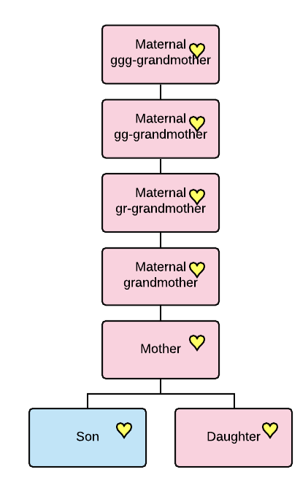
Everyone has their mother’s mitochondrial DNA, which is passed intact, except for an occasional mutation, directly down through generations of mothers. It’s not admixed like autosomal DNA, so we don’t lose some portion in each generation. This is exactly why we can track mitochondrial DNA infinitely far back in time and why it’s so crucial for understanding the origins of your mother’s specific line.

Y-DNA is passed from fathers only to their sons, which is what makes males male. Like mitochondrial DNA, Y-DNA is not admixed with any DNA from the mother, so we get a laser line-of-sight view of the direct patrilineal line back in time. The Y-DNA direct paternal line is the male’s surname line in cultures where males carry their father’s surname.

If you’ve tested at or upgraded to either the Big Y-700 level or the mtFull, full mitochondrial sequence test, you will receive the most granular haplogroup possible, meaning the closest in time and most informative. You’ll also match with other testers who have taken the less-refined lower-level tests.

The most informative and precise results occur when both people have taken the premium tests. As more people test and science advances, you may receive a new haplogroup from time to time when you and another tester share a rare mutation – so these tests are evergreen.

Both Y-DNA and mitochondrial DNA testers at any level have access to Discover on their dashboard for those products, although the results of lower-level tests provide less information.

The Free Version of Discover Compared to the Premium Version for Testers

Here’s a comparison of lower-level Y-DNA tests and the Big Y-700.

Click any image to enlarge

Y-DNA testers who have only taken the 12-111 STR panel tests receive a predicted haplogroup, and when clicking through to Discover, receive up to 10 Ancient Connections.

For example, If your Y-DNA haplogroup is predicted as R-M269, the most common male lineage in Europe that arose some 6450 years ago, your Ancient Connections begin with the closest genetic match to R-M269. Viewing Ancient Connections that are 6500 years ago will certainly be interesting, so please do look, but probably not terribly useful for genealogy.

However, if that same person were to upgrade to the Big Y-700, they would receive a much more recent haplogroup, and along with it, up to 30 Ancient Connections within their major haplogroup lineage, R in this case, plus the oldest sample in the database. For some haplogroups, there may not yet be 30 Ancient Connections, although new ancient samples are added weekly for both Y-DNA and mitochondrial DNA.

All Ancient Connections begin with the matches who are genetically closest to the haplogroup requested.

The same scenario holds true for mitochondrial DNA testers who previously tested at the HVR1/HVR2 level, but not at the full sequence level, which is the only test available today.

This article focuses on testers at the higher levels, meaning the Big Y-700 and the mtFull tests, and how to utilize their 30 closest Ancient Connections. We’ll walk through step-by-step examples using both.

However, before we begin evaluating our Ancient Connections, we need to cover two fundamental concepts.

BCE, CE and Converting to “Years Ago”

It’s helpful to understand date structures and how they are used.

It’s easy to get confused when seeing the dates of CE, current era, and BCE, before current era, which means we misinterpret the information.

For example, the year 100 CE is the year 100 that occurred roughly 1900 years ago. We round 2026 to 2000 for these types of calculations. The year 100 BCE, before current era, occurred approximately 2100 years ago. I often prefer to work in “years ago”, because it equalizes the numbers, meaning you’re less likely to get confused about how long ago someone lived or something happened.

To do the calculations from BCE dates to “years ago,” add 2000, so 2250 BCE equals 4250 years ago.

For CE dates, subtract from 2000. The date 500 CE occurred 1500 years ago.

This can be especially confusing when you’re dealing with the same number on either side of the current era, which began in the year 1. There is no year zero. For example, we need to be vigilant not to confuse 500 BCE, which was 2500 years ago, and 500 CE, which was 1500 years ago.

Now, on to our second concept.

Haplogroup Age and Burial Age Are Not the Same

When viewing Ancient Connections, the genetic age of the haplogroup, meaning when it was formed, and age of the burial are two different things.

Haplogroup R-ZP18 is about 4250 years old, and this Late Iron Age, pre-Roman burial which is also R-ZP18, occurred about between 2337 and 2043 years ago.

Haplogroup ages and the date they emerged, which show on the Timeline, sometimes mature and are refined with additional testers and branching.

Burials are dated using various techniques, and sometimes the ages provided in the academic papers are earlier than the genetic age of the haplogroup, shown on the Timeline at the bottom of the Connections page.

Discover makes no attempt to “fix” this situation, because it’s unclear which age should be changed. It’s not unusual to be unable to fully analyze ancient remains. For example, let’s say a sample is determined to have the SNP for R-ZP18, but simultaneously lacks downstream SNPs and some upstream SNPs, and the burial was dated from surrounding soil or artifacts. In that case, it would be impossible to know what is precisely “accurate”, but the sample is accurate enough to be included in Ancient Connections. This is also why some samples aren’t included in Globetrekker™ calculations. Some low-quality samples are excluded entirely.

Every ancient sample is individually analyzed by R&D team members before being included in the phylogenetic tree and Ancient Connections. Sometimes, the scientists at FamilyTreeDNA can assign a more specific haplogroup than was available to the paper authors at the time of publication because the tree has since branched.

As you receive new Ancient Connections, your older ones, except your final or oldest connection, will roll off of your list.

That’s one reason I devised a process for analyzing and recording my Ancient Connections, and for determining which ones might be actual ancestors – or at least aren’t precluded from it.

First Peek at Ancient Connections

Sign in to your FamilyTreeDNA account and click on the Discover link on the dashboard for the type of test you wish to view.

In the Y-DNA example, I’m using my male Estes cousins. As a female, I can’t test for the Estes Y chromosome, so I recruited others to represent my line. You can see the results in the Estes DNA project.

After signing in, click on Discover, then on Ancient Connections.

Y-DNA Ancient Connections 

It’s a bonanza!

Your Ancient Connections are displayed at the top of the page, ordered from genetically closest to most distant. These are archaeological samples whose data has been extracted from academic papers and analyzed before being include in Discover.

You’ll see a description of the first sample, or any sample you click on. The Timeline for that sample, along with your haplogroup and your common ancestor’s haplogroup, is displayed at the bottom of the page.

The first, meaning closest, Ancient Connection is highlighted, so let’s take a look.

  • “You” are shown in the dark purple frame (with purple arrows) at right, with your haplogroup, in this case R-ZS3700, which is placed on the Timeline at the bottom of the page in the appropriate location.
  • The Ancient Connection named “North Berwick 16499”, whose name was taken from the academic paper in which it was found, is shown in a red frame and placed on the timeline based on information provided in the paper.

“North Berwick” has been assigned to haplogroup R-ZP18, either in the paper, or by the FamilyTreeDNA R&D team if a more refined haplogroup can be determined, and is this tester’s closest Ancient Connection based on its position on the list.

Note that you may have other Ancient Connections who are genetically equivalent in age, meaning they too would be R-ZP18. In our case, only one sample is assigned to that haplogroup.

  • Your Shared Ancestor, in the green frame, is the first man who carried R-ZP18, which emerged about 2250 BCE, or 4250 years ago.

Notice that I said, “the first man.” That man’s sons, grandsons and so forth were also haplogroup R-ZP18. Some went on to develop new downstream haplogroups, but apparently, North Berwick, by the time he lived, had not. Either that, or a downstream haplogroup cannot yet be determined due to a lack of other testers in that lineage.

Men with downstream SNPs (mutations), meaning downstream haplogroups, also descended from R-ZP18. Those SNP mutations become downstream haplogroups when two or more men who carry the same SNP mutation match each other. For example, our Estes ancestor who carries haplogroup R-ZS3700 descends from R-ZP18 through a distinct series of downstream SNPs (mutations). While we carry R-ZP18 in our lineage, it’s not our most refined haplogroup.

However, for North Berwick, haplogroup R-ZP18 is his most refined haplogroup.

Because of this, we know for sure that North Berwick and the Estes men both descend from the original R-ZP18 man who lived about 4250 years ago, but we can’t tell when they shared a common ancestor between 4250 years ago and 3750 years ago when the next downstream haplogroup R-BY342, was formed in the Estes lineage.

Because North Berwick does not belong to a different downstream haplogroup, it’s genetically possible that the Estes men could descend from him during that 500-year timeframe. There’s nothing to exclude that possibility based on his haplogroup alone, but looking at when North Berwick lived is another matter.

North Berwick lived between 2337 and 2043 years ago, which is 1400 years LATER than when the first downstream haplogroup, R-BY342 was formed, about 3750 year ago, in the Estes lineage. This precludes North Berwick from being our direct ancestor. Instead, he’s our “haplocousin.” We share a common upstream ancestor.

What we absolutely CAN confirm, though, is that between 500 and 1300 years earlier than North Berwick lived, between when haplogroups R-BY342 and R-ZP18 were formed, both North Berwick and our Estes ancestor descended from the same man.

This kind of information is like waving a red flag in a genealogist’s face. We immediately need to know more.

This is just the beginning, and we have so many questions!

Revealing More Information

Did our common ancestor live in or near North Berwick, or someplace else? What do we know about the history of North Berwick?

What can we discern about North Berwick?

  • When did this man live, and where?
  • What do we know about him?
  • Who was he?
  • Did he live close to where my earliest known ancestor in this line is found?
  • What can I tell about his culture?
  • Were there grave goods that provide at least a peek into his life?

So many questions!

Discover tells us that he lived between 337 and 43 BCE, so between 2337 and 2043 years ago, during the Late Iron Age, and is associated with the Iron Age Britain cultural group.

The Ancient Connections “Reference” provides information about the paper where the North Berwick sample was found. No links are provided because sometimes the paper is behind a paywall, and you can’t access it without paying, and sometimes it’s a preprint and will appear later elsewhere. Sometimes one paper actually uses data from an earlier paper, and it gets complicated.

The first thing I do is Google the paper – Patterson et al. 2022. Google provides two links – one that’s free, and one that isn’t. Many times, the sample data is found in the supplementary material, which may also be behind a paywall, even if the paper isn’t.

I know you’re going to think it’s a pain, but I strongly encourage you to read every paper, though sometimes they can be challenging to understand, so read them when you’re fresh, not tired, and can concentrate. If nothing else, at least read the abstract. There’s so much great information buried in academic papers, including nice maps and discussions of the burial site. You can also learn more sometimes by Googling the burial site itself.

Let me give you an example from this paper’s abstract. I’ve added the brackets [ ] for clarity, from the body of the paper:

Between 1000 and 875 BC[E], EEF [Early European Farmer] ancestry increased in southern Britain [England and Wales] but not northern Britain [Scotland] due to incorporation of migrants who arrived at this time and over previous centuries, and who were genetically most similar to ancient individuals from France. These migrants contributed about half the ancestry of people of England and Wales from the Iron Age, thereby creating a plausible vector for the spread of early Celtic languages into Britain.

How does this information align with our North Berwick man? He lived between 2337 and 2043 years ago, and the EEF ancestry increased in southern Britain between 3000 and 2875 years ago. The authors do add “over previous centuries” which probably accounts for the 500-year gap and gets closer to when R-ZP18 lived. North Berwick is found in Scotland, not England or Wales, so not part of the group of people most closely aligned with the ancient French migrants from this timeframe. Maps in the paper confirm this as well.

Googling the paper and sample name provided additional sourced information. This paper incorporates samples from earlier papers and performed a different type of analysis.

Ironically, I wrote about this in detail in 2022, here, before Discover was introduced, so I had absolutely no idea that North Berwick 16499, discovered on Law Road in North Berwick, was related to my ancestors, and therefore, to me.

In that article, I researched and mapped the samples. North Berwick 16499 is located on the coast, along the harbour, not far from Edinburgh.

The burial was excavated in the cemetery of the original St. Andrew’s Church in North Berwick, originally built in the 1100s, but now in ruins.

This paper’s supplementary material explains that:

Excavation of a substantial square cist at Law Road, North Berwick, uncovered the remains of four inhumations of Late Iron Age date (Richardson et al. 2005). Two adult males 3603 (Skeletons C46 and C51) and a female around 16–18 years of age at death (Skeleton C50) appeared to have been displaced for the burial of an adult female (Skeleton C47), wearing an iron brooch. One of the males (C46) had been buried with a bone-handled iron knife.

What I wouldn’t give to see that iron brooch and bone-handled knife.

C51 is North Berwick 16499, “our” skeleton. A cist grave is a small, stone-lined burial box, and this one was preserved beneath medieval deposits.

That reference gave the even more precise location of Law Road and St. Andrews Street and informs us that the remains are held by National Museums Scotland. Checking their collections confirms that they hold these items, plus the bones. However, there are no photos shown. Contacting them for images might yield results.

What the paper did not say is that little was known prior to these excavations about early North Berwick.

By Stefan Schäfer, Lich – Own work, CC BY-SA 3.0, https://commons.wikimedia.org/w/index.php?curid=19450589

North Berwick was known to exist as a ferry landing from the 7th century, but an archaeological survey of Berwick Law, a hill that overlooks the town, revealed much earlier information:

The earliest features on North Berwick Law comprise a pair of newly discovered cup-marked rocks and the scanty remains of a prehistoric hilltop fort discovered by RCAHMS (1957, xv), whose outworks appear to be more limited than suggested by previous authorities (Feachem 1963, 119; OS 1975). The lower SW flank of the Law is dotted with the remains of a prehistoric settlement comprising at least 12 hut circles or house platforms and fragments of an associated field system of small cairns and banks.

Unfortunately, the perimeters of Berwick Law have been settled and farmed since, and the hilltop has served recently in the same capacity as it probably served initially – as a lookout across the firth. The residents would have been watching from this highest point for invaders arriving by sea.

It’s about half a mile from the foot of the hill to the burial cist.

The survey also mentioned that they found “stray bronze age finds” that had likely been disrupted by subsequent settlement. The bronze age in Northern Scotland began about 4200 years ago, about the time that R-ZP18 lived, until about 2800 years ago. Whoever North Berwick 16499 was, the man who was buried here some 2400 years ago, he was probably associated with this hilltop fort, perhaps farming at the base, probably living in one of those huts or nearby. His body wouldn’t have been taken far for burial.

We are left to wonder how long his family had lived here, and how they had arrived. Was his cist burial a sign of status? Was he sent to commend the fort, or had his family settled here centuries earlier? Did our ancestor descend from this location, too?

After our analysis, we know that our ancestor did not descend from North Berwick 16499 himself, but North Berwick definitely descended from our ancestor.

If you’re thinking this is a rabbit hole, it definitely is – but what a rabbit hole! There is so much to be gleaned from these Connections.

The Evaluation Process

I needed a process to keep track of these Ancient Connections, my findings, and how they relate to my Estes ancestors. Who begat, or might have begat whom, and where?

I created a spreadsheet as I read and analyzed each Ancient Connection relative to my ancestral line. I include what I know about it, and what I THINK I know about it. Those can be two vastly different things. I follow this same process for every ancestral line where I can find a representative Y-DNA or mitochondrial DNA tester.

For example, there’s a persistent rumor that the Estes family line descends from the d’Este family of Italy. That rumor was spun up long before we had genetic proof that our line was found in Kent, England, in records dating back to about 1495. Fortunately, church records, for the most part, and some civil records still exist.

The first known record is the will of our Nycholas Ewstas written on January 1, 1533/1534 in Deal, Kent, England. We confirmed that this is our Estes line by testing the Y-DNA of his descendant who still lives a few miles up the road, compared with the descendants of Abraham Estes (1647-1720), the man who immigrated to Virginia in 1673. We believed that Abraham Estes, who married in 1672, then immigrated 14 months later, was one and the same person.

Based on the details of the d’Este rumor, the Estes line was supposed to descend from one Francesco d’Este (Esteuse), an illegitimate royal son, exiled to France about 1471 after the death of his father, Azzo VI of Este, by a jealous half-brother, complete with a royal allowance. There are mentions of him in the Dutch and French courts, then nothing. Silence.

Apparently, various Estes lines in England liked the idea that he crossed the English Channel and settled in the fishing village of Deal, with his descendants carrying the surname Estes, a derivative of d’Este. King James apparently believed there was a connection and made that suggestion himself in one instance, although it’s unclear if that Estes man was from our Estes line.

It’s difficult to prove a negative, so we need to rely on the evidence we do have, much of which has been discovered and accumulated in more recent years, since the genesis of that rumor which was widely believed.

To begin with, it makes no sense that between 1471 and 1495, the family suddenly went from being a wealthy exiled royal circulating at court in France and the Netherlands, to peasant fishermen on the coast across the channel.

There is a legitimate royal lineage that does descend from the d’Este family in Italy, but until and unless someone who is a descendant of the direct male line of the House of Hanover, which reaches back to the Azzo line of Ferrara, takes the Y-DNA test, there’s no proof positive. Either their Y-DNA would match the Estes line, or not. I’d wager that it does not, but I’d love to find out for sure.

I’m hopeful that some nugget in Ancient Connections might add weight to either side of the argument.

Creating a Spreadsheet

First, I’ll show you the Ancient Connections spreadsheet built for the Estes line, then I’ll demonstrate how to build it.

Here’s the finished spreadsheet. Every haplogroup’s spreadsheet will be different.

I placed the four confirmed Estes haplogroups at the bottom because that’s the base from which the Ancient Connections are built, beginning with the closest Connection first.

“My” haplogroup, meaning for my ancestor’s Estes male line, is R-ZS3700, but there’s one additional downstream haplogroup, which I’ve included for completeness.

Let me alert you now that you WILL receive new Ancient Connections, which means that for every new Connection you receive, one more distant Connection rolls off the end because it’s outside of your 30 genetically closest Connections threshold. I’ve received new Ancient Connections in the past three months, between the time I originally began gathering this information and when I published this article.

The underlying message, in addition to maintaining your spreadsheet, is to set a calendar alert to check your Ancient Connections regularly. One rolled off that was more distant genetically, but was located only 10 miles away from where my Estes ancestors originated in Deal, England.

We’ll build the spreadsheet so you can easily expand it as new Connections are added.

Also, note that you may receive multiple matches from the same archaeological excavation site, which, of course, is highly suggestive of a family. If the multiple burials are in the same exact location and from roughly the same timeframe, I only record them on the spreadsheet once to reduce clutter, but I add a note that there are multiples.

The Build Process

Referencing the image above, haplogroups in the column directly above the originating haplogroup, R-BY154784, then R-ZS3700, colored apricot, are parent haplogroups – meaning that these haplogroups descend from the haplogroups above them. Look at R-ZP18, North Berwick, above R-BY482 as an example. This means two things.

  1. It’s possible that my ancestors could descend from these individuals in this column. However, all things considered, it’s more likely that they are a “cousin” of my ancestor who lived at that time and carried that haplogroup before a new mutation happened and branched into a new downstream haplogroup. That’s exactly what we proved about North Berwick based on when he lived and our downstream haplogroup formation date.
  2. Every man who shares that haplogroup, R-ZP18, absolutely DOES descend from the original man who carried that haplogroup-defining mutation that arose about 2250 BCE or about 4250 years ago. That one man in whom R-ZP18 occurred is noted above North Berwick, in red, indicating that both North Berwick and the Estes men descend from the man whose name is now R-ZP18.

On my spreadsheet, I’ve colored the cells of the haplogroups that I do descend from, and the burials I might descend from, apricot. The common haplogroups that burials and contemporary testers downstream descend from are in bold red text (R-ZP18 and R-DF49).

Burials who carry a different branching haplogroup, meaning they aren’t R-ZP18, but branch FROM from R-ZP18, are shown with their branches in blue. My ancestors cannot descend from blue haplogroups because we are on different branches of R-ZP18. Our branch is apricot.

Let’s add the next Ancient Connection.

Here’s the Time Tree Timeline of the second Ancient Connection, named Mount Pleasant 746, found at All Saints, Cambridgeshire, England, who lived between 940 and 1365 CE.

This shows two things.

  • My R-ZS3700 ancestor cannot descend from the Mount Pleasant burial, since R-ZS3700 doesn’t carry the mutation for R-BY173525, found in the Mount Pleasant burial.
  • However, since R-BY173525 branched from R-ZP18, we DO SHARE a common ancestor who lived about 4250 years ago. This means that between 4250 years ago and 940-1385 CE, the man found in Cambridgeshire, and my ancestor found in Kent around 1495 CE, both migrated in different directions from where their common ancestor, R-ZP18, lived, wherever that was.

The next closest Ancient Connection is Vor Frue Kirkegård 336, buried in the yard of a former monastic church in Vor Frue Kirkegård, Aalborg, Denmark, which dates from the 12th century. This man lived between 1536 and 1806 CE.

Again, my Estes ancestor who carries R-ZS3700 can’t descend directly from this man. Three things preclude Vor Frue Kirkegård 336 from being our ancestor:

  • The fact that Vor Frue Kirkegard 336 carries R-BY203953, but the Estes line does not.
  • Vor Frue Kirkegard 336 does not carry, R-BY342, the next downstream SNP for the Estes line.
  • Vor Frue Kirkegard 336 lived between 1536 and 1806 CE, which is contemporary with or after the earliest documented Estes ancestor was living in Kent, England circa 1495.

In this case, the locations are not in close proximity, over 500 miles apart by a combination of land and water. This distance would be less compelling as an elimination factor if the men were further separated by time.

In this case, any one of the first three pieces of evidence, alone, would preclude Vor Frue Kirkegard from being our ancestor.

Once again, R-ZS3700 shares the common ancestor of R-ZP18 with Vor Frue Kirkegård 336, along with Mount Pleasant 746 and North Berwick 16499. All of those men shared one common ancestor 4250 years ago.

Now, we have the bottom portion of our tree built out – meaning everyone who either carries haplogroup R-ZP18 as their primary haplogroup, or descends from that man.

Moving up the tree in the apricot column, you’ll notice that I’ve left spaces that leave room for the branching haplogroups in blue on the right. You won’t know how many spaces you need or the configuration until you start building the tree in your spreadsheet.

I listed both “5 haplogroups” and “3 haplogroups,” in the apricot column. You can spell those haplogroups out if you wish, but for my Ancient Connections, they didn’t matter. They may matter in the future, though, if you have an Ancient Connection who descends from or branches from one of them.

If you need an easy way to determine your ancestral lineage, the Ancestral Path is just the thing for you and will help build your spreadsheet.

Your Ancestral Path

It’s easy to view which haplogroups are in your direct ancestral line. Just click on the “Ancestral Path” link in Discover’s sidebar.

Your haplogroup is shown at the top, with the parent haplogroups in order beneath. I’ve boxed the “5 haplogroups” between R-BY482 and R-ZP18 here, and then the “3 haplogroups” between R-ZP18 and R-DF49, which is where we find the next closest Ancient Connections.

One bonus of the Ancestral Path display is that you can see how many Ancient Connections are in the database for each haplogroup, at far right.

As I continue to build out my spreadsheet, the next four burials are all R-DF49, a haplogroup that was formed about 4400 years ago. Three of those burials are in England, and the fourth is in the Orkney Islands. They are all apricot, meaning:

  • They don’t carry any downstream haplogroups
  • They all descend from R-DF49
  • Based on haplogroups alone, nothing precludes the Estes line from descending from any of those men

Evaluating each Ancient Connection in the same way we did for North Berwick, when they lived, as compared to our Estes men, and where, may eliminate some of these burials as possible direct ancestors.

The balance of the Ancient Connections descend from R-DF49 through different branches and are colored blue, removing them as possible ancestors of R-ZS3700.

Regardless, we all share an ancestor, R-DF49, about 4400 years ago, just shortly before R-ZP18 lived some 4250 years ago. It would make sense that R-DF49 and R-ZP18 lived in relatively close proximity, given that they only lived about 200 years apart.

What else can we learn about these Ancient Connections?

Migration Map

To view all of your Ancient Connections on a map, just click on “Migration Map” in Discover’s sidebar.

The haplogroup whose path you are viewing, in this case, R-DF13, is the red dot on the bar at the top and is shown on the map with a red circle, but is mostly obscured here by the blue and red circles with numbers in the British Isles.

That haplogroup’s migration map, and your Ancient Connections, are displayed together. Individual burials not in close proximity to others are shown with individual trowels, and multiple burials are shown with blue and red circles, with the number indicating how many burials are found at that location.

Expanding the map shows more detail. I placed a red star to indicate the Estes lineage in Deal, at the bottom right.

Many of the blue and red circles have expanded, too.

By clicking on the blue circle, you can see which samples are found there. In this case, these 7 matching samples were all found in the same archaeological dig.

By clicking on any sample, you’ll see additional information.

One of my original questions was whether or not there was any indication whatsoever, even a smidgen of possibility that the d’Este rumor might be true. Some Estes researchers are not convinced by other arguments.

Given that our closest Ancient Connection lived about 2000 years ago in the British Isles, as do most, but not all, of the other Ancient Connections, it’s exceptionally unlikely that the progenitor of the Estes lineage was living in Italy in the 1400s, just a generation before our Estes ancestors are found in the records in Deal, and some 2000 years after the parent haplogroups of R-ZS3700 were already well-established in the British Isles.

There’s another place to check for additional information.

Notable Connections

Sometimes Notable Connections includes people who are either “ancient” themselves, and whose haplogroups have been identified through their descendants, or are from burials, or a combination of both. The difference is that their identity is not entirely a mystery.

When evaluating Notable Connections for genealogy, focus on:

  • Their haplogroup
  • Your shared haplogroup
  • When and where they lived
  • Any precluding factors like we found when analyzing North Berwick

Notable Connections are all interesting, but only a few may be relevant to your genealogy or your ancestors’ journey to where you first found them.

Speaking of their journey, Globetrekker™ shows you the most likely path of your ancestor’s haplogroup over time.

Globetrekker™

Globetrekker™ is currently only available for Y-DNA, and only for those who have taken the Big Y test.

Clicking on Globetrekker™ through my cousin’s account shows the path of his haplogroup, through Europe, in this case, into England and, if I enable them, includes relevant Ancient Connections. One Ancient Connection, Mount Pleasant 746, at Cambridgeshire, is found on the estimated genetic haplogroup path.

We’ve already determined that the Estes line cannot descend from Mount Pleasant 746, but the locations of the descendants of our common ancestor, R-ZP18 can still provide substantial clues about where our common ancestor might have lived, and his culture.

I’ve also enabled Globetrekker™’s “Sibling Lines” which indicate haplogroup siblings with the thinner lines. These display options are easy to toggle on and off.

Note that this is an estimated genetic path. In other words, it’s not exact. Especially, paths of the newer haplogroups can and will change over time as more testers test, and earliest known ancestors (EKAs) are added. I wrote about how to add EKAs in the article, “Earliest Known Ancestors” at FamilyTreeDNA in 3 Easy Steps. Please add yours, along with their location.

Sometimes the most refined haplogroup did not emerge in England, R-ZS3700 in this case, but in America. However, since the descendants have noted their EKA correctly as originating in England, that’s where the most refined haplogroup is also shown.

Furthermore, other than for Native Americans who are indigenous to the Americas, Globetrekker™ and the Migration Map both stop at the originating land mass for both Y-DNA and mitochondrial DNA.

You can read more about Globetrekker™, here.

What About the d’Este Family Story?

Now, about that d’Este family story.

Globetrekker™ utilizes the “least cost” migration methodology, which means the easiest, least risky, route of passage from place to place for our ancestors. The Strait of Dover is the closest link to the European mainland, and was shallower at that time as well.

There’s absolutely no genetic evidence that points to Italy or anyplace south for the Estes ancestral line. In fact, haplogroup R-S552 emerged about 4650 years ago, and appeared about the time that this lineage crossed from continental Europe into what is today England. There’s no evidence that this line back-migrated to the continent, to then remigrate back to the British Isles after 1471.

Ancient Connections show us that there’s evidence of the Estes ancestral haplogroups in many locations across the British Isles, long before Frencesco d’Este was being exiled from Italy. Multiple Estes family members appear in the earliest records in the Deal area, so it’s certain that they were well established and probably fishing on those same shores hundreds, if not thousands, of years earlier, based on Ancient Connections these various migration maps.

These provide one more very large nail in the coffin of that much-loved but extremely unlikely family story.

The final piece of evidence would be if a proven male descendant of the d’Este line tested and did or didn’t match. I’m not holding my breath.

Mitochondrial DNA

The methodology for building your Ancient Connections spreadsheet is exactly the same for mitochondrial DNA, with one exception.

You immediately know that you cannot descend from any male burial, because men don’t pass their mitochondrial DNA on to their children of either sex. You could, however, potentially be descended from his mother, or sister, or cousin, etc. Otherwise, the guidelines are the same.

Sometimes, Ancient Connections can resolve long-standing conflicts.

The Conflict Surrounding Radegonde Lambert

For a very long time, it was believed that Radegonde Lambert, an early Acadian woman born around 1621, was Native American because there were no known people, other than her, with that surname in Acadia. Based on the birth years of her children, she married Jean Blanchard, a French man, around 1642.

It doesn’t help any that French soldiers arrived in 1632, family settlement began about 1636, but there are virtually no records until the 1671 census, nearly 40 years later. Lots of people perished during that 40 year window.

Radegonde could have married before her arrival in Acadia, and Lambert may not be spelled accurately. We are fortunate that French women are referenced by their birth surnames, not their married surnames, so she is listed as Radegonde Lambert, the wife of Jean Blanchard on the 1671, 1678 and 1686 censuses.

Based on the conflict swirling around her presumed Native American ancestry, plus early mitochondrial DNA HVR1/HVR2 results that pointed to haplogroup “X”, which has both Native American and European branches, Radegonde began to be reported as “DNA confirmed Native”. However, that was incorrect, and she was NOT DNA confirmed as Native. Haplogroup X2a and subclades are Native American, while other haplogroup X AND X2 subclades are European, as can be viewed in the Acadian AmerIndian DNA Project.

By the time full mitochondrial sequence testing became available, that incorrect “confirmation” was firmly entrenched in family trees and among researchers, leading me to pen the article, Haplogroup X2b4 is European, Not Native American.

While ho-hum with a yawn today, it was radical at the time and greeted with quite the kerfluffle. After all, Radegonde was proven Native and HOW DARE ME! 😊

Prior to Mitotree, Radegonde’s haplogroup was X2b4, but now it’s been extended to X2b4t2, which arose about the year 500, or around 1500 years ago.

X2b4 and subclades are quite rare, with only 353 descendants today, including subclades.

X2b4t2 only has 65 members.

Clicking on the “Other Countries” link takes you to the Country Frequency report.

Click on “Table View.”

Note that the 36 “Other Countries” includes people who have listed “Unknown Origin,” who are counted individually. People listing United States often mean they are brick walled here. Some people interpret this as Native American, but there is a separate United States Native American category. Not everyone selects the correct category.

These locations are user-reported in the Earliest Known Ancestor (EKA) information, which is critical for Discover reports. I wrote about how to complete that information in 3 easy steps, here. Please add yours, including location!

One person has reported that Radegonde Lambert is “United States Native American.” She’s not Native, and she never lived in the United States either. During her lifetime, Acadians lived in Nova Scotia, where three censuses accurately reflect her residence.  Perhaps that incorrect information was entered by someone years ago, and never changed. Most people don’t think to update their EKA information.

Unfortunately, when misinformation is provided, or not corrected after we learn more, new testers view that as nuggets of evidence, and the misinformation cycle continues.

One of the benefits of Ancient Connections is that they are NOT based on trees, historical records, or genealogy of any sort. Ancient Connections are based on archaeological digs, and the location of the excavation is not subject to question.

So, let’s take a quick look at Radegonde Lambert’s Ancient Connections and see what we find.

A Quick Sneak Preview

Because I’m interested primarily in a quick view of locations, I’m skipping right to the Migration Map where all of the Ancient Connections are shown.

Radegonde’s Ancient Connections are scattered all over Europe, but there’s absolutely nothing in the Americas.

Given that Native burial excavations are culturally frowned upon in many locations, we might not see any in the US, but we also wouldn’t see any recent burials in Europe, given that the Native people have been in the Americas for well over 10,000 years.

Generally, even when Ancient Connections are missing in the US, we still find some contemporary testers with proven genealogy who carry that haplogroup, and at least a few ancient burials in Canada, Mexico, Central and South America.

The first seven Ancient Connection matches carry haplogroup X2b4, and the rest are European subgroups of X2b4. There are no closer matches as of today, but that doesn’t mean there won’t be eventually.

X2b4 emerged sometime before 5200 years ago, clearly someplace in Europe, possibly central Europe.

Radegonde’s X2b4 match locations are:

  • Malá Ohrada site in Prague – the individual lived 5800-5400 years ago
  • Hetty Peglers Tump, Gloucestershire, England – lived 5639-5383 years ago
  • Sorsum, Hildesheim, Lower Saxony, Germany – lived 5350-5100 years ago
  • Passage Tomb, Carrowkeel, Cairn K, Sligo, Ireland – lived 5100-4600 years ago
  • Kolín I-7b, Bohemia, Czech Republic – lived 4835-4485 years ago
  • De Tuithoorn, Oostwoud, Netherlands – lived 4579-4421 years ago

It’s unquestionable that X2b4 was found across Europe, not in the Americas, 5000 years ago.

This image is NOT from Radegonde Lambert’s Ancient Connections. I’ve included it to illustrate a Native American branch of haplogroup X2.

The descendants of Native American haplogroup X2a, shown above, match Kennewick Man, who is also X2a, as their closest Ancient Connection. He lived between 9250 and 8390 years ago along the river in present-day Kennewick, Washington. Their second-closest Ancient Connection is with an X2a1 burial found in Windsor, Ontario, who lived between 1223 and 1384 CE.

Neither of these unquestionably Native burials are found in the Ancient Connections of Radegonde Lambert’s descendants.

It’s worth noting here that when evaluating rare haplogroups, their Ancient Connections may reach far back in time. For example, if a Native American haplogroup only has a few Ancient Connections within the Americas, the rest of their Ancient Connections, if any, will be found on another continent. Failing to read the results thoroughly and thoughtfully could lead to an inappropriate and incorrect conclusion.

For example, haplogroup X is found in Eurasia prior to the migrated of people across Beringia, the now-submerged landmass connecting Asia with Alaska, to become the indigenous people of the Americas. Therefore, if there are less than 30 closer X2a Ancient Connections, one would expect to find Ancient Connections reflecting that continental Asian, or even Eurasian, heritage far back in time.

Notable Connections

One final tip for both Y-DNA and mitochondrial DNA is to check Notable Connections and selectively add them to your spreadsheet, if appropriate. Sometimes you’ll find people there that are both Notable and Ancient.

Not that we need more evidence about whether Radegonde Lambert’s matrilineal ancestors were Native or European, but Notable Connections provides us with one more corroborating piece of evidence.

Cangrande della Scala was an Italian nobleman who lived around 1300. He and Radegonde share a haplogroup X2b1″79 ancestor in Europe around 9000 years ago, which was after the Native people had crossed Siberia and Beringia to begin settling Canada and the Americas.

If there was any question left about Radegonde Lambert’s origins, Ancient Connections resolved it, with a backup volley from Notable Connections.

Radegonde Lambert was my ancestor, so I’m going to build her Ancient Connections spreadsheet and savor every discovery, but if I were simply seeking confirmation of or the answer to the question of whether Radegonde Lambert was Native American or European, I need look no further.

Mitochondrial DNA Case Study

In the article, Mitochondrial DNA A-Z: A Step-by-Step Guide to Matches, Mitotree and mtDNA Discover, I wrote in detail about utilizing mitochondrial DNA to break through genealogy brick walls.

My goal was to detremine if Catherine LeJeune, Edmee LeJeune and Jeanne LeJeune dit Briard were sisters or at least matrilineal relatives. Fortunately, we had several testers.

As it turned out, Catherine and Edmee were European sisters, but Jeanne did not share a matrilineal ancestor with Catherine and Edmee. Jeanne was Native American.

Next, we wanted to discover as much information about the LeJeune sisters as possible.

I created an Ancient Connections spreadsheet for the LeJeune sisters and included those results in my analysis, so please take a look. Their Ancient Connections were unexpected and simply astounding.

You literally never know who is waiting for you, nor the message they hold, just waiting to be delivered.

Ancient Connections are clues from your ancestors.

_____________________________________________________________

Share the Love!

You’re always welcome to forward articles or links to friends and share on social media.

Subscribe!

If you haven’t already subscribed, it’s free. You’ll receive an e-mail whenever I publish by clicking the “follow” button at the top of the main blog page, here.

Help Keep This Blog Free

I receive a small commission when you click a vendor link in my articles and purchase that item. This does NOT increase your price but helps me keep the lights on and this informational blog free for everyone. Please click on the affiliate links in the articles or to the vendors below if you are purchasing products or DNA testing.

Thank you so much.

DNA Purchases and Free Uploads

Genealogy Products and Services

My Books

Genealogy Books

Genealogy Research

RootsTech 2026 – The Wind Beneath Our Wings

I started writing this article on Sunday evening, the day after RootsTech ended, and I’m basking in the afterglow. Also, my back and feet may never forgive me.

As a tongue-in-cheek comment, I think someone coined the word “exhausterwhelmulated” and defined it as being exhausted, overwhelmed, and overstimulated all at once. Yep, that’s me.

However, I need to add another couple of words to this – gratitude and joy.

Gratitude and Joy

I’m going to try to express this without sounding too sappy.

Do you recall the joy you used to feel when you spotted a relative you loved dearly but didn’t get to see often? Think of the unbridled joy as you piled out of your parents’ car and spotted your grandmother coming out of the door because she saw the car pull up. You ran as fast as your little legs could carry you directly into her arms, and got hugged so tightly it nearly squeezed the breath out of you.

I don’t know what the word for that would be, but it’s similar to how RootsTech feels.

Let me explain. Continue reading →

AutoKinship by Genetic Affairs Builds Family Trees from Your Matches at FamilyTreeDNA, and More

Genetic Affairs released a new AutoKinship tool designed for FamilyTreeDNA’s autosomal Family Finder matches, which also incorporates information from other sources. I must have fallen asleep at the wheel, because AutoKinship has been available for more than six months now.

I’ve been testing this tool with my matches, and it’s an immense help to those of us trying to untangle complicated family relationships using DNA evidence. I don’t know about you, but I have a long list of brick well where I could use help!

How to Use This Guide

This article is long and there are many steps involved – but it’s well worth it at the end.

My suggestion for using this article effectively is to read it through, at least once, to see what you’re going to be doing, and why.

Then, after you get things set up at Genetic Affairs, and any files you want to include, come back and use this article as a step-by-step guide to navigate these new tools.

Here’s the bottom line. The Genetic Affairs tools use matches, along with shared and bucketed matches at FamilyTreeDNA, plus their archived trees, in addition to external GEDCOM files and other information that you can provide in order to create customized, focused clusters and potential family trees for your clustered matches.

These tools combine DNA matching with internal and external trees for the composite best of both types of information.

So grab your favorite drink and let’s get started.

FamilyTreeDNA

AutoKinship works in conjunction with FamilyTreeDNA’s tools, such as Shared Matching, the Matrix tool, and Family Matching, also known as bucketing, which assigns parental sides to your matches using linked matches.

Linked matches are your matches whose relationship to you is known. If you haven’t already, link them to their profile card on your tree by clicking on “Link on Family Tree.” This allows FamilyTreeDNA, by using triangulation, to “bucket” your matches either maternally or paternally – meaning if they are related to you on your maternal side, paternal side, or both.

In my cousin Patricia’s case, the little pink icon by her profile picture shows that she has been bucketed maternally. That occurred when I linked my mother’s DNA to my tree because Patricia matches us both, plus other linked maternal cousins, on the same segments. For bucketing to occur, you don’t have to do anything except link known relatives to their proper place in your tree. FamilyTreeDNA does the rest by assigning your matches either maternally or paternally if they match on common segments.

Upload DNA Files to FamilyTreeDNA from Other Vendors

If you have not taken the Family Finder test at FamilyTreeDNA or uploaded your DNA file from 23andMe (Dec 2010 to present), Ancestry (May 2012 to present), or MyHeritage (March 2019 to May 7, 2025) to FamilyTreeDNA, you should do so now to take advantage of their tools, plus AutoKinship at Genetic Affairs.

What is AutoKinship and Why is it Different?

AutoKinship takes traditional clustering and kicks it up several notches. Instead of just showing you which matches cluster together, it actually attempts to build family trees based on the shared DNA amounts between your matches.

AutoKinship looks at how much DNA your matches share with you, and with each other, and uses that information to predict their relationships. Then AutoKinship builds potential family trees showing how everyone might connect. Additionally, you get to provide input in the process.

The timing couldn’t be better, especially since FamilyTreeDNA recently launched their updated Matrix tool, showing how your matches are related to each other. I wrote about that, here.

Two Steps

There are two primary steps in the AutoKinship process that build on each other. However, within these steps, there are many stepping-stones, so I’ve documented each one.

We’re going to use these tools, one at a time, in order.

I suggest that you join the Genetic Affairs User Group on Facebook for additional support and information.

Using AutoKinship with FamilyTreeDNA

The AutoKinship functionality for FamilyTreeDNA provides an automated approach using both AutoCluster and AutoKinship, together, then AutoLineage, where you can refine the information in a number of ways.

🔹 Step 1: Automated AutoKinship via Genetic Affairs

The first step involves running the AutoKinship tool directly from the Genetic Affairs members’ site. This process is fully automated:

  • It starts with the FamilyTreeDNA AutoCluster option, which groups DNA matches into shared clusters based on their connections to each other.
  • AutoKinship is then automatically launched on each cluster, adding the DNA tester and generating relationship hypotheses among the group.
  • Several family tree models are produced, showing how the matches and the tester could be connected based on shared DNA and cluster structure.

This step is ideal for getting quick insights into how groups of matches may relate.

🔹 Step 2: Refined Clustering & Relationship Analysis Using AutoLineage

After the automated run, downloadable files for AutoLineage are generated. These files allow you to re-import the match, shared matches, and tree data into the AutoLineage web application for further analysis.

This second step offers greater control and customization:

  • You can redo the clustering, optionally tweaking parameters to fine-tune how matches are grouped.
  • You can redo the common ancestor analysis, optionally tweaking parameters to fine-tune the discovery of MRCAs
  • The AutoKinship tool within AutoLineage becomes available again, this time with additional functionality:
    • Define known relationships between matches, such as parent-child or cousin relationships
    • Define generational information, for instance, if you know certain matches are not on the same generational level
    • Integrate MRCA (Most Recent Common Ancestor) data from reconstructed trees, e.g., from the Find Common Ancestors module.

This enhanced phase is especially useful for integrating genealogical trees for targeted clusters.

By combining both steps, automated clustering with AutoKinship, and manual refinement with known or tree-derived relationships using AutoLineage – you can leverage your FamilyTreeDNA data for in-depth relationship exploration.

Let’s Take AutoKinship for a Spin

As always, I’ll walk you through this process step by step, using my own DNA results as an example.

Getting Started

First things first – you’ll need to be a member of Genetic Affairs, so sign up for their free membership, here. Genetic Affairs’ customers purchase “credits” to spend on various features and reports, but you receive 200 free to start.

The automated AutoKinship analysis available on the Genetic Affairs website can be run using credits from the free tier – perfect for exploring the tool without any commitment. This allows users to generate relationship trees for FamilyTreeDNA clusters right away.

To access the more advanced features in the AutoLineage desktop application—including refined clustering, manual relationship input, and integration of MRCA data from reconstructed trees – you’ll need an active subscription.

To get started, sign in to the Genetic Affairs member site, here.

Let’s walk through the process step by step.

We’ll begin by registering a FamilyTreeDNA profile at Genetic Affairs. Click on “Register a new website” to get started.

FamilyTreeDNA account passwords are not stored at Genetic Affairs.

After clicking “Register profile,” you’ll see a message asking you to double-check the credentials for the kit you’re about to use. This is also a good time to log in to your FamilyTreeDNA account directly to make sure there are no pending actions — such as enabling two-factor authentication or accepting updated terms of service.

Once you click “I understand, continue,” you’ll see a list of all registered FamilyTreeDNA profiles at Genetic Affairs.

Locate the kit you want to analyze and click the blue “Start analysis” button.
This opens a guided wizard that walks you through each step of the setup.

First, select AutoKinship and click “Next.”

You’ll then be asked to define several thresholds:

  • Minimum and maximum shared cM
  • Minimum size of the largest segment
  • Minimum cluster size

A quick word of caution here: selecting a very low minimum cM value may actually reduce the number of usable matches. That’s because the system must download shared match data until it either reaches that threshold, or a preset timer expires, which can limit how much data is downloaded. When in doubt, start conservatively. You can always rerun the analysis later and change the parameters. Unfortunately, there’s no way to simoly “get everything” in one run which is, of course, what everyone would do.

Click “Next” to continue.

This section determines which matches will be included in the analysis.
For your first run, I recommend using the top matches within the selected range. This provides a strong foundation and usually produces the clearest results.

Later, once you’re more familiar with the output, you may want to experiment by analyzing only the shared matches of a specific person or group. For now, keep it simple and click “Next.”

Here, you’ll enter your FamilyTreeDNA password (twice) so the system can retrieve the required data.

If you use two-factor authentication, you can enter the 2FA code here, as well. To do that, log in to your FamilyTreeDNA account, retrieve the code from your email, and paste it into the wizard.

Then click “Next.”

You’ll now see a summary of all the settings you’ve chosen. Take a moment to review everything. When you’re ready, click “Perform analysis” in the bottom right corner.

At this point, the Genetic Affairs servers take over and begin processing your data.

The Results Arrive

When your report is ready, you’ll receive an email with a download link. You can also access it through the notification panel in the top right corner of the Genetic Affairs site.

Downloading the report will result in a zipped file. Save it in a location on your computer where you can find it.

Critical Step

This step is critical and will save you a great deal of frustration: If you’re using a PC, you MUST extract or unzip the files before you can properly use them. I can’t tell you how many people skip this step and then wonder why they’re receiving error messages. Ask me how I know!

This is your zipped file.

If you try to open the HTML file while it’s still zipped, it might appear to work at first, but when you click on any links within the file, you’ll receive an error.

If this happens to you, close everything, right-click on that yellow zipped folder, select “extract all,” and then try again.

Now you’re set up, so on to the fun part – viewing the results.

Exploring Your Results

Once you have everything properly extracted and open the HTML file, you’ll watch your AutoCluster literally fly into place on your screen. I love this part. It’s like watching my family fly into place. I wish the actual genealogy research was this easy.

The new Genetic Affairs reports include significantly more information than previous versions.

You can change what’s displayed using the dropdown menu.

By default, you’ll see the shared cM amounts between your matches, but you can change this to show paternal or maternal information if you’ve identified those lineages by linking your matches.

In my case, my maternal line has fewer matches because my mother’s ancestry includes both recent Dutch and German immigrants, so the majority of my high cM matches are US-centric on my father’s side. My father’s ancestors have been in this country since colonial times, and a lot of testers in the US are looking back to the old country for their origins.

Therefore, in my first several clusters, I see squares with the symbol P, indicating they are paternal matches – designated as such through linked family matches, aka bucketing.

You can see the faint Ps inside the orange cells.

Here’s a close-up so you can see the “P” for paternal. If you haven’t linked your matches, you won’t have bucketed matches. Your Genetic Affairs results don’t require bucketing – it’s just a really beneficial feature.

You can change your AutoCluster settings in several ways. I tend to start with the defaults and then modify from there.

Genetic Affairs functions based on the amount of server time a particular tool takes, so it’s not possible to just “run everything,” or trust me, I would.

The Common Ancestor Magic

In your report, scroll down several sections, and you’ll find Common Ancestors – my favorite feature.

This section shows you the common ancestors that have been identified between your matches’ trees.

Looking at the Common Ancestors cluster report, you can click on three things for each cluster:

  • FamilyTreeDNA Trees of Cluster #
  • Common Ancestors of Cluster #
  • Common Locations of Cluster #

Let’s examine the reconstructed trees based on the common ancestor analysis. The first cluster shows some of my close DNA matches that are descendants of my Vannoy line.

You can see that there are six testers, in addition to me, who descend from Joel Vannoy.

Next, scroll down to the AutoKinship section of your report.

The AutoKinship Analysis

The real treasure lies in the AutoKinship analysis, which is presented in a small table on the main HTML page. When you click on the AutoKinship results for any cluster, you’ll see reconstructed trees based on the shared DNA amounts between matches, meaning between you and each of them, and between each other.

You can see that I have 10 reports available based on the cluster numbers indicated.

I clicked on Cluster 1, which shows some of my close DNA matches who are Vannoy line descendants. This includes testers both with and without trees.

Since the AutoKinship algorithm doesn’t have access to age information, it sometimes struggles with generational differences – but the relationship predictions are still remarkably useful.

Alternative trees are also provided, giving you multiple hypotheses to investigate.

Some matches may not be integrated because of incompatible relationships.

The Next Step with AutoLineage – Adding Genealogical Trees to the Mix

We’ve seen AutoTree and AutoKinship. The new upgraded AutoLineage adds genealogical tree information to genetic information by allowing the user to:

  • Import other trees
  • Integrate most recent common ancestors (MRCAs) in AutoKinship trees
  • Set known relationships
  • Provide generational information.

AutoLineage, Genetic Affairs’ online clustering and tree-building tool, has been around for several years but was recently upgraded to create trees based on shared DNA and incorporate genealogical evidence.

This is where the proverbial rubber meets the road.

Setting Up AutoLineage

Return to the home page at Genetic Affairs and select AutoLineage.

If you’re new to this tool, you’ll see a simplified workflow on the start page that walks you through the process.

First, create a profile representing the DNA test taker – in my case, that’s me.

After creating the profile, you’ll be redirected to the landing page of the profile. From there, you can register DNA tests linked to the profile. From the home page, you can see the different profiles.

You’ll register a new FamilyTreeDNA test specifically for each user whose kit you manage and who took a test.

FamilyTreeDNA is the only DNA testing company for which Genetic Affairs runs automated analyses on their site.

Additionally, you can:

Importing the Data

After registering a FamilyTreeDNA test, you are redirected to the overview of this DNA page, where matches are imported.

Click on “Import matches” and select the CSV file from Genetic Affairs. Here’s where that AutoKinship report we generated earlier comes in handy. The unzipped report contains match and shared match information that we can import directly into AutoLineage.

Navigate to the gephi folder in your report and select the nodes.csv file to import your matches.

After importing the matches, a short dialog shows how many matches were imported.

After closing the dialog box, the DNA matches pane is opened.

You’ll see your DNA matches that were downloaded.

Next, import the shared match information from the edges.csv file in the same gephi folder.

Once both data sets are imported, you’ll see that the ICW (In Common With) column has populated, showing how many shared matches are available for each DNA match.

Clustering in AutoLineage

Now, with the shared match data loaded, you can perform your own clustering analysis.

The wizard allows you to set parameters for which matches to include based on:

  • The amount of shared cMs
  • Weighted or unweighted clustering
  • How much DNA is shared between shared matches

You can also define the cluster characteristics, from sparse to very dense clusters.

Last, you can select the coloring scheme. After setting the parameters, click on “Start Clustering,” at bottom right.

After clustering is finished, the clustering chart is displayed. It looks fairly similar to the ones obtained automatically from Genetic Affairs, but with some differences.

The first thing I noticed is that the large orange cluster 1 in the automated clustering is now mostly represented by the purple cluster 4.

Let’s zoom in on this cluster. By looking more closely at the numbers contained in each cluster, you can already make an estimated guess about the richness in relationship information for cluster members. This cluster has lots of close relationships. Clusters whose matches only share a small amount of DNA with each other are not the best candidates for an AutoKinship analysis because they most likely share a distant common ancestor. Unless, of course, it’s a distant ancestor you’re searching for. (Hello brick wall.)

Adding and Importing Tree Information

Now that we have the new clusters, we could continue to directly run the tree reconstruction on these clusters using the shared DNA information, but let’s wait  since we want to include the tree information as well to guide this process.

To use common ancestors, we need to import the available trees that are linked to the DNA matches. Luckily, just like (shared) match information, the tree information is provided with the automated analysis as well. Let’s import the data.

First, navigate to the tree management page. As you can see, no trees have been created or imported. Let’s start the wizard by clicking on the “Import Trees” button.

An “Import tree” wizard pops up, providing different ways to import tree information. It’s also possible to import GEDCOM files or tree data from other resources, but for now, I’m only using the archived trees at FamilyTreeDNA.

Click on the last option and select the files.

Navigate to the matches folder and select the HTML files contained in the folder.

Each file represents a DNA match report, some of which have a tree associated with them.

After importing the trees, they are automatically associated with the concerned DNA matches (using the unique identifier present in each file name). The tree overview page shows which tree is linked to a profile or DNA test, and the amount of DNA shared with the linked DNA match.

If you have created trees for your matches based on your own research (like quick and dirty trees), now is the time to import these using the “Import Tree” wizard again. This is a wonderful feature, because it means you’re not entirely dependant on your match having uploaded a tree themselves.

If you don’t import trees from GEDCOMs, you don’t need the linking wizard.

Click on the “Import Tree” wizard and select the GEDCOM option.

Now that we have imported additional trees, we need to associate them with DNA matches.

You can use a wizard to link the unlinked trees to the DNA matches, or link them from each DNA match. The wizard will try to guestimate, based on the content of the tree file name, which DNA match could be associated with the tree. Change the search criteria if it does not provide the correct results.

TIP: Save the GEDCOM files with the name of the linked DNA match as well the shared cM, which speeds up the importing process

Don’t forget to import your own tree. I imported my GEDCOM file from my computer genealogy software and associated it with my profile so it’s included in the common ancestor identification. You can easily upload your GEDCOM from your computer software, or download your tree from either Ancestry or MyHeritage to upload here.

Visit the profile, and select the tree pane. The tree pane only shows a single individual and allows you to add ancestors to it manually. To associate that individual with an existing tree, click on “Link to Existing Tree”.

A wizard will be displayed, which shows all available trees on the left side. Sort by clicking on the “Created” column to display the most recent trees.

Next, you need to select the root person.

I selected my tree.

Next, the right side of the wizard fills with the people in the selected tree. Select the root person, which is me, and click on “Save” in the lower right corner.

Finding Common Ancestors

Now that we have associated a tree with the profile and imported trees for the FamilyTreeDNA matches, it’s time to locate some common ancestors. Fingers crossed!

Go back to the profile and select the profile overview. Scroll down to the “Find common ancestors” section and click on the “Find common ancestors” button.

The “common ancestors” wizard shows trees that are associated with this profile in the table on the left and provides information about the different steps on the right. You can change the settings to make the search more restrictive or more relaxed.

After running the common ancestor identification, a dialog shows the number of trees and tree persons that were used, and the number of common ancestors that were identified.

After the analysis runs, you’ll be able to view all reconstructed trees or filter them based on common ancestors, trees, or linked DNA matches.

Common ancestors, not surprisingly, often align closely with what the automated analysis discovered.

All six testers are now shown descending from our common ancestor, in the approximate location where they will fit in our common tree.

But we aren’t quite finished yet.

The Final AutoKinship Analysis

Finally, we’ve arrived. The earlier steps were necessary to pave the way.

We have the common ancestors and clusters, and it’s time to go back to the clusters to begin the reconstruction of trees using trees combined with DNA.

Click on the profile and go to the clustering results pane. Select the 1x view, which will show the clustering chart.

Now select the matches pane that shows the different matches that are contained in each cluster. Scroll down until you reach your cluster of interest, which is four for me.

After clicking on any cluster, you’ll be redirected to a cluster view with only the information for that particular cluster.

Let’s view purple cluster 4, which looks fairly dense, with only a couple of empty cells, indicating that these shared matches with white cells did not share (enough) DNA with each other to be included in the cluster. Now select the matches pane in the dashboard at the top of this cluster, which displays the matches linked to this specific cluster. As you can see, a button is now available that allows us to run the AutoKinship analysis. Click on the button.

Single cluster matches are displayed.

Now back to the wizard.

The wizard provides several important parameters:

  • Maximum number of generations between DNA matches
  • Number of trees to analyze in each iteration
  • Final number of trees to keep
  • Whether to include known relationships and/or MRCA (Most Recent Common Ancestor) relationships

In this example, MRCA relationships were found because we performed the common ancestor identification that resulted in common ancestors between the matches of this cluster.

If you know specific relationships between matches, you can set those manually. Sometimes you might not know the exact relationship, but if you can estimate that a match is one or more generations older or younger than yourself, you can set that too.

In addition to setting the relationship between the test taker (indicated in green in the table) and the DNA matches, it’s also possible to set the relationship between shared matches, if known.

The Hybrid Results

After the analysis has finished, an overview of the identified trees is presented.

The final result is a blended tree where DNA evidence fills in the blanks for matches who haven’t uploaded trees, or you haven’t provided a tree, and known genealogy supports the structure where it exists. This hybrid approach gives us the best of both worlds – the precision of documented genealogy combined with the discovery power of DNA analysis.

I particularly like this approach, because when I identify how a DNA match is related to me from any vendor, I enter their lineage in my desktop genealogy software. Therefore, using that GEDCOM file is the most complete source of my identified relatives.

Testers 1-6 were shown using the regular AutoTree, without the integrated tree, but an additional 11 matches were placed for consideration using all available tools.

I was using this as an experiment because I know how most people in this cluster are related, and those are all placed accurately. There is one person, located on the branch between 1 and 5, who I had no idea how they fit into this puzzle. Now, at least I know where to look.

I can’t imagine trying to do all of this manually.

Why This Matters

For those of us dealing with unknown parent or grandparent situations, poorly documented lines, non-existent trees, or just plain stubborn brick walls, this combination of tools is nothing short of amazing. You can now explore relationship hypotheses even when traditional documentation is scarce.

The reconstructed trees show how common ancestor information provides the template, while the AutoLineage tool fills gaps using shared DNA information. The updated AutoLineage is the genealogical assistant that never gets tired and can deal with relationship possibilities much more effectively than traditional hand-based methods.

In Summary

If you haven’t explored Genetic Affairs recently, give it a look. The integration between AutoKinship and AutoLineage represents a significant step forward in DNA analysis.

While AutoKinship offers valuable insights on its own, its full potential is truly unlocked when you export the data into AutoLineage. The combination creates a comprehensive analysis that was previously impossible.

For researchers dealing with complex family relationships or challenging genealogical puzzles, this hybrid approach that combines matches at FamilyTreeDNA with DNA evidence and genealogical trees could be the key to breaking through stubborn brick walls that nothing else has budged.

Last but not least, I suggest reading Dr. Patricia Coleman’s blog articles about these tools and her methodologies here and here. Patricia works extensively with these tools, and I often recommend her for private autosomal research consultations. Patricia’s 2026 RootsTech Session, DNA Case Study: Finding an 1877 Birth Father with Genetic Affairs, BanyanDNA, and No Birth Record, details her work solving a long-standing problem for my cousin in the Speaks family.

_____________________________________________________________

Share the Love!

You’re always welcome to forward articles or links to friends and share on social media.

Subscribe!

If you haven’t already subscribed, it’s free. You’ll receive an e-mail whenever I publish by clicking the “follow” button at the top of the main blog page, here.

Help Keep This Blog Free

I receive a small commission when you click a vendor link in my articles and purchase that item. This does NOT increase your price but helps me keep the lights on and this informational blog free for everyone. Please click on the affiliate links in the articles or to the vendors below if you are purchasing products or DNA testing.

Thank you so much.

DNA Purchases and Free Uploads

Genealogy Products and Services

My Books

Genealogy Books

Genealogy Research

Getting Ready for RootsTech 2026

RootsTech, March 5-7, 2026, will be here before you know it. Behind the scenes, people are scurrying around like crazy!

Let’s take a peek!

You’d Think January Would Be Quiet…

January seems like it would be a quiet, “down” time, after the holidays, but for many of us, it’s not. It would seem like the holidays would be a time to relax and catch up, but I always get further behind and face a ton of emails in January. (I’m still very behind with those.)

No small part of my January issue is self-imposed, though not all of it.

Let me explain.

  • I’ve always strived for one industry or technical blog article each week. Something about a tool, a product, a how-to article, industry news, something useful and educational. I can’t write an article without using and understanding the tools, so these articles take a substantial amount of time to prepare.
  • I also strive for one “52 Ancestors” article each week, typically published on the weekend. While these articles reconstruct the lives of my ancestors, they include a great deal of genealogy research, instructional content, and a substantial amount of history that affected the lives of anyone who lived in that location or during that time. While the topic is my ancestor, these articles are useful far beyond my own genealogy.

As an aside, many people read these articles as a short-story series. Working on each article draws me close to each ancestor individually. I literally walk through their life beside them – joys, sorrows, deaths, where they lived, what was happening around them – birth to burial.

  • Of course, then there’s “everything else.” Other articles, interviews, my contractual work, collaborating with others, and of course, some smidgen of personal time.

January is Different

But the reason January is different, on steroids, is threefold:

  • It’s the month that speakers begin planning and preparing for sessions they will be giving during the rest of the year.
  • For US business owners, it’s when we begin gathering the information for business taxes, which are due March 15th, a week after RootsTech, which means that we have to get the information to our preparer long before RootsTech. I’m not exaggerating to say this is one of my LEAST favorite activities ever.
  • However, the third challenge is RootsTech itself.

RootsTech 2026

RootsTech, held March 5-7 this year in Salt Lake City, is the granddaddy of all genealogy conferences. I’m fortunate to be able to attend and present – and I’m grateful for that opportunity. But there’s a huge amount of prep, and while some of it happens in December, most of it falls in January.

I’m often asked about what it takes to create a presentation, or put more bluntly, “Why does it take so long? All you have to do is throw together a few Powerpoints.” So, here’s the backstory.

I can’t speak for other presenters, but every 45-minute presentation that I create takes about a week.

If you’re stunned, every one of my slides includes images and often graphics that I create. The slide content needs to be balanced, readable, and not distracting form the point I’m trying to make. It needs to flow smoothly from the prior slide, and to the next one.

It goes without saying that I have to verify everything, sometimes with a vendor, sometimes making sure features still work the way I think they do, or did, the logic is accurate, and that any math maths.

Many screenshots used for articles and presentations need to be blurred, and I need to be sure I don’t accidentally compromise someone’s privacy.

It seems there are 1000 little things. Ok, so maybe only 100!

Syllabus: Oh, you want a syllabus too? Well, that’s another document which often has to be formatted in a specific way, and must be between x and y pages long. Some requirements for different conferences are very specific, down to the font.

The presentation must “fit” into its allocated time, say, generally 45 or 50 minutes, without me talking at 150 MPH with the audience feeling rushed, and provide enough information to be both useful and entertaining. This means that presenters must practice, refine, practice. You get the drift.

Additionally, when working in a tech field, like DNA, vendors change things, often, and you need to review your presentation just before the conference to be sure the screenshots and information are still current. Speakers watch every announcement between presentation creation and the conference with an eye to changes. I swear, it never fails that the night before, I’m always trying to update my presentation because a vendor updated their website. One time it was literally at the podium. That was way too close for comfort.

RootsTech must manage and coordinate hundreds of presenters, their presentations and syllabi, lots of technology, and massive logistics. In order to do so:

  • Pre-recorded sessions are due to RootsTech at the end of December.
  • For other speakers, copies of their PowerPoint presentations and syllabi are due by January 25th so RootsTech can review, check for any issues, and make any last-minute changes. (Hint – you may not see another blog article for the next 10 days.)

All things considered, RootsTech does a great job, but last-minute schedule changes do occur, so be sure to check your planned schedule closer to and daily during RootsTech.

My 2026 RootsTech Sessions

Pre-Recorded Session:

  • X-DNA Basics for Genealogists, a recorded session that will be available in the FamilyTreeDNA virtual booth, which means that everyone will be able to watch. The great news is that the vendor booths and their contents will be visible in the Expo Hall, both in person and virtually, entirely free. You don’t need to register to attend RootsTech to view the vendor booths, but there’s no reason not to, because online registration is free.

Live-Streamed Session:

  • I’ll be presenting Mapping Maternal Connections: Where Science Meets Genealogy on the Updated mtDNA Tree of Humankind for FamilyTreeDNA as a member of the R&D team that developed the new Mitotree. This will be a fun session that explains why mitochondrial DNA matters, covers the latest update, and how the new Mitotree, along with Discover, provides genealogists with new tools to break through brick walls.

The date and time for this session have not yet been confirmed, so check the schedule moving forward.

You must register for RootsTech Online to access live-streamed sessions remotely. They are added to the RootsTech on-demand library for later viewing.

In-Person Sessions

I’m fortunate to have two in-person sessions this year. Neither are being live-streamed or recorded, so I hope to see you in person.

  • Mitochondrial DNA to Z: My Results Are Back, Now What? Everyone is excited when their DNA test results are back, but what do you do next? How do you use them most effectively? What do those numbers means and why are they important? If these questions sound familiar, this is just the class for you. We will take results, step-by-step through all of the reports and tools and help you interpret what they mean and how to use them for genealogy using a case study.

This session is currently scheduled on March 5th, at 4:30 PM, Mountain Time. Please see the Schedule Warning section below.

  • Y-DNA to Z: My Results Are Back, Now What? Would you like to understand how to use your Y-DNA results for genealogy? What do those numbers mean and why are they important? This is just the class for you. We will take Y-DNA results, including the Big Y-700, step-by-step through all of the reports and tools and help you interpret what they mean and how to use them for genealogy. We’ll close with “next steps”, so you have a plan to understand your own Y-DNA message, PLUS how to create a genetic tree to reveal the messages from your other ancestors too. Females don’t have a Y chromosome, but we have fathers, brothers and male family members to test.

This session is currently scheduled on March 6th, at 3 PM, Mountain Time. Please see the Schedule Warning below.

Schedule Warning!!

When viewing sessions on the RootsTech website, the date and time displayed on your computer is the date and time that the event occurs USING YOUR LOCAL TIME!! The RootsTech website uses the time on your computer and adjusts the RootsTech session time displayed to your local time.

That’s fine if you’re attending online, but it’s NOT fine if you’re trying to plan an in-person schedule around travel time and other commitments.

For example, here’s the time displayed for my Y-DNA session. You can see that it says 5 PM, which is GMT-5, and that’s the time where I live, not in Salt Lake City which, during RootsTech, is GMT-7.

This session is NOT available virtually, so anyone who wants to attend will need to do so in person in Salt Lake City. However, the local time, in Salt Lake City, that this session will be taking place is 3 PM, not 5 PM.

In prior years, when I’ve scheduled these sessions in my phone, I wound up having to go back and change the time of every session after arriving in SLC – so that just adds to the confusion. Check your phone after arriving to be sure your sessions are shown in their correct time slot.

One more possible glitch this year is that Salt Lake City time changes at 2 AM on the day following RootsTech. Be sure to factor this time difference into your schedule if you’re planning to fly on Sunday, March 8, the day after RootsTech.

Bottom line – when planning your RootsTech events, be sure to calculate the local time and not your system time, unless you’ll be attending virtually. Also, be sure to check your schedule often in case either schedule or room changes have been made.

Register

Be sure to register for RootsTech. Online is free, and in-person only costs $129 for a 3-day pass, which is a great value for everything that’s offered.

When you register for RootsTech, you’ll be able to use their complimentary conference schedule planning feature which is infinitely helpful. If you’re planning to attend any session, adding it to your RootsTech calendar helps RootsTech with room size planning – getting the right speakers in the right rooms to properly accommodate the audience size.

If you have more questions, here’s the RootsTech FAQ.

Personal Note

On a personal note, RootsTech isn’t just a conference, it’s a clan gathering, a homecoming for genealogists where we meet and mingle with other genealogists. Where we find cousins, both new and old. It’s a place to bask in the genealogy glow with our peeps and discuss historical events, new technology, old maps and common ancestors. It’s a reunion, a place of excited greetings and infinite hugs.

Me with Mags Gaulden in 2018

I know this sounds sappy, but it’s absolutely true. It’s the only place many of us see each other. We have a great deal of fun and cherish every minute!

Come make some priceless memories.

I hope to see you there!

_____________________________________________________________

Share the Love!

You’re always welcome to forward articles or links to friends and share on social media.

Subscribe!

If you haven’t already subscribed, it’s free. You’ll receive an e-mail whenever I publish by clicking the “follow” button at the top of the main blog page, here.

Help Keep This Blog Free

I receive a small commission when you click a vendor link in my articles and purchase that item. This does NOT increase your price but helps me keep the lights on and this informational blog free for everyone. Please click on the affiliate links in the articles or to the vendors below if you are purchasing products or DNA testing.

Thank you so much.

DNA Purchases and Free Uploads

Genealogy Products and Services

My Books

Genealogy Books

Genealogy Research

2025 Genetic Genealogy Retrospective: Wow – What a Year!

2025 has been quite a year in genetic genealogy. Genetic genealogy, per se, really isn’t a separate “thing” anymore. DNA testing is now an integral part of genealogy, with the potential to answer questions that nothing else can!

The 76 articles I wrote in 2025 fall into multiple categories and focus on different topics based on what was happening in the industry.

From my perspective, here are the most notable announcements and trends in genetic genealogy, and genealogy more broadly.

#1 for 2025 – Mitochondrial DNA: The Million Mito Project Released the New Mitotree, Updates, and mtDNA Discover

The biggest genealogy news items this year, both industry-wide and genealogy-changing are definitely the release of the new Mitotree, plus two tree updates. But that’s not all.

In addition, full sequence mitochondrial DNA testers received new Mitotree haplogroups, if appropriate, and everyone received a haplotype – a new feature. Along with Mitotree, FamilyTreeDNA introduced mtDNA Discover which provides 13 individual reports based on your haplogroup and matches.

It’s no wonder that mitochondrial DNA articles led the pack with the most views based on the eleven articles about that topic. If you haven’t yet tested your mitochondrial DNA at FamilyTreeDNA, there’s no better time! You never know what you’re going to discover and the more testers, the more matches for everyone.

You don’t know what you don’t know, and you’ll never know if you don’t test. Remember, mitochondrial DNA is for both males and females and tests your mother’s direct matrilineal line (mother to mother to mother, etc.) – reaching beyond known surnames.  Click here to order or upgrade.

#2 – MyHeritage Low Pass Whole Genome Sequence Test Charges into the Future

Another big hitter is the new MyHeritage low-pass whole genome test (WGS) test. It’s new and innovative, but we haven’t seen comparative results yet.

My results from the new low-pass whole genome test just came back, and I haven’t had the opportunity to review them yet, as compared to the earlier tests. That said, I do have roughly the same number of matches, but I need to determine if they are the same matches, and how well they track. I’ll be working on that review soon.

The new whole genome test may be more about future proofing and preparedness than additional current benefit – but we will see. I definately wanted to take the whole genome test so I can receive and benefit from whatever new is coming down the pike.

MyHeritage allows you to maintain multiple DNA tests on your account, so the new whole genome won’t “replace” your older or uploaded test. That way, you can easily compare the results of the whole genome against any DNA test that you curently have at MyHeritage.

Click here to order the new test.

#3 – 23andMe Experiences Problems

On a less positive note, but still quite newsworthy is the bankruptcy of 23andMe and subsequent repurchase of 23andMe by the original founder after setting up a new nonprofit. I have real mixed feelings about this topic. However, 23andMe was really never about genealogy, and now, matching segment information is no longer available. Those searching for unknown parents or family may want to test there if they are unsuccessful elsewhere.

Best Genealogy Tool

The FamilySearch full text search continues to have a HUGE impact for genealogists. This tool is not one-and-done, but provides increasing amounts of rich information as more records are added to the “fully scanned” collection. If you haven’t tried it, please do. It’s a game-changer and continues to improve.
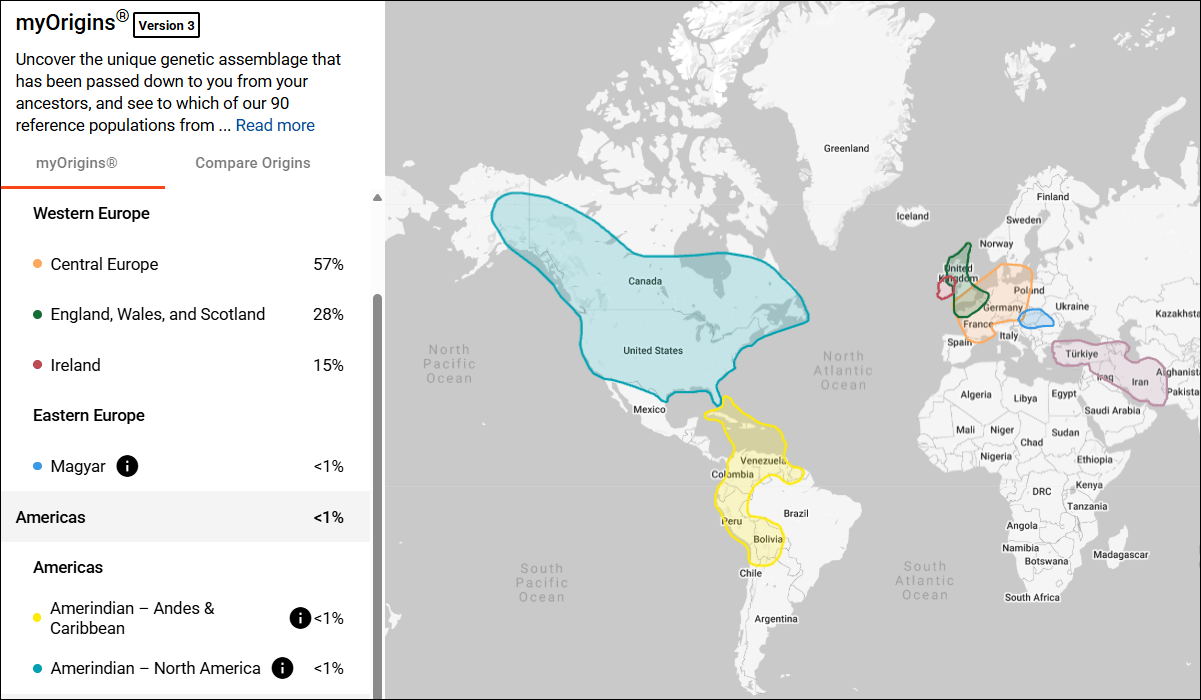
A Cautionary Word About AI – Artificial Intelligence

AI is such a hot topic right now that I feel it needs to be included.

The FamilySearch full text search uses a form of AI. However, you’ll quickly notice that it can’t read everything, gets words and names wrong, and if you actually need to fully depend on it for accuracy, you cannot. (That said, it’s still an amazing tool, and I’m not picking on FamilySearch.)

Aside from FamilySearch, AI in its current form is both wonderful and terrible. I’ll be writing about AI in the new year, but for now, don’t ever rely on AI for anything that you can’t verity. It’s your assistant, not an expert, no matter how insistent it is. Never trust and always verify.

This is ESPECIALLY TRUE WHEN RELATED TO GENETICS and genetic related topics. I can’t even begin to tell you how very wrong it has been, and how much people fall in love with inaccurate results. No, just no – at least for now.

You need to know your AI tool, your skill set, your understanding of AI broadly, the tool’s limitations, and yours, and that’s all before verifying the actual AI results. If you want to educate yourself, and everyone should, treat yourself to anything, anyplace by either Mark Thompson or Steve Little, the dynamic AI duo. They offer YouTube videos and classes in a wide variety of places – but keep in mind that AI tools and technology literally change every few weeks.

AI is, indeed, a specialty all unto itself, much like genetic genealogy. And right now, it’s not soup yet, but it is cooking.

Tried and True Genetic Genealogy Staples – DNAPrint and Genetic Affairs

I haven’t written about either one this year, but I use both DNAPainter and Genetic Affairs regularly.
I consistently paint segments from matches at both MyHeritage, FamilyTreeDNA, and GEDmatch that are newly identified to an ancestor or ancestral couple at DNAPainter.

Unfortunately, neither Ancestry nor 23andMe provide matching cM location information for your matches (chromosome browser), but you may find some people who have tested at those companies at both FamilyTreeDNA and GEDmatch if they have uploaded to either of those vendors. Both vendors provide segment information and a Chromosome Browser, enabling you to paint that information to DNAPainter when you can identify your common ancestor.

MyHeritage also provides a Chromosome Browser, but unfortunately, no longer accepts uploads from any other vendor. You can paint segments from MyHeritage, but no longer upload DNA files to MyHeritage.

Thanks to DNAPainter, I have 90% of my segments identified to specific ancestors – which is actually rather remarkable given that my mother’s grandfather was a Dutch immigrant, and her great-grandparents on her other side were German immigrants, meaning we don’t have many matches on either of those lines.

Genetic Affairs continues to develop new, advanced clustering tools, one of which I’ll be reviewing soon.

Major Vendor Releases

Aside from what’s listed above, most of the major vendors released new features.

MyHeritage released a VERY COOL new tool called Cousin Finder that finds your relatives in the MyHeritage database, whether they match you on a DNA test, or not. They may not have even taken a DNA test. Cousin Finder identifies your common ancestor and shows your relationships. It’s a wonderful way to initiate communications, discuss your common ancestors, and ask about DNA testing.

Of my 378 Cousin Finder matches, only 23 (about 6%) are on my DNA match list, so that leaves 355 people to message, several of whom represent Y-DNA and mtDNA lines I don’t have. You can bet I’ll be offering testing scholarships.

Additionally, MyHeritage released a new ethnicity version.

FamilyTreeDNA, in addition to the new Mitotree, Discover, and associated features, released a new match matrix so you can see if and how selected matches are related to each other in a grid format. In other words, you can create your own cluster.

A new built-in “Share” feature blurs private information to make sharing easier both on the website and in Discover.

Discover improvements include thousands of new Y-DNA and mtDNA tree branches, plus thousands of new Ancient DNA samples. Discover is evergreen, so once you’ve taken that Big Y-700 test or the mitochondrial DNA test, your learning never stops as more content is added.

Tree integration with WikiTree is super-easy and means you don’t have to choose between trees. You can choose to retain your archived tree at FamilyTreeDNA, or move your tree to MyHeritage, PLUS link yourself to your family at WikiTree.

Ancestry released match clustering and a new beta pedigree view of ThruLines, but that’s back in the shop for more work. I’d expect to see it rereleased in 2026.

Conferences

RootsTech is the granddaddy of genealogy conferences, and it’s always fun to attend and write about the experience. Many vendors release new tools or products during the conference.

The ECGGC (East Coast Genetic Genealogy Conference), held in the fall, is the only conference that focuses entirely on genetic genealogy, new tools, how to use existing tools, and more. The 2025 conference was virtual and provided a great deal of focused content. Attendees particularly appreciate the deep dive in a particular topic presented in DNA Academy.

I’ll be at RootsTech in 2026, will write about that soon, and hope to see you there.

Concepts, Techniques and Plain Old Genealogy

In the past, my Concepts series and genealogy “how to” articles have been very popular, so, in 2025, I penned a half-dozen articles focusing on frequently asked questions about relationships and DNA.

For example, how does one go about finding DNA testing candidates? The number of options may surprise you and includes both Cousin Finder and Relatives at RootsTech.

By testing ONE PERSON for either Y-DNA or mitochondrial DNA that represents an ancestor, you actually receive information about that entire lineage of ancestors. So, on my Estes line, by locating an Estes male from my line to test, I received relevant information for every Estes male in my line, back to and beyond the progenitor.

Eventually, we hit a brick wall in every line, and those tools are the perfect way to break through those brick walls.

Other articles discuss things like how to use Discover’s Ancient Connections, and the difference between half and full relationships, both in your tree and genetically. Plus, what does a cousin “once removed” mean anyway? And why do I care?

Another question I receive is how far back, based on the shared amount of DNA, should I look in my matches’ trees for our common ancestor? In other words, how many generations back should I click? That article was fun and produced some unexpected results.

Memorial Articles

Because we are part of a community, I write memorial articles when one of our friends passes on. This year, sadly, Schelly Talalay Dardashti, well-known Jewish genealogist, and another very close friend joined the ancestors, so I’ve recognized the best in both of their lives which constitutes their legacy.

Be the Storyteller

Last, but not least, I wrote about my ancestors in the “52 Ancestors” series, which launched several years ago with Amy Johnson Crow’s challenge to write about one ancestor per week. She hosts this every year, and you can join (free) now.

I’m now on ancestor #467, so yes, it’s addictive, but it’s also AMAZING how many wonderful cousins I’ve met who have information that I did not. Not only that, but after publishing about an ancestor, I’ve discovered that I’m related to people I’ve known for years. We were SOOOooo excited!

I’ve been writing about the lives of my ancestors for several years now, and the articles include attempts to identify Y-DNA and mtDNA testers for each ancestor, where appropriate. There’s so much to learn that can’t be revealed any other way.

Plus, people seem to like the “mystery” and “short story” aspect, and I salt each story with the history of the region and relevant historical events of the timeframe. You might find your ancestors here too, or other helpful information.

Find a way to share about your ancestors!

Do You Have Suggestions for 2026 Topics?

Do you have suggestions or requests for article topics in 2026? If so, please comment on this article and let me know.

Check Out the 2025 List

Here’s the list of the 2025 articles. Did you miss something fun? Enjoy!

  Title Category Date Link
1 Welcome to 2025 – Opportunities and New Genetic Genealogy Articles Welcome, general 1-2-2025 https://dna-explained.com/2025/01/02/welcome-to-2025-opportunities-and-new-genetic-genealogy-articles/
2 Anne Doucet (1713-1791), Oceans, Rivers, and Perseverance – 52 Ancestors #438 52 Ancestors 1-4-2025 https://dna-explained.com/2025/01/04/anne-doucet-1713-1791-oceans-rivers-and-perseverance-52-ancestors-438/
3 Register for RootsTech 2025 Now RootsTech 1-16-2025 https://dna-explained.com/2025/01/16/register-for-rootstech-2025-now/
4 What IS the McNeil Family History, by George Franklin McNeil – 52 Ancestors #439 52 Ancestors 1-19-2025 https://dna-explained.com/2025/01/20/what-is-the-mcneil-family-history-by-george-franklin-mcneil-52-ancestors-439/
5 Jean Garceau dit Tranchemontagne (c1785-1711), Soldier from Saint Marseault – 52 Ancestors #440 52 Ancestors 1-29-2025 https://dna-explained.com/2025/01/29/jean-garceau-dit-tranchemontagne-c1785-1711-soldier-from-saint-marseault-52-ancestors-440/
6 Memories Resurface When the Old Family Home Gets a Facelift Genealogy 2-3-2025 https://dna-explained.com/2025/02/03/memories-resurface-when-the-old-family-home-gets-a-facelift/
7 MyHeritage Introduces Ethnicity v2.5 MyHeritage 2-6-2025 https://dna-explained.com/2025/02/06/myheritage-introduces-ethnicity-v2-5/
8 Relatives at RootsTech Reveals Cousins and Provides DNA Candidates RootsTech, techniques 2-8-2025 https://dna-explained.com/2025/02/08/relatives-at-rootstech-reveals-cousins-and-provides-dna-candidates/
9 FamilyTreeDNA’s New Matrix Shows How Your Matches Are Related to Each Other FamilyTreeDNA 2-12-2025 https://dna-explained.com/2025/02/12/familytreednas-new-matrix-shows-how-your-matches-are-related-to-each-other/
10 René Doucet (c1680-c1731), Lifetime of Incessant Upheaval – 52 Ancestors #441 52 Ancestors 2-15-2024 https://dna-explained.com/2025/02/16/rene-doucet-c1680-c1731-lifetime-of-incessant-upheaval-52-ancestors-441/
11 Lineages Versus Ancestors – How to Find and Leverage Yours Techniques 2-23-2025 https://dna-explained.com/2025/02/23/lineages-versus-ancestors-how-to-find-and-leverage-yours/
12 Mitotree is Born Mitochondrial DNA 2-25-2025 https://dna-explained.com/2025/02/25/mitotree-is-born/
13 RootsTech 2025 – The Year of Discover and the New Mitotree RootsTech, Mitochondrial DNA 3-14-2025 https://dna-explained.com/2025/03/15/rootstech-2025-the-year-of-discover-and-the-new-mitotree/
14 Pierre Doucet (c1621-1713), Walking History Book Lived to Nearly 100 – 52 Ancestors #442 3-16-2025 https://dna-explained.com/2025/03/16/pierre-doucet-c1621-1713-walking-history-book-lived-to-nearly-!100-52-ancestors-442/
15 Welcome to the New FamilyTreeDNA mtDNA Group Mitochondrial DNA 3-17-2025 https://dna-explained.com/2025/03/17/welcome-to-the-new-familytreedna-mtdna-group/
16 23andMe Files for Bankruptcy – What You Need to Know! 23andMe 3-24-2025 https://dna-explained.com/2025/03/25/23andme-files-for-bankruptcy-what-you-need-to-know/
17 New “Share” Features at FamilyTreeDNA Blur Match Information and Make Sharing Easy FamilyTreeDNA 4-1-2025 https://dna-explained.com/2025/04/01/new-share-features-at-familytreedna-blur-match-information-and-make-sharing-easy/
18 The Chauvet Cave: Trip Back in Time with Prehistoric European Humans – Are We Related? History, DNA 4-6-2025 https://dna-explained.com/2025/04/06/the-chauvet-cave-trip-back-in-time-with-prehistoric-european-humans-are-we-related/
19 DNA for Native American Genealogy Webinar & Companion Book Native American 4-8-2025 https://dna-explained.com/2025/04/08/dna-for-native-american-genealogy-webinar-companion-book/
20 Marie Levron (c1686-1727), Tragedy from Cradle to Grave – 52 Ancestors #443 52 Ancestors 4-14-2025 https://dna-explained.com/2025/04/14/marie-levron-c1686-1727-tragedy-from-cradle-to-grave-52-ancestors-443/
21 Mitochondrial DNA: What is a Haplotype Cluster and How Do I Find and Use Mine Mitochondrial DNA 4-14-2025 https://dna-explained.com/2025/04/14/mitochondrial-dna-what-is-a-haplotype-cluster-and-how-do-i-find-and-use-mine/
22 New Mitotree Haplogroups and How to Utilize Them for Genealogy Mitochondrial DNA 4-23-2025 https://dna-explained.com/2025/04/23/new-mitotree-haplogroups-and-how-to-utilize-them-for-genealogy/
23 Sir Francois Levron dit Nantois(c1651-1714), and Acadia’s Pirate – 52 Ancestors #444 52 Ancestors 4-26-2025 https://dna-explained.com/2025/04/27/sir-francois-levron-dit-nantois-c1651-1714-and-acadias-pirate-52-ancestors-444/
24 Catherine Savoie (c1661-c1722/25), Whispered Threads Weave a Tapestry of Life – 52 Ancestors #445 52 Ancestors 5-4-2025 https://dna-explained.com/2025/05/04/catherine-savoie-c1661-c1722-5-whispered-threads-weave-a-tapestry-of-life-52-ancestors-445/
25 Discover’s Ancient Connections – How Are You Related? Discover, Ancient DNA 5-8-2025 https://dna-explained.com/2025/05/08/discovers-ancient-connections-how-are-you-related/
26 Mother’s Day and Legacies 52 Ancestors, Genealogy 5-10-2025 https://dna-explained.com/2025/05/11/mothers-day-and-legacies/
27 The Mystery of the Blue Fugates and Smiths: A Study in Blue Genes and Pedigree Collapse Genetics, Genealogy 5-18-1015 https://dna-explained.com/2025/05/19/the-mystery-of-the-blue-fugates-and-smiths-a-study-in-blue-genes-and-pedigree-collapse/
28 Regeneron Wins Bid for Bankrupt 23andMe – Wedding Planned 23andMe 5-19-2023 https://dna-explained.com/2025/05/19/regeneron-wins-bid-for-bankrupt-23andme-wedding-planned/
29 Francois Savoie’s Homestead Rediscovered – 52 Ancestors #446 52 Ancestors 5-24-2025 https://dna-explained.com/2025/05/24/francois-savoies-homestead-rediscovered-52-ancestors-446/
30 Memorial Day – Some Gave All Memorial 5-25-2025 https://dna-explained.com/2025/05/25/memorial-day-some-gave-all/
31 Mitotree Webinar – What It Is, How We Did It, and What Mitotree Means to You Mitochondrial DNA 6-4-2025 https://dna-explained.com/2025/06/04/mitotree-webinar-what-it-is-how-we-did-it-and-what-mitotree-means-to-you/
32 Catherine LeJeune (c1633-1671/1686), Meet Your Grandchildren – 52 Ancestors #447 52 Ancestors 6-7-2025 https://dna-explained.com/2025/06/07/catherine-lejeune-c1633-1671-1686-meet-your-grandchildren-52-ancestors-447/
33 Mitotree Q&A for Everyone Mitochondrial DNA 6-11-2025 https://dna-explained.com/2025/06/11/mitotree-qa-for-everyone/
34 Father’s Day: Bravery and Love 52 Ancestors, Genealogy 6-14-2025 https://dna-explained.com/2025/06/14/fathers-day-bravery-and-love/
35 Francoise Bourgeois (c1659-1693/1697), High Drama in Beaubassin and Terror at Port Royal – 52 Ancestors #448 52 Ancestors 6-16-2025 https://dna-explained.com/2025/06/16/francoise-bourgeois-c1659-1693-97-high-drama-in-beaubassin-and-terror-at-port-royal-52-ancestors-448/
36 Requesting Suggestions for RootsTech 2026 Topics RootsTech 6-18-2025 https://dna-explained.com/2025/06/18/requesting-suggestions-for-rootstech-2026-topics/
37 FamilyTreeDNA and WikiTree Collaboration – In Two Easy Steps!! FamilyTreeDNA, WikiTree 6-25-2025 https://dna-explained.com/2025/06/25/familytreedna-and-wikitree-collaboration-in-two-easy-steps/
38 Jacques Bourgeois (c1620-c1700), Surgeon of Port Royal – 52 Ancestors #449 52 Ancestors 7-1-2025 https://dna-explained.com/2025/07/01/jacques-bourgeois-c1620-c1700-surgeon-of-port-royal-52-ancestors-449/
39 TTAM, a Nonprofit Formed by 23andMe’s Founder Now Plans to Buy 23andMe 23andMe 7-1-2025 https://dna-explained.com/2025/07/01/ttam-a-nonprofit-formed-by-23andmes-founder-now-plans-to-buy-23andme/
40 Jacques Bourgeois: Complex Acadian, Founder of Beaubassin – 52 Ancestors #450 52 Ancestors 7-6-2025 https://dna-explained.com/2025/07/06/jacques-bourgeois-complex-acadian-founder-of-beaubassin-52-ancestors-450/
41 How to Use Ancestry’s New Match Clusters and What They Mean Ancestry 7-10-2025 https://dna-explained.com/2025/07/10/how-to-use-ancestrys-new-match-clusters-and-what-they-mean/
42 Walk with Your Ancestors: Peace, Light and Healing in an Abandoned Medieval Village History 7-21-2025 https://dna-explained.com/2025/07/21/walk-with-your-ancestors-peace-light-and-healing-in-an-abandoned-medieval-village/
43 Jeanne Trahan (c1629-c1699), Life in Chinon, La Heve, Port Royal, and Beaubassin – 52 Ancestors #451 52 Ancestors 8-2-2025 https://dna-explained.com/2025/07/28/jeanne-trahan-c1629-c1699-life-in-chinon-la-heve-port-royal-and-beaubassin-52-ancestors-451/
44 Wherefore Art Thou, Oh Ancestor – New Generation Tree Chart Suggests Where to Look in Your Matches’ Trees Techniques, Genetics, Genealogy 8-2-2025 https://dna-explained.com/2025/08/02/wherefore-art-thou-oh-ancestor-new-generation-tree-chart-suggests-where-to-look-in-your-matches-trees/
45 Guillaume Trahan (c1601-1625), More Than Meets the Eye – 52 Ancestors #452 52 Ancestors 8-13-2025 https://dna-explained.com/2025/08/13/guillaume-trahan-c1601-c1684-more-than-meets-the-eye-52-ancestor-452/ 
46 The East Coast Genetic Genealogy Conference – ECGGC – Register Now for the Best of the Best ECGGC Conference 8-14-2025 https://dna-explained.com/2025/08/14/the-east-coast-genetic-genealogy-conference-ecggc-register-now-for-the-best-of-the-best/
47 Schelly Talalay Dardashti – May Her Memory Be a Blessing Memorial 8-17-2025 https://dna-explained.com/2025/08/17/schelly-talalay-dardashti-may-her-memory-be-a-blessing/
48 Francoise Corbineau (c1609-c1665), Bride in Chinon, Founder of Acadia – 52 Ancestors #453 52 Ancestors 8-25-2025 https://dna-explained.com/2025/08/23/francoise-corbineau-c1609-c1665-bride-in-chinon-founder-of-acadia-52-ancestors-453/
49 Nicolas Trahan (c1570->1632), Life in the Heart of French Wine Country – 52 Ancestors #454 52 Ancestors 8-31-2015 https://dna-explained.com/2025/08/31/nicolas-trahan-c1570-1632-life-in-the-heart-of-french-wine-country-52-ancestors-454/
50 Mitochondrial DNA A-Z: A Step-by-Step Guide to Matches, Mitotree, and mtDNA Discover Mitochondrial DNA, Discover, Genealogy, Techniques 10-2-2025 https://dna-explained.com/2025/09/02/mitochondrial-dna-a-z-a-step-by-step-guide-to-matches-mitotree-and-mtdna-discover/
51 Renée Desloges (c1570-1627/1632), Fragments of Life in Montreuil-Bellay – 52 Ancestors #454 (this is actually 455) 52 Ancestors 9-6-2025 https://dna-explained.com/2025/09/06/renee-desloges-c1570-1627-1632-fragments-of-life-in-montreuil-bellay-52-ancestors-454/
52 Best Mitochondrial DNA Presentation EVER – You’re Invited to DNA Academy!! Mitochondrial DNA 9-9-2025 https://dna-explained.com/2025/09/09/best-mitochondrial-dna-presentation-ever-youre-invited-to-dna-academy/
53 Unfillable Shoes Memorial – Douglas Rhodenbaugh 9-14-2025 https://dna-explained.com/2025/09/14/unfillable-shoes/
54 Concepts: What Does a Cousin “Once Removed” Mean? Concepts, Genealogy 9-24-2025 https://dna-explained.com/2025/09/24/concepts-what-does-a-cousin-once-removed-mean/
55 Daniel Vannoy (1752-after 1820), “Lived in the Boundary of the Cherokee Indians” – Say What??? 52 Ancestors 9-29-2025 https://dna-explained.com/2025/09/29/daniel-vannoy-1752-after-1820-lived-in-the-boundary-of-the-cherokee-indians-say-what/
56 Daniel Vannoy and the Strange Case of the Two Sarahs – 52 Ancestors #457 52 Ancestors 10-5-2025 https://dna-explained.com/2025/10/06/daniel-vannoy-and-the-strange-case-of-the-two-sarahs-52-ancestors-457/
57 Cousin Finder – MyHeritage’s Innovative New Tool Finds Your Relatives MyHeritage 10-9-2025 https://dna-explained.com/2025/10/09/cousin-finder-myheritages-innovative-new-tool-finds-your-relatives/
58 Sarah Hickerson Vannoy (c1761 – after 1826), Threw More than Shade – 52 Ancestors #458 52 Ancestors https://dna-explained.com/2025/10/13/sarah-hickerson-vannoy-c1761-after-1826-threw-more-than-shade-52-ancestors-458/
59 MyHeritage Introduces a Low-Pass Whole Genome Autosomal DNA Test & Why It Matters MyHeritage 10-14-2025 https://dna-explained.com/2025/10/14/myheritage-introduces-a-low-pass-whole-genome-autosomal-dna-test-why-it-matters/
60 Henriette Pelletret (c1640 – before 1694), Life Death in the Shadow of the Fort – 52 Ancestors #459 52 Ancestors 10-21-2025 https://dna-explained.com/2025/10/21/henriette-pelletret-c1640-before-1694-life-and-death-in-the-shadow-of-the-fort-52-ancestor-459/
61 Cheat Sheet: Mitochondrial Matches, Haplotype Clusters, and Haplogroups Mitochondrial DNA 10-22-2025 https://dna-explained.com/2025/10/22/cheat-sheet-mitochondrial-matches-haplotype-clusters-and-haplogroups/
62 Simon Pelletret (1610-1642/1645): A Walk Through Port Royal – 52 Ancestors #460 52 Ancestors 10-27-2025 https://dna-explained.com/2025/10/27/simon-pelletret-c1610-1642-1645-a-walk-through-port-royal-52-ancestors-460/
63 Perrine Bourg (c1626-1693/1698): Phoenix Rising from the Ashes – 52 Ancestors #461 52 Ancestors 11-2-2025 https://dna-explained.com/2025/11/02/perrine-bourg-c1626-1693-1698-phoenix-rising-from-the-ashes-52-ancestors-461/
64 Concepts: What is a Half Relationships, Life Half First Cousins, Anyway? Concepts, Genealogy 11-4-2025 https://dna-explained.com/2025/11/04/concepts-what-is-a-half-relationship-like-half-first-cousins-anyway/
65 Marie Broussard (1686-after 1752), Life Across the River from Port Royal – 52 Ancestors #462 52 Ancestors 11-10-2025 https://dna-explained.com/2025/11/10/marie-broussard-1686-after-1752-life-across-the-river-from-port-royal-52-ancestors-462/
66 Francois Broussard (1653-1716), Intractable Acadian – 52 Ancestors #463 52 Ancestors 11-22-2025 https://dna-explained.com/2025/11/22/francois-broussard-1653-1716-intractable-acadian-52-ancestors-463/
67 Mitotree Sprouts 12,773 New Branches and Includes Ancient DNA Mitochondrial DNA 11-24-2025 https://dna-explained.com/2025/11/24/mitotree-sprouts-12773-new-branches-and-includes-ancient-dna/
68 Catherine Richard (c1663 – after 1714), Mother of Beausoleil, Acadian Freedom Fighters – 52 Ancestors #464 52 Ancestors 11-29-2025 https://dna-explained.com/2025/11/29/catherine-richard-c1663-after-1714-mother-of-beausoleil-acadian-freedom-fighters-52-ancestors-464/
69 Ancestry’s ThruLines Has a New Pedigree View Ancestry 12-2-2025 https://dna-explained.com/2025/12/03/ancestrys-thrulines-has-a-new-pedigree-view/
70 Ancestry Reverts ThruLines to the Original View Ancestry 12-6-2025 https://dna-explained.com/2025/12/06/ancestry-reverts-thrulines-to-the-original-view/
71 Michel Richard (c1630-1686/1689), Carefree Acadian – 52 Ancestors #465 52 Ancestors 12-7-2025 https://dna-explained.com/2025/12/08/michel-richard-dit-sansoucy-c1630-1686-1689-carefree-acadian-52-ancestors-465/ 
72 Mitochondrial DNA: How Do I Know if I’m a Candidate to Receive a New Haplogroup? Mitochondrial DNA 12-9-2025 https://dna-explained.com/2025/12/09/mitochondrial-dna-how-do-i-know-if-im-a-candidate-to-receive-a-new-haplogroup/
73 Heavens Ablaze: the 1833 Leonid Meteor Storm and Your Ancestors History, Genealogy 12-15-2025 https://dna-explained.com/2025/12/15/heavens-ablaze-the-1833-leonid-meteor-storm-and-your-ancestors/
74 Madelaine Blanchard (c1643 – 1678/1683), Gone Too Soon – 52 Ancestors #466 52 Ancestors 12-20-2025 https://dna-explained.com/2025/12/20/madelaine-blanchard-c1643-1678-1683-gone-too-soon-52-ancestors-466/
75 Soar Inspiration 12-24-2025 https://dna-explained.com/2025/12/24/soar/

_____________________________________________________________

Share the Love!

You’re always welcome to forward articles or links to friends and share on social media.

Subscribe!

If you haven’t already subscribed, it’s free. You’ll receive an e-mail whenever I publish by clicking the “follow” button at the top of the main blog page, here.

Help Keep This Blog Free

I receive a small commission when you click a vendor link in my articles and purchase that item. This does NOT increase your price but helps me keep the lights on and this informational blog free for everyone. Please click on the affiliate links in the articles or to the vendors below if you are purchasing products or DNA testing.

Thank you so much.

DNA Purchases and Free Uploads

Genealogy Products and Services

My Books

Genealogy Books

Genealogy Research