Mitotree: First, the Tree – Now the Paper

It’s definitely a red-letter day.

Dr. Paul Maier, the lead author on the new paper Mitotree: The Universal Human Mitochondrial Reference Phylogeny at 10x the Resolution has uploaded the paper to the bioRxiv preprint server, here.

I want to congratulate all of the authors, most of whom are members of the FamilyTreeDNA R&D team as either employees or contractors. I’m a contractor and have had the honor of working with these amazing colleagues on this project since 2020.

About Mitotree

Mitotree was officially “born” on February 25, 2025, and the tree has been updated several times since. About 75% of FamilyTreeDNA’s customers who have taken the full-sequence mitochondrial DNA test received a more refined haplogroup with the release of Mitotree or subsequent updates. Those haplogroups are, on average, 2000 years newer than the person’s legacy Phylotree haplogroup, and some are much more recent.

This means that the tree branches have gotten much, much bushier close to the tips. In other words, lots more twigs and leaves!

Unfortunately, about 25% of testers did not receive a new haplogroup because they do not have any qualifying mutations:

  • Either because they have no additional mutations
  • Or because they have mutations, but they are unstable
  • Or because they have mutations, but no other testers have yet tested that match them to split a branch

The good news is that with the addition of haplotype clusters, everyone benefits from new matching and grouping tools. Testers are grouped into clusters on their matches page, and on the Match Time Tree in Discover, which is much more useful for genealogy.

I know this paper has been a long time coming, but it’s well worth the wait.

Mitotree was a massive undertaking. We began with PhyloTree v17 which had 5,438 hand-curated branches constructed from 24,275 full and partial mitochondrial sequences. Phylotree was last updated in 2016 before subsequently being abandoned.

The Million Mito Team developed Mitotree, a robust phylogeny with more than 54,000 branches formed from over 330,000 complete mitochondrial sequences, of which 177,196 are unique sequences.

Let’s Look Under the Hood

There are three critical pieces of information in those statements.

First, the PhyloTree curation and maintenance was not automated, and a paper detailing their build process, what mutations were included or excluded, and under what circumstances was never published.

Approximately once a year, a new PhyloTree was published where newer samples were individually evaluated and new haplogroups were hand-grafted onto an existing backbone tree.

This methodology did not allow for deep splits to become apparent, because the tree itself was never recalculated. This is exactly how haplogroup L7 went undetected until the Million Mito Team recalculated the tree, including the backbone, in 2022, and published this paper about L7’s discovery.

In other words, while PhyloTree was publicly available, there was no recipe for how it was created or maintained.

Clearly, the tree-building process had to be automated, as hand-curation was unsustainable. There were no academic programs in existence capable of handling the number of samples involved. Not even in 2016 for fewer than 25,000 samples, let alone today.

To maintain haplogroup naming consistency, the first thing our team had to do was write software to phylogenetically reverse engineer PhyloTree v17 to establish a common foundation on which to build. This step was essential for consistency and maintaining the established haplogroup naming pattern.

That software also had to be capable of scaling up exponentially. The first versions took weeks to run, which clearly wasn’t an acceptable long-term solution. Still, being able to establish a foundational backbone to build on programmatically was a victory in and of itself.

Second, PhyloTree used partial sequences, meaning HVR1 and HVR2 samples. Early academic researchers did not perform full sequence testing, so the curators of PhyloTree used what was available to the best of their ability.

With over 330,000 full-sequence samples available today, we no longer include partial samples.

Third, 177,196 of the 331,221 full sequence samples used were unique. Before launching the program to construct the tree, identical samples from known immediate relatives are deduped, when possible, in order to reduce unnecessary clutter and processing time.

This means two things. The actual number of testers is greater than 331,000. But more importantly, anyone who thinks that mitochondrial DNA isn’t interesting should take another look. More than half of the sequences used for tree-building are unique, which handily dispels the myth that mitochondrial DNA doesn’t mutate often enough to be useful for genealogy.

The Mitotree initiative has been both scientifically and genealogically successful beyond anything we could have imagined. The base tree includes approximately 180 branches that are older than 30,000 years, including the discovery of haplogroup L7 at 100,000 years old. These branches both expand and more firmly root the oldest portions of the tree.

Amazingly, haplogroup L7 has living descendants whose earliest known family members are found in Turkey, Saudi Arabia, Yemen, the UAE, Palestinian Territory, Ethiopia, Sudan, and South Africa.

Another fun discovery involved Otzi, the Iceman, a mummy found frozen in the Italian Alps who lived more than 5,000 years ago. He was thought to carry an extinct haplogroup, K1ö, named in his honor, but as it turns out, he’s actually a member of haplogroup K1f, a clade with living descendants in Algeria. Additionally, Otzi now matches four ancient burials too, so he does have cousins.

We couldn’t have made these discoveries without the right people testing, so please encourage everyone and dispel the discouraging myth that mitochondrial DNA isn’t useful or interesting. It absolutely IS, and the success stories keep rolling in!

Why Build a Phylogenetic Tree?

Simply put, the history of our ancestors, both recently and reaching back into ancient history, is revealed in the tree – and there’s absolutely no other avenue to reach this information. Ironically, it’s readily available to everyone because everyone has mitochondrial DNA and can easily take the test.

Mitochondrial DNA is different than Y-DNA, which has its own phylogenetic tree based on SNP mutations, and autosomal DNA, which has no tree.

The reason that both Y-DNA and mitochondrial DNA can have phylogenetic trees is that they are inherited from the appropriate parent with only occasional mutations, while autosomal DNA is roughly halved in each generation.

Y-DNA is inherited by males only from their fathers, with no admixture from their mother, while mitochondrial DNA is inherited by everyone from only their mothers, with no admixture from their father.

Autosomal DNA is inherited through random recombination, with half coming from each parent, except for the X chromosome which has its own inheritance pattern. X-DNA is often confused with mitochondrial DNA, but they are entirely different types of DNA. I wrote about that here.

No tree is possible for autosomal DNA, because it gets diced and riced in each generation.

The mutations that occur occasionally and randomly in both Y and mitochondrial DNA form a trail of breadcrumbs leading backward in time, or in our case, they form both the trunk and branches on the tree.

Those unique mutations, once they occur, are inherited by subsequent generations, forming a path back in time.

In current generations, those mutations provide testers with the ability to identify our closest cousins who inherited those same mutations and who have taken either a Big Y-700 test, in males, or a mitochondrial DNA full sequence test for everyone.
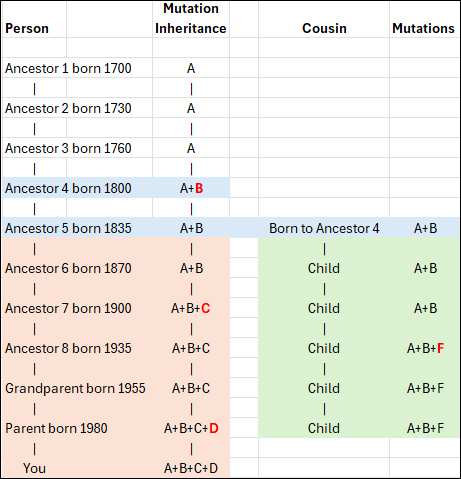
In this conceptual example, you can see that Ancestor 1 carries mutation A, as do the next two generations who inherited it from their parent. However, Ancestor 4 now has additional mutation B, so that person carries mutations A+B. This inheritance pattern continues through the apricol lineage as mutations C and D are added in subsequent generations, until “You” are born with A+B+C+D.

Your cousin’s ancestor, on the other hand, was also born to Ancestor 4 and carries both A+B, as seen in the green column. Three generations later, that line added mutation F. Your  ancestor 7 added mutation C, so now the apricot and green lineages can easily be genetically distinguished from each other.

When a living person tests, we immediately know, based on the combination of their mutations, if and where they fit in this lineage, because both the apricot and green branches have accumulated unique mutations that the original blue Ancestor 4 and earlier ancestors did not have.

Using our knowledge of the tree branches, when and where they occurred, provides valuable genealogical information, along with fascinating Ancient Connections, both since and prior to the adoption of surnames.

Both Y-DNA and mitochondrial DNA can reach much further back in time than autosomal DNA because they are not diluted with DNA from the other parent in each generation.

So mitochondrial DNA is both broad, meaning many leaves, and deep, meaning it helps us look straight back in time like a laser sight, all the way to the common ancestor of all humanity, Mitochondrial Eve, who lived about 140,000 years ago in Africa.

Mitochondrial DNA Presents Unique Challenges

Mitochondrial DNA presents challenges not found in Y-DNA tree building.

For example, mitochondrial DNA only has 16,569 locations available to utilize, while Y-DNA currently uses roughly 22 million “gold standard” locations on the Y chromosome.

Of those 16,569 mitochondrial locations, some are not reliable enough for tree-building.

Unreliable mutations include:

  • Insertions, where extra copies of a particular nucleotide (Thymine, Adenine, Cytosine and Guanine) have been inserted at a specific location. Those are indicated by designations such as 309.1C where 309 indicates the marker location, .1 indicates the number of insertions at that location, and C (for Cytosine in this example) indicates the nucleotide inserted.
  • Heteroplasmies occur when multiple nucleotides are detected at a specific location. They are reported by a different letter than T, A, C or G, depending on which of multiple nucleotides are found. Heteroplasmies tend to “come and go” based on detection and threshold levels, so they can’t be used the same way as more stable mutations for tree building – and are often, but not always, unreliable for genealogy. I wrote about this in the article, What is a Heteroplasmy and Why Do I Care?.

Those locations and types of mutations have been excluded from forming tree branches, or downweighted, because they are too prone to mutating back and forth. However, they *might* be useful for genealogical purposes. Less-than-reliable mutations are now used to create haplotype clusters, even though they aren’t used to create new branches on the Mitotree.

I wrote about how haplogroups and haplotype clusters are formed in these articles:

Weighting and Confidence Factors

Mitotree formation would have been a lot easier if delineations, meaning inclusions and exclusions, were clear, either yes or no, but they aren’t.

Some were obvious from the get-go, such as insertions at location 309 and elsewhere, but other situations were much less obvious.

For example, sometimes there’s a specific location that seems prone to reversion, mutating back and forth, meaning that it mutates, then returns to its original state, then repeats the process.

Reversions are a natural phenomenon that occurs frequently in mitochondrial DNA, but is rarely, if ever, found in Y-DNA.

Let’s look at an example.

Courtesy Dr. Paul Maier

How many reversions at the same location are too many, especially if they are close in the tree?

In the above example, the mutation from A to G occurs just below the first arrow, forming haplogroup L1, a branch of L. The red areas all carry that mutation, subsequently forming eight new branches.

However, one step downstream from that mutation, just above the second arrow, location 7055 back-mutates, or reverts to A from G, which is indicated by the “!”. That reverse mutation forms haplogroup L1c3.

If location 7055 continues to flip back and forth between A and G, at what point do we have less confidence in that location, and at what point should a location be excluded from the tree and prevented from creating or dividing a branch?

The answer is that “it depends,” sometimes on the branch, sometimes on the “group” of other mutations it’s found with, and other factors. Some locations are stable in some parts of the tree, but unstable in others. We certainly never expected to see that!

This means the team had to design and build a weighting methodology so that relevant mutations, such as reversions, are not summarily excluded from tree building but instead carry different confidence weighting levels, depending on the circumstances.

Some samples, such as ancient DNA, were down-weighted in general due to their propensity to contain artifacts resulting from deterioration. Ancient samples can still influence branching, just not as much as a high-quality modern sample.

Furthermore, especially when utilizing academic samples, results with a high number of heteroplasmies are excluded, along with those with ambiguous reads and missing upstream mutations, which were previously inferred with PhyloTree. Academic samples vary in quality and age, and we have no way of knowing which quality criteria were used by that lab at that time.

These types of variances made constructing and updating the Mitotree more challenging than the Y-DNA tree, which is not subject to weighting, resulting from phylogenetic tug-of-war between mutations.

In some situations, the addition of just one test can make the difference between a new branch, or no branch, in a subsequent run of the tree. Due to this type of scenario, and fine-tuning the algorithm, some people’s new haplogroups have reverted to an earlier haplogroup in subsequent Mitotree updates.

The paper and supplemental materials provide details about the exclusion process, types of exclusions, and a list of excluded marker locations.

You can view the confidence of any haplogroup in the Classic Mitotree view in Discover.

My haplogroup, J1c2f, is formed by the mutation G9055A, and you can see that the confidence rank is 7.5 out of 10.

Mousing over the little up-arrow tree icon beside the star explains changes in nearby branches, which can affect the haplogroup’s confidence ranking.

Branches are not renamed for convenience, and only when phylogenetically warranted. Existing haplogroup names used either on PhyloTree, in academic literature, or previously on the Y-Full tree are either maintained or avoided to eliminate potential confusion. No one wants two different haplogroup names depending on which tree is being viewed.

Previously obsoleted names remain permanently obsoleted and are not reused.

The paper explains further about technical corrections and tie-breaker situations. In some cases, potential branches with equal or near-equal weighting are flagged for team review.

Amazing Discoveries

I encourage everyone to read the section in the paper beginning with “Notable discoveries.” These aren’t people, as in Discover’s Notable Connections, but scientific accomplishments achieved with the new Mitotree.

Our knowledge of human migration within and out of Africa has been greatly refined, as well as the ancestral path into and across Eurasia, Asia, and into the Pacific Rim. If you have unusual mitochondrial haplogroups such as L, M, N, P, Q, R or S, you’ll absolutely want to read this.

Of course, in time these haplogroups branch and become Paleolithic haplogroups, then the Gravettian-Mesolithic followed by the Hunter-Gatherers found throughout Europe that we are familiar with. We’ve learned a great deal from rare ancient DNA samples that anchor more modern haplogroups in a place and time, and inform us of migration patterns as well as how now-extinct ghost populations gave rise to current ones.

The earliest humans, whom Mitotree has more firmly anchored, formed a trickle out of Africa that became a bifurcated stream, eventually flowing across the rest of the world. What recorded and even archaeological history cannot tell us can be and is revealed through the patterns held in our DNA today – and Mitotree is our map to read them. Common ancestors are found where our mutations as haplogroups converge, joining as we travel backward in time, piercing an otherwise impenetrable veil.

For those with Native American ancestry, Mitotree expands the two-wave theory, refining it into five or six probable migration surges, depending on how you count, based on a combination of haplogroup ages and distribution.

Summarizing from the paper:

The first wave of haplogroups A2, B2, C1b, C1c, C1d, D1, and D4h3a arrived from Asia, across Beringia or along the Pacific Corridor, about 17,000 to 18,500 years ago, and expanded along the Pacific coast. D4h3a is found almost exclusively in the Pacific region.

This was followed by haplogroup C4c about 15,800 years ago and X2a about 10,000 years ago, which expanded into the interior through the ice-free corridor east of the Rockies after the ice melted.

Next were the Paleo-Eskimo and Na-Dene speakers in haplogroups A2a, D2a, D2b, D2c/D3, and D4b1a2a1a2, who, between 3000 and 7000 years ago, made their way from Alaska, across the polar regions of Canada, into Greenland.

Na-Dene speakers, Apache and Navajo, in haplogroups A2a and B2a made their way southwest between 1300 and 1500 CE, or between 500 and 700 years ago.

Last, the present-day Inuit-Yupik expanded from Beringia to Greenland about 1000 CE.

For additional information, please see the Native American lineages section of the paper.

Mitotree has also clarified the ancestors of the Ainu/Jomon people from Hokkaido, Japan, and their ancient Paleolithic northwest Asian and Siberian relatives. The ancestors of this group and Native Americans share even earlier Asian ancestors.

The history of the Jewish people has been significantly refined as well, expanding on earlier works, and is found in the Counting the newest Jewish founders section of the paper.

  • 43% of Ashkenazi Jewish testers fell into 5 founding lineages where they had no subclades before, but they do now.
  • Two clades of haplogroup K have now been split 4000 to 5000 years ago in Romania.
  • There’s new information about the crypto-Jewish community in Portugal, Mountain Jews from Persia and the Caucasus, plus Jewish groups in India, Georgia, Azerbaijan, Israel and Libya.
  • Additionally, haplogroup M33c9b tells the story of Ashkenazi Silk Road merchants who traveled between China and Europe.

The paper reports the isolation of Sardinian-specific haplogroups and provides substantially greater structural definition for the Saami people, increasing from 22 subclades to more than 300.

The Notable discoveries section is chock full of information.

Genealogy Jump-Start

Today’s tree is ten times larger than the 2016 tree, and will continue to grow as more people take a full sequence mitochondrial DNA test, available at FamilyTreeDNA.

The greatly improved tree alone is not the only facilitator of genealogical success. A dozen reports, including Haplotype Clusters and the Match Time Tree are provided for all full-sequence testers in Discover. I wrote about how to effectively use your matches and Discover to break through genealogy brick walls, here.

There are a couple of things you need to do to increase your opportunities for success and to help Discover and Mitotree.
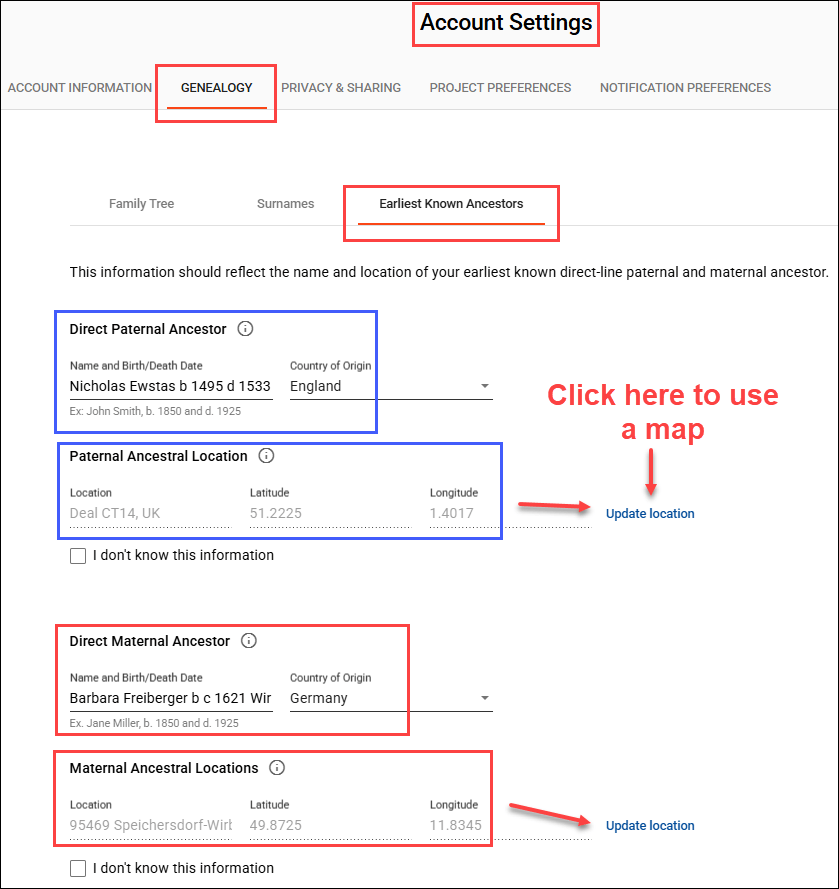
Genealogy is a team sport, and you can increase everyone’s success rate by completing (and updating) your Earliest Known Ancestor (EKA) and location information, found under “Account Settings” beneath your name in the upper right hand corner when signed on, then “Genealogy”, then “Earliest Known Ancestor”, and by providing a family tree or a link to WikiTree.

Identifying common ancestors is what testing is all about, and these are all important success factors. Everyone wants to identify previously unknown ancestors.

Mitotree is More Than Genealogy

Of course, as genealogists, we’re focused on how to use the new Mitotree information, paired with Discover, to identify brick-walled ancestors and learn more about them. I’ve written specifically about how to do that in these two articles:

Mitotree isn’t just an explosion for genealogy, though – it’s an incredible scientific achievement. Instead of genealogy benefiting from other specialties, now they can benefit from what genealogy has wrought.

Mitotree presents opportunities to rethink and potentially recalculate dating and information in other fields, such as archaeology, medical genetics, forensics, and history.

We know vastly more than ever before, but this is only the beginning.

With each new tester and every ancient genome added to the growing body of evidence, our understanding becomes more refined, revealing insights about our ancestors, and weaving our thread into the broader tapestry of human history.

_____________________________________________________________

Share the Love!

You’re always welcome to forward articles or links to friends and share on social media.

Subscribe!

If you haven’t already subscribed, it’s free. You’ll receive an e-mail whenever I publish by clicking the “follow” button at the top of the main blog page, here.

Help Keep This Blog Free

I receive a small commission when you click a vendor link in my articles and purchase that item. This does NOT increase your price but helps me keep the lights on and this informational blog free for everyone. Please click on the affiliate links in the articles or to the vendors below if you are purchasing products or DNA testing.

Thank you so much.

DNA Purchases and Free Uploads

Genealogy Products and Services

My Books

Genealogy Books

Genealogy Research

Ancient Connections: Where Archaeology Meets Your Ancestors

Ancient Connections, a report found on FamilyTreeDNA’s Discover platform for both Y-DNA and mitochondrial DNA (mtDNA), can be used in multiple ways to enhance your genealogy and unlock secrets.

It’s exciting to examine ancient burials linked to our ancestors and understand how we connect to them. Ancient Connections offer a wealth of information, providing clues that can help unravel long-standing mysteries.

Today, there are more than 12,960 Y-DNA Ancient Connections in Discover, along with more than 25,310 mitochondrial Ancient Connections, and that number increases weekly.

Why the disparity, you ask? Remember, everyone has mitochondrial DNA, but only males have Y-DNA.

In addition to matches, your DNA results hold something even more powerful – evidence of where your ancestors and their cousins lived in the distant past, when they lived, and the cultural context surrounding them. These essential insights are unavailable through any other means. Ancient Connections help us answer the age-old question, “Where did I come from?”

Could These People Be My Ancestors?

I’ll show you how to answer another question, too. Which of these Ancient Connections could potentially be your ancestors, and which ones are your “haplo-cousins”?

Regardless, they all help us understand our ancestors’ past, and that of their descendants.

Discover is for Everyone

FamilyTreeDNA provides a free version of Discover that everyone can use. There’s also an enriched version with additional information for their customers who have purchased Y-DNA and mitochondrial DNA tests.

Discover has something to offer for everyone.

Mitochondrial DNA is passed from mothers to all of their children of both sexes – unmixed with the DNA of the father.

Everyone has their mother’s mitochondrial DNA, which is passed intact, except for an occasional mutation, directly down through generations of mothers. It’s not admixed like autosomal DNA, so we don’t lose some portion in each generation. This is exactly why we can track mitochondrial DNA infinitely far back in time and why it’s so crucial for understanding the origins of your mother’s specific line.

Y-DNA is passed from fathers only to their sons, which is what makes males male. Like mitochondrial DNA, Y-DNA is not admixed with any DNA from the mother, so we get a laser line-of-sight view of the direct patrilineal line back in time. The Y-DNA direct paternal line is the male’s surname line in cultures where males carry their father’s surname.

If you’ve tested at or upgraded to either the Big Y-700 level or the mtFull, full mitochondrial sequence test, you will receive the most granular haplogroup possible, meaning the closest in time and most informative. You’ll also match with other testers who have taken the less-refined lower-level tests.

The most informative and precise results occur when both people have taken the premium tests. As more people test and science advances, you may receive a new haplogroup from time to time when you and another tester share a rare mutation – so these tests are evergreen.

Both Y-DNA and mitochondrial DNA testers at any level have access to Discover on their dashboard for those products, although the results of lower-level tests provide less information.

The Free Version of Discover Compared to the Premium Version for Testers

Here’s a comparison of lower-level Y-DNA tests and the Big Y-700.

Click any image to enlarge

Y-DNA testers who have only taken the 12-111 STR panel tests receive a predicted haplogroup, and when clicking through to Discover, receive up to 10 Ancient Connections.

For example, If your Y-DNA haplogroup is predicted as R-M269, the most common male lineage in Europe that arose some 6450 years ago, your Ancient Connections begin with the closest genetic match to R-M269. Viewing Ancient Connections that are 6500 years ago will certainly be interesting, so please do look, but probably not terribly useful for genealogy.

However, if that same person were to upgrade to the Big Y-700, they would receive a much more recent haplogroup, and along with it, up to 30 Ancient Connections within their major haplogroup lineage, R in this case, plus the oldest sample in the database. For some haplogroups, there may not yet be 30 Ancient Connections, although new ancient samples are added weekly for both Y-DNA and mitochondrial DNA.

All Ancient Connections begin with the matches who are genetically closest to the haplogroup requested.

The same scenario holds true for mitochondrial DNA testers who previously tested at the HVR1/HVR2 level, but not at the full sequence level, which is the only test available today.

This article focuses on testers at the higher levels, meaning the Big Y-700 and the mtFull tests, and how to utilize their 30 closest Ancient Connections. We’ll walk through step-by-step examples using both.

However, before we begin evaluating our Ancient Connections, we need to cover two fundamental concepts.

BCE, CE and Converting to “Years Ago”

It’s helpful to understand date structures and how they are used.

It’s easy to get confused when seeing the dates of CE, current era, and BCE, before current era, which means we misinterpret the information.

For example, the year 100 CE is the year 100 that occurred roughly 1900 years ago. We round 2026 to 2000 for these types of calculations. The year 100 BCE, before current era, occurred approximately 2100 years ago. I often prefer to work in “years ago”, because it equalizes the numbers, meaning you’re less likely to get confused about how long ago someone lived or something happened.

To do the calculations from BCE dates to “years ago,” add 2000, so 2250 BCE equals 4250 years ago.

For CE dates, subtract from 2000. The date 500 CE occurred 1500 years ago.

This can be especially confusing when you’re dealing with the same number on either side of the current era, which began in the year 1. There is no year zero. For example, we need to be vigilant not to confuse 500 BCE, which was 2500 years ago, and 500 CE, which was 1500 years ago.

Now, on to our second concept.

Haplogroup Age and Burial Age Are Not the Same

When viewing Ancient Connections, the genetic age of the haplogroup, meaning when it was formed, and age of the burial are two different things.

Haplogroup R-ZP18 is about 4250 years old, and this Late Iron Age, pre-Roman burial which is also R-ZP18, occurred about between 2337 and 2043 years ago.

Haplogroup ages and the date they emerged, which show on the Timeline, sometimes mature and are refined with additional testers and branching.

Burials are dated using various techniques, and sometimes the ages provided in the academic papers are earlier than the genetic age of the haplogroup, shown on the Timeline at the bottom of the Connections page.

Discover makes no attempt to “fix” this situation, because it’s unclear which age should be changed. It’s not unusual to be unable to fully analyze ancient remains. For example, let’s say a sample is determined to have the SNP for R-ZP18, but simultaneously lacks downstream SNPs and some upstream SNPs, and the burial was dated from surrounding soil or artifacts. In that case, it would be impossible to know what is precisely “accurate”, but the sample is accurate enough to be included in Ancient Connections. This is also why some samples aren’t included in Globetrekker™ calculations. Some low-quality samples are excluded entirely.

Every ancient sample is individually analyzed by R&D team members before being included in the phylogenetic tree and Ancient Connections. Sometimes, the scientists at FamilyTreeDNA can assign a more specific haplogroup than was available to the paper authors at the time of publication because the tree has since branched.

As you receive new Ancient Connections, your older ones, except your final or oldest connection, will roll off of your list.

That’s one reason I devised a process for analyzing and recording my Ancient Connections, and for determining which ones might be actual ancestors – or at least aren’t precluded from it.

First Peek at Ancient Connections

Sign in to your FamilyTreeDNA account and click on the Discover link on the dashboard for the type of test you wish to view.

In the Y-DNA example, I’m using my male Estes cousins. As a female, I can’t test for the Estes Y chromosome, so I recruited others to represent my line. You can see the results in the Estes DNA project.

After signing in, click on Discover, then on Ancient Connections.

Y-DNA Ancient Connections 

It’s a bonanza!

Your Ancient Connections are displayed at the top of the page, ordered from genetically closest to most distant. These are archaeological samples whose data has been extracted from academic papers and analyzed before being include in Discover.

You’ll see a description of the first sample, or any sample you click on. The Timeline for that sample, along with your haplogroup and your common ancestor’s haplogroup, is displayed at the bottom of the page.

The first, meaning closest, Ancient Connection is highlighted, so let’s take a look.

  • “You” are shown in the dark purple frame (with purple arrows) at right, with your haplogroup, in this case R-ZS3700, which is placed on the Timeline at the bottom of the page in the appropriate location.
  • The Ancient Connection named “North Berwick 16499”, whose name was taken from the academic paper in which it was found, is shown in a red frame and placed on the timeline based on information provided in the paper.

“North Berwick” has been assigned to haplogroup R-ZP18, either in the paper, or by the FamilyTreeDNA R&D team if a more refined haplogroup can be determined, and is this tester’s closest Ancient Connection based on its position on the list.

Note that you may have other Ancient Connections who are genetically equivalent in age, meaning they too would be R-ZP18. In our case, only one sample is assigned to that haplogroup.

  • Your Shared Ancestor, in the green frame, is the first man who carried R-ZP18, which emerged about 2250 BCE, or 4250 years ago.

Notice that I said, “the first man.” That man’s sons, grandsons and so forth were also haplogroup R-ZP18. Some went on to develop new downstream haplogroups, but apparently, North Berwick, by the time he lived, had not. Either that, or a downstream haplogroup cannot yet be determined due to a lack of other testers in that lineage.

Men with downstream SNPs (mutations), meaning downstream haplogroups, also descended from R-ZP18. Those SNP mutations become downstream haplogroups when two or more men who carry the same SNP mutation match each other. For example, our Estes ancestor who carries haplogroup R-ZS3700 descends from R-ZP18 through a distinct series of downstream SNPs (mutations). While we carry R-ZP18 in our lineage, it’s not our most refined haplogroup.

However, for North Berwick, haplogroup R-ZP18 is his most refined haplogroup.

Because of this, we know for sure that North Berwick and the Estes men both descend from the original R-ZP18 man who lived about 4250 years ago, but we can’t tell when they shared a common ancestor between 4250 years ago and 3750 years ago when the next downstream haplogroup R-BY342, was formed in the Estes lineage.

Because North Berwick does not belong to a different downstream haplogroup, it’s genetically possible that the Estes men could descend from him during that 500-year timeframe. There’s nothing to exclude that possibility based on his haplogroup alone, but looking at when North Berwick lived is another matter.

North Berwick lived between 2337 and 2043 years ago, which is 1400 years LATER than when the first downstream haplogroup, R-BY342 was formed, about 3750 year ago, in the Estes lineage. This precludes North Berwick from being our direct ancestor. Instead, he’s our “haplocousin.” We share a common upstream ancestor.

What we absolutely CAN confirm, though, is that between 500 and 1300 years earlier than North Berwick lived, between when haplogroups R-BY342 and R-ZP18 were formed, both North Berwick and our Estes ancestor descended from the same man.

This kind of information is like waving a red flag in a genealogist’s face. We immediately need to know more.

This is just the beginning, and we have so many questions!

Revealing More Information

Did our common ancestor live in or near North Berwick, or someplace else? What do we know about the history of North Berwick?

What can we discern about North Berwick?

  • When did this man live, and where?
  • What do we know about him?
  • Who was he?
  • Did he live close to where my earliest known ancestor in this line is found?
  • What can I tell about his culture?
  • Were there grave goods that provide at least a peek into his life?

So many questions!

Discover tells us that he lived between 337 and 43 BCE, so between 2337 and 2043 years ago, during the Late Iron Age, and is associated with the Iron Age Britain cultural group.

The Ancient Connections “Reference” provides information about the paper where the North Berwick sample was found. No links are provided because sometimes the paper is behind a paywall, and you can’t access it without paying, and sometimes it’s a preprint and will appear later elsewhere. Sometimes one paper actually uses data from an earlier paper, and it gets complicated.

The first thing I do is Google the paper – Patterson et al. 2022. Google provides two links – one that’s free, and one that isn’t. Many times, the sample data is found in the supplementary material, which may also be behind a paywall, even if the paper isn’t.

I know you’re going to think it’s a pain, but I strongly encourage you to read every paper, though sometimes they can be challenging to understand, so read them when you’re fresh, not tired, and can concentrate. If nothing else, at least read the abstract. There’s so much great information buried in academic papers, including nice maps and discussions of the burial site. You can also learn more sometimes by Googling the burial site itself.

Let me give you an example from this paper’s abstract. I’ve added the brackets [ ] for clarity, from the body of the paper:

Between 1000 and 875 BC[E], EEF [Early European Farmer] ancestry increased in southern Britain [England and Wales] but not northern Britain [Scotland] due to incorporation of migrants who arrived at this time and over previous centuries, and who were genetically most similar to ancient individuals from France. These migrants contributed about half the ancestry of people of England and Wales from the Iron Age, thereby creating a plausible vector for the spread of early Celtic languages into Britain.

How does this information align with our North Berwick man? He lived between 2337 and 2043 years ago, and the EEF ancestry increased in southern Britain between 3000 and 2875 years ago. The authors do add “over previous centuries” which probably accounts for the 500-year gap and gets closer to when R-ZP18 lived. North Berwick is found in Scotland, not England or Wales, so not part of the group of people most closely aligned with the ancient French migrants from this timeframe. Maps in the paper confirm this as well.

Googling the paper and sample name provided additional sourced information. This paper incorporates samples from earlier papers and performed a different type of analysis.

Ironically, I wrote about this in detail in 2022, here, before Discover was introduced, so I had absolutely no idea that North Berwick 16499, discovered on Law Road in North Berwick, was related to my ancestors, and therefore, to me.

In that article, I researched and mapped the samples. North Berwick 16499 is located on the coast, along the harbour, not far from Edinburgh.

The burial was excavated in the cemetery of the original St. Andrew’s Church in North Berwick, originally built in the 1100s, but now in ruins.

This paper’s supplementary material explains that:

Excavation of a substantial square cist at Law Road, North Berwick, uncovered the remains of four inhumations of Late Iron Age date (Richardson et al. 2005). Two adult males 3603 (Skeletons C46 and C51) and a female around 16–18 years of age at death (Skeleton C50) appeared to have been displaced for the burial of an adult female (Skeleton C47), wearing an iron brooch. One of the males (C46) had been buried with a bone-handled iron knife.

What I wouldn’t give to see that iron brooch and bone-handled knife.

C51 is North Berwick 16499, “our” skeleton. A cist grave is a small, stone-lined burial box, and this one was preserved beneath medieval deposits.

That reference gave the even more precise location of Law Road and St. Andrews Street and informs us that the remains are held by National Museums Scotland. Checking their collections confirms that they hold these items, plus the bones. However, there are no photos shown. Contacting them for images might yield results.

What the paper did not say is that little was known prior to these excavations about early North Berwick.

By Stefan Schäfer, Lich – Own work, CC BY-SA 3.0, https://commons.wikimedia.org/w/index.php?curid=19450589

North Berwick was known to exist as a ferry landing from the 7th century, but an archaeological survey of Berwick Law, a hill that overlooks the town, revealed much earlier information:

The earliest features on North Berwick Law comprise a pair of newly discovered cup-marked rocks and the scanty remains of a prehistoric hilltop fort discovered by RCAHMS (1957, xv), whose outworks appear to be more limited than suggested by previous authorities (Feachem 1963, 119; OS 1975). The lower SW flank of the Law is dotted with the remains of a prehistoric settlement comprising at least 12 hut circles or house platforms and fragments of an associated field system of small cairns and banks.

Unfortunately, the perimeters of Berwick Law have been settled and farmed since, and the hilltop has served recently in the same capacity as it probably served initially – as a lookout across the firth. The residents would have been watching from this highest point for invaders arriving by sea.

It’s about half a mile from the foot of the hill to the burial cist.

The survey also mentioned that they found “stray bronze age finds” that had likely been disrupted by subsequent settlement. The bronze age in Northern Scotland began about 4200 years ago, about the time that R-ZP18 lived, until about 2800 years ago. Whoever North Berwick 16499 was, the man who was buried here some 2400 years ago, he was probably associated with this hilltop fort, perhaps farming at the base, probably living in one of those huts or nearby. His body wouldn’t have been taken far for burial.

We are left to wonder how long his family had lived here, and how they had arrived. Was his cist burial a sign of status? Was he sent to commend the fort, or had his family settled here centuries earlier? Did our ancestor descend from this location, too?

After our analysis, we know that our ancestor did not descend from North Berwick 16499 himself, but North Berwick definitely descended from our ancestor.

If you’re thinking this is a rabbit hole, it definitely is – but what a rabbit hole! There is so much to be gleaned from these Connections.

The Evaluation Process

I needed a process to keep track of these Ancient Connections, my findings, and how they relate to my Estes ancestors. Who begat, or might have begat whom, and where?

I created a spreadsheet as I read and analyzed each Ancient Connection relative to my ancestral line. I include what I know about it, and what I THINK I know about it. Those can be two vastly different things. I follow this same process for every ancestral line where I can find a representative Y-DNA or mitochondrial DNA tester.

For example, there’s a persistent rumor that the Estes family line descends from the d’Este family of Italy. That rumor was spun up long before we had genetic proof that our line was found in Kent, England, in records dating back to about 1495. Fortunately, church records, for the most part, and some civil records still exist.

The first known record is the will of our Nycholas Ewstas written on January 1, 1533/1534 in Deal, Kent, England. We confirmed that this is our Estes line by testing the Y-DNA of his descendant who still lives a few miles up the road, compared with the descendants of Abraham Estes (1647-1720), the man who immigrated to Virginia in 1673. We believed that Abraham Estes, who married in 1672, then immigrated 14 months later, was one and the same person.

Based on the details of the d’Este rumor, the Estes line was supposed to descend from one Francesco d’Este (Esteuse), an illegitimate royal son, exiled to France about 1471 after the death of his father, Azzo VI of Este, by a jealous half-brother, complete with a royal allowance. There are mentions of him in the Dutch and French courts, then nothing. Silence.

Apparently, various Estes lines in England liked the idea that he crossed the English Channel and settled in the fishing village of Deal, with his descendants carrying the surname Estes, a derivative of d’Este. King James apparently believed there was a connection and made that suggestion himself in one instance, although it’s unclear if that Estes man was from our Estes line.

It’s difficult to prove a negative, so we need to rely on the evidence we do have, much of which has been discovered and accumulated in more recent years, since the genesis of that rumor which was widely believed.

To begin with, it makes no sense that between 1471 and 1495, the family suddenly went from being a wealthy exiled royal circulating at court in France and the Netherlands, to peasant fishermen on the coast across the channel.

There is a legitimate royal lineage that does descend from the d’Este family in Italy, but until and unless someone who is a descendant of the direct male line of the House of Hanover, which reaches back to the Azzo line of Ferrara, takes the Y-DNA test, there’s no proof positive. Either their Y-DNA would match the Estes line, or not. I’d wager that it does not, but I’d love to find out for sure.

I’m hopeful that some nugget in Ancient Connections might add weight to either side of the argument.

Creating a Spreadsheet

First, I’ll show you the Ancient Connections spreadsheet built for the Estes line, then I’ll demonstrate how to build it.

Here’s the finished spreadsheet. Every haplogroup’s spreadsheet will be different.

I placed the four confirmed Estes haplogroups at the bottom because that’s the base from which the Ancient Connections are built, beginning with the closest Connection first.

“My” haplogroup, meaning for my ancestor’s Estes male line, is R-ZS3700, but there’s one additional downstream haplogroup, which I’ve included for completeness.

Let me alert you now that you WILL receive new Ancient Connections, which means that for every new Connection you receive, one more distant Connection rolls off the end because it’s outside of your 30 genetically closest Connections threshold. I’ve received new Ancient Connections in the past three months, between the time I originally began gathering this information and when I published this article.

The underlying message, in addition to maintaining your spreadsheet, is to set a calendar alert to check your Ancient Connections regularly. One rolled off that was more distant genetically, but was located only 10 miles away from where my Estes ancestors originated in Deal, England.

We’ll build the spreadsheet so you can easily expand it as new Connections are added.

Also, note that you may receive multiple matches from the same archaeological excavation site, which, of course, is highly suggestive of a family. If the multiple burials are in the same exact location and from roughly the same timeframe, I only record them on the spreadsheet once to reduce clutter, but I add a note that there are multiples.

The Build Process

Referencing the image above, haplogroups in the column directly above the originating haplogroup, R-BY154784, then R-ZS3700, colored apricot, are parent haplogroups – meaning that these haplogroups descend from the haplogroups above them. Look at R-ZP18, North Berwick, above R-BY482 as an example. This means two things.

  1. It’s possible that my ancestors could descend from these individuals in this column. However, all things considered, it’s more likely that they are a “cousin” of my ancestor who lived at that time and carried that haplogroup before a new mutation happened and branched into a new downstream haplogroup. That’s exactly what we proved about North Berwick based on when he lived and our downstream haplogroup formation date.
  2. Every man who shares that haplogroup, R-ZP18, absolutely DOES descend from the original man who carried that haplogroup-defining mutation that arose about 2250 BCE or about 4250 years ago. That one man in whom R-ZP18 occurred is noted above North Berwick, in red, indicating that both North Berwick and the Estes men descend from the man whose name is now R-ZP18.

On my spreadsheet, I’ve colored the cells of the haplogroups that I do descend from, and the burials I might descend from, apricot. The common haplogroups that burials and contemporary testers downstream descend from are in bold red text (R-ZP18 and R-DF49).

Burials who carry a different branching haplogroup, meaning they aren’t R-ZP18, but branch FROM from R-ZP18, are shown with their branches in blue. My ancestors cannot descend from blue haplogroups because we are on different branches of R-ZP18. Our branch is apricot.

Let’s add the next Ancient Connection.

Here’s the Time Tree Timeline of the second Ancient Connection, named Mount Pleasant 746, found at All Saints, Cambridgeshire, England, who lived between 940 and 1365 CE.

This shows two things.

  • My R-ZS3700 ancestor cannot descend from the Mount Pleasant burial, since R-ZS3700 doesn’t carry the mutation for R-BY173525, found in the Mount Pleasant burial.
  • However, since R-BY173525 branched from R-ZP18, we DO SHARE a common ancestor who lived about 4250 years ago. This means that between 4250 years ago and 940-1385 CE, the man found in Cambridgeshire, and my ancestor found in Kent around 1495 CE, both migrated in different directions from where their common ancestor, R-ZP18, lived, wherever that was.

The next closest Ancient Connection is Vor Frue Kirkegård 336, buried in the yard of a former monastic church in Vor Frue Kirkegård, Aalborg, Denmark, which dates from the 12th century. This man lived between 1536 and 1806 CE.

Again, my Estes ancestor who carries R-ZS3700 can’t descend directly from this man. Three things preclude Vor Frue Kirkegård 336 from being our ancestor:

  • The fact that Vor Frue Kirkegard 336 carries R-BY203953, but the Estes line does not.
  • Vor Frue Kirkegard 336 does not carry, R-BY342, the next downstream SNP for the Estes line.
  • Vor Frue Kirkegard 336 lived between 1536 and 1806 CE, which is contemporary with or after the earliest documented Estes ancestor was living in Kent, England circa 1495.

In this case, the locations are not in close proximity, over 500 miles apart by a combination of land and water. This distance would be less compelling as an elimination factor if the men were further separated by time.

In this case, any one of the first three pieces of evidence, alone, would preclude Vor Frue Kirkegard from being our ancestor.

Once again, R-ZS3700 shares the common ancestor of R-ZP18 with Vor Frue Kirkegård 336, along with Mount Pleasant 746 and North Berwick 16499. All of those men shared one common ancestor 4250 years ago.

Now, we have the bottom portion of our tree built out – meaning everyone who either carries haplogroup R-ZP18 as their primary haplogroup, or descends from that man.

Moving up the tree in the apricot column, you’ll notice that I’ve left spaces that leave room for the branching haplogroups in blue on the right. You won’t know how many spaces you need or the configuration until you start building the tree in your spreadsheet.

I listed both “5 haplogroups” and “3 haplogroups,” in the apricot column. You can spell those haplogroups out if you wish, but for my Ancient Connections, they didn’t matter. They may matter in the future, though, if you have an Ancient Connection who descends from or branches from one of them.

If you need an easy way to determine your ancestral lineage, the Ancestral Path is just the thing for you and will help build your spreadsheet.

Your Ancestral Path

It’s easy to view which haplogroups are in your direct ancestral line. Just click on the “Ancestral Path” link in Discover’s sidebar.

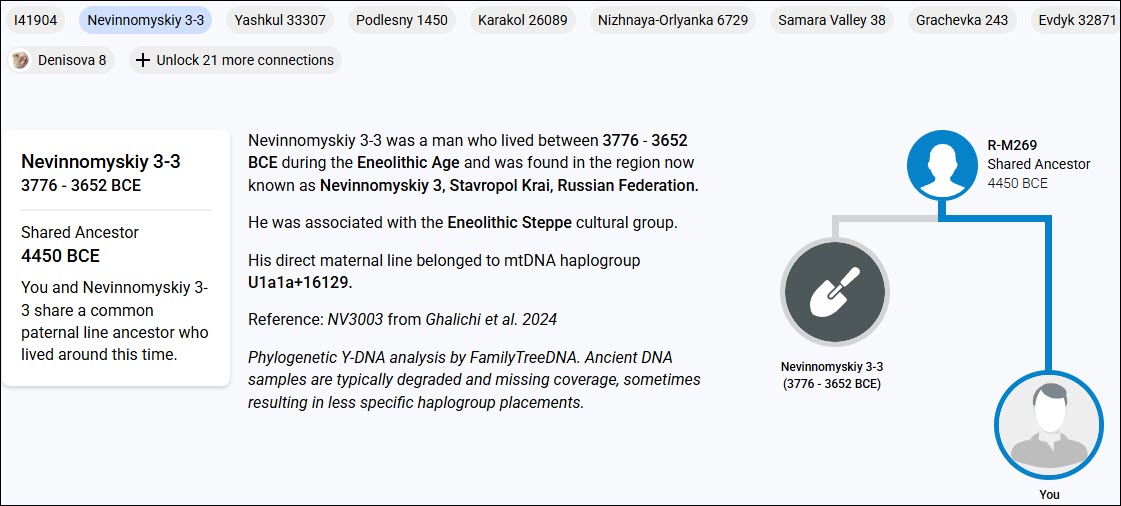
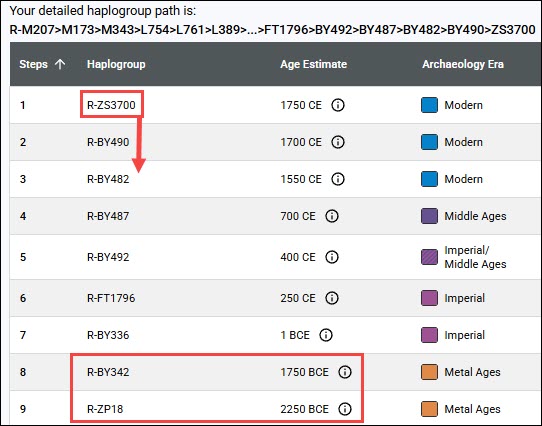
Your haplogroup is shown at the top, with the parent haplogroups in order beneath. I’ve boxed the “5 haplogroups” between R-BY482 and R-ZP18 here, and then the “3 haplogroups” between R-ZP18 and R-DF49, which is where we find the next closest Ancient Connections.

One bonus of the Ancestral Path display is that you can see how many Ancient Connections are in the database for each haplogroup, at far right.

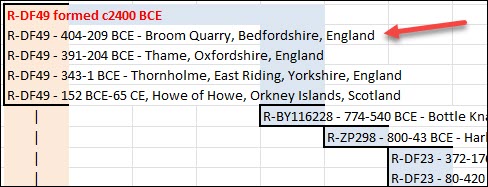
As I continue to build out my spreadsheet, the next four burials are all R-DF49, a haplogroup that was formed about 4400 years ago. Three of those burials are in England, and the fourth is in the Orkney Islands. They are all apricot, meaning:

  • They don’t carry any downstream haplogroups
  • They all descend from R-DF49
  • Based on haplogroups alone, nothing precludes the Estes line from descending from any of those men

Evaluating each Ancient Connection in the same way we did for North Berwick, when they lived, as compared to our Estes men, and where, may eliminate some of these burials as possible direct ancestors.

The balance of the Ancient Connections descend from R-DF49 through different branches and are colored blue, removing them as possible ancestors of R-ZS3700.

Regardless, we all share an ancestor, R-DF49, about 4400 years ago, just shortly before R-ZP18 lived some 4250 years ago. It would make sense that R-DF49 and R-ZP18 lived in relatively close proximity, given that they only lived about 200 years apart.

What else can we learn about these Ancient Connections?

Migration Map

To view all of your Ancient Connections on a map, just click on “Migration Map” in Discover’s sidebar.

The haplogroup whose path you are viewing, in this case, R-DF13, is the red dot on the bar at the top and is shown on the map with a red circle, but is mostly obscured here by the blue and red circles with numbers in the British Isles.

That haplogroup’s migration map, and your Ancient Connections, are displayed together. Individual burials not in close proximity to others are shown with individual trowels, and multiple burials are shown with blue and red circles, with the number indicating how many burials are found at that location.

Expanding the map shows more detail. I placed a red star to indicate the Estes lineage in Deal, at the bottom right.

Many of the blue and red circles have expanded, too.

By clicking on the blue circle, you can see which samples are found there. In this case, these 7 matching samples were all found in the same archaeological dig.

By clicking on any sample, you’ll see additional information.

One of my original questions was whether or not there was any indication whatsoever, even a smidgen of possibility that the d’Este rumor might be true. Some Estes researchers are not convinced by other arguments.

Given that our closest Ancient Connection lived about 2000 years ago in the British Isles, as do most, but not all, of the other Ancient Connections, it’s exceptionally unlikely that the progenitor of the Estes lineage was living in Italy in the 1400s, just a generation before our Estes ancestors are found in the records in Deal, and some 2000 years after the parent haplogroups of R-ZS3700 were already well-established in the British Isles.

There’s another place to check for additional information.

Notable Connections

Sometimes Notable Connections includes people who are either “ancient” themselves, and whose haplogroups have been identified through their descendants, or are from burials, or a combination of both. The difference is that their identity is not entirely a mystery.

When evaluating Notable Connections for genealogy, focus on:

  • Their haplogroup
  • Your shared haplogroup
  • When and where they lived
  • Any precluding factors like we found when analyzing North Berwick

Notable Connections are all interesting, but only a few may be relevant to your genealogy or your ancestors’ journey to where you first found them.

Speaking of their journey, Globetrekker™ shows you the most likely path of your ancestor’s haplogroup over time.

Globetrekker™

Globetrekker™ is currently only available for Y-DNA, and only for those who have taken the Big Y test.

Clicking on Globetrekker™ through my cousin’s account shows the path of his haplogroup, through Europe, in this case, into England and, if I enable them, includes relevant Ancient Connections. One Ancient Connection, Mount Pleasant 746, at Cambridgeshire, is found on the estimated genetic haplogroup path.

We’ve already determined that the Estes line cannot descend from Mount Pleasant 746, but the locations of the descendants of our common ancestor, R-ZP18 can still provide substantial clues about where our common ancestor might have lived, and his culture.

I’ve also enabled Globetrekker™’s “Sibling Lines” which indicate haplogroup siblings with the thinner lines. These display options are easy to toggle on and off.

Note that this is an estimated genetic path. In other words, it’s not exact. Especially, paths of the newer haplogroups can and will change over time as more testers test, and earliest known ancestors (EKAs) are added. I wrote about how to add EKAs in the article, “Earliest Known Ancestors” at FamilyTreeDNA in 3 Easy Steps. Please add yours, along with their location.

Sometimes the most refined haplogroup did not emerge in England, R-ZS3700 in this case, but in America. However, since the descendants have noted their EKA correctly as originating in England, that’s where the most refined haplogroup is also shown.

Furthermore, other than for Native Americans who are indigenous to the Americas, Globetrekker™ and the Migration Map both stop at the originating land mass for both Y-DNA and mitochondrial DNA.

You can read more about Globetrekker™, here.

What About the d’Este Family Story?

Now, about that d’Este family story.

Globetrekker™ utilizes the “least cost” migration methodology, which means the easiest, least risky, route of passage from place to place for our ancestors. The Strait of Dover is the closest link to the European mainland, and was shallower at that time as well.

There’s absolutely no genetic evidence that points to Italy or anyplace south for the Estes ancestral line. In fact, haplogroup R-S552 emerged about 4650 years ago, and appeared about the time that this lineage crossed from continental Europe into what is today England. There’s no evidence that this line back-migrated to the continent, to then remigrate back to the British Isles after 1471.

Ancient Connections show us that there’s evidence of the Estes ancestral haplogroups in many locations across the British Isles, long before Frencesco d’Este was being exiled from Italy. Multiple Estes family members appear in the earliest records in the Deal area, so it’s certain that they were well established and probably fishing on those same shores hundreds, if not thousands, of years earlier, based on Ancient Connections these various migration maps.

These provide one more very large nail in the coffin of that much-loved but extremely unlikely family story.

The final piece of evidence would be if a proven male descendant of the d’Este line tested and did or didn’t match. I’m not holding my breath.

Mitochondrial DNA

The methodology for building your Ancient Connections spreadsheet is exactly the same for mitochondrial DNA, with one exception.

You immediately know that you cannot descend from any male burial, because men don’t pass their mitochondrial DNA on to their children of either sex. You could, however, potentially be descended from his mother, or sister, or cousin, etc. Otherwise, the guidelines are the same.

Sometimes, Ancient Connections can resolve long-standing conflicts.

The Conflict Surrounding Radegonde Lambert

For a very long time, it was believed that Radegonde Lambert, an early Acadian woman born around 1621, was Native American because there were no known people, other than her, with that surname in Acadia. Based on the birth years of her children, she married Jean Blanchard, a French man, around 1642.

It doesn’t help any that French soldiers arrived in 1632, family settlement began about 1636, but there are virtually no records until the 1671 census, nearly 40 years later. Lots of people perished during that 40 year window.

Radegonde could have married before her arrival in Acadia, and Lambert may not be spelled accurately. We are fortunate that French women are referenced by their birth surnames, not their married surnames, so she is listed as Radegonde Lambert, the wife of Jean Blanchard on the 1671, 1678 and 1686 censuses.

Based on the conflict swirling around her presumed Native American ancestry, plus early mitochondrial DNA HVR1/HVR2 results that pointed to haplogroup “X”, which has both Native American and European branches, Radegonde began to be reported as “DNA confirmed Native”. However, that was incorrect, and she was NOT DNA confirmed as Native. Haplogroup X2a and subclades are Native American, while other haplogroup X AND X2 subclades are European, as can be viewed in the Acadian AmerIndian DNA Project.

By the time full mitochondrial sequence testing became available, that incorrect “confirmation” was firmly entrenched in family trees and among researchers, leading me to pen the article, Haplogroup X2b4 is European, Not Native American.

While ho-hum with a yawn today, it was radical at the time and greeted with quite the kerfluffle. After all, Radegonde was proven Native and HOW DARE ME! 😊

Prior to Mitotree, Radegonde’s haplogroup was X2b4, but now it’s been extended to X2b4t2, which arose about the year 500, or around 1500 years ago.

X2b4 and subclades are quite rare, with only 353 descendants today, including subclades.

X2b4t2 only has 65 members.

Clicking on the “Other Countries” link takes you to the Country Frequency report.

Click on “Table View.”

Note that the 36 “Other Countries” includes people who have listed “Unknown Origin,” who are counted individually. People listing United States often mean they are brick walled here. Some people interpret this as Native American, but there is a separate United States Native American category. Not everyone selects the correct category.

These locations are user-reported in the Earliest Known Ancestor (EKA) information, which is critical for Discover reports. I wrote about how to complete that information in 3 easy steps, here. Please add yours, including location!

One person has reported that Radegonde Lambert is “United States Native American.” She’s not Native, and she never lived in the United States either. During her lifetime, Acadians lived in Nova Scotia, where three censuses accurately reflect her residence.  Perhaps that incorrect information was entered by someone years ago, and never changed. Most people don’t think to update their EKA information.

Unfortunately, when misinformation is provided, or not corrected after we learn more, new testers view that as nuggets of evidence, and the misinformation cycle continues.

One of the benefits of Ancient Connections is that they are NOT based on trees, historical records, or genealogy of any sort. Ancient Connections are based on archaeological digs, and the location of the excavation is not subject to question.

So, let’s take a quick look at Radegonde Lambert’s Ancient Connections and see what we find.

A Quick Sneak Preview

Because I’m interested primarily in a quick view of locations, I’m skipping right to the Migration Map where all of the Ancient Connections are shown.

Radegonde’s Ancient Connections are scattered all over Europe, but there’s absolutely nothing in the Americas.

Given that Native burial excavations are culturally frowned upon in many locations, we might not see any in the US, but we also wouldn’t see any recent burials in Europe, given that the Native people have been in the Americas for well over 10,000 years.

Generally, even when Ancient Connections are missing in the US, we still find some contemporary testers with proven genealogy who carry that haplogroup, and at least a few ancient burials in Canada, Mexico, Central and South America.

The first seven Ancient Connection matches carry haplogroup X2b4, and the rest are European subgroups of X2b4. There are no closer matches as of today, but that doesn’t mean there won’t be eventually.

X2b4 emerged sometime before 5200 years ago, clearly someplace in Europe, possibly central Europe.

Radegonde’s X2b4 match locations are:

  • Malá Ohrada site in Prague – the individual lived 5800-5400 years ago
  • Hetty Peglers Tump, Gloucestershire, England – lived 5639-5383 years ago
  • Sorsum, Hildesheim, Lower Saxony, Germany – lived 5350-5100 years ago
  • Passage Tomb, Carrowkeel, Cairn K, Sligo, Ireland – lived 5100-4600 years ago
  • Kolín I-7b, Bohemia, Czech Republic – lived 4835-4485 years ago
  • De Tuithoorn, Oostwoud, Netherlands – lived 4579-4421 years ago

It’s unquestionable that X2b4 was found across Europe, not in the Americas, 5000 years ago.

This image is NOT from Radegonde Lambert’s Ancient Connections. I’ve included it to illustrate a Native American branch of haplogroup X2.

The descendants of Native American haplogroup X2a, shown above, match Kennewick Man, who is also X2a, as their closest Ancient Connection. He lived between 9250 and 8390 years ago along the river in present-day Kennewick, Washington. Their second-closest Ancient Connection is with an X2a1 burial found in Windsor, Ontario, who lived between 1223 and 1384 CE.

Neither of these unquestionably Native burials are found in the Ancient Connections of Radegonde Lambert’s descendants.

It’s worth noting here that when evaluating rare haplogroups, their Ancient Connections may reach far back in time. For example, if a Native American haplogroup only has a few Ancient Connections within the Americas, the rest of their Ancient Connections, if any, will be found on another continent. Failing to read the results thoroughly and thoughtfully could lead to an inappropriate and incorrect conclusion.

For example, haplogroup X is found in Eurasia prior to the migrated of people across Beringia, the now-submerged landmass connecting Asia with Alaska, to become the indigenous people of the Americas. Therefore, if there are less than 30 closer X2a Ancient Connections, one would expect to find Ancient Connections reflecting that continental Asian, or even Eurasian, heritage far back in time.

Notable Connections

One final tip for both Y-DNA and mitochondrial DNA is to check Notable Connections and selectively add them to your spreadsheet, if appropriate. Sometimes you’ll find people there that are both Notable and Ancient.

Not that we need more evidence about whether Radegonde Lambert’s matrilineal ancestors were Native or European, but Notable Connections provides us with one more corroborating piece of evidence.

Cangrande della Scala was an Italian nobleman who lived around 1300. He and Radegonde share a haplogroup X2b1″79 ancestor in Europe around 9000 years ago, which was after the Native people had crossed Siberia and Beringia to begin settling Canada and the Americas.

If there was any question left about Radegonde Lambert’s origins, Ancient Connections resolved it, with a backup volley from Notable Connections.

Radegonde Lambert was my ancestor, so I’m going to build her Ancient Connections spreadsheet and savor every discovery, but if I were simply seeking confirmation of or the answer to the question of whether Radegonde Lambert was Native American or European, I need look no further.

Mitochondrial DNA Case Study

In the article, Mitochondrial DNA A-Z: A Step-by-Step Guide to Matches, Mitotree and mtDNA Discover, I wrote in detail about utilizing mitochondrial DNA to break through genealogy brick walls.

My goal was to detremine if Catherine LeJeune, Edmee LeJeune and Jeanne LeJeune dit Briard were sisters or at least matrilineal relatives. Fortunately, we had several testers.

As it turned out, Catherine and Edmee were European sisters, but Jeanne did not share a matrilineal ancestor with Catherine and Edmee. Jeanne was Native American.

Next, we wanted to discover as much information about the LeJeune sisters as possible.

I created an Ancient Connections spreadsheet for the LeJeune sisters and included those results in my analysis, so please take a look. Their Ancient Connections were unexpected and simply astounding.

You literally never know who is waiting for you, nor the message they hold, just waiting to be delivered.

Ancient Connections are clues from your ancestors.

_____________________________________________________________

Share the Love!

You’re always welcome to forward articles or links to friends and share on social media.

Subscribe!

If you haven’t already subscribed, it’s free. You’ll receive an e-mail whenever I publish by clicking the “follow” button at the top of the main blog page, here.

Help Keep This Blog Free

I receive a small commission when you click a vendor link in my articles and purchase that item. This does NOT increase your price but helps me keep the lights on and this informational blog free for everyone. Please click on the affiliate links in the articles or to the vendors below if you are purchasing products or DNA testing.

Thank you so much.

DNA Purchases and Free Uploads

Genealogy Products and Services

My Books

Genealogy Books

Genealogy Research