A Little Something for Their Final Journey

It was five years ago this week that I visited my parents’ graves for what was probably the final time.

I gathered silk flowers from my home, which was being emptied, arranged them into glorious bouquets, and took treats – for both them and me.

You don’t see it in the photo above, where I was just setting up for our picnic on the picnic quilt that always lives in my car, but it took me an entire box of Kleenex to get through that picnic and what I had to share with them that day.

This was it. I wasn’t coming back. They were already buried six hours away from where I lived then – and now that distance is measured in days, not hours. There’s no one left there to visit now, and it’s not on the way to anyplace.

Dad loved popcorn and cheese cubes with turkey and salami, and Mom absolutely lived for Hershey bars.

Of course, I knew “they” couldn’t enjoy them in the here and now, and I was probably just feeding the wildlife. It was more about the ritual, the expression of love and caring, tinged with regret that I can no longer steal cubes of Dad’s cheese (he just smiled at me) or give Mom oversized Hershey bars.

Mom smiled at me too, but for an entirely different reason.

Recalling sitting on that quilt, discussing things with Mom and Dad while baking in the summer heat, much as I remember doing on the farm, makes me smile now too.

Facebook memories brought that day back this week. As I lay in bed in the silent night, reliving that hot July day picnicking with Mom and Dad, I realized that their graves aren’t the only places I had “left them something.”

Until that night, I didn’t realize that I had done it twice, once for each of my parents, but never for anyone else.

Dad

All of my regular readers know that Dad was actually my stepfather, and that he had lost his only daughter, Linda, as a baby.

No one can ever take another person’s place, but Dad told me twice that he “got his daughter back” when he married Mom. My allergies immediately acted up.

My biological father died when I was a child, so I felt like I had hit the jackpot and lucked into the best father ever when Mom married Dean.

I worshipped the ground that man walked on.

Dad died in 1994, following a horrific, progressive disease. His death was a devastating loss. On top of another loss just the year before.

Now, Dad was well-known for his orneriness, practical jokes, and sense of humor. Perhaps what made it even funnier was that he was such a quiet man – the last person you’d expect as the culprit.

So, when we all gathered at the church for his viewing and found no casket, we patiently waited for the funeral home to show up with Dad.

But when that visitation hour passed, and there was STILL no Dad, we began to worry. Mom was frantically calling the funeral home, which was about 20 miles away, but no one answered. She was a nervous wreck.

My brother was laughing. Most people were quietly and awkwardly visiting, hoping nothing was wrong.

Our imaginations were running wild. Had there been an accident? Was Dad lying someplace beside the road in his Sunday finest? Let’s face it, Dad was already deceased – he couldn’t die twice if there was an accident, but what if, what if Dad was at the wrong church or some such thing? Did they bury him by accident?

Finally, the hearse pulled up outside the church, and we heard doors slamming. Mom rushed out and asked, in her “not my church deacon” voice, where the devil they had been. Well, devil might not have been the word she used, but whatever. I was all too personally familiar with that voice, and I knew they were in BIG TROUBLE!

As it turned out, they had gotten the times mixed up, making Dad late for his own funeral.

Perhaps it was a combination of nerves and grief, plus Mom clucking around like an angry wet hen, but that whole scene just struck me as incredibly funny, and I started to laugh.

Mom gave me the side-eye like only mothers can give, so I tried to stifle myself – which made me laugh even harder, snorting through my nose.

About this time, the men from the funeral home were trying to carry the casket in the back door and up the narrow steps into the church. At the top, there was a right-angle turn, and let’s just say the casket and the men didn’t quite make it.

Well, they kind of made it, but one of the men got pinned between the casket and the corner of the wall in a very awkward place. He was also trying very hard not to let on, but you’d have had to be both deaf and blind to miss what was happening.

My mother was following this entourage up the stairs, and even she stopped talking as the scene unfolded.

By this time, I was laughing hysterically beyond any semblance of composure, tears streaming down my face, and so were most of the guests. Laughter like that is highly contagious. Most of the men were trying to help, but we had to back Dad down the stairs to free the trapped man.

I’m laughing as I write this. I can see it all over again and just can’t help myself.

Right about that time, the most inappropriate thought popped into my head. I couldn’t help it. I wondered if Dad had paid them to ensure that he was late for his own funeral.

The ultimate prank. He certainly WOULD have done that – in a heartbeat. Only question that remained was DID HE? And of course, we’ll never know.

All things considered, with everyone still laughing and crying, we were hardly in the proper frame of mind to begin a funeral, so the minister suggested that we have the viewing and recompose ourselves before the funeral. You really can’t start a funeral with everyone laugh-crying, and we were already so late by that time that it didn’t matter.

Mom had dressed Dad in a suit. I had only ever seen him in a suit a handful of times.

His wedding to Mom, my wedding, Gary’s wedding, church pictures, and maybe one other time.

Dad hated suits. He was a dyed-in-the-overalls farmer, and those overalls would have suited him much better than a suit. However, I’d wager that Dad knew Mom would dress him in a “funeral suit” for his funeral, so maybe this was his way of commenting on that.

Regardless, by the time it was my turn to step up to the casket for the final time, as grief-stricken as I was, I certainly appreciated the levity that he had introduced that day. Yes, I’m crediting him!

I dug around in Mom’s purse and found a small pair of scissors. As an Avon lady, she had literally everything in there – her purse was bottomless. I cut a lock of my hair, found a ribbon or piece of string buried in the depths of Mom’s purse, tied it around the lock, then lovingly tucked it into Dad’s starched shirt pocket for eternity.

I patted his hand one last time and told him I loved him as I smiled through my tears. I bent close and whispered that he had done a fine job as my tears dropped onto his white shirt. I swear – I swear – I saw a smile flicker across that man’s lips just for an instant.

I hadn’t planned it, but I sent Dad on his last journey with a little bit of me in his pocket. Forever.

Mom

Mom was an Avon lady for the last quarter century of her life. She loved to dress up and look her finest, so Avon was a perfect fit for her. Plus, it gave her an excuse to check in on the elderly and those with challenges in the community. She was always taking food or something to someone. Every. Single. Day.

Mom retired in the spring of 2005 at 82.

One of her longtime customers took this photo of Mom on her last day making Avon deliveries.

Mom wanted to retire with her best sales year ever, and I purchased a lifetime supply of soap, bubble bath, and Skin-So-Soft. Maybe two lifetimes’ worth. Trust me when I tell you that I’m still using Avon products.

Every Christmas, we all received our favorite Avon items in our Christmas stockings from Mom. Plus, Avon Care Deeply chapstick. Didn’t matter – man, woman, child, elderly neighbor – someone in line at the grocery whose lips looked chapped. You got Avon chapstick.

As far as I’m concerned, one can never have too much chapstick. I have chapstick, aka lip gloss, everyplace, including one or two of Mom’s that I still cherish and keep in my nightstand and desk drawer.

When Mom retired, she was one of her own best customers and stocked up on things.

Just this past week, my husband found a little wooden box that was in a drawer in his nightstand in our old house. He opened it, and voila, there they were.

Three chapsticks from Mom.

Vintage Avon Care Deeply from 2002, 2004, and 2005. Mom really liked Jim. He received the first one even before we were married. He has now kindly given all three to me. Now that’s true love.

How can chapstick make you cry?

Mom passed away unexpectedly in the spring of 2006. She had a stroke and managed to crawl into her closet and put her “pretty shoes” mostly on. No one is quite sure how she managed that, but she did. That’s how we found her. She loved shoes.

Mom’s funeral was much more subdued than Dad’s. My brother and I met with a different undertaker, so she would actually arrive at the church on time.

I selected Mom’s clothes along with her favorite “pretty shoes.” The funeral director told us that he could not get high heels on her feet. We told him that whether he could get them fully on or not, he was to get them as far onto her feet as possible – and do something to make sure they didn’t fall off. I didn’t care if he tied them on. She needed her pretty shoes. She would haunt me forever otherwise.

Saying goodbye to a parent just before the casket is closed is one of the most difficult things you will ever do.

Mom always had everything in her purse, including spare Kleenex, which she often tucked up her sleeve at her wrist, under her watch band so they would always be quickly available.

She was always handing out Kleenex at church to anyone who needed it, and probably several people who didn’t actually need one, but she thought they might. She accused me, accurately, of never having a Kleenex when I needed one. How was I supposed to predict that?

After Mom passed, we found clean Kleenex everyplace. In her pockets and purses, of course, used as bookmarks, and even tucked into the door handles inside her car.

On the day of her funeral, I had a full box of Kleenex with me. I was clearly going to need them and couldn’t depend on Mom for that anymore. She would have been proud.

As always, I had multiple Avon chapsticks, not the imposter kind, in my purse and pockets. Somehow, Mom would have known if I cheated with something other than Avon.

Standing there, saying my final goodbyes, I realized that I could NOT send Mom off into the afterlife without Kleenex and Avon chapstick, both of which she used religiously. So, I tucked a few Kleenex into one of her crossed hands and a chapstick into the other, closed my eyes for a minute, said a little prayer, then nodded for the casket to be closed as I wiped my eyes. They had been patiently waiting for me. I was struggling. Part of my heart was in there with her.

The funeral itself was a blur. When the minister finished, Mom was loaded into the back of the black hearse for her final ride along those oh-so-familiar roads to the cemetery. The little white church was at a farm crossroads, and the cemetery was probably a dozen miles away, down country roads too narrow for center lines. No one needed them anyway. The only people out there were members of local farm families who all knew each other, slowed down, and waved.

Suddenly, the hearse slammed on the brakes. We were in the car immediately behind, and I had a very up-close view of its brake lights, just before we came so close that they disappeared from view. I waited for the crunch, but fortunately, we managed to stop with an inch or so to spare, but we were quite shaken. Both figuratively and literally.

Someone had run the stop sign in front of the hearse, which missed the car by a hair’s breadth. For me, that was déjà vu, because years before, the only life-threatening accident I had ever had occurred a few miles on down that same road, under the same circumstances – minus the funeral procession.

I couldn’t help but think about the supreme irony of potentially being killed in Mom’s funeral procession, on that same road, some two decades later. I was more than a little shaky already, given the circumstances, and that didn’t help one bit.

But then, an even worse thought struck me.

What if Mom’s chapstick had been knocked out of her hand and was rolling around beyond her reach for eternity? How could I condemn her to that fate? If you know, you know.

Did she drop her Kleenex?

But perhaps more importantly, did her shoes fall off?

ECGGC 2026: East Coast Genetic Genealogy Conference – Both In-Person and Virtual

I hope you’ll join me and a whole trove of other wonderful speakers at the East Coast Genetic Genealogy Conference August 21-23 in Boston. The in-person conference is being held at the Embassy Suites at the Boston Logan Airport, so you don’t need to worry about transportation into Boston after arrival.

The great news is that you don’t have to be present to participate, and you don’t have to worry about missing sessions you wanted to attend.

All sessions, except for the Sunday morning ISOGG meeting, are either livestreamed, then available to watch later, or are available on-demand on their scheduled day.

I love this conference because it focuses strictly on genetic genealogy and how to apply it successfully to genealogy. Not to mention, it’s like a family reunion! I can hardly wait to see everyone!

Keynotes

  • Steve Little and Mark Thompson – Friday evening: The AI Frontier in Genetic Genealogy: Where We Are and Where We’re Going
  • Jennifer Zinck – Saturday morning: It Takes a Village
  • Kevin Borland – Sunday Morning: Mining A Chromosome 22 Pile-Up: Clustering Through a Documented Colonial Lineage

Speakers

In alphabetical order, speakers include:

  • Kelli BergheimerUnderstanding Your DNA Health Reports, and, Finding an Ohio Pioneer Family Using Mitochondrial DNA
  • Katherine BorgesDNA and DAR, and, Sunday morning: ISOGG Meeting
  • Kevin BorlandMining A Chromosome 22 Pile-Up: Clustering Through a Documented Colonial Lineage (keynote)
  • Greg Clarke – Welcome and Introduction
  • Janine CloudTurning a Brick Wall into a Community: Using Documents and DNA Together, and, with Roberta Estes: Between the Records and the Results: Tracing Ancestors in Mixed Lines
  • Roberta EstesMitochondrial DNA-Z: My Results are Back, Now What?, and, at DNA Academy: Using Ancient Connections to Unlock Genealogy, and, with Janine Cloud:  Between the Records and the Results: Tracing Ancestors in Mixed Lines
  • Mags GauldenThe DNA of a Revolution
  • Kate Penney HowardWhen the Story Isn’t True: DNA and the Family Legend Problem, and, Gerald Hawley and the Silence: What Erased Ancestors Teach Us About DNA Research
  • Daniel HorowitzMyHeritage DNA Basic Level, and, MyHeritageDNA Advanced Level
  • Peggy JudeYour DNA Toolkit: Expanding Your Research with Third-Party Tools, and, Step Up to the Plate: Winning Strategies for Connecting with Your DNA Matches
  • Dawn KosmakosUnraveling the Identity of Arthur Burton
  • Steve LittleSolving a Paternity Puzzle: AI-Assisted Match List Analysis in Endogamous Appalachia, and, keynote with Mark Thompson: The AI Frontier in Genetic Genealogy: Where We Are and Where We’re Going
  • Melanie McCombUsing DNA to Identify Ancestral Origins
  • Adina NewmanNavigating Your Jewish DNA Results, and, Introduction to DNA Painter: Strategies to Enhance Your Genealogical Research
  • Jonny PerlUnderstanding the What are the Odds Tool at DNA Painter
  • Rhonda RoedererThe Power of DNA – Making Life-Changing Connections
  • Diahan SouthardI Did Everything Right. So Where’s My Ancestor?, and, There’s Always a Next Step
  • Jerome SpearsOur Genetic Explorer’s Journey
  • Mark ThompsonApplied Artificial Intelligence for Genetic Genealogists, and, keynote with Steve Little: The AI Frontier in Genetic Genealogy: Where We Are and Where We’re Going
  • David Vance – At DNA Academy: NGS Testing for Autosomal DNA
  • Rob WarthenCommon Ancestors at DNAGedcom – Building Trees
  • Jennifer ZinckIt Takes a Village (keynote), and, Unleash the Power of DNA

You can view the schedule and session information here.

For people attending in Boston, additional activities are being held at the American Ancestors office and library on Thursday.

DNA Academy

Saturday evening, the ECGGC hosts DNA Academy. Each year, this fun, interactive, advanced learning session is hosted by Mags Gaulden and includes a panel Q&A session, and speakers.

From the ECGGC agenda:

Join Mags Gaulden, Dave Vance, Roberta Estes, Rob Warthen, Katherine Borges, and Jennifer Zinck for a Q & A panel with special guests to start, then sit back and enjoy a presentation on NGS testing for autosomal DNA, by Dave Vance, and “Using Ancient Connections to Unlock Genealogy”, by Roberta Estes.

Exhibit and Vendor Hall

There are both in-person and virtual vendor exhibit halls, so visit both if attending in person. Vendors who sponsor this indispensable conference are the ones who keep it affordable for the rest of us, so be sure to stop by their booths.

Register

The conference starts in just a month, but there’s still time to register, here. In-person costs $295 and virtual is $175. Both are great values. I already have my plan in place for which sessions I’m attending in person, and I’ll watch the rest after the conference.

Hope to see you there. Please be sure to say hello.

_____________________________________________________________

Share the Love!

You’re always welcome to forward articles or links to friends and share on social media.

Subscribe!

If you haven’t already subscribed, it’s free. You’ll receive an e-mail whenever I publish by clicking the “follow” button at the top of the main blog page, here.

Help Keep This Blog Free

I receive a small commission when you click a vendor link in my articles and purchase that item. This does NOT increase your price but helps me keep the lights on and this informational blog free for everyone. Please click on the affiliate links in the articles or to the vendors below if you are purchasing products or DNA testing.

Thank you so much.

DNA Purchases and Free Uploads

Genealogy Products and Services

My Books

Genealogy Books

Genealogy Research

AI and Genealogy – Brick Walls, Breakthroughs and Blunders

This is the fourth article in the AI series.

I suggest that you read these articles in publication order, as they build on each other.

AI and Genealogy

Most genealogy vendors use AI in one way or another. Like with everything else, there’s yin and yang to AI and genealogy – but for the most part, sprinkled with a little salt, I love the advances.

Let’s survey the genealogy landscape.

FamilySearch is my go-to for document images, especially now. One of the absolute best things to happen in the genealogy field has been the FamilySearch implementation of full-text searches, which they are rolling out across all of their imaged records. I wrote about the rollout here, and it’s only gotten better in the two years since.

For their latest update, including search hints, watch the video FamilySearch Full-Text Search – Your Golden Path to Ancestral Discovery.

May I live long enough to go back and search for information about each one of my ancestors.

Some of what I’ve already found is, well, shocking and sure does make my ancestors more human. Often, only the primary records like deeds, wills and marriage records have been transcribed, indexed and are online, if that much. Some other records have been published, but you have to know to look in a specific county’s records and have access to the published book. If you were trying to “find your way back in time” to where your ancestor came from, before full-text searching, you were out of luck. Now it’s easy to search across time and locations. Let’s just hope you’re not searching for a common name. Sympathies if you have John Smith.

Is full-text search an application of AI? Absolutely – and it’s wonderful. Is it always accurate? Not by a long shot – but it’s much MUCH better than nothing, and if it’s enough to “get you there,” as genealogists, we can deal with the rest.

Don’t let the pursuit of perfect be the enemy of good!

MyHeritage has been leading the pack with AI for some time now. Initially with their newspaper scans and OCR transcriptions, followed by photo restoration tools, and AI Time Machine. Next, they introduced Tribute Reels, which I wrote about here. Tribute Reels allows you to select photos and then animates them to bring your ancestor to life.

MyHeritage has also recently released Scribe AI, which is now one of my favorites. Scribe AI helps to decipher, translate, transcribe, and interpret old documents, photos, and more. I have not written about Scribe AI yet, but you can read the MyHeritage introduction article here, and try it for yourself here.

As an experiment, I selected a document at random from my saved photos at MyHeritage to see what Scribe AI could tell me. This is a French parish marriage record from 1721. Yes, I submitted something difficult, on purpose, but Scribe AI did not disappoint.

Not only did I receive a historical explanation of what this document is, I received the details, key findings, suggested next steps, a full text transcription in French, PLUS a translation to English, my language of choice.

I have been using ChatGPT for this, but sometimes different AI tools stumble over bad handwriting and such. Mied versus Mius, for example. Now I have two “go-to” tools for translations and transcriptions – both ChatGPT and Scribe AI. Hopefully, if one stumbles over something, the other won’t stumble in the same place.

This is EXACTLY the kind of help that genealogists need.

At RootsTech, MyHeritage announced that they will be introducing GAIA, a genealogy AI assistant, soon. I can’t wait.

Ancestry has been using OCR for their newspaper articles and indexes too, and including items such as wedding announcements and obituaries in your hints. They’ve also implemented AI for LifeStory.

I wanted to see what Ancestry had to say about the LifeStory of William George Estes, who lived in Lynch, Kentucky.

On the next screen, I selected “What might William George have done for entertainment while living here?”

This absolutely cracked me up, because William George Estes was, among other things, a notorious bootlegger. I never heard of him setting foot in a church – not once – nor a library.

Lynch actually didn’t have a library, but it did benefit from the Pack Horse Library Project, where librarians on horses brought the library to remote schools and residents in their saddlebags. Now that would have been both interesting and much more accurate.

Generally, though, this description was relatively accurate. These types of activities were available to people in Lynch, a segregated coal-mining town established and owned by the mining company.

Limited drinking spots? William George counted on that, and it’s exactly how he made his living!

Another recent AI beta tool, “Ideas” has been added and can be found in the upper toolbar of any ancestor’s profile.

I tried “Ideas” for Ollie Florence Bolton because of missing chapters in her story that I’d love to fill.

I was excited. I have already looked for these items, but maybe they are available now, or Ollie’s record can be located. I clicked on “Start researching” for her death certificate.

Was I EVER disappointed. Ancestry, whose primary offering is records, has just told me to search records that IT ALREADY HAS. Ancestry owns Newspapers.com, for Pete’s sake. SEARCH THE DOGGONE RECORDS FOR ME!

As I’ve been using Ancestry over the past few days, I’ve noticed the little Ancestry AI diamond pop up from time to time asking if I’d like help with something. What I wish Ancestry would do is transcribe text in the documents shown, beside the document itself, similar to FamilySearch and MyHeritage.

Across Vendors

One place where we see AI across vendors today is for customer support.

All genealogy vendors and most other businesses now use AI chatbots to answer questions that are asked repeatedly.

AI is the way of the future, and eventually, AI will be able to guide us through records and collections relevant to our ancestors. One day soon, AI will know where to look next and will look there on our behalf, providing an accurate analysis of the results. At least that’s my dream.

Everybody has to crawl before they can walk, so let’s keep moving forward and verifying.

Generating Ancestors

Modifying, enhancing, or even creating photographs of our ancestors is certainly of interest to genealogists. If you haven’t encountered this yet, you will.

I submitted a family picture of the children of Hiram Bauke Ferverda and Evaline Miller to ChatGPT. I asked it to create a likeness of the parents of their adult children, who were standing, and to completely ignore the two seated people. I did not tell ChatGPT that the seated people were Hiram and Evaline.

ChatGPT indicated that it could do as I asked, but cautioned:

  • It won’t be historically accurate in a forensic sense—it’s an informed visual estimate based on facial features the siblings share.
  • If there are both brothers and sisters, I can usually generate separate likely father and mother composites.

Here’s the output.

Notice that ChatGPT “cleaned up” the images of the children. That means it actually recreated them behind the scenes.

Here’s the second image that is different yet.

Here’s the original for comparison.

Here’s the question we need to ask ourselves and answer.

As ChatGPT cautioned, the images aren’t accurate – and I must add, they are especially inaccurate after ChatGPT “fixed” the original.

Should genealogists do this and attach reconstituted AI images to their trees?

I don’t think so, as they fall into the same category as supposed photos of Revolutionary War soldiers who died in 1800, decades before cameras existed. At least, in that circumstance, with a little bit of applied knowledge and logic, the discrepancy quickly becomes clear.

If an AI-generated image is attached, it clearly needs to be marked “AI-generated” across the photo in a prominent location, larger than in my example, such that the watermark or label can’t easily be removed as the photo is copied from tree to tree in the future.

AI genealogy expert, Stephen Little points to the Coalition for Responsible AI in Genealogy‘s statement on “Protecting Trust in Historical Images” which suggests that we “always label, always cite, and use for illustration not evidence.” It further states that images generated by AI should not be used as historical documents.

Here’s the bottom line. If you put any of these images in your trees, anyplace other than on your own computer (assuming you don’t sync with an online tree), you’ve released it into the wild because it will spread, often as the result of “hints.” Other people will copy and save it, and it will be represented as the real McCoy, either intentionally or otherwise.

We all need to be hypervigilant when evaluating photos, now and in the future.

Custom GPTs and Experts

Some people write “Expert GPTs”. Think of AI, generally, as a general practitioner. An expert GPT is written by someone who either is an expert in that field or thinks they are.

Like everything else with AI, remain cognizant of your surroundings. I mention this because I’m aware of an instance where someone who was very excited and well-intentioned about a topic wrote a GPT that was inaccurate – and if you trusted that GPT as an expert, you would be wrong and unintentionally spreading misinformation too.

If you find an expert GPT, validate that the author actually IS an expert in the topic at hand.

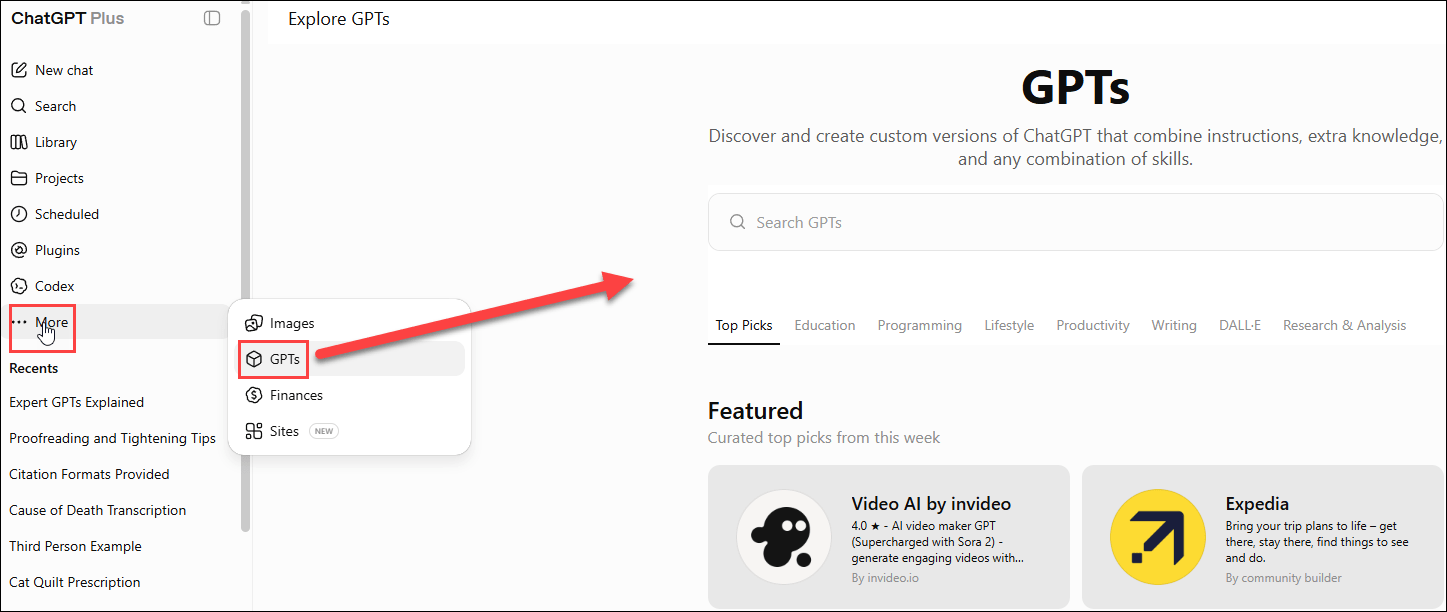
There are several custom GPTs available under the “More” button in the ChatGPT sidebar. You can search by topic or keyword or scroll and view by category.

I searched for Y-GPT, about Y-DNA, because I know positively that Dave Vance is an expert and that the answers his Y-GPT provides can be trusted.

Scroll to the bottom and just click “Start Chat.”

In fact, Dave has pre-loaded his GPT with the most common questions.

Dave’s Y-GPT is a great resource, and I recommend it, but all GPTs are not created equal. Fortunately, there are experts like Dave who freely share their knowledge. Just because someone writes a GPT or THINKS they’re an expert does not make them one. Know your author and their level of expertise before you rely on anything.

Special Project – How I’m Using AI Right Now

I want to share a special project I’m currently working on and how I’m using AI to assist. Actually, AI has saved my bacon.

I’m planning to visit my ancestors’ locations in Massachusetts this year. When I began preparing, I discovered that I have 100 ancestors who hail from 45 different Massachusetts towns. Nobody seemed to stay put. Various reasons existed for moving on. More or better land, marrying someone from another town, religious tiffs within the church, change of religion, or simply the lure of the next frontier.

I’ve compiled research into a document for each individual that includes dates and locations for the following facts, when known:

  • Birth
  • Marriage
  • Childrens’ births and marriages
  • Land grants and ownership, including purchases, sales, and inheritance
  • Military service
  • Civic service or appointments, such as selectmen or jury members
  • Church membership
  • Wills and estates, particularly land distribution
  • Death
  • Burial
  • Anything else that is location-specific, unique, or particularly interesting, such as if they helped to found a town, a church, or built a fort

If you’ve read any of my 52 Ancestors articles, you’re aware that I enjoy visiting where my ancestors lived, and “being” with them where the events in their lives took place.

That meant that after I compiled the information about each ancestor, I had to reorganize it by town because that’s how the trip would be laid out. Furthermore, in each location, I wanted to find my ancestor’s land, today. This recent article about William and Nehemiah Hunt, who owned Punkatasset Hill, and its connection to the Revolutionary War is a good example.

At this point, I have more ancestors whose land I need to find than I have time to complete the detailed research – and I was beginning to feel incredibly discouraged.

I Accidentally Turned to Google AI

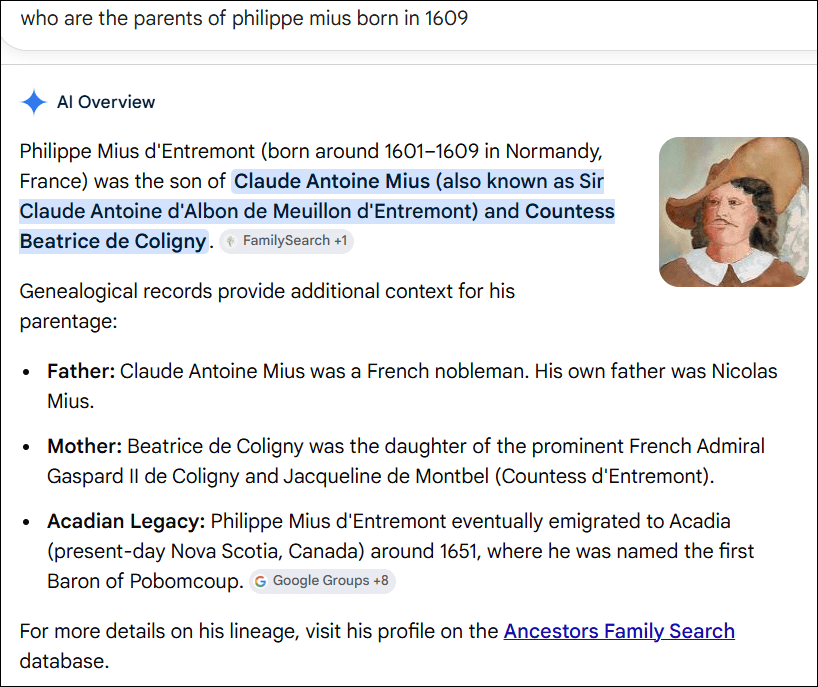
When I say accidentally, I mean I never realized just how useful Google’s AI could be until I submitted William Hunt’s name, birth and death dates, and location to see what other resources Google’s search engine might turn up. When reading the AI overview, I realized that Google had found resources that I had not and certainly would not in the time I have available to plan this trip.

Then, I switched to AI mode, and the resource improved even more.

Incredible!

When using AI tools, we need to take into consideration the strengths of the tool we are using or considering and the resources it has available. In this case, aside from being a search engine and finding information, Google’s specialty is maps, locations, place names, establishments like restaurants, hotels, historical societies, museums and more – including customer reviews.

While I was preparing for the upcoming trip, I stumbled across information that my ancestors, William Hunt and his son, Nehemiah Hunt, both owned Punkatasset Hill, the hill that the men marched down in Concord to take the Old North Bridge in 1775. That infamous “shot heard round the world.”

Google found those resources for me, and their AI tool linked them together. I spent about two days researching this one ancestral place and family for the article – working with Google resources and using each link provided to VERIFY accuracy. You will find that sometimes the resource links don’t contain what AI said they do.

I hurriedly put together William Hunt (c1604-1667), Punkatasset Hill, and the Revolution for America’s 250th.

I need to make it perfectly clear at this point that AI did NOT write that article or this article for me. I write all of my own articles. Yes, I know AI could write faster and I could publish more, but that’s not my goal or my work. This is my work. Google’s AI was my research assistant, feeding me places and resources to check based on dozens of individual prompts that I fed it in the form of questions.

As you can see in the article, I was able to locate the actual land and home of Nehemiah Hunt, and it was Google that provided the current address gleaned through the video posted by a realtor. Otherwise, I have no idea how I would ever have found that, especially since the local museum/genealogy society is closed on the day I’ll be there.

I was then able to verify that location using other means, including comparing an old photo with a satellite image.

Caution: AI was incorrect more than once, and had I not verified, I would have been off on a wild goose chase, thinking I was catching my ancestors. But without AI and prompting it in different ways, I would never have found this at all.

The Process

I’m going to step through a prompt series for my ancestor Gyles (also spelled Giles) Hopkins, Mayflower passenger and son of another passenger, Stephen Hopkins. I’ll add my own commentary as we go.

I knew that my ancestor, Gyles (or Giles) Hopkins, obtained land in Brewster, Massachusetts. Here’s information I already had before I engaged Google’s AI.

  • Stephen Hopkins, in his will dated June 6, 1644, made Caleb Hopkins, his younger son, his ‘heir apparent,’ and consequently the whole of his large real estate holding was inherited by Caleb after Stephen died in July or August of 1644. Soon after his father’s death, Caleb gave a very large tract of land located in what is now Brewster to Gyles Hopkins, his older and only surviving brother.
  • As early as 1653, Gyles Hopkins owned the 8th lot in a tract in what is now West Brewster, east of Quivet, which he sold on Nov. 9, 1666, to John Wing of Yarmouth in consideration of a mare, colt and other land.

I wanted to know specifically where this land was located and whether Gyles ever lived there.

My first question to Google was, “Where was Giles Hopkins’ land in Brewster, MA, and where is that today?”

Tip: Be very careful when Googling to include identifying information about the person you’re asking about. For example, “Where was the land of Gyles, also spelled Giles, Hopkins who lived between <date> and <date>…” would have been a better way to ask the question to ensure that I received what I wanted. There could be multiple men with the same name.

Based on what I knew about other aspects of Gyles’ life, I suspected that this land was held speculatively, as an investment, because I knew he had lived in Eastham.

So, I was surprised to see that a home had been built there.

But read carefully – it says, “A historical Hopkins home was later built in this area.” It doesn’t say HIS home, but still.

Plus, there’s a Hopkins Homestead and Bakery? Seriously? You mean, I can visit the land he owned, sit there, and have coffee? Maybe? And who built that house? Is it the original house? So many questions…I had to stop myself from immediately going down that rabbit hole. And I wasn’t even in “AI Mode” yet.

Ok, let’s switch to AI Mode and see what it says.

Now we have the name of Snowy Owl Coffee Roasters too, which says it’s a homestead site, but not necessarily “the” homestead site.

And it looks like Gyles’ (or Giles’) son, Stephen, lived in this location. His grandson apparently was also named Stephen.

Google in AI Mode almost always asks if you’d like additional information – and it’s like crack for genealogists – almost impossible to say no. Keep an eye on the sources on the right, because they change with each question or answer, and you may need to click to “show all.”

Tip: Read the sources; do NOT presume that the verbiage used by AI is verbatim in the sources or that it’s there at all.

Next, I asked to see the bakery on a map. You can tell that I’m considering stopping during my visit, right?

Google just backtracked a bit, saying that the Snowy Owl had moved and that the Hopkins House Bakery sits directly on the land granted in the 1640s.

Hot diggity!!!

Word of caution: Verify addresses and locations on Google Maps directly, as I have found discrepancies.

Keep reading, because there’s more!

Wait? What? There’s a First Encounter Beach monument? I had no idea.

Google asked if I wanted to know more. Yes, of COURSE I want to know more about that.

I already know where Gyles is buried, and I’ll get to that when I’m not focused on his land in Brewster.

Ok, I’m definitely visiting the First Encounter site, but where is it exactly?

Google asked me if I wanted driving directions. I asked for 3 locations to be included: the Hopkins House, the Cove Burying Ground in Eastham, where Gyles is buried, and the monument site.

Google must be experiencing “fatigue” because it can’t seem to retrieve everything from its memory. I’ve had this issue before. I know that Google can easily show multiple locations and stops on maps, but this time, it didn’t show “the map below” that it said was there.

Tip: When I encounter this issue, I close Google and sometimes the browser altogether, then reopen Google in AI Mode.

You can then select the conversation you were just engaged in from the AI history menu. You can also search for keywords and view your most recent AI Mode converations. How convenient is that?!

I noticed an “Upgrade” button appear in the top bar and wondered if that has anything to do with the “fatigue” Google’s AI was experiencing.

So, I clicked on the link to see if this could have been the problem with the fatigue that failed to produce the map. It wasn’t the problem, but the information provided was still useful.

I suspect that if I upgraded to either Plus or Pro, which is very reasonably priced, I might experience fewer display issues. I figured that I might have to do that to complete this time-critical project – but I didn’t.

Instead, I just clicked on the embedded link to the map, and saw that the route had been nicely mapped out.

Google even added a few local features that I hadn’t requested, which I found helpful. I should also note, though, that it missed an important landmark – so don’t get overconfident in its abilities and answers, and always verify.

I didn’t realize that the Cove Burying Ground was just a few feet away from the Eagle Wing Inn. I hadn’t asked for that information. I’m not complaining because I’m going to need a place to stay and I can click on that location and see important information like customer reviews.

Unfortunately, by the time I finished the planning for this project, this Inn was full, but Google recommended other locations based on clustering my visit locations so that I only had to move every few days – establishing a central hub in an area.

Often, several ancestors lived in a specific town, like both Plymouth and Eastham. I compiled my information for each individual location, even if they were adjacent and everything I knew about all ancestors in that location, into a PDF file. Providing AI with too much in a single prompt results in less, more diluted, and less reliable information.

For each town, I uploaded the PDF file and asked Google AI how to find each piece of land, where it is located today, how much time to allocate for each stop, the best order, and even for information on places I’ve missed that would be of interest.

In one location, Google suggested a harbor cruise, complete with a contact phone number and website, to view the land of my ancestor because it’s on Saquish Head, which is entirely privately owned and access-restricted.

In another instance, Google identified a home built by my ancestor that still stands. It has been moved from the original location, which is why I didn’t find it.

I did a LOT of prep work and provided summary information for each ancestor, including location, some of which Google helped me gather. The document totalled 551 pages. I asked Google if it could extract every mention of each town from that document, and it replied that its processing limit was between 50 and 100 pages, so the extraction would have to be done by hand. That’s OK, because it gave me a better feel for the landscape and their lives.

After I extracted the ancestors’ information by town, Google helped me immensely by adding information and organizing it into a plan, with directions and recommended time allocation for each place on the itinerary. In one town, Google even found a local Inn located on my ancestors’ land. Unfortunately, it’s booked, but it is open for dinner, so I’ll still be dining with my ancestor – so to speak.

Here were the project steps:

  1. Gather information by ancestor using traditional genealogical resources, plus Google AI to add anything I didn’t already have. Note that Google does not gather information from behind paywalled sites, or sites that technologically deflect crawling and indexing information.
  2. Create section in Master Ancestor Document for each ancestor.
  3. Ask Google to find ancestral land locations today, adding to their page
  4. Extract information from each person in the ancestor document and reassemble by town in travel order. When complete, save as PDF file by town.
  5. Submit PDF to Google AI and ask for land locations today – verifying what it said before. Prompt for an itinerary for each town, listing each stop, and how long each town’s activities will take. Include any gotchas such as locked cemeteries, museum hours, inaccessible locations (like islands), and accessibility concerns (walking, steep hills, etc.)
  6. After each town was complete, create itinerary in table format. Submit to Google AI for verification and suggested lodging in each area. Ask for driving suggestions to avoid high-traffic areas or congested times of day or other concerns or requests – including lunch or dinner suggestions.

This leaves me with the following documents:

Just a few of my Massachusetts ancestors.

  • Master Document by Ancestor – One master document that includes every ancestor in this region. The Table of Contents is 5 pages long, and the document eventually totalled 551 pages. This is how I gathered the information before any organization, and before eliminating Connecticut and Maine, which are outside the scope of this trip.
  • Master Document by Location – I quickly realized that the ancestor document was already much too long, so I created a second document by location which totalled 531 pages.
  • Individual Location Documents – When finished, I divided the Master Location Document into one file for each location. I eliminated locations where there was nothing to see, so I now have 35 individual files, which have been updated individually using AI, so they no longer match the Master Location Document. I will load these to my laptop and also to a location that I can access from my phone so I can reference them as I travel. I would actually like to print them by location to take with me, except 500 pages is a ream of paper and paper is heavy.
  • Master Itinerary by Day/Location – Detailing where I’m staying, confirmation and phone numbers, which town I’m visiting which day, and anything else I need “at a glance.”

What will I need to do after this trip? I’ll need to combine the information from the Master Document by Ancestor with information in the Individual Location Documents that pertains to them. I’ll add photos, of course, and new information gleaned during the trip. I will compile this by ancestor in their own personal file. Will AI be able to help with this step? I don’t know. We’ll see.

And yes, in case you’re wondering, you’ll be reading these as 52 Ancestors stories for years to come!

My intention in this exercize was to illustrate how AI can help locate important geographical features, like ancestral land, for instance, help you organize your data and even plan trips. I almost always find more than I was asking for. I’ve found that Google’s ability to read historical and local history websites is extremely beneficial.

I feared that I might not be ready for this trip in time to make reservations, but thanks to Google AI, I am – and I’ve discovered things about my ancestors I would not have found in time. The worst thing possible is to make a critical discovery AFTER you’ve visited and don’t have the opportunity to return.

Advanced Tools and Bleeding Edge

This series has been focused on the “normie” user, not someone pushing the frontiers of the AI envelope – although we certainly need those pioneers to help sort out how to use these tools safely for genealogy and when to stay away.

When attempting more complex tasks using AI, I’ve experienced spectacular failures. But yesterday’s failures are today’s or tomorrow’s successes. The tools literally get better every day, and a week or month in AI is like a year anywhere else.

The tools from the various AI vendors leapfrog each other, too, and each tool has a unique learning curve.

Recently, Anthropic’s Claude introduced an extremely powerful tool called Fable 5 that was free for the first several days, then available via the purchase of prepaid usage credits or tokens. That’s marketing genius, because it encouraged what I would consider “complex genealogy users” to try it. People who had projects either in mind or in the wings where other models had failed.

Specifically, Fable 5 is focused on what I would call “long horizon” jobs or tasks, such as, “Here are 300 Acadian documents. Please translate and transcribe them, then reconstruct the relationships of the people in these documents.” Or, “Here are 550 pages of ancestors, please reorganize them by town, and within town, by year.” Of course, the construction of the prompt has a lot to do with the degree of success of any query.

Anthropic says it can sustain multi-stage projects over hours or even days, planning work, checking its own output, delegating to sub-agents in agent frameworks, and producing deliverables with much less supervision than previous models.

Some people reported amazing successes with multiple files and hundreds of pages being read, processed, correlated, and reported, mostly accurately. Others had a completely different experience.

I have not been working with these new tools, but Mark Thompson and Steve Little have been. Not only did I not have a massive project ready and waiting, as I had already completed by Massachusetts town extraction, I also needed to have time to VERIFY something that large, because as tempting as this is, AI can be and is often wrong.

You can read about Mark turning Fable 5 loose on his archiving project, here.

Catch up with Steve’s interesting experiments, troubleshooting, analysis and guidance here and here.

The AI landscape is shifting away from asking “Which AI is best?” to asking “How do I assemble the best team of AI specialists and effectively use them?”

Interestingly, these advanced agents are now being used both independently and together to answer complex questions and analyze projects. This is known informally as cross-model verification. Sometimes the models agree, and sometimes they disagree, presenting different “evidence” and debate positions for their conclusions. Ultimately, you are the final arbiter.

Just as genealogists don’t rely on a single record, increasingly they shouldn’t rely on a single AI assistant either. A census, will, land grant, deed, and church record each contribute different evidence, all of which needs to be considered together. Likewise, different AI models have different strengths, weaknesses, and biases. Comparing their answers is often the digital equivalent of seeking independent corroborating evidence.

You don’t need to work on the bleeding edge. Just tuck this away for a future project after these tools are more reliable and stable.

The Take-Away

The takeaway from this is that AI is a force to be reckoned with.

Vendors are using AI, sometimes when we know it, and other times behind the scenes to process text, for example. The net-net of this is absolutely positive.

AI usage will increase over time – and that’s a good thing since we can verify the output. AI can accomplish in seconds, minutes or hours what would take us hours, days, months or maybe never.

As always, AI becomes dangerous when we don’t verify, don’t understand that we need to, don’t know how to confirm the results or we trust “experts” who aren’t.

What Do You Want?

I’m excited for the future and I have my own personal list of how I hope the vendors will integrate AI with tools they provide.

My list includes, but is not limited to:

  • AI records transcription at Ancestry, similar to FamilySearch.
  • At FamilySearch, full-text records by name and location “suggested” as hints, by individual, along with a multiple-record summary of evidence. Over time, this could go a VERY long way in resolving the “wrong spouse” or “wrong child” connected issues that persist.
  • AI “DNA plus tree matching” WITH common ancestors, meaning providing a list of people on your DNA match list who match you and each other and have common ancestors in their tree that you have. Both Ancestry and MyHeritage provide part of this in different ways today, but not all of it.
  • AI “DNA plus tree matching” WITHOUT a common ancestor in YOUR tree. This provides a means to potentially identify a brick-walled ancestor by identifying the ancestors of the people whose DNA matches yours and each other, but who do not share a common ancestor in your tree. However, they DO share ancestors with each other, which could be critically important to your research. Yes, I know this would need to be fleshed out – but it’s doable.
  • AI records searching. Essentially, what Ancestry suggests as next steps, but to actually DO THE SEARCH on your behalf and provide those results. Go a step further and indicate where to find the records if they aren’t on the platform. Message you if those records ever become available there, or the person has been revealed in existing records. For example, if death certificates are now available but weren’t previously – or the writing was so horrendous that the indexing didn’t pick it up before, but the person has been identified now – let me know.
  • At FamilySearch, something similar to relatives at RootsTech, but year-round so that cousins can contact each other, collaborate and make breakthroughs together.
  • Broad yet restricted AI searching, such as “provide me with a list of all transactions that include anyone with the surname of Estes or Eastes between 1700 and 1720 in Halifax County, Virginia.” Or, “Provide me with a list of all Estes men who live in Tennessee but who were born in Virginia in the 1850-1880 censuses.” Or, “Provide me with a list of all Estes men who are listed on the 1840 census as being pensioners or having served in the Revolutionary War.”
  • At WikiTree, FamilySearch, GEDmatch, Geni and other public sharing platforms,  identify and provide a way to contact individuals who qualify to test for the Y-DNA (male direct paternal male-to-male line) or mitochondrial DNA (everyone’s direct matrilineal mother-to-mother line) of your common ancestors. Include an avenue to offer a testing scholarship at FamilyTreeDNA. There’s so much we could learn!!!

I’m sure you can add to this list. Specifically, what would you like to see AI be able to do for you, either within or outside of a vendor’s platform?

The sky’s the limit, so dream big!

_____________________________________________________________

Share the Love!

You’re always welcome to forward articles or links to friends and share on social media.

Subscribe!

If you haven’t already subscribed, it’s free. You’ll receive an e-mail whenever I publish by clicking the “follow” button at the top of the main blog page, here.

Help Keep This Blog Free

I receive a small commission when you click a vendor link in my articles and purchase that item. This does NOT increase your price but helps me keep the lights on and this informational blog free for everyone. Please click on the affiliate links in the articles or to the vendors below if you are purchasing products or DNA testing.

Thank you so much.

DNA Purchases and Free Uploads

Genealogy Products and Services

My Books

Genealogy Books

Genealogy Research

William Hunt (c1604-1667), Punkatasset Hill, and the Revolution – 52 Ancestors #481

William Hunt was probably born between the years of 1603 and 1605 in England, although the dates and location in England are both uncertain.

We know that he was probably married to Elizabeth, whose last name is unknown, about 1630, because their first three children were baptized in St. Mary, Nottingham, in England.

  • Samuel Hunt was baptized on April 10, 1631, and eventually married Elizabeth Redding in the colonies.
  • Nehemiah Hunt was baptized on January 6, 1632/33, married Mary Toll, and died on March 6, 1717/18.
  • Elizabeth Hunt was baptized on October 11, 1635, and married John Barron in 1664.

Earlier researchers have presumed that William Hunt and his family arrived on the ship, Susan and Ellen, but that’s impossible, given that it departed on May 2, 1635, which conflicts with Elizabeth’s baptism in October.

  • William and Elizabeth Hunt apparently lost a child in 1637 or 1638.
  • The next child we find is Hannah Hunt, who was born on February 12, 1640/41, in Concord, Massachusetts. She apparently died between 1654, when she is mentioned in the will of Robert Best, and before her father made his will in 1667. The other children are mentioned, but she is absent.
  • William’s last child, Isaac Hunt, was born about 1647 and married Mary Stone in 1680.

This sequence of events tells us that William Hunt and Elizabeth, founders of Concord, Massachusetts, arrived sometime after October 1635, so probably between 1636 and sometime in 1640.

Thomas Wyman, in his book, Genealogy of the Name and Family of Hunt, published in 1862 and available on the Internet Archive, here, describes William Hunt’s decision to leave England. Extracted and edited slightly for readability:

The Life of William Hunt.

He was born in England about the year 1605, two years after the tedious but glorious reign of the Maiden Queen had ended, and the mild and pacific James Stuart had come from his native realm to rule the three kingdoms; and all the nation was glad at the happy change. It was a pleasant time to live in England. There was no very great emigration taking place, and no serious occasion for people to leave their native land to get a living. King James gave to his subjects the Bible in the same form we use this day; and learning and wisdom received happy impulses from the new light diffused by revelation, spreading its lustre more widely over civilized life. Our ancestor partook, in his daily career, of the free average advantage which a somewhat middling position in social rank allowed to realize the benefits flowing to the interior social state of the people from the refreshing access of intelligence and progress rapidly accelerating. His joyous days of childhood and youth passed into ripe manhood. Getting forward in life beyond the perils incident to all conditions, amid the protecting influences that guard the English home, — as from the early consecration at the baptismal font by the revered pastor, to the gradual growth in school and church attendance; under parental or friendly care, coming to know and practice industry and every good accomplishment that could be an attribute “of the intelligent and likely young man; then to the blissful married state, and to be father (before he left England) of at least two sons, — gifts tender and promising to infold and bring over from the Old Workl hither, to bear fruit and multiply, replenish the wilderness, and give seed for yet countless generations.

Not long after the bright and happy state of conjugal life had been entered by our revered ancestor, the policy of public affairs grew gloomy: and the hearts and wishes of worthy subjects of the king inclined them to leave the land of their nativity; to forsake the castled hills and sunny dales that they were so familiar with; to separate from the neighborhood of the kind and friendly nobility of the land, the earl and the earl’s daughter, whose presence was always inspiring; to go from the domain of the good duke, who was so firm in Parliament to support the living interests of the kingdom, the strong arguer for right, and a pillar of the realm. Could William Hunt go with his friends and neighbors, and build a commonwealth, and hope to live?

Ah! The effort was made; the achievement apparently has been accomplished. He sailed in the year 1635, with his companions, away from Old England, giving up more especially the succoring and sustaining influences of the best home society, — old neighbors, helpful and friendly (dear, good souls, known from childhood), — willing to lose all comforts and nurture so well accustomed. Greater sacrifices were to be made; the rich and blessed communions of early friendship were to be cut off. These quiet, homely English folk were going in a merchant vessel to sea. A ship took them with goods, customhouse certificates, charts, compasses, sailing gear, ocean fare, and all things strange and unused, in hazard of all dangers of the deep. The company arrived safe. From different counties came the hardy settlers. The goodly and godly Peter Bulkley, Capt. Willard, the Wheelers, Thomas Bateman, and others, are all familiar to the page of history. The weary and faithful craft came to anchor at the quay in Boston. No inducement for the stanch husbandmen was there to remain, and get subsistence in town: so they came up soon to Musketaquid, now changed (from the Indian [name]) to the sweet and intelligent name Concord, for town and river. Had they a dictionary to help them find this good name? We will take down Walker’s edition, and we find,

“Concord, noun substantive – Agreement between persons and things; peace, union, harmony; concert of sounds.”

It was the sentiments of the hearts of our Christian forefathers that moved them to bestow this choice name. The township, six miles square, was regularly bought of the Indians. The bargain was made by Capt. Willard and others, at the house of Mr. Bulkley, with Squa Sachem, Nuttunkurta, and others, of odd and long names; and the pay was duly delivered. The land was swampy in some places, with none but Indian paths, about one foot broad, and anon a broad plain, with thick, prickly bushes. Plenty of deep woods, where “sweet feme” grew so abundant, that in summer, under the sun’s rays, the strong aroma thereof caused many to faint, and fallen trees impeded very much the early proprietors. Uplands they had, and meadows which overflowed at times with water unexpectedly, as the old records say. They could make hay. Fish were caught. Alewives were plenty, even to bestow to enrich the ground.

The habitation of our ancestor was built, like the others, by digging into the bank of the hill, driving posts into the ground, and covering the top and sides with brushwood. This might be called a mere wigwam; and so were the beginnings of his American home. In process of time, land was divided, and the town-business organized; and affairs were conducted. He was one who petitioned the Governor and Assembly, in the year 1645, concerning matters of finance.

Early Concord, Massachusetts

The area that became the town of Concord was originally known as “Musketaquid,” an Algonquian word for “grassy plain.” It’s located at the confluence of the Sudbury and Assabet rivers. Native American people had lived here for time immemorial, fished, and cultivated crops like corn.

Sadly, the 1633 smallpox epidemic, a disease introduced by New World settlers, had essentially depopulated the area. This made it particularly attractive to the English, who were seeking land.

In 1635, a group of English settlers led by Rev. Peter Bulkley and Major Simon Willard received a land grant from the General Court and negotiated a land purchase with the local indigenous people. Bulkeley was a religious leader who “carried a good number of planters with him into the woods”; and Willard was a trader who spoke the Algonquian language and had gained their trust.

Six square miles were purchased in exchange for wampum-peage, hatchets, knives, hoes, cotton cloth, and shirts, useful items that the Native people could only acquire from Europeans. Concord was incorporated on September 2, 1635.

On September 6, 1636, the first church was established when the settlers voted to build a meeting house near Monument Square, along with a nearby burial ground.

There is no complete list of the original settlers who received land in 1635 and 1636, but William Hunt was assuredly there near the beginning. Not only was his daughter born in early 1641, but he took the oath of freeman on June 2, 1641. Requirements to be a freeman included:

  • Religious Orthodoxy: A man had to be a formally admitted member in good standing of the local, orthodox Puritan church. This was the hardest prerequisite, as church membership required passing a rigorous public screening of one’s personal salvation experience.
  • Age & Gender: Had to be a male at least 21 years old.
  • Property Ownership (The Freeholder Rule): He had to own a “ratable estate” (taxable property) valued at a minimum threshold—often legally recorded as 20 pounds.
  • Character Standing: The applicant had to be formally recommended by his town’s selectmen as being of “sober and peaceable conversation.”
  • The Oath: Finally, he had to swear the strict Oath of a Freeman, pledging total allegiance to the colony’s government rather than the British Crown.

Clearly, William Hunt owned land by 1641. We know, based on William Hunt’s will, that he purchased his original 30-acre “great lot” from Reverend Peter Buckley.

Reverend Buckley held the original Concord town deed. Some of the deeds and records are missing, so in 1653, Concord compiled a land registry, which was later used to correlate property conveyed in sales and by will in estates.

According to the History of Concord, Massachusetts, the original homes were built on small lots in the center of town, near Concord Square.

William’s lot was not one of the small lots clustered together in the center of town, so he was not there for the original 1635/1636 land distribution.

Based on the land William owned in 1668, as described in his will, we know he left 15 distinct parcels in Concord totaling 626 acres. His real estate was valued at an impressive £596, 12s, making him one of the wealthiest early landholders in the town.

William divided his massive Concord acreage exclusively among his three surviving sons. William had remarried after his wife Elizabeth died in 1661, and subsequently moved to Marlboro where his second wife lived, about 16 miles away, so he wasn’t living on his land when he died.

  • Samuel Hunt (William’s eldest son): He was bequeathed the original William Hunt homestead, which was built on Ponkawtasset Hill in northern Concord. He also received accompanying acreage, pasture lands, and meadows.
  • Nehemiah Hunt (William’s second son): He received 297 total acres, which included his own house site (25 acres), a 30-acre “great lot,” 188 acres from the town’s second land division (1653), and multiple parcels of fertile meadow land (including Wigwam Meadow and Bound Meadow). Wigwam Meadow eventually became part of Ponkawtasset Hill, today’s Punkatasset Hill and Conservation Area.
  • Isaac Hunt (William’s youngest son): He was granted the remaining parcels of Concord farmland, meadows, and managed woodlots to establish his own estate.

What Happened to the Land?

Samuel Hunt had already relocated to Ipswich when William died, and his land was incorporated into Nehemiah’s holdings.

Due to his massive landholdings, Nehemiah Hunt became known as the “Lord of Punkatasset” and lived there his entire life. He died intestate in 1718, but his land passed on within the family after his death.

You can read more about the history of William Hunt’s land in The History of Two-Rod Road, here.

William’s land followed distinct paths through the generations, transitioning from pioneer farmland to historic landmarks and protected Conservation areas. Estabrook Woods, which includes all of Isaac’s land and part of the rest has been acquired by Harvard’s Museum of Comparative Zoology to protect what it describes as a “priceless resource.”

Henry David Thoreau lived in Concord for most of his life and regularly sought refuge on Punkatasset Hill and Estabrook. Thoreau wrote fondly and eloquently about “the great wild tract” in his journal.

In 1837, recently graduated from Harvard and unemployed because he quit a teaching job that required him to flog his students, Thoreau began journaling, and three weeks later wrote:

Ponkawtasset

There goes the river, or rather is, “in serpent error wandering”–the jugular vein of Musketaquid. Who knows how much of the proverbial moderation of the inhabitants was caught from its dull circulation?

The snow gives the landscape a washing-day appearance–here a streak of white, there a streak of dark–it is spread like a napkin over the hills and meadows. This must be a rare drying day; to judge from the vapor that floats over the “vast clothes” yard.

A hundred guns are firing and a flag flying in the village in celebration of the whig victory. Now a short dull report–the mere disk of a sound shorn of its beams–and then a puff of smoke rises in the horizon to join its misty relatives in the skies.

Punkatasset Hill, also known as Hunt’s Hill in the early 1700s, marks the southeast corner of the Eastabrook forest and had played a pivotal role in the Revolutionary War just sixty years before Thoreau put pen to paper.

The Estate

Remarkably, the original Nehemiah Hunt and Daniel Hunt homes on Ponkawtasset Hill still stands today as a historic private estate, recognized as one of the oldest standing colonial dwellings in Concord.

In 1920, William Henry Hunt (1830-1926), a farmer who inherited the deteriorating family homes, wrote about his recollections of the Hunt family and their lands, including their abolitionist beliefs and activities before and during the Civil War.

William Henry Hunt was six generations removed from William and Elizabeth Hunt, descending through son Nehemiah Hunt (1631-1718), William Hunt (1678-1756), Nehemiah Hunt (1726-1785), Nehemiah Hunt (1764-1846) and his father, Daniel Hunt (1796-1870).

One of the things William Henry Hunt provided was a photo of the two homes that are described as “adjoining.” You can view an 1880s photo, here. Nehemiah’s home is on the left, and the “Daniel Hunt” house, built between 1780 and 1790, is on the right.

William Henry Hunt, Daniel’s son, spent much of his life attempting to rejuvenate the deteriorating farm homes. By 1863, Nehemiah’s original home was probably 200 years old, given that he married in 1663, and his father died just five years later, stating that Nehemiah already lived on his property.

In 1887, William Henry Hunt gave up and sold the land to the Reverend Henry Hutchins, who created a large-scale commercial dairy farm to sell milk into the Boston market.

Hutchins built a massive barn and merged the two “adjacent” homes into one. Hutchins unified and expanded the living quarters. He structurally tied the older architectural wings together under a continuous, sprawling gambrel roof layout. This architectural choice masked the distinct joins of the previous Hunt and Barrett structures visible in the 1880s photo, expanding the main footprint into a singular, cohesive 6-bedroom grand country estate. To accommodate farm staff and his own family, he also added two cottages. We’ll visit in a little bit.

You may wonder why I’ve spent so much time discussing William Hunt’s property. As it turns out, William Hunt’s property is uniquely important in the history of the United States – of its birth, 250 years ago, today.

You see, William Hunt’s land, then Nehemiah’s land, included Ponkawtasset Hill.

Ponkawtasset Hill, in turn, directly and profoundly shaped our nation’s history a century later.

Ponkawtasset Hill

Tensions had been building for months, years actually. Taxation by the British government, lack of representation, and more. The retaliatory “Tea Party” took place in nearby Boston on December 16, 1773, serving as a flashpoint.

The British government punished Boston for the Boston Tea Party by closing its harbor and revoking Massachusetts’ self-governance, which led the colonists to stockpile weapons in Concord and organize a militia network.

Concord residents burned tea. Anyone caught buying or selling tea, or even drinking tea was publicly humiliated and shamed. To make a public statement and stand in solidarity with Boston, the townspeople gathered their remaining stores of tea and burned them in the town common right outside the Wright Tavern.

The situation escalated. In August 1774, the British Parliament enacted the Massachusetts Government Act, a law that stripped colonists of their democratic rights, banned town meetings, and dictated that local judges and court officials would now be directly appointed by the British Crown rather than local authorities. The citizens realized that by allowing those courts to open and those judges to sit, they were submitting to tyranny, and they weren’t having it.

In Concord, they had had enough. Concord residents determined to overthrow British rule themselves – and they did.

Throughout the week of September 13, 1774, thousands of armed citizens and militiamen marched into Concord. On September 17, 1774, armed Middlesex County citizens blocked the crown-appointed judges from opening the county court, effectively establishing an independent, illegal provincial government.

The British had mightily underestimated the populace, especially in Concord.

The militia forced these officials to march outside through a gauntlet of citizens and publicly sign a recantation, swearing they would never execute their royal commissions. Then, the Crown-appointed judges, clerks, and the royal sheriff sought shelter inside Daniel Heywood’s local tavern.

How humiliating! And inspiring.

Not only did those judges never sit again in Concord, they never sat again in Middlesex County. But this was just the beginning.

Unbeknownst to those brave citizens at the time, the American Revolution had begun, and they were the sparks. Emboldened by Concord, the rebellion spread throughout Massachusetts. But they knew that the British would not walk away without a fight, and following what had just occurred, consequences were coming.

Concord prepared.

On October 4th, 209 towns sent more than 300 delegates to Concord, by now the seat of the rebellion, to form the Massachusetts Provisional Congress.

In Worchester, at the town meeting, the instructions were given.

You are to exert yourself in devising ways and means to raise from the dissolution of the old constitution, as from the ashes of the Phenix, a new form, wherein all officers shall be dependent on the suffrages of the people, whatever unfavorable constructions our enemies may put upon such procedure.

“As the ashes of the Phenix” – I love that!

William Hunt and his sons had been dead for decades, but you know their spirits were cheering.

We have no written records of their political leanings, but given what we know about what happened soon enough, and that their descendants felt that their abolitionist views 90 years later were a continuation of their Revolutionary War commitment, we really don’t need any.

Knowing that the Redcoats would descend upon them soon, the townspeople focused on preparation. They knew that British General Gage was waiting on reinforcements, and once they arrived, the fight would be on.

Had Concord bitten off more than they could chew?

They needed to raise a fighting force of 15,000 men, with guns and ammunition for all of them – a seemingly impossible, overwhelming task.

But then again, this was Concord, a town who knew no bounds and had the spunk of their ancestors running through their veins.

The entire population of Concord, maybe 1,400 people was spread among roughly 260 families. That’s maybe 300 males of fighting age. The imbalance and seeming impossibility simply boggles the mind.

To purchase supplies, the Provincial Congress commandeered all of the taxes that would have gone to the British government. How they did this isn’t exactly clear, but they did, bought munitions, and stored their supplies in both Concord and Worcester.

General Gage knew this, and that made Concord a bullseye. He would make an example out of Concord and quell that rebellion.

Concord knew that, too, and they were much closer to Boston than Worcester.

Because Concord was designated as the central munitions depot, Colonel James Barrett, whose family was intermarried with the Hunts, was tasked by the Provincial Congress with organizing, safeguarding, and distributing the massive colonial arsenal.

He began to smuggle arms and supplies out of Boston, including musket balls, gunpowder, medical supplies, and four very valuable brass cannons.

British reinforcements arrived, and General Thomas Gage ordered 700 British Regulars to march secretly from Boston to Concord.

“Sir, you will march with the corps of grenadiers and light infantry put under your command with the utmost expedition and secrecy to Concord…”

I’m not quite sure how 700 soldiers in bright red coats with their equipment clanking can march secretly through the countryside, even if it was the middle of the night, but whatever. Their mission was to seize and destroy a massive stockpile of colonial weapons and gunpowder.

The British, were, indeed, coming.

Paul Revere Rides

It was the night of April 18th, 1775, and Paul Revere was summoned by Dr. Joseph Warren. Revere was informed that General Gage had ordered the Redcoats to proceed with “utmost expedition and secrecy to Concord,” where they were tasked with destroying the munitions stores and arresting the Patriots, of course.

Paul Revere, a silversmith, was selected as the rider who would secure his place in history books because of his proven reliability and established network in the countryside. He had been serving as a clandestine express courier to New York and Philadelphia to keep them apprised of the brewing rebellion in Boston, and was widely credited with participating in, if not leading, the Boston Tea Party revolt.

After the Tea Party, the British forced the Boston citizens to “quarter” the British soldiers in their homes. Revere and other tradesmen began to meet at the Green Dragon, probably the early version of Cheers, to exchange information and watch the British. Already a member of the Sons of Liberty and producing political documents, Revere began submitting engravings to a new Patriot publication as well.

His goal that night was to ride to Lexington and Concord ahead of the British to warn Patriot leaders and alert the militia to be on guard.

Revere, fearing capture, instructed the sexton to hang two lanterns in the steeple of the Old North Church, indicating that the British were crossing the Charles River by sea, not land.

Revere then rowed across the Charles River, actually rowing unnoticed right past a British warship under the cover of darkness. Upon arrival in Charlestown across the river, they had aleady seen the lanterns and knew Revere would need a horse, so had one waiting for him as he began his famous ride into history. .

Along the way, in around 40 towns and villages, he alerted one pre-appointed person who took over from there. Local church bells were rung to alert the militia, who began preparing as Revere was silently off to his next stop.

Revere made it as far as Lexington, where he arrived about midnight and was able to alert Samuel Adams and John Hancock, but he was captured after leaving Lexington and never reached Concord.

However, at Lexington, William Dawes, a fellow express rider out of Boston caught up with Revere, and about 1 in the morning, the two men decided to press on the next seven miles to Concord where the weapons were stockpiled. On the road, they encountered Dr. Samuel Prescot, a Concord physician returning home from treating a patient, who joined their mission.

Shortly thereafter, they were ambushed by a roadblock of British officers who had been stationed there to intercept any rebel messengers. Revere was cornered in a field, captured, questioned, his horse confiscated, and eventually released on foot.

Dawes turned around and made for Lexington, but his horse threw him and ran away.

Dr. Prescott knew all the ins and outs of the local roads and farms, having ridden them many times. He jumped his horse over a stone wall, escaping into the deep woods, and successfully made it to Concord to alert the sentry on guard, who rang the church bell to awaken the townspeople.

Prescott also continued riding and alerted the neighboring militias in Acton and Stow, a brilliant decision. They immediately gathered their men and began marching towards Concord.

The Mad Rush

Concord immediately knew what was happening, and who was coming. Everything the British were seeking was hidden on the farm of Col. Barrett, who was the head of the local militia units. The residents set about in a mad rush to distribute the munitions and hide the cannons.

They loaded heavy wooden barrels of musket balls, flints and medical supplies onto carts, distributed and hid them in various locations in town, including marshy areas behind the Hunt land on Punkatasset Hill. They successfully hid the four cannons on Barrett’s farm, two by plowing them into fields.

Sometime before dawn, a contingent from Lincoln, Massachusetts, under the command of Capt. William Smith, the brother of Abigail Adams, arrived to assist Concord.

As dawn broke, Barrett assembled the armed militia in the town center, which assuredly included Nehemiah Hunt, who lived in the family home that still stands on Punkatasset Hill today. This Nehemiah Hunt (1726-1785) was the great-grandson of William Hunt (c1604-1667), and the grandson of Nehemiah Hunt (1633-1718).

Concord scout Reuben Brown was dispatched towards Lexington, where, about 5:30 AM he heard gunshots, which turned out to be at Lexington Green, and knew that the British were on their way to Concord.

Around 7:00 AM, the townspeople watched as 700 Redcoats appeared on the horizon, with drums beating, fifes playing, and bayonets fixed.

That was half the population of the entire town, and more than twice as many as the 250 militiamen under Barrett’s control.

Barrett knew what was coming, and rather than face slaughter, he ordered a tactical retreat out of the town center, across the Old North Bridge, ascending straight up the extremely steep, defensive Punkatasset Hill onto their designated staging field, and higher yet.

From the top of the hill, the entire terrain for miles was visible, and on a clear day, one could see all the way to Boston.

The hill provided not only safety and visibility, but the opportunity to regroup without being under the immediate emotional turmoil of a clearly suicidal battle.

The Battle

When the British troops arrived in Concord to find an abandoned town, they were quite perplexed. Where were the people, and where did the militiamen go?

The British decided to secure the three bridges, including the Old North Bridge. They sent some of their soldiers right past Nathaniel Hunt’s land to search Barrett’s farm for munitions and those cannons.

Unflustered, Barrett’s wife slowed them down by fixing them breakfast as the cannons were plowed under in the fields. They had no idea that they had just been outsmarted by a “housewife.”

The British soldiers who remained in town discovered some wooden gun carriages, which they smashed and burned.

During this time, reinforcements were arriving on Punkatasset Hill – a Bedford Company and three from Acton, bringing their total to about 400 men. One of the Acton units was led by Captain Simon Hunt (1704-1790), the great-great-grandson of Nehemiah Hunt who died in 1718, and the great-great-great-grandson of William Hunt, the founder who originally owned Punkatasset Hill.

The men up on the hill wanted to be able to watch the activity at the Old North Bridge, so about 9 o’clock, they moved down the hill partway to Major John Buttrick’s muster field, a lower plateau that provided an unobstructed view of the bridge.

There, they spotted a plume of thick, black smoke above the town and thought the soldiers were burning their homes.

Adjutant Joseph Hosmer yelled, “Will we let them burn the town down?” The rest shouted, “No!” That was all it took.

Their short respite on the hill, and the reinforcements had turned the psychological tide, providing a contingent of Massachusetts farmers with the confidence to advance on the world’s most powerful military force. God bless them one and all.

The decision was made to march down the hill immediately, and onto the Old North Bridge that the British soldiers were guarding. Because they were the best armed, Isaac Davis and his Acton Minutemen were asked to lead the column, to which he replied, “I haven’t a man who is afraid to go.”

The order was given to load their muskets.

Colonel Barrett ordered the advance, instructing them not to fire unless they were fired upon. Their hearts must have been beating out of their chests, knowing they were outnumbered and facing a contingent of professional soldiers.

Still, they marched.

Led by Acton’s minutemen, who had bayonetts, they descended the hillside, marching in a tight double-file line straight down the hill to where the Redcoats were waiting – probably wondering what on earth was going on.

This tactical descent led directly to the famous Battle at the Old North Bridge.

The 90 Redcoats guarding the bridge suddenly realized they were outnumbered and hastily retreated back across the bridge. In their panic and resulting confusion, they only managed to pull a few planks up off of the bridge, so the militia was able to cross easily.

The British formed a deep, narrow line on the other side of the bridge. This formation, where the front men fired, then stepped to the read to reload as the next group fired, was designed for street fighting, not open riverfront while firing across a narrow bridge. They weren’t trained for this and crowded together, blocking each other’s views.

The Patriot militiamen just kept on advancing, reaching the western edge of the bridge, when the British opened fire. At first, warning shots fell into the water, but then a full-on volley followed, killing Acton’s Captain Isaac Davis with a bullet directly through the heart.

Standing where this monument stands today, and seeing men drop, Major John Buttrick leaped into the air, screaming the historic words, “Fire, fellow soldiers, for God’s sake, fire.”

And fire they did.

“The shot heard round the world.”

The front ranks of the colonial militia leveled their muskets over the bridge and loosed a devastating, concentrated volley. Because the British were bunched up in their narrow street-firing column, the colonial musket balls tore through their ranks, wounding four of the eight British officers on the bridge, and killing four privates.

The British panicked, broke formation, and fled into the Concord town center.

The fallen British soldiers were left laying at the bridge, where this monument stands today.

The entire first battle, the opening salvo of the Revolutionary War had only lasted two or three minutes, and took place at the base of Punkatasset Hill.

The minutemen crossed the bridge, but did not immediately pursue the fleeing British soldiers into the town center. Some fell back across the river and took up a defensive position behind the stone walls beside the road, near the British monument today.

The British soldiers who had gone to Barrett’s to search his property, finding nothing because the munitions had already been distributed, were now cut off and the victorious minutemen stood firmly between them and the rest of the British soldiers.

For the next hour, a tense standoff ensued, and neither side did anything.

Around 10:30, unaware of what had transpired, the unit dispatched to Barrett’s farm marched directly back into Concord, only to discover their comrades’ bodies. One man, not yet dead, had been struck in the head with a hatchet by a colonial boy who obviously didn’t wield a gun, but that terrified the Redcoats, thinking that the Native people had joined the Patriots in the fray.

The militiamen chose to regroup and stay quiet, expecting an attack or ambush that never came. After the group returned from Barrett’s and joined the British in Concord, the Redcoats spent the next couple of hours treating their wounded and trying to regroup.

They left at least two of their dead who were buried beside the road, near the British monument today.

The British didn’t realize it, but as the standoff continued, reinforcements from nearby towns continued to arrive from all directions, soon outnumbering the British. More than 32 militia companies with just under 1400 men eventually joined the fight at Concord. You can see a print of that day, drawn shortly thereafter, here.

Around noon, the British officers decided to retreat to Boston, but they were too late and the fuse had aleady been lit.

As the British began their march back to Boston, fighting resumed on the outskirts of Concord, at Miriam’s Corner.

Thinking they were safely regrouping in the Concord town center, away from Concord’s militiamen, they were sorely mistaken. What they had done was given away precious time, a fatal strategic flaw. The silent alarm system in the Massachusetts countryside was hard at work, and thousands of men headed towards Concord, blocking the British escape route.

The final fight at Concord killed a few more Redcoats, but the real war would take place all along the 16-mile route back to Boston, known as the “Nightmare of Battle Road”.

The colonial militia did not meet the British columns of soldiers in their bright red coats head on. Instead they used guerilla tactics, firing from the woods, from barns, behind walls and from inside houses into the increasingly depleted and battle weary soldiers who had been marching and fighting since midnight. The number of militia increased, as the number of soldiers decreased.

By the end of that day, the British had marched back to Boston with their red tails between their legs. One of the British officers lamented that, “their numbers increasing from all parts while ours was reducing by deaths, wounds and fatigue.”

The final tally was:

  • British casualties: 247 casualties with 73 killed and 53 missing
  • Colonist casualties: 88 casualties, with 49 killed

When the fighting ended in Charlestown that evening, it wasn’t the end of the fight, it was the beginning of a new era. More than 20,000 Massachusetts militiamen had responded and began a siege of Boston.

The battle for America was on.

I choose to believe that William Hunt and his son, Nehemiah, were watching what transpired on their homeland, Punkatasset Hill, and that they were silently cheering the men on. Maybe helping in some unknown way.

America’s turning point happened on Punkatasset Hill. It was here that the final spark was lit, half a mile above the town. One that transformed localized protests into an organized military resistance.

The hill provided the local militia with time to consolidate their resources, spy on the British, make a strategic offensive decision, and obtain the psychological advantage. Then, a few hundred outnumbered soldiers in farmers’ clothing descended the hill, marching two-by-two, staring directly into the face of death.

Without Punkatasset Hill, the path of our history may well have been charted differently.

The fate of America hung in the balance that day, and might well have taken an entirely different turn.

Punkatasset Hill Today

There are two parts to the question of Punkatasset Hill’s location today. The first is the location of the hill itself and the second is the location of Nehemiah Hunt’s original home on the Hunt property.

Today, most of Punkatasset Hill is a preserved historic site within Concord, serving as a monument to the quiet hour of anticipation that directly birthed the American Revolution.

This area is replete with hiking trails, one of which provides access to the top of Punkatasset Hill, where the militiamen stood and America embarked on freedom’s path.

The short hike to the hill can be found on TrailMaps, here, noted as trail 7. You can watch a video of the hike to nearby Hutchins pond on YouTube, here.

The Town of Concord provides several trail maps and guides, here.

William Hall’s Land and Nehemiah Hall’s Home

While William Hunt’s land expands across almost all of Punkatasset Hill, and his original home is gone, we can pinpoint exactly where Nehemiah Hunt lived, because the home, while heavily refurbished, still exists today.

The trailhead is just above Nehemiah’s residence on Monument Street, and across from Hutchins Farm.

You can still see the shape of the two adjoining houses today, although they look vastly different than in the 1880s.

Take a look at these beautiful photos of the property on Realtor.com, here. The residence is gated and can’t be seen from the road.

The structure to the rear is Nehemiah’s home and dates to pre-Revolutionary War days. The brave Patriots gathered on the hill directly behind this home.

The barn and outbuildings do not date to this period. The pool, in the drone photos, is directly behind Nehemiah’s part of the home.

I can’t tell which rooms are in the original portion of the house, but they are all stunning. I know William and Nehemiah Hunt stood in these rooms and warmed themselves by the fire.

What I really want you to look at is the aerial view. I can’t quite place the hill, but it’s someplace here, perhaps slightly behind and to the right of the barn. Regardless, it’s William Hunt’s land.

But why not fly over?

There’s a video tour here, on Vimeo.

How I wish this were a VRBO.

The Hill I Will Die On

William Hunt founded Concord, with others, between 1636 and 1640. He died in 1667, and just over a century later, his land would provide the launching pad for what would become the United States.

I can only imagine the shock, and how proud he would be, were he to know what he begat and the outsized role that Punkatasset Hill played in history.

Punkatasset Hill provided the clarion call for the foundation of this country. It was a humble beginning with a few brave men on a hilltop one chilly April morning.

This is a hill that I, too, am willing to die on.

The Declaration of Independence

Fifteen months after the encounter beneath Punkatasset Hill, on the Old North Bridge, a new country would be formed. On July 4, 1776, the Declaration of Independence was signed at Independence Hall, severing our political ties with Great Britain. We threw off the mantle of a form of government where monarchs ruled and became a sovereign nation, in charge of our own fate.

The Declaration’s Introduction

When in the Course of human events, it becomes necessary for one people to dissolve the political bands which have connected them with another, and to assume among the powers of the earth, the separate and equal station to which the Laws of Nature and of Nature’s God entitle them, a decent respect to the opinions of mankind requires that they should declare the causes which impel them to the separation.

The preamble begins:

We hold these truths to be self-evident, that all men are created equal, that they are endowed by their Creator with certain unalienable Rights, that among these are Life, Liberty and the pursuit of Happiness.—That to secure these rights, Governments are instituted among Men, deriving their just powers from the consent of the governed,—That whenever any Form of Government becomes destructive of these ends, it is the Right of the People to alter or to abolish it, and to institute new Government, laying its foundation on such principles and organizing its powers in such form, as to them shall seem most likely to effect their Safety and Happiness. Prudence, indeed, will dictate that Governments long established should not be changed for light and transient causes; and accordingly all experience hath shewn, that mankind are more disposed to suffer, while evils are sufferable, than to right themselves by abolishing the forms to which they are accustomed. But when a long train of abuses and usurpations, pursuing invariably the same Object evinces a design to reduce them under absolute Despotism, it is their right, it is their duty, to throw off such Government, and to provide new Guards for their future security

The Constitution

The Declaration of Independence was followed by the Constitution, which sets forth the structure of how the republic is to be run. It was signed on September 17, 1787.

At the close of the Constitutional Convention, when leaving the building, a woman asked Benjamin Franklin, “What have we got, a republic or a monarchy?” Franklin famously replied:

“A republic, if you can keep it.”  

The Constitution provides a balanced federal structure, divided between three equally powerful but distinct branches of government, the Judiciary, the Legislative, and the Executive. It provides separation of power, and divides power between the federal government and the states.

A summary of the Seven Articles of the Constitution:

  • Article I (The Legislative Branch): Creates Congress (the Senate and House of Representatives), sets member qualifications, and details its powers like taxing, coining money, and declaring war.
  • Article II (The Executive Branch): Establishes the presidency, details the Electoral College system, outlines presidential powers (like commanding the military), and defines the impeachment process.
  • Article III (The Judicial Branch): Creates the Supreme Court, allows Congress to set up lower federal courts, defines the types of cases they can hear, and explicitly defines treason.
  • Article IV (The States): Regulates relationships between states, requires them to respect each other’s laws, guarantees citizens equal treatment across state lines, and outlines how new states can join the Union.
  • Article V (The Amendment Process): Sets up the two-step system needed to change the Constitution, requiring a two-thirds vote in Congress and approval from three-fourths of the states.
  • Article VI (Federal Supremacy): Establishes the Constitution and federal laws as the “supreme Law of the Land,” meaning federal law trumps state law if they conflict, and bans religious tests for holding public office.
  • Article VII (Ratification): Explains the original startup rules, stating that 9 out of the original 13 states had to approve the document for it to officially take effect.

You can read the full text of the Constitution, here.

Because we were no longer a monarchy, where one person told the rest of us what to do, the Constitution needed to be ratified. It took nine months for the Constitution to complete the ratification process and be approved.

  • September 17, 1787 (The Proposal): The Constitution was completed and signed by the delegates, then sent to the states.
  • December 7, 1787 (The First State): Delaware became the very first state to vote in favor of approval, earning its nickname “The First State”.
  • June 21, 1788 (Official Approval): New Hampshire became the crucial 9th state to ratify the document. This officially made the Constitution the legally binding framework of the United States.
  • March 4, 1789 (The Government Begins): The new constitutional government officially began operations.
  • May 29, 1790 (Unanimous Approval): Rhode Island, the final holdout state, finally ratified the document, making the approval unanimous across all 13 original states.

Constitutional Amendments

The founding fathers provided enough flexibility that the Constitution could be amended, and it has been several times.

The first 10 amendments are known as the Bill of Rights. The Bill of Rights was officially proposed by Congress on September 25, 1789, and ratified by the states on December 15, 1791.

Two Amendments in the original Bill of Rights didn’t pass. The first dealt with Congressional representation in the House of Representatives as the country grew. The second dealt with Congressional pay raises and was tabled. It eventually became the 27th Amendment, but took 202 years to pass.

The Bill of Rights

The purpose of the Bill of Rights was to safeguard individual liberties and place strict, legal limits on federal power

  • 1st Amendment: Freedom of speech, religion, press, assembly, and petition.
  • 2nd Amendment: The right to keep and bear arms.
  • 3rd Amendment: Restrictions on housing soldiers in private homes.
  • 4th Amendment: Protection against unreasonable searches and seizures.
  • 5th Amendment: Rights of the accused (due process, double jeopardy, self-incrimination).
  • 6th Amendment: The right to a speedy and public trial by jury in criminal cases.
  • 7th Amendment: The right to a jury trial in civil cases.
  • 8th Amendment: Protections against excessive bail and cruel and unusual punishment.
  • 9th Amendment: Ensures that citizens have rights beyond those listed in the Constitution.
  • 10th Amendment: Reserves powers not given to the federal government to the states or the people

Amendments 11-27

  • 11th Amendment (1795): Stops citizens of one state or another country from suing another state in federal court.
  • 12th Amendment (1804): Fixes the Electoral College so electors vote for President and Vice President separately.
  • 13th Amendment (1865): Abolished slavery and involuntary servitude across the entire nation.
  • 14th Amendment (1868): Guarantees birthright citizenship, due process, and equal protection under the law to all citizens.
  • 15th Amendment (1870): Bans the government from denying a citizen the right to vote based on race.
  • 16th Amendment (1913): Allows Congress to levy a nationwide income tax.
  • 17th Amendment (1913): Changes the law so citizens vote directly for U.S. Senators instead of state legislatures choosing them.
  • 18th Amendment (1919): Banned the manufacture, sale, and transportation of alcohol (Prohibition) and was repealed by the 21st Amendment.
  • 19th Amendment (1920): Granted women the right to vote.
  • 20th Amendment (1933): Shortened the time between elections and inauguration, moving the presidential start date to January 20.
  • 21st Amendment (1933): Ended Prohibition by completely repealing the 18th Amendment.
  • 22nd Amendment (1951): Limits the President to serving a maximum of two terms.
  • 23rd Amendment (1961): Gives Washington, D.C. residents the right to vote in presidential elections.
  • 24th Amendment (1964): Bans poll taxes, making it illegal to force people to pay a tax to vote.
  • 25th Amendment (1967): Clarifies that the Vice President takes over if the President dies, resigns, or becomes disabled.
  • 26th Amendment (1971): Lowers the national voting age from 21 down to 18.
  • 27th Amendment (1992): Prevents members of Congress from giving themselves an immediate pay raise until an election has passed. (Took 202 years to pass and finally did in 1992)

Stalled

  • 28th Amendment (stalled): The Equal Rights Amendment (ERA) states that equality of rights under the law shall not be denied or abridged by the United States or by any State on account of sex. Congress passed it in 1972 with a deadline of March 22, 1979 for three-fourths of the states to ratify, but they failed to do so, even after an extension to 1982, so it remains stalled among lawsuits.

You can read the full text of the Amendments, here and here, or here.

The Oaths

All elected officials swear an oath to uphold the Constitution, which includes the Amendments.

The exact verbiage of the President’s oath is dictated by Article I of the Constitution, as follows:

I do solemnly swear (or affirm) that I will faithfully execute the Office of President of the United States, and will to the best of my Ability, preserve, protect and defend the Constitution of the United States.

Similar Constitutional oaths are required for every elected official and virtually every person working in federal or state government, including the military.

Regardless of their job description, their first and foremost obligation is to defend the Constitution, meaning the safety and security of the country, and the rights of the American citizens.

May we have the wisdom to protect our republic, the legacy for which so many of our forefathers laid down their lives, and the constitutional system of government that those brave men who marched down Punkatasset Hill were willing to die for. Ordinary men who did something extraordinary and, with it, changed history.

AI Assistants – The Good, the Bad, the Ugly, and the Unseen

This is the third article in the AI series.

I suggest that you read these articles in publication order, as they build on each other.

AI Tools

The most commonly used AI tools, in no particular order, are:

  • ChatGPT by OpenAI
  • Claude by Anthropic
  • Gemini by Google
  • Co-Pilot by Microsoft

This is not a comprehensive list, but these are the tools you’re most likely to encounter.

Increasingly, AI is integrated into social media platforms that many use widely, such as:

  • Facebook (META)
  • Grok integrated with X (formerly Twitter)

Broadly speaking, it’s now far more unusual to find a platform without AI in one form or another than one with AI.

This isn’t going to change, so we all need to learn how to adapt, live with AI, and use it successfully.

AI Agents, Tools, or BOTs Are Not Search Engines

Before we go any further, let’s be clear that AI tools are not search engines. Originally, many people thought they were “search engines with brains” that helped analyze results. Maybe someday, but not yet, with the notable exception of Google, which was originally a search engine and now has an “AI Option.”

Sometimes, it’s difficult to know when your AI assistant is accessing websites and when it isn’t – because AI tools are inconsistent.

Access Levels

Sometimes what you receive depends, at least partly, on what you pay for.

I pay for a monthly ChatGPT Plus subscription, which provides broad access to ChatGPT for non-programmers. There are several subscription tiers, including a free option that you, as a general user, can try.

Developers, on the other hand, using the APIs (application programming interfaces), generally pay with tokens based on usage.

This pricing approach is common across AI services today, although every vendor is somewhat different, and the landscape is evolving rapidly.

Interfacing With AI Assistants

I asked ChatGPT whether there is a website to report a Swallowtail Kite bird sighting. It gave me the correct answer, indicating that it searched the web and provided a link to a reporting form. That’s exactly what I wanted.

However, last week, when I specifically gave ChatGPT the link to one of my own blog articles, publicly available on the web, and asked it to proofread for typos, it gave me answers – but with errors that indicated it had NOT read the article.

The answers were wrong, and the language and errors it reported were NOT IN THAT ARTICLE. I reported the issue and asked ChatGPT what happened. When challenged, it replied that it had based its answer on earlier conversations, NOT on reading the article – so essentially ChatGPT fibbed to me. It should have simply told me it could not access the article, rather than making something up. Although why it couldn’t access the article is still baffling.

We officially call the phenomenon of AI making something up a hallucination or hallucinating, and all AI models do it.

We tend to humanize these tools. A fib or lie is an intentional and calculated behavior by a human. AI is not human. It doesn’t understand ethics or possess concepts of right and wrong. It does not have the capability of feeling shame or other emotions. It does have the capacity, however, to be extremely frustrating. Just when you think you know what to look for and how to interact, you discover that you’re wrong.

LLMs (Large Language Models) are trained on patterns, so ChatGPT reported what it “thought” it would find in that article based on earlier interactions. How do I know that? I asked it.

It said:

Some training methodologies reward forced guessing, meaning that it’s better to make a guess than to admit it doesn’t know or can’t answer. In some cases, hallucinating can be a result of outdated data or reaching into its own memory of our past interactions to piece together an answer.

Regardless, the onus falls on you, either as the initiator of the conversation, or the end-consumer, to validate every interaction and catch those issues.

When writing this article, I asked ChatGPT why it could search for an answer about a location to report Swallowtail Kite sightings and give me web links in its reply, but it could not proofread my own article and even indicated that it had, while providing misinformation.

Here’s the lengthy answer. To summarize, ChatGPT says that its answer was based on earlier restrictions – but that’s NOT true either because this interaction was the week before. A very long word-salad answer that was neither helpful nor accurate. I’ve come to learn that when ChatGPT gets “too chatty,” especially in a situation like this, it’s trying to “avoid something.” Generally, this chatty behavior precedes me discovering than ChatGPT can’t do something it clearly told me it could do.

Another example is when I asked ChatGPT to divide one long Word document into four shorter files. It said there was no problem. We agreed which sections belonged in which of the four resulting files. After some back-and-forth discussion, I told it to go ahead and divide, and it kept repeatedly telling me about divisions and what it was going to do. I finally told it I had raised children.

Finally, it fessed up.

Remember, this is a machine telling me that it “realized halfway through.” That’s hooey. Then it went on to tell me what it could do, which it couldn’t do either.

I’ve omitted 3 or 4 pages of increasing frustration here.

By this point, and several hours after we began, my exasperation level was off the charts. I could have done this myself in one fourth of the time I had already invested – and I still had to complete the task manually. I thought it would be quicker and easier to have AI perform what should have been a simple AI task – and AI confirmed this line of logic. Clearly, we were both wrong.

I never know what to expect anymore – as I’m often astounded in both directions.

ChatGPT kept telling me that my time wasn’t wasted and the good news was that I now had the redesigned document, which was the hard part anyway. Of course I had the redesign, because I DID THE REDESIGN!

I gave it instructions for what to do in the future. In other words, in my best mother voice, “don’t ever do that again!”

It told me that when I said “I’ve raised children,” it “knew the jig was up.” It’s trying to be “cute” here. Remember, it’s a machine – even though this exchange implies it was doing that on purpose until “caught.” It did stop at that point and admitted what was going on.

I told ChatGPT that I was going to use this as an example of “AI can frustrate you to tears.” And it replied, “You absolutely should add that.”

I sent it to timeout for a couple of days, like the naughty child it was, while I got over being mad at it.

So, the tool that should be able to help me not only sometimes does not help, it tells me that it did, then procedes to make excuses.

“Did you take out the trash?”

Rolls eyes, “Yes, Mom, I took out the trash.”

“It’s sitting right here…”

To be fair, on the flip side, sometimes ChatGPT is extremely helpful, which is why I let it out of timeout and didn’t cancel my subscription – although I was tempted to ask how to do that about midway through😊

The bottom line – we can’t trust AI results without verifying every single thing, every single time!

This is true for every AI agent out there. Full stop. It’s not just ChatGPT.

AI Fatigue

Like a sleepy toddler, AI behavior gets worse or deteriorates the “more tired” it gets, which means the further into a chat session.

If I submit a Word document or save my draft article as a PDF and upload it to ChatGPT, and the article is “long”, ChatGPT gets worse as it goes along. Not only does it miss things, but it also reports things that aren’t there and sometimes simply makes things up. Sometimes PDFs have better results, but not always.

This general phenomenon is called “fatigue” or “context fatigue,” which is a type of hallucination. The fact that there’s a term for these things is concerning in its own right.

You’re probably wondering why on earth I still use this tool at all, and the answer is because I’ve learned:

  • How to use it (mostly) successfully
  • When to use it and when to use a different tool
  • AND NEVER to trust it without confirmation

Clearly, under specific circumstances, the good outweighs the bad, or I wouldn’t still be using it at all.

AI Icons

As a consumer, how might you know when you’re engaging with something that was AI generated?

Ethical AI users, developers, and companies indicate when they are using AI or when output was produced using AI. AI is new enough that there are no standard practices or only one icon to look for. Complicating the issue is that fact that while something may not be entirely AI generated, it may have been AI assisted or partly generated.

And what constitutes AI anyway?

What about Grammarly, a proofreading tool that we have been using for years to assist with spelling and grammar? Is that AI? Or just its newer “rewrite” feature? I’ve used Grammarly for a long time, but differently that ChatGPT. Grammarly catches issues like verb tenses while you’re writing. ChatGPT doesn’t integrate and only works on things you submit directly inside the application. Grammarly has become more persnickity, and ChatGPT more useful during the same time period.

It’s clear that images and infographics I ask to have created are Generative AI, and should be labeled as such, but much of the rest is unclear.

I asked ChatGPT to generate an image of the most common icons indicating that something is AI-generated and gave it three examples. I also included the instructions to add “generated by AI” at the bottom, which should be a standard practice, and this is what it provided.

I’m seeing the little “sparkle” more and more, and I suspect this will become the industry standard.

Word of caution: Just because you DON’T see the AI disclaimer “Generated by AI” or something similar doesn’t mean what you’re viewing WASN’T generated using AI. This is particularly true for unethical AI uses, but not everyone that omits the disclaimer is unethical. It’s still a new field.

But assuredly, if someone has created something using Generative AI for an unethical purpose, with the goal being to convince you that it’s true, they certainly aren’t going to tell you that they are trying to manipulate you through the use of AI.

Keep your guard up.

Google

One of the features I like about Google (most of the time) is that Google’s AI integrates with its search engine. In other words, it’s a hybrid, and if you’re using Google, you’re already using AI.

As Google and every other AI agent will tell you, “AI can be wrong.” That’s like telling the doctor, as you’re in labor, getting ready to deliver a baby, “I might be pregnant.”

Google Search Plus AI Integration

Google search now has an option to include AI integration, which I love for two reasons.

First, Google provides a nice summary, AND, more importantly, it gives me sources for each statement.

I asked Google, “Is there only one AI symbol?” knowing that the answer is no.

Please note that this is the “All” search mode, NOT “AI Mode” which provides additional analysis.

I love that Google provides sources, and I can click through to decide for myself what’s relevant or accurate.

The sources are also provided in an information box on the right-hand side of the page with a preview so you can quickly do a cursory evaluation of the sources that contributed to Google’s response.

Providing sources does NOT mean that AI is correct 100% of the time, of course, but it increases the chances because, as a search engine, Google has the benefit of being able to “rank” or “judge” which sites are consistently accessed and seem to be of better “quality.” Yes, I know there are lots of “air quotes” in that sentence, but everything is the consistency of warm jello in this industry right now.

“AI Can Be Wrong”

That’s the understatement of the year. If 2026 has a tech theme, this is it!

Over time, and with much use, I’ve learned to use Google to gather resources and reference sites for a particular topic. I always confirm and verify. I have seen Google be wrong, for a variety of reasons, but I’ve YET to see Google make up a reference site out of thin air. I think that’s the benefit of combining the search engine that has years of ranking experience with AI.

In some cases, other AI tools hallucinate names of books and materials in libraries, complete with fictitious reference and call numbers. In one case, one of the AI tools provided me with a list of books that I authored, which included:

  • A book that another author wrote (but without that author’s name)
  • A book that doesn’t exist at all
  • A book that I did write
  • And missed another book that I wrote

When I asked about the missing book that I wrote, it told me that another author wrote it. I was NOT happy.

Today, a few weeks later, the answer is still wrong, but wrong differently. In all fairness, when I switched to Google’s AI mode, it did better and only included my books. When I asked ChatGPT, it was exactly right and also included my blog articles and scientific paper publications. Like I said before, consistency within and between tools is problematic.

AI agents are improving and will continue to do so. However, we always need to maintain the level of skepticism we exercise when viewing unsourced family trees, and even those with sources attached. We evaluate everything in our genealogy, and we need to implement the same skepticism protocol with AI results.

AI is built on whatever information is found on the internet and other unnamed, unknown training sources. I don’t have to explain the pitfalls inherent in that approach.

You can give it a test drive by asking Google or any AI model about your favorite disproven family myth.

Here’s mine.

I asked Google, “Who are the Parents of Philippe Mius born in 1609?”

This is wrong and is a compilation of various flavors of erroneous information from the web. However, the third bullet point is correct, so inaccurate information is interspersed with accurate information, factually stated and presented beautifully, which might lead people to believe without verifying.

By the way, this isn’t the fault of AI which is only providing information for you to verify.

Think about the next step – if AI generated a story for you with erroneous information, and how wonderfully convincing that story could be. Just because something is provided in narrative or “story format” doesn’t make it any more accurate, just more interesting.

Understanding what AI is, how it works, and why it can be both useful and confidently wrong is only the first step. The next question is practical: how do we actually use AI successfully without letting it lead us into the weeds with bright, shiny objects before abandoning us there?

Which leads me to the question – “What is Generative AI?”

Generative AI

AI, in general, is a tool that we can use in a number of ways. You can ask AI to help analyze a spreadsheet, so long as you check to make sure the analysis is accurate.

Sometimes AI succeeds with complex things and fails at simple ones – defying the type of evaluation logic we might utilize in other circumstances.

Generative AI is different in that it’s a subset of AI that is used to create new content. Some common uses are:

  • Story or article creation
  • Image generation, like posters, infographics, or pictures
  • Audio generation
  • Video generation
  • Photo “Repair”
  • Photo modification

Let’s look at a recent example.

I wanted this image of me with Mom’s quilt around my shoulders to be combined with a labyrinth photo (or photos) depicting a walk in my labyrinth.

I submitted several photographs of myself and the labyrinth, including some of me inside the labyrinth from different angles. I’m not including them all here, as it’s not the photos that are important, but the fact that I provided plenty of fodder.

Here’s the labyrinth from the air. I included more photos from different angles on the ground.

I asked ChatGPT to combine them to show me walking in or into the labyrinth with the quilt as shown in the first photo.

This is the best result after a couple hours and at least 30 attempts. Try as I might, I was unable to convince ChatGPT to create an accurate labyrinth, even though I provided several photos and had an active conversation about what I wanted.

It parroted what I said and correctly indicated that it understood what I wanted, but failed to produce the expected output. The real labyrinth includes boulders and non-uniformly placed rocks lining the labyrinth path. This “labyrinth” also has no “turns” and appears to be a series of concentric circles, which is clearly not what a labyrinth is. Towards the end, each iteration was actually getting worse instead of better.

I finally just gave up and stopped.

This image really doesn’t matter because it was just for fun, although I had hoped to use it for Mother’s Day. However, it serves as an excellent example of the great potential, along with the current level of frustration. We’ll discuss photo modification and repair, a subject near and dear to a genealogist’s heart, in the next article about AI and genealogy.

Unseen AI

The examples we’ve been discussing are circumstances where you’re aware that AI is being used because you’re in the driver’s seat, but what about circumstances where AI is ingrained in a platform, and you’re not aware that you’re dealing with AI?

Let’s use medical care, for example.

Medical Care

Today, some patient portal software platforms include AI answers to questions patients can submit. Some applications are fine, like providing directions to the office or even for pre and post-operative standard care.

Individualized questions are different. The platforms I’m familiar with submit the AI answer to a provider before posting the answer back to the patient. Do they all submit to a provider first? That’s a parameter that can be configured by the practice. There is no “best practice” standard, at least not yet, but here’s how the Mayo Clinic is handling answers to patient questions.

Johns Hopkins discusses AI’s role and great potential in health care, here. I don’t want any entity to get out over their skis with AI just yet. That said, AI is providing valuable assistance in the medical imaging field, analyzing scans with unprecedented speed and precision, picking up fine signals that might easily be missed or not evident at all to humans, then handing the results off to the diagnostician.

An article in the Atlantic, titled, “AI is Taking Over Hospitals” isn’t being hyperbolic. The first paragraph states:

“Every knowledge-based profession may one day reach the point when AI outperforms the human experts. In medicine, that day appeared to come in April. A group of primarily Harvard and Stanford researchers announced the results of a study that pitted ChatGPT against hundreds of physicians in a diagnostic obstacle course involving written medical mysteries and information from real-world patients. The bot had won, and the humans weren’t entirely happy about it.” You can read the rest here.

Harvard discusses AI in health care, here, empowerment, and where the field is headed.

Truthfully, based on recent interactions with my healthcare provider, I’d be better off with AI. AI with guardrails may be the way of the future, especially in underserved areas. AI as a tool would allow patients to better understand their diagnosis, options, and advocate for themselves.

It’s important for patients to know when AI and/or an actual physician or other health care provider has been involved with a response. I hope provider “involvement” isn’t just a mass “click to send.”

ChatBots

Next, consider banking. I submitted a question about currency conversion to my bank’s chatbot on their website. Not all chatbots are AI – some are actually people or transfer calls to humans if the question moves into an area of uncertainty.

The Chatbot could not answer a question about if there were fees for currency conversion between the US and Canada, simply telling me I had to visit my local branch. This should not be a difficult question. I asked if it was a chatbot or a human, and it simply replied, “My name is Sara. I’m in Pennsylvania.” Yep, Chatbot, and a disingenuous answer.

So, I took the Canadian check and drove a half hour each way to visit my branch. They asked why I came in for that information instead of calling. I explained what happened, and when I tried to call the branch, I was routed to a centralized call center, where I interacted with another bot and received the same answer.

As it turned out, there was no conversion fee, but I needed to deposit the check in person anyway because their phone app does not have the ability to do currency conversion. I’ll spare you my opinion on all of this, other than to say that this frustration and poor customer service was entirely unnecessary. I felt like, instead of being assisted, I was in “tech loop jail.”

AI could have been programmed to help by answering a straightforward yes/no question, but it wasn’t. The automated call center just sent me to the bot. The phone app could do currency conversion, but it doesn’t.

You’ll have to decide for yourself how comfortable you are with any answer you receive in these types of circumstances. How will you know if it’s AI versus a human, and how much confidence do you have in either? Both can make mistakes. Maybe if combined, mistakes can be minimized or eliminated altogether.

In the bank case, I wasted time and was frustrated, but not damaged. In other situations, I would only want to discuss my specific circumstances with a human who actually knew what they were doing or was at least actively overseeing an AI tool.

Stay vigilant.

AI Vibe Coding and Hacking Tools

AI has made computer programming accessible to the general populace, even if they don’t know how to code. That’s both the good news and the bad news.

AI is making it substantially easier to be bad guys. Specifically, AI has enabled the creation of bots that hack and scrape websites, making it significantly easier to compromise them or bring them down.

The Atlantic’s article, “Assume You Will Be Hacked” isn’t kidding. The opening sentence says, “AI is enabling a deluge of cyberattacks the likes of which we’ve never seen before.” If you’re thinking to yourself, “I don’t have anything to worry about, I don’t have a website,” think again. Where do you bank? That’s just for starters.

One of the reasons that it’s easier to be evil is something known as “vibe coding,” which means you don’t need to know how to write code or program a computer. The AI tool, generates code on your behalf based on your human-language description of what you want it to do. You tell it what you want, and it constructs the code to (hopefully) perform that function.

Here’s an example with the human prompt and the first few lines of the code generated immediately by AI.

The prompt is short, only two sentences, but the AI tool generated nearly 50 lines of HTML, CSS, and JavaScript. This example makes the “magic” of vibe coding immediately obvious, even to, or maybe especially to someone who’s never programmed.

Generated by AI

You can then follow up with additional instructions, like “make the box blue,” or green, or whatever.

For experienced coders, this is a huge productivity advantage because they don’t have to start from scratch. They also have the skills to catch errors in either AI’s logic, code or both.

The problem is that most people either don’t have the skills or simply don’t take the time. For the unwary, vibe coding can introduce security vulnerabilities and hidden bugs. “The unwary” doesn’t just apply to the person generating the code, but the consumer too, who has no idea who generated that code or how it was generated.

AI doesn’t have morals or ethics and has no idea what it is that you’re planning to do with the program it produces for you. It’s easy to ramp up from PC level to server level to internet scale.

AI is just a tool and doesn’t have a way to judge intent. We’ve known for a very long time that viruses and malware exist, and someone is always trying to compromise either us personally or business entities, one way or another. We’ve seen examples of cybersecurity failures in our own industry.

It falls to the vendors to protect themselves and their customers, as much as possible, and to us as consumers to be ever vigilant. We need to learn about and engage in safe, secure practices with known entities by going directly to their websites and not clicking through links.

We will focus on the ever-present and growing dangers of AI in the final article of this series.

Successful Uses of AI

By now, you might think I don’t like AI, but that’s not true. I’ve embraced it. We’re roommates. We live in the same house and get along most of the time, but we’re not married. I use AI in some form nearly every day. AI agents excel at some things.

We’re going to look at a few examples, but one thing these examples don’t convey is the amount of time invested behind the scenes.

Learning to use AI effectively is the key to success. The difference is that the AI revolution is a rapidly evolving technology frontier. We’re all riding the bucking broncos and trying to hold on while getting something useful done.

Many of the examples in this article, both successes and failures, represent hours of experimentation, refining prompts, asking follow-up questions, and learning what works – and what doesn’t. Experience matters.

So, let’s take a look at some AI successes.

Problem Solving

I asked ChatGPT when, at my current publication rate since the inception of my blog, the number of published articles would equal the year in which that article was published.

In less than a minute, I had an answer – around November 2, 2027.

Additionally, ChatGPT “showed its work,” which helps me immensely in the verification process.

What would I need to check here? Clearly, if this were more than just a fun exercise, I’d check to see if both the logic and the math are accurate.

This level of communication between ChatGPT and me didn’t happen overnight, though. I’ve learned how to prompt more effectively so that I have a better chance of receiving what I want. ChatGPT has remembered our interactions and, to some extent, has learned what I want based on both instructions and my repeated use of the tool.

You can also describe what you want and ask it what prompts, or instructions, you need to provide. This also works for modifications if you didn’t receive exactly what you expected.

AI can do amazing things, then fail at something incredibly simple, so you need to confirm everything. Don’t allow your confidence to build, which means letting your guard down.

Proofreading and Editing

How do I typically use ChatGPT, in particular? I mostly use it for proofreading and editing where I’ve given it very specific instructions. I don’t want it to change the meaning of or rewrite anything.

I want it to be my editor, of sorts, although it can also miss important errors and doesn’t always have the context that I do. ChatGPT can’t always “see” or “understand” images, placement, bolding, or colored text in documents, so it’s easy for it to miss nuances that are covered there. It’s a TEXT editor.

I’ve also asked ChatGPT to remember other preferences. For example, I dislike em dashes, so it avoids suggesting them unless there’s a compelling reason, which I generally ignore.

This is an example of our typical workflow where I provide my text, and ChatGPT provides suggestions.

When I ask for a proofreading sweep just prior to uploading to WordPress, I don’t want my content rewritten. Instead, I want suggestions for changes where my original sentence is shown first, the suggested revision below it, changes highlighted in bold, and an explanation of why the change is recommended. Typos are obvious, but other things aren’t. I evaluate each suggestion and decide if I like it entirely, partly, or not at all.

I pasted the paragraph above into ChatGPT and told it that I want to use it as an example of our workflow and to proceed normally. Our exchange is shown below.

Of the five suggestions, I would omit the first two, include the third and fourth, and possibly the last suggestion. I especially like the explanations of why.

Some exchanges are more complex, where ChatGPT suggests breaking a long sentence into two, or a different solution when something feels awkward. Often, the reason I ask ChatGPT is because I can’t quite think of the right word, or the sentence or paragraph structure just feels “off.”

Aside from discouraging em dashes, some of the instructions I’ve asked it to remember include:

  • Don’t rewrite my voice. Look for typos, punctuation, repeated words, missing words, grammar, and awkward phrasing, but don’t “improve” my writing just because you would have written it differently.
  • When transcribing historical documents, don’t guess. If a word can’t be read, mark it as uncertain rather than inventing something.
  • When generating images, avoid sepia tones. I prefer brighter colors in my own palette, and usually don’t want words embedded in the image.
  • For genealogical translations, be exactly literal first. Preserve names, dates, and relationships accurately before making the language more readable. Indicate words you can’t read and leave space for them.
  • Explain the reason for non-obvious edits. A typo is self-explanatory, but if you recommend changing wording or punctuation, tell me why.

Remember that AI, in this case, is operating as an LLM, large language model, and is helping you as an editor, not as an expert in anything, and not as the author. That’s your role.

It’s also worth mentioning that AI does miss things, and I do my final editing on the WordPress platform, where I always seem to introduce at least some kind of error. Dragon commas, missing periods and extra spaces are my particular nemesis. Thankfully, I have a very good human friend who sends me those for correction!

Sometimes, as an author, I’m my own worst enemy. We need editors because we tend to think that removing words or sentences is chopping limbs from our cherished tree, but it isn’t. I use ChatGPT to help with those things.

This past week, I wrote a draft conference presentation submission, but it needed to be refined to fewer than 200 words. I submitted it to ChatGPT, which then gave me several suggestions for word changes or consolidation to hit the target.

I never, EVER ask or allow AI to write for me. Not only do my articles need to be in “my voice,” but there’s also a benefit to the author of working with the content. Going back and rewriting, researching, straightening things up. I do sometimes ask ChatGPT if I have flow issues with content, for example a sentence.

Given that ChatGPT is a LLM, I often ask it language-related questions.

Prompt: Remorse isn’t the word that I want here:

As they sailed out of the harbour, Madeleine, about 18 with a small baby, probably shed a few tears. She knew she would never return, and she would never see her family again. Or, maybe she was too young to feel any remorse and viewed it as a grand adventure.

ChatGPT suggested 7 replacement words, plus three rewritten sentences, including the following.

She knew she would never return, and she would never see her family again. Or, perhaps she was too young to fully grasp the magnitude of what she was leaving behind and viewed it as a grand adventure.

I selected this version because it’s actually what I was trying to say and couldn’t find the right words.

I use AI this way all the time. It’s a productive collaboration – AI isn’t writing for me; it’s helping me write better. I’m not outsourcing my thinking, but augmenting the creative process through targeted back-and-forth interaction. The nice thing about AI is that it never gets its feelings hurt if you don’t do what it suggests.

Could I publish more articles if I used AI more liberally? Of course. But that’s not my goal or my style, aside from the inherent issues of accuracy. My articles need to be authentically mine. My voice, my content, plus AI assistance with editor functions.

Be Careful What You Ask For

Ironically, I’ve instructed ChatGPT so many times not to rewrite anything that the ONE TIME I did ask it to help me write something based on our discussions, it refused. I was truly shocked. It was eventually the Love Lives article, and I was terribly grief-stricken. I hoped that AI could give me a head start, but ChatGPT told me that it needed to be in my voice. Smart aleck!

However, it didn’t leave me flapping in the wind. Instead, it suggested that, based on our discussions, it could help me organize my thoughts into a potential outline. It took me a few weeks to come to terms with the situation before I could actually write, and ChatGPT was exactly right. I really did need to work through that entirely by myself. Bravo to my ChatGPT buddy!

The way I choose to use AI is extremely useful but still preserves my writing, style, and retains my voice.

Translation and Transcription

Another way that I use ChatGPT is to translate documents from other languages, and transcribe them. In my case, the translation is typically from either 17th or 18th century French.

However, I also use ChatGPT to attempt to sort out English.

Could I figure this out eventually? Probably, because it’s archaic English and not archaic French, but why not use a time-saving tool?

Here’s my prompt to ChatGPT: “The names in this document are William Brewster, Isaac Harris and Thomas Prence as witnesses. Richard White is the man whose will it was. Please transcribe the rest.”

The reply:

August the 14th 1727

The above named William Brewster, Isaac Harris
and Thomas Prence sayeth that they saw
the above named Richard White sign seal and
heard him declare the above written to be his
last Will and Testament and that at the same
time they sett to their hands as Witnesses and
also to the best of their observation the then
was of sound and disposing mind and memory

Before Isaac Winslow Judge of Probate

A few notes on uncertain readings:

    • “sayeth” could also be “saith” — both were commonly used.
    • “sett” is written with a double “t.”
    • “the then was of sound…” almost certainly intends “he then was of sound…” but the manuscript itself is difficult and faint there.
    • “disposing mind and memory” is a standard probate phrase of the period.

My AI assistant provided this in seconds, and I didn’t have to struggle.

What do I need to do next? You already know the answer. Check it for accuracy.

AI can also summarize relationships among people in one or more complex documents, such as deeds or wills, or some combination thereof – or at least try to.

Meetings, Audio, and Notes

AI, specifically Gemini, also takes wonderful meeting notes and then synthesizes them into bullet points. It doesn’t replace being present for discussions, but it’s one heck of a lot better than being absent.

Most AI tools have an audio transcription capability, as does YouTube.

Presentation Assistance

AI can take your slide presentation, condense the content and create a syllabus.

AI can also create PowerPoint presentations, but I’m much, much too fussy about my presentations and, again, “my voice.” In this case, I also have a distinctive template style and strong preferences.

If AI ever gets to the point where it can accurately create in “my voice,” I think I’m more frightened than ever.

Challenges

I have had less success with more complex requests. For example, I uploaded a spreadsheet and asked ChatGPT to create some charts from the contents. One of the graphs just didn’t look right, and sure enough, it wasn’t.

When challenged, ChatGPT “fixed” it, which was also incorrect.

Eventually, I gave up. But were I to try it again just six months later, the tool may well have improved to the point where it’s accurate now.

Yesterday’s failures are the training ground for tomorrow’s successes.

I’m now at the point where I ask, when faced with a task, “How might AI be able to help me?” That doesn’t necessarily mean that it can help me, or not in less time than I could have done it myself. Sometimes the frustration load is overwhelming, but the successes outnumber those bad days. I’m getting better with prompting, and it’s improving at the same time.

Two years ago, I was more frustrated than successful, but thankfully, I persevered and didn’t give up. Someplace along the way, the tables turned.

AI can be an amazing research assistant, so long as you continue to remember that it’s not human, it can’t have an original thought, it makes mistakes, and you are responsible.

AI Education

I’m sure you’ve noticed that AI is THE hot topic at genealogy conferences now, and with good reason.

If you attend conferences either in person or virtually, you can find any number of sessions. AI today is like the early days of DNA testing. Everyone was curious, lots of people were suspicious, and many were outright opposed. But DNA was and is the way of the future, and so is AI.

We are in the toddler phase today.

Mark Thompson and Steve Little are the two people I trust regarding AI, and particularly in the genealogy space. I asked them for educational recommendations. It’s a full-time job to keep current – and they both do.

Mark provided links to two videos that are publicly available, indicating that they start with the complete basics and build up from there. I highly recommend anything they create!

The third link is a webinar that they produced as a team for Legacy Family Tree Webinars. It requires a subscription, but I love Legacy Family Tree, and I think a subscription is well worth the money.

Their Family History AI Show podcast is another great way to learn. Mark said that their podcasts run from beginner basics to advanced topics, with a smattering of current events in the family history and AI worlds thrown in for fun.

Another resource is the Facebook group, Genealogy and Artificial Intelligence, but remember that members are not experts, so read everything there with a grain or even the whole lick of salt.

By now, I hope you have a better understanding of how to recognize when AI’s involved, how to use AI successfully and when to recognize its warning signs.

Next upAI and Genealogy – Brick Walls, Breakthroughs and Blunders. I’m going to share several examples and topics for discussion, including my most recent project where I’m using AI very successfully to enhance my genealogy research!

_____________________________________________________________

Share the Love!

You’re always welcome to forward articles or links to friends and share on social media.

Subscribe!

If you haven’t already subscribed, it’s free. You’ll receive an e-mail whenever I publish by clicking the “follow” button at the top of the main blog page, here.

Help Keep This Blog Free

I receive a small commission when you click a vendor link in my articles and purchase that item. This does NOT increase your price but helps me keep the lights on and this informational blog free for everyone. Please click on the affiliate links in the articles or to the vendors below if you are purchasing products or DNA testing.

Thank you so much.

DNA Purchases and Free Uploads

Genealogy Products and Services

My Books

Genealogy Books

Genealogy Research