
In this article, we’ll cover the importance of segments, how to find yours at the various vendors that provide that information, and an amazing tool called DNAPainter to keep track of it all.
If you are new to the FOCUS series, which is focused on breaking down your genealogical brick walls, I suggest reading the earlier articles in order.
- FOCUS: A New Series Focused on Breaking Down Brick Walls
- FOCUS: Step 1 – Seven Solutions for DNA Matches with Absent or Shrunken Trees
- FOCUS: Step 2 – Finding the Y-DNA and Mitochondrial DNA of Your Ancestors
- FOCUS: Step 3 – Breaking Through Brick Walls Using Y-DNA and Mitochondrial DNA
Why Are Segments Important?
Years ago, my mother and I used to have a discussion that went something like this:
Me: Look at that pretty orange shirt.
Mom: That’s not orange. It’s red.
Me, pointing across the room at someone else: No, that’s red over there.
And so the good-hearted banter went on for years. The fun part was that we could never tell who was “right.” What was really “red”?
How would we know the difference if we couldn’t compare them to each other, side by side, and maybe to colored paint chips too?
The answer is that we couldn’t. We were both “close” but when specifics and details mattered, we were flying blind based on our preconceived notions of red and orange, plus looking at both shirts from across a room.
In autosomal DNA, segments afford us the ability to compare actual pieces of DNA with our various matches to determine whether we share the same pieces, or segments, of DNA.
Segments are the arbiter of relatedness, both IF we are related, and HOW we are related. They allow us to compare our DNA with our matches’ DNA in order to assign ancestors to shared segments.
How Do Segments Work?
Let’s say that Buster is my second cousin (2C), which means that our shared ancestors are our great-grandparents, Lazarus Estes and Elizabeth Vannoy.
We both match another person, Joe, but we don’t know exactly how.
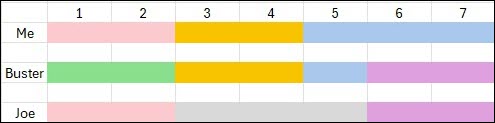
In this example, I match both Buster and Joe, and Joe and Buster match each other too.
- I match Buster on segments 3, 4, and 5.
- I match Joe on segments 1 and 2.
- Buster matches Joe on segments 6 and 7.
So, we must all share a common ancestor, right?
Nope!
Not based on these DNA segments.
We might share a common ancestor, but not based on these matches.
Here’s the important part. Without being able to look at those segments, we would never know that we actually don’t all match each other on any of the same segments, because we all three match each other.
What does this mean?
Each pair shares DNA, but no segment is shared by all three of us. So if we share a common ancestor, it’s not evident in these three matches. This is exactly why viewing shared matches without being able to view segments can be very misleading.
Let’s look at segments.
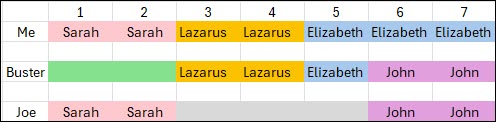
We know that segments where Buster and I match had to have been inherited from our great-grandparents, Lazarus and Elizabeth. After working with other matches from known ancestors, I can determine that we both inherited orange segments 3 and 4 from Lazarus, and I inherited blue segments 5, 6 and 7 from Elizabeth. Buster, however, inherited only segment 5 from Elizabeth.
Buster inherited his purple segments 6 and 7 from another ancestor named John. Buster shares that ancestor with Joe, but not with me.
I, on the other hand, inherited my pink segments 1 and 2 from Sarah, and Joe inherited the same segments from Sarah too.
Buster inherited green segments 1 and 2 from a different ancestor. Neither segment matches Joe or me. Joe inherited grey segments 3, 4, and 5 that don’t match either me or Buster.
It’s happenstance that Buster and I both happen to match Joe.
The fact that the three of us happen to all match each other has nothing to do with any universally common segments that we share. It probably has to do with the fact that so many families lived in the hollers of eastern Tennessee together for generations.
However, if we couldn’t SEE those segments, it would be very easy to assume (danger word) otherwise.
Now, let’s look at a slightly different scenario.
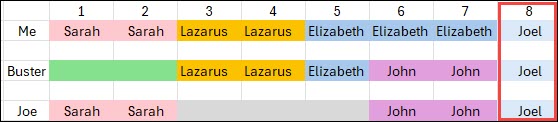
Let’s say that Elizabeth’s father is Joel. Joe doesn’t descend from Lazarus and Elizabeth, but he descends from Joel through a different wife who is not Elizabeth’s mother. All three people share the same DNA on segment #8, so this segment triangulates. Triangulation occurs when each person matches both of the others on the same stretch of DNA.
We can tell that this segment descends from Joel, through Elizabeth to me and Buster, because Joe doesn’t descend from Lazarus and Elizabeth. Therefore, light blue segment #8 has to descend from Joel, not his two different wives.
Walking Segments Back in Time Identifies Earlier Ancestors
Identifying segments that descend from specific ancestors allows us to walk the segment back in time – and it’s also how we can identify brick-walled ancestors.
For each group of segments that you can assign to a particular ancestral couple, part of those segments will descend from their father, and part from their mother. Look for additional matches to work out which segments came from each member of the couple.
Let’s look at an example of how this works, and how we use it to connect the dots.
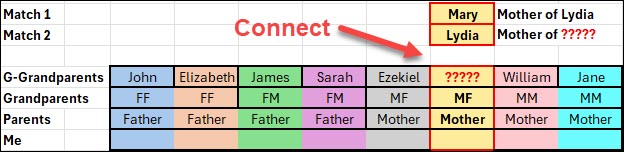
In this illustration, I carry segments from all eight of my great-grandparents, but without being able to assign them to ancestors, I don’t know who contributed what.
So let’s walk this back in time.
My father contributed the four segments on the left, and my mother contributed the four on the right. I know this based on who I match on those segments.
Each of their parents, my grandparents, contributed two segments, beginning with FF (father’s father) on the left and moving across to the right.
At the great-grandparent level, the eight colors now make sense, and I can attribute the segments to ancestors. However, I don’t know the identity of my mother’s father’s mother, Ezekiel’s wife, identified by the mustard-colored segment.
Ezekiel’s wife may be unknown, but people who match me on that segment will also share the lineage of my unknown mustard-colored great-grandmother. They may not match through her, but through her ancestors, who are also my ancestors except I don’t know who they are. Yet.
Some of your matches will know their ancestral lineage and who is in it – and they will match each other and you on a common segment.
Now it’s time to connect the dots.
It’s their genealogical information that you need. If Match 1 descends from Mary, and Match 2 descends from Lydia, then we need to figure out how Mary’s and Lydia’s trees connect to each other, then look at the trees of other people who triangulate with us on that segment.
There are really only three groups of people who match on this segment.
- Those we can determine descend from a known ancestor in my line based on the match’s tree.
- Those who don’t have trees.
- Those who don’t descend from a known ancestor on my known line, but have trees that connect to different ancestors, such as Mary and Lydia.
Eventually, using both genealogy and genetic matching, we’ll be able to connect the dots between our unknown ancestor, ?????, and Lydia. If my unknown great-grandmother is the daughter of Lydia, I will probably match people who match not only Lydia, but Lydia’s husband’s line too, presuming he was the father of ?????, especially if we match on multiple segments.
Identifying unknown ancestors is a large puzzle with no picture on the lid, and we’re assembling the pieces, working from all directions.
If your parents are living, use their results for this exercise since you only inherited half of each parent’s autosomal DNA.
If your parents aren’t available, your next best options are siblings, aunts, uncles, or cousins who descend from this same ancestor. Use their results in addition to your own. They will match people and segments that you don’t, which increases your chances of solving this puzzle.
Tracking Your Segments
Once you identify segments, you want a way to track them so you don’t have to do this over and over for the same segments. Plus, there are benefits to working with identified segments.
There are a couple of different ways to track segments as they are assigned to ancestors.
I used to track segments by forming triangulation groups in a massive spreadsheet, but I use a different methodology now.
Jim Bartlett, on his wonderful blog, Segmentology, steps his readers through how to do this successfully. Even if you don’t want to use the spreadsheet methodology, learning why this works is incredibly important.
You can see by looking at the right-hand side of his page that he’s been writing since April 2015. There’s so much to learn there, and I highly recommend his educational articles.
DNAPainter
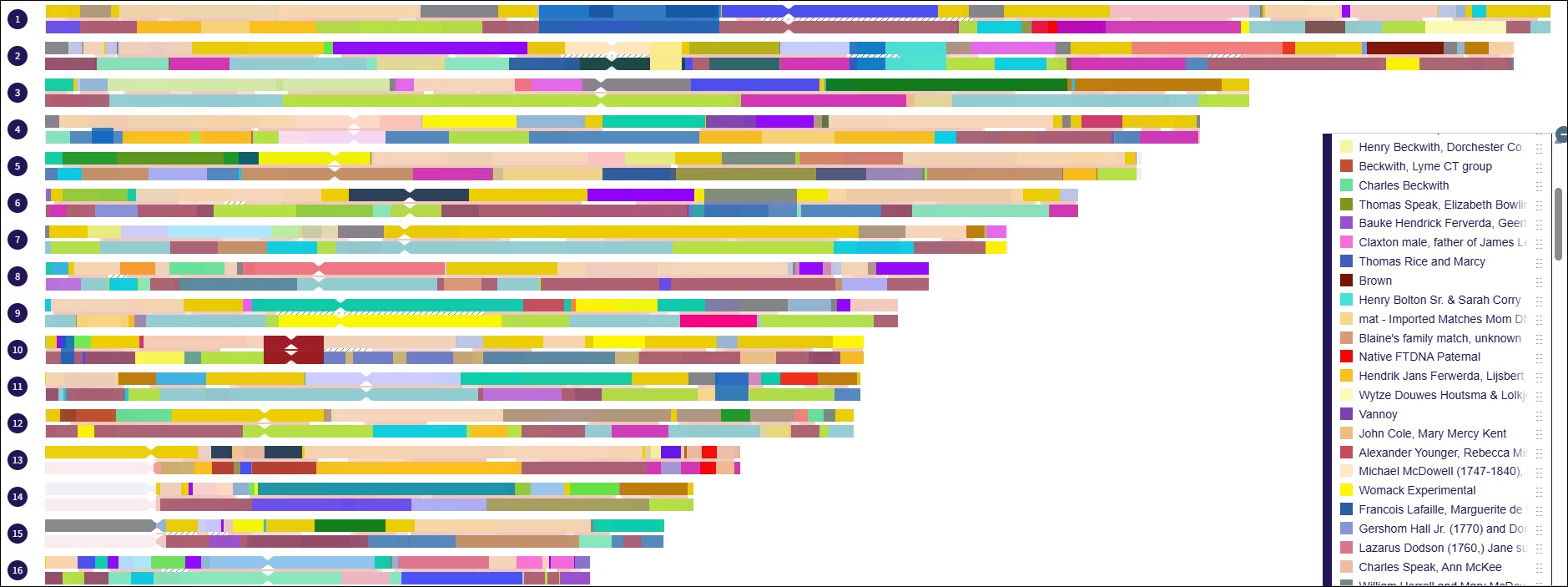
DNAPainter Chromosome Map with Ancestor color legend
Instead of a massive spreadsheet that I maintain myself, I now use DNAPainter, a tool for you to:
- Easily paint your segments on your chromosomes
- Associate them with an ancestral couple
I’ve written about DNAPainter several times, but the article DNAPainter Instructions and Resources serves as a repository for all of the articles.
My goal in this article is not to teach you how to use DNAPainter, although it’s very easy, but to explain why you want to, and how to find the segments at each vendor to paint. DNAPainter also provides instructions about where to find segment data here, and how to assign segments to ancestors, here.
Why Do Ancestral Segments Matter?
Let’s say I’m searching for the unknown mother of Nancy Ann Moore. Her first name is Lucy, but I don’t know her birth surname or who her parents are.

At DNAPainter, from the bottom right menu on my chromosome map, I’ve selected the couple, John R. Estes and Nancy Ann Moore. This displays all of the matches I’ve already painted along with the segments attributed to those matches.
For privacy reasons, I’ve unselected “Show match names on segments” above. In the following image, the match name and anything else I entered would normally be displayed too.

These segments descend from the couple, John R. Estes and Nancy Ann Moore. Some of those segments will descend from John Estes’s ancestors, and some from Nancy Moore’s ancestors.
On Nancy’s side, some will have been inherited from her mother, Lucy, and some from her father, William Moore.
In a future article, we’ll work with our “best” matches for each brick-walled ancestral line. In this visual, it’s easy to see that the “best” matches are the longest segments because we have a greater chance of matching people on a longer segment than a shorter one. Furthermore, a longer segment is more likely to be identical by descent and not by chance.
If you paint your highest cM matches, meaning the closest relationships that you can identify at each of these vendors, you’ll already have a head start on our next article.
Segments At Each Vendor
Ancestry does not provide segment address information, so you can’t paint segments from Ancestry.
However, FamilyTreeDNA, MyHeritage, and GEDmatch do, and 23andMe used to. Some Ancestry and 23andMe users upload their DNA files to GEDmatch, so you may be able to find some Ancestry and 23andMe matches that you can identify among your highest matches on GEDmatch.
At FamilyTreeDNA
I’ve tested a lot of my family members at FamilyTreeDNA, so I know exactly which ancestors I share with my top matches.
Let’s start with my first match who is not a parent, sibling, or my descendant.
In my case, my closest match is Cheryl, my 1C1R on my Mom’s side.

You can see that Cheryl is a match on my maternal side. How do we know that? I linked Cheryl to her place in my tree on Mom’s side. This allows FamilyTreeDNA to triangulate behind the scenes and assign other people who match Cheryl and me on common segments to the same side of my tree.

Be sure to link everyone you can identify to their proper place in your tree, beginning with your highest matches. Of my 9075 matches, FamilyTreeDNA was able to identify 3759 as paternal and 1657 as maternal.
Next, click the box beside your match’s name, at far left.

This pops up a box where you can select “Compare Chromosome Browser.”

My chromosomes are displayed as the background, in grey, and the locations where Cheryl matches me are shown in blue.
You can download the segments being displayed into a file, but it’s actually easier to click on “Detailed Segment Data.”

You can simply copy this data, then go to your account at DNAPainter.
- Click on “Paint a New Match”
- Paste these segments into the box and save
- Proceed to associate this match with your common ancestral couple

Please note that in these examples, I’m only showing the first few chromosomes because it’s the process that matters.
At MyHeritage

At MyHeritage, for the match you want to view, click “Review DNA Match”.

Scroll down quite a way, past Shared Matches.
If the tester has authorized the comparison of their DNA with their matches, you’ll see a chromosome browser.
At right, click on the arrow beside “Advanced options” and then on “Download shared DNA info.”

A CSV file listing the segments you share with that person will be downloaded. Open the file and copy the contents of the rows and paste them into “Paint a New Match” at DNAPainter.
At 23andMe
Unfortunately, 23andMe removed the chromosome browser following their 2023 data breach. They eventually partially restored it, but only for subscribers. So, you may not have access to a chromosome browser at 23andMe.
If you saved a 2023 match download from before the October 2023 issues, it includes segment coordinates, and you can still use those.

Even if you do have access to the chromosome browser through a subscription, all 23andMe shows you is a picture with no associated segment information.

When you compare yourself with two or more matches, you can obtain the segment information for how they match each other, but not how you match either of them.

Yes, it’s insane that I can’t see how my match matches me. This information is not radioactive, especially since 23andMe is perfectly willing to show me the segment data for how two of my matches match each other.
Where this might come in handy as a partial workaround is if you have a sibling at 23andMe. This would provide you with how your sibling matches your match, but only on the same segments where they both match you. Incredibly frustrating, especially since you must subscribe to obtain even this much.
23andMe apparently does not wish to be a genealogy company when they grow up.
At GEDmatch
Fortunately, there’s a third-party tool where people from various testing companies can upload their raw data files and match.
You may be able to pick up some of your high-value testers from Ancestry and 23andMe at GEDmatch. You will need to correlate the name at GEDmatch with the test at Ancestry or 23andMe to be sure it’s the same person, and to view their tree at Ancestry.

Whether you have a subscription or free account at GEDmatch, select “One to Many” results. I’m demonstrating the free “One-to-Many Original” version, but it doesn’t matter because you’ll be able to see where the person tested with each version. Please note that X-DNA matching requires running that tool separately. If you match on the X-chromosome, you’ll want to paste that too.
What will matter to you is that the “One-to-Many Limited” version includes a column for a GEDCOM file or WikiTree link. Both display the testing company.

You can see where your matches tested. At one point, GEDmatch migrated from one platform to another internally, and the letter at the end of the “Migration” indicates the company, while the middle letter+number means the (now-irrelevant) test version.
- So, Migration-F2-F means it came from FamilyTreeDNA.
- A means Ancestry.
- M means 23andMe.
- H means MyHeritage.
Tests uploaded since the migration simply have the testing company name.
Select the match you want to view and copy their kit number from the far-left column.
Return to the menu and select “One-to-One Autosomal Comparison.”

Enter your kit number and the kit number of the match you want to compare with. Then, at the bottom left, select “Position only” so that the chromosome images won’t display between the rows of segment data.
Then click “Compare.”

Now, just copy the data in this entire table, go to DNAPainter, click “Paint a Match,” and paste the data into the box. You’ll be able to add the name of the tester.
Do you have to use DNAPainter?
No, of course not, but there are simply too many matches across different companies to keep them organized without a tool.
Here’s the benefit and where this is going.
How Segment Tracking Breaks Through Brick Walls
Let’s say that someone is a match on your mother’s side.

When you copy and paste the segments into DNAPainter, it shows which groups you’ve already painted and identified by ancestor that contain segments overlapping your new match.
Notice that you need to tell DNAPainter whether this match is maternal or paternal, because this segment location is found on both your maternal and paternal chromosomes. It points to one group of ancestors on the paternal side and another on the maternal side.
The people who carry this segment of maternal DNA are the exact people whose trees you want to view. Even if you can’t determine initially how you’re related to them, and through which ancestral line – your DNA and matches with people whose ancestors you can identify are doing the heavy lifting for you.
The ancestors you know, through their segments, lead to the brick-walled ancestors you’d like to know!
Based on these matches and the known genealogy of these ancestors, my cousin Roland is a descendant of Jacob Lentz and Fredericka Reuhl. Eva Miller, my great-grandmother, is Fredericka Reuhl’s granddaughter, so that one 26 cM segment that Roland and I share descended to both of us from either or both Jacob Lentz and Fredericka Reuhl. This was confirmed by Roland’s genealogy. The beauty of this is that now we know that the next person who matches us on that segment either descends from Jacob Lentz and Fredericka Reuhl, or one of their ancestors upstream.
One day, someone who does not descend through this couple, but from another Lentz or Reuhl ancestor will test and match, which will reveal who this segment belongs to.
If we’re searching for the ancestor of Jacob or Fredericka as our brick wall, matches on this segment plus their associated genealogy will provide hints about the identity of that unknown ancestor too.
The segments of DNA gifted to you by your ancestors are literally the keys to the kingdom, unlocking the door through that brick wall.
_____________________________________________________________
Share the Love!
You’re always welcome to forward articles or links to friends and share on social media.
Subscribe!
If you haven’t already subscribed, it’s free. You’ll receive an e-mail whenever I publish by clicking the “follow” button at the top of the main blog page, here.
Help Keep This Blog Free
I receive a small commission when you click a vendor link in my articles and purchase that item. This does NOT increase your price but helps me keep the lights on and this informational blog free for everyone. Please click on the affiliate links in the articles or to the vendors below if you are purchasing products or DNA testing.
Thank you so much.
DNA Purchases and Free Uploads
- FamilyTreeDNA – Y-DNA, mitochondrial and autosomal DNA testing
- MyHeritage DNA – Autosomal DNA test
- AncestryDNA – Autosomal DNA test
- AncestryDNA Plus Traits
- 23andMe Ancestry – Autosomal DNA only, no Health
- 23andMe Ancestry Plus Health
Genealogy Products and Services
- MyHeritage Subscription with Free Trial
- Legacy Family Tree Webinars – Genealogy and DNA classes, subscription-based, some free
- Legacy Family Tree Software – Genealogy software for your computer
- OldNews – Old Newspapers with links to save to MyHeritage trees
- MyHeritage Omni comprehensive “everything included” subscription plan
- Newspapers.com – Search newspapers for your ancestors
- NewspaperArchive – Search different newspapers for your ancestors
My Books
- DNA for Native American Genealogy – by Roberta Estes, for those ordering the e-book from anyplace, or paperback within the United States
- DNA for Native American Genealogy – for those ordering the paperback outside the US
- The Complete Guide to FamilyTreeDNA – Y-DNA, Mitochondrial, Autosomal and X-DNA – for those ordering the e-book from anyplace, or paperback within the United States
- The Complete Guide to FamilyTreeDNA – Y-DNA, Mitochondrial, Autosomal and X-DNA for those ordering the paperback from outside the US
Genealogy Books
- Genealogical.com – Lots of wonderful genealogy research books
- American Ancestors – Wonderful selection of genealogy books
Genealogy Research
- Legacy Tree Genealogists – Professional genealogy research
Share this:

Discover more from DNAeXplained - Genetic Genealogy
Subscribe to get the latest posts sent to your email.