AI and Genealogy – Brick Walls, Breakthroughs and Blunders

This is the fourth article in the AI series.

I suggest that you read these articles in publication order, as they build on each other.

AI and Genealogy

Most genealogy vendors use AI in one way or another. Like with everything else, there’s yin and yang to AI and genealogy – but for the most part, sprinkled with a little salt, I love the advances.

Let’s survey the genealogy landscape.

FamilySearch is my go-to for document images, especially now. One of the absolute best things to happen in the genealogy field has been the FamilySearch implementation of full-text searches, which they are rolling out across all of their imaged records. I wrote about the rollout here, and it’s only gotten better in the two years since.

For their latest update, including search hints, watch the video FamilySearch Full-Text Search – Your Golden Path to Ancestral Discovery.

May I live long enough to go back and search for information about each one of my ancestors.

Some of what I’ve already found is, well, shocking and sure does make my ancestors more human. Often, only the primary records like deeds, wills and marriage records have been transcribed, indexed and are online, if that much. Some other records have been published, but you have to know to look in a specific county’s records and have access to the published book. If you were trying to “find your way back in time” to where your ancestor came from, before full-text searching, you were out of luck. Now it’s easy to search across time and locations. Let’s just hope you’re not searching for a common name. Sympathies if you have John Smith.

Is full-text search an application of AI? Absolutely – and it’s wonderful. Is it always accurate? Not by a long shot – but it’s much MUCH better than nothing, and if it’s enough to “get you there,” as genealogists, we can deal with the rest.

Don’t let the pursuit of perfect be the enemy of good!

MyHeritage has been leading the pack with AI for some time now. Initially with their newspaper scans and OCR transcriptions, followed by photo restoration tools, and AI Time Machine. Next, they introduced Tribute Reels, which I wrote about here. Tribute Reels allows you to select photos and then animates them to bring your ancestor to life.

MyHeritage has also recently released Scribe AI, which is now one of my favorites. Scribe AI helps to decipher, translate, transcribe, and interpret old documents, photos, and more. I have not written about Scribe AI yet, but you can read the MyHeritage introduction article here, and try it for yourself here.

As an experiment, I selected a document at random from my saved photos at MyHeritage to see what Scribe AI could tell me. This is a French parish marriage record from 1721. Yes, I submitted something difficult, on purpose, but Scribe AI did not disappoint.

Not only did I receive a historical explanation of what this document is, I received the details, key findings, suggested next steps, a full text transcription in French, PLUS a translation to English, my language of choice.

I have been using ChatGPT for this, but sometimes different AI tools stumble over bad handwriting and such. Mied versus Mius, for example. Now I have two “go-to” tools for translations and transcriptions – both ChatGPT and Scribe AI. Hopefully, if one stumbles over something, the other won’t stumble in the same place.

This is EXACTLY the kind of help that genealogists need.

At RootsTech, MyHeritage announced that they will be introducing GAIA, a genealogy AI assistant, soon. I can’t wait.

Ancestry has been using OCR for their newspaper articles and indexes too, and including items such as wedding announcements and obituaries in your hints. They’ve also implemented AI for LifeStory.

I wanted to see what Ancestry had to say about the LifeStory of William George Estes, who lived in Lynch, Kentucky.

On the next screen, I selected “What might William George have done for entertainment while living here?”

This absolutely cracked me up, because William George Estes was, among other things, a notorious bootlegger. I never heard of him setting foot in a church – not once – nor a library.

Lynch actually didn’t have a library, but it did benefit from the Pack Horse Library Project, where librarians on horses brought the library to remote schools and residents in their saddlebags. Now that would have been both interesting and much more accurate.

Generally, though, this description was relatively accurate. These types of activities were available to people in Lynch, a segregated coal-mining town established and owned by the mining company.

Limited drinking spots? William George counted on that, and it’s exactly how he made his living!

Another recent AI beta tool, “Ideas” has been added and can be found in the upper toolbar of any ancestor’s profile.

I tried “Ideas” for Ollie Florence Bolton because of missing chapters in her story that I’d love to fill.

I was excited. I have already looked for these items, but maybe they are available now, or Ollie’s record can be located. I clicked on “Start researching” for her death certificate.

Was I EVER disappointed. Ancestry, whose primary offering is records, has just told me to search records that IT ALREADY HAS. Ancestry owns Newspapers.com, for Pete’s sake. SEARCH THE DOGGONE RECORDS FOR ME!

As I’ve been using Ancestry over the past few days, I’ve noticed the little Ancestry AI diamond pop up from time to time asking if I’d like help with something. What I wish Ancestry would do is transcribe text in the documents shown, beside the document itself, similar to FamilySearch and MyHeritage.

Across Vendors

One place where we see AI across vendors today is for customer support.

All genealogy vendors and most other businesses now use AI chatbots to answer questions that are asked repeatedly.

AI is the way of the future, and eventually, AI will be able to guide us through records and collections relevant to our ancestors. One day soon, AI will know where to look next and will look there on our behalf, providing an accurate analysis of the results. At least that’s my dream.

Everybody has to crawl before they can walk, so let’s keep moving forward and verifying.

Generating Ancestors

Modifying, enhancing, or even creating photographs of our ancestors is certainly of interest to genealogists. If you haven’t encountered this yet, you will.

I submitted a family picture of the children of Hiram Bauke Ferverda and Evaline Miller to ChatGPT. I asked it to create a likeness of the parents of their adult children, who were standing, and to completely ignore the two seated people. I did not tell ChatGPT that the seated people were Hiram and Evaline.

ChatGPT indicated that it could do as I asked, but cautioned:

  • It won’t be historically accurate in a forensic sense—it’s an informed visual estimate based on facial features the siblings share.
  • If there are both brothers and sisters, I can usually generate separate likely father and mother composites.

Here’s the output.

Notice that ChatGPT “cleaned up” the images of the children. That means it actually recreated them behind the scenes.

Here’s the second image that is different yet.

Here’s the original for comparison.

Here’s the question we need to ask ourselves and answer.

As ChatGPT cautioned, the images aren’t accurate – and I must add, they are especially inaccurate after ChatGPT “fixed” the original.

Should genealogists do this and attach reconstituted AI images to their trees?

I don’t think so, as they fall into the same category as supposed photos of Revolutionary War soldiers who died in 1800, decades before cameras existed. At least, in that circumstance, with a little bit of applied knowledge and logic, the discrepancy quickly becomes clear.

If an AI-generated image is attached, it clearly needs to be marked “AI-generated” across the photo in a prominent location, larger than in my example, such that the watermark or label can’t easily be removed as the photo is copied from tree to tree in the future.

AI genealogy expert, Stephen Little points to the Coalition for Responsible AI in Genealogy‘s statement on “Protecting Trust in Historical Images” which suggests that we “always label, always cite, and use for illustration not evidence.” It further states that images generated by AI should not be used as historical documents.

Here’s the bottom line. If you put any of these images in your trees, anyplace other than on your own computer (assuming you don’t sync with an online tree), you’ve released it into the wild because it will spread, often as the result of “hints.” Other people will copy and save it, and it will be represented as the real McCoy, either intentionally or otherwise.

We all need to be hypervigilant when evaluating photos, now and in the future.

Custom GPTs and Experts

Some people write “Expert GPTs”. Think of AI, generally, as a general practitioner. An expert GPT is written by someone who either is an expert in that field or thinks they are.

Like everything else with AI, remain cognizant of your surroundings. I mention this because I’m aware of an instance where someone who was very excited and well-intentioned about a topic wrote a GPT that was inaccurate – and if you trusted that GPT as an expert, you would be wrong and unintentionally spreading misinformation too.

If you find an expert GPT, validate that the author actually IS an expert in the topic at hand.
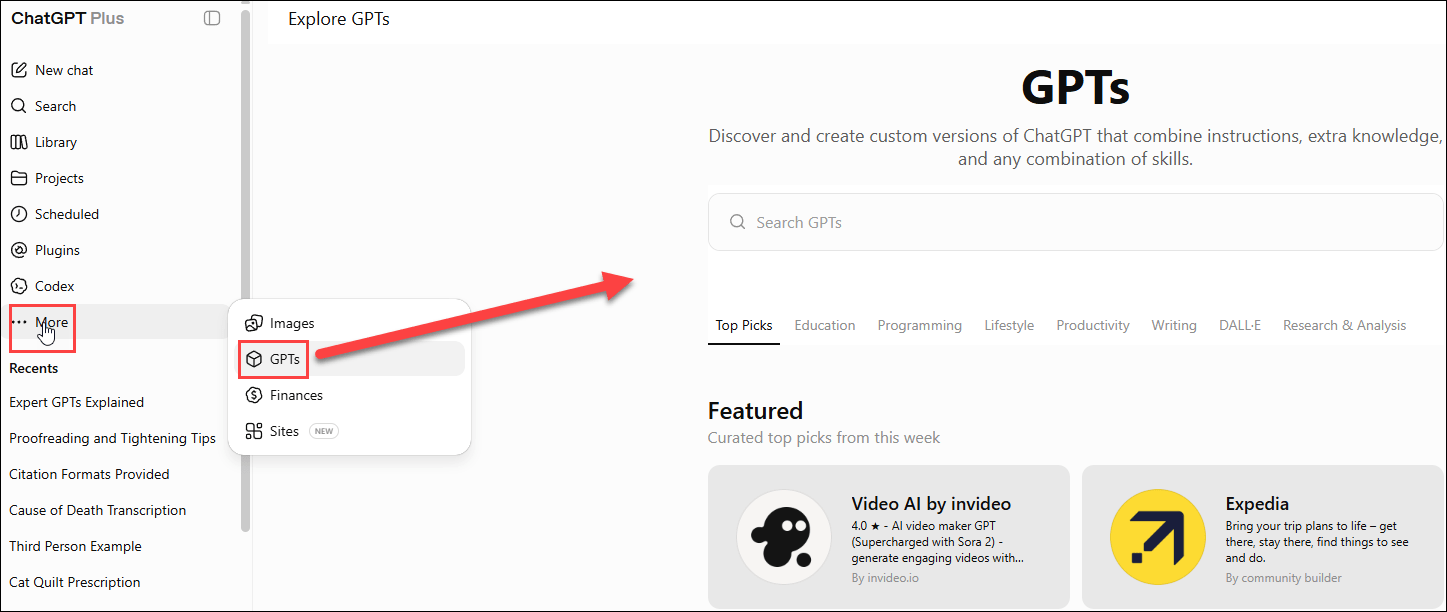
There are several custom GPTs available under the “More” button in the ChatGPT sidebar. You can search by topic or keyword or scroll and view by category.

I searched for Y-GPT, about Y-DNA, because I know positively that Dave Vance is an expert and that the answers his Y-GPT provides can be trusted.

Scroll to the bottom and just click “Start Chat.”

In fact, Dave has pre-loaded his GPT with the most common questions.

Dave’s Y-GPT is a great resource, and I recommend it, but all GPTs are not created equal. Fortunately, there are experts like Dave who freely share their knowledge. Just because someone writes a GPT or THINKS they’re an expert does not make them one. Know your author and their level of expertise before you rely on anything.

Special Project – How I’m Using AI Right Now

I want to share a special project I’m currently working on and how I’m using AI to assist. Actually, AI has saved my bacon.

I’m planning to visit my ancestors’ locations in Massachusetts this year. When I began preparing, I discovered that I have 100 ancestors who hail from 45 different Massachusetts towns. Nobody seemed to stay put. Various reasons existed for moving on. More or better land, marrying someone from another town, religious tiffs within the church, change of religion, or simply the lure of the next frontier.

I’ve compiled research into a document for each individual that includes dates and locations for the following facts, when known:

  • Birth
  • Marriage
  • Childrens’ births and marriages
  • Land grants and ownership, including purchases, sales, and inheritance
  • Military service
  • Civic service or appointments, such as selectmen or jury members
  • Church membership
  • Wills and estates, particularly land distribution
  • Death
  • Burial
  • Anything else that is location-specific, unique, or particularly interesting, such as if they helped to found a town, a church, or built a fort

If you’ve read any of my 52 Ancestors articles, you’re aware that I enjoy visiting where my ancestors lived, and “being” with them where the events in their lives took place.

That meant that after I compiled the information about each ancestor, I had to reorganize it by town because that’s how the trip would be laid out. Furthermore, in each location, I wanted to find my ancestor’s land, today. This recent article about William and Nehemiah Hunt, who owned Punkatasset Hill, and its connection to the Revolutionary War is a good example.

At this point, I have more ancestors whose land I need to find than I have time to complete the detailed research – and I was beginning to feel incredibly discouraged.

I Accidentally Turned to Google AI

When I say accidentally, I mean I never realized just how useful Google’s AI could be until I submitted William Hunt’s name, birth and death dates, and location to see what other resources Google’s search engine might turn up. When reading the AI overview, I realized that Google had found resources that I had not and certainly would not in the time I have available to plan this trip.

Then, I switched to AI mode, and the resource improved even more.

Incredible!

When using AI tools, we need to take into consideration the strengths of the tool we are using or considering and the resources it has available. In this case, aside from being a search engine and finding information, Google’s specialty is maps, locations, place names, establishments like restaurants, hotels, historical societies, museums and more – including customer reviews.

While I was preparing for the upcoming trip, I stumbled across information that my ancestors, William Hunt and his son, Nehemiah Hunt, both owned Punkatasset Hill, the hill that the men marched down in Concord to take the Old North Bridge in 1775. That infamous “shot heard round the world.”

Google found those resources for me, and their AI tool linked them together. I spent about two days researching this one ancestral place and family for the article – working with Google resources and using each link provided to VERIFY accuracy. You will find that sometimes the resource links don’t contain what AI said they do.

I hurriedly put together William Hunt (c1604-1667), Punkatasset Hill, and the Revolution for America’s 250th.

I need to make it perfectly clear at this point that AI did NOT write that article or this article for me. I write all of my own articles. Yes, I know AI could write faster and I could publish more, but that’s not my goal or my work. This is my work. Google’s AI was my research assistant, feeding me places and resources to check based on dozens of individual prompts that I fed it in the form of questions.

As you can see in the article, I was able to locate the actual land and home of Nehemiah Hunt, and it was Google that provided the current address gleaned through the video posted by a realtor. Otherwise, I have no idea how I would ever have found that, especially since the local museum/genealogy society is closed on the day I’ll be there.

I was then able to verify that location using other means, including comparing an old photo with a satellite image.

Caution: AI was incorrect more than once, and had I not verified, I would have been off on a wild goose chase, thinking I was catching my ancestors. But without AI and prompting it in different ways, I would never have found this at all.

The Process

I’m going to step through a prompt series for my ancestor Gyles (also spelled Giles) Hopkins, Mayflower passenger and son of another passenger, Stephen Hopkins. I’ll add my own commentary as we go.

I knew that my ancestor, Gyles (or Giles) Hopkins, obtained land in Brewster, Massachusetts. Here’s information I already had before I engaged Google’s AI.

  • Stephen Hopkins, in his will dated June 6, 1644, made Caleb Hopkins, his younger son, his ‘heir apparent,’ and consequently the whole of his large real estate holding was inherited by Caleb after Stephen died in July or August of 1644. Soon after his father’s death, Caleb gave a very large tract of land located in what is now Brewster to Gyles Hopkins, his older and only surviving brother.
  • As early as 1653, Gyles Hopkins owned the 8th lot in a tract in what is now West Brewster, east of Quivet, which he sold on Nov. 9, 1666, to John Wing of Yarmouth in consideration of a mare, colt and other land.

I wanted to know specifically where this land was located and whether Gyles ever lived there.

My first question to Google was, “Where was Giles Hopkins’ land in Brewster, MA, and where is that today?”

Tip: Be very careful when Googling to include identifying information about the person you’re asking about. For example, “Where was the land of Gyles, also spelled Giles, Hopkins who lived between <date> and <date>…” would have been a better way to ask the question to ensure that I received what I wanted. There could be multiple men with the same name.

Based on what I knew about other aspects of Gyles’ life, I suspected that this land was held speculatively, as an investment, because I knew he had lived in Eastham.

So, I was surprised to see that a home had been built there.

But read carefully – it says, “A historical Hopkins home was later built in this area.” It doesn’t say HIS home, but still.

Plus, there’s a Hopkins Homestead and Bakery? Seriously? You mean, I can visit the land he owned, sit there, and have coffee? Maybe? And who built that house? Is it the original house? So many questions…I had to stop myself from immediately going down that rabbit hole. And I wasn’t even in “AI Mode” yet.

Ok, let’s switch to AI Mode and see what it says.

Now we have the name of Snowy Owl Coffee Roasters too, which says it’s a homestead site, but not necessarily “the” homestead site.

And it looks like Gyles’ (or Giles’) son, Stephen, lived in this location. His grandson apparently was also named Stephen.

Google in AI Mode almost always asks if you’d like additional information – and it’s like crack for genealogists – almost impossible to say no. Keep an eye on the sources on the right, because they change with each question or answer, and you may need to click to “show all.”

Tip: Read the sources; do NOT presume that the verbiage used by AI is verbatim in the sources or that it’s there at all.

Next, I asked to see the bakery on a map. You can tell that I’m considering stopping during my visit, right?

Google just backtracked a bit, saying that the Snowy Owl had moved and that the Hopkins House Bakery sits directly on the land granted in the 1640s.

Hot diggity!!!

Word of caution: Verify addresses and locations on Google Maps directly, as I have found discrepancies.

Keep reading, because there’s more!

Wait? What? There’s a First Encounter Beach monument? I had no idea.

Google asked if I wanted to know more. Yes, of COURSE I want to know more about that.

I already know where Gyles is buried, and I’ll get to that when I’m not focused on his land in Brewster.

Ok, I’m definitely visiting the First Encounter site, but where is it exactly?

Google asked me if I wanted driving directions. I asked for 3 locations to be included: the Hopkins House, the Cove Burying Ground in Eastham, where Gyles is buried, and the monument site.

Google must be experiencing “fatigue” because it can’t seem to retrieve everything from its memory. I’ve had this issue before. I know that Google can easily show multiple locations and stops on maps, but this time, it didn’t show “the map below” that it said was there.

Tip: When I encounter this issue, I close Google and sometimes the browser altogether, then reopen Google in AI Mode.

You can then select the conversation you were just engaged in from the AI history menu. You can also search for keywords and view your most recent AI Mode converations. How convenient is that?!

I noticed an “Upgrade” button appear in the top bar and wondered if that has anything to do with the “fatigue” Google’s AI was experiencing.

So, I clicked on the link to see if this could have been the problem with the fatigue that failed to produce the map. It wasn’t the problem, but the information provided was still useful.

I suspect that if I upgraded to either Plus or Pro, which is very reasonably priced, I might experience fewer display issues. I figured that I might have to do that to complete this time-critical project – but I didn’t.

Instead, I just clicked on the embedded link to the map, and saw that the route had been nicely mapped out.

Google even added a few local features that I hadn’t requested, which I found helpful. I should also note, though, that it missed an important landmark – so don’t get overconfident in its abilities and answers, and always verify.

I didn’t realize that the Cove Burying Ground was just a few feet away from the Eagle Wing Inn. I hadn’t asked for that information. I’m not complaining because I’m going to need a place to stay and I can click on that location and see important information like customer reviews.

Unfortunately, by the time I finished the planning for this project, this Inn was full, but Google recommended other locations based on clustering my visit locations so that I only had to move every few days – establishing a central hub in an area.

Often, several ancestors lived in a specific town, like both Plymouth and Eastham. I compiled my information for each individual location, even if they were adjacent and everything I knew about all ancestors in that location, into a PDF file. Providing AI with too much in a single prompt results in less, more diluted, and less reliable information.

For each town, I uploaded the PDF file and asked Google AI how to find each piece of land, where it is located today, how much time to allocate for each stop, the best order, and even for information on places I’ve missed that would be of interest.

In one location, Google suggested a harbor cruise, complete with a contact phone number and website, to view the land of my ancestor because it’s on Saquish Head, which is entirely privately owned and access-restricted.

In another instance, Google identified a home built by my ancestor that still stands. It has been moved from the original location, which is why I didn’t find it.

I did a LOT of prep work and provided summary information for each ancestor, including location, some of which Google helped me gather. The document totalled 551 pages. I asked Google if it could extract every mention of each town from that document, and it replied that its processing limit was between 50 and 100 pages, so the extraction would have to be done by hand. That’s OK, because it gave me a better feel for the landscape and their lives.

After I extracted the ancestors’ information by town, Google helped me immensely by adding information and organizing it into a plan, with directions and recommended time allocation for each place on the itinerary. In one town, Google even found a local Inn located on my ancestors’ land. Unfortunately, it’s booked, but it is open for dinner, so I’ll still be dining with my ancestor – so to speak.

Here were the project steps:

  1. Gather information by ancestor using traditional genealogical resources, plus Google AI to add anything I didn’t already have. Note that Google does not gather information from behind paywalled sites, or sites that technologically deflect crawling and indexing information.
  2. Create section in Master Ancestor Document for each ancestor.
  3. Ask Google to find ancestral land locations today, adding to their page
  4. Extract information from each person in the ancestor document and reassemble by town in travel order. When complete, save as PDF file by town.
  5. Submit PDF to Google AI and ask for land locations today – verifying what it said before. Prompt for an itinerary for each town, listing each stop, and how long each town’s activities will take. Include any gotchas such as locked cemeteries, museum hours, inaccessible locations (like islands), and accessibility concerns (walking, steep hills, etc.)
  6. After each town was complete, create itinerary in table format. Submit to Google AI for verification and suggested lodging in each area. Ask for driving suggestions to avoid high-traffic areas or congested times of day or other concerns or requests – including lunch or dinner suggestions.

This leaves me with the following documents:

Just a few of my Massachusetts ancestors.

  • Master Document by Ancestor – One master document that includes every ancestor in this region. The Table of Contents is 5 pages long, and the document eventually totalled 551 pages. This is how I gathered the information before any organization, and before eliminating Connecticut and Maine, which are outside the scope of this trip.
  • Master Document by Location – I quickly realized that the ancestor document was already much too long, so I created a second document by location which totalled 531 pages.
  • Individual Location Documents – When finished, I divided the Master Location Document into one file for each location. I eliminated locations where there was nothing to see, so I now have 35 individual files, which have been updated individually using AI, so they no longer match the Master Location Document. I will load these to my laptop and also to a location that I can access from my phone so I can reference them as I travel. I would actually like to print them by location to take with me, except 500 pages is a ream of paper and paper is heavy.
  • Master Itinerary by Day/Location – Detailing where I’m staying, confirmation and phone numbers, which town I’m visiting which day, and anything else I need “at a glance.”

What will I need to do after this trip? I’ll need to combine the information from the Master Document by Ancestor with information in the Individual Location Documents that pertains to them. I’ll add photos, of course, and new information gleaned during the trip. I will compile this by ancestor in their own personal file. Will AI be able to help with this step? I don’t know. We’ll see.

And yes, in case you’re wondering, you’ll be reading these as 52 Ancestors stories for years to come!

My intention in this exercize was to illustrate how AI can help locate important geographical features, like ancestral land, for instance, help you organize your data and even plan trips. I almost always find more than I was asking for. I’ve found that Google’s ability to read historical and local history websites is extremely beneficial.

I feared that I might not be ready for this trip in time to make reservations, but thanks to Google AI, I am – and I’ve discovered things about my ancestors I would not have found in time. The worst thing possible is to make a critical discovery AFTER you’ve visited and don’t have the opportunity to return.

Advanced Tools and Bleeding Edge

This series has been focused on the “normie” user, not someone pushing the frontiers of the AI envelope – although we certainly need those pioneers to help sort out how to use these tools safely for genealogy and when to stay away.

When attempting more complex tasks using AI, I’ve experienced spectacular failures. But yesterday’s failures are today’s or tomorrow’s successes. The tools literally get better every day, and a week or month in AI is like a year anywhere else.

The tools from the various AI vendors leapfrog each other, too, and each tool has a unique learning curve.

Recently, Anthropic’s Claude introduced an extremely powerful tool called Fable 5 that was free for the first several days, then available via the purchase of prepaid usage credits or tokens. That’s marketing genius, because it encouraged what I would consider “complex genealogy users” to try it. People who had projects either in mind or in the wings where other models had failed.

Specifically, Fable 5 is focused on what I would call “long horizon” jobs or tasks, such as, “Here are 300 Acadian documents. Please translate and transcribe them, then reconstruct the relationships of the people in these documents.” Or, “Here are 550 pages of ancestors, please reorganize them by town, and within town, by year.” Of course, the construction of the prompt has a lot to do with the degree of success of any query.

Anthropic says it can sustain multi-stage projects over hours or even days, planning work, checking its own output, delegating to sub-agents in agent frameworks, and producing deliverables with much less supervision than previous models.

Some people reported amazing successes with multiple files and hundreds of pages being read, processed, correlated, and reported, mostly accurately. Others had a completely different experience.

I have not been working with these new tools, but Mark Thompson and Steve Little have been. Not only did I not have a massive project ready and waiting, as I had already completed by Massachusetts town extraction, I also needed to have time to VERIFY something that large, because as tempting as this is, AI can be and is often wrong.

You can read about Mark turning Fable 5 loose on his archiving project, here.

Catch up with Steve’s interesting experiments, troubleshooting, analysis and guidance here and here.

The AI landscape is shifting away from asking “Which AI is best?” to asking “How do I assemble the best team of AI specialists and effectively use them?”

Interestingly, these advanced agents are now being used both independently and together to answer complex questions and analyze projects. This is known informally as cross-model verification. Sometimes the models agree, and sometimes they disagree, presenting different “evidence” and debate positions for their conclusions. Ultimately, you are the final arbiter.

Just as genealogists don’t rely on a single record, increasingly they shouldn’t rely on a single AI assistant either. A census, will, land grant, deed, and church record each contribute different evidence, all of which needs to be considered together. Likewise, different AI models have different strengths, weaknesses, and biases. Comparing their answers is often the digital equivalent of seeking independent corroborating evidence.

You don’t need to work on the bleeding edge. Just tuck this away for a future project after these tools are more reliable and stable.

The Take-Away

The takeaway from this is that AI is a force to be reckoned with.

Vendors are using AI, sometimes when we know it, and other times behind the scenes to process text, for example. The net-net of this is absolutely positive.

AI usage will increase over time – and that’s a good thing since we can verify the output. AI can accomplish in seconds, minutes or hours what would take us hours, days, months or maybe never.

As always, AI becomes dangerous when we don’t verify, don’t understand that we need to, don’t know how to confirm the results or we trust “experts” who aren’t.

What Do You Want?

I’m excited for the future and I have my own personal list of how I hope the vendors will integrate AI with tools they provide.

My list includes, but is not limited to:

  • AI records transcription at Ancestry, similar to FamilySearch.
  • At FamilySearch, full-text records by name and location “suggested” as hints, by individual, along with a multiple-record summary of evidence. Over time, this could go a VERY long way in resolving the “wrong spouse” or “wrong child” connected issues that persist.
  • AI “DNA plus tree matching” WITH common ancestors, meaning providing a list of people on your DNA match list who match you and each other and have common ancestors in their tree that you have. Both Ancestry and MyHeritage provide part of this in different ways today, but not all of it.
  • AI “DNA plus tree matching” WITHOUT a common ancestor in YOUR tree. This provides a means to potentially identify a brick-walled ancestor by identifying the ancestors of the people whose DNA matches yours and each other, but who do not share a common ancestor in your tree. However, they DO share ancestors with each other, which could be critically important to your research. Yes, I know this would need to be fleshed out – but it’s doable.
  • AI records searching. Essentially, what Ancestry suggests as next steps, but to actually DO THE SEARCH on your behalf and provide those results. Go a step further and indicate where to find the records if they aren’t on the platform. Message you if those records ever become available there, or the person has been revealed in existing records. For example, if death certificates are now available but weren’t previously – or the writing was so horrendous that the indexing didn’t pick it up before, but the person has been identified now – let me know.
  • At FamilySearch, something similar to relatives at RootsTech, but year-round so that cousins can contact each other, collaborate and make breakthroughs together.
  • Broad yet restricted AI searching, such as “provide me with a list of all transactions that include anyone with the surname of Estes or Eastes between 1700 and 1720 in Halifax County, Virginia.” Or, “Provide me with a list of all Estes men who live in Tennessee but who were born in Virginia in the 1850-1880 censuses.” Or, “Provide me with a list of all Estes men who are listed on the 1840 census as being pensioners or having served in the Revolutionary War.”
  • At WikiTree, FamilySearch, GEDmatch, Geni and other public sharing platforms,  identify and provide a way to contact individuals who qualify to test for the Y-DNA (male direct paternal male-to-male line) or mitochondrial DNA (everyone’s direct matrilineal mother-to-mother line) of your common ancestors. Include an avenue to offer a testing scholarship at FamilyTreeDNA. There’s so much we could learn!!!

I’m sure you can add to this list. Specifically, what would you like to see AI be able to do for you, either within or outside of a vendor’s platform?

The sky’s the limit, so dream big!

_____________________________________________________________

Share the Love!

You’re always welcome to forward articles or links to friends and share on social media.

Subscribe!

If you haven’t already subscribed, it’s free. You’ll receive an e-mail whenever I publish by clicking the “follow” button at the top of the main blog page, here.

Help Keep This Blog Free

I receive a small commission when you click a vendor link in my articles and purchase that item. This does NOT increase your price but helps me keep the lights on and this informational blog free for everyone. Please click on the affiliate links in the articles or to the vendors below if you are purchasing products or DNA testing.

Thank you so much.

DNA Purchases and Free Uploads

Genealogy Products and Services

My Books

Genealogy Books

Genealogy Research

Tribute Reels from MyHeritage

Mother’s Day was Sunday, and my family was close in heart, but not actually here that day. After I had a nice visit with them, I settled in for a quiet day of writing and quilting. The evening before, I had published, Mom’s Quilt, an article honoring my mother.

Of course, I checked my email and social media from time to time during the day, so imagine my surprise when I saw a video of my mother, MY MOTHER, in someone else’s social media feed on Mother’s Day.

Huh???

Wait!

What?

There’s no mistaking her.

You know there’s a great backstory, right?!.

RootsTech 2026

Every year I’m always front row, center at Gilad Japhet’s keynote session at Rootstech – except when RootsTech schedules our two sessions at the same time. That’s exactly what happened in 2026.

I love to hear first-hand what’s being announced and coming next from MyHeritage. Gilad founded MyHeritage in 2003 as a small startup focused on genealogy research. MyHeritage grew by leaps and bounds, and in 2016 they added DNA testing as a resource. The rest, as they say, is history.

I missed his keynote this year, so imagine my surprise when my friend, Peggy, walked up to me a little later and said, “Oh my gosh, Roberta, I was crying in the session…your mother.”

I paused for a moment, because I had not mentioned my mother in my presentation earlier – which is what I assumed she must be talking about.

I must have looked very confused because Peggy continued, “Half the room was in tears.”

“What?”

“In Gilad’s presentation – you and your mother.”

Suddenly, everything fell into place and made sense. I had given Gilad permission to include pilot videos at RootsTech of something he had been working on if he thought it was appropriate, and if MyHeritage decided to go forward with the project.

Something else suddenly made sense, too. The look of disappointment when I was asked by a MyHeritage team member if I was going to be in Gilad’s session, and I explained that my session had been moved to a slot at the same exact time. “That’s too bad – we saved you a seat right up front.” At the time, I thought, “Well, that’s very nice,” but later, I understood.

Obviously, Gilad had made the decision to show the videos – but which version? There were two – equally as compelling in different ways.

The Backstory

A few weeks earlier, I had received an email from Gilad, asking what I thought about a potential new feature. He included a “demo” version – not even an alpha version because MyHeritage was only considering the possibility of implementing something like this for their customers.

Gilad asked for feedback. Did I like it? How did I think other people would feel if something like this was built for their own family?

Let’s just say that I was not at all prepared for what I saw when I clicked on the attachment. He should have given me a “do not watch in the presence of other people” warning.

I sobbed. I ugly cried so hard I got the hiccups.

My poor husband asked what was wrong.

“Who died?”

Imagine his shock when I slobbered out, “My mother.”

He clearly knew that my mother had died 20 years ago – but I wasn’t answering the question he actually asked. I was trying to explain why I was crying.

I couldn’t talk, so I took him into my office and just played the video – at which point, I wasn’t the only one crying. He claimed he had something in his eye😊- both eyes apparently.

I’m not going to try to explain, because there truly are no words.

At that point, what is now named “Tribute Reels” was being called “Life Tribute,” as you can see in the original video in Gilad’s RootsTech talk, here. There was also a surprise for me that I didn’t know about until I watched the video after RootsTech. This part of the video begins at the 30.25-minute mark and the rest is interspersed over the next 12 minutes.

When I was talking to Peggy at RootsTech, I had not attended Gilad’s session, and the video wasn’t available yet, so I didn’t know exactly what was there, and what might have changed.

I’ll show you how to create your own Tribute Reel in a minute, but first, I’d like to share my experience.

Tribute Reels

Tribute Reels is a series of photos sorted in your preferred order, then combined into a reel using AI animation. When AI photo animation first became available, I was not a fan because it was a technology in its infancy and the results were so unnatural that they were almost frightening. However, the technology has matured very quickly, allowing viewers to focus on the subject and not the underpinnings, and MyHeritage is using cutting-edge technology for Tribute Reels.

This is truly a special gift. Seeing Mom in motion long before I was born reminds me of viewing a decades-old home movie that might have been found in an old trunk discovered in the attic.

Gilad selected these photos at random from those I had uploaded to Mom’s profile at MyHeritage, so there was no “special prep” or me selecting especially relevant photos for the proof-of-concept video.

Here’s my reply to Gilad after viewing the Tribute Reel for my mother contained in his email.

Wow Gilad!

First, before I share my techy evaluation and commentary, let me share my experience.

My habit, when I wake up, is to review my e-mail and social media. Social media to see what has happened overnight, and my e-mail to delete spam and such, and to see if there is anything interesting.

Your email was obviously interesting, so I read it and watched the attached video.

Suffice it to say that I started my day with a good cry. I sat outside with my coffee and thought fondly of Mom. I still miss her incredibly.

Now my thoughts about this new video in a less emotional vein.

One of the things I really like is that each of the brought-to-life photos includes the person smiling. They are happy, even if their life wasn’t entirely happy. That’s the human condition, I guess.

In any case, the photos with the children also include touches of affection.

I think the one that touched me the most in my video was the photo of Mom and me together in our matching dresses that we made. I’m sure I was a lot of “help,” but then again, it introduced the love of sewing which I still do today, albeit mixed with art. I very vaguely remember the day that picture was taken. I was maybe 4 or 5, and my father took the photo. I remember how much fun we had making and wearing those dresses. In the picture, we were holding hands, and in the video, that portion was animated in such a touching way. Until the age of digital recording, we would never have been able to see ourselves in videos or “moving pictures” from this timeframe, so it’s like revisiting the past in such a pleasant manner

I noticed this same aspect in other portions of the video as well. The affection and closeness.

Towards the end, there’s a photo of Mom and my stepfather, whom I called Dad. In that animation, he reaches up and touches his tie, but to me, it seemed like a “touch my heart” message. Yes, I know it’s an animation, and that’s not actually possible, but that’s how it made me feel. A silent but well-understood message from the other side.

In the picture on the farm with Dad, Mom, and her aunt, with Spot, the family dog on Dad’s lap – that was just so quintessentially “home.” Of course, we can’t go back in time to a place that no longer exists, with people and fur-family members who have all passed on – but this image served to do that for me. Time travel in the best of ways.

The original photo is blurry – and I while I know it could be digitally “sharpened,” I actually like that it’s blurry because it suggests a misty memory.

And the laughs. Laughing while crying, actually. That picture with Mom holding the huge chocolate bar. She was so happy, and it was her last holiday season with us. She passed on five months later. I’m so incredibly glad I found that mega-sized Hershey’s bar for her. It was supposed to be a joke. Jim gave her a chisel and a hammer to use on it. She ate every bite!

So, speaking of Jim, I asked him to come into my office, and I just played the video for him with no up-front discussion. I turned around and looked at him, standing behind me, having a sudden allergy attack making his eyes water😊 He said, “How could one NOT cry? She’s not even my mother, but I sure miss her. She was such a card.” Then, for a few minutes, we talked about our shared memories of Mom. Jim only knew her for about a decade before she passed on, but they got along very well.

Mom died just before Mother’s Day in 2006. I cleaned out her apartment that Mother’s Day Sunday. So, given that this Mother’s Day marked the 20th anniversary of Mom’s departure from this plane, it was difficult, to say the least, and I so appreciated this very unexpected gift from MyHeritage.

Kind of like a wink and a nod from Mom. I still feel her with me.

Making Your Own Tribute Reel

The MyHeritage blog article explains more about Tribute Reels and provides additional information, here. You’ll also notice a shortened, color-enhanced version of Mom’s Tribute Reel.

To create your own Tribute Reel, sign in to your MyHeritage account, and select Photos, then Tribute Reel.

Click on “Create Tribute Reel”.

MyHeritage suggests people in your tree for whom there are photos available, showing you how many photos you can choose from for each person. Or you can enter someone’s name.

I’m selecting my father this time.

Click on the photos to select at least 5 but as many as 15 for Tribute Reels to use. I uploaded a few more from my computer.

On the next screen, just drag your selected photos to arrange in your preferred order.

I rearranged these, with his favorite hobby as the cover photo, and me visiting his grave to close. You can also add both cover and closing text.

Next, customize your Reel by selecting music, or no sound.

And last, consent to process.

MyHeritage emails you when your Tribute Reel is ready. Mine only took about 15 minutes, but I’m sure it varies widely based on the server load. If the email doesn’t arrive in a timely manner, check your spam filter.

Here’s my father’s reel, so take a look.

Well, here I am, crying again. The baby between my father’s knees is me. It’s the only photo I have of us together. Remember what I said about the looks of affection?

Create a Tribute Reel for someone you love.

_____________________________________________________________

Share the Love!

You’re always welcome to forward articles or links to friends and share on social media.

Subscribe!

If you haven’t already subscribed, it’s free. You’ll receive an e-mail whenever I publish by clicking the “follow” button at the top of the main blog page, here.

Help Keep This Blog Free

I receive a small commission when you click a vendor link in my articles and purchase that item. This does NOT increase your price but helps me keep the lights on and this informational blog free for everyone. Please click on the affiliate links in the articles or to the vendors below if you are purchasing products or DNA testing.

Thank you so much.

DNA Purchases and Free Uploads

Genealogy Products and Services

My Books

Genealogy Books

Genealogy Research

RootsTech 2026 – The Wind Beneath Our Wings

I started writing this article on Sunday evening, the day after RootsTech ended, and I’m basking in the afterglow. Also, my back and feet may never forgive me.

As a tongue-in-cheek comment, I think someone coined the word “exhausterwhelmulated” and defined it as being exhausted, overwhelmed, and overstimulated all at once. Yep, that’s me.

However, I need to add another couple of words to this – gratitude and joy.

Gratitude and Joy

I’m going to try to express this without sounding too sappy.

Do you recall the joy you used to feel when you spotted a relative you loved dearly but didn’t get to see often? Think of the unbridled joy as you piled out of your parents’ car and spotted your grandmother coming out of the door because she saw the car pull up. You ran as fast as your little legs could carry you directly into her arms, and got hugged so tightly it nearly squeezed the breath out of you.

I don’t know what the word for that would be, but it’s similar to how RootsTech feels.

Let me explain. Continue reading

RootsTech 2026 Schedule: Online and In-Person Sessions Plus Book Signing – You’re Invited!

RootsTech is right around the corner.

Like always, there’s so much energy swirling around RootsTech, whether you’re attending in person or virtually. I can hardly wait!

If you’re attending RootsTech in Salt Lake City, I hope we have the opportunity to connect. Please be sure to say hello.

I have a few DNAeXplain badge ribbons left, so be sure to ask me for one. When they are gone, they’re gone and will soon become a RootsTech collector’s item!.

Register

Be sure to register for the free online conference, here, if you aren’t attending in Salt Lake City. All of the in-person only sessions have a syllabus available, and many speakers include their slides. So be sure to check everything out, even sessions that are in-person only.

Join Relatives at RootsTech

Oh, and while you’re at it, sign up for Relatives at RootsTech, here, and see which of your cousins are attending either virtually or in-person. I’ve written several articles about how I utilize Relatives at RootsTech, here.

Roberta’s Schedule

Here’s my presentation, appearance and book-signing schedule.

“Monday’s with Myrt”, hosted by Pat Richley-Erickson (Myrt), a RootsTech tradition, is always broadcast from the FamilySearch Library in SLC on the Monday before RootsTech. Myrt live-streams interviews and discussions with lots of people you know. 

I’ll be discussing something completely out of the ordinary for me – with surprise visuals! Here’s the link. Come join us for the fun!

Thursday is a VERY Busy Day With Four Sessions

This recorded session is available for everyone at this link, beginning when RootsTech opens and throughout the conference. This session is sponsored by FamilyTreeDNA, which makes sense because they are the only vendor that offers X-DNA matching.

Show Floor

Two of my events will take place in booths on the show floor. The book-signing in in the GenealogyBank booth, at far right, and the MyHeritage session is right inside the main entrance where you can’t miss it!

You can purchase my books during the signing while supplies last. If you’ve previously purchased a book and would like it signed, you can bring the book, of course, or I will have some bookplates with me that I will gladly sign for you.

  • Thursday, March 5 – 2 PM Mountain Time (SLC), MyHeritage booth #900, Everything I Love About MyHeritage

Ok, so this session might not include quite EVERYTHING I love about MyHeritage. I’m going to begin in an unexpected place with an underutilized tool, Cousin Finder, and work my way through using the rest of the MyHeritage DNA (and supporting) tools successfully. Two fun case studies in my own family with an unexpected twist that every genealogist dreams about. MyHeritage makes it easy to jump the pond!

Mitochondrial DNA to Z is in-person only, so not recorded or livestreamed. Here’s the link which includes my slides. (You’re welcome!).

Friday Holds Two Great Sessions – Including One That’s Livestreamed

Y-DNA to Z is in-person only, so not recorded or livestreamed. Here’s the link which includes my slides. (You’re welcome!).

Mapping Maternal Connections, sponsored by FamilyTreeDNA, is available both in person and online. As a contract member of the R&D team, and as a genetic genealogist, I’m really excited to share the latest updates with you, as well as how I’m using the new MitoTree, matching and Discover to solve long-standing mysteries. Here’s the link, which includes a syllabus.

Just so you know, recordings of online sessions will be available after the event, so if you miss it, come back to view later.

_____________________________________________________________

Share the Love!

You’re always welcome to forward articles or links to friends and share on social media.

Subscribe!

If you haven’t already subscribed, it’s free. You’ll receive an e-mail whenever I publish by clicking the “follow” button at the top of the main blog page, here.

Help Keep This Blog Free

I receive a small commission when you click a vendor link in my articles and purchase that item. This does NOT increase your price but helps me keep the lights on and this informational blog free for everyone. Please click on the affiliate links in the articles or to the vendors below if you are purchasing products or DNA testing.

Thank you so much.

DNA Purchases and Free Uploads

Genealogy Products and Services

My Books

Genealogy Books

Genealogy Research

MyHeritage Whole Genome Sequencing (WGS) Results and Comparison

I’m excited to receive my low-pass whole-genome sequencing test results from MyHeritage. When MyHeritage initially introduced their new test, I wrote about what that means in the article, MyHeritage Introduces a Low-Pass Whole Genome Autosomal DNA Test and Why It Matters.

In that article, I said I was ordering a WGS test and would publish a comparison of the new test with the two tests I’ve previously taken with MyHeritage, plus a test I uploaded to MyHeritage from FamilyTreeDNA in 2016.

Before I review these comparative results with you, I want to properly set expectations.

What To Expect from the MyHeritage Whole Genome Sequence (WGS) Test

From Ran Snir, Vice President of Product Management for MyHeritage DNA:

  1. Those who take a MyHeritage DNA test now are all sequenced with WGS and will receive the same access to features and results as those who have taken a MyHeritage DNA test and were genotyped with an old chip in the past. In fact, all samples processed by the lab in December were already processed with WGS.
  2. The transition to WGS does not introduce new features and capabilities immediately.
  3. The new WGS technology has minor implications when it comes to the ethnicity estimate results and DNA Matches, but people should not expect to get “something completely different”.
  4. The transition to WGS and having more people processed with it opens the door for deeper research and more insights. It will allow MyHeritage to drastically improve its phasing, imputation and matching algorithms. This will take time as MyHeritage needs to amass a lot of data first. In the long run, MyHeritage plans to improve the product, build new features and introduce new capabilities which will be based on learnings from WGS.

Thank you, Ran.

In this article, I am not focusing on ethnicity, but on DNA matches, which I depend on to help me unravel those pesky genealogy puzzles.

Also, please note, some features I’m discussing here are free with the purchase of a DNA test, and others require a subscription at some level. I have a subscription, and I use it nearly every day.

Coupon Code for a $20 DNA Test

That said, if you already know you want to order the WGS test, or you’re a new tester, use this special coupon code at checkout to reduce the test to $20 through the end of February 2026. That’s a great value!

Coupon Code: RobertaFeb26

Now, let’s look at my results when comparing the WGS test to the results of my other three tests at MyHeritage.

How does the new WGS test fare?

My Results

Before ordering my WGS test from MyHeritage, I already had three tests at MyHeritage to choose from.

MyHeritage allows you to select between different tests, including uploads and tests you’ve taken at MyHeritage at different times. There’s absolutely no need to delete older tests there, and in fact, I recommend that you don’t. This article illustrates why.

My four tests include:

  • FamilyTreeDNA (FTDNA) test uploaded to MyHeritage in 2016
  • MyHeritage health test taken in 2019
  • MyHeritage test taken in June 2024
  • MyHeritage low-pass whole genome test (WGS) taken in December 2025
FTDNA 2016 MH Health 2019 MH 2024 MH WGS
Total Matches 19,722 17,179 17,767 17,676
TOFR 128 111 108 Not ready

This chart shows the total number of matches and Theories of Family Relativity for each test in January 2026.

What Are Theories of Family Relativity (TOFR)?

I have several very useful Theories of Family Relativity (TOFR) where MyHeritage uses trees and other documentation, such as census records, to connect you and your DNA matches to common ancestors. TOFR is one of MyHeritage’s most beneficial tools.

In this example, my match only provided their father’s name, but that name was linked to our common ancestors by connecting through a FamilySearch tree. Often, multiple potential relationships and paths are shown. Like with any other tool, each theory needs to be reviewed for accuracy.

Please note that TOFR is only run periodically and has not yet been calculated for the WGS test results. I’m sure that will happen soon.

Evaluating Matches

I wanted to know if (and how) the same people matched me on the different tests, including the new low-pass whole genome (WGS).

  • Are there differences?
  • Are the differences slight or pronounced?
  • Do some people match me on some tests, and not others?
  • Do some people match me on earlier tests, but not the WGS?
  • Do some people match me on the WGS, but not earlier tests?
  • What is the takeaway from all of this?

To compare the results of all four tests, I created a side-by-side comparison spreadsheet.

The Spreadsheet

I created a spreadsheet where I recorded 434 individual matches by entering information in the following columns:

  • A – Match number that I assigned
  • B – Match source (more about this in a minute)
  • C – FTDNA 2016 test matching number of cMs
  • D – MH 2019 matching number of cMs
  • E – MH 2024 Health matching number of cMs
  • F – MH Low Pass Whole Genome Sequencing (WGS) matching number of cMs
  • G – Relationship if known
  • H – Common Ancestor if known

I included several other columns in my spreadsheet for my own genealogical research purposes that show my matches’ tree size, and the actual lineage from them to our common ancestor couple. However, for comparing matches and accuracy, I’ve utilized the columns indicated above.

Match Sources

I wanted to compare different types of matches, meaning not just the closest or the most distant, or only the matches I can identify. These are the sources of the matches I compared.

  • Cousin Finder – I actually started a spreadsheet back in October 2025 when I was using Cousin Finder to find cousins, meaning people with common ancestors identified by MyHeritage. Twenty-eight of the 378 people that MyHeritage identified as cousins are DNA matches, so those were the first matches I entered into this comparison spreadsheet, along with our most recent common ancestors.
  • TOFR – All Theories of Family Relativity begin with DNA matches, then connect you and your matches together using trees and/or documents, when possible. Because matches vary with each of the tests, so do the TOFRs. WGS theories aren’t yet calculated, but the matches are, so I’ve included TOFR matches here.
  • Family Kits – These 15 matches are family members’ tests that I manage and match, so I clearly know how we’re related.
  • Top 100/150 – The first group of matches, other than the above categories, were the top 100 matches using the FamilyTreeDNA 2016 kit, which was my first test at MyHeritage. All tests continue to accumulate matches over time, so it just made sense to start here.

However, after I finished transcribing each of those 100 matches into the spreadsheet and started transcribing the top 100 matches for the MyHeritage 2019 test, I quickly realized that the top 100 matches were not the same between tests. Therefore, I used the top 100 matches from all 4 tests. For every name included from any test in the top 100, I included the matching cM amount from all four tests. This means that in total, there are more than 100 in the “Top 100”, so now it’s called the Top 100/150, but all of the top 100 matches from each of the four tests are included in the spreadsheet. In total, there are about 220 in that category.

  • Bottom 100 – Last, I included the bottom 100 matches on the FTDNA 2016 kit, meaning I listed those and searched for them on the other tests. If I had included the bottom 100 from all four tests, it would have been more like the bottom 350.

When I finished listing all of these matches, I had 434 to work with for this comparison. .

Minimum Matching

The minimum MyHeritage reported match is 8 cM, and at that level, a surprising number of tests don’t match either parent, although some clearly match with close relatives on that parent’s side, which means that either:

  • Those tests (either mine or the match’s, or both) were uploaded and imputed
  • Some portion of the parents’ test did not read
  • These are not valid matches, meaning they are identical by chance, not by descent.

About Imputation

Imputation is a widely used technology among vendors to bridge small sections of unread DNA. This is useful when comparing files from different vendors for matching.

Vendors use imputation internally too.

For example, vendors often use different DNA chips in the lab. They sometimes change chips internally, as well, for a variety of reasons. Regardless of why, the same locations aren’t always read, or aren’t read successfully. Imputation levels the playing field, allowing backwards compatibility, and compatibility for matching across platforms. Imputation fills in the blanks to equalize those files, allowing them to be compared for matching.

Let me give you an example. Let’s say you have the letters c_t, where the middle letter between c and t is missing. In English, there are a limited number of letters that can be. To begin with, it must be a vowel. In this case, it has to be either a, o or u. Next, looking at context, if the surrounding words are “the c_t chased a mouse,” the missing word is not cut or cot. It’s almost certainly cat, so the “a” is filled in using imputation.

Imputation usually works well, but occasionally it can extend matching areas improperly. This has always been true, and it’s still true with the new low-pass WGS test. The new WGS test only scans the genome twice to keep the test affordable. Any “no read” area must be imputed. I wrote about imputation here.

Ok, back to the MyHeritage comparison!

Test Comparison Methodology

If you’re recreating this process with your own results:

  • Color-code the column headers for the various tests
  • Label them clearly so you can easily differentiate between tests
  • Freeze your top row

Select the test you want to search for matches, and record the people you want to cross-check. I began the process with my FTDNA test that I uploaded to MyHeritage in 2016.

I entered the matches on my spreadsheet, recording the matching cM amount. Then I selected the other tests, one by one, and searched for the same match name.

In this case, I started with the FTDNA 2016 test. Jane Jones (not her real name) matched me at 744 cM.

Then I selected the MyHeritage 2019 test, searched for Jane’s name, and recorded the match amount – 739 cM. I did the same with the 2024 test, and last, the WGS test.

When searching by surname at MyHeritage, don’t always expect the person to be at the top of the list where you might expect. Be sure to scroll down a bit, even to page two, especially with common names. MyHeritage also displays people with the same surname in their trees.

Match Analysis

As we work through these match results, keep in mind that the comparison percentage numbers only pertain to the 434 people that I’ve selected to compare across all four tests. This is NOT the total amount in any category for all of my matches. There’s no way to make that determination without manually comparing every single match for all four tests – which is why I selected what I felt was a representative sample.

You’ll quickly discover that many people DON’T MATCH you on all the DNA tests. You’ll notice as I give examples that I’ve colored coded some cells for my own use in both interpreting matches as well as sorting them. For example, People who don’t match on that test were labeled “none” and colored bright blue. Eventually, I simply entered “0” instead of the word “none” so I could perform math functions on those cells. I retained the blue so I could filter by cell color. You get the idea.

Using the new WGS test, 16 people (3.7% of 434) match me ONLY on the WGS test, but do NOT match me on any of the other tests.

Interestingly enough, they are all in the Top 100/150 category for the WGS test. Those match results range from 45 cMs to 53 cMs.

That’s NOT a trivial amount of DNA. It’s rather confusing how someone could match at that level on the WGS test, but not at all on the others.

Equally as interesting is that two of those 16 WGS matches don’t match either of my parents.

So, let’s say this another way to be clear – I only see these matches on the WGS test, and none of the other tests.

How Many People Match Me on Only One Test?

Ok, so how many people match me on ONLY one test?

FTDNA 2016 Only Matches MH 2019 Only Matches MH 2024 Only Matches MH WGS Only Matches
44 (10.1%) 3 (0.7%) 3 (0.7%) 16 (3.7%)
  • 44 people match me ONLY on the FamilyTreeDNA 2016 uploaded test.
  • 3 people match me ONLY on the MyHeritage 2019 and 2024 tests, respectively, but not the same three people
  • 16 people match me ONLY on the MyHeritage WGS test

Extrapolating these percentages to the rest of my matches suggests the following number of people would match ONLY on this test in the entire match list for each test.

FTDNA 2016 MH Health 2019 MH 2024 MH WGS
Total Matches 19,722 17,179 17,767 17,676
Extrapolated Matches on Only This Test 10.1% or 1992 matches 0.7% or 120 matches 0.7% or 124 matches 3.7% or 654 matches

 How Many People DON’T Match Me on a Specific Test?

Now, how many people DON’T match me on a specific test?

No FTDNA Match No MH 2019 Match No MH 2024 Match No MH WGS Match
36 (8.3%) 117 (27%) 126 (30%) 96 (22%)
  • 36 people don’t match me on the FamilyTreeDNA test, but do match me on at least one other test at MyHeritage
  • 117 people don’t match on the 2019 MyHeritage test, but do match on at least one other test at MyHeritage
  • 126 people don’t match on the 2024 MyHeritage test, but do match on at least one other test at MyHeritage
  • 96 people don’t match me on the WGS test, but do match me on at least one other test at MyHeritage

Extrapolating these percentages provides an extrapolated number of matches that I don’t match on any specific test, but that I do match on at least one other test.

FTDNA 2016 MH Health 2019 MH 2024 MH WGS
Total Matches 19,722 17,179 17,767 17,676
Extrapolated # That Don’t Match on This Test 8.3% or 1637 matches 27% or 4638 matches 39% or 5330 matches 22% or 3,889 matches

How Many Match Me On All Tests

  • 195 matches, or 44.9%, nearly half of my matches, match on all four tests at some level.
  • Out of those, 68, or 15.7% of the total number of matches match me at exactly the same cM level across all 4 tests. That’s pretty remarkable.

The Largest Differences Between Tests

Another question might be how large the difference is between the various matches.

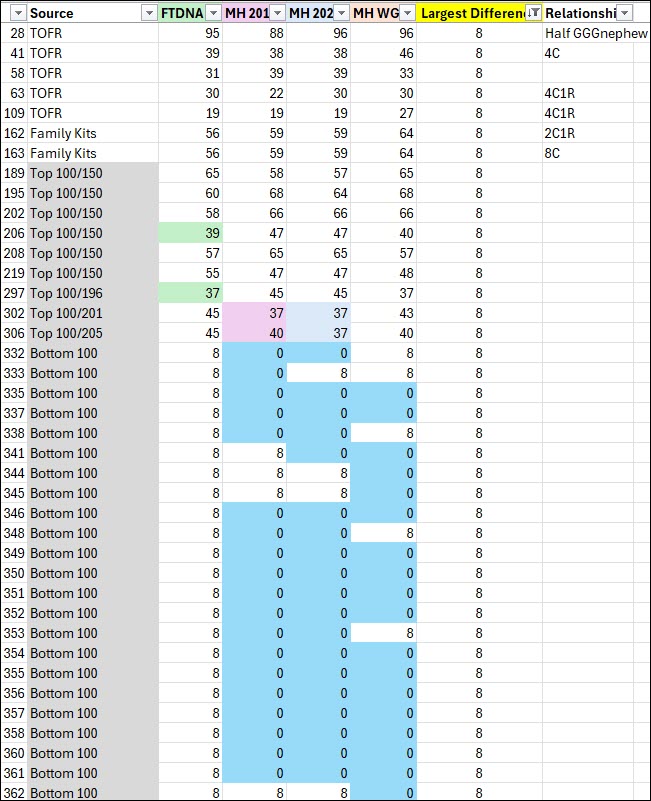
I calculated the largest differences between the highest and lowest match values between the four tests, and placed that value in column G. This means that I subtracted the lowest value of the four tests on this particular match, from the highest value.

In the first row, that means I subtracted 0, the MH 2019 test value, from 75, the WGS test value. The difference between the lowest and highest values is 75 cMs.

Next, I sorted, highest to lowest in column G, so the largest difference is displayed at the top.

I was VERY surprised to see a difference as high as 75 cM, so let’s evaluate the results where the difference is 50 cM or greater. Thirteen matches fall into this category.

  • Entry 168 – The largest difference at 75 cM. This person matches me at 70, 74 and 75 cM, but not at all on the 2019 test, which caused me to go back and check again. Did I spell the name correctly? Yes, I did. We don’t know why I don’t match this person on the 2019 test, but the other matching cM values are very close so they look to be correct.
  • Entry 183 – I match this person on both the FamilyTreeDNA uploaded test at 71 cMs, and the WGS test at 35 cMs, around half as much on the WGS test as the FamilyTreeDNA test. I don’t match them at all on either the MyHeritage 2019 or 2024 kits. I have no explanation.
  • Entry 186 – Like entry 168, we match on three of four tests at 62, 63 and 67 cMs, with the non-matching test being the 2019 test. I would presume that this match is accurate as well.
  • Entry 191 – This one is interesting because I match this person on the FamilyTreeDNA uploaded test at 64 cMs, but none of the other tests.
  • Entry 192 – We match at 57 cMs on both the WGS and the 2024 tests, but not the 2019 test, where we don’t match at all. The match on the FamilyTreeDNA test is 11 cMs lower, at 46 cMs.
  • Entry 228 – This person is my half 1C1R, and I match them on all the tests, of course. However, there’s a 53 cM difference between the WGS and the FamilyTreeDNA uploaded test. In a relationship this close, 53 cM is a small percentage and won’t affect matching, but it’s not an insignificant amount of DNA.
  • Entries 233, 247, 248 and 283 – I match these people ONLY on the WGS test at 50, 52 and 53 cMs, so if I hadn’t taken the WGS test, I wouldn’t match them at all. Without additional research, we can’t tell if this is a legitimate match or not, but 50-53 cM would be a lot to be imputed or to be identical by chance. These people also match one of my parents’ tests, which eliminates the identical by chance possibility, meaning some of the DNA matches my mother and some matches my father – at least on my end. We can’t determine if this match is identical by chance on their side. I’ve never seen a 50+ cM segment (or even close) that is identical by chance, though.
  • Entry 249 – Matches on the FamilyTreeDNA test at 15 cM, and the MyHeritage 2024 test at 52 cM, but not the others.
  • Entry 250 – Matches at 51 cM on the FamilyTreeDNA test, but not on any of the MyHeritage tests.
  • Entry 279 – Matches only on the MyHeritage 2019 test at 50 cM.

Difference Range

Next, let’s review the entire range of differences, meaning the largest matching difference for any one person across all four tests, by group. I’m including all 434 here so you can judge for yourself.

  • 50-75 cM difference – 13 matches analyzed above

  • 45-49 cM difference – 22 matches

  • 40-44 cM difference – 11 matches

  • 35-39 cM difference – 9 matches

  • 30-34 cM difference – 10 matches

  • 25-29 cM difference – 12 matches

  • 20-24 cM difference – 26 matches

  • 16-19 cM difference – 28 matches

  • 13-15 cM difference – 29 matches

  • 9-12 cM difference – 29 matches

  • 8 cM difference – 78 matches

The 8 cM difference has the most of any value or category because this is the lowest level of matching at MyHeritage. Many tests have a minimum level match on a test or tests, and no others.

  • 6-7 cM match difference – 41 matches

The match differences at 5 cM and below are inconsequential. 57 matches fall into this category.

Commentary

One of the indicators of a valid match is if a parent has tested and also matches,

Of these 434 matches, 35 match neither parent, and most of those are at the smallest match level, meaning 8 cM. Of all the match amounts, that would be the least reliable, and most likely to be a false positive match, or identical by chance.

However, that’s not universally the case. Some WGS results match people at significantly higher levels, but don’t match parents. Two WGS matches match people at 47 and 49 cMs, respectively, and not on any of the other tests. Those two WGS matches don’t match either parent.

After reviewing all 434 selected matches, it appears that both the FamilyTreeDNA 2016 test, and the WGS test produce the most consistent and reliable results of the four tests.

44 people, or 10%, match on BOTH the WGS and the FTDNA tests, but neither of the other two tests. A total of 13.8% match EITHER the FTDNA test OR the WGS test, but not the others.

Conclusions

I think we can draw several conclusions from this comparison.

First, let’s evaluate the number of matches. Looking at the differences between the total number of matches between the various tests, especially the three MyHeritage tests, over time, isn’t that great. That’s exactly why you can’t depend on these numbers as an accurate comparison.

FTDNA 2016 MH Health 2019 MH 2024 MH WGS
Total Matches 19,722 17,179 17,767 17,676

There are only a few hundred differences between the three MyHeritage tests, and about 2000 between the FamilyTreeDNA test uploaded in 2016 and the various MyHeritage tests. That’s a substantial difference.

The difference number of matches between tests may seem irrelevant, especially the MyHeritage tests, until you realize that those who match AREN’T ALL THE SAME PEOPLE. In other words, comparing the MyHeritage 2024 test with the WGS test only shows a difference of 91 matches. This DOES NOT mean that the MyHeritage 2024 test and the WGS test have 17,676 of the same people who match both tests, and that the 2024 test simply has 91 more matches than the WGS test.

As we’ve seen, many people who appear on any one match list don’t appear on other match lists.

Our analysis showed that 44.9% of my 434 matches compared appear on all match lists, which means that more than half of my matches appear on one or more match lists, and not the others. Therefore, just comparing the number of matches isn’t really relevant. You need to compare the people included on all the different tests, which is why I created my spreadsheet and included people from a wide variety of sources.

3.7% of my matches on the WGS test were not on any other test, which extrapolates to approximately 654 of my total WGS matches that I wouldn’t receive any other way.

I care a great deal about those matches, especially since at least some appear to be high value.

Yes, I absolutely, positively want those matches, especially when you consider that some of the matching differences are as high as 75 cM. A 75 cM match can be in the second, third or fourth cousin range.

Realistically, they may or may not be valid or useful matches – but if I don’t have the opportunity to compare them, I’ll never know.

Should You Purchase the WGS Test If You’ve Already Tested?

So, now for the question you’re surely asking yourself.

Truthfully, when I ordered my test back in December, I was ambivalent. I only ordered it to do this comparison for my blog readers – and I really dislike spending money on something that I don’t think will benefit me.

Note the words “don’t think.”

I’ve changed my mind, for several reasons, and I’m glad I ordered the test.

The thing that changed my mind was that I received a nontrivial amount of matches on the WGS test that I didn’t receive on any of the others – even if some of them turn out to be identical by chance.

Since we can’t go back in time and take the earlier tests, and MyHeritage no longer accepts uploads from other vendors, our decision now is whether or not we should take the new WGS test, or not, especially if we already have a DNA test at MyHeritage.

If you’re a new tester, by all means, test at all four of the main vendors. DNA matching is the best thing since sliced bread.

However, the people I’m really speaking to here are those who already have a test of some sort at MyHeritage.

Here’s the bottom line:

  • You will receive WGS matches that you didn’t receive on your other test – and vice versa, so don’t delete your older test at MyHeritage
  • Some of those new WGS matches may well be high-value matches – as was illustrated in the “differences” I discovered.
  • Given the differences in who is included in the match list, your TOFR will be different too – perhaps leading to a brick wall breakthrough. I have two that I’m just itching to solve.
  • Use matches, shared matches and TOFR from ALL of your tests at MyHeritage.

My Biggest Regret

As Ran Snir said, new features and developments at MyHeritage will be based on the WGS test. We don’t know what those developments might be, or when they will become available. But it’s very clear that while testers on the older testing platforms will receive as much as MyHeritage can give them, the MyHeritage DNA future is being build on the WGS platform. I want to be there and benefit from new discoveries.

My biggest regret is that my parents aren’t around to take the new WGS test – and neither are several other family members.

Of the 15 family members whose tests I manage at MyHeritage, 9 are deceased, and I think that four more are as well. Two others are now quite elderly and are no longer able to consent or retest.

Your closest family members are your DNA anchors, identifying lineages and pointing you in specific directions, guiding your research.

The very best thing you can do for your genetic genealogy is to test your grandparents if they are living, and your parents. If they aren’t available, test your closest relatives such as grandparents, siblings, aunts, uncles and first cousins.

Preparing for the Future

So, here’s my advice:

  • Take the WGS test yourself in order to glean as much information as possible and to benefit from future developments.
  • Retest any relatives whose tests you manage on the WGS platform, if possible.
  • Test your close family members and anyone you know whose DNA test could help you identify ancestral lineages.

Why is testing your relatives important?

Close relatives will carry some of the DNA from your mutual ancestors that you don’t.

Having the known DNA of your ancestors means that you can evaluate and analyze the trees of the entire group of people who match those identified DNA segments to see if you can break down an upstream brick wall.

I’ve been successful doing this for some time – and am in the process again by combining DNA matches and traditional records research.

Coupon Code for $20 DNA Test

MyHeritage has been kind enough to provide a limited-time coupon code (RobertaFeb26) for my readers which DROPS YOUR PRICE for the DNA test to $20 through February 28th at midnight.

This is the absolute lowest price I’ve ever seen for a DNA test.

You’ll receive the following features that are included with every test:

  • Ethnicity and ethnicity map
  • DNA matches and the ability to contact them
  • Shared ancestral surnames
  • Chromosome browser
  • cM Explainer

In addition, with this code you’ll receive both Shared DNA Matches and Shared Ancestral Places that usually require a subscription.

Normally, a subscription is required to access:

  • Trees of DNA matches
  • Shared DNA Matches (free now with the coupon code)
  • Shared ancestral places (free now with the coupon code)
  • AutoClusters
  • Theory of Family Relativity (TOFR)

If you’re interested in trying a subscription, click here to purchase a MyHeritage subscription with a free trial.

Here’s the link to purchase the DNA test, and here’s the coupon code to enter at checkout: RobertaFeb26

And yes, absolutely feel free to share the coupon code with your family, friends, and anyone else who might benefit.

Let me know how your results compare when you receive them.

_____________________________________________________________

Share the Love!

You’re always welcome to forward articles or links to friends and share on social media.

Subscribe!

If you haven’t already subscribed, it’s free. You’ll receive an e-mail whenever I publish by clicking the “follow” button at the top of the main blog page, here.

Help Keep This Blog Free

I receive a small commission when you click a vendor link in my articles and purchase that item. This does NOT increase your price but helps me keep the lights on and this informational blog free for everyone. Please click on the affiliate links in the articles or to the vendors below if you are purchasing products or DNA testing.

Thank you so much.

DNA Purchases and Free Uploads

Genealogy Products and Services

My Books

Genealogy Books

Genealogy Research

2025 Genetic Genealogy Retrospective: Wow – What a Year!

2025 has been quite a year in genetic genealogy. Genetic genealogy, per se, really isn’t a separate “thing” anymore. DNA testing is now an integral part of genealogy, with the potential to answer questions that nothing else can!

The 76 articles I wrote in 2025 fall into multiple categories and focus on different topics based on what was happening in the industry.

From my perspective, here are the most notable announcements and trends in genetic genealogy, and genealogy more broadly.

#1 for 2025 – Mitochondrial DNA: The Million Mito Project Released the New Mitotree, Updates, and mtDNA Discover

The biggest genealogy news items this year, both industry-wide and genealogy-changing are definitely the release of the new Mitotree, plus two tree updates. But that’s not all.

In addition, full sequence mitochondrial DNA testers received new Mitotree haplogroups, if appropriate, and everyone received a haplotype – a new feature. Along with Mitotree, FamilyTreeDNA introduced mtDNA Discover which provides 13 individual reports based on your haplogroup and matches.

It’s no wonder that mitochondrial DNA articles led the pack with the most views based on the eleven articles about that topic. If you haven’t yet tested your mitochondrial DNA at FamilyTreeDNA, there’s no better time! You never know what you’re going to discover and the more testers, the more matches for everyone.

You don’t know what you don’t know, and you’ll never know if you don’t test. Remember, mitochondrial DNA is for both males and females and tests your mother’s direct matrilineal line (mother to mother to mother, etc.) – reaching beyond known surnames.  Click here to order or upgrade.

#2 – MyHeritage Low Pass Whole Genome Sequence Test Charges into the Future

Another big hitter is the new MyHeritage low-pass whole genome test (WGS) test. It’s new and innovative, but we haven’t seen comparative results yet.

My results from the new low-pass whole genome test just came back, and I haven’t had the opportunity to review them yet, as compared to the earlier tests. That said, I do have roughly the same number of matches, but I need to determine if they are the same matches, and how well they track. I’ll be working on that review soon.

The new whole genome test may be more about future proofing and preparedness than additional current benefit – but we will see. I definately wanted to take the whole genome test so I can receive and benefit from whatever new is coming down the pike.

MyHeritage allows you to maintain multiple DNA tests on your account, so the new whole genome won’t “replace” your older or uploaded test. That way, you can easily compare the results of the whole genome against any DNA test that you curently have at MyHeritage.

Click here to order the new test.

#3 – 23andMe Experiences Problems

On a less positive note, but still quite newsworthy is the bankruptcy of 23andMe and subsequent repurchase of 23andMe by the original founder after setting up a new nonprofit. I have real mixed feelings about this topic. However, 23andMe was really never about genealogy, and now, matching segment information is no longer available. Those searching for unknown parents or family may want to test there if they are unsuccessful elsewhere.

Best Genealogy Tool

The FamilySearch full text search continues to have a HUGE impact for genealogists. This tool is not one-and-done, but provides increasing amounts of rich information as more records are added to the “fully scanned” collection. If you haven’t tried it, please do. It’s a game-changer and continues to improve.

A Cautionary Word About AI – Artificial Intelligence

AI is such a hot topic right now that I feel it needs to be included.

The FamilySearch full text search uses a form of AI. However, you’ll quickly notice that it can’t read everything, gets words and names wrong, and if you actually need to fully depend on it for accuracy, you cannot. (That said, it’s still an amazing tool, and I’m not picking on FamilySearch.)

Aside from FamilySearch, AI in its current form is both wonderful and terrible. I’ll be writing about AI in the new year, but for now, don’t ever rely on AI for anything that you can’t verity. It’s your assistant, not an expert, no matter how insistent it is. Never trust and always verify.

This is ESPECIALLY TRUE WHEN RELATED TO GENETICS and genetic related topics. I can’t even begin to tell you how very wrong it has been, and how much people fall in love with inaccurate results. No, just no – at least for now.

You need to know your AI tool, your skill set, your understanding of AI broadly, the tool’s limitations, and yours, and that’s all before verifying the actual AI results. If you want to educate yourself, and everyone should, treat yourself to anything, anyplace by either Mark Thompson or Steve Little, the dynamic AI duo. They offer YouTube videos and classes in a wide variety of places – but keep in mind that AI tools and technology literally change every few weeks.

AI is, indeed, a specialty all unto itself, much like genetic genealogy. And right now, it’s not soup yet, but it is cooking.

Tried and True Genetic Genealogy Staples – DNAPrint and Genetic Affairs

I haven’t written about either one this year, but I use both DNAPainter and Genetic Affairs regularly.

I consistently paint segments from matches at both MyHeritage, FamilyTreeDNA, and GEDmatch that are newly identified to an ancestor or ancestral couple at DNAPainter.

Unfortunately, neither Ancestry nor 23andMe provide matching cM location information for your matches (chromosome browser), but you may find some people who have tested at those companies at both FamilyTreeDNA and GEDmatch if they have uploaded to either of those vendors. Both vendors provide segment information and a Chromosome Browser, enabling you to paint that information to DNAPainter when you can identify your common ancestor.

MyHeritage also provides a Chromosome Browser, but unfortunately, no longer accepts uploads from any other vendor. You can paint segments from MyHeritage, but no longer upload DNA files to MyHeritage.

Thanks to DNAPainter, I have 90% of my segments identified to specific ancestors – which is actually rather remarkable given that my mother’s grandfather was a Dutch immigrant, and her great-grandparents on her other side were German immigrants, meaning we don’t have many matches on either of those lines.

Genetic Affairs continues to develop new, advanced clustering tools, one of which I’ll be reviewing soon.

Major Vendor Releases

Aside from what’s listed above, most of the major vendors released new features.

MyHeritage released a VERY COOL new tool called Cousin Finder that finds your relatives in the MyHeritage database, whether they match you on a DNA test, or not. They may not have even taken a DNA test. Cousin Finder identifies your common ancestor and shows your relationships. It’s a wonderful way to initiate communications, discuss your common ancestors, and ask about DNA testing.

Of my 378 Cousin Finder matches, only 23 (about 6%) are on my DNA match list, so that leaves 355 people to message, several of whom represent Y-DNA and mtDNA lines I don’t have. You can bet I’ll be offering testing scholarships.

Additionally, MyHeritage released a new ethnicity version.

FamilyTreeDNA, in addition to the new Mitotree, Discover, and associated features, released a new match matrix so you can see if and how selected matches are related to each other in a grid format. In other words, you can create your own cluster.

A new built-in “Share” feature blurs private information to make sharing easier both on the website and in Discover.

Discover improvements include thousands of new Y-DNA and mtDNA tree branches, plus thousands of new Ancient DNA samples. Discover is evergreen, so once you’ve taken that Big Y-700 test or the mitochondrial DNA test, your learning never stops as more content is added.

Tree integration with WikiTree is super-easy and means you don’t have to choose between trees. You can choose to retain your archived tree at FamilyTreeDNA, or move your tree to MyHeritage, PLUS link yourself to your family at WikiTree.

Ancestry released match clustering and a new beta pedigree view of ThruLines, but that’s back in the shop for more work. I’d expect to see it rereleased in 2026.

Conferences

RootsTech is the granddaddy of genealogy conferences, and it’s always fun to attend and write about the experience. Many vendors release new tools or products during the conference.

The ECGGC (East Coast Genetic Genealogy Conference), held in the fall, is the only conference that focuses entirely on genetic genealogy, new tools, how to use existing tools, and more. The 2025 conference was virtual and provided a great deal of focused content. Attendees particularly appreciate the deep dive in a particular topic presented in DNA Academy.

I’ll be at RootsTech in 2026, will write about that soon, and hope to see you there.

Concepts, Techniques and Plain Old Genealogy

In the past, my Concepts series and genealogy “how to” articles have been very popular, so, in 2025, I penned a half-dozen articles focusing on frequently asked questions about relationships and DNA.

For example, how does one go about finding DNA testing candidates? The number of options may surprise you and includes both Cousin Finder and Relatives at RootsTech.

By testing ONE PERSON for either Y-DNA or mitochondrial DNA that represents an ancestor, you actually receive information about that entire lineage of ancestors. So, on my Estes line, by locating an Estes male from my line to test, I received relevant information for every Estes male in my line, back to and beyond the progenitor.

Eventually, we hit a brick wall in every line, and those tools are the perfect way to break through those brick walls.

Other articles discuss things like how to use Discover’s Ancient Connections, and the difference between half and full relationships, both in your tree and genetically. Plus, what does a cousin “once removed” mean anyway? And why do I care?

Another question I receive is how far back, based on the shared amount of DNA, should I look in my matches’ trees for our common ancestor? In other words, how many generations back should I click? That article was fun and produced some unexpected results.

Memorial Articles

Because we are part of a community, I write memorial articles when one of our friends passes on. This year, sadly, Schelly Talalay Dardashti, well-known Jewish genealogist, and another very close friend joined the ancestors, so I’ve recognized the best in both of their lives which constitutes their legacy.

Be the Storyteller

Last, but not least, I wrote about my ancestors in the “52 Ancestors” series, which launched several years ago with Amy Johnson Crow’s challenge to write about one ancestor per week. She hosts this every year, and you can join (free) now.

I’m now on ancestor #467, so yes, it’s addictive, but it’s also AMAZING how many wonderful cousins I’ve met who have information that I did not. Not only that, but after publishing about an ancestor, I’ve discovered that I’m related to people I’ve known for years. We were SOOOooo excited!

I’ve been writing about the lives of my ancestors for several years now, and the articles include attempts to identify Y-DNA and mtDNA testers for each ancestor, where appropriate. There’s so much to learn that can’t be revealed any other way.

Plus, people seem to like the “mystery” and “short story” aspect, and I salt each story with the history of the region and relevant historical events of the timeframe. You might find your ancestors here too, or other helpful information.

Find a way to share about your ancestors!

Do You Have Suggestions for 2026 Topics?

Do you have suggestions or requests for article topics in 2026? If so, please comment on this article and let me know.

Check Out the 2025 List

Here’s the list of the 2025 articles. Did you miss something fun? Enjoy!

  Title Category Date Link
1 Welcome to 2025 – Opportunities and New Genetic Genealogy Articles Welcome, general 1-2-2025 https://dna-explained.com/2025/01/02/welcome-to-2025-opportunities-and-new-genetic-genealogy-articles/
2 Anne Doucet (1713-1791), Oceans, Rivers, and Perseverance – 52 Ancestors #438 52 Ancestors 1-4-2025 https://dna-explained.com/2025/01/04/anne-doucet-1713-1791-oceans-rivers-and-perseverance-52-ancestors-438/
3 Register for RootsTech 2025 Now RootsTech 1-16-2025 https://dna-explained.com/2025/01/16/register-for-rootstech-2025-now/
4 What IS the McNeil Family History, by George Franklin McNeil – 52 Ancestors #439 52 Ancestors 1-19-2025 https://dna-explained.com/2025/01/20/what-is-the-mcneil-family-history-by-george-franklin-mcneil-52-ancestors-439/
5 Jean Garceau dit Tranchemontagne (c1785-1711), Soldier from Saint Marseault – 52 Ancestors #440 52 Ancestors 1-29-2025 https://dna-explained.com/2025/01/29/jean-garceau-dit-tranchemontagne-c1785-1711-soldier-from-saint-marseault-52-ancestors-440/
6 Memories Resurface When the Old Family Home Gets a Facelift Genealogy 2-3-2025 https://dna-explained.com/2025/02/03/memories-resurface-when-the-old-family-home-gets-a-facelift/
7 MyHeritage Introduces Ethnicity v2.5 MyHeritage 2-6-2025 https://dna-explained.com/2025/02/06/myheritage-introduces-ethnicity-v2-5/
8 Relatives at RootsTech Reveals Cousins and Provides DNA Candidates RootsTech, techniques 2-8-2025 https://dna-explained.com/2025/02/08/relatives-at-rootstech-reveals-cousins-and-provides-dna-candidates/
9 FamilyTreeDNA’s New Matrix Shows How Your Matches Are Related to Each Other FamilyTreeDNA 2-12-2025 https://dna-explained.com/2025/02/12/familytreednas-new-matrix-shows-how-your-matches-are-related-to-each-other/
10 René Doucet (c1680-c1731), Lifetime of Incessant Upheaval – 52 Ancestors #441 52 Ancestors 2-15-2024 https://dna-explained.com/2025/02/16/rene-doucet-c1680-c1731-lifetime-of-incessant-upheaval-52-ancestors-441/
11 Lineages Versus Ancestors – How to Find and Leverage Yours Techniques 2-23-2025 https://dna-explained.com/2025/02/23/lineages-versus-ancestors-how-to-find-and-leverage-yours/
12 Mitotree is Born Mitochondrial DNA 2-25-2025 https://dna-explained.com/2025/02/25/mitotree-is-born/
13 RootsTech 2025 – The Year of Discover and the New Mitotree RootsTech, Mitochondrial DNA 3-14-2025 https://dna-explained.com/2025/03/15/rootstech-2025-the-year-of-discover-and-the-new-mitotree/
14 Pierre Doucet (c1621-1713), Walking History Book Lived to Nearly 100 – 52 Ancestors #442 3-16-2025 https://dna-explained.com/2025/03/16/pierre-doucet-c1621-1713-walking-history-book-lived-to-nearly-!100-52-ancestors-442/
15 Welcome to the New FamilyTreeDNA mtDNA Group Mitochondrial DNA 3-17-2025 https://dna-explained.com/2025/03/17/welcome-to-the-new-familytreedna-mtdna-group/
16 23andMe Files for Bankruptcy – What You Need to Know! 23andMe 3-24-2025 https://dna-explained.com/2025/03/25/23andme-files-for-bankruptcy-what-you-need-to-know/
17 New “Share” Features at FamilyTreeDNA Blur Match Information and Make Sharing Easy FamilyTreeDNA 4-1-2025 https://dna-explained.com/2025/04/01/new-share-features-at-familytreedna-blur-match-information-and-make-sharing-easy/
18 The Chauvet Cave: Trip Back in Time with Prehistoric European Humans – Are We Related? History, DNA 4-6-2025 https://dna-explained.com/2025/04/06/the-chauvet-cave-trip-back-in-time-with-prehistoric-european-humans-are-we-related/
19 DNA for Native American Genealogy Webinar & Companion Book Native American 4-8-2025 https://dna-explained.com/2025/04/08/dna-for-native-american-genealogy-webinar-companion-book/
20 Marie Levron (c1686-1727), Tragedy from Cradle to Grave – 52 Ancestors #443 52 Ancestors 4-14-2025 https://dna-explained.com/2025/04/14/marie-levron-c1686-1727-tragedy-from-cradle-to-grave-52-ancestors-443/
21 Mitochondrial DNA: What is a Haplotype Cluster and How Do I Find and Use Mine Mitochondrial DNA 4-14-2025 https://dna-explained.com/2025/04/14/mitochondrial-dna-what-is-a-haplotype-cluster-and-how-do-i-find-and-use-mine/
22 New Mitotree Haplogroups and How to Utilize Them for Genealogy Mitochondrial DNA 4-23-2025 https://dna-explained.com/2025/04/23/new-mitotree-haplogroups-and-how-to-utilize-them-for-genealogy/
23 Sir Francois Levron dit Nantois(c1651-1714), and Acadia’s Pirate – 52 Ancestors #444 52 Ancestors 4-26-2025 https://dna-explained.com/2025/04/27/sir-francois-levron-dit-nantois-c1651-1714-and-acadias-pirate-52-ancestors-444/
24 Catherine Savoie (c1661-c1722/25), Whispered Threads Weave a Tapestry of Life – 52 Ancestors #445 52 Ancestors 5-4-2025 https://dna-explained.com/2025/05/04/catherine-savoie-c1661-c1722-5-whispered-threads-weave-a-tapestry-of-life-52-ancestors-445/
25 Discover’s Ancient Connections – How Are You Related? Discover, Ancient DNA 5-8-2025 https://dna-explained.com/2025/05/08/discovers-ancient-connections-how-are-you-related/
26 Mother’s Day and Legacies 52 Ancestors, Genealogy 5-10-2025 https://dna-explained.com/2025/05/11/mothers-day-and-legacies/
27 The Mystery of the Blue Fugates and Smiths: A Study in Blue Genes and Pedigree Collapse Genetics, Genealogy 5-18-1015 https://dna-explained.com/2025/05/19/the-mystery-of-the-blue-fugates-and-smiths-a-study-in-blue-genes-and-pedigree-collapse/
28 Regeneron Wins Bid for Bankrupt 23andMe – Wedding Planned 23andMe 5-19-2023 https://dna-explained.com/2025/05/19/regeneron-wins-bid-for-bankrupt-23andme-wedding-planned/
29 Francois Savoie’s Homestead Rediscovered – 52 Ancestors #446 52 Ancestors 5-24-2025 https://dna-explained.com/2025/05/24/francois-savoies-homestead-rediscovered-52-ancestors-446/
30 Memorial Day – Some Gave All Memorial 5-25-2025 https://dna-explained.com/2025/05/25/memorial-day-some-gave-all/
31 Mitotree Webinar – What It Is, How We Did It, and What Mitotree Means to You Mitochondrial DNA 6-4-2025 https://dna-explained.com/2025/06/04/mitotree-webinar-what-it-is-how-we-did-it-and-what-mitotree-means-to-you/
32 Catherine LeJeune (c1633-1671/1686), Meet Your Grandchildren – 52 Ancestors #447 52 Ancestors 6-7-2025 https://dna-explained.com/2025/06/07/catherine-lejeune-c1633-1671-1686-meet-your-grandchildren-52-ancestors-447/
33 Mitotree Q&A for Everyone Mitochondrial DNA 6-11-2025 https://dna-explained.com/2025/06/11/mitotree-qa-for-everyone/
34 Father’s Day: Bravery and Love 52 Ancestors, Genealogy 6-14-2025 https://dna-explained.com/2025/06/14/fathers-day-bravery-and-love/
35 Francoise Bourgeois (c1659-1693/1697), High Drama in Beaubassin and Terror at Port Royal – 52 Ancestors #448 52 Ancestors 6-16-2025 https://dna-explained.com/2025/06/16/francoise-bourgeois-c1659-1693-97-high-drama-in-beaubassin-and-terror-at-port-royal-52-ancestors-448/
36 Requesting Suggestions for RootsTech 2026 Topics RootsTech 6-18-2025 https://dna-explained.com/2025/06/18/requesting-suggestions-for-rootstech-2026-topics/
37 FamilyTreeDNA and WikiTree Collaboration – In Two Easy Steps!! FamilyTreeDNA, WikiTree 6-25-2025 https://dna-explained.com/2025/06/25/familytreedna-and-wikitree-collaboration-in-two-easy-steps/
38 Jacques Bourgeois (c1620-c1700), Surgeon of Port Royal – 52 Ancestors #449 52 Ancestors 7-1-2025 https://dna-explained.com/2025/07/01/jacques-bourgeois-c1620-c1700-surgeon-of-port-royal-52-ancestors-449/
39 TTAM, a Nonprofit Formed by 23andMe’s Founder Now Plans to Buy 23andMe 23andMe 7-1-2025 https://dna-explained.com/2025/07/01/ttam-a-nonprofit-formed-by-23andmes-founder-now-plans-to-buy-23andme/
40 Jacques Bourgeois: Complex Acadian, Founder of Beaubassin – 52 Ancestors #450 52 Ancestors 7-6-2025 https://dna-explained.com/2025/07/06/jacques-bourgeois-complex-acadian-founder-of-beaubassin-52-ancestors-450/
41 How to Use Ancestry’s New Match Clusters and What They Mean Ancestry 7-10-2025 https://dna-explained.com/2025/07/10/how-to-use-ancestrys-new-match-clusters-and-what-they-mean/
42 Walk with Your Ancestors: Peace, Light and Healing in an Abandoned Medieval Village History 7-21-2025 https://dna-explained.com/2025/07/21/walk-with-your-ancestors-peace-light-and-healing-in-an-abandoned-medieval-village/
43 Jeanne Trahan (c1629-c1699), Life in Chinon, La Heve, Port Royal, and Beaubassin – 52 Ancestors #451 52 Ancestors 8-2-2025 https://dna-explained.com/2025/07/28/jeanne-trahan-c1629-c1699-life-in-chinon-la-heve-port-royal-and-beaubassin-52-ancestors-451/
44 Wherefore Art Thou, Oh Ancestor – New Generation Tree Chart Suggests Where to Look in Your Matches’ Trees Techniques, Genetics, Genealogy 8-2-2025 https://dna-explained.com/2025/08/02/wherefore-art-thou-oh-ancestor-new-generation-tree-chart-suggests-where-to-look-in-your-matches-trees/
45 Guillaume Trahan (c1601-1625), More Than Meets the Eye – 52 Ancestors #452 52 Ancestors 8-13-2025 https://dna-explained.com/2025/08/13/guillaume-trahan-c1601-c1684-more-than-meets-the-eye-52-ancestor-452/ 
46 The East Coast Genetic Genealogy Conference – ECGGC – Register Now for the Best of the Best ECGGC Conference 8-14-2025 https://dna-explained.com/2025/08/14/the-east-coast-genetic-genealogy-conference-ecggc-register-now-for-the-best-of-the-best/
47 Schelly Talalay Dardashti – May Her Memory Be a Blessing Memorial 8-17-2025 https://dna-explained.com/2025/08/17/schelly-talalay-dardashti-may-her-memory-be-a-blessing/
48 Francoise Corbineau (c1609-c1665), Bride in Chinon, Founder of Acadia – 52 Ancestors #453 52 Ancestors 8-25-2025 https://dna-explained.com/2025/08/23/francoise-corbineau-c1609-c1665-bride-in-chinon-founder-of-acadia-52-ancestors-453/
49 Nicolas Trahan (c1570->1632), Life in the Heart of French Wine Country – 52 Ancestors #454 52 Ancestors 8-31-2015 https://dna-explained.com/2025/08/31/nicolas-trahan-c1570-1632-life-in-the-heart-of-french-wine-country-52-ancestors-454/
50 Mitochondrial DNA A-Z: A Step-by-Step Guide to Matches, Mitotree, and mtDNA Discover Mitochondrial DNA, Discover, Genealogy, Techniques 10-2-2025 https://dna-explained.com/2025/09/02/mitochondrial-dna-a-z-a-step-by-step-guide-to-matches-mitotree-and-mtdna-discover/
51 Renée Desloges (c1570-1627/1632), Fragments of Life in Montreuil-Bellay – 52 Ancestors #454 (this is actually 455) 52 Ancestors 9-6-2025 https://dna-explained.com/2025/09/06/renee-desloges-c1570-1627-1632-fragments-of-life-in-montreuil-bellay-52-ancestors-454/
52 Best Mitochondrial DNA Presentation EVER – You’re Invited to DNA Academy!! Mitochondrial DNA 9-9-2025 https://dna-explained.com/2025/09/09/best-mitochondrial-dna-presentation-ever-youre-invited-to-dna-academy/
53 Unfillable Shoes Memorial – Douglas Rhodenbaugh 9-14-2025 https://dna-explained.com/2025/09/14/unfillable-shoes/
54 Concepts: What Does a Cousin “Once Removed” Mean? Concepts, Genealogy 9-24-2025 https://dna-explained.com/2025/09/24/concepts-what-does-a-cousin-once-removed-mean/
55 Daniel Vannoy (1752-after 1820), “Lived in the Boundary of the Cherokee Indians” – Say What??? 52 Ancestors 9-29-2025 https://dna-explained.com/2025/09/29/daniel-vannoy-1752-after-1820-lived-in-the-boundary-of-the-cherokee-indians-say-what/
56 Daniel Vannoy and the Strange Case of the Two Sarahs – 52 Ancestors #457 52 Ancestors 10-5-2025 https://dna-explained.com/2025/10/06/daniel-vannoy-and-the-strange-case-of-the-two-sarahs-52-ancestors-457/
57 Cousin Finder – MyHeritage’s Innovative New Tool Finds Your Relatives MyHeritage 10-9-2025 https://dna-explained.com/2025/10/09/cousin-finder-myheritages-innovative-new-tool-finds-your-relatives/
58 Sarah Hickerson Vannoy (c1761 – after 1826), Threw More than Shade – 52 Ancestors #458 52 Ancestors https://dna-explained.com/2025/10/13/sarah-hickerson-vannoy-c1761-after-1826-threw-more-than-shade-52-ancestors-458/
59 MyHeritage Introduces a Low-Pass Whole Genome Autosomal DNA Test & Why It Matters MyHeritage 10-14-2025 https://dna-explained.com/2025/10/14/myheritage-introduces-a-low-pass-whole-genome-autosomal-dna-test-why-it-matters/
60 Henriette Pelletret (c1640 – before 1694), Life Death in the Shadow of the Fort – 52 Ancestors #459 52 Ancestors 10-21-2025 https://dna-explained.com/2025/10/21/henriette-pelletret-c1640-before-1694-life-and-death-in-the-shadow-of-the-fort-52-ancestor-459/
61 Cheat Sheet: Mitochondrial Matches, Haplotype Clusters, and Haplogroups Mitochondrial DNA 10-22-2025 https://dna-explained.com/2025/10/22/cheat-sheet-mitochondrial-matches-haplotype-clusters-and-haplogroups/
62 Simon Pelletret (1610-1642/1645): A Walk Through Port Royal – 52 Ancestors #460 52 Ancestors 10-27-2025 https://dna-explained.com/2025/10/27/simon-pelletret-c1610-1642-1645-a-walk-through-port-royal-52-ancestors-460/
63 Perrine Bourg (c1626-1693/1698): Phoenix Rising from the Ashes – 52 Ancestors #461 52 Ancestors 11-2-2025 https://dna-explained.com/2025/11/02/perrine-bourg-c1626-1693-1698-phoenix-rising-from-the-ashes-52-ancestors-461/
64 Concepts: What is a Half Relationships, Life Half First Cousins, Anyway? Concepts, Genealogy 11-4-2025 https://dna-explained.com/2025/11/04/concepts-what-is-a-half-relationship-like-half-first-cousins-anyway/
65 Marie Broussard (1686-after 1752), Life Across the River from Port Royal – 52 Ancestors #462 52 Ancestors 11-10-2025 https://dna-explained.com/2025/11/10/marie-broussard-1686-after-1752-life-across-the-river-from-port-royal-52-ancestors-462/
66 Francois Broussard (1653-1716), Intractable Acadian – 52 Ancestors #463 52 Ancestors 11-22-2025 https://dna-explained.com/2025/11/22/francois-broussard-1653-1716-intractable-acadian-52-ancestors-463/
67 Mitotree Sprouts 12,773 New Branches and Includes Ancient DNA Mitochondrial DNA 11-24-2025 https://dna-explained.com/2025/11/24/mitotree-sprouts-12773-new-branches-and-includes-ancient-dna/
68 Catherine Richard (c1663 – after 1714), Mother of Beausoleil, Acadian Freedom Fighters – 52 Ancestors #464 52 Ancestors 11-29-2025 https://dna-explained.com/2025/11/29/catherine-richard-c1663-after-1714-mother-of-beausoleil-acadian-freedom-fighters-52-ancestors-464/
69 Ancestry’s ThruLines Has a New Pedigree View Ancestry 12-2-2025 https://dna-explained.com/2025/12/03/ancestrys-thrulines-has-a-new-pedigree-view/
70 Ancestry Reverts ThruLines to the Original View Ancestry 12-6-2025 https://dna-explained.com/2025/12/06/ancestry-reverts-thrulines-to-the-original-view/
71 Michel Richard (c1630-1686/1689), Carefree Acadian – 52 Ancestors #465 52 Ancestors 12-7-2025 https://dna-explained.com/2025/12/08/michel-richard-dit-sansoucy-c1630-1686-1689-carefree-acadian-52-ancestors-465/ 
72 Mitochondrial DNA: How Do I Know if I’m a Candidate to Receive a New Haplogroup? Mitochondrial DNA 12-9-2025 https://dna-explained.com/2025/12/09/mitochondrial-dna-how-do-i-know-if-im-a-candidate-to-receive-a-new-haplogroup/
73 Heavens Ablaze: the 1833 Leonid Meteor Storm and Your Ancestors History, Genealogy 12-15-2025 https://dna-explained.com/2025/12/15/heavens-ablaze-the-1833-leonid-meteor-storm-and-your-ancestors/
74 Madelaine Blanchard (c1643 – 1678/1683), Gone Too Soon – 52 Ancestors #466 52 Ancestors 12-20-2025 https://dna-explained.com/2025/12/20/madelaine-blanchard-c1643-1678-1683-gone-too-soon-52-ancestors-466/
75 Soar Inspiration 12-24-2025 https://dna-explained.com/2025/12/24/soar/

_____________________________________________________________

Share the Love!

You’re always welcome to forward articles or links to friends and share on social media.

Subscribe!

If you haven’t already subscribed, it’s free. You’ll receive an e-mail whenever I publish by clicking the “follow” button at the top of the main blog page, here.

Help Keep This Blog Free

I receive a small commission when you click a vendor link in my articles and purchase that item. This does NOT increase your price but helps me keep the lights on and this informational blog free for everyone. Please click on the affiliate links in the articles or to the vendors below if you are purchasing products or DNA testing.

Thank you so much.

DNA Purchases and Free Uploads

Genealogy Products and Services

My Books

Genealogy Books

Genealogy Research

MyHeritage Introduces a Low-Pass Whole Genome Autosomal DNA Test & Why It Matters

Another first for MyHeritage!

MyHeritage, Ultima Genomics, and Gene by Gene, the parent company of FamilyTreeDNA, have jointly announced that MyHeritage is introducing a Whole Genome Sequence (WGS) test using equipment produced by Ultima Genomics. MyHeritage DNA tests will continue to be run in the Gene by Gene Genomics Testing Center in Houston, Texas.

MyHeritage expects to process more than one million DNA tests annually, which is GREAT for genetic genealogy.

You may have heard about whole genome sequence tests before and wonder why this is a big deal. There are several reasons!

All Whole Genome Tests Are Not the Same

Not all whole genome sequence tests, abbreviated WGS, are the same, and MyHeritage has overcome substantial hurdles.

The human genome consists of roughly 3.2 billion base pairs, and most of the human genome is the same between all humans. Traditional autosomal tests target roughly 700,000 of the locations known to be least similar.

Whole genome tests don’t target specific locations, but scan the entire genome, using an entirely different technology. Think of an airplane or a drone flying over your genome.

In whole genome sequencing, we refer to “passes” and “depth”, meaning how many times the genome is scanned (passes), and how many times each location is successfully read (depth). The higher the number of passes, which increases the depth, the higher the cost, not just of the scan but of combining and aligning the data into usable information.

The reason WGS uses multiple passes is because even the most reliable technology is going to miss some things. It’s the nature of the beast.

Even with a 99.99% accuracy rate, which isn’t achieved, more than 320,000 locations would either be missed entirely or reported with erroneous values.

Scanning once would be called a 1xWGS, or one-pass whole-genome sequence.

Clinical or medical-grade whole-genome tests are 30x or greater. That’s important, because diagnoses are based on the results. Those tests are typically ordered by your physician, but you can order them individually from specialized providers.

To make WGS testing even remotely affordable for consumers, enough information needs to be extracted from the lowest number of passes possible.

For several years, direct-to-consumer (DTC) whole genome tests have been available from a number of third-party companies, but none came with Y-DNA, mitochondrial DNA, nor autosomal files, nor with matching. For genealogy, a file without matching capability is useless. In other words, if you really wanted a whole genome sequence, you could purchase it, but it was piecemeal and “some assembly was required.”

One of the challenges has been that for a quality read, the resulting file size generated was prohibitive for storage. I have taken a WGS test, and the results were literally shipped to the customer, for an additional charge, on a hard drive.

The other challenge was cost. Some vendors charge for just the sequencing, but you purchase results from a secondary menu.

Needless to say, none of this is useful or practical for genealogy.

This is exactly why the MyHeritage introduction is important. Through a unique combination of innovation and partnerships, MyHeritage found a way to reach the critical tipping point that makes WGS technology both affordable and available for all genealogists.

While MyHeritage does not provide Y-DNA or mitochondrial DNA testing, they provide world-class autosomal testing with matching, ethnicity results, Theories of Family Relativity, triangulation, and much more.

Moving to a WGS platform opens the door for future innovation beyond what we know today.

My Hope

My fervent hope is for increased granularity, meaning that matching might eventually reach further back in time, and ethnicity can be improved and become more specific. MyHeritage did not say that – it’s me hoping out loud.

Of course, both of those features would rely on enough people testing on the new platform so that areas not currently harvested by traditional technology become available for analysis.

What’s out there, waiting? I don’t know, and neither does MyHeritage. But someone has to be the first pioneer, and MyHeritage, never afraid of a challenge, has stepped up and stepped out.

What About Compatibility?

MyHeritage did not make this move quickly or take it lightly. You can read their 2020 study describing matching using 1x low-pass sequencing, here.

All vendors, over time, change the underlying chips and technology. They have no choice, because their vendors upgrade and make changes too. That’s also why some vendors are more, or less, compatible with other vendors. In some cases, the resulting DNA file incompatibility is too great, meaning too few of the same locations are tested, and vendors who accept uploads don’t accept some versions from other vendors.

MyHeritage would never adopt a platform that was incompatible with their existing customers’ tests, so the new WGS test is backward compatible.

Imputation is a technology that has been used for years in the genetic genealogy industry, to “equalize” files that don’t test exactly the same locations, and although they don’t say, I’m sure some type of imputation will be used here as well.

My Experiment

Let me tell you what I’m going to do.

I’m going to order a new MyHeritage DNA test so that it will be processed on the new equipment.

After the results are uploaded, I will compare matching and the other MyHeritage DNA features between my current and the new WGS test. How does that sound?

Customers can toggle back and forth between different tests at MyHeritage, so you can do this too.

Will Other Vendors Follow Suit?

Not all vendors are as transparent as MyHeritage about their technology, so there’s really no way to know about specific vendors unless they publish their information.

I do know that low-pass WGS would not be conducive to some types of tests. For example, Y-DNA testing that relies on either targeted location reads or multiple reads of every location to produce precise haplogroup calls would not scale well, and neither would mitochondrial DNA. Some Y-DNA locations are read as many as 35 times.

Each vendor has to make their own decision based on their own products, criteria, and customer needs.

Uploads From Other Vendors

You might have noticed a few weeks ago that MyHeritage stopped accepting uploads from other vendors. This might be a hint as to why that decision was made.

You’re always better off taking the test of the vendor where you want to work with matches. The vendor’s own test will always be more accurate when using their products and matching.

Downloading Your New File From MyHeritage

In their press release, MyHeritage committed to providing a file download in a CRAM file format. A CRAM file stores only the differences between a sequence and its reference genome, which means it’s substantially smaller than an entire whole genome. How large is it? I have no idea, but we will see.

Uploading to Other Vendors

Will you be able to upload your file to other vendor sites? I don’t know the broader answer to that question but neither Ancestry nor 23andMe accept any uploads.

FamilyTreeDNA says they are preparing to accept the new MyHeritage file uploads by year-end.

Ordering New Tests

Some MyHeritage tests are already being run on the new WGS machines, but beginning today, all MyHeritage tests will be WGS tests. (Update – MyHeritage has clarified that only kits arriving in the lab in January 2026 are guaranteed to run on the WGS machine. So if you order now at the sale price, wait to mail it back until January.)

Existing tests purchased in the past will not be rerun. Unless the customer has paid for the MyHeritage biobanking service, MyHeritage does not store your DNA after processing, so they can’t reprocess your DNA.

MyHeritage DNA tests, typically $89, are on sale for $36 right now, so there has literally never been a better time to purchase a MyHeritage DNA test. Click here to purchase.

_____________________________________________________________

Share the Love!

You’re always welcome to forward articles or links to friends and share on social media.

If you haven’t already subscribed (it’s free,) you can receive an e-mail whenever I publish by clicking the “follow” button on the main blog page, here.

You Can Help Keep This Blog Free

I receive a small contribution when you click on some of the links to vendors in my articles. This does NOT increase your price but helps me keep the lights on and this informational blog free for everyone. Please click on the affiliate links in the articles or to the vendors below if you are purchasing products or DNA testing.

Thank you so much.

DNA Purchases and Free Uploads

Genealogy Products and Services

My Books

Genealogy Books

Genealogy Research

Cousin Finder – MyHeritage’s Innovative New Tool Finds Your Relatives

I knew I was going to love the Cousin Finder, recently introduced by MyHeritage, I just had no idea HOW MUCH I would love it.

For a very long time, I’ve wanted a list of everyone with my specific ancestor in their tree. With the introduction of Cousin-Finder, you don’t even need to search. Cousin Finder finds them for you – automatically.

Cousin Finder isn’t just for DNA matches, although DNA matches are included, too. Better even yet, these people are all potential DNA matches.

Cousin Finder provides you with a list of the other MyHeritage members who have the same ancestor, or ancestral couple in their tree as you do in yours, along with your relationship to each other, how you both descend from the ancestor, and more.

Warning!

Warning: Cousin Finder is crack for genealogists – it’s highly addictive. I started reviewing my Cousin Finder matches to write this article. The next thing you know, I’ve created a spreadsheet that tracks how we are related, our common shared ancestor(s), if we are a DNA match, and additional information.

There are unexpected bonuses too. I accidentally found answers to questions I’ve had for YEARS. For example, I have ancestors whose child or children I can’t locate in adulthood. If these trees are right, which is always a caveat, Cousin Finder matches answer several of those questions because they descend from those children.

There’s a LOT to glean from these tree matches so let’s step through using Cousin Finder.

Let’s GO!

Everyone with a tree at MyHeritage has Cousin Finder.

Sign in to your MyHeritage account, and under Discoveries, click on Cousin Finder.

Next, you’ll see that MyHeritage is comparing trees and calculating the members with trees that hold at least one discernible common ancestor with you.

The word “discernible” is important here, because you may see a match listed with only one person of an ancestral couple who wasn’t married twice. If the ancestors’ names are spelled differently or omitted, the system may not be able to determine that the second person of the couple is your ancestor too. Keep that in mind as you work through your matches.

Every time you select Cousin Finder, you have the option to recalculate, so I record the number of matches found each time.

This time, I have 378 people on my list, and I CANNOT wait to see who is there and what those matches reveal.

About Half-Relationships

Half relationships are often not noted as such. While it may not be relevant for just trees, it’s certainly relevant in terms of how much shared DNA to expect.

In the example above, sharing only one parent, John, would mean that the child of your ancestor that you descend from, Wife 1, would only be half-siblings with the child of your ancestor and their other spouse, Wife 2. Half-siblings share half as much DNA, on average, as full siblings.

The children of half-siblings are half first cousins (half 1C), who also share approximately half as much DNA as full first cousins.

Never assume that if only one ancestor is showing in Cousin Finder, it means that it’s a half relationship. Also, don’t assume that your ancestor had a second spouse, or that the other person descends from a second known spouse. Showing only one ancestor could mean that the spouse’s name is spelled differently, omitted, wrong entirely or something else – so always check their full tree.

We will run across these when viewing matching trees, so let’s see what Cousin Finder looks like!

Using Cousin Finder

My closest matches are people I know and am closely related to, so for purposes of this comparison, I’m moving to a cousin I don’t already know.

MyHeritage provides a LOT of information about every cousin on your Cousin Finder list.

Susan is noted as being my third cousin’s daughter, which is a third cousin once removed, or 3C1R. I wrote about what “removed” cousins means in the article, “Concepts: What Does a Cousin “Once Removed” Mean”?”.

I LOVE that MyHeritage shows the most recent common ancestor between the two of us – Joseph Preston Bolton.

But why doesn’t Joseph Preston Bolton’s wife show? He had two wives during his lifetime. I descend from Joseph’s second wife, Margaret Herrell. Does Susan descend from Joseph’s first wife, Mary Tankersley?

Let’s click on “View Relationship” to see more.

My connection to Joseph Preston Bolton is shown on the left side, and Susan’s is shown at right.

Since only one common ancestor is shown, this means that either:

  • We descend from different wives of Joseph, meaning it’s a half-relationship.
  • Joseph’s wife is also our common ancestor, but she is omitted in at least one of our trees
  • Joseph’s wife is also our common ancestor, but her name is not spelled the same in both trees, so she cannot be programmatically recognized as the same person.

We need more information.

Fortunately, MyHeritage also includes a link to view Susan’s full tree.

In the portion of Susan’s tree with Joseph Bolton, we discover that Susan descends from Joseph’s first wife, Mary Tankersley. I descend from his second wife, Margaret Herrell, so indeed this is a half relationship.

Susan and I would be 3C1R if we shared the same wife of Joseph, but we don’t, so Susan and I are actually half third cousins once removed, or half 3C1R.

Evaluate the Rest of Their Tree

Always review the rest of your cousin’s tree too, because in this case, I found Cook, another name from the same county that’s also in my tree, and on Susan’s father’s side, the surname Shepard, both of which I need to research further to determine if they are the same lines.

MyHeritage makes this super-easy. Click through to the profile of the ancestor in their tree, then click on “Research this person.”

A few clicks later, I discovered that indeed, Susan and I share another set of ancestors, George Shepherd (c1700-1751) and Elizabeth Mary Angelica Daye (c1700- after 1750), but Susan didn’t have several connecting generations in her tree.

Cousin Finder Only Reports ONE Common Ancestral Line

MyHeritage only reports ONE COMMON LINE – NOT ALL common lines – so ALWAYS review the full tree of your cousin. Don’t just stop at the relationship shown.

This is especially important if you are also a DNA match, because you don’t want to misidentify the source of your shared DNA. Different DNA segments may match because they descend from different ancestors. Furthermore, half relationships only carry half as much expected DNA as full relationships.

Fortunately, MyHeritage labels Cousin Finder matches if the member is also a DNA match.

Cousin Finder DNA Matches

Pamela is a DNA match in Cousin Finder.

My relationship with Pamela is shown as my third cousin’s daughter, but she’s actually my half third cousin’s daughter, which is my half 3C1R.

But that’s just the BEGINNING of our shared story.

Click image to enlarge

There’s SO MUCH great information here.

  • Our Cousin Finder relationship identifies our common ancestor as Margaret Martin Herrell, shown at the bottom. Margaret’s first married name, Martin, is listed here as her middle name, which is incorrect, but the information provided leaves no doubt about the identity of the woman in question, and MyHeritage was able to make the connection.
  • Pamela and I don’t share the other parent, so Pamela descends from Anson Cook Martin, and I descend from Joseph Preston Bolton.
  • Margaret’s parents, William Herrell and Mary McDowell, are shown, at right, in red.
  • Pamela carries the mitochondrial DNA of her direct matrilineal line, meaning it is passed through all females back to Margaret Herrell. In other words, if I did not already have a tester who provided the mitochondrial DNA of Margaret Herrell, which is also her mother, Mary McDowell’s mitochondrial DNA – I’d reach out immediately and ask if Pamela has taken a mitochondrial DNA test at FamilyTreeDNA. If she has not, I’d explain about mitochondrial DNA testing, what it can do for us, and ask if she’d be interested in testing. I often offer a testing scholarship to sweeten the pie. .
  • In addition to our closest common relative, Margaret Herrell, Pamela and I share at least four other ancestral couples, even though we don’t know Charles Campbell’s wife’s name.

Wow – just WOW!

Cousin Finder is an incredibly powerful tool!

Follow the DNA Link

Clicking on my DNA match with Pamela.reveals additional information.

Among other things, our DNA match shows that:

  • We share 24cM of DNA divided into two segments
  • We have 12 surnames in common
  • We have four smart matches
  • We share some geographical locations

Clicking on “Review DNA Match” provides much more detail about all of these features.

Scrolling through my shared matches with Pamela, and particularly the people with whom we share triangulated segments, proves our genetic connection through specific ancestors.

Two of my shared DNA matches with Pamela also descend through children of Jacob Dobkins and Dorcas Johnson, and Charles Campbell. Two sons of Charles Campbell, John and George, married two daughters of Jacob Dobkins and Dorcas Johnson.

It’s also worth noting that if I’m seeking a Campbell male for Y-DNA testing who descends from my line, there’s a Campbell male right here on our shared match list – and MyHeritage makes it VERY easy to contact your cousins.

If you haven’t yet taken a DNA test at MyHeritage, please do. There’s so much to discover.

Really Like

I REALLY like some of these features.

One of the nice built-in tree features is how MyHeritage handles pedigree collapse,  labeling ancestors that appear more than once in someone’s tree.

If you’re evaluating a DNA match with another member, this individual could carry twice as much DNA of those ancestors at that relationship level than ancestors who only appear once in their tree. I wrote about the effects of pedigree collapse, here.

How Did Cousin Finder Benefit Me?

The primary Cousin Finder benefit is that MyHeritage provides a comprehensive list of common ancestors, relieving me of the need to do a lot of searching and sifting, and allowing me to make several discoveries:

  • I found several people with common ancestors, including as far back as 9C1R, that I would probably never have discovered without this tool.
  • Cousin Finder allows me to focus my research on people with specific common ancestors.

  • These 378 Cousin Finder tree matches are spread among 74 ancestors or ancestral couples.
  • Many people share multiple ancestors – including ones you’d never expect from different “sides” in different geographic locations.
  • I found trees belonging to people who live near where our common German or Dutch ancestors lived, which means they may well have information that I do not. MyHeritage has a lot of European members.
  • I discovered trees for people on Cousin Finder that I have DNA matches with at other DNA testing vendors, but who have no trees there. I never thought of using Cousin Finder to locate trees of matches at other companies before I accidentally made this discovery.
  • All of these members are autosomal DNA testing candidates if they haven’t yet tested – and there’s no hunting for your common ancestor because you already know who it is.
  • I found both Y-DNA and mitochondrial DNA test candidates for multiple ancestors. I’m very excited about this and will reach out to them, first asking if they have already taken those tests. If not, I’ll explain the benefits and offer a testing scholarship at FamilyTreeDNA.
  • By viewing our common ancestors’ profiles and clicking “research this person”, I discovered hints and leads that I didn’t have before. Writing this article took me way too long because of this “distraction”!

Asking Your Cousins to DNA Test

I’m very excited that several of these people are candidates for either Y-DNA or mitochondrial DNA testing, and all of them are great candidates for autosomal testing.

One surname line in particular has evaded me for years, and there are TWO men on my Cousin Finder list with that surname who descend from our common ancestor. Either would make a wonderful Y-DNA test candidate. Fingers crossed!

Pay attention to more than just your cousin’s surname. While the member themselves may not be a candidate, the ancestor’s Y-DNA or mitochondrial DNA line may extend to their father or grandparents, meaning the tester may know uncles/aunts or first cousins who are candidates. Information from those tests would benefit both you and the tree-owner. Every single line hits a brick wall sooner or later, and those two tests can break through those brick walls when autosomal tests can’t.

What’s the worst that can happen? Your cousin might not answer or might say no. But with a little education and a nice informational exchange, they may well say yes, and you’ll have a new collaboration partner!

The answer is “no” if you don’t ask.

Observations

One of the biggest Cousin Finder challenges seems to be surname variation. For example, Claxton, Clarkson, and Clarkston are all used in the same time and place for the same person/family. In these cases, if the spouse’s surname is spelled the same in both trees, you’ll still see them as a Cousin Finder match.

I noticed that several people seem to have only one or two lines extended beyond a generation or two. It benefits everyone to extend their trees.

Cousin Finder is Available for Anyone in Your Tree

Cousin Finder isn’t limited to just you. You can view Cousin Finder matches for anyone in your tree or any tree that you own on your MyHeritage site.

Select anyone in your tree, then scroll down to “Additional Actions” and select their Cousin Finder option.

Suggestions

I do love Cousin Finder, but genealogists are always thinking about how to wring more information out of any and every opportunity. We just can’t get enough of a good thing! So, I have some suggestions, aka, not-so-subtle enhancement requests. 😊

  1. I would like for Cousin Finder to display multiple shared ancestors. If multiple distinct shared ancestral couples are found in the same tree, I’d like to see an entry for each one, not just the first one that Cousin Finder locates. It’s not that I’m just being lazy, either.

Common ancestors are easy to see if they show on the first page of the pedigree, but beyond fourth cousins, you need to expand all 32 lines one by one to see if there is an additional shared ancestral line, and them continue expanding to the end. The good news is that the MyHeritage tree is easy to expand, but Cousin Finder would be more friendly and useful if MyHeritage showed multiple common lines so we don’t have to hunt for them.

  1. I would love to be able to filter or sort in several ways, including combinations, which would probably eliminate the need for my spreadsheet where I entered all 378 Cousin Finder member entries:
    • Filter by ancestor(s)
    • Filter by members with a DNA match to me
    • Filter by Y-DNA and mitochondrial DNA lineage candidates for our shared ancestor
    • Filter or sort by the member’s country
    • Filter for or annotate a new person on the list since the last Cousin Finder calculation
    • Filter or annotate a member already on your list but who has now taken a DNA test and matches you
  1. Thankfully, MyHeritage shows if the tree owner has taken a DNA test and matches you, but you have no way of knowing who has tested and does NOT match you. I would love to be able to filter by people who have taken a DNA test but who don’t match me. I do realize this might be a difficult ask for privacy reasons, but perhaps MyHeritage will find a way for members with common ancestors.
  2. Added from blog follower – The ability to make a note on each match. Also to indicate if a match is incorrect due to issues like same-name conventions. .

In Summary

Cousin Finder is a wonderful automated aggregation tool to view the trees of MyHeritage members that share known common ancestors with you based on matching within your trees..

If you have a DNA match with no tree or a small tree at another vendor, check both Cousin Finder and your DNA matches at MyHeritage.

Expanding your tree helps you by facilitating additional Cousin Finder matches.

It’s beneficial to test the DNA of your close and close-ish family members. If there is a third-cousin (3C) or closer with no DNA match button, I’ll be asking if they have DNA tested and if not, if they would consider doing so.

I’m preparing verbiage to send to each match. I’ll customize each one with the name of the member and our common ancestor, and I’ll be asking each of them if they have already taken a DNA test at MyHeritage or elsewhere. Additionally, I’ll try to include some piece of information about that ancestor to pique their interest.

If they are a Y-DNA or mitochondrial DNA candidate for an ancestor whose Y-DNA or mitochondrial DNA I need, I’ll be asking if they have taken that test as well.

While working through Cousin Finder, I discovered so many benefits and useful tidbits that I didn’t expect that I’ve probably forgotten some. Maybe I haven’t discovered them all yet. Let me know if you discover another benefit or use as you work through your Cousin Finder matches.

Cost

According to MyHeritage, Cousin Finder itself is free, but some of the advanced features within Cousin Finder, such as viewing the full relationship path, confirming Smart Matches, extracting information to your tree, or contacting your relatives, do require a subscription.

If you have not yet taken the autosomal DNA test at MyHeritage, you can order one here. You can purchase a MyHeritage research subscription that gives you access to all of the Cousin Finder and other features, and comes with a free trial, here.

Have fun with Cousin Finder!!

_____________________________________________________________

Share the Love!

You’re always welcome to forward articles or links to friends and share on social media.

If you haven’t already subscribed (it’s free,) you can receive an e-mail whenever I publish by clicking the “follow” button on the main blog page, here.

You Can Help Keep This Blog Free

I receive a small contribution when you click on some of the links to vendors in my articles. This does NOT increase your price but helps me keep the lights on and this informational blog free for everyone. Please click on the affiliate links in the articles or to the vendors below if you are purchasing products or DNA testing.

Thank you so much.

DNA Purchases and Free Uploads

Genealogy Products and Services

My Books

Genealogy Books

Genealogy Research

Wherefore Art Thou, Oh Ancestor? – New Generation Tree Chart Suggests Where to Look in Your Matches’ Trees

When you see a DNA match, do you wonder how far back in your trees your common ancestors live? How do you know where to search?

I’ve been working through my DNA match list person by person, reviewing the information and trees for each match, searching for common ancestors.

Whether you’re looking at individual matches, shared matches, clusters or triangulation groups, trees are essential for finding common ancestors.

My favorite vendor-provided tree is my MyHeritage tree. They’ve done a great job, so I’m using their tree for my examples today.

Here’s the question I’m trying to answer – based on how much DNA I share with someone, how far up that person’s tree, roughly, do I need to look for our most recent common ancestor? And, is there something else I can tell?

Tree Size Matters aka How Far Up the Tree Do I Need to Look?

So, if you click on your matches’ trees, how far up their tree do you need to look for a common ancestor? How many times will you need to click to expand their tree beyond the 4 (Ancestry) or 5 (MyHeritage) generations initially displayed, assuming your match has a tree that size? How far out, meaning how many generations do you need to hope and pray they have extended their tree?

Conversely, how many generations do YOU need to include for your tree to be useful for:

  • Other testers to find common ancestors with you
  • Theories of Family Relativity provided by MyHeritage, suggesting common ancestors with other testers
  • ThruLines at Ancestry
  • Family Matching (bucketing) at FamilyTreeDNA which assigns your matches either maternally or paternally. (Note – FamilyTreeDNA is transitioning their trees to the MyHeritage platform.)

If you’re thinking that the size of YOUR tree doesn’t matter, think again.

Not only can the vendors not help you effectively without a tree – genealogy is a collaborative sport. Other people NEED the generations in your tree to locate your common ancestors, just like you NEED to see as many generations in their tree as possible. The vendors NEED as complete a tree as you can provide to help you further.

DNA+Trees Bulldoze Brick Walls

But maybe the most important aspect is that you NEED trees to break through brick walls – especially in conjunction with DNA and tools like clustering that show you visual images of genetic commonality.

We all need to be team players when we have that option – meaning we know who are ancestors are. Our brick walls can be solved, and you can be a puzzle piece of solving brick walls for others too.

Some of my closest friends and cousins are a direct result of DNA matches and genealogy collaboration over the years. (You know who you are!) I’ve even discovered that several friends are cousins too – which I would never have happened without DNA and trees.

Guidelines for What’s Reasonable

What is a reasonable number of generations to peruse for common ancestors?

The answer is – it depends! (I’m sorry…)

Let’s sort through this.

Given that, on AVERAGE, inherited autosomal DNA from a particular ancestor is halved in each successive generation during recombination between the parents, we can calculate the expected average. However, in reality – DNA isn’t always halved. Sometimes segments are passed intact, divided but not in half, or not inherited at all. That’s why you may not match some third cousins, but match some 7th cousins. Random recombination is, in fact, random.

Every segment has its own individual history.

That’s part of the reason we use triangulation, to confirm that a specific segment originated with a particular couple or ancestral line.

Here are a few rules of thumb, with links to articles that explain the various terms and concepts:

  • There are no known instances of second cousins or closer NOT matching.
  • Some (but not all) people find their common ancestor in the first 5 or 6 generations.
  • Many people have proven, triangulated matches to the 10th generation, but those are more difficult to prove, often due to incomplete trees (brick walls) at that distance on either your side, your match’s side, or both. I have no brick walls at 5 generations, counting my parents as generation 1, but I have 6 female brick walls in the 6th generation.
  • If you’re lucky, you can spot your common ancestral surname on the first page of your match’s tree – and follow that line back. Note that there may be additional common ancestors, so view each of their lines to the end. The MyHeritage tree makes this super easy!
  • Pedigree collapse, where you, and/or the other person share multiple lines, known or unknown, is a complicating factor. Pedigree collapse often means you share more DNA than would be expected for a specific relationship.
  • Endogamy, which is pedigree collapse on steroids, is real and will cause many smaller matches.
  • Based on the number of distant versus close cousins you have, you will have MANY more smaller matches than larger ones.
  • And last, but not least, some matches, especially smaller ones, are identical by chance (IBC), not identical by descent (IBD).

All of that said, we can estimate the number of generations back in our matches’ trees where we might need to look for that common ancestor.

As I’ve been reviewing all of my matches, I realized that I can look at the match cM size and mentally size up just about where in their tree I will find our common ancestor. In essence, I’ve “bottled that” for you, here.

Using Trees Effectively

One of the reasons I love the MyHeritage tree is that as you need to click further back in trees beyond the generations initially displayed, which occurs often – the next generations open to the right, the earlier generations just shift left and they all remain visible.

I know that might not sound important, but it is – incredibly – especially when you’re evaluating several matches. Otherwise, it’s easy to lose track of where you are in someone’s tree. I have 9 generations open, above, and I can just keep going – with the more recent generations just shifting left.

But there’s more!

When viewing matches’ trees, I can also click on anyone in their tree, and a profile box opens to the left with additional information about that person, leaving the tree open so I don’t lose my place and have to click around to find it again. I can’t even begin to tell you how wonderful this is, and it’s unique to MyHeritage. You can tell the MyHeritage tree was designed by actual genealogists.

This feature is incredibly useful because many, if not most, of the common ancestors with your matches will be beyond the first page displayed.

Thank you, thank you, MyHeritage!!!

Estimating the Number of Generations by the Amount of Shared DNA

How far up the tree you’ll need to look can be estimated by the amount of DNA that you share with a particular match.

Vendors estimate the relationship of DNA matches by either the percentage of shared DNA or the number of shared centimorgans (cMs), but there’s no quick reference to show you, generationally, where to focus in you and your matches’ trees for your common ancestor.

That’s the handy reference Generation Tree Chart that I’ve created here.

In the article, Shared cM Project 2020 Analysis, Comparison and Handy Reference Charts, I compiled information from multiple sources into one chart detailing HOW MUCH DNA can be expected to be shared at various relationship levels. Shared cM Project information is also visualized at DNAPainter

What I need to know now, though, isn’t an estimate of how closely we are related, but how many generations back to look for our common ancestor in my and their trees.

As I’m clicking through my matches, the majority, by far, are smaller than larger. That makes sense, of course, because we have many more distant relatives than close relatives.

At FamilyTreeDNA, I have 8758 matches who are not immediate or close family.

Number of Matches Relationship Range cM Range
10 Half-1C and 1C1R 318-637 cM
4 2C and equivalent 159-318 cM
7 Between 2C-3C, such as half-2C 80-159 cM
79 3C and equivalent 40-80 cM
814 3C-4C and equivalent 20-40 cM
7548 4C and equivalent 9-20 cM
293 Below 4C and equivalent 7-9 cM

I know the people in the first two categories and some of the people in the third category, but the genetic/ancestral scavenger hunt begins there.

All Cousins Are Not Equivalent

You’re probably wondering about the word “equivalent.” Genetically, people of different relationships carry the same amount of expected DNA. We not only have 5th cousins (5C), for example, we have:

  • Half-fifth-cousins
  • Fifth-cousins-once-removed (5C1R)
  • Fifth-cousins-twice-removed (5C2R)
  • And so forth

I wrote about determining cousin relationships, meaning halves and removed,here.

Genetically speaking, a 5C2R carries the same expected amount of shared DNA as a 6C, so they are functional equivalents. How do we resolve this and where do we look in our trees for our common ancestors?

I’m so glad you asked!

Where Do Various Cousin Levels Fall in My Tree?

We know that first cousins share grandparents, but as we get further back in our tree, it’s difficult to remember or calculate how many generations back a 6th cousin is in our tree.

I’ve used my MyHeritage tree to display 1st through 10th cousins, labeled in red, and the generation number they represent, in black. So, my common ancestors with my second cousins are found 3 generations out in my tree.

Making things more challenging, however, is that unless we know the match already, we’re trying to figure out how closely the match is actually related to us based on their DNA. Not all cousins of any level share the same amount of DNA, so the best vendors can do is provide an estimate or relationship range.

To determine our actual relationship, we need to find our most recent common ancestor.

Where, approximately, in my tree would I look for each category of match, especially that huge group of 7548 people?

Good question!

The Generation Tree Chart is Born

I needed a quick reference for approximately how many generations back in time our common ancestors existed by how much DNA we share, so I know how far back in someone’s tree I need to look.

I’ve reorganized the data from my earlier articles and created a new resource.

The Generation Tree Chart

The Generation Tree Chart:

  • Is not meant to identify parents or close relatives.
  • Does not include parents or grandparents.
  • Counts your parents as generation 1. Some people count themselves as generation 1. If you’re discussing this table, keep in mind that you may be one generation “off” in your discussions with someone who counts differently.
  • This chart clusters the relationships according to color, based on how much DNA people of that relationship are expected to share. For example, a first-cousin-twice-removed (1C2R) shares the same expected amount of DNA with you as a second-cousin (2C).
  • All cousin relationships that are expected to share the same amount of DNA are in the same color band.
  • If you’re using this chart with Ancestry’s numbers, use the unweighted (pre-Timber) amount of DNA.

The colored bands correlate to shared DNA, but the shared ancestor isn’t necessarily the same generation back in time.

This is my “show your work” chart. You’ll notice a few things.

  • The “Avg % Shared” column is the amount of shared DNA expected based on a 50% division (recombination) in each generation, which almost never happens exactly.
  • The “Expected cM” column is the expected cM amount based a 50% division in each generation.
  • I’ve incorporated the DNAPainter mean, low and high range for each relationship.
  • The expected number of shared cMs, in the “Expected cM” column is almost always smaller than the “cM Mean” from DNAPainter. The mean is the midpoint reported in the Shared cM Project for all respondents of that relationship who reported their shared DNA – minus the outliers.

This fact that reported is often significantly higher than expected is particularly interesting. In the closer generations, it doesn’t really matter, but beginning about the 6th blue band and the 7th red band in the chart, the mean is often twice the expected amount.

Remember that DNAPainter numbers are based on the Shared cM Project which relies on user-reported relationships and their associated cM match amounts. You can view Blaine Bettinger’s paper about the most recent Shared cM Project version (2020) and his methodologies here.

My theory is that the more distantly people match, the less likely they are to report the relationship accurately. They may be reporting the relationship they believe to be accurate, life a full versus a half cousin, but that’s not actually the case. It’s also possible that there are multiple unknown relationships or pedigree collapse, or both.

Furthermore, from the red band to the end of the chart, the reported amounts are significantly higher than expected, which is probably a function, in part, of “all or nothing” segment transmission. In other words, if someone’s parent carries a 10 cM segment, you’re probably going to inherit all of it or none of it. If it’s actually divided to 5 and 5 cM, you’re not going to see it on any match list.

In my case, I have several 8 cM triangulated matches who descend from common Dodson ancestors whose descendants intermarried a couple of generations later. Therefore, these matches are, respectively, both my 6C2R and 7C3R from the same line (20 cM total match), two matches at 6C1R (66 cM and 19 cM), and one 6C (51 cM). These people also triangulate on multiple segments. Given the high amount of shared DNA for this relationship level, I suspect additional pedigree collapse someplace. At least one person also matches on an unrelated line that I never realized before doing this match-by-match analysis, which opens up new possibilities.

Next, the meat of this chart.

  • The “Generations Back in Tree” column shows where your common ancestor with someone in that cousin generation would be expected. For example, in the first three bands, all of the first cousin variants are found two generations back, and your grandparents are your common ancestors.

All of the 2C variants descend through great-grandparents, which are 3 generations back in your tree.

Plase note that you can easily find the amount of DNA that you share with a match in the “Expected cM” and “Mean” Columns, and look to the right to see the Generations Back in Tree. 

For example, if I have a match where I share 20 cM of DNA, I’m going to be looking between the red band and the second white band. The generations back in tree range from 4-6, or the common ancestor could potentially be further back. In other words, if I’m lucky, I’ll spot common ancestors on the first tree page displayed, but I may well need to display additional generations.

  • The “Common Ancestors” column displays the common ancestor with anyone in that cousin generation. So, anyone in any variation of 3C shares great-great-grandparents with you.
  • “How Many” shows how many great-great-grandparents you have – 8.

Color Bands and Generations

Color bands represent the same amount of expected DNA, but the various relationships that are included in those bands represent at least two different “Generations Back in Tree.”

For example, looking at the green band, the half 1C3R will be found in the grandparents generation, or generation 2, the 2C2R and half 2C1R are in the great-grandparents, or generation 3, and the 3C is found in the great-great-grandparents, or generation 4.

Where I really needed this chart, though, was in the more distant generations. While we are clearly dealing with a range, if I see a match with 11 or 12 cM, our common ancestor is nearly always at least 6 generations out, and often more.

The Net-Net of This Exercise

The majority of my matches, 7548, fall into the red band of 9-20 cM, which should be the 4th or 5th generation, either great-great or GGG-grandparents, but in reality, common ancestors will often be found more distantly in matches’ trees.

Most of your matches will be 20 cM or below, meaning they are at least 4/5 generations distant, or further – which translates to NOT the first tree page displayed. This why using the MyHeritage tree is so convenient, because when you click to the next generations, they just open and it’s VERY easy to quickly click and expand every generation with no back-clicking needed. Tip – when viewing profile cards for their ancestors, be sure to note locations which are important hints too. You can also click to “research this person.”
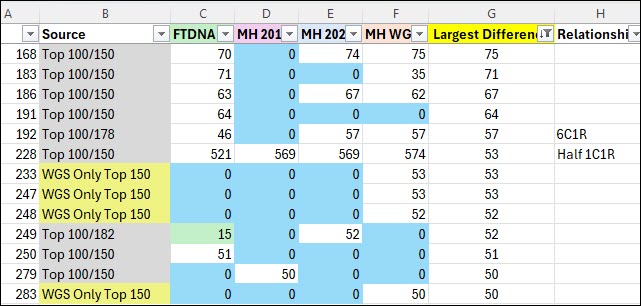
If your match doesn’t have a tree developed to at least 5 generations, it’s unlikely that you will be able to find a common ancestor for someone with less than a 20 cM match. However, all is not lost because you may recognize a surname, and if you build out the tree for your match, you may find your common ancestor. I build out my matches’ trees often! (Yes, it’s painful and irritating, but just do it! After all, we’re genealogists. We got this.)

For people with smaller cM matches, you may be looking even further out. I have some solid triangulated matches with multiple people at 6 and 7 generations..

The further out in time, the more triangulated people you need to be confident that your common ancestor who contributed that segment is identified correctly. At that distance, most people will have dead end lines and brick walls, probably yourself included.

However, my research methodology has the potential to break through brick walls.

Brick Walls Breakers

When I’m working on match and triangulation clusters, not only am I looking for MY known ancestors, I’m also looking for common surnames, or more specifically, common ancestors between my matches trees.

In some cases, common ancestors only mean that I’m viewing first cousins to each other, but in other cases, those common ancestors between my matches, but not me, MAY POINT DIRECTLY TO A MISSING BRICK WALL ancestor of mine.

Another hint that this might be the case is when the shared cMs seem high relative to how far back your common identified ancestor is in your tree – which is the case with my Dodson cluster. There may be a second relationship obscured there, especially if they match each other more “normally” and it’s only my matches that are higher than expected with multiple people in this cluster.

Research Methodology

If you’re wondering how I approach this process, I use a spreadsheet organized by triangulation cluster because everyone in a triangulation cluster matches each other on a particular segment. This means that the triangulated segment comes from a common ancestor (or is idencal by chance.) Each match has it’s own row in the cluster on my spreadsheet.

This spreadsheet could also be organized by shared match or matrix cluster, but I prefer smaller triangulation clusters where everyone matches each other and me on the same segment – because it points to ONE shared souce of the DNA – meaning one ancestor or ancestral couple.

I downloaded my match list at FamilyTreeDNA where I can see which matches are assigned either maternally or paternally based on identified, linked relationships, and who matches on the same segments. I used that spreadsheet as the foundation of this spreadsheet, but I could also add people who match on that segment and triangulate from other vendors who provide matching segment information, such as MyHeritage.

Using my Dodson example group, this group of people above, on my father’s side, hence the blue color, also triangulates on other segments. Other clusters are significantly larger, with around 50 cluster members.

One person, JA, descends from Dodson cousins who intermarried, which is pedigree collapse, so they may carry more Dodson/Durham DNA than they would otherwise.

If someone has a small tree, I often use traditional genealogy resources to expand their tree if I recognize a surname.

I track my other ancestors’ surnames that I notice in their trees, which provides a clue for additional ancestors. Of course, common surnames sometimes aren’t useful. However, one match, JC, found in this group is a proven Crumley line cousin who has colonial Virginia ancestors, but no prior knowledge of a Dodson/Durham line – so this could be a HUGE hint for one of JC’s brick walls.

This example cluster from my mother’s side includes my mother, who I haven’t listed, and also RM, a known second cousin who I tested. Based on his known common ancestors with me, I know immediately that these segment matches all track to John David Miller and Margaret Elizabeth Lentz, or beyond. Sure enough DW has a tree where our common ancestor is David Miller, father of John David Miller, and TK is related to DW based on an obituary. So far, we know this segment originated with David Miller and his wife, Catherine Schaeffer, but we don’t know if the segment originated with the Miller or Schaeffer parent.

One additional cluster member shows a Cyrus Miller out of Pennsylvania and my initial attempt at extending their tree using WikiTree, MyHeritage and Ancestry to find a common ancestor was not fruitful, but a deep dive might well produce more, or the common ancestor could reach back into Europe.

As new people test and match, I can add them to the spreadsheet in the clusters where they fit.

Summary Generation Tree Chart

Here’s a summary version of the Generation Tree Chart for you to use, without the cM high and low ranges, and without the red boxes. This is the one I use the most.

Here’s the full chart, including the ranges, but with no red boxes.

The Bottom Line

To derive the most benefit, we all need to develop our trees as far as possible, and share with others. A rising tide lifts all ships!

It’s impossible to identify common ancestors without trees, which means it’s also impossible to use genetic genealogy to break through brick walls.

Please check your trees at the various vendors, if you have multiple trees, and at WikiTree, to be sure you’ve added your most distant known ancestor in each line.

Link your known relatives to their position in your tree at FamilyTreeDNA, which allows them to triangulate behind the scenes and assign (bucket) your matches either maternally or paternally on your match list.

What new information is waiting for you in your matches? Do you have brick walls that need to fall?

_____________________________________________________________

Share the Love!

You’re always welcome to forward articles or links to friends and share on social media.

If you haven’t already subscribed (it’s free,) you can receive an e-mail whenever I publish by clicking the “follow” button on the main blog page, here.

You Can Help Keep This Blog Free

I receive a small contribution when you click on some of the links to vendors in my articles. This does NOT increase your price but helps me keep the lights on and this informational blog free for everyone. Please click on the affiliate links in the articles or to the vendors below if you are purchasing products or DNA testing.

Thank you so much.

DNA Purchases and Free Uploads

Genealogy Products and Services

My Books

Genealogy Books

Genealogy Research

RootsTech 2025 – The Year of Discover and the New Mitotree

Last week, RootsTech was a whirlwind and full of discoveries – which, ironically, was the 2025 theme.

I always take you along with me and share the RootsTech experience, start to finish, so here’s my 2025 “feet on the ground” report.

I might, just might, have overcommitted myself. I taught the half-day DNA Academy,  three more sessions, plus several other commitments such as book signings, get-togethers, and interviews.

One class, “DNA for Native American Genealogy,” was a live webinar from the floor of the expo hall. You can watch that here for free, if you’re interested.

Unfortunately, none of my other sessions were recorded, but I’ll see what other alternative options may be available to bring those to you.

Additionally, I did two book signings at the GenealogyBank booth, along with two other authors, Drew Smith and Sunny Morton. I’m sorry, I don’t have any pictures. I should have asked someone to take some.

There were long lines and books sold out. Still, you can order either of my books, The Complete Guide to FamilyTreeDNA – Y-DNA, Mitochondrial, Autosomal and X-DNA or DNA for Native American Genealogy, at Genealogical.com. Thank you to GenealogyBank for being so welcoming.

The book signing was particularly fun because people shared their success stories or their hopes of what they want to achieve. I met a couple of new cousins too! Even people waiting in line were helping each other with information about research resources.

I had created my “RootsTech plan” for sessions I wanted to attend, but I was only able to actually attend one of those. Several were happening at the same time as mine, or directly before or after. As a presenter, you arrive early to get set up and make sure everything is working correctly.

Then, after your session, attendees have questions and are interested in your topic, which is a good thing. So essentially, you can’t attend sessions either before or after your session either.

Before I share photos, I’d like to share something else.

It’s About the People

I have never attended RootsTech for the classes, although there are wonderful offerings – and I have enjoyed them immensely.

Having said that, for me, the best part of RootsTech is the people. People I know and love but never get to see – many of whom I met in-person at RootsTech initially. I get to meet my blog followers. I meet with or reconnect with friends and cousins from around the world. I am privileged to talk with people about their challenges and their victories – when they’ve broken through a brick wall using DNA that they could never have otherwise achieved. People collaborating and helping each other. It’s all beautiful.

The reason I started blogging in the first place, and the reason all 1750 articles are free, is because I wanted to help people do just that – confirm ancestors, find ancestors, and connect with their fsmily.

My cousins that I’ve met through genealogy are some of my closest friends and closest family members. Outliving everyone is a mixed blessing but it makes me extremely grateful for my various cousins since all of my siblings and close family, with the exception of the next generation, have transitioned to the land of the ancestors.

So, yea, for me, RootsTech is about connecting and reconnecting with the people.

That’s also why I never get anything done because I’m always talking with someone.

Additionally, this particular RootsTech was a celebration.

Mitotree Release

Just a few days before RootsTech, the Million Mito Team at FamilyTreeDNA released the brand new Mitotree, 5 years in the making, reconstructing the tree of humankind to reflect our combined heritage more accurately.

At RootsTech 2020, I was honored to announce the Million Mito Project, and the new Mitotree initiative was born.

At some point, I will write about the deep, personal significance of the Mitotree for me,  but for now, suffice it to say that there is something profoundly moving about rewriting the tree of humankind and in doing so, giving a voice to our ancestors from long ago. Yes, I know many of them are thousands or even tens of thousands of years old, but had they not survived, we would not be here today. Now we can identify who they are and that they lived.

Million Mito Team, left to right, Goran Runfeldt, Dr. Paul Maier, me, Dr. Miguel Vilar, Bennett Greenspan, John Detsikas

Our amazing Dream Team has given life to our ancestors and said their names once again, even if their name is a mitochondrial DNA haplogroup. Four team members, Goran, Paul, me and Bennett were at RootsTech. Where else can you actually approach and speak with the actual scientists?

When I say RootsTech is about the people, I know that I am related to every single individual at RootsTech, it’s just a matter of how far back in time. So are you.

Just think about the significance of that for a minute.

Every. Single. Person.

The other end of the mitochondrial DNA spectrum is genealogy, of course, and the new Mitotree with it’s haplotype clusters brings mitochondrial DNA results into the genealogical timeframe. In future articles, I’ll be writing about each one of the new tools, what they mean, and how to use them.

Dr. Paul Maier, lead scientist doing most of the hard science behind Mitotree, had the much-deserved honor of introducing the Mitotree to genealogists at RootsTech.

I’m not sure the audience understood they were witnessing history unfold, but they clearly were. We needed a drum roll and some balloons!

This wasn’t like most vendor announcements of a new product or feature – this was a major scientific achievement that led to genealogical benefits.

In celebration, I asked my friend to make double helix zipper pulls so that I could give them to colleagues, friends and cousins that I ran into at RootsTech. It’s my way of celebrating and sharing the joy!

Five years is a very long time to work on a project. The Mitotree is a massive accomplishment. Every customer at FamilyTreeDNA who has taken the full sequence test received their new haplogroup either the week before or during RootsTech, AND, the second updated version of the tree was released too.

While this is truly wonderful, the true highlight is the testimonials – seeing how Mitotree is actually helping people break through their brick walls.

Here’s just one.

Breathless Testimonial

I’m going to try to convey this exactly as it happened.

A lady that I don’t know literally runs up to me in the hallway. This isn’t unusual. She was so excited that what she said was one long breathless sentence, which I’m going to try to reconstruct here, although I’m adding a bit of punctuation. I also can’t remember how many “greats” were attached to the “grandmother,” but you’ll get the idea.

Roberta, Roberta, I’m so excited – I just wanted to let you know – I found my ancestor using mitochondrial DNA. I got my new haplogroup and I had like 47 matches before but now they are clustered together so I could focus…and there were three matches in my cluster…and one of them had an EKA but the other didn’t…so I built out the EKA matches’ tree and guess what??? They were from the same place and then I found that her great-great-grandmother’s sister is my great-great-grandmother but she had her surname so now I have more generations too. OMG I ‘m so excited I could never have broken through this wall without mtDNA because I had no surname. This is THE MOST CONSEQUENTIAL DNA TEST I’VE EVER TAKEN, and I’ve taken them all. Thank you, thank you!

And with that she quickly hugged me and ran off to something she was obviously late for.

I never got to say one word, which was fine, but I stood there with tears in my eyes, thinking to myself, “This – this is what it’s all about.”

It doesn’t get better than this!

I want to hear your stories too. I just scaled my fourth brick wall last night using the new Mitotree and mtDNA Discover features.

RootsTech Week

RootsTech week started early for me – as in leaving the house at 3 AM Sunday. I fly on Sunday because the flights are cheaper and because the pre-conference meetings and events begin on Monday.

We took off into the dawn, jetting our way westward through the azure blue sky.

I have never gotten over the majesty and beauty of the Rocky Mountains.

And then, of course, the Great Salt Lake, for which Salt Lake City is named.

Looking at the Salt Palace across the street from the Marriott hotel. The silver building is the new Hyatt which is attached to the conference center behind the windmills which extends another very long block to the right, out of view. The mountain range is visible in the distance, and the beautiful sunset.

Speaking of the Marriott hotel, several people have asked if it was any better this year, and if I got trapped in the fire exit again, like last year.

No, I didn’t get stuck because I didn’t tempt fate again. It looked just the same though, so I’m presuming nothing has changed. Furthermore, there was no heat in my room, so they gave me a space heater and a pass to the concierge level – which they did not do last year.

That was kind of them, but food ran out, and there was only one poor server in the restaurant. I’m not even going to mention the nauseating thing that happened with my food. Let’s just say I’m not picky, but I will NEVER eat there again, and that makes it particularly difficult because there’s very little close by, especially when you’re exhausted.

I’m hoping that RootsTech will negotiate someplace different for speakers in the future. I’ve stayed in a lot of Marriotts and most of them are just fine. I have never had issues like this with any of them, let alone repeat issues year after year.

The good news is that we’re not there for the hotel, and the fun began on Monday.

Monday

My interviews began on Monday morning with “Mondays with Myrt” at the FamilySearch Library, which you can view here beginning about 16 minutes.

Mondays with Myrt is a RootsTech tradition and Myrt incorporates people present in person and tuning in virtually as well. Left to right, Kirsty Gray from England, John Tracy Cunningham, me and Myrt. Kirsty had a huge breakthrough that she shared with us just a few minutes after it happened.

I met John at the ECGGS Conference last October. He’s one of the few people I know whose 8 great-grandparents were born in the same county. I’m so jealous. Mine were either born in or first generation immigrants from four countries.

Sometimes the broadcast waiting area is just as much fun as the actual broadcast – in part because it’s the first day of RootsTech week and everyone is so excited to see their friends that they haven’t seen in forever. Call is a reunion!

Do Kirsty Gray and I look like we’re about to get into mischief?

Behind me is the first group of folks to be interviewed.

Pat Richley-Erickson, aka Myrt, Cheryl Hudson Passey, Laura Wilkinson Hedgecock, and Jenny Horner Hawran.

This is the livestream room at the FamilySearch Library. The waiting area for the next group is to the right, and the three presently being interviewed are sitting on the left beside Myrt.

For those who know Gordon, aka Mr. Myrt, he’s coordinating interviewees outside the livestream room. His job is herding cats and he’s the nicest cat-herder you’ll ever meet!

Pre-RootsTech Library Research

I love the FamilySearch Library. It feels like coming home to me.

So many passionate genealogists at every level – learning and searching. Lots of volunteer helpers available, too.

Normally, I create a research plan for the library, but I had been so utterly slammed between preparing my several RootsTech sessions and the Mitotree release that I hadn’t really been able to prepare anything.

I did, however, have a group of ancestors in mind that settled in the Oley Valley in Pennsylvania, so I decided to focus on the Berks County books.

I won’t bore you with the details, but among other things, I found confirmation that the Hoch surname is also the same as High and Hoy, which explains some very confusing Y-DNA results. So even though I didn’t get much productive time there, I did find something very useful in the land records.

I also ran into cousins and friends, of course, which is why I didn’t get more actual research done.

I knew Judy Nimer Muhn, at left, was going to be at RootsTech as a speaker, and I knew we connected through Acadian lines, but we never took the time to really piece together that puzzle.

My cousins, Mark and Manny were also coming for RootsTech, and to visit the library, for the first time. Mark, Manny and I visited Nova Scotia together in the summer of 2024, chasing our ancestors.

You know, fate is a funny thing.

We all descend from Acadian, Francois Savoie who was born about 1621 in France, but settled in Acadia, today’s Nova Scotia. Mark, Manny and I knew that we are cousins through Francois, but Judy and I did not. Mark, Manny and I ran into a local historian, Charlie Thibodeau, the Acadian Peasant, last year, outside of Port Royal. It just so happened that he was taking another couple to see the remains of the Savoie homestead deep in the salt marshes at BelleIsle.

We asked if we could join them, and Charlie was kind enough to include us. It was a long, brutally hot, tick-infested hike through the swamp, but oh so worth it!

We also found the well, located between three homesteads.

The year before, Judy had been in the same place in Nova Scotia, found the same man, Charlie, at the BelleIsle Hall Acadian Cultural Centre, and he had taken her to the remains of the same homestead.

And here we all four are in Utah.

What are the chances?

Needless to say, we had a LOT to talk about, and still do. Unfortunately, I wasn’t able to get to Judy’s talk, but Mark and Manny attended.

I ran into Katy Rowe-Schurwanz, the FamilyTreeDNA Product Manager at the library too, and look what she’s wearing – a mitochondrial DNA scarf. How cool is that!

The rest of Tuesday and most of Wednesday morning were spent trying to update my several presentations to reflect newly released information by various vendors and practicing the timing of the presentations. I had another interview, and more people were arriving.

I found time to visit Eva’s Bakery about 3 blocks from the Salt Palace. If you’re ever in Salt Lake City, Eva’s is a must! Lunch is wonderful, and so are their French pastries.

Wednesday is “tech prep” day at RootsTech, along with speaker instructions and then the Speaker Dinner.

Steve Rockwood, President and CEO of FamilySearch always delivers an inspirational message and this year did not disappoint.

If you’ve wondered about RootsTech conference stats, they provided this information. I can’t even imagine trying to coordinate all of this – and that’s not including the vendors, expo hall, technology in the presentation rooms, food, security and so much more.

Last year, in 2024, the final attendance numbers were more than 16,000 people in person and 4 million virtual attendees. I noticed a few days ago that there were more than half a million people participating in Relatives at RootsTech, which is still live until April 12th.

On Wednesday evening, after the Speaker’s Dinner, vendors in the Expo Hall were putting the final touches on their booths and preparing for the thousands of excited genealogists who would descend Thursday morning.

Discover

This year’s RootsTech theme was “discover” and attendees were greeted with this display just inside the door.

Attendees listed their discoveries on Post-its and could either post them on the board or plastic boxes, or on the green tree.

I placed my discovery from the day before at the library on the Rootstech tree.

Some people place their wishes here, kind of like a technology wishing well.

I couldn’t help but think of the new Mitotree, now forever green and growing, so I posted a second discovery, “Mitotree.”

Thursday – Opening Day

For those who don’t know, the Salt Palace Convention Center is two lengthy blocks long, a block wide, and two or three stories high, depending on whether you are in the front or rear portion. In other words, it’s massive and you need a map!

The huge Expo Hall with vendors is located in the center on the first floor and vendors have aisle addresses. The show floor is always very busy, and this year was no exception. One of the things I love is that spontaneous conversations just spring up between people who often find commonalities – common ancestors, common locations, and more. People compliment each other and join others at tables. It’s like a big family gathering of sorts.

I always try to walk the entire Expo Hall, because I really enjoy seeing the vendors and their wares, but this year, I never actually had enough time to traverse all the aisles. I took several pictures as I was passing through and running into people, but not nearly enough. I know I missed a lot, but there just wasn’t enough time and I arrived at RootsTech already tired.

However, the energy of RootsTech is like no place else and just infects you.

It’s like you can’t drink from the genealogy firehose fast enough!

Let’s Take a Walk

Ok, come along on a walk with me.

Left to right, Lianne Kruger, a speaker, and Courtney, in the FamilyTreeDNA booth. I believe they said they are cousins.

Daniel Horowitz, genealogist extraordinaire, in the MyHeritage booth. More about MyHeritage’s announcements shortly.

Geoff Rasmussen in the Legacy Family Tree Webinars booth. For those who don’t know, there’s lots of good material at Legacy, and the freshly recorded webinars are always free for a week.

Several vendors offer booth talks, including MyHeritage. I love their photo tools and use their site in some capacity almost daily.

One of the RootsTech traditions is ribbons. Collect one, collect ‘em all. Liv’s ribbons almost reach the floor. I think she wins!

Selfies are also a RootsTech tradition. Me, here with Jonny Perl of DNAPainter fame. I owe Jonny an apology as he asked me if I had a minute, and I had to say no because I was on the way to one of my own classes. I never got back to his booth to view his new features. Sorry Jonny – don’t take it personally!

Jonny released a new Ancestral tree version titled Places, so take a look here at his blog. I need to go look at my ancestors Places.

You’ll find this new feature under Ancestral Trees, Places. These are my most recent 8 generations. Just think of all those brave souls who climbed on a ship and sailed for the unknown. Check this feature out and have fun.

In a booth talk, Dave Vance, Executive Vice-President and General Manager at FamilyTreeDNA is speaking about the three types of DNA, which are, of course, Y-DNA, mitochondrial and autosomal DNA – all useful for genealogy in different ways.

Dave is explaining how in-common-with matches, also known as shared matches, operate with the chromosome browser. You can use the chromosome browser, shared matches, the new Matrix Tool, and download your match segment information at FamilyTreeDNA, a combination of features not available at any other vendor.

WikiTree, a free a moderated one-world-tree is one of my favorite genealogy tools. One of their best features is that you find your ancestor, and in addition to lots of sources, their Y-DNA, mitochondrial DNA, and those who are related autosomally are listed. Here’s my grandfather, for example.

Several DNA connections are listed. The further back in my tree, the more DNA connections are found, becuase those ancestors have more descendants.

WikiTree volunteers were wandering around taking pictures of “WikiTreers” holding fun signs.

Paul Woodbury, a long time researcher with Legacy Tree Genealogists, who specializes in DNA. I don’t take private clients anymore, and regularly refer people to Legacy Tree.

Me with Janine Cloud taking our annual RootsTech selfie. Janine, the Group Projects Manager at FamilyTreeDNA and I co-administer one of those projects and accidentally discovered a few years ago that we are cousins too. How fun is this!!!

I wanted this shirt, but by the time I got back to the booth, it was too late. I’m going to order it online from Carlisle Creations, in case you want one too. This is so me.

Land records are critically important to genealogists. Rebecca Whitman’s class was about plotting land plats. What she’s holding is a surveyor’s chain. You’ve read about chain carriers? This is what they carried to measure land boundaries – literally metes and bounds. Some of my best discoveries have been thanks to land records.

The only session I actually got to attend was Gilad Japhet’s “What’s New and Exciting at MyHeritage.” For those who don’t know, Gilad is the founder and CEO of MyHeritage and it’s always great to hear about the new features straight from the top executive who is, himself, a seasoned genealogist. That’s why he started MyHeritage in the first place – 22 years ago in his living room.

Gilad had several wonderful announcements, but the one I’m most excited about is their new Cousin Finder. Cousin Finder finds and reveals cousins who are DNA candidates if they have not yet taken a DNA test.

I’ll be writing more about the MyHeritage announcements soon, but you can read their blog about Cousin Finder now, here, and their Roundup here about the rest of their announcements!

My Last Class – Reveal Your Maternal Ancestors & Their Stories

My last class at the end of the final day of RootsTech was “Reveal Your Maternal Ancestors & Their Stories – Solving Mitochondrial DNA Puzzles.”

Had I tried to coordinate this presentation with International Women’s Day, I could never have done it, but fate winked and here I was.

I’m often asked what it’s like from the presenters’ perspective. This is one of the smaller ballrooms. My earlier sessions were in larger rooms, maybe 3 times this size. I took this picture about 15 minutes before the session started as people were beginning to drift in.

The amazing RootsTech techs had me wired up to microphones and had verified that the audio and video equipment was working correctly, so now it was just waiting.

My cousin, John Payne, who co-administers the Speaks surname project with me, came by and took this great picture of the two of us. We’ve made huge inroads connecting the various Speake(s) lines in America, plus finally proving our home village in England, thanks to the Big Y-700 test, followed by church records. All is takes, sometimes, is that one critical match.

As I sat there, waiting to begin the mitochondrial DNA session, I couldn’t help but reflect upon all of the women who came before me and how fortunate I was to have been in the right place at the right time to be a member of the Million Mito team.

These are my direct matrilineal ancestors who give me, and my daughter, pictured at left, their mitochondrial DNA. I felt them with me as I sat there, waiting.

The woman at furthest right, Barbara Drechsel (1848-1930), immigrated to Indiana from Germany as a child with her parents in the 1850s. Before her came thousands of generations of women with no photos, of course, and no names before Barbara Freiberger, another eight generations earlier, born about 1621 in Germany.

Before that, which was before church and other records, prior to the 30 Years War, this lineage came from Scandinavia where some of my exact matches are still found today.

Before beginning, I said a positive affirmation and thanked my ancestors – so very honored to introduce them. I know they were proud of me, a member of the team that opened the door to the distant past. I wouldn’t be here if not for every one of their lives.

In this session, I would discuss, for the first time ever, the new Mitotree and my/our connection to all of humanity some 7000 generations ago, more or less.

The mutations we carry over those generations form an unbroken chain of breadcrumbs, connecting us to mitochondrial Eve who lived about 145,000 years ago. We revealed that breakthrough finding in the Haplogroup L7 paper, published in 2022.

I’m still in absolute awe that we have been able to both reach that far back in time AND, at the same time, make the newest haplogroups and haplotype clusters genealogically relevant. I will write more about that soon, but for now, I wrote about the Mitotree release here and you can find articles by Katy Rowe-Schurwanz here and here.

I’m very excited about my new mitochondrial DNA results for my ancestral lines that I track and have already made headway on several.

I’m not the only one.

Not only was I excited about my results, many other people have had breakthroughs too, including Mark Thompson, one of our genealogy AI experts who also spoke at RootsTech. I particularly love his AI generated image.

If you haven’t yet, check your mitochondrial DNA results.

It’s a Wrap

Another year done, another RootsTech under our belts. Hopefully everyone is over the “conference crud” by now and are busily applying their newfound knowledge.

You can view either live-cast sessions or RootsTech webinars, here.

I saw a meme posted sometime during the conference that coined the term “exhausterwhelmulated,” a combination of exhausted, overwhelmed and overstimulated at the same time.

I added exhilarated and elated to the mix and asked ChatGPT to draw me a picture of someone at a genealogy conference feeling those simultaneous emotions.

ChatGPT titled this request “Genealogy Conference Overload,” which made me laugh.

The first two attempts looked like the person had a headache, which I fully understood, so I asked ChatGPT to make the person look happy to be there.

This person, carrying a coffee like I often do, looks like they have just discovered the great irony that they have chased the wrong ancestor for some 20 years – with “laugh or I’ll cry” mania being their overwhelm “go to” in that minute.

This one made me laugh too!

Yes, indeed, I think every single one of us, especially at RootsTech, has experienced this exact adrenaline-fueled emotion.

We leave with a VERY long to-do list, exhausted but full of anticipation and buoyed by excitement. Filled with so much gratitude for our cousins and fellow genealogists, the speakers, vendors, DNA to solve thorny problems, new tools and records, FamilySearch who sponsors RootsTech itself and their amazing employees, plus the legions of the volunteers who make it all work.

Thank you! Thank you! Thank you!

_____________________________________________________________

Share the Love!

You’re always welcome to forward articles or links to friends and share on social media.

If you haven’t already subscribed (it’s free,) you can receive an e-mail whenever I publish by clicking the “follow” button on the main blog page, here.

You Can Help Keep This Blog Free

I receive a small contribution when you click on some of the links to vendors in my articles. This does NOT increase your price but helps me keep the lights on and this informational blog free for everyone. Please click on the links in the articles or to the vendors below if you are purchasing products or DNA testing.

Thank you so much.

DNA Purchases and Free Uploads

Genealogy Products and Services

My Books

Genealogy Books

Genealogy Research