Register for RootsTech 2022 Now – It’s Free!

Just the good news we need to end the year. RootsTech 2022, sponsored by FamilySearch, is entirely virtual and completely free – again.

In 2021, over a million people “attended” RootsTech and you can be one of those lucky people in March 2022 too.

In 2022, there will be more than 1500 sessions presented by hundreds of speakers from around the globe in many languages. Of course, that’s in addition to the vendor Expo booths, which I love, and the DNA Basics Learning Center.

The 2022 sessions and speakers aren’t listed yet, but this would be a good time to view any of the 2021 sessions that you never got a chance to. What better thing could you be doing for New Year’s Eve😊

Sign Up!

You can sign up for RootsTech 2022 here, for free.

I’ll let you know as soon as the 2022 sessions are added. The sessions showing are the 2021 classes which RootsTech has graciously made available for the entire year. I don’t know how long they will be viewable, so if you want to watch, please do so now.

As you might imagine, the 2022 speakers are busily (should I say crazily) designing and recording their content. You’ll be seeing me in both recorded sessions (about my new book, DNA for Native American Genealogy,) sharing success-story testimonials, and in several live sessions too.

Yes, some sessions will be live this time and the live sessions will be recorded for later playback. I like to interact with people, so I’ve decided to cross my fingers that the internet gremlins don’t visit me those days! I have seven exciting sessions under construction.

Be sure to test your Y, mitochondrial and autosomal DNA and upload your autosomal DNA to multiple locations in advance so you are prepared to benefit from all of the DNA track presentations and a multitude of wonderful speakers. There’s still time today and tomorrow to take advantage of end-of-the year sales.

__________________________________________________________

Follow DNAexplain on Facebook, here or follow me on Twitter, here. You can also subscribe to receive emails when I publish an article by clicking the “Follow” button at www.DNAexplain.com.

You’re always welcome to forward articles or links to friends.

Help Out, Please

I receive a small contribution when you click on some of the links to vendors in my articles. This does NOT increase the price you pay but helps me to keep the lights on and this informational blog free for everyone. Please click on the links in the articles or to the vendors below if you are purchasing products or DNA testing.

Thank you so much.

DNA Purchases and Free Uploads

Genealogy Products and Services

My Book

Genealogy Books

Genealogy Research

Y DNA Tree of Mankind Reaches 50,000 Branches

Today is a really, REALLY big day in the genetic genealogy world.

The Y DNA tree of mankind at FamilyTreeDNA has reached 50,000 branches. That’s quite a milestone!

There’s been remarkably rapid growth in the past three years, as shown below.

From the FamilyTreeDNA blog article announcing this milestone event, we see the growth from 2018 to present cumulatively and within each haplogroup. Of course, haplogroup R, present in very high frequencies in Europe, forms the base of this mountain, but every haplogroup has achieved significant gains – which benefits all testers.

Who is Branch 50,000?

Michael Sager, the phylogeneticist at FamilyTreeDNA just added branch 50,000.

Drum roll please! Who is it? Surprisingly, it’s NOT found in haplogroup R, but a man from Vanuatu, a country in Oceania.

The new branch is a member of haplogroup S – specifically S-FTC416, immediately downstream of S-P315. Haplogroup S is found in Indonesia, Micronesia and other Pacific Island nations, including Australia and New Zealand.

This man was a new customer who joins a couple of Aboriginal samples found in academic papers from Kuranda (Queensland, Australia) and 3 ancient samples from Vanuatu.

How cool is that!!!

We’ve Come a LONG Way!

The Y DNA phylogenetic tree has been growing like wildfire.

  • Back in 2002, there were 153 branches on the Y-DNA tree, and a total of 243 known SNPs. (Some SNPs were either duplicates or not yet placed on the tree which explains the difference.)
  • In 2008, six years later, the tree had doubled to 311 branches and 600 SNPs. At the FamilyTreeDNA International Conference that year, attendees received this poster. I remember the project administrators marveling about how large the tree had grown.
  • In 2010, two years later, the tree was comprised of 440 branches and 800 SNPs. That poster was even larger, and it was the last year that the phylotree would fit onto a poster.
  • By 2012, when the Genographic Project V2 was announced, that bombshell announcement included information that the Genographic project was testing for 12,000 SNP locations on their chip, not all of which had been classified.
  • In 2014, when FamilyTreeDNA and Genographic jointly released their new Y tree to celebrate DNA Day, the Y tree had grown to more than 6200 SNPS, of which, more than 1200 were end-of-branch terminal SNPs. If this had been a poster, it would have been more than 62 feet long.

From that point on, the trajectory was unstoppable.

The earliest SNP-seeking product called Walk the Y had been introduced followed by the first-generation powerful Big Y NGS DNA scanning product.

That’s 1300% growth, or said another way, the database increased by 13 times in four years.

In the three years since, many of those SNPs, plus private variants that had not yet been named at that point have been added to the tree.

In January 2019, the Big Y-700 was announced and many people upgraded. The Big Y-700 provided dramatically increased resolution, meaning that test could find more mutations or SNPs. The effect of this granularity is that the Big Y-700 is discovering mutations and new SNPs in a genealogical timeframe, where the original haplogroups a few years ago could only piece together deeper ancestry.

The Big Y-700 has made a HUGE difference for genealogists.

  • Today, in December of 2021, the tree hit 50,000 branches. That poster would be more than 500 feet long, almost twice the length of a football field.

I have to wonder how many more branches are out there just waiting to be found? How many will we find in the next year? Or the next?

The pace doesn’t show any signs of slowing down, that’s for sure. Adding academic and ancient samples to the tree helps a great deal in terms of adding context to our knowledge.

What gems does your family’s Y DNA hold?

How Does a SNP or Variant Get Added to the Tree?

You might be wondering how all of this happens.

A SNP, which becomes a haplogroup has three states of “being,” following discovery.

  1. When the mutation, termed a SNP (single nucleotide polymorphism), pronounced “snip” is found in the first male, it’s simply called a variant. In other words, it varies from the nucleotide that is normally found in that position in that one man.
  2. When the SNP is found in multiple men, assuming it’s found consistently in multiple scans, and it’s in an area that is “clean” and not genetically “noisy,” then the SNP is given a name like R-ZS3700 or R-BY154784, and the SNP is placed on the tree in its correct position. From my article last week about using Y DNA STR and SNP markers for genealogy, you can see that both of those haplogroups have multiple men who have been found with those mutations.
  3. Some SNPs are equivalent SNPs. For example, in the image below, the SNP FT702 today is equivalent to R-ZS3700, meaning it’s found in the same men that carry R-ZS3700. Eventually, many equivalent SNPs form a separate tree branch.

One day, some man may test that does have R-ZS3700 but does NOT have FT702, which means that a new branch will be formed.

When men tested that had R-BY154784, that new branch was added to the left of R-ZS3700, because not all men with R-ZS3700 have the mutation R-BY154784.

You’ll notice that the teal blocks indicate the number of private variants which are mutations that have not yet been found in other men in this same branch structure, and those variants are therefore not yet named SNPs.

If You’ve Already Tested, How Do You Receive a New Haplogroup?

It’s worth noting here that none of the terminal SNPs that define these branches were available using the older Big Y tests which illustrates clearly why it’s important to upgrade from the Big Y or Big Y-500 to the Big Y-700.

In my Estes line, the terminal SNP in the Big Y-500 was R-BY490. These same men upgraded to the Big Y-700 and have now been assigned to four different, distinct, genealogically significant lineages based on SNPs discovered after they upgraded. Some men have three new SNPs that weren’t available in earlier tests. In real terms, that’s the difference between the common ancestor born in 1495 and descendants of John R. Estes who died in the 1880s. Genealogically speaking, that’s night and day.

If you haven’t taken a Big Y test, I heartily recommend it – even if you don’t have STR matches. I talked about why, here. Men can purchase the Big Y initially, or sign on to your account and upgrade if you’ve already taken another test.

In a nutshell, the Big Y-700 test provides testers with two types of tools that work both together and separately to provide genealogically relevant information.

Not to mention – you may be responsible for growing the tree of mankind, one branch at a time. What’s waiting for you?

___________________________________________________________

You Can Help Keep This Blog Free

I receive a small contribution when you click on some of the links to vendors in my articles. This does NOT increase the price you pay but helps me to keep the lights on and this informational blog free for everyone. Please click on the links in the articles or to the vendors below if you are purchasing products or DNA testing.

Thank you so much.

DNA Purchases and Free Uploads

Genealogy Products and Services

My Book

Genealogy Books

Genealogy Research

Black Friday Starts Now – MyHeritage DNA Only $39!

MyHeritage has dropped the price of DNA tests to $39 for their Black Friday Sale.

I’ve never previously seen DNA kits prices this low. You can purchase, here.

DNA Plus More

The great thing about DNA at MyHeritage is that you receive emails like this one I received yesterday telling me that my DNA match, Fred, is my 4th cousin once removed!

Note that Fred is just one of 88 of my DNA matches that have Theories of Family Relativity, showing how I may be related to that match. That’s an incredible benefit.

Sure enough, when I click on “View Theory,” I see that Fred and I share ancestors Francoise Lafaille and Marguerite de Forest.

Click to enlarge image

MyHeritage can provide Theories to their customers when the customer has BOTH taken a DNA test AND uploaded or created a tree. I’ve provided some tips on how you can receive more Theories of Family Relativity, here.

If you haven’t yet tested your DNA at MyHeritage, there has never been a better time. You can click here to order tests for yourself and other family members. Free shipping on two or more kits, too.

_____________________________________________________________

Follow DNAexplain on Facebook, here or follow me on Twitter, here.

Share the Love!

You’re always welcome to forward articles or links to friends and share on social media.

If you haven’t already subscribed (it’s free,) you can receive an email whenever I publish by clicking the “follow” button on the main blog page, here.

You Can Help Keep This Blog Free

I receive a small contribution when you click on some of the links to vendors in my articles. This does NOT increase the price you pay but helps me to keep the lights on and this informational blog free for everyone. Please click on the links in the articles or to the vendors below if you are purchasing products or DNA testing.

Thank you so much.

DNA Purchases and Free Uploads

Genealogy Products and Services

My Book

Genealogy Books

Genealogy Research

DNA for Native American Genealogy – Hot Off the Press!

Drum roll please…my new book, DNA for Native American Genealogy, was just released today, published by Genealogical.com.

I’m so excited! I expected publication around the holidays. What a pleasant surprise.

This 190-page book has been a labor of love, almost a year in the making. There’s a lot.

  • Vendor Tools – The book incorporates information about how to make the best use of the autosomal DNA tools offered by all 4 of the major testing vendors; FamilyTreeDNA, MyHeritage, Ancestry, and 23andMe.
  • Chromosome Painting – I’ve detailed how to use DNAPainter to identify which ancestor(s) your Native heritage descends from by painting your population/ethnicity segments provided by FamilyTreeDNA and 23andMe.
  • Y and Mitochondrial DNA – I’ve described how and when to utilize the important Y and mitochondrial DNA tests, for you and other family members.
  • Maps – Everyone wants to know about ancient DNA. I’ve included ancient DNA information complete with maps of ancient DNA sites by major Native haplogroups, gathered from many academic papers, as well as mapped contemporary DNA locations.
  • Haplogroups – Locations in the Americas, by haplogroup, where individual haplogroups and subgroups are found. Some haplogroups are regional in nature. If you happen to have one of these haplogroups, that’s a BIG HINT about where your ancestor lived.
  • Tribes – Want to know, by tribe, which haplogroups have been identified? Got you covered there too.
  • Checklist – I’ve provided a checklist type of roadmap for you to follow, along with an extensive glossary.
  • Questions – I’ve answered lots of frequently asked questions. For example – what about joining a tribe? I’ve explained how tribes work in the US and Canada, complete with links for relevant forms and further information.

But wait, there’s more…

New Revelations!!!

There is scientific evidence suggesting that two haplogroups not previously identified as Native are actually found in very low frequencies in the Native population. Not only do I describe these haplogroups, but I provide their locations on a map.

I hope other people will test and come forward with similar results in these same haplogroups to further solidify this finding.

It’s important to understand the criteria required for including these haplogroups as (potentially) Native. In general, they:

  • Must be found multiple times outside of a family group
  • Must be unexplained by any other scenario
  • Must be well-documented both genetically as well as using traditional genealogical records
  • Must be otherwise absent in the surrounding populations

This part of the research for the book was absolutely fascinating to me.

Description

Here’s the book description at Genealogical.com:

DNA for Native American Genealogy is the first book to offer detailed information and advice specifically aimed at family historians interested in fleshing out their Native American family tree through DNA testing.

Figuring out how to incorporate DNA testing into your Native American genealogy research can be difficult and daunting. What types of DNA tests are available, and which vendors offer them? What other tools are available? How is Native American DNA determined or recognized in your DNA? What information about your Native American ancestors can DNA testing uncover? This book addresses those questions and much more.

Included are step-by-step instructions, with illustrations, on how to use DNA testing at the four major DNA testing companies to further your genealogy and confirm or identify your Native American ancestors. Among the many other topics covered are the following:

    • Tribes in the United States and First Nations in Canada
    • Ethnicity
    • Chromosome painting
    • Population Genetics and how ethnicity is assigned
    • Genetic groups and communities
    • Y DNA paternal direct line male testing for you and your family members
    • Mitochondrial DNA maternal direct line testing for you and your family members
    • Autosomal DNA matching and ethnicity comparisons
    • Creating a DNA pedigree chart
    • Native American haplogroups, by region and tribe
    • Ancient and contemporary Native American DNA

Special features include numerous charts and maps; a roadmap and checklist giving you clear instructions on how to proceed; and a glossary to help you decipher the technical language associated with DNA testing.

Purchase the Book and Participate

I’ve included answers to questions that I’ve received repeatedly for many years about Native American heritage and DNA. Why Native DNA might show in your DNA, why it might not – along with alternate ways to seek that information.

You can order DNA for Native American Genealogy, here.

For customers in Canada and outside the US, you can use the Amazon link, here, to reduce the high shipping/customs costs.

I hope you’ll use the information in the book to determine the appropriate tests for your situation and fully utilize the tools available to genealogists today to either confirm those family rumors, put them to rest – or maybe discover a previously unknown Native ancestor.

Please feel free to share this article with anyone who might be interested.

_____________________________________________________________

Disclosure

I receive a small contribution when you click on some of the links to vendors in my articles. This does NOT increase the price you pay but helps me to keep the lights on and this informational blog free for everyone. Please click on the links in the articles or to the vendors below if you are purchasing products or DNA testing.

Thank you so much.

DNA Purchases and Free Uploads

Genealogy Products and Services

My Book

Genealogy Books

Genealogy Research

Sitting Bull’s Hair Confirms Relationship With Great-Grandson

Tȟatȟáŋka Íyotake, known as the legendary Lakota warrior and leader, Sitting Bull, was born about 1831 and was killed in 1890. You’ll probably remember him for his victory over Custer and his troops in 1876 at the Battle of Little Big Horn, known as the Battle of Greasy Grass to the Native people and as Custer’s Last Stand colloquially.

By Orlando Scott Goff – Heritage Auctions, Public Domain, https://commons.wikimedia.org/w/index.php?curid=27530348

Pictured here, Sitting Bull was photographed in 1881.

After Sitting Bull’s murder, his scalp lock, a braided length of hair used to hold his feather in place was cut from his body as a souvenir of the grizzly event. In 1896, the scalp lock along with his leggings were donated to and held by the Smithsonian Museum for more than a century before being returned to his family in 2007. Sitting Bull’s great-grandson, Ernie LaPointe, now in his 70s, along with his three sisters are Sitting Bull’s closest living relatives.

The family needed to unquestionably prove a familial connection to be allowed to make decisions about Sitting Bull’s gravesite and remains. Genetic analysis was employed to augment traditional genealogical records. According to Ernie, “over the years, many people have tried to question the relationship that I and my sisters have to Sitting Bull.”

After the return of Sitting Bull’s scalp lock to Ernie LaPointe, Professor Eske Willerslev, one of the pioneers in ancient DNA, contacted Ernie and offered to assist the family by analyzing the hair sample.

By Von Bern – Sitting Bull family portrait, Public Domain, https://commons.wikimedia.org/w/index.php?curid=49894969

Original text from the back of the above image:

“4 generations of Sitting Bull: Sitting Bull, two wives, their daughter, her daughter, her baby” “Copy from Mrs. Edward M. Johnson collection Spiritwood, N. Dak.” Sitting Bull and family 1882 at Ft Randall rear L-R Good Feather Woman (sister), Walks Looking (daughter) front L-R Her Holy Door (mother), Sitting Bull, Many Horses (daughter) with her son, Courting a Woman

LaPointe and his sisters descend from Sitting Bull through their mother, through one of Sitting Bull’s three daughters, so neither Y nor mitochondrial DNA were options to prove that they were the great-grandchildren of Sitting Bull. Generally, neither Y nor mitochondrial DNA establish exact recent relationships, but confirm or disprove lineage relationships.

DNA From Sitting Bull’s Hair

In 2007, obtaining autosomal DNA from hair was virtually impossible, even from contemporary hair, let alone hair that’s more than a century old. However, today, the technology involved has improved. Additionally, it’s also possible that some of the DNA from Sitting Bull’s skin or skin flakes were held within the scalp lock itself.

The fact that the hair had been treated with arsenic for preservation while in the possession of the Smithsonian made DNA analysis even more difficult. Unlike traditional contemporary DNA tests, a full autosomal sequence was not able to be obtained. Small fragments of autosomal DNA from the braid were able to be pieced together well enough to compare to Ernie LaPointe and other Lakota people, showing that Ernie and his family match Sitting Bull’s hair more closely than other Lakota.

The academic paper published by Willerslev, with other researchers and authors including LaPointe provides the following abstract:

Only a small portion of the braid was utilized for the analysis. The rest was burned in a spiritual ceremony. You can read the scientific paper, here.

This analysis of Sitting Bull’s hair opens the door for the remains in the two potential burial sites to be evaluated to see if they match the DNA retrieved from the scalp lock – enabling the family to rebury Sitting Bull in a location of their choice.

You can read additional coverage, here, here, here, and here.

Establishing a Relationship

Sitting Bull’s DNA is considered ancient DNA because it’s not contemporary, and it was degraded. But the definition of ancient needs to be put in context.

Sitting Bull’s “ancient DNA” is not the same thing as “ancient DNA” from thousands of years ago. In part, because we know positively that the DNA from thousands of years ago will not match anyone genealogically today – although it may match people at a population level (or by chance) with small fragments of DNA. We know the identity of Sitting Bull, who, on the other hand, would be expected to match close family members and other more distantly related members of the tribe.

Ernie and his sisters are great-grandchildren of Sitting Bull, so they would be expected to share about 887 cM of DNA in total, ranging from 485 cM to 1486 cM.

In an endogamous population, one could be expected to share even more total DNA, but that additional DNA would likely be in smaller fragments, not contiguous segments.

Great-Grandchildren Matches

For example, two great-grandchildren match their great-grandmother on 902 cM and 751 cM of DNA, respectively, with a longest contiguous block of 130 cM and 72 cM.

Another pair matches a great-grandfather at 1051 cM and 970 cM, with longest blocks of 220 cM and 141 cM.

A person would be expected to share about 12.5% of their autosomal DNA with a given great-grandparent. I wrote about how much we can expect to inherit, on average, from any ancestor, here.

In terms of the types of DNA matches that we are used to for genealogy, a great-grandparent would be one of our closest matches. Other relationships that could share about the same amount of DNA include a great-aunt/uncle/niece or nephew, a half-aunt/uncle/niece or nephew, a first cousin, half first cousin, first cousin once removed, or a great-grandchild.

Courtesy of DNAPainter

Since Sitting Bull’s DNA was extracted from hair, and we know unquestionably where that hair had been since 1896 when it was donated to the Smithsonian, we can eliminate some of those relationships. Furthermore, the genetic analysis supports the genealogical records.

What About Hair, DNA, and Your Genealogy?

I’m sure you’re wondering how this applies to you and your genealogy.

Like so many other people, I have a hair WITH a follicle belonging to my father and letters written by my paternal grandfather in envelopes that I hope he licked to seal. I tried several years ago, at different times, unsuccessfully. to have both of their DNA extracted to use for genealogy. Not only were the endeavors unsuccessful, but those attempts were also VERY expensive.

IT’S NOT SOUP YET!

I know how desperately we want to utilize those items for our genealogy, but the technology still is not ripe yet. Not then and not now. At least, not for regular consumers.

Remember that this extraction took a very specialized ancient DNA lab and many highly skilled individuals. It also took a total of 14 years. The DNA obtained was highly fragmented and had to be reassembled, with lots of pieces still missing. Then it had to be compared to currently living individuals. The ancient DNA autosomal file, like other autosomal forensic files, would NOT pass quality control at any of the DNA processing companies today, where the required QA pass rate is in the ballpark of 98%.

This type of ancient DNA extraction has only been successfully done using autosomal DNA once before, in 2015 on the remains of someone who died in 1916. While Y and mitochondrial DNA has been used to rule out, or *not* rule out direct patrilineal or matrilineal relationships in other burials, highly degraded autosomal DNA is much more difficult to utilize to establish relationships. The relationships must be close in nature so that enough of the genome can be reconstructed to infer a close familial relationship

I realize that more than one company has entered this space over the past several years, and you might also notice that they have either exited said space or are have not achieved any measure of reproducible success. Do NOT chance a valuable irreplaceable sample to any company just yet. This type of processing is not a standard offering – but ongoing research opens the door for more improvement in the future. I still have my fingers crossed.

If you are interested in preserving your items, such as hair, teeth, hairbrushes, electric razors, etc. for future analysis, be sure to keep them in paper, preferably acid-free (archival) paper, NOT plastic, and in a relatively temperature-controlled environment. By that, I mean NOT in the attic and NOT in a humid basement. Someplace in the house, comfortable for regular humans, and not sealed in a ziplock baggie. Don’t touch or handle them either.

Test Older Relatives NOW!

If you can test your oldest relatives, do it now. Grandparents, great-grandparents, aunts, uncles, great-aunts/uncles. All of your oldest family members. Don’t wait.

FamilyTreeDNA performs the test you order and is the only DNA testing company that archives the DNA sample for 25 years. The remaining DNA is available to order upgrades or new products as technology advances.

That’s exactly how and why some younger people have great-grandparent DNA available for matching today, even if their great-grandparents have walked on to the other side and joined Sitting Bull.

————————————————————————————————————-

Disclosure

I receive a small contribution when you click on some of the links to vendors in my articles. This does NOT increase the price you pay but helps me to keep the lights on and this informational blog free for everyone. Please click on the links in the articles or to the vendors below if you are purchasing products or DNA testing.

Thank you so much.

DNA Purchases and Free Uploads

Genealogy Products and Services

Books

Genealogy Research

DNA Beginnings: Matching at Ancestry and What It Means

This is the fourth in the series of “DNA Beginnings” articles. Previous articles you might enjoy include:

Why Is Matching Important?

For genealogists, DNA matching to other people is the key to verifying your ancestors, beginning with your parents and continuing up your tree. You can also meet new cousins who may have information, including photos, that you don’t.

Each of the four major vendors has benefits that the others don’t have. As we review matches at each vendor, we’ll discuss the plusses and minuses of each one and how to use their unique features to benefit your genealogy quest.

Let’s start with Ancestry.

Ancestry

The highest total number of people have tested their DNA with Ancestry, although I’m not certain that holds true for testers outside the US.

This means that you are likely to find at least some close matches at Ancestry. Every vendor has people in their database that no other vendor has though. I recommend testing at the 4 major vendors, including FamilyTreeDNA, MyHeritage, and 23andMe.

At Ancestry, Where Are My Matches?

You’ll find the list of people who match you under the “DNA”, then “DNA Matches” tabs at Ancestry.

Ancestry packs a lot of information into your match pages. Let’s take a look at what that means to you as a genealogist and how you can make it work for you.

Clcik to enlarge images

I’ll be discussing each one of these areas, below, so refer back. Let’s start with the basic page arrangement.

  • Features at the top apply to managing and working with all of your matches
  • Features under each match apply to that match only.

Pretty straightforward.

I’ll begin at the top and review each item, but first, let’s talk about testing your parents.

Test Your Parents

First, if you have either or both parents available to test, by all means, test both parents and not just at Ancestry. This is sage advice for all vendors.

Be aware that if one or both of your parents are not your biological parents, DNA testing will reveal that fact.

When your parent tests, matches that Ancestry can automatically attribute to that parent’s side of your family based on matching you and your parent, both, are noted as such.

While this is useful, especially since maternally and paternally assigned matches are your closest matches, Ancestry only automatically assigns about as many matches as fall into your close matches category. Someplace between half and 1% of your total matches. I sort of deflated like a balloon when I made that discovery. 

It’s still definitely worth testing your parents, though, because you will be able to view your matches to see if they match you and a parent both. Even if Ancestry doesn’t assign them maternally or paternally, you can certainly derive clues from who you match in common – and you can assign matches yourself.

We will talk about exactly how to do this in a bit!

Now, back to the function bar.

The Function Bar

The function bar beneath the ad promoting parental testing is your driver’s seat.

Click to enlarge images

You’ll find a variety of filters and functions like searching and sorting your matches. In other words, these are the actions you can take. Let’s start with the filters, on the left.

  • Unviewed – The “Unviewed” filter widget displays only matches you have not yet viewed. Unviewed matches are annotated with a blue dot. Because your matches are displayed in highest to lowest order, you’ll see your closest unviewed match first. I use this filter a lot because it means I don’t have to scroll through the matches I’ve already viewed and analyzed.

I have a “one initial touch” policy. When I initially view a match, I step through all the functions I can utilize to identify how that person is (potentially) related to me and I make notes.

The rest of these filters and functions are important steps in that analysis process.

Please notice that you can combine filters.

I’ve clicked both the “Unviewed” and the “Common Ancestors” filters, meaning BOTH of these filters are simultaneously functioning. If you just want one filter, be sure to “Reset Filters” before clicking a second filter button.

  • Common Ancestors – That infamous little green leaf. In this case, when viewing DNA matches, that green leaf is very important because it indicates that Ancestry has found a (potential) common ancestor between you and your match.

Clicking on the little green leaf shows you the most recent common ancestor(s) that Ancestry believes you share with that match based on:

  1. The fact that your DNA does match
  2. And that you have common ancestors either in your tree
  3. Or ancestors that can be linked to both of you through other people’s trees

Notice Ancestry’s careful wording about these potential ancestors. Megan “could be” my 5th cousin once removed. “Could be.” Ancestry isn’t using weasel words here, but trying to convey the fact that people’s genealogy, Megan’s, mine or other peoples’ can be wrong.

In other words, Ancestry has found a potential link between me and Megan, but it may not be valid. These connections use trees to suggest common ancestors and some trees are not reliable. It’s up to me (and you) to confirm that suggested ancestral path.

Clicking on “View Relationship” takes me to the Ancestry tool known as ThruLines which shows me how Megan and I may be related.

I have Stephen Miller in my tree, but not his son John J. Miller as indicated by the hashed boxes.

I can click on the Evaluate button to see what type of evidence and which trees Ancestry used to assign John J. Miller as the son of Stephen Miller. In other words, I can accumulate my own evidence to validate, verify, or refute the connection to Daniel Miller for me and Megan.

I wrote about ThruLines here and here.

  • Messaged – The “Messaged” filter button shows matches I’ve sent messages to through Ancestry’s messaging feature.

You can track your messages in the little envelope button by your name at upper right.

  • Notes – The “Notes” filter shows your matches and the notes you’ve made about that match. I use notes extensively so I don’t replow the same field.

In my case, I took a second test at Ancestry several years ago when they introduced a new chip to compare to the results of my original test. I noted that this is my V2 test in this example.

Normally my notes are genealogy-related, especially in cases where I’ve discovered more than one set of common ancestors through multiple lines. I record hints here, such as which of my closest relatives this person also matches. I also record our common ancestor when I identify who that is or even who it might be.

You can create a note by clicking on the match, then on “Add Note” near the top.

  • Trees – The “Trees” filter provides the ability to view matches who have only specific tree statuses.

Perhaps you only want to view only people with public, linked trees. Why are public, linked trees important?

Public trees can be seen and searched by your matches. Private trees cannot be seen by matches.

A public, linked tree means that your match has linked their DNA test to their own profile card in a public tree. The linking process tells Ancestry who “they are” in their tree and allows Ancestry to begin searching from that person up their tree to see if they can identify common ancestors with their matches. In other words, linking allows Ancestry’s tools to work for you and allows other people to view your position in your tree so that can see how you might share ancestors.

Some people don’t understand the linking process, so I normally take a look at unlinked trees too, especially if the person only has one tree.

Be sure your DNA test is linked to your tree by clicking on the little down arrow by your user name in the upper right-hand corner of the screen, then, click on “Your Profile,” then click on the settings gear beneath your name.

Then click on DNA:

You’ll see the tests that you own, so click on the little right arrow (>) to work with a specific test.

Finally, you’ll see the name on the test, the profile it’s connected to, and the name of the tree.

Not accurate or what you want? You can change it!

Ok, back to working with filters. Next, Shared DNA.

  • “Shared DNA” allows you to view only specific relationships of matches.

I use this tab mostly to see how many matches I have.

  • The “Groups” filter categorizes matches by the colored dot groups you establish. Matches can be assigned to single or multiple groups.

The good news is that you have 24 colored dot buttons that represent groups to work with. The bad news is that you have only 24 that you can assign.

Generally, I assign colored dots, and therefore matches, to a couple, not an individual. In some cases, especially with two marriages, I have assigned match buttons to a single ancestor. Of course, that means that one couple uses 2 colored buttons☹

After you’ve created your groups, you can assign a match to a group, or multiple groups, by clicking on your match.

“Add to group” is located right beside “Add note,” so I do both at the same time for each match.

I have one group called “Ancestor Identified” which is reserved for all ancestors who don’t have colored group dots assigned. I can tell which ancestor by reading the notes I’ve entered.

To view every match in a particular group, click on that group, then “apply” at the bottom.

The matches displayed will only be the 17 matches that I’ve assigned to the blue dot group – all descended from Antoine Lore (and his wife).

However, looking at who I match in common with these 17 people can lead me to more people descended from Antoine, his wife, or their ancestors.

  • Search – The “Search” function at far right allows you to search your matches in multiple ways, but not by the most important aspect of genealogy.

  1. You can search by the match’s name; first, last or Ancestry user name.
  2. You can search by surname in your matches’ trees. I sure hope you don’t have Jones.
  3. You can search by birth location in matches’ trees.
  4. You CANNOT search by ancestor. Say what???

Seriously.

Come on Ancestry…don’t make this intentionally difficult.

  • “Sort” allows you to sort your match list either by relationship (the default) or by date. I’d trade this for search by ancestor in a New York Minute.

We are finished with the filters and functions for managing your entire list, so let’s see what we can do with each individual match.

Match Information

We’ve already learned a lot about our matches just by using different filters, but there’s a lot more available.

You’ll need to click on various areas of the match to view specific or additional information.

Click on the predicted relationship, like 5th-8th cousin, to view how closely Ancestry,  thinks you are related based on the amount of DNA you share. If you click on the relationship, Ancestry displays the various relationship possibilities and how likely each one is.

Looks like there’s a bit of a disconnect, because while Ancestry predicts this relationship with 17 shared cM of DNA at 5th-8th cousin, their chart shows that variations of 3rd or 4th cousin are more likely. This is a great example of why you should always click on the predicted relationship and check for yourself.

Conversely, if you’re related to a match through multiple lines, or through one set of ancestors more than once, Ancestry may predict that you are related more closely than you actually are – because you may carry more of that ancestor’s DNA. Ancestry, nor any other vendor, has any way of knowing why you carry that amount of ancestral DNA.

Ancestry also shows you a little more information about how much DNA you share, and how many segments. Unfortunately, Ancestry does not provide a chromosome browser, so there isn’t any more you can do, at Ancestry, with this information – although you can certainly transfer your DNA to MyHeritage, FamilyTreeDNA, or GedMatch (a third-party tool) who all provide chromosome browsers.

Ancestry shows you the number of cMs, or centiMorgans of DNA you share. Think about a centiMorgan as a length measure, for practical purposes. Each vendor has their own matching threshold and a matching piece of DNA with another person must be larger than that bar. Ancestry’s minimum cM threshold is 8 cM, the highest of all the vendors.

This means that any match lower than 8 cM is not considered a match at Ancestry, but that same person might appear on your match list at another vendor whose match threshold is lower.

Ancestry also removes some of your matching DNA before considering matches. In areas where your DNA is “too matchy,” Ancestry removes some segments because they feel that DNA may be “older” and not genealogically relevant.

There’s a great deal of debate about this practice, and strong feelings abound. Some people feel this is justified because it helps reduce the large number of matches, especially for people who descend from highly endogamous populations.

Other people who have one endogamous line among many others find that many or most of their matches from that population were removed by Ancestry when they did one of their two purges. That’s what happened to my Acadian and many of my African American matches.

Regardless, Ancestry tells you for each match if they removed DNA segments using their Timber algorithm, and if so, how many.

Clearly, when viewing this match, 1 cM of removed DNA isn’t going to make much if any difference unless that 1cM was the difference between being a match and not matching. You can read Ancestry’s paper about how their matching works beneath the hood, here.

There are only two real differences that DNA removal makes at Ancestry:

  • Whether you match or not, meaning you’re either over or under that 8 cM bar.
  • Shared matches under 20 cM won’t show, so if you have 22 cM of shared DNA with someone and Ancestry removes 3, you won’t show as a shared match to people you match in common. And people you match in common, if they have less than 20 cM shared DNA won’t show to you either.

Since Ancestry doesn’t provide their customers with advanced tools to compare segments of DNA with their matches, other than the two circumstances above, the removal of some DNA doesn’t really matter.

That might be more than you wanted to know! However, if you find some matches confusing, especially if you know two people are both matching you and each other, but they don’t show as a shared match, this just might be why. We’ll talk about shared matches in a minute.

Do Your Recognize Your Matches?

Ancestry provides a way for you to assign relationships.

If you click on “Learn more,” you’ll view the match page that shows their tree, common ancestors with you, if identified, and more.

If you click “Yes,” you’ll be prompted for how you match.

Ancestry will ask if you know the specific relationship based on the probabilities of that relationship being accurate.

After you confirm, that individual will be assigned to that parental side of your family, or both, based on your selection.

Shared Matches

Shared matches are a way of viewing who you and one of your matches both match.

In other words, if you recognize other people you both match, that’s a HUGE clue as to how you and your match are related. However, it’s not an absolute, because you could match two people through entirely different lines, and they could match each other through another line not related to you. However, shared matching does provide hints, especially if your match matches several relatives you can identify who descend from the same ancestor or ancestral couple.

This match only has initials and a private unlinked tree. That means they aren’t linked to the proper place in their tree, and their tree is private so I can’t view it to evaluate for hints.

How can I possibly figure out how we are related?

Click on the match.

Clicking on Shared Matches shows me the people that T. F. and I both match.

Notice that T. F. and I match my 5 top matches on my mother’s side. Clearly, T. F. and I share common ancestors on my mother’s side.

Furthermore, based on my notes and the amount of DNA we share, our common ancestor is probably my great-grandparents.

This match was easy to unravel, but not all are. Lets’s look at a different shared match list.

In this example, all 4 people have unlinked trees. The smallest shared match is 20 cM –  because Ancestry doesn’t show smaller shared matches below 20 cM. Of course, there are probably a lot of smaller shared matches, but I can’t see them. In essence, this limits viewing your shared matches to the 4th-6th cousin range or closer.

Just be aware that you’re not seeing all of your shared matches, so don’t assume you are.

Summary

By reviewing each match at Ancestry using a methodical step-by-step approach, there’s a great deal of information to be gleaned.

Let’s summarize briefly:

  • Your matches listed first on your match list are your closest, and likely to be the most useful to you in terms of identifying maternal and paternal sides of your family for other matches.
  • Test either or both parents if possible
  • Link yourself and the DNA kits you manage to their proper place in your tree so that Ancestry can provide you with parental sides for your matches if your parents have tested. Ancestry uses linked trees for ThruLines tii.
  • Manually assign “sides” to matches if your parents aren’t available to test.
  • Use the filters or combinations. Don’t forget to reset.
  • Click on “Common Ancestors” to view potential common ancestors – matches exhibiting those green leaves. This is Ancestry’s strength.
  • From Common Ancestors, check ThruLines to view matches linked to a common ancestor.
  • Don’t neglect unlinked trees.
  • Assign dot colors to ancestral couples or a way that makes sense to you.
  • Assign matches by colored dot group.
  • Make notes that will help you remember details about the match and what you have and have not done with or learned about that match.
  • Search by location or surname or a combination of both.
  • Assign relationships, when known. At least assign maternally or paternally, or both if the match is related through both sides of your family. Hint – your full siblings, their children, and your children are related to both sides – your mother’s and father’s sides, both.
  • Click on your match’s profile to view additional information, including common ancestors and their tree. Scroll down to view common surnames, locations and ancestors from both people (you and your match) found in those locations.
  • View shared matches to see who else you and your match are both related to. Your shared matches may well hold the key to how you and an unknown match are related. Don’t forget that Ancestry only displays shared matches of 20 cM or larger.
  • If you’d like to utilize a chromosome browser for additional insights and to confirm specific common ancestors by shared segments of DNA, download a copy of your raw DNA data file and upload, free, to both FamilyTreeDNA and MyHeritage, here. They both provide chromosome browsers and advanced tools.

You can find step-by-step instructions for downloading from Ancestry and uploading elsewhere, here.

Join Me for More!

I’ll be publishing similar articles about working with matches at FamilyTreeDNA, MyHeritage and 23andMe soon.

If you haven’t tested at all of these vendors and would like to, just click on these links for more information or to order tests:

Subscribe to this Free Blog

Did you enjoy this article?

You can subscribe to receive my articles in your email for free at www.dnaexplain.com by entering your email address and clicking on the Follow button.

Follow DNAexplain on Facebook, here or follow me on Twitter, here. You can always forward any of my articles or links to friends.

____________________________________________________________

Disclosure

I receive a small contribution when you click on some of the links to vendors in my articles. This does NOT increase the price you pay but helps me to keep the lights on and this informational blog free for everyone. Please click on the links in the articles or to the vendors below if you are purchasing products or DNA testing.

Thank you so much.

DNA Purchases and Free Uploads

Genealogy Products and Services

Books

  • com – Lots of wonderful genealogy research books

Genealogy Research

How Many Men Discover or Confirm Their Surname with Y DNA Testing?

About 15 years ago, Bennett Greenspan, founder of FamilyTreeDNA, at one of the early conferences said that about 30% of men who take a Y DNA test find a strong surname match. That number has increased now to nearly 100%, or “almost everyone.”

Exceptions

Of course, there are exceptions that fall into a number of categories:

  • Jewish families from regions where surnames weren’t adopted until in the 1800s.
  • Jewish families whose direct paternal line suffered dramatic losses during the Holocaust.
  • Dutch families who did not adopt surnames until Napoleon’s edict in 1811.
  • Cultures who have or recently had patronymic surnames that change every generation.
  • Men whose DNA is either extremely rare (and no relatives have tested) or are from under-sampled regions of the world.
  • Males whose paternal line may be recent immigrants and people in the homeland don’t participate in genealogy or don’t DNA test.
  • Males whose ancestors were enslaved. In the US, families adopted surnames after the Civil War ended slavery in the 1860s, so Y DNA testing plus autosomal is critically important to reunite these families. Please note that the Y DNA haplogroup, even an estimate provided with STR testing, will indicate whether the direct paternal lineage is European, African, Native American/Asian – all of which are found in the descendants of men who were enslaved. The Big Y-700 provides significantly more information along with placement on the haplotree.

I started writing Y DNA reports for clients in 2004 (although I no longer accept private clients) and at that time, often saw men with no matches. Today, a man with no matches is extremely unusual, and most have strong surname matches. As more men test, everyone will have more matches, of course, and the more we can learn about our ancestors.

What do matches reveal?

Matches Reveal

In essence, matches to other men with common surnames do one of two things:

  1. Confirm the surname lineage, at least to the common ancestor.
  2. Identify the surname where the tester is likely to find his ancestral roots.
  3. Provide perspective further back in time answering the question, “Where did I come from?”

Of course, this second point is crucial for males searching for the identity of their paternal lines.

While time has moved on, the number of testers in the database has dramatically increased, and almost everyone has relevant matches now – I still see the 30% metric oft-repeated. Let’s put this to the test and see what we find.

Setting Up the Experiment

I selected 20 men who have taken the Big Y test whose kits I manage or who were randomly selected from projects that I manage and who have given permission for their results to be published on public project pages.

I recorded results for the tester’s own or very similar surnames. Slightly different but recognizable spellings are counted as the same name.

I included matches at 12 markers, 111 markers, and the Big Y results. Men who purchase or upgrade to the Big Y-700 test will have all 111 STR panel markers included. Obviously, individual testers should check their results at every level.

Big Y testers actually receive 700+ STR markers, but can only easily filter for matches at 111 (or below), so that’s the number I used. Plus, males can purchase  37 and 111 panels without taking the Big Y test, so this comparative information will be valid for all Y DNA testers.

Click to enlarge image.

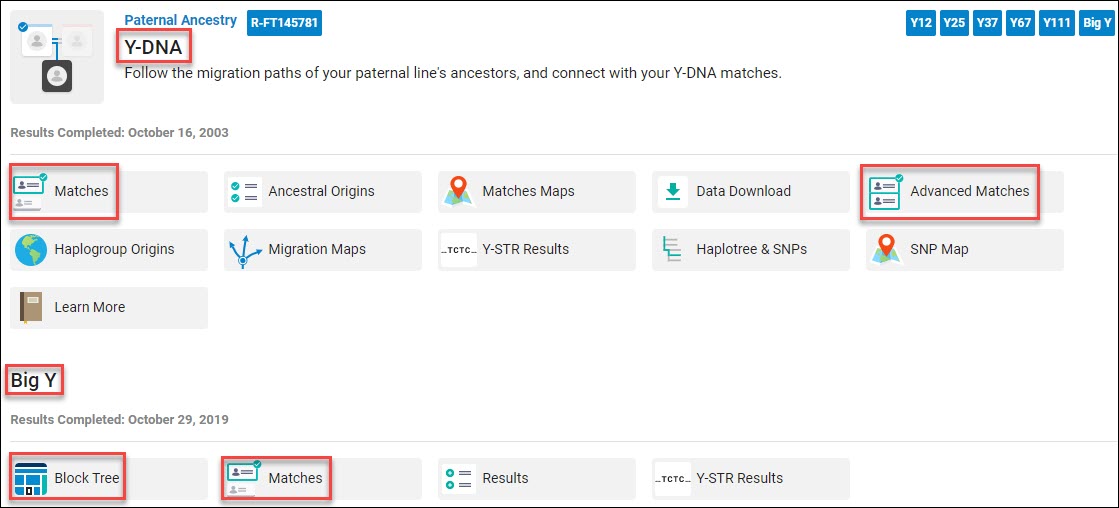
Additionally, I used the Advanced Matches feature to check for people who match someone on BOTH the Y DNA and their Family Finder autosomal test. Of course, this doesn’t guarantee that the reason they match on both tests is because of their common surname line – but it’s a hint and may be very useful, especially with closer Family Finder matches.

I intentionally included some men with recent European heritage who are unlikely to have matches simply because their families have been in colonial America since the 1600s or 1700s and their ancestor had a dozen sons who each had a dozen sons.

Why Did I Include 12 Marker Results?

You may wonder why I included 12 marker matches since that test is no longer sold individually and is the least granular. Truthfully, it’s too often deemed useless and overlooked.

Hear me out on this one😊

Many of the men who originally took the 12 and 25 marker tests, before the higher panels (37, 67, 111, and Big Y) were available are deceased now. Twenty years is a generation, and FamilyTreeDNA began testing the Y chromosome in the year 2000.

While these low marker tests alone are not conclusive, with additional information, such as trees, common ancestors, and other testers who match, they form pieces of evidence that can be invaluable. Some have also taken an autosomal test which can be especially important, given that they are another generation or two (or three) further back in time than the people testing today.

You won’t see these men as matches at 37, 67 or 111 markers, because they are deceased and can’t upgrade, but they may provide the nugget of information you need by matching at 12 or 25 markers. You’ll need to evaluate that match in light of other information. I’ll review that in the next two sections.

20 Men

If you’re a man or can find a male to test for each of your genealogy lines, the Y DNA is the fastest, most reliable way to identify an ancestral surname – not just in your father’s generation, but moving back in time.

Of the 20 men selected, all men had matches to their surname. However, one Smith man, #18, had a unique situation that might be very genealogically relevant.

I’ll discuss each match briefly with some commentary below the chart.

Surname Match Name 12 Marker 111 Marker Big Y Advanced – 12 + FF Both
1 Howery Howery 9 of 20 2 of 2 0 (none tested) 1
2 Graves Graves 8 of 51 2 of 8 1 Graves + others 1 – different surname
3 Perkins Perkins/McDonald 16 of 1762 1 of 63, many McDonalds 0 Perkins (no testers) but several McD names 8 – 2 McDonald
4 Napier Napier 19 of 19,217 2 of 13 2 Napier + others 1 + many others
5 Rice Rice 45 of 58 14 of 19 7 of 10 1
6 Rader Rader  13 of 18,576 7 of 7 7 3
7 Estes Estes 69 of 502 21 of 24 9 of 10 2 + 4 different surname
8 Campbell Campbell 178 of 369 61 of 103 7 of 10 4 of 5
9 Lentz Lentz 1 of 1 0 of 1 1 different name, no other Lentz Big Y testers 0
10 Bonnevie Bonnevie 1 of 1 (tested to 37) 0 0 no test
11 Vannoy Vannoy 7 of 49 2 of 4 0 of 1 0
12 Lore/Lord Lore/Lord 3 of 7 1 of 3 1 of 1 0
13 Clarkson/Claxton Clarkson/Claxton 19 of 540 1 of 1 0 of 9 (No Big Y testers) 0 of 3
14 Muncey Muncy/Muncey 9 of 155 7 of 16 1 of 4 1
15 Miller Miller 5 of 6 2 at 67, no 111 testers 0 – no Miller match testers 1 of 2
16 Speak(s) Speak(s) 9 of 9 21 of 51 4 of 17 0
17 Smith Smith/Jennings 2 of 16, 9 Jennings 0 of 2 (Jennings) 1 Jennings of 3 1 Jennings
18 Bolton Bolton 8 of 1750 2 of 2 0 of 28 0 of 12
19 Crumley Crumley 10 of 79 7 of 93 3 of 127 0 of 2
20 Harrell Harrell 81 of 17,638 3 of 7 2 of 2 0 of 119

Messages Revealed in the Results

Let’s briefly review the information we’ve discovered and extrapolate from each of these 20 matches. Analysis is the key to success.

  1. The Howery surname is rather unusual. This man had only two 111 marker matches and both were to men of the same surname. Half of his 12 marker matches are the same surname. None of his matches had taken the Big Y test, so he has no same-surname or other surname matches there. He did match one of his Y DNA matches on the Family Finder test though. This is high-quality confirmation that Howery is indeed the biological ancestral surname and our tester can set about finding and confirming his common ancestors with his matches.
  2. The Graves male had several 12-marker matches, but many 12-marker matches have not tested at the 111 marker level. He matches one Graves male on the Big Y plus some men with other surnames. The Big Y reaches back further in time, so these matches may reflect common ancestors before the advent of surnames.
  3. Our Perkins male has very interesting matches. He does have both 12 and 111 Perkins matches, but he also had a LOT of McDonald matches. More McDonald matches than Perkins matches. This suggests that indeed, his ancestors were Perkins, at least back to the earliest known ancestor (EKA), but before that, he may well be a member of the McDonald Y DNA clan. There were no Perkins Big Y testers, but if I were him, I’d ask my Perkins matches to upgrade.
  4. I can tell by looking at the huge number of 12 marker matches for our Napier man that he is haplogroup R, the most common in Europe, with an EXTREMELY common 12 marker haplotype. Note how dramatically the number of 111 marker matches drops – from 19,000+ to 13 – a perfect example of why we suggest men upgrade to at least 111 markers to refine their matches. Both of his 111 marker Napier matches have upgraded to the Big Y, and he matches them there as well. He does match one Napier on both the 12 marker test and Family Finder Advanced Matching – but he also matches MANY other men. This is because of the extremely high number of 12 marker matches. In his case, I would only use Y DNA marker panels higher than 12 markers in the Advanced Matching.
  5. Lots of Rice testers from this line confirm a common ancestor. I wonder if there is a Rice male from someplace overseas who has tested. If so, this might be that “jump the pond” event that genealogists who have European ancestors who are found in colonial America seek.
  6. Our Rader tester also has many 12 marker matches, but his only matches at 111 and on the Big Y are his Rader kinsmen. No doubt about that surname whatsoever.
  7. My Estes line has several 12 marker matches, but that gets slimmed right down at 111 markers. Using the Big Y test, we further divided those branches of Estes men. I literally could not have sorted out who was descended from whom without the Big Y test results. Way too many Johns, Williams, and Elishas in burned counties in Virginia.
  8. Our Campbell tester is unquestionably confirmed to be descended from the Clan Campbell line from Inverary, Scotland. However, the challenge in this family is which Campbell male they descend from in Virginia. The Big Y-700 test has narrowed the possibilities significantly, and the tester is currently in the process of attempting to convince his three closest Y STR 111 matches to take the Big Y test. Yes, he has offered to pay as well. Hey, in genealogy, you do what you need to do. Y DNA is likely the only way this puzzle from the 1700s will ever be unraveled.
  9. The Lentz line is German with rare DNA, but they do have a confirming match to another Lentz male.
  10. Bonnievie spelled various ways is French and has one 12 marker match who only tested to 37 markers. He has no matches above that. Not only is his Y DNA quite rare, DNA testing is illegal in France which makes additional testers few and far between. Unfortunately, his one match has not taken a Family Finder test either.
  11. Several men from the Vannoy line have tested and a Big Y test match to another man confirmed that the ancestral line is Dutch – not French as was speculated for decades. The STR tests have revealed Vannoy lines, by similar spellings, from lines we didn’t know existed.
  12. Lore or Lord is a rare Acadian family surname. Our tester does have matches to other Lore/Lord men, which confirms the line to the ancestor who arrived in Acadia in the early 1600s, but future testers will be needed before we can confirm his origins to either France or as one of the English soldiers who served at the fort.
  13. The Clarkson/Claxton testers confirm two lines, one spelled each way, from Tennessee and North Carolina line to a common ancestor in either Virginia or North Carolina in the 1770s. However, the family is still working to further assemble that puzzle. Finding a Clarkson/Claxton match on STR markers or the Big Y who descends from a male not from the two known lines would help immensely. Our hope is that a Clarkson/Claxton from an earlier line or from the British Isles will test and provide that push over the brick wall. Any Clarkson/Clarkson men out there who haven’t taken the Y DNA test yet?
  14. The Muncy/Munsey line is confirmed to a common ancestor born in England in and died on Long Island in 1674. Based on both STR and SNP results from the Big Y, we can narrow the lineages of Muncy men who test and aren’t familiar with their Muncy genealogy. Of course, the Muncy line eventually migrated through Virginia and seemingly named every man in every generation either John, Samuel or Francis – but DNA testing helps immensely to sort this out.
  15. While Miller is a very common occupation surname, DNA testing has put to rest many incorrect myths about this particular Swiss Miller line. Men with the same surname in the same location, even in the same church, does not equate to the same genetic family line. Any male with a common surname absolutely needs to do Y DNA testing and at the highest level. There’s nothing worse than spending countless hours barking up the wrong tree – especially when Y DNA testing will save you.
  16. Our Speaks man matched another Speak male who knew where his ancestors were from in Lancashire. Testing additional men living in Lancashire at the 111 marker and Big Y levels allowed the Speak line to be divided into specific lineages beginning in the 1500s, piecing together the earlier ancestors into a descendant tree. Recently, an “orphan” line in the US has been connected to his ancestors, thanks to both STR values AND Big Y testing.
  17. Smith is quite interesting because we discover that something doesn’t add up. Our Smith man matches two Smith men who have the same ancestor born in 1810 but that son, John, does not match the descendants of his brothers. There seems to be an undocumented adoption of some sort at that point in time. John Smith’s Y DNA is not the same as his brothers whose descendants match each other. Given that our Smith tester, and his two matches, do not match the other descendants of the ancestor they are supposed to descend from, we can pinpoint the generation in which the adoption event occurred. However, we have a further clue, because these Smith men match the Jennings line closely- including one advanced match where the Smith man also matches autosomally in addition to the Y DNA. This is clearly a case of “you don’t know what you don’t know” and would never have known without Y DNA testing.
  18. Our Bolton tester matches several other Bolton men who descend from a common immigrant ancestor. If the Bolton matches upgrade to the Big Y-700 test, they might be able to determine separate genetic lines branching through the various sons of the immigrant ancestor. Evaluating the surnames that the tester matches at the Big Y level may assist with evaluating deeper ancestry in England and determining where the Bolton ancestors originated before the 1600s in London.
  19. Crumley is a difficult family to research, in part because several people with the same surname are found in close proximity, but Y DNA testing has shown that these men are not related. Big Y testing has disproved that the Crumley progenitor originated in Germany, although a different Crumley family did. The Big Y matches include many Mc… surnames along with Ferguson and Gillespie. The Big Y Block Tree shows the closest matches with ancestors born in Scotland, Ireland, and Northern Ireland – which is very likely where the Crumley progenitor originated too.
  20. Harrell is another difficult surname, spelled numerous ways with several Harrell/Herrell/Harrold/Herrald families moving westward in the 1600s and 1700s from the thirteen original colonies. This Harrell line has not been able to connect to a single progenitor in the colonies, yet, but Y DNA testing and the block tree confirm that this Harrell line originated in the British Isles, very likely England.

What Did These 20 Men Learn?

Every single one of these men benefitted from Y DNA testing, although exactly how depends to some extent on their testing goal. Other men also benefitted by matching.

One man, our Smith, #17, needs to look at the Jennings family prior to 1810. Is there a Jennings man living in close proximity, or do court records exist that might be illuminating?

If one of these 20 men had been an adoptee or otherwise searching for an unknown paternal line, they would have been able to identify a surname connection and perhaps a progenitor ancestor. I encourage everyone to either order a Family Finder autosomal test or transfer a DNA file (for free) from another vendor if they have taken an autosomal test elsewhere. Step-by-step transfer instructions are found here. Be sure that the Y DNA and autosomal tests are on the same kit/account at FamilyTreeDNA so that you can use the advanced matching tool.

With the Big Y-700 test, these men can discern or confirm lines descending from their direct paternal ancestors – sometimes within a generation or two of the tester. This test is so sensitive and granular and has such deep coverage (millions of bases) now that often we find small mutations between fathers and sons or brothers.

While STR markers, 12-111 are genealogically important, they do tend to mutate rapidly and sometimes back-mutate. SNPs, tested in the Big Y-700 test, don’t do that, and the power of STRs and SNPs together have the potential to break down brick walls and correct trees. In fact, it happens every single day.

Resources

If you’d like to watch a video about Y DNA, Y DNA-related genetic terms, and the benefits of Big Y-700 testing, you can watch a great educational video by Janine Cloud here. Be sure to note the part where she talks about why people who have previously taken the Big Y-500 might want to upgrade to the Big Y-700.

Also, check out my Y DNA Resource page, here.

What Don’t You Know?

Y DNA tests, including the Big Y-700 which includes all STR panels, and the autosomal Family Finder test are on sale at FamilyTreeDNA right now for Father’s Day.

There’s no better time to find missing pieces and discover information that you can’t find any other way.

Click here to order Y DNA tests, the Family Finder, or upgrade an existing test.

_____________________________________________________________

Disclosure

I receive a small contribution when you click on some of the links to vendors in my articles. This does NOT increase the price you pay but helps me to keep the lights on and this informational blog free for everyone. Please click on the links in the articles or to the vendors below if you are purchasing products or DNA testing.

Thank you so much.

DNA Purchases and Free Transfers

Genealogy Products and Services

Books

Genealogy Research

Big Y News and Stats + Sale

I must admit – this past January when FamilyTreeDNA announced the Big Y-700, an upgrade from the Big Y-500 product, I was skeptical. I wondered how much benefit testers would really see – but I was game to purchase a couple upgrades – and I did. Then, when the results came back, I purchased more!

I’m very pleased to announce that I’m no longer skeptical. I’m a believer.

The Big Y-700 has produced amazing results – and now FamilyTreeDNA has decoupled the price of the BAM file in addition to announcing substantial sale prices for their Thanksgiving Sale.

I’m going to discuss sale pricing for products other than the Big Y in a separate article because I’d like to focus on the progress that has been made on the phylogenetic tree (and in my own family history) as a result of the Big Y-700 this year.

Big Y Pricing Structure Change

FamilyTreeDNA recently anounced some product structure changes.

The Big Y-700 price has been permanently dropped by $100 by decoupling the BAM file download from the price of the test itself. This accomplishes multiple things:

  • The majority of testers don’t want or need the BAM file, so the price of the test has been dropped by $100 permanently in order to be able to price the Big Y-700 more attractively to encourage more testers. That’s good for all of us!!!
  • For people who ordered the Big Y-700 since November 1, 2019 (when the sale prices began) who do want the BAM file, they can purchase the BAM file separately through the “Add Ons and Upgrades” page, via the “Upgrades” tab for $100 after their test results are returned. There will also be a link on the Big Y-700 results page. The total net price for those testers is exactly the same, but it represents a $100 permanent price drop for everyone else.
  • This BAM file decoupling reduces the initial cost of the Big Y-700 test itself, and everyone still has the option of purchasing the BAM file later, which will make the Big Y-700 test more affordable. Additionally, it allows the tester who wants the BAM file to divide the purchase into two pieces, which will help as well.
  • The current sale price for the Big Y-700 for the tester who has taken NO PREVIOUS Y DNA testing is now just $399, formerly $649. That’s an amazing price drop, about 40%, in the 9 months since the Big Y-700 was introduced!
  • Upgrade pricing is available too, further down in this article.
  • If you order an upgrade from any earlier Big Y to the Big Y-700, you receive an upgraded BAM file because you already paid for the BAM file when you ordered your initial Big Y test.
  • The VCF file is still available for download at no additional cost with any Big Y test.
  • There is no change in the BAM file availability for current customers. Everyone who ordered before November 1, 2019 will be able to download their BAM file as always.

The above changes are permanent, except for the sale price.

2019 has been a Banner Year

I know how successful the Big Y-700 has been for kits and projects that I manage, but how successful has it been overall, in a scientific sense?

I asked FamilyTreeDNA for some stats about the number of SNPs discovered and the number of branches added to the Y phylotree.

Drum roll please…

Branches Added This Year Total Tree Branches Variants Added to Tree This Year Total Variants Added to Tree
2018 6,259 17,958 60,468 132.634
2019 4,394 22.352 32,193 164,827

The tests completed in 2019 are only representative for 10 months, through October, and not the entire year.

Haplotree Branches

Not every SNP discovered results in a new branch being added to the haplotree, but many do. This chart shows the number of actual branches added in 2018 and 2019 to date.

Big Y 700 haplotree branches.png

These stats, provided by FamilyTreeDNA, show the totals in the bottom row, which is a cumulative branch number total, not a monthly total. At the end of October 2019, the total number of individual branches were 22,352.

Big Y 700 haplotree branches small.png

This chart, above, shows some of the smaller haplogroups.

Big Y 700 haplotree branches large.png

This chart shows the larger haplogroups, including massive haplogroup R.

Haplotree Variants

The number of variants listed below is the number of SNPs that have been discovered, named and placed on the tree. You’ll notice that these numbers are a lot larger than the number of branches, above. That’s because roughly 168,000 of these are equivalent SNPs, meaning they don’t further branch the tree – at least not yet. These 168K variants are the candidates to be new branches as more people test and the tree can be further split.

Big Y 700 variants.png

These numbers also don’t include Private Variants, meaning SNPs that have not yet been named.

If you see Private Variants listed in your Big Y results, when enough people have tested positive for the same variant, and it makes sense, the variants will be given a SNP name and placed on the tree.

Big Y 700 variants small.png

The smaller haplogroups variants again, above, followed by the larger, below.

Big Y 700 variants large.png

Upgrades from the Big Y, or Big Y-500 to Big Y-700

Based on what I see in projects, roughly one third of the Big Y and Big Y-500 tests have upgraded to the Big Y-700.

For my Estes line, I wondered how much value the Big Y-700 upgrade would convey, if any, but I’m extremely glad I upgraded several kits. As a result of the Big Y-700, we’ve further divided the sons of Abraham, born in 1747. This granularity wasn’t accomplished by STR testing and wasn’t accomplished by the Big Y or Big Y-500 testing alone – although all of these together are building blocks. I’m ECSTATIC since it’s my own ancestral line that has the new lineage defining SNP.

Big Y 700 Estes.png

Every Estes man descended from Robert born in 1555 has R-BY482.

The sons of the immigrant, Abraham, through his father, Silvester, all have BY490, but the descendants of Silvester’s brother, Robert, do not.

Moses, son of Abraham has ZS3700, but the rest of Abraham’s sons don’t.

Then, someplace in the line of kit 831469, between Moses born in 1711 and the present-day tester, we find a new SNP, BY154784.

Big Y 700 Estes block tree.png

Looking at the block tree, we see the various SNPs that are entirely Estes, except for one gentleman who does not carry the Estes surname. I wrote about the Block Tree, here.

Without Big Y testing, none of these SNPs would have been found, meaning we could never have split these lines genealogically.

Every kit I’ve reviewed carries SNPs that the Big Y-700 has been able to discern that weren’t discovered previously.

Every. Single. One.

Now, even someone who hasn’t tested Y DNA before can get the whole enchilada – meaning 700+ STRs, testing for all previously discovered SNPs, and new branch defining SNPs, like my Estes men – for $399.

If a new Estes tester takes this test, without knowing anything about his genealogy, I can tell him a great deal about where to look for his lineage in the Estes tree.

Reduced Prices

FamilyTreeDNA has made purchasing the Big Y-700 outright, or upgrading, EXTREMELY attractive.

Test Price
Big Y-700 purchase with no previous Y DNA test


$399
Y-12 upgrade to Big Y-700 $359
Y-25 upgrade to Big Y-700 $349
Y-37 upgrade to Big Y-700 $319
Y-67 upgrade to Big Y-700 $259
Y-111 upgrade to Big Y-700 $229
Big Y or Big Y-500 upgrade to Big Y-700 $189

Note that the upgrades include all of the STR markers as yet untested. For example, the 12-marker to Big Y-700 includes all of the STRs between 25 and 111, in addition to the Big Y-700 itself. The Big Y-700 includes:

  • All of the already discovered SNPs, called Named Variants, extending your haplogroup all the way to the leaf at the end of your branch
  • Personal and previously undiscovered SNPs called Private Variants
  • All of the untested STR markers inclusive through 111 markers
  • A minimum of a total of 700 STR markers, including markers above 111 that are only available through Big Y-700 testing

With the refinements in the Big Y test over the past few years, and months, the Big Y is increasingly important to genealogy – equally or more so than traditional STR testing. In part, because SNPs are not prone to back mutations, and are therefore more stable than STR markers. Taken together, STRs and SNPs are extremely informative, helping to break down ancestral brick walls for people whose genealogy may not reach far back in time – and even those who do.

If you are a male and have not Y DNA tested, there’s never been a better opportunity. If you are a female, find a male on a brick wall line and sponsor a scholarship.

Click here to order or upgrade!

______________________________________________________________

Disclosure

I receive a small contribution when you click on some of the links to vendors in my articles. This does NOT increase the price you pay but helps me to keep the lights on and this informational blog free for everyone. Please click on the links in the articles or to the vendors below if you are purchasing products or DNA testing.

Thank you so much.

DNA Purchases and Free Transfers

Genealogy Services

Genealogy Research

Triangulation in Action at Family Tree DNA

Recently, I published the article, Hitting a Genealogy Home Run Using Your Double-Sided Two-Faced Chromosomes While Avoiding Imposters. The “Home Run” article explains why you want to use a chromosome browser, what you’re seeing and what it means to you.

This article, and the rest in the “Triangulation in Action” series introduces triangulation at Family Tree DNA, MyHeritage, 23andMe, GedMatch and DNAPainter, explaining how to use triangulation to confirm descent from a common ancestor. You may want to read the introductory article first.

What is Triangulation?

Think of triangulation as a three-legged stool – a triangle. Triangulation requires three things:

  1. At least three (not closely related) people must match
  2. On the same reasonably sized segment of DNA and
  3. Descend from a common ancestor

Triangulation is the foundation of confirming descent from a common ancestor, and thereby assigning a specific segment to that ancestor. Without triangulation, you might just have a match to someone else by chance. You can confirm mathematical triangulation, numbers 1 and 2, above, without knowing the identity of the common ancestor.

Boundaries

Triangulation means that all three, or more, people much match on a common segment. However, what you’re likely to see is that some people don’t match on the entire segment, meaning more or less than others as demonstrated in the following examples.

FTDNA Triangulation boundaries.png

You can see that I match 5 different cousins who I know descend from my father’s side on chromosome 15 above. As always, I’m the background grey and these matches are all being compared against me.

I triangulate with them in different ways, forming multiple triangulation groups that I’ve discussed individually, below.

Triangulation Group 1

FTDNA triangulation 1.png

Group 1 – On the left group of matches, above, I triangulate with the blue, red and orange person on the amount of DNA that is common between all of them, shown in the black box. This is triangulation group 1.

I’ve overlayed additional triangulation groups below, so you can compare the groups.

Triangulation Group 2

FTDNA triangulation 2.png

Group 2 – However, if you look just at the blue and orange triangulated matches bracketed in green, I triangulate on slightly more, extending to the left. This group excludes the red person because their beginning point is not the same, or even close. This is triangulation group 2.

Triangulation Group 3 and 4

FTDNA triang 3.png

Group 3 – At right, we see two large triangulation groups. Triangulation group 3 includes the common portions of blue, red, teal and orange matches.

Group 4 – Triangulation group 4 is the skinny group at far right and includes the common portion of the blue, teal and dark blue matches.

Triangulation Groups 5 and 6

FTDNA triang 5.png

Group 5 – There are also two more triangulation groups. The larger green bracketed group includes only the blue and teal people because their end locations are to the right of the end locations of the red and orange matches. The start location varies as well. This is triangulation group 5.

Group 6 – The smaller green bracketed group includes only the blue and teal person because their start locations are before the dark blue person. This is triangulation group 6.

There’s actually one more triangulation group. Can you spot it?

Triangulation Group 7

FTDNA triang 7.png

Group 7 – The tan group includes the red, teal and orange matches but only the areas where they all overlap. This excludes the top blue match because their start location is different. Triangulation group 7 only extends to the end of the red and orange matches, because those are the same locations, while the teal match extends further to the right. That extension is excluded in this group, of course.

Slight Variations

Matches with only slight start and end differences are probably descended from the same ancestor, but we can’t say that for sure (at this point) so we only include actual mathematically matching segments in a triangulation group.

You can see that triangulation groups often overlap because group members share more or less DNA with each other. Normally we don’t bother to number the groups – we just look at the alignment. I numbered them for illustration purposes.

Shared or In-Common-With Matching

Triangulation is not the same thing as a 3-way shared “in-common-with” match. You may share DNA with those two people, but on entirely different segments from entirely different ancestors. If those other two people match each other, it can be on a segment where you don’t match either of them, and thanks to an ancestor that they share who isn’t in your line at all. Shared matches are a great hint, especially in addition to other information such as Phased Family Matching which we’ll talk about in a minute, but shared matches don’t necessarily mean triangulation has occurred, although it’s a great place to start looking.

I have shared matches where I match one person on my maternal side, one on my paternal side, and they match each other through a completely different ancestor on an entirely different segment. However, we don’t triangulate because we don’t all match each other on the SAME segment of DNA. Yes, it can be confusing.

Just remember, each of your segments, and matches, has its own individual history.

Imputation Can Affect Matching

Over the years the chips on which our DNA is processed at the vendors have changed. Each new generation of chips tests a different number of markers, and sometimes different markers – with the overlaps between the entire suite of chips being less than optimal.

I can verify that most vendors use imputation to level the playing field, and even though two vendors have never verified that fact, I’m relatively certain that they all do. That’s the only way they could match to their own prior “only somewhat compatible” chip versions.

The net-net of this is that you may see some differences in matching segments at different vendors, even when you’re comparing the same people. Imputation generally “fills in the blanks,” but doesn’t create large swatches of non-existent DNA. I wrote about the concept of imputation here.

What I’d like for you to take away from this discussion is to be focused on the big picture – if and how people triangulate which is the function important to genealogy. Not if the start and end segments are exactly the same.

Triangulation Solutions

Each of the major vendors, except Ancestry who does not have a chromosome browser, offers some type of triangulation solution, so let’s look at what each vendor offers. If your Ancestry matches have uploaded to GedMatch, Family Tree DNA or MyHeritage, you can triangulate with them there. Otherwise, you can’t triangulate Ancestry results, so encourage your Ancestry matches to transfer.

You can find step-by-step transfer instructions to and from each vendor, here.

I wrote more specifically about triangulation here and here.

Let’s start by looking at triangulation at Family Tree DNA.

Triangulation at Family Tree DNA

Family Tree DNA has two different tools that can be used separately in different circumstances to determine whether or not your segments triangulate.

Phased Family Matching can be used for triangulation.

The Matrix tool can be utilized for people who aren’t designated through Phased Family Matching as maternal or paternal matches to suggest or eliminate triangulation.

First, go to the Family Finder section of your personal page.

We’ll be working with Matches, the Chromosome Browser, and the Matrix.

FTDNA triangulation page.png

Phased Family Matching

At Family Tree DNA, I’ve tested my cousins:

  • Cheryl, my mother’s first cousin (1C)
  • Charlene, my first cousin once removed (1C1R) on my father’s side
  • David, my second cousin (2C) on my father’s side.

I’ve linked the test results of those cousins to my tree in their proper location, which allows Family Tree DNA to do something called Phased Family Matching.

If you don’t have a tree and don’t link your DNA results and those of your family members, Family Tree DNA can’t perform Phased Family Matching.

I explained phasing in the introductory article.

Testing your parents is wonderful if that’s possible, but parents aren’t always available to test. At Family Tree DNA, you don’t need to have tested your parents in order to have phased matches.

In essence, Family Tree DNA uses the DNA of known cousins, third cousins or closer, to assign matches to maternal or paternal tabs, or sides, also sometimes referred to as buckets. I wrote about Phased Family Matching here and here.

FTDNA triang buckets.png

You can see that of my 4806 matches, 1101 are assigned to my paternal side, 884 to my maternal side and 4 are assigned to both.

FTDNA triang header.pngFTDNA triang Charlene.png

My cousin Charlene is assigned to my paternal side, as shown by the blue icon, because I linked her to the correct position in my tree, as is my cousin, David, below.

FTDNA triang David.png

Conversely, my cousin Cheryl is assigned maternally because I linked her as well.

FTDNA triang Cheryl.png

These specific people are assigned maternally and paternally because I linked them to their proper place in my tree. These matches will allows Family Tree DNA to link other testers to the proper side of my tree too, because they match me and my cousin on the same segments – in essence phasing a large number of my matches for me which facilitates triangulation.

Linking Matches on Your Tree

In order to cause Phased Family Matching, aka, “bucketing” to occur, I linked my own test and that of my known 3rd cousins or closer to their proper places in my tree at Family Tree DNA.

If you don’t create a tree or upload a GEDCOM file and link yourself and your known matches, your matches can’t be assigned to maternal and paternal sides.

FTDNA triang tree.png

By utilizing the matching DNA between you and known close relatives on your maternal and paternal sides, Family Tree DNA assigns other people who match both of you on those same segments to the same side of your tree.

If you select matches from the same side of your tree and they match on the same segments, they triangulate.

Of course, that’s assuming the person doesn’t match you on both sides of your tree.

You can also download your matching segments in a file and sort to see who matches on the same locations, but the parental side designation (bucketing) is not reflected in the segment download file. Bucketing is reflected in the match download file which is a different file.

There are two separate download files, but they can be merged.

Two Download Files

The first file, your match download file, provides information about your matches such as their haplogroups, surnames and contact information, including bucketing assignment, but not the actual matching segment data.

The match file tells you a great deal and is both sortable and searchable. You can search for any surname, for example, or you can sort for everyone in the Paternal or Maternal matching bucket. You can creatively combine parts of this file with the matching segments file in order to quickly flag the people on your paternal side. Knowledge about how to work with spreadsheets is a plus.

FTDNA triang match file

Click to enlarge

This download is available at the bottom of the Family Finder match page.

FTDNA triang match.png

You can download all of your matches, or just those in a filtered view, such as in-common-with or as the result of a surname search.

FTDNA triang download.png

The second file, your matching segments file, is available on the chromosome browser page.

The matching segments file includes the match name along with the matching chromosome segments and number of matching SNPs.

FTDNA triang segment file.png

If you click through to the chromosome browser from your main page, as shown below, with NO MATCHES SELECTED, you will be able to download ALL matching segments.

FTDNA triang browser.png

You’ll see “Download All Segments” in the upper right-hand corner.

FTDNA triang download all seg.png

From that Chromosome Browser page, you will also have the ability to select matches to show on the browser.

FTDNA triang browser select

If you select people on the match page before clicking on the chromosome browser or select matches on the chromosome browser page, then clicking on “Download Segments,” will only download the matching segments of the people that you have currently selected to match against in the browser.

FTDNA triang download seg.png

Combinations of Tools and Filters

  • The chromosome browser tells you if people match you on the same segment.
  • The in-common-with filter on the match page tells you who you match in common with a specific person, but not if those two people match each other.

Of course, if both people are assigned to your same parental side bucket, and they both only match you on one large segment – and it’s the same segment, then you must triangulate.

If they aren’t both assigned to a parental bucket, then you can’t make that determination using parental side designations.

Is there a tool that allows you to compare people against each other at the same time to see if your matches also match each other?

Glad you asked.

Yes, there is.

The Matrix

Let’s say that you want to see if a group of people who you match also match each other.

FTDNA triang matrix.png

Family Tree DNA provides a Matrix tool that allows you to select 10 (or fewer) matches in order to determine if your matches also match each other.

FTDNA triang matrix match.png

I’ve entered Cheryl, Charlene and David. You can see that David and Charlene match each other, and Cheryl doesn’t match either Charlene or David.

Of course, we know that’s accurate because:

  • I already know these people and their relationship to me and each other
  • These three people are already assigned to maternal and paternal sides or buckets, so the matrix is verifying what we already know
  • I know where they match on the same segment on the chromosome browser

FTDNA triang 3 browser.png

Even though they match on the same segment on the chromosome browser, the fact that they are bucketed to different parental sides, and that the matrix shows that Cheryl doesn’t match either Charlene and David, confirms that David and Charlene triangulate with me, while Cheryl is not a member of that triangulation group.

This is exactly why triangulation is important. Looking at the image above, the only thing you know is that they all 3 match you – but with the additional information about bucketing and the matrix, we know that only the two bottom people, Charlene and David triangulate with me. Note that I’ve added the maternal and paternal icons for clarity.

FTDNA triang match group browser.png

However, if I didn’t have this knowledge, or not everyone was bucketed, the Matrix tool would be extremely useful. The matrix tool uses the matching threshold of approximately 7.69 cM.

The matrix doesn’t tell you if these people match each other on the same segment where they match you,

However, there’s a good probability that they do, especially if only one matching segment is involved.

You can check the chromosome browser to see if they both match you on the same segment. It’s possible if they don’t match you on the same segment that they match each other on different segments, and possibly through a different ancestor. You may need to reach out to them to ask if they match each other, and if they have known genealogy if they aren’t bucketed.

By utilizing the Matrix tool, you can isolate people to maternal and paternal sides of your tree.

Other Resources to Identify Common Ancestors

Be sure to check other clues at Family Tree DNA such as:

Shared surnames, shown on your matches page, with common surnames that you share bolded

FTDNA triang surnames.png

Trees, indicated by the blue pedigree icon on the match page.

FTDNA triang pedigree.png

Y and mitochondrial DNA haplogroups and matching. You can view your matches haplogroup and other information by clicking on their profile picture on your matches page.

FTDNA triang profile.png

Advanced Matching can be utilized to see if you match on combined tests, or in common projects.

FTDNA triang advanced match.png

This article discusses the 9 different autosomal tools available at Family Tree DNA.

What About You?

Do you have a tree at Family Tree DNA?

Have you connected your test and any family members to your tree?

Can you test a family member, third cousins or closer, or have them transfer a kit from another vendor?

Here’s how to transfer:

How many people do you have on your paternal and maternal tabs on your Family Finder matches page?

You can paint every single one of the people who are designated as maternal or paternal at DNAPainter to your grandparents on the respective maternal or paternal side. DNAPainter Instructions and Resources will explain how, and why.

Join me soon for similar articles about how to work with triangulation at MyHeritage, 23andMe, GedMatch and DNAPainter.

Most of all – have fun!

______________________________________________________________

Disclosure

I receive a small contribution when you click on some of the links to vendors in my articles. This does NOT increase the price you pay but helps me to keep the lights on and this informational blog free for everyone. Please click on the links in the articles or to the vendors below if you are purchasing products or DNA testing.

Thank you so much.

DNA Purchases and Free Transfers

Genealogy Services

Genealogy Research

Mitochondrial DNA Resources – Everything You Need to Know

Mitochondrial DNA Resources

Recently, I wrote a multi-part series about mitochondrial DNA – start to finish – everything you need to know.

I’ve assembled several articles in one place, and I’ll add any new articles here as well.

Please feel free to share this resource or any of the links to individual articles with friends, genealogy groups or on social media.

What the Difference Between Mitochondrial and Other Types of DNA?

Mitochondrial DNA is inherited directly from your matrilineal line, only, meaning your mother’s mother’s mother’s mother – on up your family tree until you run out of direct line mothers that you’ve identified. The great news is even if you don’t know the identities of those people in your tree, you carry their mitochondrial DNA which can help identify them.

Here’s a short article about the different kinds of DNA that can be used for genealogy.

Why Mitochondrial DNA?

Let’s start out with why someone might want to test their mitochondrial DNA.

After you purchase a DNA test, swab, return the kit and when the lab finishes processing your test, you’ll receive your results on your personal page at FamilyTreeDNA, the only company that tests mitochondrial DNA at the full sequence level and provides matching with tens of thousands of other testers.

What About Those Results?

People want to understand how to use all of the different information provided to testers. These articles provide a step-by-step primer.

Mitochondrial DNA personal page update

Sign in to your Family Tree DNA account and use these articles as a guideline to step through your results on your personal page.

We begin with an overview. What is mitochondrial DNA, how it is inherited and why is it useful for genealogy?

Next, we look at your results and decode what all the numbers mean. It’s easy, really!

Our ancestors lived in clans, and our mitochondrial DNA has its own versions of clans too – called haplogroups. Your full haplogroup can be very informative.

Sometimes there’s more than meets the eye. Here are my own tips and techniques for more than doubling the usefulness of your matches.

You’ll want to wring every possible advantage out of your tests, so be sure to join relevant projects and use them to their fullest extent.

Do you know how to utilize advanced matching? It’s a very powerful tool. If not, you will after these articles.

Mitochondrial DNA Information for Everyone

FamilyTreeDNA maintains an extensive public mitochondrial DNA tree, complete with countries of origin for all branches. You don’t need to have tested to enjoy the public tree.

However, if you have tested, take a look to see where the earliest known ancestors of your haplogroup matches are located based on the country flags.

Mitochondrial resources haplotree

These are mine. Where are yours?

What Can Mitochondrial DNA Do for You?

Some people mistakenly think that mitochondrial DNA isn’t useful for genealogy. I’m here to testify that it’s not only useful, it’s amazing! Here are three stories from my own genealogy about how I’ve used mitochondrial DNA to learn more about my ancestors and in some cases, break right through brick walls.

It’s not only your own mitochondrial DNA that’s important, but other family members too.

My cousin tested her mitochondrial DNA to discover that her direct matrilineal ancestor was Native American, much to her surprise. The great news is that her ancestor is my ancestor too!

Searching for Native American Ancestors?

If you’re searching for Native American or particular ancestors, mitochondrial DNA can tell you specifically if your mitochondrial DNA, or that of your ancestors (if you test a direct matrilineal descendant,) is Native, African, European, Jewish or Asian. Furthermore, your matches provide clues as to what country your ancestor might be from and sometimes which regions too.

Did you know that people from different parts of the world have distinctive haplogroups?

You can discover your ancestors’ origins through their mitochondrial DNA.

You can even utilize autosomal segment information to track back in time to the ancestor you seek. Then you can obtain that ancestor’s mitochondrial DNA by selectively testing their descendants or finding people who have already tested that descend from that ancestor. Here’s how.

You never know what you’re going to discover when you test your mitochondrial DNA. I discovered that although my earliest known matrilineal ancestor is found in Germany, her ancestors were from Scandinavia. My cousin discovered that our common ancestor is Mi’kmaq.

What secrets will your mitochondrial DNA reveal?

You can test or upgrade your mitochondrial DNA by clicking here.

______________________________________________________________

Disclosure

I receive a small contribution when you click on some of the links to vendors in my articles. This does NOT increase the price you pay but helps me to keep the lights on and this informational blog free for everyone. Please click on the links in the articles or to the vendors below if you are purchasing products or DNA testing.

Thank you so much.

DNA Purchases and Free Transfers

Genealogy Services

Genealogy Research