Gateway Ancestors Leading to Royal and Noble Lines

Many people descend from either royalty or nobility. Of course, figuring out if you’re one of those people, and how you connect, is the challenge. Ancestors who have been proven to connect to royalty or nobility, often across the pond, are known as gateway ancestors.

Back in 2013, geneticists Peter Ralph and Graham Coop, in a paper in Nature, showed that almost all Europeans are descended from the same ancestors. In essence, everyone who lived in the ninth century and left any descendants is the ancestor of almost every living person with European heritage today. That includes Charlemagne and many noble or royal families who collectively have millions of descendants.

Before we talk more about how to find and identify gateway ancestors, let me tell you about the Vernoe/de Vernon family who lived in Vernon, France in the 1000s and 1100s. If you recall, in 1066, William the Conqueror of Normandy became the English King following the Battle of Hastings. Many of the French nobles, especially from Normandy, subsequently became the new noble class of England. England and France are inextricably connected.

William de Vernon, or, “of Vernon,” (born circa 1021 – died before 1089,) lived in Vernon and had his children baptized in the local Catholic Church, the Collégiale Notre-Dame de Vernon, dedicated in 1072 to “the Holy Mother of God.” William’s sons fought with William the Conqueror, and I descend from two of his children, Adela and Richard.

I recently returned from a trip to France where I was fortunate enough to visit the churches where some of my noble families were baptized, worshipped, or were buried.

I was very excited to visit Vernon, a beautiful, quaint village in Normandy on the Seine River which was the main “road” of western France. Come along with me!

Historic Vernon

We’re visiting the medieval church in Vernon, but many of the churches in the villages scattered throughout Europe hail from this period and have many of the same characteristics.

This glorious Gothic church stands sentry just up the street a block or so from the banks of the Seine.

Being able to literally walk in my ancestor’s footsteps was incredibly moving, as was sitting in the church where they sat, or stood, depending on their status.

The incredibly beautiful Gothic church beckons parishioners and visitors alike.

If you’re fortunate and time your arrival correctly, you may hear the church bells summoning worshipers, just like they did all those generations ago. I was extremely lucky.

Close your eyes, and you can hear the local peasants and nobility alike, hurrying along the cobblestone streets to services.

The church may be open, or a service may be getting ready to commence, and you can join in, just as your ancestors did.

These historic structures have withstood the ravages of time, and the passageways remind us of those who walked these steps hundreds of years ago. Their descendants still climb them today.

Much of the stained glass is original, at least for the churches that escaped both fire and the bombings of WWII.

While most of the churches remain Catholic, everyone is welcome to light a candle for goodwill and say a prayer, if you’re so inclined. I like to participate in the customs that my ancestors did. It connects me to them in a spiritual way. Often the side chapels have candles burning on altars, with the flames flickering beautifully, harkening back to distant times.

The small donation for the candle contributes to the maintenance of the church.

Fonts, holding holy water, and piscinas are in evidence throughout the church, especially in the little side chapels and near the doors.

Piscinas are usually shallow basins or decorative divots in the wall used for washing communion vessels or disposing of holy water or consecrated sacramental wine. There is a hole in the bottom allowing the liquid to drain into the earth inside the sheltering walls of the church, so that the sacred liquids remain in consecrated ground.

The church was always located in the center of the town, as it was the center of the life of the residents. Baptisms, marriages, communion, confessions, and funerals all took place there, as did regular sermons, given in Latin by the priest, encouraging their flock to remain true to the tenets of the Catholic faith.

Small streets, sometimes only a few feet wide, separated the neighboring houses from the church.

Many of the beautiful Medieval half-timbered buildings still stand, especially in the small villages like Vernon. The street in front of the church leads uphill to the remains of the castle, including the keep.

If your ancestor lived here, they walked these uneven cobblestone streets and were very likely in these very buildings, although some structures, like the castle, are in ruins today.

This is known as Philippe Auguste’s Keep. He was the King of France from 1180-1223. The French Kings prior to Philippe were known as the kings of the Franks.

We could see the castle and walls from a distance, but we had difficulty finding it among the maze of ancient streets, some of which are closed to through traffic today because they aren’t wide enough for vehicles or because modern buildings have been built across some ancient pathways.

The land along the old city wall has been reclaimed for vineyards, along with their ever-present roses that alert vinedressers to the presence of pests. Much like the canary in the coal mine.

I’m sure that at the time my ancestors lived there, all homes were within the protective city walls, and the hillsides were lush with vineyards. Wine was much safer to drink than water which could easily be contaminated by either animals or humans, delivering dysentery and cholera.

Many times, you’ll find portions of the old city wall built into or closely adjacent current structures. In some locations, the old walls are incorporated into the interior of contemporary buildings. This practice isn’t unusual, but normal in Roman-age Medieval towns and cities.

The walls were defensive, of course. Notice how thick the walls were, some as much as 10 feet thick.

Portions of old city walls or remains of historically significant buildings may simply be free-standing, part of the everyday life of the current residents, many of whom are probably related to the people who lived here hundreds of years ago.

History is in evidence everywhere!

By Philippe Alès – Own work, CC BY-SA 4.0, https://commons.wikimedia.org/w/index.php?curid=35337173

Today, pillars of the old medieval bridge crossing the Seine remain. Historically, bridges were difficult to build across large expanses of water, so Vernon was strategically important, in part because it had a bridge.

The old mill remains perched upon the first piling that connects the bridge to the land across the river from Vernon, very close to Monet’s famous gardens. A newer castle is mostly hidden behind the trees, with the white limestone cliffs soaring above the Seine.

Vernon today, viewed from the Seine waterway at the approximate location of the old medieval bridge near the old mill. The church can be seen at left, and the castle keep, at right, with the flags flying on top.

Controlling passage across the river and defending the village from invaders arriving on the river were priorities.

Whoever controlled the rivers controlled access to everything, ruled the people, and controlled the economy.

Finding a Gateway Ancestor

How do you find a noble or royal link, and how do you know that your connection is accurate?

Great questions.

In my case, my Muncy (Munsy, Munsey) line out of Lee County, Virginia, and Claiborne County, Tennessee, works its way back in time to Sarah Ludlow.

Sarah Ludlow’s father is a gateway ancestor – meaning the first ancestor to immigrate whose lineage is documented to descend from royal or noble lines.

As you can see, Sarah’s line quickly connects with Edith de Windsor, of the House of Windsor. Yes, this is the lineage of Queen Elizabeth II as well as the current King Charles III. The good news is that once you’ve connected, there are many well-documented resources for noble lines.

In this case, I’m using WikiTree to view the direct relationship between Edith (de) Windsor and William (de) Vernon.

Due to their age, some ancestors’ profiles are managed by the Magna Carta Project or the Medieval Project with specific training and documentation requirements.

Strategy

You, of course, are responsible for doing the research to connect back to the gateway ancestor(s) whom others have connected back further in line.

In order to connect with a peerage line of some sort, you generally need to work your proven genealogy back several generations. In the US, this normally means into the 1600s or early 1700s.

I caution skepticism about personal online trees. You might want to use those as hints, but copy/paste is far too easy, so don’t. You never really know what the other person did, unless you know them and they are an expert. The good news is that genealogists have several good resources available.

I would suggest beginning by comparing your end-of-line ancestors to the gateway ancestors listed on these sites, then check out the books from both Genealogical.com and American Ancestors.

Noble Lineage Resources

There are several resources available to identify or connect with gateway ancestors and noble lineages.

It’s always wonderful when you find a noble or notable connection because it often means the work has been done for you – although – as always, verify.

Research and Reference Books

If you think you might be or wonder if you are descended from Charlemagne, Genealogical.com wrote a wonderful blog article that includes several of their books:

Check out Genealogical.com’s books here.

American Ancestors has a nice selection too, including these collections:

View their books, here.

Y-DNA

Of course, I had to check to see if the Y-DNA of the Vernon family line is represented, and lucky for me, it is.

The Varner DNA Project includes the surname Vernon, and the volunteer administrators have created a James Vernon (born circa 1616 in England) subgroup.

Using that information, plus the other earliest known ancestors, we can determine that this lineage represents the de Vernon family of Vernon, France with haplogroup J-FT118973. Thanks to Y-DNA matching, men today can figure out how they fit into this family.

These very refined haplogroups and high-resolution matching are only available through the Big Y-700 DNA test at FamilyTreeDNA.

Using the FamilyTreeDNA Discover tool, we learn that this haplogroup was formed about the year 1569, so well after the lineage was established in England.

The Ancient Connections tell us that other men whose haplogroups are related to the Vernon haplogroup are found in:

  • Albania and Serbia, and share a common ancestor about 1350 BCE (or about 3350 years ago) in the Bronze Age
  • Montenegro, Yorkshire (England,) and Hungary about 1500 BCE
  • Rome, Montenegro, Croatia, and Lower Saxony (Germany,) twice, about 1950 BCE.

Looking at these locations on a map, it appears that the Vernon haplogroup, which of course wouldn’t adopt the Vernon surname for another two thousand years, appear to have migrated along the Mediterranean coastline, then perhaps either worked their way into Germany and England, or followed the coastline all the way around Spain. The new Globetrekker tool which will be released from FamilyTreeDNA soon (you didn’t hear that from me), will provide a LOT more specific information.

Of course, we’ll never be able to follow the paper trail or even historical genealogy much beyond William de Vernon who would have been called by the place name where he lived, which morphed into his surname. However, using his descendants’ Y-DNA haplogroup, available as a result of the Big Y-700 test, we can reach MUCH further back in time, unveiling the distant past of the Vernon male ancestors.

Your Turn

Who are your gateway, noble, and royal ancestors? What can you discover?

_____________________________________________________________

Follow DNAexplain on Facebook, here.

Share the Love!

You’re always welcome to forward articles or links to friends and share on social media.

If you haven’t already subscribed (it’s free,) you can receive an email whenever I publish by clicking the “follow” button on the main blog page, here.

You Can Help Keep This Blog Free

I receive a small contribution when you click on some of the links to vendors in my articles. This does NOT increase the price you pay but helps me to keep the lights on and this informational blog free for everyone. Please click on the links in the articles or to the vendors below if you are purchasing products or DNA testing.

Thank you so much.

DNA Purchases and Free Uploads

Genealogy Products and Services

My Book

Genealogy Books

Genealogy Research

Which DNA Test Should I Buy? And Why?

Which DNA test should I buy, and why?

I receive questions like this often. As a reminder, I don’t take private clients anymore, which means I don’t provide this type of individual consulting or advice. However, I’m doing the next best thing! In this article, I’m sharing the step-by-step process that I utilize to evaluate these questions so you can use the process too.

It’s important to know what questions to ask and how to evaluate each situation to arrive at the best answer for each person.

Here’s the question I received from someone I’ll call John. I’ve modified the wording slightly and changed the names for privacy.

I’m a male, and my mother was born in Charleston, SC. My maternal grandmother’s maiden name was Jones and a paternal surname was Davis. The family was supposed to have been Black, Dutch, Pennsylvania Dutch, and Scots-Irish…only once was I told I was 3/16 Indian, with Davis being 3/4 and Jones being full Indian.

Do I have enough reasonable information to buy a test, and which one?

Please note that it’s common for questions to arrive without all the information you need to provide a sound answer – so it’s up to you to ask those questions and obtain clarification.

Multiple Questions

There are actually multiple questions here, so let me parse this a bit.

  1. John never mentioned what his testing goal was.
  2. He also never exactly said how the paternal line of Davis was connected, so I’ve made an assumption. For educational purposes, it doesn’t matter because we’re going to walk through the evaluation process, which is the same regardless.
  3. John did not include a tree or a link to a tree, so I created a rudimentary tree to sort through this. I need the visuals and normally just sketch it out on paper quickly.
  4. Does John have enough information to purchase a test?
  5. If so, which test?

There is no “one size fits all” answer, so let’s discuss these one by one.

Easy Answers First

The answer to #4 is easy.

Anyone with any amount of information can purchase a DNA test. Adoptees do it all the time, and they have no prior information.

So, yes, John can purchase a test.

The more difficult question is which test, because that answer depends on John’s goals and whether he’s just looking for some quick information or really wants to delve into genealogy and learn. Neither approach is wrong.

Many people think they want a quick answer –  and then quickly figure out that they really want to know much more about their ancestors.

I wrote an article titled DNA Results – First Glances at Ethnicity and Matching for new testers, here.

Goals

Based on what John said, I’m going to presume his goals are probably:

  • To prove or disprove the family oral history of Black, Dutch, Pennsylvania Dutch (which is actually German,) Scots-Irish, and potentially Native American.
  • John didn’t mention actual genealogy, which would include DNA matches and trees, so we will count that as something John is interested in secondarily. However, he may need genealogy records to reach his primary goal.

If you’re thinking, “The process of answering this seemingly easy question is more complex than I thought,” you’d be right.

Ethnicity in General

It sounds like John is interested in ethnicity testing. Lots of people think that “the answer” will be found there – and sometimes they are right. Often not so much. It depends.

The great news is that John really doesn’t need any information at all to take an autosomal DNA test, and it doesn’t matter if the test-taker is male or female.

To calculate each tester’s ethnicity, every testing company compiles their own reference populations, and John will receive different results at each of the major companies. Each company updates their ethnicity results from time to time as well, and they will change.

Additionally, each company provides different tools for their customers.

The ethnicity results at different companies generally won’t match each other exactly, and sometimes the populations look quite different.

Normally, DNA from a specific ancestor can be found for at least 5 or 6 generations. Of course, that means their DNA, along with the DNA from all of your other ancestors is essentially combined in a communal genetic “pot” of your chromosomes, and the DNA testing company needs to sort it out and analyze your DNA for ethnicity.

DNA descended from ancestors, and their populations, further back in people’s trees may not be discerned at all using autosomal DNA tests.

A much more specific “ethnicity” can be obtained for both the Y-DNA line, which is a direct patrilineal line for men (blue arrow,) and the mitochondrial DNA line (pink arrows,) which is a direct matrilineal line for everyone, using those specific tests.

We will discuss both of those tests after we talk about the autosomal tests available from the four major genealogy DNA testing companies. All of these tools can and should be used together.

Let’s Start with Native American

Let’s evaluate the information that John provided.

John was told that he “was 3/16 Indian, with Davis being 3/4 and Jones being full Indian.”

We need to evaluate this part of his question slightly differently.

I discussed this in the article, Ancestral DNA Percentages – How Much of Them is in You?

First, we need to convert generations to 16ths.

You have two ancestors in your parent’s generation, four in your grandparents, and so forth. You have 16 great-great-grandparents. So, if John was 3/16th Native, then three of his great-great-grandparents would have been fully Native, or an equivalent percentage. In other words, six ancestors in that generation could have been half-Native. Based on what John said, they would have come from his mother’s side of the tree. John is fortunate to have that much information to work with.

He told us enough about his tree that we can evaluate the statement that he might be 3/16ths Native.

Here’s the tree I quickly assembled in a spreadsheet based on John’s information.

His father, at left, is not part of the equation based on the information John provided.

On his mother’s side, John said that Grandfather Davis is supposed to be three-quarters Native, which translates to 12/16ths. Please note that it would be extremely beneficial to find a Y-DNA tester from his Davis line, like one of his mother’s brothers, for example.

John said that his Grandmother Jones is supposed to be 100% Native, so 16/16ths.

Added together, those sum to 28/32, which reduces down to 14/16th or 7/8th for John’s mother.

John would have received half of his autosomal DNA from his mother and half from his non-Native father. That means that if John’s father is 100% non-Native, John would be half of 14/16ths or 7/16ths, so just shy of half Native.

Of course, we know that we don’t always receive exactly 50% of each of our ancestors’ DNA (except for our parents,) but we would expect to see something in the ballpark of 40-45% Native for John if his grandmother was 100% Native and his grandfather was 75%.

Using simple logic here, for John’s grandmother to be 100% Native, she would almost assuredly have been a registered tribal member, and the same if his grandfather was 75% Native. I would think that information would be readily available and well-known to the family – so I doubt that this percentage is accurate. It would be easy to check, though, on various census records during their lifetimes where they would likely have been recorded as “Indian.” They might have been in the special “Indian Census” taken and might be living on a reservation.

It should also be relatively easy to find their parents since all family members were listed every ten years in the US beginning with the 1850 census.

The simple answer is that if John’s grandparents had as much Native as reported, he would be more than 3/16th – so both of these factoids cannot simultaneously be accurate. But that does NOT mean neither is accurate.

John could be 7/8th or 40ish%, 3/16th or 18ish%, or some other percentage. Sometimes, where there is smoke, there is fire. And that seems to be the quandary John is seeking to resolve.

Would  Ethnicity/Population Tests Show This Much Native?

Any of the four major testing companies would show Native for someone whose percentage would be in the 40% or 18% ballpark.

The easiest ethnicities to tell apart from one another are continental-level populations. John also stated that he thinks he may also have Black ancestry, plus Dutch, Pennsylvania Dutch (German), and Scots-Irish. It’s certainly possible to verify that using genealogy, but what can DNA testing alone tell us?

How far back can we expect to find ethnicities descending from particular ancestors?

In this table, you can see at each generation how many ancestors you have in that generation, plus the percentage of DNA, on average, you would inherit from each ancestor.

All of the major DNA testing companies can potentially pick up small trace percentages, but they don’t always. Sometimes one company does, and another doesn’t. So, if John has one sixth-generation Native American ancestor, he would carry about 1.56% Native DNA, if any.

  • Sometimes a specific ethnicity is not found because, thanks to random recombination, you didn’t inherit any of that DNA from those ancestors. This is why testing your parents, grandparents, aunts, uncles, and siblings can be very important. They share your same ancestors and may have inherited DNA that you didn’t that’s very relevant to your search.
  • Sometimes it’s not found because the reference populations and algorithms at that testing company aren’t able to detect that population or identify it accurately, especially at trace levels. Every DNA testing company establishes their own reference populations and writes internal, proprietary ethnicity analysis algorithms.
  • Sometimes it’s not found because your ancestor wasn’t Native or from that specific population.
  • Sometimes it’s there, but your population is called something you don’t expect.

For example, you may find Scandinavian when your ancestor was from England or Ireland. The Vikings raided the British Isles, so while some small amount of Scandinavian is not what you expect, that doesn’t mean it‘s wrong. However, if all of your family is from England, it’s not reasonable to have entirely Scandinavian ethnicity results.

It’s also less likely as each generation passes by that the information about their origins gets handed down accurately to following generations. Most non-genealogists don’t know the names of their great-grandparents, let alone where their ancestors were from.

Using a 25-year average generation length, by the 4th generation, shown in the chart above, you have 16 ancestors who lived approximately 100 years before your parents were born, so someplace in the mid-1800s. It’s unlikely for oral history from that time to survive intact. It’s even less likely from a century years earlier, where in the 7th generation, you have 128 total ancestors.

The best way to validate the accuracy of your ethnicity estimates is by researching your genealogy. Of course, you need to take an ethnicity test, or two, in order to have results to validate.

Ethnicity has a lot more to offer than just percentages.

Best Autosomal Tests for Native Ethnicity

Based on my experience with people who have confirmed Native ancestry, the two best tests to detect Native American ethnicity, especially in smaller percentages, are both FamilyTreeDNA and 23andMe.

Click images to enlarge

In addition to percentages, both 23andMe and FamilyTreeDNA provide chromosome painting for ethnicity, along with segment information in download files. In other words, they literally paint your ethnicity results on your chromosomes.

They then provide you with a file with the “addresses” of those ethnicities on your chromosomes, which means you can figure out which ancestors contributed those ethnicity segments.

The person in the example above, a tester at FamilyTreeDNA, is highly admixed with ancestors from European regions, African regions and Native people from South America.

Trace amounts of Native American with a majority of European heritage would appear more like this.

You can use this information to paint your chromosome segments at DNAPainter, along with your matching segments to other testers where you can identify your common ancestors. This is why providing trees is critically important – DNA plus ancestor identification with our matches is how we confirm our ancestry.

This combination allows you to identify which Native (or another ethnicity) segments descended from which ancestors. I was able to determine which ancestor provided that pink Native American segment on chromosome 1 on my mother’s side.

I’ve provided instructions for painting ethnicity segments to identify their origins in specific ancestors, here.

Autosomal and Genealogy

You may have noticed that we’ve now drifted into the genealogy realm of autosomal DNA testing. Ethnicity is nice, but if you want to know who those segments came from, you’ll need:

  • Autosomal test matching to other people
  • To identify your common ancestor with as many matches as you can
  • To match at a company who provides you with segment information for each match
  • To work with DNAPainter, which is very easy

The great news is that you can do all of that using the autosomal tests you took for ethnicity, except at Ancestry who does not provide segment information.

Best Autosomal Test for Matching Other Testers

The best autosomal test for matching may be different for everyone. Let’s look at some of the differentiators and considerations.

If you’re basing a testing recommendation solely on database size, which will probably correlate to more matches, then the DNA testing vendors fall into this order:

If you’re basing that recommendation on the BEST, generally meaning the closest matches for you, there’s no way of knowing ahead of time. At each of the four DNA testing companies, I have very good matches who have not tested elsewhere. If I weren’t in all four databases, I would have missed many valuable matches.

If you’re basing that recommendation on which vendor began testing earliest, meaning they have many tests from people who are now deceased, so you won’t find their autosomal tests in other databases that don’t accept uploads, the recommended testing company order would be:

If you’re basing that recommendation on matches to people who live in other countries, the order would be:

Ancestry and 23andMe are very distant third/fourth because they did not sell widely outside the US initially and still don’t sell in as many countries as the others, meaning their testers’ geography is more limited. However, Ancestry is also prevalent in the UK.

If you’re basing that recommendation on segment information and advanced tools that allow you to triangulate and confirm your genetic link to specific ancestors, the order would be:

Ancestry does NOT provide any segment information.

If you’re basing that recommendation on unique tools provided by each vendor, every vendor has something very beneficial that the others don’t.

In other words, there’s really no clear-cut answer for which single autosomal DNA test to order. The real answer is to be sure you’re fishing in all the ponds. The fish are not the same. Unique people test at each of those companies daily who will never be found in the other databases.

Test at or upload your DNA to all four DNA testing companies, plus GEDmatch. Step-by-step instructions for downloading your raw data file and uploading it to the DNA testing companies who accept uploads can be found, here.

Test or Upload

Not all testing companies accept uploads of raw autosomal DNA data files from other companies. The good news is that some do, and it’s free to upload and receive matches.

Two major DNA testing companies DO NOT accept uploads from other companies. In other words, you have to test at that company:

Two testing companies DO accept uploads from the other three companies. Uploads and matching are free, and advanced features can be unlocked very cost effectively.

  • FamilyTreeDNA – free matching and $19 unlock for advanced features
  • MyHeritage – free matching and $29 unlock.for advanced features

I recommend testing at both 23andMe and Ancestry and uploading one of those files to both FamilyTreeDNA and MyHeritage, then purchasing the respective unlocks.

GEDmatch

GEDmatch is a third-party matching site, not a DNA testing company. Consider uploading to GEDmatch because you may find matches from Ancestry who have uploaded to GEDmatch, giving you access to matching segment information.

Other Types of DNA

John provided additional information that may prove to be VERY useful. Both Y-DNA and mitochondrial DNA can be tested as well and may prove to be more useful than autosomal to positively identify the origins of those two specific lines.

Let’s assume that John takes an autosomal test and discovers that indeed, the 3/16th Native estimate was close. 3/16th equates to about 18% Native which would mean that three of his 16 great-great-grandparents were Native.

John told us that his Grandmother Jones was supposed to be 100% Native.

At the great-great-grandparent level, John has 16 ancestors, so eight on his mother’s side, four from maternal grandmother Jones and four from his maternal grandfather Davis.

John carries the mitochondrial DNA of his mother (red boxes and arrows,) and her mother, through a direct line of females back in time. John also carries the Y-DNA of his father (dark blue box, at left above, and blue arrows below.)

Unlike autosomal DNA which is admixed in every generation, mitochondrial DNA (red arrows) is inherited from that direct matrilineal line ONLY and never combines with the DNA of the father. Mothers give their mitochondrial DNA to both sexes of their children, but men never contribute their mitochondrial DNA to offspring. Everyone has their mother’s mitochondrial DNA.

Because it never recombines with DNA from the father, so is never “watered down,” we can “see” much further back in time, even though we can’t yet identify those ancestors.

However, more importantly, in this situation, John can test his own mitochondrial DNA that he inherited from his mother, who inherited it from her mother, to view her direct matrilineal line.

John’s mitochondrial DNA haplogroup that will be assigned during testing tells us unquestionably whether or not his direct matrilineal ancestor was Native on her mother’s line, or not. If not, it may well tell us where that specific line originated.

You can view the countries around the world where Y-DNA haplogroups are found, here, and mitochondrial haplogroups, here.

If John’s mitochondrial DNA haplogroup is Native, that confirms that one specific line is Native. If he can find other testers in his various lines to test either their Y-DNA or mitochondrial DNA, John can determine if other ancestors were Native too. If not, those tests will reveal the origins of that line, separate from the rest of his genealogical lines.

Although John didn’t mention his father’s line, if he takes a Y-DNA test, especially at the Big Y-700 level, that will also reveal the origins of his direct paternal line. Y-DNA doesn’t combine with the other parent’s DNA either, so it reaches far back in time too.

Y-DNA and mitochondrial DNA tests are laser-focused on one line each, and only one line. You don’t have to try to sort it out of the ethnicity “pot,” wondering which ancestor was or was not Native.

My Recommendation

When putting together a testing strategy, I recommend taking advantage of free uploads and inexpensive unlocks when possible.

  • To confirm Native American ancestry via ethnicity testing, I recommend testing at 23andMe and uploading to FamilyTreeDNA, then purchasing the $19 unlock. The free upload and $19 unlock are less expensive than testing there directly.
  • For matching, I recommend testing at Ancestry and uploading to MyHeritage, then unlocking the MyHeritage advanced features for $29, which is less expensive than retesting. Ancestry does not provide segment information, but MyHeritage (and the others) do.

At this point, John will have taken two DNA tests, but is now in all four databases, plus GEDmatch if he uploads there.

  • For genealogy research on John’s lines to determine whether or not his mother’s lines were Native, I recommend an Ancestry and a MyHeritage records subscription, plus using WikiTree, which is free.
  • To determine if John’s mother’s direct matrilineal female line was Native, I recommend that John order the mitochondrial DNA test at FamilyTreeDNA.
  • When ordering multiple tests, or uploading at FamilyTreeDNA, be sure to upload/order all of one person’s tests on the same DNA kit so that those results can be used in combination with each other.

Both males and females can take autosomal and mitochondrial DNA tests.

  • To discover what he doesn’t know about his direct paternal, meaning John’s surname line – I recommend the Big Y-700 test at FamilyTreeDNA.

Only males can take a Y-DNA test, so women would need to ask their father, brother, or paternal uncle, for example, to test their direct paternal line.

  • If John can find a male Davis from his mother’s line, I recommend that he purchase the Big Y-700 test at FamilyTreeDNA for that person, or check to see if someone from his Davis line may have already tested by viewing the Davis DNA Project. Like with mitochondrial DNA, the Y-DNA haplogroup will tell John the origins of his direct Davis male ancestor – plus matching of course. He will be able to determine if they were Native, and if not, discover the origins of the Davis line.
  • For assigning segments to ancestors and triangulating to confirm descent from a common ancestor, I recommend 23andMe, MyHeritage, FamilyTreeDNA and GEDmatch, paired with DNAPainter as a tool.

Shopping and Research List

Here are the tests and links recommended above:

More Than He Asked

I realize this answer is way more than John expected or even knew to ask. That’s because there is often no “one” or “one best” answer. There are many ways to approach the question after the goal is defined, and the first “answer” received may be a bit out of context.

For example, let’s say John has 2% Native ancestry and took a test at a vendor who didn’t detect it. John would believe he had none. But a different vendor might find that 2%. If it’s on his mother’s direct matrilineal line, mitochondrial DNA testing will confirm, or refute Native, beyond any doubt, regardless of autosomal ethnicity results – but only for that specific ancestral line.

Autosomal DNA can suggest Native across all your DNA, but Y-DNA and mitochondrial DNA confirm it for each individual ancestor.

Even when autosomal testing does NOT show Native American, or African, for example, it’s certainly possible that it’s just too far back in time or has not been passed down during random recombination, but either Y-DNA or mitochondrial DNA will unquestionably confirm (or refute) the ancestry in question if the right person is tested.

This is exactly why I attempt to find a cousin who descends appropriately from every ancestor and provide testing scholarships. It’s important to obtain Y-DNA and mitochondrial DNA information for each ancestor.

Which Test Should I Order?

What steps will help you decide which test or tests to take?

  1. Define your testing goal.
  2. Determine if your Y-DNA or mitochondrial DNA will help answer the question.
  3. Determine if you need to find ancestors another generation or two back in time to get the most benefit from DNA testing. In our example, if John discovered that both of his grandparents were enrolled tribal members, that’s huge, and the tribe might have additional information about his family.
  4. Subscribe to Ancestry and MyHeritage records collections as appropriate to perform genealogical research. Additional information not only provides context for your family, it also provides you with the ability to confirm or better understand your ethnicity results.
  5. Extend your tree so that you can obtain the best results from the three vendors who support trees; Ancestry, FamilyTreeDNA, and MyHeritage. All three use trees combined with DNA tests to provide you with additional information.
  6. Order 23andMe and Ancestry autosomal DNA tests.
  7. Either test at or upload one of those tests to MyHeritage, FamilyTreeDNA, and GEDmatch.
  8. If a male, order the Big Y-700 DNA test. Or, find a male from your ancestral line who has taken or will take that test. I always offer a testing scholarship and, of course, share the exciting results!
  9. Order a mitochondrial DNA test for yourself and for appropriately descended family members to represent other ancestors. Remember that your father (and his siblings) all carry your paternal grandmother’s mitochondrial DNA. That’s often a good place to start after testing your own DNA.
  10. If your parents or grandparents are alive, or aunts and uncles, test their autosomal DNA too. They are (at least) one generation closer to your ancestors than you are and will carry more of your ancestors’ DNA.
  11. Your siblings will carry some of your ancestors’ DNA that you do not, so test them too if both of your parents aren’t available for testing.

Enjoy!!!

_____________________________________________________________

Follow DNAexplain on Facebook, here.

Share the Love!

You’re always welcome to forward articles or links to friends and share on social media.

If you haven’t already subscribed (it’s free,) you can receive an email whenever I publish by clicking the “follow” button on the main blog page, here.

You Can Help Keep This Blog Free

I receive a small contribution when you click on some of the links to vendors in my articles. This does NOT increase the price you pay but helps me to keep the lights on and this informational blog free for everyone. Please click on the links in the articles or to the vendors below if you are purchasing products or DNA testing.

Thank you so much.

DNA Purchases and Free Uploads

Genealogy Products and Services

My Book

Genealogy Books

Genealogy Research

WikiTree Connections, King Charles III, and DNA

By Copyright House of Lords 2022 / Photography by Annabel Moeller, CC BY 2.0, https://commons.wikimedia.org/w/index.php?curid=117865820

I’m not a royal-watcher, but you’d pretty much have to be dead to not be aware that King Charles III is being crowned this Saturday, May 6th.

Have you wondered if you’re related to Charles? Or someone else?

It’s easy to find out on WikiTree.

Go to King Charles’s profile, here.

Notice that under “DNA Connections,” a WikiTree user has entered the Y-DNA of the line of King Charles via an academic sample uploaded to mitoYDNA. That’s interesting!

Tsar Romanov and King Charles III both descend from a common ancestor and are first cousins twice removed (1C2R.) You can also see more about Nicholas Romanov II in the FamilyTreeDNA Discover tool under haplogroup R-M269, in Notable Connections.

Under WikiTree DNA Connections, I notice no one has entered King Charles’s mitochondrial DNA information. Of course, King Charles inherited his mtDNA from his mother, Queen Elizabeth II.

If you know of anyone who carries Queen Elizabeth’s mitochondrial DNA through her direct matrilineal ancestors, by all means, enter this information. If you don’t know how, you can click on help at the bottom of the page or click here. WikiTree has lots of truly helpful volunteers.

You can also enter your information if you’ve taken an autosomal, Y-DNA, or mitochondrial DNA test and are descended appropriately from the person represented in the profile.

Here’s an example from my ancestor, Phebe Cole’s profile. I entered where I tested, and my GEDmatch number.

You can add your DNA test information by clicking on the “Add” button in the top header, then DNA Test Information here.

WikiTree DNA Benefits

WikiTree is a wonderful place to:

  • Upload your DNA to the relevant profile, where it will be populated up the tree appropriately
  • Obtain DNA information, including haplogroups, about your ancestors
  • Discover cousins who descend from that ancestor and who have tested their DNA
  • Discover cousins who may not have tested yet, but might be willing

I use WikiTree regularly to fish for Y and mitochondrial DNA information about my ancestors and to see if I match cousins listed as descendants of a common ancestor.

WikiTree works in the opposite direction from the DNA testing vendors.

At the testing vendors, you find the match and then need to determine how they are related. At WikiTree, you check your ancestor and will find a list of cousins who descend from that ancestor and who have DNA tested. You already know at least one way that each person is related to you. Finding cousin matches by ancestor is part of my triangulation process.

Are You Related?

No known DNA testers or don’t match – no problem.

You can determine whether or not you’re genealogically related to any individual on Wikitree.

Just sign in to your account, and select the profile of the person you want to check.

Scroll very near the bottom or do a browser search for the words “your connection.”

Just click on “Your connection” or “Your genealogical relationship.”

Collaborate is Key

WikiTree is crowd-sourced, so be sure to verify your connection pathway results. If the path isn’t accurate, you can correct the inaccurate person or connection. We are all doing the genealogy community a HUGE favor by ensuring this collaborative tree is accurate.

If you’re unsure about a connection, check the sources and evidence for each generation. If you need information, contact the profile manager.

Add a comment, ask a question, add an image, or provide additional information and sources on any profile.

Ancestral Legacy

I regularly update my ancestors’ profiles with additional information when it becomes available. I appreciate everything others have shared with me over the years, and I want to be sure the information about my ancestors is as accurate as possible.

I don’t know about you, but I’m in this for the long game – for posterity. Leaving as much accurate information, including Y and mitochondrial DNA, is the very least I can do for my ancestors. After all, we wouldn’t be here without them.

So, are you related to King Charles? Is your distant cousin being crowned on Saturday?

_____________________________________________________________

Follow DNAexplain on Facebook, here.

Share the Love!

You’re always welcome to forward articles or links to friends and share on social media.

If you haven’t already subscribed (it’s free,) you can receive an email whenever I publish by clicking the “follow” button on the main blog page, here.

You Can Help Keep This Blog Free

I receive a small contribution when you click on some of the links to vendors in my articles. This does NOT increase the price you pay but helps me to keep the lights on and this informational blog free for everyone. Please click on the links in the articles or to the vendors below if you are purchasing products or DNA testing.

Thank you so much.

DNA Purchases and Free Uploads

Genealogy Products and Services

My Book

Genealogy Books

Genealogy Research

What Is a Sibling Anyway? Full, Half, Three-Quarters, Step, Adopted, Donor-Conceived & Twins

I’ve seen the term sibling used many different ways, sometimes incorrectly.

When referring to their own siblings, people usually use the term brother or sister, regardless of whether they are talking about a full, half or step-sibling. It’s a term of heart or description. It’s often genealogists who are focused on which type of sibling. As far as I’m concerned, my brother is my brother, regardless of which type of brother. But in terms of genetics, and genealogy, there’s a huge difference. How we feel about our sibling(s) and how we are biologically related are two different things.

Let’s cover the various types of siblingship and how to determine which type is which.

  • Full Siblings – Share both parents
  • Half-Siblings – Share only one parent
  • Three-Quarter Siblings – It’s complicated
  • Adopted Siblings
  • Donor-Conceived
  • Step-Siblings – Share no biological parent
  • Twins – Fraternal and Identical

Full Siblings

Full siblings share both parents and share approximately 50% of their DNA with each other.

You can tell if you are full siblings with a match in various ways.

  1. You share the same fairly close matches on both parents’ sides. For example, aunts or uncles or their descendants.

Why do I say close matches? You could share one parent and another more distant relative on the other parent’s side. Matching with close relatives like aunts, uncles or first cousins at the appropriate level is an excellent indicator unless your parents or grandparents are available for testing. If you are comparing to grandparents, be sure to confirm matches to BOTH grandparents on each side.

  1. Full siblings will share in the ballpark of 2600 cM, according to DNAPainter’s Shared cM Tool.

Keep in mind that you can share more or less DNA, hence the range. It’s also worth noting that some people who reported themselves as full siblings in the Shared cM project were probably half siblings and didn’t realize it.

  1. Full siblings will share a significant amount of fully identical regions (FIR) of DNA with each other, meaning they share DNA at the same DNA address from both parents, as illustrated above. Shared DNA with each other inherited from Mom and Dad are blocked in green. The fully identical regions, shared with both parents, are bracketed in purple. You can’t make this determination at FamilyTreeDNA, MyHeritage or Ancestry, but you can at both 23andMe and GEDmatch.

At GEDmatch, the large fully green areas in the chromosome browser “graphics and positions” display indicates full siblings, where DNA is shared from both parents at that location.

I wrote about the details of how to view fully identical regions (FIR) versus half identical regions (HIR) in the article, DNA: In Search of…Full and Half-Siblings.

  1. If your parents/grandparents have tested, you and your full sibling will both match both parents/grandparents. Yes, I know this sounds intuitive, but sometimes it’s easy to miss the obvious.

At FamilyTreeDNA, you can use the matrix tool to see who matches each other in a group of people that you can select. In this case, both siblings are compared to the father, but if the father isn’t available, a close paternal relative could substitute. Remember that all people who are 2nd cousins or closer will match.

  1. At Ancestry, full siblings will be identified as either “brother” or “sister,” while half-siblings do not indicate siblingship. Half-siblings are called “close family” and a range of possible relationships is given. Yes, Ancestry, is looking under the hood at FIR/HIR regions. I have never seen a full sibling misidentified as anything else at Ancestry. Unfortunately, Ancestry does not give customers access to their matching chromosome segment location data.
  2. Y-DNA of males who are full siblings will match but may have some slight differences. Y-DNA alone cannot prove a specific relationship, with very rare exceptions, but can easily disprove a relationship if two males do not match. Y-DNA should be used in conjunction with autosomal DNA for specific relationship prediction when Y-DNA matches.
  3. Y-DNA testing is available only through FamilyTreeDNA, but high-level haplogroup-only estimates are available through 23andMe. Widely divergent haplogroups, such as E versus R, can be considered a confirmed non-match. Different haplogroups within the same base haplogroup, such as R, but obtained from different vendors or different testing levels may still be a match if they test at the Big Y-700 level at FamilyTreeDNA.
  4. Mitochondrial DNA, inherited matrilineally from the mother, will match for full siblings (barring unusual mutations such as heteroplasmies) but cannot be used in relationship verification other than to confirm nonmatches. For both Y-DNA and mitochondrial DNA, it’s possible to have a lineage match that is not the result of a direct parental relationship.
  5. Mitochondrial DNA testing is available only through FamilyTreeDNA, but haplogroup-only estimates are included at 23andMe. Different base haplogroups such as H and J can be considered a non-match.
  6. A difference in ethnicity is NOT a reliable indicator of half versus full siblings.

Half-Siblings

Half-siblings share only one parent, but not both, and usually share about 25% of their DNA with each other.

You will share as much DNA with a half-sibling as you do some other close matches, so it’s not always possible for DNA testing companies to determine the exact relationship.

Referencing the MyHeritage cM Explainer tool, you can see that people who share 1700 cM of DNA could be related in several ways. I wrote about using the cM Explainer tool here.

Hints that you are only half-siblings include:

  1. At testing vendors, including Ancestry, a half-sibling will not be identified as a sibling but as another type of close match.
  2. If your parents or grandparents have tested, you will only match one parent or one set of grandparents or their descendants.
  3. You will not have shared matches on one parent’s side. If you know that specific, close relatives have tested on one parent’s side, and you don’t match them, but your other family members do, that’s a very big hint. Please note that you need more than one reference point, because it’s always possible that the other person has an unknown parentage situation.
  4. At 23andMe, you will not show fully identical regions (FIR).
  5. At GEDmatch, you will show only very minimal FIR.

Scattered, very small green FIR locations are normal based on random recombination. Long runs of green indicate that significant amounts of DNA was inherited from both parents. The example above is from half-siblings.

  1. At FamilyTreeDNA and 23andMe, most men who share a mother will also share an X chromosome match since men only inherit their X chromosome from their mother. However, it is possible for the mother to give one son her entire X chromosome from her father, and give the other son her entire X chromosome from her mother. Therefore, two men who do share a mother but don’t have an X chromosome match could still be siblings. The X is not an entirely reliable relationship predictor. However, if two men share an entire X chromosome match, it’s very likely that they are siblings on their mother’s side, or that their mothers are very close relatives.

Three-Quarter Siblings

This gets a little more complicated.

Three-quarter siblings occur when one parent is the same, and the other parents are siblings to each other.

Let’s use a real-life example.

A couple marries and has children. The mother dies, and the father marries the mother’s sister and has additional children. Those children are actually less than full siblings, but more than half-siblings.

Conversely, a woman has children by two brothers and those children are three-quarter siblings.

These were common situations in earlier times when a man needed a female companion to raise children and women needed a male companion to work on the farm. Neither one could perform both childcare and the chores necessary to earn a living in an agricultural society, and your deceased spouse’s family members were already people you knew. They already loved your children too.

Neither of these situations is historically unusual, but both are very difficult to determine using genetics alone, even in the current generation.

Neither X-DNA nor mitochondrial DNA will be helpful, and Y-DNA will generally not be either.

Unfortunately, three-quarter siblings’ autosomal DNA will fall in the range of both half and full siblings, although not at the bottom of the half-sibling range, nor at the top of the full sibling range – but that leaves a lot of middle ground.

I’ve found it almost impossible to prove this scenario without prior knowledge, and equally as impossible to determine which of multiple brothers is the father unless there is a very strong half-sibling match in addition.

The DNA-Sci blog discusses this phenomenon, but I can’t utilize comparison screenshots according to their terms of service.

Clearly, what we need are more known three-quarter siblings to submit data to be studied in order to (possibly) facilitate easier determination, probably based on the percentage frequency distribution of FIR/HIR segments. Regardless, it’s never going to be 100% without secondary genealogical information.

Three-quarter siblings aren’t very common today, but they do exist. If you suspect something of this nature, really need the answer, and have exhausted all other possibilities, I recommend engaging a very experienced genetic genealogist with experience in this type of situation. However, given the random nature of recombination in humans, we may never be able to confirm using any methodology, with one possible exception.

There’s one possibility using Y-DNA if the parents in question are two brothers. If one brother has a Y-DNA SNP mutation that the other does not have, and this can be verified by testing either the brothers who are father candidates or their other known sons via the Big Y-700 test – the father of the siblings could then be identified by this SNP mutation as well. Yes, it’s a long shot.

Three-quarter sibling situations are very challenging.

Step-siblings, on the other hand, are easy.

Step-Siblings

Step-siblings don’t share either parent, so their DNA will not match to each other unless their parents are somehow related to each other. Please note that this means either of their parents, not just the parents who marry each other.

One child’s parent marries the other child’s parent, resulting in a blended family. The children then become step-siblings to each other.

The terms step-sibling and half-sibling are often used interchangeably, and they are definitely NOT the same.

Adopted Siblings

Adopted siblings may not know they are adopted and believe, until DNA testing, that they are biological siblings.

Sometimes adopted siblings are either half-siblings or are otherwise related to each other but may not be related to either of their adoptive parents. Conversely, adopted siblings, one or both, may be related to one of their adoptive parents.

The same full and half-sibling relationship genetic clues apply to adopted siblings, as well as the tools and techniques in the In Search of Unknown Family series of articles.

Donor-Conceived Siblings

Donor-conceived siblings could be:

  • Half-siblings if the donor is the same father but a different mother.
  • Half-siblings if they share an egg donor but not a father.
  • Full siblings if they are full biological siblings to each other, meaning both donors are the same but not related to the woman into whom the fertilized egg was implanted, nor to her partner, their legal parents.
  • Not biologically related to each other or either legal parent.
  • Biologically related to one or both legal parents when a family member is either an egg or sperm donor.

Did I cover all of the possible scenarios? The essence is that we literally know nothing and should assume nothing.

I have known of situations where the brother (or brothers) of the father was the sperm donor, so the resulting child or children appear to be full or three-quarters siblings to each other. They are related to their legal father who is the mother’s partner. In other words, in this situation, the mother’s husband was infertile, and his brother(s) donated sperm resulting in multiple births. The children from this family who were conceived through different brothers and had very close (half-sibling) matches to their “uncles'” children were very confused until they spoke with their parents about their DNA results.

The same techniques to ascertain relationships would be used with donor-conceived situations. Additionally, if it appears that a biological relationship exists, but it’s not a full or half-sibling relationship, I recommend utilizing other techniques described in the In Search of Unknown Family series.

Twins or Multiple Birth Siblings

Two types of twin or multiple birth scenarios exist outside of assisted fertilization.

Fraternal twins – With fraternal or dizygotic twins, two eggs are fertilized independently by separate sperm. Just view this as one pregnancy with two siblings occupying the same space for the same 9 months of gestation. Fraternal twins can be male, female or one of each sex.

Fraternal twins are simply siblings that happen to gestate together and will match in the same way that full siblings match.

Please note that it’s possible for two of a woman’s eggs to be fertilized at different times during the same ovulation cycle, potentially by different men, resulting in twins who are actually half-siblings.

A difference in ethnicity is NOT a reliable indicator of fraternal or identical twins. Submitting your own DNA twice often results in slightly different ethnicity results.

Identical twins – Identical or monozygotic twins occur when one egg is fertilized by one sperm and then divides into multiple embryos that develop into different children. Those children are genetically identical since they were both developed from the same egg and sperm.

Two of the most famous identical twins are astronauts Mark and Scott Kelly.

Identical twins are the same sex and will look the same because they have the same DNA, except for epigenetic changes, but of course external factors such as haircuts, clothes and weight can make identical twins physically distinguishable from each other.

DNA testing companies will either identify identical twins as “self,” “identical twin” or “parent/child” due to the highest possible shared cM count plus fully matching FIR regions.

For identical twins, checking the FIR versus HIR is a positive identification as indicated above at GEDmatch with completely solid green FIR regions. Do not assume twins that look alike are identical twins.

Siblings

Whoever thought there would be so many kinds of siblings!

If you observe the need to educate about either sibling terminology or DNA identification methodologies, feel free to share this article. When identifying relationships, never assume anything, and verify everything through multiple avenues.

_____________________________________________________________

Follow DNAexplain on Facebook, here or follow me on Twitter, here.

Share the Love!

You’re always welcome to forward articles or links to friends and share on social media.

If you haven’t already subscribed (it’s free,) you can receive an email whenever I publish by clicking the “follow” button on the main blog page, here.

You Can Help Keep This Blog Free

I receive a small contribution when you click on some of the links to vendors in my articles. This does NOT increase the price you pay but helps me to keep the lights on and this informational blog free for everyone. Please click on the links in the articles or to the vendors below if you are purchasing products or DNA testing.

Thank you so much.

DNA Purchases and Free Uploads

Genealogy Products and Services

My Book

Genealogy Books

Genealogy Research

So, You Want to Become a Professional Genetic Genealogist

I get asked quite often about what is required to become a professional genetic genealogist.

That’s actually two separate questions.

  • What is required to become a professional genealogist?
  • Then, what is required to specialize as a genetic genealogist?

What It’s Not

Before we have this discussion, I need to make sure that you understand that I’m NOT talking about forensics, meaning IGG, or investigative genetic genealogy in this article.

  • This is NOT forensics (IGG)
  • This is also not a specialty in finding missing parents for adoptees and others searching for unknown parents.

Both IGG and adoption searches utilize the same methodology, a subset of genetic genealogy. I wrote about that in Identifying Unknown Parents and Individuals Using DNA Matching.

The difference between genetic genealogy more broadly and IGG is:

  • What you’re searching for
  • The perspective
  • The methods utilized.

Essentially, the functional difference is that genealogists know who they are and have some information about their ancestors. For example, they know who their parents are and probably at least their grandparents. Genealogists are using both DNA testing and traditional genealogical paper trail research methods to focus and make discoveries going backwards in time.

Both IGG and unknown parent research uses DNA and (sometimes some) paper trail genealogy to find ways to connect the closest matches to the DNA tester (or DNA sample) together to each other to identify either living or recently living people. For example, two people who are are first cousins to the tester should both have the same grandparents if they are related to the tester through the same parent.

If two people who are related to the tester as first cousins do not share the same grandparent(s), then they are related to the tester through different parents of the tester.

The commonality is that DNA testing and some types of records are used for:

  • IGG where you’re searching for the identity of the tester or DNA sample
  • Unknown parent(s) searches where you are searching for the identity of the parent(s)
  • Genetic genealogy

However, the search methodology is different for IGG and unknown parents than for genealogy.

With IGG and unknown parent searches, you’re looking for your closest matches, then attempting to connect them together to identify either currently living or recently living people.

This article focuses specifically on genealogy and genetic genealogy, meaning looking backwards in time to identify ancestors.

I wrote about the techniques used for both IGG and parental searching in the article, Identifying Unknown Parents and Individuals Using DNA Matching.

What Do Genealogists Do?

Genealogy is the study of family history and the descent of a person or a family. Genealogists use a variety of sources and methods to discover and show the ancestry of their subjects and in doing so, create the family trees that are familiar to all of us.

Genealogists use different sources and methods to find and show the descent and kinship of their subjects.

Traditional sources include but are not limited to the following record types:

  • Vital records (birth, marriage, and death certificates)
  • Census
  • Military
  • Immigration
  • Land and tax records
  • Wills and probate
  • Church records
  • Newspapers
  • Obituaries
  • Published and online books
  • Oral histories
  • Genealogy databases
  • And more

Of course, today the four types of DNA can be added to that list.

A professional genealogist needs to know how and where to find these types of records in the target area, any unique cultural or regional factors affecting those records, and how to interpret them both individually and together.

For example, in a deed record in colonial Virginia, why would, or wouldn’t a female release her dower right? What is dower right, and why is it important? How might that record, or lack thereof, affect future probate for that woman/couple? In what type of historical or court record book might one look for these types of records?

Genealogists also need to know how to weigh different types of information in terms of potential accuracy and how to interpret primary and secondary sources.

Primary sources are those that were created at or near the time of an event by someone who was present at the event or who had first-hand knowledge of it. Examples of primary sources include birth certificates, marriage licenses, and census records, although census records are far more likely to be inaccurate or incomplete than a birth certificate or marriage record. Genealogists need to understand why, and where to look for corroboration. Primary sources are considered to be most accurate.

Secondary sources are those that were created later by someone who did not have first-hand knowledge of the event. Examples of secondary sources include family histories and genealogies, published biographies, and sometimes, newspaper articles.

The genealogists “go to” source for understanding and interpreting evidence is Evidence Explained by Elizabeth Shown Mills, available here.

Of course, DNA understanding and analysis needs to be added to this list and has become an important resource in genealogy. Additionally, genetic genealogy has become a specialty within the broader field of genealogy, as has IGG.

Put another way, a genealogist should have expertise and a specialty in some area. Maybe Italian records, or Native American genealogy, or New England records, in addition to the basic skills. At one time, a genealogist didn’t necessarily HAVE TO have expertise in genetic genealogy as well, but that has changed in the past few years. A professional genealogist should MINIMALLY understand the basics of genetic genealogy and when/how it can be useful. They may or may not have ready access to a genetic genealogist within the company where they work.

Being an independent genealogist, unless you specialize only in a specific area, like Dutch genealogy, is much more challenging because you’ll need to be proficient in BOTH Dutch genealogy AND genetic genealogy. It’s tough keeping up with one specialty, let alone two, although in this case, Yvette does an amazing job. However, her primary specialty is Dutch genealogy, and genetic genealogy is the booster rocket when appropriate. Genetic genealogy is not always needed for traditional genealogy, which is why genetic genealogy is a specialty skill.

In addition to all that, you also need to be proficient and comfortable with technology and a good communicator. Walking on water is also helpful:)

Job Description

So, what does the job description for a genealogist look like?

I reached out to Legacy Tree Genealogists because they are one of the largest, if not the largest genealogy research company, and they partner with 23andMe, FamilyTreeDNA, and MyHeritage. Legacy Tree has specialists in many regions and languages, in addition to six genetic genealogists on staff.

Fortunately, they have a job listing posted right now, here, with an excellent description of what is expected.

If you’re interested or wish to sign up for notifications, click here.

Understanding that this job description won’t be posted forever, I reached out to the owner, Jessica Dalley Taylor, and asked if she would send me a sample description to include in this article.

Here you go, courtesy of Jessica:

About You

It’s not easy to make each client’s experience the very best it can possibly be, and it means we can only hire an exceptional genealogist for this position. You will be a great fit if:

    • You are fluent in English and can explain your genealogy discoveries in a way that clients connect with and understand
    • You have taken at least one genetic genealogy test or administered the test of a relative
    • You have introductory genetic genealogy abilities
    • You have at least intermediate traditional genealogical research experience in any geographic locality
    • You are familiar with the repositories of the areas for which you claim expertise and have worked with them to obtain documents
    • You are passionate about genealogy and are a creative problem solver
    • You are great at working independently and hitting deadlines (please don’t overlook this line about deadlines)
    • You are comfortable with Microsoft Office suite
    • You’re familiar with genealogical technology such as pedigree software
    • You have a quiet place to work without distractions, a computer, and great internet
    • You have a strong desire to work as a professional genetic genealogist

Even better if:

    • You have a basic understanding of genetic inheritance and its application to genealogy
    • You have beginning experience with interpretation and use of genetic genealogy test results
    • You have intermediate-level genetic genealogy abilities

What you’ll be doing at Legacy Tree:

    • You’ll be learning how to use genetic testing in identifying family
    • You’ll be learning how to create high-quality research reports
    • You’ll be reading and formatting reports by professional researchers
    • You’ll be assisting with researching and writing genealogy reports
    • You’ll be performing genetic genealogy analysis under the direction of professional mentors
    • You’ll be developing advanced-level genetic genealogy skills and abilities
    • With your input, you’ll do other things as opportunities and needs arise

Please note that Legacy Tree offers both traditional genealogy services, combined with genetic genealogy, along with adoption and unknown parent searches.

As a measure of fundamental basic genetic genealogy skills, you should be able to create and teach a class like First Steps When Your DNA Results Are Ready – Sticking Your Toe in the Genealogy Water.

You should also be able to read and fully comprehend the articles on this blog, as well as explain the content to others. A very wise person once told me that if you can’t explain or teach a topic, you don’t understand it.

As luck would have it, Ancestry also posted a job opening for a genealogist as I was finishing this article. Here’s part of the job requirements.

Contractor or Employee

Please note that many companies have shifted their primary hiring strategy to utilizing contractors for not more than half time, especially now that working remotely has become the norm.

This may or may not be good news for you.

It allows the company to avoid paying benefits like insurance, vacation, leave, and retirement programs which reduces their costs. You may not need these benefits, and it may represent an opportunity for you. For others who need those benefits, it’s a deal-breaker.

Contracting may provide the ability to work part-time, but contracting probably means you need to have business management skills not required when you work for someone else. Let’s just say that I make quarterly estimated tax payments and my annual CPA bill is in the $2,000 range.

Compensation

Pay, either as an employee or contractor for a company, is a sticky wicket in this field.

First, there’s a consumer mindset, although not universal, that genealogy “should be” free. In part, this is due to search angels and a history of well-intentioned people making things free. I’m one of them – guilty as charged – this blog is free. My hourly work, however, when I accepted clients (which I DO NOT now,) was not free.

However, that “should be free” mindset makes it difficult to shift to a “pay to play” mentality when people can go on social media and get what they want for free.

Professional services are not and should not be free.

Professionals should be able to earn a respectable living. The full-time Ancestry job, posted above, with those credentials, nets out to $21.63 per hour for a 40-hour week, with a graduate degree preferred. For comparison, google other jobs and professions.

If you doubt for one second whether professional services should or should not be free, especially ones that require a bachelor’s degree or master’s, just think about what your CPA would do if you asked them to do your taxes because they have the ability, for free. Same for a doctor, lawyer, or any other professional.

People are often shocked at the rates paid to employees versus the rates charged to prospective customers. This discussion has recently gotten spicy on social media, so I’m not going to comment other than to say that when I did take private clients, which I DO NOT ANYMORE, I found it much more beneficial to operate independently than to work for a company.

However, I also had a readily recognizable specialty and an avenue to reach potential clients.

I also already had a business structure set up, and a CPA, and perhaps more important than either of those – I had medical insurance already in place.

The need for benefits is what drives many people to work for companies, which I fully understand. It’s also a big factor in why there are more female genealogists than male genealogists. Married women in the US are eligible to be covered by their spouse’s insurance, assuming the spouse has insurance through their employer.

My very strong recommendation to you is to weigh all of the factors and NEVER to find yourself without medical insurance or coverage.

If you’re going to be “self-employed,” set up a company. If you’re going to set up a company, do it properly, understand the tax ramifications of the various types of corporations and engage a competent CPA to shepherd you through the process from day 1 through taxes. They are worth every penny.

Look at various jobs in the market, review at the associated pay, get a quote for genealogy services of the type you would be providing from the various companies – and decide if this profession is really for you.

I don’t mean to be a wet blanket, just a realist.

Training and Certification

Now for the good news and the bad news.

  • There is professional training for genealogy
  • There are certifications for genealogy
  • There is no “one place” for either
  • There is no certification for genetic genealogy
  • There’s a LOT of misunderstanding and misinformation about genetic genealogy
  • Genetic genealogy changes often

You need to view your education for genealogy/genetic genealogy in the same way you’d view obtaining a college degree – plus continuing education to maintain your education and skills at a current and functional level.

And yes, all of that costs money. If you decide to work for a company, be sure to ask if continuing ed is on their dime and time, or yours.

Genealogy Training

The Board for Certification of Genealogists, BCG, allows graduates to append CG, for Certified Genealogist after their name. BCG is focused on certification of skills and is not a training platform, although they do provide some webinars, etc. It’s not a college curriculum though. Certification is the “end game” for many. Candidates must submit a portfolio for evaluation, complete in a specific timeframe, and must reapply every five years to maintain their certification.

Not all genealogists are certified by BCG, and BCG only lists references of BCG members.

In the field of Genetic Genealogy, that can be problematic because many competent and well-known people are not BCG certified. BCG does not have a genetic genealogy certification.

Lack of BCG certification does not mean that someone is not qualified, and BCG certification certainly does NOT mean or imply that the individual is competent in genetic genealogy, which has more and more become a part of almost every genealogical puzzle. If not for initial discovery, for confirmation.

There are many avenues for genealogical training, including, but not limited to:

  • Brigham Young University Family History Degree
  • NGS Home Study Course
  • Salt Lake Institute of Genealogy (SLIG)
  • Genealogical Research Institute of Pittsburgh (GRIP)
  • Boston University Certificate program
  • Genealogical Institute on Federal Records (Gen-Fed)
  • Institute of Genealogy and Historical Research (IGHR)
  • University of Strathclyde
  • University of Dundee
  • Major Conferences, including RootsTech and NGS, among others
  • Specialty conferences such as the International Conference on Jewish Genealogy (IAJGS)
  • Online conferences and conference proceedings such as Rootstech who maintains a free library of their virtual and recorded conference sessions.
  • Legacy Family Tree Webinars
  • Videos produced by major genealogy companies such as MyHeritage, FamilyTreeDNA and Ancestry, often available through their website, Youtube or both
  • Blogs and learning/help centers of the major genealogy companies

Genetic Genealogy Training

Genetic genealogy training is more challenging because there is no specific program, curriculum, or certification.

Many genetic genealogists obtained their experience as a part of genealogy over 15 or 20 years and have focused on the genetic aspect of genealogy. Several of us had a scientific background that meshed well with this field and is part of why we discovered that our passion is here.

Before I provide this resource list, I need to emphatically state that probably 95% of answers that I see provided on social media platforms in response to questions asked by people are either entirely incorrect, partially incorrect in a way that makes me want to say, “well, not exactly,” or are incomplete in a way that makes a significant difference.

I chose and choose to focus on creating educational tools and making explanations available for everyone, in one place, not one question at a time.

I began publishing my blog in 2012 as an educational tool and I’m dumbstruck by how many people just want a yes or no answer instead of learning. If one doesn’t take the time to learn, they have no idea if the answers they receive are valid, or if there’s more to the story that they are missing.

Social media can mislead you badly if you don’t have the ability to discern between accurate answers, partially accurate answers, and incorrect answers. Furthermore, opinions differ widely on some topics.

Unfortunately, because there is no genetic genealogy credentialling, there is also no “post-nominal letters,” such as CG for certified genealogist. Therefore, a novice has absolutely no idea how to discern between an expert and another overly helpful novice who is unintentionally providing incorrect or partial information.

Many of us who at one time reliably answered questions have simply gotten burned out at the same question being asked over and over, and no longer regularly engage. Burnout is real. Another issue is that askers often don’t provide enough, or accurate, information, so a significant amount of time is spent in clarifying the information around a question. Furthermore, your CPA, lawyer, and physician don’t answer questions online for free, and neither do most people who are busy earning a living in this field.

DNA educational opportunities, some of which are contained within larger conference agendas, include:

There are other blogs, of course, some of which were launched by well-known genetic genealogists but are no longer maintained. Blogging is quite time-consuming.

I’ve covered all kinds of genetic genealogy topics in my blog articles. They are a good source of information, education and hands-on training. I attempt to publish two articles weekly, and there are over 1600 available for your enjoyment.

In addition to the initial learning period, you’ll need to make time to stay engaged and maintain your genealogy and genetic genealogy skills.

Apprenticeship

In addition to training, I think you’d need at least a year interning or working at a junior learning level, minimum. Think of it as your genealogy residency.

  • You could choose to work for a vendor in their help center.
  • You could choose to work for a genealogy company. I’ve mentioned the largest ones, but there are others as well.
  • You could choose to work on your own case studies and those of your friends and family, but if you do, be aware that you won’t have anyone reviewing your work. If you make a mistake or should have approached something differently, and you’re working alone, there’s no one to tell you.
  • You could work as a search angel for others. I have mixed emotions about this, in part due to the lack of review and oversight. But also, in part because “free search angels” perpetuate the idea that genealogy “should be” free.

If you want to work in IGG, after training, an internship under an established mentor is ABSOLUTELY ESSENTIAL for a minimum of 100 or so successful closures.

Genealogists and genetic genealogists have the ethical responsibility to NOT MAKE MISTAKES when working on other people’s family. You need to know what you know, what you don’t know, when to get help, from where and with whom.

Networking Opportunity

A Facebook group named “Genealogy Jobs” has been established to discuss opportunities and all of the topics surrounding this subject.

There’s a Genealogy Career Day event on April 22nd where you can interact with professionals including authors, freelance genealogists, certified genealogists, business owners, and an investigative genetic genealogist. Take a look at the topics. If you’re considering whether or not you want to go pro, you’ll be interested. You can sign up here.

The sessions will be uploaded to their YouTube channel, here, after the event.

I hope you’ve found this article useful and helps you decide if this profession is for you. If so, create a plan and execute.

If you decide you do want to go pro, I wish you the best and welcome you to the fast-paced world of professional genealogy or its specialty, genetic genealogy.

____________________________________________________________

Follow DNAexplain on Facebook, here or follow me on Twitter, here.

Share the Love!

You’re always welcome to forward articles or links to friends and share on social media.

If you haven’t already subscribed (it’s free,) you can receive an email whenever I publish by clicking the “follow” button on the main blog page, here.

You Can Help Keep This Blog Free

I receive a small contribution when you click on some of the links to vendors in my articles. This does NOT increase the price you pay but helps me to keep the lights on and this informational blog free for everyone. Please click on the links in the articles or to the vendors below if you are purchasing products or DNA testing.

Thank you so much.

DNA Purchases and Free Uploads

Genealogy Products and Services

My Book

Genealogy Books

Genealogy Research

X Chromosome Master Class

The X chromosome can be especially useful to genetic genealogists because it has a unique inheritance path. Thanks to that characteristic, some of the work of identifying your common ancestor is done just by simply HAVING an X match.

Unfortunately, X-DNA and X matching is both underutilized and somewhat misunderstood – in part because not all vendors utilize the X chromosome for matching.

The X chromosome has the capability of reaching further back in time and breaking down brick walls that might fall no other way.

Hopefully, you will read this article, follow along with your own DNA results and make important discoveries.

Let’s get started!

Who Uses the X Chromosome?

The X chromosome is autosomal in nature, meaning it recombines under some circumstances, but you only inherit your X chromosome from certain ancestors.

It’s important to understand why, and how to utilize the X chromosome for matching. In this article, I’ve presented this information in a variety of ways, including case studies, because people learn differently.

Of the four major testing vendors, only two provide X-DNA match results.

  • FamilyTreeDNA – provides X chromosome results and advanced matching capabilities including filtered X matching
  • 23andMe – provides X chromosome results, but not filtered X matching without downloading your results in spreadsheet format
  • Ancestry and MyHeritage do not provide X-DNA results but do include the X in your raw DNA file so you can upload to vendors who do provide X matching
  • GEDmatch – not a DNA testing vendor but a third-party matching database that provides X matching in addition to other tools

It’s worth noting at this point that X-DNA and mitochondrial DNA is not the same thing. I wrote about that, here. The source of this confusion is that the X chromosome and mitochondrial DNA are both associated in some way with descent from females – but they are very different and so is their inheritance path.

So, what is X-DNA and how does it work?

What is X-DNA?

Everyone inherits two copies of each of chromosomes 1-22, one copy of each chromosome from each of your parents.

That’s why DNA matching works and each match can be identified as “maternal” or “paternal,” depending on how your match is related to you. Each valid match (excluding identical by chance matches) will be related either maternally, or paternally, or sometimes, both.

Your 23rd chromosome is your sex determination chromosome and is inherited differently. Chromosome 23 is comprised of X and Y DNA.

Everyone inherits one copy of chromosome 23 from each parent.

  • Males inherit a Y chromosome from their father, which is what makes males male. They do not inherit an X chromosome from their father.
  • Males always inherit an X chromosome from their mother.
  • Females inherit an X chromosome from both parents, which is what makes them female. Females have two X chromosomes, and no Y chromosome.
Chromosome 23 Father Contributes Mother Contributes
Male Child Y chromosome X chromosome
Female Child X chromosome X chromosome

X-DNA and mitochondrial DNA are often confused, but they are not the same thing. In fact, they are completely different.

Mitochondrial DNA, in BOTH males and females is always inherited from only the mother and only descends from the direct matrilineal line, so only the mother’s mother’s mother’s direct line. X DNA can be inherited from a number of ancestors based on a specific inheritance path.

Everyone has both X-DNA AND mitochondrial DNA.

Because males don’t inherit an X chromosome from their father, X chromosome matching has a unique and specific pattern of descent which allows testers who match to immediately eliminate some potential common ancestors.

  • Males only inherit an X chromosome from their mother, which means they can only have legitimate X matches on their mother’s side of their tree.
  • Females, on the other hand, inherit an X chromosome from both their mother and father. Their father only has one X chromosome to contribute, so his daughter receives her paternal grandmother’s X chromosome intact.
  • Both males and females inherit their mother’s X chromosome just like any of the other 22 autosomes. I wrote about chromosomes, here.

However, the unique X chromosome inheritance path provides us with a fourth very useful type of DNA for genealogy, in addition to Y-DNA, mitochondrial and autosomal DNA.

For the vendors who provide X-matching, it’s included with your autosomal test and does not need to be purchased separately.

The Unique X Chromosome

The X chromosome, even though it is autosomal in nature, meaning it does recombine and divide in certain circumstances, is really its own distinct tool that is not equivalent to autosomal matching in the way we’re accustomed. We just need to learn about the message it’s delivering and how to interpret X matches.

FamilyTreeDNA is one of two vendors who utilizes X chromosome matching, along with 23andMe, which is another good reason to encourage your matches at other vendors to upload their DNA file to FamilyTreeDNA for free matching.

The four major vendors do include X-DNA results in their raw DNA download file, even if they don’t provide X-matching themselves. This means you can upload the results to either FamilyTreeDNA or GEDmatch where you can obtain X matches. I provided step-by-step download/upload instructions for each vendor here.

Let’s look how X matching is both different, and beneficial.

My X Chromosome Family Tree

We are going to build a simple case study. A case study truly is worth 1000 descriptions.

This fan chart of my family tree colorizes the X chromosome inheritance path. In this chart, males are colored blue and females pink, but the salient point is that I can inherit some portion of (or all of) a copy of my X chromosome from the colorized ancestors, and only those ancestors.

Because males don’t inherit an X chromosome from their father, they CANNOT inherit any portion of an X chromosome from their father’s ancestors.

Looking at my father’s half of the chart, at left, you see that I inherited an X chromosome from both of my parents, but my father only inherited an X chromosome from his mother, Ollie Bolton. His father’s portion of the tree is uncolored, so no X chromosome could have descended from his paternal ancestors to him. Therefore he could not pass any X chromosome segments to me from his paternal side – because he doesn’t have X DNA from his father.

Hence, I didn’t inherit an X chromosome from any of the people whose positions in the chart are uncolored, meaning I can only inherit an X chromosome from the pink or blue people.

Essentially any generational male to male, meaning father/son relationship is an X-DNA blocker.

I know positively that I inherited my paternal grandmother, Ollie Bolton’s entire X chromosome, because hers is the only X chromosome my father, in the fan chart above, had to give me. His entire paternal side of the fan chart is uncolored.

Men only ever inherit their X chromosome from their mother. The only exception to this is if a male has the rare genetic condition of Klinefelter Syndrome, also known as XXY. If you are an adult male, it’s likely that you’ll already know if you have Klinefelters, so that’s probably the last possibility you should consider if you appear to have paternal X matches, not the first.

Sometimes, men appear to have X matches on their father’s side, but (barring Klinefelter’s) this is impossible. Those matches must either be identical by chance, or somehow related in an unknown way on their mother’s side.

Everyone inherits an X chromosome from their mother that is some combination of the X from her father and mother. It’s possible to inherit all of your maternal grandmother or maternal grandfather’s X chromosome, meaning they did not recombine during meiosis.

Using DNA Painter as an X Tool

I use DNAPainter to track my matches and correlate segments with ancestors.

I paint my DNA segments for all my chromosomes at DNAPainter which provides me with a central tracking mechanism that is visual in nature and allows me to combine matches from multiple vendors who provide segment information. I provide step-by-step instructions for using DNAPainter, here.

This is my maternal X chromosome with my matches painted. I’ve omitted my matches’ names for privacy.

On the left side of the shaded grey column, those matches are from my maternal grandmother’s ancestors. On the right side, those matches are from my maternal grandfather’s ancestors.

The person in the grey column descends from unknown ancestors. In other words, I can tell that they descend from my maternal line, but I can’t (yet) determine through which of my two maternal grandparents.

There’s also an area to the right of the grey column where there are no matches painted, so I don’t know yet whether I inherited this portion of my X chromosome from my maternal grandmother or maternal grandfather.

The small darker pink columnar band is simply marking the centromere of the chromosome and does not concern us for this discussion.

Click on any image to enlarge

In this summary view of my paternal X chromosome, above, it appears that I may well have inherited my entire X chromosome from my paternal great-grandmother. We know, based on our inheritance rules that I clearly received my paternal grandmother’s X chromosome, because that’s all my father had to give me.

However, by painting my matches based on their ancestors, and selecting the summary view, you can see that most of my paternal X chromosome can be accounted for, with the exception of rather small regions with the red arrows.

It’s not terribly unusual for either a male or female to inherit their entire maternal X chromosome from one grandparent, or in this case, great-grandparent.

Of course, a male doesn’t inherit an X chromosome from their father, but a female can inherit her paternal X chromosome from either or both paternal grandparents.

Does Size Matter?

Generally speaking, an X match needs to be larger than a match on the other chromosomes to be considered genealogically equivalent in the same timeframe as other autosomal matches. This is due to:

  • The unique inheritance pattern, meaning fewer recombination events occurred.
  • The fact that X-DNA is NOT inherited from several lines.
  • The X chromosome has lower SNP density, meaning it contains fewer SNPs, so there are fewer possible locations to match when compared to the other chromosomes.

I know this equivalency requirement sounds negative, but it’s actually not. It means 7 cM (centimorgans) of DNA on the X chromosome will reach back further in time, so you may carry the DNA of an ancestor on the X chromosome that you no longer carry on other chromosomes. It may also mean that older segments remain larger. It’s actually a golden opportunity.

It sounds much more positive to say that a 16 cM X match for a female, or a 13 cM X match for a male is about the same as a 7 cM match for any other autosomal match in the same generation.

Of course, if the 7 cM match gets divided in the following generation, it has slipped below the matching threshold. If a 16 or 13 cM X match gets divided, it’s still a match. Plus, in some generations, if passed from father to daughter, it’s not divided or recombined. So a 7 cM X match may well be descended from ancestors further back in time.

X Chromosome Differences are Important!

Working with our great-great grandparent’s generation, we have 16 direct ancestors as illustrated in the earlier fan chart.

Given that females inherit from 8 X-chromosome ancestors in total, they are going to inherit an average of 45.25 cM of X-DNA from each of those ancestors. Females have two X chromosomes for a total length of 362 cM of X-DNA from both parents.

A male only has one X chromosome, 181 cM in length, so he will receive an average of 36.2 cM from each of 5 ancestors, and it’s all from his mother’s side.

In this chart, I’ve shown the total number of cMs for all of the autosomes, meaning chromosomes 1-22 and, separately, the X for males and females.

  • The average total cM for chromosomes 1-22 individually is 304 cM. (Yes, each chromosome is a different length, but that doesn’t matter for averages.)
  • That 304 cM can be inherited from any of 16 ancestors (in your great-grandparent’s generation)
  • The total number of cM on the X chromosomes for both parents for females totals 362
  • The total cM of X-DNA for males is 181 cM
  • The calculated average cM inherited for the X chromosome in the same generation is significantly different, shown in the bottom row.

The actual average for males and females for any ancestor on any random non-X chromosome (in the gg-grandparent generation) is still 19 cM. Due to the inheritance pattern of the X chromosome, the female X-chromosome average inheritance is 45.25 cM and the male average is 36.2 cM, significantly higher than the average of 19 cM that genetic genealogists have come to expect at this relationship distance on the other chromosomes, combined.

How Do I Interpret an X Match?

It’s important to remember when looking at X matching that you’re only looking at the amount of DNA from one chromosome. When you’re looking at any other matching amount, you’re looking at a total match across all chromosomes, as reported by that vendor. Vendors report total matching DNA differently.

  • The total amount of matching autosomal DNA does not include the X chromosome cMs at FamilyTreeDNA. X-DNA matching cMs are reported separately.
  • The total amount of matching autosomal DNA does include the X chromosome cMs in the total cM match at 23andMe
  • X-DNA is not used for matching or included in the match amount at either MyHeritage or Ancestry, but is included in the raw DNA data download files for all four vendors.
  • The total match amount shows the total for 22 (or 23) chromosomes, NOT just the X chromosome(s). That’s not apples to apples.

Therefore, an X match of 45 cM for a female or 36 for a male is NOT (necessarily) equivalent to a 19 cM non-X match. That 19 cM is the total for 22 chromosomes, while the X match amount is just for one chromosome.

You might consider a 20 cM match on the regular autosomes significant, but a 20 cM X-only match *could* be only roughly equivalent to a 10ish cM match on chromosomes 1-22 in the same generation. That’s the dog-leg inheritance pattern at work.

This is why FamilyTreeDNA does not report an X-only match if there is no other autosomal match. A 19 cM X match is not equivalent to a 19cM match on chromosomes 1-22. Not to mention, calculating relationships based on cM ranges becomes more difficult when the X is included.

However, the flip side is that because of the inheritance pattern of the X chromosome, that 19 cM match, if valid and not IBC, may well reach significantly further back in time than a regular autosomal matches. This can be particularly important for people seeking either Native or enslaved African ancestors for whom traditional records are elusive if they exist at all.

Critical Take-Away Messages

Here are the critical take-away messages:

  1. Because there are fewer ancestral lineages contributing to the tester’s X chromosome, the amount of X chromosomal DNA that a tester inherits from the ancestors who contribute to their X chromosome is increased substantially.
  2. The DNA of the contributing ancestors is more likely to be inherited, because there are fewer other possible contributing ancestors, meaning fewer recombination events or DNA divisions/recombinations.
  3. X-DNA is also more likely to be inherited because when passed from mother to son, it’s passed intact and not admixed with the DNA of the father.
  4. X matches cannot be compared equally to either percentages or cM amounts on any of the other chromosomes, or autosomal DNA in total, because X matching only reports the amount on one single chromosome, while your total cM match amount reports the amount of DNA that matches from all chromosomes (which includes the X at 23andMe).
  5. If you have X matches at 23andMe and/or FamilyTreeDNA, you can expect your total matching to be higher at 23andMe because they include the X matching cM in the total amount of shared DNA. FamilyTreeDNA provides the amount of X matching DNA separately, but not included in the total. MyHeritage and Ancestry do not include X matching DNA.

For clarity, at FamilyTreeDNA, you can see my shared DNA match with my mother. Of course, I match her on the total length of all my chromosomes, which is 3563 cM, the total Shared DNA for chromosomes 1-22. This includes all chromosomes except for the X chromosome which is reported separately at 181 cM. The longest contiguous block of shared DNA is 284 cM, the entire length of chromosome 1, the longest chromosome.

Because I’m a female, I match both parents on the full length of all 23 chromosomes, including 181 cM on both X chromosomes, respectively. Males will only match their mother on their X chromosome, meaning their total autosomal DNA match to their father, because the X is excluded, is 181 cM less than to their mother.

This difference in the amount of shared DNA with each parent, plus the differences in how DNA totals are reported by various vendors is also challenging for tools like DNAPainter’s Shared cM Tool which is based on the crowd sourced Shared cM Project that averages shared DNA numbers for known relationships at various vendors and translates those numbers into possible relationships for unknown matches.

Not all vendors report their total amount of shared DNA the same way. This is true for both X-DNA and half identical (HIR) versus fully identical (FIR) segments at 23andMe. This isn’t to say either approach is right or wrong, just to alert you to the differences.

Said Another Way

Let’s look at this another way.

If the average on any individual chromosome is 19 cMs for a relationship that’s 5 generations back in time. The average X-DNA for the same distance relationship is substantially more, which means that:

  • The X-DNA probably reaches further back in time than an equivalent relationship on any other autosome.
  • The X-DNA will have (probably) divided fewer times, and more DNA will descend from individual ancestors.
  • The inheritance path, meaning potential ancestors who contributed the X chromosomal DNA, is reduced significantly.

It’s challenging to draw equivalences when comparing X-DNA matching to the other chromosomes due to several variables that make interpretation difficult.

Based on the X-match size in comparison to the expected 19 cM single chromosome match at this genealogical distance, what is the comparable X-DNA segment size to the minimum 7 cM size generally accepted as valid on other chromosomes? What would be equal to a 7 cM segment on any other single random autosomal match, even though we know the inheritance probabilities are different and this isn’t apples to apples? Let’s pretend that it is.

This calculation presumes at the great-great-grandparent level that the 19 cM is in one single segment on a single chromosome. Now let’s divide 19 cM by 7 cM, which is 2.7, then divide the X amounts by the same number for the 7 cM equivalent of 16.75 cM for a female and 13.4 cM for a male.

When people say that you need a “larger X match to be equivalent to a regular autosomal match,” this is the phenomenon being referenced. Clearly a 7 cM X match is less relevant, meaning not equivalent, in the same generation as a 7 cM regular autosomal match.

Still, X matching compared to match amounts shown on the other chromosomes is never exact;u apples to apples because:

  • You’re comparing one X chromosome to the combined DNA amounts of many chromosomes.
  • The limited recombination path.
  • DNA from the other autosomes is less likely to be inherited from a specific ancestor.
  • The X chromosome has a lower SNP density than the other chromosomes, meaning fewer SNPs per cM.
  • The X-DNA may well reach further back in time because it has been divided less frequently.

Bottom Line

The X chromosome is different and holds clues that the other autosomes can’t provide.

Don’t dismiss X matches even if you can’t identify a common ancestor. Given the inheritance path, and the reduced number of divisions, your X-DNA may descend from an ancestor further back in time. I certainly would NOT dismiss X matches with smaller cMs than the 13 and 16 shown above, even though they are considered “equivalent” in the same generation.

X chromosome matching can’t really be equated to matching on the other chromosomes. They are two distinct tools, so they can’t be interpreted identically.

Different vendors treat the X chromosome differently, making comparison challenging.

  • 23andMe includes not only the X chromosome in their cM total, but doubles the Fully Identical Regions (FIR) when people, such as full siblings, share the same DNA from both parents. I wrote about that here.
  • Ancestry does not include the X in their cM match calculations.
  • Neither does MyHeritage.
  • FamilyTreeDNA shows an X match only when it’s accompanied by a match on another chromosome.

The Shared cM Project provides an average of all of the data input by crowdsourcing from all vendors, by relationship, which means that the cM values for some relationships are elevated when compared to the same relationship or even same match were it to be reported from a different vendor.

The Best Part!

The X chromosome inheritance pattern means that you’re much more likely to carry some amount of a contributing ancestor’s X-DNA than on any other chromosome.

  • X-DNA may well be “older” because it’s not nearly as likely to be divided, given that there are fewer opportunities for recombination.
  • When you’re tracking your X-DNA back in your tree, whenever you hit a male, you get an automatic “bump” back a generation to his mother. It’s like the free bingo X-DNA square!
  • You can immediately eliminate many ancestors as your most recent common ancestor (MRCA) with an X-DNA match.
  • Because X-DNA reaches further back in time, sometimes you match people who descend from common ancestors further back in time as well.

If you match someone on multiple segments, if one of those matching segments is X-DNA, that segment is more likely to descend from a different ancestor than the segments on chromosomes 1-22. I’ve found many instances where an X match descends from a different ancestor than matching DNA segments on the autosomes. Always evaluate X matches carefully.

Sometimes X-DNA is exactly what you need to solve a mystery.

Ok, now let’s step through how to use X-DNA in a real-life example.

Using X DNA to Solve a Mystery

Let’s say that I have a 30 cM X match with a male.

  • I know immediately that our most recent common ancestor (MRCA) is on HIS mother’s side.
  • I know, based on my fan chart, which ancestral lines are eliminated in my tree. I’ve immediately narrowed the ancestors from 16 to 5 on his side and 16 to 8 on my side.
  • Two matching males is even easier, because you know immediately that the common ancestor must be on both of their mother’s sides, with only 5 candidate lines each at the great-great-grandparent generation.

Female to female matches are slightly more complex, but there are still several immediately eliminated lines each. That means you’ve already eliminated roughly half of the possible relationships by matching another female on their X chromosome.

In this match with a female second cousin, I was able to identify who she was via our common ancestor based on the X chromosome path. In this chart, I’m showing the relevant halves of her chart at left (paternal), and mine (maternal), side by side.

I added blockers on her chart and mine too.

As it turns out, we both inherited most of our X chromosome from our great-grandparents, marked above with the black stars.

Several lines are blocked, and my grandfather’s X chromosome is not a possibility because the common ancestor is my maternal grandmother’s parents. My grandfather is not one of her ancestors.

Having identified this match as my closest relative (other than my mother) to descend on my mother’s maternal side, I was able to map that portion of my X chromosome to my great-grandparents Nora Kirsch and Curtis Benjamin Lore.

My X Chromosome at DNA Painter

Here’s my maternal X chromosome at DNAPainter and how I utilized chromosome painting to push the identification of the ancestors whose X chromosome I inherited back an additional two generations.

Using that initial X chromosome match with my second cousin, shown by the arrow at bottom of the graphic, I mapped a large segment of my maternal X chromosome to my maternal great-grandparents.

By viewing the trees of subsequent X maternal matches, I was then able to push those common segments, shown painted directly above that match with the same color, back another two generations, to Joseph Hill, born in 1790, and Nabby Hall. I was able to do that based on the fact that other matches descend from Joseph and Nabby through different children, meaning we all triangulate on that common segment. I wrote about triangulation at DNAPainter, here.

I received no known X-DNA from my great-grandmother, Nora Kirsch, although a small portion of my X chromosome is still unassigned in yellow as “Uncertain.”

I received a small portion of my maternal X chromosome, in magenta, at left, from my maternal great-great-grandparents, John David Miller and Margaret Lentz.

The X chromosome is a powerful tool and can reach far back in time.

In some cases, the X, and other chromosomes can be inherited intact from one grandparent. I could have inherited my mother’s entire copy of her mother’s, or her father’s X chromosome based on random recombination, or not. As it turns out, I didn’t, and I know that because I’ve mapped my chromosomes to identify my ancestors based on common ancestors with my matches.

X-DNA Advanced Matches at FamilyTreeDNA

At FamilyTreeDNA, the Advanced Matches tab includes the ability to search for X matches, either within the entire database, or within specific projects. I find the project selection to be particularly useful.

For example, within the Claxton project, my father’s maternal grandmother’s line, I recognize my match, Joy, which provides me an important clue as to the possible common ancestor(s) of our shared segments.

Joy’s tree shows that her 4-times great-grandparents are my 3-times great-grandparents, meaning we are 4th cousins once removed and share 17 cM of DNA on our X chromosome across two segments.

Don’t be deceived by the physical appearance of “size” on your chromosomes. The first segment that spans the centromere, or “waist” of the chromosome, above, is 10.29 cM, and the smaller segment at right is 7.02 cM. SNPs are not necessarily evenly distributed along chromosomes.

Remember, an X or other autosomal match doesn’t necessarily mean the entire match is contained in one segment so long as it’s large enough to be divided in two parts and survive the match threshold.

It’s worth noting that Joy and I actually share at least two different, unrelated ancestral lines, so I need to look at Joy’s blocked lines to see if one of those common ancestral lines is not a possibility for our X match. It’s important to evaluate all possible ancestors, plus the inheritance path to eliminate any lineage that involves a father to son inheritance on the X chromosome.

Last but not least, you may match on your X chromosome through a different ancestor than on other chromosomes. Every matching segment has its own individual history. It’s not safe to assume.

Now, take a look at your X chromosome matches at FamilyTreeDNA, 23andMe, and GedMatch. What will you discover?

_____________________________________________________________

Follow DNAexplain on Facebook, here or follow me on Twitter, here.

Share the Love!

You’re always welcome to forward articles or links to friends and share on social media.

If you haven’t already subscribed (it’s free,) you can receive an email whenever I publish by clicking the “follow” button on the main blog page, here.

You Can Help Keep This Blog Free

I receive a small contribution when you click on some of the links to vendors in my articles. This does NOT increase the price you pay but helps me to keep the lights on and this informational blog free for everyone. Please click on the links in the articles or to the vendors below if you are purchasing products or DNA testing.

Thank you so much.

DNA Purchases and Free Uploads

Genealogy Products and Services

My Book

Genealogy Books

Genealogy Research

Beethoven’s DNA Reveals Surprises – Does Your DNA Match?

Beethoven’s DNA has been sequenced from a lock of his hair. That, alone, is amazing news – but that’s just the beginning!

The scientific paper was released this week, and the news media is awash with the unexpected surprises that Beethoven’s DNA has revealed for us. Better yet, his DNA is in the FamilyTreeDNA database and you just might match. Are you related to Beethoven?

His Y-DNA, mitochondrial DNA and autosomal DNA have been recovered and are available for matching.

You can check your autosomal results if you’ve taken a Family Finder test, or you can upload your DNA file from either AncestryDNA, 23andMe or MyHeritage to find out if you match Beethoven. Here are the download/upload instructions for each company.

But first, let’s talk about this amazing sequence of events (pardon the pun) and scientific discoveries!

Beethoven’s Genome is Sequenced

Everyone knows the famous, genius composer, Ludwig van Beethoven. He was born in 1770 in Bonn on the banks of the Rhine River and died in 1827 in Vienna. You can listen to a snippet of his music, here.

We are all about to know him even better.

Yesterday, amid much media fanfare and a press release, the genome and related findings about Beethoven were released by a team of renowned scientists in a collaborative effort. Research partners include the University of Cambridge, the Ira F. Brilliant Center for Beethoven Studies, the American Beethoven Society, KU Leuven, the University Hospital Bonn, the University of Bonn, the Beethoven-Haus Bonn, the Max Planck Institute for Evolutionary Anthropology and  FamilyTreeDNA. I want to congratulate all of these amazing scientists for brilliant work.

Beethoven’s Hair Revelations

In the past, we were unable to retrieve viable DNA from hair, but advances have changed that in certain settings. If you’re eyeing grandma’s hair wreath – the answer is “not yet” for consumer testing. Just continue to protect and preserve your family heirlooms as described in this article.

Thankfully, Beethoven participated in the Victorian custom of giving locks of hair as mementos. Eight different locks of hair attributed to Beethoven were analyzed, with five being deemed authentic and one inconclusive. Those locks provided enough DNA to obtain a great deal of different types of information.

Beethoven’s whole genome was sequenced to a 24X coverage level, meaning the researchers were able to obtain 24 good reads of his DNA, providing a high level of confidence in the accuracy of the sequencing results.

What Was Discovered?

Perhaps the most interesting discovery, at least to genealogists, is that someplace in Beethoven’s direct paternal lineage, meaning his Y-DNA, a non-paternal event (NPE) occurred. The paper’s primary authors referred to this as an “extra-pair-paternity event” but I’ve never heard that term before.

Based on testing of other family members, that event occurred sometime between roughly 1572 and Ludwig’s conception in 1770. The reported lack of a baptismal record had already raised red flags with researchers relative to Beethoven’s paternity, but there is nothing to suggest where in the five generations prior to Ludwig von Beethoven that genetic break occurred. Perhaps testing additional people in the future will provide more specificity.

We also discovered that Beethoven was genetically predisposed to liver disease. He was plagued with jaundice and other liver-related issues for much of his later life.

Beethoven, prior to his death, left a handwritten directive asking his physicians to describe and publicize his health issues which included progressive hearing loss to the point of deafness, persistent gastrointestinal problems and severe liver issues that eventually resulted in his death. Cirrhosis of the liver was widely believed to be his cause of death.

In addition, DNA in the hair revealed that Beethoven had contracted Hepatitis B, which also affects the liver.

The combination of genetic predisposition to liver disease, Hepatitis B and heavy alcohol use probably sealed his fate.

Additional health issues that Beethoven experienced are described in the paper, published in Current Biology.

It’s quite interesting that during this analysis the team devised a method to use triangulated segments that they mapped to various geographic locations, as illustrated above in a graphic from the paper. Fascinating work!!!

As a partner in this research, Cambridge University created a beautiful website, including a video which you can watch, here.

Beethoven’s Later Years

This portrait of Beethoven was painted in 1820 just 7 years before his death, at 56 years of age. By this time, he had been completely deaf for several years, had stopped performing and appearing in public. Ironically, he still continued to compose, but was horribly frustrated and discouraged, even contemplating suicide. I can’t even fathom the depths of despair for a person with his musical genius to become deaf, slowly, like slow torture.

His personal life didn’t fare much better. In 1812, he wrote this impassioned love letter to his “Immortal Beloved” whose identity has never been revealed, if it was ever known by anyone other than Beethoven himself. The letter was never sent, which is why we have it today.

FamilyTreeDNA

FamilyTreeDNA, one of the research partners published a blog article, here.

The FamilyTreeDNA research team not only probed Beethoven’s genealogy, they tested people whose DNA should have matched, but as it turns out, did not.

Beethoven’s mitochondrial DNA haplogroup is H1b1+16,362C, plus a private mutation at C16,176T. Perhaps in the future, Beethoven’s additional private mutation will become a new haplogroup if other members of this haplogroup have it as well. If you have tested your mitochondrial DNA, check and see if Beethoven is on your match list. If you haven’t tested, now’s a great time.

According to the academic paper, Beethoven’s Y-DNA haplogroup is I-Z139, but when viewing Figure 5 in the paper, here, I noticed that Beethoven’s detailed haplogroup is given as I-FT396000, which you can see in the Discover project, here.

Viewing the Time Tree and the Suggested Projects, I noticed that there are four men with that haplogroup, some of whom are from Germany.

The ancestor’s surnames of the I-FT396000 men, as provided in public projects include:

  • Pitzschke (from Germany)
  • Hartmann (from Germany)
  • Stayler
  • Schauer (from Germany)

If your Y-DNA matches Beethoven at any level, you might want to upgrade if you haven’t taken the Big Y-700 test. It would be very interesting to see when and where your most recent common ancestor with Beethoven lived. You just never known – if you match Beethoven, your known ancestry might help unravel the mystery of Beethoven’s unknown paternal lineage.

Beethoven’s DNA is in the FamilyTreeDNA database for matching, including Y-DNA mitochondrial and autosomal results, so you just might match. Take a look! A surprise just might be waiting for you.

_____________________________________________________________

Follow DNAexplain on Facebook, here or follow me on Twitter, here.

Share the Love!

You’re always welcome to forward articles or links to friends and share on social media.

If you haven’t already subscribed (it’s free,) you can receive an email whenever I publish by clicking the “follow” button on the main blog page, here.

You Can Help Keep This Blog Free

I receive a small contribution when you click on some of the links to vendors in my articles. This does NOT increase the price you pay but helps me to keep the lights on and this informational blog free for everyone. Please click on the links in the articles or to the vendors below if you are purchasing products or DNA testing.

Thank you so much.

DNA Purchases and Free Uploads

Genealogy Products and Services

My Book

Genealogy Books

Genealogy Research

Who is Peter Johnson’s Ancestor – Peter Jochimsson (Yocum) or Mathias Jönsson alias Hutt? Or Neither? – 52 Ancestors #391

Peter Johnson (c1720-1790) is making me crazy. To refresh your memory, Peter’s early life, including his parents, are shrouded in mystery. I wrote about him here and here. My ancestor is Dorcas Johnson who married Jacob Dobkins. I strongly believe Dorcas to be Peter Johnson’s daughter, for a myriad of reasons, supported by evidence of various types, including paper-trail and genetic, but I’m still seeking that elusive nail in the coffin – pardon the pun. I wrote about Dorcas here and here.

I’m comfortable with assigning Peter Johnson as Dorcas’s father, although I’d love just one conclusive piece of proof. However, Peter’s parents are another matter entirely and one very tough nut.

I’ve been digging like a dog with a bone, and so far, I’ve unearthed conflicting evidence. So now I have two bones and no idea which one is accurate. Wasn’t counting on that – but it sure makes for an interesting article!

I did, however, discover an absolutely WONDERFUL book in Salt Lake City recently. My husband scanned the entire book for me. Let’s start with the 1693 Census of the Swedes on the Delaware.

1693 Census of the Swedes on the Delaware

According to the 1693 Census of the Swedes on the Delaware authored in 1993 and published by Peter Stebbins Craig, J.D., between 1637 and 1655, Sweden equipped thirteen passenger voyages for the South Delaware River, with about 800 prospective settlers. Eleven ships with 600 passengers actually arrived.

The first ship deposited 24 men at Fort Christina, now Wilmington, Delaware. The second and third expeditions brought families. In 1644, Sweden and Denmark were at war, so immigration was suspended until 1647.

In 1651, the Dutch erected a fortified town and fort Casimir at present day New Castle, and the Swedes were disgusted. Several returned to Sweden and others left for neighboring Maryland.

In 1653, 22 Swedes presented a petition to the Swedish Governor Johan Printz, complaining of his aristocratic rule. One Peeter Jochim and one Claes Johansson were among the petitioners. The descendants of Claes, according to Peter Craig, use the Johnson surname in Pennsylvania, and Classon in Delaware and Maryland. Nothing confusing here!

Printz accused the petitioners of mutiny and returned in a huff to Sweden, but a new governor was soon dispatched, along with more settlers. Sailing into the Delaware River, the new Governor, Johan Rising, demanded that the Dutch Fort Casimir surrender – which it did because it had no gunpowder.

The Dutch at Fort Trinity (Fort Casimir, now New Castle) returned north to New Netherlands, but more Swedes moved to Maryland. You can read about Fort Trinity/Fort Casimir archaeology excavations, here.

Craig estimates that about 300 people, including wives and children, remained in New Sweden in 1655 when the Dutch governor Peter Stuyvesant sailed up the Delaware with 7 armed ships and 317 soldiers. The 50 Swedish solders were divided between two fortresses. Both Fort Trinity and Fort Christina (now Wilmington) surrendered on September 15, 1655. You can see a reconstructed Swedish village, here.

At this point, a few Swedes returned to the old country, but most remained, influenced strongly by Peter Stuyvesant’s conciliatory attitude. In a surprise move, he offered to return the colony to Governor Rising, but would retain Fort Casimir (New Castle). Governor Rising declined and left, but Stuyvesant made the same offer to the remaining settlers, offering them the opportunity to govern themselves by a court of their own choosing, continue their religion, have their own militia, continue trading with the Indians and retain their land. In return, they had to pledge loyalty to New Netherlands and Stuyvesant reserved the right to approve their officers. That seemed like a pretty good deal, all things considered, so the Swedes accepted, although they remained stubbornly independent.

Another voyage was already underway though, and in March of 1656, an additional 106 people arrived from the province of Varmland, Sweden, sailing out of Gothenburg.

The new “Swedish Nation” was formed in August 1656, with two courts. One was “Upland,” north of New Castle, and the other functioned on the other side of the Cristina River. The Delaware River was the highway and transportation was primarily by dugout canoe, exactly like the Native people. Hunting was achieved using Native paths. Some farming was undertaken, but mostly, only enough to feed families.

By 1680, life was changing for the Swedish families along the Delaware and many Englishmen were settling in the region. In 1681, William Penn received his charter for Pennsylvania, quickly followed by 23 ships from England carrying his Quaker followers. The three “lower counties” of Pennsylvania were present-day Delaware. By 1682, no longer holding a majority, the Swedish courts were no longer in session.

Penn was very complimentary of the Swedes, said they were welcoming and helpful to the English, got along very well with the Native people, and “strong of body…they have fine children, and almost every house full; rare to find one of them without 3 or 4 boys and as many girls; some six, seven and eight sons.”

By this time, given that 40+ years had elapsed since the first Swedes settled in New Sweden, the third generation was beginning – grandchildren of those original settlers were being born.

One of their English neighbors described the Swedes as ingenious, speaking English, Swedish, Finnish, Dutch and Indian. He described their efficiency, stating that one man could cut down a tree, two would quickly rend the tree into planks using only an ax and wooden wedges. No iron. The women spun linen and wove it into clothe and then made clothes. Swedish families ate rye instead of white bread.

The Swedes introduced log cabins to the colony – structures that would sustain pioneers on the ever-westward-moving frontiers for centuries to come.

The Nothnagle cabin,above, in Gibbstown, NJ, built in 1638 (attached to a 1738 structure) is reputed to be the oldest house in New Jersey.

The cabin is a few miles downstream from present-day Philadelphia, across the river from Tinicum Island, about four miles northeast of Raccoon Creek. This is important because it tell us where Swedes were living at the early date.

After William Penn obtained his charter, he cultivated the friendship of the Swedes to help his English settlers. Among others, Peter Petersson Yocum served as an interpreter, assisting Penn when purchasing land from the Indians.

Unfortunately, the Swedes had already purchased this land, as attested to by depositions from 7 “Antient Swedes” stating that they had purchased and occupied that land since 1638. Eventually, the Swedes provided Penn with the land that would become Philadelphia.

Given that Finland was part of Sweden at this time, no differentiation was made between Swedes and Finns, and both were included. Craig says that if the term Finns was used, it was specifically referring to people who spoke primarily Finnish. People who spoke primarily Swedish were not called Finns. Spelling was not standardized, but neither was it for English. This seems to be a politically challenging time in Scandinavia and results in confusion when looking back and trying to unravel New Sweden’s settlers. Additionally, patronymics, followed by the gradual adoption of surnames make both history and genealogy exceedingly difficult.

In 1693, a “census” of the Swedes was taken, thankfully, and appended to a letter. In 1693, the Swedes were still living below the fall line. In later years, they would settle in tracts granted to them by Penn in Upper Merions Township in Montgomery County, PA and Manatawny, present day Amity Township in Berks County.

Some Swedes settled at Sahakitko, a trading center for the Susquehanna (Minquas) Indians located at the head of the Elk River, now Elkton, Maryland. These traders traveled extensively, hunting, trapping, moving among and trading with various Indian tribes.

Peter Craig spent his retirement visiting these locations, along with archives and universities in Sweden and Finland, ferreting out information about these families. To him, we owe a massive debt of gratitude, because without his work we would be left with only shreds to try to reweave back into a piece of whole cloth. I’ll spare you the details about the mistakes with early 1693 census publications, but suffice it to say that Craig located and reassembled the information. The order of recording is important as well and provided information about where the families lived. The area was called “New Sweden in Pennsylvania on the Delaware River” and in 1693, the number of people in each household was recorded.

By 1693, not everyone was Swedish or Finnish. Dutch, English and German immigrants had intermarried with the Swedish colonists. Conversely, some of the Swedes were found in Maryland and no longer associated with the Swedish churches. Both of the Swedish churches were without pastors and had requested replacements. A 1697 list of parishioners includes people not listed in 1693 and a population estimate of about 1200.

The total 1693 census was 972 individuals, and within the Swedes community, our Peter Johnson’s ancestor is found – someplace.

Peter Craig listed the Swedes along with the number of souls shown in the census, but due to the changing nature of patronymics, it’s very difficult, without additional information to move further than this.

Thankfully, in the remainder of the book, Craig fleshed out each family, as best he could based on documents retrieved from many locations.

By now, you’re probably wondering why I’ve provided all this background.

Peter Johnson (c1720-1790)

I wrote about “my” Peter Johnson, here and here. We know some things, unquestionably, about Peter Johnson (c1720-1790.)

There is absolutely NO question that Peter Johnson’s descendants are related to the descendants of BOTH Jacob Dobkins who married Dorcas (Darkus) Johnson and Evan Dobkins who married Margaret Johnson.

Three distinct types of genetic evidence come into play.

Genetic Evidence

The mitochondrial DNA descendants of both Dorcas Johnson and Margaret Johnson match each other, confirming that they indeed descend from a common maternal ancestor. Mitochondrial DNA can’t prove actual parentage, but it can certainly rule it out. An exact match is strong evidence. Multiple pieces of evidence point to Darcus/Dorcas and Margaret being sisters. I wrote about this family and their challenges, here.

Even stronger evidence would be to find a mitochondrial DNA descendant of Peter Johnson’s wife, reportedly Mary Polly Philips, through another daughter, descending through all females to the current generation which can be male or female. If the descendant of Mary’s other daughter through all females to the current generation, which can be male, matches both Dorcas and Margaret’s descendants’ mitochondrial DNA, we’ve added another very important piece of evidence that Dorcas and Margaret are daughters of Peter Johnson and his wife. I’m offering a fully paid DNA testing scholarship for a qualifying person.

Using autosomal DNA, descendants of Peter Johnson through multiple other children match dozens of people descended from both Dobkins/Johnson couples.

Click to enlarge

Here’s one example using Ancestry’s ThruLines. How could I match descendants of six of Peter’s other children if I wasn’t descended through Peter or his ancestral line? By ancestral line, I mean that this same phenomenon could happen if I was descended from, say, Peter’s sibling.

Let’s look at another example from the perspective of someone descended from one of Peter Johnson’s other children.

Click to enlarge

This confirmed descendant of Peter Johnson through son James matches several descendants through Peter’s other children, plus 4 through Dorcas Johnson and Jacob Dobkins, plus 21 through Margaret Johnson and Evan Dobkins. How could this person who is descended through Peter’s son James match 25 people descended through Dorcas and Margaret who married the Dobkins boys if Dorcas and Margaret weren’t Peter’s daughters or blood relatives?

Jacob Dobkins and Evan Dobkins are confirmed brothers through John Dobkins and wife Elizabeth, and Dorcas Johnson and Margaret Johnson are believed to be sisters. The Bible of Peter Johnson’s son, Solomon, records two of his sisters marrying Dobkins men. It’s important to note that this record comes from descendants of Peter, through another branch of Peter Johnson’s family, and not from descendants of those two Dobkins/Johnson couples.

A third piece of genetic evidence is the Y-DNA of Peter Johnson.

Several men who descend from Peter and other Johnson males have tested and match each other, including three Big Y-700 testers.

I’ve spent an incredible amount of time recently evaluating Y-DNA and autosomal DNA matches, from tests taken by both Johnson and Yokum testers, or similarly spelled surnames. Some men have completely different Y-DNA, but claim to descend from the same lines. Clearly, we have conflicting evidence to resolve.

Another piece of information of which I’m confident is that our Peter Johnson’s ancestors were indeed Swedish, and I agree with Eric and other Johnson researchers who believe Peter descended from one of the founders of the early Swedish Colony along the Delaware River in the 1600s. Now you know exactly why I’ve shared this information from Peter Craig’s book.

Before we review additional DNA information, I’d like to continue with information about both the Johnson and Yocum lines, extracted from Peter’s comprehensive book. I’ve provided map locations which will aid with locations and proximity.

Peter Petersson Yocum

Page 25-26: Peter Yocum was a member of the Wicaco church when on the last day of May in 1693, 26 members of the Swedish congregation gathered at the log church to sign the letter to Sweden requesting new ministers.

The church faced the Delaware River at the present location of Gloria Dei (Old Swedes) Church in Philadelphia and had originally been built in 1677 to serve the Swedes living above the Schuylkill River, with the 1646 church at Tinicum Island continuing to serve members located between the Schuylkill and Marcus Hook.

When Tinicum Island passed out of Swedish ownership in 1683, the church at Tinicum was abandoned. By 1693, the Wicaco congregation embraced 102 Swedish households extending from Neshaminy Creek in Bucks County to Marcus Hook, on the Pennsylvania side of the Delaware, and from Pennsauken Creek in Burlington County to the southern boundary of Gloucester County (Oldmans Creek) on the New Jersey side of the river.

Identification of the 554 Swedish church members living within this area is facilitated by the fact that in 1697 the new Wicaco minister, Andreas Rudman, made a house-by-house enumeration of his congregation, which was later copied and preserved. This chapter focused on the first 37 Wicaco households listed in the 1693 census. The household’s location is shown as evidenced by contemporary land records. Additionally, the value or size of each property is shown in pounds or acres as reported in contemporary tax records.

Page 43, person #35* – Peter Petersson Yocum (Aronameck, 100 pounds): Peter was born in New Sweden about 1652. His father, a soldier named Peter Jochimsson from Schlesvig in Holsstein, had arrived in New Sweden on the Swan in 1643 and became a freeman on November 1, 1652. He was one of the 22 freemen signing the 1653 complaint against Governor Printz. In the summer of 1654, Governor Rising chose him to go to New Amsterdam (now Manhattan in New York City) on a diplomatic and spying mission to deliver a letter. Peter Jochimsson died there. Thereafter, his widow, aged 20 with 2 children at his death, known in 1693 as Ella Steelman, (#54), married Hans Mansson who raised Peter Petersson as his own son. Peter Petersson who adopted the surname Jochim (Yocum) about 1675 married Judith, daughter of Jonas Nilsson (322), and had seven children by May of 1693: Peter born 1677, Mans born 1678, Catharine born 1681, Charles born 1682, Sven born 1685, Julia born 1687, and Jonas born in 1689. Peter Petersson Yocum who had been prominent as an Indian trader and as an Indian interpreter for William Penn died in 1702. His widow thereafter moved with her younger sons to Manatawny (Berks County) where she died in 1727. Their descendants used the surname of Yocum or Yocom.

Craig provides the following footnote: Subsequent children: Anders (Craig’s ancestor) born 1693, John born 1696 and Maria. For additional references to Peter’s father, Peter Jochimson, see Huygen, 63, MGB 23, 78; Rising 93, 107, 111, 112, 163, 165, 183, 195. Peter Jochimsson also had a daughter, Elisabeth born about 1654 who married an English soldier, John Ogle. Yocum, 270, n24; Stille, 147-149.

*Please note that Craig’s numbers, such as #35, reference their position on the 1693 census. Peter is recorded as “Petter Yocomb – 9” meaning 9 people in the family as of that date.

Mathias Hutt Jönsson

Raccoon Creek is about two miles north of Oldmans Creek, shown at the top of the map below.

Mathias Jönsson alias Hutt, living someplace on or near Salem Creek in New Jersey (upper red arrow,) fell under the Crane Hook Congregation across the river on the Pennsylvania side in what is now Wilmington.

Click to enlarge

His son, Oliver, and possibly other sons would eventually live in the Indian trading village of Sahakitko at Head of Elk, now Elkton, Maryland.

Craig tells us that the migration of families from New Castle County across the Delaware River to Penn’s Neck in Salem County began in 1671. By the time of the 1693 census, the Crane Hook Church counted 130 members living on “the other side” of the Delaware.

Penn’s Neck was bounded by the Delaware River on the west and extended from Oldmans Creek on the north to Salem Creek on the south. The eastern boundary was also Salem Creek to its northern bend, then extending overland northeast to Oldman’s Creek. It derived its name from the fact that William Penn, proprietor of Pennsylvania, also acquired proprietorship of this area in 1683 from its first English claimant, John Fenwick. The church census identifies the households in Penn’s Neck beginning at its northernmost settlement.

Page 104, footnote 58 on Olle Thomasson #113 – partially reads: On August 25, 1685, “Wooley Thomason of Pennsylvania” (which then included Delaware,) and Wooley Peterson of Boughttown (#80) were named co-administrators of the estate of “Matthias Unson” of Salem Creek in Penn’s Neck. NJA, 23:474. The deceased whose full name was Matthias Jönsson alias Hutt, directed that his son Michael should live with Wooley Thompson. Salem Co. wills, 2:16-17, NJA 23:474; 1730 accounting by William Peterson, surviving executor, Salem County probate records 503Q, NJA, 23:263-64.

This next portion loops in another Jönsson family and is confusing. I apologize in advance.

The Jönsson or Halton Family – The probable progenitor of the Halton family was Jons Jönsson, a Finn from Letstigen, Varmland, who was listed in October 1655 as about to go to New Sweden on the Mercurius with his wife and 6 children. Later records disclose the presence of Olle, Peter and Mans Jönsson whose patronymic was later replaced by Halton. Along with Nils Larsson France (see #85), Olle Rawson (#135) and their associated, Olle Jönsson (also known as “Carringa Olle”) was licensed by the New Jersey governor in 1668 to buy Indian lands on the east side of the Delaware River. The subsequent purchase agreement, executed Nov. 15, 1676, conveyed the lands to Hans Hoffman and Peter Jönsson. In 1684, Peter Jönsson moved to Penn’s Neck, Salen County, dying in 1692. He called himself Peter Halton in his will, naming his wife as Mary and his children as Frederick, Andrew and Brita.

Page 79 #78 – Lasse Halton (Raccoon Creek, 100 acres): Born about 1668, Lasse Halton was the eldest son of Olle Jönsson (“Carringa Olle”) and in 1693 was probably residing with his brother Hans and Carl Halton. Lasse later married a daughter of Matthias Jönsson of Penn’s Neck. The names of their children, if any, are uncertain. He moved to Piles Grove, Salem County, around 1707, after selling his Raccoon Creek Plantation to his brother Hans.

The 100 acres occupied by Lasse Halton was taxed to his mother, “Madlen Janson” in 1687. Her name was replaced with his on the 1690 and 1694 tax lists.

The final accounting of the estate of Matthias Jönsson, filed in 1730, showed a payment to Lausy Halton for his wife’s filial portion NJA, 21:263-264. He had picked out his grave site at Raccoon church in 1724. RPN, 27.

Carl (Charles) Halton married Maria, daughter of Matthias Jönsson (NJA, 23:263-64) and following her death, Gunnilla Fransson. Charles Halton died at Penn’s Neck in 1738.

Page 148, #173 Anders Anderson Weinam (150 aces): (The first portion regarding his name omitted.)

It is uncertain whether Anders Andersson Weinam was a son of a settler or New Sweden named Anders or whether he was among the 1663-1664 arrivals under Dutch rule. Anders was fined 50 guilders in the 1669 Long Finn Rebellion. By 1677 he had moved to Crane Hook. In 1679, he joined Matthias Jönsson, Lars Corneliusson (see #174-75) and widow Annika Hendricks (see #176) in obtaining the original 600 acre grant at Chestnut Neck between Parting Creek and Bastowe (sauna) Creek. In 1690 Nicholas Philpot purchased 50 acres from Anders Andersson’s original 150 acres. Meanwhile, in partnership with Peter Bilderback, Anderson acquired a nearby tract of 100 acres from William Penn. In 1697 Anders Weinam pledged 18 shillings for the new church at Christina and in 1699 both Anders Vinam and his wife were assigned pews at Holy Trinity. The will of Anders Andersson of Penn’s Neck, dated July 9, 1719, gave his entire estate to his wife Anna. Her will, proved the following year, made her brother Henery Boasman (Hendrick Batsman), sold heir, which identifies her as the daughter of Joran Joransson Batsman (see #151.) She and Anders had no children. Their household of four probably included two of the children of Matthias Jönsson Hutt.

Matthias Jönsson alias Hutt had been granted a patent for 100 acres at Feren Hook in 1669. Fined in 1675 in the dike rebellion, he remained at that location until 1679 when he moved to Chestnut Neck. When he died in 1685, he left nine orphan children. The two youngest of his sons, Eric and Eskil Jönsson or Johnson, also known as Erik and Eskil Hutton or Hotton, remained in Penn’s Neck and probably were members of Anders Andersson’s household in 1693.

Will – 1684-5 Feb. 14 – Unson, Mathias, of Castiana Neck on Fenwick’s River alias Salem Greek, Salem Tenth, planter; will of. Gives real and personal estate to his nine children, of whom only the following names are given; Woola Matheson, who is to live with Lause Powleson, Michael, the third son, to live with Wooley Thompson, the fourth son, Erick, to live with Andrea Anderson. Witnesses – Peeter Billderbeck and William Wilkinson. Proved August 11, 1685

1730 <no date> – Johnson, Mathias, of Pen’s Neck, Salem Co., yeoman. Account of the estate of £75.9, by the surviving executor, William Peterson, who has paid to Lausey Halton £8.5 in full of his wife’s filial portion, to Mary, wife of Chas. Halton £6 as her portion, to Samuel Walcott and wife Katharine £8.5, the filial portion of Erick Johnson, said Katherine’s former husband, to Oliver Johnson £6.3, to Eskell Johnson £6.3, to Michael Johnson £4.17.6, to Henry Johnson £6.3, Margaret Johnson £6.3, all filial portions. [No will on record or on file.]

Footnote 46 – DYR, 137, NYHM, 20:22; 21:104; NCR, 1:160, 163; NJA, 21:544, 568, 574; will of Matthis Unson of Castiana Neck on Salem Creek, dated Feb 14, 1684/5 and proved May 11 1685, Salem County wills, 2:16, and final accounting of estate of Matthias Johnson by William Peterson, surviving executor, filed 1730, Salem County wills, 503-Q. The eldest son, Olle, later known as Oliver, was to stay with Lars Palsson Kampe (#147), Henrick with Lars’ father Pal Larsson and Michael with Olle Thompson (#113). They all died at Sahakitko (Elkton), Cecil County. See, e.g., MCW, 7:219. Eric was to live with Anders Andersson and Eskil was unassigned. Eric and Eskil Hutton or Hotten both pledged money and contributed labor for the building of Holy Trinity Church and were assigned pews in that church in 1699. Eric as Eric Jansson or Johnson married Catharine Gillijohnson and died at Penn’s Neck in 1719. Eskil as Ezekiel Jansson or Johnson worked on the glebe house for Penn’s Neck church in 1721 and died intestate in Penn’s Neck in 1726. According to the accounting, one daughter married Lars Halton (#78), another, Maria, married Lars Halton’s brother Charles Halton. A third was named Margaret Johnson in the account. The fourth, Catherine Johnson and her newborn child were maintained by Olle (William) Peterson of Gloucester County (#80) for 13 months.

Information for Lars Palsson Kampe (#147) (Sahakitko): This man’s father, Pal Larsson had been granted a patent at Feren Hook in 1668, was fined 100 guilders in the 1669 Long Finn Rebellion and 20 guilders in the 1675 dike rebellion. The will of Paul Larson dated March 7, 1685, witnessed by Olle Palsson and Eskil Andersson, left his “house and lands whereon I now live” to his wife Magdalena for life, then to his daughters – unnamed. He left to his sons Lawrence and Matthias “my land which is now in Elk River, which is 200 acres,” with directions that Lawrence keep and maintain Matthias. On October 20, 1685, Paul sold his 200-acre home plantation at Feren Hook to Justa Andersson and apparently moved to Elk River, Cecil County where his will was proved June 3, 1692. His eldest son, Lars Palsson chose the surname Kampe, warrior in Swedish, as illustrated in this census. In 1693 his household included his wife (name unknown,) their first children and perhaps his brother Matthias. Lars had three children who later moved to Gloucester County: John, Paul and Brigitta Kampe, also written as Camp.

These families were neighbors and eventually, related. Their lives were intertwined and the survival of the colony depended on the cooperation of many.

In Peter Stebbins Craig’s book, 1671 Census of the Delaware, he states that Feren Hook, meaning Pink Hook, appears to have been settled in 1663 by Swedes and Finns arriving from Sweden via Christiania (now Oslo,) Norway, and Amsterdam in the time of d’Hinojossa. Transcription here.

The Quandary

Now, of course, the quandary.

My Johnson cousins Y-DNA matches a few other Johnson men and one Yocum male.

The Yokum male shows his ancestor as Peter Jochimsson born in 1620 and died in 1702. That, of course would be the father of Peter Petersson Yocum.

At first glance, this looks like a slam dunk, meaning our Johnson line is Yocum, descended from Peter Jochimsson, but it isn’t.

Eric Johnson, who is descended from “our” Peter Johnson who was born circa 1720 and died in 1790 in Allegheny County, PA, worked with Dr. Peter Craig before his death who provided Eric with information suggesting that our Peter Johnson is descended from Mathias Jönsson alias Hutt, through his son Oliver (Olle) who had son Peter in 1720 in Cecil County, MD, near Head of Elk, now Elkton.

I found a record in 1740 in Cecil County, MD for 3 Johnson men, Oliver, Simon and Peter, members of the foot company militia under the command of Capt. Zebulon Hollingsworth. Is this “our” Peter as a young man, or a different Peter. I don’t know.

Also in Cecil County, one Peter Johnson’s will is probated in 1747, and we know that our Peter had moved to the border of Pennsylvania and Maryland by 1742, near Hagerstown. Later deeds tie Peter in Allegheny County, PA to the Peter in Franklin Co., PA.

The records for Peter Johnson (c1720-1790) begin in April of 1742 when he obtained land in Lancaster County, PA, the portion that became Cumberland County in 1750, then Franklin County in 1784. If he was born in 1720, he would only have been 22 at the time, which isn’t impossible but young based on the customs of the time. This land was actually on or very near the Maryland/Pennsylvania border, just above Frederick County, MD, close to Hagerstown.

Hence, the suggestion that our Peter Johnson descended from Elkton in Cecil County seems reasonable.

One thing is certain. Our Johnson and Yocum men DO share a common ancestor as confirmed by Big Y-700 DNA testing.

The question is, of course, whether the Yocum male has documentation confirming that he descends from Peter Jochimsson, the father of Peter Petersson Yocum (#35) or if that was an assumption by someone based on the Yocum surname? If not, what type of source information exists and is it conclusive and incontrovertible?

What are the Possibilities?

Unfortunately, we now have some contradictory evidence to resolve.

  • It’s possible that the Yocum male who matches our Johnson line very closely does have solid, confirmed genealogy descending from Peter Jochimsson. If that’s the case, can each successive generation be confirmed? How strong is the evidence?
  • If our Yocum male’s line can be confirmed, then our ancestor is also very likely Peter Jochimsson.

However, there’s a plot twist.

  • There’s another group of about 10 Yocum men who match each other, two of who claim to descend from Peter Jochimsson as well. These men do not match “our Yocum” male, nor do they match any Johnsons. Their haplogroup is in an entirely different branch of the tree.

These groups of men cannot BOTH be directly paternally descended from Peter Jochimsson.

  • It’s possible that our Johnson/Yokum line is indeed descended from Mathias Jönsson alias Hutt. If that’s the case, then someplace, Jönsson became Yokum several generations back in time for at least one male whose descendant tested today, while the rest remained or became Johnson/Johnston.
  • Its not possible for our Johnson line to descend from Mathias Jönsson/Hutt and the Yokum man who matches the Johnson Y-DNA to descend from Peter Jochimsson, unless of course these ancestral men were closely related to each other, sharing a common paternal ancestor.

Peter Jochimsson and Mathias Jönsson/Hutt sharing a common paternal ancestor is certainly not impossible, but in New Sweden, they don’t live very close to each other. Initially, they were about 40 miles distant. So, if they were related, it’s either in the first generation or two, before 1702, or reaches back to the old country. However, that isn’t what the Y-DNA suggests.

Craig says that Mathias Jochimsson came from Schlesvig in Holsstein, the northern portion of Germany that abuts Denmark, and the settlers in Feren Hook were from near Oslo. Of course, that’s not absolute given that Craig never found a specific origin for Mathias Jönsson/Hutt.

We also don’t know when Mathias Johnsson/Hutt arrived, or where he came from. We know for sure a group of settlers arrived in 1656. According to Amandus Johnson in The Swedes on the Delaware 1638-1664, a final group of Finnish families from Sweden landed in Holland in 1664, en route for New Sweden, but it’s unclear whether they were allowed to proceed to the colonies. We know for sure that Mathias Jönsson/Hutt was in Feren Hook by 1669.

It’s worth noting that little is known about Peter Jochimsson, the original settler, aside from his one son, Peter Petersson Yocum and a daughter reported by Craig. He was either unmarried upon arrival and didn’t marry until he gained his freedom in 1652, or he had more children that died, or he had more children that we don’t know about. Craig reports his widow to have been 20 at his death, with two children which opens the possibility that she was a second wife.

It’s also worth noting that we have the other Otto Jönsson “Carringa Olle” who reportedly took the surname Halton. That line also contains a Peter.

The Y DNA

Two Johnson men and the Yocum tester have taken the Big Y-700 test which has a very distinct aging ability. They have the same haplogroup which is shown on the public Discover haplotree, here.

The most recent common ancestor of these men is estimated to have been born about 1750, which would be roughly the generation of our Peter Johnson who was born before 1720 and died in 1790. Given that we don’t know for sure who Peter’s father was, it’s very likely that our Peter Johnson (possibly the son of Oliver) had siblings and uncles, so Johnson becoming phonetically spelled Yocum or vice versa wouldn’t be the least bit surprising in that era, or in the generation(s) prior.
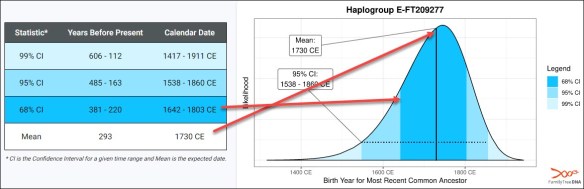
The confidence range and associated dates suggest that the common ancestor of these Johnson/Yokum men was born in New Sweden. If that is accurate, that means that both the Yocum and Johnson testers are either descended from one ancestor in New Sweden, meaning either Peter Jochimsson or Mathias Johnson alias Hutt (assuming the ancestor is one of those two men.) It likely removes the possibility that those two men were related in the old country, especially given that Craig identified Jochimsson’s origins in Schleswig-Holsstein and suggests that Mathias Jönsson/Hutt may have originated near Oslo.

It may be worth mentioning at this point that, according to the mitochondrial DNA matches of Dorcas Johnson and Margaret Johnson, the daughter of Peter Johnson and his wife, Mary Polly Phillips (if that was her name,) their closest matches are clustered in Finland.

That, of course, strongly suggests that Peter Johnson (c1720-1790) probably married the daughter of one of the settler families wherever he was living in the early 1740s when he would have been marrying.

Let’s hope we find that someone descended from another daughter of Peter Johnson and Mary Polly Philips, through all females to the current generation, which can be male or female, to take a mitochondrial DNA test. That match would solidify the relationship of Dorcas and Margaret to Peter Johnson and Mary.

Now, to determine Peter’s ancestors…

Research Activities

Recently, I extracted records for Maryland and Virginia Counties when I visited the FamilySearch Library in Salt Lake City. Why Maryland and Virginia? John Dobkins, the father of Jacob and Evan Dobkins is first found in the Monocacy Valley of Maryland before migrating in the early 1730s to what was at that time Frederick County, VA with Jost Hite, one of the early land speculators. Frederick County became Augusta and Dunmore, which eventually became Shenandoah County. John Dobkins lived in Dunmore which is where both Darcus Johnson married Jacob Dobkins and Margaret Johnson married Evan Dobkins in 1775. The Dobkins family is connected with (and probably related to) the Riley Moore family who was found in Prince George’s County, MD, adjacent to Cecil County. Frederick County, MD was once part of Prince George’s County, and Frederick County MD is where Peter Johnson (c1720-1790) is found owning land, on the border with Pennsylvania – Josh Hite’s stomping ground.

Frederick County, VA is chocked full of settlers from Cecil County, Prince George’s County and Frederick County, MD. Furthermore, many New Jersey Quakers moved to Frederick County, VA and established the Hopewell Meeting House. It would make sense that Peter Johnson’s family, perhaps him or maybe his siblings and uncles would make their way down that same path leading to land on the next frontier.

I was tracking Johnsons by the first names we’re familiar with, plus Isaac Johnson who is found associated with John Dobkins in Shenandoah County, VA, as was John Johnson. I found two other records for Isaac Johnson in Frederick County, one in 1751 as a witness to the will of Adam Warner, and one in 1769 as a legatee of Ralph Thompson who also had a son named Isaac. Additionally, there’s an Isaac Johnson in Cumberland County, PA but there’s nothing to suggest that these are the same man. John Johnson was a very common name and I ran out of time.

Somehow, Peter Johnson HAD to be in the Dunmore County neighborhood in 1775 for his two daughters to marry John Dobkins’ sons. There is no record of Peter in Dunmore County in 1775, but the existing records are incomplete. In 1778, Dunmore became Shenandoah.

Was Peter related to either Isaac or John Johnson who were associated with John Dobkins? I wish I had the answer to that. Two of one’s daughters did not marry two sons of a family you weren’t acquainted with, in a location where you weren’t living. Courting required proximity. Of course, the Revolutionary War was interfering with just about everything, so who knows why Peter Johnson might have been in Virginia in 1775. The county records are incomplete during this time, and the entire country was in an uproar.

Peter Johnson sold his land on the Pennsylvania/Maryland border in 1769 and 1770 although his adult son Richard (Derrick) remained in that location, at least for a while. Peter’s Brethren neighbors in Maryland moved to Holman Creek in Dunmore/Shenandoah County, directly adjacent John Dobkins, becoming his neighbors.

One Peter Johnson is found in Bedford County, PA in 1772, but it’s doubtful that this is the same man since he’s listed as a single freeman. Other than that, Peter’s entirely missing from 1773 when he’s found in Rostravener Township, PA, which is all of SW Pennsylvania, until 1783 when he’s found again in the same location. Part of Rostravener became Allegheny County in 1780, where Peter Johnson eventually settled and died a decade later.

In 1776, one Peter Johnson swears an oath of allegiance in Cumberland Co., PA, but our Peter had already left. Peter Johnson is not a terribly unusual name.

One of the earlier Johnson books states that Peter came from Winchester, VA which is found in Frederick Co., VA where there is an early mention of a Peter Johnson. In 1773, according to Eric Johnson, one Richard and Priscilla Johnson mention their son Peter in a deed, although that may well be a younger man. I do not have that record, nor know where they lived.

In other words, the very best clue we have as to where Peter Johnson was found in 1775 is where his two daughters were married to Dobkins men.

In addition to these recent research activities, I have a friend who has been helping me search for tidbits high and low. I’m still processing the information she has sent. Maybe there’s something more hidden there.

Followup

I’ve written to the matches of my Johnson cousins asking if they will share their genealogy, or at least as much as they know.

I’d surely love to see additional Johnson and Yokum men take Y-DNA tests, and those who match our line upgrade to the Big Y-700. Perhaps, between more refined time tree placement in addition to jointly working on genealogy and sharing resources, we can isolate one lineage and eliminate the other. That alone would be a victory!

I’m still chiseling at this brick wall, bit by bit!

_____________________________________________________________

Follow DNAexplain on Facebook, here or follow me on Twitter, here.

Share the Love!

You’re always welcome to forward articles or links to friends and share on social media.

If you haven’t already subscribed (it’s free,) you can receive an email whenever I publish by clicking the “follow” button on the main blog page, here.

You Can Help Keep This Blog Free

I receive a small contribution when you click on some of the links to vendors in my articles. This does NOT increase the price you pay but helps me to keep the lights on and this informational blog free for everyone. Please click on the links in the articles or to the vendors below if you are purchasing products or DNA testing.

Thank you so much.

DNA Purchases and Free Uploads

Genealogy Products and Services

My Book

Genealogy Books

Genealogy Research

DNAExplain Blog to be Preserved for Future Generations in the Library of Congress

Yes, indeed, this is definitely a red-letter event!!!

Not only is having my blog archived in the Library of Congress an incredible honor, but it solves a long-standing problem. Let’s start at the beginning.

In the Beginning…

I started this blog, www.dna-explained.com, also www.dnaexplain.com, for three primary reasons:

  • To educate the public, specifically genetic genealogists, about effectively using DNA for genealogy.
  • To share my own and other relevant vendor and non-vendor research and advancements in the field.
  • To provide a timeline and cumulative progressive history of this emerging field, recorded as it occurred. Essentially an industry diary.

My first blog article was published in July of 2012. The direct-to-consumer genetics industry was about 12 years old at that time. Today, the industry is roughly 23 years old and my blog is approaching its 11th anniversary. I’ve covered nearly half of the life of the genetic genealogy industry.

I recently crossed the threshold of 1600 published articles which equates to about 2.5 articles each week. Those articles total over 4 million words, or more than 15,000 pages of text, plus 20,000 images. That’s about half the size of the Encyclopedia Brittanica. That level of writing and publishing is almost a full-time job, alone, without anything else. Yet, I need to perform the research and do the work to create the content of each article. Not to mention the rest of my activities that pay the bills.

Anyone who writes, specifically, those who write to publish regularly, such as a blog, know that blogging isn’t exactly easy and requires an incredible amount of investmented time. The majority of blogs are abandoned shortly after creation. I fully understand why. You have to love both the process of writing and the subject – and be willing to contribute. Not to mention monitoring and approving the more than 50,000 comments and such.

As you know, this blog is free. I don’t charge for a subscription. I don’t accept paid content, guest articles or write articles for pay. I do have affiliate links at the bottom, but consider those cumulative purchases equivalent to buying me a cup of coffee. (Thank you to those who purchase through those links.)

There is some recurring financial investment in blogging too, but the biggest commitment, by far, is time. Hours and days that can’t be spent elsewhere, like on genealogy, for example – which leads me to my 52 Ancestors articles.

52 Ancestors

Of those slightly more than 1600 articles, 465 are in my 52 Ancestors series. I’m “blaming,” or crediting, Amy Johnson Crow for this, because in January of 2014, she challenged genealogists to write something about one ancestor a week and share or publish it someplace, somehow. I really liked that idea, and came to discover that focusing on one ancestor at a time, not a couple, and not their parents or children, allowed me to live with them for a bit and view their life through their eyes alone. So many times we know very little about our ancestor’s lives, and even less about the women. Interweaving Y-DNA and mitochondrial DNA results and matches, relationships and the history of what was happening around them provides an invaluable tool to connect with their lives.

I wasn’t sure I could maintain that one article per week pace, but I wanted to try. The 52 Ancestors challenge was just for one year, right? I could stop anytime, right? But how would I share? I didn’t really think any of you would be interested in MY ancestors, so I very nearly didn’t publish these stories on my blog. I’m INCREDIBLY glad that I did, because I use both genealogy and genetic tools at multiple vendors to confirm those ancestors, to find and identify their descendants, and to break though next-generation brick walls. Plus, I’ve discovered innumerable wonderful cousins!

Having committed, I jumped into 52 Ancestors with both feet and immediately addressed a very long-standing mystery about my father’s missing son. What I didn’t expect to happen was for you, my readers, to help solve it, but you did!!! Two weeks later, Lee was identified, had a name and a history! Wow we were off and running at breakneck speed. To this day, the 52 Ancestors articles remain some of my favorites, along with the process of bringing those ancestors back to life, even if just through words.

Sometimes I don’t write about ancestors specifically, but memorable events in our lifetimes that we’ve shared, like the 1969 moon landing, Y2K and more recently, the anniversary of the space shuttle Challenger explosion. Don’t you wish someone had written or journaled about contemporary milestones in our ancestor’s lives? What I wouldn’t give for that!

Preservation and Perpetuity

One of the reasons I write about my ancestors and genetic genealogy more broadly is because I very much want to share with other researchers, now and in the future.

In some cases, I’m the contributor, but often others contribute invaluable information to me. I firmly believe that a rising tide lifts all ships.

My goal is twofold:

  • To educate others and share methodologies so they can find and confirm their ancestors.
  • To complete the painting of my ancestor’s lives, or as much as I can in my lifetime.

Both of these are foundations upon which others can build.

A few years ago, I began to be concerned with preservation in perpetuity. How might I preserve those stories and the rest of my blog? I realize that in time, the technical aspects of my blog articles will be dated, but the educational basics remain firm. Better research methodologies will be developed. New information, both paper trail and genetic, will, hopefully, be unearthed about my ancestors, but I want the information I’ve provided to remain accessible over time.

I’ve been a technologist long enough to know that nothing is forever. Web sites disappear every day. The Internet Archive is wonderful, but it too may go poof, not to mention that you need to know the website url to access the archived website.

I reached out to WordPress, my blogging platform a few years ago. I asked if I could pay in advance for a “permanent” website, but they said that after payment stopped for the domain name and my subscription for the “non-free” platform, that my articles would revert to a free WordPress site “forever.” That means the url would change. Of course, none of the original links would work, and its value would be much dimished given that the articles would not appear in search engines. Furthermore, “forever” in technology days could be very short indeed.

Resources like FamilySearch aren’t meant for publications like my blog, and neither is WikiTree, especially “someday” after the blog link is no longer valid. I’ve posted links to articles on my blog on the ancestors’ profiles at WikiTree and in my personal trees at MyHeritage and Ancestry, but once the link is gone, effectively, so is the information.

I could copy the articles to word/pdf documents and attach those files to the trees, but we really don’t know what will and will not have longevity in today’s technical genealogical environment. Plus, I don’t want my articles behind a paywall anyplace, especially since I’ve made them available for free.

However, the Library of Congress has now solved that quandary for me and I’m both elated and honored.

The Invitation  

In the crazy days leading up to RootsTech, a gem of an email landed in my inbox. It was supposedly the Library of Congress (LOC) requesting to archive this blog and make this website available for all perpetuity as part of a collection of historically and culturally significant websites designated for preservation.

That’s quite a compliment.

I wasn’t quite sure I believed it. In fact, I was pretty sure that I didn’t.

Of course, the first thing I thought was that these were really brilliant scammers.

I contacted the LOC and discovered that this email was, indeed, genuine. I was both shocked and humbled.

To Whom It May Concern:

The United States Library of Congress requests permission to include your website in the Local History and Genealogy Web Archive, which is part of a larger collection of historically and culturally significant websites that have been designated for preservation. The following URL has been selected for archiving: https://dna-explained.com/.

The Library hopes that you share its vision of preserving digital content and making it available to current and future generations of researchers. As the internet has become an increasingly important and influential part of our lives, we believe the historical record would be incomplete if websites like yours are not preserved and made a part of it. We also believe that expanding access to the Library’s collections is one of the best ways we can increase opportunities for education and scholarship around the world. Please provide the Library with permission to archive your website and provide public access to archived versions of your website by filling out the form available here: <link redacted.>

With your permission, the Library of Congress or its agent will engage in the collection of content from your website at regular intervals over time. In order to properly archive the above URL, we may archive other portions of the website and public content that your page links to on third party sites such as social media platforms. In addition to the aforementioned collection, archived content from your website may be added to other relevant collections in the future. This content would be available to researchers only at Library facilities or by special arrangement, unless you additionally grant the Library permission for the content to become more broadly available through hosting on the Library’s public website, which would be done no sooner than one year after it was collected. For more information on the web archiving process, please read our frequently asked questions.

We encourage you to learn more about the Library’s Web Archiving program and explore our collections to see examples of how we archive websites. If you have any questions, comments, or recommendations concerning the archiving of your website, please email the Library’s Web Archiving Team at webcapture@loc.gov.

Thank you.

Library of Congress Web Archiving Team

It would be an understatement to say I was incredibly excited. There were no balloons or jubilant noisemakers though, and the cats were unimpressed as I clicked and agreed for my collective body of work to succeed me “forever.” Who knew milestones like this were so quiet, with only me winking to Mom and Dad who I’m positive were watching and silently cheering!

Here’s the confirmation of my acceptance.

So, in another hundred years, just like I can search for, say, Estes photos from a century or more ago at the Library of Congress, people living four or five generations in the future will be able to search for and read about the very early days of genetic genealogy and find those ancestor stories. They will also be able to learn something about the time in which we live today.

I can stop worrying about more than a decade’s worth of work disappearing after I join my ancestors, hopefully to obtain the answers that have eluded me here.

I’m incredibly, incredibly humbled and grateful to the Library of Congress for this amazing opportunity to contribute to our collective heritage. Thanks to each and every one of you for joining me on our journey into the history books.

_____________________________________________________________

Follow DNAexplain on Facebook, here or follow me on Twitter, here.

Share the Love!

You’re always welcome to forward articles or links to friends and share on social media.

If you haven’t already subscribed (it’s free,) you can receive an email whenever I publish by clicking the “follow” button on the main blog page, here.

You Can Help Keep This Blog Free

I receive a small contribution when you click on some of the links to vendors in my articles. This does NOT increase the price you pay but helps me to keep the lights on and this informational blog free for everyone. Please click on the links in the articles or to the vendors below if you are purchasing products or DNA testing.

Thank you so much.

DNA Purchases and Free Uploads

Genealogy Products and Services

My Book

Genealogy Books

Genealogy Research

cM Explainer™ – New MyHeritage Relationship Prediction Tool

At RootsTech, MyHeritage introduced cM Explainer, a new tool for all of their DNA customers that utilizes both the total matching cMs (centimorgans) plus the ages of the people involved, if provided by the customers, to estimate the relationship possibilities between two matches.

According to the MyHeritage blog article, here:

DNA Matches are characterized by the amount of DNA shared between two individuals, measured using a unit of genetic distance called centimorgans (cM). cM Explainer™ is unique in the way it uses both the centimorgan value as well as the ages of the two individuals (if known) to fine-tune its predictions, making MyHeritage the only major genealogy company to offer relationship prediction at this level of granularity and accuracy.

cM Explainer™ is fully integrated into the MyHeritage platform to shed light on any DNA Match found on MyHeritage, and is also available as a free standalone tool to benefit individuals who have tested with other DNA services.

Using cM Explainer

cM Explainer is automatically implemented for all MyHeritage DNA customers, so there’s nothing to do except utilize the tool in conjunction with the additional DNA tools already provided by MyHeritage.

Just click on DNA Matches if you’re a DNA customer, or under DNA Tools if you want to use the cM Explainer standalone tool.

Let’s look at my matches.

As you can see, two of my matches have provided their ages which appear in their match information.

The new cM Explainer probable relationship is listed as well. In Charlene’s case, she’s predicted to be a half first cousin, and Cheryl is predicted to be either a half first cousin, or a parent’s 1st cousin, which is another way of saying first cousin once removed.

Recall that “once removed” means one side of the descendant tree is one generation longer than the other. Cheryl and my Mom are first cousins (1C) and Cheryl and I are first cousins once removed (1C1R) or, said another way, I’m Cheryl’s first cousin’s daughter.

Probable Relationships

Some matches receive two listed “Probable Relationships,” but everyone can view additional estimates.

Click on the purple “Review DNA Match” button to view detail information.

My match’s segment information is provided, in addition to the possible relationships, in order of most probable first. To see additional information, click on the “show more relationships” link.

Charlene has a total of 5 possible relationships listed, each with its own probability calculated. One of my matches has a total of 8 possible relationships displayed.

Next, you’ll see the diagram of possible relationships.

Don’t forget to click on the “Relationships” dropdown in the upper right corner of the diagram.

You can click on Full relationships, Half relationships, or All Relationships.

I clicked on “all” which displays everything together.

Clicking the “Show probabilities for MRCA” box in the upper left-hand corner adds the probability that you and your match descend from a specific generation, or MRCA (most recent common ancestor.)

The highest or best probable relationship for cousin Charlene is calculated as 51.8% half first cousin.

The other possibilities are less likely. The second most likely is “Parent’s first cousin,” at 24.3%.

Charlene is my first cousin once removed (1C1R,) at the bottom. Stated another way, Charlene is my first cousin’s child, calculated at 4.5%, which should be genetically equivalent to a half first cousin at 51.8%. As you can see in the chart above, there’s VERY large probability difference between those two, which may be because of the expected comparative ages of the people in those positions involved.

Let’s take a minute to look at how half and “removed” relationships work genetically.

Half and “Removed” Relationships

In this example, John was married twice, to Mary and Sue. John had son Jim with Mary, and both daughters, Anna and Bonnie, with Sue. Their descendants took DNA tests.

In this chart, you can see that half-relationships of any kind carry half the average expected shared DNA as the full version of the same relationship. The yellow people, descendants of John and Mary, are half relationships to the green people because John was married to both Mary and Sue, having children with both wives.

The green people descend from full siblings, Anna and Bonnie, the children of Sue.

In the first generation, Jim and Anna are half siblings and share about 25% of their DNA. Anna and Bonnie are full siblings and share about 50% of their DNA. By extension, of course, Jim and Bonnie are half siblings too, sharing approximately 25% of their DNA, but not the exact same DNA as Jim and Anna share.

In the next generation, Jordan and Andrew are half first cousins and share about 6.25% of their DNA, while Andrew and Brad are full first cousins and share about 12.5% of their DNA.

Below the second cousin level, some cousins won’t match each other, but that doesn’t mean they aren’t cousins. It only means they didn’t happen to inherit a common segment of DNA from their common ancestors.

At the fourth-generation level, Jeremy and Abraham are half third cousins and share less than 1% or about 26.56 cM of their DNA, while Abraham and Betty are full third cousins and share about 53.13 cM of their DNA.

That half division of DNA occurred several generations earlier because Jim and Anna are half siblings which means that they only share half as much DNA as full siblings Anna and Bonnie. Of course, each subsequent generation will be a half relationship, and share roughly half as much as the full equivalent of that same relationship.

Once Removed

However, when the generations are offset by one, or once removed (1R,) the DNA is halved again. Looking at the chart again, half third cousins (3C,) Jeremy and Abraham share about 0.39% or about 25.56 cM of their DNA. Abraham and Beverly, who are 3C1R (third cousins once removed) are ALSO expected to share about 25.56 cM, the same amount of their DNA. In this comparison, the halving occurs in the last generation by the generational offset, when comparing Abraham with Beverly.

Of course, Jeremy and Beverly share the smallest percentage of all, because they are Half third cousins once removed, so they would be expected to share only about 13.28 cM of their DNA, assuming they share any at all.

I wrote about the various percentages expected of each relationship level and compiled a comprehensive chart in this article.

Of course, MyHeritage has included the factor of age to attempt to refine the relationship more succinctly.

How Accurate is cM Explainer?

I created a chart of my closest matches who are known, proven relatives.

Results where My Heritage has provided exact, accurate predictions are shown in red.

My first thought when I saw this new tool was that all of the people with whom I shared a Theory of Family Relativity (TOFR), especially relationships I had confirmed (or at least not rejected) would be predicted in cM Explainer to be that same relationship. Well, I was wrong.

Of the 8 matches with whom I have an accurate TOFR, the relationships of 4, or 50%, are correct, but the other 4 are not, so clearly, MyHeritage is not relying on TOFRs for cM Explainer, at least not solely, if at all.

Person Total cM # Segments Actual Relationship TOFR MyHeritage cM Explainer
Michael 822.8 31 1C Y 1C
Alberta 744.2 25 Half niece *1 (2nd on list) Y 1C
Dana 521.8 17 Half 1C1R (not on list) N 1st C dau, half 1C
Charlene 477.5 24 1C1R *2 (4th on list) N Half 1C
Cheryl 477.2 23 Parent’s 1C (2nd on list) N Half 1C, parent’s 1C
David 460.4 17 2C (3rd on list) N Half 1C
Buster 409.9 16 1C1R *3 N Parent’s 1C
Donald 381.7 17 1C1R (3rd on list) N 2C
Kurt 378.9 16 Half great-nephew (not on list) N 2C
Teresa 330.4 13 Half great-nephew (not on list) Y 2C
Shirley 223.3 8 2C1R (2nd on list) Y 2C
Sydney 217.8 10 Half great-nephew (not on list) N 2C dau, 1C dau
Buzz 212.7 9 2C Y 2C
Amos 182.7 8 1C2R (8th on list) N 2C son
Denny 166.9 6 3C (2nd on list) N 2C
Thomas 156.4 7 2C Y 2C
Patty 150.6 9 2C Y 2C
Cathy 102.9 5 3C Y 3C
Carol 87 7 2C1R (2nd on list) N 3C

*1 – Half aunt/uncle is equivalent to half niece/nephew – it’s simply a matter of perspective.

*2 – 1C1R (first cousin once removed) is the same relationship as a first cousin’s child, just said differently.

*3 – Your parent’s first cousin in your first cousin once removed (1C1R.)

In the Actual Relationship column, I’ve indicated the actual relationship, then if the actual relationship is shown on the chart of possibilities provided by MyHeritage, and if so, at which position.

For example, I’ve listed Alberta’s “Actual Relationship” as my half-niece. Additionally, there’s a comment at *1 below the chart. MyHeritage predicted Alberta as my first cousin, but the correct half-niece designation is shown second on the list.

In this case, I’m fairly sure I know exactly why the relationship miscalculation occurred. Alberta’s mother, my half-sister, was born to my father’s first wife. My mother was 22 years younger than my father, so my mother is roughly the same age as my half-sister. I am the same age as my half-sister’s oldest children. Therefore, we have an unusual generational difference where ages might be misleading.

In the second position, MyHeritage estimated Alberta as half-aunt, which is the same as half niece, depending on whose perspective you’re speaking from, so cM Explainer was close. In normal circumstances, 1st Cousin is probably the most likely relationship although having children separated by two decades certainly is not unheard of.

MyHeritage correctly predicted 6 of 19 relationships, for 31.6% accuracy.

The correct relationship was on the relationship list most of the time, but was omitted entirely 4 times. The common factor in the entirely missing relationships is that they are all half-relationships. While they were not all from the same family line, they did all involve long generations, meaning children born over a very long period. That’s not uncommon with half-siblings, and half relationships are notoriously difficult to sort from other candidate relationships. These situations might possibly be considered statistical outliers.

Equivalent Relationships

A half first cousin should be genetically equivalent to a first cousin, once removed, based on the amount of expected DNA for those relationships.

However, in at least one case, these two relationships are calculated with different resulting probabilities. Half first cousin is 41.5%, and 1st cousins child (aka 1C1R or 1st cousin once removed) is 43.8%.

Keep in mind, though that MyHeritage is using the age of the two individuals in their calculations, which could alter the results based on the combination of factors calculated into the probabilities. It’s 85% likely that the match is one of those two relationships.

Your Thoughts?

I’m interested in your thoughts on this new tool. How does it work for you? What about endogamy or pedigree collapse? Do you find it useful? How are you utilizing it in your research?

Shortly, I’ll do a comparison article with other tools to see how the publicly available cM Explainer tool stacks up against the rest.

Thanks to MyHeritage for making this tool free for all to use, here.

_____________________________________________________________

Follow DNAexplain on Facebook, here or follow me on Twitter, here.

Share the Love!

You’re always welcome to forward articles or links to friends and share on social media.

If you haven’t already subscribed (it’s free,) you can receive an email whenever I publish by clicking the “follow” button on the main blog page, here.

You Can Help Keep This Blog Free

I receive a small contribution when you click on some of the links to vendors in my articles. This does NOT increase the price you pay but helps me to keep the lights on and this informational blog free for everyone. Please click on the links in the articles or to the vendors below if you are purchasing products or DNA testing.

Thank you so much.

DNA Purchases and Free Uploads

Genealogy Products and Services

My Book

Genealogy Books

Genealogy Research