Beethoven’s DNA Reveals Surprises – Does Your DNA Match?

Beethoven’s DNA has been sequenced from a lock of his hair. That, alone, is amazing news – but that’s just the beginning!

The scientific paper was released this week, and the news media is awash with the unexpected surprises that Beethoven’s DNA has revealed for us. Better yet, his DNA is in the FamilyTreeDNA database and you just might match. Are you related to Beethoven?

His Y-DNA, mitochondrial DNA and autosomal DNA have been recovered and are available for matching.

You can check your autosomal results if you’ve taken a Family Finder test, or you can upload your DNA file from either AncestryDNA, 23andMe or MyHeritage to find out if you match Beethoven. Here are the download/upload instructions for each company.

But first, let’s talk about this amazing sequence of events (pardon the pun) and scientific discoveries!

Beethoven’s Genome is Sequenced

Everyone knows the famous, genius composer, Ludwig van Beethoven. He was born in 1770 in Bonn on the banks of the Rhine River and died in 1827 in Vienna. You can listen to a snippet of his music, here.

We are all about to know him even better.

Yesterday, amid much media fanfare and a press release, the genome and related findings about Beethoven were released by a team of renowned scientists in a collaborative effort. Research partners include the University of Cambridge, the Ira F. Brilliant Center for Beethoven Studies, the American Beethoven Society, KU Leuven, the University Hospital Bonn, the University of Bonn, the Beethoven-Haus Bonn, the Max Planck Institute for Evolutionary Anthropology and  FamilyTreeDNA. I want to congratulate all of these amazing scientists for brilliant work.

Beethoven’s Hair Revelations

In the past, we were unable to retrieve viable DNA from hair, but advances have changed that in certain settings. If you’re eyeing grandma’s hair wreath – the answer is “not yet” for consumer testing. Just continue to protect and preserve your family heirlooms as described in this article.

Thankfully, Beethoven participated in the Victorian custom of giving locks of hair as mementos. Eight different locks of hair attributed to Beethoven were analyzed, with five being deemed authentic and one inconclusive. Those locks provided enough DNA to obtain a great deal of different types of information.

Beethoven’s whole genome was sequenced to a 24X coverage level, meaning the researchers were able to obtain 24 good reads of his DNA, providing a high level of confidence in the accuracy of the sequencing results.

What Was Discovered?

Perhaps the most interesting discovery, at least to genealogists, is that someplace in Beethoven’s direct paternal lineage, meaning his Y-DNA, a non-paternal event (NPE) occurred. The paper’s primary authors referred to this as an “extra-pair-paternity event” but I’ve never heard that term before.

Based on testing of other family members, that event occurred sometime between roughly 1572 and Ludwig’s conception in 1770. The reported lack of a baptismal record had already raised red flags with researchers relative to Beethoven’s paternity, but there is nothing to suggest where in the five generations prior to Ludwig von Beethoven that genetic break occurred. Perhaps testing additional people in the future will provide more specificity.

We also discovered that Beethoven was genetically predisposed to liver disease. He was plagued with jaundice and other liver-related issues for much of his later life.

Beethoven, prior to his death, left a handwritten directive asking his physicians to describe and publicize his health issues which included progressive hearing loss to the point of deafness, persistent gastrointestinal problems and severe liver issues that eventually resulted in his death. Cirrhosis of the liver was widely believed to be his cause of death.

In addition, DNA in the hair revealed that Beethoven had contracted Hepatitis B, which also affects the liver.

The combination of genetic predisposition to liver disease, Hepatitis B and heavy alcohol use probably sealed his fate.

Additional health issues that Beethoven experienced are described in the paper, published in Current Biology.

It’s quite interesting that during this analysis the team devised a method to use triangulated segments that they mapped to various geographic locations, as illustrated above in a graphic from the paper. Fascinating work!!!

As a partner in this research, Cambridge University created a beautiful website, including a video which you can watch, here.

Beethoven’s Later Years

This portrait of Beethoven was painted in 1820 just 7 years before his death, at 56 years of age. By this time, he had been completely deaf for several years, had stopped performing and appearing in public. Ironically, he still continued to compose, but was horribly frustrated and discouraged, even contemplating suicide. I can’t even fathom the depths of despair for a person with his musical genius to become deaf, slowly, like slow torture.

His personal life didn’t fare much better. In 1812, he wrote this impassioned love letter to his “Immortal Beloved” whose identity has never been revealed, if it was ever known by anyone other than Beethoven himself. The letter was never sent, which is why we have it today.

FamilyTreeDNA

FamilyTreeDNA, one of the research partners published a blog article, here.

The FamilyTreeDNA research team not only probed Beethoven’s genealogy, they tested people whose DNA should have matched, but as it turns out, did not.

Beethoven’s mitochondrial DNA haplogroup is H1b1+16,362C, plus a private mutation at C16,176T. Perhaps in the future, Beethoven’s additional private mutation will become a new haplogroup if other members of this haplogroup have it as well. If you have tested your mitochondrial DNA, check and see if Beethoven is on your match list. If you haven’t tested, now’s a great time.

According to the academic paper, Beethoven’s Y-DNA haplogroup is I-Z139, but when viewing Figure 5 in the paper, here, I noticed that Beethoven’s detailed haplogroup is given as I-FT396000, which you can see in the Discover project, here.

Viewing the Time Tree and the Suggested Projects, I noticed that there are four men with that haplogroup, some of whom are from Germany.

The ancestor’s surnames of the I-FT396000 men, as provided in public projects include:

  • Pitzschke (from Germany)
  • Hartmann (from Germany)
  • Stayler
  • Schauer (from Germany)

If your Y-DNA matches Beethoven at any level, you might want to upgrade if you haven’t taken the Big Y-700 test. It would be very interesting to see when and where your most recent common ancestor with Beethoven lived. You just never known – if you match Beethoven, your known ancestry might help unravel the mystery of Beethoven’s unknown paternal lineage.

Beethoven’s DNA is in the FamilyTreeDNA database for matching, including Y-DNA mitochondrial and autosomal results, so you just might match. Take a look! A surprise just might be waiting for you.

_____________________________________________________________

Follow DNAexplain on Facebook, here or follow me on Twitter, here.

Share the Love!

You’re always welcome to forward articles or links to friends and share on social media.

If you haven’t already subscribed (it’s free,) you can receive an email whenever I publish by clicking the “follow” button on the main blog page, here.

You Can Help Keep This Blog Free

I receive a small contribution when you click on some of the links to vendors in my articles. This does NOT increase the price you pay but helps me to keep the lights on and this informational blog free for everyone. Please click on the links in the articles or to the vendors below if you are purchasing products or DNA testing.

Thank you so much.

DNA Purchases and Free Uploads

Genealogy Products and Services

My Book

Genealogy Books

Genealogy Research

Who is Peter Johnson’s Ancestor – Peter Jochimsson (Yocum) or Mathias Jönsson alias Hutt? Or Neither? – 52 Ancestors #391

Peter Johnson (c1720-1790) is making me crazy. To refresh your memory, Peter’s early life, including his parents, are shrouded in mystery. I wrote about him here and here. My ancestor is Dorcas Johnson who married Jacob Dobkins. I strongly believe Dorcas to be Peter Johnson’s daughter, for a myriad of reasons, supported by evidence of various types, including paper-trail and genetic, but I’m still seeking that elusive nail in the coffin – pardon the pun. I wrote about Dorcas here and here.

I’m comfortable with assigning Peter Johnson as Dorcas’s father, although I’d love just one conclusive piece of proof. However, Peter’s parents are another matter entirely and one very tough nut.

I’ve been digging like a dog with a bone, and so far, I’ve unearthed conflicting evidence. So now I have two bones and no idea which one is accurate. Wasn’t counting on that – but it sure makes for an interesting article!

I did, however, discover an absolutely WONDERFUL book in Salt Lake City recently. My husband scanned the entire book for me. Let’s start with the 1693 Census of the Swedes on the Delaware.

1693 Census of the Swedes on the Delaware

According to the 1693 Census of the Swedes on the Delaware authored in 1993 and published by Peter Stebbins Craig, J.D., between 1637 and 1655, Sweden equipped thirteen passenger voyages for the South Delaware River, with about 800 prospective settlers. Eleven ships with 600 passengers actually arrived.

The first ship deposited 24 men at Fort Christina, now Wilmington, Delaware. The second and third expeditions brought families. In 1644, Sweden and Denmark were at war, so immigration was suspended until 1647.

In 1651, the Dutch erected a fortified town and fort Casimir at present day New Castle, and the Swedes were disgusted. Several returned to Sweden and others left for neighboring Maryland.

In 1653, 22 Swedes presented a petition to the Swedish Governor Johan Printz, complaining of his aristocratic rule. One Peeter Jochim and one Claes Johansson were among the petitioners. The descendants of Claes, according to Peter Craig, use the Johnson surname in Pennsylvania, and Classon in Delaware and Maryland. Nothing confusing here!

Printz accused the petitioners of mutiny and returned in a huff to Sweden, but a new governor was soon dispatched, along with more settlers. Sailing into the Delaware River, the new Governor, Johan Rising, demanded that the Dutch Fort Casimir surrender – which it did because it had no gunpowder.

The Dutch at Fort Trinity (Fort Casimir, now New Castle) returned north to New Netherlands, but more Swedes moved to Maryland. You can read about Fort Trinity/Fort Casimir archaeology excavations, here.

Craig estimates that about 300 people, including wives and children, remained in New Sweden in 1655 when the Dutch governor Peter Stuyvesant sailed up the Delaware with 7 armed ships and 317 soldiers. The 50 Swedish solders were divided between two fortresses. Both Fort Trinity and Fort Christina (now Wilmington) surrendered on September 15, 1655. You can see a reconstructed Swedish village, here.

At this point, a few Swedes returned to the old country, but most remained, influenced strongly by Peter Stuyvesant’s conciliatory attitude. In a surprise move, he offered to return the colony to Governor Rising, but would retain Fort Casimir (New Castle). Governor Rising declined and left, but Stuyvesant made the same offer to the remaining settlers, offering them the opportunity to govern themselves by a court of their own choosing, continue their religion, have their own militia, continue trading with the Indians and retain their land. In return, they had to pledge loyalty to New Netherlands and Stuyvesant reserved the right to approve their officers. That seemed like a pretty good deal, all things considered, so the Swedes accepted, although they remained stubbornly independent.

Another voyage was already underway though, and in March of 1656, an additional 106 people arrived from the province of Varmland, Sweden, sailing out of Gothenburg.

The new “Swedish Nation” was formed in August 1656, with two courts. One was “Upland,” north of New Castle, and the other functioned on the other side of the Cristina River. The Delaware River was the highway and transportation was primarily by dugout canoe, exactly like the Native people. Hunting was achieved using Native paths. Some farming was undertaken, but mostly, only enough to feed families.

By 1680, life was changing for the Swedish families along the Delaware and many Englishmen were settling in the region. In 1681, William Penn received his charter for Pennsylvania, quickly followed by 23 ships from England carrying his Quaker followers. The three “lower counties” of Pennsylvania were present-day Delaware. By 1682, no longer holding a majority, the Swedish courts were no longer in session.

Penn was very complimentary of the Swedes, said they were welcoming and helpful to the English, got along very well with the Native people, and “strong of body…they have fine children, and almost every house full; rare to find one of them without 3 or 4 boys and as many girls; some six, seven and eight sons.”

By this time, given that 40+ years had elapsed since the first Swedes settled in New Sweden, the third generation was beginning – grandchildren of those original settlers were being born.

One of their English neighbors described the Swedes as ingenious, speaking English, Swedish, Finnish, Dutch and Indian. He described their efficiency, stating that one man could cut down a tree, two would quickly rend the tree into planks using only an ax and wooden wedges. No iron. The women spun linen and wove it into clothe and then made clothes. Swedish families ate rye instead of white bread.

The Swedes introduced log cabins to the colony – structures that would sustain pioneers on the ever-westward-moving frontiers for centuries to come.

The Nothnagle cabin,above, in Gibbstown, NJ, built in 1638 (attached to a 1738 structure) is reputed to be the oldest house in New Jersey.

The cabin is a few miles downstream from present-day Philadelphia, across the river from Tinicum Island, about four miles northeast of Raccoon Creek. This is important because it tell us where Swedes were living at the early date.

After William Penn obtained his charter, he cultivated the friendship of the Swedes to help his English settlers. Among others, Peter Petersson Yocum served as an interpreter, assisting Penn when purchasing land from the Indians.

Unfortunately, the Swedes had already purchased this land, as attested to by depositions from 7 “Antient Swedes” stating that they had purchased and occupied that land since 1638. Eventually, the Swedes provided Penn with the land that would become Philadelphia.

Given that Finland was part of Sweden at this time, no differentiation was made between Swedes and Finns, and both were included. Craig says that if the term Finns was used, it was specifically referring to people who spoke primarily Finnish. People who spoke primarily Swedish were not called Finns. Spelling was not standardized, but neither was it for English. This seems to be a politically challenging time in Scandinavia and results in confusion when looking back and trying to unravel New Sweden’s settlers. Additionally, patronymics, followed by the gradual adoption of surnames make both history and genealogy exceedingly difficult.

In 1693, a “census” of the Swedes was taken, thankfully, and appended to a letter. In 1693, the Swedes were still living below the fall line. In later years, they would settle in tracts granted to them by Penn in Upper Merions Township in Montgomery County, PA and Manatawny, present day Amity Township in Berks County.

Some Swedes settled at Sahakitko, a trading center for the Susquehanna (Minquas) Indians located at the head of the Elk River, now Elkton, Maryland. These traders traveled extensively, hunting, trapping, moving among and trading with various Indian tribes.

Peter Craig spent his retirement visiting these locations, along with archives and universities in Sweden and Finland, ferreting out information about these families. To him, we owe a massive debt of gratitude, because without his work we would be left with only shreds to try to reweave back into a piece of whole cloth. I’ll spare you the details about the mistakes with early 1693 census publications, but suffice it to say that Craig located and reassembled the information. The order of recording is important as well and provided information about where the families lived. The area was called “New Sweden in Pennsylvania on the Delaware River” and in 1693, the number of people in each household was recorded.

By 1693, not everyone was Swedish or Finnish. Dutch, English and German immigrants had intermarried with the Swedish colonists. Conversely, some of the Swedes were found in Maryland and no longer associated with the Swedish churches. Both of the Swedish churches were without pastors and had requested replacements. A 1697 list of parishioners includes people not listed in 1693 and a population estimate of about 1200.

The total 1693 census was 972 individuals, and within the Swedes community, our Peter Johnson’s ancestor is found – someplace.

Peter Craig listed the Swedes along with the number of souls shown in the census, but due to the changing nature of patronymics, it’s very difficult, without additional information to move further than this.

Thankfully, in the remainder of the book, Craig fleshed out each family, as best he could based on documents retrieved from many locations.

By now, you’re probably wondering why I’ve provided all this background.

Peter Johnson (c1720-1790)

I wrote about “my” Peter Johnson, here and here. We know some things, unquestionably, about Peter Johnson (c1720-1790.)

There is absolutely NO question that Peter Johnson’s descendants are related to the descendants of BOTH Jacob Dobkins who married Dorcas (Darkus) Johnson and Evan Dobkins who married Margaret Johnson.

Three distinct types of genetic evidence come into play.

Genetic Evidence

The mitochondrial DNA descendants of both Dorcas Johnson and Margaret Johnson match each other, confirming that they indeed descend from a common maternal ancestor. Mitochondrial DNA can’t prove actual parentage, but it can certainly rule it out. An exact match is strong evidence. Multiple pieces of evidence point to Darcus/Dorcas and Margaret being sisters. I wrote about this family and their challenges, here.

Even stronger evidence would be to find a mitochondrial DNA descendant of Peter Johnson’s wife, reportedly Mary Polly Philips, through another daughter, descending through all females to the current generation which can be male or female. If the descendant of Mary’s other daughter through all females to the current generation, which can be male, matches both Dorcas and Margaret’s descendants’ mitochondrial DNA, we’ve added another very important piece of evidence that Dorcas and Margaret are daughters of Peter Johnson and his wife. I’m offering a fully paid DNA testing scholarship for a qualifying person.

Using autosomal DNA, descendants of Peter Johnson through multiple other children match dozens of people descended from both Dobkins/Johnson couples.

Click to enlarge

Here’s one example using Ancestry’s ThruLines. How could I match descendants of six of Peter’s other children if I wasn’t descended through Peter or his ancestral line? By ancestral line, I mean that this same phenomenon could happen if I was descended from, say, Peter’s sibling.

Let’s look at another example from the perspective of someone descended from one of Peter Johnson’s other children.

Click to enlarge

This confirmed descendant of Peter Johnson through son James matches several descendants through Peter’s other children, plus 4 through Dorcas Johnson and Jacob Dobkins, plus 21 through Margaret Johnson and Evan Dobkins. How could this person who is descended through Peter’s son James match 25 people descended through Dorcas and Margaret who married the Dobkins boys if Dorcas and Margaret weren’t Peter’s daughters or blood relatives?

Jacob Dobkins and Evan Dobkins are confirmed brothers through John Dobkins and wife Elizabeth, and Dorcas Johnson and Margaret Johnson are believed to be sisters. The Bible of Peter Johnson’s son, Solomon, records two of his sisters marrying Dobkins men. It’s important to note that this record comes from descendants of Peter, through another branch of Peter Johnson’s family, and not from descendants of those two Dobkins/Johnson couples.

A third piece of genetic evidence is the Y-DNA of Peter Johnson.

Several men who descend from Peter and other Johnson males have tested and match each other, including three Big Y-700 testers.

I’ve spent an incredible amount of time recently evaluating Y-DNA and autosomal DNA matches, from tests taken by both Johnson and Yokum testers, or similarly spelled surnames. Some men have completely different Y-DNA, but claim to descend from the same lines. Clearly, we have conflicting evidence to resolve.

Another piece of information of which I’m confident is that our Peter Johnson’s ancestors were indeed Swedish, and I agree with Eric and other Johnson researchers who believe Peter descended from one of the founders of the early Swedish Colony along the Delaware River in the 1600s. Now you know exactly why I’ve shared this information from Peter Craig’s book.

Before we review additional DNA information, I’d like to continue with information about both the Johnson and Yocum lines, extracted from Peter’s comprehensive book. I’ve provided map locations which will aid with locations and proximity.

Peter Petersson Yocum

Page 25-26: Peter Yocum was a member of the Wicaco church when on the last day of May in 1693, 26 members of the Swedish congregation gathered at the log church to sign the letter to Sweden requesting new ministers.

The church faced the Delaware River at the present location of Gloria Dei (Old Swedes) Church in Philadelphia and had originally been built in 1677 to serve the Swedes living above the Schuylkill River, with the 1646 church at Tinicum Island continuing to serve members located between the Schuylkill and Marcus Hook.

When Tinicum Island passed out of Swedish ownership in 1683, the church at Tinicum was abandoned. By 1693, the Wicaco congregation embraced 102 Swedish households extending from Neshaminy Creek in Bucks County to Marcus Hook, on the Pennsylvania side of the Delaware, and from Pennsauken Creek in Burlington County to the southern boundary of Gloucester County (Oldmans Creek) on the New Jersey side of the river.

Identification of the 554 Swedish church members living within this area is facilitated by the fact that in 1697 the new Wicaco minister, Andreas Rudman, made a house-by-house enumeration of his congregation, which was later copied and preserved. This chapter focused on the first 37 Wicaco households listed in the 1693 census. The household’s location is shown as evidenced by contemporary land records. Additionally, the value or size of each property is shown in pounds or acres as reported in contemporary tax records.

Page 43, person #35* – Peter Petersson Yocum (Aronameck, 100 pounds): Peter was born in New Sweden about 1652. His father, a soldier named Peter Jochimsson from Schlesvig in Holsstein, had arrived in New Sweden on the Swan in 1643 and became a freeman on November 1, 1652. He was one of the 22 freemen signing the 1653 complaint against Governor Printz. In the summer of 1654, Governor Rising chose him to go to New Amsterdam (now Manhattan in New York City) on a diplomatic and spying mission to deliver a letter. Peter Jochimsson died there. Thereafter, his widow, aged 20 with 2 children at his death, known in 1693 as Ella Steelman, (#54), married Hans Mansson who raised Peter Petersson as his own son. Peter Petersson who adopted the surname Jochim (Yocum) about 1675 married Judith, daughter of Jonas Nilsson (322), and had seven children by May of 1693: Peter born 1677, Mans born 1678, Catharine born 1681, Charles born 1682, Sven born 1685, Julia born 1687, and Jonas born in 1689. Peter Petersson Yocum who had been prominent as an Indian trader and as an Indian interpreter for William Penn died in 1702. His widow thereafter moved with her younger sons to Manatawny (Berks County) where she died in 1727. Their descendants used the surname of Yocum or Yocom.

Craig provides the following footnote: Subsequent children: Anders (Craig’s ancestor) born 1693, John born 1696 and Maria. For additional references to Peter’s father, Peter Jochimson, see Huygen, 63, MGB 23, 78; Rising 93, 107, 111, 112, 163, 165, 183, 195. Peter Jochimsson also had a daughter, Elisabeth born about 1654 who married an English soldier, John Ogle. Yocum, 270, n24; Stille, 147-149.

*Please note that Craig’s numbers, such as #35, reference their position on the 1693 census. Peter is recorded as “Petter Yocomb – 9” meaning 9 people in the family as of that date.

Mathias Hutt Jönsson

Raccoon Creek is about two miles north of Oldmans Creek, shown at the top of the map below.

Mathias Jönsson alias Hutt, living someplace on or near Salem Creek in New Jersey (upper red arrow,) fell under the Crane Hook Congregation across the river on the Pennsylvania side in what is now Wilmington.

Click to enlarge

His son, Oliver, and possibly other sons would eventually live in the Indian trading village of Sahakitko at Head of Elk, now Elkton, Maryland.

Craig tells us that the migration of families from New Castle County across the Delaware River to Penn’s Neck in Salem County began in 1671. By the time of the 1693 census, the Crane Hook Church counted 130 members living on “the other side” of the Delaware.

Penn’s Neck was bounded by the Delaware River on the west and extended from Oldmans Creek on the north to Salem Creek on the south. The eastern boundary was also Salem Creek to its northern bend, then extending overland northeast to Oldman’s Creek. It derived its name from the fact that William Penn, proprietor of Pennsylvania, also acquired proprietorship of this area in 1683 from its first English claimant, John Fenwick. The church census identifies the households in Penn’s Neck beginning at its northernmost settlement.

Page 104, footnote 58 on Olle Thomasson #113 – partially reads: On August 25, 1685, “Wooley Thomason of Pennsylvania” (which then included Delaware,) and Wooley Peterson of Boughttown (#80) were named co-administrators of the estate of “Matthias Unson” of Salem Creek in Penn’s Neck. NJA, 23:474. The deceased whose full name was Matthias Jönsson alias Hutt, directed that his son Michael should live with Wooley Thompson. Salem Co. wills, 2:16-17, NJA 23:474; 1730 accounting by William Peterson, surviving executor, Salem County probate records 503Q, NJA, 23:263-64.

This next portion loops in another Jönsson family and is confusing. I apologize in advance.

The Jönsson or Halton Family – The probable progenitor of the Halton family was Jons Jönsson, a Finn from Letstigen, Varmland, who was listed in October 1655 as about to go to New Sweden on the Mercurius with his wife and 6 children. Later records disclose the presence of Olle, Peter and Mans Jönsson whose patronymic was later replaced by Halton. Along with Nils Larsson France (see #85), Olle Rawson (#135) and their associated, Olle Jönsson (also known as “Carringa Olle”) was licensed by the New Jersey governor in 1668 to buy Indian lands on the east side of the Delaware River. The subsequent purchase agreement, executed Nov. 15, 1676, conveyed the lands to Hans Hoffman and Peter Jönsson. In 1684, Peter Jönsson moved to Penn’s Neck, Salen County, dying in 1692. He called himself Peter Halton in his will, naming his wife as Mary and his children as Frederick, Andrew and Brita.

Page 79 #78 – Lasse Halton (Raccoon Creek, 100 acres): Born about 1668, Lasse Halton was the eldest son of Olle Jönsson (“Carringa Olle”) and in 1693 was probably residing with his brother Hans and Carl Halton. Lasse later married a daughter of Matthias Jönsson of Penn’s Neck. The names of their children, if any, are uncertain. He moved to Piles Grove, Salem County, around 1707, after selling his Raccoon Creek Plantation to his brother Hans.

The 100 acres occupied by Lasse Halton was taxed to his mother, “Madlen Janson” in 1687. Her name was replaced with his on the 1690 and 1694 tax lists.

The final accounting of the estate of Matthias Jönsson, filed in 1730, showed a payment to Lausy Halton for his wife’s filial portion NJA, 21:263-264. He had picked out his grave site at Raccoon church in 1724. RPN, 27.

Carl (Charles) Halton married Maria, daughter of Matthias Jönsson (NJA, 23:263-64) and following her death, Gunnilla Fransson. Charles Halton died at Penn’s Neck in 1738.

Page 148, #173 Anders Anderson Weinam (150 aces): (The first portion regarding his name omitted.)

It is uncertain whether Anders Andersson Weinam was a son of a settler or New Sweden named Anders or whether he was among the 1663-1664 arrivals under Dutch rule. Anders was fined 50 guilders in the 1669 Long Finn Rebellion. By 1677 he had moved to Crane Hook. In 1679, he joined Matthias Jönsson, Lars Corneliusson (see #174-75) and widow Annika Hendricks (see #176) in obtaining the original 600 acre grant at Chestnut Neck between Parting Creek and Bastowe (sauna) Creek. In 1690 Nicholas Philpot purchased 50 acres from Anders Andersson’s original 150 acres. Meanwhile, in partnership with Peter Bilderback, Anderson acquired a nearby tract of 100 acres from William Penn. In 1697 Anders Weinam pledged 18 shillings for the new church at Christina and in 1699 both Anders Vinam and his wife were assigned pews at Holy Trinity. The will of Anders Andersson of Penn’s Neck, dated July 9, 1719, gave his entire estate to his wife Anna. Her will, proved the following year, made her brother Henery Boasman (Hendrick Batsman), sold heir, which identifies her as the daughter of Joran Joransson Batsman (see #151.) She and Anders had no children. Their household of four probably included two of the children of Matthias Jönsson Hutt.

Matthias Jönsson alias Hutt had been granted a patent for 100 acres at Feren Hook in 1669. Fined in 1675 in the dike rebellion, he remained at that location until 1679 when he moved to Chestnut Neck. When he died in 1685, he left nine orphan children. The two youngest of his sons, Eric and Eskil Jönsson or Johnson, also known as Erik and Eskil Hutton or Hotton, remained in Penn’s Neck and probably were members of Anders Andersson’s household in 1693.

Will – 1684-5 Feb. 14 – Unson, Mathias, of Castiana Neck on Fenwick’s River alias Salem Greek, Salem Tenth, planter; will of. Gives real and personal estate to his nine children, of whom only the following names are given; Woola Matheson, who is to live with Lause Powleson, Michael, the third son, to live with Wooley Thompson, the fourth son, Erick, to live with Andrea Anderson. Witnesses – Peeter Billderbeck and William Wilkinson. Proved August 11, 1685

1730 <no date> – Johnson, Mathias, of Pen’s Neck, Salem Co., yeoman. Account of the estate of £75.9, by the surviving executor, William Peterson, who has paid to Lausey Halton £8.5 in full of his wife’s filial portion, to Mary, wife of Chas. Halton £6 as her portion, to Samuel Walcott and wife Katharine £8.5, the filial portion of Erick Johnson, said Katherine’s former husband, to Oliver Johnson £6.3, to Eskell Johnson £6.3, to Michael Johnson £4.17.6, to Henry Johnson £6.3, Margaret Johnson £6.3, all filial portions. [No will on record or on file.]

Footnote 46 – DYR, 137, NYHM, 20:22; 21:104; NCR, 1:160, 163; NJA, 21:544, 568, 574; will of Matthis Unson of Castiana Neck on Salem Creek, dated Feb 14, 1684/5 and proved May 11 1685, Salem County wills, 2:16, and final accounting of estate of Matthias Johnson by William Peterson, surviving executor, filed 1730, Salem County wills, 503-Q. The eldest son, Olle, later known as Oliver, was to stay with Lars Palsson Kampe (#147), Henrick with Lars’ father Pal Larsson and Michael with Olle Thompson (#113). They all died at Sahakitko (Elkton), Cecil County. See, e.g., MCW, 7:219. Eric was to live with Anders Andersson and Eskil was unassigned. Eric and Eskil Hutton or Hotten both pledged money and contributed labor for the building of Holy Trinity Church and were assigned pews in that church in 1699. Eric as Eric Jansson or Johnson married Catharine Gillijohnson and died at Penn’s Neck in 1719. Eskil as Ezekiel Jansson or Johnson worked on the glebe house for Penn’s Neck church in 1721 and died intestate in Penn’s Neck in 1726. According to the accounting, one daughter married Lars Halton (#78), another, Maria, married Lars Halton’s brother Charles Halton. A third was named Margaret Johnson in the account. The fourth, Catherine Johnson and her newborn child were maintained by Olle (William) Peterson of Gloucester County (#80) for 13 months.

Information for Lars Palsson Kampe (#147) (Sahakitko): This man’s father, Pal Larsson had been granted a patent at Feren Hook in 1668, was fined 100 guilders in the 1669 Long Finn Rebellion and 20 guilders in the 1675 dike rebellion. The will of Paul Larson dated March 7, 1685, witnessed by Olle Palsson and Eskil Andersson, left his “house and lands whereon I now live” to his wife Magdalena for life, then to his daughters – unnamed. He left to his sons Lawrence and Matthias “my land which is now in Elk River, which is 200 acres,” with directions that Lawrence keep and maintain Matthias. On October 20, 1685, Paul sold his 200-acre home plantation at Feren Hook to Justa Andersson and apparently moved to Elk River, Cecil County where his will was proved June 3, 1692. His eldest son, Lars Palsson chose the surname Kampe, warrior in Swedish, as illustrated in this census. In 1693 his household included his wife (name unknown,) their first children and perhaps his brother Matthias. Lars had three children who later moved to Gloucester County: John, Paul and Brigitta Kampe, also written as Camp.

These families were neighbors and eventually, related. Their lives were intertwined and the survival of the colony depended on the cooperation of many.

In Peter Stebbins Craig’s book, 1671 Census of the Delaware, he states that Feren Hook, meaning Pink Hook, appears to have been settled in 1663 by Swedes and Finns arriving from Sweden via Christiania (now Oslo,) Norway, and Amsterdam in the time of d’Hinojossa. Transcription here.

The Quandary

Now, of course, the quandary.

My Johnson cousins Y-DNA matches a few other Johnson men and one Yocum male.

The Yokum male shows his ancestor as Peter Jochimsson born in 1620 and died in 1702. That, of course would be the father of Peter Petersson Yocum.

At first glance, this looks like a slam dunk, meaning our Johnson line is Yocum, descended from Peter Jochimsson, but it isn’t.

Eric Johnson, who is descended from “our” Peter Johnson who was born circa 1720 and died in 1790 in Allegheny County, PA, worked with Dr. Peter Craig before his death who provided Eric with information suggesting that our Peter Johnson is descended from Mathias Jönsson alias Hutt, through his son Oliver (Olle) who had son Peter in 1720 in Cecil County, MD, near Head of Elk, now Elkton.

I found a record in 1740 in Cecil County, MD for 3 Johnson men, Oliver, Simon and Peter, members of the foot company militia under the command of Capt. Zebulon Hollingsworth. Is this “our” Peter as a young man, or a different Peter. I don’t know.

Also in Cecil County, one Peter Johnson’s will is probated in 1747, and we know that our Peter had moved to the border of Pennsylvania and Maryland by 1742, near Hagerstown. Later deeds tie Peter in Allegheny County, PA to the Peter in Franklin Co., PA.

The records for Peter Johnson (c1720-1790) begin in April of 1742 when he obtained land in Lancaster County, PA, the portion that became Cumberland County in 1750, then Franklin County in 1784. If he was born in 1720, he would only have been 22 at the time, which isn’t impossible but young based on the customs of the time. This land was actually on or very near the Maryland/Pennsylvania border, just above Frederick County, MD, close to Hagerstown.

Hence, the suggestion that our Peter Johnson descended from Elkton in Cecil County seems reasonable.

One thing is certain. Our Johnson and Yocum men DO share a common ancestor as confirmed by Big Y-700 DNA testing.

The question is, of course, whether the Yocum male has documentation confirming that he descends from Peter Jochimsson, the father of Peter Petersson Yocum (#35) or if that was an assumption by someone based on the Yocum surname? If not, what type of source information exists and is it conclusive and incontrovertible?

What are the Possibilities?

Unfortunately, we now have some contradictory evidence to resolve.

  • It’s possible that the Yocum male who matches our Johnson line very closely does have solid, confirmed genealogy descending from Peter Jochimsson. If that’s the case, can each successive generation be confirmed? How strong is the evidence?
  • If our Yocum male’s line can be confirmed, then our ancestor is also very likely Peter Jochimsson.

However, there’s a plot twist.

  • There’s another group of about 10 Yocum men who match each other, two of who claim to descend from Peter Jochimsson as well. These men do not match “our Yocum” male, nor do they match any Johnsons. Their haplogroup is in an entirely different branch of the tree.

These groups of men cannot BOTH be directly paternally descended from Peter Jochimsson.

  • It’s possible that our Johnson/Yokum line is indeed descended from Mathias Jönsson alias Hutt. If that’s the case, then someplace, Jönsson became Yokum several generations back in time for at least one male whose descendant tested today, while the rest remained or became Johnson/Johnston.
  • Its not possible for our Johnson line to descend from Mathias Jönsson/Hutt and the Yokum man who matches the Johnson Y-DNA to descend from Peter Jochimsson, unless of course these ancestral men were closely related to each other, sharing a common paternal ancestor.

Peter Jochimsson and Mathias Jönsson/Hutt sharing a common paternal ancestor is certainly not impossible, but in New Sweden, they don’t live very close to each other. Initially, they were about 40 miles distant. So, if they were related, it’s either in the first generation or two, before 1702, or reaches back to the old country. However, that isn’t what the Y-DNA suggests.

Craig says that Mathias Jochimsson came from Schlesvig in Holsstein, the northern portion of Germany that abuts Denmark, and the settlers in Feren Hook were from near Oslo. Of course, that’s not absolute given that Craig never found a specific origin for Mathias Jönsson/Hutt.

We also don’t know when Mathias Johnsson/Hutt arrived, or where he came from. We know for sure a group of settlers arrived in 1656. According to Amandus Johnson in The Swedes on the Delaware 1638-1664, a final group of Finnish families from Sweden landed in Holland in 1664, en route for New Sweden, but it’s unclear whether they were allowed to proceed to the colonies. We know for sure that Mathias Jönsson/Hutt was in Feren Hook by 1669.

It’s worth noting that little is known about Peter Jochimsson, the original settler, aside from his one son, Peter Petersson Yocum and a daughter reported by Craig. He was either unmarried upon arrival and didn’t marry until he gained his freedom in 1652, or he had more children that died, or he had more children that we don’t know about. Craig reports his widow to have been 20 at his death, with two children which opens the possibility that she was a second wife.

It’s also worth noting that we have the other Otto Jönsson “Carringa Olle” who reportedly took the surname Halton. That line also contains a Peter.

The Y DNA

Two Johnson men and the Yocum tester have taken the Big Y-700 test which has a very distinct aging ability. They have the same haplogroup which is shown on the public Discover haplotree, here.

The most recent common ancestor of these men is estimated to have been born about 1750, which would be roughly the generation of our Peter Johnson who was born before 1720 and died in 1790. Given that we don’t know for sure who Peter’s father was, it’s very likely that our Peter Johnson (possibly the son of Oliver) had siblings and uncles, so Johnson becoming phonetically spelled Yocum or vice versa wouldn’t be the least bit surprising in that era, or in the generation(s) prior.
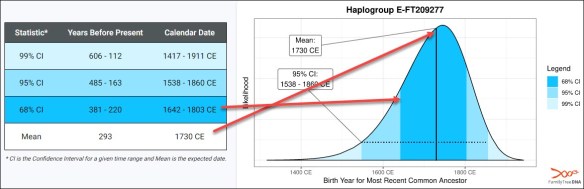
The confidence range and associated dates suggest that the common ancestor of these Johnson/Yokum men was born in New Sweden. If that is accurate, that means that both the Yocum and Johnson testers are either descended from one ancestor in New Sweden, meaning either Peter Jochimsson or Mathias Johnson alias Hutt (assuming the ancestor is one of those two men.) It likely removes the possibility that those two men were related in the old country, especially given that Craig identified Jochimsson’s origins in Schleswig-Holsstein and suggests that Mathias Jönsson/Hutt may have originated near Oslo.

It may be worth mentioning at this point that, according to the mitochondrial DNA matches of Dorcas Johnson and Margaret Johnson, the daughter of Peter Johnson and his wife, Mary Polly Phillips (if that was her name,) their closest matches are clustered in Finland.

That, of course, strongly suggests that Peter Johnson (c1720-1790) probably married the daughter of one of the settler families wherever he was living in the early 1740s when he would have been marrying.

Let’s hope we find that someone descended from another daughter of Peter Johnson and Mary Polly Philips, through all females to the current generation, which can be male or female, to take a mitochondrial DNA test. That match would solidify the relationship of Dorcas and Margaret to Peter Johnson and Mary.

Now, to determine Peter’s ancestors…

Research Activities

Recently, I extracted records for Maryland and Virginia Counties when I visited the FamilySearch Library in Salt Lake City. Why Maryland and Virginia? John Dobkins, the father of Jacob and Evan Dobkins is first found in the Monocacy Valley of Maryland before migrating in the early 1730s to what was at that time Frederick County, VA with Jost Hite, one of the early land speculators. Frederick County became Augusta and Dunmore, which eventually became Shenandoah County. John Dobkins lived in Dunmore which is where both Darcus Johnson married Jacob Dobkins and Margaret Johnson married Evan Dobkins in 1775. The Dobkins family is connected with (and probably related to) the Riley Moore family who was found in Prince George’s County, MD, adjacent to Cecil County. Frederick County, MD was once part of Prince George’s County, and Frederick County MD is where Peter Johnson (c1720-1790) is found owning land, on the border with Pennsylvania – Josh Hite’s stomping ground.

Frederick County, VA is chocked full of settlers from Cecil County, Prince George’s County and Frederick County, MD. Furthermore, many New Jersey Quakers moved to Frederick County, VA and established the Hopewell Meeting House. It would make sense that Peter Johnson’s family, perhaps him or maybe his siblings and uncles would make their way down that same path leading to land on the next frontier.

I was tracking Johnsons by the first names we’re familiar with, plus Isaac Johnson who is found associated with John Dobkins in Shenandoah County, VA, as was John Johnson. I found two other records for Isaac Johnson in Frederick County, one in 1751 as a witness to the will of Adam Warner, and one in 1769 as a legatee of Ralph Thompson who also had a son named Isaac. Additionally, there’s an Isaac Johnson in Cumberland County, PA but there’s nothing to suggest that these are the same man. John Johnson was a very common name and I ran out of time.

Somehow, Peter Johnson HAD to be in the Dunmore County neighborhood in 1775 for his two daughters to marry John Dobkins’ sons. There is no record of Peter in Dunmore County in 1775, but the existing records are incomplete. In 1778, Dunmore became Shenandoah.

Was Peter related to either Isaac or John Johnson who were associated with John Dobkins? I wish I had the answer to that. Two of one’s daughters did not marry two sons of a family you weren’t acquainted with, in a location where you weren’t living. Courting required proximity. Of course, the Revolutionary War was interfering with just about everything, so who knows why Peter Johnson might have been in Virginia in 1775. The county records are incomplete during this time, and the entire country was in an uproar.

Peter Johnson sold his land on the Pennsylvania/Maryland border in 1769 and 1770 although his adult son Richard (Derrick) remained in that location, at least for a while. Peter’s Brethren neighbors in Maryland moved to Holman Creek in Dunmore/Shenandoah County, directly adjacent John Dobkins, becoming his neighbors.

One Peter Johnson is found in Bedford County, PA in 1772, but it’s doubtful that this is the same man since he’s listed as a single freeman. Other than that, Peter’s entirely missing from 1773 when he’s found in Rostravener Township, PA, which is all of SW Pennsylvania, until 1783 when he’s found again in the same location. Part of Rostravener became Allegheny County in 1780, where Peter Johnson eventually settled and died a decade later.

In 1776, one Peter Johnson swears an oath of allegiance in Cumberland Co., PA, but our Peter had already left. Peter Johnson is not a terribly unusual name.

One of the earlier Johnson books states that Peter came from Winchester, VA which is found in Frederick Co., VA where there is an early mention of a Peter Johnson. In 1773, according to Eric Johnson, one Richard and Priscilla Johnson mention their son Peter in a deed, although that may well be a younger man. I do not have that record, nor know where they lived.

In other words, the very best clue we have as to where Peter Johnson was found in 1775 is where his two daughters were married to Dobkins men.

In addition to these recent research activities, I have a friend who has been helping me search for tidbits high and low. I’m still processing the information she has sent. Maybe there’s something more hidden there.

Followup

I’ve written to the matches of my Johnson cousins asking if they will share their genealogy, or at least as much as they know.

I’d surely love to see additional Johnson and Yokum men take Y-DNA tests, and those who match our line upgrade to the Big Y-700. Perhaps, between more refined time tree placement in addition to jointly working on genealogy and sharing resources, we can isolate one lineage and eliminate the other. That alone would be a victory!

I’m still chiseling at this brick wall, bit by bit!

_____________________________________________________________

Follow DNAexplain on Facebook, here or follow me on Twitter, here.

Share the Love!

You’re always welcome to forward articles or links to friends and share on social media.

If you haven’t already subscribed (it’s free,) you can receive an email whenever I publish by clicking the “follow” button on the main blog page, here.

You Can Help Keep This Blog Free

I receive a small contribution when you click on some of the links to vendors in my articles. This does NOT increase the price you pay but helps me to keep the lights on and this informational blog free for everyone. Please click on the links in the articles or to the vendors below if you are purchasing products or DNA testing.

Thank you so much.

DNA Purchases and Free Uploads

Genealogy Products and Services

My Book

Genealogy Books

Genealogy Research

RootsTech 2023 – Truly United

Finally, finally, we were on our way, winging our way across the world from near and far – flying and motoring into snowy Salt Lake City for RootsTech. It seemed like we had been preparing forever, and Murphy visited many of us as gremlins trying to keep us away – but we persevered, and Murphy’s ploy just didn’t work.

Grab a cup of your favorite beverage, because you’re going to RootsTech with me!

I started out very early in dense fog which was a precursor to a nightmare at the airport. We didn’t know that yet, and the sun emerged beautifully as we were on our way.

Utah was blanketed with snow a few days before our arrival. We were hoping for no more snow.

The snow cover made for stunningly beautiful photos from the air.

The Kennecott Copper Mine outside Salt Lake City is three miles wide, nearly a mile deep and looked very interesting and beautiful laced with snow. These terraces are actually roughly 500 miles of dirt road. This used to be a mountain that was 8400 feet in elevation.

During the flight, I read about my ancestor, Stephen Hopkins and couldn’t help but think about how shocked he would have been that I flew across the country some 413 years after he was shipwrecked in Bermuda on the way to Jamestown, eventually lived in Jamestown for 4 years, sailed back to England, remarried, then arrived on the Mayflower in Plymouth Colony.

His ships and mine were very, very different.

FamilySearch Library

Some of us arrived early for research or meetings, or both.

FamilySearch took the opportunity presented during the Covid shutdown to remodel and upgrade the facilities significantly. The new library is both beautiful and super-functional.

The workstations now have three monitors.

There’s a lovely new break room with vending machines, tables, and a fridge.

To put things in perspective, the break room is larger than the preserved pioneer cabin that stands beside the library.

I’m struck by the contrast of the small cabin standing beside the FamilySearch library at left, and museum at right, and just a block away from skyscrapers.

Rather than leave and waste valuable research time, we had a picnic lunch in the break room.

I went to Salt Lake City early to visit the FamilySearch Library and attempt to break down a brick wall. I think I might have done that. We will see.

Other researchers did the same thing, and you can view a special GenFriends episode, here, hosted by Cheryl Hudson Passey, where several of us shared our excitement about our research, discoveries and simply gathering together again.

I was very excited to meet my cousin, Audrey Hill, for the first time in person, at the library. We’ve been collaborating for several months on our John Hill (1737-1805) and Catherine Mitchell (1738-1827) line. She’s already following up on a lead I never did (my bad.) Go Audrey!!

I spent two days perusing book after book after book in the Virginia and Maryland counties where my Dobkins and Johnson ancestors were known to have lived, then moved to the historically adjacent counties.

I was incredibly discouraged, but on the evening of the second day, back at my hotel again, I reviewed all of the library resources and noticed that I had missed one book that was shelved elsewhere.

Glory be, I *think* I’ve found him and his family.

My Peter Johnson line’s Y-DNA matches the Jochimsson (Yocum) line, so I have a LOT of work to do. But now at least I know where to dig!

I needed this entire book, not just a few pages.

Fortunately for me, Jim volunteered to scan the entire book at one of the new book-scanning stations.

I’m SOOO excited.

RootsTech and the FamilySearch library ran golf carts back and forth between the facilities throughout the conference.

Decisions, decisions.

Well, if you can’t decide, just go to the chocolate shop to think things over😊

The Night Before

Preconference events began on Wednesday evening with the media dinner which allows us to understand the layout, when to be someplace, and where that place might be. It also allows provides accurate information to pass on to you.

Of course, many of us have known each other for years. As the first event of RootsTech, after three years of being apart, it felt like one huge family reunion with everyone catching up. So many hugs!!!

And selfies.

It was wonderful to see Marie Cappart again. I’ll never forget walking down the street in Amsterdam with two friends and hearing someone shouting my name from some distance away. I turned around and there was Marie, running toward me, arms outstretched. What are the chances??

The influencers and media were treated to a tour of the show floor after setup was supposed to be complete.

Finishing touches were being put on the Expo Hall and booths. I guess I never realized how large these booths are and that they actually have to be “constructed”.

The next morning, the show would open and thousands of excited genealogists would descend on the Salt Palace for the next three days.

RootsTech Opens

Finally, the Salt Palace, with its legendary signs outside, was ready to receive genealogy guests.

Everyone was so happy to see each other again. My friends, Janna Helstein, Schelly Taladay Dardashti and Daniel Horowitz with MyHeritage photobombing the group. This was the best of several photos because we were all joyfully laughing so hard.

The absolute best part of RootsTech 2023 was seeing people again, in person. Zoom and similar platforms have been sanity-saving for the past three years – but they aren’t people.

Humans are, I think, wired for connection to each other.

I’ve worked “home office” for decades now, but not without regular contact with others.

The classes were great and there was a lot that was wonderful at RootsTech – but hands down, the best part was hugging so many people.

In case you aren’t aware, genealogists are huggers.

If someone were to have followed me around taking photos, there would have been hundreds of hugs. And I don’t mean polite greeting distant hugs. I mean the “OMG I haven’t seen you in a lifetime and everyone was concerned we might never see each other again” holding tight, never-letting-go hugs.

Mags Gaulden and I spotted each other in front of the WikiTree booth, and some kind soul took our picture. I tried to do a nice thing for her and made DNA masks, not remembering that she was allergic to my cat assistants. Thank goodness Mags realized it quickly enough to remove the masks before they had the opposite of the intended effect. I really do not want to be listed in her obituary! “Cause of death: Roberta’s masks.”

Tears streamed down people’s faces as they saw each other, especially that first day. And I don’t mean because of cat hair, either.

There were thousands of selfies joyfully taken. Lots of “blooper” ones too, but just the giddiness of being together again was intoxicating and overshadowed the challenges of the past few years. For a minute, or a few, everyone could just forget about everything else and enjoy our three-day adrenaline high.

And of course, sometimes things change, and many people weren’t there, for a variety of reasons. I missed so many people and there was more than one moment of silence.

Attendance

Here’s the RootsTech Expo Hall from the second floor. It felt like “coming home” after a long absence.

I was standing inside when the doors opened on the first day. People were waiting, but not the mob like past years.

In a Zoom call with RootsTech staff a week or ten days before the conference, they said they had 6000 paid admissions at that time, and a week or so later, they said they were anticipating the same number of attendees as 2020 which was about three times that number.

That number was clearly aspirational, but it didn’t happen.

I’ve been attending RootsTech since 2018, and the actual in-person attendance, based on observation, was lower than it has been since I’ve been attending. Of course, while we may be getting used to Covid, it’s not over and still a significant concern to many. I had my doubts.

Now that I’ve said that about attendance, let me expand. There were over a million registered online for the virtual sessions PLUS the livestreamed sessions that were held in person as well. I don’t know how many more than a million attended, but that number will only grow because those sessions remain available for viewing after RootsTech. In other words, Rootstech sessions have become a library which you can find and enjoy, here.

Clearly, more people in total were reached in 2023 than in 2020.

Questions for Attendees

This year, I had three in-person classes, and no virtual classes. All three were well-attended.

I don’t know how many people attended my sessions, but I know I took about 2000 DNAeXplain ribbons that were passed out to attendees at the exit doors of my classes if they wanted them for their RootsTech badges. I brought home maybe 100.

After everything is set up for the session (thank you Jim,) I always chat with the people in my sessions that show up early. There’s no reason not to have a little fun for everyone.

My first session was at 9:30 the first day, right after the conference opened at 9. I was passing out ribbons personally to people who were early and I saw the confused looks. So I demonstrated what to do with the ribbons with my own badge.

Ribbons on badges are a RootsTech staple, and it’s the only conference I’ve ever attended with that tradition. I realized, based on the confused looks, that we had several first-time attendees.

I was so excited to welcome people at the beginning of my first session, back to in-person genealogy, and that feeling was palpable throughout the room and the conference as a whole.

How Many First-Time Attendees?

When my session started, I asked how many people were attending RootsTech for the first time, and I was very surprised to discover that roughly half the room raised their hands.

Half!!!

That’s HUGE. No wonder there were so many confused looks about the ribbons.

My three sessions, in order, were:

  • DNA for Native American Genealogy: 10 Ways to Find Your Native American Ancestors
  • DNA Journey – Follow Your Ancestors Path
  • Big Y for the Win

I mention this because of the next questions I asked.

Who Has Taken a DNA Test for Genealogy?

In the first session, “DNA for Native American Genealogy,” I asked who had taken a DNA test, and more than half raised their hands, but several had not. Frankly, that surprised me given how long DNA testing has been available now. I talked to people afterwards, and the common thread for those who had not seemed to be:

  • They didn’t know which vendor or which DNA test to take for this purpose.
  • They thought the ancestor was too far back in time and they would not have any Native results. In my session, I talked about testing the older generations and your cousins. Also, that you don’t know what you don’t know. I asked how many people would purchase a book if they thought the answer to that question even MIGHT be inside, and every single person raised their hand.

I also pointed people to the Native section on my blog, to my book, DNA for Native American Genealogy, and to my second blog focused entirely on early Native American records, www.nativeheritageproject.com.

In the second class, “DNA Journey – Follow Your Ancestor’s Path,” probably three fourths of the class had taken a DNA test. That session was really fun. I used several case studies to illustrate how different kinds of DNA have broken down brick walls AND showed me exactly, and I mean literally exactly where my ancestors were from. I used Y-DNA, mitochondrial DNA and autosomal to accomplish this. Who among you DOESN’T want to stand where your ancestors stood?

Yep, we all do.

I think it was in the second class that I asked a question about how many people had taken the three different types of tests, and here’s the breakdown:

  • Who has taken a DNA test? – The majority of the room
  • Who has taken an autosomal test – It looked to be the same number of people as above
  • Who has taken (or sponsored) a Y-DNA test – Maybe 10% of the room
  • Who has taken a mitochondrial DNA test – A scattering of people

As genealogists, we need to do more Y-DNA and mitochondrial DNA testing, because we don’t know what we don’t know and may well be missing.

In the third class, “Big Y for the Win,” which included both Y-DNA STR testing and the Big Y-700, comparing and contrasting the tests, how to use them, and why the Big Y provides significant advantages, most of the people had taken some type of DNA test.

The second question I asked in the Big Y class was how many people had taken or sponsored a Big Y test, and significantly more than half had, which is what I would have expected.

However, given the session topic, I was surprised to learn that few had used the new, free, Discover Tools, or the recently released Group Time Tree. Both were developed and created by FamilyTreeDNA to maximize the usefulness of Y-DNA haplogroups, and they are amazing.

How Many People Have Tested?

As part of the information that I gathered during the conference, Ancestry has tested 23 million people and MyHeritage 6.5 million. I don’t have a current number for FamilyTreeDNA or 23andMe, but the last numbers I heard some months ago were 2 and 5 million, respectively.

There are clearly more (and new) people who are interested in genealogy and are still DNA testing candidates – especially Y-DNA and mitochondrial DNA which have separate inheritance paths, providing additional and unique benefits as compared to autosomal tests.

Keynotes

The keynote sessions were livestreamed, so you can still view them here. Be sure to watch Steve Rockwood’s welcome. He may be the CEO, but he’s an exceptionally caring, inspirational and humble, man.

I attended two of three keynote sessions. Each keynote session actually included three speakers, which was initially confusing.

Steve Rockwood’s message is that “All Means All” – everyone is included. He also thanked and encouraged people to not be further divisive during this difficult time, and instead to choose inclusion.

Steve asked several questions and in answer to his queries, attendees were encouraged to hold up their phones with their flashlight on. As you can see, the entire huge room is filled with light – our light. One at a time. We can all be the light. You can hear Steve’s message for yourself, here.

Another session I enjoyed immensely was Jordin Sparks, the youngest ever American Idol winner. I’ve been in concert venues that were smaller, so it was a real treat to enjoy this inspirational story plus four of her amazing songs.

I really encourage you to watch this video, especially if you love music. Even Jordin’s guitarist was wiping his eyes!

She literally played to a packed house and I don’t think there was a dry eye anyplace.

Jordin has an incredible voice and an inspirational story. Do yourself a favor and listen, here.

MyHeritage Keynote and Announcements

Aaron Godfrey, VP of Marketing with MyHeritage announced new products and initiatives during the keynote on day 2.

The new Photo Dater app, available soon, will estimate when a photo was taken based on clothes, hairstyles and other items in the photo.

Additionally, Aaron announced the cM Explainer, a wonderful new tool which predicts relationship estimates between DNA matches and includes the ages of the testers, among other factors. cM Explainer is incorporated into your DNA matches at MyHeritage in addition to being independently available for free, here.

I’ll be reviewing this new feature in an article, soon.

In another surprise, Aaron announced that MyHeritage has donated another 5000 kits to DNA Quest, for adoptees, here.

MyHeritage also introduced color coding for family trees, here. If you’re a MyHeritage user, this feature is already available for you on your tree, so check it out.

MyHeritage takes the “most new announcements at RootsTech” award with these new features.

Vendor Booth Sessions

Truth be told, I didn’t even get to visit all of the various booths. I meant to, but it just didn’t happen.

At least two vendors offered sessions throughout all three days. There were probably others, but between my three RootsTech sessions, three booth sessions and the book signing, in addition to keynotes, meetings and interviews, I just wasn’t able to attend many booth sessions.

The ones I did attend were wonderful. I focused on DNA, of course. Let’s start with FamilyTreeDNA.

Sherman McRae presented “Unexpected Y-DNA Results” in the FamilyTreeDNA booth where he’s showing how to utilize the Y-DNA Time Tree in the Discover tool, and the Group Time Tree.

You can view Sherman’s main session, Connect the Forefathers, here.

You just never know when a pilgrim is going to show up for your session.

Janine Cloud, an enrolled Cherokee tribal member and manager of Group Projects at FamilyTreeDNA discussed Y-DNA, mitochondrial and autosomal avenues to prove Native ancestors using DNA, using her own Cherokee ancestors as an example.

Dr Paul Maier, Population Geneticist, Goran Runfeldt, Head of Research and Michael Sager, Phylogeneticist answer questions about Y-DNA in the AMA (Ask Me Anything) session.

Paul and Goran also hosted an AMA for mitochondrial DNA as well, an often overlooked but valuable resource.

In addition to the Native American AMA session for FamilyTreeDNA which I gave with Janine, I gave two booth presentations for MyHeritage, “Time Travel with Your Ancestors” and “AutoClusters for the Win,” both of which were recorded meaning you  just might see them in the future.

The Time Travel session utilized the MyHeritage AI tools to see what my ancestors who came from specific regions or cultures might have looked like in that time and place. In the slide above the AI photo of my grandmother is combined with the document and with the Genetic Group that incorporates that part of Germany.

I combined the AI images with MyHeritage records that link those ancestors to a specific location, showing the predicted ethnicity, genetic groups when applicable, and then the actual location – some of which I’ve visited. My ancestor owned that windmill in the Netherlands, above. Combining these tools is so much FUN. My heritage provided the AI photos, records and ethnicity. I’m the one who did the traveling, of course, but in this way, time travel is possible!

I really enjoyed using this story-telling methodology that incorporates all 4 types of genealogy research and clues.

In the AutoClusters for the Win session in the MyHeritage booth, I discussed how I utilized AutoClusters to solve an adoption case in my own family, and how you can use this very powerful tool as well. The methodology I used works equally as well for genealogy mysteries.

In another MyHeritage booth presentation, Janna Helshtein told an amazing and moving story about her grandparents, their escape from the Holocaust, move to Israel, and more – in their own “voices” using MyHeritage’s Deep Story.

We all sat spellbound.

Janna also offers a free guide on how she created and integrated the Deep Story verbiage that her grandparents “spoke.” It was actually quite easy.

There was more to Janna’s story, but I don’t want to spoil it for you.

I believe MyHeritage intends to make their booth sessions available through social media.

Here, Janna and I are celebrating with a quick picnic style lunch after her presentation. She truly knocked it out of the park.

Shifting Attendance

I’m sharing my opinion here, and not anything a RootsTech spokesperson told me.

I was surprised that the in-person attendance was down as much as it was, truthfully. I think in-person was down by either half or maybe even two-thirds. Some decline wouldn’t have surprised me, but this much was sobering.

I was also VERY surprised that roughly half of the attendees were new. And that number could have actually been higher. That’s a good thing, meaning new people are being attracted to genealogy.

These two things, together, suggest the following to me:

  • The passing of time, Covid, and aging-out of some people caused some decline. I know several people who passed away during the past three years, not to mention those whose lives changed dramatically due to their partner’s illness, passing or life circumstances. Several people lost jobs or moved, or both, or are in that process now.
  • Now let’s flip this and say that the virtual and FREE capability for much of RootsTech made the conference accessible and available to many who could not attend in person. For that, I’m very grateful. I have a friend who has been very ill and participated by taking selfies of herself with the livestreamed sessions on her monitor behind her. She posted her photos on social media to be with us. That warmed my heart so much.
  • I think that the reason there were so many new people was because they were able to attend virtually during 2021 and 2022. Essentially this means that while virtual RootsTech was challenging for everyone on the behind-the-scenes production side, to put it mildly, it served to recruit many new genealogists who would not have participated in person had they not previously attended online.

Based on discussions at the media dinner table, and other statements by Steve Rockwood, CEO of FamilySearch, FamilySearch, including RootsTech, is reaching out to young people and to other areas of the world as well.

According to Steve, who, by the way, turns out to be my 11th cousin according to Relatives at RootsTech and the FamilySearch Tree, RootsTech will forever be a blended conference event.

This year, in addition to the local emcee, there were 15 people in other countries hosting in their locations, times and in their native languages.

This year there were 304 virtual classes, 205 in person, and some of those were streamed online as well.

Don’t forget that Relatives at RootsTech is still available through March 31st and you can contact cousins to collaborate. Some may represent Y-DNA or mitochondrial DNA testing lines that you need for matching and to complete your tree.

Vendors

That brings me to the topic of vendors.

Three of the four major DNA vendors were present, meaning Ancestry, FamilyTreeDNA and MyHeritage. 23andMe was absent in 2020 and again this year. Their last DNA innovation was their genetic tree in September of 2019.

Many of the smaller vendors were not in attendance. I had made friends with several of the Mom and Pop vendors and almost none of them were there this year, nor were many of the organizations and smaller companies. I spoke with several people and they said, almost universally, that the cost of the virtual booths over the past two years, the work involved, and the fact that those virtual booths did not generate many sales, not even equal to the amount of the booth rent, had soured the experience.

Not only are conference booths very expensive, so is the invested labor and time. For those of you who don’t know, booth rent is only a part of it. You want carpet? That’s more. A chair? That’s more. Two chairs? More. A trash basket? More. Oh, you need wireless to handle sales? LOTS more.

I’d say that the Expo Hall was only half to one third of the size it had been previously. Mind you, it’s still huge, especially compared to many other conferences, but I missed seeing many of my favorite vendors.

For example, neither Genealogical.com nor Deseret Books were there this year, so there was no bookstore, and neither were many of the fun t-shirt vendors or others that sold jewelry or genealogy-related merchandise.

I hope that FamilySearch will put their creative caps on and perhaps reach out to their vendors, both past and current, and figure out a way to make RootsTech vendors attractive to the online crowd. Perhaps a “search” game where you have to visit vendor booths to find items. Maybe there could be some permanent online stores as well.

There were fewer food vendors too, but in case anyone was wondering, I could still smell cinnamon-almonds throughout the facility😊

I did run into some of my long-time vendor friends.

My friend Jessica Taylor with Legacy Tree Genealogists. I regularly refer people seeking genealogists who understand both genealogy and DNA to Legacy Tree Genealogists.

I don’t need to tell you how much I love DNAPainter and it was great to see Jonny Perl and Patricia Coleman in the DNAPainter booth.

I feel kind of bad because I obviously caught Rob Warthen and Carol Carman by surprise in the East Coast Genetic Genealogy Conference booth, but it’s the only photo I have of their booth.

Last fall’s ECGGC conference was very successful and I’m planning to speak in person this year, in Baltimore, October 6-8, 2023. Save the date. Last year was the first year and it was wonderful.

My Book Signing

FamilyTreeDNA was kind enough to host my book signing for DNA for Native American Genealogy in conjunction with the Native American Ask Me Anything session. Many thanks to Joe Brickey for her help with this event as well.

After the AMA session, which was the final event of Saturday, just before closing, we took a group picture with the FamilyTreeDNA team, or at least the staff members in the booth at that time.

I did learn that perhaps the last thing Saturday might not be the best time for a book signing, because lots of people leave on Friday night. On the other hand, on Saturday, admission to the conference is free, at least to the show floor, with lots of children’s activities and programs for LDS families. Saturday is always very busy in terms of traffic, with sometimes more Saturday visitors than paying conference attendees. It will be interesting to see final RootsTech conference numbers.

The Thank You That Made My Day!!!

One lovely lady, Charis, came up to me after my first session and explained that she saw an ad for RootsTech. She decided she needed to purchase a ticket and attend. She had never heard of me, but she is very focused on documenting her Native ancestry. She sat in the front row in my first session and paid rapt attention. (Speakers do notice, in case you wondered.)

Charis came up to me afterwards and told me that this class alone was worth her registration fee.

She made my day, but I thought to myself that she would attend other sessions that she would find equally as valuable. After all, the conference was just beginning. She found me the next day and repeated what she had said. On day 3, she attended the Ask Me Anything session, arriving early. She said the said the same thing, AGAIN, and I asked if we could take a picture together. As presenters, we take our time, spend our money to attend these conferences, and invest the effort because we want to help people.

People like Charis make this all worthwhile.

Sweetness Personified

I’m sorry, I just can’t resist sharing the sweetest picture series ever.

In 2020, I met my cousin, Heidi Campbell and her baby at RootsTech. Three years later, I saw Heidi again, with a beautiful new addition to the family.

I just can’t tell you how wonderful it was to hold this baby. The last baby I held was Heidi’s little one, three years ago. The look on Heidi’s face is priceless too when he’s reaching for my glasses. He had the biggest smile EVER on his face and he’s booping noses with me. We had so much fun.

My heart just melted into a huge puddle. I so much wish they lived close so I could “grandma.” Thank you, Heidi, for sharing your sunshine with me.

Rolling Up the Sidewalks

On Saturday, literally at one minute after 3 when the conference closed, the workers at the Salt Palace started rolling up the sidewalks, or in this case, the carpets.

It’s a wrap!!!

Afterglow

At the Salt Lake City airport, I ran into two people and had the opportunity to talk to them again and hug goodbye once more. You’d think we would all have had enough of genealogy, but not a chance. More hugs, gratitude for togetherness, and anticipation for next year.

Winging my way home again, having walked about 6 miles each day, according to Fitbit, I was tired, desperately tired, and my everything hurt. However, I was also incredibly fulfilled to have connected again with old friends and met so many new people that I now look forward to seeing again. We are very fortunate to be members of such a wonderful, diverse and universal community.

I couldn’t help but think, as we crossed the winding Mississippi River, how fortunate we are that we have “time travel” in this way. I’m also struck with how many different ways we have to time travel, with Y-DNA and mitochondrial DNA at FamilyTreeDNA, autosomal testing and ethnicity at various vendors, and actual historical records that are becoming ever-more available remotely.

Using artificial intelligence, we can “see” our ancestor’s heritage in our own faces, or, in this case, the face of my grandfather using the MyHeritage AI Time Machine.

Using our DNA, we can identify the parts of those ancestors that we carry today, reaching back in time several generations with autosomal DNA. In addition to autosomal, both Y-DNA and mitochondrial DNA provide close matches and reach back in time, focused on one specific line, providing insights for millennia.

Time travel, truly reimagined.

There are so many ways to discover and connect with our ancestors available to us today. If we don’t carry the DNA of ancestors a few generations upstream, perhaps selected cousins do. We have several tools and databases at our disposal to find testers.

The DNA of our ancestors can and does actually lead us home, to them and, sometimes, exactly where they lived, as I illustrated with several case studies in my presentation, “Follow Your Ancestors Path.” Today, these options are available to everyone.

RootsTech is in the history books for another year, with new friendships made and old ones renewed. Indeed, we were finally reunited with each other, and introduced to cousins we had never met before. We shared tools, methodologies and information to identify our ancestors. We all left fervently hoping to be reunited again next year.

Please enjoy the amazing RootsTech musical finale here.

_____________________________________________________________

Follow DNAexplain on Facebook, here or follow me on Twitter, here.

Share the Love!

You’re always welcome to forward articles or links to friends and share on social media.

If you haven’t already subscribed (it’s free,) you can receive an email whenever I publish by clicking the “follow” button on the main blog page, here.

You Can Help Keep This Blog Free

I receive a small contribution when you click on some of the links to vendors in my articles. This does NOT increase the price you pay but helps me to keep the lights on and this informational blog free for everyone. Please click on the links in the articles or to the vendors below if you are purchasing products or DNA testing.

Thank you so much.

DNA Purchases and Free Uploads

Genealogy Products and Services

My Book

Genealogy Books

Genealogy Research

More Opportunities at RootsTech 2023 – Book Signing & Booth Lecture Sessions

There are even MORE virtual and in-person opportunities at RootsTech beginning on March 2nd.

Collage graphic courtesy of Dr. Penny Walters

This is sort of like Where’s Waldo, except it’s “Where’s Roberta” at RootsTech 2023.

I’m giving my three RootsTech sessions of course, but that’s not all. I’m appearing for presentations in both the FamilyTreeDNA and MyHeritage booths, plus having a book signing for my book, DNA for Native American Genealogy.

Unfortunately, none of my RootsTech sessions are livestreamed, so please attend in person if you’re in Salt Lake City.

The Expo Hall vendor floor plan is here.

The entire floor plan, including the session rooms is here.

Here’s my schedule, followed by the FamilyTreeDNA and MyHeritage booth schedules. Both have wonderful, free, DNA and genealogy sessions.

Roberta – Thursday March 2

9:30 – 10:30 AM – DNA for Native American Genealogy – 10 Ways to Find Your Native American Ancestor – Room 155A

1 – 1:30 PM – Time Travel with Your Ancestors – MyHeritage Booth

3 PM – DNA Journey – Follow Your Ancestor’s Path – Room 255B

Roberta – Friday March 3

1:30 – 2:30 PM – Big Y DNA for the Win – Room 150

4 PM – AutoClusters for the Win – MyHeritage Booth

Roberta – Saturday March 4

1:30 – 2:00 PM – Native American AMA (Ask Me Anything) – FamilyTreeDNA Booth

2:00 – 2:30 PM – Book Signing – DNA for Native American Genealogy – FamilyTreeDNA Booth

About the Book Signing

It’s unfortunate that there won’t be a book vendor at RootsTech this year, but I’ll have some copies of my book along for purchase and signing.

For right now, plan on bringing either $30 in cash, or a check. I’m trying to work out credit card processing, but no promises.

If I run out of books, the show-special pricing of $30 will be honored by the publisher if you order and pay at the book signing.

I’m bringing book plates to sign so I can sign the plate for you, even if you need to order.

If you already purchased the book, come on by and I’ll be glad to sign a book plate for you as well, at least until I run out😊

Expo Hall Opportunities

Many vendors will be offering sessions in their booths, both in person and virtual. Please check them out.

You can register for RootsTech for free which gives you remote access and also access to the Expo Hall if you attend in person. Of course, the paid registration gives you access to the in-person sessions at RootsTech.

I wrote about how to sign up and navigate the RootsTech site, here.

There are a lot more sessions available in the Expo Hall, both virtual and in person, in the vendor booths.

I’m highlighting both FamilyTreeDNA and MyHeritage since they both focus on DNA and have scheduled free sessions from their own specialists plus industry leaders. Most booth sessions tend to be about half an hour.

MyHeritage Hall Lecture and Booth Schedule

Click to enlarge

I’m sure after the virtual Expo Halls opens, their schedule will be available there too.

FamilyTreeDNA Hall Lecture and Booth Schedule

FamilyTreeDNA (FTDNA) published two blog posts, one about the free virtual RootsTech sessions, here, and one about the in-person sessions, here. If you subscribe to their blog, here, you’ll received updates during the week as they feature different sessions. Also, check their virtual booth after the Expo Hall opens.

SLC Local Time Thursday March 2 Friday March 3 Saturday March 4
9:30 (AM) Y DNA: An Overview of your Results – Katy Rowe – Ballroom A – livestreamed Let’s Play Connect Forefathers! -Sherman McRae – Ballroom A – livestreamed
10:30 What You Can Do with DNA – Katy Rowe – FTDNA Booth Native American Roots – Janine Cloud – FTDNA Booth Which Test is Best for Me? – Janine Cloud – FTDNA Booth
1:00 PM FamilyTreeDNA Sponsor Spotlight – Main Stage Y-DNA AMA (Ask Me Anything) – Dr. Paul Maier, Goran Runfeldt, Michael Sager Mitochondrial DNA AMA (Ask me Anything) – Dr. Paul Maier, Goran Runfeldt
1:30 Unexpected Y-DNA Result – Sherman McRae – FTDNA Booth Just in Time for Groups – Jim Brewster – Virtual Live Demo through FTDNA Expo Hall booth Native American AMA (Ask Me Anything) – Roberta Estes – FTDNA Booth
2:00 Book Signing – DNA for Native American Genealogy – Roberta Estes – FTDNA booth
3:00 Unexpected Y DNA Result – Sherman McRae – FTDNA booth
4:00 Which Test is Best for Me? – Janine Cloud – FTDNA Booth

Rootstech Live Webinars Versus Livestreamed Sessions

There has been some confusion about the difference between RootsTech Live Webinars and Livestreamed sessions, and how to access each. I know this is confusing, so bear with me.

  • It appears that the free virtual registration will give you access to the live webinars, because the speakers and their sessions are listed both under the in-person and the virtual on-demand classes, here.
  • The paid registration gives you access to the sessions that will be given in person and also livestreamed.

There is no list (or filter ability) of livestreamed or live webinar sessions, but it’s easy to see if you go to the list of in-person sessions, here, and look under location where it will say “Live Webinar” if the session is just a webinar. However, this list does NOT tell you if the session is livestreamed.

Let’s look at an example.

Here are the first two sessions for Thursday.

Click to enlarge

The first session listed is a Live Webinar, meaning there is no in person room to visit. This sessions ALSO appears on the virtual list of classes, if you look there.

The second session physically takes place in Ballroom A. If you click on the session, and scroll to the bottom, you’ll see this statement about livestreaming. That means you go to Ballroom A if you are in SLC or you can view the session by visiting this link and clicking at the red arrow to join. I believe these will be available later too, but I have no confirmation of that.

This session is NOT listed in the free “on demand” sessions, so I believe any in-person session is only available with a paid registration.

The message is to plan your RootsTech sessions in advance.

Over and Out Until RootsTech

How can it possibly just be just four days until RootsTech. The suspense builds every single day because we know there will be announcements and it will be wonderful to see our genea-friends in person again. It feels like it has been forever.

This is it for me until RootsTech. My schedule is absolutely jam-packed slammed busy, but I will try to write and publish something everyday so you folks can “come along” with me.

I have a media pass this year, so I’ll be trying to grab photos of people, including the main stage speakers, and asking what are hopefully relevant questions. Maybe some behind the scenes things too. I’m not sure how much access we have.

There are sure to be some interesting surprises, planned or unplanned. There always are. Personally, I’m just extremely grateful that RootsTech wasn’t this week, given their 2 feet of snow, or I would have been interviewing people in the hotel lobby and maybe coordinating games of Euchre or perhaps modifying Jeopardy for “Who’s Your Ancestor?” “I’ll take pilgrims for $200.”

It would be miserable to be snowed in literally one block from the FamilySearch Library and not be able to get there. Mother Nature, hopefully, has gotten this out of her system as this week promises to be less weather-challenged. Knock wood!

____________________________________________________________

Follow DNAexplain on Facebook, here or follow me on Twitter, here.

Share the Love!

You’re always welcome to forward articles or links to friends and share on social media.

If you haven’t already subscribed (it’s free,) you can receive an email whenever I publish by clicking the “follow” button on the main blog page, here.

You Can Help Keep This Blog Free

I receive a small contribution when you click on some of the links to vendors in my articles. This does NOT increase the price you pay but helps me to keep the lights on and this informational blog free for everyone. Please click on the links in the articles or to the vendors below if you are purchasing products or DNA testing.

Thank you so much.

DNA Purchases and Free Uploads

Genealogy Products and Services

My Book

Genealogy Books

Genealogy Research

Relatives at RootsTech – How to Use & Connect with DNA

Relatives at RootsTech is back and I’m so very glad to see it.

Let me show you how to use this wonderful tool, including tips for how to get even more out of the experience.

It’s important to start now to accumulate your cousins, because there’s a display limit of 300 in each category, so you’ll want to begin recording your findings so that as more people sign up and are added to your list, you don’t “lose” the earlier relatives.

Let’s start with my link. Click here.

You’ll be prompted to sign in to your FamilySearch account, or create one. If you don’t have an account, create one now.

Right now, the number of participants is doubling every few days.

Let’s take a look at how Relatives at RootsTech works and how it can benefit you.

Surnames

At first glance, the surname tool doesn’t look terribly exciting, but there’s a hidden gem, especially for newer genealogists.

I entered my surname and one other, knowing there is probably no common locations other than the US. Kvochick is very rare and unique.

The results show two interesting things. First, the genesis of the surname, and second, the total number of people in the FamilySearch tree in both of the common locations for both surnames.

Be sure to try variant spellings too.

After you sign in, you’ll be asked to update your profile which is how you join in on the fun. If you signed up for Relatives at RootsTech last year, that doesn’t count for this year. You need to opt-in for this year’s festivities.

RootsTech Relatives

After you sign in, you’ll see how many of your relatives have joined.

Of the 60,461 total who have joined, according to the FamilySearch tree, I’m related to about 15% of them. That sure gives new perspective to how many people we’re related to. And just think if those brick walls didn’t exist. We’d be related to just about everyone. Far enough back, we’re all related, literally.

Your Relatives at RootsTech are displayed in three ways.

By location, ancestor or family line.

Relatives by Location

Your first view will be by all locations (including people who did not select a location,) but displayed in closest to most distant relationship order. For me, that’s the most interesting part.

These people, my closest relatives, are the people most likely to have critical pieces of information that I don’t have or know about. Like family stories, or photos, for example.

I know one of these people, but not the rest. I’m dying to know who they are and how we are related.

For me, the map itself isn’t terribly useful, but it would be if some members of your family were from distinct locations.

Not everyone opts in to have their location displayed. The “173” in the center is the people who generically selected United States.

Relatives by Family Line

The Family Line display shows you the number of people by parent or grandparent. Unfortunately, you can only view 300 of your matches in each line, which is disappointing.

However, there’s a better way to view your relatives.

Relatives by Ancestor

For me, the best way to view relatives is by ancestor. This also circumvents the 300 limit to some extent, unless you have more than 300 relatives for any one ancestor.

I have two relatives who also descend from Curtis Benjamin Lore. It’s Jen and Jill again, my closest relatives.

I’m quite interested in these people, because Curtis is my great-grandfather and he was a very interesting man. I know Jen and Jill are interested in genealogy too, or they would not have signed up for RootsTech Relatives, this year, in the past few days. This is not a stale list.

I’ll be messaging them as soon as I’m finished with this article!!!

Please note that FamilySearch does not label half-relationships accurately.

Jen and Jill are my HALF second cousins twice removed, which will affect the expected amount of shared DNA. Their ancestors, Edith and Maude were half-sisters through their father, not full sisters. One of the reasons I’m so interested in communicating with Jen and Jill is because I’m not at all sure that those half-sisters knew each other existed.

Maintaining Contact

For each relative found, you can view your relationship, message them, or add them to your contact list. Be aware – your contact list “saves” this person, but it does not tell you how you’re related. That’s where either a Word document, with screen shots of how you’re related, or a spreadsheet where you can detail that information is important.

If you have messaged people in the past, those messages are still in your message box in the upper right-hand corner.

I generally provide my email address when I message relatives.

Displaying the Relationship

If you click on the “Relationship” button, you’ll see how FamilySearch believes you’re related to each match.

My relationship with an Acadian cousin, beginning with our common ancestor, is shown above. Grab a screen shot so you can remember. I drop them into a spreadsheet or Word document.

These matches are based on FamilySearch’s one world type of tree. I don’t have to tell you to be cautious because, like any tree, there are erroneous connections. This connection, at least on my side (left hand,) seems to be accurate. I don’t have Jeanne Chebrat’s second marriage to Jehan Piorier in my file, so I’ll need to check that out. Many times FamilySearch, WikiTree, Ancestry, or MyHeritage has connected documents or sources. In this case, here’s the WikiTree entry for Jeanne.

See, I’ve found something interesting already.

Search for People

On the toolbar, if you click on the right arrow, you’ll notice there’s one more option – Search.

If you think one your cousins might be attending, either virtually or in person, you can search by surname. I entered Estes out of curiosity.

This is quite interesting, because some other poor soul is also named Roberta Estes. You KNOW I’ll be messaging her. I’m pretty sure I know who this is, because we’ve been getting mixed up for years. Unless, of course there are actually three of us interested in genealogy.

However, where this Search option really shines is if you’re looking for males who descend from a particular line as candidates for Y-DNA testing.

Bingo!

I suggest doing this name search for each surname in your tree.

The Share Button is Critically Important

Sharing is the key to encouraging people to participate.

This button on the main page is how I generated the link for you to use to see if we’re related.

There’s a “Share” button in several locations. However, you’ll want to be sure you know exactly what you’re sharing. In some cases, it will be the surname comparison information or other information that you’re viewing. 

However, on the bottom of your Relatives pages, Share will generate a message link to/through several programs or apps so people can sign in to see if they are related to you.

You can also just copy the link and send it to someone in a text message or otherwise.

If you generate a message to share, you’ll see what will be posted, so you’ll know for sure exactly what you’re sharing. I wanted to post the link for my friends on Facebook to see if we are related, and that’s exactly what was generated.

If you follow the link to see if we are related, be sure to tell me, or anyone else whose link you follow.

Next, Connect with DNA

Relatives for RootsTech is a wonderful segway into DNA testing.

Remember, with the 300-relative limit, different searches will produce different results including people that won’t be included due to the 300 limit in other searches. Be creative and search in multiple ways. Add your relatives to your spreadsheet or Word document, then record whether they’ve DNA tested, at which vendor(s) and if you match there.

There are various ways to utilize Relatives at RootsTech for DNA.

  • Y-DNA candidates for the direct paternal line for males – The Search by surname can provide you with Y-DNA testing candidates. They may already have tested their Y-DNA with FamilyTreeDNA or their autosomal DNA with at least one vendor, so just message them and ask. Tell them which databases you’re in. Viewing Relatives by Ancestor can be very useful for this same purpose, especially if you have multiple unrelated lines with the same surname.
  • Mitochondrial DNA – the Relatives by Ancestor tool is very useful for locating mitochondrial DNA testing candidates, especially since you can easily see how they are descended from your common ancestor. Mitochondrial DNA is passed from women through all females to the current generation, which can be male or female. Any of your cousins, of either sex, are candidates so long as they descend from your target ancestor through all females.
  • DNA Pedigree Chart – If you’re building your own DNA Pedigree Chart with the Y-DNA and mitochondrial DNA of each ancestral line, consider offering a DNA testing scholarship to people who carry those lines that are missing in your DNA Pedigree Chart.
  • Testing Candidates – Anyone is a good candidate for autosomal testing. No second cousin or closer has ever not matched. Ask your cousins if they have tested and tell them which DNA databases you are in. Furthermore, suggest that they upload their DNA to FamilyTreeDNA and MyHeritage for free to utilize their tools and find matches that aren’t in the other databases. GEDmatch isn’t a testing company, but is another free database where you may find people who tested at Ancestry. Unfortunately, Ancestry does not provide segment information for matching or painting, so hopefully you’ll be able to find your Ancestry matches elsewhere.
  • Databases – Be sure you’re in all of the databases (Ancestry, 23andMe, FamilyTreeDNA, MyHeritage and GEDmatch) so you can be found and you can find your relatives.
  • DNAPainter – If you’re painting your segments at DNAPainter, you can paint your matching segments from 23andMe, FamilyTreeDNA, MyHeritage or GEDmatch. Ancestry is the only vendor that does not provide matching segment information for their customers.
  • DNA Search – If your cousin has used their actual name when registering at FamilySearch, sort by ancestor, then search your DNA matches at the various vendors for that cousin’s name. The beauty of Relatives at RootsTech is that the relationship is already sorted by ancestor, so that piece of the puzzle has already been assembled for you, which is exactly the opposite of most DNA matches. Of course, this does not preclude errors or connections through multiple ancestors.

Limited Time – March 31 is the End

If I had a FamilySearch genie and could get one wish, it would be that they would leave Relatives for RootsTech up and available until the next RootsTech. I need time to work on these relationships.

However, that’s not the case, and Relatives for RootsTech ends on March 31st.

Therefore, it’s important to begin building your spreadsheet, or however you’re going to record your relatives, NOW. Check your list often so none of those precious matches will roll off of your list and become unavailable. Access to the complete relative match list, meaning no 300 limit would be my second wish from the FamilySearch genie.

To preserve the ability to communicate with your relatives, message them now or at least add them to your contact list – WITH A NOTE IN YOUR SPREADSHEET AS TO HOW YOU’RE RELATED. Otherwise, that information will not be available after March 31st.

You’ll want to use the same spreadsheet from year to year, as some of the relatives signing up this year probably did last year too.

Ready, Set, Relatives at RootsTech

Have fun. Be sure to let me know if we’re related and how!!!

____________________________________________________________

Follow DNAexplain on Facebook, here or follow me on Twitter, here.

Share the Love!

You’re always welcome to forward articles or links to friends and share on social media.

If you haven’t already subscribed (it’s free,) you can receive an email whenever I publish by clicking the “follow” button on the main blog page, here.

You Can Help Keep This Blog Free

I receive a small contribution when you click on some of the links to vendors in my articles. This does NOT increase the price you pay but helps me to keep the lights on and this informational blog free for everyone. Please click on the links in the articles or to the vendors below if you are purchasing products or DNA testing.

Thank you so much.

DNA Purchases and Free Uploads

Genealogy Products and Services

My Book

Genealogy Books

Genealogy Research

ThruLines Suggests Potential Ancestors – How Accurate Are They?

I wanted to evaluate the accuracy of Ancestry’s ThruLines suggested Potential Ancestors when compared with a tree I know is accurate. I conducted an experiment where I created a small tree on Ancestry for a DNA tester that included only the first two generations, meaning grandparents and great-grandparents.

Click to enlarge any image.

This gave Ancestry enough data to work with and means that for the upstream ancestors, Ancestry’s ThruLines suggested specific people as ancestors.

How well did Ancestry do? Are the Potential Ancestors suggested by Ancestry accurate? How do they make those suggestions anyway? Are they useful?

I do have a second, completely separate, full tree connected to my other DNA test, and I do know who those ancestors are, or, in some cases, I know who they aren’t. I’ve had the privilege of working intensively on my genealogy for decades, so I can easily compare what is known and proven, or what has been disproven, to Ancestry’s suggested Potential Ancestors.

We’ll start with the great-grandparents’ generation, but first, let’s talk about how ThruLines works. I’ve previously written about ThruLines here and here.

How ThruLines Works

ThruLines is a tool for people who have taken an AncestryDNA test and who link themselves to their position on their tree. Linking is a critical step. If you don’t link the DNA test to the proper profile, the tester won’t have ThruLines. I provided step-by-step instructions, here.

I want to emphasize this again, ThruLines is a TOOL, not an answer. It may or may not be accurate and it’s entirely UP TO YOU to take that hint, run with it, and verify or disprove. Ancestry is providing you with a hint.

Essentially, the more ancestors that you provide to Ancestry, generally, the better they can do when suggesting additional Potential Ancestors. They do need something to work with. I wrote about that in the article Optimizing Your Tree at Ancestry for More Hints and DNA ThruLines.

If you don’t provide at least your parents and at least your grandparents in a tree, it’s unlikely that Ancestry will be able to provide Potential Ancestors for you.

I added two generations above the parents in this experiment in order to provide Ancestry with a significant “hook” to latch onto to connect with:

  • Other DNA testers who match the tester AND
  • Other people’s trees, whether the tree-owners have tested their DNA or not

So yes, to be clear, Ancestry DOES:

  • Use the trees of other people whose DNA you match AND have the same ancestors in their tree
  • Along with the trees of people you don’t match (or who haven’t DNA tested,) to propose ancestors for you

ThruLines only reaches back to ancestors within 7 generations, meaning the ancestor is the tester’s 5th great-grandparent or closer.

Most suggested Potential Ancestors in ThruLines have descendants who have tested and are DNA matches to you, but not necessarily all.

On your tree itself, the ThruLines “3 people” icon shows on the ancestors that have Thrulines.

Click to enlarge

Looking at this graphic of my tree, you can see that ThruLines ends at the 7th generation, but Potential Ancestors continue to be suggested beyond 7 generations. Note generation 9, below, which is beyond ThruLines but has Potential Ancestors suggested based entirely on other people’s trees.

ThruLines stops at 7 generations, but Potential Ancestor suggestions do not.

In the above example, in generation 7, Michael McDowell (1720-1755) is a known ancestor and has a ThruLine, but his wife is unknown. Ancestry has suggested a Potential Mother for Michael McDowell (1747-1840) who is also the spouse of Michael McDowell (1720-1755).

Here’s the ThruLines suggestion for Michael McDowell’s wife.

Ironically, there are no DNA matches for either Michael or Eleanor. However, there are DNA matches for their child who clearly descends from Michael. This may be an example of a situation where the other testers are beyond the 7th generation, so they don’t show as matches for our tester in Michael’s generation. The other possibility, of course, is a glitch in ThruLines.

(For those familiar with the Michael McDowell (1720-1755) lineage, Eleanor is his mother, not his wife. His wife is unknown, so this Potential Ancestor is incorrect.)

Potential Ancestors Without DNA Matches

A person may still be suggested as a Potential Ancestor even without any DNA matches.

I have seen situations where a parent has DNA matches to several ThruLine ancestors, but their child has the same suggested ancestor with zero DNA matches listed because the child and the match are one generation too far removed to be listed as a DNA match on ThruLines.

Yet, if you search the child’s match list for the individual listed as a DNA match to their parent through that ancestor, that match is also on the child’s match list.

In the chart that follows, you can see that ancestors in the midrange of generations have many DNA matches, but as you approach the 7th generation, the number of matches drops significantly, and some even have zero. That’s because both people of a match pair have to be within the generational boundary for ThruLines to list them as matches.

In some cases, the ancestor is not suggested for the child in ThruLines because the ancestor is the 6th great-grandparent of the child. If you look directly at the child’s tree, the Potential Ancestor may be suggested there.

Points to Remember

  • The difference between ThruLines and Potential Ancestors is that Potential Ancestors are still suggested beyond the hard 7 generation or 5 GG boundary for ThruLines.
  • ThruLines may suggest Potential Ancestors with or without DNA matches.
  • Potential Ancestors, either within or beyond ThruLines must connect to someone in your tree, or another Potential Ancestor or ancestors who connect to someone in your tree.

Incorrect Ancestors and Discrepancies

An incorrect ancestor can be listed in multiple people’s trees, and Ancestry will suggest that incorrect ancestor for you based on the associated trees. At one point, I did a survey of the number of people who had the incorrect Virginia wife listed for my ancestor, Abraham Estes, and the first 150 trees I viewed had the wrong wife. We have church record proof of her death in England before his children were born by his colonial Virginia wife. Garbage in, garbage out.

That doesn’t mean those trees aren’t useful. In some cases, the information “saved” to that person in those incorrect trees shows you exactly what is out there and can’t be correct. For example, if there is a death record and burial for someone, they can’t also be alive 50 years later in another location. Or someone born in 1780 can’t have been a Revolutionary War veteran. Sometimes you’ll discover same name confusion, or multiple people who have been conflated into one. Other times, you may actually find valid hints for your own ancestor misplaced in someone else’s tree. Always evaluate.

You “should” have the same number of matches to the man and woman of a couple if neither of them had descendants with another partner, but sometimes that doesn’t happen. I would presume that’s due to tree discrepancies among your matches or other trees on Ancestry.

If the same ancestor is listed with multiple name spellings or similar differences, I have no idea how Ancestry determines which version to present to you as a Potential Ancestor. That’s why ThruLines are hints. Ancestry does show you the various trees they utilized and allows you to peruse them for hints for that suggested ancestor.

Just click on the Evaluate button. Unfortunately, neither of these trees have any records for this ancestor.

If you click on the tree, you are then given the opportunity to add Eleanor (meaning the potential ancestor) to your tree from their tree.

I STRONGLY, STRONGLY suggest that you DO NOT do this. By adding information directly from other people’s trees, you’re introducing any errors from their tree into your tree as well.

If you click through to their tree, you’ll often find that they used someone else’s tree as their “source,” so misinformation propagates easily. Seeing “Ancestry Family Trees” as a source, especially in multiple records, provides you with an idea of the research style of that tree owner. This also conveys the message to less-experienced researchers that copy/pasting from other trees is a valid source.

Use this information provided as hints and do your own research and evaluation.

Where Do Potential Ancestors Come From?

Let’s view an example of an incorrect Potential Ancestor suggestion and proof-steps you can utilize to help validate or potentially disprove the suggestion.

We know that George Middleton Clarkston/Clarkson is NOT the father of James Lee Clarkson based on Y-DNA testing where the descendants of the two men not only don’t match, they have a completely different haplogroup. They do not share a common paternal ancestor. Furthermore, proven descendant groups of both men do not have autosomal DNA matches.

However, George Middleton Clarkson is suggested as a Potential Ancestor in ThruLines as the father of James Lee Clarkson.

Mousing over the ThruLines placard shows 98 DNA matches to other people who claim descent from George Middleton Clarkson. How is it possible to have 98 matches with descendants of George Middleton Clarkson, yet he’s not my ancestor?

Many people just see that “98,” which is a high number and think, “well, of course he’s my ancestor, otherwise, I wouldn’t match all those descendants.” It’s not that simple or straightforward though. It’s certainly possible to all be wrong together, especially if you’re dealing with long-held assumptions in the genealogy community and trees copies from other people’s trees for decades.

To view the ThruLine detail for George Middleton Clarkson, just click on the placard.

The ThruLine for George Middleton Clarkson has three attributed children with DNA matches. Let’s evaluate.

  • ThruLines Child 1 is my own James Lee Clarkson that has been erroneously attached to George Middleton Clarkson. However, the Y-DNA of the three various lines, above, does not match. That erroneous connection alone counts for 80 of those 98 matches. If all of those people who match me do descend from our common ancestor, James, those matches all make sense.

According to early histories, James Lee Clarkson was believed to be George’s son based on geographic proximity between the state of Franklin in eastern Tennessee and Russell County, Virginia, but then came DNA testing which said otherwise.

This DNA grouping from the Clarkson/Claxton DNA Project at FamilyTreeDNA shows that the men, above, which includes descendants of James Lee Claxton/Clarkson, all match each other.

  • ThruLines Child 2 is Thomas Clarkston who has 17 DNA matches through 7 of his children.

By clicking on the green evaluate button for Thomas, we see that two of the DNA related trees have records, but three do not.

The first tree is quite interesting for a number of reasons.

  1. Thomas Clarkson is found in Lee County, VA, in relatively close proximity to where James Lee Clarkson is first found in Russell County, VA as an adult in 1795.
  2. There is no actual documentation to connect Thomas Clarkson with George Middleton Clarkson who was hung in 1787 in the lost State of Franklin, Tennessee, now Washington and Greene Counties in Tennessee. It has been “accepted” for years that Thomas descends from George Middleton based on information reportedly passed down within that family long before the internet.

The Claxton/Clarkson DNA Project at FamilyTreeDNA shows the Thomas lineage. This lineage reaches back into England based on Y-DNA matches – a huge and important hint for the Thomas descendants that they won’t be able to obtain anyplace else.

Note that Thomas’s Y-DNA does not match that of James Lee Clarkson/Claxton which means these people must match me through a different line. That’s not surprising given that many of the families of this region intermarried for generations.

  • ThruLines Child 3 is David Claxton, who has one DNA match, so let’s look at that by clicking on the green evaluate button.

You’ll see that this ancestor through David Claxton was recommended based on:

  • One DNA match with a tree with 0 source records, and
  • Zero Ancestry member trees of people whose DNA I don’t match, or that haven’t DNA tested

Checking this tree shows no sources for the following generations either, so I have no way to evaluate the accurace of the tree.

However, I did track his descendants for a generation or so and found them in Wilson County, TN, which allowed me to find them in the Clarkson/Claxton Y DNA Project at FamilyTreeDNA.

In the Clarkson/Claxton DNA project, we see that this David Claxton of Wilson County, TN is in a third DNA group that does not match either the James Lee Claxton or the Thomas Claxton line.

Furthermore, look at the hints for the descendants of David Claxton based on the Y-DNA matches. This link appears to reach back to a Clayton in Kirkington, Yorkshire.

ThruLines Conflation

In this case, three men of similar or the same surnames were cobbled together as sons of George Middleton Clarkson where clearly, based on Y-DNA testing, those three men are not related to each other paternally and do not share a common paternal ancestor. They cannot all three be descendants of George Middleton Clarkson.

It’s amazing how much is missed and erroneously inferred by NOT testing Y-DNA. In very short order, we just proved that the ThruLine that connected all three of these men to George Middleton Clarkson as their ancestor is inaccurate.

In defense of Ancestry, they simply used user-submitted erroneous trees – but you have it within YOUR power to search further, and to utilize Y-DNA or mitochondrial DNA testing for additional clarification. This Clarkson/Claxton information was freely available, publicly, by just checking.

You can find surname or other projects at FamilyTreeDNA, by scrolling down, here, or simply google “<surname you seek> DNA Project.”

How Can These People All Match the Tester?

If we know that the male Claxton/Clarkson line is not the link between these matches, then why and how do these people all DNA match the tester? That’s a great question.

It’s possible that:

  • They match the tester through a different ancestor
  • There has been a genetic disconnect in the Claxton/Clarkson line and the match is through the mother, not the Claxton/Clarkson male
  • Some of the other testers’ genealogy is in error by including George Middleton Clarkson in their trees
  • People accept the George Middleton Clarkson suggestion, adding him to their tree, propagating erroneous information
  • The descendants of James Lee Clarkson/Claxton match because he is their common ancestor, but connecting him to George Middleton Clarkson is erroneous
  • The 15 cM match (and potentially others) is identical by chance
  • The Y-DNA disproved this possibility in this case. In other cases, the matches could have been from the same biological Clarkson/Claxton line, but the testers have their ancestor incorrectly attached to George Middleton Clarkson/Claxton. In this case, we can’t say which of David Claxton, James Lee Claxton and/or Thomas Claxton are or are not individually erroneously connected to George Middleton Clarkson, but we know for a fact that David’s, James’ and Thomas’s descendant’s Y-DNA does not match each other, so they can’t all three be descendants of George Middleton Clarkston. Furthermore, there is no solid evidence that ANY of these three men are his descendant. We know that these three men do not share a common direct paternal ancestor.

I recommend for every male line that you check the relevant Y-DNA project at FamilyTreeDNA and see if the information there confirms or conflicts with a suggested ancestor, or if a descendant hasn’t yet tested. I also STRONGLY recommend that a male in the relevant surname line that carries that surname be asked to test in order to verify the lineage.

ThruLine Ranking

I’m going to rank Ancestry’s suggested Potential Ancestors by awarding points for accuracy on their Potential Ancestor ThruLines suggestions and subtracting points for incorrect Potential Ancestor suggestions. This chart is at the end with links to my 52 Ancestor’s articles for those ancestors.

OK, let’s take a look, beginning with the great-grandparent generation.

Great-Grandparents

I entered all of these ancestors and they are connected to their children, the tester’s grandparents. They are not connected to their parents for purposes of this article, although I do know who the parents are, so let’s see how Ancestry does making Potential Ancestor suggestions through ThruLines.

Ancestors (above example) that are NOT framed by a dotted line and who are NOT labeled as a “Potential Ancestor” have been connected in their tree by the DNA tester, meaning you.

The next generations, below, are all framed by dotted lines, meaning they are Potential Ancestor suggestions provided by Ancestry. Potential Ancestors are always clearly marked with the green bar.

Eight 2nd Great Grandparents

In this generation, because I have not connected them, Ancestry has suggested Potential Ancestors for all sixteen 2X Great-Grandparents.

I’ve provided gold stars for the correct ancestor information meaning both the name and the birth and death date within a year or a decade when they died between census years.

Of these 16, three are completely accurate and the rest were at least partially accurate.

I repeated this process for each one of the suggested Potential Ancestors in the 3rd, 4th and 5th great grandparent categories as well, completing a ranking chart as I went.

Ranking Chart

I’ve ranked Ancestry’s accuracy in their Potential Ancestor recommendations.

  • +2 points means the name AND birth and death years are accurate within a year or decade if they died within a census boundary
  • +1 point means that EITHER the name OR the birth and death dates are (mostly) accurate, but not both
  • 0 means uncertain, so neither positive or negative
  • -1 point means that NEITHER the name NOR birth and death dates are accurate but it’s clear that this is meant to be the correct person. In other words, with some work, this hint could point you in the right direction, but in and of itself, it is inaccurate.
  • -2 means that the person suggested is the wrong person

I’ve been generous where there was some question. I’ve linked these ancestors where I’ve written their 52 Ancestors stories. [LNU] means last name unknown. It’s worth noting that one of the trees Ancestry has available to utilize for Potential Ancestors is my own accurate tree with many source documents for my ancestors.

# Generation Ancestry Name & Birth/Death Years Correct Name & Birth/Death Years # Matches Points Awarded Y or mtDNA Confirmed
1 2nd GGP John R. Estes 1788-1885 John. R. Estes 1787-1885 110 2 Yes
2 2nd GGP Nancy Ann Moore 1789-1865 Ann Moore or Nancy Ann Moore c1785-1860/1870 112 1 Need mtDNA through all females
3 2nd GGP Lazarus Dotson 1785-1861 Lazarus Dodson 1795-1861 46 -1 Yes
4 2nd GGP Elizabeth Campbell 1802-1842 Elizabeth Campbell c 1802-1827/1830 46 1 Yes
5 2nd GGP Elijah R. Vannoy 1782-1850 Elijah Vannoy 1784-1850s 82 -1 Yes
6 2nd GGP Rebecca Lois McNeil 1781-1839 Lois McNiel c1786-c1830s 81 -1 Yes
7 2nd GGP William Crumley ?-1859 William Crumley 1788-1859 97 1 Yes
8 2nd GGP Lydia Brown Crumley 1796-1847 Lydia Brown c1781-1830/1840 112 -1 Yes
9 2nd GGP Henry Bolton 1741-1846 Henry Frederick Bolton 1762-1846 152 -1 Yes
10 2nd GGP Nancy Mann 1777-1841 Nancy Mann c1780-1841 134 1 Yes
11 2nd GGP William Herrel 1803-1859 William Harrell/Herrell c1790-1859 31 1 Yes
12 2nd GGP Mary McDowell 1785-1871 Mary McDowell 1785-after 1872 45 2 Yes
13 2nd GGP Fairwick Clarkson 1800-1874 Fairwix/Fairwick Clarkson/Claxton 1799/1800-1874 82 2 Yes
14 2nd GGP Agnes Sander Muncy 1803-1880 Agnes Muncy 1803-after 1880 106 1 Yes
15 2nd GGP Thomas Charles Speak 1805-1843 Charles Speak 1804/1805-1840/1850 60 1 Yes
16 2nd GGP Ann McKee 1805-1860 Ann McKee 1804/1805-1840/1850 60 1 Yes
17 3rd GGP George M. Estes 1763-1859 George Estes 1763-1859 76 1 Yes
18 3rd GGP Mary C. Younger 1766-1850 Mary Younger c1766-1820/1830 75 -1 Yes
19 3rd GGP William Moore 1756-1810 William Moore 1750-1826 72 1 Yes
20 3rd GGP Susannah Harwell 1748-1795 Lucy [LNU] 1754-1832 69 -2 Need Lucy’s mtDNA through all females
21 3rd GGP Lazarous Dotson 1760-1826 Lazarus Dodson 1760-1826 42 1 Yes
22 3rd GGP Janet Jane Campbell 1762-1826 Jane [LNU] c1760-1830/1840 38 -2 Need mtDNA through all females
23 3rd GGP John Campbell 1772-1836 John Campbell c1772-1838 65 1 Yes
24 3rd GGP Jane Dobkins 1780-1860 Jane Dobkins c1780-c1860 22 2 Yes
25 3rd GGP Francis Vanoy/Vannoy 1746-1822 Daniel Vannoy 1752-after 1794 76 -2 Yes
26 3rd GGP Millicent “Millie” Henderson 1755-1822 Sarah Hickerson 1752/1760-before 1820 76 -2 Need mtDNA through all females
27 3rd GGP William McNeil/McNeal 1760-1830 William McNiel c1760-c1817 116 1 Yes
28 3rd GGP Elizabeth Shepherd McNeil 1766-1820 Elizabeth Shepherd 1766-1830/1840 115 -1 Yes
29 3rd GGP William Crumley 1767-1837 William Crumley c1767-c1839 59 1 Yes
30 3rd GGP Hannah Hanner “Hammer” 1770-1814 unknown 60 -2 Have her mtDNA
31 3rd GGP Jotham Sylvanis Brown 1765-1859 Jotham Brown c1740-c1799 100 -2 Yes
32 3rd GGP Ruth Johnston Brown Phoebe Cole 1747-1802 97 -2 Incorrect person but have correct mtDNA
33 3rd GGP Henry Bolton 1720-1757 Henry Bolton 1729-1765 88 1 Yes
34 3rd GGP Sarah Corry 1729-1797 Sarah Corry 1729-1797 80 2 Need mtDNA through all females
35 3rd GGP Robert James Mann 1753-1801 James Mann 1745-? 77 -1 Need Y-DNA
36 3rd GGP Mary Jane Wilson 1760-1801 Mary Brittain Cantrell c1755-? 80 -2 Incorrect but have correct mtDNA
37 3rd GGP John Herrell 1761-1829 John Harrold c1750-1825 19 -1 Yes
38 3rd GGP Hallie Mary [LNU] c1750-1826 18 -2 Need mtDNA through all females
39 3rd GGP Michael McDowell-McDaniel 1737-1834 Michael McDowell c17471840 25 -2 Yes
40 3rd GGP Sarah Isabel “Liza” Hall Isabel [LNU] c1753-1840/1850 27 -2 Need mtDNA through all females
41 3rd GGP James Lee Clarkson 1775-1815 James Lee Clarkson c1775-1815 170 2 Yes
42 3rd GGP Sarah Helloms Cook 1775-1863 Sarah Cook 1775-1863 188 1 Yes
43 3rd GGP Samuel Munsey-Muncy 1767-1830 Samuel Muncy after 1755-before 1820 108 1 Yes
44 3rd GGP Anne W. Workman 1768-1830 Anne Nancy Workman 1760/1761-after 1860 107 -1 Yes
45 3rd GGP Rev. Nicholas Speak 1782-1852 Nicholas Speak/Speaks 1782-1852 93 2 Yes
46 3rd GGP Sarah Faires Speak 1782-1865 Sarah Faires 1786-1865 93 -1 Yes
47 3rd GGP Andrew McKee 1760-1814 Andrew McKee c1760-1814 86 2 Yes
48 3rd GGP Elizabeth 1765-1839 Elizabeth [LNU] c1767-1838 88 2 Yes
49 4th GGP Moses Estes 1742-1815 Moses Estes c1742-1813 27 1 Yes
50 4th GGP Luremia Susannah Combes 1747-1815 Luremia Combs c1740-c1820 33 -1 Need mtDNA through all females
51 4th GGP Marcus Younger 1735-1816 Marcus Younger 1730/1740-1816 30 2 Yes
52 4th GGP Susanna Hart* 1725-1806 Susanna [possibly] Hart c1740-before 1805 26 -1 Yes
53 4th GGP William Moore 1725-1757 James Moore c1718-c1798 25 -2 Yes
54 4th GGP Margaret Hudspeth 1725-1808 Mary Rice c1723-c1778/1781 26 -2 Need Mary Rice mtDNA through all females
55 4th GGP Samuel “Little Sam” Harwell 1716-1793 Incorrect 36 -2
56 4th GGP Abigail Anne Jackson 1712-1793 Incorrect 33 -2
57 4th GGP Rawleigh “Rolly” Dodson 1730-1793 Raleigh Dodson 1730-c1794 19 2 Yes
58 4th GGP Elizabeth Mary Booth 1728-1793 Mary [LNU] c1730-1807/1808 27 -2 Need Mary’s mtDNA through all females
59 4th GGP Nancy Ann Steele 1728-1836 Unknown mother of Jane [LNU], wife of Lazarus Dodson 16 -2 Need Jane’s mtDNA through all females
60 4th GGP James Campbell 1742-1931 Charles Campbell c1750-c1825 28 -2 Y DNA confirmed NOT this line
61 4th GGP Letitia Allison 1759-1844 Incorrect 31 -2
62 4th GGP Jacob Dobkins 1750-1833 Jacob Dobkins 1751-1835 91 1 Yes
63 4th GGP Dorcas (Darcas) Johnson 1750-1831 Darcus Johnson c1750-c1835 92 2 Yes
64 4th GGP John Francis Vannoy 1719-1778 John Francis Vannoy 1719-1778 47 2 Yes
65 4th GGP Susannah Baker Anderson 1720-1816 Susannah Anderson c1721-c1816 59 2 Need mtDNA through all females
66 4th GGP Thomas Hildreth Henderson 1736-1806 Charles Hickerson c1725-before 1793 37 -2 Have Hickerson Y-DNA
67 4th GGP Mary Frances “Frankie” McIntire 1735-1811 Mary Lytle c1730-before 1794 37 -2 Need mtDNA from all females
68 4th GGP Rev. George W. McNeil 1720-1805 George McNiel c1720-1805 143 1 Yes
69 4th GGP Mary Sarah Coates 1732-1782 Sarah/Sallie or Mary [maybe] Coates c1740-1782/1787 139 1 Need mtDNA through all females
70 4th GGP John James Sheppard Shepherd 1734-1810 Robert Shepherd 1739-1817 136 -2 Have Shepherd Y-DNA
71 4th GGP Sarah Ann Rash 1732-1810 Sarah Rash 1748-1829 178 -1 Yes
72 4th GGP John Crumbley 1737-1794 William Crumley 1736-1793 77 -2 Have Crumley Y-DNA
73 4th GGP Hannah Mercer 1742-1774 Hannah Mercer c1740-c1773 73 2 Yes
74 4th GGP John Hanner (Hainer) Incorrect 19 -2
75 4th GGP Jotham Brown 1740-1799 Incorrect 183 -2 Have Brown Y-DNA
76 4th GGP Phoebe Ellen Johnston 1742-1810 Incorrect 182 -2
77 4th GGP Moses Johnston 1746-1828 Incorrect 45 -2
78 4th GGP Eleanor Havis 1753-1837 Incorrect 47 -2
79 4th GGP Henry Boulton 1693-1737 John Bolton before 1693-after 1729 23 -2 Have Bolton Y-DNA
80 4th GGP Elizabeth Bryan 1658-1742 Elizabeth Goaring 1795-1729 22 -2 Need mtDNA through all females
81 4th GGP Thomas Curry (Corry) 1705-1729 Thomas Curry 1705-1729 25 2 Need Curry Y-DNA
82 4th GGP Monique “Moniky” Curry 1704-1729 Monique Demazares 1705-1729 25 1 Need mtDNA through all females
83 4th GGP Robert James Mann 1740-1787 John Mann 1725-1774 26 -2 Need Mann Y-DNA
84 4th GGP Sarah Susannah McCloskey 1716-1797 Frances Carpenter 1728-1833 28 -2 Need mtDNA through all females
85 4th GGP Benjamin “Col. Ben” Colonel Wilson 1733-1814 Incorrect 28 -2
86 4th GGP Mary Ann Seay 1735-1814 Incorrect 29 -2
87 4th GGP John Hugh McDowell 1695-1742 Michael McDowell c1720-after 1755 7 -2 Incorrect but have correct Y-DNA McDowell Y-DNA
88 4th GGP Mary Magdalena Woods 1705-1800 Incorrect 8 -2
89 4th GGP Ebenezer Hall 1721-1801 Incorrect 6 -2
90 4th GGP Dorcas Abbott Hall 1728-1797 Incorrect 6 -2
91 4th GGP George Middleton Clarkston/Clarkson 1745-1787 Incorrect 98 -2 Incorrect but have correct Clarkson Y-DNA
92 4th GGP Catherine Middleton 1764-1855 Incorrect 94 -2
93 4th GGP William Henry Cook 1750-1920 Joel Cook before 1755 – ? 83 -2 Need Cook Y-DNA
94 4th GGP Elizabeth Wall 1747-1826 Alcy [LNU] c 1755-? 91 -2 Yes
95 4th GGP Obediah Samuel Muncy 1735-1806 Samuel Muncy 1740-1799 33 -1 Yes
96 4th GGP UFN Obediah Muncy wife Unknowen (sic) 1728-1843 Agnes Craven 1745-1811 27 -2 Need Agnes Craven Need mtDNA through all females
97 4th GGP Joseph Workman 1732-1813 Joseph Workman c1736-c1813 64 2 Yes
98 4th GGP Phoebe McRay McMahon 1745-1826 Phoebe McMahon c1741-after 1815 64 1 Yes
99 4th GGP Charles Beckworth Speake/Speaks 1741-1794 Charles Speake c1731-1794 47 1 Yes
100 4th GGP Jane Connor 1742-1789 Incorrect, unknown first wife 40 -2 Need mtDNA through all females
101 4th GGP Gideon Farris 1748-1818 Gideon Faires before 1749-1821 54 -1 Yes
102 4th GGP Sarah Elizabeth McSpadden 1745-1821 Sarah McSpadden c1745-c1820 55 1 Yes
103 4th GGP Hugh McKee 1720-1795 Unknown 34 -2
104 4th GGP Mary Nesbit 1732-1795 Unknown 35 -2
105 4th GGP Private (sic) Unknown father of Elizabeth, wife of Andrew McKee 35 -2
106 4th GGP Anna Elizabeth Carney [wife of “private”] Incorrect 35 -2
107 5th GGP Moses Estes 1711-1788 Moses Estes 1711-1787 13 2 Yes
108 5th GGP Elizabeth Jones “Betty” Webb 1718-1782 Elizabeth [LNU] 1715/1720-1772/1782 5 -2 No known daughters
109 5th GGP George W. Combs 1714-1798 John Combs 1705-1762 6 -2 Need Combs Y-DNA
110 5th GGP Phebe Wade ?-1830 Incorrect 6 -2 Need mtDNA of John Combs first wife through all females
111 5th GGP Sarah Ferguson 1700-1781 Incorrect 3 -2
112 5th GGP Anthony Hart 1700-? Possibly Anthony Hart but no evidence 3 0
113 5th GGP Charles Rev. Moore 1685-1734 Incorrect 4 -2
114 5th GGP Mary Margaret Barry Moore 1690-1748 Incorrect 4 -2
115 5th GGP Ralph Hudspeth II* 1690-1776 Incorrect 9 -2
116 5th GGP Mary Carter 1699-1737 Incorrect 3 -2
117 5th GGP Samuel Harwell 1674-1767 Incorrect 3 -2
118 5th GGP Mary Ann Coleman*8th Ggm (sic) 1678-1723 incorrect 6 -2
119 5th GGP Ambrose (Sar) Jackson 1695-1745 Incorrect 6 -2
120 5th GGP Anne Amy Wyche 1692-1765 Incorrect 6 -2
121 5th GGP George E Dodson (DNA) (sic) 1702-1770 George Dodson 1702-after 1756 23 -1 Yes
122 5th GGP Margaret Dogett Dagord 1708-1770 Margaret Dagord 1708-? 24 1 Need mtDNA through all females
123 5th GGP James Booth 1700-1741 Incorrect 4 -2
124 5th GGP Frances Dale Booth (15great aunt) (sic) 1688-1777 Incorrect 3 -2
125 5th GGP Samuel Scurlock Steele 1709-1790 Incorrect 2 -2
126 5th GGP Robert R. Campbell 1718-1810 Incorrect 34 -2
127 5th GGP Lady: Letitia Crockett 1719-1760 Incorrect 8 -2
128 5th GGP John A. Dobkins 1717-1783 John Dobkins c1710-c1788 20 1 Yes
129 5th GGP Mary Elizabeth Betty Moore 1739-1815 Elizabeth [LNU] c1711-? 20 -2 Need mtDNA through all females
130 5th GGP Peter Johnson 1715-1796 Peter Johnson/Johnston c1720-c1794 0 1 Yes
131 5th GGP Mary Polly Phillips 1729-1790 Mary Polly Phillips c1726-? 1 2 Need mtDNA through all females
132 5th GGP Francis Janzen Vannoy Van Noy 1688-1774 Francis Vannoy 1688-1774 8 1 Yes
133 5th GGP Rebecca Anna Catherine Anderson 1698-1785 Rebecca Annahh Andriesen/ Anderson 1697-1727 13 -1 Need mtDNA through all females
134 5th GGP Cornelius Anderson (Andriessen) 1670-1724 Kornelis Andriesen 1670-1724 5 2 Yes
135 5th GGP Annetje Annah Opdyck 1670-1746 Annetje Opdyck c1675-after 1746 5 2 Need mtDNA through all females
136 5th GGP Thomas Hildret Henderson 1715-1794 Incorrect


3 -2
137 5th GGP Mary Frisby 1709-1794 Incorrect 3 -2
138 5th GGP Alexander (Alex) McEntire 1707-1802 Incorrect 12 -2
139 5th GGP Hannah Janet McPherson 1711-1792 Incorrect 15 -2
140 5th GGP Thomas James McNeil 1699-1803 Incorrect 25 -2
141 5th GGP Mary Hannah Parsons 1697-1784 Incorrect 27 -2
142 5th GGP John Coates 1699-1732 Incorrect 21 -2
143 5th GGP Sarah Ann Titcombe 1710-1732 Incorrect 22 -2
144 5th GGP George Sheppard, Shepherd 1716-1751 George Shepherd c1700-1751 42 1 Have Shepherd Y-DNA
145 5th GGP Elizabeth Mary Angelicke Day (Daye) 1699-? Elizabeth Mary Angelica Daye 1699-after 1750 41 1 Need mtDNA through all females
146 5th GGP Joseph Rash 1722-1776 Joseph Rash before 1728-c1767 36 1 Yes
147 5th GGP Mary Warren 1726-1792 Mary Warren 1726-? 36 1 Yes
148 5th GGP James L Crumley/Cromley 1712-1784 James Crumley c1711-1764 11 -1 Yes
149 5th GGP Catherine Bowen Gilkey 1712-1784 Catherine [LNU] c1712-c1790 11 -1 Need mtDNA through all females
150 5th GGP Edward Willis Mercer 1704-1763 Edward Mercer 1704-1763 5 1 Yes
151 5th GGP Ann Lueretias Coats 1710-1763 Ann [LNU] 1699/1705-c1786/1790 5 -2 Need mtDNA through all females
152 5th GGP Daniel Brown 1710-1798 Incorrect 39 -2
153 5th GGP Mary Brown 1717-1777 Incorrect 40 -2
154 5th GGP Zopher “Elder” Johnson/Johnston* 1700-1804 Incorrect 51 -2
155 5th GGP Elizabeth Williamson Cooper 1703-1794 Incorrect 49 -2
156 5th GGP Joseph Benjamin Johnson (6th ggf) (sic) 1709-1795 Incorrect 3 -2
157 5th GGP Elizabeth Shepard 1709-1786 Incorrect 3 -2
158 5th GGP John (Boulware) Havis (Rev/war) (sic) 1728-1807 Incorrect 4 -2
159 5th GGP Susannah Gentile Boullier (Boulware) 1733-1817 Incorrect 3 -2
160 5th GGP Henry Boulton Jr. 1652-1720 Incorrect 22 -2
161 5th GGP Elizabeth Bryan 1658-1742 Incorrect, linked in two generations Duplicate not processing -2
162 5th GGP Norton Bryan 1634-1672 Incorrect 2 -2
163 5th GGP Elizabeth Middlemore 1640-1658 Incorrect 2 -2
164 5th GGP Guillam Demazure 1685-1706 Guillam Demazares before 1685-after 1705 2 2 Need Y-DNA
165 5th GGP Marie Demazure 1686-1705 Marie [LNU] before 1686-after 1705 2 1 Need mtDNA through all females
166 5th GGP John Robert Mann {Minnis} 1711-1772 Incorrect 3 -2
167 5th GGP Anne Vincent 1711-1747 Incorrect 3 -2
168 5th GGP Joseph David McCluskey 1693-1756 Incorrect 3 -2
169 5th GGP Barbara S Rohlflag 1695-1755 Incorrect 3 -2
170 5th GGP Willis Wilson, Jr. 1710-1794 Incorrect 4 -2
171 5th GGP Elizabeth Goodrich ?-1789 Incorrect 4 -2
172 5th GGP Reverend James Matthew Seay 1696-1757 Incorrect 7 -2
173 5th GGP Elizabeth (James M Seay) Wilson or Lewis 1696-1752 Incorrect 6 -2
174 5th GGP Ephriam Samuel McDowell 1673-1774 Murtough McDowell before 1700-1752 0 -2 Yes
175 5th GGP Margaret Elizabeth Irvine 1674-1728 Eleanor [LNU] before 1700-after 1730 1 -2 Need mtDNA through all females
176 5th GGP Michael Marion Woods 1684-1782 Incorrect 9 -2
177 5th GGP Mary Catherine Woods 1690-1742 Incorrect 9 -2
178 5th GGP Joseph Hall 1680-1750 Incorrect 0 -2
179 5th GGP Sarah Kimball Hall Haley 1686-1752 Incorrect 0 -2
180 5th GGP Edward Abbott 1702-759 Incorrect 0 -2
181 5th GGP Dorcas Mehitable Chandler 1704-1748 Incorrect 0 -2
182 5th GGP James Anderson Clarkston 1717-1816 Incorrect 17 -2
183 5th GGP Thomasina Elizabeth Middleton 1720-1796 Incorrect 17 -2
184 5th GGP Harlace Middleton Incorrect 5 -2
185 5th GGP Capt. Vallentine Felty Kuke Cook 1730-1797 Incorrect 25 -2
186 5th GGP Michael Wall 1728-1749 Incorrect 11 -2
187 5th GGP Rebecca Chapman 1725-1791 Incorrect 11 -2
188 5th GGP Samuel Scott Muncy 1712-1786 Samuel Muncy 1712-after 1798 50 -1 Yes
189 5th GGP Mary Daughtery Skidmore 1710-1797 Mary Skidmore c1710-1811 51 -1 Need mtDNA through all females
190 5th GGP Abraham Woertman Workman 1709-1749 Abraham Workman 1709-1813 26 1 Yes
191 5th GGP Hannah Annetje (Smith) Workman 1706-1747 Annetie Smith 1714-? 26 1 Need mtDNA through all females
192 5th GGP Hugh McMahon 1699-1749 Hugh McMahon 1699-1749 17 2 Need Y-DNA
193 5th GGP Agnas Norton 1699-1747 Agnas Norton after 1700-? 17 2 Need mtDNA through all females
194 5th GGP Thomas Bowling Speake V 1698-1765 Thomas Speak c1634-1681 11 -2 Yes
195 5th GGP Jane Barton/Brisco Smoote 1714-1760 Elizabeth Bowling 1641-before 1692 12 -2 No known daughters
196 5th GGP William Farris 1714-1776 William Faires/Farris before 1728-1776 11 1 Yes
197 5th GGP Deborah Johnson Faries 1734-1812 Deborah [LNU] 1734-1812 11 1 Need mtDNA through all females
198 5th GGP Thomas of Borden’s Grant McSpadden 1720-1765 Thomas McSpadden c1721-1785 19 1 Yes
199 5th GGP Mary Dorothy Edmondson (Edmundson, Edmiston, Edmisten) 1721-1786 Dorothy [possibly Edmiston] 1721-? 28 1 Yes
200 5th GGP Thomas Alexander McKee, Sr 1693-1769 Incorrect 7 -2
201 5th GGP Tecumseh Margaret Opessa Pekowi 1695-1780 Incorrect 6 -2
202 5th GGP Thomas F Nesbit 1707-1783 Incorrect 7 -2
203 5th GGP Jean McKee 1707-1790 Incorrect 7 -2
Total -163

Please note that I will provide a free Y-DNA testing scholarship at FamilyTreeDNA for any male descending through all men from the male ancestor where it’s noted that Y-DNA is needed. Y-DNA is typically the surname line in most western countries.

I will also provide a mitochondrial DNA testing scholarship at FamilyTreeDNA for anyone who descends from the women where it’s noted that mitochondrial DNA is needed. Mitochondrial DNA passes through all females to the current generation, which can be male or female.

If this is you or a family member, please reach out to me.

The Scores

Of the 203 ancestors for which Ancestry provided a Potential Ancestor, they could have amassed a total of 406 points if each one provided an accurate name and accurate birth and death dates within a reasonable margin. If they were completely wrong on every one, they could have earned a negative score of -406.

Ancestry’s ThruLine accuracy score was -163, meaning they were wrong more than right. Zero was the break-even point where there was equally as much accurate information as inaccurate.

In fairness though, the older ancestors are more likely to be wrong than the more recent ones, and there are more older ancestors given that ancestors double in each generation. Once Ancestry provided a wrong ancestor, they continued down that wrong path on up the tree, so once the path was incorrect, it never recovered.

Regardless of why, Ancestry suggested incorrect information, and as we know, many people take that information to heart as gospel. In fact, many people even call these *TrueLines* instead of *ThruLines*.

Ok, how did Ancestry do?

Category Total Percent
+2 – Both Name and Date Accurate or Within Range 24 11.82%
+1 – Name and/or Date Partly Accurate 41 20.2%
0 – Uncertain 1 0.49%
-1 – Neither Name nor Date Accurate, but Enough Context to Figure Out With Research 22 10.84%
-2 – Inaccurate, the wrong person 115 56.65%

 Take Aways – Lessons Learned

This leads us to the lessons learned portion.

  • Never, ever, take ThruLines or Potential Ancestors at face value. They are hints and nothing more. Ancestry states that “ThruLines uses Ancestry trees to suggest how you may be related to your DNA matches through common ancestors.” (Bolding is mine.)
  • Verify everything.
  • Never simply copy something from another tree or accept a hint of any kind without a thorough evaluation. No, your ancestor probably did not zigzag back and forth across the country every other year in the 1800s. If you think they did, then you’ll need lots of information to prove that unusual circumstance. Extraordinary circumstances require extraordinary proof.
  • Never add extraneous “things” to names like “DNA match” or name someone “Private,” unless, of course, that was actually their name. Extraneous “pieces” in names confuses Ancestry’s search routines too, so you’re hurting your own chances of finding relevant information about your ancestor, not to mention ThruLines for others.
  • Naming someone “Private” isn’t useful if they are attached to other non-private people as ancestors, siblings and descendants. Just sayin…
  • Once the first incorrect ancestor is suggested, ThruLines continues to go up the incorrect tree.
  • In the the older or oldest generations, a small number of DNA matches for a particular ancestor may simply mean that lots of people are beyond the ThruLines match reporting thresholds. Unfortunately, Ancestry does NOT have a function where you can hunt for matches by ancestor.
  • In the the older or oldest generations, a small number of DNA matches may also mean it’s either the wrong ancestor, or they have few descendants, or few have tested.
  • The number of matches, in either direction, is not directly predictive of the accuracy of the suggested ancestor.
  • One of the best ways to validate ancestor accuracy is to match other descendants through multiple children of the ancestor, assuming that the children have been assigned to that ancestor properly. Recall George Middleton Clarkson where the three male children assigned to him do not have the same Y-DNA.
  • Another validation technique is to also match descendants of both parents of the ancestor(s) in question, through multiple children.
  • Remember that paper trail documentation is an extremely important aspect of genealogy.
  • Do not rely on trees without sources, or on trees with sources without verifying that every source is actually referencing this specific person.
  • Same name confusion is a very real issue.
  • For male ancestors, always check the Y-DNA projects at FamilyTreeDNA to verify that males attached as children have descendants with matching Y-DNA.
  • Always test males for their surname line. You never know when you’ll either prove or disprove a long-held belief, or discover that someplace, there has been a biological break in that line.
  • Y-DNA matches can provide extremely valuable information on earlier ancestral lines which may lead to breaking through your brick wall.
  • Mitochondrial DNA testing and matching of descendants is sometimes the only way of proving maternity or discovering matches to earlier ancestors.
  • Both Y-DNA and mitochondrial DNA, via haplogroups, can provide origins information for that one specific line, meaning you don’t have to try to figure out which ancestor contributed some percentage of ethnicity or population-based DNA.
  • Everyone can test their mitochondrial DNA, inherited from their direct matrilineal line, and men can test their Y-DNA, which is their surname line.
  • Remember that ThruLines can only be as good as the trees upon which it relies.
  • Review the source trees for each Potential Ancestor provided, evaluating each source carefully, including notes, images and web links. You just never know where that diamond is hiding.

How Can Ancestry Improve ThruLines, Potential Ancestors and Provide Customers with Better Tools?

To improve ThruLines and/or Potential Ancestors, Ancestry could:

  • My #1 request would be to implement a “search by ancestor” feature for DNA matches. This would be especially beneficial for situations where matches are beyond the 5GG threshold, or if someone is testing a hypothesis to see if they match descendants of a particular person.
  • Provide a “dismiss” function, or even a function where a customer could provide a reason why they don’t believe a connection or suggestion is accurate. This could travel with that link for other users as well so people can benefit from commentary from and collaboration with others.
  • Provide all DNA matches to people who share a specific ancestor, even if one person is beyond the 5 GG level. Currently, if both people are beyond that threshold, the match won’t show for either, so that’s no problem. The hybrid way it works today is both confusing and misleading and the hard cutoff obfuscates matches that have the potential to be extremely useful. Often this is further exacerbated by the 20 cM thresold limit on shared matches.
  • Add a feature similar to the now defunct NADs (New Ancestor Discoveries) where Ancestry shows you a group of your matches that descend from common ancestors, but those ancestors are NOT connected to anyone in your tree. However, DO NOT name the tool New Ancestor Discoveries because these people may not be, and often are not, your ancestors. If you’re related to a group of people who all have these people in THEIR tree as ancestors, that alone is a powerful hint. You might be descended from their ancestors, from the spouse of one of their children – something. But it’s information to work with when you have brick walls where Ancestry cannot connect someone as a potential ancestor directly to someone in your tree. Even locations of those brick-wall-breaker possible ancestors would be a clue. In fact, it’s not terribly different than the Potential Ancestors today, except today’s Potential Ancestors are entirely tree based (beyond ThruLines) and dependent upon connecting with someone in your tree. These new Brick-Wall-Breaker Potential Ancestors are (1.) NOT connected to your tree, and (2.) are all a result of DNA matches with people who have these ancestors in their tree.
  • If you already map your segment information at DNAPainter, the Brick-Wall-Breaker ancestral lineage connection would be immediately evident if Ancestry provided DNA segment location information. In other words, there are answers and significant hints that could be available to Ancestry’s customers.
  • Extend ThruLines for (at least) another two generations. Today ThruLines ends at the point that many people begin running into brick walls about the time the US census began. Using a 25-year generation, the current algorithm gives you 175 years (about 1825 starting with the year 2000), and a 30-year generation gives you 210 years (about 1790). Extending that two additional generations would give testers two more generations, several more Potential Ancestors, and 50-60 more years, approaching or reaching across the US colonial threshold.
  • Extending ThruLines and adding that Brick-Wall-Breaker functionality wouldn’t be nearly as important if customers could search by ancestor and download their match with direct ancestor information, similar to the other vendors, but since we can’t, we’re completely reliant on ThruLines and Potential Ancestors for automated connections by ancestor. Downloading your match list including a list of each person’s direct ancestors and matching segments would provide resources for many of these customer needs, without Ancestry having to do significant major development. If nothing else, it could be an interim stepping-stone.

_____________________________________________________________

Follow DNAexplain on Facebook, here or follow me on Twitter, here.

Share the Love!

You’re always welcome to forward articles or links to friends and share on social media.

If you haven’t already subscribed (it’s free,) you can receive an email whenever I publish by clicking the “follow” button on the main blog page, here.

You Can Help Keep This Blog Free

I receive a small contribution when you click on some of the links to vendors in my articles. This does NOT increase the price you pay but helps me to keep the lights on and this informational blog free for everyone. Please click on the links in the articles or to the vendors below if you are purchasing products or DNA testing.

Thank you so much.

DNA Purchases and Free Uploads

Genealogy Products and Services

My Book

Genealogy Books

Genealogy Research

Sneak Preview: Introducing the FamilyTreeDNA Group Time Tree

Drum roll please!!!

This is a sneak peek of a new tool being rolled out by FamilyTreeDNA in a VERY EARLY BETA soft launch.

Right now, the only way to view the Group Time Tree is by using the link to my group project, below, then, search for a different project name. I’ll show you, but first, let’s talk about this VERY COOL new tool for Big Y group project results.

The Group Time Tree is a feature that group project administrators and project members have wanted for a VERY long time!

At FamilyTreeDNA, the words “group” and “project” are both used to describe Group Projects which are projects run by volunteer administrators. FamilyTreeDNA customers can join any number of projects to collaborate with other testers who have a common interest.

Four basic types of public group projects exist:

  • Surname Group Projects
  • Haplogroup Group Project
  • Geographic Group Projects which can include other types of special interests
  • Mitochondrial Lineage Group Projects

What Does the Regular Discover Time Tree Do?

The Discover tool that was recently introduced (here) provides a Time Tree view of any specific haplogroup (but no surnames or ancestors) in relation to:

  • Big Y testers (not SNP-only testers and not STR results because they can’t be used for time-to-most-recent-common-ancestor (TMRCA) calculations)
  • Ancient Connections
  • Notable Connections

Using the regular Discover Haplogroup took, here’s an example of the haplogroups of the Estes (and other) men, beginning with the R-BY154784 lineage near the bottom. Time is at the top. The only way you know they are Estes men is because I told you. The Discover tool is haplogroup specific, not surname specific.

What Does the New Group Time Tree Do?

The brand-new Group Time Tree is an extension of the Discover technology, but focused within projects and includes both surnames and earliest known ancestors for people who have opted-in to have their results display in public group projects. This tool only works for group projects that have the public display enabled, and includes only data that the administrator has included. Not all administrators have enabled the display of the “Paternal Ancestor” field, for example.

Now, you can see Big Y group project members:

  • All mapped together on a genetic time tree, or
  • By project subgroups defined by the project administrator

I want to provide a friendly reminder that this is a BETA tool and will be fully rolled out in the not-too-distant future. In the meantime, it’s fun to have a sneak preview!!!

Estes DNA Group Project

Before going further, here are some screen shots of the Estes DNA Group Project for comparison.

I’ve created multiple color-coded groups within the project based on the genealogy and Y-DNA matches of the participants. The teal groups all descend from the Estes line from Kent, England, and match each other. Since not every man with an Estes surname descends from this line, there are also other color-identified groups.

Additionally, in the Estes project, I do not restrict members to males with the Estes surname, so there are several non-Estes men who have joined. Their Y-DNA shows in the project so I have placed them in an “Autosomal – Not Y DNA” group because they are Estes-related autosomally, not through the direct Y-DNA surname line.

I’ve grouped other clusters of Estes-surname males who do not descend from the Kent line into other color-coded groups, which turned out to be extremely beneficial for the new Group Time Tree.

Let’s see how the Estes Project works with the new Group Time Tree.

The Estes Group Time Tree

Here’s the link to the Estes Group Time Tree. I’ll be using the Estes data for this article, then show you how to view other group projects of your choosing from this link. So please read these instructions.

The Group Time Tree shows a genetic family tree of direct paternal lineages on a time scale. It shows how Big Y tested members of Group Projects are related to each other and when their shared ancestors are estimated to have lived.

Click on any image to enlarge

This is the first display I see.

Looking around, I notice the menu.

Select either “All search results” or the group or groups you want to view.

If you compare the groups above on the menu to the project screen shots, you’ll notice that the colors along the left side equate to the colors of the project subgroupings. We have Eastridge, meaning those who are not genetically Estes, then “Estes Autosomal, Not Y DNA,” then a group of teal project groupings who descend from the Estes Kent line.

I clicked on “Select All Search Results” which displayed everyone in the project from all haplogroups. This resulted in the Estes men being scrunched on the right-hand side, below, due to the long timeframe involved, which is not useful.

What is VERY useful is the Paternal Ancestor column which is the earliest known ancestor (EKA) for each tester’s line. Hopefully, this will encourage everyone to enter their EKA and location. You can find instructions, here.

Ok, let’s “De-select all” and just focus on specific groups.

Much better. I can see a much more relevant timeline for the men in the line being researched. The Estes men are no longer scrunched up along the right side because the left-to-right time is much shorter – 1500ish vs 100,000ish years.

The colored dot on the location flag indicates which colored group these men have been assigned to by the project administrator.

It’s very easy to see if two groups (or two men) descend from the same paternal line.

Next, I added the Eastridge group back into the display as an experiment.

The common ancestor between the single Eastridge Big Y tester and the Estes men is back in the Stone Age, about 35,000 BCE.

I do feel compelled to mention that this information can’t necessarily be extrapolated for all Eastridge men, because there are a few men with Eastridge surnames that are actually genetically Estes men. Someplace along the line, the name got changed. This is the perfect example of why every man needs to test their Y-DNA.

You can remove the menu by clicking on Subgroups.

You make the menu re-appear by clicking on Subgroups again.

I LOVE – LOVE – LOVE that I can see the ancestors and the clusters and I didn’t have to do this grouping myself. These men could have been in one big group in the project and the software would have created the clusters for me.

For example, there has been debate for decades about whether or not Moses Estes of South Carolina was descended from Abraham Estes, the immigrant, and if so, through which son.

Based on the Big Y-700 test (the Big Y-500 did not reveal this) and clustering, we know assuredly that Moses Estes of SC:

  • Descended from the Kent line
  • Descended from Abraham who has mutation R-BY490
  • Did NOT descend from Abraham’s son Moses whose descendants have mutation R-ZS3700

I’ve been keeping this project spreadsheet for years now. It’s wonderful to be able to see a genetic tree visualization. The Big Y men are blocked in red.

I’m hopeful that the balance of the men who have NOT yet taken the Big Y-700 will upgrade now because there’s so much more to learn. This is especially true for men who reach a brick wall prior to Abraham. The Big Y-700 test, perhaps combined with STRs, will place them in a lineage.

I’m sure that we would discover new haplogroups among Abraham’s descendants if they would all upgrade. There are more men who have not tested at the Big Y level than those that have.

Display Options

Under display options, you can add Ancient or Notable connections, remove confidence bars, and adjust the tree height.

Discoveries for Administrators

As a project administrator, one thing I discovered is that I might want to regroup within some of my projects to take full advantage of the color coding on the Group Time Tree. If you are a project administrator, you may want to ponder the same.

I also discovered that when I clicked on Country Map, I did not have Project Statistics enabled.

If you make project configuration changes, this report will only be updated weekly, so it’s not immediate.

The country map shows the distribution of all the countries within the project, not specific groups within projects

You can view Country Maps in either map or table format, but remember that if the project is a surname project and includes autosomal testers, the map view will not be representative of the surname itself. This view shows all groups.

Viewing Another Group Project

To view a different group project, simply enter that project name in the search box. For now, this is how you’ll be able to view group projects until this tool is fully rolled out.

I entered the surname “Speak” and was presented with these options.

Obviously, the surname Speak or a variation is found in these projects. Just click to view.

Your Turn

If you have not yet taken or upgraded to the Big Y-700 test, now’s the time. Order or upgrade, here.

If you have already taken the Big Y-700 test, or want to view a project, click on this link, and search for your project of choice.

Have fun!!!

_____________________________________________________________

Follow DNAexplain on Facebook, here or follow me on Twitter, here.

Share the Love!

You’re always welcome to forward articles or links to friends and share on social media.

If you haven’t already subscribed (it’s free,) you can receive an email whenever I publish by clicking the “follow” button on the main blog page, here.

You Can Help Keep This Blog Free

I receive a small contribution when you click on some of the links to vendors in my articles. This does NOT increase the price you pay but helps me to keep the lights on and this informational blog free for everyone. Please click on the links in the articles or to the vendors below if you are purchasing products or DNA testing.

Thank you so much.

DNA Purchases and Free Uploads

Genealogy Products and Services

My Book

Genealogy Books

Genealogy Research

The Best of 2022

It’s that time of year where we look both backward and forward.

Thank you for your continued readership! Another year under our belts!

I always find it interesting to review the articles you found most interesting this past year.

In total, I published 97 articles in 2022, of which 56 were directly instructional about genetic genealogy. I say “directly instructional,” because, as you know, the 52 Ancestors series of articles are instructional too, but told through the lives of my ancestors. That leaves 41 articles that were either 52 Ancestors articles, or general in nature.

It has been quite a year.

2022 Highlights

In a way, writing these articles serves as a journal for the genetic genealogy community. I never realized that until I began scanning titles a year at a time.

Highlights of 2022 include:

Which articles were your favorites that were published in 2022, and why?

Your Favorites

Often, the topics I select for articles are directly related to your comments, questions and suggestions, especially if I haven’t covered the topic previously, or it needs to be featured again. Things change in this industry, often. That’s a good thing!

However, some articles become forever favorites. Current articles don’t have enough time to amass the number of views accumulated over years for articles published earlier, so recently published articles are often NOT found in the all-time favorites list.

Based on views, what are my readers’ favorites and what do they find most useful?

In the chart below, the 2022 ranking is not just the ranking of articles published in 2022, but the ranking of all articles based on 2022 views alone. Not surprisingly, six of the 15 favorite 2022 articles were published in 2022.

The All-Time Ranking is the ranking for those 2022 favorites IF they fell within the top 15 in the forever ranking, over the entire decade+ that this blog has existed.

Drum roll please!!!

Article Title Publication Date 2022 Ranking All-Time Ranking
Concepts – Calculating Ethnicity Percentages January 2017 1 2
Proving Native American Ancestry Using DNA December 2012 2 1
Ancestral DNA Percentages – How Much of Them in in You? June 2017 3 5
AutoKinship at GEDmatch by Genetic Affairs February 2022 4
442 Ancient Viking Skeletons Hold DNA Surprises – Does Your Y or Mitochondrial DNA Match? Daily Updates Here September 2020 5
The Origins of Zana of Abkhazia July 2021 6
Full or Half Siblings April 2019 7 15
Ancestry Rearranged the Furniture January 2022 8
DNA from 459 Ancient British Isles Burials Reveals Relationships – Does Yours Match? February 2022 9
DNA Inherited from Grandparents and Great-Grandparents January 2020 10
Ancestry Only Shows Shared Matches of 20 cM and Greater – What That Means & Why It Matters May 2022 11
How Much Indian Do I Have in Me??? June 2015 12 8
Top Ten RootsTech 2022 DNA Sessions + All DNA Session Links March 2022 13
FamilyTreeDNA DISCOVER Launches – Including Y DNA Haplogroup Ages June 2022 14
Ancient Ireland’s Y and Mitochondrial DNA – Do You Match??? November 2020 15

2023 Suggestions

I have a few articles already in the works for 2023, including some surprises. I’ll unveil one very soon.

We will be starting out with:

  • Information about RootsTech where I’ll be giving at least 7 presentations, in person, and probably doing a book signing too. Yes, I know, 7 sessions – what was I thinking? I’ve just missed everyone so very much.
  • An article about how accurately Ancestry’s ThruLines predicts Potential Ancestors and a few ways to prove, or disprove, accuracy.
  • The continuation of the “In Search Of” series.

As always, I’m open for 2023 suggestions.

In the comments, let me know what topics you’d like to see.

_____________________________________________________________

Follow DNAexplain on Facebook, here or follow me on Twitter, here.

Share the Love!

You’re always welcome to forward articles or links to friends and share on social media.

If you haven’t already subscribed (it’s free,) you can receive an email whenever I publish by clicking the “follow” button on the main blog page, here.

You Can Help Keep This Blog Free

I receive a small contribution when you click on some of the links to vendors in my articles. This does NOT increase the price you pay but helps me to keep the lights on and this informational blog free for everyone. Please click on the links in the articles or to the vendors below if you are purchasing products or DNA testing.

Thank you so much.

DNA Purchases and Free Uploads

Genealogy Products and Services

My Book

Genealogy Books

Genealogy Research

DNA Black Friday is Here

Yes, I know it’s not Friday yet, but the DNA Black Friday sales have started, and sale dates are limited, so here we go.

These are the best prices I’ve ever seen at both FamilyTreeDNA and MyHeritage. If you’ve been waiting to purchase a DNA test for that special someone, there’s never been a better time.

Remember, to jump-start your genetic genealogy, test close or targeted relatives in addition to yourself:

  • Parents, or if both parents are not available, full and half-siblings
  • If neither parents nor siblings are available, your siblings’ descendants
  • Grandparents or descendants of your grandparents – aunts, uncles, or their descendants
  • Cousins descended from great-grandparents or other known ancestors
  • Y and mitochondrial DNA descendants of specific, targeted ancestors

For yourself, you’ll want to fish in all the ponds by taking an autosomal test or uploading a DNA file to each of the four vendors. Upload/download instructions are available here.

Everyone can test their own mitochondrial DNA to learn about your mother’s direct matrilineal line, and males can test their Y-DNA to unveil information about their patrilineal or surname line. Women, you can test your father’s, brother’s, or paternal uncle’s Y-DNA.

I’ve written a DNA explainer article, 4 Kinds of DNA for Genetic Genealogy, which you might find helpful. Please feel free to pass it on.

Vendor Offerings

FamilyTreeDNA

Free shipping within the US for orders of $79 or more

FamilyTreeDNA is the only major testing company that offers multiple types of tests, meaning Y-DNA, mitochondrial and autosomal. You can also get your toes wet with introductory level tests for Y DNA (37 and 111 marker tests), or you can go for the big gun right away with the Big Y-700.

This means that if you’ve purchased tests in the past, you can upgrade now. Upgrade pricing is shown below. Click here to sign on to your account to purchase an upgrade or additional product.

At FamilyTreeDNA, by taking advantage of autosomal plus Y-DNA and mitochondrial DNA, you will get to know your ancestors in ways not possible elsewhere. You can even identify or track them using your myOrigins painted ethnicity segments.

FamilyTreeDNA divides your Family Finder matches maternal and paternally for you if you create or upload a tree and link known testers. How cool is this?!!!

MyHeritage

The MyHeritage DNA test is on sale for $36, the best autosomal test price I’ve ever seen anyplace.

MyHeritage has a significant European presence and I find European matches at MyHeritage that aren’t anyplace else. MyHeritage utilizes user trees and DNA matches to construct Theories of Family Relativity that shows how you and your matches may be related.

Remember, you can upload the raw data file from the MyHeritage DNA test to both FamilyTreeDNA and GEDmatch for free.

Free shipping on 2 kits or more.

This sale ends at the end-of-day on Black Friday.

You can combine your DNA test with a MyHeritage records subscription with a free trial, here.

Ancestry

The AncestryDNA test is $59, here. With Ancestry’s super-size DNA database, you’re sure to get lots of matches and hints via ThruLines.

You can get free shipping if you’re an Amazon Prime member.

If you order an AncestryDNA test, you can upload the raw DNA file to FamilyTreeDNA, MyHeritage and GEDmatch for free. Unfortunately, Ancestry does not accept uploads from other vendors.

23andMe

The 23andMe Ancestry + Traits DNA test is $79, here. 23andMe is well known for its Ancestry Composition (ethnicity) results and one-of-a-kind genetic tree.

The 23andMe Ancestry + Traits + Health test is now $99, here.

You can get free shipping if you’re an Amazon Prime member.

If you order either of the 23andMe tests, you can upload the raw data file to FamilyTreeDNA, MyHeritage, and GEDmatch for free. Unfortunately, 23andMe does not accept uploads from other vendors.

Can’t Wait!!

This is always my favorite time of the year because I know that beginning soon, we will all be receiving lots of new matches from people who purchased or received DNA tests during the holiday season.

  • What can you do to enhance your genealogy?
  • Have you ordered Y and mitochondrial DNA tests for yourself and people who carry the Y and mitochondrial DNA of your ancestors?
  • Are you in all of the autosomal databases?
  • Who are you ordering tests for?

_____________________________________________________________

Follow DNAexplain on Facebook, here or follow me on Twitter, here.

Share the Love!

You’re always welcome to forward articles or links to friends and share on social media.

If you haven’t already subscribed (it’s free,) you can receive an email whenever I publish by clicking the “follow” button on the main blog page, here.

You Can Help Keep This Blog Free

I receive a small contribution when you click on some of the links to vendors in my articles. This does NOT increase the price you pay but helps me to keep the lights on and this informational blog free for everyone. Please click on the links in the articles or to the vendors below if you are purchasing products or DNA testing.

Thank you so much.

DNA Purchases and Free Uploads

Genealogy Products and Services

My Book

Genealogy Books

Genealogy Research

Y DNA Genealogy Case Study: SNPs, STRs & Autosomal – Why the Big Y-700 Rocks!

An expanded version of this article, including the genealogical aspects written for the Speak family, is available here. There is significantly more DNA information and analysis in this article, including STR values and autosomal analysis which can sometimes augment Y DNA results.

In 2004, 18 years ago, I founded the Speak(e)(s) Family DNA Project at FamilyTreeDNA in collaboration with the Speaks Family Association (SFA).

The goal of the Association broadly was to share research and to determine if, and how, the various Speak lines in America were related. The “rumor” was that the family was from England, but no one knew for sure. We didn’t even know who was actually “in” the family, or how many different families there might be.

The good news is that to answer these types of questions, you don’t need a huge study, and with today’s tools, you certainly don’t need 18 years. Don’t let that part scare you. In fact, any Speak(e)(s) man who takes a Y-DNA test today will have the answer plopped into his lap thanks to earlier testers.

When I established the Speaks DNA Project, our goal was stated, in part, as follows:

This project was begun to determine the various Speak(e)(s) lines around the world. According to family legend, the original ancestor came to England with William the Conqueror and his last name then was L’Espec. It was later spelled Speke and then the derivatives of Speake, Speak, Speakes, and Speaks carried by descendants today.

We knew there was a Thomas Speak (c1634-1681) who settled in St. Mary’s County, MD by 1661 and had two sons, John the InnKeeper or InnHolder (1665-1731) and Bowling (c1674-1755), named after his mother’s birth surname.

Fast forwarding two or three generations, my ancestor, Nicholas Speak or Speaks was born about 1782 and was first found in Washington County, Virginia in 1804 when he married Sarah Faires. That’s a long way from Maryland. Who was Nicholas? Who were his parents? How did Nicholas get to Washington County, Virginia? There aren’t any other Speaks men, or women, in Washington County. Was he dropped fully grown by the stork?

In 2005, I attended my first Speaks Family Association Convention and gave an introductory talk about Y-DNA. Speaks males volunteered to test.

By the 2006 Convention, we had 8 Y-DNA testers.

At first, everything was fine. Two testers each from Thomas the Immigrant through sons John and Bowling.

  • Thomas, Bowling and then two different sons. They matched.
  • Thomas, John, and his son Richard. They matched too.
  • All four men above match each other.

Everything’s good, right?

Not so fast…

Then, a father/son pair tested who were also supposed to descend from the Thomas, Bowling, and Thomas line. Thankfully, they matched each other, but they did NOT match the other descendants of Thomas the Immigrant.

Because we had multiple men through both of Thomas the Immigrant’s sons, we had confirmed the Y-DNA STR marker signature of Thomas – which means that the father/son pair had experienced a genetic disconnect, or, they were actually descended from a different Speak line.

That wasn’t all though. Two more men tested who believed they descended from Thomas the Immigrant through John and then Richard. They didn’t match each other, nor any of the other men either.

This was a difficult, painful situation, and not what was anticipated. Of course, I reviewed the results privately with the men involved before presenting them at the convention, and only did so with their permission.

In an effort to identify their genealogical lines, we discovered seven other mentions of early colonial Speak immigrants, including one named Thomas.

Over time, we would discover additional Y-DNA genetic Speak lines.

Bonus Cousin

Y-DNA also revealed an amazing new cousin, Henry, who didn’t know who his father was, but thanks to DNA, discovered he is a genetic Speaks AND identified his father.

In 2006, our Y-DNA haplogroup was known only as I1b1. We knew it was fairly rare and found in the rough Dinaric Alps border region between Bosnia and Croatia.

We weren’t wrong. We were just early. Our ancestors didn’t stop in the Alps.

Haplogroups have come a long way since that time.

Today, using the new maps in the Discover tool, the migration path into Europe-proper looks like this.

By the 2009 Convention, more Speaks men were taking Y-DNA tests, but we still had no idea where the Speaks line originated overseas.

The Holy Grail

The Holy Grail of Y-DNA testing is often a match with a man either from the “old country,” wherever that is, or someone who unquestionably knows where their ancestor is from. Through a match with them, other testers get to jump the pond too.

In early 2010, a man in New Zealand was interested in taking a Y-DNA test and knew where, in England, his ancestors originated.

A few weeks later, the New Zealand tester matched our Thomas Speaks, the Immigrant, line, which meant our ancestors might be from where his ancestors were from. Where was that?

Gisburn.

Gisburn? Where the heck was Gisburn?

Gisburn

Gisburn is a tiny, ancient village in Lancashire, England located in the Ribble Valley on the old Roman road. It appears in the Domesday Book of 1086 as Ghiseburne and is believed to have been established in the 9th century.

This was no longer speculation or unsourced oral history, but actual genetic evidence.

We knew that Thomas Speake, the Immigrant, was Catholic. Maryland was a safe haven for Catholics hoping to escape persecution in England.

Thomas was rumored to have been born to a John, but we had no idea where that rumor arose.

Was our Thomas born in Gisburn too?

Shortly, we discovered that St. Mary’s Church in Gisburn held 50 marked Speaks burials in addition to many unmarked graves.

Next, we discovered that the records of St. Mary’s and All Saints Church in Whalley, eleven miles from Gisburn, held pages and pages of Speak family records. The earliest Speak burial there was in 1540.

In 2011, the SFA Convention was held near Thomas and Bowlng Speak’s land in Charles County, Maryland. My Convention presentation contained a surprise – the information about our Gisburn match, and what we had found. A Y-DNA match, plus church records, and graves. How could that get better?

I showed this cemetery map from St. Mary’s Church in Gisburn, where our New Zealand cousin’s family was buried.

It felt like we were so excruciatingly close, but still so far away.

We knew unquestionably that we were in the neighborhood, but where was our Thomas born?

Who was his family?

I closed with this photo of St. Mary’s in Gisburn and famously said, “I don’t know about you, but I want to stand there.”

It was a throw-away comment, or so I thought, but as it turned out, it wasn’t.

2013 – The Trip Home

Gisburn

Two years later, our Convention was held in Lancashire, and indeed, I got to stand there.

So did our Speak cousin from New Zealand whose Y-DNA test bulldozed this brick wall for us. To be clear, had this ONE PERSON not tested, we would NOT have known where to dig for records, or where to visit.

St. Mary’s Church was surrounded by the cemetery, with many Speak stones. The church itself was built as a defensive structure sometime before 1135 with built-in arrowslits for archers in many locations, including the tower. Our family history was thick and rich here.

St. Mary’s Church in Whalley

Our next stop was St. Mary’s Church in Whalley, where Henry Speke was granted a lease in 1540.

This church is ancient, built in the 1200s, replacing an earlier church in the same location, and stunningly beautiful.

The little green men carved into the wooden choir seats are a wink and a nod to an earlier pagan era. Our ancestors would have known that era too.

In addition to the churches in Gisburn and Whalley, we visited St. Leonard’s Church in Downham which is a chapelry of the church in Whalley.

Downham

This church, in the shadow of Pendle Hill, proved to be quite important to our hunt for family.

Downham, on the north side of Pendle Hill was small then, and remains a crossroad village today with a population of about 150 people, including Twiston.

Twiston is located less than 3 miles away, yet it’s extremely remote, at the foot or perhaps on the side of Pendle Hill.

During our visit, Lord Clitheroe provided us with a transcription of the Downham church records wherein one Thomas Speak was baptized on January 1, 1633/34, born to Joannis, the Latin form of John, in nearby Twiston.

Is this Thomas our Thomas the Immigrant who was born about that same time? We still don’t know. There are clues but they are inconclusive and some conflict with each other.

Records in this area are incomplete. A substantial battle was fought in Whalley in 1643. Churches were often used for quartering soldiers and horses. Minister’s notes could well have been displaced, or books destroyed entirely. There could easily have been more than one Thomas born about this time.

Probate files show that in 1615, “John Speake of Twiston, husbandman” mentions his son William and William’s children, including John who was the administrator of his will. For John to be an administrator, he had to be age 21 or over, so born in 1594 or earlier. Some John Speak married Elizabeth Biesley at Whalley in 1622 and is believed to be the John Speak Sr. recorded in Downham Parish Registers.

The Whalley, Gisburn, and Twiston Speake families are closely connected. The difference may well be that our Thomas’s line remained secretly Catholic, so preferred the “uninhabited” areas of the remote Twiston countryside. Even today, Gisburn is described as being “rural, surrounded by hilly and relatively unpopulated areas.” And that’s Gisburn, with more than 500 residents. Downham is much smaller, about 20% of the size of Gisburn.

What do we know about Twiston?

Twiston

Twiston is too small to even be called a hamlet. The original farm and corn mill was owned originally by Whalley Abbey at least since the 1300s and stands near an old lime kiln, probably in use since Roman times.

This is where you know the earth holds the DNA of your ancestors, and their blood watered the landscape.

When the Speak family lived here, it was considered a “wild and lawless region” by local authorities, probably due in part to its remoteness – not to mention the (ahem) rebellious nature of the inhabitants.

If you were a Catholic, living in a hotbed of “recussants,” and trying to be invisible, Twiston, nestled at the base of Pendle Hill would be a location where you might be able to successfully disappear among those of like mind.

Yes, of course, you’d show up, hold your nose, and baptize your baby in the Anglican church because you needed to, but then you would retreat into the deep hillside woodlands until another mandatory church appearance was required.

The road to Twiston was twisty, rock-lined, and extremely narrow, with rock walls on both sides. If only these ancient buildings and stone walls could speak, share their stories, and reveal their secrets.

Old documents, however, do provide some insight.

This document, originally penned in Latin, was provided by the Lancashire archives.

John Speak, in 1609, was a farmer, with a house (messauge), garden, orchard, 10 acres of farmland, 5 of meadow, and 10 acres of pasture.

Indeed, Twiston is where John Speak lived. If the Thomas born in Twiston to Joannis, Latin for John, in 1633 and baptized on January 1, 1633/34 in old St. Leonard’s Church in Downham is our Thomas, this is his birth location.

For our family, this is, indeed, hallowed ground.

Local Testers

Prior to our visit, we published small ads in local newspapers and contacted historical societies. We found several Speak(e)(s) families and invited them to dinner where the after-dinner speaker explained all about DNA testing. You probably can’t see them clearly, but there are numerous DNA kits lying on the table, just waiting for people to have a swab party.

Our guests brought their family histories, and one of those families traced their line to…you guessed it…Twiston.

Five men from separate Speak families tested. None of them knew of any connection between their families, and all presumed they were not related.

I carried those men’s DNA tests back in my hand luggage like the gold that they were.

They were wrong. All five men matched each other’s Y-DNA and our Thomas Speake line. We got busy connecting the dots genealogically, as best we could given the paucity of extant records.

  • Two of our men descended from Henry Speak born in 1650 who married Alice Hill and lived in Downham/Twiston.
  • Two of our men descended from John Speak born about 1540 who married Elina Singleton and lived in Whalley.
  • Two of our men, including our New Zealand tester, descend from John born sometime around 1700, probably in Gisburn where his son, James, was born about 1745.

We indeed confirmed that we had found our way “home” and that our Speake family has lived there a long time. But how long?

2022 DNA Analysis

Today, the Speaks family DNA Project has 146 members comprised of:

  • 105 autosomal testers
  • 32 Speak Y-DNA testers
  • 24 of whom are Thomas the Immigrant descendants
  • 8 Big Y testers

Over the years, we’ve added another goal. We need to determine HOW a man named Aaron Lucky Speaks is related to the rest of us.

Autosomal DNA confirms that Aaron Luckey is related, but we need more information.

Aaron Lucky is first found in 1787 purchasing land and on the 1790 Iredell County, NC census. We finally located a Y-DNA tester and confirmed that his paternal line is indeed the Lancashire Speaks line, but how?

After discovering that all 5 Lancashire Speaks men descend from the same family as Thomas the Immigrant, we spent a great deal of time trying to both sort them out, and tie the family lines together using STR 25-111 markers, with very limited success.

Can Y-DNA make that connection for us, even though the records can’t?

Yes, but we needed to upgrade several testers, preferably multiple people from each line to the Big Y-700 test.

The Y-DNA Block Tree

When men take or upgrade to a Big Y-700 DNA test, they receive the most detailed information possible, including all available (700+) STR markers plus the most refined haplogroup, including newly discovered mutations in their own test, placing them as a leaf on the very tip of their branch of the tree of mankind.

The only other men “in that branch neighborhood” are their closest relatives. Sometimes they match exactly and are sometimes separated by a single or few mutations. Testers with 30 or fewer mutations difference are shown on the Block Tree by name. Eight Speaks men have taken or upgraded to the Big Y test, providing information via matching that we desperately needed.

This Big Y block tree view shown below is from the perspective of a descendant of Nicholas Speaks (b1782) and includes the various mutations that define branches, shown as building blocks. Each person shown on the Block Tree is a match to the tester with 30 or fewer mutations difference.

Think of haplogroups as umbrellas. Each umbrella shelters and includes everything beneath it.

At the top of this block tree, we have one solid blue block that forms an umbrella over all three branches beneath it. The top mutation name is I-BY14004, which is the haplogroup name associated with that block.

We have determined that all of the Speak men descended from the Lancashire line are members of haplogroup I-BY14004 and therefore, fall under that umbrella. The other haplogroup names in the same block mean that as other men test, a new branch may split off beneath the I-BY14004 branch.

Next, let’s look at the blue block at far left.

The Lancashire men, meaning those who live there, plus our New Zealand tester, also carry additional mutations that define haplogroup I-BY14009, which means that our Thomas the Immigrant line split off from theirs before that mutation was formed.

They all have that mutation, and Thomas didn’t, but he has a mutation that they don’t. This is how the tree forms branches.

Thomas the Immigrant’s line has the mutation defining haplogroup I-FTA21638, forming an umbrella over both of Thomas the Immigrant’s sons – meaning descendants of both sons carry this mutation.

Bowling’s line is defined by haplogroup I-BY215064, but John’s line does not carry this mutation, so John’s descendants are NOT members of this haplogroup, which turns out to be quite important.

We are very fortunate that one of Thomas’s sons, Bowling, developed a mutation, because it allows us to differentiate between Bowling and his brother, John’s, descendants easily if testers take the Big Y test.

Those teal Private Variants are haplogroups-in-waiting, meaning that when someone else tests, and matches that variant, it will be named and become a haplogroup, splitting the tree in that location by forming a new branch.

Aaron Luckey Speak

As you can see, the descendants of Aaron Lucky Speak, bracketed in blue above, carry the Bowling line mutation, so Aaron Luckey descends from one of Bowling’s sons. That makes sense, especially since two of Bowling’s grandsons are also found in Iredell County during the same timeframe and are candidates to be Aaron Luckey’s father.

Here’s a different view of the Big Y testers along with STR Y-DNA testers in a spreadsheet that I maintain.

Thomas the Immigrant (tan band top row) is shown with son, Bowling, who carries haplogroup BY215064. Bowling’s descendants are tan too, near the bottom.

Thomas’s son, John the InnKeeper, shown in the blue bar does NOT have the BY215064 mutation that defines Bowling’s group.

However, the bright green Aaron Lucky line, disconnected at far right, does have the Bowling mutation, BY215064, so this places Aaron Luckey someplace beneath Bowling, meaning his descendant. We just don’t know where he fits yet. The key word is yet.

Can STR Markers Be Utilized for Lineage Grouping?

Sometimes we can utilize STR marker mutations for subgrouping within haplogroups, but in this case, we cannot because STR mutations in this family have:

  • Occurred independently in different lines
  • Potentially back mutated

Between both of these issues, STR mutations are inconsistent and, therefore, in this case, entirely unreliable. I have found this phenomenon repeatedly in DNA projects that I manage where the genealogy line of descent is known and documented.

Let’s analyze the STR mutations.

I’ve created a table based on our 26 Y-DNA testers. However, not everyone tested at 111 markers, so there is a mix.

You can view the Speak DNA Project results, here.

I’ve divided the testers into the same groupings indicated by genealogy combined with the Big Y SNP mutations, which do agree with each other. Those groups are:

  • The Lancaster men that never left, except for the New Zealand tester whose ancestor left just two generations ago. They all share a defining SNP which provides them with an identifying haplogroup that the American line does not have.
  • The Thomas the Immigrant line through son Bowling.
    • The Aaron Luckey line who descends, somehow, from Bowling.
  • The Thomas the Immigrant line through son John the InnKeeper.
  • Two men who have provided no genealogy

We already know that Aaron Luckey descends from Bowling, somehow, but I’m keeping them separate just in case STR values can be helpful.

Let’s look at a total of five STR markers where multiple descendants have experienced mutations and see if we can discern any message. The mutations in the bright yellow Lancashire groups on the project page are summarized and analyzed in the chart, below.

You read the chart below, as follows:

  • For marker DYS-19, the testers who have a value of 16 – then the numbers indicated the number of testers in that group with that value. The Lancaster group has 5, the Bowling group has 7, the Aaron Luckey group has 4, and so forth.
  • The next row, colored the same, shows the value of 17 for marker DYS19.
  • Rows for values of the same marker are colored the same.

This chart does not include several markers where there are one-offs, meaning one mutation in the entire group, or one in each of two different groups that are different from each other. This chart includes markers with mutations that occur in multiple descendants only.

If these mutations were predictive and could be used for lineage assignment, we would expect to see the same mutation only within one of the lines, descended from a common ancestor, consistently, and not scattered across multiple lines.

Let’s start our analysis with the only marker that may be consistently predictive in this group. Marker DYS389ii has an ancestral value of 28, We know this because that value is consistently found in all of the Speaks descendants. A value of 29 is ONLY found in the 4 descendants of Aaron Luckey, and the value of 29 is consistently found in all of his known descendants who have tested. Therefore, it could be predictive.

However, given the nature of STR mutations, it’s difficult to place a lot of confidence in STR-based lineage predictions. Let’s look at the other four markers.

  • Marker DYS19 has a value of 16 in every line, which would be the ancestral value. However, we also find a mutation of 17 in 1 of Bowling’s children, and in 2 of John the InnKeeper’s descendants. That can’t be lineage-defining.
  • Looking at the CDY a/b marker, we find one instance of 35/36, which is a one-off. I wouldn’t have included it if I wasn’t using the other two combinations as examples. The values of 36/36 are found in every line except for the one with no genealogy and only one person has tested at 111 markers. A value of 36/37 is found in only the Bowling line, but not the Aaron Luckey line. The MRCA, or most recent common ancestor between the Bowling descendants is his son, Thomas of Zachia. The best candidates for Aaron Luckey’s father are two of Thomas of Zachia’s sons, but his descendants have a hodgepodge mixture of the two values, so this, again, cannot be a lineage-defining marker.
  • Looking at DYS534, we see a 15 in one of Bowling’s descendants and in 4 of John the InnKeeper’s descendants. Obviously not lineage-specific. There’s a value of 16 in every line which would be ancestral.
  • A value of 33 at DYS710 is found in every lineage, so would be the ancestral value. The value of 34 is found once in each line except for Bowling, which precludes it from being lineage-defining.

Inconsistent lineage results is one of the best reasons to purchase or upgrade to the Big Y-700 test.

Unfortunately, STR placement and lineage determination can be very deceptive and lead genealogists astray. At one time, we didn’t have advanced tools like the Big Y, but today we do.

STR Tests Are Useful When…

To be clear, STR marker tests, meaning the 37 and 111 marker tests available for purchase today, ARE very useful for:

  • Matching other testers
  • Identifying surnames of interest
  • Ruling out a connection, meaning determining that you don’t match a particular line
  • Introductory testing with limited funds that provides matching, a high-level haplogroup, and additional tools. You can always upgrade to the Big Y-700 test.

However, the Big Y-700 is necessary to place groups of people reliably into lineages and determine relationships accurately.

In some cases, autosomal DNA is useful, but in this case, autosomal doesn’t augment Y-DNA due, in part, to record loss and incomplete genealogy in the generations following Thomas of Zachia.

Family Finder Autosomal Analysis

In total, we have the following total Family Finder testers whose genealogy is confirmed:

  • 8 Aaron Luckey
  • 6 Lancashire testers
  • 15 John the InnKeeper testers
  • 33 Bowling testers

An autosomal analysis shows that Aaron Luckey Speak’s descendants match each other (green to green) most closely than they match either of Thomas the Immigrant’s sons, Bowling (tan) or John’s (blue) descendants. We would expect Aaron Luckey’s descendants to match each other the most closely, of course.

The numbers in the cells are total matching centiMorgans/longest segment cM match.

Click on any image to enlarge

Aaron Luckey’s descendants don’t collectively match John or Bowling’s descendants more closely than the other group using centiMorgans as the comparison. Although they match more of Bowling’s descendants (21%) than John’s (13%). This too would be expected since we know Aaron Luckey descends from Bowling’s line, not John’s.

At best, Aaron Luckey’s descendants are 8 or 9 generations removed from a common ancestor with other descendants of Thomas of Zachia, making them 6th or 7th cousins, plus another couple of generations back to Thomas the Immigrant. We can’t differentiate genetically between sibling ancestors or cousin lines at this distance.

Furthermore, we have a large gap in known descendants beneath Thomas of Zachia, other than Charles Beckworth Speak’s son Nicholas’s line. We have at least that many other testers in the project who don’t can’t confirm their Speaks ancestral lineage.

Combining genetic and genealogy information, we know that both Charles Beckworth Speak and Thomas Bowling Speak, in yellow, are found in Iredell County, NC. The children of Thomas of Zachia, shown in purple, are born in the 1730s and any one of them could potentially be the father of Aaron Luckey.

The men in green, including William, Bowling’s other son, are also candidates to be Aaron Luckey’s ancestor, although the two yellow men are more likely due to geographic proximity. They are both found in Iredell County.

We don’t know anything about William’s children, if any, nor much about Edward. John settled in Kentucky. Nicholas (green) stayed in Maryland.

There may be an additional generation between Charles Beckworth Speak (yellow) and Nicholas (born 1782), also named Charles. There’s a lot of uncertainty in this part of the tree.

It seems that Aaron’s middle name of Lucky is likely to be very significant. Aaron Luckey’s descendants may be able to search their autosomal matches for a Luckey family, found in both Iredell County AND Maryland, which may assist with further identification and may help identify Aaron’s father.

If all of the Speak men who took STR tests would upgrade to the Big Y, it’s probable that more branches would be discovered through those Private Variants, and it’s very likely that Aaron Luckey could be much more accurately placed on the tree. Another Aaron Luckey Speak Big Y-700 DNA tester would be useful too.

Connecting the Genetic Dots in England

What can we discern about the Speak family in the US and in Lancashire?

Reaching back in time, before Thomas the Immigrant was born about 1633, what can we tell about the Speak family, how they are connected, and when?

The recently introduced Discover tool allows us to view Y-DNA haplogroups and when they were born, meaning when the haplogroup-defining mutation occurred.

The Time Tree shows the haplogroups, in black above the profile dots. The scientifically calculated approximate dates of when those haplogroups were “born,” meaning when those mutations occurred, are found across the top.

I’ve added genealogical information, in red, at right.

  • Reading from the bottom red dot, Bowling’s haplogroup was born about the year 1660. Bowling was indeed born in 1674, so that’s VERY close
  • Moving back in time, Thomas’s haplogroup was born about 1617, and Thomas himself was born about 1633, but his birth certainly could have been a few years earlier.
  • The Lancashire testers’ common haplogroup was born about 1636, and the earliest known ancestor of those men is Henry, born in Twiston in 1650.
  • The common Speak ancestor of BOTH the Lancashire line and the Thomas the Immigrant line was born about 1334. The earliest record of any Speak was Henry Speke, of Whalley, born before 1520.

The lines of Thomas the Immigrant and the Lancashire men diverged sometime between about 1334, when the umbrella mutation for all Speaks lines was born, and about 1617 when we know the mutation defining the Thomas the Immigrant line formed and split off from the Lancashire line.

But that’s not all.

Surprise!

As I panned out and viewed the block tree more broadly, I noticed something.

This is quite small and difficult to read, so let me explain. At far left is the branch for our Speaks men. The common ancestor of that group was born about 1334 CE, meaning “current era,” as we’ve discussed.

Continuing up the tree, we see that the next haplogroup umbrella occurs about 1009 CE, then the year 850 at the top is the next umbrella, encompassing everything beneath.

Looking to the right, the farthest right blocks date to 1109 CE, then 1318 CE, then progressing on down the tree branch to the bottom, I see one surname in three separate blocks.

What is that name?

Here, let me enlarge the chart for you!

Standish.

The name is Standish, as in Myles Standish, the Pilgrim.

Miles is our relative, and even though he has a different surname, we share a common ancestor, probably before surnames were adopted. Our genetic branches divided about the year 1000.

The Discover tool also provides Notable Connections for each haplogroup, so I entered one of the Speaks haplogroups, and sure enough, the closest Speak Notable Connection is Myles Standish 1584-1656.

And look, there’s the Standish Pew in Chorley, another church that we visited during our Lancashire trip because family members of Thomas Speake’s Catholic wife, Elizabeth Bowling, are found in the Chorley church records.

Our common ancestor with the Standish line was born in about the year 850. Our line split off, as did the Standish line about the year 1000. That’s about 1000 years ago, or 30-40 generations.

Our family names are still found in the Chorley church records

Ancient Connections

The Discover tool also provides Ancient Connections from archaeological digs, by haplogroup.

Sure enough, there’s an ancient sample on the Time Tree named Heslerton 20641.

Checking the Discover Ancient Connections, the man named Heslerton 20641 is found in West Heslerton, Yorkshire, and lived about the year 450-650, based on carbon dating.

The mutation identifying the common ancestor between the Speak/Standish men and Heslerton occurred about 2450 BCE, or 4500 years ago. Twiston and West Heslerton are only 83 miles apart.

Where Are We?

What have we learned from the information discovered through genealogy combined with Big Y testing?

  • We found a Speek family in Whalley in 1385.
  • One of our Lancashire testers descends from a John born about 1540 in Whalley.
  • One of our Lancashire testers descends from Henry born about 1650 in Downham/Twiston
  • Thomas Speake was baptized in Downham and born in Twiston in 1733.
  • Our New Zealand tester’s ancestor was found in Gisburn, born about 1745.

All of these locations are within 15 miles of each other.

  • Chorley, where the Standish family is found in the 1500s is located 17 miles South of Whalley. Thomas Speake’s wife, Elizabeth Bowlings’ family is found in the Chorley church records.

What about the L’Espec origin myth?

  • The Speak family clearly did not arrive in 1066 with the Normans.
  • We have no Scandinavian DNA matches.
  • No place is the surname spelled L’Espec in any Lancashire regional records.
  • The Speak family is in the Whalley/Chorley area by 1000 when the Speak/Standish lines diverged
  • The common ancestor with the Standish family lived about the year 850, although that could have occurred elsewhere. Clearly, their common ancestor was in the Chorley/Whalley area by 1000 when their lines diverged.

The cemetery at Whalley includes Anglo-Saxon burials, circa 800-900. The Speak men, with no surname back then, greeted William the Conqueror and lived to tell the tale, along with their Standish cousins, of course. This, in essence, tells us that they were useful peasants, working the land and performing other labor tasks, and not landed gentry.

Little is known of Lancashire during this time, but we do know more generally that the Anglo-Saxons, a Germanic people, arrived in the 5th century when there was little else in this region.

Are our ancestors buried in these and other early Anglo-Saxon graves? I’d wager that the answer is yes. We are likely related one way or another to every family who lived in this region over many centuries.

Y-DNA connected the dots between recent cousins, connected them to their primary line in America, provided a lifeline back to Twiston, Whalley, and Gisburn, and then to the Anglo-Saxons – long before surnames.

Aaron Luckey Speak’s descendants now know that he descends, somehow, from Bowling, likely through one of two sons of Thomas of Zachia. They don’t have the entire answer yet, but they are within two generations, a lot closer than they were before.

And this, all of this, was a result of Big-Y DNA tests. We could not have accomplished any of this without Y-DNA testing.

Our ancestors are indeed speaking across the ages.

We found the road home, that path revealed by the DNA of our ancestors. You can find your road home too.

_____________________________________________________________

Follow DNAexplain on Facebook, here or follow me on Twitter, here.

Share the Love!

You’re always welcome to forward articles or links to friends and share on social media.

If you haven’t already subscribed (it’s free,) you can receive an email whenever I publish by clicking the “follow” button on the main blog page, here.

You Can Help Keep This Blog Free

I receive a small contribution when you click on some of the links to vendors in my articles. This does NOT increase the price you pay but helps me to keep the lights on and this informational blog free for everyone. Please click on the links in the articles or to the vendors below if you are purchasing products or DNA testing.

Thank you so much.

DNA Purchases and Free Uploads

Genealogy Products and Services

My Book

Genealogy Books

Genealogy Research