RootsTech 2021 Day 4: Connect Our Souls

Why do we crazy genealogists do this anyway? More than half a million of us just this week? I wondered if a bunch of people signed up just because RootsTech was free, and then wouldn’t attend, but according to the FamilySearch people in our speaker’s group, that’s not the case.

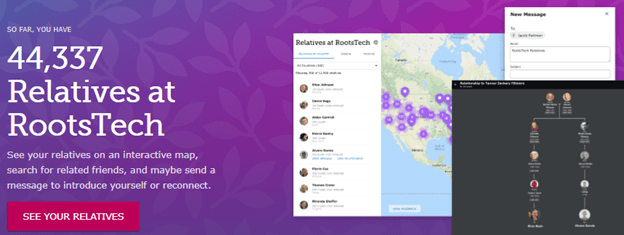
The official counter stopped updating at the beginning of RootsTech, so we don’t know how many people have actually signed up. I do know that my number of Relatives at RootsTech has increased from 44,337 on the first full day to 57,906 today.

That’s an increase of about 31%. If you extrapolate and multiply the 501,000 people registered when the counter stopped, that means there’s more than 650,000 registrants, 150,000 of whom who signed up during RootsTech.

That’s the approximate size of these US cities:

  • Nashville
  • Detroit
  • Oklahoma City
  • Portland
  • Las Vegas
  • Memphis

Put another way, that’s more than three times the size of Salt Lake City that has about 200,000 residents.

No one, but no one, expected anything like this.

Why?

So why do we do this?

It connects our souls.

I want to share with you this amazing, short video, here. This box of found pictures provided photos of ancestors long dead to descendants in an Alaska indigenous community that didn’t even have cameras in the 1950s and 1960s.

Like the man in the video said, genealogy connects our souls. That connection sustains us. Through tough times. Through pandemics. And bridges death. It connects us through the people we know or knew to the ones we didn’t.

That’s why genealogists seek ancestors. We carry part of them in us – their DNA, their eyes, their hands perhaps, their smile and yes, maybe even their souls.

Genealogy, and specifically, DNA helps us to find them. Genetics identifies what parts of us come from them.

DNA Learning Center Activities

Through the DNA Learning Center Activities at RootsTech, I discovered the fun Traits Tree. Check it out. You may learn something you didn’t know about genetic traits. Who else has them in your family?

Who doesn’t love the Jelly Bean (er, I mean Gene) Machine at RootsTech where you can learn about autosomal DNA inheritance?

You can’t eat them this year, but you can still learn about autosomal inheritance in this fun little Jelly Genes app.

You can also connect to Learn.Genetics.

If you want to learn about the science behind DNA, Learn Genetics at the University of Utah has provided this great reference, including classroom materials.

Winding Down

I’m embarrassed to tell you that I’ve only managed to watch 2 or 3 sessions and part of one keynote.

What have I been doing and what have I accomplished? I wonder the same thing.

  • I’ve answered literally hundreds of questions in the chat rooms from my sessions and other rooms where I volunteered. I’m not positive that being able to direct message speakers, especially without notification capability was a good idea. Most people are kind and patient, understanding that this is not a slumber party and speakers, even genealogy speakers, must sleep from time to time. 😊
  • I made a list of all of the Y and mtDNA lines that I need in the closest 7 generations, allowing me to make the best use of my time working with Relatives at RootsTech.
  • I was VERY disappointed to discover that I could only see how the top 300 Relatives at RootsTech were related to me. Personally, I think this is one of the best features. I would LOVE to be able to sort those relatives by ancestor. I was told that this app is better on the phone, so I would hope that the online version could be enhanced to provide what the phone app does for future conferences.
  • Using the app, I discovered a cousin in the Netherlands on my Dutch line that I didn’t know existed. I hope they answer.
  • I built a wonderful playlist for myself. If I watch just one presentation a day, every day, I’ll be done sometime around the first of August with individual sessions, and that’s before I watch the 16 series that have more than one session each.

This is a wonderful gift. Something every single day to look forward to. I can probably watch and listen to some while I’m quilting or cleaning or doing some other task that doesn’t require my full concentration.

I know RootsTech Connect 2021 was different and bumpy and sometimes difficult – for you and trust me, for the speakers too. But it has also been a growing experience.

We’re on the other side of it now. Warriors – and we survived. And you know what – it just might be the best RootsTech yet because it’s not really over.

I hope next year we can all be gathered back together again in Salt Lake City – in person but also incorporating the best of this year of forced change. By that I mean, inclusive so that RootsTech can again be a global event. Wouldn’t you love to actually be able to see the speakers live as they present?

Hope

I’ve been sharing my DNA garb with you this week. Today, I’m sharing something a bit different.

Hope.

I ordered this absolutely stunning woven Kente cloth from Ghana. I’m sure you see the helix.

This cloth represents so much to me, personally.

First, we all descend from Africa.

We are all related.

We are all connected.

We are humankind.

This cloth represents hope to me – reaching into our common past – and extending into the future.

A future that hopefully includes a trip to Salt Lake City for RootsTech next year.

One of the reasons I’m so passionate about Y DNA and mitochondrial DNA and love it so very much is because that is the only avenue we have to connect ourselves back into the distant past – beyond the mists of time. Crossing that veil into antiquity, before surnames and before genealogy as we know it. Yet, it’s there, within our reach and DNA opens that door.

Stretching back and informing us about our family in the distant past. Telling the story of their path, their journey and their struggles that led to us.

We are woven together by the tapestry of life, through our ancestors, both recent and distant. And yes, their DNA is interwoven in us as well. Individual threads of them that created each unique one of us.

Kente cloth at its best.

May your ancestors bring you hope and love and inspiration.

I’ll share with you next year what my ancestors inspire me to do with this wonderful hand-woven fabric that represents their collective lives. Yes, my ancestors walk with me in this way too.

Every. Single. Day.

In Closing

I actually did manage to watch the closing session with Steve Rockwood. He’s not only the FamilySearch CEO, but he’s an incredibly gifted speaker. I don’t want to say more, but I hope you will be able watch even though it’s lengthy.

If you like music and songwriting, this is definitely for you. Music reaches places that words cannot.

One last thing – you absolutely will not get through this final session dry-eyed. “Love me like it’s 1961…..” and that’s just the beginning. Just get the box of Kleenex.

Let me close these four days of RootsTech Connect 2021 by sharing these thoughts.

Give us hope.

We are not alone.

Let us heal.

Connect our souls.

_____________________________________________________________

Disclosure

I receive a small contribution when you click on some of the links to vendors in my articles. This does NOT increase the price you pay but helps me to keep the lights on and this informational blog free for everyone. Please click on the links in the articles or to the vendors below if you are purchasing products or DNA testing.

Thank you so much.

DNA Purchases and Free Transfers

Genealogy Products and Services

Genealogy Research

Books

Rootstech 2021 Day 3: Picture Perfect & Great Prices!

How can a virtual conference possibly be this tiring? I’ve been trying to watch a few sessions, but I’ve spent most of my time in various chat rooms answering questions.

Of course, I discovered that 23andMe changed their product AFTER I recorded and submitted the Triangulation video. Guess what you’ll be reading next week!

Yep, a clarification article. I’m using the word “clarification” loosely here, because it’s still confusing.

So, what’s going on in the genealogy community and at RootsTech today?

Well, for starters, MyHeritage has been acquired. This was out of left field. Wow.

MyHeritage Acquisition

MyHeritage has been acquired by private equity firm, Francisco Partners.

I have no idea if the MyHeritage acquisition was timed to correspond to RootsTech, but regardless, it did.

We’re used to big announcements at RootsTech, but not this big, and not announcements of this nature, either.

In the past several months, all of the other 3 major genetic genealogy companies have been acquired. MyHeritage is number four.

Here’s the Business Wire link, and here’s a very nice article from a personal perspective of a long-standing MyHeritage board member.

I have to tell you, this made me draw a sharp breath, so I reached out to three people at MyHeritage in positions to know. After hearing from all three within hours, I’m greatly relieved.

Founder Gilad Japhet is remaining in position as CEO, as is the rest of the staff. This acquisition means more investment dollars which means that MyHeritage can digitize more records and produce more tools for genealogists.

2021, in the genetic genealogy world, is a new ballgame. All 4 vendors now have new owners, and a year ago, GEDmatch was sold as well.

Gilad is, at heart, first and foremost a genealogist, as is Bennett Greenspan from FamilyTreeDNA who retained a board seat after the GenebyGene/myDNA merger.

I was relieved to read in the MyHeritage PR release the following:

MyHeritage takes a best-in-class approach to user privacy and does not sell or license personal data. Under MyHeritage’s partnership with Francisco Partners, this commitment will be further strengthened and users will benefit from enhancements to the company’s privacy framework. As a first step in this strategy, MyHeritage will shortly update its privacy policy to include the unequivocal prohibition for the company to license or sell genetic data to any 3rd party. These updates will be highly unique amongst the larger genealogy and genetic DNA industry and are a testament to the commitment both MyHeritage and Francisco Partners share to privacy and consumers.

That’s not all MyHeritage has been up to.

MyHeritage Introduces Deep Nostalgia

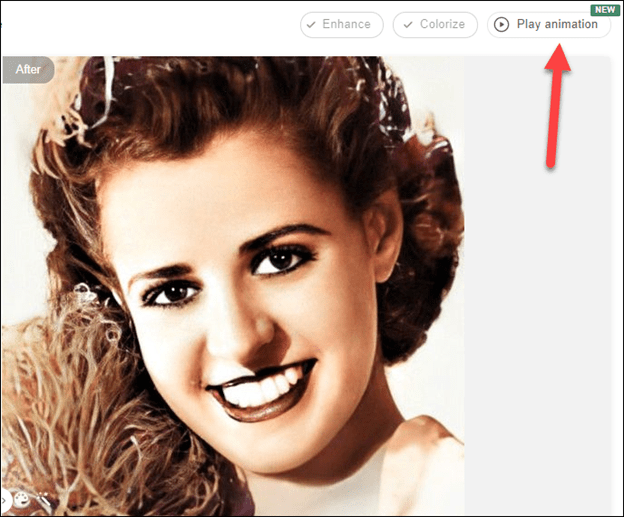
MyHeritage introduced yet another photo enhancement tool. You’ll want to try this for yourself.

Deep Nostalgia is different than photo enhancement. It animates faces. Some people love this, and others think it’s kind of creepy. I’ve animated several photos, and I think it has to do with the photo to begin with, and if you knew the person in real life.

For one of my friends who only has photos of their parents and grandparents, and never knew them, this technology has been a gift of the highest magnitude.

I immediately went and animated my grandmother who died the year I was born.

I would suggest starting with a photo of yourself maybe to see if you want to go further. Or, maybe, just jump right in.

So far, my favorite is the picture of my mother as a child that you can see right here. I love this little girl so very much. This technology is the only way I’ll ever “see” my mother move as a child. I want to hug her. She looks so much like my daughter about the same age.

The enhancement technology itself is amazing, even without animation.

I clicked to animate this photo, above, and look at my Mom’s face, below, after the animation. Where you see the animation button, below, you’ll discover that you can select animations 1-10 and they are quite different. If you don’t like one, try a different one. I liked this one of my Mom.

MyHeritage enhances the photos before animating. Their technology has improved dramatically from the first versions, just a few months ago. This picture of my mother during her show business years is stunning. Upload any photo or click on a photo in your photo gallery at MyHeritage, then just click on the animate button.

Additionally, MyHeritage rolled out a few new features in the past couple of weeks and I’ve been so busy I almost missed them.

You can now see if a shared match has a tree and access it directly from the Shared DNA match page. You can also see any notes and how many people are in this person’s tree by flying your mouse over the respective icons. Adding those notes in this location is a godsend for me, because I always note as much as I can discover about each match and now I don’t have to click to open each match just to “see who they are.”

click images to enlarge

You can read more in the MyHeritage blog, here.

Ancestry

I watched the “What’s New at Ancestry” video to see if they have any announcements since RootsTech is typically a platform for those types of splashes. The information in the video is from 2020. I didn’t find anything new involving DNA, although Crista was discussing new green leaf genealogy hint algorithms and such.

She did say that while ethnicity percentages will be updated once a year or so, Genetic Communities is updated on an ongoing basis. She mentioned Ancestry’s Genetic Communities patented technology combines the consumer genetic network and their family trees.

Crista clarified that ethnicity estimates are looking at where your DNA was 500-1000 years ago. Genetic Communities is looking at where your family members lived in the last 100-200 years. The last update, just a couple weeks ago, applied to 8 million users, of 18 million total. I received one new subset community.

Nothing mentioned about 2021.

DNA Kit Sales

I was surprised to discover that Ancestry is not offering any promotions in their booth. Not for DNA and not for subscriptions. Even at Amazon, the Ancestry DNA kit is $99.

If you’re wondering about 23andMe, they weren’t at RootsTech last year and they are absent this year too. If you’ve tested at 23andMe, you can transfer to both MyHeritage and Family Tree DNA.

If you need upload, download or transfer instructions for any vendor, click here.

That’s OK, amble on over to the MyHeritage and FamilyTreeDNA booths who are both having great sales.

Family Tree DNA – Best DNA Price of RootsTech 2021

  • At FamilyTreeDNA, their autosomal Family Finder test is now only $49. This is the best price of the conference. Click here to purchase using coupon code RTCTFF.
  • I noticed that FamilyTreeDNA added a sale code for the Autosomal Transfer advanced tool unlock too, good through March 7th. If you’ve been waiting, now’s a great time. You can click here to sign on, upload your DNA file if you’ve tested elsewhere and then unlock using code RTCAU10.

You can see all of the FamilyTreeDNA show prices, here.

MyHeritage – Free Advanced Tools Unlock Expires in Two Days

Ok, let’s do something fun now.

RootsTech “Souvenir” Photos

You can get a “souvenir” photo of yourself, or someone else, at RootsTech. Yep, time travel, of sorts. Click here.

I didn’t want a photo of myself taken in my office when I haven’t had a haircut in over a year, so I selected a photo I like much better.

RootsTech is building a real-time mosaic. Of course, your eyes have to be better than mine to find yourself😊

Surname Search

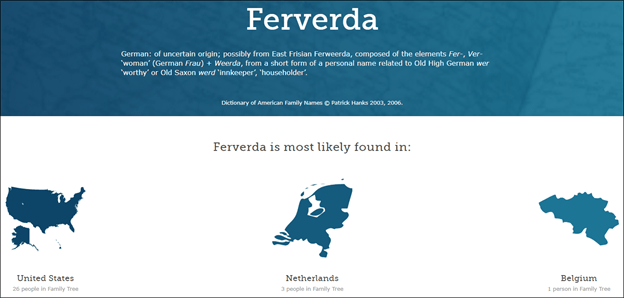
Another fun activity is the FamilySearch surname search tool that shows where in the world a particular surname is found.

Of course, in many cases, the top location is the US, land of immigrants, but hey, the genesis of the surname is quite interesting.

Have fun.

DNA Garb

Today’s DNA outfit is my chromosome sweater, and no, I didn’t make it.

Unlike the vests and dresses, this isn’t a dress-up item, but just something that’s soft and comfortable and I wear it in my office. I stuff it in my carry-on travel bag and you would be more likely to see me wearing this than any of my “good” DNA outfits😊

It’s still snowy where I live, which reminds me of Salt Lake City – so I just took a walk and pretended.

It’s hard to believe tomorrow is the last day of the conference already. What fun things are you doing at RootsTech?

_____________________________________________________________

Disclosure

I receive a small contribution when you click on some of the links to vendors in my articles. This does NOT increase the price you pay but helps me to keep the lights on and this informational blog free for everyone. Please click on the links in the articles or to the vendors below if you are purchasing products or DNA testing.

Thank you so much.

DNA Purchases and Free Transfers

Genealogy Products and Services

Genealogy Research

Books

RootsTech 2021 Day 2: Hints, Chats & Bittersweet Memories

The RootsTech Expo Hall opened last night, followed by the sessions four hours later. We learned a lot about navigating the system, and how to use the various chats too.

News items first.

Relatives at RootsTech is Available ONLY During RootsTech

That cool “Relatives at RootsTech” feature won’t be available after RootsTech ends. So, if you want to see who your relatives are at RootsTech, you must do it now. Scroll down when you sign in to the conference or click here.

If you add your relatives to a friend list, that list will be available until March 20th-ish.

HINT – If you are looking for mitochondrial DNA candidates for a particular ancestor, this is an avenue to make those discoveries and find a candidate who descends through that ancestor to the current generation through all females. The current generation can be male.

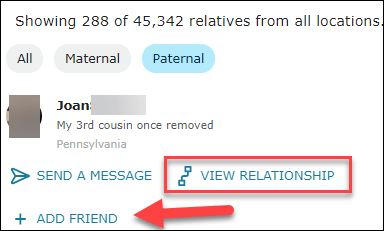
I selected the paternal side of my tree, then clicked to show how we’re related. In this case, Alexander Smith is a male, so my relative who descends from Alexander Smith is NOT a candidate to test for Margaret Herrell’s mitochondrial DNA.

We can search by surname, but not by ancestor.

I can bookmark the sessions I want to watch and watch them over the next year, but I won’t have access to these relatives beyond the conference. My priorities for the next couple days have just shifted.

Make yourself a list of Y and mitochondrial candidates that you need and have at it!

Search Bug

Searching for a presenter by name may or may not work, and may not work correctly.

Putting quotes around the name may or may not help. For example, Judy Russell and Tom Jones aren’t showing up reliably in searches, but trust me, they are both “there.”

Use the lists and search by session name, or by topic. Or scroll. Otherwise, you’re going to miss people and sessions you want to see – including sessions in the next category.

Tips and Tricks

Yesterday, in the Sneak Preview article we discussed that there are:

There’s a fifth category. I didn’t realize these sessions weren’t listed with the regular sessions, but they aren’t. I wouldn’t have realized it at all if I hadn’t known someone who recorded one and couldn’t find her session. They are collectively called “Tips and Tricks,” and they are shorter videos of just a few minutes each, from 3-20 minutes, recorded by volunteers. (A big thank you to those folks.)

Here’s a great example. Katherine Borges recorded “DNA and Lineage Societies.” It’s a lovely and informative presentation and explains the various societies, such as DAR, SAR, Mayflower and others, and how they utilize DNA. How does that work anyway? Watch Katherine’s session to find out.

Did you know that one of the societies uses X DNA too?

Katherine talks about the “DNA jackpot lottery” which always makes me chuckle.

Many lineage societies have DNA Projects at FamilyTreeDNA too.

Take a look by scrolling down on the FamilyTreeDNA page, here, until you see the search box, then type in a keyword like DAR or Mayflower.

You won’t find Katherine’s presentation by searching for her name, unfortunately.

The ONLY way you can find these Tips and Tricks sessions is to scroll through each of the various categories, on this page, and read what’s available.

I’m hoping that RootsTech will make available a list of these Tips and Tricks sessions. If they do, even if it’s after the show, I’ll publish it so you don’t miss anything. You can add these sessions to your playlist.

Chat Rooms & Ask Us Anything

Remember those very nice people wearing the teal “ask me anything” shirts at RootsTech in the exhibit hall? Well, they’re still here, just differently.

On the upper toolbar, that teal or blue circle with the chat icon – that’s “ask us anything.” Just click.

To ask a vendor questions, you MUST go to their booth first in the Expo hall.

Once there, you can do two things.

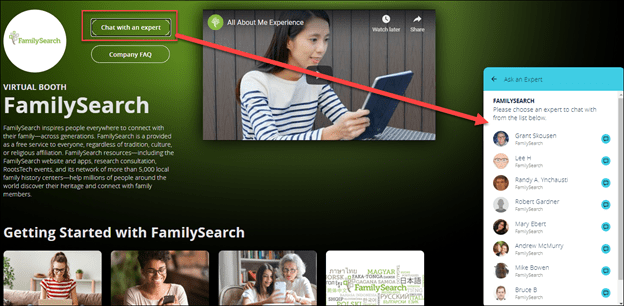
You can request to “chat with an expert” which then opens a list of experts who are available at that time to chat one-on-one.

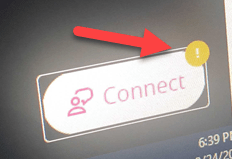
If you want to ask a general question, not one-on-one with someone, while on that vendor’s page, you can click on the Connect button on the lower right-hand corner of the page.

Hint: If you try to chat or connect and see a yellow ! mark and receive a message about not being able to connect to the chat server, be sure you actually signed in to the conference. If so, sign out and sign in again.

Yes, unfortunately, the chats have been a bit glitchy, but trying again or waiting a bit to try again usually takes care of the problem.

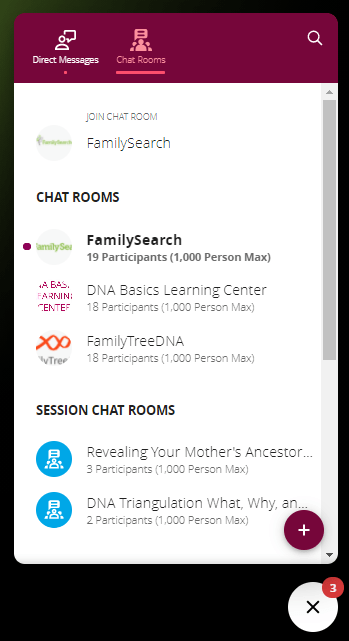
Once you click on the Connect button, this window will open.

You’ll then see the list of chat rooms that you’ve visited. At the top of the list is the chat room for the vendor’s page that you are currently visiting.

Just click on that chat room to review the messages and ask your question.

Note that at the top, you have two tabs – one for chat rooms and one for direct messages.

The little number in the bottom right corner is the number of messages and chats that have messages you haven’t seen.

You can leave a room by clicking on the three dots for other options.

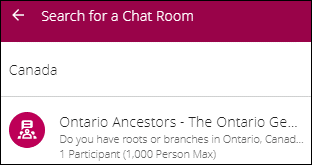
Another thing you can do is to search for rooms or topics.

Click on the little search icon in the top right, above.

I just searched for Canada.

Hint: Vendor’s booths do NOT show up in the chat search unless they have added a second booth.

Each presentation or session also has an associated chat room. Go to that session and after watching, click on either “Join Chat Room” beneath the descriptive text, or click on Connect in the corner.

My Sessions

Now that RootsTech is open, you can watch all regular sessions, including mine. DNA Learning Center sessions are released on a preset schedule.

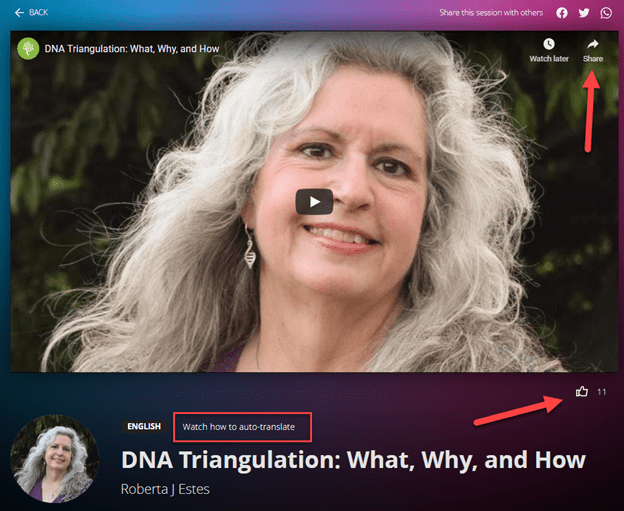
Here’s the link to my session, DNA Triangulation: What, Why, and How at FamilySearch.

There are three interesting things.

  • First, you can share sessions on social media; Facebook, Twitter, and WhatsApp. Please share sessions that you enjoy that others might enjoy too.
  • Second please leave positive feedback for speakers. It’s the social media equivalent of clapping or “thank you.” Speakers can’t see you and many have volunteered many hours to create these sessions and are devoting more time answering questions in chat rooms.
  • Third, the information about how to auto-translate is quite interesting. Clicking on that link takes you to a “Quicktip Selecting auto-translate in youtube.”

Youtube you ask?

Yes, RootsTech is using YouTube as the delivery platform on the FamilySearch channel. You can share the YouTube link for sessions too. Here’s the YouTube link for this session. These are not searchable, just so you know.

Be sure to check the Downloadable Resources, beneath each regular session. I provided links to a number of articles that help explain the details that I couldn’t cover in a single presentation.

Note that DNA Learning Center sessions are created by volunteers and don’t have associated downloadable documents.

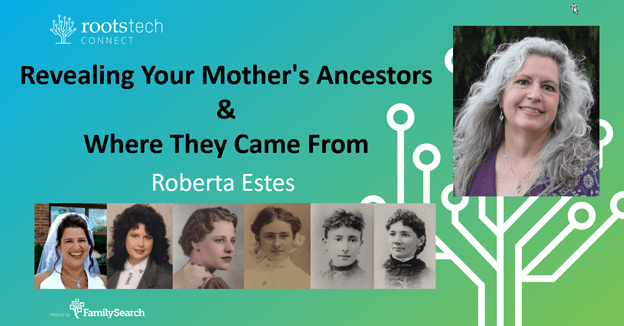
My second session, in the DNA Learning Center, Revealing Your Mother’s Ancestors and Where They Came From is live now too. Be sure you are signed in to the conference to play the video.

We had SO MUCH FUN in the chat for this session right after it finished. Great questions and Dr. Miguel Vilar, former Lead Scientist for the Genographic Project and Million Mito Project colleague joined us and helped to answer questions too. You just never know who you’ll find at RootsTech😊

Here’s the YouTube link for this session.

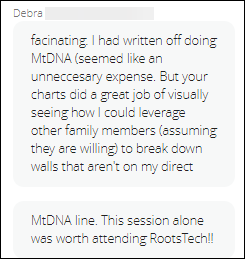
I’m sharing feedback from Debra in the chat. This is why we speakers do what we do! Thank you Debra for this incredible compliment. I surely hope Debra and all of you break down those pesky brick walls too.

Memories

A few years ago, I had some custom chromosome browser fabric made that portrays my family members’ matching DNA painted on my chromosomes. Yes, I know that’s terribly, horribly geeky, but it sure is FUN!.

I had the background painted purple because that’s my favorite color. I’ve been wearing this outfit off and on for 3 or 4 years now – just to conferences.

I asked my husband to take this photo this morning for today’s DNA conference clothing.

Later today, I was feeling somewhat melancholy. I miss people and I’m missing my so-very-many-friends at RootsTech.

And then, something amazing happened.

I was searching around my system for a good “RootsTech past” photo when this one popped up.

Wouldn’t you know it, I was wearing this exact same dress.

What a coincidence, right?

But there’s more…

I’m laughing with my friend, Bob McLaren, who was at RootsTech for as many years as I can remember, volunteering in the FamilyTreeDNA booth, always wearing his McLaren kilt and clan regalia.

Bob loved genealogy, DNA, and interacting with people, which is why he was always at genealogy conferences.

Everyone knew and remembered Bob simply as the “man wearing the kilt.” We all loved him, and it showed.

We lost Bob unexpectedly in 2020.

This is exactly why RootsTech is so important.

Connections.

Hugs.

Laughter.

Memories.

Were it not for genealogy, I would never have met Bob, some 17 or 18 years ago.

Were it not for conferences, I wouldn’t have seen Bob each and every one of those years.

I miss Bob ribbing me.

I’m a Campbell you know, and well, those Campbell’s and McLaren clans just didn’t get along very well up in the Scottish Highlands. Never let it be said that clans let bygones be bygones. That’s heresy! Just ask Bob.

I vividly remember one time telling Bob that I was pretty sure I saw where those McLaren’s DNA matched a Campbell man. Bob didn’t much care for that news and wasn’t’ shy about telling me so. That’s OK, because it was a yarn I spun for his benefit.

I alleged that SOME Campbell and SOME McLaren had apparently liked each other just fine and he insisted that would never have happened. Our debate resumed every single year. It was, of course, a tradition we both enjoyed.

But not this year.

There’s silence.

Just silence.

I miss Bob.

I’ve never been so grateful for the past. Things I took for granted. Often little things.

Hearing someone’s voice.

Their laughter.

People I thought I’d see again “next year,” or before.

People I’m so blessed, so privileged to know.

People I love.

People I want to hug.

I so look forward to the future. Next year.

I miss people.

I will forever miss Bob, but I know he is with me today.

_____________________________________________________________

Disclosure

I receive a small contribution when you click on some of the links to vendors in my articles. This does NOT increase the price you pay but helps me to keep the lights on and this informational blog free for everyone. Please click on the links in the articles or to the vendors below if you are purchasing products or DNA testing.

Thank you so much.

DNA Purchases and Free Transfers

Genealogy Products and Services

Genealogy Research

Books

  • com – Lots of wonderful genealogy research books

RootsTech 2021 Opening Day: Sneak Preview & Navigation

I am so overwhelmed today. Mostly in a good way. I’m writing this so that hopefully, you won’t be.

If you’re riding along with me for the RootsTech journey this year, you’ll recall that my daily RootsTech conference posts are less than polished. Quick and dirty is the only way I can get them out the door. So I just apologize in advance. Things move very quickly during RootsTech week, and polished articles take a long time to refine.

If you haven’t already subscribed to my blog, you can do so by going to www.dna-explained.com and signing up. It’s free.

I wrote about the RootsTech presentations, here. We have a lot more information now.

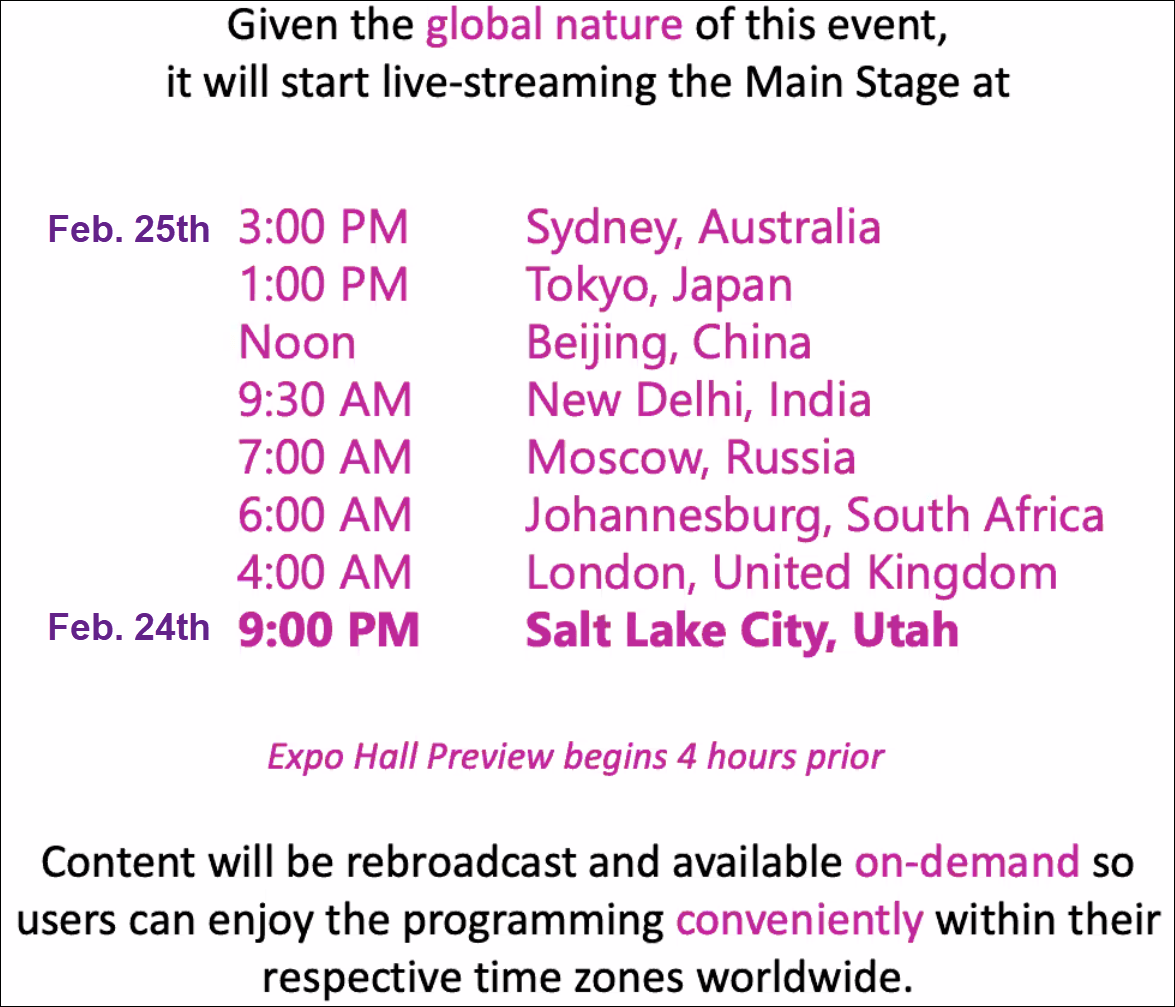
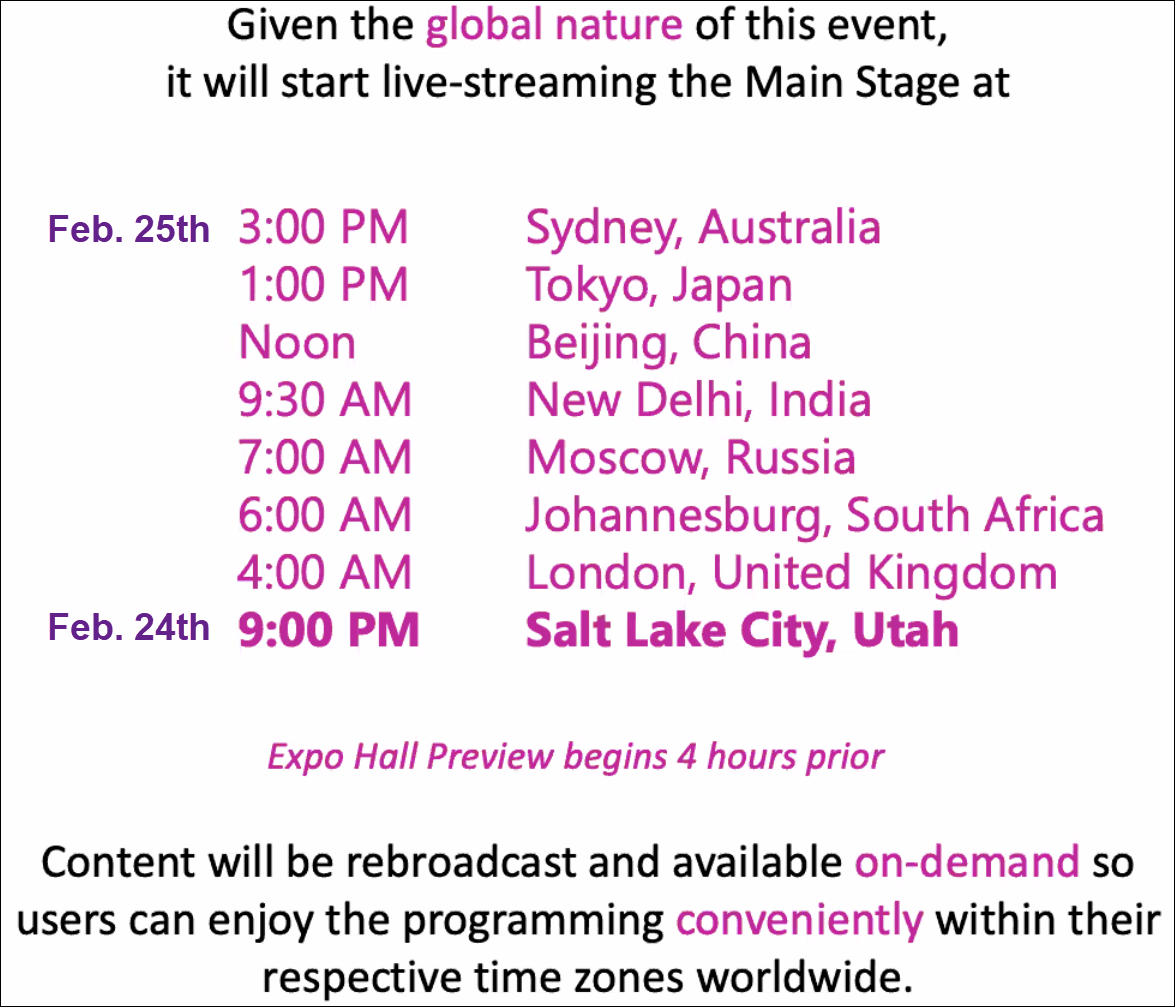
RootsTech opens this afternoon, depending on where you are in the world. Here are the times. Remember, it’s already tomorrow down under.

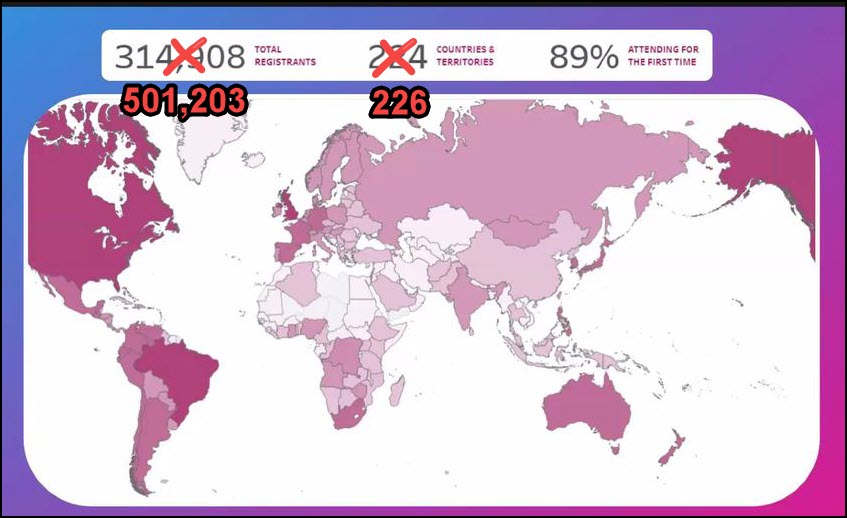
There are a HUGE number of registrants. This graphic was from a few days ago.

Drum roll please…

Today’s numbers, this morning, topped half a million registrants. That’s the size of a major city.

RootsTech is by far the largest genealogy and largest DNA event that the world has ever seen. You can still sign up, here. It’s totally free.

Important

This is important – there are FOUR places at RootsTech to view different educational sessions.

  • The presenters, who would normally be presenting in conference rooms.
  • The DNA Learning Center, sponsored by FamilySearch, normally found in the Expo Hall.
  • The Demo Theater, which are sessions recorded by the vendors that would normally be presented in the Demo Theater on the show floor.
  • The vendors’ virtual booths.

I’m going to run through how to find all of these and how to navigate the website.

Sessions

The list of regular sessions is here. PLEASE NOTE THAT THERE IS NO TIME SCHEDULE. The reason there aren’t times is because the sessions are all pre-recorded and you will be able to watch at your convenience. You’ll be able to build a custom playlist for yourself too.

Navigating

This is the main RootsTech site, here. Notice the navigation bar across the top. You’ll be able to view these links AFTER the website opens. 

This primer will help you navigate and find what you need.

Guide Me – DNA Basics Learning Center

If you click on “Guide Me” – you’ll see categories of interests. Under DNA, you’ll see the DNA Basics Learning Center.

There are lots of resources in the DNA Learning Center, including the Live Class Session Schedule, here. Please note that these are DIFFERENT sessions than the regular presentation sessions and are NOT listed on that schedule.

If you click on “Live Sessions” and then on more, you’ll see my session.

Several experts have volunteered to answer questions for the DNA Basics Learning Center across the multiple days of the conference – so you might find me there. There is pretty much always someone available. We are just now receiving training on how this works, so we’ll all be on an adventure together the first couple of hours😊

If you click the Connect button at the bottom of any session or vendor booth or any page, it opens a chat box where you can ask questions.

For fun, click on “Show My Relatives.”

I believe these relatives are shown in closest to most distant order, because I see a number of third cousins that I recognize. Trust me, I’ll be messaging each of these closer relatives. For one thing, I want to know if they have DNA tested, and where. I also want to know who our common ancestor is. Maybe they have photos I don’t have, or maybe I can help them.

Click on any name to initiate a chat with that person.

These chat features will only be available during the actual RootsTech show days.

Sessions

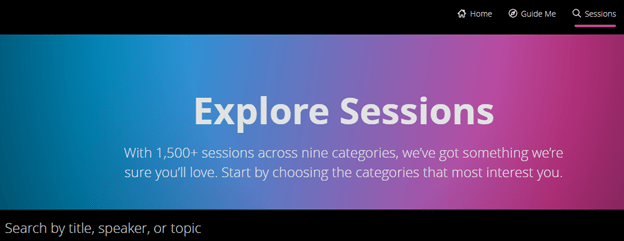
If you click on “Sessions,’ on the main Rootstech tab, you’ll be able to search by a variety of topics, names or session titles.

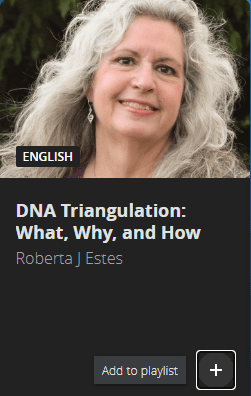
I searched for my own name, and sure enough, here’s my session. There are other sessions listed too, but those are other speakers – not me.

Clicking on that + (plus sign) adds the session to your playlist. How fun it this! You can customize your own RootsTech conference. These sessions will be available for the next year, so no hurry.

Expo Hall

Next, click on “Expo Hall” on the main tab.

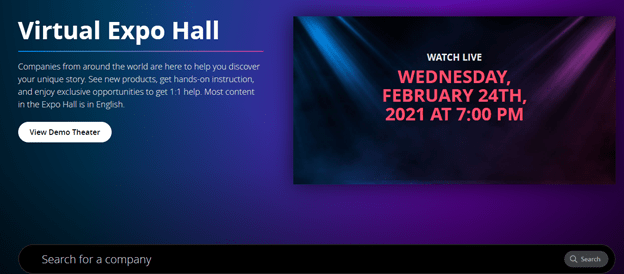
Remember, the Expo Hall opens 4 hours before the conference, so 7 PM EST time.

If you click on Expo Hall, you’ll see the following:

This is 7 PM tonight, EST. I believe that the website converts this to your time, but I’m not positive.

If you click on “View Demo Theater,” you’ll see the vendor sessions. There are several here that I want to watch, and the good news is that you can add these to your playlist too.

You can also search for a specific vendor or scroll.

There are lots more vendors. This is just a sampler platter!

Five things of note.

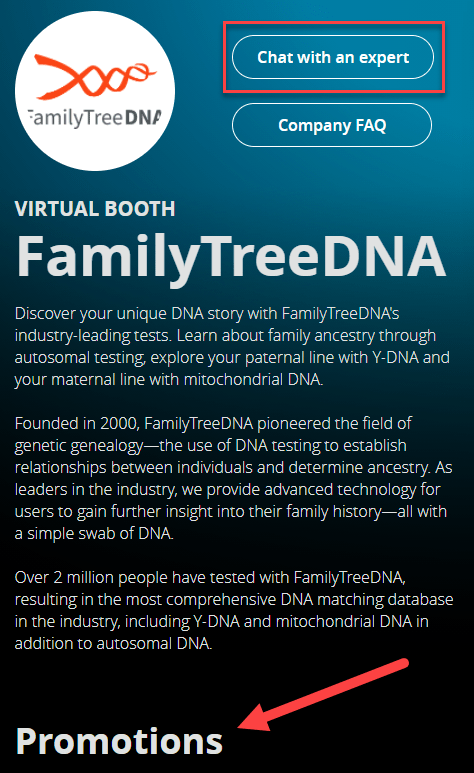
  • First, vendors will have sales. Note that “Promotions” word in the FamilyTreeDNA booth, below.
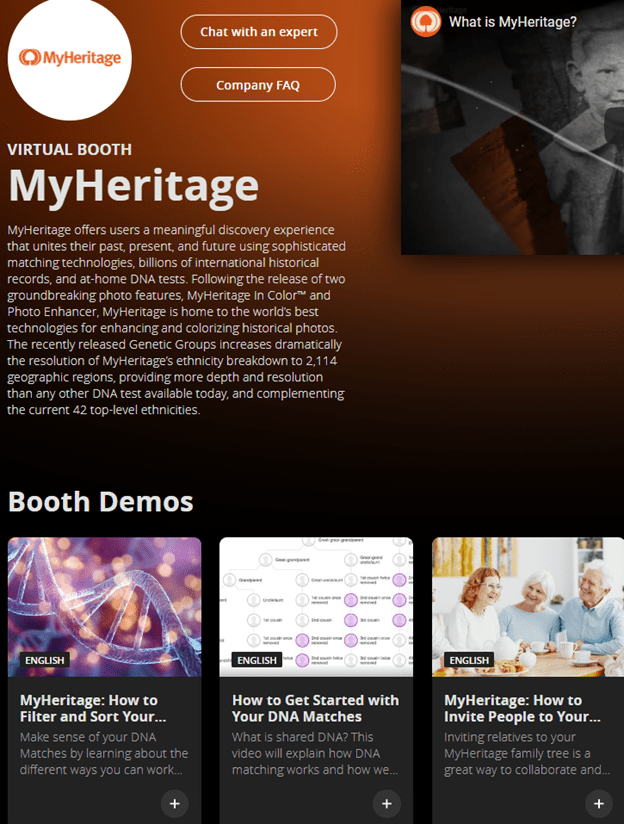
  • Second, vendors may offer sessions in their booths that are not available elsewhere. Note the MyHeritage booth, below.
  • Third, vendors will probably make announcements during RootsTech. I know of a few, but I can’t share until after the official vendor announcement.
  • Fourth, many vendors will have downloadable resources. Be sure to scroll to the bottom of each booth to see everything.
  • Fifth, you can “chat with an expert” in any vendor’s booth. FamilyTreeDNA experts will include people who would normally staff the booth, of course. However, the 24×7 times three days conference nature is a challenge, so they have included members of the science team along with project administrators from around the world. You just might find someone you know there from time to time, with expertise in a specific area. Note that vendors can also set up “chat rooms” for specific topics, or when experts are “visiting.”

These leaked yesterday, so here are the FTDNA prices and discount codes.

You can order or upgrade by clicking here.

In the MyHeritage booth, they offer three demos that aren’t available elsewhere. You can also add these to your playlist.

Don’t forget that MyHeritage is offering the free transfer and FREE advanced tool unlock during the conference – so if you haven’t transferred your DNA file to MyHeriage, now’s the time and you can do that, here. I wrote about how to do that, with instructions, here.

Of course, you can also purchase a MyHeritage DNA kit, here.

My Schedule

I’ll be three places, live.

  • Answering questions in the FamilyTreeDNA booth as a guest expert for 2 hours beginning at 7 PM EST tonight.
  • The DNA Learning Center from time to time.
  • In the chat rooms for my own sessions.

If I have additions or more designated times, I’ll let you know as the week unfolds.

One Last Thing – JOY

Yes, RootsTech has been a struggle this year – for the presenters, for the vendors, for the volunteers, but especially for the FamilySearch/RootsTech staff. Bless their hearts, and I mean that.

I want to put this in perspective.

Without a virtual RootsTech, we would have NO RootsTech this year. I can’t even begin to say how much I’m missing being in Salt Lake City, seeing my friends, meeting you, my wonderful blog readers, finding new cousins, looking at all the cool things on the show floor, and researching at the Family History Library.

This year is different, but RootsTech Connect is bringing JOY – JOY, when we need it the very most.

We can indeed connect with other people. And because RootsTech is free, we can include even more people in our community. More people to collaborate with. More people to DNA test. More people finding ancestors. More people to share the JOY.

As you may know, I’m a quilter, and I’ve made “DNA clothes” that I wear to RootsTech and other conferences for several years now. This year, I’m doing something different. I’m dressing up anyway, even though I’m attending at home – just to get in the spirit. I’ll take a picture every day of my DNA outfit and how I’m being joyful, right where I live.

I’m wearing my RootsTech Connect 2021 pin too which signifies an amazing community achievement. I’m proud to be a part of this momentous event.

It’s bright and sunny and a beautiful winter day. A bit windy. But that’s OK. Do you see the helix that looks windblown right along with me?

You be joyful too!

What are your RootsTech plans?

See you at RootsTech. Be sure to tune in for tomorrow’s RootsTech blog article. Who knows what tomorrow will bring!

_____________________________________________________________

Disclosure

I receive a small contribution when you click on some of the links to vendors in my articles. This does NOT increase the price you pay but helps me to keep the lights on and this informational blog free for everyone. Please click on the links in the articles or to the vendors below if you are purchasing products or DNA testing.

Thank you so much.

DNA Purchases and Free Transfers

Genealogy Products and Services

Genealogy Research

Books

Free Webinar: Revealing Your Mother’s Ancestors & Where They Came From

I want to personally invite everyone to “save the date” for the free presentation I’ve created for the RootsTech DNA Basics Learning Center.

Those of you who have attended RootsTech in person in Salt Lake City over the past couple of years may have noticed the DNA Center sponsored by FamilySearch that provides non-vendor-specific DNA education for everyone.

You probably remember their DNA beans explaining the concept of random autosomal inheritance.

That tidy little package is “you.” The genealogical goal, of course, is to work backwards and figure out who, in your tree, those jellybean colors represent.

This year we won’t be gathering together in Salt Lake City, so it will be a bring-your-own-jellybeans event. However, the DNA Learning Center will be available virtually – which is actually a great benefit.

I know, I want to see everyone too – but in this case, the sessions are recorded and will be available for everyone worldwide so we can educate far more people than on the show floor.

Revealing Your Mother’s Ancestors & Where They Came From

In addition to my regular session, which I’ll write about as soon as the schedule is finalized, I volunteered to create a basic presentation for the DNA Learning Center. DNA is critically important to genealogy and I want everyone to enjoy that benefit.

As everyone knows, maternal ancestors are often challenging for a variety of reasons. Because surnames change with marriage, at least in most western cultures, females’ birth surnames are more prone to be missing. Fortunately, DNA has provided genealogists with two different tools to help overcome those challenges.

Mitochondrial DNA is focused only on your direct matrilineal (your mother’s mother’s mother’s) line, and autosomal DNA can be inherited from any ancestor. However, there are tools and techniques that allow us to hone autosomal results and use them selectively.

I’ll be covering inheritance and how to utilize both autosomal and mitochondrial DNA, including haplogroups, for your genealogy. Both separately, and together.

We’ll discuss how a cousin and I collaborated, using both types of DNA in addition to traditional genealogical records to break through one of those “no surname” brick walls six generations in the past. That breakthrough then revealed several MORE generations, like dominoes falling in quick succession.

Those pesky ancestors had moved from Long Island to New Jersey to Virginia leaving no backward trail. Cleary, not your normal migration pattern. This mystery absolutely could NOT have been solved without mitochondrial DNA pointing the way.

When and Where?

The where is easy – on your computer or device, of course.

Currently, this free session is scheduled to air twice, so mark your calendar:

  • February 25 – 3 PM EST – captioned in English
  • February 27 – 1 PM EST – captioned in Spanish

FamilySearch is providing volunteers to answer questions entered into the online chat during all of the DNA Learning Center sessions, including mine. I plan to “be there” to answer questions too, as will several other volunteers. Some volunteers will speak Spanish on the 27th. Unfortunately, I don’t speak Spanish, so I’ll be restricted to answering questions in English.

When the entire 3-day DNA Learning Center schedule is finalized, I’ll post and give a huge shout-out to the other volunteer speakers too.

While we wait for Rootstech to arrive, you still have time to order mitochondrial or autosomal DNA tests, below.

_____________________________________________________________

Disclosure

I receive a small contribution when you click on some of the links to vendors in my articles. This does NOT increase the price you pay but helps me to keep the lights on and this informational blog free for everyone. Please click on the links in the articles or to the vendors below if you are purchasing products or DNA testing.

Thank you so much.

DNA Purchases and Free Transfers

Genealogy Products and Services

Genealogy Research

Books

Genetic Genealogy at 20 Years: Where Have We Been, Where Are We Going and What’s Important?

Not only have we put 2020 in the rear-view mirror, thankfully, we’re at the 20-year, two-decade milestone. The point at which genetics was first added to the toolbox of genealogists.

It seems both like yesterday and forever ago. And yes, I’ve been here the whole time,  as a spectator, researcher, and active participant.

Let’s put this in perspective. On New Year’s Eve, right at midnight, in 2005, I was able to score kit number 50,000 at Family Tree DNA. I remember this because it seemed like such a bizarre thing to be doing at midnight on New Year’s Eve. But hey, we genealogists are what we are.

I knew that momentous kit number which seemed just HUGE at the time was on the threshold of being sold, because I had inadvertently purchased kit 49,997 a few minutes earlier.

Somehow kit 50,000 seemed like such a huge milestone, a landmark – so I quickly bought kits, 49,998, 49,999, and then…would I get it…YES…kit 50,000. Score!

That meant that in the 5 years FamilyTreeDNA had been in business, they had sold on an average of 10,000 kits per year, or 27 kits a day. Today, that’s a rounding error. Then it was momentous!

In reality, the sales were ramping up quickly, because very few kits were sold in 2000, and roughly 20,000 kits had been sold in 2005 alone. I know this because I purchased kit 28,429 during the holiday sale a year earlier.

Of course, I had no idea who I’d test with that momentous New Year’s Eve Y DNA kit, but I assuredly would find someone. A few months later, I embarked on a road trip to visit an elderly family member with that kit in tow. Thank goodness I did, and they agreed and swabbed on the spot, because they are gone today and with them, the story of the Y line and autosomal DNA of their branch.

In the past two decades, almost an entire generation has slipped away, and with them, an entire genealogical library held in their DNA.

Today, more than 40 million people have tested with the four major DNA testing companies, although we don’t know exactly how many.

Lots of people have had more time to focus on genealogy in 2020, so let’s take a look at what’s important? What’s going on and what matters beyond this month or year?

How has this industry changed in the last two decades, and where it is going?

Reflection

This seems like a good point to reflect a bit.

Professor Dan Bradley reflecting on early genetic research techniques in his lab at the Smurfit Institute of Genetics at Trinity College in Dublin. Photo by Roberta Estes

In the beginning – twenty years ago, there were two companies who stuck their toes in the consumer DNA testing water – Oxford Ancestors and Family Tree DNA. About the same time, Sorenson Genomics and GeneTree were also entering that space, although Sorenson was a nonprofit. Today, of those, only FamilyTreeDNA remains, having adapted with the changing times – adding more products, testing, and sophistication.

Bryan Sykes who founded Oxford Ancestors announced in 2018 that he was retiring to live abroad and subsequently passed away in 2020. The website still exists, but the company has announced that they have ceased sales and the database will remain open until Sept 30, 2021.

James Sorenson died in 2008 and the assets of Sorenson Molecular Genealogy Foundation, including the Sorenson database, were sold to Ancestry in 2012. Eventually, Ancestry removed the public database in 2015.

Ancestry dabbled in Y and mtDNA for a while, too, destroying that database in 2014.

Other companies, too many to remember or mention, have come and gone as well. Some of the various company names have been recycled or purchased, but aren’t the same companies today.

In the DNA space, it was keep up, change, die or be sold. Of course, there was the small matter of being able to sell enough DNA kits to make enough money to stay in business at all. DNA processing equipment and a lab are expensive. Not just the equipment, but also the expertise.

The Next Wave

As time moved forward, new players entered the landscape, comprising the “Big 4” testing companies that constitute the ponds where genealogists fish today.

23andMe was the first to introduce autosomal DNA testing and matching. Their goal and focus was always medical genetics, but they recognized the potential in genealogists before anyone else, and we flocked to purchase tests.

Ancestry settled on autosomal only and relies on the size of their database, a large body of genealogy subscribers, and a widespread “feel-good” marketing campaign to sell DNA kits as the gateway to “discover who you are.”

FamilyTreeDNA did and still does offer all 3 kinds of tests. Over the years, they have enhanced both the Y DNA and mitochondrial product offerings significantly and are still known as “the science company.” They are the only company to offer the full range of Y DNA tests, including their flagship Big Y-700, full sequence mitochondrial testing along with matching for both products. Their autosomal product is called Family Finder.

MyHeritage entered the DNA testing space a few years after the others as the dark horse that few expected to be successful – but they fooled everyone. They have acquired companies and partnered along the way which allowed them to add customers (Promethease) and tools (such as AutoCluster by Genetic Affairs), boosting their number of users. Of course, MyHeritage also offers users a records research subscription service that you can try for free.

In summary:

One of the wonderful things that happened was that some vendors began to accept compatible raw DNA autosomal data transfer files from other vendors. Today, FamilyTreeDNA, MyHeritage, and GEDmatch DO accept transfer files, while Ancestry and 23andMe do not.

The transfers and matching are free, but there are either minimal unlock or subscription plans for advanced features.

There are other testing companies, some with niche markets and others not so reputable. For this article, I’m focusing on the primary DNA testing companies that are useful for genealogy and mainstream companion third-party tools that complement and enhance those services.

The Single Biggest Change

As I look back, the single biggest change is that genetic genealogy evolved from the pariah of genealogy where DNA discussion was banned from the (now defunct) Rootsweb lists and summarily deleted for the first few years after introduction. I know, that’s hard to believe today.

Why, you ask?

Reasons varied from “just because” to “DNA is cheating” and then morphed into “because DNA might do terrible things like, maybe, suggest that a person really wasn’t related to an ancestor in a lineage society.”

Bottom line – fear and misunderstanding. Change is exceedingly difficult for humans, and DNA definitely moved the genealogy cheese.

From that awkward beginning, genetic genealogy organically became a “thing,” a specific application of genealogy. There was paper-trail traditional genealogy and then the genetic aspect. Today, for almost everyone, genealogy is “just another tool” in the genealogist’s toolbox, although it does require focused learning, just like any other tool.

DNA isn’t separate anymore, but is now an integral part of the genealogical whole. Having said that, DNA can’t solve all problems or answer all questions, but neither can traditional paper-trail genealogy. Together, each makes the other stronger and solves mysteries that neither can resolve alone.

Synergy.

I fully believe that we have still only scratched the surface of what’s possible.

Inheritance

As we talk about the various types of DNA testing and tools, here’s a quick graphic to remind you of how the different types of DNA are inherited.

  • Y DNA is inherited paternally for males only and informs us of the direct patrilineal (surname) line.
  • Mitochondrial DNA is inherited by everyone from their mothers and informs us of the mother’s matrilineal (mother’s mother’s mother’s) line.
  • Autosomal DNA can be inherited from potentially any ancestor in random but somewhat predictable amounts through both parents. The further back in time, the less identifiable DNA you’ll inherit from any specific ancestor. I wrote about that, here.

What’s Hot and What’s Not

Where should we be focused today and where is this industry going? What tools and articles popped up in 2020 to help further our genealogy addiction? I already published the most popular articles of 2020, here.

This industry started two decades ago with testing a few Y DNA and mitochondrial DNA markers, and we were utterly thrilled at the time. Both tests have advanced significantly and the prices have dropped like a stone. My first mitochondrial DNA test that tested only 400 locations cost more than $800 – back then.

Y DNA and mitochondrial DNA are still critically important to genetic genealogy. Both play unique roles and provide information that cannot be obtained through autosomal DNA testing. Today, relative to Y DNA and mitochondrial DNA, the biggest challenge, ironically, is educating newer genealogists about their potential who have never heard about anything other than autosomal, often ethnicity, testing.

We have to educate in order to overcome the cacophony of “don’t bother because you don’t get as many matches.”

That’s like saying “don’t use the right size wrench because the last one didn’t fit and it’s a bother to reach into the toolbox.” Not to mention that if everyone tested, there would be a lot more matches, but I digress.

If you don’t use the right tool, and all of the tools at your disposal, you’re not going to get the best result possible.

The genealogical proof standard, the gold standard for genealogy research, calls for “a reasonably exhaustive search,” and if you haven’t at least considered if or how Y
DNA
and mitochondrial DNA along with autosomal testing can or might help, then your search is not yet exhaustive.

I attempt to obtain the Y and mitochondrial DNA of every ancestral line. In the article, Search Techniques for Y and Mitochondrial DNA Test Candidates, I described several methodologies to find appropriate testing candidates.

Y DNA – 20 Years and Still Critically Important

Y DNA tracks the Y chromosome for males via the patrilineal (surname) line, providing matching and historical migration information.

We started 20 years ago testing 10 STR markers. Today, we begin at 37 markers, can upgrade to 67 or 111, but the preferred test is the Big Y which provides results for 700+ STR markers plus results from the entire gold standard region of the Y chromosome in order to provide the most refined results. This allows genealogists to use STR markers and SNP results together for various aspects of genealogy.

I created a Y DNA resource page, here, in order to provide a repository for Y DNA information and updates in one place. I would encourage anyone who can to order or upgrade to the Big Y-700 test which provides critical lineage information in addition to and beyond traditional STR testing. Additionally, the Big Y-700 test helps build the Y DNA haplotree which is growing by leaps and bounds.

More new SNPs are found and named EVERY SINGLE DAY today at FamilyTreeDNA than were named in the first several years combined. The 2006 SNP tree listed a grand total of 459 SNPs that defined the Y DNA tree at that time, according to the ISOGG Y DNA SNP tree. Goran Rundfeldt, head of R&D at FamilyTreeDNA posted this today:

2020 was an awful year in so many ways, but it was an unprecedented year for human paternal phylogenetic tree reconstruction. The FTDNA Haplotree or Great Tree of Mankind now includes:

– 37,534 branches with 12,696 added since 2019 – 51% growth!
defined by
– 349,097 SNPs with 131,820 added since 2019 – 61% growth!

In just one year, 207,536 SNPs were discovered and assigned FT SNP names. These SNPs will help define new branches and refine existing ones in the future.

The tree is constructed based on high coverage chromosome Y sequences from:
– More than 52,500 Big Y results
– Almost 4,000 NGS results from present-day anonymous men that participated in academic studies

Plus an additional 3,000 ancient DNA results from archaeological remains, of mixed quality and Y chromosome coverage at FamilyTreeDNA.

Wow, just wow.

These three new articles in 2020 will get you started on your Y DNA journey!

Mitochondrial DNA – Matrilineal Line of Humankind is Being Rewritten

The original Oxford Ancestor’s mitochondrial DNA test tested 400 locations. The original Family Tree DNA test tested around 1000 locations. Today, the full sequence mitochondrial DNA test is standard, testing the entire 16,569 locations of the mitochondria.

Mitochondrial DNA tracks your mother’s direct maternal, or matrilineal line. I’ve created a mitochondrial DNA resource page, here that includes easy step-by-step instructions for after you receive your results.

New articles in 2020 included the introduction of The Million Mito Project. 2021 should see the first results – including a paper currently in the works.

The Million Mito Project is rewriting the haplotree of womankind. The current haplotree has expanded substantially since the first handful of haplogroups thanks to thousands upon thousands of testers, but there is so much more information that can be extracted today.

Y and Mitochondrial Resources

If you don’t know of someone in your family to test for Y DNA or mitochondrial DNA for a specific ancestral line, you can always turn to the Y DNA projects at Family Tree DNA by searching here.

The search provides you with a list of projects available for a specific surname along with how many customers with that surname have tested. Looking at the individual Y DNA projects will show the earliest known ancestor of the surname line.

Another resource, WikiTree lists people who have tested for the Y DNA, mitochondrial DNA and autosomal DNA lines of specific ancestors.

Click on images to enlarge

On the left side, my maternal great-grandmother’s profile card, and on the right, my paternal great-great-grandfather. You can see that someone has tested for the mitochondrial DNA of Nora (OK, so it’s me) and the Y DNA of John Estes (definitely not me.)

MitoYDNA, a nonprofit volunteer organization created a comparison tool to replace Ysearch and Mitosearch when they bit the dust thanks to GDPR.

MitoYDNA accepts uploads from different sources and allows uploaders to not only match to each other, but to view the STR values for Y DNA and the mutation locations for the HVR1 and HVR2 regions of mitochondrial DNA. Mags Gaulden, one of the founders, explains in her article, What sets mitoYDNA apart from other DNA Databases?.

If you’ve tested at nonstandard companies, not realizing that they didn’t provide matching, or if you’ve tested at a company like Sorenson, Ancestry, and now Oxford Ancestors that is going out of business, uploading your results to mitoYDNA is a way to preserve your investment. PS – I still recommend testing at FamilyTreeDNA in order to receive detailed results and compare in their large database.

CentiMorgans – The Word of Two Decades

The world of autosomal DNA turns on the centimorgan (cM) measure. What is a centimorgan, exactly? I wrote about that unit of measure in the article Concepts – CentiMorgans, SNPs and Pickin’ Crab.

Fortunately, new tools and techniques make using cMs much easier. The Shared cM Project was updated this year, and the results incorporated into a wonderfully easy tool used to determine potential relationships at DNAPainter based on the number of shared centiMorgans.

Match quality and potential relationships are determined by the number of shared cMs, and the chromosome browser is the best tool to use for those comparisons.

Chromosome Browser – Genetics Tool to View Chromosome Matches

Chromosome browsers allow testers to view their matching cMs of DNA with other testers positioned on their own chromosomes.

My two cousins’ DNA where they match me on chromosomes 1-4, is shown above in blue and red at Family Tree DNA. It’s important to know where you match cousins, because if you match multiple cousins on the same segment, from the same side of your family (maternal or paternal), that’s suggestive of a common ancestor, with a few caveats.

Some people feel that a chromosome browser is an advanced tool, but I think it’s simply standard fare – kind of like driving a car. You need to learn how to drive initially, but after that, you don’t even think about it – you just get in and go. Here’s help learning how to drive that chromosome browser.

Triangulation – Science Plus Group DNA Matching Confirms Genealogy

The next logical step after learning to use a chromosome browser is triangulation. If fact, you’re seeing triangulation above, but don’t even realize it.

The purpose of genetic genealogy is to gather evidence to “prove” ancestral connections to either people or specific ancestors. In autosomal DNA, triangulation occurs when:

  • You match at least two other people (not close relatives)
  • On the same reasonably sized segment of DNA (generally 7 cM or greater)
  • And you can assign that segment to a common ancestor

The same two cousins are shown above, with triangulated segments bracketed at MyHeritage. I’ve identified the common ancestor with those cousins that those matching DNA segments descend from.

MyHeritage’s triangulation tool confirms by bracketing that these cousins also match each other on the same segment, which is the definition of triangulation.

I’ve written a lot about triangulation recently.

If you’d prefer a video, I recorded a “Top Tips” Facebook LIVE with MyHeritage.

Why is Ancestry missing from this list of triangulation articles? Ancestry does not offer a chromosome browser or segment information. Therefore, you can’t triangulate at Ancestry. You can, however, transfer your Ancestry DNA raw data file to either FamilyTreeDNA, MyHeritage, or GEDmatch, all three of which offer triangulation.

Step by step download/upload transfer instructions are found in this article:

Clustering Matches and Correlating Trees

Based on what we’ve seen over the past few years, we can no longer depend on the major vendors to provide all of the tools that genealogists want and need.

Of course, I would encourage you to stay with mainstream products being used by a significant number of community power users. As with anything, there is always someone out there that’s less than honorable.

2020 saw a lot of innovation and new tools introduced. Maybe that’s one good thing resulting from people being cooped up at home.

Third-party tools are making a huge difference in the world of genetic genealogy. My favorites are Genetic Affairs, their AutoCluster tool shown above, DNAPainter and DNAGedcom.

These articles should get you started with clustering.

If you like video resources, here’s a MyHeritage Facebook LIVE that I recorded about how to use AutoClusters:

I created a compiled resource article for your convenience, here:

I have not tried a newer tool, YourDNAFamily, that focuses only on 23andMe results although the creator has been a member of the genetic genealogy community for a long time.

Painting DNA Makes Chromosome Browsers and Triangulation Easy

DNAPainter takes the next step, providing a repository for all of your painted segments. In other words, DNAPainter is both a solution and a methodology for mass triangulation across all of your chromosomes.

Here’s a small group of people who match me on the same maternal segment of chromosome 1, including those two cousins in the chromosome browser and triangulation sections, above. We know that this segment descends from Philip Jacob Miller and his wife because we’ve been able to identify that couple as the most distant ancestor intersection in all of our trees.

It’s very helpful that DNAPainter has added the functionality of painting all of the maternal and paternal bucketed matches from Family Tree DNA.

All you need to do is to link your known matches to your tree in the proper place at FamilyTreeDNA, then they do the rest by using those DNA matches to indicate which of the rest of your matches are maternal and paternal. Instructions, here. You can then export the file and use it at DNAPainter to paint all of those matches on the correct maternal or paternal chromosomes.

Here’s an article providing all of the DNAPainter Instructions and Resources.

DNA Matches Plus Trees Enhance Genealogy

Of course, utilizing DNA matching plus finding common ancestors in trees is one of the primary purposes of genetic genealogy – right?

Vendors have linked the steps of matching DNA with matching ancestors in trees.

Genetic Affairs take this a step further. If you don’t have an ancestor in your tree, but your matches have common ancestors with each other, Genetic Affairs assembles those trees to provide you with those hints. Of course, that common ancestor might not be relevant to your genealogy, but it just might be too!

click to enlarge

This tree does not include me, but two of my matches descend from a common ancestor and that common ancestor between them might be a clue as to why I match both of them.

Ethnicity Continues to be Popular – But Is No Shortcut to Genealogy

Ethnicity is always popular. People want to “do their DNA” and find out where they come from. I understand. I really do. Who doesn’t just want an answer?

Of course, it’s not that simple, but that doesn’t mean it’s not disappointing to people who test for that purpose with high expectations. Hopefully, ethnicity will pique their curiosity and encourage engagement.

All four major vendors rolled out updated ethnicity results or related tools in 2020.

The future for ethnicity, I believe, will be held in integrated tools that allow us to use ethnicity results for genealogy, including being able to paint our ethnicity on our chromosomes as well as perform segment matching by ethnicity.

For example, if I carry an African segment on chromosome 1 from my father, and I match one person from my mother’s side and one from my father’s side on that same segment – one or the other of those people should also have that segment identified as African. That information would inform me as to which match is paternal and which is maternal

Not only that, this feature would help immensely tracking ancestors back in time and identifying their origins.

Will we ever get there? I don’t know. I’m not sure ethnicity is or can be accurate enough. We’ll see.

Transition to Digital and Online

Sometimes the future drags us kicking and screaming from the present.

With the imposed isolation of 2020, conferences quickly moved to an online presence. The genealogy community has all pulled together to make this work. The joke is that 2020’s most used phrase is “can you hear me?” I can vouch for that.

Of course while the year 2020 is over, the problem isn’t and is extending at least through the first half of 2021 and possibly longer. Conferences are planned months, up to a year, in advance and they can’t turn on a dime, so don’t even begin to expect in-person conferences until either late in 2021 or more likely, 2022 if all goes well this year.

I expect the future will eventually return to in-person conferences, but not entirely.

Finding ways to be more inclusive allows people who don’t want to or can’t travel or join in-person to participate.

I’ve recorded several sessions this year, mostly for 2021. Trust me, these could be a comedy, mostly of errors😊

I participated in four MyHeritage Facebook LIVE sessions in 2020 along with some other amazing speakers. This is what “live” events look like today!

Screenshot courtesy MyHeritage

A few days ago, I asked MyHeritage for a list of their LIVE sessions in 2020 and was shocked to learn that there were more than 90 in English, all free, and you can watch them anytime. Here’s the MyHeritage list.

By the way, every single one of the speakers is a volunteer, so say a big thank you to the speakers who make this possible, and to MyHeritage for the resources to make this free for everyone. If you’ve ever tried to coordinate anything like this, it’s anything but easy.

Additonally, I’ve created two Webinars this year for Legacy Family Tree Webinars.

Geoff Rasmussen put together the list of their top webinars for 2020, and I was pleased to see that I made the top 10! I’m sure there are MANY MORE you’d be interested in watching. Personally, I’m going to watch #6 yet today! Also, #9 and #22. You can always watch new webinars for free for a few days, and you can subscribe to watch all webinars, here.

The 2021 list of webinar speakers has been announced here, and while I’m not allowed to talk about something really fun that’s upcoming, let’s just say you definitely have something to look forward to in the springtime!

Also, don’t forget to register for RootsTech Connect which is entirely online and completely free, February 25-27, here.

Thank you to Penny Walters for creating this lovely graphic.

There are literally hundreds of speakers providing sessions in many languages for viewers around the world. I’ve heard the stats, but we can’t share them yet. Let me just say that you will be SHOCKED at the magnitude and reach of this conference. I’m talking dumbstruck!

During one of our zoom calls, one of the organizers says it feels like we’re constructing the plane as we’re flying, and I can confirm his observation – but we are getting it done – together! All hands on deck.

I’ll be presenting an advanced session about triangulation as well as a mini-session in the FamilySearch DNA Resource Center about finding your mother’s ancestors. I’ll share more information as it’s released and I can.

Companies and Owners Come & Go

You probably didn’t even notice some of these 2020 changes. Aside from the death of Bryan Sykes (RIP Bryan,) the big news and the even bigger unknown is the acquisition of Ancestry by Blackstone. Recently the CEO, Margo Georgiadis announced that she was stepping down. The Ancestry Board of Directors has announced an external search for a new CEO. All I can say is that very high on the priority list should be someone who IS a genealogist and who understands how DNA applies to genealogy.

Other changes included:

In the future, as genealogy and DNA testing becomes ever more popular and even more of a commodity, company sales and acquisitions will become more commonplace.

Some Companies Reduced Services and Cut Staff

I understand this too, but it’s painful. The layoffs occurred before Covid, so they didn’t result from Covid-related sales reductions. Let’s hope we see renewed investment after the Covid mess is over.

In a move that may or may not be related to an attempt to cut costs, Ancestry removed 6 and 7 cM matches from their users, freeing up processing resources, hardware, and storage requirements and thereby reducing costs.

I’m not going to beat this dead horse, because Ancestry is clearly not going to move on this issue, nor on that of the much-requested chromosome browser.

Later in the year, 23andMe also removed matches and other features, although, to their credit, they have restored at least part of this functionality and have provided ethnicity updates to V3 and V4 kits which wasn’t initially planned.

It’s also worth noting that early in 2020, 23andMe laid off 100 people as sales declined. Since that time, 23andMe has increasingly pushed consumers to pay to retest on their V5 chip.

About the same time, Ancestry also cut their workforce by about 6%, or about 100 people, also citing a slowdown in the consumer testing market. Ancestry also added a health product.

I’m not sure if we’ve reached market saturation or are simply seeing a leveling off. I wrote about that in DNA Testing Sales Decline: Reason and Reasons.

Of course, the pandemic economy where many people are either unemployed or insecure about their future isn’t helping.

The various companies need some product diversity to survive downturns. 23andMe is focused on medical research with partners who pay 23andMe for the DNA data of customers who opt-in, as does Ancestry.

Both Ancestry and MyHeritage provide subscription services for genealogy records.

FamilyTreeDNA is part of a larger company, GenebyGene whose genetics labs do processing for other companies and medical facilities.

A huge thank you to both MyHeritage and FamilyTreeDNA for NOT reducing services to customers in 2020.

Scientific Research Still Critical & Pushes Frontiers

Now that DNA testing has become a commodity, it’s easy to lose track of the fact that DNA testing is still a scientific endeavor that requires research to continue to move forward.

I’m still passionate about research after 20 years – maybe even more so now because there’s so much promise.

Research bleeds over into the consumer marketplace where products are improved and new features created allowing us to better track and understand our ancestors through their DNA that we and our family members inherit.

Here are a few of the research articles I published in 2020. You might notice a theme here – ancient DNA. What we can learn now due to new processing techniques is absolutely amazing. Labs can share files and information, providing the ability to “reprocess” the data, not the DNA itself, as more information and expertise becomes available.

Of course, in addition to this research, the Million Mito Project team is hard at work rewriting the tree of womankind.

If you’d like to participate, all you need to do is to either purchase a full sequence mitochondrial DNA kit at FamilyTreeDNA, or upgrade to the full sequence if you tested at a lower level previously.

Predictions

Predictions are risky business, but let me give it a shot.

Looking back a year, Covid wasn’t on the radar.

Looking back 5 years, neither Genetic Affairs nor DNAPainter were yet on the scene. DNAAdoption had just been formed in 2014 and DNAGedcom which was born out of DNAAdoption didn’t yet exist.

In other words, the most popular tools today didn’t exist yet.

GEDmatch, founded in 2010 by genealogists for genealogists was 5 years old, but was sold in December 2019 to Verogen.

We were begging Ancestry for a chromosome browser, and while we’ve pretty much given up beating them, because the horse is dead and they can sell DNA kits through ads focused elsewhere, that doesn’t mean genealogists still don’t need/want chromosome and segment based tools. Why, you’d think that Ancestry really doesn’t want us to break through those brick walls. That would be very bizarre, because every brick wall that falls reveals two more ancestors that need to be researched and spurs a frantic flurry of midnight searching. If you’re laughing right now, you know exactly what I mean!

Of course, if Ancestry provided a chromosome browser, it would cost development money for no additional revenue and their customer service reps would have to be able to support it. So from Ancestry’s perspective, there’s no good reason to provide us with that tool when they can sell kits without it. (Sigh.)

I’m not surprised by the management shift at Ancestry, and I wouldn’t be surprised to see several big players go public in the next decade, if not the next five years.

As companies increase in value, the number of private individuals who could afford to purchase the company decreases quickly, leaving private corporations as the only potential buyers, or becoming publicly held. Sometimes, that’s a good thing because investment dollars are infused into new product development.

What we desperately need, and I predict will happen one way or another is a marriage of individual tools and functions that exist separately today, with a dash of innovation. We need tools that will move beyond confirming existing ancestors – and will be able to identify ancestors through our DNA – out beyond each and every brick wall.

If a tester’s DNA matches to multiple people in a group descended from a particular previously unknown couple, and the timing and geography fits as well, that provides genealogical researchers with the hint they need to begin excavating the traditional records, looking for a connection.

In fact, this is exactly what happened with mitochondrial DNA – twice now. A match and a great deal of digging by one extremely persistent cousin resulting in identifying potential parents for a brick-wall ancestor. Autosomal DNA then confirmed that my DNA matched with 59 other individuals who descend from that couple through multiple children.

BUT, we couldn’t confirm those ancestors using autosomal DNA UNTIL WE HAD THE NAMES of the couple. DNA has the potential to reveal those names!

I wrote about that in Mitochondrial DNA Bulldozes Brick Wall and will be discussing it further in my RootsTech presentation.

The Challenge

We have most of the individual technology pieces today to get this done. Of course, the combined technological solution would require significant computing resources and processing power – just at the same time that vendors are desperately trying to pare costs to a minimum.

Some vendors simply aren’t interested, as I’ve already noted.

However, the winner, other than us genealogists, of course, will be the vendor who can either devise solutions or partner with others to create the right mix of tools that will combine matching, triangulation, and trees of your matches to each other, even if you don’t’ share a common ancestor.

We need to follow the DNA past the current end of the branch of our tree.

Each triangulated segment has an individual history that will lead not just to known ancestors, but to their unknown ancestors as well. We have reached critical mass in terms of how many people have tested – and more success would encourage more and more people to test.

There is a genetic path over every single brick wall in our genealogy.

Yes, I know that’s a bold statement. It’s not future Jetson’s flying-cars stuff. It’s doable – but it’s a matter of commitment, investment money, and finding a way to recoup that investment.

I don’t think it’s possible for the one-time purchase of a $39-$99 DNA test, especially when it’s not a loss-leader for something else like a records or data subscription (MyHeritage and Ancestry) or a medical research partnership (Ancestry and 23andMe.)

We’re performing these analysis processes manually and piecemeal today. It’s extremely inefficient and labor-intensive – which is why it often fails. People give up. And the process is painful, even when it does succeed.

This process has also been made increasingly difficult when some vendors block tools that help genealogists by downloading match and ancestral tree information. Before Ancestry closed access, I was creating theories based on common ancestors in my matches trees that weren’t in mine – then testing those theories both genetically (clusters, AutoTrees and ThruLines) and also by digging into traditional records to search for the genetic connection.

For example, I’m desperate to identify the parents of my James Lee Clarkson/Claxton, so I sorted my spreadsheet by surname and began evaluating everyone who had a Clarkson/Claxton in their tree in the 1700s in Virginia or North Carolina. But I can’t do that anymore now, either with a third-party tool or directly at Ancestry. Twenty million DNA kits sold for a minimum of $79 equals more than 1.5 billion dollars. Obviously, the issue here is not a lack of funds.

Including Y and mitochondrial DNA resources in our genetic toolbox not only confirms accuracy but also provides additional hints and clues.

Sometimes we start with Y DNA or mitochondrial DNA, and wind up using autosomal and sometimes the reverse. These are not competing products. It’s not either/or – it’s *and*.

Personally, I don’t expect the vendors to provide this game-changing complex functionality for free. I would be glad to pay for a subscription for top-of-the-line innovation and tools. In what other industry do consumers expect to pay for an item once and receive constant life-long innovations and upgrades? That doesn’t happen with software, phones nor with automobiles. I want vendors to be profitable so that they can invest in new tools that leverage the power of computing for genealogists to solve currently unsolvable problems.

Every single end-of-line ancestor in your tree represents a brick wall you need to overcome.

If you compare the cost of books, library visits, courthouse trips, and other research endeavors that often produce exactly nothing, these types of genetic tools would be both a godsend and an incredible value.

That’s it.

That’s the challenge, a gauntlet of sorts.

Who’s going to pick it up?

I can’t answer that question, but I can say that 23andMe can’t do this without supporting extensive trees, and Ancestry has shown absolutely no inclination to support segment data. You can’t achieve this goal without segment information or without trees.

Among the current players, that leaves two DNA testing companies and a few top-notch third parties as candidates – although – as the past has proven, the future is uncertain, fluid, and everchanging.

It will be interesting to see what I’m writing at the end of 2025, or maybe even at the end of 2021.

Stay tuned.

_____________________________________________________________

Disclosure

I receive a small contribution when you click on some of the links to vendors in my articles. This does NOT increase the price you pay but helps me to keep the lights on and this informational blog free for everyone. Please click on the links in the articles or to the vendors below if you are purchasing products or DNA testing.

Thank you so much.

DNA Purchases and Free Transfers

Genealogy Products and Services

Genealogy Research

Books

Y DNA Resources and Repository

I’ve created a Y DNA resource page with the information in this article, here, as a permanent location where you can find Y DNA information in one place – including:

  • Step-by-step guides about how to utilize Y DNA for your genealogy
  • Educational articles and links to the latest webinars
  • Articles about the science behind Y DNA
  • Ancient DNA
  • Success stories

Please feel free to share this resource or any of the links to individual articles with friends, genealogy groups, or on social media.

If you haven’t already taken a Y DNA test, and you’re a male (only males have a Y chromosome,) you can order one here. If you also purchase the Family Finder, autosomal test, those results can be used to search together.

What is Y DNA?

Y DNA is passed directly from fathers to their sons, as illustrated by the blue arrow, above. Daughters do not inherit the Y chromosome. The Y chromosome is what makes males, male.

Every son receives a Y chromosome from his father, who received it from his father, and so forth, on up the direct patrilineal line.

Comparatively, mitochondrial DNA, the pink arrow, is received by both sexes of children from the mother through the direct matrilineal line.

Autosomal DNA, the green arrow, is a combination of randomly inherited DNA from many ancestors that is inherited by both sexes of children from both parents. This article explains a bit more.

Y DNA has Unique Properties

The Y chromosome is never admixed with DNA from the mother, so the Y chromosome that the son receives is identical to the father’s Y chromosome except for occasional minor mutations that take place every few generations.

This lack of mixture with the mother’s DNA plus the occasional mutation is what makes the Y chromosome similar enough to match against other men from the same ancestors for hundreds or thousands of years back in time, and different enough to be useful for genealogy. The mutations can be tracked within extended families.

In western cultures, the Y chromosome path of inheritance is usually the same as the surname, which means that the Y chromosome is uniquely positioned to identify the direct biological patrilineal lineage of males.

Two different types of Y DNA tests can be ordered that work together to refine Y DNA results and connect testers to other men with common ancestors.

FamilyTreeDNA provides STR tests with their 37, 67 and 111 marker test panels, and comprehensive STR plus SNP testing with their Big Y-700 test.

click to enlarge

STR markers are used for genealogy matching, while SNP markers work with STR markers to refine genealogy further, plus provide a detailed haplogroup.

Think of a haplogroup as a genetic clan that tells you which genetic family group you belong to – both today and historically, before the advent of surnames.

This article, What is a Haplogroup? explains the basic concept of how haplogroups are determined.

In addition to the Y DNA test itself, Family Tree DNA provides matching to other testers in their database plus a group of comprehensive tools, shown on the dashboard above, to help testers utilize their results to their fullest potential.

You can order or upgrade a Y DNA test, here. If you also purchase the Family Finder, autosomal test, those results can be used to search together.

Step-by-Step – Using Your Y DNA Results

Let’s take a look at all of the features, functions, and tools that are available on your FamilyTreeDNA personal page.

What do those words mean? Here you go!

Come along while I step through evaluating Big Y test results.

Big Y Testing and Results

Why would you want to take a Big Y test and how can it help you?

While the Big Y-500 has been superseded by the Big Y-700 test today, you will still be interested in some of the underlying technology. STR matching still works the same way.

The Big Y-500 provided more than 500 STR markers and the Big Y-700 provides more than 700 – both significantly more than the 111 panel. The only way to receive these additional markers is by purchasing the Big Y test.

I have to tell you – I was skeptical when the Big Y-700 was introduced as the next step above the Big Y-500. I almost didn’t upgrade any kits – but I’m so very glad that I did. I’m not skeptical anymore.

This Y DNA tree rocks. A new visual format with your matches listed on their branches. Take a look!

Educational Articles

I’ve been writing about DNA for years and have selected several articles that you may find useful.

What kinds of information are available if you take a Y DNA test, and how can you use it for genealogy?

What if your father isn’t available to take a DNA test? How can you determine who else to test that will reveal your father’s Y DNA information?

Family Tree DNA shows the difference in the number of mutations between two men as “genetic distance.” Learn what that means and how it’s figured in this article.

Of course, there were changes right after I published the original Genetic Distance article. The only guarantees in life are death, taxes, and that something will change immediately after you publish.

Sometimes when we take DNA tests, or others do, we discover the unexpected. That’s always a possibility. Here’s the story of my brother who wasn’t my biological brother. If you’d like to read more about Dave’s story, type “Dear Dave” into the search box on my blog. Read the articles in publication order, and not without a box of Kleenex.

Often, what surprise matches mean is that you need to dig further.

The words paternal and patrilineal aren’t the same thing. Paternal refers to the paternal half of your family, where patrilineal is the direct father to father line.

Just because you don’t have any surname matches doesn’t necessarily mean it’s because of what you’re thinking.

Short tandem repeats (STRs) and single nucleotide polymorphisms (SNPs) aren’t the same thing and are used differently in genealogy.

Piecing together your ancestor’s Y DNA from descendants.

Haplogroups are something like our pedigree charts.

What does it mean when you have a zero for a marker value?

There’s more than one way to break down that brick wall. Here’s how I figured out which of 4 sons was my ancestor.

Just because you match the right line autosomally doesn’t mean it’s because you descend from the male child you think is your ancestor. Females gave their surnames to children born outside of a legal marriage which can lead to massive confusion. This is absolutely why you need to test the Y DNA of every single ancestral line.

When the direct patrilineal line isn’t the line you’re expecting.

You can now tell by looking at the flags on the haplotree where other people’s ancestral lines on your branch are from. This is especially useful if you’ve taken the Big Y test and can tell you if you’re hunting in the right location.

If you’re just now testing or tested in 2018 or after, you don’t need to read this article unless you’re interested in the improvements to the Big Y test over the years.

2019 was a banner year for discovery. 2020 was even more so, keeping up an amazing pace. I need to write a 2020 update article.

What is a terminal SNP? Hint – it’s not fatal😊

How the TIP calculator works and how to best interpret the results. Note that this tool is due for an update that incorporates more markers and SNP results too.

You can view the location of the Y DNA and mitochondrial DNA ancestors of people whose ethnicity you match.

Tools and Techniques

This free public tree is amazing, showing locations of each haplogroup and totals by haplogroup and country, including downstream branches.

Need to search for and find Y DNA candidates when you don’t know anyone from that line? Here’s how.

Yes, it’s still possible to resolve this issue using autosomal DNA. Non-matching Y DNA isn’t the end of the road, just a fork.

Science Meets Genealogy – Including Ancient DNA

Haplogroup C was an unexpected find in the Americas and reaches into South America.

Haplogroup C is found in several North American tribes.

Haplogroup C is found as far east as Nova Scotia.

Test by test, we made progress.

New testers, new branches. The research continues.

The discovery of haplogroup A00 was truly amazing when it occurred – the base of the phylotree in Africa.

The press release about the discovery of haplogroup A00.

In 2018, a living branch of A00 was discovered in Africa, and in 2020, an ancient DNA branch.

Did you know that haplogroups weren’t always known by their SNP names?

This brought the total of SNPs discovered by Family Tree DNA in mid-2018 to 153,000. I should contact the Research Center to see how many they have named at the end of 2020.

An academic paper split ancient haplogroup D, but then the phylogenetic research team at FamilyTreeDNA split it twice more! This might not sound exciting until you realize this redefines what we know about early man, in Africa and as he emerged from Africa.

Ancient DNA splits haplogroup P after analyzing the remains of two Jehai people from West Malaysia.

For years I doubted Kennewick Man’s DNA would ever be sequenced, but it finally was. Kennewick Man’s mitochondrial DNA haplogroup is X2a and his Y DNA was confirmed to Q-M3 in 2015.

Compare your own DNA to Vikings!

Twenty-seven Icelandic Viking skeletons tell a very interesting story.

Irish ancestors? Check your DNA and see if you match.

Ancestors from Hungary or Italy? Take a look. These remains have matches to people in various places throughout Europe.

The Y DNA story is no place near finished. Dr. Miguel Vilar, former Lead Scientist for National Geographic’s Genographic Project provides additional analysis and adds a theory.

Webinars

Y DNA Webinar at Legacy Family Tree Webinars – a 90-minute webinar for those who prefer watching to learn! It’s not free, but you can subscribe here.

Success Stories and Genealogy Discoveries

Almost everyone has their own Y DNA story of discovery. Because the Y DNA follows the surname line, Y DNA testing often helps push those lines back a generation, or two, or four. When STR markers fail to be enough, we can turn to the Big Y-700 test which provides SNP markers down to the very tip of the leaves in the Y DNA tree. Often, but not always, family-defining SNP branches will occur which are much more stable and reliable than STR mutations – although SNPs and STRs should be used together.

Methodologies to find ancestral lines to test, or maybe descendants who have already tested.

DNA testing reveals an unexpected mystery several hundred years old.

When I write each of my “52 Ancestor” stories, I include genetic information, for the ancestor and their descendants, when I can. Jacob was special because, in addition to being able to identify his autosomal DNA, his Y DNA matches the ancient DNA of the Yamnaya people. You can read about his Y DNA story in Jakob Lenz (1748-1821), Vinedresser.

Please feel free to add your success stories in the comments.

What About You?

You never know what you’re going to discover when you test your Y DNA. If you’re a female, you’ll need to find a male that descends from the line you want to test via all males to take the Y DNA test on your behalf. Of course, if you want to test your father’s line, your father, or a brother through that father, or your uncle, your father’s brother, would be good candidates.

What will you be able to discover? Who will the earliest known ancestor with that same surname be among your matches? Will you be able to break down a long-standing brick wall? You’ll never know if you don’t test.

You can click here to upgrade an existing test or order a Y DNA test.

Share the Love

You can always forward these articles to friends or share by posting links on social media. Who do you know that might be interested?

_____________________________________________________________

Disclosure

I receive a small contribution when you click on some of the links to vendors in my articles. This does NOT increase the price you pay but helps me to keep the lights on and this informational blog free for everyone. Please click on the links in the articles or to the vendors below if you are purchasing products or DNA testing.

Thank you so much.

DNA Purchases and Free Transfers

Genealogy Products and Services

Genealogy Research

Books

Most Popular Articles of 2020

We all know that 2020 was a year like no other, right? So, what were we reading this year as we spent more time at home?

According to my blog stats, these are the ten most popular articles of 2020.

2020 Rank Blog Article Name Publication Date/Comment
1 Concepts – Calculating Ethnicity Percentages Jan 11, 2017
2 Proving Native American Ancestry Using DNA December 18, 2012
3 Ancestry to Remove DNA Matches Soon – Preservation Strategies with Detailed Instructions Now obsolete article – July 16, 2020
4 Ancestral DNA Percentages – How Much of Them is in You? June 27, 2017
5 Full or Half Siblings? April 3, 2019
6 442 Ancient Viking Skeletons Hold DNA Surprises – Does Your Y or Mitochondrial DNA Match? September 18, 2020
7 Migration Pedigree Chart March 25, 2016
8 DNA Inherited from Grandparents and Great-Grandparents January 14, 2020
9 Optimizing Your Tree at Ancestry for More Hints and DNA ThruLines February 22, 2020
10 Phylogenetic Tree of Novel Coronavirus (hCoV-19) Covid-19 March 12, 2020

Half of these articles were published this year, and half are older.

One article is now obsolete. The Ancestry purge has already happened, so there’s nothing to be done now.

Let’s take a look at the rest and what messages might be held in these popular selections.

Ethnicity

I’m not the least bit surprised by ethnicity being the most popular topic, nor that Concepts – Calculating Ethnicity Percentages is the most popular article. Not only is ethnicity a perennially favorite, but all four major vendors introduced something new this year.

By the way, my perennial caveat still applies – ethnicity is only an estimate😊

While Genetic Groups isn’t actually ethnicity, per se, it’s a layer on top of ethnicity that provides you with locations where your ancestors might have been from and migrated to, based on genetic clusters. Clusters are defined by the locations of ancestors of other people within that genetic cluster.

There’s actually good news at 23andMe. Since this article was published in October, 23andMe has indeed updated the V3 and V4 kits with new ethnicity updates. 23andMe had originally stated they weren’t going to do that, clearly in the hope that people would pay to retest by purchasing the V5 Health + Ancestry test. I’m so glad to see their reversal.

Viewing the older V2 kits, the “updated” date at the bottom of their Ancestry Composition page says they were updated on December 9th or 10th, but I don’t see a difference and they don’t have the “updated” icon like the V3 and V4 kits do.

23andMe made another reversal too and also restored the original matches. They had reduced the number of matches to 1500 for non-Health+Ancestry testers who don’t also subscribe. If you wanted between 1500 and 5000 matches, you had to retest and subscribe for $29 per year. (It’s worth noting that I have over 5000 matches at all of the other vendors.)

To date, 23andMe has restored previous matches and also restored some but not all of the search functionality that they had removed.

What isn’t clear is whether 23andMe will continue to add to this number of matches until the tester reaches the earlier limit of 2000, or whether they have simply restored the previous matches, but the match total will not increase unless you have a subscription.

Consumer feedback works – so thanks to everyone who provided feedback to 23andMe.

Native American Ancestry

The article, Proving Native American Ancestry Using DNA, written 8 years ago, only 5 months after launching this blog, has been in the top 10 every year since I’ve been counting.

I created a Native American reference and resource page too, which you can find here.

I’ll also be publishing some new articles after the first of the year which I promise you’ll find VERY INTERESTING. Something to look forward to.

Understanding Autosomal DNA

2020 has seen more people delving into genealogy + DNA testing which means they need to understand both the results and the concepts underlying their results.

Whooohooo – more people in the pool. Jump on in – the water’s fine!

The articles Ancestral DNA Percentages – How Much of Them is in You? and DNA Inherited from Grandparents and Great-Grandparents both explain how DNA is passed from your ancestors to you.

These are great basic articles if you’re looking to help someone new, and so is First Steps When Your DNA Results are Ready – Sticking Your Toe in the Genealogy Water.

I always look forward to the end of January because there will be lots of matches from holiday gifts being posted. Feel free to forward any of these articles to your new matches. It’s always fun helping new people because you just never know when they might be able to help you.

Surprises

With more and more people testing, more and more people are receiving “surprises” in their results. Need to figure out the difference between full and half-siblings? Then Full or Half Siblings? is the article for you.

Trying to discern other relationships? My favorite tool is the Shared cM Project tool at DNAPainter, here.

Vikings

Who doesn’t want to know if they are related to the ancient Vikings??? You can make that discovery in the article, 442 Ancient Viking Skeletons Hold DNA Surprises – Does Your Y or Mitochondrial DNA Match?. Not only is this just plain fun, but I snuck in a little education too.

Of course, you’ll need to have your Y DNA or mitochondrial DNA results, which you can easily order, here. If you’re unsure and would like to read a short article about the different kinds of DNA and how they can help you, 4 Kinds of DNA for Genetic Genealogy is perfect.

Do you think your DNA isn’t Viking because your ancestors aren’t from Scandinavia? Guess again!

Those Vikings didn’t stay home, and they didn’t restrict their escapades to the British Isles either.

This drawing depicts Viking ships besieging Paris in the year 845. Vikings voyaged into Russia and as far as the Mediterranean.

Have a child studying at home? This might be an interesting topic!

Migration Pedigree Chart

Another just plain fun idea is the Migration Pedigree Chart.

I created this migration pedigree chart in a spreadsheet, but you can also create a pedigree chart in genealogy software with whatever “names” you want. This will also help you figure out the estimated percentages of ethnicity you might reasonably expect.

Another idea for helping kids learn at home and they might accidentally learn about figuring percentages in the process.

ThruLines

ThruLines is the Ancestry tool that assists DNA testers with trees connect the dots to common ancestors with their matches. There are ways to optimize your tree to improve your connections, both in terms of accuracy and the number of Thrulines that form.

Optimizing Your Tree at Ancestry for More Hints and DNA ThruLines provides step by step instructions, which reminds me – I need to write a similar article for MyHeritage’s Theories of Family Relativity. I keep meaning to…

Covid

You know, it wouldn’t be 2020 if I didn’t HAVE to mention that word.

I’m glad to know that people were and hopefully still are educating themselves about Covid. Phylogenetic Tree of Novel Coronavirus (hCoV-19) Covid-19 reflected early information about the novel virus and our first efforts to sequence the DNA. Of course, as expected, just like any other organism, mutations have occurred since then.

Goodness knows, we are all tired of Covid and the resulting safety protocols. Keep on keeping on. We need you on the other side.

Stay home, mask up when you must leave, stay away from other people outside your family that you live with, wash your hands, and get vaccinated as soon as you can.

And until we can all see each other in person again, hopefully, sooner than later, keep on doing genealogy.

Locked in the Library

Be careful what you ask for.

Remember that dream where you’re locked in a library? Remember saying you don’t have enough time for genealogy?

Well, now you are and now you do.

The library is your desk with your computer or maybe your laptop on a picnic table in the yard.

DNA results, matches, and research tools are the books and you’re officially locked in for at least a few more weeks. Free articles like these are your guide.

Hmmm, pandemic isolation doesn’t sound so bad now, does it??

We’ll just rename it “genealogy library lock-in.”

Happy New Year!

What can you discover?

_____________________________________________________________

Disclosure

I receive a small contribution when you click on some of the links to vendors in my articles. This does NOT increase the price you pay but helps me to keep the lights on and this informational blog free for everyone. Please click on the links in the articles or to the vendors below if you are purchasing products or DNA testing.

Thank you so much.

DNA Purchases and Free Transfers

Genealogy Products and Services

Genealogy Research

Books

Triangulation Resources In One Place

I’ve written a number of articles about autosomal DNA triangulation.

I’ve created this repository to provide gather various resources all in one place to make it easier for you to find what you need.

Triangulation Concepts and Tools

What is triangulation, why it is important for genealogy, and how does one go about triangulating? More importantly, why do genealogists care?

In a nutshell, triangulation allows you to discover or confirm your ancestors or ancestral lines when:

  • You match at least two other people (who are not close relatives) on the same reasonably sized segment of DNA.
  • Those matches also match each other on a reasonably sized portion of the same DNA segment where you match both of them.
  • You identify a common ancestor or ancestral couple who passed that segment to all of the people who match on that segment of DNA.
Recently, one of my readers asked why we can’t or shouldn’t use close relatives for triangulation. Another explained that she was just sure she had proof that DNA skipped generations and was appalled that I said it doesn’t. (It doesn’t.) 
Using lots of graphics, I’ve explained why you really can’t use close relatives for reliable triangulation, how you can use their results successfully, and why that reader might have thought DNA skipped a generation. Yes, there is a potential reason why she might think that – and you might find yourself in that same situation too.
 
I compiled everything at the end into a Triangulation Checklist that you can use to make sure you’ve thought of everything, that people are matching in reasonable ways, and to at least consider reasons for anomalies that might drag you down that rabbit hole.
I’ve written two articles that explain chromosome matching, triangulation, and how to use a chromosome browser.

This article explains chromosome matching and triangulation step-by-step to help you sort through your matches.

A chromosome browser is essential to genetic genealogy and specifically, to triangulation, allowing you to visualize your DNA matches on your chromosomes. This article starts at the beginning with what a chromosome browser looks like and explains each step along the way.

It’s important to understand that some people will match you, but won’t match either of your parents, or wouldn’t if your parents were both available to test. The technique of triangulation removes the issue of “false matches” which aren’t identical by descent, because you inherited that DNA segment from an ancestor through one of your parents, but are instead “identical by chance.”

If you’d like to utilize X matching, you’ll want to read this article. The X chromosome has a unique inheritance path, is treated differently by various vendors and you’ll need to evaluate X matches differently.

Genetic Affairs has numerous tools that facilitate and assist with different aspects of triangulation including their AutoClusters, AutoTree, AutoPedigree, AutoSegment and AutoKinship features in addition to their AutoSegment Cluster Tool at GEDmatch.

How to Triangulate?

Each of the major vendors, except Ancestry, provides a chromosome browser along with some type of triangulation tool. Additionally, third parties who do not perform DNA testing offer great supplemental tools. GEDmatch and DNAPainter both provide triangulation tools, allowing you to take advantage of matches from multiple vendors.

I’ve written step-by-step articles detailing how to utilize triangulation at each vendor:

FamilyTreeDNA is the only vendor that provides built-in parental phasing, even if your own parents haven’t tested. You’ll want to either test at or transfer your DNA file (free) to Family Tree DNA, then pay the $19 unlock for advanced tools. As an added benefit, you can also test and obtain matches to your Y DNA (paternal or surname line) if you’re a male and mitochondrial DNA (mother’s matrilineal line) for either sex in order to further your genealogical research.

MyHeritage is the only vendor to incorporate a triangulation tool with shared matches and AutoClusters into their solution. Of course, MyHeritage also provides traditional genealogical research records that they combine with DNA matches and trees in their Theories of Family Relativity feature, showing potential tree connections between you and your matches to common ancestors. You’ll want to either test at or transfer your DNA file to MyHeritage (free), then pay the $29 unlock for advanced tools.

23andMe doesn’t call triangulation by that name, but they provide the functionality, nonetheless. While 23andMe doesn’t support trees in the normal genealogical manner, they are the only vendor who has created a sort of genetic tree, giving you an idea of how your closest matches may fit into a family tree positionally. You can’t transfer files to 23andMe, so if you want to be in their database, you’ll need to test there.

In the late fall or winter of 2020/2021, 23andMe made changes that broke triangulation the way it previously worked.

This article details the problem and provides step-by-step instructions for the workaround

GEDmatch does not provide DNA testing, but they do provide additional tools. You will find a number of people who have tested at Ancestry and other vendors, then transferred to GEDmatch to use their chromosome browser and other tools to obtain additional matches. GEDmatch is the only vendor who triangulates all of your matches at one time – providing a comprehensive report. You’ll want to transfer your DNA kit to GEDmatch (free) and subscribe to their Tier1 Level to utilize their advanced tools.

DNAPainter doesn’t provide DNA testing but does provide a critical service by facilitating the painting of your DNA matches on your chromosomes, identified by ancestor. This allows you to “walk the segment back in time,” meaning to identify the oldest ancestor to whom you can identify a specific segment. I utilize DNAPainter as a central location to house all of my identified segments from all vendors. You can get started by checking out the DNAPainter Instructions and Resources, here.

Testing and Transferring

It’s important to identify as many triangulated segments as possible, which means it‘s crucial to be in all the databases that support triangulation and provide tools.

All major vendors allow you to download your DNA raw data file once you’ve tested, but not all vendors support uploading other vendors’ files instead of purchasing their test.

You can upload (at least) recent versions of other vendors DNA data files to:

The following vendors do NOT support uploads, but you can download your DNA file from these vendors and upload to the vendors above:

I wrote step-by-step instructions about how to download your files from each vendor and uploading them to vendors who accept uploads in the article, DNA File Upload-Download and Transfer Instructions to and from DNA Testing Companies.

Up your genealogy game by transferring and triangulating.

_____________________________________________________________

Disclosure

I receive a small contribution when you click on some of the links to vendors in my articles. This does NOT increase the price you pay but helps me to keep the lights on and this informational blog free for everyone. Please click on the links in the articles or to the vendors below if you are purchasing products or DNA testing.

Thank you so much.

DNA Purchases and Free Transfers

Genealogy Products and Services

Genealogy Research

Books

Join Me For “How to Use AutoClusters to Analyze Your DNA Matches,” Live and Free

Please accept this invitation to join me this Wednesday, October 21, at 2 PM EST, for the MyHeritage Facebook LIVE event, “How to Use AutoClusters to Analyze Your DNA Matches,” presented by yours truly! Please note that if you can’t join us for the live presentation, it will be available to view later. I’ll post a link when it becomes available – after the live session.

The live webinar is free, courtesy of MyHeritage, and me.

You can read about this event and other free October seminars in the MyHeritage blog article, here.

To view the session, simply click on the MyHeritage Facebook page, at this link, near that time and the session will appear as a posting. I can’t give you the link in advance because until the live session is occurring, there isn’t a link to post.

We will be covering how to use the AutoCluster feature that’s included for all MyHeritage DNA users, incorporating cluster information with other MyHeritage DNA tools such as Theories of Family Relativity, Smart Matches, Ancestral Surnames, Shared Matches, Locations and Triangulation to solve genealogical puzzles.

I even made a discovery when creating this workshop and I’ll share how that happened and why it’s important.

You have surprises waiting for you too. AutoCluster opens doors and breaks down brick walls.
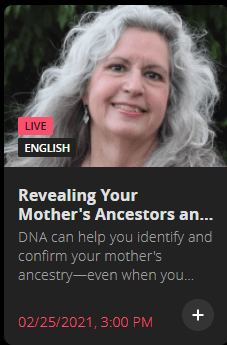
It’s Not Too Late!
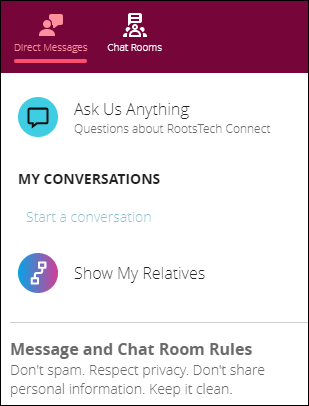
If you haven’t DNA tested at MyHeritage, you can purchase a test, here.

However, if you’ve already tested elsewhere, it’s much quicker and less expensive to upload your DNA file for free, here, and pay the $29 unlock fee to access the advanced tools, including AutoCluster. Step-by-step transfer instructions for all vendors are found, here.

Instead of paying the $29 unlock fee, you can subscribe to the MyHeritage genealogy research package and that will gain you access to the advanced DNA tools as well. You can sign up for a trial subscription for free, here.

See you on Wednesday!!!

_____________________________________________________________

Disclosure

I receive a small contribution when you click on some of the links to vendors in my articles. This does NOT increase the price you pay but helps me to keep the lights on and this informational blog free for everyone. Please click on the links in the articles or to the vendors below if you are purchasing products or DNA testing.

Thank you so much.

DNA Purchases and Free Transfers

Genealogy Products and Services

Genealogy Research