DNA: In Search of…What Do You Mean I’m Not Related to My Family? – and What Comes Next?

Welcome to the second in our series of articles about how to search for unknown family members.

I introduced the series in the article, DNA: In Search of…New Series Launches.

This article addresses the question of “How did this happen?” and introduces the tools we need to answer that question. I’ve combined two articles into one because I really didn’t want to leave you hanging after introducing you to the problem.

We discuss the various kinds of DNA tests, when they are appropriate for your biological sex, and how one can use them to discover information about the person or people you’re seeking.

In other words, we begin at the point of making the discovery that there is something amiss, then review possible glitches. Once we confirm there is someone you need to search for, we discuss how to use genetic testing reasonably and in a planned fashion to solve that mystery.

Please note that I am NOT referring to unexpected ethnicity results in this article. This article refers to your match list and who you do and don’t match on that list. We will discuss ethnicity and how it can help you in a different context in a future article.

The Unknown

Some people have known all their lives that they were adopted, or that they didn’t know the identity of one parent, generally their father.

Other people have made or will make that discovery in a different way. Sometimes, that realization happens when they take an autosomal DNA test and don’t match people they expect to match, either not at all or in a different way.

For example:

  • You might not match a parent or a sibling.
  • You could match only people on your mother’s side, but no known relatives on your father’s side.
  • Your parents or siblings have tested, but you don’t match any of them.
  • Your immediate family hasn’t tested, but your first and second cousins have tested, and you don’t match any of them.
  • You recognize no people, families, or family names on your match list.
  • You think you know your genealogy, but nothing on your match list looks familiar.
  • If your parents and close relatives haven’t tested, not recognizing families might be explained if your family is part of a community of undertested individuals.
  • You might not recognize anyone or surnames if you know absolutely nothing about your family genealogy.
  • Sometimes, a sibling is reported as a half-sibling instead of a full sibling, which is an unexpected finding. This means that you only share one parent, not two. I wrote about this in the article Full or Half Siblings. The non-matching parent is generally the father. The question that follows is, which one of you, if not both, weren’t fathered by the man you thought was your biological father?

These discoveries are generally unexpected and unwelcome – a horrible shock followed by some level of disbelief.

I’ve been there.

My half-brother turned out to not be my half-brother, so we weren’t biologically related at all, although that didn’t change how much I loved him one iota.

Later, I did identify his father, but it was too late for them. My brother had passed on by that time.

Ironically, his biological family would have welcomed him with open arms.

If you’re interested, I wrote about our journey in a series of articles:

The Shock of Discovery

It’s difficult discovering that your full sibling isn’t a full sibling or not a sibling at all, but it’s even worse when you discover that one or both of your parents are not your biological parent(s) when you weren’t expecting that. Obviously, sometimes those two shockers accompany each other.

And no, if you don’t match your parents, siblings, first or second cousins, DNA tests can’t be “that” wrong in terms of matching. That’s generally the first question everyone asks.

Yes, we have seen a couple of instances of test mix-ups at the labs, many years ago, among the millions of tests taken. Better quality control procedures were introduced, and a mix-up hasn’t happened in a very long time. However, if you really think that’s a possibility, or you need peace of mind – order another test from the same vendor. If the second test comes back with the same match list as the first test, there is no lab mix-up.

Or, you can order a test from another vendor – something you’re going to need anyway to solve the mystery and for your genealogy. Hint – the two vendors you must test at directly are Ancestry and 23andMe because they don’t accept uploads. If you’re going to order another test, make it one or both of those.

Before deciding you’ve discovered a genetic disconnect, let’s take a deep breath and look at a couple of other possibilities first.

Be Sure the Vial or Transfer Wasn’t Confused

If you’re encountering a situation where you’re not matching relatives that you know have tested, or for some reason, you suspect something isn’t right, the first things that need to be considered are:

  • Are you positive that your relative(s) have taken a DNA test? You wouldn’t believe how many times someone has told me that they don’t match their mother/father/sibling and come to find out, their family member hasn’t tested. Did they order a test but never send it in? Did they send it in, but their results arent’ back yet?
  • Are you positive that your relative(s) tested at the same company where you did? Many times we discover that they’ve tested, but at a different company. Have your relative show you their results, take a screenshot, or give you their login to confirm you’re at the same vendor.
  • Are you missing all of your relatives or just one or two in the same line? If the answer is one or two, they, not you, may have a disconnect, especially if you match other people on the same side of your family.
  • Did you and a friend or spouse both swab or spit at the same time? If so, is there any possibility that your and their vials were inadvertently swapped when you put them in envelopes and mailed them?

If there is any doubt, check with that other person and see if they are experiencing the same issue. If you look at their results, you may recognize your own family. I’ve seen this occur at family reunions and at the holidays, where several DNA tests were taken by various family members.

  • This last situation is much more common and is caused by confusing files during a download/upload to another vendor. Do you manage multiple kits, and did you inadvertently download the wrong DNA file, or upload the wrong person’s DNA file to a different vendor?

If so, you’re looking at someone else’s results, thinking they are your own. If that person is a cousin, you may be even more confused because you may match some of the same people, just at very different levels. This could make your sibling look like a half-sibling or first cousin, for example.

If there is any possibility of an upload mix-up, or any doubt whatsoever:

  1. Delete the suspect file at the vendor where you uploaded the DNA file
  2. Delete the downloaded files from your computer
  3. Start over by downloading the DNA file again from the original vendor
  4. Label the downloaded file clearly, and immediately, with the tester’s name and date.
  5. Upload the new file to the target vendor before you download another person’s DNA file.

Step-by-step upload/download instructions can be found, here.

Not Parent Expected

If you discover that one of two parents is not the expected biological parent, you’ve discovered a genetic disconnect that is known by a number of different terms. Initially, the term NPE was used, but other terms have been added over the years, and they are sometimes used differently, depending on who is speaking.

  • NPE – Non-Parental Event, Not Parent Expected
  • MPE – Misattributed Paternal/Parental Event or Misattributed Parentage Experience
  • Undocumented Adoption – Regardless of how the situation occurred, it was not documented.

Please, please do NOT jump to conclusions and make assumptions about infidelity and duplicity. There can be many reasons for this occurrence, including:

  • Agreed upon “open” relationships
  • Intentional impregnation when one partner is infertile
  • Surrogacy
  • Infidelity
  • Rape
  • Sperm donor
  • Adoption
  • Unknown first marriage, with step-father raising a child as his own
  • Illegitimate birth of a child before marriage
  • Lifestyle choices
  • Intoxication
  • Coercion

In other words, the situation may have been known to the involved parties, even if they did not share that information with you or others. Prior to the last 20 years, no one would ever have considered that this information might ever be revealed. Social norms and judgments were very different a generation or more ago.

I wrote about this in the article, Things That Need To Be said: Adoption, Adultery, Coercion, Rape, and DNA.

Of course, these events could happen in any generation, but the closer to you, in time, the more evident it will be when looking at your matches.

Now that we’ve determined that we have an unknown parent or grandparent, how do we sort this out?

Let’s Start with the Basics

I’m going to begin by explaining the basics of the different kinds of tests, and when each test can be used.

In this series, we will be focused on searching for six individuals, separately – both parents and all four grandparents.

You will be able to use the same techniques for ancestors in more distant generations by following the same instructions and methodologies, just adapting to include more matches to reach further back in time.

We will be taking the search step-by-step in each article.

Four Kinds of DNA

For genealogy, we can work with four kinds of DNA:

We can potentially use each of these when searching for unknown ancestors, including parents and grandparents. Each type of DNA has specific characteristics and uses in different situations because it’s inherited differently by the son and daughter, below.

In these examples, everything is from the perspective of the son and daughter.

Y DNA testing is only available to males, because only males have a Y chromosome which is inherited directly from the father, shown by the blue arrow. In other words, the son has the father’s Y chromosome (and generally his surname,) but the daughter does not.

The Y chromosome can provide surnames and very close matches, or reach far back in time, or both. Ideally, Y DNA is used in conjunction with autosomal testing when searching for unknown individuals.

Mitochondrial DNA can be tested by everyone since males and females both receive mitochondrial DNA from their mother, passed to her from her direct maternal line, shown by the pink arrows and the yellow hearts. Both the son and daughter can test for their mother’s mitochondrial DNA.

Both Y DNA and mitochondrial DNA can reach far back in time, but can also be informative of recent connections. Neither are ever mixed with the DNA of the other parent, so the DNA is not diluted over the generations.

Think of Y DNA and mitochondrial DNA as having the ability to provide recent genealogy information and connections, plus a deep dive on just one particular line. Fortunately, when you’re looking for parents, the lines they test are the direct maternal (or matrilineal) line and the direct paternal (or patrilineal) lines.

Both Y DNA and mitochondrial DNA tests are deep, not broad. One line each.

Y DNA and mitochondrial DNA will both be able to tell you if that specific ancestral line is European, African, Native American, Asian, Jewish, and so forth. Additionally, both offer matching at FamilyTreeDNA, information about where other testers’ ancestors are found in the world, and more.

If you want more information about what these tests have to offer, now, I provide a Y DNA Resource page, here, and a Mitochondrial DNA Resource page, here.

Autosomal DNA is the DNA contributed to you on chromosomes 1-22 by your ancestors from across all your ancestral lines in your tree, shown by the green arrow.

Everyone receives half of their autosomal DNA from each parent, with the exception of the X chromosome, which we’ll discuss in a minute.

This means that because the parent’s DNA is cut in half in each generation, the contributions of more distant ancestors’ DNA are reduced over time, with each generational division, until it’s no longer discernable or disappears altogether.

Autosomal DNA is broad across many lines, but not deep.

This figure provided by Dr. Paul Maier at FamilyTreeDNA, in the MyOrigins 3.0 White Paper, illustrates that by the 7th generation, you won’t receive DNA from a few of your ancestors. Some may be contained in segments too small to be reported by DNA testing vendors.

Translated, this means that autosomal DNA matching is most reliable in the closest generations, which is where we are working.

There is no documented occurrence of second cousins who don’t match each other. 90% of third cousins match, and about 50% of fourth cousins. I wrote about that in the article, Why Don’t I Match My Cousin?

The 23rd Chromosome – Sex Determination

Autosomal DNA generally refers to chromosomes 1-22. The 23rd chromosome is the sex selection chromosome.

Males have a Y chromosome contributed by their father, and an X contributed by their mother. The Y chromosome is what makes males, male.

Females have an X chromosome contributed by both their mother and father, which recombines just like chromosomes 1-22, but women have no Y chromosome.

In this graphic, you can see that a male child receives the father’s Y chromosome and the mother’s X. The female child receives an X chromosome from both parents.

Only FamilyTreeDNA and 23andMe report X chromosome results by including them with their autosomal DNA test.

Let’s take a look at how the X chromosome works in a little more detail.

X Chromosome DNA is another type of autosomal DNA, meaning it can be inherited from both parents in some circumstances. However, the X chromosome has a different inheritance path which means we analyze it differently for genealogy.

The father gives an X or a Y chromosome to his offspring, but not both.

If the child inherits the Y chromosome from the father, the child becomes a male. If the child inherits the X chromosome from the father, the child becomes a female.

Men only receive an X chromosome from their mother since they receive a Y chromosome from their father. Men can inherit a mixture of their mother’s X chromosomes that were contributed to their mother from both her mother (peach) and father (green.) Conversely, men can inherit their maternal grandmother’s or maternal grandfather’s X chromosome intact.

In this example, the mother and father have three sons. None of the sons can inherit an X chromosome from their father, whose X chromosome is shown in yellow. The father gives the sons his Y chromosome, not shown here, instead of an X, which is how they become males. Males only inherit their X chromosome from their mother.

The mother inherited one copy of her X chromosome from her father, shown in green, and one copy from her mother, shown in peach.

  1. The first son inherited his maternal grandfather’s green X chromosome, intact, from his mother, and none of his maternal grandmother’s peach X chromosome.
  2. The second son inherited a portion of his maternal grandmother’s peach X chromosome and a portion of his maternal grandfather’s green X chromosome. I’ve shown the portions as half, but the division could vary.
  3. The third son inherited his maternal grandmother’s peach X chromosome, intact, and none of his maternal grandfather’s green X chromosome.

This means if you match a man on his X chromosome, assuming it’s a valid match and not identical by chance, that match MUST come from his mother’s line.

In a future article, I’ll provide some X-specific fan charts and tips to help you easily discern potential X inheritance paths.

Women inherit an X chromosome from both their mother and father. They inherit their father’s X chromosome intact that he received from his mother, because he only has one X to give his daughter. Therefore, daughters inherit their paternal grandmother’s X chromosome from their father, because he passes on exactly what he received from his mother.

In this graphic, the father and mother have three daughters. You can see that each daughter receives the father’s yellow X chromosome that he inherited from his mother.

He doesn’t have a second copy of an X chromosome to mix with his mother’s.

Women inherit their mother’s X chromosome in the same fashion that men do. You can see in our example that:

  • The first daughter inherited her father’s yellow X chromosome, plus her maternal grandmother’s peach X chromosome, intact, and none of her maternal grandfather’s green X chromosome.
  • The second daughter inherited her father’s yellow X chromosome, plus part of her maternal grandfather’s green X chromosome and part of her maternal grandmother’s peach X chromosome from her mother. The portions of the mother’s pink and green chromosomes inherited by the daughter can vary widely.
  • The third daughter inherited her father’s yellow X chromosome, plus her maternal grandfather’s green X chromosome, intact, which is his mother’s X chromosome, of course. This daughter inherited none of her maternal grandmother’s peach X chromosome.

Women inherit two X chromosomes, one from each parent, while men only inherit one X, contributed from their mother. This means that X matches have different inheritance paths for women and men.

Because the X inheritance path involves the mother, many people confuse mitochondrial DNA inheritance with X inheritance. I wrote about that in the article, X Matching and Mitochondrial DNA is NOT the Same Thing.

Testing Strategies and Vendor Strengths

In the next article, we will be discussing detailed testing strategies based on multiple factors:

  • Who you are searching for in your tree
  • Who, other than you, is available to test
  • Sex of the tester(s)
  • Vendor strengths and unique offerings
  • Urgency, or not
  • Using combinations of vendor results and why you want to

Getting lucky may be what you hope for, but it’s not a strategy.😊

_____________________________________________________________

Follow DNAexplain on Facebook, here or follow me on Twitter, here.

Share the Love!

You’re always welcome to forward articles or links to friends and share on social media.

If you haven’t already subscribed (it’s free,) you can receive an email whenever I publish by clicking the “follow” button on the main blog page, here.

You Can Help Keep This Blog Free

I receive a small contribution when you click on some of the links to vendors in my articles. This does NOT increase the price you pay but helps me to keep the lights on and this informational blog free for everyone. Please click on the links in the articles or to the vendors below if you are purchasing products or DNA testing.

Thank you so much.

DNA Purchases and Free Uploads

Genealogy Products and Services

My Book

Genealogy Books

Genealogy Research

DNA: In Search of… New Series Launches

Today, I’m excited to announce a new series titled “DNA: In Search of…”

I receive queries every single day about how to search for either unknown parents or unknown grandparents using genetic genealogy.
While some of the techniques are the same when searching for these different people, others vary and depend on a combination of factors: Continue reading →

DNA-eXplained Celebrates Tenth Anniversary!

This blog, DNA-eXplained, is celebrating its 10th anniversary today. How time flies!

I never thought for a minute about a 10th anniversary when I launched that first article.

I started blogging to teach people and literally “explain” about genetic genealogy – which is why I selected the name DNA-eXplained. Over time, it has also been nicknamed DNAeXplain, which is fine.

I hoped to be able to answer questions once, with graphics and examples, instead of over and over again off-the-cuff. I needed someplace where people could be referred for answers. Blogging seemed like the perfect medium for achieving exactly that.

Blogs allow writers to publish content attractively and react to changes and announcements quickly.

Blogs encourage readers to subscribe for email delivery or use RSS reader aggregation and can publish to social media.

Content can be located easily using browser searches.

Everything, all content, is indexed and searchable by keyword or phrase.

Blogging certainly seemed like the right solution. Still, I was hesitant.

I vividly remember working at my desk that day, a different desk in a different location, and anguishing before pressing the “publish” button that first time. Was I really, REALLY sure? I had the sense that I was sitting in one of those life-defining fork-in-the-road moments and once embarked upon, there would be no turning back.

I’m so glad I closed my eyes and pushed that button!

I knew we were going to be in for an incredible journey. Of course, I had no idea where that roller coaster ride was going, but we would be riding together, regardless. What a journey it has been!

A decade later, I’ve had the opportunity to meet and become friends with so many of you, both online and in person. I’ve met countless cousins I never knew I had, thanks to various blog articles, including the 52 Ancestors series which has turned out to be 365 and counting.

I am incredibly grateful for this opportunity! I thought I was giving to others, yet I’ve been greatly enriched by this experience and all of you.

So much has changed in all of our lives.

Looking Back

Today, as I look back at that very short first article, I can’t help but think just how unbelievably far we’ve come.

There was one Y and mitochondrial DNA testing vendor in 2012, FamilyTreeDNA, and that’s still the case today.

There were three autosomal testing companies, 23andMe, FamilyTreeDNA, and Ancestry, in addition to the Genographic Project, which was sunset in 2019 after an amazing 15-year run. GEDmatch was two years old in 2012 and had been formed to fill the need for advanced autosomal matching tools. In 2016, MyHeritage joined the autosomal testing market. All of those companies have since been acquired.

In 2012, FamilyTreeDNA broke ground by accepting uploaded DNA files from other vendors. Autosomal DNA tests cost about $300 although prices were dropping. I don’t anticipate prices dropping much further now, because companies have to maintain a reasonable profit margin to stay in business.

In 2013, when DNA-eXplained celebrated its first anniversary, I had published 162 articles.

That first year was VERY busy with lots of innovation occurring in the industry. You can read my end-of-year article, 2012 Top 10 Genetic Genealogy Happenings if you’d like to reminisce a bit. For comparison, here’s my Genetic Genealogy at 20 Years summary.

The World is Our Oyster

In the past decade, I’ve penned articles in a wide variety of locations, in several countries, on 5 continents.

I’ve written in my offices, of course, but also in cars, on buses, trains, and planes. I’ve crafted several articles on ships while cruising. In fact, writing is one of my favorite “sea-day” things to do, often sitting on deck if it’s a nice day.

I’ve written in cemeteries, which shouldn’t surprise you, on the hood of my car, and cross-legged on the floor at innumerable conferences.

I’ve composed at picnic tables and in countless hotel lobbies, libraries, laboratories, restaurants, and coffee shops. And, in at least 3 castles.

I’ve written while on archaeology digs, balancing my laptop on my knees while sitting on an inverted bucket, trying to keep dirt, sand, and ever-present insects away.

I’ve even written in hospitals, both as a visitor and a patient. Yea, I might not have told you about that.

I’ve pretty much taken you with me everyplace I’ve gone for the past decade. And we are no place near finished!

Today

This article is number 1531 which means I’ve published an article every 2.3 days for a decade. Truthfully, I’m stunned. I had no idea that I have been that prolific. I never have writer’s block. In fact, I have the opposite problem. So many wonderful topics to write about and never enough time.

A huge, HUGE thank you to all of my readers. Writers don’t write if people don’t read!

DNA-eXplained has received millions and millions of views and is very popular, thanks to all of you.

There have been more than 48,000 comments, 4,800 a year or about 13 each day, and yes, I read every single one before approving it for publication.

Akismet, my spam blocker only reports for 45 months, but in that time alone, there have been about 100,000 attempted SPAM comments. That equates to about 75 each day and THANK GOODNESS I don’t have to deal with those.

WordPress doesn’t count “pages,” as such, but if my articles average 10 pages each, and each page averages 500 words, then we’re looking at someplace between 7 and 8 million words. That’s 13 times the size of War and Peace😊. Not only do I write each article, but I proofread it several times too.

Peering Into the Future

Genetic genealogy as a whole continues to produce the unexpected and solve mysteries.

Tools like triangulation in general, Family Matching at FamilyTreeDNA, genetic trees at 23andMe, Theories of Family Relativity at MyHeritage, and ThruLines at Ancestry have provided hints and tools to both suggest and confirm relationships and break through brick walls.

Ethnicity chromosome painting at both 23andMe and FamilyTreeDNA help unravel ancestral mysteries, especially for people with combinations of fundamentally different ancestries, as does Genetic Communities at Ancestry and Genetic Groups at MyHeritage.

Third-party tools that we love today weren’t even a twinkle in a developer’s eye in 2012. Products like DNAPainter, Genetic Affairs, and DNAGedcom pick up where the vendors leave off and are widely utilized by genealogists.

I hope that all of our vendors continue to invest in product development and provide the genetic genealogy community with new and innovative tools that assist us with breaking down those pesky brick walls.

Primarily, though, I hope you continue to enjoy your genealogy journey and make steady progress, with a rocket boost from genetic testing.

The vendors can provide wonderful tools, but it’s up to us to use them consistently, wringing out every possible drop. Don’t neglect paternal (male surname) Y DNA and matrilineal mitochondrial DNA testing for people who carry those important lines for your ancestors. All 4 kinds of DNA have a very specific and unique genealogical use.

I encourage you to test every relative you can and check their and your results often. New people test every single day. You never know where that critical piece of information will come from, or when that essential puzzle piece will drop into place.

Be sure to upload to both FamilyTreeDNA and MyHeritage (plus GEDMatch) so you are in the database of all the vendors. (Instructions here.) Fate favors the prepared.

Thank You!!

Thank you from the bottom of my heart for supporting me by reading and sharing my articles with your friends, organizations, and family members, by purchasing through the affiliate links, by buying my book, and by graciously sharing your own experiences.

Thank you for your suggestions and questions which plant the seeds of new articles and improvements.

I hope you’ve made progress with your research, unraveled some thorny knots, and that you’ve enjoyed this decade as much as I have. Tell me in the comments what you enjoyed the most or found most useful?

Here’s to another wonderful 10 years together!

___________________________________________________________

Follow DNAexplain on Facebook, here or follow me on Twitter, here.

Share the Love!

You’re always welcome to forward articles or links to friends and share on social media.

If you haven’t already subscribed (it’s free,) you can receive an email whenever I publish by clicking the “follow” button on the main blog page, here.

You Can Help Keep This Blog Free

I receive a small contribution when you click on some of the links to vendors in my articles. This does NOT increase the price you pay but helps me to keep the lights on and this informational blog free for everyone. Please click on the links in the articles or to the vendors below if you are purchasing products or DNA testing.

Thank you so much.

DNA Purchases and Free Uploads

Genealogy Products and Services

My Book

Genealogy Books

Genealogy Research
 

Tips & Tricks for Working with Theories of Family Relativity

If you’re a MyHeritage DNA customer, either by taking their DNA test or uploading a file from another vendor, this is an exciting time. MyHeritage has provided new Theories of Family Relativity and updates, so you’ll want to check your account. 

Theories of Family Relativity (TOFR) is the marriage of DNA matching with other types of hints, such as:

  • Common ancestors and links to ancestors in various public trees such as FamilySearch and Geni
  • Common ancestors and links to ancestors in MyHeritage trees
  • Supporting documents, such as census records

The results are Theories about how you are related to your matches, and who your common ancestors are.

MyHeritage introduced Theories of Family Relativity (TOFR) In February 2019 and periodically runs the algorithm, adding new Theories to your DNA results page.

After initial introduction, MyHeritage updated customers’ TOFR in July 2019, May 2020, September 2020, February 2021, and October 2021, so there were plenty of new theory candidates just waiting.

I received an email from MyHeritage stating that TOFR has been updated again, with the following information:

In case you’re still unfamiliar with Theory of Family Relativity™, this feature pulls together billions of data points from across all the family tree profiles and historical records on MyHeritage to bring you theories about how your DNA Matches may be related to you. The calculations are run on a periodic basis, and since our last update, countless new DNA kits, family tree profiles, and historical records have been added to MyHeritage.

This means that the number of theories, the number of DNA Matches that include a theory, and the number of kits that have a theory have all increased significantly — and so have your chances of getting a new theory!

As a result of this new update:

    • 25,636,711 Theories of Family Relativity™ were added
    • 328,439 kits that didn’t have any theories previously now have at least one
    • 233,297 additional users will have at least one theory following this update

What Do I Need for a TOFR to Form?

For a Theory to have the opportunity to form, you need the following at MyHeritage:

You can try a MyHeritage subscription for free, here.

  • Or, if you uploaded your DNA from another site, the one-time unlock fee of $29 also provides access to the advanced DNA tools, including TOFR.

TOFRs Form for DNA Matches

For a TOFR to form, first, you need to be a DNA match.

Second, you need some combination of tree links and records connecting you and your match with a common ancestor.

Those resources can be:

  • Public trees, like FamilySearch or Geni
  • Private trees within MyHeritage
  • Records such as census or other records connecting ancestors and their offsping

Those trees and resources are stitched together to create a Theory that you can review and confirm or reject.

Remember, Theories are just that, theories aka intelligent hints. Accuracy is up to you to confirm.

Let’s step through this process.

How Many New Theories?

How many new Theories do I have, and how do I find them?

In my case, I have a total of 91 theories, which is 9 more than I had the last time Theories was run, representing a 10% increase. Please note that some of the older TOFR may have been updated as well.

However, for now, I don’t want to view the Theories that I’ve already processed, just new ones.

I’ve discovered a way to view only Theories that are new since I processed my TOFR last time.

By processing, I mean

  1. Reviewing the Theory
  2. Confirming or rejecting the Theory
  3. Making notes about my findings
  4. Painting the segment(s) to DNAPainter

All of these steps are important for different reasons.

Viewing Your New Theories

Sign on to your account and click on DNA at the top, then DNA Matches.

You’ll see a purple banner if you have Theories.

In order to see my newest Theories, I’m going to click on the Filters funnel, then select Tree Details.

Then filter Tree Details by “Has Theory of Family Relativity.”

Now I’m only seeing my matches that have Theories.

Next, I’m going to sort those in the most recent order.

This allows me to see my newest matches first, which are probably the most likely to have TOFR that didn’t have a Theory the last time MyHeritage updated the Theories. It’s also possible that some older matches have new Theories too, but let’s start with these first.

Why Notes Help

I always make notes when I review a match, whether it’s a TOFR or a DNA match without a TOFR.

Why?

When you create a note, the note box turns purple.

When a note is present on a match, it’s easy to see and means I have already reviewed that match at least once. Of course, that doesn’t mean I shouldn’t take a look again. Notes are a way of talking to myself.

When I see a match without a purple note icon, I know for sure that I do indeed need to review this TOFR because I have not done so previously.

You could use another methodology to indicate already analyzed TOFR, such as the star (favorites) or even a colored match label (square box.)

I can’t wait to review my new Theories.

Wow – Dutch Matches!!!

My first new Theory is with Gerard from the Netherlands. This is a VERY exciting turn of events because my mother is 25% Dutch and we have very few matches on her Dutch lines.

One of MyHeritage’s strengths is that a lot of Europeans test with MyHeritage.

Click to enlarge any image

My match to Gerard is through my great-great-grandfather’s sister’s descendants who still live in the Netherlands. The connection was made based on tree connections and records.

I love the circular confidence links at each join so you can see exactly how that connection was made and the confidence level at each joining connection.

This particular theory is created from one community tree and three MyHeritage trees, plus records documentation.

My own tree is one of those trees and so is the FamilySearch Tree. Two other trees are MyHeritage user trees, plus two additional documents.

This is an accurate Theory.

Be sure to confirm or reject each Theory so that MyHeritage can refine their TOFR formation process and update your Theories in the future.

Of course, Theories are only one aspect of matching. You’ll need to review the entire match for more information.

Review The Entire Match

Each DNA match comes with a significant amount of information.

Click on Review DNA Match.

The first piece of information that you’ll see is how you and your match are related to your common ancestor.

Next, you’ll see “Shared Matches” which can prove especially helpful.

In my case, because I uploaded my mother’s DNA file to MyHeritage, I can immediately see if Gerard, my Dutch TOFR match, shares DNA with my mother. If it’s a valid match, he will match Mother of course. If my mother’s DNA wasn’t available, I could look for a match with a sibling, aunt, cousin, or another close relative on my mother’s relevant side.

I can also see that we triangulate by the presence of the little purple triangulation widget which would be expected with my mother if the match is valid and not identical by chance.

I wrote about Triangulation in Action at MyHeritage, here.

We do triangulate, of course.

Triangulating with my mother isn’t terribly remarkable because I received half of her DNA, and triangulation with Mom only means that we’ve confirmed that the match with Gerard is valid.

Since we’ve confirmed that this is a legitimate match, let’s look at other aspects of my match with Gerard.

I can also see ethnicities and Genetic Communities that Gerard and I share.

We share three ethnicities and two Genetic Groups.

The Genetic Groups are spot on.

Scrolling on down, I see where Gerard and I match on our chromosomes.

We match on two segments. One smaller segment is on chromosome 12, and a larger segment on chromosome 13.

Of course, we saw that segment when clicking on my mother’s triangulation widget, but that’s a three-way match. This match is just between me and Gerard.

I’ll be harvesting this segment information to paint at DNA Painter where I gather all of my segments from each vendor and compile them into one chromosome map. This allows me to identify specific segments and walk each one back in time to earlier ancestors.

For example, before this match, I knew the segment above was assigned to the Ferverda side, but now I know it descends from one (or both) of my 3X great-grandparents. This match pushed my knowledge about that segment back three generations in time.

What Can You Do to Get More Theories?

You won’t be able to get new Theories immediately, but you can certainly set yourself up to receive additional TOFR in the next run. I wrote about this process in detail, here, but in summary, you can:

  1. Encourage cousins to take a DNA test or upload their DNA files (for free) if they have tested elsewhere.
  2. Encourage matches, especially close matches at other vendors to upload their DNA file to MyHeritage.
  3. If you or your family members uploaded your DNA from elsewhere, unlock the advanced features (including TOFR) for $29.
  4. Expand your tree to include your ancestor’s children and descendants, in addition to your direct ancestor. Each person you add acts like a little handle for another tree to hook onto and join with to form a new TOFR. I started by expanding every ancestor through their grandchildren, where possible.
  5. Be sure to link your DNA, and the DNA of any other tests that you manage, to their proper profile person in your tree.
  6. Make sure your tree is public so MyHeritage can connect you to other people by utilizing people in your tree.
  7. Confirm, or reject, both Smart Matches and Record Matches for each person in your tree.
  8. Maintain a MyHeritage subscription (Premium or above,) as noted earlier, so that you have access to and receive all available genealogical and record information.

What Else Can I Do?

Now that you’ve evaluated your new Theories and made notes, what else can you do to obtain even more information?

Shared Matches

By clicking on “Review DNA Matches,” I can see who I match in common with Gerard.

I see that I have 62 shared matches, meaning other people that Gerard and I both match. Scrolling down the list reveals several people who have Dutch names or live in the Netherlands. Sixteen triangulate with me and Gerard, meaning we share the same DNA.

Reviewing these matches individually may reveal whether matching segments are from the Ferverda/Ferwerda or the Camstra line.

AutoClusters

MyHeritage includes AutoClusters under DNA Tools.

You can order an AutoCluster report. Your TOFR matches and/or Shared Matches may be included in AutoClusters. Membership in a cluster suggests that each person in the cluster shares an ancestral line with all the other people in the cluster.

All of these tools, working together, will help you understand how you are related to your matches, identify your common ancestors, and which ancestors contributed specific DNA segments to you.

I wrote about using AutoClusters at MyHeritage to analyze DNA matches, here.

What About You?

How many new Theories did you receive with this update?

Were any of your existing Theories revised?

Did you discover something fun?

Do you have relatives or matches who tested elsewhere that might be willing to upload their DNA for matching?

_____________________________________________________________

Follow DNAexplain on Facebook, here or follow me on Twitter, here.

Share the Love!

You’re always welcome to forward articles or links to friends and share on social media.

If you haven’t already subscribed (it’s free,) you can receive an email whenever I publish by clicking the “follow” button on the main blog page, here.

You Can Help Keep This Blog Free

I receive a small contribution when you click on some of the links to vendors in my articles. This does NOT increase the price you pay but helps me to keep the lights on and this informational blog free for everyone. Please click on the links in the articles or to the vendors below if you are purchasing products or DNA testing.

Thank you so much.

DNA Purchases and Free Uploads

Genealogy Products and Services

My Book

Genealogy Books

Genealogy Research

Ancestry Only Shows Shared Matches of 20 cM and Greater – What That Means & Why It Matters

Recently, I’ve noticed an uptick in confused people who’ve taken Ancestry’s DNA test.

They are using shared matches, which is a great tool and exactly what they should be doing, but they become confused when no shared matches appear with some specific people.

This is especially perplexing when they know through information sharing or because they manage multiple DNA kits that those two people who both match them actually do share DNA and match each other, meaning they “should” appear on a shared match list. Or worse, yet, conflicting match information is displayed, with one person showing the shared match, but the other person reciprocally does not.

What gives?

That’s exactly what this article addresses. It’s not quite as simple as it sounds, but it’s certainly easier once you understand.

What Are Matches and Shared Matches?

Matches occur when two people match each other. From your perspective as a DNA tester, matches are people who have taken DNA tests and appear on your match list because you share some level of DNA equal to or greater than the match threshold of the vendor in question.

At Ancestry, that minimum matching threshold is 8 cM (centimorgans) of matching DNA.

Individual matches are always one-to-one. Your match list is a list of people who all match you.

So, you match person 1, and you match person 2, individually.

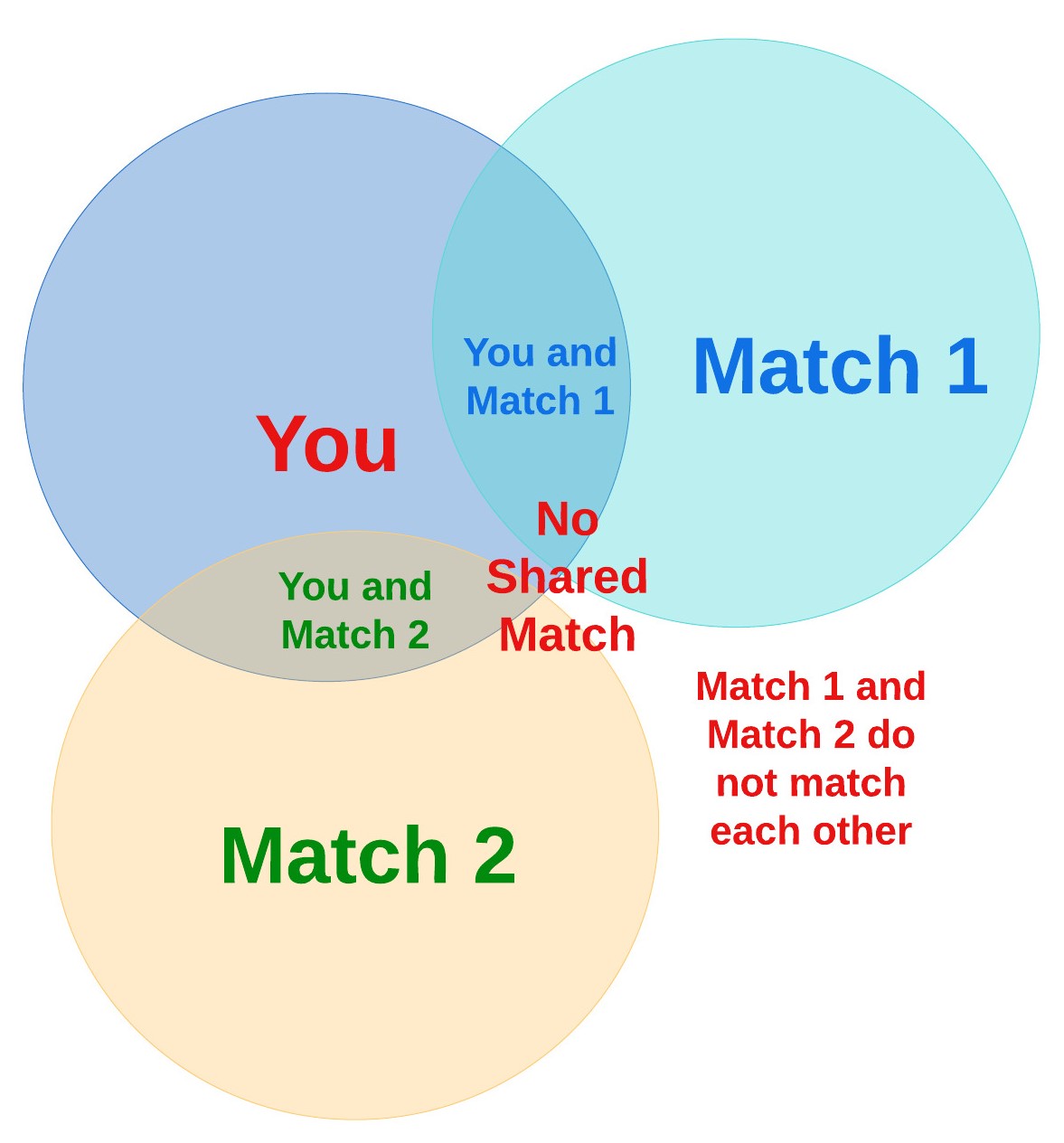
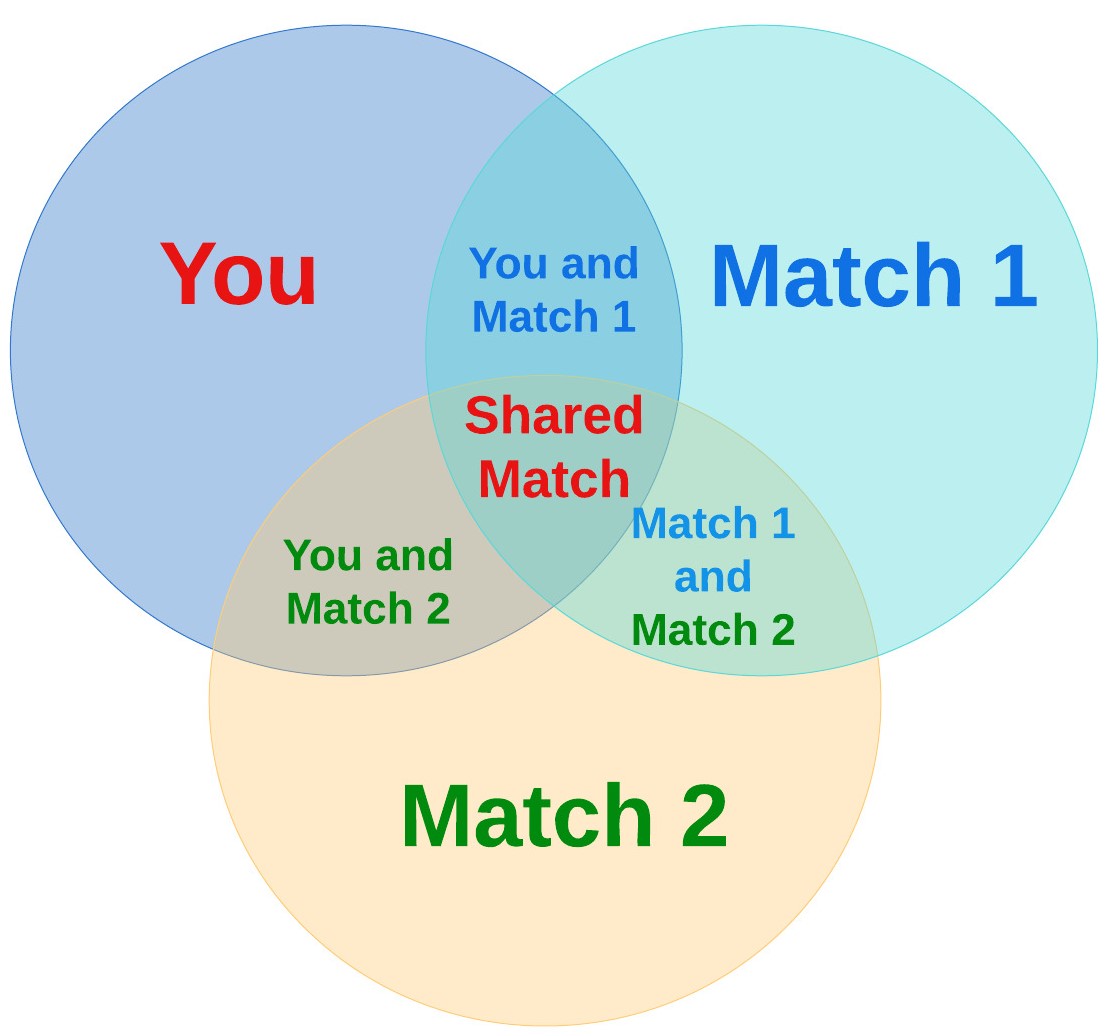
Your matches may or may not also match each other. If they do match each other in addition to matching you, that’s a shared match which is a hint as to a potential common ancestor between all three people.

Shared matches are a list of people who match you PLUS any one other match on your list. In other words, shared matches are three-way matches.

In the diagram above, you can see that you match Match 1 and you also match Match 2. In this case, Match 1 and Match 2 also match each other, so all three of you match each other, but not necessarily on the same segment. Therefore, you’re all three shared matches, as shown in the center of the three circles.

Viewing Shared Matches

To view a list of people who match you and Match 1, you would request shared matches with Match 1 by clicking on “View Match” or “Learn More” on your match list, then on “Shared Matches” on the next screen.

The resulting shared match list consist of people who match you AND Match 1, both. It’s easy to make assumptions about why you have shared matches, but don’t.

Shared Matches are Hints

A shared match CAN mean:

  • That all three people share a common ancestral line.
  • You share a common ancestor with Match 1 and Match 2, but Match 1 and 2 match each other because they share an entirely different ancestor.
  • You match Match 1 because you share DNA from Ancestor A and you match Match 2 because you share DNA from Ancestor B. Match 1 and 2 match each other either because they share one or both of those common ancestors.
  • Match 1 and Match 2 might match because Match 1 and Match 2 share an ancestor that isn’t related to you.
  • That one (or more) of the matches is identical by chance, meaning the DNA combined from two parents in a random way that just happens to match with someone else.

Shared matches are great hints to be sifted for relevance. The operative word here is hint.

What If We Don’t Have Shared Matches?

Conversely, NOT having a shared match doesn’t mean you don’t share a common ancestor.

Sorry about the triple negative. Let me say that another way, because this is important.

Even though you and someone else aren’t on a shared match list, you might still share DNA and you may share a common ancestor, whether you share their DNA or not.

Ancestry’s shared matches work differently than shared matches at other vendors. Before we discuss that, let’s talk about why shared matches are important.

Why Do Shared Matches Matter Anyway?

Matches and shared matches are how genealogists perform two critically important functions:

  • Verifying “known” ancestors. Sometimes paper trails aren’t accurate and certainly, neither are trees.
  • Identifying unknown ancestors. Looking for common families among shared DNA matches is a HUGE hint when tracking down those pesky unknown ancestors.

I wrote about shared matches, here, when Ancestry purged segments under 8 cM, but I think the message about the limitations of shared matches and how the process actually works deserves its own article, especially for new users. Shared matches and segment cM numbers can be quite confusing, but they don’t need to be.

I wrote an article titled DNA Beginnings: Matching at Ancestry and What It Means that includes lots of useful information.

Ok, now let’s look specifically at using shared matches and why sometimes shared matches just don’t seem to make sense.

Matches

By far, the majority of your matches at any vendor will be more distant matches. That’s because you have thousands of distant relatives, most of whom you don’t know (yet).

You’ll only have a few closer relatives.

At Ancestry, I have 102,000+ total matches, of which more than 97,000 are distant matches. Based on these numbers, keep in mind that about 95.74% of my matches are distant, meaning 20 cM or below, and yours probably are too. You’ll need that number later.

Note that 20 cM is Ancestry’s threshold between close matches and distant matches.

That’s about exactly where you’d expect, on average, to see a 20 cM match – generally at or further back than 4th cousins. 20 cM is roughly the 4th to 6th cousin level.

Of course, you won’t match most of your 5th cousins at all, yet you’ll match some with more than 20 cM. That’s just the roll of the genetic dice.

Closer ancestors (meaning closer matches) is also the area of genealogy where much of the lower-hanging fruit has been plucked.

In my case, the closest unknown ancestor in my tree occurs at the 6th generation level and I have 5 or 6 missing sixth-generation ancestors – all females with no surnames. Two have no names at all.

Click to enlarge any image

How Much DNA Do Cousins Share?

One of my priorities as a genealogist is to identify those unknown people, which is why matches, and shared matching at that level are critical for me.

Ancestry tells me that this 20 cM match is likely my 4th-6th cousin.

At DNAPainter, in the Shared cM Tool, you can enter the total cM number of a match, which is the total amount of DNA that you share after Ancestry’s Timber algorithm has been applied. The range of relationship probabilities for 20 cM is shown below.

For a total match of 20 cM with another individual, several relationships ranging between half 3C2R/3C3R and 8th cousins are the most probable relationships at 58%.

For the record, this is total cM, which does not necessarily mean one segment. Ancestry reports the number of segments, but Ancestry does not show you the segment locations, nor do they have a chromosome browser. Without a chromosome browser, you have no way of determining whether or not you match with shared matches on the same segment(s). In other words, there is no triangulation at Ancestry, meaning confirmation of a specific shared DNA segment descended from a common ancestor. You can find triangulation resources, here.

Close Matches

The best way to figure out how you are related to closer matches (assuming you don’t already know them and Ancestry has not found a common ancestor) is using shared matches. Hopefully, you will share matches with people you do know or with whom you’ve already identified your common ancestor.

One of my relatively close DNA matches at Ancestry is Lonnie. I don’t know Lonnie, but it looks like I should because he’s probably a 1st or 2nd cousin. We share 357 cM of DNA over 20 segments.

I thought I knew all of my 1st and 2nd cousins. Let’s see if I can figure out how I’m related to Lonnie.

By clicking on Lonnie’s name on my match list, then on Shared Matches, I can determine that Lonnie and I connect through my Estes and Vannoy lines based on who we both match, which means that our common ancestor is either my paternal grandfather or my great-grandparents, Lazarus Estes and Elizabeth Vannoy.

You can see the notes I’ve made about these matches I share with Lonnie.

Viewing Lonnie’s unlinked tree verifies the ancestral line that shared matches suggest. An unlinked tree means that Lonnie has not linked his DNA test to himself in his tree. Since Ancestry doesn’t know who he is in the tree, they can’t find a common ancestor for me and Lonnie. However, I can by viewing his tree.

Our common ancestor is Lazarus Estes and his wife, Elizabeth Vannoy. Therefore, Lonnie is my 2nd cousin.

That wasn’t difficult, in part because I had already worked on the genealogy of our common matches and Lonnie had a small unlinked tree where I could confirm our common ancestor.

Now let’s move to more distant, not-so-easy matches.

Distant Matches

I’ve spent a lot of time over the years identifying common ancestors with my matches.

When I make that connection, whether or not Ancestry has been able to identify our common ancestor, I make notes about common ancestors and anything else that seems relevant. Notes very conveniently show on my match list so I don’t need to open each match to see how we are related.

Ancestry does identify potential common ancestors using ThruLines. Note the word potential. Ancestry compares the trees of you and your matches searching for common ancestors and suggests connections. It’s up to you to verify. ThruLines are hints, not gospel. Additionally, you may have multiple ancestral links to your matches. Ancestry can only work with the fact that you have a DNA match with someone AND the user-provided trees of your matches.

Ancestry’s ThruLines only reach back a maximum of 7 generations to suggest common ancestors. At 7 generations distance, you’d be a 5th cousin to a descendant who is also 7 generations downstream from that ancestor.

The information from DNAPainter, who utilizes the Shared CM Project compiled data shows that the most likely amount of shared DNA for 5th cousins, is, you’ve guessed it – 20 cM.

Jacob Dobkins is my 7th generation ancestor. I have ThruLines for him and his wife, but not for their parents who are one generation too distant for ThruLines. I’d LOVE to see Ancestry extend ThruLines another 2 or 3 generations.

ThruLines matches me with people who descend from Jacob through his other children. Other children are important because the only ancestors you share with those people are (presumably) that ancestral couple.

Matches with Jacob’s descendants range from 8 cM (the smallest amount Ancestry reports) to 32 cM.

Here’s an example.

Ancestry displays some shared matches with all of your matches, regardless of the size of your match to that person. However, Ancestry ONLY shows shared matches to a third person if you share more than 20 cM of DNA with that third person.

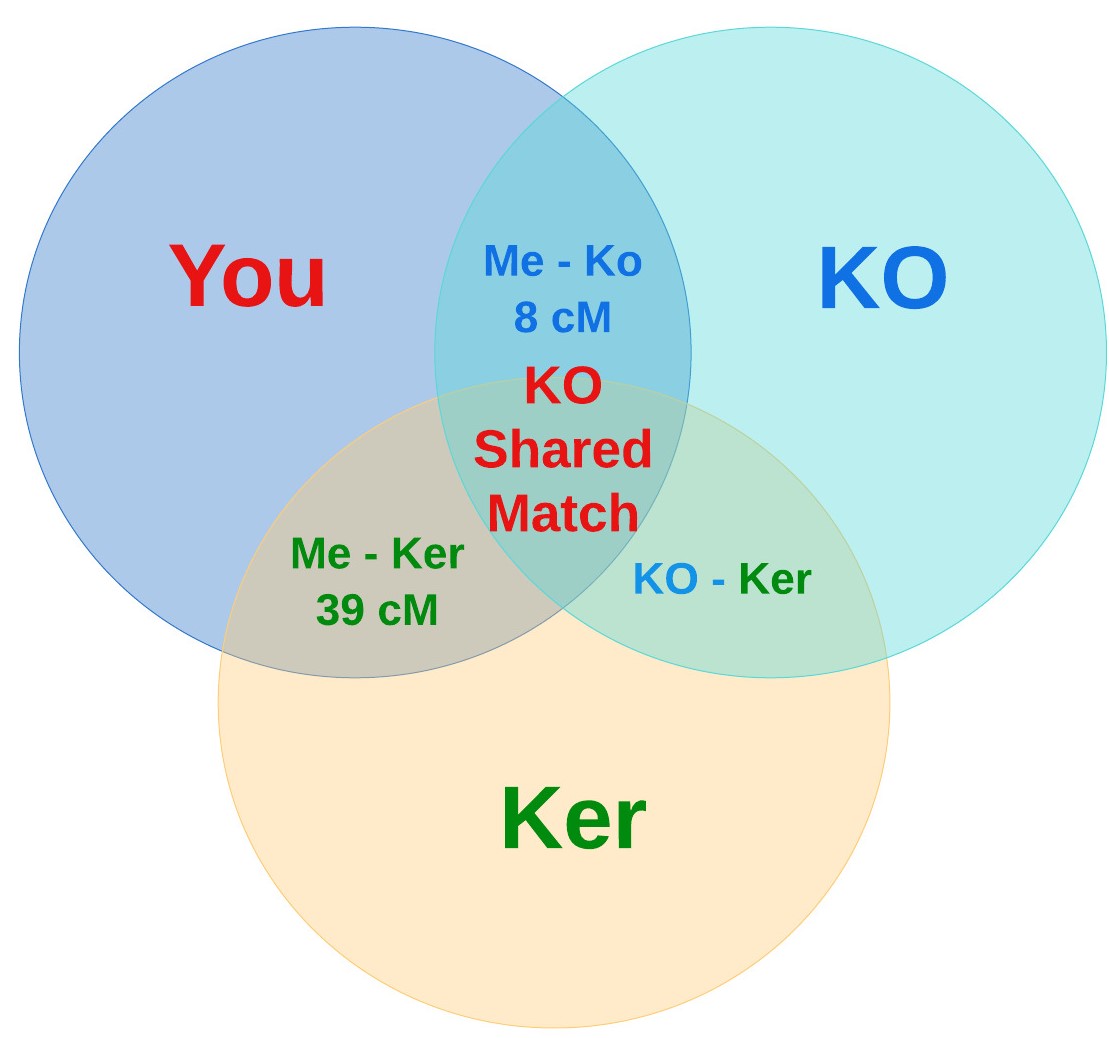
For example, I match KO with 8 cM of DNA. Ancestry shows my shared matches with KO, below.

I only have 3 shared matches with KO. I only match KO at 8 cM, but I match our shared matches at 39, 31 and 21 cM, respectively.

Ancestry does NOT show shared matches below 20 cM, so it’s unknown how many additional shared matches KO and I actually have if shared matches less than 20 cM were displayed.

Perspective is Critical

Whether you see a shared match or not is sometimes a matter of perspective, meaning which of two people you request shared matches with.

In this case, I requested shared matches with KO. I only share 8 cM of DNA with KO, but that doesn’t matter. The amount of DNA you share with the person you’re requesting shared matches with is irrelevant.

Ancestry’s Shared Matches with KO include Ker

I will see shared matches with KO to anyone we mutually share as matches above 20 cM, including Ker.

If I request shared matches with Ker, with whom I share 39 cM of DNA, I will see all of our mutual matches at 20 cM (or greater) of DNA. However, that does NOT include KO because I only share 8 cM of DNA with KO.

This restriction applies regardless of how much DNA KO and Ker share, which is an unknown to me of course.

Ancestry’s Shared Matches with Ker does NOT include KO

Nothing has changed between these matches, yet KO does not appear on my shared matches list with Ker when I request shared matches with Ker.

I still share 8 cM with KO and 39 cM with Ker. KO and Ker still both match each other. The only difference is that Ker shows up on my shared match list with KO because I share more than 20 cM with Ker. However, when I request a match list with Ker, KO does NOT appear because I only share 8 cM with KO.

This is the source of the confusion and often, why people disagree about shared matches. It’s kind of a “now you see it, now you don’t” situation.

If a person shows as a shared match depends on:

  1. Whether the third person actually does share DNA with the tester and the person they’ve asked for shared matches with
  2. Whether the third person shares 20 cM DNA or more with the tester, the person requesting the shared match list with one of their matches

Whether someone appears on a shared match list can literally be a matter of perspective unless the match and the shared matches all match the tester at 20 cM or larger.

Another Example

Let’s look at a larger match to a descendant of the same ancestor.

I share exactly 20 cM with Joyce, my 5C1R.

Viewing my shared matches with Joyce, I match 50 other people that she matches as well.

I only share 25 cM of DNA with the smallest match with Joyce. Apparently, there are no matches with Joyce with whom I share between 20 and 25 cM of DNA.

Bottom Line

Here’s the bottom line.

Ancestry NEVER shows any shared matches below 20 cM from the perspective of the tester, meaning people who match you and someone else, both.

If you recall our earlier math, that means that approximately 95.74% of my shared matches aren’t shown.

This puts shared matches in a different perspective because now I realize just how many matches I’m not seeing.

Why is This Confusing?

If you aren’t aware of this shared match limitation, and that a majority of your shared matches are actually below 20 cM, you may interpret shared match results to mean you actually DON’T share specific matches with that other person. That isn’t necessarily true, as we saw above with KO and Ker.

Furthermore, let’s say you manage your DNA kit plus 3 more, A, B and C. Because you manage all 4 kits, that means you can see the results for all 4 people.

  • A – 10 cM
  • B – 20 cM
  • C – 40 cM

From the perspective of YOUR kit, you will see some shared matches FOR all of those matches.

What you won’t see is shared matches if you don’t match the shared match (third person) at 20 cM or greater.

Always remember, shared match information at Ancestry is ALWAYS from the perspective of your DNA kit combined with the person with whom you request the match.

I’ve put this information in a grid because that’s how I make sense of things like this.

Here are your matches. When you click on shared matches with person A who you match at 10 cM, you’ll see both person B and person C as shared matches since you match both of those people at 20 cM or larger. You WILL see 20 cM shared matches, but you will not see 19 cM shared matches.

When you request shared matches for A, you will see both B and C.

When you request shared matches with kits B and C, you will not see A because you only match them at 10 cM.

However, from the perspective of DNA kits A, B and C, shared matches look different.

Let’s look at shared matches from the perspective of Kits A, B and C.

Kit A matches you, Kit B and C, but can only see Kit B as a shared match because matches with you and Kit C are under 20 cM.

Kit B doesn’t match C at all, so they clearly won’t have shared matches. However, they do match you and Kit A, both at 20 cM and over, so Kit B will see you as a shared match with Kit A, and Kit A as a shared match with you.

Kit C doesn’t match Kit B, so no shared matches with that person at all. Kit C does match you and Kit A. However, when Kit C clicks on shared matches for you, Kit A doesn’t show up because they only match Kit A on 9 cM. When Kit C clicks on Kit A for shared matches, you ARE listed as a shared match because you share 40 cM of DNA with Kit C.

There’s no way to discern whether two of your matches match each other unless they show as a match in the shared match tool. You can’t tell if their absence on the shared match list means they actually don’t match, or their shared match absence is because they match you at less than 20 cM.

Whew, that was a mouthful.

You may need to refer back to this from time to time if you’re confused by your shared matches at Ancestry.

If you need to remember rules, remember this.

  1. You can obtain shared matches with yourself plus any match, regardless of how much or how little DNA you share with that one match. Prove this to yourself by finding a match under 20 cM, like my 8 cM match, and viewing your shared matches.
  2. No one will show on a shared match list with another person unless they match you at 20 cM or greater. Prove this to yourself by viewing the smallest shared match with anyone.

Strategy

The takeaway of this is if you have a larger (20 cM or over) and smaller match (under 20 cM), always request shared matches from the perspective of the smaller match because the smaller match won’t show up as a shared match on any shared match list.

The only way you can see shared matches that includes people under 20 cM is to request to view shared matches with individual people who match you below 20 cM. 

In my case, I will never see KO on any shared match list because I only match KO at 8 cM. However, I can request my shared matches with KO in which case I’ll see all 20 cM or greater shared matches with KO.

Alternatives

Every vendor provides a shared match feature, and each functions differently.

In the chart below, I’ve provided basic shared match information for each vendor.

If you’re interested in uploading your DNA file from Ancestry or another vendor, I’ve provided upload/download step-by-step instructions for each vendor, here.

_____________________________________________________________

Follow DNAexplain on Facebook, here or follow me on Twitter, here.

Share the Love!

You’re always welcome to forward articles or links to friends and share on social media.

If you haven’t already subscribed (it’s free,) you can receive an email whenever I publish by clicking the “follow” button on the main blog page, here.

You Can Help Keep This Blog Free

I receive a small contribution when you click on some of the links to vendors in my articles. This does NOT increase the price you pay but helps me to keep the lights on and this informational blog free for everyone. Please click on the links in the articles or to the vendors below if you are purchasing products or DNA testing.

Thank you so much.

DNA Purchases and Free Uploads

Genealogy Products and Services

My Book

Genealogy Books

Genealogy Research

Happy Census April Fool’s Day – aka – Where the Heck Are My Parents???

What did we expect anyway – combining those two events? That’s just an invitation to fate to mess with our heads.

Nevertheless, like the drunken fly willfully walking into the spider web like an addict, at 12:01 AM, I suddenly “remembered” that the 1950 census was released and just had to go and try it out instead of going to bed. Well, I told myself it was “before” going to bed but it was actually instead. Let’s just say I saw the sunrise from the far side instead of the near side and woke up a few hours later with my phone on my chest and my last piece of chocolate melted to me. We should have had a party. I think I have a genealogy hangover.

Yes, we addicts did put quite a load on the National Archives (NARA) system causing errors, but it didn’t go down entirely. Somebody in NARA-land heaved a huge sigh of relief. Never underestimate the tenacity or craziness of genealogists who were OF COURSE willing to stay up all night.

I wondered if NARA would actually be able to pull off the massive AI census index project – but they did. Hats off to their team! What an incredible gift – even if it is April Fool’s Day and my well-hidden ancestors are still laughing at my expense.

You can access the NARA census, here, and I provided a prep article here that shows you how to find enumeration districts which you will probably need.

Found

I found the family members that I knew the location where they were living AND they weren’t living in large cities.

For example, my maternal grandparents were living at 107 East Main in Silver Lake, Indiana. That’s a very small town, so even though the AI didn’t record my grandparents, or brother who was living with them, I just paged through those records because I knew they were living in Silver Lake, and there was only one enumeration district. Easy peasy.

What was interesting to me was that my grandfather, who was the Lake Township Trustee had worked 72 hours the previous week, and my grandmother had worked 25 as a secretary.

The confusing part is that he was the trustee, and I don’t think she worked for the township. The enumerator mixed them up, apparently. So, was it her that worked 72 hours?

But, where was my mother? Back to that in a minute.

On the other side of my family, my paternal grandfather was living in Harlan County, Kentucky in a relatively remote location, up on Black Mountain. I half expected him NOT to be enumerated at all because he was a bootlegger, but lo and behold, there he is listed as a ”farmer.” Well, I guess that’s sort of farming.

The interesting thing about this record is that they have a boarder living with them, 22-year-old James Holcomb.

Their daughter, Evelyn had a child two years later, in 1952, reportedly with one Jake or Jack Halcomb, but that situation was always pretty hush-hush. I suspect that Jake Halcomb was actually James Holcomb, which makes a lot of sense. Her older sister was married to a William Halcomb, so I wonder if these men were brothers. Another mystery to solve.

Missing

My paternal grandmother, Ollie Bolton Robbins is missing. She lived in Chicago which had hundreds if not thousands of census enumeration districts. I checked the address given when she died in 1955, and where my father was reportedly living at that time, all to no avail. They were not living there in 1950.

My father is also missing. He had married Ellen Copack in 1949 in Chicago but I’ve been unable to obtain the actual marriage application from the Cook County Clerk’s office which would have (hopefully) contained the addresses of the bride and groom. By 1952, they were living in Fort Wayne, Indiana.

I checked both locations using the census name search but there were just too many entries to peruse them all. I need to be able to hunt at the vendors for William with a spouse of Ellen plus age information.

He was like a leaf in a windstorm, blowing from place to place, so who knows where he was in 1950.

My mother is also missing, and that’s a whole other story for another article. A chapter of her life I didn’t know much about is slowly unfolding, and not very easily either.

Let’s just say I expected to find her living with her parents and my half-brother, but she’s not there. I used a surname search in Chicago, Illinois where she had previously lived, in Fort Wayne, Indiana where she later lived, and in Florida where she was for about a year in 1949 through early 1950. At least, I think she was there in early 1950. Regardless, I can’t find her either with just a name search so I’ll have to wait until I can combine that search with age and other defining factors.

Patience is not my strong suit! I’m signing up for the new MyHeritage Census Helper to let them do the heavy lifting for me when their indexing is ready.

MyHeritage Census Helper

MyHeritage is offering their new Census Helper tool for free, just in time for the 1950 census. You can read about it, here.

All you have to do is upload your tree and MyHeritage prepares a list of people based on your tree information who are likely to be found in the 1950 census.

By clicking on the orange “Research” button, MyHeritage finds other records that are available now and will help to focus the 1950 census search.

I need to add some additional records for both my mother and father so that MyHeritage “knows” where to potentially look for them in 1950 when their indexed census records become available.

Of course, you can order a DNA test while you’re there, or upload your DNA file from another vendor, here, which is also free.

Juicy Finds!

It has been fun to watch social media today as people search for and find their relatives in the 1950 census.

One person discovered that their mother had a child they never knew existed. Of course, that begs the question of what happened to that child, and why the researcher had never heard of them. So many possibilities.

Another person discovered quite valuable information that required me to draw a chart to understand. It answered a WHOLE LOT of questions about situations only whispered about in that family.

A third person discovered that their father was divorced, and he had not yet married their mother. Of course, now that requires more research.

So many people receive unexpected close DNA relatives and the 1950 census information may well provide hints and clues that might at least provide breadcrumbs to those answers. In some cases, the answers are right there, in black and white. I keep expecting a half-sibling match, or their children or even grandchildren perhaps, but so far…I’m still waiting.

Are you in every database? You don’t want to miss any matches and you never know where that much-needed match might test. You can upload your DNA file to both MyHeritage and FamilyTreeDNA in addition to GEDmatch. I wrote free step-by-step upload/download instructions for all the vendors, here.

The discovery that really touched my heart, though, was the person who discovered that their father WAS the census enumerator. His handwriting reached out to say hello some 72 years later.

What a perfect April Fool’s Day.

What have you discovered?

_____________________________________________________________

Follow DNAexplain on Facebook, here or follow me on Twitter, here.

Share the Love!

You’re always welcome to forward articles or links to friends and share on social media.

If you haven’t already subscribed (it’s free,) you can receive an email whenever I publish by clicking the “follow” button on the main blog page, here.

You Can Help Keep This Blog Free

I receive a small contribution when you click on some of the links to vendors in my articles. This does NOT increase the price you pay but helps me to keep the lights on and this informational blog free for everyone. Please click on the links in the articles or to the vendors below if you are purchasing products or DNA testing.

Thank you so much.

DNA Purchases and Free Uploads

Genealogy Products and Services

My Book

Genealogy Books

Genealogy Research

1950 Census Will Be Released on April Fool’s Day

The US 1950 census images will indeed be released by the National Archives on April Fool’s Day, 72 years after that census began. Talk about irony. I just have this feeling I’ll not be able to find everyone and they will all be laughing at me!

Were you planning on searching to find your ancestor or their descendants that day using the traditional vendors? April Fool! Not so fast.

The census is always released without an index. April 1st is the shot at the starting gate for the various vendors to index the records to add to their product offerings for their customers.

If you’d like to see what kinds of questions were asked in that census, and the instructions provided to enumerators, you can view the 1950 census instructions, here.

Peeking

However, you might, just might, be able to gain a peek into those records on April 1st, assuming you know where your relatives lived at that time, and maybe even if you don’t. There are multiple opportunities and methodologies, so let’s take a look at a few.

Steve Morse’s Census Enumeration District Finder

Steve Morse has created lots of tools for genealogists, but right now, his census enumeration district finder may save your bacon!

https://stevemorse.org/census/unified.html

Steve’s no-nonsense site provides two levels of detail. The first is at the city level, and then, if you know the house number and street, you can narrow the district further.

For example, my grandmother lived in Chicago at the time, so I entered that information.

I’m only showing a few of the districts in Chicago. There are literally hundreds, if not thousands. The House number and Street fields open up at this point.

I think I know the address where she might have lived, or did when she died 5 years later, so I entered 639 N. Kedzie.

Unfortunately, there are still too many districts, so I went to Google maps to find a cross street.

Fortunately, 639 Kedzie still exists, and the surrounding streets are shown, above. I entered Huron since that is the closest. Then I added Ohio.

I was able to narrow the district to two using Ohio and Huron. Adding Sawyer shows one of those districts, and adding Troy shows the other, so I’m wagering that Kedzie might have been the dividing line.

As a bonus, I located the building where she resided, at least at one point, Did my grandmother live in this building that’s now a church in 1950? We will see in just a couple days now.

MyHeritage

MyHeritage is providing 1950 census information on their 1950 Content Hub

https://www.myheritage.com/census/us/1950census/

If you create your tree on MyHeritage, the 1950 census hints will be provided to you for people in your tree as soon as they are indexed, and you can extract the data directly into that person’s profile.

Ancestry

Ancestry is providing a Census District Finder, but not at the address level. For Chicago, Ancestry is hopeless, at least until the indexing is completed, but for a small town, township or rural area, Ancestry’s maps work pretty well and are interesting.

https://www.ancestry.com/discoveryui-content/district-map/62308

My maternal grandparents lived in the small town of Silver Lake, Indiana

I entered the location. Ancestry displayed the original census map with a pin in that location. By clicking on that pin, Ancestry displayed the district number, above. I will look in district 43-13 to view the residents of Silver Lake on April 1st.

Be sure to take note of other information on the map. At right, there are special enumeration areas and schedules. Specifically, a Seminary and Hotel, and there’s no detailed map for Winona Lake.

Indexed Records

Finding the enumeration district and manually scrolling through the records may allow you to locate your relatives. Of course, if you don’t know where your ancestors were living in 1950, then you’ll need to wait for the indexed records.

As it turns out, your wait may not be that long.

The National Archives says that the census information will be available through a link, here, beginning April 1, and it will be released with a name index created using Amazon web services artificial intelligence.

Woohoo. This will certainly be a first if they can actually pull this off.

Indexed census records using artificial intelligence, meaning OCR, will be released as soon as possible by both Ancestry and MyHeritage.

Of course, validation of OCR records will need to be performed manually for a variety of reasons including poor handwriting, damage to the documents, or other issues. In other words, if you can’t find your family members, look for similar names or search creatively after the indexed census is released.

How much later in April will the vendors release their products? We don’t know. It’s a race to rival any Olympics and we’ll just have to wait and see.

You Can Participate

FamilySearch is launching a massive volunteer indexing effort, here. You can join with other genealogists. FamilySearch provides their records for free, of course, and you can append them to your ancestor on FamilySearch’s big tree.

Why is the 1950 Census Important?

People we know or knew were living in 1950. The census will, hopefully, help us locate our family members and flesh out their lives. For example, I’m not at all sure where my parents were living in 1950.

Anyone born before April 1950 will be recorded in this census. If you’re hunting for descendants of your grandparents, or great-grandparents, knowing where their children were living and who was in the family will provide valuable information as to where to look for other relevant records such as yearbooks, city directories, obituaries, wills and so forth.

If you’d like to DNA test some of those relatives and their descendants, you have to first locate them.

It seems like 70 years isn’t all that long ago, genealogically speaking, so I wasn’t initially terribly excited until I realized I didn’t know where my parents were living and wasn’t sure where my paternal grandparents were living. Furthermore, I want to know what kind of information will be revealed about other family members.

Who Are You Searching For?

Have you made a list of your relatives that would be beneficial to locate in the census?

I’ve created a list, with location and the enumeration district as closely as can be identified for now.

If you’re planning to do this before April 1, I wouldn’t wait much longer. Every genealogist in the country will be accessing those sites on April 1st, and the April Fool’s laugh just might be on all of us if we crash the entire system.

Happy hunting!

_____________________________________________________________

Follow DNAexplain on Facebook, here or follow me on Twitter, here.

Share the Love!

You’re always welcome to forward articles or links to friends and share on social media.

If you haven’t already subscribed (it’s free,) you can receive an email whenever I publish by clicking the “follow” button on the main blog page, here.

You Can Help Keep This Blog Free

I receive a small contribution when you click on some of the links to vendors in my articles. This does NOT increase the price you pay but helps me to keep the lights on and this informational blog free for everyone. Please click on the links in the articles or to the vendors below if you are purchasing products or DNA testing.

Thank you so much.

DNA Purchases and Free Uploads

Genealogy Products and Services

My Book

Genealogy Books

Genealogy Research

Top Ten RootsTech 2022 DNA Sessions + All DNA Session Links

The official dates of RootsTech 2022 were March 3-5, but the sessions and content in the vendor booths are still available. I’ve compiled a list of the sessions focused on DNA, with web links on the RootsTech YouTube channel

YouTube reports the number of views, so I was able to compile that information as of March 8, 2022.

I do want to explain a couple of things to add context to the numbers.

Most speakers recorded their sessions, but a few offered live sessions which were recorded, then posted later for participants to view. However, there have been glitches in that process. While the sessions were anticipated to be available an hour or so later, that didn’t quite happen, and a couple still aren’t posted. I’m sure the presenters are distressed by this, so be sure to watch those when they are up and running.

The Zoom rooms where participants gathered for the live sessions were restricted to 500 attendees. The YouTube number of views does not include the number of live viewers, so you’ll need to add an additional number, up to 500.

When you see a number before the session name, whether recorded or live, that means that the session is part of a series. RootsTech required speakers to divide longer sessions into a series of shorter sessions no longer than 15-20 minutes each. The goal was for viewers to be able to watch the sessions one after the other, as one class, or separately, and still make sense of the content. Let’s just say this was the most challenging thing I’ve ever done as a presenter.

For recorded series sessions, these are posted as 1, 2 and 3, as you can see below with Diahan Southard’s sessions. However, with my live session series, that didn’t happen. It looks like my sessions are a series, but when you watch them, parts 1, 2 and 3 are recorded and presented as one session. Personally, I’m fine with this, because I think the information makes a lot more sense this way. However, it makes comparisons difficult.

This was only the second year for RootsTech to be virtual and the conference is absolutely HUGE, so live and learn. Next year will be smoother and hopefully, at least partially in-person too.

When I “arrived” to present my live session, “Associating Autosomal DNA Segments With Ancestors,” my lovely moderator, Rhett, told me that they were going to livestream my session to the RootsTech page on Facebook as well because they realized that the 500 Zoom seat limit had been a problem the day before with some popular sessions. I have about 9000 views for that session and more than 7,400 of them are on the RootsTech Facebook page – and that was WITHOUT any advance notice or advertising. I know that the Zoom room was full in addition. I felt kind of strange about including my results in the top ten because I had that advantage, but I didn’t know quite how to otherwise count my session. As it turns out, all sessions with more than 1000 views made it into the top ten so mine would have been there one way or another. A big thank you to everyone who watched!

I hope that the RootsTech team notices that the most viewed session is the one that was NOT constrained by the 500-seat limited AND was live-streamed on Facebook. Seems like this might be a great way to increase session views for everyone next year. Hint, hint!!!

I also want to say a huge thank you to all of the presenters for producing outstanding content. The sessions were challenging to find, plus RootsTech is always hectic, even virtually. So, I know a LOT of people will want to view these informative sessions, now that you know where to look and have more time. Please remember to “like” the session on YouTube as a way of thanking your presenter.

With 140 DNA-focused sessions available, you can watch a new session, and put it to use, every other day for the next year! How fun is that! You can use this article as your own playlist.

Please feel free to share this article with your friends and genealogy groups so everyone can learn more about using DNA for genealogy.

Ok, let’s look at the top 10. Drum roll please…

Top 10 Most Viewed RootsTech Sessions

Session Title Presenter YouTube Link Views
1 1. Associating Autosomal DNA Segments With Ancestors Roberta Estes (live) https://www.youtube.com/watch?v=_IHSCkNnX48


~9000: 1019 + 500 live viewers + 7,400+ Facebook
2 1. What to Do with Your DNA Test Results in 2022 (part 1 of 3) Diahan Southard https://www.youtube.com/watch?v=FENAKAYLXX4 7428
3 Who Is FamilyTreeDNA? FamilyTreeDNA – Bennett Greenspan https://www.youtube.com/watch?v=MHFtwoatJ-A 2946
4 2. What to Do with Your DNA Test Results in 2022 (part 2 of 3) Diahan Southard https://www.youtube.com/watch?v=mIllhtONhlI 2448
5 Latest DNA Painter Releases DNAPainter Jonny Perl (live) https://www.youtube.com/watch?v=iLBThU8l33o 2230 + live viewers
6 DNA Painter Introduction DNAPainter – Jonny Perl https://www.youtube.com/watch?v=Rpe5LMPNmf0 1983
7 3. What to Do with Your DNA Test Results in 2022 (part 3 of 3) Diahan Southard https://www.youtube.com/watch?v=hemY5TuLmGI 1780
8 The Tree of Mankind Age Estimates Paul Maier https://www.youtube.com/watch?v=jjkL8PWAEwk 1638
9 A Sneak Peek at FamilyTreeDNA Coming Attractions FamilyTreeDNA (live) https://www.youtube.com/watch?v=K9sKqNScvnE 1270 + live viewers


10 Extending Time Horizons with DNA Rob Spencer (live) https://www.youtube.com/watch?v=wppXD1Zz2sQ 1037 + live viewers


All DNA-Focused Sessions

I know you’ll find LOTS of goodies here. Which ones are your favorites?

  Session Presenter YouTube Link Views
1 Estimating Relationships by Combining DNA from Multiple Siblings Amy Williams https://www.youtube.com/watch?v=xs1U0ohpKSA 201
2 Overview of HAPI-DNA.org Amy Williams https://www.youtube.com/watch?v=FjNiJgWaBeQ 126
3 How do AncestryDNA® Communities help tell your story? | Ancestry® Ancestry https://www.youtube.com/watch?v=EQNpUxonQO4 183


4 AncestryDNA® 201 Ancestry – Crista Cowan https://www.youtube.com/watch?v=lbqpnXloM5s


494
5 Genealogy in a Minute: Increase Discoveries by Attaching AncestryDNA® Results to Family Tree Ancestry – Crista Cowan https://www.youtube.com/watch?v=iAqwSCO8Pvw 369
6 AncestryDNA® 101: Beginner’s Guide to AncestryDNA® | Ancestry® Ancestry – Lisa Elzey https://www.youtube.com/watch?v=-N2usCR86sY 909
7 Hidden in Plain Sight: Free People of Color in Your Family Tree Cheri Daniels https://www.youtube.com/watch?v=FUOcdhO3uDM 179
8 Finding Relatives to Prevent Hereditary Cancer ConnectMyVariant – Dr. Brian Shirts https://www.youtube.com/watch?v=LpwLGgEp2IE 63
9 Piling on the chromosomes Debbie Kennett https://www.youtube.com/watch?v=e14lMsS3rcY 465
10 Linking Families With Rare Genetic Condition Using Genealogy Deborah Neklason https://www.youtube.com/watch?v=b94lUfeAw9k 43
11 1. What to Do with Your DNA Test Results in 2022 Diahan Southard https://www.youtube.com/watch?v=FENAKAYLXX4 7428
12 1. What to Do with Your DNA Test Results in 2022 Diahan Southard https://www.youtube.com/watch?v=hemY5TuLmGI 1780
13 2. What to Do with Your DNA Test Results in 2022 Diahan Southard https://www.youtube.com/watch?v=mIllhtONhlI 2448
14 DNA Testing For Family History Diahan Southard https://www.youtube.com/watch?v=kCLuOCC924s 84


15 Understanding Your DNA Ethnicity Estimate at 23andMe Diana Elder


https://www.youtube.com/watch?v=xT1OtyvbVHE 66
16 Understanding Your Ethnicity Estimate at FamilyTreeDNA Diana Elder https://www.youtube.com/watch?v=XosjViloVE0 73
17 DNA Monkey Wrenches Katherine Borges https://www.youtube.com/watch?v=Thv79pmII5M 245
18 Advanced Features in your Ancestral Tree and Fan Chart DNAPainter – Jonny Perl https://www.youtube.com/watch?v=4u5Vf13ZoAc 425
19 DNA Painter Introduction DNAPainter – Jonny Perl https://www.youtube.com/watch?v=Rpe5LMPNmf0 1983
20 Getting Segment Data from 23andMe DNA Matches DNAPainter – Jonny Perl https://www.youtube.com/watch?v=8EBRI85P3KQ 134
21 Getting segment data from FamilyTreeDNA DNA matches DNAPainter – Jonny Perl https://www.youtube.com/watch?v=rWnxK86a12U 169
22 Getting segment data from Gedmatch DNA matches DNAPainter – Jonny Perl https://www.youtube.com/watch?v=WF11HEL8Apk 163
23 Getting segment data from Geneanet DNA Matches DNAPainter – Jonny Perl https://www.youtube.com/watch?v=eclj8Ap0uK4 38
24 Getting segment data from MyHeritage DNA matches DNAPainter – Jonny Perl https://www.youtube.com/watch?v=9rGwOtqbg5E 160
25 Inferred Chromosome Mapping: Maximize your DNA Matches DNAPainter – Jonny Perl https://www.youtube.com/watch?v=tzd5arHkv64 688
26 Keeping track of your genetic family tree in a fan chart DNAPainter – Jonny Perl https://www.youtube.com/watch?v=W3Hcno7en94 806


27 Mapping a DNA Match in a Chromosome Map DNAPainter – Jonny Perl https://www.youtube.com/watch?v=A61zQFBWaiY 423
28 Setting up an Ancestral Tree and Fan Chart and Exploring Tree Completeness DNAPainter – Jonny Perl https://www.youtube.com/watch?v=lkJp5Xk1thg 77
29 Using the Shared cM Project Tool to Evaluate DNA Matches DNAPainter – Jonny Perl https://www.youtube.com/watch?v=vxhn9l3Dxg4 763
30 Your First Chromosome Map: Using your DNA Matches to Link Segments to Ancestors DNAPainter – Jonny Perl https://www.youtube.com/watch?v=tzd5arHkv64 688
31 DNA Painter for absolute beginners DNAPainter (Jonny Perl) https://www.youtube.com/watch?v=JwUWW4WHwhk 1196
32 Latest DNA Painter Releases DNAPainter (live) https://www.youtube.com/watch?v=iLBThU8l33o 2230 + live viewers
33 Unraveling your genealogy with DNA segment networks using AutoSegment from Genetic Affairs Evert-Jan Blom https://www.youtube.com/watch?v=rVpsJSqOJZI


162
34 Unraveling your genealogy with genetic networks using AutoCluster Evert-Jan Blom https://www.youtube.com/watch?v=ZTKSz_X7_zs 201


35 Unraveling your genealogy with reconstructed trees using AutoTree & AutoKinship from Genetic Affairs Evert-Jan Blom https://www.youtube.com/watch?v=OmDQoAn9tVw 143
36 Research Like a Pro with DNA – A Genealogist’s Guide to Finding and Confirming Ancestors with DNA Family Locket Genealogists https://www.youtube.com/watch?v=NYpLscJJQyk 183
37 How to Interpret a DNA Network Graph Family Locket Genealogists – Diana Elder https://www.youtube.com/watch?v=i83WRl1uLWY 393
38 Find and Confirm Ancestors with DNA Evidence Family Locket Genealogists – Nicole Dyer https://www.youtube.com/watch?v=DGLpV3aNuZI 144
39 How To Make A DNA Network Graph Family Locket Genealogists – Nicole Dyer https://www.youtube.com/watch?v=MLm_dVK2kAA 201
40 Create A Family Tree With Your DNA Matches-Use Lucidchart To Create A Picture Worth A Thousand Words Family Locket Genealogists – Robin Wirthlin https://www.youtube.com/watch?v=RlRIzcW-JI4 270
41 Charting Companion 7 – DNA Edition Family Tree Maker https://www.youtube.com/watch?v=k2r9rkk22nU 316


42 Family Finder Chromosome Browser: How to Use FamilyTreeDNA https://www.youtube.com/watch?v=w0_tgopBn_o 750


43 FamilyTreeDNA: 22 Years of Breaking Down Brick Walls FamilyTreeDNA https://www.familysearch.org/rootstech/session/familytreedna-22-years-of-breaking-down-brick-walls Not available
44 Review of Autosomal DNA, Y-DNA, & mtDNA FamilyTreeDNA  – Janine Cloud https://www.youtube.com/watch?v=EJoQVKxgaVY 77
45 Who Is FamilyTreeDNA? FamilyTreeDNA – Bennett Greenspan https://www.youtube.com/watch?v=MHFtwoatJ-A 2946
46 Part 1: How to Interpret Y-DNA Results, A Walk Through the Big Y FamilyTreeDNA – Casimir Roman https://www.youtube.com/watch?v=ra1cjGgvhRw 684


47 Part 2: How to Interpret Y-DNA Results, A Walk Through the Big Y FamilyTreeDNA – Casimir Roman https://www.youtube.com/watch?v=CgqcjBD6N8Y


259
48 Big Y-700: A Brief Overview FamilyTreeDNA – Janine Cloud https://www.youtube.com/watch?v=IefUipZcLCQ 96
49 Mitochondrial DNA & The Million Mito Project FamilyTreeDNA – Janine Cloud https://www.youtube.com/watch?v=5Zppv2uAa6I 179
50 Mitochondrial DNA: What is a Heteroplasmy FamilyTreeDNA – Janine Cloud https://www.youtube.com/watch?v=ZeGTyUDKySk 57
51 Y-DNA Big Y: A Lifetime Analysis FamilyTreeDNA – Janine Cloud https://www.youtube.com/watch?v=E6NEU92rpiM 154
52 Y-DNA: How SNPs Are Added to the Y Haplotree FamilyTreeDNA – Janine Cloud https://www.youtube.com/watch?v=CGQaYcroRwY 220
53 Family Finder myOrigins: Beginner’s Guide FamilyTreeDNA – Katy Rowe https://www.youtube.com/watch?v=VrJNpSv8nlA 88
54 Mitochondrial DNA: Matches Map & Results for mtDNA FamilyTreeDNA – Katy Rowe https://www.youtube.com/watch?v=YtA1j01MOvs 190
55 Mitochondrial DNA: mtDNA Mutations Explained FamilyTreeDNA – Katy Rowe https://www.youtube.com/watch?v=awPs0cmZApE 340


56 Y-DNA: Haplotree and SNPs Page Overview FamilyTreeDNA – Katy Rowe https://www.youtube.com/watch?v=FOuVhoMD-hw 432
57 Y-DNA: Understanding the Y-STR Results Page FamilyTreeDNA – Katy Rowe https://www.youtube.com/watch?v=gCeZz1rQplI 148
58 Y-DNA: What Is Genetic Distance? FamilyTreeDNA – Katy Rowe https://www.youtube.com/watch?v=qJ6wY6ILhfg 149
59 DNA Tools: myOrigins 3.0 Explained, Part 1 FamilyTreeDNA – Paul Maier https://www.youtube.com/watch?v=ACgY3F4-w78 74


60 DNA Tools: myOrigins 3.0 Explained, Part 2 FamilyTreeDNA – Paul Maier https://www.youtube.com/watch?v=h7qU36bIFg0 50
61 DNA Tools: myOrigins 3.0 Explained, Part 3 FamilyTreeDNA – Paul Maier https://www.youtube.com/watch?v=SWlGPm8BGyU 36
62 African American Genealogy Research Tips FamilyTreeDNA – Sherman McRae https://www.youtube.com/watch?v=XdbkM58rXIQ 153


63 Connecting With My Ancestors Through Y-DNA FamilyTreeDNA – Sherman McRae https://www.youtube.com/watch?v=xbo1XnLkuQU 200
64 Join The Million Mito Project FamilyTreeDNA (Join link) https://www.familysearch.org/rootstech/session/join-the-million-mito-project link
65 View the World’s Largest mtDNA Haplotree FamilyTreeDNA (Link to mtDNA tree) https://www.familytreedna.com/public/mt-dna-haplotree/L n/a
66 View the World’s Largest Y Haplotree FamilyTreeDNA (Link to Y tree) https://www.familytreedna.com/public/y-dna-haplotree/A link
67 A Sneak Peek at FamilyTreeDNA Coming Attractions FamilyTreeDNA (live) https://www.youtube.com/watch?v=K9sKqNScvnE 1270 + live viewers


68 DNA Upload: How to Transfer Your Autosomal DNA Data FamilyTreeDNA -Katy Rowe https://www.youtube.com/watch?v=CS-rH_HrGlo 303
69 Family Finder myOrigins: How to Compare Origins With Your DNA Matches FamilyTreeDNA -Katy Rowe https://www.youtube.com/watch?v=7mBmWhM4j9Y 145
70 Join Group Projects at FamilyTreeDNA FamilyTreeDNA link to learning center article) https://www.familysearch.org/rootstech/session/join-group-projects-at-familytreedna link


71 Product Demo – Unraveling your genealogy with reconstructed trees using AutoKinship GEDmatch https://www.youtube.com/watch?v=R7_W0FM5U7c 803
72 Towards a Genetic Genealogy Driven Irish Reference Genome Gerard Corcoran https://www.youtube.com/watch?v=6Kx8qeNiVmo 155


73 Discovering Biological Origins in Chile With DNA: Simple Triangulation Gonzalo Alexis Luengo Orellana https://www.youtube.com/watch?v=WcVby54Uigc 40
74 Cousin Lynne: An Adoption Story International Association of Jewish Genealogical Societies https://www.youtube.com/watch?v=AptMcV4_B4o 111
75 Using DNA Testing to Uncover Native Ancestry Janine Cloud https://www.youtube.com/watch?v=edzebJXepMA 205
76 1. Forensic Genetic Genealogy Jarrett Ross https://www.youtube.com/watch?v=0euIDZTmx5g 58
77 Reunited and it Feels so Good Jennifer Mendelsohn https://www.youtube.com/watch?v=X-hxjm7grBE 57


78 Genealogical Research and DNA Testing: The Perfect Companions Kimberly Brown https://www.youtube.com/watch?v=X82jA3xUVXk 80
79 Finding a Jewish Sperm Donor Kitty Munson Cooper https://www.youtube.com/watch?v=iKRjFfNcpug 164
80 Using DNA in South African Genealogy Linda Farrell https://www.youtube.com/watch?v=HXkbBWmORM0 141
81 Using DNA Group Projects In Your Family History Research Mags Gaulden https://www.youtube.com/watch?v=0tX7QDib4Cw 165
82 2. The Expansion of Genealogy Into Forensics Marybeth Sciaretta https://www.youtube.com/watch?v=HcEO-rMe3Xo 35


83 DNA Interest Groups That Keep ’em Coming Back McKell Keeney (live) https://www.youtube.com/watch?v=HFwpmtA_QbE 180 plus live viewers
84 Searching for Close Relatives with Your DNA Results Mckell Keeney (live) https://www.familysearch.org/rootstech/session/searching-for-close-relatives-with-your-dna-results Not yet available
85 Top Ten Reasons To DNA Test For Family History Michelle Leonard https://www.youtube.com/watch?v=1B9hEeu_dic 181
86 Top Tips For Identifying DNA Matches Michelle Leonard https://www.youtube.com/watch?v=-3Oay_btNAI 306
87 Maximising Messages Michelle Patient https://www.youtube.com/watch?v=4TRmn0qzHik 442
88 How to Filter and Sort Your DNA Matches MyHeritage https://www.youtube.com/watch?v=fmIgamFDvc8 88
89 How to Get Started with Your DNA Matches MyHeritage https://www.youtube.com/watch?v=JPOzhTxhU0E 447


90 How to Track DNA Kits in MyHeritage` MyHeritage https://www.youtube.com/watch?v=2W0zBbkBJ5w 28


91 How to Upload Your DNA Data to MyHeritage MyHeritage https://www.youtube.com/watch?v=nJ4RoZOQafY 82
92 How to Use Genetic Groups MyHeritage https://www.youtube.com/watch?v=PtDAUHN-3-4 62
My Story: Hope MyHeritage https://www.youtube.com/watch?v=qjyggKZEXYA 133
93 MyHeritage Keynote, RootsTech 2022 MyHeritage https://www.familysearch.org/rootstech/session/myheritage-keynote-rootstech-2022 Not available
94 Using Labels to Name Your DNA Match List MyHeritage https://www.youtube.com/watch?v=enJjdw1xlsk 139


95 An Introduction to DNA on MyHeritage MyHeritage – Daniel Horowitz https://www.youtube.com/watch?v=1I6LHezMkgc 60
96 Using MyHeritage’s Advanced DNA Tools to Shed Light on Your DNA Matches MyHeritage – Daniel Horowitz https://www.youtube.com/watch?v=Pez46Xw20b4 110
97 You’ve Got DNA Matches! Now What? MyHeritage – Daniel Horowitz https://www.youtube.com/watch?v=gl3UVksA-2E 260
98 My Story: Lizzie and Ayla MyHeritage – Elizbeth Shaltz https://www.youtube.com/watch?v=NQv6C8G39Kw 147
99 My Story: Fernando and Iwen MyHeritage – Fernando Hermansson https://www.youtube.com/watch?v=98-AR0M7fFE 165


100 Using the Autocluster and the Chromosome Browser to Explore Your DNA Matches MyHeritage – Gal Zruhen https://www.youtube.com/watch?v=a7aQbfP7lWU 115


101 My Story : Kara Ashby Utah Wedding MyHeritage – Kara Ashby https://www.youtube.com/watch?v=Qbr_gg1sDRo 200
102 When Harry Met Dotty – using DNA to break down brick walls Nick David Barratt https://www.youtube.com/watch?v=8SdnLuwWpJs 679
103 How to Add a DNA Match to Airtable Nicole Dyer https://www.youtube.com/watch?v=oKxizWIOKC0 161
104 How to Download DNA Match Lists with DNAGedcom Client Nicole Dyer https://www.youtube.com/watch?v=t9zTWnwl98E 124
105 How to Know if a Matching DNA Segment is Maternal or Paternal Nicole Dyer https://www.youtube.com/watch?v=-zd5iat7pmg 161
106 DNA Basics Part I Centimorgans and Family Relationships Origins International, Inc. dba Origins Genealogy https://www.youtube.com/watch?v=SI1yUdnSpHA 372
107 DNA Basics Part II Clustering and Connecting Your DNA Matches Origins International, Inc. dba Origins Genealogy https://www.youtube.com/watch?v=ECs4a1hwGcs 333
108 DNA Basics Part III Charting Your DNA Matches to Get Answers Origins International, Inc. dba Origins Genealogy https://www.youtube.com/watch?v=qzybjN0JBGY 270
109 2. Using Cluster Auto Painter Patricia Coleman https://www.youtube.com/watch?v=-nfLixwxKN4 691
110 3. Using Online Irish Records Patricia Coleman https://www.youtube.com/watch?v=mZsB0l4z4os 802
111 Exploring Different Types of Clusters Patricia Coleman https://www.youtube.com/watch?v=eEZBFPC8aL4 972


112 The Million Mito Project: Growing the Family Tree of Womankind Paul Maier https://www.youtube.com/watch?v=cpctoeKb0Kw 541
113 The Tree of Mankind Age Estimates Paul Maier https://www.youtube.com/watch?v=jjkL8PWAEwk 1638
114 Y-DNA and Mitochondrial DNA Testing Plans Paul Woodbury https://www.youtube.com/watch?v=akymSm0QKaY 168
115 Finding Biological Family Price Genealogy https://www.youtube.com/watch?v=4xh-r3hZ6Hw 137
116 What Y-DNA Testing Can Do for You Richard Hill https://www.youtube.com/watch?v=a094YhIY4HU 191
117 Extending Time Horizons with DNA Rob Spencer (live) https://www.youtube.com/watch?v=wppXD1Zz2sQ 1037 + live viewers
118 DNA for Native American Ancestry by Roberta Estes Roberta Estes https://www.youtube.com/watch?v=EbNyXCFfp4M 212
119 1. Associating Autosomal DNA Segments With Ancestors Roberta Estes (live) https://www.youtube.com/watch?v=_IHSCkNnX48


~9000: 1019 + 500 live viewers + 7,400+ Facebook
120 1. What Can I Do With Ancestral DNA Segments? Roberta Estes (live) https://www.youtube.com/watch?v=Suv3l4iZYAQ 325 plus live viewers


121 Native American DNA – Ancient and Contemporary Maps Roberta Estes (live) https://www.youtube.com/watch?v=dFTl2vXUz_0 212 plus 483 live viewers


122 How Can DNA Enhance My Family History Research? Robin Wirthlin https://www.youtube.com/watch?v=f3KKW-U2P6w 102
123 How to Analyze a DNA Match Robin Wirthlin https://www.youtube.com/watch?v=LTL8NbpROwM 367
124 1. Jewish Ethnicity & DNA: History, Migration, Genetics Schelly Talalay Dardashti https://www.youtube.com/watch?v=AIJyphGEZTA 82


125 2. Jewish Ethnicity & DNA: History, Migration, Genetics Schelly Talalay Dardashti https://www.youtube.com/watch?v=VM3MCYM0hkI 72
126 Ask us about DNA Talking Family History (live) https://www.youtube.com/watch?v=kv_RfR6OPpU 96 plus live viewers
127 1. An Introduction to Visual Phasing Tanner Blair Tolman https://www.youtube.com/watch?v=WNhErW5UVKU


183
128 2. An Introduction to Visual Phasing Tanner Blair Tolman https://www.youtube.com/watch?v=CRpQ8EVOShI 110


129 Common Problems When Doing Visual Phasing Tanner Blair Tolman https://www.youtube.com/watch?v=hzFxtBS5a8Y 68
130 Cross Visual Phasing to Go Back Another Generation Tanner Blair Tolman https://www.youtube.com/watch?v=MrrMqhfiwbs 64
131 DNA Basics Tanner Blair Tolman https://www.youtube.com/watch?v=OCMUz-kXNZc 155
132 DNA Painter and Visual Phasing Tanner Blair Tolman https://www.youtube.com/watch?v=2-eh1L4wOmQ 155
133 DNA Painter Part 2: Chromosome Mapping Tanner Blair Tolman https://www.youtube.com/watch?v=zgOJDRG7hJc 172
134 DNA Painter Part 3: The Inferred Segment Generator Tanner Blair Tolman https://www.youtube.com/watch?v=96ai8nM4lzo


100
135 DNA Painter Part 4: The Distinct Segment Generator Tanner Blair Tolman https://www.youtube.com/watch?v=Pu-WIEQ_8vc 83
136 DNA Painter Part 5: Ancestral Trees Tanner Blair Tolman https://www.youtube.com/watch?v=dkYDeFLduKA 73
137 Understanding Your DNA Ethnicity Results Tanner Blair Tolman https://www.youtube.com/watch?v=4tAd8jK6Bgw 518
138 What’s New at GEDmatch Tim Janzen https://www.youtube.com/watch?v=AjA59BG_cF4


515
139 What Does it Mean to Have Neanderthal Ancestry? Ugo Perego https://www.youtube.com/watch?v=DshCKDW07so 190
140 Big Y-700 Your DNA Guide https://www.youtube.com/watch?v=rIFC69qswiA 143
141 Next Steps with Your DNA Your DNA Guide – Diahan Southard (live) https://www.familysearch.org/rootstech/session/next-steps-with-your-dna Not yet available

Additions:

142  Adventures of an Amateur Genetic Genealogist – Geoff Nelson https://www.familysearch.org/rootstech/session/adventures-of-an-amateur-genetic-genealogist     291 views

____________________________________________________________

Sign Up Now – It’s Free!

If you enjoyed this article, subscribe to DNAeXplain for free, to automatically receive new articles by email each week.

Here’s the link. Just look for the little grey “follow” button on the right-hand side on your computer screen below the black title bar, enter your e-mail address, and you’re good to go!

In case you were wondering, I never have nor ever will share or use your e-mail outside of the intended purpose.

_____________________________________________________________

Follow DNAexplain on Facebook, here or follow me on Twitter, here.

Share the Love!

You’re always welcome to forward articles or links to friends and share on social media.

If you haven’t already subscribed (it’s free,) you can receive an email whenever I publish by clicking the “follow” button on the main blog page, here.

You Can Help Keep This Blog Free

I receive a small contribution when you click on some of the links to vendors in my articles. This does NOT increase the price you pay but helps me to keep the lights on and this informational blog free for everyone. Please click on the links in the articles or to the vendors below if you are purchasing products or DNA testing.

Thank you so much.

DNA Purchases and Free Uploads

Genealogy Products and Services

My Book

Genealogy Books

Genealogy Research

RootsTech Connect 2022 Day 1 – #ChooseConnection

You may not know this but I’m a music junkie – and I LOVE LOVE LOVE the new RootsTech Connect song.

Please listen here.

Doesn’t this make you just want to get up and dance? Go right ahead.

I don’t want to “out” anyone who doesn’t wish to be known, but one of the extremely talented RootsTech team members wrote this song! He just might just be the person speaking in this short video! How cool is this!!! Talk about multi-talented. He’s an integral part of the team that brought you RootsTech 2022. It’s young people like this that give me such hope.

RootsTech opened with a message from Steve Rockwood in this video. I think it’s a message we all need to hear. Especially right now.

Steve is always so inspirational. I met Steve in a situation where pretty much everything had gone wrong, years ago, and trust me, he is every bit the man you see in this video. It’s not an act.

I invite you to view the amazing Paula Madison keynote from 2016. I don’t think I’ve ever seen a more moving, inspirational, or pronounced example of “connection.”

What are you doing to #ChooseConnection today?

Sessions

The pre-recorded sessions are available now and you can watch at will. There are hundreds to choose from.

There are still issues with the search functions and PlayList, but you will be able to watch at your convenience now or later.

The live sessions are recorded and will be uploaded after the live session. I know the upload goal was an hour or two, but there were technical gremlins that visited my session, and it’s still not uploaded. I’m not sure what will happen, but I’ll record the session for uploading if need be. Don’t worry, you’ll get to see my session eventually if you couldn’t join us live today.

You can join me tomorrow, live at:

I’m compiling a list of DNA-related sessions and I’ll publish that as soon as it’s complete, probably near the end of the conference so that I can include links to the live sessions that are being recorded and uploaded later.

MyHeritage Keynote

MyHeritage always has an interesting keynote and announces something big.

This year, they reviewed their accomplishments since RootsTech a year ago before announcing their newest feature. You can watch the keynote, here.

You know, it’s always good to see my friends from around the world, even if it is virtual. We truly are a worldwide family. Here’s hoping that we can see each other later this year, in person, once again.

Aaron Godfrey and Maya Lerner introduced LiveStory.

LiveStory

Deep Nostagia, announced last year at RootsTech has facilitated 65 million photo animations.

Now, MyHeritage has gone even further.

Imagine what it would be like if your ancestor could tell you their own story. Well, now they can, at least somewhat.

MyHeritage introduced LiveStory today. Here’s a demo.

Your ancestor can tell their own story from their photo using the information you’ve uploaded, entered, or saved from documents at MyHeritage. This link should take you to your Livestory page if you’re a MyHeritage user.

I created a LiveStory for my grandfather.

I was curious to see if the “brothel ownership” from the newspaper records at MyHeritage got incorporated into his LifeStory.

Thankfully, no, especially since the OCR newspaper scan misread brother as brothel. Yea, I know, that’s what they all say, right😊. BrotheR. BrotheR. R.

However, even if it had included the brothel, I could have corrected or removed that juicy tidbit.

You can customize information, select voices and languages as well. My great-grandfather was born in the Netherlands, so maybe I’ll try this with him and “hear” him speak in Dutch. That would be very interesting. For that matter, my maternal great-great-grandparents were born in Germany, so I could select German for them.

This blog article tells you everything you need to know and leads you through the process.

My recommendation is to select someone as an experiment who you did NOT know in real life. If you enjoy that experience, then move on to people you knew.

I’m hopeful that family members will upload photos of my ancestors that I don’t know exist – and LifeStory is a wonderful incentive to do just that.

Date Estimator for Historical Photos

MyHeritage announced that they will be adding a date estimator for historical photos.

I NEED THIS!!!

Do you have photos that you could better utilize if you only knew when they were taken? For example, you know that one candidate person was living elsewhere, or had passed away by a specific date, so if you just knew when the photo was taken, it would provide a HUGE clue about that person’s identity.

I certainly have some of those. Like this one, for example. Is this Barbara Drechsel (1848-1930)? Could it be someone else? When was it taken?

I can’t wait to try this out as soon as it’s available.

Found Families

Some of the most heartwarming stories are the found families. Just get the Kleenex before you watch this keynote that includes two of these incredible stories.

It’s all the feels.

This reminds me so much of when I found my brother, Dave, and then his sisters after Dave had passed.

Day 2 at RootsTech

Tomorrow is Day 2 of 3. Are you ready with your agenda?

What did you watch today that you enjoyed and would recommend for others?

How are you connecting?

_____________________________________________________________

Follow DNAexplain on Facebook, here or follow me on Twitter, here.

Share the Love!

You’re always welcome to forward articles or links to friends and share on social media.

If you haven’t already subscribed (it’s free,) you can receive an email whenever I publish by clicking the “follow” button on the main blog page, here.

You Can Help Keep This Blog Free

I receive a small contribution when you click on some of the links to vendors in my articles. This does NOT increase the price you pay but helps me to keep the lights on and this informational blog free for everyone. Please click on the links in the articles or to the vendors below if you are purchasing products or DNA testing.

Thank you so much.

DNA Purchases and Free Uploads

Genealogy Products and Services

My Book

Genealogy Books

Genealogy Research

FREE Advanced DNA Tools at MyHeritage with DNA File Upload

It’s RootsTech week and the goodies have already started flowing.

Free Advanced DNA Tools at RootsTech

From March 1-8, MyHeritage is including all of the advanced tools for free with a DNA file upload from another vendor. That includes features that normally require the $29 unlock but are free this week:

If you haven’t uploaded yet to MyHeritage, it’s definitely worth it to increase your matches and use their great tools. One of my closest paternal matches was unexpectedly found at MyHeritage, along with several Dutch matches from my mother’s side of the tree. I always recommend fishing in all of the vendor ponds.

If you manage kits for other people that haven’t been uploaded yet, now’s a great time, with their permission of course.

Feel free to pass the word on too. Shared matches with known cousins provide wonderful hints as to how you’re related to unknown matches. The more cousins that upload their DNA files to MyHeritage, the better!

I wrote step-by-step download and upload instructions for all of the major vendors, here. Feel free to share.

Click here to upload your DNA file.

French Roots

I also have French, Acadian, roots, and the MyHeritage has just added 269 million family tree profile records from Filae to MyHeritage – and that’s in addition to the 9 million historical records from France and Norway added already in 2022.

Click to enlarge images

After the hustle and bustle of RootsTech is over, I’ll be looking for new records for each of my Acadian ancestors on my tree at MyHeritage. Especially Francois Lafaille, a particularly irksome brick wall. But I digress😊

Do you have French ancestors or others that would benefit from records searches? You can try a record subscription free trial, here.

Main Stage

You’ll want to watch the MyHeritage RootsTech keynote on the main stage at 2:30 EST on Thursday as well. I don’t have an inside scoop about the topic, but traditionally, MyHeritage sessions are both heartwarming and include an announcement that’s great news for genealogists.

Have fun!

Earlier RootsTech 2022 Articles

___________________________________________________________

Follow DNAexplain on Facebook, here or follow me on Twitter, here.

Share the Love!

You’re always welcome to forward articles or links to friends and share on social media.

If you haven’t already subscribed (it’s free,) you can receive an email whenever I publish by clicking the “follow” button on the main blog page, here.

You Can Help Keep This Blog Free

I receive a small contribution when you click on some of the links to vendors in my articles. This does NOT increase the price you pay but helps me to keep the lights on and this informational blog free for everyone. Please click on the links in the articles or to the vendors below if you are purchasing products or DNA testing.

Thank you so much.

DNA Purchases and Free Uploads

Genealogy Products and Services

My Book

Genealogy Books

Genealogy Research