2019: The Year and Decade of Change

2019 ends both a year and a decade. In the genealogy and genetic genealogy world, the overwhelmingly appropriate word to define both is “change.”

Everything has changed.

Millions more records are online now than ever before, both through the Big 3, being FamilySearch, MyHeritage and Ancestry, but also through multitudes of other sites preserving our history. Everyplace from National Archives to individual blogs celebrating history and ancestors.

All you need to do is google to find more than ever before.

I don’t know about you, but I’ve made more progress in the past decade that in all of the previous ones combined.

Just Beginning?

If you’re just beginning with genetic genealogy, welcome! I wrote this article just for you to see what to expect when your DNA results are returned.

If you’ve been working with genetic genealogy results for some time, or would like a great review of the landscape, let’s take this opportunity to take a look at how far we’ve come in the past year and decade.

It’s been quite a ride!

What Has Changed?

EVERYTHING

Literally.

A decade ago, we had Y and mitochondrial DNA, but just the beginning of the autosomal revolution in the genetic genealogy space.

In 2010, Family Tree DNA had been in business for a decade and offered both Y and mitochondrial DNA testing.

Ancestry offered a similar Y and mtDNA product, but not entirely the same markers, nor full sequence mitochondrial. Ancestry subsequently discontinued that testing and destroyed the matching database. Ancestry bought the Sorenson database that included Y, mitochondrial and autosomal, then destroyed that data base too.

23andMe was founded in 2006 and began autosomal testing in 2007 for health and genealogy. Genealogists piled on that bandwagon.

Family Tree DNA added autosomal to their menu in 2010, but Ancestry didn’t offer an autosomal product until 2012 and MyHeritage not until 2016. Both Ancestry and MyHeritage have launched massive marketing and ad campaigns to help people figure out “who they are,” and who their ancestors were too.

Family Tree DNA

2019 FTDNA

Family Tree DNA had a banner year with the Big Y-700 product, adding over 211,000 Y DNA SNPs in 2019 alone to total more than 438,000 by year end, many of which became newly defined haplogroups. You can read more here. Additionally, Family Tree DNA introduced the Block Tree and public Y and public mitochondrial DNA trees.

Anyone who ignores Y DNA testing does so at their own peril. Information produced by Y DNA testing (and for that matter, mitochondrial too) cannot be obtained any other way. I wrote about utilizing mitochondrial DNA here and a series about how to utilize Y DNA begins in a few days.

Family Tree DNA remains the premier commercial testing company to offer high resolution and full sequence testing and matching, which of course is the key to finding genealogy solutions.

In the autosomal space, Family Tree DNA is the only testing company to provide Phased Family Matching which uses your matches on both sides of your tree, assuming you link 3rd cousins or closer, to assign other testers to specific parental sides of your tree.

Family Tree DNA accepts free uploads from other testing companies with the unlock for advanced features only $19. You can read about that here and here.

MyHeritage

MyHeritage, the DNA testing dark horse, has come from behind from their late entry into the field in 2016 with focused Europeans ads and the purchase of Promethease in 2019. Their database stands at 3.7 million, not as many as either Ancestry or 23andMe, but for many people, including me – MyHeritage is much more useful, especially for my European lines. Not only is MyHeritage a genealogy company, piloted by Gilad Japhet, a passionate genealogist, but they have introduced easy-to-use advanced tools for consumers during 2019 to take the functionality lead in autosomal DNA.

2019 MyHeritage.png

You can read more about MyHeritage and their 2019 accomplishments, here.

As far as I’m concerned, the MyHeritage bases-loaded 4-product “Home Run” makes MyHeritage the best solution for genetic genealogy via either testing or transfer:

  • Triangulation – shows testers where 3 or more people match each other. You can read more, here.
  • Tree Matching – SmartMatching for both DNA testers and those who have not DNA tested
  • Theories of Family Relativity – a wonderful new tool introduced in February. You can read more here.
  • AutoClusters – Integrated cluster technology helps you to visualize which groups of people match each other.

One of their best features, Theories of Family Relativity connects the dots between people you DNA match with disparate trees and other documents, such as census. This helps you and others break down long-standing brick walls. You can read more, here.

MyHeritage encourages uploads from other testing companies with basic functions such as matching for free. Advanced features cost either a one-time unlock fee of $29 or are included with a full subscription which you can try for free, here. You can read about what is free and what isn’t, here.

You can develop a testing and upload strategy along with finding instructions for how to upload here and here.

23andMe

Today, 23andMe is best known for health, having recovered after having had their wings clipped a few years back by the FDA. They were the first to offer Health results, leveraging the genealogy marketspace to attract testers, but have recently been eclipsed by both Family Tree DNA with their high end full Exome Tovana test and MyHeritage with their Health upgrade which provides more information than 23andMe along with free genetic counseling if appropriate. Both the Family Tree DNA and MyHeritage tests are medically supervised, so can deliver more results.

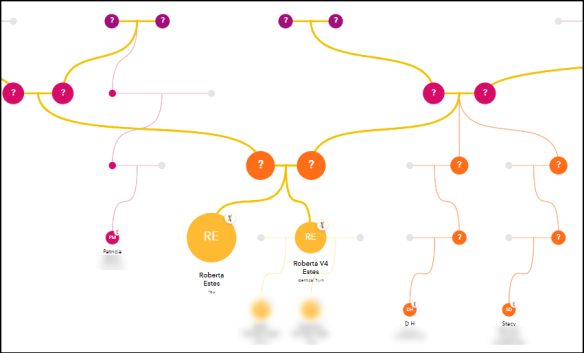
23andMe has never fully embraced genetic genealogy by adding the ability to upload and compare trees. In 2019, they introduced a beta function to attempt to create a genetic tree on your behalf based on how your matches match you and each other.

2019 23andMe.png

These trees aren’t accurate today, nor are they deep, but they are a beginning – especially considering that they are not based on existing trees. You can read more here.

The best 23andMe feature for genealogy, as far as I’m concerned, is their ethnicity along with the fact that they actually provide testers with the locations of their ethnicity segments which can help testers immensely, especially with minority ancestry matching. You can read about how to do this for yourself, here.

23andMe generally does not allow uploads, probably because they need people to test on their custom-designed medical chip. Very rarely, once that I know of in 2018, they do allow uploads – but in the past, uploaders do not receive all of the genealogy features and benefits of testing.

You can however, download your DNA file from 23andMe and upload elsewhere, with instructions here.

Ancestry

Ancestry is widely known for their ethnicity ads which are extremely effective in recruiting new testers. That’s the great news. The results are frustrating to seasoned genealogists who get to deal with the fallout of confused people trying to figure out why their results don’t match their expectations and family stories. That’s the not-so-great news.

However, with more than 15 million testers, many of whom DO have genealogy trees, a serious genealogist can’t *NOT* test at Ancestry. Testers do need to be aware that not all features are available to DNA testers who don’t also subscribe to Ancestry’s genealogy subscriptions. For example, you can’t see your matches’ trees beyond a 5 generation preview without a subscription. You can read more about what you do and don’t receive, here.

Ancestry is the only one of the major companies that doesn’t provide a chromosome browser, despite pleas for years to do so, but they do provide ThruLines that show you other testers who match your DNA and show a common ancestor with you in their trees.

2019 Ancestry.png

ThruLines will also link partial trees – showing you ancestral descendants from the perspective of the ancestor in question, shown above. You can read about ThruLines, here.

Of course, without a chromosome browser, this match is only as good as the associated trees, and there is no way to prove the genealogical connection. It’s possible to all be wrong together, or to be related to some people through a completely different ancestor. Third party tools like Genetic Affairs and cluster technology help resolve these types of issues. You can read more, here.

You can’t upload DNA files from other testing companies to Ancestry, probably due to their custom medical chip. You can download your file from Ancestry and upload to other locations, with instructions here.

Selling Customers’ DNA

Neither Family Tree DNA, MyHeritage nor Gedmatch sell, lease or otherwise share their customers’ DNA, and all three state (minimally) they will not in the future without prior authorization.

All companies utilize their customers’ DNA internally to enhance and improve their products. That’s perfectly normal.

Both Ancestry and 23andMe sell consumers DNA to both known and unknown partners if customers opt-in to additional research. That’s the purpose of all those questions.

If you do agree or opt-in, and for those who tested prior to when the opt-in began, consumers don’t know who their DNA has been sold to, where it is or for what purposes it’s being utilized. Although anonymized (pseudonymized) before sale, autosomal results can easily be identified to the originating tester (if someone were inclined to do so) as demonstrated by adoptees identifying parents and law enforcement identifying both long deceased remains and criminal perpetrators of violent crimes. You can read more about re-identification here, although keep in mind that the re-identification frequency (%) would be much higher now than it was in 2018.

People are widely split on this issue. Whatever you decide, to opt-in or not, just be sure to do your homework first.

Always read the terms and conditions fully and carefully of anything having to do with genetics.

Genealogy

The bottom line to genetic genealogy is the genealogy aspect. Genealogists want to confirm ancestors and discover more about those ancestors. Some information can only be discovered via DNA testing today, distant Native heritage, for example, breaking through brick walls.

This technology, as it has advanced and more people have tested, has been a godsend for genealogists. The same techniques have allowed other people to locate unknown parents, grandparents and close relatives.

Adoptees

Not only are genealogists identifying people long in the past that are their ancestors, but adoptees and those seeking unknown parents are making discoveries much closer to home. MyHeritage has twice provided thousands of free DNA tests via their DNAQuest program to adoptees seeking their biological family with some amazing results.

The difference between genealogy, which looks back in time several generations, and parent or grand-parent searches is that unknown-parent searches use matches to come forward in time to identify parents, not backwards in time to identify distant ancestors in common.

Adoptee matching is about identifying descendants in common. According to Erlich et al in an October 2018 paper, here, about 60% of people with European ancestry could be identified. With the database growth since that time, that percentage has risen, I’m sure.

You can read more about the adoption search technique and how it is used, here.

Adoptee searches have spawned their own subculture of sorts, with researchers and search angels that specialize in making these connections. Do be aware that while many reunions are joyful, not all discoveries are positively received and the revelations can be traumatic for all parties involved.

There’s ying and yang involved, of course, and the exact same techniques used for identifying biological parents are also used to identify cold-case deceased victims of crime as well as violent criminals, meaning rapists and murderers.

Crimes Solved

The use of genetic genealogy and adoptee search techniques for identifying skeletal remains of crime victims, as well as identifying criminals in order that they can be arrested and removed from the population has resulted in a huge chasm and division in the genetic genealogy community.

These same issues have become popular topics in the press, often authored by people who have no experience in this field, don’t understand how these techniques are applied or function and/or are more interested in a sensational story than in the truth. The word click-bait springs to mind although certainly doesn’t apply equally to all.

Some testers are adamantly pro-usage of their DNA in order to identify victims and apprehend violent criminals. Other testers, not so much and some, on the other end of the spectrum are vehemently opposed. This is a highly personal topic with extremely strong emotions on both sides.

The first such case was the Golden State Killer, which has been followed in the past 18 months or so by another 100+ solved cases.

Regardless of whether or not people want their own DNA to be utilized to identify these criminals and victims, providing closure for families, I suspect the one thing we can all agree on is that we are grateful that these violent criminals no longer live among us and are no longer preying on innocent victims.

I wrote about the Golden State Killer, here, as well as other articles here, here, here and here.

In the genealogy community, various vendors have adopted quite different strategies relating to these kinds of searches, as follows:

  • Ancestry, 23andMe and MyHeritage – have committed to fight all access attempts by law enforcement, including court ordered subpoenas.
  • MyHeritage, Family Tree DNA and GedMatch allow uploads, so forensic kits, meaning kits from deceased remains or rape kits could be uploaded to search for matches, the same as any other kit. Law Enforcement uploads violate the MyHeritage terms of service. Both Family Tree DNA and GEDmatch have special law enforcement procedures in place. All three companies have measures in place to attempt to detect unauthorized forensic uploads.
  • Family Tree DNA has provided a specific Law Enforcement protocol and guidelines for forensic uploads, here. All EU customers were opted out earlier in 2019, but all new or existing non-EU customers need to opt out if they do not want their DNA results available for matching to law enforcement kits.
  • GEDmatch was recently sold to Verogen, a DNA forensics company, with information, here. Currently GEDMatch customers are opted-out of matching for law enforcement kits, but can opt-in. Verogen, upon purchase of GEDmatch, required all users to read the terms and conditions and either accept the terms or delete their kits. Users can also delete their kits or turn off/on law enforcement matching at any time.

New Concerns

Concerns in late 2019 have focused on the potential misuse of genetic matching to potentially target subsets of individuals by despotic regimes such as has been done by China to the Uighurs.

You can read about potential risks here, here and here, along with a recent DoD memo here.

Some issues spelled out in the papers can be resolved by vendors agreeing to cryptographically sign their files when customers download. Of course, this would require that everyone, meaning all vendors, play nice in the sandbox. So far, that hasn’t happened although I would expect that the vendors accepting uploads would welcome cryptographic signatures. That pretty much leaves Ancestry and 23andMe. I hope they will step up to the plate for the good of the industry as a whole.

Relative to the concerns voiced in the papers and by the DoD, I do not wish to understate any risks. There ARE certainly risks of family members being identified via DNA testing, which is, after all, the initial purpose even though the current (and future) uses were not foreseen initially.

In most cases, the cow has already left that barn. Even if someone new chooses not to test, the critical threshold is now past to prevent identification of individuals, at least within the US and/or European diaspora communities.

I do have concerns:

  • Websites where the owners are not known in the genealogical community could be collecting uploads for clandestine purposes. “Free” sites are extremely attractive to novices who tend to forget that if you’re not paying for the product, you ARE the product. Please be very cognizant and leery. Actually, just say no unless you’re positive.
  • Fearmongering and click-bait articles in general will prevent and are already causing knee-jerk reactions, causing potential testers to reject DNA testing outright, without doing any research or reading terms and conditions.
  • That Ancestry and 23andMe, the two major vendors who don’t accept uploads will refuse to add crypto-signatures to protect their customers who download files.

Every person needs to carefully make their own decisions about DNA testing and participating in sharing through third party sites.

Health

Not surprisingly, the DNA testing market space has cooled a bit this past year. This slowdown is likely due to a number of factors such as negative press and the fact that perhaps the genealogical market is becoming somewhat saturated. Although, I suspect that when vendors announce major new tools, their DNA kit sales spike accordingly.

Look at it this way, do you know any serious genealogists who haven’t DNA tested? Most are in all of the major databases, meaning Ancestry, 23andMe, FamilyTreeDNA, MyHeritage and GedMatch.

All of the testing companies mentioned above (except GEDmatch who is not a testing company) now have a Health offering, designed to offer existing and new customers additional value for their DNA testing dollar.

23andMe separated their genealogy and health offering years ago. Ancestry and MyHeritage now offer a Health upgrade. For existing customers, FamilyTreeDNA offers the Cadillac of health tests through Tovana.

I would guess it goes without saying here that if you really don’t want to know about potential health issues, don’t purchase these tests. The flip side is, of course, that most of the time, a genetic predisposition is nothing more and not a death sentence.

From my own perspective, I found the health tests to be informative, actionable and in some cases, they have been lifesaving for friends.

Whoever knew genealogy might save your life.

Innovative Third-Party Tools

Tools, and fads, come and go.

In the genetic genealogy space, over the years, tools have burst on the scene to disappear a few months later. However, the last few years have been won by third party tools developed by well-known and respected community members who have created tools to assist other genealogists.

As we close this decade, these are my picks of the tools that I use almost daily, have proven to be the most useful genealogically and that I feel I just “couldn’t live without.”

And yes, before you ask, some of these have a bit of a learning curve, but if you are serious about genealogy, these are all well worthwhile:

  • GedMatch – offers a wife variety of tools including triangulation, half versus fully identical segments and the ability to see who your matches also match. One of the tools I utilize regularly is segment search to see who else matches me on a specific segment, attached to an ancestor I’m researching. GedMatch, started by genealogists, has lasted more than a decade prior to the sale in December 2019.
  • Genetic Affairs – a barn-burning newcomer developed by Evert-Jan Blom in 2018 wins this years’ “Best” award from me, titled appropriately, the “SNiPPY.”.

Genetic Affairs 2019 SNiPPY Award.png

Genetic Affairs offers clustering, tree building between your matches even when YOU don’t have a tree. You can read more here.

2019 genetic affairs.png

Just today, Genetic Affairs released a new cluster interface with DNAPainter, example shown above.

  • DNAPainter – THE chromosome painter created by Jonny Perl just gets better and better, having added pedigree tree construction this year and other abilities. I wrote a composite instructional article, here.
  • DNAGedcom.com and Genetic.Families, affiliated with DNAAdoption.org – Rob Warthen in collaboration with others provides tools like clustering combined with triangulation. My favorite feature is the gathering of all direct ancestors of my matches’ trees at the various vendors where I’ve DNA tested which allows me to search for common surnames and locations, providing invaluable hints not otherwise available.

Promising Newcomer

  • MitoYDNA – a non-profit newcomer by folks affiliated with DNAAdoption and DNAGedcom is designed to replace YSearch and MitoSearch, both felled by the GDPR ax in 2018. This website allows people to upload their Y and mitochondrial DNA results and compare the values to each other, not just for matching, which you can do at Family Tree DNA, but also to see the values that do and don’t match and how they differ. I’ll be taking MitoYDNA for a test drive after the first of the year and will share the results with you.

The Future

What does the future hold? I almost hesitate to guess.

  • Artificial Intelligence Pedigree Chart – I think that in the not-too-distant future we’ll see the ability to provide testers with a “one and done” pedigree chart. In other words, you will test and receive at least some portion of your genealogy all tidily presented, red ribbon untied and scroll rolled out in front of you like you’re the guest on one of those genealogy TV shows.

Except it’s not a show and is a result of DNA testing, segment triangulation, trees and other tools which narrow your ancestors to only a few select possibilities.

Notice I said, “the ability to.” Just because we have the ability doesn’t mean a vendor will implement this functionality. In fact, just think about the massive businesses built upon the fact that we, as genealogists, have to SEARCH incessantly for these elusive answers. Would it be in the best interest of these companies to just GIVE you those answers when you test?

If not, then these types of answers will rest with third parties. However, there’s a hitch. Vendors generally don’t welcome third parties offering advanced tools and therefore block those tools, even though they are being used BY the customer or with their explicit authorization to massage their own data.

On the other hand, as a genealogist, I would welcome this feature with open arms – because as far as I’m concerned, the identification of that ancestor is just the first step. I get to know them by fleshing out their bones by utilizing those research records.

In fact, I’m willing to pony up to the table and I promise, oh-so-faithfully, to maintain my subscription lifelong if one of those vendors will just test me. Please, please, oh pretty-please put me to the test!

I guess you know what my New Year’s Wish is for this and upcoming years now too😊

What About You?

What do you think the high points of 2019 have been?

How about the decade?

What do you think the future holds?

Do you care to make any predictions?

Are you planning to focus on any particular goal or genealogy problem in 2020?

______________________________________________________________

Disclosure

I receive a small contribution when you click on some of the links to vendors in my articles. This does NOT increase the price you pay but helps me to keep the lights on and this informational blog free for everyone. Please click on the links in the articles or to the vendors below if you are purchasing products or DNA testing.

Thank you so much.

DNA Purchases and Free Transfers

Genealogy Products and Services

Genealogy Research

Fun DNA Stuff

  • Celebrate DNA – customized DNA themed t-shirts, bags and other items

Big Y News and Stats + Sale

I must admit – this past January when FamilyTreeDNA announced the Big Y-700, an upgrade from the Big Y-500 product, I was skeptical. I wondered how much benefit testers would really see – but I was game to purchase a couple upgrades – and I did. Then, when the results came back, I purchased more!

I’m very pleased to announce that I’m no longer skeptical. I’m a believer.

The Big Y-700 has produced amazing results – and now FamilyTreeDNA has decoupled the price of the BAM file in addition to announcing substantial sale prices for their Thanksgiving Sale.

I’m going to discuss sale pricing for products other than the Big Y in a separate article because I’d like to focus on the progress that has been made on the phylogenetic tree (and in my own family history) as a result of the Big Y-700 this year.

Big Y Pricing Structure Change

FamilyTreeDNA recently anounced some product structure changes.

The Big Y-700 price has been permanently dropped by $100 by decoupling the BAM file download from the price of the test itself. This accomplishes multiple things:

  • The majority of testers don’t want or need the BAM file, so the price of the test has been dropped by $100 permanently in order to be able to price the Big Y-700 more attractively to encourage more testers. That’s good for all of us!!!
  • For people who ordered the Big Y-700 since November 1, 2019 (when the sale prices began) who do want the BAM file, they can purchase the BAM file separately through the “Add Ons and Upgrades” page, via the “Upgrades” tab for $100 after their test results are returned. There will also be a link on the Big Y-700 results page. The total net price for those testers is exactly the same, but it represents a $100 permanent price drop for everyone else.
  • This BAM file decoupling reduces the initial cost of the Big Y-700 test itself, and everyone still has the option of purchasing the BAM file later, which will make the Big Y-700 test more affordable. Additionally, it allows the tester who wants the BAM file to divide the purchase into two pieces, which will help as well.
  • The current sale price for the Big Y-700 for the tester who has taken NO PREVIOUS Y DNA testing is now just $399, formerly $649. That’s an amazing price drop, about 40%, in the 9 months since the Big Y-700 was introduced!
  • Upgrade pricing is available too, further down in this article.
  • If you order an upgrade from any earlier Big Y to the Big Y-700, you receive an upgraded BAM file because you already paid for the BAM file when you ordered your initial Big Y test.
  • The VCF file is still available for download at no additional cost with any Big Y test.
  • There is no change in the BAM file availability for current customers. Everyone who ordered before November 1, 2019 will be able to download their BAM file as always.

The above changes are permanent, except for the sale price.

2019 has been a Banner Year

I know how successful the Big Y-700 has been for kits and projects that I manage, but how successful has it been overall, in a scientific sense?

I asked FamilyTreeDNA for some stats about the number of SNPs discovered and the number of branches added to the Y phylotree.

Drum roll please…

Branches Added This Year Total Tree Branches Variants Added to Tree This Year Total Variants Added to Tree
2018 6,259 17,958 60,468 132.634
2019 4,394 22.352 32,193 164,827

The tests completed in 2019 are only representative for 10 months, through October, and not the entire year.

Haplotree Branches

Not every SNP discovered results in a new branch being added to the haplotree, but many do. This chart shows the number of actual branches added in 2018 and 2019 to date.

Big Y 700 haplotree branches.png

These stats, provided by FamilyTreeDNA, show the totals in the bottom row, which is a cumulative branch number total, not a monthly total. At the end of October 2019, the total number of individual branches were 22,352.

Big Y 700 haplotree branches small.png

This chart, above, shows some of the smaller haplogroups.

Big Y 700 haplotree branches large.png

This chart shows the larger haplogroups, including massive haplogroup R.

Haplotree Variants

The number of variants listed below is the number of SNPs that have been discovered, named and placed on the tree. You’ll notice that these numbers are a lot larger than the number of branches, above. That’s because roughly 168,000 of these are equivalent SNPs, meaning they don’t further branch the tree – at least not yet. These 168K variants are the candidates to be new branches as more people test and the tree can be further split.

Big Y 700 variants.png

These numbers also don’t include Private Variants, meaning SNPs that have not yet been named.

If you see Private Variants listed in your Big Y results, when enough people have tested positive for the same variant, and it makes sense, the variants will be given a SNP name and placed on the tree.

Big Y 700 variants small.png

The smaller haplogroups variants again, above, followed by the larger, below.

Big Y 700 variants large.png

Upgrades from the Big Y, or Big Y-500 to Big Y-700

Based on what I see in projects, roughly one third of the Big Y and Big Y-500 tests have upgraded to the Big Y-700.

For my Estes line, I wondered how much value the Big Y-700 upgrade would convey, if any, but I’m extremely glad I upgraded several kits. As a result of the Big Y-700, we’ve further divided the sons of Abraham, born in 1747. This granularity wasn’t accomplished by STR testing and wasn’t accomplished by the Big Y or Big Y-500 testing alone – although all of these together are building blocks. I’m ECSTATIC since it’s my own ancestral line that has the new lineage defining SNP.

Big Y 700 Estes.png

Every Estes man descended from Robert born in 1555 has R-BY482.

The sons of the immigrant, Abraham, through his father, Silvester, all have BY490, but the descendants of Silvester’s brother, Robert, do not.

Moses, son of Abraham has ZS3700, but the rest of Abraham’s sons don’t.

Then, someplace in the line of kit 831469, between Moses born in 1711 and the present-day tester, we find a new SNP, BY154784.

Big Y 700 Estes block tree.png

Looking at the block tree, we see the various SNPs that are entirely Estes, except for one gentleman who does not carry the Estes surname. I wrote about the Block Tree, here.

Without Big Y testing, none of these SNPs would have been found, meaning we could never have split these lines genealogically.

Every kit I’ve reviewed carries SNPs that the Big Y-700 has been able to discern that weren’t discovered previously.

Every. Single. One.

Now, even someone who hasn’t tested Y DNA before can get the whole enchilada – meaning 700+ STRs, testing for all previously discovered SNPs, and new branch defining SNPs, like my Estes men – for $399.

If a new Estes tester takes this test, without knowing anything about his genealogy, I can tell him a great deal about where to look for his lineage in the Estes tree.

Reduced Prices

FamilyTreeDNA has made purchasing the Big Y-700 outright, or upgrading, EXTREMELY attractive.

Test Price
Big Y-700 purchase with no previous Y DNA test


$399
Y-12 upgrade to Big Y-700 $359
Y-25 upgrade to Big Y-700 $349
Y-37 upgrade to Big Y-700 $319
Y-67 upgrade to Big Y-700 $259
Y-111 upgrade to Big Y-700 $229
Big Y or Big Y-500 upgrade to Big Y-700 $189

Note that the upgrades include all of the STR markers as yet untested. For example, the 12-marker to Big Y-700 includes all of the STRs between 25 and 111, in addition to the Big Y-700 itself. The Big Y-700 includes:

  • All of the already discovered SNPs, called Named Variants, extending your haplogroup all the way to the leaf at the end of your branch
  • Personal and previously undiscovered SNPs called Private Variants
  • All of the untested STR markers inclusive through 111 markers
  • A minimum of a total of 700 STR markers, including markers above 111 that are only available through Big Y-700 testing

With the refinements in the Big Y test over the past few years, and months, the Big Y is increasingly important to genealogy – equally or more so than traditional STR testing. In part, because SNPs are not prone to back mutations, and are therefore more stable than STR markers. Taken together, STRs and SNPs are extremely informative, helping to break down ancestral brick walls for people whose genealogy may not reach far back in time – and even those who do.

If you are a male and have not Y DNA tested, there’s never been a better opportunity. If you are a female, find a male on a brick wall line and sponsor a scholarship.

Click here to order or upgrade!

______________________________________________________________

Disclosure

I receive a small contribution when you click on some of the links to vendors in my articles. This does NOT increase the price you pay but helps me to keep the lights on and this informational blog free for everyone. Please click on the links in the articles or to the vendors below if you are purchasing products or DNA testing.

Thank you so much.

DNA Purchases and Free Transfers

Genealogy Services

Genealogy Research

Mitochondrial DNA Resources – Everything You Need to Know

Mitochondrial DNA Resources

Recently, I wrote a multi-part series about mitochondrial DNA – start to finish – everything you need to know.

I’ve assembled several articles in one place, and I’ll add any new articles here as well.

Please feel free to share this resource or any of the links to individual articles with friends, genealogy groups or on social media.

What the Difference Between Mitochondrial and Other Types of DNA?

Mitochondrial DNA is inherited directly from your matrilineal line, only, meaning your mother’s mother’s mother’s mother – on up your family tree until you run out of direct line mothers that you’ve identified. The great news is even if you don’t know the identities of those people in your tree, you carry their mitochondrial DNA which can help identify them.

Here’s a short article about the different kinds of DNA that can be used for genealogy.

Why Mitochondrial DNA?

Let’s start out with why someone might want to test their mitochondrial DNA.

After you purchase a DNA test, swab, return the kit and when the lab finishes processing your test, you’ll receive your results on your personal page at FamilyTreeDNA, the only company that tests mitochondrial DNA at the full sequence level and provides matching with tens of thousands of other testers.

What About Those Results?

People want to understand how to use all of the different information provided to testers. These articles provide a step-by-step primer.

Mitochondrial DNA personal page update

Sign in to your Family Tree DNA account and use these articles as a guideline to step through your results on your personal page.

We begin with an overview. What is mitochondrial DNA, how it is inherited and why is it useful for genealogy?

Next, we look at your results and decode what all the numbers mean. It’s easy, really!

Our ancestors lived in clans, and our mitochondrial DNA has its own versions of clans too – called haplogroups. Your full haplogroup can be very informative.

Sometimes there’s more than meets the eye. Here are my own tips and techniques for more than doubling the usefulness of your matches.

You’ll want to wring every possible advantage out of your tests, so be sure to join relevant projects and use them to their fullest extent.

Do you know how to utilize advanced matching? It’s a very powerful tool. If not, you will after these articles.

Mitochondrial DNA Information for Everyone

FamilyTreeDNA maintains an extensive public mitochondrial DNA tree, complete with countries of origin for all branches. You don’t need to have tested to enjoy the public tree.

However, if you have tested, take a look to see where the earliest known ancestors of your haplogroup matches are located based on the country flags.

Mitochondrial resources haplotree

These are mine. Where are yours?

What Can Mitochondrial DNA Do for You?

Some people mistakenly think that mitochondrial DNA isn’t useful for genealogy. I’m here to testify that it’s not only useful, it’s amazing! Here are three stories from my own genealogy about how I’ve used mitochondrial DNA to learn more about my ancestors and in some cases, break right through brick walls.

It’s not only your own mitochondrial DNA that’s important, but other family members too.

My cousin tested her mitochondrial DNA to discover that her direct matrilineal ancestor was Native American, much to her surprise. The great news is that her ancestor is my ancestor too!

Searching for Native American Ancestors?

If you’re searching for Native American or particular ancestors, mitochondrial DNA can tell you specifically if your mitochondrial DNA, or that of your ancestors (if you test a direct matrilineal descendant,) is Native, African, European, Jewish or Asian. Furthermore, your matches provide clues as to what country your ancestor might be from and sometimes which regions too.

Did you know that people from different parts of the world have distinctive haplogroups?

You can discover your ancestors’ origins through their mitochondrial DNA.

You can even utilize autosomal segment information to track back in time to the ancestor you seek. Then you can obtain that ancestor’s mitochondrial DNA by selectively testing their descendants or finding people who have already tested that descend from that ancestor. Here’s how.

You never know what you’re going to discover when you test your mitochondrial DNA. I discovered that although my earliest known matrilineal ancestor is found in Germany, her ancestors were from Scandinavia. My cousin discovered that our common ancestor is Mi’kmaq.

What secrets will your mitochondrial DNA reveal?

You can test or upgrade your mitochondrial DNA by clicking here.

______________________________________________________________

Disclosure

I receive a small contribution when you click on some of the links to vendors in my articles. This does NOT increase the price you pay but helps me to keep the lights on and this informational blog free for everyone. Please click on the links in the articles or to the vendors below if you are purchasing products or DNA testing.

Thank you so much.

DNA Purchases and Free Transfers

Genealogy Services

Genealogy Research

Native American & Minority Ancestors Identified Using DNAPainter Plus Ethnicity Segments

Ethnicity is always a ticklish subject. On one hand we say to be leery of ethnicity estimates, but on the other hand, we all want to know who our ancestors were and where they came from. Many people hope to prove or disprove specific theories or stories about distant ancestors.

Reasons to be cautious about ethnicity estimates include:

  • Within continents, like Europe, it’s very difficult to discern ethnicity at the “country” level because of thousands of years of migration across regions where borders exist today. Ethnicity estimates within Europe can be significantly different than known and proven genealogy.
  • “Countries,” in Europe, political constructs, are the same size as many states in the US – and differentiation between those populations is almost impossible to accurately discern. Think of trying to figure out the difference between the populations of Indiana and Illinois, for example. Yet we want to be able to tell the difference between ancestors that came from France and Germany, for example.

Ethnicity states over Europe

  • All small amounts of ethnicity, even at the continental level, under 2-5%, can be noise and might be incorrect. That’s particularly true of trace amounts, 1% or less. However, that’s not always the case – which is why companies provide those small percentages. When hunting ancestors in the distant past, that small amount of ethnicity may be the only clue we have as to where they reside at detectable levels in our genome.

Noise in this case is defined as:

  • A statistical anomaly
  • A chance combination of your DNA from both parents that matches a reference population
  • Issues with the reference population itself, specifically admixture
  • Perhaps combinations of the above

You can read about the challenges with ethnicity here and here.

On the Other Hand

Having restated the appropriate caveats, on the other hand, we can utilize legitimate segments of our DNA to identify where our ancestors came from – at the continental level.

I’m actually specifically referring to Native American admixture which is the example I’ll be using, but this process applies equally as well to other minority or continental level admixture as well. Minority, in this sense means minority ethnicity to you.

Native American ethnicity shows distinctly differently from African and European. Sometimes some segments of DNA that we inherit from Native American ancestors are reported as Asian, specifically Siberian, Northern or Eastern Asian.

Remember that the Native American people arrived as a small group via Beringia, a now flooded land bridge that once connected Siberia with Alaska.

beringia map

By Erika Tamm et al – Tamm E, Kivisild T, Reidla M, Metspalu M, Smith DG, et al. (2007) Beringian Standstill and Spread of Native American Founders. PLoS ONE 2(9): e829. doi:10.1371/journal.pone.0000829. Also available from PubMed Central., CC BY 2.5, https://commons.wikimedia.org/w/index.php?curid=16975303

After that time, the Native American/First Nations peoples were isolated from Asia, for the most part, and entirely from Europe until European exploration resulted in the beginning of sustained European settlement, and admixture beginning in the late 1400s and 1500s in the Americas.

Family Inheritance

Testing multiple family members is extremely useful when working with your own personal minority heritage. This approach assumes that you’d like to identify your matches that share that genetic heritage because they share the same minority DNA that you do. Of course, that means you two share the same ancestor at some time in the past. Their genealogy, or your combined information, may hold the clue to identifying your ancestor.

In my family, my daughter has Native American segments that she inherited from me that I inherited from my mother.

Finding the same segment identified as Native American in several successive generations eliminates the possibility that the chance combination of DNA from your father and mother is “appearing” as Native, when it isn’t.

We can use segment information to our benefit, especially if we don’t know exactly who contributed that DNA – meaning which ancestor.

We need to find a way to utilize those Native or other minority segments genealogically.

23andMe

Today, the only DNA testing vendor that provides consumers with a segment identification of our ethnicity predictions is 23andMe.

If you have tested at 23andMe, sign in and click on Ancestry on the top tab, then select Ancestry Composition.

Minority ethnicity ancestry composition.png

Scroll down until you see your painted chromosomes.

Minority ethnicity chromosome painting.png

By clicking on the region at left that you want to see, the rest of the regions are greyed out and only that region is displayed on your chromosomes, at right.

Minority ethnicity Native.png

According to 23andMe, I have two Native segments, one each on chromosomes 1 and 2. They show these segments on opposite chromosomes, meaning one (the top for example) would be maternal or paternal, and the bottom one would be the opposite. But 23andMe apparently could not tell for sure because neither my mother nor father have tested there. This placement also turned out to be incorrect. The above image was my initial V3 test at 23andMe. My later V4 results were different.

Versions May Differ

Please note that your ethnicity predictions may be different based on which test you took which is dictated by when you took the test. The image above is my V3 test that was in use at 23andMe between 2010 and November 2013, and the image below is my V4 test in use between November 2013 and August 2017.

23andMe apparently does not correct original errors involving what is known as “strand swap” where the maternal and paternal segments are inverted during analysis. My V4 test results are shown below, where the strands are correctly portrayed.

Minority ethnicity Native V4.png

Note that both Native segments are now on the lower chromosome “side” of the pair and the position on the chromosome 1 segment has shifted visually.

Minority ethnicity sides.png

I have not tested at 23andMe on the current V5 GSA chip, in use since August 9, 2017, but perhaps I should. The results might be different yet, with the concept being that each version offers an improvement over earlier versions as science advances.

If your parents have tested, 23andMe makes adjustments to your ethnicity estimates accordingly.

Although my mother can’t test at 23andMe, I happen to already know that these Native segments descend from my mother based on genealogical and genetic analysis, combined. I’m going to walk you through the process.

I can utilize my genealogy to confirm or refute information shown by 23andMe. For example, if one of those segments comes from known ancestors who were living in Germany, it’s clearly not Native, and it’s noise of some type.

We’re going to utilize DNAPainter to determine which ancestors contributed your minority segments, but first you’ll need to download your ethnicity segments from 23andMe.

Downloading Ethnicity Segment Data

Downloading your ethnicity segments is NOT THE SAME as downloading your raw DNA results to transfer to another vendor. Those are two entirely different files and different procedures.

To download the locations of your ethnicity segments at 23andMe, scroll down below your painted ethnicity segments in your Ancestry Composition section to “View Scientific Details.”

MInority ethnicity scientific details.png

Click on View Scientific Details and scroll down to near the bottom and then click on “Download Raw Data.” I leave mine at the 50% confidence level.

Minority ethnicity download raw data.png

Save this spreadsheet to your computer in a known location.

In the spreadsheet, you’ll see columns that provide the name of the segment, the chromosome copy number (1 or 2) and the chromosome number with start and end locations.

Minority ethnicity download.png

You really don’t care about this information directly, but DNAPainter does and you’ll care a lot about what DNAPainter does for you.

DNAPainter

I wrote introductory articles about DNAPainter:

If you’re not familiar with DNAPainter, you might want to read these articles first and then come back to this point in this article.

Go ahead – I’ll wait!

Getting Started

If you don’t have a DNAPainter account, you’ll need to create one for free. Some features, such as having multiple profiles are subscription based, but the functionality you’ll need for one profile is free.

I’ve named this example profile “Ethnicity Demo.” You’ll see your name where mine says “Ethnicity Demo.”

Minority ethnicity DNAPainter.png

Click on “Import 23andme ancestry composition.”

You will copy and paste all the spreadsheet rows in the entire downloaded 23andMe ethnicity spreadsheet into the DNAPainter text box and make your selection, below. The great news is that if you discover that your assumption about copy 1 being maternal or paternal is incorrect, it’s easy to delete the ethnicity segments entirely and simply repaint later. Ditto if 23andMe changes your estimate over time, like they have mine.

Minority ethnicity DNAPainter sides.png

I happen to know that “copy 2” is maternal, so I’ve made that selection.

You can then see your ethnicity chromosome segments painted, and you can expand each one to see the detail. Click on “Save Segments.”

MInority ethnicity DNAPainter Native painting

Click to enlarge

In this example, you can see my Native segments, called by various names at different confidence levels at 23andMe, on chromosome 1.

Depending on the confidence level, these segments are called some mixture of:

  • East Asian & Native American
  • North Asian & Native American
  • Native American
  • Broadly East Asian & Native American

It’s exactly the same segment, so you don’t really care what it’s called. DNAPainter paints all of the different descriptions provided by 23andMe, at all confidence levels as you can see above.

The DNAPainter colors are different from 23andMe colors and are system-selected. You can’t assign the colors for ethnicity segments.

Now, I’m moving to my own profile that I paint with my ancestral segments. To date, I have 78% of my segments painted by identifying cousins with known common ancestors.

On chromosomes 1 and 2, copy 2, which I’ve determined to be my mother’s “side,” these segments track back to specific ancestors.

Minority ethnicity maternal side

Click to enlarge

Chromosome 1 segments, above, track back to the Lore family, descended from Antoine (Anthony) Lore (Lord) who married Rachel Hill. Antoine Lore was Acadian.

Minority ethnicity chromosome 1.png

Clicking on the green segment bar shows me the ancestors I assigned when I painted the match with my Lore family member whose name is blurred, but whose birth surname was Lore.

The Chromosome 2 segment, below, tracks back to the same family through a match to Fred.

Minority ethnicity chromosome 2.png

My common ancestors with Fred are Honore Lore and Marie Lafaille who are the parents of Antoine Lore.

Minority ethnicity common ancestor.png

There are additional matches on both chromosomes who also match on portions of the Native segments.

Now that I have a pointer in the ancestral direction that these Native American segments arrived from, what can traditional genealogy and other DNA information tell me?

Traditional Genealogy Research

The Acadian people were a mixture of English, French and Native American. The Acadians settled on the island of Nova Scotia in 1609 and lived there until being driven out by the English in 1755, roughly 6 or 7 generations later.

Minority ethnicity Acadian map.png

The Acadians intermarried with the Mi’kmaq people.

It had been reported by two very qualified genealogists that Philippe Mius, born in 1660, married two Native American women from the Mi’kmaq tribe given the name Marie.

The French were fond of giving the first name of Marie to Native women when they were baptized in the Catholic faith which was required before the French men were allowed to marry the Native women. There were many Native women named Marie who married European men.

Minority ethnicity Native mitochondrial tree

Click to enlarge

This Mius lineage is ancestral to Antoine Lore (Lord) as shown on my pedigree, above.

Mitochondrial DNA has revealed that descendants from one of Philippe Mius’s wives, Marie, carry haplogroup A2f1a.

However, mitochondrial tests of other descendants of “Marie,” his first wife, carry haplogroup X2a2, also Native American.

Confusion has historically existed over which Marie is the mother of my ancestor, Francoise.

Karen Theroit Reader, another professional genealogist, shows Francoise Mius as the last child born to the first Native wife before her death sometime after 1684 and before about 1687 when Philippe remarried.

However, relative to the source of Native American segments, whether Francoise descends from the first or second wife doesn’t matter in this instance because both are Native and are proven so by their mitochondrial DNA haplogroups.

Additionally, on Antoine’s mother’s side, we find a Doucet male, although there are two genetic male Doucet lines, one of European origin, haplogroup R-L21, and one, surprisingly, of Native origin, haplogroup C-P39. Both are proven by their respective haplogroups but confusion exists genealogically over who descends from which lineage.

On Antoine’s mother’s side, there are several unidentified lineages, any one or multiples of which could also be Native. As you can see, there are large gaps in my tree.

We do know that these Native segments arrived through Antoine Lore and his parents, Honore Lore and Marie LaFaille. We don’t know exactly who upstream contributed these segments – at least not yet. Painting additional matches attributable to specific ancestral couples will eventually narrow the candidates and allow me to walk these segments back in time to their rightful contributor.

Segments, Traditional Research and DNAPainter

These three tools together, when using continent-level segments in combination with painting the DNA segments of known cousins that match specific lineages create a triangulated ethnicity segment.

When that segment just happens to be genealogically important, this combination can point the researchers in the right direction knowing which lines to search for that minority ancestor.

If your cousins who match you on this segment have also tested with 23andMe, they should also be identified as Native on this same segment. This process does not apply to intracontinental segments, meaning within Europe, because the admixture is too great and the ethnicity predictions are much less reliable.

When identifying minority admixture at the continental level, adding Y and mitochondrial DNA testing to the mix in order to positively identify each individual ancestor’s Y and mitochondrial DNA is very important in both eliminating and confirming what autosomal DNA and genealogy records alone can’t do. The base haplogroup as assigned at 23andMe is a good start, but it’s not enough alone. Plus, we only carry one line of mitochondrial DNA and only males carry Y DNA, and only their direct paternal line.

We need Y and mitochondrial DNA matching at FamilyTreeDNA to verify the specific lineage. Additionally, we very well may need the Y and mitochondrial DNA information that we don’t directly carry – but other cousins do. You can read about Y and mitochondrial DNA testing, here.

I wrote about creating a personal DNA pedigree chart including your ancestors’ Y and mitochondrial DNA here. In order to find people descended from a specific ancestor who have DNA tested, I utilize:

  • WikiTree resources and trees
  • Geni trees
  • FamilySearch trees
  • FamilyTreeDNA autosomal matches with trees
  • AncestryDNA autosomal matches and their associated trees
  • Ancestry trees in general, meaning without knowing if they are related to a DNA match
  • MyHeritage autosomal matches and their trees
  • MyHeritage trees in general

At both MyHeritage and Ancestry, you can view the trees of your matches, but you can also search for ancestors in other people’s trees to see who might descend appropriately to provide a Y or mitochondrial DNA sample. You will probably need a subscription to maximize these efforts. My Heritage offers a free trial subscription here.

If you find people appropriately descended through WikiTree, Geni or FamilySearch, you’ll need to discuss DNA testing with them. They may have already tested someplace.

If you find people who have DNA tested through your DNA matches with trees at Ancestry and MyHeritage, you’ll need to offer a Y or mitochondrial DNA test to them if they haven’t already tested at FamilyTreeDNA.

FamilyTreeDNA is the only vendor who provides the Y DNA and mitochondrial DNA tests at the higher resolution level, beyond base haplogroups, required for matching and for a complete haplogroup designation.

If the person has taken the Family Finder autosomal test at FamilyTreeDNA, they may have already tested their Y DNA and mtDNA, or you can offer to upgrade their test.

Projects

Checking projects at FamilyTreeDNA can be particularly useful when trying to discover if anyone from a specific lineage has already tested. There are many, special interest projects such as the Acadian AmerIndian Ancestry project, the American Indian project, haplogroup projects, surname projects and more.

You can view projects alphabetically here or you can click here to scroll down to enter the surname or topic you are seeking.

Minority ethnicity project search.png

If the topic isn’t listed, check the alphabetic index under Geographical Projects.

23andMe Maternal and Paternal Sides

If possible, you’ll want to determine which “side” of your family your minority segments originate come from, unless they come from both. you’ll want to determine whether chromosome side one 1 or 2 is maternal, because the other one will be paternal.

23andMe doesn’t offer tree functionality in the same way as other vendors, so you won’t be able to identify people there descended from your ancestors without contacting each person or doing other sleuthing.

Recently, 23andMe added a link to FamilySearch that creates a list of your ancestors from their mega-shared tree for 7 generations, but there is no tree matching or search functionality. You can read about the FamilySearch connection functionality here.

So, how do you figure out which “side” is which?

Minority ethnicity minority segment.png

The chart above represents the portion of your chromosomes that contains your minority ancestry. Initially, you don’t know if the minority segment is your mother’s pink chromosome or your father’s blue chromosome. You have one chromosome from each parent with the exact same addresses or locations, so it’s impossible to tell which side is which without additional information. Either the pink or the blue segment is minority, but how can you tell?

In my case, the family oral history regarding Native American ancestry was from my father’s line, but the actual Native segments wound up being from my mother, not my father. Had I made an assumption, it would have been incorrect.

Fortunately, in our example, you have both a maternal and paternal aunt who have tested at 23andMe. You match both aunts on that exact same segment location – one from your father’s side, blue, and one from your mother’s side, pink.

You compare your match with your maternal aunt and verify that indeed, you do match her on that segment.

You’ll want to determine if 23andMe has flagged that segment as Native American for your maternal aunt too.

You can view your aunt’s Ancestry Composition by selecting your aunt from the “Your Connections” dropdown list above your own ethnicity chromosome painting.

Minority ethnicity relative connections.png

You can see on your aunt’s chromosomes that indeed, those locations on her chromosomes are Native as well.

Minority ethnicity relative minority segments.png

Now you’ve identified your minority segment as originating on your maternal side.

Minority ethnicity Native side.png

Let’s say you have another match, Match 1, on that same segment. You can easily tell which “side” Match 1 is from. Since you know that you match your maternal aunt on that minority segment, if Match 1 matches both you and your maternal aunt, then you know that’s the side the match is from – AND that person also shares that minority segment.

You can also view that person’s Ancestry Composition as well, but shared matching is more reliable,especially when dealing with small amounts of minority admixture.

Another person, Match 2, matches you on that same segment, but this time, the person matches you and your paternal aunt, so they don’t share your minority segment.

Minority ethnicity match side.png

Even if your paternal aunt had not tested, because Match 2 does not match you AND your maternal aunt, you know Match 2 doesn’t share your minority segment which you can confirm by checking their Ancestry Composition.

Download All of Your Matches

Rather than go through your matches one by one, it’s easiest to download your entire match list so you can see which people match you on those chromosome locations.

Minority ethnicity download aggregate data.png

You can click on “Download Aggregate Data” at 23andMe, at the bottom of your DNA Relatives match list to obtain all of your matches who are sharing with you. 23andMe limits your matches to 2000 or less, the actual number being your highest 2000 matches minus the people who aren’t sharing. I have 1465 matches showing and that number decreases regularly as new testers at 23andMe are focused on health and not genealogy, meaning lower matches get pushed off the list of 2000 match candidates.

You can quickly sort the spreadsheet to see who matches you on specific segments. Then, you can check each match in the system to see if that person matches you and another known relative on the minority segments or you can check their Ancestry Composition, or both.

If they share your minority segment, then you can check their tree link if they have one, included in the download, their Family Search information if included on their account, or reach out to them to see if you might share a known ancestor.

The key to making your ethnicity segment work for you is to identify ancestors and paint known matches.

Paint Those Matches

When searching for matches whose DNA you can attribute to specific ancestors, be sure to check at all 4 places that provide segment information that you can paint:

At GedMatch, you’ll find some people who have tested at the other various vendors, including Ancestry, but unfortunately not everyone uploads. Ancestry doesn’t provide segment information, so you won’t be able to paint those matches directly from Ancestry.

If your Ancestry matches transfer to GedMatch, FamilyTreeDNA or MyHeritage you can view your match and paint your common segments. At GedMatch, Ancestry kit numbers begin with an A. I use my Ancestry kit matches at GedMatch to attempt to figure out who that match is at Ancestry in order to attempt to figure out the common ancestor.

To Paint, You Must Test

Of course, in order to paint your matches that you find in various databases, you need to be in those data bases, meaning you either need to test there or transfer your DNA file.

Transfers

If you’d like to test your DNA at one vendor and download the file to transfer to another vendor, or GedMatch, that’s possible with both FamilyTreeDNA and MyHeritage who both accept uploads.

You can transfer kits from Ancestry and 23andMe to both FamilyTreeDNA and MyHeritage for free, although the chromosome browsers, advanced tools and ethnicity require an unlock fee (or alternatively a subscription at MyHeritage). Still, the free transfer and unlock for $19 at FamilyTreeDNA or $29 at MyHeritage is less than the cost of testing.

Here’s a quick cheat sheet.

DNA vendor transfer cheat sheet 2019

From time to time, as vendor file formats change, the ability to transfer is temporarily interrupted, but it costs nothing to try a transfer to either MyHeritage or FamilyTreeDNA, or better yet, both.

In each of these articles, I wrote about how to download your data from a specific vendor and how to upload from other vendors if they accept uploads.

Summary Steps

In order to use your minority ethnicity segments in your genealogy, you need to:

  1. Test at 23andMe
  2. Identify which parental side your minority ethnicity segments are from, if possible
  3. Download your ethnicity segments
  4. Establish a DNAPainter account
  5. Upload your ethnicity segments to DNAPainter
  6. Paint matches of people with whom you share known common ancestors utilizing segment information from 23andMe, FamilyTreeDNA, MyHeritage and AncestryDNA matches who have uploaded to GedMatch
  7. If you have not tested at either MyHeritage or FamilyTreeDNA, upload your 23andMe file to either vendor for matching, along with GedMatch
  8. Focus on those minority segments to determine which ancestral line they descend through in order to identify the ancestor(s) who provided your minority admixture.

Have fun!

______________________________________________________________

Disclosure

I receive a small contribution when you click on some of the links to vendors in my articles. This does NOT increase the price you pay but helps me to keep the lights on and this informational blog free for everyone. Please click on the links in the articles or to the vendors below if you are purchasing products or DNA testing.

Thank you so much.

DNA Purchases and Free Transfers

Genealogy Services

Genealogy Research

Why Different Haplogroup Results?

“Why do vendors give me different haplogroups?”

This questions often comes up when people test with different vendors and receive different haplogroup results for both Y and mitochondrial DNA.

If you need a quick refresher on who carries which types of DNA, read 4 Kinds of DNA for Genetic Genealogy.

You’re the same person, right, so why would you receive different answers from different testing companies, and which answer is actually right?

The answer is pretty straightforward, conceptually – having to do with how vendors test and interpret your DNA.

Different companies test different pieces of your DNA, depending on:

  • The type of chip the company is using for testing
  • The way they have programmed the chip
  • The version of the reference “tree” they are using to assign haplogroups
  • The level they have decided to report

Therefore, their haplogroups reported may vary, and some may be more exact than others. Occasionally, a vendor outside the major testers is simply wrong.

Not All Tests are Created Equal

All haplogroups carry interesting information and can be at least somewhat genealogically useful. For example, haplogroups alone can tell you if your direct line DNA (paternal or matrilineal) is probably European, Asian, African or Native American. Note the word probably. This too may be subject to interpretation.

A basic haplogroup can rule out a genealogical match through a specific branch, but can’t confirm a genealogical match. You need to compare specific DNA locations not provided with haplogroup testing alone for genealogical matching. Plus you’ll need to add genealogical records where possible.

Let’s look at two examples.

Mitochondrial DNA

Your mitochondrial DNA is inherited from your mother’s direct line, on up you tree until you run out of mothers.  So, you, your mother, her mother, her mother…etc.

The red circles show the mitochondrial lineage in the pedigree chart, below.

If your mitochondrial haplogroup is H1a, for example, then your base haplogroup is “H”, the first branch is “1” and the next smaller branch is “a.”

Therefore, if you don’t match at H, your base haplogroup, you aren’t a possible match on that genealogical line. In other words, if you are H1a, or H plus anything, you can’t match on the direct matrilineal line of someone who is J1a, or J plus anything. H and J are different base haplogroups who haven’t shared a common ancestor in tens of thousands of years.

You can, however, potentially be related on any other line – just not on this specific line.

If your haplogroup does match, even exactly, that doesn’t mean you are related in a genealogically relevant timeframe. It means you share an ancestor, but that common ancestor may be back hundreds, thousands or even tens of thousands of years.

The further downstream, the younger the branches.  “H” is the oldest, then “1,” then “a” is the youngest.

Some companies might just test the locations for H, some for H1 and some for H1a.  Of course, there are even more haplogroups, like H1a2a. New, more refined haplogroups are discovered with each new version of the mitochondrial reference tree.

The only company that tests your haplogroup all the way to the end, meaning the most refined test possible to give you your complete haplogroup and all mutations, is Family Tree DNA with their mtFull Sequence test.

A quick comparison of my mitochondrial DNA at the following three vendors shows the following:

23andMe Living DNA Family Tree DNA Full Seqence
J1c2 J1c J1c2f

With Family Tree DNA’s full sequence test, you’ll receive your full haplogroup along with matching to other people who have taken mitochondrial DNA tests. They are the only vendor to offer Y and mitochondrial matching, because they are the only vendor that tests at that level.

Y DNA

Y DNA operates on the same principle. Specific locations called SNPs are tested by companies like 23andMe and Living DNA to provide customers with a branch level haplogroup. You don’t receive matching with these types of tests.

Just like with mitochondrial DNA, a basic branch level test can eliminate a match on the direct paternal (surname) branch but can’t confirm the genealogical match.

If your haplogroup branch is E-M2 and someone else’s is R-M269, you can’t share a common paternal ancestor because your base haplogroups don’t match, meaning E and R.

You can share an ancestor on any other line, just not on the direct Y line.

The blue squares show the Y DNA lineage on the pedigree chart below.

Family Tree DNA predicts your haplogroup for free if you take the 37, 67 or 111 marker Y-DNA STR test, but if you take the Big Y-500, your Y chromosome is completely tested and your haplogroup defined to the most refined level possible (often called your terminal SNP) – including mutations that may exist in only very few people. You also receive matching to other testers (with any Y test) which can be very genealogically relevant, plus bonus Y STR markers with the Y-500.

OK, But Why Do Different Companies Give Me Different Haplogroup Results?

Great question.

For this example, let’s say your haplogroup is H1a2a.

Let’s say that Company 1 uses a chip that they’ve programmed to test to the H1a level of haplogroup H1a2a.

Let’s say that Company 2 uses a chip that they’ve programmed to test to the H1 level of haplogroup H1a2a.

Let’s say that you take the full sequence test with Family Tree DNA and they fully test all 15,659 locations of your mitochondria and determine that you are H1a2a.

Company 1 will report your mitochondrial haplogroup as H1a, Company 2 as H1 and Family Tree DNA as H1a2a.

With mitochondrial DNA, you can at least see some consist pathway in naming practices, meaning H, H1, H1a, etc., so you can tell that you’re on the same branch.

With Y DNA, the only consistent part is the base haplogroup.

With Y DNA, let’s say that Company 1 programs their chip to test for specific SNP  locations, and they return a Y DNA haplogroup of R-L21.

Company 2 programs their chip to test for fewer or different locations and they return a Y DNA haplogroup of R-M269.

You purchase a Big Y-500 test at Family Tree DNA, and they return your haplogroup as R-CTS3386.

All three haplogroups can be correct, as far as they go. It’s just that they don’t test the same distance down the Y chromosome tree.

R-M269, R-L21 and R-CTS3386 are all increasingly smaller branches on the Y haplotree.

Furthermore, for both Y and mitochondrial DNA, there is always a remote possibility that a critical location won’t be able to be read in your DNA sample that might affect your haplogroup.

Obtaining Your Haplogroup

I strongly encourage people to test with and upload to only well-known major companies or organizations. Some companies provide haplogroup information that is simply wrong.

Companies that I am comfortable with relative to haplogroups include:

Neither MyHeritage nor Ancestry provide Y or mitochondrial haplogroups.

The chart below shows the various vendor offerings, including Y and mitochondrial DNA matching.

Company Offerings Matching
Family Tree DNA – Y DNA Y haplogroup is estimated with STR test. Haplogroup provided to most refined level possible with Big Y-500 test. Individual SNP tests also available. Yes
Family Tree DNA – mitochondrial At least base haplogroup provided with mtPlus test, plus more if possible, but full haplogroup plus additional mutations provided with mtFull Sequence test. Yes
Genographic Project (obsolete in 2019) More than base haplogroup for both Y and mitochondrial, but not full haplogroup on either. No
23andMe More than base haplogroup for both Y and mitochondrial, but not full haplogroup on either. No
Living DNA More than base haplogroup for both Y and mitochondrial, but not full haplogroup on either. No

Want More Detail?

If you’d like to read a more detailed answer about how haplogroups are determined, take a look at the article, Haplogroup Comparisons Between Family Tree DNA and 23andMe.

______________________________________________________________

Disclosure

I receive a small contribution when you click on some of the links to vendors in my articles. This does NOT increase the price you pay but helps me to keep the lights on and this informational blog free for everyone. Please click on the links in the articles or to the vendors below if you are purchasing products or DNA testing.

Thank you so much.

DNA Purchases and Free Transfers

Genealogy Services

Genealogy Research

Milestone! 1000 Articles About Genetic Genealogy

Today is a big day for DNA-eXplained. I christened this blog on July 11, 2012 with an invitation for the world of genetic genealogy to follow along. Wow, what a ride!

Today, about 5 weeks shy of the blog’s 6th birthday, I’m publishing my 1000th article – this one. I don’t even want to know how many words or pages, but I do know I’ve gone through two keyboards – worn the letters right off the keys.

My original goal in 2012 was to publish one article per week. That would have been 307 articles this week. I’ve averaged 3.25 articles a week. That’s almost an article every other day, which even surprises me!

That’s wonderful news for my readers because it means that there is so much potential in the genetic genealogy world that I need to write often. Even so, I always feel like there is so much to say – so much that needs to be taught and that I’ll never catch up.

I wonder, which have been the most popular articles?

Most Popular Articles

The most popular article has received almost a million views.

I’m not surprised that the article about Native American heritage and DNA testing is number one. Many people want to verify their family stories of Native American ancestry. It was and remains a very large motivation for DNA testing.

One link I expected to see on this list, but didn’t, is my Help page. Maybe because it’s a page and not an article? Maybe I should publish it as an article too. Hmmm….

What Do These Articles Have In Common?

Four are about ethnicity, which doesn’t surprise me. In the past couple of years, one of the major testing companies has pushed ethnicity testing as a “shortcut” to genealogy. That’s both a blessing and a curse.

Unfortunately, it encourages a misperception of DNA testing and what it can reasonably do, causing dissatisfaction and kit abandonment. Fortunately, advertising encourages people to test and some will go on to get hooked, upload trees and engage.

The good news is that judging from the popular articles, at least some people are researching ethnicity testing – although I have to wonder if it’s before or after they receive their test results.😊

Three articles are specifically about Native American heritage, although I suspect people who discover that they don’t carry as much Native as they expected are also reading ethnicity articles.

Two articles are specifically not about autosomal results, which pleases me because many autosomal testers don’t know about Y and mitochondrial DNA, or if they do, they don’t understand what it can do for them or how to utilize results.

Several articles fall into the research category – meaning an article someone might read to decide what tests to purchase or how to understand results.

Key Word Searchable

One of the things I love about WordPress, my blogging platform, is that DNA-eXplained is fully keyword searchable. This means that you can enter any term you want to find in the search box in the upper right-hand corner and you’ll be presented with a list of articles to select from.

For example, if you enter the phrase “Big Y,” you’ll find every article, beginning with the most recent that either has those words in the title, the text or as a tag or category.

Go ahead, give it a try. What would you like to learn about?

More Tools – Tags and Categories

Tags and categories help you find relevant information and help search engines find relevant articles when you “Google” for something.

If you scroll down the right-hand sidebar of the blog, you’ll see, in order:

  • Subscription Information
  • Family Tree DNA ad
  • Award Received
  • Recent Posts
  • Archives by date
  • Categories
  • Tags
  • Top Posts and Pages

Bloggers categorize their articles, so if you want to view the articles I’ve categorized as “Acadians” or “Art,” for example, just click on that link.

I use Tags as a more general article categorization. Tags are displayed in alphabetical order with the largest font indicating the tags with the most tagged articles.

You can see that I categorize a lot of articles as Basic Education and General Information. You can click on any tag to read those articles.

My Biggest Surprise

I’ve been asked what’s the most surprising thing that I’ve learned.

I very nearly didn’t publish my 52 Ancestors series because I didn’t think people would be interested in my own family stories about my ancestors and the search that uncovered their history.

Was I ever wrong. Those stories, especially the research techniques, including DNA of course, have been extremely well received. I’ve learned that people love stories.

Thank you for the encouragement. This next week will be the 197th article in that series.

I encourage everyone to find a way to tell the story of your ancestors too. If you don’t, who will?

My Biggest Disappointment

I think my biggest disappointment has been that not enough people utilize the information readily available on the blog. By this, I mean that I see questions on Facebook in multiple groups every day that I’ve already written about and answered – sometimes multiple times in different ways.

This is where you can help. If you see questions like that, please feel free to share the love and post links to any articles. With roughly 12 million testers today and more before year end – there are going to be lots of questions.

Let’s make sure they receive accurate answers.

Sharing

Please feel free to share and post links to any of my articles. That’s the purpose. You don’t need to ask permission.

If you would like to reproduce an article for any reason, please contact me directly.

Most of all, read, enjoy and learn. Encourage others to do so as well. The blog is free for everyone, but any support you choose to give by way of purchasing through affiliate links is greatly appreciated. It doesn’t cost you more, but a few cents comes my way from each purchase through an affiliate link to help support the blog.

What’s Coming?

I have a few articles in process, but I’d like to know what you’d like to see.

Do you have suggestions? Please leave them in the comments.

I’ve love to hear from you and I often write articles inspired by questions I receive.

Subscribe

Don’t miss any articles. If you haven’t already, you can subscribe by entering your e-mail just above the Follow button on the upper right-hand side of the right sidebar.

You can also subscribe via an RSS feed, or follow me on Twitter. You can follow DNAexplain on Facebook, but be aware that Facebook doesn’t show you all of the postings, and you won’t want to miss anything. Subscribing via e-mail is the most reliable option.

Thank You

There’s so much available today – it’s a wonderful time to be a genealogist that’s using DNA. There used to be a difference between a genealogist and a genetic genealogist – but I think we’ve moved past that stage and every genealogist should be utilizing all aspects of DNA (Y, mitochondrial, autosomal and X) as tools.

Thank you for subscribing, following or however you read these articles. You’re an amazing audience. I’ve made the unexpected wonderful discovery that many of you are my cousins as well.

Thanks to you, I’ve unraveled mysteries I never thought would be solved. I’ve visited ancestral homelands as a result of your comments and assistance. I’ve met amazing people. Yes, that means YOU!

I’m extremely grateful. I started this blog to help other people, never imagining how much it would help me too.

I love writing for you, my extended family.

Enjoy and Happy Ancestor Hunting!

______________________________________________________________

Disclosure

I receive a small contribution when you click on some of the links to vendors in my articles. This does NOT increase the price you pay but helps me to keep the lights on and this informational blog free for everyone. Please click on the links in the articles or to the vendors below if you are purchasing products or DNA testing.

Thank you so much.

DNA Purchases and Free Transfers

Genealogy Services

Genealogy Research

Female Viking Warrior Discovered Through DNA Testing

Hervor dying after the Battle of the Goths and Huns. A painting by Peter Nicolai Arbo, a Norwegian historical painter. Hervor dressed like a man, fought, killed and pillaged under her male surname Hjörvard.

Then the high-born lady saw them play the wounding game,

she resolved on a hard course and flung off her cloak;

she took a naked sword and fought for her kinsmen’s lives,

she was handy at fighting, wherever she aimed her blows.

The Greenlandic Poem of Atli (st. 49), The poetic Edda. Oxford: Oxford University Press.

Ancient DNA

I just love ancient DNA. Not only does it provide us a way to “view” long deceased individuals who we may be related to, one way or another (Y, mtDNA or autosomal), but it gives us a peephole into history as well.

Recently, a Viking warrior long presumed to be male has been positively identified as female through DNA analysis.

The paper titled A female Viking warrior confirmed by genomics by Hedenstiera-Jonson et al provides details.

Oral history tells us of female Viking warriors, but mostly, those stories have been dismissed as mythology. But guess what – they weren’t.

A Viking warrior grave excavated in Birka, Sweden in the 1970s was originally identified as a female. That finding was initially dismissed in light of the extensive warrior burial artifacts. The skeleton was presumed to be a warrior male due to extensive funerary objects indicating a high ranking individual. Similar female warrior burials have been dismissed as well by saying that the warrior artifacts might have been heirlooms and don’t identify the burial as a warrior.

The warrior burial has now been indeed proven to be a female using DNA analysis.

From the paper’s authors:

This type of reasoning takes away the agency of the buried female. As long as the sex is male, the weaponry in the grave not only belong to the interred but also reflects his status as warrior, whereas a female sex has raised doubts, not only regarding her ascribed role but also in her association to the grave goods.

A great deal can be told about skeletal remains through their bones – and certain traits indicate males or females. In 2014, a scientist again suggested that the bones of this burial suggested the warrior had been a female, but that commentary was met with significant skepticism because of the warrior’s high rank based on the grave goods. DNA was determined to be the only way to resolve the question. Thank goodness this avenue was pursued and was productive.

From their abstract:

The objective of this study has been to confirm the sex and the affinity of an individual buried in a well-furnished warrior grave (Bj 581) in the Viking Age town of Birka, Sweden. Previously, based on the material and historical records, the male sex has been associated with the gender of the warrior and such was the case with Bj 581. An earlier osteological classification of the individual as female was considered controversial in a historical and archaeological context. A genomic confirmation of the biological sex of the individual was considered necessary to solve the issue.

From their results:

The genomic results revealed the lack of a Y-chromosome and thus a female biological sex, and the mtDNA analyses support a single-individual origin of sampled elements. The genetic affinity is close to present-day North Europeans, and within Sweden to the southern and south-central region. Nevertheless, the Sr values are not conclusive as to whether she was of local or nonlocal origin.

And their discussion:

The identification of a female Viking warrior provides a unique insight into the Viking society, social constructions, and exceptions to the norm in the Viking time-period. The results call for caution against generalizations regarding social orders in past societies.

The paper further states that over 3,000 warrior graves are known, with approximately 1,100 excavated. I have to wonder how many of those graves might be females too.

The Birka warrior was confirmed to be a female by the absence of a Y chromosome, but her mitochondrial DNA can tell us even more.

Mitochondrial DNA

Her mitochondrial DNA is haplogroup T2b.

Dr. David Pike is the administrator of the haplogroup T mtDNA project and the mtDNA T2 project at Family Tree DNA. He notified me of these results and offered the following information:

The list of mtDNA mutations in the supplement (namely those obtained from a canine tooth) are actually quite thorough (see page 15 of the supplement). They include all of the mutations that lead up to and including mtDNA haplogroup T2b. And then they go on to include two more that do not yet fit into any currently-named subgroup of T2b. These are T5774C and C16354T.

People who are curious about their own mtDNA can determine their status at position 16354 by a simple HVR1 test at FTDNA, but position 5774 requires a full mtDNA sequence test.

Within the T projects for which I’m an administrator, there are a few people with T5774C with none that have both of these two mutations. At least not yet… it would be nice to encourage more people to do full mtDNA testing.

If you have tested at a company other than Family Tree DNA that provides you with only a haplogroup, and it’s T, T2 or T2b, you might want to consider the mitochondrial test at Family Tree DNA to obtain a more definitive haplogroup and your actual mutations. Someone, someplace, may well match this Viking warrior woman.

Who is She Most Like?

The report indicates that the Birka female warrior showed autosomal genetic affinity to the following present-day populations:

  • British Island of England and Scotland,
  • North Atlantic Islands of Iceland and the Orkneys
  • Scandinavian countries of Denmark and Norway
  • Baltic counties of Lithuania and Latvia
  • Sweden from the south-central and southern region

The warrior was more like northern Europeans than southern Europeans, which shouldn’t come as a surprise.

Your Mitochondrial DNA

Mitochondrial DNA holds so many secrets and provides testers with information you can’t possible discover about your ancestors any other way. Males and females can both test. If you haven’t taken the full sequence mitochondrional DNA test, please consider doing so.

Want to know what you might discover? Please read the articles, Mitochondrial DNA – Your Mom’s Story and Jasmine’s Journey of Discovery.

You can click here to order the mtFull Sequence test or upgrade an existing test to the full sequence level.

______________________________________________________________

Disclosure

I receive a small contribution when you click on some of the links to vendors in my articles. This does NOT increase the price you pay but helps me to keep the lights on and this informational blog free for everyone. Please click on the links in the articles or to the vendors below if you are purchasing products or DNA testing.

Thank you so much.

DNA Purchases and Free Transfers

Genealogy Services

Genealogy Research

Mitochondrial DNA – Your Mom’s Story

Have you ever wondered why you would want to test your mitochondrial DNA? What would a mitochondrial DNA test tell you about your ancestors? What would it mean to you and how would it help your genealogy?

If you’re like most genealogists, you want to know every single tidbit you can discover about your ancestors – and mitochondrial DNA not only tells us about people we match that are currently living, that share ancestors with us at some point in time, but it also reaches back beyond the range of what genealogy in the traditional sense can tell us – past the time when surnames were adopted, peering into the misty veil of the past!

Every single one of your ancestors has their own individual story to tell – and if you really want to know who you are and where each ancestral line came from, mitochondrial DNA is the insider story on your mother’s matrilineal line.

What Is Mitochondrial DNA?

Mitochondrial DNA a special type of DNA that tells the direct line story of your mother’s mother’s mother’s heritage – all the way back as far as we can go – beyond genealogy– to the woman from whom we are all descended that we call “mitochondrial Eve.”

Mitochondrial DNA is never mixed with the father’s DNA, so the red circle pedigree line above remains unbroken and intact and is passed from mothers to all of their children, as you can see in the brother and sister at the bottom. Only females pass mitochondrial DNA on to their children, so all children carry their mother’s mtDNA. The great news is that everyone can test for mitochondrial DNA, unlike Y DNA where only males can test, shown by the blue square pedigree line above.

However, because of the surname changes in every generation for females, you can’t tell at a glance by looking at your mitochondrial matches’ surname if you are or might be related, like you can with Y DNA which tracks the direct paternal line which means the surname typically doesn’t change. If your match doesn’t list a common ancestor that you recognize, you may need to do some genealogy work to search for that ancestor.

This doesn’t mean mitochondrial DNA isn’t useful, because it can provide you with lots of information – some of which is useful genealogically and some that provides you with knowledge of where your matrilineal line came from and their course of travel through time, over hundreds and thousands of years.

Mitochondrial DNA is an extremely underutilized resource that gives us the ability to peer down the periscope of one family line for thousands of years.

Not to mention, it’s just plain fun!  Who doesn’t want to know more about our ancestors, and especially when the information resides within us and is so easy to retrieve.

Family Tree DNA provides 10 great mitochondrial tools for every customer. Let’s take a look at what you receive and how to utilize this information.

Haplogroup

Everyone who tests their mitochondrial DNA at Family Tree DNA receives a haplogroup assignment. Think of a haplogroup as your genetic clan. Haplogroups have a history and a pedigree chart, just like people do. Haplogroups and their branches can identify certain groups of people, such as people of African descent, European, Asian, Jewish and Native American.

While the matrilineal DNA is passed intact with no admixture from the father, occasionally mutations do happen, and it’s those historical mutations that form clans and branches of clans as generation after generation is born and continues to migrate to new areas.

If you take the entry level mtDNA Plus test which only tests about 6% of the available mitochondrial markers, those most likely to mutate, you will receive a base haplogroup, because that’s all that can be determined by those markers. If you take the mtFull Sequence test which tests all of the 16,569 mitochondrial locations, you will receive a full haplogroup designation, plus a lot more.

What’s the difference? In my case, my full haplogroup is J1c2f, meaning that my branch of haplogroup J is the result of 4 branching events from mother haplogroup J. Haplogroup J itself was formed by a defining set of mutations. The first branch was J1, then J1c, and so forth.

Haplogroup J was formed someplace in the Middle East and its branches are found primarily in the Mediterranean, Europe and western Asia today, plus, of course, diaspora regions like the Americas, Canada, Australia and New Zealand.

The mitochondrial Haplogroup J Project at Family Tree DNA provides a map of the most distant known ancestors of Haplogroup J members, including all branches, shown below.

My branch, haplogroup J1c2f, a rare haplogroup, is found in a much more restricted geography. It has taken 10 years or so to accumulate 10 pins on the map.  Of course, there would be more if everyone tested and joined their haplogroup project.

How Old is Haplogroup J?

With the mtFull Sequence test, you receive a lot more information than with the mtPlus test, for not a lot more investment, as you can see in the chart below and as we work through results.

Haplogroup Born Years Ago Receive With Test
J 34,000 mtPlus
J1 27,000 mtFull Sequence
J1c 13.000 mtFull Sequence
J1c2 10,000 mtFull Sequence
J1c2f 1,000 mtFull Sequence

Estimated dates for each haplogroup branches “birth” have been provided in the paper, A “Copernican” Reassessment of the Human Mitochondrial DNA Tree from its Root by Behar et al.

Haplogroup J itself was born about 34,000 years ago, someplace in the Middle East or near the Black Sea.

Haplogroup J1c2f was born about 1000 years ago, and utilizing the map of J1c2f in combination with the known history of my full sequence matches allows me to learn where my ancestors were in more recent times. In my case, I’m fascinated by that cluster in Sweden and Norway, all of whom I’m related to with in the last 1000 years or so. Is there a message there for me about where my ancestor lived, perhaps, before the first documentation of my ancestral line in Germany in 1799?

More Please

Are you starting to see the benefit to mitochondrial DNA testing? We’ve only scratched the surface.

At Family Tree DNA, your haplogroup is shown in the upper right hand corner on your personal page dashboard.

In the mtDNA section, additional tools are shown. Let’s look at each one and what it can tell you about your matrilineal line.

Please note that you can click to enlarge any image.

You can always navigate to the Dashboard or any other option by clicking on the myFTDNA button on the upper left hand corner.

Matches

The first place most people look is at their Matches page. In my case, I have 38 full sequence matches. Full sequence matches are the most likely to match in a genealogical time frame. You can see by just looking at my matches below why entering the name of your earliest known ancestor (under Manage Personal Information, Account Settings, Genealogy) is so important!!! That’s the first thing people see and the best indication of a common ancestor. I always include a name, birth/death date and location.

As you can see, most of my matches (names obscured for privacy) have trees attached to their results and many have also taken the family finder test. Both are great news for me!

I can then view at my HVR1+HVR2 matches, which is equivalent to the mtPlus test today.

I have 266 HVR1+HVR2 matches, many of whom have also taken the full sequence test. Those who have taken the higher level test, I can disregard because their results, if they match, are already included on the full sequence match page. I do review the people who have not yet taken the full sequence test because a valuable match may be lurking there.

I can e-mail my matches by clicking on the envelope.

Results

Next, let’s look at our results. This page should really probably say “raw results,” because as many people say, “it’s just a page of numbers.”  Yes, it is, but there is magic in these numbers because they are the key to “everything else mitochondrial.”

This page shows your mutations – in other words, what makes you both different from other people and the same as people you match, which isolates your matches to people with whom you share a common ancestor at some point in time. The fewer mutations difference, generally the closer in time your common ancestor. If you match someone exactly, it means you share all of the same mutations, including “extra” and “missing” mutations typically found in people who carry your hapologroup.

There are two formats provided, the RSRS and the CRS, which I explained in the article, The CRS and the RSRS. You don’t need to know these details, but they are available if you are interested.

Some of these mutations shown are your haplogroup and subgroup defining mutations. For example, haplogroup J1c2f is defined by the mutation at location 9055, shown above. If you have all these mutations but don’t have G9055A, then you’re not haplgroup J1c2f, you’re J1c2.

Haplogroup Haplogroup Defining Mutations
J C295T, T489C, A10398G!, A12612G, G13708A, C16069T
J1 C462T, G3010A
J1c T14798C
J1c2 A188G
J1c2f G9055A

Most mutations shown, other than haplogroup defining mutations, are typically found in your subgroup, but others are “rare.” It’s those rare extra or missing mutations that are your family-line-defining mutations. In my case, both G185A and G228A are family line defining. But you really don’t need to worry about this unless you are going to take a deep dive, because the matching and other tools included by Family Tree DNA provide further analysis in ways far easier to understand and without you having to understand or worry about the nitty-gritty details.

The beauty of these numbers, is, of course, in the underlying story they tell us. You can’t have matches without these numbers. You also can’t have maps or anything else without the raw mutation information.

Let’s look at the story they tell.

Matches Maps

One of my favorite tools is the Matches Map because it shows the most distant ancestor for all of your matches that have provided that information.

Hint: You MUST enter the geographic information through the “Update Ancestor’s Location” link at the bottom of this map for YOUR ancestor to be displayed on THIS map (white pin) and also on the maps of your matches. You can see how useful this information is!  I wish everyone would do this, even if they are adopted and the only information they have is where they were born! Clusters are important for genealogy matching as well as for more distant origins.

You can also display your match list by clicking on the “Show Match List” link under the map. You can click on the pins on the map to display the accompanying information.

On the full sequence map, your exact matches are shown in red, 1 step mutations in orange, 2 steps in yellow, so you can easily look for clusters.

Once again, the Scandinavian group stands out because many are exact matches to my German ancestor. Do you think there might be a message there?

If not for my mitochondrial DNA, how else would I ever obtain this information, given that the German church records ended in 1799 for my matrilineal line? Did they end in 1799 because my ancestral line wasn’t in Germany before that?

Migration and Frequency Maps

Are you wondering how your ancestor and her ancestors arrived in the location where you first find them?

The haplogroup Migration Maps show you the ancestral path from Africa to, in my case, Europe.

The Frequency Map then shows you how much of the European population is haplogroup J, which includes subgroups.

Haplogroup Origins

The Haplogroup Origins page shows me the distribution of my haplogroup, by region, by match type.

For example, I have 7 exact matches in Norway and 1 in Poland. Only a portion of my Haplogroup Origins page is shown here, and only the Full Sequence Matches.  HVR1 and HVR1+HVR2 matches are displayed as well.

Ancestral Origins

The Ancestral Origins page shows my matches by Country along with any comments. My matches shown don’t have any comments, but comments might be Ashkenazi or MDKO (most distant known origin) when US is given as the most distant ancestral location.

Again, I’ve only shown my full sequence matches.

Advanced Matching Combines Tools

Another of my favorite tools is Advanced Matches, available under the Tools and Apps tab.

Advanced Matches is a wonderful tool that allows you to combine test types. For example, let’s say that you want to know if any of the people you match on the mtDNA test are also showing up as a match on the Family Finder test. You could further limit this by project as well.

Be sure to click on “show only people I match in all selected tests” or you’ll receive the combined list of all matches, not just the people who match on BOTH tests, which is what you want.

There aren’t any people that match me on BOTH the Family Finder test and the full sequence mtDNA test, which tells me that these matches are several generations back in time.  For purposes of example, I’m showing my two matches on both the HVR1 and the Family Finder test, below – just so you can see how the tool works.

Because both of these people tested at the HVR2 level, where we don’t match, the mitochondrial part of this match is likely hundreds to thousands of years ago and isn’t connected to the Family Finder match.  However, if these two matches had NOT tested at a higher level, where I know we don’t match, the combined match of mtDNA and the Family Finder test might be a significant hint as to our common ancestral line.

Of course, for adoptees, finding someone with whom you match closely on the Family Finder test AND match exactly on the full sequence test would be very suggestive of a matrilineal common ancestor in a recent timeframe.

Combination matching is a powerful tool.

Projects

We started our discussion about mitochondrial haplogroups by referencing the MtDNA Haplogroup J project. Family Tree DNA has over 9000 projects for you to select from.

Thankfully, you don’t have to browse through them all, as they are broken down into categories.

  • Haplogroup projects are categorized by Y or mtDNA and then by subhaplogroup where appropriate.
  • Surname projects exist as well and are searchable for your genealogy lines.
  • Geographical projects cover everything else, from geographies such as the Cumberland Gap region of Appalachia to the American Indian project. Some projects focus on Y DNA, some on mtDNA, some both plus include people with autosomal results that pertain to that project.

Project administrators can enter surnames that pertain to their project so that Family Tree DNA can match the tester’s surname to the project list to provide the tester with a menu.

Please do READ the project description before joining, as lot of people join every project listed, even though the surname listed in that project in no way pertains to their family.  For example, in the Estes list above, my Estes line is in no way connected to the Estis family of the Ukraine or Fairfield County, SC nor are they haplogroup I, so joining the haplogroup I-L161(Isles) Y DNA project would be futile even if I was an Estes male.

Needless to say, if you’re a female who did not test under your birth surname, the project menu won’t be relevant to you, so you’ll need to use the “Search by Surname” function, at the bottom of the menu to find projects for your surname.

You can also scroll down and browse in a number of ways, in addition to surname.

All testers should join their haplogroup project so that everyone can benefit from collaboration. Testing in isolation without collaboration benefits no one.  We all benefit from matching and sharing, both individually and as a larger group.  Think of those maps and clusters!

You can join and manage your projects from your home page by clicking on the Projects tab on the upper left.

Mitochondrial Summary

I hope this overview has provided you with some good reasons to test your mitochondrial DNA or to better understand your results if you’ve already tested.

Mitochondrial DNA holds the secrets of your matrilineal line. You never know what you don’t know unless you test. You don’t know what kind of surprises are waiting for you – and let’s face it, our ancestors are always full of surprises!

You can order or upgrade your mitochondrial DNA test by clicking here.

______________________________________________________________

Disclosure

I receive a small contribution when you click on some of the links to vendors in my articles. This does NOT increase the price you pay but helps me to keep the lights on and this informational blog free for everyone. Please click on the links in the articles or to the vendors below if you are purchasing products or DNA testing.

Thank you so much.

DNA Purchases and Free Transfers

Genealogy Services

Genealogy Research

Native American Y Haplogroup C-P39 Sprouts Branches!

I am extremely pleased to provide an update on the Haplogroup C-P39 Native American Y DNA project. Marie Rundquist and I as co-administrators have exciting discoveries to share.

As it so happens, this announcement comes almost exactly on the 4th anniversary of the founding of this project at Family Tree DNA. We couldn’t celebrate in a better way!

Native American Y DNA Haplogroups

Haplogroup C is one of two core Native American male haplogroups. Of the two, haplogroup Q is much more prevalent, while haplogroup C is rare. Only some branches of both haplogroup Q and haplogroup C are Native American, with other branches of both haplogroups being Asian and European.

C-P39 is the Native American branch of haplogroup C, and because of its rarity, until now, very little was known. There were no known branches.

In February 2016, Marie Rundquist created a focused project testing plan to upgrade at least one man from each family line to the full 111 markers along with a Big Y test in order to determine if further differentiation could be achieved in the C-P39 haplogroup lineage.

Haplogroup C-P39 Sprouts Branches

In November 2016, Marie presented preliminary research findings at the International Genetic Genealogy Conference in Houston, Texas, with a final evaluation being completed and submitted to Family Tree DNA for review in March 2017. As a result, Marie provides the following press release:

April 29, 2017: Based on a recent “Big Y” DNA novel variant submission from the C-P39 Y DNA project, the Y Tree has been updated by Family Tree DNA scientists. With this latest update, in addition to the C-P39 SNP that distinguishes this haplogroup, there are now new, long-awaited, downstream SNPs and subclades, as reflected in the Y Tree that offer new avenues for research by members of this rare, Native American haplogroup. A summary of new C-P39 Y DNA project subclades follows:

  • North American Appalachian Region: C-P39+ C-BY1360+
  • North American Canada – Multiple Surnames: C-P39+ C-Z30765+
  • North American Canada – Multiple Surnames: C-P39+ C-Z30750+
  • North American Canada: Acadia (Nova Scotia): C-P39+ C-Z30750+
  • North American Canada: Acadia (Nova Scotia): C-P39+ C-Z30754+
  • North American Southwest Region: CP39+ C-Z30747+

The following SNP (BY18405+) was found to have been shared only by two C-P39 project members in the entire Big Y system, as reported here:

  • North American Canada Newfoundland: C-P39+ C-BY18405+
  • North American Canada: Gaspe, QC: C-P39+ C-BY18405+

The ancestors of two families represented in the study, one in the Pacific Northwest and another in the North American Southwest did not experience any mutations in the New World and Big Y results are within the current genetic boundaries of the C-P39 SNP haplogroup as noted.

The Family Tree DNA C-P39 Y DNA Project is managed by Roberta Estes, Administrator, Marie Rundquist, Co-Administrator, and Dr. David Pike, Project Advisor. The “Big Y” DNA test is a product of Family Tree DNA.

Reference: https://www.familytreedna.com/public/ydna_C-P39

The New Tree

The new C-P39 tree at Family Tree DNA is shown, below, including all the new SNPs below P39, a grand total of eight new branches on the C-P39 tree.

It’s just so beautiful to see this in black and white – well, green, black and white. It’s really an amazing accomplishment for citizen scientists to be contributing at this level to the field of genetics.

Beneath C-P39, several sub-branches develop.

  • BY1360 which is represented by a gentleman from Appalachia.
  • BY736 which is represented by two downstream SNPs that include the surnames of both King and Brooms from Canada.
  • Z30747 which is represented by a Garcia from the southwest US, following by downstream subgroup Z30750 represented by a Canadian gentleman, and SNP Z30754 represented by the Acadian Doucette family from Nova Scotia.

This haplotree suggests that the SNP carried by the gentleman from Appalachia is the oldest, with the other sub-branches descending from their common ancient lineage. As you might guess, this isn’t exactly what we had anticipated, but therein lies the thrill of discovery and the promise of science.

The Next Step

Just like with traditional genealogy, this discovery begets more questions. Now, testing needs to be done on additional individuals to see if we can further tease apart relationships and perhaps identify patterns to suggest a migration path. This testing will come, in part, from STR marker testing along with Big Y testing for some lines not yet tested at that level.

We’re also hopeful, of course, that anyone who carries haplogroup C-P39 or any downstream branch will join the C-P39 project. Collaboration is key to discovery.

Contributing

If you would like to donate to the C-P39 project general fund to play a critical role in the next steps of discovery, we would be eternally grateful. At this point, we need to fund at least 4 additional Big Y tests, plus several 111 marker upgrades, totaling about $3000. You can contribute to the project general fund at this link:

https://www.familytreedna.com/group-general-fund-contribution.aspx?g=Y-DNAC-P39

Thank you in advance – every little bit helps!

Kudos

I want to personally congratulate Marie for her hard work and dedication over the past year to bring this monumental discovery and tree update to fruition. It’s truly an incredible accomplishment representing countless hours of behind the scenes work.

Marie and I would both like to thank all of our participants, individuals who contributed funds to the testing, Dr. David Pike as a project advisor and, of course, Family Tree DNA, without whom none of this would be possible.

DNA Testing for Native Heritage

If you are male and have not yet Y DNA tested, but believe that you have a Native ancestor on your direct paternal (surname) line, please order at least the 37 marker test at Family Tree DNA. Your results and who you match will tell that story!

People with Native heritage on any ancestral line are encouraged to join the American Indian Project at Family Tree DNA. If you have tested elsewhere, you can download your results to Family Tree DNA for free.

For additional information about DNA testing for Native American heritage, please read Proving Native American Ancestry Using DNA.

______________________________________________________________

Disclosure

I receive a small contribution when you click on some of the links to vendors in my articles. This does NOT increase the price you pay but helps me to keep the lights on and this informational blog free for everyone. Please click on the links in the articles or to the vendors below if you are purchasing products or DNA testing.

Thank you so much.

DNA Purchases and Free Transfers

Genealogy Services

Genealogy Research

Which DNA Test is Best?

If you’re reading this article, congratulations. You’re a savvy shopper and you’re doing some research before purchasing a DNA test. You’ve come to the right place.

The most common question I receive is asking which test is best to purchase. There is no one single best answer for everyone – it depends on your testing goals and your pocketbook.

Testing Goals

People who want to have their DNA tested have a goal in mind and seek results to utilize for their particular purpose. Today, in the Direct to Consumer (DTC) DNA market space, people have varied interests that fall into the general categories of genealogy and medical/health.

I’ve approached the question of “which test is best” by providing information grouped into testing goal categories.  I’ve compared the different vendors and tests from the perspective of someone who is looking to test for those purposes – and I’ve created separate sections of this article for each interest..

We will be discussing testing for:

  • Ethnicity – Who Am I? – Breakdown by Various World Regions
  • Adoption – Finding Missing Parents or Close Family
  • Genealogy – Cousin Matching and Ancestor Search/Verification
  • Medical/Health

We will be reviewing the following test types:

  • Autosomal
  • Y DNA (males only)
  • Mitochondrial DNA

I have included summary charts for each section, plus an additional chart for:

  • Additional Vendor Considerations

If you are looking to select one test, or have limited funds, or are looking to prioritize certain types of tests, you’ll want to read about each vendor, each type of test, and each testing goal category.

Each category reports information about the vendors and their products from a different perspective – and only you can decide which of these perspectives and features are most important to you.

You might want to read this short article for a quick overview of the 4 kinds of DNA used for genetic genealogy and DTC testing and how they differ.

The Big 3

Today, there are three major players in the DNA testing market, not in any particular order:

Each of these companies offers autosomal tests, but each vendor offers features that are unique. Family Tree DNA and 23andMe offer additional tests as well.

In addition to the Big 3, there are a couple of new kids on the block that I will mention where appropriate. There are also niche players for the more advanced genetic genealogist or serious researcher, and this article does not address advanced research.

In a nutshell, if you are serious genealogist, you will want to take all of the following tests to maximize your tools for solving genealogical puzzles. There is no one single test that does everything.

  • Full mitochondrial sequence that informs you about your matrilineal line (only) at Family Tree DNA. This test currently costs $199.
  • Y DNA test (for males only) that informs you about your direct paternal (surname) line (only) at Family Tree DNA. This test begins at $169 for 37 markers.
  • Family Finder, an autosomal test that provides ethnicity estimates and cousin matching at Family Tree DNA. This test currently costs $89.
  • AncestryDNA, an autosomal test at Ancestry.com that provides ethnicity estimates and cousin matching. (Do not confuse this test with Ancestry by DNA, which is not the same test and does not provide the same features.) This test currently costs $99, plus the additional cost of a subscription for full feature access. You can test without a subscription, but nonsubscribers can’t access all of the test result features provided to Ancestry subscribers.
  • 23andMe Ancestry Service test, an autosomal test that provides ethnicity estimates and cousin matching. The genealogy version of this test costs $99, the medical+genealogy version costs $199.

A Word About Third Party Tools

A number of third party tools exist, such as GedMatch and DNAGedcom.com, and while these tools are quite useful after testing, these vendors don’t provide tests. In order to use these sites, you must first take an autosomal DNA test from a testing vendor. This article focuses on selecting your DNA testing vendor based on your testing goals.

Let’s get started!

Ethnicity

Many people are drawn to DNA testing through commercials that promise to ‘tell you who you are.” While the allure is exciting, the reality is somewhat different.

Each of the major three vendors provide an ethnicity estimate based on your autosomal DNA test, and each of the three vendors will provide you with a different result.

Yep, same person, different ethnicity breakdowns.

Hopefully, the outcomes will be very similar, but that’s certainly not always the case. However, many people take one test and believe those results wholeheartedly. Please don’t. You may want to read Concepts – Calculating Ethnicity Percentages to see how varied my own ethnicity reports are at various vendors as compared to my known genealogy.

The technology for understanding “ethnicity” from a genetic perspective is still very new. Your ethnicity estimate is based on reference populations from around the world – today. People and populations move, and have moved, for hundreds, thousands and tens of thousands of years. Written history only reaches back a fraction of that time, so the estimates provided to people today are not exact.

That isn’t to criticize any individual vendor. View each vendor’s results not as gospel, but as their opinion based on their reference populations and their internal proprietary algorithm of utilizing those reference populations to produce your ethnicity results.

To read more about how ethnicity testing works, and why your results may vary between vendors or not be what you expected, click here.

I don’t want to discourage anyone from testing, only to be sure consumers understand the context of what they will be receiving. Generally speaking, these results are accurate at the continental level, and less accurate within continents, such as European regional breakdowns.

All three testing companies provide additional features or tools, in addition to your ethnicity estimates, that are relevant to ethnicity or population groups.

Let’s look at each company separately.

Ethnicity – Family Tree DNA

Family Tree DNA’s ethnicity tool is called myOrigins and provides three features or tools in addition to the actual ethnicity estimate and associated ethnicity map.

Please note that throughout this article you can click on any image to enlarge.

On the myOrigins ethnicity map page, above, your ethnicity percentages and map are shown, along with two additional features.

The Shared Origins box to the left shows the matching ethnic components of people on your DNA match list. This is particularly useful if you are trying to discover, for example, where a particular minority admixture comes from in your lineage. You can select different match types, for example, immediate relatives or X chromosome matches, which have special inheritance qualities.

Clicking on the apricot (mitochondrial DNA) and green (Y DNA) pins in the lower right corner drops the pins in the locations on your map of the most distant ancestral Y and mitochondrial DNA locations of the individuals in the group you have selected in the Shared Origins match box. You may or may not match these individuals on the Y or mtDNA lines, but families tend to migrate in groups, so match hints of any kind are important.

A third unique feature provided by Family Tree DNA is Ancient Origins, a tool released with little fanfare in November 2016.

Ancient Origins shows the ancient source of your European DNA, based on genome sequencing of ancient DNA from the locations shown on the map.

Additionally, Family Tree DNA hosts an Ancient DNA project where they have facilitated the upload of the ancient genomes so that customers today can determine if they match these ancient individuals.

Kits included in the Ancient DNA project are shown in the chart below, along with their age and burial location. Some have matches today, and some of these samples are included on the Ancient Origins map.

Individual Approx. Age Burial Location Matches Ancient Origins Map
Clovis Anzick 12,500 Montana (US) Yes No
Linearbandkeramik 7,500 Stuttgart, Germany Yes Yes
Loschbour 8,000 Luxembourg Yes Yes
Palaeo-Eskimo 4,000 Greenland No No
Altai Neanderthal 50,000 Altai No No
Denisova 30,000 Siberia No No
Hinxton-4 2,000 Cambridgeshire, UK No No
BR2 3,200 Hungary Yes Yes
Ust’-Ishim 45,000 Siberia Yes No
NE1 7,500 Hungary Yes Yes

Ethnicity – Ancestry

In addition to your ethnicity estimate, Ancestry also provides a feature called Genetic Communities.

Your ethnicity estimate provides percentages of DNA found in regions shown on the map by fully colored shapes – green in Europe in the example above. Genetic Communities show how your DNA clusters with other people in specific regions of the world – shown with dotted clusters in the US in this example.

In my case, my ethnicity at Ancestry shows my European roots, illustrated by the green highlighted areas, and my two Genetic Communities are shown by yellow and red dotted regions in the United States.

My assigned Genetic Communities indicate that my DNA clusters with other people whose ancestors lived in two regions; The Lower Midwest and Virginia as well as the Alleghenies and Northeast Indiana.

Testers can then view their DNA matches within that community, as well as a group of surnames common within that community.

The Genetic Communities provided for me are accurate, but don’t expect all of your genealogical regions to be represented in Genetic Communities. For example, my DNA is 25% German, and I don’t have any German communities today, although ancestry will be adding new Genetic Communities as new clusters are formed.

You can read more about Genetic Communities here and here.

Ethnicity – 23andMe

In addition to ethnicity percentage estimates, called Ancestry Composition, 23andMe offers the ability to compare your Ancestry Composition against that of your parent to see which portions of your ethnicity you inherited from each parent, although there are problems with this tool incorrectly assigning parental segments.

Additionally, 23andMe paints your chromosome segments with your ethnic heritage, as shown below.

You can see that my yellow Native American segments appear on chromosomes 1 and 2.

In January 2017, 23andMe introduced their Ancestry Timeline, which I find to be extremely misleading and inaccurate. On my timeline, shown below, they estimate that my most recent British and Irish ancestor was found in my tree between 1900 and 1930 while in reality my most recent British/Irish individual found in my tree was born in England in 1759.

I do not view 23andMe’s Ancestry Timeline as a benefit to the genealogist, having found that it causes people to draw very misleading conclusions, even to the point of questioning their parentage based on the results. I wrote about their Ancestry Timeline here.

Ethnicity Summary

All three vendors provide both ethnicity percentage estimates and maps. All three vendors provide additional tools and features relevant to ethnicity. Vendors also provide matching to other people which may or may not be of interest to people who test only for ethnicity. “Who you are” only begins with ethnicity estimates.

DNA test costs are similar, although the Family Tree DNA test is less at $89. All three vendors have sales from time to time.

Ethnicity Vendor Summary Chart

Ethnicity testing is an autosomal DNA test and is available for both males and females.

Family Tree DNA Ancestry 23andMe
Ethnicity Test Included with $89 Family Finder test Included with $99 Ancestry DNA test Included with $99 Ancestry Service
Percentages and Maps Yes Yes Yes
Shared Ethnicity with Matches Yes No Yes
Additional Feature Y and mtDNA mapping of ethnicity matches Genetic Communities Ethnicity phasing against parent (has issues)
Additional Feature Ancient Origins Ethnicity mapping by chromosome
Additional Feature Ancient DNA Project Ancestry Timeline


Adoption and Parental Identity

DNA testing is extremely popular among adoptees and others in search of missing parents and grandparents.

The techniques used for adoption and parental search are somewhat different than those used for more traditional genealogy, although non-adoptees may wish to continue to read this section because many of the features that are important to adoptees are important to other testers as well.

Adoptees often utilize autosomal DNA somewhat differently than traditional genealogists by using a technique called mirror trees. In essence, the adoptee utilizes the trees posted online of their closest DNA matches to search for common family lines within those trees. The common family lines will eventually lead to the individuals within those common trees that are candidates to be the parents of the searcher.

Here’s a simplified hypothetical example of my tree and a first cousin adoptee match.

The adoptee matches me at a first cousin level, meaning that we share at least one common grandparent – but which one? Looking at other people the adoptee matches, or the adoptee and I both match, we find Edith Lore (or her ancestors) in the tree of multiple matches. Since Edith Lore is my grandmother, the adoptee is predicted to be my first cousin, and Edith Lore’s ancestors appear in the trees of our common matches – that tells us that Edith Lore is also the (probable) grandmother of the adoptee.

Looking at the possibilities for how Edith Lore can fit into the tree of me and the adoptee, as first cousins, we fine the following scenario.

Testing the known child of daughter Ferverda will then provide confirmation of this relationship if the known child proves to be a half sibling to the adoptee.

Therefore, close matches, the ability to contact matches and trees are very important to adoptees. I recommend that adoptees make contact with www.dnaadoption.com. The volunteers there specialize in adoptions and adoptees, provide search angels to help people and classes to teach adoptees how to utilize the techniques unique to adoption search such as building mirror trees.

For adoptees, the first rule is to test with all 3 major vendors plus MyHeritage. Family Tree DNA allows you to test with both 23andMe and Ancestry and subsequently transfer your results to Family Tree DNA, but I would strongly suggest adoptees test on the Family Tree DNA platform instead. Your match results from transferring to Family Tree DNA from other companies, except for MyHeritage, will be fewer and less reliable because both 23andMe and Ancestry utilize different chip technology.

For most genealogists, MyHeritage is not a player, as they have only recently entered the testing arena, have a very small data base, no tools and are having matching issues. I recently wrote about MyHeritage here. However, adoptees may want to test with MyHeritage, or upload your results to MyHeritage if you tested with Family Tree DNA, because your important puzzle-solving match just might have tested there and no place else. You can read about transfer kit compatibility and who accepts which vendors’ tests here.

Adoptees can benefit from ethnicity estimates at the continental level, meaning that regional (within continent) or minority ethnicity should be taken with a very large grain of salt. However, knowing that you have 25% Jewish heritage, for example, can be a very big clue to an adoptee’s search.

Another aspect of the adoptees search that can be relevant is the number of foreign testers. For many years, neither 23andMe, nor Ancestry tested substantially (or at all) outside the US. Family Tree DNA has always tested internationally and has a very strong Jewish data base component.

Not all vendors report X chromosome matches. The X chromosome is important to genetic genealogy, because it has a unique inheritance path. Men don’t inherit an X chromosome from their fathers. Therefore, if you match someone on the X chromosome, you know the relationship, for a male, must be from their mother’s side. For a female, the relationship must be from the mother or the father’s mother’s side. You can read more about X chromosome matching here.

Neither Ancestry nor MyHeritage have chromosome browsers which allow you to view the segments of DNA on which you match other individuals, which includes the X chromosome.

Adoptee Y and Mitochondrial Testing

In addition to autosomal DNA testing, adoptees will want to test their Y DNA (males only) and mitochondrial DNA.

These tests are different from autosomal DNA which tests the DNA you receive from all of your ancestors. Y and mitochondrial DNA focus on only one specific line, respectively. Y DNA is inherited by men from their fathers and the Y chromosome is passed from father to son from time immemorial. Therefore, testing the Y chromosome provides us with the ability to match to current people as well as to use the Y chromosome as a tool to look far back in time. Adoptees tend to be most interested in matching current people, at least initially.

Working with male adoptees, I have a found that about 30% of the time a male will match strongly to a particular surname, especially at higher marker levels. That isn’t always true, but adoptees will never know if they don’t test. An adoptee’s match list is shown at 111 markers, below.

Furthermore, utilizing the Y and mitochondrial DNA test in conjunction with autosomal DNA matching at Family Tree DNA helps narrows possible relatives. The Advanced Matching feature allows you to see who you match on both the Y (or mitochondrial) DNA lines AND the autosomal test, in combination.

Mitochondrial DNA tests the matrilineal line only, as women pass their mitochondrial DNA to all of their children, but only females pass it on. Family Tree DNA provides matching and advanced combination matching/searching for mitochondrial DNA as well as Y DNA. Both genders of children carry their mother’s mitochondrial DNA. Unfortunately, mitochondrial DNA is more difficult to work with because of the surname changes in each generation, but you cannot be descended from a woman, or her direct matrilineal ancestors if you don’t substantially match her mitochondrial DNA.

Some vendors state that you receive mitochondrial DNA with your autosomal results, which is only partly accurate. At 23andMe, you receive a haplogroup but no detailed results and no matching. 23andMe does not test the entire mitochondria and therefore cannot provide either advanced haplogroup placement nor Y or mitochondrial DNA matching between testers.

For additional details on the Y and Mitochondrial DNA tests themselves and what you receive, please see the Genealogy – Y and Mitochondrial DNA section.

Adoption Summary

Adoptees should test with all 4 vendors plus Y and mitochondrial DNA testing.

  • Ancestry – due to their extensive data base size and trees
  • Family Tree DNA – due to their advanced tools, chromosome browser, Y and mitochondrial DNA tests (Ancestry and 23andMe participants can transfer autosomal raw data files and see matches for free, but advanced tools require either an unlock fee or a test on the Family Tree DNA platform)
  • 23andMe – no trees and many people don’t participate in sharing genetic information
  • MyHeritage – new kid on the block, working through what is hoped are startup issues
  • All adoptees should take the full mitochondrial sequence test.
  • Male adoptees should take the 111 marker Y DNA test, although you can start with 37 or 67 markers and upgrade later.
  • Y and mitochondrial tests are only available at Family Tree DNA.

Adoptee Vendor Feature Summary Chart

Family Tree DNA Ancestry 23andMe MyHeritage
Autosomal DNA – Males and Females
Matching Yes Yes Yes Yes – problems
Relationship Estimates* Yes – May be too close Yes – May be too distant Yes – Matches may not be sharing Yes –  problematic
International Reach Very strong Not strong but growing Not strong Small but subscriber base is European focused
Trees Yes Yes No Yes
Tree Quantity 54% have trees, 46% no tree (of my first 100 matches) 56% have trees, 44% no tree or private (of my first 100 matches) No trees ~50% don’t have trees or are private (cannot discern private tree without clicking on every tree)
Data Base Size Large Largest Large – but not all opt in to matching Very small
My # of Matches on 4-23-2017 2,421 23,750 1,809 but only 1,114 are sharing 75
Subscription Required No No for partial, Yes for full functionality including access to matches’ trees, minimal subscription for $49 by calling Ancestry No No for partial, Yes for full functionality
Other Relevant Tools New Ancestor Discoveries
Autosomal DNA Issues Many testers don’t have trees Many testers don’t have trees Matching opt-in is problematic, no trees at all Matching issues, small data base size is problematic, many testers don’t have trees
Contact Methodology E-mail address provided to matches Internal message system – known delivery issues Internal message system Internal message system
X Chromosome Matching Yes No Yes No
Y-DNA – Males Only
Y DNA STR Test Yes- 37, 67, and 111 markers No No No
Y Haplogroup Yes as part of STR test plus additional testing available No Yes, basic level but no additional testing available, outdated haplogroups No
Y Matching Yes No No No
Advanced Matching Between Y and Autosomal Yes No No No
Mitochondrial DNA- Males and Females
Test Yes, partial and full sequence No No No
Mitochondrial DNA Haplogroup Yes, included in test No Yes, basic but full haplogroup not available, haplogroup several versions behind No
Advanced Matching Between Mitochondrial and Autosomal Yes No No No

Genealogy – Cousin Matching and Ancestor Search/Verification

People who want to take a DNA test to find cousins, to learn more about their genealogy, to verify their genealogy research or to search for unknown ancestors and break down brick walls will be interested in various types of testing

Test Type Who Can Test
Y DNA – direct paternal line Males only
Mitochondrial DNA – direct matrilineal line Males and Females
Autosomal – all lines Males and Females

Let’s begin with autosomal DNA testing for genealogy which tests your DNA inherited from all ancestral lines.

Aside from ethnicity, autosomal DNA testing provides matches to other people who have tested. A combination of trees, meaning their genealogy, and their chromosome segments are used to identify (through trees) and verify (through DNA segments) common ancestor(s) and then to assign a particular DNA segment(s) to that ancestor or ancestral couple. This process, called triangulation, then allows you to assign specific segments to particular ancestors, through segment matching among multiple people. You then know that when another individual matches you and those other people on the same segment, that the DNA comes from that same lineage. Triangulation is the only autosomal methodology to confirm ancestors who are not close relatives, beyond the past 2-3 generations or so.

All three vendors provide matching, but the tools they include and their user interfaces are quite different. 

Genealogy – Autosomal –  Family Tree DNA

Family Tree DNA entered DNA testing years before any of the others, initially with Y and mitochondrial DNA testing.

Because of the diversity of their products, their website is somewhat busier, but they do a good job of providing areas on the tester’s personal landing page for each of the products and within each product, a link for each feature or function.

For example, the Family Finder test is Family Tree DNA’s autosomal test. Within that product, tools provided are:

  • Matching
  • Chromosome Browser
  • Linked Relationships
  • myOrigins
  • Ancient Origins
  • Matrix
  • Advanced Matching

Unique autosomal tools provided by Family Tree DNA are:

  • Linked Relationships that allows you to connect individuals that you match to their location in your tree, indicating the proper relationship. Phased Family Matching uses these relationships within your tree to indicate which side of your tree other matches originate from.
  • Phased Family Matching shows which side of your tree, maternal, paternal or both, someone descends from, based on phased DNA matching between you and linked relationship matches as distant as third cousins. This allows Family Tree DNA to tell you whether matches are paternal (blue icon), maternal (red icon) or both (purple icon) without a parent’s DNA. This is one of the best autosomal tools at Family Tree DNA, shown below.

  • In Common With and Not In Common With features allow you to sort your matches in common with another individual a number of ways, or matches not in common with that individual.
  • Filtered downloads provide the downloading of chromosome data for your filtered match list.
  • Stackable filters and searches – for example, you can select paternal matches and then search for a particular surname or ancestral surname within the paternal matches.
  • Common ethnicity matching through myOrigins allows you to see selected groups of individuals who match you and share common ethnicities.
  • Y and mtDNA locations of autosomal matches are provided on your ethnicity map through myOrigins.
  • Advanced matching tool includes Y, mtDNA and autosomal in various combinations. Also includes matches within projects where the tester is a member as well as by partial surname.
  • The matrix tool allows the tester to enter multiple people that they match in order to see if those individuals also match each other. The matrix tool is, in combination with the in-common-with tool and the chromosome browser is a form of pseudo triangulation, but does not indicate that the individuals match on the same segment.

  • Chromosome browser with the ability to select different segment match thresholds to display when comparing 5 or fewer individuals to your results.
  • Projects to join which provide group interaction and allow individuals to match only within the project, if desired.

To read more about how to utilize the various autosomal tools at Family Tree DNA, with examples, click here.

Genealogy – Autosomal – Ancestry

Ancestry only offers autosomal DNA testing to their customers, so their page is simple and straightforward.

Ancestry is the only testing vendor (other than MyHeritage who is not included in this section) to require a subscription for full functionality, although if you call the Ancestry support line, a minimal subscription is available for $49. You can see your matches without a subscription, but you cannot see your matches trees or utilize other functions, so you will not be able to tell how you connect to your matches. Many genealogists have Ancestry subscriptions, so this is minimally problematic for most people.

However, if you don’t realize you need a subscription initially, the required annual subscription raises the effective cost of the test quite substantially. If you let your subscription lapse, you no longer have access to all DNA features. The cost of testing with Ancestry is the cost of the test plus the cost of a subscription if you aren’t already a subscriber.

This chart, from the Ancestry support center, provides details on which features are included for free and which are only available with a subscription.

Unique tools provided by Ancestry include:

  • Shared Ancestor Hints (green leaves) which indicate a match with whom you share a common ancestor in your tree connected to your DNA, allowing you to display the path of you and your match to the common ancestor. In order to take advantage of this feature, testers must link their tree to their DNA test. Otherwise, Ancestry can’t do tree matching.  As far as I’m concerned, this is the single most useful DNA tool at Ancestry. Subscription required.

  • DNA Circles, example below, are created when several people whose DNA matches also share a common ancestor. Subscription required.

  • New Ancestor Discoveries (NADs), which are similar to Circles, but are formed when you match people descended from a common ancestor, but don’t have that ancestor in your tree. The majority of the time, these NADs are incorrect and are, when dissected and the source can be determined, found to be something like the spouse of a sibling of your ancestor. I do not view NADs as a benefit, more like a wild goose chase, but for some people these could be useful so long as the individual understands that these are NOT definitely ancestors and only hints for research. Subscription required.
  • Ancestry uses a proprietary algorithm called Timber to strip DNA from you and your matches that they consider to be “too matchy,” with the idea that those segments are identical by population, meaning likely to be found in large numbers within a population group – making them meaningless for genealogy. The problem is that Timber results in the removal of valid segments, especially in endogamous groups like Acadian families. This function is unique to Ancestry, but many genealogists (me included) don’t consider Timber a benefit.
  • Genetic Communities shows you groups of individuals with whom your DNA clusters. The trees of cluster members are then examined by Ancestry to determine connections from which Genetic Communities are formed. You can filter your DNA match results by Genetic Community.

Genealogy – Autosomal – 23and Me

Unfortunately, the 23andMe website is not straightforward or intuitive. They have spent the majority of the past two years transitioning to a “New Experience” which has resulted in additional confusion and complications when matching between people on multiple different platforms. You can take a spin through the New Experience by clicking here.
23andMe requires people to opt-in to sharing, even after they have selected to participate in Ancestry Services (genealogy) testing, have opted-in previously and chosen to view their DNA Relatives. Users on the “New Experience” can then either share chromosome data and results with each other individually, meaning on a one by one basis, or globally by a one-time opt-in to “open sharing” with matches. If a user does not opt-in to both DNA Relatives and open sharing, sharing requests must be made individually to each match, and they must opt-in to share with each individual user. This complexity and confusion results in an approximate sharing rate of between 50 and 60%. One individual who religiously works their matches by requesting sharing now has a share rate of about 80% of their matches in the data base who HAVE initially selected to participate in DNA Relatives. You can read more about the 23andMe experience at this link.

Various genetic genealogy reports and tools are scattered between the Reports and Tools tabs, and within those, buried in non-intuitive locations. If you are going to utilize 23andMe for matching and genealogy, in addition to the above link, I recommend Kitty Cooper’s blogs about the new DNA Relatives here and on triangulation here. Print the articles, and use them as a guide while navigating the 23andMe site.

Note that some screens (the Tools, DNA Relatives, then DNA tab) on the site do not display/work correctly utilizing Internet Explorer, but do with Edge or other browsers.

The one genealogy feature unique to 23andMe is:

  • Triangulation at 23andMe allows you to select a specific match to compare your DNA against. Several pieces of information will be displayed, the last of which, scrolling to the bottom, is a list of your common relatives with the person you selected.

In the example below, I’ve selected to see the matches I match in common with known family member, Stacy Den (surnames have been obscured for privacy reasons.)  Please note that the Roberta V4 Estes kit is a second test that I took for comparison purposes when the new V4 version of 23andMe was released.  Just ignore that match, because, of course I match myself as a twin.

If an individual does not match both you and your selected match, they will not appear on this list.

In the “relatives in common” section, each person is listed with a “shared DNA” column. For a person to be shown on this “in common” list, you obviously do share DNA with these individuals and they also share with your match, but the “shared DNA” column goes one step further. This column indicates whether or not you and your match both share a common DNA segment with the “in common” person.

I know this is confusing, so I’ve created this chart to illustrate what will appear in the “Shared DNA” column of the individuals showing on the list of matches, above, shared between me and Stacy Den.

Clicking on “Share to see” sends Sarah a sharing request for her to allow you to see her segment matches.

Let’s look at an example with “yes” in the Shared DNA column.

Clicking on the “Yes” in the Shared DNA column of Debbie takes us to the chromosome browser which shows both your selected match, Stacy in my case, and Debbie, the person whose “yes” you clicked.

All three people, meaning me, Stacy and Debbie share a common DNA segment, shown below on chromosome 17.

What 23andMe does NOT say is that these people. Stacy and Debbie, also match each other, in addition to matching me, which means all three of us triangulate.

Because I manage Stacy’s kit at 23andMe, I can check to see if Debbie is on Stacy’s match list, and indeed, Debbie is on Stacy’s match list and Stacy does match both Debbie and me on chromosome 17 in exactly the same location shown above, proving unquestionably that the three of us all match each other and therefore triangulate on this segment. In our case, it’s easy to identify our common relative whose DNA all 3 of us share.

Genealogy – Autosomal Summary

While all 3 vendors offer matching, their interfaces and tools vary widely.

I would suggest that Ancestry is the least sophisticated and has worked hard to make their tools easy for the novice working with genetic genealogy. Their green leaf DNA+Tree Matching is their best feature, easy to use and important for the novice and experienced genealogist alike.  Now, if they just had that chromosome browser so we could see how we match those people.

Ancestry’s Circles, while a nice feature, encourage testers to believe that their DNA or relationship is confirmed by finding themselves in a Circle, which is not the case.

Circles can be formed as the result of misinformation in numerous trees. For example, if I were to inaccurately list Smith as the surname for one of my ancestor’s wives, I would find myself in a Circle for Barbara Smith, when in fact, there is absolutely no evidence whatsoever that her surname is Smith. Yet, people think that Barbara Smith is confirmed due to a Circle having been formed and finding themselves in Barbara Smith’s Circle. Copying incorrect trees equals the formation of incorrect Circles.

It’s also possible that I’m matching people on multiple lines and my DNA match to the people in any given Circle is through another common ancestor entirely.

A serious genealogist will test minimally at Ancestry and at Family Tree DNA, who provides a chromosome browser and other tools necessary to confirm relationships and shared DNA segments.

Family Tree DNA is more sophisticated, so consequently more complex to use.  They provide matching plus numerous other tools. The website and matching is certainly friendly for the novice, but to benefit fully, some experience or additional education is beneficial, not unlike traditional genealogy research itself. This is true not just for Family Tree DNA, but GedMatch and 23andMe who all three utilize chromosome browsers.

The user will want to understand what a chromosome browser is indicating about matching DNA segments, so some level of education makes life a lot easier. Fortunately, understanding chromosome browser matching is not complex. You can read an article about Match Groups and Triangulation here. I also have an entire series of Concepts articles, Family Tree DNA offers a webinar library, their Learning Center and other educational resources are available as well.

Family Tree DNA is the only vendor to provide Phased Family Matches, meaning that by connecting known relatives who have DNA tested to your tree, Family Tree DNA can then identify additional matches as maternal, paternal or both. This, in combination with pseudo-phasing are very powerful matching tools.

23andMe is the least friendly of the three companies, with several genetic genealogy unfriendly restrictions relative to matching, opt-ins, match limits and such. They have experienced problem after problem for years relative to genetic genealogy, which has always been a second-class citizen compared to their medical research, and not a priority.

23andMe has chosen to implement a business model where their customers must opt-in to share segment information with other individuals, either one by one or by opting into open sharing. Based on my match list, roughly 60% of my actual DNA matches have opted in to sharing.

Their customer base includes fewer serious genealogists and their customers often are not interested in genealogy at all.

Having said that, 23andMe is the only one of the three that provides actual triangulated matches for users on the New Experience and who have opted into sharing.

If I were entering the genetic genealogy testing space today, I would test my autosomal DNA at Ancestry and at Family Tree DNA, but I would probably not test at 23andMe. I would test both my Y DNA (if a male) and mitochondrial at Family Tree DNA.

Thank you to Kitty Cooper for assistance with parent/child matching and triangulation at 23andMe.

Genealogy Autosomal Vendor Feature Summary Chart

Family Tree DNA Ancestry 23andMe
Matching Yes Yes Yes – each person has to opt in for open sharing or authorize sharing individually, many don’t
Estimated Relationships Yes Yes Yes
Chromosome Browser Yes No – Large Issue Yes
Chromosome Browser Threshold Adjustment Yes No Chromosome Browser No
X Chromosome Matching Yes No Yes
Trees Yes Yes – subscription required so see matches’ trees No
Ability to upload Gedcom file Yes Yes No
Ability to search trees Yes Yes No
Subscription in addition to DNA test price No No for partial, Yes for full functionality, minimal subscription for $49 by calling Ancestry No
DNA + Ancestor in Tree Matches No Yes – Leaf Hints – subscription required – Best Feature No
Phased Parental Side Matching Yes – Best Feature No No
Parent Match Indicator Yes No Yes
Sort or Group by Parent Match Yes Yes Yes
In Common With Tool Yes Yes Yes
Not In Common With Tool Yes No No
Triangulated Matches No – pseudo with ICW, browser and matrix No Yes – Best Feature
Common Surnames Yes Yes – subscription required No
Ability to Link DNA Matches on Tree Yes No No
Matrix to show match grid between multiple matches Yes No No
Match Filter Tools Yes Minimal Some
Advanced Matching Tool Yes No No
Multiple Test Matching Tool Yes No multiple tests No multiple tests
Ethnicity Matching Yes No Yes
Projects Yes No No
Maximum # of Matches Restricted No No Yes – 2000 unless you are communicating with the individuals, then they are not removed from your match list
All Customers Participate Yes Yes, unless they don’t have a subscription No – between 50-60% opt-in
Accepts Transfers from Other Testing Companies Yes No No
Free Features with Transfer Matching, ICW, Matrix, Advanced Matching No transfers No transfers
Transfer Features Requiring Unlock $ Chromosome Browser, Ethnicity, Ancient Origins, Linked Relationships, Parentally Phased Matches No Transfers No transfers
Archives DNA for Later Testing Yes, 25 years No, no additional tests available No, no additional tests available
Additional Tool DNA Circles – subscription required
Additional Tool New Ancestor Discoveries – subscription required
Y DNA Not included in autosomal test but is additional test, detailed results including matching No Haplogroup only
Mitochondrial DNA Not included in autosomal test but is additional test, detailed results including matching No Haplogroup only
Advanced Testing Available Yes No No
Website Intuitive Yes, given their many tools Yes, very simple No
Data Base Size Large Largest Large but many do not test for genealogy, only test for health
Strengths Many tools, multiple types of tests, phased matching without parent DNA + Tree matching, size of data base Triangulation
Challenges Website episodically times out No chromosome browser or advanced tools Sharing is difficult to understand and many don’t, website is far from intuitive


Genealogy – Y and Mitochondrial DNA

Two indispensable tools for genetic genealogy that are often overlooked are Y and mitochondrial DNA.

The inheritance path for Y DNA is shown by the blue squares and the inheritance path for mitochondrial DNA is shown by the red circles for the male and female siblings shown at the bottom of the chart.

Y-DNA Testing for Males

Y DNA is inherited by males only, from their father. The Y chromosome makes males male. Women instead inherit an X chromosome from their father, which makes them female. Because the Y chromosome is not admixed with the DNA of the mother, the same Y chromosome has been passed down through time immemorial.

Given that the Y chromosome follows the typical surname path, Y DNA testing is very useful for confirming surname lineage to an expected direct paternal ancestor. In other words, an Estes male today should match, with perhaps a few mutations, to other descendants of Abraham Estes who was born in 1647 in Kent, England and immigrated to the colony of Virginia.

Furthermore, that same Y chromosome can look far back in time, thousands of years, to tell us where that English group of Estes men originated, before the advent of surnames and before the migration to England from continental Europe. I wrote about the Estes Y DNA here, so you can see an example of how Y DNA testing can be used.

Y DNA testing for matching and haplogroup identification, which indicates where in the world your ancestors were living within the past few hundred to few thousand years, is only available from Family Tree DNA. Testing can be purchased for either 37, 67 or 111 markers, with the higher marker numbers providing more granularity and specificity in matching.

Family Tree DNA provides three types of Y DNA tests.

  • STR (short tandem repeat) testing is the traditional Y DNA testing for males to match to each other in a genealogically relevant timeframe. These tests can be ordered in panels of 37, 67 or 111 markers and lower levels can be upgraded to higher levels at a later date. An accurate base haplogroup prediction is made from STR markers.
  • SNP (single nucleotide polymorphism) testing is a different type of testing that tests single locations for mutations in order to confirm and further refine haplogroups. Think of a haplogroup as a type of genetic clan, meaning that haplogroups are used to track migration of humans through time and geography, and are what is utilized to determine African, European, Asian or Native heritage in the direct paternal line. SNP tests are optional and can be ordered one at a time, in groups called panels for a particular haplogroup or a comprehensive research level Y DNA test called the Big Y can be ordered after STR testing.
  • The Big Y test is a research level test that scans the entire Y chromosome to determine the most refined haplogroup possible and to report any previously unknown mutations (SNPs) that may define further branches of the Y DNA tree. This is the technique used to expand the Y haplotree.

You can read more about haplogroups here and about the difference between STR markers and SNPs here, here and here.

Customers receive the following features and tools when they purchase a Y DNA test at Family Tree DNA or the Ancestry Services test at 23andMe. The 23andMe Y DNA information is included in their Ancestry Services test. The Family Tree DNA Y DNA information requires specific tests and is not included in the Family Finder test. You can click here to read about the difference in the technology between Y DNA testing at Family Tree DNA and at 23andMe. Ancestry is not included in this comparison because they provide no Y DNA related information.

Y DNA Vendor Feature Summary Chart

Family Tree DNA 23andMe
Varying levels of STR panel marker testing Yes, in panels of 37, 67 and 111 markers No
Test panel (STR) marker results Yes Not tested
Haplogroup assignment Yes – accurate estimate with STR panels, deeper testing available Yes –base haplogroup by scan – haplogroup designations are significantly out of date, no further testing available
SNP testing to further define haplogroup Yes – can purchase individual SNPs, by SNP panels or Big Y test No
Matching to other participants Yes No
Trees available for your matches Yes No
E-mail of matches provided Yes No
Calculator tool to estimate probability of generational distance between you and a match Yes No
Earliest known ancestor information Yes No
Projects Surname, haplogroup and geographic projects No
Ability to search Y matches Yes No Y matching
Ability to search matches within projects Yes No projects
Ability to search matches by partial surname Yes No
Haplotree and customer result location on tree Yes, detailed with every branch Yes, less detailed, subset
Terminal SNP used to determine haplogroup Yes Yes, small subset available
Haplogroup Map Migration map Heat map
Ancestral Origins – summary by ancestral location of others you match, by test level Yes No
Haplogroup Origins – match ancestral location summary by haplogroup, by test level Yes No
SNP map showing worldwide locations of any selected SNP Yes No
Matches map showing mapped locations of your matches most distant ancestor in the paternal line, by test panel Yes No
Big Y – full scan of Y chromosome for known and previously unknown mutations (SNPs) Yes No
Big Y matching Yes No
Big Y matching known SNPs Yes No
Big Y matching novel variants (unknown or yet unnamed SNPs) Yes No
Filter Big Y matches Yes No
Big Y results Yes No
Advanced matching for multiple test types Yes No
DNA is archived so additional tests or upgrades can be ordered at a later date Yes, 25 years No

Mitochondrial DNA Testing for Everyone

Mitochondrial DNA is contributed to both genders of children by mothers, but only the females pass it on. Like the Y chromosome, mitochondrial DNA is not admixed with the DNA of the other parent. Therefore, anyone can test for the mitochondrial DNA of their matrilineal line, meaning their mother’s mother’s mother’s lineage.

Matching can identify family lines as well as ancient lineage.

You receive the following features and tools when you purchase a mitochondrial DNA test from Family Tree DNA or the Ancestry Services test from 23andMe. The Family Tree DNA mitochondrial DNA information requires specific tests and is not included in the Family Finder test. The 23andMe mitochondrial information is provided with the Ancestry Services test. Ancestry is omitted from this comparison because they do not provide any mitochondrial information.

Mitochondrial DNA Vendor Feature Summary Chart

Family Tree DNA 23andMe
Varying levels of testing Yes, mtPlus and Full Sequence No
Test panel marker results Yes, in two formats, CRS and RSRS No
Rare mutations, missing and extra mutations, insertions and deletions reported Yes No
Haplogroup assignment Yes, most current version, Build 17 Yes, partial and out of date version
Matching to other participants Yes No
Trees of matches available to view Yes No
E-mail address provided to matches Yes No
Earliest known ancestor information Yes No
Projects Surname, haplogroup and geographic available No
Ability to search matches Yes No
Ability to search matches within project Yes No projects
Ability to search match by partial surname Yes No
Haplotree and customer location on tree No Yes
Mutations used to determine haplogroup provided Yes No
Haplogroup Map Migration map Heat map
Ancestral Origins – summary by ancestral location of others you match, by test level Yes No
Haplogroup Origins –match ancestral location summary by haplogroup Yes No
Matches map showing mapped locations of your matches most distant ancestor in the maternal line, by test level Yes No
Advanced matching for multiple test types Yes No
DNA is archived so additional tests or upgrades can be ordered at a later date Yes, 25 years No


Overall Genealogy Summary

Serious genealogists should test with at least two of the three major vendors, being Family Tree DNA and Ancestry, with 23andMe coming in as a distant third.

No genetic genealogy testing regimen is complete without Y and mitochondrial DNA for as many ancestral lines as you can find to test. You don’t know what you don’t know, and you’ll never know if you don’t test.

Unfortunately, many people, especially new testers, don’t know Y and mitochondrial DNA testing for genetic genealogy exists, or how it can help their genealogy research, which is extremely ironic since these were the first tests available, back in 2000.

You can read about finding Y and mitochondrial information for various family lines and ancestors and how to assemble a DNA Pedigree Chart here.

You can also take a look at my 52 Ancestors series, where I write about an ancestor every week. Each article includes some aspect of DNA testing and knowledge gained by a test or tests, DNA tool, or comparison. The DNA aspect of these articles focuses on how to use DNA as a tool to discover more about your ancestors.

Testing for Medical/Health or Traits

The DTC market also includes health and medical testing, although it’s not nearly as popular as genetic genealogy.

Health/medical testing is offered by 23andMe, who also offers autosomal DNA testing for genealogy.

Some people do want to know if they have genetic predispositions to medical conditions, and some do not. Some want to know if they have certain traits that aren’t genealogically relevant, but might be interesting – such as whether they carry the Warrior gene or if they have an alcohol flush reaction.

23andMe was the first company to dip their toes into the water of Direct to Consumer medical information, although they called it “health,” not medicine, at that time. Regardless of the terminology, information regarding Parkinson’s and Alzheimer’s, for example, were provided for customers. 23andMe attempted to take the raw data and provide the consumer with something approaching a middle of the road analysis, because sometimes the actual studies provide conflicting information that might not be readily understood by consumers.

The FDA took issue with 23andMe back in November of 2013 when they ordered 23andMe to discontinue the “health” aspect of their testing after 23andMe ignored several deadlines. In October 2015, 23andMe obtained permission to provide customers with some information, such as carrier status, for 36 genetic disorders.

Since that time, 23andMe has divided their product into two separate tests, with two separate prices. The genealogy only test called Ancestry Service can be purchased separately for $99, or the combined Health + Ancestry Service for $199.

If you are interested in seeing what the Health + Ancestry test provides, you can click here to view additional information.

However, there is a much easier and less expensive solution.

If you have taken the autosomal test from 23andMe, Ancestry or Family Tree DNA, you can download your raw data file from the vendor and upload to Promethease to obtain a much more in-depth report than is provided by 23andMe, and much less expensively – just $5.

I reviewed the Promethease service here. I found the Promethease reports to be very informative and I like the fact that they provide information, both positive and negative for each SNP (DNA location) reported. Promethease avoids FDA problems by not providing any interpretation or analysis, simply the data and references extracted from SNPedia for you to review.

I would be remiss if I didn’t mention that you should be sure you really want to know before you delve into medical testing. Some mutations are simply indications that you could develop a condition that you will never develop or that is not serious. Other mutations are not so benign. Promethease provides this candid page before you upload your data.

Different files from different vendors provide different results at Promethease, because those vendors test different SNP locations in your DNA. At the Promethease webpage, you can view examples.

Traits

Traits fall someplace between genealogy and health. When you take the Health + Ancestry test at 23andMe, you do receive information about various traits, as follows:

Of course, you’ll probably already know if you have several of these traits by just taking a look in the mirror, or in the case of male back hair, by asking your wife.

At Family Tree DNA, existing customers can order tests for Factoids (by clicking on the upgrade button), noted as curiosity tests for gene variants.

Family Tree DNA provides what I feel is a great summary and explanation of what the Factoids are testing on their order page:

“Factoids” are based on studies – some of which may be controversial – and results are not intended to diagnose disease or medical conditions, and do not serve the purpose of medical advice. They are offered exclusively for curiosity purposes, i.e. to see how your result compared with what the scientific papers say. Other genetic and environmental variables may also impact these same physiological characteristics. They are merely a conversational piece, or a “cocktail party” test, as we like to call it.”

Test Price Description
Alcohol Flush Reaction $19 A condition in which the body cannot break down ingested alcohol completely. Flushing, after consuming one or two alcoholic beverages, includes a range of symptoms: nausea, headaches, light-headedness, an increased pulse, occasional extreme drowsiness, and occasional skin swelling and itchiness. These unpleasant side effects often prevent further drinking that may lead to further inebriation, but the symptoms can lead to mistaken assumption that the people affected are more easily inebriated than others.
Avoidance of Errors $29 We are often angry at ourselves because we are unable to learn from certain experiences. Numerous times we have made the wrong decision and its consequences were unfavorable. But the cause does not lie only in our thinking. A mutation in a specific gene can also be responsible, because it can cause a smaller number of dopamine receptors. They are responsible for remembering our wrong choices, which in turn enables us to make better decisions when we encounter a similar situation.
Back Pain $39 Lumbar disc disease is the drying out of the spongy interior matrix of an intervertebral disc in the spine. Many physicians and patients use the term lumbar disc disease to encompass several different causes of back pain or sciatica. A study of Asian patients with lumbar disc disease showed that a mutation in the CILP gene increases the risk of back pain.
Bitter Taste Perception $29 There are several genes that are responsible for bitter taste perception – we test 3 of them. Different variations of this gene affect ability to detect bitter compounds. About 25% of people lack ability to detect these compounds due to gene mutations. Are you like them? Maybe you don’t like broccoli, because it tastes too bitter?
Caffeine Metabolism $19 According to the results of a case-control study reported in the March 8, 2006 issue of JAMA, coffee is the most widely consumed stimulant in the world, and caffeine consumption has been associated with increased risk for non-fatal myocardial infarction. Caffeine is primarily metabolized by the cytochrome P450 1A2 in the liver, accounting for 95% of metabolism. Carriers of the gene variant *1F allele are slow caffeine metabolizers, whereas individuals homozygous for the *1A/*1A genotype are rapid caffeine metabolizers.
Earwax Type $19 Whether your earwax is wet or dry is determined by a mutation in a single gene, which scientists have discovered. Wet earwax is believed to have uses in insect trapping, self-cleaning and prevention of dryness in the external auditory canal of the ear. It also produces an odor and causes sweating, which may play a role as a pheromone.
Freckling $19 Freckles can be found on anyone no matter what the background. However, having freckles is genetic and is related to the presence of the dominant melanocortin-1 receptor MC1R gene variant.
Longevity $49 Researchers at Harvard Medical School and UC Davis have discovered a few genes that extend lifespan, suggesting that the whole family of SIR2 genes is involved in controlling lifespan. The findings were reported July 28, 2005 in the advance online edition of Science.
Male Pattern Baldness $19 Researchers at McGill University, King’s College London and GlaxoSmithKline Inc. have identified two genetic variants in Caucasians that together produce an astounding sevenfold increase of the risk of male pattern baldness. Their results were published in the October 12, 2008 issue of the Journal of Nature Genetics.
Monoamine Oxidase A (Warrior Gene) $49.50 The Warrior Gene is a variant of the gene MAO-A on the X chromosome. Recent studies have linked the Warrior Gene to increased risk-taking and aggressive behavior. Whether in sports, business, or other activities, scientists found that individuals with the Warrior Gene variant were more likely to be combative than those with the normal MAO-A gene. However, human behavior is complex and influenced by many factors, including genetics and our environment. Individuals with the Warrior Gene are not necessarily more aggressive, but according to scientific studies, are more likely to be aggressive than those without the Warrior Gene variant. This test is available for both men and women, however, there is limited research about the Warrior Gene variant amongst females. Additional details about the Warrior Gene genetic variant of MAO-A can be found in Sabol et al, 1998.
Muscle Performance $29 A team of researchers, led by scientists at Dartmouth Medical School and Dartmouth College, have identified and tested a gene that dramatically alters both muscle metabolism and performance. The researchers say that this finding could someday lead to treatment of muscle diseases, including helping the elderly who suffer from muscle deterioration and improving muscle performance in endurance athletes.
Nicotine Dependence $19 In 2008, University of Virginia Health System researchers have identified a gene associated with nicotine dependence in both Europeans and African Americans.

Many people are interested in the Warrior Gene, which I wrote about here.

At Promethease, traits are simply included with the rest of the conditions known to be associated with certain SNPs, such as baldness, for example, but I haven’t done a comparison to see which traits are included.


Additional Vendor Information to Consider

Before making your final decision about which test or tests to purchase, there are a few additional factors you may want to consider.

As mentioned before, Ancestry requires a subscription in addition to the cost of the DNA test for the DNA test to be fully functional.

One of the biggest issues, in my opinion, is that both 23andMe and Ancestry sell customer’s anonymized DNA information to unknown others. Every customer authorizes the sale of their information when they purchase or activate a kit – even though very few people actually take the time to read the Terms and Conditions, Privacy statements and Security documents, including any and all links. This means most people don’t realize they are authorizing the sale of their DNA.

At both 23andMe and Ancestry, you can ALSO opt in for additional non-anonymized research or sale of your DNA, which you can later opt out of. However, you cannot opt out of the lower level sale of your anonymized DNA without removing your results from the data base and asking for your sample to be destroyed. They do tell you this, but it’s very buried in the fine print at both companies. You can read more here.

Family Tree DNA does not sell your DNA or information.

All vendors can change their terms and conditions at any time. Consumers should always thoroughly read the terms and conditions including anything having to do with privacy for any product they purchase, but especially as it relates to DNA testing.

Family Tree DNA archives your DNA for later testing, which has proven extremely beneficial when a family member has passed away and a new test is subsequently introduced or the family wants to upgrade a current test.  Had my mother’s DNA not been archived at Family Tree DNA, I would not have Family Finder results for her today – something I thank Mother and Family Tree DNA for every single day.

Family Tree DNA also accepts transfer files from 23andMe, Ancestry and very shortly, MyHeritage – although some versions work better than others. For details on which companies accept which file versions, from which vendors, and why, please read Autosomal DNA Transfers – Which Companies Accept Which Tests?

If you tested on a compatible version of the 23andMe Test (V3 between December 2010 and November 2013) or the Ancestry V1 (before May 2016) you may want to transfer your raw data file to Family Tree DNA for free and pay only $19 for full functionality, as opposed to taking the Family Finder test. Family Tree DNA does accept later versions of files from 23andMe and Ancestry, but you will receive more matches if you test on the same chip platform that Family Tree DNA utilizes instead of doing a transfer.

Additional Vendor Considerations Summary Chart

Family Tree DNA Ancestry 23andMe
Subscription required in addition to cost of DNA test No Yes for full functionality, partial functionality is included without subscription, minimum subscription is $49 by calling Ancestry No
Customer Support Good and available Available, nice but often not knowledgeable about DNA Poor
Sells customer DNA information No Yes Yes
DNA raw data file available to download Yes Yes Yes
DNA matches file available to download including match info and chromosome match locations Yes No Yes
Customers genealogically focused Yes Yes Many No
Accepts DNA raw data transfer files from other companies Yes, most, see article for specifics No No
DNA archived for later testing Yes, 25 years No No
Beneficiary provision available Yes No No


Which Test is Best For You?

I hope you now know the answer as to which DNA test is best for you – or maybe it’s multiple tests for you and other family members too!

DNA testing holds so much promise for genealogy. I hesitate to call DNA testing a miracle tool, but it often is when there are no records. DNA testing works best in conjunction with traditional genealogical research.

There are a lot of tests and options.  The more tests you take, the more people you match. Some people test at multiple vendors or upload their DNA to third party sites like GedMatch, but most don’t. In order to make sure you reach those matches, which may be the match you desperately need, you’ll have to test at the vendor where they tested. Otherwise, they are lost to you. That means, of course, that eventually, if you’re a serious genealogist, you’ll be testing at all 3 vendors.  Don’t forget about Y and mitochondrial tests at Family Tree DNA.

Recruit family members to test and reach out to your matches.  The more you share and learn – the more is revealed about your ancestors. You are, after all, the unique individual that resulted from the combination of all of them!

Update: Vendor prices updated June 22, 2017.

______________________________________________________________

Disclosure

I receive a small contribution when you click on some of the links to vendors in my articles. This does NOT increase the price you pay but helps me to keep the lights on and this informational blog free for everyone. Please click on the links in the articles or to the vendors below if you are purchasing products or DNA testing.

Thank you so much.

DNA Purchases and Free Transfers

Genealogy Services

Genealogy Research