AutoKinship by Genetic Affairs Builds Family Trees from Your Matches at FamilyTreeDNA, and More

Genetic Affairs released a new AutoKinship tool designed for FamilyTreeDNA’s autosomal Family Finder matches, which also incorporates information from other sources. I must have fallen asleep at the wheel, because AutoKinship has been available for more than six months now.

I’ve been testing this tool with my matches, and it’s an immense help to those of us trying to untangle complicated family relationships using DNA evidence. I don’t know about you, but I have a long list of brick well where I could use help!

How to Use This Guide

This article is long and there are many steps involved – but it’s well worth it at the end.

My suggestion for using this article effectively is to read it through, at least once, to see what you’re going to be doing, and why.

Then, after you get things set up at Genetic Affairs, and any files you want to include, come back and use this article as a step-by-step guide to navigate these new tools.

Here’s the bottom line. The Genetic Affairs tools use matches, along with shared and bucketed matches at FamilyTreeDNA, plus their archived trees, in addition to external GEDCOM files and other information that you can provide in order to create customized, focused clusters and potential family trees for your clustered matches.

These tools combine DNA matching with internal and external trees for the composite best of both types of information.

So grab your favorite drink and let’s get started.

FamilyTreeDNA

AutoKinship works in conjunction with FamilyTreeDNA’s tools, such as Shared Matching, the Matrix tool, and Family Matching, also known as bucketing, which assigns parental sides to your matches using linked matches.

Linked matches are your matches whose relationship to you is known. If you haven’t already, link them to their profile card on your tree by clicking on “Link on Family Tree.” This allows FamilyTreeDNA, by using triangulation, to “bucket” your matches either maternally or paternally – meaning if they are related to you on your maternal side, paternal side, or both.

In my cousin Patricia’s case, the little pink icon by her profile picture shows that she has been bucketed maternally. That occurred when I linked my mother’s DNA to my tree because Patricia matches us both, plus other linked maternal cousins, on the same segments. For bucketing to occur, you don’t have to do anything except link known relatives to their proper place in your tree. FamilyTreeDNA does the rest by assigning your matches either maternally or paternally if they match on common segments.

Upload DNA Files to FamilyTreeDNA from Other Vendors

If you have not taken the Family Finder test at FamilyTreeDNA or uploaded your DNA file from 23andMe (Dec 2010 to present), Ancestry (May 2012 to present), or MyHeritage (March 2019 to May 7, 2025) to FamilyTreeDNA, you should do so now to take advantage of their tools, plus AutoKinship at Genetic Affairs.

What is AutoKinship and Why is it Different?

AutoKinship takes traditional clustering and kicks it up several notches. Instead of just showing you which matches cluster together, it actually attempts to build family trees based on the shared DNA amounts between your matches.

AutoKinship looks at how much DNA your matches share with you, and with each other, and uses that information to predict their relationships. Then AutoKinship builds potential family trees showing how everyone might connect. Additionally, you get to provide input in the process.

The timing couldn’t be better, especially since FamilyTreeDNA recently launched their updated Matrix tool, showing how your matches are related to each other. I wrote about that, here.

Two Steps

There are two primary steps in the AutoKinship process that build on each other. However, within these steps, there are many stepping-stones, so I’ve documented each one.

We’re going to use these tools, one at a time, in order.

I suggest that you join the Genetic Affairs User Group on Facebook for additional support and information.

Using AutoKinship with FamilyTreeDNA

The AutoKinship functionality for FamilyTreeDNA provides an automated approach using both AutoCluster and AutoKinship, together, then AutoLineage, where you can refine the information in a number of ways.

🔹 Step 1: Automated AutoKinship via Genetic Affairs

The first step involves running the AutoKinship tool directly from the Genetic Affairs members’ site. This process is fully automated:

  • It starts with the FamilyTreeDNA AutoCluster option, which groups DNA matches into shared clusters based on their connections to each other.
  • AutoKinship is then automatically launched on each cluster, adding the DNA tester and generating relationship hypotheses among the group.
  • Several family tree models are produced, showing how the matches and the tester could be connected based on shared DNA and cluster structure.

This step is ideal for getting quick insights into how groups of matches may relate.

🔹 Step 2: Refined Clustering & Relationship Analysis Using AutoLineage

After the automated run, downloadable files for AutoLineage are generated. These files allow you to re-import the match, shared matches, and tree data into the AutoLineage web application for further analysis.

This second step offers greater control and customization:

  • You can redo the clustering, optionally tweaking parameters to fine-tune how matches are grouped.
  • You can redo the common ancestor analysis, optionally tweaking parameters to fine-tune the discovery of MRCAs
  • The AutoKinship tool within AutoLineage becomes available again, this time with additional functionality:
    • Define known relationships between matches, such as parent-child or cousin relationships
    • Define generational information, for instance, if you know certain matches are not on the same generational level
    • Integrate MRCA (Most Recent Common Ancestor) data from reconstructed trees, e.g., from the Find Common Ancestors module.

This enhanced phase is especially useful for integrating genealogical trees for targeted clusters.

By combining both steps, automated clustering with AutoKinship, and manual refinement with known or tree-derived relationships using AutoLineage – you can leverage your FamilyTreeDNA data for in-depth relationship exploration.

Let’s Take AutoKinship for a Spin

As always, I’ll walk you through this process step by step, using my own DNA results as an example.

Getting Started

First things first – you’ll need to be a member of Genetic Affairs, so sign up for their free membership, here. Genetic Affairs’ customers purchase “credits” to spend on various features and reports, but you receive 200 free to start.

The automated AutoKinship analysis available on the Genetic Affairs website can be run using credits from the free tier – perfect for exploring the tool without any commitment. This allows users to generate relationship trees for FamilyTreeDNA clusters right away.

To access the more advanced features in the AutoLineage desktop application—including refined clustering, manual relationship input, and integration of MRCA data from reconstructed trees – you’ll need an active subscription.

To get started, sign in to the Genetic Affairs member site, here.

Let’s walk through the process step by step.

We’ll begin by registering a FamilyTreeDNA profile at Genetic Affairs. Click on Register a new website to get started.

FamilyTreeDNA account passwords are not stored at Genetic Affairs.
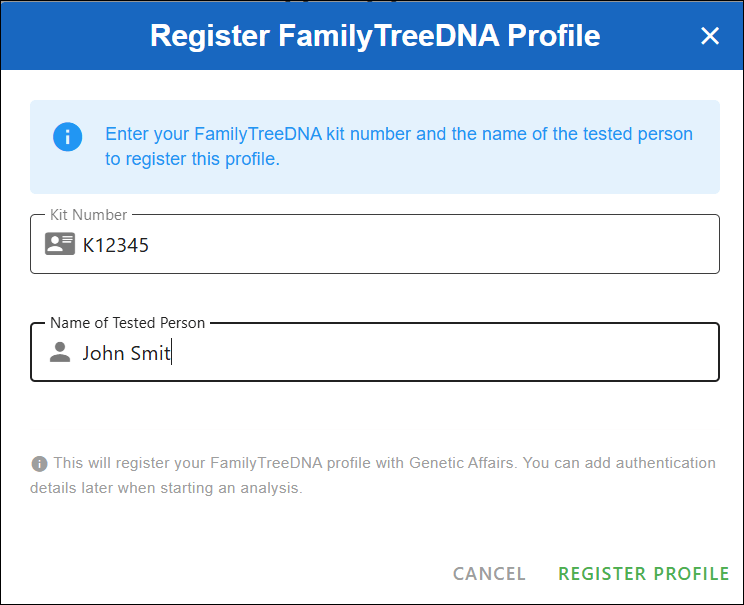
After clicking “Register profile,” you’ll see a message asking you to double-check the credentials for the kit you’re about to use. This is also a good time to log in to your FamilyTreeDNA account directly to make sure there are no pending actions — such as enabling two-factor authentication or accepting updated terms of service.

Once you click “I understand, continue,” you’ll see a list of all registered FamilyTreeDNA profiles at Genetic Affairs.
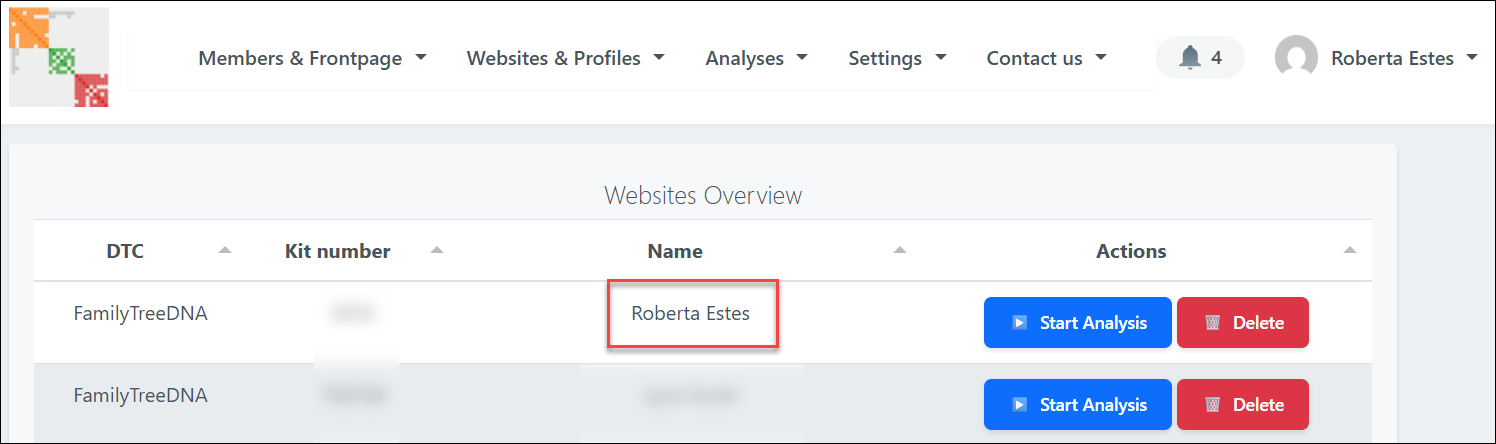
Locate the kit you want to analyze and click the blue “Start analysis” button.
This opens a guided wizard that walks you through each step of the setup.

First, select AutoKinship and click “Next.”

You’ll then be asked to define several thresholds:

  • Minimum and maximum shared cM
  • Minimum size of the largest segment
  • Minimum cluster size

A quick word of caution here: selecting a very low minimum cM value may actually reduce the number of usable matches. That’s because the system must download shared match data until it either reaches that threshold, or a preset timer expires, which can limit how much data is downloaded. When in doubt, start conservatively. You can always rerun the analysis later and change the parameters. Unfortunately, there’s no way to simoly “get everything” in one run which is, of course, what everyone would do.

Click “Next” to continue.
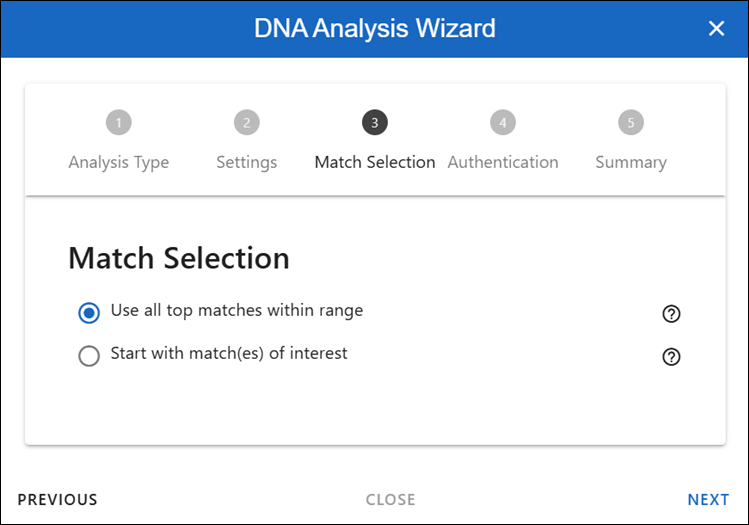
This section determines which matches will be included in the analysis.
For your first run, I recommend using the top matches within the selected range. This provides a strong foundation and usually produces the clearest results.

Later, once you’re more familiar with the output, you may want to experiment by analyzing only the shared matches of a specific person or group. For now, keep it simple and click “Next.”

Here, you’ll enter your FamilyTreeDNA password (twice) so the system can retrieve the required data.

If you use two-factor authentication, you can enter the 2FA code here, as well. To do that, log in to your FamilyTreeDNA account, retrieve the code from your email, and paste it into the wizard.

Then click “Next.”

You’ll now see a summary of all the settings you’ve chosen. Take a moment to review everything. When you’re ready, click Perform analysis” in the bottom right corner.

At this point, the Genetic Affairs servers take over and begin processing your data.

The Results Arrive

When your report is ready, you’ll receive an email with a download link. You can also access it through the notification panel in the top right corner of the Genetic Affairs site.
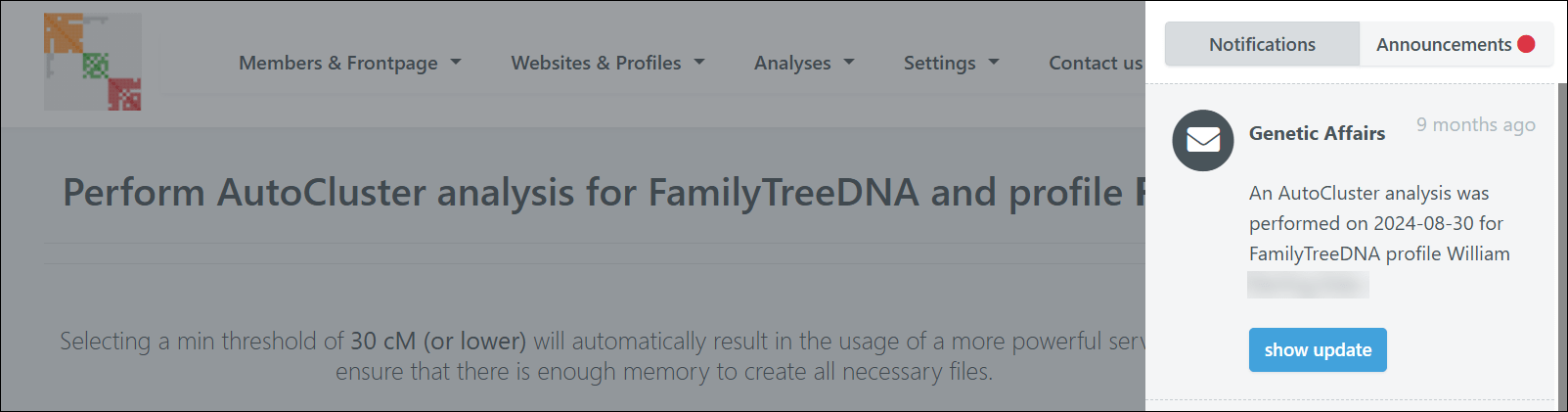
Downloading the report will result in a zipped file. Save it in a location on your computer where you can find it.

Critical Step

This step is critical and will save you a great deal of frustration: If you’re using a PC, you MUST extract or unzip the files before you can properly use them. I can’t tell you how many people skip this step and then wonder why they’re receiving error messages. Ask me how I know!

This is your zipped file.

If you try to open the HTML file while it’s still zipped, it might appear to work at first, but when you click on any links within the file, you’ll receive an error.

If this happens to you, close everything, right-click on that yellow zipped folder, select “extract all,” and then try again.

Now you’re set up, so on to the fun part – viewing the results.

Exploring Your Results

Once you have everything properly extracted and open the HTML file, you’ll watch your AutoCluster literally fly into place on your screen. I love this part. It’s like watching my family fly into place. I wish the actual genealogy research was this easy.

The new Genetic Affairs reports include significantly more information than previous versions.

You can change what’s displayed using the dropdown menu.

By default, you’ll see the shared cM amounts between your matches, but you can change this to show paternal or maternal information if you’ve identified those lineages by linking your matches.

In my case, my maternal line has fewer matches because my mother’s ancestry includes both recent Dutch and German immigrants, so the majority of my high cM matches are US-centric on my father’s side. My father’s ancestors have been in this country since colonial times, and a lot of testers in the US are looking back to the old country for their origins.

Therefore, in my first several clusters, I see squares with the symbol P, indicating they are paternal matches – designated as such through linked family matches, aka bucketing.

You can see the faint Ps inside the orange cells.

Here’s a close-up so you can see the “P” for paternal. If you haven’t linked your matches, you won’t have bucketed matches. Your Genetic Affairs results don’t require bucketing – it’s just a really beneficial feature.

You can change your AutoCluster settings in several ways. I tend to start with the defaults and then modify from there.

Genetic Affairs functions based on the amount of server time a particular tool takes, so it’s not possible to just “run everything,” or trust me, I would.

The Common Ancestor Magic

In your report, scroll down several sections, and you’ll find Common Ancestors – my favorite feature.

This section shows you the common ancestors that have been identified between your matches’ trees.

Looking at the Common Ancestors cluster report, you can click on three things for each cluster:

  • FamilyTreeDNA Trees of Cluster #
  • Common Ancestors of Cluster #
  • Common Locations of Cluster #

Let’s examine the reconstructed trees based on the common ancestor analysis. The first cluster shows some of my close DNA matches that are descendants of my Vannoy line.

You can see that there are six testers, in addition to me, who descend from Joel Vannoy.

Next, scroll down to the AutoKinship section of your report.

The AutoKinship Analysis

The real treasure lies in the AutoKinship analysis, which is presented in a small table on the main HTML page. When you click on the AutoKinship results for any cluster, you’ll see reconstructed trees based on the shared DNA amounts between matches, meaning between you and each of them, and between each other.

You can see that I have 10 reports available based on the cluster numbers indicated.

I clicked on Cluster 1, which shows some of my close DNA matches who are Vannoy line descendants. This includes testers both with and without trees.

Since the AutoKinship algorithm doesn’t have access to age information, it sometimes struggles with generational differences – but the relationship predictions are still remarkably useful.

Alternative trees are also provided, giving you multiple hypotheses to investigate.

Some matches may not be integrated because of incompatible relationships.

The Next Step with AutoLineage – Adding Genealogical Trees to the Mix

We’ve seen AutoTree and AutoKinship. The new upgraded AutoLineage adds genealogical tree information to genetic information by allowing the user to:

  • Import other trees
  • Integrate most recent common ancestors (MRCAs) in AutoKinship trees
  • Set known relationships
  • Provide generational information.

AutoLineage, Genetic Affairs’ online clustering and tree-building tool, has been around for several years but was recently upgraded to create trees based on shared DNA and incorporate genealogical evidence.

This is where the proverbial rubber meets the road.

Setting Up AutoLineage

Return to the home page at Genetic Affairs and select AutoLineage.

If you’re new to this tool, you’ll see a simplified workflow on the start page that walks you through the process.

First, create a profile representing the DNA test taker – in my case, that’s me.

After creating the profile, you’ll be redirected to the landing page of the profile. From there, you can register DNA tests linked to the profile. From the home page, you can see the different profiles.

You’ll register a new FamilyTreeDNA test specifically for each user whose kit you manage and who took a test.

FamilyTreeDNA is the only DNA testing company for which Genetic Affairs runs automated analyses on their site.

Additionally, you can:

Importing the Data

After registering a FamilyTreeDNA test, you are redirected to the overview of this DNA page, where matches are imported.

Click on “Import matches” and select the CSV file from Genetic Affairs. Here’s where that AutoKinship report we generated earlier comes in handy. The unzipped report contains match and shared match information that we can import directly into AutoLineage.
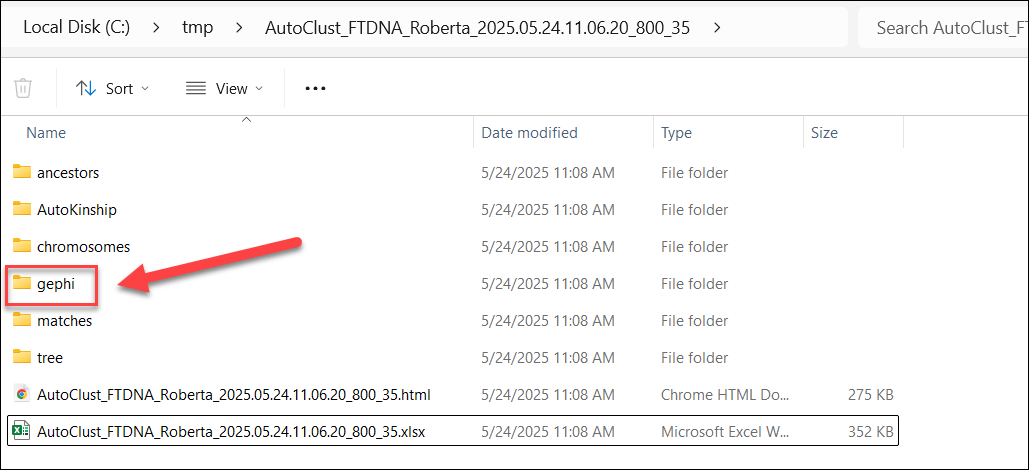
Navigate to the gephi folder in your report and select the nodes.csv file to import your matches.

After importing the matches, a short dialog shows how many matches were imported.

After closing the dialog box, the DNA matches pane is opened.

You’ll see your DNA matches that were downloaded.

Next, import the shared match information from the edges.csv file in the same gephi folder.
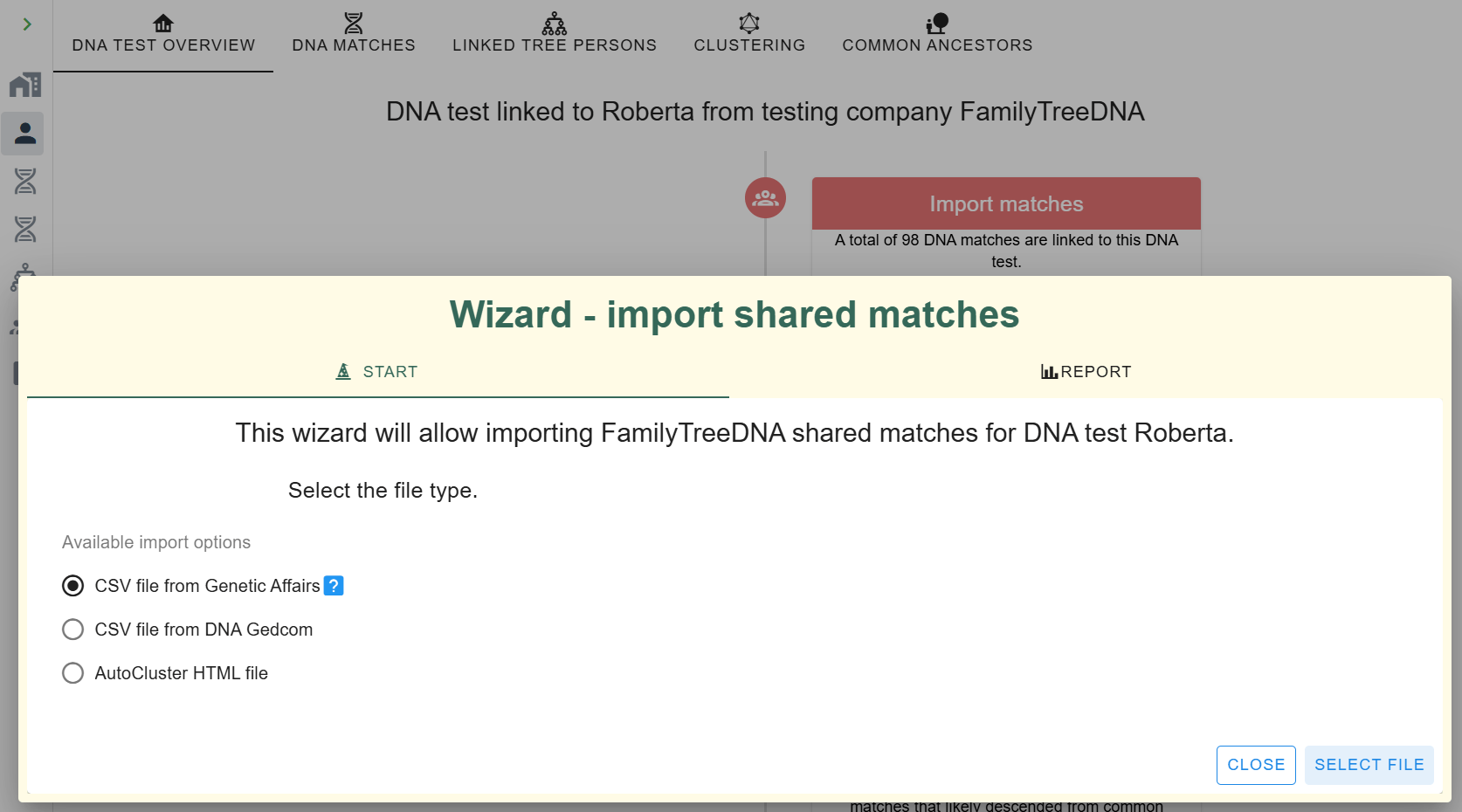
Once both data sets are imported, you’ll see that the ICW (In Common With) column has populated, showing how many shared matches are available for each DNA match.

Clustering in AutoLineage

Now, with the shared match data loaded, you can perform your own clustering analysis.

The wizard allows you to set parameters for which matches to include based on:

  • The amount of shared cMs
  • Weighted or unweighted clustering
  • How much DNA is shared between shared matches

You can also define the cluster characteristics, from sparse to very dense clusters.

Last, you can select the coloring scheme. After setting the parameters, click on “Start Clustering,” at bottom right.

After clustering is finished, the clustering chart is displayed. It looks fairly similar to the ones obtained automatically from Genetic Affairs, but with some differences.

The first thing I noticed is that the large orange cluster 1 in the automated clustering is now mostly represented by the purple cluster 4.

Let’s zoom in on this cluster. By looking more closely at the numbers contained in each cluster, you can already make an estimated guess about the richness in relationship information for cluster members. This cluster has lots of close relationships. Clusters whose matches only share a small amount of DNA with each other are not the best candidates for an AutoKinship analysis because they most likely share a distant common ancestor. Unless, of course, it’s a distant ancestor you’re searching for. (Hello brick wall.)

Adding and Importing Tree Information

Now that we have the new clusters, we could continue to directly run the tree reconstruction on these clusters using the shared DNA information, but let’s wait  since we want to include the tree information as well to guide this process.

To use common ancestors, we need to import the available trees that are linked to the DNA matches. Luckily, just like (shared) match information, the tree information is provided with the automated analysis as well. Let’s import the data.
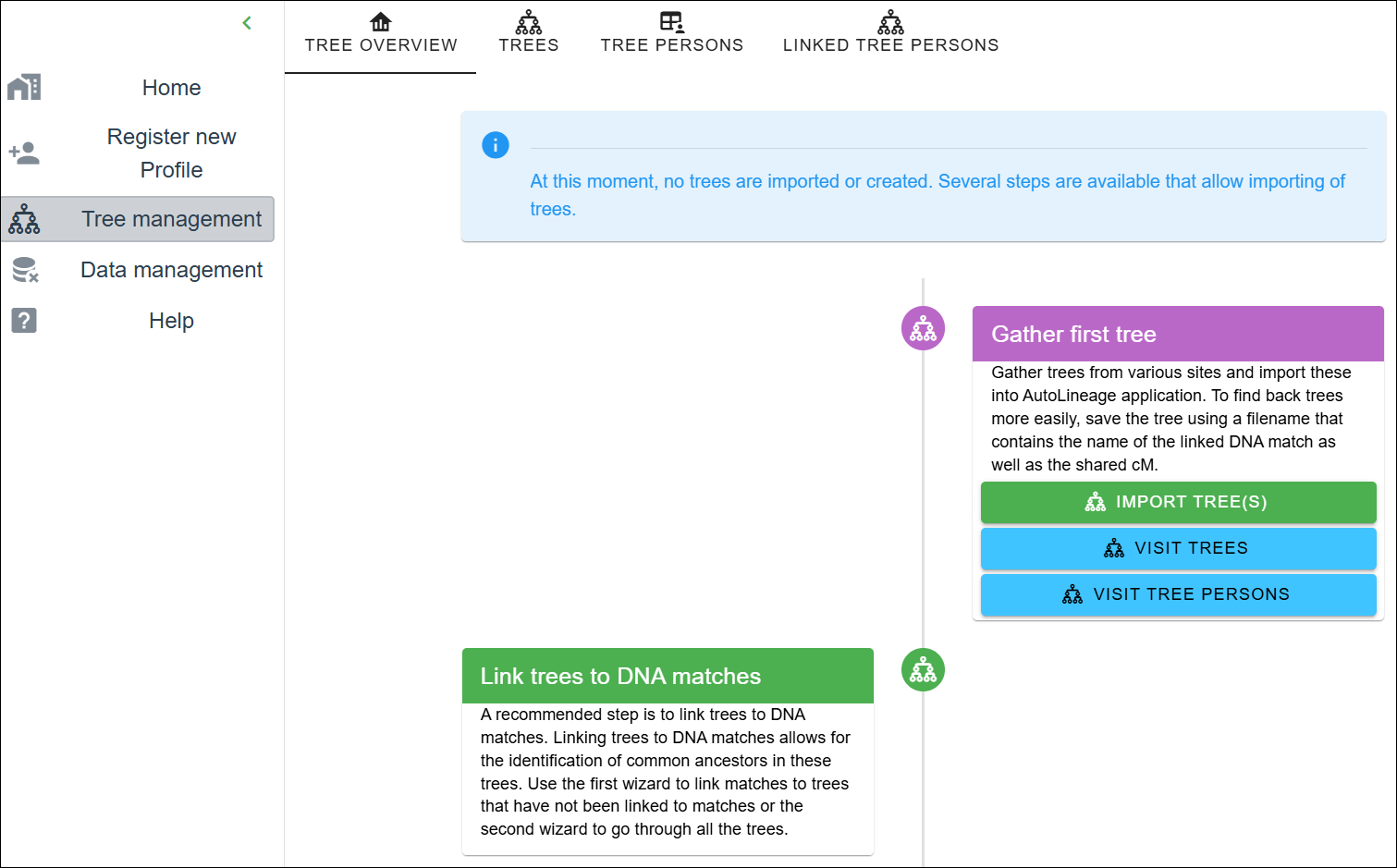
First, navigate to the tree management page. As you can see, no trees have been created or imported. Let’s start the wizard by clicking on the “Import Trees” button.

An “Import tree” wizard pops up, providing different ways to import tree information. It’s also possible to import GEDCOM files or tree data from other resources, but for now, I’m only using the archived trees at FamilyTreeDNA.
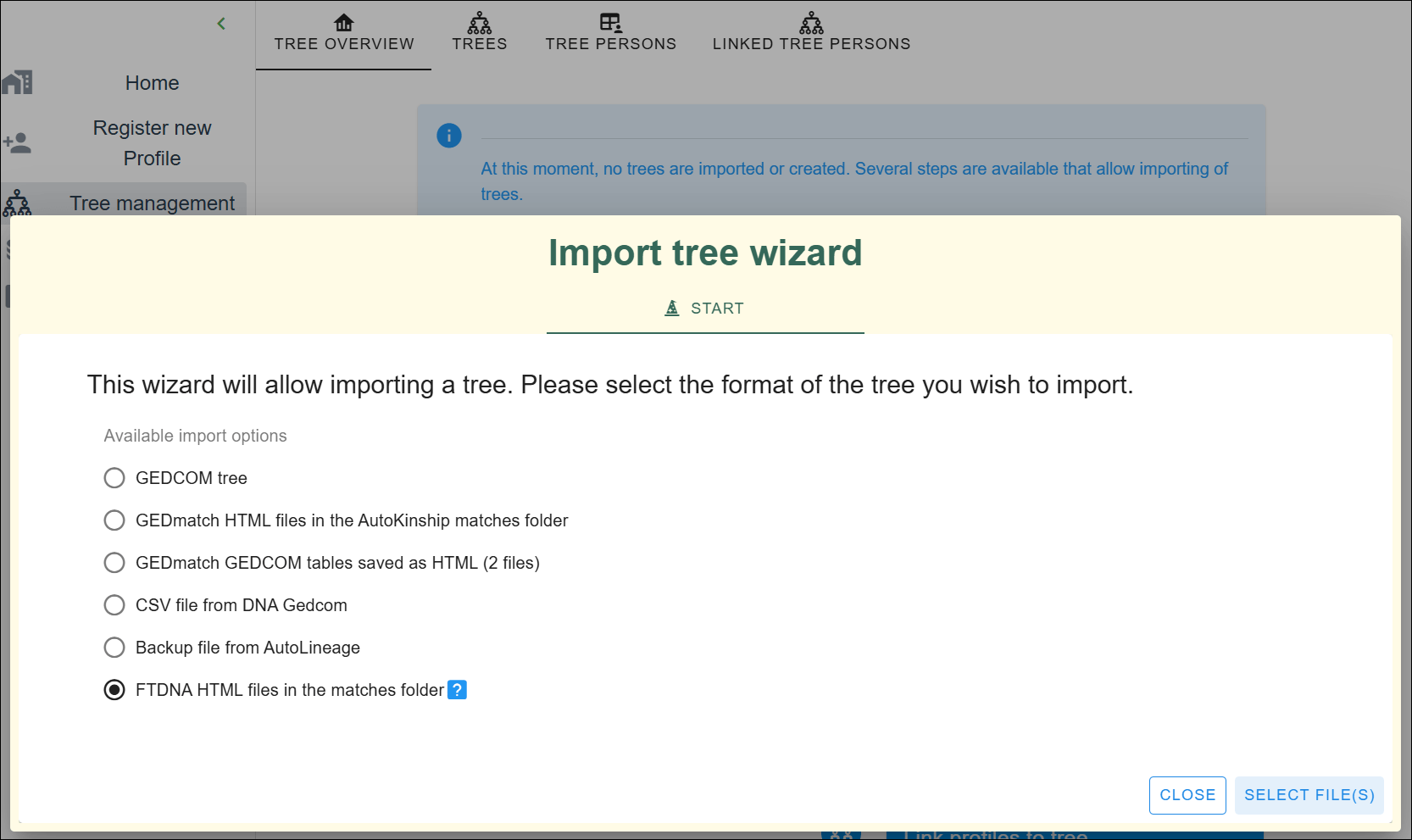
Click on the last option and select the files.

Navigate to the matches folder and select the HTML files contained in the folder.

Each file represents a DNA match report, some of which have a tree associated with them.

After importing the trees, they are automatically associated with the concerned DNA matches (using the unique identifier present in each file name). The tree overview page shows which tree is linked to a profile or DNA test, and the amount of DNA shared with the linked DNA match.
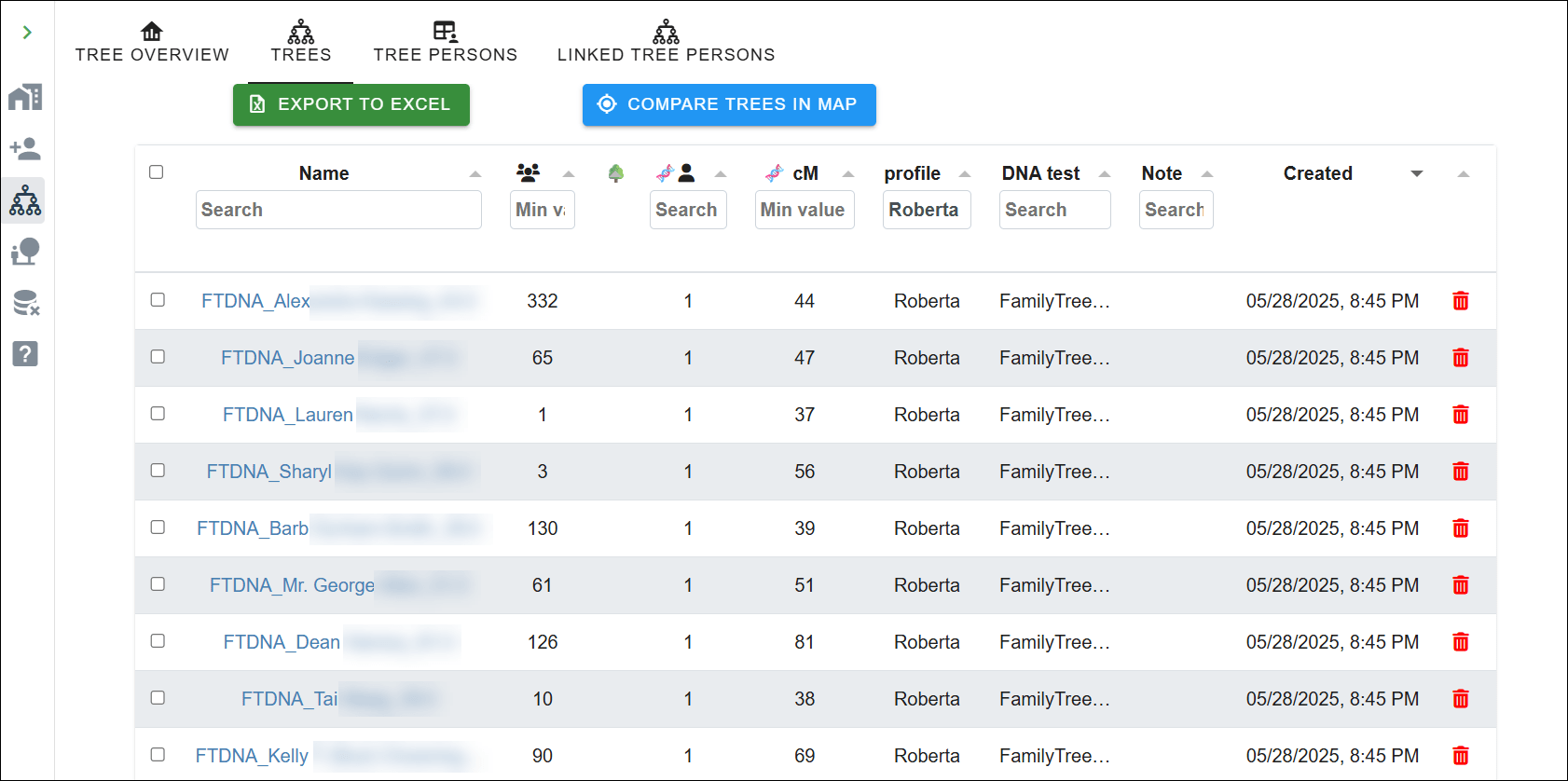
If you have created trees for your matches based on your own research (like quick and dirty trees), now is the time to import these using the “Import Tree” wizard again. This is a wonderful feature, because it means you’re not entirely dependant on your match having uploaded a tree themselves.

If you don’t import trees from GEDCOMs, you don’t need the linking wizard.

Click on the “Import Tree” wizard and select the GEDCOM option.

Now that we have imported additional trees, we need to associate them with DNA matches.
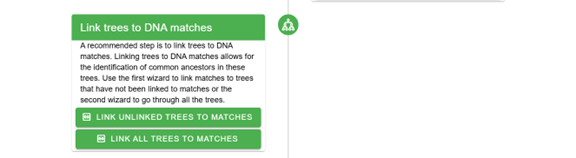
You can use a wizard to link the unlinked trees to the DNA matches, or link them from each DNA match. The wizard will try to guestimate, based on the content of the tree file name, which DNA match could be associated with the tree. Change the search criteria if it does not provide the correct results.

TIP: Save the GEDCOM files with the name of the linked DNA match as well the shared cM, which speeds up the importing process

Don’t forget to import your own tree. I imported my GEDCOM file from my computer genealogy software and associated it with my profile so it’s included in the common ancestor identification. You can easily upload your GEDCOM from your computer software, or download your tree from either Ancestry or MyHeritage to upload here.

Visit the profile, and select the tree pane. The tree pane only shows a single individual and allows you to add ancestors to it manually. To associate that individual with an existing tree, click on “Link to Existing Tree”.

A wizard will be displayed, which shows all available trees on the left side. Sort by clicking on the “Created” column to display the most recent trees.

Next, you need to select the root person.

I selected my tree.

Next, the right side of the wizard fills with the people in the selected tree. Select the root person, which is me, and click on “Save” in the lower right corner.

Finding Common Ancestors

Now that we have associated a tree with the profile and imported trees for the FamilyTreeDNA matches, it’s time to locate some common ancestors. Fingers crossed!

Go back to the profile and select the profile overview. Scroll down to the “Find common ancestors” section and click on the “Find common ancestors” button.

The “common ancestors” wizard shows trees that are associated with this profile in the table on the left and provides information about the different steps on the right. You can change the settings to make the search more restrictive or more relaxed.

After running the common ancestor identification, a dialog shows the number of trees and tree persons that were used, and the number of common ancestors that were identified.

After the analysis runs, you’ll be able to view all reconstructed trees or filter them based on common ancestors, trees, or linked DNA matches.

Common ancestors, not surprisingly, often align closely with what the automated analysis discovered.

All six testers are now shown descending from our common ancestor, in the approximate location where they will fit in our common tree.

But we aren’t quite finished yet.

The Final AutoKinship Analysis

Finally, we’ve arrived. The earlier steps were necessary to pave the way.

We have the common ancestors and clusters, and it’s time to go back to the clusters to begin the reconstruction of trees using trees combined with DNA.

Click on the profile and go to the clustering results pane. Select the 1x view, which will show the clustering chart.

Now select the matches pane that shows the different matches that are contained in each cluster. Scroll down until you reach your cluster of interest, which is four for me.

After clicking on any cluster, you’ll be redirected to a cluster view with only the information for that particular cluster.
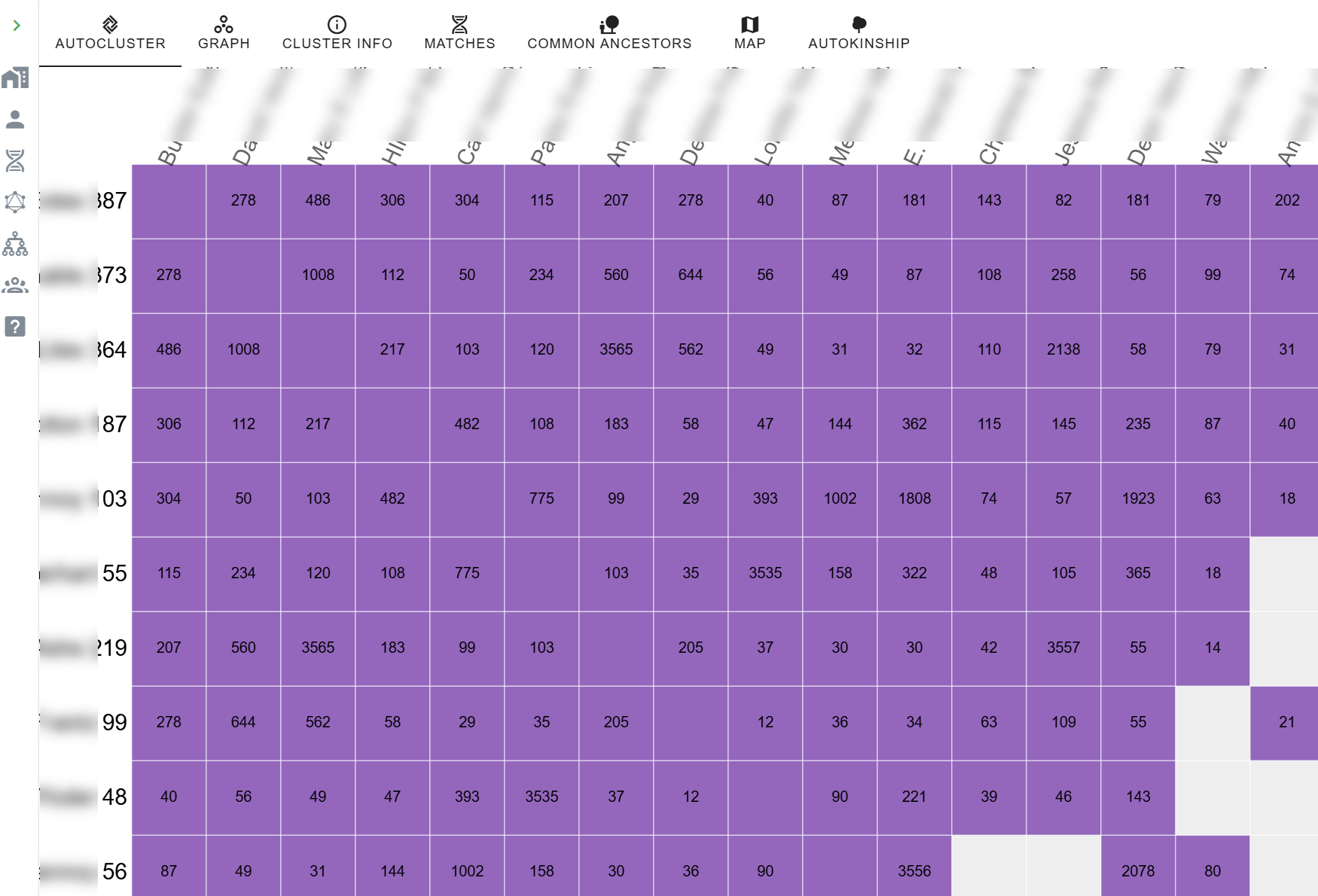
Let’s view purple cluster 4, which looks fairly dense, with only a couple of empty cells, indicating that these shared matches with white cells did not share (enough) DNA with each other to be included in the cluster. Now select the matches pane in the dashboard at the top of this cluster, which displays the matches linked to this specific cluster. As you can see, a button is now available that allows us to run the AutoKinship analysis. Click on the button.

Single cluster matches are displayed.

Now back to the wizard.

The wizard provides several important parameters:

  • Maximum number of generations between DNA matches
  • Number of trees to analyze in each iteration
  • Final number of trees to keep
  • Whether to include known relationships and/or MRCA (Most Recent Common Ancestor) relationships

In this example, MRCA relationships were found because we performed the common ancestor identification that resulted in common ancestors between the matches of this cluster.

If you know specific relationships between matches, you can set those manually. Sometimes you might not know the exact relationship, but if you can estimate that a match is one or more generations older or younger than yourself, you can set that too.

In addition to setting the relationship between the test taker (indicated in green in the table) and the DNA matches, it’s also possible to set the relationship between shared matches, if known.

The Hybrid Results

After the analysis has finished, an overview of the identified trees is presented.

The final result is a blended tree where DNA evidence fills in the blanks for matches who haven’t uploaded trees, or you haven’t provided a tree, and known genealogy supports the structure where it exists. This hybrid approach gives us the best of both worlds – the precision of documented genealogy combined with the discovery power of DNA analysis.

I particularly like this approach, because when I identify how a DNA match is related to me from any vendor, I enter their lineage in my desktop genealogy software. Therefore, using that GEDCOM file is the most complete source of my identified relatives.

Testers 1-6 were shown using the regular AutoTree, without the integrated tree, but an additional 11 matches were placed for consideration using all available tools.

I was using this as an experiment because I know how most people in this cluster are related, and those are all placed accurately. There is one person, located on the branch between 1 and 5, who I had no idea how they fit into this puzzle. Now, at least I know where to look.

I can’t imagine trying to do all of this manually.

Why This Matters

For those of us dealing with unknown parent or grandparent situations, poorly documented lines, non-existent trees, or just plain stubborn brick walls, this combination of tools is nothing short of amazing. You can now explore relationship hypotheses even when traditional documentation is scarce.

The reconstructed trees show how common ancestor information provides the template, while the AutoLineage tool fills gaps using shared DNA information. The updated AutoLineage is the genealogical assistant that never gets tired and can deal with relationship possibilities much more effectively than traditional hand-based methods.

In Summary

If you haven’t explored Genetic Affairs recently, give it a look. The integration between AutoKinship and AutoLineage represents a significant step forward in DNA analysis.

While AutoKinship offers valuable insights on its own, its full potential is truly unlocked when you export the data into AutoLineage. The combination creates a comprehensive analysis that was previously impossible.

For researchers dealing with complex family relationships or challenging genealogical puzzles, this hybrid approach that combines matches at FamilyTreeDNA with DNA evidence and genealogical trees could be the key to breaking through stubborn brick walls that nothing else has budged.

Last but not least, I suggest reading Dr. Patricia Coleman’s blog articles about these tools and her methodologies here and here. Patricia works extensively with these tools, and I often recommend her for private autosomal research consultations. Patricia’s 2026 RootsTech Session, DNA Case Study: Finding an 1877 Birth Father with Genetic Affairs, BanyanDNA, and No Birth Record, details her work solving a long-standing problem for my cousin in the Speaks family.

_____________________________________________________________

Share the Love!

You’re always welcome to forward articles or links to friends and share on social media.

Subscribe!

If you haven’t already subscribed, it’s free. You’ll receive an e-mail whenever I publish by clicking the “follow” button at the top of the main blog page, here.

Help Keep This Blog Free

I receive a small commission when you click a vendor link in my articles and purchase that item. This does NOT increase your price but helps me keep the lights on and this informational blog free for everyone. Please click on the affiliate links in the articles or to the vendors below if you are purchasing products or DNA testing.

Thank you so much.

DNA Purchases and Free Uploads

Genealogy Products and Services

My Books

Genealogy Books

Genealogy Research

2025 Genetic Genealogy Retrospective: Wow – What a Year!

2025 has been quite a year in genetic genealogy. Genetic genealogy, per se, really isn’t a separate “thing” anymore. DNA testing is now an integral part of genealogy, with the potential to answer questions that nothing else can!

The 76 articles I wrote in 2025 fall into multiple categories and focus on different topics based on what was happening in the industry.

From my perspective, here are the most notable announcements and trends in genetic genealogy, and genealogy more broadly.

#1 for 2025 – Mitochondrial DNA: The Million Mito Project Released the New Mitotree, Updates, and mtDNA Discover

The biggest genealogy news items this year, both industry-wide and genealogy-changing are definitely the release of the new Mitotree, plus two tree updates. But that’s not all.

In addition, full sequence mitochondrial DNA testers received new Mitotree haplogroups, if appropriate, and everyone received a haplotype – a new feature. Along with Mitotree, FamilyTreeDNA introduced mtDNA Discover which provides 13 individual reports based on your haplogroup and matches.

It’s no wonder that mitochondrial DNA articles led the pack with the most views based on the eleven articles about that topic. If you haven’t yet tested your mitochondrial DNA at FamilyTreeDNA, there’s no better time! You never know what you’re going to discover and the more testers, the more matches for everyone.

You don’t know what you don’t know, and you’ll never know if you don’t test. Remember, mitochondrial DNA is for both males and females and tests your mother’s direct matrilineal line (mother to mother to mother, etc.) – reaching beyond known surnames.  Click here to order or upgrade.

#2 – MyHeritage Low Pass Whole Genome Sequence Test Charges into the Future

Another big hitter is the new MyHeritage low-pass whole genome test (WGS) test. It’s new and innovative, but we haven’t seen comparative results yet.

My results from the new low-pass whole genome test just came back, and I haven’t had the opportunity to review them yet, as compared to the earlier tests. That said, I do have roughly the same number of matches, but I need to determine if they are the same matches, and how well they track. I’ll be working on that review soon.

The new whole genome test may be more about future proofing and preparedness than additional current benefit – but we will see. I definately wanted to take the whole genome test so I can receive and benefit from whatever new is coming down the pike.

MyHeritage allows you to maintain multiple DNA tests on your account, so the new whole genome won’t “replace” your older or uploaded test. That way, you can easily compare the results of the whole genome against any DNA test that you curently have at MyHeritage.

Click here to order the new test.

#3 – 23andMe Experiences Problems

On a less positive note, but still quite newsworthy is the bankruptcy of 23andMe and subsequent repurchase of 23andMe by the original founder after setting up a new nonprofit. I have real mixed feelings about this topic. However, 23andMe was really never about genealogy, and now, matching segment information is no longer available. Those searching for unknown parents or family may want to test there if they are unsuccessful elsewhere.

Best Genealogy Tool

The FamilySearch full text search continues to have a HUGE impact for genealogists. This tool is not one-and-done, but provides increasing amounts of rich information as more records are added to the “fully scanned” collection. If you haven’t tried it, please do. It’s a game-changer and continues to improve.

A Cautionary Word About AI – Artificial Intelligence

AI is such a hot topic right now that I feel it needs to be included.

The FamilySearch full text search uses a form of AI. However, you’ll quickly notice that it can’t read everything, gets words and names wrong, and if you actually need to fully depend on it for accuracy, you cannot. (That said, it’s still an amazing tool, and I’m not picking on FamilySearch.)

Aside from FamilySearch, AI in its current form is both wonderful and terrible. I’ll be writing about AI in the new year, but for now, don’t ever rely on AI for anything that you can’t verity. It’s your assistant, not an expert, no matter how insistent it is. Never trust and always verify.

This is ESPECIALLY TRUE WHEN RELATED TO GENETICS and genetic related topics. I can’t even begin to tell you how very wrong it has been, and how much people fall in love with inaccurate results. No, just no – at least for now.

You need to know your AI tool, your skill set, your understanding of AI broadly, the tool’s limitations, and yours, and that’s all before verifying the actual AI results. If you want to educate yourself, and everyone should, treat yourself to anything, anyplace by either Mark Thompson or Steve Little, the dynamic AI duo. They offer YouTube videos and classes in a wide variety of places – but keep in mind that AI tools and technology literally change every few weeks.

AI is, indeed, a specialty all unto itself, much like genetic genealogy. And right now, it’s not soup yet, but it is cooking.

Tried and True Genetic Genealogy Staples – DNAPrint and Genetic Affairs

I haven’t written about either one this year, but I use both DNAPainter and Genetic Affairs regularly.

I consistently paint segments from matches at both MyHeritage, FamilyTreeDNA, and GEDmatch that are newly identified to an ancestor or ancestral couple at DNAPainter.

Unfortunately, neither Ancestry nor 23andMe provide matching cM location information for your matches (chromosome browser), but you may find some people who have tested at those companies at both FamilyTreeDNA and GEDmatch if they have uploaded to either of those vendors. Both vendors provide segment information and a Chromosome Browser, enabling you to paint that information to DNAPainter when you can identify your common ancestor.

MyHeritage also provides a Chromosome Browser, but unfortunately, no longer accepts uploads from any other vendor. You can paint segments from MyHeritage, but no longer upload DNA files to MyHeritage.

Thanks to DNAPainter, I have 90% of my segments identified to specific ancestors – which is actually rather remarkable given that my mother’s grandfather was a Dutch immigrant, and her great-grandparents on her other side were German immigrants, meaning we don’t have many matches on either of those lines.

Genetic Affairs continues to develop new, advanced clustering tools, one of which I’ll be reviewing soon.

Major Vendor Releases

Aside from what’s listed above, most of the major vendors released new features.

MyHeritage released a VERY COOL new tool called Cousin Finder that finds your relatives in the MyHeritage database, whether they match you on a DNA test, or not. They may not have even taken a DNA test. Cousin Finder identifies your common ancestor and shows your relationships. It’s a wonderful way to initiate communications, discuss your common ancestors, and ask about DNA testing.

Of my 378 Cousin Finder matches, only 23 (about 6%) are on my DNA match list, so that leaves 355 people to message, several of whom represent Y-DNA and mtDNA lines I don’t have. You can bet I’ll be offering testing scholarships.

Additionally, MyHeritage released a new ethnicity version.

FamilyTreeDNA, in addition to the new Mitotree, Discover, and associated features, released a new match matrix so you can see if and how selected matches are related to each other in a grid format. In other words, you can create your own cluster.

A new built-in “Share” feature blurs private information to make sharing easier both on the website and in Discover.

Discover improvements include thousands of new Y-DNA and mtDNA tree branches, plus thousands of new Ancient DNA samples. Discover is evergreen, so once you’ve taken that Big Y-700 test or the mitochondrial DNA test, your learning never stops as more content is added.

Tree integration with WikiTree is super-easy and means you don’t have to choose between trees. You can choose to retain your archived tree at FamilyTreeDNA, or move your tree to MyHeritage, PLUS link yourself to your family at WikiTree.

Ancestry released match clustering and a new beta pedigree view of ThruLines, but that’s back in the shop for more work. I’d expect to see it rereleased in 2026.

Conferences

RootsTech is the granddaddy of genealogy conferences, and it’s always fun to attend and write about the experience. Many vendors release new tools or products during the conference.

The ECGGC (East Coast Genetic Genealogy Conference), held in the fall, is the only conference that focuses entirely on genetic genealogy, new tools, how to use existing tools, and more. The 2025 conference was virtual and provided a great deal of focused content. Attendees particularly appreciate the deep dive in a particular topic presented in DNA Academy.

I’ll be at RootsTech in 2026, will write about that soon, and hope to see you there.

Concepts, Techniques and Plain Old Genealogy

In the past, my Concepts series and genealogy “how to” articles have been very popular, so, in 2025, I penned a half-dozen articles focusing on frequently asked questions about relationships and DNA.

For example, how does one go about finding DNA testing candidates? The number of options may surprise you and includes both Cousin Finder and Relatives at RootsTech.

By testing ONE PERSON for either Y-DNA or mitochondrial DNA that represents an ancestor, you actually receive information about that entire lineage of ancestors. So, on my Estes line, by locating an Estes male from my line to test, I received relevant information for every Estes male in my line, back to and beyond the progenitor.

Eventually, we hit a brick wall in every line, and those tools are the perfect way to break through those brick walls.

Other articles discuss things like how to use Discover’s Ancient Connections, and the difference between half and full relationships, both in your tree and genetically. Plus, what does a cousin “once removed” mean anyway? And why do I care?

Another question I receive is how far back, based on the shared amount of DNA, should I look in my matches’ trees for our common ancestor? In other words, how many generations back should I click? That article was fun and produced some unexpected results.

Memorial Articles

Because we are part of a community, I write memorial articles when one of our friends passes on. This year, sadly, Schelly Talalay Dardashti, well-known Jewish genealogist, and another very close friend joined the ancestors, so I’ve recognized the best in both of their lives which constitutes their legacy.

Be the Storyteller

Last, but not least, I wrote about my ancestors in the “52 Ancestors” series, which launched several years ago with Amy Johnson Crow’s challenge to write about one ancestor per week. She hosts this every year, and you can join (free) now.

I’m now on ancestor #467, so yes, it’s addictive, but it’s also AMAZING how many wonderful cousins I’ve met who have information that I did not. Not only that, but after publishing about an ancestor, I’ve discovered that I’m related to people I’ve known for years. We were SOOOooo excited!

I’ve been writing about the lives of my ancestors for several years now, and the articles include attempts to identify Y-DNA and mtDNA testers for each ancestor, where appropriate. There’s so much to learn that can’t be revealed any other way.

Plus, people seem to like the “mystery” and “short story” aspect, and I salt each story with the history of the region and relevant historical events of the timeframe. You might find your ancestors here too, or other helpful information.

Find a way to share about your ancestors!

Do You Have Suggestions for 2026 Topics?

Do you have suggestions or requests for article topics in 2026? If so, please comment on this article and let me know.

Check Out the 2025 List

Here’s the list of the 2025 articles. Did you miss something fun? Enjoy!

  Title Category Date Link
1 Welcome to 2025 – Opportunities and New Genetic Genealogy Articles Welcome, general 1-2-2025 https://dna-explained.com/2025/01/02/welcome-to-2025-opportunities-and-new-genetic-genealogy-articles/
2 Anne Doucet (1713-1791), Oceans, Rivers, and Perseverance – 52 Ancestors #438 52 Ancestors 1-4-2025 https://dna-explained.com/2025/01/04/anne-doucet-1713-1791-oceans-rivers-and-perseverance-52-ancestors-438/
3 Register for RootsTech 2025 Now RootsTech 1-16-2025 https://dna-explained.com/2025/01/16/register-for-rootstech-2025-now/
4 What IS the McNeil Family History, by George Franklin McNeil – 52 Ancestors #439 52 Ancestors 1-19-2025 https://dna-explained.com/2025/01/20/what-is-the-mcneil-family-history-by-george-franklin-mcneil-52-ancestors-439/
5 Jean Garceau dit Tranchemontagne (c1785-1711), Soldier from Saint Marseault – 52 Ancestors #440 52 Ancestors 1-29-2025 https://dna-explained.com/2025/01/29/jean-garceau-dit-tranchemontagne-c1785-1711-soldier-from-saint-marseault-52-ancestors-440/
6 Memories Resurface When the Old Family Home Gets a Facelift Genealogy 2-3-2025 https://dna-explained.com/2025/02/03/memories-resurface-when-the-old-family-home-gets-a-facelift/
7 MyHeritage Introduces Ethnicity v2.5 MyHeritage 2-6-2025 https://dna-explained.com/2025/02/06/myheritage-introduces-ethnicity-v2-5/
8 Relatives at RootsTech Reveals Cousins and Provides DNA Candidates RootsTech, techniques 2-8-2025 https://dna-explained.com/2025/02/08/relatives-at-rootstech-reveals-cousins-and-provides-dna-candidates/
9 FamilyTreeDNA’s New Matrix Shows How Your Matches Are Related to Each Other FamilyTreeDNA 2-12-2025 https://dna-explained.com/2025/02/12/familytreednas-new-matrix-shows-how-your-matches-are-related-to-each-other/
10 René Doucet (c1680-c1731), Lifetime of Incessant Upheaval – 52 Ancestors #441 52 Ancestors 2-15-2024 https://dna-explained.com/2025/02/16/rene-doucet-c1680-c1731-lifetime-of-incessant-upheaval-52-ancestors-441/
11 Lineages Versus Ancestors – How to Find and Leverage Yours Techniques 2-23-2025 https://dna-explained.com/2025/02/23/lineages-versus-ancestors-how-to-find-and-leverage-yours/
12 Mitotree is Born Mitochondrial DNA 2-25-2025 https://dna-explained.com/2025/02/25/mitotree-is-born/
13 RootsTech 2025 – The Year of Discover and the New Mitotree RootsTech, Mitochondrial DNA 3-14-2025 https://dna-explained.com/2025/03/15/rootstech-2025-the-year-of-discover-and-the-new-mitotree/
14 Pierre Doucet (c1621-1713), Walking History Book Lived to Nearly 100 – 52 Ancestors #442 3-16-2025 https://dna-explained.com/2025/03/16/pierre-doucet-c1621-1713-walking-history-book-lived-to-nearly-!100-52-ancestors-442/
15 Welcome to the New FamilyTreeDNA mtDNA Group Mitochondrial DNA 3-17-2025 https://dna-explained.com/2025/03/17/welcome-to-the-new-familytreedna-mtdna-group/
16 23andMe Files for Bankruptcy – What You Need to Know! 23andMe 3-24-2025 https://dna-explained.com/2025/03/25/23andme-files-for-bankruptcy-what-you-need-to-know/
17 New “Share” Features at FamilyTreeDNA Blur Match Information and Make Sharing Easy FamilyTreeDNA 4-1-2025 https://dna-explained.com/2025/04/01/new-share-features-at-familytreedna-blur-match-information-and-make-sharing-easy/
18 The Chauvet Cave: Trip Back in Time with Prehistoric European Humans – Are We Related? History, DNA 4-6-2025 https://dna-explained.com/2025/04/06/the-chauvet-cave-trip-back-in-time-with-prehistoric-european-humans-are-we-related/
19 DNA for Native American Genealogy Webinar & Companion Book Native American 4-8-2025 https://dna-explained.com/2025/04/08/dna-for-native-american-genealogy-webinar-companion-book/
20 Marie Levron (c1686-1727), Tragedy from Cradle to Grave – 52 Ancestors #443 52 Ancestors 4-14-2025 https://dna-explained.com/2025/04/14/marie-levron-c1686-1727-tragedy-from-cradle-to-grave-52-ancestors-443/
21 Mitochondrial DNA: What is a Haplotype Cluster and How Do I Find and Use Mine Mitochondrial DNA 4-14-2025 https://dna-explained.com/2025/04/14/mitochondrial-dna-what-is-a-haplotype-cluster-and-how-do-i-find-and-use-mine/
22 New Mitotree Haplogroups and How to Utilize Them for Genealogy Mitochondrial DNA 4-23-2025 https://dna-explained.com/2025/04/23/new-mitotree-haplogroups-and-how-to-utilize-them-for-genealogy/
23 Sir Francois Levron dit Nantois(c1651-1714), and Acadia’s Pirate – 52 Ancestors #444 52 Ancestors 4-26-2025 https://dna-explained.com/2025/04/27/sir-francois-levron-dit-nantois-c1651-1714-and-acadias-pirate-52-ancestors-444/
24 Catherine Savoie (c1661-c1722/25), Whispered Threads Weave a Tapestry of Life – 52 Ancestors #445 52 Ancestors 5-4-2025 https://dna-explained.com/2025/05/04/catherine-savoie-c1661-c1722-5-whispered-threads-weave-a-tapestry-of-life-52-ancestors-445/
25 Discover’s Ancient Connections – How Are You Related? Discover, Ancient DNA 5-8-2025 https://dna-explained.com/2025/05/08/discovers-ancient-connections-how-are-you-related/
26 Mother’s Day and Legacies 52 Ancestors, Genealogy 5-10-2025 https://dna-explained.com/2025/05/11/mothers-day-and-legacies/
27 The Mystery of the Blue Fugates and Smiths: A Study in Blue Genes and Pedigree Collapse Genetics, Genealogy 5-18-1015 https://dna-explained.com/2025/05/19/the-mystery-of-the-blue-fugates-and-smiths-a-study-in-blue-genes-and-pedigree-collapse/
28 Regeneron Wins Bid for Bankrupt 23andMe – Wedding Planned 23andMe 5-19-2023 https://dna-explained.com/2025/05/19/regeneron-wins-bid-for-bankrupt-23andme-wedding-planned/
29 Francois Savoie’s Homestead Rediscovered – 52 Ancestors #446 52 Ancestors 5-24-2025 https://dna-explained.com/2025/05/24/francois-savoies-homestead-rediscovered-52-ancestors-446/
30 Memorial Day – Some Gave All Memorial 5-25-2025 https://dna-explained.com/2025/05/25/memorial-day-some-gave-all/
31 Mitotree Webinar – What It Is, How We Did It, and What Mitotree Means to You Mitochondrial DNA 6-4-2025 https://dna-explained.com/2025/06/04/mitotree-webinar-what-it-is-how-we-did-it-and-what-mitotree-means-to-you/
32 Catherine LeJeune (c1633-1671/1686), Meet Your Grandchildren – 52 Ancestors #447 52 Ancestors 6-7-2025 https://dna-explained.com/2025/06/07/catherine-lejeune-c1633-1671-1686-meet-your-grandchildren-52-ancestors-447/
33 Mitotree Q&A for Everyone Mitochondrial DNA 6-11-2025 https://dna-explained.com/2025/06/11/mitotree-qa-for-everyone/
34 Father’s Day: Bravery and Love 52 Ancestors, Genealogy 6-14-2025 https://dna-explained.com/2025/06/14/fathers-day-bravery-and-love/
35 Francoise Bourgeois (c1659-1693/1697), High Drama in Beaubassin and Terror at Port Royal – 52 Ancestors #448 52 Ancestors 6-16-2025 https://dna-explained.com/2025/06/16/francoise-bourgeois-c1659-1693-97-high-drama-in-beaubassin-and-terror-at-port-royal-52-ancestors-448/
36 Requesting Suggestions for RootsTech 2026 Topics RootsTech 6-18-2025 https://dna-explained.com/2025/06/18/requesting-suggestions-for-rootstech-2026-topics/
37 FamilyTreeDNA and WikiTree Collaboration – In Two Easy Steps!! FamilyTreeDNA, WikiTree 6-25-2025 https://dna-explained.com/2025/06/25/familytreedna-and-wikitree-collaboration-in-two-easy-steps/
38 Jacques Bourgeois (c1620-c1700), Surgeon of Port Royal – 52 Ancestors #449 52 Ancestors 7-1-2025 https://dna-explained.com/2025/07/01/jacques-bourgeois-c1620-c1700-surgeon-of-port-royal-52-ancestors-449/
39 TTAM, a Nonprofit Formed by 23andMe’s Founder Now Plans to Buy 23andMe 23andMe 7-1-2025 https://dna-explained.com/2025/07/01/ttam-a-nonprofit-formed-by-23andmes-founder-now-plans-to-buy-23andme/
40 Jacques Bourgeois: Complex Acadian, Founder of Beaubassin – 52 Ancestors #450 52 Ancestors 7-6-2025 https://dna-explained.com/2025/07/06/jacques-bourgeois-complex-acadian-founder-of-beaubassin-52-ancestors-450/
41 How to Use Ancestry’s New Match Clusters and What They Mean Ancestry 7-10-2025 https://dna-explained.com/2025/07/10/how-to-use-ancestrys-new-match-clusters-and-what-they-mean/
42 Walk with Your Ancestors: Peace, Light and Healing in an Abandoned Medieval Village History 7-21-2025 https://dna-explained.com/2025/07/21/walk-with-your-ancestors-peace-light-and-healing-in-an-abandoned-medieval-village/
43 Jeanne Trahan (c1629-c1699), Life in Chinon, La Heve, Port Royal, and Beaubassin – 52 Ancestors #451 52 Ancestors 8-2-2025 https://dna-explained.com/2025/07/28/jeanne-trahan-c1629-c1699-life-in-chinon-la-heve-port-royal-and-beaubassin-52-ancestors-451/
44 Wherefore Art Thou, Oh Ancestor – New Generation Tree Chart Suggests Where to Look in Your Matches’ Trees Techniques, Genetics, Genealogy 8-2-2025 https://dna-explained.com/2025/08/02/wherefore-art-thou-oh-ancestor-new-generation-tree-chart-suggests-where-to-look-in-your-matches-trees/
45 Guillaume Trahan (c1601-1625), More Than Meets the Eye – 52 Ancestors #452 52 Ancestors 8-13-2025 https://dna-explained.com/2025/08/13/guillaume-trahan-c1601-c1684-more-than-meets-the-eye-52-ancestor-452/ 
46 The East Coast Genetic Genealogy Conference – ECGGC – Register Now for the Best of the Best ECGGC Conference 8-14-2025 https://dna-explained.com/2025/08/14/the-east-coast-genetic-genealogy-conference-ecggc-register-now-for-the-best-of-the-best/
47 Schelly Talalay Dardashti – May Her Memory Be a Blessing Memorial 8-17-2025 https://dna-explained.com/2025/08/17/schelly-talalay-dardashti-may-her-memory-be-a-blessing/
48 Francoise Corbineau (c1609-c1665), Bride in Chinon, Founder of Acadia – 52 Ancestors #453 52 Ancestors 8-25-2025 https://dna-explained.com/2025/08/23/francoise-corbineau-c1609-c1665-bride-in-chinon-founder-of-acadia-52-ancestors-453/
49 Nicolas Trahan (c1570->1632), Life in the Heart of French Wine Country – 52 Ancestors #454 52 Ancestors 8-31-2015 https://dna-explained.com/2025/08/31/nicolas-trahan-c1570-1632-life-in-the-heart-of-french-wine-country-52-ancestors-454/
50 Mitochondrial DNA A-Z: A Step-by-Step Guide to Matches, Mitotree, and mtDNA Discover Mitochondrial DNA, Discover, Genealogy, Techniques 10-2-2025 https://dna-explained.com/2025/09/02/mitochondrial-dna-a-z-a-step-by-step-guide-to-matches-mitotree-and-mtdna-discover/
51 Renée Desloges (c1570-1627/1632), Fragments of Life in Montreuil-Bellay – 52 Ancestors #454 (this is actually 455) 52 Ancestors 9-6-2025 https://dna-explained.com/2025/09/06/renee-desloges-c1570-1627-1632-fragments-of-life-in-montreuil-bellay-52-ancestors-454/
52 Best Mitochondrial DNA Presentation EVER – You’re Invited to DNA Academy!! Mitochondrial DNA 9-9-2025 https://dna-explained.com/2025/09/09/best-mitochondrial-dna-presentation-ever-youre-invited-to-dna-academy/
53 Unfillable Shoes Memorial – Douglas Rhodenbaugh 9-14-2025 https://dna-explained.com/2025/09/14/unfillable-shoes/
54 Concepts: What Does a Cousin “Once Removed” Mean? Concepts, Genealogy 9-24-2025 https://dna-explained.com/2025/09/24/concepts-what-does-a-cousin-once-removed-mean/
55 Daniel Vannoy (1752-after 1820), “Lived in the Boundary of the Cherokee Indians” – Say What??? 52 Ancestors 9-29-2025 https://dna-explained.com/2025/09/29/daniel-vannoy-1752-after-1820-lived-in-the-boundary-of-the-cherokee-indians-say-what/
56 Daniel Vannoy and the Strange Case of the Two Sarahs – 52 Ancestors #457 52 Ancestors 10-5-2025 https://dna-explained.com/2025/10/06/daniel-vannoy-and-the-strange-case-of-the-two-sarahs-52-ancestors-457/
57 Cousin Finder – MyHeritage’s Innovative New Tool Finds Your Relatives MyHeritage 10-9-2025 https://dna-explained.com/2025/10/09/cousin-finder-myheritages-innovative-new-tool-finds-your-relatives/
58 Sarah Hickerson Vannoy (c1761 – after 1826), Threw More than Shade – 52 Ancestors #458 52 Ancestors https://dna-explained.com/2025/10/13/sarah-hickerson-vannoy-c1761-after-1826-threw-more-than-shade-52-ancestors-458/
59 MyHeritage Introduces a Low-Pass Whole Genome Autosomal DNA Test & Why It Matters MyHeritage 10-14-2025 https://dna-explained.com/2025/10/14/myheritage-introduces-a-low-pass-whole-genome-autosomal-dna-test-why-it-matters/
60 Henriette Pelletret (c1640 – before 1694), Life Death in the Shadow of the Fort – 52 Ancestors #459 52 Ancestors 10-21-2025 https://dna-explained.com/2025/10/21/henriette-pelletret-c1640-before-1694-life-and-death-in-the-shadow-of-the-fort-52-ancestor-459/
61 Cheat Sheet: Mitochondrial Matches, Haplotype Clusters, and Haplogroups Mitochondrial DNA 10-22-2025 https://dna-explained.com/2025/10/22/cheat-sheet-mitochondrial-matches-haplotype-clusters-and-haplogroups/
62 Simon Pelletret (1610-1642/1645): A Walk Through Port Royal – 52 Ancestors #460 52 Ancestors 10-27-2025 https://dna-explained.com/2025/10/27/simon-pelletret-c1610-1642-1645-a-walk-through-port-royal-52-ancestors-460/
63 Perrine Bourg (c1626-1693/1698): Phoenix Rising from the Ashes – 52 Ancestors #461 52 Ancestors 11-2-2025 https://dna-explained.com/2025/11/02/perrine-bourg-c1626-1693-1698-phoenix-rising-from-the-ashes-52-ancestors-461/
64 Concepts: What is a Half Relationships, Life Half First Cousins, Anyway? Concepts, Genealogy 11-4-2025 https://dna-explained.com/2025/11/04/concepts-what-is-a-half-relationship-like-half-first-cousins-anyway/
65 Marie Broussard (1686-after 1752), Life Across the River from Port Royal – 52 Ancestors #462 52 Ancestors 11-10-2025 https://dna-explained.com/2025/11/10/marie-broussard-1686-after-1752-life-across-the-river-from-port-royal-52-ancestors-462/
66 Francois Broussard (1653-1716), Intractable Acadian – 52 Ancestors #463 52 Ancestors 11-22-2025 https://dna-explained.com/2025/11/22/francois-broussard-1653-1716-intractable-acadian-52-ancestors-463/
67 Mitotree Sprouts 12,773 New Branches and Includes Ancient DNA Mitochondrial DNA 11-24-2025 https://dna-explained.com/2025/11/24/mitotree-sprouts-12773-new-branches-and-includes-ancient-dna/
68 Catherine Richard (c1663 – after 1714), Mother of Beausoleil, Acadian Freedom Fighters – 52 Ancestors #464 52 Ancestors 11-29-2025 https://dna-explained.com/2025/11/29/catherine-richard-c1663-after-1714-mother-of-beausoleil-acadian-freedom-fighters-52-ancestors-464/
69 Ancestry’s ThruLines Has a New Pedigree View Ancestry 12-2-2025 https://dna-explained.com/2025/12/03/ancestrys-thrulines-has-a-new-pedigree-view/
70 Ancestry Reverts ThruLines to the Original View Ancestry 12-6-2025 https://dna-explained.com/2025/12/06/ancestry-reverts-thrulines-to-the-original-view/
71 Michel Richard (c1630-1686/1689), Carefree Acadian – 52 Ancestors #465 52 Ancestors 12-7-2025 https://dna-explained.com/2025/12/08/michel-richard-dit-sansoucy-c1630-1686-1689-carefree-acadian-52-ancestors-465/ 
72 Mitochondrial DNA: How Do I Know if I’m a Candidate to Receive a New Haplogroup? Mitochondrial DNA 12-9-2025 https://dna-explained.com/2025/12/09/mitochondrial-dna-how-do-i-know-if-im-a-candidate-to-receive-a-new-haplogroup/
73 Heavens Ablaze: the 1833 Leonid Meteor Storm and Your Ancestors History, Genealogy 12-15-2025 https://dna-explained.com/2025/12/15/heavens-ablaze-the-1833-leonid-meteor-storm-and-your-ancestors/
74 Madelaine Blanchard (c1643 – 1678/1683), Gone Too Soon – 52 Ancestors #466 52 Ancestors 12-20-2025 https://dna-explained.com/2025/12/20/madelaine-blanchard-c1643-1678-1683-gone-too-soon-52-ancestors-466/
75 Soar Inspiration 12-24-2025 https://dna-explained.com/2025/12/24/soar/

_____________________________________________________________

Share the Love!

You’re always welcome to forward articles or links to friends and share on social media.

Subscribe!

If you haven’t already subscribed, it’s free. You’ll receive an e-mail whenever I publish by clicking the “follow” button at the top of the main blog page, here.

Help Keep This Blog Free

I receive a small commission when you click a vendor link in my articles and purchase that item. This does NOT increase your price but helps me keep the lights on and this informational blog free for everyone. Please click on the affiliate links in the articles or to the vendors below if you are purchasing products or DNA testing.

Thank you so much.

DNA Purchases and Free Uploads

Genealogy Products and Services

My Books

Genealogy Books

Genealogy Research

Six Ways to Figure Out How We’re Related

In my latest Webinar, Six Ways to Figure Out How We’re Related, I discuss the various tools from Ancestry, FamilyTreeDNA, MyHeritage, and 23andMe – plus clusters from Genetic Affairs and the amazing DNAPainter.

This webinar lives in the Legacy Family Tree Webinar library, but as part of the “webtember” lineup, you can view it for free through the end of September.

It’s always exciting to discover a new match at one of the DNA testing companies, which, of course, begs the question of how you’re related.

So, what are the six ways to figure out how you’re related, and how do you use them?

Come along for a step-by-step guide!

Shared Matches

We begin with how each vendor handles shared matches, what that feature is called, where to find the information, and how to interpret what they are telling you.

23andMe goes a step further and creates a genetic tree, of sorts, although that functionality has changed since their breach last October.

Bucketing and Sides

Two vendors go a step further and provide unique tools to divide your matches maternally and paternally.

FamilyTreeDNA buckets your matches maternally and paternally (or both) based on matches you link to their profile cards in your tree. FamilyTreeDNA then uses your linked matches to triangulate with other matches and assign your matches accordingly, providing a maternal and paternal match list. Bucketing, also known as Family Matching, is one of my favorite tools.

Note that linking matches at FamilyTreeDNA requires that you have transferred your tree to MyHeritage. I wrote about that and provided instructions here and here, and produced a complimentary webinar, too.

Ancestry also divides your matches by parent, but they use a different technique based on their Sideview technology and either ethnicity or shared matches.

Surnames and Locations

Surnames and locations, either separately or together, provide HUGE hints!

MyHeritage provides a nice summary for each of your matches that includes ancestral surnames, a map of locations in common, and “Smart Matches” which shows you people in common in both of your trees. There are several ways to use these tools.

FamilyTreeDNA also provides a list of surnames. You can view either the surnames in common with a match, or all of their ancestral surnames, with locations if provided. The tester enters these surnames, and we review how to complete that step.

Ancestry also provides shared surnames, with clickable links to the number of people in your matches tree with that surname, plus common locations.

X-DNA

X-DNA is probably the most underutilized DNA matching tool. While each of the vendors actually test the X chromosome, only one, FamilyTreeDNA, provides X-matching. You can obtain X-matching results by uploading your DNA file to FamilyTreeDNA. I’ve provided upload/download instructions for all companies, here.

X-DNA has a very unique inheritance pattern because males only inherit an X chromosome from their mother which limits the number of potential common ancestors for any two testers. In other words, X-DNA matching does half your work for you!

Clustering Technology – AutoClusters, the Matrix and DNAPainter

In the past few years, match clustering has become a very useful tool. Clustering shows which of your matches match you and each other.

Genetic Affairs offers several flavors of these clusters, and both MyHeritage and GEDmatch have incorporated Genetic Affairs clusters into their product offerings.

If you haven’t used AutoClusters yet, by all means, try them out.

FamilyTreeDNA offers the Matrix, a slightly different version of clustering. You can select 10 people from your match list to see if they also match each other. Shared matches don’t automatically mean triangulation between you and those two people, or even that all three people descend from the same line. However, if the people are bucketed to your same side (parent) and they share common segments with you in the chromosome browser, they triangulate.

You’ll want to paint those matches to DNAPainter to determine which ancestor you share, especially if they haven’t provided a tree.

DNAPainter provides your chromosomes as the “canvas” upon which to paint your matches in order to correlate segments with ancestors and identify common ancestral lines with mystery matches.

Three vendors, FamilyTreeDNA, MyHeritage, and GEDmatch provide segment information with matches for you to paint. I illustrate how I walk segments back in time, identifying our most distant common ancestor possible.

Theories of Family Relativity and ThruLines

Both MyHeritage and Ancestry provide a combination of DNA matching and tree triangulation, where they search the trees of your DNA matches to find common ancestors with you – although their implementation is different.

MyHeritage’s Theories of Family Relativity provides varying theories about common ancestors for you and a specific match using both trees and historical documents. You can review the various pathways and confirm or reject theories. I love this tool.

Ancestry’s Thrulines functions a bit differently, showing you all of your matches that descend from a common ancestor in all your matches’ trees. Sometimes, the trees are incorrect, but Theories of Family Relativity and ThruLines should still be used as hints.

I showed how ThruLines helped me discover what happened to one of my ancestor’s grandchildren who was lost to the family at his mother’s death – and to all of us since. Not anymore.

Bonus – Y-DNA and Mitochondrial DNA at FamilyTreeDNA

Only FamilyTreeDNA offers both Y-DNA and Mitochondrial DNA testing and matching. All of the tools above pertain to autosomal DNA testing, which is named Family Finder at FamilyTreeDNA. Illustrated by the green arrow below, autosomal DNA testing measures and compares the DNA you inherited from each ancestral line, but that’s not the only game in town.

Y-DNA, in blue, for males, tracks the direct paternal line, which is the surname line in Western cultures. Mitochondrial DNA, in red, is passed from mothers to all of their children. Therefore, everyone can test, revealing matches and information about their mother’s direct matrilineal lineage.

Y-DNA testing includes the amazing Discover tool with a baker’s dozen different reports, including ancient DNA. Mitochondrial DNA will soon have its own MitoDiscover after the rollout of the new Mitotree.

Both tests include “Matches Maps” to help you determine how you are related to your matches, as well as where your ancestors came from before the advent of surnames.

The Advanced Matching feature allows you to select multiple tests to see if your matches match you on combined types of tests.

Tune In

Now that you know what we cover in the webinar, please tune in to see how to use these awesome tools. Be sure to fish in all four “ponds” plus GEDmatch, where you may find people who didn’t test at a company that provides a chromosome browser or matching segment information.

Tools provided by the DNA testing vendors facilitate multiple ways to determine how we match and which ancestor(s) we have in common.

You can watch the webinar, here.

Additionally, subscribers to Legacy Family Tree Webinars have access to the 25-page syllabus with even more information!

A Legacy Family Tree Webinar subscription normally costs $49.95 per year, but through the end of September, there’s a coupon code good for 20% off. Just click here, then enter webtember24 at the checkout.

Enjoy!

_____________________________________________________________

Follow DNAexplain on Facebook, here.

Share the Love!

You’re always welcome to forward articles or links to friends and share on social media.

If you haven’t already subscribed (it’s free,) you can receive an e-mail whenever I publish by clicking the “follow” button on the main blog page, here.

You Can Help Keep This Blog Free

I receive a small contribution when you click on some of the links to vendors in my articles. This does NOT increase your price but helps me keep the lights on and this informational blog free for everyone. Please click on the links in the articles or to the vendors below if you are purchasing products or DNA testing.

Thank you so much.

DNA Purchases and Free Uploads

Genealogy Products and Services

My Books

Genealogy Books

Genealogy Research

DNA Academy Webinar Series Released

Great news! Legacy Family Tree Webinars has just released DNA Academy.

DNA Academy is a three-part series designed to introduce the basics of DNA for genetic genealogy and how Y-DNA, X-DNA, mitochondrial and autosomal DNA can be utilized. Each of these different types of DNA serves a different function for genealogists – and reveals different matches and hints for genealogy.

  1. DNA Academy Part 1 introduces genetic genealogy basics, then, Ancestry’s DNA tools – including their new pricing structure for DNA features. Click here to view.
  2. DNA Academy Part 2 covers FamilyTreeDNA’s products. Click here to view the webinar, which includes:
    1. Y-DNA for males which tracks the direct paternal line
    2. Mitochondrial DNA for everyone which tracks your direct maternal line – your mother’s mother’s mother’s lineage
    3. Autosomal DNA which includes matches from all of your ancestral lines and along with X-DNA matching, which has a very distinctive inheritance path.
  3. DNA Academy Part 3 includes MyHeritage, 23andMe, and third-party tools such as DNAPainter and Genetic Affairs. Click here to view.

Legacy Family Tree Webinars has graciously made Part 2, the FamilyTreeDNA class, free through August 22nd for everyone – so be sure to watch now.

After August 22nd, Part 2 will join Part 1 and Part 3 in the webinar library for subscribers with more than 2240 webinars for $49.95 per year.

_____________________________________________________________

Follow DNAexplain on Facebook, here.

Share the Love!

You’re always welcome to forward articles or links to friends and share on social media.

If you haven’t already subscribed (it’s free,) you can receive an e-mail whenever I publish by clicking the “follow” button on the main blog page, here.

You Can Help Keep This Blog Free

I receive a small contribution when you click on some of the links to vendors in my articles. This does NOT increase your price but helps me keep the lights on and this informational blog free for everyone. Please click on the links in the articles or to the vendors below if you are purchasing products or DNA testing.

Thank you so much.

DNA Purchases and Free Uploads

Genealogy Products and Services

My Books

Genealogy Books

Genealogy Research

Rootstech 2024: Friends, Discover Tools, Highways of History and the Storm

I didn’t want to open the curtains Saturday morning, given the blizzard warnings that were worsening all day Friday.

I finally screwed up my courage and peeked out.

Indeed, those skies look dark, grey, and foreboding.

Decision Time

I had a decision to make.

I originally planned to stay in Salt Lake City until Sunday, but I had already changed my flight to late Saturday afternoon following my session. I also changed my hotel reservation accordingly.

However, if I packed and checked out, got to the airport, and my flight was canceled, I was likely going to be stranded, potentially at the airport for at least two days. There aren’t any hotels in the Salt Lake City airport, but there are a few nearby. However, probably not enough rooms to accommodate an airport full of stranded people.

Would Uber even be available?

Could I get back into Salt Lake City to check back into the Marriott or any other hotel? Would they have space?

I was at the go-no-go decision point.

It was probably a 50-50 roll of the dice.

I packed and checked out.

It wasn’t snowing yet, but no one doubted that it would. The only questions were when the snow would begin, whether it would begin as rain and freeze into ice before the snow started falling, and how much snow would there be.

Maybe more important to the people at RootsTech – what about flights?

All day, you could see people obsessively checking their flight information on their phones.

I had two speaking engagements scheduled for the day: a morning Y-DNA “Ask Me Anything” panel and my afternoon session, “Highways of History – Flesh out Your Ancestors Using Discover Case Studies.”

The afternoon session was scheduled to end just half an hour before RootsTech closed for the year, so there really was no getting out early.

In for a penny, in for a pound.

Friends in the Expo Hall

I was still trying to visit every booth on the show floor.

I’ll just admit right now that I failed miserably. Not only was I bone tired by this time, but I kept running into people I knew. I realized that this was my last opportunity to see them this year, so I never made it past the halfway point in the Expo Hall.

I did notice that the crowds were very thin. Saturday was Family Day, but apparently, not many people wanted to risk venturing out. Even the locals were concerned which is never a good sign.

The Heritage Theater had a full schedule of events, but there were very few people in the audience through no fault of the speakers or RootsTech.

For those hearty souls who did attend, they received up-close and personal sessions and information from the presenters.

It was nice to see the folks from Family Tree Magazine again. I’ve written for them off and on for years, but had never met the staff in person before.

Be sure to check out their Best Genetic Genealogy Websites and also their Genealogy Books Guide, listed by subject.

When you get there, check out their other “best of” categories and other topics.

Walking on down the aisle, I stopped to talk to the “One Kind Act a Day” people,

Being the skeptic that I am, I kept trying to find the hook, but I couldn’t. It’s a nonprofit that seems to do exactly what it says.

This is absolutely something I can sign up for, so I did and took the pledge.

Doing one kind act a day is easy, so let’s do two!

You can follow them on Facebook, too.

Reclaim the Records is another nonprofit that has successfully advocated and reclaimed more than 60 million records to date that were behind lock and key.

Take a look at their successes and their to-do list.

They style themselves as intellectual freedom fighters. Did you know so many records were still entirely unavailable?

Hey, isn’t that Myko Cleland sitting at the Reclaim booth, on the left? He’s the Director of Content in Europe for MyHeritage, nicknamed the DapperHistorian, and you just never know where you’re going to find him!

How cool is this? Wear What You Love uses sublimation dying to permanently print/infuse your photos on t-shirts or other materials.

This also works on fabric that can be used in quilts but more reliably on polyester fabrics, not cotton.

Hmmm, I have some ideas.

Y-DNA Ask Me Anything at FamilyTreeDNA

The Y-DNA “Ask Me Anything” session began at 10:30. I don’t think attendees realized that FamilyTreeDNA brought the R&D brain trust and you could literally ask them anything. What an opportunity!

Left to right, Michael Sager, FamilyTreeDNA’s well-known Y-DNA phylogeneticist, Dr. Paul Maier, seated, population geneticist, and Goran Runfeldt, standing at right, Head of R&D.

The team reviewed how to use Discover and what can be revealed.

Janine Cloud, Manager of Group Projects, is beside me in the black shirt, seated at far right. Group Projects are important tools for Y-DNA testing and testers.

In addition to the Discover Time Tree, shown on the screen above, a Group Time Tree shows Big Y project members as grouped by the volunteer administrators, along with their earliest known ancestors (EKA.)

Here’s an example from the Estes surname project that I administer. My grouping of participants is shown at left, the Time Tree in the center, and the locations with earliest known ancestors at right. Results are displayed in the order that they are phylogenetically related, helping genealogists immensely.

Here, the team is explaining the Block Tree which displays matches in a different format.

Men displayed together on the same Block Tree branch are more closely related to each other than to men displayed in other branches.

Michael Sager observes while Paul Maier demonstrates Globetrekker, an innovative interactive map that shows the path that one’s male ancestors took on their journey from Africa to where they are most recently found.

One of the attendees had a question and looks on as the team explains their results using Globetrekker.

We tried to get a team photo after the presentation and managed to corral some of the team. You’ve met several already, but Bennett Greenspan, Founder and President Emeritus of FamilyTreeDNA, is to my right as you look at the photo, with Sherman McRae standing between Bennett and Paul.

I particularly like this “generations” photo.

In the rear, Katherine Borges stands with Bennett Greenspan. Bennett obviously founded the company, and Katherine was one of the early administrators. Dr. Lior Rauchberger, CEO of myDNA, which includes FamilyTreeDNA, is seated at left, along with Alex Zawisza, CFO, at right. MyDNA purchased Gene by Gene, which includes FamilyTreeDNA, just over three years ago, and the team has continued to work together for the benefit of FamilyTreeDNA customers.

Lior traveled from Australia to attend RootsTech. He could be seen checking people out at the booth, so he had the opportunity to talk with customers. He said he heard the words “brick wall” more in those three days than ever before, as in, “Thanks to FamilyTreeDNA, I broke down my brick wall.”

We all owe Lior a huge debt of gratitude for his continued commitment to FamilyTreeDNA research, and in particular, the Big Y-700 tools, such as Discover, along with the Million Mito Project which will be released with a similar tool, MitoDiscover.

Thanks Lior!

I turned around to see Stephanie Gilbert, who gave the keynote at the FamilyTreeDNA conference.

Stephanie is an incredibly engaging speaker, and I’m going to recommend her to RootsTech for next year.

It was wonderful to see Schelly Talalay Dardashti, at left. She has worked for MyHeritage since 2006 and administers the Tracing the Tribe – Jewish Genealogy Facebook group, which has more than 73,000 members. Schelly is a wonderful ambassador, always helpful and incredibly knowledgeable.

Between us is Dana Stewart Leeds, creator of the Leeds Method, a technique that launched the autocluster craze by manually grouping matches. I wrote about the Leeds Method, here, in 2018. When you see AutoClusters at Genetic Affairs or the Collins-Leeds method at DNAGedcom, think of and thank Dana. They automated her process, with her permission, of course, creating some of the most useful tools available to genealogists. You can follow Dana here.

I swear, it was brainiac day at RootsTech!

Mags Gaulden, one of the founders of mitoYDNA and who writes at Grandma’s Genes, was working in the FamilyTreeDNA booth and was quite busy – so busy that I almost didn’t manage a picture with her. We never did get to have a meal together. We will have to do better in October when we are both scheduled to be at the East Coast Genetic Genealogy Conference in person. Oops, did I say that out loud???

Save the dates!

GEDmatch – New AutoCluster Endogamy Tool

I’ve emailed back and forth with Tom Osypian with GEDmatch many times now, but I’ve never met him in person, even though we’ve been in the same place before.

This time, I was determined. Although Tom was busy several times when I stopped by the booth, there were fewer people on Saturday, so I stood a fighting chance.

Tom explained that GEDmatch has a new AutoCluster tool developed by Evert-Jan Blom at Genetic Affairs and Jarret Ross from GeneaVlogger that helps with unraveling endogamy. I told him that I already knew because we used my Mom’s autosomal results during testing. Mom is partly endogamous through her grandfather’s Acadian line.

The Acadian cluster in the upper left quadrant looks like an orange blob with no differentiation, where everyone is related to everyone else – because that’s truly how Acadian descendants are connected. As my Acadian cousin once said, “If you’re related to one Acadian, you’re related to all Acadians,” and it’s true.

Evert-Jan needed to optimize clusters for a partially endogamous person without negatively affecting their non-endogamous clusters.

He did a great job separating my Mom’s big orange blob endogamous cluster into these nice, neat mini-clusters.

To take a look, choose AutoCluster Endogamy on GEDmatch and make your preset selection.

There’s a YouTube video about this tool by GeneaVlogger, here.

Next I ran into Patricia Coleman, a fellow genealogist scientist, who wrote an excellent article about finding segment links to the opposite parent using AutoSegment AutoClusters, here. Check out her blog and published papers, here.

We are incredibly fortunate to have such dedicated researchers and scientists in our community.

Unfortunately, I was running out of time on the show floor.

Sisters of Heart

OK, now, I’m going to say something really sappy. Consider yourself warned.

By this time, I needed to find food and quickly eat before my session, which was scheduled to start at 1:15. This meant I needed to be in the room by 12:45.

Janine was doing consultations in the FamilyTreeDNA booth and couldn’t get away for food either.

Thankfully, with the storm approaching, there weren’t long lines at the food vendors. I peeked outside as I walked down the hallway looking for a food booth that wasn’t very busy.

It was ominously dark and gloomy outside, and had begun to snow.

I found the food stand that looked least bad and got in line. Neither Janine nor I knew what was available at the food vendors, but we’ve known each other for enough years and attended enough conferences that we kind of know what the other likes.

I was standing in line taking pictures of the menu and the pre-made foods in the cooler and messaging them to Janine. People must have wondered if I couldn’t find something better to take pictures of. I just chuckled. I’ll spare you the food pictures because they were unremarkable,

They were out of everything Janine thought looked good. Apparently, everyone else thought those items looked good, too. When it was my turn to order, and I had to choose, I messaged Janine that we were sharing a turkey wrap and asked if she wanted fruit.

“YES! Fruit sounds wonderful.”

Great!

I got both items and paid.

“So do chips. Chips sound great, too.”

Perfect.

I paid again.

Then I saw the muffins. Chocolate sour cream swirl muffins with large shiny sugar crystals baked on top.

No need to message Janine about this one.

Yep, I paid for the third time.

Then, I apologized to the people behind me, hoped they didn’t recognize me, and hurried back to the FamilyTreeDNA booth.

Janine’s customer had just finished up, so I sat down in that seat and spread out our goodies on the table between us. The turkey wrap was cut in half, and we shared half of everything.

I love breaking bread and sharing food with my favorite people. There’s something about feeding the body that nourishes the soul and bonds the heart. I can’t explain it, and I really wasn’t thinking about it just then. Both of us just needed a minute to relax and eat before rushing off to do something else.

I asked Janine if she wanted the last part of my half of the turkey wrap. She told me to take the turkey out and eat it because I needed the protein.

Bless her heart. She was right.

I grabbed two forks in the food booth, and we both ate out of the fruit box positioned halfway between us.

Then, after discussing and laughing that the muffin looked like a geode, I cut it into four sections. We ate them on the cupcake paper with forks, like cake. It tasted wonderful. If you’re thinking that I couldn’t finish my turkey wrap, but had plenty of room for chocolate cake, you’d be exactly right!

Someplace in the midst of our impromptu picnic meal, I realized that four years ago at RootsTech 2020, was the last time we would see each other – for years. A week after RootsTech, everything shut down. People died. Both of us had family members who perished in the Covid epidemic.

Everyone was traumatized.

Neither of us knew if we’d ever see each other again, but neither of us verbalized that because – well – we just couldn’t. Some days during that time, it was all any of us could do to simply hold it together.

I realized just how important these very relaxed impromptu moments, built on years of shared space and breaking bread together, really are. It’s exactly why we don’t have any old photos of “normal” things, just special occasions. Normal isn’t special, until it is – when someone is suddenly gone. Then, “normal” is everything.

None of us know which meal together will be the last. We never know when our number will be called, or how. We really only ever have today.

I wish someone had taken a picture of us smiling and eating, sharing our meal with each other, something we’ve done countless times before. Something so normal that we don’t even think about it. I never thought about taking a picture of something so routine, and neither did anyone else. Why would they?

Regardless, that moment is burned into my memory, along with just how precious our time together is.

Then, the moment of quiet respite, eating chocolate muffins and sharing more than food, was over, and the fragile thought bubble was broken by the ticking of the clock. I had to jump up and run off to my next presentation, and a customer approached and asked Janine a question.

Thank Goodness we were both able to return to RootsTech and relish something so absolutely normal once again.

Highways of History – Flesh Out Your Ancestors Using Discover Case Studies

My class on Friday, “DNA Academy,” was full, and sadly, people were being turned away at the door. Saturday’s “Highways of History” class was held in a larger room, but many people stayed home, so the room was only about three-quarters full. I forgot to ask someone to take a picture, so I’ll just share a few slides.

I really enjoy using AI occasionally for images. This was ChatGPTs idea of Highways of History.

Using Big Y DNA results, I provided examples of using the Discover tools to reveal the stories of my ancestors. Not every Discover tool reveals something amazing about each ancestor, but together, they tell a story we can’t unravel any other way.

I seek out men who descend from every male ancestor paternally through all males and offer a scholarship for Big Y-700 testing.

Here are just a few examples of what I’ve found and documented:

  • A descendant of Etienne Hebert (c1626-c1670), my Acadian ancestor, matches an ancient DNA burial found in Metz, France. Etienne and his brother’s children cluster in a group with a common ancestor about 1650, and the ancient burial dates to about the year 500 CE during the time that Metz was a Gallo Celtic Village. Among other things, we learn that their common ancestors were Celtic.

  • An adopted male matches several Estes men. Based on his Big Y-700 mutations, I can place him in the Estes family tree within two generations. His position in the tree is confirmed by autosomal matches to the ancestors of the wife of Joseph Frank Estes. Autosomal matches confirmed the Big Y-700.

  • Germain Doucet, born in France in the late 1500s, had two sons. One was born in France about 1621, and the second in Acadia (now Nova Scotia) was born to either a second or third wife in 1641 and named after Germain. Based on Big Y-700 tests, the son born in 1621 has a European haplogroup, but Germain, born in 1641, has a Native American father, suggesting the possibility that he may have been adopted by the older Germain Doucet. This was quite an unexpected surprise.

  • A Bowling descendant of Hugh Bowling (1591-1651) born in Chorley, Lancashire, England, had almost no English matches. STR matches are from Saudi Arabia, Algeria, Cyprus, Germany, and Portugal, but the highest percentage are from Spain. Furthermore, his ancient Connections are from Hungary, Israel (4), Armenia, Rome, Italy, Turkey, Lebanon, Lincolnshire, and Norwich, England. Local history reveals a Roman Fort just 19 miles away from where Hugh Bowling lived, and the location, now excavated, was a settlement location for Roman Sarmatian soldiers.

  • Thomas Speak was born about 1634 in Downham, Lancashire, near Chorley, England where the family attended church. Big Y-700 testing shows that he and other English Speak men still living in the area share an ancestor about 1300 CE. When we visited in 2012, we discovered that Myles Standish’s family also attended the same church. Saxon Crosses are found in the graveyard outside, dating to circa 800-900 CE. A Standish male’s Big Y-700 test matches the Speak men, with their common ancestor dating to 850 CE, the same time that the Saxons were settling the region.

  • Bennett Greenspan’s Jewish ancestors were found in Ukraine in the mid-1700s, but he wanted to know more about where they came from originally. Were they Ashkenazi or Sephardic, or something else? By upgrading both close and distant matches to the Big Y-700, Bennett discovered that their common ancestors were in Spain in the year 296 when the two lines diverged and his line left. You can read Bennett’s story in more detail, here.

None of these mysteries or brick walls could have been solved without Big Y-700 tests and without the Discover tools.

This session was so much fun, and I can hardly wait to find more male ancestors and test their direct male-line descendants.

Goodbyes

By the time questions were answered, and I packed up my equipment, there were only about 15 minutes left until the Expo Hall closed at 3. Furthermore, I needed to retrieve my coat from the FamilyTreeDNA booth, retrieve my suitcase from the Marriott bellman, and order an Uber. My flight was only about two and a half hours away, assuming it left.

So far, it hadn’t been cancelled or delayed.

I mentioned my flight concerns to a colleague that I ran into on the way to the booth. He happens to live in Salt Lake City and gave me his phone number, with instructions to call if I got stranded.

My first (unspoken) thought was, “Thank you, but I’d never impose like that.” But then, I realized that was crazy and I really should call him if I needed help. What was wrong with me? I didn’t know him well, but I had known him and the company where he works for many years and felt completely safe. We are Facebook friends too, so I’ve joyfully watched him marry and start a family. I would have done exactly the same for him, and yes, I absolutely WOULD have wanted him to call. Plus, if I actually did wind up staying on his couch for a day or so, I would get time to “Grandma” his children, so HUGE BONUS!

You know who you are, and THANK YOU. I felt so much better after that. Genealogists are just the most amazing people!

Then, I ran into Lisa Rhea Baker who very generously gifted me with bracelets made by her veteran daughter as she healed from surgery. The bracelets around my wrist are beaded, and the one joining our hands is knotted in German colors. I’m wearing that one today. What a very talented and generous young lady.

I was very touched and so grateful. I asked her to thank her daughter on my behalf.

I saw Katherine Borges again in the booth as I was retrieving my coat and we quickly took a selfie. Neither of us realized we hadn’t gotten one earlier, although we did manage to have dinner with a small group where we all chattered like magpies.

Last, Goran, Paul and I took a quick selfie as I was preparing to run out the door. It was 3, closing time, and almost no one was left in the Expo Hall. I knew if I missed this flight, I’d not get another one. Everything was full.

I surely miss seeing these guys. Hopefully, I’ll see them again before the next RootsTech!

The Blizzard Strikes

I stepped outside.

The blizzard had begun in earnest. I could see a couple blocks down the street, but huge flakes of snow were pouring down. The wind was blowing viciously, whipping everything, making it difficult to hang onto my laptop rolling bag. The snow was sticking to everything.

At least it wasn’t slick yet, at least not where I was walking. If the wind hadn’t been so strong, it would have been pretty.

Would the plane be able to take off in this wind? The snow was blowing directly sideways now.

The only distance I had to walk was across the street. This is how much snow accumulated on my coat in just a minute or so.

A little later, Goran took this picture.

Ubers were becoming somewhat scarce, so two of us shared and made it to the airport in time for long TSA lines.

The plane was about 45 minutes late, which didn’t surprise me. I heaved a huge sigh of relief when it pulled up to the gate. At least it arrived, and as soon as it was cleaned a bit, we began to board.

Eventually, we pulled out of the gate and began waiting on the tarmac for the plane to be de-iced.

An hour later, we weren’t even halfway to the front of the line. The pilot estimated it would be another 90 minutes or so.

The snow continued to accumulate.

Would the pilot and crew time out and be unable to fly?

If we had to go back, there would be no prayer of getting another crew. Flights were already being canceled.

The woman beside me was ill. I felt awful for her, and it occurred to me that this might also be a reason to return to the gate.

At least the pilot allowed us to unbuckle our seatbelts and go to the restroom as we waited.

My flight had been scheduled to arrive just after midnight. But now, we were more than four hours late. What time would we get in? My poor husband. I told him to go to sleep and I’d just stay in the hotel in the airport. He said no, nothing doing.

I begged him to at least take a nap and recheck the flights at 3 or 4 AM.

The flight was extremely rough. We couldn’t get above or around the storm, and the seatbelt sign was only off for about 10 minutes during the entire flight.

I tried to sleep, but that wasn’t happening, even though I was beyond exhausted.

This is what love looks like. One single car in the cell lot at around 5 AM, as Jim waited patiently for me.

On the way home, in fact, all of the way home, we drove through the most incredible lightning storm I’ve ever seen.

It was someplace between worrisome/terrifying, and fascinating.

This lightning wasn’t reaching toward the earth in bolts. Instead, the entire sky lit up like daylight, horizon to horizon, flashing like an extremely bright strobe. It was so bright that, at times, it was nearly blinding, and the clouds looked like rainbows as the lightning flashed behind and through them. I had never seen anything like this.

This type of “sheet lightning” is crazy rare. Thankfully, it kept us awake and was stunningly beautiful in a very strange, ethereal way. We worried that we would be caught in a hellacious storm and unable to see in the downpour.

Florida is notorious for vicious storms and torrential downpours. It’s also the lightning strike capital of the US and ranks fourth in the world. This area, in particular, is known as Lightning Alley. Our house was struck last year.

As we exited the expressway, just a couple miles from home, the sky unzipped, and torrential rains began. Thankfully, we were spared for most of the drive.

I was incredibly glad to finally be home and hoped that others had been able to either escape the Utah storm or find a room in a hotel that did not lose power on Sunday. Reports said wind gusts in the Utah mountains were measured at 165 miles an hour, but Salt Lake City, tucked into a valley, was spared most of that.

What an incredible week in so very many ways.

I hope you enjoyed coming along with me. Dates have already been announced for RootsTech 2025.

_____________________________________________________________

Follow DNAexplain on Facebook, here.

Share the Love!

You’re always welcome to forward articles or links to friends and share on social media.

If you haven’t already subscribed (it’s free,) you can receive an e-mail whenever I publish by clicking the “follow” button on the main blog page, here.

You Can Help Keep This Blog Free

I receive a small contribution when you click on some of the links to vendors in my articles. This does NOT increase your price but helps me keep the lights on and this informational blog free for everyone. Please click on the links in the articles or to the vendors below if you are purchasing products or DNA testing.

Thank you so much.

DNA Purchases and Free Uploads

Genealogy Products and Services

My Book

Genealogy Books

Genealogy Research

So, You Want to Become a Professional Genetic Genealogist

I get asked quite often about what is required to become a professional genetic genealogist.

That’s actually two separate questions.

  • What is required to become a professional genealogist?
  • Then, what is required to specialize as a genetic genealogist?

What It’s Not

Before we have this discussion, I need to make sure that you understand that I’m NOT talking about forensics, meaning IGG, or investigative genetic genealogy in this article.

  • This is NOT forensics (IGG)
  • This is also not a specialty in finding missing parents for adoptees and others searching for unknown parents.

Both IGG and adoption searches utilize the same methodology, a subset of genetic genealogy. I wrote about that in Identifying Unknown Parents and Individuals Using DNA Matching.

The difference between genetic genealogy more broadly and IGG is:

  • What you’re searching for
  • The perspective
  • The methods utilized.

Essentially, the functional difference is that genealogists know who they are and have some information about their ancestors. For example, they know who their parents are and probably at least their grandparents. Genealogists are using both DNA testing and traditional genealogical paper trail research methods to focus and make discoveries going backwards in time.

Both IGG and unknown parent research uses DNA and (sometimes some) paper trail genealogy to find ways to connect the closest matches to the DNA tester (or DNA sample) together to each other to identify either living or recently living people. For example, two people who are are first cousins to the tester should both have the same grandparents if they are related to the tester through the same parent.

If two people who are related to the tester as first cousins do not share the same grandparent(s), then they are related to the tester through different parents of the tester.

The commonality is that DNA testing and some types of records are used for:

  • IGG where you’re searching for the identity of the tester or DNA sample
  • Unknown parent(s) searches where you are searching for the identity of the parent(s)
  • Genetic genealogy

However, the search methodology is different for IGG and unknown parents than for genealogy.

With IGG and unknown parent searches, you’re looking for your closest matches, then attempting to connect them together to identify either currently living or recently living people.

This article focuses specifically on genealogy and genetic genealogy, meaning looking backwards in time to identify ancestors.

I wrote about the techniques used for both IGG and parental searching in the article, Identifying Unknown Parents and Individuals Using DNA Matching.

What Do Genealogists Do?

Genealogy is the study of family history and the descent of a person or a family. Genealogists use a variety of sources and methods to discover and show the ancestry of their subjects and in doing so, create the family trees that are familiar to all of us.

Genealogists use different sources and methods to find and show the descent and kinship of their subjects.

Traditional sources include but are not limited to the following record types:

  • Vital records (birth, marriage, and death certificates)
  • Census
  • Military
  • Immigration
  • Land and tax records
  • Wills and probate
  • Church records
  • Newspapers
  • Obituaries
  • Published and online books
  • Oral histories
  • Genealogy databases
  • And more

Of course, today the four types of DNA can be added to that list.

A professional genealogist needs to know how and where to find these types of records in the target area, any unique cultural or regional factors affecting those records, and how to interpret them both individually and together.

For example, in a deed record in colonial Virginia, why would, or wouldn’t a female release her dower right? What is dower right, and why is it important? How might that record, or lack thereof, affect future probate for that woman/couple? In what type of historical or court record book might one look for these types of records?

Genealogists also need to know how to weigh different types of information in terms of potential accuracy and how to interpret primary and secondary sources.

Primary sources are those that were created at or near the time of an event by someone who was present at the event or who had first-hand knowledge of it. Examples of primary sources include birth certificates, marriage licenses, and census records, although census records are far more likely to be inaccurate or incomplete than a birth certificate or marriage record. Genealogists need to understand why, and where to look for corroboration. Primary sources are considered to be most accurate.

Secondary sources are those that were created later by someone who did not have first-hand knowledge of the event. Examples of secondary sources include family histories and genealogies, published biographies, and sometimes, newspaper articles.

The genealogists “go to” source for understanding and interpreting evidence is Evidence Explained by Elizabeth Shown Mills, available here.

Of course, DNA understanding and analysis needs to be added to this list and has become an important resource in genealogy. Additionally, genetic genealogy has become a specialty within the broader field of genealogy, as has IGG.

Put another way, a genealogist should have expertise and a specialty in some area. Maybe Italian records, or Native American genealogy, or New England records, in addition to the basic skills. At one time, a genealogist didn’t necessarily HAVE TO have expertise in genetic genealogy as well, but that has changed in the past few years. A professional genealogist should MINIMALLY understand the basics of genetic genealogy and when/how it can be useful. They may or may not have ready access to a genetic genealogist within the company where they work.

Being an independent genealogist, unless you specialize only in a specific area, like Dutch genealogy, is much more challenging because you’ll need to be proficient in BOTH Dutch genealogy AND genetic genealogy. It’s tough keeping up with one specialty, let alone two, although in this case, Yvette does an amazing job. However, her primary specialty is Dutch genealogy, and genetic genealogy is the booster rocket when appropriate. Genetic genealogy is not always needed for traditional genealogy, which is why genetic genealogy is a specialty skill.

In addition to all that, you also need to be proficient and comfortable with technology and a good communicator. Walking on water is also helpful:)

Job Description

So, what does the job description for a genealogist look like?

I reached out to Legacy Tree Genealogists because they are one of the largest, if not the largest genealogy research company, and they partner with 23andMe, FamilyTreeDNA, and MyHeritage. Legacy Tree has specialists in many regions and languages, in addition to six genetic genealogists on staff.

Fortunately, they have a job listing posted right now, here, with an excellent description of what is expected.

If you’re interested or wish to sign up for notifications, click here.

Understanding that this job description won’t be posted forever, I reached out to the owner, Jessica Dalley Taylor, and asked if she would send me a sample description to include in this article.

Here you go, courtesy of Jessica:

About You

It’s not easy to make each client’s experience the very best it can possibly be, and it means we can only hire an exceptional genealogist for this position. You will be a great fit if:

    • You are fluent in English and can explain your genealogy discoveries in a way that clients connect with and understand
    • You have taken at least one genetic genealogy test or administered the test of a relative
    • You have introductory genetic genealogy abilities
    • You have at least intermediate traditional genealogical research experience in any geographic locality
    • You are familiar with the repositories of the areas for which you claim expertise and have worked with them to obtain documents
    • You are passionate about genealogy and are a creative problem solver
    • You are great at working independently and hitting deadlines (please don’t overlook this line about deadlines)
    • You are comfortable with Microsoft Office suite
    • You’re familiar with genealogical technology such as pedigree software
    • You have a quiet place to work without distractions, a computer, and great internet
    • You have a strong desire to work as a professional genetic genealogist

Even better if:

    • You have a basic understanding of genetic inheritance and its application to genealogy
    • You have beginning experience with interpretation and use of genetic genealogy test results
    • You have intermediate-level genetic genealogy abilities

What you’ll be doing at Legacy Tree:

    • You’ll be learning how to use genetic testing in identifying family
    • You’ll be learning how to create high-quality research reports
    • You’ll be reading and formatting reports by professional researchers
    • You’ll be assisting with researching and writing genealogy reports
    • You’ll be performing genetic genealogy analysis under the direction of professional mentors
    • You’ll be developing advanced-level genetic genealogy skills and abilities
    • With your input, you’ll do other things as opportunities and needs arise

Please note that Legacy Tree offers both traditional genealogy services, combined with genetic genealogy, along with adoption and unknown parent searches.

As a measure of fundamental basic genetic genealogy skills, you should be able to create and teach a class like First Steps When Your DNA Results Are Ready – Sticking Your Toe in the Genealogy Water.

You should also be able to read and fully comprehend the articles on this blog, as well as explain the content to others. A very wise person once told me that if you can’t explain or teach a topic, you don’t understand it.

As luck would have it, Ancestry also posted a job opening for a genealogist as I was finishing this article. Here’s part of the job requirements.

Contractor or Employee

Please note that many companies have shifted their primary hiring strategy to utilizing contractors for not more than half time, especially now that working remotely has become the norm.

This may or may not be good news for you.

It allows the company to avoid paying benefits like insurance, vacation, leave, and retirement programs which reduces their costs. You may not need these benefits, and it may represent an opportunity for you. For others who need those benefits, it’s a deal-breaker.

Contracting may provide the ability to work part-time, but contracting probably means you need to have business management skills not required when you work for someone else. Let’s just say that I make quarterly estimated tax payments and my annual CPA bill is in the $2,000 range.

Compensation

Pay, either as an employee or contractor for a company, is a sticky wicket in this field.

First, there’s a consumer mindset, although not universal, that genealogy “should be” free. In part, this is due to search angels and a history of well-intentioned people making things free. I’m one of them – guilty as charged – this blog is free. My hourly work, however, when I accepted clients (which I DO NOT now,) was not free.

However, that “should be free” mindset makes it difficult to shift to a “pay to play” mentality when people can go on social media and get what they want for free.

Professional services are not and should not be free.

Professionals should be able to earn a respectable living. The full-time Ancestry job, posted above, with those credentials, nets out to $21.63 per hour for a 40-hour week, with a graduate degree preferred. For comparison, google other jobs and professions.

If you doubt for one second whether professional services should or should not be free, especially ones that require a bachelor’s degree or master’s, just think about what your CPA would do if you asked them to do your taxes because they have the ability, for free. Same for a doctor, lawyer, or any other professional.

People are often shocked at the rates paid to employees versus the rates charged to prospective customers. This discussion has recently gotten spicy on social media, so I’m not going to comment other than to say that when I did take private clients, which I DO NOT ANYMORE, I found it much more beneficial to operate independently than to work for a company.

However, I also had a readily recognizable specialty and an avenue to reach potential clients.

I also already had a business structure set up, and a CPA, and perhaps more important than either of those – I had medical insurance already in place.

The need for benefits is what drives many people to work for companies, which I fully understand. It’s also a big factor in why there are more female genealogists than male genealogists. Married women in the US are eligible to be covered by their spouse’s insurance, assuming the spouse has insurance through their employer.

My very strong recommendation to you is to weigh all of the factors and NEVER to find yourself without medical insurance or coverage.

If you’re going to be “self-employed,” set up a company. If you’re going to set up a company, do it properly, understand the tax ramifications of the various types of corporations and engage a competent CPA to shepherd you through the process from day 1 through taxes. They are worth every penny.

Look at various jobs in the market, review at the associated pay, get a quote for genealogy services of the type you would be providing from the various companies – and decide if this profession is really for you.

I don’t mean to be a wet blanket, just a realist.

Training and Certification

Now for the good news and the bad news.

  • There is professional training for genealogy
  • There are certifications for genealogy
  • There is no “one place” for either
  • There is no certification for genetic genealogy
  • There’s a LOT of misunderstanding and misinformation about genetic genealogy
  • Genetic genealogy changes often

You need to view your education for genealogy/genetic genealogy in the same way you’d view obtaining a college degree – plus continuing education to maintain your education and skills at a current and functional level.

And yes, all of that costs money. If you decide to work for a company, be sure to ask if continuing ed is on their dime and time, or yours.

Genealogy Training

The Board for Certification of Genealogists, BCG, allows graduates to append CG, for Certified Genealogist after their name. BCG is focused on certification of skills and is not a training platform, although they do provide some webinars, etc. It’s not a college curriculum though. Certification is the “end game” for many. Candidates must submit a portfolio for evaluation, complete in a specific timeframe, and must reapply every five years to maintain their certification.

Not all genealogists are certified by BCG, and BCG only lists references of BCG members.

In the field of Genetic Genealogy, that can be problematic because many competent and well-known people are not BCG certified. BCG does not have a genetic genealogy certification.

Lack of BCG certification does not mean that someone is not qualified, and BCG certification certainly does NOT mean or imply that the individual is competent in genetic genealogy, which has more and more become a part of almost every genealogical puzzle. If not for initial discovery, for confirmation.

There are many avenues for genealogical training, including, but not limited to:

  • Brigham Young University Family History Degree
  • NGS Home Study Course
  • Salt Lake Institute of Genealogy (SLIG)
  • Genealogical Research Institute of Pittsburgh (GRIP)
  • Boston University Certificate program
  • Genealogical Institute on Federal Records (Gen-Fed)
  • Institute of Genealogy and Historical Research (IGHR)
  • University of Strathclyde
  • University of Dundee
  • Major Conferences, including RootsTech and NGS, among others
  • Specialty conferences such as the International Conference on Jewish Genealogy (IAJGS)
  • Online conferences and conference proceedings such as Rootstech who maintains a free library of their virtual and recorded conference sessions.
  • Legacy Family Tree Webinars
  • Videos produced by major genealogy companies such as MyHeritage, FamilyTreeDNA and Ancestry, often available through their website, Youtube or both
  • Blogs and learning/help centers of the major genealogy companies

Genetic Genealogy Training

Genetic genealogy training is more challenging because there is no specific program, curriculum, or certification.

Many genetic genealogists obtained their experience as a part of genealogy over 15 or 20 years and have focused on the genetic aspect of genealogy. Several of us had a scientific background that meshed well with this field and is part of why we discovered that our passion is here.

Before I provide this resource list, I need to emphatically state that probably 95% of answers that I see provided on social media platforms in response to questions asked by people are either entirely incorrect, partially incorrect in a way that makes me want to say, “well, not exactly,” or are incomplete in a way that makes a significant difference.

I chose and choose to focus on creating educational tools and making explanations available for everyone, in one place, not one question at a time.

I began publishing my blog in 2012 as an educational tool and I’m dumbstruck by how many people just want a yes or no answer instead of learning. If one doesn’t take the time to learn, they have no idea if the answers they receive are valid, or if there’s more to the story that they are missing.

Social media can mislead you badly if you don’t have the ability to discern between accurate answers, partially accurate answers, and incorrect answers. Furthermore, opinions differ widely on some topics.

Unfortunately, because there is no genetic genealogy credentialling, there is also no “post-nominal letters,” such as CG for certified genealogist. Therefore, a novice has absolutely no idea how to discern between an expert and another overly helpful novice who is unintentionally providing incorrect or partial information.

Many of us who at one time reliably answered questions have simply gotten burned out at the same question being asked over and over, and no longer regularly engage. Burnout is real. Another issue is that askers often don’t provide enough, or accurate, information, so a significant amount of time is spent in clarifying the information around a question. Furthermore, your CPA, lawyer, and physician don’t answer questions online for free, and neither do most people who are busy earning a living in this field.

DNA educational opportunities, some of which are contained within larger conference agendas, include:

There are other blogs, of course, some of which were launched by well-known genetic genealogists but are no longer maintained. Blogging is quite time-consuming.

I’ve covered all kinds of genetic genealogy topics in my blog articles. They are a good source of information, education and hands-on training. I attempt to publish two articles weekly, and there are over 1600 available for your enjoyment.

In addition to the initial learning period, you’ll need to make time to stay engaged and maintain your genealogy and genetic genealogy skills.

Apprenticeship

In addition to training, I think you’d need at least a year interning or working at a junior learning level, minimum. Think of it as your genealogy residency.

  • You could choose to work for a vendor in their help center.
  • You could choose to work for a genealogy company. I’ve mentioned the largest ones, but there are others as well.
  • You could choose to work on your own case studies and those of your friends and family, but if you do, be aware that you won’t have anyone reviewing your work. If you make a mistake or should have approached something differently, and you’re working alone, there’s no one to tell you.
  • You could work as a search angel for others. I have mixed emotions about this, in part due to the lack of review and oversight. But also, in part because “free search angels” perpetuate the idea that genealogy “should be” free.

If you want to work in IGG, after training, an internship under an established mentor is ABSOLUTELY ESSENTIAL for a minimum of 100 or so successful closures.

Genealogists and genetic genealogists have the ethical responsibility to NOT MAKE MISTAKES when working on other people’s family. You need to know what you know, what you don’t know, when to get help, from where and with whom.

Networking Opportunity

A Facebook group named “Genealogy Jobs” has been established to discuss opportunities and all of the topics surrounding this subject.

There’s a Genealogy Career Day event on April 22nd where you can interact with professionals including authors, freelance genealogists, certified genealogists, business owners, and an investigative genetic genealogist. Take a look at the topics. If you’re considering whether or not you want to go pro, you’ll be interested. You can sign up here.

The sessions will be uploaded to their YouTube channel, here, after the event.

I hope you’ve found this article useful and helps you decide if this profession is for you. If so, create a plan and execute.

If you decide you do want to go pro, I wish you the best and welcome you to the fast-paced world of professional genealogy or its specialty, genetic genealogy.

____________________________________________________________

Follow DNAexplain on Facebook, here or follow me on Twitter, here.

Share the Love!

You’re always welcome to forward articles or links to friends and share on social media.

If you haven’t already subscribed (it’s free,) you can receive an email whenever I publish by clicking the “follow” button on the main blog page, here.

You Can Help Keep This Blog Free

I receive a small contribution when you click on some of the links to vendors in my articles. This does NOT increase the price you pay but helps me to keep the lights on and this informational blog free for everyone. Please click on the links in the articles or to the vendors below if you are purchasing products or DNA testing.

Thank you so much.

DNA Purchases and Free Uploads

Genealogy Products and Services

My Book

Genealogy Books

Genealogy Research

The Best of 2022

It’s that time of year where we look both backward and forward.

Thank you for your continued readership! Another year under our belts!

I always find it interesting to review the articles you found most interesting this past year.

In total, I published 97 articles in 2022, of which 56 were directly instructional about genetic genealogy. I say “directly instructional,” because, as you know, the 52 Ancestors series of articles are instructional too, but told through the lives of my ancestors. That leaves 41 articles that were either 52 Ancestors articles, or general in nature.

It has been quite a year.

2022 Highlights

In a way, writing these articles serves as a journal for the genetic genealogy community. I never realized that until I began scanning titles a year at a time.

Highlights of 2022 include:

Which articles were your favorites that were published in 2022, and why?

Your Favorites

Often, the topics I select for articles are directly related to your comments, questions and suggestions, especially if I haven’t covered the topic previously, or it needs to be featured again. Things change in this industry, often. That’s a good thing!

However, some articles become forever favorites. Current articles don’t have enough time to amass the number of views accumulated over years for articles published earlier, so recently published articles are often NOT found in the all-time favorites list.

Based on views, what are my readers’ favorites and what do they find most useful?

In the chart below, the 2022 ranking is not just the ranking of articles published in 2022, but the ranking of all articles based on 2022 views alone. Not surprisingly, six of the 15 favorite 2022 articles were published in 2022.

The All-Time Ranking is the ranking for those 2022 favorites IF they fell within the top 15 in the forever ranking, over the entire decade+ that this blog has existed.

Drum roll please!!!

Article Title Publication Date 2022 Ranking All-Time Ranking
Concepts – Calculating Ethnicity Percentages January 2017 1 2
Proving Native American Ancestry Using DNA December 2012 2 1
Ancestral DNA Percentages – How Much of Them in in You? June 2017 3 5
AutoKinship at GEDmatch by Genetic Affairs February 2022 4
442 Ancient Viking Skeletons Hold DNA Surprises – Does Your Y or Mitochondrial DNA Match? Daily Updates Here September 2020 5
The Origins of Zana of Abkhazia July 2021 6
Full or Half Siblings April 2019 7 15
Ancestry Rearranged the Furniture January 2022 8
DNA from 459 Ancient British Isles Burials Reveals Relationships – Does Yours Match? February 2022 9
DNA Inherited from Grandparents and Great-Grandparents January 2020 10
Ancestry Only Shows Shared Matches of 20 cM and Greater – What That Means & Why It Matters May 2022 11
How Much Indian Do I Have in Me??? June 2015 12 8
Top Ten RootsTech 2022 DNA Sessions + All DNA Session Links March 2022 13
FamilyTreeDNA DISCOVER Launches – Including Y DNA Haplogroup Ages June 2022 14
Ancient Ireland’s Y and Mitochondrial DNA – Do You Match??? November 2020 15

2023 Suggestions

I have a few articles already in the works for 2023, including some surprises. I’ll unveil one very soon.

We will be starting out with:

  • Information about RootsTech where I’ll be giving at least 7 presentations, in person, and probably doing a book signing too. Yes, I know, 7 sessions – what was I thinking? I’ve just missed everyone so very much.
  • An article about how accurately Ancestry’s ThruLines predicts Potential Ancestors and a few ways to prove, or disprove, accuracy.
  • The continuation of the “In Search Of” series.

As always, I’m open for 2023 suggestions.

In the comments, let me know what topics you’d like to see.

_____________________________________________________________

Follow DNAexplain on Facebook, here or follow me on Twitter, here.

Share the Love!

You’re always welcome to forward articles or links to friends and share on social media.

If you haven’t already subscribed (it’s free,) you can receive an email whenever I publish by clicking the “follow” button on the main blog page, here.

You Can Help Keep This Blog Free

I receive a small contribution when you click on some of the links to vendors in my articles. This does NOT increase the price you pay but helps me to keep the lights on and this informational blog free for everyone. Please click on the links in the articles or to the vendors below if you are purchasing products or DNA testing.

Thank you so much.

DNA Purchases and Free Uploads

Genealogy Products and Services

My Book

Genealogy Books

Genealogy Research

DNA-eXplained Celebrates Tenth Anniversary!

This blog, DNA-eXplained, is celebrating its 10th anniversary today. How time flies!

I never thought for a minute about a 10th anniversary when I launched that first article.

I started blogging to teach people and literally “explain” about genetic genealogy – which is why I selected the name DNA-eXplained. Over time, it has also been nicknamed DNAeXplain, which is fine.

I hoped to be able to answer questions once, with graphics and examples, instead of over and over again off-the-cuff. I needed someplace where people could be referred for answers. Blogging seemed like the perfect medium for achieving exactly that.

Blogs allow writers to publish content attractively and react to changes and announcements quickly.

Blogs encourage readers to subscribe for email delivery or use RSS reader aggregation and can publish to social media.

Content can be located easily using browser searches.

Everything, all content, is indexed and searchable by keyword or phrase.

Blogging certainly seemed like the right solution. Still, I was hesitant.

I vividly remember working at my desk that day, a different desk in a different location, and anguishing before pressing the “publish” button that first time. Was I really, REALLY sure? I had the sense that I was sitting in one of those life-defining fork-in-the-road moments and once embarked upon, there would be no turning back.

I’m so glad I closed my eyes and pushed that button!

I knew we were going to be in for an incredible journey. Of course, I had no idea where that roller coaster ride was going, but we would be riding together, regardless. What a journey it has been!

A decade later, I’ve had the opportunity to meet and become friends with so many of you, both online and in person. I’ve met countless cousins I never knew I had, thanks to various blog articles, including the 52 Ancestors series which has turned out to be 365 and counting.

I am incredibly grateful for this opportunity! I thought I was giving to others, yet I’ve been greatly enriched by this experience and all of you.

So much has changed in all of our lives.

Looking Back

Today, as I look back at that very short first article, I can’t help but think just how unbelievably far we’ve come.

There was one Y and mitochondrial DNA testing vendor in 2012, FamilyTreeDNA, and that’s still the case today.

There were three autosomal testing companies, 23andMe, FamilyTreeDNA, and Ancestry, in addition to the Genographic Project, which was sunset in 2019 after an amazing 15-year run. GEDmatch was two years old in 2012 and had been formed to fill the need for advanced autosomal matching tools. In 2016, MyHeritage joined the autosomal testing market. All of those companies have since been acquired.

In 2012, FamilyTreeDNA broke ground by accepting uploaded DNA files from other vendors. Autosomal DNA tests cost about $300 although prices were dropping. I don’t anticipate prices dropping much further now, because companies have to maintain a reasonable profit margin to stay in business.

In 2013, when DNA-eXplained celebrated its first anniversary, I had published 162 articles.

That first year was VERY busy with lots of innovation occurring in the industry. You can read my end-of-year article, 2012 Top 10 Genetic Genealogy Happenings if you’d like to reminisce a bit. For comparison, here’s my Genetic Genealogy at 20 Years summary.

The World is Our Oyster

In the past decade, I’ve penned articles in a wide variety of locations, in several countries, on 5 continents.

I’ve written in my offices, of course, but also in cars, on buses, trains, and planes. I’ve crafted several articles on ships while cruising. In fact, writing is one of my favorite “sea-day” things to do, often sitting on deck if it’s a nice day.

I’ve written in cemeteries, which shouldn’t surprise you, on the hood of my car, and cross-legged on the floor at innumerable conferences.

I’ve composed at picnic tables and in countless hotel lobbies, libraries, laboratories, restaurants, and coffee shops. And, in at least 3 castles.

I’ve written while on archaeology digs, balancing my laptop on my knees while sitting on an inverted bucket, trying to keep dirt, sand, and ever-present insects away.

I’ve even written in hospitals, both as a visitor and a patient. Yea, I might not have told you about that.

I’ve pretty much taken you with me everyplace I’ve gone for the past decade. And we are no place near finished!

Today

This article is number 1531 which means I’ve published an article every 2.3 days for a decade. Truthfully, I’m stunned. I had no idea that I have been that prolific. I never have writer’s block. In fact, I have the opposite problem. So many wonderful topics to write about and never enough time.

A huge, HUGE thank you to all of my readers. Writers don’t write if people don’t read!

DNA-eXplained has received millions and millions of views and is very popular, thanks to all of you.

There have been more than 48,000 comments, 4,800 a year or about 13 each day, and yes, I read every single one before approving it for publication.

Akismet, my spam blocker only reports for 45 months, but in that time alone, there have been about 100,000 attempted SPAM comments. That equates to about 75 each day and THANK GOODNESS I don’t have to deal with those.

WordPress doesn’t count “pages,” as such, but if my articles average 10 pages each, and each page averages 500 words, then we’re looking at someplace between 7 and 8 million words. That’s 13 times the size of War and Peace😊. Not only do I write each article, but I proofread it several times too.

Peering Into the Future

Genetic genealogy as a whole continues to produce the unexpected and solve mysteries.

Tools like triangulation in general, Family Matching at FamilyTreeDNA, genetic trees at 23andMe, Theories of Family Relativity at MyHeritage, and ThruLines at Ancestry have provided hints and tools to both suggest and confirm relationships and break through brick walls.

Ethnicity chromosome painting at both 23andMe and FamilyTreeDNA help unravel ancestral mysteries, especially for people with combinations of fundamentally different ancestries, as does Genetic Communities at Ancestry and Genetic Groups at MyHeritage.

Third-party tools that we love today weren’t even a twinkle in a developer’s eye in 2012. Products like DNAPainter, Genetic Affairs, and DNAGedcom pick up where the vendors leave off and are widely utilized by genealogists.

I hope that all of our vendors continue to invest in product development and provide the genetic genealogy community with new and innovative tools that assist us with breaking down those pesky brick walls.

Primarily, though, I hope you continue to enjoy your genealogy journey and make steady progress, with a rocket boost from genetic testing.

The vendors can provide wonderful tools, but it’s up to us to use them consistently, wringing out every possible drop. Don’t neglect paternal (male surname) Y DNA and matrilineal mitochondrial DNA testing for people who carry those important lines for your ancestors. All 4 kinds of DNA have a very specific and unique genealogical use.

I encourage you to test every relative you can and check their and your results often. New people test every single day. You never know where that critical piece of information will come from, or when that essential puzzle piece will drop into place.

Be sure to upload to both FamilyTreeDNA and MyHeritage (plus GEDMatch) so you are in the database of all the vendors. (Instructions here.) Fate favors the prepared.

Thank You!!

Thank you from the bottom of my heart for supporting me by reading and sharing my articles with your friends, organizations, and family members, by purchasing through the affiliate links, by buying my book, and by graciously sharing your own experiences.

Thank you for your suggestions and questions which plant the seeds of new articles and improvements.

I hope you’ve made progress with your research, unraveled some thorny knots, and that you’ve enjoyed this decade as much as I have. Tell me in the comments what you enjoyed the most or found most useful?

Here’s to another wonderful 10 years together!

___________________________________________________________

Follow DNAexplain on Facebook, here or follow me on Twitter, here.

Share the Love!

You’re always welcome to forward articles or links to friends and share on social media.

If you haven’t already subscribed (it’s free,) you can receive an email whenever I publish by clicking the “follow” button on the main blog page, here.

You Can Help Keep This Blog Free

I receive a small contribution when you click on some of the links to vendors in my articles. This does NOT increase the price you pay but helps me to keep the lights on and this informational blog free for everyone. Please click on the links in the articles or to the vendors below if you are purchasing products or DNA testing.

Thank you so much.

DNA Purchases and Free Uploads

Genealogy Products and Services

My Book

Genealogy Books

Genealogy Research


Top Ten RootsTech 2022 DNA Sessions + All DNA Session Links

The official dates of RootsTech 2022 were March 3-5, but the sessions and content in the vendor booths are still available. I’ve compiled a list of the sessions focused on DNA, with web links on the RootsTech YouTube channel

YouTube reports the number of views, so I was able to compile that information as of March 8, 2022.

I do want to explain a couple of things to add context to the numbers.

Most speakers recorded their sessions, but a few offered live sessions which were recorded, then posted later for participants to view. However, there have been glitches in that process. While the sessions were anticipated to be available an hour or so later, that didn’t quite happen, and a couple still aren’t posted. I’m sure the presenters are distressed by this, so be sure to watch those when they are up and running.

The Zoom rooms where participants gathered for the live sessions were restricted to 500 attendees. The YouTube number of views does not include the number of live viewers, so you’ll need to add an additional number, up to 500.

When you see a number before the session name, whether recorded or live, that means that the session is part of a series. RootsTech required speakers to divide longer sessions into a series of shorter sessions no longer than 15-20 minutes each. The goal was for viewers to be able to watch the sessions one after the other, as one class, or separately, and still make sense of the content. Let’s just say this was the most challenging thing I’ve ever done as a presenter.

For recorded series sessions, these are posted as 1, 2 and 3, as you can see below with Diahan Southard’s sessions. However, with my live session series, that didn’t happen. It looks like my sessions are a series, but when you watch them, parts 1, 2 and 3 are recorded and presented as one session. Personally, I’m fine with this, because I think the information makes a lot more sense this way. However, it makes comparisons difficult.

This was only the second year for RootsTech to be virtual and the conference is absolutely HUGE, so live and learn. Next year will be smoother and hopefully, at least partially in-person too.

When I “arrived” to present my live session, “Associating Autosomal DNA Segments With Ancestors,” my lovely moderator, Rhett, told me that they were going to livestream my session to the RootsTech page on Facebook as well because they realized that the 500 Zoom seat limit had been a problem the day before with some popular sessions. I have about 9000 views for that session and more than 7,400 of them are on the RootsTech Facebook page – and that was WITHOUT any advance notice or advertising. I know that the Zoom room was full in addition. I felt kind of strange about including my results in the top ten because I had that advantage, but I didn’t know quite how to otherwise count my session. As it turns out, all sessions with more than 1000 views made it into the top ten so mine would have been there one way or another. A big thank you to everyone who watched!

I hope that the RootsTech team notices that the most viewed session is the one that was NOT constrained by the 500-seat limited AND was live-streamed on Facebook. Seems like this might be a great way to increase session views for everyone next year. Hint, hint!!!

I also want to say a huge thank you to all of the presenters for producing outstanding content. The sessions were challenging to find, plus RootsTech is always hectic, even virtually. So, I know a LOT of people will want to view these informative sessions, now that you know where to look and have more time. Please remember to “like” the session on YouTube as a way of thanking your presenter.

With 140 DNA-focused sessions available, you can watch a new session, and put it to use, every other day for the next year! How fun is that! You can use this article as your own playlist.

Please feel free to share this article with your friends and genealogy groups so everyone can learn more about using DNA for genealogy.

Ok, let’s look at the top 10. Drum roll please…

Top 10 Most Viewed RootsTech Sessions

Session Title Presenter YouTube Link Views
1 1. Associating Autosomal DNA Segments With Ancestors Roberta Estes (live) https://www.youtube.com/watch?v=_IHSCkNnX48


~9000: 1019 + 500 live viewers + 7,400+ Facebook
2 1. What to Do with Your DNA Test Results in 2022 (part 1 of 3) Diahan Southard https://www.youtube.com/watch?v=FENAKAYLXX4 7428
3 Who Is FamilyTreeDNA? FamilyTreeDNA – Bennett Greenspan https://www.youtube.com/watch?v=MHFtwoatJ-A 2946
4 2. What to Do with Your DNA Test Results in 2022 (part 2 of 3) Diahan Southard https://www.youtube.com/watch?v=mIllhtONhlI 2448
5 Latest DNA Painter Releases DNAPainter Jonny Perl (live) https://www.youtube.com/watch?v=iLBThU8l33o 2230 + live viewers
6 DNA Painter Introduction DNAPainter – Jonny Perl https://www.youtube.com/watch?v=Rpe5LMPNmf0 1983
7 3. What to Do with Your DNA Test Results in 2022 (part 3 of 3) Diahan Southard https://www.youtube.com/watch?v=hemY5TuLmGI 1780
8 The Tree of Mankind Age Estimates Paul Maier https://www.youtube.com/watch?v=jjkL8PWAEwk 1638
9 A Sneak Peek at FamilyTreeDNA Coming Attractions FamilyTreeDNA (live) https://www.youtube.com/watch?v=K9sKqNScvnE 1270 + live viewers


10 Extending Time Horizons with DNA Rob Spencer (live) https://www.youtube.com/watch?v=wppXD1Zz2sQ 1037 + live viewers


All DNA-Focused Sessions

I know you’ll find LOTS of goodies here. Which ones are your favorites?

  Session Presenter YouTube Link Views
1 Estimating Relationships by Combining DNA from Multiple Siblings Amy Williams https://www.youtube.com/watch?v=xs1U0ohpKSA 201
2 Overview of HAPI-DNA.org Amy Williams https://www.youtube.com/watch?v=FjNiJgWaBeQ 126
3 How do AncestryDNA® Communities help tell your story? | Ancestry® Ancestry https://www.youtube.com/watch?v=EQNpUxonQO4 183


4 AncestryDNA® 201 Ancestry – Crista Cowan https://www.youtube.com/watch?v=lbqpnXloM5s


494
5 Genealogy in a Minute: Increase Discoveries by Attaching AncestryDNA® Results to Family Tree Ancestry – Crista Cowan https://www.youtube.com/watch?v=iAqwSCO8Pvw 369
6 AncestryDNA® 101: Beginner’s Guide to AncestryDNA® | Ancestry® Ancestry – Lisa Elzey https://www.youtube.com/watch?v=-N2usCR86sY 909
7 Hidden in Plain Sight: Free People of Color in Your Family Tree Cheri Daniels https://www.youtube.com/watch?v=FUOcdhO3uDM 179
8 Finding Relatives to Prevent Hereditary Cancer ConnectMyVariant – Dr. Brian Shirts https://www.youtube.com/watch?v=LpwLGgEp2IE 63
9 Piling on the chromosomes Debbie Kennett https://www.youtube.com/watch?v=e14lMsS3rcY 465
10 Linking Families With Rare Genetic Condition Using Genealogy Deborah Neklason https://www.youtube.com/watch?v=b94lUfeAw9k 43
11 1. What to Do with Your DNA Test Results in 2022 Diahan Southard https://www.youtube.com/watch?v=FENAKAYLXX4 7428
12 1. What to Do with Your DNA Test Results in 2022 Diahan Southard https://www.youtube.com/watch?v=hemY5TuLmGI 1780
13 2. What to Do with Your DNA Test Results in 2022 Diahan Southard https://www.youtube.com/watch?v=mIllhtONhlI 2448
14 DNA Testing For Family History Diahan Southard https://www.youtube.com/watch?v=kCLuOCC924s 84


15 Understanding Your DNA Ethnicity Estimate at 23andMe Diana Elder


https://www.youtube.com/watch?v=xT1OtyvbVHE 66
16 Understanding Your Ethnicity Estimate at FamilyTreeDNA Diana Elder https://www.youtube.com/watch?v=XosjViloVE0 73
17 DNA Monkey Wrenches Katherine Borges https://www.youtube.com/watch?v=Thv79pmII5M 245
18 Advanced Features in your Ancestral Tree and Fan Chart DNAPainter – Jonny Perl https://www.youtube.com/watch?v=4u5Vf13ZoAc 425
19 DNA Painter Introduction DNAPainter – Jonny Perl https://www.youtube.com/watch?v=Rpe5LMPNmf0 1983
20 Getting Segment Data from 23andMe DNA Matches DNAPainter – Jonny Perl https://www.youtube.com/watch?v=8EBRI85P3KQ 134
21 Getting segment data from FamilyTreeDNA DNA matches DNAPainter – Jonny Perl https://www.youtube.com/watch?v=rWnxK86a12U 169
22 Getting segment data from Gedmatch DNA matches DNAPainter – Jonny Perl https://www.youtube.com/watch?v=WF11HEL8Apk 163
23 Getting segment data from Geneanet DNA Matches DNAPainter – Jonny Perl https://www.youtube.com/watch?v=eclj8Ap0uK4 38
24 Getting segment data from MyHeritage DNA matches DNAPainter – Jonny Perl https://www.youtube.com/watch?v=9rGwOtqbg5E 160
25 Inferred Chromosome Mapping: Maximize your DNA Matches DNAPainter – Jonny Perl https://www.youtube.com/watch?v=tzd5arHkv64 688
26 Keeping track of your genetic family tree in a fan chart DNAPainter – Jonny Perl https://www.youtube.com/watch?v=W3Hcno7en94 806


27 Mapping a DNA Match in a Chromosome Map DNAPainter – Jonny Perl https://www.youtube.com/watch?v=A61zQFBWaiY 423
28 Setting up an Ancestral Tree and Fan Chart and Exploring Tree Completeness DNAPainter – Jonny Perl https://www.youtube.com/watch?v=lkJp5Xk1thg 77
29 Using the Shared cM Project Tool to Evaluate DNA Matches DNAPainter – Jonny Perl https://www.youtube.com/watch?v=vxhn9l3Dxg4 763
30 Your First Chromosome Map: Using your DNA Matches to Link Segments to Ancestors DNAPainter – Jonny Perl https://www.youtube.com/watch?v=tzd5arHkv64 688
31 DNA Painter for absolute beginners DNAPainter (Jonny Perl) https://www.youtube.com/watch?v=JwUWW4WHwhk 1196
32 Latest DNA Painter Releases DNAPainter (live) https://www.youtube.com/watch?v=iLBThU8l33o 2230 + live viewers
33 Unraveling your genealogy with DNA segment networks using AutoSegment from Genetic Affairs Evert-Jan Blom https://www.youtube.com/watch?v=rVpsJSqOJZI


162
34 Unraveling your genealogy with genetic networks using AutoCluster Evert-Jan Blom https://www.youtube.com/watch?v=ZTKSz_X7_zs 201


35 Unraveling your genealogy with reconstructed trees using AutoTree & AutoKinship from Genetic Affairs Evert-Jan Blom https://www.youtube.com/watch?v=OmDQoAn9tVw 143
36 Research Like a Pro with DNA – A Genealogist’s Guide to Finding and Confirming Ancestors with DNA Family Locket Genealogists https://www.youtube.com/watch?v=NYpLscJJQyk 183
37 How to Interpret a DNA Network Graph Family Locket Genealogists – Diana Elder https://www.youtube.com/watch?v=i83WRl1uLWY 393
38 Find and Confirm Ancestors with DNA Evidence Family Locket Genealogists – Nicole Dyer https://www.youtube.com/watch?v=DGLpV3aNuZI 144
39 How To Make A DNA Network Graph Family Locket Genealogists – Nicole Dyer https://www.youtube.com/watch?v=MLm_dVK2kAA 201
40 Create A Family Tree With Your DNA Matches-Use Lucidchart To Create A Picture Worth A Thousand Words Family Locket Genealogists – Robin Wirthlin https://www.youtube.com/watch?v=RlRIzcW-JI4 270
41 Charting Companion 7 – DNA Edition Family Tree Maker https://www.youtube.com/watch?v=k2r9rkk22nU 316


42 Family Finder Chromosome Browser: How to Use FamilyTreeDNA https://www.youtube.com/watch?v=w0_tgopBn_o 750


43 FamilyTreeDNA: 22 Years of Breaking Down Brick Walls FamilyTreeDNA https://www.familysearch.org/rootstech/session/familytreedna-22-years-of-breaking-down-brick-walls Not available
44 Review of Autosomal DNA, Y-DNA, & mtDNA FamilyTreeDNA  – Janine Cloud https://www.youtube.com/watch?v=EJoQVKxgaVY 77
45 Who Is FamilyTreeDNA? FamilyTreeDNA – Bennett Greenspan https://www.youtube.com/watch?v=MHFtwoatJ-A 2946
46 Part 1: How to Interpret Y-DNA Results, A Walk Through the Big Y FamilyTreeDNA – Casimir Roman https://www.youtube.com/watch?v=ra1cjGgvhRw 684


47 Part 2: How to Interpret Y-DNA Results, A Walk Through the Big Y FamilyTreeDNA – Casimir Roman https://www.youtube.com/watch?v=CgqcjBD6N8Y


259
48 Big Y-700: A Brief Overview FamilyTreeDNA – Janine Cloud https://www.youtube.com/watch?v=IefUipZcLCQ 96
49 Mitochondrial DNA & The Million Mito Project FamilyTreeDNA – Janine Cloud https://www.youtube.com/watch?v=5Zppv2uAa6I 179
50 Mitochondrial DNA: What is a Heteroplasmy FamilyTreeDNA – Janine Cloud https://www.youtube.com/watch?v=ZeGTyUDKySk 57
51 Y-DNA Big Y: A Lifetime Analysis FamilyTreeDNA – Janine Cloud https://www.youtube.com/watch?v=E6NEU92rpiM 154
52 Y-DNA: How SNPs Are Added to the Y Haplotree FamilyTreeDNA – Janine Cloud https://www.youtube.com/watch?v=CGQaYcroRwY 220
53 Family Finder myOrigins: Beginner’s Guide FamilyTreeDNA – Katy Rowe https://www.youtube.com/watch?v=VrJNpSv8nlA 88
54 Mitochondrial DNA: Matches Map & Results for mtDNA FamilyTreeDNA – Katy Rowe https://www.youtube.com/watch?v=YtA1j01MOvs 190
55 Mitochondrial DNA: mtDNA Mutations Explained FamilyTreeDNA – Katy Rowe https://www.youtube.com/watch?v=awPs0cmZApE 340


56 Y-DNA: Haplotree and SNPs Page Overview FamilyTreeDNA – Katy Rowe https://www.youtube.com/watch?v=FOuVhoMD-hw 432
57 Y-DNA: Understanding the Y-STR Results Page FamilyTreeDNA – Katy Rowe https://www.youtube.com/watch?v=gCeZz1rQplI 148
58 Y-DNA: What Is Genetic Distance? FamilyTreeDNA – Katy Rowe https://www.youtube.com/watch?v=qJ6wY6ILhfg 149
59 DNA Tools: myOrigins 3.0 Explained, Part 1 FamilyTreeDNA – Paul Maier https://www.youtube.com/watch?v=ACgY3F4-w78 74


60 DNA Tools: myOrigins 3.0 Explained, Part 2 FamilyTreeDNA – Paul Maier https://www.youtube.com/watch?v=h7qU36bIFg0 50
61 DNA Tools: myOrigins 3.0 Explained, Part 3 FamilyTreeDNA – Paul Maier https://www.youtube.com/watch?v=SWlGPm8BGyU 36
62 African American Genealogy Research Tips FamilyTreeDNA – Sherman McRae https://www.youtube.com/watch?v=XdbkM58rXIQ 153


63 Connecting With My Ancestors Through Y-DNA FamilyTreeDNA – Sherman McRae https://www.youtube.com/watch?v=xbo1XnLkuQU 200
64 Join The Million Mito Project FamilyTreeDNA (Join link) https://www.familysearch.org/rootstech/session/join-the-million-mito-project link
65 View the World’s Largest mtDNA Haplotree FamilyTreeDNA (Link to mtDNA tree) https://www.familytreedna.com/public/mt-dna-haplotree/L n/a
66 View the World’s Largest Y Haplotree FamilyTreeDNA (Link to Y tree) https://www.familytreedna.com/public/y-dna-haplotree/A link
67 A Sneak Peek at FamilyTreeDNA Coming Attractions FamilyTreeDNA (live) https://www.youtube.com/watch?v=K9sKqNScvnE 1270 + live viewers


68 DNA Upload: How to Transfer Your Autosomal DNA Data FamilyTreeDNA -Katy Rowe https://www.youtube.com/watch?v=CS-rH_HrGlo 303
69 Family Finder myOrigins: How to Compare Origins With Your DNA Matches FamilyTreeDNA -Katy Rowe https://www.youtube.com/watch?v=7mBmWhM4j9Y 145
70 Join Group Projects at FamilyTreeDNA FamilyTreeDNA link to learning center article) https://www.familysearch.org/rootstech/session/join-group-projects-at-familytreedna link


71 Product Demo – Unraveling your genealogy with reconstructed trees using AutoKinship GEDmatch https://www.youtube.com/watch?v=R7_W0FM5U7c 803
72 Towards a Genetic Genealogy Driven Irish Reference Genome Gerard Corcoran https://www.youtube.com/watch?v=6Kx8qeNiVmo 155


73 Discovering Biological Origins in Chile With DNA: Simple Triangulation Gonzalo Alexis Luengo Orellana https://www.youtube.com/watch?v=WcVby54Uigc 40
74 Cousin Lynne: An Adoption Story International Association of Jewish Genealogical Societies https://www.youtube.com/watch?v=AptMcV4_B4o 111
75 Using DNA Testing to Uncover Native Ancestry Janine Cloud https://www.youtube.com/watch?v=edzebJXepMA 205
76 1. Forensic Genetic Genealogy Jarrett Ross https://www.youtube.com/watch?v=0euIDZTmx5g 58
77 Reunited and it Feels so Good Jennifer Mendelsohn https://www.youtube.com/watch?v=X-hxjm7grBE 57


78 Genealogical Research and DNA Testing: The Perfect Companions Kimberly Brown https://www.youtube.com/watch?v=X82jA3xUVXk 80
79 Finding a Jewish Sperm Donor Kitty Munson Cooper https://www.youtube.com/watch?v=iKRjFfNcpug 164
80 Using DNA in South African Genealogy Linda Farrell https://www.youtube.com/watch?v=HXkbBWmORM0 141
81 Using DNA Group Projects In Your Family History Research Mags Gaulden https://www.youtube.com/watch?v=0tX7QDib4Cw 165
82 2. The Expansion of Genealogy Into Forensics Marybeth Sciaretta https://www.youtube.com/watch?v=HcEO-rMe3Xo 35


83 DNA Interest Groups That Keep ’em Coming Back McKell Keeney (live) https://www.youtube.com/watch?v=HFwpmtA_QbE 180 plus live viewers
84 Searching for Close Relatives with Your DNA Results Mckell Keeney (live) https://www.familysearch.org/rootstech/session/searching-for-close-relatives-with-your-dna-results Not yet available
85 Top Ten Reasons To DNA Test For Family History Michelle Leonard https://www.youtube.com/watch?v=1B9hEeu_dic 181
86 Top Tips For Identifying DNA Matches Michelle Leonard https://www.youtube.com/watch?v=-3Oay_btNAI 306
87 Maximising Messages Michelle Patient https://www.youtube.com/watch?v=4TRmn0qzHik 442
88 How to Filter and Sort Your DNA Matches MyHeritage https://www.youtube.com/watch?v=fmIgamFDvc8 88
89 How to Get Started with Your DNA Matches MyHeritage https://www.youtube.com/watch?v=JPOzhTxhU0E 447


90 How to Track DNA Kits in MyHeritage` MyHeritage https://www.youtube.com/watch?v=2W0zBbkBJ5w 28


91 How to Upload Your DNA Data to MyHeritage MyHeritage https://www.youtube.com/watch?v=nJ4RoZOQafY 82
92 How to Use Genetic Groups MyHeritage https://www.youtube.com/watch?v=PtDAUHN-3-4 62
My Story: Hope MyHeritage https://www.youtube.com/watch?v=qjyggKZEXYA 133
93 MyHeritage Keynote, RootsTech 2022 MyHeritage https://www.familysearch.org/rootstech/session/myheritage-keynote-rootstech-2022 Not available
94 Using Labels to Name Your DNA Match List MyHeritage https://www.youtube.com/watch?v=enJjdw1xlsk 139


95 An Introduction to DNA on MyHeritage MyHeritage – Daniel Horowitz https://www.youtube.com/watch?v=1I6LHezMkgc 60
96 Using MyHeritage’s Advanced DNA Tools to Shed Light on Your DNA Matches MyHeritage – Daniel Horowitz https://www.youtube.com/watch?v=Pez46Xw20b4 110
97 You’ve Got DNA Matches! Now What? MyHeritage – Daniel Horowitz https://www.youtube.com/watch?v=gl3UVksA-2E 260
98 My Story: Lizzie and Ayla MyHeritage – Elizbeth Shaltz https://www.youtube.com/watch?v=NQv6C8G39Kw 147
99 My Story: Fernando and Iwen MyHeritage – Fernando Hermansson https://www.youtube.com/watch?v=98-AR0M7fFE 165


100 Using the Autocluster and the Chromosome Browser to Explore Your DNA Matches MyHeritage – Gal Zruhen https://www.youtube.com/watch?v=a7aQbfP7lWU 115


101 My Story : Kara Ashby Utah Wedding MyHeritage – Kara Ashby https://www.youtube.com/watch?v=Qbr_gg1sDRo 200
102 When Harry Met Dotty – using DNA to break down brick walls Nick David Barratt https://www.youtube.com/watch?v=8SdnLuwWpJs 679
103 How to Add a DNA Match to Airtable Nicole Dyer https://www.youtube.com/watch?v=oKxizWIOKC0 161
104 How to Download DNA Match Lists with DNAGedcom Client Nicole Dyer https://www.youtube.com/watch?v=t9zTWnwl98E 124
105 How to Know if a Matching DNA Segment is Maternal or Paternal Nicole Dyer https://www.youtube.com/watch?v=-zd5iat7pmg 161
106 DNA Basics Part I Centimorgans and Family Relationships Origins International, Inc. dba Origins Genealogy https://www.youtube.com/watch?v=SI1yUdnSpHA 372
107 DNA Basics Part II Clustering and Connecting Your DNA Matches Origins International, Inc. dba Origins Genealogy https://www.youtube.com/watch?v=ECs4a1hwGcs 333
108 DNA Basics Part III Charting Your DNA Matches to Get Answers Origins International, Inc. dba Origins Genealogy https://www.youtube.com/watch?v=qzybjN0JBGY 270
109 2. Using Cluster Auto Painter Patricia Coleman https://www.youtube.com/watch?v=-nfLixwxKN4 691
110 3. Using Online Irish Records Patricia Coleman https://www.youtube.com/watch?v=mZsB0l4z4os 802
111 Exploring Different Types of Clusters Patricia Coleman https://www.youtube.com/watch?v=eEZBFPC8aL4 972


112 The Million Mito Project: Growing the Family Tree of Womankind Paul Maier https://www.youtube.com/watch?v=cpctoeKb0Kw 541
113 The Tree of Mankind Age Estimates Paul Maier https://www.youtube.com/watch?v=jjkL8PWAEwk 1638
114 Y-DNA and Mitochondrial DNA Testing Plans Paul Woodbury https://www.youtube.com/watch?v=akymSm0QKaY 168
115 Finding Biological Family Price Genealogy https://www.youtube.com/watch?v=4xh-r3hZ6Hw 137
116 What Y-DNA Testing Can Do for You Richard Hill https://www.youtube.com/watch?v=a094YhIY4HU 191
117 Extending Time Horizons with DNA Rob Spencer (live) https://www.youtube.com/watch?v=wppXD1Zz2sQ 1037 + live viewers
118 DNA for Native American Ancestry by Roberta Estes Roberta Estes https://www.youtube.com/watch?v=EbNyXCFfp4M 212
119 1. Associating Autosomal DNA Segments With Ancestors Roberta Estes (live) https://www.youtube.com/watch?v=_IHSCkNnX48


~9000: 1019 + 500 live viewers + 7,400+ Facebook
120 1. What Can I Do With Ancestral DNA Segments? Roberta Estes (live) https://www.youtube.com/watch?v=Suv3l4iZYAQ 325 plus live viewers


121 Native American DNA – Ancient and Contemporary Maps Roberta Estes (live) https://www.youtube.com/watch?v=dFTl2vXUz_0 212 plus 483 live viewers


122 How Can DNA Enhance My Family History Research? Robin Wirthlin https://www.youtube.com/watch?v=f3KKW-U2P6w 102
123 How to Analyze a DNA Match Robin Wirthlin https://www.youtube.com/watch?v=LTL8NbpROwM 367
124 1. Jewish Ethnicity & DNA: History, Migration, Genetics Schelly Talalay Dardashti https://www.youtube.com/watch?v=AIJyphGEZTA 82


125 2. Jewish Ethnicity & DNA: History, Migration, Genetics Schelly Talalay Dardashti https://www.youtube.com/watch?v=VM3MCYM0hkI 72
126 Ask us about DNA Talking Family History (live) https://www.youtube.com/watch?v=kv_RfR6OPpU 96 plus live viewers
127 1. An Introduction to Visual Phasing Tanner Blair Tolman https://www.youtube.com/watch?v=WNhErW5UVKU


183
128 2. An Introduction to Visual Phasing Tanner Blair Tolman https://www.youtube.com/watch?v=CRpQ8EVOShI 110


129 Common Problems When Doing Visual Phasing Tanner Blair Tolman https://www.youtube.com/watch?v=hzFxtBS5a8Y 68
130 Cross Visual Phasing to Go Back Another Generation Tanner Blair Tolman https://www.youtube.com/watch?v=MrrMqhfiwbs 64
131 DNA Basics Tanner Blair Tolman https://www.youtube.com/watch?v=OCMUz-kXNZc 155
132 DNA Painter and Visual Phasing Tanner Blair Tolman https://www.youtube.com/watch?v=2-eh1L4wOmQ 155
133 DNA Painter Part 2: Chromosome Mapping Tanner Blair Tolman https://www.youtube.com/watch?v=zgOJDRG7hJc 172
134 DNA Painter Part 3: The Inferred Segment Generator Tanner Blair Tolman https://www.youtube.com/watch?v=96ai8nM4lzo


100
135 DNA Painter Part 4: The Distinct Segment Generator Tanner Blair Tolman https://www.youtube.com/watch?v=Pu-WIEQ_8vc 83
136 DNA Painter Part 5: Ancestral Trees Tanner Blair Tolman https://www.youtube.com/watch?v=dkYDeFLduKA 73
137 Understanding Your DNA Ethnicity Results Tanner Blair Tolman https://www.youtube.com/watch?v=4tAd8jK6Bgw 518
138 What’s New at GEDmatch Tim Janzen https://www.youtube.com/watch?v=AjA59BG_cF4


515
139 What Does it Mean to Have Neanderthal Ancestry? Ugo Perego https://www.youtube.com/watch?v=DshCKDW07so 190
140 Big Y-700 Your DNA Guide https://www.youtube.com/watch?v=rIFC69qswiA 143
141 Next Steps with Your DNA Your DNA Guide – Diahan Southard (live) https://www.familysearch.org/rootstech/session/next-steps-with-your-dna Not yet available

Additions:

142  Adventures of an Amateur Genetic Genealogist – Geoff Nelson https://www.familysearch.org/rootstech/session/adventures-of-an-amateur-genetic-genealogist     291 views

____________________________________________________________

Sign Up Now – It’s Free!

If you enjoyed this article, subscribe to DNAeXplain for free, to automatically receive new articles by email each week.

Here’s the link. Just look for the little grey “follow” button on the right-hand side on your computer screen below the black title bar, enter your e-mail address, and you’re good to go!

In case you were wondering, I never have nor ever will share or use your e-mail outside of the intended purpose.

_____________________________________________________________

Follow DNAexplain on Facebook, here or follow me on Twitter, here.

Share the Love!

You’re always welcome to forward articles or links to friends and share on social media.

If you haven’t already subscribed (it’s free,) you can receive an email whenever I publish by clicking the “follow” button on the main blog page, here.

You Can Help Keep This Blog Free

I receive a small contribution when you click on some of the links to vendors in my articles. This does NOT increase the price you pay but helps me to keep the lights on and this informational blog free for everyone. Please click on the links in the articles or to the vendors below if you are purchasing products or DNA testing.

Thank you so much.

DNA Purchases and Free Uploads

Genealogy Products and Services

My Book

Genealogy Books

Genealogy Research

How to Find RootsTech 2022 Sessions + Other Info You Need to Know

Tomorrow, Thursday, March 3rd is the beginning of RootsTech 2022 which is completely free and entirely virtual this year.

You’ll find a bouquet of speakers from around the world providing sessions in many languages. An auto-translate feature is available through YouTube as well.

I hope you’ve already signed up for RootsTech. If not, here are instructions.

The opening presentation by Steve Rockwood will take place on the “Main Stage, here,” at 10 AM EST.

The Expo Hall opens at the same time, and class sessions begin as well.

The navigation bar is at the top of your page.

New Options

Like last year, RootsTech is offering 15-20 minute sessions, with a few sessions being offered as a series which means there are either two, or three, 15-20 minute sessions that are intended to be viewed serially.

Additionally, some presentations, including several of mine, are live this year. Fingers crossed that Zoom doesn’t act up and technology gremlins don’t attend RootsTech too.

Session Availability

Classes, presentations or sessions, however you refer to them, will be offered for three full days and will be available for some time after as well.

How long they will be available depends on the source of the class/session/presentation. If the presentation is given by a vendor, the vendor’s booths and content won’t be available for as long as sessions presented by individuals.

I don’t know how long keynotes will be available either.

I do know that the RootsTech team told the speakers that their intention is for the sessions to remain online for three years unless they are no longer relevant for some reason.

I’ll explain how to find different classes and create a playlist in a minute. There are a few workarounds that will be very beneficial and several places you’ll want to look to be sure you find everything – including the Expo Hall.

Expo Hall

The Expo Hall, meaning vendor booths, organizations, and supporters will also open at 10 AM EST on Thursday, March 3rd and they will remain open through Saturday, March 5th, closing at 7 PM EST. This is the time that the booth is “staffed.” You can of course stop by anytime. The content in each booth may be available for longer and was last year.

Don’t overlook vendor booths thinking you can only find items for sale there. That’s not the case at all. Many if not most vendors and organizations will also have presentations and other resources available for you there too. What better source to find out about that organization’s tools and how to use them successfully than from the horse’s mouth, or booth, in this case.

Speaker’s Bookstore

There will be a Speaker’s Bookstore this year, and no, you cannot purchase a speaker in the store. You can, however, purchase things the speaker might have to sell, like books or services or whatever is relevant to their specialty. The Speaker’s Bookstore will be found in the Expo Hall.

This is a great way to support the speakers, plus, don’t forget to “like” sessions you enjoy.

Sessions

There are several ways to navigate the RootsTech website, and not all types of sessions are in the same place, so I want to be sure you know how to find everything and how to create a playlist for yourself. Furthermore, RootsTech is still trying to iron out some last-minute issues, so I’ve detailed ways I’ve found to deal with challenges.

Please also note that last year’s 2021 sessions are still available as well. Here’s a comprehensive list of 2021 DNA sessions that I created for your convenience, with links to the session recordings.

Live Sessions Calendar

To view all of the live sessions, including several roundtables, in one place, go to the Calendar, here.

You’ll notice that there are three days, and three groups of presentations, with 9 total sets of live sessions for you to choose from. Some sessions are scheduled “very late” in the US, but remember that late here is early someplace else and vice versa. RootsTech has a worldwide audience.

Be sure to review each group and make your selections.

In order to add a session to your playlist, click on the little “+” sign. It’s OK if you select multiple events for the same timeslot. You’ll just have to choose between them later, or watch some as recordings. All live sessions are being recorded. I don’t know how soon they will be available for viewing.

The PlayList can also serve as a “to do” list for after RootsTech as well. Just uncheck the ones you’ve already seen.

I like to watch live sessions because the speakers often provide time-sensitive information. You may also have the opportunity to ask chat questions of live presenters.

Session Search

Let’s say you’re interested in viewing presentations of a specific speaker.

Click to enlarge any image

Click on “Sessions,” and you’ll see the search box. Type the name of the speaker or any keyword into the search box. Be aware that the search/filter function is one of the aspects that the RootsTech team is still diligently working on. We’ll be discussing different ways to find things so you can be positive you’ve found what’s relevant for you.

Session Filters

On the left side, you see a list of filters. You can use these filters alone, in groups, or in conjunction with the search feature.

I suggest viewing each drop down and experimenting a bit, especially combinations.

I typed the word “dna” in the search box, selected the DNA category under Topic, plus selected only 2022 and I see a total of 151 DNA sessions. That’s a smorgasbord!!!!

Adding 2021 for both years shows a total of 278 sessions.

You could add language or other filters as well.

Series Filter

The “Series Episode” filter under “Content Type” isn’t showing all of the sessions that are a series of 2 or 3 contiguous sessions. My series sessions aren’t showing yet (as of this writing,) but some series sessions are. I hope this will be fixed soon.

Doggone Pesky Bugs

The searches and filters aren’t working consistently correctly right now. I only mention this because you may not see everything available for individual speakers, vendors or categories, so try various avenues, meaning search and filter in multiple ways to be sure you’re seeing everything relevant.

Creating a virtual event to serve over a million attendees is a daunting task, and the team really is working hard to resolve issues.

Add to the PlayList

When you add a session to your playlist, the “+” becomes an “X”.

I definitely want to hear what Paul Maier has to say about the Million Mito Project! You can read more about the Million Mito Project here and here.

Using Your PlayList

Your PlayList can be viewed at the top under the menu.

Your sessions will be listed in chronological order, generally with the day and time displayed, but not always. Hmmm…

I noticed that the first session showing, “The Million Mito Project” by Paul Maier doesn’t display a date or time, so I clicked to view the session. It is scheduled for 8 PM on March 2nd, before the conference actually opens, so be sure to check the session times. I’ll check back later today to be sure this is accurate.

I heartily recommend putting this session on your PlayList.

As a Million Mito team member, I might or might or might not be writing a short article soon on this very topic! 😊

Innovators Portal

Take a look at the Innovators Portal where you’ll find several “incognito sessions.”

I haven’t found all of these sessions listed elsewhere, and several are quite interesting.

This is a great place to see what vendors are doing.

Y DNA age estimates – OMG finally! I’m adding this one to my PlayList for sure!!!

You can also view your PlayList by clicking on the little “play” shortcut arrow.

My Sessions

I want to be sure you can find and view my sessions.

I have 4 sessions this year, two of which are actually a series of three sessions each. If you’re counting, yes, that means I’ve created a total of 8 sessions. If you’re thinking, “she’s nuts,” you’d be right. I’ll likely never do this again. It’s just so easy to get inspired, but then the weeks of work comes later.

If you’d like to view my autosomal DNA session from 2021, DNA Triangulation: What, Why and How, click here.

My 2021 session, Revealing Your Mother’s Ancestors and Where They Came From lives in the RootsTech DNA Learning Center, and you can watch it here.

I’m very pleased to offer four sessions in 2022 that I’ve listed in schedule order, below.

DNA for Native American Ancestryclick here to add to PlayList and view.

Thursday, March 3rd – 10 AM EST

I’ll be talking about the contents of DNA for Native American Genealogy, my new book. I wrote this book to help people identify their Native American ancestors, or put those rumors to rest.

There is a myriad of ways to approach this challenge, beginning with your family history, then using several genetic tools. The book covers methodology, geography, ethnicity results, Y DNA, mitochondrial DNA, autosomal DNA, your cousins as gold nuggets, third-party tools, identifying that elusive Native ancestor, and more.

This session is recorded, so you can watch it anytime after the conference opens.

Native American DNA – Ancient and Contemporary Mapsclick here to add to PlayList and view.

Thursday, March 3rd – 2 PM EST LIVE

One of my very favorite parts of writing the book was working with ancient DNA which informs our understanding of where specific groups of people lived, where they migrated – and where their descendants are found today.

Whether you’re interested in Native American heritage, history, anthropology or you’re a map junkie – join me because we are going to have a GREAT time.

Associating Autosomal DNA Segments With Ancestorsclick here to add to PlayList and view.

Friday, March 4th – 10 AM LIVE, Series

This session is a series of three 20-minute sessions that you can view by simply signing in to the first session. Each individual session will have a short Q&A following the session before moving on to the next one. This series will be recorded live so that the individual sessions can be viewed later, either together or separately.

I discuss why segments are important to genealogy, how to find ancestral segments at each major DNA testing vendor, plus GEDmatch, and identifying which ancestor(s) those segments descend from. You might be surprised to learn that I utilize Ancestry in this process too, even though they don’t have a chromosome browser.

After figuring out how to associate your DNA segments with specific ancestors, there’s so much more you can do! I hope you’ll join me for this next session too!

What Can I DO With Ancestral DNA Segments?click here to add to PlayList and view.

Friday March 4th – 2 PM LIVE, Series

This session is a series of three 20-minute sessions that you can view by simply signing in to the first session. Each session will have a short Q&A following the session before moving on to the next one. This live series will be recorded so that the individual sessions can be viewed later, either together or separately.

In this series, I review the more advanced tools at the DNA testing vendors, plus third-party tools like Genetic Affairs, DNAPainter and GEDmatch.

The great thing is that this painter’s pallet of tools has automated what we had been doing manually for several years – and every vendor and tool has something unique to offer genealogists.

Your Turn

Now it’s time to create your PlayList of sessions and make your RootsTech viewing plan. Hope to “see” you there!

Earlier RootsTech 2022 Articles

_____________________________________________________________

Follow DNAexplain on Facebook, here or follow me on Twitter, here.

Share the Love!

You’re always welcome to forward articles or links to friends and share on social media.

If you haven’t already subscribed (it’s free,) you can receive an email whenever I publish by clicking the “follow” button on the main blog page, here.

You Can Help Keep This Blog Free

I receive a small contribution when you click on some of the links to vendors in my articles. This does NOT increase the price you pay but helps me to keep the lights on and this informational blog free for everyone. Please click on the links in the articles or to the vendors below if you are purchasing products or DNA testing.

Thank you so much.

DNA Purchases and Free Uploads

Genealogy Products and Services

My Book

Genealogy Books

Genealogy Research