Paint Your Way Up Your Tree with MyHeritage, AutoClusters and DNAPainter – Free Webtember Webinar

Legacy Family Tree Webinars is sponsoring a free Webtember genealogy conference for everyone. Last week, 7 speakers presented, including my session, titled “Paint Your Way Up Your Tree with MyHeritage and DNAPainter.”

You can watch all 7 sessions free, here, for the full month of September – um – I mean Webtember😊. By the way, they have closed captions too.

You can download the syllabus with a paid membership and watch any of the 1500+ videos anytime. Click here to join and be sure to enter the coupon code, webtember, to receive a 15% discount!

Webtember Webinars

On the main Webtember page, you can sign up to view the sessions live each week for free.

Recorded sessions will be available later in the day on Fridays all month. You can read about Webtember, here.

Last Friday, we had people from 52 countries in attendance, including a few new cousins I didn’t know I had. How fun is that!!!

What can you learn from my session?

Paint Your Way Up Your Tree with MyHeritage and DNAPainter

We are so fortunate to have wonderful vendors and outstanding third-party tools. My session focused on how to turn your AutoCluster at MyHeritage into a beautifully painted chromosome map at DNAPainter.

While your genetic artwork is beautiful, that’s not the point. AutoClusters are a shortcut to identifying groups of people who match you and each other and therefore share a common ancestor.

I’ve developed a technique to utilize your close matches at MyHeritage, and your clusters, together, to identify ancestral groups at DNAPainter.

Each AutoCluster file contains about 100 of your matches in colorful groups.

This technique works for both beginners who have never done chromosome painting before, as well as people who paint regularly.

I’ve broken this technique down into easy step-by-step instructions for both novices and experienced DNAPainting artisans.

At the end, I show an example of how I leapfrogged from 3 to 7 generations back in time using these tools. I was able to identify segments that descended from Philip Jacob Miller and his wife Magdalena whose surname is unknown.

I know that segment either had to descend to all of us from either Philip Jacob or Magdalena. If it descended through him, then I should be able to find matches on that same segment from Philip’s brother’s descendants too. If that segment doesn’t descend from Philip, then I won’t match any of his relatives (except his children’s descendants) on that segment.

If that segment descends from Magdalena, maybe I can figure out her parent’s names by evaluating the trees of people who match me and these other people. In other words, I need to look for people who triangulate, on this or other common segments between this group of matches and share common ancestors in their trees. Fortunately, MyHeritage offers triangulation.

I’m oh-so-close, just oh-so-close to revealing Magdalena’s surname.

Do you have mysteries you’d like to solve?

Maybe painting your way up your tree using the AutoCluster Tool at MyHeritage, combined with DNAPainter and triangulation will help you break through your brick walls.

If you haven’t yet tested at MyHeritage or uploaded your results from another vendor to MyHeritage, you can purchase a test here or I’ve provided easy instructions for uploading your results from another vendor, here. If you’re ready to upload, click here to get started.

_____________________________________________________________

Disclosure

I receive a small contribution when you click on some of the links to vendors in my articles. This does NOT increase the price you pay but helps me to keep the lights on and this informational blog free for everyone. Please click on the links in the articles or to the vendors below if you are purchasing products or DNA testing.

Thank you so much.

DNA Purchases and Free Uploads

Genealogy Products and Services

Books

Genealogy Research

Free Webinar: 10 Ways to Find Your Native American Ancestor Using Y, Mitochondrial and Autosomal DNA

I recorded 10 Ways to Find Your Native American Ancestor Using Y, Mitochondrial and Autosomal DNA for Legacy Family Tree Webinars.

Webinars are free for the first week. After that, you’ll need a subscription.

If you subscribe to Legacy Family Tree, here, you’ll also receive the downloadable 24-page syllabus and you can watch any of the 1500+ webinars available at Legacy Family Tree Webinars anytime.

In 10 Ways to Find Your Native American Ancestor Using Y, Mitochondrial and Autosomal DNA, I covered the following features and how to use them for your genealogy:

  • Ethnicity – why it works and why it sometimes doesn’t
  • Ethnicity – how it works
  • Your Chromosomes – Mom and Dad
  • Ethnicity at AncestryDNA, 23andMe, FamilyTreeDNA and MyHeritage DNA
  • Genetic Communities at AncestryDNA
  • Genetic Groups at MyHeritage DNA
  • Painted ethnicity segments at 23andMe and FamilyTreeDNA
  • Painting ethnicity segments at DNAPainter – and why you want to
  • Shared ethnicity segments with your matches at AncestryDNA, 23andMe, FamilyTreeDNA and MyHeritage DNA
  • Downloading matches and segment files
  • Techniques to pinpoint Native Ancestors in your tree
  • Y DNA, Native ancestors and haplogroups
  • Mitochondrial DNA, Native ancestors and haplogroups
  • Creating a plan to find your Native ancestor
  • Strategies for finding test candidates
  • Your Ancestor DNA Pedigree Chart
  • Success!!!

If you haven’t yet tested at or uploaded your DNA to both FamilyTreeDNA and MyHeritage, you can find upload/download instructions, here, so that you can take advantage of the unique tools at all vendors.

Hope you enjoy the webinar and find those elusive ancestors!

_____________________________________________________________

Disclosure

I receive a small contribution when you click on some of the links to vendors in my articles. This does NOT increase the price you pay but helps me to keep the lights on and this informational blog free for everyone. Please click on the links in the articles or to the vendors below if you are purchasing products or DNA testing.

Thank you so much.

DNA Purchases and Free Uploads

Genealogy Products and Services

Books

Genealogy Research

FamilyTreeDNA’s Chromosome Painting Just Arrived!!!

FamilyTreeDNA’s long-anticipated chromosome painting for ethnicity results just arrived!

Videos and a White Paper!

Along with the release, Family TreeDNA has also provided several resources.

Dr. Paul Maier, Population Geneticist at FamilyTreeDNA created a three-part video series that explains MyOrigins V3 and the science behind the results – in normal language that air-breathing humans can understand. These are absolutely wonderful and only about 10 minutes each, so be sure to watch – in order!

MyOrigins 3.0 white paper that explains the science in more detail is here! If nothing else, at least skim and look at the pictures. It’s actually an amazing document.

Your Painted Results

To view your results, sign on to your account and click on Chromosome Painting!

Click on any image to enlarge

There it is – your beautiful new painted chromosomes with your Continental or Super Population results painted on your chromosomes!

Look, there are my AmerIndian segments, in pink.

What Can I Do?

You can download your segment file too – in the upper right-hand corner.

You can also download your segment match file found under the chromosome browser tab and sort your segments to see who matches you on these segments. I provided instructions, here.

Of course, you’ll see both sides, meaning paternal and maternal matches, so it will be necessary to determine on which “side” your segments of interest originate, and who matches you on that side of your tree.

We will discuss these strategies and how to implement them in future articles.

A little birdie tells me that DNAPainter will have an import soon so you can upload your chromosome painting file to integrate with your match painting.

Right now, just viewing and appreciating your chromosome art that represents our ancestors is amazing. Did you find any surprises? Who else wants to print and frame this?

If you don’t have results at FamilyTreeDNA, you can upload DNA results from the other three major testing companies and pay a $19 unlock to receive your very own chromosome painting. Upload/Download instructions are found here.

_____________________________________________________________

Disclosure

I receive a small contribution when you click on some of the links to vendors in my articles. This does NOT increase the price you pay but helps me to keep the lights on and this informational blog free for everyone. Please click on the links in the articles or to the vendors below if you are purchasing products or DNA testing.

Thank you so much.

DNA Purchases and Free Transfers

Genealogy Products and Services

Books

Genealogy Research

Announcing DNA Beginnings – A New Series

Welcome to DNA Beginnings. This exciting, upcoming series will be focused on the new DNA tester who may also be a novice genealogist and is unsure of quite what to do.

People ask, “Where do I even start?”

If this is you, welcome!

Which Vendors Will Be Covered?

This series will consist of one article for each of the four main DNA vendors:

Topics

Each article will cover two primary topics:

  • Matches
  • In-common-with or shared matches between you and other people

Along with:

  • Why each match type is important.
  • What matches and shared matches can tell you
  • How to make use of that information

More Information

For those who are ready – at the end of each article, I’ll include links with instructions for using more advanced tools at each vendor.

Get Ready!

While you’re waiting, you can upload your DNA data file from some vendors to other vendors, for free! That way you’ll have matches to work with, in multiple places. You’ll match different people at each vendor who are related to you in different ways. You never know where the match you need will be found – so fish in multiple ponds.

If you’ve tested at any vendor, you can download your raw DNA file. Downloading your raw DNA data file doesn’t affect your DNA file or matches at the vendor where you tested. The file you’re downloading is just a copy of the raw DNA file.

Just don’t delete the DNA test at the original vendor. That’s an entirely separate function, so don’t worry.

Uploading your raw DNA file to another vendor, for free, saves the cost of retesting, even if you do have to pay a small fee to utilize that vendor’s advanced tools.

Which Vendors Accept Upload Files?

Which vendors accept raw DNA data file uploads from other vendors? The chart below shows the vendors where you’ve tested on the left side, and the vendors you want to transfer to across the top.

To read this, people who have tested at FamilyTreeDNA (from the left column) can upload their raw DNA file to MyHeritage, but not to 23andMe or Ancestry. Note the asterisks. For example, people who tested at MyHeritage can upload their DNA file to FamilyTreeDNA, but only if they tested after May 7, 2019.

From to >>>>> FamilyTreeDNA MyHeritage 23andMe* Ancestry*
FamilyTreeDNA N/A Yes No No
MyHeritage Yes** N/A No No
23andMe*** V3, V4, V5 V3, V4, V5 N/A No
Ancestry V1, V2 V1, V2 No N/A

* Neither 23andMe nor Ancestry accept any DNA file uploads from any vendors. To receive matches at these two vendors, you must test there.

** FamilyTreeDNA accepts MyHeritage DNA tests taken after May 7, 2019.

*** Vendors do not accept the early 23andMe V2 file type used before December 2010.

None of these vendors accept files from LivingDNA who uses an incompatible DNA testing chip, although LivingDNA accepts upload files from other vendors.

Step-By-Step Instructions for Transferring Your Raw DNA Files

I wrote articles about how to download your raw DNA file from each vendor and how to upload your DNA file to vendors who accept DNA uploads in lieu of testing at their site.

You’ll save money by transferring your DNA file instead of testing at each vendor.

Transfer your file now and get ready to have fun with our DNA Beginnings articles!

Share and Subscribe – It’s Free

Feel free to share these articles with your friends and organizations. Anyone can subscribe to DNAexplained (this blog) for free and receive weekly articles in their inbox by entering their email and clicking on the little grey “Follow” button on the upper right-hand side of the blog on a computer or tablet screen. Hint – if you received this article in your email – you’re already subscribed so you don’t need to do anything. If you’re not subscribed already, just filling the info and click on “Follow.”

Every genealogist and genetic genealogist starts someplace and DNA Beginnings is a wonderful opportunity. The first article in the series will be arriving later this week!

_____________________________________________________________

Disclosure

I receive a small contribution when you click on some of the links to vendors in my articles. This does NOT increase the price you pay but helps me to keep the lights on and this informational blog free for everyone. Please click on the links in the articles or to the vendors below if you are purchasing products or DNA testing.

Thank you so much.

DNA Purchases and Free Uploads

Genealogy Products and Services

Books

Genealogy Research

Join Me for Free Webinars in August and “Webtember”

Legacy Family Webinars provides free webinars every month. Check out the upcoming schedule, here.

You can register for free and watch live. If you’d like access to the ever-growing Webinar Library, you can subscribe, here, and watch any webinar, anytime.

I’m presenting a free webinar in both August and September.

10 Ways to Find Your Native American Ancestor Using Y, Mitochondrial and Autosomal DNA

On Friday, August 27th at 2 PM Eastern, I’ll be presenting “10 Ways to Find Your Native American Ancestor Using Y, Mitochondrial and Autosomal DNA.” You can register for free, here.

If you’re trying to figure out if you have a Native ancestor or you’d like to confirm those family legends, this webinar is for you.

Webtember Free Month-Long Genealogy Conference

Legacy Tree Webinars is sponsoring a free month-long virtual conference every Friday featuring 7 or 8 speakers each week. There are so many sessions I can’t wait to see.

Here’s the conference pdf listing all of the speakers and schedule.

On September 3rd at 11 AM, I’ll be presenting Paint Your Way Up Your Tree with MyHeritage and DNAPainter.

I love combining these two wonderful tools to easily discover which ancestors contributed my DNA segments. Once you know who contributed each segment, you also know how (through which line) you’re related to the other people you match (and who match each other) on that same segment. This is going to be so much fun!

Everyone can watch the Webtember presentations for free through the end of September.

I hope you’ll join us.

_____________________________________________________________

Disclosure

I receive a small contribution when you click on some of the links to vendors in my articles. This does NOT increase the price you pay but helps me to keep the lights on and this informational blog free for everyone. Please click on the links in the articles or to the vendors below if you are purchasing products or DNA testing.

Thank you so much.

DNA Purchases and Free Transfers

Genealogy Products and Services

Books

Genealogy Research

Robert Vernon Estes: Still Missing, But Not Forgotten – 52 Ancestors #339

Today was an incredible day – one I’ve been working towards and looking forward to for more than a year. One that Robert Vernon Estes earned more than 70 years ago.

Robert was a POW, captured in Korea on November 30, 1950.

Bobby is still MIA since he was never officially reported as either captured or known dead through official channels and his body was never returned.

He was declared dead, however, in 1954 after a fellow POW after release reported that Robert had died sometime around January 31, 1951.

This military photo in the Monticello paper is the only known photo of Bobby and we wouldn’t have that were it not for an incredibly tenacious volunteer at the White County Historical Society. I can’t thank her enough.

Our family has dispersed to the wind. Bobby is my father’s brother’s child. Bobby’s parents divorced as did my parents. I knew Bobby had died in the military, but had no details. Bobby’s father was involved in some type of accident that caused brain damage.

Bobby’s mother died before he was declared dead. I don’t know what happened to his step-father. Bobby’s brother went his own way and a generation or two later, the family had scattered to the winds.

Bobby died at 19, never married and had no children.

Seventy years later, I am Bobby’s closest remaining family member and as such, was the Gold Star Family representative at today’s memorial service. I think officially Gold Star family members are limited to immediate family – but my invitation addressed me as a Gold Star family member and I filled in for others now deceased.

I’m honored to represent Bobby, the first cousin I never knew, but who I’m named after.

I have written about Robert Vernon Estes twice.

Indiana War Memorial Foundation

The Indiana War Memorial Foundation had planned to honor Indiana’s Korean War MIAs in 2020, but had to postpone the event until this summer.

Today dawned hot and humid – a typical Indiana summer day with the exception of the high level smoke that made the atmosphere hazy in addition to hot and humid. The one blessing is that there was at least a hint of a breeze.

The Soldiers and Sailors Monument

The Soldier and Sailors Monument, dedicated in 1902 sits dead center in the middle of Indianapolis, dead center in the middle of Indiana.

alexeatswhales, CC BY 2.0 <https://creativecommons.org/licenses/by/2.0&gt;, via Wikimedia Commons

Bricks, many engraved with the names of veterans, pave the circular street and sidewalks surround the towering monument.

As I turned the corner to hunt for a parking garage, the monument loomed above the city in front of me. You can’t miss it.

The streets were blocked today and families, having traveled from from all over the country were instructed to arrive early.

The ceremony would begin at 10.

I noticed the man on the motorcycle and thought to myself that he must be awfully hot.

After parking and walking the couple blocks to the circle, I discovered why the bike was present.

Rolling Thunder

Rolling Thunder is an advocacy group of bikers who are veterans founded in 1995. Their membership is committed to accounting for all POW and MIA soldiers from all wars.

You may remember Rolling Thunder to the Wall in Washington DC in 2010 and the blessing of the bikes.

The last Washington DC ride took place in 2019, but the local and state chapters are still extremely active in their support and advocacy.

I walked straight up to these men and thanked them for both their service and for joining us today. One veteran reminded me of my brother, and it was all I could do to keep my voice from cracking and try not to stare.

We will see these guys a bit later:)

Signing In

As each family signed in, we noted the name of our soldier and our relationship. I was one of the early arrivals and noticed both “sister” and “daughter.” Siblings were still alive, but all of the parents, born about 1910 or earlier, would be gone now. Every single one of them passed away without closure about what happened to their son.

Bobby’s mother died before he was declared dead, but not before she received a small box with a few of his belongings. I hope they brought her at least some level of comfort.

Today, in Indy, bricks laid in honor of our family members who never came home would be unveiled to honor their service and sacrifice.

Family Packets

Not to say that it was hot or anything, but in the packets provided for each family were the quintessential “funeral fans.” Now I don’t suppose everyone called them funeral fans. They were always stuck in the back of pews with the hymnals at church when I was growing up.

Everyone at funerals always nervously fanned, AND, often funeral homes bought the fans – for advertising of course. Jesus praying was always on one side and the funeral home’s name was always on the other.

A lovely brochure was also included in the packet with the scheduled events of the day.

Of course, honoring these brave men was the purpose of today’s somber event.

Credit Where Credit Is Due

Before I go any further, I need to thank a number of anonymous people. I took many of these photos and videos, but not all. Our families had been assembled by virtue of common tragedy which provided us with an immediate bond. We talked, thanked the veterans and men in uniform present, shared photos, messaged back and forth, air-dropped and asked random people to please take our pictures in front of something or with other family members. By the time the ceremony actually began, we were on a first name basis and sharing stories.

In fact, perhaps the most amazing thing of all is what happened afterwards. You’re not going to believe this. But let’s get through the ceremony first.

Settling In

As people began to get settled, I stepped back far enough to get a photo of the tent that had (thankfully) been set up for the families in front of the Memorial. I had to stand back a LONG way. It’s HUGE!

As I kept backing up further to get this shot, I realized there was something going on in the street behind me.

Firetrucks and the Flag

Clearly security was a consideration for an event like this, and the streets were blocked off. The circle itself and the block leading to the circle.

I heard some commotion and turned around.

What are they doing?

Oh, look, it’s one of those huge flags.

I was excited to get to witness this. Look at the one guy literally “holding the bag.”

I remembered that my phone has video capability. Forgive the amateur behind the camera here – I had to flip it sideways at the end. It was quite an endeavor to keep the flag from touching the ground.

The flag was unfurled with a little help from one of the Rolling Thunder guys. Notice the firefighter with the now-empty bag. I wonder how they get the flag back in that bag.

I have to say, the flag being raised with synchronized ladders is an amazing sight and makes you feel really small and awestruck.

The flag was raised high above the street. I would love to have gone up to the observation tower in the Memorial and taken a look, but that building (ironically) wasn’t open, and besides, I didn’t want to miss anything outside.

I scoped out my seat near the end of the first row. People were milling around, but beginning to take their seats.

Preparations were taking place on the stage area and Rolling Thunder veterans were everyplace.

I happened to look back at the tent and saw the flag. You couldn’t miss the flag!

I was making my way to my seat at far left, above, and then I spotted “trouble.” The good kind of trouble:)

Trouble

You’ve all been my readership family long enough by now to know that I cannot go anyplace without some adventure finding me or me getting in some kind of trouble. When trouble fails to find me, that’s how I’ll know I’m dead.

You may recall, my brother-who-was-not-my-brother was a long haul trucker, a biker and a wounded Vietnam Marine.

Trust me, if you’re ever in real trouble someplace, find one of these guys.

Standing near my seat was another group of Rolling Thunder guys. I swear, they were the security detail. I mean, who’s going to mess with anyone with legions of these guys around. No sane person, that’s for sure!

I thanked these men for their service AND what they do today. The voice of remembrance when it’s all too easy to forget.

We talked about the MIA and POW men still unaccounted for and I told them that even though Bobby is officially MIA, we know he’s deceased, of course. Everyone shook their head in agreement. One of the men asked me his name. Then I explained it is my name too, I’m named for Robert. And I kept Estes too. Then I told them about Dave.

Not a dry eye in the place. A bit of shoe shuffling, allergies and hugging.

Let’s just say we bonded. Notice my special friend to my left who is modeling my bag. These guys were so doggone much fun to visit with and explained more about what Rolling Thunder does, how they participate, and their commitment. Trust me, no one rides bikes, wears leather and hangs out in the intense mid-summer heat if they aren’t either related or committed.

Before sitting down, I decided to grab one picture of the families and the flag from the memorial steps.

The Ceremony Begins

I had a great seat with a wonderful view of the Memorial itself. All those years I lived in Indiana and I never really paid attention. I’m not sure I had ever seen the Memorial other than from a distance.

The Indiana National Guard’s 38th Infantry Brass Quintet, in full dress uniform, was located to the right.

I can only imagine how miserable they must have been. You would never have known it from their lovely music.

The dignitaries begin delivering remarks.

The flags are ceremonially escorted into the stage area by a color guard – you’ve guessed it. Rolling Thunder again.

Remember that I mentioned there was, blessedly, a breeze?

The most shocking thing happened a minute or two later.

The breeze blew the American flag right over, onto the ground with a resounding thud. An audible gasp emanated from the crowd. Everyone knows that the flag is never supposed to touch the ground. When I was younger I thought a flag had to be destroyed if it touched the ground. I wondered what would happen, not eventually to the flag, but in this instance. In the middle of a ceremony honoring a special class of our veterans.

Two men from Rolling Thunder walked up behind the dignitaries, picked up the flags and proceeded to stand for the duration of the ceremony holding the flags upright. What a beautiful picture.

The National Anthem was sung, acapella, by Staff Sergeant Ronald Walker, also in full dress uniform. This man is both brave and amazing!

Unveiling the Bricks

Next, the bricks were unveiled. I had been unaware that the blue tarp was actually covering the bricks.

I don’t have to tell you who did the unveiling do I?

I was pleased to see that the bricks for the Korean POW/MIAs had been placed together, not scattered around the plaza.

My neighbor had a better view than I did and kindly shared his video with me.

The unveiling of the bricks was followed by the wreath laying.

The wreath laying is a respectful tradition associated with either funerals or memorial services.

The Roll Call

I didn’t know about the concept of Roll Call before. Now I’ll never be able to unhear it.

The name of the soldier still missing is read. A veteran, in this case, a Rolling Thunder member, steps forward and says, “Still missing, Sir,” then steps back.

This was repeated 195 times as the names were read in alphabetical order.

Simple.

Somber.

Gut-wrenching.

Each family member in attendance had been given a sign with their soldier’s photo, if one was available, and asked to stand and hold the photo facing the crowd when it was their turn.

The veteran sitting next to me knew the name of my soldier and filmed this, then gifted it to me.

I can’t even begin to tell you how grateful I am.

I was saddened to notice how many men did not have representative family members present.

As the Roll Call finished, and the Rolling Thunder men exited, a bagpiper played Amazing Grace. One of two songs I can never get through dry-eyed.

Followed, of course, by the next song I cannot get through dry-eyed.

The flags or colors were retired in the same way they had been presented initially.

After the Ceremony

Robert Vernon Estes and his 194 comrades never received a funeral. Their families never had closure. Regardless of what happened to those men in Korea, it’s clear that they are not still living today.

It was sad that we needed to have this service, but it was beautiful and somber and cathartic. It may not be closure for the immediate family, but it’s at least recognition that these men have not been forgotten.

After the ceremony, there was a palpable sense of gratitude and relief. The camaraderie of sharing this experience with others was so meaningful and important. I’m struggling to find the right words to convey the mixture of sad and glad and relief still mixed with prayers that one day, at least some of these men’s remains will be returned for burial. A real funeral, with taps, and the 21 gun salute, and everything else that they deserve. Not an empty hole of nothingness.

I’m so filled with gratitude for the many people who made this possible.

Some, but not all of the volunteers who made this lovely ceremony possible for the veterans and the Gold Star families. Thank you so very much.

The beautiful wreath standing by the bricks.

The only other wreath-laying ceremony I have ever attended was when the DAR set the stone for my Revolutionary War ancestor on another beastly hot summer day.

The Rest of the Story

I attended the ceremony alone. The people sitting in the row behind me seemed friendly enough. As we waited for the ceremony to begin, we chatted pleasantly about our respective family members that we were honoring.

They did not know much about the history of the unit in which their family member had fought. I was trying to explain about obtaining records from NARA, and declassified unit records – in essence what I had done for Robert Estes.

I had noticed that someone representing the Indiana senator’s office was sitting two seats from me. I turned around and told the man behind me that he needed to talk to the person from the senator’s office and ask for liaison assistance.

After they spoke, our group began talking again, and I told him I think that the unit his family member served in fought with the unit Robert served in.

Their family was fortunate to have several people in attendance, while I’m the only one left in my generation in my line. By this time, it was noon and miserably hot – on the north side of 90. The committee had provided rollups and ice cold water while the families visited afterwards, but everyone was ready for something more.

They invited me along to eat with them. I hesitated, not wanting to be a third wheel and hoping they didn’t feel obligated to invite me. They said, “hey, you’re family,” and you know, it felt like family. We decided we would just all be family, at least for today. I was so grateful for the invitation and felt like we had a common bond. Maybe it was the emotion of the day – I can’t explain it.

We managed to find the absolute worst Italian restaurant I’ve ever eaten in – but the companionship was wonderful and we had a room in the back to ourselves.

After we finished, I mentioned that I had to go back to the memorial because somehow I had forgotten to find Bobby’s brick and take a picture – and I wanted a picture of me with the brick too.

They said they had to walk back that way anyway, so we went together.

The stage area was clear and everyone was gone, of course.  Only a few flowers remained. But those bricks are permanent and will still be there long after we are gone!

I was so very pleased to be present for the one thing of permanence that will remain of Bobby.

I wanted to photograph the rest of the bricks, together.

That’s When It Happened!

Look.

Robert Minniear is the other family’s MIA soldier. He went missing on November 30, 1950,

So did Bobby.

Both men’s families were from the same part of Indiana.

We just stared at each other dumbstruck with the realization of our discovery. Our family members indeed had gone missing the same day. Likely in the same battle in Korea. Spoiler alert – I came back to my hotel and did indeed verify that the two units were fighting together on that day.

Did our family members know each other? Before, or after they were captured, or both? Were they held as POWs together, or was their Robert killed during either the fighting itself or the horrific conditions immediately after?

Can the information I’ve found about Bobby’s unit help their family gain closure?

What are the chances that this would happen? That we would all attend this ceremony, sit together, strike up a friendly conversation, feel a bond, go to lunch, discover our common roots in the same town, then the revelation of the same MIA date? Did I mention that one of these men is also named Robert, born the same year I was and named for his Robert too?

I’d swear, if I didn’t know better, that the Robert’s were sort of nudging us.

As Mike, my new family member was reading the dates on the rest of the bricks, he noticed several other men who were MIA that same day and remain so:

  • Gene Ruby – PFC USMC
  • Everett W. Leffler – CPL US Army
  • Robert L. White – SGT US Army
  • Robert Lee White – CPL US Army (I hope these two men aren’t closely related – that poor family.)
  • Donald K. Mitchell – CPL US Army
  • James Mishler – PFC US Army

Maybe, just maybe, this story isn’t quite over just yet. Maybe information about one of our soldiers is information about all of our soldiers…

Maybe there’s a chapter yet to be written.

What’s the Difference Between Pedigree Collapse and Endogamy?

There has been recent discussion and confusion about the difference between pedigree collapse and endogamy.

Let’s take a look at the similarities and differences and what it means to genealogists.

Pedigree Collapse

Pedigree collapse occurs when the same person/people appear in your tree multiple times as ancestors.

In this example, you can see that John Smith and Mary Johnson appear twice, which of course means the ancestors further back in time in those lines all appear at least twice too.

Genetically speaking, our tester, Tester Smith, could be expected to inherit more of the DNA of John Smith and Mary Johnson because they are receiving an infusion of their DNA from both sides of their tree.

Each parent provides 50% of their respective DNA to each child, but contribute different pieces of their DNA to different children.

Each grandparent normally contributes approximately 25% to each grandchild, although it may be slightly more or less. Each great-grandparent contributes about 12.5% to each great-grandchild.

However, since John Smith appears twice in Tester Smith’s tree as a great-grandparent, John Smith would be expected to contribute approximately 12.5% of his DNA times 2 to Tester Smith. This means that approximately 25% of Tester Smith’s DNA descends from John Smith. The same is true for John Smith’s wife, Mary Johnson.

Let’s look at how this affects our chromosomes and matching.

Chromosome Perspective with No Pedigree Collapse

First, let’s look at a situation where there’s no pedigree collapse. Chromosome 22 has about 72 cM of DNA that is being compared for genealogy, so let’s use that chromosome for our example, with chromosome 22 being representative of all other chromosomes (except the X chromosome.)

If each grandparent contributes one fourth of each person’s DNA, then our tester’s mother would have received approximately 25% of her DNA from her 4 grandparents, respectively, or 18 cM from each grandparent.

For purposes of these examples, I’m going to use the 25% average amount of DNA inherited for each grandparent, but you can read more specifics here and here, if you’re interested.

In this example with no pedigree collapse, you can see that our tester received 9 cM or 12.5% of each of their great-grandparents’ DNA. The great-grandparents’ DNA combined in the grandparents and then Tester’s parents such that Tester received 18 cM or 25% of their DNA from each grandparent and 9 cM or 12.5% from each great-grandparent.

Note that Tester Smith received one 9 cM piece of each color of his 8 grandparents’ colored DNA. It’s easy to visualize inheritance this way.

Chromosome Perspective with Pedigree Collapse

Our second example shows pedigree collapse with John Smith and Mary Johnson being present as great-grandparents twice.

Note that Tester Smith inherited a segment of John Smith’s red DNA from their mother and one from their father. Tester also inherited one segment of Mary Johnson’s yellow DNA from each parent.

In this situation, the red DNA segment inherited by Tester Smith’s father from John Smith and the red DNA segment inherited from Tester’s mother from John Smith could potentially be:

  • The same DNA segment contributed by John Smith to both of his children, George Smith and Fred Smith, meaning those segments will match entirely.
  • Partially the same DNA segments meaning that some of John Smith’s DNA that Tester Smith inherited from his parents will match each other and some won’t.
  • Entirely different DNA segments meaning that although the DNA was inherited from John Smith in both cases, his children, George Smith and Fred Smith inherited different pieces of John Smith’s DNA. That DNA was passed through George Smith and Fred Smith’s children to Tester Smith. Even though both segments inherited by Tester descended from John Smith originally, they don’t match because they were different segments to begin with.

Tester Smith will inherit approximately half of the DNA from John Smith that his parents received, so their red segments of DNA could be exactly the same, partially the same, or completely different.

Since I am showing the red segments in different positions on the chromosomes, we’ll presume that the positions shown indicate chromosome location (addresses.) Since the red DNA is not in the same location on the mother’s and father’s chromosomes, the DNA from John Smith inherited by Tester from his parents are different segments.

Tester will have inherited 18 cM total from John Smith and 18 cM total from Mary Johnson (using averages). In this illustration, the red and yellow segments, respectively are two separate 9 cM segments. If by chance those two red (or yellow) segments had been inherited in adjacent locations, they would match as one 18 cM segment – even though they were really two separate segments inherited through two different parents. The phenomenon where segments from common ancestors joining each other again in descendants causes relationship predictions to be closer than the actual relationships.

Said another way, even though Tester Smith inherited 25% of John Smith’s DNA, John Smith is still a great-grandparent, albeit twice, not a grandparent even though vendors would predict someone with 25% shared DNA as a grandparent.

Of course, each generation further back in the tree means that the amount of DNA inherited from each ancestor is cut in half, so the effects of pedigree collapse become less pronounced the further back in time the collapse occurs.

Looking at our example, if John Smith and Mary Johnson were duplicated in Tester’s tree another generation further removed, Tester would inherit 6.25% times two from John Smith, or a total of 12.5% of his DNA, and the same from Mary Johnson. Another generation back in time, 6.25% total. Eventually, many of those segments will disappear entirely due to loss during recombination, so distant pedigree collapse is not necessarily discernable in this way.

To summarize, pedigree collapse occurs in a genealogical timeframe, meaning that you could at least potentially identify the ancestors who are duplicated in your tree. If you know where in your tree the duplication occurs, you can calculate the expected amount of DNA that you will inherit (assuming an exact 50% inheritance/recombination rate in each generation) from each of those ancestors.

Endogamy

Endogamy is different. Instead of one person or a pair of ancestors who are duplicated, testers will have no immediate ancestors who are the same in their tree, but they will have many historical ancestors who are identical.

Endogamy most often occurs in closed communities where out-marriage is either highly discouraged or impossible. Common examples include Jewish populations, especially in Europe with the Ashkenazi, Native Americans, Finnish people, Acadians, Amish, Mennonite and Brethren communities. Of course, there are many more.

These communities often married only within their own community for many generations. Each community member shares the DNA of many common ancestors from long ago.

In this example, the DNA from distant common ancestors is handed down to the parents from the grandparents, but the ancestral segments are shown in small pieces. I used 4.5 cM as the segment size, but endogamous samples have many small, fragmented segments below that threshold.

“Small” segments for purposes of this discussion are those below the 6 cM minimum vendor matching/viewing threshold of FamilyTreeDNA, MyHeritage and 23andMe. Ancestry’s minimum match threshold is 8 cM. The take-away here is that none of those individual 4.5 cM segments would match between testers at any of those vendors because they are below all vendor’s thresholds.

The red arrows point to small segments where the mother and father both inherited small pieces of the same identical DNA from the same distant ancestors. Our tester will receive the pink and red DNA segment from both parents, because there is nothing else in that location for them to inherit.

The green arrows show examples of identical by chance matches where the yellow and red DNA, respectively, is not handed down from one parent. Instead, the two yellow and two red segments abut and are joined to form one 9 cM segment where two individual 4.5 cM segments converge – one inherited from the mother and one from the father.

This, of course, is the definition of identical by chance (IBC) where the DNA from two parents just happens to align in such a way that the tester matches another person. However, in ADDITION to being IBC, those two smaller segments just happened to be from common earlier ancestors in an endogamous population. Because endogamous populations have a limited amount of available DNA, it’s much more common to have small segments that match in descendants – and sometimes recombine to match in larger segments too.

In this case, the DNA of unknown distant ancestors just happened to be handed down and aligned adjacent to each other.

Our tester will match to anyone else who just happens to have inherited those two small ancestral DNA segments in the same location from that same population. When the original number of ancestors is limited, so are the number of DNA segments available for inheritance, and it’s very common for random ancestral segments to align in this way. Think of each ancestor’s tiny DNA segments salting a bowl of soup. You’re going to get some in every spoonful.

If those two adjacent 4.5 yellow segments are passed down together to the next generation, they add up to 9 cM, so will be considered a match to another person who inherited those same two adjacent 4.5 cM segments from that yellow ancestor – even though that unknown yellow ancestor could have lived ages ago – long before the possibility of genealogical matches. When no new DNA is introduced into populations, the only DNA available to be passed to the next generation is the ancestral DNA that has been salting the same pot of soup for generations.

This is exactly why we see the following situations in highly endogamous populations:

  • Many matches at lower cM levels due to identical by change recombination
  • Many small segments in common below vendor match thresholds
  • Significantly more smaller segment matches than non-endogamous individuals due to the historical ancestral DNA being passed and recombined from descendant to descendant.

A fully endogamous individual from the Ashkenazi population often has 4 or 5 times as many matches, or more, than non-endogamous individuals.

Conversely, some fully endogamous individuals from populations that have not tested many people will have very few matches, but may not be able to identify their genealogical relationship with any of their matches.

Segments Compared

In the article Concepts – Endogamy and DNA Segments, I provided several real-life examples of how endogamy affects DNA matches.

FamilyTreeDNA’s most recent matching update, among other things, has:

  • Removed the segments below 6 cM from the DNA match totals
  • Developed a new technique to determine and remove many identical by chance (IBC) matches
  • Fully imputed all transfer kits from other vendors (yay!,) meaning that early transfers who did not previously have distant matches now do
  • Recalculated everyone’s matches based on all of the above
  • Developed an improved relationship prediction algorithm
  • Re-predicted everyone’s relationships

While these changes benefit everyone, they provide huge benefits to people with high numbers of matches due to endogamy.

In this chart from the earlier article, you can see individuals predicted to the same relationship level, with segments as small as 1 cM showing, although matching never occurred at this level:

  • Non-endogamous matches at left
  • Jewish matches in the center
  • Native American matches at right.

The chromosomes of the Jewish and Native people look polka dotted by comparison to the non-endogamous people. All of their matching segments are shorter then the non-endogamous group at the same predicted level, because all of the small segments were included in the relationship prediction calculations.

The removal of segments below 6 cM at FamilyTreeDNA improves accuracy and relationship predictions for everyone. A white paper will be available soon describing their new techniques.

Population Genetics

While endogamous matches are frustrating for genealogists due to both the high number of matches and the difficulty identifying common pedigree ancestors, endogamous matches are very useful in another way.

Looking at our endogamous example again, let’s say our tester is entirely Jewish, with no admixture.

Our tester has a child with a partner who is entirely Asian, with no admixture. The DNA of these two populations does not fit the same genetic pattern.

In this example, the Asian person’s DNA is chartreuse green (for simplicity.) The Jewish DNA in the child has been divided in half, losing all of the army green, bright blue, and light blue segments, along with part of the tan, grey and yellow segments. Notice that the child still has two yellow segments and two red ones.

Population geneticists look for distinct patterns among populations of people who have lived exclusively together, in close proximity, or mixed often for tell-tale genetic signals where high frequencies of certain DNA patterns, or colors here, appear. Think of an island like Australia or New Zealand where there were no new populations available.

Those telltale small DNA segments, below matching thresholds, signal membership in or a genetic affiliation with that population. Of course, not all populations are quite as distinctive as the Jewish or Aussie/NZ populations. Some populations have not been isolated as long or more admixture has taken place. Think about Europe and those fluid borders.

Still, the signal of the founding populations is present for several generations, and sometimes longer if the testers ancestors were from the same population or region of the world and those identifying segments have been preserved during genetic recombination.

This individual’s ethnicity or populations would likely be predicted at or near 50% Jewish and 50% Asian. Those populations have been separated for tens of thousands of years and are relatively easy, genetically, to tell apart.

However, ascertaining between France and Germany is another matter altogether.

Real Life Examples

In the “picture is worth a thousand words” category, let’s take a look at some visuals.

Genetic Affairs has developed autocluster technology which I’ve written about several times. In the introductory article AutoClustering by Genetic Affairs, I provided examples of “normal” non-endogamous autoclusters.

A non-endogamous individual where other people from their family lines have tested would show several separate clusters. Individuals included in the same colored cluster match each other. Those clusters represent different ancestors or ancestral couples. For the most part, the people in individual clusters don’t match other clusters, although some will as the smaller clusters tend to represent generations further back in time. The people who match two clusters are shown by grey cells.

On the other hand, people who descend from an entirely endogamous population pretty much have one large interrelated square, not neatly arranged descending colored blocks.

My mother’s great-grandfather is Acadian, a highly endogamous population. She has no known pedigree collapse outside of the Acadian population. However, the Acadian population has substantial pedigree collapse meaning that most of her matches would have substantial pedigree collapse. All Acadians share the same founding ancestors from the early 1600s.

As researchers, we are fortunate to have meticulous Catholic church and tax records maintained by the Acadians. Other genealogists aren’t nearly as fortunate and therefore can’t necessarily differentiate between endogamy and pedigree collapse or a combination of both.

Mother would have inherited about 12.5% of her DNA from Antoine (Anthony Lord) Lore.

Mom’s orange Acadian cluster at upper left is oversized, much larger than her next cluster, and you can see that many orange-cluster people are related to each other. Mom has more Acadian matches than would normally account for 12.5% of her matches at the threshold used to generate the autocluster. These proportionally oversized autoclusters are the hallmark of endogamy.

One generation further downstream, my Acadian cluster, which accounts for 6.25% of my DNA is still my largest cluster, shown below, NOT clusters from my four grandparents as might be expected.

However, my Acadian cluster isn’t nearly as large as my mother’s, illustrating just how much was lost through recombination in one generation.

My friend and professional Dutch genealogist, Yvette Hoitink was gracious enough to provide an example of endogamy from an individual whose ancestors were from Winterswijk, a small village in the Netherlands.

Graphic courtesy of Yvette Hoitink

Yvette tells us that in Winterswijk, people were serfs, some until 1795, and were required to pay a fine if they married a serf belonging to a different landlord.

Now, in addition to being a small village, we understand why so many people were related to each other, and why the other clusters are so tiny. Do note that many of the people in the red cluster also match people in the other colored clusters too, as identified by the grey cells. Truly, everyone does seem to be related to (at least) some of this person’s other ancestors.

Courtesy Yvette Hoitink

Just so you don’t think all Dutch people are endogamous, Yvette also provided this autocluster of an individual from Friesland where people weren’t serfs during that timeframe.

Regional differences and population history, both on a large or small scale, really do make a HUGE difference.

Pedigree Collapse, Endogamy and Their Cousin, Population Genetics

I hope you have a better idea how pedigree collapse is different than endogamy and why endogamy is useful in population genetics.

  • Pedigree collapse means you have the same ancestor(s) present in your tree, but other than those lines, it does NOT mean that everyone in your tree is related to each other.
  • When everyone within a group is related somehow to everyone else, that’s endogamy.
  • Of course, like many things in life, these “states of being” are not exclusive and entirely separate. You can have pedigree collapse without endogamy, but long-term community pedigree collapse within a group of people, such as the Acadians, defines endogamy.
  • When endogamy is present, literally everyone is somehow related to everyone else, one way or another – especially distantly.
  • You can have endogamy without any known recent ancestors.
  • You can also have both pedigree collapse and endogamy, together, like my Acadian family line. If you do, I’m sorry😊!

With pedigree collapse, you have duplicate ancestors but you know who they are.

With endogamy, you’ll have a huge distant family, but it’s difficult or sometimes impossible to determine which ancestors, even if you DO know who they are, contributed specific DNA segments. Lots of matches with smaller matching DNA segments are prevalent and likely result from distant population-based matches.

_____________________________________________________________

Disclosure

I receive a small contribution when you click on some of the links to vendors in my articles. This does NOT increase the price you pay but helps me to keep the lights on and this informational blog free for everyone. Please click on the links in the articles or to the vendors below if you are purchasing products or DNA testing.

Thank you so much.

DNA Purchases and Free Transfers

Genealogy Products and Services

Books

  • com – Lots of wonderful genealogy research books

Genealogy Research

FamilyTreeDNA Relaunch – New Feature Overview

The brand-new FamilyTreeDNA website is live!

I’m very pleased with the investment that FamilyTreeDNA has made in their genealogy platform and tools. This isn’t just a redesign, it’s more of a relaunch.

I spoke with Dr. Lior Rauchberger, CEO of myDNA, the parent company of FamilyTreeDNA briefly yesterday. He’s excited too and said:

“The new features and enhancements we are releasing in July are the first round of updates in our exciting product roadmap. FamilyTreeDNA will continue to invest heavily in the advancement of genetic genealogy.”

In other words, this is just the beginning.

In case you were wondering, all those features everyone asked for – Lior listened.

Lior said earlier in 2021 that he was going to do exactly this and he’s proven true to his word, with this release coming just half a year after he took the helm. Obviously, he hit the ground running.

A few months ago, Lior said that his initial FamilyTreeDNA focus was going to be on infrastructure, stability, and focusing on the customer experience. In other words, creating a foundation to build on.

The new features, improvements, and changes are massive and certainly welcome.

I’ll be covering the new features in a series of articles, but in this introductory article, I’m providing an overview so you can use it as a guide to understand and navigate this new release.

Change is Challenging

I need to say something here.

Change is hard. In fact, change is the most difficult challenge for humans. We want improvements, yet we hate it when the furniture is rearranged in our “room.” However, we can’t have one without the other.

So, take a deep breath, and let’s view this as a great new adventure. These changes and tools will provide us with a new foundation and new clues. Think of this as finding long-lost documents in an archive about your ancestors. If someone told me that there is a potential for discovering the surname of one of my elusive female ancestors in an undiscovered chest in a remote library, trust me, I’d be all over it – regardless of where it was or how much effort I had to expend to get there. In this case, I can sit right here in front of my computer and dig for treasure.

We just need to learn to navigate the new landscape in a virtual room. What a gift!

Let’s start with the first thing you’ll see – the main page when you sign in.

Redesigned Main Page

The FamilyTreeDNA main page has changed. To begin with, the text is darker and the font is larger across the entire platform. OMG, thank you!!!

The main page has been flipped left to right, with results on the left now. Projects, surveys, and other information, along with haplogroup badges are on the right. Have you answered any surveys? I don’t think I even noticed them before. (My bad!)

Click any image to enlarge.

The top tabs have changed too. The words myTree and myProjects are now gone, and descriptive tabs have replaced those. The only “my” thing remaining is myOrigins. This change surprises me with myDNA being the owner.

The Results & Tools tab at the top shows the product dropdowns.

The most popular tabs are shown individually under each product, with additional features being grouped under “See More.”
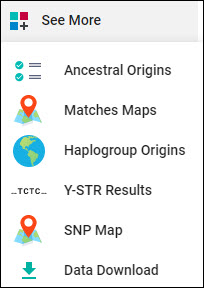
Every product now has a “See More” link where less frequently used widgets will be found, including the raw data downloads. This is the Y DNA “See More” dropdown by way of example.

You can see the green Updated badge on the Family Finder Matches tab. I don’t know if that badge will always appear when customers have new matches, or if it’s signaling that all customers have updated Family Finder Matches now.

We’ll talk about matches in the Family Finder section.

The Family Finder “See More” tab includes the Matrix, ancientOrigins, and the raw data file download.

The mitochondrial DNA section, titled Maternal Line Ancestry, mtDNA Results and Tools includes several widgets grouped under the “See More” tab.

Additional Tests and Tools

The Additional Tests and Tools area includes a link to your Family Tree (please do upload or create one,) Public Haplotrees, and Advanced Matches.

Public haplotrees are free-to-the-public Y and mitochondrial DNA trees that include locations. They are also easily available to FamilyTreeDNA customers here.

Please note that you access both types of trees from one location after clicking the Public Haplotrees page. The tree defaults to Y-DNA, but just click on mtDNA to view mitochondrial haplogroups and locations. Both trees are great resources because they show the location flags of the earliest known ancestors of the testers within each haplogroup.

Advanced Matches used to be available from the menu within each test type, but since advanced matching includes all three types of tests, it’s now located under the Additional Tests and Tools banner. Don’t forget about Advanced Matches – it’s really quite useful to determine if someone matches you on multiple types of tests and/or within specific projects.

Hey, look – I found a tooltip. Just mouse over the text and tabs on various pages to see where tooltips have been added.

Help and Help Center

The new Help Center is debuting in this release. The former Learning Center is transitioning to the Help Center with new, updated content.

Here’s an example of the new easy-to-navigate format. There’s a search function too.

Each individual page, test type, and section on your personal home page has a “Helpful Information” button.

On the main page, at the top right, you’ll see a new Help button.

Did you see that Submit Feedback link?

If you click on the Help Center, you’ll be greeted with context-sensitive help.

I clicked through from the dashboard, so that’s what I’m seeing. However, other available topics are shown at left.

I clicked on both of the links shown and the content has been updated with the new layout and features. No wonder they launched a new Help Center!

Account Settings

Account settings are still found in the same place, and those pages don’t appear to have changed. However, please keep in mind that some settings make take up to 24 hours to take effect.

Family Finder Rematching

Before we look at what has changed on your Family Finder pages, let’s talk about what happened behind the scenes.

FamilyTreeDNA has been offering the Family Finder test for 11 years, one of two very early companies to enter that marketspace. We’ve learned so much since then, not only about DNA itself, but about genetic genealogy, matching, triangulation, population genetics, how to use these tools, and more.

In order to make improvements, FamilyTreeDNA changing the match criteria which necessitated rematching everyone to everyone else.

If you have a technology background of any type, you’ll immediately realize that this is a massive, expensive undertaking requiring vast computational resources. Not only that, but the rematching has to be done in tandem with new kits coming in, coordinated for all customers, and rolled out at once. Based on new matches and features, the user interface needed to be changed too, at the same time.

Sounds like a huge headache, right?

Why would a company ever decide to undertake that, especially when there is no revenue for doing so? The answer is to make functionality and accuracy better for their customers. Think of this as a new bedrock foundation for the future.

FamilyTreeDNA has made computational changes and implemented several features that require rematching:

  • Improved matching accuracy, in particular for people in highly endogamous populations. People in this category have thousands of matches that occur simply because they share multiple distant ancestors from within the same population. That combination of multiple common ancestors makes their current match relationships appear to be closer in time than they are. In order to change matching algorithms, FamilyTreeDNA had to rewrite their matching software and then run matching all over to enable everyone to receive new, updated match results.
  • FamilyTreeDNA has removed segments below 6 cM following sustained feedback from the genealogical community.
  • X matching has changed as well and no longer includes anyone as an X match below 6 cM.
  • Family Matching, meaning paternal, maternal and both “bucketing” uses triangulation behind the scenes. That code also had to be updated.
  • Older transfer kits used to receive only closer matches because imputation was not in place when the original transfer/upload took place. All older kits have been imputed now and matched with the entire database, which is part of why you may have more matches.
  • Relationship range calculations have changed, based on the removal of microsegments, new matching methodology and rematching results.
  • FamilyTreeDNA moved to hg37, known as Build 37 of the human genome. In layman’s terms, as scientists learn about our DNA, the human map of DNA changes and shifts slightly. The boundary lines change somewhat. Versions are standardized so all researchers can use the same base map or yardstick. In some cases, early genetic genealogy implementers are penalized because they will eventually have to rematch their entire database when they upgrade to a new build version, while vendors who came to the party later won’t have to bear that internal expense.

As you can see, almost every aspect of matching has changed, so everyone was rematched against the entire database. You’ll see new results. Some matches may be gone, especially distant matches or if you’re a member of an endogamous population.

You’ll likely have new matches due to older transfer kits being imputed to full compatibility. Your matches should be more accurate too, which makes everyone happy.

I understand a white paper is being written that will provide more information about the new matching algorithms.

Ok, now let’s check out the new Family Finder Matches page.

Family Finder Matches

FamilyTreeDNA didn’t just rearrange the furniture – there’s a LOT of new content.

First, a note. You’ll see “Family Finder” in some places, and “Autosomal DNA” in other places. That’s one and the same at FamilyTreeDNA. The Family Finder test is their autosomal test, named separately because they also have Y DNA and mitochondrial DNA tests.

When you click on Family Finder matches for the first time, you will assuredly notice one thing and will probably notice a second.

First, you’ll see a little tour that explains how to use the various new tools.

Secondly, you will probably see the “Generating Matches” notice for a few seconds to a few minutes while your match list is generated, especially if the site is busy because lots of people are signing on. I saw this message for maybe a minute or two before my match list filled.

This should be a slight delay, but with so many people signing in right now, my second kit took longer. If you receive a message that says you have no matches, just refresh your page. If you had matches before, you DO have matches now.

While working with the new interface this morning, I’ve found that refreshing the screen is the key to solving issues.

My kits that have a few thousand matches loaded Family Matching (bucketing) immediately, but this (Jewish) kit that has around 30,000 matches received this informational message instead. FamilyTreeDNA has removed the little spinning icon. If you mouse over the information, you’ll see the following message:

This isn’t a time estimate. Everyone receives the same message. The message didn’t even last long enough for me to get a screenshot on the first kit that received this message. The results completed within a minute or so. The Family Matching buckets will load as soon as the parental matching is ready.

These delays should only happen the first time, or if someone has a lot of matches that they haven’t yet viewed. Once you’ve signed in, your matches are cached, a technique that improves performance, so the loading should be speedy, or at least speedier, during the second and subsequent visits.

Of course, right now, all customers have an updated match list, so there’s something new for everyone.

Getting Help

Want to see that tutorial again?

Click on that little Help box in the upper right-hand corner. You can view the Tutorial, look at Quick References that explain what’s on this page, visit the Help Center or Submit Feedback.

Two Family Finder Matches Views – Detail and Table

The first thing you’ll notice is that there are two views – Detail View and Table View. The default is Detail View.

Take a minute to get used to the new page.

Detail View – Filter Matches by Match Type

I was pleased to see new filter buttons, located in several places on the page.

The Matches filter at left allows you to display only specific relationship levels, including X-Matches which can be important in narrowing matches to a specific subset of ancestors.

You can display only matches that fall within certain relationship ranges. Note the new “Remote Relative” that was previously called speculative.

Parental Matching and Filtering by Test Type or Trees

All of your matches are displayed by default, of course, but you can click on Paternal, Maternal or Both, like before to view only matches in those buckets. In order for the Family Matching bucketing feature to be enabled, you must attach known relatives’ DNA matches to their proper place in your tree.

Please note that I needed to refresh the page a couple of times to get my parental matches to load the first time. I refreshed a couple of times to be sure that all of my bucketed matches loaded. This should be a first-time loading blip.

There’s a new filter button to the right of the bucketing tabs.

You can now filter by who has trees and who has taken which kinds of tests.

You can apply multiple filters at the same time to further narrow your matches.

Important – Clearing Filters

It’s easy to forget you have a filter enabled. This section is important, in part because Clear Filter is difficult to find.

The clear filter button does NOT appear until you’ve selected a filter. However, after applying that filter, to clear it and RESET THE MATCHES to unfiltered, you need to click on the “Clear Filter” button which is located at the top of the filter selections, and then click “Apply” at the bottom of the menu. I looked for “clear filter” forever before finding it here.

You’re welcome😊

Enhanced Search

Thank goodness, the search functionality has been enhanced and simplified too. Full name search works, both here and on the Y DNA search page.

If you type in a surname without selecting any search filters, you’ll receive a list of anyone with that word in their name, or in their list of ancestral surnames. This does NOT include surnames in their tree if they have not added those surnames to their list of ancestral surnames.

Notice that your number of total matches and bucketed people will change based on the results of this search and any filters you have applied.

I entered Estes in the search box, with no filters. You can see that I have a total of 46 matches that contain Estes in one way or another, and how they are bucketed.

Estes is my birth surname. I noticed that three people with Estes in their information are bucketed maternally. This is the perfect example of why you can’t assume a genetic relationship based on only a surname. Those three people’s DNA matches me on my mother’s side. And yes, I confirmed that they matched my mother too on that same segment or segments.

Search Filters

You can also filter by haplogroup. This is very specific. If you select mitochondrial haplogroup J, you will only receive Family Finder matches that have haplogroup J, NOT J1 or J1c or J plus anything.

If you’re looking for your own haplogroup, you’ll need to type your full haplogroup in the search box and select mtDNA Haplogroup in the search filter dropdown.

Resetting Search Results

To dismiss search results, click on the little X. It’s easy to forget that you have initiated a search, so I need to remember to dismiss searches after I’m finished with each one.

Export Matches

The “Export CSV” button either downloads your entire match list, or the list of filtered matches currently selected. This is not your segment information, but a list of matches and related information such as which side they are bucketed on, if any, notes you’ve made, and more.

Your segment information is available for download on the chromosome browser.

Sort By

The Sort By button facilitates sorting your matches versus filtering your matches. Filters ONLY display the items requested, while sorts display all of the items requested, sorting them in a particular manner.

You can sort in any number of ways. The default is Relationship Range followed by Shared DNA.

Your Matches – Detail View

A lot has changed, but after you get used to the new interface, it makes more sense and there are a lot more options available which means increased flexibility. Remember, you can click to enlarge any of these images.

To begin with, you can see the haplogroups of your matches if they have taken a Y or mitochondrial DNA test. If you match someone, you’ll see a little check in the haplogroup box. I’m not clear whether this means you’re a haplogroup match or that person is on your match list.

To select people to compare in the chromosome browser, you simply check the little square box to the left of their photo and the chromosome browser box pops up at the bottom of the page. We’ll review the chromosome browser in a minute.

The new Relationship Range prediction is displayed, based on new calculations with segments below 6 cM removed. The linked relationship is displayed below the range.

A linked relationship occurs when you link that person to their proper place in your tree. If you have no linked relationship, you’ll see a link to “assign relationship” which takes you to your tree to link this person if you know how you are related.

The segments below 6 cM are gone from the Shared DNA total and X matches are only shown if they are 6 cM or above.

In Common With and Not In Common With

In Common With and Not In Common With is the little two-person icon at the right.

Just click on the little person icon, then select “In Common With” to view your shared matches between you, that match, and other people. The person you are viewing matches in common with is highlighted at the top of the page, with your common matches below.

You can stack filters now. In this example, I selected my cousin, Don, to see our common matches. I added the search filter of the surname Ferverda, my mother’s maiden name. She is deceased and I manage her kit. You can see that my cousin Don and I have 5 total common matches – four maternal and one both, meaning one person matches me on both my maternal and paternal lines.

It’s great news that now Cousin Don pops up in the chromosome browser box at the bottom, enabling easy confusion-free chromosome segment comparisons directly from the In Common With match page. I love this!!!.

All I have to do now is click on other people and then on Compare Relationship which pushes these matches through to the chromosome browser. This is SOOOO convenient.

You’ll see a new tree icon at right on each match. A dark tree means there’s content and a light tree means this person does not have a tree. Remember, you can filter by trees with content using the filter button beside “Both”.

Your notes are shown at far right. Any person with a note is dark grey and no note is white.

If you’re looking for the email contact information, click on your match’s name to view their placard which also includes more detailed ancestral surname information.

Family Finder – Table View

The table view is very similar to the Detail View. The layout is a bit different with more matches visible in the same space.
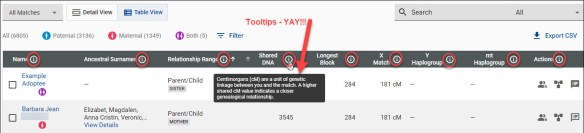
This view has lots of tooltips on the column heading bar! Tooltips are great for everyone, but especially for people just beginning to find their way in the genetic genealogy world.

I’ll have to experiment a bit to figure out which view I prefer. I’d like to be able to set my own default for whichever view I want as my default. In fact, I think I’ll submit that in the “Submit Feedback” link. For every suggestion, I’m going to find something really positive to say. This was an immense overhaul.

Chromosome Browser

Let’s look at the chromosome Browser.

You can arrive at the Chromosome Browser by selecting people on your match page, or by selecting the Chromosome Browser under the Results and Tools link.

Everything is pretty much the same on the chromosome browser, except the default view is now 6 cM and the smaller segments are gone. You can also choose to view only segments above 10 cM.

If you have people selected in the chromosome browser and click on Download Segments in the upper right-hand corner, it downloads the segments of only the people currently selected.

You can “Clear All” and then click on Download All Segments which downloads your entire segment file. To download all segments, you need to have no people selected for comparison.

The contents of this file are greatly reduced as it now contains only the segments 6 cM and above.

Family Tree

No, the family tree has not changed, and yes, it needs to, desperately. Trust me, the management team is aware and I suspect one of the improvements, hopefully sooner than later, will be an improved tree experience.

Y DNA

The Y DNA page has received an update too, adding both a Detail View and a Table View with the same basic functionality as the Family Finder matching above. If you are reading this article for Y DNA only, please read the Family Finder section to understand the new layout and features.

Like previously, the match comparison begins at the 111 marker level.

However, there’s a BIG difference. If there are no matches at this level, YOU NEED TO CLICK THE NEXT TAB. You can easily see that this person has matches at the 67 level and below, but the system no longer “counts down” through the various levels until it either finds a level with a match or reaches 12 markers.

If you’re used to the old interface, it’s easy to think you’re at the final destination of 12 markers with no matches when you’re still at 111.

Y DNA Detail View

The Y-DNA Detail and Table views features are the same as Family Finder and are described in that section.

The new format is quite different. One improvement is that the Paternal Country of Origin is now displayed, along with a flag. How cool is that!

The Paternal Earliest Known Ancestor and Match Date are at far right. Note that match dates have been reset to the rerun date. At this point, FamilyTreeDNA is evaluating the possibility of restoring the original match date. Regardless, you’ll be able to filter for match dates when new matches arrive.

Please check to be sure you have your Country of Origin, Earliest Known Ancestor, and mapped location completed and up to date.

Earliest Known Ancestor

If you haven’t completed your Earliest Known Ancestor (EKA) information, now’s the perfect time. It’s easy, so let’s do it before you forget.

Click on the Account Settings gear beneath your name in the right-hand upper corner. Click on Genealogy, then on Earliest Known Ancestors and complete the information in the red boxes.

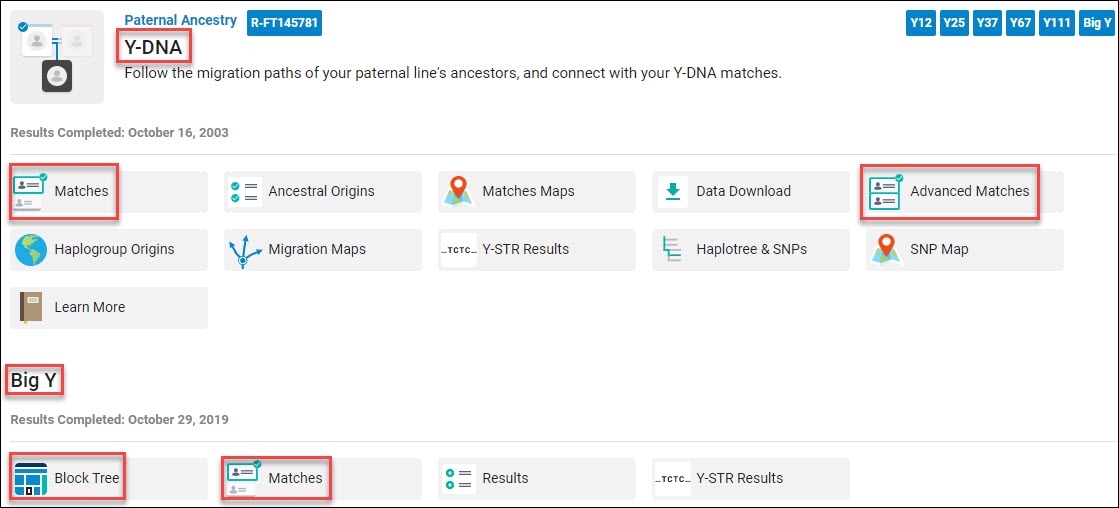
  • Direct paternal line means your father’s father’s father’s line – as far up through all fathers as you can reach. This is your Y DNA lineage, but females should complete this information on general principles.
  • Direct maternal line means your mother’s mother’s mother’s line – as far up through all mothers that you can reach. This is your mitochondrial DNA lineage, so relevant for both males and females.

Completing all of the information, including the location, will help you and your matches as well when using the Matches Map.

Be sure to click Save when you’re finished.

Y DNA Filters

Y DNA has more filter options than autosomal.

The Y DNA filter, located to the right of the 12 Markers tab allows testers to filter by:

  • Genetic distance, meaning how many mutations difference between you and your matches
  • Groups meaning group projects that the tester has joined
  • Tree status
  • Match date
  • Level of test taken

If none of your matches have taken the 111 marker test or you don’t match anyone at that level, that test won’t show up on your list.

Y DNA Table View

As with Family Finder, the Table View is more condensed and additional features are available on the right side of each match. For details, please review the Family Finder section.

If you’re looking for the old Y DNA TiP report, it’s now at the far right of each match.

The actual calculator hasn’t changed yet. I know people were hoping for the new Y DNA aging in this release, but that’s yet to follow.

Other Pages

Other pages like the Big Y and Mitochondrial DNA did not receive new features or functionality in this release, but do sport new user-friendly tooltips.

I lost track, but I counted over 100 tooltips added across the platform, and this is just the beginning.

There are probably more new features and functionality that I haven’t stumbled across just yet.

And yes, we are going to find a few bugs. That’s inevitable with something this large. Please report anything you find to FamilyTreeDNA.

Oh wait – I almost forgot…

New Videos

I understand that there are in the ballpark of 50 new videos that are being added to the new Help Center, either today or very shortly.

When I find out more, I’ll write an article about what videos are available and where to find them. People learn in various ways. Videos are often requested and will be a popular addition. I considered making videos, but that’s almost impossible for anyone besides the vendor because the names on screens either need to be “fake” or the screen needs to be blurred.

So hurray – very glad to hear these are imminent!

Stay Tuned

Stay tuned for new developments. As Lior said, FamilyTreeDNA is investing heavily in genetic genealogy and there’s more to come.

My Mom used to say that the “proof is in the pudding.” I’d say the myDNA/FamilyTreeDNA leadership team has passed this initial test with flying colors.

Of course, there’s more to do, but I’m definitely grateful for this lovely pudding. Thank you – thank you!

I can’t wait to get started and see what new gems await.

Take a Look!

Sign in and take a look for yourself.

Do you have more matches?

Are your matches more accurate?

How about predicted relationships?

How has this new release affected you?

What do you like the best?

_____________________________________________________________

Disclosure

I receive a small contribution when you click on some of the links to vendors in my articles. This does NOT increase the price you pay but helps me to keep the lights on and this informational blog free for everyone. Please click on the links in the articles or to the vendors below if you are purchasing products or DNA testing.

Thank you so much.

DNA Purchases and Free Transfers

Genealogy Products and Services

Books

Genealogy Research

How Many Men Discover or Confirm Their Surname with Y DNA Testing?

About 15 years ago, Bennett Greenspan, founder of FamilyTreeDNA, at one of the early conferences said that about 30% of men who take a Y DNA test find a strong surname match. That number has increased now to nearly 100%, or “almost everyone.”

Exceptions

Of course, there are exceptions that fall into a number of categories:

  • Jewish families from regions where surnames weren’t adopted until in the 1800s.
  • Jewish families whose direct paternal line suffered dramatic losses during the Holocaust.
  • Dutch families who did not adopt surnames until Napoleon’s edict in 1811.
  • Cultures who have or recently had patronymic surnames that change every generation.
  • Men whose DNA is either extremely rare (and no relatives have tested) or are from under-sampled regions of the world.
  • Males whose paternal line may be recent immigrants and people in the homeland don’t participate in genealogy or don’t DNA test.
  • Males whose ancestors were enslaved. In the US, families adopted surnames after the Civil War ended slavery in the 1860s, so Y DNA testing plus autosomal is critically important to reunite these families. Please note that the Y DNA haplogroup, even an estimate provided with STR testing, will indicate whether the direct paternal lineage is European, African, Native American/Asian – all of which are found in the descendants of men who were enslaved. The Big Y-700 provides significantly more information along with placement on the haplotree.

I started writing Y DNA reports for clients in 2004 (although I no longer accept private clients) and at that time, often saw men with no matches. Today, a man with no matches is extremely unusual, and most have strong surname matches. As more men test, everyone will have more matches, of course, and the more we can learn about our ancestors.

What do matches reveal?

Matches Reveal

In essence, matches to other men with common surnames do one of two things:

  1. Confirm the surname lineage, at least to the common ancestor.
  2. Identify the surname where the tester is likely to find his ancestral roots.
  3. Provide perspective further back in time answering the question, “Where did I come from?”

Of course, this second point is crucial for males searching for the identity of their paternal lines.

While time has moved on, the number of testers in the database has dramatically increased, and almost everyone has relevant matches now – I still see the 30% metric oft-repeated. Let’s put this to the test and see what we find.

Setting Up the Experiment

I selected 20 men who have taken the Big Y test whose kits I manage or who were randomly selected from projects that I manage and who have given permission for their results to be published on public project pages.

I recorded results for the tester’s own or very similar surnames. Slightly different but recognizable spellings are counted as the same name.

I included matches at 12 markers, 111 markers, and the Big Y results. Men who purchase or upgrade to the Big Y-700 test will have all 111 STR panel markers included. Obviously, individual testers should check their results at every level.

Big Y testers actually receive 700+ STR markers, but can only easily filter for matches at 111 (or below), so that’s the number I used. Plus, males can purchase  37 and 111 panels without taking the Big Y test, so this comparative information will be valid for all Y DNA testers.

Click to enlarge image.

Additionally, I used the Advanced Matches feature to check for people who match someone on BOTH the Y DNA and their Family Finder autosomal test. Of course, this doesn’t guarantee that the reason they match on both tests is because of their common surname line – but it’s a hint and may be very useful, especially with closer Family Finder matches.

I intentionally included some men with recent European heritage who are unlikely to have matches simply because their families have been in colonial America since the 1600s or 1700s and their ancestor had a dozen sons who each had a dozen sons.

Why Did I Include 12 Marker Results?

You may wonder why I included 12 marker matches since that test is no longer sold individually and is the least granular. Truthfully, it’s too often deemed useless and overlooked.

Hear me out on this one😊

Many of the men who originally took the 12 and 25 marker tests, before the higher panels (37, 67, 111, and Big Y) were available are deceased now. Twenty years is a generation, and FamilyTreeDNA began testing the Y chromosome in the year 2000.

While these low marker tests alone are not conclusive, with additional information, such as trees, common ancestors, and other testers who match, they form pieces of evidence that can be invaluable. Some have also taken an autosomal test which can be especially important, given that they are another generation or two (or three) further back in time than the people testing today.

You won’t see these men as matches at 37, 67 or 111 markers, because they are deceased and can’t upgrade, but they may provide the nugget of information you need by matching at 12 or 25 markers. You’ll need to evaluate that match in light of other information. I’ll review that in the next two sections.

20 Men

If you’re a man or can find a male to test for each of your genealogy lines, the Y DNA is the fastest, most reliable way to identify an ancestral surname – not just in your father’s generation, but moving back in time.

Of the 20 men selected, all men had matches to their surname. However, one Smith man, #18, had a unique situation that might be very genealogically relevant.

I’ll discuss each match briefly with some commentary below the chart.

Surname Match Name 12 Marker 111 Marker Big Y Advanced – 12 + FF Both
1 Howery Howery 9 of 20 2 of 2 0 (none tested) 1
2 Graves Graves 8 of 51 2 of 8 1 Graves + others 1 – different surname
3 Perkins Perkins/McDonald 16 of 1762 1 of 63, many McDonalds 0 Perkins (no testers) but several McD names 8 – 2 McDonald
4 Napier Napier 19 of 19,217 2 of 13 2 Napier + others 1 + many others
5 Rice Rice 45 of 58 14 of 19 7 of 10 1
6 Rader Rader  13 of 18,576 7 of 7 7 3
7 Estes Estes 69 of 502 21 of 24 9 of 10 2 + 4 different surname
8 Campbell Campbell 178 of 369 61 of 103 7 of 10 4 of 5
9 Lentz Lentz 1 of 1 0 of 1 1 different name, no other Lentz Big Y testers 0
10 Bonnevie Bonnevie 1 of 1 (tested to 37) 0 0 no test
11 Vannoy Vannoy 7 of 49 2 of 4 0 of 1 0
12 Lore/Lord Lore/Lord 3 of 7 1 of 3 1 of 1 0
13 Clarkson/Claxton Clarkson/Claxton 19 of 540 1 of 1 0 of 9 (No Big Y testers) 0 of 3
14 Muncey Muncy/Muncey 9 of 155 7 of 16 1 of 4 1
15 Miller Miller 5 of 6 2 at 67, no 111 testers 0 – no Miller match testers 1 of 2
16 Speak(s) Speak(s) 9 of 9 21 of 51 4 of 17 0
17 Smith Smith/Jennings 2 of 16, 9 Jennings 0 of 2 (Jennings) 1 Jennings of 3 1 Jennings
18 Bolton Bolton 8 of 1750 2 of 2 0 of 28 0 of 12
19 Crumley Crumley 10 of 79 7 of 93 3 of 127 0 of 2
20 Harrell Harrell 81 of 17,638 3 of 7 2 of 2 0 of 119

Messages Revealed in the Results

Let’s briefly review the information we’ve discovered and extrapolate from each of these 20 matches. Analysis is the key to success.

  1. The Howery surname is rather unusual. This man had only two 111 marker matches and both were to men of the same surname. Half of his 12 marker matches are the same surname. None of his matches had taken the Big Y test, so he has no same-surname or other surname matches there. He did match one of his Y DNA matches on the Family Finder test though. This is high-quality confirmation that Howery is indeed the biological ancestral surname and our tester can set about finding and confirming his common ancestors with his matches.
  2. The Graves male had several 12-marker matches, but many 12-marker matches have not tested at the 111 marker level. He matches one Graves male on the Big Y plus some men with other surnames. The Big Y reaches back further in time, so these matches may reflect common ancestors before the advent of surnames.
  3. Our Perkins male has very interesting matches. He does have both 12 and 111 Perkins matches, but he also had a LOT of McDonald matches. More McDonald matches than Perkins matches. This suggests that indeed, his ancestors were Perkins, at least back to the earliest known ancestor (EKA), but before that, he may well be a member of the McDonald Y DNA clan. There were no Perkins Big Y testers, but if I were him, I’d ask my Perkins matches to upgrade.
  4. I can tell by looking at the huge number of 12 marker matches for our Napier man that he is haplogroup R, the most common in Europe, with an EXTREMELY common 12 marker haplotype. Note how dramatically the number of 111 marker matches drops – from 19,000+ to 13 – a perfect example of why we suggest men upgrade to at least 111 markers to refine their matches. Both of his 111 marker Napier matches have upgraded to the Big Y, and he matches them there as well. He does match one Napier on both the 12 marker test and Family Finder Advanced Matching – but he also matches MANY other men. This is because of the extremely high number of 12 marker matches. In his case, I would only use Y DNA marker panels higher than 12 markers in the Advanced Matching.
  5. Lots of Rice testers from this line confirm a common ancestor. I wonder if there is a Rice male from someplace overseas who has tested. If so, this might be that “jump the pond” event that genealogists who have European ancestors who are found in colonial America seek.
  6. Our Rader tester also has many 12 marker matches, but his only matches at 111 and on the Big Y are his Rader kinsmen. No doubt about that surname whatsoever.
  7. My Estes line has several 12 marker matches, but that gets slimmed right down at 111 markers. Using the Big Y test, we further divided those branches of Estes men. I literally could not have sorted out who was descended from whom without the Big Y test results. Way too many Johns, Williams, and Elishas in burned counties in Virginia.
  8. Our Campbell tester is unquestionably confirmed to be descended from the Clan Campbell line from Inverary, Scotland. However, the challenge in this family is which Campbell male they descend from in Virginia. The Big Y-700 test has narrowed the possibilities significantly, and the tester is currently in the process of attempting to convince his three closest Y STR 111 matches to take the Big Y test. Yes, he has offered to pay as well. Hey, in genealogy, you do what you need to do. Y DNA is likely the only way this puzzle from the 1700s will ever be unraveled.
  9. The Lentz line is German with rare DNA, but they do have a confirming match to another Lentz male.
  10. Bonnievie spelled various ways is French and has one 12 marker match who only tested to 37 markers. He has no matches above that. Not only is his Y DNA quite rare, DNA testing is illegal in France which makes additional testers few and far between. Unfortunately, his one match has not taken a Family Finder test either.
  11. Several men from the Vannoy line have tested and a Big Y test match to another man confirmed that the ancestral line is Dutch – not French as was speculated for decades. The STR tests have revealed Vannoy lines, by similar spellings, from lines we didn’t know existed.
  12. Lore or Lord is a rare Acadian family surname. Our tester does have matches to other Lore/Lord men, which confirms the line to the ancestor who arrived in Acadia in the early 1600s, but future testers will be needed before we can confirm his origins to either France or as one of the English soldiers who served at the fort.
  13. The Clarkson/Claxton testers confirm two lines, one spelled each way, from Tennessee and North Carolina line to a common ancestor in either Virginia or North Carolina in the 1770s. However, the family is still working to further assemble that puzzle. Finding a Clarkson/Claxton match on STR markers or the Big Y who descends from a male not from the two known lines would help immensely. Our hope is that a Clarkson/Claxton from an earlier line or from the British Isles will test and provide that push over the brick wall. Any Clarkson/Clarkson men out there who haven’t taken the Y DNA test yet?
  14. The Muncy/Munsey line is confirmed to a common ancestor born in England in and died on Long Island in 1674. Based on both STR and SNP results from the Big Y, we can narrow the lineages of Muncy men who test and aren’t familiar with their Muncy genealogy. Of course, the Muncy line eventually migrated through Virginia and seemingly named every man in every generation either John, Samuel or Francis – but DNA testing helps immensely to sort this out.
  15. While Miller is a very common occupation surname, DNA testing has put to rest many incorrect myths about this particular Swiss Miller line. Men with the same surname in the same location, even in the same church, does not equate to the same genetic family line. Any male with a common surname absolutely needs to do Y DNA testing and at the highest level. There’s nothing worse than spending countless hours barking up the wrong tree – especially when Y DNA testing will save you.
  16. Our Speaks man matched another Speak male who knew where his ancestors were from in Lancashire. Testing additional men living in Lancashire at the 111 marker and Big Y levels allowed the Speak line to be divided into specific lineages beginning in the 1500s, piecing together the earlier ancestors into a descendant tree. Recently, an “orphan” line in the US has been connected to his ancestors, thanks to both STR values AND Big Y testing.
  17. Smith is quite interesting because we discover that something doesn’t add up. Our Smith man matches two Smith men who have the same ancestor born in 1810 but that son, John, does not match the descendants of his brothers. There seems to be an undocumented adoption of some sort at that point in time. John Smith’s Y DNA is not the same as his brothers whose descendants match each other. Given that our Smith tester, and his two matches, do not match the other descendants of the ancestor they are supposed to descend from, we can pinpoint the generation in which the adoption event occurred. However, we have a further clue, because these Smith men match the Jennings line closely- including one advanced match where the Smith man also matches autosomally in addition to the Y DNA. This is clearly a case of “you don’t know what you don’t know” and would never have known without Y DNA testing.
  18. Our Bolton tester matches several other Bolton men who descend from a common immigrant ancestor. If the Bolton matches upgrade to the Big Y-700 test, they might be able to determine separate genetic lines branching through the various sons of the immigrant ancestor. Evaluating the surnames that the tester matches at the Big Y level may assist with evaluating deeper ancestry in England and determining where the Bolton ancestors originated before the 1600s in London.
  19. Crumley is a difficult family to research, in part because several people with the same surname are found in close proximity, but Y DNA testing has shown that these men are not related. Big Y testing has disproved that the Crumley progenitor originated in Germany, although a different Crumley family did. The Big Y matches include many Mc… surnames along with Ferguson and Gillespie. The Big Y Block Tree shows the closest matches with ancestors born in Scotland, Ireland, and Northern Ireland – which is very likely where the Crumley progenitor originated too.
  20. Harrell is another difficult surname, spelled numerous ways with several Harrell/Herrell/Harrold/Herrald families moving westward in the 1600s and 1700s from the thirteen original colonies. This Harrell line has not been able to connect to a single progenitor in the colonies, yet, but Y DNA testing and the block tree confirm that this Harrell line originated in the British Isles, very likely England.

What Did These 20 Men Learn?

Every single one of these men benefitted from Y DNA testing, although exactly how depends to some extent on their testing goal. Other men also benefitted by matching.

One man, our Smith, #17, needs to look at the Jennings family prior to 1810. Is there a Jennings man living in close proximity, or do court records exist that might be illuminating?

If one of these 20 men had been an adoptee or otherwise searching for an unknown paternal line, they would have been able to identify a surname connection and perhaps a progenitor ancestor. I encourage everyone to either order a Family Finder autosomal test or transfer a DNA file (for free) from another vendor if they have taken an autosomal test elsewhere. Step-by-step transfer instructions are found here. Be sure that the Y DNA and autosomal tests are on the same kit/account at FamilyTreeDNA so that you can use the advanced matching tool.

With the Big Y-700 test, these men can discern or confirm lines descending from their direct paternal ancestors – sometimes within a generation or two of the tester. This test is so sensitive and granular and has such deep coverage (millions of bases) now that often we find small mutations between fathers and sons or brothers.

While STR markers, 12-111 are genealogically important, they do tend to mutate rapidly and sometimes back-mutate. SNPs, tested in the Big Y-700 test, don’t do that, and the power of STRs and SNPs together have the potential to break down brick walls and correct trees. In fact, it happens every single day.

Resources

If you’d like to watch a video about Y DNA, Y DNA-related genetic terms, and the benefits of Big Y-700 testing, you can watch a great educational video by Janine Cloud here. Be sure to note the part where she talks about why people who have previously taken the Big Y-500 might want to upgrade to the Big Y-700.

Also, check out my Y DNA Resource page, here.

What Don’t You Know?

Y DNA tests, including the Big Y-700 which includes all STR panels, and the autosomal Family Finder test are on sale at FamilyTreeDNA right now for Father’s Day.

There’s no better time to find missing pieces and discover information that you can’t find any other way.

Click here to order Y DNA tests, the Family Finder, or upgrade an existing test.

_____________________________________________________________

Disclosure

I receive a small contribution when you click on some of the links to vendors in my articles. This does NOT increase the price you pay but helps me to keep the lights on and this informational blog free for everyone. Please click on the links in the articles or to the vendors below if you are purchasing products or DNA testing.

Thank you so much.

DNA Purchases and Free Transfers

Genealogy Products and Services

Books

Genealogy Research

Yes, Ancestry is Glitchy Right Now – Here’s What TO and NOT TO DO

Public Service Announcement – Ancestry has been a bit glitchy for a few days/weeks and remains so. All vendors have issues from time to time, and it seems to be Ancestry’s turn right now. I wasn’t affected at first, but these tree-based problems seem to randomly come and go. So even if you’re not affected right now, you may be soon.

Here are tips on dealing with the reported issues, and perhaps more important, what NOT to do. Trying to fix things may just cause more problems.

What’s going on?

What’s Up With Ancestry?

A few days ago I signed on to Ancestry to discover that all of my tree branches beyond the first page displayed were “gone.” At that point in time, if I clicked on the right arrow, either no ancestors appeared, just those blank boxes to add parents, or in one case, one ancestor appeared with no parents.

This was uniform for all of my tree branches.

Needless to say, it struck panic into my genealogist’s heart. The saving grace is that indeed, no one but me has edit access to my tree – so I know positively that no one but me could delete anything.

Furthermore, I know beyond any shadow of a doubt that I had not deleted or broken the links of all of those ancestral lines. I don’t do “sleepwalk-genealogy” and if I did, I’d be much more likely to add someone😊

To try to quell the panic a bit, I used the Tree Search feature in the upper right-hand corner of the Tree page and yes, those “missing” ancestors were still in my tree file. They just weren’t showing correctly.

Technology Background

I spent years in technology and I learned two things:

  • Don’t panic and jump to conclusions
  • Sometimes things fix themselves, at least from the user’s perspective

After a couple of easy noninvasive steps, I decided to LEAVE THINGS ALONE and see what happened.

1-2-3 Things to Do

Here’s the 1-2-3 of things to do, in order.

  1. Sign out and back in.
  2. Try a different browser. If you are using a mobile app, use the computer and vice versa.
  3. Go away and check again later or tomorrow.

What Worked?

In this case, number three worked. The next day, everything was back to normal again with no residual damage.

Thankfully.

Had that not been the case, I would have started searching on social media for common issues and I would have called Ancestry’s support – no matter how much I don’t like doing that.

But there’s one thing I would NOT have done.

DO NOT

DO NOT start to repair things. If you start trying to reconnect people, when the underlying problem is actually resolved by Ancestry, Heaven only knows what a mess you’ll have with people double connected.

Twins and Duplicates

Another issue reported is that people are being duplicated in trees, including the tree owner/home person who finds that they have a twin with the same information.

Again, DO NOT start deleting and correcting.

What You CAN Do

Verify that indeed, only people you trust have edit access to your tree.

Under the name of the appropriate tree at upper left, select Tree Settings.

For another person to be able to either contribute to or edit your tree, you must specifically invite them to do so. Guests can only view your tree.

While Ancestry says that all invitees are editors, that’s not the case, as shown below when I clicked to invite someone.

As you can see, the default is “Guest,” but always verify after someone accepts your invitation.

Patience

Patience is difficult, but if you’re experiencing tree problems at Ancestry, just do something else for a few hours or a couple days.

Here are four great genetic genealogy activities you can do elsewhere that are productive.

  1. Download a copy of your DNA file from Ancestry and upload to MyHeritage, FamilyTreeDNA, or GedMatch to find additional matches. Instructions can be found here.
  2. At FamilyTreeDNA, upload your file and get matches for free. Check Family Finder, Y or mitochondrial DNA matches, or order a Big Y test or upgrade. The Father’s Day sale just started and you can sign on or order, here.
  3. At MyHeritage, if you don’t have a DNA test, upload free and get matches here. Check your DNA matches using their new Genetic Groups filter. I provided instructions, here. While you’re viewing your DNA matches, be sure to check for SmartMatches, record matches and other hints. If you’re not a records subscriber, you can subscribe with a 14-day free trial here.
  4. At 23andMe, testers are limited to 2000 matches unless you purchase an annual subscription – then you’re limited to about 5000 matches. However, 23and Me does not roll matches off your list that you’ve connected to, invited to connect, made a note about or messaged. (At least they never have and mine remain.) Go to the last page of your DNA Relatives list, which are your smallest segment matches, and start working backward to be sure you’ve initiated some type of communication that will prevent them from rolling off your match list.

These tasks aren’t just busywork. You have no idea what kind of a gold nugget you may discover.

You’ll have accomplished several things, enlarged your horizons and maybe, just maybe, by the time you’re done your tree at Ancestry will have righted itself again.

What fun things did you discover?

_____________________________________________________________

Disclosure

I receive a small contribution when you click on some of the links to vendors in my articles. This does NOT increase the price you pay but helps me to keep the lights on and this informational blog free for everyone. Please click on the links in the articles or to the vendors below if you are purchasing products or DNA testing.

Thank you so much.

DNA Purchases and Free Transfers

Genealogy Products and Services

Books

Genealogy Research