DNA Academy Webinar Series Released

Great news! Legacy Family Tree Webinars has just released DNA Academy.

DNA Academy is a three-part series designed to introduce the basics of DNA for genetic genealogy and how Y-DNA, X-DNA, mitochondrial and autosomal DNA can be utilized. Each of these different types of DNA serves a different function for genealogists – and reveals different matches and hints for genealogy.

  1. DNA Academy Part 1 introduces genetic genealogy basics, then, Ancestry’s DNA tools – including their new pricing structure for DNA features. Click here to view.
  2. DNA Academy Part 2 covers FamilyTreeDNA’s products. Click here to view the webinar, which includes:
    1. Y-DNA for males which tracks the direct paternal line
    2. Mitochondrial DNA for everyone which tracks your direct maternal line – your mother’s mother’s mother’s lineage
    3. Autosomal DNA which includes matches from all of your ancestral lines and along with X-DNA matching, which has a very distinctive inheritance path.
  3. DNA Academy Part 3 includes MyHeritage, 23andMe, and third-party tools such as DNAPainter and Genetic Affairs. Click here to view.

Legacy Family Tree Webinars has graciously made Part 2, the FamilyTreeDNA class, free through August 22nd for everyone – so be sure to watch now.

After August 22nd, Part 2 will join Part 1 and Part 3 in the webinar library for subscribers with more than 2240 webinars for $49.95 per year.

_____________________________________________________________

Follow DNAexplain on Facebook, here.

Share the Love!

You’re always welcome to forward articles or links to friends and share on social media.

If you haven’t already subscribed (it’s free,) you can receive an e-mail whenever I publish by clicking the “follow” button on the main blog page, here.

You Can Help Keep This Blog Free

I receive a small contribution when you click on some of the links to vendors in my articles. This does NOT increase your price but helps me keep the lights on and this informational blog free for everyone. Please click on the links in the articles or to the vendors below if you are purchasing products or DNA testing.

Thank you so much.

DNA Purchases and Free Uploads

Genealogy Products and Services

My Books

Genealogy Books

Genealogy Research

The Big Y-700 Test Marries Science to Genealogy

Recently, one of my long-time friends and project co-administrators asked me a simple question.

  • What do the FamilyTreeDNA Big Y-700 test and the Time Tree tell us when we have genealogy trees provided by testers?
  • What does the Discover Time Tree tell us that’s different, and how do we reconcile the Time Tree and genealogy?

Those are great questions.

Sometimes, I get so buried in the details of genetic genealogy that I neglect the obvious, so I’m writing this article for my co-admin and anyone else with the same questions.

Time Tree Versus Genealogy Question

Of course, as a genealogist, my first answer would be that we always need to be cautious about user-provided trees. Even when the genealogy is accurate, that’s no guarantee there wasn’t a biological disruption that caused the genetic line not to be the same as the surname line.

Almost every lineage has examples of people whose genealogy was “off” or misattributed paternity occurred someplace upstream, meaning that someone carries the surname but does not descend from that biological lineage.

However, relative to DNA projects, the Big Y-700 tests provide one very important feature that STR testing does not and cannot do.

The Big Y-700 test creates a genetic tree, in conjunction with other testers, which provides scientifically calculated dates when branches of the genetic tree were formed.

The genetic tree should align, at least closely, with testers’ genealogical trees.

In other words, if their genealogy is accurate, testers “should” fit in (or at least near) the appropriate places on the branches of the genetic tree.

Furthermore, for people trying to sort out their actual branch in the tree, the Big Y-700 test is MUCH MORE reliable than the earlier STR (short tandem repeat) tests that are prone to random and back mutations. At one time, STR tests were all that was available, but now,  SNPs have been added to our arsenal. SNPs (single nucleotide polymorphisms) are extremely stable and reliable mutations.

I’m getting ready to record a new Y-DNA webinar, and I’m giving you a sneak peek of a couple of my slides here. I’ll publish an announcement when the webinar is available.

STRs Versus SNPs

Historic Y-DNA testing tested only a limited number of STR locations. That test reported the number of repeats at a specific genetic location on the Y chromosome. Today, the 37, 67, and 111 marker STR tests are still available to purchase.

What are the major differences between the two types of tests, and why would someone purchase one over the other?

If you purchase one of the STR tests, you purchase testing at a specific number of locations, such as 37, 67, and 111. The Big Y-700 test includes at least 700 STR locations, but the specificity of the Big Y-700 SNP testing replaces most of the STR test results in terms of lineage definition.

SNP mutations, when discovered in more than one man in a particular haplogroup lineage, are then named as haplogroups. That mutation is then found in each directly descended male in that line.

STR – 37, 67, 111 Big Y-700 (STRs & SNPs)
Tests A limited number of repeat STR markers – Big Y guarantees 700+ NGS scan targets ~ 25 million locations
Focus Comparatively short genealogy timeframe All-inclusive – recent genealogy plus older to ancient
Includes Can upgrade to Big Y-700 Includes STR tests, separate matching, Globetrekker, Discover, and more
Tree Genealogy, customer provided Genetic Tree – Group Time Tree coordinates with genealogy if provided
Tools STR tools STR tools plus SNP tools & robust Discover
Haplogroup Estimated based on STR values Confirmed to the most granular level possible – evergreen
Useful When Exclusion testing, less costly, entry-level Discover provides lineage, ancient DNA, TMRCA, and more
Matching STRs only STR plus Big Y – both can be useful
Trees Customer provided genealogy Time Tree, Group Time Tree, Block Tree, Classic Tree + 1 more soon

Put simply, the STR tests are now entry-level. Once you see what the Big Y-700 provides, you’ll absolutely want to upgrade to that test. Most of the time, if I know I’m testing someone from the correct line, I just purchase the Big Y-700 out the gate. If I’m not sure I’m testing the correct lineage, I’ll purchase the STR test first to make sure they match the correct lineage before upgrading to the Big Y-700.

Discover

The Discover tool was introduced to provide additional information to Big Y testers and others seeking haplogroup information. STR results can only predict a relatively high-level haplogroup, usually a few thousand years ago, while the Big Y-700 provides testers with an extremely granular haplogroup – usually decades to a few hundred years ago. Often, living men that span 2 or 3 descendant generations (grandfather, father, sons) discover that they have their own haplogroup branch on the tree of mankind!

However, if no one else from your line has tested in hundreds of years, Discover can only work with available information.

Let’s take a quick look at the Estes Group Time Tree.

Estes Project Group Time Trees

Group projects have Group Time Trees. You can view the Estes surname project, here. You can find a project for any surname by either googling “<surname> DNA Project” or scrolling to the VERY bottom of the FamilyTreeDNA main page.

If you’re signed into FamilyTreeDNA, you can also find projects in the top banner.

Once you’re on the project page, you’ll see an option for DNA Results (assuming the administrators have not made the project entirely private.)

Click on the DNA Results link and select Y-DNA.

Next, you’ll see “Group Time Tree.”

Group Time Tree Display

What appears next depends on how the project administrators have grouped the project participants.

I’ve grouped the Estes project by genealogical line, with the exception of a couple of people who carry the Estes surname but have experienced an adoption or other unknown parental event in their Estes lineage.

In some cases, there are simply two same-name lineages that were never from the same biological line. Unfortunately, occasionally they settle in the same place, making the genealogy difficult. Even worse, until Y-DNA testing came along, there was often no way to know they were two different families.

This situation is actually where the Big Y-700 test shines.


The Group Time Tree shows the genetic tree scientifically constructed from the SNP results of the Big Y-test results of the testers, at left. At right you’ll see the surnames of the testers along with their Earliest Known Ancestor (EKA) if they have entered that information.

Initially, you don’t even realize you’re actually looking at two types of information merged together. This display allows testers to see the genetic branching tree structure, at left, which is reflective of their actual genealogy, at right.

You can see that the birth year of Sylvester Estes, entered by a tester with haplogroup R-BY482, is 1622. Please note, there’s a typo. Sylvester was born in 1522, NOT 1622. This is a perfect example of what I meant by tree information sometimes being inaccurate and it’s very important when trying to correlate the genetic tree and the user-provided genealogy.

We discovered that R-BY482 (red profile above, at left) is an Estes “signature” haplogroup for the Estes line originating in Deal, England, with three other haplogroups that formed in descendant generations. We know this because every descendant from this line has this mutation.

R-BY490 was formed between Sylvester’s son Robert Estes, born about 1555, and his son, born about 1600, also named Sylvester. We know this because all of the descendants of Sylvester (born circa 1600) carry this mutation, but Robert’s son, Robert, born in 1603, does not.

The genealogy portion of the Group Time Tree, above, doesn’t reveal that information because testers either don’t know their genealogy that far back or perhaps listed an earlier known ancestor, such as Nicholas, born in 1495.

Click to enlarge

I created a spreadsheet tracking the Big Y-700 testers of the descendants of Nicholas Estes, along with their descendant haplogroups.

We know that Robert, born in 1555, carries R-BY490 because both of his sons, Abraham and Richard, inherited that mutation, seen with green arrows.

However, this calls into question the associated genealogy because if Robert, born in 1603, descended from Robert, born in 1555, he too would have the mutation R-BY490 since Robert’s other two sons do. Note that the user-provided birth year typo of 1622 which should be 1522 is a century off – enough to be within the genetic band haplogroup birth band – but impossible for the genealogy table.

There is one other possibility: kit 166011, the descendant of Robert born in 1603, could have taken the earlier Big Y-500 test and never upgraded to the more powerful Big Y-700. That’s too much detail for this article, but the discrepancy between the genetic tree and the genealogy tree alerts us that additional research is warranted. The genealogy submitted for tester 166011 confirms that, indeed, 1622 is a typo.

There are no other descendants of known sons of Nicholas or Sylvester born in 1522 to test, but perhaps another will surface one day.

You can see that the more testers in any particular line, the more granularity we can achieve.

The Genetic Tree

How close is the genetic tree to the genealogical tree that has been confirmed?

We know that Sylvester was born in 1522, and his father Nicholas in about 1496. The scientifically calculated creation date of R-BY482 is 1493, just 3 years before the birth of Nicholas. Based on this, there’s a good chance that this mutation occurred between Nicholas’s unknown father and him, or perhaps between Nicholas and Sylvester.

You can view the scientific details of any haplogroup in Discover.

Discover’s BY-482 scientific details page shows its creation date range.

Marriage

You can see that the scientifically created tree and the genealogy information are both important.

In fact, the combination of both allowed us to identify the correct branch of a Wilbur man who matches Estes men but doesn’t know where he fits in the tree.

His haplogroup placed him definitively on the more recent R-BY154784 branch, and his autosomal results then confirmed his specific path of descent because he matches descendants of three generations of Estes men’s wives, showing that his branch descends from Joseph Estes and his wife Ritty Lee, through son Chism, on down to our tester. In this case, autosomal DNA results provided a boost-assist to the genealogy, which helped identify the generation that the Y-DNA haplogroup R-BY154784 actually formed.

This also informs us that Joseph Estes, born in 1780, carried haplogroup R-BY154784 because both of his sons have it. If Joseph hadn’t had that mutation, then both of his sons couldn’t have inherited it.

Therefore, the mutation that formed haplogroup R-BY154784 had to occur between Moses, born in 1711, and John, born in 1732. We know that because Moses’s other son’s descendants do not have that haplogroup.

The more descendants of any ancestor that test, the more specific and accurate the descendant haplogroup formation dates will be.

The marriage of genetic trees and genealogy is powerful indeed.

More Information

For those seeking more information, 70 pages of my new book, The Complete Guide to FamilyTreeDNA – Y-DNA, Mitochondrial, Autosomal and X-DNA is devoted to Y-DNA results.

_____________________________________________________________

Follow DNAexplain on Facebook, here.

Share the Love!

You’re always welcome to forward articles or links to friends and share on social media.

If you haven’t already subscribed (it’s free,) you can receive an e-mail whenever I publish by clicking the “follow” button on the main blog page, here.

You Can Help Keep This Blog Free

I receive a small contribution when you click on some of the links to vendors in my articles. This does NOT increase your price but helps me keep the lights on and this informational blog free for everyone. Please click on the links in the articles or to the vendors below if you are purchasing products or DNA testing.

Thank you so much.

DNA Purchases and Free Uploads

Genealogy Products and Services

My Books

Genealogy Books

Genealogy Research

Great News – Both e-Pub and Print Version of “The Complete Guide to FamilyTreeDNA” Now Available Worldwide  

  • Anyone, anyplace, can order the full-color, searchable, e-pub version of The Complete Guide to FamilyTreeDNA – Y-DNA, Mitochondrial, Autosomal and X-DNA from the publisher, Genealogical.com, here.
  • Customers within the US can order the black and white print book from the publisher, here.
  • Customers outside the US can order the print book from their country’s Amazon website. The publisher does not ship print books outside the US due to customs, shipping costs, and associated delays. They arranged to have the book printed by an international printer so that it can be shipped directly to Amazon for order fulfillment without international customers incurring additional expenses and delays. If you ordered the book previously from Amazon and a long delivery time was projected, that should be resolved now and your book should be arriving soon.

Comprehensive

This book is truly comprehensive and includes:

  • 247 pages
  • More than 267 images
  • 288 footnotes
  • 12 charts
  • 68 tips
  • Plus, an 18-page glossary

To view the table of contents, click here. To order, click here.

Thank you, everyone, for your patience and your support.

_____________________________________________________________

Follow DNAexplain on Facebook, here.

Share the Love!

You’re always welcome to forward articles or links to friends and share on social media.

If you haven’t already subscribed (it’s free,) you can receive an e-mail whenever I publish by clicking the “follow” button on the main blog page, here.

You Can Help Keep This Blog Free

I receive a small contribution when you click on some of the links to vendors in my articles. This does NOT increase your price but helps me keep the lights on and this informational blog free for everyone. Please click on the links in the articles or to the vendors below if you are purchasing products or DNA testing.

Thank you so much.

DNA Purchases and Free Uploads

Genealogy Products and Services

My Books

Genealogy Books

Genealogy Research

Complete Guide to FamilyTreeDNA Released in Hardcopy

Just what many of you have been waiting for! The hardcopy print version of the Complete Guide to FamilyTreeDNA has just been released.

As shown in the table of contents below, The Complete Guide to FamilyTreeDNA contains lots of logically organized information! It includes basic education about genetic genealogy and how it works, instructions on using the FamilyTreeDNA tests and tools, plus an extensive glossary.

Enjoy!

_____________________________________________________________

Follow DNAexplain on Facebook, here.

Share the Love!

You’re always welcome to forward articles or links to friends and share on social media.

If you haven’t already subscribed (it’s free,) you can receive an e-mail whenever I publish by clicking the “follow” button on the main blog page, here.

You Can Help Keep This Blog Free

I receive a small contribution when you click on some of the links to vendors in my articles. This does NOT increase your price but helps me keep the lights on and this informational blog free for everyone. Please click on the links in the articles or to the vendors below if you are purchasing products or DNA testing.

Thank you so much.

DNA Purchases and Free Uploads

Genealogy Products and Services

My Books

Genealogy Books

Genealogy Research

Announcing: The Complete Guide to FamilyTreeDNA; Y-DNA, Mitochondrial, Autosomal and X-DNA

I’m so very pleased to announce the publication of my new book, The Complete Guide to FamilyTreeDNA – Y-DNA, Mitochondrial, Autosomal and X-DNA.

For the first time, the publisher, Genealogical.com, is making the full-color, searchable e-book version available before the hardcopy print version, here. The e-book version can be read using your favorite e-book reader such as Kindle or iBooks.

Update: The hardcopy version was released at the end of May and is available from the publisher in the US and from Amazon internationally.

This book is about more than how to use the FamilyTreeDNA products and interpreting their genealogical meaning, it’s also a primer on the four different types of DNA used for genealogy and how they work:

  • Autosomal DNA
  • Mitochondrial DNA
  • Y-DNA
  • X-DNA

There’s a LOT here, as shown by the table of contents, below

This book is chocked full of great information in one place. As an added bonus, the DNA glossary is 18 pages long.

I really hope you enjoy my new book, in whatever format you prefer.

_____________________________________________________________

Follow DNAexplain on Facebook, here.

Share the Love!

You’re always welcome to forward articles or links to friends and share on social media.

If you haven’t already subscribed (it’s free,) you can receive an e-mail whenever I publish by clicking the “follow” button on the main blog page, here.

You Can Help Keep This Blog Free

I receive a small contribution when you click on some of the links to vendors in my articles. This does NOT increase your price but helps me keep the lights on and this informational blog free for everyone. Please click on the links in the articles or to the vendors below if you are purchasing products or DNA testing.

Thank you so much.

DNA Purchases and Free Uploads

Genealogy Products and Services

My Books

Genealogy Books

Genealogy Research

Why Don’t Our Y-DNA Haplogroups Match?

I’ve been asked this question several times recently, and the answer is resoundingly, “it depends.” There are several reasons why Y-DNA haplogroups might not match and most of them aren’t “bad.”

How Haplogroups Work

Haplogroups are the 79,000+ branches of the Y-DNA phylogenetic tree which you can view here, along with countries where those haplogroups are found. You can think of haplogroups as genetic clans of either closely or distantly related men. Major haplogroup branches have unique letters assigned. Downstream or younger haplogroups are designated by a letter-number sequence that is always preceded by the main haplogroup letter.

Image courtesy FamilyTreeDNA

Major haplogroups were formed tens of thousands of years ago, with more recent haplogroups added as they’ve been discovered. Haplogroups are discovered and added every day thanks to the Big Y-700 test. You can read more about that process, here.

As you look at the pie chart above, you’ll notice that haplogroup R represents about half the men who have tested and has several major subbranches. Every haplogroup R man belongs to all of the branches above his own that lead back to the root of haplogroup R.

Using haplogroup R, which is R-M207, its identifying SNP, as an example, it immediately splits into two branches: R-M173, which has 37,000+ more branches, and R-M479, which has 313 branches. My Estes men fall into a haplogroup several steps beneath R-M173, but they are still members of haplogroups R-M173 and R-M207, even though their descendant haplogroup is R-BY490, which was formed by a mutation that occurred 20,000 years later.

Haplogroup R-M173, then, in turn, leads back to Y-Adam, the first man to have lived and has descendants today.

As we approach the question of why haplogroups of two men might differ, we will review tools to use and how to interpret your findings to reach the appropriate answer for your situation.

What is Your Goal?

You may be looking for a very specific answer, or this may be a more general question.

  • If you’re evaluating closely related men who have different haplogroup assignments, not matching can be very disconcerting. Breathe. There are several perfectly legitimate reasons why they may not match, and we have easy, free analysis tools.
  • If you’re looking at your Y-DNA match list at FamilyTreeDNA, you may or may not match other men closely, but you do “match” at some level if they are on your match list. You may see several different haplogroups in your match list. How closely you match those men is a different question.
  • If you’re looking at autosomal results at FamilyTreeDNA, you may see haplogroups listed for males. You may or may not “match” the haplogroup of men with the same surname. What does this mean, and why don’t you match? Your autosomal match may have nothing to do with your paternal line, or it may be because of your paternal line.

We will cover all of these scenarios.

Where Did You Both Test?

  • Are you comparing apples and apples?
  • Did you both test at the same company?
  • Did you both take the same type or level of test?

These factors all make a difference.

Which Test Did You Take?

There are four types of tests that will provide males with some level of Y-DNA haplogroup.

Autosomal Tests – Some companies include a few Y-DNA location probes in their autosomal test, meaning that they test a few haplogroup-specific Y-DNA locations. LivingDNA, 23andMe, and FamilyTreeDNA’s Family Finder test provide a mid-level Y-DNA haplogroup to customers. The haplogroup that can be determined from these tests depends on a variety of factors, including the vendor, the probes they selected for their chip, the test version, and if that location is successfully read in the test.

Note that FamilyTreeDNA supports autosomal uploads from MyHeritage and Ancestry who do not provide Y-DNA haplogroups to customers, but who do test some Y-DNA locations. Therefore you can upload your autosomal test from those companies to FamilyTreeDNA for free and receive at least a cursory Y-DNA haplogroup.

FamilyTreeDNA is currently processing all of its Family Finder tests, followed by tests uploaded from other vendors, to provide all genetic male testers with a Y-DNA haplogroup at some level. Different vendors and test versions test different Y-DNA SNPs, so your mileage may vary. Y-DNA haplogroups are a free benefit at FamilyTreeDNA.

STR Tests – At FamilyTreeDNA, you can purchase both Y-37 and Y-111 STR (short tandem repeat) Y-DNA tests that provide matching at the number of locations you purchased, plus a predicted haplogroup based on those results. These haplogroup predictions are accurate but are often relatively far back in time.

If you match someone on STR tests, your match may be very recent or before the advent of surnames. For a more specific haplogroup, you need to purchase the Big Y-700 test, which provides at least 700 STR match locations but, more importantly, sequences the entire gold-standard region of the Y-chromosome for the most precise haplogroup and matching possible.

  • When viewing matches of two men who ONLY took STR tests, STR marker matches are more important for genealogy than haplogroups because the haplogroups were formed thousands of years ago.
  • When viewing matches on the Big Y-700 test, haplogroup matching is much more specific and reliable than STR matches because the mutations (SNPs – single nucleotide polymorphisms) that form haplogroups are much more stable than STRs which mutate unpredictably, including back mutations.

SNP Confirmation Tests – Historically, FamilyTreeDNA customers could purchase individual SNPs to confirm a haplogroup, or SNP packs or bundles to do the same for a group of SNPs. With the advent of both the Family Finder haplogroup assignments, and the Big Y-700, these individual tests are no longer necessary or advantageous and are being discontinued.

Big Y-700 Test – At FamilyTreeDNA, the Big Y-700 test provides the most granular and specific haplogroup possible, most often well within a genealogical timeframe. You may be able to tell, based on previously undiscovered mutations, that two people are brothers or father and son, or, depending on who else has tested and when mutations formed, testers may match further back in time. Here’s an example of using the results from multiple testers in the Estes DNA Surname Project.

You can also match men who took the Big Y-500 test which is less specific than the Big Y-700. In the now-obsolete Big Y-500 test, a smaller portion of the Y chromosome was sequenced and testers only received about 500 STR locations. The Big Y-700 test has been enriched to provide a wider range of more specific information. Men who originally took the Big Y-500, then upgraded to the Big Y-700, will very probably have a new haplogroup assignment based on the expanded coverage and increased resolution of the Big Y-700 test. The Big Y-700 ferrets out lineages that the Big Y-500 simply could not, and continues to provide additional value as more men test, which facilitates the formation of new haplogroups.

What Do You Mean by Match?

Matching doesn’t mean you have to have the exact same haplogroup. A perfectly valid match can have a different haplogroup because one haplogroup is more specific or refined than the other. Matching exactly as a result of a predicted STR haplogroup is much less useful than matching closely on a much more recent Big Y-700 haplogroup.

Not all haplogroups are created equal.

I know this is a bit confusing, so let’s look at real-life examples to clarify.

STR to STR or Autosomal to Autosomal Haplogroup Match

Two males might match exactly on a mid-range Family Finder autosomal haplogroup or on a STR-predicted haplogroup like R-M269, which is about 6350 years old.

This haplogroup “match,” even though it might be exact, does not confirm a close match and really only serves to eliminate some other haplogroups and confirm that a closer match is possible. For example, R-M269 men don’t match someone in haplogroup J or E. You may or may not share a surname. You may or may not still “match” if you both upgrade to the Big Y-700.

In this case, a father/son pair would match exactly, as would two men with different surnames whose common ancestor lived 6000 years ago.

Note that if you’re comparing autosomal-derived haplogroups across different vendor platforms, or even different DNA testing chip versions on the same platform, you may see two different haplogroups. Different vendors test different locations. Please note that second cousins and closer will always match on autosomal DNA, but relationships further back than that may not. Y-DNA very reliably reaches far beyond the capabilities of autosomal DNA due to the fact that it is never mixed with the DNA of the other parent – so it never divides or is watered down in time. When comparing two autosomally-generated haplogroups of men who are supposed to be closely related, always check their autosomal match results too.

Use the free Discover Tool to find various categories of information about any haplogroup, including its age. Take a look at R-M269 here.

Using Discover to Compare Haplogroups

You can always use the Discover tool to compare two haplogroups.

Go to Discover (or click through if you’re signed on to your FamilyTreeDNA Y-DNA page), then enter the first haplogroup you’d like to compare.

Click search to view information about that haplogroup.

On the menu bar, at left, click on Compare.

Add the second haplogroup.

I’m selecting E-M35, a completely different branch of the phylogenetic tree.

R-M269 was formed about 6350 years ago, while E-M35 was formed about 25,000 years ago. Their common ancestor was formed about 65,000 years ago. Clearly, these two paternal lineages are not related in anything close to a genealogical timeframe.

These two men would never match on an STR test, but could easily match on an autosomal test on any line OTHER than their direct paternal line.

Now let’s compare two haplogroups that are more closely related.

Haplogroup R-M222 is very common in Ireland, so let’s see how closely related it is to R-M269 which is very common in western Europe.

We see that R-M222 descends from R-M269, so there is no “other haplogroup” involved.

R-M222 was formed about 2100 years ago, around 4250 years after R-M269 was formed.

There are 17 steps between R-M222 and R-M269.

The bottom block shows the lineage from R-M269 back to Y-Adam.

How cool is this??!!

Big Y-700 to Autosomal or STR Haplogroup Comparison

Joe took the Big Y-700 test and discovered that he’s haplogroup R-BY177080.

Joe noticed that his son, who had initially taken an STR test, had been assigned haplogroup R-M269. Then, his son took a Family Finder test and his haplogroup changed to R-FGC8601.

Joe was confused about why he and his son’s haplogroups didn’t match.

First, let’s check Family Finder to confirm the parent/child relationship. Joe’s son is clearly his son.

So why doesn’t Joe’s son’s haplogroup match Joe’s haplogroup? And why did Joe’s son’s haplogroup change?

Joe’s son had not taken a Big Y-700 DNA test, so Joe’s son’s R-M269 haplogroup was initially predicted from his STR test.

Joe’s son’s updated haplogroup, R-FGC8601 was generated by the Family Finder test. Think of this as a bonus. If you’re a male and haven’t yet, you’ll soon receive an email telling you that you’ve received a Family Finder Y-DNA haplogroup. It’s your lucky day!

Family Finder haplogroups always replace STR predicted haplogroups since they are always more specific than predicted STR haplogroups. Big Y-700 haplogroups always replace STR-generated haplogroup predictions and Family Finder haplogroups because they are the most specific.

Let’s compare these results using Discover.

Joe’s son’s original predicted haplogroup was R-M269.

Discover Compare shows us that Joe’s Big Y-700 Haplogroup, R-BY177080, is a descendant of R-M269.

So, they actually do “match,” just several branches further up the tree

Joe’s son’s more precise Family Finder haplogroup was assigned as R-FGC8601.

Discover Compare shows us that Joe’s Big Y-700 haplogroup also descends from R-FGC8601.

You can see that the haplogroup generated by Family Finder is more precise by about 4700 years and improves that comparison.

R-M269 was formed about 6350 years ago, but R-FGC8601 was formed about 1700 years ago.

Joe’s Big Y-700 haplogroup, R-BY177080 was formed about the year 1900, improving the family haplogroup by another 1600 years or so.

Joe’s son’s Family Finder haplogroup moved down the haplotree 21 branches and 4650 years, for free! If Joe’s son were to upgrade to the Big Y-700, they might very well be assigned a new haplogroup that, for the time being, only they share.

Of course, Family Finder doesn’t provide Y-DNA matching so you still need the Y-DNA tests for that important aspect of genealogy.

Big Y to Big Y Comparison

In our next example, a group of men, including a father and son or other very close relative may take the Big Y-700 test and have different haplogroups. If you’re saying, “Whoa Nelly,” hear me out.

George took a Big Y-700 test and discovered that he is haplogroup R-FGC43597. His son and grandsons tested, and they are haplogroup R-FTC50269. What happened? Shouldn’t they all match George?

On George’s Big Y-700 block tree, you can see that a mutation, R-FTC50269, occurred between George and his son. George doesn’t have it, but his son does.

A haplogroup isn’t “named” until there are two men with the same mutation in the same lineage. Therefore, when George’s son initially tested, he would have been assigned to the same haplogroup as George, R-FGC43697, but with one extra variant, or mutation.

Of course, that extra mutation was passed from George’s son to both of his grandsons, so when the first grandson tested, the new haplogroup, R-FTC50269 was assigned as a result of that mutation. Now, George has one haplogroup and his son and grandsons have a different haplogroup, one branch downstream.

Using Discover to check the haplogroup ages and path, we find that indeed, these haplogroups are only one step apart.

Checking Family Finder results can always verify that the match is close or as close as you expected.

Haplogroup Assignments

Haplogroup assignments range from good to better to best.

Good Better Best
STR predicted Yes – but further back in time
SNP Packs (now obsolete) Between good and better
Family Finder autosomal Yes – generally midrange between STR predicted and the Big Y-700
Big Y-500 (need to upgrade) Usually between better and best
Big Y-700 The best – usually within a genealogically relevant timeframe unless your DNA is rare

Where Are You?

Older haplogroups, such as the STR-predicted haplogroups are useful for:

  • Eliminating some potential matches
  • Identifying where that haplogroup originated at that specific point in time. In other words, where your ancestor lived when that haplogroup was born.

If your Y-DNA matches another Y-DNA tester at FamilyTreeDNA, your haplogroups will fall someplace on the same haplogroup branch, although they may be thousands of years apart. STR-predicted haplogroups are “older,” meaning they range in age from about 6500 years to tens of thousands of years ago. They can tell you where the haplogroup originated at that time.

Autosomal haplogroups will be newer, or more recent, than STR-predicted haplogroups, but still (sometimes significantly) older than the Big Y-700 haplogroups..

FamilyTreeDNA provides Y-DNA haplogroups for free for every biological male who either takes the FamilyTreeDNA Family Finder test or uploads an autosomal result from either Ancestry or MyHeritage. Soon, 23andMe uploads will be resumed as well. This means that you will be able to view other men with a similar surname in your Family Finder results and:

  • Rule them out as a paternal line match.
  • Check your STR matches if they have taken a Y-DNA test
  • Check your Big Y-700 test for matches if both men have taken a Big Y test.
  • Encourage your matches to take a Big Y-700 test so you can see how closely you match on your paternal line.
  • Use the Discover Compare and other tools to reveal more information.

Family Finder haplogroups are relatively new, so currently, all new Family Finder testers are receiving haplogroups. Older Family Finder tests are being processed and will be followed by autosomal tests uploaded from other vendors. Haplogroups from autosomal tests are confirmed and will be newer, or more recent, than STR-predicted haplogroups.

The only test that can bring your haplogroup to current, meaning the most refined, recent, personal haplogroup, is the Big Y-700 test. Without taking the Big Y-700 test, you’ll forever be stuck with an older, less informative haplogroup branch. The Big Y-700 allows us to reliably sort families into lineages based on branching mutations.

The Big Y-700 haplogroup is:

  • The most detailed and granular possible.
  • Determined by sequencing the Y chromosome.
  • A test of discovery that continues to provide additional value as more men test and new haplogroups are formed.

Big Y-700 haplogroups generally fall into a genealogically useful timeframe and can be very recent.

The Discover tool and Time Tree provide a wealth of information about your ancestors, including locations, migration paths, ancient DNA, and more.

You Don’t Know What You Don’t Know

Now that you understand how to compare and interpret haplogroup matches, what additional information can you learn?

I always encourage Y-DNA matches to upgrade to the Big Y-700. Why? You don’t know what you don’t know. The article, Bennett Greenspan: Meet My Extended Family & Discover Extraordinary Deep Heritage illustrates the benefits of the Big Y-700 for all matches. Upgrading 12-marker matches is exactly how he made his big breakthrough.

The Big Y-700 test answers many questions beyond simply matching by using Discover and the Group Time Tree.

  • Where were your ancestors?
  • Who do you match, and who were their ancestors?
  • Genetically and genealogically, how do your surname matches fit together?
  • Where were your matches’ ancestors, and when?
  • Which ancient DNA results do you match, and where were they located?
  • What is the history of locations where your ancestors were found along their journey?
  • How closely or distantly are you related to other Big Y-700 matches?
  • Can your matches’ information break down your paternal line brick wall, or at least move it back a few generations?

Where are your Y-DNA results along the spectrum of useful haplogroup information? Do you or your matches need to upgrade? Click here to upgrade or order a Big Y-700 test.

______________________________________________________________

Sign Up Now – It’s Free!

If you appreciate this article, subscribe to DNAeXplain for free, to automatically receive new articles by e-mail each week.

Here’s the link. Look for the black “follow” button on the right side of your computer screen below the black title bar, enter your e-mail address, and you’re good to go!

In case you were wondering, I never have nor ever will share or use your e-mail outside of the intended purpose.

_____________________________________________________________

Follow DNAexplain on Facebook, here.

Share the Love!

You’re always welcome to forward articles or links to friends and share on social media.

If you haven’t already subscribed (it’s free,) you can receive an e-mail whenever I publish by clicking the “follow” button on the main blog page, here.

You Can Help Keep This Blog Free

I receive a small contribution when you click on some of the links to vendors in my articles. This does NOT increase your price but helps me keep the lights on and this informational blog free for everyone. Please click on the links in the articles or to the vendors below if you are purchasing products or DNA testing.

Thank you so much.

DNA Purchases and Free Uploads

Genealogy Products and Services

My Book

Genealogy Books

Genealogy Research

Washington Family Lineage Revealed from Family Burials & Opens the Door for More

I’m excited to share the paper, “Unearthing Who and Y at Harewood Cemetery and inference of George Washington’s Y-chromosomal haplotype” by Cavagnino et al. 2024, and published in iScience, on which I’m a co-author.

When Goran Runfeldt, Head of R&D at FamilyTreeDNA called me last year and asked if I wanted to work on something fun, I had no idea of the significance of the journey I was about to undertake. I was privileged to join the team working on the Washington family story, as told through DNA via excavated family burials.

I’ll tell you upfront that this project is very close to my heart in a very personal way.

Let’s talk about the science first, then I’ll share my exciting personal connection.

The Washington Project

By the time I joined this study, Courtney Cavagnino and the team at Armed Forces DNA Identification Laboratory, a division of the Armed Forces Medical Examiner System (AFMES-AFDIL), had already been hard at work sequencing burials from the Harewood Cemetery in West Virginia for some time.

By Acroterion – Own work, CC BY-SA 3.0, https://commons.wikimedia.org/w/index.php?curid=5598643

The Harewood Cemetery is located on a plantation owned by the Washington family where two grandsons of President George Washington’s brother, and their mother, Lucy Payne, are buried in unmarked graves.

George Washington’s brother, Samuel Washington (1734-1781), had the home designed in 1770 and had moved there before his death in 1781 at the age of 46, from tuberculosis. George Washington (1732-1799) visited his brother there several times.

Samuel Washington’s son, George Steptoe Washington (1771-1809), eventually inherited the property and married Lucy Payne (1769-1846). With Lucy, he had sons Dr. Samuel Walter Washington (1797-1831) and George Steptoe Washington II (1806-1831).

Lucy Payne’s younger sister, Dolley, married James Madison, the future President, in the parlor at Harewood in 1794.

This graphic from the paper shows Samuel Walter Washington’s ancestors. Note that he is related to Augustine Washington and Mary Ball through three different paths.

The FamilyTreeDNA research team redrew the relationships in a more traditional genealogical view.

Image courtesy FamilyTreeDNA. Click to enlarge.

Complicating the analysis, and making it more interesting was the fact that present-day tester, Samuel Walter Washington (SWW) is descended from Augustine Washington, the patriarch of the colonial Washington Family, and his wife, Mary Ball, through three different paths.

The Burials

According to the 1882 last will and testament of Dr. Samuel Walter Washington’s wife, the graves at Harewood were relocated to the Zion Episcopal Churchyard in Charles Town, West Virginia, where gravestones were placed for the Washington males. Therefore, only fragments and small bones were left in the Harewood plantation graves.

The Harewood property still remains in the Washington family, so they had ready access to the cemetery location. The original excavation took place in May of 1999, after using ground-penetrating radar to identify the likely burial locations based on soil disturbances. The original goal was to locate the grave of Samuel Washington, George Washington’s younger brother.

As would be expected, bacteria had contaminated already degraded DNA. This precluded traditional as well as some forensic sequencing methods. DNA capture technology has improved significantly since 1999, so the AFMES-AFDIL team was using a combination of revolutionary technologies to process the remains.

A technique known as hybridization capture using bait panels was combined with NGS sequencing to attempt to obtain about 95,000 nuclear SNPs, similar to those used in traditional autosomal testing. Additionally, the capture was primed for mitochondrial and Y-DNA SNPs for haplogroup determination. Some Y STRs were captured as well. The paper, published today, provides more technical details for those who are interested.

Three Kinds of DNA

We were fortunate to be able to utilize three types of DNA in the analysis.

Each type of DNA, with its specific inheritance characteristics, was critically important for establishing relationships between the burials. The connection to SWW identified the male burials.

  • Y-DNA is passed only from male to male and is not mixed with the DNA of the mother, making it uniquely qualified for male lineage matching.
  • Mitochondrial DNA is passed only from women to both sexes of their offspring, not mixed with the DNA of the father, making mitochondrial DNA uniquely qualified for matrilineal lineage matching.
  • Autosomal DNA is inherited from all ancestral lineages and is divided in each generation. Half is inherited from one’s mother and half from one’s father. Based on both random inheritance and recombination, people, on average, inherit half the amount of autosomal DNA of each ancestor that their parents did.

Y-DNA

Y-DNA is passed from father to son intact, meaning that it is not mixed with the DNA of the mother. Small mutations accrue over time, forming branches of the Y-DNA phylogenetic tree. Those branches have names assigned, called haplogroups. The higher up the tree, the more descendant branches have occurred over time. The further down the tree, the more unique and refined the haplogroup. Haplogroups are formed when two or more men have the same group of unique mutations.

Additionally, a second type of Y-DNA, STRs, or short tandem repeats, is also used for comparison. These mutate much more quickly than SNPs, single-nucleotide polymorphisms, used to determine haplogroups. Both types of Y-DNA are utilized together.

The bait panels were constructed to recover at least some information about the Y-DNA of the male individuals buried in the graves. For comparison purposes, Samuel Walter Washington, the living descendant, took the highly refined Big Y-700 test at FamilyTreeDNA  which tests millions of locations on the Y chromosome – including all of the locations on the bait panels..

Some Y-DNA of the two male burials was recovered and reconstructed. The DNA results matched each other, as would be expected of brothers, and also the Y-DNA of SWW.

This provided a relatively high-level haplogroup designation, R-U152, which was formed about 4500 years ago.

A matching haplogroup at this level does not confirm a close family relationship, but it also doesn’t preclude it.

Fortunately, the Big Y-700 test of SWW was able to reveal significantly more information, including his refined haplogroup of R-FTE201 which was formed about 2000 years ago.

George Washington didn’t have any known children, so we can’t compare his Y-DNA or autosomal DNA directly to either the Harewood burials or SWW.

Barring an unknown paternity event, George Washington’s Y-DNA haplogroup would be the same as that of his brother’s grandsons and the same as present-day tester SWW.

Of course, it’s possible that small mutational differences would have occurred in the past three centuries, since Augustine Washington, the common ancestor of George Washington and SWW, lived, but if so, their haplogroups would be nearly identical.

The Washington family has graciously permitted the Washington lineage to be included in Discover, so if you are haplogroup R, please check to see if the presidential Washington family shows up in your Notable Discover connections in the next few days.

Mitochondrial DNA
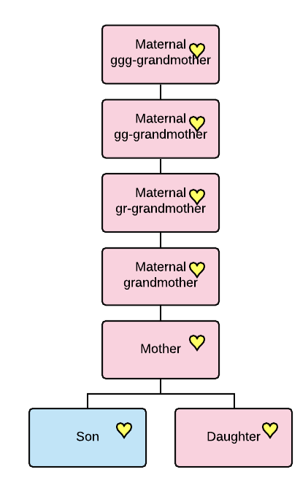
Mitochondrial DNA is passed from mothers to all of their children without being admixed with the father’s mitochondrial DNA. Only females pass it on. Therefore, to obtain the mitochondrial DNA of any ancestor, one must descend from that female ancestor through all females. In the current generation, the tester can be a male.

Mitochondrial DNA has been the chosen methodology for the identification and repatriation of military remains for at least two decades. The reason is simple. Mitochondrial DNA is easier to retrieve since thousands of copies live in the cytoplasm of each cell. Only one copy of the 23 pairs of autosomes lives in the nucleus of a cell.

The mitochondria are comprised of 16,569 locations, while the autosomes contain 3 billion pairs, for a total of 6 billion locations across both the maternal and paternal chromosomes. As you can imagine, degraded autosomal DNA is broken into small pieces and mixed together. Think of a blender. Recovering that DNA and then piecing it back together is a massive undertaking.

Furthermore, with military repatriations, the mother or sibling or other relative who shares the mitochondrial DNA of the soldier contributes their mitochondrial DNA to the military for comparison against remains as they are recovered.

One of the ways that the graves of Dr. Samuel Walter Washington and his brother, George Steptoe Washington, were confirmed is that the mitochondrial DNA recovered from those burials matches the mitochondrial DNA of another burial, which was determined to be their mother, Lucy Payne.

While mitochondrial DNA alone is generally not adequate to definitively prove identity, it can be utilized along with other evidence, such as extra mutations in addition to haplogroup-defining mutations, and the geographical location where the remains were recovered.

The AFMES-AFDIL team recovered the full sequence of Lucy Payne’s and her sons’ mitochondrial DNA, which was identified as haplogroup J1c1b1a1 based on unique haplogroup-defining mutations.

Why the AFMES-AFDIL Team?

You may recall that the US government agency involved in this project is the Armed Forces DNA Identification Laboratory. Why, you might wonder, are they involved in the identification of the people interred in the Washington family cemetery?

Did you notice that I said, “mitochondrial DNA has been the chosen methodology” for identification?

The AFMES-AFDIL team is developing and refining multiple techniques that can be utilized to identify badly degraded remains of servicemen.

For example, in this case, there were only small bones, the DNA was severely degraded, and there was significant contamination.

If the mitochondrial DNA was a very common haplogroup, and was perhaps only partially recovered, they could eliminate several possible soldiers as matches, but they could not make a positive ID.

This case was just “problematic” enough to be useful, without being an unknown or unresolvable situation.

The family was involved and supportive. They knew who the candidate burials were in the cemetery and SWW contributed his own DNA for comparison.

SWW’s involvement provided two very important genetic benefits.

  • First, SWW descended from Augustine Washington through the direct paternal line, so his Y-DNA should match that of the two Washington men in the burials.
  • Secondly, SWW was related to the male burials in a short enough time period that he should match them both – one as his direct ancestor – his great-great-grandfather. The second burial was his great-great-grandfather’s brother. He should match his great-great-grandfather more closely than his great-great-grandfather’s brother.
Individual Relationship to SWW Expected percent of DNA Expected cMs of DNA Relationship Degree with Dr. Samuel
Dr. Samuel Walter Washington Great-great-grandfather 100 3500
Christian Marie Washington married Richard Scott Blackburn Washington Great-grandmother 50 1750 First
Samuel Walter Washington Grandfather 25 875 Second
John Augustine Washington Father 12.5 437.5 Third
SWW Present-day tester 6.25 218.75 Fourth

Lucy Payne would be SWW’s Fifth Degree relative, as would Dr. Samuel Walter Washington’s brother.

Full siblings share approximately 50% of the same DNA, so SWW would be expected to match the burial to whom he was more closely related with approximately twice as much autosomal DNA.

Therefore, using pairwise comparisons and kinship predictions, the team was able to discern which burial belonged to Dr. Samuel Walter Washington, because SWW matched that burial more closely.

But it turned out to be not quite that simple.

The Monkey Wrench

Relationships are classified as degree levels, as shown above. For example, children are first-degree relatives of their parents, siblings, and children. Genetic relationship levels are determined by comparing the DNA of two people and result in kinship predictions.

Normally, genealogists don’t think much about relationship degrees because we use the number of shared or overlapping centimorgans (cMs), and DNA testing companies provide kinship predictions.

However, because the AFMES-AFDIL team wasn’t working with the normal autosomal chip, they were only able to utilize a portion of the 95,000 locations, and they needed to “convert” SWWs results to compare to Dr. Samuel Washington and George Steptoe Washington Jr. They also needed to compensate for the fact that they were not able to obtain 100% of the 95,000 SNP locations on any of the burials. Recovered DNA ranged from 50%-85%

However, the burials matched SWW at one relationship degree level higher than expected.

Initially, Goran had asked me to review and work on expanding the genealogy of the Washington family, but now we had a new, very-interesting, wrinkle.

On a call, the team mentioned the disparity in the expected relationship level. I realized that the probable answer was that SWW was descended from Augustine Washington not just once, not twice, but three times, and we were seeing the genetic effects of pedigree collapse.

Those multiple relationships are beneficial when they provide one path to the Washington Y-DNA through a direct line to Augustine through his son, John Augustine, and another shorter path to Dr. Samuel Walter Washington for autosomal matching.

However, multiple relationship paths added complexity to autosomal relationship determination

There was yet a third avenue of descent to SWW through the father of Richard Scott Blackburn Washington, John Augustine Washington II.

In other words, there are three ways that SWW can and did inherit autosomal DNA from the Washington lineage, beginning with Augustine. Carrying extra autosomal DNA would affect the expected degree of relationship, potentially for SWW with both of the male Washington burials.

We needed a methodology to account for that.

Pedigree Collapse

I’m sure that the AFMES-AFDIL team didn’t view pedigree collapse as a benefit, at least not initially. They aren’t genealogists, so they really weren’t thinking about pedigree collapse in the same way genealogists do.

I’ve worked with pedigree collapse many times, but three separate events in the same line within a few generations was challenging in terms of getting the math right. It’s not obvious, and it’s not easy.

With pedigree collapse, it’s not just a simple matter of figuring out the expected percentage of DNA for all three relationships and adding them together because some of that DNA can be expected to be shared, which reduces the matching amount of DNA from the “add-three-together” number. So, the actual expected amount of shared DNA is someplace between the closest relationship, in this case, Dr. Samuel Walter Washington, and the additive result of all three relationships.

Plus, I couldn’t use cMs, so one hand was tied behind my back.

Therefore, we worked together to solve this puzzle.

My article, Pedigree Collapse and DNA – Plus an Easy-Peasy Shortcut is the result of my pedigree collapse calculations for this project – and how to make pedigree collapse easier for you to understand and account for.

It’s also the foundation of what I provided for the AFMES-AFDIL team, which integrated it into their protocol. Of course, when I published my Pedigree Collapse article, I had to remove anything that might have given anything away before the study and resulting paper was ready for publication.

Why the Monkey Wrench is Important

When dealing with unknown remains, we don’t have the luxury of already knowing who the family is and their potential position in the family.

The AFMES-AFDIL team wants to be able to utilize the techniques they are perfecting for the identification and repatriation of military remains as far back as WWII, 80 years ago. That means that those men would have been born nearly a century ago, and if a generation is roughly 20-25 years, the people available today to test may be as many generations removed from WWII veterans as SWW is from Dr. Samuel Walter Washington.

The repatriation team also won’t know if they are dealing with pedigree collapse until they see it. If a potential relationship comes back slightly differently than expected, they will know to consider either endogamy or pedigree collapse. Furthermore, tools that measure runs of homozygosity (ROH) can help inform them of either condition.

I’m glad this monkey wrench crept into the equation, and I was in the right place at the right time to help.

The Conversation

I joined this team someplace midway in the process, so I didn’t initially have the benefit of understanding why Courtney’s team was involved – that they hoped to refine their processes to begin utilizing autosomal DNA for repatriation.

I opined at one point that I was incredibly frustrated that this many years following the use of autosomal DNA for genealogy, the military was just now beginning to consider its use for repatriation, AND that they were not and had not been collecting autosomal DNA from family members of MIA/POW service members.

Courtney hopes this study will open that door sooner rather than later. As far as I’m concerned, next week would be great!

I was shocked that I had fallen into this opportunity, given that I have a POW/MIA family. member.

I’m a Gold Star Family Member

My first cousin, Robert Vernon Estes, Bobby, served in the Army in the Korean conflict. He was captured on November 30, 1950 in the horrific battle later known as “The Gauntlet.” He died on approximately January 31, 1951 in a POW camp someplace near Pugwon, Korea. He was only 19.

I am his namesake, and I also represent him as a Gold Star family member.

I’ve written about Bobby’s story, obtaining and unraveling his military records.

Bobby probably starved to death, as other members of his battalion did.

His mother died shortly after his capture, and he had no sisters to contribute mitochondrial DNA.

I’m the closest family member left now. We shared grandparents.

In July 2021, Bobby was honored by the State of Indiana. He served from White County. I was incredibly proud to be his representative family member.

When I accepted the invitation to assist the AFMES-AFDIL team with the Washington family burials, I had absolutely NO IDEA that their goal was to validate and extend this technology and these techniques to service member repatriation.

Bobby’s mother was adopted, so I have absolutely no ability to locate someone with Bobby’s mitochondrial DNA, which has frustrated me greatly for years. Therefore, if Bobby’s body were returned from North Korea today, his remains would remain unidentified and unclaimed. That possibility breaks my heart.

North Korea, “isn’t even answering the phone right now,” so the hope that Bobby will be returned to us in my lifetime fades a little with each passing day. That’s EXACTLY why it’s so important for the military to adopt and accept autosomal DNA from family members, even if they can’t utilize it today. My DNA and others can be archived for the future. Someday, Bobby and other servicemen may come back home.

Mitochondrial DNA alone couldn’t have solved the Washington mystery. There will be service members like Bobby who have no mitochondrial DNA sample waiting to be matched to them.

Just a few months before Goran asked me if I wanted to assist with a fun project, I had spoken with Bobby’s military representative, begging them to accept my autosomal DNA. No dice – at least not then.

Hopefully soon – very soon, so that we can begin to build the bank.

These men deserve to be identified. They gave their lives, their futures – that’s the least we can do for them.

The very least.

I’m so proud to be a part of this fantastic project. I’m incredibly grateful that Fate decided to put me in the right place at the right time, with the right combination of skills. I hope Courtney succeeds in pushing this door all the way open. It’s past time, and our team has proven beyond a doubt what can be accomplished. Our POW/MIA servicemen, servicewomen, and their families deserve it.

Thank you to my colleagues, Michael Sager and Goran Runfeldt at FamilyTreeDNA,  Courtney Cavagnino, and the AFMES-AFDIL team.

_____________________________________________________________

Follow DNAexplain on Facebook, here.

Share the Love!

You’re always welcome to forward articles or links to friends and share on social media.

If you haven’t already subscribed (it’s free,) you can receive an e-mail whenever I publish by clicking the “follow” button on the main blog page, here.

You Can Help Keep This Blog Free

I receive a small contribution when you click on some of the links to vendors in my articles. This does NOT increase your price but helps me keep the lights on and this informational blog free for everyone. Please click on the links in the articles or to the vendors below if you are purchasing products or DNA testing.

Thank you so much.

DNA Purchases and Free Uploads

Genealogy Products and Services

My Book

Genealogy Books

Genealogy Research

RootsTech 2024 – Celebrating 25 Years of Genetic Genealogy

On the first day of RootsTech, we celebrated the milestone anniversary of 25 years of genetic genealogy. Right now, we are at the intersection of two incredibly powerful tools: genetics and AI. Both technologies are revolutionary and have changed and are changing the genealogical world overnight. What an amazing time to be alive!

Day 1 is Just Beginning

Day 1 is just the beginning, although pre-show activities have been occurring for a day or two. Everyone is excited. The energy on the show floor and as attendees talk is palpable – a form of human electricity.

I’m going to share some of RootsTech’s flavor with you, so come along with me as I attend a few sessions, give my dozen sessions, and meet people.

First, I need to provide some caveats.

  • I wasn’t able to attend very many sessions
  • I didn’t get to half the expo floor booths
  • I was only at one keynote, but fortunately, most were recorded

I managed to overcommit myself “just a bit,” and I just couldn’t be in two places at once. Thankfully, recorded sessions are available here.

One of the reasons that I didn’t get as much done as I had hoped is because I kept running into people. There was more hugging at RootsTech than at a bear-hug festival. The fun of taking selfies is a thing – a modern-day bonding experience and lots of group selfies are floating around on social media.

I truly love my fellow genealogists, many of whom I’ve discovered are cousins, and some of whom have become lifelong friends. They are brothers and sisters of heart -people who I can’t imagine NOT having in my family. This group of troublemakers is the perfect example of that, with Lianne Krüger, Mags Gaulden, and me in the back and Janine Cloud in front. I think we look like a girl band. Perhaps we’ll call ourselves The Chromosomes. 😊

The first thing on my agenda for Thursday was a book signing for my book, DNA for Native American Genealogy.

Penny Walters wandered by while I was signing and said hello.

Penny, the queen of selfies, constantly has to instruct me on how to do this successfully. It seems I either shut my eyes or I’m smiling so hard I’m laughing. One day, Penny, one day!

Thanks, Penny, for taking this picture of me with my book.

Following the book signing, Janine Could, Groups and Events Manager at FamilyTreeDNA, and I had an AMA, Ask Me Anything session in the FamilyTreeDNA booth about determining if you have Native American ancestors. Our stories are so complementary.

I was raised with and participated in Native cultural traditions. Janine wasn’t, but she is an enrolled Cherokee tribal member. After we had known each other for several years, we discovered that we’re related, but not through that line – at least not that we know of.

The great thing about AMA sessions is that the speakers are literally there to answer your questions. During the conference, lots of people took advantage of the expertise of speakers and their fellow attendees.

Remember

Last year, I met Charis, in the middle between me and Janine. Charis made my day when she told me that she was driving by the Salt Palace a week or so before RootsTech, saw that I was giving a Native American session, and knew she had to attend.

We talked for a long time, and I wondered if I would see her again this year.

Sure enough!

I saw her walking down an aisle, so I knew she was attending. I wanted to give her a hug but I couldn’t at that moment.

She stopped by the FamilyTreeDNA booth and asked Janine if she thought I’d remember her.

You remember people that make you feel good, and she really did.

Someone once told me that people often remember you for how you make them feel.

This year, Charis attended my sessions, and it felt good to see a friendly, smiling face in the audience.

After one class, she waited for me until everyone’s questions were answered. I asked if we could sit down in the quiet at a vacant table in the back of that hall for a few minutes to visit.

Charis pulled out a bag with a card and gave it to me, saying she hoped I didn’t think it was weird or anything. I was stunned and quite moved.

Her name is Remember, the theme of Rootstech this year.

I cried. Charis’s gift was so thoughtful in so many ways, as was the card – and she had no idea how personally this touched me.

We talked for a long time, and while I’m not going to share details, I remembered how it felt to be young and have your life’s trajectory shifted in ways you can’t control.

I remembered what it was like to have hopes dashed.

I remembered when I was “just doing what I was doing” every day, not realizing that I was making memories – not just for me but for others as well.

I remember when Douglas explained the concept of GodMothers to me – and I wasn’t young.

Douglas told me that I had GodMothered people through our combined educational ministry (and I’m not talking about church here) and through my own individual work. Of course, the first thing I thought when Douglas said that was, “No, no, not me,” but then I remembered my mother’s “simple” ministry to others. I remembered how my step-father changed my life both with his actions and a few simple, well-placed words. I remembered the kindness of others when I desperately needed it – and still do.

I remembered.

I remembered that we all have a mission, a ministry, even if we don’t realize it. Even if we don’t understand it. Even if “all we do” is a simple kindness every day.

I remembered that some people’s lives are meant to intersect.

Charis is doing GodMother work, or maybe God’s Mother’s work, every day of her life.

Charis gives me hope for the future.

Thank you Charis, for Remember, and for helping me remember. And for being the next generation of GodMothers and shining your light for others to follow in generations of GodMother footsteps.

Remember.

Genetic Genealogy Turns 25

A few weeks before RootsTech, Diahan Southard emailed and asked me if I’d be interested in and willing to write a short, roughly 3-page “chapter” for a book she was preparing for RootsTech, celebrating the 25th anniversary of genetic genealogy.

Additionally, Diahan would be hosting a panel where some of the contributors would share our remembrances, beginning with the earliest days and ending with more recent innovations.

You can watch the session here.

It’s not hyperbole to say that genetic genealogy changed my life. It also changed the trajectory of my career.

I was very proud to be included on this panel with Diahan and Bennett Greenspan, both of whom I have known since the beginning. Never in my wildest dreams could I have imagined an event like this – let alone being on this stage on this incredibly memorable day.

Diahan shared her story about beginning her career at Sorenson Molecular Institute with Scott Woodward, who joined us and told his story via video.

Bennett Greenspan spoke about his inspiration as a genealogist, and how and why he founded FamilyTreeDNA in 1999.

Bennett introduced Y-DNA and mitochondrial DNA to the consuming public, planting the seeds of an industry that would flourish and ultimately become a household word in the genealogy community.

Tim Janzen spoke about the role of Y-DNA from the first 12-marker panels to the Big Y-700 today. The landmark discovery that Thomas Jefferson had fathered children with Sally Hemmings occurred as a result of Y-DNA testing and drew attention to the possibilities for solving long-standing mysteries – known or unknown.

Leah Larkin discussed the tipping point of autosomal DNA in the genetic genealogy industry.

Aimee Haynes with DNA Angels, an adoption search organization, explained how autosomal DNA, in particular, answers questions for adoptees, giving identities and histories to millions of people who “don’t know who they are.”

Diahan asked me to speak about ethnicity and genetic genealogy, and I actually managed to find my original ethnicity test from 2003. That image in the middle with the red dot and “parenthesis” bands was the extent of the information returned, in addition to the percentages. By the way, those percentages weren’t accurate either, but it was a beginning.

However, ethnicity, with associated segment information at FamilyTreeDNA and 23andMe, has paved the way for painting both ethnicity and match segments with Jonny Perl’s DNAPainter.

Jonny spoke about his inspiration for DNAPainter and how he initially developed it for his own use. Now, just a few years later, everyone loves it!

Lori Napolitano spoke about the evolution of Forensic Investigative Genetic Genealogy (FIGG), also known as IGG, including a collage of people whose remains have been identified and a separate collage of perpetrators of violent crime who are now off the streets. She addressed the successes along with the challenges.

Lori’s 3 or 4 minutes were extremely balanced, presenting both sides of the coin, and I strongly encourage you to listen beginning at about minute 36.

Diahan has compiled these people’s contributions along others for a total of 34 vignettes in the book So Far: Genetic Genealogy – The First 25 Years 1999-2024.

  • Megan Smolenyak-Smolenyak
  • Scott Woodward
  • Bennett Greenspan
  • Ann Turner
  • Ugo Perego
  • Diahan Southard
  • Scott Fisher
  • Roberta Estes
  • Tim Janzen
  • Jim Bartlett
  • Blaine Bettinger
  • Daniel Horowitz
  • Debbie Kennett
  • Kitty Cooper
  • Angie Bush
  • Michelle Leonard
  • Paul Woodbury
  • Kelli Bergheimer
  • Judy Russell
  • Dana Leeds
  • Drew Smith
  • Diana Elder
  • Nicole Dyer
  • Leah Larkin
  • Nathan Dylan Goodwin
  • Mary Eberle
  • Mags Gaulden
  • Aimee-Rose-Haynes
  • Jonny Perl
  • Brianne Kirkpatrick
  • Laura Olmsted
  • Cheryi Hudson-Passey
  • Margaret Press
  • Penny Walters

The stories and visions of these pioneers and industry influencers are fascinating.

The eBook is free by scanning the QR code below or click here.

The following day, I found Diahan’s booth and was able to thank her for this labor of love.

Printed copies of Diahan’s book were available for sale in her booth, Your DNA Guide, and I was surprised how many people sought out attendees who wrote mini-chapters and asked us to sign our pages. What fun!

Diahan and I go back a long way. In the greatest of ironies, in the very early days, the Skidmore Family Association retained Diahan to “tell them what she could” about early Y-DNA tests of 51 Skidmore men. Initially, I was very concerned that the family association might have gotten themselves aligned with someone who was less than competent – but then thrilled when I discovered that consultant was Diahan. Better yet, my own line was one of 8 individual Skidmore lines that Diahan identified and was represented by several testers. Back then, Diahan was working with only a few STR markers and of course, today, we have Big Y-700 tests.

Sunny Morton, another author, joined us for a lovely photo in Diahan’s booth.

I’ve always been incredibly grateful to Sunny for taking me under her wing during my first year speaking at RootsTech, where I had 4 or 5 days to prepare a presentation to cover for another speaker who was unexpectedly unable to attend. Baptism by fire, for sure.

Another reminder that people remember you for how you make them feel.

Expo Hall Show Floor

In between sessions and events, I wandered around the show floor to see the booths, their offerings, and my friends. Many of these people are probably your friends, too, or you have seen their names in the community.

Near Diahan’s booth, I found Diana Elder and Nicole Dyer, pictured above, a lovely mother-daughter professional genealogist pair who founded Family Locket. Should I say this? I especially love the baby genealogist peeking at us from behind. I’m thinking in another year or so, it will be a three-generation endeavor.😊

I was excited to run into Marian Pierre-Louis, who facilitates the smooth running of Legacy Family Tree Webinars and slays technology gremlins left and right! Another person I’m grateful to!

Geoff Rasmussen, founder of Legacy Family Tree, both the Legacy Family Tree Software and the webinars, was staffing the booth. If you haven’t tried these amazing genealogy webinars, all webinars are free initially and for 7 days and are then available by subscription in the webinar library.

Here, Geoff and Marian appear together. What a wonderful team. I’ll have a new webinar in the library before year-end.

Further down the row, I found Geneanet. If you’re not familiar with Geneanet, they are the last totally free resource that I’m aware of that allows the free uploading of your tree, regardless of size.

I use Geneanet often, especially when searching for Europeans. One of my favorite trees at Geneanet belongs to professional genealogist Karen Theriot Reader, and it documents more than 166,000 Acadians and their descendants—along with sources.

Yes, there was food, although not as much as in earlier years. However, these lovely mini-bundt cakes were TO DIE FOR. Unfortunately, I never did manage to purchase a chocolate one.

Maybe I’ll just have to cross my fingers for next year.

_____________________________________________________________

Follow DNAexplain on Facebook, here.

Share the Love!

You’re always welcome to forward articles or links to friends and share on social media.

If you haven’t already subscribed (it’s free,) you can receive an e-mail whenever I publish by clicking the “follow” button on the main blog page, here.

You Can Help Keep This Blog Free

I receive a small contribution when you click on some of the links to vendors in my articles. This does NOT increase your price but helps me keep the lights on and this informational blog free for everyone. Please click on the links in the articles or to the vendors below if you are purchasing products or DNA testing.

Thank you so much.

DNA Purchases and Free Uploads

Genealogy Products and Services

My Book

Genealogy Books

Genealogy Research

RootsTech 2024 – MyHeritage is ON FIRE with 13 Announcements

I’ve got to tell you, MyHeritage has outdone themselves.

I had a hard time just keeping track of their announcements, which totaled 13 – a baker’s dozen.

You can watch the MyHeritage RootsTech keynote by Aaron Godfrey, here.

However, there are a few things not in the video, so let’s take a look at a quick summary of what’s new.

DNA Uploads with Free Advanced Tools Forever Extended Until March 10th

MyHeritage just extended their DNA upload that includes ALL ADVANCED TOOLS FOR FREE, forever, to March 10th so click here now to upload every kit you manage. This is a great deal. Hint – new ethnicity results are coming soon and you’ll be saving $29 on each kit you upload.

20+ Billion Records

MyHeritage has just passed the 20 billion record mark and is continuing to add. That’s billion, with a B. These records are available to customers with a MyHeritage subscription. If you don’t have a subscription, you can try a MyHeritage Subscription with a Free Trial, here.,

Additionally, right now, subscriptions are 50% off, but I don’t know how long that price lasts.

I love my MyHeritage subscription, and if you try it and don’t like yours, you can cancel and be charged nothing during the 14-day trial period.

I particularly like that the local newspaper where my grandparents lived is available on MyHeritage, and no place else. In addition, MyHeritage has integrated with FamilySearch, which is digitizing and indexing records like wildfire. That collaboration has provided me with information from European sources, including archives.

MyHeritage Wiki

MyHeritage has been working on their new Wiki, a community encyclopedia for genealogy and DNA, for almost a year now, although it was only recently released.

Photo courtesy of MyHeritage

I’ve been honored to write several articles for the newly announced MyHeritage Wiki, including the definition of DNA itself:

Take a look at the new Wiki, here.

You can filter in a number of ways, and you can even sign up to be a contributor.

Check out their blog article, here.

AI Record Finder

The AI Record Finder is the world’s first AI chat-based search engine for historical records.

I should probably tell you that, at this point in time, I do use AI, such as ChatGPT, very cautiously, and I’m inherently suspicious because AI tools sometimes hallucinate. It’s a new technology with lots of glitches and unknowns, so let’s see how MyHeritage is using this tool. It should be much more reliable since it’s in a controlled environment. I need to be convinced. 😊

The AI Record Finder is under the Research Menu. Just type your question about your ancestor.

I’m cheating and giving MyHeritage a tough one. I typed, “Please tell me about Solomon Ferwerda, who died in 1768 in Groningen, the Netherlands.”

MyHeritage returned three possibilities in their database, including their affiliated databases. One is a MyHeritage tree and two are records from FamilySearch.

Don’t limit yourself at this point.

I happen to know “my” Solomon is the first person, but I played around a bit before selecting the “right” Solomon. Why? Because there’s a lot that I don’t know about his life. It’s possible that the second and third records are ALSO the right person, so be sure to review everything.

Clicking on the middle or right record for Solomon shows that, indeed, this record from FamilySearch comes from the Dutch Archival Indexes, so it’s not “just someone’s tree.”

We do know the Ferwerda family is from Leeuwarden, but we don’t know when Solomon was born, nor if he was married twice. I only have the name of his second wife and one child, Jan, who was born the year he died.

The two FamilySearch Dutch archive records are from Leeuwarden, so maybe, just maybe, I’ve discovered something new about Solomon. How exciting!

I need to click through and check this out further.

I didn’t expect to like this tool, but so far, I really do. But wait – there’s more.

AI Ancestor Bio

You can click to have MyHeritage generate an AI bio of an ancestor for you.

The bio takes a few minutes to generate and will be available for download in the chat and will also be emailed to you. You can easily share with others. Getting other people interested in genealogy often encourages them to take a DNA test. DNA tests are still on sale for $39, here.

Solomon Ferwerda’s AI bio was completed quickly and arrived in pdf format. We know so little about him, I knew it would be short. I must say, I really enjoyed the “Historical Context” section that discussed the surrounding events that would have affected his life. That’s incredibly important and would have or could have influenced the decisions he made. Maybe the warfare and political unrest caused him to move from Leeuwarden to Groningen for some reason, where he died the year his son was born.

Here’s Solomon’s bio.

Here’s a link to the RootsTech lecture about the MyHeritage AI tools by Ran Snir, the VP of Product.

MyHeritage blog links for AI Record finder are here and here.

You can watch Telling Your Family’s Story with MyHeritage’s AI Features by Janna Helshtein at Legacy Family Tree Webinars, here.

I can’t wait to play with the MyHeritage AI tools more.

Updated Ethnicity Coming Soon

This is going to make a lot of people happy!

MyHeritage is in the process of updating their ethnicity results, increasing their regions from 42 to 80, with significantly optimized granularity in Europe. I initially misunderstood and thought the new results were available now, but they won’t arrive until summer.

I understand from talking to a Jewish friend involved in MyHeritage’s R&D effort that their own results are substantially improved and that they have now been placed in Armenia where their ancestors are from. They are no longer generically “Jewish.”

New Profile Pages with Hints

Daniel Horowitz said that everyone calls Smart Matches and Record Matches hints, so now MyHeritage has updated profile pages and is adding them to the profile page and officially calling them Hints.

You can still find Smart Matches and Record Matches listed separately under Discoveries, but on everyone’s profile, they are called Hints.

On Solomon’s profile page, scroll down to view his journey based on the information you’ve entered or accepted into your tree.

I did not yet add Leeuwarden, because I’m yet positive those records in Leewarden are his, but if I had, Leeuwarden would also be shown on his journey map. I’ll be incorporating these into my 52 Ancestors stories. I love maps! Maybe I can find old maps to include too,

You can read more about the new profiles and hints, here.

Tree Collaboration with FamilyTreeDNA

Aaron Godfrey announced tree collaboration with FamilyTreeDNA who pre-announced this at their conference in November.

I don’t have specific details about how it works, as this won’t happen for a few months yet, but FamilyTreeDNA customers will port their trees to MyHeritage which allows them to take advantage of MyHeritage’s record collections and such. Existing MyHeritage customers will simply connect their FamilyTreeDNA test to their MyHeritage tree.

FamilyTreeDNA has never been a “tree” company, so this means that users will have one less tree to maintain independently, and they can augment their research with records from MyHeritage.

I talked to Katy Rowe-Schurwanz, the Product Manager at FamilyTreeDNA to confirm that this is NOT a DNA transfer. FamilyTreeDNA matches still occur in the FamilyTreeDNA database, just like always, and MyHeritage matches still occur in the MyHeritage database. If you want matching in both databases, you still have to upload to or test at both. Only the trees are integrated, meaning when you click on a tree at  FamilyTreeDNA, you’ll see the tree displayed on MyHeritage.

The great news is that FamilyTreeDNA features such as Family Matching (bucketing) where you link your DNA matches at FamilyTreeDNA to their profile cards so that maternal/paternal bucketing occurs will still work the same way. The only difference will be that your tree will actually reside at MyHeritage and not at FamilyTreeDNA.

You’ll be able to enjoy the best of both worlds.

We will know more in a few months, and I’ll provide more details when I have them.

Invite Another MyHeritage User to View Your DNA Results

Aaron Godfrey said in the keynote that 2FA (two-factor authentication) at MyHeritage will become mandatory later this month, and with it, MyHeritage is adding the feature of being able to invite another MyHeritage user to view your DNA results. This allows people to collaborate more easily, especially if a different person is managing someone else’s DNA test.

Reimagine Multi-Photo Scanner App

This photo-scanning innovation is for your phone and allows you to scan photos and entire photo album pages – automatically separating and improving the photos. Then, of course, you just tag them to the proper person in your tree like any other photo.

Oh, and did I mention that Reimagine is free? I expected to have to pay when I downloaded the app, but I didn’t, probably because I have a full subscription.

Based on this article, Reimagine is not meant for other types of images, like pages of text or albums of clipped newspaper articles. But guess what? I downloaded the app, and it works just fine for those items! Hallelujah. How I wish I had this last week at the FamilySearch Library when I was finding pages in books I wanted to associate with a specific ancestor.

If you have album pages of photos to scan, this is golden and integrates with the profiles of people into your MyHeritage tree.

I really, really like the idea of having the ability to scan in the palm of my hand. That way if someone has a photo, you don’t have to try to take a photo of it. Gone are the days of literally dragging a laptop and scanner around with me when I’m traveling – just in case. Yes, I actually did and now I don’t have to anymore.

I cringe to think how many opportunities were lost to me before the days of laptops – but not now.

Thank you – THANK YOU, MyHeritage. What a great gift!

You can find the QR code to download the app, here.

OldNews is New News

MyHeritage has introduced a new website for old newspapers called OldNews which you can find here.

This addition doubles the number of newspapers previously available on MyHeritage.

Users can also subscribe separately to Old News for about $99/year.

MyHeritage customers use their normal credentials to sign in to either site, but accessing newspapers not previously integrated into MyHeritage will require an OldNews subscription too.

I had to try it. I entered my mother’s name.

Look, my Mom had a tonsillectomy. I never knew that. It was just a couple of months after she graduated from high school.

I didn’t know Mom spent the summer in Philadelphia, either. She was 19 at that time, and I had heard rumblings that she studied with a “prima ballerina” at the School of American Ballet. Guess where that is? Yep, Philly.

My Mom was a professional tap and ballet dancer before she became my Mom.

Understanding that Mom spent the summer of 1942 on the east coast sheds new light on this and a few other photos in Mom’s photo album, which I can now scan.

Ok, I can’t help myself. I have to enhance this photo at MyHeritage.

Much better. Another tiny piece of Mom’s life brought into focus.

I wonder what else is in OldNews that I don’t know about. Hmmmm…

You can read about OldNews here.

New All-Inclusive Omni Subscription

MyHeritage is launching a new Omni all-inclusive subscription plan that includes most of the MyHeritage products and tools, except for Filae, unless I’m missing something. Omni reportedly costs less than half the price if you were to subscribe to all of these individually. I’ve asked for a comparison chart which I don’t have yet, but I’m told will be coming soon.

Here’s what’s included:

Additionally, I asked MyHeritage about whether or not the advanced DNA tools are included with Omni, and they are. So, add advanced DNA tools to that list.

The following information about the Omni Plan is a screenshot from the MyHeritage blog article, here.

I have not been able to determine the price of an Omni subscription. At RootsTech, you were interested in the Omni plan, you submitted a Google form and a day or so later, you received this email.

I suspect MyHeritage needs to talk to you because how much it costs initially depends on your existing subscriptions, and how much time is left on those.

I reached out to MyHeritage and asked when Omni will be available to purchase, and the answer is “soon.” You can’t sign up just yet.

I have never subscribed to Legacy Family Tree Webinars, even though I’m a webinar presenter and have several webinars available there. My gift to myself is going to be Omni when it’s available because I want Legacy Family Tree Webinars, and I’d love a subscription to OldNews. I already have a full subscription to MyHeritage, and I’d probably use Geni more than I do as a casual user if I had the Omni subscription.

Artifact Testing – Maybe

Unfortunately, I was not able to attend CEO Gilad Japhet’s RootsTech session because his session and mine were at exactly the same time.

However, I asked Aaron Godfrey after Gilad’s session what I had missed that was not in Aaron’s keynote, other than Gilad’s wonderful stories.

Aaron and others told me that Gilad stated that he was personally submitting personal artifacts, such as stamps, to a third-party lab once again, to test the waters to see if DNA can now be extracted from artifacts successfully.

MyHeritage tried this a few years ago, ultimately unsuccessfully. Perhaps this time will be different, but I would not hold my breath, truthfully. Degraded DNA has quality issues, not to mention that the DNA extracted might not be the DNA of the person expected.

I would personally love this, but I am also skeptical at this point. Kudos to Gilad for trying again with his own personal items.

MyHeritage Online RootsTech Booth

MyHeritage has provided several educational videos in their online RootsTech booth, at this link. Be sure to take advantage of this free resource.

Whew, I’m finally done! I told you that MyHeritage had been very, very busy, and I wasn’t kidding. I hope I didn’t miss anything.

_____________________________________________________________

Follow DNAexplain on Facebook, here.

Share the Love!

You’re always welcome to forward articles or links to friends and share on social media.

If you haven’t already subscribed (it’s free,) you can receive an e-mail whenever I publish by clicking the “follow” button on the main blog page, here.

You Can Help Keep This Blog Free

I receive a small contribution when you click on some of the links to vendors in my articles. This does NOT increase your price but helps me keep the lights on and this informational blog free for everyone. Please click on the links in the articles or to the vendors below if you are purchasing products or DNA testing.

Thank you so much.

DNA Purchases and Free Uploads

Genealogy Products and Services

My Book

Genealogy Books

Genealogy Research

Pedigree Collapse and DNA – Plus an Easy-Peasy Shortcut

Pedigree collapse can be responsible for you sharing more DNA than expected with another person.

What is pedigree collapse?

Pedigree collapse occurs when you descend from the same ancestor(s) through more than one path. In other words, you descend from those ancestors through two different children. Therefore, when matching with someone else who descends through those ancestors, you may share more DNA than would be expected from that level of relationship on the surface, meaning without pedigree collapse.

Endogamy is different and means that you descend from a community of ancestors who descend from the same group of ancestors. Often out-marriage is discouraged or otherwise impossible, so all of the group of people share common ancestors, which means they often match on segments without sharing close ancestors. Examples of descent from endogamous populations are Jewish, Amish, Brethren, Acadian, Native Hawaiian, Māori, and Native American people, among others.

I wrote about the difference between pedigree collapse and endogamy in the article, What’s the Difference Between Pedigree Collapse and Endogamy?

I’ve also written about endogamy in the following articles:

Degrees of Consanguinity

If you’re a genealogist, and especially if you’ve worked with Catholic church records, you’ve probably heard of “degrees of sanguinity,” which are prohibited blood relationships in marriage. For example, siblings are prohibited from marrying because they are too closely related, according to church doctrine.

By SVG remake by WClarke based on original by User:Sg647112c – Own work, CC BY-SA 4.0, https://commons.wikimedia.org/w/index.php?curid=54804980

Today, we think of the genetic results of inbreeding, but originally, relationships (and consanguinity) also had to do with inheritance.

Essentially, marriages are prohibited by degree of sanguinity, and that degree is calculated based on this relationship chart. Prohibited degrees of consanguinity changed over time. Sometimes, a priest granted dispensation for a couple to wed who was of a prohibited degree of sanguinity. That’s a genealogy goldmine because it tells you where to look for common ancestors. It also tells you something else – that you may share more DNA with other descendants of that couple than one would otherwise expect.

More Than You Ever Expected

Recently, I’ve been working with an academic research team on a very interesting ancient DNA case that involves pedigree collapse. Doing the genealogy and genetic work on how much DNA was expected in a match without pedigree collapse, and how much was expected with pedigree collapse, was very interesting.

The team was working to confirm relationships between people in a cemetery. The burials shared more DNA than anticipated for who the people were believed to be. Enter pedigree collapse.

I can’t disclose the circumstances just yet – but I will as soon as possible. It’s an extremely interesting story.

We needed to ensure that readers, both academic and more generally understood pedigree collapse and our calculations. Why did burials share higher than expected DNA than indicated by the expected relationships? This puzzle becomes much more interesting when you add in pedigree collapse.

Academic researchers and scientists have access to models and mathematical algorithms that normal air-breathing humans don’t have easy access to.
So, what do you do if you and a match have a known pedigree collapse in your tree? How much DNA can you expect to share, and how do you calculate that?

These are all great questions, so let’s take a look.

I’m sharing the PowerPoint slides I prepared for our team on this topic. I’ve removed anything that would identify or even hint at the project and modified the slides slightly for easier consumption.

This presentation has never been given publicly, so you’re first! It seemed a waste to do this work and not share it!

Pedigree Collapse and DNA

Pedigree collapse occurs when you share an ancestor or ancestors through different pathways. In this case, the person at the bottom is the child of parents who were third cousins, but the father’s grandparents were also first cousins.

First cousin marriages were common in the not-too-distant past. Today, you could easily marry your third or fourth cousin and not even realize it unless someone in your family just happened to be a genealogist.

Genealogists use various tools to calculate the expected amount of shared DNA in relationships – first cousins, siblings, or half-siblings, for example. Both the Shared cM Project at DNAPainter and SegcM at DNA-Sci Tools provide tools.

Take a look at the article, DNA: In Search of…Full and Half-Siblings, for some great examples.

First cousins share common grandparents. Their child inherits DNA from two paths that lead back to the same ancestors. Some of that DNA will be the same, meaning the child will or can inherit the same ancestral segment from both parents, and some will be different segments from those ancestors that the parents do not share with each other.

Inheritance – How It Works

Let’s look at inheritance to see how this happens.

Let’s start with full and half-siblings.

Each child inherits half of their DNA from each parent, but not entirely the same half (unless they are identical twins.)

Therefore, full siblings will match on about 50% of their DNA, which is illustrated by the segments on the chromosome browser. However, and this will be important in a minute, about 25% of their DNA is exactly the same, when compared to each other, on the chromosome inherited from their father and mother at the same location.

On the chromosome browser, you can see that three siblings do match. One sibling (the grey background chromosomes) is the person both other full siblings are being compared to, in the example above.

What you can’t determine is whether they share the exact same DNA on both their mother and father’s Chromosome 1, where the matches overlap, for example. We know they both match their sibling, but the top person could match the sibling due to a match from their paternal chromosome in that location, and the bottom person could match due to their maternal chromosome. There’s no way to know, at least not from that view.

The areas where the siblings share exactly the same DNA on both their maternal and paternal chromosome, both, with each other are called Fully Identical REgions (FIR), as compared to Half Identical Regions (HIR) where the siblings match on either their maternal or paternal copy of the chromosome, but not both.

23andMe used to provide a tool that displayed both types of matches.

Since the data exposure incident at 23andMe, they no longer provide this lovely tool, and since that help page is now gone as well, I doubt this view will ever be returned. Fortunately, I grabbed a screenshot previously.

The dark purple segments are fully identical, meaning that these two full siblings match on both their maternal and paternal chromosomes in that location. The magenta are half identical, which means they match on EITHER the maternal or paternal chromosome in that location but not on both chromosomes. Of course, no color (light grey) means there is no match at that location.

Please note that because 23andMe counts fully identical regions (FIR) twice, their total matching cMs are elevated. The other companies do NOT count those regions twice.
GEDmatch also shows both full and half-identical regions as described more fully, here.

In this full-sibling example from GEDmatch, the green segments are fully identical regions across both the maternal and paternal chromosomes.

The definition of FIR is that two people match on both their mother’s and father’s DNA on the same chromosome. Therefore, in following generations, there technically should not be FIR matches, but in some instances we do find FIR matches outside of full siblings.

Moving down another generation, first cousins may share SOME fully identical DNA, especially if they are from an endogamous population or their mothers are related, but less, and it’s generally scattered.

Here’s my Mom’s GEDmatch comparison to her first cousin. The purple-legend segment shows a match, and the green within that match shows fully identical locations.

You can easily see that these are very scattered, probably representing “chance” or population-based fully identical matching locations within a segment. Comparatively, the green FIR segments for full siblings are dense and compact, indicating a segment that is fully identical.

Evaluating matches for dense FIR segments (known as runs of homozygosity – ROH) is a good indicator of parental relatedness.

Double Cousins

Of course, if these people were double first cousins, where the wives of the siblings were sisters to each other – the first cousins would have large patches of dense green FIR segments.

First cousins share grandparents.

Double first cousins occur when two people share both sets of grandparents, meaning that brothers marry sisters. Normal first cousins share about 12.5% of their DNA, but double first cousins share about 25% of their DNA.

In this case, Sharon and Donna descend from two brothers, James and Henry, who were sons of Joseph and Jane. In this scenario, James and Henry married unrelated women, so Sharon and Donna are first cousins to each other.

Double first cousins share both sets of grandparents so they would inherit FIR from both sets of siblings.

You need to be aware of this, but for now, let’s stick with non-double relationships. You’re welcome!

DNA Inheritance

Here’s a different example of DNA inheritance between two siblings.

  1. You can see that in the first 50 cM segment, both siblings inherited the same DNA from both parents, so they match on both their mother’s and father’s chromosomes. They match on both the 50 cM green and 50 cM pink segments. 23andMe would count that as 100 cMs, but other vendors only count a segment IF it matches, NOT if it matches twice. So, other vendors count this as a 50 cM match.
  2. In column two, these two people don’t match at all because they inherited different DNA from each parent. In this example, Person 1 inherited their maternal grandmother’s segment, and Person 2 inherited their maternal grandfather’s segment.
  3. In column three, our siblings match on their paternal grandmother’s segment.
  4. In column four, no match again.

How much can we expect to inherit at different levels – on average?

Different tools differ slightly, and all tools provide ranges. In our example, I’ve labeled the generations and how much shared DNA we would expect – WITHOUT pedigree collapse.

Ancestral couple Inherited cM Inherited %
Gen 1 – Their children 3500 cM 50
Gen 2 – Grandchildren 1750 cM 25
Gen 3 – Great-Grandchildren 875 cM 12.5
Gen 4 – GG-Grandchildren 437.5 6.25
Gen 5 – GGG-Grandchildren 218.75 3.125
Gen 6 – GGGG-Grandchildren 109.375 1.5625
Gen 7 – GGGG-Grandchildren 54.6875 .078125

Please note that this is inherited DNA, not shared (matching) DNA with another person.

Adding in pedigree collapse, you can see that we have three Gen 1 people involved, three Gen 2 descendants, and two Gen 3 and Gen 4 people.

Each of those people inherit and pass on segments from our original couple at the top.
We have three distinct inheritance paths leading from our original couple to Gen 5.
We have a first cousin marriage at Gen 2, at left, which means that their child, Gen 3, will have an elevated amount of the DNA of their common ancestors.

In Gen 4, two people marry who both descend from a common couple, meaning their child, Gen 5, descends from that couple in three different ways.

Did your eyes just glaze over? Well, mine did, too, which is why I had to draw all of this out on paper before putting it into PowerPoint.

The Gen 5 child inherits DNA from the ancestral couple via three pathways.
The next thing to keep in mind is that just because you inherit the DNA from an ancestor does not mean you match another descendant. Inheritance is not matching.

You must inherit before you can match, but just because you and someone else have inherited a DNA segment from a common ancestor does not guarantee a match. Those segments could be in different locations.

Categories of DNA

When dealing with inheritance and descent, we discuss four categories of DNA.

  • In the first generation, full siblings will, in about 25% of their locations, share the same DNA that has been inherited from both parents on the same chromosome. In other words, they match each other both maternally and paternally at that location. Those are FIR.
  • The DNA you inherit from an ancestor.
  • The DNA that both you and your cousin(s) inherit from a common ancestor and match on the same location. This is shared DNA.
  • The DNA that both you and your cousin(s) inherit from a common ancestor, but it’s not in the same location, so you do not match each other on that segment. Just because you inherit DNA from that ancestor does not necessarily mean that your cousin has the same DNA from that ancestor. This is inherited but not shared.

Inheritance is Not The Same as Matching

Inheritance is not the same thing as matching.

Inheriting our ancestor’s DNA isn’t enough. We need to match someone else who inherited that same segment in order to attribute the segment to that specific ancestor.

Depending on how close or distant the relationship, two people may share a lot of DNA (like full siblings), or one segment in more distant matches, or sometimes none at all. As we reach further back in time, we inherit less and less of our increasingly distant ancestors’ DNA, which means we match increasingly fewer of their descendants. I wrote about determining ancestral percentages in the article,  Ancestral Percentages – How Much of Them is in You?

Based on how much DNA we share with other known relatives, we can estimate relationships.

Pedigree collapse, where one descends from common ancestors more than once, increases the expected amount of inherited DNA, which in turn increases the probability of a shared match with other descendants.

Ancestral Couple Matching Between Shared DNA ~cM Shared DNA ~% Range (Shared cM Project) FIR – Identical DNA
Generation 1 Full Siblings 2600 50 1613-3488 25%
Generation 2 First Cousins 866 12.5 396-1397 0
Generation 3 Second Cousins 229 3.125 41-592 0
Generation 4 Third Cousins 73 0.78125 0-234 0

Here’s an example through third cousins, including expected FIR, fully identical regions where full siblings match each other on both their maternal and paternal chromosomes in the same location.

I provided a larger summary chart incorporating the information from public sources, here, minus FIR.

Of course, double cousins, where two pairs of siblings marry each other, represent another separate level of complexity. DNA-Sci’s Double Cousin Orogen explains this here and also provides a tool.

Double cousins, meaning when two pairs of siblings marry each other, are different from doubly related.

Doubly related means that two people descend from common ancestors through multiple paths, meaning multiple lines of descent. Doubly related is pedigree collapse. Double cousins is pedigree collapse on steroids.

Pedigree Collapse, aka Doubly Related

Calculating expected inherited DNA from multiple lines of descent is a bit more challenging.

A handy-dandy chart isn’t going to help with multiple relationships because the amount of expected shared DNA is based on the number of and distance of relationships.

Please note that this discussion excludes X-DNA matching which has its own inheritance path.

It’s time for math – but I promise I’ll make this relatively easy – pardon the pun.

What’s Behind the Math?

So, here’s the deal. I want you to understand why and how this works. You may not need this information today, but eventually, you probably will. This is one of those “refer back to it” articles for your personal library. Read this once as a conceptual overview, then read it again if you need to work through the relationships.

This is easy if you take it one step at a time.

First, we calculate each path separately.

In the first generation, full siblings inherit identical (FIR) DNA on both their mother’s and father’s chromosomes.

In the second generation, the male inherits the maternal segment, and the female inherits the paternal segment.

In the third generation, their child inherits those segments intact from both of their parents. The child inherits from the ancestral couple twice – once through each parent.

In generation 1, those two segments were FIR, fully identical regions. Both of those men married unrelated wives. When their children, Gen 2, were born, they had either the maternal or paternal segment from their father because they had an entirely different segment in that location from their mother.

However, the child in Gen 3 inherited the original green segment from their father and the original pink segment from their mother – reuniting those FIR segments in later generations.

First Cousin’s Child

Let’s calculate the inheritance for the child of those two first cousins who married.

Ancestral couple Inherited cM Inherited %
Gen 3 – Great-Grandchildren 875 cM 12.5
Total 1750 cM 25

Normally, a Gen 3 person inherits roughly 875 cM, or 12.5% of their great-grandparent’s DNA. However, since their grandparents were first cousins, they inherit about twice that amount, or 1750 cM.

While a Gen 3 person inherits as much as a grandchild (25%) normally would from the original couple, they won’t match on all of that DNA. When matching, we need to subtract some of that DNA out of the equation for two reasons:

  • In the first generation, between siblings, some of their DNA was fully identical and cannot be identified as such.
  • In the second generation, they will each have some parts of the ancestral couple’s DNA that will not match the other person. So, they inherit the same amounts from their common ancestors, but they can only be expected to match on about 25% of that amount two generations later.

However, the child of first cousins who marry inherits more DNA of the common ancestors than they would if their parents weren’t related. It’s just that some of that DNA is the same, potentially on the maternal and paternal chromosomes again, and some won’t match at all.

While matching DNA is the whole point of autosomal DNA testing, fully identical DNA matching regions (FIR) cannot be identified that way. For the most part, other than identifying full and half-siblings, sometimes pedigree collapse, and parent-relatedness, fully identical DNA isn’t terribly useful for genealogy. However, we still need to understand how this works.

It’s OK if you just want to say, “I know we’ll share more DNA due to pedigree collapse,” but if you want to know how much more to expect, keep reading. I’d really like for you to understand use cases and be able to track those segments.

Remember, we will learn a super-easy shortcut at the end, so for now, just read. It’s important to understand why the shortcut works.

Sibling Inheritance Versus Matching

In order to compare apples to apples, sometimes we need to remove some portion of DNA in our calculations.

Remember story problems where you had to “show your work”?

Calculating Expected DNA

Here’s the step-by-step logic.

Ancestral couple Inherited Non-Identical cM Inherited %
Gen 1 first son 3500 50
Gen 1 second son 3500 50
Less identical segments (FIR) -1750 (subtracted from one child for illustration) 25
Gen 2 son 1750 25
Gen 2 daughter married Gen 2 son 875 12.5
Gen 3 – Their child path through Gen 2 son 875 cM 12.5
Gen 3 – Their child path through Gen 2 mother 437.5 cM 6.25
Their child total without removing identical segments 1750 cM 25
Their child total after removing identical segments 1312.5 18.75

Category cMs Most Probable Degree Relationship
No Pedigree Collapse 875 98% Great grandparent or great-grandchild, great or half aunt/uncle, great or half niece/nephew, 1C 3
Pedigree Collapse without identical segment removal 1750 100% Grandparent, grandchild, aunt/uncle, half-sibling, niece/nephew 2
Pedigree Collapse after identical segment removal 1312.5 56% grandparent, grandchild, aunt/uncle, niece/nephew, half-sibling 2

Just because you HAVE this much shared (and/or identical) DNA doesn’t mean you’ll match on that DNA.

Next, let’s look at Gen 5 child who inherited three ways from the ancestors.

If you think, “This will never happen,” remember that it did, which is why I was working through this story problem. It’s not uncommon for families to live in the same area for generations. You married who you saw – generally, your family and neighbors, who were likely also family.

Let’s take a look at that 5th generation child.

The more distantly related, the less pedigree collapse affects matching DNA. That’s not to say we can ignore it.

Here’s our work product. See, this isn’t difficult when you take it step by step, one at a time.

Ancestral couple Inherited Non-Identical cM Inherited %
Gen 3 Child total after removing identical segments 1312.5 18.75
Gen 4 father – half of Gen 3 father 656.25 9.375
Gen 5 child – half of Gen 4 father 328.125 4.6875
Gen 5 child – mother’s side calculated from ancestral couple normally 218.75 3.125
Total for Gen 5 Child 546.875 7.8125

Inheritance Ranges

Lots of factors can affect how much DNA a person in any given generation inherits from an ancestor. The same is true with multiple paths from that same ancestor. How do we calculate multiple path inheritance ranges?

As with any relationship, we find a range, or combined set of ranges for Gen 5 Child based on the multiple pathways back to the common ancestors.

Gen 5 Child Inherited Non-Identical cM Inherited %
Without removing either paternal or maternal identical cMs 656.25 9.375
After removing paternal identical cMs only 546.875 7.8125


After removing maternal cMs only 546.875 7.8125


After removing both paternal and maternal identical cMs 362.50 6.25
Normal Gen 5 no pedigree collapse 218 3.125

What About Matching?

Inheritance and matching are different. Most of the time, two people are unlikely to share all of the DNA they inherited from a particular ancestor. Of course, inheriting through multiple paths increases the likelihood that at least some DNA from that ancestor is preserved and that it’s shared with other descendants.

Two people aren’t expected to match on all of the segments of DNA that they inherit from a particular ancestor. The closer in time the relationship, the more segments they will inherit from that ancestor, which increases the chances of matching on at least one or some segments.

Clearly, pedigree collapse affects matching. It’s most pronounced in closer relationships, but it may also be the only thing that has preserved that ONE matching segment in a more distant relationship.

So, how does pedigree collapse actually affect the likelihood of matching? What can we actually expect to see? Is there a name for this and a mathematical model to assist with calculations?

I’m so glad you asked! It’s called Coefficient of Relationship.

Coefficent of Relationship

My colleague, Diahan Southard, a scientist who writes at YourDNAGuide has authored two wonderful articles about calculating the statistical effects of pedigree collapse.

You can also read another article about the methodology of calculating coefficient of relationship, here, on WaybackMachine.

Diahan is a math whiz. I’m not, so I needed to devise something “quick and dirty” for my own personal use. I promised you a “cheat sheet,” so here’s the methodology.

Two Inheritance Paths – First and Third Cousins

Let’s look at an example where two people are both first cousins and third cousins because their grandparents were also first cousins.

Let’s calculate how these two people are related. They are first cousins and also third cousins.

When calculating the effects of pedigree collapse, we calculate the first relationship normally, then calculate the second relationship and add a portion of the result.

Here’s the math.

Using the Shared cM Project for the expected amount of shared DNA for both relationships, we’ve calculated the expected range for this pedigree collapse relationship.

Tying this back to degrees of relatedness.

Let’s look at ways to do Quick Calculations using the publicly available Shared cM charts and my composite tables, here.

Using Average Shared DNA

This first methodology uses average expected amount of shared, meaning matching, DNA. Please note, I’m not necessarily expecting you to DO this now, just read to follow.

Using Average Inherited DNA

Here’s a second method using average inherited DNA, meaning people wouldn’t be expected to match on all of the inherited DNA – just a portion.

You can’t always use the shared cM charts because all relationships aren’t represented, so you may need to use the amount of expected inherited DNA instead of shared DNA amounts.

Methodology Differences

Remember, none of these methodologies are foolproof because DNA inheritance is random. You may also have additional relationships that you’re aware of.

So, what’s the easiest method? Neither, actually. I’ve found an even easier method based on these proven methodologies.

Easy-Peasy Pedigree Collapse Shortcut Range Calculation in 4 Steps

Now that you understand the science and reasoning behind all of this, you can choose from multiple calculation methodologies after drawing a picture of the relevant tree.

You’re probably wondering, “What’s the easiest way to do this?”

  • These quick calculation methods are the easiest to work with for non-scientists and non-math whizzes. These are the calculations I use because, taking into account random recombination, you can’t do any better than get close.
  • Also, remember, if you’re dealing with double relationships, meaning double first cousins, you’ll need to take that into consideration, too.
  • If endogamy is involved, your matches will be higher yet, and you should use the highest calculations below because you need to be on the highest end of the range – and that may still not be high enough.

In these Easy-Peasy calculations, you calculate for the lowest, then the highest, and that’s your range. Please note that these are options, and truly, one size does not fit all.

  1. For the lowest end of the range, simply use the average of the highest relationship. In this case, that would be 1C, which is 866 cM. Remember that you may not share DNA with third cousins. 10% of third cousins don’t share any DNA, and 50% of fourth cousins don’t.
  2. For the highest end of the range, find the second relationship in the Shared cM chart, divide the average by half, and add to the value from the closest relationship. In this case, half of the 3C value of 76 is 38.
  3. Add 38 to 866 for the highest end of the range of 904.
  4. If there’s yet another path to ANY shared ancestor, add half that amount too to calculate the high end of the range – unless it’s 4C or more distant, then don’t add anything.

You can see that this easy-peasy range calculation for pedigree collapse compares very well to the more complex but still easy calculations.

  • Easy-peasy calculation: 866-904
  • Other calculation methods: 850-903
  • For this same relationship combination, Diahan’s statistical calculation was 850 cM.

Back to Genealogy

What’s the short story about how pedigree collapse affects genealogy?

Essentially, in close generations, meaning within a few generations of two first cousins marrying, descendants can expect to inherit and share significantly more DNA of the common ancestors, but not double the amount. As we move further away from those marriages in time, the effect becomes less pronounced and more difficult to detect. You can see that effect when calculating multiple paths where at the fourth cousin level, or more distant, those cousins have a 50% or greater possibility of not sharing DNA segments.

Of course, with multiple paths to the same ancestor, your chances of inheriting at least some segments from the common ancestor are increased because their DNA descends through multiple paths.

Today, close marriages are much less common and have been for several generations in many cultures, so we see fewer instances where pedigree collapse makes a significant difference.

Within a population or group of people, if pedigree collapse becomes common, meaning that there are multiple paths leading back to common ancestors, like our three-path example, DNA segments from the common ancestors are found among many people. Significant pedigree collapse becomes endogamy, especially if marriage outside of the group is difficult, impossible, or discouraged.

Normally, pedigree collapse is not recorded in actual records. It’s left to genealogists to discover those connections.

The exception, of course, is those wonderful Catholic parish records where the priest granted dispensations. Sometimes, that’s our only hint to earlier genealogy. In the case of the marriage of Marie-Josesphe LePrince to Jacques Forest, the priest wrote “dispense 3-3 consanguinity,” which tells us that they shared great-grandparents. It also tells us that their grandparents were siblings, that the bride and groom were second cousins, and that their children and descendants inherited an extra dose of DNA from their common great-grandparents.

How does that affect me today? Given that I’m their seventh-generation descendant – probably not at all. Of course, they are Acadian, and the Acadians are highly endogamous, which means I match many Acadians because all Acadians share the DNA of just a few founders, making it almost impossible to track segments to any particular ancestor. If it weren’t for endogamy, I would probably match few, if any, of their descendants.

Now, when you see those Catholic church dispensations or otherwise discover pedigree collapse, you can be really excited, because you understand the effects of pedigree collapse and how to calculate resulting matches! You might, just might, have retained a DNA segment from those ancestors because you inherited segments through multiple paths – increasing the probability that one survived.

_____________________________________________________________

Follow DNAexplain on Facebook, here.

Share the Love!

You’re always welcome to forward articles or links to friends and share on social media.

If you haven’t already subscribed (it’s free,) you can receive an email whenever I publish by clicking the “follow” button on the main blog page, here.

You Can Help Keep This Blog Free

I receive a small contribution when you click on some of the links to vendors in my articles. This does NOT increase your price but helps me keep the lights on and this informational blog free for everyone. Please click on the links in the articles or to the vendors below if you are purchasing products or DNA testing.

Thank you so much.

DNA Purchases and Free Uploads

Genealogy Products and Services

My Book

Genealogy Books

Genealogy Research