What is a Heteroplasmy and Why Do I Care?

Most people have never heard of a heteroplasmy – but you might have one.

You Might Have a Heteroplasmy If…

…You have no exact matches at the full sequence mitochondrial DNA level.

A heteroplasmy is one of the first things I think of when someone tells me they have no exact full sequence matches but several that are a genetic distance of 1, meaning one mutation difference.

That phenomenon usually means the tester has a rare mutation that no one else has, at least no one who has tested their mitochondrial DNA (yet) – and that mutation just might be a heteroplasmy.

Heteroplasmies are generally (but not always) quite recent mutations. Actually, heteroplasmies are mutations caught in the act of mutating – kind of like an insect in genetic amber – frozen in time in your generation.
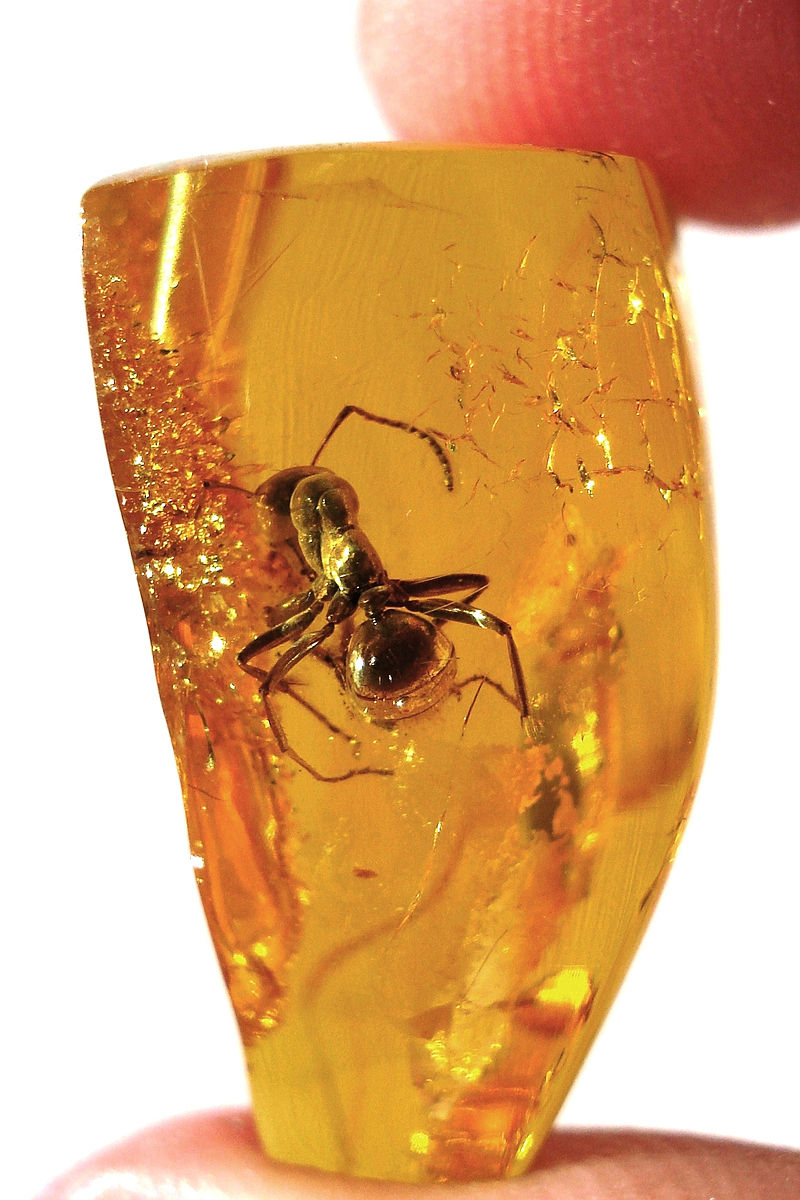
By Anders L. Damgaard – http://www.amber-inclusions.dk – Baltic-amber-beetle CC BY-SA 3.0, https://commons.wikimedia.org/w/index.php?curid=16792582

Let’s say you might have a heteroplasmy. Or maybe you want to see if you do. Even if YOU don’t have a heteroplasmy, other people’s heteroplasmies can and will affect matching.

Here’s everything you ever wanted to know about heteroplasmies but didn’t know to ask😊

Heteroplasmies are Fascinating

A heteroplasmy is actually quite interesting because it’s a genetic mutation in progress.

This means you have two versions of a DNA sequence showing in your mitochondrial DNA at a specific location.

Said another way, at a specific genetic location, you show both of two separate nucleotides. Amounts detected of a second nucleotide greater than 20% are considered a heteroplasmy. Amounts below 20% are ignored. Generally, within a few generations, the mutation will resolve in one direction or the other – although some heteroplasmies persist for several generations and can sometimes define family branches.

If you’d like to read more about mitochondrial DNA, I wrote a series of step-by-step articles and combined them into one resource page, here.

Show Me!

You can easily check to see if you have a heteroplasmy by signing on to your FamilyTreeDNA account. Hopefully, you’ve taken the full sequence test.

Today, new testers, thankfully, can only purchase full sequence tests, so HVR1 results don’t present quite the same challenges when combined with heteroplasmies as they used to. We’ll talk about that in a minute.

If you have only taken the HVR1 or HVR1+HVR2 “Plus” test, as opposed to the Full Sequence, you can upgrade by signing on here and clicking on the “Full” button on the Maternal Ancestry section of your personal page.

These buttons will be pink if you’ve taken that test already, and grey if you need to upgrade. If you have an account at FamilyTreeDNA, you can add a mitochondrial DNA test to that same account by clicking on “Add Ons and Upgrades” at the top of your personal page. You can order a test if you’re a new customer, here.

How Do I Know if I Have a Heteroplasmy?

Your mitochondrial DNA has a total of 16,569 locations that you can think of as addresses. If your DNA at those locations is normal, meaning no mutations, they won’t be listed in your results.

Mutations are shown in your mitochondrial DNA results by a different letter at the end of the location.

For example, here are my mutations for my HVR1 region. Each of these locations in the HVR1 region has a mutation.

For locations that are shown in your results, meaning those where you have a mutation, you’ll see, in order:

  • A letter, either T, A, C or G
  • The location number
  • A different letter, typically another one of T, A, C or G, but sometimes a small d

For the first mutation, C16069T, the location address is 16069, the normal value is C, the mutation that occurred is T.

Heteroplasmies are shown in your mitochondrial DNA results by letters other than T, A, C, G or d at the end of the location.

I don’t have any heteroplasmies, so I’m switching to the results of a cousin who has a heteroplasmic mutation at location T16362Y to use as an example. The trailing Y means they have a heteroplasmy at location 16362.

But first, what do those letters mean?

The Letters

The letters stand for the nucleotide bases that comprise DNA, as follows:

  • T – Thymine
  • A – Adenine
  • C – Cytosine
  • G – Guanine
  • d – a deletion has occurred. There is no nucleotide at this location.

For location T16362Y, the first letter, T, is the “normal” value found at this location. If a mutation has occurred, the second letter is the mutated value. Normally, this is one of the other nucleotides, A, C or G.

Any other letter after the location has a specific meaning; in this case, Y means that both a C and a T were found, per the chart below.

Note – if you have a small letter t, a, c or g, it’s not a heteroplasmy, and I wrote about small letters and what they mean in the article, Mitochondrial DNA Part 2: What Do Those Numbers Mean?

Check Your Results

On your FamilyTreeDNA personal page in the mtDNA section, click on the Mutations tab.
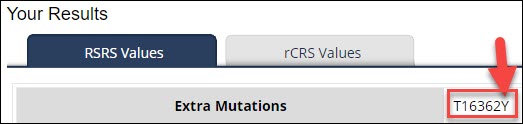
If you’ve taken the full sequence test, you’ll see Extra Mutations. You’re looking for any mutation that ends in any letter other than T, A, C, G or d.

If you haven’t taken the full sequence test, you don’t have “Extra” mutations listed, but you can still view your mutations for the HVR1 and HVR2 regions.

Look for any value that has any letter other than T, A, C, G or lower case d at the end of the location.

The Y tells us that this location is a heteroplasmy.

Heteroplasmy Matching

Ok, let’s look at a heteroplasmy mutation at location 16326. A heteroplasmy can occur at any mitochondrial location. I’ve selected this location because it occurs in the HVR1 region of the mitochondrial DNA, so even people who haven’t tested at the full sequence level will see results for this location. Plus, the location at which the heteroplasmy occurs affects matching in different ways.

Using the example of T16362Y, the Y tells us that both nucleotides C and T were found. This location should match against anyone carrying the following values in the same location:

  • Y (letter indicating a C/T heteroplasmy)
  • T (standard or normal value)
  • C (mutated value)

However, currently at Family Tree DNA, the heteroplasmy only counts as a match to anyone with a Y, the specific heteroplasmy indicator, and the “normal” value of T, but not the mutated value of C.

This table shows how heteroplasmies are counted at FamilyTreeDNA. For heteroplasmy T16362Y, based on the value your potential match has at this location, you either will or will not be considered a match at that location.

Scenario Other Person’s Value Your Result – T16362Y
1 T16362Y – heteroplasmy indicator Match to you at this location
2 T16362T – normal value, not a mutation Match to you at this location
3 T16362C – mutated value Not counted as match to you at this location
  • If your match has a value of Y, the heteroplasmic C/T value, they are counted as a match to you, so no problem.
  • If your match has a value of T, the normal value, this location won’t be shown on their mutation list at all. They WILL be counted as a match to you so there’s no issue.
  • If your match has a value of C, the mutated value, in my opinion they should also be counted as a match to you, but they aren’t today. The logic, I believe, was that the most likely value is the standard or normal value and that the mutated value is much less likely to be accurate. Regardless, I’ve requested this change and am hoping for a matching adjustment in a future release for heteroplasmies.

Heteroplasmies do affect matching at the different levels.

Viewing Your Matches

Mitochondrial DNA, for testing purposes, is broken into three regions, HVR1 (hyper-variable region 1), HVR2 and the Coding Region.

At FamilyTreeDNA, you can view your matches at each level. The matches are cumulative, meaning that the HVR2 level includes the HVR1 level information, and the Coding Region level includes the HVR1 and HVR2 regions. That highest level which includes all three regions shows information from your entire your entire full mitochondrial DNA sequence.

Heteroplasmy Effects on Matching

If you otherwise match someone exactly, but one of you has a heteroplasmy and the other person carries the mutated value, you will be counted as a mismatch of 1 at the full sequence level.

A mismatch has different effects when it occurs in the HVR1, HVR2 or Coding Regions, respectively.

GD is an abbreviation for Genetic Distance which is how mutations are counted. A GD of 1 means the two people have one mutation difference between them.

In the following chart, the effects of you having a nonmatch, heteroplasmic or otherwise, in each of the regions is shown at each level. The region in which the mismatch occurs is shown in the first column, at left, and the effect the mismatch has on matching in each region is shown in columns 2-4.

The red sections are not counted as matches.

Mismatch Occurs in this Region HVR1 Level Match to Someone Else HVR2 Level Match to Someone Else Coding Region Level Match to Someone Else
HVR1 region nonmatch GD of 1 means no match GD of 1 means no match GD of 1 is a match
HVR2 region nonmatch Does not affect HVR1 – so you are a match GD of 1 means no match GD of 1 is a match
Coding Region nonmatch Does not affect HVR1 – so you are a match Does not affect HVR2 – so you are a match GD of 1 is a match

For purposes of this discussion, we’re assuming our two people being compared in the chart above match exactly on every other location so matching is not otherwise affected.

  • If your heteroplasmic nonmatch occurs in the HVR1 region – in other words, scenario 3 – you’ll fall into the HVR1 nonmatch row. That means you won’t be shown as a match at the HVR1 or HVR1+HVR2 levels, but you WILL be shown as a full sequence match.
  • If your heteroplasmic nonmatch is in the HVR2 region of addresses, it won’t affect your HVR1 matches, but it will affect your HVR2 and Coding Region matches. This means you will be shown as HVR1 match, not an HVR2 match, but will be a full sequence match.
  • If your heteroplasmic nonmatch is in the Coding Region, it won’t affect your HVR1 or HVR2 matches, but it will affect your Coding Region matches. However, it won’t preclude matches and you’ll be shown as a match in all three regions.

To be very clear, I have no issue with these match thresholds. It’s important to understand how this works, and therefore why heteroplasmic (and other) mismatches in specific regions affect our matches in the way they do.

Why Aren’t Mismatches of 1 Counted as Matches in the HVR1 or HVR2 Regions?

The match threshold at FamilyTreeDNA for the HVR1 and the HVR1+HVR2 regions, both small regions of about 1000 locations each, is that only an exact match is considered a match. Therefore, a heteroplasmic nonmatch in this region can really be confusing and sometimes misleading, especially if either or BOTH people have NOT tested at the full sequence level.

These are the match thresholds in effect today.

HVR1 GD or # of Mutations Allowed for a Match HVR2 GD or # of Mutations Allowed for a Match Coding Region GD or # of Mutations Allowed for a Match
0 – no mutations allowed 0 – no mutations allowed 3 mutations allowed

If both people match on either the heteroplasmy identified (Y in our case) or one person has the normal value – all is fine. But if one person has a heteroplasmy and the other has the mutated value – then a mismatch occurs. This is really only problematic when:

  • The heteroplasmy mismatch is in the HVR1 region and both people have only tested at that level, causing the two people to not match at all.
  • The heteroplasmy mismatch occurs in combination with other mutations that, cumulatively, push the two people over the GD 3 full sequence matching threshold.

The second scenario happens rarely, but I have seen situations where people don’t match their mothers, aunts, siblings, or other close relatives because of multiple heteroplasmic mutations occurring in different people.

And yes, this is hen’s teeth rare – but it does occasionally happen.

So, what’s the bottom line about heteroplasmies?

Heteroplasmy Bottom Line

  1. You can suspect a heteroplasmy if you have full sequence matches, but no exact matches.
  2. If you have a heteroplasmy in the HVR1 region, understand that you may not have many or any matches in the HVR1 and HVR2 regions. The remedy is to test at the full sequence level and check matches there.
  3. If you have a heteroplasmy and don’t match someone you expect to match – reach out to them and ask about their value at that specific location. If that location isn’t listed for them in their results, then they have no mutation there and your heteroplasmy is NOT the cause of you not matching with them.
  4. If you don’t match someone you expect to match, reach out to them and ask if THEY have any heteroplasmies. The easiest way to ask is, “Do you have any mutations listed that end with anything other than T, A, C, G or d?” Feel free to link to this article so that they’ll know where to look, and why you’re asking.

Do you have any heteroplasmies?

_____________________________________________________________

Disclosure

I receive a small contribution when you click on some of the links to vendors in my articles. This does NOT increase the price you pay but helps me to keep the lights on and this informational blog free for everyone. Please click on the links in the articles or to the vendors below if you are purchasing products or DNA testing.

Thank you so much.

DNA Purchases and Free Transfers

Genealogy Products and Services

Books

Genealogy Research

Using Mitochondrial Haplogroups at 23andMe to Pick the Lock

I’ve been writing recently about using haplogroups for genealogy, and specifically, your mitochondrial DNA haplogroup. You can check out recent articles here and here.

While FamilyTreeDNA tests the entire mitochondria and provides you with the most detailed and granular haplogroup, plus matches to other testers, 23andMe provides mid-range level haplogroup information to all testers.

I’ve been asked how testers can:

  1. Locate that information on their account
  2. What it means
  3. How to use it for genealogy

Let’s take those questions one by one. It’s actually amazing what can be done – the information you can piece together, and how you can utilize one piece of information to leverage more.

Finding Your Haplogroup Information

At 23andMe, sign in, then click on Ancestry.

Then click on Ancestry Overview.

You’ll need to scroll down until you see the haplogroup section.

If you’re a female, you don’t have a paternal haplogroup. That’s misleading, at best and I wrote about that here. If you click to view your report, you’ll simply be encouraged to purchase a DNA test for your father.

Click on the maternal haplogroup panel to view the information about your mitochondrial haplogroup.

You’ll see basic information about the haplogroup level 23andMe provides. For me, that’s J1c2.

Next, you’ll view the migration path for haplogroup J out of Africa. Haplogroup J is the great-granddaughter haplogroup of L3, an African haplogroup. Mutations occurred in L3 that gave birth to haplogroup N. More mutations gave birth to R, which gave birth to J, and so forth.

You’ll notice that haplogroup J1c2 is fairly common among 23andMe customers. This means that in my list of 1793 matches in DNA Relatives, I could expect roughly 9 to carry this base haplogroup.

There’s more interesting information.

Yes, King Richard is my long-ago cousin, of sorts. Our common mitochondrial ancestor lived in Europe, but not long after haplogroup J1c migrated from the Middle East.

One of my favorite parts of the 23andMe information is a bit geeky, I must admit.

Scroll back to the top and select Scientific Details.

Scroll down, and you’ll be able to see the haplogroup tree formation of all your ancestral haplogroups since Mitochondrial Eve who is haplogroup L. You can see L3 who migrated out of Africa, and then N and R. You can also see their “sister clades,” in blue. In other words, L3 gave birth to L3a through M, which are all sisters to N. N gave birth to R, and so forth.

On the free Public Mitochondrial Tree, provided by FamilyTreeDNA, you can see the haplogroups displayed in a different configuration, along with the countries where the most distant known ancestors of FamilyTreeDNA testers who carry that haplogroup are found. Note that only people who have taken the full sequence test are shown on this tree. You can still check out your partial haplogroup from 23andMe, but it will be compared to people who don’t have a subgroup assigned today on this public tree.

If you were to take the full sequence test at FamilyTreeDNA, you might well have a more refined haplogroup, including a subgroup. Most people do, but not everyone.

Here’s the second half of the 23andMe haplogroup tree leading from haplogroup R to J1c2, my partial haplogroup at 23andMe.

Here’s the public tree showing the J1c2 haplogroup, and my most refined haplogroup, J1c2f from my full sequence test at FamilyTreeDNA.

If you’re interested in reading more in the scientific literature about your haplogroup, at the bottom of the 23andMe Scientific Details page, you’ll see a list of references. Guaranteed to cure insomnia.😊

You’re welcome!

Using Your Haplogroup at 23andMe for Genealogy

Enjoying this information is great, but how do you actually USE this information at 23andMe for genealogy? As you already know, 23andMe does not support trees, so many times genealogists need to message our matches to determine at least some portion of their genealogy. But not always. Let’s look at different options.

While a base haplogroup is certainly interesting and CAN be used for some things, it cannot be used, at 23andMe for matching directly because only a few haplogroup-defining locations are tested.

We can use basic haplogroup information in multiple ways for genealogy, even if your matches don’t reply to messages.

23andMe no longer allows testers to filter or sort their matches by haplogroup unless you test (or retest) on the V5 platform AND subscribe yearly for $29. You can read about what you receive with the subscription, here. You can purchase a V5 test, here.

To get around the haplogroup filtering restriction, you can download your matches, which includes your matches’ haplogroups, in one place. I provided instructions for how to download your matches, here.

While 23andMe doesn’t test to a level that facilitates matching on mitochondrial alone, even just a partial haplogroup can be useful for genealogy.

You can identify the haplogroup of specific ancestors.

You can identify people who might match on a specific line based on their haplogroup. and you can use that information as a key or lever to unlock additional information. You can also eliminate connections to your matches on your matrilineal line. 

Let’s start there.

Matrilineal Line Elimination

For every match, you can view their haplogroup by clicking on their name, then scrolling down to view haplogroup information.

As you can see, Stacy does not carry the same base haplogroup as me, so our connection is NOT on our direct matrilineal line. We can eliminate that possibility. Our match could still be on our mother’s side though, just not our mother’s mother’s mother’s direct line.

If Stacy’s haplogroup was J1c2, like mine, then our connection MIGHT be through the matrilineal line. In other words, we can’t rule it out, but it requires more information to confirm that link.

Identifying My Ancestor’s Haplogroups

I’ve made it a priority to identify the mitochondrial haplogroups of as many ancestors as possible. This becomes very useful, not only for what the haplogroup itself can tell me, but to identify other matches from that line too.

click to enlarge images

Here’s my pedigree chart of my 8 great-grandparents. The colored hearts indicate whose mitochondrial DNA each person inherited. Of course, the mothers of the men in the top row would be shown in the next generation.

As you can see, I have identified the mitochondrial DNA of 6 of my 8 great-grandparents. How did I do that?

  • Testing myself
  • Searching at FamilyTreeDNA for candidates to test or who have already tested
  • Searching at Ancestry for candidates to test, particularly using ThruLines which I wrote about, here.
  • Searching at MyHeritage for candidates to test, particularly using Theories of Family Relativity which I wrote about, here
  • Searching for people from a specific line at 23andMe, although that’s challenging because 23andMee does not support traditional trees
  • Searching for people who might be descended appropriately using the 23andMe estimated “genetic tree.” Of course, then I need to send a message and cross my fingers for a reply.
  • Searching for people at WikiTree by visiting the profile of my ancestors whose mitochondrial DNA I’m searching for in the hope of discovering either someone who has already taken the mitochondrial DNA test, or who descends appropriately and would be a candidate to test

In my pedigree chart, above, the mitochondrial DNA of John Ferverda and his mother, Eva Miller, T2b, is a partial haplogroup because I discovered the descendant through 23andMe.

I was fairly certain of that match’s identity, but I need two things:

  • Confirmation of their genealogical connection to Eva Miller Ferverda
  • Someone to take the full sequence test at FamilyTreeDNA that will provide additional information

I confirmed this haplogroup by identifying a second person descended from Eva through all females to the current generation who carries the same haplogroup

Now that I’ve confirmed one person at 23andMe who descends from Eva Miller Ferverda matrilineally, and I know their mitochondrial DNA haplogroup, I can use this information to help identify other matches – even if no one responds to my messages.

This is where downloading your spreadsheet becomes essential.

Download Your Matches

Next, we’re going to work with a combination of your downloaded matches on a spreadsheet along with your matches at 23andMe on the website.

I provided step-by-step instructions for downloading your matches, here.

On the spreadsheet, you’ll see your matches and various columns for information about each match, including (but not limited to):

  • Name
  • Segment information
  • Link to tester’s profile page (so you don’t need to search for them)
  • Maternal or paternal side, but only if your parents have tested
  • Maternal haplogroup (mitochondrial DNA for everyone)
  • Paternal haplogroup (Y DNA if you’re a male)
  • Family Surnames
  • Family Locations
  • Country locations of 4 grandparents
  • Notes (that you’ve entered)
  • Link to a family tree if tester has provided that information. I wrote about how to link your tree in this article. The tree-linking instructions are still valid although 23andMe no longer partners with FamilySearch. You can link an Ancestry or MyHeritage tree.

I want to look for other people who match me and who also have haplogroup T2b, meaning they might descend from Eva Miller Ferverda, her mother, Margaret Elizabeth Lentz, or her mother, Johanne Fredericka Ruhle in the US.

To be clear, the mitochondrial DNA reaches back further in time in Germany, but since 23andMe limits matches to either your highest 1500 or 2000 matches (it’s unclear which,) minus the people who don’t opt-in to Relative Sharing, I likely wouldn’t find anyone from the German lines in the 23andMe database as matches. If you subscribe to the V5+$29 per year version of the test, you are allowed “three times as many matches” before people roll off your match list.

On the download spreadsheet, sort on the maternal column.

I have several people who match me and are members of haplogroup T2b.

Upon closer evaluation, I discovered that at least one other person does descend from Eva Miller, which confirmed that Eva’s haplogroup is indeed T2b, plus probably an unknown subclade.

I also discovered two more people who I think are good candidates to be descended from Eva Miller using the following hints:

  • Same haplogroup, T2b
  • Shared matches with other known descendants of Eva Miller, Margaret Lentz or Frederica Ruhle.
  • Triangulation with some of those known descendants

Now, I can look at each one of those matches individually to see if they triangulate with anyone else I recognize.

Do be aware that just because these people have the mitochondrial haplogroup you are seeking doesn’t necessarily mean that you’re related through that line. However, as I worked through these matches WITH the same haplogroup, I did find several that are good candidates for a common ancestor on the matrilineal line based on matches we share in common.

Let’s hope they reply, or they have tested at a different vendor that supports trees and I can recognize their name in that database.

Assign a Side

At 23andMe, one of the first important steps is to attempt to assign a parental side to each match, if possible.

If I can assign a match to a “side” of my tree based on shared matches, then I can narrow the possible haplogroups that might be of interest. In this case, I can ignore any T2b matches assigned to my father’s side.

The way to assign matches to sides, assuming you don’t have parents to test, is to look for triangulation or a group of matches with known, hopefully somewhat close, relatives.

I wrote about Triangulation Action at 23andMe, here.

For example, my top 4 matches at 23andMe are 2 people from my father’s side, and 2 people from my mother’s side, first or second cousins, so I know how we are related.

Using these matches, our “Relatives in Common,” and triangulation, I can assign many of my matches to one side or the other. “Yes” in the DNA Overlap column means me, Stacy and that person triangulate on at least one segment.

Do be careful though, because it’s certainly possible to match someone, and triangulate on one segment, but match them from your other parent’s side on a different segment.

At the very bottom of every match page (just keep scrolling) is a Notes field. Enter something. I believe, unless this has changed, that if you have entered a note, the match will NOT roll off your list, even if you’ve reached your match limit. I include as much as I do know plus a date, even if it’s “don’t know which side.” At least I know I’ve evaluated the match.

However, equally as important, when you download your spreadsheet, you’ll be able to see your own notes, so it’s easy to refer to that spreadsheet when looking at other relatives in common on your screen.

I have two monitors which makes life immensely easier.

Working the Inverse

Above, we used the haplogroup to find other matches. You can work the inverse, of course, using matches to find haplogroups.

Now that you’ve downloaded your spreadsheet, you can search in ways you can’t easily at 23andMe.

On your spreadsheet, skim locations for hints and search for the surnames associated with the ancestral line you are seeking.

Don’t stop there. Many people at 23andMe either don’t enter any information, but some enter a generation or two. Sometimes 4 surnames, one for each grandparent. If you’ve brought your lines to current genealogically, search for the surnames of the people of the lines you seek. Eva’s grandchildren who would carry her mitochondrial haplogroup would include the surnames of Robison, Gordon, and several others. I found two by referencing my descendants chart in my computer genealogy program to quickly find surnames of people descended through all females.

The link to each match’s profile page is in the spreadsheet. Click on that link to see who you match in common, and who they and you triangulate with.

Because each of the people at 23andMe does have at least a partial mitochondrial DNA haplogroup, you may be able through surname searching, or perhaps even viewing matches in common, to reveal haplogroups of your ancestors.

If you’ve already identified someone from that ancestral line, and you’re seeking that ancestor’s mitochondrial DNA, highlight the people who triangulate with the known descendant on your spreadsheet. Generation by generation, search for the surnames of that ancestor’s female grandchildren. I found one line just one generation downstream which allowed me to identify the ancestor’s haplogroup. In other words, the birth surname of my ancestor was missing, and that of her husband, but the surname of one of her granddaughters was there.

That person did indeed match and triangulate with other known descendants.

Sorting by haplogroup, at that point, showed two additional people I was able to assign to Eva’s haplogroup line and confirm through what few tidbits of genealogy the testers did provide.

I started with not knowing Eva’s haplogroup, and now I not only know she is haplogroup T2b, I’ve identified and confirmed a total of 6 people in this lineage who also have haplogroup T2b – although several descend from her mother and grandmother. I’ve also confirmed several others through this process who don’t have haplogroup T2b, but who triangulated with me and those who do. How cool is this?

I’ll be checking at FamilyTreeDNA to see if any of Eva’s T2b descendants have tested or transferred there. If I’m lucky, they’ll have already taken the mitochondrial DNA test. If not, I’ll be offering a mitochondrial DNA full sequence testing scholarship to the first one of those matches to accept.

Is this process necessarily easy?

No, but the tools certainly exist to get it done.

Is it worth it?

Absolutely.

It’s one more way to put meat on the bones of those ancestors, one tiny piece of information at a time.

I’ll be reaching out to see if perhaps any of my newly identified cousins has genealogical information, or maybe photos or stories that I don’t.

Tips and Tools

For tips and tools to work with your mitochondrial DNA haplogroups, read the article Where Did My Mitochondrial DNA Haplogroup Come From?

Please visit the Mitochondrial DNA Resource page for more information.

You can also use Genetic Affairs AutoCluster tool to assist in forming groups of related people based on your shared matches at 23andMe and FamilyTreeDNA.

What Can You Find?

What can you find at 23andMe?

Your ancestor’s haplogroups, perhaps?

Or maybe you can use known ancestral haplogroups as the key to unlocking your common ancestor with other matches.

I found an adoptee while writing this article with common triangulated matches plus haplogroup T2b, and was able to provide information about our common ancestors, including names. Their joy was palpable.

Whoever thought something like a partial haplogroup could be the gateway to so much.

23andMe tests are on sale right now for Mother’s Day, here.

_____________________________________________________________

Disclosure

I receive a small contribution when you click on some of the links to vendors in my articles. This does NOT increase the price you pay but helps me to keep the lights on and this informational blog free for everyone. Please click on the links in the articles or to the vendors below if you are purchasing products or DNA testing.

Thank you so much.

DNA Purchases and Free Transfers

Genealogy Products and Services

Books

Genealogy Research

Want Ancestor-Specific Ethnicity? Test Mitochondrial DNA

Recently, someone’s mitochondrial DNA test revealed that their ancestor was from Africa, but that person had no African heritage showing in their autosomal results or revealed in their genealogy.

They wondered how this was possible and which test was “wrong.” The answer is that neither test is wrong.

Mitochondrial DNA is important EXACTLY for this reason. It does not divide with inheritance, while autosomal DNA does and eventually disappears entirely.

Mitochondrial DNA is inherited from our direct matrilineal line – our mother – her mother – on up the tree directly through all mothers.

If you need a refresher, the article, 4 Kinds of DNA for Genetic Genealogy shows how different types of DNA are inherited from our ancestors.

Mitochondrial DNA and Ethnicity

Let’s look specifically at mitochondrial DNA ethnicity as compared to autosomal ethnicity.

In the chart above, an African ancestor (or ancestor of any ethnicity) who was the only ancestor of that ethnicity in your heritage is shown at the top – your five times great-grandmother. Using a 25-year generation, their autosomal DNA would have been admixed with partners of a different ethnicity 7 times between them and you.

Of course, that means the autosomal DNA of that ancestor would have been divided in (roughly) half 7 times.

Percent of Inherited Autosomal DNA

In the Percent of Inherited Autosomal DNA column, we look at it from your perspective. In other words, of the 100% of your ethnicity, stepping back each generation we can see how much of that particular ancestor you would carry. You carry 50% of your mother, 25% of your grandmother, and so forth.

You inherited approximately 0.78% of your GGGGG-Grandmother’s autosomal DNA, less than 1%.

If she was 100% African, then that 0.78% would be the only African autosomal DNA of hers that you carry, on average. You could carry a little less or a little more. We know that you don’t actually inherit exactly half of each of your ancestors’ DNA from your parents, nor they from their parents, so we can only use averages in that calculation.

Ancestral Percent Autosomal Ethnicity

In the Ancestral Percent Autosomal Ethnicity column, we look at it from the ancestor’s perspective.

Of your GGGGG-Grandmother’s 100% African ethnicity, how much would each subsequent generation be expected to inherit of that ethnicity, on average?

You would inherit 0.78% of that ancestor’s DNA. Given that GGGGG-Grandma was 100% African in this example, you would carry 0.78% African ethnicity.

Percent Mitochondrial DNA Inherited

Now, look at the Percent of Mitochondrial DNA Inherited column. Your African GGGGG-Grandmother’s mitochondrial DNA was 100% African in her generation, 7 generations ago, and still is 100% African in you, today.

That’s the beauty of mitochondrial DNA. It’s a forever record – never divided and never washes away.

How else would you EVER figure out her African roots today without records? Even if you did inherit a small amount of autosomal African DNA, and the vendor reported less than 1%, how would you determine which ancestor that African DNA came from, or when?

Not to mention trying to figure out if less than 1% or any small amount of reported ethnicity is a legitimate finding or “noise.”

What about if you, like my friend, carried no African autosomal DNA from that ancestor? There would be nothing to report in your autosomal ethnicity results – but your mitochondrial DNA would still tell the story of your African ancestor. Even after that trace is long gone in autosomal DNA.

Mitochondrial DNA is MUCH more reliable for each specific line in determining the “ethnicity” or biogeographical ancestry of each ancestor. I wrote about how to use your mitochondrial DNA haplogroup, here.

Discovering Your Forever Record

Everyone can test for their own mitochondrial DNA, and you can test other family members for their matrilineal lines as well. For example, your father or his siblings carry the mitochondrial DNA of his mother. You get the idea.

I record the mitochondrial haplogroup of each of my lines in my genealogy records and on their WikiTree profile card so others can share – now and in the future.

Genealogy research of female ancestors is less difficult with at least “one” record that reaches back where surnames and autosomal DNA don’t and can’t.

What will your mitochondrial “forever history” reveal?

Mitochondrial DNA tests are on sale this week for Mother’s Day – click here to upgrade or purchase.

_____________________________________________________________

Disclosure

I receive a small contribution when you click on some of the links to vendors in my articles. This does NOT increase the price you pay but helps me to keep the lights on and this informational blog free for everyone. Please click on the links in the articles or to the vendors below if you are purchasing products or DNA testing.

Thank you so much.

DNA Purchases and Free Transfers

Genealogy Products and Services

Books

Genealogy Research

Where Did My Mitochondrial DNA Haplogroup Come From?

Mother’s Day is approaching, so I’m writing articles about mitochondrial DNA inspired by the most common questions in the Mitochondrial DNA for Genealogy Facebook group. I’ll be adding these articles to the Mitochondrial DNA Resource page, here.

FamilyTreeDNA has already started their Mother’s Day sale where both the mitochondrial DNA test and Family Finder are both on sale. Take a look.

I can’t believe how much the prices have dropped over the years – as the technology has improved. I took the full sequence mitochondrial DNA test when it was first offered and I think it was something like $800, as was the first autosomal test I ordered lo those many years ago.

Today, these tests are $139 and $59, respectively, and are critical tools for everyone’s genealogy.

Where Did My Mitochondrial DNA Haplogroup Come From?

This is one of the most common questions about mitochondrial DNA. Everyone wants to know something about their haplogroup.

The answer is multi-faceted and depends on the question you’re actually trying to answer.

There are really two flavors of this question:

  • Where did my ancestors come from in a genealogical timeframe?
  • Where did my ancestors come from before I can find them in genealogical records?

Clearly, the timeframes involved vary to some extent, because when records end varies for each ancestral line. Generally speaking, genealogy records don’t extend back beyond 500 years or so. Whenever your genealogy records end, that’s where your haplogroup and match information becomes critically important to your research.

Fortunately, we have tools to answer both types of questions which actually form a continuum.

Some answers rely on having taken a mitochondrial DNA test at FamilyTreeDNA and some don’t.

  • We’ll discuss finding haplogroup information for people who have taken a (preferably full sequence) mitochondrial DNA test at FamilyTreeDNA.
  • We’ll discuss how people who have obtained their haplogroups through autosomal testing at other vendors can find information.
  • We’ll talk about finding haplogroup information when other family members have tested who carry the mitochondrial DNA of ancestors that you do not.

Tools exist for each of these situations.

Genealogical Timeframe

If you’re trying to answer the question of where other people who carry your haplogroup are found in the world, that question can be further subdivided:

  • Where are the earliest known matrilineal ancestors of my mitochondrial DNA matches located?
  • Where are other mitochondrial DNA testers who carry my haplogroup, even if I don’t match them, found in the world?

Let’s start at FamilyTreeDNA and then move to public resources.

FamilyTreeDNA

Mitochondrial DNA Tests

FamilyTreeDNA provides a great deal of information for people who have taken a mitochondrial DNA test. We’ll step through each tab on a tester’s personal page that’s relevant to haplogroups.

To find the location of your matches’ most distant ancestors, you need to have taken the mitochondrial DNA test at FamilyTreeDNA in order to obtain results and matches. I know this might seem like an obvious statement, but you’d be surprised how many people don’t realize that there are separate tests for Y and mitochondrial DNA.

Your most detailed, and therefore most accurate and specific results will result from taking the Full Sequence test, called the mtFull test and sometimes abbreviated as FMS (full mitochondrial sequence.)

Taking a full sequence test means you’ve tested all three different regions of the mitochondria, HVR1, HVR2, and the Coding Region. Don’t worry about those details. Today, the Full Sequence test is the only test you can order, but people who tested earlier could order a partial test. Those people can easily upgrade today.

click on images to enlarge

You can see, in the upper right-hand corner of the mitochondrial section of my personal page, above, that I’ve taken both tests. The “Plus” test is the HVR1 and HVR2 portion of the test.

If you haven’t taken any mitochondrial DNA test, then the mitochondrial section doesn’t show on your personal page.

If your Plus and Full buttons are both greyed out, that means you took the HVR1 level test only, and you can click on either button to upgrade.

If your “Full” button is greyed out, that means you haven’t tested at that level and you can click on the Full button to upgrade.

Entering Ancestor Information is Important

Genealogy is a collaborative sport and entering information about our ancestors is important – both for our own genealogy and for other testers too.

Your matches may or may not enter their ancestor’s information in all three locations where it can be useful:

  • Earliest Known Ancestor (found under the dropdown beneath your name in the upper right-hand corner of your personal page, then “Account Settings,” then “Genealogy,” then “Earliest Known Ancestors”)
  • Matches Map (found on your Y or mtDNA personal page tab or “Update Location” on Earliest Known Ancestors tab)
  • Uploading or creating a tree (found under myTree at the very top of your personal page)

Please enter your information by following the notes above, or you can follow the step-by-step instructions, here. You’ll be glad you did.

Your Haplogroup

You’ll find your haplogroup name under the Badges section of your personal page as well as at the top of the mtDNA section.

click all images to enlarge

The mtDNA section at FamilyTreeDNA has five tabs that each provides different pieces of the puzzle of where your ancestors, and therefore your haplogroups, came from.

Checking all of these tabs in the mtDNA section of your results is critical to gather every piece of evidence provided by your matches and the scientists as well. Let’s take a look at each one and what they reveal about your haplogroup.

Let’s start with your matches.

Matches

On the matches page, you’ll only be matched with people who carry the same haplogroup – or at least the same base haplogroup.

The haplogroup level of your matches depends on the level of test they have taken. In other words, if your match has only taken the HVR1 level test, and they only have a base haplogroup of J, then you’ll only see them, and their haplogroup J, on your HVR1 match page. If they have tested at a higher level and you match them at the HVR1 level, you’ll see the most specific haplogroup possible as determined by the level they tested.

The (default) match page shows your matches at the highest-level test you have tested. In my case, that’s the “HVR1, HVR2, Coding Region” because I’ve taken the full sequence test which tests the entire mitochondria.

At the full sequence level match page, I’ll only see people who match me on the same extended haplogroup. In my case, that’s J1c2f.

Viewing your matches’ Earliest Known Ancestor shows where their ancestors were located, which provides clues as to where your common haplogroup was found in the world at that time. Based on those results, the geographic distribution, what you know about your own ancestors, and how far back in time, your matches’ information may be an important clue about your own ancestry.

Generally, the closer your matches, meaning the fewer mutations difference, the closer in time you share a common ancestor. I say “generally,” because mutations don’t happen on a time schedule and can happen in any generation.

The number of mutations is shown in the column “Genetic Distance.” Genetic Distance is the number of mutations difference between you and your match. So a 3 in the GD column means 3 mutations difference. A GD of 0 is an exact match. At the HVR1 and HVR2 levels, no genetic distance is provided because only exact matches are shown at those levels.

The little blue pedigree icons on the Matches page indicate people who have created or uploaded trees. You’ll definitely want to take a look at those. Sometimes you’ll discover that your matches have added more generations in their tree than is shown in the Earliest Known Ancestor field.

Is Taking the Full Sequence Test Important?

Why is taking the full sequence test important? Looking at my HVR1 matches, below, provides the perfect example.

This shows my first four HVR1-only matches. In other words, these people match me on a small subset of my mitochondrial DNA. About 1000 locations of the total 16,569 are tested in the HVR1 region. You can see that utilizing the HVR1 region, only, the people I match exactly in that region have different extended, or full haplogroups, assigned when taking the full sequence test.

Crystal and Katherine have both taken the full sequence test as indicated by FMS (full mitochondrial sequence,) and they are both haplogroup J1c2f, but Peter is haplogroup J1c2g – a different haplogroup.

Peter is shown as an exact match to me at the HVR1 level, but he has a different full haplogroup, so he won’t be shown as a match at the HVR1/HVR2/Coding Region (full sequence) level.

Crystal and Katherine will match me at the full sequence level if we have three or fewer mutations difference in total.

Susan has only tested to the HVR1 level, so she can only be assigned to haplogroup J from those 1000 locations. That tells us that (at least) one of mutations that defines haplogroup J resides in the HVR1 region.

At the HVR1 matching level, I’ll be matched with everyone I match exactly so long as they are in haplogroup J, the common denominator haplogroup of everyone at that level.

If Susan were to test at the full sequence level, she would obtain a full haplogroup and I might continue to match her at the full sequence level if she is haplogroup J1c2f and matches me with three or fewer mutations difference. At the full sequence level, I’ll only match people who match my haplogroup exactly and match at a genetic distance of 0, 1, 2 or 3.

Now, let’s look at the Ancestral Origins tab.

Ancestral Origins

The Ancestral Origins tab is organized by Country within match level. In the example above, I’ve shown exact matches or GD=0.

The match total on the Ancestral Origins tab shows the number of people whose ancestors were from various locations – as entered by the testers.

The most common places for my full sequence exact matches are in Norway and Sweden. That’s interesting because my ancestor was found in Germany in the 1600s.

There is also a comments column, to the right, not shown here, which may hold additional information of interest such as “Ashkenazi” or “Sicily” or “Canary Islands.”

The Country Total column is interesting too because it tells you how many people are in the database who have indicated that location as ancestral. The Match Percentage column is pretty much irrelevant unless your haplogroup is extremely rare.

Matches Map

The matches map falls into the “picture is worth 1000 words category.”

This is the map of the earliest known matrilineal ancestor locations of my full sequence matches.

My ancestor is the white pin in Germany. Red=exact match, orange=1 mutation difference, yellow=2 mutations difference. I have no GD=3 matches showing.

By clicking on any pin, you can see additional information about the ancestor of the tester.

You can also select an option on the map to view lower testing levels, such as my HVR1 matches shown below.

While some people are tempted to ignore the HVR1 or HVR2 Matches Maps, I don’t.

If the question you’re trying to answer is where your haplogroup came from, viewing the map of where people are located who may match you more distantly in time is useful. While we know for sure that some of these people have different full haplogroups, we also know that they are all members of haplogroup J plus some subclade. Therefore, these matches shared a common haplogroup J ancestor.

J subgroups are clearly European but some are found in Anatolia, the path out of Africa to Europe, although that could be a function of back-migration.

When looking at match maps, keep two things in mind:

  • The information is provided by testers. It’s possible for them to misunderstand what is meant by providing the information for their earliest known “direct maternal ancestor.” I can’t tell you how many male names I’ve seen here. Clearly, the tester misunderstood the purpose and what was being asked – because men don’t pass mitochondrial DNA to their offspring. Check the pins for surnames that seem to fit the pin location, and that pins have been accurately placed.
  • Testing bias. In other words, lots of people have tested in the US as compared to Europe, and probably more people in the UK than say, Turkey. Testing is still illegal in France.

Haplogroup Origins

While the Ancestral Origins tab is organized by the locations of your matches ancestors, the Haplogroup Origins tab is focused on your haplogroup by match level only.

In many cases, the numbers will match your Ancestral Origins exactly, but for other test levels, the numbers will be different.

For example, at the HVR1/HVR2 level, I can easily see at a glance the locations where my haplogroup is found, and the number of my matches in those various locations.

This page is reflective of where the haplogroup itself is found, according to your matches.

There may be other people with the same haplogroup that you don’t match and won’t be reflected on this page.  We’ll see them either in projects or on the Public Mitochondrial Tree in following sections.

Migration Map

The migration map tab shows the path between Mitochondrial Eve who lived in African about 145,000 years ago and your haplogroup today. For haplogroups J, Eve’s descendant left African and traveled through the Middle East and on into Southwest Asia before turning left and migrating throughout Europe.

Clearly, the vast majority of this migration occurred before genealogy, but not all, or you wouldn’t be here today.

Thousands of my ancestors brought my mitochondrial DNA from Africa through Anatolia, through Europe, to Scandinavia, and back to Germany – then on to the US where it continued being passed on for five more generations before reaching me.

Additional Features – Other Tools

On your personal page, scroll down below your Mitochondrial DNA results area and you’ll see Public Haplotrees under the Other Tools tab.

This tree is available to FamilyTreeDNA customers as well as the public.

Public Mitochondrial DNA Haplotree

The public mitochondrial haplotree provided by FamilyTreeDNA includes location information and is available to everyone, customer or not, for free. Please note that only full sequence results were used to construct this tree, so partial results, meaning haplogroups of people who tested at the HVR1/2 levels only, are not included because the haplogroup cannot be refined at that level.

If you’ve received a haplogroup from a different test at another vendor, you can use this public tool to obtain location information. FamilyTreeDNA has the single largest repository of mitochondrial tests in the world, having tested customers for 21 years, and they have made this tree with location information available for everyone.

If you are a customer, you can sign in and access this tree from your account, above.

If you access the haplotree in this manner, be sure to select the mtDNA tree, not the Y DNA tree which is the default.

Or you can simply access the mtDNA the same way as the public, below.

Go to the main FamilyTreeDNA page by clicking here.

On the main page, scroll to the very bottom – yes, just keep scrolling.

At the very bottom, in the footer, you’ll see “Community.” (Hint, if you don’t see Community at the very bottom of this page, you’re probably signed in to your account.)

Click on “mtDNA Haplotree.”

Next, you’ll see the beginning, or root, of the mitochondrial DNA tree, with the RSRS at the top of the page. The tree structure and haplogroups are defined at Phylotree Build 17, here. All of the main daughter haplogroups, such as “J,” are displayed beneath or you can select them across the top.

Enter the haplogroup name in the “Branch Name” field in the upper right. For me, that’s J1c2f.

I don’t match all of the J1c2f people in the database, because there more total country designations shown here (82) than I have full sequence matches with locations provided (50 from my Ancestral Origins page.)

If you click on the three dots at right, you’ll see a Country Report which provides details for this haplogroup and downstream haplogroups, if there are any. I wrote about that, in detail, here.

There are no “J1c2f plus a daughter” haplogroups defined today, so there is nothing listed downstream.

However, that’s not always the case. There may be a downstream clade that you’re not a member of, meaning you don’t carry that haplogroup-defining mutation.

Or, you may have tested someplace that provides you with a partial haplogroup, so you don’t know if you have a subclade or not. You can still glean useful information from partial haplogroups.

Partial Haplogroups From Autosomal Tests

There’s nothing “wrong” with partial haplogroups. It’s nice to know at least some history about your matrilineal ancestry. What you don’t receive, of course, aside from matching, is more recent, genealogical, information.

Both 23andMe and LivingDNA provide autosomal customers with partial mitochondrial haplogroups. Both of these vendors tend to be accurate as far as they go, as opposed to other vendors, who shall remain unnamed, that are often inaccurate.

Autosomal tests don’t specifically test the mitochondrial DNA directly like a full sequence mitochondrial DNA test does, but they do use “probes” that scan specific haplogroup defining locations. Of course, each of the autosomal chips has a finite number of locations and every location that is used for either mitochondrial or Y DNA haplogroups is a space the vendors can’t use for autosomal locations.

Therefore, customers receive partial haplogroups.

In my case, I’ve received J1c at LivingDNA and J1c2 at 23andMe.

Both vendors provide basic information about your haplogroup, along with migration maps. Wikipedia also provides basic haplogroup information. Google is your friend – “mitochondrial haplogroup J Wikipedia.”

DNA Projects

Most haplogroups have a DNA project at FamilyTreeDNA. Note that these projects are administered by volunteers, so your mileage will vary in terms of participant grouping, along with whether or not results or maps are displayed. You can just google for “mitochondrial haplogroup J DNA project at FamilyTreeDNA” and you’ll find the project or perhaps multiple projects to select from. Some haplogroups have a main “J” project and perhaps a subproject, like “J1c,” for example.

You can join the project, either from this page if you’ve tested at FamilyTreeDNA, or from your personal page via the “myProjects” tab at the top of your personal page.

If you’re looking for public haplogroup information, click on “DNA Results.”

If the Haplogroup J DNA testers have joined this project, authorized displaying their results in projects, and provided ancestor information, you will be able to see that on the “Results” page. Projects are often grouped by haplogroup subgroup. Please note that the default page display size is 25, so scroll to the bottom to see how many pages are in the project. Multiply that number times 25 (182 pages total X 25 = 4550) and change the page display size to that number (4550, in this case.)

One of the most useful tools for haplogroup discovery is the project map which offers the same subgroups as the project groupings.

You can select “All” on the dropdown to display the locations of the earliest known ancestors of everyone in this haplogroup project, or you can select a subclade. This map is displaying haplogroup J1c2 as an example of my partial haplogroup.

The Public Mitochondrial Tree and Partial Haplogroups

To find more comprehensive information for partial haplogroups, I can use the free mitochondrial tree at FamilyTreeDNA. While projects only reflect information for people who have joined those particular projects, the tree provides more comprehensive information.

Anyone with a partial haplogroup can still learn a great deal. Like with any haplogroup, you can view where tester’s ancestors lived in the world.

In this case, it doesn’t matter whether I’m looking at partial haplogroups J1c or J1c2, there are many subgroups that I could potentially belong to.

In fact, haplogroup J1c has subclades through J1c17, so there are pages and pages of haplogroup subclade candidates.

Does a Full Haplogroup Really Matter?

How much difference can there be? Is J1c or J1c2 good enough? Good questions.

It depends – on what you want to know.

  • For general interest, perhaps.
  • For genealogy, no.

Genealogists need the most granular results possible to obtain the most information possible. You don’t know what you don’t know. But how much might that be, aside from full sequence matches?

There’s a significant difference in the country details of haplogroup J1c, J1c2 and J1c2f. I created a chart of the top 10 locations, and how many people’s ancestors are found there for J1c, J1c2, and J1c2f.

Wow, that’s a big difference.

How accurately do J1c and J1c2 results reflect the locations in my full J1c2f haplogroup? I color-coded the results and removed the locations from J1c and J1c2 that are not reflected in J1c2f.

As it turns out, the 5 most frequent locations in J1c and the top 3 locations in J1c2 aren’t even in the top 10 of J1c2f. Obtaining a full haplogroup is important.

Current and Past Populations

It’s worth noting that where a current population is found is not always indicative of where an ancestral population was found.

Of course, with genealogy, we can look back a few generations by seeing where the ancestors of our close and distant matches were found.

My earliest known ancestor is found in a marriage record in 1647 in Wirbenz, Germany when she was 26 years old. However, the majority of my exact mitochondrial DNA matches are not found in Germany, or even in Europe, but in Scandinavia. I’m sure there’s a story there to be told, possibly related to the Thirty Years’ War which began in 1618 and devastated Germany. The early German records where she lived were destroyed.

Even in the abbreviated genealogical timeframe where records and surnames exist, as compared to the history of mankind and womankind, we can see examples of population migration and shift with weather, warfare, and opportunity.

We can’t peer further back in time, at least not without ancient DNA, except by a combination of general history, haplogroup inference, and noting where branching from our mother clade occurred.

We know that people move. Sometimes populations were small and the entire population moved to a new location.

Sometimes, the entire population didn’t move, the but descendants of the migrating group survived to take DNA tests, while the population remaining in the original location has no present-day descendants.

Sometimes descendants of both groups survived.

Of course, throughout history, mutations continued to occur in all lines, forming new genetic branches – haplogroups.

Thank goodness they did, because mutations, or lack thereof, are incredibly important clues to genealogy as well as being our breadcrumbs back into the mists of distant time. Those haplogroup-defining mutations are the umbilical cord that allows us to connect with those distant ancestors.

These tools, especially used together, are the best way to answer the question, “Where did my Mitochondrial DNA Haplogroup Come From?”

Where did your haplogroup come from?

_____________________________________________________________

Disclosure

I receive a small contribution when you click on some of the links to vendors in my articles. This does NOT increase the price you pay but helps me to keep the lights on and this informational blog free for everyone. Please click on the links in the articles or to the vendors below if you are purchasing products or DNA testing.

Thank you so much.

DNA Purchases and Free Transfers

Genealogy Products and Services

Books

Genealogy Research

DNA Day: Forty Years On and We’re Still Shaking The Tree!

Genealogists are always excited when DNA Day in April arrives because it means two things:

  • Celebrating DNA
  • Sales

This year we have a 40th anniversary to celebrate along with some great sales.

Those of you who know me already understand how excited I am about the powerful combination of genetics and genealogy. Yes, I’m a science/genealogy nerd and I’m also one of the scientists working on the Million Mito Project – the next generation of mitochondrial DNA.

We’re pushing that envelope and you’ll be the beneficiary.

So please forgive me if my excitement spills over for a bit here. Let’s celebrate together!

The Beginning – Mitochondrial DNA

Mitochondrial graphic courtesy Dr. Paul Maier Copyright 2021 all rights reserved

Mitochondrial DNA, the DNA all humans inherit from their mother in a direct matrilineal line was first sequenced in 1981 at Cambridge University using the DNA of an anonymous volunteer. We know today that the volunteer whose DNA was used for that reference sample carried mutation values that eventually placed them in haplogroup H2a2a1. Of course, haplogroup H2a2a1 didn’t exist back then and has slowly evolved over the years as we learn more and updates to the tree occur.

That volunteer’s sequence of mutations was organized to form basic haplogroups, a genetic breadcrumb history that provides links both backward in time to our distant ancestors and forwards in time to us today. Comparing our mitochondrial DNA to other testers is genealogically relevant and can help break through brick walls. But that next chapter, genealogy, wouldn’t begin until the year 2000 when both Oxford Ancestors and FamilyTreeDNA introduced direct-to-consumer testing.

For 31 years after that initial discovery, everyone would be compared to the Cambridge Reference Sequence, the CRS.

Scientists didn’t know at the time, of course, but using the DNA of a person whose haplogroup was formed about 3500 years ago would make it challenging to correctly place people whose haplogroup was formed sometime between Mitochondrial Eve, our founding mother, and the haplogroup H reference sequence.

Think of it as trying to measure someone’s height when measuring from their shoulders up. You can do it, but you need to compensate for not measuring from the floor to the top of their head in one step.

Mitochondrial Eve lived about 150,000 years ago in Africa and was the founder of haplogroup L who eventually gave birth to all of the rest of the haplogroups in the world through haplogroups M and N who migrated out of Africa.

Courtesy FamilyTreeDNA

In 2012, a second comparison methodology, the Reconstructed Sapiens Reference Sequence (RSRS) was published in the landmark paper, A “Copernican” Reassessment of the Human Mitochondrial DNA Tree from its Root, written by Behar et al.

The RSRS version of the tree defined branches beginning at the base with Mitochondrial Eve, the first woman who lived in African and has survivors today, and provided estimated dates of when individual haplogroups were formed in a supplement to the paper. In other words, the RSRS measured height, or the genetic distance from Eve to us, from the floor up.

Today, there is still no universally accepted standardization in reporting, in part because the earlier papers are still relevant and utilize the older CRS methodology. Different academic papers reference the CRS or the RSRS, and FamilyTreeDNA, the only company that tests the full sequence and provides matching for genealogy, reports both versions for customers.

click to enlarge graphics

I find the RSRS more relevant for genealogy, because it’s much easier to see and identify our extra and missing mutations which are the seeds of future haplogroups.

While the original scientific mitochondrial DNA paper from 1981 is behind a paywall, here, I found another article, Mitochondrial DNA published in the magazine, The Science Teacher, that’s free, here.

With Build 17 of the mitochondrial tree, published in 2016, more than 5,400 haplogroups were defined using 24,275 samples. You can view the defining mutations by haplogroup, here, or on Phylotree, here.

Many more samples are available now, and the tree is in desperate need of an update, but that update needs to be a scientific reevaluation, not just adding to the tips of the branches.

In February of 2020, the Million Mito Project was launched which will use more than a quarter-million samples, with a goal of a million, to rewrite the Tree of Womankind. Samples are included from:

  • FamilyTreeDNA
  • Genographic Project participants who opted in to scientific research
  • Academic samples

You can watch a short video about the Million Mito Project produced by yours truly, here. I’ll have more information on this topic, soon.

I put together a Mitochondrial DNA resource page, here, with everything you’ve ever wanted to know and then some😊

Individuals can particulate in the Million Mito Project (MMP) by taking the mitochondrial DNA test at FamilyTreeDNA. Academic institutions can participate by uploading research samples to GenBank and contacting a member of the research team.

1981 Was Just the First Baby Step

Of course, the sequencing of mitochondrial DNA 40 years ago was just the beginning of our genetic journey. The first 20 years was spent building the foundation for consumer testing. This second 20 years has been the express-train ride of a lifetime.

Today, we’re shaking that tree harder than ever! Man alive, has it ever produced too – ancestors, surprises, confirmation of paper trails, new cousins and so much more. We’ve learned, and are continuing to learn about the genetic journey of our ancestors that was entirely unavailable to us before genealogists embraced DNA testing.

Every year we celebrate DNA Day by testing our DNA and by reviewing our matches to see what they reveal about our own personal journey and those of our ancestors. New matches arrive all the time. The key is to:

  • Take each kind of DNA test.
  • Test relatives. Their matches are critical to our shared ancestral genealogy.
  • Find relatives to represent Y and mitochondrial DNA of ancestors whose Y and mitochondrial DNA we don’t’ carry.
  • Check back often to see what new matches have appeared, and what hints and secrets they might hold. If the key to that brick wall has arrived, and you don’t check, you’ll never know!

Take that test! Upgrade if that’s an option for either Y or mitochondrial DNA for yourself, and test your autosomal DNA or transfer to all of the four major companies. Fish in all the ponds. You don’t know where that fish you need is living.

Step-by-step upload-download instructions are here for every vendor.

Don’t forget about testing your relatives that share all of the same ancestors that you do – aunts, uncles, grandparents. They will have matches that you don’t.

DNA Day Sales

Not all vendors are offering DNA Day sales, at least not yet, but FamilyTreeDNA and MyHeritage have great sale prices, shown below.

FamilyTreeDNA

Of course, FamilyTreeDNA sells three types of DNA tests for genealogy, Y DNA (direct paternal surname line for males only, mitochondrial DNA (direct matrilineal line for both sexes), and the Family Finder autosomal test (all lines for everyone), so they have more products to discount.

Please note that the autosomal transfer advanced tool unlock is only $9 right now. The unlock provides access to your myOrigins results (ethnicity) and AncientOrigins along with the chromosome browser if you uploaded your DNA from another vendor. The unlock seldom goes on sale and $9 is a great price. How many tests have you transferred and not yet unlocked?

If you’ve taken an earlier Y or mitochondrial DNA test at a lower level, you can upgrade – and upgrades are on sale too.

Have you been waiting to order that Big Y upgrade? Now’s the time!

You can click right here to order, upgrade or unlock a transfer.

MyHeritage

MyHeritage’s autosomal DNA test is on sale until the 25th for $59 with free shipping if you purchase 2 or more tests.

MyHeritage recently added another new feature for their DNA customers – Shared Ethnicities and Genetic Groups.

When you click to compare your information with a match, you can scroll down to see common ethnicities and Genetic Groups that you share with that person.

You can see that I share a small amount of indigenous American DNA with this person.

Is this important? I don’t know. It might be and it’s up to me as a genealogist to run with this ball and see what I can uncover.

Shared Genetic Groups may make finding common origins with your DNA matches even easier. The person with whom I share that indigenous ancestry also has ancestors from Appalachia. Hmmm, now I need to see who else I match in common with this person. I’m pretty sure, just based on this, that they match on my father’s side.

You can click here to check out your common ethnicities or genetic groups at My Heritage, or to order tests for family members whose results will help you unravel your matches.

Don’t forget, if you’ve already tested elsewhere, you can click here to easily upload to MyHeritage for free matching and just pay the $29 unlock for their advanced tools including the chromosome browser, ethnicities, Genetic Groups, clustering and triangulation.

_____________________________________________________________

Disclosure

I receive a small contribution when you click on some of the links to vendors in my articles. This does NOT increase the price you pay but helps me to keep the lights on and this informational blog free for everyone. Please click on the links in the articles or to the vendors below if you are purchasing products or DNA testing.

Thank you so much.

DNA Purchases and Free Transfers

Genealogy Products and Services

Books

Genealogy Research

How to Download Your DNA Matching Segment Data and Why You Should

There are two or three types of data that testers may be able to download from DNA testing sites. Genealogy customers need to periodically download as much as possible.

  1. Raw data files needed for transferring DNA files from the company where you tested to other testing or analysis/comparison sites such as FamilyTreeDNA, MyHeritage, and GEDmatch for matching and other tools.
  2. Matching segment files which detail your matches, segment by segment with people whom you match.
  3. Match information files that provide you with additional information about your matches. What’s included varies by vendor.

This type of information is not uniformly available from all vendors, but is available as follows:

Vendor Raw Data File Matching Segment File Match Information File
FamilyTreeDNA Yes Yes Yes
MyHeritage Yes Yes Yes
23andMe Yes Yes Yes
Ancestry Yes No No
GedMatch Not a testing company, so no Yes Yes

I have provided step-by-step information about how to download your raw DNA data files and upload them to other vendors in a series of articles that you can find here.

Some of the answers in the table above need caveats because each vendor is different. Let’s take a look.

Matching Segment Files

In this article, I’ll provide information about how to download your matching segment and match information file(s).

Unfortunately, Ancestry does not provide any segment data at all, nor do they provide a way to download your match information. Third-party tools that did this for you have been banned by Ancestry, under threat of legal action, so this information is no longer available to Ancestry customers.

You can’t obtain this information from Ancestry, but you can transfer your DNA file to other vendors such as FamilyTreeDNA, MyHeritage and the third-party site, GEDmatch where you’ll receive additional matches. Some Ancestry matches will have transferred elsewhere as well, and you can take advantage of your matching segment information.

Why Do I Want a Matching Segment File?

The matching segment file provides you with information about exactly how and where you match each person.

Here’s an example that includes the match name, chromosome, start and end location of the match along with the total number of CentiMorgans (cM) and total SNPs in the matching segment. Your matching segment file consists of hundreds/thousands of rows of this information.

Determining who matches you on the same segment is important because it facilitates the identification of common ancestors. Segment matching is also the first step in triangulation which allows you to confirm descent from common ancestors with your matches.

I wrote about triangulation at each vendor in the following articles:

Matching and Triangulation help you sort out legitimate matches, and which ancestors that DNA segment comes from.

Sorting For Legitimate Matches

On each segment location of your DNA, you will match:

  • People from your Mom’s side
  • People from your Dad’s side
  • People that are identical by chance (IBC) where they match you because part of the DNA from your Mom’s side and part from your Dad’s side just happens to look like their DNA (or vice versa.)

You can see how matching works in this example of 10 DNA locations. You inherited half of your Mom’s DNA and half of your Dad’s.

  • Legitimate maternal matches to you on this segment will have all As in this location.
  • Legitimate paternal matches to you will have all Cs in this location.
  • Identical by chance matches will match you, because they have the same DNA as both of your parents that you carry – interspersed. They will not match either of your parents individually.

IBC matches DO technically match you, but accidentally. In other words, they are identical by chance (IBC) because they just happen to match the DNA of both of your parents intermixed. Conversely, you can match the DNA of their parents intermixed as well. Regardless of why, they are not a legitimate maternal or paternal match to you.

For example, you can see that the identical by chance (IBC) match to you, above, won’t match the legitimate maternal or legitimate paternal matches.

When comparing your matches on any segment, you’ll wind up with a group of people who match you and each other on your maternal side, a group on your paternal side, and “everyone else” who is IBC.

I wrote about IBD, identical by descent DNA and IBC, identical by chance DNA and how that works, here.

A downloadable segment match file allows you to sort all of your matches by chromosome and segment. That’s the first step in determining if your matches match each other – which is how to determine if people are legitimate matches or IBC.

Additionally, these files allow you to utilize features at DNAPainter along with the tools at DNAGedcom and Genetic Affairs.

Match Information File

There’s a second file you’ll want to download as well except at 23andMe who includes all of the information in one file. You’ll want to download these files from each vendor at the same time so they are coordinated and include the same matches from the same time.

Downloading the second file, your match information, provides additional information which will be helpful for your genealogy. The information in this file varies by vendor, but includes items such as, but not limited to:

  • Tree link
  • Haplogroup
  • Match date
  • Predicted Relationship Range
  • Actual Relationship
  • Total shared cM
  • Longest segment cM
  • Maternal or paternal bucket (FamilyTreeDNA)
  • Notes
  • Email
  • Family Surnames
  • Location
  • Percent of shared DNA

You never know when vendors are going to change something that will affect your matches, like 23andMe did last fall, so it’s a good idea to download periodically.

Downloading your segment match and match information files are free, so let’s do this.

Downloading Your Segment Match & Information Files

FamilyTreeDNA

Sign on to your account.

click images to enlarge

Under your Family Finder Autosomal DNA test results, click on Chromosome Browser.

On the chromosome browser page, at the top right, click on Download All Segments.

Caveat – if you access the chromosome browser through the Family Finder match page, shown below, you will receive the segment matches ONLY for the people you have selected.

After selecting specific matches, as shown above, the option on the chromosome browser page will only say “Download Segments.” It does NOT say “Download All Segments.”

Clicking on this link only downloads the segments that you match with those people, so always be sure to access “Download ALL Segments” directly through the chromosome browser selection on your Autosomal DNA Family Finder menu without going to your match page and selecting specific matches.

The segment download file includes only the segments, but not additional information, such as which side, maternal or paternal, those matches are bucketed to, surnames and so forth. You need to download a second file.

To download additional information about your matches, scroll to the very bottom of your Family Finder match page and click on either Download Matches or Download Filtered matches. If you’ve used a filter such as maternal or paternal, you’ll receive only those matches, so be sure no filters are in use to download all of your matches’ information.

Your reports will be downloaded to your computer, so save them someplace where you can find them.

MyHeritage

Sign in to your account and click on the DNA tab, then DNA Matches.

At the far right-hand side, you’ll see three little dots. Click on the dots and you’ll see the options to export both the entire DNA Matches list and the shared DNA segment info for all DNA Matches.

You’ll want to download both. The first file Is the DNA matches list.

To download your segment matches, select the second option, “Export shared DNA segment info…”

Your files will be emailed to you.

23andMe

At 23andMe, sign on to your account and click on “DNA Relatives” under the Ancestry tab.

You’ll see your list of matches. Scroll to the very bottom where you’ll see the link to “Download aggregate data.”

23andMe combines your segment and match information in one file.

Remember that at 23andMe, your matches are limited to 2000 (unless you’re a V5 subscriber), minus the number of people who have not opted in to Relative Sharing. Additionally, there will be a number of people in the download file whose names appear, but who don’t have any segment data. Those people opted-in to Relative Sharing, but not to share segment information.

For example, my download file has 2827 rows. Of those, 1769 are unique individuals, meaning that I have matches with multiple segments for 1058 people. This means that of my 2000 allowed matches, 231 (or more) did not opt-in for Relative Sharing. The “or more” means that 23andMe does not roll matches off the list if you have communicated with the person, so some people may actually have more than 2000 matches. It’s impossible to know how 23andMe approaches calculations in this case.

Of those 1769 unique individuals on my match list, 257, or 15% did not share segment information. I’d sure like for those to be automatically rolled off and replaced with the next 257 who do share. 1512 or roughly three-quarters, 75%, of my 2000 allowed matches are useful for genealogy.

Initially, when 23andMe made their changes last fall, they were reportedly limiting the download file number to 1000, but they have reversed that policy on the V3 and V4 chips. I downloaded files from both chip versions to confirm that’s true.

I don’t have the V5 chip subscription level, nor am I going to retest to do that, so I don’t know if V5 subscribers receive all 5000 of the allowed matches in their download file.

This is the perfect example of why it’s a good idea to download your match files periodically. 23andMe is the only testing vendor that restricts your matches and when they roll off your list, they are irretrievable.

Aside from that, safe is better than sorry. You never know when something will change at a vendor and you’ll wish you had downloaded your match files earlier.

GedMatch

GedMatch, a third-party vendor, provides lots of tools but isn’t intuitive and provides almost no tutorial or information about how to navigate or use their site. There are some YouTube videos and Kitty Cooper has written several how-to articles. GEDmatch has promised a facelift soon.

GEDmatch provides many tools for free, along with a Tier1 level which provides advanced features by subscription.

At GEDmatch, you can see up to 2000 matches for free, but you must be a Tier 1 subscription member to download your matches – and the download is restricted to your top 1000 matches.

There are two Tier 1 one-to-many comparison options that are very similar. For either, you’ll enter your kit number and make your selection. Given that you’re restricted to 1000 in the download, there is no reason to search for more than 1000 kits.

click to enlarge

Then, click on Visualization options

You will then see the list of visualization options which includes “List/CSV.”

Clicking on “List/CSV” provides you with options.

click to enlarge

You’ll want to select the Matched Segment List, and you can either select “Prevent Hard Breaks,” or not. Allowing hard breaks means that small non-matching regions between two matching segments is not ignored, and the two segments are reported as two separate segments – if they are large enough to be reported.

If you prevent hard breaks, non-matching regions of less than 500,000 thousand base positions are ignored, creating one larger blended segment. It’s my preference to allow hard breaks because I’ve seen too many instances of erroneously “blended” segments.

When your matching segment file is complete, you will be prompted to download to your computer.

Thanks to Genetic Affairs, I discovered an alternate way to obtain more than 1000 downloaded matches from GEDmatch.

GEDmatch Alternative Methodology

Genetic Affairs suggests using the DNA Segment Search with a minimum of 5000 kits, and to enable the option to “Prevent Hard Breaks.”

Do not close the session while GedMatch is processing or you’ll need to restart your query.

When finished click “Here” to download the file to your system.

Now you’re ready for part 2.

Next, you’ll want to select the Triangulation feature.

These functions take time, so you’ll be watching as the counter increases. Or maybe go eat dinner or research some genealogy.

I can hear the “Jeopardy countdown music

When finished, click on “Here” to download this second file.

Whew! Now you should have your segment and match information files from each company that supports this information and provides downloads.

Saving Files

I generally save my files by vendor and date. However, if you’re going to use the files for a special project – you may want to make a copy elsewhere. For example, I’m going to use these files for Genetic Affairs’ AutoSegment feature, so I’ve downloaded fresh files from each vendor on the same date and made a separate copy, stored in my Genetic Affairs folder. I’ll let you know how that goes😊

Bottom Line

  • Test at vendors that don’t accept transfers. Ancestry and 23andMe
  • Test at or transfer to the rest. FamilyTreeDNA, MyHeritage and GEDmatch
  • Unlock or subscribe to the advanced tools that include chromosome browsers, ethnicity, and more, depending on the vendor. FamilyTreeDNA, MyHeritage, GEDmatch
  • Upload or create trees at each vendor (except 23andMe who doesn’t support trees.)
  • Download as much information as you can from each vendor.
  • Work your matches through shared (in common with) matches, trees, segments, and clusters!

Have fun!!!

_____________________________________________________________

Disclosure

I receive a small contribution when you click on some of the links to vendors in my articles. This does NOT increase the price you pay but helps me to keep the lights on and this informational blog free for everyone. Please click on the links in the articles or to the vendors below if you are purchasing products or DNA testing.

Thank you so much.

DNA Purchases and Free Transfers

Genealogy Products and Services

Books

Genealogy Research

RootsTech Connect 2021: Comprehensive DNA Session List

I wondered exactly how many DNA sessions were at RootsTech this year and which ones are the most popular.

Unfortunately, we couldn’t easily view a list of all the sessions, so I made my own. I wanted to be sure to include every session, including Tips and Tricks and vendor sessions that might only be available in their booths. I sifted through every menu and group and just kept finding more and more buried DNA treasures in different places.

I’m sharing this treasure chest with you below. And by the way, this took an entire day, because I’ve listed the YouTube direct link AND how many views each session had amassed today.

Two things first.

RootsTech Sessions

As you know, RootsTech was shooting for TED talk format this year. Roughly 20-minute sessions. When everything was said and done, there were five categories of sessions:

  • Curated sessions are approximately 20-minute style presentations curated by RootsTech meaning that speakers had to submit. People whose sessions were accepted were encouraged to break longer sessions into a series of two or three 20-minute sessions.
  • Vendor booth videos could be loaded to their virtual boots without being curated by RootsTech, but curated videos by their employees could also be loaded in the vendor booths.
  • DNA Learning Center sessions were by invitation and provided by volunteers. They last generally between 10-20 minutes.
  • Tips and Tricks are also produced by volunteers and last from 1 to 15 minutes. They can be sponsored by a company and in some cases, smaller vendors and service providers utilized these to draw attention to their products and services.
  • 1-hour sessions tend to be advanced and not topics could be easily broken apart into a series.

Look at this amazing list of 129 DNA or DNA-related sessions that you can watch for free for the next year. Be sure to bookmark this article so you can refer back easily.

Please note that I started compiling this list for myself and I’ve shortened some of the session names. Then I realized that if I needed this, so do you.

Top 10 Most-Viewed Sessions

I didn’t know whether I should list these sessions by speaker name, or by the most views, so I’m doing a bit of both.

Drum roll please…

The top 10 most viewed sessions as of today are:

Speaker/Vendor Session Title Type Link Views
Libby Copeland How Home DNA Testing Has Redefined Family History Curated Session https://youtu.be/LsOEuvEcI4A 13,554
Nicole Dyer Organize Your DNA Matches in a Diagram Tips and Tricks https://youtu.be/UugdM8ATTVo 6175
Roberta Estes DNA Triangulation: What, Why, and How 1 hour https://youtu.be/nIb1zpNQspY 6106
Tim Janzen Tracing Ancestral Lines in the 1700s Using DNA Part 1 Curated Session https://youtu.be/bB7VJeCR6Bs 5866
Amy Williams Ancestor Reconstruction: Why, How, Tools Curated Session https://youtu.be/0D6lAIyY_Nk 5637
Drew Smith Before You Test Basics Part 1 Curated Session https://youtu.be/wKhMRLpefDI 5079
Nicole Dyer How to Interpret a DNA Cluster Chart Tips and Tricks https://youtu.be/FI4DaWGX8bQ 4982
Nicole Dyer How to Evaluate a ThruLines Hypothesis Tips and Tricks https://youtu.be/ao2K6wBip7w 4823
Kimberly Brown Why Don’t I Match my Match’s Matches DNA Learning Center https://youtu.be/A8k31nRzKpc 4593
Rhett Dabling, Diahan Southard Understanding DNA Ethnicity Results Curated Session https://youtu.be/oEt7iQBPfyM 4287

Libby Copeland must be absolutely thrilled. I noticed that her session was featured over the weekend in a highly prominent location on the RootsTech website.

Sessions by Speaker

The list below includes the English language sessions by speaker. I apologize for not being able to discern which non-English sessions are about DNA.

Don’t let a smaller number of views discourage you. I’ve watched a few of these already and they are great. I suspect that sessions by more widely-known speakers or ones whose sessions were listed in the prime-real estate areas have more views, but what you need might be waiting just for you in another session. You don’t have to pick and choose and they are all here for you in one place.

Speaker/Vendor Session Title Type Link Views
Alison Wilde SCREEN Method: A DNA Match Note System that Really Helps DNA Learning Center https://youtu.be/WaNnh_v1rwE 791
Amber Brown Genealogist-on-Demand: The Help You Need on a Budget You Can Afford Curated Session https://youtu.be/9KjlD6GxiYs 256
Ammon Knaupp Pattern of Genetic Inheritance DNA Learning Center https://youtu.be/Opr7-uUad3o 824
Amy Williams Ancestor Reconstruction: Why, How, Tools Curated Session https://youtu.be/0D6lAIyY_Nk 5637
Amy Williams Reconstructing Parent DNA and Analyzing Relatives at HAPI-DNA, Part 1 Curated Session https://youtu.be/MZ9L6uPkKbo 1021
Amy Williams Reconstructing Parent DNA and Analyzing Relatives at HAPI-DNA, Part 2 Curated Session https://youtu.be/jZBVVvJmnaU 536
Ancestry DNA Matches Curated Session https://youtu.be/uk8EKXLQYzs 743
Ancestry ThruLines Curated Session https://youtu.be/RAwimOgNgUE 1240
Ancestry Ancestry DNA Communities: Bringing New Discoveries to Your Family History Research Curated Session https://youtu.be/depeGW7QUzU 422
Andre Kearns Helping African Americans Trace Slaveholding Ancestors Using DNA Curated Session https://youtu.be/mlnSU5UM-nQ 2211
Barb Groth I Found You: Methods for Finding Hidden Family Members Curated Session https://youtu.be/J93hxOe_KC8 1285
Beth Taylor DNA and Genealogy Basics DNA Learning Center https://youtu.be/-LKgkIqFhL4 967
Beth Taylor What Do I Do With Cousin Matches? DNA Learning Center https://youtu.be/LyGT9B6Mh00 1349
Beth Taylor Using DNA to Find Unknown Relatives DNA Learning Center https://youtu.be/WGJ8IfuTETY 2166
David Ouimette I Am Adopted – How Do I Use DNA to Find My Parents? Curated Session https://youtu.be/-jpKgKMLg_M 365
Debbie Kennett Secrets and Surprises: Uncovering Family History Mysteries through DNA Curated Session https://youtu.be/nDnrIWKmIuA 2899
Debbie Kennett Genetic Genealogy Meets CSI Curated Session https://youtu.be/sc-Y-RtpEAw 589
Diahan Southard What is a Centimorgan Tips and Tricks https://youtu.be/uQcfhPU5QhI 2923
Diahan Southard Using the Shared cM Project DNA Learning Center https://youtu.be/b66zfgnzL0U 3172
Diahan Southard Understanding Ethnicity Results DNA Learning Center https://youtu.be/8nCMrf-yJq0 1587
Diahan Southard Problems with Shared Centimorgans DNA Learning Center https://youtu.be/k7j-1yWwGcY 2494
Diahan Southard 4 Next Steps for Your DNA Curated Session https://youtu.be/poRyCaTXvNg 3378
Diahan Southard Your DNA Questions Answered Curated Session https://youtu.be/uUlZh_VYt7k 3454
Diahan Southard You Can Do the DNA – We Can Help Tips and Tricks https://youtu.be/V5VwNzcVGNM 763
Diahan Southard What is a DNA Match? Tips and Tricks https://youtu.be/Yt_GeffWhC0 314
Diahan Southard Diahan’s Tips for DNA Matches Tips and Tricks https://youtu.be/WokgGVRjwvk 3348
Diahan Southard Diahan’s Tips for Y DNA Tips and Tricks https://youtu.be/QyH69tk-Yiw 620
Diahan Southard Diahan’s Tips about mtDNA testing Tips and Tricks https://youtu.be/6d-FNY1gcmw 2142
Diahan Southard Diahan’s Tips about Ethnicity Results Tips and Tricks https://youtu.be/nZFj3zCucXA 1597
Diahan Southard Diahan’s Tips about Which DNA Test to Take Tips and Tricks https://youtu.be/t–4R8H8q0U 2043
Diahan Southard Diahan’s Tips about When Your Matches Don’s Respond Tips and Tricks https://youtu.be/LgHtM3nS60o 3009
Diahan Southard Three Next Steps: Using Known Matches Tips and Tricks https://youtu.be/z1SVq8ME42A 118
Diahan Southard Three Next Steps: MRCA/DNA and the Paper Trail Tips and Tricks https://youtu.be/JB0cVyk-Y4Q 80
Diahan Southard Three Next Steps: Start With Known Matches Tips and Tricks https://youtu.be/BSNhaQCNtAo 68
Diahan Southard Three Next Steps: Additional Tools Tips and Tricks https://youtu.be/PqNPBLQSBGY 140
Diahan Southard Three Next Steps: Ancestry ThruLines Tips and Tricks https://youtu.be/KWayyAO8p_c 335
Diahan Southard Three Next Steps: MyHeritage Theory of Relativity Tips and Tricks https://youtu.be/Et2TVholbAE 80
Diahan Southard Three Next Steps: Who to Test Tips and Tricks https://youtu.be/GyWOO1XDh6M 111
Diahan Southard Three Next Steps: Genetics vs Genealogy Tips and Tricks https://youtu.be/Vf0DC5eW_vA 294
Diahan Southard Three Next Steps: Centimorgan Definition Tips and Tricks https://youtu.be/nQF935V08AQ 201
Diahan Southard Three Next Steps: Shared Matches Tips and Tricks https://youtu.be/AYcR_pB6xgA 233
Diahan Southard Three Next Steps: Case Study – Finding an MRCA Tips and Tricks https://youtu.be/YnlA9goeF7w 256
Diahan Southard Three Next Steps: Why Use DNA Tips and Tricks https://youtu.be/v-o4nhPn8ww 266
Diahan Southard Three Next Steps: Finding Known Matches Tips and Tricks https://youtu.be/n3N9CnAPr18 688
Diana Elder Using DNA Ethnicity Estimates in Your Research Tips and Tricks https://youtu.be/aJgUK3TJqtA 1659
Diane Elder Using DNA in a Client Research Project to Solve a Family Mystery 1 hour https://youtu.be/ysGYV6SXxR8 1261
Donna Rutherford DNA and the Settlers of Taranaki, New Zealand Curated Session https://youtu.be/HQxFwie4774 214
Drew Smith Before You Test Basics Part 1 Curated Session https://youtu.be/wKhMRLpefDI 5079
Drew Smith Before You Test Basics Part 2 Curated Session https://youtu.be/Dopx04UHDpo 2769
Drew Smith Before You Test Basics Part 3 Curated Session https://youtu.be/XRd2IdtA-Ng 2360
Elena Fowler Whakawhanaungatanga Using DNA – It’s Complicated (Māori heritage) Curated Session https://youtu.be/6XTPMzVnUd8 470
Elena Fowler Whakawhanaungatanga Using DNA – FamilyTreeDNA (Māori heritage) Curated Session https://youtu.be/fM85tt5ad3A 269
Elena Fowler Whakawhanaungatanga Using DNA – Ancestry (Māori heritage) Curated Session https://youtu.be/-byO6FOfaH0 191
Esmee Mortimer-Taylor Living DNA: Anathea Ring – Her Story Tips and Tricks https://youtu.be/MTE4UFKyLRs 189
Esmee Mortimer-Taylor Living DNA: Coretta Scott King Academy – DNA Results Reveal Tips and Tricks https://youtu.be/CK1EYcuhqmc 82
Fonte Felipe Ethnic Filters and DNA Matches: The Way Forward to Finding Your Lineage Curated Session https://youtu.be/mt2Rv2lpj7o 553
FTDNA – Janine Cloud Big Y: What is it? Why Do I Need It? Curated Session https://youtu.be/jiDcjWk4cVI 2013
FTDNA – Sherman McRae Using DNA to Find Ancestors Lost in Slavery Curated Session https://youtu.be/i3VKwpmttBI 738
Jerome Spears Elusive Distant African Cousins: Using DNA, They Can Be Found Curated Session https://youtu.be/fAr-Z78f_SM 335
Karen Stanbary Ruling Out Instead of Ruling In: DNA and the GPS in Action 1 hour https://youtu.be/-WLhIHlSyLE 548
Katherine Borges DNA and Lineage Societies Tips and Tricks https://youtu.be/TBYGyLHHAOI 451
Kimberly Brown Why Don’t I Match my Match’s Matches DNA Learning Center https://youtu.be/A8k31nRzKpc 4593
Kitty Munson Cooper Basics of Unknown Parentage Research Using DNA Part 1 Curated Session https://youtu.be/2f3c7fJ74Ig 2931
Kitty Munson Cooper Basics of Unknown Parentage Research Using DNA Part 2 Curated Session https://youtu.be/G7h-LJPCywA 1222
Lauren Vasylyev Finding Cousins through DNA Curated Session https://youtu.be/UN7WocQzq78 1979
Lauren Vasylyev, Camille Andrus Finding Ancestors Through DNA Curated Session https://youtu.be/4rbYrRICzrQ 3919
Leah Larkin Untangling Endogamy Part 1 Curated Session https://youtu.be/0jtVghokdbg 2291
Leah Larkin Untangling Endogamy Part 2 Curated Session https://youtu.be/-rXLIZ0Ol-A 1441
Liba Casson-Budell Shining a Light on Jewish Genealogy Curated Session https://youtu.be/pHyVz94024Y 162
Libby Copeland How Home DNA Testing Has Redefined Family History Curated Session https://youtu.be/LsOEuvEcI4A 13,554
Linda Farrell Jumpstart your South African research Curated Session https://youtu.be/So7y9_PBRKc 339
Living DNA How to do a Living DNA Swab Tips and Tricks https://youtu.be/QkbxhqCw7Mo 50
Lynn Broderick Ethical Considerations Using DNA Results Curated Session https://youtu.be/WMcRiDxPy2k 249
Mags Gaulden Importance and Benefits of Y DNA Testing DNA Learning Center https://youtu.be/MVIiv0H7imI 1032
Maurice Gleeson Using Y -DNA to Research Your Surname Curated Session https://youtu.be/Ir4NeFH_aJs 1140
Melanie McComb Georgetown Memory Project: Preserving the Stories of the GU272 Curated Session https://youtu.be/Fv0gHzTHwPk 320
Michael Kennedy What Can You Do with Your DNA Test? DNA Learning Center https://youtu.be/rKOjvkqYBAM 616
Michelle Leonard Understanding X-Chromosome DNA Matching Curated Session https://youtu.be/n784kt-Xnqg 775
MyHeritage How to Analyze DNA Matches on MH Curated Session https://youtu.be/gHRvyQYrNds 1192
MyHeritage DNA – an Overview Curated Session https://youtu.be/AIRGjEOg_xo 389
MyHeritage Advanced DNA Tools Curated Session https://youtu.be/xfZUAjI5G_I 762
MyHeritage How to Get Started with Your DNA Matches Tips and Tricks https://youtu.be/rU_dq1vt6z4 1901
MyHeritage How to Filter and Sort Your DNA Matches Tips and Tricks https://youtu.be/aJ7dRwMTt90 1008
Nicole Dyer How to Interpret a DNA Cluster Chart Tips and Tricks https://youtu.be/FI4DaWGX8bQ 4982
Nicole Dyer How to Evaluate a ThruLines Hypothesis Tips and Tricks https://youtu.be/ao2K6wBip7w 4823
Nicole Dyer Organize Your DNA Matches in a Diagram Tips and Tricks https://youtu.be/UugdM8ATTVo 6175
Nicole Dyer Research in the Southern States Curated Session https://youtu.be/Pouw_yPrVSg 871
Olivia Fordiani Understanding Basic Genetic Genealogy DNA Learning Center https://youtu.be/-kbGOFiwH2s 810
Pamela Bailey Information Wanted: Reuniting an American Family Separated by Slavery Tips and Tricks https://youtu.be/DPCJ4K8_PZw 105
Patricia Coleman Getting Started with DNA Painter DNA Learning Center https://youtu.be/Yh_Bzj6Atck 1775
Patricia Coleman Adding MyHeritage Data to DNA Painter DNA Learning Center https://youtu.be/rP9yoCGjkLc 458
Patricia Coleman Adding 23andMe Data to DNA Painter DNA Learning Center https://youtu.be/pJBAwe6s0z0 365
Penny Walters Mixing DNA with Paper Trail DNA Learning Center https://youtu.be/PP4SjdKuiLQ 2693
Penny Walters Collaborating with DNA Matches When You’re Adopted DNA Learning Center https://youtu.be/9ioeCS22HlQ 1222
Penny Walters Differences in Ethnicity Between My 6 Children DNA Learning Center https://youtu.be/RsrXLcXRNfs 400
Penny Walters Differences in DNA Results Between My 6 Children DNA Learning Center https://youtu.be/drnzW3FXScI 815
Penny Walters Ethical Dilemmas in DNA Testing DNA Learning Center https://youtu.be/PRPoc0nB4Cs 437
Penny Walters Adoption – Background Context Curated Session https://youtu.be/qC1_Ln8WCNg 1054
Penny Walters Adoption – Utilizing DNA Testing to Construct a Bio Family Tree Curated Session https://youtu.be/zwJ5QofaGTE 941
Penny Walters Adoption – Ethical Dilemmas and Varied Consequences of Looking for Bio Family Curated Session https://youtu.be/ZLcHHTSfCIE 576
Penny Walters I Want My Mummy: Ancient and Modern Egypt Curated Session https://youtu.be/_HRO50RtzFk 311
Rebecca Whitman Koford BCG: Brief Step-by-Step Tour of the BCG Website Tips and Tricks https://youtu.be/YpV9bKG6sXk 317
Renate Yarborough Sanders DNA Understanding the Basics DNA Learning Center https://youtu.be/bX_flUQkBEA 2713
Renate Yarborough Sanders To Test or Not to Test DNA Learning Center https://youtu.be/58-qzvN4InU 1048
Rhett Dabling Finding Ancestral Homelands Through DNA Curated Session https://youtu.be/k9zixg4uL1I 505
Rhett Dabling, Diahan Southard Understanding DNA Ethnicity Results Curated Session https://youtu.be/oEt7iQBPfyM 4287
Richard Price Finding Biological Family Tips and Tricks https://youtu.be/L9C-SGVRZLM 101
Robert Kehrer Will They Share My DNA (Consent, policies, etc.) DNA Learning Center https://youtu.be/SUo-jpTaR1M 480
Robert Kehrer What is a Centimorgan? DNA Learning Center https://youtu.be/dopniLw8Fho 1194
Roberta Estes DNA Triangulation: What, Why and How 1 hour https://youtu.be/nIb1zpNQspY 6106
Roberta Estes Mother’s Ancestors DNA Learning Center https://youtu.be/uUh6WrVjUdQ 3074
Robin Olsen Wirthlin How Can DNA Help Me Find My Ancestors? Curated Session https://youtu.be/ZINiyKsw0io 1331
Robin Olsen Wirthlin DNA Tools Bell Curve Tips and Tricks https://youtu.be/SYorGgzY8VQ 1207
Robin Olsen Wirthlin DNA Process Trees Guide You in Using DNA in Family History Research Tips and Tricks https://youtu.be/vMOQA3dAm4k 1708
Shannon Combs-Bennett DNA Basics Made Easy DNA Learning Center https://youtu.be/4JcLJ66b0l4 1560
Shannon Combs-Bennett DNA Brick Walls DNA Learning Center https://youtu.be/vtFkT_PSHV0 450
Shannon Combs-Bennett Basics of Genetic Genealogy Part 1 Curated Session https://youtu.be/xEMbirtlBZo 2263
Shannon Combs-Bennett Basics of Genetic Genealogy Part 2 Curated Session https://youtu.be/zWMPja1haHg 1424
Steven Micheleti, Joanna Mountain Genetic Consequences of the Transatlantic Slave Trade Part 1 Curated Session https://youtu.be/xP90WuJpD9Q 2284
Steven Micheleti, Joanna Mountain Genetic Consequences of the Transatlantic Slave Trade Part 2 Curated Session https://youtu.be/McMNDs5sDaY 742
Thom Reed How Can Connecting with Ancestors Complete Us? Curated Session https://youtu.be/gCxr6W-tkoY 392
Tim Janzen Tracing Ancestral Lines in the 1700s Using DNA Part 1 Curated Session https://youtu.be/bB7VJeCR6Bs 5866
Tim Janzen Tracing Ancestral Lines in the 1700s Using DNA Part 2 Curated Session https://youtu.be/scOtMyFULGI 3008
Ugo Perego Strengths and Limitations of Genetic Testing for Family History DNA Learning Center https://youtu.be/XkBK1y-LVaE 480
Ugo Perego A Personal Genetic Journey DNA Learning Center https://youtu.be/Lv9CSU50xCc 844
Ugo Perego Discovering Native American Ancestry through DNA Curated Session https://youtu.be/L1cs748ctx0 884
Ugo Perego Mitochondrial DNA: Our Maternally-Inherited Family History Curated Session https://youtu.be/Z5bPTUzewKU 599
Vivs Laliberte Introduction to Y DNA DNA Learning Center https://youtu.be/rURyECV5j6U 752
Yetunde Moronke Abiola 6% Nigerian: Tracing my Missing Nigerian Ancestor Curated Session https://youtu.be/YNQt60xKgyg 494

_____________________________________________________________

Disclosure

I receive a small contribution when you click on some of the links to vendors in my articles. This does NOT increase the price you pay but helps me to keep the lights on and this informational blog free for everyone. Please click on the links in the articles or to the vendors below if you are purchasing products or DNA testing.

Thank you so much.

DNA Purchases and Free Transfers

Genealogy Products and Services

Genealogy Research

Books

Rootstech 2021 Day 3: Picture Perfect & Great Prices!

How can a virtual conference possibly be this tiring? I’ve been trying to watch a few sessions, but I’ve spent most of my time in various chat rooms answering questions.

Of course, I discovered that 23andMe changed their product AFTER I recorded and submitted the Triangulation video. Guess what you’ll be reading next week!

Yep, a clarification article. I’m using the word “clarification” loosely here, because it’s still confusing.

So, what’s going on in the genealogy community and at RootsTech today?

Well, for starters, MyHeritage has been acquired. This was out of left field. Wow.

MyHeritage Acquisition

MyHeritage has been acquired by private equity firm, Francisco Partners.

I have no idea if the MyHeritage acquisition was timed to correspond to RootsTech, but regardless, it did.

We’re used to big announcements at RootsTech, but not this big, and not announcements of this nature, either.

In the past several months, all of the other 3 major genetic genealogy companies have been acquired. MyHeritage is number four.

Here’s the Business Wire link, and here’s a very nice article from a personal perspective of a long-standing MyHeritage board member.

I have to tell you, this made me draw a sharp breath, so I reached out to three people at MyHeritage in positions to know. After hearing from all three within hours, I’m greatly relieved.

Founder Gilad Japhet is remaining in position as CEO, as is the rest of the staff. This acquisition means more investment dollars which means that MyHeritage can digitize more records and produce more tools for genealogists.

2021, in the genetic genealogy world, is a new ballgame. All 4 vendors now have new owners, and a year ago, GEDmatch was sold as well.

Gilad is, at heart, first and foremost a genealogist, as is Bennett Greenspan from FamilyTreeDNA who retained a board seat after the GenebyGene/myDNA merger.

I was relieved to read in the MyHeritage PR release the following:

MyHeritage takes a best-in-class approach to user privacy and does not sell or license personal data. Under MyHeritage’s partnership with Francisco Partners, this commitment will be further strengthened and users will benefit from enhancements to the company’s privacy framework. As a first step in this strategy, MyHeritage will shortly update its privacy policy to include the unequivocal prohibition for the company to license or sell genetic data to any 3rd party. These updates will be highly unique amongst the larger genealogy and genetic DNA industry and are a testament to the commitment both MyHeritage and Francisco Partners share to privacy and consumers.

That’s not all MyHeritage has been up to.

MyHeritage Introduces Deep Nostalgia

MyHeritage introduced yet another photo enhancement tool. You’ll want to try this for yourself.

Deep Nostalgia is different than photo enhancement. It animates faces. Some people love this, and others think it’s kind of creepy. I’ve animated several photos, and I think it has to do with the photo to begin with, and if you knew the person in real life.

For one of my friends who only has photos of their parents and grandparents, and never knew them, this technology has been a gift of the highest magnitude.

I immediately went and animated my grandmother who died the year I was born.

I would suggest starting with a photo of yourself maybe to see if you want to go further. Or, maybe, just jump right in.

So far, my favorite is the picture of my mother as a child that you can see right here. I love this little girl so very much. This technology is the only way I’ll ever “see” my mother move as a child. I want to hug her. She looks so much like my daughter about the same age.

The enhancement technology itself is amazing, even without animation.

I clicked to animate this photo, above, and look at my Mom’s face, below, after the animation. Where you see the animation button, below, you’ll discover that you can select animations 1-10 and they are quite different. If you don’t like one, try a different one. I liked this one of my Mom.

MyHeritage enhances the photos before animating. Their technology has improved dramatically from the first versions, just a few months ago. This picture of my mother during her show business years is stunning. Upload any photo or click on a photo in your photo gallery at MyHeritage, then just click on the animate button.

Additionally, MyHeritage rolled out a few new features in the past couple of weeks and I’ve been so busy I almost missed them.

You can now see if a shared match has a tree and access it directly from the Shared DNA match page. You can also see any notes and how many people are in this person’s tree by flying your mouse over the respective icons. Adding those notes in this location is a godsend for me, because I always note as much as I can discover about each match and now I don’t have to click to open each match just to “see who they are.”

click images to enlarge

You can read more in the MyHeritage blog, here.

Ancestry

I watched the “What’s New at Ancestry” video to see if they have any announcements since RootsTech is typically a platform for those types of splashes. The information in the video is from 2020. I didn’t find anything new involving DNA, although Crista was discussing new green leaf genealogy hint algorithms and such.

She did say that while ethnicity percentages will be updated once a year or so, Genetic Communities is updated on an ongoing basis. She mentioned Ancestry’s Genetic Communities patented technology combines the consumer genetic network and their family trees.

Crista clarified that ethnicity estimates are looking at where your DNA was 500-1000 years ago. Genetic Communities is looking at where your family members lived in the last 100-200 years. The last update, just a couple weeks ago, applied to 8 million users, of 18 million total. I received one new subset community.

Nothing mentioned about 2021.

DNA Kit Sales

I was surprised to discover that Ancestry is not offering any promotions in their booth. Not for DNA and not for subscriptions. Even at Amazon, the Ancestry DNA kit is $99.

If you’re wondering about 23andMe, they weren’t at RootsTech last year and they are absent this year too. If you’ve tested at 23andMe, you can transfer to both MyHeritage and Family Tree DNA.

If you need upload, download or transfer instructions for any vendor, click here.

That’s OK, amble on over to the MyHeritage and FamilyTreeDNA booths who are both having great sales.

Family Tree DNA – Best DNA Price of RootsTech 2021

  • At FamilyTreeDNA, their autosomal Family Finder test is now only $49. This is the best price of the conference. Click here to purchase using coupon code RTCTFF.
  • I noticed that FamilyTreeDNA added a sale code for the Autosomal Transfer advanced tool unlock too, good through March 7th. If you’ve been waiting, now’s a great time. You can click here to sign on, upload your DNA file if you’ve tested elsewhere and then unlock using code RTCAU10.

You can see all of the FamilyTreeDNA show prices, here.

MyHeritage – Free Advanced Tools Unlock Expires in Two Days

Ok, let’s do something fun now.

RootsTech “Souvenir” Photos

You can get a “souvenir” photo of yourself, or someone else, at RootsTech. Yep, time travel, of sorts. Click here.

I didn’t want a photo of myself taken in my office when I haven’t had a haircut in over a year, so I selected a photo I like much better.

RootsTech is building a real-time mosaic. Of course, your eyes have to be better than mine to find yourself😊

Surname Search

Another fun activity is the FamilySearch surname search tool that shows where in the world a particular surname is found.

Of course, in many cases, the top location is the US, land of immigrants, but hey, the genesis of the surname is quite interesting.

Have fun.

DNA Garb

Today’s DNA outfit is my chromosome sweater, and no, I didn’t make it.

Unlike the vests and dresses, this isn’t a dress-up item, but just something that’s soft and comfortable and I wear it in my office. I stuff it in my carry-on travel bag and you would be more likely to see me wearing this than any of my “good” DNA outfits😊

It’s still snowy where I live, which reminds me of Salt Lake City – so I just took a walk and pretended.

It’s hard to believe tomorrow is the last day of the conference already. What fun things are you doing at RootsTech?

_____________________________________________________________

Disclosure

I receive a small contribution when you click on some of the links to vendors in my articles. This does NOT increase the price you pay but helps me to keep the lights on and this informational blog free for everyone. Please click on the links in the articles or to the vendors below if you are purchasing products or DNA testing.

Thank you so much.

DNA Purchases and Free Transfers

Genealogy Products and Services

Genealogy Research

Books

Haplogroup Matching: What It Does (and Doesn’t) Mean

“Our haplogroups (sort of) match, so that means we’re related, right?”

Well, maybe.

It depends.

Great Question

This is an oft-asked great question. Of course, the answer varies depending on the context of the question and what is meant by “related.” A haplogroup match may or may not be a valid match for genealogy. A “match” or a “not match” can mean different things.

The questions people often ask include:

  • Does a haplogroup have to match exactly in order for another person to either be considered a match to you?
  • If they don’t match exactly, can they still be considered as a possible match?
  • Conversely, can we rule someone out as a match on a specific genealogical line based on haplogroup alone?

These questions often arise in relation to DNA testing at Family Tree DNA, sometimes when people are trying to compare results to people who have haplogroup estimates, either at FamilyTreeDNA or from testing elsewhere.

In other words, if one person is haplogroup J and someone else is J1, either at the same vendor or at another, what does that tell us? This question pertains to both Y DNA and mitochondrial DNA tests no matter where you’ve tested.

Family Tree DNA offers different levels of Y DNA testing. Interpreting those match results can sometimes be confusing. The same is true for mitochondrial DNA, especially if your matches have not taken the full mitochondrial sequence (mtFull) test.

You might be comparing apples and oranges, or you might be comparing a whole orange (detailed test) with a few slices (haplogroup estimate.) How can you know, and how can you make sense of the results?

If you’re comparing a haplogroup between sources, such as a partial haplogroup determined by testing through a company like 23andMe or LivingDNA to complete tests taken at FamilyTreeDNA, the answer can be less than straightforward.

I discussed the difference between autosomal-based haplogroup assignments and actual testing of both Y DNA and mitochondrial DNA which result in haplogroup assignments, here. In a nutshell, both LivingDNA and 23andMe provide a high-level (base) haplogroup estimates based on a few specific probes when you purchase an autosomal test, but that’s not the same as deeper testing of the Y chromosome or mitochondrial DNA.

The answer to whether your haplogroup has to match is both “yes”, and “no.” Don’t you hate it when this happens?

Let’s look at different situations. But to begin with, there is at least one common answer.

Yes, Your Base Haplogroup Must Match

To even begin to look further for a common ancestor on either your Y DNA line (direct patrilineal) or direct mitochondrial matrilineal line (your mother’s mother’s mother’s line on up the tree), your base haplogroup much match.

In other words, you and your matches must all be in the same base haplogroup. Haplogroups are defined by the presence of specific combinations of mutations which are called SNPs (single nucleotide polymorphisms) in the Y DNA.

Click to enlarge images

All of these men on the Y DNA matches page are a branch of haplogroup R as shown under the Y-DNA Haplogroup column. There are more matches on down the page (not shown here) with more and different haplogroups. However, you’ll notice that all matches are a subset of haplogroup R, the base haplogroup.

The same is true for mitochondrial DNA haplogroups. You can see in this example that people who have not tested at the FMS (full mitochondrial sequence) level have a less specific haplogroup. The entire mitochondria must be tested in order to obtain a full haplogroup, such as J1c2f, as opposed to haplogroup J.

The Y DNA Terminal SNP Might Not Match

For Y DNA testers, when looking at your matches, even to close relatives, you may not have the same exact haplogroup because:

  • Some people may have tested at different levels
  • Some people in recent generations may have developed a SNP specific to their line.

In other words, haplogroups, testing level, and known genealogy all need to be considered, especially when the haplogroups are “close to each other” on the tree.

For Y DNA, FamilyTreeDNA:

  • Provides all testers with base haplogroup estimates based on STR tests, meaning 12-111 marker panels. These are very accurate estimates, but are also very high level.
  • Offers or has offered in the past both individual SNP tests and SNP packs or bundles that test individual SNPs indicating their presence or absence. This confirms a SNP or haplogroup, but only to that particular level.
  • Offers the Big Y-700 test, along with upgrades to previous Big Y test levels. There have been 3 versions of the Big Y test over time. The Big Y reads the entire gold standard region of the Y chromosome, reporting the known (named) SNP mutations customers do and don’t have. Additionally, the test reports any unnamed SNPs which are considered private variants until multiple men on the same branch of the Y DNA tree test with the same mutation. At that point, the mutation is named and becomes a haplogroup.

That’s why the answer is “no,” your haplogroup does not have to match exactly for you to actually be a match to each other.

A father and son could test, with one having an estimated haplogroup of R-M269 and the other taking the Big Y-700 resulting in a very different Terminal SNP, quite distant on the tree. Conversely, both men could take the Big Y and the son could have a different terminal SNP than the father because a mutation occurred between them. An autosomal DNA test would confirm that they are in fact, father and son.

However, a father and son who test and are placed in different base haplogroups – one in haplogroup I, and the other in haplogroup R, for example, has a very different situation. Their autosomal test would likely confirm that they are not father and son.

Having said this about paternity, especially if haplogroups are estimated and specific Y DNA SNP testing has not been done, don’t have a premature freak-out moment. Look at autosomal DNA, assuming you DO want to know. Y DNA alone should never be used to infer paternity without autosomal testing.

Let’s look at some examples.

Matches and Haplogroups

In the example shown above, you can see that several people have taken the Big Y test, so their SNP will be shown on further down the haplotree than those testers who have not. These are a leaf, not a branch.

You can see by looking at the Terminal SNP column, at far right, that people who have either taken the Big Y, or had any positive SNP test will have a value in the Terminal SNP column.

Anyone who has NOT taken the Big Y or taken a SNP test will have their base haplogroup estimated based on their STR tests. In this case, that estimate is R-M269. People with estimated haplogroups will not show anything in the Terminal SNP column.

It’s possible that if all of these men took the Big Y test that at least some would share the same Terminal SNP, and others might be closely related, only a branch or so different on the tree.

These men in this example are all descendants of Robert Estes born in England in 1555. All have Estes surnames, except for one man who is seeking the identity of his paternal line.

Let’s Look at the Tree

Our tester in the screenshot is haplogroup R-ZS3700 and matches men in the following haplogroups:

  • R-M269
  • R-L21
  • R-BY490
  • R-BY154784

There are a few additional haplogroups not shown because they are further down on his match list, so let’s just work with these for now.

After determining that these men are on the same branch of the Y tree, haplogroup R, the real question is how closely they are related and how close or far distant their terminal SNPs are located. More distance means the common ancestor is further back in time.

However, looks can be deceiving, especially if not everyone has tested to the same level.

The haplogroup furthest up in the tree, meaning the oldest, is R-M269, followed by the man who took the single SNP test for R-L21. Notice that R-M269 has more than 15,000 branches, so while this haplogroup could be used to rule out a match, R-M269 alone isn’t useful to determine genealogical matching.

There are a lot of branches between R-L21 and the next haplogroup on the tree.

Finally, here we go. Our tester is haplogroup R-ZS3700 that has one descendant branch. R-ZS3700 is a branch of R-BY490 that has 2 branches.

R-BY154784 is the last SNP on this branch of the tree. Our tester matches this man too.

Another way of viewing these matches is on the Block Tree provided for Big Y testers.

In this view, you can see that the Estes men all match back to about 18 “SNP generations” ago according to the legend at left, but they don’t match men further back in time who have taken the Big Y test.

Notice the up-arrow where haplogroups R-L21 and R-M269 are shown across the top of the display.

If you click on R-L21, you’ll see that that it appears about 61 SNP generations back in time.

Haplogroup R-M269 appears even further back in time, about 174 SNP generations.

The only reason you will match someone at either the R-L21 or R-M269 level is because you both descend from a common long-ago ancestral branch, hundreds to thousands of years in the past. You and they would both need to take either the Big Y-700 test for Y DNA, or the full sequence mitochondrial DNA test in order to determine your full haplogroup and see your list of matches based on those full sequences.

Public Trees

You can view FamilyTreeDNA‘s extensive public Y DNA tree by haplogroup, here.

You can view their public mitochondrial DNA tree by haplogroup, here.

And the Answer Is…

As you can see, there is no single answer to the question of haplogroup relationships. The answer is also partly defined by the context in which the question is asked.

  1. For two men to be “related” on the Y DNA patrilineal line, yes, minimally, the base haplogroup does have to match. Base haplogroups are defined by the leading letter, like “R” in the examples above.
  2. “Related” based on base haplogroup only can be hundreds or thousands of years back in time, but additional testing can resolve that question.
  3. “Related” can mean before the advent of surnames. However, a match to a man with the same surname suggests a common ancestor with that surname in the past several hundred years. That match could, however, be much closer in time.
  4. For two men to be closely related, assuming they have taken the same version of Big Y test, their haplogroup branches need to be fairly closely adjacent on the haplotree. FamilyTreeDNA will be introducing haplogroup aging soon, meaning SNP/haplogroup branch dates on their haplotree. At that time, the “distance” between men will be easier to understand.
  5. You can exclude a genealogical relationship on the direct paternal line if the two men involved have a different base haplogroup. This question often occurs when people are trying to understand if they “might match” with someone whose haplogroup has been estimated.
  6. This holds true as well for mitochondrial DNA haplogroups and matching.

And there you have it, six answers about what haplogroup matching does and does not mean.

The bottom line is that haplogroups can be a great starting point and you can sometimes eliminate people as potential matches.

However, to confirm genealogical matches, you’ll always need more granular testing that includes actual Y DNA or mitochondrial DNA matching based on marker mutation results, not just haplogroups.

_____________________________________________________________

Disclosure

I receive a small contribution when you click on some of the links to vendors in my articles. This does NOT increase the price you pay but helps me to keep the lights on and this informational blog free for everyone. Please click on the links in the articles or to the vendors below if you are purchasing products or DNA testing.

Thank you so much.

DNA Purchases and Free Transfers

Genealogy Products and Services

Genealogy Research

Books

myDNA Merges With FamilyTreeDNA and Gene by Gene

2021 is starting out with an exciting announcement in the genetic genealogy world. A marriage!

Dr. Lior Rauchberger, CEO of Australian company, myDNA, has announced a merger with well-known genetic genealogy company, FamilyTreeDNA along with the parent company that owns their DNA processing lab, Gene by Gene.

click to enlarge images

Bennett Greenspan and Max Blankfeld, founders of both Houston-based companies, FamilyTreeDNA and Gene by Gene, will retain board seats in the merged organization, while Rauchberger will be the CEO of the organization.

Here’s the full press release.

I spoke with Bennett, and he assured me that myDNA has every intention of maintaining and investing in the genealogy side of the house. He indicated that both companies felt that this was a very compatible marriage.

I didn’t know anything about myDNA previously, but like any genealogist, I’ve done some research.

Who is myDNA?

According to their website, myDNA, founded in 2007, is focused on personal health management.

Their approach seems to be a bit different than health and wellness tests I’ve seen before.

The myDNA test is a functional pathology test that reports on how genetic factors may influence the ways in which medications affect individuals. Different people metabolize and eliminate medications differently, and at various speeds.

myDNA testing provides customers with the ability to work with their physicians to tailor their medications to maximize benefits and minimize side effects.

I’m not surprised that FamilyTreeDNA has, one way or another, added a health component to the menu. As I mentioned in my Genetic Genealogy at 20 Years article earlier this week, all three of the other major players have a health/medical aspect of their products.

You can take a look at what myDNA offers, here, and here, for yourself, and at an example report, here.

The myDNA products also offer ways to make sustainable lifestyle changes, DNA based meal plans and workouts customized for your goals.

I don’t have any personal experience with myDNA, but I will as soon as I order a test.

Benefits and Opportunities

I see several potential benefits to the genetic genealogy community, including:

  • myDNA customers may provide a pool of new customers (and matches) who might possibly be interested in genealogy, aka, YDNA, mitochondrial DNA, and autosomal testing.

I would presume that these tests will soon be offered as options to myDNA customers. Australia, in addition to its aboriginal population, consists of immigrants from the British Isles and elsewhere. I actually discovered the DNA match down under who broke through my decades-old Speak family brick wall in Lancashire.

  • myDNA customers, even if they aren’t interested in genealogy, per se, may be interested in more general “where did I come from,” personal history type of information.

This might include interesting Y and mitochondrial DNA migration map “journeys,” along with ethnicity. I’m thinking along the lines of “myY,” “myMito” and the already existing  “myOrigins,” Perhaps something similar to the less in-depth, but still quite interesting (now-defunct) Genographic product test results.

Adding FamilyTreeDNA tools for myDNA customers would benefit both sides of the equation. Every additional person who tests helps the scientific research aspect, meaning building both the Y and mitochondrial trees, which in turn helps traditional genealogy customers.
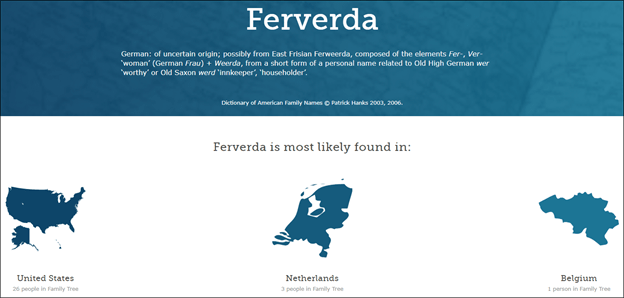
Conversely, FamilyTreeDNA customers may want to easily add some of the myDNA products and have them available through one single customer portal.

I’m extremely hopeful about opportunities for the genetic genealogy side of the house. Specifically, my fingers are crossed that myDNA will invest in:

  • Website infrastructure which will improve performance.
  • Enhancing current and adding new advanced genealogy tools and products that aren’t just pieces, but provide us with innovative solutions.

And yes, I have suggestions. Like a kid in the toy store, I have a long wish list of features I’d love to see😊.

I’d like to hear your (positively constructed) wish list as well.

I’m excited about this new opportunity!

Customer Notification

Customers will be notified via e-mail in the next 48 hours or so. If you don’t receive an e-mail, check your spam folder or sign on to your account. If you’ve changed your e-mail recently, sign in to be sure your e-mail address is current.

_____________________________________________________________

Disclosure

I receive a small contribution when you click on some of the links to vendors in my articles. This does NOT increase the price you pay but helps me to keep the lights on and this informational blog free for everyone. Please click on the links in the articles or to the vendors below if you are purchasing products or DNA testing.

Thank you so much.

DNA Purchases and Free Transfers

Genealogy Products and Services

Genealogy Research

Books