FamilyTreeDNA and myDNA Team Up for Black Friday Sale – $39 for Family Finder or $59 for Family Finder + Wellness

FamilyTreeDNA just launched a Black Friday sale that offers two great values.

Most people are already familiar with the Family Finder autosomal test, but this is the first time the myDNA Wellness test has been bundled. You’ll recall that myDNA merged with FamilyTreeDNA in January of 2021.

The myDNA Wellness test offers 30 Health and Wellness Insights. Of course, the bundle includes the Family Finder test too.

myDNA Wellness Test

I’m not familiar with the myDNA Wellness test, so I did some digging.

In summary, the myDNA Wellness test provides:

  • myDNA Personalized Wellness Reports
  • DNA Insights for things like Power vs Endurance, Injury Prevention, Stamina, Recovery
  • Nutrition including Caffeine
  • Skin
  • B Vitamins, Bone Health, Heart Health, Iron
  • Sleep Routine
  • DNA-Powered Plans including meals and workouts
  • Key to working with your body for lifelong behaviors
  • An app for your mobile device in addition to reports on your personal page at FamilyTreeDNA. (Note that project administrators cannot view these results.)

You can take a look at the Wellness report information, here.

I have not taken the Wellness test yet, but those who have indicate that it helps them understand their body includes things such as meal planning based on their genetic needs. I would actually order the test for the meal planning feature alone which is tuned to my individual body.

The Health and Wellness product is not focused on telling you something one time, but on helping you live successfully over time.

Upgrades to Health and Wellness for Current Customers

You may be wondering if current customers can upgrade to the myDNA Wellness test.

FamilyTreeDNA is in the process of rolling out the myDNA Wellness upgrade opportunity in stages to groups of their existing customers.

FamilyTreeDNA has run DNA tests on multiple DNA chip versions over many years. Currently, a subset of customers who have tested on the GSAv2 chip that went into production in March of 2019 are eligible for upgrades to the myDNA Wellness test. Not everyone on that chip version is eligible quite yet but will be soon.

Customers who tested on earlier chip versions or transferred their DNA file from another company that uses a different chip would need to re-swab and will be able to see when they are eligible on their account at FamilyTreeDNA.

You can sign on to your account, here, to determine if you are eligible to upgrade.

If you are eligible now, you’ll see the myDNA Wellness Membership section if you scroll down beneath the Genealogy DNA products. It’s just below the Additional Tests and Tools. If you don’t see this section, you’re not currently eligible.

If you click on the myDNA Wellness link, you’ll see that the myDNA upgrade is on sale for $39.

If you’re not eligible just yet, you will be soon. I’ll be ordering a Wellness test as soon as I’m eligible.

Family Finder and More

The Family Finder test without the Wellness product is only $39 which is an amazing value. It has never been priced this low before. What a great time to stock up.

Testing your relatives will help your genealogy and theirs as well. It’s more than just a one-time test though.

You can link tests of people you match to your tree which allows FamilyTreeDNA to automatically assign your common matches to either your maternal or paternal side.

That’s the first question genealogists want to know. Does someone match me maternally, paternally, or on both sides.

Taking a DNA test, uploading a tree and linking matches to their proper place in your tree is the key to having those 4627 people you see above identified as maternal or paternal for me. I didn’t have to lift a finger. My Family Finder test plus linking matches in my tree allowed FamilyTreeDNA to do it for me.

The more relatives you link on your tree, the more matches FamilyTreeDNA can bucket maternally or paternally for you. So, order DNA tests for aunts, uncles, cousins, everyone!

Order Holiday Gifts Now

I always ask my relatives what they’d like to know when I order their DNA tests. That way they have something to look forward to when the results come back, and I have more tools to answer those questions. My relatives love hearing about what we’ve discovered together and how it relates to them.

We’ve pushed through some brick walls that I thought would never fall – and they wouldn’t have if my relatives hadn’t agreed to DNA test.

The easiest purchase this year is a DNA test for family members. No lines and no worries. More, importantly, it’s a lifelong gift that keeps on giving.

_____________________________________________________________

Follow DNAexplain on Facebook, here or follow me on Twitter, here.

Share the Love!

You’re always welcome to forward articles or links to friends and share on social media.

If you haven’t already subscribed (it’s free,) you can receive an email whenever I publish by clicking the “follow” button on the main blog page, here.

You Can Help Keep This Blog Free

I receive a small contribution when you click on some of the links to vendors in my articles. This does NOT increase the price you pay but helps me to keep the lights on and this informational blog free for everyone. Please click on the links in the articles or to the vendors below if you are purchasing products or DNA testing.

Thank you so much.

DNA Purchases and Free Uploads

Genealogy Products and Services

My Book

Genealogy Books

Genealogy Research

DNA for Native American Genealogy – Hot Off the Press!

Drum roll please…my new book, DNA for Native American Genealogy, was just released today, published by Genealogical.com.

I’m so excited! I expected publication around the holidays. What a pleasant surprise.

This 190-page book has been a labor of love, almost a year in the making. There’s a lot.

  • Vendor Tools – The book incorporates information about how to make the best use of the autosomal DNA tools offered by all 4 of the major testing vendors; FamilyTreeDNA, MyHeritage, Ancestry, and 23andMe.
  • Chromosome Painting – I’ve detailed how to use DNAPainter to identify which ancestor(s) your Native heritage descends from by painting your population/ethnicity segments provided by FamilyTreeDNA and 23andMe.
  • Y and Mitochondrial DNA – I’ve described how and when to utilize the important Y and mitochondrial DNA tests, for you and other family members.
  • Maps – Everyone wants to know about ancient DNA. I’ve included ancient DNA information complete with maps of ancient DNA sites by major Native haplogroups, gathered from many academic papers, as well as mapped contemporary DNA locations.
  • Haplogroups – Locations in the Americas, by haplogroup, where individual haplogroups and subgroups are found. Some haplogroups are regional in nature. If you happen to have one of these haplogroups, that’s a BIG HINT about where your ancestor lived.
  • Tribes – Want to know, by tribe, which haplogroups have been identified? Got you covered there too.
  • Checklist – I’ve provided a checklist type of roadmap for you to follow, along with an extensive glossary.
  • Questions – I’ve answered lots of frequently asked questions. For example – what about joining a tribe? I’ve explained how tribes work in the US and Canada, complete with links for relevant forms and further information.

But wait, there’s more…

New Revelations!!!

There is scientific evidence suggesting that two haplogroups not previously identified as Native are actually found in very low frequencies in the Native population. Not only do I describe these haplogroups, but I provide their locations on a map.

I hope other people will test and come forward with similar results in these same haplogroups to further solidify this finding.

It’s important to understand the criteria required for including these haplogroups as (potentially) Native. In general, they:

  • Must be found multiple times outside of a family group
  • Must be unexplained by any other scenario
  • Must be well-documented both genetically as well as using traditional genealogical records
  • Must be otherwise absent in the surrounding populations

This part of the research for the book was absolutely fascinating to me.

Description

Here’s the book description at Genealogical.com:

DNA for Native American Genealogy is the first book to offer detailed information and advice specifically aimed at family historians interested in fleshing out their Native American family tree through DNA testing.

Figuring out how to incorporate DNA testing into your Native American genealogy research can be difficult and daunting. What types of DNA tests are available, and which vendors offer them? What other tools are available? How is Native American DNA determined or recognized in your DNA? What information about your Native American ancestors can DNA testing uncover? This book addresses those questions and much more.

Included are step-by-step instructions, with illustrations, on how to use DNA testing at the four major DNA testing companies to further your genealogy and confirm or identify your Native American ancestors. Among the many other topics covered are the following:

    • Tribes in the United States and First Nations in Canada
    • Ethnicity
    • Chromosome painting
    • Population Genetics and how ethnicity is assigned
    • Genetic groups and communities
    • Y DNA paternal direct line male testing for you and your family members
    • Mitochondrial DNA maternal direct line testing for you and your family members
    • Autosomal DNA matching and ethnicity comparisons
    • Creating a DNA pedigree chart
    • Native American haplogroups, by region and tribe
    • Ancient and contemporary Native American DNA

Special features include numerous charts and maps; a roadmap and checklist giving you clear instructions on how to proceed; and a glossary to help you decipher the technical language associated with DNA testing.

Purchase the Book and Participate

I’ve included answers to questions that I’ve received repeatedly for many years about Native American heritage and DNA. Why Native DNA might show in your DNA, why it might not – along with alternate ways to seek that information.

You can order DNA for Native American Genealogy, here.

For customers in Canada and outside the US, you can use the Amazon link, here, to reduce the high shipping/customs costs.

I hope you’ll use the information in the book to determine the appropriate tests for your situation and fully utilize the tools available to genealogists today to either confirm those family rumors, put them to rest – or maybe discover a previously unknown Native ancestor.

Please feel free to share this article with anyone who might be interested.

_____________________________________________________________

Disclosure

I receive a small contribution when you click on some of the links to vendors in my articles. This does NOT increase the price you pay but helps me to keep the lights on and this informational blog free for everyone. Please click on the links in the articles or to the vendors below if you are purchasing products or DNA testing.

Thank you so much.

DNA Purchases and Free Uploads

Genealogy Products and Services

My Book

Genealogy Books

Genealogy Research

How to Join a Project at FamilyTreeDNA – And Why You Want To

I’ve been receiving a lot of questions about how to join projects lately, and I think I know why.

Right now, FamilyTreeDNA is having a pre-holiday sale. All tests are on sale – the Family Finder autosomal test for $59, here, and the mitochondrial full sequence DNA test for your matrilineal line for $139, here. However, of particular significance is that the Y DNA tests are heavily discounted which is what’s driving the questions about joining projects.

The Y-37 is $79 and the Big Y-700, the most refined Y-DNA test, is only $379, here.

Why the Y DNA Test?

Y DNA tests facilitate men matching other men on their direct paternal line, which is generally the surname line. In other words, Estes men can be expected to match other Estes men, and so forth, unless an adoption or unknown parentage is involved. In that case, the man can expect to match his biological surname line.

The even better news is that the Big Y-700 test is refined to the level that WITHIN surname lines, testers can often differentiate and are able to tell where a specific mutation occurred in their genealogy.

You can see matches with either the 37 or 111 marker Y DNA test, but this level of detail is ONLY available with the Big Y-700 test.

A picture is worth 1000 words.

Here’s the view of the Estes portion of the Y DNA Block Tree, viewed from the account of one of my male Estes cousins who took the Big Y-700 test.

  • You can see that if a male takes the Big Y-700 test and receives the haplogroup of R-BY154784, we know he’s in the line of John born 1732, son of Moses Estes. This can be especially important for the man in the project with a Wilbur surname. It connects him with his Estes paternal lineage. For other Estes men, it tells them which son of Moses was their paternal ancestor.
  • If a man tests and receives R-ZS3700, upstream of R-BY154784, then we know he’s in the line of Moses Estes born 1711, son of Abraham, the Virginia immigrant.
  • If a tester receives haplogroup R-BY490, we know he descends from the Silvester Estes line, but NOT from the Moses line, or he would be R-ZS3700.
  • If a tester receives R-BY482 but not R-BY490, we know he is from the line of Robert Estes born in 1555, in Kent, but not in the American Estes line who all carry R-BY490 or more granular downstream haplogroups.

This is why people are ordering the Big Y-700 tests and want to join projects.

How do you know if a surname project exists for your surname of interest?

Does a Surname Project Exist for Me?

To see if a surname project exists for your surname of interest, click here, then scroll a little way down until you see the surname search box.

I typed Vannoy, my great-grandmother’s birth surname, and the following projects are shown.

Click any image to enlarge

You can see that the administrators for three projects have included Vannoy in their project names-of-interest, which is why the projects appear on the Vannoy search list.

Hurray! There is a Vannoy surname project with 66 members.

Ok, excuse me while I cheat for a minute. How many of these 66 people do I match on my Family Finder test?

Using the Advanced Matches tool on my main page, selecting Family Finder and the Vannoy project, I match 11 of those 66 people in the Vannoy project. How fun is that!?!

Ok, done cheating and back to the surname search results.

In the FamilyTreeDNA database, a total of 22 people have the surname of Vannoy, spelled exactly this way. Of the 11 people I match in the project, 7 have a surname of Vannoy or a derivative.

So, yes, there is a Vannoy project AND there are people with the Vannoy surname who have tested – and – as it turns out, I match several of the project members.

If you haven’t yet tested at FamilyTreeDNA, you can click here to check to see if there are surname projects of interest to you and to order a test.

If you’ve already tested or transferred your results, how do you join a project at FamilyTreeDNA?

How Do Customers Join Projects at FamilyTreeDNA?

Joining projects is easy and very beneficial. You can collaborate with other testers and you can use the Advanced Tools to see who else in the project you match as well.

Joining Projects

Family Tree DNA provides three types of projects for their customers to join. All projects are free to join and are run by volunteer project administrators, people who have a specific interest in the topic at hand and are generally quite glad to be of assistance. Projects are great ways to find people you match and others interested in a common topic.

There are three primary kinds of DNA projects:

  • Surname projects – like Estes
  • Haplogroup projects – like R-L21 for my cousin’s Y DNA or J-mtDNA for my own mitochondrial DNA haplogroup. Both Y and mitochondrial DNA projects exist for haplogroups and subgroups.
  • Geographic projects – really anything else that isn’t a surname or a haplogroup, like Cumberland Gap, American Indian or Scottish DNA

Sign on to your account. Begin by clicking on Group Projects at the top of your personal page.

You can join an unlimited number of projects, but you want to make sure projects you join are relevant to your genealogy, your research and/or your haplogroup.

If you click on “Join a Project,” you’ll see a number of projects where the volunteer administrators have listed your surname as a surname of interest to that project.

First, of course, you must have tested at or transferred your (autosomal) results to Family Tree DNA and you must have taken the type of test relevant to the project at hand.

For example, if you have taken the Family Finder autosomal test and not taken any other tests, you can’t join a Y DNA-only project because you have not tested your Y chromosome. (Women don’t have a Y chromosome.)

Some surname projects are for males only who have tested their Y DNA and carry that surname or are related on the direct paternal line. Like the Wilbur gentleman in the Estes Y-DNA Block Tree example. This is why surname projects are often called Y DNA projects.

Surname projects fall into three categories, based on the goals of the project:

  • Y DNA, meaning only males with that surname can join.
  • People who have a mitochondrial connection to the surname can join as well.
  • Anyone who is descended from any ancestor with that surname can join.

In the Estes surname project, I welcome anyone with an Estes ancestor.

The Project List

When you click on “Join a Project,” you’ll see the list of projects that are “Recommended Projects.” This means that the administrator has added your surname as one of interest. This doesn’t necessarily mean you should join all those projects, but that you might want to evaluate each project for appropriateness.

Let’s take a quick look.

  • The Cumberland Gap mtDNA project isn’t relevant, because my Estes line is my paternal line and my mitochondrial DNA is my matrilineal line – so no cigar on this one, at least not for me.
  • The Cumberland Gap Y DNA project isn’t relevant for me, because I’m a female and don’t have a Y chromosome, although my family is from the Cumberland Gap area. However, my male Estes cousins can join.
  • The Estes surname project welcomes anyone descended from an Estes by any spelling.
  • Estis Jewish Ukraine – Nope doesn’t pertain to me or my Estes line.
  • The I-L161 (Isles) project is a Y DNA haplogroup project, so does not apply to me as I have no Y chromosome.
  • The Jester project listed Estes as a variant spelling.
  • I would need to read about the rest of the projects.

Note that only the first 10 project are shown in the list and there may be more.

Searching

Obviously, there are probably other projects of interest that can’t be sensed by your surname.

For example, I’d like to know about the Bolton project – my grandmother’s surname, so I entered Bolton in the search box.

Click the project name to read more about each project.

Once you’ve determined that a project is for you, click the orange “Join” button to join. Don’t worry, you can unjoin easily if you make a mistake. Some projects have a “request to join” feature to be sure the pairing is a good fit.

Browse

Can’t find your surname or want to see what else is available? Try an alternate name spelling or scroll down to the Browse Group Projects section.

There are so many great possibilities.

Projects fall into multiple browse categories:

  • Surname
  • Y DNA Geographical
  • MtDNA Geographical
  • Dual (Y DNA and mtDNA Geographical)
  • MtDNA Lineage
  • Y-DNA Haplogroup
  • MtDNA Haplogroup

There’s so much of interest.

If I know a topic name, I can search here to see if an administrator has entered that as a keyword.

I searched for Acadian and found 6 options to evaluate.

Now all I have to do is click on the project link and then on the orange Join button to become a member.

Check Your Sharing Option

One quick housekeeping item as a project member is to check to be sure that your results can be shared on the project page, if that’s what you want.

At the top of your page, under “Manage Group Projects,” click on “Project Preferences.”

You can view the administrators of each project and manage permissions for each administrator individually.

Scroll down just a bit more and you’ll see the group project profile.

If you’d like for your DNA results to be included in the public project page results, be sure sharing is set to “on.” Your name is never shown publicly, except to your matches on your match page. In projects, only a surname and earliest known ancestor is shown. Here’s the Vannoy Y DNA page as an example.

Sharing in genealogy benefits everyone and encourages other people to test.

What About You?

Have you joined the projects that would be a good fit for you? Check out your surnames and topics of interest, here.

You can always transfer your autosomal DNA from other vendors and join projects today with no waiting.

If you transfer an autosomal kit from another vendor (instructions here,) you can order a Y DNA or mitochondrial upgrade and FamilyTreeDNA will send you a swab kit. That way all of your test results can be utilized together for added benefit.

————————————————————————————————————-

Disclosure

I receive a small contribution when you click on some of the links to vendors in my articles. This does NOT increase the price you pay but helps me to keep the lights on and this informational blog free for everyone. Please click on the links in the articles or to the vendors below if you are purchasing products or DNA testing.

Thank you so much.

DNA Purchases and Free Uploads

Genealogy Products and Services

Books

Genealogy Research

Free Webinar: 10 Ways to Find Your Native American Ancestor Using Y, Mitochondrial and Autosomal DNA

I recorded 10 Ways to Find Your Native American Ancestor Using Y, Mitochondrial and Autosomal DNA for Legacy Family Tree Webinars.

Webinars are free for the first week. After that, you’ll need a subscription.

If you subscribe to Legacy Family Tree, here, you’ll also receive the downloadable 24-page syllabus and you can watch any of the 1500+ webinars available at Legacy Family Tree Webinars anytime.

In 10 Ways to Find Your Native American Ancestor Using Y, Mitochondrial and Autosomal DNA, I covered the following features and how to use them for your genealogy:

  • Ethnicity – why it works and why it sometimes doesn’t
  • Ethnicity – how it works
  • Your Chromosomes – Mom and Dad
  • Ethnicity at AncestryDNA, 23andMe, FamilyTreeDNA and MyHeritage DNA
  • Genetic Communities at AncestryDNA
  • Genetic Groups at MyHeritage DNA
  • Painted ethnicity segments at 23andMe and FamilyTreeDNA
  • Painting ethnicity segments at DNAPainter – and why you want to
  • Shared ethnicity segments with your matches at AncestryDNA, 23andMe, FamilyTreeDNA and MyHeritage DNA
  • Downloading matches and segment files
  • Techniques to pinpoint Native Ancestors in your tree
  • Y DNA, Native ancestors and haplogroups
  • Mitochondrial DNA, Native ancestors and haplogroups
  • Creating a plan to find your Native ancestor
  • Strategies for finding test candidates
  • Your Ancestor DNA Pedigree Chart
  • Success!!!

If you haven’t yet tested at or uploaded your DNA to both FamilyTreeDNA and MyHeritage, you can find upload/download instructions, here, so that you can take advantage of the unique tools at all vendors.

Hope you enjoy the webinar and find those elusive ancestors!

_____________________________________________________________

Disclosure

I receive a small contribution when you click on some of the links to vendors in my articles. This does NOT increase the price you pay but helps me to keep the lights on and this informational blog free for everyone. Please click on the links in the articles or to the vendors below if you are purchasing products or DNA testing.

Thank you so much.

DNA Purchases and Free Uploads

Genealogy Products and Services

Books

Genealogy Research

DNA Beginnings: How Many DNA Matches Do I Have?

People often want to know how many DNA matches they have.

Sounds simple, right?

At some vendors, the answer to this question is easy to find, and at others, not so much.

How do you locate this information at each of the four major vendors?

What else do you need to know?

I’ve written handy step-by-step instructions for each company!

Matches at FamilyTreeDNA

Sign on at FamilyTreeDNA and under autosomal results, click on Family Finder Matches.

At the top of the next page, you’ll see your total number of matches along with matches that FamilyTreeDNA has been able to assign maternally or paternally based on creating/uploading a tree and linking known matches to that tree in their proper place.

Your parents do NOT need to have tested for the maternal/paternal bucketing functionality, but you DO need to identify some relatives and link their tests to their place in your tree. It’s that easy. Instructions for linking can be found in the “Linking Matches on Your Tree” section of this article (click here), along with information about how that helps you, or here.

Obviously, if your parents have tested, that’s the best scenario. For people who don’t have that option, FamilyTreeDNA is the ONLY vendor that offers this type of feature if your parents have NOT tested.

At FamilyTreeDNA, I have 7313 total matches of which 3169 are paternal, 1402 are maternal and 6 are related to both parents.

Hint – your siblings, their children, your children, grandchildren, etc. will be related to you on both your paternal and maternal sides.

If you don’t have an autosomal DNA test at FamilyTreeDNA, you can upload one from Ancestry, 23andMe, or MyHeritage for free. Click here for instructions.

Matches at MyHeritage

At MyHeritage, sign on and click on DNA, then DNA Matches.

At the top of your matches page, you’ll see your total number of matches.

At MyHeritage, I have 14,082 matches.

Matches are not broken down maternally and paternally automatically, but I can filter my matches in a wide variety of ways, including shared matches with either parent if they have tested, or other relatives.

If you don’t have an autosomal DNA test at MyHeritage, you can transfer one from Ancestry, 23andMe, or FamilyTreeDNA for free. Click here to begin your upload to MyHeritage.

Click here for instructions about how to download a copy of your DNA file from other vendors.

Matches at Ancestry

At Ancestry, sign on and click on DNA, then DNA Matches.

On your matches page, at the top, you’ll see a number of function widgets. Look for “Shared DNA.”

Click the down arrow to expand the Shared DNA box and you’ll see the total number of matches, along with the breakdown between 4th cousins or closer and distant matches.

Sometimes the number of matches doesn’t show up which means Ancestry’s servers are too busy to calculate the number of matches. Refresh your screen or try again in a few minutes. This happens often to me and always makes me question my sanity:)

I have 53,435 matches at Ancestry, of which 4,102 are estimated to be 4th cousins or closer and 49,333 are more distant.

For close matches only, if your parents have tested at Ancestry, when possible, Ancestry tells you on each match if that person is associated with your father’s side or your mother’s side.

You can’t upload DNA files from other vendors to Ancestry, but you can download a copy of your DNA file from Ancestry and upload to either FamilyTreeDNA or MyHeritage. Click here for instructions.

You can also download a copy of your tree from Ancestry and upload it to either of those vendors, along with your DNA file for best results.

Matches at 23andMe

23andMe functions differently from the other vendors. They set a hard limit on the number of matches you receive.

That maximum number differs based on the test version you took and if you pay for a membership subscription that provides enhanced medical information along with advanced filters and the ability to have a maximum of 5000 matches.

In order to purchase the membership subscription, you need to take their most current V5 test. If you tested with an earlier product, you will need to repurchase, retest or upgrade your current test which means you’ll need to spit in the vial again.

Please note the words, “up to 5000 relatives,” in the 23andMe verbiage. They also say that’s “over 3 times what you get” with their test without a subscription.

23andMe handles things differently from any other vendor in the industry. They made changes recently which created quite a stir because they removed some capabilities from existing customers and made those functions part of their subscription model. You can read about that here and here.

The match limit on the current 23andMe V5 test, WITHOUT the subscription, is 1500. If you tested previously on earlier kits, V2-V4, 23andMe has reinstated your prior maximum match limit which was 2000.

So, here’s the maximum match summary for 23andMe:

  • Earlier kits (V2-V4) – 2000 maximum matches
  • Current V5 kit with no subscription – 1500 maximum matches
  • Current V5 kit with subscription – 5000 maximum matches

Except, that’s NOT the number of matches you’ll actually see.

23andMe handles matching differently too.

23andMe matches you with their other customers up to your maximum, whatever that is, then subtracts the people who have not opted-in to genealogy matching. Remember, 23andMe focuses on health, not genealogy, so not all of their customers want matching.

Therefore, you’ll NEVER see your total number of allowed matches, which is why 23andMe cleverly says you “get access to up to 5000 relatives.”

Let’s look at my V4 test at 23andMe. Sign on and click on Ancestry, then DNA Relatives. (Please note, Ancestry is not Ancestry the company, but at 23andMe means genealogy results as opposed to medical/health results.)

At the top of your DNA Relatives page, you’ll see your total number of matches, before any sorting filters are applied.

23andMe does not automatically assign matches maternally or paternally, but if your parents have tested AND opt-in to matching, then you can filter by people who also match either parent.

I have 1796 matches at 23andMe, which means that 204 or 11% of my matches have not opted-in to matching.

You can’t upload DNA files from other vendors to 23andMe, but you can download a copy of your DNA file from 23andMe and upload to either FamilyTreeDNA or MyHeritage where you will assuredly receive more matches. Click here for instructions.

Summary

Each vendor has its own unique set of features and operates differently. It’s not so much the number of matches you have, but if you have the RIGHT match to break through a particular brick wall or provide you with a previously unknown photo of a cherished family member.

I encourage everyone to fish in all 4 of these ponds by testing or uploading your DNA. Uploading and matching are both free. Advanced tools require a small one-time unlock fee, but it’s significantly less than testing again. You can find step-by-step instructions to walk you through the process, here.

Have fun!!!

_____________________________________________________________

Disclosure

I receive a small contribution when you click on some of the links to vendors in my articles. This does NOT increase the price you pay but helps me to keep the lights on and this informational blog free for everyone. Please click on the links in the articles or to the vendors below if you are purchasing products or DNA testing.

Thank you so much.

DNA Purchases and Free Transfers

Genealogy Products and Services

Books

Genealogy Research

Announcing DNA Beginnings – A New Series

Welcome to DNA Beginnings. This exciting, upcoming series will be focused on the new DNA tester who may also be a novice genealogist and is unsure of quite what to do.

People ask, “Where do I even start?”

If this is you, welcome!

Which Vendors Will Be Covered?

This series will consist of one article for each of the four main DNA vendors:

Topics

Each article will cover two primary topics:

  • Matches
  • In-common-with or shared matches between you and other people

Along with:

  • Why each match type is important.
  • What matches and shared matches can tell you
  • How to make use of that information

More Information

For those who are ready – at the end of each article, I’ll include links with instructions for using more advanced tools at each vendor.

Get Ready!

While you’re waiting, you can upload your DNA data file from some vendors to other vendors, for free! That way you’ll have matches to work with, in multiple places. You’ll match different people at each vendor who are related to you in different ways. You never know where the match you need will be found – so fish in multiple ponds.

If you’ve tested at any vendor, you can download your raw DNA file. Downloading your raw DNA data file doesn’t affect your DNA file or matches at the vendor where you tested. The file you’re downloading is just a copy of the raw DNA file.

Just don’t delete the DNA test at the original vendor. That’s an entirely separate function, so don’t worry.

Uploading your raw DNA file to another vendor, for free, saves the cost of retesting, even if you do have to pay a small fee to utilize that vendor’s advanced tools.

Which Vendors Accept Upload Files?

Which vendors accept raw DNA data file uploads from other vendors? The chart below shows the vendors where you’ve tested on the left side, and the vendors you want to transfer to across the top.

To read this, people who have tested at FamilyTreeDNA (from the left column) can upload their raw DNA file to MyHeritage, but not to 23andMe or Ancestry. Note the asterisks. For example, people who tested at MyHeritage can upload their DNA file to FamilyTreeDNA, but only if they tested after May 7, 2019.

From to >>>>> FamilyTreeDNA MyHeritage 23andMe* Ancestry*
FamilyTreeDNA N/A Yes No No
MyHeritage Yes** N/A No No
23andMe*** V3, V4, V5 V3, V4, V5 N/A No
Ancestry V1, V2 V1, V2 No N/A

* Neither 23andMe nor Ancestry accept any DNA file uploads from any vendors. To receive matches at these two vendors, you must test there.

** FamilyTreeDNA accepts MyHeritage DNA tests taken after May 7, 2019.

*** Vendors do not accept the early 23andMe V2 file type used before December 2010.

None of these vendors accept files from LivingDNA who uses an incompatible DNA testing chip, although LivingDNA accepts upload files from other vendors.

Step-By-Step Instructions for Transferring Your Raw DNA Files

I wrote articles about how to download your raw DNA file from each vendor and how to upload your DNA file to vendors who accept DNA uploads in lieu of testing at their site.

You’ll save money by transferring your DNA file instead of testing at each vendor.

Transfer your file now and get ready to have fun with our DNA Beginnings articles!

Share and Subscribe – It’s Free

Feel free to share these articles with your friends and organizations. Anyone can subscribe to DNAexplained (this blog) for free and receive weekly articles in their inbox by entering their email and clicking on the little grey “Follow” button on the upper right-hand side of the blog on a computer or tablet screen. Hint – if you received this article in your email – you’re already subscribed so you don’t need to do anything. If you’re not subscribed already, just filling the info and click on “Follow.”

Every genealogist and genetic genealogist starts someplace and DNA Beginnings is a wonderful opportunity. The first article in the series will be arriving later this week!

_____________________________________________________________

Disclosure

I receive a small contribution when you click on some of the links to vendors in my articles. This does NOT increase the price you pay but helps me to keep the lights on and this informational blog free for everyone. Please click on the links in the articles or to the vendors below if you are purchasing products or DNA testing.

Thank you so much.

DNA Purchases and Free Uploads

Genealogy Products and Services

Books

Genealogy Research

Nine Years and Future Plans – Happy Blogiversary

Happy Blogiversary!

Yes, blogiversary is actually a real word for a blog’s birthday.

It’s DNAeXplained’s 9th birthday and I nearly forgot.

How could I???

What do you get a blog for its birthday anyway?

History and Changes

I remember the 4th of July holiday back in 2012 – although that seems like about two lifetimes ago now.

I was trying to learn how to use WordPress, my chosen blogging platform, and to become familiar enough with how everything worked so I wouldn’t embarrass myself.

On July 11, 2012, I published my first very short blog article, just saying hello and inviting people to subscribe and come along for the ride. And what a ride it has been as we begin our 10th year together.

I was explaining DNA topics so often that I figured if I wrote the answer once as an article with pictures and graphics, I could save myself (and lots of other people) a great deal of effort. I could just link my blog article and not have to retype everything.

Seemed like a great idea…right?

That worked then and still does, well…except for a couple of considerations:

  • Increasingly, people don’t seem to be interested in learning, just in receiving “an answer.” In other words, they often don’t bother to actually read articles. Or, in one woman’s words, “You didn’t answer my question. You just gave me something to read.” Sigh.

I’m mortified when I read some of the answers provided to people on social media – especially realizing that the person asking the question has no idea how to discern between an accurate answer and something else.

Doubt that? Try an experiment. Select any topic where you are an expert. Go to a social media group about that topic. Review the questions and resulting answers. Bash head on table.

  • Things change over time. We’ve learned a WHOLE LOT since 2012 in the genetic genealogy space. Every vendor platform has changed multiple times. New products have been introduced which obsolete older products and their articles. Some vendors and tools have disappeared and new ones have emerged. DNA has become a household word.

The Unexpected

Blogging has resulted in a few things I didn’t anticipate:

  • Sometimes, bloggers becoming targets. This is especially painful when it comes from within the community. Mostly, I refuse to give any of that oxygen. Their hatefulness is really not about me. Still, it was shocking and painful at first.
  • I receive between 500 and 1000 emails every single day. Yes, EVERY SINGLE DAY. That’s in addition to blog comments and social media communications. It’s overwhelming, even after deleting obvious spam. This also means that I don’t catch up, am chronically behind, and never really get a break. (This is a big reason why bloggers burn out.)

Communications

Communications fall into several categories:

  • Some emails/communications are people reaching out about my (our) ancestors. Obviously, those emails are always welcome and often make my day. 😊
  • Some people are saying thank you or offering suggestions that I sometimes utilize as future article topics. I appreciate those too.
  • Some people comment or participate in a discussion. Those just require a quick approval and I’m always glad to see people engaging.
  • Some people inquire about consulting services. At this point, I don’t accept private clients and no longer write Y and mitochondrial DNA reports for people. That could change in the future, but right now, I simply refer people to others who I know are qualified based on the topic of the request.
  • Many emails are from someone who wants something. For example – “I’d like to write a guest post for your blog.” Translated – “I’d like to use the platform you’ve developed over the past 9 years, and your followers, to benefit myself.” The answer is a resounding “NO”! Truthfully, I no longer respond to these. The delete key suffices. But I still have to read them.

Unchanged!

Some things have NOT changed:

  • I still love to explain and educate about the marriage of DNA and genealogy.
  • I still love to chase my ancestors.
  • No ad policy – you won’t see embedded ads in my articles. When bloggers allow ads, the ads provide revenue, but the blogger also risks a substandard product being displayed to their subscribers and visitors. There are sometimes relevant, curated, affiliate links within my articles for products that I use, but they never appear as an ad. I am not criticizing bloggers who do adopt the ad model – simply explaining to you why I don’t. And yes, I know I’m foregoing revenue with this decision, but I feel it’s the right thing to do.

Improvements

Almost every aspect of genetic genealogy has improved over the past 9 years:

  • Autosomal test matches have increased and are often of a higher quality as a result of millions of people having tested at the four major vendors: FamilyTreeDNA, MyHeritage, 23andMe, and Ancestry. We probably had an industry-wide total of about 2 million testers in 2012, and now I’d wager we have more than 40 million. More and better matches for everyone!
  • Y DNA testing (for men only) has improved by leaps and bounds, with a combination of SNP testing with the Big Y-700 test and STR testing being able to refine relationships at a very granular level. This paternal line test plus matching is only available at FamilyTreeDNA.
  • Mitochondrial DNA test numbers lag behind other tests, but the Million Mito Project will encourage more testers and refine mitochondrial match results in a meaningful way as well. We simply need more testers, just like we did with autosomal back in 2012. The mitochondrial DNA full sequence test is available at FamilyTreeDNA.
  • Every major DNA vendor has added state-of-the-art, innovative tools over the years.
  • Every major DNA vendor has been sold/acquired and we’ve all managed to survive, despite teeth-gnashing and predictions of doom.
  • FamilyTreeDNA and MyHeritage both accept transfers/uploads from other vendors, making swimming in all the genetic genealogy pools easier and more affordable for consumers. Click here for step-by-step download/upload instructions.
  • Public consciousness about DNA testing for genealogy, health, and traits has increased dramatically. We see TV and social media ads regularly today.
  • Techniques like triangulation, clustering, and various flavors of tree-matching have revolutionized what can be accomplished with genetic genealogy – both confirming and discovering ancestors. Newly discovered new cousins may be researching the same ancestral lines.
  • People seeking the identity of parents or other close relatives routinely solve those puzzles today, thanks to the millions of people who have tested. That was quite rare in 2012.
  • We are attracting a whole new savvy generation of testers who grew up with and understand technology.

The Future

What does the future hold for me and DNAeXplain? To be clear, DNAeXplain is the underlying business/website and DNAeXplained.com is the blog, but I often use them interchangeably since both URLs resolve to the same location today.

First and foremost, I don’t have any intention of stopping. I’m passionate about genetic genealogy, have been for 21 years now, and love to write articles and share with you. In fact, in the last few months, I’ve added the Y DNA Resources one-stop educational page as well as Mitochondrial DNA.

I’ve had the opportunity to get to know and meet so many blog followers. Some of you turned out to be cousins. Of course, we’re all related eventually, someplace back in time.

I look forward to in-person conferences again, but don’t worry – I’ll continue researching, writing, and covering topics in this amazing industry.

Cousin Bait

I never considered that I might find cousins through blogging but that’s worked marvelously – both when I publish the articles and later too.

On a personal level, my 52 Ancestors series has been extremely successful for a couple of reasons:

  • Each article forces me to verify and update my research.
  • The articles act as cousin bait. Not only are they findable using Google, or the blog search feature, I post the article links at WikiTree, MyHeritage, and Ancestry on the profile card for that ancestor. I need to do the same at FamilySearch as well.

Upcoming Book

I’m very excited to be able to share with you that I’m completing a manuscript.

I can’t discuss more about the book just yet, but I should have the draft to the editor shortly.

Chapters

The book of our life is written in chapters, just like the lives of our ancestors were.

I’m beginning a new chapter shortly – a move to someplace where it’s warmer.

I don’t know where just yet (I think a villa in Tuscany is probably out of the question), nor exactly when.

What I do know is that I’ve accumulated a HUGE amount of stuff over the decades that I’ve lived in this house. My mother passed away, so I have her things too.

Genealogy books are heavy and require lots of space.

So does paper, as in file cabinets and boxes of documents.

As most of you know, I’m a quilter – and fabric is heavy and requires space too.

Movers charge by some combination of distance, how much space your possessions require in their truck, hourly fees, weight and prep required.

Let’s just say that preparing to move is proving challenging!

Why am I telling you this?

Changes

Over the period of 9 years, I’ve written and published 1442 articles. That equates to one article about every 2.25 days.

That’s even hard for me to believe.

My goal has always been to publish:

  • One technical article during the week. Topics include things like DNA concepts, sales, new features, and various “how-to” articles.
  • One 52-Ancestors article each weekend.

I’ve exceeded that goal.

Needless to say, both of those types of articles take hours-to-days to research, compose and publish.

During these next few months as I’m migrating from one part of the country to another, and one chapter of my life to the next, I may miss my goal of publishing the 52-ancestors article each week. I’ve already compiled the easy ones given that the next one will be number 338.

Those articles require a significant amount of research and right now, I need to focus on reducing the file cabinets and bookshelves of stuff. And of course, like any genealogist, I have to sift through everything one paper at a time to be sure I’m not disposing of something I’ll regret – like, you know, my high school report card. 😊

It’s very difficult to not run down every rabbit hole! Hey, what is my friend in that picture beside me at the football game up to now? Oops, an obituary. What about my co-worker that I had a crush on? What do they look like? Who was sitting at the picnic table in that family reunion picture anyway? I don’t remember them. You get the drift.

The message for you here is “don’t worry.” Some of those emails and messages are from people who care about me and are checking in to be sure nothing is wrong when I miss publishing an article on my long-established schedule. I really appreciate their concern and have been incredibly fortunate to connect with so many wonderful people.

A year from now, we’ll be celebrating DNAeXplain’s 10-year birthday. I hope to be happily settled and writing prolifically again in a new office in a yet-to-be-selected distant location, experiencing an exciting new chapter of life. Maybe I’ll just take you along on that adventure through the power of storytelling! Don’t we wish our ancestors had done that?

It’s going to be a very, very interesting year!!!

_____________________________________________________________

Disclosure

I receive a small contribution when you click on some of the links to vendors in my articles. This does NOT increase the price you pay but helps me to keep the lights on and this informational blog free for everyone. Please click on the links in the articles or to the vendors below if you are purchasing products or DNA testing.

Thank you so much.

DNA Purchases and Free Transfers

Genealogy Products and Services

Books

Genealogy Research

FamilyTreeDNA Relaunch – New Feature Overview

The brand-new FamilyTreeDNA website is live!

I’m very pleased with the investment that FamilyTreeDNA has made in their genealogy platform and tools. This isn’t just a redesign, it’s more of a relaunch.

I spoke with Dr. Lior Rauchberger, CEO of myDNA, the parent company of FamilyTreeDNA briefly yesterday. He’s excited too and said:

“The new features and enhancements we are releasing in July are the first round of updates in our exciting product roadmap. FamilyTreeDNA will continue to invest heavily in the advancement of genetic genealogy.”

In other words, this is just the beginning.

In case you were wondering, all those features everyone asked for – Lior listened.

Lior said earlier in 2021 that he was going to do exactly this and he’s proven true to his word, with this release coming just half a year after he took the helm. Obviously, he hit the ground running.

A few months ago, Lior said that his initial FamilyTreeDNA focus was going to be on infrastructure, stability, and focusing on the customer experience. In other words, creating a foundation to build on.

The new features, improvements, and changes are massive and certainly welcome.

I’ll be covering the new features in a series of articles, but in this introductory article, I’m providing an overview so you can use it as a guide to understand and navigate this new release.

Change is Challenging

I need to say something here.

Change is hard. In fact, change is the most difficult challenge for humans. We want improvements, yet we hate it when the furniture is rearranged in our “room.” However, we can’t have one without the other.

So, take a deep breath, and let’s view this as a great new adventure. These changes and tools will provide us with a new foundation and new clues. Think of this as finding long-lost documents in an archive about your ancestors. If someone told me that there is a potential for discovering the surname of one of my elusive female ancestors in an undiscovered chest in a remote library, trust me, I’d be all over it – regardless of where it was or how much effort I had to expend to get there. In this case, I can sit right here in front of my computer and dig for treasure.

We just need to learn to navigate the new landscape in a virtual room. What a gift!

Let’s start with the first thing you’ll see – the main page when you sign in.

Redesigned Main Page

The FamilyTreeDNA main page has changed. To begin with, the text is darker and the font is larger across the entire platform. OMG, thank you!!!

The main page has been flipped left to right, with results on the left now. Projects, surveys, and other information, along with haplogroup badges are on the right. Have you answered any surveys? I don’t think I even noticed them before. (My bad!)

Click any image to enlarge.

The top tabs have changed too. The words myTree and myProjects are now gone, and descriptive tabs have replaced those. The only “my” thing remaining is myOrigins. This change surprises me with myDNA being the owner.

The Results & Tools tab at the top shows the product dropdowns.

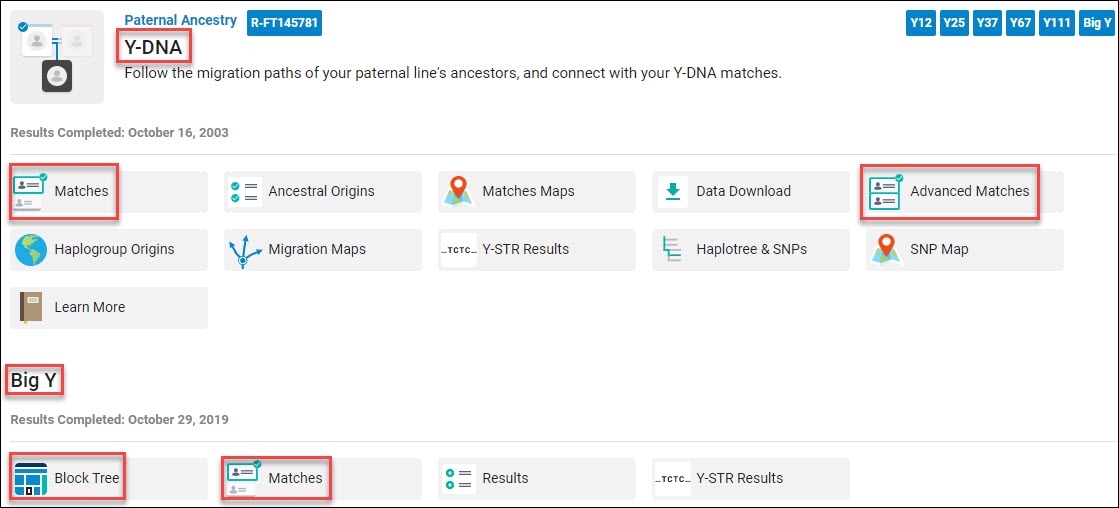
The most popular tabs are shown individually under each product, with additional features being grouped under “See More.”
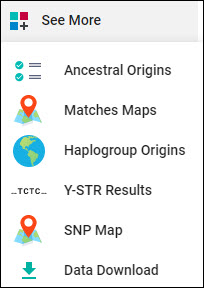
Every product now has a “See More” link where less frequently used widgets will be found, including the raw data downloads. This is the Y DNA “See More” dropdown by way of example.

You can see the green Updated badge on the Family Finder Matches tab. I don’t know if that badge will always appear when customers have new matches, or if it’s signaling that all customers have updated Family Finder Matches now.

We’ll talk about matches in the Family Finder section.

The Family Finder “See More” tab includes the Matrix, ancientOrigins, and the raw data file download.

The mitochondrial DNA section, titled Maternal Line Ancestry, mtDNA Results and Tools includes several widgets grouped under the “See More” tab.

Additional Tests and Tools

The Additional Tests and Tools area includes a link to your Family Tree (please do upload or create one,) Public Haplotrees, and Advanced Matches.

Public haplotrees are free-to-the-public Y and mitochondrial DNA trees that include locations. They are also easily available to FamilyTreeDNA customers here.

Please note that you access both types of trees from one location after clicking the Public Haplotrees page. The tree defaults to Y-DNA, but just click on mtDNA to view mitochondrial haplogroups and locations. Both trees are great resources because they show the location flags of the earliest known ancestors of the testers within each haplogroup.

Advanced Matches used to be available from the menu within each test type, but since advanced matching includes all three types of tests, it’s now located under the Additional Tests and Tools banner. Don’t forget about Advanced Matches – it’s really quite useful to determine if someone matches you on multiple types of tests and/or within specific projects.

Hey, look – I found a tooltip. Just mouse over the text and tabs on various pages to see where tooltips have been added.

Help and Help Center

The new Help Center is debuting in this release. The former Learning Center is transitioning to the Help Center with new, updated content.

Here’s an example of the new easy-to-navigate format. There’s a search function too.

Each individual page, test type, and section on your personal home page has a “Helpful Information” button.

On the main page, at the top right, you’ll see a new Help button.

Did you see that Submit Feedback link?

If you click on the Help Center, you’ll be greeted with context-sensitive help.

I clicked through from the dashboard, so that’s what I’m seeing. However, other available topics are shown at left.

I clicked on both of the links shown and the content has been updated with the new layout and features. No wonder they launched a new Help Center!

Account Settings

Account settings are still found in the same place, and those pages don’t appear to have changed. However, please keep in mind that some settings make take up to 24 hours to take effect.

Family Finder Rematching

Before we look at what has changed on your Family Finder pages, let’s talk about what happened behind the scenes.

FamilyTreeDNA has been offering the Family Finder test for 11 years, one of two very early companies to enter that marketspace. We’ve learned so much since then, not only about DNA itself, but about genetic genealogy, matching, triangulation, population genetics, how to use these tools, and more.

In order to make improvements, FamilyTreeDNA changing the match criteria which necessitated rematching everyone to everyone else.

If you have a technology background of any type, you’ll immediately realize that this is a massive, expensive undertaking requiring vast computational resources. Not only that, but the rematching has to be done in tandem with new kits coming in, coordinated for all customers, and rolled out at once. Based on new matches and features, the user interface needed to be changed too, at the same time.

Sounds like a huge headache, right?

Why would a company ever decide to undertake that, especially when there is no revenue for doing so? The answer is to make functionality and accuracy better for their customers. Think of this as a new bedrock foundation for the future.

FamilyTreeDNA has made computational changes and implemented several features that require rematching:

  • Improved matching accuracy, in particular for people in highly endogamous populations. People in this category have thousands of matches that occur simply because they share multiple distant ancestors from within the same population. That combination of multiple common ancestors makes their current match relationships appear to be closer in time than they are. In order to change matching algorithms, FamilyTreeDNA had to rewrite their matching software and then run matching all over to enable everyone to receive new, updated match results.
  • FamilyTreeDNA has removed segments below 6 cM following sustained feedback from the genealogical community.
  • X matching has changed as well and no longer includes anyone as an X match below 6 cM.
  • Family Matching, meaning paternal, maternal and both “bucketing” uses triangulation behind the scenes. That code also had to be updated.
  • Older transfer kits used to receive only closer matches because imputation was not in place when the original transfer/upload took place. All older kits have been imputed now and matched with the entire database, which is part of why you may have more matches.
  • Relationship range calculations have changed, based on the removal of microsegments, new matching methodology and rematching results.
  • FamilyTreeDNA moved to hg37, known as Build 37 of the human genome. In layman’s terms, as scientists learn about our DNA, the human map of DNA changes and shifts slightly. The boundary lines change somewhat. Versions are standardized so all researchers can use the same base map or yardstick. In some cases, early genetic genealogy implementers are penalized because they will eventually have to rematch their entire database when they upgrade to a new build version, while vendors who came to the party later won’t have to bear that internal expense.

As you can see, almost every aspect of matching has changed, so everyone was rematched against the entire database. You’ll see new results. Some matches may be gone, especially distant matches or if you’re a member of an endogamous population.

You’ll likely have new matches due to older transfer kits being imputed to full compatibility. Your matches should be more accurate too, which makes everyone happy.

I understand a white paper is being written that will provide more information about the new matching algorithms.

Ok, now let’s check out the new Family Finder Matches page.

Family Finder Matches

FamilyTreeDNA didn’t just rearrange the furniture – there’s a LOT of new content.

First, a note. You’ll see “Family Finder” in some places, and “Autosomal DNA” in other places. That’s one and the same at FamilyTreeDNA. The Family Finder test is their autosomal test, named separately because they also have Y DNA and mitochondrial DNA tests.

When you click on Family Finder matches for the first time, you will assuredly notice one thing and will probably notice a second.

First, you’ll see a little tour that explains how to use the various new tools.

Secondly, you will probably see the “Generating Matches” notice for a few seconds to a few minutes while your match list is generated, especially if the site is busy because lots of people are signing on. I saw this message for maybe a minute or two before my match list filled.

This should be a slight delay, but with so many people signing in right now, my second kit took longer. If you receive a message that says you have no matches, just refresh your page. If you had matches before, you DO have matches now.

While working with the new interface this morning, I’ve found that refreshing the screen is the key to solving issues.

My kits that have a few thousand matches loaded Family Matching (bucketing) immediately, but this (Jewish) kit that has around 30,000 matches received this informational message instead. FamilyTreeDNA has removed the little spinning icon. If you mouse over the information, you’ll see the following message:

This isn’t a time estimate. Everyone receives the same message. The message didn’t even last long enough for me to get a screenshot on the first kit that received this message. The results completed within a minute or so. The Family Matching buckets will load as soon as the parental matching is ready.

These delays should only happen the first time, or if someone has a lot of matches that they haven’t yet viewed. Once you’ve signed in, your matches are cached, a technique that improves performance, so the loading should be speedy, or at least speedier, during the second and subsequent visits.

Of course, right now, all customers have an updated match list, so there’s something new for everyone.

Getting Help

Want to see that tutorial again?

Click on that little Help box in the upper right-hand corner. You can view the Tutorial, look at Quick References that explain what’s on this page, visit the Help Center or Submit Feedback.

Two Family Finder Matches Views – Detail and Table

The first thing you’ll notice is that there are two views – Detail View and Table View. The default is Detail View.

Take a minute to get used to the new page.

Detail View – Filter Matches by Match Type

I was pleased to see new filter buttons, located in several places on the page.

The Matches filter at left allows you to display only specific relationship levels, including X-Matches which can be important in narrowing matches to a specific subset of ancestors.

You can display only matches that fall within certain relationship ranges. Note the new “Remote Relative” that was previously called speculative.

Parental Matching and Filtering by Test Type or Trees

All of your matches are displayed by default, of course, but you can click on Paternal, Maternal or Both, like before to view only matches in those buckets. In order for the Family Matching bucketing feature to be enabled, you must attach known relatives’ DNA matches to their proper place in your tree.

Please note that I needed to refresh the page a couple of times to get my parental matches to load the first time. I refreshed a couple of times to be sure that all of my bucketed matches loaded. This should be a first-time loading blip.

There’s a new filter button to the right of the bucketing tabs.

You can now filter by who has trees and who has taken which kinds of tests.

You can apply multiple filters at the same time to further narrow your matches.

Important – Clearing Filters

It’s easy to forget you have a filter enabled. This section is important, in part because Clear Filter is difficult to find.

The clear filter button does NOT appear until you’ve selected a filter. However, after applying that filter, to clear it and RESET THE MATCHES to unfiltered, you need to click on the “Clear Filter” button which is located at the top of the filter selections, and then click “Apply” at the bottom of the menu. I looked for “clear filter” forever before finding it here.

You’re welcome😊

Enhanced Search

Thank goodness, the search functionality has been enhanced and simplified too. Full name search works, both here and on the Y DNA search page.

If you type in a surname without selecting any search filters, you’ll receive a list of anyone with that word in their name, or in their list of ancestral surnames. This does NOT include surnames in their tree if they have not added those surnames to their list of ancestral surnames.

Notice that your number of total matches and bucketed people will change based on the results of this search and any filters you have applied.

I entered Estes in the search box, with no filters. You can see that I have a total of 46 matches that contain Estes in one way or another, and how they are bucketed.

Estes is my birth surname. I noticed that three people with Estes in their information are bucketed maternally. This is the perfect example of why you can’t assume a genetic relationship based on only a surname. Those three people’s DNA matches me on my mother’s side. And yes, I confirmed that they matched my mother too on that same segment or segments.

Search Filters

You can also filter by haplogroup. This is very specific. If you select mitochondrial haplogroup J, you will only receive Family Finder matches that have haplogroup J, NOT J1 or J1c or J plus anything.

If you’re looking for your own haplogroup, you’ll need to type your full haplogroup in the search box and select mtDNA Haplogroup in the search filter dropdown.

Resetting Search Results

To dismiss search results, click on the little X. It’s easy to forget that you have initiated a search, so I need to remember to dismiss searches after I’m finished with each one.

Export Matches

The “Export CSV” button either downloads your entire match list, or the list of filtered matches currently selected. This is not your segment information, but a list of matches and related information such as which side they are bucketed on, if any, notes you’ve made, and more.

Your segment information is available for download on the chromosome browser.

Sort By

The Sort By button facilitates sorting your matches versus filtering your matches. Filters ONLY display the items requested, while sorts display all of the items requested, sorting them in a particular manner.

You can sort in any number of ways. The default is Relationship Range followed by Shared DNA.

Your Matches – Detail View

A lot has changed, but after you get used to the new interface, it makes more sense and there are a lot more options available which means increased flexibility. Remember, you can click to enlarge any of these images.

To begin with, you can see the haplogroups of your matches if they have taken a Y or mitochondrial DNA test. If you match someone, you’ll see a little check in the haplogroup box. I’m not clear whether this means you’re a haplogroup match or that person is on your match list.

To select people to compare in the chromosome browser, you simply check the little square box to the left of their photo and the chromosome browser box pops up at the bottom of the page. We’ll review the chromosome browser in a minute.

The new Relationship Range prediction is displayed, based on new calculations with segments below 6 cM removed. The linked relationship is displayed below the range.

A linked relationship occurs when you link that person to their proper place in your tree. If you have no linked relationship, you’ll see a link to “assign relationship” which takes you to your tree to link this person if you know how you are related.

The segments below 6 cM are gone from the Shared DNA total and X matches are only shown if they are 6 cM or above.

In Common With and Not In Common With

In Common With and Not In Common With is the little two-person icon at the right.

Just click on the little person icon, then select “In Common With” to view your shared matches between you, that match, and other people. The person you are viewing matches in common with is highlighted at the top of the page, with your common matches below.

You can stack filters now. In this example, I selected my cousin, Don, to see our common matches. I added the search filter of the surname Ferverda, my mother’s maiden name. She is deceased and I manage her kit. You can see that my cousin Don and I have 5 total common matches – four maternal and one both, meaning one person matches me on both my maternal and paternal lines.

It’s great news that now Cousin Don pops up in the chromosome browser box at the bottom, enabling easy confusion-free chromosome segment comparisons directly from the In Common With match page. I love this!!!.

All I have to do now is click on other people and then on Compare Relationship which pushes these matches through to the chromosome browser. This is SOOOO convenient.

You’ll see a new tree icon at right on each match. A dark tree means there’s content and a light tree means this person does not have a tree. Remember, you can filter by trees with content using the filter button beside “Both”.

Your notes are shown at far right. Any person with a note is dark grey and no note is white.

If you’re looking for the email contact information, click on your match’s name to view their placard which also includes more detailed ancestral surname information.

Family Finder – Table View

The table view is very similar to the Detail View. The layout is a bit different with more matches visible in the same space.
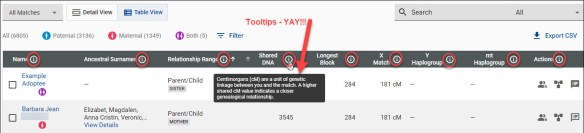
This view has lots of tooltips on the column heading bar! Tooltips are great for everyone, but especially for people just beginning to find their way in the genetic genealogy world.

I’ll have to experiment a bit to figure out which view I prefer. I’d like to be able to set my own default for whichever view I want as my default. In fact, I think I’ll submit that in the “Submit Feedback” link. For every suggestion, I’m going to find something really positive to say. This was an immense overhaul.

Chromosome Browser

Let’s look at the chromosome Browser.

You can arrive at the Chromosome Browser by selecting people on your match page, or by selecting the Chromosome Browser under the Results and Tools link.

Everything is pretty much the same on the chromosome browser, except the default view is now 6 cM and the smaller segments are gone. You can also choose to view only segments above 10 cM.

If you have people selected in the chromosome browser and click on Download Segments in the upper right-hand corner, it downloads the segments of only the people currently selected.

You can “Clear All” and then click on Download All Segments which downloads your entire segment file. To download all segments, you need to have no people selected for comparison.

The contents of this file are greatly reduced as it now contains only the segments 6 cM and above.

Family Tree

No, the family tree has not changed, and yes, it needs to, desperately. Trust me, the management team is aware and I suspect one of the improvements, hopefully sooner than later, will be an improved tree experience.

Y DNA

The Y DNA page has received an update too, adding both a Detail View and a Table View with the same basic functionality as the Family Finder matching above. If you are reading this article for Y DNA only, please read the Family Finder section to understand the new layout and features.

Like previously, the match comparison begins at the 111 marker level.

However, there’s a BIG difference. If there are no matches at this level, YOU NEED TO CLICK THE NEXT TAB. You can easily see that this person has matches at the 67 level and below, but the system no longer “counts down” through the various levels until it either finds a level with a match or reaches 12 markers.

If you’re used to the old interface, it’s easy to think you’re at the final destination of 12 markers with no matches when you’re still at 111.

Y DNA Detail View

The Y-DNA Detail and Table views features are the same as Family Finder and are described in that section.

The new format is quite different. One improvement is that the Paternal Country of Origin is now displayed, along with a flag. How cool is that!

The Paternal Earliest Known Ancestor and Match Date are at far right. Note that match dates have been reset to the rerun date. At this point, FamilyTreeDNA is evaluating the possibility of restoring the original match date. Regardless, you’ll be able to filter for match dates when new matches arrive.

Please check to be sure you have your Country of Origin, Earliest Known Ancestor, and mapped location completed and up to date.

Earliest Known Ancestor

If you haven’t completed your Earliest Known Ancestor (EKA) information, now’s the perfect time. It’s easy, so let’s do it before you forget.

Click on the Account Settings gear beneath your name in the right-hand upper corner. Click on Genealogy, then on Earliest Known Ancestors and complete the information in the red boxes.

  • Direct paternal line means your father’s father’s father’s line – as far up through all fathers as you can reach. This is your Y DNA lineage, but females should complete this information on general principles.
  • Direct maternal line means your mother’s mother’s mother’s line – as far up through all mothers that you can reach. This is your mitochondrial DNA lineage, so relevant for both males and females.

Completing all of the information, including the location, will help you and your matches as well when using the Matches Map.

Be sure to click Save when you’re finished.

Y DNA Filters

Y DNA has more filter options than autosomal.

The Y DNA filter, located to the right of the 12 Markers tab allows testers to filter by:

  • Genetic distance, meaning how many mutations difference between you and your matches
  • Groups meaning group projects that the tester has joined
  • Tree status
  • Match date
  • Level of test taken

If none of your matches have taken the 111 marker test or you don’t match anyone at that level, that test won’t show up on your list.

Y DNA Table View

As with Family Finder, the Table View is more condensed and additional features are available on the right side of each match. For details, please review the Family Finder section.

If you’re looking for the old Y DNA TiP report, it’s now at the far right of each match.

The actual calculator hasn’t changed yet. I know people were hoping for the new Y DNA aging in this release, but that’s yet to follow.

Other Pages

Other pages like the Big Y and Mitochondrial DNA did not receive new features or functionality in this release, but do sport new user-friendly tooltips.

I lost track, but I counted over 100 tooltips added across the platform, and this is just the beginning.

There are probably more new features and functionality that I haven’t stumbled across just yet.

And yes, we are going to find a few bugs. That’s inevitable with something this large. Please report anything you find to FamilyTreeDNA.

Oh wait – I almost forgot…

New Videos

I understand that there are in the ballpark of 50 new videos that are being added to the new Help Center, either today or very shortly.

When I find out more, I’ll write an article about what videos are available and where to find them. People learn in various ways. Videos are often requested and will be a popular addition. I considered making videos, but that’s almost impossible for anyone besides the vendor because the names on screens either need to be “fake” or the screen needs to be blurred.

So hurray – very glad to hear these are imminent!

Stay Tuned

Stay tuned for new developments. As Lior said, FamilyTreeDNA is investing heavily in genetic genealogy and there’s more to come.

My Mom used to say that the “proof is in the pudding.” I’d say the myDNA/FamilyTreeDNA leadership team has passed this initial test with flying colors.

Of course, there’s more to do, but I’m definitely grateful for this lovely pudding. Thank you – thank you!

I can’t wait to get started and see what new gems await.

Take a Look!

Sign in and take a look for yourself.

Do you have more matches?

Are your matches more accurate?

How about predicted relationships?

How has this new release affected you?

What do you like the best?

_____________________________________________________________

Disclosure

I receive a small contribution when you click on some of the links to vendors in my articles. This does NOT increase the price you pay but helps me to keep the lights on and this informational blog free for everyone. Please click on the links in the articles or to the vendors below if you are purchasing products or DNA testing.

Thank you so much.

DNA Purchases and Free Transfers

Genealogy Products and Services

Books

Genealogy Research

Heads Up – Great Changes Coming at FamilyTreeDNA

This should be subtitled “Confessions of a Squeaky Wheel.”

Yes, I’ve been incessantly squeaky for a long time now, and it looks for all the world like this nagging, er, squeaking has worked.

Just a few minutes ago, this email arrived from FamilyTreeDNA, addressed to project administrators.

There’s at least one thing that’s time-sensitive, so be sure to read this today.

You may have been one of the FamilyTreeDNA customers who received one of two surveys a few weeks ago, after myDNA merged with FamilyTreeDNA. FamilyTreeDNA asked for feedback about what customers would like to see.

At that time, there was a raft of unfounded rumors that myDNA wasn’t committed to genealogy.

That was wrong, dead wrong. Couldn’t be further from the truth, and that’s not just extrapolated from this email. It’s a function of being that squeaky wheel. Based on this, FamilyTreeDNA obviously listened.

This is certainly welcome news!

That list of things we’ve been asking for…well, here you go.

Increased matches for many, along with improved matches. Did you see that?

There’s a lot here. It’s no wonder the matches page has been redesigned with all these new features.

It looks like the Y DNA page has been redesigned for the same reason. No mention of mitochondrial DNA though. Maybe that’s coming soon.

Thank goodness – a new Help Center.

And VIDEOs too!!!

Yes!!!

Ok, who loves that “Houston we have a problem” message? No one with their hand up? Me either.

However, I’ve already seen an improvement over the past few weeks, so maybe this has been an ongoing behind-the-scenes process.

And tooltips too!

For those who don’t know, a tooltip is a little information box with a couple of sentences that you can just mouse over. For example, a good place for a tooltip would be on the column headers explaining what that column means.

Ok, here’s the time-sensitive part.

I know FamilyTreeDNA said that they had closed the National Geographic Genographic transfer portal a year ago, but clearly they left it open as a courtesy.

However, with all these changes, it’s going away for good, now.

If you don’t transfer your Nat Geo Genographic kit before end of day on June 30th, you will not be able to do so. You can find instructions, here.

What’s Next?

We don’t know when these features will be released, exactly, but we do know it’s coming in July.

The fact that the Genographic transfer is gone as of June 30th suggests that at least some changes are imminent.

This cumulative list equates to a huge change, so I’d wager that it won’t be one big release, but a series of releases that build on each other.

I don’t know about you, but I can hardly wait. I’ll be writing about the new features as soon as they arrive.

I’m signing in now to record the number of matches I have so I can compare when the new features arrive. You can too, by clicking here.

If you have kits from other vendors that you’ve been meaning to upload to FamilyTreeDNA, now would be a great time to do that. You can find step-by-step instructions for downloading raw data files from each vendor and uploading them elsewhere, here.

Feel free to share this article with groups or anyone else who might be interested!

_____________________________________________________________

Disclosure

I receive a small contribution when you click on some of the links to vendors in my articles. This does NOT increase the price you pay but helps me to keep the lights on and this informational blog free for everyone. Please click on the links in the articles or to the vendors below if you are purchasing products or DNA testing.

Thank you so much.

DNA Purchases and Free Transfers

Genealogy Products and Services

Books

Genealogy Research

How Many Men Discover or Confirm Their Surname with Y DNA Testing?

About 15 years ago, Bennett Greenspan, founder of FamilyTreeDNA, at one of the early conferences said that about 30% of men who take a Y DNA test find a strong surname match. That number has increased now to nearly 100%, or “almost everyone.”

Exceptions

Of course, there are exceptions that fall into a number of categories:

  • Jewish families from regions where surnames weren’t adopted until in the 1800s.
  • Jewish families whose direct paternal line suffered dramatic losses during the Holocaust.
  • Dutch families who did not adopt surnames until Napoleon’s edict in 1811.
  • Cultures who have or recently had patronymic surnames that change every generation.
  • Men whose DNA is either extremely rare (and no relatives have tested) or are from under-sampled regions of the world.
  • Males whose paternal line may be recent immigrants and people in the homeland don’t participate in genealogy or don’t DNA test.
  • Males whose ancestors were enslaved. In the US, families adopted surnames after the Civil War ended slavery in the 1860s, so Y DNA testing plus autosomal is critically important to reunite these families. Please note that the Y DNA haplogroup, even an estimate provided with STR testing, will indicate whether the direct paternal lineage is European, African, Native American/Asian – all of which are found in the descendants of men who were enslaved. The Big Y-700 provides significantly more information along with placement on the haplotree.

I started writing Y DNA reports for clients in 2004 (although I no longer accept private clients) and at that time, often saw men with no matches. Today, a man with no matches is extremely unusual, and most have strong surname matches. As more men test, everyone will have more matches, of course, and the more we can learn about our ancestors.

What do matches reveal?

Matches Reveal

In essence, matches to other men with common surnames do one of two things:

  1. Confirm the surname lineage, at least to the common ancestor.
  2. Identify the surname where the tester is likely to find his ancestral roots.
  3. Provide perspective further back in time answering the question, “Where did I come from?”

Of course, this second point is crucial for males searching for the identity of their paternal lines.

While time has moved on, the number of testers in the database has dramatically increased, and almost everyone has relevant matches now – I still see the 30% metric oft-repeated. Let’s put this to the test and see what we find.

Setting Up the Experiment

I selected 20 men who have taken the Big Y test whose kits I manage or who were randomly selected from projects that I manage and who have given permission for their results to be published on public project pages.

I recorded results for the tester’s own or very similar surnames. Slightly different but recognizable spellings are counted as the same name.

I included matches at 12 markers, 111 markers, and the Big Y results. Men who purchase or upgrade to the Big Y-700 test will have all 111 STR panel markers included. Obviously, individual testers should check their results at every level.

Big Y testers actually receive 700+ STR markers, but can only easily filter for matches at 111 (or below), so that’s the number I used. Plus, males can purchase  37 and 111 panels without taking the Big Y test, so this comparative information will be valid for all Y DNA testers.

Click to enlarge image.

Additionally, I used the Advanced Matches feature to check for people who match someone on BOTH the Y DNA and their Family Finder autosomal test. Of course, this doesn’t guarantee that the reason they match on both tests is because of their common surname line – but it’s a hint and may be very useful, especially with closer Family Finder matches.

I intentionally included some men with recent European heritage who are unlikely to have matches simply because their families have been in colonial America since the 1600s or 1700s and their ancestor had a dozen sons who each had a dozen sons.

Why Did I Include 12 Marker Results?

You may wonder why I included 12 marker matches since that test is no longer sold individually and is the least granular. Truthfully, it’s too often deemed useless and overlooked.

Hear me out on this one😊

Many of the men who originally took the 12 and 25 marker tests, before the higher panels (37, 67, 111, and Big Y) were available are deceased now. Twenty years is a generation, and FamilyTreeDNA began testing the Y chromosome in the year 2000.

While these low marker tests alone are not conclusive, with additional information, such as trees, common ancestors, and other testers who match, they form pieces of evidence that can be invaluable. Some have also taken an autosomal test which can be especially important, given that they are another generation or two (or three) further back in time than the people testing today.

You won’t see these men as matches at 37, 67 or 111 markers, because they are deceased and can’t upgrade, but they may provide the nugget of information you need by matching at 12 or 25 markers. You’ll need to evaluate that match in light of other information. I’ll review that in the next two sections.

20 Men

If you’re a man or can find a male to test for each of your genealogy lines, the Y DNA is the fastest, most reliable way to identify an ancestral surname – not just in your father’s generation, but moving back in time.

Of the 20 men selected, all men had matches to their surname. However, one Smith man, #18, had a unique situation that might be very genealogically relevant.

I’ll discuss each match briefly with some commentary below the chart.

Surname Match Name 12 Marker 111 Marker Big Y Advanced – 12 + FF Both
1 Howery Howery 9 of 20 2 of 2 0 (none tested) 1
2 Graves Graves 8 of 51 2 of 8 1 Graves + others 1 – different surname
3 Perkins Perkins/McDonald 16 of 1762 1 of 63, many McDonalds 0 Perkins (no testers) but several McD names 8 – 2 McDonald
4 Napier Napier 19 of 19,217 2 of 13 2 Napier + others 1 + many others
5 Rice Rice 45 of 58 14 of 19 7 of 10 1
6 Rader Rader  13 of 18,576 7 of 7 7 3
7 Estes Estes 69 of 502 21 of 24 9 of 10 2 + 4 different surname
8 Campbell Campbell 178 of 369 61 of 103 7 of 10 4 of 5
9 Lentz Lentz 1 of 1 0 of 1 1 different name, no other Lentz Big Y testers 0
10 Bonnevie Bonnevie 1 of 1 (tested to 37) 0 0 no test
11 Vannoy Vannoy 7 of 49 2 of 4 0 of 1 0
12 Lore/Lord Lore/Lord 3 of 7 1 of 3 1 of 1 0
13 Clarkson/Claxton Clarkson/Claxton 19 of 540 1 of 1 0 of 9 (No Big Y testers) 0 of 3
14 Muncey Muncy/Muncey 9 of 155 7 of 16 1 of 4 1
15 Miller Miller 5 of 6 2 at 67, no 111 testers 0 – no Miller match testers 1 of 2
16 Speak(s) Speak(s) 9 of 9 21 of 51 4 of 17 0
17 Smith Smith/Jennings 2 of 16, 9 Jennings 0 of 2 (Jennings) 1 Jennings of 3 1 Jennings
18 Bolton Bolton 8 of 1750 2 of 2 0 of 28 0 of 12
19 Crumley Crumley 10 of 79 7 of 93 3 of 127 0 of 2
20 Harrell Harrell 81 of 17,638 3 of 7 2 of 2 0 of 119

Messages Revealed in the Results

Let’s briefly review the information we’ve discovered and extrapolate from each of these 20 matches. Analysis is the key to success.

  1. The Howery surname is rather unusual. This man had only two 111 marker matches and both were to men of the same surname. Half of his 12 marker matches are the same surname. None of his matches had taken the Big Y test, so he has no same-surname or other surname matches there. He did match one of his Y DNA matches on the Family Finder test though. This is high-quality confirmation that Howery is indeed the biological ancestral surname and our tester can set about finding and confirming his common ancestors with his matches.
  2. The Graves male had several 12-marker matches, but many 12-marker matches have not tested at the 111 marker level. He matches one Graves male on the Big Y plus some men with other surnames. The Big Y reaches back further in time, so these matches may reflect common ancestors before the advent of surnames.
  3. Our Perkins male has very interesting matches. He does have both 12 and 111 Perkins matches, but he also had a LOT of McDonald matches. More McDonald matches than Perkins matches. This suggests that indeed, his ancestors were Perkins, at least back to the earliest known ancestor (EKA), but before that, he may well be a member of the McDonald Y DNA clan. There were no Perkins Big Y testers, but if I were him, I’d ask my Perkins matches to upgrade.
  4. I can tell by looking at the huge number of 12 marker matches for our Napier man that he is haplogroup R, the most common in Europe, with an EXTREMELY common 12 marker haplotype. Note how dramatically the number of 111 marker matches drops – from 19,000+ to 13 – a perfect example of why we suggest men upgrade to at least 111 markers to refine their matches. Both of his 111 marker Napier matches have upgraded to the Big Y, and he matches them there as well. He does match one Napier on both the 12 marker test and Family Finder Advanced Matching – but he also matches MANY other men. This is because of the extremely high number of 12 marker matches. In his case, I would only use Y DNA marker panels higher than 12 markers in the Advanced Matching.
  5. Lots of Rice testers from this line confirm a common ancestor. I wonder if there is a Rice male from someplace overseas who has tested. If so, this might be that “jump the pond” event that genealogists who have European ancestors who are found in colonial America seek.
  6. Our Rader tester also has many 12 marker matches, but his only matches at 111 and on the Big Y are his Rader kinsmen. No doubt about that surname whatsoever.
  7. My Estes line has several 12 marker matches, but that gets slimmed right down at 111 markers. Using the Big Y test, we further divided those branches of Estes men. I literally could not have sorted out who was descended from whom without the Big Y test results. Way too many Johns, Williams, and Elishas in burned counties in Virginia.
  8. Our Campbell tester is unquestionably confirmed to be descended from the Clan Campbell line from Inverary, Scotland. However, the challenge in this family is which Campbell male they descend from in Virginia. The Big Y-700 test has narrowed the possibilities significantly, and the tester is currently in the process of attempting to convince his three closest Y STR 111 matches to take the Big Y test. Yes, he has offered to pay as well. Hey, in genealogy, you do what you need to do. Y DNA is likely the only way this puzzle from the 1700s will ever be unraveled.
  9. The Lentz line is German with rare DNA, but they do have a confirming match to another Lentz male.
  10. Bonnievie spelled various ways is French and has one 12 marker match who only tested to 37 markers. He has no matches above that. Not only is his Y DNA quite rare, DNA testing is illegal in France which makes additional testers few and far between. Unfortunately, his one match has not taken a Family Finder test either.
  11. Several men from the Vannoy line have tested and a Big Y test match to another man confirmed that the ancestral line is Dutch – not French as was speculated for decades. The STR tests have revealed Vannoy lines, by similar spellings, from lines we didn’t know existed.
  12. Lore or Lord is a rare Acadian family surname. Our tester does have matches to other Lore/Lord men, which confirms the line to the ancestor who arrived in Acadia in the early 1600s, but future testers will be needed before we can confirm his origins to either France or as one of the English soldiers who served at the fort.
  13. The Clarkson/Claxton testers confirm two lines, one spelled each way, from Tennessee and North Carolina line to a common ancestor in either Virginia or North Carolina in the 1770s. However, the family is still working to further assemble that puzzle. Finding a Clarkson/Claxton match on STR markers or the Big Y who descends from a male not from the two known lines would help immensely. Our hope is that a Clarkson/Claxton from an earlier line or from the British Isles will test and provide that push over the brick wall. Any Clarkson/Clarkson men out there who haven’t taken the Y DNA test yet?
  14. The Muncy/Munsey line is confirmed to a common ancestor born in England in and died on Long Island in 1674. Based on both STR and SNP results from the Big Y, we can narrow the lineages of Muncy men who test and aren’t familiar with their Muncy genealogy. Of course, the Muncy line eventually migrated through Virginia and seemingly named every man in every generation either John, Samuel or Francis – but DNA testing helps immensely to sort this out.
  15. While Miller is a very common occupation surname, DNA testing has put to rest many incorrect myths about this particular Swiss Miller line. Men with the same surname in the same location, even in the same church, does not equate to the same genetic family line. Any male with a common surname absolutely needs to do Y DNA testing and at the highest level. There’s nothing worse than spending countless hours barking up the wrong tree – especially when Y DNA testing will save you.
  16. Our Speaks man matched another Speak male who knew where his ancestors were from in Lancashire. Testing additional men living in Lancashire at the 111 marker and Big Y levels allowed the Speak line to be divided into specific lineages beginning in the 1500s, piecing together the earlier ancestors into a descendant tree. Recently, an “orphan” line in the US has been connected to his ancestors, thanks to both STR values AND Big Y testing.
  17. Smith is quite interesting because we discover that something doesn’t add up. Our Smith man matches two Smith men who have the same ancestor born in 1810 but that son, John, does not match the descendants of his brothers. There seems to be an undocumented adoption of some sort at that point in time. John Smith’s Y DNA is not the same as his brothers whose descendants match each other. Given that our Smith tester, and his two matches, do not match the other descendants of the ancestor they are supposed to descend from, we can pinpoint the generation in which the adoption event occurred. However, we have a further clue, because these Smith men match the Jennings line closely- including one advanced match where the Smith man also matches autosomally in addition to the Y DNA. This is clearly a case of “you don’t know what you don’t know” and would never have known without Y DNA testing.
  18. Our Bolton tester matches several other Bolton men who descend from a common immigrant ancestor. If the Bolton matches upgrade to the Big Y-700 test, they might be able to determine separate genetic lines branching through the various sons of the immigrant ancestor. Evaluating the surnames that the tester matches at the Big Y level may assist with evaluating deeper ancestry in England and determining where the Bolton ancestors originated before the 1600s in London.
  19. Crumley is a difficult family to research, in part because several people with the same surname are found in close proximity, but Y DNA testing has shown that these men are not related. Big Y testing has disproved that the Crumley progenitor originated in Germany, although a different Crumley family did. The Big Y matches include many Mc… surnames along with Ferguson and Gillespie. The Big Y Block Tree shows the closest matches with ancestors born in Scotland, Ireland, and Northern Ireland – which is very likely where the Crumley progenitor originated too.
  20. Harrell is another difficult surname, spelled numerous ways with several Harrell/Herrell/Harrold/Herrald families moving westward in the 1600s and 1700s from the thirteen original colonies. This Harrell line has not been able to connect to a single progenitor in the colonies, yet, but Y DNA testing and the block tree confirm that this Harrell line originated in the British Isles, very likely England.

What Did These 20 Men Learn?

Every single one of these men benefitted from Y DNA testing, although exactly how depends to some extent on their testing goal. Other men also benefitted by matching.

One man, our Smith, #17, needs to look at the Jennings family prior to 1810. Is there a Jennings man living in close proximity, or do court records exist that might be illuminating?

If one of these 20 men had been an adoptee or otherwise searching for an unknown paternal line, they would have been able to identify a surname connection and perhaps a progenitor ancestor. I encourage everyone to either order a Family Finder autosomal test or transfer a DNA file (for free) from another vendor if they have taken an autosomal test elsewhere. Step-by-step transfer instructions are found here. Be sure that the Y DNA and autosomal tests are on the same kit/account at FamilyTreeDNA so that you can use the advanced matching tool.

With the Big Y-700 test, these men can discern or confirm lines descending from their direct paternal ancestors – sometimes within a generation or two of the tester. This test is so sensitive and granular and has such deep coverage (millions of bases) now that often we find small mutations between fathers and sons or brothers.

While STR markers, 12-111 are genealogically important, they do tend to mutate rapidly and sometimes back-mutate. SNPs, tested in the Big Y-700 test, don’t do that, and the power of STRs and SNPs together have the potential to break down brick walls and correct trees. In fact, it happens every single day.

Resources

If you’d like to watch a video about Y DNA, Y DNA-related genetic terms, and the benefits of Big Y-700 testing, you can watch a great educational video by Janine Cloud here. Be sure to note the part where she talks about why people who have previously taken the Big Y-500 might want to upgrade to the Big Y-700.

Also, check out my Y DNA Resource page, here.

What Don’t You Know?

Y DNA tests, including the Big Y-700 which includes all STR panels, and the autosomal Family Finder test are on sale at FamilyTreeDNA right now for Father’s Day.

There’s no better time to find missing pieces and discover information that you can’t find any other way.

Click here to order Y DNA tests, the Family Finder, or upgrade an existing test.

_____________________________________________________________

Disclosure

I receive a small contribution when you click on some of the links to vendors in my articles. This does NOT increase the price you pay but helps me to keep the lights on and this informational blog free for everyone. Please click on the links in the articles or to the vendors below if you are purchasing products or DNA testing.

Thank you so much.

DNA Purchases and Free Transfers

Genealogy Products and Services

Books

Genealogy Research