2024 Retrospective – Plus New Color Version of Complete Guide to FamilyTreeDNA

I hope 2024 was a great year for you.

2024 was an amazing year that included the release of my new book, Complete Guide to FamilyTreeDNA, and two genealogy-focused trips. I was also able to use Y-DNA to extend multiple paternal lines and break down a mitochondrial brick wall. It hardly gets better than this, but I have a focus list for 2025 already – and I hope you do, too.

But before we move on to 2025, let’s take a look at what was popular in 2024. Did you miss anything? Now is a great time to review, and I’ve assembled a list of this year’s top ten articles for you.

2024 in Review

Each year, I look back at my blog’s end-of-year statistics to see which articles were the most popular. I published 75 articles in 2024, which is an article about every four and a half days.

The Top 10 List isn’t just compiled from this year’s new articles, but the top 10 articles read this year from all 1738 articles that I’ve published over the past 12.5 years. I’ve noted the publication year by the article name.

Four of this year’s top 10 also fall in the all-time top 10. Of course, articles that have been published longer have more time to accrue views.

Article 2024 All Time
Concepts – Calculating Ethnicity Percentages (2017) 1 2
442 Ancient Viking Skeletons Hold DNA Surprised – Does Your Y or Mitochondrial DNA Match? (2020) 2
Ancestral DNA Percentages – How Much of Them is in You? (2017) 3 5
Proving Native American Ancestry Using DNA (2012) 4 1
23andMe Trouble – Step-by-Step Instructions to Preserve Your Data and Matches (2024) 5
DNA Inherited from Grandparents and Great-Grandparents (2020) 6
Ancestry’s ThruLines and Shared Matches Now Require a Subscription (2024) 7
Native American Mitochondrial Haplogroups (2013) 8 10
FamilyTreeDNA Tree Integration with MyHeritage – Step-by-Step Instructions (2024) 9
Y-DNA: Step-by-Step Analysis (2020) 10

Consistently, Native American DNA, ethnicity, and inheritance prove to be overwhelmingly popular topics. This probably explains the success of my book, DNA for Native American Genealogy. It’s timeless, and there are always new people searching! Thank you to everyone who has purchased it.

Of course, articles about this year’s announcements in the genetic genealogy world are always popular. The articles that didn’t make the Top 10 List but are in the 11-20 category include articles from RootsTech, two more Native American articles,  determining full or half-siblingspedigree collapse, the Washington family burial article, plus one about my Acadian ancestors and their DNA.

Thank you to everyone who subscribes, reads, and comments. Please share this article or site link with another genealogist who you think might benefit. As you know, it’s easy to subscribe and completely free.

You can also search for keywords in articles throughout the year to answer questions when you see them on social media or elsewhere. It’s easy and educational to post or send an article link.

Complete Guide to FamilyTreeDNA – Now Available in Color

Are you ready for a good laugh?

As I was reviewing these articles, I thought to myself, “where’s the announcement of the new color version of my book, “The Complete Guide to FamilyTreeDNA”?

I literally forgot to publish that article. How could I?? I mean…seriously. (My excuse is that I was traveling, plus conferences and back-to-back hurricanes.)

So, here’s the (slightly late) mini-announcement.

Initially, in May, The Complete Guide to FamilyTreeDNA was released in a full-color e-pub version, which is available from the publisher here. You can take a look at the table of contents here.

That was followed shortly by the release of the black and white print version, available in the US from the publisher, here, and worldwide from your country’s Amazon. Selling outside the US through Amazon removes the issues of expensive international shipping, VAT tax, and customs, which significantly increases the cost of the book and delays its delivery.

The decision was made to publish initially in black and white due to printing costs, but lots of people requested a color book.

For those who have already purchased the black-and-white version, the publisher has provided a free downloadable PDF with 26 of the most critical pages in color. We really had no idea that people would be eager to purchase a color version, but that has proven to be the case, and we didn’t want earlier purchasers to be disappointed.

Drum Roll

You spoke, and we listened.

In the fall, we released a full-color print-on-demand version of The Complete Guide to FamilyTreeDNA. Again, in the US, the book is available from the publisher, here, and at Amazon elsewhere.

This book truly is comprehensive and includes both DNA education, along with how to use the FamilyTreeDNA tools, many of which are unique in the industry. For example, no other vendor offers either Y-DNA or mitochondrial DNA testing and matching.

You don’t know what you don’t know, and I encourage you to find out!

Thank You!

Thank you so much for your ongoing support. Twelve years strong, going on 13.

Be thinking about what you’d like to see in 2025, because I’m going to be asking you tomorrow!

_____________________________________________________________

Sign Up Now – It’s Free!

If you appreciate this article, subscribe to DNAeXplain for free, to automatically receive new articles by e-mail each week.

Here’s the link. Just look for the black “follow” button on the right-hand side on your computer screen below the black title bar, enter your e-mail address, and you’re good to go!

In case you were wondering, I never have nor ever will share or use your e-mail outside of the intended purpose.

_____________________________________________________________

Follow DNAexplain on Facebook, here.

Share the Love!

You’re always welcome to forward articles or links to friends and share on social media.

If you haven’t already subscribed (it’s free,) you can receive an e-mail whenever I publish by clicking the “follow” button on the main blog page, here.

You Can Help Keep This Blog Free

I receive a small contribution when you click on some of the links to vendors in my articles. This does NOT increase your price but helps me keep the lights on and this informational blog free for everyone. Please click on the links in the articles or to the vendors below if you are purchasing products or DNA testing.

Thank you so much.

DNA Purchases and Free Uploads

Genealogy Products and Services

My Books

Genealogy Books

Genealogy Research

Six Ways to Figure Out How We’re Related

In my latest Webinar, Six Ways to Figure Out How We’re Related, I discuss the various tools from Ancestry, FamilyTreeDNA, MyHeritage, and 23andMe – plus clusters from Genetic Affairs and the amazing DNAPainter.

This webinar lives in the Legacy Family Tree Webinar library, but as part of the “webtember” lineup, you can view it for free through the end of September.

It’s always exciting to discover a new match at one of the DNA testing companies, which, of course, begs the question of how you’re related.

So, what are the six ways to figure out how you’re related, and how do you use them?

Come along for a step-by-step guide!

Shared Matches

We begin with how each vendor handles shared matches, what that feature is called, where to find the information, and how to interpret what they are telling you.

23andMe goes a step further and creates a genetic tree, of sorts, although that functionality has changed since their breach last October.

Bucketing and Sides

Two vendors go a step further and provide unique tools to divide your matches maternally and paternally.

FamilyTreeDNA buckets your matches maternally and paternally (or both) based on matches you link to their profile cards in your tree. FamilyTreeDNA then uses your linked matches to triangulate with other matches and assign your matches accordingly, providing a maternal and paternal match list. Bucketing, also known as Family Matching, is one of my favorite tools.

Note that linking matches at FamilyTreeDNA requires that you have transferred your tree to MyHeritage. I wrote about that and provided instructions here and here, and produced a complimentary webinar, too.

Ancestry also divides your matches by parent, but they use a different technique based on their Sideview technology and either ethnicity or shared matches.

Surnames and Locations

Surnames and locations, either separately or together, provide HUGE hints!

MyHeritage provides a nice summary for each of your matches that includes ancestral surnames, a map of locations in common, and “Smart Matches” which shows you people in common in both of your trees. There are several ways to use these tools.

FamilyTreeDNA also provides a list of surnames. You can view either the surnames in common with a match, or all of their ancestral surnames, with locations if provided. The tester enters these surnames, and we review how to complete that step.

Ancestry also provides shared surnames, with clickable links to the number of people in your matches tree with that surname, plus common locations.

X-DNA

X-DNA is probably the most underutilized DNA matching tool. While each of the vendors actually test the X chromosome, only one, FamilyTreeDNA, provides X-matching. You can obtain X-matching results by uploading your DNA file to FamilyTreeDNA. I’ve provided upload/download instructions for all companies, here.

X-DNA has a very unique inheritance pattern because males only inherit an X chromosome from their mother which limits the number of potential common ancestors for any two testers. In other words, X-DNA matching does half your work for you!

Clustering Technology – AutoClusters, the Matrix and DNAPainter

In the past few years, match clustering has become a very useful tool. Clustering shows which of your matches match you and each other.

Genetic Affairs offers several flavors of these clusters, and both MyHeritage and GEDmatch have incorporated Genetic Affairs clusters into their product offerings.

If you haven’t used AutoClusters yet, by all means, try them out.

FamilyTreeDNA offers the Matrix, a slightly different version of clustering. You can select 10 people from your match list to see if they also match each other. Shared matches don’t automatically mean triangulation between you and those two people, or even that all three people descend from the same line. However, if the people are bucketed to your same side (parent) and they share common segments with you in the chromosome browser, they triangulate.

You’ll want to paint those matches to DNAPainter to determine which ancestor you share, especially if they haven’t provided a tree.

DNAPainter provides your chromosomes as the “canvas” upon which to paint your matches in order to correlate segments with ancestors and identify common ancestral lines with mystery matches.

Three vendors, FamilyTreeDNA, MyHeritage, and GEDmatch provide segment information with matches for you to paint. I illustrate how I walk segments back in time, identifying our most distant common ancestor possible.

Theories of Family Relativity and ThruLines

Both MyHeritage and Ancestry provide a combination of DNA matching and tree triangulation, where they search the trees of your DNA matches to find common ancestors with you – although their implementation is different.

MyHeritage’s Theories of Family Relativity provides varying theories about common ancestors for you and a specific match using both trees and historical documents. You can review the various pathways and confirm or reject theories. I love this tool.

Ancestry’s Thrulines functions a bit differently, showing you all of your matches that descend from a common ancestor in all your matches’ trees. Sometimes, the trees are incorrect, but Theories of Family Relativity and ThruLines should still be used as hints.

I showed how ThruLines helped me discover what happened to one of my ancestor’s grandchildren who was lost to the family at his mother’s death – and to all of us since. Not anymore.

Bonus – Y-DNA and Mitochondrial DNA at FamilyTreeDNA

Only FamilyTreeDNA offers both Y-DNA and Mitochondrial DNA testing and matching. All of the tools above pertain to autosomal DNA testing, which is named Family Finder at FamilyTreeDNA. Illustrated by the green arrow below, autosomal DNA testing measures and compares the DNA you inherited from each ancestral line, but that’s not the only game in town.

Y-DNA, in blue, for males, tracks the direct paternal line, which is the surname line in Western cultures. Mitochondrial DNA, in red, is passed from mothers to all of their children. Therefore, everyone can test, revealing matches and information about their mother’s direct matrilineal lineage.

Y-DNA testing includes the amazing Discover tool with a baker’s dozen different reports, including ancient DNA. Mitochondrial DNA will soon have its own MitoDiscover after the rollout of the new Mitotree.

Both tests include “Matches Maps” to help you determine how you are related to your matches, as well as where your ancestors came from before the advent of surnames.

The Advanced Matching feature allows you to select multiple tests to see if your matches match you on combined types of tests.

Tune In

Now that you know what we cover in the webinar, please tune in to see how to use these awesome tools. Be sure to fish in all four “ponds” plus GEDmatch, where you may find people who didn’t test at a company that provides a chromosome browser or matching segment information.

Tools provided by the DNA testing vendors facilitate multiple ways to determine how we match and which ancestor(s) we have in common.

You can watch the webinar, here.

Additionally, subscribers to Legacy Family Tree Webinars have access to the 25-page syllabus with even more information!

A Legacy Family Tree Webinar subscription normally costs $49.95 per year, but through the end of September, there’s a coupon code good for 20% off. Just click here, then enter webtember24 at the checkout.

Enjoy!

_____________________________________________________________

Follow DNAexplain on Facebook, here.

Share the Love!

You’re always welcome to forward articles or links to friends and share on social media.

If you haven’t already subscribed (it’s free,) you can receive an e-mail whenever I publish by clicking the “follow” button on the main blog page, here.

You Can Help Keep This Blog Free

I receive a small contribution when you click on some of the links to vendors in my articles. This does NOT increase your price but helps me keep the lights on and this informational blog free for everyone. Please click on the links in the articles or to the vendors below if you are purchasing products or DNA testing.

Thank you so much.

DNA Purchases and Free Uploads

Genealogy Products and Services

My Books

Genealogy Books

Genealogy Research

DNA Academy Webinar Series Released

Great news! Legacy Family Tree Webinars has just released DNA Academy.

DNA Academy is a three-part series designed to introduce the basics of DNA for genetic genealogy and how Y-DNA, X-DNA, mitochondrial and autosomal DNA can be utilized. Each of these different types of DNA serves a different function for genealogists – and reveals different matches and hints for genealogy.

  1. DNA Academy Part 1 introduces genetic genealogy basics, then, Ancestry’s DNA tools – including their new pricing structure for DNA features. Click here to view.
  2. DNA Academy Part 2 covers FamilyTreeDNA’s products. Click here to view the webinar, which includes:
    1. Y-DNA for males which tracks the direct paternal line
    2. Mitochondrial DNA for everyone which tracks your direct maternal line – your mother’s mother’s mother’s lineage
    3. Autosomal DNA which includes matches from all of your ancestral lines and along with X-DNA matching, which has a very distinctive inheritance path.
  3. DNA Academy Part 3 includes MyHeritage, 23andMe, and third-party tools such as DNAPainter and Genetic Affairs. Click here to view.

Legacy Family Tree Webinars has graciously made Part 2, the FamilyTreeDNA class, free through August 22nd for everyone – so be sure to watch now.

After August 22nd, Part 2 will join Part 1 and Part 3 in the webinar library for subscribers with more than 2240 webinars for $49.95 per year.

_____________________________________________________________

Follow DNAexplain on Facebook, here.

Share the Love!

You’re always welcome to forward articles or links to friends and share on social media.

If you haven’t already subscribed (it’s free,) you can receive an e-mail whenever I publish by clicking the “follow” button on the main blog page, here.

You Can Help Keep This Blog Free

I receive a small contribution when you click on some of the links to vendors in my articles. This does NOT increase your price but helps me keep the lights on and this informational blog free for everyone. Please click on the links in the articles or to the vendors below if you are purchasing products or DNA testing.

Thank you so much.

DNA Purchases and Free Uploads

Genealogy Products and Services

My Books

Genealogy Books

Genealogy Research

Bennett Greenspan: Meet My Extended Family & Discover Extraordinary Deep Heritage

“My ancestors are in my soul. I can’t get them out of my mind.”

Bennett Greenspan

“And yes, I brake for cemeteries.”

Bennett Greenspan gave an incredibly interesting presentation at the 15th International Genetic Genealogy Conference held by FamilyTreeDNA in November 2023. Since his retirement in January 2021, he has been able to focus on his genealogy. Once a genealogist, always a genealogist.

Bennett said some things I hadn’t thought about, and now I’m viewing Y-DNA matches with a different perspective – based on how he’s using his results.

Ever since I met him, Bennett’s focus has been to use genetics to unravel his complex Jewish heritage.

The questions that drive Bennett are the same ones that motivate most genealogists:

  1. Who are we?
  2. Where did we come from?
  3. Where were we before we were there?
  4. How did my ancestors get there?

Bennett “lost his family lines” before the mid-1800s due to his Jewish heritage, exacerbated in the 1930s by the devastation wrought by the Holocaust. Families were either killed or scattered to survive. It has been through Y-DNA in particular that he has been able to establish unquestionable and confirmed connections with other Greenspan men, sometimes by similar but different surnames, like Green, and sometimes with other surnames entirely.

When Bennett first started down this path, he tested more than 62 men before actually finding one a decade later that matched his Y-DNA. Bennet commented that it was “a little frustrating.”

Persistence is the key, and sometimes, genealogy is a waiting game, but that’s small comfort to genealogists during that unproductive waiting period.

Eventually, Bennett reassembled his family, at least somewhat, but it was a long journey. Here’s Bennett’s incredible story, including surprises, as he tells it.

Bennett discovered genealogy at age 12 and, like many genealogists, created a pedigree chart by talking to his family.

I love the mark-outs. How many of us still have our first chart with its edits?

This is the young Bennett Greenspan, whose interest in genealogy would one day unlock secrets for all of us!

It was a long way from a decade with no matches to finding his genetic kin in Ukraine.

The Big Y-700 Time Tree shows Bennett’s lineage in Ukraine, but stepping back in time, some descendants of his ancestors are found in adjacent locations.

Bennett was passionately discussing his matches on the time tree and in the Greenspan project, so I visited the Greenspan DNA Project, where the earliest known ancestors of Bennett’s Big Y matches are shown on the Group Time Tree.

Bennett’s closest matches are shown as descendants of haplogroup J-ZS1718. He has additional matches who are not in the Greenspan project. Since this is the Group Time Tree, it only displays the people in that project, along with their earliest known ancestors, Isaac and Usher Greenspan.

12-Marker Matches

Bennett never fails to amaze me. He said something very important and profound about 12-marker matches that I really hadn’t thought about – at least not this way.

As a community, we are often guilty of discounting 12-marker matches, those that don’t match us at 25-markers or above, or with different surnames, as “too far back in time” or otherwise irrelevant. I always look at the names and earliest known ancestors of 12-marker matches, because that person may have tested back in the day when fewer markers were available. But if I don’t recognize something, I move on.

However, Bennett said that, ”Y-12 matches reach back to a common ancestor. 12-marker matches are not a quirk. They are related to you, just further back in time. You share a common ancestor with them, someplace. They may be more distant, but they are still your close matches.”

I’ve been in too much of a hurry for a quick win, and ignoring the (apparently not so) obvious.

Determining when and where their ancestors lived also paves the way to discover yours. Your Y-DNA and theirs were in the same place at the same time.

Of Bennett’s 171 12-marker matches, 107 have upgraded to the Big Y, probably mostly due to his encouragement. This benefits both them and Bennett by fleshing out the history of that entire group of men, including how they got to where they are found in the first available records. The Time Tree shows when Big Y testers shared a common ancestor, and based on Earliest Known Ancestor (EKA) locations, where. This provides further information about the lives of ancestors before contemporary records – in other words – people that we can never identify by name. It’s a window into ancestors before surnames.

Bennett notes that testers need to know their ancestral village or location to be most useful within the project, and of course, they need to enter their EKA information. Location information is how the Migration Map, Matches Map, and Discover tools, including the Time Tree, are built.

What Happened in Spain?

Bennett’s ancestors and those of his 12-marker matches are found in Spain, and as Bennett says, “One son stayed and one left about the year 296.”

While we have no idea of their names, based on the Time Tree combined with the cluster of earliest known ancestors, we know that they were in Spain, and when.

Their family story is revealed in the bifurcation of the tree found beneath haplogroup J-L823, formed about 296 CE. One line stayed in Spain, and Bennett’s line migrated to eastern Europe where that man’s descendants, including Bennett’s family, are found in the Russian Federation, Belarus, Poland, Lithuania, Sweden, Slovakia, Ukraine, Germany, Romania, the Czech Republic, and other eastern European locations. The closer to you in the tree and in time, the more relevant to your more recent ancestral story.

However, Bennett’s deeper ancestry, the migration of his ancestors to Spain, was only revealed by testing those more distantly related men. Those same men could well have been ignored entirely because they only matched at 12 markers.

According to Bennett, “Y-12 markers are important because these are the men most closely related to you in a database of 1 million men.”

How incredibly profound. How much have I been cavalierly overlooking?

How does this actually apply to Bennett’s results?

Bennett’s Spanish Matches

Bennett has the following STR panel matches who indicate that their EKA are from Spain. You can see that they match Bennett on a variety of panels.

  • X = yes, match
  • No = no match
  • Blank = not tested at that level.

In the Big Y GD column, the genetic distance (GD) is displayed as 15/660 where 15 is the number of mismatches, or the cumulative genetic distance ABOVE the 111 panel, and 660 is the number of STR markers above 111 with results.

The Big Y-500 test guaranteed a minimum of 500 total STR markers, and the Big Y-700 guarantees a minimum of 700 total STR markers, plus multiple scans of the balance of the Y chromosome for SNP mutations that define haplogroups. Testers don’t receive the same number of markers because the scan technology sometimes doesn’t read a specific location.

Tester 12 25 37 67 111 Big Y Test Big Y GD Big Y Match Haplogroup
AA X X X No No Yes 15/660 No J-FTD8826
DT X X No No X Yes 17/664 No J-FTE50318
JG X X No No
AR No No X X No No
ELR X X X No No
EL X X Yes 17/666 No J-FTE50318
GC X X X X No No
JC X No No
JLG X X No No No Yes 14/662 No J-FTE23540
MF X X No X No Yes 15/665 No J-FTD91126
MT X X X X No No
BE X X X X X Yes 20/664 No J-BY1795
DR X X X X X Yes 16/660 No J-FTC87344
EC X X X X X Yes 15/665 No J-FTC87344
GM X X No No No Yes 16/650 No J-FTD28153
GM X X X X No Yes 17/664 No J-FTD11019
LS X X No No No Yes 18/666 No J-FTD28153
NE X X X X X Yes 23/597 No J-BY1795
NC X No No
RR X X X No X Yes 22/659 No J-BY1795
TT X X X X X Yes 16/647 No J-FTC87344
XG X X X No No Yes 17/523 No J-BY167283
JA X X No No No Yes 15/646 No J-FTD11019

Of those 23 Spanish matches, sixteen have upgraded to Big Y tests, 14 of which are Big Y-700s, resulting in nine different haplogroups, all of which are descendants of Haplogroup J-L823. How cool is that?

The “Nos” in the Big Y Match Column aren’t mistakes. That’s right – none of these men match Bennett on the Big Y test, meaning they had more than a 30 mutation difference between them and Bennett on the Big Y test.

At first glance, you’d think that Bennett would have been disappointed, but that’s not the case at all! In fact, it was the information provided by these distant Spanish matches that provided Bennett with the information that his line had split sometime around the year 296 CE, with one branch remaining in Spain and his branch migrating to Eastern Europe, where he has lots of matches.

DNA Plus History

What was happening in Spain or the Iberian peninsula that involved the Jewish people about that time? Historical records exist of Jews living in that region before the fall of the Second Temple in about 70 CE, including records of Jews being expelled from Rome in 139 for their “corrupting influence.”

Furthermore, the Ancient DNA Connections for haplogroup J-L823, the most recent common ancestor (MRCA) for all of those branches, includes connections to multiple burials from:

  • Lebanon
  • Iran
  • Rome (from 1-400 CE)
  • Turkey
  • Jordan

Clearly, Bennett’s ancestor was in the Iberian peninsula around or before 296 CE. One branch stayed, winding up in Spain, and one headed for Europe.

Without these matches, some who didn’t match above the 12 or 25 marker level, how would Bennett have EVER known that his Jewish ancestors left the Middle East for Spain in the early years? How would he have known they migrated from Spain to Eastern Europe, and how would he have known that his line did not migrate directly from the Levant to Eastern Europe in the 9th century?

Big Y matches are typically within about 1500 years, but non-matches are still INCREDIBLY valuable. Without them, you can’t completely assemble your family story.

I noticed on the Time Tree that in Bennett’s Eastern European line, one of his ancestor’s brother lineages includes the Katzenellenbogen Rabbinic Lineage derived from ancient DNA samples.

Bennett’s successes have resulted from contacting his matches and encouraging upgrades. So how did he do it? What’s the magic sauce?

Contacting Matches

How to contact matches successfully is a question I see often. In fact, FamilyTreeDNA recently wrote about that in an article, here.

Bennett’s methodology for contacting his matches to encourage an upgrade is that he sends an email explaining why he’s encouraging them to upgrade, followed by a 2nd email three days later.

Bennett tells the recipient that we are at an inflection point in time. “It’s winter, the wind is blowing hard, and many of the leaves are gone.”

In other words, we need to cast the net wider and capture what we can, while we can. Unfortunately, many early testers have died, and with them, chapters of history are perishing.

Collaboration is key. In addition to encouraging upgrades, Bennett also offers Zoom calls to these groups of men to explain the results if they are interested.

What a GREAT idea! I need to begin offering that as well.

Upgrade Request

Bennett reaches out to his matches at various levels, but he expects his closer STR matches, meaning at the 67 and 111 marker level with the fewest mismatches, to match him on a Big Y-700 test and connect someplace between 300-600 years ago, which helps everyone flesh out their tree.

Bennett’s email:

Hello <name>,

Since you have already made a sizable investment in your Y-DNA, you now know that we come from the dominant male Middle Eastern group (Haplogroup J) of men who <subject here>.

What’s really neat is that our Y-DNA has recently been found in an archaeological site in Northwestern Jordan dated to about 4200 years ago. I know this because I upgraded to the Big Y, which tests SNPs, looking at several million locations on the Y chromosome of each man.

One academic customer recently compared this new technology as the difference between looking into space with binoculars versus the Hubble Telescope.

I don’t know if you are familiar with your list of matches at the highest level you’ve tested for, either Y-67 or Y-111. If you are, you should recognize my name and the names of others who have taken the Big Y test.

You’ll see what you’ll gain by letting me upgrade your test for you and determining whether you are related to my line – probably between about 200 years and 500 years.

This might be the second time that I have written to you on this matter; can I presume if I don’t hear from you that you’re not really interested in the Y-DNA subject anymore?

Can I run the test so that I can see how closely we are related – at my expense? (Of course, you get to see how closely related we are, too).

Please reply to me and say “yes.” You don’t even have to put a 🙂 if you don’t want to.

I started this company and this industry over 20 years ago. I predict that you will be happy with the history of YOU that this upgrade will uncover.

Best,

Bennett Greenspan

As you can see, this email can easily be personalized further and adapted to matches at the 37, 25, and 12 marker levels – or even Family Finder matches, now that intermediate-range haplogroups are being reported.

What’s Next?

I’m going back to every one of the kits I sponsored or that represent descendants of one of my ancestors to review their matches again – focusing not just on the closest matches with common surnames, but also on locations – and specifically at lower matching levels. I’ll also be checking their Family Finder matches for male surname matches, or similar surnames.

As is evident from Bennett’s tests, an entire mine of diamonds is out there, just waiting to be unearthed by a Big Y test.

And to think that some people have been advising people to ignore 12-marker matches out-of-hand because they are “entirely irrelevant.” They aren’t – for two reasons.

  1. First, some early testers only tested to that level
  2. Second, because of the deeper history that Big Y tests from those matches will uncover

You can view your Y-DNA matches, upgrade your own Y-DNA test, or order a Big Y-700 test if you haven’t yet tested by clicking here. What’s your next step?

_____________________________________________________________

Follow DNAexplain on Facebook, here.

Share the Love!

You’re always welcome to forward articles or links to friends and share on social media.

If you haven’t already subscribed (it’s free,) you can receive an email whenever I publish by clicking the “follow” button on the main blog page, here.

You Can Help Keep This Blog Free

I receive a small contribution when you click on some of the links to vendors in my articles. This does NOT increase your price but helps me keep the lights on and this informational blog free for everyone. Please click on the links in the articles or to the vendors below if you are purchasing products or DNA testing.

Thank you so much.

DNA Purchases and Free Uploads

Genealogy Products and Services

My Book

Genealogy Books

Genealogy Research

FamilyTreeDNA 2023 Update – Past, Present and Future

At the FamilyTreeDNA International Conference on Genetic Genealogy, held November 3-5 in Houston for group project administrators, product and feature updates were scattered across both days in various presentations.

I’ve combined the updates from FamilyTreeDNA into one article.

I’ve already written two articles that pertain to the conference.

FamilyTreeDNA has already begun rolling the new Y DNA haplogroups from Family Finder autosomal tests, which I wrote about here:

I still have at least two more articles to publish from this conference that was chocked full of wonderful information from a wide range of talented speakers.

Past, Present, and Future with Katy Rowe-Schurwanz

Katy Rowe-Schurwanz, FamilyTreeDNA’s Product Manager, provided an update on what has been accomplished in the four and a half years since the last conference, what’s underway now, and her wish list for 2024.

Please note the word “wish list.” Wish list items are NOT commitments.

Recent Milestones

A lot has been happening at FamilyTreeDNA since the last conference.

Acquisition and Wellness Bundles

As everyone is aware, at the end of 2020, myDNA acquired Gene by Gene, the parent company of FamilyTreeDNA, which included the lab. As a result, the FamilyTreeDNA product menu has expanded, and wellness bundles are now available for FamilyTreeDNA customers.

If you’re interested, you can order the Wellness product in a bundle with a Family Finder test, here.

You can add the Wellness product for $39 if you’ve already tested.

New TIP (Time Prediction) STR Report

Did you notice that the old TIP report for Y DNA STR markers was replaced with an updated version several months ago?

To view the new report, sign on and select your Y DNA matches. At the far right of each match you’ll see these three icons representing a pedigree chart, notes, and the TIP (Time Predictor) report.

The updated TIP report includes wonderful new graphs and age estimates for each match category, which you can read about, here. Each category, such as 67-marker matches, has time estimates in which a common ancestor might have lived at each possible genetic distance.

Math is our friend, and thankfully, someone else has done it for us!

Please note that the Big Y SNP dates are MUCH more accurate for a variety of reasons, not limited to the instability and rapid mutation rate of STR mutations.

MyOrigins3

MyOrigins3, FamilyTreeDNA’s ethnicity offering, added over 60 new reference populations for a total of 90, plus chromosome painting. You can read about MyOrigins features here, and the white paper, here.

This is one of my favorite improvements because it allows me to identify the segment location of my population ancestries, which in turn allows me to identify people who share my minority segments such as Native American and African.

Due to a lack of records, these relationships are often exceedingly difficult to identify, and MyOrigins3 helps immensely.

Additional Releases

Additional products and features released since the last conference include:

Discover

Released in July 2022, Discover is the amazing new free product that details your ancestor’s Y DNA “story” and his walk through time and across the globe.

In the past 18 months, all of the Discover features are new, so I’m only making a brief list here. The great thing is that everyone can use Discover if you know or can discover (pardon the pun) the haplogroup of your ancestral lines. Surname projects are often beneficial for finding your lineages.

  • Haplogroup Story includes haplogroup location, ages derived from the earliest known ancestor (EKA) of your matches, and ancient DNA samples. Please be sure you’ve entered or updated your EKA, and that the information is current. You can find instructions for how to update or add your EKA here.
  • A recent addition to the haplogroup story includes Haplogroup Badges.
  • Country Frequency showing where this haplogroup is found with either a table view or an interactive map
  • Famous and infamous Notable Connections, including Mayflower passengers, Patriots from the American Revolution, US presidents, royal houses, artists, musicians, authors, pirates, sports figures, scientists, and more.

If you know of a proven connection to a notable figure, contact customer support and let them know! Notable connections are added every week.

One famous Discover connection is Ludwig von Beethoven which resulted from a joint academic study between FamilyTreeDNA and academic researchers. It’s quite a story and includes both a mystery and misattributed parentage. You can see if you match on Discover and read about the study, here.

  • Updated Migration Map, including locations of select ancient DNA sites
  • The Time Tree, probably the most popular Discover report, shows the most current version of the Y DNA phylotree, updated weekly, plus scientifically calculated ages for each branch. Tree node locations are determined by your matches and their EKA countries of origin. I wrote about the Time Tree, here.
  • Anticipated in early 2024, the EKA and block tree matches will also be shown on the Time Tree in Discover for individual Big Y testers, meaning they will need to sign in through their kits.
  • The Group Time Tree, visible through group projects, takes the Time Tree a step further by including the names of the EKA of each person on the Time Tree within a specific project. Information is only displayed for project members who have given permission to include their data. You can select specific project groupings to view, or the entire project. I wrote about the Group Time Tree here and here.
  • Globetrekker is an exclusive Big Y mapping feature discussed here, here, here, and here.
  • Ancient Connections includes more than 6,100 ancient Y DNA results from across the globe, which have been individually analyzed and added for matching in Discover. Ancient Connections serve to anchor haplogroups and provide important clues about matches, migration paths and culture. New connections are added weekly or as academic papers with adequate Y DNA coverage are released.
  • Your Ancestral Path, which lists the haplogroups through every step from the tester back to Y Adam and beyond. Additional information for each haplogroup in your path includes “Time Passed” between haplogroups, and “Immediate Descendants,” meaning haplogroups that descend from each subclade. New columns recently added include “Tested Modern Descendants” and “Ancient Connections.”
  • Suggested Projects include surname, haplogroup, and geographic projects. Katy said that people joining projects are more likely to collaborate and upgrade their tests. You can also see which projects other men with this haplogroup have joined, which may well be projects you want to join too.
  • Scientific Details provides additional information, such as each branch’s confidence intervals and equivalent variables (SNPs). You can read more here.
  • Compare Haplogroups is the most recent new feature, added just last month, which allows you to enter any two haplogroups and compare them to determine their most recent common ancestral haplogroup. You can read about Compare Haplogroups, here.

Please note that the Studies feature is coming soon, providing information about studies whose data has been included in Discover.

You can read about Discover here, here, here, and here.

If you’re interested, FamilyTreeDNA has released a one-minute introduction to Y DNA and Discover that would interest new testers, here.

Earliest Known Ancestor (EKA) Improvement

Another improvement is that the earliest known ancestor is MUCH easier to enter now, and the process has been simplified. The EKAs are critical for Discover, so PLEASE be sure you’ve entered and updated your EKA.

Under the dropdown beside your name in the upper right-hand corner of your personal page, select Account Settings, then Genealogy and Earliest Known Ancestors. Complete the information, then click on “Update Location” to find or enter the location on a map to record the coordinates.

It’s easy. Just type or drop a pin and “Save.”

Saving will take you back to the original EKA page. Save that page, too.

Recommended Projects on Haplogroups & SNPs Page

You’re probably aware that Discover suggests projects for Y DNA testers to join, but recommended haplogroup projects are available on each tester’s pages, under the Y DNA Haplotree & SNPs page, in the Y DNA STR results section.

If there isn’t a project for your immediate haplogroup, just scroll up to find the closest upstream project. You can also view this page by Variants, Surnames and Countries.

This is a super easy tool to use to view which surnames are clustered with and upstream of your haplogroup. With Family Finder haplogroups being assigned now, I check my upstream haplogroups almost daily to see what has been added.

For example, my Big Y Estes results are ten branches below R-DF49, but several men, including Estes testers, have been assigned at this level, thanks to Y DNA haplogroups from Family Finder testing. I can now look for these haplogroups in the STR and Family Finder matches lists and see if those men are receptive to Big Y testing.

Abandoned Projects

Sometimes group project administrators can no longer function in that capacity, resulting in the project becoming abandoned. FamilyTreeDNA has implemented a feature to help remedy that situation.

If you discover an abandoned project, you can adopt the project, spruce things up, and select the new project settings. Furthermore, administrators can choose to display this message to recruit co-administrators. I need to do this for several projects where I have no co-admin.

If you are looking for help with your project, you can choose to display the button
through the Project Profile page in GAP. For non-project administrators, if you’d like to help, please email the current project administrators.

New Kit Manager Feature

FamilyTreeDNA has added a “Kit Manager” feature so that an individual can designate another person as the manager of their kit.

This new setting provides an avenue for you to designate someone else as the manager of your DNA test. This alerts FamilyTreeDNA that they can share information with both of you – essentially treating your designated kit manager the same as you.

If you’re the kit manager for someone else, you NEED to be sure this is completed. If that person is unavailable for some reason, and support needs to verify that you have legitimate access to this kit, this form and the Beneficiary form are the ONLY ways they can do that.

If your family member has simply given you their kit number and password, and for some reason, a password reset is required, and their email address is the primary contact – you may be shut out of this kit if you don’t complete this form.

Beneficiary Page

Additionally, everyone needs to be sure to complete the Beneficiary page so that in the event of your demise, FamilyTreeDNA knows who you’ve designated to access and manage your DNA account in perpetuity. If you’ve inherited a kit, you need to add a beneficiary to take over in the event of your death as well.

What is FamilyTreeDNA working on now?

Currently in the Works

Katy moved on to what’s currently underway.

Privacy and Security

Clearly, the unauthorized customer data exposure breach at 23andMe has reverberated through the entire online community, not just genetic genealogy. You can read about the incident here, here, here, and here.

FamilyTreeDNA has already taken several steps, and others are in development and will be released shortly.

Clearly, in this fast-moving situation, everything is subject to change.

Here’s what has happened and is currently planned as of today:

  • Group Project Administrators will be required to reset their password soon.

Why is this necessary?

Unauthorized access was gained to 23andMe accounts by people using the same password for multiple accounts, combined with their email as their user ID. Many people use the same password for every account so that they can remember it. That means that all a hacker needs to do is breach one account, and they can use that same information to “legitimately” sign in to other accounts. There is no way for the vendor to recognize this as unauthorized since they have both your user ID and password.

That’s exactly what happened at 23andMe. In other breaches, this information was exposed, and hackers simply tried the same username and password combination at 23andMe, exposing the entire account of the person whose account they signed in “as.” This includes all of their matches, genetic tree, shared matches, matches of matches, ethnicity, and segments. They could also have downloaded both the match list and the raw DNA file of the compromised account.

At FamilyTreeDNA, project administrators can select their own username, which could be their email, so they will be required to reset their password.

Additional precautions have been put in place on an interim basis:

  • A pause in the ability to download match and segment information.
  • A pause in accepting 23andMe uploads.

Administrators will also be required to use two-factor authentication (2FA.) To date, two of the four major vendors are requiring 2FA. I would not be surprised to see it more broadly. Facebook recently required me to implement 2FA there, too, due to the “reach” of my postings, but 2FA is not required of everyone on Facebook.

Please note that if you received an email or message that is supposedly from any vendor requiring 2FA, GO DIRECTLY TO THAT VENDOR SITE AND SIGN IN.  Never click on a link in an email you weren’t expecting. Bad actors exploit everything.

Customers who are not signing in as administrators are not required to implement 2FA, nor will they be required to reset their password.

Personally, I will implement 2FA as soon as it’s available.

While 2FA is an extra step, it’s easy to get used to, and it has already literally saved one of my friends from an authorized hack on their primary and backup email accounts this week. Another friend just lost their entire account on Facebook because someone signed in as them. Their account was gone within 15 minutes.

2FA is one of those things you don’t appreciate (at all) until it saves you, and then, suddenly, you’re incredibly grateful.

At this point in time, FamilyTreeDNA users will NOT be required to do a password reset or implement 2FA. This is because customers use a kit number for sign-in and not a username or email address. I would strongly recommend changing your password to something “not easy.” Never reuse passwords between accounts.

I really, really want you to visit this link at TechRepublic and scroll down to Figure A, which shows how long it takes a hacker to crack your password. I guarantee you, it’s MUCH quicker than you’d ever expect.

Kim Komando wrote about this topic two years ago, so compare the two charts to see how much easier this has become in just two years.

Again, if you receive an email about resetting your password, don’t click on a link. Sign in independently to the vendor’s system, but DO reset your password.

FamilyTreeDNA also engages in additional security efforts, such as ongoing penetration testing.

New Permissions

Additionally, at FamilyTreeDNA, changes were already in the works to separate out at least two permissions that testers can opt-in to without granting project administrators Advanced rights.

  • Download data
  • Purchase tests

The ability to purchase tests can be very important because it allows administrators to order and pay for tests or upgrades on behalf of this tester anytime in the future.

Family Finder Haplogroups

FamilyTreeDNA has already begun releasing mid-level Y DNA haplogroups for autosomal testers in a staggered rollout of several thousand a day.

I wrote about this in the article, FamilyTreeDNA Provides Y DNA Haplogroups from Family Finder Autosomal Tests, so I’m not repeating all of that information here – just highlights.

  • The Family Finder haplogroup rollout is being staggered and began with customers on the most recent version of the testing chip, which was implemented in March of 2019.
  • Last will be transfers/uploads from third parties.
  • Haplogroups resulting from tests performed in the FTDNA labs will be visible to matches and within projects. They will also be used in both Discover and the haplotree statistics. This includes Family Finder plus MyHeritage and Vitagene uploads.
  • Both MyHeritage and Vitagene are uploaded or “transferred” via an intracompany secure link, meaning FamilyTreeDNA knows that their information is credible and has not been manipulated.
  • Haplogroups derived from tests performed elsewhere will only be visible to the user or a group administrator viewing a kit within a project. They will not be visible to matches or used in trees or for statistics.
  • Any man who has taken a Y DNA STR test will receive a SNP-confirmed, updated haplogroup from their Family Finder test that replaces their predicted haplogroup from the STR test.

Please read this article for more information.

New Discover Tools and Updates

Discover content continues to be updated, and new features are added regularly, creating an increasingly robust user experience.

Soon, group administrators will be able to view all Discover features (like Globetrekker) when viewing kits of project members who have granted an appropriate level of access.

Ancient and Notable connects are added weekly, and a new feature, Study Connections, will be added shortly.

Study Connections is a feature requested by customers that will show you which study your academic matches came from. Today, those results are used in the Y DNA tree, but the source is not detailed.

Anticipated in early 2024, the EKA and block tree matches will also be shown on the Time Tree in Discover for individual Big Y testers (not publicly).

Big Y FaceBook Group

FamilyTreeDNA has ramped up its social media presence. They launched the Big Y Facebook group in July 2023, here, which currently has just under 9000 members. Several project administrators have volunteered their time to help manage the group.

FamilyTreeDNA Blog

In addition, FamilyTreeDNA is publishing at least one blog article each week, and sometimes more. You can view or subscribe here. Some articles are written by FamilyTreeDNA staff, but project administrators and customers author other content.

Multi-Language Support

Translation of the main FamilyTreeDNA website and results pages to Spanish has begun, with more languages planned soon.

Paypal, Payments, and Gift Cards

Paypal has been added as a payment selection, along with a PayPal option that provides the ability to make payments.

Additionally, a gift card can be purchased from the main page.

Million Mito Project & Mitotree

Work on the Million Mito Project is ongoing.

The Million Mito Project was launched in 2020 as a collaborative effort between FamilyTreeDNA’s Research & Development Team and the scientific portion of the Genographic Project. I’m a team member and wrote about the Million Mito Project, here.

We’re picking up from where the Phylotree left off in 2016, analyzing 20 times more mtDNA full sequences and reimagining the mtDNA Haplotree. By examining more mtDNA data and applying the processes that allowed FamilyTreeDNA to build the world’s largest Y DNA Haplotree, we can also create the world’s largest Mitotree.

In 2022, the first update was released, authored by the Million Mito team, with the discovery of haplogroup L7. You can read about this amazing discovery rooted deep in the tree here, here, and here. (Full disclosure: I’m a co-author.)

Not only that, but “Nature Scientific Reports” selected this article as one of five named Editor’s Choice in the Mitogenomics category, here. In the science world, that’s a HUGE deal – like the genetic Emmy.

Here’s one example of the type of improvements that can be expected. Currently, the formation of haplogroup U5a2b2a reaches back to about 5000 years ago, but after reanalysis, current branches originated between 500 and 2,500 years ago, and testers are clustered more closely together.

This is SOOO exciting!!!

Just as Discover for Y DNA results was built one feature at a time, the same will be true for MitoDiscover. That’s my name, not theirs.

As the new Mitotree is rolled out, the user interface will also be updated, and matching will function somewhat differently. Specifically, it’s expected that many more haplogroups will be named, so today’s matching that requires an exact haplogroup match to be a full sequence match will no longer work. That and other matching adjustments will need to be made.

I can hardly wait. I have so many results I need to be able to view in a tree format and to place in a timeframe.

You can be included in this exciting project, learn more about your matrilineal (mother’s) line, and hopefully break down some of those brick walls by taking the full sequence mitochondrial DNA test, here.

After the new Mitotree is rolled out and the Y DNA Family Finder haplogroups are completed, Family Finder customers, where possible, will also receive at least a basic-level mitochondrial haplogroup. Not all upload files from other vendors include mtDNA SNPs in their autosomal files. The mitochondrial Family Finder haplogroup feature isn’t expected until sometime in 2025, after the new tree and MitoDiscover are complete.

The Future

What’s coming later in 2024, or is ongoing?

Privacy Laws

Most people aren’t aware of the new privacy laws in various states, each of which has to be evaluated and complied with.

The effects of these changes will be felt in various areas as they are implemented.

New Kits Opted Out of IGG

Since late August, all new FTDNA kits are automatically opted OUT of Investigative Genetic Genealogy (IGG) by default.

Regular matching consent and IGG matching consent have been separated during onboarding.

Biobanking Separate Consent

Another consent change is to have your sample biobanked. FamilyTreeDNA has always maintained your sample for “roughly 25 years.” You could always ask to have your sample destroyed, but going forward, you will be asked initially if you want your sample to be retained (biobanked.) It’s still free.

Remember, if someone declines the biobanking option, their DNA will be disposed of after testing. They can’t order upgrades without submitting a new sample. Neither can their family after they’re gone. I ordered my mother’s Family Finder test many years after she had gone on to meet our ancestors – and I’m incredibly grateful every single day.

MyHeritage Tree Integration

An exciting change coming next year is tree integration with MyHeritage.

And no, before any rumors get started, FAMILYTREEDNA IS NOT MERGING WITH MYHERITAGE. It’s a beneficial marriage of convenience for both parties.

In essence, one of the primary focuses of MyHeritage is trees, and they do that very well. FamilyTreeDNA is focused on DNA testing and their existing trees have had issues for years. MyHeritage trees are excellent, support pedigree collapse, provide search capabilities that are NOT case sensitive, SmartMatching, and much more.

If you don’t have a MyHeritage account, creating one is free, and you will be able to either port your existing FamilyTreeDNA tree, or begin one there. If you’re already a MyHeritage member, FamilyTreeDNA and MyHeritage are planning together for a smooth integration for you. More detailed information will be forthcoming as the integration progressed and is released to customers.

You’ll be able to connect multiple kits to your tree at MyHeritage, just like you can at FamilyTreeDNA today, which enables family matching, aka bucketing.

You can also have an unlimited number of different trees at MyHeritage on the same account. You’re not limited to one.

After you link your initial FamilyTreeDNA kit to the proper person in your MyHeritage tree, you’ll be able to relink any currently linked kits.

MyHeritage will NOT receive any DNA information or match information from FamilyTreeDNA, and yes, you’ll be able to use the same tree independently at MyHeritage for their DNA matching.

You’ll still be able to view your matches’ trees, except it will actually be the MyHeritage tree that will be opened at FamilyTreeDNA in a new tab.

To the best of my knowledge, this is a win-win-win, and customers of both companies aren’t losing anything.

One concern is that some FamilyTreeDNA testers have passed away and cannot transition their tree, so a view-only copy of their tree will remain at FamilyTreeDNA so that their matches can still see their tree.

Big Y Infrastructure

Katy mentioned that internal discussions are taking place to see what changes could be made to improve things like matching and test processing times.

No changes are planned for SNP or STR coverage, but discussions are taking place about a potential update to the Telomere to Telomere (T2T) reference. No promises about if or when this might occur. The last part of the human genome to be fully sequenced, the T2T reference model includes the notoriously messy and unreliable region of the Y chromosome with many repeats, duplications, gaps, and deletions. Some data from this region is probably salvageable but has previously been omitted due to the inherent problems.

I’m not sure this shouldn’t be in the next section, the Wishlist.

Wishlist

There are lots of good things on the Wishlist – all of which I’d love.

I’d have difficulty prioritizing, but I’d really appreciate some Family Finder features in addition to the items already discussed. I’d also like to see some GAP (administrator) tool updates.

Which items do you want to see most?

Katy said that FamilyTreeDNA is NOT planning to offer a Whole Genome Sequencing (WGS) test anytime soon. So, if you’re holding your breath, please don’t. Based on what Katy did say, WGS is very clearly not a consideration in 2024 and I don’t expect to see it in 2025 either unless something changes drastically in terms of technology AND pricing.

While WGS prices have come down, those consumer tests are NOT scanned at the depth and quality required for advanced tests like the Big Y or even Family Finder. Normally consumer-grade WGS tests are scanned between 2 and 10 times, where the FamilyTreeDNA lab scans up to 30 times in order to obtain a quality read. 30X scans are in the same category as medical or clinical grade whole genome scans. Significantly higher quality scans mean significantly higher prices, too, so WGS isn’t ready for genealogy prime time yet.

Additionally, commercially available WGS tests are returned to the customer “as is,” and you’re left to extract the relevant SNPs and arrange them into files, or find someone else to do that. Not to mention, in order to preserve the integrity of their database, FamilyTreeDNA does not accept Y or mitochondrial DNA uploads.

Recently, I saw two WGS files with a 20-25% no-call rate for the autosomal SNPs required for the Family Finder test. Needless to say, that’s completely unacceptable. Some tools attempt to “fix” that mess by filling in the blanks in the format of either a 23andMe or Ancestry file so you can upload to vendors, but that means you’re receiving VERY unreliable matches.

The reason none of the major four vendors offer WGS testing for genealogists is because it’s not financially feasible nor technologically beneficial. The raw data file alone won’t fit on most home computers. WGS is just not soup yet, and it won’t be for the general consuming public, including relevant tools, for at least a few years.

I’ve had my whole genome sequenced, and trust me, I wish it were feasible now, but it just isn’t.

Suggestions Welcomed

Katy said that if you have suggestions for items NOT on the wishlist today to contact her through support.

I would add that if you wish to emphasize any specific feature or need above others, please send that feedback, politely, to support as well.

Katy ended by thanking the various teams and individuals whose joint efforts together produce the products we use and enjoy today.

Lab Update

Normally, DNA testing companies don’t provide lab updates, but this conference is focused on group project administrators, who are often the most dedicated to DNA testing.

A lab update has become a tradition over the years.

Linda Jones, Lab Manager, provided a lab update.

You may or may not know that the FamilyTreeDNA lab shifted gears and stepped up to handle Covid testing.

Supply-chain shortages interfered, but the lab ran 24×7 between 2020 and 2022.

Today, the lab continues to make improvements to processes with the goal of delivering the highest quality results in a timely manner.

On Monday, after the conference, attendees could sign up for a lab tour. You might say we are a rather geeky bunch and really enjoy the science behind the scenes.

Q&A and Thank You

At the end of the conference, the FamilyTreeDNA management team answered questions from attendees.

Left to right, Daniel Au, CTO; Linda Jones, Lab Manager; Katy Rowe-Schurwanz, Product Manager; Clayton Conder, VP Marketing; Goran Runfeldt, Head of R&D; and Andrew Gefre, Development Manager. Not pictured, Jeremy Balkin, Support Manager; Kelly Jenkins, VP of Operations; and Janine Cloud, Group Projects Manager. Janine is also responsible for conferences and events, without whom there would have been no 2023 FamilyTreeDNA conference. Janine, I can’t thank you enough!

A huge thanks to all of these people and many others, including the presenters, CSRs,  IT, and other FamilyTreeDNA team members for their support during the conference, enabling us to enjoy the conference and replenish the well of knowledge.

_____________________________________________________________

Follow DNAexplain on Facebook, here.

Share the Love!

You’re always welcome to forward articles or links to friends and share on social media.

If you haven’t already subscribed (it’s free,) you can receive an email whenever I publish by clicking the “follow” button on the main blog page, here.

You Can Help Keep This Blog Free

I receive a small contribution when you click on some of the links to vendors in my articles. This does NOT increase your price but helps me keep the lights on and this informational blog free for everyone. Please click on the links in the articles or to the vendors below if you are purchasing products or DNA testing.

Thank you so much.

DNA Purchases and Free Uploads

Genealogy Products and Services

My Book

Genealogy Books

Genealogy Research

Which DNA Test Should I Buy? And Why?

Which DNA test should I buy, and why?

I receive questions like this often. As a reminder, I don’t take private clients anymore, which means I don’t provide this type of individual consulting or advice. However, I’m doing the next best thing! In this article, I’m sharing the step-by-step process that I utilize to evaluate these questions so you can use the process too.

It’s important to know what questions to ask and how to evaluate each situation to arrive at the best answer for each person.

Here’s the question I received from someone I’ll call John. I’ve modified the wording slightly and changed the names for privacy.

I’m a male, and my mother was born in Charleston, SC. My maternal grandmother’s maiden name was Jones and a paternal surname was Davis. The family was supposed to have been Black, Dutch, Pennsylvania Dutch, and Scots-Irish…only once was I told I was 3/16 Indian, with Davis being 3/4 and Jones being full Indian.

Do I have enough reasonable information to buy a test, and which one?

Please note that it’s common for questions to arrive without all the information you need to provide a sound answer – so it’s up to you to ask those questions and obtain clarification.

Multiple Questions

There are actually multiple questions here, so let me parse this a bit.

  1. John never mentioned what his testing goal was.
  2. He also never exactly said how the paternal line of Davis was connected, so I’ve made an assumption. For educational purposes, it doesn’t matter because we’re going to walk through the evaluation process, which is the same regardless.
  3. John did not include a tree or a link to a tree, so I created a rudimentary tree to sort through this. I need the visuals and normally just sketch it out on paper quickly.
  4. Does John have enough information to purchase a test?
  5. If so, which test?

There is no “one size fits all” answer, so let’s discuss these one by one.

Easy Answers First

The answer to #4 is easy.

Anyone with any amount of information can purchase a DNA test. Adoptees do it all the time, and they have no prior information.

So, yes, John can purchase a test.

The more difficult question is which test, because that answer depends on John’s goals and whether he’s just looking for some quick information or really wants to delve into genealogy and learn. Neither approach is wrong.

Many people think they want a quick answer –  and then quickly figure out that they really want to know much more about their ancestors.

I wrote an article titled DNA Results – First Glances at Ethnicity and Matching for new testers, here.

Goals

Based on what John said, I’m going to presume his goals are probably:

  • To prove or disprove the family oral history of Black, Dutch, Pennsylvania Dutch (which is actually German,) Scots-Irish, and potentially Native American.
  • John didn’t mention actual genealogy, which would include DNA matches and trees, so we will count that as something John is interested in secondarily. However, he may need genealogy records to reach his primary goal.

If you’re thinking, “The process of answering this seemingly easy question is more complex than I thought,” you’d be right.

Ethnicity in General

It sounds like John is interested in ethnicity testing. Lots of people think that “the answer” will be found there – and sometimes they are right. Often not so much. It depends.

The great news is that John really doesn’t need any information at all to take an autosomal DNA test, and it doesn’t matter if the test-taker is male or female.

To calculate each tester’s ethnicity, every testing company compiles their own reference populations, and John will receive different results at each of the major companies. Each company updates their ethnicity results from time to time as well, and they will change.

Additionally, each company provides different tools for their customers.

The ethnicity results at different companies generally won’t match each other exactly, and sometimes the populations look quite different.

Normally, DNA from a specific ancestor can be found for at least 5 or 6 generations. Of course, that means their DNA, along with the DNA from all of your other ancestors is essentially combined in a communal genetic “pot” of your chromosomes, and the DNA testing company needs to sort it out and analyze your DNA for ethnicity.

DNA descended from ancestors, and their populations, further back in people’s trees may not be discerned at all using autosomal DNA tests.

A much more specific “ethnicity” can be obtained for both the Y-DNA line, which is a direct patrilineal line for men (blue arrow,) and the mitochondrial DNA line (pink arrows,) which is a direct matrilineal line for everyone, using those specific tests.

We will discuss both of those tests after we talk about the autosomal tests available from the four major genealogy DNA testing companies. All of these tools can and should be used together.

Let’s Start with Native American

Let’s evaluate the information that John provided.

John was told that he “was 3/16 Indian, with Davis being 3/4 and Jones being full Indian.”

We need to evaluate this part of his question slightly differently.

I discussed this in the article, Ancestral DNA Percentages – How Much of Them is in You?

First, we need to convert generations to 16ths.

You have two ancestors in your parent’s generation, four in your grandparents, and so forth. You have 16 great-great-grandparents. So, if John was 3/16th Native, then three of his great-great-grandparents would have been fully Native, or an equivalent percentage. In other words, six ancestors in that generation could have been half-Native. Based on what John said, they would have come from his mother’s side of the tree. John is fortunate to have that much information to work with.

He told us enough about his tree that we can evaluate the statement that he might be 3/16ths Native.

Here’s the tree I quickly assembled in a spreadsheet based on John’s information.

His father, at left, is not part of the equation based on the information John provided.

On his mother’s side, John said that Grandfather Davis is supposed to be three-quarters Native, which translates to 12/16ths. Please note that it would be extremely beneficial to find a Y-DNA tester from his Davis line, like one of his mother’s brothers, for example.

John said that his Grandmother Jones is supposed to be 100% Native, so 16/16ths.

Added together, those sum to 28/32, which reduces down to 14/16th or 7/8th for John’s mother.

John would have received half of his autosomal DNA from his mother and half from his non-Native father. That means that if John’s father is 100% non-Native, John would be half of 14/16ths or 7/16ths, so just shy of half Native.

Of course, we know that we don’t always receive exactly 50% of each of our ancestors’ DNA (except for our parents,) but we would expect to see something in the ballpark of 40-45% Native for John if his grandmother was 100% Native and his grandfather was 75%.

Using simple logic here, for John’s grandmother to be 100% Native, she would almost assuredly have been a registered tribal member, and the same if his grandfather was 75% Native. I would think that information would be readily available and well-known to the family – so I doubt that this percentage is accurate. It would be easy to check, though, on various census records during their lifetimes where they would likely have been recorded as “Indian.” They might have been in the special “Indian Census” taken and might be living on a reservation.

It should also be relatively easy to find their parents since all family members were listed every ten years in the US beginning with the 1850 census.

The simple answer is that if John’s grandparents had as much Native as reported, he would be more than 3/16th – so both of these factoids cannot simultaneously be accurate. But that does NOT mean neither is accurate.

John could be 7/8th or 40ish%, 3/16th or 18ish%, or some other percentage. Sometimes, where there is smoke, there is fire. And that seems to be the quandary John is seeking to resolve.

Would  Ethnicity/Population Tests Show This Much Native?

Any of the four major testing companies would show Native for someone whose percentage would be in the 40% or 18% ballpark.

The easiest ethnicities to tell apart from one another are continental-level populations. John also stated that he thinks he may also have Black ancestry, plus Dutch, Pennsylvania Dutch (German), and Scots-Irish. It’s certainly possible to verify that using genealogy, but what can DNA testing alone tell us?

How far back can we expect to find ethnicities descending from particular ancestors?

In this table, you can see at each generation how many ancestors you have in that generation, plus the percentage of DNA, on average, you would inherit from each ancestor.

All of the major DNA testing companies can potentially pick up small trace percentages, but they don’t always. Sometimes one company does, and another doesn’t. So, if John has one sixth-generation Native American ancestor, he would carry about 1.56% Native DNA, if any.

  • Sometimes a specific ethnicity is not found because, thanks to random recombination, you didn’t inherit any of that DNA from those ancestors. This is why testing your parents, grandparents, aunts, uncles, and siblings can be very important. They share your same ancestors and may have inherited DNA that you didn’t that’s very relevant to your search.
  • Sometimes it’s not found because the reference populations and algorithms at that testing company aren’t able to detect that population or identify it accurately, especially at trace levels. Every DNA testing company establishes their own reference populations and writes internal, proprietary ethnicity analysis algorithms.
  • Sometimes it’s not found because your ancestor wasn’t Native or from that specific population.
  • Sometimes it’s there, but your population is called something you don’t expect.

For example, you may find Scandinavian when your ancestor was from England or Ireland. The Vikings raided the British Isles, so while some small amount of Scandinavian is not what you expect, that doesn’t mean it‘s wrong. However, if all of your family is from England, it’s not reasonable to have entirely Scandinavian ethnicity results.

It’s also less likely as each generation passes by that the information about their origins gets handed down accurately to following generations. Most non-genealogists don’t know the names of their great-grandparents, let alone where their ancestors were from.

Using a 25-year average generation length, by the 4th generation, shown in the chart above, you have 16 ancestors who lived approximately 100 years before your parents were born, so someplace in the mid-1800s. It’s unlikely for oral history from that time to survive intact. It’s even less likely from a century years earlier, where in the 7th generation, you have 128 total ancestors.

The best way to validate the accuracy of your ethnicity estimates is by researching your genealogy. Of course, you need to take an ethnicity test, or two, in order to have results to validate.

Ethnicity has a lot more to offer than just percentages.

Best Autosomal Tests for Native Ethnicity

Based on my experience with people who have confirmed Native ancestry, the two best tests to detect Native American ethnicity, especially in smaller percentages, are both FamilyTreeDNA and 23andMe.

Click images to enlarge

In addition to percentages, both 23andMe and FamilyTreeDNA provide chromosome painting for ethnicity, along with segment information in download files. In other words, they literally paint your ethnicity results on your chromosomes.

They then provide you with a file with the “addresses” of those ethnicities on your chromosomes, which means you can figure out which ancestors contributed those ethnicity segments.

The person in the example above, a tester at FamilyTreeDNA, is highly admixed with ancestors from European regions, African regions and Native people from South America.

Trace amounts of Native American with a majority of European heritage would appear more like this.

You can use this information to paint your chromosome segments at DNAPainter, along with your matching segments to other testers where you can identify your common ancestors. This is why providing trees is critically important – DNA plus ancestor identification with our matches is how we confirm our ancestry.

This combination allows you to identify which Native (or another ethnicity) segments descended from which ancestors. I was able to determine which ancestor provided that pink Native American segment on chromosome 1 on my mother’s side.

I’ve provided instructions for painting ethnicity segments to identify their origins in specific ancestors, here.

Autosomal and Genealogy

You may have noticed that we’ve now drifted into the genealogy realm of autosomal DNA testing. Ethnicity is nice, but if you want to know who those segments came from, you’ll need:

  • Autosomal test matching to other people
  • To identify your common ancestor with as many matches as you can
  • To match at a company who provides you with segment information for each match
  • To work with DNAPainter, which is very easy

The great news is that you can do all of that using the autosomal tests you took for ethnicity, except at Ancestry who does not provide segment information.

Best Autosomal Test for Matching Other Testers

The best autosomal test for matching may be different for everyone. Let’s look at some of the differentiators and considerations.

If you’re basing a testing recommendation solely on database size, which will probably correlate to more matches, then the DNA testing vendors fall into this order:

If you’re basing that recommendation on the BEST, generally meaning the closest matches for you, there’s no way of knowing ahead of time. At each of the four DNA testing companies, I have very good matches who have not tested elsewhere. If I weren’t in all four databases, I would have missed many valuable matches.

If you’re basing that recommendation on which vendor began testing earliest, meaning they have many tests from people who are now deceased, so you won’t find their autosomal tests in other databases that don’t accept uploads, the recommended testing company order would be:

If you’re basing that recommendation on matches to people who live in other countries, the order would be:

Ancestry and 23andMe are very distant third/fourth because they did not sell widely outside the US initially and still don’t sell in as many countries as the others, meaning their testers’ geography is more limited. However, Ancestry is also prevalent in the UK.

If you’re basing that recommendation on segment information and advanced tools that allow you to triangulate and confirm your genetic link to specific ancestors, the order would be:

Ancestry does NOT provide any segment information.

If you’re basing that recommendation on unique tools provided by each vendor, every vendor has something very beneficial that the others don’t.

In other words, there’s really no clear-cut answer for which single autosomal DNA test to order. The real answer is to be sure you’re fishing in all the ponds. The fish are not the same. Unique people test at each of those companies daily who will never be found in the other databases.

Test at or upload your DNA to all four DNA testing companies, plus GEDmatch. Step-by-step instructions for downloading your raw data file and uploading it to the DNA testing companies who accept uploads can be found, here.

Test or Upload

Not all testing companies accept uploads of raw autosomal DNA data files from other companies. The good news is that some do, and it’s free to upload and receive matches.

Two major DNA testing companies DO NOT accept uploads from other companies. In other words, you have to test at that company:

Two testing companies DO accept uploads from the other three companies. Uploads and matching are free, and advanced features can be unlocked very cost effectively.

  • FamilyTreeDNA – free matching and $19 unlock for advanced features
  • MyHeritage – free matching and $29 unlock.for advanced features

I recommend testing at both 23andMe and Ancestry and uploading one of those files to both FamilyTreeDNA and MyHeritage, then purchasing the respective unlocks.

GEDmatch

GEDmatch is a third-party matching site, not a DNA testing company. Consider uploading to GEDmatch because you may find matches from Ancestry who have uploaded to GEDmatch, giving you access to matching segment information.

Other Types of DNA

John provided additional information that may prove to be VERY useful. Both Y-DNA and mitochondrial DNA can be tested as well and may prove to be more useful than autosomal to positively identify the origins of those two specific lines.

Let’s assume that John takes an autosomal test and discovers that indeed, the 3/16th Native estimate was close. 3/16th equates to about 18% Native which would mean that three of his 16 great-great-grandparents were Native.

John told us that his Grandmother Jones was supposed to be 100% Native.

At the great-great-grandparent level, John has 16 ancestors, so eight on his mother’s side, four from maternal grandmother Jones and four from his maternal grandfather Davis.

John carries the mitochondrial DNA of his mother (red boxes and arrows,) and her mother, through a direct line of females back in time. John also carries the Y-DNA of his father (dark blue box, at left above, and blue arrows below.)

Unlike autosomal DNA which is admixed in every generation, mitochondrial DNA (red arrows) is inherited from that direct matrilineal line ONLY and never combines with the DNA of the father. Mothers give their mitochondrial DNA to both sexes of their children, but men never contribute their mitochondrial DNA to offspring. Everyone has their mother’s mitochondrial DNA.

Because it never recombines with DNA from the father, so is never “watered down,” we can “see” much further back in time, even though we can’t yet identify those ancestors.

However, more importantly, in this situation, John can test his own mitochondrial DNA that he inherited from his mother, who inherited it from her mother, to view her direct matrilineal line.

John’s mitochondrial DNA haplogroup that will be assigned during testing tells us unquestionably whether or not his direct matrilineal ancestor was Native on her mother’s line, or not. If not, it may well tell us where that specific line originated.

You can view the countries around the world where Y-DNA haplogroups are found, here, and mitochondrial haplogroups, here.

If John’s mitochondrial DNA haplogroup is Native, that confirms that one specific line is Native. If he can find other testers in his various lines to test either their Y-DNA or mitochondrial DNA, John can determine if other ancestors were Native too. If not, those tests will reveal the origins of that line, separate from the rest of his genealogical lines.

Although John didn’t mention his father’s line, if he takes a Y-DNA test, especially at the Big Y-700 level, that will also reveal the origins of his direct paternal line. Y-DNA doesn’t combine with the other parent’s DNA either, so it reaches far back in time too.

Y-DNA and mitochondrial DNA tests are laser-focused on one line each, and only one line. You don’t have to try to sort it out of the ethnicity “pot,” wondering which ancestor was or was not Native.

My Recommendation

When putting together a testing strategy, I recommend taking advantage of free uploads and inexpensive unlocks when possible.

  • To confirm Native American ancestry via ethnicity testing, I recommend testing at 23andMe and uploading to FamilyTreeDNA, then purchasing the $19 unlock. The free upload and $19 unlock are less expensive than testing there directly.
  • For matching, I recommend testing at Ancestry and uploading to MyHeritage, then unlocking the MyHeritage advanced features for $29, which is less expensive than retesting. Ancestry does not provide segment information, but MyHeritage (and the others) do.

At this point, John will have taken two DNA tests, but is now in all four databases, plus GEDmatch if he uploads there.

  • For genealogy research on John’s lines to determine whether or not his mother’s lines were Native, I recommend an Ancestry and a MyHeritage records subscription, plus using WikiTree, which is free.
  • To determine if John’s mother’s direct matrilineal female line was Native, I recommend that John order the mitochondrial DNA test at FamilyTreeDNA.
  • When ordering multiple tests, or uploading at FamilyTreeDNA, be sure to upload/order all of one person’s tests on the same DNA kit so that those results can be used in combination with each other.

Both males and females can take autosomal and mitochondrial DNA tests.

  • To discover what he doesn’t know about his direct paternal, meaning John’s surname line – I recommend the Big Y-700 test at FamilyTreeDNA.

Only males can take a Y-DNA test, so women would need to ask their father, brother, or paternal uncle, for example, to test their direct paternal line.

  • If John can find a male Davis from his mother’s line, I recommend that he purchase the Big Y-700 test at FamilyTreeDNA for that person, or check to see if someone from his Davis line may have already tested by viewing the Davis DNA Project. Like with mitochondrial DNA, the Y-DNA haplogroup will tell John the origins of his direct Davis male ancestor – plus matching of course. He will be able to determine if they were Native, and if not, discover the origins of the Davis line.
  • For assigning segments to ancestors and triangulating to confirm descent from a common ancestor, I recommend 23andMe, MyHeritage, FamilyTreeDNA and GEDmatch, paired with DNAPainter as a tool.

Shopping and Research List

Here are the tests and links recommended above:

More Than He Asked

I realize this answer is way more than John expected or even knew to ask. That’s because there is often no “one” or “one best” answer. There are many ways to approach the question after the goal is defined, and the first “answer” received may be a bit out of context.

For example, let’s say John has 2% Native ancestry and took a test at a vendor who didn’t detect it. John would believe he had none. But a different vendor might find that 2%. If it’s on his mother’s direct matrilineal line, mitochondrial DNA testing will confirm, or refute Native, beyond any doubt, regardless of autosomal ethnicity results – but only for that specific ancestral line.

Autosomal DNA can suggest Native across all your DNA, but Y-DNA and mitochondrial DNA confirm it for each individual ancestor.

Even when autosomal testing does NOT show Native American, or African, for example, it’s certainly possible that it’s just too far back in time or has not been passed down during random recombination, but either Y-DNA or mitochondrial DNA will unquestionably confirm (or refute) the ancestry in question if the right person is tested.

This is exactly why I attempt to find a cousin who descends appropriately from every ancestor and provide testing scholarships. It’s important to obtain Y-DNA and mitochondrial DNA information for each ancestor.

Which Test Should I Order?

What steps will help you decide which test or tests to take?

  1. Define your testing goal.
  2. Determine if your Y-DNA or mitochondrial DNA will help answer the question.
  3. Determine if you need to find ancestors another generation or two back in time to get the most benefit from DNA testing. In our example, if John discovered that both of his grandparents were enrolled tribal members, that’s huge, and the tribe might have additional information about his family.
  4. Subscribe to Ancestry and MyHeritage records collections as appropriate to perform genealogical research. Additional information not only provides context for your family, it also provides you with the ability to confirm or better understand your ethnicity results.
  5. Extend your tree so that you can obtain the best results from the three vendors who support trees; Ancestry, FamilyTreeDNA, and MyHeritage. All three use trees combined with DNA tests to provide you with additional information.
  6. Order 23andMe and Ancestry autosomal DNA tests.
  7. Either test at or upload one of those tests to MyHeritage, FamilyTreeDNA, and GEDmatch.
  8. If a male, order the Big Y-700 DNA test. Or, find a male from your ancestral line who has taken or will take that test. I always offer a testing scholarship and, of course, share the exciting results!
  9. Order a mitochondrial DNA test for yourself and for appropriately descended family members to represent other ancestors. Remember that your father (and his siblings) all carry your paternal grandmother’s mitochondrial DNA. That’s often a good place to start after testing your own DNA.
  10. If your parents or grandparents are alive, or aunts and uncles, test their autosomal DNA too. They are (at least) one generation closer to your ancestors than you are and will carry more of your ancestors’ DNA.
  11. Your siblings will carry some of your ancestors’ DNA that you do not, so test them too if both of your parents aren’t available for testing.

Enjoy!!!

_____________________________________________________________

Follow DNAexplain on Facebook, here.

Share the Love!

You’re always welcome to forward articles or links to friends and share on social media.

If you haven’t already subscribed (it’s free,) you can receive an email whenever I publish by clicking the “follow” button on the main blog page, here.

You Can Help Keep This Blog Free

I receive a small contribution when you click on some of the links to vendors in my articles. This does NOT increase the price you pay but helps me to keep the lights on and this informational blog free for everyone. Please click on the links in the articles or to the vendors below if you are purchasing products or DNA testing.

Thank you so much.

DNA Purchases and Free Uploads

Genealogy Products and Services

My Book

Genealogy Books

Genealogy Research

Comparing DNA Results – Different Tests at the Same Testing Company

Several people have asked about different tests at the same DNA testing company. They wondered if matching is affected, meaning whether your matches are different if you have two different tests at the same company. Specifically, they asked if you are better off purchasing a test AT a DNA testing vendor that allows uploads, rather than uploading a test from a different vendor. Does it make a difference to the tester or their matches? Do they have the same matches?

These are great questions, and the answer isn’t conclusive. It varies based on several factors.

Having multiple tests at the same DNA testing company can occur in three ways:

  • The same person tests twice at the same DNA testing company.
  • The same person tests once at the DNA testing company and uploads a test from a different testing company. Only two of the primary four DNA testing companies accept uploads from other vendors – FamilyTreeDNA and MyHeritage.
  • The same person uploads two different files from other DNA testing companies to the DNA testing company in question. For example, the DNA company could be FamilyTreeDNA and the two uploaded DNA files could be from either MyHeritage, 23andMe or Ancestry.

All DNA testing companies allow users to download their raw DNA data files. This enables the tester to upload their DNA file to the vendors who accept uploaded files. Both FamilyTreeDNA and MyHeritage provide matching for free, but advanced tools require a small unlock fee of $19 and $29, respectively.

Testing Company Accepts Uploads from Other Companies Download Upload Instructions
23andMe No Instructions here
Ancestry No Instructions here
FamilyTreeDNA Yes, some Instructions here
MyHeritage Yes, some Instructions here

I wrote about developing a DNA testing and transfer/upload strategy, here, and about which companies accept which tests, here.

Not all DNA files are created equal. Therefore, not all files from vendors are compatible with other vendors for various reasons.

Multiple Tests at the Same DNA Testing Company

I have at least two tests at each of the four major vendors. I did this for research purposes, meaning to write articles to share with you.

If you actually test twice at a vendor, meaning purchase two separate tests and take them yourself, you will have two test results at that testing company. At some companies, specifically 23andMe, if you purchase a new test through their “upgrade” procedure, you won’t have two tests, just the newer one.

However, if you’re testing at the DNA testing company, and also uploading, I generally don’t recommend more than one test at each vendor. All it really does is clog up people’s match lists with no or little additional benefit. At 23andMe, with their restrictions on the size of your match list, if everyone had two tests, the effective match limit would be half of their stated limit of about 1500 matches for earlier testers and about 5000 for current testers with subscriptions.

So, in essence, I’m telling you to “do as I say, not as I do.” We all have better things to do with our money rather pay for the same test twice. If you haven’t tested your Y-DNA or mitochondrial DNA, that’s much more beneficial than two autosomal tests at one vendor.

Chips and Chip Evolution

Before we begin the side-by-side comparison, let’s briefly discuss DNA testing chips and how they work.

Each DNA testing company purchases DNA processing equipment. Illumina is the big dog in this arena. Illumina defines the capacity and structure of each chip. In part, how the testing companies use that capacity, or space on each chip, is up to each company. This means that the different testing companies test many of the same autosomal DNA SNP locations, but not all of the same locations.

Furthermore, the individual testing companies can specify a number of “other” locations to be included on their chip, up to the chip maximum size limit. The testing companies who offer Y-DNA or mitochondrial DNA haplogroups from autosomal tests use part of their chip array space for selected known haplogroup-defining SNP locations. This does NOT mean that Y-DNA or mitochondrial DNA is autosomal, just that the testing company used part of their chip array space to target these SNPs in your genome. Of course, for your most refined haplogroup and Y-DNA or mitochondrial DNA matching, you have to take those specific tests at FamilyTreeDNA .

This means that each testing company includes and reports many of the same, but also some different SNP locations when they scan your DNA.

In the lab, after your DNA is extracted from either your saliva or the cheek swab, it’s placed on this array chip which is then placed in the processing equipment.

There are several steps in processing your DNA. Each DNA location specified on the chip is scanned and read multiple times, and the results are recorded. The final output is the raw DNA results file that you see if/when you download your raw DNA file.

Here’s an example from my file. The RSID is the reference SNP cluster ID which is the naming convention used for specific SNPs. It’s not relevant to you, but it is to the lab, along with the chromosome number and position, which is in essence the address on the chromosome.

In the Result column, your file reports one nucleotide (T, A, C or G) that you inherited from each parent at each tested position. They are not listed in “parent order” because your DNA is not organized in that fashion. There’s no way for the lab to know which nucleotide came from which parent, unless they are the same, of course. You can read about nucleotides, here.

When you upload your raw DNA file to a different DNA testing company (vendor), they have to work with a file that isn’t entirely compatible with the files they generate, or the other files uploaded from other DNA testing companies.

In addition to dealing with different file formats and contents from multiple DNA vendors, companies change their own chips and file structure from time to time. In some cases, it’s a forced change by the chip manufacturer. Other times, the vendors want to include different locations or make improvements. For example, with 23andMe’s focus on health, they probably add new medically related SNP locations regularly. Regardless of why, some DNA files include locations not included in other files and are not 100% compatible.

Looking at the first few entries in my example file above, let’s say that the testing vendor included the first ten positions, but an uploaded file from another company did not. Or perhaps the chip changed, and a different version of the company’s own file contains different positions.

DNA testing companies have to “fill in the blanks” for compatibility, and they do this using a technique called imputation. Illumina forced their customers to adopt imputation in 2017 when they dropped the capacity of their chip. I was initially quite skeptical, but imputation has worked surprisingly well. Some of the matching differences you will see when comparing the results of two different DNA files is a result of imputation.

I wrote about imputation in an early article here. Please note the companies have fixed many issues with imputation and improved matching greatly, but the concepts and imputation processes still apply. The downloaded raw data files are your results BEFORE imputation, meaning that it’s up to any company where you upload to process your raw file in the same way they would process a file that they generated. A lot goes on behind the scenes when you upload a file to a DNA testing company.

At both 23andMe and Ancestry, you know that all of your matches tested there, meaning they did not upload a file from another testing company. You don’t know and can’t tell what chip was utilized when your matches tested. The only way to determine a chip testing version, aside from knowing the date or remembering the chip version from when you tested, is to look at the beginning of the raw data download file, although not all files contain that information.

Ok, now that you understand the landscape, let’s look at my results at each company.

23andMe

I tested twice at 23andMe on two different chip versions, V3 and V4, which tested some different locations of my DNA. Neither of these chips is the current version. I originally tested twice to evaluate the differences between the two test versions which you can read about, here.

23andMe named their ethnicity results Ancestry Composition.

They last updated my V3 test’s Ancestry Composition results on July 28, 2021.

The percentages are shown at left, and the country locations are highlighted at right for my 23andMe V3 test.

Click to enlarge any graphic

The 23andMe V4 test was also updated for the last time on July 28, 2021.

The ethnicity results differ substantially between the two chip versions, even though they were both updated on the same date.

In October of 2020, in an effort to “encourage” their customers to pay for a new test on their V5 chip, 23andMe announced that there would be no ethnicity updates on older tests. So, I really don’t know for sure when my tests were actually updated. Just note how different the results are. It’s also worth mentioning that 23andMe does not show trace amounts on their map, so even though my Indigenous American results were found, they aren’t displayed on the map.

Indigenous is, however, shown in yellow on their DNA Chromosome Painting.

No other testing company restricts updates, penalizing their customers who purchased earlier versions of tests.

Matches at 23andMe

23andMe limits your matches to about 1500 unless you have purchased the current test, including health AND pay for an annual $69 subscription which buys you about 5000 matches. I have not purchased this test.

Your number of actual matches displayed/retained is also affected by how many people you have communicated with, or at least initiated communications with. 23andMe does not roll those people off of your match list.

I have 1803 matches on both of my tests, meaning I’ve reached out to about 300 people who would have otherwise been removed from my match list. 23andMe retains your highest matches, deleting lower matches after you reach the maximum match threshold.

I’ve randomly evaluated several of the same matches at each vendor, at least five maternal and five paternal, separated by a blank row. I wanted to determine whether they match me on the same number of centimorgans, meaning the same amount of DNA, on both tests, and the same number of segments.

Match 23and Me V3 23and Me V4
Patricia 292 cM – 12 segments Same as V3
Joe 148 cM, 8 segments Same
Emily 73 cM, 4 segs 72 cM, 4 seg
Roland 27 cM, 1 seg Same
Ian 62 cM, 4 seg Same
Stacy 469 cM, 16 segments 482 cM, 16 segments
Harold 134 cM, 6 segments Same
Dean 69 cM, 3 seg Same
Carl 95 cM, 4 seg Same
Debbie 83 cM, 4 seg 84 cM, 4 seg

As you can see, the matches are either exact or xclose.

Please note that bolded matches are also found at another company. I will include a summary table at the end comparing the same match across multiple vendors.

23and Me Summary

The 23andMe V3 and V4 match results are very close. Since the match limit is the same, and the results are so close between tests, they are essentially identical in terms of matching.

The ethnicity results are similar, but the V4 test reflects a broader region. Italian baffles me in both versions.

Ethnicity should never be taken at face value at any DNA testing company, especially with smaller percentages which could be noise or a combination of other regions which just happens to resemble Italy, in my case.

I don’t know what type of comparison the current chip would yield since I suspect it has more medical and less genealogical SNPs on board.

Reprocessing Tests

This is probably a good place to note that it’s very expensive for any company to update their customer’s ethnicity results because every single customer’s DNA results file must be completely rerun. Note that this does not mean their DNA itself is retested. The output raw data file is reprocessed using a new algorithm.

Rerunning means reprocessing that specific portion of every test, meaning the vendors must rent “time in the cloud.” We are talking millions of dollars for each run. I don’t know how much it costs per test, but think about the expense if it takes $1 to rerun each test in the vendor’s database. Ancestry has more than 20 million tests.

While we, as consumers, are always chomping at the bit for new and better ethnicity results – the testing companies need to be sure it really is “better,” not just different before they invest the money to reprocess and update results.

This is probably why 23andMe decided to cease updating older kits. The newer tests require a subscription which is recurring revenue.

The same is true when DNA testing companies need to rematch their entire user base. This happens when the criteria for matching changes. For example, Ancestry purged a large number of matches for all of their customers back in 2020. While match algorithm changes necessitate rematching, with associated costs, this change also provided Ancestry with the huge benefit of eliminating approximately half of their customer’s matches. This freed up storage space, either physically in their data center or space rented in the cloud, representing substantial cost-savings.

How long can a DNA testing company reasonably be expected to continue investing in a product which never generates additional revenue but for which the maintenance and reinvestment costs never end?

Ancestry and MyHeritage both hope to offset the expenses of maintaining their customer’s DNA tests and providing free updates by selling subscriptions to their record services. 23andMe wants you to purchase a new test and a yearly subscription. FamilyTreeDNA wants you to purchase a Big Y-DNA and mitochondrial DNA test.

OK, now let’s look at my matches at Ancestry.

Ancestry

I’ve taken two Ancestry tests, V1 and V2. There were some differences, which I wrote about here and here. V2 is no longer the current chip.

Except for 23andMe who wants their customers to purchase their most current test, the other companies no longer routinely announce new chip versions. They just go about their business. The only way you know that a vendor actually changed something is when the other companies who accept uploads suddenly encounter an issue with file formats. It always takes a few weeks to sort that out.

My Ancestry V1 test’s ethnicity results don’t show my Native American ethnicity.

Ancestry results were updated in June 2022

However, my V2 results do include Native American ethnicity.

Matches at Ancestry

I have many more matches on my V1 test at Ancestry because I took steps to preserve my smaller matches when Ancestry initiated its massive purge in 2020. I wrote about that here and here.

Ancestry’s SideView breaks matches down into maternal, paternal, and unassigned based on your side selection. You tell Ancestry which side is which. You may be able to determine which “side” is maternal or paternal either by your ethnicity or shared matches. While SideView is not always accurate, it’s a good place to begin.

Match Category Ancestry V1 Test Ancestry V2 Test
Maternal 15,587 15,116
Paternal 42,247 41,870
Both 2 2
Unassigned 48,999 4,127
Total 106,835 61,115

Ancestry either displays all your matches or your matches by side, which I used to compile the table above. I suspect that Ancestry is not assigning any of the smaller preserved matches to “sides” based on the numbers above.

Ancestry implemented a process called Timber that removes DNA that they feel is “too matchy,” meaning you match enough people in this region that they think it’s a pileup region for you personally, and therefore not useful. In some cases, enough DNA is removed causing that person to no longer be considered a match because they fall beneath the match threshold. I am not a fan of Timber.

Your match amount shown is AFTER Timber has removed those segments. Unweighted shared DNA is your pre-Timber match amount.

You can view the Unweighted shared DNA by clicking on the amount of shared DNA on your match list.

You can read Ancestry’s Matching White Paper, here.

Let’s take a look at my matches. I’ve listed both weighted and unweighted where they are different.

Match Ancestry V1 Ancestry V2
Michael 755 cM, 35 seg 737 cM, 33 seg
Edward 66 cM, 4 seg (unweighted 86 cM) 65 cM, 4 seg (unweighted 86 cM)
Tom 59 cM, 3 seg (unweighted 63) Same
Jonathon 43 cM, 4 seg, (unweighted 52 cM) Same
Matthew 20 cM, 2 seg (unweighted 35 cM) Same
Harold 132 cM, 7 seg 135 cM, 6 seg
Dean 67 cM, 4 seg (unweighted 78 cM) 66 cM, 4 seg (unweighted 78 cM)
Debbie 93 cM, 5 seg Same
Valli 142 cM, 3 seg Same
Jared 20 cM, 1 seg (unweighted 22 cM) Same

Timber only removes DNA when the match is under 90 cM. Almost every match under 90 cM has some DNA removed.

Ancestry Summary

The results of the two Ancestry tests are very close.

In some circumstances, no DNA is removed by Timber, so the unweighted is the same as the weighted. However, in other cases, a significant amount is removed. 15 cM of Matthew’s 35 cM was removed by Timber, reducing his total to 20 cM.

Remember that Ancestry does not show shared matches unless they are greater than 20 cM, which is different than any other DNA testing company.

At one point, Ancestry was selling a health test that was also a genealogy test. That test utilized a different chip that is not accepted for uploads by other vendors. The results of that test might well be different that the “normal” Ancestry tests focused on genealogy. The Ancestry health test is no longer offered.

Companies that Accept Uploads

DNA testing companies that accept uploaded DNA files from other DNA testing companies need to process the uploaded file, just like a file that is generated in their own lab. Of course, they must deal with the differences between uploaded files and their own file format. The processing includes imputation and formulates the uploaded file so that it works with the tools that they provide for their customers, including ethnicity (by whatever name they use) matching, family matching (bucketing), advanced matching, the match matrix, triangulation, AutoClusters, Theories of Family Relativity, and other advanced tools.

Of course, the testing company accepting uploads can only work with the DNA locations provided by the original DNA testing company in the uploaded file.

Matching and some additional tools are free to uploaders, but advanced tools require an inexpensive unlock.

FamilyTreeDNA

I took a test at FamilyTreeDNA, plus uploaded a copy of both of my Ancestry DNA files.

FamilyTreeDNA named their population (ethnicity) test myOrigins and the current version is V3. I wrote about the rollout and comparison in September of 2020, here.

My DNA test taken at FamilyTreeDNA, above, reveals Native American segments that match reference populations found both in North and South America and the Caribbean Islands.

At FamilyTreeDNA, my Ancestry V1 uploaded file results show Native American population matches only in North America.

Interestingly, my Ancestry V1 file processed AT Ancestry did not reveal Native American ancestry, but the same file uploaded to and processed at FamilyTreeDNA did show Native American results, reflecting the difference between the vendors’ internal algorithms and reference populations utilized.

My myOrigins results from my Ancestry V2 uploaded file at FamilyTreeDNA also include my North American Native American segments. The V2 test also showed Native American ethnicity at Ancestry, so clearly something changed in Ancestry’s algorithm, locations tested, and/or reference populations between V1 and V2.

Fortunately, FamilyTreeDNA provides both chromosome painting and a population download file so I can match those Native segments with my autosomal matches to identify which of my ancestors contributed those specific segments.

One of my Native segments is shown in pink on Chromosome1. My mother has a Native segment in exactly the same location, so I know that this segment originated with my mother’s ancestors.

I downloaded the myOrigins population segment file and painted my results at DNAPainter, along with the matches where I can identify our common ancestor. This allowed me to pinpoint the ancestral line that contributed this Native segment in my maternal line. You can read about using DNAPainter, here.

FamilyTreeDNA Matches

I have significantly more matches at FamilyTreeDNA on their test than on either of my Ancestry tests that I uploaded. However, nearly the same number are maternally or paternally assigned through Family Matching, with the remainder unassigned. You can read about Family Matching here.

Match Category FamilyTreeDNA Test Ancestry V1 at FamilyTreeDNA Ancestry V2 at FamilyTreeDNA
Paternal 3,479 3,572 3,422
Maternal 1,549 1,536 1,477
Both 3 3 3
All 8,154 6,397 6,579

Family matching, aka bucketing, automatically assigns my matches as maternal and paternal by linking known relatives to their place in my tree.

I completed the following match chart using my original test taken at FamilyTreeDNA, plus the same match at FamilyTreeDNA for both of my Ancestry tests.

In other words, Cheryl matched me at 467 cM on 21 segments on the original test taken at FamilyTreeDNA. She matched me on 473 cM and 21 segments on my Ancestry V1 test uploaded to FamilyTreeDNA and on 483 cM and 22 segments on the Ancestry V2 test uploaded to FamilyTreeDNA.

Match FamilyTreeDNA Ancestry V1 at FTDNA Ancestry V2 at FTDNA
Cheryl 467 cM, 21 seg 473 cM, 21 seg 483 cM, 22 seg
Patricia 195 cM, 11 seg 189 cM, 11 seg 188 cM, 11 seg
Tom 77 cM, 4 seg 71 cM, 4 seg 76 cM, 4 seg
Thomas 72 cM, 3 seg 71 cM, 3 seg 74 cM, 3 seg
Roland 29 cM, 1 seg 35 cM, 2 seg 35 cM, 2 seg
Rex 62 cM, 4 seg 55 cM, 3 seg 57 cM, 3 seg
Don 395 cM, 18 seg 362 cM, 15 seg 398 cM, 18 seg
Ian 64 cM, 4 seg 56 cM, 4 seg 64 cM, 4 seg
Stacy 490 cM, 18 seg 494 cM, 15 seg 489 cM, 14 seg
Harold 127 cM, 5 cM 133 cM, 6 seg 143 cM, 6 seg
Dean 81 cM, 4 seg 75 cM, 3 seg 83 cM, 4 seg
Carl 103 cM, 4 seg 101 cM, 4 seg 102 cM, 4 seg
Debbie 99 cM, 5 seg 97 cM, 5 seg 99 cM, 5 seg
David 373 cM, 16 seg 435 cM, 19 seg 417 cM, 18 seg
Amos 176 cM, 7 seg 177 cM. 8 seg 177 cM, 7 seg
Buster 387 cM, 15 seg 396 cM, 16 seg 402 cM, 17 seg
Charlene 461 cM, 21 seg 450 cM, 21 seg 448 cM, 20 seg
Carol 65 cM, 6 seg 64 cM, 6 seg 65 cM, 6 seg

I have tested many of my cousins at FamilyTreeDNA and encouraged others to test or upload. I’ve attempted to include enough people so that I can have common matches at least at one other DNA testing company for comparison.

FamilyTreeDNA Summary

The matches are relatively close, with a few being exact.

Interestingly, some of the segment counts are different. In most cases, this results from one segment being broken into multiple segments by one or more of the tests, but not always. In the couple that I checked, the entire segment seems to descend from the same ancestral couple, so the break is likely a result of not all of the same DNA locations being tested, plus the limits of imputation.

MyHeritage

I have two tests at MyHeritage. One taken at MyHeritage, and an uploaded file from FamilyTreeDNA.

MyHeritage displays both ethnicity results and Genetic Groups which maps groups of people that you match. I left the Genetic Groups setting at the highest confidence level. Shifting it to lower displays additional Genetic Groups, some of which overlap with or are within ethnicity regions.

My test taken at MyHeritage, above, shows several ethnicities and Genetic Groups, but no Native American.

My FamilyTreeDNA kit processed at MyHeritage shows the same ethnicity regions, one additional Genetic Group, plus Native American heritage in the Amazon which is rather surprising given that I don’t show Native in North American regions where I’m positive my Native ancestors lived.

MyHeritage Matching

At MyHeritage, I compared the results of the test I took with MyHeritage, and a test I uploaded from FamilyTreeDNA. Fewer than half of my matches can be assigned to a parent via shared matching.

Matches MyHeritage Test FamilyTreeDNA at MyHeritage
Paternal 4,422 6,501
Maternal 2,660 3,655
Total 13,233 16,147

I have rounded my matches at MyHeritage to the closest cM.

Match MyHeritage Test FamilyTreeDNA at MyHeritage
Michael 801 cM, 32 seg 823 cM, 31 segments
Cheryl 467 cM, 23 seg 477 cM, 23 seg
Roland No match 28 cM, 1 seg
Patty 156 cM, 9 seg 151 cM, 9 seg
Rex 43 cM, 4 seg 53 cM, 3 seg
Don 369 cM, 16 seg 382 cM, 17 seg
 
David 449 cM, 17 seg 460 cM, 17 seg
Charlene 454 cM, 23 seg 477 cM, 24 seg
Buster 408 cM, 15 seg 410 cM, 16 seg
Amos 183 cM, 8 seg Same
Carol 78 cM, 6 seg 87 cM, 7 seg

MyHeritage Summary

I was surprised to discover that Roland had no match with the MyHeritage test, but did with the FamilyTreeDNA test. I wonder if this is a searching or matching glitch, especially since both companies use the same chip. 28 cM in one segment is a reasonably large match, and even if it was divided in two, it would still be over the matching threshold. I know this is a valid match because Roland triangulates with me and several cousins, I’m positive of our common ancestor, and he also matches me at both FamilyTreeDNA and 23andMe.

Other than that, the matches are reasonably close, with one being exact.

Your Matches Aren’t Everyplace

I unsuccessfully searched for someone who was a match to me in all four databases. Ancestry does not permit match downloads, so I had to search manually. People don’t always use the same names in different databases.

Surprisingly, I was unable to find one match who is in all of the databases. Many people only suggest testing at Ancestry because they have the largest database, but if you look at the following comparison chart that I’ve created, you’ll see that 16 of 26 people, or 62% were not at Ancestry. Conversely, many people were at Ancestry and not elsewhere. I could not find five maternal and five paternal matches at Ancestry that I could identify as matches in another database. 40% were not elsewhere.

If you think for one minute that it doesn’t matter for genealogy if you’re in all four major databases, please reconsider. It surely does matter.

Every single vendor has matches that the others don’t. Substantial, important matches. I have found first and second-cousin matches in every database that weren’t elsewhere.

Many of the original testers have passed away and can’t test again. My mother can never test at either 23andMe or Ancestry, but she is at both FamilyTreeDNA and MyHeritage because I could upgrade her kit at FamilyTreeDNA after she died. I uploaded her to MyHeritage. Of course, because she is a generation closer to our ancestors, she has many valuable matches that I don’t.

Each vendor provides either an email address or a messaging platform for you to contact your matches. Don’t be discouraged if they don’t answer. Just today, I received a reply that was years in the making.

Genealogists hope for immediate gratification, but we are actually in this for the long game. Play it with every tool at your disposal.

The Answer

Does it matter if you test at a DNA testing company, or upload a file?

I know this was a very long answer to what my readers hoped was a simple yes or no question.

There is no consistent answer at either FamilyTreeDNA or MyHeritage, the two DNA testing companies that accept uploads. Be sure you’re in both databases. My closest two matches that I did not test were found at MyHeritage. Here’s a direct link to upload at MyHeritage.

Of the vendors, those two should be the closest to each other because they are both processed in the GenebyGene lab, but again, the actual chip version, when the test was originally taken, and each vendor’s internal processing will result in differences. Neither the original test at the DNA testing company nor the uploaded files have consistently higher or lower matches. Neither type of test or upload appears to be universally more or less accurate. Differences in either direction seem to occur on a match-by-match basis. Many are so close as to be virtually equivalent, with a few seemingly random exceptions. Of course, we always have to consider Timber.

If you upload, unlock the advanced features at both FamilyTreeDNA and MyHeritage.

If you upload to a DNA testing company, you may discover in the future that some features and functions will only be available to original testers.

Personally, if I had the option, I would test at the company directly simply because it eliminates or at least reduces the possibility of future incompatibilities – with the exception of 23andMe which has chosen to not provide consistent updates to older tests. I’m incredibly grateful I didn’t test my mother or now deceased family members at 23andMe, and only there. I would be heartsick, heartbroken, and furious.

Our DNA is an extremely valuable resource for our genealogy. It’s the gift that truly keeps on giving, day after day, even when other records don’t exist. Be sure you and your family members are in each database one way or another, and test your Y-DNA (for males) and mitochondrial DNA (for everyone) to have a complete arsenal at your disposal.

_____________________________________________________________

Follow DNAexplain on Facebook, here.

Share the Love!

You’re always welcome to forward articles or links to friends and share on social media.

If you haven’t already subscribed (it’s free,) you can receive an email whenever I publish by clicking the “follow” button on the main blog page, here.

You Can Help Keep This Blog Free

I receive a small contribution when you click on some of the links to vendors in my articles. This does NOT increase the price you pay but helps me to keep the lights on and this informational blog free for everyone. Please click on the links in the articles or to the vendors below if you are purchasing products or DNA testing.

Thank you so much.

DNA Purchases and Free Uploads

Genealogy Products and Services

My Book

Genealogy Books

Genealogy Research

DNA: In Search Of…Your Grandparents

Are you searching for an unknown relative or trying to unravel and understand unexpected results? Maybe you discovered that one or both of your parents is not your biological parent. Maybe one of your siblings might be a half-sibling instead. Or maybe you suddenly have an unexpected match that looks to be an unknown close relative, possibly a half-sibling. Perhaps there’s a close match you can’t place.

Or, are you searching for the identity of your grandparent or grandparents? If you’re searching for your parent or parents, often identifying your grandparents is a necessary step to narrow the parent-candidates.

I’ve written an entire series of “In Search of Unknown Family” articles, permanently listed together, here. They will step you through the search process and help you understand how to unravel your results. If you’re new, reading these, in order, before proceeding, would be a good idea.

Identifying a Grandparent

I saved this “grandparents” article for later in the series because you will need the tools and techniques I’ve introduced in the earlier articles. Identifying grandparents is often the most challenging of any of the relationships we’ve covered so far. In part because each of those four individuals occupies a different place in your tree, meaning their X, Y-DNA and mitochondrial DNA is carried by different, and not all, descendants. This means we sometimes have to utilize different tools and techniques.

If you’re trying to identify any of your four grandparents, females are sometimes more challenging than males.

Why?

Women don’t have a Y chromosome to test. This can be a double handicap. Female testers can’t test a Y chromosome, and maternal ancestors don’t have a Y chromosome to match.

Of course, every circumstance differs. You may not have a male to test for paternal lines either.

The maternal grandfather can be uniquely challenging, because two types of DNA, Y-DNA and mitochondrial DNA matching are immediately eliminated for all testers.

While I’ve focused on the maternal grandfather in this example, these techniques can be utilized for all four grandparents as well as for parents. At the end, I’ll review other grandparent relationships and additional tools you might be able to utilize for each one.

In addition to autosomal DNA, we can also utilize mitochondrial DNA, Y-DNA and sometimes X DNA in certain situations.

Testing, Tests and Vendors

As you recall, only men have a Y chromosome (blue arrow), so only genetic males can take a Y-DNA test. Men pass their Y chromosome from father to son in each generation. Daughters don’t receive a Y chromosome.

Everyone has their mother’s mitochondrial DNA (pink arrow.) Women pass their mitochondrial DNA to both sexes of their children, but only females pass it on. In the current generation, represented by the son and daughter, above, the mother’s yellow heart-shaped mitochondrial DNA is inherited by both sexes of her children. In the current generation, males and females can both test for their mother’s mitochondrial DNA.

Of course, everyone has autosomal DNA, inherited from all of their ancestral lines through at least the 5th or 6th generation, and often further back in time. Autosomal DNA is divided in half in each generation, as children inherit half of each parents’ autosomal DNA (with the exception of the X chromosome, which males only inherit from their mother.)

The four major vendors, Ancestry, 23andMe, FamilyTreeDNA and MyHeritage sell autosomal DNA tests, but only FamilyTreeDNA sells Y-DNA and mitochondrial DNA tests.

Only 23andMe and FamilyTreeDNA report X matching.

All vendors except Ancestry provide segment location information along with a chromosome browser.

You can read about the vendor’s strengths and weaknesses in the third article, here.

Ordering Y and Mitochondrial DNA Tests

If you’re seeking the identities of grandparents, the children and parents, above, can test for the following types of DNA in addition to autosomal:

Person in Pedigree Y-DNA Mitochondrial
Son His father’s blue star His mother’s pink heart
Daughter None Her mother’s pink heart
Father His father’s blue star His mother’s gold heart
Mother None Her mother’s pink heart

Note that none of the people shown above in the direct pedigree line carry the Y-DNA of the green maternal grandfather. However, if the mother has a full sibling, the green “Male Child,” he will carry the Y-DNA of the maternal grandfather. Just be sure the mother and her brother are full siblings, because otherwise, the brother’s Y-DNA may not have been inherited from your mother’s father. I wrote about full vs half sibling determination, here.

Let’s view this from a slightly different perspective. For each grandparent in the tree, which of the two testers, son or daughter, if either, carry that ancestor’s DNA of the types listed in the columns.

Ancestor in Tree Y-DNA Mitochondrial DNA Autosomal DNA X DNA
Paternal Grandfather Son Neither Son, daughter Neither
Paternal Grandmother Has no Y chromosome None (father has it, doesn’t pass it on to son or daughter) Son, daughter Daughter (son does not receive father’s X chromosome)
Maternal Grandfather Neither Neither Son, daughter Son, daughter (potentially)
Maternal Grandmother Has no Y chromosome Son, daughter Son, daughter Son, daughter (potentially)

Obtaining the Y-DNA and mitochondrial DNA of those grandparents from their descendants will provide hints and may be instrumental in identifying the grandparent.

FamilyTreeDNA

You’ll need to order Y-DNA (males only) and mitochondrial DNA tests separately from autosomal DNA tests. They are three completely different tests.

At FamilyTreeDNA, the autosomal DNA test is called Family Finder to differentiate it from their Y-DNA and mitochondrial DNA tests.

Their autosomal test is called Family Finder whether you order a test from FamilyTreeDNA, or upload your results to their site from another vendor (instructions here.)

I recommend ordering the Big Y-700 Y-DNA test if possible, and if not, the highest resolution Y-DNA test you can afford. The Big Y-700 is the most refined Y-DNA test available, includes multiple tools and places Big Y-700 testers on the Time Tree through the Discover tool, providing relatively precise estimates of when those men shared a common ancestor. If you’ve already purchased a lower-precision Y-DNA test at FamilyTreeDNA, you can easily upgrade.

I wrote about using the Discover tool here. The recently added Group Time Tree draws a genetic Y-DNA tree of Big-Y testers in common projects, showing earliest known ancestors and the date of the most recent common ancestor.

You need to make sure your Family Finder, mitochondrial DNA and Y-DNA (if you’re a male) tests are ordered from the same account at FamilyTreeDNA.

You want all 3 of your tests on the same account (called a kit number) so that you can use the advanced search features that display people who match you on combinations of multiple kinds of tests. For example, if you’re a male, do your Y-DNA matches also match you on the autosomal Family Finder test, and if so, how closely? Advanced matching also provides X matching tools.

X DNA is included in autosomal tests. X DNA has a distinct matching pattern for males and females which makes it uniquely useful for genealogy. I wrote about X DNA matching here.

If you upload your autosomal results to FamilyTreeDNA from another company, you’re only uploading a raw DNA file, not the DNA itself, so FamilyTreeDNA will need to send you a swab kit to test your Y-DNA and mitochondrial DNA. If you upload your autosomal DNA, simply sign in to your kit, purchase the Y-DNA and/or mitochondrial DNA tests and they will send you a swab kit.

If you test directly at FamilyTreeDNA, you can add any test easily by simply signing in and placing an order. They will use your archived DNA from your swab sample, as long as there’s enough left and it’s of sufficient quality.

Fish In All Ponds

The first important thing to do in your grandparent search is to be sure you’re fishing in all ponds. In other words, be sure you’ve tested at all 4 vendors, or uploaded files to FamilyTreeDNA and MyHeritage.

When you upload files to those vendors, be sure to purchase the unlock for their advanced tools, because you’re going to utilize everything possible.

If you have relatively close matches at other vendors, ask if they will upload their files too. The upload is free. Not only will they receive additional matches, and another set of ethnicity results, their results will help you by associating your matches with specific sides of your family.

Why Order Multiple Tests Now Instead of Waiting?

I encourage testers to order their tests at the beginning of their journey, not one at a time. Each new test from a vendor takes about 6-8 weeks from the time you initially order – they send the test, you swab or spit, return it, and they process your DNA. Of course, uploading takes far less time.

If you’re adding elapsed time, two autosomal tests (Ancestry and 23andMe), two uploads (FamilyTreeDNA and MyHeritage,) a Y-DNA and a mitochondrial DNA test, if all purchased serially, one after the other, means you’ll be waiting about 6-8 months.

Do you want to wait 6-8 months? Can you afford to?

Part of that answer has to do with what, exactly, you’re seeking.

A Name or Information?

Are you seeking the name of a person, or are you seeking information about that person? With grandparents, you may be hoping to meet them, and time may be of the essence. Time delayed may not be able to be recovered or regained.

Most people don’t just want to put a name to the person they are seeking – they want to learn about them. You will have different matches at each company. Even after you identify the person you seek, the people you match at each company may have information about them, their photos, know about their life, family, and their ancestors. They may be able and willing to facilitate an introduction if that’s what you seek.

One cousin that I assisted discovered that his father had died just 6 weeks before he made the connection. He was heartsick.

Having data from all vendors simultaneously will allow you to compile that data and work with it together as well as separately. Using your “best” matches at each company, augmented by both Y-DNA and mitochondrial DNA can make MUCH shorter work of this search.

Your Y-DNA, if you’re a male will give you insights into your surname line, and the Big-Y test now comes with estimates of how far in the past you share a common ancestor with other men that have taken the Big-Y test. This can be a HUGE boon to a male trying to figure out his surname line.

Y-DNA and mitochondrial DNA, respectively, will eliminate many people from being your mother or father, or your direct paternal or direct maternal line ancestor. Both provide insights into which population and where that population originated as well. In other words, it provides you lineage-specific information not available elsewhere.

Your Y-DNA and mitochondrial DNA can also provide critically important information about whether that direct line ancestor belonged to an endogamous population, and where they came from.

Strategies

You may be tempted to think that you only need to test at one vendor, or at the vendor with the largest database, but that’s not necessarily true.

Here’s a table of my closest matches at the 4 vendors.

Vendor Closest Maternal Closest Paternal Comments
Ancestry 1C, 1C1R Half 1C, 2C I recognized both of the maternal and neither of the paternal.
23andMe 2C, 2C 1C1R, half-gr-niece Recognized both maternal, one paternal
MyHeritage Mother uploaded, 1C Half-niece, half 1C Recognized both maternal, one paternal
FamilyTreeDNA Mother tested, 1C1R Parent/child, half-gr-niece Recognized all 4

To be clear, I tested my mother at FamilyTreeDNA before she passed away, but if I was an adoptee searching for my mother, that’s the first database she would be in. As her family, we were able to order the Family Finder test from her archived DNA after she had passed away. I then uploaded her DNA file to MyHeritage, but she’ll never be at either 23andMe or Ancestry because they don’t accept uploads and she clearly can’t test.

Additionally, being able to identify maternal matches by viewing shared matches with my mother separates out close matches from my paternal side.

Let’s put this another way, I stand a MUCH BETTER chance of unraveling this mystery with the combined closest matches of all 4 databases instead of the top ones from just one database.

I’m providing analysis methodologies for working with results from all of the vendors together, in case your answer is not immediately obvious. Taking multiple tests facilitates using all of these tools immediately, not months later. Solving the puzzle sooner means you may not miss valuable connection opportunities.

You may also discover that the door slams shut with some people, but another match may be unbelievably helpful. Don’t unnecessarily limit your possibilities.

Here’s the testing and upload strategy I recommend.

What When Ancestry 23andMe MyHeritage FamilyTreeDNA GEDmatch
Order autosomal test Initially Yes Yes Upload Upload Upload
Order Big-Y DNA test if male Initially Yes
Order mitochondrial DNA test Initially Yes
Upload free autosomal file From Ancestry or 23andMe Yes Yes Yes
Unlock Advanced Tools When upload file $29 $19 $9.95 month
Includes X Matching No Yes No Yes Yes
Chromosome Browser, segment location information No Yes Yes Yes Yes

When you upload a DNA file to a vendor site, only upload one file per site, per tester. Otherwise, multiple tests simply glom up everyone’s match list with multiple matches to the same person and can be very confusing.

  • One person took an autosomal test at a company that accepts uploads, forgot about it, uploaded a file from another vendor later, and immediately thought she had found her parent. She had not. She “found” herself.
  • Another person though she had found two sisters, but one person had uploaded their own file from two different vendors.

Multiple vendor sites reveal multiple close matches to different people which increase your opportunity to discover INFORMATION about your family, not just the identity of the person.

Match Ranges

Given that we are searching for an unknown maternal grandfather, your mother may not have had any (known) full siblings. The “best” match would be to a full or half siblings to your parents, or their descendants, depending on how old your grandparents would be.

Let’s take the “worst case” scenario, meaning there are no full siblings AND there are many possible generations between you and the people you may match.

Now, let’s look at DNAPainter’s Shared cM tool.

You’re going to be looking for someone who is either your mother’s half sibling on her father’s side, or who is a full sibling.

If your mother is adopted, it’s possible that she has or had full siblings. If your mother was born circa 1920, it’s likely that you will be matching the next generation, or two, or three.

However, if your mother was born later, you could be matching her siblings directly.

I’m going to assume half siblings for this example, because they are more difficult than full siblings.

Full sibling relationships for your mother’s siblings are listed at right. Your full aunt or uncle at top, then their descendant generations below.

At left, in red, are the half-sibling relationships and the matching amounts.

You can see that if you’re dealing with half 1C3R (half first cousin three times removed,) you may not match.

Therefore, in order to isolate matches, it’s imperative to test every relevant relative possible.

Who’s Relevant for DNA Testing?

Who is relevant to test If you’re attempting to identify your maternal grandfather?

The goal is to be able to assign matches to the most refined ancestor possible. In other words, if you can assign someone to either your grandmother’s line, or your grandfather’s line, that’s better than assigning the person to your grandparents jointly.

Always utilize the tests of the people furthest up the tree, meaning the oldest generations. Their DNA is less-diluted, meaning it has been divided fewer times. Think about who is living and might be willing to test.

You need to be able to divide your matches between your parents, and then between your grandparents on your mother’s side.

  • Test your parents, of course, and any of their known siblings, half or full.
  • If those siblings have passed away, test as many of their children as you can.
  • If any of your grandparents are living, test them
  • If BOTH of your grandparents on the same side aren’t available to test, test any, preferably all, living aunts or uncles.
  • If your maternal grandmother had siblings, test them or their descendants if they are deceased.
  • If your parents are deceased, test your aunts, uncles, full siblings and half-siblings on your mother’s side. (Personally, I’d test all half-siblings, not just maternal.)
  • Half-siblings are particularly valuable because there is no question which “side” your shared DNA came from. They will match people you don’t because they received part of your parent’s DNA that you did not.

Furthermore, shared matches to half-siblings unquestionably identify which parent those matches are through.

Essentially, you’re trying to account for all matches that can be assigned to your grandparents whose identities you know – leaving only people who descend from your unknown maternal grandfather.

Testing your own descendants will not aid your quest. There is no need to test them for this purpose, given that they received half of your DNA.

I wrote about why testing close relatives is important in the article Superpower: Your Aunts’ and Uncles’ DNA is Your DNA Too – Maximize Those Matches!

Create or Upload a Tree

Three of the four major vendors, plus GEDMatch, support and utilize family trees.

You’ll want to either upload or create a tree at each of the vendor sites.

You can either upload a GEDCOM file from your home computer genealogy software, or you can create a tree at one of the vendors, download it, and upload to the others. I described that process at Ancestry, here.

Goal

Your goal is to work with your highest matches first to determine how they are related to you, thereby eliminating matches to known lineages.

Assuming you’re only searching for the identity of one grandparent, it’s beneficial to have done enough of your genealogy on your three known grandparents to be able to assign matches from those lines to those sides.

Step 1 is to check each vendor for close matches that might fall into that category.

The Top 15 at Each Vendor

Your closest several autosomal matches are the most important and insightful. I begin with the top 15 autosomal results at each vendor, initially, which provides me with the best chance of meaningful close relationship discoveries.

Create a Spreadsheet or Chart

I hate to use that S word (spreadsheet), because I don’t want non-technical people to be discouraged. So, I’m going to show you how I set up a spreadsheet and you can simply create a chart or even draw this out on paper if you wish.

I’ve color-coded columns for each of my 4 grandparents. The green column is the target Maternal Grandfather whose identity I’m seeking.

I match our first example; Erik, at 417 cM. Based on various pieces of information, taken together, I’ve determined that I’m Erik’s half 1C1R. His 8 great-grandparent surnames, or the ones he has provided, indicate that I’m related to Eric on my paternal grandfather’s line.

You’ll want to record your closest matches in this fashion.

Let’s look at how to find this information and work with the tools at the individual vendors.

23andMe

Let’s start at 23andMe, because they create a potential genetic tree for you, which may or may not be accurate.

I have two separate tests at 23andMe. One is a V3 and one is a V4 test. I keep one in its pristine state, and I work with the second one. You’ll see two of “me” in the tree, and that’s why.

23andMe makes it easy to see estimated relationships, although they are not always correct. Generally, they are close, and they can be quite valuable.

Click on any image to enlarge

The maternal and paternal “sides” may not be positioned where genealogists are used to seeing them. Remember, 23andMe has no genealogy trees, so they are attempting to construct a genetic tree based on how people are related to you and to each other, with no prior knowledge. They do sometimes have issues with half-relationships, so I’d encourage you to use this tree to isolate people to the three grandparents you know.

In my case, I was able to determine the maternal and paternal sides easily based on known cousins. This is the perfect example of why it’s important to test known relatives from both sides of your family.

My paternal side, at right, in blue, was easy because I recognized my half-sister’s family, and because of known cousins who I recognized from having tested elsewhere. I’ve worked with them for years. The blue stars show people I could identify, mostly second cousins.

My maternal side is at left, in red. Normally, for genealogists, the maternal side is at right, and the paternal at left, so don’t make assumptions, and don’t let this positioning throw you.

I’m pretending I don’t know who my maternal grandfather is. I was able to identify my maternal grandmother’s side based on a known second cousin.

That leaves my target – my maternal grandfather’s line.

All of the matches to the left of the red circle would, by process of elimination, be on my maternal grandfather’s side.

The next step would be to figure out how the 5 people descending from my maternal grandfather’s line are related to each other – through which of their ancestors.

On the DNA Relatives match list, here’s what needs to be checked:

  • Do your matches share surnames with you or your ancestors?
  • Do they show surnames in common with each other?
  • Is there a common location?
  • Birth year which helps you understand their potential generation.
  • Did they list their grandparents’ birthplaces?
  • Did they provide a family tree link?
  • Do they also match each other using the Relatives in Common feature?
  • Do they triangulate, indicated by “DNA Overlap” in Relatives in Common?
  • Who else is on the Relatives in Common list, and what do they have in common with each other?
  • Looking at your Ancestry Composition compared with theirs, what are your shared populations, and are they relevant? If you are both 100% European, then shared populations aren’t useful, but if both people share the same minority ancestry, especially on the same segments, it may indeed be relevant – especially if it can’t be accounted for on the known sides of the family.

Reach out to these people and see what they know about their genealogy, if they have tested elsewhere, and if they have a genealogy tree someplace that you can view.

If they can tell you their grandparents’ names, birth and death dates and locations, you can check public sources like WikiTree, FamilySearch and Geni, or build trees for them. You can also use Newspaper resources, like Newspapers.com, NewspaperArchive and the newspapers at MyHeritage.

I added the top 15 23andMe matches into the spreadsheet I created.

You’ll notice that not many people at 23andMe enter surnames. However, if you can identify individuals from your 3 known lines, you can piggyback the rest by using Relatives in Common in conjunction with the genetic tree placement.

Be sure to check all the people that are connected to the target line in your genetic tree.

You’ll want to harvest your DNA segments to paint at DNAPainter if you don’t solve this mystery with initial reviews at each vendor.

Ancestry

Let’s move to Ancestry next.

At Ancestry, you’ll want to start with your closest matches on your match list.

Ancestry classifies “Close Matches” as anyone 200 cM or greater, which probably won’t reach as far down as the matches we’ll want to include.

Some of the categories in the Shared cM Chart from DNAPainter, above, don’t work based on ages, so I’ve eliminated those. I also know, for example, that someone who could fall in the grandparent/grandchild category (blue star,) in my case, does not, so must be a different relationship.

Second cousins, who share great-grandparents, can be expected to share about 229 cM of DNA on average, or between 41 and 592 cM. First cousins share 866 cM, and half first cousins share 449 cM on average.

I have 13 close matches (over 200 cM), but I’m including my top 15 at each vendor, so I added two more. You can always go back and add more matches if necessary. Just keep in mind that the smaller the match, the greater the probability that it came from increasingly distant generations before your grandparents. Your sweet spot to identify grandparents is between 1C and 2C.

I need to divide my close matches into 4 groups, each one equating to a grandparent. Record this on your spreadsheet.

You can group your matches at Ancestry using colored dots, which means you can sort by those groups.

You can also select a “side” for a match by clicking on “Yes” under the question, “Do you recognize them?”

Initially, you want to determine if this person is related to you on your mother’s or father side, and hopefully, through which grandparent.

Recently, Ancestry added a feature called SideView which allows testers to indicate, based on ethnicity, which side is “parent 1” and which side is “parent 2.” I wrote about that, here.

Make your selection, assuming you can tell which “side” of you descends from which parent based on ethnicity and/or shared matches. How you label “parent 1,” meaning either maternal or paternal, determines how Ancestry assigns your matches, when possible.

Using these tools, which may not be completely accurate, plus shared matches with people you can identify, divide your matches among your three known grandparents, meaning that the people you cannot assign will be placed in the fourth “unknown” column.

On my spreadsheet, I assign all of my closest matches to one of my grandparents. Michael is my first cousin (1C) and we share both maternal grandparents, so he’s not helpful in the division because he can’t be assigned to only one grandparent.

The green maternal grandfather is who I’m attempting to identify.

There are 4 people, highlighted in yellow, who don’t fall into the other three grandparent lines, so they get added to the green column and will be my focus.

I would be inclined to continue adding matches using a process known as the Leeds Method, until I had several people in each category. Looking back at the DNAPainter cM chart, at this point, we don’t have anyone below 200 cM and the matches we need might be below that threshold. The more matches you have to work with, the better.

At Ancestry, you cannot download your matches into a spreadsheet, nor can you work with other clustering tools such as Genetic Affairs, so you’ll have to build out your spreadsheet manually.

Check for the same types of information that I reviewed at 23andMe:

  • Review trees, if your matches have them, minimally recording the surnames of their 8 great-grandparents.
  • Review shared matches, looking for common names in the trees in recent generations.
  • View shared matches with people with whom you have a “Common Ancestor” indication, which means a ThruLine. You won’t have Thrulines with your target grandparent, of course, but Thrulines will allow you to place the match in one of the other columns. I wrote about ThruLines here, here and here.
  • ThruLines sometimes suggests ancestors based on other people’s trees, so be EXCEEDINGLY careful with potential ancestor suggestions. That’s not to say you should discount those suggestions. Just treat them as tree hints that may have been copy/pasted hundreds of times, because that’s what they are.

I make notes on each match so I can easily see the connection by scanning without opening the match.

Now, I have a total of 30 entries on my spreadsheet, 15 from 23and Me and 15 from Ancestry.

Why Not Use Autosclusters?

Even with vendors who allow or provide cluster tools, I don’t use an automated autocluster tool at this point. Autocluster tools often omit your closest matches because your closest matches would be in nearly half of all your clusters, which isn’t exactly informative. However, for this purpose, those are the very matches we need to evaluate.

After identifying groups of people that represent the missing grandparent, using our spreadsheet methodology, autoclusters could be useful to identify common surnames and even to compare the trees of our matches using AutoTree, AutoPedigree and AutoKinship. AutoClusters cannot be utilized at Ancestry, but is available through MyHeritage and at GEDmatch, or through Genetic Affairs for 23andMe and FamilyTreeDNA.

Next, let’s move to FamilyTreeDNA.

FamilyTreeDNA

FamilyTreeDNA is the only vendor that provides Family Matching, also known as “bucketing.” FamilyTreeDNA assigns your matches to either a paternal or maternal bucket, or both, based on triangulated matches with someone you’ve linked to a profile in your tree.

The key to Family Matching is to link known Family Finder matches to their profile cards in your tree.

Clicking on the Family Tree link at the top of your personal page allows you to link your matches to the profile cards of your matches.

FamilyTreeDNA utilizes these linked matches to assign those people, and matches who match you and those people, both, on at least one common segment, to the maternal or paternal tabs on your match list.

Always link as many known people as possible (red stars) which will result in more matches being bucketed and assigned to parents’ sides for you, even if neither parent is available to test.

I wrote about Triangulation in Action at FamilyTreeDNA, here.
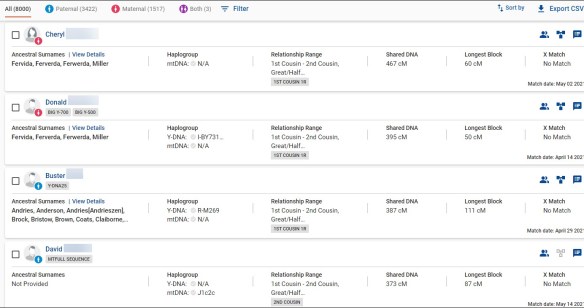
You can see at the top of my match list that I have a total of 8000 matches of which 3422 are paternal, 1517 are maternal and 3 match on both sides. Full siblings, their (and my) children and their descendants will always match on both sides. People with endogamy across both parents may have several matches on both sides.

If your relevant parent has tested, always work from their test.

Because we are searching for the maternal grandfather, in this case, we can ignore all tests that are bucketed as paternal matches.

Given that we are searching for my maternal grandfather, I probably have not been able to link as many maternal matches, other than possibly ones from my maternal grandmother. This means that the maternal grandfather’s matches are not bucketed because there are no identified matches to link on that side of my tree.

If you sort by maternal and paternal tabs, you’ll miss people who aren’t bucketed, meaning they have no maternal or paternal icon, so I recommend simply scanning down the list and processing maternal matches and non-bucketed matches.

By being able to confidently ignore paternally bucketed matches and only processing maternal and non-assigned matches, this is equivalent to processing the first 48 total matches. If I were to only look at the first 15 matches, 12 were paternal and only 3 are maternal.

Using bucketing at FamilyTreeDNA is very efficient and saves a lot of work.

Omitting paternal matches also means we are including smaller matches which could potentially be from common ancestors further back in the tree. Or, they could be younger testers. Or simply smaller by the randomness of recombination.

FamilyTreeDNA is a goldmine, with 16 of 20 maternal matches being from the unknown maternal grandfather.

Next, let’s see what’s waiting at MyHeritage.

MyHeritage

MyHeritage is particularly useful if your lineage happens to be from Europe. Of course, if you’re searching for an unknown person, you probably have no idea where they or their ancestors are from. Two of my best matches first appeared at MyHeritage.

Of course, your matches with people who descend from your unknown maternal grandfather won’t have any Theories of Family Relativity, as that tool is based on BOTH a DNA match plus a tree or document match. However, Theories is wonderful to group your matches to your other three grandparents.

MyHeritage provides a great deal of information for each match, including common surnames with your tree. If you recognize the surnames (and shared matches) as paternal or maternal, then you can assign the match. However, the matches you’re most interested in are the highest matches without any surnames in common with you – which likely point to the missing maternal grandfather.

However, those people may, and probably do, have surnames in common with each other.

Of the matches who aren’t attributed to the other three grandparents, the name Ferverda arises again and again. So does Miller, which suggests the grandparent or great-grandparent couple may well be Ferverda/Miller.

Let’s continue working through the process with our spreadsheet and see what we can discover about those surnames.

Our 60 Results

Of the 60 total results, 15 from each vendor, a total of 24 cannot be assigned to other columns through bucketing or shared matches, so are associated with the maternal grandfather. Of course, Michael who descends from both of my maternal grandparents won’t be helpful initially.

Cheryl, Donald and Michael are duplicates at different vendors, but the rest are not.

Of the relevant matches, the majority, 12 are from FamilyTreeDNA, four each are from Ancestry and MyHeritage, and three are from 23andMe.

Of the names provided in the surname fields of matches, in matches’ trees in the first few generations, and the testers’ surnames, Ferverda is repeated 12 times, for 50% of the time. Miller is repeated 9 times, so it’s likely that either of those are the missing grandfather’s surname. Of course, if we had Y-DNA, we’d know the answer to that immediately.

Comparing trees of my matches, we find John Ferverda as the common ancestor between two different matches. John is the son of Hiram Ferverda and Eva Miller who are found in several trees.

That’s a great hint. But is this the breakthrough I need?

What’s Next?

The next step is to look for connections between the maternal grandmother, Edith Lore, who is known in our example, and a Ferverda male. He is probably one of the sons of Hiram Ferverda and Eva Miller. Do they lived in the same area? In close proximity? Do they attend the same church or school? Are they neighbors or live close to the family or some of their relatives? Does she have connections with Ferverda family members? We are narrowing in.

Some of Hiram and Eva’s sons might be able to be eliminated based on age or other factors, or at least be less likely candidates. Any of their children who had moved out of state when the child was conceived would be less likely candidates. Age would be a factor, as would opportunity.

Target testing of the Ferverda sons’ children, or the descendants of their children would (probably) be able to pinpoint which of their sons is more closely related to me (or my mother) than the rest.

In our case, indeed, John Ferverda is the son we are searching for and his descendant, Michael is the highest match on the list. Cheryl and Donald descend from John’s brother, which eliminates him as a candidate. Another tester descends from a third Ferverda son, which eliminates that son as well.

Michael, my actual first cousin with a 755 cM match at one vendor, and 822 cM at a second vendor, is shown by the MyHeritage cM Explainer with an 88% probability that he is my first cousin.

However, when I’m trying to identify the maternal grandfather, which is half of that couple, I need to focus one generation further back in time to eliminate other candidates.

The second and third closest matches are both Donald at 395 cM and Cheryl at 467 cM who also share the same Ferverda/Miller lineage and are the children of my maternal grandfather’s brother.

On the spreadsheet, I need to look at the trees of people who have both Ferverda and Miller, which brought me to both Cheryl and Donald, then Michael, which allowed me to identify John Ferverda, unquestionably, as my grandfather based on the cM match amounts.

Cheryl and Donald, who are confirmed full siblings, and my mother either have to be first cousins, or half siblings. Their match with mother is NOT in the half-sibling range for one sibling, and on the lower edge with the other. Mother also matches Michael as a nephew, not more distantly as she would if he were a first cousin once removed (1C1R) instead of a nephew.

Evaluating these matches combined confirms that my maternal grandfather is indeed John Ferverda.

What About X DNA?

The X chromosome has a unique inheritance path which is sometimes helpful in this circumstance, especially to males.

Women inherit an X chromosome from both parents, but males inherit an X chromosome from ONLY their mother. A male inherits a Y chromosome from his father which is what makes him male. Women inherit two X chromosomes, one from each parent, and no Y, which is what makes them female.

Therefore, if you are a male and are struggling with which side of your tree matches are associated with, the X chromosome may be of help.

Your mother passed her X chromosome to you, which could be:

  • Her entire maternal X, meaning your maternal grandmother’s X chromosome
  • Her entire paternal X, meaning your maternal grandfather’s X chromosome (which descends from his mother)
  • Some combination of your maternal grandmother and maternal grandfather’s chromosomes

One thing we know positively is that a male’s X matches are ALWAYS from their maternal side only, so that should help when dividing a male’s matches maternally or paternally. Note – be aware of potential pedigree collapse, endogamy and identical-by-chance matches if it looks like a male has a X match on his father’s side.

Unfortunately, the X chromosome cannot assist females in the same way, because females inherit an X from both parents. Therefore, they can match people in the same was as a male, but also in additional ways.

  • Females will match their paternal grandmother on her entire X chromosome, and will match one or both of their maternal grandparents on the X chromosome.
  • Females will NEVER match their paternal grandfather’s X chromosome because their father did not inherit an X chromosome from his father.
  • Males will match one or both of their maternal grandparents on their X chromosome.
  • Males will NEVER match their paternal grandparents, because males do not receive an X chromosome from their father.

The usefulness of X DNA matching depends on the inheritance path of both the tester AND their match.

When Can Y-DNA or Mitochondrial DNA Help with Grandparent Identification?

If you recall, I selected the maternal grandfather as the person to seek because no tester carries either the Y-DNA or mitochondrial DNA of their maternal grandfather. In other words, this was the most difficult identification, meaning that any of the other three grandparents would be, or at least could be, easier with the benefit of Y-DNA and/or mitochondrial DNA testing.

In addition to matching, both Y-DNA and mitochondrial DNA will provide testers with location origins, both continental and often much more specific locations based on where other testers and matches are from.

Y-DNA often provides a surname.

Let’s see how these tests, matches and results can assist us.

  • Paternal grandfather – If I was a male descended from John Ferverda paternally, I could have tested both my autosomal DNA PLUS my Y-DNA, which would have immediately revealed the Ferverda surname via Y-DNA. Two Ferverda men are shown in the Ferverda surname DNA project, above.

That revelation would have confirmed the Ferverda surname when combined with the high frequency of Ferverda found among autosomal matches on the spreadsheet.

  • Maternal grandmother – If we were searching for a maternal grandmother, both the male and female sibling testers (as shown in the pedigree chart) would have her mitochondrial DNA which could provide matches to relevant descendants. Mitochondrial DNA at both FamilyTreeDNA and 23andMe could also eliminate anyone who does not match on a common haplogroup, when comparing 23andMe results to 23andMe results, and FamilyTreeDNA to FamilyTreeDNA results at the same level.

At 23andMe, only base level haplogroups are provided, but they are enough to rule out a direct matrilineal line ancestor.

At FamilyTreeDNA, the earlier HVR1 and HVR2 tests provide base level haplogroups, while full sequence testing provides granular, specific haplogroups. Full sequence is the recommended testing level.

  • Paternal grandmother – If we were searching for a paternal grandmother, testers would, of course, need either their father to test his mitochondrial DNA, or for one of his siblings to test which could be used in the same way as described for maternal grandmother matching.

Summary

Successfully identifying a grandparent is dependent on many factors. Before you make that identification, it’s very difficult to know which are more or less important.

For example, if the grandparent is from a part of the world with few testers, you will have far fewer matches, potentially, than other lines from more highly tested regions. In my case, two of my four grandparents’ families, including Ferverda, immigrated in the 1850s, so they had fewer matches than families that have been producing large families in the US for generations.

Endogamy may be a factor.

Family size in past and current generations may be a factor.

Simple luck may be a factor.

Therefore, it’s always wise to test your DNA, and that of your parents and close relatives if possible, and upload to all of the autosomal databases. Then construct an analysis plan based on:

  • How you descend from the grandparent in question, meaning do you carry their X DNA, Y-DNA or mitochondrial DNA.
  • Who else is available to test their autosomal DNA to assist with shared matches and the process of elimination.
  • Who else is available to test for Y-DNA and/or mitochondrial DNA of the ancestor in question.

If you don’t find the answer initially, schedule a revisit of your matches periodically and update your spreadsheet. Sometimes DNA and genealogy is a waiting same.

Just remember, luck always favors the prepared!

Resources

You may find the following resource articles beneficial in addition to the links provided throughout this article.

_____________________________________________________________

Follow DNAexplain on Facebook, here or follow me on Twitter, here.

Share the Love!

You’re always welcome to forward articles or links to friends and share on social media.

If you haven’t already subscribed (it’s free,) you can receive an email whenever I publish by clicking the “follow” button on the main blog page, here.

You Can Help Keep This Blog Free

I receive a small contribution when you click on some of the links to vendors in my articles. This does NOT increase the price you pay but helps me to keep the lights on and this informational blog free for everyone. Please click on the links in the articles or to the vendors below if you are purchasing products or DNA testing.

Thank you so much.

DNA Purchases and Free Uploads

Genealogy Products and Services

My Book

Genealogy Books

Genealogy Research

RootsTech 2023 – Truly United

Finally, finally, we were on our way, winging our way across the world from near and far – flying and motoring into snowy Salt Lake City for RootsTech. It seemed like we had been preparing forever, and Murphy visited many of us as gremlins trying to keep us away – but we persevered, and Murphy’s ploy just didn’t work.

Grab a cup of your favorite beverage, because you’re going to RootsTech with me!

I started out very early in dense fog which was a precursor to a nightmare at the airport. We didn’t know that yet, and the sun emerged beautifully as we were on our way.

Utah was blanketed with snow a few days before our arrival. We were hoping for no more snow.

The snow cover made for stunningly beautiful photos from the air.

The Kennecott Copper Mine outside Salt Lake City is three miles wide, nearly a mile deep and looked very interesting and beautiful laced with snow. These terraces are actually roughly 500 miles of dirt road. This used to be a mountain that was 8400 feet in elevation.

During the flight, I read about my ancestor, Stephen Hopkins and couldn’t help but think about how shocked he would have been that I flew across the country some 413 years after he was shipwrecked in Bermuda on the way to Jamestown, eventually lived in Jamestown for 4 years, sailed back to England, remarried, then arrived on the Mayflower in Plymouth Colony.

His ships and mine were very, very different.

FamilySearch Library

Some of us arrived early for research or meetings, or both.

FamilySearch took the opportunity presented during the Covid shutdown to remodel and upgrade the facilities significantly. The new library is both beautiful and super-functional.

The workstations now have three monitors.

There’s a lovely new break room with vending machines, tables, and a fridge.

To put things in perspective, the break room is larger than the preserved pioneer cabin that stands beside the library.

I’m struck by the contrast of the small cabin standing beside the FamilySearch library at left, and museum at right, and just a block away from skyscrapers.

Rather than leave and waste valuable research time, we had a picnic lunch in the break room.

I went to Salt Lake City early to visit the FamilySearch Library and attempt to break down a brick wall. I think I might have done that. We will see.

Other researchers did the same thing, and you can view a special GenFriends episode, here, hosted by Cheryl Hudson Passey, where several of us shared our excitement about our research, discoveries and simply gathering together again.

I was very excited to meet my cousin, Audrey Hill, for the first time in person, at the library. We’ve been collaborating for several months on our John Hill (1737-1805) and Catherine Mitchell (1738-1827) line. She’s already following up on a lead I never did (my bad.) Go Audrey!!

I spent two days perusing book after book after book in the Virginia and Maryland counties where my Dobkins and Johnson ancestors were known to have lived, then moved to the historically adjacent counties.

I was incredibly discouraged, but on the evening of the second day, back at my hotel again, I reviewed all of the library resources and noticed that I had missed one book that was shelved elsewhere.

Glory be, I *think* I’ve found him and his family.

My Peter Johnson line’s Y-DNA matches the Jochimsson (Yocum) line, so I have a LOT of work to do. But now at least I know where to dig!

I needed this entire book, not just a few pages.

Fortunately for me, Jim volunteered to scan the entire book at one of the new book-scanning stations.

I’m SOOO excited.

RootsTech and the FamilySearch library ran golf carts back and forth between the facilities throughout the conference.

Decisions, decisions.

Well, if you can’t decide, just go to the chocolate shop to think things over😊

The Night Before

Preconference events began on Wednesday evening with the media dinner which allows us to understand the layout, when to be someplace, and where that place might be. It also allows provides accurate information to pass on to you.

Of course, many of us have known each other for years. As the first event of RootsTech, after three years of being apart, it felt like one huge family reunion with everyone catching up. So many hugs!!!

And selfies.

It was wonderful to see Marie Cappart again. I’ll never forget walking down the street in Amsterdam with two friends and hearing someone shouting my name from some distance away. I turned around and there was Marie, running toward me, arms outstretched. What are the chances??

The influencers and media were treated to a tour of the show floor after setup was supposed to be complete.

Finishing touches were being put on the Expo Hall and booths. I guess I never realized how large these booths are and that they actually have to be “constructed”.

The next morning, the show would open and thousands of excited genealogists would descend on the Salt Palace for the next three days.

RootsTech Opens

Finally, the Salt Palace, with its legendary signs outside, was ready to receive genealogy guests.

Everyone was so happy to see each other again. My friends, Janna Helstein, Schelly Taladay Dardashti and Daniel Horowitz with MyHeritage photobombing the group. This was the best of several photos because we were all joyfully laughing so hard.

The absolute best part of RootsTech 2023 was seeing people again, in person. Zoom and similar platforms have been sanity-saving for the past three years – but they aren’t people.

Humans are, I think, wired for connection to each other.

I’ve worked “home office” for decades now, but not without regular contact with others.

The classes were great and there was a lot that was wonderful at RootsTech – but hands down, the best part was hugging so many people.

In case you aren’t aware, genealogists are huggers.

If someone were to have followed me around taking photos, there would have been hundreds of hugs. And I don’t mean polite greeting distant hugs. I mean the “OMG I haven’t seen you in a lifetime and everyone was concerned we might never see each other again” holding tight, never-letting-go hugs.

Mags Gaulden and I spotted each other in front of the WikiTree booth, and some kind soul took our picture. I tried to do a nice thing for her and made DNA masks, not remembering that she was allergic to my cat assistants. Thank goodness Mags realized it quickly enough to remove the masks before they had the opposite of the intended effect. I really do not want to be listed in her obituary! “Cause of death: Roberta’s masks.”

Tears streamed down people’s faces as they saw each other, especially that first day. And I don’t mean because of cat hair, either.

There were thousands of selfies joyfully taken. Lots of “blooper” ones too, but just the giddiness of being together again was intoxicating and overshadowed the challenges of the past few years. For a minute, or a few, everyone could just forget about everything else and enjoy our three-day adrenaline high.

And of course, sometimes things change, and many people weren’t there, for a variety of reasons. I missed so many people and there was more than one moment of silence.

Attendance

Here’s the RootsTech Expo Hall from the second floor. It felt like “coming home” after a long absence.

I was standing inside when the doors opened on the first day. People were waiting, but not the mob like past years.

In a Zoom call with RootsTech staff a week or ten days before the conference, they said they had 6000 paid admissions at that time, and a week or so later, they said they were anticipating the same number of attendees as 2020 which was about three times that number.

That number was clearly aspirational, but it didn’t happen.

I’ve been attending RootsTech since 2018, and the actual in-person attendance, based on observation, was lower than it has been since I’ve been attending. Of course, while we may be getting used to Covid, it’s not over and still a significant concern to many. I had my doubts.

Now that I’ve said that about attendance, let me expand. There were over a million registered online for the virtual sessions PLUS the livestreamed sessions that were held in person as well. I don’t know how many more than a million attended, but that number will only grow because those sessions remain available for viewing after RootsTech. In other words, Rootstech sessions have become a library which you can find and enjoy, here.

Clearly, more people in total were reached in 2023 than in 2020.

Questions for Attendees

This year, I had three in-person classes, and no virtual classes. All three were well-attended.

I don’t know how many people attended my sessions, but I know I took about 2000 DNAeXplain ribbons that were passed out to attendees at the exit doors of my classes if they wanted them for their RootsTech badges. I brought home maybe 100.

After everything is set up for the session (thank you Jim,) I always chat with the people in my sessions that show up early. There’s no reason not to have a little fun for everyone.

My first session was at 9:30 the first day, right after the conference opened at 9. I was passing out ribbons personally to people who were early and I saw the confused looks. So I demonstrated what to do with the ribbons with my own badge.

Ribbons on badges are a RootsTech staple, and it’s the only conference I’ve ever attended with that tradition. I realized, based on the confused looks, that we had several first-time attendees.

I was so excited to welcome people at the beginning of my first session, back to in-person genealogy, and that feeling was palpable throughout the room and the conference as a whole.

How Many First-Time Attendees?

When my session started, I asked how many people were attending RootsTech for the first time, and I was very surprised to discover that roughly half the room raised their hands.

Half!!!

That’s HUGE. No wonder there were so many confused looks about the ribbons.

My three sessions, in order, were:

  • DNA for Native American Genealogy: 10 Ways to Find Your Native American Ancestors
  • DNA Journey – Follow Your Ancestors Path
  • Big Y for the Win

I mention this because of the next questions I asked.

Who Has Taken a DNA Test for Genealogy?

In the first session, “DNA for Native American Genealogy,” I asked who had taken a DNA test, and more than half raised their hands, but several had not. Frankly, that surprised me given how long DNA testing has been available now. I talked to people afterwards, and the common thread for those who had not seemed to be:

  • They didn’t know which vendor or which DNA test to take for this purpose.
  • They thought the ancestor was too far back in time and they would not have any Native results. In my session, I talked about testing the older generations and your cousins. Also, that you don’t know what you don’t know. I asked how many people would purchase a book if they thought the answer to that question even MIGHT be inside, and every single person raised their hand.

I also pointed people to the Native section on my blog, to my book, DNA for Native American Genealogy, and to my second blog focused entirely on early Native American records, www.nativeheritageproject.com.

In the second class, “DNA Journey – Follow Your Ancestor’s Path,” probably three fourths of the class had taken a DNA test. That session was really fun. I used several case studies to illustrate how different kinds of DNA have broken down brick walls AND showed me exactly, and I mean literally exactly where my ancestors were from. I used Y-DNA, mitochondrial DNA and autosomal to accomplish this. Who among you DOESN’T want to stand where your ancestors stood?

Yep, we all do.

I think it was in the second class that I asked a question about how many people had taken the three different types of tests, and here’s the breakdown:

  • Who has taken a DNA test? – The majority of the room
  • Who has taken an autosomal test – It looked to be the same number of people as above
  • Who has taken (or sponsored) a Y-DNA test – Maybe 10% of the room
  • Who has taken a mitochondrial DNA test – A scattering of people

As genealogists, we need to do more Y-DNA and mitochondrial DNA testing, because we don’t know what we don’t know and may well be missing.

In the third class, “Big Y for the Win,” which included both Y-DNA STR testing and the Big Y-700, comparing and contrasting the tests, how to use them, and why the Big Y provides significant advantages, most of the people had taken some type of DNA test.

The second question I asked in the Big Y class was how many people had taken or sponsored a Big Y test, and significantly more than half had, which is what I would have expected.

However, given the session topic, I was surprised to learn that few had used the new, free, Discover Tools, or the recently released Group Time Tree. Both were developed and created by FamilyTreeDNA to maximize the usefulness of Y-DNA haplogroups, and they are amazing.

How Many People Have Tested?

As part of the information that I gathered during the conference, Ancestry has tested 23 million people and MyHeritage 6.5 million. I don’t have a current number for FamilyTreeDNA or 23andMe, but the last numbers I heard some months ago were 2 and 5 million, respectively.

There are clearly more (and new) people who are interested in genealogy and are still DNA testing candidates – especially Y-DNA and mitochondrial DNA which have separate inheritance paths, providing additional and unique benefits as compared to autosomal tests.

Keynotes

The keynote sessions were livestreamed, so you can still view them here. Be sure to watch Steve Rockwood’s welcome. He may be the CEO, but he’s an exceptionally caring, inspirational and humble, man.

I attended two of three keynote sessions. Each keynote session actually included three speakers, which was initially confusing.

Steve Rockwood’s message is that “All Means All” – everyone is included. He also thanked and encouraged people to not be further divisive during this difficult time, and instead to choose inclusion.

Steve asked several questions and in answer to his queries, attendees were encouraged to hold up their phones with their flashlight on. As you can see, the entire huge room is filled with light – our light. One at a time. We can all be the light. You can hear Steve’s message for yourself, here.

Another session I enjoyed immensely was Jordin Sparks, the youngest ever American Idol winner. I’ve been in concert venues that were smaller, so it was a real treat to enjoy this inspirational story plus four of her amazing songs.

I really encourage you to watch this video, especially if you love music. Even Jordin’s guitarist was wiping his eyes!

She literally played to a packed house and I don’t think there was a dry eye anyplace.

Jordin has an incredible voice and an inspirational story. Do yourself a favor and listen, here.

MyHeritage Keynote and Announcements

Aaron Godfrey, VP of Marketing with MyHeritage announced new products and initiatives during the keynote on day 2.

The new Photo Dater app, available soon, will estimate when a photo was taken based on clothes, hairstyles and other items in the photo.

Additionally, Aaron announced the cM Explainer, a wonderful new tool which predicts relationship estimates between DNA matches and includes the ages of the testers, among other factors. cM Explainer is incorporated into your DNA matches at MyHeritage in addition to being independently available for free, here.

I’ll be reviewing this new feature in an article, soon.

In another surprise, Aaron announced that MyHeritage has donated another 5000 kits to DNA Quest, for adoptees, here.

MyHeritage also introduced color coding for family trees, here. If you’re a MyHeritage user, this feature is already available for you on your tree, so check it out.

MyHeritage takes the “most new announcements at RootsTech” award with these new features.

Vendor Booth Sessions

Truth be told, I didn’t even get to visit all of the various booths. I meant to, but it just didn’t happen.

At least two vendors offered sessions throughout all three days. There were probably others, but between my three RootsTech sessions, three booth sessions and the book signing, in addition to keynotes, meetings and interviews, I just wasn’t able to attend many booth sessions.

The ones I did attend were wonderful. I focused on DNA, of course. Let’s start with FamilyTreeDNA.

Sherman McRae presented “Unexpected Y-DNA Results” in the FamilyTreeDNA booth where he’s showing how to utilize the Y-DNA Time Tree in the Discover tool, and the Group Time Tree.

You can view Sherman’s main session, Connect the Forefathers, here.

You just never know when a pilgrim is going to show up for your session.

Janine Cloud, an enrolled Cherokee tribal member and manager of Group Projects at FamilyTreeDNA discussed Y-DNA, mitochondrial and autosomal avenues to prove Native ancestors using DNA, using her own Cherokee ancestors as an example.

Dr Paul Maier, Population Geneticist, Goran Runfeldt, Head of Research and Michael Sager, Phylogeneticist answer questions about Y-DNA in the AMA (Ask Me Anything) session.

Paul and Goran also hosted an AMA for mitochondrial DNA as well, an often overlooked but valuable resource.

In addition to the Native American AMA session for FamilyTreeDNA which I gave with Janine, I gave two booth presentations for MyHeritage, “Time Travel with Your Ancestors” and “AutoClusters for the Win,” both of which were recorded meaning you  just might see them in the future.

The Time Travel session utilized the MyHeritage AI tools to see what my ancestors who came from specific regions or cultures might have looked like in that time and place. In the slide above the AI photo of my grandmother is combined with the document and with the Genetic Group that incorporates that part of Germany.

I combined the AI images with MyHeritage records that link those ancestors to a specific location, showing the predicted ethnicity, genetic groups when applicable, and then the actual location – some of which I’ve visited. My ancestor owned that windmill in the Netherlands, above. Combining these tools is so much FUN. My heritage provided the AI photos, records and ethnicity. I’m the one who did the traveling, of course, but in this way, time travel is possible!

I really enjoyed using this story-telling methodology that incorporates all 4 types of genealogy research and clues.

In the AutoClusters for the Win session in the MyHeritage booth, I discussed how I utilized AutoClusters to solve an adoption case in my own family, and how you can use this very powerful tool as well. The methodology I used works equally as well for genealogy mysteries.

In another MyHeritage booth presentation, Janna Helshtein told an amazing and moving story about her grandparents, their escape from the Holocaust, move to Israel, and more – in their own “voices” using MyHeritage’s Deep Story.

We all sat spellbound.

Janna also offers a free guide on how she created and integrated the Deep Story verbiage that her grandparents “spoke.” It was actually quite easy.

There was more to Janna’s story, but I don’t want to spoil it for you.

I believe MyHeritage intends to make their booth sessions available through social media.

Here, Janna and I are celebrating with a quick picnic style lunch after her presentation. She truly knocked it out of the park.

Shifting Attendance

I’m sharing my opinion here, and not anything a RootsTech spokesperson told me.

I was surprised that the in-person attendance was down as much as it was, truthfully. I think in-person was down by either half or maybe even two-thirds. Some decline wouldn’t have surprised me, but this much was sobering.

I was also VERY surprised that roughly half of the attendees were new. And that number could have actually been higher. That’s a good thing, meaning new people are being attracted to genealogy.

These two things, together, suggest the following to me:

  • The passing of time, Covid, and aging-out of some people caused some decline. I know several people who passed away during the past three years, not to mention those whose lives changed dramatically due to their partner’s illness, passing or life circumstances. Several people lost jobs or moved, or both, or are in that process now.
  • Now let’s flip this and say that the virtual and FREE capability for much of RootsTech made the conference accessible and available to many who could not attend in person. For that, I’m very grateful. I have a friend who has been very ill and participated by taking selfies of herself with the livestreamed sessions on her monitor behind her. She posted her photos on social media to be with us. That warmed my heart so much.
  • I think that the reason there were so many new people was because they were able to attend virtually during 2021 and 2022. Essentially this means that while virtual RootsTech was challenging for everyone on the behind-the-scenes production side, to put it mildly, it served to recruit many new genealogists who would not have participated in person had they not previously attended online.

Based on discussions at the media dinner table, and other statements by Steve Rockwood, CEO of FamilySearch, FamilySearch, including RootsTech, is reaching out to young people and to other areas of the world as well.

According to Steve, who, by the way, turns out to be my 11th cousin according to Relatives at RootsTech and the FamilySearch Tree, RootsTech will forever be a blended conference event.

This year, in addition to the local emcee, there were 15 people in other countries hosting in their locations, times and in their native languages.

This year there were 304 virtual classes, 205 in person, and some of those were streamed online as well.

Don’t forget that Relatives at RootsTech is still available through March 31st and you can contact cousins to collaborate. Some may represent Y-DNA or mitochondrial DNA testing lines that you need for matching and to complete your tree.

Vendors

That brings me to the topic of vendors.

Three of the four major DNA vendors were present, meaning Ancestry, FamilyTreeDNA and MyHeritage. 23andMe was absent in 2020 and again this year. Their last DNA innovation was their genetic tree in September of 2019.

Many of the smaller vendors were not in attendance. I had made friends with several of the Mom and Pop vendors and almost none of them were there this year, nor were many of the organizations and smaller companies. I spoke with several people and they said, almost universally, that the cost of the virtual booths over the past two years, the work involved, and the fact that those virtual booths did not generate many sales, not even equal to the amount of the booth rent, had soured the experience.

Not only are conference booths very expensive, so is the invested labor and time. For those of you who don’t know, booth rent is only a part of it. You want carpet? That’s more. A chair? That’s more. Two chairs? More. A trash basket? More. Oh, you need wireless to handle sales? LOTS more.

I’d say that the Expo Hall was only half to one third of the size it had been previously. Mind you, it’s still huge, especially compared to many other conferences, but I missed seeing many of my favorite vendors.

For example, neither Genealogical.com nor Deseret Books were there this year, so there was no bookstore, and neither were many of the fun t-shirt vendors or others that sold jewelry or genealogy-related merchandise.

I hope that FamilySearch will put their creative caps on and perhaps reach out to their vendors, both past and current, and figure out a way to make RootsTech vendors attractive to the online crowd. Perhaps a “search” game where you have to visit vendor booths to find items. Maybe there could be some permanent online stores as well.

There were fewer food vendors too, but in case anyone was wondering, I could still smell cinnamon-almonds throughout the facility😊

I did run into some of my long-time vendor friends.

My friend Jessica Taylor with Legacy Tree Genealogists. I regularly refer people seeking genealogists who understand both genealogy and DNA to Legacy Tree Genealogists.

I don’t need to tell you how much I love DNAPainter and it was great to see Jonny Perl and Patricia Coleman in the DNAPainter booth.

I feel kind of bad because I obviously caught Rob Warthen and Carol Carman by surprise in the East Coast Genetic Genealogy Conference booth, but it’s the only photo I have of their booth.

Last fall’s ECGGC conference was very successful and I’m planning to speak in person this year, in Baltimore, October 6-8, 2023. Save the date. Last year was the first year and it was wonderful.

My Book Signing

FamilyTreeDNA was kind enough to host my book signing for DNA for Native American Genealogy in conjunction with the Native American Ask Me Anything session. Many thanks to Joe Brickey for her help with this event as well.

After the AMA session, which was the final event of Saturday, just before closing, we took a group picture with the FamilyTreeDNA team, or at least the staff members in the booth at that time.

I did learn that perhaps the last thing Saturday might not be the best time for a book signing, because lots of people leave on Friday night. On the other hand, on Saturday, admission to the conference is free, at least to the show floor, with lots of children’s activities and programs for LDS families. Saturday is always very busy in terms of traffic, with sometimes more Saturday visitors than paying conference attendees. It will be interesting to see final RootsTech conference numbers.

The Thank You That Made My Day!!!

One lovely lady, Charis, came up to me after my first session and explained that she saw an ad for RootsTech. She decided she needed to purchase a ticket and attend. She had never heard of me, but she is very focused on documenting her Native ancestry. She sat in the front row in my first session and paid rapt attention. (Speakers do notice, in case you wondered.)

Charis came up to me afterwards and told me that this class alone was worth her registration fee.

She made my day, but I thought to myself that she would attend other sessions that she would find equally as valuable. After all, the conference was just beginning. She found me the next day and repeated what she had said. On day 3, she attended the Ask Me Anything session, arriving early. She said the said the same thing, AGAIN, and I asked if we could take a picture together. As presenters, we take our time, spend our money to attend these conferences, and invest the effort because we want to help people.

People like Charis make this all worthwhile.

Sweetness Personified

I’m sorry, I just can’t resist sharing the sweetest picture series ever.

In 2020, I met my cousin, Heidi Campbell and her baby at RootsTech. Three years later, I saw Heidi again, with a beautiful new addition to the family.

I just can’t tell you how wonderful it was to hold this baby. The last baby I held was Heidi’s little one, three years ago. The look on Heidi’s face is priceless too when he’s reaching for my glasses. He had the biggest smile EVER on his face and he’s booping noses with me. We had so much fun.

My heart just melted into a huge puddle. I so much wish they lived close so I could “grandma.” Thank you, Heidi, for sharing your sunshine with me.

Rolling Up the Sidewalks

On Saturday, literally at one minute after 3 when the conference closed, the workers at the Salt Palace started rolling up the sidewalks, or in this case, the carpets.

It’s a wrap!!!

Afterglow

At the Salt Lake City airport, I ran into two people and had the opportunity to talk to them again and hug goodbye once more. You’d think we would all have had enough of genealogy, but not a chance. More hugs, gratitude for togetherness, and anticipation for next year.

Winging my way home again, having walked about 6 miles each day, according to Fitbit, I was tired, desperately tired, and my everything hurt. However, I was also incredibly fulfilled to have connected again with old friends and met so many new people that I now look forward to seeing again. We are very fortunate to be members of such a wonderful, diverse and universal community.

I couldn’t help but think, as we crossed the winding Mississippi River, how fortunate we are that we have “time travel” in this way. I’m also struck with how many different ways we have to time travel, with Y-DNA and mitochondrial DNA at FamilyTreeDNA, autosomal testing and ethnicity at various vendors, and actual historical records that are becoming ever-more available remotely.

Using artificial intelligence, we can “see” our ancestor’s heritage in our own faces, or, in this case, the face of my grandfather using the MyHeritage AI Time Machine.

Using our DNA, we can identify the parts of those ancestors that we carry today, reaching back in time several generations with autosomal DNA. In addition to autosomal, both Y-DNA and mitochondrial DNA provide close matches and reach back in time, focused on one specific line, providing insights for millennia.

Time travel, truly reimagined.

There are so many ways to discover and connect with our ancestors available to us today. If we don’t carry the DNA of ancestors a few generations upstream, perhaps selected cousins do. We have several tools and databases at our disposal to find testers.

The DNA of our ancestors can and does actually lead us home, to them and, sometimes, exactly where they lived, as I illustrated with several case studies in my presentation, “Follow Your Ancestors Path.” Today, these options are available to everyone.

RootsTech is in the history books for another year, with new friendships made and old ones renewed. Indeed, we were finally reunited with each other, and introduced to cousins we had never met before. We shared tools, methodologies and information to identify our ancestors. We all left fervently hoping to be reunited again next year.

Please enjoy the amazing RootsTech musical finale here.

_____________________________________________________________

Follow DNAexplain on Facebook, here or follow me on Twitter, here.

Share the Love!

You’re always welcome to forward articles or links to friends and share on social media.

If you haven’t already subscribed (it’s free,) you can receive an email whenever I publish by clicking the “follow” button on the main blog page, here.

You Can Help Keep This Blog Free

I receive a small contribution when you click on some of the links to vendors in my articles. This does NOT increase the price you pay but helps me to keep the lights on and this informational blog free for everyone. Please click on the links in the articles or to the vendors below if you are purchasing products or DNA testing.

Thank you so much.

DNA Purchases and Free Uploads

Genealogy Products and Services

My Book

Genealogy Books

Genealogy Research

The Best of 2022

It’s that time of year where we look both backward and forward.

Thank you for your continued readership! Another year under our belts!

I always find it interesting to review the articles you found most interesting this past year.

In total, I published 97 articles in 2022, of which 56 were directly instructional about genetic genealogy. I say “directly instructional,” because, as you know, the 52 Ancestors series of articles are instructional too, but told through the lives of my ancestors. That leaves 41 articles that were either 52 Ancestors articles, or general in nature.

It has been quite a year.

2022 Highlights

In a way, writing these articles serves as a journal for the genetic genealogy community. I never realized that until I began scanning titles a year at a time.

Highlights of 2022 include:

Which articles were your favorites that were published in 2022, and why?

Your Favorites

Often, the topics I select for articles are directly related to your comments, questions and suggestions, especially if I haven’t covered the topic previously, or it needs to be featured again. Things change in this industry, often. That’s a good thing!

However, some articles become forever favorites. Current articles don’t have enough time to amass the number of views accumulated over years for articles published earlier, so recently published articles are often NOT found in the all-time favorites list.

Based on views, what are my readers’ favorites and what do they find most useful?

In the chart below, the 2022 ranking is not just the ranking of articles published in 2022, but the ranking of all articles based on 2022 views alone. Not surprisingly, six of the 15 favorite 2022 articles were published in 2022.

The All-Time Ranking is the ranking for those 2022 favorites IF they fell within the top 15 in the forever ranking, over the entire decade+ that this blog has existed.

Drum roll please!!!

Article Title Publication Date 2022 Ranking All-Time Ranking
Concepts – Calculating Ethnicity Percentages January 2017 1 2
Proving Native American Ancestry Using DNA December 2012 2 1
Ancestral DNA Percentages – How Much of Them in in You? June 2017 3 5
AutoKinship at GEDmatch by Genetic Affairs February 2022 4
442 Ancient Viking Skeletons Hold DNA Surprises – Does Your Y or Mitochondrial DNA Match? Daily Updates Here September 2020 5
The Origins of Zana of Abkhazia July 2021 6
Full or Half Siblings April 2019 7 15
Ancestry Rearranged the Furniture January 2022 8
DNA from 459 Ancient British Isles Burials Reveals Relationships – Does Yours Match? February 2022 9
DNA Inherited from Grandparents and Great-Grandparents January 2020 10
Ancestry Only Shows Shared Matches of 20 cM and Greater – What That Means & Why It Matters May 2022 11
How Much Indian Do I Have in Me??? June 2015 12 8
Top Ten RootsTech 2022 DNA Sessions + All DNA Session Links March 2022 13
FamilyTreeDNA DISCOVER Launches – Including Y DNA Haplogroup Ages June 2022 14
Ancient Ireland’s Y and Mitochondrial DNA – Do You Match??? November 2020 15

2023 Suggestions

I have a few articles already in the works for 2023, including some surprises. I’ll unveil one very soon.

We will be starting out with:

  • Information about RootsTech where I’ll be giving at least 7 presentations, in person, and probably doing a book signing too. Yes, I know, 7 sessions – what was I thinking? I’ve just missed everyone so very much.
  • An article about how accurately Ancestry’s ThruLines predicts Potential Ancestors and a few ways to prove, or disprove, accuracy.
  • The continuation of the “In Search Of” series.

As always, I’m open for 2023 suggestions.

In the comments, let me know what topics you’d like to see.

_____________________________________________________________

Follow DNAexplain on Facebook, here or follow me on Twitter, here.

Share the Love!

You’re always welcome to forward articles or links to friends and share on social media.

If you haven’t already subscribed (it’s free,) you can receive an email whenever I publish by clicking the “follow” button on the main blog page, here.

You Can Help Keep This Blog Free

I receive a small contribution when you click on some of the links to vendors in my articles. This does NOT increase the price you pay but helps me to keep the lights on and this informational blog free for everyone. Please click on the links in the articles or to the vendors below if you are purchasing products or DNA testing.

Thank you so much.

DNA Purchases and Free Uploads

Genealogy Products and Services

My Book

Genealogy Books

Genealogy Research