Ancient Connections: Where Archaeology Meets Your Ancestors

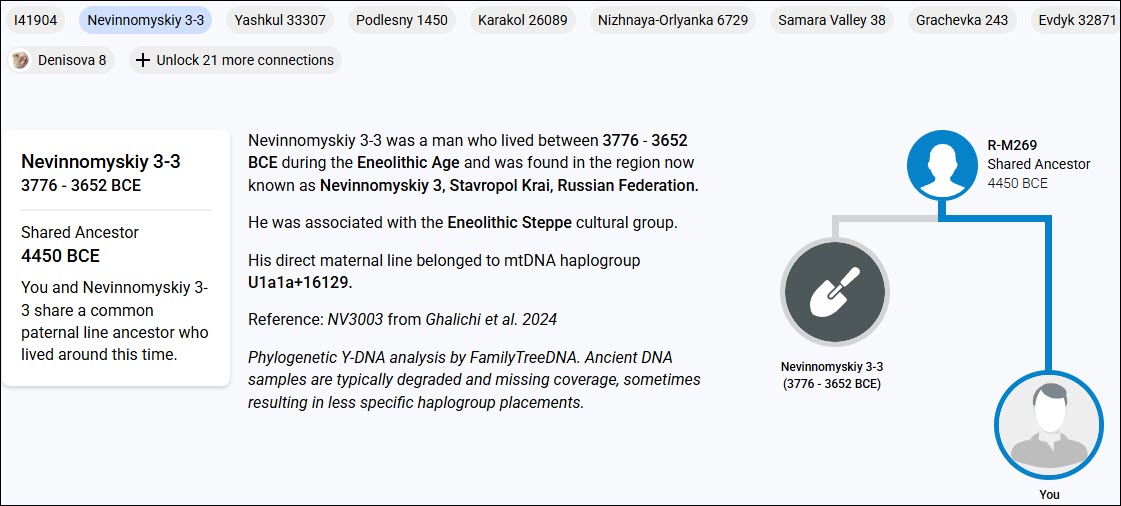
Ancient Connections, a report found on FamilyTreeDNA’s Discover platform for both Y-DNA and mitochondrial DNA (mtDNA), can be used in multiple ways to enhance your genealogy and unlock secrets.

It’s exciting to examine ancient burials linked to our ancestors and understand how we connect to them. Ancient Connections offer a wealth of information, providing clues that can help unravel long-standing mysteries.

Today, there are more than 12,960 Y-DNA Ancient Connections in Discover, along with more than 25,310 mitochondrial Ancient Connections, and that number increases weekly.

Why the disparity, you ask? Remember, everyone has mitochondrial DNA, but only males have Y-DNA.

In addition to matches, your DNA results hold something even more powerful – evidence of where your ancestors and their cousins lived in the distant past, when they lived, and the cultural context surrounding them. These essential insights are unavailable through any other means. Ancient Connections help us answer the age-old question, “Where did I come from?”

Could These People Be My Ancestors?

I’ll show you how to answer another question, too. Which of these Ancient Connections could potentially be your ancestors, and which ones are your “haplo-cousins”?

Regardless, they all help us understand our ancestors’ past, and that of their descendants.

Discover is for Everyone

FamilyTreeDNA provides a free version of Discover that everyone can use. There’s also an enriched version with additional information for their customers who have purchased Y-DNA and mitochondrial DNA tests.

Discover has something to offer for everyone.

Mitochondrial DNA is passed from mothers to all of their children of both sexes – unmixed with the DNA of the father.

Everyone has their mother’s mitochondrial DNA, which is passed intact, except for an occasional mutation, directly down through generations of mothers. It’s not admixed like autosomal DNA, so we don’t lose some portion in each generation. This is exactly why we can track mitochondrial DNA infinitely far back in time and why it’s so crucial for understanding the origins of your mother’s specific line.

Y-DNA is passed from fathers only to their sons, which is what makes males male. Like mitochondrial DNA, Y-DNA is not admixed with any DNA from the mother, so we get a laser line-of-sight view of the direct patrilineal line back in time. The Y-DNA direct paternal line is the male’s surname line in cultures where males carry their father’s surname.

If you’ve tested at or upgraded to either the Big Y-700 level or the mtFull, full mitochondrial sequence test, you will receive the most granular haplogroup possible, meaning the closest in time and most informative. You’ll also match with other testers who have taken the less-refined lower-level tests.

The most informative and precise results occur when both people have taken the premium tests. As more people test and science advances, you may receive a new haplogroup from time to time when you and another tester share a rare mutation – so these tests are evergreen.

Both Y-DNA and mitochondrial DNA testers at any level have access to Discover on their dashboard for those products, although the results of lower-level tests provide less information.

The Free Version of Discover Compared to the Premium Version for Testers

Here’s a comparison of lower-level Y-DNA tests and the Big Y-700.

Click any image to enlarge

Y-DNA testers who have only taken the 12-111 STR panel tests receive a predicted haplogroup, and when clicking through to Discover, receive up to 10 Ancient Connections.

For example, If your Y-DNA haplogroup is predicted as R-M269, the most common male lineage in Europe that arose some 6450 years ago, your Ancient Connections begin with the closest genetic match to R-M269. Viewing Ancient Connections that are 6500 years ago will certainly be interesting, so please do look, but probably not terribly useful for genealogy.

However, if that same person were to upgrade to the Big Y-700, they would receive a much more recent haplogroup, and along with it, up to 30 Ancient Connections within their major haplogroup lineage, R in this case, plus the oldest sample in the database. For some haplogroups, there may not yet be 30 Ancient Connections, although new ancient samples are added weekly for both Y-DNA and mitochondrial DNA.

All Ancient Connections begin with the matches who are genetically closest to the haplogroup requested.

The same scenario holds true for mitochondrial DNA testers who previously tested at the HVR1/HVR2 level, but not at the full sequence level, which is the only test available today.

This article focuses on testers at the higher levels, meaning the Big Y-700 and the mtFull tests, and how to utilize their 30 closest Ancient Connections. We’ll walk through step-by-step examples using both.

However, before we begin evaluating our Ancient Connections, we need to cover two fundamental concepts.

BCE, CE and Converting to “Years Ago”

It’s helpful to understand date structures and how they are used.

It’s easy to get confused when seeing the dates of CE, current era, and BCE, before current era, which means we misinterpret the information.

For example, the year 100 CE is the year 100 that occurred roughly 1900 years ago. We round 2026 to 2000 for these types of calculations. The year 100 BCE, before current era, occurred approximately 2100 years ago. I often prefer to work in “years ago”, because it equalizes the numbers, meaning you’re less likely to get confused about how long ago someone lived or something happened.

To do the calculations from BCE dates to “years ago,” add 2000, so 2250 BCE equals 4250 years ago.

For CE dates, subtract from 2000. The date 500 CE occurred 1500 years ago.

This can be especially confusing when you’re dealing with the same number on either side of the current era, which began in the year 1. There is no year zero. For example, we need to be vigilant not to confuse 500 BCE, which was 2500 years ago, and 500 CE, which was 1500 years ago.

Now, on to our second concept.

Haplogroup Age and Burial Age Are Not the Same

When viewing Ancient Connections, the genetic age of the haplogroup, meaning when it was formed, and age of the burial are two different things.

Haplogroup R-ZP18 is about 4250 years old, and this Late Iron Age, pre-Roman burial which is also R-ZP18, occurred about between 2337 and 2043 years ago.

Haplogroup ages and the date they emerged, which show on the Timeline, sometimes mature and are refined with additional testers and branching.

Burials are dated using various techniques, and sometimes the ages provided in the academic papers are earlier than the genetic age of the haplogroup, shown on the Timeline at the bottom of the Connections page.

Discover makes no attempt to “fix” this situation, because it’s unclear which age should be changed. It’s not unusual to be unable to fully analyze ancient remains. For example, let’s say a sample is determined to have the SNP for R-ZP18, but simultaneously lacks downstream SNPs and some upstream SNPs, and the burial was dated from surrounding soil or artifacts. In that case, it would be impossible to know what is precisely “accurate”, but the sample is accurate enough to be included in Ancient Connections. This is also why some samples aren’t included in Globetrekker™ calculations. Some low-quality samples are excluded entirely.

Every ancient sample is individually analyzed by R&D team members before being included in the phylogenetic tree and Ancient Connections. Sometimes, the scientists at FamilyTreeDNA can assign a more specific haplogroup than was available to the paper authors at the time of publication because the tree has since branched.

As you receive new Ancient Connections, your older ones, except your final or oldest connection, will roll off of your list.

That’s one reason I devised a process for analyzing and recording my Ancient Connections, and for determining which ones might be actual ancestors – or at least aren’t precluded from it.

First Peek at Ancient Connections

Sign in to your FamilyTreeDNA account and click on the Discover link on the dashboard for the type of test you wish to view.

In the Y-DNA example, I’m using my male Estes cousins. As a female, I can’t test for the Estes Y chromosome, so I recruited others to represent my line. You can see the results in the Estes DNA project.

After signing in, click on Discover, then on Ancient Connections.

Y-DNA Ancient Connections 

It’s a bonanza!

Your Ancient Connections are displayed at the top of the page, ordered from genetically closest to most distant. These are archaeological samples whose data has been extracted from academic papers and analyzed before being include in Discover.

You’ll see a description of the first sample, or any sample you click on. The Timeline for that sample, along with your haplogroup and your common ancestor’s haplogroup, is displayed at the bottom of the page.

The first, meaning closest, Ancient Connection is highlighted, so let’s take a look.

  • “You” are shown in the dark purple frame (with purple arrows) at right, with your haplogroup, in this case R-ZS3700, which is placed on the Timeline at the bottom of the page in the appropriate location.
  • The Ancient Connection named “North Berwick 16499”, whose name was taken from the academic paper in which it was found, is shown in a red frame and placed on the timeline based on information provided in the paper.

“North Berwick” has been assigned to haplogroup R-ZP18, either in the paper, or by the FamilyTreeDNA R&D team if a more refined haplogroup can be determined, and is this tester’s closest Ancient Connection based on its position on the list.

Note that you may have other Ancient Connections who are genetically equivalent in age, meaning they too would be R-ZP18. In our case, only one sample is assigned to that haplogroup.

  • Your Shared Ancestor, in the green frame, is the first man who carried R-ZP18, which emerged about 2250 BCE, or 4250 years ago.

Notice that I said, “the first man.” That man’s sons, grandsons and so forth were also haplogroup R-ZP18. Some went on to develop new downstream haplogroups, but apparently, North Berwick, by the time he lived, had not. Either that, or a downstream haplogroup cannot yet be determined due to a lack of other testers in that lineage.

Men with downstream SNPs (mutations), meaning downstream haplogroups, also descended from R-ZP18. Those SNP mutations become downstream haplogroups when two or more men who carry the same SNP mutation match each other. For example, our Estes ancestor who carries haplogroup R-ZS3700 descends from R-ZP18 through a distinct series of downstream SNPs (mutations). While we carry R-ZP18 in our lineage, it’s not our most refined haplogroup.

However, for North Berwick, haplogroup R-ZP18 is his most refined haplogroup.

Because of this, we know for sure that North Berwick and the Estes men both descend from the original R-ZP18 man who lived about 4250 years ago, but we can’t tell when they shared a common ancestor between 4250 years ago and 3750 years ago when the next downstream haplogroup R-BY342, was formed in the Estes lineage.

Because North Berwick does not belong to a different downstream haplogroup, it’s genetically possible that the Estes men could descend from him during that 500-year timeframe. There’s nothing to exclude that possibility based on his haplogroup alone, but looking at when North Berwick lived is another matter.

North Berwrock lived between 2337 and 2043 years ago, which is 1400 years LATER than when the first downstream haplogroup, R-BY342 was formed, about 3750 year ago, in the Estes lineage. This precludes North Berwick from being our direct ancestor. Instead, he’s our “haplocousin.” We share a common upstream ancestor.

What we we absolutely CAN confirm, though, is that between 500 and 1300 years earlier than North Berwick lived, between when haplogroups R-BY342 and R-ZP18 were formed, both North Berwick and our Estes ancestor descended from the same man.

This kind of information is like waving a red flag in a genealogist’s face. We immediately need to know more.

This is just the beginning, and we have so many questions!

Revealing More Information

Did our common ancestor live in or near North Berwick, or someplace else? What do we know about the history of North Berwick?

What can we discern about North Berwick?

  • When did this man live, and where?
  • What do we know about him?
  • Who was he?
  • Did he live close to where my earliest known ancestor in this line is found?
  • What can I tell about his culture?
  • Were there grave goods that provide at least a peek into his life?

So many questions!

Discover tells us that he lived between 337 and 43 BCE, so between 2337 and 2043 years ago, during the Late Iron Age, and is associated with the Iron Age Britain cultural group.

The Ancient Connections “Reference” provides information about the paper where the North Berwick sample was found. No links are provided because sometimes the paper is behind a paywall, and you can’t access it without paying, and sometimes it’s a preprint and will appear later elsewhere. Sometimes one paper actually uses data from an earlier paper, and it gets complicated.

The first thing I do is Google the paper – Patterson et al. 2022. Google provides two links – one that’s free, and one that isn’t. Many times, the sample data is found in the supplementary material, which may also be behind a paywall, even if the paper isn’t.

I know you’re going to think it’s a pain, but I strongly encourage you to read every paper, though sometimes they can be challenging to understand, so read them when you’re fresh, not tired, and can concentrate. If nothing else, at least read the abstract. There’s so much great information buried in academic papers, including nice maps and discussions of the burial site. You can also learn more sometimes by Googling the burial site itself.

Let me give you an example from this paper’s abstract. I’ve added the brackets [ ] for clarity, from the body of the paper:

Between 1000 and 875 BC[E], EEF [Early European Farmer] ancestry increased in southern Britain [England and Wales] but not northern Britain [Scotland] due to incorporation of migrants who arrived at this time and over previous centuries, and who were genetically most similar to ancient individuals from France. These migrants contributed about half the ancestry of people of England and Wales from the Iron Age, thereby creating a plausible vector for the spread of early Celtic languages into Britain.

How does this information align with our North Berwick man? He lived between 2337 and 2043 years ago, and the EEF ancestry increased in southern Britain between 3000 and 2875 years ago. The authors do add “over previous centuries” which probably accounts for the 500-year gap and gets closer to when R-ZP18 lived. North Berwick is found in Scotland, not England or Wales, so not part of the group of people most closely aligned with the ancient French migrants from this timeframe. Maps in the paper confirm this as well.

Googling the paper and sample name provided additional sourced information. This paper incorporates samples from earlier papers and performed a different type of analysis.

Ironically, I wrote about this in detail in 2022, here, before Discover was introduced, so I had absolutely no idea that North Berwick 16499, discovered on Law Road in North Berwick, was related to my ancestors, and therefore, to me.

In that article, I researched and mapped the samples. North Berwick 16499 is located on the coast, along the harbour, not far from Edinburgh.

The burial was excavated in the cemetery of the original St. Andrew’s Church in North Berwick, originally built in the 1100s, but now in ruins.

This paper’s supplementary material explains that:

Excavation of a substantial square cist at Law Road, North Berwick, uncovered the remains of four inhumations of Late Iron Age date (Richardson et al. 2005). Two adult males 3603 (Skeletons C46 and C51) and a female around 16–18 years of age at death (Skeleton C50) appeared to have been displaced for the burial of an adult female (Skeleton C47), wearing an iron brooch. One of the males (C46) had been buried with a bone-handled iron knife.

What I wouldn’t give to see that iron brooch and bone-handled knife.

C51 is North Berwick 16499, “our” skeleton. A cist grave is a small, stone-lined burial box, and this one was preserved beneath medieval deposits.

That reference gave the even more precise location of Law Road and St. Andrews Street and informs us that the remains are held by National Museums Scotland. Checking their collections confirms that they hold these items, plus the bones. However, there are no photos shown. Contacting them for images might yield results.

What the paper did not say is that little was known prior to these excavations about early North Berwick.

By Stefan Schäfer, Lich – Own work, CC BY-SA 3.0, https://commons.wikimedia.org/w/index.php?curid=19450589

North Berwick was known to exist as a ferry landing from the 7th century, but an archaeological survey of Berwick Law, a hill that overlooks the town, revealed much earlier information:

The earliest features on North Berwick Law comprise a pair of newly discovered cup-marked rocks and the scanty remains of a prehistoric hilltop fort discovered by RCAHMS (1957, xv), whose outworks appear to be more limited than suggested by previous authorities (Feachem 1963, 119; OS 1975). The lower SW flank of the Law is dotted with the remains of a prehistoric settlement comprising at least 12 hut circles or house platforms and fragments of an associated field system of small cairns and banks.

Unfortunately, the perimeters of Berwick Law have been settled and farmed since, and the hilltop has served recently in the same capacity as it probably served initially – as a lookout across the firth. The residents would have been watching from this highest point for invaders arriving by sea.

It’s about half a mile from the foot of the hill to the burial cist.

The survey also mentioned that they found “stray bronze age finds” that had likely been disrupted by subsequent settlement. The bronze age in Northern Scotland began about 4200 years ago, about the time that R-ZP18 lived, until about 2800 years ago. Whoever North Berwick 16499 was, the man who was buried here some 2400 years ago, he was probably associated with this hilltop fort, perhaps farming at the base, probably living in one of those huts or nearby. His body wouldn’t have been taken far for burial.

We are left to wonder how long his family had lived here, and how they had arrived. Was his cist burial a sign of status? Was he sent to commend the fort, or had his family settled here centuries earlier? Did our ancestor descend from this location, too?

After our analysis, we know that our ancestor did not descend from North Berwick 16499 himself, but North Berwick definitely descended from our ancestor.

If you’re thinking this is a rabbit hole, it definitely is – but what a rabbit hole! There is so much to be gleaned from these Connections.

The Evaluation Process

I needed a process to keep track of these Ancient Connections, my findings, and how they relate to my Estes ancestors. Who begat, or might have begat whom, and where?

I created a spreadsheet as I read and analyzed each Ancient Connection relative to my ancestral line. I include what I know about it, and what I THINK I know about it. Those can be two vastly different things. I follow this same process for every ancestral line where I can find a representative Y-DNA or mitochondrial DNA tester.

For example, there’s a persistent rumor that the Estes family line descends from the d’Este family of Italy. That rumor was spun up long before we had genetic proof that our line was found in Kent, England, in records dating back to about 1495. Fortunately, church records, for the most part, and some civil records still exist.

The first known record is the will of our Nycholas Ewstas written on January 1, 1533/1534 in Deal, Kent, England. We confirmed that this is our Estes line by testing the Y-DNA of his descendant who still lives a few miles up the road, compared with the descendants of Abraham Estes (1647-1720), the man who immigrated to Virginia in 1673. We believed that Abraham Estes, who married in 1672, then immigrated 14 months later, was one and the same person.

Based on the details of the d’Este rumor, the Estes line was supposed to descend from one Francesco d’Este (Esteuse), an illegitimate royal son, exiled to France about 1471 after the death of his father, Azzo VI of Este, by a jealous half-brother, complete with a royal allowance. There are mentions of him in the Dutch and French courts, then nothing. Silence.

Apparently, various Estes lines in England liked the idea that he crossed the English Channel and settled in the fishing village of Deal, with his descendants carrying the surname Estes, a derivative of d’Este. King James apparently believed there was a connection and made that suggestion himself in one instance, although it’s unclear if that Estes man was from our Estes line.

It’s difficult to prove a negative, so we need to rely on the evidence we do have, much of which has been discovered and accumulated in more recent years, since the genesis of that rumor which was widely believed.

To begin with, it makes no sense that between 1471 and 1495, the family suddenly went from being a wealthy exiled royal circulating at court in France and the Netherlands, to peasant fishermen on the coast across the channel.

There is a legitimate royal lineage that does descend from the d’Este family in Italy, but until and unless someone who is a descendant of the direct male line of the House of Hanover, which reaches back to the Azzo line of Ferrara, takes the Y-DNA test, there’s no proof positive. Either their Y-DNA would match the Estes line, or not. I’d wager that it does not, but I’d love to find out for sure.

I’m hopeful that some nugget in Ancient Connections might add weight to either side of the argument.

Creating a Spreadsheet

First, I’ll show you the Ancient Connections spreadsheet built for the Estes line, then I’ll demonstrate how to build it.

Here’s the finished spreadsheet. Every haplogroup’s spreadsheet will be different.

I placed the four confirmed Estes haplogroups at the bottom because that’s the base from which the Ancient Connections are built, beginning with the closest Connection first.

“My” haplogroup, meaning for my ancestor’s Estes male line, is R-ZS3700, but there’s one additional downstream haplogroup, which I’ve included for completeness.

Let me alert you now that you WILL receive new Ancient Connections, which means that for every new Connection you receive, one more distant Connection rolls off the end because it’s outside of your 30 genetically closest Connections threshold. I’ve received new Ancient Connections in the past three months, between the time I originally began gathering this information and when I published this article.

The underlying message, in addition to maintaining your spreadsheet, is to set a calendar alert to check your Ancient Connections regularly. One rolled off that was more distant genetically, but was located only 10 miles away from where my Estes ancestors originated in Deal, England.

We’ll build the spreadsheet so you can easily expand it as new Connections are added.

Also, note that you may receive multiple matches from the same archaeological excavation site, which, of course, is highly suggestive of a family. If the multiple burials are in the same exact location and from roughly the same timeframe, I only record them on the spreadsheet once to reduce clutter, but I add a note that there are multiples.

The Build Process

Referencing the image above, haplogroups in the column directly above the originating haplogroup, R-BY154784, then R-ZS3700, colored apricot, are parent haplogroups – meaning that these haplogroups descend from the haplogroups above them. Look at R-ZP18, North Berwick, above R-BY482 as an example. This means two things.

  1. It’s possible that my ancestors could descend from these individuals in this column. However, all things considered, it’s more likely that they are a “cousin” of my ancestor who lived at that time and carried that haplogroup before a new mutation happened and branched into a new downstream haplogroup. That’s exactly what we proved about North Berwick based on when he lived and our downstream haplogroup formation date.
  2. Every man who shares that haplogroup, R-ZP18, absolutely DOES descend from the original man who carried that haplogroup-defining mutation that arose about 2250 BCE or about 4250 years ago. That one man in whom R-ZP18 occurred is noted above North Berwick, in red, indicating that both North Berwick and the Estes men descend from the man whose name is now R-ZP18.

On my spreadsheet, I’ve colored the cells of the haplogroups that I do descend from, and the burials I might descend from, apricot. The common haplogroups that burials and contemporary testers downstream descend from are in bold red text (R-ZP18 and R-DF49).

Burials who carry a different branching haplogroup, meaning they aren’t R-ZP18, but branch FROM from R-ZP18, are shown with their branches in blue. My ancestors cannot descend from blue haplogroups because we are on different branches of R-ZP18. Our branch is apricot.

Let’s add the next Ancient Connection.

Here’s the Time Tree Timeline of the second Ancient Connection, named Mount Pleasant 746, found at All Saints, Cambridgeshire, England, who lived between 940 and 1365 CE.

This shows two things.

  • My R-ZS3700 ancestor cannot descend from the Mount Pleasant burial, since R-ZS3700 doesn’t carry the mutation for R-BY173525, found in the Mount Pleasant burial.
  • However, since R-BY173525 branched from R-ZP18, we DO SHARE a common ancestor who lived about 4250 years ago. This means that between 4250 years ago and 940-1385 CE, the man found in Cambridgeshire, and my ancestor found in Kent around 1495 CE, both migrated in different directions from where their common ancestor, R-ZP18, lived, wherever that was.

The next closest Ancient Connection is Vor Frue Kirkegård 336, buried in the yard of a former monastic church in Vor Frue Kirkegård, Aalborg, Denmark, which dates from the 12th century. This man lived between 1536 and 1806 CE.

Again, my Estes ancestor who carries R-ZS3700 can’t descend directly from this man. Three things preclude Vor Frue Kirkegård 336 from being our ancestor:

  • The fact that Vor Frue Kirkegard 336 carries R-BY203953, but the Estes line does not.
  • Vor Frue Kirkegard 336 does not carry, R-BY342, the next downstream SNP for the Estes line.
  • Vor Frue Kirkegard 336 lived between 1536 and 1806 CE, which is contemporary with or after the earliest documented Estes ancestor was living in Kent, England circa 1495.

In this case, the locations are not in close proximity, over 500 miles apart by a combination of land and water. This distance would be less compelling as an elimination factor if the men were further separated by time.

In this case, any one of the first three pieces of evidence, alone, would preclude Vor Frue Kirkegard from being our ancestor.

Once again, R-ZS3700 shares the common ancestor of R-ZP18 with Vor Frue Kirkegård 336, along with Mount Pleasant 746 and North Berwick 16499. All of those men shared one common ancestor 4250 years ago.

Now, we have the bottom portion of our tree built out – meaning everyone who either carries haplogroup R-ZP18 as their primary haplogroup, or descends from that man.

Moving up the tree in the apricot column, you’ll notice that I’ve left spaces that leave room for the branching haplogroups in blue on the right. You won’t know how many spaces you need or the configuration until you start building the tree in your spreadsheet.

I listed both “5 haplogroups” and “3 haplogroups,” in the apricot column. You can spell those haplogroups out if you wish, but for my Ancient Connections, they didn’t matter. They may matter in the future, though, if you have an Ancient Connection who descends from or branches from one of them.

If you need an easy way to determine your ancestral lineage, the Ancestral Path is just the thing for you adn will help build your spreadsheet.

Your Ancestral Path

It’s easy to view which haplogroups are in your direct ancestral line. Just click on the “Ancestral Path” link in Discover’s sidebar.

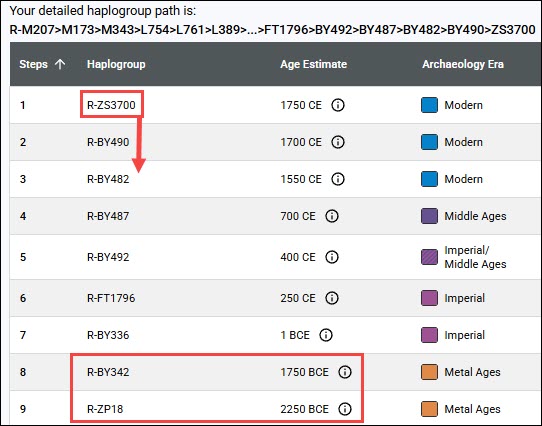
Your haplogroup is shown at the top, with the parent haplogroups in order beneath. I’ve boxed the “5 haplogroups” between R-BY482 and R-ZP18 here, and then the “3 haplogroups” between R-ZP18 and R-DF49, which is where we find the next closest Ancient Connections.

One bonus of the Ancestral Path display is that you can see how many Ancient Connections are in the database for each haplogroup, at far right.

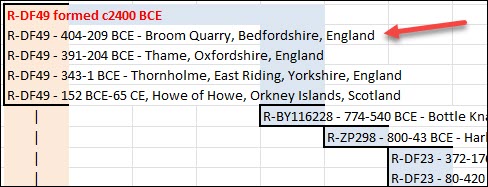
As I continue to build out my spreadsheet, the next four burials are all R-DF49, a haplogroup that was formed about 4400 years ago. Three of those burials are in England, and the fourth is in the Orkney Islands. They are all apricot, meaning:

  • They don’t carry any downstream haplogroups
  • They all descend from R-DF49
  • Based on haplogroups alone, nothing precludes the Estes line from descending from any of those men

Evaluating each Ancient Connection in the same way we did for North Berwick, when they lived, as compared to our Estes men, and where, may eliminate some of these burials as possible direct ancestors.

The balance of the Ancient Connections descend from R-DF49 through different branches and are colored blue, removing them as possible ancestors of R-ZS3700.

Regardless, we all share an ancestor, R-DF49, about 4400 years ago, just shortly before R-ZP18 lived some 4250 years ago. It would make sense that R-DF49 and R-ZP18 lived in relatively close proximity, given that they only lived about 200 years apart.

What else can we learn about these Ancient Connections?

Migration Map

To view all of your Ancient Connections on a map, just click on “Migration Map” in Discover’s sidebar.

The haplogroup whose path you are viewing, in this case, R-DF13, is the red dot on the bar at the top and is shown on the map with a red circle, but is mostly obscured here by the blue and red circles with numbers in the British Isles.

That haplogroup’s migration map, and your Ancient Connections, are displayed together. Individual burials not in close proximity to others are shown with individual trowels, and multiple burials are shown with blue and red circles, with the number indicating how many burials are found at that location.

Expanding the map shows more detail. I placed a red star to indicate the Estes lineage in Deal, at the bottom right.

Many of the blue and red circles have expanded, too.

By clicking on the blue circle, you can see which samples are found there. In this case, these 7 matching samples were all found in the same archaeological dig.

By clicking on any sample, you’ll see additional information.

One of my original questions was whether or not there was any indication whatsoever, even a smidgen of possibility that the d’Este rumor might be true. Some Estes researchers are not convinced by other arguments.

Given that our closest Ancient Connection lived about 2000 years ago in the British Isles, as do most, but not all, of the other Ancient Connections, it’s exceptionally unlikely that the progenitor of the Estes lineage was living in Italy in the 1400s, just a generation before our Estes ancestors are found in the records in Deal, and some 2000 years after the parent haplogroups of R-ZS3700 were already well-established in the British Isles.

There’s another place to check for additional information.

Notable Connections

Sometimes Notable Connections includes people who are either “ancient” themselves, and whose haplogroups have been identified through their descendants, or are from burials, or a combination of both. The difference is that their identity is not entirely a mystery.

When evaluating Notable Connections for genealogy, focus on:

  • Their haplogroup
  • Your shared haplogroup
  • When and where they lived
  • Any precluding factors like we found when analyzing North Berwick

Notable Connections are all interesting, but only a few may be relevant to your genealogy or your ancestors’ journey to where you first found them.

Speaking of their journey, Globetrekker™ shows you the most likely path of your ancestor’s haplogroup over time.

Globetrekker™

Globetrekker™ is currently only available for Y-DNA, and only for those who have taken the Big Y test.

Clicking on Globetrekker™ through my cousin’s account shows the path of his haplogroup, through Europe, in this case, into England and, if I enable them, includes relevant Ancient Connections. One Ancient Connection, Mount Pleasant 746, at Cambridgeshire, is found on the estimated genetic haplogroup path.

We’ve already determined that the Estes line cannot descend from Mount Pleasant 746, but the locations of the descendants of our common ancestor, R-ZP18 can still provide substantial clues about where our common ancestor might have lived, and his culture.

I’ve also enabled Globetrekker™’s “Sibling Lines” which indicate haplogroup siblings with the thinner lines. These display options are easy to toggle on and off.

Note that this is an estimated genetic path. In other words, it’s not exact. Especially, paths of the newer haplogroups can and will change over time as more testers test, and earliest known ancestors (EKAs) are added. I wrote about how to add EKAs in the article, “Earliest Known Ancestors” at FamilyTreeDNA in 3 Easy Steps. Please add yours, along with their location.

Sometimes the most refined haplogroup did not emerge in England, R-ZS3700 in this case, but in America. However, since the descendants have noted their EKA correctly as originating in England, that’s where the most refined haplogroup is also shown.

Furthermore, other than for Native Americans who are indigenous to the Americas, Globetrekker™ and the Migration Map both stop at the originating land mass for both Y-DNA and mitochondrial DNA.

You can read more about Globetrekker™, here.

What About the d’Este Family Story?

Now, about that d’Este family story.

Globetrekker™ utilizes the “least cost” migration methodology, which means the easiest, least risky, route of passage from place to place for our ancestors. The Strait of Dover is the closest link to the European mainland, and was shallower at that time as well.

There’s absolutely no genetic evidence that points to Italy or anyplace south for the Estes ancestral line. In fact, haplogroup R-S552 emerged about 4650 years ago, and appeared about the time that this lineage crossed from continental Europe into what is today England. There’s no evidence that this line back-migrated to the continent, to then remigrate back to the British Isles after 1471.

Ancient Connections show us that there’s evidence of the Estes ancestral haplogroups in many locations across the British Isles, long before Frencesco d’Este was being exiled from Italy. Multiple Estes family members appear in the earliest records in the Deal area, so it’s certain that they were well established and probably fishing on those same shores hundreds, if not thousands, of years earlier, based on Ancient Connections these various migration maps.

These provide one more very large nail in the coffin of that much-loved but extremely unlikely family story.

The final piece of evidence would be if a proven male descendant of the d’Este line tested and did or didn’t match. I’m not holding my breath.

Mitochondrial DNA

The methodology for building your Ancient Connections spreadsheet is exactly the same for mitochondrial DNA, with one exception.

You immediately know that you cannot descend from any male burial, because men don’t pass their mitochondrial DNA on to their children of either sex. You could, however, potentially be descended from his mother, or sister, or cousin, etc. Otherwise, the guidelines are the same.

Sometimes, Ancient Connections can resolve long-standing conflicts.

The Conflict Surrounding Radegonde Lambert

For a very long time, it was believed that Radegonde Lambert, an early Acadian woman born around 1621, was Native American because there were no known people, other than her, with that surname in Acadia. Based on the birth years of her children, she married Jean Blanchard, a French man, around 1642.

It doesn’t help any that French soldiers arrived in 1632, family settlement began about 1636, but there are virtually no records until the 1671 census, nearly 40 years later. Lots of people perished during that 40 year window.

Radegonde could have married before her arrival in Acadia, and Lambert may not be spelled accurately. We are fortunate that French women are referenced by their birth surnames, not their married surnames, so she is listed as Radegonde Lambert, the wife of Jean Blanchard on the 1671, 1678 and 1686 censuses.

Based on the conflict swirling around her presumed Native American ancestry, plus early mitochondrial DNA HVR1/HVR2 results that pointed to haplogroup “X”, which has both Native American and European branches, Radegonde began to be reported as “DNA confirmed Native”. However, that was incorrect, and she was NOT DNA confirmed as Native. Haplogroup X2a and subclades are Native American, while other haplogroup X AND X2 subclades are European, as can be viewed in the Acadian AmerIndian DNA Project.

By the time full mitochondrial sequence testing became available, that incorrect “confirmation” was firmly entrenched in family trees and among researchers, leading me to pen the article, Haplogroup X2b4 is European, Not Native American.

While ho-hum with a yawn today, it was radical at the time and greeted with quite the kerfluffle. After all, Radegonde was proven Native and HOW DARE ME! 😊

Prior to Mitotree, Radegonde’s haplogroup was X2b4, but now it’s been extended to X2b4t2, which arose about the year 500, or around 1500 years ago.

X2b4 and subclades are quite rare, with only 353 descendants today, including subclades.

X2b4t2 only has 65 members.

Clicking on the “Other Countries” link takes you to the Country Frequency report.

Click on “Table View.”

Note that the 36 “Other Countries” includes people who have listed “Unknown Origin,” who are counted individually. People listing United States often mean they are brick walled here. Some people interpret this as Native American, but there is a separate United States Native American category. Not everyone selects the correct category.

These locations are user-reported in the Earliest Known Ancestor (EKA) information, which is critical for Discover reports. I wrote about how to complete that information in 3 easy steps, here. Please add yours, including location!

One person has reported that Radegonde Lambert is “United States Native American.” She’s not Native, and she never lived in the United States either. During her lifetime, Acadians lived in Nova Scotia, where three censuses accurately reflect her residence.  Perhaps that incorrect information was entered by someone years ago, and never changed. Most people don’t think to update their EKA information.

Unfortunately, when misinformation is provided, or not corrected after we learn more, new testers view that as nuggets of evidence, and the misinformation cycle continues.

One of the benefits of Ancient Connections is that they are NOT based on trees, historical records, or genealogy of any sort. Ancient Connections are based on archaeological digs, and the location of the excavation is not subject to question.

So, let’s take a quick look at Radegonde Lambert’s Ancient Connections and see what we find.

A Quick Sneak Preview

Because I’m interested primarily in a quick view of locations, I’m skipping right to the Migration Map where all of the Ancient Connections are shown.

Radegonde’s Ancient Connections are scattered all over Europe, but there’s absolutely nothing in the Americas.

Given that Native burial excavations are culturally frowned upon in many locations, we might not see any in the US, but we also wouldn’t see any recent burials in Europe, given that the Native people have been in the Americas for well over 10,000 years.

Generally, even when Ancient Connections are missing in the US, we still find some contemporary testers with proven genealogy who carry that haplogroup, and at least a few ancient burials in Canada, Mexico, Central and South America.

The first seven Ancient Connection matches carry haplogroup X2b4, and the rest are European subgroups of X2b4. There are no closer matches as of today, but that doesn’t mean there won’t be eventually.

X2b4 emerged sometime before 5200 years ago, clearly someplace in Europe, possibly central Europe.

Radegonde’s X2b4 match locations are:

  • Malá Ohrada site in Prague – the individual lived 5800-5400 years ago
  • Hetty Peglers Tump, Gloucestershire, England – lived 5639-5383 years ago
  • Sorsum, Hildesheim, Lower Saxony, Germany – lived 5350-5100 years ago
  • Passage Tomb, Carrowkeel, Cairn K, Sligo, Ireland – lived 5100-4600 years ago
  • Kolín I-7b, Bohemia, Czech Republic – lived 4835-4485 years ago
  • De Tuithoorn, Oostwoud, Netherlands – lived 4579-4421 years ago

It’s unquestionable that X2b4 was found across Europe, not in the Americas, 5000 years ago.

This image is NOT from Radegonde Lambert’s Ancient Connections. I’ve included it to illustrate a Native American branch of haplogroup X2.

The descendants of Native American haplogroup X2a, shown above, match Kennewick Man, who is also X2a, as their closest Ancient Connection. He lived between 9250 and 8390 years ago along the river in present-day Kennewick, Washington. Their second-closest Ancient Connection is with an X2a1 burial found in Windsor, Ontario, who lived between 1223 and 1384 CE.

Neither of these unquestionably Native burials are found in the Ancient Connections of Radegonde Lambert’s descendants.

It’s worth noting here that when evaluating rare haplogroups, their Ancient Connections may reach far back in time. For example, if a Native American haplogroup only has a few Ancient Connections within the Americas, the rest of their Ancient Connections, if any, will be found on another continent. Failing to read the results thoroughly and thoughtfully could lead to an inappropriate and incorrect conclusion.

For example, haplogroup X is found in Eurasia prior to the migrated of people across Beringia, the now-submerged landmass connecting Asia with Alaska, to become the indigenous people of the Americas. Therefore, if there are less than 30 closer X2a Ancient Connections, one would expect to find Ancient Connections reflecting that continental Asian, or even Eurasian, heritage far back in time.

Notable Connections

One final tip for both Y-DNA and mitochondrial DNA is to check Notable Connections and selectively add them to your spreadsheet, if appropriate. Sometimes you’ll find people there that are both Notable and Ancient.

Not that we need more evidence about whether Radegonde Lambert’s matrilineal ancestors were Native or European, but Notable Connections provides us with one more corroborating piece of evidence.

Cangrande della Scala was an Italian nobleman who lived around 1300. He and Radegonde share a haplogroup X2b1″79 ancestor in Europe around 9000 years ago, which was after the Native people had crossed Siberia and Beringia to begin settling Canada and the Americas.

If there was any question left about Radegonde Lambert’s origins, Ancient Connections resolved it, with a backup volley from Notable Connections.

Radegonde Lambert was my ancestor, so I’m going to build her Ancient Connections spreadsheet and savor every discovery, but if I were simply seeking confirmation of or the answer to the question of whether Radegonde Lambert was Native American or European, I need look no further.

Mitochondrial DNA Case Study

In the article, Mitochondrial DNA A-Z: A Step-by-Step Guide to Matches, Mitotree and mtDNA Discover, I wrote in detail about utilizing mitochondrial DNA to break through genealogy brick walls.

My goal was to detremine if Catherine LeJeune, Edmee LeJeune and Jeanne LeJeune dit Briard were sisters or at least matrilineal relatives. Fortunately, we had several testers.

As it turned out, Catherine and Edmee were European sisters, but Jeanne did not share a matrilineal ancestor with Catherine and Edmee. Jeanne was Native American.

Next, we wanted to discover as much information about the LeJeune sisters as possible.

I created an Ancient Connections spreadsheet for the LeJeune sisters and included those results in my analysis, so please take a look. Their Ancient Connections were unexpected and simply astounding.

You literally never know who is waiting for you, nor the message they hold, just waiting to be delivered.

Ancient Connections are clues from your ancestors.

_____________________________________________________________

Share the Love!

You’re always welcome to forward articles or links to friends and share on social media.

Subscribe!

If you haven’t already subscribed, it’s free. You’ll receive an e-mail whenever I publish by clicking the “follow” button at the top of the main blog page, here.

Help Keep This Blog Free

I receive a small commission when you click a vendor link in my articles and purchase that item. This does NOT increase your price but helps me keep the lights on and this informational blog free for everyone. Please click on the affiliate links in the articles or to the vendors below if you are purchasing products or DNA testing.

Thank you so much.

DNA Purchases and Free Uploads

Genealogy Products and Services

My Books

Genealogy Books

Genealogy Research

Mitotree Q&A for Everyone

I recently presented Mitotree Webinar – What It Is, How We Did It, and What Mitotree Means to You at Legacy Family Tree Webinars. It’s still free to view through June 13th, and after that, it’s available in the webinar library with a subscription. The 31-page syllabus is also a subscription feature.

Thank you to all 1000+ of you who attended and everyone else who has since watched the webinar – or will now.

We had a limited amount of time for Q&A at the end, so Geoff, our host, was kind enough to send me the list of questions from the Chat, and I’m doing the Q&A here. But keep in mind, please, that I’m assuming when I answer that you’ve watched the webinar or are familiar with how the new Mitotree and tools work.

That said, I think this Q&A can help everyone who is interested in mitochondrial DNA. Your genealogy gift from your mother and her female lineage.

Just a quick reminder that the mitochondrial DNA test tracks your direct matrilineal line only, meaning your mother’s mother’s mother’s line on up your tree until you run out of mothers. Of course, our goal is always to break through that brick wall.

This is a wonderful opportunity, because, unlike autosomal DNA, mitochondrial DNA is not admixed with the DNA of the other parent, so it’s a straight line look back directly up your mother’s female line.

Aha Moment!

Geoff said at the end that he had an aha moment during the webinar. Both males and females have mitochondrial DNA inherited from their mother, so we think of testing our own – but forget to obtain the mitochondrial DNA of our father. Testing your father’s mitochondrial DNA means obtaining your paternal grandmother’s mitochondrial DNA, so test your father to learn about his mother’s maternal line.

And it’s Father’s Day shortly.

Q&A

I’ve combined and summarized similar questions to make this short and sweet. Well, as short and sweet as I can make anything!

  • Can I benefit from Discover even if I don’t have a full sequence test?

You can benefit from the free FamilyTreeDNA Discover tool with any haplogroup, even a partial haplogroup. Be sure to click the down arrow and select mtDNA before entering the haplogroup if you’re using the public version.

However, to gain the most advantage from your test results and Discover, and to receive your closest matches, you need the full sequence test, called the mtFull, which you can purchase here. If you took one of the lower-level “Plus” tests, years ago, click here to sign in and upgrade or check your account to see if you have the full sequence test.

  • What benefits do I receive if I click through to Discover from my account versus using the public version of Discover?

Click any image to enlarge

If you click through to Discover directly from your FamilyTreeDNA account, you will receive features and additional information that are not available in the free, public version of Discover.

You’ll receive additional Notable Connections and up to 30 Ancient Connections based on how many are available and relevant for you.

You’ll also be able to view the Match Time tree, showing your matches, their earliest known ancestors, and where they fit in your haplogroup and haplotype cluster. In this example, two EKAs hinted at a common lineage, which turned out to be accurate after I did some digging.

I think the Match Time Tree is indispensable – the best thing since sliced bread!

The Scientific Details report is also customized for you with your Haplotype Cluster and your private variants.

  • Will a child and their mother always have the same haplogroup?

Yes, but if one of them has a mutation that the other doesn’t, or a heteroplasmy, they may be in a different haplotype cluster.

Also, they both need to have taken the full sequence test. Otherwise, the one who did not take the full sequence test will only have a partial haplogroup until they upgrade.

We will talk more about edge cases in Q&A on down the list.

Great question. Sign in to your account.

In the Maternal Line Ancestry section, which is mitochondrial DNA, check to see if both the Plus and Full boxes are pink. If so, you have taken both and you’ll have a new Mitotree haplogroup and haplotype cluster.

If the “Full” box is grey, you can either click there or at the top where it says “Add Ons and Upgrades” to upgrade to the full sequence test.

  • Why is it called the Million Mito Project? What were you counting?

When we first launched the project, we hoped for a million full sequence samples to build the initial tree. After removing duplicates, such as parent/child, partial sequence samples such as HVR1/2, unreliable samples from PhyloTree, and including FamilyTreeDNA  testers and academic samples, we had between one-third and half a million samples when we launched. The Mitotree and Discover are growing with new testers and groups of samples from archaeological studies, academic samples, and other publicly available resources, following quality analysis, of course.

  • Is there a way to confirm that I submitted an mtDNA to the Mito Tree project? I think I submitted my mom’s when you first started, but my husband recently tested, and I don’t remember if we opted him in at that time.

The science team at FamilyTreeDNA  is using all of the full sequence tests in the construction of the Mitotree, so you don’t need to do anything special.

  • Do or can haplotype F numbers (haplotype clusters) ever become haplogroups?

The answer is maybe. (I know – I’m sorry!)

If you have private variants in addition to your haplotype cluster, then yes, those are haplogroup seeds.

This is my result and I have no additional private variants left to use.

If you don’t have any private variants, or mutations, left over, then no, you won’t receive a new haplogroup for this reason. However, if for some reason the haplogroup splits upstream, you might receive a new haplogroup in the future due to that split.

In addition to the webinar, I wrote about haplotype clusters in the article, Mitochondrial DNA: What is a Haplotype Cluster and How Do I Find and Use Mine?

  • How can mitochondrial DNA and the Mitotree be useful for breaking down genealogy in various parts of the world?

There are two aspects to mitochondrial DNA testing.

The first is to connect genealogically, if possible. To do that, you’ll be paying attention to your matches EKAs (earliest known ancestors), their trees, and their locations. You may well need to do some genealogy digging and build out some trees for others.

The second aspect is to learn more about that lineage before you can connect genealogically. Where did they come from? Do they share a haplogroup with any Ancient Connections, and what cultures do they share? Where did they come from most recently in the world, and where do the breadcrumbs back in time lead?

I wrote about this in the article, New Mitotree Haplogroups and How to Utilize Them for Genealogy.

Sometimes, DNA testing of any type is simply a waiting game until the right person tests and matches you. That’s one reason it bothers me so much to see people “not recommend” mitochondrial DNA testing. We all need more testers so we can have more matches.

  • When will Globetrekker™ for mtDNA be available?

I don’t know and neither does the team. The Mitotree is still being refined. For example, we are adding thousands of samples to the tree right now from multiple locations around the world. I probably wouldn’t expect Globetrekker™ until the tree is officially out of Beta, and no, I don’t know when that will happen either. It’s difficult to know when you’re going to be “finished” with something that has never been done before.

While it’s not Globetrekker™, you do have the Matches Map to work with, and the Migration Map in Discover, which also shows the locations of your Ancient Connections.

  • During the webinar, Roberta mentioned that her ancestor is German, but she discovered her ancestors were Scandinavian. Can you expand about the “event” that explained this unexpected discovery.

In my case, the church records for the tiny village where my ancestor lived in Germany begin right after the 30 Years’ War, which was incredibly destructive. Looking at Swedish troop movements in Germany, the army of Gustavus Adolphus of Sweden marched through the region with more than 18,000 soldiers. Women accompanied the baggage trains, providing essential, supportive roles and services to the soldiers and military campaign. I’ll never know positively, of course, but given that the majority of my full sequence matches are in Scandinavia, mostly Sweden, and not in Germany, it’s a reasonable hypothesis.

People often receive surprises in their results, and the history of the region plays a big role in the stories of our ancestors.

You don’t know what you don’t know, until you test and follow the paths ahd hints revealed.

  • Why do I have fewer matches in the HVR2 region than the HVR1 region?

Think of the mitochondria as a clock face.

The older (now obsolete) HVR1 test tested about 1000 locations, from about 11-noon and the HVR2/3 region tested another 1000 locations, from about noon-1 PM. The full sequence test tests the full 16,569 locations of the entire mitochondria.

Each level has its own match threshold. So, if you have one mutation at either the HVR1 or HVR2/3 level, combined, you are not considered a match. For example, you can match 10 people at the HVR1 level, and have a mutation in the HVR2 level that 4 people don’t share, so you’ll only match 6 people at the HVR2 level.

If you have one mutation in the HVR1 region, you won’t match anyone in either the HVR1 or HVR1/HVR2 regions.

At the full sequence level, you can have three mutation differences (GD 3) and still be considered a match.

So, the short answer is that you probably have a mutation that some of your matches at the HVR2 level don’t have.

In addition to matches on your Matches page, you will (probably) have haplogroup matches that aren’t on your match list, so check Discover for those.

  • I have HVR1/HVR2 matches, but none at the full sequence level. Why?

It’s possible that none of your matches have tested at that level.

You have no mutations in the HVR1/2 region, or you would not be a match. If your HVR1/2 matches have tested at the full sequence level, then you have more than 3 mutations difference in the coding region.

  • Why do I match people at the full sequence level but not HVR1/2?

The match threshold at the HVR1/2 level is 1, so if you have one mismatch, you’re not listed as a match. However, at the full sequence level, the GD (genetic distance) is 3 mismatches. This tells me you have a mismatch in the HVR1 region, which also precludes HVR2 matching, but less than 4 mutations total. Click on the little “i” button above each match level on the matches page.

  • Why don’t all of my matches show on the Match Time Tree?

Only full sequence matches can show on the Match Time Tree, because they are the only testers who can receive a full haplogroup.

  • How does a heteroplasmy interfere with mtDNA research?

Heteroplasmies, where someone carries two different nucleotides at the same location in different mitochondrial in their body, are both extremely fascinating and equally as frustrating.

Heteroplasmies can interfere with your matching because you might have a T nucleotide in a specific location, which matches the reference model, so no mutation – like 16362T. Your mother might have a C in that location, so T16362C, which is a mutation from T to C. Your aunt or sister might have both a T and a C, which means she is shown with letter Y, so 16362Y, which means she has more than 20% of both. All three of you probably have some of each, but it’s not “counted” as a heteroplasmy unless it’s over 20%.

The challenge is how to match these people with these different values accurately, and how heteroplasmies should “count” for matching.

I wrote about this in the article What is a Heteroplasmy and Why Do I Care?

Bottom line is this – if you are “by yourself” and have no matches, or you don’t match known relatives exactly, suspect a heteroplasmy. If you ask yourself, “What the heck is going on?” – rule out a heteroplasmy. Check out my article and this heteroplasmy article in the FamilyTreeDNA help center.

  • Someone asked about the X chromosome and may have been confusing it with mitochondrial DNA. The X chromosome is not the same as mitochondrial DNA.

The confusion stems from the fact that both are associated with inheritance from the maternal line. Everyone inherits their mitochondrial DNA from their mother. Men inherit their X chromosome ONLY from their mother, because their father gives them a Y chromosome, which makes them a male. Females inherit an X chromosome from both parents. And yes, there are medical exceptions, but those are unusual.

I wrote about this in the article, X Matching and Mitochondrial DNA is Not the Same Thing.

  • How do you determine the location of the last mutation? A tester and their aunt are from one country, and another man in the same haplogroup is from another country, but he has tested only the HVR1/HVR2 level.

There are really two answers here.

First, you can’t really compare your full sequence new Mitotree haplogroup with a partial haplogroup based on only the HVR1/2 test. Chances are very good that if he upgraded to a full sequence test, he would receive a more complete haplogroup, and one that might be near the tester’s haplogroup, but perhaps not the same.

For example, my full sequence haplogroup is J1c2f. I have matches with people who only tested at the HVR1/HVR2 level, but they can only be predicted to haplogroup J, with no subgroup, because they are missing about 14,000 locations that are included in the full sequence test.

Using the Discover Compare feature, comparing haplogroup J to J1c2f clearly shows that the mutations that define haplogroup J1c2f happened long after the mutation(s) that define haplogroup J.

You can use other Discover tools such as the Match Time Tree (if you click through from your account), the Time Tree, the Ancestral Path and the Classic Tree to see when the various haplogroups were born.

  • My mother took the full sequence test in 2016, so should I look for an upgrade now? She is deceased so can’t retest.

First, I’m sorry for your loss, but so glad you have her DNA tests.

The good news is that you ordered the full sequence right away, so you don’t need to worry about an upgrade failing later. In this case, there is no upgrade because the full sequence tests all 16,569 locations.

Additionally, had you needed an upgrade, or wanted to do a Family Finder test, for example, FamilyTreeDNA stores the DNA vials for future testing, so you could potentially run additional tests.

And lastly, since we’re talking mitochondrial DNA, which you inherit from your mother with no admixture from your father, your mtDNA should match hers exactly, so you could test in proxy for her, had she not already tested.

  • Has anything changed in Native American haplogroups?

Absolutely. About 75% of testers received a new haplogroup and that includes people with Native American matrilineal ancestors.

For example, my Native ancestor was haplogroup A2f1a, formed about 50 CE and is now A2f1a4-12092, formed about 1600 CE, so has moved 2 branches down the tree and about 1500 years closer. My ancestor was born about 1683. Her descendant has 58 full sequence matches, 22 in the same haplogroup, and 16 people in their haplotype cluster.

I’m so excited about this, because it helps provide clarity about her ancestors and where they were before she entered my genealogy by marrying a French settler.

  • Are mtDNA mutations the same or similar to autosomal SNPs?

A SNP is a single nucleotide polymorphism, which means a single variation in a specific location. So yes, a mutation is a change in a nucleotide at a genetic location in Y-DNA, autosomal DNA, or mitochondrial DNA.

  • Can we filter or sort our matches by haplotype on our match page?

Not yet. Generally, your closest matches appear at or near the top of your match list. Of course, you can use the Discover Match Time Tree and you can download your matches in a CSV file. (Instructions are further down in Q&A.)

  • Is there a way to make it more obvious that the EKA should be in their matrilineal line? There are so many men as EKAs!

So frustrating. The verbiage has been changed and maybe needs to be revised again, but of course, that doesn’t help with the people who have already entered males. We know males aren’t the source of mitochondrial DNA.

When I see males listed as an EKA, I send the match a pleasant note. I’m not sure they make the connection between what they entered and what is being displayed to their matches. If they have included or linked to a tree, I tell them who, in their tree, is their mtDNA EKA.

I’ve written about how to correctly add an Earliest Known Ancestor. I’ll update that article and publish again so that you can forward those instructions to people with no EKA, or male EKAs.

  • I love learning about my ancient connections. I have a new match due to the updates, who is from a neighboring area to my great-great-great-grandmother.

I love, love, LOVE Ancient Connections. They tell me who my ancestors were before I have any prayer of identifying them individually. Then I can read up on the culture from which they sprang.

I’ve also had two situations where Ancient Connections have been exceptionally useful.

One is an exact haplogroup match to my ancestor, and the burial was in a necropolis along the Roman road about 3-4 km outside the medieval “city” where my ancestor lived.

In a second case, there were two villages in different parts of the same country, hundreds of miles apart, and one burial from about 200 years before my ancestor lived was found about 10 km from one of those villages. While this isn’t conclusive, it’s certainly evidence.

  • What does the dashed line on the Time Tree mean?

Dashed lines on the time tree can mean two things.

The red dashed line, red arrow above, is the haplogroup formation date range and correlates to the dates at the top of Time Tree, not show in this screen shot. You can also read about those dates and how they are calculated on the Scientific Details tab in Discover.

The brown dashed lines, green arrow above, connect an ancient sample to its haplogroup, but the sample date is earlier than the estimated haplogroup.

At first this doesn’t make sense, until you realize that ancient samples are sometimes carbon dated, sometimes dated by proximity to something else, and sometimes dated based on the dates of the cemetery or cultural dig location.

Archaeological samples can also be contaminated, or have poor or low coverage. In other words, at this point in time, the samples are listed, but would need to be individually reviewed before shifting the haplogroup formation date. Haplogroup formation dates are based on present day testers.

  • A cousin and I have been mtDNA tested. What might be gained by testing our other six female cousins/10 or so male cousins?

Probably not much, so here’s how I would approach this.

I would test one cousin who descends from another daughter of the EKA, if possible. This helps to sift out if a haplogroup-defining mutation has occurred.

If you or that cousin has private variants left over after their haplotype cluster is formed,  testing a second person from that line may well results in a new haplogroup formation for that branch.

I absolutely would ask every single one of those cousins to take an autosomal test, however, because you never know what tools the future will bring, and we want to leverage every single segment of DNA that our ancestors carried. Testing cousins in the only way to find those.

  • In the Mitotree, I am grouped in a haplogroup that, according to the Mitotree Match Time Tree, branched off only about 200 years ago and has four mtDNA testers in it, including me. In fact, my earliest known maternal line ancestor I found using pen-and-paper genealogy was indeed born around 230 years ago and is also the known maternal ancestor for one of these three testers – confirming the Mitotree grouping is correct. But the other two matches in this haplogroup are completely unknown to me. Unfortunately, they do not have a tree online, and they did not respond to several messages. Is there any way to find out more about them using the new Mitotree tools?

First of all, this is great news. Having said that, I share your frustration. However, you’re a genealogist. Think of yourself as a sleuth.

I’d start by emailing them, but in this case, you already have. Tell them what you know from your line and ask if their line is from the same area? End with a question for them to answer. Share tidbits from Discover – like Ancient Connections maybe. Something to peak their interest.

Next, put on your sleiuh hat. I’d google their name and email address, and check Facebook and other social media sites. I’d check to see if they match me, or any cousins who have tested, on an autosomal test. If they do match autosomally, use shared matching and the matrix tool. If they are an autosomal match, I’d also check other testing sites to see if they have a tree there.

  • One webinar attendee is haplogroup H1bb7a+151 and is frustrated because they only have eight matches and don’t understand how to leverage this.

Of course, without knowing more, I can’t speak to what they have and have not done, and I certainly understand their frustration. However, in mitochondrial and Y-DNA, you really don’t want thousands of matches. It’s not autosomal. You want close, good matches, and that’s what the Mitotree plus haplotype clusters provide.

Your personal goals also make a lot of difference.

For me, I wanted to verify what I think I know – and received a surprise. I also want to go further back if possible. Then, I want to know the culture my ancestors came from.

First, step through every single one of Discover’s 13 tools and READ EVERY PAGE – not skim. These are chapters in your free book about your ancestor.

Their haplogroup was formed about 1200, so all of those matches will be since that time. The Ancient Connections tell me it’s probably British, maybe Irish – but they will see more from their account than I can see on the public version of Discover.

The Time Tree shows me one haplotype cluster, which is where the tester’s closest matches will probably be, barring a mutation or heteroplasmy.

Looking at the matches, e-mail people, look for common locations in their trees, and see if any of them are also autosomal matches using the Advanced Matching tool.

Looking at the 10 success story examples I used, one man was able to connect 19 of his matches into three groups by doing their genealogy for them. This doesn’t work for everyone, but it will never work if we don’t make the attempt.

  • An attendee would like to search on the Earliest Known Ancestor’s (EKA’s) name field.

I would like that too. You can search on surnames, but that’s often not terribly useful for mitochondrial DNA. The Match Time Tree shows the EKA for all full sequence testers.

In the upper right hand corner of your Matches page, there’s an “Export CSV” file link. Click there to download in a spreadsheet format. The EKA is a column in that file, along with both the new Mitotree haplogroup and haplotype F number, and it’s very easy to do a sort or text search from there.

  • Several questions about why people have so many more autosomal matches than either Y-DNA or mitochondrial.

There are several considerations.

First, autosomal testing became very popular, often based on ethnicity. There are many times more autosomal testers than there are either Y or mitochondrial.

Second, if you look back just six generations, you have 64 lineages. Y-DNA and mtDNA tests one line each and you don’t have to figure out which line. It also reaches back much further in time because it’s not admixed, so nothing washes out or rolls off in each generation like with autosomal.

Third, the Y-DNA and mitochondrial DNA tests are very specific and granular.

More is not necessarily better. You’re looking for refinement – and mitochondrial is just one line. No confusion. Think how happy you’d be if your autosomal matches weren’t all jumbled together and could be placed into 64 neat little baskets. Think how much time we spend sorting them out by shared matches and other criteria. Both Y-DNA and mitochondrial is already sorted out.

I’ve broken through several brick walls with unrecombined Y-DNA and mitochondrial DNA that could never be touched with autosomal – especially older lines where autosomal DNA is either gone or negligible.

  • You mentioned a Facebook group where I can ask questions about mitochondrial DNA?

The mitochondrial DNA Facebook group is the FamilyTreeDNA mtDNA Group, here.

  • To the webinar attendee who came to see me more than 20 years ago at Farmington Hills, Michigan, at one of my first, if not the first, genetic genealogy presentation – thank you!

Thank you for attending then when I really had no idea if ANYONE would come to hear about this new DNA “thing” for genealogy. I remember how nervous I was. And thank you for sticking around, continuing to research, and saying hello now!

Closing Comment

Mitochondrial DNA testing is different than autosomal, of course. It’s often the key to those females’ lines with seemingly insurmountable brick walls.

I attempt to collect the mitochondrial DNA of every ancestor. I trace “up the tree” to find people to test who descend from those ancestors through all women to the current generation, which can be males.

To find testers, I shop:

  • Autosomal matches at FamilyTreeDNA
  • Projects at FamilyTreeDNA
  • WikiTree
  • FamilySearch
  • Ancestry DNA matches
  • Ancestry Thrulines
  • Ancestry trees
  • MyHeritage DNA matches, where ther are a lot more European testers
  • MyHeritage Theories of Family Relativity
  • MyHeritage Cousin Finder
  • Relatives at RootsTech during the month before and after RootsTech when it’s available
  • Facebook Genealogy and family groups that appear relevant

When I find an appropriately descended person, I ask if they have already taken either the Y-DNA or mitochondrial DNA test, whichever one I’m searching for at that moment. If yes, hurray and I ask if they will share at least their haplogroup. If they haven’t tested, I tell them I’m offering a testing scholarship.

I will gladly explain the results if they will share them with me. Collaboration is key and a rising tide lifts all ships.

My mantra in all of this is, “You don’t know what you don’t know, and if you don’t test, you’ll never know.” I’ve missed testing opportunities that I desperately wish I hadn’t, so test your DNA and find testers to represent your ancestors.

I hope you enjoyed the webinar. It’s not too late to watch.

_____________________________________________________________

Share the Love!

You’re always welcome to forward articles or links to friends and share on social media.

If you haven’t already subscribed (it’s free,) you can receive an e-mail whenever I publish by clicking the “follow” button on the main blog page, here.

You Can Help Keep This Blog Free

I receive a small contribution when you click on some of the links to vendors in my articles. This does NOT increase your price but helps me keep the lights on and this informational blog free for everyone. Please click on the links in the articles or to the vendors below if you are purchasing products or DNA testing.

Thank you so much.

DNA Purchases and Free Uploads

Genealogy Products and Services

My Books

Genealogy Books

Genealogy Research

2024 Retrospective – Plus New Color Version of Complete Guide to FamilyTreeDNA

I hope 2024 was a great year for you.

2024 was an amazing year that included the release of my new book, Complete Guide to FamilyTreeDNA, and two genealogy-focused trips. I was also able to use Y-DNA to extend multiple paternal lines and break down a mitochondrial brick wall. It hardly gets better than this, but I have a focus list for 2025 already – and I hope you do, too.

But before we move on to 2025, let’s take a look at what was popular in 2024. Did you miss anything? Now is a great time to review, and I’ve assembled a list of this year’s top ten articles for you.

2024 in Review

Each year, I look back at my blog’s end-of-year statistics to see which articles were the most popular. I published 75 articles in 2024, which is an article about every four and a half days.

The Top 10 List isn’t just compiled from this year’s new articles, but the top 10 articles read this year from all 1738 articles that I’ve published over the past 12.5 years. I’ve noted the publication year by the article name.

Four of this year’s top 10 also fall in the all-time top 10. Of course, articles that have been published longer have more time to accrue views.

Article 2024 All Time
Concepts – Calculating Ethnicity Percentages (2017) 1 2
442 Ancient Viking Skeletons Hold DNA Surprised – Does Your Y or Mitochondrial DNA Match? (2020) 2
Ancestral DNA Percentages – How Much of Them is in You? (2017) 3 5
Proving Native American Ancestry Using DNA (2012) 4 1
23andMe Trouble – Step-by-Step Instructions to Preserve Your Data and Matches (2024) 5
DNA Inherited from Grandparents and Great-Grandparents (2020) 6
Ancestry’s ThruLines and Shared Matches Now Require a Subscription (2024) 7
Native American Mitochondrial Haplogroups (2013) 8 10
FamilyTreeDNA Tree Integration with MyHeritage – Step-by-Step Instructions (2024) 9
Y-DNA: Step-by-Step Analysis (2020) 10

Consistently, Native American DNA, ethnicity, and inheritance prove to be overwhelmingly popular topics. This probably explains the success of my book, DNA for Native American Genealogy. It’s timeless, and there are always new people searching! Thank you to everyone who has purchased it.

Of course, articles about this year’s announcements in the genetic genealogy world are always popular. The articles that didn’t make the Top 10 List but are in the 11-20 category include articles from RootsTech, two more Native American articles,  determining full or half-siblingspedigree collapse, the Washington family burial article, plus one about my Acadian ancestors and their DNA.

Thank you to everyone who subscribes, reads, and comments. Please share this article or site link with another genealogist who you think might benefit. As you know, it’s easy to subscribe and completely free.

You can also search for keywords in articles throughout the year to answer questions when you see them on social media or elsewhere. It’s easy and educational to post or send an article link.

Complete Guide to FamilyTreeDNA – Now Available in Color

Are you ready for a good laugh?

As I was reviewing these articles, I thought to myself, “where’s the announcement of the new color version of my book, “The Complete Guide to FamilyTreeDNA”?

I literally forgot to publish that article. How could I?? I mean…seriously. (My excuse is that I was traveling, plus conferences and back-to-back hurricanes.)

So, here’s the (slightly late) mini-announcement.

Initially, in May, The Complete Guide to FamilyTreeDNA was released in a full-color e-pub version, which is available from the publisher here. You can take a look at the table of contents here.

That was followed shortly by the release of the black and white print version, available in the US from the publisher, here, and worldwide from your country’s Amazon. Selling outside the US through Amazon removes the issues of expensive international shipping, VAT tax, and customs, which significantly increases the cost of the book and delays its delivery.

The decision was made to publish initially in black and white due to printing costs, but lots of people requested a color book.

For those who have already purchased the black-and-white version, the publisher has provided a free downloadable PDF with 26 of the most critical pages in color. We really had no idea that people would be eager to purchase a color version, but that has proven to be the case, and we didn’t want earlier purchasers to be disappointed.

Drum Roll

You spoke, and we listened.

In the fall, we released a full-color print-on-demand version of The Complete Guide to FamilyTreeDNA. Again, in the US, the book is available from the publisher, here, and at Amazon elsewhere.

This book truly is comprehensive and includes both DNA education, along with how to use the FamilyTreeDNA tools, many of which are unique in the industry. For example, no other vendor offers either Y-DNA or mitochondrial DNA testing and matching.

You don’t know what you don’t know, and I encourage you to find out!

Thank You!

Thank you so much for your ongoing support. Twelve years strong, going on 13.

Be thinking about what you’d like to see in 2025, because I’m going to be asking you tomorrow!

_____________________________________________________________

Sign Up Now – It’s Free!

If you appreciate this article, subscribe to DNAeXplain for free, to automatically receive new articles by e-mail each week.

Here’s the link. Just look for the black “follow” button on the right-hand side on your computer screen below the black title bar, enter your e-mail address, and you’re good to go!

In case you were wondering, I never have nor ever will share or use your e-mail outside of the intended purpose.

_____________________________________________________________

Follow DNAexplain on Facebook, here.

Share the Love!

You’re always welcome to forward articles or links to friends and share on social media.

If you haven’t already subscribed (it’s free,) you can receive an e-mail whenever I publish by clicking the “follow” button on the main blog page, here.

You Can Help Keep This Blog Free

I receive a small contribution when you click on some of the links to vendors in my articles. This does NOT increase your price but helps me keep the lights on and this informational blog free for everyone. Please click on the links in the articles or to the vendors below if you are purchasing products or DNA testing.

Thank you so much.

DNA Purchases and Free Uploads

Genealogy Products and Services

My Books

Genealogy Books

Genealogy Research

Françoise Mius (c1684-c1715): Mi’kmaq, Acadian, French & English Culture Clash – 52 Ancestors #422

There’s more that we don’t know about Françoise than we do.

We can infer some information from the facts we have.

Françoise Mius was born between 1684 and 1687, probably closer to 1684, in a Native village. Probably in or near Pobomcoup, Acadia, now Pubnico, Nova Scotia where her (presumed) father, Philippe Mius II, was raised. Philippe was the son of the most prominent Frenchman in Acadia by the same name, and her mother was a Native woman reported to have been from a Mi’kmaq village, Ministiguesche, near present-day Barrington.

By the way, according to the Nova Scotia Archives, the correct pronunciation of Mi’kmaq is ‘Meeg-em-ach.’

Did you notice all those words of uncertainly describing Françoise Mius, like multiple instances of probably and presumed? We’ll work through each one.

The first record of Françoise is the 1703 census at Port Royal, where she is listed with her husband, Jacques Bonnevie, and their two eldest children, both girls.

A total of about 85 families are living near Port Royal.

This family is NOT shown in the 1700 or 1701 census anywhere. Given that they had two children in 1703, they would have been married about 1700. The remaining parish records in Port Royal begin in 1702, and their children are not shown as baptized there.

However, the Port Royal parish registers, on October 22 and 23, 1705, show that several mixed Native/Acadian children were baptized who were previously baptized at Cape Sable, or nearby. Residences of their parents include Outkrukagan, Pombomkou, Puikmakagan, OneKmakagan, Mirliguish, Petite Riviere, Merligueshe, Port Multois, and Kayigomias.

Along the Eastern Coast, Mi’kmaq were seasonally migratory and also located near Canso, River Sainte Marie, Chebucto, La Heve, Port Medway, Port Rossignol (Shelburne), Ministiguesch (Port La Tour) and Ouimakagan (near Pubnico). For a more detailed discussion of these village sites, see Bill Wicken, “Encounters with Tall Sails and Tall Tales: Mi’kmaq Society, 1600-1760”.

Merligueche is noted in this list of villages, and it turns out to be an especially important place for the Mius family.

Photo courtesy of the Nova Scotia Archives.

Merligueche was also the location of a large Mi’kmaq summer village and trading port.

This cluster of 1705 baptisms within a day or so of each other makes me wonder if there was some kind of community baptismal event where everyone who wanted their child officially baptized climbed into a canoe or fishing boat and set out for Port Royal, where they had access to a priest. Conversely, the gathering could have been a harvest festival, Mawio’mi (powwow), or celebration of some type. One thing is clear, lots of non-resident people were visiting Port Royal that weekend and they probably didn’t visit regularly since the children being baptized were born across several years.

Many people were recorded with place names for surnames like Anne de Pobomkou.

There was only one Catholic church on the western shores of Acadia – at Port Royal. We know that children were born elsewhere and baptized at birth as they could be, even without a priest, which may have been the case for Françoise Mius’s two eldest daughters. Unlike others, they were never rebaptized at Port Royal, or, those records no longer exist.

It’s interesting that “Philippe de Pobomkou,” who signed as Philippe Muis, baptized children in 1702.

“Sieur de Pobomkou” baptized a child in 1704, which had to have been the son of the elder Philippe Mius d’Entremont, because the elder Philippe Mius died in 1700 after signing the seigneury over to his son, Jacques. Philippe Mius and his son were the highest-ranking Frenchmen in Acadia during their lifetimes and were quite well respected. Philippe Sr. had arrived in 1651 as a Lt-Major to his friend, Charles La Tour. In this case, the name “de Pobomkou” was used synonymously with Mius and reflected his Barony.

Philippe Mius Jr. lived among and married into the Mi’kmaq tribe, although he clearly kept many of his French ways, including the Catholic faith.

Both the Mius and LaTour families married into the Native families. This was not frowned upon or discouraged. An attitude shift developed sometime later.

We don’t know why, but something was motivating some of the mixed Acadian/Mi’qmak people to move to Port Royal. Jean Roy dit Laliberte, who was the shoremaster for Charles St-Etienne de La Tour and Jacques Mius, and his Native wife moved to Port Royal by 1698, and we know that Françoise Mius and Jacques Bonnevie were there by 1704. Of course, their motivation could have been because Jacques was a soldier. I noticed that some of the same military men were witnesses for other rehabilitation baptisms of the children of mixed couples that moved up from the Pobomcoup area.

On May 31, 1704, son Jacques Bonnevie was born and baptized the next day, listing “Françoise Muis dit Beaumon” as the wife of Jacques Bonnevie

  • Register RG 1 volume 26 page 20
  • Priest Felix Pain
  • Registration Date 1 June 1704
  • Event Baptism
  • Name Jacques Bonnevie
  • Born 31 May 1704
  • Father Jacques Bonnevie
  • Mother Françoise Muis dit Beaumon
  • Godparents Jacques de Teinville
  • lieutenant of a company
  • Magdelaine Mellansson ditte de la Boulardrie

It’s worth noting here that the Godfather is indeed the lieutenant of a company.

Françoise’s husband, Jacques Bonnevie, was reported in 1732 to be a retired, disabled soldier.

Seige!

One month and one day after that baby was baptized, two English warships and seven smaller vessels entered the Port Royal basin, capturing the guard station opposite Goat Island, along with four Acadians.

A woman from a family who had been captured was sent to the fort to demand surrender. It’s unclear if this was a separate family or the four that we know were captured.

For 17 long days, the men in the fort awaited an attack. However, the fleet commander had moved on to Grand Pre where the English laid waste to the town before returning to exchange perfunctory gunfire with the fort at Port Royal before returning to Boston.

Much of the English harassment and attacks upon Acadia were coordinated out of Boston.

The siege of Port Royal lasted only 17 days. This time. With a newborn infant plus two young children, and her husband stationed inside the fort, anticipating an attack at any minute, Françoise must have been terrified. She was also alone because, as a soldier, Jacques had no family there, and as a half-Native woman from far-away Pobomcoup, neither did she.

Perhaps families sheltered inside the habitation. Perhaps Françoise took her children and retreated into the safety of the woods, relying upon the skills she learned among her family.

Life in Port Royal

Their next child, Marie Bonnevie, was born and baptized on May 12, 1706 in the Catholic Church near Port Royal.

  • Bonnevie Marie 1706
  • Register RG 1 volume 26 page 47
  • Priest Justinien Durand
  • Registration Date 12 May 1706
  • Event Baptism
  • Name Marie Bonnevie
  • Born 12 May 1706
  • Father Jacques Bonnevie
  • Mother Françoise Mius
  • Godparents Louis de Clauneuf [Closneuf]
  • lieutenant of a company
  • Françoise de Belle Isle

Again, the Godfather was the lieutenant of a company.

In 1707, the family was listed in Port Royal under the name of Jacques Bonneur, his wife, 1 boy less than 14, and three girls less than 12. The family is living on 1 arpent of land, with 2 cattle and 6 hogs. One arpent of land is clearly not enough for farming, but given that Jacques is a professional soldier, he is probably stationed at the fort and is paid for his service. Their land would be used for a garden plot and raising their livestock.

They live two houses away from Madame de Belle Isle, a widow who may well be related to the Françoise de Belle Isle, who stood as Godmother the year before. Madame de Belle Isle is Marie Saint-Etienne de LaTour who was the widow of Alexandre Le Borgne de Belle-Isle. They lived in Port Royal, and she was widowed by 1693, becoming important in her own right as a seigneuresse, managing the finances of her former husband, a seigneur, allotting and selling land among other responsibilities.

Soldiers do not appear on the census. Most returned to France at the end of their service, but some stayed, married, and settled into Acadian life.

A total of 106 families are enumerated.

On February 21, 1708, Françoise Mius, wife of Beaumont, stood as the Godmother of Anne Clemenceau, daughter of Jean Clemenceau and Anne Roye. Anne Roy was also from Cape Sable and half-Native. Her father worked for the LaTour and Mius men.

Françoise would have known Anne before they both moved to Port Royal. They spoke the same language, shared cultures, and may even have been related.

Between 1708 and 1715, Françoise would have had at least four additional children, but we have no record of their births or deaths.

The Conquest of Acadia

In 1710, the English attacked Port Royal once again, but this time armed with warships and 3400 troops.

Again, a siege ensued.

Those brave men managed to hold the fort for 11 days, but in the end, had to relinquish control. 300 men, some of whom were poorly trained new recruits, stood no chance against the mighty English warships. Plus, they were outnumbered by more than 11 to 1.

The English warships fired upon the fort all night, and their cannon had advanced to within 300 feet of the fort. It became evident that either they negotiated the best possible surrender conditions, or die. Either way, the English were going to take control of the fort, and with it, Acadia.

The English allowed the Acadian and French men to exit with at least their lives and what was left of their dignity, flags flying and drummers drumming.

This event became known as The Conquest of Acadia and ended French rule.

Françoise must have been incredibly relieved – not that the Acadians lost their homeland, but that Jacques wasn’t killed and the French soldiers were released. I do have to wonder how and when he became disabled, and if it was related to this event.

A year later, the Acadian men and the Mi’kmaq warriors attempted a siege of the now-English fort, which failed.

Living Under English Rule

Day-to-day life didn’t change much under English rule, at least not initially. The Acadians were permitted to continue Catholic worship, and the routines of the seasons dictated daily activities.

The English only took one census.

In the 1714 census, “Beaumont” was listed with his wife, one son, and three daughters at Port Royal. His career as a French soldier at the fort had clearly ended, although life must have been extremely uneasy for those previous soldiers.

How would they have earned a living? The English certainly weren’t going to give them land.

On October 13, 1715, their son, Charles Bonnevie, was born and baptized.

  • Register RG 1 volume 26 page 137
  • Priest Justinien Durand
  • Registration Date 13 October 1715
  • Event Baptism
  • Name Charles Bonnevie
  • Born 13 October 1715
  • Father Jacques Bonnevie
  • Mother Françoise Mius
  • Godparents Charles Landry
  • Marguerite Pitre
  • wife of Abraham Comeau

When Was Françoise Born?

Unfortunately, not one single record gives Françoise’s age. Not one.

If Françoise had two daughters by 1703, with the next child, Jacques, born in May of 1704, we can surmise that the youngest daughter was born in 1702 or maybe early 1703, 18-24 months before Jacques. Françoise’s oldest daughter would have been born about 2 years before that, so about mid-1700 or perhaps in 1701.

This suggests that Françoise Mius was married in either 1699 or 1700, which puts her birth at about 1680-ish. Some researchers show her birth between 1684 and 1687. 1684 is after the birth of known children of Philippe Mius with his first wife, and 1687 is the approximate birth of the first of the next group of Philippe Mius’s children with a Native woman named Marie.

All things considered, I’m using 1684 as her birth year.

If you’re thinking, “This sure is complicated,” you’d be exactly right.

Who Are the Parents of Françoise Mius?

This is where it gets a little dicey.

There are only four known Mius men in Acadia at this time, all of whom are well-known and documented. Some can be reasonably eliminated from consideration.

Philippe Mius, the elder, and father of the other three, was born in France around 1609, married Madeleine Helie around 1649, presumably in France, and had five known children between 1650 and 1669. Sometime around 1651, Philippe came to Acadia with his young family as Lieutenant to Charles de Saint-Etienne de La Tour and served as commander of the colony in La Tour’s absence. We will hear his story later.

  • Philippe Sr.’s eldest son, Jacques Mius d’Entremont, was born about 1654, married Anne Saint-Etienne de La Tour (1661-1741) about 1678, and died about 1735.
  • Philippe Sr.’s second son, Abraham Mius de Pleinmarais, was born about 1658 and married Marguerite Saint-Etienne de La Tour (1658-1748) about 1676 and died about 1700.

Both of these sons had married European women long before the 1680s when Françoise was born.

  • Philippe Sr.’s third son, Philippe dit d’Azy Mius II, was born about 1660, lived among the Native people, and was married to two Mi’kmaq women.

We know, based on the mitochondrial DNA haplogroup of our Françoise Mius, X2a2, that her mother was indeed Native, which limits the choice of father for Françoise, barring an unusual circumstance, to son Philippe Mius.

This early photo of a Mi’kmaw woman, Mary Christianne Paul Morris, was taken in 1864. She is holding a quillwork model canoe, and a quillwork box rests on the floor by her leg. She is dressed in traditional attire. Photo courtesy of the Nova Scotia Archives.

Early Census Records

Philippe Mius Sr. is shown on the 1671 census of Acadia at the Habitation of Poboncom near the Island of Touquet as follows:

Phillippe Mius, squire, Sieur de Landremont, 62, wife Madeleine Elie 45; Children: Marguerite Marie An, Pierre 17, Abraham 13, Phillippe 11, daughter “la cadette” Madeleine 2; cattle 26; sheep 25.

In the 1686 census, we find:

Philippe Mius, royal prosecutor, age 77, is shown in Port Royal with son, Philippe, 24, daughter Magdelaine 16, and 40 arpents of land. It’s worth noting that both of his sons Jacques and Abraham are married with children and living in Cap Sable beside or near the LaTour family whose surname is sometimes written Saint-Etienne de La Tour.

These two censuses show his birth year as 1660 and 1662.

The 1708 Census

In the 1708 census, which includes both French and Native families, in the section titled “Indians from La Heve and surrounding area,” we find:

  • Philippe Mieusse age 48 (birth year 1660)
  • Marie his wife 38 (so born about 1670)
  • Jacques his son 20
  • Pierre his son 17
  • Françoise his daughter 11
  • François his son 8
  • Philipe his son 5
  • Anne his daughter 3

This daughter, named Françoise, is only 11 and, therefore, cannot be our Françoise, who was married by about 1700 and had children shortly thereafter.

We do find a few more people with the surname Mieusse:

  • Cape Sable under enumeration of the French: François Vige, age 46, his wife Marie Mieusse 28, with 5 children. Marie’s age of 28 puts her birth in about 1680.
  • Indians from Mouscoudabouet (Now Musquodoit Harbour): Maurice Mieusse 26 with wife Marguerite 27 and two children. Age 26 puts his birth at about 1682.
  • Cape Sable Indians: Mathieu Emieusse 26, Madelaine 20 and one child. This puts his birth at about 1682.
  • De La Heve under “enumeration of the French”: Jean Baptiste Guedry 24 and Madelaine Mieusse 14. Age 14 puts her birth at age 1694.

Another child of Philippe Mius Sr. is found three houses away from François Vige and Marie Mieusse:

  • Joseph dazy 35, Marie tourangeau 24, with 5 children. His age places his birth about 1673. His death record on December 13, 1729, at about 55 years of age, by the name Joseph Mieux dit D’Azy, confirms his identity. His surname line among descendants was known as D’Azy.

Neither Françoise Muis nor Jacques Bonnevie is shown in 1708 under the only Port Royal category of “Indians of Port Royal.” They are considered French and live among the French families.

Philippe Mius’s Older Children

Given the age of Philippe’s wife, Marie, in 1708, she was born about 1670.

This means that it was impossible for Marie to be the mother of Philippe Mius’s oldest children, including Françoise. His older children were:

  • Joseph d’Azy Mius, born about 1673/1679, received land in 1715 and is described as “part Indian who dwelt at Port Le Tore,” and is the son-in-law of “Tourangeaut”.

We know that Philippe Mius Jr. was born around 1660, which is probably why researchers have shifted his son Joseph d’Azy’s birth closer to 1679. Various records across the years clearly show Joseph as being half-Native.

He is later noted as the “part Indian who dwelt at Port Le Tore,” which was originally known as Port Lomeron and was where Charles La Tour lived.

This map shows Port LaTare, aka LaTour, along with the other capes and early forts.

La Tour traded here between 1624 and 1635 when he established another fort at the mouth of the River Saint John.

Author Father Joseph Clarence d’Entremont states that Philippe Mius’s first unknown Mi’kmaq wife who was the mother of Françoise Mius was from what is today Barrington, Nova Scotia. Based on the 1708 census, Philippe Mius’s second Native wife, Marie was probably a member of the Le Heve tribe. Barrington may have been the village of Ministiguesche according to the authors of the Ethnographic Report.

Several of Joseph Mius’s children intermarried with the Mi’kmaq people, as did two of his full siblings, shown below:

  • Marie Mius, born about 1680, married Francois Viger. They lived at Ouimakagan, present-day Robert’s Island, near Pobomcoup in 1705.
  • Maurice Mius, born about 1682, married Marguerite, a Mi’kmaq.
  • Mathieu Mius, born about 1682, married Madeleine, a Mi’kmaq
  • Françoise Muis, born about 1684, married Jacques Bonnevie, a French soldier.

Maurice and Mathieu are shown as twins, born in 1682, and Françoise is slotted as the next child, born in 1684.

That’s certainly possible, as she would have been 16 in 1700, and young women were clearly marrying at that age in that time and place.

There is no evidence or suggestion that the other Mius men, meaning Philippe Sr. or his sons Jacques Mius d’Entremont or Abraham Mius de Pleinmarais, had children with a Native woman in the 1680s.

Of course, that also doesn’t mean it didn’t happen.

Given the age of Philippe Mius’s Native wife, Marie, born about 1670, she cannot have been the mother of those older Mius children.

Adding to the confusion, Philippe had daughters named both Françoise and Marie with both Native wives, although the children may well have been called by their Native names, not their French baptismal names.

Facts About Françoise

So, we know a few things, for sure:

  • Françoise was shown in the parish records as Mius and Mius de Beaumon(t)
  • Françoise’s mother was unquestionably Mi’kmaq, confirmed by mitochondrial DNA
  • Françoise was having children by 1700/1701, so probably born no later than 1685
  • Assuming that her father was a Mius male, the only candidates were Philippe Sr., Philippe Jr, Abraham, or Jacques
  • Philippe Sr., Abraham, and Jacques were married to European wives at that time.
  • Philippe Jr. is documented to have been living with the Native people and, according to various records, had two Native wives
  • Françoise’s mother was very unlikely Philippe Jr.’s second Native wife, Marie, as she was born about 1670, so would have been a prepubescent child when Philippe’s oldest children were born, and about 14 when Françoise was born
  • Françoise’s mother was very unlikely Philippe Jr.’s second Native wife, as she named another daughter Françoise who was born in 1697.

Constant Conflict

Acadia was in a state of constant conflict, with the English either attacking or threatening to attack at all times.

These conflicts began before Françoise was born, but one of the more memorable took place in 1690, when Françoise was a mere child. The Battle of Port Royal was fought, resulting in the fort’s surrender. That should have been the end of it, but it wasn’t, as the English burned the town and many farms before forcing the residents to sign a loyalty oath, taking a few hostages, and sailing back to Boston. A few weeks later, more English arrived to pillage anything that was left.

While Françoise would have been tucked safely in a Mi’kmaq village someplace in Southwest Acadia, this back-and-forth scenario and broken trust played out over and over again.

Beginning in 1713, the English, who had been in control of the Acadian homeland since 1710, tried to force the Acadians to sign “better” loyalty oaths to the crown. When they refused, the English tried to evict the Acadians, only to change their minds because they needed their labor to feed the English soldiers.

The unrelenting conflict with the English was ramping up again.

The Acadians wanted to and tried to depart for Ile Royal, but were stopped by the English Governor.

In 1715, the Fort’s gates were shut and locked, preventing trade with anyone, including Native people.

In 1717, Captain Doucette became the Lieutenant Governor of Acadia. By this time some Acadians had decided to stay put on peaceful terms. When the Indians learned about this, they threatened the Acadians. Though they had always been friends, and in Françoise’s case, relatives, the Indians didn’t want the Acadians defecting to the English side.

By now, everyone was upset and everyone was mad at everyone else.

Doucette demanded that the Acadians take the oath, but they thought doing so would tie them down … and they still wanted to move. The Acadians said that if they were to stay, they wanted protection from the Indians, and the oath would need to be stated so that they would not have to fight their own countrymen. But that negotiation tactic wasn’t working, because Doucette wanted an unconditional oath.

The only constant in Acadia other than Catholicism was warfare.

Given that Françoise was half-Native and given the nature of the conflict between 1710 and 1720, I wondered if perhaps Françoise and her husband, Jacques Bonnevie, struck out for parts unknown, or at least undocumented.

I quickly discounted that possibility, because their children are found in Port Royal. They wouldn’t have left them behind with no means of supporting themselves.

By 1718, Françoise’s children began to marry, and in 1719 her first grandchild arrived. Her husband, Jacques Bonnevie, stood as Godfather at the baptism, but Françoise did not stand with him. She is not found in any record again.

Clash of Cultures

Constant warfare isn’t the only undercurrent running through Acadian lives – or, more accurately, through Acadian/Mi’kmaq mixed lives.

This painting, “Homme Acadien,” Acadian Man by André Grasset de Saint-Sauveur, is reported to represent a Mi’kmaq man somewhere in the Acadian region. Looking at this man, I’m not at all sure he’s native, or at least not fully Native.

Every genealogist knows about assumptions, and we all try to avoid them. Sometimes we don’t even realize we’re assuming. Once in a while, assume gets us.

I’ve been researching Acadians and Native peoples for decades now, and I know that the Acadians were closely allied with the Mi’kmaq and probably other Native peoples too. The Maliseet lived in the Saint John River drainage, and both the Penobscot and Abenaki are found in and near the early Acadian settlements, particularly those on the mainland in New Brunswick and present-day Maine. The Acadians and Native people intermarried. The Native people helped the Acadians and lived near and sometimes integrated with their villages. They were hunting and trading partners.

Everything seemed hunky dory.

Like every place Europeans colonized, they attempted to convert the aboriginal people to their religion. We know from parish records in Acadia and elsewhere that many Native people were baptized and given European religious names.

And yes, we know that Native people and Acadians intermarried. The Catholic Church would not sanction a marriage unless both parties were Catholic, so the Mi’kmaq converted. Although it’s very doubtful that the Native people understood conversion to be what the French assumed. Still, the marriage happened, which was the point.

A list of Mi’kmaq marriages extracted were by Fran Wilcox from the Port Royal parish registers beginning in 1702 and published by Lucie LeBlanc Consentino. Another list with genealogical information can be found at WikiTree here. Stephen White’s list is available here. Some “marriages,” meaning in the legal or religious sense, are inferred.

There were rumblings of unrest between the two groups of people from time to time, especially when the Native people became concerned that the Acadians might be planning to side with the English, and against them, but nothing at all that seemed serious. Nothing suggested or even hinted that ethnic discrimination played into the equation. In fact, I thought just the opposite. People intermarried, and the blending seemed smooth. No boats seemed to be rocking.

I was wrong.

In the document, “An Ethnographic Report on the Acadian-Metis (Sang-Meles) People of the Southwest Nova Scotia,” I learned a lot – a whole lot. The authors provide a download copy, here, for noncommercial use, and I encourage Acadian researchers to download and read the document in its entirety.

This treatise was written by academics who are also Acadian descendants, specifically Acadians who carry both French and Native heritage. Little that I learned was pleasant.

To begin, let’s define a few terms.

  • French people – people from France and not yet Acadians
  • Acadian people – people who came from France and settled in Acadian, now Nova Scotia, and established a separate, unique culture over time
  • Mi’kmaq First Nations people – Aboriginal inhabitants of Nova Scotia, Atlantic Maritime Canada, and the northeast US
  • Metis – In Canada, mixed race between French/Canadian and First Nations. Initially, metis simply meant a person of mixed parentage, but today, there is an official “Metis” tribe, and the identity and definition have become complex.
  • Sang-Mêlés – defined in the Ethnographic document as people who were mixed Acadian/First Nations, perceived as an “inferior caste of people” both before and after the Deportation in 1755
  • Bois-Brûlé – this term is applied to the descendants of Joseph Mius d’Azy whose father was Philippe Mius Jr. and mother was Mi’kmaq, and the descendants of Germain Doucet, born in 1641, whose father was Native. People referenced by this term live in Tuskey Forks/Quinan, Nova Scotia.

The authors found distinct, documented marriage patterns where parents who were members of the “Pur” caste, meaning those who were not admixed with Native people, would go to extreme lengths to ensure that their children did not intermarry with those who were mixed, specifically the “caste dêtestée des gens mêlés,” which translates to “detested caste of mixed people.” This was particularly pronounced in the Cape Sable region where the Mius descendants are prevalent, both pre-deportation and after members of the Mius and Doucet families returned after the Exile.

It hurts my heart to even type these words. I was truly shocked. This was not at all what I expected.

But it also explains A LOT in my own family. I had a HUGE AHA moment.

The authors point out that the degree of blood quantum, or the generational distance between the individual being discussed and their original Native ancestor makes no difference at all.

This reminds me of the dreaded “one drop rule” in portions of the US, specifically stating that anyone with even “one drop” of nonwhite blood was considered to be non-white or “colored.” Of course, discriminatory practices were visited upon anyone non-white in the 20th century and earlier.

The authors stated that even recently, one of the greatest insults to an Acadian would be to tell them that they had Native blood.

These families often intermarried within their community or with newcomers and established a distinct culture separate from the Acadians, Mi’kmaq, or, more broadly, the French/Canadian Metis.

My ancestry reaches from my mother to Françoise Mius as follows:

  1. My mother
  2. Edith Barbara Lore 1888-1960, who knew absolutely nothing about Acadian heritage and nothing about her father’s past before meeting her mother
  3. Curtis Benjamin Lore 1856-1909 – A man with a mysterious past that he attempted to escape.
  4. Antoine “Anthony” Lore 1805-1862/1868 – His family never knew he was Acadian  As a young man, he left a high-drama family situation in L’Acadie, Quebec, and died, perhaps as a river-pirate in Pennsylvania. Another mysterious man.
  5. Honoré Lore 1768-1834 – Born in New York during the Acadian exile.
  6. Honoré Lore/Lord 1742-1818 – Born in Acadia, exiled in New York, settled in Quebec.
  7. Jacques “dit LaMontagne” Lore/Lord, probably the son of a soldier, was born about 1679 in Port Royal. He married Marie Charlotte Bonnevie who was born about 1703 to Françoise Mius and Jacques Bonnevie, probably in Pobomcoup, and was one-fourth Native.
  8. Françoise Mius born about 1684 – Half Native through her unknown mother, who was married to Philippe Mius II sometime around 1679

Even 4 or 5 generations later, my mother’s grandfather and great-grandfather were very evasive and behaved in a manner that suggested they were trying to escape or avoid something. That fear and perhaps cultural avoidance had been passed from generation to generation.

Mother didn’t know they were Acadian, didn’t know she had Native blood, and didn’t know about her grandfather’s past. Neither did her mother and I doubt his wife, mother’s grandmother, did either.

Of course, that’s my perspective – it’s not from the perspective of the Acadian people, not from the perspective of the Sang-Mêlés, and not from the perspective of any of those people mentioned. I wonder about the adage, “Once burned, twice shy.” Once something is revealed, it can’t be “unseen.”

Betrayal was a constant concern.

So, my Acadian ancestors moved away and chose not to reveal a past that had burned them previously. Catholic, Native, poor, and Acadian were all things that could burn you again. Anything that wasn’t part of the mainstream, in line with the people in power, put you at risk.

Prior to the arrival of the French, before the arrival of the priests, the Native people enjoyed and functioned perfectly well within their own culture. They had their own standards, rituals, and customs about marriage and morality, how it worked, what was acceptable and what wasn’t – in their community and environment. The colonizers had other ideas and judged the Native people, their culture, and their descendants, who still bore at least traces of both Mi’kmaq culture and blood, from their pulpits and their seats of government.

A priest, Father Jean-Mande Sigogne, who served in the Cape Sable area for more than a quarter century, beginning in 1800 when he arrived in a fishing boat, was incredibly frustrated for more than a quarter century by both the behavior of the Sang-Mêlés families AND by the blatant discrimination exhibited by members of his parish who weren’t related to those families – and certainly didn’t want to be. In 1802, he wrote the following letter to church elders and mentioned that the denigration of the Sang-Mêlés was a widely accepted practice.

There reigns here a prejudice that seems to be contradictory to the charity and the spirit of the religion and also of the church because it has been carried too far, and it is supported by authority and the custom of the area, and even by the clergy. It is the marriage that is contracted or to be contracted between those who are called Whites and others who they call sang mêlé, which is not accepted by people here, despite the equality of conditions to others, superiority in wealth, and of virtue and talent. Some people prefer to see their children unmarried than to see them married into the families that are even slightly tainted, and most prefer that they marry to the degrees that are prohibited by the church: so that they have more respect for their vain prejudice than for order and rule in the church. We can see here that there is a refusal to marry any young man with any drop of Savage blood. This is new and ridiculous to me, I have never heard of such irregularities. I have found no canon from the ancient church of Africa that mentions similar; there seems to have been Roman families that were allied with the African families. This prejudice seems difficult to destroy; I said something in public, but with precaution so I would not offend the spirits; but I have been ridiculed for this on occasion; It makes me angry that to Marry couples is in violation of the laws of the church because one of the ancestors of their great-grandfathers married a Savage, perhaps more Christian than them. I wait with submission and respect for your opinion on this prejudice, your Greatness.

Father Sigogne railed against the inherent racism and denigration of the mixed Native/Acadian people in the same treatise where he called their blood “tainted.” He said in one case that the “Sauvage” might have been more Christian than a member of his own parish, yet their cultural norms frustrated him to tears.

In 1809 he wrote:

There exists here a prejudice that I believe to be unchristian, not very charitable and little just in itself. [Those in] my world have a horrible repugnance to unite with those who have what they call mixed-blood. I mean with those whose families come originally from the marriage of a Frenchman with a savage woman and vice versa; they even have a sovereign contempt for those with merit and even superior. I openly attacked this foolish prejudice to the exemptions and I have much displeased the people who have, they say, pure blood. I still fight it, though with more reserve. But people with mixed-blood, for the most part, behave so badly that they cover me with confusion for having defended them, and are truly worthy of the contempt of them. They indulge without discretion all sorts of vices. Disorders of every kind reign among them in an eminent degree. They have, it seems, passions stronger than the others, or the contempt of them reduces them to the point of having no sense of virtue or honor.

He goes on to ask for marriage exemptions for four couples who are mixed and are related to either the second, third, or fourth degree of sanguinity. In one case, the couple was related twice, through both the second and third degree. These marriages are all between the descendants of the mixed Mius and Doucet families.

The Mius family, Doucet family, and the Native people were very closely allied and, by this time, had been interrelated for generations.

If you cannot marry into the “general population,” there is no one left to marry other than people within your “caste.” The priest at one time said he had hoped that the English men would convert to Catholicism and marry within this group, but that didn’t happen.

In 1813, while attempting to assist the Mi’kmaq acquire land, which is incredibly ironic since they were the aboriginal population, he noted that Andrew James Meuse was the chief of the local tribe. He went on to describe the desperate state of the Mi’kmaq people and that people often took advantage of them. He tells of Mi’kmaw walking from as far as 300 miles carrying packs and children. You can read more here.

By 1826, the priest had not given up and clearly remained extremely frustrated after more than a quarter century of living among and working with these families. He wrote the following in a sermon:

I am forced to tell you here, O people whose blood is mixed, if you are fleeing, if you disdain, if we refuse to ally with you, is it not because of your bad conduct, scandals & disorders that reign openly among those of this caste, more than among the others? Indeed, have we not seen & not seen yet from time to time actions that make us blush & move our neighbors away from our church, seeing in it the reign of adulterers and public concubinages? & that among you, degenerate race, corrupt and incestuous race. It is necessary to tell you the truth; upon my arrival, sincerely believing before God that the contempt which I perceived they were making of you was not very charitable, I took your side because charity covered in my eyes the multitude of your sins & that I wished that the past be forgotten, and that by forming new establishments for the civil and the religion, I did not expect my care and my ministry to see reign among your union, faith, marital harmony, purity of morals, probity, temperance, and sobriety; this is the fruit that I expected from my labours by doing catechisms carefully & the first communions with solemnity. I was waiting, yes, I was waiting for all this, and not less than that of you; and that is the principle of indulgence and favour that I showed you to the scandal and reproaches of others who have given me enough testimony [sic] of their dissatisfaction. But alas, to my great sorrow, I soon saw by the wrinkle of the promises made, by the terrible scandals which have appeared, that it is necessary, by blushing at your conduct, that I change my manner of thinking about you. So I promised myself that I would no longer encourage or support disputed unions because of the stain of mixed blood, leaving the rest to God. This is before God, oh Christians, the simple exposition of my heart. You can now see who you are going to; it is my misfortune but it is not my fault. It is true, however, that there are families in the mixed caste whom I cannot reproach; so I make it a point to do them justice and to respect them, but the justice and respect which I owe them, and which I am, disposes of their render must not go to the point of leaving vice unpunished; it is an accident for them to be among those families, but I cannot help it; so I pray those to take in good part what I did & what I say. I measured and weighed my words before God. It is with vices, it is with the disorders, it is with scandals that I make war, it is to drunkards, rebels, old [sic], adulterers, public concubinaries and none who approve and support them, whether they are white or tainted families, pure or mixed, that my reproaches are directed & not to those who live as Christians, whatever they are. May the misguided and the vicious, the incestuous, and the adulterers return to the true path, to virtue and good order, in a word to penance, my reproaches will no longer look at them…”

That. Just. Brutal.

I can’t even imagine hearing this from the pulpit, and if it were directed toward me or my family, I can assure you that I would never darken the church door again.

We will never know the specifics, of course, although I certainly want details with names. Still, this reminds me of the outrage of the European colonizers when they discovered that many of the tribes in what became known as the Americas practiced a form of polygamy and had, successfully, for generations. It was their normal, and they saw no reason to change.

Extremely heated feelings and prejudice had existed prior to the Expulsion in 1755, at least as early as 1745, wherein the Acadian Lieutenant-Governor Paul Mascarene wrote, in part, that people in vessels from New England were pressing inhabitants of Annapolis Royal to “destroy all the inhabitants that had any Indian blood in them and scalp them…”

In other words, this sentiment was not restricted only to the Cape Sable region. Those seeds were planted before the Deportation and may have had roots more than a century earlier, especially if the Mi’kmaq did not completely reject their Native cultural ways and entirely assimilate into the French Catholic religious family. The only problem was, of course, that even if they did, they still looked Native, and they still had Native customs and relatives.

By Maestrobistro – Own work, CC BY-SA 4.0, https://commons.wikimedia.org/w/index.php?curid=98949742

Four Acadian women in 1895 from the Argyle Township Courthouse Archives.

Even generations later, vestiges of an earlier culture were still present in their descendants. In terms of how they looked and dressed, their handwork, how they reacted to certain situations based on previous encounters, and resulting from generationally transmitted trauma in the sense of what their ancestors had survived – or didn’t.

While the priest was frustrated with the Mi’kmaq or mixed Acadian/Mi’kmaq culture, there was plenty of blame to go around.

In 1723, Philippe Mius’s son, François Mius, half-brother of our Françoise, along with some other Native people who were also related to our family, had been captured by the English from one of the coastal Native villages and were being held in Boston.

This scene with a Mi’kmaq father and son in 1871 at Tufts Cove probably looked much the same as the same scene a century or two earlier, except for the house and their clothes.

In 1726, several Native men, including Philippe Mius, were frustrated with the fact that despite a supposed peace treaty between the English, French, and Mi’kmaq, their family members hadn’t been returned. This led to an incident we’ll review in detail in a later article, where a group of men attempted to hold an English fishing vessel in exchange for the return of their family members. This led to charges of privacy wherein four of Philippe Mius’s family members, including two sons, his son-in-law, and his grandson were hung by the English as pirates.

Of course, François was half French, as were at least some of the other hostages taken in 1723, but were considered lesser citizens when classified as “Indians.” Even worse, the French informed the Mi’kmaq that there was no treaty with the English, encouraging and emboldening their actions against the English that were subsequently interpreted as piracy instead of warfare – which resulted in several hangings. The French and English both benefitted from the intimidation, but neither paid any price. The mixed Mi’kmaq/Acadian families suffered horribly.

It’s no wonder that trust was difficult to come by. Discrimination, however blatant or disguised, seems to have been baked into life in Acadia – at least if you were mixed Native. You fit in neither culture – so you created your own.

François Mius, Chief of the Mi’kmaq

At some point after his brothers were hung in 1726, François Mius was released as a hostage and returned to Acadia.

François, sometimes known as Francis, is further discussed by Christian Boudreau, Director, L’Association des AcadiensMetis-Souriquois, in his paper, News and Reflections: “A Further Exploration of the Life of Chief François Mius of La Hève and Mirliguesche, Acadia” dated August 3, 2019.

In 1742, François was mentioned in correspondence recorded at Louisbourg.

It is necessary for the good of the Service of his Majesty & for the tranquility of the Savage Mikmak village of Mirligueche in Acadia depending on this government, to provide for the establishment of a Chief whose experience for War & good conduct Be known, & Under the good & laudable relationship that has been made to us of the person named Francois Miouce of his capacity for War & of His Zeal & attachment to France. We did not believe we would make a better choice than His person to command the said village of Mirligueche; & in consequence it was committed & established by these presents to put him at the head of all of the Savages comprising the said village in order to make them carry out the orders that we will give him. Order to all of the said Savages to recognize him & obey him in everything he will command them for the Service of the King.

For the reason why We gave him the Presents, & to this one has the stamp of our Weapons affixed. Written at Louisbourg this twenty fifth of July one thousand seven hundred and forty two.

This document confirmed that it was the French who decided that François Miouce (Mius) was the best selection for chief due to his strong connections to France, and that he was living at Mirligueche, near Lunenburg. In other words, the French clearly exerted significant control and influence over the Mi’kmaq people.

NB: The Son of Said Francis Miouce, possessor of the original hath besides a medal of Louis XV, which he wears when he appears at Church or in publick. he is now in a decrepit old age.”

In 1812, Father Sigogne wrote that he:

“Went in a neighboring wood where I knew that Jacques Muice Son to Francis was laying infirm by old age. I demanded of him His Father’s Credential Letters, which he willingly delivered…”

The authors explain that this excerpt is important because it identifies:

“Jacques as the son of said Francis Miouce, possessor of the original hath besides a medal of Louis XV, which he wears when he appears at Church or in publick. he is now in a decrepit old age” that was mentioned by Père Jean-Mandé Sigogne in the “NB.” (Notez Bien) section of his copy of the recently-discussed “Brevet de Commission of the Indian chief.” Therefore, we can conclude that the son of Chief Franois Mius who had inherited this document, as well as the “medal of Louis XV” was named “Jacques Muice” (Jacques Mius).”

François and his family clearly cherished his medal, but he was also a practical man, cognizant of which way the wind was blowing.

In 1761, Francis Mius signed a friendship treaty with the English, signing for himself and as the chief of the tribe of the La Heve Indians. This occurred after the 1755-1758 deportation of the Acadians, so the mixed people living in the Native villages were not deported – but all other French or Acadians had been.

I’m sure the Mi’kmaq understood the danger clearly.

Francis is the anglicized version of François.

The only way to survive was to make peace with the English and agree to English law. The Mi’kmaq had no option. They had seen all too clearly what happened to those who refused to capitulate. This agreement included giving two Mi’kmaq hostages at Halifax to ensure good behavior as defined in the agreement. However, no English hostages were given in exchange.

Of course, this treaty was written in English. Initially, I wondered if François had any idea what he was signing – but then I remembered that he had been held hostage in Boston for at least three years. Of course, he understood at least rudimentary English, although he could neither read nor write, based on the fact that he made a mark for his signature.

This copy of the treaty at the Nova Scotia Archives was made in 1812 from an original that no longer exists. However, the original treaty apparently detailed a Peace-Dance and Ceremony of Burying War-Weapons. This event was recorded in a letter dated May 9, 1812, written by Sir John Coape Sherbrooke detailing what was related to him by “an Acadian eye-witness,” who was the friend of the interpreter. At this time, he was living at La Hève, Acadia.

“… At the conclusion of the Treaty, according to their Custom the Indians had their Peace-Dance and Ceremony of burying war-weapons. The Priest was present with some Acadians and many English people. A hole being dug, the chief at the head of his warriors began the dance with the Casse-Tête in their hands. They made more sounds that customary and the Chief shewed some reluctance. He had much talk that was not understood by the bye Standers but by the Priest who came nearer & whispered to the Chief to fling his Hatchet in the hole; The Chief observed that perhaps they would be oppressed and could not afterwards make war again. The Priest then told him that if any wrong were done them, they might take their arms again. Then the Indians flung down instantly their weapons, which were soon covered with the earth.”

Based on various treaties, letters and documents, Boudreau concludes that, “the descendants of Chief François Mius were considered to have been Mi’kmaq, whereas the descendants of his half-brother, the “Part Indian” Joseph Mius d’Azy I were considered to have been “Sang-Mêlés” (“Mixed-Bloods”)/Métis/“Bois-Brûlés (Burnt Woods)”/Etc. As we’ve seen at various points throughout this collection, other siblings of these two men (half- and full-siblings) and their descendants were labelled as “Mulattos,” “Demi-Sauvagesses,” etc.”

One final letter from Father Sigogne to John Cope Sherbrooke, also discussing the 1761 treaty and subsequent war-weapon burying ceremony reveals the identity of the Mi’kmaq Chief as Francis Mius and statrs that he had gone into the woods and spoken with his son, Jacques.

Furthermore, Father Sigogne wrote:

The kind and obliging reception by which your Excellency has been pleased to honour my Memorial & Petition in behalf of the Indians excites my most earnest thanks, and sincere zeal in behalf of these unfortunate beings. I shall be sparing, and I will not abuse of your Excellency’s generosity. Under your auspices I have a firm hope that something shall be done from government in regard to the purposes exposed in the Memorial. It is to be wished that the Legislature would take the Indians into some consideration and forbid the selling them strong liquours as it is done in Canada, I am told. That would prove the first step to render them useful members of Society. Indeed their degenerate condition renders any of them unfit to be chief, however some trial should be made to bring them to a better order. I have heard the best character of that old chief Franc. Miuce both for Morals and Religion, from every body that knew him, but his descendants do not follow his steps. His family, however poor, is respected amongst the Indians.

Françoise Mius’s Family

Françoise Mius’s family was inextricably interwoven with the Mi’kmaq people. Her half-brother, François was eventually chief of the tribe, so he was clearly considered Indian, as were his descendants. Her full brother Jacques was considered to be half-Native. Two of her half-brothers were hung in Boston in 1726 as “Indian” pirates. I wonder if their obvious mixed-race, aka non-white, status played any part in that and if they were hung to serve as an example.

One of Françoise’s half-sisters survived the Deportation and died in France, so she and her family were clearly considered “Acadian.”

Others simply disappeared, either as a function of death or an undocumented life among the Native people. Some may have survived the deportation by “disappearing into the woods.” No family would have been better prepared to do so.

Additional information about this family can be found here.

Given this history in the years before the 1755 Expulsion, and illustrated by those Acadians who returned to Cape Sable, it’s no wonder that others who were “mixed,” especially if they could pass as “white,” settled in a new home elsewhere.

That break with the homeland had already occurred in 1755, so after a decade in exile, it might have been best to put down roots somewhere else.

Honoré Lore/Lore, born in 1742, was only two generations from Françoise Mius, who was half Mi’kmaq, and whose family was widely known and associated with the Mi’kmaq. That made him one-eighth. In that place and time, percentages didn’t matter. It seems that Indian or not was a binary question – yes or no – and our family’s answer was unquestionably yes. Everyone in Acadia knew that.

While Françoise married Jacques Bonnevie, a newly-imported military Frenchman, her family was clearly still viewed as “Indian,” and her descendants would have been as well.

So, Honoré spent a forced decade in exile someplace in New York, fought in the Revolutionary War, and then made his way to Quebec, where he probably never mentioned his mixed-race heritage. Yes, other Acadians would have or could have known, but many of them were probably related to him as well. Maybe no one else said anything, either. Those horrific deportation memories were still burned into their collective memory, and they weren’t about to say one thing to anyone about something that even might cause them to be discriminated against again.

Nope, lips were sealed.

Yet, Honoré had an “old Indian quilt” in his estate when he died in 1818. Perhaps this was his connection to old Acadia, and to Françoise, the grandmother he had never known. To his people, the Mi’kmaq, whose heritage he had lost when expelled. Did he hold it close in times of great peril, and did it protect and warm him as she could not do?

Based on the blending of cultures and traditions, this group of intermarried and endogamous families formed a unique subculture, distinct from the other Acadian families, and from the unmixed Mi’kmaq. They had feet firmly planted in both worlds – Native and French – a condition that did not endear them to the English, who were always nipping around the edges and eventually succeeded in displacing the French.

While we sometimes find Native American haplogroups among the Acadians, including the confusing Germain Doucet born in 1641, we can also expect to find European haplogroups among the descendants of the Native people.

Genevieve Massignon, who researched in the mid-1900s, came to the conclusion that the “Mius d’Entremont left many illegitimate children in different parts of Acadia.” Again, “illegitimate” is a European construct. He noted that “the strain of Indian blood is still visible,” which I interpret to mean that Native features were still evident among the families in Yarmouth, Tusket, and Belleville, near Pubnico.

This 1935 photo shows “Birch-bark summer ‘camp’ or wigwam of Micmac Indian, Henry Sack (son of Isaac Sack) and his wife Susan (in typical old Micmac woman’s costume) on Indian Point, Fox Point Road, near Hubbards, Lun. Co., N.S. Left to right: Susan Sack, Harry Piers of Halifax, and Henry Sack of Indian reservation, Truro, N.S. View looking northeast…Carrying basket made by Henry Sack.” Photo courtesy of the Nova Scotia Archives.

In 1644, Charles d’Aulnay wrote that in 1624:

“The men ran the wood with 18 or 20 men, mixed with the savages and lived a libertine life, and infamous as crude beasts without exercise of religion and similarly not having the care to baptize the children procreated by them and these poor miserable women. On the contrary, they abandoned them to their mothers as at present they do during which time the English usurp the whole extend of New France and on the said Coasts of Acadia.”

According to the authorities, such as they were, those men were having just too much fun and liberty. They adopted the Native lifestyle, not vice versa. That lifestyle persisted, at least in part, before, through, and after the deportation.

It was also recorded that La Tour had fathered mixed children, some of whom were daughters who took his surname.

Given the circumstances surrounding our Françoise’s birth with Philippe Mius II marrying into and residing among the Mi’kmaq, we really don’t know who her mother was. It’s possible that she did not share the same mother as the other Mius children. Hopefully, additional mitochondrial DNA testing of people descended from Philippe Mius’s female children (through all females) will determine how many women were mothers to his children. I expect Francoise’s descendants will match the descendants of the older set of children. Philippe was never known to have married or fathered children outside of the Mi’kmaq tribe.

Lastly, it’s interesting that the R vs. Powley Canadian Supreme Court case in 2003 surfaced many earlier historical writings that had been buried deep in archives, along with writings of earlier authors.

One author, John MacLean, wrote in 1996 that Acadian itself was a Native language, different from French, having evolved over 350 years. Of course, the Mi’kmaq cultural influence, especially among mixed families, would have influenced the Acadian language as well.

Another author, in Daniels vs Canada in 2016, noted that as early as 1650, a separate and distinct Metis community had developed in Le Heve, separate from Acadians and Mi’kmaq Indians. Of course, that’s where our Mius family is found.

I want to close this section by saying that it’s important to understand our heritage, our genesis, and the social and cultural environments that our ancestors thrived in, along with situations that they simply endured and survived.

I’m heartbroken to learn that discrimination, especially of this magnitude, existed. I had no idea. But my heart swells with pride at the endurance and tenacity of my ancestors. They did survive. Sometimes against unimaginable odds with factors far outside their control.

Viva the Great Spirit of the Mi’kmaq, the Metis, Sang-Mêlés and Bois-Brûlé by whatever name! Their blood runs in me, and I am proud of them!

About that Mi’kmaq DNA

My mother and I carry a segment of Native American DNA that is traceable back through the ancestral lines to Françoise and, therefore, her mother.

My mother and I both share this same pink Native American segment of DNA on chromosome 1, identified at both 23andMe and FamilyTreeDNA.

I copied the segment information to DNAPainter, along with other matches to people on that same segment whose ancestors I can identify.

DNAPainter “stacks” match on your chromosomes. These maternal matches align with those Native American segments.

The green match shares ancestor Antoine, aka, Anthony Lore with me.

Other individuals share ancestors further back in the tree.

Using those shared Native ethnicity segments, matches with shared ancestors, DNAPainter to combine them, and mitochondrial DNA testing to prove that Françoise mother was indeed Native – I was able to prove that I do, in fact, carry (at least) one DNA segment from Françoise Mius’s mother.

Even though the Acadian and Native heritage had been forgotten (or hidden) in my family, DNA didn’t forget, and Françoise lived on, just waiting to be found.

How cool is this??!!!

But there’s still one unanswered question.

What Happened to Françoise Mius?

Don’t I wish we knew?

Françoise Mius’s children’s baptisms were recorded in Port Royal beginning in 1704. Her children were married there as well, beginning in 1718 when her namesake daughter, Françoise, married.

The last record we have indicating that Françoise was alive was the baptism of Charlies in 1715. For that matter, we don’t have any further records for Charles either.

In 1715, Françoise would have only been about 31 years of age. The fact that we find no additional baptisms also strongly suggests she died about that time – sometime between 1715 and 1717, when the next child would be expected.

One would think that if Françoise were still alive, she would appear at least once in her grandchildren’s baptism records, but she doesn’t.

Both Françoise and her father, Philippe Mius, were clearly Catholic.

It’s important to note that while we have birth and baptism records for 1715, there are no extant death records for that year. The first death record after the 1715 baptism didn’t appear until November of 1720, so it’s very likely that Françoise and Charles both died during that time.

In fact, it’s possible that they both died shortly after his birth and are buried together in an unmarked and unremembered grave near where the Catholic church once stood in Annapolis Royal.

_____________________________________________________________

Follow DNAexplain on Facebook, here.

Share the Love!

You’re always welcome to forward articles or links to friends and share on social media.

If you haven’t already subscribed (it’s free,) you can receive an e-mail whenever I publish by clicking the “follow” button on the main blog page, here.

You Can Help Keep This Blog Free

I receive a small contribution when you click on some of the links to vendors in my articles. This does NOT increase your price but helps me keep the lights on and this informational blog free for everyone. Please click on the links in the articles or to the vendors below if you are purchasing products or DNA testing.

Thank you so much.

DNA Purchases and Free Uploads

Genealogy Products and Services

My Book

Genealogy Books

Genealogy Research

2021 Favorite Articles

It’s that time of the year again when we welcome the next year.

2021 was markedly different than anything that came before. (Is that ever an understatement!)

Maybe you had more time for genealogy and spent time researching!

So, what did we read in 2021? Which of my blog articles were the most popular?

In reverse order, beginning with number 10, we have:

This timeless article published in 2015 explains how to calculate the amount of any specific heritage you carry based on your ancestors.

Just something fun that’s like your regular pedigree chart, except color coded locations instead of ancestors. Here’s mine

The Autosegment Triangulation Cluster Tool is a brand new tool introduced in October 2021. Created by Genetic Affairs for GEDmatch, this tool combines autoclusters and triangulation.

Many people don’t realize that we actually don’t inherit exactly 25% of our DNA from each grandparent, nor why.

This enlightening article co-authored with statistician Philip Gammon explains how this works, and why it affects all of your matches.

Who doesn’t love learning about ancient DNA and the messages it conveys. Does your Y or mitochondrial DNA match any of these burials? Take a look. You might be surprised.

How can you tell if you are full or half siblings with another person? You might think this is a really straightforward question with an easy answer, but it isn’t. And trust me, if you EVER find yourself in a position of needing to know, you really need to know urgently.

Using simple match, it’s easy to figure how much of your ancestor’s DNA you “should” have, but that’s now how inheritance actually works. This article explains why and shows different inheritance scenarios.

That 28 day timer has expired, but the article can still be useful in terms of educating yourself. This should also be read in conjunction with Ancestry Retreats, by Judy Russell.

If I had a dollar for every time I’ve heard someone say that their ethnicity percentages were “wrong,” I’d be a rich woman, living in a villa in sun-drenched Tuscany😊

This extremely popular article has either been first or second every year since it was published. Ethnicity is both exciting and perplexing.

As genealogists, the first thing we need to do is to calculate what, according to our genealogy, we would expect those percentages to be. Of course, we also need to factor in the fact that we don’t inherit exactly the same amount of DNA from each grandparent. I explain how I calculated my “expected” percentages of ethnicity based on my known tree. That’s the best place to start.

Please note that I am no longer updating the vendor comparison charts in the article. Some vendors no longer release updates to the entire database at the same time, and some “tweak” results periodically without making an announcement. You’ll need to compare your own results at the different vendors at the same point in time to avoid comparing apples and oranges.

The #1 Article for 2021 is…

  1. Proving Native American Ancestry Using DNA

This article has either been first (7 times) or second (twice) for 9 years running. Now you know why I chose this topic for my new book, DNA for Native American Genealogy.

If you’re searching for your Native American ancestry, I’ve provided step-by-step instructions, both with and without some percentage of Native showing in your autosomal DNA percentages.

Make 2022 a Great Year!

Here’s wishing you the best in 2022. I hope your brick walls cave. What are you doing to help that along? Do you have a strategy in mind?

__________________________________________________________

Follow DNAexplain on Facebook, here or follow me on Twitter, here. You can also subscribe to receive emails when I publish articles by clicking the “Follow” button at www.DNAexplain.com.

You’re always welcome to forward articles or links to friends.

Help Out, Please

I receive a small contribution when you click on some of the links to vendors in my articles. This does NOT increase the price you pay but helps me to keep the lights on and this informational blog free for everyone. Please click on the links in the articles or to the vendors below if you are purchasing products or DNA testing.

Thank you so much.

DNA Purchases and Free Uploads

Genealogy Products and Services

My Book

Genealogy Books

Genealogy Research