RootsTech 2024 Synopsis – Plus the MyHeritage Keynote is Online Now

RootsTech isn’t entirely over yet.

  1. Many vendor videos remain available
  2. FamilyTreeDNA show pricing specials are still in effect until March 29th. Don’t miss out.
  3. Relatives at RootsTech is still available through March 29th
  4. Recorded RootsTech speaker videos are available and will remain available indefinitely.
  5. Gilad Japhet is the founder and CEO of MyHeritage, and his wonderful keynote has only become available in the last day or so. I always attend his keynote, but unfortunately, I was presenting a session at exactly the same time, so I couldn’t this year. Gilad revealed an incredible discovery that every genealogist will both understand and enjoy. You can watch, here.

Relatives at RootsTech

People have continued to sign up to view the free sessions, so don’t neglect to check back. Here’s the link.

Don’t forget that Relatives at RootsTech is the perfect avenue to connect with cousins who descend from specific ancestors. Seldom do you know which ancestor you share before you know if you are a DNA match – so take advantage of this opportunity and ask your relatives if they have tested their DNA and, if so, at which company or companies. Then, take a look at that company, see if they match, and paint your segments at DNAPainter.

Relatives at RootsTech is also particularly useful for finding candidates for both Y-DNA and mitochondrial DNA candidates since you can tell immediately if your cousin descends from your common ancestor through all females (mitochondrial DNA) or if they are a male and descend from a male ancestor through all males. Generally, the surname tells that story.

Close cousins may well have photos, stories, or other information that didn’t make their way down to you, so do reach out.

I write about Relatives at RootsTech, including instructions, in the article Relatives at RootsTech Returns!!! Don’t forget to take advantage of this while you still can.

The RootsTech Travel Journal Articles

I really had no idea how many people look forward to travel journal stories, for lack of another description. I know not everyone can attend, and I really wanted to give you a true flavor, like you were walking along with me.

For those of you who would like to be sure you read all of the RootsTech 2024 articles, or if you simply want to read them in order or check out the comments, here they are:

RootsTech 2025

I always say I don’t know if I have another one in me. RootsTech, the presentation prep, planning, leadup, travel itself, the incredible show, and then returning home are both exhilarating and exhausting. I feel like I need to sleep for a week!

I tell my friends and my husband to remind me of this about mid-summer when I’ve forgotten the pain of childbirth, er, I mean RootsTech, and think this is a wonderful idea again.

They do, and then I sign up anyway.

Now they just roll their eyes at me. I don’t blame them one bit.

Did I mention that I don’t know if I have another one in me? 😊

I will say that RootsTech would be a WHOLE LOT MORE tempting if it didn’t take place in the winter.

I keep suggesting that FamilySearch purchase the hotel around the corner from the FamilySearch Library and rent rooms to researchers and conference attendees.

I sure hope you’ve enjoyed attending RootsTech with me this year!

_____________________________________________________________

Follow DNAexplain on Facebook, here.

Share the Love!

You’re always welcome to forward articles or links to friends and share on social media.

If you haven’t already subscribed (it’s free,) you can receive an e-mail whenever I publish by clicking the “follow” button on the main blog page, here.

You Can Help Keep This Blog Free

I receive a small contribution when you click on some of the links to vendors in my articles. This does NOT increase your price but helps me keep the lights on and this informational blog free for everyone. Please click on the links in the articles or to the vendors below if you are purchasing products or DNA testing.

Thank you so much.

DNA Purchases and Free Uploads

Genealogy Products and Services

My Book

Genealogy Books

Genealogy Research

RootsTech Session Signup and My Sessions

It’s hard to believe we’re t-minus two weeks now for RootsTech.

For me, this is going to be the busiest RootsTech EVER.

This article is about signing up for both in-person and virtual sessions – and about my sessions. I hope to see you there.

Another article will follow next week about my booth talks (I think there are 7 now), book signings, and more.

A cautionary note – if you want to attend my sessions at RootsTech, you need to indicate your interest by the “add” to schedule button. I’ll show you how in a minute. If there are a lot of people indicating interest in a particular session, and the room is too small, RootsTech may rearrange things a bit. I don’t want anyone who wants to attend to be unable to find a seat.

One of my sessions is the DNA Academy, which covers soup to nuts for a full afternoon – and I don’t want you to miss this opportunity. This is a first for RootsTech and for me as well. We will discuss all four major vendors, their best tools, third-party tools, and research techniques. There are some real goodies in this session, including maybe an announcement. Just sayin’!

I have two primary sessions plus a third where I’m a panel member.

Session Day/Time (Mountain Time) Session Type
Genetic Genealogy Turns 25: DNA Experts Tell Their Stories (Panelist in Diahan Southard’s session) Thursday, February 29, 12:15-1:00 MST, Ballroom B In Person, Livestreamed and Recorded
DNA Academy: Pulling It All Together – Tests, Vendors, Tools and You Friday, March 1, 1:30-4:00 MST (*Please note this class is 2.5 hours – all afternoon*) In Person Only, not recorded or Livestreamed
Highways of History – Flesh Out Your Ancestors Using Discover Case Studies Saturday, March 2, 1:30-2:30 MST In Person Only, not recorded or livestreamed

Registration and Signup

Virtual RootsTech sessions are free, including pre-recorded webinars, recorded vendor sessions found in their virtual booths, and livestreams. Livestreams will be recorded for your viewing pleasure later.

In-person RootsTech is not free, although it’s very reasonably priced at $99 for all three days.

Most of the sessions are not recorded. Of course, every presenter hoped that their session would be selected for one of the three ballrooms equipped for broadcasting – but there are only 3 lucky sessions in each timeslot. Clearly, another good reason to attend in person.

However, in my opinion, the best reason to attend in person is the camaraderie with fellow genealogists.

Time Zone Cautions

Caution – when viewing the RootsTech session schedule WITHOUT signing in, the session time will revert to your local time on your computer. This was very confusing to me because I know my session takes place at 1:30 at the conference, but it showed my session at 3:30.

However, after I registered and SIGNED IN, the time displayed for the sessions was correct – 1:30 MST, the Salt Lake City timezone.

This is a great feature for people attending in person, but be aware if you’re trying to view something live-streamed, the time shown may be a challenge. Just be aware. Even if you miss a live session, the recorded version will be available later for viewing.

Sessions

If you haven’t signed up yet, click here.

You’ll see information about the In-Person event and the Online event, which is free. Scroll down for more info.

To view speakers and create your schedule, click on the appropriate button.

On-Demand and Timeless Events

RootsTech On-Demand sessions are available near the bottom of the main page.

There are multiple ways to search for or browse sessions and speakers.

If you just want to search for everything, broadly, across all years, without registering, click on the little magnifying icon on the top right.

You can search or browse using a variety of filters.

However, let’s look at just the events for this year.

2024 RootsTech Events

If you want to search for 2024 sessions only, click on RootsTech Event, then Speakers.

To find my sessions, search by name and then select me.

You’ll see all of my RootsTech sessions available in the library, plus my two scheduled for this year.

Please note that viewing sessions BEFORE YOU SIGN IN results in the sessions defaulting to your system time zone. For me, these are showing as beginning at 3:30 because I’m EST, but the classes are scheduled at 1:30 MST and will be reflected as such AFTER you sign up AND sign in.

Also, if you use more than one email address, don’t forget which one you used. Don’t ask how I know this!

Here are my two classes, one of which is 2+ hours. I’m VERY excited about this opportunity to share with you how to get the most out of available tools. A lot has changed recently in this industry, and there’s something here for everyone, including organizational techniques.

Three Days of Great Sessions

RootsTech will be held over a three-day period.

Sign up for in person attendance, here.

Sign up for the free online event, here.

After you sign in, you’ll be able to filter and create your own schedule of conference events.

After Signup

You can filter for classes in a variety of ways.

Unfortunately, when you are viewing the sessions, you can’t see who is speaking. However, click on the title to view additional information.

In addition to my own presentations, I’m a panelist in Diahan Southard’s session.

I really hope you can attend. I don’t want to give too much away, but Diahan has invited a panel of founders and pioneers to celebrate a quarter century of genetic genealogy. You won’t want to miss this!

Diahan and I were both there in the beginning, although we didn’t meet for another year or two. Preparing for this session has been fun.

Another session I’d really encourage you to attend is Genealogy’s Secret Weapon: How mtDNA Can Solve Family Mysteries with Katy Rowe-Schurwanz, Product Manager with FamilyTreeDNA.

I’m excited about Katy’s session, and I’m planning to attend. She has some really good information to share, including success stories.

Add sessions to your schedule by clicking on the add button.

Unfortunately, you can’t add personal appointments or vendor booth talks to your schedule.

View Your Schedule

You can view your schedule by clicking on the little calendar icon at the top.

Are you excited yet?

Get yourself signed up if you haven’t already.

Next week, I’ll publish a list of my talks in vendors’ booths, book signings, and their relevant times for people attending in person.

_____________________________________________________________

Follow DNAexplain on Facebook, here.

Share the Love!

You’re always welcome to forward articles or links to friends and share on social media.

If you haven’t already subscribed (it’s free,) you can receive an e-mail whenever I publish by clicking the “follow” button on the main blog page, here.

You Can Help Keep This Blog Free

I receive a small contribution when you click on some of the links to vendors in my articles. This does NOT increase your price but helps me keep the lights on and this informational blog free for everyone. Please click on the links in the articles or to the vendors below if you are purchasing products or DNA testing.

Thank you so much.

DNA Purchases and Free Uploads

Genealogy Products and Services

My Book

Genealogy Books

Genealogy Research

Bennett Greenspan: Meet My Extended Family & Discover Extraordinary Deep Heritage

“My ancestors are in my soul. I can’t get them out of my mind.”

Bennett Greenspan

“And yes, I brake for cemeteries.”

Bennett Greenspan gave an incredibly interesting presentation at the 15th International Genetic Genealogy Conference held by FamilyTreeDNA in November 2023. Since his retirement in January 2021, he has been able to focus on his genealogy. Once a genealogist, always a genealogist.

Bennett said some things I hadn’t thought about, and now I’m viewing Y-DNA matches with a different perspective – based on how he’s using his results.

Ever since I met him, Bennett’s focus has been to use genetics to unravel his complex Jewish heritage.

The questions that drive Bennett are the same ones that motivate most genealogists:

  1. Who are we?
  2. Where did we come from?
  3. Where were we before we were there?
  4. How did my ancestors get there?

Bennett “lost his family lines” before the mid-1800s due to his Jewish heritage, exacerbated in the 1930s by the devastation wrought by the Holocaust. Families were either killed or scattered to survive. It has been through Y-DNA in particular that he has been able to establish unquestionable and confirmed connections with other Greenspan men, sometimes by similar but different surnames, like Green, and sometimes with other surnames entirely.

When Bennett first started down this path, he tested more than 62 men before actually finding one a decade later that matched his Y-DNA. Bennet commented that it was “a little frustrating.”

Persistence is the key, and sometimes, genealogy is a waiting game, but that’s small comfort to genealogists during that unproductive waiting period.

Eventually, Bennett reassembled his family, at least somewhat, but it was a long journey. Here’s Bennett’s incredible story, including surprises, as he tells it.

Bennett discovered genealogy at age 12 and, like many genealogists, created a pedigree chart by talking to his family.

I love the mark-outs. How many of us still have our first chart with its edits?

This is the young Bennett Greenspan, whose interest in genealogy would one day unlock secrets for all of us!

It was a long way from a decade with no matches to finding his genetic kin in Ukraine.

The Big Y-700 Time Tree shows Bennett’s lineage in Ukraine, but stepping back in time, some descendants of his ancestors are found in adjacent locations.

Bennett was passionately discussing his matches on the time tree and in the Greenspan project, so I visited the Greenspan DNA Project, where the earliest known ancestors of Bennett’s Big Y matches are shown on the Group Time Tree.

Bennett’s closest matches are shown as descendants of haplogroup J-ZS1718. He has additional matches who are not in the Greenspan project. Since this is the Group Time Tree, it only displays the people in that project, along with their earliest known ancestors, Isaac and Usher Greenspan.

12-Marker Matches

Bennett never fails to amaze me. He said something very important and profound about 12-marker matches that I really hadn’t thought about – at least not this way.

As a community, we are often guilty of discounting 12-marker matches, those that don’t match us at 25-markers or above, or with different surnames, as “too far back in time” or otherwise irrelevant. I always look at the names and earliest known ancestors of 12-marker matches, because that person may have tested back in the day when fewer markers were available. But if I don’t recognize something, I move on.

However, Bennett said that, ”Y-12 matches reach back to a common ancestor. 12-marker matches are not a quirk. They are related to you, just further back in time. You share a common ancestor with them, someplace. They may be more distant, but they are still your close matches.”

I’ve been in too much of a hurry for a quick win, and ignoring the (apparently not so) obvious.

Determining when and where their ancestors lived also paves the way to discover yours. Your Y-DNA and theirs were in the same place at the same time.

Of Bennett’s 171 12-marker matches, 107 have upgraded to the Big Y, probably mostly due to his encouragement. This benefits both them and Bennett by fleshing out the history of that entire group of men, including how they got to where they are found in the first available records. The Time Tree shows when Big Y testers shared a common ancestor, and based on Earliest Known Ancestor (EKA) locations, where. This provides further information about the lives of ancestors before contemporary records – in other words – people that we can never identify by name. It’s a window into ancestors before surnames.

Bennett notes that testers need to know their ancestral village or location to be most useful within the project, and of course, they need to enter their EKA information. Location information is how the Migration Map, Matches Map, and Discover tools, including the Time Tree, are built.

What Happened in Spain?

Bennett’s ancestors and those of his 12-marker matches are found in Spain, and as Bennett says, “One son stayed and one left about the year 296.”

While we have no idea of their names, based on the Time Tree combined with the cluster of earliest known ancestors, we know that they were in Spain, and when.

Their family story is revealed in the bifurcation of the tree found beneath haplogroup J-L823, formed about 296 CE. One line stayed in Spain, and Bennett’s line migrated to eastern Europe where that man’s descendants, including Bennett’s family, are found in the Russian Federation, Belarus, Poland, Lithuania, Sweden, Slovakia, Ukraine, Germany, Romania, the Czech Republic, and other eastern European locations. The closer to you in the tree and in time, the more relevant to your more recent ancestral story.

However, Bennett’s deeper ancestry, the migration of his ancestors to Spain, was only revealed by testing those more distantly related men. Those same men could well have been ignored entirely because they only matched at 12 markers.

According to Bennett, “Y-12 markers are important because these are the men most closely related to you in a database of 1 million men.”

How incredibly profound. How much have I been cavalierly overlooking?

How does this actually apply to Bennett’s results?

Bennett’s Spanish Matches

Bennett has the following STR panel matches who indicate that their EKA are from Spain. You can see that they match Bennett on a variety of panels.

  • X = yes, match
  • No = no match
  • Blank = not tested at that level.

In the Big Y GD column, the genetic distance (GD) is displayed as 15/660 where 15 is the number of mismatches, or the cumulative genetic distance ABOVE the 111 panel, and 660 is the number of STR markers above 111 with results.

The Big Y-500 test guaranteed a minimum of 500 total STR markers, and the Big Y-700 guarantees a minimum of 700 total STR markers, plus multiple scans of the balance of the Y chromosome for SNP mutations that define haplogroups. Testers don’t receive the same number of markers because the scan technology sometimes doesn’t read a specific location.

Tester 12 25 37 67 111 Big Y Test Big Y GD Big Y Match Haplogroup
AA X X X No No Yes 15/660 No J-FTD8826
DT X X No No X Yes 17/664 No J-FTE50318
JG X X No No
AR No No X X No No
ELR X X X No No
EL X X Yes 17/666 No J-FTE50318
GC X X X X No No
JC X No No
JLG X X No No No Yes 14/662 No J-FTE23540
MF X X No X No Yes 15/665 No J-FTD91126
MT X X X X No No
BE X X X X X Yes 20/664 No J-BY1795
DR X X X X X Yes 16/660 No J-FTC87344
EC X X X X X Yes 15/665 No J-FTC87344
GM X X No No No Yes 16/650 No J-FTD28153
GM X X X X No Yes 17/664 No J-FTD11019
LS X X No No No Yes 18/666 No J-FTD28153
NE X X X X X Yes 23/597 No J-BY1795
NC X No No
RR X X X No X Yes 22/659 No J-BY1795
TT X X X X X Yes 16/647 No J-FTC87344
XG X X X No No Yes 17/523 No J-BY167283
JA X X No No No Yes 15/646 No J-FTD11019

Of those 23 Spanish matches, sixteen have upgraded to Big Y tests, 14 of which are Big Y-700s, resulting in nine different haplogroups, all of which are descendants of Haplogroup J-L823. How cool is that?

The “Nos” in the Big Y Match Column aren’t mistakes. That’s right – none of these men match Bennett on the Big Y test, meaning they had more than a 30 mutation difference between them and Bennett on the Big Y test.

At first glance, you’d think that Bennett would have been disappointed, but that’s not the case at all! In fact, it was the information provided by these distant Spanish matches that provided Bennett with the information that his line had split sometime around the year 296 CE, with one branch remaining in Spain and his branch migrating to Eastern Europe, where he has lots of matches.

DNA Plus History

What was happening in Spain or the Iberian peninsula that involved the Jewish people about that time? Historical records exist of Jews living in that region before the fall of the Second Temple in about 70 CE, including records of Jews being expelled from Rome in 139 for their “corrupting influence.”

Furthermore, the Ancient DNA Connections for haplogroup J-L823, the most recent common ancestor (MRCA) for all of those branches, includes connections to multiple burials from:

  • Lebanon
  • Iran
  • Rome (from 1-400 CE)
  • Turkey
  • Jordan

Clearly, Bennett’s ancestor was in the Iberian peninsula around or before 296 CE. One branch stayed, winding up in Spain, and one headed for Europe.

Without these matches, some who didn’t match above the 12 or 25 marker level, how would Bennett have EVER known that his Jewish ancestors left the Middle East for Spain in the early years? How would he have known they migrated from Spain to Eastern Europe, and how would he have known that his line did not migrate directly from the Levant to Eastern Europe in the 9th century?

Big Y matches are typically within about 1500 years, but non-matches are still INCREDIBLY valuable. Without them, you can’t completely assemble your family story.

I noticed on the Time Tree that in Bennett’s Eastern European line, one of his ancestor’s brother lineages includes the Katzenellenbogen Rabbinic Lineage derived from ancient DNA samples.

Bennett’s successes have resulted from contacting his matches and encouraging upgrades. So how did he do it? What’s the magic sauce?

Contacting Matches

How to contact matches successfully is a question I see often. In fact, FamilyTreeDNA recently wrote about that in an article, here.

Bennett’s methodology for contacting his matches to encourage an upgrade is that he sends an email explaining why he’s encouraging them to upgrade, followed by a 2nd email three days later.

Bennett tells the recipient that we are at an inflection point in time. “It’s winter, the wind is blowing hard, and many of the leaves are gone.”

In other words, we need to cast the net wider and capture what we can, while we can. Unfortunately, many early testers have died, and with them, chapters of history are perishing.

Collaboration is key. In addition to encouraging upgrades, Bennett also offers Zoom calls to these groups of men to explain the results if they are interested.

What a GREAT idea! I need to begin offering that as well.

Upgrade Request

Bennett reaches out to his matches at various levels, but he expects his closer STR matches, meaning at the 67 and 111 marker level with the fewest mismatches, to match him on a Big Y-700 test and connect someplace between 300-600 years ago, which helps everyone flesh out their tree.

Bennett’s email:

Hello <name>,

Since you have already made a sizable investment in your Y-DNA, you now know that we come from the dominant male Middle Eastern group (Haplogroup J) of men who <subject here>.

What’s really neat is that our Y-DNA has recently been found in an archaeological site in Northwestern Jordan dated to about 4200 years ago. I know this because I upgraded to the Big Y, which tests SNPs, looking at several million locations on the Y chromosome of each man.

One academic customer recently compared this new technology as the difference between looking into space with binoculars versus the Hubble Telescope.

I don’t know if you are familiar with your list of matches at the highest level you’ve tested for, either Y-67 or Y-111. If you are, you should recognize my name and the names of others who have taken the Big Y test.

You’ll see what you’ll gain by letting me upgrade your test for you and determining whether you are related to my line – probably between about 200 years and 500 years.

This might be the second time that I have written to you on this matter; can I presume if I don’t hear from you that you’re not really interested in the Y-DNA subject anymore?

Can I run the test so that I can see how closely we are related – at my expense? (Of course, you get to see how closely related we are, too).

Please reply to me and say “yes.” You don’t even have to put a 🙂 if you don’t want to.

I started this company and this industry over 20 years ago. I predict that you will be happy with the history of YOU that this upgrade will uncover.

Best,

Bennett Greenspan

As you can see, this email can easily be personalized further and adapted to matches at the 37, 25, and 12 marker levels – or even Family Finder matches, now that intermediate-range haplogroups are being reported.

What’s Next?

I’m going back to every one of the kits I sponsored or that represent descendants of one of my ancestors to review their matches again – focusing not just on the closest matches with common surnames, but also on locations – and specifically at lower matching levels. I’ll also be checking their Family Finder matches for male surname matches, or similar surnames.

As is evident from Bennett’s tests, an entire mine of diamonds is out there, just waiting to be unearthed by a Big Y test.

And to think that some people have been advising people to ignore 12-marker matches out-of-hand because they are “entirely irrelevant.” They aren’t – for two reasons.

  1. First, some early testers only tested to that level
  2. Second, because of the deeper history that Big Y tests from those matches will uncover

You can view your Y-DNA matches, upgrade your own Y-DNA test, or order a Big Y-700 test if you haven’t yet tested by clicking here. What’s your next step?

_____________________________________________________________

Follow DNAexplain on Facebook, here.

Share the Love!

You’re always welcome to forward articles or links to friends and share on social media.

If you haven’t already subscribed (it’s free,) you can receive an email whenever I publish by clicking the “follow” button on the main blog page, here.

You Can Help Keep This Blog Free

I receive a small contribution when you click on some of the links to vendors in my articles. This does NOT increase your price but helps me keep the lights on and this informational blog free for everyone. Please click on the links in the articles or to the vendors below if you are purchasing products or DNA testing.

Thank you so much.

DNA Purchases and Free Uploads

Genealogy Products and Services

My Book

Genealogy Books

Genealogy Research

FamilyTreeDNA 2023 Update – Past, Present and Future

At the FamilyTreeDNA International Conference on Genetic Genealogy, held November 3-5 in Houston for group project administrators, product and feature updates were scattered across both days in various presentations.

I’ve combined the updates from FamilyTreeDNA into one article.

I’ve already written two articles that pertain to the conference.

FamilyTreeDNA has already begun rolling the new Y DNA haplogroups from Family Finder autosomal tests, which I wrote about here:

I still have at least two more articles to publish from this conference that was chocked full of wonderful information from a wide range of talented speakers.

Past, Present, and Future with Katy Rowe-Schurwanz

Katy Rowe-Schurwanz, FamilyTreeDNA’s Product Manager, provided an update on what has been accomplished in the four and a half years since the last conference, what’s underway now, and her wish list for 2024.

Please note the word “wish list.” Wish list items are NOT commitments.

Recent Milestones

A lot has been happening at FamilyTreeDNA since the last conference.

Acquisition and Wellness Bundles

As everyone is aware, at the end of 2020, myDNA acquired Gene by Gene, the parent company of FamilyTreeDNA, which included the lab. As a result, the FamilyTreeDNA product menu has expanded, and wellness bundles are now available for FamilyTreeDNA customers.

If you’re interested, you can order the Wellness product in a bundle with a Family Finder test, here.

You can add the Wellness product for $39 if you’ve already tested.

New TIP (Time Prediction) STR Report

Did you notice that the old TIP report for Y DNA STR markers was replaced with an updated version several months ago?

To view the new report, sign on and select your Y DNA matches. At the far right of each match you’ll see these three icons representing a pedigree chart, notes, and the TIP (Time Predictor) report.

The updated TIP report includes wonderful new graphs and age estimates for each match category, which you can read about, here. Each category, such as 67-marker matches, has time estimates in which a common ancestor might have lived at each possible genetic distance.

Math is our friend, and thankfully, someone else has done it for us!

Please note that the Big Y SNP dates are MUCH more accurate for a variety of reasons, not limited to the instability and rapid mutation rate of STR mutations.

MyOrigins3

MyOrigins3, FamilyTreeDNA’s ethnicity offering, added over 60 new reference populations for a total of 90, plus chromosome painting. You can read about MyOrigins features here, and the white paper, here.

This is one of my favorite improvements because it allows me to identify the segment location of my population ancestries, which in turn allows me to identify people who share my minority segments such as Native American and African.

Due to a lack of records, these relationships are often exceedingly difficult to identify, and MyOrigins3 helps immensely.

Additional Releases

Additional products and features released since the last conference include:

Discover

Released in July 2022, Discover is the amazing new free product that details your ancestor’s Y DNA “story” and his walk through time and across the globe.

In the past 18 months, all of the Discover features are new, so I’m only making a brief list here. The great thing is that everyone can use Discover if you know or can discover (pardon the pun) the haplogroup of your ancestral lines. Surname projects are often beneficial for finding your lineages.

  • Haplogroup Story includes haplogroup location, ages derived from the earliest known ancestor (EKA) of your matches, and ancient DNA samples. Please be sure you’ve entered or updated your EKA, and that the information is current. You can find instructions for how to update or add your EKA here.
  • A recent addition to the haplogroup story includes Haplogroup Badges.
  • Country Frequency showing where this haplogroup is found with either a table view or an interactive map
  • Famous and infamous Notable Connections, including Mayflower passengers, Patriots from the American Revolution, US presidents, royal houses, artists, musicians, authors, pirates, sports figures, scientists, and more.

If you know of a proven connection to a notable figure, contact customer support and let them know! Notable connections are added every week.

One famous Discover connection is Ludwig von Beethoven which resulted from a joint academic study between FamilyTreeDNA and academic researchers. It’s quite a story and includes both a mystery and misattributed parentage. You can see if you match on Discover and read about the study, here.

  • Updated Migration Map, including locations of select ancient DNA sites
  • The Time Tree, probably the most popular Discover report, shows the most current version of the Y DNA phylotree, updated weekly, plus scientifically calculated ages for each branch. Tree node locations are determined by your matches and their EKA countries of origin. I wrote about the Time Tree, here.
  • Anticipated in early 2024, the EKA and block tree matches will also be shown on the Time Tree in Discover for individual Big Y testers, meaning they will need to sign in through their kits.
  • The Group Time Tree, visible through group projects, takes the Time Tree a step further by including the names of the EKA of each person on the Time Tree within a specific project. Information is only displayed for project members who have given permission to include their data. You can select specific project groupings to view, or the entire project. I wrote about the Group Time Tree here and here.
  • Globetrekker is an exclusive Big Y mapping feature discussed here, here, here, and here.
  • Ancient Connections includes more than 6,100 ancient Y DNA results from across the globe, which have been individually analyzed and added for matching in Discover. Ancient Connections serve to anchor haplogroups and provide important clues about matches, migration paths and culture. New connections are added weekly or as academic papers with adequate Y DNA coverage are released.
  • Your Ancestral Path, which lists the haplogroups through every step from the tester back to Y Adam and beyond. Additional information for each haplogroup in your path includes “Time Passed” between haplogroups, and “Immediate Descendants,” meaning haplogroups that descend from each subclade. New columns recently added include “Tested Modern Descendants” and “Ancient Connections.”
  • Suggested Projects include surname, haplogroup, and geographic projects. Katy said that people joining projects are more likely to collaborate and upgrade their tests. You can also see which projects other men with this haplogroup have joined, which may well be projects you want to join too.
  • Scientific Details provides additional information, such as each branch’s confidence intervals and equivalent variables (SNPs). You can read more here.
  • Compare Haplogroups is the most recent new feature, added just last month, which allows you to enter any two haplogroups and compare them to determine their most recent common ancestral haplogroup. You can read about Compare Haplogroups, here.

Please note that the Studies feature is coming soon, providing information about studies whose data has been included in Discover.

You can read about Discover here, here, here, and here.

If you’re interested, FamilyTreeDNA has released a one-minute introduction to Y DNA and Discover that would interest new testers, here.

Earliest Known Ancestor (EKA) Improvement

Another improvement is that the earliest known ancestor is MUCH easier to enter now, and the process has been simplified. The EKAs are critical for Discover, so PLEASE be sure you’ve entered and updated your EKA.

Under the dropdown beside your name in the upper right-hand corner of your personal page, select Account Settings, then Genealogy and Earliest Known Ancestors. Complete the information, then click on “Update Location” to find or enter the location on a map to record the coordinates.

It’s easy. Just type or drop a pin and “Save.”

Saving will take you back to the original EKA page. Save that page, too.

Recommended Projects on Haplogroups & SNPs Page

You’re probably aware that Discover suggests projects for Y DNA testers to join, but recommended haplogroup projects are available on each tester’s pages, under the Y DNA Haplotree & SNPs page, in the Y DNA STR results section.

If there isn’t a project for your immediate haplogroup, just scroll up to find the closest upstream project. You can also view this page by Variants, Surnames and Countries.

This is a super easy tool to use to view which surnames are clustered with and upstream of your haplogroup. With Family Finder haplogroups being assigned now, I check my upstream haplogroups almost daily to see what has been added.

For example, my Big Y Estes results are ten branches below R-DF49, but several men, including Estes testers, have been assigned at this level, thanks to Y DNA haplogroups from Family Finder testing. I can now look for these haplogroups in the STR and Family Finder matches lists and see if those men are receptive to Big Y testing.

Abandoned Projects

Sometimes group project administrators can no longer function in that capacity, resulting in the project becoming abandoned. FamilyTreeDNA has implemented a feature to help remedy that situation.

If you discover an abandoned project, you can adopt the project, spruce things up, and select the new project settings. Furthermore, administrators can choose to display this message to recruit co-administrators. I need to do this for several projects where I have no co-admin.

If you are looking for help with your project, you can choose to display the button
through the Project Profile page in GAP. For non-project administrators, if you’d like to help, please email the current project administrators.

New Kit Manager Feature

FamilyTreeDNA has added a “Kit Manager” feature so that an individual can designate another person as the manager of their kit.

This new setting provides an avenue for you to designate someone else as the manager of your DNA test. This alerts FamilyTreeDNA that they can share information with both of you – essentially treating your designated kit manager the same as you.

If you’re the kit manager for someone else, you NEED to be sure this is completed. If that person is unavailable for some reason, and support needs to verify that you have legitimate access to this kit, this form and the Beneficiary form are the ONLY ways they can do that.

If your family member has simply given you their kit number and password, and for some reason, a password reset is required, and their email address is the primary contact – you may be shut out of this kit if you don’t complete this form.

Beneficiary Page

Additionally, everyone needs to be sure to complete the Beneficiary page so that in the event of your demise, FamilyTreeDNA knows who you’ve designated to access and manage your DNA account in perpetuity. If you’ve inherited a kit, you need to add a beneficiary to take over in the event of your death as well.

What is FamilyTreeDNA working on now?

Currently in the Works

Katy moved on to what’s currently underway.

Privacy and Security

Clearly, the unauthorized customer data exposure breach at 23andMe has reverberated through the entire online community, not just genetic genealogy. You can read about the incident here, here, here, and here.

FamilyTreeDNA has already taken several steps, and others are in development and will be released shortly.

Clearly, in this fast-moving situation, everything is subject to change.

Here’s what has happened and is currently planned as of today:

  • Group Project Administrators will be required to reset their password soon.

Why is this necessary?

Unauthorized access was gained to 23andMe accounts by people using the same password for multiple accounts, combined with their email as their user ID. Many people use the same password for every account so that they can remember it. That means that all a hacker needs to do is breach one account, and they can use that same information to “legitimately” sign in to other accounts. There is no way for the vendor to recognize this as unauthorized since they have both your user ID and password.

That’s exactly what happened at 23andMe. In other breaches, this information was exposed, and hackers simply tried the same username and password combination at 23andMe, exposing the entire account of the person whose account they signed in “as.” This includes all of their matches, genetic tree, shared matches, matches of matches, ethnicity, and segments. They could also have downloaded both the match list and the raw DNA file of the compromised account.

At FamilyTreeDNA, project administrators can select their own username, which could be their email, so they will be required to reset their password.

Additional precautions have been put in place on an interim basis:

  • A pause in the ability to download match and segment information.
  • A pause in accepting 23andMe uploads.

Administrators will also be required to use two-factor authentication (2FA.) To date, two of the four major vendors are requiring 2FA. I would not be surprised to see it more broadly. Facebook recently required me to implement 2FA there, too, due to the “reach” of my postings, but 2FA is not required of everyone on Facebook.

Please note that if you received an email or message that is supposedly from any vendor requiring 2FA, GO DIRECTLY TO THAT VENDOR SITE AND SIGN IN.  Never click on a link in an email you weren’t expecting. Bad actors exploit everything.

Customers who are not signing in as administrators are not required to implement 2FA, nor will they be required to reset their password.

Personally, I will implement 2FA as soon as it’s available.

While 2FA is an extra step, it’s easy to get used to, and it has already literally saved one of my friends from an authorized hack on their primary and backup email accounts this week. Another friend just lost their entire account on Facebook because someone signed in as them. Their account was gone within 15 minutes.

2FA is one of those things you don’t appreciate (at all) until it saves you, and then, suddenly, you’re incredibly grateful.

At this point in time, FamilyTreeDNA users will NOT be required to do a password reset or implement 2FA. This is because customers use a kit number for sign-in and not a username or email address. I would strongly recommend changing your password to something “not easy.” Never reuse passwords between accounts.

I really, really want you to visit this link at TechRepublic and scroll down to Figure A, which shows how long it takes a hacker to crack your password. I guarantee you, it’s MUCH quicker than you’d ever expect.

Kim Komando wrote about this topic two years ago, so compare the two charts to see how much easier this has become in just two years.

Again, if you receive an email about resetting your password, don’t click on a link. Sign in independently to the vendor’s system, but DO reset your password.

FamilyTreeDNA also engages in additional security efforts, such as ongoing penetration testing.

New Permissions

Additionally, at FamilyTreeDNA, changes were already in the works to separate out at least two permissions that testers can opt-in to without granting project administrators Advanced rights.

  • Download data
  • Purchase tests

The ability to purchase tests can be very important because it allows administrators to order and pay for tests or upgrades on behalf of this tester anytime in the future.

Family Finder Haplogroups

FamilyTreeDNA has already begun releasing mid-level Y DNA haplogroups for autosomal testers in a staggered rollout of several thousand a day.

I wrote about this in the article, FamilyTreeDNA Provides Y DNA Haplogroups from Family Finder Autosomal Tests, so I’m not repeating all of that information here – just highlights.

  • The Family Finder haplogroup rollout is being staggered and began with customers on the most recent version of the testing chip, which was implemented in March of 2019.
  • Last will be transfers/uploads from third parties.
  • Haplogroups resulting from tests performed in the FTDNA labs will be visible to matches and within projects. They will also be used in both Discover and the haplotree statistics. This includes Family Finder plus MyHeritage and Vitagene uploads.
  • Both MyHeritage and Vitagene are uploaded or “transferred” via an intracompany secure link, meaning FamilyTreeDNA knows that their information is credible and has not been manipulated.
  • Haplogroups derived from tests performed elsewhere will only be visible to the user or a group administrator viewing a kit within a project. They will not be visible to matches or used in trees or for statistics.
  • Any man who has taken a Y DNA STR test will receive a SNP-confirmed, updated haplogroup from their Family Finder test that replaces their predicted haplogroup from the STR test.

Please read this article for more information.

New Discover Tools and Updates

Discover content continues to be updated, and new features are added regularly, creating an increasingly robust user experience.

Soon, group administrators will be able to view all Discover features (like Globetrekker) when viewing kits of project members who have granted an appropriate level of access.

Ancient and Notable connects are added weekly, and a new feature, Study Connections, will be added shortly.

Study Connections is a feature requested by customers that will show you which study your academic matches came from. Today, those results are used in the Y DNA tree, but the source is not detailed.

Anticipated in early 2024, the EKA and block tree matches will also be shown on the Time Tree in Discover for individual Big Y testers (not publicly).

Big Y FaceBook Group

FamilyTreeDNA has ramped up its social media presence. They launched the Big Y Facebook group in July 2023, here, which currently has just under 9000 members. Several project administrators have volunteered their time to help manage the group.

FamilyTreeDNA Blog

In addition, FamilyTreeDNA is publishing at least one blog article each week, and sometimes more. You can view or subscribe here. Some articles are written by FamilyTreeDNA staff, but project administrators and customers author other content.

Multi-Language Support

Translation of the main FamilyTreeDNA website and results pages to Spanish has begun, with more languages planned soon.

Paypal, Payments, and Gift Cards

Paypal has been added as a payment selection, along with a PayPal option that provides the ability to make payments.

Additionally, a gift card can be purchased from the main page.

Million Mito Project & Mitotree

Work on the Million Mito Project is ongoing.

The Million Mito Project was launched in 2020 as a collaborative effort between FamilyTreeDNA’s Research & Development Team and the scientific portion of the Genographic Project. I’m a team member and wrote about the Million Mito Project, here.

We’re picking up from where the Phylotree left off in 2016, analyzing 20 times more mtDNA full sequences and reimagining the mtDNA Haplotree. By examining more mtDNA data and applying the processes that allowed FamilyTreeDNA to build the world’s largest Y DNA Haplotree, we can also create the world’s largest Mitotree.

In 2022, the first update was released, authored by the Million Mito team, with the discovery of haplogroup L7. You can read about this amazing discovery rooted deep in the tree here, here, and here. (Full disclosure: I’m a co-author.)

Not only that, but “Nature Scientific Reports” selected this article as one of five named Editor’s Choice in the Mitogenomics category, here. In the science world, that’s a HUGE deal – like the genetic Emmy.

Here’s one example of the type of improvements that can be expected. Currently, the formation of haplogroup U5a2b2a reaches back to about 5000 years ago, but after reanalysis, current branches originated between 500 and 2,500 years ago, and testers are clustered more closely together.

This is SOOO exciting!!!

Just as Discover for Y DNA results was built one feature at a time, the same will be true for MitoDiscover. That’s my name, not theirs.

As the new Mitotree is rolled out, the user interface will also be updated, and matching will function somewhat differently. Specifically, it’s expected that many more haplogroups will be named, so today’s matching that requires an exact haplogroup match to be a full sequence match will no longer work. That and other matching adjustments will need to be made.

I can hardly wait. I have so many results I need to be able to view in a tree format and to place in a timeframe.

You can be included in this exciting project, learn more about your matrilineal (mother’s) line, and hopefully break down some of those brick walls by taking the full sequence mitochondrial DNA test, here.

After the new Mitotree is rolled out and the Y DNA Family Finder haplogroups are completed, Family Finder customers, where possible, will also receive at least a basic-level mitochondrial haplogroup. Not all upload files from other vendors include mtDNA SNPs in their autosomal files. The mitochondrial Family Finder haplogroup feature isn’t expected until sometime in 2025, after the new tree and MitoDiscover are complete.

The Future

What’s coming later in 2024, or is ongoing?

Privacy Laws

Most people aren’t aware of the new privacy laws in various states, each of which has to be evaluated and complied with.

The effects of these changes will be felt in various areas as they are implemented.

New Kits Opted Out of IGG

Since late August, all new FTDNA kits are automatically opted OUT of Investigative Genetic Genealogy (IGG) by default.

Regular matching consent and IGG matching consent have been separated during onboarding.

Biobanking Separate Consent

Another consent change is to have your sample biobanked. FamilyTreeDNA has always maintained your sample for “roughly 25 years.” You could always ask to have your sample destroyed, but going forward, you will be asked initially if you want your sample to be retained (biobanked.) It’s still free.

Remember, if someone declines the biobanking option, their DNA will be disposed of after testing. They can’t order upgrades without submitting a new sample. Neither can their family after they’re gone. I ordered my mother’s Family Finder test many years after she had gone on to meet our ancestors – and I’m incredibly grateful every single day.

MyHeritage Tree Integration

An exciting change coming next year is tree integration with MyHeritage.

And no, before any rumors get started, FAMILYTREEDNA IS NOT MERGING WITH MYHERITAGE. It’s a beneficial marriage of convenience for both parties.

In essence, one of the primary focuses of MyHeritage is trees, and they do that very well. FamilyTreeDNA is focused on DNA testing and their existing trees have had issues for years. MyHeritage trees are excellent, support pedigree collapse, provide search capabilities that are NOT case sensitive, SmartMatching, and much more.

If you don’t have a MyHeritage account, creating one is free, and you will be able to either port your existing FamilyTreeDNA tree, or begin one there. If you’re already a MyHeritage member, FamilyTreeDNA and MyHeritage are planning together for a smooth integration for you. More detailed information will be forthcoming as the integration progressed and is released to customers.

You’ll be able to connect multiple kits to your tree at MyHeritage, just like you can at FamilyTreeDNA today, which enables family matching, aka bucketing.

You can also have an unlimited number of different trees at MyHeritage on the same account. You’re not limited to one.

After you link your initial FamilyTreeDNA kit to the proper person in your MyHeritage tree, you’ll be able to relink any currently linked kits.

MyHeritage will NOT receive any DNA information or match information from FamilyTreeDNA, and yes, you’ll be able to use the same tree independently at MyHeritage for their DNA matching.

You’ll still be able to view your matches’ trees, except it will actually be the MyHeritage tree that will be opened at FamilyTreeDNA in a new tab.

To the best of my knowledge, this is a win-win-win, and customers of both companies aren’t losing anything.

One concern is that some FamilyTreeDNA testers have passed away and cannot transition their tree, so a view-only copy of their tree will remain at FamilyTreeDNA so that their matches can still see their tree.

Big Y Infrastructure

Katy mentioned that internal discussions are taking place to see what changes could be made to improve things like matching and test processing times.

No changes are planned for SNP or STR coverage, but discussions are taking place about a potential update to the Telomere to Telomere (T2T) reference. No promises about if or when this might occur. The last part of the human genome to be fully sequenced, the T2T reference model includes the notoriously messy and unreliable region of the Y chromosome with many repeats, duplications, gaps, and deletions. Some data from this region is probably salvageable but has previously been omitted due to the inherent problems.

I’m not sure this shouldn’t be in the next section, the Wishlist.

Wishlist

There are lots of good things on the Wishlist – all of which I’d love.

I’d have difficulty prioritizing, but I’d really appreciate some Family Finder features in addition to the items already discussed. I’d also like to see some GAP (administrator) tool updates.

Which items do you want to see most?

Katy said that FamilyTreeDNA is NOT planning to offer a Whole Genome Sequencing (WGS) test anytime soon. So, if you’re holding your breath, please don’t. Based on what Katy did say, WGS is very clearly not a consideration in 2024 and I don’t expect to see it in 2025 either unless something changes drastically in terms of technology AND pricing.

While WGS prices have come down, those consumer tests are NOT scanned at the depth and quality required for advanced tests like the Big Y or even Family Finder. Normally consumer-grade WGS tests are scanned between 2 and 10 times, where the FamilyTreeDNA lab scans up to 30 times in order to obtain a quality read. 30X scans are in the same category as medical or clinical grade whole genome scans. Significantly higher quality scans mean significantly higher prices, too, so WGS isn’t ready for genealogy prime time yet.

Additionally, commercially available WGS tests are returned to the customer “as is,” and you’re left to extract the relevant SNPs and arrange them into files, or find someone else to do that. Not to mention, in order to preserve the integrity of their database, FamilyTreeDNA does not accept Y or mitochondrial DNA uploads.

Recently, I saw two WGS files with a 20-25% no-call rate for the autosomal SNPs required for the Family Finder test. Needless to say, that’s completely unacceptable. Some tools attempt to “fix” that mess by filling in the blanks in the format of either a 23andMe or Ancestry file so you can upload to vendors, but that means you’re receiving VERY unreliable matches.

The reason none of the major four vendors offer WGS testing for genealogists is because it’s not financially feasible nor technologically beneficial. The raw data file alone won’t fit on most home computers. WGS is just not soup yet, and it won’t be for the general consuming public, including relevant tools, for at least a few years.

I’ve had my whole genome sequenced, and trust me, I wish it were feasible now, but it just isn’t.

Suggestions Welcomed

Katy said that if you have suggestions for items NOT on the wishlist today to contact her through support.

I would add that if you wish to emphasize any specific feature or need above others, please send that feedback, politely, to support as well.

Katy ended by thanking the various teams and individuals whose joint efforts together produce the products we use and enjoy today.

Lab Update

Normally, DNA testing companies don’t provide lab updates, but this conference is focused on group project administrators, who are often the most dedicated to DNA testing.

A lab update has become a tradition over the years.

Linda Jones, Lab Manager, provided a lab update.

You may or may not know that the FamilyTreeDNA lab shifted gears and stepped up to handle Covid testing.

Supply-chain shortages interfered, but the lab ran 24×7 between 2020 and 2022.

Today, the lab continues to make improvements to processes with the goal of delivering the highest quality results in a timely manner.

On Monday, after the conference, attendees could sign up for a lab tour. You might say we are a rather geeky bunch and really enjoy the science behind the scenes.

Q&A and Thank You

At the end of the conference, the FamilyTreeDNA management team answered questions from attendees.

Left to right, Daniel Au, CTO; Linda Jones, Lab Manager; Katy Rowe-Schurwanz, Product Manager; Clayton Conder, VP Marketing; Goran Runfeldt, Head of R&D; and Andrew Gefre, Development Manager. Not pictured, Jeremy Balkin, Support Manager; Kelly Jenkins, VP of Operations; and Janine Cloud, Group Projects Manager. Janine is also responsible for conferences and events, without whom there would have been no 2023 FamilyTreeDNA conference. Janine, I can’t thank you enough!

A huge thanks to all of these people and many others, including the presenters, CSRs,  IT, and other FamilyTreeDNA team members for their support during the conference, enabling us to enjoy the conference and replenish the well of knowledge.

_____________________________________________________________

Follow DNAexplain on Facebook, here.

Share the Love!

You’re always welcome to forward articles or links to friends and share on social media.

If you haven’t already subscribed (it’s free,) you can receive an email whenever I publish by clicking the “follow” button on the main blog page, here.

You Can Help Keep This Blog Free

I receive a small contribution when you click on some of the links to vendors in my articles. This does NOT increase your price but helps me keep the lights on and this informational blog free for everyone. Please click on the links in the articles or to the vendors below if you are purchasing products or DNA testing.

Thank you so much.

DNA Purchases and Free Uploads

Genealogy Products and Services

My Book

Genealogy Books

Genealogy Research

15th Annual FamilyTreeDNA Conference for Genetic Genealogy – Reunion, Reception and Keynote

Fifteen years is a VERY long time in this industry. The first conference for group project administrators took place in 2004 in Houston. The “annual” part was interrupted twice by hurricanes, and then along came Covid.

It was nothing short of WONDERFUL to be back together again. Five of us have attended all 15 conferences. Nearly half of the attendees were there for the first time. It’s always nice to engage with new people.

While the conference is open to Group Administrators, the sessions aren’t focused, for the most part, on group project administrator activities. However, some sessions are focused on optimum ways to handle and group large numbers of testers, like in surname projects. Project administration affects us all.

Many session topics reflect education, such as how phylogenetics works, or ancient DNA, or how to find your Native American ancestor. And then, of course, the keynotes are always amazing.

This was the first year the conference was blended, combining in-person and virtual.

Janine Cloud, shown here smiling as she enjoyed a presentation, manages the Groups group at FamilyTreeDNA and coordinates FamilyTreeDNA’s conference presence.

Janine shouldered the responsibility for putting this conference together, and while she had lots of help, there would have been no conference without her. I want to say a HUGE thank you to Janine.

During part of the conference, there were three session tracks to choose from, and I clearly couldn’t be in all of them simultaneously to take pictures. I also presented, and there are no photos of my session. I thought about giving my phone to someone and asking for a favor, but I didn’t want to interfere with their experience.

I was initially going to publish one article about the conference and presentations, but it simply grew too long, so I’m separating the conference experience into several, more meaningful articles. I learned something new in every session, so I hope you’ll “come along.”

Part Conference, Part Reunion

I’m taking a point of personal privilege here and posting fun photos first.

I was already excited, but when the plane was landing, and the Houston skyline came into view, I knew it would only be another hour or so before I saw my friends again. Like a little kid, I could hardly wait.

I hadn’t realized a couple of things.

First, how much I’ve missed people during the Covid “pause.” Not only was that difficult because of the disease itself and the necessary social restrictions to halt the spread, but because I lost SO MANY friends and family members. Many deaths resulted from Covid, and some were due to other things.

Both individually and cumulatively, the losses were brutal and devastating. Added on to the isolation.

Some people accumulate more family members as they age. If you had lots of siblings or several children – you’re adding to the family with new grandbabies, nieces and nephews. However, if you had a small family to begin with, and a small family yourself, your family may be rapidly shrinking instead of rapidly expanding.

That’s what has been happening to me.

My siblings are all gone now. My closest cousin who was functionally my sister passed over earlier this year.

Other than my immediate family and quilt-sisters, the people I’m the closest to are my cousins that I met through genealogy, and my genealogy friends. We have developed a bond that has endured and survived all kinds of obstacles for decades – including the grim-reaper and Covid.

None of us were or are ever assured of seeing each other again. We used to take that for granted, when we were younger, but not anymore. Now we are vividly aware, through painful experience, that none of us are invincible, nor do we know when any one of us is going to join the ancestors.

These past few years, many of us held our breath as each other suffered through Covid and family loss – praying, sewing masks when there were none, making front porch soup deliveries, and sometimes delivering care quilts. Then there were the virtual hugs at virtual funerals. I’ll not even mention the other crushingly difficult situations that have arisen during this time.

But here we were, in Houston, finally together once again. Survivors.

I didn’t realize in advance that I was attending a family reunion.

There are just no words to express the joyful reunions. People seeing each other for the first time in four and a half years, names shouted from across the room, and people literally running to embrace.

Tears, hugs, joy.

Jennifer Zinck snapped this photo of me and Janine Cloud meeting once again and graciously permitted me to use it and a few others in this article.

Speaking of Jenn, it was wonderful seeing her and her daughter as well. More joyful reunions. Can you see the chromosomes on Jenn’s dress? What fun!

Bennett Greenspan, the founder and President Emeritus of FamilyTreeDNA, “retired” a couple of years ago, but only to do what genealogists do in retirement. Genealogy, of course, and in his case, genetic genealogy. Would you expect anything less? I was thrilled for this photo op of me, Bennett, and long-time project administrator and friend, Bonny Cook.

Courtney Eberhard was kind enough to take this wonderful group photo at the Friday night reception. Left to right, Katy Rowe, Product Owner at FamilyTreeDNA; Katherine Borges, ISOGG founder; Max Blankfeld, retired co-founder of FamilyTreeDNA; Dana Leeds, creator of the Leeds method; Tim Janzen, MD, long-time genetic genealogist with an interest in Mennonite DNA; Bennett Greenspan; me and Tom Cloud, Cloud Project co-administrator. I’m sure you recognize these faces and names. I’ve discovered over the years that I’m related to at least two of these people, which is part of the fun of genealogy. Right?

Bennett and Max did humanity, particularly genealogists, an incredible service by founding FamilyTreeDNA 23 or 24 years ago. Who knew where we’d be a quarter-century later.

Those of you who know me know that I have an affinity for chocolate, especially dark chocolate. I also often take chocolate with me and pass out Ghirardelli squares. Sometimes I can be a bit of a pest and ask a lot of questions, so I learned long ago that chocolate in advance is the best form of asking forgiveness.

Mags Gaulden, my sister-of-heart, apparently agrees and was trying to save me from too much chocolate. I greatly appreciate her sacrifice on my behalf. 😊

Actually, Mags was my front-row seatmate and we had so much doggone fun. We tried, without much success, to behave. Or maybe we didn’t really try that hard!

This lovely lady, Marilyn Souders, one of the five people who have attended every conference, dressed the part and granted permission to publish her photo with these lovely helix tops. She said she found them on Etsy. Now I want one too.

I was lucky enough to get a photo with the R&D team, who were all present except Dr. Paul Maier.

To include Paul in the group picture, Dr. Miguel Vilar, at right, is holding “flat Paul.”

Trying to take selfies made us all laugh. The person with the longest arm gets to hold the phone, someone else gets to tap the button, and everyone tries to smile at the same time!

My lovely friend, Derrell Oakley Teat, who, in honor of HER birthday hand-made and brought gifts for others.

I’m always excited when young people are interested in both science and genealogy. Juniper Zinck has been attending conferences for years now and met Derrell in 2016. Derrell made Juniper a lovely critter, now named Hermie the Wormie to go with Franklin the Spider who accompanied Juniper and posed with many of us at her first conference.

I was stunned to find this lovely gift pack at my seat – everything handmade by Derrell.

Inside the package were several goodies including a hotpad, drink cozy, dishcloth and skillet handle hotpad. I came home with “conference cred” and have been using the hotpad as a mini placemat for my soup bowls.

Plus, my very own adorable little Woggley Worm, who also enjoyed the sessions.

How cute is this with a “family tree” and a tiny passport. I confess, this made me cry. So many of us have been on such adventures together, all bonded through genetic genealogy.

I wasn’t the only lucky person. I saw Derrell passing gifts out to others, too. What a wonderful, thoughtful way to celebrate your birthday.

However, Derrell wasn’t getting off the hook that easy, because the entire room “sang” to her, or at least attempted to sing to her. I’ll spare you my caterwauling! One gentleman who is a retired opera singer sang Happy Birthday to her property, but sadly,  I missed it.

Derrell is “retiring” as a project administrator, so we suspect it will be the last time she joins us at the conference.

Before I close this section, I need to say a personal thank you to several people who brought me goodies and mementos from where they live. Pins, remembrances, and chocolate from around the world. Did I mention chocolate? Thank you. Thank you. I was quite surprised to be the lucky recipient and oh so grateful. I’m still rationing the chocolate so I can enjoy it and think fondly of my years of friendship with the gifter.

Thank you, Bennett

The R&D team, without Paul, but including Bennett Greenspan, who began it all.

Bennett has certainly earned his place as a team member. I’d say “honorary member,” but Bennett is still quite involved with his extensive research and focus.

I can’t tell you how many times over the years I approached Bennett, often at conferences, and said, “I have an idea,” or “I’ve observed something interesting,” or, “We need to update and redo the mitochondrial tree.”

Bennett has always been an advocate for scientific research to advance our knowledge about the intersection of historical and genetic information and discoveries.

Sometimes Bennett asked intense questions, but if your ideas stood up to scrutiny, his answers were always some version of, “Let’s do it!” Then, you were expected to do just that.

While Bennett did officially retire, his legacy never will. In fact, it’s still being written. The Million Mito Project with the updated MitoTree and accompanying MitoDiscover, actively under development and currently planned for 2024, began with his approval and has his signature all over it.

The discoveries made under Bennett’s stewardship have changed lives in untold and immeasurable ways. Bennett’s vision didn’t just launch a company, it birthed an industry that has expanded and continues to expand exponentially, beyond even Bennett’s wildest dreams. He was just a genealogist, trying to reassemble his family.

The 2004 FamilyTreeDNA conference was the first conference anywhere focused solely on genetic genealogy, specifically for project administrators who act as shepherds for projects of interest to them and their project members.

This week in Houston, that legacy of generosity and helping each other also lived on.

Bless your heart, Bennett, in all the best ways, and thank you from the bottom of mine.

The Conference

Check-in began, goodie bags were passed out (thank you, FamilyTreeDNA), and the traditional reception occurred on Friday evening. FamilyTreeDNA had arranged unofficial tutoring sessions with volunteers on Friday afternoon for those who arrived early.

My first view of the tables below where the conference rooms were located and meals were served. Breakfast and lunch were included.

I could hardly wait to get down there!

Everyone was engaged. There was lots of visiting and catching up.

The conference is small enough that attendees have the opportunity to visit with, encourage, and exchange ideas with everyone over the three-day event.

Over the years, so many ideas and collaborations have been birthed and problems solved at these tables.

Lior Rauchberger, the CEO of myDNA which includes FamilyTreeDNA opened the conference remotely from Australia, welcoming everyone.

Thank you, Lior, for continuing this fine tradition of education and excellence.

Clayton Conder, VP of Marketing, and Katy Rowe, Product Manager, shared emcee duties for the weekend.

Years ago, Max and Bennett established the tradition of recognizing the administrators who had passed away since the last conference.

I had a huge lump in my throat. Not only did I know many of these people, four were co-administrators with me on projects. And then, there was legendary Bob McLaren, loved by all.

Making Connections

Genealogy, including genetic genealogy, is about making connections.

At conferences, I have this love-hate relationship with the FamilySearch app’s feature called “Relatives Around Me.” Mostly love!

You are connected to the FamilySearch “one world tree,” and have the app installed on your phone. At a conference or any place with multiple people who have the app open, you can click on the “Relatives Around Me” tab, which then displays, according to the FamilySearch tree, who you’re related to.

This app is lots of fun and a conversation starter.

Of course, caveats always apply about validating the information, but I can’t tell you how many times I’ve used this tool to find cousins and share information.

Courtney and I discovered that we are confirmed 8th cousins three times removed.

The bad news is that once you encourage people to use “Relatives Around Me,” you’re going to lose your audience for the next 15 minutes as they find each other and compare ancestors!

The Keynote

Stephanie Gilbert – Sojurns in Truth, My First Time Travel

Stephanie Gilbert delivered an AWESOME keynote, in addition to a second session the following day.

Stephanie told her stories for the first time as presentations, to us, and what a stories they were. Things every genealogist dreams of, like finding your ancestors’ homes or recovering their possessions, but even more challenging and emotionally difficult for the descendants of enslaved people.

Stephanie was adopted by a loving African-American family. Her first session told how she traced her adoptive family’s heritage to the Richland Farm in Maryland, where their ancestors were enslaved.

By HoCoHistory – Own work, CC BY-SA 4.0, https://commons.wikimedia.org/w/index.php?curid=60128519

Stephanie’s ancestors were not slave hands, at least some of them, but worked in the “big house,” pictured here in 2014.

Like many genealogists, Stephanie began by asking family members about their known history.

Stephanie asked Cousin Bert to tell her what she knew about the family. Cousin Bert knew some things, but Stephanie’s digging led to far more – things nobody knew.

I don’t want to steal any of Stephanie’s thunder, in case you have the opportunity to hear her speak, or listen to the recorded sessions if you signed up as a conference attendee – but she’s one of the best storytellers I’ve had the honor of listening to.

You could have heard a pin drop as she told of her formerly enslaved ancestor, Oliver Cromwell Gilbert, a “house slave” at Walnut Grove, son of Cynthia, the enslaved cook. Unlike many enslaved people who could not read or write, Oliver penned a precious manuscript, now in Stephanie’s possession.

Stephanie connected with the Watkins family who formerly enslaved her family and has been able to repair many of the “fractures of slavery.” The family had additional information that allowed Stephanie to learn more about two earlier generations of her family, AND, eventually, to own many of the items that her ancestors lived with and touched on the plantation.

Stephanie visits, yet today, on her yearly sojourn where she sits peacefully and communes with those ancestors who still speak in whispers.

You can read more of Stephanie’s story here, here and here.

Finding Suzanne

Stephanie’s second presentation was about her own adoption journey and connecting with her biological family.

Stephanie was known at the time of adoption, when she was not a newborn, as “Baby Girl Rice.”

Stephanie would come to learn that, in essence, her mother was forced into placing Stephanie, then Baby Girl Rice, for adoption. When the time came to sign the papers, her mother informed the agency that she had changed her mind and was told that she could not do so.

The baby was taken, adopted, and renamed Stephanie with her new family.

Clearly, that was unethical and perhaps illegal, but it’s also water long under that bridge.

Stephanie’s journey is not only fascinating, it’s incredibly inspirational.

She takes us to the filling station, where a chance meeting between her husband and a man in line led to her father’s family, and a day later, to her father.

Stephanie shared with us the truly “stranger than fiction” lives of her two biological parents, how and when they met in the most unlikely circumstances.

During her presentations, Stephanie made a couple of resonant points.

We are approaching the last opportunity to reconnect with ancestors from the mid-1800s using DNA. By this, she means that the generations we need to test that carry enough autosomal DNA of our ancestors are passing away. This is particularly important for people who lose their lineage before the 1860s when slavery ended. We are now at the 5 or 6 generation inflection point.

Stephanie didn’t mention this, but for those who were not enslaved, reaching back before the 1850 census is challenging. In 1850, all family members were listed by name, but in 1840 and earlier, just the head of household.

Furthermore, older generations may not even realize they possess valuable information and take that library of information along with them into the great beyond when they pass away. I wish desperately I had known what to ask my great-aunt before she died in the 1990s.

Stephanie has focused on repairing the fractures of slavery, both through genetics and relationships with people today. For example, she established a relationship with the family who enslaved her ancestors and, through that relationship, was able to discover even more about her family. She has also reunited with her biological family, another type of fracture that has been repaired, and relationships recovered.

The Sale Started

Keeping with tradition, the holiday sale starts with the conference, and the sale prices are available, here, now. If you’re interested in the Big Y-700 test, now’s a great time.

Join me soon for the second day of the FamilyTreeDNA 2023 conference.

_____________________________________________________________

Follow DNAexplain on Facebook, here.

Share the Love!

You’re always welcome to forward articles or links to friends and share on social media.

If you haven’t already subscribed (it’s free,) you can receive an email whenever I publish by clicking the “follow” button on the main blog page, here.

You Can Help Keep This Blog Free

I receive a small contribution when you click on some of the links to vendors in my articles. This does NOT increase the price you pay but helps me to keep the lights on and this informational blog free for everyone. Please click on the links in the articles or to the vendors below if you are purchasing products or DNA testing.

Thank you so much.

DNA Purchases and Free Uploads

Genealogy Products and Services

My Book

Genealogy Books

Genealogy Research

East Coast Genetic Genealogy Conference – In Person and Virtual – October 6-8, 2023

There’s a conference focused solely on genetic genealogy, and you’re invited!! Now that’s talking my language!!!

The second annual East Coast Genetic Genealogy Conference (ECGGC) will take place on October 6-8, 2023, at the Maritime Conference Center in Linthicum Heights, Maryland, just outside Baltimore.

This year’s conference is a hybrid affair, with both in-person and virtual speaker sessions and vendor booths.

The in-person conference includes lunch and costs $225, while the virtual conference is $175.

As the name suggests, this conference caters to genetic genealogists. The lineup includes wonderful speakers who I’m sure you’ll recognize, here. I can hardly wait to attend some of these sessions. The great news is that you really don’t have to pick and choose from the more than 40 sessions, because you can view recorded sessions after the conference.

Please note that while my session on Sunday at 11, Wringing Every Drop Out of Mitochondrial DNA, is listed as In-Person, it is not. Due to a change in plans, it’s virtual.

Be sure to check out the DNA Academy on Saturday evening from 6 to 8:30 PM. This event was quite popular last year.

Is there a presentation or a few that you’re particularly looking forward to?

Recorded sessions will be available until December 31st, so even if you can’t join us that weekend, or you’re on the other side of the world and the timing just doesn’t work, you don’t have to miss out. Often, in-person sessions aren’t recorded and available later, but at ECGGC, both in-person and virtual sessions will be recorded so you can watch any session through year-end. Thanks to the fine folks on the ECGGC conference committee for providing this benefit.

You can purchase a ticket, here.

This is a wonderful opportunity, and I hope to see you there.

_____________________________________________________________

Follow DNAexplain on Facebook, here.

Share the Love!

You’re always welcome to forward articles or links to friends and share on social media.

If you haven’t already subscribed (it’s free,) you can receive an email whenever I publish by clicking the “follow” button on the main blog page, here.

You Can Help Keep This Blog Free

I receive a small contribution when you click on some of the links to vendors in my articles. This does NOT increase the price you pay but helps me to keep the lights on and this informational blog free for everyone. Please click on the links in the articles or to the vendors below if you are purchasing products or DNA testing.

Thank you so much.

DNA Purchases and Free Uploads

Genealogy Products and Services

My Book

Genealogy Books

Genealogy Research

RootsTech 2023 – Truly United

Finally, finally, we were on our way, winging our way across the world from near and far – flying and motoring into snowy Salt Lake City for RootsTech. It seemed like we had been preparing forever, and Murphy visited many of us as gremlins trying to keep us away – but we persevered, and Murphy’s ploy just didn’t work.

Grab a cup of your favorite beverage, because you’re going to RootsTech with me!

I started out very early in dense fog which was a precursor to a nightmare at the airport. We didn’t know that yet, and the sun emerged beautifully as we were on our way.

Utah was blanketed with snow a few days before our arrival. We were hoping for no more snow.

The snow cover made for stunningly beautiful photos from the air.

The Kennecott Copper Mine outside Salt Lake City is three miles wide, nearly a mile deep and looked very interesting and beautiful laced with snow. These terraces are actually roughly 500 miles of dirt road. This used to be a mountain that was 8400 feet in elevation.

During the flight, I read about my ancestor, Stephen Hopkins and couldn’t help but think about how shocked he would have been that I flew across the country some 413 years after he was shipwrecked in Bermuda on the way to Jamestown, eventually lived in Jamestown for 4 years, sailed back to England, remarried, then arrived on the Mayflower in Plymouth Colony.

His ships and mine were very, very different.

FamilySearch Library

Some of us arrived early for research or meetings, or both.

FamilySearch took the opportunity presented during the Covid shutdown to remodel and upgrade the facilities significantly. The new library is both beautiful and super-functional.

The workstations now have three monitors.

There’s a lovely new break room with vending machines, tables, and a fridge.

To put things in perspective, the break room is larger than the preserved pioneer cabin that stands beside the library.

I’m struck by the contrast of the small cabin standing beside the FamilySearch library at left, and museum at right, and just a block away from skyscrapers.
Rather than leave and waste valuable research time, we had a picnic lunch in the break room.

I went to Salt Lake City early to visit the FamilySearch Library and attempt to break down a brick wall. I think I might have done that. We will see.

Other researchers did the same thing, and you can view a special GenFriends episode, here, hosted by Cheryl Hudson Passey, where several of us shared our excitement about our research, discoveries and simply gathering together again.

I was very excited to meet my cousin, Audrey Hill, for the first time in person, at the library. We’ve been collaborating for several months on our John Hill (1737-1805) and Catherine Mitchell (1738-1827) line. She’s already following up on a lead I never did (my bad.) Go Audrey!!

I spent two days perusing book after book after book in the Virginia and Maryland counties where my Dobkins and Johnson ancestors were known to have lived, then moved to the historically adjacent counties.

I was incredibly discouraged, but on the evening of the second day, back at my hotel again, I reviewed all of the library resources and noticed that I had missed one book that was shelved elsewhere.

Glory be, I *think* I’ve found him and his family.

My Peter Johnson line’s Y-DNA matches the Jochimsson (Yocum) line, so I have a LOT of work to do. But now at least I know where to dig!

I needed this entire book, not just a few pages.

Fortunately for me, Jim volunteered to scan the entire book at one of the new book-scanning stations.

I’m SOOO excited.

RootsTech and the FamilySearch library ran golf carts back and forth between the facilities throughout the conference.

Decisions, decisions.

Well, if you can’t decide, just go to the chocolate shop to think things over😊

The Night Before

Preconference events began on Wednesday evening with the media dinner which allows us to understand the layout, when to be someplace, and where that place might be. It also allows provides accurate information to pass on to you.

Of course, many of us have known each other for years. As the first event of RootsTech, after three years of being apart, it felt like one huge family reunion with everyone catching up. So many hugs!!!

And selfies.

It was wonderful to see Marie Cappart again. I’ll never forget walking down the street in Amsterdam with two friends and hearing someone shouting my name from some distance away. I turned around and there was Marie, running toward me, arms outstretched. What are the chances??

The influencers and media were treated to a tour of the show floor after setup was supposed to be complete.

Finishing touches were being put on the Expo Hall and booths. I guess I never realized how large these booths are and that they actually have to be “constructed”.

The next morning, the show would open and thousands of excited genealogists would descend on the Salt Palace for the next three days.

RootsTech Opens

Finally, the Salt Palace, with its legendary signs outside, was ready to receive genealogy guests.

Everyone was so happy to see each other again. My friends, Janna Helstein, Schelly Taladay Dardashti and Daniel Horowitz with MyHeritage photobombing the group. This was the best of several photos because we were all joyfully laughing so hard.

The absolute best part of RootsTech 2023 was seeing people again, in person. Zoom and similar platforms have been sanity-saving for the past three years – but they aren’t people.

Humans are, I think, wired for connection to each other.

I’ve worked “home office” for decades now, but not without regular contact with others.

The classes were great and there was a lot that was wonderful at RootsTech – but hands down, the best part was hugging so many people.

In case you aren’t aware, genealogists are huggers.

If someone were to have followed me around taking photos, there would have been hundreds of hugs. And I don’t mean polite greeting distant hugs. I mean the “OMG I haven’t seen you in a lifetime and everyone was concerned we might never see each other again” holding tight, never-letting-go hugs.

Mags Gaulden and I spotted each other in front of the WikiTree booth, and some kind soul took our picture. I tried to do a nice thing for her and made DNA masks, not remembering that she was allergic to my cat assistants. Thank goodness Mags realized it quickly enough to remove the masks before they had the opposite of the intended effect. I really do not want to be listed in her obituary! “Cause of death: Roberta’s masks.”

Tears streamed down people’s faces as they saw each other, especially that first day. And I don’t mean because of cat hair, either.

There were thousands of selfies joyfully taken. Lots of “blooper” ones too, but just the giddiness of being together again was intoxicating and overshadowed the challenges of the past few years. For a minute, or a few, everyone could just forget about everything else and enjoy our three-day adrenaline high.

And of course, sometimes things change, and many people weren’t there, for a variety of reasons. I missed so many people and there was more than one moment of silence.

Attendance

Here’s the RootsTech Expo Hall from the second floor. It felt like “coming home” after a long absence.

I was standing inside when the doors opened on the first day. People were waiting, but not the mob like past years.

In a Zoom call with RootsTech staff a week or ten days before the conference, they said they had 6000 paid admissions at that time, and a week or so later, they said they were anticipating the same number of attendees as 2020 which was about three times that number.

That number was clearly aspirational, but it didn’t happen.

I’ve been attending RootsTech since 2018, and the actual in-person attendance, based on observation, was lower than it has been since I’ve been attending. Of course, while we may be getting used to Covid, it’s not over and still a significant concern to many. I had my doubts.

Now that I’ve said that about attendance, let me expand. There were over a million registered online for the virtual sessions PLUS the livestreamed sessions that were held in person as well. I don’t know how many more than a million attended, but that number will only grow because those sessions remain available for viewing after RootsTech. In other words, Rootstech sessions have become a library which you can find and enjoy, here.

Clearly, more people in total were reached in 2023 than in 2020.

Questions for Attendees

This year, I had three in-person classes, and no virtual classes. All three were well-attended.

I don’t know how many people attended my sessions, but I know I took about 2000 DNAeXplain ribbons that were passed out to attendees at the exit doors of my classes if they wanted them for their RootsTech badges. I brought home maybe 100.

After everything is set up for the session (thank you Jim,) I always chat with the people in my sessions that show up early. There’s no reason not to have a little fun for everyone.

My first session was at 9:30 the first day, right after the conference opened at 9. I was passing out ribbons personally to people who were early and I saw the confused looks. So I demonstrated what to do with the ribbons with my own badge.

Ribbons on badges are a RootsTech staple, and it’s the only conference I’ve ever attended with that tradition. I realized, based on the confused looks, that we had several first-time attendees.

I was so excited to welcome people at the beginning of my first session, back to in-person genealogy, and that feeling was palpable throughout the room and the conference as a whole.

How Many First-Time Attendees?

When my session started, I asked how many people were attending RootsTech for the first time, and I was very surprised to discover that roughly half the room raised their hands.

Half!!!

That’s HUGE. No wonder there were so many confused looks about the ribbons.

My three sessions, in order, were:

  • DNA for Native American Genealogy: 10 Ways to Find Your Native American Ancestors
  • DNA Journey – Follow Your Ancestors Path
  • Big Y for the Win

I mention this because of the next questions I asked.

Who Has Taken a DNA Test for Genealogy?

In the first session, “DNA for Native American Genealogy,” I asked who had taken a DNA test, and more than half raised their hands, but several had not. Frankly, that surprised me given how long DNA testing has been available now. I talked to people afterwards, and the common thread for those who had not seemed to be:

  • They didn’t know which vendor or which DNA test to take for this purpose.
  • They thought the ancestor was too far back in time and they would not have any Native results. In my session, I talked about testing the older generations and your cousins. Also, that you don’t know what you don’t know. I asked how many people would purchase a book if they thought the answer to that question even MIGHT be inside, and every single person raised their hand.

I also pointed people to the Native section on my blog, to my book, DNA for Native American Genealogy, and to my second blog focused entirely on early Native American records, www.nativeheritageproject.com.

In the second class, “DNA Journey – Follow Your Ancestor’s Path,” probably three fourths of the class had taken a DNA test. That session was really fun. I used several case studies to illustrate how different kinds of DNA have broken down brick walls AND showed me exactly, and I mean literally exactly where my ancestors were from. I used Y-DNA, mitochondrial DNA and autosomal to accomplish this. Who among you DOESN’T want to stand where your ancestors stood?

Yep, we all do.

I think it was in the second class that I asked a question about how many people had taken the three different types of tests, and here’s the breakdown:

  • Who has taken a DNA test? – The majority of the room
  • Who has taken an autosomal test – It looked to be the same number of people as above
  • Who has taken (or sponsored) a Y-DNA test – Maybe 10% of the room
  • Who has taken a mitochondrial DNA test – A scattering of people

As genealogists, we need to do more Y-DNA and mitochondrial DNA testing, because we don’t know what we don’t know and may well be missing.

In the third class, “Big Y for the Win,” which included both Y-DNA STR testing and the Big Y-700, comparing and contrasting the tests, how to use them, and why the Big Y provides significant advantages, most of the people had taken some type of DNA test.

The second question I asked in the Big Y class was how many people had taken or sponsored a Big Y test, and significantly more than half had, which is what I would have expected.

However, given the session topic, I was surprised to learn that few had used the new, free, Discover Tools, or the recently released Group Time Tree. Both were developed and created by FamilyTreeDNA to maximize the usefulness of Y-DNA haplogroups, and they are amazing.

How Many People Have Tested?

As part of the information that I gathered during the conference, Ancestry has tested 23 million people and MyHeritage 6.5 million. I don’t have a current number for FamilyTreeDNA or 23andMe, but the last numbers I heard some months ago were 2 and 5 million, respectively.

There are clearly more (and new) people who are interested in genealogy and are still DNA testing candidates – especially Y-DNA and mitochondrial DNA which have separate inheritance paths, providing additional and unique benefits as compared to autosomal tests.

Keynotes

The keynote sessions were livestreamed, so you can still view them here. Be sure to watch Steve Rockwood’s welcome. He may be the CEO, but he’s an exceptionally caring, inspirational and humble, man.

I attended two of three keynote sessions. Each keynote session actually included three speakers, which was initially confusing.

Steve Rockwood’s message is that “All Means All” – everyone is included. He also thanked and encouraged people to not be further divisive during this difficult time, and instead to choose inclusion.

Steve asked several questions and in answer to his queries, attendees were encouraged to hold up their phones with their flashlight on. As you can see, the entire huge room is filled with light – our light. One at a time. We can all be the light. You can hear Steve’s message for yourself, here.

Another session I enjoyed immensely was Jordin Sparks, the youngest ever American Idol winner. I’ve been in concert venues that were smaller, so it was a real treat to enjoy this inspirational story plus four of her amazing songs.

I really encourage you to watch this video, especially if you love music. Even Jordin’s guitarist was wiping his eyes!

She literally played to a packed house and I don’t think there was a dry eye anyplace.

Jordin has an incredible voice and an inspirational story. Do yourself a favor and listen, here.

MyHeritage Keynote and Announcements

Aaron Godfrey, VP of Marketing with MyHeritage announced new products and initiatives during the keynote on day 2.

The new Photo Dater app, available soon, will estimate when a photo was taken based on clothes, hairstyles and other items in the photo.

Additionally, Aaron announced the cM Explainer, a wonderful new tool which predicts relationship estimates between DNA matches and includes the ages of the testers, among other factors. cM Explainer is incorporated into your DNA matches at MyHeritage in addition to being independently available for free, here.

I’ll be reviewing this new feature in an article, soon.

In another surprise, Aaron announced that MyHeritage has donated another 5000 kits to DNA Quest, for adoptees, here.

MyHeritage also introduced color coding for family trees, here. If you’re a MyHeritage user, this feature is already available for you on your tree, so check it out.

MyHeritage takes the “most new announcements at RootsTech” award with these new features.

Vendor Booth Sessions

Truth be told, I didn’t even get to visit all of the various booths. I meant to, but it just didn’t happen.

At least two vendors offered sessions throughout all three days. There were probably others, but between my three RootsTech sessions, three booth sessions and the book signing, in addition to keynotes, meetings and interviews, I just wasn’t able to attend many booth sessions.

The ones I did attend were wonderful. I focused on DNA, of course. Let’s start with FamilyTreeDNA.

Sherman McRae presented “Unexpected Y-DNA Results” in the FamilyTreeDNA booth where he’s showing how to utilize the Y-DNA Time Tree in the Discover tool, and the Group Time Tree.

You can view Sherman’s main session, Connect the Forefathers, here.
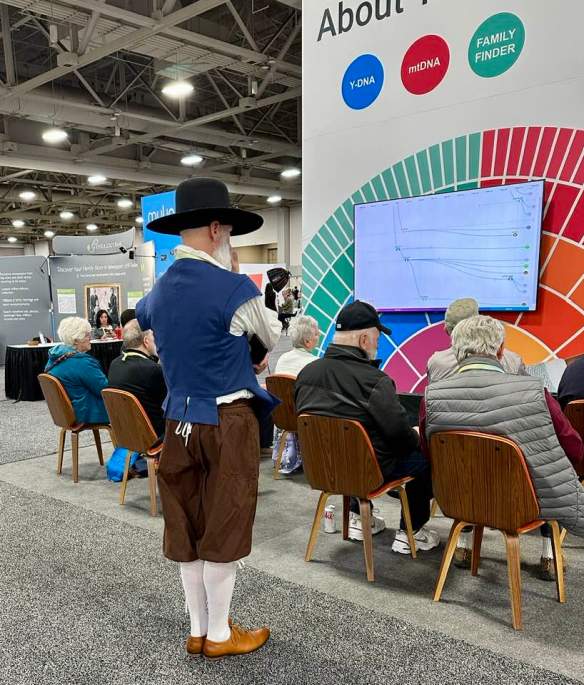
You just never know when a pilgrim is going to show up for your session.

Janine Cloud, an enrolled Cherokee tribal member and manager of Group Projects at FamilyTreeDNA discussed Y-DNA, mitochondrial and autosomal avenues to prove Native ancestors using DNA, using her own Cherokee ancestors as an example.

Dr Paul Maier, Population Geneticist, Goran Runfeldt, Head of Research and Michael Sager, Phylogeneticist answer questions about Y-DNA in the AMA (Ask Me Anything) session.

Paul and Goran also hosted an AMA for mitochondrial DNA as well, an often overlooked but valuable resource.

In addition to the Native American AMA session for FamilyTreeDNA which I gave with Janine, I gave two booth presentations for MyHeritage, “Time Travel with Your Ancestors” and “AutoClusters for the Win,” both of which were recorded meaning you  just might see them in the future.

The Time Travel session utilized the MyHeritage AI tools to see what my ancestors who came from specific regions or cultures might have looked like in that time and place. In the slide above the AI photo of my grandmother is combined with the document and with the Genetic Group that incorporates that part of Germany.

I combined the AI images with MyHeritage records that link those ancestors to a specific location, showing the predicted ethnicity, genetic groups when applicable, and then the actual location – some of which I’ve visited. My ancestor owned that windmill in the Netherlands, above. Combining these tools is so much FUN. My heritage provided the AI photos, records and ethnicity. I’m the one who did the traveling, of course, but in this way, time travel is possible!

I really enjoyed using this story-telling methodology that incorporates all 4 types of genealogy research and clues.
In the AutoClusters for the Win session in the MyHeritage booth, I discussed how I utilized AutoClusters to solve an adoption case in my own family, and how you can use this very powerful tool as well. The methodology I used works equally as well for genealogy mysteries.

In another MyHeritage booth presentation, Janna Helshtein told an amazing and moving story about her grandparents, their escape from the Holocaust, move to Israel, and more – in their own “voices” using MyHeritage’s Deep Story.

We all sat spellbound.

Janna also offers a free guide on how she created and integrated the Deep Story verbiage that her grandparents “spoke.” It was actually quite easy.

There was more to Janna’s story, but I don’t want to spoil it for you.

I believe MyHeritage intends to make their booth sessions available through social media.

Here, Janna and I are celebrating with a quick picnic style lunch after her presentation. She truly knocked it out of the park.

Shifting Attendance

I’m sharing my opinion here, and not anything a RootsTech spokesperson told me.

I was surprised that the in-person attendance was down as much as it was, truthfully. I think in-person was down by either half or maybe even two-thirds. Some decline wouldn’t have surprised me, but this much was sobering.

I was also VERY surprised that roughly half of the attendees were new. And that number could have actually been higher. That’s a good thing, meaning new people are being attracted to genealogy.

These two things, together, suggest the following to me:

  • The passing of time, Covid, and aging-out of some people caused some decline. I know several people who passed away during the past three years, not to mention those whose lives changed dramatically due to their partner’s illness, passing or life circumstances. Several people lost jobs or moved, or both, or are in that process now.
  • Now let’s flip this and say that the virtual and FREE capability for much of RootsTech made the conference accessible and available to many who could not attend in person. For that, I’m very grateful. I have a friend who has been very ill and participated by taking selfies of herself with the livestreamed sessions on her monitor behind her. She posted her photos on social media to be with us. That warmed my heart so much.
  • I think that the reason there were so many new people was because they were able to attend virtually during 2021 and 2022. Essentially this means that while virtual RootsTech was challenging for everyone on the behind-the-scenes production side, to put it mildly, it served to recruit many new genealogists who would not have participated in person had they not previously attended online.

Based on discussions at the media dinner table, and other statements by Steve Rockwood, CEO of FamilySearch, FamilySearch, including RootsTech, is reaching out to young people and to other areas of the world as well.

According to Steve, who, by the way, turns out to be my 11th cousin according to Relatives at RootsTech and the FamilySearch Tree, RootsTech will forever be a blended conference event.

This year, in addition to the local emcee, there were 15 people in other countries hosting in their locations, times and in their native languages.

This year there were 304 virtual classes, 205 in person, and some of those were streamed online as well.

Don’t forget that Relatives at RootsTech is still available through March 31st and you can contact cousins to collaborate. Some may represent Y-DNA or mitochondrial DNA testing lines that you need for matching and to complete your tree.

Vendors

That brings me to the topic of vendors.

Three of the four major DNA vendors were present, meaning Ancestry, FamilyTreeDNA and MyHeritage. 23andMe was absent in 2020 and again this year. Their last DNA innovation was their genetic tree in September of 2019.

Many of the smaller vendors were not in attendance. I had made friends with several of the Mom and Pop vendors and almost none of them were there this year, nor were many of the organizations and smaller companies. I spoke with several people and they said, almost universally, that the cost of the virtual booths over the past two years, the work involved, and the fact that those virtual booths did not generate many sales, not even equal to the amount of the booth rent, had soured the experience.

Not only are conference booths very expensive, so is the invested labor and time. For those of you who don’t know, booth rent is only a part of it. You want carpet? That’s more. A chair? That’s more. Two chairs? More. A trash basket? More. Oh, you need wireless to handle sales? LOTS more.

I’d say that the Expo Hall was only half to one third of the size it had been previously. Mind you, it’s still huge, especially compared to many other conferences, but I missed seeing many of my favorite vendors.

For example, neither Genealogical.com nor Deseret Books were there this year, so there was no bookstore, and neither were many of the fun t-shirt vendors or others that sold jewelry or genealogy-related merchandise.

I hope that FamilySearch will put their creative caps on and perhaps reach out to their vendors, both past and current, and figure out a way to make RootsTech vendors attractive to the online crowd. Perhaps a “search” game where you have to visit vendor booths to find items. Maybe there could be some permanent online stores as well.

There were fewer food vendors too, but in case anyone was wondering, I could still smell cinnamon-almonds throughout the facility😊

I did run into some of my long-time vendor friends.

My friend Jessica Taylor with Legacy Tree Genealogists. I regularly refer people seeking genealogists who understand both genealogy and DNA to Legacy Tree Genealogists.

I don’t need to tell you how much I love DNAPainter and it was great to see Jonny Perl and Patricia Coleman in the DNAPainter booth.

I feel kind of bad because I obviously caught Rob Warthen and Carol Carman by surprise in the East Coast Genetic Genealogy Conference booth, but it’s the only photo I have of their booth.

Last fall’s ECGGC conference was very successful and I’m planning to speak in person this year, in Baltimore, October 6-8, 2023. Save the date. Last year was the first year and it was wonderful.

My Book Signing

FamilyTreeDNA was kind enough to host my book signing for DNA for Native American Genealogy in conjunction with the Native American Ask Me Anything session. Many thanks to Joe Brickey for her help with this event as well.

After the AMA session, which was the final event of Saturday, just before closing, we took a group picture with the FamilyTreeDNA team, or at least the staff members in the booth at that time.

I did learn that perhaps the last thing Saturday might not be the best time for a book signing, because lots of people leave on Friday night. On the other hand, on Saturday, admission to the conference is free, at least to the show floor, with lots of children’s activities and programs for LDS families. Saturday is always very busy in terms of traffic, with sometimes more Saturday visitors than paying conference attendees. It will be interesting to see final RootsTech conference numbers.

The Thank You That Made My Day!!!

One lovely lady, Charis, came up to me after my first session and explained that she saw an ad for RootsTech. She decided she needed to purchase a ticket and attend. She had never heard of me, but she is very focused on documenting her Native ancestry. She sat in the front row in my first session and paid rapt attention. (Speakers do notice, in case you wondered.)

Charis came up to me afterwards and told me that this class alone was worth her registration fee.

She made my day, but I thought to myself that she would attend other sessions that she would find equally as valuable. After all, the conference was just beginning. She found me the next day and repeated what she had said. On day 3, she attended the Ask Me Anything session, arriving early. She said the said the same thing, AGAIN, and I asked if we could take a picture together. As presenters, we take our time, spend our money to attend these conferences, and invest the effort because we want to help people.

People like Charis make this all worthwhile.

Sweetness Personified

I’m sorry, I just can’t resist sharing the sweetest picture series ever.

In 2020, I met my cousin, Heidi Campbell and her baby at RootsTech. Three years later, I saw Heidi again, with a beautiful new addition to the family.

I just can’t tell you how wonderful it was to hold this baby. The last baby I held was Heidi’s little one, three years ago. The look on Heidi’s face is priceless too when he’s reaching for my glasses. He had the biggest smile EVER on his face and he’s booping noses with me. We had so much fun.

My heart just melted into a huge puddle. I so much wish they lived close so I could “grandma.” Thank you, Heidi, for sharing your sunshine with me.

Rolling Up the Sidewalks

On Saturday, literally at one minute after 3 when the conference closed, the workers at the Salt Palace started rolling up the sidewalks, or in this case, the carpets.

It’s a wrap!!!

Afterglow

At the Salt Lake City airport, I ran into two people and had the opportunity to talk to them again and hug goodbye once more. You’d think we would all have had enough of genealogy, but not a chance. More hugs, gratitude for togetherness, and anticipation for next year.

Winging my way home again, having walked about 6 miles each day, according to Fitbit, I was tired, desperately tired, and my everything hurt. However, I was also incredibly fulfilled to have connected again with old friends and met so many new people that I now look forward to seeing again. We are very fortunate to be members of such a wonderful, diverse and universal community.

I couldn’t help but think, as we crossed the winding Mississippi River, how fortunate we are that we have “time travel” in this way. I’m also struck with how many different ways we have to time travel, with Y-DNA and mitochondrial DNA at FamilyTreeDNA, autosomal testing and ethnicity at various vendors, and actual historical records that are becoming ever-more available remotely.

Using artificial intelligence, we can “see” our ancestor’s heritage in our own faces, or, in this case, the face of my grandfather using the MyHeritage AI Time Machine.

Using our DNA, we can identify the parts of those ancestors that we carry today, reaching back in time several generations with autosomal DNA. In addition to autosomal, both Y-DNA and mitochondrial DNA provide close matches and reach back in time, focused on one specific line, providing insights for millennia.

Time travel, truly reimagined.
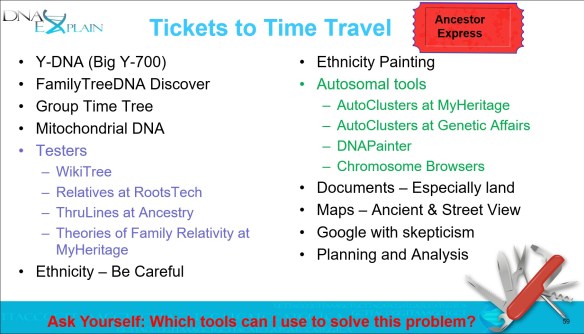
There are so many ways to discover and connect with our ancestors available to us today. If we don’t carry the DNA of ancestors a few generations upstream, perhaps selected cousins do. We have several tools and databases at our disposal to find testers.

The DNA of our ancestors can and does actually lead us home, to them and, sometimes, exactly where they lived, as I illustrated with several case studies in my presentation, “Follow Your Ancestors Path.” Today, these options are available to everyone.

RootsTech is in the history books for another year, with new friendships made and old ones renewed. Indeed, we were finally reunited with each other, and introduced to cousins we had never met before. We shared tools, methodologies and information to identify our ancestors. We all left fervently hoping to be reunited again next year.

Please enjoy the amazing RootsTech musical finale here.

_____________________________________________________________

Follow DNAexplain on Facebook, here or follow me on Twitter, here.

Share the Love!

You’re always welcome to forward articles or links to friends and share on social media.

If you haven’t already subscribed (it’s free,) you can receive an email whenever I publish by clicking the “follow” button on the main blog page, here.

You Can Help Keep This Blog Free

I receive a small contribution when you click on some of the links to vendors in my articles. This does NOT increase the price you pay but helps me to keep the lights on and this informational blog free for everyone. Please click on the links in the articles or to the vendors below if you are purchasing products or DNA testing.

Thank you so much.

DNA Purchases and Free Uploads

Genealogy Products and Services

My Book

Genealogy Books

Genealogy Research

Relatives at RootsTech – How to Use & Connect with DNA

Relatives at RootsTech is back and I’m so very glad to see it.

Let me show you how to use this wonderful tool, including tips for how to get even more out of the experience.

It’s important to start now to accumulate your cousins, because there’s a display limit of 300 in each category, so you’ll want to begin recording your findings so that as more people sign up and are added to your list, you don’t “lose” the earlier relatives.

Let’s start with my link. Click here.

You’ll be prompted to sign in to your FamilySearch account, or create one. If you don’t have an account, create one now.

Right now, the number of participants is doubling every few days.

Let’s take a look at how Relatives at RootsTech works and how it can benefit you.

Surnames

At first glance, the surname tool doesn’t look terribly exciting, but there’s a hidden gem, especially for newer genealogists.

I entered my surname and one other, knowing there is probably no common locations other than the US. Kvochick is very rare and unique.

The results show two interesting things. First, the genesis of the surname, and second, the total number of people in the FamilySearch tree in both of the common locations for both surnames.

Be sure to try variant spellings too.

After you sign in, you’ll be asked to update your profile which is how you join in on the fun. If you signed up for Relatives at RootsTech last year, that doesn’t count for this year. You need to opt-in for this year’s festivities.

RootsTech Relatives

After you sign in, you’ll see how many of your relatives have joined.

Of the 60,461 total who have joined, according to the FamilySearch tree, I’m related to about 15% of them. That sure gives new perspective to how many people we’re related to. And just think if those brick walls didn’t exist. We’d be related to just about everyone. Far enough back, we’re all related, literally.

Your Relatives at RootsTech are displayed in three ways.

By location, ancestor or family line.

Relatives by Location

Your first view will be by all locations (including people who did not select a location,) but displayed in closest to most distant relationship order. For me, that’s the most interesting part.

These people, my closest relatives, are the people most likely to have critical pieces of information that I don’t have or know about. Like family stories, or photos, for example.

I know one of these people, but not the rest. I’m dying to know who they are and how we are related.

For me, the map itself isn’t terribly useful, but it would be if some members of your family were from distinct locations.

Not everyone opts in to have their location displayed. The “173” in the center is the people who generically selected United States.

Relatives by Family Line

The Family Line display shows you the number of people by parent or grandparent. Unfortunately, you can only view 300 of your matches in each line, which is disappointing.

However, there’s a better way to view your relatives.

Relatives by Ancestor

For me, the best way to view relatives is by ancestor. This also circumvents the 300 limit to some extent, unless you have more than 300 relatives for any one ancestor.

I have two relatives who also descend from Curtis Benjamin Lore. It’s Jen and Jill again, my closest relatives.

I’m quite interested in these people, because Curtis is my great-grandfather and he was a very interesting man. I know Jen and Jill are interested in genealogy too, or they would not have signed up for RootsTech Relatives, this year, in the past few days. This is not a stale list.

I’ll be messaging them as soon as I’m finished with this article!!!

Please note that FamilySearch does not label half-relationships accurately.

Jen and Jill are my HALF second cousins twice removed, which will affect the expected amount of shared DNA. Their ancestors, Edith and Maude were half-sisters through their father, not full sisters. One of the reasons I’m so interested in communicating with Jen and Jill is because I’m not at all sure that those half-sisters knew each other existed.

Maintaining Contact

For each relative found, you can view your relationship, message them, or add them to your contact list. Be aware – your contact list “saves” this person, but it does not tell you how you’re related. That’s where either a Word document, with screen shots of how you’re related, or a spreadsheet where you can detail that information is important.

If you have messaged people in the past, those messages are still in your message box in the upper right-hand corner.

I generally provide my email address when I message relatives.

Displaying the Relationship

If you click on the “Relationship” button, you’ll see how FamilySearch believes you’re related to each match.

My relationship with an Acadian cousin, beginning with our common ancestor, is shown above. Grab a screen shot so you can remember. I drop them into a spreadsheet or Word document.

These matches are based on FamilySearch’s one world type of tree. I don’t have to tell you to be cautious because, like any tree, there are erroneous connections. This connection, at least on my side (left hand,) seems to be accurate. I don’t have Jeanne Chebrat’s second marriage to Jehan Piorier in my file, so I’ll need to check that out. Many times FamilySearch, WikiTree, Ancestry, or MyHeritage has connected documents or sources. In this case, here’s the WikiTree entry for Jeanne.

See, I’ve found something interesting already.

Search for People

On the toolbar, if you click on the right arrow, you’ll notice there’s one more option – Search.

If you think one your cousins might be attending, either virtually or in person, you can search by surname. I entered Estes out of curiosity.

This is quite interesting, because some other poor soul is also named Roberta Estes. You KNOW I’ll be messaging her. I’m pretty sure I know who this is, because we’ve been getting mixed up for years. Unless, of course there are actually three of us interested in genealogy.

However, where this Search option really shines is if you’re looking for males who descend from a particular line as candidates for Y-DNA testing.

Bingo!

I suggest doing this name search for each surname in your tree.

The Share Button is Critically Important

Sharing is the key to encouraging people to participate.

This button on the main page is how I generated the link for you to use to see if we’re related.

There’s a “Share” button in several locations. However, you’ll want to be sure you know exactly what you’re sharing. In some cases, it will be the surname comparison information or other information that you’re viewing. 

However, on the bottom of your Relatives pages, Share will generate a message link to/through several programs or apps so people can sign in to see if they are related to you.

You can also just copy the link and send it to someone in a text message or otherwise.

If you generate a message to share, you’ll see what will be posted, so you’ll know for sure exactly what you’re sharing. I wanted to post the link for my friends on Facebook to see if we are related, and that’s exactly what was generated.

If you follow the link to see if we are related, be sure to tell me, or anyone else whose link you follow.

Next, Connect with DNA

Relatives for RootsTech is a wonderful segway into DNA testing.

Remember, with the 300-relative limit, different searches will produce different results including people that won’t be included due to the 300 limit in other searches. Be creative and search in multiple ways. Add your relatives to your spreadsheet or Word document, then record whether they’ve DNA tested, at which vendor(s) and if you match there.

There are various ways to utilize Relatives at RootsTech for DNA.

  • Y-DNA candidates for the direct paternal line for males – The Search by surname can provide you with Y-DNA testing candidates. They may already have tested their Y-DNA with FamilyTreeDNA or their autosomal DNA with at least one vendor, so just message them and ask. Tell them which databases you’re in. Viewing Relatives by Ancestor can be very useful for this same purpose, especially if you have multiple unrelated lines with the same surname.
  • Mitochondrial DNA – the Relatives by Ancestor tool is very useful for locating mitochondrial DNA testing candidates, especially since you can easily see how they are descended from your common ancestor. Mitochondrial DNA is passed from women through all females to the current generation, which can be male or female. Any of your cousins, of either sex, are candidates so long as they descend from your target ancestor through all females.
  • DNA Pedigree Chart – If you’re building your own DNA Pedigree Chart with the Y-DNA and mitochondrial DNA of each ancestral line, consider offering a DNA testing scholarship to people who carry those lines that are missing in your DNA Pedigree Chart.
  • Testing Candidates – Anyone is a good candidate for autosomal testing. No second cousin or closer has ever not matched. Ask your cousins if they have tested and tell them which DNA databases you are in. Furthermore, suggest that they upload their DNA to FamilyTreeDNA and MyHeritage for free to utilize their tools and find matches that aren’t in the other databases. GEDmatch isn’t a testing company, but is another free database where you may find people who tested at Ancestry. Unfortunately, Ancestry does not provide segment information for matching or painting, so hopefully you’ll be able to find your Ancestry matches elsewhere.
  • Databases – Be sure you’re in all of the databases (Ancestry, 23andMe, FamilyTreeDNA, MyHeritage and GEDmatch) so you can be found and you can find your relatives.
  • DNAPainter – If you’re painting your segments at DNAPainter, you can paint your matching segments from 23andMe, FamilyTreeDNA, MyHeritage or GEDmatch. Ancestry is the only vendor that does not provide matching segment information for their customers.
  • DNA Search – If your cousin has used their actual name when registering at FamilySearch, sort by ancestor, then search your DNA matches at the various vendors for that cousin’s name. The beauty of Relatives at RootsTech is that the relationship is already sorted by ancestor, so that piece of the puzzle has already been assembled for you, which is exactly the opposite of most DNA matches. Of course, this does not preclude errors or connections through multiple ancestors.

Limited Time – March 31 is the End

If I had a FamilySearch genie and could get one wish, it would be that they would leave Relatives for RootsTech up and available until the next RootsTech. I need time to work on these relationships.

However, that’s not the case, and Relatives for RootsTech ends on March 31st.

Therefore, it’s important to begin building your spreadsheet, or however you’re going to record your relatives, NOW. Check your list often so none of those precious matches will roll off of your list and become unavailable. Access to the complete relative match list, meaning no 300 limit would be my second wish from the FamilySearch genie.

To preserve the ability to communicate with your relatives, message them now or at least add them to your contact list – WITH A NOTE IN YOUR SPREADSHEET AS TO HOW YOU’RE RELATED. Otherwise, that information will not be available after March 31st.

You’ll want to use the same spreadsheet from year to year, as some of the relatives signing up this year probably did last year too.

Ready, Set, Relatives at RootsTech

Have fun. Be sure to let me know if we’re related and how!!!

____________________________________________________________

Follow DNAexplain on Facebook, here or follow me on Twitter, here.

Share the Love!

You’re always welcome to forward articles or links to friends and share on social media.

If you haven’t already subscribed (it’s free,) you can receive an email whenever I publish by clicking the “follow” button on the main blog page, here.

You Can Help Keep This Blog Free

I receive a small contribution when you click on some of the links to vendors in my articles. This does NOT increase the price you pay but helps me to keep the lights on and this informational blog free for everyone. Please click on the links in the articles or to the vendors below if you are purchasing products or DNA testing.

Thank you so much.

DNA Purchases and Free Uploads

Genealogy Products and Services

My Book

Genealogy Books

Genealogy Research

Preparing for Research at the FamilySearch Library

One of my readers asked about what type of research facilities are available in Salt Lake City (SLC). They are attending RootsTech for the first time.

I’m so glad they asked. This article will answer their question but is also a broader article about how I research specific lineages and locations. Please note that I’ll be including lots of links where you can find additional information.

The FamilySearch Library is extremely useful to genealogists, even if you can’t visit in person. This article isn’t just for in-person visitors, although that’s where I’m focused today. It’s really for everyone and will help you understand how to access the various types of research tools available, and where.

When in Salt Lake City, the Family History Library, now called the FamilySearch Library is THE place to go for research. It’s world-class and equivalent to Mecca for genealogists.

The FamilySearch Library is pictured above. Just a block away, with the red arrow, you’ll find the Salt Palace Convention Center where RootsTech is held. The large silver tower behind the red arrow is the brand-new Hyatt Hotel.

First, we’re going to discuss logistics, then how to prepare for utilizing resources at the library.

Family History Library Renamed FamilySearch Library

Just a few weeks ago, the Family History Library (FHL) rebranded itself as the FamilySearch Library, so you’ll hear both terms. Just know that by whatever name, this is the most comprehensive genealogy library in the US, as well as in the world.

The library is funded and sponsored by the Church of Jesus Christ of Latter Day Saints, also known as the Mormons. Genealogy is a part of their religion, so whether you are of the LDS faith or not, the library is beneficial, welcoming and does not attempt to recruit non-LDS visitors to the LDS faith. The staff and volunteers there are super-friendly and helpful. I am not LDS and I love this library.

The library hosts special hours, here, during RootsTech week, staying open 12 hours per day.

You can see lots of pictures, here and a map to the library, here.

If you haven’t visited in the past couple of years, the library has taken the opportunity to remodel and upgrade during the Covid down-time. I really look forward to visting the new facility.

Help

If you need help or direction, there are multiple ways to receive that, both virtually and in-person. Consultations are free and can be arranged, here.

On the library website, be sure to click on each of these helpful buttons to plan and get the most out of your visit.

Media

Within the FamilySearch Library, there are different types of resources you can access, including traditional books and microfilmed records through their complimentary workstations. The library is divided into sections, and you’ll find an information desk when entering.

Here’s a layout and a site map with additional information.

Food

Please note that while the library does have a breakroom where guests can eat, they don’t have food service. Many library patrons bring something in their bag and simply visit the breakroom quickly to eat. Peanut butter cheese crackers are a favorite of mine, along with protein bars. I refill a water bottle.

The closest restaurant is around the corner in the Salt Lake Plaza Hotel, and the next closest is the Blue Lemon.

However, most genealogists don’t want to pack everything up and then unpack after lunch, so they simply bring something to eat in the breakroom.

I strongly recommend a small rolling suitcase for your research, laptop, notebooks, pencils (I use mechanical pencils) and snacks. You’ll be carrying or pulling everything, all day long.

You may well leave with more than you arrived with, meaning copies.

Also, don’t neglect to bring phone charging cords (with electrical plug-in) in your library bag, along with a spare thumb drive or two. Voice of experience here. Your phone will double as your camera and prevent you from having to make copies. You can stand right at your table and photograph what you need.

Close to the RootsTech Conference

The FamilySearch Library is literally a block away from the Salt Palace Convention Center where RootsTech is held, directly across the street from the Marriott hotel. The Marriott has a Starbucks in the lobby.

The library is within easy walking distance and Salt Lake City keeps the sidewalks shoveled and clear of ice and snow, for the most part. Bring warm clothes that you can layer though, because it is the dead of winter.

There’s a coat check at RootsTech, but I don’t use it. I just wear a thin thermal-lined coat and stuff it in my rolling bag.

A word about parking. Don’t. I use Uber or Lyft. There is also public bus transportation from the airport. I’ve never used that. However, parking is very limited and if you’re going to drive or rent a car, you’ll probably want to park it at the Marriott, the conference center, or other paid parking and walk when you are downtown. Parking is quite expensive, especially given that you’re probably not going to use that car for days. Uber/Lyft is MUCH easier and if you need to Uber/Lyft to a restaurant downtown, it’s just a couple of dollars.

Most of us are so tired we just grab something quick at the end of the day and then just die in our beds. There are food vendors at RootsTech.

Research Prep

Ok, now that we have location and logistics out of the way, let’s talk about how to actually prepare to research.

Go to www.familysearch.org where you’ll be prompted to either sign in or create an account.

Click on images to enlarge

If you don’t have an account, create one. They are free and there are things you can’t see and do without an account.

Also, you can scroll down to view different kinds of assistance available, including at local Family History Centers and library affiliates across the world. However, this article is about preparing to research at the main FamilySearch Library in Salt Lake City.

Having said that, I do suggest you take a look to see where your closest facility is located, because items in the FamilySearch catalog are available:

  • Online plus at the FamilySearch Library in Salt Lake City and in local Family History Centers
  • At the FamilySearch Library in Salt Lake City ONLY
  • At the local Family History Centers in addition to the library in Salt Lake City

When in Salt Lake City, you’ll want to focus your efforts on items that are available only at FamilySearch Library in Salt Lake City. You can utilize online resources at your convenience, and you can visit your local Family History Center or affiliate library easier than visiting SLC. In my case, I don’t have a local center or affiliated library anyplace even remotely close, so I’ll be accessing everything in SLC. Some local Family History Centers have very limited hours or aren’t active anymore, so check before you assume you can access something locally.

Family Tree

The FamilySearch Family Tree is a collaborate effort. Some people love it, some don’t. I use it judiciously to see if someone has found a record for an ancestor that I have not and attached it to that ancestor’s profile. You can access this tree from home, so I’m not covering it in this article.

Search

What you’re going to do is Search and make a list of items to reference when in Salt Lake City.

I prepare either a spreadsheet or Word document as I search.

Of course, experiment with each search category, including images.

For all county searches, you don’t type the word “county.” Just “Just Hancock, Tennessee” for Hancock County, Tennessee.

Book Search

In the Book search, you’ll generally want to enter one word, such as “Estes” or experiment with the Advanced Search Options.

Click images to enlarge

I was prompted to sign in before I could view this book. Because I can view it online, I’m not going to waste time viewing this book in SLC, but I might use it to prep, or view it later, so I’m adding it to my spreadsheet but not for SLC.

However, there will be books that you cannot view online.

This book is copyright restricted. You will be able to see some highlights, often including the index, but not the entire book. Click on the title to see additional information.

This book is physically located at the FamilySearch Library, so put it on your list for SLC using the:

  • Title
  • Author’s name
  • Title number
  • Call number

If you see a book that is ONLY available in off-site storage, contact the library before your visit to see if they can retrieve it for you. Be sure to record all call numbers on your spreadsheet. If you can’t find a call number, call the library.

Some locations of availability will be local Family History Centers, so be sure to read carefully. Additional books are available through the Catalog Search.

Catalog Search

My favorite search is the Catalog Search.

You can search in a wide variety of ways and combinations. Sometimes one search will pick something up that another won’t, so I use all of the searches.

In this case, I’m searching for items from Hancock County, TN. Sometimes I limit the search to “Online”, then search for “Any” because it’s easy to quickly tell if there is anything in a category that is not available online. For example, there are three items in the Cemeteries category, but only one item available online, I know to look in that category for two things that aren’t available online.

You can expand any of these categories to view the items listed.

By clicking on the title, you can easily see additional information.

The first book (series) is available in a number of ways.

The book volumes are available at the library in SLC, and also on microfiche at the library.

If these little film roll icons were the only availability, then YES, I would want to view these in SLC

The reel means microfilm only, and must be viewed in Salt Lake.

However, at the very bottom, the little camera tells you that some are available online with unrestricted images so long as you are signed into your FamilySearch account. This is why you need a FamilySearch account.

By unrestricted, I mean that you don’t have to be physically IN Sale Lake City to view the images.

This little magnifying glass icon means that the images are available, have been indexed and are searchable. Glory hallelujah.

So, if this is a group of marriage records, you can browse the records themselves, but if you search for a surname in record search with location, you’ll find people of that surname from these records.

Many records are not indexed or searchable, but some indexes have been filmed so you can cross-reference that way.

If you see the image of a camera with a key, that means that the image is ONLY available to view at either a Family History Center or affiliate, or the FamilySearch Library. Generally, that has to do with the license FamilySearch was able to obtain from the owning entity.

You can read more about the availability of catalog items here.

Additionally, sometimes notes are provided that direct you to other viewing opportunities.

Clearly, I don’t need to view this item in SLC.

You may see this note which means you should definitely put this item on your SLC list.

Here’s another article about research methodologies.

FamilySearch Wiki

Additionally, I use the FamilySearch Wiki often. I just type my desired search into Google. “Hancock County, Tennessee FamilySearch wiki”

The FamilySearch wiki not only tells you what’s available specifically for Hancock County, but other relevant record collections not at FamilySearch, and where you can access them.

Additionally, these pages explain about formation, boundary changes, record loss, cities, towns and villages within the county, and neighboring counties. The information is updated regularly, so check back from time to time.

Prep Summary

I find these pages and tools invaluable. I hope you do too and will find goldmines of information just waiting for you that will provide those missing pieces to your ancestor puzzles.

Preparing wisely is the key to getting the most out of your limited research time in Salt Lake City.

Have fun!!!

____________________________________________________________

Follow DNAexplain on Facebook, here or follow me on Twitter, here.

Share the Love!

You’re always welcome to forward articles or links to friends and share on social media.

If you haven’t already subscribed (it’s free,) you can receive an email whenever I publish by clicking the “follow” button on the main blog page, here.

You Can Help Keep This Blog Free

I receive a small contribution when you click on some of the links to vendors in my articles. This does NOT increase the price you pay but helps me to keep the lights on and this informational blog free for everyone. Please click on the links in the articles or to the vendors below if you are purchasing products or DNA testing.

Thank you so much.

DNA Purchases and Free Uploads

Genealogy Products and Services

My Book

Genealogy Books

Genealogy Research

RootsTech 2023 Theme is “Uniting” – Registration is Open – Free Pass Giveaway

The RootsTech theme for this year is “Uniting,” and RootsTech registration is now open. The dates this year are March 2-4 in Salt Lake City, but of course you could always arrive early or stay late and visit the Family History Library for some intensive genealogy therapy – ummm – I mean research.

That’s what I’m hoping to do.

FamilySearch has combined the super-successful virtual RootsTech format of 2021 and 2022 with the tried and true in-person conference loved by so many.

I don’t know about you, but I was extremely grateful for virtual RootsTech in 2021 and 2022, but I’m also VERY MUCH looking forward to gathering with my genea-friends and family again.

I’m glad to see this hybrid event because it makes RootsTech more widely available to a larger audience.

You can read about RootsTech 2023 in the press release here.

Classes

Classes and speakers will be announced shortly, but we know there are over 200 sessions that will be available for free, virtually. That means you could watch one a day, everyday, from the beginning of RootsTech through the middle of September. Sounds like genealogy-Heaven to me.

Classes will be announced soon, but let me give you a sneak-peek about my classes.

  • Big Y for the Win – When, where and how to use the BIG Y test to unravel or at least make sense of your genealogy.
  • DNA for Native American Genealogy – 10 Ways to Find Your Native American Ancestor (even if they don’t show up in your ethnicity.)
  • DNA Journey – Follow Your Ancestor’s Path – Let your ancestor’s DNA guide you home. Literally! Y-DNA, mitochondrial and autosomal DNA all play roles in this journey.

In addition, I’m finalizing multiple sessions in two different vendors’ booths. More about this as it firms up.

Book Signing

I’m also attempting to organize a book-signing for my book, DNA for Native American Genealogy.

More on this later too.

Registration

The in-person pass is $98 for three full days, but the Expo Hall is open and free for everyone during that time.

In addition to the virtual classes, there will be about 210 in-person classes as well. According to the RootsTech team, there will be 16 classes taking place simultaneously, with 2 or 3 being live-streamed.

There will be 5 blocks of session-time on Thursday and Friday, and 4 blocks on Saturday. Each of those blocks will have 16 class slots available, so you’re sure to find something you’ll enjoy. Of course, many of the vendors host mini-sessions in their booths too, so there’s a lot going on and educational opportunities everyplace you look.

You can view registration details, here.

Free Pass Giveaway

I’m giving one free three-day pass to a lucky blog reader. Of course, you’ll need to get yourself there and such, but a $98 value is nothing to sneeze at.

Already purchased your pass? Don’t despair. If you win and you’ve already purchased a pass, just let me know and RootsTech will reimburse you.

How Do You Enter?

Just make a comment on this article – something about an ancestor. Maybe the Uniting theme. To prevent dustups, please DO NOT make any type of political comment, nor include a link, nor reference a vendor.

On January 25th, I will literally pull a name out of some type of old-fashioned “hat” and notify the winner by email. The winner will need to provide their registration information to RootsTech.

How fun is this!

Ok, for those who would like to attend RootsTech in person: ready – set – go.

Tell me something interesting about one of your ancestors in the comments.

_____________________________________________________________

Follow DNAexplain on Facebook, here or follow me on Twitter, here.

Share the Love!

You’re always welcome to forward articles or links to friends and share on social media.

If you haven’t already subscribed (it’s free,) you can receive an email whenever I publish by clicking the “follow” button on the main blog page, here.

You Can Help Keep This Blog Free

I receive a small contribution when you click on some of the links to vendors in my articles. This does NOT increase the price you pay but helps me to keep the lights on and this informational blog free for everyone. Please click on the links in the articles or to the vendors below if you are purchasing products or DNA testing.

Thank you so much.

DNA Purchases and Free Uploads

Genealogy Products and Services

My Book

Genealogy Books

Genealogy Research