DNA Shows Peter Johnson and Mary Polly Philips Are My Relatives, But Are They My Ancestors? – 52 Ancestors #350

One of the requests by several people for 2022 article topics revolved in some way around solving challenges and showing my work.

In this case, I’m going to show both my work and the work of a newly-discovered cousin, Greg Simkins.

Let’s start by reminding you of something I said last week in Darcus Johnson (c1750-c1835) Chain Carrier – Say What??.

Darcus is reported in many trees to be the daughter of Peter Johnson (Johnston, Johnstone) and his wife Mary Polly Phillips. Peter reportedly lived in Pennsylvania and died in Allegheny County, PA. However, I am FAR from convinced that this couple was Darcus’s parents.

The distance from Shenandoah County, VA to Allegheny Co., PA is prohibitive for courting.

The Shenandoah County records need to be thoroughly researched with various Johnson families reconstructed. I’m hoping that perhaps someone has already done that and a Johnson family was living not terribly far from Jacob Dobkins father, John Dobkins. That would be the place to start.

Greg, Peter Johnson’s descendant through son James reached out to me.

Hi Roberta, I read your essay today on Dorcas Johnson. I wanted to write to you because I am a descendant of Dorcas’s brother James and have DNA matches to support our connection.

Clearly, I was very interested, but I learned long ago not to get too excited.

Then, Greg kindly shared his tree and DNA results with me. He was also generous enough to allow me to incorporate his information into this article. So yes, this article is possible entirely thanks to Greg.

I was guardedly excited about Greg’s communication, but I wasn’t prepared for the HUGE shock about to follow!

Whoa!!!

Greg has done his homework and stayed after school.

First, he tracked the descendants of Peter through all of his children, to present, where possible, and added them into his trees at the genealogy vendors. The vendors can do much better work for you with as much ammunition as you can provide.

Second, he has doggedly tracked matches at MyHeritage, FamilyTreeDNA, Ancestry and GEDmatch that descend through Peter Johnson and Mary Polly Phillips’s children. By doggedly, I mean he has spent hundreds to thousands of hours by his estimation – and based on what I see, I would certainly agree. In doing so, he pushed his own line back from his great-great-grandmother, Elizabeth Johnson, three generations to Peter Johnson and Mary Polly Phillips – and proved its accuracy using DNA.

Altogether, Greg has identified almost 250 matches that descend from Peter Johnson and Mary Polly Phillips, and mapped those segments across his chromosomes.

Greg made notes for each match by entering the number of matching cMs into their profile names as a suffix in his tree. For example, “David Johnson 10cM” instead of “David Johnson Jr.” or Sr.  That way, it’s easy to quickly see who is a match and by how much. Brilliant! I’m adopting that strategy. It won’t affect what other people see, because no living people are shown in trees.

Of course, DNA is on top of traditional genealogical research that we are all familiar with that connects people via deeds, wills, and other records.

Additionally, Greg records research information for individuals as a word document or pdf file and attaches them as documents to the person’s profile in his tree. His tree is searchable and shareable, so this means those resources are available to other people too. We want other researchers to find us and our records for EXACTLY this reason.

One thing to note is that if you are using Ancestry and use the Notes function on profiles, the notes don’t show to people with whom you share your tree, but links, sources and attached documents do.

Greg has included both “Other Sources” and “Web Links” below.

Click images to enlarge

For example, if I click on Greg’s link to Historic Pittsburg, I see the land grant location for Peter Johnson. Wow, this was unexpected.

Ok, I love maps and I’m hooked. Notice the names of the neighbors too. You’ll see Applegate again. Also, note that Thomas Applegate sold his patent to Richard Johnson. Remember the FAN club – friends and neighbors.

Ok, back to DNA for now.

The Children

Ancestors with large families are the best for finding present-day DNA matches. Of course, that’s because there are more candidates. More descendants and that means more people who might test someplace. This is also why you want to be sure to have your DNA in all 4 major DNA vendors, FamilyTreeDNA, MyHeritage, Ancestry, and 23andMe, plus GEDmatch.

This is a portion of Greg’s tree that includes the children of Peter Johnson and Mary Polly Phillips. Note that two Johnson females married Dobkins men. I’ve always suspected that Margaret Johnson and Dorcas Johnson were sisters, but unless we could use mitochondrial DNA, or figure out who the parents of either Peter or Mary are, there’s no good way to prove it.

We’re gathering some very valuable evidence.

At Ancestry, Greg has 85 matches on his ThruLines for Peter Johnson and Mary Polly Phillips, respectively.

  • Of course, Greg has the most matches for his own line through Peter’s son James Johnson (1752-1826) who married Elizabeth Lindsay and died in Lawrence County, IL: 35 matches.
  • Next is Margaret Johnson (1780-1833) who married Evan Dobkins in Dunmore County, VA, brother of my ancestor, Jacob Dobkins. She probably died in Cocke County, TN: 25 matches. Dorcas named one of her children Margaret and Margaret may have named one of her children Dorcas.
  • Solomon Johnson (1765-1843) married Frances Warne and stayed in Allegheny County, PA: 8 matches. Notice one of Peter’s neighbors was a Warner family. Dorcas named one of her children Solomon, a fairly unusual name.
  • Mary Johnson (1770-1833) married Garrett Wall Applegate and died in Harrison County, IN: 7 matches. The Applegates were Peter Johnson’s neighbors and Garrett served in the Revolutionary War in the 8th VA Regiment. Clearly, some of these settlers came from or spent time in Virginia.
  • Dorcas Johnson (c1750-c1835) married Jacob Dobkins in Dunmore County, VA and died in Claiborne County, TN: 5 matches.
  • Peter Johnson (1753-1840) married Eleanor “Nellie” Peter and died in Jefferson County, KY: 4 matches.
  • Richard D. Johnson (1752-1818) married Hannah Dungan and Elizabeth Nash: 2 matches.

Unfortunately, since most of those matches are between 7 and 20 cM, and Ancestry does not display shared matches under 20 cM, we can’t use Ancestry’s comparison tool to see if these people also match each other. That’s VERY unfortunate and extremely frustrating.

Greg matches more people from this line at MyHeritage, GEDmatch and FamilyTreeDNA, and thankfully, those vendors all three provide segment information AND shared match information.

Cousins Are Critical

While Greg, unfortunately, does not match me, he does match several of my cousins whose tests I manage.

Two of those cousins both descend from Darcus Johnson through her daughter Jenny Dobkins, through her daughter Elizabeth Campbell, through her daughter Rutha Dodson, through her sons John Y. Estes and Lazarus Estes, respectively.

Another descends through Jenny Dobkins son, William Newton Campbell for another 5 generations. These individuals all match on a 17 cM segment of Chromosome 20.

Other known cousins match Greg on different chromosomes.

Looking at their shared matches at FamilyTreeDNA, we find more Dobkins, Dodson and Campbell cousins, some that were previously unknown to me. One of those cousins also descends through William Newton Campbell’s daughter for another 4 generations and matches on the same segment of chromosome 20.

DNAPainter

Emails have been flying back and forth between me and Greg, each one with some piece of information that one of us has found that we want to be sure the other has too. Having research buddies is wonderful!

Then, Greg sent a screenshot of a portion of his chromosome 20 from DNAPainter that includes the DNA of the cousins mentioned above. I didn’t realize Greg was using DNAPainter. It’s an understatement to say I’m thrilled because DNAPainter does the cross-vendor triangulation work automatically for you.

Just look at all of those matches that carry this Johnson/Phillips segment of chromosome 20. Holy chimloda.

Greg also sent his DNAPainter sharing link, and it turns out that this is only a partial list, with one of my cousins highlighted, dead center in the list of Peter Johnson’s and Mary Polly Phillip’s descendants. Greg has even more not shown.

Trying Not to Jump to Conclusions

I’m trying so hard NOT to jump to conclusions, but this is just SOOOO EXCITING!

Little doubt remains that indeed, Peter Johnson and Mary Polly Phillips are the parents of Dorcas Johnson who married Jacob Dobkins and also of Margaret Johnson who married Evan Dobkins. I’ve eliminated the possibility of other common ancestors, as much as possible, and verified that the descent is through multiple children. This particular segment on chromosome 20 reaches across multiple children’s lines.

I say little doubt remains, because some doubt does remain. It’s possible that perhaps Dorcas and her sister weren’t actually daughters of Peter Johnson, but maybe children of his brother? Peter was reported to have a brother James, a sheriff in Cumberland County, PA. but again, we lack proof. If Dorcas is Peter Johnson’s niece, her descendants would still be expected to match some of the descendants of Peter and his wife.

Also complicating matters is the fact that Greg also has a Campbell brick wall with a James Campbell born about 1790 who lived in Fayette County, PA, in the far northwest corner of the state. Therefore, DNA matches through Dorcas Johnson Dobkins’s daughters Jenny and Elizabeth who married Campbell brothers need to be verified through her children’s lines that do NOT descend through her daughters who married Campbell men.

Nagging Questions

I know, I’m being a spoilsport, but I still have questions that need answers.

For example, I still need to account for how the Johnson girls managed to get to Shenandoah County, VA (Dunmore County at that time) to meet the Dobkins boys, spend enough time there to court, and then marry Evan and Jacob nine months apart in 1775. Surely they were living there. Young women simply did not travel, especially not great distances, and marriages occurred in the bride’s home county. Yet, they married in Shenandoah County, VA, not in PA.

What About the Records?

We are by no means done. In fact, I’ve just begun. I have some catching up to do. Greg has focused on Peter Johnson and Mary Polly Phillips in Pennsylvania. I need to focus on Virginia.

Of course, the next challenge is actual records.

What exists and what doesn’t? FamilySearch provides a list for Dunmore County, here, and Shenandoah, here.

Was Peter Johnson ever in Dunmore County that became Shenandoah County, VA, and if so when and where? If not, how the heck did his two daughters marry the Dobkins boys in 1775? Was there another Johnson man in Dunmore during that time? Was it James?

Where was Peter Johnson in 1775 when Dorcas and Margaret were marrying? Can we positively account for him in Pennsylvania or elsewhere?

Some information has been published about Peter Johnson, but those critical years are unaccounted for.

It appears that the Virginia Archives has a copy of the 1774-1776 rent rolls for Dunmore County, but they aren’t online. That’s the best place to start. Fingers crossed for one Peter Johnson living right beside John Dobkins, Jacob’s father. Now THAT would convince me.

Stay tuned!

Note – If you’d like to view Greg’s tree at Ancestry, its name is “MyHeritage Tree Simkins” and you can find it by searching for Maude Gertrude Wilson born in 1876 in Logan County, Illinois, died January 27, 1950 in Ramsey County, Minnesota, and married Harry A. Simkins. Elizabeth Ann Johnson (1830-1874) is Maude’s grandmother.

_____________________________________________________________

Follow DNAexplain on Facebook, here or follow me on Twitter, here.

Share the Love!

You’re always welcome to forward articles or links to friends and share on social media.

If you haven’t already subscribed (it’s free,) you can receive an email whenever I publish by clicking the “follow” button on the main blog page, here.

You Can Help Keep This Blog Free

I receive a small contribution when you click on some of the links to vendors in my articles. This does NOT increase the price you pay but helps me to keep the lights on and this informational blog free for everyone. Please click on the links in the articles or to the vendors below if you are purchasing products or DNA testing.

Thank you so much.

DNA Purchases and Free Uploads

Genealogy Products and Services

My Book

Genealogy Books

Genealogy Research

Identify Your Ancestors – Follow Nested Ancestral Segments

I don’t think that we actively think about our DNA segments as nested ancestors, like Russian Matryoshka dolls, but they are.

That’s exactly why segment information is critical for genealogists. Every segment, and every portion of a segment, has an incredibly important history. In fact, you could say that the further back in time we can track a segment, the more important it becomes.

Let’s see how to unveil nested segments. I’ll use my chromosome 20 as an example because it’s a smaller chromosome. But first, let’s start with my pedigree chart.

Pedigree

Click images to enlarge.

Before we talk about nested segments that originated with specific ancestors, it’s important to take a look at the closest portion of my maternal pedigree chart. My DNA segments came from and through these people. I’ll be working with the first 5 generations, beginning with my mother as generation #1.

Generation 1 – Parents

In the first generation, we receive a copy of each chromosome from each parent. I have a copy of chromosome 20 from my mother and a copy from my father.

At FamilyTreeDNA, you can see that I match my mother on the entire tested region of each chromosome.

Therefore, the entire length of each of my chromosomes is assigned to both mother and father because I received a copy from each parent. I’m fortunate that my mother’s DNA was able to be tested before she passed away.

We see that each copy of chromosome 20 is a total of 110.20 cM long with 17,695 SNPs.

Of course, my mother inherited the DNA on her chromosome 20 from multiple ancestors whose DNA combined in her parents, a portion of which was inherited by my mother. Mom received one chromosome from each of her parents.

I inherited only one copy of each chromosome (In this case, chromosome 20) from Mom, so the DNA of her two parents was divided and recombined so that I inherited a portion of my maternal chromosome 20 from both of my maternal grandparents.

Identifying Maternal and Paternal Matches

Associating matches with your maternal or paternal side is easy at FamilyTreeDNA because their Family Finder matching does it automatically for you if you upload (or create) a tree and link matches that you can identify to their proper place in your tree.

FamilyTreeDNA then uses that matching segment information from known, identified relatives in your tree to place people who match you both on at least one significant-sized segment in the correct maternal, paternal, (or both) buckets. That’s triangulation, and it happens automatically. All you have to do is click on the Maternal tab to view your triangulated maternal matches. As you can see, I have 1432 matches identified as maternal. 

Some other DNA testing companies and third-party tools provide segment information and various types of triangulation information, but they aren’t automated for your entire match list like Family Finder matching at FamilyTreeDNA.

You can read about triangulation in action at MyHeritage, here, 23andMe, here, GEDmatch, here, and DNAPainter, which we’ll use, here. Genetic Affairs AutoKinship tool incorporates triangulation, as does their AutoSegment Triangulation Cluster Tool at GEDmatch. I’ve compiled a reference resource for triangulation, here.

Every DNA testing vendor has people in their database that haven’t tested anyplace else. Your best strategy for finding nested segments and identifying matches to specific ancestors is to test at or transfer your DNA file to every vendor plus GEDmatch where people who test at Ancestry sometimes upload for matching. Ancestry does not provide segment information or a chromosome browser so you’ll sometimes find Ancestry testers have uploaded to GEDmatch, FamilyTreeDNA  or MyHeritage where segment information is readily available. I’ve created step-by-step download/upload instructions for all vendors, here.

Generation 2 – Grandparents

In the second generation, meaning that of my grandparents, I inherited portions of my maternal and paternal grandmother’s and grandfather’s chromosomes.

My maternal and paternal chromosomes can be divided into two pieces or groups each, one for each grandparent.

Using DNAPainter, we can see my father’s chromosome 20 on top and my mother’s on the bottom. I have previously identified segments assigned to specific ancestors which are represented by different colors on these chromosomes. You can read more about how to use DNAPainter, here.

We can divide the DNA inherited from each parent into the DNA inherited from each grandparent based on the trees of people we match. If we test cousins from each side, assigning segments maternally or paternally becomes much, much easier. That’s exactly why I’ve tested several.

For the rest of this article, I’m focusing only on my mother’s side because the concepts and methods are the same regardless of whether you’re working on your maternal side or your paternal side.

Using DNAPainter, I expanded my mother’s chromosome 20 in order to see all of the people I’ve painted on my mother’s side.

DNAPainter allows us to paint matching segments from multiple testing vendors and assign them to specific ancestors as we identify common ancestors with our matches.

Based on these matches, I’ve divided these maternal matches into two categories:

  • Maternal grandmother, meaning my mother’s mother, bracketed in red boxes
  • Maternal grandfather, meaning my mother’s father, bracketed in black boxes.

The text and arrows in these graphics refer to the colors of the brackets/boxes, and NOT the colors of the segments beside people’s names. For example, if you look at the large black box at far right, you’ll see several people, with their matching segments identified by multiple colored bars. The different colored segments (bars) mean I’ve associated the match with different ancestors in multiple or various levels of generations.

Generation 3 – Great-grandparents

Within those maternal and paternal grandparent segments, more nested information is available.

The black Ferverda grandfather segments are further divided into black, from Hiram Ferverda, and gold from his wife Eva Miller. The same concept applies to the red grandmother segments which are now divided into red representing Nora Kirsch and purple representing Curtis Lore, her husband.

While I have only been able to assign the first four segments (at the top) to one person/ancestor, there’s an entire group of matches who share the grouping of segments at right, in gold, descended through Eva Miller. The Miller line is Brethren and Mennonite with lots of testers, so this is a common pattern in my DNA matches.

Eva Miller, the gold ancestor, has two parents, Margaret Elizabeth Lentz and John David Miller, so her segments would come from those two sides.

Generation 4 and 5 – Fuschia Segment

I was able to track the segment shown in fuschia indicated by the blue arrow to Jacob Lentz and his wife Fredericka Ruhle, German immigrant ancestors. Other people in this same match (triangulation) group descend from Margaret Elizabeth Lentz and John David Miller – but that fuschia match is the one that shows us where that segment originated. This allows us to assign that entire gold/blue bracketed set of segments to a specific ancestor or ancestral couple because they triangulate, meaning they all match me and each other.

Therefore, all of the segments that match with the fuschia segment also track back to Jacob Lentz and Fredericka Ruhle, or to their ancestors. We would need people who descend from Jacob’s parents and/or Fredericka’s parents to determine the origins of that segment.

In other words, we know all of these people share a common source of that segment, even if we don’t yet know exactly who that common ancestor was or when they lived. That’s what the process of tracking back discovers.

To be very clear, I received that segment through Jacob and Fredericka, but some of those matches who I have not been able to associate with either Jacob or Fredericka may descend from either Jacob or Fredericka’s ancestors, not Jacob and Fredericka themselves. Connecting the dots between Jacob/Fredericka and their ancestors may be enlightening as to the even older source of that segment.

Let’s take a look at nested segments on my pedigree chart.

Nested Pedigree

Click to enlarge.

You can see the progression of nesting on my pedigree chart, using the same colors for the brackets/boxes. The black Ferverda box at the grandparent level encompasses the entire paternal side of my mother’s ancestry, and the red includes her mother’s entire side. This is identical to the DNAPainter graphic, just expressed on my pedigree chart instead of my chromosome 20.

Then the black gets broken into smaller nested segments of black, gold and fuschia, while the red gets broken into red and purple.

If I had more matches that could be assigned to ancestors, I would have even more nested levels. Of course, if I was using all of my chromosomes, not just 20, I would be able to go back further as well.

You can see that as we move further back in time, the bracketed areas assigned to each color become smaller and smaller, as do the actual segments as viewed on my DNAPainter chromosomes.

Segments Get Progressively Smaller

You can see in the pedigree chart and segment painting above that the segments we inherit from specific ancestors divide over time. As we move further and further back in our tree, the segments inherited from any specific ancestor get smaller and smaller too.

Dr. Paul Maier in the MyOrigins 3.0 White Paper provides this informative graphic that shows the reduction in segments and the number of ancestors whose DNA we carry reaching back in time.

I refer to this as a porcupine chart.

Eventually, we inherit no segments from red ancestors, and the pieces of DNA that we inherit from the distant blue ancestors become so small and fragmented that they cannot be positively identified as coming from a specific ancestor when compared to and matched with other people. That’s why vendors don’t show small segment matches, although different vendors utilize different segment thresholds.

The debate about how small is too small continues, but the answer is not simply segment size alone. There is no one-size-fits-all answer.

As segments become smaller, the probability, or chances that we match another person by chance (IBC) increases. Proof that someone shares a specific ancestor, especially when dealing with increasingly smaller segments is a function of multiple factors, such as tree completeness for both people, shared matches, parental match confirmation, and more. I wrote about What Constitutes Proof, here.

In the Family Finder Matching White Paper, Dr. Maier provides this chart reflecting IBD (Identical By Descent) and IBC (Identical By Chance) segments and the associated false positivity rate. That means how likely you are to match someone on a segment of that size by chance and NOT because you both share the DNA from a common ancestor.

I wrote Concepts: Identical by Descent, State, Population and Chance to help you better understand how this works.

In the chart below, I’ve combined the generations, relationships, # of ancestors, assuming no duplicates, birth year range based on an approximate 30-year generation, percent of DNA assuming exactly half of each ancestor’s DNA descends in each generation (which we know isn’t exactly accurate), and the average amount of total inherited cMs using that same assumption.

Note that beginning with the 7th generation, on average, we can expect to inherit less than 1% of the DNA of an ancestor, or approximately 55 total cM which may be inherited in multiple segments.

The amount of actual cMs inherited in each generation can vary widely and explains why, beginning with third cousins, some people won’t share DNA from a common ancestor above the various vendor matching thresholds. Yet, other cousins several generations removed will match. Inheritance is random.

Parallel Inheritance

In order to match someone else descended from that 11th generation ancestor, BOTH you AND your match will need to have inherited the exact SAME DNA segment, across 11 generations EACH in order to match. This means that 11 transmission events for each person will need to have taken place in parallel with that identical segment being passed from parent to child in each line. For 22 rolls of the genetic dice in a row, the same segment gets selected to be passed on.

You can see why we all need to work to prove that distant matches are valid.

The further back in time we work, the more factors we must take into consideration, and the more confirming proof is needed that a match with another individual is a result of a shared ancestor.

Having said that, shared distant matches ARE the key to breaking through brick-wall ancestors. We just need to be sure we are chasing the real deal and not a red herring.

Exciting Possibilities

The most exciting possibility is that some segments are actually passed intact for several generations, meaning those segments don’t divide into segments too small for matching.

For example, the 22 cM fuschia segment that tracks through generations 4 and 5 to Jacob Lentz and Fredericka Ruhle has been passed either intact or nearly intact to all of those people who stack up and match each other and me on that segment. 22 cM is definitely NOT a small segment and we know that it descended from either Jacob or Fredericka, or perhaps combined segments from each. In any case, if someone from the Lentz line in Germany tested and matched me on that segment (and by inference, the rest of these people too), we would know that segment descended to me from Jacob Lentz – or at least the part we match on if we don’t match on the entire segment.

This is exactly what nested segments are…breadcrumbs to ancestors.

Part of that 22cM segment could be descended from Jacob and part from Fredericka. Then of Jacob’s portion, for example, pieces could descend from both his mother and father.

This is why we track individual segments back in time to discern their origin.

The Promise of the Future

The promise of the future is when a group of other people triangulate on a reasonably sized segment AND know where it came from. When we match that triangulation group, their identified segment may well help break down our brick walls because we match all of them on that same segment.

It is exactly this technique that has helped me identify a Womack segment on my paternal line. I still haven’t identified our common ancestor, but I have confirmed that the Womacks and my Moore/Rice family interacted as neighbors 8 generations ago and likely settled together in Amelia county, migrating from eastern Virginia. In time, perhaps I’ll be able to identify the common Womack ancestor and the link into either my Moore or Rice lines.

I’m hoping for a similar breakthrough on my mother’s side for Philip Jacob Miller’s wife, Magdalena, 7 generations back in my tree. We know Magdalena was Brethren and where they lived when they took up housekeeping. We don’t know who her parents were. However, there are thousands of Miller descendants, so it’s possible that eventually, we will be able to break down that brick wall by using nested segments – ours and people who descend from Magdalena’s siblings, aunts, and uncles.

Whoever those people were, at least some of their descendants will likely match me and/or my cousins on at least one nested Miller segment that will be the same segment identified to their ancestors.

Genealogy is a team sport and solving puzzles using nested segments requires that someone out there is working on identifying triangulated segments that track to their common ancestors – which will be my ancestors too. I have my fingers crossed that someone is working on that triangulation group and I find them or they find me. Of course, I’m working to triangulate and identify my segments to specific ancestors – hoping for a meeting in the middle – that much-desired bridge to the past.

By the time you’ve run out of other records, nested segments are your last chance to identify those elusive ancestors. 

Do you have genealogical brick walls that nested segments could solve?

__________________________________________________________

Follow DNAexplain on Facebook, here or follow me on Twitter, here. You can also subscribe to receive emails when I publish articles by clicking the “Follow” button at www.DNAexplain.com.

You’re always welcome to forward articles or links to friends.

You Can Help Out and It’s Free

I receive a small contribution when you click on some of the links to vendors in my articles. This does NOT increase the price you pay but helps me to keep the lights on and this informational blog free for everyone. Please click on the links in the articles or to the vendors below if you are purchasing products or DNA testing.

Thank you so much.

DNA Purchases and Free Uploads

Genealogy Products and Services

My Book

Genealogy Books

Genealogy Research

2021 Favorite Articles

It’s that time of the year again when we welcome the next year.

2021 was markedly different than anything that came before. (Is that ever an understatement!)

Maybe you had more time for genealogy and spent time researching!

So, what did we read in 2021? Which of my blog articles were the most popular?

In reverse order, beginning with number 10, we have:

This timeless article published in 2015 explains how to calculate the amount of any specific heritage you carry based on your ancestors.

Just something fun that’s like your regular pedigree chart, except color coded locations instead of ancestors. Here’s mine

The Autosegment Triangulation Cluster Tool is a brand new tool introduced in October 2021. Created by Genetic Affairs for GEDmatch, this tool combines autoclusters and triangulation.

Many people don’t realize that we actually don’t inherit exactly 25% of our DNA from each grandparent, nor why.

This enlightening article co-authored with statistician Philip Gammon explains how this works, and why it affects all of your matches.

Who doesn’t love learning about ancient DNA and the messages it conveys. Does your Y or mitochondrial DNA match any of these burials? Take a look. You might be surprised.

How can you tell if you are full or half siblings with another person? You might think this is a really straightforward question with an easy answer, but it isn’t. And trust me, if you EVER find yourself in a position of needing to know, you really need to know urgently.

Using simple match, it’s easy to figure how much of your ancestor’s DNA you “should” have, but that’s now how inheritance actually works. This article explains why and shows different inheritance scenarios.

That 28 day timer has expired, but the article can still be useful in terms of educating yourself. This should also be read in conjunction with Ancestry Retreats, by Judy Russell.

If I had a dollar for every time I’ve heard someone say that their ethnicity percentages were “wrong,” I’d be a rich woman, living in a villa in sun-drenched Tuscany😊

This extremely popular article has either been first or second every year since it was published. Ethnicity is both exciting and perplexing.

As genealogists, the first thing we need to do is to calculate what, according to our genealogy, we would expect those percentages to be. Of course, we also need to factor in the fact that we don’t inherit exactly the same amount of DNA from each grandparent. I explain how I calculated my “expected” percentages of ethnicity based on my known tree. That’s the best place to start.

Please note that I am no longer updating the vendor comparison charts in the article. Some vendors no longer release updates to the entire database at the same time, and some “tweak” results periodically without making an announcement. You’ll need to compare your own results at the different vendors at the same point in time to avoid comparing apples and oranges.

The #1 Article for 2021 is…

  1. Proving Native American Ancestry Using DNA

This article has either been first (7 times) or second (twice) for 9 years running. Now you know why I chose this topic for my new book, DNA for Native American Genealogy.

If you’re searching for your Native American ancestry, I’ve provided step-by-step instructions, both with and without some percentage of Native showing in your autosomal DNA percentages.

Make 2022 a Great Year!

Here’s wishing you the best in 2022. I hope your brick walls cave. What are you doing to help that along? Do you have a strategy in mind?

__________________________________________________________

Follow DNAexplain on Facebook, here or follow me on Twitter, here. You can also subscribe to receive emails when I publish articles by clicking the “Follow” button at www.DNAexplain.com.

You’re always welcome to forward articles or links to friends.

Help Out, Please

I receive a small contribution when you click on some of the links to vendors in my articles. This does NOT increase the price you pay but helps me to keep the lights on and this informational blog free for everyone. Please click on the links in the articles or to the vendors below if you are purchasing products or DNA testing.

Thank you so much.

DNA Purchases and Free Uploads

Genealogy Products and Services

My Book

Genealogy Books

Genealogy Research

AutoSegment Triangulation Cluster Tool at GEDmatch

Today, I’m reviewing the exciting new AutoSegment Triangulation Cluster Tool at GEDmatch. I love it because this automated tool can be as easy or complex as you want.

It’s easy because you just select your options, run it, and presto, you receive all kinds of useful results. It’s only complex if you want to understand the details of what’s really happening beneath the hood, or you have a complex problem to unravel. The great news is that this one tool does both.

I’ve taken a deep dive with this article so that you can use AutoSegment either way.

Evert-Jan “EJ” Blom, creator of Genetic Affairs has partnered with GEDmatch to provide AutoSegment for GEDmatch users. He has also taken the time to be sure I’ve presented things correctly in this article. Thanks, EJ!

My recommendation is to read this article by itself first to understand the possibilities and think about how you can utilize these results. Then, at GEDmatch, select the AutoSegment Report option and see what treasures await!

Genetic Affairs

Genetic Affairs offers a wide variety of clustering tools that help genealogists break down their brick walls by showing us, visually, how our matches match us and each other. I’ve written several articles about Genetic Affairs’ tools and how to use them, here.

Every DNA segment that we have originated someplace. First, from one of our parents, then from one of our 4 grandparents, and so forth, on up our tree. The further back in time we go, the smaller the segments from those more distant ancestors become, until we have none for a specific ancestor, or at least none over the matching threshold.

The keyword in that sentence is segment, because we can assign or attribute DNA segments to ancestors. When we find that we match someone else on that same segment inherited from the same parent, assuming the match is identical by descent and not identical by chance, we then know that somehow, we shared a common ancestor. Either an ancestor we’ve already identified, or one that remains a mystery.

Those segments can and will reveal ancestors and tell us how we are related to our matches.

That’s the good news. The bad news is that not every vendor provides segment information. For example, 23andMe, FamilyTreeDNA, and MyHeritage all do, but Ancestry does not.

For Ancestry testers, and people wishing to share segment information with Ancestry testers, all is not lost.

Everyone can download a copy of their raw DNA data file and upload those files to vendors who accept uploads, including FamilyTreeDNA, MyHeritage, and of course GEDmatch.

GEDmatch

GEDmatch does not offer DNA testing services, specializing instead in being the common matching denominator and providing advanced tools. GEDmatch recently received a facelift. If you don’t recognize the image above, you probably haven’t signed in to GEDmatch recently, so take a look. The AutoSegment tool is only available on the new version, not the Classic version.

Ancestry customers, as well as people testing elsewhere, can download their DNA files from the testing vendor and upload the files to GEDmatch, availing themselves of both the free and Tier 1 subscription tools.

I’ve written easy step-by-step download/upload instructions for each vendor, here.

At GEDmatch, matching plus a dozen tools are free, but the Tier 1 plan for $10 per month provides users with another 14 advanced tools, including AutoSegment.

To get started, click on the AutoSegment option.

AutoSegment at GEDmatch

You’ll see the GEDmatch AutoSegment selection menu.

You can easily run as many AutoSegment reports as you want, so I suggest starting with the default values to get the lay of the land. Then experiment with different options.

At GEDmatch, AutoSegment utilizes your top 3000 matches. What a huge, HUGE timesaver.

Just a couple of notes about options.

  • My go-to number of SNPs is 500 (or larger,) and I’m always somewhat wary of matches below that level because there is an increased likelihood of identical by chance segments when the required number of segment matching locations is smaller.
  • GEDmatch has to equalize DNA files produced by different vendors, including no-calls where certain areas don’t read. Therefore, there are blank spaces in some files where there is data in other vendors’ files. The “Prevent Hard Breaks” option allows GEDmatch to “heal” those files by allowing longer stretches of “missing” DNA to be considered a match if the DNA on both sides of that blank space matches.
  • “Remove Segments in Known Pile-Up Regions” is an option that instructs GEDmatch NOT to show segments in parts of the human genome that are known to have pile-up regions. I generally don’t select this option, because I want to see those matches and determine for myself if they are valid. We’ll look at a few comparative examples in the Pileup section of this article.

Fortunately, you can experiment with each of these settings one by one to see how they affect your matching. Even if you don’t normally subscribe to GEDmatch, you can subscribe for only one month to experiment with this and other Tier 1 tools.

Your AutoSegment results will be delivered via a download link.

Save and Extract

All Genetic Affairs cluster files are delivered in a zipped file.

You MUST DO TWO THINGS, or these files won’t work correctly.

  1. Save the zip file to your computer.
  2. Extract the files from the zip file. If you’re on a PC, right-click on the zip file and EXTRACT ALL. This extracts the files from the zipped file to be used individually.

If you click on a feature and receive an error message, it’s probably because you either didn’t save the file to your computer or didn’t extract the files.

The file name is very long, so if you try to add the file to a folder that is also buried a few levels deep on your system, you may encounter problems when extracting your file. Putting the file on your desktop so you can access it easily while working is a good idea.

Now, let’s get to the good stuff.

Your AutoSegment Cluster File

Click on the largest HTML file in the list of your extracted files. The HTML file uses the files in the clusters and matches folders, so you don’t need to open those individually.

It’s fun to watch your clusters fly into place. I love this part.

If your file is too large and your system is experiencing difficulty or your browser locks, just click on the smaller AutoSegment HTML file, at the bottom of the list, which is the same information minus the pretty cluster.

Word to the wise – don’t get excited and skip over the three explanatory sections just below your cluster. Yes, I did that and had to go back and read to make sense of what I was seeing.

At the bottom of this explanatory section is a report about Pileup Regions that I’ll discuss at the end of this article.

Excel

As a third viewing option, you can also open the AutoSegment Excel file to view the results in an excel grid.

You’ll notice a second sheet at the bottom of this spreadsheet page that says AutoSegment-segment-clusters. If you click on that tab, you’ll see that your clusters are arranged in chromosome and cluster order, in the same format as long-time genetic genealogist Jim Bartlett uses in his very helpful blog, segment-ology.

You’ll probably see a message at the top of the spreadsheet asking if you want to enable editing. In order for the start and end locations to calculate, you must enable editing. If the start and end locations are zeroes, look for the editing question.

Notice that the colors on this sheet are coordinated with the clusters on the first sheet.

EJ uses yellow rows as cluster dividers. The “Seg” column in the yellow row indicates the number of people in this cluster group, meaning before the next yellow divider row. “Chr” is the chromosome. “Segment TG” is the triangulation group number and “Side” is Jim Bartlett’s segment tracking calculation number.

Of course, the Centimorgans column is the cM size, and the number of matching SNPs is provided.

You can read about how Jim Bartlett tracks his segment clusters, here, which includes discussions of the columns and how they are used.

Looking at each person in the cluster groups by chromosome, *WS matches me and *Cou, the other person in the cluster beginning and ending at the start and end location on chromosome 1. In the match row (as compared with the yellow dividing row,) Column F, “Seg,” tells you the number of segments where *WA matches me, the tester.

A “*” before the match name at GEDmatch means a pseudonym or alias is being used.

In order to be included in the AutoSegment report, a match must triangulate with you and at least one other person on (at least) one of those segments. However, in the individual match reports, shown below, all matching segments are provided – including ones NOT in segment clusters.

Individual DNA Matches

In the HTML file, click on *WA.

You’ll see the three segments where *WA matches you, or me in this case. *WA triangulates with you and at least one other person on at least one of these segments or *WA would not be included in the GEDmatch AutoSegment report.

However, *WA may only triangulate on one segment and simply match you on the other two – or *WA may triangulate on more than one segment. You’ll have to look at the other sections of this report to make that determination.

Also, remember that this report only includes your top 3000 matches.

AutoSegment

All Genetic Affairs tools begin with an AutoCluster which is a grouping of people who all match you and some of whom match each other in each colored cluster.

AutoSegment at GEDmatch begins with an AutoCluster as well, but with one VERY IMPORTANT difference.

AutoSegment clusters at GEDmatch represent triangulation of three people, you and two other people, in AT LEAST ONE LOCATION. Please note that you and they may also match in other locations where three people don’t triangulate.

By matching versus triangulation, I’m referring to the little individual cells which show the intersection of two of your matches to each other.

Regular AutoCluster reports, meaning NOT AutoSegment clusters at GEDmatch, include overlapping segment matches between people, even if they aren’t on the same chromosome and/or don’t overlap entirely. A colored cell in AutoSegment at GEDmatch means triangulation, while a colored cell in other types of AutoCluser reports means match, but not necessarily triangulation.

Match information certainly IS useful genealogically, but those two matching people in that cell:

  • Could be matching on unrelated chromosomes.
  • Could be matching due to different ancestors.
  • Could be matching each other due to an ancestor you don’t have.
  • May or may not triangulate.

Two people who have a colored cell intersection in an AutoSegment Cluster at GEDmatch are different because these cells don’t represent JUST a match, they represent a TRIANGULATED match.

Triangulation tightens up these matches by assuring that all three people, you and the two other people in that cell, match each other on a sufficient overlapping segment (10 cM in this case) on the same chromosome which increases the probability that you do in fact share a common ancestor.

I wrote about the concept of triangulation in my article about triangulation at GEDmatch, but AutoSegment offers a HUGE shortcut where much of the work is done for you. If you’re not familiar with triangulation, it’s still a good idea to read that article, along with A Triangulation Checklist Born From the Question; “Why NOT use Close Relatives for Triangulation?”

Let’s take a look at my AutoSegment report from GEDmatch.

AutoSegment Clusters at GEDmatch

A total of 195 matches are clustered into a total of 32 colored clusters. I’m only showing a portion of the clusters, above.

I’ve blurred the names of my matches in my AutoSegment AutoCluster, of course, but each cell represents the intersection of two people who both match and triangulate with me and each other. If the two people match and triangulate with each other and others in the same cluster, they are colored the same as their cluster matches.

For example, all 18 of the people in the orange cluster match me and each other on one (or more) chromosome segments. They all triangulate with me and at least one other person, or they would not appear in a colored cell in this report. They triangulate with me and every other person with whom they have a colored cell.

If you mouse over a colored cell, you can see the identity of those two people at that intersection and who else they match in common. Please note that me plus the two people in any cell do triangulate. However, me plus two people in a different cell in the same cluster may triangulate on a different segment. Everyone matches in an intricate grid, but different segments on different chromosomes may be involved.

You can see in this example that my cousin, Deb matches Laurene and both Deb and Laurene match these other people on a significant amount of DNA in that same cluster.

What happens when people match others within a cluster, but also match people in other colored clusters too?

Multiple Cluster Matches = Grey Cells

The grey cells indicate people who match in multiple clusters, showing the match intersection outside their major or “home” cluster. When you see a grey cell, think “AND.” That person matches everyone in the colored cell to the left of that grey cell, AND anyone in a colored cell below grey cells too. Any of your matches could match you and any number of other people in other cells/clusters as well. It’s your lucky day!

Deb’s matches are all shown in row 4. She and I both match all of the orange cluster people as well as several others in other clusters, indicated by grey cells.

I’m showing Deb’s grey cell that indicates that she also matches people in cluster #5, the large brown cluster. When I mouse over that grey cell, it shows that Deb (orange cluster) and Daniel (brown cluster) both match a significant number of people in both clusters. That means these clusters are somehow connected.

Looking at the bigger picture, without mousing over any particular cell, you can see that a nontrivial number of people match between the first several clusters. Each of these people match strongly within their primary-colored cluster, but also match in at least one additional cluster. Some people will match people in multiple clusters, which is a HUGE benefit when trying to identify the source ancestor of a specific segment.

Let’s look at a few examples. Remember, all of these people match you, so the grid shows how they also match with each other.

#1 – In the orange cluster, the top 5 rows, meaning the first 5 people on the left side list match other orange cluster members, but they ALSO match people in the brown cluster, below. A grey cell is placed in the column of the person they also match in the brown cluster.

#2 – The two grey cells bracketed in the second example match someone in the small red cluster above, but one person also matches someone in the small purple cluster and the other person matches someone in the brown cluster.

#3 – The third example shows one person who matches a number of people in the brown cluster in addition to every person in the magenta cluster below.

#4 – This long, bracketed group shows several people who match everyone in the orange cluster, some of whom also match people in the green cluster, the red cluster, the brown cluster, and the magenta cluster. Clearly, these clusters are somehow related to each other.

Always look at the two names involved in an individual cell and work from there.

The goal, of course, is to identify and associate these clusters with ancestors, or more specifically, ancestral couples, pushing back in time, as we identify the common ancestors of individuals in the cluster.

For example, the largest orange cluster represents my paternal grandparents. The smaller clusters that have shared members with the large orange cluster represent ancestors in that lineage.

Identifying the MRCA, or most recent common ancestor with our matches in any cluster tells us where those common segments of DNA originated.

Chromosome Segments from Clusters

As you scroll down below your cluster, you’ll notice a section that describes how you can utilize these results at DNAPainter.

While GEDmatch can’t automatically determine which of your matches are maternal and paternal, you can import them, by colored cluster, to DNAPainter where you can identify clusters to ancestors and paint them on your maternal and paternal chromosomes. I’ve written about how to use DNAPainter here.

Let’s scroll to the next section in your AutoSegment file.

Chromosome Segment Statistics

The next section of your file shows “Chromosome segment statistics per AutoSegment cluster.”

I need to take a minute here to describe the difference between:

  1. Colored clusters on your AutoCluster diagram, shown below, and
  2. Chromosome segment clusters or groups within each colored AutoSegment cluster

Remember, colored clusters are people, and you can match different people on different, sometimes multiple, chromosomes. Two people whose intersecting cell is colored triangulate on SOME segment but may also match on other segments that don’t triangulate with each other and you.

According to my “Chromosome segment statistics” report, my large orange AutoSegment cluster #1, above, includes:

  • 67 segments from all my matches
  • On five chromosomes (3, 5, 7, 10, 17)
  • That cluster into 8 separate chromosome segment clusters or groups within the orange cluster #1

This is much easier to visualize, so let’s take a look.

Chromosome Segment Clusters

Click on any cluster # in your report, above, to see the chromosome painting for that cluster. I’m clicking on my AutoSegment cluster #1 on the “Chromosome segment statistics” report that will reveal all of the segments in orange cluster #1 painted on my chromosomes.

The brightly colored painted segments show the triangulated segment locations on each chromosome. You can easily see the 8 different segment clusters in cluster #1.

Interestingly, three separate groups or chromosome clusters occur on chromosome 5. We’ll see in a few minutes that the segments in the third cluster on chromosome 5 overlaps with part of cluster #5. (Don’t confuse cluster number shown with a # and chromosome number. They are just coincidentally both 5 in this case.)

The next tool helps me visualize each of these segment clusters individually. Just scroll down.

You can mouse over the segment to view additional information, but I prefer the next tool because I can easily see how the DNA of the people who are included in this segment overlap with each other.

This view shows the individual chromosome clusters, or groups, contained entirely within the orange cluster #1. (Please note that you can adjust the column widths side to side by positioning the cursor at the edge of the column header and dragging.)

Fortunately, I recognize one of these matches, Deb, and I know exactly how she and I are related, and which ancestor we share – my great-grandparents.

Because these segments are triangulated, I know immediately that every one of these people share that segment with Deb and me because they inherited that segment of DNA from some common ancestor shared by me and Deb both.

To be very clear, these people may not share our exact same ancestor. They may share an ancestor upstream from Deb and my common ancestor. Regardless, these people, Deb, and I all share a segment I can assign at this point to my great-grandparents because it either came from them for everyone, or from an upstream ancestor who contributed it to one of my great-grandparents, who contributed it to me and Deb both.

Segment Clusters Entirely Linked

Clusters #2 and #3 are small and have common matches with people in cluster #1 as indicated by the grey cells, so let’s take a look.

I’m clicking on AutoSegment green cluster #2 which only has two cluster members.

I can see that the common triangulated segment between these two people and me occurs on chromosome 3.

This segment on chromosome 3 is entirely contained in green cluster #2, meaning no members of other clusters triangulate on this segment with me and these two people.

This can be a bit confusing, so let’s take it logically step by step.

Remember that the two people who triangulate in green cluster #2 also match people in orange cluster #1? However, the people from orange cluster #1 are NOT shown as members of green cluster #2.

This could mean that although the two people in the green cluster #2 match a couple of people in the orange cluster, they did not match the others, or they did not triangulate. This can be because of the minimum segment overlap threshold that is imposed.

So although there is a link between the people in the clusters, it is NOT sufficient for the green people to be included in the orange cluster and since the two matches triangulate on another segment, they become a separate green cluster.

In reality, you don’t need to understand exactly why members do or don’t fall into the clusters they do, you just need to understand generally how clustering and triangulation works. In essence, trust the tool if people are NOT included in multiple clusters. Click on each person individually to see which chromosomes they match you on, even if they don’t triangulate with others on all of those segments. At this point, I often run one-to-one matches, or other matching tools, to see exactly how people match me and each other.

However, if they ARE included in multiple partly linked clusters, that can be a HUGE bonus.

Let’s look at red cluster #3.

Segment Clusters Partly Linked

You can see that Mark, one of the members of red cluster #3 shares two triangulated segments, one on chromosome 4, and one on chromosome 10.

Mark and Glenn are members of cluster #3, but Glenn is not a member of the segment cluster/group on chromosome 4, only Iona and Mark.

Scrolling down, I can view additional information about the cluster members and the two segments that are held within red cluster #3.

Unlike green cluster #2 whose segment cluster/group is entirely confined to green cluster #2, red cluster #3 has NO segments entirely confined to members of red cluster #3.

Cluster #3 has two members, Mark and Glen. Mark and Glen, along with Val who is a member of orange cluster #1 triangulate on chromosome 10. Remember, I said that chromosome 10 would be important in a minute when we were discussing orange cluster #1. Now you know why.

This segment of chromosome 10 triangulates in both orange cluster #1 AND red cluster #3.

However, Mark, who is a red cluster #3 member also triangulates with Iona and me on a segment of chromosome 4. This segment also appears in AutoSegment brown cluster #4 on chromosome 4.

Now, the great news is that I know my earliest known ancestors with Iona, which means that I can assign this segment to my paternal great-great-grandparents.

If I can identify a common ancestor with some of these other people, I may be able to push segments back further in time to an earlier ancestral couple.

Identifying Common Ancestors

Of course, review each cluster’s members to see if you recognize any of your cousins.

If you don’t know anyone, how do you identify a common ancestor? You can email the person, of course, but GEDmatch also facilitates uploading GEDCOM files which are trees.

In your primary AutoSegment file, keep scrolling to see who has trees.

AutoSegment Cluster Information

If you continue to scroll down in your original HTML file, you’ll see AutoSegment Cluster Information.

For each cluster, all members are listed. It’s easy to see which people have uploaded trees. You can click to view and can hopefully identify an ancestor or at least a surname.

Click on “tree” to view your match’s entry, then on Pedigree to see their tree.

If your matches don’t have a tree, I suggest emailing and sharing what you do know. For example, I can tell my matches in cluster #1 that I know this line descends from Lazarus Estes and Elizabeth Vannoy, their birth and death dates and location, and encourage my match to view my tree which I have uploaded to GEDmatch.

If you happen to have a lot of matches with trees, you can create a tag group and run the AutoTree analysis on this tag group to identify common ancestors automatically. AutoTree is an amazing tool that identifies common ancestors in the trees of your matches, even if they aren’t in your tree. I wrote about AutoTree, here.

Pileup Regions

Whether you select “Remove Segments in Known Pileup Regions” or not when you select the options to run AutoSegment, you’ll receive a report that you can access by a link in the Explanation of AutoSegment Analysis section. The link is buried at the bottom of those paragraphs that I said not to skip, and many people don’t even see it. I didn’t at first, but it’s most certainly worth reviewing.

What Are Pileup Regions?

First, let’s talk about what pileup regions are, and why we observe them.

Some regions of the human genome are known to be more similar than others, for various reasons.

In these regions, people are more likely to match other people simply because we’re human – not specifically because we share a common ancestor.

EJ utilizes a list of pileup regions, based on the Li et al 2014 paper.

You may match other people on these fairly small segments because humans, generally, are more similar in these regions.

Many of those segments are too small to be considered a match by themselves, although if you happen to match on an adjacent segment, the pileup region could extend your match to appear to be more significant than it is.

If you select the “remove pileup segments” option, and you overlap any pileup region with 4.00 cM or larger, the entire matching segment that includes that region will be removed from the report no matter how large the matching segment is in total.

Here’s an example where the pileup region of 5.04 cM is right in the middle of a matching segment to someone. This entire 15.04 cM segment will be removed.

If those end segments are both 10 cM each instead of 5 cM, the segment will still be removed.

However, if the segment overlap with the pileup region is 3.99 cM or smaller, none of the resulting segment will be removed, so long as the entire segment is over the matching threshold in the first place. In the example above, if the AutoSegment threshold was 7 or 8 cM, the entire segment would be retained. If the matching threshold was 9 or greater, the segment would not have been included because of the threshold.

Of course, eight regions in the pileup chart are large enough to match without any additional adjacent segments if the match threshold is 7 cM and the overlap is exact. If the match threshold is 10 cM, only two pileup regions will possibly match by themselves. However, because those two regions are so large, we are more likely to see multiple matches in those regions.

Having a match in a pileup region does NOT invalidate that match. I have many matches in pileup regions that are perfectly valid, often extending beyond that region and attributable to an identified common ancestor.

You may also have pileup regions, in the regions shown in the chart and elsewhere, because of other genealogical reasons, including:

  • Endogamy, where your ancestors descend from a small, intermarried population, either through all or some of your ancestors. The Jewish population is probably the most well-known example of large-scale endogamy over a very long time period.
  • Pedigree collapse, where you descend from the same ancestors in multiple ways in a genealogical timeframe. Endogamy can reach far back in time. With pedigree collapse, you know who your ancestors are and how you descend, but with endogamy, you don’t.
  • Because you descend from an over-represented or over-tested group, such as the Acadians who settled in Nova Scotia in the early 1600s, intermarried and remained relatively isolated until 1755 when they were expelled. Their numerous descendants have settled in many locations. Acadian descendants often have a huge number of Acadian matches.
  • Some combination of all three of the above reasons. Acadians are a combination of both endogamy and pedigree collapse and many of their descendants have tested.

In my case, I have proportionally more Acadian matches than I have other matches, especially given that my Dutch and some of my German lines have few matches because they are recent immigrants with few descendants in the US. This dichotomy makes the proportional difference even more evident and glaring.

I want to stress here that pileup regions are not necessarily bad. In fact, they may provide huge clues to why you match a particular group of people.

Pileup Regions and Genealogy

In 2016, when Ancestry removed matches that involved personal pileup regions, segments that they felt were “too-matchy,” many of my lost matches were either Acadian or Mennonite/Brethren. Both groups are endogamous and experience pedigree collapse.

Over time, as I’ve worked with my DNA matches, painting my segments at DNAPainter, which marks pileup regions, I’ve come to realize that I don’t have more matches on segments spanning standard pileup regions indicated in the Li paper, nor are those matches unreliable.

An unreliable match might be signaled by people who match on that segment but descend from different unrelated common ancestors to me. Each segment tracks to one maternal and one paternal ancestral source, so if we find individuals matching on the same segment who claim descent from different ancestral lines on the same side, that’s a flag that something’s wrong. (That “something” could also be genealogy or descending from multiple ancestors.)

Therefore, after analyzing my own matching patterns, I don’t select the option to remove pileup segments and I don’t discount them. However, this may not be the right selection for everyone. Just remember, you can run the report as many times as your want, so nothing ventured, nothing gained.

Regardless of whether you select the remove pileup segments option or not, the report contents are very interesting.

Pileup Regions in the Report

Let’s take a look at Pileups in the AutoSegment report.

  • If I don’t select the option of removing pileup region segments, I receive a report that shows all of my segments.
  • If I do select the option to remove pileup region segments, here’s what my report says.

Based on the “remove pileup region segments” option selected, all segments should be removed in the pileup regions documented in the Li article if the match overlap is 4.00 cM or larger.

I want to be very clear here. The match itself is NOT removed UNLESS the pileup segment that IS removed causes the person not to be a match anymore. If that person still matches and triangulates on another segment over your selected AutoSegment threshold, those segments will still show.

I was curious about which of my chromosomes have the most matches. That’s exactly what the Pileup Report tells us.

According to the Pileup Report, my chromosome with the highest number of people matching is chromosome 5. The Y (vertical) axis shows the number of people that match on that segment, and the X axis across the bottom shows the match location on the chromosome.

You’ll recall that chromosome 5 was the chromosome from large orange AutoSegment cluster #1 with three distinct segment matches, so this makes perfect sense.

Sure enough, when I view my DNAPainter results, that first pileup region from about location 5-45 are Brethren matches (from my maternal grandfather) and the one from about 48-95 are Acadian matches (from my maternal grandmother.) This too makes sense.

Please note that chromosome 5 has no general pileup regions annotated in the Li table, so no segments would have been removed.

Let’s look at another example where some segments would be removed.

Based on the chromosome table from the Li paper, chromosome 15 has nearly back-to-back pileup regions from about 20-30 with almost 20 cM of DNA combined.

Let’s see what my Pileup Segment Removal Report for chromosome 15 shows.

No segment matches in this region are reported because I selected remove pileup regions.

The only way to tell how many segment matches were removed in this region is to run the report and NOT select the remove pileup segments option. I did that as a basis for comparison.

You can see that about three segments were removed and apparently one of those segments extended further than the other two. It’s also interesting that even though this is designated as a pileup region, I had fewer matches in this region than on other portions of the chromosome.

If I want to see who those segments belong to, I can just view my chromosome 15 results in the AutoSegment-segment-clusters tab in the spreadsheet view which is arranged neatly in chromosome order.

The only way to tell if matches in pileup regions are genealogically valid and relevant is to work with each match or group of matches and determine if they make sense. Does the match extend beyond the pileup region start and end edge? If so, how much? Can you identify a common ancestor or ancestral line, and if so, do the people who triangulate in that segment cluster makes sense?

Of course, my genealogy and therefore my experience will be different than other people’s. Anyone who descends primarily from an endogamous population may be very grateful for the “remove pileups” option. One size does NOT fit all. Fortunately, we have options.

You can run these reports as many times as you want, so you may want to run identical reports and compare a report that removes segments that occur in pileup regions with one that does not.

What’s Next?

For AutoSegment at GEDmatch to work most optimally, you’ll need to do three things:

  • If you don’t have one already, upload a raw DNA file from one of the testing vendors. Instructions here.
  • Upload a GEDCOM file. This allows you to more successfully run tools like AutoTree because your ancestors are present, and it helps other people too. Perhaps they will identify your common ancestor and contact you. You can always email your matches and suggest that they view your GEDCOM file to look for common ancestors or explain what you found using AutoTree. Anyone who has taken the time to learn about GEDmatch and upload a file might well be interested enough to make the effort to upload their GEDCOM file.
  • Convince relatives to upload their DNA files too or offer to upload for them. In my case, triangulating with my cousins is invaluable in identifying which ancestors are represented by each cluster.

If you have not yet uploaded a GEDCOM file to GEDmatch, now’s a great time while you’re thinking about it. You can see how useful AutoClusters and AutoSegment are, so give yourself every advantage in identifying common matches.

If you have a tree at Ancestry, you can easily download a copy and upload to GEDmatch. I wrote step-by-step instructions, here. Of course, you can upload any GEDCOM file from another source including your own desktop computer software.

You never know, using AutoSegment and AutoTree, you may just find common ancestors BETWEEN your matches that you aren’t aware of that might, just might, help you break down YOUR brick walls and find previously unknown ancestors.

AutoSegment tells you THAT you triangulate and exactly where. Now it’s up to you to figure out why.

Give AutoSegment at GEDmatch a try.

————————————————————————————————————-

Disclosure

I receive a small contribution when you click on some of the links to vendors in my articles. This does NOT increase the price you pay but helps me to keep the lights on and this informational blog free for everyone. Please click on the links in the articles or to the vendors below if you are purchasing products or DNA testing.

Thank you so much.

DNA Purchases and Free Uploads

Genealogy Products and Services

Books

Genealogy Research

A Triangulation Checklist Born From the Question; “Why NOT Use Close Relatives for Triangulation?”

One of my readers asked why we don’t use close relatives for triangulation.

This is a great question because not using close relatives for triangulation seems counter-intuitive.

I used to ask my kids and eventually my students and customers if they wanted the quick short answer or the longer educational answer.

The short answer is “because close relatives are too close to reliably form the third leg of the triangle.” Since you share so much DNA with close relatives, someone matching you who is identical by chance can also match them for exactly the same reason.

If you trust me and you’re good with that answer, wonderful. But I hope you’ll keep reading because there’s so much to consider, not to mention a few gotchas. I’ll share my methodology, techniques, and workarounds.

We’ll also discuss absolutely wonderful ways to utilize close relatives in the genetic genealogical process – just not for triangulation.

At the end of this article, I’ve provided a working triangulation checklist for you to use when evaluating your matches.

Let’s go!

The Step-by-Step Educational Answer😊

Some people see “evidence” they believe conflicts with the concept that you should not use close relatives for triangulation. I understand that, because I’ve gone down that rathole too, so I’m providing the “educational answer” that explains exactly WHY you should not use close relatives for triangulation – and what you should do.

Of course, we need to answer the question, “Who actually are close relatives?”

I’ll explain the best ways to best utilize close relatives in genetic genealogy, and why some matches are deceptive.

You’ll need to understand the underpinnings of DNA inheritance and also of how the different vendors handle DNA matching behind the scenes.

The purpose of autosomal DNA triangulation is to confirm that a segment is passed down from a particular ancestor to you and a specific set of your matches.

Triangulation, of course, implies 3, so at least three people must all match each other on a reasonably sized portion of the same DNA segment for triangulation to occur.

Matching just one person only provides you with one path to that common ancestor. It’s possible that you match that person due to a different ancestor that you aren’t aware of, or due to chance recombination of DNA.

It’s possible that your or your match inherited part of that DNA from your maternal side and part from your paternal side, meaning that you are matching that other person’s DNA by chance.

I wrote about identical by descent (IBD), which is an accurate genealogically meaningful match, and identical by chance (IBC) which is a false match, in the article Concepts – Identical by…Descent, State, Population and Chance.

I really want you to understand why close relatives really shouldn’t be used for triangulation, and HOW close relative matches should be used, so we’re going to discuss all of the factors that affect and influence this topic – both the obvious and little-understood.

  • Legitimate Matches
  • Inheritance and Triangulation
  • Parental Cross-Matching
  • Parental Phasing
  • Automatic Phasing at FamilyTreeDNA
  • Parental Phasing Caveats
  • Pedigree Collapse
  • Endogamy
  • How Many Identical-by-Chance Matches Will I Have?
  • DNA Doesn’t Skip Generations (Seriously, It Doesn’t)
  • Your Parents Have DNA That You Don’t (And How to Use It)
  • No DNA Match Doesn’t Mean You’re Not Related
  • Imputation
  • Ancestry Issues and Workarounds
  • Testing Close Relatives is VERY Useful – Just Not for Triangulation
  • Triangulated Matches
  • Building Triangulation Evidence – Ingredients and a Recipe
  • Aunts/Uncles
  • Siblings
  • How False Positives Work and How to Avoid Them
  • Distant Cousins Are Best for Triangulation & Here’s Why
  • Where Are We? A Triangulation Checklist for You!
  • The Bottom Line

Don’t worry, these sections are logical and concise. I considered making this into multiple articles, but I really want it in one place for you. I’ve created lots of graphics with examples to help out.

Let’s start by dispelling a myth.

DNA Doesn’t Skip Generations!

Recently, someone emailed to let me know that they had “stopped listening to me” in a presentation when I said that if a match did not also match one of your parents, it was a false match. That person informed me that they had worked on their tree for three years at Ancestry and they have “proof” of DNA skipping generations.

Nope, sorry. That really doesn’t happen, but there are circumstances when a person who doesn’t understand either how DNA works, or how the vendor they are using presents DNA results could misunderstand or misinterpret the results.

You can watch my presentation, RootsTech session, DNA Triangulation: What, Why and How, for free here. I’m thrilled that this session is now being used in courses at two different universities.

DNA really doesn’t skip generations. You CANNOT inherit DNA that your parents didn’t have.

Full stop.

Your children cannot inherit DNA from you that you don’t carry. If you don’t have that DNA, your children and their descendants can’t have it either, at least not from you. They of course do inherit DNA from their other parent.

I think historically, the “skipping generations” commentary was connected to traits. For example, Susie has dimples (or whatever) and so did her maternal grandmother, but her mother did not, so Susie’s dimples were said to have “skipped a generation.” Of course, we don’t know anything about Susie’s other grandparents, if Susie’s parents share ancestors, recessive/dominant genes or even how many genetic locations are involved with the inheritance of “dimples,” but I digress.

DNA skipping generations is a fallacy.

You cannot legitimately match someone that your parent does not, at least not through that parent’s side of the tree.

But here’s the caveat. You can’t match someone one of your parents doesn’t with the rare exception of:

  • Relatively recent pedigree collapse that occurs when you have the same ancestors on both sides of your tree, meaning your parents are related, AND
  • The process of recombination just happened to split and recombine a segment of DNA in segments too small for your match to match your parents individually, but large enough when recombined to match you.

We’ll talk about that more in a minute.

However, the person working with Ancestry trees can’t make this determination because Ancestry doesn’t provide segment information. Ancestry also handles DNA differently than other vendors, which we’ll also discuss shortly.

We’ll review all of this, but let’s start at the beginning and explain how to determine if our matches are legitimate, or not.

Legitimate Matches

Legitimate matches occur when the DNA of your ancestor is passed from that ancestor to their descendants, and eventually to you and a match in an unbroken pathway.

Unbroken means that every ancestor between you and that ancestor carried and then passed on the segment of the ancestor’s DNA that you carry today. The same is true for your match who carries the same segment of DNA from your common ancestor.

False positive matches occur when the DNA of a male and female combine randomly to look like a legitimate match to someone else.

Thankfully, there are ways to tell the difference.

Inheritance and Triangulation

Remember, you inherit two copies of each of your chromosomes 1-22, one copy from your mother and one from your father. You inherit half of the DNA that each parent carries, but it’s mixed together in you so the labs can’t readily tell which nucleotide, A, C, T, or G you received from which parent. I’m showing your maternal and paternal DNA in the graphic below, stacked neatly together in a column – but in reality, it could be AC in one position and CA in the next.

For matching all that matters is the nucleotide that matches your match is present in one of those two locations. In this case, A for your mother’s side and C for your father’s side. If you’re interested, you can read more about that in the article, Hit a Genealogy Home Run Using Your Double-Sided Two-Faced Chromosomes While Avoiding Imposters.

You can see in this example that you inherited all As from your Mom and all Cs from your Dad.

  • A legitimate maternal match would match you on all As on this particular example segment.
  • A legitimate paternal match would match you on all Cs on this particular segment.
  • A false positive match will match you on some random combination of As and Cs that make it look like they match you legitimately, but they don’t.
  • A false positive match will NOT match either your mother or your father.

To be very clear, technically a false positive match DOES match your DNA – but they don’t match your DNA because you share a common ancestor with your match. They match you because random recombination on their side causes you to match each other by chance.

In other words, if part of your DNA came from your Mom’s side and part from your Dad’s but it randomly fell in the correct positional order, you’d still match someone whose DNA was from only their mother or father’s side. That’s exactly the situation shown above and below.

Looking at our example again, it’s evident that your identical by chance (IBC) match’s A locations (1, 3, 5, 7 & 9) will match your Mom. C locations (2, 4, 6 8, & 10) will match your Dad, but the nonmatching segments interleaved in-between that match alternating parents will prevent your match from matching either of your parents. In other words, out of 10 contiguous locations in our example, your IBC match has 5 As alternated with 5 Cs, so they won’t match either of your parents who have 10 As or 10 Cs in a row.

This recombination effect can work in either direction. Either or both matching people’s DNA could be randomly mixed causing them to match each other, but not their parents.

Regardless of whose DNA is zigzagging back and forth between maternal and paternal, the match is not genealogical and does not confirm a common ancestor.

This is exactly why triangulation works and is crucial.

If you legitimately match a third person, shown below, on your maternal side, they will match you, your first legitimate maternal match, and your Mom because they carry all As. But they WON’T match the person who is matching you because they are identical by chance, shown in grey below.

The only person your identical by chance match matches in this group is you because they match you because of the chance recombination of parental DNA.

That third person WILL also match all other legitimate maternal matches on this segment.

In the graphic above, we see that while the grey identical by chance person matches you because of the random combination of As from your mother and Cs from your father, your legitimate maternal matches won’t match your identical by chance match.

This is the first step in identifying false matches.

Parental Cross-Matching

Removing the identical by chance match, and adding in the parents of your legitimate maternal match, we see that your maternal match, above, matches you because you both have all As inherited from one parent, not from a combination of both parents.

We know that because we can see the DNA of both parents of both matches in this example.

The ideal situation occurs when two people match and they have both had their parents tested. We need to see if each person matches the other person’s parents.

We can see that you do NOT match your match’s father and your match does NOT match your father.

You do match your match’s mother and your match does match your mother. I refer to this as Parental Cross-matching.

Your legitimate maternal matches will also match each other and your mother if she is available for testing.

All the people in yellow match each other, while the two parents in gray do not match any of your matches. An entire group of legitimate maternal matches on this segment, no matter how many, will all match each other.

If another person matches you and the other yellow people, you’ll still need to see if you match their parents, because if not, that means they are matching you on all As because their two parents DNA combined just happened, by chance, to contribute an A in all of those positions.

In this last example, your new match, in green, matches you, your legitimate match and both of your mothers, BUT, none of the four yellow people match either of the new match’s parents. You can see that the new green match inherited their As from the DNA of their mother and father both, randomly zigzagging back and forth.

The four yellow matches phase parentally as we just proved with cross matching to parents. The new match at first glance appears to be a legitimate match because they match all of the yellow people – but they aren’t because the yellow people don’t match the green person’s parents.

To tell the difference between legitimate matches and identical by chance matches, you need two things, in order.

  • Parental matching known as parental phasing along with parental cross-matching, if possible, AND
  • Legitimate identical by descent (IBD) triangulated matches

If you have the ability to perform parental matching, called phasing, that’s the easiest first step in eliminating identical by chance matches. However, few match pairs will have parents for everyone. You can use triangulation without parental phasing if parents aren’t available.

Let’s talk about both, including when and how close relatives can and cannot be used.

Parental Phasing

The technique of confirming your match to be legitimate by your match also matching one of your parents is called parental phasing.

If we have the parents of both people in a match pair available for matching, we can easily tell if the match does NOT match either parent. That’s Parental Cross Matching. If either match does NOT match one of the other person’s parents, the match is identical by chance, also known as a false positive.

See how easy that was!

If you, for example, is the only person in your match pair to have parents available, then you can parentally phase the match on your side if your match matches your parents. However, because your match’s parents are unavailable, your match to them cannon tbe verified as legitimate on their side. So you are not phased to their parents.

If you only have one of your parents available for matching, and your match does not match that parent, you CANNOT presume that because your match does NOT match that parent, the match is a legitimate match for the other, missing, parent.

There are four possible match conditions:

  • Maternal match
  • Paternal match
  • Matches neither parent which means the match is identical by chance meaning a false positive
  • Matches both parents in the case of pedigree collapse or endogamy

If two matching people do match one parent of both matches (parental cross-matching), then the match is legitimate. In other words, if we match, I need to match one of your parents and you need to match one of mine.

It’s important to compare your matches’ DNA to generationally older direct family members such as parents or grandparents, if that’s possible. If your grandparents are available, it’s possible to phase your matches back another generation.

Automatic Phasing at FamilyTreeDNA

FamilyTreeDNA automatically phases your matches to your parents if you test that parent, create or upload a GEDCOM file, and link your test and theirs to your tree in the proper places.

FamilyTreeDNA‘s Family Matching assigns or “buckets” your matches maternally and paternally. Matches are assigned as maternal or paternal matches if one or both parents have tested.

Additionally, FamilyTreeDNA uses triangulated matches from other linked relatives within your tree even if your parents have not tested. If you don’t have your parents, the more people you identify and link to your tree in the proper place, the more people will be assigned to maternal and paternal buckets. FamilyTreeDNA is the only vendor that does this. I wrote about this process in the article, Triangulation in Action at Family Tree DNA.

Parental Phasing Caveats

There are very rare instances where parental phasing may be technically accurate, but not genealogically relevant. By this, I mean that a parent may actually match one of your matches due to endogamy or a population level match, even if it’s considered a false positive because it’s not relevant in a genealogical timeframe.

Conversely, a parent may not match when the segment is actually legitimate, but it’s quite rare and only when pedigree collapse has occurred in a very specific set of circumstances where both parents share a common ancestor.

Let’s take a look at that.

Pedigree Collapse

It’s not terribly uncommon in the not-too-distant past to find first cousins marrying each other, especially in rather closely-knit religious communities. I encounter this in Brethren, Mennonite and Amish families often where the community was small and out-marrying was frowned upon and highly discouraged. These families and sometimes entire church congregations migrated cross-country together for generations.

When pedigree collapse is present, meaning the mother and father share a common ancestor not far in the past, it is possible to inherit half of one segment from Mom and the other half from Dad where those halves originated with the same ancestral couple.

For example, let’s say the matching segment between you and your match is 12 cM in length, shown below. You inherited the blue segment from your Dad and the neighboring peach segment from Mom – shown just below the segment numbers. You received 6 cM from both parents.

Another person’s DNA does match you, shown in the bottom row, but they are not shown on the DNA match list of either of your parents. That’s because the DNA segments of the parents just happened to recombine in 6 cM pieces, respectively, which is below the 7 cM matching threshold of the vendor in this example.

If the person matched you at 12 cM where you inherited 8 cM from one parent and 4 from the other, that person would show on one parent’s match list, but not the other. They would not be on the parent’s match list who contributed only 4 cM simply because the DNA divided and recombined in that manner. They would match you on a longer segment than they match your parent at 8 cM which you might notice as “odd.”

Let’s look at another example.

click to enlarge image

If the matching segment is 20 cM, the person will match you and both of your parents on different pieces of the same segment, given that both segments are above 7 cM. In this case, your match who matches you at 20 cM will match each of your parents at 10 cM.

You would be able to tell that the end location of Dad’s segment is the same as the start location of Mom’s segment.

This is NOT common and is NOT the “go to” answer when you think someone “should” match your parent and does not. It may be worth considering in known pedigree collapse situations.

You can see why someone observing this phenomenon could “presume” that DNA skipped a generation because the person matches you on segments where they don’t match your parent. But DNA didn’t skip anything at all. This circumstance was caused by a combination of pedigree collapse, random division of DNA, then random recombination in the same location where that same DNA segment was divided earlier. Clearly, this sequence of events is not something that happens often.

If you’ve uploaded your DNA to GEDmatch, you can select the “Are your parents related?” function which scans your DNA file for runs of homozygosity (ROH) where your DNA is exactly the same in both parental locations for a significant distance. This suggests that because you inherited the exact same sequence from both parents, that your parents share an ancestor.

If your parents didn’t inherit the same segment of DNA from both parents, or the segment is too short, then they won’t show as “being related,” even if they do share a common ancestor.

Now, let’s look at the opposite situation. Parental phasing and ROH sometimes do occur when common ancestors are far back in time and the match is not genealogically relevant.

Endogamy

I often see non-genealogical matching occur when dealing with endogamy. Endogamy occurs when an entire population has been isolated genetically for a long time. In this circumstance, a substantial part of the population shares common DNA segments because there were few original population founders. Much of the present-day population carries that same DNA. Many people within that population would match on that segment. Think about the Jewish community and indigenous Americans.

Consider our original example, but this time where much of the endogamous population carries all As in these positions because one of the original founders carried that nucleotide sequence. Many people would match lots of other people regardless of whether they are a close relative or share a distant ancestor.

People with endogamous lines do share relatives, but that matching DNA segment originated in ancestors much further back in time. When dealing with endogamy, I use parental phasing as a first step, if possible, then focus on larger matches, generally 20 cM or greater. Smaller matches either aren’t relevant or you often can’t tell if/how they are.

At FamilyTreeDNA, people with endogamy will find many people bucketed on the “Both” tab meaning they triangulate with people linked on both sides of the tester’s tree.

An example of a Jewish person’s bucketed matches based on triangulation with relatives linked in their tree is shown above.

Your siblings, their children, and your children will be related on both your mother’s and father’s sides, but other people typically won’t be unless you have experienced either pedigree collapse where you are related both maternally and paternally through the same ancestors or you descend from an endogamous population.

How Many Identical-by-Chance Matches Will I Have?

If you have both parents available to test, and you’re not dealing with either pedigree collapse or endogamy, you’ll likely find that about 15-20% of your matches don’t match your parents on the same segment and are identical by chance.

With endogamy, you’ll have MANY more matches on your endogamous lines and you’ll have some irrelevant matches, often referred to as “false positive” matches even though they technically aren’t, even using parental phasing.

Your Parents Have DNA That You Don’t

Sometimes people are confused when reviewing their matches and their parent’s match to the same person, especially when they match someone and their parent matches them on a different or an additional segment.

If you match someone on a specific segment and your parents do not, that’s a false positive FOR THAT SEGMENT. Every segment has its own individual history and should be evaluated individually. You can match someone on two segments, one from each parent. Or three segments, one from each parent and one that’s identical by chance. Don’t assume.

Often, your match will match both you and your parent on the same segment – which is a legitimate parentally phased match.

But what if your match matches your parent on a different segment where they don’t match you? That’s a false positive match for you.

Keep in mind that it is possible for one of your matches to match your parent on a separate or an additional segment that IS legitimate. You simply didn’t inherit that particular segment from your parent.

That’s NOT the same situation as someone matching you that does NOT match one of your parents on the same segment – which is an identical by chance or false match.

Your parent having a match that does not match you is the reverse situation.

I have several situations where I match someone on one segment, and they match my parent on the same segment. Additionally, that person matches my parent on another segment that I did NOT inherit from that parent. That’s perfectly normal.

Remember, you only inherit half of your parent’s DNA, so you literally did NOT inherit the other half of their DNA. Your mother, for example, should have twice as many matches as you on her side because roughly half of her matches won’t match you.

That’s exactly why testing your parents and close family members is so critical. Their matches are as valid and relevant to your genealogy as your own. The same is true for other relatives, such as aunts and uncles with whom you share ALL of the same ancestors.

You need to work with your family member’s matches that you don’t share.

No DNA Match Doesn’t Mean You’re Not Related

Some people think that not matching someone on a DNA test is equivalent to saying they aren’t related. Not sharing DNA doesn’t mean you’re not related.

People are often disappointed when they don’t match someone they think they should and interpret that to mean that the testing company is telling them they “aren’t related.” They are upset and take issue with this characterization. But that’s not what it means.

Let’s analyze this a bit further.

First, not sharing DNA with a second cousin once removed (2C1R) or more distant does NOT mean you’re NOT related to that person. It simply means you don’t share any measurable DNA ABOVE THE VENDOR THRESHOLD.

All known second cousins match, but about 10% of third cousins don’t match, and so forth on up the line with each generation further back in time having fewer cousins that match each other.

If you have tested close relatives, check to see if that cousin matches your relatives.

Second, it’s possible to match through the “other” or unexpected parent. I certainly didn’t think this would be the case in my family, because my father is from Appalachia and my mother’s family is primarily from the Netherlands, Germany, Canada, and New England. But I was wrong.

All it took was one German son that settled in Appalachia, and voila, a match through my mother that I surely thought should have been through my father’s side. I have my mother’s DNA and sure enough, my match that I thought should be on my father’s side matches Mom on the same segment where they match me, along with several triangulated matches. Further research confirmed why.

I’ve also encountered situations where I legitimately match someone on both my mother’s and father’s side, on different segments.

Third, imputation can be important for people who don’t match and think they should. Imputation can also cause matching segment length to be overreported.

Ok, so what’s imputation and why do I care?

Imputation

Every DNA vendor today has to use some type of imputation.

Let me explain, in general, what imputation is and why vendors use it.

Over the years, DNA processing vendors who sell DNA chips to testing companies have changed their DNA chips pretty substantially. While genealogical autosomal tests test about 700,000 DNA locations, plus or minus, those locations have changed over time. Today, some of these chips only have 100,000 or so chip locations in common with chips either currently or previously utilized by other vendors.

The vendors who do NOT accept uploads, such as 23andMe or Ancestry, have to develop methods to make their newest customers on their DNA processing vendor’s latest chip compatible with their first customer who was tested on their oldest chip – and all iterations in-between.

Vendors who do accept transfers/uploads from other vendors have to equalize any number of vendors’ chips when their customers upload those files.

Imputation is the scientific way to achieve this cross-platform functionality and has been widely used in the industry since 2017.

Imputation, in essence, fills in the blanks between tested locations with the “most likely” DNA found in the human population based on what’s surrounding the blank location.

Think of the word C_T. There are a limited number of letters and words that are candidates for C_T. If you use the word in a sentence, your odds of accuracy increase dramatically. Think of a genetic string of nucleotides as a sentence.

Imputation can be incorrect and can cause both false positive and false negative matches.

For the most part, imputation does not affect close family matches as much as more distant matches. In other words, imputation is NOT going to cause close family members not to match.

Imputation may cause more distant family members not to match, or to have a false positive match when imputation is incorrect.

Imputation is actually MUCH less problematic than I initially expected.

The most likely effect of imputation is to cause a match to be just above or below the vendor threshold.

How can we minimize the effects of imputation?

  • Generally, the best result will be achieved if both people test at the same vendor where their DNA is processed on the same chip and less imputation is required.
  • Upload the results of both people to both MyHeritage and FamilyTreeDNA. If your match results are generally consistent at those vendors, imputation is not a factor.
  • GEDmatch does not use imputation but attempts to overcome files with low overlapping regions by allowing larger mismatch areas. I find their matches to be less accurate than at the various vendors.

Additionally, Ancestry has a few complicating factors.

Ancestry Issues

AncestryDNA is different in three ways.

  • Ancestry doesn’t provide segment information so it’s impossible to triangulate or identify the segment or chromosome where people match. There is no chromosome browser or triangulation tool.
  • Ancestry down-weights and removes some segments in areas where they feel that people are “too matchy.” You can read Ancestry’s white papers here and here.

These “personal pileup regions,” as they are known, can be important genealogically. In my case, these are my mother’s Acadian ancestors. Yes, this is an endogamous population and also suffers from pedigree collapse, but since this is only one of my mother’s great-grandparents, this match information is useful and should not be removed.

  • Ancestry doesn’t show matches in common if the shared segments are less than 20cM. Therefore, you may not see someone on a shared match list with a relative when they actually are a shared match.

If two people both match a third person on less than a 20 cM segment at Ancestry, the third person won’t appear on the other person’s shared match list. So, if I match John Doe on 19 cM of DNA, and I looked at the shared matches with my Dad, John Doe does NOT appear on the shared match list of me and my Dad – even though he is a match to both of us at 19 cM.

The only way to determine if John Doe is a shared match is to check my Dad’s and my match list individually, which means Dad and I will need to individually search for John Doe.

Caveat here – Ancestry’s search sometimes does not work correctly.

Might someone who doesn’t understand that the shared match list doesn’t show everyone who shares DNA with both people presume that the ancestral DNA of that ancestor “skipped a generation” because John Doe matches me with a known ancestor, and not Dad on our shared match list? I mean, wouldn’t you think that a shared match would be shown on a tab labeled “Shared Matches,” especially since there is no disclaimer?

Yes, people can be forgiven for believing that somehow DNA “skipped” a generation in this circumstance, especially if they are relatively inexperienced and they don’t understand Ancestry’s anomalies or know that they need to or how to search for matches individually.

Even if John Doe does match me and Dad both, we still need to confirm that it’s on the same segment AND it’s a legitimate match, not IBC. You can’t perform either of these functions at Ancestry, but you can elsewhere.

Ancestry WorkArounds

To obtain this functionality, people can upload their DNA files for free to both FamilyTreeDNA and MyHeritage, companies that do provide full shared DNA reporting (in common with) lists of ALL matches and do provide segment information with chromosome browsers. Furthermore, both provide triangulation in different ways.

Matching is free, but an inexpensive unlock is required at both vendors to access advanced tools such as Family Matching (bucketing) and triangulation at Family Tree DNA and phasing/triangulation at MyHeritage.

I wrote about Triangulation in Action at FamilyTreeDNA, here.

MyHeritage actually brackets triangulated segments for customers on their chromosome browser, including parents, so you get triangulation and parental phasing at the same time if you and your parent have both tested or uploaded your DNA file to MyHeritage. You can upload, for free, here.

In this example, my mother is matching to me in red on the entire length of chromosome 18, of course, and three other maternal cousins triangulate with me and mother inside the bracketed portion of chromosome 18. Please note that if any one of the people included in the chromosome browser comparison do not triangulate, no bracket is drawn around any others who do triangulate. It’s all or nothing. I remove people one by one to see if people triangulate – or build one by one with my mother included.

I wrote about Triangulation in Action at MyHeritage, here.

People can also upload to GEDmatch, a third-party site. While GEDmatch is less reliable for matching, you can adjust your search thresholds which you cannot do at other vendors. I don’t recommend routinely working below 7 cM. I occasionally use GEDmatch to see if a pedigree collapse segment has recombined below another vendor’s segment matching threshold.

Do NOT check the box to prevent hard breaks when selecting the One-to-One comparison. Checking that box allows GEDmatch to combine smaller matching segments into mega-segments for matching.

I wrote about Triangulation in Action at GEDmatch, here.

Transferring/Uploading Your DNA 

If you want to transfer your DNA to one of these vendors, you must download the DNA file from one vendor and upload it to another. That process does NOT remove your DNA file from the vendor where you tested, unless you select that option entirely separately.

I wrote full step-by-step transfer/upload instructions for each vendor, here.

Testing Close Relatives Is VERY Useful – Just Not for Triangulation

Of course, your best bet if you don’t have your parents available to test is to test as many of your grandparents, great-aunts/uncles, aunts, and uncles as possible. Test your siblings as well, because they will have inherited some of the same and some different segments of DNA from your parents – which means they carry different pieces of your ancestors’ DNA.

Just because close relatives don’t make good triangulation candidates doesn’t mean they aren’t valuable. Close relatives are golden because when they DO share a match with you, you know where to start looking for a common ancestor, even if your relative matches that person on a different segment than you do.

Close relatives are also important because they will share pieces of your common ancestor’s DNA that you don’t. Their matches can unlock the answers to your genealogy questions.

Ok, back to triangulation.

Triangulated Matches

A triangulated match is, of course, when three people all descended from a common ancestor and match each other on the same segment of DNA.

That means all three people’s DNA matches each other on that same segment, confirming that the match is not by chance, and that segment did descend from a common ancestor or ancestral couple.

But, is this always true? You’re going to hate this answer…

“It depends.”

You knew that was coming, didn’t you! 😊

It depends on the circumstances and relationships of the three people involved.

  • One of those three people can match the other two by chance, not by descent, especially if two of those people are close relatives to each other.
  • Identical by chance means that one of you didn’t inherit that DNA from one single parent. That zigzag phenomenon.
  • Furthermore, triangulated DNA is only valid as far back as the closest common ancestor of any two of the three people.

Let’s explore some examples.

Building Triangulation Evidence – Ingredients and a Recipe

The strongest case of triangulation is when:

  • You and at least two additional cousins match on the same segment AND
  • Descend through different children of the common ancestral couple

Let’s look at a valid triangulated match.

In this first example, the magenta segment of DNA is at least partially shared by four of the six cousins and triangulates to their common great-grandfather. Let’s say that these cousins then match with two other people descended from different children of their great-great-great-grandparents on this same segment. Then the entire triangulation group will have confirmed that segment’s origin and push the descent of that segment back another two generations.

These people all coalesce into one line with their common great-grandparents.

I’m only showing 3 generations in this triangulated match, but the concept is the same no matter how many generations you reach back in time. Although, over time, segments inherited from any specific ancestor become smaller and smaller until they are no longer passed to the next generation.

In this pedigree chart, we’re only tracking the magenta DNA which is passed generation to generation in descendants.

Eventually, of course, those segments become smaller and indistinguishable as they either aren’t passed on at all or drop below vendor matching thresholds.

This chart shows the average amount of DNA you would carry from each generational ancestor. You inherit half of each parent’s DNA, but back further than that, you don’t receive exactly half of any ancestor’s DNA in any generation. Larger segments are generally cut in two and passed on partially, but smaller segments are often either passed on whole or not at all.

On average, you’ll carry 7 cM of your eight-times-great-grandparents. In reality, you may carry more or you may not carry any – and you are unlikely to carry the same segment as any random other descendants but we know it happens and you’ll find them if enough (or the right) descendants test.

Putting this another way, if you divide all of your approximate 7000 cM of DNA into 7 cM segments of equal length – you’ll have 1000 7 cM segments. So will every other descendant of your eight-times-great-grandparent. You can see how small the chances are of you both inheriting that same exact 7 cM segment through ten inheritance/transmission events, each. Yet it does happen.

I have several triangulated matches with descendants of Charles Dodson and his wife, Anne through multiple of their 9 (or so) children, ten generations back in my tree. Those triangulated matches range from 7-38 cM. It’s possible that those three largest matches at 38 cM could be related through multiple ancestors because we all have holes in our trees – including Anne’s surname.

Click to enlarge image

It helps immensely that Charles Dodson had several children who were quite prolific as well.

Of course, the further back in time, the more “proof” is necessary to eliminate other unknown common ancestors. This is exactly why matching through different children is important for triangulation and ancestor confirmation.

The method we use to confirm the common ancestor is that all of the descendants who match the tester on the same segment all also match each other. This greatly reduces the chances that these people are matching by chance. The more people in the triangulation group, the stronger the evidence. Of course, parental phasing or cross-matching, where available is an added confirmation bonus.

In our magenta inheritance example, we saw that three of the males and one of the females from three different descendants of the great-grandparents all carry at least a portion of that magenta segment of great-grandpa’s DNA.

Now, let’s take a look at a different scenario.

Why can’t siblings or close relatives be used as two of the three people needed for triangulation?

Aunts and Uncles

We know that the best way to determine if a match is valid is by parental phasing – your match also matching to one of your parents.

If both parents aren’t available, looking for close family matches in common with your match is the next hint that genealogists seek.

Let’s say that you and your match both match your aunt or uncle in common or their children.

You and your aunts or uncles matching DNA only pushes your common ancestor back to your grandparents.

At that point, your match is in essence matching to a segment that belongs to your grandparents. Your matches’ DNA, or your grandparents’ DNA could have randomly recombined and you and your aunt/cousins could be matching that third person by chance.

Ok, then, what about siblings?

Siblings

The most recent common ancestor (MRCA) of you and someone who also matches your sibling is your parents. Therefore, you and your sibling actually only count as one “person” in this scenario. In essence, it’s the DNA of your parent(s) that is matching that third person, so it’s not true triangulation. It’s the same situation as above with aunts/uncles, except the common ancestor is closer than your grandparents.

The DNA of your parents could have recombined in both siblings to look like a match to your match’s family. Or vice versa. Remember Parental Cross-Matching.

If you and a sibling inherited EXACTLY the same segment of your Mom’s and Dad’s DNA, and you match someone by chance – that person will match your sibling by chance as well.

In this example, you can see that both siblings 1 and 2 inherited the exact same segments of DNA at the same locations from both of their parents.

Of course, they also inherited segments at different locations that we’re not looking at that won’t match exactly between siblings, unless they are identical twins. But in this case, the inherited segments of both siblings will match someone whose DNA randomly combined with green or magenta dots in these positions to match a cross-section of both parents.

How False Positives Work and How to Avoid Them

We saw in our first example, displayed again above, what a valid triangulated match looks like. Now let’s expand this view and take a look more specifically at how false positive matches occur.
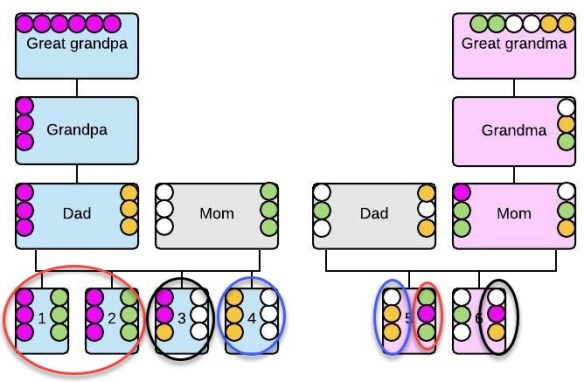
On the left-hand (blue) side of this graphic, we see four siblings that descend through their father from Great-grandpa who contributed that large magenta segment of DNA. That segment becomes reduced in descendants in subsequent generations.

In downstream generations, we can see gold, white and green segments being added to the DNA inherited by the four children from their ancestor’s spouses. Dad’s DNA is shown on the left side of each child, and Mom’s on the right.

  • Blue Children 1 and 2 inherited the same segments of DNA from Mom and Dad. Magenta from Dad and green from Mom.
  • Blue Child 3 inherited two magenta segments from Dad in positions 1 and 2 and one gold segment from Dad in position 3. They inherited all white segments from Mom.
  • Blue Child 4 inherited all gold segments from Dad and all white segments from Mom.

The family on the blue left-hand side is NOT related to the pink family shown at right. That’s important to remember.

I’ve intentionally constructed this graphic so that you can see several identical by chance (IBC) matches.

Child 5, the first pink sibling carries a white segment in position 1 from Dad and gold segments in positions 2 and 3 from Dad. From Mom, they inherited a green segment in position 1, magenta in position 2 and green in position 3.

IBC Match 1 – Looking at the blue siblings, we see that based on the DNA inherited from Pink Child 5’s parents, Pink Child 5 matches Blue Child 4 with white, gold and gold in positions 1-3, even though they weren’t inherited from the same parent in Blue Child 4. I circled this match in blue.

IBC Match 2 – Pink Child 5 also matches Blue Children 1 and 2 (red circles) because Pink Child 5 has green, magenta, and green in positions 1-3 and so do Blue Children 1 and 2. However, Blue Children 1 and 2 inherited the green and magenta segments from Mom and Dad respectively, not just from one parent.

Pink Child 5 matches Blue Children 1, 2 and 4, but not because they match by descent, but because their DNA zigzags back and forth between the blue children’s DNA contributed by both parents.

Therefore, while Pink Child 5 matches three of the Blue Children, they do not match either parent of the Blue Children.

IBC Match 3 – Pink Child 6 matches Blue Child 3 with white, magenta and gold in positions 1-3 based on the same colors of dots in those same positions found in Blue Child 3 – but inherited both paternally and maternally.

You can see that if we had the four parents available to test, that none of the Pink Children would match either the Blue Children’s mother or father and none of the Blue Children would match either of the Pink Children’s mother or father.

This is why we can’t use either siblings or close family relatives for triangulation.

Distant Cousins Are Best for Triangulation & Here’s Why

When triangulating with 3 people, the most recent common ancestor (MRCA) intersection of the closest two people is the place at which triangulation turns into only two lines being compared and ceases being triangulation. Triangle means 3.

If siblings are 2 of the 3 matching people, then their parents are essentially being compared to the third person.

If you, your aunt/uncle, and a third person match, your grandparents are the place in your tree where three lines converge into two.

The same holds true if you’re matching against a sibling pair on your match’s side, or a match and their aunt/uncle, etc.

The further back in your tree you can push that MRCA intersection, the more your triangulated match provides confirming evidence of a common ancestor and that the match is valid and not caused by random recombination.

That’s exactly what the descendants of Charles Dodson have been able to do through triangulation with multiple descendants from several of his children.

It’s also worth mentioning at this point that the reason autosomal DNA testing uses hundreds/thousands of base pairs in a comparison window and not 3 or 6 dots like in my example is that the probability of longer segments of DNA simply randomly matching by chance is reduced with length and SNP density which is the number of SNP locations tested within that cM range.

Hence a 7 cM/500 SNP minimum is the combined rule of thumb. At that level, roughly half of your matches will be valid and half will be identical by chance unless you’re dealing with endogamy. Then, raise your threshold accordingly.

Ok, So Where are We? A Triangulation Checklist for You!

I know this has been a relatively long educational article, but it’s important to really understand that testing close relatives is VERY important, but also why we can’t effectively use them for triangulation.

Here’s a handy-dandy summary matching/triangulation checklist for you to use as you work through your matches.

  • You inherit half of each of your parents’ DNA. There is no other place for you to obtain or inherit your DNA. There is no DNA fairy sprinkling you with DNA from another source:)
  • DNA does NOT skip generations, although in occasional rare circumstances, it may appear that this happened. In this situation, it’s incumbent upon you, the genealogist, to PROVE that an exception has occurred if you really believe it has. Those circumstances might be pedigree collapse or perhaps imputation. You’ll need to compare matches at vendors who provide a chromosome browser, triangulation, and full shared match list information. Never assume that you are the exception without hard and fast proof. We all know about assume, right?
  • Your siblings inherit half of your parents’ DNA too, but not the same exact half of your parent’s DNA that you other siblings did (unless they are identical twins.) You may inherit the exact same DNA from either or both of your parents on certain segments.
  • Your matches may match your parents on different or an additional segment that you did not inherit.
  • Every segment has an individual history. Evaluate every matching segment separately. One matching segment with someone could be maternal, one paternal, and one identical by chance.
  • You can confirm matches as valid if your match matches one of your parents, and you match one of your match’s parents. Parental Phasing is when your match matches your parent. Parental Cross-Matching is when you both match one of each other’s parents. To be complete, both people who match each other need to match one of the parents of the other person. This rule still holds even if you have a known common ancestor. I can’t even begin to tell you how many times I’ve been fooled.
  • 15-20% (or more with endogamy) of your matches will be identical by chance because either your DNA or your match’s DNA aligns in such a way that while they match you, they don’t match either of your parents.
  • Your siblings, aunts, and uncles will often inherit the same DNA as you – which means that identical by chance matches will also match them. That’s why we don’t use close family members for triangulation. We do utilize close family members to generate common match hints. (Remember the 20 cM shared match caveat at Ancestry)
  • While your siblings, aunts, and uncles are too close to use for triangulation, they are wonderful to identify ancestral matches. Some of their matches will match you as well, and some will not because your close family members inherited segments of your ancestor’s DNA that you did not. Everyone should test their oldest family members.
  • Triangulate your close family member’s matches separately from your own to shed more light on your ancestors.
  • Endogamy may interfere with parental phasing, meaning you may match because you and/or your match may have inherited some of the same DNA segment(s) from both sides of your tree and/or more DNA than might otherwise be expected.
  • Pedigree collapse needs to be considered when using parental phasing, especially when the same ancestor appears on both sides of your family tree. You may share more DNA with a match than expected.
  • Conversely, with pedigree collapse, your match may not match your parents, or vice versa, if a segment happens to have recombined in you in a way that drops the matching segments of your parents beneath the vendor’s match threshold.
  • While you will match all of your second cousins, you will only match approximately 90% of your third cousins and proportionally fewer as your relationship reaches further back in time.
  • Not being a DNA match with someone does NOT mean you’re NOT related to them, unless of course, you’re a second cousin (2C) or closer. It simply means you don’t carry any common ancestral segments above vendor thresholds.
  • At 2C or closer, if you’re not a DNA match, other alternative situations need to be considered – including the transfer/upload of the wrong person’s DNA file.
  • Imputation, a scientific process required of vendors may interfere with matching, especially in more distant relatives who have tested on different platforms.
  • Imputation artifacts will be less obvious when people are more closely related, meaning closer relatives can be expected to match on more and larger segments and imputation errors make less difference.
  • Imputation will not cause close relatives, meaning 2C or closer, to not match each other.
  • In addition to not supporting segment matching information, Ancestry down-weights some segments, removes some matching DNA, and does not show shared matches below 20cM, causing some people to misinterpret their lack of common matches in various ways.
  • To resolve questions about matching issues at Ancestry, testers can transfer/upload their DNA files to MyHeritage, FamilyTreeDNA, and GEDmatch and look for consistent matches on the same segment. Start and end locations may vary to some extent between vendors, but the segment size should be basically in the same location and roughly the same size.
  • GEDmatch does not use imputation but allows larger non-matching segments to combine as a single segment which sometimes causes extremely “generous” matches. GEDmatch matching is less reliable than FamilyTreeDNA or MyHeritage, but you can adjust the matching thresholds.
  • The best situation for matching is for both people to test at the same vendor who supports and provides segment data and a chromosome browser such as 23andMe, FamilyTreeDNA, or MyHeritage.
  • Siblings cannot be used for triangulation because the most recent common ancestor (MRCA) between you and your siblings is your parents. Therefore, the “three” people in the triangulation group is reduced to two lines immediately.
  • Uncles and aunts should not be used for triangulation because the most recent common ancestors between you and your aunts and uncles are your grandparents.
  • Conversely, you should not consider triangulating with siblings and close family members of your matches as proof of an ancestral relationship.
  • A triangulation group of 3 people is only confirmation as far back as when two of those people’s lines converge and reach a common ancestor.
  • Identical by chance (IBC) matching occurs when DNA from the maternal and paternal sides are mixed positionally in the child to resemble a maternal/paternal side match with someone else.
  • Identical by chance DNA admixture (when compared to a match) could have occurred in your parents or grandparent’s generation, or earlier, so the further back in time that people in a triangulation group reach, the more reliable the triangulation group is likely to be.
  • The larger the segments and/or the triangulation group, the stronger the evidence for a specific confirmed common ancestor.
  • Early families with a very large number of descendants may have many matching and triangulated members, even 9 or 10 generations later.
  • While exactly 50% of each ancestor’s DNA is not passed in each generation, on average, you will carry 7 cM of your ancestors 10 generations back in your tree. However, you may carry more, or none.
  • The percentage of matching descendants decreases with each generation beyond great-grandparents.
  • The ideal situation for triangulation is a significant number of people, greater than three, who match on the same reasonably sized segment (7 cM/500 SNP or larger) and descend from the same ancestor (or ancestral couple) through different children whose spouses in descendant generations are not also related.
  • This means that tree completion is an important factor in match/triangulation reliability.
  • Triangulating through different children of the ancestral couple makes it significantly less likely that a different unknown common ancestor is contributing that segment of DNA – like an unknown wife in a descendant generation.

Whew!!!

The Bottom Line

Here’s the bottom line.

  1. Don’t use close relatives to triangulate.
  2. Use parents for Parental Phasing.
  3. Use Parental Cross-Matching when possible.
  4. Use close relatives to look for shared common matches that may lead to triangulation possibilities.
  5. Triangulate your close relatives’ DNA in addition to your own for bonus genealogical information. They will match people that you don’t.
  6. For the most reliable triangulation results, use the most distant relatives possible, descended through different children of the common ancestral couple.
  7. Keep this checklist of best practices, cautions, and caveats handy and check the list as necessary when evaluating the strength of any match or triangulation group. It serves as a good reminder for what to check if something seems “off” or unusual.

Feel free to share and pass this article (and checklist) on to your genealogy buddies and matches as you explain triangulation and collaborate on your genealogy.

Have fun!!!

_____________________________________________________________

Disclosure

I receive a small contribution when you click on some of the links to vendors in my articles. This does NOT increase the price you pay but helps me to keep the lights on and this informational blog free for everyone. Please click on the links in the articles or to the vendors below if you are purchasing products or DNA testing.

Thank you so much.

DNA Purchases and Free Transfers

Genealogy Products and Services

Books

Genealogy Research

How to Download Your DNA Matching Segment Data and Why You Should

There are two or three types of data that testers may be able to download from DNA testing sites. Genealogy customers need to periodically download as much as possible.

  1. Raw data files needed for transferring DNA files from the company where you tested to other testing or analysis/comparison sites such as FamilyTreeDNA, MyHeritage, and GEDmatch for matching and other tools.
  2. Matching segment files which detail your matches, segment by segment with people whom you match.
  3. Match information files that provide you with additional information about your matches. What’s included varies by vendor.

This type of information is not uniformly available from all vendors, but is available as follows:

Vendor Raw Data File Matching Segment File Match Information File
FamilyTreeDNA Yes Yes Yes
MyHeritage Yes Yes Yes
23andMe Yes Yes Yes
Ancestry Yes No No
GedMatch Not a testing company, so no Yes Yes

I have provided step-by-step information about how to download your raw DNA data files and upload them to other vendors in a series of articles that you can find here.

Some of the answers in the table above need caveats because each vendor is different. Let’s take a look.

Matching Segment Files

In this article, I’ll provide information about how to download your matching segment and match information file(s).

Unfortunately, Ancestry does not provide any segment data at all, nor do they provide a way to download your match information. Third-party tools that did this for you have been banned by Ancestry, under threat of legal action, so this information is no longer available to Ancestry customers.

You can’t obtain this information from Ancestry, but you can transfer your DNA file to other vendors such as FamilyTreeDNA, MyHeritage and the third-party site, GEDmatch where you’ll receive additional matches. Some Ancestry matches will have transferred elsewhere as well, and you can take advantage of your matching segment information.

Why Do I Want a Matching Segment File?

The matching segment file provides you with information about exactly how and where you match each person.

Here’s an example that includes the match name, chromosome, start and end location of the match along with the total number of CentiMorgans (cM) and total SNPs in the matching segment. Your matching segment file consists of hundreds/thousands of rows of this information.

Determining who matches you on the same segment is important because it facilitates the identification of common ancestors. Segment matching is also the first step in triangulation which allows you to confirm descent from common ancestors with your matches.

I wrote about triangulation at each vendor in the following articles:

Matching and Triangulation help you sort out legitimate matches, and which ancestors that DNA segment comes from.

Sorting For Legitimate Matches

On each segment location of your DNA, you will match:

  • People from your Mom’s side
  • People from your Dad’s side
  • People that are identical by chance (IBC) where they match you because part of the DNA from your Mom’s side and part from your Dad’s side just happens to look like their DNA (or vice versa.)

You can see how matching works in this example of 10 DNA locations. You inherited half of your Mom’s DNA and half of your Dad’s.

  • Legitimate maternal matches to you on this segment will have all As in this location.
  • Legitimate paternal matches to you will have all Cs in this location.
  • Identical by chance matches will match you, because they have the same DNA as both of your parents that you carry – interspersed. They will not match either of your parents individually.

IBC matches DO technically match you, but accidentally. In other words, they are identical by chance (IBC) because they just happen to match the DNA of both of your parents intermixed. Conversely, you can match the DNA of their parents intermixed as well. Regardless of why, they are not a legitimate maternal or paternal match to you.

For example, you can see that the identical by chance (IBC) match to you, above, won’t match the legitimate maternal or legitimate paternal matches.

When comparing your matches on any segment, you’ll wind up with a group of people who match you and each other on your maternal side, a group on your paternal side, and “everyone else” who is IBC.

I wrote about IBD, identical by descent DNA and IBC, identical by chance DNA and how that works, here.

A downloadable segment match file allows you to sort all of your matches by chromosome and segment. That’s the first step in determining if your matches match each other – which is how to determine if people are legitimate matches or IBC.

Additionally, these files allow you to utilize features at DNAPainter along with the tools at DNAGedcom and Genetic Affairs.

Match Information File

There’s a second file you’ll want to download as well except at 23andMe who includes all of the information in one file. You’ll want to download these files from each vendor at the same time so they are coordinated and include the same matches from the same time.

Downloading the second file, your match information, provides additional information which will be helpful for your genealogy. The information in this file varies by vendor, but includes items such as, but not limited to:

  • Tree link
  • Haplogroup
  • Match date
  • Predicted Relationship Range
  • Actual Relationship
  • Total shared cM
  • Longest segment cM
  • Maternal or paternal bucket (FamilyTreeDNA)
  • Notes
  • Email
  • Family Surnames
  • Location
  • Percent of shared DNA

You never know when vendors are going to change something that will affect your matches, like 23andMe did last fall, so it’s a good idea to download periodically.

Downloading your segment match and match information files are free, so let’s do this.

Downloading Your Segment Match & Information Files

FamilyTreeDNA

Sign on to your account.

click images to enlarge

Under your Family Finder Autosomal DNA test results, click on Chromosome Browser.

On the chromosome browser page, at the top right, click on Download All Segments.

Caveat – if you access the chromosome browser through the Family Finder match page, shown below, you will receive the segment matches ONLY for the people you have selected.

After selecting specific matches, as shown above, the option on the chromosome browser page will only say “Download Segments.” It does NOT say “Download All Segments.”

Clicking on this link only downloads the segments that you match with those people, so always be sure to access “Download ALL Segments” directly through the chromosome browser selection on your Autosomal DNA Family Finder menu without going to your match page and selecting specific matches.

The segment download file includes only the segments, but not additional information, such as which side, maternal or paternal, those matches are bucketed to, surnames and so forth. You need to download a second file.

To download additional information about your matches, scroll to the very bottom of your Family Finder match page and click on either Download Matches or Download Filtered matches. If you’ve used a filter such as maternal or paternal, you’ll receive only those matches, so be sure no filters are in use to download all of your matches’ information.

Your reports will be downloaded to your computer, so save them someplace where you can find them.

MyHeritage

Sign in to your account and click on the DNA tab, then DNA Matches.

At the far right-hand side, you’ll see three little dots. Click on the dots and you’ll see the options to export both the entire DNA Matches list and the shared DNA segment info for all DNA Matches.

You’ll want to download both. The first file Is the DNA matches list.

To download your segment matches, select the second option, “Export shared DNA segment info…”

Your files will be emailed to you.

23andMe

At 23andMe, sign on to your account and click on “DNA Relatives” under the Ancestry tab.

You’ll see your list of matches. Scroll to the very bottom where you’ll see the link to “Download aggregate data.”

23andMe combines your segment and match information in one file.

Remember that at 23andMe, your matches are limited to 2000 (unless you’re a V5 subscriber), minus the number of people who have not opted in to Relative Sharing. Additionally, there will be a number of people in the download file whose names appear, but who don’t have any segment data. Those people opted-in to Relative Sharing, but not to share segment information.

For example, my download file has 2827 rows. Of those, 1769 are unique individuals, meaning that I have matches with multiple segments for 1058 people. This means that of my 2000 allowed matches, 231 (or more) did not opt-in for Relative Sharing. The “or more” means that 23andMe does not roll matches off the list if you have communicated with the person, so some people may actually have more than 2000 matches. It’s impossible to know how 23andMe approaches calculations in this case.

Of those 1769 unique individuals on my match list, 257, or 15% did not share segment information. I’d sure like for those to be automatically rolled off and replaced with the next 257 who do share. 1512 or roughly three-quarters, 75%, of my 2000 allowed matches are useful for genealogy.

Initially, when 23andMe made their changes last fall, they were reportedly limiting the download file number to 1000, but they have reversed that policy on the V3 and V4 chips. I downloaded files from both chip versions to confirm that’s true.

I don’t have the V5 chip subscription level, nor am I going to retest to do that, so I don’t know if V5 subscribers receive all 5000 of the allowed matches in their download file.

This is the perfect example of why it’s a good idea to download your match files periodically. 23andMe is the only testing vendor that restricts your matches and when they roll off your list, they are irretrievable.

Aside from that, safe is better than sorry. You never know when something will change at a vendor and you’ll wish you had downloaded your match files earlier.

GedMatch

GedMatch, a third-party vendor, provides lots of tools but isn’t intuitive and provides almost no tutorial or information about how to navigate or use their site. There are some YouTube videos and Kitty Cooper has written several how-to articles. GEDmatch has promised a facelift soon.

GEDmatch provides many tools for free, along with a Tier1 level which provides advanced features by subscription.

At GEDmatch, you can see up to 2000 matches for free, but you must be a Tier 1 subscription member to download your matches – and the download is restricted to your top 1000 matches.

There are two Tier 1 one-to-many comparison options that are very similar. For either, you’ll enter your kit number and make your selection. Given that you’re restricted to 1000 in the download, there is no reason to search for more than 1000 kits.

click to enlarge

Then, click on Visualization options

You will then see the list of visualization options which includes “List/CSV.”

Clicking on “List/CSV” provides you with options.

click to enlarge

You’ll want to select the Matched Segment List, and you can either select “Prevent Hard Breaks,” or not. Allowing hard breaks means that small non-matching regions between two matching segments is not ignored, and the two segments are reported as two separate segments – if they are large enough to be reported.

If you prevent hard breaks, non-matching regions of less than 500,000 thousand base positions are ignored, creating one larger blended segment. It’s my preference to allow hard breaks because I’ve seen too many instances of erroneously “blended” segments.

When your matching segment file is complete, you will be prompted to download to your computer.

Thanks to Genetic Affairs, I discovered an alternate way to obtain more than 1000 downloaded matches from GEDmatch.

GEDmatch Alternative Methodology

Genetic Affairs suggests using the DNA Segment Search with a minimum of 5000 kits, and to enable the option to “Prevent Hard Breaks.”

Do not close the session while GedMatch is processing or you’ll need to restart your query.

When finished click “Here” to download the file to your system.

Now you’re ready for part 2.

Next, you’ll want to select the Triangulation feature.

These functions take time, so you’ll be watching as the counter increases. Or maybe go eat dinner or research some genealogy.

I can hear the “Jeopardy countdown music

When finished, click on “Here” to download this second file.

Whew! Now you should have your segment and match information files from each company that supports this information and provides downloads.

Saving Files

I generally save my files by vendor and date. However, if you’re going to use the files for a special project – you may want to make a copy elsewhere. For example, I’m going to use these files for Genetic Affairs’ AutoSegment feature, so I’ve downloaded fresh files from each vendor on the same date and made a separate copy, stored in my Genetic Affairs folder. I’ll let you know how that goes😊

Bottom Line

  • Test at vendors that don’t accept transfers. Ancestry and 23andMe
  • Test at or transfer to the rest. FamilyTreeDNA, MyHeritage and GEDmatch
  • Unlock or subscribe to the advanced tools that include chromosome browsers, ethnicity, and more, depending on the vendor. FamilyTreeDNA, MyHeritage, GEDmatch
  • Upload or create trees at each vendor (except 23andMe who doesn’t support trees.)
  • Download as much information as you can from each vendor.
  • Work your matches through shared (in common with) matches, trees, segments, and clusters!

Have fun!!!

_____________________________________________________________

Disclosure

I receive a small contribution when you click on some of the links to vendors in my articles. This does NOT increase the price you pay but helps me to keep the lights on and this informational blog free for everyone. Please click on the links in the articles or to the vendors below if you are purchasing products or DNA testing.

Thank you so much.

DNA Purchases and Free Transfers

Genealogy Products and Services

Books

Genealogy Research

Genetic Genealogy at 20 Years: Where Have We Been, Where Are We Going and What’s Important?

Not only have we put 2020 in the rear-view mirror, thankfully, we’re at the 20-year, two-decade milestone. The point at which genetics was first added to the toolbox of genealogists.

It seems both like yesterday and forever ago. And yes, I’ve been here the whole time,  as a spectator, researcher, and active participant.

Let’s put this in perspective. On New Year’s Eve, right at midnight, in 2005, I was able to score kit number 50,000 at Family Tree DNA. I remember this because it seemed like such a bizarre thing to be doing at midnight on New Year’s Eve. But hey, we genealogists are what we are.

I knew that momentous kit number which seemed just HUGE at the time was on the threshold of being sold, because I had inadvertently purchased kit 49,997 a few minutes earlier.

Somehow kit 50,000 seemed like such a huge milestone, a landmark – so I quickly bought kits, 49,998, 49,999, and then…would I get it…YES…kit 50,000. Score!

That meant that in the 5 years FamilyTreeDNA had been in business, they had sold on an average of 10,000 kits per year, or 27 kits a day. Today, that’s a rounding error. Then it was momentous!

In reality, the sales were ramping up quickly, because very few kits were sold in 2000, and roughly 20,000 kits had been sold in 2005 alone. I know this because I purchased kit 28,429 during the holiday sale a year earlier.

Of course, I had no idea who I’d test with that momentous New Year’s Eve Y DNA kit, but I assuredly would find someone. A few months later, I embarked on a road trip to visit an elderly family member with that kit in tow. Thank goodness I did, and they agreed and swabbed on the spot, because they are gone today and with them, the story of the Y line and autosomal DNA of their branch.

In the past two decades, almost an entire generation has slipped away, and with them, an entire genealogical library held in their DNA.

Today, more than 40 million people have tested with the four major DNA testing companies, although we don’t know exactly how many.

Lots of people have had more time to focus on genealogy in 2020, so let’s take a look at what’s important? What’s going on and what matters beyond this month or year?

How has this industry changed in the last two decades, and where it is going?

Reflection

This seems like a good point to reflect a bit.

Professor Dan Bradley reflecting on early genetic research techniques in his lab at the Smurfit Institute of Genetics at Trinity College in Dublin. Photo by Roberta Estes

In the beginning – twenty years ago, there were two companies who stuck their toes in the consumer DNA testing water – Oxford Ancestors and Family Tree DNA. About the same time, Sorenson Genomics and GeneTree were also entering that space, although Sorenson was a nonprofit. Today, of those, only FamilyTreeDNA remains, having adapted with the changing times – adding more products, testing, and sophistication.

Bryan Sykes who founded Oxford Ancestors announced in 2018 that he was retiring to live abroad and subsequently passed away in 2020. The website still exists, but the company has announced that they have ceased sales and the database will remain open until Sept 30, 2021.

James Sorenson died in 2008 and the assets of Sorenson Molecular Genealogy Foundation, including the Sorenson database, were sold to Ancestry in 2012. Eventually, Ancestry removed the public database in 2015.

Ancestry dabbled in Y and mtDNA for a while, too, destroying that database in 2014.

Other companies, too many to remember or mention, have come and gone as well. Some of the various company names have been recycled or purchased, but aren’t the same companies today.

In the DNA space, it was keep up, change, die or be sold. Of course, there was the small matter of being able to sell enough DNA kits to make enough money to stay in business at all. DNA processing equipment and a lab are expensive. Not just the equipment, but also the expertise.

The Next Wave

As time moved forward, new players entered the landscape, comprising the “Big 4” testing companies that constitute the ponds where genealogists fish today.

23andMe was the first to introduce autosomal DNA testing and matching. Their goal and focus was always medical genetics, but they recognized the potential in genealogists before anyone else, and we flocked to purchase tests.

Ancestry settled on autosomal only and relies on the size of their database, a large body of genealogy subscribers, and a widespread “feel-good” marketing campaign to sell DNA kits as the gateway to “discover who you are.”

FamilyTreeDNA did and still does offer all 3 kinds of tests. Over the years, they have enhanced both the Y DNA and mitochondrial product offerings significantly and are still known as “the science company.” They are the only company to offer the full range of Y DNA tests, including their flagship Big Y-700, full sequence mitochondrial testing along with matching for both products. Their autosomal product is called Family Finder.

MyHeritage entered the DNA testing space a few years after the others as the dark horse that few expected to be successful – but they fooled everyone. They have acquired companies and partnered along the way which allowed them to add customers (Promethease) and tools (such as AutoCluster by Genetic Affairs), boosting their number of users. Of course, MyHeritage also offers users a records research subscription service that you can try for free.

In summary:

One of the wonderful things that happened was that some vendors began to accept compatible raw DNA autosomal data transfer files from other vendors. Today, FamilyTreeDNA, MyHeritage, and GEDmatch DO accept transfer files, while Ancestry and 23andMe do not.

The transfers and matching are free, but there are either minimal unlock or subscription plans for advanced features.

There are other testing companies, some with niche markets and others not so reputable. For this article, I’m focusing on the primary DNA testing companies that are useful for genealogy and mainstream companion third-party tools that complement and enhance those services.

The Single Biggest Change

As I look back, the single biggest change is that genetic genealogy evolved from the pariah of genealogy where DNA discussion was banned from the (now defunct) Rootsweb lists and summarily deleted for the first few years after introduction. I know, that’s hard to believe today.

Why, you ask?

Reasons varied from “just because” to “DNA is cheating” and then morphed into “because DNA might do terrible things like, maybe, suggest that a person really wasn’t related to an ancestor in a lineage society.”

Bottom line – fear and misunderstanding. Change is exceedingly difficult for humans, and DNA definitely moved the genealogy cheese.

From that awkward beginning, genetic genealogy organically became a “thing,” a specific application of genealogy. There was paper-trail traditional genealogy and then the genetic aspect. Today, for almost everyone, genealogy is “just another tool” in the genealogist’s toolbox, although it does require focused learning, just like any other tool.

DNA isn’t separate anymore, but is now an integral part of the genealogical whole. Having said that, DNA can’t solve all problems or answer all questions, but neither can traditional paper-trail genealogy. Together, each makes the other stronger and solves mysteries that neither can resolve alone.

Synergy.

I fully believe that we have still only scratched the surface of what’s possible.

Inheritance

As we talk about the various types of DNA testing and tools, here’s a quick graphic to remind you of how the different types of DNA are inherited.

  • Y DNA is inherited paternally for males only and informs us of the direct patrilineal (surname) line.
  • Mitochondrial DNA is inherited by everyone from their mothers and informs us of the mother’s matrilineal (mother’s mother’s mother’s) line.
  • Autosomal DNA can be inherited from potentially any ancestor in random but somewhat predictable amounts through both parents. The further back in time, the less identifiable DNA you’ll inherit from any specific ancestor. I wrote about that, here.

What’s Hot and What’s Not

Where should we be focused today and where is this industry going? What tools and articles popped up in 2020 to help further our genealogy addiction? I already published the most popular articles of 2020, here.

This industry started two decades ago with testing a few Y DNA and mitochondrial DNA markers, and we were utterly thrilled at the time. Both tests have advanced significantly and the prices have dropped like a stone. My first mitochondrial DNA test that tested only 400 locations cost more than $800 – back then.

Y DNA and mitochondrial DNA are still critically important to genetic genealogy. Both play unique roles and provide information that cannot be obtained through autosomal DNA testing. Today, relative to Y DNA and mitochondrial DNA, the biggest challenge, ironically, is educating newer genealogists about their potential who have never heard about anything other than autosomal, often ethnicity, testing.

We have to educate in order to overcome the cacophony of “don’t bother because you don’t get as many matches.”

That’s like saying “don’t use the right size wrench because the last one didn’t fit and it’s a bother to reach into the toolbox.” Not to mention that if everyone tested, there would be a lot more matches, but I digress.

If you don’t use the right tool, and all of the tools at your disposal, you’re not going to get the best result possible.

The genealogical proof standard, the gold standard for genealogy research, calls for “a reasonably exhaustive search,” and if you haven’t at least considered if or how Y
DNA
and mitochondrial DNA along with autosomal testing can or might help, then your search is not yet exhaustive.

I attempt to obtain the Y and mitochondrial DNA of every ancestral line. In the article, Search Techniques for Y and Mitochondrial DNA Test Candidates, I described several methodologies to find appropriate testing candidates.

Y DNA – 20 Years and Still Critically Important

Y DNA tracks the Y chromosome for males via the patrilineal (surname) line, providing matching and historical migration information.

We started 20 years ago testing 10 STR markers. Today, we begin at 37 markers, can upgrade to 67 or 111, but the preferred test is the Big Y which provides results for 700+ STR markers plus results from the entire gold standard region of the Y chromosome in order to provide the most refined results. This allows genealogists to use STR markers and SNP results together for various aspects of genealogy.

I created a Y DNA resource page, here, in order to provide a repository for Y DNA information and updates in one place. I would encourage anyone who can to order or upgrade to the Big Y-700 test which provides critical lineage information in addition to and beyond traditional STR testing. Additionally, the Big Y-700 test helps build the Y DNA haplotree which is growing by leaps and bounds.

More new SNPs are found and named EVERY SINGLE DAY today at FamilyTreeDNA than were named in the first several years combined. The 2006 SNP tree listed a grand total of 459 SNPs that defined the Y DNA tree at that time, according to the ISOGG Y DNA SNP tree. Goran Rundfeldt, head of R&D at FamilyTreeDNA posted this today:

2020 was an awful year in so many ways, but it was an unprecedented year for human paternal phylogenetic tree reconstruction. The FTDNA Haplotree or Great Tree of Mankind now includes:

37,534 branches with 12,696 added since 2019 – 51% growth!
defined by
349,097 SNPs with 131,820 added since 2019 – 61% growth!

In just one year, 207,536 SNPs were discovered and assigned FT SNP names. These SNPs will help define new branches and refine existing ones in the future.

The tree is constructed based on high coverage chromosome Y sequences from:
– More than 52,500 Big Y results
– Almost 4,000 NGS results from present-day anonymous men that participated in academic studies

Plus an additional 3,000 ancient DNA results from archaeological remains, of mixed quality and Y chromosome coverage at FamilyTreeDNA.

Wow, just wow.

These three new articles in 2020 will get you started on your Y DNA journey!

Mitochondrial DNA – Matrilineal Line of Humankind is Being Rewritten

The original Oxford Ancestor’s mitochondrial DNA test tested 400 locations. The original Family Tree DNA test tested around 1000 locations. Today, the full sequence mitochondrial DNA test is standard, testing the entire 16,569 locations of the mitochondria.

Mitochondrial DNA tracks your mother’s direct maternal, or matrilineal line. I’ve created a mitochondrial DNA resource page, here that includes easy step-by-step instructions for after you receive your results.

New articles in 2020 included the introduction of The Million Mito Project. 2021 should see the first results – including a paper currently in the works.

The Million Mito Project is rewriting the haplotree of womankind. The current haplotree has expanded substantially since the first handful of haplogroups thanks to thousands upon thousands of testers, but there is so much more information that can be extracted today.

Y and Mitochondrial Resources

If you don’t know of someone in your family to test for Y DNA or mitochondrial DNA for a specific ancestral line, you can always turn to the Y DNA projects at Family Tree DNA by searching here.

The search provides you with a list of projects available for a specific surname along with how many customers with that surname have tested. Looking at the individual Y DNA projects will show the earliest known ancestor of the surname line.

Another resource, WikiTree lists people who have tested for the Y DNA, mitochondrial DNA and autosomal DNA lines of specific ancestors.

Click on images to enlarge

On the left side, my maternal great-grandmother’s profile card, and on the right, my paternal great-great-grandfather. You can see that someone has tested for the mitochondrial DNA of Nora (OK, so it’s me) and the Y DNA of John Estes (definitely not me.)

MitoYDNA, a nonprofit volunteer organization created a comparison tool to replace Ysearch and Mitosearch when they bit the dust thanks to GDPR.

MitoYDNA accepts uploads from different sources and allows uploaders to not only match to each other, but to view the STR values for Y DNA and the mutation locations for the HVR1 and HVR2 regions of mitochondrial DNA. Mags Gaulden, one of the founders, explains in her article, What sets mitoYDNA apart from other DNA Databases?.

If you’ve tested at nonstandard companies, not realizing that they didn’t provide matching, or if you’ve tested at a company like Sorenson, Ancestry, and now Oxford Ancestors that is going out of business, uploading your results to mitoYDNA is a way to preserve your investment. PS – I still recommend testing at FamilyTreeDNA in order to receive detailed results and compare in their large database.

CentiMorgans – The Word of Two Decades

The world of autosomal DNA turns on the centimorgan (cM) measure. What is a centimorgan, exactly? I wrote about that unit of measure in the article Concepts – CentiMorgans, SNPs and Pickin’ Crab.

Fortunately, new tools and techniques make using cMs much easier. The Shared cM Project was updated this year, and the results incorporated into a wonderfully easy tool used to determine potential relationships at DNAPainter based on the number of shared centiMorgans.

Match quality and potential relationships are determined by the number of shared cMs, and the chromosome browser is the best tool to use for those comparisons.

Chromosome Browser – Genetics Tool to View Chromosome Matches

Chromosome browsers allow testers to view their matching cMs of DNA with other testers positioned on their own chromosomes.

My two cousins’ DNA where they match me on chromosomes 1-4, is shown above in blue and red at Family Tree DNA. It’s important to know where you match cousins, because if you match multiple cousins on the same segment, from the same side of your family (maternal or paternal), that’s suggestive of a common ancestor, with a few caveats.

Some people feel that a chromosome browser is an advanced tool, but I think it’s simply standard fare – kind of like driving a car. You need to learn how to drive initially, but after that, you don’t even think about it – you just get in and go. Here’s help learning how to drive that chromosome browser.

Triangulation – Science Plus Group DNA Matching Confirms Genealogy

The next logical step after learning to use a chromosome browser is triangulation. If fact, you’re seeing triangulation above, but don’t even realize it.

The purpose of genetic genealogy is to gather evidence to “prove” ancestral connections to either people or specific ancestors. In autosomal DNA, triangulation occurs when:

  • You match at least two other people (not close relatives)
  • On the same reasonably sized segment of DNA (generally 7 cM or greater)
  • And you can assign that segment to a common ancestor

The same two cousins are shown above, with triangulated segments bracketed at MyHeritage. I’ve identified the common ancestor with those cousins that those matching DNA segments descend from.

MyHeritage’s triangulation tool confirms by bracketing that these cousins also match each other on the same segment, which is the definition of triangulation.

I’ve written a lot about triangulation recently.

If you’d prefer a video, I recorded a “Top Tips” Facebook LIVE with MyHeritage.

Why is Ancestry missing from this list of triangulation articles? Ancestry does not offer a chromosome browser or segment information. Therefore, you can’t triangulate at Ancestry. You can, however, transfer your Ancestry DNA raw data file to either FamilyTreeDNA, MyHeritage, or GEDmatch, all three of which offer triangulation.

Step by step download/upload transfer instructions are found in this article:

Clustering Matches and Correlating Trees

Based on what we’ve seen over the past few years, we can no longer depend on the major vendors to provide all of the tools that genealogists want and need.

Of course, I would encourage you to stay with mainstream products being used by a significant number of community power users. As with anything, there is always someone out there that’s less than honorable.

2020 saw a lot of innovation and new tools introduced. Maybe that’s one good thing resulting from people being cooped up at home.

Third-party tools are making a huge difference in the world of genetic genealogy. My favorites are Genetic Affairs, their AutoCluster tool shown above, DNAPainter and DNAGedcom.

These articles should get you started with clustering.

If you like video resources, here’s a MyHeritage Facebook LIVE that I recorded about how to use AutoClusters:

I created a compiled resource article for your convenience, here:

I have not tried a newer tool, YourDNAFamily, that focuses only on 23andMe results although the creator has been a member of the genetic genealogy community for a long time.

Painting DNA Makes Chromosome Browsers and Triangulation Easy

DNAPainter takes the next step, providing a repository for all of your painted segments. In other words, DNAPainter is both a solution and a methodology for mass triangulation across all of your chromosomes.

Here’s a small group of people who match me on the same maternal segment of chromosome 1, including those two cousins in the chromosome browser and triangulation sections, above. We know that this segment descends from Philip Jacob Miller and his wife because we’ve been able to identify that couple as the most distant ancestor intersection in all of our trees.

It’s very helpful that DNAPainter has added the functionality of painting all of the maternal and paternal bucketed matches from Family Tree DNA.

All you need to do is to link your known matches to your tree in the proper place at FamilyTreeDNA, then they do the rest by using those DNA matches to indicate which of the rest of your matches are maternal and paternal. Instructions, here. You can then export the file and use it at DNAPainter to paint all of those matches on the correct maternal or paternal chromosomes.

Here’s an article providing all of the DNAPainter Instructions and Resources.

DNA Matches Plus Trees Enhance Genealogy

Of course, utilizing DNA matching plus finding common ancestors in trees is one of the primary purposes of genetic genealogy – right?

Vendors have linked the steps of matching DNA with matching ancestors in trees.

Genetic Affairs take this a step further. If you don’t have an ancestor in your tree, but your matches have common ancestors with each other, Genetic Affairs assembles those trees to provide you with those hints. Of course, that common ancestor might not be relevant to your genealogy, but it just might be too!

click to enlarge

This tree does not include me, but two of my matches descend from a common ancestor and that common ancestor between them might be a clue as to why I match both of them.

Ethnicity Continues to be Popular – But Is No Shortcut to Genealogy

Ethnicity is always popular. People want to “do their DNA” and find out where they come from. I understand. I really do. Who doesn’t just want an answer?

Of course, it’s not that simple, but that doesn’t mean it’s not disappointing to people who test for that purpose with high expectations. Hopefully, ethnicity will pique their curiosity and encourage engagement.

All four major vendors rolled out updated ethnicity results or related tools in 2020.

The future for ethnicity, I believe, will be held in integrated tools that allow us to use ethnicity results for genealogy, including being able to paint our ethnicity on our chromosomes as well as perform segment matching by ethnicity.

For example, if I carry an African segment on chromosome 1 from my father, and I match one person from my mother’s side and one from my father’s side on that same segment – one or the other of those people should also have that segment identified as African. That information would inform me as to which match is paternal and which is maternal

Not only that, this feature would help immensely tracking ancestors back in time and identifying their origins.

Will we ever get there? I don’t know. I’m not sure ethnicity is or can be accurate enough. We’ll see.

Transition to Digital and Online

Sometimes the future drags us kicking and screaming from the present.

With the imposed isolation of 2020, conferences quickly moved to an online presence. The genealogy community has all pulled together to make this work. The joke is that 2020’s most used phrase is “can you hear me?” I can vouch for that.

Of course while the year 2020 is over, the problem isn’t and is extending at least through the first half of 2021 and possibly longer. Conferences are planned months, up to a year, in advance and they can’t turn on a dime, so don’t even begin to expect in-person conferences until either late in 2021 or more likely, 2022 if all goes well this year.

I expect the future will eventually return to in-person conferences, but not entirely.

Finding ways to be more inclusive allows people who don’t want to or can’t travel or join in-person to participate.

I’ve recorded several sessions this year, mostly for 2021. Trust me, these could be a comedy, mostly of errors😊

I participated in four MyHeritage Facebook LIVE sessions in 2020 along with some other amazing speakers. This is what “live” events look like today!

Screenshot courtesy MyHeritage

A few days ago, I asked MyHeritage for a list of their LIVE sessions in 2020 and was shocked to learn that there were more than 90 in English, all free, and you can watch them anytime. Here’s the MyHeritage list.

By the way, every single one of the speakers is a volunteer, so say a big thank you to the speakers who make this possible, and to MyHeritage for the resources to make this free for everyone. If you’ve ever tried to coordinate anything like this, it’s anything but easy.

Additonally, I’ve created two Webinars this year for Legacy Family Tree Webinars.

Geoff Rasmussen put together the list of their top webinars for 2020, and I was pleased to see that I made the top 10! I’m sure there are MANY MORE you’d be interested in watching. Personally, I’m going to watch #6 yet today! Also, #9 and #22. You can always watch new webinars for free for a few days, and you can subscribe to watch all webinars, here.

The 2021 list of webinar speakers has been announced here, and while I’m not allowed to talk about something really fun that’s upcoming, let’s just say you definitely have something to look forward to in the springtime!

Also, don’t forget to register for RootsTech Connect which is entirely online and completely free, February 25-27, here.

Thank you to Penny Walters for creating this lovely graphic.

There are literally hundreds of speakers providing sessions in many languages for viewers around the world. I’ve heard the stats, but we can’t share them yet. Let me just say that you will be SHOCKED at the magnitude and reach of this conference. I’m talking dumbstruck!

During one of our zoom calls, one of the organizers says it feels like we’re constructing the plane as we’re flying, and I can confirm his observation – but we are getting it done – together! All hands on deck.

I’ll be presenting an advanced session about triangulation as well as a mini-session in the FamilySearch DNA Resource Center about finding your mother’s ancestors. I’ll share more information as it’s released and I can.

Companies and Owners Come & Go

You probably didn’t even notice some of these 2020 changes. Aside from the death of Bryan Sykes (RIP Bryan,) the big news and the even bigger unknown is the acquisition of Ancestry by Blackstone. Recently the CEO, Margo Georgiadis announced that she was stepping down. The Ancestry Board of Directors has announced an external search for a new CEO. All I can say is that very high on the priority list should be someone who IS a genealogist and who understands how DNA applies to genealogy.

Other changes included:

In the future, as genealogy and DNA testing becomes ever more popular and even more of a commodity, company sales and acquisitions will become more commonplace.

Some Companies Reduced Services and Cut Staff

I understand this too, but it’s painful. The layoffs occurred before Covid, so they didn’t result from Covid-related sales reductions. Let’s hope we see renewed investment after the Covid mess is over.

In a move that may or may not be related to an attempt to cut costs, Ancestry removed 6 and 7 cM matches from their users, freeing up processing resources, hardware, and storage requirements and thereby reducing costs.

I’m not going to beat this dead horse, because Ancestry is clearly not going to move on this issue, nor on that of the much-requested chromosome browser.

Later in the year, 23andMe also removed matches and other features, although, to their credit, they have restored at least part of this functionality and have provided ethnicity updates to V3 and V4 kits which wasn’t initially planned.

It’s also worth noting that early in 2020, 23andMe laid off 100 people as sales declined. Since that time, 23andMe has increasingly pushed consumers to pay to retest on their V5 chip.

About the same time, Ancestry also cut their workforce by about 6%, or about 100 people, also citing a slowdown in the consumer testing market. Ancestry also added a health product.

I’m not sure if we’ve reached market saturation or are simply seeing a leveling off. I wrote about that in DNA Testing Sales Decline: Reason and Reasons.

Of course, the pandemic economy where many people are either unemployed or insecure about their future isn’t helping.

The various companies need some product diversity to survive downturns. 23andMe is focused on medical research with partners who pay 23andMe for the DNA data of customers who opt-in, as does Ancestry.

Both Ancestry and MyHeritage provide subscription services for genealogy records.

FamilyTreeDNA is part of a larger company, GenebyGene whose genetics labs do processing for other companies and medical facilities.

A huge thank you to both MyHeritage and FamilyTreeDNA for NOT reducing services to customers in 2020.

Scientific Research Still Critical & Pushes Frontiers

Now that DNA testing has become a commodity, it’s easy to lose track of the fact that DNA testing is still a scientific endeavor that requires research to continue to move forward.

I’m still passionate about research after 20 years – maybe even more so now because there’s so much promise.

Research bleeds over into the consumer marketplace where products are improved and new features created allowing us to better track and understand our ancestors through their DNA that we and our family members inherit.

Here are a few of the research articles I published in 2020. You might notice a theme here – ancient DNA. What we can learn now due to new processing techniques is absolutely amazing. Labs can share files and information, providing the ability to “reprocess” the data, not the DNA itself, as more information and expertise becomes available.

Of course, in addition to this research, the Million Mito Project team is hard at work rewriting the tree of womankind.

If you’d like to participate, all you need to do is to either purchase a full sequence mitochondrial DNA kit at FamilyTreeDNA, or upgrade to the full sequence if you tested at a lower level previously.

Predictions

Predictions are risky business, but let me give it a shot.

Looking back a year, Covid wasn’t on the radar.

Looking back 5 years, neither Genetic Affairs nor DNAPainter were yet on the scene. DNAAdoption had just been formed in 2014 and DNAGedcom which was born out of DNAAdoption didn’t yet exist.

In other words, the most popular tools today didn’t exist yet.

GEDmatch, founded in 2010 by genealogists for genealogists was 5 years old, but was sold in December 2019 to Verogen.

We were begging Ancestry for a chromosome browser, and while we’ve pretty much given up beating them, because the horse is dead and they can sell DNA kits through ads focused elsewhere, that doesn’t mean genealogists still don’t need/want chromosome and segment based tools. Why, you’d think that Ancestry really doesn’t want us to break through those brick walls. That would be very bizarre, because every brick wall that falls reveals two more ancestors that need to be researched and spurs a frantic flurry of midnight searching. If you’re laughing right now, you know exactly what I mean!

Of course, if Ancestry provided a chromosome browser, it would cost development money for no additional revenue and their customer service reps would have to be able to support it. So from Ancestry’s perspective, there’s no good reason to provide us with that tool when they can sell kits without it. (Sigh.)

I’m not surprised by the management shift at Ancestry, and I wouldn’t be surprised to see several big players go public in the next decade, if not the next five years.

As companies increase in value, the number of private individuals who could afford to purchase the company decreases quickly, leaving private corporations as the only potential buyers, or becoming publicly held. Sometimes, that’s a good thing because investment dollars are infused into new product development.

What we desperately need, and I predict will happen one way or another is a marriage of individual tools and functions that exist separately today, with a dash of innovation. We need tools that will move beyond confirming existing ancestors – and will be able to identify ancestors through our DNA – out beyond each and every brick wall.

If a tester’s DNA matches to multiple people in a group descended from a particular previously unknown couple, and the timing and geography fits as well, that provides genealogical researchers with the hint they need to begin excavating the traditional records, looking for a connection.

In fact, this is exactly what happened with mitochondrial DNA – twice now. A match and a great deal of digging by one extremely persistent cousin resulting in identifying potential parents for a brick-wall ancestor. Autosomal DNA then confirmed that my DNA matched with 59 other individuals who descend from that couple through multiple children.

BUT, we couldn’t confirm those ancestors using autosomal DNA UNTIL WE HAD THE NAMES of the couple. DNA has the potential to reveal those names!

I wrote about that in Mitochondrial DNA Bulldozes Brick Wall and will be discussing it further in my RootsTech presentation.

The Challenge

We have most of the individual technology pieces today to get this done. Of course, the combined technological solution would require significant computing resources and processing power – just at the same time that vendors are desperately trying to pare costs to a minimum.

Some vendors simply aren’t interested, as I’ve already noted.

However, the winner, other than us genealogists, of course, will be the vendor who can either devise solutions or partner with others to create the right mix of tools that will combine matching, triangulation, and trees of your matches to each other, even if you don’t’ share a common ancestor.

We need to follow the DNA past the current end of the branch of our tree.

Each triangulated segment has an individual history that will lead not just to known ancestors, but to their unknown ancestors as well. We have reached critical mass in terms of how many people have tested – and more success would encourage more and more people to test.

There is a genetic path over every single brick wall in our genealogy.

Yes, I know that’s a bold statement. It’s not future Jetson’s flying-cars stuff. It’s doable – but it’s a matter of commitment, investment money, and finding a way to recoup that investment.

I don’t think it’s possible for the one-time purchase of a $39-$99 DNA test, especially when it’s not a loss-leader for something else like a records or data subscription (MyHeritage and Ancestry) or a medical research partnership (Ancestry and 23andMe.)

We’re performing these analysis processes manually and piecemeal today. It’s extremely inefficient and labor-intensive – which is why it often fails. People give up. And the process is painful, even when it does succeed.

This process has also been made increasingly difficult when some vendors block tools that help genealogists by downloading match and ancestral tree information. Before Ancestry closed access, I was creating theories based on common ancestors in my matches trees that weren’t in mine – then testing those theories both genetically (clusters, AutoTrees and ThruLines) and also by digging into traditional records to search for the genetic connection.

For example, I’m desperate to identify the parents of my James Lee Clarkson/Claxton, so I sorted my spreadsheet by surname and began evaluating everyone who had a Clarkson/Claxton in their tree in the 1700s in Virginia or North Carolina. But I can’t do that anymore now, either with a third-party tool or directly at Ancestry. Twenty million DNA kits sold for a minimum of $79 equals more than 1.5 billion dollars. Obviously, the issue here is not a lack of funds.

Including Y and mitochondrial DNA resources in our genetic toolbox not only confirms accuracy but also provides additional hints and clues.

Sometimes we start with Y DNA or mitochondrial DNA, and wind up using autosomal and sometimes the reverse. These are not competing products. It’s not either/or – it’s *and*.

Personally, I don’t expect the vendors to provide this game-changing complex functionality for free. I would be glad to pay for a subscription for top-of-the-line innovation and tools. In what other industry do consumers expect to pay for an item once and receive constant life-long innovations and upgrades? That doesn’t happen with software, phones nor with automobiles. I want vendors to be profitable so that they can invest in new tools that leverage the power of computing for genealogists to solve currently unsolvable problems.

Every single end-of-line ancestor in your tree represents a brick wall you need to overcome.

If you compare the cost of books, library visits, courthouse trips, and other research endeavors that often produce exactly nothing, these types of genetic tools would be both a godsend and an incredible value.

That’s it.

That’s the challenge, a gauntlet of sorts.

Who’s going to pick it up?

I can’t answer that question, but I can say that 23andMe can’t do this without supporting extensive trees, and Ancestry has shown absolutely no inclination to support segment data. You can’t achieve this goal without segment information or without trees.

Among the current players, that leaves two DNA testing companies and a few top-notch third parties as candidates – although – as the past has proven, the future is uncertain, fluid, and everchanging.

It will be interesting to see what I’m writing at the end of 2025, or maybe even at the end of 2021.

Stay tuned.

_____________________________________________________________

Disclosure

I receive a small contribution when you click on some of the links to vendors in my articles. This does NOT increase the price you pay but helps me to keep the lights on and this informational blog free for everyone. Please click on the links in the articles or to the vendors below if you are purchasing products or DNA testing.

Thank you so much.

DNA Purchases and Free Transfers

Genealogy Products and Services

Genealogy Research

Books

Triangulation Resources In One Place

I’ve written a number of articles about autosomal DNA triangulation.

I’ve created this repository to provide gather various resources all in one place to make it easier for you to find what you need.

Triangulation Concepts and Tools

What is triangulation, why it is important for genealogy, and how does one go about triangulating? More importantly, why do genealogists care?

In a nutshell, triangulation allows you to discover or confirm your ancestors or ancestral lines when:

  • You match at least two other people (who are not close relatives) on the same reasonably sized segment of DNA.
  • Those matches also match each other on a reasonably sized portion of the same DNA segment where you match both of them.
  • You identify a common ancestor or ancestral couple who passed that segment to all of the people who match on that segment of DNA.
Recently, one of my readers asked why we can’t or shouldn’t use close relatives for triangulation. Another explained that she was just sure she had proof that DNA skipped generations and was appalled that I said it doesn’t. (It doesn’t.) 
Using lots of graphics, I’ve explained why you really can’t use close relatives for reliable triangulation, how you can use their results successfully, and why that reader might have thought DNA skipped a generation. Yes, there is a potential reason why she might think that – and you might find yourself in that same situation too.
 
I compiled everything at the end into a Triangulation Checklist that you can use to make sure you’ve thought of everything, that people are matching in reasonable ways, and to at least consider reasons for anomalies that might drag you down that rabbit hole.
I’ve written two articles that explain chromosome matching, triangulation, and how to use a chromosome browser.

This article explains chromosome matching and triangulation step-by-step to help you sort through your matches.

A chromosome browser is essential to genetic genealogy and specifically, to triangulation, allowing you to visualize your DNA matches on your chromosomes. This article starts at the beginning with what a chromosome browser looks like and explains each step along the way.

It’s important to understand that some people will match you, but won’t match either of your parents, or wouldn’t if your parents were both available to test. The technique of triangulation removes the issue of “false matches” which aren’t identical by descent, because you inherited that DNA segment from an ancestor through one of your parents, but are instead “identical by chance.”

If you’d like to utilize X matching, you’ll want to read this article. The X chromosome has a unique inheritance path, is treated differently by various vendors and you’ll need to evaluate X matches differently.

Genetic Affairs has numerous tools that facilitate and assist with different aspects of triangulation including their AutoClusters, AutoTree, AutoPedigree, AutoSegment and AutoKinship features in addition to their AutoSegment Cluster Tool at GEDmatch.

How to Triangulate?

Each of the major vendors, except Ancestry, provides a chromosome browser along with some type of triangulation tool. Additionally, third parties who do not perform DNA testing offer great supplemental tools. GEDmatch and DNAPainter both provide triangulation tools, allowing you to take advantage of matches from multiple vendors.

I’ve written step-by-step articles detailing how to utilize triangulation at each vendor:

FamilyTreeDNA is the only vendor that provides built-in parental phasing, even if your own parents haven’t tested. You’ll want to either test at or transfer your DNA file (free) to Family Tree DNA, then pay the $19 unlock for advanced tools. As an added benefit, you can also test and obtain matches to your Y DNA (paternal or surname line) if you’re a male and mitochondrial DNA (mother’s matrilineal line) for either sex in order to further your genealogical research.

MyHeritage is the only vendor to incorporate a triangulation tool with shared matches and AutoClusters into their solution. Of course, MyHeritage also provides traditional genealogical research records that they combine with DNA matches and trees in their Theories of Family Relativity feature, showing potential tree connections between you and your matches to common ancestors. You’ll want to either test at or transfer your DNA file to MyHeritage (free), then pay the $29 unlock for advanced tools.

23andMe doesn’t call triangulation by that name, but they provide the functionality, nonetheless. While 23andMe doesn’t support trees in the normal genealogical manner, they are the only vendor who has created a sort of genetic tree, giving you an idea of how your closest matches may fit into a family tree positionally. You can’t transfer files to 23andMe, so if you want to be in their database, you’ll need to test there.

In the late fall or winter of 2020/2021, 23andMe made changes that broke triangulation the way it previously worked.

This article details the problem and provides step-by-step instructions for the workaround

GEDmatch does not provide DNA testing, but they do provide additional tools. You will find a number of people who have tested at Ancestry and other vendors, then transferred to GEDmatch to use their chromosome browser and other tools to obtain additional matches. GEDmatch is the only vendor who triangulates all of your matches at one time – providing a comprehensive report. You’ll want to transfer your DNA kit to GEDmatch (free) and subscribe to their Tier1 Level to utilize their advanced tools.

DNAPainter doesn’t provide DNA testing but does provide a critical service by facilitating the painting of your DNA matches on your chromosomes, identified by ancestor. This allows you to “walk the segment back in time,” meaning to identify the oldest ancestor to whom you can identify a specific segment. I utilize DNAPainter as a central location to house all of my identified segments from all vendors. You can get started by checking out the DNAPainter Instructions and Resources, here.

Testing and Transferring

It’s important to identify as many triangulated segments as possible, which means it‘s crucial to be in all the databases that support triangulation and provide tools.

All major vendors allow you to download your DNA raw data file once you’ve tested, but not all vendors support uploading other vendors’ files instead of purchasing their test.

You can upload (at least) recent versions of other vendors DNA data files to:

The following vendors do NOT support uploads, but you can download your DNA file from these vendors and upload to the vendors above:

I wrote step-by-step instructions about how to download your files from each vendor and uploading them to vendors who accept uploads in the article, DNA File Upload-Download and Transfer Instructions to and from DNA Testing Companies.

Up your genealogy game by transferring and triangulating.

_____________________________________________________________

Disclosure

I receive a small contribution when you click on some of the links to vendors in my articles. This does NOT increase the price you pay but helps me to keep the lights on and this informational blog free for everyone. Please click on the links in the articles or to the vendors below if you are purchasing products or DNA testing.

Thank you so much.

DNA Purchases and Free Transfers

Genealogy Products and Services

Genealogy Research

Books

DNA Tidbit #5: What’s Your Goal?

You probably see this all the time on social media:

“I just got my DNA results. Now what?”

No further information is given.

The answer is, “What is your goal?”

Why did they test and what are they hoping to learn?

DNA Tidbit Challenge: Define goals for answering genealogy questions, allowing you to focus your efforts.

Your DNA testing goal depends on a number of factors including:

  • What test you took, meaning Y DNA, mitochondrial or autosomal.
  • Where you tested and the tools they offer.
  • What you’re hoping to achieve. In other words, why did you test in the first place?

For a short article about the difference between Y, mitochondrial, and autosomal DNA, please click here.

For more seasoned genealogists, we may have taken all the tests and answered many questions already, but still, our research needs to be guided by goals.

I regularly check my matches. I still think I may have had a half-sibling that is yet to be located. After I confirm that no, I don’t have any new close matches, I then look at the rest, making notes where appropriate.

Recently, late one night, I thought to myself, “why am I doing this?” Endlessly scrolling through new matches and randomly seeing if I can figure out where they fit or which ancestor we share.

But why?

Originally, I had two broad goals.

  • I wanted to find Y line males in each line and other males from the same supposed line to confirm that indeed the ancestral line is what the paper trail had identified.
  • To confirm that I am indeed descended from the ancestral lines I think I am, meaning no NPEs. As a genealogist, the only thing I’d hate worse than discovering that I’ve been researching the wrong line for all these years is to keep doing so.

Given that I’ve confirmed my connection to ancestors on most lines back several generations now, what are my goals?

Broad and Deep

I’ve realized over the years that goals are both broad and deep.

Broad goals are as I described above, in essence, spanning the entire tree.

My broad goals have changed a bit over time. I’ve located and tested descendants of many Y lines, but I’m still working on a few. I’ve confirmed most of my lineage back several generations by matching the DNA from other children of the same ancestor and using tools like triangulation and DNAPainter to confirm the segment is actually from the ancestral couple I think it is.

I’ve added the goal of breaking down brick walls.

This means that I need to look deep instead of broad.

Deep means that I need to focus on and formulate a plan for each line.

Looking Deep

I’ve identified three specific deep goals and put together a plan with action steps to achieve those goals.

  • Deep Goal #1 – Collecting and Using Y and Mitochondrial DNA

I like to “collect” the Y DNA and mitochondrial DNA results/haplogroups of my ancestors for different reasons. First, I’ve discovered surprises in where their DNA originated. For both Y DNA and mitochondrial DNA, you can identify their continent of origin as well as confirm ancestors or break down brick walls for that one specific line through matches and other tools at Family Tree DNA.

Looking at my tree, my closest ancestor whose Y DNA or mtDNA I don’t have is my great-grandmother, Evaline Miller (1857-1939) who had 4 daughters who all had daughters. You wouldn’t think it would be this difficult to find someone who descends to current through all daughters.

How do I go about achieving this goal? What are some alternatives?

  • Track and ask family members, if possible.
  • Find descendants using MyHeritage, Ancestry and Geneanet (especially in Europe) trees. Bonus – they may also have photos or information that I don’t, especially since this isn’t a distant ancestor.

click to enlarge

Ancestry’s ThruLines shows your matches by ancestor, so long as the connection can be made through trees. Unfortunately, in this case, no one descends correctly for mitochondrial DNA, meaning through all females to the current generation which can be male. BUT, they might have an aunt or uncle who does, so it’s certainly worth making a contact attempt.

  • I can also use WikiTree to see if someone has already tested in her line. Unfortunately, no.

However, I don’t know the profile manager so maybe I should click and see how we might be related. You never know and the answer is no if you don’t ask😊

Deep Goal #2 – Confirming a Specific Ancestor

I want to confirm that a specific ancestor is my ancestor, or as close as I can get.

What do I mean by that?

In the first couple of close generations, using autosomal DNA, we can confirm ancestral lines and parentage. We can confirm our parents and our grandparents, but further back in that, we have to use a combination of our tree and other tools to confirm our paper genealogy.

For example, as we move further back in time, we can’t confirm that one particular son was the father as opposed to his brother. In closer generations, autosomal DNA might help, but not beyond the first couple of generations. Second cousins always match autosomally, but beyond that, not so much.

Using Y DNA, if we can find a suitable candidate, I can confirm that my Estes ancestor actually does descend through the Estes line indicated by my paper trail.

I need to find someone in my line either to test or who has already tested, of course.

click to enlarge

If they do test and share their match information with me, and others from that same line have tested, I can see their earliest known ancestors on their Y DNA match page.

If someone from that line has already tested and has joined a surname project, you can see their results on the public project page if they have authorized public project display.

click to enlarge

This is also one way of determining whether or not your line has already tested, especially if you have no Y DNA matches to the expected surname and ancestor. If others have tested from that ancestor, and you don’t match them, there’s a mystery to be unraveled.

To see if projects exist for your surnames, you can click here and scroll down to the search box, below.

Please note that if someone else in your family takes the Y DNA test, that doesn’t guarantee that you descend from that ancestor too unless that person is a reasonably close relative and you match them autosomally in the expected way.

Confirmation of a specific ancestor requires two things without Y DNA testing:

  • Sharing autosomal matches, and preferably triangulated segments, with others who descend from that ancestor (or ancestral couple) through another child.
  • Eliminating other common ancestors.

Of course, Ancestry’s ThruLines are useful for this purpose as are MyHeritage’s Theories of Family Relativity, but that only works if people have linked their DNA results to a tree.

My favorite tool for ancestor confirmation is DNAPainter where you can paint your segments from FamilyTreeDNA, 23andMe, MyHeritage and GEDmatch, either individually or in bulk. You can’t use Ancestry DNA information for this purpose, but you can transfer your Ancestry DNA file to those other vendors (except 23andMe) for free, and search for matches without retesting. (Step-by-step transfer instructions are found here.)

Here’s an example of a group of my matches from various companies painted on one of my chromosomes at DNAPainter. You can read all about how to use DNAPainter, here.

I identify every match that I can and paint those segments to that ancestor. Ancestors are identified by color that I’ve assigned.

In this case, I have identified several people who descend from ancestors through my paternal grandmother’s side going back four generations. We have a total of 12 descendants of the couple Henry Bolton and Nancy Mann (burgundy), even though initially I can only identify some people back to either my grandparents (mustard color) or my grandmother’s parents (grey) or her grandparents (blue). The fact that several people descend from Henry and Nancy, through multiple children, confirms this segment back to that couple. Of course, we don’t know which person of that couple until we find people matching from upstream ancestors.

What about that purple person? I don’t know how they match to me – meaning through which ancestor based on genealogy. However, I know for sure at least part of that matching segment, the burgundy portion, is through Henry Bolton and Nancy Mann, or their ancestors.

Deep Goal #3 – Breaking Down a Brick Wall

Of course, the nature of your brick wall may vary, but I’ll use the example of not being able to find the parents of an ancestral couple.

In the above example, I mentioned that each segment goes back to a couple. Clearly, in the next generation, that segment either comes from either the father or mother, or parts from both perhaps. In this case, that oldest burgundy segment originated with either Henry Bolton or Nancy Mann.

In other words, in the next generation upstream, that segment can be assigned to another couple.

Even if we don’t know who that couple is, it’s still their DNA and other people may have inherited that very same segment.

What we need to know is if the people who share that segment with us and each other also have people in their trees in common with each other that we don’t have in our trees.

Does that make sense? I’m looking for commonality between other testers in their trees that might allow me to connect back another generation.

That common couple in their trees may be the key to unlocking the next generation.

Caveat – please note that people they have in common that we don’t may also be wives of their ancestors downstream of our common ancestor. Just keep that in mind.

Let’s shift away from that Bolton example and look at another way to identify clusters of people and common ancestors.

In order to identify clusters of people who match me and each other, I utilize Genetic Affairs autocluster, or the AutoCluster features incorporated into MyHeritage or the Tier 1 “Clusters” option at GEDmatch.

Based on the ancestors of people in this red cluster that I CAN identify, I know it’s a Crumley cluster. The wife of my William Crumley (1767/8 – 1837/40) has never been identified. I looked at the trees of the people in this cluster that I don’t know and can’t identify a common ancestor, and I discovered at least two people have a Babb family in their tree.

Babb was a near neighbor to William Crumley’s family, but I’ve also noticed that Babb married into this line downstream another 3 generations in Iowa. These families migrated from Frederick County, VA to Greene County, TN and on, together – so I’ll need to be very careful. However, I can’t help but wonder if my William’s wife was a Babb.

I need to see if any of my other matches have Babb as a common name. Now, I can search for Babb at any of the testing vendors to see what, if anything, I can discover.

Genetic Affairs has a combined AutoCluster and AutoTree/AutoPedigree function that compares and combines the trees of cluster members for you, here.

Goals Summary

Now, it’s your turn.

  • What are your genealogy goals that DNA can assist with?
  • Are those goals broad or deep?
  • What kind of DNA test can answer or help answer those questions?
  • What tools and research techniques fit the quandary at hand?

I suggest that you look at each ancestor, and in particular each end-of-line ancestor thinking about where you can focus to obtain answers and reveal new ancestors.

Happy ancestor hunting!

_____________________________________________________________

Disclosure

I receive a small contribution when you click on some of the links to vendors in my articles. This does NOT increase the price you pay but helps me to keep the lights on and this informational blog free for everyone. Please click on the links in the articles or to the vendors below if you are purchasing products or DNA testing.

Thank you so much.

DNA Purchases and Free Transfers

Genealogy Products and Services

Genealogy Research

Books

Introducing DNA Tidbits – DNA Tidbit #1: Triangulation

I know this winter is going to be difficult, but don’t lose heart. I have a plan.

Covid is already spiking and many families have already canceled holiday plans. This situation, combined with the seasonal darkness and cold will make things even more difficult for people in the northern hemisphere. I’ve been trying to think of some way to help make things better, to lift our collective spirits – and I’ve come up with an idea.

Drum roll please…

Today, I’m introducing the first of what will be weekly “DNA Tidbits” – fun genealogy+DNA tasks that might, just might, reveal buried treasure.

You know, tidbits, as in those wonderful tiny little nuggets of luscious goodness that tide you over until you can eat the whole thing, whatever your “thing” is. No, wait…eat the whole thing – that’s not what I meant to say:) Tidbits are about pacing ourselves, right??!!

DNA Tidbits will be enjoyable to do together because we can share our findings. They will range from introductory to a little more complex so everyone can play, and learn.

We will be jumping around between different vendors and third-party tools, so this might be a good time to be sure you’re in the 4 major databases, FamilyTreeDNA, MyHeritage, Ancestry, and 23andMe, either by testing or by transfer, where possible.

Here’s a step-by-step article about how to transfer results to both FamilyTreeDNA and MyHeritage, which are the only two testing vendors that accept transfers:

DNA Tidbits

DNA tidbits will be different from my regular articles in that they aren’t going to be detailed educational lessons on HOW to do specific things. That’s already handled in lots of articles on my blog that are keyword searchable.

Keyword Searchable

For example, if you want to read about triangulation, what it is, and how to use triangulation at the various vendors, use the search box on the blog and type in “triangulation.”

click to enlarge

You’ll find educational and instructional articles along with other articles where I’ve mentioned triangulation, plus lots of examples.

DNA Tidbit #1 – Triangulation

A DNA Tidbit challenge will read something like this:

Challenge: Go to each of the three testing vendors, FamilyTreeDNA, MyHeritage, and 23andMe who provide triangulation, plus GedMatch. View your 5 highest matches that triangulate. Triangulation, of course, means that three people – you, a match plus someone else (not a direct relative meaning not parents or siblings) all match each other on the same segment.

Can you tell how the person or people you triangulate with match? Through which ancestral line? You might be able to discern this by viewing each triangulated match to see:

  • Who else they match in common with you. If they triangulate with you and your first cousin who you already know, that’s a huge hint as to the ancestral line.
  • Who else they match on that same segment.
  • Ancestors share by you and those matches. Look at their surnames, trees, and other tools to see if you can identify common ancestors.

How can or does this help your genealogy?

Have you painted those segments at DNAPainter? That’s yet another way to achieve triangulation.

Triangulation Instructions

When I’ve written articles about how to perform the various tasks referenced in a DNA Tidbit, I’ll include links to instructions.

Why is Ancestry missing from this list?

Because Ancestry doesn’t have a chromosome browser or triangulation, which is why checking at GedMatch is important. At least some Ancestry customers will upload their DNA files to GedMatch and not elsewhere.

Community

During these next few months when we won’t be able to see members of our own families, our genealogy community will be more important than ever. Be sure to post a comment sharing your outcome for each week’s Tidbit. Did you find something unexpected?

Trust me, you’ll inspire others and we all need positive inspiration right now!

This triangulation exercise is DNA Tidbit #1.

I’ll go first with a couple of examples to help you along the way. This is probably more detailed than future Tidbits because Tidbits are designed to be quick for you and me, both. Can’t do everything? That’s OK, do something.

There are no tidbit or chocolate police!

DNA Tidbit #1 – Triangulation Results

Family Tree DNA – My top 5 triangulated autosomal matches are people assigned to one parent or the other. That’s how triangulation occurs at Family Tree DNA. I’ve skipped the people whose relationships I’ve already identified, which I track by notes, and selected my top 5 that I haven’t previously identified. Their note icon is grey meaning nothing recorded there.

click to enlarge

Unfortunately, Christopher has uploaded no tree. He is, however, assigned to my paternal side with a sizeable piece of matching DNA across multiple segments.

Looking at who we match in common, I can discern immediately that we connect through my great-grandparents, Lazarus Estes and Elizabeth Vannoy because we match people who descend from both of those lines upstream of that couple.

Christopher and I match on three significant segments.

  • The first segment also matches a cousin who descends through Lazarus and Elizabeth.
  • The second segment matches a cousin who descends from the Campbell/Dodson line which is Lazarus Estes’s mother’s line.
  • The third segment matches a cousin who also descends through the Campbell line so this segment can be attributed to Elizabeth Campbell of the Elizabeth Campbell/Lazarus Dodson marriage. That means, in generational order, this segment descends to me through my father, his father William George Estes, his father Lazarus Estes, his mother Rutha Dodson, and her mother Elizabeth Campbell and her parents John Campbell and Jenny Dobkins.

Next, I viewed these matches in the chromosome browser of course, and in the matrix tool.

I made a note on the match at FamilyTreeDNA and painted these segments at DNA Painter, noting how I identified the segments.

Unfortunately, none of my top 5 triangulated matches had trees that were productive in terms of identifying a common ancestor.

Have you gotten this far? Good job. Eat a strawberry or chocolate tidbit.

MyHeritage – I chose Jason from my match list, the first person with whom I did not have a note indicating I’ve already worked with the match.

I reviewed the DNA match to see if Jason and I share triangulated segments with other people, indicated by the purple icon on my shared matches with Jason.

click to enlarge

Jason and I triangulate with my cousin Buster, which tells me that we share a common ancestor from either the Lazarus Estes or Elizabeth Vannoy lines, my paternal grandfather’s parents They are my most recent common ancestors with Buster.

However, as I scan on down the list of shared matches that Jason and I triangulate with, I see several people from my paternal grandmother’s side who do not share ancestors with my paternal grandfather’s side. My grandparents were not related to each other.

This indicates that Jason and I are related through two different lines that lived in the same area and intermarried.

I might need two pieces of chocolate for this one!

I need to send Jason a message. He doesn’t have a tree, but I bet he knows at least some of his genealogy since this connection seems to be within the past few generations based on the amount of DNA we share.

23andMe is more difficult because you can’t quickly see which matches have notes. Notes only appear after you’ve clicked on the match, and then at the very bottom of that page after scrolling to the end. Instead, I use the stars to indicate that I’ve worked with the match.

I click on the star to turn it yellow after I’ve analyzed a match, in addition to making notes.

My first match at 23andMe with no yellow star is RA.

Checking who I match in common with RA, I can see that 23andMe has assigned RA to my father’s side of my genetic tree, as a descendant of Lazarus Estes and Elizabeth Vannoy. Keep in mind that this tree is not uploaded, but genetically created by 23andMe with the customer adding the appropriate names of their ancestors in their proper position. This relationship tree can be incorrect, but it’s certainly a useful tool.

click to enlarge

Clicking “Find Relatives in Common” on my match page with RA, I see that RA and I do share DNA, meaning triangulate, with several relatives on my list. That’s what “Shared” means in this context at 23andMe – shared same segment.

Unfortunately, RA has not entered any additional information such as a tree link, family surnames, or locations.

I’ll message RA for more information as soon as I finish my next bite of chocolate.

GEDmatch is a bit different because your match list is not pre-generated, meaning there is no stored match list so no ability to create and save notes for matches.

At GEDmatch, I did a One-to-Many comparison which allowed me to view my match list.

In the far right column, you can see the testing company and test version. A=Ancestry, F=FTDNA, and M=23andMe along with the version when it says the results were migrated to the current platform. Otherwise, you’ll see the name of the testing company your match uploaded from more recently.

I selected an Ancestry match since I’ll match the people from MyHeritage and FamilyTreeDNA at their respective sites that already have triangulation capability. I will match close matches at 23andMe, but 23andMe caps matches at 1500 (unless you’re on the V5 chip WITH a subscription), so some matches may be here that aren’t there.

Ancestry testers are my best bet for finding new triangulated matches at GEDmatch because Ancestry doesn’t support triangulation on their own platform.

Based on my match’s name, I think the first person on this match list that I can’t identify is the same match, Christopher, that I was working with at Family Tree DNA. He uploaded 4 different files to GEDmatch, including an Ancestry file. This tells me he might have a nice tree at Ancestry since he’s obviously interested enough in genealogy to test multiple places😊

I went back to the main GEDmatch menu and selected Triangulation from the Tier 1 (paid subscription) options. Triangulation selects your closest matches and indeed, Christopher was among the triangulated groups with other people I recognize, providing immediate hints as to how we are related.

Next, I’m going to run over to Ancestry to see if indeed, I can find Christopher and view his tree there.

Unfortunately, I can’t find Christopher at Ancestry by the name he used elsewhere, although I do see a good candidate using initials but who has a private tree☹

Time for another chocolate!

Fortunately, I have Christopher’s email from GEDmatch and FamilyTreeDNA, so I can send him a friendly email introducing myself and asking about his genealogy.

DNA Tidbit #1 – Summary

Surprisingly, with reviewing just 5 triangulated matches at each vendor, I found a LOT to work with and discovered the ancestral lines through which several people are related to me, even if I can’t isolate exactly which ancestor. I painted each of those matches at DNAPainter. I’m currently sitting at 90% of my segments painted, which means they are identified with a specific ancestral line. Every identified match gets me closer to 100%.

I’m left with the distinct impression that after I find genealogical connections with these closest matches, that the leftover matches that triangulate will be the ones to break down brick walls.

Those will be the matches I really need to concentrate on, because somehow these people DO all match each other too, and the common ancestor they share between themselves may be the clue I desperately need. You know, the key to those people waiting just behind that brick wall of burned records and no last names.

Making that discovery will, indeed, be cause to celebrate with more than tidbits!!!

_____________________________________________________________

Disclosure

I receive a small contribution when you click on some of the links to vendors in my articles. This does NOT increase the price you pay but helps me to keep the lights on and this informational blog free for everyone. Please click on the links in the articles or to the vendors below if you are purchasing products or DNA testing.

Thank you so much.

DNA Purchases and Free Transfers

Genealogy Products and Services

Genealogy Research

Books