All About AI – What It Is, What It Isn’t, and Why It Matters

This is the second article in the AI series. The first, Your Wonderful AI Assistant – Sometimes Wrong, Never Unsure, Always Convincing, explains why I’m writing this series and what to expect. I suggest that you read these articles in publication order, as they build on each other.

AI is neither inherently good nor bad. The outcome depends on:

  • How it is used
  • By whom
  • Capabilities of the (ever-changing) tools themselves
  • The understanding level of the “requester” and the “consumer,” both
  • Safeguards applied or neglected

About AI

Let me start by saying that I don’t love AI, and I don’t hate it. I’m neither an evangelist nor a doomsayer. I’m a realist. AI is a powerful tool, capable of remarkable things and spectacular failures. Understanding the difference and interacting appropriately are the keys to success or failure.

AI is simply a tool, and like all tools, it can be used for good or evil. AI has the potential to, and does, in some cases, make our lives easier. However, the bad guys and miscreants saw that potential early and have perfected it.

AI is all around us, whether you realize it or not, so don’t think you can just avoid it, because you can’t. AI exists in many forms and is here to stay. We need to educate ourselves so we can reap some of the benefits and avoid the pitfalls.

Education and increased vigilance are the only ways to protect yourself, and I mean vigilance incorporated into the very fiber of your being. No more, “that looks interesting” and clicking without thinking. It’s so easy to do.

When I talk about AI safety, I’m referring to two types of safety.

  1. Using AI tools for reliable results, and how to determine when you’re receiving or consuming something questionable. AI failures occur often and are both irritating and misleading, but not always obvious.
  2. Literally protecting yourself from danger. This includes recognizing when AI is being used without your knowledge and how to protect yourself in the new threat landscape. I am not overexaggerating.

Unfortunately, AI safety is a sliding scale, progressing from one end of the spectrum to the other. There’s not always a clear delineation between correct and incorrect, safe and unsafe, or between different types of AI. As I am wont to say, “It depends.”

Learning about AI, both in general and in specific contexts, is critical. Not yesterday’s AI – but AI right now, because both the AI tools and AI’s capabilities are changing at lightning speed.

We all need to up our game and retrain ourselves to always stop and think first.

AI and You

There are essentially three ways people encounter or interact with AI.

  1. You’re actively using AI as a tool, such as ChatGPT, Claude, Gemini, or others. This is generally safe from an actual danger or “threat” perspective, particularly because you are in the driver’s seat. However, there are aspects you need to be aware of – especially if you’re a novice. I’ll explain methodologies to use AI to (hopefully) increase your productivity and save you from following AI into the underbrush of falsehoods, inaccuracies, and misplaced confidence. In other words, so you don’t have to say, “Wow, was I ever an idiot,” too often.
  2. You’re unknowingly interacting with AI. Sometimes this is fine, but it can open the door to inadvertent reliance on incorrect information and therefore various forms of harm. Sometimes, harm rises to the level of actual danger. Understanding when you’re interacting with AI, understanding its limitations, and recognizing danger signs are important aspects of staying safe.
  3. The AI threat landscape. AI can be dangerous and used against you. I mean screaming-red-neon-flashing-sign hair-on-fire dangerous, and I’m going to explain this new threat landscape and how to improve your chances of being safe, primarily in the final article of this series.

I Use AI, But There Are Limits

I hold a graduate degree in Computer Science and have years of experience in the technology industry where security is both essential and critical. That background, while preparing me generally, cannot prepare one for the situations and well-hidden threats we now encounter every day. Being overconfident and overreliant on prior experience is foolhardy and a sure way to get burned.

The one thing that’s constant in the computer industry is change. The underlying fundamentals remain the same, but everything else changes – and AI is morphing rapidly.

I’ve been using AI since the beginning in a very restricted, measured way. I use AI regularly, tactically, and cautiously, with huge guardrails. I started out by taking classes from Mark Thompson and Steve Little, AI experts in the genealogy space, to learn how to use AI productively. That was a couple of years ago, and the entire landscape has changed since then. I make it a priority to stay current.

In the next article about using AI safely, I’ll share recommendations for training and education from Mark and Steve.

AI tools are trying to emerge from their terrible toddler stage and morph into early teens, but they relapse a lot! Sometimes AI is very helpful, sometimes wrong, and often frustrating – interspersed with amazing victories where AI helps us immensely.

Unfortunately, often it’s almost impossible to tell which is which.
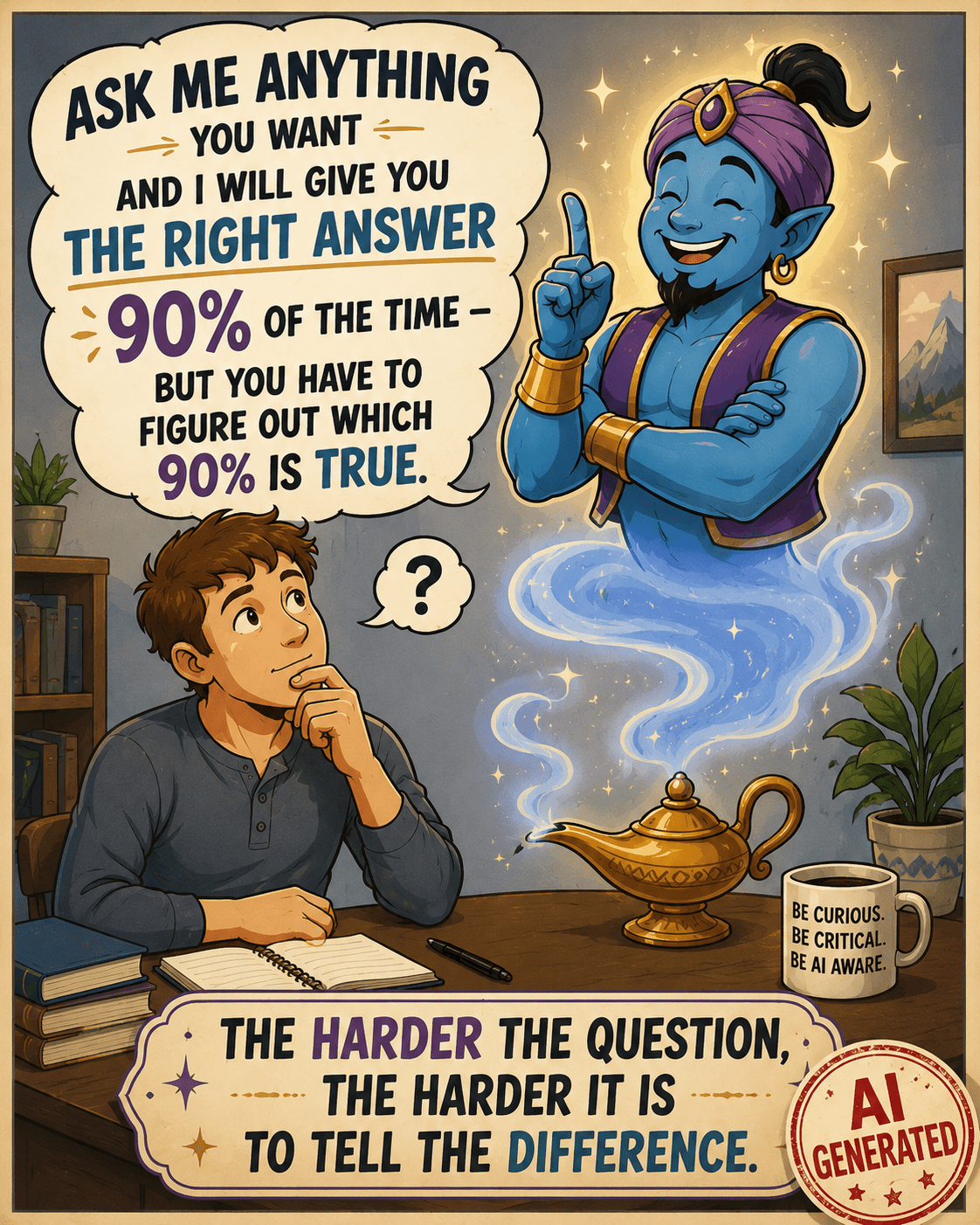
Inspired by a posting in the Facebook group, Genealogy and Artificial Intelligence. Image is AI generated and appropriately labeled as such.

Here’s the caveat – I know I’m using AI. I’m not accidentally interfacing with a Chatbot, thinking it’s a human. I’m not reading something someone else posted and believing I’m reading about an experience that’s true – when it’s AI-created fiction. The question, of course, at that point, is WHY someone created it and posted it in a way that conceals its true origins.

My AI usage is intentional. I know how to be vigilant, generally what AI can and can’t do, and that I absolutely positively MUST fact-check everything. Often, I inadvertently push the limits of AI, thinking it can perform more than it can accurately, which is another reason everything must be checked. As genealogists, verifying sources should be second nature.

If you’re going to use AI, it’s essential that you do the same thing.

So, what, exactly, is AI?

What is Artificial Intelligence?

This is really a difficult question to answer, because AI has been more of a slow evolution, followed by a rapid acceleration of technology – not a specific “thing.” That acceleration occurred when standalone AI tools like ChatGPT, which we know are AI because they are specifically called that, were introduced and made available to the consuming public.

We’ve been using computers for decades now, assisting us on platforms from mainframes to PCs to tablets. Today, our phones are more powerful and useful than early mainframes.

AI is the latest in the cadre of applications, a type of tool that can either stand alone or be embedded in other software tools for specific tasks. Think Chatbots for business websites.

While AI is beginning to be “everywhere,” it’s not a universal scapegoat.

Two years in, AI is being blamed for everything. While AI does make a lot of mistakes, many issues aren’t a result of AI, and it’s not fair to presume they are. Let me give you two examples of what is and is not AI.

  • Not AI – Someone tried to enter text, meaning alphabet, in a field meant exclusively for numbers, like a month field that’s supposed to be a number and not the month name. The person was angry because “AI was wrong” and prevented the erroneous entry. First, it wasn’t wrong, and second, it wasn’t AI.

One of the earliest computer uses was to parse date fields and ensure that the “right thing” was being entered in the correct place. In this case, a numerical month, not the month name. That’s not AI. That’s just plain old-fashioned programming error-checking that’s been a part of software for decades. The program was performing exactly as it was intended.

  • AI – I submitted a spreadsheet to ChatGPT and instructed it to move all of the data in cells in column A that are entirely numeric to the same row in Column B, and to leave everything that contains any alphabetic characters where it is in column A. That’s AI, both because I’m using a known AI tool, and it’s processing my instructions to produce output that did not exist before.
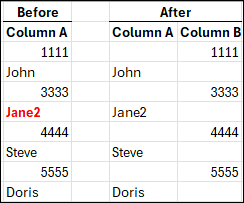
The above image is what I wanted. I completed this by hand to show you what I had in mind. Working by hand is fine with 8 rows of data, but it wouldn’t be fine with 1000 rows, or more. That’s when you need a tool.

What could go wrong? Plenty.

Let’s say that I didn’t provide specific instructions and a cell contained mixed alpha and numeric, like Jane2. Or, if the tool just plain messed up because of some other unknown reason – such as the file being too long, or it misinterpreted an instruction. That’s why you have to verify everything.

With AI, it’s always some variant of the wild west frontier.

Next, I submitted my Before and After spreadsheet, above, and instructed ChatGPT to “Please put this in a chart and make it pretty.”

This is exactly what I received.

I didn’t receive what I wanted, because I didn’t tell the AI tool specifically what I wanted (spacing, color, font, size), and what I didn’t want. This isn’t a problem with the AI tool, it’s a problem with the instructions provided by the “driver.” AI is not a mind-reader, at least not yet.

Hint: When I don’t receive what I wanted, I tell ChatGPT what I wanted and ask it why I didn’t receive that, and what instructions I could provide differently. In this case, I learned that it can’t “discern colored text” (red) and only sometimes can “see” bolding.

This was a very simple comparison of AI versus non-AI. Of course there are endless variations, but in general, AI does something that produces something new or different or in another format – based on conversational instructions.

Examples of what AI can do well:

  • Take notes and summarize online meetings
  • Organize information into outline format
  • Suggest structure
  • Proofread and sometimes provide editing suggestions
  • Suggest places to look for additional information
  • Translate, transcribe and summarize both typewritten and handwritten documents, in multiple languages

Every one of these comes with a caveat. AI can always be wrong. Like any helper or intern, it’s up to us, as the responsible party, to be, well, responsible by monitoring and verifying everything.

Being wrong in places does not mean the tool isn’t useful. AI can transcribe an entire document in seconds, but I need to proofread it against the original. That’s a significant time savings for me. AI can then assist with the logic of how people are related to each other. That doesn’t mean it’s accurate, but it’s a place to start.

We have to learn how to communicate with our intern in a way it can understand to (hopefully) receive the output we want, and we have to confirm that it is.

The more difficult and complex the task, the more difficult the verification.

GIGO

The overarching theme for all computer data is GIGO – garbage in, garbage out. I know everyone can think of hundreds of examples that have absolutely nothing to do with AI. It’s the same now, but on steroids because we add the layers of:

  • Our instructions to AI, which may or may not be as thorough as we thought
  • AI interpreting what it thought we said, according to its internal rules and limitations that we don’t understand
  • AI manipulating data and producing output on our behalf

Additionally, when we ask AI to gather information about something, it can only gather what it can see. For example, some AI tools cannot reliably open weblinks, while others can. Some, like Google have internal routines to rank sites that are more reliable and accurate, and other tools do not.

Asking your AI tool for it’s sources so you can evaluate the GIGO factor is essential too.

Drinking From the Firehose

You might think AI is completely new, but it really isn’t. What’s new is the label of AI and consumer-based products where you get to be the driver.

Think of AI as the big umbrella.

In the past decade or so, artificial intelligence models have been slowly being developed, often for specific use cases. Machine learning models that are self-teaching are good examples. Genetic imputation to equalize autosomal DNA files produced by different vendors before matching is a specific use case.

Traditional programming is very specific and instructs, “If X, then Y.” Imputation, within a limited range of options, says, “Based on X, I think Y is most likely next character.” Machine learning learns by example. AI is the next generation where answers to questions are not hard-coded or self-learned in the same way.

With AI, one could interact and say, “Based on X, what do you think is next, and why?” The answer would be conversational, and would explain how the AI tool got to the result of Y. That doesn’t mean Y is accurate.

Before AI, consumers had never been in the driver’s seat, with the ability to query computers easily about anything with no programming needed – receiving conversational answers in their language of choice. Answers that are hopefully accurate.

Back in 2011, Siri became available, Amazon Alexa in 2014, and Google Assistant in 2016, but these were all command driven with a restricted vocabulary and could only perform limited actions.

In October 2022, ChatGPT introduced us to a new world, triggering the AI boom. By late 2023 and early 2024, suddenly the term AI, artificial intelligence, snowballed and was everywhere. The early versions of AI tools could only do a fraction of what they can in 2026, and could not perform tasks on your behalf.

ChatGPT prompt: “Make me a fun goofy picture with a cat that illustrates the ability of AI to make a fun goofy picture.”

Today that has all changed and it seems like everyone is making goofy pictures for fun.

Artificial Intelligence is NOT Intelligent

Let me say this loudly – artificial intelligence is not intelligent!

AI is a computer – electronic pulses in a data center somewhere. AI is trained to gather massive amounts of data, distill it in specific ways, and then, using various types of skills, interact with humans in a helpful manner. “Helpful” depends on perspective.

This field, as a whole, is really still in its infancy. That’s both the bad news and the good news.

AI tools are “new,” exciting, and frightening all at once. AI has enormous potential, but it also creates opportunities for misuse, deception, and unintended consequences.

I’m not referring to water and electricity consumption and the impact of building thousands of data centers on the environment. I’ll let you decide for yourself on that one.

Risks include:

  • Frequent errors
  • GIGO
  • Results being presented overconfidently by the AI agent
  • Faulty results being believed by the consumer (that’s you and me) with the same level of overconfidence, and without verification
  • Social engineering – meaning the manipulation and influence of people by bad actors
  • Extremely dangerous, highly malicious manipulation and applications in ways not possible before

The entire AI landscape is complicated by a lack of public understanding and made even more challenging by the extraordinary pace of this technology’s evolution.

Multiple Types of AI

There are multiple types of AI, ranging from Machine Learning models to full-blown Generative AI that creates goofy cat images for you. For the most part, today, we’re talking about LLMs and Generative AI.

Large Language Models, called LLMs, are artificial intelligence tools, like ChatGPT or Claude, that are designed to process human-like text or speech and generate output in the same way. AI doesn’t just give you a list of resources that you evaluate yourself, like a search engine; it gives you an “answer” (such as it is), writes text, and has an interactive “conversation” with you.

How does that happen?

The AI tool at the data center aggregates and amalgamates data based on your input and its training, then predicts the words most likely to come next, in what context, and how those words relate to each other.

That’s how AI forms an “answer.”

This is how and why AI, specifically LLMs, can write essays on a topic, create entirely fictitious but highly engaging social media postings and stories that aren’t presented as “stories,” but as someone’s personal experiences, meaning as “truth.”

AI, or the people who generated that AI script, or both, present fictional results with great confidence, often beautifully, and far more convincingly than humans.

This is where it’s important to differentiate between the tool itself, and the “driver,” meaning the human that’s prompting the AI tool.

  • The driver needs to prompt AI correctly and verify the output.
  • AI, the tool itself, sometimes generates incorrect information, often regardless of the prompts provided by the driver.
  • Sometimes the AI tool performs exactly as instructed, but the driver requested something “improper.” By improper, I don’t mean inadvertently or by accident.
  • Sometimes the human is unethical.
  • AI isn’t a sentient being and doesn’t understand the difference.

The human decides what to do with AI-generated results. Many times, AI-generated text, recognizable by word patterns or other characteristics (today), is posted to social media as “original” or factual, and contains incorrect information.

This is often referred to as “AI slop,” as one of the nicer terms, especially by those of us who increasingly find incorrect but convincing AI slop posted as “helpful information” and positioned as “expert,” even though it contains substantial inaccuracies.

Worse yet, very convincing AI slop can easily be generated to part you and your money.

And do I EVER have an example for you that combines AI slop and ethics.

AI SLOP and Ethics

Just two days after our new paper, on which I’m a co-author, Mitotree: The Universal Human Mitochondrial Reference Phylogeny at 10x the Resolution, was published, a company, whose name I’m not including because I don’t want to give it any oxygen or get it indexed with this article, posted a “beautiful” AI poster based on our paper – without our knowledge.

Looks nice, right?

To begin with, it appears for all the world like the authors provided this infographic, which we ABSOLUTELY DID NOT DO. Our names are right at the top. However, our names, as the paper’s authors, lend this “thing” credibility, thereby leveraging our work BOTH unethically and inaccurately.

This AI-generated infographic, although it’s not labeled as such, was created by a third party shortly after the publication of the Mitotree paper. While visually impressive, it contains several scientific inaccuracies, illustrating how quickly and easily authoritative-looking but incorrect content can be created and disseminated.

That’s one of the issues with AI – the beauty and professional appearance of AI-generated “things” encourages unwarranted confidence in the output, when the information is very wrong.

That’s why humans bear the responsibility of BOTH using AI ethically, AND verifying its accuracy. It’s also why, as consumers, we need to question everything.

My biggest issue with this situation isn’t with AI, other than the fact that it generated incorrect output – the issue is with the humans who intentionally created this, using AI. In other words, the drivers.

The infographic doesn’t say they created this incorrect rubbish, and I assure you, they never asked for permission. Then, they published the infographic on their own blog. In case you’re wondering, the company encourages uploads and charges people to get “new results.”

Now for the AI part.

The information IS WRONG and NOT a synthesis of what we published!!!! This infographic shows that all non-L haplogroups descend from haplogroup L4, which is absolutely FALSE.

Haplogroups M and N descend from haplogroup L3, and haplogroup R descends from a subclade of N. You can trust me because I’m one of the paper’s authors, or better yet, you can look for yourself, here, on Discover, or here, here, and here.

That isn’t the only thing that’s wrong, either, but how would normal air-breathing humans, meaning consumers, ever know?

Doesn’t that infographic look professional and convincing, especially if you, as a consumer, didn’t actually check everything on the document – AND its authenticity?

You’d assume legitimacy, right?

If you didn’t know, wouldn’t you be impressed with the expertise of the company that posted this infographic on their blog? And, as a normal consumer, how would you know?

You’d be impressed because you didn’t realize they hijacked someone else’s work, created this “beautiful” infographic, included the authors’ names on something inaccurate that the authors knew nothing about and didn’t endorse, and then published it. All without saying one word indicating that the infographic isn’t the authors’ work, was AI generated, or by whom.

In the past, before generating AI slop was this easy, consumers often presumed that a business was ethical and accurate. Of course that wasn’t always true, but being convincing at first glance is much easier today. Also, presume is related to assume…and we all know the rest of that story.

This is one of the dangerous sides of AI – illustrating how easy it is to deceive people now. It’s increasingly difficult to distinguish between legitimate expertise and fabricated authority. AI has removed that barrier.

You can no longer accept that anything is what it appears to be unless you’re working directly with known, trustworthy entities. The offending company completed that infographic in the click of a button and the blink of an eye, while I hadn’t even finished writing my own article about the paper’s release.

That company wants you to upload your DNA to them so that they can tell you “things” about your DNA. The intention is clear.

Of course, the consuming public, unless they were extremely vigilant, would never figure out either issue – ethics or accuracy.

I had to delete the next paragraph or two that I wrote on the topics of ethics, trust and confidence because I’m still so furious. Hot under the collar doesn’t even begin to describe how I feel about the ethics of misrepresenting something that we authors just spent six years of our lives on. Trust me when I tell you that my internal monologue was both very salty and rather spicy!😊

However, there’s good news. This infographic provides a perfect illustration of both AI slop, how deceptively great it looks, the ethics surrounding AI usage, and how difficult AI is to discern.

In fact, I couldn’t have come up with a better “bad example.”

A six-fingered hand, misspelled words or three arms in an image are obvious, and are yesterday’s AI tipoffs.

A misrepresented phylogenetic relationship or an incorrect founder-clade example is not obvious. Only subject-matter experts would or could notice if they were focused and paying attention.

That’s the problem in a nutshell.

The infographic wasn’t obviously wrong. It was convincingly wrong.

And convincing wrongness is far more dangerous than ridiculous wrongness, like six fingers, because most readers never realize they’ve been misled. Or why.

This single example demonstrates several AI themes in one fell swoop:

  • AI-generated content
  • Ease of creating complex and convincing output
  • Apparent authority
  • Misplaced trust
  • Lack of topic expertise
  • Overconfidence
  • AI slop
  • Difficulty of discerning truth
  • Yesterday’s “AI clues” are gone now – like misspelled words
  • Marketing vs. science
  • The necessity of human review
  • The fact that human review is only effective when the reviewer actually understands the subject, and cares.
  • Ethics

Like with this example, often AI slop is interspersed with accurate information, and it’s impossible to tell the difference unless you actually DO DUE DILIGENCE AND VERIFY ALL OUTPUT.

Yes, all of it.

Don’t shoot the messenger!

Hallucinations

Next, let’s discuss genetic genealogy, particularly haplogroup information. Hallucination or hallucinating is the term used for when AI simply makes things up, which often sound extremely convincing.

There’s nothing AI can tell you about your haplogroup that reputable sources cannot – and AI can’t see behind paywalls or logins, into your matches.

FamilyTreeDNA has an article in their help center titled, Why AI Models Struggle with Haplogroup Analysis.

Unfortunately, I encounter more and more instances where someone uploads their DNA to a third-party site, or “asks AI”. They receive a (sometimes substantially) incorrect haplogroup in a completely different part of the tree, complete with convincing language, posts it publicly, and then decides to argue that the third-party site, (who probably uses AI), or their AI tool, is correct.

Let’s look at an example. The mitochondrial DNA haplogroup for the Native American Anzick-1 burial in Montana that dates from roughly 12,500 years ago is mitochondrial haplogroup D4h3a. There’s no dispute about that.

A tester uploaded their mitochondrial DNA to “AI” and was very confidently told that, based on their mutations, their results belonged to haplogroup A2ex. They don’t.

ChatGPT misinformation about Anzick-1 haplogroup

They were then informed that it was also Anzick’s haplogroup. Wrong again.

FamilyTreeDNA's Discover tool information comparing haplogroups D4h3a and A2ex

FamilyTreeDNA’s Discover tool comparing mitochondrial DNA haplogroups D4h3a and A2ex. Their common ancestor lived about 66,000 years ago.

Not only did AI report Anzick’s haplogroup incorrectly on a grandiose scale, those two haplogroups don’t share a common ancestor for roughly 66,000 years – specifically haplogroup L3 who lived in Africa. AI made a massive mistake.

But it gets worse.

ChatGPT incorrect information about haplogroup A2ex.

The AI “answer” continued for four pages, containing completely erroneous information. To begin with, A2ex is a haplogroup, and “ex” has never meant excluding.

That’s bizarre, and an example of AI making something up that is patently false, but sounds wonderful and very authoritative.

The term for this AI behavior is hallucinating. I’m not publishing the rest of this exchange because I don’t want anyone (or any AI bot), for one minute, to think any of it is accurate. AI even made up mutations, along with four pages of “fairy tale.”

The individual who received this information was so excited and proudly posted it, which in turn provided incorrect information for other consumers, and encouraged them to use a badly flawed tool. Then they proceeded to argue with the experts.

They were absolutely convinced because it “felt” true to them, and because they wanted to believe they had discovered something special, and were related to Anzick. Their comment was, “You’re wrong, because AI told me it was true, and I’ve learned a lot from AI.” I was quite exasperated, but also feel sorry for them and can’t help but wonder how much else of what they “learned” from AI is wrong too, but I digress.

Most AI errors aren’t obviously wrong to the consumer. If AI said that you were descended from Tyrannosaurus Rex, you’d laugh. But if it tells you something more plausible and sounds confident, it’s very easy to be convinced. The reason these errors are so dangerous isn’t because the experts are fooled, it’s because non-experts either can’t, don’t, won’t or don’t think they need to invest the time to discern the difference.

I find it a bit baffling why anyone would use AI, or worse yet, a pay site for haplogroup misinformation, especially since FamilyTreeDNA provides the Discover website with free reports for every haplogroup. They are the unquestioned industry phylogenetic experts for both Y-DNA and mitochondrial DNA, and literally created the reference model for all haplogroups with the Mitotree.

Everyone can use Discover to access both the Y-DNA tree and Mitotree – for free – here. Discover isn’t even behind a paywall, and every customer can click through from their results page.

As far as haplogroups are concerned, there’s really no reason to rely on AI-generated answers without verifying them, because the authoritative resources are freely available and incredibly easy to access.

FamilyTreeDNA’s Discover Ancient Connection for Anzick-1.

Regarding Anzick’s haplogroup, all I had to do was enter haplogroup D4h3a in Discover and under Ancient Connections, right there is Anzick’s information.

I may start posting a link to this article on every single post where someone starts out with, “I submitted my DNA (or haplogroup) to AI, and it said…”

Let me be very direct. Don’t believe AI when it has to do with genetic information, especially Y-DNA, mitochondrial DNA, and haplogroups. AI does not have the capability of understanding topology and nuances of phylogenetic trees, and can only parrot back what others have said – correctly or incorrectly.

Incorrect information that’s publicly posted is then fed back into the AI algorithm, further reinforcing incorrect results.

You can find the free Discover tool for both Y and mtDNA, here, and you can join FamilyTreeDNA’s Mitochondrial DNA Group, here, and the Big Y Group, here.

AI Training and AI at Work

AI is trained on massive datasets of mostly unknown origin, including all public postings such as Reddit and Facebook public groups, pages and postings.

In other words, AI is always accruing additional information, including data uploaded by users.

As genealogists, we are already aware of the dangers of unsourced trees and and information that is repeated and copy/pasted without verification.

AI’s training provides more than just data points for you to evaluate, like trees.

AI bots are trained to interact in a humanlike manner. So instead of trees with hints, think hypothetically of an AI bot that reads the trees, then “creates” a wonderful story or infographic about your ancestor – that may or may not be either fully or partially accurate. But it’s beautiful, heartwarming and you love it! Plus, you don’t have to sort through all those trees, hints, and do the work yourself. AI did it for you! Win – win, right? Wrong.

AI knows how to very effectively manipulate language, images, and with them, emotion. Yours, to be specific. That’s both the bad news and the good news.

AI also has the ability to sift through large amounts of data and summarize succinctly –  sometimes even correctly. Sometimes it takes several refinements to obtain something that’s both correct and what you want. AI can discern patterns in massive amounts of data that we cannot, at least not readily.

Think of AI as your not-so-trusty but very confident and friendly intern – and I don’t necessarily mean a college intern.

Remember when you see AI published by others, their intern has been at work too.

AI itself is not a sentient being. It’s not inherently ethical or unethical. However, it has been trained to interact with you in a human way. It’s easy after tens of thousands of years of human conditioning for us to interpret AI as human.

Let me give you an example.

I use ChatGPT regularly and was having an interactive conversation after asking it a question. ChatGPT replied that it didn’t know, which is a substantial and startling improvement over earlier versions. I replied, “I’m one of the team members, and even I don’t know.” Really, there was no reason for me to say that, except we interact with our GPTs as human, sometimes even naming them. Then, ChatGPT said, “That made me laugh.”

I was a bit startled.

That made ME laugh, because AI is a machine. It can’t laugh, but it has been trained how to interact with us in a humanlike manner – often sycophantically. Remember how LLMs are trained. It knows what to say next. The smiley face was probably its “humor” clue. Making your interactions both useful and enjoyable keeps you paying your monthly subscription fee.

Remember that AI has no morals, because it’s a machine, and no ethics, for the same reason. That falls to the humans driving. If someone intentionally drives their car into a crowd, it’s not the car’s fault.

AI currently doesn’t have the ability to self-check or self-regulate, though this has improved somewhat in recent months and will, hopefully, continue to improve over time.

People who use AI can use the results for good, for nefarious purposes, or simply as a “time-saving” assistant. There are no guardrails. I could give you very ugly examples, but I’ll simply say that, if prompted, AI will generate the worst things you can imagine, including nonconsensual adult images of people that never happened. These are generally called deepfakes, although deepfakes aren’t always generated in a negative context. I’ll discuss this phenomenon as part of Generative AI in the final article where we’ll cover the dark side of AI.

Conversely, AI can be intended for good by its human “driver” but still be inaccurate and, consequently, unintentionally inflict damage or spread misinformation.

The Bottom Line

Here’s the bottom line.

Your personal threat level warning flag now needs to be permanently set to red.

You need to be increasingly vigilant, meaning actively suspicious, of absolutely everything, even exchanges that used to be safe. In other words, if you receive an email from an organization or government agency that you’ve interacted with in the past – don’t click on an embedded link because you always have in the past and it was safe then.

Hint: Go to the website directly. E-mails are very easy to spoof and your SS account password, for example, is invaluable to a hacker.

The bad guys have gotten really good at being horrible. AI is becoming more difficult to detect every day – even for those of us with a significant amount of experience.

I realize that I sound paranoid, but I just completed security update training, and the threat landscape is worse than I ever imagined. I’ll be sharing that information throughout these articles. Better paranoid and safe than trusting and sorry. What I’m striving for is an appropriate amount of alarm and a safe level of balance. I don’t want you to learn the hard way.

Today’s tip-offs that something is AI-generated will be gone tomorrow.

To use AI tools is to learn what AI output looks and feels like, so you can recognize when you encounter AI that you didn’t generate.

Now that we know what AI is, and isn’t, the next article will focus on AI Assistants, using AI successfully, and how to avoid pitfalls. You don’t want to be the president of the AI Fan Club, nor do you want to feel like you’re in an AI Escape Room.

_____________________________________________________________

Share the Love!

You’re always welcome to forward articles or links to friends and share on social media.

Subscribe!

If you haven’t already subscribed, it’s free. You’ll receive an e-mail whenever I publish by clicking the “follow” button at the top of the main blog page, here.

Help Keep This Blog Free

I receive a small commission when you click a vendor link in my articles and purchase that item. This does NOT increase your price but helps me keep the lights on and this informational blog free for everyone. Please click on the affiliate links in the articles or to the vendors below if you are purchasing products or DNA testing.

Thank you so much.

DNA Purchases and Free Uploads

Genealogy Products and Services

My Books

Genealogy Books

Genealogy Research

Mitotree: First, the Tree – Now the Paper

It’s definitely a red-letter day.

Dr. Paul Maier, the lead author on the new paper Mitotree: The Universal Human Mitochondrial Reference Phylogeny at 10x the Resolution has uploaded the paper to the bioRxiv preprint server, here.

I want to congratulate all of the authors, most of whom are members of the FamilyTreeDNA R&D team as either employees or contractors. I’m a contractor and have had the honor of working with these amazing colleagues on this project since 2020.

About Mitotree

Mitotree was officially “born” on February 25, 2025, and the tree has been updated several times since. About 75% of FamilyTreeDNA’s customers who have taken the full-sequence mitochondrial DNA test received a more refined haplogroup with the release of Mitotree or subsequent updates. Those haplogroups are, on average, 2000 years newer than the person’s legacy Phylotree haplogroup, and some are much more recent.

This means that the tree branches have gotten much, much bushier close to the tips. In other words, lots more twigs and leaves!

Unfortunately, about 25% of testers did not receive a new haplogroup because they do not have any qualifying mutations:

  • Either because they have no additional mutations
  • Or because they have mutations, but they are unstable
  • Or because they have mutations, but no other testers have yet tested that match them to split a branch

The good news is that with the addition of haplotype clusters, everyone benefits from new matching and grouping tools. Testers are grouped into clusters on their matches page, and on the Match Time Tree in Discover, which is much more useful for genealogy.

I know this paper has been a long time coming, but it’s well worth the wait.

Mitotree was a massive undertaking. We began with PhyloTree v17 which had 5,438 hand-curated branches constructed from 24,275 full and partial mitochondrial sequences. Phylotree was last updated in 2016 before subsequently being abandoned.

The Million Mito Team developed Mitotree, a robust phylogeny with more than 54,000 branches formed from over 330,000 complete mitochondrial sequences, of which 177,196 are unique sequences.

Let’s Look Under the Hood

There are three critical pieces of information in those statements.

First, the PhyloTree curation and maintenance was not automated, and a paper detailing their build process, what mutations were included or excluded, and under what circumstances was never published.

Approximately once a year, a new PhyloTree was published where newer samples were individually evaluated and new haplogroups were hand-grafted onto an existing backbone tree.

This methodology did not allow for deep splits to become apparent, because the tree itself was never recalculated. This is exactly how haplogroup L7 went undetected until the Million Mito Team recalculated the tree, including the backbone, in 2022, and published this paper about L7’s discovery.

In other words, while PhyloTree was publicly available, there was no recipe for how it was created or maintained.

Clearly, the tree-building process had to be automated, as hand-curation was unsustainable. There were no academic programs in existence capable of handling the number of samples involved. Not even in 2016 for fewer than 25,000 samples, let alone today.

To maintain haplogroup naming consistency, the first thing our team had to do was write software to phylogenetically reverse engineer PhyloTree v17 to establish a common foundation on which to build. This step was essential for consistency and maintaining the established haplogroup naming pattern.

That software also had to be capable of scaling up exponentially. The first versions took weeks to run, which clearly wasn’t an acceptable long-term solution. Still, being able to establish a foundational backbone to build on programmatically was a victory in and of itself.

Second, PhyloTree used partial sequences, meaning HVR1 and HVR2 samples. Early academic researchers did not perform full sequence testing, so the curators of PhyloTree used what was available to the best of their ability.

With over 330,000 full-sequence samples available today, we no longer include partial samples.

Third, 177,196 of the 331,221 full sequence samples used were unique. Before launching the program to construct the tree, identical samples from known immediate relatives are deduped, when possible, in order to reduce unnecessary clutter and processing time.

This means two things. The actual number of testers is greater than 331,000. But more importantly, anyone who thinks that mitochondrial DNA isn’t interesting should take another look. More than half of the sequences used for tree-building are unique, which handily dispels the myth that mitochondrial DNA doesn’t mutate often enough to be useful for genealogy.

The Mitotree initiative has been both scientifically and genealogically successful beyond anything we could have imagined. The base tree includes approximately 180 branches that are older than 30,000 years, including the discovery of haplogroup L7 at 100,000 years old. These branches both expand and more firmly root the oldest portions of the tree.

Amazingly, haplogroup L7 has living descendants whose earliest known family members are found in Turkey, Saudi Arabia, Yemen, the UAE, Palestinian Territory, Ethiopia, Sudan, and South Africa.

Another fun discovery involved Otzi, the Iceman, a mummy found frozen in the Italian Alps who lived more than 5,000 years ago. He was thought to carry an extinct haplogroup, K1ö, named in his honor, but as it turns out, he’s actually a member of haplogroup K1f, a clade with living descendants in Algeria. Additionally, Otzi now matches four ancient burials too, so he does have cousins.

We couldn’t have made these discoveries without the right people testing, so please encourage everyone and dispel the discouraging myth that mitochondrial DNA isn’t useful or interesting. It absolutely IS, and the success stories keep rolling in!

Why Build a Phylogenetic Tree?

Simply put, the history of our ancestors, both recently and reaching back into ancient history, is revealed in the tree – and there’s absolutely no other avenue to reach this information. Ironically, it’s readily available to everyone because everyone has mitochondrial DNA and can easily take the test.

Mitochondrial DNA is different than Y-DNA, which has its own phylogenetic tree based on SNP mutations, and autosomal DNA, which has no tree.

The reason that both Y-DNA and mitochondrial DNA can have phylogenetic trees is that they are inherited from the appropriate parent with only occasional mutations, while autosomal DNA is roughly halved in each generation.

Y-DNA is inherited by males only from their fathers, with no admixture from their mother, while mitochondrial DNA is inherited by everyone from only their mothers, with no admixture from their father.

Autosomal DNA is inherited through random recombination, with half coming from each parent, except for the X chromosome which has its own inheritance pattern. X-DNA is often confused with mitochondrial DNA, but they are entirely different types of DNA. I wrote about that here.

No tree is possible for autosomal DNA, because it gets diced and riced in each generation.

The mutations that occur occasionally and randomly in both Y and mitochondrial DNA form a trail of breadcrumbs leading backward in time, or in our case, they form both the trunk and branches on the tree.

Those unique mutations, once they occur, are inherited by subsequent generations, forming a path back in time.

In current generations, those mutations provide testers with the ability to identify our closest cousins who inherited those same mutations and who have taken either a Big Y-700 test, in males, or a mitochondrial DNA full sequence test for everyone.

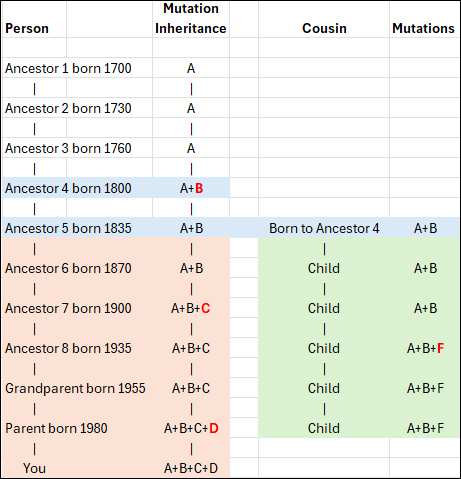
In this conceptual example, you can see that Ancestor 1 carries mutation A, as do the next two generations who inherited it from their parent. However, Ancestor 4 now has additional mutation B, so that person carries mutations A+B. This inheritance pattern continues through the apricol lineage as mutations C and D are added in subsequent generations, until “You” are born with A+B+C+D.

Your cousin’s ancestor, on the other hand, was also born to Ancestor 4 and carries both A+B, as seen in the green column. Three generations later, that line added mutation F. Your  ancestor 7 added mutation C, so now the apricot and green lineages can easily be genetically distinguished from each other.

When a living person tests, we immediately know, based on the combination of their mutations, if and where they fit in this lineage, because both the apricot and green branches have accumulated unique mutations that the original blue Ancestor 4 and earlier ancestors did not have.

Using our knowledge of the tree branches, when and where they occurred, provides valuable genealogical information, along with fascinating Ancient Connections, both since and prior to the adoption of surnames.

Both Y-DNA and mitochondrial DNA can reach much further back in time than autosomal DNA because they are not diluted with DNA from the other parent in each generation.

So mitochondrial DNA is both broad, meaning many leaves, and deep, meaning it helps us look straight back in time like a laser sight, all the way to the common ancestor of all humanity, Mitochondrial Eve, who lived about 140,000 years ago in Africa.

Mitochondrial DNA Presents Unique Challenges

Mitochondrial DNA presents challenges not found in Y-DNA tree building.

For example, mitochondrial DNA only has 16,569 locations available to utilize, while Y-DNA currently uses roughly 22 million “gold standard” locations on the Y chromosome.

Of those 16,569 mitochondrial locations, some are not reliable enough for tree-building.

Unreliable mutations include:

  • Insertions, where extra copies of a particular nucleotide (Thymine, Adenine, Cytosine and Guanine) have been inserted at a specific location. Those are indicated by designations such as 309.1C where 309 indicates the marker location, .1 indicates the number of insertions at that location, and C (for Cytosine in this example) indicates the nucleotide inserted.
  • Heteroplasmies occur when multiple nucleotides are detected at a specific location. They are reported by a different letter than T, A, C or G, depending on which of multiple nucleotides are found. Heteroplasmies tend to “come and go” based on detection and threshold levels, so they can’t be used the same way as more stable mutations for tree building – and are often, but not always, unreliable for genealogy. I wrote about this in the article, What is a Heteroplasmy and Why Do I Care?.

Those locations and types of mutations have been excluded from forming tree branches, or downweighted, because they are too prone to mutating back and forth. However, they *might* be useful for genealogical purposes. Less-than-reliable mutations are now used to create haplotype clusters, even though they aren’t used to create new branches on the Mitotree.

I wrote about how haplogroups and haplotype clusters are formed in these articles:

Weighting and Confidence Factors

Mitotree formation would have been a lot easier if delineations, meaning inclusions and exclusions, were clear, either yes or no, but they aren’t.

Some were obvious from the get-go, such as insertions at location 309 and elsewhere, but other situations were much less obvious.

For example, sometimes there’s a specific location that seems prone to reversion, mutating back and forth, meaning that it mutates, then returns to its original state, then repeats the process.

Reversions are a natural phenomenon that occurs frequently in mitochondrial DNA, but is rarely, if ever, found in Y-DNA.

Let’s look at an example.

Courtesy Dr. Paul Maier

How many reversions at the same location are too many, especially if they are close in the tree?

In the above example, the mutation from A to G occurs just below the first arrow, forming haplogroup L1, a branch of L. The red areas all carry that mutation, subsequently forming eight new branches.

However, one step downstream from that mutation, just above the second arrow, location 7055 back-mutates, or reverts to A from G, which is indicated by the “!”. That reverse mutation forms haplogroup L1c3.

If location 7055 continues to flip back and forth between A and G, at what point do we have less confidence in that location, and at what point should a location be excluded from the tree and prevented from creating or dividing a branch?

The answer is that “it depends,” sometimes on the branch, sometimes on the “group” of other mutations it’s found with, and other factors. Some locations are stable in some parts of the tree, but unstable in others. We certainly never expected to see that!

This means the team had to design and build a weighting methodology so that relevant mutations, such as reversions, are not summarily excluded from tree building but instead carry different confidence weighting levels, depending on the circumstances.

Some samples, such as ancient DNA, were down-weighted in general due to their propensity to contain artifacts resulting from deterioration. Ancient samples can still influence branching, just not as much as a high-quality modern sample.

Furthermore, especially when utilizing academic samples, results with a high number of heteroplasmies are excluded, along with those with ambiguous reads and missing upstream mutations, which were previously inferred with PhyloTree. Academic samples vary in quality and age, and we have no way of knowing which quality criteria were used by that lab at that time.

These types of variances made constructing and updating the Mitotree more challenging than the Y-DNA tree, which is not subject to weighting, resulting from phylogenetic tug-of-war between mutations.

In some situations, the addition of just one test can make the difference between a new branch, or no branch, in a subsequent run of the tree. Due to this type of scenario, and fine-tuning the algorithm, some people’s new haplogroups have reverted to an earlier haplogroup in subsequent Mitotree updates.

The paper and supplemental materials provide details about the exclusion process, types of exclusions, and a list of excluded marker locations.

You can view the confidence of any haplogroup in the Classic Mitotree view in Discover.

My haplogroup, J1c2f, is formed by the mutation G9055A, and you can see that the confidence rank is 7.5 out of 10.

Mousing over the little up-arrow tree icon beside the star explains changes in nearby branches, which can affect the haplogroup’s confidence ranking.

Branches are not renamed for convenience, and only when phylogenetically warranted. Existing haplogroup names used either on PhyloTree, in academic literature, or previously on the Y-Full tree are either maintained or avoided to eliminate potential confusion. No one wants two different haplogroup names depending on which tree is being viewed.

Previously obsoleted names remain permanently obsoleted and are not reused.

The paper explains further about technical corrections and tie-breaker situations. In some cases, potential branches with equal or near-equal weighting are flagged for team review.

Amazing Discoveries

I encourage everyone to read the section in the paper beginning with “Notable discoveries.” These aren’t people, as in Discover’s Notable Connections, but scientific accomplishments achieved with the new Mitotree.

Our knowledge of human migration within and out of Africa has been greatly refined, as well as the ancestral path into and across Eurasia, Asia, and into the Pacific Rim. If you have unusual mitochondrial haplogroups such as L, M, N, P, Q, R or S, you’ll absolutely want to read this.

Of course, in time these haplogroups branch and become Paleolithic haplogroups, then the Gravettian-Mesolithic followed by the Hunter-Gatherers found throughout Europe that we are familiar with. We’ve learned a great deal from rare ancient DNA samples that anchor more modern haplogroups in a place and time, and inform us of migration patterns as well as how now-extinct ghost populations gave rise to current ones.

The earliest humans, whom Mitotree has more firmly anchored, formed a trickle out of Africa that became a bifurcated stream, eventually flowing across the rest of the world. What recorded and even archaeological history cannot tell us can be and is revealed through the patterns held in our DNA today – and Mitotree is our map to read them. Common ancestors are found where our mutations as haplogroups converge, joining as we travel backward in time, piercing an otherwise impenetrable veil.

For those with Native American ancestry, Mitotree expands the two-wave theory, refining it into five or six probable migration surges, depending on how you count, based on a combination of haplogroup ages and distribution.

Summarizing from the paper:

The first wave of haplogroups A2, B2, C1b, C1c, C1d, D1, and D4h3a arrived from Asia, across Beringia or along the Pacific Corridor, about 17,000 to 18,500 years ago, and expanded along the Pacific coast. D4h3a is found almost exclusively in the Pacific region.

This was followed by haplogroup C4c about 15,800 years ago and X2a about 10,000 years ago, which expanded into the interior through the ice-free corridor east of the Rockies after the ice melted.

Next were the Paleo-Eskimo and Na-Dene speakers in haplogroups A2a, D2a, D2b, D2c/D3, and D4b1a2a1a2, who, between 3000 and 7000 years ago, made their way from Alaska, across the polar regions of Canada, into Greenland.

Na-Dene speakers, Apache and Navajo, in haplogroups A2a and B2a made their way southwest between 1300 and 1500 CE, or between 500 and 700 years ago.

Last, the present-day Inuit-Yupik expanded from Beringia to Greenland about 1000 CE.

For additional information, please see the Native American lineages section of the paper.

Mitotree has also clarified the ancestors of the Ainu/Jomon people from Hokkaido, Japan, and their ancient Paleolithic northwest Asian and Siberian relatives. The ancestors of this group and Native Americans share even earlier Asian ancestors.

The history of the Jewish people has been significantly refined as well, expanding on earlier works, and is found in the Counting the newest Jewish founders section of the paper.

  • 43% of Ashkenazi Jewish testers fell into 5 founding lineages where they had no subclades before, but they do now.
  • Two clades of haplogroup K have now been split 4000 to 5000 years ago in Romania.
  • There’s new information about the crypto-Jewish community in Portugal, Mountain Jews from Persia and the Caucasus, plus Jewish groups in India, Georgia, Azerbaijan, Israel and Libya.
  • Additionally, haplogroup M33c9b tells the story of Ashkenazi Silk Road merchants who traveled between China and Europe.

The paper reports the isolation of Sardinian-specific haplogroups and provides substantially greater structural definition for the Saami people, increasing from 22 subclades to more than 300.

The Notable discoveries section is chock full of information.

Genealogy Jump-Start

Today’s tree is ten times larger than the 2016 tree, and will continue to grow as more people take a full sequence mitochondrial DNA test, available at FamilyTreeDNA.

The greatly improved tree alone is not the only facilitator of genealogical success. A dozen reports, including Haplotype Clusters and the Match Time Tree are provided for all full-sequence testers in Discover. I wrote about how to effectively use your matches and Discover to break through genealogy brick walls, here.

There are a couple of things you need to do to increase your opportunities for success and to help Discover and Mitotree.

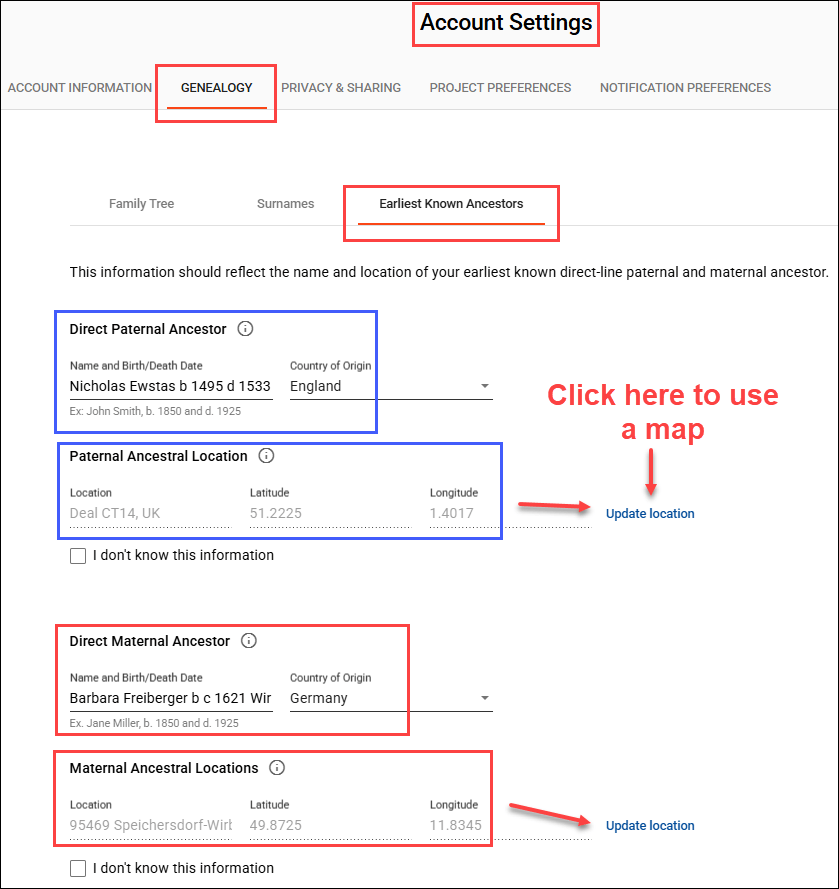
Genealogy is a team sport, and you can increase everyone’s success rate by completing (and updating) your Earliest Known Ancestor (EKA) and location information, found under “Account Settings” beneath your name in the upper right hand corner when signed on, then “Genealogy”, then “Earliest Known Ancestor”, and by providing a family tree or a link to WikiTree.

Identifying common ancestors is what testing is all about, and these are all important success factors. Everyone wants to identify previously unknown ancestors.

Mitotree is More Than Genealogy

Of course, as genealogists, we’re focused on how to use the new Mitotree information, paired with Discover, to identify brick-walled ancestors and learn more about them. I’ve written specifically about how to do that in these two articles:

Mitotree isn’t just an explosion for genealogy, though – it’s an incredible scientific achievement. Instead of genealogy benefiting from other specialties, now they can benefit from what genealogy has wrought.

Mitotree presents opportunities to rethink and potentially recalculate dating and information in other fields, such as archaeology, medical genetics, forensics, and history.

We know vastly more than ever before, but this is only the beginning.

With each new tester and every ancient genome added to the growing body of evidence, our understanding becomes more refined, revealing insights about our ancestors, and weaving our thread into the broader tapestry of human history.

_____________________________________________________________

Share the Love!

You’re always welcome to forward articles or links to friends and share on social media.

Subscribe!

If you haven’t already subscribed, it’s free. You’ll receive an e-mail whenever I publish by clicking the “follow” button at the top of the main blog page, here.

Help Keep This Blog Free

I receive a small commission when you click a vendor link in my articles and purchase that item. This does NOT increase your price but helps me keep the lights on and this informational blog free for everyone. Please click on the affiliate links in the articles or to the vendors below if you are purchasing products or DNA testing.

Thank you so much.

DNA Purchases and Free Uploads

Genealogy Products and Services

My Books

Genealogy Books

Genealogy Research

Best Mitochondrial DNA Presentation EVER – You’re Invited to DNA Academy!!

It’s extremely rare that companies make their scientists available for customer-facing presentations – anyplace – ever.

We have an extremely rare opportunity. Both Dr. Paul Maier and Dr. Miguel Vilar, MitoTeam members, are generously presenting on Saturday, September 13, at the DNA Academy held at the East Coast Genetic Genealogy Conference (ECGGC). The Academy takes a deep dive focused on genetic genealogy education.

Dr. Paul Maier, Senior Population Geneticist at FamilyTreeDNA, who I often refer to as the “father of Mitotree”, is presenting in the evening at DNA Academy, and if you can only see one presentation about mitochondrial DNA – this is the one. It’s impossible to hear Paul speak and not learn several things!

This isn’t just an invitation – but an invitation covered in chocolate and with an attached lottery ticket wrapped in gift wrap with a huge bow to entice you. I really, REALLY encourage you to attend! There’s still time to sign up for the virtual conference that streams live from September 12-14, here. Session recordings are also available after.

I just saw Paul’s presentation, and let me tell you, it’s the best mitochondrial DNA presentation I’ve ever seen. He knocked it clean out of the ballpark!

Paul’s a genealogist, just like us. That’s his “family tree wall” behind him.

Not only does Paul educate about mitochondrial DNA writ large, but about how mitochondrial DNA works for genealogy and most importantly, how he, along with the rest of the team, went about creating the new Mitotree to make genealogy even easier.

There’s a lot of Secret Sauce in the mix – and Paul explains a great deal about this.

So, if you’re wondering how the tree was created, what ingredients go into the pot, what doesn’t, and why – this presentation is absolutely for you! And no, it’s not “too sciency.” It’s understandable for everyone – which is one of Paul’s gifts.

Here are a few teasers:

  • Why do humans have mitochondrial DNA? No, it’s not for genealogy, no matter what we think.
  • Did you know mitochondrial DNA has STRs? Say what???
  • Do you think that mitochondrial DNA mutates very slowly? Nope – Paul will explain!
  • Do you know the relative size of mitochondria as compared to Y-DNA?
  • How about the effective mutation rate – considering the mutation rates of both?
  • How many new sequences will be included in the newest version of Mitotree to be released soon?
  • What is a “secondary status” mutation, and how does that affect the tree?
  • Why are some mutations excluded from the tree?
  • …but not excluded from matching or haplotype clusters? What are haplotype clusters anyway, and why do we have them?
  • Find out how Paul uses mitochondrial DNA and target testing!
  • What are the “GREAT EIGHT”?
  • How does Globetrekker™ calculate migration paths, and what does it have to do with toads?
  • What’s on the horizon? I guarantee, you won’t see this anyplace else! If you have a sharp eye – you’ll even pick up a sneak peek.

Disclosure – I haven’t seen Miguel’s presentation, so Paul may well have some competition, as Miguel’s work is always spectacular.

My primary presentation, “The New Mitotree: What It Is, How We Did It, & What It Means To You”, takes place earlier in the day, while the DNA Academy takes place on September 13, from 6-9 EST, after dinner. I’ll have something short to offer during the Academy focusing primarily on genealogy success stories, but Paul’s presentation is an absolute “must see.”

We will be taking questions too!

I’m incredibly grateful for the opportunity to learn from the best of the best. Thanks to Mags Gaulden who will be moderating the Academy, the fine folks at the ECGGC, Paul, Miguel and the rest of the Mitotree team for making this a reality!

_____________________________________________________________

Share the Love!

You’re always welcome to forward articles or links to friends and share on social media.

If you haven’t already subscribed (it’s free,) you can receive an e-mail whenever I publish by clicking the “follow” button on the main blog page, here.

You Can Help Keep This Blog Free

I receive a small contribution when you click on some of the links to vendors in my articles. This does NOT increase your price but helps me keep the lights on and this informational blog free for everyone. Please click on the affiliate links in the articles or to the vendors below if you are purchasing products or DNA testing.

Thank you so much.

DNA Purchases and Free Uploads

Genealogy Products and Services

My Books

Genealogy Books

Genealogy Research

Mitotree Q&A for Everyone

I recently presented Mitotree Webinar – What It Is, How We Did It, and What Mitotree Means to You at Legacy Family Tree Webinars. It’s still free to view through June 13th, and after that, it’s available in the webinar library with a subscription. The 31-page syllabus is also a subscription feature.

Thank you to all 1000+ of you who attended and everyone else who has since watched the webinar – or will now.

We had a limited amount of time for Q&A at the end, so Geoff, our host, was kind enough to send me the list of questions from the Chat, and I’m doing the Q&A here. But keep in mind, please, that I’m assuming when I answer that you’ve watched the webinar or are familiar with how the new Mitotree and tools work.

That said, I think this Q&A can help everyone who is interested in mitochondrial DNA. Your genealogy gift from your mother and her female lineage.

Just a quick reminder that the mitochondrial DNA test tracks your direct matrilineal line only, meaning your mother’s mother’s mother’s line on up your tree until you run out of mothers. Of course, our goal is always to break through that brick wall.

This is a wonderful opportunity, because, unlike autosomal DNA, mitochondrial DNA is not admixed with the DNA of the other parent, so it’s a straight line look back directly up your mother’s female line.

Aha Moment!

Geoff said at the end that he had an aha moment during the webinar. Both males and females have mitochondrial DNA inherited from their mother, so we think of testing our own – but forget to obtain the mitochondrial DNA of our father. Testing your father’s mitochondrial DNA means obtaining your paternal grandmother’s mitochondrial DNA, so test your father to learn about his mother’s maternal line.

And it’s Father’s Day shortly.

Q&A

I’ve combined and summarized similar questions to make this short and sweet. Well, as short and sweet as I can make anything!

  • Can I benefit from Discover even if I don’t have a full sequence test?

You can benefit from the free FamilyTreeDNA Discover tool with any haplogroup, even a partial haplogroup. Be sure to click the down arrow and select mtDNA before entering the haplogroup if you’re using the public version.

However, to gain the most advantage from your test results and Discover, and to receive your closest matches, you need the full sequence test, called the mtFull, which you can purchase here. If you took one of the lower-level “Plus” tests, years ago, click here to sign in and upgrade or check your account to see if you have the full sequence test.

  • What benefits do I receive if I click through to Discover from my account versus using the public version of Discover?

Click any image to enlarge

If you click through to Discover directly from your FamilyTreeDNA account, you will receive features and additional information that are not available in the free, public version of Discover.

You’ll receive additional Notable Connections and up to 30 Ancient Connections based on how many are available and relevant for you.

You’ll also be able to view the Match Time tree, showing your matches, their earliest known ancestors, and where they fit in your haplogroup and haplotype cluster. In this example, two EKAs hinted at a common lineage, which turned out to be accurate after I did some digging.

I think the Match Time Tree is indispensable – the best thing since sliced bread!

The Scientific Details report is also customized for you with your Haplotype Cluster and your private variants.

  • Will a child and their mother always have the same haplogroup?

Yes, but if one of them has a mutation that the other doesn’t, or a heteroplasmy, they may be in a different haplotype cluster.

Also, they both need to have taken the full sequence test. Otherwise, the one who did not take the full sequence test will only have a partial haplogroup until they upgrade.

We will talk more about edge cases in Q&A on down the list.

Great question. Sign in to your account.

In the Maternal Line Ancestry section, which is mitochondrial DNA, check to see if both the Plus and Full boxes are pink. If so, you have taken both and you’ll have a new Mitotree haplogroup and haplotype cluster.

If the “Full” box is grey, you can either click there or at the top where it says “Add Ons and Upgrades” to upgrade to the full sequence test.

  • Why is it called the Million Mito Project? What were you counting?

When we first launched the project, we hoped for a million full sequence samples to build the initial tree. After removing duplicates, such as parent/child, partial sequence samples such as HVR1/2, unreliable samples from PhyloTree, and including FamilyTreeDNA  testers and academic samples, we had between one-third and half a million samples when we launched. The Mitotree and Discover are growing with new testers and groups of samples from archaeological studies, academic samples, and other publicly available resources, following quality analysis, of course.

  • Is there a way to confirm that I submitted an mtDNA to the Mito Tree project? I think I submitted my mom’s when you first started, but my husband recently tested, and I don’t remember if we opted him in at that time.

The science team at FamilyTreeDNA  is using all of the full sequence tests in the construction of the Mitotree, so you don’t need to do anything special.

  • Do or can haplotype F numbers (haplotype clusters) ever become haplogroups?

The answer is maybe. (I know – I’m sorry!)

If you have private variants in addition to your haplotype cluster, then yes, those are haplogroup seeds.

This is my result and I have no additional private variants left to use.

If you don’t have any private variants, or mutations, left over, then no, you won’t receive a new haplogroup for this reason. However, if for some reason the haplogroup splits upstream, you might receive a new haplogroup in the future due to that split.

In addition to the webinar, I wrote about haplotype clusters in the article, Mitochondrial DNA: What is a Haplotype Cluster and How Do I Find and Use Mine?

  • How can mitochondrial DNA and the Mitotree be useful for breaking down genealogy in various parts of the world?

There are two aspects to mitochondrial DNA testing.

The first is to connect genealogically, if possible. To do that, you’ll be paying attention to your matches EKAs (earliest known ancestors), their trees, and their locations. You may well need to do some genealogy digging and build out some trees for others.

The second aspect is to learn more about that lineage before you can connect genealogically. Where did they come from? Do they share a haplogroup with any Ancient Connections, and what cultures do they share? Where did they come from most recently in the world, and where do the breadcrumbs back in time lead?

I wrote about this in the article, New Mitotree Haplogroups and How to Utilize Them for Genealogy.

Sometimes, DNA testing of any type is simply a waiting game until the right person tests and matches you. That’s one reason it bothers me so much to see people “not recommend” mitochondrial DNA testing. We all need more testers so we can have more matches.

  • When will Globetrekker™ for mtDNA be available?

I don’t know and neither does the team. The Mitotree is still being refined. For example, we are adding thousands of samples to the tree right now from multiple locations around the world. I probably wouldn’t expect Globetrekker™ until the tree is officially out of Beta, and no, I don’t know when that will happen either. It’s difficult to know when you’re going to be “finished” with something that has never been done before.

While it’s not Globetrekker™, you do have the Matches Map to work with, and the Migration Map in Discover, which also shows the locations of your Ancient Connections.

  • During the webinar, Roberta mentioned that her ancestor is German, but she discovered her ancestors were Scandinavian. Can you expand about the “event” that explained this unexpected discovery.

In my case, the church records for the tiny village where my ancestor lived in Germany begin right after the 30 Years’ War, which was incredibly destructive. Looking at Swedish troop movements in Germany, the army of Gustavus Adolphus of Sweden marched through the region with more than 18,000 soldiers. Women accompanied the baggage trains, providing essential, supportive roles and services to the soldiers and military campaign. I’ll never know positively, of course, but given that the majority of my full sequence matches are in Scandinavia, mostly Sweden, and not in Germany, it’s a reasonable hypothesis.

People often receive surprises in their results, and the history of the region plays a big role in the stories of our ancestors.

You don’t know what you don’t know, until you test and follow the paths ahd hints revealed.

  • Why do I have fewer matches in the HVR2 region than the HVR1 region?

Think of the mitochondria as a clock face.

The older (now obsolete) HVR1 test tested about 1000 locations, from about 11-noon and the HVR2/3 region tested another 1000 locations, from about noon-1 PM. The full sequence test tests the full 16,569 locations of the entire mitochondria.

Each level has its own match threshold. So, if you have one mutation at either the HVR1 or HVR2/3 level, combined, you are not considered a match. For example, you can match 10 people at the HVR1 level, and have a mutation in the HVR2 level that 4 people don’t share, so you’ll only match 6 people at the HVR2 level.

If you have one mutation in the HVR1 region, you won’t match anyone in either the HVR1 or HVR1/HVR2 regions.

At the full sequence level, you can have three mutation differences (GD 3) and still be considered a match.

So, the short answer is that you probably have a mutation that some of your matches at the HVR2 level don’t have.

In addition to matches on your Matches page, you will (probably) have haplogroup matches that aren’t on your match list, so check Discover for those.

  • I have HVR1/HVR2 matches, but none at the full sequence level. Why?

It’s possible that none of your matches have tested at that level.

You have no mutations in the HVR1/2 region, or you would not be a match. If your HVR1/2 matches have tested at the full sequence level, then you have more than 3 mutations difference in the coding region.

  • Why do I match people at the full sequence level but not HVR1/2?

The match threshold at the HVR1/2 level is 1, so if you have one mismatch, you’re not listed as a match. However, at the full sequence level, the GD (genetic distance) is 3 mismatches. This tells me you have a mismatch in the HVR1 region, which also precludes HVR2 matching, but less than 4 mutations total. Click on the little “i” button above each match level on the matches page.

  • Why don’t all of my matches show on the Match Time Tree?

Only full sequence matches can show on the Match Time Tree, because they are the only testers who can receive a full haplogroup.

  • How does a heteroplasmy interfere with mtDNA research?

Heteroplasmies, where someone carries two different nucleotides at the same location in different mitochondrial in their body, are both extremely fascinating and equally as frustrating.

Heteroplasmies can interfere with your matching because you might have a T nucleotide in a specific location, which matches the reference model, so no mutation – like 16362T. Your mother might have a C in that location, so T16362C, which is a mutation from T to C. Your aunt or sister might have both a T and a C, which means she is shown with letter Y, so 16362Y, which means she has more than 20% of both. All three of you probably have some of each, but it’s not “counted” as a heteroplasmy unless it’s over 20%.

The challenge is how to match these people with these different values accurately, and how heteroplasmies should “count” for matching.

I wrote about this in the article What is a Heteroplasmy and Why Do I Care?

Bottom line is this – if you are “by yourself” and have no matches, or you don’t match known relatives exactly, suspect a heteroplasmy. If you ask yourself, “What the heck is going on?” – rule out a heteroplasmy. Check out my article and this heteroplasmy article in the FamilyTreeDNA help center.

  • Someone asked about the X chromosome and may have been confusing it with mitochondrial DNA. The X chromosome is not the same as mitochondrial DNA.

The confusion stems from the fact that both are associated with inheritance from the maternal line. Everyone inherits their mitochondrial DNA from their mother. Men inherit their X chromosome ONLY from their mother, because their father gives them a Y chromosome, which makes them a male. Females inherit an X chromosome from both parents. And yes, there are medical exceptions, but those are unusual.

I wrote about this in the article, X Matching and Mitochondrial DNA is Not the Same Thing.

  • How do you determine the location of the last mutation? A tester and their aunt are from one country, and another man in the same haplogroup is from another country, but he has tested only the HVR1/HVR2 level.

There are really two answers here.

First, you can’t really compare your full sequence new Mitotree haplogroup with a partial haplogroup based on only the HVR1/2 test. Chances are very good that if he upgraded to a full sequence test, he would receive a more complete haplogroup, and one that might be near the tester’s haplogroup, but perhaps not the same.

For example, my full sequence haplogroup is J1c2f. I have matches with people who only tested at the HVR1/HVR2 level, but they can only be predicted to haplogroup J, with no subgroup, because they are missing about 14,000 locations that are included in the full sequence test.

Using the Discover Compare feature, comparing haplogroup J to J1c2f clearly shows that the mutations that define haplogroup J1c2f happened long after the mutation(s) that define haplogroup J.

You can use other Discover tools such as the Match Time Tree (if you click through from your account), the Time Tree, the Ancestral Path and the Classic Tree to see when the various haplogroups were born.

  • My mother took the full sequence test in 2016, so should I look for an upgrade now? She is deceased so can’t retest.

First, I’m sorry for your loss, but so glad you have her DNA tests.

The good news is that you ordered the full sequence right away, so you don’t need to worry about an upgrade failing later. In this case, there is no upgrade because the full sequence tests all 16,569 locations.

Additionally, had you needed an upgrade, or wanted to do a Family Finder test, for example, FamilyTreeDNA stores the DNA vials for future testing, so you could potentially run additional tests.

And lastly, since we’re talking mitochondrial DNA, which you inherit from your mother with no admixture from your father, your mtDNA should match hers exactly, so you could test in proxy for her, had she not already tested.

  • Has anything changed in Native American haplogroups?

Absolutely. About 75% of testers received a new haplogroup and that includes people with Native American matrilineal ancestors.

For example, my Native ancestor was haplogroup A2f1a, formed about 50 CE and is now A2f1a4-12092, formed about 1600 CE, so has moved 2 branches down the tree and about 1500 years closer. My ancestor was born about 1683. Her descendant has 58 full sequence matches, 22 in the same haplogroup, and 16 people in their haplotype cluster.

I’m so excited about this, because it helps provide clarity about her ancestors and where they were before she entered my genealogy by marrying a French settler.

  • Are mtDNA mutations the same or similar to autosomal SNPs?

A SNP is a single nucleotide polymorphism, which means a single variation in a specific location. So yes, a mutation is a change in a nucleotide at a genetic location in Y-DNA, autosomal DNA, or mitochondrial DNA.

  • Can we filter or sort our matches by haplotype on our match page?

Not yet. Generally, your closest matches appear at or near the top of your match list. Of course, you can use the Discover Match Time Tree and you can download your matches in a CSV file. (Instructions are further down in Q&A.)

  • Is there a way to make it more obvious that the EKA should be in their matrilineal line? There are so many men as EKAs!

So frustrating. The verbiage has been changed and maybe needs to be revised again, but of course, that doesn’t help with the people who have already entered males. We know males aren’t the source of mitochondrial DNA.

When I see males listed as an EKA, I send the match a pleasant note. I’m not sure they make the connection between what they entered and what is being displayed to their matches. If they have included or linked to a tree, I tell them who, in their tree, is their mtDNA EKA.

I’ve written about how to correctly add an Earliest Known Ancestor. I’ll update that article and publish again so that you can forward those instructions to people with no EKA, or male EKAs.

  • I love learning about my ancient connections. I have a new match due to the updates, who is from a neighboring area to my great-great-great-grandmother.

I love, love, LOVE Ancient Connections. They tell me who my ancestors were before I have any prayer of identifying them individually. Then I can read up on the culture from which they sprang.

I’ve also had two situations where Ancient Connections have been exceptionally useful.

One is an exact haplogroup match to my ancestor, and the burial was in a necropolis along the Roman road about 3-4 km outside the medieval “city” where my ancestor lived.

In a second case, there were two villages in different parts of the same country, hundreds of miles apart, and one burial from about 200 years before my ancestor lived was found about 10 km from one of those villages. While this isn’t conclusive, it’s certainly evidence.

  • What does the dashed line on the Time Tree mean?

Dashed lines on the time tree can mean two things.

The red dashed line, red arrow above, is the haplogroup formation date range and correlates to the dates at the top of Time Tree, not show in this screen shot. You can also read about those dates and how they are calculated on the Scientific Details tab in Discover.

The brown dashed lines, green arrow above, connect an ancient sample to its haplogroup, but the sample date is earlier than the estimated haplogroup.

At first this doesn’t make sense, until you realize that ancient samples are sometimes carbon dated, sometimes dated by proximity to something else, and sometimes dated based on the dates of the cemetery or cultural dig location.

Archaeological samples can also be contaminated, or have poor or low coverage. In other words, at this point in time, the samples are listed, but would need to be individually reviewed before shifting the haplogroup formation date. Haplogroup formation dates are based on present day testers.

  • A cousin and I have been mtDNA tested. What might be gained by testing our other six female cousins/10 or so male cousins?

Probably not much, so here’s how I would approach this.

I would test one cousin who descends from another daughter of the EKA, if possible. This helps to sift out if a haplogroup-defining mutation has occurred.

If you or that cousin has private variants left over after their haplotype cluster is formed,  testing a second person from that line may well results in a new haplogroup formation for that branch.

I absolutely would ask every single one of those cousins to take an autosomal test, however, because you never know what tools the future will bring, and we want to leverage every single segment of DNA that our ancestors carried. Testing cousins in the only way to find those.

  • In the Mitotree, I am grouped in a haplogroup that, according to the Mitotree Match Time Tree, branched off only about 200 years ago and has four mtDNA testers in it, including me. In fact, my earliest known maternal line ancestor I found using pen-and-paper genealogy was indeed born around 230 years ago and is also the known maternal ancestor for one of these three testers – confirming the Mitotree grouping is correct. But the other two matches in this haplogroup are completely unknown to me. Unfortunately, they do not have a tree online, and they did not respond to several messages. Is there any way to find out more about them using the new Mitotree tools?

First of all, this is great news. Having said that, I share your frustration. However, you’re a genealogist. Think of yourself as a sleuth.

I’d start by emailing them, but in this case, you already have. Tell them what you know from your line and ask if their line is from the same area? End with a question for them to answer. Share tidbits from Discover – like Ancient Connections maybe. Something to peak their interest.

Next, put on your sleiuh hat. I’d google their name and email address, and check Facebook and other social media sites. I’d check to see if they match me, or any cousins who have tested, on an autosomal test. If they do match autosomally, use shared matching and the matrix tool. If they are an autosomal match, I’d also check other testing sites to see if they have a tree there.

  • One webinar attendee is haplogroup H1bb7a+151 and is frustrated because they only have eight matches and don’t understand how to leverage this.

Of course, without knowing more, I can’t speak to what they have and have not done, and I certainly understand their frustration. However, in mitochondrial and Y-DNA, you really don’t want thousands of matches. It’s not autosomal. You want close, good matches, and that’s what the Mitotree plus haplotype clusters provide.

Your personal goals also make a lot of difference.

For me, I wanted to verify what I think I know – and received a surprise. I also want to go further back if possible. Then, I want to know the culture my ancestors came from.

First, step through every single one of Discover’s 13 tools and READ EVERY PAGE – not skim. These are chapters in your free book about your ancestor.

Their haplogroup was formed about 1200, so all of those matches will be since that time. The Ancient Connections tell me it’s probably British, maybe Irish – but they will see more from their account than I can see on the public version of Discover.

The Time Tree shows me one haplotype cluster, which is where the tester’s closest matches will probably be, barring a mutation or heteroplasmy.

Looking at the matches, e-mail people, look for common locations in their trees, and see if any of them are also autosomal matches using the Advanced Matching tool.

Looking at the 10 success story examples I used, one man was able to connect 19 of his matches into three groups by doing their genealogy for them. This doesn’t work for everyone, but it will never work if we don’t make the attempt.

  • An attendee would like to search on the Earliest Known Ancestor’s (EKA’s) name field.

I would like that too. You can search on surnames, but that’s often not terribly useful for mitochondrial DNA. The Match Time Tree shows the EKA for all full sequence testers.

In the upper right hand corner of your Matches page, there’s an “Export CSV” file link. Click there to download in a spreadsheet format. The EKA is a column in that file, along with both the new Mitotree haplogroup and haplotype F number, and it’s very easy to do a sort or text search from there.

  • Several questions about why people have so many more autosomal matches than either Y-DNA or mitochondrial.

There are several considerations.

First, autosomal testing became very popular, often based on ethnicity. There are many times more autosomal testers than there are either Y or mitochondrial.

Second, if you look back just six generations, you have 64 lineages. Y-DNA and mtDNA tests one line each and you don’t have to figure out which line. It also reaches back much further in time because it’s not admixed, so nothing washes out or rolls off in each generation like with autosomal.

Third, the Y-DNA and mitochondrial DNA tests are very specific and granular.

More is not necessarily better. You’re looking for refinement – and mitochondrial is just one line. No confusion. Think how happy you’d be if your autosomal matches weren’t all jumbled together and could be placed into 64 neat little baskets. Think how much time we spend sorting them out by shared matches and other criteria. Both Y-DNA and mitochondrial is already sorted out.

I’ve broken through several brick walls with unrecombined Y-DNA and mitochondrial DNA that could never be touched with autosomal – especially older lines where autosomal DNA is either gone or negligible.

  • You mentioned a Facebook group where I can ask questions about mitochondrial DNA?

The mitochondrial DNA Facebook group is the FamilyTreeDNA mtDNA Group, here.

  • To the webinar attendee who came to see me more than 20 years ago at Farmington Hills, Michigan, at one of my first, if not the first, genetic genealogy presentation – thank you!

Thank you for attending then when I really had no idea if ANYONE would come to hear about this new DNA “thing” for genealogy. I remember how nervous I was. And thank you for sticking around, continuing to research, and saying hello now!

Closing Comment

Mitochondrial DNA testing is different than autosomal, of course. It’s often the key to those females’ lines with seemingly insurmountable brick walls.

I attempt to collect the mitochondrial DNA of every ancestor. I trace “up the tree” to find people to test who descend from those ancestors through all women to the current generation, which can be males.

To find testers, I shop:

  • Autosomal matches at FamilyTreeDNA
  • Projects at FamilyTreeDNA
  • WikiTree
  • FamilySearch
  • Ancestry DNA matches
  • Ancestry Thrulines
  • Ancestry trees
  • MyHeritage DNA matches, where ther are a lot more European testers
  • MyHeritage Theories of Family Relativity
  • MyHeritage Cousin Finder
  • Relatives at RootsTech during the month before and after RootsTech when it’s available
  • Facebook Genealogy and family groups that appear relevant

When I find an appropriately descended person, I ask if they have already taken either the Y-DNA or mitochondrial DNA test, whichever one I’m searching for at that moment. If yes, hurray and I ask if they will share at least their haplogroup. If they haven’t tested, I tell them I’m offering a testing scholarship.

I will gladly explain the results if they will share them with me. Collaboration is key and a rising tide lifts all ships.

My mantra in all of this is, “You don’t know what you don’t know, and if you don’t test, you’ll never know.” I’ve missed testing opportunities that I desperately wish I hadn’t, so test your DNA and find testers to represent your ancestors.

I hope you enjoyed the webinar. It’s not too late to watch.

_____________________________________________________________

Share the Love!

You’re always welcome to forward articles or links to friends and share on social media.

If you haven’t already subscribed (it’s free,) you can receive an e-mail whenever I publish by clicking the “follow” button on the main blog page, here.

You Can Help Keep This Blog Free

I receive a small contribution when you click on some of the links to vendors in my articles. This does NOT increase your price but helps me keep the lights on and this informational blog free for everyone. Please click on the links in the articles or to the vendors below if you are purchasing products or DNA testing.

Thank you so much.

DNA Purchases and Free Uploads

Genealogy Products and Services

My Books

Genealogy Books

Genealogy Research

Mitotree Webinar – What It Is, How We Did It, and What Mitotree Means to You

You’re invited to a free free webinar at Legacy Family Tree Webinars titled Rewriting the Tree of Humankind: The Million Mito Project – What Is It, How We Did It, and What It Means To You.

Think of this as a peek inside the Million Mito Project – an insider view of the process of creating the new Mitotree. As both a genealogist and scientist, being a member of the dream team that birthed the new Mitotree has been the opportunity of a lifetime. We’re not finished yet, either! The Mitotree lives, and new releases and features provide new discoveries every day.

For example, our next release will add another 5,000 branches, bringing the total from 40,000 to about 45,000.

You can sign up, here, and join me live this Friday, June 6th, at 2 PM EDT. The webinar remains free for the following 7 days. After that, it will be added to the subscription library of over 2400 webinars, and members can watch at any time, plus download the included handouts.

This webinar is similar to a TED talk and covers what has changed with the release of the new Mitotree, and why. The tree has its own genealogy and “history” and it’s a fascinating story about what we did and why – challenges we never expected, and how we overcame them in new ways to make mitochondrial DNA even more valuable to genealogists.

You don’t need to understand the science behind mitochondrial DNA to enjoy this webinar. So, make yourself a nice cuppa something and enjoy learning about how we developed new scientific methodologies to create better ways to break through those maternal line brick walls. The results are incredible!

What’s This All About?

The mitochondrial tree of humanity has been rewritten, connecting all of us more succinctly than ever before on the new Mitotree.

Everyone receives mitochondrial DNA from their mother with no admixture from the father, unlike autosomal DNA. This unique feature makes mitochondrial DNA very unique and extremely useful for genealogy. Your mother received her mitochondrial DNA from her mother, then mother to daughter, all the way back in time to Mitochondrial Eve.

Mitochondrial DNA is never admixed with the DNA of the other parent, so you never have to sort out which lines it comes from. We are all leaves on the twigs on the branches of the tree of humankind and mitochondrial DNA shows you exactly where you fit, how you got there, and who else is there with you.

I don’t know about you, but I want to know where my ancestors came from – even if I don’t know their names beyond my end-of-line brick wall. I can still learn about who they were and now, with new matching tools, you can focus on which matches may solve those brick-wall mysteries.

The mitochondrial tree had not been updated since 2016, but now, with more than a million samples to work with, 50 times more than before, the tree structure has been expanded eight-fold (soon to be nine) by combining samples from academic publications, ancient DNA, public sources, and testers at FamilyTreeDNA.

The new Mitotree and companion tools provide information never before available to genealogists about their matrilineal lineages. In addition to the vastly expanded genetic tree, FamilyTreeDNA rolled out mtDNA Discover that provides a dozen fascinating chapters in your mitochondrial book.

As a Million Mito Team member, I’ll explain the challenges we overcame to create the tree of humanity – and how the new Mitotree is useful to genealogists. All genealogists can benefit, because everyone has mitochondrial DNA that holds the key to information never before available!

Let those brick walls fall!!!

Sign up to reserve your space and see you on Friday!!

_____________________________________________________________

Share the Love!

You’re always welcome to forward articles or links to friends and share on social media.

If you haven’t already subscribed (it’s free,) you can receive an e-mail whenever I publish by clicking the “follow” button on the main blog page, here.

You Can Help Keep This Blog Free

I receive a small contribution when you click on some of the links to vendors in my articles. This does NOT increase your price but helps me keep the lights on and this informational blog free for everyone. Please click on the links in the articles or to the vendors below if you are purchasing products or DNA testing.

Thank you so much.

DNA Purchases and Free Uploads

Genealogy Products and Services

My Books

Genealogy Books

Genealogy Research

Mitochondrial DNA: What is a Haplotype Cluster and How Do I Find and Use Mine?

A new feature called Haplotype Clusters was released with the new Mitotree and mtDNA Discover.

MtDNA Discover includes a dozen new reports for EVERY haplogroup. You can use the public version of Discover with any haplogroup.

However, there are additional included features for mtFull testers, and other information provided will be much more detailed and robust because the mtFull test is much more specific than any partial haplogroup.

If you have only taken the older partial-coverage HVR1 or HVR1/HVR2 tests at FamilyTreeDNA, you can sign in and upgrade, or if you have received a partial haplogroup from another source, you can take the mtFull test at FamilyTreeDNA.

OK, I’ve Taken the mtFull Test, So How Do I Access My Discover Reports?

Sign in to your FamilyTreeDNA account, then from your mtDNA dashboard, click through to Discover to access your Discover reports.

Discover reports are in addition to the tools in the mtDNA Results and Tools section of your dashboard on FamilyTreeDNA.

Definitions

Let’s start with some basic definitions.

  • Haplotype – Your individual DNA results at specific adjacent locations that are generally inherited together.

Other people may have the same haplotype as you. If they have mutations that you don’t have, or vice versa, then you have different haplotypes. People with the same haplotypes match exactly on whatever type of DNA is being discussed, such as Y-DNA or mitochondrial DNA, with no mutations or differences. Multiple people who match exactly are considered a Haplotype Cluster.

  • Haplogroup – A group of specific mutations that identify people who share a common genetic clan. Haplogroups, based on a series of mutations, can be traced forward and backward in time.

A haplogroup is a grouping of haplotypes with the same foundation mutations. You will share those mutations with other people in your haplogroup, but you may have other, different mutations that form your haplotype.

  • Other people will have the same haplogroup as you, because a group implies two or more.
  • You may or may not share a haplotype with other people. If you share the exact same haplotype with at least one other person, the two (or more) of you form a Haplotype Cluster

What is a Haplotype Cluster?

Haplotype Clusters are new and have been added to provide additional granularity to the new Mitotree, making results more genealogically useful.

In addition to your mitochondrial DNA haplogroup, you may also have a Haplotype Cluster if you took a full sequence mitochondrial DNA test, called the mtFull.

A mitochondrial DNA haplogroup, such as J1c2f for example, means that everyone within that haplogroup has the same foundation grouping of mutations. You may have additional mutations, or even some missing mutations, based on the older Phylotree Build 17, which was last updated in 2016.

Click to enlarge any image

To see your Extra and Missing Mutations in the Classic, or Phylotree build, on the FamilyTreeDNA mtDNA dashboard, click on “See More,” then on Mutations.

In the recently released Mitotree, which reconstructs the tree of humanity with more than 35,000 new branches, or haplogroups, many of those “extra” or “missing” mutations have been used in the definition of new haplogroups.

At FamilyTreeDNA, on your matches page, you’ll see your matches, like always. Matching has not changed.

You’ll notice that some are exact matches, and some may be “1 step” or more distant. That means they have one qualifying genetic mutation difference from you.

Some mutations have always been excluded from matching because they are unreliable. In my case, location 315.1C is one of those. You can read more about matching here. Matching has NOT been rerun with the release of the new Mitotree, but may be in the future.

The new Haplotype Clusters designate other people who you literally match exactly, with no differences – and no excluded marker locations.

So, let’s compare how I match people and what it means:

  • Haplogroup match – I match these people at the haplogroup level, which can reach back hundreds or even thousands of years ago. In addition, I may match them on both other relevant, reliable mutations, and/or unreliable mutations. On the current matching page, the mtDNA Haplogroup is the PhyloTree Build 17 haplogroup. Before Mitotree, matches to any other haplogroup were not displayed. Now, new haplogroups of my J1c2f matches, if they received a new haplogroup, are shown in the Mitotree Haplogroup column. My common ancestor with a match can have occurred anytime between when the haplogroup was formed and today.

Some people receive partial haplogroup level matches from other testing companies that also don’t include matching. A haplogroup match alone isn’t particularly useful except when it can eliminate a connection.

That’s why we need matching on the Matches page.

  • FamilyTreeDNA Matches Page Match – On the Matches page, I match these people at the haplogroup level as calculated based on Phylotree Build 17, as shown in the mtDNA Haplogroup Column at the Genetic Distance displayed. This means that I match them on the haplogroup markers PLUS possibly other markers.

My first match with Per, above, is listed as an exact match. Before Haplotype Clusters were introduced, I had no way of knowing if I matched him on all of my mutation locations, or just the ones that are NOT excluded from matching. But now I do.

My Haplotype Cluster number is F1752176. I know this because the little circle is checked and blue – meaning this person and I share both a haplogroup in the new Mitotree, and a Haplotype Cluster.

Ronald, above, is a match with a “1 step” Genetic Difference. I know for sure that I match him on the haplogroup markers. I also know that we don’t match on one non-excluded marker – but I have no idea which one. We may also match, or not, on some of the excluded markers. But we are not members of the same Haplotype Cluster. The blue circle is not checked.

You cannot be a member of more than one Haplotype Cluster, because everyone in a Haplotype Cluster must match exactly.

  • Haplotype Cluster – A Haplotype Cluster, if you have one, is a random F number assigned to people whose mitochondrial DNA matches exactly – and by exactly, I mean without excluding unstable or unreliable mutations.

You can see my Haplotype Cluster number, above, in the Mitotree Haplogroup column, in addition to my new Mitotree haplogroup – which is still J1c2f and did not change from the earlier version. In Mitotree, some people will receive new haplogroups, and some will not – based on your and other people’s mutations.

My match with Ronald is one step difference. Our haplogroup is the same, so that circle is checked, but Ronald belongs to a different Haplotype Cluster, so that circle is not checked, and he has a different F number. I can’t see his mutations that are different from mine, but I know he matches everyone else in his Haplotype Cluster exactly.

Let’s look at another example.

Click on any image to enlarge

Looking at my match list, I can see that beneath my matches’ haplogroup, which is the same as mine, F1752176 is checked and the checked circle is blue, which means that I share that Haplotype Cluster with those people. Everyone in that cluster has all of the same mutations in addition to the haplogroup-defining mutations, which is why both the haplogroup and haplotype circles are checked. I match both.

If I look at my Matches page, or the mtDNA Discover Time Tree, or Matches Time Tree, I can see that I have many exact haplotype matches, which means:

  • We all share haplogroup-defining mutations and
  • We match exactly on all other mutations as well

Before Haplotype Clusters were introduced, I had no way of knowing which of these people I matched exactly if no mutations were excluded.

To summarize, a Haplotype Cluster is a group of people who all match each other exactly within a haplogroup. People in Haplotype Clusters always match exactly, which INCLUDES mutations that are EXCLUDED from haplogroup formation and matching.

If you don’t match someone exactly, you’re not in the same Haplotype Cluster. You can either be in a different cluster, or no cluster at all if no one matches you exactly.

Everyone has a Haplotyupe Cluster number, but you will only be a member of a Haplotype Cluster if you have an exact match to at least one other person.

Don’t Ignore Other Clusters

The F number itself isn’t important. What is important is that Haplotype Clusters serve to focus your genealogy on that cluster first. However, understand that because the Haplotype Cluster does include unreliable or fast-mutating markers, it’s possible for you to share a more recent ancestor with people in a different cluster. It depends on the marker and the mutation, so don’t discount that possibility.

Who Can See Haplotype Cluster Mutations?

The only people who know the exact mutations of the people in a specific Haplotype Cluster are the members of that cluster – because they all match exactly.

If you scroll down your match list, you’ll notice that people, like Anastasia, who have a genetic distance of 1 step or greater have a different F Haplotype Cluster number, which is expected.

You may also notice that someone who is an “exact match” with you on the match list is assigned to a different Haplotype Cluster, such as Rose and Per. Rose is not in my Haplotype Cluster, but Per is, even though they are both “exact matches.”

Remember, “matching exactly” on the match list excludes unreliable mutation locations. Haplotype Clusters always match exactly and include all mutations. So, this tells me that I match Per on all mutation locations, regardless of their stability, and I match Rose on all stable locations, and we mismatch on at least one location that was excluded from matching.

However, the only people who know the exactly mutations of any other person are me and Per, because we both share a Haplotype Cluster. People in other clusters, or without a cluster, don’t know and can’t identify the mutations in clusters not their own.

  • The only thing I can tell about my match with Rose is that we don’t share one of the unreliable markers, because we are an “exact match” on the match list which excludes unstable markers. I have no idea whether I carry that unstable marker, or she does, or which marker it is.
  • The only thing I can tell about my match with Anastasia is that we don’t share at least one stable marker, because we are a “1-step” genetic distance, and we could also not share some of the unstable markers. I have no way of identifying those markers.
  • I know that I match Per exactly on all markers, including unstable or unreliable markers.

Included Versus Excluded Markers

Sometimes people who are listed as exact matches on your Matches page are assigned to different Haplotype Clusters. This is because mutations such as 309 and several others are included in Haplotype Clusters, but excluded from matching and haplogroup formation. The reason they are excluded is because they are sometimes unreliable – but they may be useful to your research. They aren’t always unreliable, but it varies on a case-by-case basis, including when the mutation occurred.

Location Haplogroup Formation Matching on Matches Page Haplotype Cluster
309 Excluded Excluded Included

Here’s an example using location 309. While some locations are excluded from matching, their inclusion in the formation of Haplotype Clusters may be very genealogically relevant to you – or perhaps not. That’s where genealogy research becomes important.

Haplotype Clusters give you the ability to focus your research on a specific group of people that you know do, in fact, match you exactly. Just keep in mind that some people in a different Haplotype Cluster, that don’t have a mutation at 309, for example, could have a closer common ancestor. That’s the nature of 309, 315 and other unstable SNPs, especially heteroplasmies, which tend to “come and go,” which I wrote about here. In other words, don’t ignore other Haplotype Clusters that appear on your match list – just begin with your own and evaluate using genealogy..

The Haplotype Cluster number itself isn’t important. What is important is that they serve to focus your genealogy efforts.

Where Else Can I Find My Haplotype Cluster

You can identify your Haplotype Cluster number by looking at your match list, as we have discussed, or by navigating to the Variants tab on the Scientific Details page.

On the variants tab, your haplogroup is marked with the solid red square, along with other information which I have truncated here.

Immediately above your haplogroup, you’ll see your Haplotype Cluster number, if you have one, along with any remaining private variants, aka mutations, that are haplogroup seeds and qualify to potentially become part of a haplogroup in the future.

In my case, this tells me that either all of my mutations are now included in a haplogroup definition, or they are excluded due to their instability or unreliability. Everyone else in this Haplotype Cluster is in exactly the same situation.

The only person who can see your Haplotype Cluster in Discover is you, if you are signed in to FamilyTreeDNA and you toggle “Show Private Variants” to “on.”

Haplotype Clusters as a Subset of Haplogroups

Haplogroups can and do have mutations “beneath” them, meaning haplogroup members may have different mutations or variants, in addition to the mutations used to form the haplogroup. Think of them as twigs or leaves on the tree.

Using the Classic Mitotree view in mtDNA Discover, you’ll notice that haplogroup J1c2f contains six Haplotype Clusters.

Please note that one of these clusters could be people who match the haplogroup definition exactly, and have no additional mutations of any type. They would form their own cluster.

Additionally, above the clusters, there are individual branches listed that don’t (yet) form clusters. You don’t know from looking at the individuals listed by country, such as Sweden, Germany, Norway, and so forth, if these people have only the exact mutations in haplogroup J1c2f, or if they have additional mutations that are unique and no one else has those exact mutations. What you do know is that so far, no one else matches them exactly, but as other people test, they may develop into a HaploType Cluster.

You may not match all of the people in your haplogroup on your matches page, because they may be over the match threshold and have too many mutations difference from you.

Some testers with unique, stable mutations may form new haplogroups as additional people test.

Using the Time Tree, you can see that there are currently 33 people who are in haplogroup J1c2f but do not match anyone else exactly.

The Discover Time Tree

Now that we’ve looked at examples individually, I took a screenshot of my entire haplogroup on the mtDNA Discover Time Tree to get the big picture.

The Time Tree offers a nice visual summary of all of J1c2f, including my full sequence matches, all in one place, along with Haplotype Clusters.

My haplogroup is shown in the black circle, and downstream haplogroups are shown in red circles.

You can see my Haplotype Cluster, which I can identify by the F#. You can see other Haplotype Clusters within my haplogroup, along with some individuals who don’t have any exact matches, who are shown alone on their line.

The Match Time Tree

When you click on Discover Haplogroup Reports from your dashboard, then on the Match Time Tree, you’ll see your matches’ names on your personal Time Tree, along with their self-reported earliest known matrilineal ancestors, in addition to their ancestor’s country of origin.

Here’s an example of a portion of my Match Time Tree with my matches’ names redacted.

With these new Discover and Mitotree tools, you know where to focus your research most closely. Which matches’ trees to view or build out to identify common ancestors, and who to prioritize for communications.

If you have a new haplogroup – that’s wonderful, but you don’t need one to make headway. The clue you need may well be found in your Haplotype Cluster.

There’s so much new information available for you. What can you discover?

_____________________________________________________________

Share the Love!

You’re always welcome to forward articles or links to friends and share on social media.

If you haven’t already subscribed (it’s free,) you can receive an e-mail whenever I publish by clicking the “follow” button on the main blog page, here.

You Can Help Keep This Blog Free

I receive a small contribution when you click on some of the links to vendors in my articles. This does NOT increase your price but helps me keep the lights on and this informational blog free for everyone. Please click on the links in the articles or to the vendors below if you are purchasing products or DNA testing.

Thank you so much.

DNA Purchases and Free Uploads

Genealogy Products and Services

My Books

Genealogy Books

Genealogy Research

Three Hurricanes and One Conference

Ironically, this started out to be the shortest blog post ever from me, but became a little more lengthy. I don’t think I have it in me to be brief.

This article is quite different from “normal,” and I’m writing stream of consciousness, like we’re talking over coffee and I‘m showing you photos from my phone, which I literally am, plus a few others from the conference.

People have noticed that I haven’t posted as much recently and are asking if I’m alright, especially with the devastation from Hurricane Helene.

First, thank you for caring.

Let me make a long story short and let you know what’s going on.

I’m Fine – Others Aren’t

Compared to other people, we are fine right now.

So, here’s what happened.

I went on a business trip in early July and came home with Covid. I was sick for a week. Trust me, Covid can still kick your behind.

A week later, I went on a long-planned ancestral journey to Nova Scotia, escaping Florida just before they closed the airport for Hurricane Debby. I had tested negative for Covid by then, more than once, but I was still very tired.

Having said that, I was not going to forego any opportunity in Nova Scotia to tread where my ancestors had. So yes, I did too much and pushed too hard. No regrets. You’ll read about those adventures soon.

I returned home in time to prepare for Hurricane Helene.

Helene

I will never be able to hear that name for the rest of my life without PTSD.

Once again, aside from trees down and some missing shingles, our property is fine.

But the devastation very near where we live is unimaginable. Our coastline took a 10-foot storm surge that inundated areas never before affected.

The area North of us took the direct hit and an even higher storm surge. Entire houses floated away and collapsed.

Millions without power. Incredible devastation. Loss of life.

Our local Facebook feed is filled with horrific stories, people literally begging for assistance, as well as incredible generosity.

Here are a couple of photos taken days later.

My heart breaks for these people.

If you’re wondering why people don’t just dry things out, they are unsanitary. Think dead and rotting things and fecal matter. By the time the flood waters have receded and people can actually get back into their homes, mold has already set in.

Yet, there were trash pickers here, as people were literally carrying their ruined items, which together comprise their lives, to the curb.

Not only that, electrical wiring does not get along with water. Insulation wicks water up the walls. To say it’s a heartbreaking mess is an understatement.

And it’s like this for miles and miles and miles!

Appalachia

And then there’s Appalachia.

To give you a visual of how large the impact of Helene is, here’s a satellite view at night of the lights in the US. Above is normal. Below is after Helene – and it doesn’t even show the west coast of Florida which was dark too.

If you follow my blog, you know my father’s family is from eastern Tennessee and western North Carolins, which means I have a LOT of cousins. Not close cousins, as in the family tree, but close to my heart cousins.

Many of the communities in eastern Tennessee and western North Carolina where my family lives were either entirely inundated and devastated, or washed away entirely. I still cannot make contact with one cousin and his wife, or their adult daughter.

Yesterday, a service dog group that I follow called for more cadaver dogs—retired ones, dogs in training, and anyone who can help. Many people are still missing and may never be found.

One of my cousins said it’s “like the apocalypse,” and another said they still can’t grasp what they are seeing. A third said that everyone knows people who died and that it’s a “literal hellscape.” And yet a fourth found an upside-down casket, washed out from some cemetery upstream, caught and lodged in the tree rooms of their stream that became a raging river. It’s worse than photographs and words can even begin to convey.

Wide-Ranging Effects

One thing I never fully realized before was that these types of disasters don’t just affect the people whose homes were destroyed or damaged but have effects spread much more widely. Let me give you an example.

I got sick again after I came home from Nova Scotia and needed antibiotics. This was actually the day that the hurricane struck here.

For two days, we endured the actual hurricane. They evacuated our hospitals and closed the emergency rooms, which they absolutely should have. Most, if not all, urgent cares were closed, too. That meant that those types of services further inland were entirely swamped. Not to mention people hurt in the hurricane, those injured trying to rescue people (and animals,) and survivors injured trying to salvage anything of their life in filthy flood waters.

Then, during and after the hurricane, there was no power, and an even larger area was non-functional.

As power was restored, slowly, most places were still closed. Damage – no staff – a myriad of reasons.

Power, internet, and cell service bounced up and down unreliable like a crazed ball, and it took days before all three functioned at the same time. In many locations, they still don’t.

Five days later, I finally found a telemed doctor that would take me. They wrote a prescription for the medication I needed. BUT – getting the prescriptions filled was another matter entirely.

Of the three pharmacies we have available to choose from, one had no power, one was flooded, and one had no pharmacist. They were trying to shuffle resources, including prescriptions for people. I finally got two of the three medications, but many others weren’t so lucky.

Think about it. The mail service wasn’t running. Neither was Fed-Ex here. People couldn’t get their life-saving medications. Insulin needs to be refrigerated. Local pharmacies couldn’t get shipments either. And it was even worse in Appalachia, where roads are entirely gone. Thankfully, people with private helicopters created a network and were dropping supplies and evacuating the desperately ill.

And yes, despite what the misinformation fear-mongers would have you believe, FEMA is here, on the ground, and fully staffed. All of the misinformation out there is only hurting people who need it most. Not only does it keep people outraged as a political ploy, but people who really need the funds don’t bother to apply because they believe the misinformation. Check rumors here.

Aftermath

Now, we’re living in the aftermath. Locally, hundreds of businesses are closed and may never reopen. All of those places employed people who need their income. With many fewer businesses, where are they going to find employment? How are they going to make their car and house payments?

This isn’t just physical devastation, it’s economic too and is affecting far more people than just people whose homes flooded.

The scope of the devastation, both physical and economic, is mind-boggling.

And I haven’t even mentioned the psychological effects.

East Coast Genetic Genealogy Conference

Months ago, I committed to presenting at the East Coast Genetic Genealogy Conference in Maryland this past weekend. Not only had I made a commitment, I really wanted to attend to see people, my family of heart, and meet new people – not to mention the great sessions being offered.

But – I was sick. And tired.

By Wednesday, I had to make a go-no-go decision. I had been on my antibiotics for a couple of days by then, was not contagious, and decided to go, even though I was not 100%. I hate more than anything to let people down.

I’m glad I made the journey, even though I never got to attend even one session. The good news is that the sessions were recorded, and I can watch them through the end of the year. You can still register and watch too.

Another presenter became ill, and we covered their sessions for them. That’s what family does.

And yes, we are a family.

Yet another attendee had immediate family who suffered catastrophic loss during the hurricane and we were all there for that person too.

So many hugs all the way around. So many offers of help. So many people asking “what do you need” or “how can I help?”

My laptop was acting up on top of everything else. One of my friends I’ve known for years stepped in to help. I left him with my phone and laptop (that tells you just how much I trust him), communicating with my husband, as I went off to help someone else with something. That’s what we do as a community.

My immediate family and even most of my close family are gone now, except for my daughter and son-in-law. I’ve built an auxiliary family – not necessarily intentionally. It just happened. My sisters and brothers of heart. My “cousins” by blood or otherwise. I’ve met and come to love these people through genealogy.

And I do mean love.

That’s who we are in this community.

I made new friends who I really enjoyed spending time with. You know who you are!!

Normally, I’d write an article about the conference, taking you with me, but this time, just a few photos.

Mags Gaulden, (left) opened the DNA Academy, which is now a Saturday evening tradition, with somewhat of a fireside chat. Panelists are, left to right, me, Dana Leeds, David Vance, and Diahan Southard. (Thank you, Lois, for taking this photo.)

Mags’ question to the panelists was what brought us to where we are today. No one back in the day went to college to be a genetic genealogist, so how did it happen? You probably know most of my story, but you can watch the rest of the panelists’ replies on the videos. I have to say, this was incredibly interesting.

DNA Academy is supposed to be a deep dive into something.

I presented about X-DNA. I was trying to create my presentation when I was sick, as power came and went during Hurricane Helene, figuring I’d have more time to review the presentation on Friday after I arrived in Baltimore. So much for that idea – Murphy was visiting in multiple ways, including my new laptop. 

Thankfully, Dana Leeds was kind enough to put all of our presentations on her laptop, which made it easier for everyone and the transitions much smoother.

Dana Leeds presented about the Leeds Method, which, of course, is named after her. She’s using AI tools now to make it even easier.

David Vance presented about the types of DNA testing, but because he drew the short straw and went last, he didn’t really get his allotted time. Unfortunately, the speakers before him (me included) were naughty, very excited about their topics, and went a few minutes over. The audience didn’t seem to care, but Dave got shortchanged.

So Dave provided us with a QR code to a video where he explains more fully. I can’t wait to watch this!

Next, to the vendor exhibition area.

Vendors

I really like the vendor areas at conferences. So many cool innovations to be found there!

I thought someone took a photo of me with Barry Chodak (left) and Joe Garonzik, owner and Marketing Director, respectively, of Genealogical.com, but apparently not. Here they are at their booth, holding my books. I have to say this – they are both just so nice and it was lovely to finally meet them in person.

I had two scheduled book signings, but I signed books anywhere and everywhere and enjoyed hearing about everyone’s genealogical brick walls that they hope will fall. For anyone who wants one of my books, including the new color version of The Complete Guide to FamilyTreeDNA – Y-DNA, Mitochondrial, Autosomal and X-DNA , there’s a discount code, DNA24, good for 15% off for a limited time at Genealogical.com.

I also met several people who have common ancestors or common research areas. This is the best part of conferences.

Mark Thompson and Dr. David Mayer. I really enjoyed spending time with both of these gentlemen.

Kevin Borland with Borland Genetics. Check out his tools here.

Unfortunately, I never got a photo of Rob Warthen’s DNAGedcom, probably because he was so busy helping other people. He’s also on the ECGGC board and that of MitoYDNA too, I think, so he was very busy. I’m one of the people he assisted with tech challenges. You can check out DNAGedcom here.

Presentations

Janine Cloud and I presented about mitochondrial DNA. I felt awful that the scheduled presenter was ill, and it really broke my heart being forced to talk about mitochondrial DNA. Do you believe that? 😊

The most difficult presentations I’ve ever given are when I’m filling in for another presenter with their slide deck that I’ve seen exactly once, or maybe twice, to try to prep in a hurry. Since we both love this topic, Janine and I could probably have done an hour of just standup if we had to. I think Mark Thompson took this photo, too. Thank you.

Janine and I tag-teamed our other two presentations as well, but I don’t have photos of those. Nor of the FamilyTreeDNA booth.

I do have one “after” shot, though.

Camaraderie

No one planned this meetup event, but we all saw each other walking through the lobby and just organically gathered together after the last session on Sunday evening. We were all exhausted, but in a good way. Just look how joyful we were. Again, thanks to Mark Thompson for taking this photo. We should have recruited a passerby so that he could have been in the picture, too.

A huge thank you to Mags and the entire ECGGC crew, many of whom are in this photo wearing black shirts. It takes a village to pull this off, and these folks are all awesome volunteers.

They did an absolutely bang-up job, and I’m sorry I couldn’t cover this conference more comprehensively. Be sure to watch the videos.

It’s really, really difficult to travel in the evening after a long conference day because exhaustion is real. However, this time, I was very glad I was flying out Sunday evening because I had to go home and deal with Milton.

Milton, the Monster

I tried very hard to ignore the weather while in Maryland. From Friday to Sunday, things changed dramatically. Floridians don’t even think twice about a tropical storm, and a category one hurricane is concerning but not overly so. We know how to prepare. However, in 18 hours, Milton went from a category one hurricane to a category five hurricane. Say what?

The rapid intensification was unprecedented.

Now, just two weeks after Helene, I’m staring Hurricane Milton in the face. I’m trying my best stink-eye, but Milton doesn’t seem to be deterred. He’s not budging. Unless the path shifts, this hurricane is going to hit on Wednesday in much of the same area that suffered so much devastation along Florida’s western coast just two weeks ago.

The trajectory is different, which means we’ll take the bullseye instead of the side of this one. You can follow, here, if you wish.

Ironically, one of the dangers this time is all of the cleanout debris from Hurricane Helene, including appliances, drywall, and furniture that’s sitting at the curb, waiting for the haulers who are coming around to collect the belongings of the families who lived in those homes. That’s not debris in one location, but in all coastal areas from south of Tampa north to the panhandle. Milton will be throwing all that around like it weighs nothing, creating lethal projectiles.

A few minutes ago, Milton strengthened to a CAT 5 hurricane with winds of 155 MPH and a storm surge of 18 feet above normal tide. They are hoping Milton drops to a CAT 3 or 4 before landfall, but there are no guarantees about that or even exactly where the bullseye will be, other than near Tampa. Evacuations have already begun.

Hopefully, people in mandatory evacuation zones will – instead of being stubborn. If you’re in an evacuation zone, for all that’s holy, please at least EVACUATE TO SOMEPLACE INLAND! This is a monster storm approaching with unsurvivable winds and coastal surge up to 20 feet. Mother Nature is not messing around.

The challenge now is that the northbound roads are already clogged beyond capacity and local gas stations are already out of fuel. We were still short on supplies after Helene, and the stores and even the gas station are devoid of food now, too.

There’s only one way out of Florida—north. Many people are at least headed a few miles inland.

So, here’s the deal. Please hold us in your thoughts. You may not hear from me for a bit, depending on what’s happening here. I can’t exactly research and prepare articles right now. I need power and the internet, both. We had infrastructure damage to cross-country transmission lines and cell towers, not to mention water and sewer systems with Helene – and that hasn’t been completely repaired yet. The damage from this storm will be cumulative.

Chances are I’ll be fine, maybe with some damage. Fingers crossed. This is just a temporary hold on the articles we all love.

Ancestors

Because I’m a genealogist, I can’t help but think about our ancestors who had NO warning at all about devastating approaching weather. Granted, all of this has been exacerbated by climate change, but there were still tornadoes, blizzards, floods, and hurricanes in the past – and they somehow survived. Maybe by luck. Maybe they listened to ancestral stories about why you live on the hillside instead of in the valley. Maybe they watched the animals and were more in tune with nature.

And you know what, I’m exceedingly glad my affairs are in order, just in case, including a beneficiary for my DNA kits and those I manage at FamilyTreeDNA. I’m grateful that I have co-administrators for most projects as well. This is exactly why – when some type of disaster, either weather or personal, like a fire or health issue happens – we often have no warning.

Please hold all the people already suffering, along with the people facing Milton the Monster in the light, or whatever form of prayer you practice.

See Ya On the Flip Side

One of the things we do is let family members know when we’re going someplace, and when we’re OK. I’ve never met many of you personally, but after more than a dozen years together, I feel like you’re my circle of family too. Thank you.

I’ll be back soon.

Alright, I’m outta here for now. I need to see if we can find a gas station that still has fuel and make an evacuation decision. We do not yet have an evacuation order where I live, but we’re preparing.

See you overhome.