How to Download Your DNA Match Lists & Segment Files

If you’ve taken an autosomal DNA test and you’re working to determine how your matches are related to you, meaning which ancestors you share, you’ll want to download your DNA match list.

There are three types of files that you can potentially download from each of the major autosomal DNA testing vendors.

Raw DNA file – If you want to upload your DNA file to another vendor for matching at their site (MyHeritage and FamilyTreeDNA,) you’ll need to download your raw data file from the vendor where you tested. I provided step-by-step instructions for this process at each of the vendors, here.

DNA Segment File – This file contains the segment information with each of your matches, including the start and end locations of your matching segment(s), the total number of matching (shared) centiMorgans (cM) above the vendor’s matching threshold, and sometimes the longest segment.

If you want to sort a spreadsheet to look for all of your matches on specific areas of chromosomes, this is the best way to achieve that goal. I use this information at DNAPainter when painting the segments of matches with whom I can identify a common ancestor.

You may be able to download filtered lists or individual match data as well, as opposed to an entire match list spreadsheet, but the methodology varies at each vendor.

Ancestry does not provide segment information at all. 23and Me combines this information with the next file.

Match List – This file will contain your list of matches along with other information about the matches which you will find genealogically helpful. I find using this file easier than viewing each match separately at the vendors when trying to obtain an overview or when searching for a particular surname in either my match list or their ancestral surnames.

I can also sort by haplogroup, for example, which can sometimes help immensely if that information is available.

Ancestry does not facilitate or allow downloading your match list. 23andMe combines this information with your matching DNA segments in one file.

Here’s a handy-dandy summary by testing vendor.

Vendor Raw DNA File DNA Segment File Match List
23andMe Yes, instructions here Yes, instructions in this article Yes, instructions in this article
FamilyTreeDNA Yes, instructions here Yes, instructions in this article Yes, instructions in this article
MyHeritage Yes, instructions here Yes, instructions in this article Yes, instructions in this article
Ancestry Yes, instructions here No, does not provide No, does not provide

I’ve written step-by-step instructions for how to download your Match List and DNA Segment file(s) at each vendor.

23andMe

Please note that 23and Me is the only vendor to limit your matches, which means you will only receive a file containing:

  • 1500 matches if you tested before the V5 chip, so before August 9, 2017, and have not established communications with matches that would have rolled off of your list otherwise. (I have 1805 matches, so have established contact with 305 that would otherwise have rolled off the end.)
  • 1500 if you tested on the V5 chip, so beginning August 9, 2017, but did not establish communications OR did not purchase the health option, OR did not purchase the yearly membership. If you established communications, those matches won’t roll off, and if you purchase the membership, the match threshold is raised. You may still need to establish contact to keep people from rolling off the larger list as well.
  • 5000-ish (23andMe doesn’t say exactly) if you tested on the V5 chip for BOTH ancestry and healthy AND purchased the yearly membership.

You will only receive match information for people who are listed on your restricted match list, not people who have rolled off as closer matches arrived. Therefore, I encourage you to retain your old match lists because some of your matches will be gone each time you download.

23andMe combines your match list with your segment file.

Sign on and select DNA Relatives on the toolbar.

Next, select “See all relatives.”

Scroll to the very bottom and click on Request DNA Relatives Data Download.

Your file will be prepared, and you’ll receive an email when the file is ready to be downloaded. Mine only took a minute or two, and I simply waited on my 23andMe page until the message appeared.

Save and open the downloaded file, and you’ll see a variety of information about each of your matches, in closest-match-first order, including:

  • Match name
  • Chromosome segment match information, including start and end locations, genetic distance (centiMorgans cMs,) and SNPs
  • Maternal and paternal sides if your parent or parents have tested
  • Number of matching segments
  • Relationship information
  • Birth year
  • Percent shared DNA
  • Haplogroups
  • Notes you’ve made
  • Family surnames
  • Family locations
  • 4 Grandparents’ birth country
  • Family Tree URL, external to 23andMe, if provided by tester

FamilyTreeDNA

At FamilyTreeDNA, your match list and segment information are contained in two separate files.

Sign on and click on Family Finder Matches under Autosomal DNA Results and Tools.

You’ll see your matches. At the top of your match list, on the right side, click on “Export CSV.”

You can select “All Matches” or “Filtered Matches.”

If you haven’t selected a filter, you won’t be able to make that selection. Generally, you want the entire match list.

Your match list will be prepared and downloaded.

You’ll find:

  • Match name
  • Relationship information
  • Shared DNA total
  • Longest segment
  • Linked relationship if you have linked that person to their profile card in your tree
  • Ancestral surnames
  • Haplogroups if tested
  • Notes you’ve made
  • Bucketing – Paternal, maternal, both, none
  • X-Match amount

Note – If you’re a male, valid X matches (meaning matches that are not identical by chance,) will always be on your maternal side because you received your Y chromosome from your father instead of a copy of his X. I wrote about X matching, here.

If your match is a male, an X match will always be through his mother’s line.

Segment information is available in a separate download on the chromosome browser page.

Under Autosomal DNA Results and Tools, click on the Chromosome Browser.

You’ll be able to select people to compare in the chromosome browser, but to download all of your matching segments to all of your matches, click on “Download All Segments.”

If you select people to compare your relationship, and then click on “Download Segments,” you’ll only be downloading the segments for the people you are comparing.

To download all of your segments, be sure the “All” is showing in the link and download before selecting anyone for comparison.

MyHeritage

MyHeritage also provides two separate files for matches and chromosome segment information.

Select DNA matches, then the 3-dot menu, then “Export DNA Matches.”

If you also want your individual segment information for your matches, also order the second file on that menu, “Export shared DNA segment info for shared DNA matches.”.

You’ll see a message that your report is being prepared and will be sent to the email address on file.

If your file doesn’t appear in your email box, check your spam folder.

Your match list provides:

  • Match name
  • Age
  • Country
  • Contact link
  • DNA managed by (if not the tester)
  • Contact link for DNA manager
  • Relationship information
  • Total cM
  • Percent of matching DNA
  • Number of matching segments
  • Largest segment
  • Has tree and tree manager
  • Number of people in their tree
  • Tree link and link to contact tree manager
  • Number of SmartMatches
  • Shared ancestral surnames
  • All ancestral surnames
  • Notes you’ve made
  • Has Theory of Family Relativity

Now that you have these files, what do you do with them?

Evaluating

Is there anything that stands out as remarkable, perhaps that you didn’t know or notice before? Patterns that might be informative?

I had a huge brick wall on my mother’s side that has since fallen, but retrospectively, had I reviewed these lists when that wall was still standing firm, there was a huge hint just waiting for me.

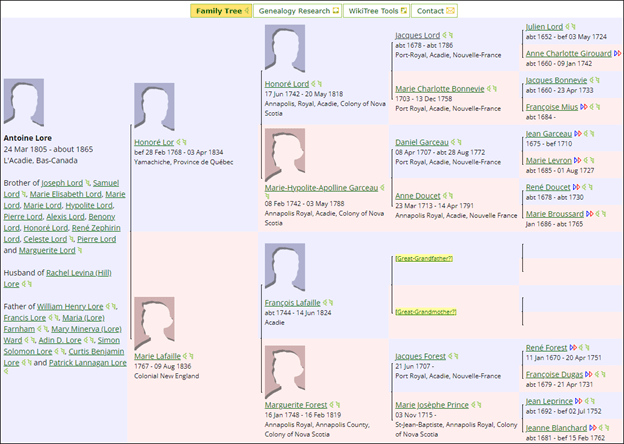
My mother has a very unexpected Acadian line through her great-grandfather, Anthony Lore, so 12.5% of her heritage.

On my match list, I see a large number of French surnames, but I didn’t know of any French ancestors on either side of my tree. Many surnames repeat, such as LeBlanc, d’Entremont (which is really unusual), Landry, and deForest. Why were these people on my match list? This is definitely smoke, and there must be fire someplace, but where?

Looking at the locations associated with these matches’ ancestors would have provided additional clues.

However, simply googling my great-grandfather’s surname in combination with those French surnames I listed above produced these 3 top search results.

Yes, you guessed it. Anthony turned out to be “Antoine” and Lore is spelled in a variety of ways, including Lord. His family is Acadian.

That’s Anthony Lore, which is how he was listed on the death certificate of his son, in the software on my computer, above, and here is Antoine Lore at WikiTree, below.

As you can see, that brick wall falling opened a whole new group of ancestors, and along with it, my appreciation of endogamy😊

Match lists facilitate viewing the big picture and can be a very useful tool for people seeking unknowns or trying to group people together in a variety of ways.

Do you have any brick walls that need to fall?

How can or do you utilize your match lists?

_____________________________________________________________

Follow DNAexplain on Facebook, here or follow me on Twitter, here.

Share the Love!

You’re always welcome to forward articles or links to friends and share on social media.

If you haven’t already subscribed (it’s free,) you can receive an email whenever I publish by clicking the “follow” button on the main blog page, here.

You Can Help Keep This Blog Free

I receive a small contribution when you click on some of the links to vendors in my articles. This does NOT increase the price you pay but helps me to keep the lights on and this informational blog free for everyone. Please click on the links in the articles or to the vendors below if you are purchasing products or DNA testing.

Thank you so much.

DNA Purchases and Free Uploads

Genealogy Products and Services

My Book

Genealogy Books

Genealogy Research

DNA-eXplained Celebrates Tenth Anniversary!

This blog, DNA-eXplained, is celebrating its 10th anniversary today. How time flies!

I never thought for a minute about a 10th anniversary when I launched that first article.

I started blogging to teach people and literally “explain” about genetic genealogy – which is why I selected the name DNA-eXplained. Over time, it has also been nicknamed DNAeXplain, which is fine.

I hoped to be able to answer questions once, with graphics and examples, instead of over and over again off-the-cuff. I needed someplace where people could be referred for answers. Blogging seemed like the perfect medium for achieving exactly that.

Blogs allow writers to publish content attractively and react to changes and announcements quickly.

Blogs encourage readers to subscribe for email delivery or use RSS reader aggregation and can publish to social media.

Content can be located easily using browser searches.

Everything, all content, is indexed and searchable by keyword or phrase.

Blogging certainly seemed like the right solution. Still, I was hesitant.

I vividly remember working at my desk that day, a different desk in a different location, and anguishing before pressing the “publish” button that first time. Was I really, REALLY sure? I had the sense that I was sitting in one of those life-defining fork-in-the-road moments and once embarked upon, there would be no turning back.

I’m so glad I closed my eyes and pushed that button!

I knew we were going to be in for an incredible journey. Of course, I had no idea where that roller coaster ride was going, but we would be riding together, regardless. What a journey it has been!

A decade later, I’ve had the opportunity to meet and become friends with so many of you, both online and in person. I’ve met countless cousins I never knew I had, thanks to various blog articles, including the 52 Ancestors series which has turned out to be 365 and counting.

I am incredibly grateful for this opportunity! I thought I was giving to others, yet I’ve been greatly enriched by this experience and all of you.

So much has changed in all of our lives.

Looking Back

Today, as I look back at that very short first article, I can’t help but think just how unbelievably far we’ve come.

There was one Y and mitochondrial DNA testing vendor in 2012, FamilyTreeDNA, and that’s still the case today.

There were three autosomal testing companies, 23andMe, FamilyTreeDNA, and Ancestry, in addition to the Genographic Project, which was sunset in 2019 after an amazing 15-year run. GEDmatch was two years old in 2012 and had been formed to fill the need for advanced autosomal matching tools. In 2016, MyHeritage joined the autosomal testing market. All of those companies have since been acquired.

In 2012, FamilyTreeDNA broke ground by accepting uploaded DNA files from other vendors. Autosomal DNA tests cost about $300 although prices were dropping. I don’t anticipate prices dropping much further now, because companies have to maintain a reasonable profit margin to stay in business.

In 2013, when DNA-eXplained celebrated its first anniversary, I had published 162 articles.

That first year was VERY busy with lots of innovation occurring in the industry. You can read my end-of-year article, 2012 Top 10 Genetic Genealogy Happenings if you’d like to reminisce a bit. For comparison, here’s my Genetic Genealogy at 20 Years summary.

The World is Our Oyster

In the past decade, I’ve penned articles in a wide variety of locations, in several countries, on 5 continents.

I’ve written in my offices, of course, but also in cars, on buses, trains, and planes. I’ve crafted several articles on ships while cruising. In fact, writing is one of my favorite “sea-day” things to do, often sitting on deck if it’s a nice day.

I’ve written in cemeteries, which shouldn’t surprise you, on the hood of my car, and cross-legged on the floor at innumerable conferences.

I’ve composed at picnic tables and in countless hotel lobbies, libraries, laboratories, restaurants, and coffee shops. And, in at least 3 castles.

I’ve written while on archaeology digs, balancing my laptop on my knees while sitting on an inverted bucket, trying to keep dirt, sand, and ever-present insects away.

I’ve even written in hospitals, both as a visitor and a patient. Yea, I might not have told you about that.

I’ve pretty much taken you with me everyplace I’ve gone for the past decade. And we are no place near finished!

Today

This article is number 1531 which means I’ve published an article every 2.3 days for a decade. Truthfully, I’m stunned. I had no idea that I have been that prolific. I never have writer’s block. In fact, I have the opposite problem. So many wonderful topics to write about and never enough time.

A huge, HUGE thank you to all of my readers. Writers don’t write if people don’t read!

DNA-eXplained has received millions and millions of views and is very popular, thanks to all of you.

There have been more than 48,000 comments, 4,800 a year or about 13 each day, and yes, I read every single one before approving it for publication.

Akismet, my spam blocker only reports for 45 months, but in that time alone, there have been about 100,000 attempted SPAM comments. That equates to about 75 each day and THANK GOODNESS I don’t have to deal with those.

WordPress doesn’t count “pages,” as such, but if my articles average 10 pages each, and each page averages 500 words, then we’re looking at someplace between 7 and 8 million words. That’s 13 times the size of War and Peace😊. Not only do I write each article, but I proofread it several times too.

Peering Into the Future

Genetic genealogy as a whole continues to produce the unexpected and solve mysteries.

Tools like triangulation in general, Family Matching at FamilyTreeDNA, genetic trees at 23andMe, Theories of Family Relativity at MyHeritage, and ThruLines at Ancestry have provided hints and tools to both suggest and confirm relationships and break through brick walls.

Ethnicity chromosome painting at both 23andMe and FamilyTreeDNA help unravel ancestral mysteries, especially for people with combinations of fundamentally different ancestries, as does Genetic Communities at Ancestry and Genetic Groups at MyHeritage.

Third-party tools that we love today weren’t even a twinkle in a developer’s eye in 2012. Products like DNAPainter, Genetic Affairs, and DNAGedcom pick up where the vendors leave off and are widely utilized by genealogists.

I hope that all of our vendors continue to invest in product development and provide the genetic genealogy community with new and innovative tools that assist us with breaking down those pesky brick walls.

Primarily, though, I hope you continue to enjoy your genealogy journey and make steady progress, with a rocket boost from genetic testing.

The vendors can provide wonderful tools, but it’s up to us to use them consistently, wringing out every possible drop. Don’t neglect paternal (male surname) Y DNA and matrilineal mitochondrial DNA testing for people who carry those important lines for your ancestors. All 4 kinds of DNA have a very specific and unique genealogical use.

I encourage you to test every relative you can and check their and your results often. New people test every single day. You never know where that critical piece of information will come from, or when that essential puzzle piece will drop into place.

Be sure to upload to both FamilyTreeDNA and MyHeritage (plus GEDMatch) so you are in the database of all the vendors. (Instructions here.) Fate favors the prepared.

Thank You!!

Thank you from the bottom of my heart for supporting me by reading and sharing my articles with your friends, organizations, and family members, by purchasing through the affiliate links, by buying my book, and by graciously sharing your own experiences.

Thank you for your suggestions and questions which plant the seeds of new articles and improvements.

I hope you’ve made progress with your research, unraveled some thorny knots, and that you’ve enjoyed this decade as much as I have. Tell me in the comments what you enjoyed the most or found most useful?

Here’s to another wonderful 10 years together!

___________________________________________________________

Follow DNAexplain on Facebook, here or follow me on Twitter, here.

Share the Love!

You’re always welcome to forward articles or links to friends and share on social media.

If you haven’t already subscribed (it’s free,) you can receive an email whenever I publish by clicking the “follow” button on the main blog page, here.

You Can Help Keep This Blog Free

I receive a small contribution when you click on some of the links to vendors in my articles. This does NOT increase the price you pay but helps me to keep the lights on and this informational blog free for everyone. Please click on the links in the articles or to the vendors below if you are purchasing products or DNA testing.

Thank you so much.

DNA Purchases and Free Uploads

Genealogy Products and Services

My Book

Genealogy Books

Genealogy Research


FamilyTreeDNA DISCOVER™ Launches – Including Y DNA Haplogroup Ages

FamilyTreeDNA just released an amazing new group of public Y DNA tools.

Yes, a group of tools – not just one.

The new Discover tools, which you can access here, aren’t just for people who have tested at FamilyTreeDNA . You don’t need an account and it’s free for everyone. All you need is a Y DNA haplogroup – from any source.

I’m going to introduce each tool briefly because you’re going to want to run right over and try Discover for yourself. In fact, you might follow along with this article.

Y DNA Haplogroup Aging

The new Discover page provides seven beta tools, including Y DNA haplogroup aging.

Haplogroup aging is THE single most requested feature – and it’s here!

Discover also scales for mobile devices.

Free Beta Tool

Beta means that FamilyTreeDNA is seeking your feedback to determine which of these tools will be incorporated into their regular product, so expect a survey.

If you’d like changes or something additional, please let FamilyTreeDNA know via the survey, their support line, email or Chat function.

OK, let’s get started!

Enter Your Haplogroup

Enter your Y DNA haplogroup, or the haplogroup you’re interested in viewing.

If you’re a male who has tested with FamilyTreeDNA , sign on to your home page and locate your haplogroup badge at the lower right corner.

If you’re a female, you may be able to test a male relative or find a haplogroup relevant to your genealogy by visiting your surname group project page to locate the haplogroup for your ancestor.

I’ll use one of my genealogy lines as an example.

In this case, several Y DNA testers appear under my ancestor, James Crumley, in the Crumley DNA project.

Within this group of testers, we have two different Big Y haplogroups, and several estimated haplogroups from testers who have not upgraded to the Big Y.

If you’re a male who has tested at either 23andMe or LivingDNA, you can enter your Y DNA haplogroup from that source as well. Those vendors provide high-level haplogroups.

The great thing about the new Discover tool is that no matter what haplogroup you enter, there’s something for you to enjoy.

I’m going to use haplogroup I-FT272214, the haplogroup of my ancestor, James Crumley, confirmed through multiple descendants. His son John’s descendants carry haplogroup I-BY165368 in addition to I-FT272214, which is why there are two detailed haplogroups displayed for this grouping within the Crumley haplogroup project, in addition to the less-refined I-M223.

Getting Started

When you click on Discover, you’ll be asked to register briefly, agree to terms, and provide your email address.

Click “View my report” and your haplogroup report will appear.

Y DNA Haplogroup Report

For any haplogroup you enter, you’ll receive a haplogroup report that includes 7 separate pages, shown by tabs at the top of your report.

Click any image to enlarge

The first page you’ll see is the Haplogroup Report.

On the first page, you’ll find Haplogroup aging. The TMRCA (time to most recent common ancestor) is provided, plus more!

The report says that haplogroup I-FT272214 was “born,” meaning the mutation that defines this haplogroup, occurred about 300 years ago, plus or minus 150 years.

James Crumley was born about 1710. We know his sons carry haplogroup I-FT272214, but we don’t know when that mutation occurred because we don’t have upstream testers. We don’t know who his parents were.

Three hundred years before the birth of our Crumley tester would be about 1670, so roughly James Crumley’s father’s generation, which makes sense.

James’ son John’s descendants have an additional mutation, so that makes sense too. SNP mutations are known to occur approximately every 80 years, on average. Of course, you know what average means…may not fit any specific situation exactly.

The next upstream haplogroup is I-BY100549 which occurred roughly 500 years ago, plus or minus 150 years. (Hint – if you want to view a haplogroup report for this upstream haplogroup, just click on the haplogroup name.)

There are 5 SNP confirmed descendants of haplogroup I-FT272214 claiming origins in England, all of whom are in the Crumley DNA project.

Haplogroup descendants mean this haplogroup and any other haplogroups formed on the tree beneath this haplogroup.

Share

If you scroll down a bit, you can see the share button on each page. If you think this is fun, you can share through a variety of social media resources, email, or copy the link.

Sharing is a good way to get family members and others interested in both genealogy and genetic genealogy. Light the spark!

I’m going to be sharing with collaborative family genealogy groups on Facebook and Twitter. I can also share with people who may not be genealogists, but who will think these findings are interesting.

If you keep scrolling under the share button or click on “Discover More” you can order Y DNA tests if you’re a biological male and haven’t already taken one. The more refined your haplogroup, the more relevant your information will be on the Discover page as well as on your personal page.

Scrolling even further down provides information about methods and sources.

Country Frequency

The next tab is Country Frequency showing the locations where testers with this haplogroup indicate that their earliest known ancestors are found.

The Crumley haplogroup has only 5 people, which is less than 1% of the people with ancestors from England.

However, taking a look at haplogroup R-M222 with many more testers, we see something a bit different.

Ireland is where R-M222 is found most frequently. 17% of the men who report their ancestors are from Ireland belong to haplogroup R-M222.

Note that this percentage also includes haplogroups downstream of haplogroup R-M222.

Mousing over any other location provides that same information for that area as well.

Seeing where the ancestors of your haplogroup matches are from can be extremely informative. The more refined your haplogroup, the more useful these tools will be for you. Big Y testers will benefit the most.

Notable Connections

On the next page, you’ll discover which notable people have haplogroups either close to you…or maybe quite distant.

Your first Notable Connection will be the one closest to your haplogroup that FamilyTreeDNA was able to identify in their database. In some cases, the individual has tested, but in many cases, descendants of a common ancestor tested.

In this case, Bill Gates is our closest notable person. Our common haplogroup, meaning the intersection of Bill Gates’s haplogroup and my Crumley cousin’s haplogroup is I-L1195. The SNP mutation that defines haplogroup I-L1145 occurred about 4600 years ago. Both my Crumley cousin and Bill Gates descend from that man.

If you’re curious and want to learn more about your common haplogroup, remember, you can enter that haplogroup into the Discover tool. Kind of like genetic time travel. But let’s finish this one first.

Remember that CE means current era, or the number of years since the year “zero,” which doesn’t technically exist but functions as the beginning of the current era. Bill Gates was born in 1955 CE

BCE means “before current era,” meaning the number of years before the year “zero.” So 2600 BCE is approximately 4600 years ago.

Click through each dot for a fun look at who you’re “related to” and how distantly.

This tool is just for fun and reinforces the fact that at some level, we’re all related to each other.

Maybe you’re aware of more notables that could be added to the Discover pages.

Migration Map

The next tab provides brand spanking new migration maps that show the exodus of the various haplogroups out of Africa, through the Middle East, and in this case, into Europe.

Additionally, the little shovel icons show the ancient DNA sites that date to the haplogroup age for the haplogroup shown on the map, or younger. In our case, that’s haplogroup I-M223 (red arrow) that was formed about 16,000 years ago in Europe, near the red circle, at left. These haplogroup ancient sites (shovels) would all date to 16,000 years ago or younger, meaning they lived between 16,000 years ago and now.

Click to enlarge

By clicking on a shovel icon, more information is provided. It’s very interesting that I-L1145, the common haplogroup with Bill Gates is found in ancient DNA in Cardiff, Wales.

This is getting VERY interesting. Let’s look at the rest of the Ancient Connections.

Ancient Connections

Our closest Ancient Connection in time is Gen Scot 24 (so name in an academic paper) who lived in the Western Isles of Scotland.

These ancient connections are more likely cousins than direct ancestors, but of course, we can’t say for sure. We do know that the first man to develop haplogroup I-L126, about 2500 years ago, is an ancestor to both Gen Scot 24 and our Crumley ancestor.

Gen Scot 24 has been dated to 1445-1268 BCE which is about 3400 years ago, which could actually be older than the haplogroup age. Remember that both dating types are ranges, carbon dating is not 100% accurate, and ancient DNA can be difficult to sequence. Haplogroup ages are refined as more branches are discovered and the tree grows.

The convergence of these different technologies in a way that allows us to view the past in the context of our ancestors is truly amazing.

All of our Crumley cousin’s ancient relatives are found in Ireland or Scotland with the exception of the one found in Wales. I think, between this information and the haplogroup formation dates, it’s safe to say that our Crumley ancestors have been in either Scotland or Ireland for the past 4600 years, at least. And someone took a side trip to Wales, probably settled and died there.

Of course, now I need to research what was happening in Ireland and Scotland 4600 years ago because I know my ancestors were involved.

Suggested Projects

I’m EXTREMELY pleased to see suggested projects for this haplogroup based on which projects haplogroup members have joined.

You can click on any of the panels to read more about the project. Remember that not everyone joins a project because of their Y DNA line. Many projects accept people who are autosomally related or descend from the family through the mitochondrial line, the direct mother’s line.

Still, seeing the Crumley surname project would be a great “hint” all by itself if I didn’t already have that information.

Scientific Details

The Scientific Details page actually has three tabs.

The first tab is Age Estimate.

The Age Estimate tab provides more information about the haplogroup age or TMRCA (Time to Most Recent Common Ancestor) calculations. For haplogroup I-FT272214, the most likely creation date, meaning when the SNP occurred, is about 1709, which just happens to align well with the birth of James Crumley about 1710.

However, anyplace in the dark blue band would fall within a 68% confidence interval (CI). That would put the most likely years that the haplogroup-defining SNP mutation took place between 1634 and 1773. At the lower end of the frequency spectrum, there’s a 99% likelihood that the common ancestor was born between 1451 and 1874. That means we’re 99% certain that the haplogroup defining SNP occurred between those dates. The broader the date range, the more certain we can be that the results fall into that range.

The next page, Variants, provides the “normal” or ancestral variant and the derived or mutated variant or SNP (Single Nucleotide Polymorphism) in the position that defines haplogroup I-FT272214.

The third tab displays FamilyTreeDNA‘s public Y DNA Tree with this haplogroup highlighted. On the tree, we can see this haplogroup, downstream haplogroups as well as upstream, along with their country flags.

Your Personal Page

If you have already taken a DNA test at FamilyTreeDNA, you can find the new Discover tool conveniently located under “Additional Tests and Tools.”

If you are a male and haven’t yet tested, then you’ll want to order a Y DNA test or upgrade to the Big Y for the most refined haplogroup possible.

Big Y tests and testers are why the Y DNA tree now has more than 50,000 branches and 460,000 variants. Testing fuels growth and growth fuels new tools and possibilities for genealogists.

What Do You Think?

Do you like these tools?

What have you learned? Have you shared this with your family members? What did they have to say? Maybe we can get Uncle Charley interested after all!

Let me know how you’re using these tools and how they are helping you interpret your Y DNA results and assist your genealogy.

_____________________________________________________________

Follow DNAexplain on Facebook, here or follow me on Twitter, here.

Share the Love!

You’re always welcome to forward articles or links to friends and share on social media.

If you haven’t already subscribed (it’s free,) you can receive an email whenever I publish by clicking the “follow” button on the main blog page, here.

You Can Help Keep This Blog Free

I receive a small contribution when you click on some of the links to vendors in my articles. This does NOT increase the price you pay but helps me to keep the lights on and this informational blog free for everyone. Please click on the links in the articles or to the vendors below if you are purchasing products or DNA testing.

Thank you so much.

DNA Purchases and Free Uploads

Genealogy Products and Services

My Book

Genealogy Books

Genealogy Research

Mitochondrial Eve Gets a Great-Granddaughter: African Mitochondrial Haplogroup L7 Discovered

Such wonderful news today!

We have a birth announcement, of sorts, detailed in our new paper released just today,  “African mitochondrial haplogroup L7: a 100,000-year-old maternal human lineage discovered through reassessment and new sequencing.”

Woohoo, Mitochondrial Eve has a new great-granddaughter!

Back in 2018, Goran Runfeldt and Bennett Greenspan at FamilyTreeDNA noticed something unusual about a few mitochondrial DNA sequences, but there weren’t enough sequences to be able to draw any conclusions. As time went on, more sequences became available, both in the FamilyTreeDNA database and in the academic community, including an ancient sequence.

This group of sequences did not fit cleanly into the phylogenetic tree as structured and seemed to cluster together, but more research and analysis were needed.

Were these unique sequences a separate branch? One branch or several? What would creating that branch do to the rest of the tree?

Given that Phylotree, last updated in 2016, did not contain an applicable branch, what were we to do with these puzzle pieces that really didn’t fit?

These discussions, and others similar, led to the decision to launch the Million Mito Project to update the mitochondrial phylogenetic tree which is now 6 years old and seriously out-of-date. For the record, phylogenetics on this scale is EXTREMELY challenging, which is probably why Phylotree hasn’t been updated, but that’s a topic for another article, another day. Today is the day to celebrate haplogroup L7.

Haplogroup L7

The Million Mito team knew there were lots of candidate haplogroups waiting to be formed near the ends of the branches of the phylotree, but what we didn’t expect was a new haplogroup near the root of the tree.

Put another way, in terms that genealogists are used to, the new branch is Eve’s great-granddaughter.

Haplogroup L now has 8 branches, instead of 7, beginning with L0. We named this new branch haplogroup L7 in order not to disrupt the naming patterns in the existing tree.

Let’s take a look.

I used the phylogenetic tree from our paper and added Eve.

Just to be clear, we aren’t talking literal daughters and granddaughters. These are phylogenetic daughters which represent many generations between each (known) branch. Of course, we can only measure the branches that survived and are tested today or are found in ancient DNA.

The only way we have of discovering and deciphering Eve and her “tree” of descendants is identifying mutations that occurred, providing breadcrumbs back in time that allow us to reconstruct Eve’s mitochondrial DNA sequence.

Those mutations are then carried forever in daughter branches (barring a back-mutation). This means that, yes, you and I have all of those mutations today – in addition to several more that define our individual branches.

You can see that Eve has two daughter branches. One branch, at left, is L0.

Eve’s daughter to the right, which I’ve labeled, is the path to the new L7 branch.

Before this new branch was identified, haplogroup L5 existed. Now, Eve has a new great-granddaughter branch L5’7 that then splits into two branches; L5 and L7.

L5 is the existing branch, but L7 is the new branch that includes a few sequences formerly misattributed to L5.

Even more exciting, the newly discovered haplogroup L7 has sub-branches too, including L7a, L7a1, L7b1 and L7b2.

In fact, haplogroup L7 has a total of 13 sublineages.

How Cool is This?!!

Haplogroup L7 is 100,000 years old. This is the oldest lineage since haplogroup L5 was discovered 20 years ago. To put this in perspective, that’s about the same time the first full sequence mitochondrial DNA test was offered to genealogists.

It took 20 years for enough people to test, and two eagle-eyed scientists to notice something unusual.

Hundreds of thousands of people have had their mitochondrial DNA tested, and so far, only 19 people are assigned to haplogroup L7 or a subgroup.

One of those people, shown as L7a* on the tree above, is 80,000 years removed from their closest relative. Yes, their DNA is hens-teeth rare. No, they don’t have any matches at FamilyTreeDNA, just in case you were wondering😊

However, in time, as more people test, they may well have matches. This is exactly why I encourage everyone to take a mitochondrial DNA test. If someone is discouraged from testing, you never know who they might have matched – or how rare their DNA may be. If they don’t test, that opportunity is lost forever – to them, to other people waiting for a match, and to science.

Are there other people out there with this haplogroup, in either Africa or the diaspora? Let’s hope so!

With so few L7 people existing today, it looks like this lineage might have been on the verge of extinction at some point, but somehow survived and is now found in a few places around the world.

Ancient DNA

One 16,000-year-old ancient DNA sample from Malawi has been reclassified from L5 to L7.

This figure from the paper shows the distribution of haplogroup L within Africa, and the figure below shows the Haplogroup L7 range within Africa, with Tanzania having the highest frequency. Malawi abuts Tanzania on the Southwest corner.

Where in the World?

Checking on the public tree at FamilyTreeDNA, you can see the new L5’7 branch with L7 and sub-haplogroups beneath.

We find L7 haplogroups in present-day testers from:

  • South Africa
  • Kenya
  • Ethiopia
  • Sudan
  • United Arab Emirates
  • Yemen
  • Tanzania

It’s also found in people who live in two European countries now, but with their roots reaching back into Africa. Surprisingly, no known African-Americans have yet tested with this haplogroup. I suspect finding the haplogroup in the Americas is just a matter of time, and testing.

The FamilyTreeDNA customers who are lucky enough to be in haplogroup L7 have had their haplogroup badges updated.

If you are haplogroup L at FamilyTreeDNA, check and see if you have a new badge.

Credit Where Credit is Due

I want to give a big shout-out to my colleagues and co-authors. Dr. Paul Maier (lead author,) Dr. Miguel Vilar and Goran Runfeldt.

I can’t even begin to express the amount of heavy lifting these fine scientists did on the long journey from initial discovery to publication. This includes months of analysis, writing the paper, creating the graphics, and recording a video which will be available soon.

I’m especially grateful to people like you who test their DNA, and academic researchers who continue to sequence mitochondrial DNA in both contemporary and ancient samples. Without testers, there would be no scientific discoveries, nor genealogy matching. If you haven’t yet tested, you can order (or upgrade) a mitochondrial DNA test here.

I also want to thank both Bennett Greenspan, Founder, and President, Emeritus of FamilyTreeDNA who initially greenlit the Million Mito Project in early 2020, and Dr. Lior Rauschberger, CEO who continues to support this research.

FamilyTreeDNA paid the open access fees so the paper is free for everyone, here, and not behind a paywall. If you’re downloading the pdf, be sure to download the supplements too. Lots of graphics and images that enhance the article greatly.

Congratulations to Mitochondrial Eve for this new branch in her family tree. Of course, her family tree is your family and mine – the family of man and womankind!

_____________________________________________________________

Follow DNAexplain on Facebook, here or follow me on Twitter, here.

Share the Love!

You’re always welcome to forward articles or links to friends and share on social media.

If you haven’t already subscribed (it’s free,) you can receive an email whenever I publish by clicking the “follow” button on the main blog page, here.

You Can Help Keep This Blog Free

I receive a small contribution when you click on some of the links to vendors in my articles. This does NOT increase the price you pay but helps me to keep the lights on and this informational blog free for everyone. Please click on the links in the articles or to the vendors below if you are purchasing products or DNA testing.

Thank you so much.

DNA Purchases and Free Uploads

Genealogy Products and Services

My Book

Genealogy Books

Genealogy Research

Honors and Accolades – Thanks to You!

Before I share the good news, I’d like to thank you, my readers and followers – my tribe – for being my fans.

For reading what I write and watching what I produce. For sharing your thoughts. For inspiring me with your stories and questions. For supporting me.

It’s because of you that I’m privileged to write this article about recent honors and accolades.

Three, to be specific, or four, depending on how you count.

I’m truly humbled.

All three notifications arrived in my inbox within a few days this past week, which also corresponded to a difficult death anniversary in my family, so I really needed this boost.

Family Tree Magazine’s 101 Best Genealogy Websites

Family Tree Magazine compiles an annual best of the best list of 101 genealogy resources for genealogy enthusiasts to research our family trees.

I’m very pleased that DNAeXplained is included again this year.

You can see the full list of honorees, here and you can click on each category to learn more.

I encourage you to try something new.

How many of these sites have you never utilized? What might be waiting for you? Do you have a particularly thorny brick wall that needs to fall?

Maybe some of these resources don’t pertain to your areas of research, but others may.

You might have used some in the past but need to check back occasionally.

For example, DeadFred. You could find photos of your long-lost relatives, and you can also submit orphaned photos there as well.

You know I’m already searching for the surname of every ancestor in my tree that died after the advent of cameras in the mid-1800s! If not them, then maybe their children or siblings. Hope springs eternal!

I’m going to try one new website from the Family Tree Magazine list every day.

Which resource are you trying first? Let me know how it goes and if you find something fun.

Legacy Family Tree Webinar’s Top 10

I received an email from Geoff Rasmussen with Legacy Family Tree Webinars announcing that my webinar, Wringing Every Drop out of Mitochondrial DNA ranked number 5 in the top 10 webinars for May.

Truthfully, I was pleasantly surprised because mitochondrial DNA has often been the “neglected” DNA that we all carry. Hopefully, that “neglected” status will change and more people will test now that they understand how beneficial this tool can be, which means additional and more meaningful matches for all of us.

More than 2,200 people have viewed this webinar so far and received the extensive companion syllabus.

You can watch too by joining Legacy Family Tree Webinars, here, which gives you access to all 1787 webinars, and counting. New webinars are literally added daily, and you can register to watch live webinars along with recently recorded webinars for free for the first 7 days. Take a look.

If you haven’t yet tested your mitochondrial DNA, please do by clicking here.

By taking a mitochondrial DNA test at FamilyTreeDNA, you’ll also become a part of the exciting Million Mito Project which is literally rewriting the history of womankind.

 E-book Release and Lovely Book Review

I received a note from my publisher, Genealogical.com, who is also on Family Tree Magazine’s “Best Of” list again this year, telling me that my book, DNA for Native American Genealogy has been released as an e-book AND has received a major book review by Dr. Margaret McMahon. I think this should count as two really good things, not just one.

I wrote about the contents of my book, here, but Dr. Mac, as she is known, summed things up succinctly in her statement, “This book picks up where the theories end and your work begins.”

That was my goal, to educate my readers, explain the various tests and results, and provide a research roadmap. Do you have a family story of a Native American ancestor? Are you looking for answers?

Dr. Mac’s book review corresponds well with the recent release of the book in e-book (e-Pub) format. Here’s how to order:

Thank You, Thank You

Once again, thank you for your continuing support. I’ll have more interesting news soon!

_____________________________________________________________

Follow DNAexplain on Facebook, here or follow me on Twitter, here.

Share the Love!

You’re always welcome to forward articles or links to friends and share on social media.

If you haven’t already subscribed (it’s free,) you can receive an email whenever I publish by clicking the “follow” button on the main blog page, here.

You Can Help Keep This Blog Free

I receive a small contribution when you click on some of the links to vendors in my articles. This does NOT increase the price you pay but helps me to keep the lights on and this informational blog free for everyone. Please click on the links in the articles or to the vendors below if you are purchasing products or DNA testing.

Thank you so much.

DNA Purchases and Free Uploads

Genealogy Products and Services

My Book

Genealogy Books

Genealogy Research

William Crumley’s Original 1792 Will Surfaces – 52 Ancestors #360

Sometimes late at night, just before I go to bed, I check MyHeritage for Record Hints and Ancestry for those little green leaf hints.

One recent midnight, I noticed a hint at Ancestry for William Crumley II. Of course, I have to have three William Crumley’s in a row in my tree.

Clicking on this hint revealed West Virginia Wills.

Of course, the first thing I noticed was that West Virginia wasn’t formed as a state until 1863, but I also know that counties and their earlier records “go with” their county into a new state. Berkeley County was formed from Frederick County, Virginia in 1772.

However, William Crumley II died between 1837 and 1840 in Lee County, Virginia, so I wasn’t very hopeful about this hint. Nonetheless, I clicked because, hey, you never know what you might discover. That’s why they’re called hints, right?

Hint 1 – The Will Book

I discovered the Berkeley County Clerk’s Will Book where William Crumley the first’s will had been dutifully copied into the Will Book on pages 185 and 186 after it was “proved” in court by witnesses on September 17, 1793. Witnesses who proved a will swore that they saw him sign the original and the will submitted was that same, unmodified, document.

This William Crumley is not William Crumley II, where this hint appeared, but his father, who did not have this hint.

I’ve been in possession of that will information for several years, so there was no new information here.

While I always read these wills, even when I have a typewritten published transcription, I know that the handwriting and the signature is not original to the person who wrote the will. The handwriting is that of the clerk.

To begin with, the signature of the deceased person can’t possibly be original after he died. William’s will was written and signed on September 30, 1792, almost exactly a year before it was probated on September 17, 1793. William was clearly ill and thinking about his family after his demise.

Given that court was held every three months, William likely died sometime between June and September of 1793.

I really wish Ancestry would not provide hints for a 1792/3 will for a man who died between 1837 and 1840.

My ancestor, William II who died in about 1840 is at least mentioned in his father’s will as a child. However, if I saved this will to William II from this hint, Ancestry would have recorded this event as his will, not the will of his father, so I declined this hint. I did, however, later connect this document to William I, even though Ancestry did NOT provide this document as a hint for him.

Hint 2 – 1764 Tax List

I clicked on the next green leaf hint for William II. A tax list for 1764. Nope, not him either given that William II wasn’t born for another three years.

Next.

Hint 3 – Executor’s Bond

Something else from Berkeley County attached to the wrong person, again.

Bother.

What’s this one?

Executor’s bonds for William Crumley’s estate who died in 1793. Now this is interesting because the bond includes the signatures of the executors, including William’s wife Sarah. I got VERY excited until I remembered that Sarah was William’s second wife and not my ancestor.

Not to mention this record dated in 1793 is still being served up on the wrong William Crumley – the same-name son of the man who died in 1793.

Worse yet, these hints did NOT exist on the correct William Crumley the first who I wrote about, here.

Ok, fine.

There’s one more hint for William II before bedtime.

Hint 4 – Berkeley County AGAIN

What’s this one?

I saw that it was from Berkeley County and almost dismissed the hint without looking. By that time, I was tired and grumpy and somewhat frustrated with trying to save records to the right person and not the person for whom the hints were delivered.

Am I EVER glad that I didn’t just click on “Ignore.”

Accidental Gold

Staring at me was the ORIGINAL WILL of William Crumley the first in a packet of Loose Probate Papers from 1772-1885 that I didn’t even know existed. I thought I had previously exhausted all available resources for this county, but I clearly had not. I’m not sure the contemporary clerks even knew those loose records existed and even if they did, they probably weren’t indexed.

Thankfully, they’ve been both scanned and (partially) indexed by Ancestry. They clearly aren’t perfect, but they are good enough to be found and sometimes, that’s all that matters. I’d rather find a hint for the wrong person so I can connect the dots than no hint at all.

My irritation pretty much evaporated.

There’s additional information provided by Ancestry which is actually incorrect, so never presume accuracy without checking for yourself. The date they are showing as the probate date is actually the date the will was executed. If I were to save this record without checking, his death/probate would be shown as September 30, 1792. That’s clearly NOT the probate nor William’s death date.

Not to mention, there were many more than 3 additional people listed in this document. There was a wife, 15 children, and the 4 witnesses to the will itself. I actually found another two names buried in the text for a total of 22 people.

Always, always read the original or at least the clerk’s handwritten copy in the Will Book.

Originals are SELDOM Available

I’ve only been lucky enough to find original wills in rare cases where the will was kept in addition to the Will Book copy, a later lawsuit ensued, or the will surfaced someplace. The original will document is normally returned to the family after being copied into the book after being proven in court.

For some reason, William’s original will was retained in the loose papers that included the original estate inventory as well. That inventory was also copied into the will book a couple of months later. Unfortunately, I’ve never found the sale document which includes the names of the purchasers.

Normally, the original will is exactly the same as the clerk’s copy in the Will Book. It should be exact, but sometimes there are differences. Some minor and some important. The will book copy is normally exact or very close to a copy transcribed by someone years later. Every time something is copied manually, there’s an opportunity for error.

Therefore, I always, always read the will, meaning the document closest in person and in time to the original, just in case. You never know. I have discovered children who were omitted in later copies or documents.

In his will, William stated that he had purchased his plantation from his brother, John Crumley. Their father, James Crumley had willed adjoining patented land to his sons, John and William. I was not aware that William had purchased John’s portion, probably when John moved to South Carolina about 1790.

William states that his plantation should be sold by the executors. The purchaser was to make payments but the land “not to be given up to the purchaser till the 26th of March in the year 1795 which is the expiration of John Antram’s (?) lease upon it.” It’s unclear whether William was referring only to the plantation he purchased from John, or if he’s referring to the combined property that he received from his father and that he purchased from John as “his plantation.”

This also tells us that William clearly didn’t expect to live until the end of that lease. The fact that the land was leased was probably a result of his poor health even though he wasn’t yet 60 years old. This also makes me wonder how long he had been ill.

William also explicitly says he has 15 children, then proceeds to name them, one by one. Unfortunately for everyone involved, William’s youngest 10 children were all underage, with the baby, Rebecca, being born about 1792.

William probably wrote his will in his brick home, above, with a newborn infant crying in the background. Sarah, his wife must have been distraught, wondering what she would do and how she would survive with 10 mouths to feed, plus any of his older children from his first marriage who remained at home. The good news, if there is any, is that the older children could help. Sarah was going to need a lot of help!

I surely would love to know what happened to William.

I can close my eyes and see the men gathered together, sitting in a circle that September 30th in 1792. It was Sunday, probably after church and after “supper” which was served at noon. William might have been too ill to attend services.

Maybe one man was preparing a quill pen and ink at a table. William spoke thoughtfully, perhaps sitting on the porch or maybe even under the tree, and the man inked his feather and wrote. You could hear the feather scratch its way across the single crisp sheet of paper. William enunciated slow, measured words, conveying his wishes to the somber onlookers who would bear witness to what he said and that, at the end, when he was satisfied, they had seen him sign the document.

From time to time, someone would nod or clear their throat as William spoke. At one point, the scrivener made a mistake and had to scratch out a couple words. Or perhaps, it wasn’t the scrivener’s error. Maybe William misspoke or someone asked him if he really meant what he said. It’s heartbreaking to write your will with a house full of young children. He knew he was dying. Men of that place and time only wrote wills when they knew the end was close at hand.

Of course, we find the obligatory language about Sarah remaining his widow. He tried to provide for Sarah even after his death. Sarah was 15 years or so younger than William and died in 1809 when she was about 59 years old. Her baby would have been about 17 years old, so she was about 40 or so when William wrote his will and died, with a whole passel of kids.

William appointed one David Faulkner, probably related to his brother John’s wife, Hannah Faulkner, along with his wife, Sarah Crumley, as his executors. Sarah’s stepfather was Thomas Faulkner, who was also her bondsman. David may have been her brother, so William probably felt secure that Sarah’s interests would be looked after.

The selection of executors may tell us indirectly that son William Crumley II had already left for the next frontier, Greene County, TN. William II was listed on the Berkeley County tax list in 1789, but not again, suggesting he had already packed up and moved on, probably before his father became ill.

But here’s the best part, on the next page…William Crumley’s actual original signature.

I wonder if this was the last time he signed his name.

Signature Doppelganger

It’s extremely ironic that the signature of his son, William Crumley the second, looks almost identical to the signature of William the first, above. We know absolutely that this was the signature of the eldest William, and we know positively that later signatures in 1807 and 1817 in Greene County, Tennessee were his son’s.

This nearly identical signature of father and son suggests that perhaps William Crumley the eldest taught his son how to write.

The family was Quaker. We know William’s father, James Crumley was a rather roudy Quaker, and William the first married Quaker Sarah Dunn in 1774, after his first wife’s death. That marriage is recorded in the Quaker minutes because Sarah had married “contrary to discipline” which tells us that William Crumley was not at that time a Quaker, or had previously been dismissed.

Quakers were forbidden from many activities. If you were a Quaker, you couldn’t marry non-Quakers, marry a first cousin, marry your first spouse’s first cousin, marry your former husband’s half-uncle, administer oaths, do something unsavory like altering a note, purchase a slave, dance, take up arms, fight, game, move away without permission, encourage gambling by lending money, train or participate in the militia, hire a militia substitute, attend muster, or even slap someone. Every year, several people were “disowned” for these violations along with failing to attend meetings, failing to pay debts, moving away without settling business affairs, or helping someone else do something forbidden, like marry “contrary to discipline.” Heaven forbid that you’d attend one of those forbidden marriage ceremonies or worse yet, join the Baptists or Methodists!

It’s unknown if William returned to the Quaker Church although it’s doubtful, because in 1774 Sarah is listed as one of the persons “disowned” for marrying him, and there is no reinstatement note or date. Furthermore, in 1781, William was among the Berkeley County citizens who provided supplies for the use of the Revolutionary armies.

One certificate (receipt) dated September 30, 1781 indicated that he and three others, including his wife’s brother William Dunn and her stepfather Thomas Faulkner were entitled to 225 pounds for eleven bushels and a peck of wheat.

We also know that William Crumley owned a slave when he died and Quakers were prohibited from owning slaves based on the belief that all human beings are equal and worthy of respect. Regardless, many Quakers continued to own slaves but purchasing a slave, at least at Hopewell, caused you to be “disowned.”

Still, William may have sent his children to be educated at the Quaker school given that the Quaker school was the only educational option other than teaching your children yourself. Quaker schools were open to non-Quaker children. We know, based on the books ordered in the 1780s for local students in multiple languages that the school was educating and welcoming non-Quaker children too.

The Hopewell Quaker Meeting House (church) built an official schoolhouse in 1779, but it’s likely that school had been being conducted in the Meeting House before a separate school building was constructed. By that time, William Crumley the second would have been 12 years old and had likely already been taught the basics, perhaps by his father.

Of course, the William Crumley family at some point, probably in 1764 when William’s father James Crumley died, if not before, had moved up the road and across the county line to Berkeley County which was about seven and a half miles from the Hopewell Meeting House (and school). That was quite a distance, so William the first may have been instructing his own children, making sure they knew how to read and write and sign their names.

No wonder his son’s signature looks exactly like his.

Education and the Hopewell Meeting House

In 1934, the Hopewell Friends History was published to commemorate the 200th anniversary of the church which provided a great deal of historical information about the church itself, that part of Frederick County and the Quaker families. Unfortunately, the notes from 1734 to 1759 were lost when the clerk’s home burned, along with most of the 1795 minutes later.

Based on his will, William clearly placed a very high value on education. He instructed that his “widdow Sarah Crumley shall rays my children together to give them learning out of the profits that arises from my estate, the boys to read, write and cifer, the girls to read and write.” Apparently, females weren’t perceived to need “cifering.”

William himself would have attended school at Hopewell after his family moved from Chester County, PA in 1744 when he was 9 or 10 years old.

William’s children, following in his footsteps, may well have attended the Hopewell School or perhaps another brick school that existed near White Hall, about halfway between The Crumley home and the Hopewell Meeting House, although it’s unclear exactly when that school was established.

Many Quakers mentioned in the 1800s in the church notes are buried at what is now the White Hall United Methodist Church on Apple Pie Ridge Road. The earliest burial there with a stone is 1831 which seems to be when headstones began to be used in the area.

William also directed his funeral expenses to be paid, of course, and his executors sold a steer to pay for his coffin.

It’s doubtful that William is buried here, in the Hopewell Cemetery, unless he reconciled with the church. William’s parents are most likely buried here. His father, James, died in 1764 and his mother, Catherine, died about 1790. William would have gazed across this cemetery as a child attending services and stood here during many funerals, possibly including the service of his own first wife, Hannah Mercer, and perhaps some of their children.

I wonder if it ever occurred to him as a child that he might one day rest here himself.

No early marked graves remain before the 1830s, but people had been buried here for a century in unmarked graves by that time.

I can’t help but think of William the first, as a child, probably attending school in this building, peering out these windows, after his family moved from Pennsylvania in the early 1740s. He worshiped here on Sundays. Perhaps his son, William II and his older children attended school here some three decades later.

This stately tree in the cemetery was likely a sapling when William was a young man.

Given that William seems to have left the Quaker Church, willingly or otherwise sometime before 1774 and probably before 1759, it’s much more likely that William is buried in the cemetery right across the road from his home in an unmarked grave adjacent and behind what is now the Mount Pleasant United Methodist Church.

I don’t know, but I’d wager that this is the old Crumley family cemetery.

Perhaps William was the first person to be buried here, or maybe his first wife or one of his children. His brother, John, may have buried children here too.

Almost Too Late

Thank goodness William’s original will was microfilmed when it was, because the pages were torn and had to be carefully unfolded and repaired. William’s will might have been beyond saving soon. After all, his will had been folded several times and stored in what was probably a metal document box, just waiting to be freed, for more than 225 years.

There is information on these original documents that just isn’t available elsewhere.

It’s interesting to note the legal process that took place when wills were brought to court when someone died. The clerk wrote on the back of the will, below William’s signature, on what would likely have been the outside of the folded document that the will had been proven in open court (OP), he had recorded and examined the will and that the executors had complied with the law and a certificate was granted to them.

I believe the bottom right writing is No. 2 Folio 185 which correlated to the book and page.

It’s nothing short of a miracle that William’s original will still exists and got tucked away for posterity. I’m ever so grateful to Mr. Hunter, that long-deceased Clerk of Court who is responsible for resurrecting William’s signature, the only tangible personal item of William’s left today, save for a few DNA segments in his descendants.

Flowers, looking into the window of the Hopewell Meeting House.

_____________________________________________________________

Follow DNAexplain on Facebook, here or follow me on Twitter, here.

Share the Love!

You’re always welcome to forward articles or links to friends and share on social media.

If you haven’t already subscribed (it’s free,) you can receive an email whenever I publish by clicking the “follow” button on the main blog page, here.

You Can Help Keep This Blog Free

I receive a small contribution when you click on some of the links to vendors in my articles. This does NOT increase the price you pay but helps me to keep the lights on and this informational blog free for everyone. Please click on the links in the articles or to the vendors below if you are purchasing products or DNA testing.

Thank you so much.

DNA Purchases and Free Uploads

Genealogy Products and Services

My Book


Genealogy Books

Genealogy Research


Ancestry’s SideView™ – Dividing Your Ethnicity in Two

Recently, Ancestry introduced a new view of your ethnicity called SideView™. In a nutshell, AncestryDNA uses your DNA matches to attempt to divide your ethnicity into regions inherited from Parent 1 and Parent 2.

Based on your matches and the common DNA they share with you, Ancestry strives to divide your ethnicity into parental “sides,” although Ancestry can’t tell you which side is maternal and which side is paternal.

Even though Ancestry can’t tell you which side is which parent, there are tricks that might help you do just that.

Ethnicity

Before we look at SideView, let’s have a quick review of ethnicity estimates and how they do and don’t work.

Every vendor creates their own proprietary mathematical algorithm to determine their customers’ ethnicity or population percentages based on their own customer database and other resources.

“Country” boundaries change and people migrate. The article, Making Sense of Ethnicity Updates may be helpful.

If you haven’t done so, create a spreadsheet or chart identifying the amount of DNA you would inherit from each ancestor if exactly 50% of each ancestor’s DNA was passed down in each generation. Your spreadsheet may/will help you identify which “side” belongs to which parent. I provided instructions for calculating your expected ethnicity percentages based on your genealogy in the article, Concepts – Calculating Ethnicity Percentages.

My Genealogy

I’ve updated my genealogy totals slightly since that 2017 article because I’ve been able to push some of those lines back in time, either genealogically, via Big-Y or full sequence mitochondrial DNA testing and matching, or a combination of both.

Here’s an updated chart. I’ve included the last two ethnicity percentage results from each vendor except MyHeritage because their ethnicity results have remained the same for several years although they released Genetic Groups to complement ethnicity in 2020.

I’ve clustered geographies in regions because the vendors measure locations differently. Locations sometimes change within the same vendor with different releases.

The earlier “Unknown” genealogy category is gone now because I’ve been able to assign those ancestors to a geographic region if not an exact “country.”

The Genealogy Percent column, with a header and totals in yellow, details the geographic source for each of my 64 great-great-great-great-grandparents who each contributed approximately 1.5625% of my DNA. Of course, we know that DNA isn’t divided exactly in half in each generation, and I possibly inherited none of the DNA of some of those people and more than 1.5625% from others. Regardless, this is the best measuring stick of what I should expect and a way to determine if my ethnicity results are in the right ballpark.

The yellow cells in the vendor column totals reflect the “best fit” for my known genealogy percentages when compared against the expected percentages. In the Native grouping, vendors receive a yellow cell for identifying that heritage.

OK, now let’s take a look at Ancestry’s new SideView.

Finding SideView

At Ancestry, your ethnicity estimate, as well as your new SideView results, are found in the DNA Story section of your DNA Results Summary tab.

Ancestry does update your ethnicity estimate from time to time, so yours may have changed since you last viewed your results.

Ideally, if exactly half of the DNA of each ancestor was passed down in each generation, then I would have the amount of DNA shown in my personal chart, assuming my genealogy is accurate with no adoptions or unexpected parent events.

Also ideally, I would show exactly half of each of my parent’s ethnicity.

But that’s not how it works. While we do inherit half of our DNA from each parent, they can randomly give us all of a segment of DNA from one ancestor and not any of a segment of DNA from a different ancestor.

I wrote about how DNA is passed to children in the article, Ancestral DNA Percentages – How Much of Them is in You?. This explains how and why you might not inherit the exact amount of a specific ethnicity you would expect. Of course, that combined with each vendor’s different algorithms may produce results that surprise you, although the discrepancy should be relatively small.

Keep in mind how ethnicity inheritance works as you view your ethnicity results, including SideView.

SideView Results

Here are my Sideview results.

Remember, we don’t know which parent is “1” and which is “2.” Click on “How we identify this” to learn about how SideView works.

Here’s a more detailed description along with some nice graphics.

Analyzing My Results

SideView appears right beside your ethnicity map, so be sure to consult that map. Note that regions reflect populations, not necessarily countries as boundaries are drawn today.

The first thing I noticed is that my significant Dutch heritage, along with my French is missing in my ethnicity results as well as on the map.

How is this possible?

The arrows point to the Netherlands and France. These are important pieces of my ancestry on my Mother’s side. Mom was 25% Dutch so I should be about 12.5%. My maternal side genealogical breakdown is shown in the chart below.

Mom % I Should Inherit From Mom
German 50 25
Dutch 25 12.5
French/Acadian 12.5 6.25
England 12.5 6.25
Native ~2 in the Acadian line ~1

Of course, my Native American is also missing at Ancestry, even though the other three major vendors identify those segments. The two vendors who paint ethnicity by segment, 23andMe and FamilyTreeDNA report Native on the same segment on my chromosome 1, so it’s unlikely that both of those vendors are in error in exactly the same way.

While Native is critically important to my genealogy, it is a small percentage. Missing a small percentage, while frustrating, is more understandable than missing a larger percentage.

My Dutch ancestors at 12.5% and French at 6.25% are not trivial and together comprise more than one-third of my mother’s heritage and more than one-sixth of mine. And yes, in case you’re wondering, I do match many other people who descend from these same ancestors so it’s not a mistaken or misidentified ancestor issue.

My father was kind of a colonial mutt. Scottish, Irish, and English with a small smattering of African and Native along with 1.5% Scandinavian/Nordic. The African in the later versions tends to show as Middle Eastern or North African, or doesn’t show at all, but that segment with a small Native one cluster together on the same chromosome. I also match other people who are Native/African on those segments as well.

However, given that neither of those ethnicities appear at Ancestry, we don’t have those to work with, nor do we have specific segment information.

Let’s work with what we do have.

View Breakdown

I wish Ancestry did not say “Now, you can see which ethnicities you inherited from each parent,” because while that’s the goal, it isn’t always the case. Lots of people will simply accept that statement at face value.

Click on View breakdown.

You’ll see your results broken into two sides with the reported regions noted at the bottom. All regions are showing in the circle by default.

To see how this works, click on any single or combination of regions.

Determining Sides

What can we do to determine which side is which parent?

Let’s start with ethnicities or regions which should be unique to one parent and not the other.

I clicked on both Norway and Sweden/Denmark since I know that one couple on my father’s side is Scandinavian/Nordic, but I discovered that Ancestry assigned pieces of those regions to both Parent 1 and Parent 2.

I’m positive that my mother did not have any ancestors in the past 6 generations and significantly further back that were Scandinavian or Nordic, BUT, Germany and the Netherlands both border those regions. People traveled, wars happened and populations as a whole mixed, so while I’m confident of my genealogy, this actual ethnicity may be accurate even though it does not reflect genealogical locations. It may well reflect populations and admixture.

What I am sure of is that I can’t use these particular regions to identify which side is maternal or paternal.

Detailed Comparison

Let’s look at the detailed comparison you’ll see by scrolling down.

Can I identify any of these regions as solely connected with only one parent?

Yes, I can. Ancestry has assigned Germanic Europe to only one parent, and Mom is 50% German, so Parent 1 has to be Mother. I should expect to be assigned roughly half of what my mother has – so about 25% Germanic.

Mother has no Irish, so Ireland has to be Dad, which also correlates to known genealogy.

However, the rest of the ethnicity results are questionable, including Mom’s missing Dutch and her missing England and Northwest Europe which should total in the neighborhood of 37.5%. I would be expected to inherit about 18.75% of that from her. Where is it?

No Segments

I very much wish Ancestry provided segment information.

Using segment matching information from the other three vendors, including ethnicity segment information from both 23andMe and FamilyTreeDNA, I’ve painted my segments at DNAPainter, so I know which ancestors or ancestral lines contributed which DNA segments.

If Ancestry, provided users with segment information, I could determine which ethnicities they have attributed to which ancestors and maybe unravel why.

Another Possible Clue

There is one additional way I might be able to figure out where Ancestry attributed Mom’s Dutch and French heritage.

Given that I know which of my closest matches are maternal and paternal, I can utilize shared matching plus shared ethnicity to look for similarities. Just click on the match with someone, then on the Ethnicity tab.

The closest match on my mother’s side is my first cousin who also descends from my maternal grandparents. My cousin’s relevant parent should have roughly the same amount of the same ethnicities as my Mom since they were siblings, taking into account that not all of our ancestors’ DNA is passed in exactly half and siblings, unless they are identical twins, don’t inherit all of the same DNA from their parents. Of course, that means my first cousin should share roughly the same amount of DNA/ethnicity from our common grandparents as I do.

My cousin’s other parent is European with what appears to be a significant number of German ancestors, so we need to take that into account when viewing my cousin’s shared ethnicity comparison with me, above.

I can see that my cousin has 4% French and 1% Native, but that percentage might have been contributed by their other parent, especially since there is a French surname in that line.

If my cousin’s other parent had been African or Asian or an ethnicity that is different from the ethnicity of our shared line, it would be easier to compare our results meaningfully.

In this case, the shared match ethnicity comparison did not help, but your mileage may vary based on your unique circumstances.

Assign the Parent

If you are fortunate enough to be able to determine which parent is which, you can assign Parent 1 and 2 as maternal or paternal at Ancestry by clicking on the “Edit parents” icon at top right on the Detailed Comparison page.

I selected side 1 as Maternal based on the 35% Germanic Europe which is very clearly my mother’s side.

What I wish we could do, but we can’t, is to explain why we disagree with some portion of an assigned ethnicity. Ancestry does have my tree and I do have Thrulines from these ancestors, so the information is available for comparison should Ancestry choose to utilize that resource.

You can undo your selections by selecting “Back” or click on “Sounds good.”

I initially clicked on “Sounds good,” even though that bothers me. I hope that I’m not confirming something that’s incorrect, given my Mother’s missing Dutch and French, and that I’m not going to make *something* worse in the future by baking in bad ingredients. I’m not comfortable confirming something that’s significantly wrong. On the other hand, Parent 1 is clearly my mother, so I’m conflicted and I really don’t know exactly what I’m confirming to Ancestry.

In other words, we don’t know what Ancestry is doing under the hood with this information, if anything, other than labeling your sides.

Ultimately, I clicked “Back”, at least for now, to leave my sides unassigned until there is some benefit to me to identify the parental sides and I know I’m not confirming something that shouldn’t be confirmed. In other words, I know which parent is which, but I do NOT want to confirm that these ethnicities are fundamentally accurately assigned, because they are not.

Does Testing Your Parents Make a Difference?

If you’re wondering if testing your parents makes a difference with SideView predictions, it does not.

Ancestry is NOT utilizing your parents’ DNA for SideView ethnicity division, even if your parent or parents have tested, which Ancestry confirms in their documentation.

If you’re wondering why Ancestry doesn’t use your parent’s DNA to improve your SideView results, remember that someone who matches you at the parent/child level can be either your parent or your child. Often trees are either absent or incorrect, so Ancestry cannot simply assume anything.

Benefits of SideView?

What do you think?

Is there a benefit to SideView or is it simply interesting window dressing?

Are your SideView results accurate?

Do you feel that Sideview is accurate enough to be genealogically useful?

Are you able to utilize Sideview for your genealogy? If so, how?

_____________________________________________________________

Follow DNAexplain on Facebook, here or follow me on Twitter, here.

Share the Love!

You’re always welcome to forward articles or links to friends and share on social media.

If you haven’t already subscribed (it’s free,) you can receive an email whenever I publish by clicking the “follow” button on the main blog page, here.

You Can Help Keep This Blog Free

I receive a small contribution when you click on some of the links to vendors in my articles. This does NOT increase the price you pay but helps me to keep the lights on and this informational blog free for everyone. Please click on the links in the articles or to the vendors below if you are purchasing products or DNA testing.

Thank you so much.

DNA Purchases and Free Uploads

Genealogy Products and Services

My Book

Genealogy Books

Genealogy Research

Sarah Rash’s and Perhaps Mary Warren’s Mitochondrial DNA – 52 Ancestors #359

Using the FamilySearch “Relatives at RootsTech” app that was available in the month or so surrounding RootsTech (but not now), I connected with a cousin who is a direct matrilineal descendant of Sarah Rash, our common ancestor.

My cousin, who descends through Sarah’s daughter Rhoda Shepherd, very kindly agreed to take a full sequence mitochondrial DNA test so we now have information about Sarah Rash’s matrilineal origins.

I wrote about Sarah Rash and what we know of her life in Sarah Rash (1748-1829), Church Founder and Grandmother of Nearly 100.

Mitochondrial DNA Inheritance

Women contribute their mitochondrial DNA to all of their children, but only females pass it on. Therefore, mitochondrial DNA is never divided, watered down or mixed with the DNA of the father. Mitochondrial DNA provides an invaluable periscope view directly back in time for our matrilineal ancestors – our direct mother’s, mother’s, mother’s line on up our tree.

Sarah Rash was born to Joseph Rash and wife, Mary, purportedly Mary Warren.  Sarah’s mitochondrial DNA also belongs to her mother Mary. That would be Mary Warren if indeed Mary Warren is Sarah’s mother. Mary Warren’s parents are unknown. However, there is a Warren family in Spotsylvania County, VA, where the Rash family lived in that timeframe.

Goals

My goals for seeking a mitochondrial DNA test for Sarah Rash’s descendant are:

  • To confirm Sarah’s genealogical accuracy by matching another descendant, preferably through another daughter or sister of Sarah.
  • To learn what we can from Sarah’s haplogroup. You don’t know what you don’t know.
  • To gather evidence to confirm or perhaps disprove that Sarah’s mother is Mary Warren.
  • To potentially extend Sarah’s line backward in time.

The Process

Several people have asked me to step through the analysis process that I use for mitochondrial DNA results, so let’s do that.

What can we tell about Sarah’s ancestors through her mitochondrial DNA?.

Sarah’s Matrilineal Line is Not Native

Sometimes when the mother of an early pioneer settler can’t be identified, the “go-to” assumption is that she might be Native American.

Sarah’s haplogroup is U5a2a1d which is definitely NOT Native.

We can dispel this thought permanently.

Since Sarah’s matrilineal ancestors aren’t Native, where are they from?

Where Are Sarah’s Ancestors From?

Using the public mitochondrial tree, here, we see the following countries displayed for haplogroup U5a2a1d.

Sarah’s haplogroup is found most often in the US, which means brick-walled here, followed by England, Ireland, and less-frequent other locations. Note that two people claim Native, the feather, but that can mean either they are mistaken, or they have entered information for their mother’s “side” of the family or their literal “oldest ancestor,” not their specific matrilineal line.

Regardless, haplogroup U is unquestionably not Native.

Matches Map

Sometimes the matches map, which shows the geographic locations of your matches’ most distant matrilineal linear ancestor is very informative, but not so in this case.

Of 74 full sequence matches, only 4, plus the tester whose pin is white, have entered the locations of their matrilineal ancestors.

One of these contains a male name, so we know that’s incorrect.

This is really sad – a wasted opportunity. Imagine how useful this could be with 74 pins instead of 4, and one of those being recorded incorrectly.

Mutations

The mutations tab shows you the mutations you have that are either extra or missing from your haplogroup assignment. This means that these may be combined in the next version of the haplotree to form a new haplogroup.

My cousin has 5 extra mutations, but at least three of those are in unstable areas that I’m sure will not be utilized as haplogroup-forming. The other two mutations are insertions at one single location and I doubt those will be used either.

I wrote about haplogroup formation in the article, Mitochondrial DNA: Part 3 – Haplogroups Unraveled, including a list of unstable and common mutations. Suffice it to say that very common locations like 16519 and 315 insertions aren’t useful to form haplogroups. Some very common mutations, such as insertions at locations 309 and 315 and deletions at 522 and 523 aren’t even counted in matching/differences.

What these unstable mutations actually tell me, relative to Sarah Rash’s DNA is that I need to pay attention to the GD1 (genetic distance of 1) matches, meaning people who have only one mutation difference from my cousin. Given that my cousin’s extra mutations, differences from her defined haplogroup, are in unstable regions, close matches such as GD1 or even GD2 could be quite relevant. It all depends on the difference.

Of course, we can’t see the mutations of the people my cousin matches, so those with a GD1 or GD2 may have mutations on a stable marker that my cousin doesn’t have.

Matches

My cousin has a total of 74 full sequence matches, of which 31 are exact matches, 18 have trees and 12 have listed an earliest known ancestor (EKA). If you haven’t done so, here’s how to enter your EKA.

Of course, the EKA of my cousin’s matches may or may not agree with the earliest matrilineal person in their tree. And the tree may or may not have more than one or two people. Regardless, every hint is worth follow-up.

Think of these as diamonds in the rough.

Trees

I viewed the trees of each of the matches that have uploaded trees. I also made a list of the earliest known ancestors for matches that didn’t have trees so I could be cognizant of watching for those names.

Many trees only had a few generations, but I used Ancestry, FamilySearch, MyHeritage, and WikiTree to see if I could reasonably complete the tree back a little further. Of these, I particularly like WikiTree because I think it tends to be more accurate AND it allows for people to enter that they carry the mitochondrial DNA of specific ancestors. As it turns out, no one has done that for Sarah Rash, or her purported mother, Mary Warren, but if they had, it would provide a confirmation opportunity.

I did find something quite interesting.

Who is Jane Davis?

The EKA of Elizabeth, one of my cousin’s matches, is Jane Davis who was born in 1690.

Unfortunately, Elizabeth did not upload a GEDCOM file or create a tree, so I turned to other trees elsewhere to see what I could unearth about Jane Davis.

I need to state emphatically that what I’m about to tell you needs to be taken with the entire salt lick, not just a grain.

Remember, we’re looking for hints and evidence here, not foregone conclusions – although admittedly, those would be nice.

According to (cringe) some trees, Jane Davis was the wife of one William Warren who was born 1678 in Surry County, VA and died on September 29, 1764 in Edgecombe County, NC. I have not confirmed any of this. Gathering evidence is the first step in the process.

IF this is accurate, William Warren and Jane Davis may be the parents of Mary Warren, the purported mother of Sarah Rash.

Notice all of those weasel words – if, may, purported. That’s where we have to start. In weaselworld.

Obviously, this needs a LOT of traditional genealogy work, but here’s the great news…I now have something to work with and someone else, Elizabeth, who appears one way or another to be descended from this line.

The Good News

Whether or not Jane Davis is accurate or not, I’d wager that we are looking at the same line because Elizabeth matches my cousin’s mitochondrial DNA. I need to email Elizabeth to see if she descends through Sarah Rash. If so, that’s confirmation of this line.

If not, and she descends through a daughter of someone else in this same line, like one of Mary Warren’s sisters, that’s evidence and a HUGE HINT that I can use to confirm Mary Warren as the mother of Sarah Rash. Confirming her mother would also confirm that Mary’s father is William Warren – so would provide evidence for both of Sarah’s parents.

Additional Tools – Advanced Matches

Next, I used Advanced Matches to query for anyone who matches at both the full sequence level and in Family Finder. There were no matches, which doesn’t surprise me since it’s quite a way back in time.

Notice that the link to upload a family tree is in this section, along with the public haplotree I used earlier.

Family Finder

Checking my cousin’s Family Finder matches and searching for surnames, I immediately checked for myself and my known cousins from that line. No cigar, but our common ancestor is many generations in the past.

Checking the Rash surname for my cousin shows a match to someone who descends from Joseph Rash’s brother, William Rash whose children also migrated to Claiborne County, TN along with Sarah Rash’s daughter, Elizabeth Shepherd who married William McNiel.

My cousin has numerous autosomal matches to the McNiel line as well. The Vannoy, McNiel, Shepherd, and Rash lines were all found in Wilkes County, NC together before migrating to Claiborne and Hancock Counties in Tennessee. Before Wilkes County, the Rash, Warren, and McNiel families were in Spotsylvania and nearby counties in Virginia.

Goal Fulfillment

How did we do fulfilling our original goals?

Goal Comment
To confirm Sarah’s genealogical accuracy by matching another descendant. Perhaps – We have that lead to follow up on with Elizabeth and her EKA of Jane Davis. We also have several relevant autosomal matches.
To learn what we can learn from her haplogroup. Yes – Not Native and probably from England or Ireland. That is useful and makes sense.
To confirm her mother as Mary Warren. We now have hints and tools. We need to hear what Elizabeth has to say. I may be able to extract more information by viewing trees individually with people my cousin matches on Family Finder.
To potentially extend Sarah’s line backward in time. We now have a great hint and information to work with, both mitochondrial and autosomal. Jane Davis may be the wife of William Warren, which might well confirm Mary Warren as the daughter of William Warren. It’s too soon to tell but my fingers are crossed for a descendant of Jane Davis from a different daughter through all females.

Sometimes answers come in a gulley-washer, and other times, we have to dig and sift over time for the gems. Let’s create a plan.

What’s Next?

There’s a lot we can do, but maybe one of the best places to start would be to attempt to assemble information about the Warren families of Spotsylvania County, VA. This Thomas Warren might be a good place to begin or maybe work my way up from Mary Warren, here.

I need to focus on both traditional genealogy and genetic autosomal matches at all of the vendors. My cousin’s DNA is only at FamilyTreeDNA, but my results and those of several other cousins are found at several vendors.

I can use Genetic Affairs’ tools to see if I cluster with other people descended from the Warren family. My cousin can set up an account and do the same thing if she wishes. AutoTree and AutoKinship may help with that.

Using traditional genealogy, if I can identify other sisters of Mary Warren (daughters of Jane Davis,) I can ask people descended from them through all females to take a mitochondrial DNA test. If they match my cousin, that’s an exceptionally compelling piece of evidence.

Of course, I can do more work on the mitochondrial DNA matches we already have by emailing and asking for genealogy information. The piece of evidence we need might be right under our noses.

The Warren Family

If you descend from a Warren family in the Spotsylvania County area in the 1600s through 1700s, would you please check your matches to see if you have me, Vannoy, McNiel, McNeil, Rash or Shepherd matches? I’d love to narrow this down.

If you descend through all females from William Warren or another Warren family who would have been having children in the Spotsylvania County from about 1710 to maybe 1740, would you please reach out to me? If we can pinpoint a likely family for Mary Warren who was reportedly born in 1726, I’d love to do a confirming mitochondrial DNA test.

_____________________________________________________________

Follow DNAexplain on Facebook, here or follow me on Twitter, here.

Share the Love!

You’re always welcome to forward articles or links to friends and share on social media.

If you haven’t already subscribed (it’s free,) you can receive an email whenever I publish by clicking the “follow” button on the main blog page, here.

You Can Help Keep This Blog Free

I receive a small contribution when you click on some of the links to vendors in my articles. This does NOT increase the price you pay but helps me to keep the lights on and this informational blog free for everyone. Please click on the links in the articles or to the vendors below if you are purchasing products or DNA testing.

Thank you so much.

DNA Purchases and Free Uploads

Genealogy Products and Services

My Book

Genealogy Books

Genealogy Research

Ancestry Only Shows Shared Matches of 20 cM and Greater – What That Means & Why It Matters

Recently, I’ve noticed an uptick in confused people who’ve taken Ancestry’s DNA test.

They are using shared matches, which is a great tool and exactly what they should be doing, but they become confused when no shared matches appear with some specific people.

This is especially perplexing when they know through information sharing or because they manage multiple DNA kits that those two people who both match them actually do share DNA and match each other, meaning they “should” appear on a shared match list. Or worse, yet, conflicting match information is displayed, with one person showing the shared match, but the other person reciprocally does not.

What gives?

That’s exactly what this article addresses. It’s not quite as simple as it sounds, but it’s certainly easier once you understand.

What Are Matches and Shared Matches?

Matches occur when two people match each other. From your perspective as a DNA tester, matches are people who have taken DNA tests and appear on your match list because you share some level of DNA equal to or greater than the match threshold of the vendor in question.

At Ancestry, that minimum matching threshold is 8 cM (centimorgans) of matching DNA.

Individual matches are always one-to-one. Your match list is a list of people who all match you.

So, you match person 1, and you match person 2, individually.

Your matches may or may not also match each other. If they do match each other in addition to matching you, that’s a shared match which is a hint as to a potential common ancestor between all three people.

Shared matches are a list of people who match you PLUS any one other match on your list. In other words, shared matches are three-way matches.

In the diagram above, you can see that you match Match 1 and you also match Match 2. In this case, Match 1 and Match 2 also match each other, so all three of you match each other, but not necessarily on the same segment. Therefore, you’re all three shared matches, as shown in the center of the three circles.

Viewing Shared Matches

To view a list of people who match you and Match 1, you would request shared matches with Match 1 by clicking on “View Match” or “Learn More” on your match list, then on “Shared Matches” on the next screen.

The resulting shared match list consist of people who match you AND Match 1, both. It’s easy to make assumptions about why you have shared matches, but don’t.

Shared Matches are Hints

A shared match CAN mean:

  • That all three people share a common ancestral line.
  • You share a common ancestor with Match 1 and Match 2, but Match 1 and 2 match each other because they share an entirely different ancestor.
  • You match Match 1 because you share DNA from Ancestor A and you match Match 2 because you share DNA from Ancestor B. Match 1 and 2 match each other either because they share one or both of those common ancestors.
  • Match 1 and Match 2 might match because Match 1 and Match 2 share an ancestor that isn’t related to you.
  • That one (or more) of the matches is identical by chance, meaning the DNA combined from two parents in a random way that just happens to match with someone else.

Shared matches are great hints to be sifted for relevance. The operative word here is hint.

What If We Don’t Have Shared Matches?

Conversely, NOT having a shared match doesn’t mean you don’t share a common ancestor.

Sorry about the triple negative. Let me say that another way, because this is important.

Even though you and someone else aren’t on a shared match list, you might still share DNA and you may share a common ancestor, whether you share their DNA or not.

Ancestry’s shared matches work differently than shared matches at other vendors. Before we discuss that, let’s talk about why shared matches are important.

Why Do Shared Matches Matter Anyway?

Matches and shared matches are how genealogists perform two critically important functions:

  • Verifying “known” ancestors. Sometimes paper trails aren’t accurate and certainly, neither are trees.
  • Identifying unknown ancestors. Looking for common families among shared DNA matches is a HUGE hint when tracking down those pesky unknown ancestors.

I wrote about shared matches, here, when Ancestry purged segments under 8 cM, but I think the message about the limitations of shared matches and how the process actually works deserves its own article, especially for new users. Shared matches and segment cM numbers can be quite confusing, but they don’t need to be.

I wrote an article titled DNA Beginnings: Matching at Ancestry and What It Means that includes lots of useful information.

Ok, now let’s look specifically at using shared matches and why sometimes shared matches just don’t seem to make sense.

Matches

By far, the majority of your matches at any vendor will be more distant matches. That’s because you have thousands of distant relatives, most of whom you don’t know (yet).

You’ll only have a few closer relatives.

At Ancestry, I have 102,000+ total matches, of which more than 97,000 are distant matches. Based on these numbers, keep in mind that about 95.74% of my matches are distant, meaning 20 cM or below, and yours probably are too. You’ll need that number later.

Note that 20 cM is Ancestry’s threshold between close matches and distant matches.

That’s about exactly where you’d expect, on average, to see a 20 cM match – generally at or further back than 4th cousins. 20 cM is roughly the 4th to 6th cousin level.

Of course, you won’t match most of your 5th cousins at all, yet you’ll match some with more than 20 cM. That’s just the roll of the genetic dice.

Closer ancestors (meaning closer matches) is also the area of genealogy where much of the lower-hanging fruit has been plucked.

In my case, the closest unknown ancestor in my tree occurs at the 6th generation level and I have 5 or 6 missing sixth-generation ancestors – all females with no surnames. Two have no names at all.

Click to enlarge any image

How Much DNA Do Cousins Share?

One of my priorities as a genealogist is to identify those unknown people, which is why matches, and shared matching at that level are critical for me.

Ancestry tells me that this 20 cM match is likely my 4th-6th cousin.

At DNAPainter, in the Shared cM Tool, you can enter the total cM number of a match, which is the total amount of DNA that you share after Ancestry’s Timber algorithm has been applied. The range of relationship probabilities for 20 cM is shown below.

For a total match of 20 cM with another individual, several relationships ranging between half 3C2R/3C3R and 8th cousins are the most probable relationships at 58%.

For the record, this is total cM, which does not necessarily mean one segment. Ancestry reports the number of segments, but Ancestry does not show you the segment locations, nor do they have a chromosome browser. Without a chromosome browser, you have no way of determining whether or not you match with shared matches on the same segment(s). In other words, there is no triangulation at Ancestry, meaning confirmation of a specific shared DNA segment descended from a common ancestor. You can find triangulation resources, here.

Close Matches

The best way to figure out how you are related to closer matches (assuming you don’t already know them and Ancestry has not found a common ancestor) is using shared matches. Hopefully, you will share matches with people you do know or with whom you’ve already identified your common ancestor.

One of my relatively close DNA matches at Ancestry is Lonnie. I don’t know Lonnie, but it looks like I should because he’s probably a 1st or 2nd cousin. We share 357 cM of DNA over 20 segments.

I thought I knew all of my 1st and 2nd cousins. Let’s see if I can figure out how I’m related to Lonnie.

By clicking on Lonnie’s name on my match list, then on Shared Matches, I can determine that Lonnie and I connect through my Estes and Vannoy lines based on who we both match, which means that our common ancestor is either my paternal grandfather or my great-grandparents, Lazarus Estes and Elizabeth Vannoy.

You can see the notes I’ve made about these matches I share with Lonnie.

Viewing Lonnie’s unlinked tree verifies the ancestral line that shared matches suggest. An unlinked tree means that Lonnie has not linked his DNA test to himself in his tree. Since Ancestry doesn’t know who he is in the tree, they can’t find a common ancestor for me and Lonnie. However, I can by viewing his tree.

Our common ancestor is Lazarus Estes and his wife, Elizabeth Vannoy. Therefore, Lonnie is my 2nd cousin.

That wasn’t difficult, in part because I had already worked on the genealogy of our common matches and Lonnie had a small unlinked tree where I could confirm our common ancestor.

Now let’s move to more distant, not-so-easy matches.

Distant Matches

I’ve spent a lot of time over the years identifying common ancestors with my matches.

When I make that connection, whether or not Ancestry has been able to identify our common ancestor, I make notes about common ancestors and anything else that seems relevant. Notes very conveniently show on my match list so I don’t need to open each match to see how we are related.

Ancestry does identify potential common ancestors using ThruLines. Note the word potential. Ancestry compares the trees of you and your matches searching for common ancestors and suggests connections. It’s up to you to verify. ThruLines are hints, not gospel. Additionally, you may have multiple ancestral links to your matches. Ancestry can only work with the fact that you have a DNA match with someone AND the user-provided trees of your matches.

Ancestry’s ThruLines only reach back a maximum of 7 generations to suggest common ancestors. At 7 generations distance, you’d be a 5th cousin to a descendant who is also 7 generations downstream from that ancestor.

The information from DNAPainter, who utilizes the Shared CM Project compiled data shows that the most likely amount of shared DNA for 5th cousins, is, you’ve guessed it – 20 cM.

Jacob Dobkins is my 7th generation ancestor. I have ThruLines for him and his wife, but not for their parents who are one generation too distant for ThruLines. I’d LOVE to see Ancestry extend ThruLines another 2 or 3 generations.

ThruLines matches me with people who descend from Jacob through his other children. Other children are important because the only ancestors you share with those people are (presumably) that ancestral couple.

Matches with Jacob’s descendants range from 8 cM (the smallest amount Ancestry reports) to 32 cM.

Here’s an example.

Ancestry displays some shared matches with all of your matches, regardless of the size of your match to that person. However, Ancestry ONLY shows shared matches to a third person if you share more than 20 cM of DNA with that third person.

For example, I match KO with 8 cM of DNA. Ancestry shows my shared matches with KO, below.

I only have 3 shared matches with KO. I only match KO at 8 cM, but I match our shared matches at 39, 31 and 21 cM, respectively.

Ancestry does NOT show shared matches below 20 cM, so it’s unknown how many additional shared matches KO and I actually have if shared matches less than 20 cM were displayed.

Perspective is Critical

Whether you see a shared match or not is sometimes a matter of perspective, meaning which of two people you request shared matches with.

In this case, I requested shared matches with KO. I only share 8 cM of DNA with KO, but that doesn’t matter. The amount of DNA you share with the person you’re requesting shared matches with is irrelevant.

Ancestry’s Shared Matches with KO include Ker

I will see shared matches with KO to anyone we mutually share as matches above 20 cM, including Ker.

If I request shared matches with Ker, with whom I share 39 cM of DNA, I will see all of our mutual matches at 20 cM (or greater) of DNA. However, that does NOT include KO because I only share 8 cM of DNA with KO.

This restriction applies regardless of how much DNA KO and Ker share, which is an unknown to me of course.

Ancestry’s Shared Matches with Ker does NOT include KO

Nothing has changed between these matches, yet KO does not appear on my shared matches list with Ker when I request shared matches with Ker.

I still share 8 cM with KO and 39 cM with Ker. KO and Ker still both match each other. The only difference is that Ker shows up on my shared match list with KO because I share more than 20 cM with Ker. However, when I request a match list with Ker, KO does NOT appear because I only share 8 cM with KO.

This is the source of the confusion and often, why people disagree about shared matches. It’s kind of a “now you see it, now you don’t” situation.

If a person shows as a shared match depends on:

  1. Whether the third person actually does share DNA with the tester and the person they’ve asked for shared matches with
  2. Whether the third person shares 20 cM DNA or more with the tester, the person requesting the shared match list with one of their matches

Whether someone appears on a shared match list can literally be a matter of perspective unless the match and the shared matches all match the tester at 20 cM or larger.

Another Example

Let’s look at a larger match to a descendant of the same ancestor.

I share exactly 20 cM with Joyce, my 5C1R.

Viewing my shared matches with Joyce, I match 50 other people that she matches as well.

I only share 25 cM of DNA with the smallest match with Joyce. Apparently, there are no matches with Joyce with whom I share between 20 and 25 cM of DNA.

Bottom Line

Here’s the bottom line.

Ancestry NEVER shows any shared matches below 20 cM from the perspective of the tester, meaning people who match you and someone else, both.

If you recall our earlier math, that means that approximately 95.74% of my shared matches aren’t shown.

This puts shared matches in a different perspective because now I realize just how many matches I’m not seeing.

Why is This Confusing?

If you aren’t aware of this shared match limitation, and that a majority of your shared matches are actually below 20 cM, you may interpret shared match results to mean you actually DON’T share specific matches with that other person. That isn’t necessarily true, as we saw above with KO and Ker.

Furthermore, let’s say you manage your DNA kit plus 3 more, A, B and C. Because you manage all 4 kits, that means you can see the results for all 4 people.

  • A – 10 cM
  • B – 20 cM
  • C – 40 cM

From the perspective of YOUR kit, you will see some shared matches FOR all of those matches.

What you won’t see is shared matches if you don’t match the shared match (third person) at 20 cM or greater.

Always remember, shared match information at Ancestry is ALWAYS from the perspective of your DNA kit combined with the person with whom you request the match.

I’ve put this information in a grid because that’s how I make sense of things like this.

Here are your matches. When you click on shared matches with person A who you match at 10 cM, you’ll see both person B and person C as shared matches since you match both of those people at 20 cM or larger. You WILL see 20 cM shared matches, but you will not see 19 cM shared matches.

When you request shared matches for A, you will see both B and C.

When you request shared matches with kits B and C, you will not see A because you only match them at 10 cM.

However, from the perspective of DNA kits A, B and C, shared matches look different.

Let’s look at shared matches from the perspective of Kits A, B and C.

Kit A matches you, Kit B and C, but can only see Kit B as a shared match because matches with you and Kit C are under 20 cM.

Kit B doesn’t match C at all, so they clearly won’t have shared matches. However, they do match you and Kit A, both at 20 cM and over, so Kit B will see you as a shared match with Kit A, and Kit A as a shared match with you.

Kit C doesn’t match Kit B, so no shared matches with that person at all. Kit C does match you and Kit A. However, when Kit C clicks on shared matches for you, Kit A doesn’t show up because they only match Kit A on 9 cM. When Kit C clicks on Kit A for shared matches, you ARE listed as a shared match because you share 40 cM of DNA with Kit C.

There’s no way to discern whether two of your matches match each other unless they show as a match in the shared match tool. You can’t tell if their absence on the shared match list means they actually don’t match, or their shared match absence is because they match you at less than 20 cM.

Whew, that was a mouthful.

You may need to refer back to this from time to time if you’re confused by your shared matches at Ancestry.

If you need to remember rules, remember this.

  1. You can obtain shared matches with yourself plus any match, regardless of how much or how little DNA you share with that one match. Prove this to yourself by finding a match under 20 cM, like my 8 cM match, and viewing your shared matches.
  2. No one will show on a shared match list with another person unless they match you at 20 cM or greater. Prove this to yourself by viewing the smallest shared match with anyone.

Strategy

The takeaway of this is if you have a larger (20 cM or over) and smaller match (under 20 cM), always request shared matches from the perspective of the smaller match because the smaller match won’t show up as a shared match on any shared match list.

The only way you can see shared matches that includes people under 20 cM is to request to view shared matches with individual people who match you below 20 cM. 

In my case, I will never see KO on any shared match list because I only match KO at 8 cM. However, I can request my shared matches with KO in which case I’ll see all 20 cM or greater shared matches with KO.

Alternatives

Every vendor provides a shared match feature, and each functions differently.

In the chart below, I’ve provided basic shared match information for each vendor.

If you’re interested in uploading your DNA file from Ancestry or another vendor, I’ve provided upload/download step-by-step instructions for each vendor, here.

_____________________________________________________________

Follow DNAexplain on Facebook, here or follow me on Twitter, here.

Share the Love!

You’re always welcome to forward articles or links to friends and share on social media.

If you haven’t already subscribed (it’s free,) you can receive an email whenever I publish by clicking the “follow” button on the main blog page, here.

You Can Help Keep This Blog Free

I receive a small contribution when you click on some of the links to vendors in my articles. This does NOT increase the price you pay but helps me to keep the lights on and this informational blog free for everyone. Please click on the links in the articles or to the vendors below if you are purchasing products or DNA testing.

Thank you so much.

DNA Purchases and Free Uploads

Genealogy Products and Services

My Book

Genealogy Books

Genealogy Research

Mitochondrial DNA Webinar is Free for 5 Days PLUS Mitochondrial DNA Test Now on Sale

Wow, the Wringing Every Drop Out of Mitochondrial DNA webinar yesterday was SO MUCH FUN. The lovely comments from attendees below the video say it all. Thank you to the 1800 or so people who signed up, joined us for the webinar and provided those kind reviews.

I’m so glad that folks are excited and already making breakthroughs using their mitochondrial DNA results.

In the webinar, I not only explained HOW mitochondrial DNA works and what your mutations and results mean, but shared some of my secrets of how to make mitochondrial DNA work harder for your genealogy.

Thanks to Legacy Family Tree Webinars, the webinar is still free for everyone through May 4th and can be viewed here.

Here’s a breakdown of what you’ll see.

The accompanying 34-page syllabus for the webinar is a feature of a paid membership.

Webinar Memberships Half Price

Legacy Family Tree Webinar memberships are currently half price, at this link, using coupon code 1750 for new members. Memberships are normally just $49.95 but right now, with the coupon code, a membership costs just $24 plus change for a full year. Your membership gives you access to all 1765 webinars in the library, and the library grows every week. The sale pricing ends Saturday, April 30th.

Here are a few of my other webinars available in the library.

The most popular webinar, though, is my Genealogy Case Study session with more than 27,000 views. That’s amazing to me. 27,000 is the size of some stadiums and EVERYONE is interested in DNA.

Mother’s Day DNA Mitochondrial DNA Sale

Sweetening the mitochondrial deal, the full sequence mitochondrial DNA test is on sale right now at FamilyTreeDNA for Mother’s Day for $139 (through May 9th) which represents a $20 savings.

Click here to learn more and order your mitochondrial DNA test or upgrade if you took an earlier test and you’d like to participate in the landmark, history-making Million Mito Project. When you order or upgrade to a full sequence mtFull test, your haplogroup results become part of the pool that will be utilized to create the new Mitotree through the Million Mito Project.

Build Your Genealogical DNA Pedigree Chart

Don’t forget, to build your DNA pedigree chart, you’ll need to find people to test for the mitochondrial DNA of the ancestors in your tree whose mitochondrial DNA you don’t carry personally.

Men and women both have their mother’s mitochondrial DNA, who has her mother’s, on up the tree in a straight matrilineal line, of course (pink arrow) – but testing your father will provide you with your paternal grandmother’s mitochondrial DNA.

In this chart, the colored hearts track back to the ancestors that color represents – in other words – that person’s matrilineal ancestors.

Who do you know among your current relatives that would be candidates to test to represent specific ancestors? First cousins, second cousins, aunts, uncles, your Dad? You only need one tester per ancestral line unless there is some uncertainty about the maternal genealogy of that line.

In the webinar, I discuss some of the methods I use to find testing candidates descended from a female ancestor through all women to the current generation, which can be men. Men can test because they have the mitochondrial DNA of their mothers, but men just don’t pass it on to their children. Only mothers pass it on.

You Don’t Know What You Don’t Know

Like I said in the webinar, you don’t know what you don’t know. I found an unexpected surprise in my own mother’s line and found a Native ancestor in another line when a cousin tested. I try to locate someone from every ancestral line and provide that person with a mitochondrial DNA testing scholarship.

Even if the match you desperately need to break through that brick wall isn’t there today, your mitochondrial DNA is waiting and fishing 24×7. That match may appear tomorrow or the next day. If you don’t test, that critical match might be waiting for you, but you’ll never know.

There’s no better time to order tests than when they are on sale. The mitochondrial DNA mtFull test normally costs $159 but is on sale, here for $139 now through May 9th.

__________________________________________________________

Follow DNAexplain on Facebook, here or follow me on Twitter, here.

Share the Love!

You’re always welcome to forward articles or links to friends and share on social media.

If you haven’t already subscribed (it’s free,) you can receive an email whenever I publish by clicking the “follow” button on the main blog page, here.

You Can Help Keep This Blog Free

I receive a small contribution when you click on some of the links to vendors in my articles. This does NOT increase the price you pay but helps me to keep the lights on and this informational blog free for everyone. Please click on the links in the articles or to the vendors below if you are purchasing products or DNA testing.

Thank you so much.

DNA Purchases and Free Uploads

Genealogy Products and Services

My Book

Genealogy Books

Genealogy Research