MyHeritage Whole Genome Sequencing (WGS) Results and Comparison

I’m excited to receive my low-pass whole-genome sequencing test results from MyHeritage. When MyHeritage initially introduced their new test, I wrote about what that means in the article, MyHeritage Introduces a Low-Pass Whole Genome Autosomal DNA Test and Why It Matters.

In that article, I said I was ordering a WGS test and would publish a comparison of the new test with the two tests I’ve previously taken with MyHeritage, plus a test I uploaded to MyHeritage from FamilyTreeDNA in 2016.

Before I review these comparative results with you, I want to properly set expectations.

What To Expect from the MyHeritage Whole Genome Sequence (WGS) Test

From Ran Snir, Vice President of Product Management for MyHeritage DNA:

  1. Those who take a MyHeritage DNA test now are all sequenced with WGS and will receive the same access to features and results as those who have taken a MyHeritage DNA test and were genotyped with an old chip in the past. In fact, all samples processed by the lab in December were already processed with WGS.
  2. The transition to WGS does not introduce new features and capabilities immediately.
  3. The new WGS technology has minor implications when it comes to the ethnicity estimate results and DNA Matches, but people should not expect to get “something completely different”.
  4. The transition to WGS and having more people processed with it opens the door for deeper research and more insights. It will allow MyHeritage to drastically improve its phasing, imputation and matching algorithms. This will take time as MyHeritage needs to amass a lot of data first. In the long run, MyHeritage plans to improve the product, build new features and introduce new capabilities which will be based on learnings from WGS.

Thank you, Ran.

In this article, I am not focusing on ethnicity, but on DNA matches, which I depend on to help me unravel those pesky genealogy puzzles.

Also, please note, some features I’m discussing here are free with the purchase of a DNA test, and others require a subscription at some level. I have a subscription, and I use it nearly every day.

Coupon Code for a $20 DNA Test

That said, if you already know you want to order the WGS test, or you’re a new tester, use this special coupon code at checkout to reduce the test to $20 through the end of February 2026. That’s a great value!

Coupon Code: RobertaFeb26

Now, let’s look at my results when comparing the WGS test to the results of my other three tests at MyHeritage.

How does the new WGS test fare?

My Results

Before ordering my WGS test from MyHeritage, I already had three tests at MyHeritage to choose from.

MyHeritage allows you to select between different tests, including uploads and tests you’ve taken at MyHeritage at different times. There’s absolutely no need to delete older tests there, and in fact, I recommend that you don’t. This article illustrates why.

My four tests include:

  • FamilyTreeDNA (FTDNA) test uploaded to MyHeritage in 2016
  • MyHeritage health test taken in 2019
  • MyHeritage test taken in June 2024
  • MyHeritage low-pass whole genome test (WGS) taken in December 2025
FTDNA 2016 MH Health 2019 MH 2024 MH WGS
Total Matches 19,722 17,179 17,767 17,676
TOFR 128 111 108 Not ready

This chart shows the total number of matches and Theories of Family Relativity for each test in January 2026.

What Are Theories of Family Relativity (TOFR)?

I have several very useful Theories of Family Relativity (TOFR) where MyHeritage uses trees and other documentation, such as census records, to connect you and your DNA matches to common ancestors. TOFR is one of MyHeritage’s most beneficial tools.

In this example, my match only provided their father’s name, but that name was linked to our common ancestors by connecting through a FamilySearch tree. Often, multiple potential relationships and paths are shown. Like with any other tool, each theory needs to be reviewed for accuracy.

Please note that TOFR is only run periodically and has not yet been calculated for the WGS test results. I’m sure that will happen soon.

Evaluating Matches

I wanted to know if (and how) the same people matched me on the different tests, including the new low-pass whole genome (WGS).

  • Are there differences?
  • Are the differences slight or pronounced?
  • Do some people match me on some tests, and not others?
  • Do some people match me on earlier tests, but not the WGS?
  • Do some people match me on the WGS, but not earlier tests?
  • What is the takeaway from all of this?

To compare the results of all four tests, I created a side-by-side comparison spreadsheet.

The Spreadsheet

I created a spreadsheet where I recorded 434 individual matches by entering information in the following columns:

  • A – Match number that I assigned
  • B – Match source (more about this in a minute)
  • C – FTDNA 2016 test matching number of cMs
  • D – MH 2019 matching number of cMs
  • E – MH 2024 Health matching number of cMs
  • F – MH Low Pass Whole Genome Sequencing (WGS) matching number of cMs
  • G – Relationship if known
  • H – Common Ancestor if known

I included several other columns in my spreadsheet for my own genealogical research purposes that show my matches’ tree size, and the actual lineage from them to our common ancestor couple. However, for comparing matches and accuracy, I’ve utilized the columns indicated above.

Match Sources

I wanted to compare different types of matches, meaning not just the closest or the most distant, or only the matches I can identify. These are the sources of the matches I compared.

  • Cousin Finder – I actually started a spreadsheet back in October 2025 when I was using Cousin Finder to find cousins, meaning people with common ancestors identified by MyHeritage. Twenty-eight of the 378 people that MyHeritage identified as cousins are DNA matches, so those were the first matches I entered into this comparison spreadsheet, along with our most recent common ancestors.
  • TOFR – All Theories of Family Relativity begin with DNA matches, then connect you and your matches together using trees and/or documents, when possible. Because matches vary with each of the tests, so do the TOFRs. WGS theories aren’t yet calculated, but the matches are, so I’ve included TOFR matches here.
  • Family Kits – These 15 matches are family members’ tests that I manage and match, so I clearly know how we’re related.
  • Top 100/150 – The first group of matches, other than the above categories, were the top 100 matches using the FamilyTreeDNA 2016 kit, which was my first test at MyHeritage. All tests continue to accumulate matches over time, so it just made sense to start here.

However, after I finished transcribing each of those 100 matches into the spreadsheet and started transcribing the top 100 matches for the MyHeritage 2019 test, I quickly realized that the top 100 matches were not the same between tests. Therefore, I used the top 100 matches from all 4 tests. For every name included from any test in the top 100, I included the matching cM amount from all four tests. This means that in total, there are more than 100 in the “Top 100”, so now it’s called the Top 100/150, but all of the top 100 matches from each of the four tests are included in the spreadsheet. In total, there are about 220 in that category.

  • Bottom 100 – Last, I included the bottom 100 matches on the FTDNA 2016 kit, meaning I listed those and searched for them on the other tests. If I had included the bottom 100 from all four tests, it would have been more like the bottom 350.

When I finished listing all of these matches, I had 434 to work with for this comparison. .

Minimum Matching

The minimum MyHeritage reported match is 8 cM, and at that level, a surprising number of tests don’t match either parent, although some clearly match with close relatives on that parent’s side, which means that either:

  • Those tests (either mine or the match’s, or both) were uploaded and imputed
  • Some portion of the parents’ test did not read
  • These are not valid matches, meaning they are identical by chance, not by descent.

About Imputation

Imputation is a widely used technology among vendors to bridge small sections of unread DNA. This is useful when comparing files from different vendors for matching.

Vendors use imputation internally too.

For example, vendors often use different DNA chips in the lab. They sometimes change chips internally, as well, for a variety of reasons. Regardless of why, the same locations aren’t always read, or aren’t read successfully. Imputation levels the playing field, allowing backwards compatibility, and compatibility for matching across platforms. Imputation fills in the blanks to equalize those files, allowing them to be compared for matching.

Let me give you an example. Let’s say you have the letters c_t, where the middle letter between c and t is missing. In English, there are a limited number of letters that can be. To begin with, it must be a vowel. In this case, it has to be either a, o or u. Next, looking at context, if the surrounding words are “the c_t chased a mouse,” the missing word is not cut or cot. It’s almost certainly cat, so the “a” is filled in using imputation.

Imputation usually works well, but occasionally it can extend matching areas improperly. This has always been true, and it’s still true with the new low-pass WGS test. The new WGS test only scans the genome twice to keep the test affordable. Any “no read” area must be imputed. I wrote about imputation here.

Ok, back to the MyHeritage comparison!

Test Comparison Methodology

If you’re recreating this process with your own results:

  • Color-code the column headers for the various tests
  • Label them clearly so you can easily differentiate between tests
  • Freeze your top row

Select the test you want to search for matches, and record the people you want to cross-check. I began the process with my FTDNA test that I uploaded to MyHeritage in 2016.

I entered the matches on my spreadsheet, recording the matching cM amount. Then I selected the other tests, one by one, and searched for the same match name.

In this case, I started with the FTDNA 2016 test. Jane Jones (not her real name) matched me at 744 cM.

Then I selected the MyHeritage 2019 test, searched for Jane’s name, and recorded the match amount – 739 cM. I did the same with the 2024 test, and last, the WGS test.

When searching by surname at MyHeritage, don’t always expect the person to be at the top of the list where you might expect. Be sure to scroll down a bit, even to page two, especially with common names. MyHeritage also displays people with the same surname in their trees.

Match Analysis

As we work through these match results, keep in mind that the comparison percentage numbers only pertain to the 434 people that I’ve selected to compare across all four tests. This is NOT the total amount in any category for all of my matches. There’s no way to make that determination without manually comparing every single match for all four tests – which is why I selected what I felt was a representative sample.

You’ll quickly discover that many people DON’T MATCH you on all the DNA tests. You’ll notice as I give examples that I’ve colored coded some cells for my own use in both interpreting matches as well as sorting them. For example, People who don’t match on that test were labeled “none” and colored bright blue. Eventually, I simply entered “0” instead of the word “none” so I could perform math functions on those cells. I retained the blue so I could filter by cell color. You get the idea.

Using the new WGS test, 16 people (3.7% of 434) match me ONLY on the WGS test, but do NOT match me on any of the other tests.

Interestingly enough, they are all in the Top 100/150 category for the WGS test. Those match results range from 45 cMs to 53 cMs.

That’s NOT a trivial amount of DNA. It’s rather confusing how someone could match at that level on the WGS test, but not at all on the others.

Equally as interesting is that two of those 16 WGS matches don’t match either of my parents.

So, let’s say this another way to be clear – I only see these matches on the WGS test, and none of the other tests.

How Many People Match Me on Only One Test?

Ok, so how many people match me on ONLY one test?

FTDNA 2016 Only Matches MH 2019 Only Matches MH 2024 Only Matches MH WGS Only Matches
44 (10.1%) 3 (0.7%) 3 (0.7%) 16 (3.7%)
  • 44 people match me ONLY on the FamilyTreeDNA 2016 uploaded test.
  • 3 people match me ONLY on the MyHeritage 2019 and 2024 tests, respectively, but not the same three people
  • 16 people match me ONLY on the MyHeritage WGS test

Extrapolating these percentages to the rest of my matches suggests the following number of people would match ONLY on this test in the entire match list for each test.

FTDNA 2016 MH Health 2019 MH 2024 MH WGS
Total Matches 19,722 17,179 17,767 17,676
Extrapolated Matches on Only This Test 10.1% or 1992 matches 0.7% or 120 matches 0.7% or 124 matches 3.7% or 654 matches

 How Many People DON’T Match Me on a Specific Test?

Now, how many people DON’T match me on a specific test?

No FTDNA Match No MH 2019 Match No MH 2024 Match No MH WGS Match
36 (8.3%) 117 (27%) 126 (30%) 96 (22%)
  • 36 people don’t match me on the FamilyTreeDNA test, but do match me on at least one other test at MyHeritage
  • 117 people don’t match on the 2019 MyHeritage test, but do match on at least one other test at MyHeritage
  • 126 people don’t match on the 2024 MyHeritage test, but do match on at least one other test at MyHeritage
  • 96 people don’t match me on the WGS test, but do match me on at least one other test at MyHeritage

Extrapolating these percentages provides an extrapolated number of matches that I don’t match on any specific test, but that I do match on at least one other test.

FTDNA 2016 MH Health 2019 MH 2024 MH WGS
Total Matches 19,722 17,179 17,767 17,676
Extrapolated # That Don’t Match on This Test 8.3% or 1637 matches 27% or 4638 matches 39% or 5330 matches 22% or 3,889 matches

How Many Match Me On All Tests

  • 195 matches, or 44.9%, nearly half of my matches, match on all four tests at some level.
  • Out of those, 68, or 15.7% of the total number of matches match me at exactly the same cM level across all 4 tests. That’s pretty remarkable.

The Largest Differences Between Tests

Another question might be how large the difference is between the various matches.

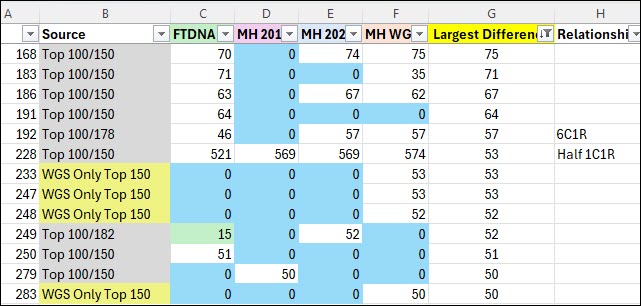
I calculated the largest differences between the highest and lowest match values between the four tests, and placed that value in column G. This means that I subtracted the lowest value of the four tests on this particular match, from the highest value.

In the first row, that means I subtracted 0, the MH 2019 test value, from 75, the WGS test value. The difference between the lowest and highest values is 75 cMs.

Next, I sorted, highest to lowest in column G, so the largest difference is displayed at the top.

I was VERY surprised to see a difference as high as 75 cM, so let’s evaluate the results where the difference is 50 cM or greater. Thirteen matches fall into this category.

  • Entry 168 – The largest difference at 75 cM. This person matches me at 70, 74 and 75 cM, but not at all on the 2019 test, which caused me to go back and check again. Did I spell the name correctly? Yes, I did. We don’t know why I don’t match this person on the 2019 test, but the other matching cM values are very close so they look to be correct.
  • Entry 183 – I match this person on both the FamilyTreeDNA uploaded test at 71 cMs, and the WGS test at 35 cMs, around half as much on the WGS test as the FamilyTreeDNA test. I don’t match them at all on either the MyHeritage 2019 or 2024 kits. I have no explanation.
  • Entry 186 – Like entry 168, we match on three of four tests at 62, 63 and 67 cMs, with the non-matching test being the 2019 test. I would presume that this match is accurate as well.
  • Entry 191 – This one is interesting because I match this person on the FamilyTreeDNA uploaded test at 64 cMs, but none of the other tests.
  • Entry 192 – We match at 57 cMs on both the WGS and the 2024 tests, but not the 2019 test, where we don’t match at all. The match on the FamilyTreeDNA test is 11 cMs lower, at 46 cMs.
  • Entry 228 – This person is my half 1C1R, and I match them on all the tests, of course. However, there’s a 53 cM difference between the WGS and the FamilyTreeDNA uploaded test. In a relationship this close, 53 cM is a small percentage and won’t affect matching, but it’s not an insignificant amount of DNA.
  • Entries 233, 247, 248 and 283 – I match these people ONLY on the WGS test at 50, 52 and 53 cMs, so if I hadn’t taken the WGS test, I wouldn’t match them at all. Without additional research, we can’t tell if this is a legitimate match or not, but 50-53 cM would be a lot to be imputed or to be identical by chance. These people also match one of my parents’ tests, which eliminates the identical by chance possibility, meaning some of the DNA matches my mother and some matches my father – at least on my end. We can’t determine if this match is identical by chance on their side. I’ve never seen a 50+ cM segment (or even close) that is identical by chance, though.
  • Entry 249 – Matches on the FamilyTreeDNA test at 15 cM, and the MyHeritage 2024 test at 52 cM, but not the others.
  • Entry 250 – Matches at 51 cM on the FamilyTreeDNA test, but not on any of the MyHeritage tests.
  • Entry 279 – Matches only on the MyHeritage 2019 test at 50 cM.

Difference Range

Next, let’s review the entire range of differences, meaning the largest matching difference for any one person across all four tests, by group. I’m including all 434 here so you can judge for yourself.

  • 50-75 cM difference – 13 matches analyzed above

  • 45-49 cM difference – 22 matches

  • 40-44 cM difference – 11 matches

  • 35-39 cM difference – 9 matches

  • 30-34 cM difference – 10 matches

  • 25-29 cM difference – 12 matches

  • 20-24 cM difference – 26 matches

  • 16-19 cM difference – 28 matches

  • 13-15 cM difference – 29 matches

  • 9-12 cM difference – 29 matches

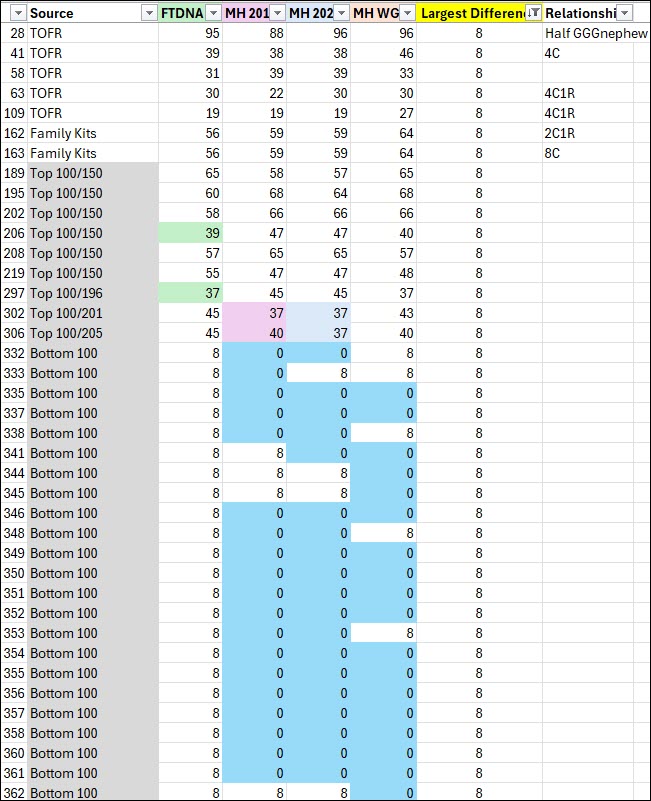
  • 8 cM difference – 78 matches

The 8 cM difference has the most of any value or category because this is the lowest level of matching at MyHeritage. Many tests have a minimum level match on a test or tests, and no others.

  • 6-7 cM match difference – 41 matches

The match differences at 5 cM and below are inconsequential. 57 matches fall into this category.

Commentary

One of the indicators of a valid match is if a parent has tested and also matches,

Of these 434 matches, 35 match neither parent, and most of those are at the smallest match level, meaning 8 cM. Of all the match amounts, that would be the least reliable, and most likely to be a false positive match, or identical by chance.

However, that’s not universally the case. Some WGS results match people at significantly higher levels, but don’t match parents. Two WGS matches match people at 47 and 49 cMs, respectively, and not on any of the other tests. Those two WGS matches don’t match either parent.

After reviewing all 434 selected matches, it appears that both the FamilyTreeDNA 2016 test, and the WGS test produce the most consistent and reliable results of the four tests.

44 people, or 10%, match on BOTH the WGS and the FTDNA tests, but neither of the other two tests. A total of 13.8% match EITHER the FTDNA test OR the WGS test, but not the others.

Conclusions

I think we can draw several conclusions from this comparison.

First, let’s evaluate the number of matches. Looking at the differences between the total number of matches between the various tests, especially the three MyHeritage tests, over time, isn’t that great. That’s exactly why you can’t depend on these numbers as an accurate comparison.

FTDNA 2016 MH Health 2019 MH 2024 MH WGS
Total Matches 19,722 17,179 17,767 17,676

There are only a few hundred differences between the three MyHeritage tests, and about 2000 between the FamilyTreeDNA test uploaded in 2016 and the various MyHeritage tests. That’s a substantial difference.

The difference number of matches between tests may seem irrelevant, especially the MyHeritage tests, until you realize that those who match AREN’T ALL THE SAME PEOPLE. In other words, comparing the MyHeritage 2024 test with the WGS test only shows a difference of 91 matches. This DOES NOT mean that the MyHeritage 2024 test and the WGS test have 17,676 of the same people who match both tests, and that the 2024 test simply has 91 more matches than the WGS test.

As we’ve seen, many people who appear on any one match list don’t appear on other match lists.

Our analysis showed that 44.9% of my 434 matches compared appear on all match lists, which means that more than half of my matches appear on one or more match lists, and not the others. Therefore, just comparing the number of matches isn’t really relevant. You need to compare the people included on all the different tests, which is why I created my spreadsheet and included people from a wide variety of sources.

3.7% of my matches on the WGS test were not on any other test, which extrapolates to approximately 654 of my total WGS matches that I wouldn’t receive any other way.

I care a great deal about those matches, especially since at least some appear to be high value.

Yes, I absolutely, positively want those matches, especially when you consider that some of the matching differences are as high as 75 cM. A 75 cM match can be in the second, third or fourth cousin range.

Realistically, they may or may not be valid or useful matches – but if I don’t have the opportunity to compare them, I’ll never know.

Should You Purchase the WGS Test If You’ve Already Tested?

So, now for the question you’re surely asking yourself.

Truthfully, when I ordered my test back in December, I was ambivalent. I only ordered it to do this comparison for my blog readers – and I really dislike spending money on something that I don’t think will benefit me.

Note the words “don’t think.”

I’ve changed my mind, for several reasons, and I’m glad I ordered the test.

The thing that changed my mind was that I received a nontrivial amount of matches on the WGS test that I didn’t receive on any of the others – even if some of them turn out to be identical by chance.

Since we can’t go back in time and take the earlier tests, and MyHeritage no longer accepts uploads from other vendors, our decision now is whether or not we should take the new WGS test, or not, especially if we already have a DNA test at MyHeritage.

If you’re a new tester, by all means, test at all four of the main vendors. DNA matching is the best thing since sliced bread.

However, the people I’m really speaking to here are those who already have a test of some sort at MyHeritage.

Here’s the bottom line:

  • You will receive WGS matches that you didn’t receive on your other test – and vice versa, so don’t delete your older test at MyHeritage
  • Some of those new WGS matches may well be high-value matches – as was illustrated in the “differences” I discovered.
  • Given the differences in who is included in the match list, your TOFR will be different too – perhaps leading to a brick wall breakthrough. I have two that I’m just itching to solve.
  • Use matches, shared matches and TOFR from ALL of your tests at MyHeritage.

My Biggest Regret

As Ran Snir said, new features and developments at MyHeritage will be based on the WGS test. We don’t know what those developments might be, or when they will become available. But it’s very clear that while testers on the older testing platforms will receive as much as MyHeritage can give them, the MyHeritage DNA future is being build on the WGS platform. I want to be there and benefit from new discoveries.

My biggest regret is that my parents aren’t around to take the new WGS test – and neither are several other family members.

Of the 15 family members whose tests I manage at MyHeritage, 9 are deceased, and I think that four more are as well. Two others are now quite elderly and are no longer able to consent or retest.

Your closest family members are your DNA anchors, identifying lineages and pointing you in specific directions, guiding your research.

The very best thing you can do for your genetic genealogy is to test your grandparents if they are living, and your parents. If they aren’t available, test your closest relatives such as grandparents, siblings, aunts, uncles and first cousins.

Preparing for the Future

So, here’s my advice:

  • Take the WGS test yourself in order to glean as much information as possible and to benefit from future developments.
  • Retest any relatives whose tests you manage on the WGS platform, if possible.
  • Test your close family members and anyone you know whose DNA test could help you identify ancestral lineages.

Why is testing your relatives important?

Close relatives will carry some of the DNA from your mutual ancestors that you don’t.

Having the known DNA of your ancestors means that you can evaluate and analyze the trees of the entire group of people who match those identified DNA segments to see if you can break down an upstream brick wall.

I’ve been successful doing this for some time – and am in the process again by combining DNA matches and traditional records research.

Coupon Code for $20 DNA Test

MyHeritage has been kind enough to provide a limited-time coupon code (RobertaFeb26) for my readers which DROPS YOUR PRICE for the DNA test to $20 through February 28th at midnight.

This is the absolute lowest price I’ve ever seen for a DNA test.

You’ll receive the following features that are included with every test:

  • Ethnicity and ethnicity map
  • DNA matches and the ability to contact them
  • Shared ancestral surnames
  • Chromosome browser
  • cM Explainer

In addition, with this code you’ll receive both Shared DNA Matches and Shared Ancestral Places that usually require a subscription.

Normally, a subscription is required to access:

  • Trees of DNA matches
  • Shared DNA Matches (free now with the coupon code)
  • Shared ancestral places (free now with the coupon code)
  • AutoClusters
  • Theory of Family Relativity (TOFR)

If you’re interested in trying a subscription, click here to purchase a MyHeritage subscription with a free trial.

Here’s the link to purchase the DNA test, and here’s the coupon code to enter at checkout: RobertaFeb26

And yes, absolutely feel free to share the coupon code with your family, friends, and anyone else who might benefit.

Let me know how your results compare when you receive them.

_____________________________________________________________

Share the Love!

You’re always welcome to forward articles or links to friends and share on social media.

Subscribe!

If you haven’t already subscribed, it’s free. You’ll receive an e-mail whenever I publish by clicking the “follow” button at the top of the main blog page, here.

Help Keep This Blog Free

I receive a small commission when you click a vendor link in my articles and purchase that item. This does NOT increase your price but helps me keep the lights on and this informational blog free for everyone. Please click on the affiliate links in the articles or to the vendors below if you are purchasing products or DNA testing.

Thank you so much.

DNA Purchases and Free Uploads

Genealogy Products and Services

My Books

Genealogy Books

Genealogy Research

Genealogy Proof Series: Gathering Location Resources

This is the first article in the Genealogy Proof Series.

Most genealogists, even if they don’t realize they are genealogists yet, begin by creating a small tree of their known ancestors. Most people know who their grandparents are, and by asking a few questions, can probably complete another generation or two.

If your parents were born in 1950, your grandparents would have been born about 1920, and your great-grandparents may have been born around 1890. You probably have concrete facts about your parents. Their birthdates, birth location, marriage location, and so forth. They probably have the same information about their parents. However, with each generation reaching back in time, the information becomes less precise and less reliable. Memories fail people, and the information they were provided may not have been accurate in the first place.

For example, my mother told me what she knew about her maternal grandfather, which wasn’t much. He died when my grandmother was 20, several years before my mother was born.

As the information becomes thinner, the need for additional information and confirmation of facts becomes crucial. Furthermore, when utilizing new resources, you may discover information not previously known about close generations. One of the best resources for that is old newspapers.

Our ancestors are more than birth and death dates. I like to piece their life together, complete with historical events, both national and local, and how they influenced and affected their lives.

This first article explains how I gather and utilize location resources for each ancestor.

Before we start, let’s talk for a minute about where we are going and how this series will be organized.

The Genealogy Proof Series Roadmap

It’s difficult to put the steps in a specific order because often, I get very distracted and go right down a rabbit hole.

In other words, I’ll be working on gathering resources for a specific county, but then I find a listing for what I think is my ancestor, and before you know it, I’m off on the chase. I really, really try NOT to do that because it’s actually very distracting to the process as a whole.

It’s also difficult for me to select an order to write these articles. For example, do I write about Leveling Up, determining what you need for each ancestor, first or last?

I’ve chosen to write about that topic last because I want to step through how to gather and use the resources before we get distracted by what you need to do with individuals in your tree. It’s way too easy to go after that bright, shiny object:)

Gathering and Organizing Location Resources: This article is about how to find location resources for the area where your ancestor(s) lived. I suggest starting at the beginning, meaning your closest ancestors. You know where your parents and grandparents lived, so start there.

If you think there’s nothing there that matters because you know everything about your family – I guarantee you surprises are waiting. They may surprise you, touch your heart, or even shock you, and they are just waiting to be discovered. But before you can logically extract everything to do with your family and surname, you need a comprehensive list of what is available for your county and region.

You’ll also need to keep a record of what you looked for in that county, and when, because you may very well need to go back and access those records again in the future.

Recording Your Data: After you have a list of what’s available for your specific counties, in the next article, we’re going to talk about extracting information and recording it in a spreadsheet. If you don’t like spreadsheets, you can do the same thing in a table. But it’s critical that you record it someplace.

You’ll also index and transcribe it as you go so you can reasonably retrieve it. This is why I utilize spreadsheets – they are made for filtering and sorting.

Surname Searching: You’ve found location resources, but where do you find surname resources? For example, what about books written about the Estes surname, or internet resources? Some will be in books or webpages about the location, but certainly not everything.

How do you find additional resources?

Proof Table: Now that you HAVE data about all the people in a region or regions where your ancestors lived, how do you prove that the Moses Estes or George Estes in Halifax County, Virginia is YOUR Moses or George Estes? What about men with the same name? What if there is no definitive proof in ONE document?

We will discuss the Genealogy Proof Standard and create a proof table for every single generation because you need proof for every single generation.

Including DNA.

(If you’re beginning to think you might dislike me by the time this series is finished – I fully understand. If it helps any, some days I’m tired and mad at myself.)

DNA: How and when can you use DNA as part of your proof argument? What about the different types of DNA? When are they useful? Are they conclusive? How do they bolster or refute other evidence?

Can you resolve conflicts between DNA and a paper trail, and if so, how?

Leveling Up: Leveling up is a methodology of determining where you are in the process of evaluating EVERY PIECE OF EVIDENCE available about each ancestor.

You don’t know what you don’t know.

For those of us who have been working on genealogy for a long time, it’s easy not to think about using new resources when they become available. For example, the 1940 and 1950 census, new full-text AI from FamilySearch, and new newspaper resources like OldNews.

What do you need to do yet for each ancestor to bring them to current?

Writing It Up: Now that you HAVE this information assembled, what will you do with it? I fervently hope you’re going to write or record it for posterity. I’ve chosen the 52 Ancestors series that I’ve been writing weekly for several years, but there are other ways, too. Genealogy is about resurrecting and honoring the lives of our ancestors. The more factual information you can saturate the airwaves and internet with, the less “bad information” can take hold. Genealogy is a team sport.

Gathering and Organizing Location Resources

This article is focused on gathering and organizing resources for where your ancestor lived, NOT on retrieving the records in those resources for your ancestor and their surname. The next article will cover retrieving and recording the data using a consistent methodology.

If you’ve followed my blog for some time, you’ll know that I’m a spreadsheet person, but I also use MSWord documents to organize and utilize resources from time to time, especially if the text is long. I have one Word document for every ancestor.

I’m going to use a chart as an example, understanding that you will create your own resource-tracking tool that you’re most comfortable with.

The first consideration is that you probably have at least three ancestors in any specific location. By that, I mean at least two parents and one child. You may have significantly more ancestors and family members from that location.

Conversely, those same ancestors may have moved from location to location – even state to state or cross-country, so you may have multiple locations for the same ancestor(s).

In my family, I have clusters of ancestors in the same county. For example, my early Estes line, along with their wives’ lines including Combs, Younger and Moore, resided in Halifax County, Virginia for about 4 generations or more than 50 years. The first generation, Moses Estes (1711-1787) who moved to Halifax County by 1771 came from someplace else, and the last generation, John R. Estes (1787-1885), moved to Claiborne County, TN about 1820, not long after his marriage.

I searched Halifax County records for at least four surnames and multiple generations.

This means I needed to compile the various resources for Halifax County across a significant amount of time.

Resources for Resources

There are multiple places to find available resources for a specific county and state.

We will use these to complete our own research list by county. In the next article, we’ll be checking each one of these resources for surnames.

FamilySearch Wiki

The first thing I do when beginning to compile resources is check the FamilySearch wiki.

Googling “Halifax County, Virginia FamilySearch wiki” brings up a lovely compilation of resources.

You’ll find general information by category, followed by very specific information and multiple resources for each category.

Click on any image to enlarge

Also note that the county website link is given, along with the county formation history further down the page. Don’t neglect to check each county’s individual resources and parent county, if relevant.

If you’ve checked the wiki, or any resource list before, check back often because things change.

I enter each of the resources into a spreadsheet for that county. This is NOT the same thing as making a list of information discovered for an individual ancestor or surname. We’ll get to that later.

Don’t limit yourself to just the years that you know your ancestor was living in that county because records pertaining to that family may exist before your ancestor arrived and long after they left. Other family members may have preceded them, while lawsuits, deeds, and other records may refer to them decades after they left or died.

Here’s the beginning of a list for Halifax County,

Resource State County Link Year Range Surnames Findings
Virginia Bible Records Virginia Halifax http://usgwarchives.net/va/halifax.htm Estes, Younger, Combs, Moore One was donated by the Tune family.
Halifax Biographies Virginia Halifax http://usgwarchives.net/va/halifax.htm Estes, Younger, Combs, Moore
1782 tax list Virginia Halifax http://usgwarchives.net/va/halifax.htm, http://files.usgwarchives.net/va/halifax/census/1782/1782tax.txt 1782 Estes, Younger, Combs, Moore 5 Estes, 1 Combs, 2 Younger 6 Moore
Slave Draft for Defense of Richmond Virginia Halifax http://usgwarchives.net/va/halifax.htm

http://files.usgwarchives.net/va/halifax/court/1862slavedraft.txt

1862 Estes, Younger, Combs, Moore 2 Younger, 2 Moore

I enter the county and state in two fields, so it’s sortable. If I’m checking multiple counties using the same resource, I enter the resource twice, one for each county and the surnames in that county that I searched for.

For example, this link for Virginia Bible records takes you to a link for Halifax County Bible records on the USGenWeb site. I listed the surnames I checked for. I also noted the Tune donation because I know from prior research that the Tune home is on the old Marcus Younger land and the families intermarried. When you search any county for another surname, be sure to add it to the list so you don’t have to wonder later if you checked for that surname.

For county histories and biographies, check to see if they are available digitally. In the next article, you’ll want to search for and record all instances of your surname, even if it’s NOT your ancestor, because of the FAN club, Friends and Neighbors (thank you ,Elizabeth Shown Mills). Those people may or will help you identify which ancestors are yours. Not to mention fleshing out their lives.

Tax lists are often used to replace or supplement the census. You should be able to determine if the lists are recorded in procession order or alphabetical order. Clearly, procession order is much more relevant because it shows who lives nearby or are neighbors. This may help you identify specific individuals, especially when there are multiple people with the same name. In the case of John Estes in Halifax County, Virginia, the tax list placed “my” John by his father, George, which was a huge clue. Eventually, on a tax list that was stuffed in the back of a deed book in the Clerk’s Office, I found another tax list with the note, “S. G.” by my John’s name, and another note on the “other” John that lived in the north end of the county. “S.G.” meant son of George, as that designation had been used and spelled out for other people elsewhere in the same tax list. I’ve never been so grateful to the taxman in my life!

The Slave Draft for the Defense of Richmond is a fascinating document transcribed by a volunteer from the court minute book.

From Minute Book 20 page 169 Halifax County, Va

At a Court Held for Halifax County on Monday the 4th day of April 1862. Present Beverly Sydnor, Howell Chastain, John M. Craddock, William Moorewell, James Kent, Henry C. Logan, James Richardson, E. A. Coleman, Archer A. Farmer

The court in consideration of the Draft from the Governor of the Commonwealth for laborers on the Public Defense near Richmond do order and direct that the Sheriff of this County do proceed for ___ to require the following named persons to deliver to him the said Sheriff at News Ferry Depot, Boston Depot, Clover Depot and as may be convenient to the parties on ___ the day of ___ at such see hours as he may designate the Slaves between the ages of eighteen and fifty five years directed to be furnished by each person in the said following list and proceed with them to the City of Richmond and deliver them to the Agent of the Confederate Government and take receipt for the Slaves furnished by each person.

Then, by district, the name of the owner, and the number of enslaved persons sent.

This information may provide insight into who enslaved others at that time, which may provide insight into families that were slaveholders historically. Additionally, it may provide important hints and clues for African American researchers who seek their family and may have adopted the surname of their former enslaver after the war.

Also, please note that these records may not be entirely accurate. For example, there’s a list of ministers who performed marriages, and my Rev. William Moore is not listed, but I actually have the list of his marriages, returns made in his own handwriting obtained in the courthouse in Halifax County.

If you remember, I found my way to GenWeb through the FamilySearch Wiki. When I finish listing the GenWeb resources, I need to return to the FamilySearch wiki to list any further resources.

You may find lists of out-of-print books for land and property records and other record types. I sometimes find out-of-print books for sale at www.bookfinder.com.

If you own the book, note that it’s in your own library.

To locate books, check the WorldCat entry, but also check both the FamilySearch Catalog by county, the Fort Wayne Public Library and other book resources as well.

Surnames

While the goal of this exercise is to document and record location resources, if you stumble across surname resources, certainly don’t ignore them and think you’ll find them later – you might not.

I suggest starting either a second spreadsheet, or new tab on this spreadsheet for each surname.

I maintain a separate spreadsheet for each location and one for each surname or group of surnames on the same migration path. For example, my Combs, Estes, Moore, and Younger families are migrating from the Virginia Colony into the new frontiers, so I track them together from Amelia and Prince Edward Counties, where they are first found through Halifax County.

Ok, back to searching for our county resources.

FamilySearch Catalog

To search the FamilySearch Catalog by county, sign in and then click on Search, Catalog, and Place.

I was given the choice of British Colonial America or the United States. I’ll check both to be sure I have all available resources.

Selecting “Land and Property,” one of the items displayed is the Antrim Parish Vestry book. By clicking on that entry, you can see that it’s available in the FamilySearch Library in Salt Lake City. Maybe it’s available elsewhere too. I’ll check in a bit.

I build research lists from these resources routinely.

The entry for deed books shows that some are available online only at either the FamilySearch Library or a Family History Center (camera with key), which may be located near you. Other images are available online with no location requirement, indicated by the camera without a key, just by clicking.

These may or may not be indexed, and an index may be available elsewhere or by using the new FamilySearch Labs AI full text transcription tool. AI is not available for all records yet.

FamilySearch Labs

Next, try FamilySearch labs for additional assistance. I wrote about this new AI full text transcription tool, here.

You’ll see two features which may help you.

Using the “Find Help with AI Search” feature, type in what you’re searching for. I find the Full Text Search” to be much more helpful.

Click on “Go to Experiment.”

Typing “Halifax County, VA” into the search box returns resources from unexpected places. For example, county histories from elsewhere that reference Halifax County, or a Divorce degree, or a deed book from another county.

These are unexpected gold mines that you’d never find otherwise.

Note that this search is literally an exact match, so Halifax County, VA, is NOT the same as Halifax County, Virginia.

However, adding a surname to the location narrows the results substantially.

While normal deed and other books are indexed by the grantor and grantee, the FamilySearch full text search reveals EVERY instance of that name, including when referenced in another document. This feature is an absolute game-changer!

I can hardly wait to revisit my earlier work to see what’s new, but that’s part of the Level Up process.

It’s important to note that FamilySearch is adding new types of records to the AI collection almost daily, so check back often. Not everything uses the full-text transcription feature today, and while it’s quite accurate, it’s not 100%, so read carefully for yourself.

FamilySearch Book Search

You can also search for books by location or surname.

Allen County Public Library

The Allen County Public Library in Fort Wayne, Indiana is one of the largest genealogy libraries in the US. You can search their site for locations, keywords, or surnames, here.

While these resources are generally not available online at this library, they alert you that they exist, and you may be able to find them elsewhere.

The one HUGE exception is the one-of-a-kind PERSI index.

PERSI

The PERSI, or Periodical Source Index is maintained by the Allen County Public Library as well, here.

You can search by location.

Click on a category that displays the results.

At the bottom of each page, you can open a form to request a copy of the article.

Ancestry.com Card Catalog

At Ancestry.com, you can search their Card Catalog by title or location.

Be sure to try different spellings and abbreviations, like VA for Virginia, or remove the word county, etc.

The results display a list of records for Halifax County in their collection.

You can click on the link to this book to search by surname or keyword.

These local histories are wonderful tools for fleshing out your ancestor’s stories because they tell us what was happening in their community during different time periods that would have affected and influenced their lives.

For example, in one of these histories, I discovered that one of the Revolutionary War generals and his troops marched right down the road in front of my ancestor’s home. It’s no wonder that he “contributed” brandy, food, and fodder for their horses.

Newspaper Sites

At Newspapers.com, you can see which papers were available and when.

You can also add a surname or first and last name.

Unless there’s a story about someone’s ancestors, there’s no point in looking for people who lived there in the 1700s and early 1800s. These are the publication dates, so an earlier ancestor could have been included in a 25 or 50-year history column in the local paper.

This same technique works with other genealogy Newspaper sites, too, including MyHeritage with a subscription and separately, their new OldNews site which contains newspapers not included in the MyHeritage subscription.

Also check out the Library of Congress digitized newspaper collection, here.

Newspaper Archive is available with an NGS membership, here.

Fulton County (not limited to Fulton County) and GenealogyBank are two additional newspaper resources.

MyHeritage

At MyHeritage, you can search by location or Newspapers as well.

MyHeritage has one book about Halifax County.

By clicking on the book, you can add additional search criteria.

Estes is mentioned 16 times in this book.

Library of Congress

Don’t forget about the Library of Congress, which has its own Historical Newspapers section, here.

You can also search by county or surname in the search box at the top. The images are all copyright-free.

State Archives

Don’t forget about your state archives.

Most have wonderful search capabilities and specific collections.

For example, the Library of Virginia has been indexing individual county chancery records dating back to the county’s formation. Chancery suits are where you find all the juicy stuff because people are asking for remediation and explaining why.

The index is here, and you can search by a combination of county and surname.

There are 59 records in Halifax County fitting this description, mentioning Estes in any capacity, reaching back as far as 1795.

Don’t neglect later cases because many times later cases tend to be lawsuits filed about much earlier estates and property divisions. They also tend to provide relationships in their narrative.

You’ll also notice that often, the plaintiff and defendant aren’t Estes, but they are clearly mentioned somewhere in that case, perhaps in a deposition.

Clicking on “View Details” displays the entire case file.

The resources at each state library are different and vast, so take a look and check back for new offerings and features.

Google is Your Friend

Google can turn up amazing resources, but it can also lead to some unsafe sites, so be careful and don’t just click without thinking.

Google “Halifax County Virginia genealogy society.” You’ll receive eight results that may have databases, members, or donated materials, but these resources may not be complete. For example, I wrote and donated a Moore genealogy to the local museum, which doubled as a genealogy society, and that “book” isn’t listed anywhere in any resource list.

You’ll often find multiple groups focused on the county of interest. These groups will likely have dedicated and interested volunteers and other researchers.

RootsWeb

Ancestry shut down the RootsWeb mailing lists, but they are still out there even though you can no longer add information.

If you Google “Halifax County, Virginia Rootsweb,” you’ll be shown several pages and entries, some of which may or may not be useful to you.

One link provides a list of the 1860 slaveholders compared to the 1870 African Americans on the census. This could be extremely useful!

Google Books

Another underutilized tool is Google books, found here.

Some of these resources you’ll not find elsewhere.

Also, check out the other Google features, such as Images, Maps, and more, which may lead you to other resources.

I love old maps where sometimes you’ll find old stream names, landmarks, or even settlers’ homes with their name.

Project Gutenberg

Project Gutenberg is an initiative found at the Internet Archive to digitize out-of-copyright books for public consumption.

You can read more here.

Genealogical.com and American Ancestors

Don’t forget about book publishers that specialize in genealogy books like Genealogical.com and American Ancestors. Both are searchable, offer both hardcopy and e-books, and American Ancestors sells used books too.

Facebook

Last but not least, Facebook has many groups, including county-focused genealogy groups.

Sign in to Facebook and then use the Facebook search for the county you want.

Some groups maintain a list of resources.

Be sure to check both “Files” and “Features,” then use the Facebook search function to search for your surname(s) or other relevant locations or keywords in the Discussions.

In Summary

As you step through this process, it’s easiest if you include links to the various sites so that you can extract names in the next step. Links make it easy to return in the future and quickly review to see if anything has been added.

Even if you don’t find anything relevant at the site, be sure to NOTE THAT. That way, you never have to wonder and replow that same infertile ground. For example, if you determine that none of your four surnames are in a book written in 1937, they will never be in that book. If you don’t record that you looked, you’ll be left to wonder a few years from now and you’ll find yourself looking again.

However, a new book about that county might be written in the future, so it’s important to continue to look for new resources.

It’s also important to know that you searched for Estes, Moore, Younger, and Combs in Halifax County because you might, someday in the future, need to search for a new surname, like Hart. This way, you know what you did and did not search for in the past.

Why might you need to search for a new surname? Brick walls fall. Sometimes, the FAN Club turns out to be an important key to unlocking relationships that may extend back in time to earlier locations. People did not live or move in a vacuum.

I’ve made every one of these mistakes and nothing makes me unhappier than having to look something up, AGAIN, because I failed to record what I did.

The same advice holds for hard-copy books in research libraries. If nothing else, I take a picture of the front or inside cover and the index so I know what to record and that nothing was found. I wish I had done that from the beginning. Live and learn.

The biggest lie I’ve ever told myself is, “Of course I’ll remember that!”

Your Turn

It’s your turn now. Happy hunting!

Our next articles in this series will discuss how to record data from these resources so that it is both useful and findable again.

_____________________________________________________________

Follow DNAexplain on Facebook, here.

Share the Love!

You’re always welcome to forward articles or links to friends and share on social media.

If you haven’t already subscribed (it’s free,) you can receive an e-mail whenever I publish by clicking the “follow” button on the main blog page, here.

You Can Help Keep This Blog Free

I receive a small contribution when you click on some of the links to vendors in my articles. This does NOT increase your price but helps me keep the lights on and this informational blog free for everyone. Please click on the links in the articles or to the vendors below if you are purchasing products or DNA testing.

Thank you so much.

DNA Purchases and Free Uploads

Genealogy Products and Services

My Books

Genealogy Books

Genealogy Research

RootsTech 2024 – MyHeritage is ON FIRE with 13 Announcements

I’ve got to tell you, MyHeritage has outdone themselves.

I had a hard time just keeping track of their announcements, which totaled 13 – a baker’s dozen.

You can watch the MyHeritage RootsTech keynote by Aaron Godfrey, here.

However, there are a few things not in the video, so let’s take a look at a quick summary of what’s new.

DNA Uploads with Free Advanced Tools Forever Extended Until March 10th

MyHeritage just extended their DNA upload that includes ALL ADVANCED TOOLS FOR FREE, forever, to March 10th so click here now to upload every kit you manage. This is a great deal. Hint – new ethnicity results are coming soon and you’ll be saving $29 on each kit you upload.

20+ Billion Records

MyHeritage has just passed the 20 billion record mark and is continuing to add. That’s billion, with a B. These records are available to customers with a MyHeritage subscription. If you don’t have a subscription, you can try a MyHeritage Subscription with a Free Trial, here.,

Additionally, right now, subscriptions are 50% off, but I don’t know how long that price lasts.

I love my MyHeritage subscription, and if you try it and don’t like yours, you can cancel and be charged nothing during the 14-day trial period.

I particularly like that the local newspaper where my grandparents lived is available on MyHeritage, and no place else. In addition, MyHeritage has integrated with FamilySearch, which is digitizing and indexing records like wildfire. That collaboration has provided me with information from European sources, including archives.

MyHeritage Wiki

MyHeritage has been working on their new Wiki, a community encyclopedia for genealogy and DNA, for almost a year now, although it was only recently released.

Photo courtesy of MyHeritage

I’ve been honored to write several articles for the newly announced MyHeritage Wiki, including the definition of DNA itself:

Take a look at the new Wiki, here.

You can filter in a number of ways, and you can even sign up to be a contributor.

Check out their blog article, here.

AI Record Finder

The AI Record Finder is the world’s first AI chat-based search engine for historical records.

I should probably tell you that, at this point in time, I do use AI, such as ChatGPT, very cautiously, and I’m inherently suspicious because AI tools sometimes hallucinate. It’s a new technology with lots of glitches and unknowns, so let’s see how MyHeritage is using this tool. It should be much more reliable since it’s in a controlled environment. I need to be convinced. 😊

The AI Record Finder is under the Research Menu. Just type your question about your ancestor.

I’m cheating and giving MyHeritage a tough one. I typed, “Please tell me about Solomon Ferwerda, who died in 1768 in Groningen, the Netherlands.”

MyHeritage returned three possibilities in their database, including their affiliated databases. One is a MyHeritage tree and two are records from FamilySearch.

Don’t limit yourself at this point.

I happen to know “my” Solomon is the first person, but I played around a bit before selecting the “right” Solomon. Why? Because there’s a lot that I don’t know about his life. It’s possible that the second and third records are ALSO the right person, so be sure to review everything.

Clicking on the middle or right record for Solomon shows that, indeed, this record from FamilySearch comes from the Dutch Archival Indexes, so it’s not “just someone’s tree.”

We do know the Ferwerda family is from Leeuwarden, but we don’t know when Solomon was born, nor if he was married twice. I only have the name of his second wife and one child, Jan, who was born the year he died.

The two FamilySearch Dutch archive records are from Leeuwarden, so maybe, just maybe, I’ve discovered something new about Solomon. How exciting!

I need to click through and check this out further.

I didn’t expect to like this tool, but so far, I really do. But wait – there’s more.

AI Ancestor Bio

You can click to have MyHeritage generate an AI bio of an ancestor for you.

The bio takes a few minutes to generate and will be available for download in the chat and will also be emailed to you. You can easily share with others. Getting other people interested in genealogy often encourages them to take a DNA test. DNA tests are still on sale for $39, here.

Solomon Ferwerda’s AI bio was completed quickly and arrived in pdf format. We know so little about him, I knew it would be short. I must say, I really enjoyed the “Historical Context” section that discussed the surrounding events that would have affected his life. That’s incredibly important and would have or could have influenced the decisions he made. Maybe the warfare and political unrest caused him to move from Leeuwarden to Groningen for some reason, where he died the year his son was born.

Here’s Solomon’s bio.

Here’s a link to the RootsTech lecture about the MyHeritage AI tools by Ran Snir, the VP of Product.

MyHeritage blog links for AI Record finder are here and here.

You can watch Telling Your Family’s Story with MyHeritage’s AI Features by Janna Helshtein at Legacy Family Tree Webinars, here.

I can’t wait to play with the MyHeritage AI tools more.

Updated Ethnicity Coming Soon

This is going to make a lot of people happy!

MyHeritage is in the process of updating their ethnicity results, increasing their regions from 42 to 80, with significantly optimized granularity in Europe. I initially misunderstood and thought the new results were available now, but they won’t arrive until summer.

I understand from talking to a Jewish friend involved in MyHeritage’s R&D effort that their own results are substantially improved and that they have now been placed in Armenia where their ancestors are from. They are no longer generically “Jewish.”

New Profile Pages with Hints

Daniel Horowitz said that everyone calls Smart Matches and Record Matches hints, so now MyHeritage has updated profile pages and is adding them to the profile page and officially calling them Hints.

You can still find Smart Matches and Record Matches listed separately under Discoveries, but on everyone’s profile, they are called Hints.

On Solomon’s profile page, scroll down to view his journey based on the information you’ve entered or accepted into your tree.

I did not yet add Leeuwarden, because I’m yet positive those records in Leewarden are his, but if I had, Leeuwarden would also be shown on his journey map. I’ll be incorporating these into my 52 Ancestors stories. I love maps! Maybe I can find old maps to include too,

You can read more about the new profiles and hints, here.

Tree Collaboration with FamilyTreeDNA

Aaron Godfrey announced tree collaboration with FamilyTreeDNA who pre-announced this at their conference in November.

I don’t have specific details about how it works, as this won’t happen for a few months yet, but FamilyTreeDNA customers will port their trees to MyHeritage which allows them to take advantage of MyHeritage’s record collections and such. Existing MyHeritage customers will simply connect their FamilyTreeDNA test to their MyHeritage tree.

FamilyTreeDNA has never been a “tree” company, so this means that users will have one less tree to maintain independently, and they can augment their research with records from MyHeritage.

I talked to Katy Rowe-Schurwanz, the Product Manager at FamilyTreeDNA to confirm that this is NOT a DNA transfer. FamilyTreeDNA matches still occur in the FamilyTreeDNA database, just like always, and MyHeritage matches still occur in the MyHeritage database. If you want matching in both databases, you still have to upload to or test at both. Only the trees are integrated, meaning when you click on a tree at  FamilyTreeDNA, you’ll see the tree displayed on MyHeritage.

The great news is that FamilyTreeDNA features such as Family Matching (bucketing) where you link your DNA matches at FamilyTreeDNA to their profile cards so that maternal/paternal bucketing occurs will still work the same way. The only difference will be that your tree will actually reside at MyHeritage and not at FamilyTreeDNA.

You’ll be able to enjoy the best of both worlds.

We will know more in a few months, and I’ll provide more details when I have them.

Invite Another MyHeritage User to View Your DNA Results

Aaron Godfrey said in the keynote that 2FA (two-factor authentication) at MyHeritage will become mandatory later this month, and with it, MyHeritage is adding the feature of being able to invite another MyHeritage user to view your DNA results. This allows people to collaborate more easily, especially if a different person is managing someone else’s DNA test.

Reimagine Multi-Photo Scanner App

This photo-scanning innovation is for your phone and allows you to scan photos and entire photo album pages – automatically separating and improving the photos. Then, of course, you just tag them to the proper person in your tree like any other photo.

Oh, and did I mention that Reimagine is free? I expected to have to pay when I downloaded the app, but I didn’t, probably because I have a full subscription.

Based on this article, Reimagine is not meant for other types of images, like pages of text or albums of clipped newspaper articles. But guess what? I downloaded the app, and it works just fine for those items! Hallelujah. How I wish I had this last week at the FamilySearch Library when I was finding pages in books I wanted to associate with a specific ancestor.

If you have album pages of photos to scan, this is golden and integrates with the profiles of people into your MyHeritage tree.

I really, really like the idea of having the ability to scan in the palm of my hand. That way if someone has a photo, you don’t have to try to take a photo of it. Gone are the days of literally dragging a laptop and scanner around with me when I’m traveling – just in case. Yes, I actually did and now I don’t have to anymore.

I cringe to think how many opportunities were lost to me before the days of laptops – but not now.

Thank you – THANK YOU, MyHeritage. What a great gift!

You can find the QR code to download the app, here.

OldNews is New News

MyHeritage has introduced a new website for old newspapers called OldNews which you can find here.

This addition doubles the number of newspapers previously available on MyHeritage.

Users can also subscribe separately to Old News for about $99/year.

MyHeritage customers use their normal credentials to sign in to either site, but accessing newspapers not previously integrated into MyHeritage will require an OldNews subscription too.

I had to try it. I entered my mother’s name.

Look, my Mom had a tonsillectomy. I never knew that. It was just a couple of months after she graduated from high school.

I didn’t know Mom spent the summer in Philadelphia, either. She was 19 at that time, and I had heard rumblings that she studied with a “prima ballerina” at the School of American Ballet. Guess where that is? Yep, Philly.

My Mom was a professional tap and ballet dancer before she became my Mom.

Understanding that Mom spent the summer of 1942 on the east coast sheds new light on this and a few other photos in Mom’s photo album, which I can now scan.

Ok, I can’t help myself. I have to enhance this photo at MyHeritage.

Much better. Another tiny piece of Mom’s life brought into focus.

I wonder what else is in OldNews that I don’t know about. Hmmmm…

You can read about OldNews here.

New All-Inclusive Omni Subscription

MyHeritage is launching a new Omni all-inclusive subscription plan that includes most of the MyHeritage products and tools, except for Filae, unless I’m missing something. Omni reportedly costs less than half the price if you were to subscribe to all of these individually. I’ve asked for a comparison chart which I don’t have yet, but I’m told will be coming soon.

Here’s what’s included:

Additionally, I asked MyHeritage about whether or not the advanced DNA tools are included with Omni, and they are. So, add advanced DNA tools to that list.

The following information about the Omni Plan is a screenshot from the MyHeritage blog article, here.

I have not been able to determine the price of an Omni subscription. At RootsTech, you were interested in the Omni plan, you submitted a Google form and a day or so later, you received this email.

I suspect MyHeritage needs to talk to you because how much it costs initially depends on your existing subscriptions, and how much time is left on those.

I reached out to MyHeritage and asked when Omni will be available to purchase, and the answer is “soon.” You can’t sign up just yet.

I have never subscribed to Legacy Family Tree Webinars, even though I’m a webinar presenter and have several webinars available there. My gift to myself is going to be Omni when it’s available because I want Legacy Family Tree Webinars, and I’d love a subscription to OldNews. I already have a full subscription to MyHeritage, and I’d probably use Geni more than I do as a casual user if I had the Omni subscription.

Artifact Testing – Maybe

Unfortunately, I was not able to attend CEO Gilad Japhet’s RootsTech session because his session and mine were at exactly the same time.

However, I asked Aaron Godfrey after Gilad’s session what I had missed that was not in Aaron’s keynote, other than Gilad’s wonderful stories.

Aaron and others told me that Gilad stated that he was personally submitting personal artifacts, such as stamps, to a third-party lab once again, to test the waters to see if DNA can now be extracted from artifacts successfully.

MyHeritage tried this a few years ago, ultimately unsuccessfully. Perhaps this time will be different, but I would not hold my breath, truthfully. Degraded DNA has quality issues, not to mention that the DNA extracted might not be the DNA of the person expected.

I would personally love this, but I am also skeptical at this point. Kudos to Gilad for trying again with his own personal items.

MyHeritage Online RootsTech Booth

MyHeritage has provided several educational videos in their online RootsTech booth, at this link. Be sure to take advantage of this free resource.

Whew, I’m finally done! I told you that MyHeritage had been very, very busy, and I wasn’t kidding. I hope I didn’t miss anything.

_____________________________________________________________

Follow DNAexplain on Facebook, here.

Share the Love!

You’re always welcome to forward articles or links to friends and share on social media.

If you haven’t already subscribed (it’s free,) you can receive an e-mail whenever I publish by clicking the “follow” button on the main blog page, here.

You Can Help Keep This Blog Free

I receive a small contribution when you click on some of the links to vendors in my articles. This does NOT increase your price but helps me keep the lights on and this informational blog free for everyone. Please click on the links in the articles or to the vendors below if you are purchasing products or DNA testing.

Thank you so much.

DNA Purchases and Free Uploads

Genealogy Products and Services

My Book

Genealogy Books

Genealogy Research

Congratulations!!! – MyHeritage 20th Anniversary Documentary

A full six-episode documentary about the history of MyHeritage has just been released. I hope you enjoy this as much as I have.

I am incredibly grateful for all of the MyHeritage tools and want to say a personal congratulations to Gilad Japhet. He personally started this company two decades ago and has literally changed the world.

I’ve been very privileged to be in the right place at the right time to be a part of launching these new technologies, some of which leverage DNA, but all of which benefit genealogists.

Congratulations Gilad – and thank you from genealogists around the world. What a leap – from pen and paper to DNA, AI and automation that does what we, individually, cannot. What an incredible legacy – and they are just beginning.

I can’t wait to see what’s next!

You can be a part of the MyHeritage genealogy family by purchasing a MyHeritage DNA test here or upload your DNA file from other vendors free here.

You also receive 14 days free when you sign up for a records subscription here. If you don’t like the subscription, just cancel at the end of 14 days to avoid billing. I use the combination of DNA and records nearly every single day. I can’t imagine genealogy without both. 

23andMe and GlaxoSmithKline Partnership Ends, Sparking Additional Layoffs

23andMe has been slimming down. In April, they announced they were cutting about 75 jobs in their therapeutics division, equating to about 9% of their workforce, and now they have cut another 71 employees in response to the end of the five-year GSK partnership.

GenomeWeb reported the earlier and most recent 23andMe layoffs, along with a 6% revenue dip, here. 23andMe is a publicly held company and reported a net loss of $104.6 million.

In 2018, 23andMe partnered with GSK, GlaxoSmithKline, a British drug company, to jointly develop drugs based on the genomic profiles of their customers who choose to participate in this type of research. You may have noticed that 23andMe asks a wide variety of questions that genealogy testing companies typically don’t, and they also report on health and traits.

At the onset of the partnership, GSK made a $300 million equity investment in 23andMe. If you need to cure insomnia, you can read the SEC filing, here.

The original partnership was to last four years and could be extended for an additional 5th year, which it was, landing another 50 million dollars in the 23andMe coffers.

According to the press release by 23andMe and this 2020 blog article, the partnership has been successful, adding more than 40 genetically validated drug discovery programs to the GSK portfolio, making me wonder why the partnership was not extended.

Customers

The 23andMe page for medical professionals states that they have more than 12 million customers worldwide.

23and Me has stated several times that about 80% of their customers opt-in to research, which means that their de-identified DNA sequences are made available to both 23andMe and their selected partners for research purposes.

Accordingly, about 8 million people have opted-in to research.

If you’re doing the math, that means that:

  • 23andMe received $29.17 for each of their 12 million customers

Viewed another way:

  • 23andMe received $43.75 for each of their 8 million customers who are opted-in for research

Attempting to Increase Revenues

In the past several months, 23andMe has attempted to staunch the corporate blood flow by:

Neither of these moves have been well-received by genealogists.

Purchase Price

23andMe sells two types of tests. One is for both health and ancestry, and the second is for ancestry, aka genealogy, only.

  • The 23andMe Health and Ancestry test is currently priced at $229. The yearly membership costs an additional $69, for a total of $298, but the membership is currently free during the first year. That’s a lot for an autosomal test that only buys you up to 5000 matches.
  • The 23andMe ancestry-only test is $119, but comes with restrictions, including the 1500 match limit.

For comparison purposes, this article shows how many matches I have at each vendor.

If you want more than 1500 matches, you MUST PURCHASE the Health and Ancestry test, not the lower-cost genealogy-only test, plus the additional membership.

This is a very difficult pill to swallow (pardon the pun.) None of the other DNA testing companies limit your matches or charge for matching, and their prices right now for their autosomal tests are as follows:

Subscription aka Membership

In order to entice customers into purchasing subscriptions, called memberships, 23andMe allows up to 5000 matches instead of 1500. 23andMe has also limited additional features, taking them away from their original customers and putting them behind the subscription paywall.

In October 2020, when they implemented subscriptions, called memberships, along with these changes, they reduced their customers’ original match limit from 2000 to 1500. Of course, to receive more matches, you could purchase a new test and subscribe. No thank you.

In another attempt to throttle services to earlier customers, there were initially no ethnicity updates for people in October of 2020 who had tested on V2, V3 or V4 chips, although following public outcry, they reversed that position for at least the V3 and V4 customers. No other DNA testing company excludes customers from ethnicity updates. 

One cannot perform other functions, such as sort or filter by haplogroup on their site, unless you purchase the Health and Ancestry test, plus a membership. You can, however, download your matches and sort/filter that way..

What’s Next for 23andMe?

23andMe says they are now actively pursuing new big pharma partners.

I hope they can find their way forward. While I don’t often find relevant matches at 23andMe anymore, and I have an issue with their subscription policy, especially removing features from existing customers, they do have a pool of 12 million-ish people. These matches certainly help many people, especially because their health customers probably won’t have tested elsewhere.

Having said that, I can’t help but wonder how many of those 12 million are the same person multiple times because they’ve had to purchase multiple tests. I’ve purchased three for myself over the years, and I’m not purchasing a fourth – but I digress.

  • 23andMe is still a good site for matching, especially for adoptees or people seeking unknown family members. You can also see how your matches match each other. You just never know where that critical match is going to pop up.
  • 23andMe provides painted ethnicity chromosome segments, along with FamilyTreeDNA. In my opinion, they are the top two vendors for ethnicity accuracy.
  • 23andMe and FamilyTreeDNA both report X-DNA matching, which can be very useful.
  • 23andMe is still the only vendor to construct a genetic tree – and yes – I know it’s not always completely accurate. Still, their tree creation is innovative and automated – based on how you match people and how they match each other. For adoptees and people seeking parents or grandparents, it’s essential because they start with nothing.
  • 23andMe doesn’t allow customers to upload or create a family tree, so you can’t view the family tree of your matches to find a common ancestor. You can include a link to your online family tree in your Enhanced Profile under Settings, but many people never see this, or aren’t genealogists.

Unfortunately, 23andMe is not focused on genealogy – at all. Their focus has always been medicine and health. From their perspective, genealogists are candidates to opt-in for genetic research, but that doesn’t mean genealogists can’t still benefit – even if we don’t opt-in, don’t purchase the more expensive $229 Health and Ancestry test, and don’t purchase their membership.

If you’re interested in more recent relatives, 23andMe is great because the 1500 match limit won’t impact you at all. Closer relatives will cluster at the top of your match list.

If you’re looking for matches that descend from more distant ancestors, you may find it worthwhile to purchase the more expensive test and the membership, at least for one year.

Filtering/Sorting Restriction Workaround 

While there’s no way around the 1500 or 5000 match limit, except that 23andMe won’t roll someone off of your match list if you’ve communicated with them, or tried to, there is a workaround for the restrictive filtering.

I check my matches periodically, sorting by the newest matched relatives. I also download my match list occasionally. I find it easier to review the information in spreadsheet format because I can search for surnames, locations, haplogroups and other information much more easily than online, especially given the restrictive filters.

However, when you download your match list, that information is downloaded as well.

Be sure to record notes on each match at 23andMe when you discover relevant information by clicking on the match and scrolling to the very bottom of the page. Your notes at 23andMe are downloaded onto the spreadsheet along with the rest of their information.

The instructions for downloading your match list, which is NOT the same as downloading your DNA file, are contained in this article. Give it a try!

_____________________________________________________________

Follow DNAexplain on Facebook, here.

Share the Love!

You’re always welcome to forward articles or links to friends and share on social media.

If you haven’t already subscribed (it’s free,) you can receive an email whenever I publish by clicking the “follow” button on the main blog page, here.

You Can Help Keep This Blog Free

I receive a small contribution when you click on some of the links to vendors in my articles. This does NOT increase the price you pay but helps me to keep the lights on and this informational blog free for everyone. Please click on the links in the articles or to the vendors below if you are purchasing products or DNA testing.

Thank you so much.

DNA Purchases and Free Uploads

Genealogy Products and Services

My Book

Genealogy Books

Genealogy Research

Which DNA Test Should I Buy? And Why?

Which DNA test should I buy, and why?

I receive questions like this often. As a reminder, I don’t take private clients anymore, which means I don’t provide this type of individual consulting or advice. However, I’m doing the next best thing! In this article, I’m sharing the step-by-step process that I utilize to evaluate these questions so you can use the process too.

It’s important to know what questions to ask and how to evaluate each situation to arrive at the best answer for each person.

Here’s the question I received from someone I’ll call John. I’ve modified the wording slightly and changed the names for privacy.

I’m a male, and my mother was born in Charleston, SC. My maternal grandmother’s maiden name was Jones and a paternal surname was Davis. The family was supposed to have been Black, Dutch, Pennsylvania Dutch, and Scots-Irish…only once was I told I was 3/16 Indian, with Davis being 3/4 and Jones being full Indian.

Do I have enough reasonable information to buy a test, and which one?

Please note that it’s common for questions to arrive without all the information you need to provide a sound answer – so it’s up to you to ask those questions and obtain clarification.

Multiple Questions

There are actually multiple questions here, so let me parse this a bit.

  1. John never mentioned what his testing goal was.
  2. He also never exactly said how the paternal line of Davis was connected, so I’ve made an assumption. For educational purposes, it doesn’t matter because we’re going to walk through the evaluation process, which is the same regardless.
  3. John did not include a tree or a link to a tree, so I created a rudimentary tree to sort through this. I need the visuals and normally just sketch it out on paper quickly.
  4. Does John have enough information to purchase a test?
  5. If so, which test?

There is no “one size fits all” answer, so let’s discuss these one by one.

Easy Answers First

The answer to #4 is easy.

Anyone with any amount of information can purchase a DNA test. Adoptees do it all the time, and they have no prior information.

So, yes, John can purchase a test.

The more difficult question is which test, because that answer depends on John’s goals and whether he’s just looking for some quick information or really wants to delve into genealogy and learn. Neither approach is wrong.

Many people think they want a quick answer –  and then quickly figure out that they really want to know much more about their ancestors.

I wrote an article titled DNA Results – First Glances at Ethnicity and Matching for new testers, here.

Goals

Based on what John said, I’m going to presume his goals are probably:

  • To prove or disprove the family oral history of Black, Dutch, Pennsylvania Dutch (which is actually German,) Scots-Irish, and potentially Native American.
  • John didn’t mention actual genealogy, which would include DNA matches and trees, so we will count that as something John is interested in secondarily. However, he may need genealogy records to reach his primary goal.

If you’re thinking, “The process of answering this seemingly easy question is more complex than I thought,” you’d be right.

Ethnicity in General

It sounds like John is interested in ethnicity testing. Lots of people think that “the answer” will be found there – and sometimes they are right. Often not so much. It depends.

The great news is that John really doesn’t need any information at all to take an autosomal DNA test, and it doesn’t matter if the test-taker is male or female.

To calculate each tester’s ethnicity, every testing company compiles their own reference populations, and John will receive different results at each of the major companies. Each company updates their ethnicity results from time to time as well, and they will change.

Additionally, each company provides different tools for their customers.

The ethnicity results at different companies generally won’t match each other exactly, and sometimes the populations look quite different.

Normally, DNA from a specific ancestor can be found for at least 5 or 6 generations. Of course, that means their DNA, along with the DNA from all of your other ancestors is essentially combined in a communal genetic “pot” of your chromosomes, and the DNA testing company needs to sort it out and analyze your DNA for ethnicity.

DNA descended from ancestors, and their populations, further back in people’s trees may not be discerned at all using autosomal DNA tests.

A much more specific “ethnicity” can be obtained for both the Y-DNA line, which is a direct patrilineal line for men (blue arrow,) and the mitochondrial DNA line (pink arrows,) which is a direct matrilineal line for everyone, using those specific tests.

We will discuss both of those tests after we talk about the autosomal tests available from the four major genealogy DNA testing companies. All of these tools can and should be used together.

Let’s Start with Native American

Let’s evaluate the information that John provided.

John was told that he “was 3/16 Indian, with Davis being 3/4 and Jones being full Indian.”

We need to evaluate this part of his question slightly differently.

I discussed this in the article, Ancestral DNA Percentages – How Much of Them is in You?

First, we need to convert generations to 16ths.

You have two ancestors in your parent’s generation, four in your grandparents, and so forth. You have 16 great-great-grandparents. So, if John was 3/16th Native, then three of his great-great-grandparents would have been fully Native, or an equivalent percentage. In other words, six ancestors in that generation could have been half-Native. Based on what John said, they would have come from his mother’s side of the tree. John is fortunate to have that much information to work with.

He told us enough about his tree that we can evaluate the statement that he might be 3/16ths Native.

Here’s the tree I quickly assembled in a spreadsheet based on John’s information.

His father, at left, is not part of the equation based on the information John provided.

On his mother’s side, John said that Grandfather Davis is supposed to be three-quarters Native, which translates to 12/16ths. Please note that it would be extremely beneficial to find a Y-DNA tester from his Davis line, like one of his mother’s brothers, for example.

John said that his Grandmother Jones is supposed to be 100% Native, so 16/16ths.

Added together, those sum to 28/32, which reduces down to 14/16th or 7/8th for John’s mother.

John would have received half of his autosomal DNA from his mother and half from his non-Native father. That means that if John’s father is 100% non-Native, John would be half of 14/16ths or 7/16ths, so just shy of half Native.

Of course, we know that we don’t always receive exactly 50% of each of our ancestors’ DNA (except for our parents,) but we would expect to see something in the ballpark of 40-45% Native for John if his grandmother was 100% Native and his grandfather was 75%.

Using simple logic here, for John’s grandmother to be 100% Native, she would almost assuredly have been a registered tribal member, and the same if his grandfather was 75% Native. I would think that information would be readily available and well-known to the family – so I doubt that this percentage is accurate. It would be easy to check, though, on various census records during their lifetimes where they would likely have been recorded as “Indian.” They might have been in the special “Indian Census” taken and might be living on a reservation.

It should also be relatively easy to find their parents since all family members were listed every ten years in the US beginning with the 1850 census.

The simple answer is that if John’s grandparents had as much Native as reported, he would be more than 3/16th – so both of these factoids cannot simultaneously be accurate. But that does NOT mean neither is accurate.

John could be 7/8th or 40ish%, 3/16th or 18ish%, or some other percentage. Sometimes, where there is smoke, there is fire. And that seems to be the quandary John is seeking to resolve.

Would  Ethnicity/Population Tests Show This Much Native?

Any of the four major testing companies would show Native for someone whose percentage would be in the 40% or 18% ballpark.

The easiest ethnicities to tell apart from one another are continental-level populations. John also stated that he thinks he may also have Black ancestry, plus Dutch, Pennsylvania Dutch (German), and Scots-Irish. It’s certainly possible to verify that using genealogy, but what can DNA testing alone tell us?

How far back can we expect to find ethnicities descending from particular ancestors?

In this table, you can see at each generation how many ancestors you have in that generation, plus the percentage of DNA, on average, you would inherit from each ancestor.

All of the major DNA testing companies can potentially pick up small trace percentages, but they don’t always. Sometimes one company does, and another doesn’t. So, if John has one sixth-generation Native American ancestor, he would carry about 1.56% Native DNA, if any.

  • Sometimes a specific ethnicity is not found because, thanks to random recombination, you didn’t inherit any of that DNA from those ancestors. This is why testing your parents, grandparents, aunts, uncles, and siblings can be very important. They share your same ancestors and may have inherited DNA that you didn’t that’s very relevant to your search.
  • Sometimes it’s not found because the reference populations and algorithms at that testing company aren’t able to detect that population or identify it accurately, especially at trace levels. Every DNA testing company establishes their own reference populations and writes internal, proprietary ethnicity analysis algorithms.
  • Sometimes it’s not found because your ancestor wasn’t Native or from that specific population.
  • Sometimes it’s there, but your population is called something you don’t expect.

For example, you may find Scandinavian when your ancestor was from England or Ireland. The Vikings raided the British Isles, so while some small amount of Scandinavian is not what you expect, that doesn’t mean it‘s wrong. However, if all of your family is from England, it’s not reasonable to have entirely Scandinavian ethnicity results.

It’s also less likely as each generation passes by that the information about their origins gets handed down accurately to following generations. Most non-genealogists don’t know the names of their great-grandparents, let alone where their ancestors were from.

Using a 25-year average generation length, by the 4th generation, shown in the chart above, you have 16 ancestors who lived approximately 100 years before your parents were born, so someplace in the mid-1800s. It’s unlikely for oral history from that time to survive intact. It’s even less likely from a century years earlier, where in the 7th generation, you have 128 total ancestors.

The best way to validate the accuracy of your ethnicity estimates is by researching your genealogy. Of course, you need to take an ethnicity test, or two, in order to have results to validate.

Ethnicity has a lot more to offer than just percentages.

Best Autosomal Tests for Native Ethnicity

Based on my experience with people who have confirmed Native ancestry, the two best tests to detect Native American ethnicity, especially in smaller percentages, are both FamilyTreeDNA and 23andMe.

Click images to enlarge

In addition to percentages, both 23andMe and FamilyTreeDNA provide chromosome painting for ethnicity, along with segment information in download files. In other words, they literally paint your ethnicity results on your chromosomes.

They then provide you with a file with the “addresses” of those ethnicities on your chromosomes, which means you can figure out which ancestors contributed those ethnicity segments.

The person in the example above, a tester at FamilyTreeDNA, is highly admixed with ancestors from European regions, African regions and Native people from South America.

Trace amounts of Native American with a majority of European heritage would appear more like this.

You can use this information to paint your chromosome segments at DNAPainter, along with your matching segments to other testers where you can identify your common ancestors. This is why providing trees is critically important – DNA plus ancestor identification with our matches is how we confirm our ancestry.

This combination allows you to identify which Native (or another ethnicity) segments descended from which ancestors. I was able to determine which ancestor provided that pink Native American segment on chromosome 1 on my mother’s side.

I’ve provided instructions for painting ethnicity segments to identify their origins in specific ancestors, here.

Autosomal and Genealogy

You may have noticed that we’ve now drifted into the genealogy realm of autosomal DNA testing. Ethnicity is nice, but if you want to know who those segments came from, you’ll need:

  • Autosomal test matching to other people
  • To identify your common ancestor with as many matches as you can
  • To match at a company who provides you with segment information for each match
  • To work with DNAPainter, which is very easy

The great news is that you can do all of that using the autosomal tests you took for ethnicity, except at Ancestry who does not provide segment information.

Best Autosomal Test for Matching Other Testers

The best autosomal test for matching may be different for everyone. Let’s look at some of the differentiators and considerations.

If you’re basing a testing recommendation solely on database size, which will probably correlate to more matches, then the DNA testing vendors fall into this order:

If you’re basing that recommendation on the BEST, generally meaning the closest matches for you, there’s no way of knowing ahead of time. At each of the four DNA testing companies, I have very good matches who have not tested elsewhere. If I weren’t in all four databases, I would have missed many valuable matches.

If you’re basing that recommendation on which vendor began testing earliest, meaning they have many tests from people who are now deceased, so you won’t find their autosomal tests in other databases that don’t accept uploads, the recommended testing company order would be:

If you’re basing that recommendation on matches to people who live in other countries, the order would be:

Ancestry and 23andMe are very distant third/fourth because they did not sell widely outside the US initially and still don’t sell in as many countries as the others, meaning their testers’ geography is more limited. However, Ancestry is also prevalent in the UK.

If you’re basing that recommendation on segment information and advanced tools that allow you to triangulate and confirm your genetic link to specific ancestors, the order would be:

Ancestry does NOT provide any segment information.

If you’re basing that recommendation on unique tools provided by each vendor, every vendor has something very beneficial that the others don’t.

In other words, there’s really no clear-cut answer for which single autosomal DNA test to order. The real answer is to be sure you’re fishing in all the ponds. The fish are not the same. Unique people test at each of those companies daily who will never be found in the other databases.

Test at or upload your DNA to all four DNA testing companies, plus GEDmatch. Step-by-step instructions for downloading your raw data file and uploading it to the DNA testing companies who accept uploads can be found, here.

Test or Upload

Not all testing companies accept uploads of raw autosomal DNA data files from other companies. The good news is that some do, and it’s free to upload and receive matches.

Two major DNA testing companies DO NOT accept uploads from other companies. In other words, you have to test at that company:

Two testing companies DO accept uploads from the other three companies. Uploads and matching are free, and advanced features can be unlocked very cost effectively.

  • FamilyTreeDNA – free matching and $19 unlock for advanced features
  • MyHeritage – free matching and $29 unlock.for advanced features

I recommend testing at both 23andMe and Ancestry and uploading one of those files to both FamilyTreeDNA and MyHeritage, then purchasing the respective unlocks.

GEDmatch

GEDmatch is a third-party matching site, not a DNA testing company. Consider uploading to GEDmatch because you may find matches from Ancestry who have uploaded to GEDmatch, giving you access to matching segment information.

Other Types of DNA

John provided additional information that may prove to be VERY useful. Both Y-DNA and mitochondrial DNA can be tested as well and may prove to be more useful than autosomal to positively identify the origins of those two specific lines.

Let’s assume that John takes an autosomal test and discovers that indeed, the 3/16th Native estimate was close. 3/16th equates to about 18% Native which would mean that three of his 16 great-great-grandparents were Native.

John told us that his Grandmother Jones was supposed to be 100% Native.

At the great-great-grandparent level, John has 16 ancestors, so eight on his mother’s side, four from maternal grandmother Jones and four from his maternal grandfather Davis.

John carries the mitochondrial DNA of his mother (red boxes and arrows,) and her mother, through a direct line of females back in time. John also carries the Y-DNA of his father (dark blue box, at left above, and blue arrows below.)

Unlike autosomal DNA which is admixed in every generation, mitochondrial DNA (red arrows) is inherited from that direct matrilineal line ONLY and never combines with the DNA of the father. Mothers give their mitochondrial DNA to both sexes of their children, but men never contribute their mitochondrial DNA to offspring. Everyone has their mother’s mitochondrial DNA.

Because it never recombines with DNA from the father, so is never “watered down,” we can “see” much further back in time, even though we can’t yet identify those ancestors.

However, more importantly, in this situation, John can test his own mitochondrial DNA that he inherited from his mother, who inherited it from her mother, to view her direct matrilineal line.

John’s mitochondrial DNA haplogroup that will be assigned during testing tells us unquestionably whether or not his direct matrilineal ancestor was Native on her mother’s line, or not. If not, it may well tell us where that specific line originated.

You can view the countries around the world where Y-DNA haplogroups are found, here, and mitochondrial haplogroups, here.

If John’s mitochondrial DNA haplogroup is Native, that confirms that one specific line is Native. If he can find other testers in his various lines to test either their Y-DNA or mitochondrial DNA, John can determine if other ancestors were Native too. If not, those tests will reveal the origins of that line, separate from the rest of his genealogical lines.

Although John didn’t mention his father’s line, if he takes a Y-DNA test, especially at the Big Y-700 level, that will also reveal the origins of his direct paternal line. Y-DNA doesn’t combine with the other parent’s DNA either, so it reaches far back in time too.

Y-DNA and mitochondrial DNA tests are laser-focused on one line each, and only one line. You don’t have to try to sort it out of the ethnicity “pot,” wondering which ancestor was or was not Native.

My Recommendation

When putting together a testing strategy, I recommend taking advantage of free uploads and inexpensive unlocks when possible.

  • To confirm Native American ancestry via ethnicity testing, I recommend testing at 23andMe and uploading to FamilyTreeDNA, then purchasing the $19 unlock. The free upload and $19 unlock are less expensive than testing there directly.
  • For matching, I recommend testing at Ancestry and uploading to MyHeritage, then unlocking the MyHeritage advanced features for $29, which is less expensive than retesting. Ancestry does not provide segment information, but MyHeritage (and the others) do.

At this point, John will have taken two DNA tests, but is now in all four databases, plus GEDmatch if he uploads there.

  • For genealogy research on John’s lines to determine whether or not his mother’s lines were Native, I recommend an Ancestry and a MyHeritage records subscription, plus using WikiTree, which is free.
  • To determine if John’s mother’s direct matrilineal female line was Native, I recommend that John order the mitochondrial DNA test at FamilyTreeDNA.
  • When ordering multiple tests, or uploading at FamilyTreeDNA, be sure to upload/order all of one person’s tests on the same DNA kit so that those results can be used in combination with each other.

Both males and females can take autosomal and mitochondrial DNA tests.

  • To discover what he doesn’t know about his direct paternal, meaning John’s surname line – I recommend the Big Y-700 test at FamilyTreeDNA.

Only males can take a Y-DNA test, so women would need to ask their father, brother, or paternal uncle, for example, to test their direct paternal line.

  • If John can find a male Davis from his mother’s line, I recommend that he purchase the Big Y-700 test at FamilyTreeDNA for that person, or check to see if someone from his Davis line may have already tested by viewing the Davis DNA Project. Like with mitochondrial DNA, the Y-DNA haplogroup will tell John the origins of his direct Davis male ancestor – plus matching of course. He will be able to determine if they were Native, and if not, discover the origins of the Davis line.
  • For assigning segments to ancestors and triangulating to confirm descent from a common ancestor, I recommend 23andMe, MyHeritage, FamilyTreeDNA and GEDmatch, paired with DNAPainter as a tool.

Shopping and Research List

Here are the tests and links recommended above:

More Than He Asked

I realize this answer is way more than John expected or even knew to ask. That’s because there is often no “one” or “one best” answer. There are many ways to approach the question after the goal is defined, and the first “answer” received may be a bit out of context.

For example, let’s say John has 2% Native ancestry and took a test at a vendor who didn’t detect it. John would believe he had none. But a different vendor might find that 2%. If it’s on his mother’s direct matrilineal line, mitochondrial DNA testing will confirm, or refute Native, beyond any doubt, regardless of autosomal ethnicity results – but only for that specific ancestral line.

Autosomal DNA can suggest Native across all your DNA, but Y-DNA and mitochondrial DNA confirm it for each individual ancestor.

Even when autosomal testing does NOT show Native American, or African, for example, it’s certainly possible that it’s just too far back in time or has not been passed down during random recombination, but either Y-DNA or mitochondrial DNA will unquestionably confirm (or refute) the ancestry in question if the right person is tested.

This is exactly why I attempt to find a cousin who descends appropriately from every ancestor and provide testing scholarships. It’s important to obtain Y-DNA and mitochondrial DNA information for each ancestor.

Which Test Should I Order?

What steps will help you decide which test or tests to take?

  1. Define your testing goal.
  2. Determine if your Y-DNA or mitochondrial DNA will help answer the question.
  3. Determine if you need to find ancestors another generation or two back in time to get the most benefit from DNA testing. In our example, if John discovered that both of his grandparents were enrolled tribal members, that’s huge, and the tribe might have additional information about his family.
  4. Subscribe to Ancestry and MyHeritage records collections as appropriate to perform genealogical research. Additional information not only provides context for your family, it also provides you with the ability to confirm or better understand your ethnicity results.
  5. Extend your tree so that you can obtain the best results from the three vendors who support trees; Ancestry, FamilyTreeDNA, and MyHeritage. All three use trees combined with DNA tests to provide you with additional information.
  6. Order 23andMe and Ancestry autosomal DNA tests.
  7. Either test at or upload one of those tests to MyHeritage, FamilyTreeDNA, and GEDmatch.
  8. If a male, order the Big Y-700 DNA test. Or, find a male from your ancestral line who has taken or will take that test. I always offer a testing scholarship and, of course, share the exciting results!
  9. Order a mitochondrial DNA test for yourself and for appropriately descended family members to represent other ancestors. Remember that your father (and his siblings) all carry your paternal grandmother’s mitochondrial DNA. That’s often a good place to start after testing your own DNA.
  10. If your parents or grandparents are alive, or aunts and uncles, test their autosomal DNA too. They are (at least) one generation closer to your ancestors than you are and will carry more of your ancestors’ DNA.
  11. Your siblings will carry some of your ancestors’ DNA that you do not, so test them too if both of your parents aren’t available for testing.

Enjoy!!!

_____________________________________________________________

Follow DNAexplain on Facebook, here.

Share the Love!

You’re always welcome to forward articles or links to friends and share on social media.

If you haven’t already subscribed (it’s free,) you can receive an email whenever I publish by clicking the “follow” button on the main blog page, here.

You Can Help Keep This Blog Free

I receive a small contribution when you click on some of the links to vendors in my articles. This does NOT increase the price you pay but helps me to keep the lights on and this informational blog free for everyone. Please click on the links in the articles or to the vendors below if you are purchasing products or DNA testing.

Thank you so much.

DNA Purchases and Free Uploads

Genealogy Products and Services

My Book

Genealogy Books

Genealogy Research

DNA: In Search Of…Your Grandparents

Are you searching for an unknown relative or trying to unravel and understand unexpected results? Maybe you discovered that one or both of your parents is not your biological parent. Maybe one of your siblings might be a half-sibling instead. Or maybe you suddenly have an unexpected match that looks to be an unknown close relative, possibly a half-sibling. Perhaps there’s a close match you can’t place.

Or, are you searching for the identity of your grandparent or grandparents? If you’re searching for your parent or parents, often identifying your grandparents is a necessary step to narrow the parent-candidates.

I’ve written an entire series of “In Search of Unknown Family” articles, permanently listed together, here. They will step you through the search process and help you understand how to unravel your results. If you’re new, reading these, in order, before proceeding, would be a good idea.

Identifying a Grandparent

I saved this “grandparents” article for later in the series because you will need the tools and techniques I’ve introduced in the earlier articles. Identifying grandparents is often the most challenging of any of the relationships we’ve covered so far. In part because each of those four individuals occupies a different place in your tree, meaning their X, Y-DNA and mitochondrial DNA is carried by different, and not all, descendants. This means we sometimes have to utilize different tools and techniques.

If you’re trying to identify any of your four grandparents, females are sometimes more challenging than males.

Why?

Women don’t have a Y chromosome to test. This can be a double handicap. Female testers can’t test a Y chromosome, and maternal ancestors don’t have a Y chromosome to match.

Of course, every circumstance differs. You may not have a male to test for paternal lines either.

The maternal grandfather can be uniquely challenging, because two types of DNA, Y-DNA and mitochondrial DNA matching are immediately eliminated for all testers.

While I’ve focused on the maternal grandfather in this example, these techniques can be utilized for all four grandparents as well as for parents. At the end, I’ll review other grandparent relationships and additional tools you might be able to utilize for each one.

In addition to autosomal DNA, we can also utilize mitochondrial DNA, Y-DNA and sometimes X DNA in certain situations.

Testing, Tests and Vendors

As you recall, only men have a Y chromosome (blue arrow), so only genetic males can take a Y-DNA test. Men pass their Y chromosome from father to son in each generation. Daughters don’t receive a Y chromosome.

Everyone has their mother’s mitochondrial DNA (pink arrow.) Women pass their mitochondrial DNA to both sexes of their children, but only females pass it on. In the current generation, represented by the son and daughter, above, the mother’s yellow heart-shaped mitochondrial DNA is inherited by both sexes of her children. In the current generation, males and females can both test for their mother’s mitochondrial DNA.

Of course, everyone has autosomal DNA, inherited from all of their ancestral lines through at least the 5th or 6th generation, and often further back in time. Autosomal DNA is divided in half in each generation, as children inherit half of each parents’ autosomal DNA (with the exception of the X chromosome, which males only inherit from their mother.)

The four major vendors, Ancestry, 23andMe, FamilyTreeDNA and MyHeritage sell autosomal DNA tests, but only FamilyTreeDNA sells Y-DNA and mitochondrial DNA tests.

Only 23andMe and FamilyTreeDNA report X matching.

All vendors except Ancestry provide segment location information along with a chromosome browser.

You can read about the vendor’s strengths and weaknesses in the third article, here.

Ordering Y and Mitochondrial DNA Tests

If you’re seeking the identities of grandparents, the children and parents, above, can test for the following types of DNA in addition to autosomal:

Person in Pedigree Y-DNA Mitochondrial
Son His father’s blue star His mother’s pink heart
Daughter None Her mother’s pink heart
Father His father’s blue star His mother’s gold heart
Mother None Her mother’s pink heart

Note that none of the people shown above in the direct pedigree line carry the Y-DNA of the green maternal grandfather. However, if the mother has a full sibling, the green “Male Child,” he will carry the Y-DNA of the maternal grandfather. Just be sure the mother and her brother are full siblings, because otherwise, the brother’s Y-DNA may not have been inherited from your mother’s father. I wrote about full vs half sibling determination, here.

Let’s view this from a slightly different perspective. For each grandparent in the tree, which of the two testers, son or daughter, if either, carry that ancestor’s DNA of the types listed in the columns.

Ancestor in Tree Y-DNA Mitochondrial DNA Autosomal DNA X DNA
Paternal Grandfather Son Neither Son, daughter Neither
Paternal Grandmother Has no Y chromosome None (father has it, doesn’t pass it on to son or daughter) Son, daughter Daughter (son does not receive father’s X chromosome)
Maternal Grandfather Neither Neither Son, daughter Son, daughter (potentially)
Maternal Grandmother Has no Y chromosome Son, daughter Son, daughter Son, daughter (potentially)

Obtaining the Y-DNA and mitochondrial DNA of those grandparents from their descendants will provide hints and may be instrumental in identifying the grandparent.

FamilyTreeDNA

You’ll need to order Y-DNA (males only) and mitochondrial DNA tests separately from autosomal DNA tests. They are three completely different tests.

At FamilyTreeDNA, the autosomal DNA test is called Family Finder to differentiate it from their Y-DNA and mitochondrial DNA tests.

Their autosomal test is called Family Finder whether you order a test from FamilyTreeDNA, or upload your results to their site from another vendor (instructions here.)

I recommend ordering the Big Y-700 Y-DNA test if possible, and if not, the highest resolution Y-DNA test you can afford. The Big Y-700 is the most refined Y-DNA test available, includes multiple tools and places Big Y-700 testers on the Time Tree through the Discover tool, providing relatively precise estimates of when those men shared a common ancestor. If you’ve already purchased a lower-precision Y-DNA test at FamilyTreeDNA, you can easily upgrade.

I wrote about using the Discover tool here. The recently added Group Time Tree draws a genetic Y-DNA tree of Big-Y testers in common projects, showing earliest known ancestors and the date of the most recent common ancestor.

You need to make sure your Family Finder, mitochondrial DNA and Y-DNA (if you’re a male) tests are ordered from the same account at FamilyTreeDNA.

You want all 3 of your tests on the same account (called a kit number) so that you can use the advanced search features that display people who match you on combinations of multiple kinds of tests. For example, if you’re a male, do your Y-DNA matches also match you on the autosomal Family Finder test, and if so, how closely? Advanced matching also provides X matching tools.

X DNA is included in autosomal tests. X DNA has a distinct matching pattern for males and females which makes it uniquely useful for genealogy. I wrote about X DNA matching here.

If you upload your autosomal results to FamilyTreeDNA from another company, you’re only uploading a raw DNA file, not the DNA itself, so FamilyTreeDNA will need to send you a swab kit to test your Y-DNA and mitochondrial DNA. If you upload your autosomal DNA, simply sign in to your kit, purchase the Y-DNA and/or mitochondrial DNA tests and they will send you a swab kit.

If you test directly at FamilyTreeDNA, you can add any test easily by simply signing in and placing an order. They will use your archived DNA from your swab sample, as long as there’s enough left and it’s of sufficient quality.

Fish In All Ponds

The first important thing to do in your grandparent search is to be sure you’re fishing in all ponds. In other words, be sure you’ve tested at all 4 vendors, or uploaded files to FamilyTreeDNA and MyHeritage.

When you upload files to those vendors, be sure to purchase the unlock for their advanced tools, because you’re going to utilize everything possible.

If you have relatively close matches at other vendors, ask if they will upload their files too. The upload is free. Not only will they receive additional matches, and another set of ethnicity results, their results will help you by associating your matches with specific sides of your family.

Why Order Multiple Tests Now Instead of Waiting?

I encourage testers to order their tests at the beginning of their journey, not one at a time. Each new test from a vendor takes about 6-8 weeks from the time you initially order – they send the test, you swab or spit, return it, and they process your DNA. Of course, uploading takes far less time.

If you’re adding elapsed time, two autosomal tests (Ancestry and 23andMe), two uploads (FamilyTreeDNA and MyHeritage,) a Y-DNA and a mitochondrial DNA test, if all purchased serially, one after the other, means you’ll be waiting about 6-8 months.

Do you want to wait 6-8 months? Can you afford to?

Part of that answer has to do with what, exactly, you’re seeking.

A Name or Information?

Are you seeking the name of a person, or are you seeking information about that person? With grandparents, you may be hoping to meet them, and time may be of the essence. Time delayed may not be able to be recovered or regained.

Most people don’t just want to put a name to the person they are seeking – they want to learn about them. You will have different matches at each company. Even after you identify the person you seek, the people you match at each company may have information about them, their photos, know about their life, family, and their ancestors. They may be able and willing to facilitate an introduction if that’s what you seek.

One cousin that I assisted discovered that his father had died just 6 weeks before he made the connection. He was heartsick.

Having data from all vendors simultaneously will allow you to compile that data and work with it together as well as separately. Using your “best” matches at each company, augmented by both Y-DNA and mitochondrial DNA can make MUCH shorter work of this search.

Your Y-DNA, if you’re a male will give you insights into your surname line, and the Big-Y test now comes with estimates of how far in the past you share a common ancestor with other men that have taken the Big-Y test. This can be a HUGE boon to a male trying to figure out his surname line.

Y-DNA and mitochondrial DNA, respectively, will eliminate many people from being your mother or father, or your direct paternal or direct maternal line ancestor. Both provide insights into which population and where that population originated as well. In other words, it provides you lineage-specific information not available elsewhere.

Your Y-DNA and mitochondrial DNA can also provide critically important information about whether that direct line ancestor belonged to an endogamous population, and where they came from.

Strategies

You may be tempted to think that you only need to test at one vendor, or at the vendor with the largest database, but that’s not necessarily true.

Here’s a table of my closest matches at the 4 vendors.

Vendor Closest Maternal Closest Paternal Comments
Ancestry 1C, 1C1R Half 1C, 2C I recognized both of the maternal and neither of the paternal.
23andMe 2C, 2C 1C1R, half-gr-niece Recognized both maternal, one paternal
MyHeritage Mother uploaded, 1C Half-niece, half 1C Recognized both maternal, one paternal
FamilyTreeDNA Mother tested, 1C1R Parent/child, half-gr-niece Recognized all 4

To be clear, I tested my mother at FamilyTreeDNA before she passed away, but if I was an adoptee searching for my mother, that’s the first database she would be in. As her family, we were able to order the Family Finder test from her archived DNA after she had passed away. I then uploaded her DNA file to MyHeritage, but she’ll never be at either 23andMe or Ancestry because they don’t accept uploads and she clearly can’t test.

Additionally, being able to identify maternal matches by viewing shared matches with my mother separates out close matches from my paternal side.

Let’s put this another way, I stand a MUCH BETTER chance of unraveling this mystery with the combined closest matches of all 4 databases instead of the top ones from just one database.

I’m providing analysis methodologies for working with results from all of the vendors together, in case your answer is not immediately obvious. Taking multiple tests facilitates using all of these tools immediately, not months later. Solving the puzzle sooner means you may not miss valuable connection opportunities.

You may also discover that the door slams shut with some people, but another match may be unbelievably helpful. Don’t unnecessarily limit your possibilities.

Here’s the testing and upload strategy I recommend.

What When Ancestry 23andMe MyHeritage FamilyTreeDNA GEDmatch
Order autosomal test Initially Yes Yes Upload Upload Upload
Order Big-Y DNA test if male Initially Yes
Order mitochondrial DNA test Initially Yes
Upload free autosomal file From Ancestry or 23andMe Yes Yes Yes
Unlock Advanced Tools When upload file $29 $19 $9.95 month
Includes X Matching No Yes No Yes Yes
Chromosome Browser, segment location information No Yes Yes Yes Yes

When you upload a DNA file to a vendor site, only upload one file per site, per tester. Otherwise, multiple tests simply glom up everyone’s match list with multiple matches to the same person and can be very confusing.

  • One person took an autosomal test at a company that accepts uploads, forgot about it, uploaded a file from another vendor later, and immediately thought she had found her parent. She had not. She “found” herself.
  • Another person though she had found two sisters, but one person had uploaded their own file from two different vendors.

Multiple vendor sites reveal multiple close matches to different people which increase your opportunity to discover INFORMATION about your family, not just the identity of the person.

Match Ranges

Given that we are searching for an unknown maternal grandfather, your mother may not have had any (known) full siblings. The “best” match would be to a full or half siblings to your parents, or their descendants, depending on how old your grandparents would be.

Let’s take the “worst case” scenario, meaning there are no full siblings AND there are many possible generations between you and the people you may match.

Now, let’s look at DNAPainter’s Shared cM tool.

You’re going to be looking for someone who is either your mother’s half sibling on her father’s side, or who is a full sibling.

If your mother is adopted, it’s possible that she has or had full siblings. If your mother was born circa 1920, it’s likely that you will be matching the next generation, or two, or three.

However, if your mother was born later, you could be matching her siblings directly.

I’m going to assume half siblings for this example, because they are more difficult than full siblings.

Full sibling relationships for your mother’s siblings are listed at right. Your full aunt or uncle at top, then their descendant generations below.

At left, in red, are the half-sibling relationships and the matching amounts.

You can see that if you’re dealing with half 1C3R (half first cousin three times removed,) you may not match.

Therefore, in order to isolate matches, it’s imperative to test every relevant relative possible.

Who’s Relevant for DNA Testing?

Who is relevant to test If you’re attempting to identify your maternal grandfather?

The goal is to be able to assign matches to the most refined ancestor possible. In other words, if you can assign someone to either your grandmother’s line, or your grandfather’s line, that’s better than assigning the person to your grandparents jointly.

Always utilize the tests of the people furthest up the tree, meaning the oldest generations. Their DNA is less-diluted, meaning it has been divided fewer times. Think about who is living and might be willing to test.

You need to be able to divide your matches between your parents, and then between your grandparents on your mother’s side.

  • Test your parents, of course, and any of their known siblings, half or full.
  • If those siblings have passed away, test as many of their children as you can.
  • If any of your grandparents are living, test them
  • If BOTH of your grandparents on the same side aren’t available to test, test any, preferably all, living aunts or uncles.
  • If your maternal grandmother had siblings, test them or their descendants if they are deceased.
  • If your parents are deceased, test your aunts, uncles, full siblings and half-siblings on your mother’s side. (Personally, I’d test all half-siblings, not just maternal.)
  • Half-siblings are particularly valuable because there is no question which “side” your shared DNA came from. They will match people you don’t because they received part of your parent’s DNA that you did not.

Furthermore, shared matches to half-siblings unquestionably identify which parent those matches are through.

Essentially, you’re trying to account for all matches that can be assigned to your grandparents whose identities you know – leaving only people who descend from your unknown maternal grandfather.

Testing your own descendants will not aid your quest. There is no need to test them for this purpose, given that they received half of your DNA.

I wrote about why testing close relatives is important in the article Superpower: Your Aunts’ and Uncles’ DNA is Your DNA Too – Maximize Those Matches!

Create or Upload a Tree

Three of the four major vendors, plus GEDMatch, support and utilize family trees.

You’ll want to either upload or create a tree at each of the vendor sites.

You can either upload a GEDCOM file from your home computer genealogy software, or you can create a tree at one of the vendors, download it, and upload to the others. I described that process at Ancestry, here.

Goal

Your goal is to work with your highest matches first to determine how they are related to you, thereby eliminating matches to known lineages.

Assuming you’re only searching for the identity of one grandparent, it’s beneficial to have done enough of your genealogy on your three known grandparents to be able to assign matches from those lines to those sides.

Step 1 is to check each vendor for close matches that might fall into that category.

The Top 15 at Each Vendor

Your closest several autosomal matches are the most important and insightful. I begin with the top 15 autosomal results at each vendor, initially, which provides me with the best chance of meaningful close relationship discoveries.

Create a Spreadsheet or Chart

I hate to use that S word (spreadsheet), because I don’t want non-technical people to be discouraged. So, I’m going to show you how I set up a spreadsheet and you can simply create a chart or even draw this out on paper if you wish.

I’ve color-coded columns for each of my 4 grandparents. The green column is the target Maternal Grandfather whose identity I’m seeking.

I match our first example; Erik, at 417 cM. Based on various pieces of information, taken together, I’ve determined that I’m Erik’s half 1C1R. His 8 great-grandparent surnames, or the ones he has provided, indicate that I’m related to Eric on my paternal grandfather’s line.

You’ll want to record your closest matches in this fashion.

Let’s look at how to find this information and work with the tools at the individual vendors.

23andMe

Let’s start at 23andMe, because they create a potential genetic tree for you, which may or may not be accurate.

I have two separate tests at 23andMe. One is a V3 and one is a V4 test. I keep one in its pristine state, and I work with the second one. You’ll see two of “me” in the tree, and that’s why.

23andMe makes it easy to see estimated relationships, although they are not always correct. Generally, they are close, and they can be quite valuable.

Click on any image to enlarge

The maternal and paternal “sides” may not be positioned where genealogists are used to seeing them. Remember, 23andMe has no genealogy trees, so they are attempting to construct a genetic tree based on how people are related to you and to each other, with no prior knowledge. They do sometimes have issues with half-relationships, so I’d encourage you to use this tree to isolate people to the three grandparents you know.

In my case, I was able to determine the maternal and paternal sides easily based on known cousins. This is the perfect example of why it’s important to test known relatives from both sides of your family.

My paternal side, at right, in blue, was easy because I recognized my half-sister’s family, and because of known cousins who I recognized from having tested elsewhere. I’ve worked with them for years. The blue stars show people I could identify, mostly second cousins.

My maternal side is at left, in red. Normally, for genealogists, the maternal side is at right, and the paternal at left, so don’t make assumptions, and don’t let this positioning throw you.

I’m pretending I don’t know who my maternal grandfather is. I was able to identify my maternal grandmother’s side based on a known second cousin.

That leaves my target – my maternal grandfather’s line.

All of the matches to the left of the red circle would, by process of elimination, be on my maternal grandfather’s side.

The next step would be to figure out how the 5 people descending from my maternal grandfather’s line are related to each other – through which of their ancestors.

On the DNA Relatives match list, here’s what needs to be checked:

  • Do your matches share surnames with you or your ancestors?
  • Do they show surnames in common with each other?
  • Is there a common location?
  • Birth year which helps you understand their potential generation.
  • Did they list their grandparents’ birthplaces?
  • Did they provide a family tree link?
  • Do they also match each other using the Relatives in Common feature?
  • Do they triangulate, indicated by “DNA Overlap” in Relatives in Common?
  • Who else is on the Relatives in Common list, and what do they have in common with each other?
  • Looking at your Ancestry Composition compared with theirs, what are your shared populations, and are they relevant? If you are both 100% European, then shared populations aren’t useful, but if both people share the same minority ancestry, especially on the same segments, it may indeed be relevant – especially if it can’t be accounted for on the known sides of the family.

Reach out to these people and see what they know about their genealogy, if they have tested elsewhere, and if they have a genealogy tree someplace that you can view.

If they can tell you their grandparents’ names, birth and death dates and locations, you can check public sources like WikiTree, FamilySearch and Geni, or build trees for them. You can also use Newspaper resources, like Newspapers.com, NewspaperArchive and the newspapers at MyHeritage.

I added the top 15 23andMe matches into the spreadsheet I created.

You’ll notice that not many people at 23andMe enter surnames. However, if you can identify individuals from your 3 known lines, you can piggyback the rest by using Relatives in Common in conjunction with the genetic tree placement.

Be sure to check all the people that are connected to the target line in your genetic tree.

You’ll want to harvest your DNA segments to paint at DNAPainter if you don’t solve this mystery with initial reviews at each vendor.

Ancestry

Let’s move to Ancestry next.

At Ancestry, you’ll want to start with your closest matches on your match list.

Ancestry classifies “Close Matches” as anyone 200 cM or greater, which probably won’t reach as far down as the matches we’ll want to include.

Some of the categories in the Shared cM Chart from DNAPainter, above, don’t work based on ages, so I’ve eliminated those. I also know, for example, that someone who could fall in the grandparent/grandchild category (blue star,) in my case, does not, so must be a different relationship.

Second cousins, who share great-grandparents, can be expected to share about 229 cM of DNA on average, or between 41 and 592 cM. First cousins share 866 cM, and half first cousins share 449 cM on average.

I have 13 close matches (over 200 cM), but I’m including my top 15 at each vendor, so I added two more. You can always go back and add more matches if necessary. Just keep in mind that the smaller the match, the greater the probability that it came from increasingly distant generations before your grandparents. Your sweet spot to identify grandparents is between 1C and 2C.

I need to divide my close matches into 4 groups, each one equating to a grandparent. Record this on your spreadsheet.

You can group your matches at Ancestry using colored dots, which means you can sort by those groups.

You can also select a “side” for a match by clicking on “Yes” under the question, “Do you recognize them?”

Initially, you want to determine if this person is related to you on your mother’s or father side, and hopefully, through which grandparent.

Recently, Ancestry added a feature called SideView which allows testers to indicate, based on ethnicity, which side is “parent 1” and which side is “parent 2.” I wrote about that, here.

Make your selection, assuming you can tell which “side” of you descends from which parent based on ethnicity and/or shared matches. How you label “parent 1,” meaning either maternal or paternal, determines how Ancestry assigns your matches, when possible.

Using these tools, which may not be completely accurate, plus shared matches with people you can identify, divide your matches among your three known grandparents, meaning that the people you cannot assign will be placed in the fourth “unknown” column.

On my spreadsheet, I assign all of my closest matches to one of my grandparents. Michael is my first cousin (1C) and we share both maternal grandparents, so he’s not helpful in the division because he can’t be assigned to only one grandparent.

The green maternal grandfather is who I’m attempting to identify.

There are 4 people, highlighted in yellow, who don’t fall into the other three grandparent lines, so they get added to the green column and will be my focus.

I would be inclined to continue adding matches using a process known as the Leeds Method, until I had several people in each category. Looking back at the DNAPainter cM chart, at this point, we don’t have anyone below 200 cM and the matches we need might be below that threshold. The more matches you have to work with, the better.

At Ancestry, you cannot download your matches into a spreadsheet, nor can you work with other clustering tools such as Genetic Affairs, so you’ll have to build out your spreadsheet manually.

Check for the same types of information that I reviewed at 23andMe:

  • Review trees, if your matches have them, minimally recording the surnames of their 8 great-grandparents.
  • Review shared matches, looking for common names in the trees in recent generations.
  • View shared matches with people with whom you have a “Common Ancestor” indication, which means a ThruLine. You won’t have Thrulines with your target grandparent, of course, but Thrulines will allow you to place the match in one of the other columns. I wrote about ThruLines here, here and here.
  • ThruLines sometimes suggests ancestors based on other people’s trees, so be EXCEEDINGLY careful with potential ancestor suggestions. That’s not to say you should discount those suggestions. Just treat them as tree hints that may have been copy/pasted hundreds of times, because that’s what they are.

I make notes on each match so I can easily see the connection by scanning without opening the match.

Now, I have a total of 30 entries on my spreadsheet, 15 from 23and Me and 15 from Ancestry.

Why Not Use Autosclusters?

Even with vendors who allow or provide cluster tools, I don’t use an automated autocluster tool at this point. Autocluster tools often omit your closest matches because your closest matches would be in nearly half of all your clusters, which isn’t exactly informative. However, for this purpose, those are the very matches we need to evaluate.

After identifying groups of people that represent the missing grandparent, using our spreadsheet methodology, autoclusters could be useful to identify common surnames and even to compare the trees of our matches using AutoTree, AutoPedigree and AutoKinship. AutoClusters cannot be utilized at Ancestry, but is available through MyHeritage and at GEDmatch, or through Genetic Affairs for 23andMe and FamilyTreeDNA.

Next, let’s move to FamilyTreeDNA.

FamilyTreeDNA

FamilyTreeDNA is the only vendor that provides Family Matching, also known as “bucketing.” FamilyTreeDNA assigns your matches to either a paternal or maternal bucket, or both, based on triangulated matches with someone you’ve linked to a profile in your tree.

The key to Family Matching is to link known Family Finder matches to their profile cards in your tree.

Clicking on the Family Tree link at the top of your personal page allows you to link your matches to the profile cards of your matches.

FamilyTreeDNA utilizes these linked matches to assign those people, and matches who match you and those people, both, on at least one common segment, to the maternal or paternal tabs on your match list.

Always link as many known people as possible (red stars) which will result in more matches being bucketed and assigned to parents’ sides for you, even if neither parent is available to test.

I wrote about Triangulation in Action at FamilyTreeDNA, here.

You can see at the top of my match list that I have a total of 8000 matches of which 3422 are paternal, 1517 are maternal and 3 match on both sides. Full siblings, their (and my) children and their descendants will always match on both sides. People with endogamy across both parents may have several matches on both sides.

If your relevant parent has tested, always work from their test.

Because we are searching for the maternal grandfather, in this case, we can ignore all tests that are bucketed as paternal matches.

Given that we are searching for my maternal grandfather, I probably have not been able to link as many maternal matches, other than possibly ones from my maternal grandmother. This means that the maternal grandfather’s matches are not bucketed because there are no identified matches to link on that side of my tree.

If you sort by maternal and paternal tabs, you’ll miss people who aren’t bucketed, meaning they have no maternal or paternal icon, so I recommend simply scanning down the list and processing maternal matches and non-bucketed matches.

By being able to confidently ignore paternally bucketed matches and only processing maternal and non-assigned matches, this is equivalent to processing the first 48 total matches. If I were to only look at the first 15 matches, 12 were paternal and only 3 are maternal.

Using bucketing at FamilyTreeDNA is very efficient and saves a lot of work.

Omitting paternal matches also means we are including smaller matches which could potentially be from common ancestors further back in the tree. Or, they could be younger testers. Or simply smaller by the randomness of recombination.

FamilyTreeDNA is a goldmine, with 16 of 20 maternal matches being from the unknown maternal grandfather.

Next, let’s see what’s waiting at MyHeritage.

MyHeritage

MyHeritage is particularly useful if your lineage happens to be from Europe. Of course, if you’re searching for an unknown person, you probably have no idea where they or their ancestors are from. Two of my best matches first appeared at MyHeritage.

Of course, your matches with people who descend from your unknown maternal grandfather won’t have any Theories of Family Relativity, as that tool is based on BOTH a DNA match plus a tree or document match. However, Theories is wonderful to group your matches to your other three grandparents.

MyHeritage provides a great deal of information for each match, including common surnames with your tree. If you recognize the surnames (and shared matches) as paternal or maternal, then you can assign the match. However, the matches you’re most interested in are the highest matches without any surnames in common with you – which likely point to the missing maternal grandfather.

However, those people may, and probably do, have surnames in common with each other.

Of the matches who aren’t attributed to the other three grandparents, the name Ferverda arises again and again. So does Miller, which suggests the grandparent or great-grandparent couple may well be Ferverda/Miller.

Let’s continue working through the process with our spreadsheet and see what we can discover about those surnames.

Our 60 Results

Of the 60 total results, 15 from each vendor, a total of 24 cannot be assigned to other columns through bucketing or shared matches, so are associated with the maternal grandfather. Of course, Michael who descends from both of my maternal grandparents won’t be helpful initially.

Cheryl, Donald and Michael are duplicates at different vendors, but the rest are not.

Of the relevant matches, the majority, 12 are from FamilyTreeDNA, four each are from Ancestry and MyHeritage, and three are from 23andMe.

Of the names provided in the surname fields of matches, in matches’ trees in the first few generations, and the testers’ surnames, Ferverda is repeated 12 times, for 50% of the time. Miller is repeated 9 times, so it’s likely that either of those are the missing grandfather’s surname. Of course, if we had Y-DNA, we’d know the answer to that immediately.

Comparing trees of my matches, we find John Ferverda as the common ancestor between two different matches. John is the son of Hiram Ferverda and Eva Miller who are found in several trees.

That’s a great hint. But is this the breakthrough I need?

What’s Next?

The next step is to look for connections between the maternal grandmother, Edith Lore, who is known in our example, and a Ferverda male. He is probably one of the sons of Hiram Ferverda and Eva Miller. Do they lived in the same area? In close proximity? Do they attend the same church or school? Are they neighbors or live close to the family or some of their relatives? Does she have connections with Ferverda family members? We are narrowing in.

Some of Hiram and Eva’s sons might be able to be eliminated based on age or other factors, or at least be less likely candidates. Any of their children who had moved out of state when the child was conceived would be less likely candidates. Age would be a factor, as would opportunity.

Target testing of the Ferverda sons’ children, or the descendants of their children would (probably) be able to pinpoint which of their sons is more closely related to me (or my mother) than the rest.

In our case, indeed, John Ferverda is the son we are searching for and his descendant, Michael is the highest match on the list. Cheryl and Donald descend from John’s brother, which eliminates him as a candidate. Another tester descends from a third Ferverda son, which eliminates that son as well.

Michael, my actual first cousin with a 755 cM match at one vendor, and 822 cM at a second vendor, is shown by the MyHeritage cM Explainer with an 88% probability that he is my first cousin.

However, when I’m trying to identify the maternal grandfather, which is half of that couple, I need to focus one generation further back in time to eliminate other candidates.

The second and third closest matches are both Donald at 395 cM and Cheryl at 467 cM who also share the same Ferverda/Miller lineage and are the children of my maternal grandfather’s brother.

On the spreadsheet, I need to look at the trees of people who have both Ferverda and Miller, which brought me to both Cheryl and Donald, then Michael, which allowed me to identify John Ferverda, unquestionably, as my grandfather based on the cM match amounts.

Cheryl and Donald, who are confirmed full siblings, and my mother either have to be first cousins, or half siblings. Their match with mother is NOT in the half-sibling range for one sibling, and on the lower edge with the other. Mother also matches Michael as a nephew, not more distantly as she would if he were a first cousin once removed (1C1R) instead of a nephew.

Evaluating these matches combined confirms that my maternal grandfather is indeed John Ferverda.

What About X DNA?

The X chromosome has a unique inheritance path which is sometimes helpful in this circumstance, especially to males.

Women inherit an X chromosome from both parents, but males inherit an X chromosome from ONLY their mother. A male inherits a Y chromosome from his father which is what makes him male. Women inherit two X chromosomes, one from each parent, and no Y, which is what makes them female.

Therefore, if you are a male and are struggling with which side of your tree matches are associated with, the X chromosome may be of help.

Your mother passed her X chromosome to you, which could be:

  • Her entire maternal X, meaning your maternal grandmother’s X chromosome
  • Her entire paternal X, meaning your maternal grandfather’s X chromosome (which descends from his mother)
  • Some combination of your maternal grandmother and maternal grandfather’s chromosomes

One thing we know positively is that a male’s X matches are ALWAYS from their maternal side only, so that should help when dividing a male’s matches maternally or paternally. Note – be aware of potential pedigree collapse, endogamy and identical-by-chance matches if it looks like a male has a X match on his father’s side.

Unfortunately, the X chromosome cannot assist females in the same way, because females inherit an X from both parents. Therefore, they can match people in the same was as a male, but also in additional ways.

  • Females will match their paternal grandmother on her entire X chromosome, and will match one or both of their maternal grandparents on the X chromosome.
  • Females will NEVER match their paternal grandfather’s X chromosome because their father did not inherit an X chromosome from his father.
  • Males will match one or both of their maternal grandparents on their X chromosome.
  • Males will NEVER match their paternal grandparents, because males do not receive an X chromosome from their father.

The usefulness of X DNA matching depends on the inheritance path of both the tester AND their match.

When Can Y-DNA or Mitochondrial DNA Help with Grandparent Identification?

If you recall, I selected the maternal grandfather as the person to seek because no tester carries either the Y-DNA or mitochondrial DNA of their maternal grandfather. In other words, this was the most difficult identification, meaning that any of the other three grandparents would be, or at least could be, easier with the benefit of Y-DNA and/or mitochondrial DNA testing.

In addition to matching, both Y-DNA and mitochondrial DNA will provide testers with location origins, both continental and often much more specific locations based on where other testers and matches are from.

Y-DNA often provides a surname.

Let’s see how these tests, matches and results can assist us.

  • Paternal grandfather – If I was a male descended from John Ferverda paternally, I could have tested both my autosomal DNA PLUS my Y-DNA, which would have immediately revealed the Ferverda surname via Y-DNA. Two Ferverda men are shown in the Ferverda surname DNA project, above.

That revelation would have confirmed the Ferverda surname when combined with the high frequency of Ferverda found among autosomal matches on the spreadsheet.

  • Maternal grandmother – If we were searching for a maternal grandmother, both the male and female sibling testers (as shown in the pedigree chart) would have her mitochondrial DNA which could provide matches to relevant descendants. Mitochondrial DNA at both FamilyTreeDNA and 23andMe could also eliminate anyone who does not match on a common haplogroup, when comparing 23andMe results to 23andMe results, and FamilyTreeDNA to FamilyTreeDNA results at the same level.

At 23andMe, only base level haplogroups are provided, but they are enough to rule out a direct matrilineal line ancestor.

At FamilyTreeDNA, the earlier HVR1 and HVR2 tests provide base level haplogroups, while full sequence testing provides granular, specific haplogroups. Full sequence is the recommended testing level.

  • Paternal grandmother – If we were searching for a paternal grandmother, testers would, of course, need either their father to test his mitochondrial DNA, or for one of his siblings to test which could be used in the same way as described for maternal grandmother matching.

Summary

Successfully identifying a grandparent is dependent on many factors. Before you make that identification, it’s very difficult to know which are more or less important.

For example, if the grandparent is from a part of the world with few testers, you will have far fewer matches, potentially, than other lines from more highly tested regions. In my case, two of my four grandparents’ families, including Ferverda, immigrated in the 1850s, so they had fewer matches than families that have been producing large families in the US for generations.

Endogamy may be a factor.

Family size in past and current generations may be a factor.

Simple luck may be a factor.

Therefore, it’s always wise to test your DNA, and that of your parents and close relatives if possible, and upload to all of the autosomal databases. Then construct an analysis plan based on:

  • How you descend from the grandparent in question, meaning do you carry their X DNA, Y-DNA or mitochondrial DNA.
  • Who else is available to test their autosomal DNA to assist with shared matches and the process of elimination.
  • Who else is available to test for Y-DNA and/or mitochondrial DNA of the ancestor in question.

If you don’t find the answer initially, schedule a revisit of your matches periodically and update your spreadsheet. Sometimes DNA and genealogy is a waiting same.

Just remember, luck always favors the prepared!

Resources

You may find the following resource articles beneficial in addition to the links provided throughout this article.

_____________________________________________________________

Follow DNAexplain on Facebook, here or follow me on Twitter, here.

Share the Love!

You’re always welcome to forward articles or links to friends and share on social media.

If you haven’t already subscribed (it’s free,) you can receive an email whenever I publish by clicking the “follow” button on the main blog page, here.

You Can Help Keep This Blog Free

I receive a small contribution when you click on some of the links to vendors in my articles. This does NOT increase the price you pay but helps me to keep the lights on and this informational blog free for everyone. Please click on the links in the articles or to the vendors below if you are purchasing products or DNA testing.

Thank you so much.

DNA Purchases and Free Uploads

Genealogy Products and Services

My Book

Genealogy Books

Genealogy Research

DNA: In Search of…Signs of Endogamy

This is the fourth in our series of articles about searching for unknown close family members, specifically; parents, grandparents, or siblings. However, these same techniques can be applied by genealogists to ancestors further back in time as well.

In this article, we discuss endogamy – how to determine if you have it, from what population, and how to follow the road signs.

After introductions, we will be covering the following topics:

  • Pedigree collapse and endogamy
  • Endogamous groups
  • The challenge(s) of endogamy
  • Endogamy and unknown close relatives (parents, grandparents)
  • Ethnicity and Populations
  • Matches
  • AutoClusters
  • Endogamous Relationships
  • Endogamous DNA Segments
  • “Are Your Parents Related?” Tool
  • Surnames
  • Projects
  • Locations
  • Y DNA, Mitochondrial DNA, and Endogamy
  • Endogamy Tools Summary Tables
    • Summary of Endogamy Tools by Vendor
    • Summary of Endogamous Populations Identified by Each Tool
    • Summary of Tools to Assist People Seeking Unknown Parents and Grandparents

What Is Endogamy and Why Does It Matter?

Endogamy occurs when a group or population of people intermarry among themselves for an extended period of time, without the introduction of many or any people from outside of that population.

The effect of this continual intermarriage is that the founders’ DNA simply gets passed around and around, eventually in small segments.

That happens because there is no “other” DNA to draw from within the population. Knowing or determining that you have endogamy helps make sense of DNA matching patterns, and those patterns can lead you to unknown relatives, both close and distant.

This Article

This article serves two purposes.

  • This article is educational and relevant for all researchers. We discuss endogamy using multiple tools and examples from known endogamous people and populations.
  • In order to be able to discern endogamy when we don’t know who our parents or grandparents are, we need to know what signs and signals to look for, and why, which is based on what endogamy looks like in people who know their heritage.

There’s no crystal ball – no definitive “one-way” arrow, but there are a series of indications that suggest endogamy.

Depending on the endogamous population you’re dealing with, those signs aren’t always the same.

If you’re sighing now, I understand – but that’s exactly WHY I wrote this article.

We’re covering a lot of ground, but these road markers are invaluable diagnostic tools.

I’ve previously written about endogamy in the articles:

Let’s start with definitions.

Pedigree Collapse and Endogamy

Pedigree collapse isn’t the same as endogamy. Pedigree collapse is when you have ancestors that repeat in your tree.

In this example, the parents of our DNA tester are first cousins, which means the tester shares great-grandparents on both sides and, of course, the same ancestors from there on back in their tree.

This also means they share more of those ancestors’ DNA than they would normally share.

John Smith and Mary Johnson are both in the tree twice, in the same position as great-grandparents. Normally, Tester Smith would carry approximately 12.5% of each of his great-grandparents’ DNA, assuming for illustration purposes that exactly 50% of each ancestor’s DNA is passed in each generation. In this case, due to pedigree collapse, 25% of Tester Smith’s DNA descends from John Smith, and another 25% descends from Mary Johnson, double what it would normally be. 25% is the amount of DNA contribution normally inherited from grandparents, not great-grandparents.

While we may find first cousin marriages a bit eyebrow-raising today, they were quite common in the past. Both laws and customs varied with the country, time, social norms, and religion.

Pedigree Collapse and Endogamy is NOT the Same

You might think that pedigree collapse and endogamy is one and the same, but there’s a difference. Pedigree collapse can lead to endogamy, but it takes more than one instance of pedigree collapse to morph into endogamy within a population. Population is the key word for endogamy.

The main difference is that pedigree collapse occurs with known ancestors in more recent generations for one person, while endogamy is longer-term and systemic in a group of people.

Picture a group of people, all descended from Tester Smith’s great-grandparents intermarrying. Now you have the beginnings of endogamy. A couple hundred or a few hundred years later, you have true endogamy.

In other words, endogamy is pedigree collapse on a larger scale – think of a village or a church.

My ancestors’ village of Schnait, in Germany, is shown above in 1685. One church and maybe 30 or 40 homes. According to church and other records, the same families had inhabited this village, and region, for generations. It’s a sure bet that both pedigree collapse and endogamy existed in this small community.

If pedigree collapse happens over and over again because there are no other people within the community to marry, then you have endogamy. In other words, with endogamy, you assuredly DO have historical pedigree collapse, generally back in time, often before you can identify those specific ancestors – because everyone descends from the same set of founders.

Endogamy Doesn’t Necessarily Indicate Recent Pedigree Collapse

With deep, historic endogamy, you don’t necessarily have recent pedigree collapse, and in fact, many people do not. Jewish people are a good example of this phenomenon. They shared ancestors for hundreds or thousands of years, depending on which group we are referring to, but in recent, known, generations, many Jewish people aren’t related. Still, their DNA often matches each other.

The good news is that there are telltale signs and signals of endogamy.

The bad news is that not all of these are obvious, meaning as an aid to people seeking clues about unknown close relatives, and other “signs” aren’t what they are believed to be.

Let’s step through each endogamy identifier, or “hint,” and then we will review how we can best utilize this information.

First, let’s take a look at groups that are considered to be endogamous.

Endogamous Groups

Jewish PeopleSpecifically groups that were isolated from other groups of Jewish (and other) people; Ashkenazi (Germany, Northern France, and diaspora), Sephardic (Spanish, Iberia, and diaspora), Mizrahi (Israel, Middle Eastern, and diaspora,) Ethiopian Jews, and possibly Jews from other locations such as Mountain Jews from Kazakhstan and the Caucasus.

AcadiansDescendants of about 60 French families who settled in “Acadia” beginning about 1604, primarily on the island of Nova Scotia, and intermarried among themselves and with the Mi’kmaq people. Expelled by the English in 1755, they were scattered in groups to various diasporic regions where they continued to intermarry and where their descendants are found today. Some Acadians became the Cajuns of Louisiana.

Anabaptist Protestant FaithsAmish, Mennonite, and Brethren (Dunkards) and their offshoots are Protestant religious sects founded in Europe in the 14th, 15th, and 16th centuries on the principle of baptizing only adults or people who are old enough to choose to follow the faith, or rebaptizing people who had been previously baptized as children. These Anabaptist faiths tend to marry within their own group or church and often expel those who marry outside of the faith. Many emigrated to the American colonies and elsewhere, seeking religious freedom. Occasionally those groups would locate in close proximity and intermarry, but not marry outside of other Anabaptist denominations.

Native American (Indigenous) People – all indigenous peoples found in North and South America before European colonization descended from a small number of original founders who probably arrived at multiple times.

Indigenous Pacific Islanders – Including indigenous peoples of Australia, New Zealand, and Hawaii prior to colonization. They are probably equally as endogamous as Native American people, but I don’t have specific examples to share.

Villages – European or other villages with little inflow or whose residents were restricted from leaving over hundreds of years.

Other groups may have significant multiple lines of pedigree collapse and therefore become endogamous over time. Some people from Newfoundland, French Canadians, and Mormons (Church of Jesus Christ of Latter-Day Saints) come to mind.

Endogamy is a process that occurs over time.

Endogamy and Unknown Relatives

If you know who your relatives are, you may already know you’re from an endogamous population, but if you’re searching for close relatives, it’s helpful to be able to determine if you have endogamous heritage, at least in recent generations.

If you know nothing about either parent, some of these tools won’t help you, at least not initially, but others will. However, as you add to your knowledge base, the other tools will become more useful.

If you know the identity of one parent, this process becomes at least somewhat easier.

In future articles, we will search specifically for parents and each of your four grandparents. In this article, I’ll review each of the diagnostic tools and techniques you can use to determine if you have endogamy, and perhaps pinpoint the source.

The Challenge

People with endogamous heritage are related in multiple, unknown ways, over many generations. They may also be related in known ways in recent generations.

If both of your parents share the SAME endogamous culture or group of relatives:

  • You may have significantly more autosomal DNA matches than people without endogamy, unless that group of people is under-sampled. Jewish people have significantly more matches, but Native people have fewer due to under-sampling.
  • You may experience a higher-than-normal cM (centiMorgan) total for estimated relationships, especially more distant relationships, 3C and beyond.
  • You will have many matches related to you on both your maternal and paternal sides.
  • Parts of your autosomal DNA will be the same on both your mother’s and father’s sides, meaning your DNA will be fully identical in some locations. (I’ll explain more in a minute.)

If either (or both) of your parents are from an endogamous population, you:

  • Will, in some cases, carry identifying Y and mitochondrial DNA that points to a specific endogamous group. This is true for Native people, can be true for Jewish people and Pacific Islanders, but is not true for Anabaptist people.

One Size Does NOT Fit All

Please note that there is no “one size fits all.”

Each or any of these tools may provide relevant hints, depending on:

  • Your heritage
  • How many other people have tested from the relevant population group
  • How many close or distant relatives have tested
  • If your parents share the same heritage
  • Your unique DNA inheritance pattern
  • If your parents, individually, were fully endogamous or only partly endogamous, and how far back generationally that endogamy occurred

For example, in my own genealogy, my maternal grandmother’s father was Acadian on his father’s side. While I’m not fully endogamous, I have significantly more matches through that line proportionally than on my other lines.

I have Brethren endogamy on my mother’s side via her paternal grandmother.

Endogamous ancestors are shown with red stars on my mother’s pedigree chart, above. However, please note that her maternal and paternal endogamous ancestors are not from the same endogamous population.

However, I STILL have fewer matches on my mother’s side in total than on my father’s side because my mother has recent Dutch and recent German immigrants which reduces her total number of matches. Neither of those lines have had as much time to produce descendants in the US, and Europe is under-sampled when compared with the US where more people tend to take DNA tests because they are searching for where they came from.

My father’s ancestors have been in the US since it was a British Colony, and I have many more cousins who have tested on his side than mother’s.

If you looked at my pedigree chart and thought to yourself, “that’s messy,” you’d be right.

The “endogamy means more matches” axiom does not hold true for me, comparatively, between my parents – in part because my mother’s German and Dutch lines are such recent immigrants.

The number of matches alone isn’t going to tell this story.

We are going to need to look at several pieces and parts for more information. Let’s start with ethnicity.

Ethnicity and Populations

Ethnicity can be a double-edged sword. It can tell you exactly nothing you couldn’t discern by looking in the mirror, or, conversely, it can be a wealth of information.

Ethnicity reveals the parts of the world where your ancestors originated. When searching for recent ancestors, you’re most interested in majority ethnicity, meaning the 50% of your DNA that you received from each of your parents.

Ethnicity results at each vendor are easy to find and relatively easy to understand.

This individual at FamilyTreeDNA is 100% Ashkenazi Jewish.

If they were 50% Jewish, we could then estimate, and that’s an important word, that either one of their parents was fully Jewish, and not the other, or that two of their grandparents were Jewish, although not necessarily on the same side.

On the other hand, my mother’s ethnicity, shown below, has nothing remarkable that would point to any majority endogamous population, yet she has two.

The only hint of endogamy from ethnicity would be her ~1% Americas, and that isn’t relevant for finding close relatives. However, minority ancestry is very relevant for identifying Native ancestors, which I wrote about, here.

You can correlate or track your ethnicity segments to specific ancestors, which I discussed in the article, Native American & Minority Ancestors Identified Using DNAPainter Plus Ethnicity Segments, here.

Since I wrote that article, FamilyTreeDNA has added the feature of ethnicity or population Chromosome Painting, based on where each of your populations fall on your chromosomes.

In this example on chromosome 1, I have European ancestry (blue,) except for the pink Native segment, which occurs on the following segment in the same location on my mother’s chromosome 1 as well.

Both 23andMe, and FamilyTreeDNA provide chromosome painting AND the associated segment information so you can identify the relevant ancestors.

Ancestry is in the process of rolling out an ethnicity painting feature, BUT, it has no segment or associated matching information. While it’s interesting eye candy, it’s not terribly useful beyond the ethnicity information that Ancestry already provides. However, Jonny Perl at DNAPainter has devised a way to estimate Ancestry’s start and stop locations, here. Way to go Jonny!

Now all you need to do is convince your Ancestry matches to upload their DNA file to one of the three databases, FamilyTreeDNA, MyHeritage, and GEDMatch, that accept transfers, aka uploads. This allows matching with segment data so that you can identify who matches you on that segment, track your ancestors, and paint your ancestral segments at DNAPainter.

I provided step-by-step instructions, here, for downloading your raw DNA file from each vendor in order to upload the file to another vendor.

Ethnicity Sides

Three of the four DNA testing vendors, 23andMe, FamilyTreeDNA, and recently, Ancestry, attempt to phase your ethnicity DNA, meaning to assign it to one parental “side” or the other – both in total and on each chromosome.

Here’s Ancestry’s SideView, where your DNA is estimated to belong to parent 1 and parent 2. I detailed how to determine which side is which, here, and while that article was written specifically pertaining to Ancestry’s SideView, the technique is relevant for all the vendors who attempt to divide your DNA into parents, a technique known as phasing.

I say “attempt” because phasing may or may not be accurate, meaning the top chromosome may not always be parent 1, and the bottom chromosome may not always be chromosome 2.

Here’s an example at 23andMe.

See the two yellow segments. They are both assigned as Native. I happen to know one is from the mother and one is from the father, yet they are both displayed on the “top” chromosome, which one would interpret to be the same parent.

I am absolutely positive this is not the case because this is a close family member, and I have the DNA of the parent who contributed the Native segment on chromosome 1, on the top chromosome. That parent does not have a Native segment on chromosome 2 to contribute. So that Native segment had to be contributed by the other parent, but it’s also shown on the top chromosome.

The DNA segments circled in purple belong together on the same “side” and were contributed to the tester by the same parent. The Native segment on chromosome 2 abuts a purple African segment, suggesting perhaps that the ancestor who contributed that segment was mixed between those ethnicities. In the US, that suggests enslavement.

The other African segments, circled, are shown on the second chromosome in each pair.

To be clear, parent 1 is not assigned by the vendors to either mother or father and will differ by person. Your parent 1, or the parent on the top chromosome may be your mother and another person’s parent 1 may be their father.

As shown in this example, parents can vary by chromosome, a phenomenon known as “strand swap.” Occasionally, the DNA can even be swapped within a chromosome assignment.

You can, however, get an idea of the division of your DNA at any specific location. As shown above, you can only have a maximum of two populations of DNA on any one chromosome location.

In our example above, this person’s majority ancestry is European (blue.) On each chromosome where we find a minority segment, the opposite chromosome in the same location is European, meaning blue.

Let’s look at another example.

At FamilyTreeDNA, the person whose ethnicity painting is shown below has a Native American (pink) ancestor on their father’s side. FamilyTreeDNA has correctly phased or identified their Native segments as all belonging to the second chromosome in each pair.

Looking at chromosome 18, for example, most of their father’s chromosome is Native American (pink). The other parent’s chromosome is European (dark blue) at those same locations.

If one of the parents was of one ethnicity, and the other parent is a completely different ethnicity, then one bar of each chromosome would be all pink, for example, and one would be entirely blue, representing the other ethnicity.

Phasing ethnicity or populations to maternal and paternal sides is not foolproof, and each chromosome is phased individually.

Ethnicity can, in some cases, give you a really good idea of what you’re dealing with in terms of heritage and endogamy.

If someone had an Ashkenazi Jewish father and European mother, for example, one copy of each chromosome would be yellow (Ashkenazi Jewish), and one would be blue (European.)

However, if each of their parents were half European Jewish and half European (not Jewish), then their different colored segments would be scattered across their entire set of chromosomes.

In this case, both of the tester’s parents are mixed – European Jewish (green) and Western Europe (blue.) We know both parents are admixed from the same two populations because in some locations, both parents contributed blue (Western Europe), and in other locations, both contributed Jewish (green) segments.

Both MyHeritage and Ancestry provide a secondary tool that’s connected to ethnicity, but different and generally in more recent times.

Ancestry’s DNA Communities

While your ethnicity may not point to anything terribly exciting in terms of endogamy, Genetic Communities might. Ancestry says that a DNA Community is a group of people who share DNA because their relatives recently lived in the same place at the same time, and that communities are much smaller than ethnicity regions and reach back only about 50-300 years.

Based on the ancestors’ locations in the trees of me and my matches, Ancestry has determined that I’m connected to two communities. In my case, the blue group is clearly my father’s line. The orange group could be either parent, or even a combination of both.

My endogamous Brethren could be showing up in Maryland, Pennsylvania, and Ohio, but it’s uncertain, in part, because my father’s ancestral lines are found in Virginia, West Virginia, and Maryland too.

These aren’t useful for me, but they may be more useful for fully endogamous people, especially in conjunction with ethnicity.

My Acadian cousin’s European ethnicity isn’t informative.

However, viewing his DNA Communities puts his French heritage into perspective, especially combined with his match surnames.

I wrote about DNA Communities when it was introduced with the name Genetic Communities, here.

MyHeritage’s Genetic Groups

MyHeritage also provides a similar feature that shows where my matches’ ancestors lived in the same locations as mine.

One difference, though, is that testers can adjust their ethnicity results confidence level from high, above, to low, below where one of my Genetic Groups overlaps my ethnicity in the Netherlands.

You can also sort your matches by Genetic Groups.

The results show you not only who is in the group, but how many of your matches are in that group too, which provides perspective.

I wrote about Genetic Groups, here.

Next, let’s look at how endogamy affects your matches.

Matches

The number of matches that a person has who is from an entirely endogamous community and a person with no endogamy may be quite different.

FamilyTreeDNA provides a Family Matching feature that triangulates your matches and assigns them to your paternal or maternal side by using known matches that you have linked to their profile cards in your tree. You must link people for the Family Matching feature known as “bucketing” to be enabled.

The people you link are then processed for shared matches on the same chromosome segment(s). Triangulated individuals are then deposited in your maternal, paternal, and both buckets.

Obviously, your two parents are the best people to link, but if they haven’t tested (or uploaded their DNA file from another vendor) and you have other known relatives, link them using the Family Tree tab at the top of your personal page.

I uploaded my Ancestry V4 kit to use as an example for linking. Let’s pretend that’s my sister. If I had not already linked my Ancestry V4 kit to “my sister’s” profile card, I’d want to do that and link other known individuals the same way. Just drag and drop the match to the correct profile card.

Note that a full or half sibling will be listed as such at FamilyTreeDNA, but an identical twin will show as a potential parent/child match to you. You’re much more likely to find a parent than an identical twin, but just be aware.

I’ve created a table of FamilyTreeDNA bucketed match results, by category, comparing the number of matches in endogamous categories with non-endogamous.

Total Matches Maternal Matches Paternal Matches Both % Both % DNA Unassigned
100% Jewish 34,637 11,329 10,416 4,806 13.9 23.3
100% Jewish 32,973 10,700 9,858 4,606 14 23.7
100% Jewish 32,255 9,060 10,970 3,892 12 25.8
75% Jewish 24,232 11,846 Only mother linked Only mother linked Only mother linked
100% Acadian 8093 3826 2299 1062 13 11
100% Acadian 7828 3763 1825 923 11.8 17
Not Endogamous 6760 3845 1909 13 0.19 14.5
Not Endogamous 7723 1470 3317 6 0.08 38
100% Native American 1,115 Unlinked Unlinked Unlinked
100% Native American 885 290 Unknown Can’t calculate without at least one link on both sides

The 100% Jewish, Acadian, and Not Endogamous testers both have linked their parents, so their matches, if valid (meaning not identical by chance, which I discussed here,) will match them plus one or the other parent.

One person is 75% Jewish and has only linked their Jewish mother.

The Native people have not tested their parents, and the first Native person has not linked anyone in their tree. The second Native person has only linked a few maternal matches, but their mother has not tested. They are seeking their father.

It’s very difficult to find people who are fully Native as testers. Furthermore, Native people are under-sampled. If anyone knows of fully Native (or other endogamous) people who have tested and linked their parents or known relatives in their trees, and will allow me to use their total match numbers anonymously, please let me know.

As you can see, Jewish, Acadian, and Native people are 100% endogamous, but many more Jewish people than Native people have tested, so you CAN’T judge endogamy by the total number of matches alone.

In fact, in order:

  • Fully Jewish testers have about 4-5 times as many matches as the Acadian and Non-endogamous testers
  • Acadian and Non-endogamous testers have about 5-6 times as many matches as the Native American testers
  • Fully Jewish people have about 30 times more matches than the Native American testers

If a person’s endogamy with a particular population is only on their maternal or paternal side, they won’t have a significant number of people related to both sides, meaning few people will fall into the “Both” bucket. People that will always be found in the ”Both” bucket are full siblings and their descendants, along with descendants of the tester, assuming their match is linked to their profiles in the tester’s tree.

In the case of our Jewish testers, you can easily see that the “Both” bucket is very high. The Acadians are also higher than one would reasonably expect without endogamy. A non-endogamous person might have a few matches on both sides, assuming the parents are not related to each other.

A high number of “Both” matches is a very good indicator of endogamy within the same population on both parents’ sides.

The percentage of people who are assigned to the “Both” bucket is between 11% and 14% in the endogamous groups, and less than 1% in the non-endogamous group, so statistically not relevant.

As demonstrated by the Native people compared to the Jewish testers, the total number of matches can be deceiving.

However, being related to both parents, as indicated by the “Both” bucket, unless you have pedigree collapse, is a good indicator of endogamy.

Of course, if you don’t know who your relatives are, you can’t link them in your tree, so this type of “hunt” won’t generally help people seeking their close family members.

However, you may notice that you’re matching people PLUS both of their parents. If that’s the case, start asking questions of those matches about their heritage.

A very high number of total matches, as compared to non-endogamous people, combined with some other hints might well point to Jewish heritage.

I included the % DNA Unassigned category because this category, when both parents are linked, is the percentage of matches by chance, meaning the match doesn’t match either of the tester’s parents. All of the people with people listed in “Both” categories have linked both of their parents, not just maternal and paternal relatives.

Matching Location at MyHeritage

MyHeritage provides a matching function by location. Please note that it’s the location of the tester, but that may still be quite useful.

The locations are shown in the most-matches to least-matches order. Clicking on the location shows the people who match you who are from that location. This would be the most useful in situations where recent immigration has occurred. In my case, my great-grandfather from the Netherlands arrived in the 1860s, and my German ancestors arrived in the 1850s. Neither of those groups are endogamous, though, unless it would be on a village level.

AutoClusters

Let’s shift to Genetic Affairs, a third-party tool available to everyone.

Using their AutoCluster function, Genetic Affairs clusters your matches together who match both each other and you.

This is an example of the first few clusters in my AutoCluster. You can see that I have several colored clusters of various sizes, but none are huge.

Compare that to the following endogamous cluster, sample courtesy of EJ Blom at Genetic Affairs.

If your AutoCluster at Genetic Affairs looks something like this, a huge orange blob in the upper left hand corner, you’re dealing with endogamy.

Please also note that the size of your cluster is also a function of both the number of testers and the match threshold you select. I always begin by using the defaults. I wrote about using Genetic Affairs, here.

If you tested at or transferred to MyHeritage, they too license AutoClusters, but have optimized the algorithm to tease out endogamous matches so that their Jewish customers, in particular, don’t wind up with a huge orange block of interrelated people.

You won’t see the “endogamy signature” huge cluster in the corner, so you’re less likely to be able to discern endogamy from a MyHeritage cluster alone.

The commonality between these Jewish clusters at MyHeritage is that they all tend to be rather uniform in size and small, with lots of grey connecting almost all the blocks.

Grey cells indicate people who match people in two colored groups. In other words, there is often no clear division in clusters between the mother’s side and the father’s side in Jewish clusters.

In non-endogamous situations, even if you can’t identify the parents, the clusters should still fall into two sides, meaning a group of clusters for each parent’s side that are not related to each other.

You can read more about Genetic Affairs clusters and their tools, here. DNAGedcom.com also provides a clustering tool.

Endogamous Relationships

Endogamous estimated relationships are sometimes high. Please note the word, “sometimes.”

Using the Shared cM Project tool relationship chart, here, at DNAPainter, people with heavy endogamy will discover that estimated relationships MAY be on the high side, or the relationships may, perhaps, be estimated too “close” in time. That’s especially true for more distant relationships, but surprisingly, it’s not always true. The randomness of inheritance still comes into play, and so do potential unknown relatives. Hence, the words “may” are bolded and underscored.

Unfortunately, it’s often stated as “conventional wisdom” that Jewish matches are “always” high, and first cousins appear as siblings. Let’s see what the actual data says.

At DNAPainter, you can either enter the amount of shared DNA (cM), or the percent of shared DNA, or just use the chart provided.

I’ve assembled a compilation of close relationships in kits that I have access to or from people who were generous enough to share their results for this article.

I’ve used Jewish results, which is a highly endogamous population, compared with non-endogamous testers.

The “Jewish Actual” column reports the total amount of shared DNA with that person. In other words, someone to their grandparent. The Average Range is the average plus the range from DNAPainter. The Percent Difference is the % difference between the actual number and the DNAPainter average.

You’ll see fully Jewish testers, at left, matching with their family members, and a Non-endogamous person, at right, matching with their same relative.

Relationship Jewish Actual Percent Difference than Average Average -Range Non-endogamous Actual Percent Difference than Average
Grandparent 2141 22 1754 (984-2482) 1742 <1 lower
Grandparent 1902 8.5 1754 (984-2482) 1973 12
Sibling 3039 16 2613 (1613-3488) 2515 3.5 lower
Sibling 2724 4 2613 (1613-3488) 2761 5.5
Half-Sibling 2184 24 1759 (1160-2436) 2127 21
Half-Sibling 2128 21 1759 (1160-2436) 2352 34
Aunt/Uncle 2066 18.5 1741 (1201-2282) 1849 6
Aunt/Uncle 2031 16.5 1741 (1201-2282) 2097 20
1C 1119 29 866 (396-1397) 959 11
1C 909 5 866 (396-1397) 789 9 lower
1C1R 514 19 433 (102-980) 467 8
1C1R 459 6 433 (102-980) 395 9 lower

These totals are from FamilyTreeDNA except one from GEDMatch (one Jewish Half-sibling).

Totals may vary by vendor, even when matching with the same person. 23andMe includes the X segments in the total cMs and also counts fully identical segments twice. MyHeritage imputation seems to err on the generous side.

However, in these dozen examples:

  • You can see that the Jewish actual amount of DNA shared is always more than the average in the estimate.
  • The red means the overage is more than 100 cM larger.
  • The percentage difference is probably more meaningful because 100 cM is a smaller percentage of a 1754 grandparent connection than compared to a 433 cM 1C1R.

However, you can’t tell anything about endogamy by just looking at any one sample, because:

  • Some of the Non-Endogamous matches are high too. That’s just the way of random inheritance.
  • All of the actual Jewish match numbers are within the published ranges, but on the high side.

Furthermore, it can get more complex.

Half Endogamous

I requested assistance from Jewish genealogy researchers, and a lovely lady, Sharon, reached out, compiled her segment information, and shared it with me, granting permission to share with you. A HUGE thank you to Sharon!

Sharon is half-Jewish via one parent, and her half-sibling is fully Jewish. Their half-sibling match to each other at Ancestry is 1756 cM with a longest segment of 164 cM.

How does Jewish matching vary if you’re half-Jewish versus fully Jewish? Let’s look at 21 people who match both Sharon and her fully Jewish half-sibling.

Sharon shared the differences in 21 known Jewish matches with her and her half-sibling. I’ve added the Relationship Estimate Range from DNAPainter and colorized the highest of the two matches in yellow. Bolding in the total cM column shows a value above the average range for that relationship.

Total Matching cMs is on the left, with Longest Segment on the right.

While this is clearly not a scientific study, it is a representative sample.

The fully Jewish sibling carries more Jewish DNA, which is available for other Jewish matches to match as a function of endogamy (identical by chance/population), so I would have expected the fully Jewish sibling to match most if not all Jewish testers at a higher level than the half-Jewish sibling.

However, that’s not universally what we see.

The fully Jewish sibling is not always the sibling with the highest number of matches to the other Jewish testers, although the half-Jewish tester has the larger “Longest Segment” more often than not.

Approximately two-thirds of the time (13/21), the fully Jewish person does have a higher total matching cM, but about one-third of the time (8/21), the half-Jewish sibling has a higher matching cM.

About one-fourth of the time (5/21), the fully Jewish sibling has the longest matching segment, and about two-thirds of the time (13/21), the half-Jewish sibling does. In three cases, or about 14% of the time, the longest segment is equal which may indicate that it’s the same segment.

Because of endogamy, Jewish matches are more likely to have:

  • Larger than average total cM for the specific relationship
  • More and smaller matching segments

However, as we have seen, neither of those are definitive, nor always true. Jewish matches and relationships are not always overestimated.

Ancestry and Timber

Please note that Ancestry downweights some matches by removing some segments using their Timber algorithm. Based on my matches and other accounts that I manage, Ancestry does not downweight in the 2-3rd cousin category, which is 90 cM and above, but they do begin downweighting in the 3-4th cousin category, below 90 cM, where my “Extended Family” category begins.

If you’ve tested at Ancestry, you can check for yourself.

By clicking on the amount of DNA you share with your match on your match list at Ancestry, shown above, you will be taken to another page where you will be able to view the unweighted shared DNA with that match, meaning the amount of DNA shared before the downweighting and removal of some segments, shown below.

Given the downweighting, and the information in the spreadsheet provided by Sharon, it doesn’t appear that any of those matches would have been in a category to be downweighted.

Therefore, for these and other close matches, Timber wouldn’t be a factor, but would potentially be in more distant matches.

Endogamous Segments

Endogamous matches tend to have smaller and more segments. Small amounts of matching DNA tend to skew the total DNA cM upwards.

How and why does this happen?

Ancestral DNA from further back in time tends to be broken into smaller segments.

Sometimes, especially in endogamous situations, two smaller segments, at one time separated from each other, manage to join back together again and form a match, but the match is only due to ancestral segments – not because of a recent ancestor.

Please note that different vendors have different minimum matching cM thresholds, so smaller matches may not be available at all vendors. Remember that factors like Timber and imputation can affect matching as well.

Let’s take a look at an example. I’ve created a chart where two ancestors have their blue and pink DNA broken into 4 cM segments.

They have children, a blue child and a pink child, and the two children, shown above, each inherited the same blue 4 cM segment and the same pink 4 cM segment from their respective parents. The other unlabeled pink and blue segments are not inherited by these two children, so those unlabeled segments are irrelevant in this example.

The parents may have had other children who inherited those same 4 cM labeled pink and blue segments as well, and if not, the parents’ siblings were probably passing at least some of the same DNA down to their descendants too.

The blue and pink children had children, and their children had children – for several generations.

Time passed, and their descendants became an endogamous community. Those pink and blue 4 cM segments may at some time be lost during recombination in the descendants of each of their children, shown by “Lost pink” and “Lost blue.”

However, because there is only a very limited amount of DNA within the endogamous community, their descendants may regain those same segments again from their “other parent” during recombination, downstream.

In each generation, the DNA of the descendant carrying the original blue or pink DNA segment is recombined with their partner. Given that the partners are both members of the same endogamous community, the two people may have the same pink and/or blue DNA segments. If one parent doesn’t carry the pink 4 cM segment, for example, their offspring may receive that ancestral pink segment from the other parent.

They could potentially, and sometimes do, receive that ancestral segment from both parents.

In our example, the descendants of the blue child, at left, lost the pink 4 cM segment in generation 3, but a few generations later, in generation 11, that descendant child inherited that same pink 4 cM segment from their other parent. Therefore, both the 4 cM blue and 4 cM pink segments are now available to be inherited by the descendants in that line. I’ve shown the opposite scenario in the generational inheritance at right where the blue segment is lost and regained.

Once rejoined, that pink and blue segment can be passed along together for generations.

The important part, though, is that once those two segments butt up against each other again during recombination, they aren’t just two separate 4 cM segments, but one segment that is 8 cM long – that is now equal to or above the vendors’ matching threshold.

This is why people descended from endogamous populations often have the following matching characteristics:

  • More matches
  • Many smaller segment matches
  • Their total cM is often broken into more, smaller segments

What does more, smaller segments, look like, exactly?

More, Smaller Segments

All of our vendors except Ancestry have a chromosome browser for their customers to compare their DNA to that of their matches visually.

Let’s take a look at some examples of what endogamous and non-endogamous matches look like.

For example, here’s a screen shot of a random Jewish second cousin match – 298 cM total, divided into 12 segments, with a longest segment of 58 cM,

A second Jewish 2C with 323 cM total, across 19 segments, with a 69 cM longest block.

A fully Acadian 2C match with 600 cM total, across 27 segments, with a longest segment of 69 cM.

A second Acadian 2C with 332 cM total, across 20 segments, with a longest segment of 42 cM.

Next, a non-endogamous 2C match with 217 cM, across 7 segments, with a longest segment of 72 cM.

Here’s another non-endogamous 2C example, with 169 shared cM, across 6 segments, with a longest segment of 70 cM.

Here’s the second cousin data in a summary table. The take-away from this is the proportion of total segments

Tester Population Total cM Longest Block Total Segments
Jewish 2C 298 58 12
Jewish 2C 323 69 19
Acadian 2C 600 69 27
Acadian 2C 332 42 20
Non-endogamous 2C 217 72 7
Non-endogamous 2C 169 70 6

You can see more examples and comparisons between Native American, Jewish and non-endogamous DNA individuals in the article, Concepts – Endogamy and DNA Segments.

I suspect that a savvy mathematician could predict endogamy based on longest block and total segment information.

Lara Diamond, a mathematician, who writes at Lara’s Jewnealogy might be up for this challenge. She just published compiled matching and segment information in her Ashkenazic Shared DNA Survey Results for those who are interested. You can also contribute to Laura’s data, here.

Endogamy, Segments, and Distant Relationships

While not relevant to searching for close relatives, heavily endogamous matches 3C and more distant, to quote one of my Jewish friends, “dissolve into a quagmire of endogamy and are exceedingly difficult to unravel.”

In my own Acadian endogamous line, I often simply have to label them “Acadian” because the DNA tracks back to so many ancestors in different lines. In other words, I can’t tell which ancestor the match is actually pointing to because the same DNA segments or segments is/are carried by several ancestors and their descendants due to founder effect.

The difference with the Acadians is that we can actually identify many or most of them, at least at some point in time. As my cousin, Paul LeBlanc, once said, if you’re related to one Acadian, you’re related to all Acadians. Then he proceeded to tell me that he and I are related 137 different ways. My head hurts!

It’s no wonder that endogamy is incredibly difficult beyond the first few generations when it turns into something like multi-colored jello soup.

“Are Your Parents Related?” Tool

There’s another tool that you can utilize to determine if your parents are related to each other.

To determine if your parents are related to each other, you need to know about ROH, or Runs of Homozygosity (ROH).

ROH means that the DNA on both strands or copies of the same chromosome is identical.

For a few locations in a row, ROH can easily happen just by chance, but the longer the segment, the less likely that commonality occurs simply by chance.

The good news is that you don’t need to know the identity of either of your parents. You don’t need either of your parent’s DNA tests – just your own. You’ll need to upload your DNA file to GEDmatch, which is free.

Click on “Are your parents related?”

GEDMatch analyzes your DNA to see if any of your DNA, above a reasonable matching threshold, is identical on both strands, indicating that you inherited the exact same DNA from both of your parents.

A legitimate match, meaning one that’s not by chance, will include many contiguous matching locations, generally a minimum of 500 SNPs or locations in a row. GEDmatch’s minimum threshold for identifying identical ancestral DNA (ROH) is 200 cM.

Here’s my result, including the graphic for the first two chromosomes. Notice the tiny green bars that show identical by chance tiny sliver segments.

I have no significant identical DNA, meaning my parents are not related to each other.

Next, let’s look at an endogamous example where there are small, completely identical segments across a person’s chromosome

This person’s Acadian parents are related to each other, but distantly.

Next, let’s look at a Jewish person’s results.

You’ll notice larger green matching ROH, but not over 200 contiguous SNPs and 7 cM.

GEDMatch reports that this Jewish person’s parents are probably not related within recent generations, but it’s clear that they do share DNA in common.

People whose parents are distantly related have relatively small, scattered matching segments. However, if you’re seeing larger ROH segments that would be large enough to match in a genealogical setting, meaning multiple greater than 7 cM and 500 SNPs,, you may be dealing with a different type of situation where cousins have married in recent generations. The larger the matching segments, generally, the closer in time.

Blogger Kitty Cooper wrote an article, here, about discovering that your parents are related at the first cousin level, and what their GEDMatch “Are Your Parents Related” results look like.

Let’s look for more clues.

Surnames

There MAY be an endogamy clue in the surnames of the people you match.

Viewing surnames is easier if you download your match list, which you can do at every vendor except Ancestry. I’m not referring to the segment data, but the information about your matches themselves.

I provided instructions in the recent article, How to Download Your DNA Match Lists and Segment Files, here.

If you suspect endogamy for any reason, look at your closest matches and see if there is a discernable trend in the surnames, or locations, or any commonality between your matches to each other.

For example, Jewish, Acadian, and Native surnames may be recognizable, as may locations.

You can evaluate in either or both of two ways:

  • The surnames of your closest matches. Closest matches listed first will be your default match order.
  • Your most frequently occurring surnames, minus extremely common names like Smith, Jones, etc., unless they are also in your closest matches. To utilize this type of matching, sort the spreadsheet in surname order and then scan or count the number of people with each surname.

Here are some examples from our testers.

Jewish – Closest surname matches.

  • Roth
  • Weiss
  • Goldman
  • Schonwald
  • Levi
  • Cohen
  • Slavin
  • Goodman
  • Sender
  • Trebatch

Acadian – Closest surname matches.

  • Bergeron
  • Hebert
  • Bergeron
  • Marcum
  • Muise
  • Legere
  • Gaudet
  • Perry
  • Verlander
  • Trombley

Native American – Closest surname matches.

  • Ortega
  • Begay
  • Valentine
  • Hayes
  • Montoya
  • Sun Bear
  • Martin
  • Tsosie
  • Chiquito
  • Yazzie

You may recognize these categories of surnames immediately.

If not, Google is your friend. Eliminate common surnames, then Google for a few together at a time and see what emerges.

The most unusual surnames are likely your best bets.

Projects

Another way to get some idea of what groups people with these surnames might belong to is to enter the surname in the FamilyTreeDNA surname search.

Go to the main FamilyTreeDNA page, but DO NOT sign on.

Scroll down until you see this image.

Type the surname into the search box. You’ll see how many people have tested with that surname, along with projects where project administrators have included that surname indicating that the project may be of interest to at least some people with that surname.

Here’s a portion of the project list for Cohen, a traditional Jewish surname.

These results are for Muise, an Acadian surname.

Clicking through to relevant surname projects, and potentially contacting the volunteer project administrator can go a very long way in helping you gather and sift information. Clearly, they have an interest in this topic.

For example, here’s the Muise surname in the Acadian AmerIndian project. Two great hints here – Acadian heritage and Halifax, Nova Scotia.

Repeat for the balance of surnames on your list to look for commonalities, including locations on the public project pages.

Locations

Some of the vendor match files include location information. Each person on your match list will have the opportunity at the vendor where they tested to include location information in a variety of ways, either for their ancestors or themselves.

Where possible, it’s easiest to sort or scan the download file for this type of information.

Ancestry does not provide or facilitate a match list, but you can still create your own for your closest 20 or 30 matches in a spreadsheet.

MyHeritage provides common surname and ancestral location information for every match. How cool is that!

Y DNA, Mitochondrial DNA, and Endogamy

Haplogroups for both Y and mitochondrial DNA can indicate and sometimes confirm endogamy. In other cases, the haplogroup won’t help, but the matches and their location information just might.

FamilyTreeDNA is the only vendor that provides Y DNA and mitochondrial DNA tests that include highly granular haplogroups along with matches and additional tools.

23andMe provides high-level haplogroups which may or may not be adequate to pinpoint a haplogroup that indicates endogamy.

Of course, only males carry Y DNA that tracks to the direct paternal (surname) line, but everyone carries their mother’s mitochondrial DNA that represents their mother’s mother’s mother’s, or direct matrilineal line.

Some haplogroups are known to be closely associated with particular ethnicities or populations, like Native Americans, Pacific Islanders, and some Jewish people.

Haplogroups reach back in time before genealogy and can give us a sense of community that’s not available by either looking in the mirror or through traditional records.

This Native American man is a member of high-level haplogroup Q-M242. However, some men who carry this haplogroup are not Native, but are of European or Middle Eastern origin.

I entered the haplogroup in the FamilyTreeDNA Discover tool, which I wrote about, here.

Checking the information about this haplogroup reveals that their common ancestor descended from an Asian man about 30,000 years ago.

The migration path in the Americans explains why this person would have an endogamous heritage.

Our tester would receive a much more refined haplogroup if he upgraded to the Big Y test at FamilyTreeDNA, which would remove all doubt.

However, even without additional testing, information about his matches at FamilyTreeDNA may be very illuminating.

The Q-M242 Native man’s Y DNA matches men with more granular haplogroups, shown above, at left. On the Haplogroup Origins report, you can see that these people have all selected the “US (Native American)” country option.

Another useful tool would be to check the public Y haplotree, here, and the public mitochondrial tree here, for self-reported ancestor location information for a specific haplogroup.

Here’s an example of mitochondrial haplogroup A2 and a few subclades on the public mitochondrial tree. You can see that the haplogroup is found in Mexico, the US (Native,) Canada, and many additional Caribbean, South, and Central American countries.

Of course, Y DNA and mitochondrial DNA (mtDNA) tell a laser-focused story of one specific line, each. The great news, if you’re seeking information about your mother or father, the Y is your father’s direct paternal (surname) line, and mitochondrial is your mother’s direct matrilineal line.

Y and mitochondrial DNA results combined with ethnicity, autosomal matching, and the wide range of other tools that open doors, you will be able to reveal a great deal of information about whether you have endogamous heritage or not – and if so, from where.

I’ve provided a resource for stepping through and interpreting your Y DNA results, here, and mitochondrial DNA, here.

Discover for Y DNA Only

If you’re a female, you may feel left out of Y DNA testing and what it can tell you about your heritage. However, there’s a back door.

You can utilize the Y DNA haplogroups of your closest autosomal matches at both FamilyTreeDNA and 23andMe to reveal information

Haplogroup information is available in the download files for both vendors, in addition to the Family Finder table view, below, at FamilyTreeDNA, or on your individual matches profile cards at both 23andMe and FamilyTreeDNA.

You can enter any Y DNA haplogroup in the FamilyTreeDNA Discover tool, here.

You’ll be treated to:

  • Your Haplogroup Story – how many testers have this haplogroup (so far), where the haplogroup is from, and the haplogroup’s age. In this case, the haplogroup was born in the Netherlands about 250 years ago, give or take 200 years. I know that it was 1806 or earlier based on the common ancestor of the men who tested.
  • Country Frequency – heat map of where the haplogroup is found in the world.
  • Notable Connections – famous and infamous (this haplogroup’s closest notable person is Leo Tolstoy).
  • Migration Map – migration path out of Africa and through the rest of the world.
  • Ancient Connections – ancient burials. His closest ancient match is from about 1000 years ago in Ukraine. Their shared ancestor lived about 2000 years ago.
  • Suggested Projects – based on the surname, projects that other matches have joined, and haplogroups.
  • Scientific Details – age estimates, confidence intervals, graphs, and the mutations that define this haplogroup.

I wrote about the Discover tool in the article, FamilyTreeDNA DISCOVER Launches – Including Y DNA Haplogroup Ages.

Endogamy Tools Summary Tables

Endogamy is a tough nut sometimes, especially if you’re starting from scratch. In order to make this topic a bit easier and to create a reference tool for you, I’ve created three summary tables.

  • Various endogamy-related tools available at each vendor which will or may assist with evaluating endogamy
  • Tools and their ability to detect endogamy in different groups
  • Tools best suited to assist people seeking information about unknown parents or grandparents

Summary of Endogamy Tools by Vendor

Please note that GEDMatch is not a DNA testing vendor, but they accept uploads and do have some tools that the testing vendors do not.

 Tool 23andMe Ancestry FamilyTreeDNA MyHeritage GEDMatch
Ethnicity Yes Yes Yes Yes Use the vendors
Ethnicity Painting Yes + segments Yes, limited Yes + segments Yes
Ethnicity Phasing Yes Partial Yes No
DNA Communities No Yes No No
Genetic Groups No No No Yes
Family Matching aka Bucketing No No Yes No
Chromosome Browser Yes No Yes Yes Yes
AutoClusters Through Genetic Affairs No Through Genetic Affairs Yes, included Yes, with subscription
Match List Download Yes, restricted # of matches No Yes Yes Yes
Projects No No Yes No
Y DNA High-level haplogroup only No Yes, full haplogroup with Big Y, matching, tools, Discover No
Mitochondrial DNA High-level haplogroup only No Yes, full haplogroup with mtFull, matching, tools No
Public Y Tree No No Yes No
Public Mito Tree No No Yes No
Discover Y DNA – public No No Yes No
ROH No No No No Yes

Summary of Endogamous Populations Identified by Each Tool

The following chart provides a guideline for which tools are useful for the following types of endogamous groups. Bolded tools require that both parents be descended from the same endogamous group, but several other tools give more definitive results with higher amounts of endogamy.

Y and mitochondrial DNA testing are not affected by admixture, autosomal DNA or anything from the “other” parent.

Tool Jewish Acadian Anabaptist Native Other/General
Ethnicity Yes No No Yes Pacific Islander
Ethnicity Painting Yes No No Yes Pacific Islander
Ethnicity Phasing Yes, if different No No Yes, if different Pacific Islander, if different
DNA Communities Yes Possibly Possibly Yes Pacific Islander
Genetic Groups Yes Possibly Possibly Yes Pacific Islander
Family Matching aka Bucketing Yes Yes Possibly Yes Pacific Islander
Chromosome Browser Possibly Possibly Yes, once segments or ancestors identified Possibly Pacific Islander, possibly
Total Matches Yes, compared to non-endogamous No No No No, unknown
AutoClusters Yes Yes Uncertain, probably Yes Pacific Islander
Estimated Relationships High Not always Sometimes No Sometimes Uncertain, probably
Relationship Range High Possibly, sometimes Possibly Possibly Possibly Pacific Islander, possibly
More, Smaller Segments Yes Yes Probably Yes Pacific Islander, probably
Parents Related Some but minimal Possibly Uncertain Probably similar to Jewish Uncertain, Possibly
Surnames Probably Probably Probably Not Possibly Possibly
Locations Possibly Probably Probably Not Probably Probably Pacific Islander
Projects Probably Probably Possibly Possibly Probably Pacific Islander
Y DNA Yes, often Yes, often No Yes Pacific Islander
Mitochondrial DNA Yes, often Sometimes No Yes Pacific Islander
Y public tree Probably not alone No No Yes Pacific Islander
MtDNA public tree Probably not No No Yes Pacific Islander
Y DNA Discover Yes Possibly Probably not, maybe projects Yes Pacific Islander

Summary of Endogamy Tools to Assist People Seeking Unknown Parents and Grandparents

This table provides a summary of when each of the various tools can be useful to:

  • People seeking unknown close relatives
  • People who already know who their close relatives are, but are seeking additional information or clues about their genealogy

I considered rating these on a 1 to 10 scale, but the relative usefulness of these tools is dependent on many factors, so different tools will be more or less useful to different people.

For example, ethnicity is very useful if someone is admixed from different populations, or even 100% of a specific endogamous population. It’s less useful if the tester is 100% European, regardless of whether they are seeking close relatives or not. Conversely, even “vanilla” ethnicity can be used to rule out majority or recent admixture with many populations.

Tools Unknown Close Relative Seekers Known Close Relatives – Enhance Genealogy
Ethnicity Yes, to identify or rule out populations Yes
Ethnicity Painting Yes, possibly, depending on population Yes, possibly, depending on population
Ethnicity Phasing Yes, possibly, depending on population Yes, possibly, depending on population
DNA Communities Yes, possibly, depending on population Yes, possibly, depending on population
Genetic Groups Possibly, depending on population Possibly, depending on population
Family Matching aka Bucketing Not if parents are entirely unknown, but yes if one parent is known Yes
Chromosome Browser Unlikely Yes
AutoClusters Yes Yes, especially at MyHeritage if Jewish
Estimated Relationships High Not No
Relationship Range High Not reliably No
More, Smaller Segments Unlikely Unlikely other than confirmation
Match List Download Yes Yes
Surnames Yes Yes
Locations Yes Yes
Projects Yes Yes
Y DNA Yes, males only, direct paternal line, identifies surname lineage Yes, males only, direct paternal line, identifies and correctly places surname lineage
Mitochondrial DNA Yes, both sexes, direct matrilineal line only Yes, both sexes, direct matrilineal line only
Public Y Tree Yes for locations Yes for locations
Public Mito Tree Yes for locations Yes for locations
Discover Y DNA Yes, for heritage information Yes, for heritage information
Parents Related – ROH Possibly Less useful

Acknowledgments

A HUGE thank you to several people who contributed images and information in order to provide accurate and expanded information on the topic of endogamy. Many did not want to be mentioned by name, but you know who you are!!!

If you have information to add, please post in the comments.

_____________________________________________________________

Follow DNAexplain on Facebook, here or follow me on Twitter, here.

Share the Love!

You’re always welcome to forward articles or links to friends and share on social media.

If you haven’t already subscribed (it’s free,) you can receive an email whenever I publish by clicking the “follow” button on the main blog page, here.

You Can Help Keep This Blog Free

I receive a small contribution when you click on some of the links to vendors in my articles. This does NOT increase the price you pay but helps me to keep the lights on and this informational blog free for everyone. Please click on the links in the articles or to the vendors below if you are purchasing products or DNA testing.

Thank you so much.

DNA Purchases and Free Uploads

Genealogy Products and Services

My Book

Genealogy Books

Genealogy Research

Top Ten RootsTech 2022 DNA Sessions + All DNA Session Links

The official dates of RootsTech 2022 were March 3-5, but the sessions and content in the vendor booths are still available. I’ve compiled a list of the sessions focused on DNA, with web links on the RootsTech YouTube channel

YouTube reports the number of views, so I was able to compile that information as of March 8, 2022.

I do want to explain a couple of things to add context to the numbers.

Most speakers recorded their sessions, but a few offered live sessions which were recorded, then posted later for participants to view. However, there have been glitches in that process. While the sessions were anticipated to be available an hour or so later, that didn’t quite happen, and a couple still aren’t posted. I’m sure the presenters are distressed by this, so be sure to watch those when they are up and running.

The Zoom rooms where participants gathered for the live sessions were restricted to 500 attendees. The YouTube number of views does not include the number of live viewers, so you’ll need to add an additional number, up to 500.

When you see a number before the session name, whether recorded or live, that means that the session is part of a series. RootsTech required speakers to divide longer sessions into a series of shorter sessions no longer than 15-20 minutes each. The goal was for viewers to be able to watch the sessions one after the other, as one class, or separately, and still make sense of the content. Let’s just say this was the most challenging thing I’ve ever done as a presenter.

For recorded series sessions, these are posted as 1, 2 and 3, as you can see below with Diahan Southard’s sessions. However, with my live session series, that didn’t happen. It looks like my sessions are a series, but when you watch them, parts 1, 2 and 3 are recorded and presented as one session. Personally, I’m fine with this, because I think the information makes a lot more sense this way. However, it makes comparisons difficult.

This was only the second year for RootsTech to be virtual and the conference is absolutely HUGE, so live and learn. Next year will be smoother and hopefully, at least partially in-person too.

When I “arrived” to present my live session, “Associating Autosomal DNA Segments With Ancestors,” my lovely moderator, Rhett, told me that they were going to livestream my session to the RootsTech page on Facebook as well because they realized that the 500 Zoom seat limit had been a problem the day before with some popular sessions. I have about 9000 views for that session and more than 7,400 of them are on the RootsTech Facebook page – and that was WITHOUT any advance notice or advertising. I know that the Zoom room was full in addition. I felt kind of strange about including my results in the top ten because I had that advantage, but I didn’t know quite how to otherwise count my session. As it turns out, all sessions with more than 1000 views made it into the top ten so mine would have been there one way or another. A big thank you to everyone who watched!

I hope that the RootsTech team notices that the most viewed session is the one that was NOT constrained by the 500-seat limited AND was live-streamed on Facebook. Seems like this might be a great way to increase session views for everyone next year. Hint, hint!!!

I also want to say a huge thank you to all of the presenters for producing outstanding content. The sessions were challenging to find, plus RootsTech is always hectic, even virtually. So, I know a LOT of people will want to view these informative sessions, now that you know where to look and have more time. Please remember to “like” the session on YouTube as a way of thanking your presenter.

With 140 DNA-focused sessions available, you can watch a new session, and put it to use, every other day for the next year! How fun is that! You can use this article as your own playlist.

Please feel free to share this article with your friends and genealogy groups so everyone can learn more about using DNA for genealogy.

Ok, let’s look at the top 10. Drum roll please…

Top 10 Most Viewed RootsTech Sessions

Session Title Presenter YouTube Link Views
1 1. Associating Autosomal DNA Segments With Ancestors Roberta Estes (live) https://www.youtube.com/watch?v=_IHSCkNnX48


~9000: 1019 + 500 live viewers + 7,400+ Facebook
2 1. What to Do with Your DNA Test Results in 2022 (part 1 of 3) Diahan Southard https://www.youtube.com/watch?v=FENAKAYLXX4 7428
3 Who Is FamilyTreeDNA? FamilyTreeDNA – Bennett Greenspan https://www.youtube.com/watch?v=MHFtwoatJ-A 2946
4 2. What to Do with Your DNA Test Results in 2022 (part 2 of 3) Diahan Southard https://www.youtube.com/watch?v=mIllhtONhlI 2448
5 Latest DNA Painter Releases DNAPainter Jonny Perl (live) https://www.youtube.com/watch?v=iLBThU8l33o 2230 + live viewers
6 DNA Painter Introduction DNAPainter – Jonny Perl https://www.youtube.com/watch?v=Rpe5LMPNmf0 1983
7 3. What to Do with Your DNA Test Results in 2022 (part 3 of 3) Diahan Southard https://www.youtube.com/watch?v=hemY5TuLmGI 1780
8 The Tree of Mankind Age Estimates Paul Maier https://www.youtube.com/watch?v=jjkL8PWAEwk 1638
9 A Sneak Peek at FamilyTreeDNA Coming Attractions FamilyTreeDNA (live) https://www.youtube.com/watch?v=K9sKqNScvnE 1270 + live viewers


10 Extending Time Horizons with DNA Rob Spencer (live) https://www.youtube.com/watch?v=wppXD1Zz2sQ 1037 + live viewers


All DNA-Focused Sessions

I know you’ll find LOTS of goodies here. Which ones are your favorites?

  Session Presenter YouTube Link Views
1 Estimating Relationships by Combining DNA from Multiple Siblings Amy Williams https://www.youtube.com/watch?v=xs1U0ohpKSA 201
2 Overview of HAPI-DNA.org Amy Williams https://www.youtube.com/watch?v=FjNiJgWaBeQ 126
3 How do AncestryDNA® Communities help tell your story? | Ancestry® Ancestry https://www.youtube.com/watch?v=EQNpUxonQO4 183


4 AncestryDNA® 201 Ancestry – Crista Cowan https://www.youtube.com/watch?v=lbqpnXloM5s


494
5 Genealogy in a Minute: Increase Discoveries by Attaching AncestryDNA® Results to Family Tree Ancestry – Crista Cowan https://www.youtube.com/watch?v=iAqwSCO8Pvw 369
6 AncestryDNA® 101: Beginner’s Guide to AncestryDNA® | Ancestry® Ancestry – Lisa Elzey https://www.youtube.com/watch?v=-N2usCR86sY 909
7 Hidden in Plain Sight: Free People of Color in Your Family Tree Cheri Daniels https://www.youtube.com/watch?v=FUOcdhO3uDM 179
8 Finding Relatives to Prevent Hereditary Cancer ConnectMyVariant – Dr. Brian Shirts https://www.youtube.com/watch?v=LpwLGgEp2IE 63
9 Piling on the chromosomes Debbie Kennett https://www.youtube.com/watch?v=e14lMsS3rcY 465
10 Linking Families With Rare Genetic Condition Using Genealogy Deborah Neklason https://www.youtube.com/watch?v=b94lUfeAw9k 43
11 1. What to Do with Your DNA Test Results in 2022 Diahan Southard https://www.youtube.com/watch?v=FENAKAYLXX4 7428
12 1. What to Do with Your DNA Test Results in 2022 Diahan Southard https://www.youtube.com/watch?v=hemY5TuLmGI 1780
13 2. What to Do with Your DNA Test Results in 2022 Diahan Southard https://www.youtube.com/watch?v=mIllhtONhlI 2448
14 DNA Testing For Family History Diahan Southard https://www.youtube.com/watch?v=kCLuOCC924s 84


15 Understanding Your DNA Ethnicity Estimate at 23andMe Diana Elder


https://www.youtube.com/watch?v=xT1OtyvbVHE 66
16 Understanding Your Ethnicity Estimate at FamilyTreeDNA Diana Elder https://www.youtube.com/watch?v=XosjViloVE0 73
17 DNA Monkey Wrenches Katherine Borges https://www.youtube.com/watch?v=Thv79pmII5M 245
18 Advanced Features in your Ancestral Tree and Fan Chart DNAPainter – Jonny Perl https://www.youtube.com/watch?v=4u5Vf13ZoAc 425
19 DNA Painter Introduction DNAPainter – Jonny Perl https://www.youtube.com/watch?v=Rpe5LMPNmf0 1983
20 Getting Segment Data from 23andMe DNA Matches DNAPainter – Jonny Perl https://www.youtube.com/watch?v=8EBRI85P3KQ 134
21 Getting segment data from FamilyTreeDNA DNA matches DNAPainter – Jonny Perl https://www.youtube.com/watch?v=rWnxK86a12U 169
22 Getting segment data from Gedmatch DNA matches DNAPainter – Jonny Perl https://www.youtube.com/watch?v=WF11HEL8Apk 163
23 Getting segment data from Geneanet DNA Matches DNAPainter – Jonny Perl https://www.youtube.com/watch?v=eclj8Ap0uK4 38
24 Getting segment data from MyHeritage DNA matches DNAPainter – Jonny Perl https://www.youtube.com/watch?v=9rGwOtqbg5E 160
25 Inferred Chromosome Mapping: Maximize your DNA Matches DNAPainter – Jonny Perl https://www.youtube.com/watch?v=tzd5arHkv64 688
26 Keeping track of your genetic family tree in a fan chart DNAPainter – Jonny Perl https://www.youtube.com/watch?v=W3Hcno7en94 806


27 Mapping a DNA Match in a Chromosome Map DNAPainter – Jonny Perl https://www.youtube.com/watch?v=A61zQFBWaiY 423
28 Setting up an Ancestral Tree and Fan Chart and Exploring Tree Completeness DNAPainter – Jonny Perl https://www.youtube.com/watch?v=lkJp5Xk1thg 77
29 Using the Shared cM Project Tool to Evaluate DNA Matches DNAPainter – Jonny Perl https://www.youtube.com/watch?v=vxhn9l3Dxg4 763
30 Your First Chromosome Map: Using your DNA Matches to Link Segments to Ancestors DNAPainter – Jonny Perl https://www.youtube.com/watch?v=tzd5arHkv64 688
31 DNA Painter for absolute beginners DNAPainter (Jonny Perl) https://www.youtube.com/watch?v=JwUWW4WHwhk 1196
32 Latest DNA Painter Releases DNAPainter (live) https://www.youtube.com/watch?v=iLBThU8l33o 2230 + live viewers
33 Unraveling your genealogy with DNA segment networks using AutoSegment from Genetic Affairs Evert-Jan Blom https://www.youtube.com/watch?v=rVpsJSqOJZI


162
34 Unraveling your genealogy with genetic networks using AutoCluster Evert-Jan Blom https://www.youtube.com/watch?v=ZTKSz_X7_zs 201


35 Unraveling your genealogy with reconstructed trees using AutoTree & AutoKinship from Genetic Affairs Evert-Jan Blom https://www.youtube.com/watch?v=OmDQoAn9tVw 143
36 Research Like a Pro with DNA – A Genealogist’s Guide to Finding and Confirming Ancestors with DNA Family Locket Genealogists https://www.youtube.com/watch?v=NYpLscJJQyk 183
37 How to Interpret a DNA Network Graph Family Locket Genealogists – Diana Elder https://www.youtube.com/watch?v=i83WRl1uLWY 393
38 Find and Confirm Ancestors with DNA Evidence Family Locket Genealogists – Nicole Dyer https://www.youtube.com/watch?v=DGLpV3aNuZI 144
39 How To Make A DNA Network Graph Family Locket Genealogists – Nicole Dyer https://www.youtube.com/watch?v=MLm_dVK2kAA 201
40 Create A Family Tree With Your DNA Matches-Use Lucidchart To Create A Picture Worth A Thousand Words Family Locket Genealogists – Robin Wirthlin https://www.youtube.com/watch?v=RlRIzcW-JI4 270
41 Charting Companion 7 – DNA Edition Family Tree Maker https://www.youtube.com/watch?v=k2r9rkk22nU 316


42 Family Finder Chromosome Browser: How to Use FamilyTreeDNA https://www.youtube.com/watch?v=w0_tgopBn_o 750


43 FamilyTreeDNA: 22 Years of Breaking Down Brick Walls FamilyTreeDNA https://www.familysearch.org/rootstech/session/familytreedna-22-years-of-breaking-down-brick-walls Not available
44 Review of Autosomal DNA, Y-DNA, & mtDNA FamilyTreeDNA  – Janine Cloud https://www.youtube.com/watch?v=EJoQVKxgaVY 77
45 Who Is FamilyTreeDNA? FamilyTreeDNA – Bennett Greenspan https://www.youtube.com/watch?v=MHFtwoatJ-A 2946
46 Part 1: How to Interpret Y-DNA Results, A Walk Through the Big Y FamilyTreeDNA – Casimir Roman https://www.youtube.com/watch?v=ra1cjGgvhRw 684


47 Part 2: How to Interpret Y-DNA Results, A Walk Through the Big Y FamilyTreeDNA – Casimir Roman https://www.youtube.com/watch?v=CgqcjBD6N8Y


259
48 Big Y-700: A Brief Overview FamilyTreeDNA – Janine Cloud https://www.youtube.com/watch?v=IefUipZcLCQ 96
49 Mitochondrial DNA & The Million Mito Project FamilyTreeDNA – Janine Cloud https://www.youtube.com/watch?v=5Zppv2uAa6I 179
50 Mitochondrial DNA: What is a Heteroplasmy FamilyTreeDNA – Janine Cloud https://www.youtube.com/watch?v=ZeGTyUDKySk 57
51 Y-DNA Big Y: A Lifetime Analysis FamilyTreeDNA – Janine Cloud https://www.youtube.com/watch?v=E6NEU92rpiM 154
52 Y-DNA: How SNPs Are Added to the Y Haplotree FamilyTreeDNA – Janine Cloud https://www.youtube.com/watch?v=CGQaYcroRwY 220
53 Family Finder myOrigins: Beginner’s Guide FamilyTreeDNA – Katy Rowe https://www.youtube.com/watch?v=VrJNpSv8nlA 88
54 Mitochondrial DNA: Matches Map & Results for mtDNA FamilyTreeDNA – Katy Rowe https://www.youtube.com/watch?v=YtA1j01MOvs 190
55 Mitochondrial DNA: mtDNA Mutations Explained FamilyTreeDNA – Katy Rowe https://www.youtube.com/watch?v=awPs0cmZApE 340


56 Y-DNA: Haplotree and SNPs Page Overview FamilyTreeDNA – Katy Rowe https://www.youtube.com/watch?v=FOuVhoMD-hw 432
57 Y-DNA: Understanding the Y-STR Results Page FamilyTreeDNA – Katy Rowe https://www.youtube.com/watch?v=gCeZz1rQplI 148
58 Y-DNA: What Is Genetic Distance? FamilyTreeDNA – Katy Rowe https://www.youtube.com/watch?v=qJ6wY6ILhfg 149
59 DNA Tools: myOrigins 3.0 Explained, Part 1 FamilyTreeDNA – Paul Maier https://www.youtube.com/watch?v=ACgY3F4-w78 74


60 DNA Tools: myOrigins 3.0 Explained, Part 2 FamilyTreeDNA – Paul Maier https://www.youtube.com/watch?v=h7qU36bIFg0 50
61 DNA Tools: myOrigins 3.0 Explained, Part 3 FamilyTreeDNA – Paul Maier https://www.youtube.com/watch?v=SWlGPm8BGyU 36
62 African American Genealogy Research Tips FamilyTreeDNA – Sherman McRae https://www.youtube.com/watch?v=XdbkM58rXIQ 153


63 Connecting With My Ancestors Through Y-DNA FamilyTreeDNA – Sherman McRae https://www.youtube.com/watch?v=xbo1XnLkuQU 200
64 Join The Million Mito Project FamilyTreeDNA (Join link) https://www.familysearch.org/rootstech/session/join-the-million-mito-project link
65 View the World’s Largest mtDNA Haplotree FamilyTreeDNA (Link to mtDNA tree) https://www.familytreedna.com/public/mt-dna-haplotree/L n/a
66 View the World’s Largest Y Haplotree FamilyTreeDNA (Link to Y tree) https://www.familytreedna.com/public/y-dna-haplotree/A link
67 A Sneak Peek at FamilyTreeDNA Coming Attractions FamilyTreeDNA (live) https://www.youtube.com/watch?v=K9sKqNScvnE 1270 + live viewers


68 DNA Upload: How to Transfer Your Autosomal DNA Data FamilyTreeDNA -Katy Rowe https://www.youtube.com/watch?v=CS-rH_HrGlo 303
69 Family Finder myOrigins: How to Compare Origins With Your DNA Matches FamilyTreeDNA -Katy Rowe https://www.youtube.com/watch?v=7mBmWhM4j9Y 145
70 Join Group Projects at FamilyTreeDNA FamilyTreeDNA link to learning center article) https://www.familysearch.org/rootstech/session/join-group-projects-at-familytreedna link


71 Product Demo – Unraveling your genealogy with reconstructed trees using AutoKinship GEDmatch https://www.youtube.com/watch?v=R7_W0FM5U7c 803
72 Towards a Genetic Genealogy Driven Irish Reference Genome Gerard Corcoran https://www.youtube.com/watch?v=6Kx8qeNiVmo 155


73 Discovering Biological Origins in Chile With DNA: Simple Triangulation Gonzalo Alexis Luengo Orellana https://www.youtube.com/watch?v=WcVby54Uigc 40
74 Cousin Lynne: An Adoption Story International Association of Jewish Genealogical Societies https://www.youtube.com/watch?v=AptMcV4_B4o 111
75 Using DNA Testing to Uncover Native Ancestry Janine Cloud https://www.youtube.com/watch?v=edzebJXepMA 205
76 1. Forensic Genetic Genealogy Jarrett Ross https://www.youtube.com/watch?v=0euIDZTmx5g 58
77 Reunited and it Feels so Good Jennifer Mendelsohn https://www.youtube.com/watch?v=X-hxjm7grBE 57


78 Genealogical Research and DNA Testing: The Perfect Companions Kimberly Brown https://www.youtube.com/watch?v=X82jA3xUVXk 80
79 Finding a Jewish Sperm Donor Kitty Munson Cooper https://www.youtube.com/watch?v=iKRjFfNcpug 164
80 Using DNA in South African Genealogy Linda Farrell https://www.youtube.com/watch?v=HXkbBWmORM0 141
81 Using DNA Group Projects In Your Family History Research Mags Gaulden https://www.youtube.com/watch?v=0tX7QDib4Cw 165
82 2. The Expansion of Genealogy Into Forensics Marybeth Sciaretta https://www.youtube.com/watch?v=HcEO-rMe3Xo 35


83 DNA Interest Groups That Keep ’em Coming Back McKell Keeney (live) https://www.youtube.com/watch?v=HFwpmtA_QbE 180 plus live viewers
84 Searching for Close Relatives with Your DNA Results Mckell Keeney (live) https://www.familysearch.org/rootstech/session/searching-for-close-relatives-with-your-dna-results Not yet available
85 Top Ten Reasons To DNA Test For Family History Michelle Leonard https://www.youtube.com/watch?v=1B9hEeu_dic 181
86 Top Tips For Identifying DNA Matches Michelle Leonard https://www.youtube.com/watch?v=-3Oay_btNAI 306
87 Maximising Messages Michelle Patient https://www.youtube.com/watch?v=4TRmn0qzHik 442
88 How to Filter and Sort Your DNA Matches MyHeritage https://www.youtube.com/watch?v=fmIgamFDvc8 88
89 How to Get Started with Your DNA Matches MyHeritage https://www.youtube.com/watch?v=JPOzhTxhU0E 447


90 How to Track DNA Kits in MyHeritage` MyHeritage https://www.youtube.com/watch?v=2W0zBbkBJ5w 28


91 How to Upload Your DNA Data to MyHeritage MyHeritage https://www.youtube.com/watch?v=nJ4RoZOQafY 82
92 How to Use Genetic Groups MyHeritage https://www.youtube.com/watch?v=PtDAUHN-3-4 62
My Story: Hope MyHeritage https://www.youtube.com/watch?v=qjyggKZEXYA 133
93 MyHeritage Keynote, RootsTech 2022 MyHeritage https://www.familysearch.org/rootstech/session/myheritage-keynote-rootstech-2022 Not available
94 Using Labels to Name Your DNA Match List MyHeritage https://www.youtube.com/watch?v=enJjdw1xlsk 139


95 An Introduction to DNA on MyHeritage MyHeritage – Daniel Horowitz https://www.youtube.com/watch?v=1I6LHezMkgc 60
96 Using MyHeritage’s Advanced DNA Tools to Shed Light on Your DNA Matches MyHeritage – Daniel Horowitz https://www.youtube.com/watch?v=Pez46Xw20b4 110
97 You’ve Got DNA Matches! Now What? MyHeritage – Daniel Horowitz https://www.youtube.com/watch?v=gl3UVksA-2E 260
98 My Story: Lizzie and Ayla MyHeritage – Elizbeth Shaltz https://www.youtube.com/watch?v=NQv6C8G39Kw 147
99 My Story: Fernando and Iwen MyHeritage – Fernando Hermansson https://www.youtube.com/watch?v=98-AR0M7fFE 165


100 Using the Autocluster and the Chromosome Browser to Explore Your DNA Matches MyHeritage – Gal Zruhen https://www.youtube.com/watch?v=a7aQbfP7lWU 115


101 My Story : Kara Ashby Utah Wedding MyHeritage – Kara Ashby https://www.youtube.com/watch?v=Qbr_gg1sDRo 200
102 When Harry Met Dotty – using DNA to break down brick walls Nick David Barratt https://www.youtube.com/watch?v=8SdnLuwWpJs 679
103 How to Add a DNA Match to Airtable Nicole Dyer https://www.youtube.com/watch?v=oKxizWIOKC0 161
104 How to Download DNA Match Lists with DNAGedcom Client Nicole Dyer https://www.youtube.com/watch?v=t9zTWnwl98E 124
105 How to Know if a Matching DNA Segment is Maternal or Paternal Nicole Dyer https://www.youtube.com/watch?v=-zd5iat7pmg 161
106 DNA Basics Part I Centimorgans and Family Relationships Origins International, Inc. dba Origins Genealogy https://www.youtube.com/watch?v=SI1yUdnSpHA 372
107 DNA Basics Part II Clustering and Connecting Your DNA Matches Origins International, Inc. dba Origins Genealogy https://www.youtube.com/watch?v=ECs4a1hwGcs 333
108 DNA Basics Part III Charting Your DNA Matches to Get Answers Origins International, Inc. dba Origins Genealogy https://www.youtube.com/watch?v=qzybjN0JBGY 270
109 2. Using Cluster Auto Painter Patricia Coleman https://www.youtube.com/watch?v=-nfLixwxKN4 691
110 3. Using Online Irish Records Patricia Coleman https://www.youtube.com/watch?v=mZsB0l4z4os 802
111 Exploring Different Types of Clusters Patricia Coleman https://www.youtube.com/watch?v=eEZBFPC8aL4 972


112 The Million Mito Project: Growing the Family Tree of Womankind Paul Maier https://www.youtube.com/watch?v=cpctoeKb0Kw 541
113 The Tree of Mankind Age Estimates Paul Maier https://www.youtube.com/watch?v=jjkL8PWAEwk 1638
114 Y-DNA and Mitochondrial DNA Testing Plans Paul Woodbury https://www.youtube.com/watch?v=akymSm0QKaY 168
115 Finding Biological Family Price Genealogy https://www.youtube.com/watch?v=4xh-r3hZ6Hw 137
116 What Y-DNA Testing Can Do for You Richard Hill https://www.youtube.com/watch?v=a094YhIY4HU 191
117 Extending Time Horizons with DNA Rob Spencer (live) https://www.youtube.com/watch?v=wppXD1Zz2sQ 1037 + live viewers
118 DNA for Native American Ancestry by Roberta Estes Roberta Estes https://www.youtube.com/watch?v=EbNyXCFfp4M 212
119 1. Associating Autosomal DNA Segments With Ancestors Roberta Estes (live) https://www.youtube.com/watch?v=_IHSCkNnX48


~9000: 1019 + 500 live viewers + 7,400+ Facebook
120 1. What Can I Do With Ancestral DNA Segments? Roberta Estes (live) https://www.youtube.com/watch?v=Suv3l4iZYAQ 325 plus live viewers


121 Native American DNA – Ancient and Contemporary Maps Roberta Estes (live) https://www.youtube.com/watch?v=dFTl2vXUz_0 212 plus 483 live viewers


122 How Can DNA Enhance My Family History Research? Robin Wirthlin https://www.youtube.com/watch?v=f3KKW-U2P6w 102
123 How to Analyze a DNA Match Robin Wirthlin https://www.youtube.com/watch?v=LTL8NbpROwM 367
124 1. Jewish Ethnicity & DNA: History, Migration, Genetics Schelly Talalay Dardashti https://www.youtube.com/watch?v=AIJyphGEZTA 82


125 2. Jewish Ethnicity & DNA: History, Migration, Genetics Schelly Talalay Dardashti https://www.youtube.com/watch?v=VM3MCYM0hkI 72
126 Ask us about DNA Talking Family History (live) https://www.youtube.com/watch?v=kv_RfR6OPpU 96 plus live viewers
127 1. An Introduction to Visual Phasing Tanner Blair Tolman https://www.youtube.com/watch?v=WNhErW5UVKU


183
128 2. An Introduction to Visual Phasing Tanner Blair Tolman https://www.youtube.com/watch?v=CRpQ8EVOShI 110


129 Common Problems When Doing Visual Phasing Tanner Blair Tolman https://www.youtube.com/watch?v=hzFxtBS5a8Y 68
130 Cross Visual Phasing to Go Back Another Generation Tanner Blair Tolman https://www.youtube.com/watch?v=MrrMqhfiwbs 64
131 DNA Basics Tanner Blair Tolman https://www.youtube.com/watch?v=OCMUz-kXNZc 155
132 DNA Painter and Visual Phasing Tanner Blair Tolman https://www.youtube.com/watch?v=2-eh1L4wOmQ 155
133 DNA Painter Part 2: Chromosome Mapping Tanner Blair Tolman https://www.youtube.com/watch?v=zgOJDRG7hJc 172
134 DNA Painter Part 3: The Inferred Segment Generator Tanner Blair Tolman https://www.youtube.com/watch?v=96ai8nM4lzo


100
135 DNA Painter Part 4: The Distinct Segment Generator Tanner Blair Tolman https://www.youtube.com/watch?v=Pu-WIEQ_8vc 83
136 DNA Painter Part 5: Ancestral Trees Tanner Blair Tolman https://www.youtube.com/watch?v=dkYDeFLduKA 73
137 Understanding Your DNA Ethnicity Results Tanner Blair Tolman https://www.youtube.com/watch?v=4tAd8jK6Bgw 518
138 What’s New at GEDmatch Tim Janzen https://www.youtube.com/watch?v=AjA59BG_cF4


515
139 What Does it Mean to Have Neanderthal Ancestry? Ugo Perego https://www.youtube.com/watch?v=DshCKDW07so 190
140 Big Y-700 Your DNA Guide https://www.youtube.com/watch?v=rIFC69qswiA 143
141 Next Steps with Your DNA Your DNA Guide – Diahan Southard (live) https://www.familysearch.org/rootstech/session/next-steps-with-your-dna Not yet available

Additions:

142  Adventures of an Amateur Genetic Genealogist – Geoff Nelson https://www.familysearch.org/rootstech/session/adventures-of-an-amateur-genetic-genealogist     291 views

____________________________________________________________

Sign Up Now – It’s Free!

If you enjoyed this article, subscribe to DNAeXplain for free, to automatically receive new articles by email each week.

Here’s the link. Just look for the little grey “follow” button on the right-hand side on your computer screen below the black title bar, enter your e-mail address, and you’re good to go!

In case you were wondering, I never have nor ever will share or use your e-mail outside of the intended purpose.

_____________________________________________________________

Follow DNAexplain on Facebook, here or follow me on Twitter, here.

Share the Love!

You’re always welcome to forward articles or links to friends and share on social media.

If you haven’t already subscribed (it’s free,) you can receive an email whenever I publish by clicking the “follow” button on the main blog page, here.

You Can Help Keep This Blog Free

I receive a small contribution when you click on some of the links to vendors in my articles. This does NOT increase the price you pay but helps me to keep the lights on and this informational blog free for everyone. Please click on the links in the articles or to the vendors below if you are purchasing products or DNA testing.

Thank you so much.

DNA Purchases and Free Uploads

Genealogy Products and Services

My Book

Genealogy Books

Genealogy Research

Native American & Minority Ancestors Identified Using DNAPainter Plus Ethnicity Segments

Ethnicity is always a ticklish subject. On one hand we say to be leery of ethnicity estimates, but on the other hand, we all want to know who our ancestors were and where they came from. Many people hope to prove or disprove specific theories or stories about distant ancestors.

Reasons to be cautious about ethnicity estimates include:

  • Within continents, like Europe, it’s very difficult to discern ethnicity at the “country” level because of thousands of years of migration across regions where borders exist today. Ethnicity estimates within Europe can be significantly different than known and proven genealogy.
  • “Countries,” in Europe, political constructs, are the same size as many states in the US – and differentiation between those populations is almost impossible to accurately discern. Think of trying to figure out the difference between the populations of Indiana and Illinois, for example. Yet we want to be able to tell the difference between ancestors that came from France and Germany, for example.

Ethnicity states over Europe

  • All small amounts of ethnicity, even at the continental level, under 2-5%, can be noise and might be incorrect. That’s particularly true of trace amounts, 1% or less. However, that’s not always the case – which is why companies provide those small percentages. When hunting ancestors in the distant past, that small amount of ethnicity may be the only clue we have as to where they reside at detectable levels in our genome.

Noise in this case is defined as:

  • A statistical anomaly
  • A chance combination of your DNA from both parents that matches a reference population
  • Issues with the reference population itself, specifically admixture
  • Perhaps combinations of the above

You can read about the challenges with ethnicity here and here.

On the Other Hand

Having restated the appropriate caveats, on the other hand, we can utilize legitimate segments of our DNA to identify where our ancestors came from – at the continental level.

I’m actually specifically referring to Native American admixture which is the example I’ll be using, but this process applies equally as well to other minority or continental level admixture as well. Minority, in this sense means minority ethnicity to you.

Native American ethnicity shows distinctly differently from African and European. Sometimes some segments of DNA that we inherit from Native American ancestors are reported as Asian, specifically Siberian, Northern or Eastern Asian.

Remember that the Native American people arrived as a small group via Beringia, a now flooded land bridge that once connected Siberia with Alaska.

beringia map

By Erika Tamm et al – Tamm E, Kivisild T, Reidla M, Metspalu M, Smith DG, et al. (2007) Beringian Standstill and Spread of Native American Founders. PLoS ONE 2(9): e829. doi:10.1371/journal.pone.0000829. Also available from PubMed Central., CC BY 2.5, https://commons.wikimedia.org/w/index.php?curid=16975303

After that time, the Native American/First Nations peoples were isolated from Asia, for the most part, and entirely from Europe until European exploration resulted in the beginning of sustained European settlement, and admixture beginning in the late 1400s and 1500s in the Americas.

Family Inheritance

Testing multiple family members is extremely useful when working with your own personal minority heritage. This approach assumes that you’d like to identify your matches that share that genetic heritage because they share the same minority DNA that you do. Of course, that means you two share the same ancestor at some time in the past. Their genealogy, or your combined information, may hold the clue to identifying your ancestor.

In my family, my daughter has Native American segments that she inherited from me that I inherited from my mother.

Finding the same segment identified as Native American in several successive generations eliminates the possibility that the chance combination of DNA from your father and mother is “appearing” as Native, when it isn’t.

We can use segment information to our benefit, especially if we don’t know exactly who contributed that DNA – meaning which ancestor.

We need to find a way to utilize those Native or other minority segments genealogically.

23andMe

Today, the only DNA testing vendor that provides consumers with a segment identification of our ethnicity predictions is 23andMe.

If you have tested at 23andMe, sign in and click on Ancestry on the top tab, then select Ancestry Composition.

Minority ethnicity ancestry composition.png

Scroll down until you see your painted chromosomes.

Minority ethnicity chromosome painting.png

By clicking on the region at left that you want to see, the rest of the regions are greyed out and only that region is displayed on your chromosomes, at right.

Minority ethnicity Native.png

According to 23andMe, I have two Native segments, one each on chromosomes 1 and 2. They show these segments on opposite chromosomes, meaning one (the top for example) would be maternal or paternal, and the bottom one would be the opposite. But 23andMe apparently could not tell for sure because neither my mother nor father have tested there. This placement also turned out to be incorrect. The above image was my initial V3 test at 23andMe. My later V4 results were different.

Versions May Differ

Please note that your ethnicity predictions may be different based on which test you took which is dictated by when you took the test. The image above is my V3 test that was in use at 23andMe between 2010 and November 2013, and the image below is my V4 test in use between November 2013 and August 2017.

23andMe apparently does not correct original errors involving what is known as “strand swap” where the maternal and paternal segments are inverted during analysis. My V4 test results are shown below, where the strands are correctly portrayed.

Minority ethnicity Native V4.png

Note that both Native segments are now on the lower chromosome “side” of the pair and the position on the chromosome 1 segment has shifted visually.

Minority ethnicity sides.png

I have not tested at 23andMe on the current V5 GSA chip, in use since August 9, 2017, but perhaps I should. The results might be different yet, with the concept being that each version offers an improvement over earlier versions as science advances.

If your parents have tested, 23andMe makes adjustments to your ethnicity estimates accordingly.

Although my mother can’t test at 23andMe, I happen to already know that these Native segments descend from my mother based on genealogical and genetic analysis, combined. I’m going to walk you through the process.

I can utilize my genealogy to confirm or refute information shown by 23andMe. For example, if one of those segments comes from known ancestors who were living in Germany, it’s clearly not Native, and it’s noise of some type.

We’re going to utilize DNAPainter to determine which ancestors contributed your minority segments, but first you’ll need to download your ethnicity segments from 23andMe.

Downloading Ethnicity Segment Data

Downloading your ethnicity segments is NOT THE SAME as downloading your raw DNA results to transfer to another vendor. Those are two entirely different files and different procedures.

To download the locations of your ethnicity segments at 23andMe, scroll down below your painted ethnicity segments in your Ancestry Composition section to “View Scientific Details.”

MInority ethnicity scientific details.png

Click on View Scientific Details and scroll down to near the bottom and then click on “Download Raw Data.” I leave mine at the 50% confidence level.

Minority ethnicity download raw data.png

Save this spreadsheet to your computer in a known location.

In the spreadsheet, you’ll see columns that provide the name of the segment, the chromosome copy number (1 or 2) and the chromosome number with start and end locations.

Minority ethnicity download.png

You really don’t care about this information directly, but DNAPainter does and you’ll care a lot about what DNAPainter does for you.

DNAPainter

I wrote introductory articles about DNAPainter:

If you’re not familiar with DNAPainter, you might want to read these articles first and then come back to this point in this article.

Go ahead – I’ll wait!

Getting Started

If you don’t have a DNAPainter account, you’ll need to create one for free. Some features, such as having multiple profiles are subscription based, but the functionality you’ll need for one profile is free.

I’ve named this example profile “Ethnicity Demo.” You’ll see your name where mine says “Ethnicity Demo.”

Minority ethnicity DNAPainter.png

Click on “Import 23andme ancestry composition.”

You will copy and paste all the spreadsheet rows in the entire downloaded 23andMe ethnicity spreadsheet into the DNAPainter text box and make your selection, below. The great news is that if you discover that your assumption about copy 1 being maternal or paternal is incorrect, it’s easy to delete the ethnicity segments entirely and simply repaint later. Ditto if 23andMe changes your estimate over time, like they have mine.

Minority ethnicity DNAPainter sides.png

I happen to know that “copy 2” is maternal, so I’ve made that selection.

You can then see your ethnicity chromosome segments painted, and you can expand each one to see the detail. Click on “Save Segments.”

MInority ethnicity DNAPainter Native painting

Click to enlarge

In this example, you can see my Native segments, called by various names at different confidence levels at 23andMe, on chromosome 1.

Depending on the confidence level, these segments are called some mixture of:

  • East Asian & Native American
  • North Asian & Native American
  • Native American
  • Broadly East Asian & Native American

It’s exactly the same segment, so you don’t really care what it’s called. DNAPainter paints all of the different descriptions provided by 23andMe, at all confidence levels as you can see above.

The DNAPainter colors are different from 23andMe colors and are system-selected. You can’t assign the colors for ethnicity segments.

Now, I’m moving to my own profile that I paint with my ancestral segments. To date, I have 78% of my segments painted by identifying cousins with known common ancestors.

On chromosomes 1 and 2, copy 2, which I’ve determined to be my mother’s “side,” these segments track back to specific ancestors.

Minority ethnicity maternal side

Click to enlarge

Chromosome 1 segments, above, track back to the Lore family, descended from Antoine (Anthony) Lore (Lord) who married Rachel Hill. Antoine Lore was Acadian.

Minority ethnicity chromosome 1.png

Clicking on the green segment bar shows me the ancestors I assigned when I painted the match with my Lore family member whose name is blurred, but whose birth surname was Lore.

The Chromosome 2 segment, below, tracks back to the same family through a match to Fred.

Minority ethnicity chromosome 2.png

My common ancestors with Fred are Honore Lore and Marie Lafaille who are the parents of Antoine Lore.

Minority ethnicity common ancestor.png

There are additional matches on both chromosomes who also match on portions of the Native segments.

Now that I have a pointer in the ancestral direction that these Native American segments arrived from, what can traditional genealogy and other DNA information tell me?

Traditional Genealogy Research

The Acadian people were a mixture of English, French and Native American. The Acadians settled on the island of Nova Scotia in 1609 and lived there until being driven out by the English in 1755, roughly 6 or 7 generations later.

Minority ethnicity Acadian map.png

The Acadians intermarried with the Mi’kmaq people.

It had been reported by two very qualified genealogists that Philippe Mius, born in 1660, married two Native American women from the Mi’kmaq tribe given the name Marie.

The French were fond of giving the first name of Marie to Native women when they were baptized in the Catholic faith which was required before the French men were allowed to marry the Native women. There were many Native women named Marie who married European men.

Minority ethnicity Native mitochondrial tree

Click to enlarge

This Mius lineage is ancestral to Antoine Lore (Lord) as shown on my pedigree, above.

Mitochondrial DNA has revealed that descendants from one of Philippe Mius’s wives, Marie, carry haplogroup A2f1a.

However, mitochondrial tests of other descendants of “Marie,” his first wife, carry haplogroup X2a2, also Native American.

Confusion has historically existed over which Marie is the mother of my ancestor, Francoise.

Karen Theroit Reader, another professional genealogist, shows Francoise Mius as the last child born to the first Native wife before her death sometime after 1684 and before about 1687 when Philippe remarried.

However, relative to the source of Native American segments, whether Francoise descends from the first or second wife doesn’t matter in this instance because both are Native and are proven so by their mitochondrial DNA haplogroups.

Additionally, on Antoine’s mother’s side, we find a Doucet male, although there are two genetic male Doucet lines, one of European origin, haplogroup R-L21, and one, surprisingly, of Native origin, haplogroup C-P39. Both are proven by their respective haplogroups but confusion exists genealogically over who descends from which lineage.

On Antoine’s mother’s side, there are several unidentified lineages, any one or multiples of which could also be Native. As you can see, there are large gaps in my tree.

We do know that these Native segments arrived through Antoine Lore and his parents, Honore Lore and Marie LaFaille. We don’t know exactly who upstream contributed these segments – at least not yet. Painting additional matches attributable to specific ancestral couples will eventually narrow the candidates and allow me to walk these segments back in time to their rightful contributor.

Segments, Traditional Research and DNAPainter

These three tools together, when using continent-level segments in combination with painting the DNA segments of known cousins that match specific lineages create a triangulated ethnicity segment.

When that segment just happens to be genealogically important, this combination can point the researchers in the right direction knowing which lines to search for that minority ancestor.

If your cousins who match you on this segment have also tested with 23andMe, they should also be identified as Native on this same segment. This process does not apply to intracontinental segments, meaning within Europe, because the admixture is too great and the ethnicity predictions are much less reliable.

When identifying minority admixture at the continental level, adding Y and mitochondrial DNA testing to the mix in order to positively identify each individual ancestor’s Y and mitochondrial DNA is very important in both eliminating and confirming what autosomal DNA and genealogy records alone can’t do. The base haplogroup as assigned at 23andMe is a good start, but it’s not enough alone. Plus, we only carry one line of mitochondrial DNA and only males carry Y DNA, and only their direct paternal line.

We need Y and mitochondrial DNA matching at FamilyTreeDNA to verify the specific lineage. Additionally, we very well may need the Y and mitochondrial DNA information that we don’t directly carry – but other cousins do. You can read about Y and mitochondrial DNA testing, here.

I wrote about creating a personal DNA pedigree chart including your ancestors’ Y and mitochondrial DNA here. In order to find people descended from a specific ancestor who have DNA tested, I utilize:

  • WikiTree resources and trees
  • Geni trees
  • FamilySearch trees
  • FamilyTreeDNA autosomal matches with trees
  • AncestryDNA autosomal matches and their associated trees
  • Ancestry trees in general, meaning without knowing if they are related to a DNA match
  • MyHeritage autosomal matches and their trees
  • MyHeritage trees in general

At both MyHeritage and Ancestry, you can view the trees of your matches, but you can also search for ancestors in other people’s trees to see who might descend appropriately to provide a Y or mitochondrial DNA sample. You will probably need a subscription to maximize these efforts. My Heritage offers a free trial subscription here.

If you find people appropriately descended through WikiTree, Geni or FamilySearch, you’ll need to discuss DNA testing with them. They may have already tested someplace.

If you find people who have DNA tested through your DNA matches with trees at Ancestry and MyHeritage, you’ll need to offer a Y or mitochondrial DNA test to them if they haven’t already tested at FamilyTreeDNA.

FamilyTreeDNA is the only vendor who provides the Y DNA and mitochondrial DNA tests at the higher resolution level, beyond base haplogroups, required for matching and for a complete haplogroup designation.

If the person has taken the Family Finder autosomal test at FamilyTreeDNA, they may have already tested their Y DNA and mtDNA, or you can offer to upgrade their test.

Projects

Checking projects at FamilyTreeDNA can be particularly useful when trying to discover if anyone from a specific lineage has already tested. There are many, special interest projects such as the Acadian AmerIndian Ancestry project, the American Indian project, haplogroup projects, surname projects and more.

You can view projects alphabetically here or you can click here to scroll down to enter the surname or topic you are seeking.

Minority ethnicity project search.png

If the topic isn’t listed, check the alphabetic index under Geographical Projects.

23andMe Maternal and Paternal Sides

If possible, you’ll want to determine which “side” of your family your minority segments originate come from, unless they come from both. you’ll want to determine whether chromosome side one 1 or 2 is maternal, because the other one will be paternal.

23andMe doesn’t offer tree functionality in the same way as other vendors, so you won’t be able to identify people there descended from your ancestors without contacting each person or doing other sleuthing.

Recently, 23andMe added a link to FamilySearch that creates a list of your ancestors from their mega-shared tree for 7 generations, but there is no tree matching or search functionality. You can read about the FamilySearch connection functionality here.

So, how do you figure out which “side” is which?

Minority ethnicity minority segment.png

The chart above represents the portion of your chromosomes that contains your minority ancestry. Initially, you don’t know if the minority segment is your mother’s pink chromosome or your father’s blue chromosome. You have one chromosome from each parent with the exact same addresses or locations, so it’s impossible to tell which side is which without additional information. Either the pink or the blue segment is minority, but how can you tell?

In my case, the family oral history regarding Native American ancestry was from my father’s line, but the actual Native segments wound up being from my mother, not my father. Had I made an assumption, it would have been incorrect.

Fortunately, in our example, you have both a maternal and paternal aunt who have tested at 23andMe. You match both aunts on that exact same segment location – one from your father’s side, blue, and one from your mother’s side, pink.

You compare your match with your maternal aunt and verify that indeed, you do match her on that segment.

You’ll want to determine if 23andMe has flagged that segment as Native American for your maternal aunt too.

You can view your aunt’s Ancestry Composition by selecting your aunt from the “Your Connections” dropdown list above your own ethnicity chromosome painting.

Minority ethnicity relative connections.png

You can see on your aunt’s chromosomes that indeed, those locations on her chromosomes are Native as well.

Minority ethnicity relative minority segments.png

Now you’ve identified your minority segment as originating on your maternal side.

Minority ethnicity Native side.png

Let’s say you have another match, Match 1, on that same segment. You can easily tell which “side” Match 1 is from. Since you know that you match your maternal aunt on that minority segment, if Match 1 matches both you and your maternal aunt, then you know that’s the side the match is from – AND that person also shares that minority segment.

You can also view that person’s Ancestry Composition as well, but shared matching is more reliable,especially when dealing with small amounts of minority admixture.

Another person, Match 2, matches you on that same segment, but this time, the person matches you and your paternal aunt, so they don’t share your minority segment.

Minority ethnicity match side.png

Even if your paternal aunt had not tested, because Match 2 does not match you AND your maternal aunt, you know Match 2 doesn’t share your minority segment which you can confirm by checking their Ancestry Composition.

Download All of Your Matches

Rather than go through your matches one by one, it’s easiest to download your entire match list so you can see which people match you on those chromosome locations.

Minority ethnicity download aggregate data.png

You can click on “Download Aggregate Data” at 23andMe, at the bottom of your DNA Relatives match list to obtain all of your matches who are sharing with you. 23andMe limits your matches to 2000 or less, the actual number being your highest 2000 matches minus the people who aren’t sharing. I have 1465 matches showing and that number decreases regularly as new testers at 23andMe are focused on health and not genealogy, meaning lower matches get pushed off the list of 2000 match candidates.

You can quickly sort the spreadsheet to see who matches you on specific segments. Then, you can check each match in the system to see if that person matches you and another known relative on the minority segments or you can check their Ancestry Composition, or both.

If they share your minority segment, then you can check their tree link if they have one, included in the download, their Family Search information if included on their account, or reach out to them to see if you might share a known ancestor.

The key to making your ethnicity segment work for you is to identify ancestors and paint known matches.

Paint Those Matches

When searching for matches whose DNA you can attribute to specific ancestors, be sure to check at all 4 places that provide segment information that you can paint:

At GedMatch, you’ll find some people who have tested at the other various vendors, including Ancestry, but unfortunately not everyone uploads. Ancestry doesn’t provide segment information, so you won’t be able to paint those matches directly from Ancestry.

If your Ancestry matches transfer to GedMatch, FamilyTreeDNA or MyHeritage you can view your match and paint your common segments. At GedMatch, Ancestry kit numbers begin with an A. I use my Ancestry kit matches at GedMatch to attempt to figure out who that match is at Ancestry in order to attempt to figure out the common ancestor.

To Paint, You Must Test

Of course, in order to paint your matches that you find in various databases, you need to be in those data bases, meaning you either need to test there or transfer your DNA file.

Transfers

If you’d like to test your DNA at one vendor and download the file to transfer to another vendor, or GedMatch, that’s possible with both FamilyTreeDNA and MyHeritage who both accept uploads.

You can transfer kits from Ancestry and 23andMe to both FamilyTreeDNA and MyHeritage for free, although the chromosome browsers, advanced tools and ethnicity require an unlock fee (or alternatively a subscription at MyHeritage). Still, the free transfer and unlock for $19 at FamilyTreeDNA or $29 at MyHeritage is less than the cost of testing.

Here’s a quick cheat sheet.

DNA vendor transfer cheat sheet 2019

From time to time, as vendor file formats change, the ability to transfer is temporarily interrupted, but it costs nothing to try a transfer to either MyHeritage or FamilyTreeDNA, or better yet, both.

In each of these articles, I wrote about how to download your data from a specific vendor and how to upload from other vendors if they accept uploads.

Summary Steps

In order to use your minority ethnicity segments in your genealogy, you need to:

  1. Test at 23andMe
  2. Identify which parental side your minority ethnicity segments are from, if possible
  3. Download your ethnicity segments
  4. Establish a DNAPainter account
  5. Upload your ethnicity segments to DNAPainter
  6. Paint matches of people with whom you share known common ancestors utilizing segment information from 23andMe, FamilyTreeDNA, MyHeritage and AncestryDNA matches who have uploaded to GedMatch
  7. If you have not tested at either MyHeritage or FamilyTreeDNA, upload your 23andMe file to either vendor for matching, along with GedMatch
  8. Focus on those minority segments to determine which ancestral line they descend through in order to identify the ancestor(s) who provided your minority admixture.

Have fun!

______________________________________________________________

Disclosure

I receive a small contribution when you click on some of the links to vendors in my articles. This does NOT increase the price you pay but helps me to keep the lights on and this informational blog free for everyone. Please click on the links in the articles or to the vendors below if you are purchasing products or DNA testing.

Thank you so much.

DNA Purchases and Free Transfers

Genealogy Services

Genealogy Research