Six Ways to Figure Out How We’re Related

In my latest Webinar, Six Ways to Figure Out How We’re Related, I discuss the various tools from Ancestry, FamilyTreeDNA, MyHeritage, and 23andMe – plus clusters from Genetic Affairs and the amazing DNAPainter.

This webinar lives in the Legacy Family Tree Webinar library, but as part of the “webtember” lineup, you can view it for free through the end of September.

It’s always exciting to discover a new match at one of the DNA testing companies, which, of course, begs the question of how you’re related.

So, what are the six ways to figure out how you’re related, and how do you use them?

Come along for a step-by-step guide!

Shared Matches

We begin with how each vendor handles shared matches, what that feature is called, where to find the information, and how to interpret what they are telling you.

23andMe goes a step further and creates a genetic tree, of sorts, although that functionality has changed since their breach last October.

Bucketing and Sides

Two vendors go a step further and provide unique tools to divide your matches maternally and paternally.

FamilyTreeDNA buckets your matches maternally and paternally (or both) based on matches you link to their profile cards in your tree. FamilyTreeDNA then uses your linked matches to triangulate with other matches and assign your matches accordingly, providing a maternal and paternal match list. Bucketing, also known as Family Matching, is one of my favorite tools.

Note that linking matches at FamilyTreeDNA requires that you have transferred your tree to MyHeritage. I wrote about that and provided instructions here and here, and produced a complimentary webinar, too.

Ancestry also divides your matches by parent, but they use a different technique based on their Sideview technology and either ethnicity or shared matches.

Surnames and Locations

Surnames and locations, either separately or together, provide HUGE hints!

MyHeritage provides a nice summary for each of your matches that includes ancestral surnames, a map of locations in common, and “Smart Matches” which shows you people in common in both of your trees. There are several ways to use these tools.

FamilyTreeDNA also provides a list of surnames. You can view either the surnames in common with a match, or all of their ancestral surnames, with locations if provided. The tester enters these surnames, and we review how to complete that step.

Ancestry also provides shared surnames, with clickable links to the number of people in your matches tree with that surname, plus common locations.

X-DNA

X-DNA is probably the most underutilized DNA matching tool. While each of the vendors actually test the X chromosome, only one, FamilyTreeDNA, provides X-matching. You can obtain X-matching results by uploading your DNA file to FamilyTreeDNA. I’ve provided upload/download instructions for all companies, here.

X-DNA has a very unique inheritance pattern because males only inherit an X chromosome from their mother which limits the number of potential common ancestors for any two testers. In other words, X-DNA matching does half your work for you!

Clustering Technology – AutoClusters, the Matrix and DNAPainter

In the past few years, match clustering has become a very useful tool. Clustering shows which of your matches match you and each other.

Genetic Affairs offers several flavors of these clusters, and both MyHeritage and GEDmatch have incorporated Genetic Affairs clusters into their product offerings.

If you haven’t used AutoClusters yet, by all means, try them out.

FamilyTreeDNA offers the Matrix, a slightly different version of clustering. You can select 10 people from your match list to see if they also match each other. Shared matches don’t automatically mean triangulation between you and those two people, or even that all three people descend from the same line. However, if the people are bucketed to your same side (parent) and they share common segments with you in the chromosome browser, they triangulate.

You’ll want to paint those matches to DNAPainter to determine which ancestor you share, especially if they haven’t provided a tree.

DNAPainter provides your chromosomes as the “canvas” upon which to paint your matches in order to correlate segments with ancestors and identify common ancestral lines with mystery matches.

Three vendors, FamilyTreeDNA, MyHeritage, and GEDmatch provide segment information with matches for you to paint. I illustrate how I walk segments back in time, identifying our most distant common ancestor possible.

Theories of Family Relativity and ThruLines

Both MyHeritage and Ancestry provide a combination of DNA matching and tree triangulation, where they search the trees of your DNA matches to find common ancestors with you – although their implementation is different.

MyHeritage’s Theories of Family Relativity provides varying theories about common ancestors for you and a specific match using both trees and historical documents. You can review the various pathways and confirm or reject theories. I love this tool.

Ancestry’s Thrulines functions a bit differently, showing you all of your matches that descend from a common ancestor in all your matches’ trees. Sometimes, the trees are incorrect, but Theories of Family Relativity and ThruLines should still be used as hints.

I showed how ThruLines helped me discover what happened to one of my ancestor’s grandchildren who was lost to the family at his mother’s death – and to all of us since. Not anymore.

Bonus – Y-DNA and Mitochondrial DNA at FamilyTreeDNA

Only FamilyTreeDNA offers both Y-DNA and Mitochondrial DNA testing and matching. All of the tools above pertain to autosomal DNA testing, which is named Family Finder at FamilyTreeDNA. Illustrated by the green arrow below, autosomal DNA testing measures and compares the DNA you inherited from each ancestral line, but that’s not the only game in town.

Y-DNA, in blue, for males, tracks the direct paternal line, which is the surname line in Western cultures. Mitochondrial DNA, in red, is passed from mothers to all of their children. Therefore, everyone can test, revealing matches and information about their mother’s direct matrilineal lineage.

Y-DNA testing includes the amazing Discover tool with a baker’s dozen different reports, including ancient DNA. Mitochondrial DNA will soon have its own MitoDiscover after the rollout of the new Mitotree.

Both tests include “Matches Maps” to help you determine how you are related to your matches, as well as where your ancestors came from before the advent of surnames.

The Advanced Matching feature allows you to select multiple tests to see if your matches match you on combined types of tests.

Tune In

Now that you know what we cover in the webinar, please tune in to see how to use these awesome tools. Be sure to fish in all four “ponds” plus GEDmatch, where you may find people who didn’t test at a company that provides a chromosome browser or matching segment information.

Tools provided by the DNA testing vendors facilitate multiple ways to determine how we match and which ancestor(s) we have in common.

You can watch the webinar, here.

Additionally, subscribers to Legacy Family Tree Webinars have access to the 25-page syllabus with even more information!

A Legacy Family Tree Webinar subscription normally costs $49.95 per year, but through the end of September, there’s a coupon code good for 20% off. Just click here, then enter webtember24 at the checkout.

Enjoy!

_____________________________________________________________

Follow DNAexplain on Facebook, here.

Share the Love!

You’re always welcome to forward articles or links to friends and share on social media.

If you haven’t already subscribed (it’s free,) you can receive an e-mail whenever I publish by clicking the “follow” button on the main blog page, here.

You Can Help Keep This Blog Free

I receive a small contribution when you click on some of the links to vendors in my articles. This does NOT increase your price but helps me keep the lights on and this informational blog free for everyone. Please click on the links in the articles or to the vendors below if you are purchasing products or DNA testing.

Thank you so much.

DNA Purchases and Free Uploads

Genealogy Products and Services

My Books

Genealogy Books

Genealogy Research

DNA Academy Webinar Series Released

Great news! Legacy Family Tree Webinars has just released DNA Academy.

DNA Academy is a three-part series designed to introduce the basics of DNA for genetic genealogy and how Y-DNA, X-DNA, mitochondrial and autosomal DNA can be utilized. Each of these different types of DNA serves a different function for genealogists – and reveals different matches and hints for genealogy.

  1. DNA Academy Part 1 introduces genetic genealogy basics, then, Ancestry’s DNA tools – including their new pricing structure for DNA features. Click here to view.
  2. DNA Academy Part 2 covers FamilyTreeDNA’s products. Click here to view the webinar, which includes:
    1. Y-DNA for males which tracks the direct paternal line
    2. Mitochondrial DNA for everyone which tracks your direct maternal line – your mother’s mother’s mother’s lineage
    3. Autosomal DNA which includes matches from all of your ancestral lines and along with X-DNA matching, which has a very distinctive inheritance path.
  3. DNA Academy Part 3 includes MyHeritage, 23andMe, and third-party tools such as DNAPainter and Genetic Affairs. Click here to view.

Legacy Family Tree Webinars has graciously made Part 2, the FamilyTreeDNA class, free through August 22nd for everyone – so be sure to watch now.

After August 22nd, Part 2 will join Part 1 and Part 3 in the webinar library for subscribers with more than 2240 webinars for $49.95 per year.

_____________________________________________________________

Follow DNAexplain on Facebook, here.

Share the Love!

You’re always welcome to forward articles or links to friends and share on social media.

If you haven’t already subscribed (it’s free,) you can receive an e-mail whenever I publish by clicking the “follow” button on the main blog page, here.

You Can Help Keep This Blog Free

I receive a small contribution when you click on some of the links to vendors in my articles. This does NOT increase your price but helps me keep the lights on and this informational blog free for everyone. Please click on the links in the articles or to the vendors below if you are purchasing products or DNA testing.

Thank you so much.

DNA Purchases and Free Uploads

Genealogy Products and Services

My Books

Genealogy Books

Genealogy Research

Paint LivingDNA Chromosome Segments to DNAPainter

LivingDNA entered the genetic genealogy landscape as a vendor in September of 2016, A British company, they were and remain focused on British Isles testers and ethnicity based on the POBI, People of the British Isles Study.

Initially, they provided only ethnicity results and high-level haplogroups, but added family matching relatively recently.

If you have not tested or uploaded to LivingDNA, you may want to read about the company and leadership, here, before doing so.

Family Matching

Please note that their family matching is imperfect, so exercise a great deal of caution.

This states that my mother’s kit, which I uploaded and own, has no matches.

My mother reportedly has no matches, including NOT TO ME. If I were to make a family inference from this, I would conclude that my mother is not my mother. That is very clearly not the case. For obvious reasons, it could be even more damaging within a family unit for a DNA company to report no matches between a father and child.

However, a second upload file from the same testing company for my mother at LivingDNA DOES reflect me as a match.

I have about 650 matches at LivingDNA, but I only share 141 matches with my mother. The rest would either be to my father’s side of the family, or identical by chance (IBC.)

Chromosome Browser

LivingDNA has been promising a chromosome browser “soon” for several years now, since at least the fall of 2017 when I spoke to them at Genetic Genealogy Ireland in Dublin. That long-awaited day has arrived. You can view your matches in a chromosome browser and paint your segments with your matches at DNAPainter to obtain additional information.

To briefly review, the purpose of a chromosome browser is to identify specific segments of your DNA that you share in common with your matches. These common segments will be associated with your common ancestors, presuming the match is identical by descent (IBD) and not identical by chance (IBC.) If you’re unfamiliar, you can read about those concepts in the article Concepts – Identical by…Descent, State, Population and Chance.

Assigning Common Segments

Of course, assigning common DNA segments with your matches to specific ancestors implies one of three things.

Either:

  1. A tree where you can identify a common ancestor or ancestral line with your match
  2. Shared matches with a family member you know
  3. Communications with your match to identify a shared ancestor

LivingDNA does not provide a tree function, so you cannot view other testers’ family trees. Neither do they provide a field for a link to an existing tree someplace else, so users are handicapped.

LivingDNA does provide a message facility, so you can message your matches and ask about their genealogy and where they may have a tree you can view.

Unless you recognize a match or your match provides you with a tree to view, you may only be able to identify common ancestors through previously identified shared matches.

Shared Matches

Your best bet is identifying a cousin or other family member at LivingDNA. I only have one match that I can identify, and that’s my mother.

I can click on our 141 shared matches in common to view that list.

Unfortunately, my closest shared match with my mother is 36 cM. Matches are not listed in segment size order. LivingDNA is not popular outside of the British Isles, but you never know where a useful match will pop up.

My closest match, other than my mother, is Christopher with whom I share 101 cM across five segments.

Christopher does not share a match with my mother, and 101 cM is too large to be IBC, so my conclusion would be that Christopher and I share ancestors on my father’s side.

I viewed the 17 shared matches Christopher and I have in common, but I don’t recognize anyone from the other testing sites.

I could, of course, message Christopher and ask about his genealogy.

However, there’s another option too. Because I’ve been painting my known matches at DNAPainter, I can now paint my match with Christopher, which might identify our common ancestor or at least provide a significant hint.

Chromosome Browser

My personal goal is to identify my DNA segments that descend from each ancestor, and to associate 100% of my DNA with an ancestor. Without knowing who our common ancestor is, painting matching segments is not terribly useful.

However, let’s say that I know who Christopher is, or that I recognize some of our 17 shared matches allowing me to identify our common ancestor(s).

By clicking on the right arrow, you’ll be able to view a selection menu.

By clicking on the blue Shared DNA Beta link, I can view my match with Christopher either on a chromosome browser, or in a table.

My common segments with Christopher are painted on my chromosomes, above.

Click on “table view” at the top to view only the segment data where Christopher matches me on chromosomes 1-22.

Painting at DNAPainter

Click on the “Copy segment data” tab in the upper right-hand corner to copy the segment data to paint at DNAPainter.

I have written several articles about using DNAPainter, which you can reference, here.

Open DNAPainter.

I selected “Paint a New Match” at DNAPainter, then pasted the copied segment information from LivingDNA.

Click on “Save Match Now’ in the lower right-hand corner.

You will need to select either the maternal or paternal side, or unknown.

We know that Christopher matches me on my father’s side because the match is large and we do not share my mother as a match.

Since I haven’t yet identified our common ancestor, I selected teal blue to differentiate the LivingDNA match.

As it turns out, Christopher at LivingDNA matches the same segments as another man named Christopher who tested at 23andMe. It’s the same person.

I identified my common ancestor with Christopher at 23andMe as Lazarus Estes and Elizabeth Vannoy, my great-grandparents.

At DNAPainter, I’ve assigned segments of other descendants of this couple the color grey. You can easily see that the same segment on chromosome 14 is assigned to several other descendants of Lazarus Estes and Elizabeth Vannoy.

Therefore, the additional 17 shared matches at LivingDNA with Christopher, assuming they are valid IBD matches, would descend from the same genetic line, if not the same couple. In other words, some of that DNA might have descended to me from Lazarus or Elizabeth, but might have descended to Christopher or others through the parents of either Lazarus or Elizabeth, or another common upstream ancestor.

Every segment has its own unique ancestral history.

Thanks to DNAPainter

LivingDNA has joined the group of vendors who provide a complimentary chromosome browser and segment information for their customers. Other DNA testing vendors who do as well include 23andMe, FamilyTreeDNA and MyHeritage, plus third-party GEDmatch.

A big thank you to DNAPainter for a comprehensive tool to track segments and assign them to ancestors in one easy-to-use all-inclusive tool.

_____________________________________________________________

Follow DNAexplain on Facebook, here.

Share the Love!

You’re always welcome to forward articles or links to friends and share on social media.

If you haven’t already subscribed (it’s free,) you can receive an email whenever I publish by clicking the “follow” button on the main blog page, here.

You Can Help Keep This Blog Free

I receive a small contribution when you click on some of the links to vendors in my articles. This does NOT increase the price you pay but helps me to keep the lights on and this informational blog free for everyone. Please click on the links in the articles or to the vendors below if you are purchasing products or DNA testing.

Thank you so much.

DNA Purchases and Free Uploads

Genealogy Products and Services

My Book

Genealogy Books

Genealogy Research

Which DNA Test Should I Buy? And Why?

Which DNA test should I buy, and why?

I receive questions like this often. As a reminder, I don’t take private clients anymore, which means I don’t provide this type of individual consulting or advice. However, I’m doing the next best thing! In this article, I’m sharing the step-by-step process that I utilize to evaluate these questions so you can use the process too.

It’s important to know what questions to ask and how to evaluate each situation to arrive at the best answer for each person.

Here’s the question I received from someone I’ll call John. I’ve modified the wording slightly and changed the names for privacy.

I’m a male, and my mother was born in Charleston, SC. My maternal grandmother’s maiden name was Jones and a paternal surname was Davis. The family was supposed to have been Black, Dutch, Pennsylvania Dutch, and Scots-Irish…only once was I told I was 3/16 Indian, with Davis being 3/4 and Jones being full Indian.

Do I have enough reasonable information to buy a test, and which one?

Please note that it’s common for questions to arrive without all the information you need to provide a sound answer – so it’s up to you to ask those questions and obtain clarification.

Multiple Questions

There are actually multiple questions here, so let me parse this a bit.

  1. John never mentioned what his testing goal was.
  2. He also never exactly said how the paternal line of Davis was connected, so I’ve made an assumption. For educational purposes, it doesn’t matter because we’re going to walk through the evaluation process, which is the same regardless.
  3. John did not include a tree or a link to a tree, so I created a rudimentary tree to sort through this. I need the visuals and normally just sketch it out on paper quickly.
  4. Does John have enough information to purchase a test?
  5. If so, which test?

There is no “one size fits all” answer, so let’s discuss these one by one.

Easy Answers First

The answer to #4 is easy.

Anyone with any amount of information can purchase a DNA test. Adoptees do it all the time, and they have no prior information.

So, yes, John can purchase a test.

The more difficult question is which test, because that answer depends on John’s goals and whether he’s just looking for some quick information or really wants to delve into genealogy and learn. Neither approach is wrong.

Many people think they want a quick answer –  and then quickly figure out that they really want to know much more about their ancestors.

I wrote an article titled DNA Results – First Glances at Ethnicity and Matching for new testers, here.

Goals

Based on what John said, I’m going to presume his goals are probably:

  • To prove or disprove the family oral history of Black, Dutch, Pennsylvania Dutch (which is actually German,) Scots-Irish, and potentially Native American.
  • John didn’t mention actual genealogy, which would include DNA matches and trees, so we will count that as something John is interested in secondarily. However, he may need genealogy records to reach his primary goal.

If you’re thinking, “The process of answering this seemingly easy question is more complex than I thought,” you’d be right.

Ethnicity in General

It sounds like John is interested in ethnicity testing. Lots of people think that “the answer” will be found there – and sometimes they are right. Often not so much. It depends.

The great news is that John really doesn’t need any information at all to take an autosomal DNA test, and it doesn’t matter if the test-taker is male or female.

To calculate each tester’s ethnicity, every testing company compiles their own reference populations, and John will receive different results at each of the major companies. Each company updates their ethnicity results from time to time as well, and they will change.

Additionally, each company provides different tools for their customers.

The ethnicity results at different companies generally won’t match each other exactly, and sometimes the populations look quite different.

Normally, DNA from a specific ancestor can be found for at least 5 or 6 generations. Of course, that means their DNA, along with the DNA from all of your other ancestors is essentially combined in a communal genetic “pot” of your chromosomes, and the DNA testing company needs to sort it out and analyze your DNA for ethnicity.

DNA descended from ancestors, and their populations, further back in people’s trees may not be discerned at all using autosomal DNA tests.

A much more specific “ethnicity” can be obtained for both the Y-DNA line, which is a direct patrilineal line for men (blue arrow,) and the mitochondrial DNA line (pink arrows,) which is a direct matrilineal line for everyone, using those specific tests.

We will discuss both of those tests after we talk about the autosomal tests available from the four major genealogy DNA testing companies. All of these tools can and should be used together.

Let’s Start with Native American

Let’s evaluate the information that John provided.

John was told that he “was 3/16 Indian, with Davis being 3/4 and Jones being full Indian.”

We need to evaluate this part of his question slightly differently.

I discussed this in the article, Ancestral DNA Percentages – How Much of Them is in You?

First, we need to convert generations to 16ths.

You have two ancestors in your parent’s generation, four in your grandparents, and so forth. You have 16 great-great-grandparents. So, if John was 3/16th Native, then three of his great-great-grandparents would have been fully Native, or an equivalent percentage. In other words, six ancestors in that generation could have been half-Native. Based on what John said, they would have come from his mother’s side of the tree. John is fortunate to have that much information to work with.

He told us enough about his tree that we can evaluate the statement that he might be 3/16ths Native.

Here’s the tree I quickly assembled in a spreadsheet based on John’s information.

His father, at left, is not part of the equation based on the information John provided.

On his mother’s side, John said that Grandfather Davis is supposed to be three-quarters Native, which translates to 12/16ths. Please note that it would be extremely beneficial to find a Y-DNA tester from his Davis line, like one of his mother’s brothers, for example.

John said that his Grandmother Jones is supposed to be 100% Native, so 16/16ths.

Added together, those sum to 28/32, which reduces down to 14/16th or 7/8th for John’s mother.

John would have received half of his autosomal DNA from his mother and half from his non-Native father. That means that if John’s father is 100% non-Native, John would be half of 14/16ths or 7/16ths, so just shy of half Native.

Of course, we know that we don’t always receive exactly 50% of each of our ancestors’ DNA (except for our parents,) but we would expect to see something in the ballpark of 40-45% Native for John if his grandmother was 100% Native and his grandfather was 75%.

Using simple logic here, for John’s grandmother to be 100% Native, she would almost assuredly have been a registered tribal member, and the same if his grandfather was 75% Native. I would think that information would be readily available and well-known to the family – so I doubt that this percentage is accurate. It would be easy to check, though, on various census records during their lifetimes where they would likely have been recorded as “Indian.” They might have been in the special “Indian Census” taken and might be living on a reservation.

It should also be relatively easy to find their parents since all family members were listed every ten years in the US beginning with the 1850 census.

The simple answer is that if John’s grandparents had as much Native as reported, he would be more than 3/16th – so both of these factoids cannot simultaneously be accurate. But that does NOT mean neither is accurate.

John could be 7/8th or 40ish%, 3/16th or 18ish%, or some other percentage. Sometimes, where there is smoke, there is fire. And that seems to be the quandary John is seeking to resolve.

Would  Ethnicity/Population Tests Show This Much Native?

Any of the four major testing companies would show Native for someone whose percentage would be in the 40% or 18% ballpark.

The easiest ethnicities to tell apart from one another are continental-level populations. John also stated that he thinks he may also have Black ancestry, plus Dutch, Pennsylvania Dutch (German), and Scots-Irish. It’s certainly possible to verify that using genealogy, but what can DNA testing alone tell us?

How far back can we expect to find ethnicities descending from particular ancestors?

In this table, you can see at each generation how many ancestors you have in that generation, plus the percentage of DNA, on average, you would inherit from each ancestor.

All of the major DNA testing companies can potentially pick up small trace percentages, but they don’t always. Sometimes one company does, and another doesn’t. So, if John has one sixth-generation Native American ancestor, he would carry about 1.56% Native DNA, if any.

  • Sometimes a specific ethnicity is not found because, thanks to random recombination, you didn’t inherit any of that DNA from those ancestors. This is why testing your parents, grandparents, aunts, uncles, and siblings can be very important. They share your same ancestors and may have inherited DNA that you didn’t that’s very relevant to your search.
  • Sometimes it’s not found because the reference populations and algorithms at that testing company aren’t able to detect that population or identify it accurately, especially at trace levels. Every DNA testing company establishes their own reference populations and writes internal, proprietary ethnicity analysis algorithms.
  • Sometimes it’s not found because your ancestor wasn’t Native or from that specific population.
  • Sometimes it’s there, but your population is called something you don’t expect.

For example, you may find Scandinavian when your ancestor was from England or Ireland. The Vikings raided the British Isles, so while some small amount of Scandinavian is not what you expect, that doesn’t mean it‘s wrong. However, if all of your family is from England, it’s not reasonable to have entirely Scandinavian ethnicity results.

It’s also less likely as each generation passes by that the information about their origins gets handed down accurately to following generations. Most non-genealogists don’t know the names of their great-grandparents, let alone where their ancestors were from.

Using a 25-year average generation length, by the 4th generation, shown in the chart above, you have 16 ancestors who lived approximately 100 years before your parents were born, so someplace in the mid-1800s. It’s unlikely for oral history from that time to survive intact. It’s even less likely from a century years earlier, where in the 7th generation, you have 128 total ancestors.

The best way to validate the accuracy of your ethnicity estimates is by researching your genealogy. Of course, you need to take an ethnicity test, or two, in order to have results to validate.

Ethnicity has a lot more to offer than just percentages.

Best Autosomal Tests for Native Ethnicity

Based on my experience with people who have confirmed Native ancestry, the two best tests to detect Native American ethnicity, especially in smaller percentages, are both FamilyTreeDNA and 23andMe.

Click images to enlarge

In addition to percentages, both 23andMe and FamilyTreeDNA provide chromosome painting for ethnicity, along with segment information in download files. In other words, they literally paint your ethnicity results on your chromosomes.

They then provide you with a file with the “addresses” of those ethnicities on your chromosomes, which means you can figure out which ancestors contributed those ethnicity segments.

The person in the example above, a tester at FamilyTreeDNA, is highly admixed with ancestors from European regions, African regions and Native people from South America.

Trace amounts of Native American with a majority of European heritage would appear more like this.

You can use this information to paint your chromosome segments at DNAPainter, along with your matching segments to other testers where you can identify your common ancestors. This is why providing trees is critically important – DNA plus ancestor identification with our matches is how we confirm our ancestry.

This combination allows you to identify which Native (or another ethnicity) segments descended from which ancestors. I was able to determine which ancestor provided that pink Native American segment on chromosome 1 on my mother’s side.

I’ve provided instructions for painting ethnicity segments to identify their origins in specific ancestors, here.

Autosomal and Genealogy

You may have noticed that we’ve now drifted into the genealogy realm of autosomal DNA testing. Ethnicity is nice, but if you want to know who those segments came from, you’ll need:

  • Autosomal test matching to other people
  • To identify your common ancestor with as many matches as you can
  • To match at a company who provides you with segment information for each match
  • To work with DNAPainter, which is very easy

The great news is that you can do all of that using the autosomal tests you took for ethnicity, except at Ancestry who does not provide segment information.

Best Autosomal Test for Matching Other Testers

The best autosomal test for matching may be different for everyone. Let’s look at some of the differentiators and considerations.

If you’re basing a testing recommendation solely on database size, which will probably correlate to more matches, then the DNA testing vendors fall into this order:

If you’re basing that recommendation on the BEST, generally meaning the closest matches for you, there’s no way of knowing ahead of time. At each of the four DNA testing companies, I have very good matches who have not tested elsewhere. If I weren’t in all four databases, I would have missed many valuable matches.

If you’re basing that recommendation on which vendor began testing earliest, meaning they have many tests from people who are now deceased, so you won’t find their autosomal tests in other databases that don’t accept uploads, the recommended testing company order would be:

If you’re basing that recommendation on matches to people who live in other countries, the order would be:

Ancestry and 23andMe are very distant third/fourth because they did not sell widely outside the US initially and still don’t sell in as many countries as the others, meaning their testers’ geography is more limited. However, Ancestry is also prevalent in the UK.

If you’re basing that recommendation on segment information and advanced tools that allow you to triangulate and confirm your genetic link to specific ancestors, the order would be:

Ancestry does NOT provide any segment information.

If you’re basing that recommendation on unique tools provided by each vendor, every vendor has something very beneficial that the others don’t.

In other words, there’s really no clear-cut answer for which single autosomal DNA test to order. The real answer is to be sure you’re fishing in all the ponds. The fish are not the same. Unique people test at each of those companies daily who will never be found in the other databases.

Test at or upload your DNA to all four DNA testing companies, plus GEDmatch. Step-by-step instructions for downloading your raw data file and uploading it to the DNA testing companies who accept uploads can be found, here.

Test or Upload

Not all testing companies accept uploads of raw autosomal DNA data files from other companies. The good news is that some do, and it’s free to upload and receive matches.

Two major DNA testing companies DO NOT accept uploads from other companies. In other words, you have to test at that company:

Two testing companies DO accept uploads from the other three companies. Uploads and matching are free, and advanced features can be unlocked very cost effectively.

  • FamilyTreeDNA – free matching and $19 unlock for advanced features
  • MyHeritage – free matching and $29 unlock.for advanced features

I recommend testing at both 23andMe and Ancestry and uploading one of those files to both FamilyTreeDNA and MyHeritage, then purchasing the respective unlocks.

GEDmatch

GEDmatch is a third-party matching site, not a DNA testing company. Consider uploading to GEDmatch because you may find matches from Ancestry who have uploaded to GEDmatch, giving you access to matching segment information.

Other Types of DNA

John provided additional information that may prove to be VERY useful. Both Y-DNA and mitochondrial DNA can be tested as well and may prove to be more useful than autosomal to positively identify the origins of those two specific lines.

Let’s assume that John takes an autosomal test and discovers that indeed, the 3/16th Native estimate was close. 3/16th equates to about 18% Native which would mean that three of his 16 great-great-grandparents were Native.

John told us that his Grandmother Jones was supposed to be 100% Native.

At the great-great-grandparent level, John has 16 ancestors, so eight on his mother’s side, four from maternal grandmother Jones and four from his maternal grandfather Davis.

John carries the mitochondrial DNA of his mother (red boxes and arrows,) and her mother, through a direct line of females back in time. John also carries the Y-DNA of his father (dark blue box, at left above, and blue arrows below.)

Unlike autosomal DNA which is admixed in every generation, mitochondrial DNA (red arrows) is inherited from that direct matrilineal line ONLY and never combines with the DNA of the father. Mothers give their mitochondrial DNA to both sexes of their children, but men never contribute their mitochondrial DNA to offspring. Everyone has their mother’s mitochondrial DNA.

Because it never recombines with DNA from the father, so is never “watered down,” we can “see” much further back in time, even though we can’t yet identify those ancestors.

However, more importantly, in this situation, John can test his own mitochondrial DNA that he inherited from his mother, who inherited it from her mother, to view her direct matrilineal line.

John’s mitochondrial DNA haplogroup that will be assigned during testing tells us unquestionably whether or not his direct matrilineal ancestor was Native on her mother’s line, or not. If not, it may well tell us where that specific line originated.

You can view the countries around the world where Y-DNA haplogroups are found, here, and mitochondrial haplogroups, here.

If John’s mitochondrial DNA haplogroup is Native, that confirms that one specific line is Native. If he can find other testers in his various lines to test either their Y-DNA or mitochondrial DNA, John can determine if other ancestors were Native too. If not, those tests will reveal the origins of that line, separate from the rest of his genealogical lines.

Although John didn’t mention his father’s line, if he takes a Y-DNA test, especially at the Big Y-700 level, that will also reveal the origins of his direct paternal line. Y-DNA doesn’t combine with the other parent’s DNA either, so it reaches far back in time too.

Y-DNA and mitochondrial DNA tests are laser-focused on one line each, and only one line. You don’t have to try to sort it out of the ethnicity “pot,” wondering which ancestor was or was not Native.

My Recommendation

When putting together a testing strategy, I recommend taking advantage of free uploads and inexpensive unlocks when possible.

  • To confirm Native American ancestry via ethnicity testing, I recommend testing at 23andMe and uploading to FamilyTreeDNA, then purchasing the $19 unlock. The free upload and $19 unlock are less expensive than testing there directly.
  • For matching, I recommend testing at Ancestry and uploading to MyHeritage, then unlocking the MyHeritage advanced features for $29, which is less expensive than retesting. Ancestry does not provide segment information, but MyHeritage (and the others) do.

At this point, John will have taken two DNA tests, but is now in all four databases, plus GEDmatch if he uploads there.

  • For genealogy research on John’s lines to determine whether or not his mother’s lines were Native, I recommend an Ancestry and a MyHeritage records subscription, plus using WikiTree, which is free.
  • To determine if John’s mother’s direct matrilineal female line was Native, I recommend that John order the mitochondrial DNA test at FamilyTreeDNA.
  • When ordering multiple tests, or uploading at FamilyTreeDNA, be sure to upload/order all of one person’s tests on the same DNA kit so that those results can be used in combination with each other.

Both males and females can take autosomal and mitochondrial DNA tests.

  • To discover what he doesn’t know about his direct paternal, meaning John’s surname line – I recommend the Big Y-700 test at FamilyTreeDNA.

Only males can take a Y-DNA test, so women would need to ask their father, brother, or paternal uncle, for example, to test their direct paternal line.

  • If John can find a male Davis from his mother’s line, I recommend that he purchase the Big Y-700 test at FamilyTreeDNA for that person, or check to see if someone from his Davis line may have already tested by viewing the Davis DNA Project. Like with mitochondrial DNA, the Y-DNA haplogroup will tell John the origins of his direct Davis male ancestor – plus matching of course. He will be able to determine if they were Native, and if not, discover the origins of the Davis line.
  • For assigning segments to ancestors and triangulating to confirm descent from a common ancestor, I recommend 23andMe, MyHeritage, FamilyTreeDNA and GEDmatch, paired with DNAPainter as a tool.

Shopping and Research List

Here are the tests and links recommended above:

More Than He Asked

I realize this answer is way more than John expected or even knew to ask. That’s because there is often no “one” or “one best” answer. There are many ways to approach the question after the goal is defined, and the first “answer” received may be a bit out of context.

For example, let’s say John has 2% Native ancestry and took a test at a vendor who didn’t detect it. John would believe he had none. But a different vendor might find that 2%. If it’s on his mother’s direct matrilineal line, mitochondrial DNA testing will confirm, or refute Native, beyond any doubt, regardless of autosomal ethnicity results – but only for that specific ancestral line.

Autosomal DNA can suggest Native across all your DNA, but Y-DNA and mitochondrial DNA confirm it for each individual ancestor.

Even when autosomal testing does NOT show Native American, or African, for example, it’s certainly possible that it’s just too far back in time or has not been passed down during random recombination, but either Y-DNA or mitochondrial DNA will unquestionably confirm (or refute) the ancestry in question if the right person is tested.

This is exactly why I attempt to find a cousin who descends appropriately from every ancestor and provide testing scholarships. It’s important to obtain Y-DNA and mitochondrial DNA information for each ancestor.

Which Test Should I Order?

What steps will help you decide which test or tests to take?

  1. Define your testing goal.
  2. Determine if your Y-DNA or mitochondrial DNA will help answer the question.
  3. Determine if you need to find ancestors another generation or two back in time to get the most benefit from DNA testing. In our example, if John discovered that both of his grandparents were enrolled tribal members, that’s huge, and the tribe might have additional information about his family.
  4. Subscribe to Ancestry and MyHeritage records collections as appropriate to perform genealogical research. Additional information not only provides context for your family, it also provides you with the ability to confirm or better understand your ethnicity results.
  5. Extend your tree so that you can obtain the best results from the three vendors who support trees; Ancestry, FamilyTreeDNA, and MyHeritage. All three use trees combined with DNA tests to provide you with additional information.
  6. Order 23andMe and Ancestry autosomal DNA tests.
  7. Either test at or upload one of those tests to MyHeritage, FamilyTreeDNA, and GEDmatch.
  8. If a male, order the Big Y-700 DNA test. Or, find a male from your ancestral line who has taken or will take that test. I always offer a testing scholarship and, of course, share the exciting results!
  9. Order a mitochondrial DNA test for yourself and for appropriately descended family members to represent other ancestors. Remember that your father (and his siblings) all carry your paternal grandmother’s mitochondrial DNA. That’s often a good place to start after testing your own DNA.
  10. If your parents or grandparents are alive, or aunts and uncles, test their autosomal DNA too. They are (at least) one generation closer to your ancestors than you are and will carry more of your ancestors’ DNA.
  11. Your siblings will carry some of your ancestors’ DNA that you do not, so test them too if both of your parents aren’t available for testing.

Enjoy!!!

_____________________________________________________________

Follow DNAexplain on Facebook, here.

Share the Love!

You’re always welcome to forward articles or links to friends and share on social media.

If you haven’t already subscribed (it’s free,) you can receive an email whenever I publish by clicking the “follow” button on the main blog page, here.

You Can Help Keep This Blog Free

I receive a small contribution when you click on some of the links to vendors in my articles. This does NOT increase the price you pay but helps me to keep the lights on and this informational blog free for everyone. Please click on the links in the articles or to the vendors below if you are purchasing products or DNA testing.

Thank you so much.

DNA Purchases and Free Uploads

Genealogy Products and Services

My Book

Genealogy Books

Genealogy Research

Family Tree Magazine’s Best Genealogy Websites for 2023

Family Tree Magazine has just released its 101 best-of-the-best genealogy websites for 2023, grouped into categories. I’m quite honored that DNAeXplain is included in the Best Genetic Genealogy Websites category.

Congratulations to the other sites as well. You can read more about each one of the genetic genealogy sites here.

In addition, Family Tree Magazine is giving away a prize package here, to celebrate. I’ve entered! Who doesn’t want helpful tools for their genealogy.

OK, What Can I Do With This?

Having a list is quite nice, but beyond that, what can you do with this?

Are there companies whose products and services you’ve never tried?

Here’s one sentence about each of the winners in the genetic genealogy category with something you might not know:

  • 23andMe – Did you know 23andMe constructs a genetic tree for you based on your matches?
  • DNAeXplained – Did you know that DNAeXplain offers more than 1600 free step-by-step “how-to” articles and pages on a wide variety of topics, and you can search by keyword or surname in the search box?
  • DNAPainter – Did you know that DNAPainter offers a blog, videos and 15 different tools in addition to their famous chromosome painting?
  • FamilyTreeDNA – Did you know that FamilyTreeDNA offers both Y and mitochondrial DNA testing in addition to autosomal DNA testing and uploads where they bucket your matches maternally or paternally based on segment matches to people you link in your tree?
  • GEDmatch – Did you know that GEDmatch offers 13 free tools in addition to 15 Tier 1 (subscription) tools, including segment search and cluster tools from Genetic Affairs not available elsewhere?
  • ISOGG – Did you know that ISOGG was founded in 2005 to provide information about genetic genealogy, is free, and run by volunteers?
  • Your DNA Guide – Did you know that Diahan Southard at Your DNA Guide provides courses, free tools, and DNA coaching?

The Larger List

Of course, genetic genealogy is one of many tools in the genealogist’s toolbox, and no one is good at everything. We need specialists with a focus on and passion for specific topics.

Have you visited each of these websites on the list to see if they have something relevant for you?

Here’s one I love. David Rumsey’s Map Collection. He scans and provides absolutely AMAZING historical maps. I don’t know David, but if I ever meet him, he’s going to get a big hug and maybe some chocolate too!😊 I use these maps all the time. I want to see what the area where my ancestors lived was like when they lived there. David very graciously makes his 122,000 maps available for use under the creative commons license.

I encourage you to take a look at each site on the list. Even if there is nothing useful for you currently, you never know when you might need whatever that site has to offer. It’s always a good thing to expand your horizons.

Maybe you can discover something new about an ancestor today!

Have fun!

_____________________________________________________________

Follow DNAexplain on Facebook, here.

Share the Love!

You’re always welcome to forward articles or links to friends and share on social media.

If you haven’t already subscribed (it’s free,) you can receive an email whenever I publish by clicking the “follow” button on the main blog page, here.

You Can Help Keep This Blog Free

I receive a small contribution when you click on some of the links to vendors in my articles. This does NOT increase the price you pay but helps me to keep the lights on and this informational blog free for everyone. Please click on the links in the articles or to the vendors below if you are purchasing products or DNA testing.

Thank you so much.

DNA Purchases and Free Uploads

Genealogy Products and Services

My Book

Genealogy Books

Genealogy Research

What Is a Sibling Anyway? Full, Half, Three-Quarters, Step, Adopted, Donor-Conceived & Twins

I’ve seen the term sibling used many different ways, sometimes incorrectly.

When referring to their own siblings, people usually use the term brother or sister, regardless of whether they are talking about a full, half or step-sibling. It’s a term of heart or description. It’s often genealogists who are focused on which type of sibling. As far as I’m concerned, my brother is my brother, regardless of which type of brother. But in terms of genetics, and genealogy, there’s a huge difference. How we feel about our sibling(s) and how we are biologically related are two different things.

Let’s cover the various types of siblingship and how to determine which type is which.

  • Full Siblings – Share both parents
  • Half-Siblings – Share only one parent
  • Three-Quarter Siblings – It’s complicated
  • Adopted Siblings
  • Donor-Conceived
  • Step-Siblings – Share no biological parent
  • Twins – Fraternal and Identical

Full Siblings

Full siblings share both parents and share approximately 50% of their DNA with each other.

You can tell if you are full siblings with a match in various ways.

  1. You share the same fairly close matches on both parents’ sides. For example, aunts or uncles or their descendants.

Why do I say close matches? You could share one parent and another more distant relative on the other parent’s side. Matching with close relatives like aunts, uncles or first cousins at the appropriate level is an excellent indicator unless your parents or grandparents are available for testing. If you are comparing to grandparents, be sure to confirm matches to BOTH grandparents on each side.

  1. Full siblings will share in the ballpark of 2600 cM, according to DNAPainter’s Shared cM Tool.

Keep in mind that you can share more or less DNA, hence the range. It’s also worth noting that some people who reported themselves as full siblings in the Shared cM project were probably half siblings and didn’t realize it.

  1. Full siblings will share a significant amount of fully identical regions (FIR) of DNA with each other, meaning they share DNA at the same DNA address from both parents, as illustrated above. Shared DNA with each other inherited from Mom and Dad are blocked in green. The fully identical regions, shared with both parents, are bracketed in purple. You can’t make this determination at FamilyTreeDNA, MyHeritage or Ancestry, but you can at both 23andMe and GEDmatch.

At GEDmatch, the large fully green areas in the chromosome browser “graphics and positions” display indicates full siblings, where DNA is shared from both parents at that location.

I wrote about the details of how to view fully identical regions (FIR) versus half identical regions (HIR) in the article, DNA: In Search of…Full and Half-Siblings.

  1. If your parents/grandparents have tested, you and your full sibling will both match both parents/grandparents. Yes, I know this sounds intuitive, but sometimes it’s easy to miss the obvious.

At FamilyTreeDNA, you can use the matrix tool to see who matches each other in a group of people that you can select. In this case, both siblings are compared to the father, but if the father isn’t available, a close paternal relative could substitute. Remember that all people who are 2nd cousins or closer will match.

  1. At Ancestry, full siblings will be identified as either “brother” or “sister,” while half-siblings do not indicate siblingship. Half-siblings are called “close family” and a range of possible relationships is given. Yes, Ancestry, is looking under the hood at FIR/HIR regions. I have never seen a full sibling misidentified as anything else at Ancestry. Unfortunately, Ancestry does not give customers access to their matching chromosome segment location data.
  2. Y-DNA of males who are full siblings will match but may have some slight differences. Y-DNA alone cannot prove a specific relationship, with very rare exceptions, but can easily disprove a relationship if two males do not match. Y-DNA should be used in conjunction with autosomal DNA for specific relationship prediction when Y-DNA matches.
  3. Y-DNA testing is available only through FamilyTreeDNA, but high-level haplogroup-only estimates are available through 23andMe. Widely divergent haplogroups, such as E versus R, can be considered a confirmed non-match. Different haplogroups within the same base haplogroup, such as R, but obtained from different vendors or different testing levels may still be a match if they test at the Big Y-700 level at FamilyTreeDNA.
  4. Mitochondrial DNA, inherited matrilineally from the mother, will match for full siblings (barring unusual mutations such as heteroplasmies) but cannot be used in relationship verification other than to confirm nonmatches. For both Y-DNA and mitochondrial DNA, it’s possible to have a lineage match that is not the result of a direct parental relationship.
  5. Mitochondrial DNA testing is available only through FamilyTreeDNA, but haplogroup-only estimates are included at 23andMe. Different base haplogroups such as H and J can be considered a non-match.
  6. A difference in ethnicity is NOT a reliable indicator of half versus full siblings.

Half-Siblings

Half-siblings share only one parent, but not both, and usually share about 25% of their DNA with each other.

You will share as much DNA with a half-sibling as you do some other close matches, so it’s not always possible for DNA testing companies to determine the exact relationship.

Referencing the MyHeritage cM Explainer tool, you can see that people who share 1700 cM of DNA could be related in several ways. I wrote about using the cM Explainer tool here.

Hints that you are only half-siblings include:

  1. At testing vendors, including Ancestry, a half-sibling will not be identified as a sibling but as another type of close match.
  2. If your parents or grandparents have tested, you will only match one parent or one set of grandparents or their descendants.
  3. You will not have shared matches on one parent’s side. If you know that specific, close relatives have tested on one parent’s side, and you don’t match them, but your other family members do, that’s a very big hint. Please note that you need more than one reference point, because it’s always possible that the other person has an unknown parentage situation.
  4. At 23andMe, you will not show fully identical regions (FIR).
  5. At GEDmatch, you will show only very minimal FIR.

Scattered, very small green FIR locations are normal based on random recombination. Long runs of green indicate that significant amounts of DNA was inherited from both parents. The example above is from half-siblings.

  1. At FamilyTreeDNA and 23andMe, most men who share a mother will also share an X chromosome match since men only inherit their X chromosome from their mother. However, it is possible for the mother to give one son her entire X chromosome from her father, and give the other son her entire X chromosome from her mother. Therefore, two men who do share a mother but don’t have an X chromosome match could still be siblings. The X is not an entirely reliable relationship predictor. However, if two men share an entire X chromosome match, it’s very likely that they are siblings on their mother’s side, or that their mothers are very close relatives.

Three-Quarter Siblings

This gets a little more complicated.

Three-quarter siblings occur when one parent is the same, and the other parents are siblings to each other.

Let’s use a real-life example.

A couple marries and has children. The mother dies, and the father marries the mother’s sister and has additional children. Those children are actually less than full siblings, but more than half-siblings.

Conversely, a woman has children by two brothers and those children are three-quarter siblings.

These were common situations in earlier times when a man needed a female companion to raise children and women needed a male companion to work on the farm. Neither one could perform both childcare and the chores necessary to earn a living in an agricultural society, and your deceased spouse’s family members were already people you knew. They already loved your children too.

Neither of these situations is historically unusual, but both are very difficult to determine using genetics alone, even in the current generation.

Neither X-DNA nor mitochondrial DNA will be helpful, and Y-DNA will generally not be either.

Unfortunately, three-quarter siblings’ autosomal DNA will fall in the range of both half and full siblings, although not at the bottom of the half-sibling range, nor at the top of the full sibling range – but that leaves a lot of middle ground.

I’ve found it almost impossible to prove this scenario without prior knowledge, and equally as impossible to determine which of multiple brothers is the father unless there is a very strong half-sibling match in addition.

The DNA-Sci blog discusses this phenomenon, but I can’t utilize comparison screenshots according to their terms of service.

Clearly, what we need are more known three-quarter siblings to submit data to be studied in order to (possibly) facilitate easier determination, probably based on the percentage frequency distribution of FIR/HIR segments. Regardless, it’s never going to be 100% without secondary genealogical information.

Three-quarter siblings aren’t very common today, but they do exist. If you suspect something of this nature, really need the answer, and have exhausted all other possibilities, I recommend engaging a very experienced genetic genealogist with experience in this type of situation. However, given the random nature of recombination in humans, we may never be able to confirm using any methodology, with one possible exception.

There’s one possibility using Y-DNA if the parents in question are two brothers. If one brother has a Y-DNA SNP mutation that the other does not have, and this can be verified by testing either the brothers who are father candidates or their other known sons via the Big Y-700 test – the father of the siblings could then be identified by this SNP mutation as well. Yes, it’s a long shot.

Three-quarter sibling situations are very challenging.

Step-siblings, on the other hand, are easy.

Step-Siblings

Step-siblings don’t share either parent, so their DNA will not match to each other unless their parents are somehow related to each other. Please note that this means either of their parents, not just the parents who marry each other.

One child’s parent marries the other child’s parent, resulting in a blended family. The children then become step-siblings to each other.

The terms step-sibling and half-sibling are often used interchangeably, and they are definitely NOT the same.

Adopted Siblings

Adopted siblings may not know they are adopted and believe, until DNA testing, that they are biological siblings.

Sometimes adopted siblings are either half-siblings or are otherwise related to each other but may not be related to either of their adoptive parents. Conversely, adopted siblings, one or both, may be related to one of their adoptive parents.

The same full and half-sibling relationship genetic clues apply to adopted siblings, as well as the tools and techniques in the In Search of Unknown Family series of articles.

Donor-Conceived Siblings

Donor-conceived siblings could be:

  • Half-siblings if the donor is the same father but a different mother.
  • Half-siblings if they share an egg donor but not a father.
  • Full siblings if they are full biological siblings to each other, meaning both donors are the same but not related to the woman into whom the fertilized egg was implanted, nor to her partner, their legal parents.
  • Not biologically related to each other or either legal parent.
  • Biologically related to one or both legal parents when a family member is either an egg or sperm donor.

Did I cover all of the possible scenarios? The essence is that we literally know nothing and should assume nothing.

I have known of situations where the brother (or brothers) of the father was the sperm donor, so the resulting child or children appear to be full or three-quarters siblings to each other. They are related to their legal father who is the mother’s partner. In other words, in this situation, the mother’s husband was infertile, and his brother(s) donated sperm resulting in multiple births. The children from this family who were conceived through different brothers and had very close (half-sibling) matches to their “uncles'” children were very confused until they spoke with their parents about their DNA results.

The same techniques to ascertain relationships would be used with donor-conceived situations. Additionally, if it appears that a biological relationship exists, but it’s not a full or half-sibling relationship, I recommend utilizing other techniques described in the In Search of Unknown Family series.

Twins or Multiple Birth Siblings

Two types of twin or multiple birth scenarios exist outside of assisted fertilization.

Fraternal twins – With fraternal or dizygotic twins, two eggs are fertilized independently by separate sperm. Just view this as one pregnancy with two siblings occupying the same space for the same 9 months of gestation. Fraternal twins can be male, female or one of each sex.

Fraternal twins are simply siblings that happen to gestate together and will match in the same way that full siblings match.

Please note that it’s possible for two of a woman’s eggs to be fertilized at different times during the same ovulation cycle, potentially by different men, resulting in twins who are actually half-siblings.

A difference in ethnicity is NOT a reliable indicator of fraternal or identical twins. Submitting your own DNA twice often results in slightly different ethnicity results.

Identical twins – Identical or monozygotic twins occur when one egg is fertilized by one sperm and then divides into multiple embryos that develop into different children. Those children are genetically identical since they were both developed from the same egg and sperm.

Two of the most famous identical twins are astronauts Mark and Scott Kelly.

Identical twins are the same sex and will look the same because they have the same DNA, except for epigenetic changes, but of course external factors such as haircuts, clothes and weight can make identical twins physically distinguishable from each other.

DNA testing companies will either identify identical twins as “self,” “identical twin” or “parent/child” due to the highest possible shared cM count plus fully matching FIR regions.

For identical twins, checking the FIR versus HIR is a positive identification as indicated above at GEDmatch with completely solid green FIR regions. Do not assume twins that look alike are identical twins.

Siblings

Whoever thought there would be so many kinds of siblings!

If you observe the need to educate about either sibling terminology or DNA identification methodologies, feel free to share this article. When identifying relationships, never assume anything, and verify everything through multiple avenues.

_____________________________________________________________

Follow DNAexplain on Facebook, here or follow me on Twitter, here.

Share the Love!

You’re always welcome to forward articles or links to friends and share on social media.

If you haven’t already subscribed (it’s free,) you can receive an email whenever I publish by clicking the “follow” button on the main blog page, here.

You Can Help Keep This Blog Free

I receive a small contribution when you click on some of the links to vendors in my articles. This does NOT increase the price you pay but helps me to keep the lights on and this informational blog free for everyone. Please click on the links in the articles or to the vendors below if you are purchasing products or DNA testing.

Thank you so much.

DNA Purchases and Free Uploads

Genealogy Products and Services

My Book

Genealogy Books

Genealogy Research

DNA: In Search Of…Your Grandparents

Are you searching for an unknown relative or trying to unravel and understand unexpected results? Maybe you discovered that one or both of your parents is not your biological parent. Maybe one of your siblings might be a half-sibling instead. Or maybe you suddenly have an unexpected match that looks to be an unknown close relative, possibly a half-sibling. Perhaps there’s a close match you can’t place.

Or, are you searching for the identity of your grandparent or grandparents? If you’re searching for your parent or parents, often identifying your grandparents is a necessary step to narrow the parent-candidates.

I’ve written an entire series of “In Search of Unknown Family” articles, permanently listed together, here. They will step you through the search process and help you understand how to unravel your results. If you’re new, reading these, in order, before proceeding, would be a good idea.

Identifying a Grandparent

I saved this “grandparents” article for later in the series because you will need the tools and techniques I’ve introduced in the earlier articles. Identifying grandparents is often the most challenging of any of the relationships we’ve covered so far. In part because each of those four individuals occupies a different place in your tree, meaning their X, Y-DNA and mitochondrial DNA is carried by different, and not all, descendants. This means we sometimes have to utilize different tools and techniques.

If you’re trying to identify any of your four grandparents, females are sometimes more challenging than males.

Why?

Women don’t have a Y chromosome to test. This can be a double handicap. Female testers can’t test a Y chromosome, and maternal ancestors don’t have a Y chromosome to match.

Of course, every circumstance differs. You may not have a male to test for paternal lines either.

The maternal grandfather can be uniquely challenging, because two types of DNA, Y-DNA and mitochondrial DNA matching are immediately eliminated for all testers.

While I’ve focused on the maternal grandfather in this example, these techniques can be utilized for all four grandparents as well as for parents. At the end, I’ll review other grandparent relationships and additional tools you might be able to utilize for each one.

In addition to autosomal DNA, we can also utilize mitochondrial DNA, Y-DNA and sometimes X DNA in certain situations.

Testing, Tests and Vendors

As you recall, only men have a Y chromosome (blue arrow), so only genetic males can take a Y-DNA test. Men pass their Y chromosome from father to son in each generation. Daughters don’t receive a Y chromosome.

Everyone has their mother’s mitochondrial DNA (pink arrow.) Women pass their mitochondrial DNA to both sexes of their children, but only females pass it on. In the current generation, represented by the son and daughter, above, the mother’s yellow heart-shaped mitochondrial DNA is inherited by both sexes of her children. In the current generation, males and females can both test for their mother’s mitochondrial DNA.

Of course, everyone has autosomal DNA, inherited from all of their ancestral lines through at least the 5th or 6th generation, and often further back in time. Autosomal DNA is divided in half in each generation, as children inherit half of each parents’ autosomal DNA (with the exception of the X chromosome, which males only inherit from their mother.)

The four major vendors, Ancestry, 23andMe, FamilyTreeDNA and MyHeritage sell autosomal DNA tests, but only FamilyTreeDNA sells Y-DNA and mitochondrial DNA tests.

Only 23andMe and FamilyTreeDNA report X matching.

All vendors except Ancestry provide segment location information along with a chromosome browser.

You can read about the vendor’s strengths and weaknesses in the third article, here.

Ordering Y and Mitochondrial DNA Tests

If you’re seeking the identities of grandparents, the children and parents, above, can test for the following types of DNA in addition to autosomal:

Person in Pedigree Y-DNA Mitochondrial
Son His father’s blue star His mother’s pink heart
Daughter None Her mother’s pink heart
Father His father’s blue star His mother’s gold heart
Mother None Her mother’s pink heart

Note that none of the people shown above in the direct pedigree line carry the Y-DNA of the green maternal grandfather. However, if the mother has a full sibling, the green “Male Child,” he will carry the Y-DNA of the maternal grandfather. Just be sure the mother and her brother are full siblings, because otherwise, the brother’s Y-DNA may not have been inherited from your mother’s father. I wrote about full vs half sibling determination, here.

Let’s view this from a slightly different perspective. For each grandparent in the tree, which of the two testers, son or daughter, if either, carry that ancestor’s DNA of the types listed in the columns.

Ancestor in Tree Y-DNA Mitochondrial DNA Autosomal DNA X DNA
Paternal Grandfather Son Neither Son, daughter Neither
Paternal Grandmother Has no Y chromosome None (father has it, doesn’t pass it on to son or daughter) Son, daughter Daughter (son does not receive father’s X chromosome)
Maternal Grandfather Neither Neither Son, daughter Son, daughter (potentially)
Maternal Grandmother Has no Y chromosome Son, daughter Son, daughter Son, daughter (potentially)

Obtaining the Y-DNA and mitochondrial DNA of those grandparents from their descendants will provide hints and may be instrumental in identifying the grandparent.

FamilyTreeDNA

You’ll need to order Y-DNA (males only) and mitochondrial DNA tests separately from autosomal DNA tests. They are three completely different tests.

At FamilyTreeDNA, the autosomal DNA test is called Family Finder to differentiate it from their Y-DNA and mitochondrial DNA tests.

Their autosomal test is called Family Finder whether you order a test from FamilyTreeDNA, or upload your results to their site from another vendor (instructions here.)

I recommend ordering the Big Y-700 Y-DNA test if possible, and if not, the highest resolution Y-DNA test you can afford. The Big Y-700 is the most refined Y-DNA test available, includes multiple tools and places Big Y-700 testers on the Time Tree through the Discover tool, providing relatively precise estimates of when those men shared a common ancestor. If you’ve already purchased a lower-precision Y-DNA test at FamilyTreeDNA, you can easily upgrade.

I wrote about using the Discover tool here. The recently added Group Time Tree draws a genetic Y-DNA tree of Big-Y testers in common projects, showing earliest known ancestors and the date of the most recent common ancestor.

You need to make sure your Family Finder, mitochondrial DNA and Y-DNA (if you’re a male) tests are ordered from the same account at FamilyTreeDNA.

You want all 3 of your tests on the same account (called a kit number) so that you can use the advanced search features that display people who match you on combinations of multiple kinds of tests. For example, if you’re a male, do your Y-DNA matches also match you on the autosomal Family Finder test, and if so, how closely? Advanced matching also provides X matching tools.

X DNA is included in autosomal tests. X DNA has a distinct matching pattern for males and females which makes it uniquely useful for genealogy. I wrote about X DNA matching here.

If you upload your autosomal results to FamilyTreeDNA from another company, you’re only uploading a raw DNA file, not the DNA itself, so FamilyTreeDNA will need to send you a swab kit to test your Y-DNA and mitochondrial DNA. If you upload your autosomal DNA, simply sign in to your kit, purchase the Y-DNA and/or mitochondrial DNA tests and they will send you a swab kit.

If you test directly at FamilyTreeDNA, you can add any test easily by simply signing in and placing an order. They will use your archived DNA from your swab sample, as long as there’s enough left and it’s of sufficient quality.

Fish In All Ponds

The first important thing to do in your grandparent search is to be sure you’re fishing in all ponds. In other words, be sure you’ve tested at all 4 vendors, or uploaded files to FamilyTreeDNA and MyHeritage.

When you upload files to those vendors, be sure to purchase the unlock for their advanced tools, because you’re going to utilize everything possible.

If you have relatively close matches at other vendors, ask if they will upload their files too. The upload is free. Not only will they receive additional matches, and another set of ethnicity results, their results will help you by associating your matches with specific sides of your family.

Why Order Multiple Tests Now Instead of Waiting?

I encourage testers to order their tests at the beginning of their journey, not one at a time. Each new test from a vendor takes about 6-8 weeks from the time you initially order – they send the test, you swab or spit, return it, and they process your DNA. Of course, uploading takes far less time.

If you’re adding elapsed time, two autosomal tests (Ancestry and 23andMe), two uploads (FamilyTreeDNA and MyHeritage,) a Y-DNA and a mitochondrial DNA test, if all purchased serially, one after the other, means you’ll be waiting about 6-8 months.

Do you want to wait 6-8 months? Can you afford to?

Part of that answer has to do with what, exactly, you’re seeking.

A Name or Information?

Are you seeking the name of a person, or are you seeking information about that person? With grandparents, you may be hoping to meet them, and time may be of the essence. Time delayed may not be able to be recovered or regained.

Most people don’t just want to put a name to the person they are seeking – they want to learn about them. You will have different matches at each company. Even after you identify the person you seek, the people you match at each company may have information about them, their photos, know about their life, family, and their ancestors. They may be able and willing to facilitate an introduction if that’s what you seek.

One cousin that I assisted discovered that his father had died just 6 weeks before he made the connection. He was heartsick.

Having data from all vendors simultaneously will allow you to compile that data and work with it together as well as separately. Using your “best” matches at each company, augmented by both Y-DNA and mitochondrial DNA can make MUCH shorter work of this search.

Your Y-DNA, if you’re a male will give you insights into your surname line, and the Big-Y test now comes with estimates of how far in the past you share a common ancestor with other men that have taken the Big-Y test. This can be a HUGE boon to a male trying to figure out his surname line.

Y-DNA and mitochondrial DNA, respectively, will eliminate many people from being your mother or father, or your direct paternal or direct maternal line ancestor. Both provide insights into which population and where that population originated as well. In other words, it provides you lineage-specific information not available elsewhere.

Your Y-DNA and mitochondrial DNA can also provide critically important information about whether that direct line ancestor belonged to an endogamous population, and where they came from.

Strategies

You may be tempted to think that you only need to test at one vendor, or at the vendor with the largest database, but that’s not necessarily true.

Here’s a table of my closest matches at the 4 vendors.

Vendor Closest Maternal Closest Paternal Comments
Ancestry 1C, 1C1R Half 1C, 2C I recognized both of the maternal and neither of the paternal.
23andMe 2C, 2C 1C1R, half-gr-niece Recognized both maternal, one paternal
MyHeritage Mother uploaded, 1C Half-niece, half 1C Recognized both maternal, one paternal
FamilyTreeDNA Mother tested, 1C1R Parent/child, half-gr-niece Recognized all 4

To be clear, I tested my mother at FamilyTreeDNA before she passed away, but if I was an adoptee searching for my mother, that’s the first database she would be in. As her family, we were able to order the Family Finder test from her archived DNA after she had passed away. I then uploaded her DNA file to MyHeritage, but she’ll never be at either 23andMe or Ancestry because they don’t accept uploads and she clearly can’t test.

Additionally, being able to identify maternal matches by viewing shared matches with my mother separates out close matches from my paternal side.

Let’s put this another way, I stand a MUCH BETTER chance of unraveling this mystery with the combined closest matches of all 4 databases instead of the top ones from just one database.

I’m providing analysis methodologies for working with results from all of the vendors together, in case your answer is not immediately obvious. Taking multiple tests facilitates using all of these tools immediately, not months later. Solving the puzzle sooner means you may not miss valuable connection opportunities.

You may also discover that the door slams shut with some people, but another match may be unbelievably helpful. Don’t unnecessarily limit your possibilities.

Here’s the testing and upload strategy I recommend.

What When Ancestry 23andMe MyHeritage FamilyTreeDNA GEDmatch
Order autosomal test Initially Yes Yes Upload Upload Upload
Order Big-Y DNA test if male Initially Yes
Order mitochondrial DNA test Initially Yes
Upload free autosomal file From Ancestry or 23andMe Yes Yes Yes
Unlock Advanced Tools When upload file $29 $19 $9.95 month
Includes X Matching No Yes No Yes Yes
Chromosome Browser, segment location information No Yes Yes Yes Yes

When you upload a DNA file to a vendor site, only upload one file per site, per tester. Otherwise, multiple tests simply glom up everyone’s match list with multiple matches to the same person and can be very confusing.

  • One person took an autosomal test at a company that accepts uploads, forgot about it, uploaded a file from another vendor later, and immediately thought she had found her parent. She had not. She “found” herself.
  • Another person though she had found two sisters, but one person had uploaded their own file from two different vendors.

Multiple vendor sites reveal multiple close matches to different people which increase your opportunity to discover INFORMATION about your family, not just the identity of the person.

Match Ranges

Given that we are searching for an unknown maternal grandfather, your mother may not have had any (known) full siblings. The “best” match would be to a full or half siblings to your parents, or their descendants, depending on how old your grandparents would be.

Let’s take the “worst case” scenario, meaning there are no full siblings AND there are many possible generations between you and the people you may match.

Now, let’s look at DNAPainter’s Shared cM tool.

You’re going to be looking for someone who is either your mother’s half sibling on her father’s side, or who is a full sibling.

If your mother is adopted, it’s possible that she has or had full siblings. If your mother was born circa 1920, it’s likely that you will be matching the next generation, or two, or three.

However, if your mother was born later, you could be matching her siblings directly.

I’m going to assume half siblings for this example, because they are more difficult than full siblings.

Full sibling relationships for your mother’s siblings are listed at right. Your full aunt or uncle at top, then their descendant generations below.

At left, in red, are the half-sibling relationships and the matching amounts.

You can see that if you’re dealing with half 1C3R (half first cousin three times removed,) you may not match.

Therefore, in order to isolate matches, it’s imperative to test every relevant relative possible.

Who’s Relevant for DNA Testing?

Who is relevant to test If you’re attempting to identify your maternal grandfather?

The goal is to be able to assign matches to the most refined ancestor possible. In other words, if you can assign someone to either your grandmother’s line, or your grandfather’s line, that’s better than assigning the person to your grandparents jointly.

Always utilize the tests of the people furthest up the tree, meaning the oldest generations. Their DNA is less-diluted, meaning it has been divided fewer times. Think about who is living and might be willing to test.

You need to be able to divide your matches between your parents, and then between your grandparents on your mother’s side.

  • Test your parents, of course, and any of their known siblings, half or full.
  • If those siblings have passed away, test as many of their children as you can.
  • If any of your grandparents are living, test them
  • If BOTH of your grandparents on the same side aren’t available to test, test any, preferably all, living aunts or uncles.
  • If your maternal grandmother had siblings, test them or their descendants if they are deceased.
  • If your parents are deceased, test your aunts, uncles, full siblings and half-siblings on your mother’s side. (Personally, I’d test all half-siblings, not just maternal.)
  • Half-siblings are particularly valuable because there is no question which “side” your shared DNA came from. They will match people you don’t because they received part of your parent’s DNA that you did not.

Furthermore, shared matches to half-siblings unquestionably identify which parent those matches are through.

Essentially, you’re trying to account for all matches that can be assigned to your grandparents whose identities you know – leaving only people who descend from your unknown maternal grandfather.

Testing your own descendants will not aid your quest. There is no need to test them for this purpose, given that they received half of your DNA.

I wrote about why testing close relatives is important in the article Superpower: Your Aunts’ and Uncles’ DNA is Your DNA Too – Maximize Those Matches!

Create or Upload a Tree

Three of the four major vendors, plus GEDMatch, support and utilize family trees.

You’ll want to either upload or create a tree at each of the vendor sites.

You can either upload a GEDCOM file from your home computer genealogy software, or you can create a tree at one of the vendors, download it, and upload to the others. I described that process at Ancestry, here.

Goal

Your goal is to work with your highest matches first to determine how they are related to you, thereby eliminating matches to known lineages.

Assuming you’re only searching for the identity of one grandparent, it’s beneficial to have done enough of your genealogy on your three known grandparents to be able to assign matches from those lines to those sides.

Step 1 is to check each vendor for close matches that might fall into that category.

The Top 15 at Each Vendor

Your closest several autosomal matches are the most important and insightful. I begin with the top 15 autosomal results at each vendor, initially, which provides me with the best chance of meaningful close relationship discoveries.

Create a Spreadsheet or Chart

I hate to use that S word (spreadsheet), because I don’t want non-technical people to be discouraged. So, I’m going to show you how I set up a spreadsheet and you can simply create a chart or even draw this out on paper if you wish.

I’ve color-coded columns for each of my 4 grandparents. The green column is the target Maternal Grandfather whose identity I’m seeking.

I match our first example; Erik, at 417 cM. Based on various pieces of information, taken together, I’ve determined that I’m Erik’s half 1C1R. His 8 great-grandparent surnames, or the ones he has provided, indicate that I’m related to Eric on my paternal grandfather’s line.

You’ll want to record your closest matches in this fashion.

Let’s look at how to find this information and work with the tools at the individual vendors.

23andMe

Let’s start at 23andMe, because they create a potential genetic tree for you, which may or may not be accurate.

I have two separate tests at 23andMe. One is a V3 and one is a V4 test. I keep one in its pristine state, and I work with the second one. You’ll see two of “me” in the tree, and that’s why.

23andMe makes it easy to see estimated relationships, although they are not always correct. Generally, they are close, and they can be quite valuable.

Click on any image to enlarge

The maternal and paternal “sides” may not be positioned where genealogists are used to seeing them. Remember, 23andMe has no genealogy trees, so they are attempting to construct a genetic tree based on how people are related to you and to each other, with no prior knowledge. They do sometimes have issues with half-relationships, so I’d encourage you to use this tree to isolate people to the three grandparents you know.

In my case, I was able to determine the maternal and paternal sides easily based on known cousins. This is the perfect example of why it’s important to test known relatives from both sides of your family.

My paternal side, at right, in blue, was easy because I recognized my half-sister’s family, and because of known cousins who I recognized from having tested elsewhere. I’ve worked with them for years. The blue stars show people I could identify, mostly second cousins.

My maternal side is at left, in red. Normally, for genealogists, the maternal side is at right, and the paternal at left, so don’t make assumptions, and don’t let this positioning throw you.

I’m pretending I don’t know who my maternal grandfather is. I was able to identify my maternal grandmother’s side based on a known second cousin.

That leaves my target – my maternal grandfather’s line.

All of the matches to the left of the red circle would, by process of elimination, be on my maternal grandfather’s side.

The next step would be to figure out how the 5 people descending from my maternal grandfather’s line are related to each other – through which of their ancestors.

On the DNA Relatives match list, here’s what needs to be checked:

  • Do your matches share surnames with you or your ancestors?
  • Do they show surnames in common with each other?
  • Is there a common location?
  • Birth year which helps you understand their potential generation.
  • Did they list their grandparents’ birthplaces?
  • Did they provide a family tree link?
  • Do they also match each other using the Relatives in Common feature?
  • Do they triangulate, indicated by “DNA Overlap” in Relatives in Common?
  • Who else is on the Relatives in Common list, and what do they have in common with each other?
  • Looking at your Ancestry Composition compared with theirs, what are your shared populations, and are they relevant? If you are both 100% European, then shared populations aren’t useful, but if both people share the same minority ancestry, especially on the same segments, it may indeed be relevant – especially if it can’t be accounted for on the known sides of the family.

Reach out to these people and see what they know about their genealogy, if they have tested elsewhere, and if they have a genealogy tree someplace that you can view.

If they can tell you their grandparents’ names, birth and death dates and locations, you can check public sources like WikiTree, FamilySearch and Geni, or build trees for them. You can also use Newspaper resources, like Newspapers.com, NewspaperArchive and the newspapers at MyHeritage.

I added the top 15 23andMe matches into the spreadsheet I created.

You’ll notice that not many people at 23andMe enter surnames. However, if you can identify individuals from your 3 known lines, you can piggyback the rest by using Relatives in Common in conjunction with the genetic tree placement.

Be sure to check all the people that are connected to the target line in your genetic tree.

You’ll want to harvest your DNA segments to paint at DNAPainter if you don’t solve this mystery with initial reviews at each vendor.

Ancestry

Let’s move to Ancestry next.

At Ancestry, you’ll want to start with your closest matches on your match list.

Ancestry classifies “Close Matches” as anyone 200 cM or greater, which probably won’t reach as far down as the matches we’ll want to include.

Some of the categories in the Shared cM Chart from DNAPainter, above, don’t work based on ages, so I’ve eliminated those. I also know, for example, that someone who could fall in the grandparent/grandchild category (blue star,) in my case, does not, so must be a different relationship.

Second cousins, who share great-grandparents, can be expected to share about 229 cM of DNA on average, or between 41 and 592 cM. First cousins share 866 cM, and half first cousins share 449 cM on average.

I have 13 close matches (over 200 cM), but I’m including my top 15 at each vendor, so I added two more. You can always go back and add more matches if necessary. Just keep in mind that the smaller the match, the greater the probability that it came from increasingly distant generations before your grandparents. Your sweet spot to identify grandparents is between 1C and 2C.

I need to divide my close matches into 4 groups, each one equating to a grandparent. Record this on your spreadsheet.

You can group your matches at Ancestry using colored dots, which means you can sort by those groups.

You can also select a “side” for a match by clicking on “Yes” under the question, “Do you recognize them?”

Initially, you want to determine if this person is related to you on your mother’s or father side, and hopefully, through which grandparent.

Recently, Ancestry added a feature called SideView which allows testers to indicate, based on ethnicity, which side is “parent 1” and which side is “parent 2.” I wrote about that, here.

Make your selection, assuming you can tell which “side” of you descends from which parent based on ethnicity and/or shared matches. How you label “parent 1,” meaning either maternal or paternal, determines how Ancestry assigns your matches, when possible.

Using these tools, which may not be completely accurate, plus shared matches with people you can identify, divide your matches among your three known grandparents, meaning that the people you cannot assign will be placed in the fourth “unknown” column.

On my spreadsheet, I assign all of my closest matches to one of my grandparents. Michael is my first cousin (1C) and we share both maternal grandparents, so he’s not helpful in the division because he can’t be assigned to only one grandparent.

The green maternal grandfather is who I’m attempting to identify.

There are 4 people, highlighted in yellow, who don’t fall into the other three grandparent lines, so they get added to the green column and will be my focus.

I would be inclined to continue adding matches using a process known as the Leeds Method, until I had several people in each category. Looking back at the DNAPainter cM chart, at this point, we don’t have anyone below 200 cM and the matches we need might be below that threshold. The more matches you have to work with, the better.

At Ancestry, you cannot download your matches into a spreadsheet, nor can you work with other clustering tools such as Genetic Affairs, so you’ll have to build out your spreadsheet manually.

Check for the same types of information that I reviewed at 23andMe:

  • Review trees, if your matches have them, minimally recording the surnames of their 8 great-grandparents.
  • Review shared matches, looking for common names in the trees in recent generations.
  • View shared matches with people with whom you have a “Common Ancestor” indication, which means a ThruLine. You won’t have Thrulines with your target grandparent, of course, but Thrulines will allow you to place the match in one of the other columns. I wrote about ThruLines here, here and here.
  • ThruLines sometimes suggests ancestors based on other people’s trees, so be EXCEEDINGLY careful with potential ancestor suggestions. That’s not to say you should discount those suggestions. Just treat them as tree hints that may have been copy/pasted hundreds of times, because that’s what they are.

I make notes on each match so I can easily see the connection by scanning without opening the match.

Now, I have a total of 30 entries on my spreadsheet, 15 from 23and Me and 15 from Ancestry.

Why Not Use Autosclusters?

Even with vendors who allow or provide cluster tools, I don’t use an automated autocluster tool at this point. Autocluster tools often omit your closest matches because your closest matches would be in nearly half of all your clusters, which isn’t exactly informative. However, for this purpose, those are the very matches we need to evaluate.

After identifying groups of people that represent the missing grandparent, using our spreadsheet methodology, autoclusters could be useful to identify common surnames and even to compare the trees of our matches using AutoTree, AutoPedigree and AutoKinship. AutoClusters cannot be utilized at Ancestry, but is available through MyHeritage and at GEDmatch, or through Genetic Affairs for 23andMe and FamilyTreeDNA.

Next, let’s move to FamilyTreeDNA.

FamilyTreeDNA

FamilyTreeDNA is the only vendor that provides Family Matching, also known as “bucketing.” FamilyTreeDNA assigns your matches to either a paternal or maternal bucket, or both, based on triangulated matches with someone you’ve linked to a profile in your tree.

The key to Family Matching is to link known Family Finder matches to their profile cards in your tree.

Clicking on the Family Tree link at the top of your personal page allows you to link your matches to the profile cards of your matches.

FamilyTreeDNA utilizes these linked matches to assign those people, and matches who match you and those people, both, on at least one common segment, to the maternal or paternal tabs on your match list.

Always link as many known people as possible (red stars) which will result in more matches being bucketed and assigned to parents’ sides for you, even if neither parent is available to test.

I wrote about Triangulation in Action at FamilyTreeDNA, here.
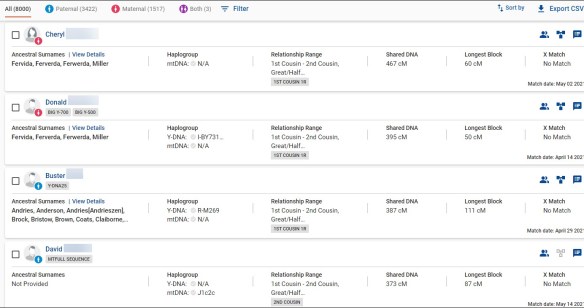
You can see at the top of my match list that I have a total of 8000 matches of which 3422 are paternal, 1517 are maternal and 3 match on both sides. Full siblings, their (and my) children and their descendants will always match on both sides. People with endogamy across both parents may have several matches on both sides.

If your relevant parent has tested, always work from their test.

Because we are searching for the maternal grandfather, in this case, we can ignore all tests that are bucketed as paternal matches.

Given that we are searching for my maternal grandfather, I probably have not been able to link as many maternal matches, other than possibly ones from my maternal grandmother. This means that the maternal grandfather’s matches are not bucketed because there are no identified matches to link on that side of my tree.

If you sort by maternal and paternal tabs, you’ll miss people who aren’t bucketed, meaning they have no maternal or paternal icon, so I recommend simply scanning down the list and processing maternal matches and non-bucketed matches.

By being able to confidently ignore paternally bucketed matches and only processing maternal and non-assigned matches, this is equivalent to processing the first 48 total matches. If I were to only look at the first 15 matches, 12 were paternal and only 3 are maternal.

Using bucketing at FamilyTreeDNA is very efficient and saves a lot of work.

Omitting paternal matches also means we are including smaller matches which could potentially be from common ancestors further back in the tree. Or, they could be younger testers. Or simply smaller by the randomness of recombination.

FamilyTreeDNA is a goldmine, with 16 of 20 maternal matches being from the unknown maternal grandfather.

Next, let’s see what’s waiting at MyHeritage.

MyHeritage

MyHeritage is particularly useful if your lineage happens to be from Europe. Of course, if you’re searching for an unknown person, you probably have no idea where they or their ancestors are from. Two of my best matches first appeared at MyHeritage.

Of course, your matches with people who descend from your unknown maternal grandfather won’t have any Theories of Family Relativity, as that tool is based on BOTH a DNA match plus a tree or document match. However, Theories is wonderful to group your matches to your other three grandparents.

MyHeritage provides a great deal of information for each match, including common surnames with your tree. If you recognize the surnames (and shared matches) as paternal or maternal, then you can assign the match. However, the matches you’re most interested in are the highest matches without any surnames in common with you – which likely point to the missing maternal grandfather.

However, those people may, and probably do, have surnames in common with each other.

Of the matches who aren’t attributed to the other three grandparents, the name Ferverda arises again and again. So does Miller, which suggests the grandparent or great-grandparent couple may well be Ferverda/Miller.

Let’s continue working through the process with our spreadsheet and see what we can discover about those surnames.

Our 60 Results

Of the 60 total results, 15 from each vendor, a total of 24 cannot be assigned to other columns through bucketing or shared matches, so are associated with the maternal grandfather. Of course, Michael who descends from both of my maternal grandparents won’t be helpful initially.

Cheryl, Donald and Michael are duplicates at different vendors, but the rest are not.

Of the relevant matches, the majority, 12 are from FamilyTreeDNA, four each are from Ancestry and MyHeritage, and three are from 23andMe.

Of the names provided in the surname fields of matches, in matches’ trees in the first few generations, and the testers’ surnames, Ferverda is repeated 12 times, for 50% of the time. Miller is repeated 9 times, so it’s likely that either of those are the missing grandfather’s surname. Of course, if we had Y-DNA, we’d know the answer to that immediately.

Comparing trees of my matches, we find John Ferverda as the common ancestor between two different matches. John is the son of Hiram Ferverda and Eva Miller who are found in several trees.

That’s a great hint. But is this the breakthrough I need?

What’s Next?

The next step is to look for connections between the maternal grandmother, Edith Lore, who is known in our example, and a Ferverda male. He is probably one of the sons of Hiram Ferverda and Eva Miller. Do they lived in the same area? In close proximity? Do they attend the same church or school? Are they neighbors or live close to the family or some of their relatives? Does she have connections with Ferverda family members? We are narrowing in.

Some of Hiram and Eva’s sons might be able to be eliminated based on age or other factors, or at least be less likely candidates. Any of their children who had moved out of state when the child was conceived would be less likely candidates. Age would be a factor, as would opportunity.

Target testing of the Ferverda sons’ children, or the descendants of their children would (probably) be able to pinpoint which of their sons is more closely related to me (or my mother) than the rest.

In our case, indeed, John Ferverda is the son we are searching for and his descendant, Michael is the highest match on the list. Cheryl and Donald descend from John’s brother, which eliminates him as a candidate. Another tester descends from a third Ferverda son, which eliminates that son as well.

Michael, my actual first cousin with a 755 cM match at one vendor, and 822 cM at a second vendor, is shown by the MyHeritage cM Explainer with an 88% probability that he is my first cousin.

However, when I’m trying to identify the maternal grandfather, which is half of that couple, I need to focus one generation further back in time to eliminate other candidates.

The second and third closest matches are both Donald at 395 cM and Cheryl at 467 cM who also share the same Ferverda/Miller lineage and are the children of my maternal grandfather’s brother.

On the spreadsheet, I need to look at the trees of people who have both Ferverda and Miller, which brought me to both Cheryl and Donald, then Michael, which allowed me to identify John Ferverda, unquestionably, as my grandfather based on the cM match amounts.

Cheryl and Donald, who are confirmed full siblings, and my mother either have to be first cousins, or half siblings. Their match with mother is NOT in the half-sibling range for one sibling, and on the lower edge with the other. Mother also matches Michael as a nephew, not more distantly as she would if he were a first cousin once removed (1C1R) instead of a nephew.

Evaluating these matches combined confirms that my maternal grandfather is indeed John Ferverda.

What About X DNA?

The X chromosome has a unique inheritance path which is sometimes helpful in this circumstance, especially to males.

Women inherit an X chromosome from both parents, but males inherit an X chromosome from ONLY their mother. A male inherits a Y chromosome from his father which is what makes him male. Women inherit two X chromosomes, one from each parent, and no Y, which is what makes them female.

Therefore, if you are a male and are struggling with which side of your tree matches are associated with, the X chromosome may be of help.

Your mother passed her X chromosome to you, which could be:

  • Her entire maternal X, meaning your maternal grandmother’s X chromosome
  • Her entire paternal X, meaning your maternal grandfather’s X chromosome (which descends from his mother)
  • Some combination of your maternal grandmother and maternal grandfather’s chromosomes

One thing we know positively is that a male’s X matches are ALWAYS from their maternal side only, so that should help when dividing a male’s matches maternally or paternally. Note – be aware of potential pedigree collapse, endogamy and identical-by-chance matches if it looks like a male has a X match on his father’s side.

Unfortunately, the X chromosome cannot assist females in the same way, because females inherit an X from both parents. Therefore, they can match people in the same was as a male, but also in additional ways.

  • Females will match their paternal grandmother on her entire X chromosome, and will match one or both of their maternal grandparents on the X chromosome.
  • Females will NEVER match their paternal grandfather’s X chromosome because their father did not inherit an X chromosome from his father.
  • Males will match one or both of their maternal grandparents on their X chromosome.
  • Males will NEVER match their paternal grandparents, because males do not receive an X chromosome from their father.

The usefulness of X DNA matching depends on the inheritance path of both the tester AND their match.

When Can Y-DNA or Mitochondrial DNA Help with Grandparent Identification?

If you recall, I selected the maternal grandfather as the person to seek because no tester carries either the Y-DNA or mitochondrial DNA of their maternal grandfather. In other words, this was the most difficult identification, meaning that any of the other three grandparents would be, or at least could be, easier with the benefit of Y-DNA and/or mitochondrial DNA testing.

In addition to matching, both Y-DNA and mitochondrial DNA will provide testers with location origins, both continental and often much more specific locations based on where other testers and matches are from.

Y-DNA often provides a surname.

Let’s see how these tests, matches and results can assist us.

  • Paternal grandfather – If I was a male descended from John Ferverda paternally, I could have tested both my autosomal DNA PLUS my Y-DNA, which would have immediately revealed the Ferverda surname via Y-DNA. Two Ferverda men are shown in the Ferverda surname DNA project, above.

That revelation would have confirmed the Ferverda surname when combined with the high frequency of Ferverda found among autosomal matches on the spreadsheet.

  • Maternal grandmother – If we were searching for a maternal grandmother, both the male and female sibling testers (as shown in the pedigree chart) would have her mitochondrial DNA which could provide matches to relevant descendants. Mitochondrial DNA at both FamilyTreeDNA and 23andMe could also eliminate anyone who does not match on a common haplogroup, when comparing 23andMe results to 23andMe results, and FamilyTreeDNA to FamilyTreeDNA results at the same level.

At 23andMe, only base level haplogroups are provided, but they are enough to rule out a direct matrilineal line ancestor.

At FamilyTreeDNA, the earlier HVR1 and HVR2 tests provide base level haplogroups, while full sequence testing provides granular, specific haplogroups. Full sequence is the recommended testing level.

  • Paternal grandmother – If we were searching for a paternal grandmother, testers would, of course, need either their father to test his mitochondrial DNA, or for one of his siblings to test which could be used in the same way as described for maternal grandmother matching.

Summary

Successfully identifying a grandparent is dependent on many factors. Before you make that identification, it’s very difficult to know which are more or less important.

For example, if the grandparent is from a part of the world with few testers, you will have far fewer matches, potentially, than other lines from more highly tested regions. In my case, two of my four grandparents’ families, including Ferverda, immigrated in the 1850s, so they had fewer matches than families that have been producing large families in the US for generations.

Endogamy may be a factor.

Family size in past and current generations may be a factor.

Simple luck may be a factor.

Therefore, it’s always wise to test your DNA, and that of your parents and close relatives if possible, and upload to all of the autosomal databases. Then construct an analysis plan based on:

  • How you descend from the grandparent in question, meaning do you carry their X DNA, Y-DNA or mitochondrial DNA.
  • Who else is available to test their autosomal DNA to assist with shared matches and the process of elimination.
  • Who else is available to test for Y-DNA and/or mitochondrial DNA of the ancestor in question.

If you don’t find the answer initially, schedule a revisit of your matches periodically and update your spreadsheet. Sometimes DNA and genealogy is a waiting same.

Just remember, luck always favors the prepared!

Resources

You may find the following resource articles beneficial in addition to the links provided throughout this article.

_____________________________________________________________

Follow DNAexplain on Facebook, here or follow me on Twitter, here.

Share the Love!

You’re always welcome to forward articles or links to friends and share on social media.

If you haven’t already subscribed (it’s free,) you can receive an email whenever I publish by clicking the “follow” button on the main blog page, here.

You Can Help Keep This Blog Free

I receive a small contribution when you click on some of the links to vendors in my articles. This does NOT increase the price you pay but helps me to keep the lights on and this informational blog free for everyone. Please click on the links in the articles or to the vendors below if you are purchasing products or DNA testing.

Thank you so much.

DNA Purchases and Free Uploads

Genealogy Products and Services

My Book

Genealogy Books

Genealogy Research

Relatives at RootsTech – How to Use & Connect with DNA

Relatives at RootsTech is back and I’m so very glad to see it.

Let me show you how to use this wonderful tool, including tips for how to get even more out of the experience.

It’s important to start now to accumulate your cousins, because there’s a display limit of 300 in each category, so you’ll want to begin recording your findings so that as more people sign up and are added to your list, you don’t “lose” the earlier relatives.

Let’s start with my link. Click here.

You’ll be prompted to sign in to your FamilySearch account, or create one. If you don’t have an account, create one now.

Right now, the number of participants is doubling every few days.

Let’s take a look at how Relatives at RootsTech works and how it can benefit you.

Surnames

At first glance, the surname tool doesn’t look terribly exciting, but there’s a hidden gem, especially for newer genealogists.

I entered my surname and one other, knowing there is probably no common locations other than the US. Kvochick is very rare and unique.

The results show two interesting things. First, the genesis of the surname, and second, the total number of people in the FamilySearch tree in both of the common locations for both surnames.

Be sure to try variant spellings too.

After you sign in, you’ll be asked to update your profile which is how you join in on the fun. If you signed up for Relatives at RootsTech last year, that doesn’t count for this year. You need to opt-in for this year’s festivities.

RootsTech Relatives

After you sign in, you’ll see how many of your relatives have joined.

Of the 60,461 total who have joined, according to the FamilySearch tree, I’m related to about 15% of them. That sure gives new perspective to how many people we’re related to. And just think if those brick walls didn’t exist. We’d be related to just about everyone. Far enough back, we’re all related, literally.

Your Relatives at RootsTech are displayed in three ways.

By location, ancestor or family line.

Relatives by Location

Your first view will be by all locations (including people who did not select a location,) but displayed in closest to most distant relationship order. For me, that’s the most interesting part.

These people, my closest relatives, are the people most likely to have critical pieces of information that I don’t have or know about. Like family stories, or photos, for example.

I know one of these people, but not the rest. I’m dying to know who they are and how we are related.

For me, the map itself isn’t terribly useful, but it would be if some members of your family were from distinct locations.

Not everyone opts in to have their location displayed. The “173” in the center is the people who generically selected United States.

Relatives by Family Line

The Family Line display shows you the number of people by parent or grandparent. Unfortunately, you can only view 300 of your matches in each line, which is disappointing.

However, there’s a better way to view your relatives.

Relatives by Ancestor

For me, the best way to view relatives is by ancestor. This also circumvents the 300 limit to some extent, unless you have more than 300 relatives for any one ancestor.

I have two relatives who also descend from Curtis Benjamin Lore. It’s Jen and Jill again, my closest relatives.

I’m quite interested in these people, because Curtis is my great-grandfather and he was a very interesting man. I know Jen and Jill are interested in genealogy too, or they would not have signed up for RootsTech Relatives, this year, in the past few days. This is not a stale list.

I’ll be messaging them as soon as I’m finished with this article!!!

Please note that FamilySearch does not label half-relationships accurately.

Jen and Jill are my HALF second cousins twice removed, which will affect the expected amount of shared DNA. Their ancestors, Edith and Maude were half-sisters through their father, not full sisters. One of the reasons I’m so interested in communicating with Jen and Jill is because I’m not at all sure that those half-sisters knew each other existed.

Maintaining Contact

For each relative found, you can view your relationship, message them, or add them to your contact list. Be aware – your contact list “saves” this person, but it does not tell you how you’re related. That’s where either a Word document, with screen shots of how you’re related, or a spreadsheet where you can detail that information is important.

If you have messaged people in the past, those messages are still in your message box in the upper right-hand corner.

I generally provide my email address when I message relatives.

Displaying the Relationship

If you click on the “Relationship” button, you’ll see how FamilySearch believes you’re related to each match.

My relationship with an Acadian cousin, beginning with our common ancestor, is shown above. Grab a screen shot so you can remember. I drop them into a spreadsheet or Word document.

These matches are based on FamilySearch’s one world type of tree. I don’t have to tell you to be cautious because, like any tree, there are erroneous connections. This connection, at least on my side (left hand,) seems to be accurate. I don’t have Jeanne Chebrat’s second marriage to Jehan Piorier in my file, so I’ll need to check that out. Many times FamilySearch, WikiTree, Ancestry, or MyHeritage has connected documents or sources. In this case, here’s the WikiTree entry for Jeanne.

See, I’ve found something interesting already.

Search for People

On the toolbar, if you click on the right arrow, you’ll notice there’s one more option – Search.

If you think one your cousins might be attending, either virtually or in person, you can search by surname. I entered Estes out of curiosity.

This is quite interesting, because some other poor soul is also named Roberta Estes. You KNOW I’ll be messaging her. I’m pretty sure I know who this is, because we’ve been getting mixed up for years. Unless, of course there are actually three of us interested in genealogy.

However, where this Search option really shines is if you’re looking for males who descend from a particular line as candidates for Y-DNA testing.

Bingo!

I suggest doing this name search for each surname in your tree.

The Share Button is Critically Important

Sharing is the key to encouraging people to participate.

This button on the main page is how I generated the link for you to use to see if we’re related.

There’s a “Share” button in several locations. However, you’ll want to be sure you know exactly what you’re sharing. In some cases, it will be the surname comparison information or other information that you’re viewing. 

However, on the bottom of your Relatives pages, Share will generate a message link to/through several programs or apps so people can sign in to see if they are related to you.

You can also just copy the link and send it to someone in a text message or otherwise.

If you generate a message to share, you’ll see what will be posted, so you’ll know for sure exactly what you’re sharing. I wanted to post the link for my friends on Facebook to see if we are related, and that’s exactly what was generated.

If you follow the link to see if we are related, be sure to tell me, or anyone else whose link you follow.

Next, Connect with DNA

Relatives for RootsTech is a wonderful segway into DNA testing.

Remember, with the 300-relative limit, different searches will produce different results including people that won’t be included due to the 300 limit in other searches. Be creative and search in multiple ways. Add your relatives to your spreadsheet or Word document, then record whether they’ve DNA tested, at which vendor(s) and if you match there.

There are various ways to utilize Relatives at RootsTech for DNA.

  • Y-DNA candidates for the direct paternal line for males – The Search by surname can provide you with Y-DNA testing candidates. They may already have tested their Y-DNA with FamilyTreeDNA or their autosomal DNA with at least one vendor, so just message them and ask. Tell them which databases you’re in. Viewing Relatives by Ancestor can be very useful for this same purpose, especially if you have multiple unrelated lines with the same surname.
  • Mitochondrial DNA – the Relatives by Ancestor tool is very useful for locating mitochondrial DNA testing candidates, especially since you can easily see how they are descended from your common ancestor. Mitochondrial DNA is passed from women through all females to the current generation, which can be male or female. Any of your cousins, of either sex, are candidates so long as they descend from your target ancestor through all females.
  • DNA Pedigree Chart – If you’re building your own DNA Pedigree Chart with the Y-DNA and mitochondrial DNA of each ancestral line, consider offering a DNA testing scholarship to people who carry those lines that are missing in your DNA Pedigree Chart.
  • Testing Candidates – Anyone is a good candidate for autosomal testing. No second cousin or closer has ever not matched. Ask your cousins if they have tested and tell them which DNA databases you are in. Furthermore, suggest that they upload their DNA to FamilyTreeDNA and MyHeritage for free to utilize their tools and find matches that aren’t in the other databases. GEDmatch isn’t a testing company, but is another free database where you may find people who tested at Ancestry. Unfortunately, Ancestry does not provide segment information for matching or painting, so hopefully you’ll be able to find your Ancestry matches elsewhere.
  • Databases – Be sure you’re in all of the databases (Ancestry, 23andMe, FamilyTreeDNA, MyHeritage and GEDmatch) so you can be found and you can find your relatives.
  • DNAPainter – If you’re painting your segments at DNAPainter, you can paint your matching segments from 23andMe, FamilyTreeDNA, MyHeritage or GEDmatch. Ancestry is the only vendor that does not provide matching segment information for their customers.
  • DNA Search – If your cousin has used their actual name when registering at FamilySearch, sort by ancestor, then search your DNA matches at the various vendors for that cousin’s name. The beauty of Relatives at RootsTech is that the relationship is already sorted by ancestor, so that piece of the puzzle has already been assembled for you, which is exactly the opposite of most DNA matches. Of course, this does not preclude errors or connections through multiple ancestors.

Limited Time – March 31 is the End

If I had a FamilySearch genie and could get one wish, it would be that they would leave Relatives for RootsTech up and available until the next RootsTech. I need time to work on these relationships.

However, that’s not the case, and Relatives for RootsTech ends on March 31st.

Therefore, it’s important to begin building your spreadsheet, or however you’re going to record your relatives, NOW. Check your list often so none of those precious matches will roll off of your list and become unavailable. Access to the complete relative match list, meaning no 300 limit would be my second wish from the FamilySearch genie.

To preserve the ability to communicate with your relatives, message them now or at least add them to your contact list – WITH A NOTE IN YOUR SPREADSHEET AS TO HOW YOU’RE RELATED. Otherwise, that information will not be available after March 31st.

You’ll want to use the same spreadsheet from year to year, as some of the relatives signing up this year probably did last year too.

Ready, Set, Relatives at RootsTech

Have fun. Be sure to let me know if we’re related and how!!!

____________________________________________________________

Follow DNAexplain on Facebook, here or follow me on Twitter, here.

Share the Love!

You’re always welcome to forward articles or links to friends and share on social media.

If you haven’t already subscribed (it’s free,) you can receive an email whenever I publish by clicking the “follow” button on the main blog page, here.

You Can Help Keep This Blog Free

I receive a small contribution when you click on some of the links to vendors in my articles. This does NOT increase the price you pay but helps me to keep the lights on and this informational blog free for everyone. Please click on the links in the articles or to the vendors below if you are purchasing products or DNA testing.

Thank you so much.

DNA Purchases and Free Uploads

Genealogy Products and Services

My Book

Genealogy Books

Genealogy Research

Chromosomes and Genealogy

Sometimes people ask about how chromosomes relate to genealogy. Every single one of us started with that question, right?

Are chromosomes different sizes, and does that matter? What are the mystery terms, cMs and SNPs? How does all of this intersect with genealogy? Do I care?

These are all great questions, and of course, there are different ways to answer. Let’s start with some basics.

Chromosomes 1-22

First, you have two copies of each of chromosomes 1-22.

The karyogram above, a photo taken through a microscope, courtesy of the National Human Genome Research Institute, shows the chromosomes of a human male. I’ve added the numbering and labeled the X and Y chromosomes (23).

You inherit one copy of each chromosome from each of your parents. You can see the two halves of each chromosome, above. One half of each chromosome is contributed by the person’s mother, and the other half is contributed by the father.

That’s why DNA matching works, and each match can be designated as “maternal” or “paternal,” depending on how your match is related to you.

Each match will be related either maternally, paternally, or sometimes, both. Of course, that’s presuming the matches are identical by descent, and not identical by chance, but that’s a different discussion. For this article, we’re referencing valid matches with whom you share common ancestors – whether you know who they are or not.

Your 23rd chromosome is different than chromosomes 1-22.

Chromosome 23 Determines a Child’s Sex

Your 23rd chromosome is your sex-determination chromosome and is inherited differently.

You still inherit one copy of chromosome 23 from each parent.

  • Males inherit a Y chromosome from their father, which is what makes males male.
  • Males inherit an X chromosome from their mother.
  • Females inherit an X chromosome from both parents, which makes them female.
Chromosome 23 Father Contributes Mother Contributes
Male Child Y chromosome X chromosome
Female Child X chromosome X chromosome

Because males don’t inherit an X chromosome from their father, X chromosome matching for genealogy has a unique and specific pattern of descent which allows testers to immediately eliminate some potential common ancestors.

The Y chromosome can be tested separately for males and follows the direct paternal line. You can read about the 4 Kinds of DNA for Genetic Genealogy, here.

The X chromosome is quite useful for genealogy due to its unique inheritance path and is included by both FamilyTreeDNA and 23andMe in matching.

Picture This

Three of the four major vendors, plus GEDmatch, provide a visual match depiction of your chromosomes using a chromosome browser:

Unfortunately, Ancestry does not provide a chromosome browser or segment location information.

Using your chromosomes as the canvas, matches to your father and mother are shown using the chromosome browser at FamilyTreeDNA, below.

You can see that a tester matches both parents on the entire covered region of all of their chromosomes. The beginning and the end tips of each chromosome sometimes aren’t covered, and neither are some other regions that are very SNP-location-poor. Omitted regions are shown by hashes. Regions that are light grey, but not hashed, are covered, but the match’s test didn’t produce results in that region.

This is why you may have a slightly different size match with one parent versus the other, especially if they both didn’t test at the same vendor at the same time.

The chromosome browser graphic visually answers the chromosome size question, but there’s more to this answer. It’s easy to see that there’s a significant difference in the physical chromosome size, but there’s more to the story.

SNPs – Chromosome Street Addresses

SNPs, known as Single Nucleotide Polymorphisms, are mutations recorded at specific addresses on chromosomes. Each chromosome holds a specific number of addresses that are read during sequencing and used for match comparison.

All of your other matches that are not parent-child and not your identical twin will match on some subset of these locations.

The Rest of the Answer – Centimorgans and SNPs

Centimorgans (cMs) are units of recombination used to measure genetic distance. You can read a scientific definition here.

For our conceptual purposes, think of centimorgans as lines on a football field. They represent distance on the chromosome.

SNPs are locations that are compared between two people to see if a match occurs.

Think of SNPs as addresses for blades of grass on that football field where an expected value occurs. If values at that address are different, then they don’t match. If values are the same, then they do match. For autosomal DNA matching, we look for long runs of SNPs that match between two people to confirm a common ancestor.

Think of SNPs as blades of grass growing between the lines on the football field. In some areas, especially in my yard, there will be many fewer blades of grass between those lines than there would be on either a well-maintained football field, or maybe a manicured golf course. You can think of the lighter green bands as sparse growth and the darker green bands as dense growth.

If the distance between 2 lines on the football field is 8 cM, for example, and there are 700 blades of grass growing there, you’ll be a match to another person if (almost) all of your blades of grass between those 2 lines match, assuming the match threshold is minimally 8 cM and 700 SNPs.

For purposes of autosomal DNA, the combination of centimorgans (distance,) and the number of SNPs (locations) within that distance measurement determines if someone is considered a match to you. In other words, you’re listed as a match if the shared DNA is over the minimum or selected thresholds. Think of track and field hurdles. To get to the end (a match), you have to get over all of the hurdles!

For example, a threshold of 8 cM and 700 SNPs means that anyone who matches you equal to or greater than both of these cumulative thresholds will be displayed as a match. Centimorgans and SNPs work in tandem to ensure valid matches.

A Second Yardstick

So, the second measure of chromosome size is the number of cMs from the beginning to the end of the chromosome, and the number of SNPs on that chromosome.

Different vendors, and different DNA testing chips cover slightly different regions. This is my match with my mother, which shows:

  • Total matching cMs on each chromosome
  • Total matching SNPs on each chromosome
  • SNP Density, which is a calculation (cM/SNPs) showing how “thick” the SNP grass is on each chromosome

The higher the matching number of cMs, especially in a row (longest segment,) the higher quality the match, and the closer the relationship.

Note that endogamous, or intermarried populations, may need separate interpretations. I discussed the signs of endogamy in this article.

Calculating Matches

Some vendors provide the ability to select your match cM and SNP thresholds, and others make those selections for you. Most vendors no longer display the number of matching SNPs, given that SNP-poor regions are, for the most part, automatically eliminated, although you can view them in your matching segment download file. In other words, the vendors simply take care of this for you. The accepted rule of thumb has always been that 500 (some said 700) or fewer SNPs was too small to be genealogically relevant, regardless of the cM match size.

Vendors include numerous and varying factors in determining match quality and potential relationships, including:

  • Total shared DNA, meaning total matching cM
  • Longest shared, meaning contiguously matching DNA block
  • X matching
  • Sex of tester (especially with respect to X matching)
  • Endogamy flags
  • Half versus fully identical DNA regions (to positively identify relationships such as half vs full siblings)
  • Triangulated segments
  • Family Matching (maternal and paternal bucketing) at FamilyTreeDNA
  • Tree matching

Not all vendors include all factors, and each vendor utilizes proprietary algorithms for features like triangulation.

The question isn’t chromosome size or even match size alone, but the quality of the match plus additive genealogical features like Theories of Family Relativity at MyHeritage to identify common and even previously unknown ancestors.

Be sure to test at the primary vendors or upload for free to MyHeritage, FamilyTreeDNA and GEDmatch to receive as many matches as possible. You just never know where that match you really need is hiding!

Enjoy!

_____________________________________________________________

Follow DNAexplain on Facebook, here or follow me on Twitter, here.

Share the Love!

You’re always welcome to forward articles or links to friends and share on social media.

If you haven’t already subscribed (it’s free,) you can receive an email whenever I publish by clicking the “follow” button on the main blog page, here.

You Can Help Keep This Blog Free

I receive a small contribution when you click on some of the links to vendors in my articles. This does NOT increase the price you pay but helps me to keep the lights on and this informational blog free for everyone. Please click on the links in the articles or to the vendors below if you are purchasing products or DNA testing.

Thank you so much.

DNA Purchases and Free Uploads

Genealogy Products and Services

My Book

Genealogy Books

Genealogy Research

DNA Black Friday is Here

Yes, I know it’s not Friday yet, but the DNA Black Friday sales have started, and sale dates are limited, so here we go.

These are the best prices I’ve ever seen at both FamilyTreeDNA and MyHeritage. If you’ve been waiting to purchase a DNA test for that special someone, there’s never been a better time.

Remember, to jump-start your genetic genealogy, test close or targeted relatives in addition to yourself:

  • Parents, or if both parents are not available, full and half-siblings
  • If neither parents nor siblings are available, your siblings’ descendants
  • Grandparents or descendants of your grandparents – aunts, uncles, or their descendants
  • Cousins descended from great-grandparents or other known ancestors
  • Y and mitochondrial DNA descendants of specific, targeted ancestors

For yourself, you’ll want to fish in all the ponds by taking an autosomal test or uploading a DNA file to each of the four vendors. Upload/download instructions are available here.

Everyone can test their own mitochondrial DNA to learn about your mother’s direct matrilineal line, and males can test their Y-DNA to unveil information about their patrilineal or surname line. Women, you can test your father’s, brother’s, or paternal uncle’s Y-DNA.

I’ve written a DNA explainer article, 4 Kinds of DNA for Genetic Genealogy, which you might find helpful. Please feel free to pass it on.

Vendor Offerings

FamilyTreeDNA

Free shipping within the US for orders of $79 or more

FamilyTreeDNA is the only major testing company that offers multiple types of tests, meaning Y-DNA, mitochondrial and autosomal. You can also get your toes wet with introductory level tests for Y DNA (37 and 111 marker tests), or you can go for the big gun right away with the Big Y-700.

This means that if you’ve purchased tests in the past, you can upgrade now. Upgrade pricing is shown below. Click here to sign on to your account to purchase an upgrade or additional product.

At FamilyTreeDNA, by taking advantage of autosomal plus Y-DNA and mitochondrial DNA, you will get to know your ancestors in ways not possible elsewhere. You can even identify or track them using your myOrigins painted ethnicity segments.

FamilyTreeDNA divides your Family Finder matches maternal and paternally for you if you create or upload a tree and link known testers. How cool is this?!!!

MyHeritage

The MyHeritage DNA test is on sale for $36, the best autosomal test price I’ve ever seen anyplace.

MyHeritage has a significant European presence and I find European matches at MyHeritage that aren’t anyplace else. MyHeritage utilizes user trees and DNA matches to construct Theories of Family Relativity that shows how you and your matches may be related.

Remember, you can upload the raw data file from the MyHeritage DNA test to both FamilyTreeDNA and GEDmatch for free.

Free shipping on 2 kits or more.

This sale ends at the end-of-day on Black Friday.

You can combine your DNA test with a MyHeritage records subscription with a free trial, here.

Ancestry

The AncestryDNA test is $59, here. With Ancestry’s super-size DNA database, you’re sure to get lots of matches and hints via ThruLines.

You can get free shipping if you’re an Amazon Prime member.

If you order an AncestryDNA test, you can upload the raw DNA file to FamilyTreeDNA, MyHeritage and GEDmatch for free. Unfortunately, Ancestry does not accept uploads from other vendors.

23andMe

The 23andMe Ancestry + Traits DNA test is $79, here. 23andMe is well known for its Ancestry Composition (ethnicity) results and one-of-a-kind genetic tree.

The 23andMe Ancestry + Traits + Health test is now $99, here.

You can get free shipping if you’re an Amazon Prime member.

If you order either of the 23andMe tests, you can upload the raw data file to FamilyTreeDNA, MyHeritage, and GEDmatch for free. Unfortunately, 23andMe does not accept uploads from other vendors.

Can’t Wait!!

This is always my favorite time of the year because I know that beginning soon, we will all be receiving lots of new matches from people who purchased or received DNA tests during the holiday season.

  • What can you do to enhance your genealogy?
  • Have you ordered Y and mitochondrial DNA tests for yourself and people who carry the Y and mitochondrial DNA of your ancestors?
  • Are you in all of the autosomal databases?
  • Who are you ordering tests for?

_____________________________________________________________

Follow DNAexplain on Facebook, here or follow me on Twitter, here.

Share the Love!

You’re always welcome to forward articles or links to friends and share on social media.

If you haven’t already subscribed (it’s free,) you can receive an email whenever I publish by clicking the “follow” button on the main blog page, here.

You Can Help Keep This Blog Free

I receive a small contribution when you click on some of the links to vendors in my articles. This does NOT increase the price you pay but helps me to keep the lights on and this informational blog free for everyone. Please click on the links in the articles or to the vendors below if you are purchasing products or DNA testing.

Thank you so much.

DNA Purchases and Free Uploads

Genealogy Products and Services

My Book

Genealogy Books

Genealogy Research