Y-DNA Haplogroup O – When and How Did It Get to the Americas?

Y-DNA Haplogroup O has been found in male testers descended from a Native American ancestor, or in Native American tribes in the Americas – but sometimes things are more complex than they seem. The story of when and how haplogroup O arrived in the Americas is fascinating – and not at all what you might think.

Introduction

The concept of Native American heritage and indigenous people can be confusing. For example, European Y-DNA haplogroup R is found among some Native American men. Those men may be tribal members based on their mother’s line, or their haplogroup R European Y-DNA may have been introduced either through adoption practices or traders after the arrival of Europeans.

There is unquestionable genetic evidence that the origin of Haplogroup R in the Americas was through colonization, with no evidence of pre-contact indigenous origins.

Y-DNA testing and matching, specifically the Big Y-700 test, with its ability to date the formation of haplogroups very granularly, has successfully identified the genesis of Y-DNA haplogroups and their movement through time.

We’ve spent years trying to unravel several instances of Native American Y-DNA Haplogroup O and their origins. Native American, in this context, means that men with haplogroup O are confirmed to be Native American at some point in documented records. This could include early records, such as court or probate records, or present-day members of tribes. There is no question that these men are recognized as Native American in post-contact records or are tribal members, or their descendants.

What has not been clear is how and when haplogroup O entered the Native American population of these various lineages, groups, or tribes. In other words, are they indigenous? Were they here from the earliest times, before the arrival of colonists, similar to Y-DNA haplogroups C and Q?

This topic has been of great interest for several years, and we have been waiting for additional information to elucidate the matter, which could manifest in several ways:

  1. Ancient pre-contact DNA samples of haplogroup O in the Americas, but none have been found.
  2. Current haplogroup O testers in Native American peoples across the North and South American continents, forming a connecting trail genetically, geographically, and linearly through time. This has not occurred.
  3. Big-Y DNA matches within the Americas between Haplogroup O Native American lines unrelated in a genealogical timeframe whose haplogroup formation pre-dates European contact. This has not occurred.
  4. Big-Y DNA matches between Haplogroup O men whose haplogroups were formed in the Americas after the Beringian migration and expansion that scientists agree occurred at least 12-16K years ago, and possibly began earlier. Earlier human lineages, if they existed, may not have survived. A later Inuit and Na-Dené speaker circumpolar migration occurred 4-7K years ago. This has not occurred.
  5. Big-Y DNA matches with men whose most recent common ancestor haplogroup formation dates connect them with continental populations in other locations, outside of North and South America. This would preclude their presence in the Americas after the migrations that populated the Americas. This has occurred.

The Beringian migration took place across a now-submerged land bridge connecting the Chutkin Peninsula in Russia across the Bering Strait with the Seward Peninsula in Alaska.

By Erika Tamm et al – Tamm E, Kivisild T, Reidla M, Metspalu M, Smith DG, et al. (2007) Beringian Standstill and Spread of Native American Founders. PLoS ONE 2(9): e829. doi:10.1371/journal.pone.0000829. Also available from PubMed Central., CC BY 2.5, https://commons.wikimedia.org/w/index.php?curid=16975303

Haplogroup O is clearly Native American in some instances, meaning that it occurs in men who are members of or descend from specific Native American tribes or peoples. One man, James Revels, is confirmed in court records as early as 1656. However, ancestors of James Revels fall into category #5, as their upstream parental haplogroup is found in the Pacific islands outside the Americas after the migration period.

Based on available evidence, the introduction of haplogroup O appears to be post-contact. Therefore, haplogroup O is not indigenous to the Americans in the same sense as haplogroups Q and C that are found widespread throughout the Americas in current testers who are tribal members, descendants of tribal members, and pre-contact ancient DNA as mapped in the book, DNA for Native American Genealogy.

Ancient DNA

Haplogroup C is found in both North and South America today, as are these ancient DNA locations.

Haplogroup Q is more prevalent than Haplogroup C, and ancient DNA remains are found throughout North and South America before colonization.

No ancient DNA for Haplogroup O has been discovered in the Americas. We do find contemporary haplogroup O testers in regional clusters, which we will analyze individually.

Let’s take a look at what we have learned recently.

Wesley Revels’ Lineage

Wesley Revels was the initial Y-DNA tester whose results identified Haplogroup O as Native American, proven by a court record. That documentation was critical, and we are very grateful to Wesley for sharing both his information and results.

Wesley’s ancestor, James Revels, was Native American, born about 1656 and bound to European planter, Edward Revell. James was proven in court to be an Accomack “Indian boy” from “Matomkin,” age 11 in 1667. James was bound, not enslaved, until age 24, at which time he was to be freed and receive corn and clothes.

James had died by 1681 when he was named several times in the Accomack County records as both “James, an Indian” and “James Revell, Indian,” in reference to his estate. James lived near Edward Revell, his greatest creditor and, therefore, administrator of his estate, and interacted with other Indian people near Great Matompkin Neck. Marie Rundquist did an excellent job of documenting that here. Additional information about the Revels family and Matomkin region can be found here.

The location where Edward Revell lived, Manokin Hundred, was on the water directly adjacent the Great Matomkin (now Folly Creek) and Little Matomkin Creeks, inside the Metomkin Inlet. The very early date tells us that James Revels’s paternal ancestor was in the colonies by 1656 and probably born about 1636, or perhaps earlier.

Lewis and Revels men are later associated with the Lumbee Tribe, now found in Robeson and neighboring counties in North Carolina. The Lewis line descends from the Revels lineage, as documented by Marie and Wesley. Other men from this line have tested and match on lower-level STR markers, but have not taken the much more granular and informative Big-Y test.

Until recently, the men who matched Wesley Revels closely on the Big-Y test were connected with the Revels line and/or the Lumbee.

Wesley has a 37-marker STR match to a man with a different surname who had not tested beyond that level, in addition to several 12-marker STR matches to men from various locations. Men who provided known ancestral or current locations include one from Bahrain, two from the Philippines, and three from China. Those men have not taken the Big-Y, and their haplogroups are all predicted from STR results to O-M175 which was formed in Asia about 31,000 years ago.

12-marker matches can reach thousands of years back in time. Unless the matches share ancestors and match at higher levels, 12-marker matches are only useful for geographic history, if that. The Big Y-700 test refines haplogroup results and ages from 10s of thousands of years to (generally) within a genealogically relevant timeframe, often within a couple hundred years.

One of Wesley’s STR matches, Mr. Luo, has taken a Big Y-700 test. Mr. Luo descends directly from Indonesia in the current generation and is haplogroup O-CTS716, originating about 244 BCE, or 2244-ish years ago. Mr. Luo does not match Wesley on the Big-Y test, meaning that Wesley and Mr. Luo have 30 or more SNP differences in their Big-Y results, which equates to about 1,500 years. The common ancestor of Wesley Revels and Mr. Luo existed more than 1,500 years ago in Indonesia. It’s evident that Mr. Luo is not Native American, but his location is relevant in a broader analysis.

There is no question that Wesley’s ancestor, James Revels, was Native American based on the court evidence. There is also no question that the Revels’ paternal lineage was not in the Americas with the Native American migration group 12-16K years ago.

The remaining question is how and when James Revels’ haplogroup O ancestor came to be found on the Atlantic seaboard in the early/mid 1600s, only a few years after the founding of Jamestown.

The results of other Haplogroup O men may help answer this question.

Mr. Lynn

Another haplogroup O man, Mr. Lynn, matches Wesley on STR markers, but not on the Big-Y test.

Mr. Lynn identified his Y-DNA line as Native American, although he did not post detailed genealogy. More specifically, we don’t know if Mr. Lynn identified that he was Native on his paternal line because he matches Wesley, or if the Native history information was passed down within his family, or from genealogical research. Mr. Lynn could also have meant generally that he was Native, or that he was Native “on Dad’s side,” not specifically his direct patrilineal Y-line.

Based on Mr. Lynn’s stated Earliest Known Ancestor (EKA) and additional genealogical research performed, his ancestor was John Wesley Lynn (born approximately 1861, died 1945), whose father was Victor Lynn. John’s death certificate, census, and his family photos on Ancestry indicate that he was African American. According to his death certificate, his father, Victor Lynn, was born in Chatham Co., NC, just west of Durham.

Family members are found in Baldwin Township, shown above.

I did not locate the family in either the 1860 or 1870 census. In 1860, the only Lynn/Linn family in Chatham County was 50-year-old Mary Linn and 17-year-old Jane, living with her, presumably a daughter. Both are listed as “mulatto” (historical term) with the occupation of “domestic.” They may or may not be related to John Wesley Lynn.

In 1870, the only Linn/Lynn in Chatham County is John, black, age 12 or 13 (so born in 1857 or 1858), farm labor, living with a white family. This is probably not John Wesley Lynn given that he is found with his mother in 1880 and the ages don’t match.

In 1880. I find Mary Lynn in Chatham County, age 48, single, black, with daughter Eliza Anne, 20, mulatto, sons John Wesley, 14 so born about 1866, and Charles 12, both black. Additionally, she is living with her nieces and nephews, Cephus, black, 12, Lizzie, 7, mulatto, Malcom, 4, mulatto, William H, 3, mulatto (I think, written over,) and John age 4, mulatto. The children aged 12 and above are farm labor.

In 1880, I also find Jack Lynn, age 28, black, married with 3 children, living beside William Lynn, 25, also married, but with no children.

Trying to find the family in 1870 by using first name searches only, I find no black Mary in 1870 or a mulatto Mary with a child named Jack or any person named Cephus by any surname. I don’t find Jack or any Lynn/Linn family in Chatham County.

The 1890 census does not exist.

In the 1900 census, I find Wesley Lynn in Chatham County, born in January of 1863, age 37, single, a boarder working on the farm of John Harris who lives beside Jack Lynn, age 43, born in April of 1857. Both Lynn men are black. I would assume some connection, given their ages, possibly or probably brothers.

In 1940, John Wesley Lynn, age 74, negro (historical term), is living beside Victor Lynn, age 37, most likely his son.

I could not find Victor Lynn, John Wesley Lynn’s father in any census, so he was likely deceased before 1880 but after 1867, given that Mary’s son Charles Lynn was born in 1868, assuming Mary’s children had the same father. The fact that Mary was listed as single, not married nor widowed suggests enslavement, given that enslaved people were prohibited from legally marrying.

About the only other assumption we can make about Victor Sr. is that he was probably born about 1832 or earlier, probably in Chatham County, NC based on John Wesley’s death certificate, and he was likely enslaved.

Subclades of Haplogroup O

Both the Revels and Lynn men are subclades of haplogroup O and both claim Native heritage – Wesley based on the Revels genealogy and court documents, and Mr. Lynn based on the Native category he selected to represent his earliest known paternal ancestor at FamilyTreeDNA.

Both men have joined various projects, including the American Indian Project, which provides Marie and me, along with our other project co-administrators, the ability to work with and view both of their results at the level they have selected.

How Closely Related Are These Haplogroup O Men?

How closely related are these two men?

By Viajes_de_colon.svg: Phirosiberiaderivative work: Phirosiberia (talk) – Viajes_de_colon.svg, CC BY-SA 3.0, https://commons.wikimedia.org/w/index.php?curid=8849049

  • Do the haplogroups of the Revels men and Mr. Lynn converge in a common ancestor in a timeframe BEFORE colonialization, meaning before Columbus “discovered” the Caribbean islands when colonization and the slave trade both began?
  • Do the haplogroups converge on North or South American soil or elsewhere?
  • Is there anything in the haplogroup and Time Tree information that precludes haplogroup O from being Native prior to the era of colonization?
  • Is there anything that confirms that a haplogroup O male or males were among the groups of indigenous people that settled the Americas sometime between 12 and 26 thousand years ago? Or even a later panArctic or circumpolar migration wave?

Haplogroup O is well known in East Asia, Indonesia, and the South Pacific.

Another potential source of haplogroup O is via Madagascar and the slave trade.

The Malagasy Roots Project has several haplogroup O individuals, including the Lynn and Revels men, who may have joined to see if they have matches. We don’t know why the various haplogroup O men in the project joined. Other haplogroup O men in the project may or may not have proven Malagasay heritage.

Information provided by the project administrators is as follows:

The people of Madagascar have a fascinating history embedded in their DNA. 17 known slave ships came from Madagascar to North America during the Transatlantic Slave Trade. As a result, we find Malagasy DNA in the African American descendants of enslaved people, often of Southeast Asian origin. One of the goals of this project is to discover the Malagasy roots of African Americans and connect them with their cousins from Madagascar. Please join us in this fascinating endeavor. mtDNA Haplogroups of interest include: B4a1a1b – the “Malagasy Motif”, M23, M7c3c, F3b1, R9 and others Y-DNA Haplogroups include: O1a2 – M50, O2a1 – M95/M88, O3a2c – P164 and others

Resources:

http://www.ncbi.nlm.nih.gov/pmc/articles/PMC2987306/  http://www.ncbi.nlm.nih.gov/pmc/articles/PMC1199379/  http://mbe.oxfordjournals.org/cgi/pmidlookup?view=long&pmid=19535740  http://www.biomedcentral.com/1471-2156/15/77  http://www.biomedcentral.com/1471-2164/10/605

The Malagasy group only has one other man who is haplogroup O and took the Big-Y test, producing haplogroup O-FTC77008. Of course, we don’t know if he has confirmed Madagascar ancestry, and his haplogroup is quite distant from both Revels and Lynn in terms of when his haplogroup was formed.
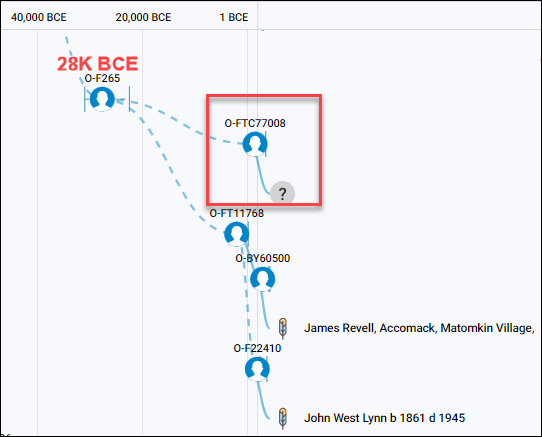
Viewing the Malagasy Project’s Group Time Tree, above, the common ancestor between those three men lived about 28K BCE, or 30,000 years ago.

Haplogroup O Project Group Time Tree

The Haplogroup O Project Time Tree provides a better representation of haplogroup O in general given that it has a much wider range of samples.

On this tree, I’ve labeled the haplogroup formation dates, along with the Revels/Lewis line which descends from O-FT45548. This haplogroup includes one additional group member whose surname is locked, as he hasn’t given publication permission. The haplogroup formation date of 1766 occurs approximately 85 years after James Revel’s birth, so is attributable to some, but not all of his descendants. At least one descendant falls into the older Haplogroup O-BY60500.

The common ancestor of all three, meaning Revels, Lewis, and the man whose name is locked and does not know his genealogy, is haplogroup O-BY60500, born about 1741.

Their ancestral haplogroup before that, O-FT11768, is much older.

Two Filipino results are shown on and descending from the parent branch of O-FT11768, formed about 3183 BCE, or about 5183 years ago. This tells us that the ancestors of all these men were in the same place, most likely the Philippines, at that time.

3183 BCE (5180 years ago) is well after the Native American migration into the Americas.

Discover Time Tree

Obviously, not every tester joins a project, so now I’m switching to the Discover Time Tree which includes all Y-DNA haplogroup branches. Their common haplogroup, O-FT11768, has many branches, not all of which are shown below. I’m summarized unseen branch locations at bottom left.

Expanding the Time Tree further to view all of the descendant haplogroups of O-FT11768, we see that this was a major branch with many South Pacific results, including the branch of O-FT22410, bracketed in red, which has three members.

One is Mr. Lynn whose feather indicates Native American as his EKA country selection, one is a man whose ancestor is from Singapore, and one is an unknown individual who did not enter his ancestor’s country of origin.

Geography

Wesley’s STR match list, which can reflect matches further back in time than the Big-Y test, includes islands near Singapore. This geography aligns with what is known about haplogroup O.

The distance between this Asian region and continental America, 9000+ miles distant by air, is remarkable and clearly only navigable at that time by ship, meaning ships with experienced crew, able to navigate long distances with supplies and water.

We know that in 760 CE, about 1240 years ago, Mr. Lynn’s haplogroup O-F24410 was formed someplace in the South Pacific – probably in Malaysia or a nearby island. This region, including the Philippines, is home to many haplogroup O men. The majority of haplogroup O is found in Asia, the South Pacific, and Diaspora regions.

We know that Hawaii was populated by Polynesian people about 1600 years ago, prior to the age of colonization. Hawaii is almost 7000 miles from Singapore.

Here’s the challenge. How did these haplogroup O men get from the South Pacific to Virginia? Mr. Lynn and the Singapore tester share a common ancestor about 1240 years ago, or 760 CE.

There is no known or theorized Native American settlement wave across Beringia as late as 760 CE. We know that the parent haplogroup was someplace near Singapore in approximately 760 CE.

Two Filipino men and the Revels’ ancestors were in the same location in the Pacific Islands 5180 years ago. How did they arrive on the Eastern Shore in Virginia, found in the Native population, either in or before 1656 when James Revels was born?

What happened in the 3500 years between those dates that might explain how James Revel’s ancestor made that journey?

Academic Papers

In recent years, there has been discussion of possible shoreline migration routes along the Russian coast, Island hopping along Alaska, Canada, and what is now the US, known as the Kelp Highway or Coastal Migration Route – but that has yet to be proven.

Even if that is the case, and it’s certainly a possibility, how did this particular group of men get from the Pacific across the continent to the Atlantic shore in such a short time, leaving no telltale signs along the way? The Coastal Migration Theory hypothesis states that this migration occurred from 12-16 thousand years ago, and then expanded inland over the next 3-5K years. They could not have expanded eastward until the glaciers receded. Regardless, the parent haplogroup and associated ancestors are still found in the Philippines and South Pacific 5000 years ago – after that migration and expansion had already occurred.

The conclusion of the paper is that there is no strong evidence for a Pacific shoreline migration. Regardless, that’s still thousands of years before the time range we’re observing.

We know that the Lynn ancestor was with men from Indonesia in 760 CE, and the Revels ancestor was with men from the Pacific Islands, probably the Philippines, 5180 years ago. They couldn’t have been in two places at the same time, so the ancestors of Revels and Lynn were not in the Americas then.

A 2020 paper shows that remains from Easter Island (Rapa Nui) show Native American DNA, and suggests that initial contact occurred between the two cultures about 1200 CE, or about 800 years ago, but there is not yet any pre-contact or post-contact ancient Y-DNA found in the Americas that shows Polynesian DNA. Furthermore, the hypothesis is that the DNA found on Easter Island came from the Americas, not vice versa. The jury is still out, but this does show that trans-Pacific contact between the two cultures was taking place 800 years ago, at least two hundred years pre-European contact.

Australasian migration to South America is also suggested by one set of remains found in Brazil dating from more than 9000 years ago, but there have been no other remains found indicating this heritage, either in Brazil, or elsewhere in the Americas.

Based on the Time Tree dates of the Haplogroup O testers in our samples, we know they were in the Islands of Southeast Asia after this time period. Additionally, there are no Australia/New Zealand matches.

The Spanish

The Spanish established an early trade route between Manila and Acapulco beginning in 1565. Consequently, east Asian men left their genetic signature in Mexico, as described in this paper.

Historians estimate that 40-129K immigrants arrived from Manilla to colonial Mexico between 1565 and 1815, with most being enslaved upon arrival. Approximately one-third of the population in Manilla was already enslaved. Unfortunately, this paper focused only on autosomal genome-wide results and did not include either Y-DNA, nor mitochondrial. However, the paper quantifies the high degree of trade, and indicates that the Philippines and other Asian population haplotypes are still prevalent in the Mexican population.

In 2016, Dr. Miguel Vilar, the lead scientist with the National Geographic Genographic project lectured in Guam about the surprising Native American DNA found in the Guam population and nearby islands. He kindly provided this link to an article about the event.

Guam was colonized by Spain. In the image from the Boxer Codex, above, the local Chamorro people greet the Manila Galleon in the Ladrones Islands, as the Marianas were called by the Spanish, about 1590.

Native Hawaiians descend from Polynesian ancestors who arrived in the islands about 400 CE, or about 1600 years ago. Captain Cook, began the age of European contact in Hawaii in 1778.

Five Possibilities

There are five possible origins of haplogroup O in the Americas.

  • Traditional migration across Beringia with the known migrations, estimated to have occurred about 12-16K years ago.
  • A Kelp Highway Coastal Migration which may have occurred about 12-16K years ago and dispersed over the next 3-5K years.
  • Circumpolar migration – specifically Inuit and Na-Dene speakers, about 4-6K years ago.
  • Post-contact incorporation from the Pacific Islands resulting from shipping trade on colonial era ships sometime after 1565.
  • Post-contact incorporation from Madagascar resulting from the importation of humans who may or may not have been enslaved upon arrival.

Do we have any additional evidence?

Other Haplogroup O DNA

From my book, DNA for Native American Genealogy:

Testers in haplogroup O-BY60500 and subclade O-FT45548 have proven Native American heritage.

We have multiple confirmed men from a common ancestor who is proven to be an enslaved Accomack “Indian boy,” James Revell, born in 1656, “belonging to the Motomkin” village, according to the Accomack County, Virginia court records. These men tested as members of haplogroup O-F3288 initially, after taking the Big Y-500 test. However, upgrading to the Big Y-700 produced more granular results and branches reflecting mutations that occurred since their progenitor was born in 1656.

Unfortunately, other than known descendants, these men have few close Y-DNA or Big Y-700 matches.

Without additional men testing from different unrelated lines, or ancient haplogroup O being discovered, we cannot confirm that this haplogroup O male’s ancestor was not introduced into the Matomkin Tribe in some way post-contact. Today, one descendant from this line is a member of the Lumbee Tribe.

However, that isn’t the end of the haplogroup O story.

The Genographic Project data shows one Haplogroup O Tlingit tribal member from Taku, Alaska, along with several testers from Mexico that indicate their paternal line is indigenous. Some people from Texas identify their paternal line as Hispanic.

Another individual indicates they were born on the Fountain Indian Reserve, in British Columbia and speaks the St’at’imcets language, an interior branch of Coastal Salish.

Haplogroup O has been identified as Native American in other locations as well.

Much of the information about Haplogroup O testers was courtesy of the Genographic Project, meaning we can’t contact those people to request upgraded tests, and we can’t obtain additional information in addition to what they provided when they tested. As an affiliate researcher, I’m very grateful to the National Geographic Society’s Genographic project for providing collaborative data.

When the book was published, the Discover Time Tree had not yet been released. We have additional information available today, including the dates of haplogroup formation.

FamilyTreeDNA Haplotree and Discover

The FamilyTreeDNA Haplotree (not to be confused with the Discover Time Tree) shows 10 people at the O-M175 level in Mexico, 10 people in the US report Native American heritage, 2 in Jamaica, and one each in Peru, Panama, and Cuba. There’s also one tester from Madagascar.

Altogether, this gives us about 35 haplogroup O males in the Americas, several with Native heritage.

Please note that I’ve omitted Hawaii in this analysis and included only North and South America. The one individual selecting Native Hawaiian (Kanaka Maoli) is in haplogroup O-M133.

Let’s look at our three distinct clusters.

Cluster 1 – Pacific Northwest – Alaska and Canada

We have a cluster of three individuals along the Pacific Coast in Alaska and Canada who have self-identified as Native, provided a tribal affiliation, and, in some cases, the spoken language.

How might haplogroup O have arrived in or near Vancouver, Washington? We know that James Cook “discovered” Hawaii in 1778, naming it the Sandwich Islands. By 1787, a female Hawaiian died en route to the Pacific Northwest, and the following year, a male arrived. Hawaii had become a provisioning stop, and the Spanish took Hawaiians onto ships as replacement workers.

Hawaiian seamen, whalers, and laborers began intermarrying with the Native people along the West Coast as early as 1811. Their presence expanded from Oregon to Alaska. Migration and intermarriage along the Pacific coast began slowly, but turned into a steady stream 30 years later when we have confirmed recruitment and migration of Hawaiian people

In 1839, John Sutter recruited a small group of 10 Hawaiians to travel with him to the then-Mexican colony of Alta, California.

By the mid-1800s, hundreds of Hawaiians lived in Canada and California. In 1847, it was reported that 10% of San Francisco’s residents were Hawaiian. Some of those people integrated with the Native American people, particularly the Miwok and Maidu. The village of Verona, California was tri-lingual: Hawaiian, a Native language, and English, and is today the Sacramento-Verona Tribe.

This article provides a history of the British Company who administered Fort Vancouver, near Vancouver, Washington, that included French-Canadians, Native Americans and Hawaiians. In 1845, 119 Hawaiians were employed at the fort. One of the 119, Opunuia, had signed on as an “engagé,” meaning some type of hired hand or employee, with the Hudson Bay Company for three years, after which he would be free to return home to Honolulu or establish himself in the Oregon Country. He married a woman from the Cascade Tribe.

The descendants of the Hawaiian men and Native women were considered tribal members. In most tribes, children took the tribal status and affiliation of the mother.

The Taku and Sitka, Alaska men on the map are Tlingit, and the man from British Columbia is from the Fountain Indian Reserve.

Hawaiian recruitment is the most likely scenario by which haplogroup O arrived in the tribes of the Pacific Northwest. In that sense, haplogroup O is indeed Native American but not indigenous to that region. The origins of haplogorup O in the Pacific Northwest are likely found in Hawaii, where it is indigenous, and before that, Polynesia – not due to a Beringian crossing.

Cluster 2 – Mexico

We find a particularly interesting small cluster of 4 haplogroup O individuals in interior Mexico.

In the 1500s, Spain established a trade route between Mexico and Manilla in the Philippines.

In 1564, four ships left Mexico to cross the Pacific to claim Guam and the Philippines for King Philip II of Spain. The spice trade, back and forth between Mexico and the Philippines began the following year and continued for the next 250.

Landings occurred along the California coast and the western Mexican coastline. The majority of the galleon crews were Malaysian and Filipino who were paid less than the Spanish sailors. Slaves, including people from the Marianas were part of the lucrative cargo.

One individual in Texas reports haplogroup O and indicates their paternal ancestors were Hispanic/Native from Mexico. A haplogroup O cluster claiming Native heritage is found near Zacatecas, Fresnillo and San Luis Potosi in central Mexico. Additionally, mitochondrial haplogroup F, also Asian, is found there as well. Acapulco is the lime green pin.

An additional haplogroup O tester with Native heritage is found in Lima, Peru.

Haplogroup O men are found in Panama, Jamaica and Cuba, but do not indicate the heritage of their paternal ancestral line. None of these men have taken Big-Y tests, and some may well have arrived on the slave ships from Madagascar, especially in the Caribbean. This source attributes some enslaved people in Jamaica to Hawaiian voyages.

I strongly suspect that the Mexican/Peru grouping in close proximity to the Pacific coastline is the result of the Manilla-Mexico 250-year trade route. The Spanish also plied those waters regularly. Big Y testing of those men would help flesh-out their stories – when and how haplogroup O arrived in the local population.

Cluster 3 – East Coast

At first glance, the East Coast grouping of men with a genetic affinity to the people of the Philippines and Indonesia seems more difficult to explain, but perhaps not.

On the East Coast, we have confirmed reports of whalers near Nantucket as early as 1765 utilizing crewmen from Hawaii, known then as the Sandwich Islands, Tahiti, and the Cape Verde Islands off of Africa. A thorough review of early literature might well reveal additional information about early connections with the Sandwich Islands, and in particular, sailors, crew, or enslaved people.

The Spanish and French were the first to colonize the Philippines by the late 1500s. They had discovered the Solomon Islands, Melanesia, and other Polynesian Islands, and by the early 1600s, the Dutch were involved as well.

The Encyclopedia Britanica further reports that Vasco Balboa first sailed into the Pacific in 1513 and seven years later, Ferdinand Magellan rounded the tip of South America. The Spanish followed, establishing a galley trade between Manila, in the Philippines and Acapulco in western Mexico.

While I found nothing specific stating that the earliest voyages brought men from the Philippines and Oceania back to their European home ports with them, we know that early European captains on exploratory voyages took Native people from the east coast of the Americas on their return journey, so there’s nothing to preclude them from doing the same from the Pacific. The early explorers stayed for months among the Oceanic Native peoples. If they were short on sailors for their return voyage, Polynesian men filled the void.

We know that the Spanish took slaves as part of their trade. We know that the ships in the Pacific took sailors from the islands. If the men themselves didn’t stay in the locations they visited, it’s certainly within the realm of possibility that they fathered children with local, Native women. Furthermore, given that the slave trade was lucrative, it’s also possible that some Pacific Island slaves were taken not as crew but with the intention of being sold into bondage. Other men may have escaped the ships and hidden among the Native Tribes along the eastern seaboard.

Fishing in Newfoundland and exploration in what would become the US was occurring by 1500, so it’s certainly possible that some of the indigenous people from Indonesia and the Philippines were either stranded, sold to enslavers, escaped, or chose to join the Native people along the coastline in North America. Ships had to stop to resupply rations and take on fresh water.

We know that by the mid-1600s, James Revels, whose father carried haplogroup O, had been born on the Atlantic coast of Virginia or Maryland, probably on the Delmarva Peninsula, short for Delaware, Maryland, Virginia, where the Accomac people lived.

There are other instances of haplogroup O found along the east coast.

On the eastern portion of the haplogroup O map from the book, DNA for Native American Genealogy, we find the following locations:

  • Hillburn, NY – man identified as “Native American Black.”
  • Chichester County, PA – Genographic tester identified the location of his earliest known ancestor – included here because O is not typically found in the states.
  • Accomack County, VA – Delmarva peninsula – James Revels lineage
  • Robeson County, NC – Lewis and Revels surname associated with the Lumbee
  • Chatham County, NC – Lynn ancestor’s earliest known location
  • Greene County, NC – enslaved Blount ancestor’s EKA in 1849

The genesis of Mr. Blount’s enslaved ancestor is unclear. Fortunately, he took a Big Y-700 test.

Mr. Blount’s only Big-Y match is to a man from the United Arab Emirates (UAE), but the haplogroup history includes Thailand, which is the likely source of both his and his UAE matches’ ancestors at some point in time. Their common ancestor was in Thailand in 336 CE, almost 1700 years ago.

All surrounding branches of haplogroup O on the Time Tree have Asian testers, except for the one UAE gentleman.

The Blount Haplogroup O-FTC77008 does not connect with the common ancestral haplogroup of Lynn and Revels, so these lineages are only related someplace in Oceana prior to O-F265, or more about  30,000 years ago. Their only commonality other than their Asian origins is that they arrived on the East Coast of the Americas.

We know that the Spanish were exploring the Atlantic coastline in the 1500s and were attempting to establish colonies. In 1566, a Spanish expedition reached the Delmarva Peninsula. This spit of land was contested and changed hands several times, belonging variously to the Spanish, Dutch, and British by 1664.

Furthermore, we also know that the ships were utilizing slave labor. One of the Spanish ships wrecked in the waters off North Carolina near Hatteras or Roanoke Island before the Lost Colony was abandoned on Roanoke Island in 1587. The Croatan Indians reported that in memorable history, several men, some of whom were reported to be slaves, had survived the wreck and “disappeared” into the hinterlands – clearly running for their lives.

These men, if they survived, would have been incorporated into the Native population as there were no other settlements at the time. Variations of this scenario may have played out many times.

James Revels’ ancestor could have arrived on any ship, beginning with exploration and colonization in the early 1500s through the mid-1650s.

By the time the chief bound the Indian boy who was given the English name James to Edward Revell, James’s Oceanic paternal ancestor could have been 4, 5 or 6 generations in the past – or could have been his father.

The Accomack was a small tribe, loosely affiliated with the Powhatan Confederacy along the Eastern Shore. By 1700, their population had declined by approximately 90% due to disease. A subgroup, the Gingaskins, intermarried with African Americans living nearby. After Nat Turner’s slave rebellion of 1831, they were expelled from their homelands.

The swamps near Lumberton in Robeson County, NC, became a safe haven for many mixed-race Native, African, and European people. The swamps protected them, and they existed, more or less undisturbed, for decades. Revels and Lewis descendants are both found there.

Many Native Americans were permanently enslaved alongside African people – and within a generation or so, their descendants knew they were Native and African, but lost track of which ancestors descended from which groups. Life was extremely difficult back then. Generations were short, and enslaved people were moved from place to place and sold indiscriminately, severing their family ties entirely, including heritage stories.

Returning to the Discover Time Tree Maps

Wesley Revels has STR matches with several men from Indonesia, China, and the Philippines. It would be very helpful if those men would upgrade to the Big Y-700 so that we can more fully complete the haplogroup O branches of the Time Tree.

The common Revels/Lewis ancestor, accompanied by two descendant men on different genetic branches from the Philippines, was born about 5180 years ago. There is no evidence to suggest Haplogroup O-FT11768 was born anyplace other than in the Philippines.

How did the descendant haplogroups of O-FT45548 (Revels, Lewis, and an unnamed man) and O-F22410 (Lynn) arrive in Virginia or anyplace along the Atlantic seaboard?

Hawaii wasn’t settled until about 1600 years ago. We know Hawaiians integrated with the Pacific Coast Native tribes in the 1800s, but James Revels was in Virginia in 1656..

We know that the Spanish established a mid-1500s trade route between Manila and Acapulco, leaving their genetic signature in western Mexico.

None of these events fit the narrative for the Revels or the Lynn paternal ancestor.

Furthermore, the Revels and Lynn lines do not connect on North American soil, as both descend from the same parent haplogroup, O-FT11768, 5180 years ago in the Philippines. This location and history suggest a connection with the Spanish galleon trade era. The haplogroup formation clearly predates that trade, which means those men were still in the Philippines, not already living on the American continents. Therefore, the descendants of the haplogroup O-FT11768 arrived in Virginia and North Carolina sometime after that haplogroup formation 5100 years ago.

The Lynn ancestor connects with a man from Singapore in 760 CE, or just 1240 years ago. A descendant of haplogroup O-F22410 arrived in North Carolina sometime later.

It does not appear, at least not on the surface, that there is a connection through Madagascar, although we can’t rule that out without additional testers. If the connection is through Madagascar, then their ancestors were likely transported from Indonesia to Madagascar, then as enslaved people from Madagascar to the Atlantic colonies to be sold. However, James Revels was not enslaved. He was clearly Native and bound to a European plantation owner, who did, in fact, free him as agreed and subsequently loaned him money.

Based on the dates involved, and when we know they were in Oceania, an arrival along the west coast, followed by a quick migration across the country to a peninsula of land in the Atlantic, is probably the least likely scenario. There is also no historical or ancient haplogroup O DNA found anyplace between the west and east coasts, nor in the Inuit or Na-Dene speakers. The Navajo, who speak the Na-Dené language, migrated to the Southwest US around 1400 CE, but haplogroup O has not been found among Na-Dené speakers.

It’s a long way from Singapore and the Philippines to Madagascar, so while the coastal migration scenario is not impossible, it’s also not probable, especially given what we know about the Spanish Pacific trade that existed profitably for 250 years.

However, one haplogroup O subgroup arrived in the UAE by some methodology after 336 CE.

It’s entirely possible, indeed probable, that haplogroup O arrived in the Americas for various reasons, on different paths, in different timeframes.

Haplogroup O was found in people in the Americas after colonization had begun. There has been no ancient Haplogroup O DNA discovered, and there’s evidence indicating that these instances of haplogroup O could not have arrived in any of the known Beringia migrations nor the theorized Coastal or Kelp migration. We know the East Coast Cluster is not a result of the West Coast 19th-century migration because James Revels was in court one hundred and fifty years before the Hawaiians were living among the Native people along the Pacific coastline.

There’s nothing to indicate that the Mexican group that likely arrived beginning in the mid-1500s for the next 250 years as a result of the Indonesian trade route migrated to the east coast, or vice versa. That’s also highly unlikely.

The most likely scenario is that Mr. Lynn’s, Mr. Blount’s, and James Revels’ ancestors were brought on trade ships, either as sailors or enslaved men. They may not have stayed, simply visited. They may each have arrived in a completely different scenario, meaning Mr. Blount’s ancestors could have been enslaved arrivals from Madagascar, Mr. Lynn’s from Indonesia, and Mr. Revel’s as a crew member on a Spanish ship. We simply don’t know.

James Revels’ descendants were Native through his mother’s tribe, as confirmed in the 1667 court records. However, the Revels and Lynn lineages weren’t Native as a result of their paternal haplogroup O ancestors crossing Beringia into the Americas with Native American haplogroups Q and C. Instead, the Lynn and Revels migration story is quite different. Their ancestors arrived by ship. The journey was long, perilous, and far more unique than we could have imagined, taking them halfway around the world by water.

Timeline

There’s a lot of information to digest, so I’ve compiled a timeline incorporating both genetic and historical information for easy reference.

  • 30,000 years ago (28,000 BCE) – haplogroup O-F265, common Asian ancestor  of Mr. Blount, the Revels/Lewis group, Mr. Lynn, and an unknown Big-Y tester in the Malagasy group project
  • 12,000-16,000 years ago – Indigenous Americans arrived across now-submerged Beringia
  • 12,000-16,000 years ago – possible Coastal Migration route may have facilitated a secondary source of indigenous arrival along the Pacific coastline of the Americas
  • 4000-7000 years ago – circumpolar migration arrival of Inuit and Na-Dené speakers found in the Arctic polar region and the Navajo in the Southwest who migrated from Alaska/Canada about 1400 CE
  • 5180 years ago (3180 BCE) – haplogroup O-FT11768, the common ancestor of Mr. Lynn and the Revels/Lewis group with many subgroups in the Philippines, Hawaii, Singapore, Brunei, China, Sumatra, and Thailand
  • 2244 years ago (244 BCE) – haplogroup O-CTS716, the common ancestor of Wesley Revels and Mr. Luo from Indonesia
  • The year 336 CE, 1684 years ago – haplogroup O-FTC77008, the common ancestor of Mr. Blount, UAE tester and a man from Thailand
  • 400 CE, 1600 years ago  –  Hawaii populated by Polynesian people
  • 760 CE, 1240 years ago – haplogroup O-F22410, common ancestor of Mr. Lynn with a Singapore man
  • 1492 CE, 528 years ago – Columbus begins his voyages to the “New World,” arriving in the Caribbean
  • By 1504 CE – European fishing began off of Newfoundland
  • 1565 – Spain claimed Guam and the Philippines
  • 1565 – Spanish trade between Manilla and Acapulco begins and continues for 250 years, until 1815, using crews of men from Guam, the Philippines, and enslaved people from the Marianas.
  • 1565 – St. Augustine (Florida) was founded by the Spanish as a base for trade and conquest along the eastern seaboard
  • 1566 – A Spanish expedition reached the Delmarva peninsula intending to establish a colony, but bad weather thwarted that attempt.
  • 1585-1587 – voyages of discovery by the English and the Lost Colony on Roanoke Island, North Carolina
  • 1603 – English first explored the Delmarva Peninsula, home to the Accomac people, now Accomack County, VA, where James Revels’s court record was found in 1667
  • 1607 – Jamestown, Virginia, founded by the English
  • 1608 – Colonists first arrived on the Delmarva Peninsula and allied with Debedeavon, whom they called the “laughing King” of the Accomac people. At that time, the Accomac had 80 warriors. Debedeavon was a close friend to the colonists and saved them from a massacre in 1622. He died in 1657.
  • 1620 – The Mayflower arrived near present-day Provincetown, Massachusetts
  • 1631-1638 – Dutch West India Company established a colony on the Delmarva Peninsula, but after conflicts, it was destroyed by Native Americans in 1638. The Swede’s colony followed, and the region was under Dutch and Swedish control until it shifted to British control in 1664
  • 1656 – Birth of James Revels, confirmed in a 1667 court record stating that he was an Accomack “Indian boy” from “Matomkin,” judged to be age 11, bound to Edward Revell. This location is on the Delmarva Peninsula.
  • 1741 CE –  Haplogroup O-BY60500 formation date that includes all of the Revels and Lewis testers who descend from James Revels born in 1656
  • 1765 – Whalers near Nantucket using crewmen from Hawaii (Sandwich Islands), Tahiti, and the Cape Verde Islands off of Africa
  • 1766 CE – Formation date for haplogroup O-FT45548, child haplogroup of O-BY60500, for some of the Lewis and Revels men who all descend from James Revels born in 1656
  • 1778 – Captain Cook makes contact with Hawaiian people
  • 1787 – The first male arrived in the Pacific Northwest from Hawaii
  • 1811 – Hawaiian seamen begin intermarrying with Native American females along the Pacific shore, eventually expanding their presence from Oregon to Alaska
  • 1839 – John Suter recruits Hawaiian men to travel with him to California
  • 1845 – Hawaiians employed by Fort Vancouver, with some marrying Native American women

Conclusions

It’s without question that James Revels was Native American very early in the settlement of the Delmarva Peninsula, now Accomack County, Virginia, but his common ancestor with Filipino men 5100 years ago precludes his direct paternal ancestor’s presence in the Americas at that time. In other words, his Revel male ancestor did not arrive in the Beringian indigenous migration 12,000-16,000 years ago. His ancestor likely arrived post-contact, based on a combination of both historical and genetic evidence.

Haplogroup O is not found in the Arctic Inuit nor the Na-Dene speakers, precluding a connection with either group, and has never been found in ancient DNA in the Americas.

Haplogroup O in the Revels lineage is most likely connected with the Spanish galleon trade with the Philippines and the early Spanish attempts to colonize the Americas.

The source of Haplogroup O in the Pacific Northwest group is likely found in the recruitment of Hawaiian men in the early/mid-1800s.

The Mexican Haplogroup O group likely originated with the Manilla/Mexico Spanish galleon trade.

The source of the Blount Haplogroup O remains uncertain, other than to say it originated in Thailand thousands of years ago and is also found in the UAE. The common Blount, UAE, and Thailand ancestor’s haplogroup dates to 336 CE, so they were all likely in or near Thailand at that date, about 1687 years ago.

What’s Next?

Science continuously evolves, revealing new details as we learn more, often clarifying or shifting our knowledge. Before the Discover tool provided haplogroup ages based on tests from men around the world, we didn’t have the necessary haplogroup origin and age data to understand the genesis of haplogroup O in the Americas. Now, we do, but there is invariably more to learn.

New evidence is always welcome and builds our knowledge base. Haplogroup O ancient DNA findings would be especially relevant and could further refine what we know, depending on the location, dates of the remains, who they match, and historical context.

Additional Big Y-700 tests of haplogroup O men, especially those with known genealogy or ancestor location, including Madagascar, would be very beneficial and allow the haplogroup formation dates to be further refined.

If you are a male with haplogroup O, please consider upgrading to the Big Y-700 test, here.

_____________________________________________________________

Follow DNAexplain on Facebook, here.

Share the Love!

You’re always welcome to forward articles or links to friends and share on social media.

If you haven’t already subscribed (it’s free,) you can receive an email whenever I publish by clicking the “follow” button on the main blog page, here.

You Can Help Keep This Blog Free

I receive a small contribution when you click on some of the links to vendors in my articles. This does NOT increase the price you pay but helps me to keep the lights on and this informational blog free for everyone. Please click on the links in the articles or to the vendors below if you are purchasing products or DNA testing.

Thank you so much.

DNA Purchases and Free Uploads

Genealogy Products and Services

My Book

Genealogy Books

Genealogy Research

New Discover Tool – Compare Haplogroups & More at FamilyTreeDNA

FamilyTreeDNA has introduced a great new Y-DNA tool – Compare – as part of Discover. I wrote about how to use Discover, here.

The new Compare feature compares two haplogroups, including where they fall on the haplotree in relationship to each other, time to most recent common ancestor (TMRCA), TimeTree, and more.

It’s easy.

All you do is enter two haplogroups.

Click to enlarge any image

Here’s how.

Enter Haplogroups

You can enter the haplogroups to compare either through your account at FamilyTreeDNA or directly into Discover.

If you’ve signed in and taken any Y-DNA test, you can click through to Discover from your account, or, you can simply navigate to Discover. The Compare feature is publicly available and free, of course.

You can compare any Y-DNA haplogroup with any other haplogroup from your match list, from a project, or just at random.

Let’s say I was viewing the Estes surname project or the Estes project Group Time Tree, and found my ancestor’s lineage. Maybe I don’t know that haplogroup R-M269 is a very common mid-level predicted haplogroup, and I don’t know that R-ZS3700 is only discovered and confirmed via a Big Y-700 test.

I want to compare their haplogroups.

As an excited genealogist, I have questions.

  • How far apart are haplogroup R-ZS3700 and R-M269?
  • Have either or both of these men taken a Big Y test?
  • What commonalities do the two haplogroups have?
  • Does one descend from another?

In this case, I know these haplogroups are found in a specific ancestral cluster in a surname project, but I could compare any two haplogroups at random.

Compare!

Let’s let Compare do its magic.

If you click through to Discover from your Y-DNA page, “you” are the orange profile. Otherwise, the orange profile is the first haplogroup entered.

Compare shows me LOTs of information.

To begin with, you can see which two haplogroups are being compared. This report tells us that R-ZS3700 is a direct descendant of R-M269. By looking at the dates in the little pedigree chart, you can see that R-ZS3700 originated in the year 1700, roughly, and R-M269 in about 4350 BCE, or approximately 6350 years ago.

This tells me, indirectly, that R-ZS3700 has taken a Big Y test, and the R-M269 man has not. The other clue is the message at bottom left encouraging an upgrade. One or both men have not taken the Big Y.

In the center-left, we have the path from ZS3700, the most refined haplogroup, to R-M269 on top, and beneath, the path from R-M269 to Y-Adam.

You can mouse over any of these haplogroups to view a brief description and their age.

There’s still more, though.

At the bottom right, you can see that both of these haplogroups connect to Collin Charvis, with the younger, more refined haplogroup more closely connected, of course.

Both haplogroups have connections to the Allen Ancient Genome Diversity Project out of the Reich lab. Now I’m getting really excited!

Check each haplogroup in Discover for additional information about these ancient and modern connections.

Scrolling down to the bottom of the page, we see the Discover Compare Timeline with the two compared haplogroups.

What About Completely Different Haplogroups?

When haplogroups are entirely different, Discover Compare searches for date and time information, then searches for commonalities.

In this example, the two haplogroups, J-FT1 and I-BY44445, are entirely different. The path to their common, joining haplogroup is shown in the tree at right.

At left, the ancestral path of each is shown, reaching back to their common haplogroup, then, at the bottom, the common haplogroup, IJ-P124 is tracked back to Y-Adam.

Even with these widely divergent haplogroups, both have an Entrepreneur connection, albeit in different haplogroups. The lucky haplogroup J-FT1 person connects with Bennett Greenspan, founder of FamilyTreeDNA.

Both have ancient connections found in Germany as well.

Let’s look at a few more examples.

The commonality between these haplogroup I and R samples is that both have an actor connection, and both have a connection in ancient DNA from a common study.

Of course, reviewing each haplogroup that you’ve compared shows you their individual information. In this case, you can view more about the Salme 2-Õ ancient individual.

You can also google the common study to discover what is known about the location, excavation, and the heritage of the people who lived there.

As I played with this new Compare tool, I found additional categories for Presidential connections, Author connections, Clan connections, and Location connections, such as the US State of Maryland in one case and the country of Hungary in another.

I’ve been asking for some time for a tool to compare haplogroups, so I’m very pleased! FamilyTreeDNA went the extra mile to include additional information.

Your family members who might not be particularly interested in DOING genealogy might be quite interested in this interesting information – and would be glad to let you test their Y-DNA and research genealogy on behalf of your family. Fingers crossed! That’s a win-win for everyone.

FamilyTreeDNA has included a share function in the upper right-hand corner of each page for exactly this reason. Let’s share and get our family members excited about genetic genealogy. The more cousins that test, the more you’ll know, and the more refined the Y-DNA haplotree becomes.

There is probably a lot more to discover, pardon the pun, in the new Compare feature. It was just released today, so I’m sure I haven’t found everything.

Check Compare out with your matches’ or ancestors’ haplogroups, and let me know what fun things you find.

_____________________________________________________________

Follow DNAexplain on Facebook, here.

Share the Love!

You’re always welcome to forward articles or links to friends and share on social media.

If you haven’t already subscribed (it’s free,) you can receive an email whenever I publish by clicking the “follow” button on the main blog page, here.

You Can Help Keep This Blog Free

I receive a small contribution when you click on some of the links to vendors in my articles. This does NOT increase the price you pay but helps me to keep the lights on and this informational blog free for everyone. Please click on the links in the articles or to the vendors below if you are purchasing products or DNA testing.

Thank you so much.

DNA Purchases and Free Uploads

Genealogy Products and Services

My Book

Genealogy Books

Genealogy Research

Reminder – Free Discover Webinar Through September 5th

Wow – has this ever been a week!!! This article should be subtitled, “Never Argue With a Woman Named Idalia.” Trust me, Idalia will be the least popular baby name for 2023.

But first things first.

I want to provide a friendly reminder that the webinar, Y-DNA Discover Tool – What News Can Your Haplogroup Reveal? is free through September 5th at Legacy Family Tree Webinars and will be available in their library for subscribers thereafter.

Discover is a free Y-DNA tool provided by FamilyTreeDNA.

Anyone can use Discover. You don’t need to have taken a Y-DNA test, but the greatest benefit will be realized with Big Y-700 test results. Don’t worry about that now, though, because I explain the differences between tests in the webinar. You can get a lot out of Discover, even if you only know a base-level haplogroup.

Normally, these webinars are live, but those plans were interrupted by Hurricane Idalia.

Idalia developed so quickly – and we really weren’t sure where it was going until just a day or so in advance – or how severe it would be. It was ugly, and as I write this, Idalia is still torturing the east coast.

When I realized the possible impact, and that the probability of having both power and internet were very remote, I contacted Legacy Family Tree Webinars and discussed options.

We really didn’t want to reschedule since more than 2000 people from around the world had signed up for the webinar. We decided that the best option was to record the webinar in advance as a precaution. Then, if possible and Idalia targeted her wrath elsewhere, I would still give it live.

Needless to say, doing anything live wasn’t in the cards on Wednesday. I should add that I am safe and dry with minimal damage – just some branches and small trees down – but others nearby aren’t nearly so fortunate. Flooding was recorded in feet of water, roads are still closed to vehicles, boats rescuing people who didn’t evacuate are zipping down the flooded streets in many places, and there’s just a massive mess. Thousands of people are displaced.

However, as they say, “the show must go on,” and it did. The webinar was presented even though I couldn’t be there for Q&A. Anticipating that possibility, I recorded a lot of detail for you.

I hope I didn’t sound as rattled as I felt, because I was recording in the midst of hurricane prep and the first bands of wind and rain were already lashing the windows. I knew that we were facing a monster storm. That’s very unsettling.. All things considered, I think the webinar went quite well. I was afraid the power would go out while we were recording, but fortunately, it didn’t.

At the end of the webinar, I pulled everything from all of the Discover tools, the Block Tree, and the Group Time Tree together, then added historical migration records along with known, proven family genealogy.

Given that:

  • How did Discover do?
  • Was it useful?
  • Is it accurate?
  • How accurate?
  • What has it done for the Estes paternal line genealogy?
  • What do I know about my Estes lineage that I didn’t know before?
  • What’s the next step?
  • What can Discover do for you?

I really encourage you to tune in and take advantage of this free educational webinar through September 5th, maybe even over the Labor Day weekend.

Please feel free to share this article and information about the webinar with interested groups and organizations!!!

_____________________________________________________________

Follow DNAexplain on Facebook, here.

Share the Love!

You’re always welcome to forward articles or links to friends and share on social media.

If you haven’t already subscribed (it’s free,) you can receive an email whenever I publish by clicking the “follow” button on the main blog page, here.

You Can Help Keep This Blog Free

I receive a small contribution when you click on some of the links to vendors in my articles. This does NOT increase the price you pay but helps me to keep the lights on and this informational blog free for everyone. Please click on the links in the articles or to the vendors below if you are purchasing products or DNA testing.

Thank you so much.

DNA Purchases and Free Uploads

Genealogy Products and Services

My Book

Genealogy Books

Genealogy Research

Haplogroups: DNA SNPs Are Breadcrumbs – Follow Their Path

Recently a reader asked some great questions.

If Y-DNA is unchanged, then why isn’t the Y-DNA of every man the same today? And if it’s not the same, then how do we know that all men descend from Y-Adam? Are the scientists just guessing?

The scientists aren’t guessing, and the recent scientific innovations behind how this works is pretty amazing, so let’s unravel these questions one at a time.

The first thing we need to understand is how Y-DNA is inherited differently from autosomal DNA, and how it mutates.

First, a reminder that:

  • Y-DNA tests the Y chromosome passed from father to son in every generation, unmixed with any DNA of the mother. This article focuses on Y-DNA.
  • Mitochondrial DNA tests the mitochondria passed from mothers to all of their children, but is only passed on by the females, unmixed with the DNA of the father. This article also pertains to mitochondrial SNPS, but we will cover that more specifically later in another article.
  • Autosomal DNA is passed from both parents to their children. Each child inherits half of each parent’s autosomal DNA.

Let’s look at how this works.

Autosomal vs Y-DNA Inheritance

Click on image to enlarge

Autosomal DNA, shown here with the green (male) and pink (female) images, divides in each generation as it’s passed from the parent to their child. Each child inherits half of each parent’s autosomal DNA, meaning chromosomes 1-22. For this discussion, each descendant shown above is a male and has a Y chromosome.

This means that in the first generation, which would be the great-grandfather, about 700,000 locations of his green autosomal DNA are tested for genealogy purposes.

His female partner (pink) also has about 700,000 locations. During recombination, they each contribute about 350,000 SNPs (Single Nucleotide Polymorphisms) of autosomal DNA to their child. Their offspring then has a total of 700,000 SNPs, 350,000 green and 350,000 pink contributed by each parent.

This process is repeated for each child, whether male or female (with the exception of the X chromosome, which is beyond the scope of this article), but each child does not receive exactly the same half of their parents’ autosomal DNA. Recombination is random.

In the four generations shown above, the green autosomal DNA of generation one, the great-grandfather, has been divided and recombined three times. The original 700,000 locations of great-grandfather’s green DNA has now been whittled down to about 87,500 locations of his green DNA.

Y-DNA in the Same Generation

Looking now at the blue Y-DNA at left, the Y-DNA remains the same in each generation with the exception of one mutation approximately every two or three generations.

As you can see in the chart, in the exact same number of generations, the Y-DNA of each male, which he inherited from his father:

  • Never recombines with any DNA from the mother
  • Never divides and gets smaller in subsequent generations
  • Remains essentially unchanged in each generation

The key word here is “essentially.”

Y-DNA

The Y chromosome consists of about 59 million locations or SNPs of DNA. STR tests, Short Tandem Repeats, which are essentially insertions and deletions, test limited numbers of carefully curated markers selected for the fact that they mutate in a genealogically relevant timeframe. These markers are combined in panels of either 67 or 111 marker tests available for purchase at FamilyTreeDNA today, or historically 12, 25, 37, 67, and 111 marker panels. The STR test was the original Y-DNA test for genealogy and is still used as an introductory test or to see if a male matches a specific line, or not.

From the STR tests, in addition to matching, FamilyTreeDNA can reliably predict a relatively high-level haplogroup, or genetic clan, based on the frequency of the combinations of those marker values in specific STR locations.

SNPs are much more reliable than STRs, which tend to be comparatively unstable, mutating at an unreliable rate, and back mutating, which can be very disconcerting for genealogy. We need reliable consistency to be able to assign a male tester to a specific lineage with confidence. We can, however, find genealogically relevant matches that may be quite important, so I never disregard STR tests or testers. STR tests aren’t relevant for deeper history, nor can they reliably discern a specific lineage within a surname. SNP tests can and do.

The Big Y-700 SNP test gives us that and more, along with the earlier Big Y-500 test which scanned about 30 million locations. The Big Y-700 is a significant improvement; men can upgrade from the Big Y-500 or STR tests.

The Big Y-700 test scans about 50 million Y-DNA locations, known as the gold standard region, for all mutations. It reports 700 or more STR markers for matching, but more importantly, it scans for all SNP mutations in those 50 million locations.

All mutations are confirmed by at least five positive repeat scans and are then assigned a haplogroup name if found in two or more men.

Y-DNA Testing

If Y-DNA remained exactly the same, then the Y-DNA of men today would be entirely indistinguishable from each other – essentially all matching humankind’s first common ancestor. With no changes, Y-DNA would not be useful for genealogy. We need inherited mutations to be able to compare men and determine their level of relatedness to each other.

Fortunately, Y-DNA SNPs do mutate. Y-DNA is never divided or combined, so it stays essentially the same except for occasional mutations which are inherited by the following generations.

Using SNP markers scanned in the Big Y test, one new mutation happens on the average of every two or three generations. Of course, that means that sometimes there are no mutations for a few generations, and sometimes there are two mutations between father and son.

What this does, though, very effectively, is provide a trail of SNP mutations – breadcrumbs essentially – that we can use for matching, AND for tracking our mutations, which equate to ancestors, back in time.

Estes Male Breadcrumb Trail

I’ve tested several Estes men of known lineage, so I’m going to use this line as an example of how mutations act as breadcrumbs, allowing us to track our ancestors back in time and across the globe.

Multiple cousins in my Estes line have taken the Big Y-700 test.

My closest male cousin matches two other men on a unique mutation. That SNP has been named haplogroup R-ZS3700.

We know, based on our genealogy, that this mutation occurred in Virginia and is found in the sons of Moses Estes born in 1711.

How do we know that?

We know that because three of Moses’s descendants have tested and all three of those men have the same mutation, R-ZS3700, and none of the sons of Moses’s brothers have that mutation.

I’ve created a chart to illustrate the Estes pedigree chart, and the haplogroups assigned to those men. So, it’s a DNA pedigree chart too. This is exactly what the Big-Y DNA test does for us.

In the red-bordered block of testers, you can see the three men that all have R-ZS3700 (in red), and all are sons of Moses born in 1711. I have not typed the names of all the men in each generation because, for purposes of this illustration, names aren’t important. However, the concept and the fact that we have been able to connect them genealogically, either before or because of Y-DNA testing, is crucial.

Directly above Moses born in 1711, you can see his father Abraham born in 1647, along with Moses’ brothers at right and left; John, Richard, Sylvester, and Elisha whose descendants have taken the Big Y-700 test. Moses’s brothers’ descendants all have haplogroup R-BY490 (in blue), but NOT R-ZS3700. That tells us that the mutation responsible for R-ZS3700 happened between Abraham born in 1647, and Moses born in 1711. Otherwise, Moses’s brothers would have the mutation if his father had the mutation.

Moses’s descendants also have R-BY490, but it’s NOT the last SNP or haplogroup in their lineage. For Moses’s descendants, R-ZS3700 occurred after R-BY490.

You can see haplogroup R-BY490 boxed in blue.

We know that Moses and his father, Abraham, both have haplogroup R-BY490 because all of Abraham’s sons have this haplogroup. Additionally, we know that Abraham’s father, Silvester also had haplogroup R-BY490.

How do we know that?

Abraham’s brother, Richard’s descendant, tested and he has haplogroup R-BY490.

However, Silvester’s father, Robert born in 1555 did NOT have R-BY490, so it formed between him and his son, Silvester.

How do we know that?

Robert’s other son, Robert born in 1603 has a descendant who tested and has haplogroup R-BY482, but does NOT have R-BY490 or R-ZS3700.

All of the other Eates testers also have R-BY482, blocked in green, in addition to R-BY490, so we know that the mutation of R-BY490 developed between Robert born in 1555 and his son, Silvester born in 1600, because his other son’s descendant does not have it.

Looking at only the descent of the haplogroups, in order, we have

  • R-BY482 (green) found in Robert born in 1555 and all of his descendants.
  • R-BY490 (blue) found in Silvester born in 1600 and all of his descendants, but not his brother
  • R-ZS3700 (red) found in Moses born in 1711 and all of his descendants, but not his brothers

If we had Estes men who descend from the two additional documented generations upstream of Robert born in 1555, we might discover when R-BY482 occurred, but to date, we don’t have any additional testers from those lines.

Now that we understand the genesis of these three haplogroups in the Estes lineage, what else can we discover through our haplogroup breadcrumbs?

The Discover Reports

By entering the haplogroup in the Discover tool, either on the public page, here, or clicking on Discover on your personal page at FamilyTreeDNA if you’ve taken the Big-Y test, you will see several reports for your haplogroup.

I strongly suggest reviewing each category, because they cumulatively act as chapters to the book of your haplogroup story, but we’re going to skip directly to the breadcrumbs, which is called the Ancestral Path.

The Ancestral Path begins with your haplogroup in Line 1 then lists the first upstream or parent haplogroup in Line 2. In this case, the haplogroup I entered is R-ZS3700.

You can see the estimated age of the haplogroup, meaning when it formed, at about 1700 CE. Moses Estes who was born in 1711 is the first Estes man to carry haplogroup R-ZS3700, so that’s extremely close.

Line 2, R-BY490 occurred or was born about 1650, and we know that it actually occurred between Robert and Silvester born in 1600, so that’s close too.

Scanning down to Line 3, R-BY482 is estimated to have occurred about 1500 CE, and we know for sure it had occurred by 1555 when Robert was born.

We see the parent haplogroup of R-BY487 on Line 4, dating from about 750 CE. Of course, if more men test, it’s possible that more haplogroups will emerge between BY482 and BY487, forming a new branch. Given the time involved, those men wouldn’t be expected to carry the Estes surname, as surnames hadn’t yet been adopted in that timeframe.

Moving down to Line 9, we see R-ZP18 from 2250 BCE, or about 4250 years ago. Looking at the right column, there’s one ancient sample with that haplogroup. The location of ancient samples anchors haplogroups definitively in a particular location at a specific time.

Haplogroup by haplogroup, step by step, we can follow the breadcrumbs back in time to Y-Adam, the first homo sapiens male known to have descendants today, meaning he’s the MRCA, or most recent common ancestor for all men.

Neanderthals and Denisovans follow, but their Y-DNA is only available through ancient samples. They have no known direct male survivors, but someday, maybe someone will test and their Y-DNA will be found to descend from Neanderthals or Denisovans.

Now that we know when those haplogroups occurred, how did our ancestors get from Africa 232,000 years ago to Kent, England, in the 1400s? What path did they take?

The new Globetrekker tool answers that question.

The Breadcrumb Trail

In Globetrekker, each haplogroup’s location is placed by a combination of testers’ results, their identified earliest known ancestor (EKA) country and location, combined with ancient samples, climatic factors like glaciers and sea levels, and geographic features. You can read about Globetrekker here and here.

To view the Globetrekker tool, you must sign it to an account that has taken the Big Y test. It’s a tool exclusively provided for Big-Y testers.

You can click at the bottom of your Globetrekker map to play the animated video.

Beginning in Africa, our ancestors began their journey with Y-Adam, then migrated through the Near East, South Asia, East Asia, then west through central Asia into Europe. The Estes ancestors crossed the English Channel and migrated around what is now England before settling in Deal, on the east coast.

Clicking on any haplogroup provides a description of that haplogroup and how it was placed in that location.

Enabling the option for ancient DNA shows those locations as well, near the haplogroups they represent when the animation is playing.

Clicking on the shovel icon explains about that particular ancient DNA sample, what is known, and how it relates to the haplogroup it’s connected to by a dotted line on the map.

Pretty cool, huh!!

End to End

As you can see from this example, Big Y results are an end-to-end tool.

We can use the Big Y-700 haplogroups very successfully for recent genealogy – assigning testers to specific lines in a genealogy timeframe. Some haplogroups are so specific that, without additional information, we can place a man in his exact generation, or within a generation or two.

Not shown in my Estes pedigree chart is an adoptee with a different surname, of course. We know that he descends from Moses’s line because he carries haplogroup R-ZS3700, but we are still working on the more recent generations using autosomal DNA to connect him accurately.  If more of Moses’s descendants tested, we could probably place him very specifically. Without the Big Y-700 test, he wouldn’t know his biological surname or that he descends from Moses. That’s a HUGE breakthrough for him.

There’s more about the Estes line to learn, however.

If our Estes cousins tested their brothers, uncles or other Estes males in their line, they would likely receive a more refined haplogroup that’s relevant only to that line.

Using Big-Y test results, we can place men within a couple of generations and identify a common ancestor, even when all men within a haplogroup don’t know their genealogical lineage. Using those same test results, we can follow the breadcrumbs all 50 steps back in time more than 230,000 years to Y-Adam.

End to end, the Big-Y test coupled with breadcrumbs in Discover, Globetrekker, and other amazing tools is absolutely the most informative and powerful test available to male testers for their paternal line genealogy.

These amazing innovations tracking more than 50,000 haplogroups across the globe answer the original questions about how we know.

The more people who take or upgrade to the Big Y-700 test, the more haplogroup branches will be added, and the more refined the breadcrumbs, ages, and maps will become. In other words, there’s still more to learn.

Test if you haven’t, and check back often for new matches and breadcrumbs, aka updates.

_____________________________________________________________

Follow DNAexplain on Facebook, here.

Share the Love!

You’re always welcome to forward articles or links to friends and share on social media.

If you haven’t already subscribed (it’s free,) you can receive an email whenever I publish by clicking the “follow” button on the main blog page, here.

You Can Help Keep This Blog Free

I receive a small contribution when you click on some of the links to vendors in my articles. This does NOT increase the price you pay but helps me to keep the lights on and this informational blog free for everyone. Please click on the links in the articles or to the vendors below if you are purchasing products or DNA testing.

Thank you so much.

DNA Purchases and Free Uploads

Genealogy Products and Services

My Book


Genealogy Books

  • com – Lots of wonderful genealogy research books
  • American Ancestors – Wonderful selection of genealogy books

Genealogy Research


Globetrekker – A New Feature for Big Y Customers From FamilyTreeDNA

FamilyTreeDNA recently released Globetrekker, a great new feature for Big Y customers as part of the Discover tools. You can read about the Discover tools, here.

What Is Globetrekker?

Globetrekker is a new mapping feature that maps your Y-DNA ancestral migration path from Y-Adam in Africa born about 200,000 years ago to where your direct paternal ancestors are found most recently based on:

  • The earliest known ancestor (EKA) locations of you, your matches and other testers
  • Ancient DNA samples
  • Various geographic criteria including elevation, migration corridors, sea levels, and glaciers.

This data-driven model also includes sea levels over time and some climate factors, such as glaciation. Clearly, our ancestors needed access to clean water, food and an environment where they weren’t going to freeze to death. If they had to choose between migrating along a lower level coastal region, or heading straight across the high mountains into the unknown, it’s more likely that they took the lower elevation coastal route with assured food.

Globetrekker displays the “most likely” corridors for you to review.

While you only see your Y-DNA line initially, the map includes 48,000 migration paths for all haplogroups spread across each continent. If you’ve taken the Big Y test, you can view any of the haplogroups in Discover.

And, there’s an integrated tree browser, too.

You can read FamilyTreeDNA’s blog article, written by Goran Runfeldt, head of R&D, here.

Please Note

  • Everyone must sign into their own account to use the new Globetrekker tool. To use the rest of the Discover features, everyone can use the public version of the tool, but Globetrekker is for Big Y customers only, which is why you need to sign in. You’ll also receive more information in other categories, such as Notable and Ancient Connections, if you access Discover through your account. The free public version is limited.
  • If you’re a project administrator and you normally view your project members’ results through your project (with member-granted authorization, of course) you can’t do that yet with Globetrekker.
  • This means that every tester has to sign on using their own kit number and password. FamilyTreeDNA is working on Group Administrator access, so don’t despair if you normally depend on your volunteer administrator to handle things for you and explain. It’s coming.
  • The migration map includes only pre-Columbian migrations. In other words, if your EKA is not Native American and is brick-walled in the US, you won’t see it on the map. You’ll see your closest haplogroup location before about 1500.
  • These routes will change over time with additional testers whose results will shift and refine the paths.

Best Thing You Can Do

The best things you can do, aside from taking (or upgrading to) a Big Y-700 test are:

  • Complete your earliest known ancestor (EKA) information.
  • Be SURE to include a country AND a location of origin because that’s the data Globetrekker draws from.
  • If your cousins test too, you may be assigned a new, more refined haplogroup, so recruit people. If you don’t know anyone specific, looking at your STR matches is a good resource to find candidates.

Adding Your EKA

To add your EKA and their geographic location, sign in to your account and click on your name, which will display a menu.

Select Account Settings.

Select Genealogy, then Earliest Known Ancestors, then complete the information, including Country, which assigns the flag, among other things. Click on update location to complete or change this location.

Search or place the pin in the correct location. Then click Save.

There are three very important pieces of EKA information that need to be completed to reap all the benefits of the Matches Map, Discover, the Time Tree, the Group Time Tree that includes ancestors, and Globetrekker.

  1. EKA Name and birth/death date
  2. Country of Origin field using the dropdown (Please note Native American entries for proven Native ancestors/haplogroups)
  3. Ancestral Location for specific locations for the Matches Map

While you’re here, enter your direct matrilineal ancestor’s information too – that’s your mother’s mother’s mother’s line, which you’ll need for mitochondrial DNA..

Then, click the orange Save button at the bottom of the page.

Your map location will also appear on your STR Matches Map. You may find relevant matches there, even if they haven’t taken the Big Y test.

There’s immense power in collaboration.

I often reach out to STR panel (12-111 markers) matches and men with the same or similar surnames, asking if they will consider upgrading to the Big Y, sometimes providing testing scholarships. The only way to obtain the most refined haplogroup possible and the most accurate migration path is for multiple people in the same lineage to test AND complete the location information.

Now that we’ve completed our housekeeping, let’s look at Globetrekker.

Globetrekker Quick Test Drive

I’ll be writing about Globetrekker results in detail soon, but for right now, let’s just take a quick spin.

Click on any image to enlarge

Sign in to your account and click on the Discover Haplogroup Reports under Y-DNA Results and Tools.

You’ll see your Haplogroup Story, of course, and on the left side, you’ll see the Globetrekker link. Click on Globetrekker.

It Takes Two to Tango

Please note the introduction at the top of the Globetrekker page, and don’t get drawn into the beautiful map without reading this part first, along with the Release Announcement, Caveats, and Survey. Please take the survey after you’ve used Globetrekker.

Click on image to enlarge

  • In order to RECEIVE a detailed haplogroup, it takes at least two people with the variant (mutation) that is then named and becomes the same haplogroup. This is why we recommend that men ask a cousin from the same paternal line to test, or even a father/brother/uncle.
  • To MAP the location of a haplogroup on Globetrekker, it takes at least two people with the same haplogroup who have selected a location. Looking at my cousin’s results, I had already entered his EKA and location, but apparently his Big Y matches have not, so there are not two men with R-ZS3700 who have locations specified. I need to contact his matches.

Be sure to enter all of your EKA info. If your cousins have tested, they need to enter their information as well.

  • Globetrekker cannot use results for the mapping function without locations.
  • Globetrekker cannot use non-Native American haplogroups that are recorded with a location in the Americas. Globetrekker does provide Native American mapping in North and South America when the haplogroup is Native and a location is provided.
  • Globetrekker CAN utilize coordinates in the Americas, but a country of origin in Europe or elsewhere pre-Columbus. Globetrekker defaults to the country of origin. Please make sure this information is accurate and not just a guess or oral history.

Locations or at least countries need to be as accurate as possible. If there are only two men with a specific haplogroup, for example, and one enters England and the other enters France, Globetrekker tries to plot the location of that haplogroup someplace in the middle. In this circumstance, probably neither person is happy – both complaining about inaccuracy. Yet another reason why it’s a good thing to help your fellow genealogists.

Therefore, if you notice that you have a Big Y match on either your Big Y match list, or your STR (12-111 panel) matches, and they don’t have an EKA and country listed, with a location displayed on the matches map, PLEASE email them and ask nicely if they will add that info. You can send them a link to this article to explain why providing that information is critically important for them AND the people they match, just like your information is crucial to them. Without location data, Globetrekker paths can’t be calculated correctly, and sometimes not at all. The more data, the greater the accuracy.

After you enter your EKA information and after Big Y results are back, it will be a week or so before Discover and Globetrekker are up to date. Discover is updated weekly, and if a new haplogroup is added, Globetrekker will be up to date the following week.

Drum Roll Please…..

Here it is. The new highly refined Globetrekker migration map. It’s a beauty!

Your end-of-line haplogroup, or the closest one that can be calculated, will be shown in orange. In this case, it’s R-BY490 (circa 1650 CE) because the location of R-ZS3700 (circa 1700 CE) can’t be calculated.

On the map, you can see the various haplogroups that are upstream of haplogroup R-BY490, meaning parent haplogroups.

The path from Y-Adam in Africa is mapped, with the color changing to represent the birth of each major haplogroup in the migration path.

For example, I clicked on the pin for haplogroup CF, which expanded that haplogroup to CF-P143 and showed information about how the haplogroup pin was located on the map – plus the age and sea level difference at the time.

Scroll down on the map until you see the play button. Clicking on that button animates the migration path, beginning with Y-Adam, then progressing to the most current pre-Columbian migration.

In this case, I paused the video at the formation of haplogroup R1.

Notice the glaciation that both forms and recedes. Clearly, your ancestors weren’t living there during glaciation, but humans moved into those areas after the glaciers thawed and retreated.

You may be surprised at the path your ancient ancestors took, so I encourage you to spend some time with this map, reviewing the approximate path and your parental haplogroups with an open mind.

A legend is located in the far right upper corner to help explain the map details, including Ocean Currents and the various sea level colors.

Notice Doggerland, in dark green, which was a land mass when some haplogroups arrived in what is now the British Isles. Doggerland flooded sometime between 6500 and 6200 BCE, or about 8500 years ago, so it’s sea today. In other coastal locations, some previous land areas are covered by water today. Note the Baltic above, for example. Truthfully, that explains a lot. I knew about Doggerland but not about many of the other coastal regions around the world.

Pay close attention to what’s happening on the map. I noticed that my red pin for the current haplogroup is found in Deal, England, but so is an earlier haplogroup, so the later pin obscures the earlier pin. I enlarged the map and paused the video at 1400 CE so the red pin doesn’t form yet, then clicked on haplogroup R-Z290 that arrived from across the English Channel.

The R-Z290 pin location tells me that my Estes male ancestors arrived from continental Europe around 4650 years ago. My assumption (there’s that word again) had been that the original Estes ancestors arrived, then stayed right in Deal, a coastal village very near Dover, the closest point to the European mainland. According to Globetrekker, that wasn’t at all what happened.

I was initially somewhat skeptical, but then looking at all of the upstream haplogroups, I realized that those 17 haplogroups upstream of R-BY490 had to get into the other parts of the British Isles somehow – and my ancestor clearly descends from those men.

Could my ancestors have crossed back over to the European mainland at some point, then recrossed into Deal? Yes, of course, but without any genetic or other evidence, that’s speculation ONLY, with nothing at all to support it. In other words, that speculation would be based on what I believed all these years and nothing more.

The data-driven genetic scientific evidence tells us that our Estes ancestor arrived in what is today England about 4500 years ago. As you can see, there are a total of 17 points in England that have been reliably placed, not just one or two that might be open to speculation. Additionally, we have ancient DNA evidence.

Notice the functions at the top of the map. Turn on Ancient Connections. You’ll see the little shovels appear when their timeframe and location are relevant to the map migration, then disappear when it isn’t.

Pause the map again, and click on the shovel to display relevant information about the archaeology dig that produced Y-DNA results of sufficient quality to be included. Those ancient samples often anchor haplogroups in a known place at a specific time.

While you’re enjoying different views, try the other options at the top of the Globetrekker map.

Integrated Tree Browser

Scroll down beneath the map to view the integrated tree browser.

This is VERY cool because the tree browser moves in tandem with the map above.

You can see that the migration map shows R-BY487, and on the timeline below, R-BY487 is showing at the top, along with the downstream haplogroups.

R-BY482 (circa 1500 CE), R-BY490 (circa 1650 CE), and R-ZS3700 (circa 1700 CE) are all Estes surname haplogroups. Prior to that, R-BY487 (circa 750 CE) has no associated surname. Surnames hadn’t been adopted yet, but we know approximately where they were living just the same. We can now reference the appropriate historical period in England to determine what was happening when they lived there.

Why the Big Y?

The Big Y test does five things extremely well:

  1. Scans millions of locations on the Y chromosome looking for mutations that, when compared with other Big Y testers, places men conclusively on their branch, and sometimes on their twig and leaf of the Y-DNA haplotree. Men carrying previously undiscovered mutations from the same line establish a newly named haplogroup.
  2. Unambiguously matches testers with men who descend from a common ancestor. SNPs, the mutations measured in the Big Y test are not subject to back-mutations and other occasional instabilities that plague the STR markers in the 12-111 panel tests.
  3. Provides matching to both STR and SNP markers, allowing genealogical connections to men who have taken either type of test. Some people who have taken STR tests have either chosen not to upgrade (yet) or may have passed away. With the Big Y test, those legacy tests, some of which are more than 20 years old, are still useful.
  4. Provides an estimated date of when the common ancestor lived.
  5. Reaches reliably back in time, before the age of surnames, allowing testers to peer into the past based on a combination of genetics and history.

In other words, the Big Y test provides the best of both worlds, genealogy for close surname matches and anthropology for ancient matching and migration.

Lots to Explore

Globetrekker results are available to men who took either the Big Y-500 or the Big Y-700. Those who took the Big Y-500 can upgrade for significantly more refinement and potentially new haplogroups. Men who have not yet tested, or who just ordered one of the STR panels can upgrade to learn about your matches, your haplogroup, and the migration path through history your ancestor trod to arrive where your EKA lived.

I’m looking forward to reviewing all of the kits I manage that have taken the Big Y test. Let me know what you think about your Globetrekker results, and be sure to complete the survey and let FamilyTreeDNA know too.

If you’d like to learn more about your Big Y results, be sure to check out both Discover and Globetrekker. Discover is public, but Big Y testers will receive more information. Globetrekker is for Big Y customers only.

Remember, both will change as more people test and new results come in, so check back often.

The FamilyTreeDNA Big Y Facebook Group

A few weeks ago, FamilyTreeDNA introduced their FamilyTreeDNA Big Y Group on Facebook. As of today, just shy of 8000 people have joined. You do have to agree to follow the rules, but you don’t need to have taken a Big Y test. Lots of people join to learn, including many women who manage Y-DNA tests for family members or people who just want to understand more about one of the three types of tests for genetic genealogy.

You’re welcome to join too, here.

The Summer Sale

Several people have asked when the Big Y or the upgrades would be on sale. The summer sale runs from August 1-31, and all Y-DNA tests and upgrades are included, here.

If you’ve already taken one of the STR panel tests, or the Big Y-500, the Big Y-700 is less expensive when you upgrade. Just sign in to your account and click on the orange Add Ons and Upgrades button at the top right of your page, then on “Upgrades.”

Click here to purchase or upgrade.

_____________________________________________________________

Follow DNAexplain on Facebook, here.

Share the Love!

You’re always welcome to forward articles or links to friends and share on social media.

If you haven’t already subscribed (it’s free,) you can receive an email whenever I publish by clicking the “follow” button on the main blog page, here.

You Can Help Keep This Blog Free

I receive a small contribution when you click on some of the links to vendors in my articles. This does NOT increase the price you pay but helps me to keep the lights on and this informational blog free for everyone. Please click on the links in the articles or to the vendors below if you are purchasing products or DNA testing.

Thank you so much.

DNA Purchases and Free Uploads

Genealogy Products and Services

My Book

Genealogy Books

Genealogy Research

Paint LivingDNA Chromosome Segments to DNAPainter

LivingDNA entered the genetic genealogy landscape as a vendor in September of 2016, A British company, they were and remain focused on British Isles testers and ethnicity based on the POBI, People of the British Isles Study.

Initially, they provided only ethnicity results and high-level haplogroups, but added family matching relatively recently.

If you have not tested or uploaded to LivingDNA, you may want to read about the company and leadership, here, before doing so.

Family Matching

Please note that their family matching is imperfect, so exercise a great deal of caution.

This states that my mother’s kit, which I uploaded and own, has no matches.

My mother reportedly has no matches, including NOT TO ME. If I were to make a family inference from this, I would conclude that my mother is not my mother. That is very clearly not the case. For obvious reasons, it could be even more damaging within a family unit for a DNA company to report no matches between a father and child.

However, a second upload file from the same testing company for my mother at LivingDNA DOES reflect me as a match.

I have about 650 matches at LivingDNA, but I only share 141 matches with my mother. The rest would either be to my father’s side of the family, or identical by chance (IBC.)

Chromosome Browser

LivingDNA has been promising a chromosome browser “soon” for several years now, since at least the fall of 2017 when I spoke to them at Genetic Genealogy Ireland in Dublin. That long-awaited day has arrived. You can view your matches in a chromosome browser and paint your segments with your matches at DNAPainter to obtain additional information.

To briefly review, the purpose of a chromosome browser is to identify specific segments of your DNA that you share in common with your matches. These common segments will be associated with your common ancestors, presuming the match is identical by descent (IBD) and not identical by chance (IBC.) If you’re unfamiliar, you can read about those concepts in the article Concepts – Identical by…Descent, State, Population and Chance.

Assigning Common Segments

Of course, assigning common DNA segments with your matches to specific ancestors implies one of three things.

Either:

  1. A tree where you can identify a common ancestor or ancestral line with your match
  2. Shared matches with a family member you know
  3. Communications with your match to identify a shared ancestor

LivingDNA does not provide a tree function, so you cannot view other testers’ family trees. Neither do they provide a field for a link to an existing tree someplace else, so users are handicapped.

LivingDNA does provide a message facility, so you can message your matches and ask about their genealogy and where they may have a tree you can view.

Unless you recognize a match or your match provides you with a tree to view, you may only be able to identify common ancestors through previously identified shared matches.

Shared Matches

Your best bet is identifying a cousin or other family member at LivingDNA. I only have one match that I can identify, and that’s my mother.

I can click on our 141 shared matches in common to view that list.

Unfortunately, my closest shared match with my mother is 36 cM. Matches are not listed in segment size order. LivingDNA is not popular outside of the British Isles, but you never know where a useful match will pop up.

My closest match, other than my mother, is Christopher with whom I share 101 cM across five segments.

Christopher does not share a match with my mother, and 101 cM is too large to be IBC, so my conclusion would be that Christopher and I share ancestors on my father’s side.

I viewed the 17 shared matches Christopher and I have in common, but I don’t recognize anyone from the other testing sites.

I could, of course, message Christopher and ask about his genealogy.

However, there’s another option too. Because I’ve been painting my known matches at DNAPainter, I can now paint my match with Christopher, which might identify our common ancestor or at least provide a significant hint.

Chromosome Browser

My personal goal is to identify my DNA segments that descend from each ancestor, and to associate 100% of my DNA with an ancestor. Without knowing who our common ancestor is, painting matching segments is not terribly useful.

However, let’s say that I know who Christopher is, or that I recognize some of our 17 shared matches allowing me to identify our common ancestor(s).

By clicking on the right arrow, you’ll be able to view a selection menu.

By clicking on the blue Shared DNA Beta link, I can view my match with Christopher either on a chromosome browser, or in a table.

My common segments with Christopher are painted on my chromosomes, above.

Click on “table view” at the top to view only the segment data where Christopher matches me on chromosomes 1-22.

Painting at DNAPainter

Click on the “Copy segment data” tab in the upper right-hand corner to copy the segment data to paint at DNAPainter.

I have written several articles about using DNAPainter, which you can reference, here.

Open DNAPainter.

I selected “Paint a New Match” at DNAPainter, then pasted the copied segment information from LivingDNA.

Click on “Save Match Now’ in the lower right-hand corner.

You will need to select either the maternal or paternal side, or unknown.

We know that Christopher matches me on my father’s side because the match is large and we do not share my mother as a match.

Since I haven’t yet identified our common ancestor, I selected teal blue to differentiate the LivingDNA match.

As it turns out, Christopher at LivingDNA matches the same segments as another man named Christopher who tested at 23andMe. It’s the same person.

I identified my common ancestor with Christopher at 23andMe as Lazarus Estes and Elizabeth Vannoy, my great-grandparents.

At DNAPainter, I’ve assigned segments of other descendants of this couple the color grey. You can easily see that the same segment on chromosome 14 is assigned to several other descendants of Lazarus Estes and Elizabeth Vannoy.

Therefore, the additional 17 shared matches at LivingDNA with Christopher, assuming they are valid IBD matches, would descend from the same genetic line, if not the same couple. In other words, some of that DNA might have descended to me from Lazarus or Elizabeth, but might have descended to Christopher or others through the parents of either Lazarus or Elizabeth, or another common upstream ancestor.

Every segment has its own unique ancestral history.

Thanks to DNAPainter

LivingDNA has joined the group of vendors who provide a complimentary chromosome browser and segment information for their customers. Other DNA testing vendors who do as well include 23andMe, FamilyTreeDNA and MyHeritage, plus third-party GEDmatch.

A big thank you to DNAPainter for a comprehensive tool to track segments and assign them to ancestors in one easy-to-use all-inclusive tool.

_____________________________________________________________

Follow DNAexplain on Facebook, here.

Share the Love!

You’re always welcome to forward articles or links to friends and share on social media.

If you haven’t already subscribed (it’s free,) you can receive an email whenever I publish by clicking the “follow” button on the main blog page, here.

You Can Help Keep This Blog Free

I receive a small contribution when you click on some of the links to vendors in my articles. This does NOT increase the price you pay but helps me to keep the lights on and this informational blog free for everyone. Please click on the links in the articles or to the vendors below if you are purchasing products or DNA testing.

Thank you so much.

DNA Purchases and Free Uploads

Genealogy Products and Services

My Book

Genealogy Books

Genealogy Research

What Is a Sibling Anyway? Full, Half, Three-Quarters, Step, Adopted, Donor-Conceived & Twins

I’ve seen the term sibling used many different ways, sometimes incorrectly.

When referring to their own siblings, people usually use the term brother or sister, regardless of whether they are talking about a full, half or step-sibling. It’s a term of heart or description. It’s often genealogists who are focused on which type of sibling. As far as I’m concerned, my brother is my brother, regardless of which type of brother. But in terms of genetics, and genealogy, there’s a huge difference. How we feel about our sibling(s) and how we are biologically related are two different things.

Let’s cover the various types of siblingship and how to determine which type is which.

  • Full Siblings – Share both parents
  • Half-Siblings – Share only one parent
  • Three-Quarter Siblings – It’s complicated
  • Adopted Siblings
  • Donor-Conceived
  • Step-Siblings – Share no biological parent
  • Twins – Fraternal and Identical

Full Siblings

Full siblings share both parents and share approximately 50% of their DNA with each other.

You can tell if you are full siblings with a match in various ways.

  1. You share the same fairly close matches on both parents’ sides. For example, aunts or uncles or their descendants.

Why do I say close matches? You could share one parent and another more distant relative on the other parent’s side. Matching with close relatives like aunts, uncles or first cousins at the appropriate level is an excellent indicator unless your parents or grandparents are available for testing. If you are comparing to grandparents, be sure to confirm matches to BOTH grandparents on each side.

  1. Full siblings will share in the ballpark of 2600 cM, according to DNAPainter’s Shared cM Tool.

Keep in mind that you can share more or less DNA, hence the range. It’s also worth noting that some people who reported themselves as full siblings in the Shared cM project were probably half siblings and didn’t realize it.

  1. Full siblings will share a significant amount of fully identical regions (FIR) of DNA with each other, meaning they share DNA at the same DNA address from both parents, as illustrated above. Shared DNA with each other inherited from Mom and Dad are blocked in green. The fully identical regions, shared with both parents, are bracketed in purple. You can’t make this determination at FamilyTreeDNA, MyHeritage or Ancestry, but you can at both 23andMe and GEDmatch.

At GEDmatch, the large fully green areas in the chromosome browser “graphics and positions” display indicates full siblings, where DNA is shared from both parents at that location.

I wrote about the details of how to view fully identical regions (FIR) versus half identical regions (HIR) in the article, DNA: In Search of…Full and Half-Siblings.

  1. If your parents/grandparents have tested, you and your full sibling will both match both parents/grandparents. Yes, I know this sounds intuitive, but sometimes it’s easy to miss the obvious.

At FamilyTreeDNA, you can use the matrix tool to see who matches each other in a group of people that you can select. In this case, both siblings are compared to the father, but if the father isn’t available, a close paternal relative could substitute. Remember that all people who are 2nd cousins or closer will match.

  1. At Ancestry, full siblings will be identified as either “brother” or “sister,” while half-siblings do not indicate siblingship. Half-siblings are called “close family” and a range of possible relationships is given. Yes, Ancestry, is looking under the hood at FIR/HIR regions. I have never seen a full sibling misidentified as anything else at Ancestry. Unfortunately, Ancestry does not give customers access to their matching chromosome segment location data.
  2. Y-DNA of males who are full siblings will match but may have some slight differences. Y-DNA alone cannot prove a specific relationship, with very rare exceptions, but can easily disprove a relationship if two males do not match. Y-DNA should be used in conjunction with autosomal DNA for specific relationship prediction when Y-DNA matches.
  3. Y-DNA testing is available only through FamilyTreeDNA, but high-level haplogroup-only estimates are available through 23andMe. Widely divergent haplogroups, such as E versus R, can be considered a confirmed non-match. Different haplogroups within the same base haplogroup, such as R, but obtained from different vendors or different testing levels may still be a match if they test at the Big Y-700 level at FamilyTreeDNA.
  4. Mitochondrial DNA, inherited matrilineally from the mother, will match for full siblings (barring unusual mutations such as heteroplasmies) but cannot be used in relationship verification other than to confirm nonmatches. For both Y-DNA and mitochondrial DNA, it’s possible to have a lineage match that is not the result of a direct parental relationship.
  5. Mitochondrial DNA testing is available only through FamilyTreeDNA, but haplogroup-only estimates are included at 23andMe. Different base haplogroups such as H and J can be considered a non-match.
  6. A difference in ethnicity is NOT a reliable indicator of half versus full siblings.

Half-Siblings

Half-siblings share only one parent, but not both, and usually share about 25% of their DNA with each other.

You will share as much DNA with a half-sibling as you do some other close matches, so it’s not always possible for DNA testing companies to determine the exact relationship.

Referencing the MyHeritage cM Explainer tool, you can see that people who share 1700 cM of DNA could be related in several ways. I wrote about using the cM Explainer tool here.

Hints that you are only half-siblings include:

  1. At testing vendors, including Ancestry, a half-sibling will not be identified as a sibling but as another type of close match.
  2. If your parents or grandparents have tested, you will only match one parent or one set of grandparents or their descendants.
  3. You will not have shared matches on one parent’s side. If you know that specific, close relatives have tested on one parent’s side, and you don’t match them, but your other family members do, that’s a very big hint. Please note that you need more than one reference point, because it’s always possible that the other person has an unknown parentage situation.
  4. At 23andMe, you will not show fully identical regions (FIR).
  5. At GEDmatch, you will show only very minimal FIR.

Scattered, very small green FIR locations are normal based on random recombination. Long runs of green indicate that significant amounts of DNA was inherited from both parents. The example above is from half-siblings.

  1. At FamilyTreeDNA and 23andMe, most men who share a mother will also share an X chromosome match since men only inherit their X chromosome from their mother. However, it is possible for the mother to give one son her entire X chromosome from her father, and give the other son her entire X chromosome from her mother. Therefore, two men who do share a mother but don’t have an X chromosome match could still be siblings. The X is not an entirely reliable relationship predictor. However, if two men share an entire X chromosome match, it’s very likely that they are siblings on their mother’s side, or that their mothers are very close relatives.

Three-Quarter Siblings

This gets a little more complicated.

Three-quarter siblings occur when one parent is the same, and the other parents are siblings to each other.

Let’s use a real-life example.

A couple marries and has children. The mother dies, and the father marries the mother’s sister and has additional children. Those children are actually less than full siblings, but more than half-siblings.

Conversely, a woman has children by two brothers and those children are three-quarter siblings.

These were common situations in earlier times when a man needed a female companion to raise children and women needed a male companion to work on the farm. Neither one could perform both childcare and the chores necessary to earn a living in an agricultural society, and your deceased spouse’s family members were already people you knew. They already loved your children too.

Neither of these situations is historically unusual, but both are very difficult to determine using genetics alone, even in the current generation.

Neither X-DNA nor mitochondrial DNA will be helpful, and Y-DNA will generally not be either.

Unfortunately, three-quarter siblings’ autosomal DNA will fall in the range of both half and full siblings, although not at the bottom of the half-sibling range, nor at the top of the full sibling range – but that leaves a lot of middle ground.

I’ve found it almost impossible to prove this scenario without prior knowledge, and equally as impossible to determine which of multiple brothers is the father unless there is a very strong half-sibling match in addition.

The DNA-Sci blog discusses this phenomenon, but I can’t utilize comparison screenshots according to their terms of service.

Clearly, what we need are more known three-quarter siblings to submit data to be studied in order to (possibly) facilitate easier determination, probably based on the percentage frequency distribution of FIR/HIR segments. Regardless, it’s never going to be 100% without secondary genealogical information.

Three-quarter siblings aren’t very common today, but they do exist. If you suspect something of this nature, really need the answer, and have exhausted all other possibilities, I recommend engaging a very experienced genetic genealogist with experience in this type of situation. However, given the random nature of recombination in humans, we may never be able to confirm using any methodology, with one possible exception.

There’s one possibility using Y-DNA if the parents in question are two brothers. If one brother has a Y-DNA SNP mutation that the other does not have, and this can be verified by testing either the brothers who are father candidates or their other known sons via the Big Y-700 test – the father of the siblings could then be identified by this SNP mutation as well. Yes, it’s a long shot.

Three-quarter sibling situations are very challenging.

Step-siblings, on the other hand, are easy.

Step-Siblings

Step-siblings don’t share either parent, so their DNA will not match to each other unless their parents are somehow related to each other. Please note that this means either of their parents, not just the parents who marry each other.

One child’s parent marries the other child’s parent, resulting in a blended family. The children then become step-siblings to each other.

The terms step-sibling and half-sibling are often used interchangeably, and they are definitely NOT the same.

Adopted Siblings

Adopted siblings may not know they are adopted and believe, until DNA testing, that they are biological siblings.

Sometimes adopted siblings are either half-siblings or are otherwise related to each other but may not be related to either of their adoptive parents. Conversely, adopted siblings, one or both, may be related to one of their adoptive parents.

The same full and half-sibling relationship genetic clues apply to adopted siblings, as well as the tools and techniques in the In Search of Unknown Family series of articles.

Donor-Conceived Siblings

Donor-conceived siblings could be:

  • Half-siblings if the donor is the same father but a different mother.
  • Half-siblings if they share an egg donor but not a father.
  • Full siblings if they are full biological siblings to each other, meaning both donors are the same but not related to the woman into whom the fertilized egg was implanted, nor to her partner, their legal parents.
  • Not biologically related to each other or either legal parent.
  • Biologically related to one or both legal parents when a family member is either an egg or sperm donor.

Did I cover all of the possible scenarios? The essence is that we literally know nothing and should assume nothing.

I have known of situations where the brother (or brothers) of the father was the sperm donor, so the resulting child or children appear to be full or three-quarters siblings to each other. They are related to their legal father who is the mother’s partner. In other words, in this situation, the mother’s husband was infertile, and his brother(s) donated sperm resulting in multiple births. The children from this family who were conceived through different brothers and had very close (half-sibling) matches to their “uncles'” children were very confused until they spoke with their parents about their DNA results.

The same techniques to ascertain relationships would be used with donor-conceived situations. Additionally, if it appears that a biological relationship exists, but it’s not a full or half-sibling relationship, I recommend utilizing other techniques described in the In Search of Unknown Family series.

Twins or Multiple Birth Siblings

Two types of twin or multiple birth scenarios exist outside of assisted fertilization.

Fraternal twins – With fraternal or dizygotic twins, two eggs are fertilized independently by separate sperm. Just view this as one pregnancy with two siblings occupying the same space for the same 9 months of gestation. Fraternal twins can be male, female or one of each sex.

Fraternal twins are simply siblings that happen to gestate together and will match in the same way that full siblings match.

Please note that it’s possible for two of a woman’s eggs to be fertilized at different times during the same ovulation cycle, potentially by different men, resulting in twins who are actually half-siblings.

A difference in ethnicity is NOT a reliable indicator of fraternal or identical twins. Submitting your own DNA twice often results in slightly different ethnicity results.

Identical twins – Identical or monozygotic twins occur when one egg is fertilized by one sperm and then divides into multiple embryos that develop into different children. Those children are genetically identical since they were both developed from the same egg and sperm.

Two of the most famous identical twins are astronauts Mark and Scott Kelly.

Identical twins are the same sex and will look the same because they have the same DNA, except for epigenetic changes, but of course external factors such as haircuts, clothes and weight can make identical twins physically distinguishable from each other.

DNA testing companies will either identify identical twins as “self,” “identical twin” or “parent/child” due to the highest possible shared cM count plus fully matching FIR regions.

For identical twins, checking the FIR versus HIR is a positive identification as indicated above at GEDmatch with completely solid green FIR regions. Do not assume twins that look alike are identical twins.

Siblings

Whoever thought there would be so many kinds of siblings!

If you observe the need to educate about either sibling terminology or DNA identification methodologies, feel free to share this article. When identifying relationships, never assume anything, and verify everything through multiple avenues.

_____________________________________________________________

Follow DNAexplain on Facebook, here or follow me on Twitter, here.

Share the Love!

You’re always welcome to forward articles or links to friends and share on social media.

If you haven’t already subscribed (it’s free,) you can receive an email whenever I publish by clicking the “follow” button on the main blog page, here.

You Can Help Keep This Blog Free

I receive a small contribution when you click on some of the links to vendors in my articles. This does NOT increase the price you pay but helps me to keep the lights on and this informational blog free for everyone. Please click on the links in the articles or to the vendors below if you are purchasing products or DNA testing.

Thank you so much.

DNA Purchases and Free Uploads

Genealogy Products and Services

My Book

Genealogy Books

Genealogy Research

ThruLines Suggests Potential Ancestors – How Accurate Are They?

I wanted to evaluate the accuracy of Ancestry’s ThruLines suggested Potential Ancestors when compared with a tree I know is accurate. I conducted an experiment where I created a small tree on Ancestry for a DNA tester that included only the first two generations, meaning grandparents and great-grandparents.

Click to enlarge any image.

This gave Ancestry enough data to work with and means that for the upstream ancestors, Ancestry’s ThruLines suggested specific people as ancestors.

How well did Ancestry do? Are the Potential Ancestors suggested by Ancestry accurate? How do they make those suggestions anyway? Are they useful?

I do have a second, completely separate, full tree connected to my other DNA test, and I do know who those ancestors are, or, in some cases, I know who they aren’t. I’ve had the privilege of working intensively on my genealogy for decades, so I can easily compare what is known and proven, or what has been disproven, to Ancestry’s suggested Potential Ancestors.

We’ll start with the great-grandparents’ generation, but first, let’s talk about how ThruLines works. I’ve previously written about ThruLines here and here.

How ThruLines Works

ThruLines is a tool for people who have taken an AncestryDNA test and who link themselves to their position on their tree. Linking is a critical step. If you don’t link the DNA test to the proper profile, the tester won’t have ThruLines. I provided step-by-step instructions, here.

I want to emphasize this again, ThruLines is a TOOL, not an answer. It may or may not be accurate and it’s entirely UP TO YOU to take that hint, run with it, and verify or disprove. Ancestry is providing you with a hint.

Essentially, the more ancestors that you provide to Ancestry, generally, the better they can do when suggesting additional Potential Ancestors. They do need something to work with. I wrote about that in the article Optimizing Your Tree at Ancestry for More Hints and DNA ThruLines.

If you don’t provide at least your parents and at least your grandparents in a tree, it’s unlikely that Ancestry will be able to provide Potential Ancestors for you.

I added two generations above the parents in this experiment in order to provide Ancestry with a significant “hook” to latch onto to connect with:

  • Other DNA testers who match the tester AND
  • Other people’s trees, whether the tree-owners have tested their DNA or not

So yes, to be clear, Ancestry DOES:

  • Use the trees of other people whose DNA you match AND have the same ancestors in their tree
  • Along with the trees of people you don’t match (or who haven’t DNA tested,) to propose ancestors for you

ThruLines only reaches back to ancestors within 7 generations, meaning the ancestor is the tester’s 5th great-grandparent or closer.

Most suggested Potential Ancestors in ThruLines have descendants who have tested and are DNA matches to you, but not necessarily all.

On your tree itself, the ThruLines “3 people” icon shows on the ancestors that have Thrulines.

Click to enlarge

Looking at this graphic of my tree, you can see that ThruLines ends at the 7th generation, but Potential Ancestors continue to be suggested beyond 7 generations. Note generation 9, below, which is beyond ThruLines but has Potential Ancestors suggested based entirely on other people’s trees.

ThruLines stops at 7 generations, but Potential Ancestor suggestions do not.

In the above example, in generation 7, Michael McDowell (1720-1755) is a known ancestor and has a ThruLine, but his wife is unknown. Ancestry has suggested a Potential Mother for Michael McDowell (1747-1840) who is also the spouse of Michael McDowell (1720-1755).

Here’s the ThruLines suggestion for Michael McDowell’s wife.

Ironically, there are no DNA matches for either Michael or Eleanor. However, there are DNA matches for their child who clearly descends from Michael. This may be an example of a situation where the other testers are beyond the 7th generation, so they don’t show as matches for our tester in Michael’s generation. The other possibility, of course, is a glitch in ThruLines.

(For those familiar with the Michael McDowell (1720-1755) lineage, Eleanor is his mother, not his wife. His wife is unknown, so this Potential Ancestor is incorrect.)

Potential Ancestors Without DNA Matches

A person may still be suggested as a Potential Ancestor even without any DNA matches.

I have seen situations where a parent has DNA matches to several ThruLine ancestors, but their child has the same suggested ancestor with zero DNA matches listed because the child and the match are one generation too far removed to be listed as a DNA match on ThruLines.

Yet, if you search the child’s match list for the individual listed as a DNA match to their parent through that ancestor, that match is also on the child’s match list.

In the chart that follows, you can see that ancestors in the midrange of generations have many DNA matches, but as you approach the 7th generation, the number of matches drops significantly, and some even have zero. That’s because both people of a match pair have to be within the generational boundary for ThruLines to list them as matches.

In some cases, the ancestor is not suggested for the child in ThruLines because the ancestor is the 6th great-grandparent of the child. If you look directly at the child’s tree, the Potential Ancestor may be suggested there.

Points to Remember

  • The difference between ThruLines and Potential Ancestors is that Potential Ancestors are still suggested beyond the hard 7 generation or 5 GG boundary for ThruLines.
  • ThruLines may suggest Potential Ancestors with or without DNA matches.
  • Potential Ancestors, either within or beyond ThruLines must connect to someone in your tree, or another Potential Ancestor or ancestors who connect to someone in your tree.

Incorrect Ancestors and Discrepancies

An incorrect ancestor can be listed in multiple people’s trees, and Ancestry will suggest that incorrect ancestor for you based on the associated trees. At one point, I did a survey of the number of people who had the incorrect Virginia wife listed for my ancestor, Abraham Estes, and the first 150 trees I viewed had the wrong wife. We have church record proof of her death in England before his children were born by his colonial Virginia wife. Garbage in, garbage out.

That doesn’t mean those trees aren’t useful. In some cases, the information “saved” to that person in those incorrect trees shows you exactly what is out there and can’t be correct. For example, if there is a death record and burial for someone, they can’t also be alive 50 years later in another location. Or someone born in 1780 can’t have been a Revolutionary War veteran. Sometimes you’ll discover same name confusion, or multiple people who have been conflated into one. Other times, you may actually find valid hints for your own ancestor misplaced in someone else’s tree. Always evaluate.

You “should” have the same number of matches to the man and woman of a couple if neither of them had descendants with another partner, but sometimes that doesn’t happen. I would presume that’s due to tree discrepancies among your matches or other trees on Ancestry.

If the same ancestor is listed with multiple name spellings or similar differences, I have no idea how Ancestry determines which version to present to you as a Potential Ancestor. That’s why ThruLines are hints. Ancestry does show you the various trees they utilized and allows you to peruse them for hints for that suggested ancestor.

Just click on the Evaluate button. Unfortunately, neither of these trees have any records for this ancestor.

If you click on the tree, you are then given the opportunity to add Eleanor (meaning the potential ancestor) to your tree from their tree.

I STRONGLY, STRONGLY suggest that you DO NOT do this. By adding information directly from other people’s trees, you’re introducing any errors from their tree into your tree as well.

If you click through to their tree, you’ll often find that they used someone else’s tree as their “source,” so misinformation propagates easily. Seeing “Ancestry Family Trees” as a source, especially in multiple records, provides you with an idea of the research style of that tree owner. This also conveys the message to less-experienced researchers that copy/pasting from other trees is a valid source.

Use this information provided as hints and do your own research and evaluation.

Where Do Potential Ancestors Come From?

Let’s view an example of an incorrect Potential Ancestor suggestion and proof-steps you can utilize to help validate or potentially disprove the suggestion.

We know that George Middleton Clarkston/Clarkson is NOT the father of James Lee Clarkson based on Y-DNA testing where the descendants of the two men not only don’t match, they have a completely different haplogroup. They do not share a common paternal ancestor. Furthermore, proven descendant groups of both men do not have autosomal DNA matches.

However, George Middleton Clarkson is suggested as a Potential Ancestor in ThruLines as the father of James Lee Clarkson.

Mousing over the ThruLines placard shows 98 DNA matches to other people who claim descent from George Middleton Clarkson. How is it possible to have 98 matches with descendants of George Middleton Clarkson, yet he’s not my ancestor?

Many people just see that “98,” which is a high number and think, “well, of course he’s my ancestor, otherwise, I wouldn’t match all those descendants.” It’s not that simple or straightforward though. It’s certainly possible to all be wrong together, especially if you’re dealing with long-held assumptions in the genealogy community and trees copies from other people’s trees for decades.

To view the ThruLine detail for George Middleton Clarkson, just click on the placard.

The ThruLine for George Middleton Clarkson has three attributed children with DNA matches. Let’s evaluate.

  • ThruLines Child 1 is my own James Lee Clarkson that has been erroneously attached to George Middleton Clarkson. However, the Y-DNA of the three various lines, above, does not match. That erroneous connection alone counts for 80 of those 98 matches. If all of those people who match me do descend from our common ancestor, James, those matches all make sense.

According to early histories, James Lee Clarkson was believed to be George’s son based on geographic proximity between the state of Franklin in eastern Tennessee and Russell County, Virginia, but then came DNA testing which said otherwise.

This DNA grouping from the Clarkson/Claxton DNA Project at FamilyTreeDNA shows that the men, above, which includes descendants of James Lee Claxton/Clarkson, all match each other.

  • ThruLines Child 2 is Thomas Clarkston who has 17 DNA matches through 7 of his children.

By clicking on the green evaluate button for Thomas, we see that two of the DNA related trees have records, but three do not.

The first tree is quite interesting for a number of reasons.

  1. Thomas Clarkson is found in Lee County, VA, in relatively close proximity to where James Lee Clarkson is first found in Russell County, VA as an adult in 1795.
  2. There is no actual documentation to connect Thomas Clarkson with George Middleton Clarkson who was hung in 1787 in the lost State of Franklin, Tennessee, now Washington and Greene Counties in Tennessee. It has been “accepted” for years that Thomas descends from George Middleton based on information reportedly passed down within that family long before the internet.

The Claxton/Clarkson DNA Project at FamilyTreeDNA shows the Thomas lineage. This lineage reaches back into England based on Y-DNA matches – a huge and important hint for the Thomas descendants that they won’t be able to obtain anyplace else.

Note that Thomas’s Y-DNA does not match that of James Lee Clarkson/Claxton which means these people must match me through a different line. That’s not surprising given that many of the families of this region intermarried for generations.

  • ThruLines Child 3 is David Claxton, who has one DNA match, so let’s look at that by clicking on the green evaluate button.

You’ll see that this ancestor through David Claxton was recommended based on:

  • One DNA match with a tree with 0 source records, and
  • Zero Ancestry member trees of people whose DNA I don’t match, or that haven’t DNA tested

Checking this tree shows no sources for the following generations either, so I have no way to evaluate the accurace of the tree.

However, I did track his descendants for a generation or so and found them in Wilson County, TN, which allowed me to find them in the Clarkson/Claxton Y DNA Project at FamilyTreeDNA.

In the Clarkson/Claxton DNA project, we see that this David Claxton of Wilson County, TN is in a third DNA group that does not match either the James Lee Claxton or the Thomas Claxton line.

Furthermore, look at the hints for the descendants of David Claxton based on the Y-DNA matches. This link appears to reach back to a Clayton in Kirkington, Yorkshire.

ThruLines Conflation

In this case, three men of similar or the same surnames were cobbled together as sons of George Middleton Clarkson where clearly, based on Y-DNA testing, those three men are not related to each other paternally and do not share a common paternal ancestor. They cannot all three be descendants of George Middleton Clarkson.

It’s amazing how much is missed and erroneously inferred by NOT testing Y-DNA. In very short order, we just proved that the ThruLine that connected all three of these men to George Middleton Clarkson as their ancestor is inaccurate.

In defense of Ancestry, they simply used user-submitted erroneous trees – but you have it within YOUR power to search further, and to utilize Y-DNA or mitochondrial DNA testing for additional clarification. This Clarkson/Claxton information was freely available, publicly, by just checking.

You can find surname or other projects at FamilyTreeDNA, by scrolling down, here, or simply google “<surname you seek> DNA Project.”

How Can These People All Match the Tester?

If we know that the male Claxton/Clarkson line is not the link between these matches, then why and how do these people all DNA match the tester? That’s a great question.

It’s possible that:

  • They match the tester through a different ancestor
  • There has been a genetic disconnect in the Claxton/Clarkson line and the match is through the mother, not the Claxton/Clarkson male
  • Some of the other testers’ genealogy is in error by including George Middleton Clarkson in their trees
  • People accept the George Middleton Clarkson suggestion, adding him to their tree, propagating erroneous information
  • The descendants of James Lee Clarkson/Claxton match because he is their common ancestor, but connecting him to George Middleton Clarkson is erroneous
  • The 15 cM match (and potentially others) is identical by chance
  • The Y-DNA disproved this possibility in this case. In other cases, the matches could have been from the same biological Clarkson/Claxton line, but the testers have their ancestor incorrectly attached to George Middleton Clarkson/Claxton. In this case, we can’t say which of David Claxton, James Lee Claxton and/or Thomas Claxton are or are not individually erroneously connected to George Middleton Clarkson, but we know for a fact that David’s, James’ and Thomas’s descendant’s Y-DNA does not match each other, so they can’t all three be descendants of George Middleton Clarkston. Furthermore, there is no solid evidence that ANY of these three men are his descendant. We know that these three men do not share a common direct paternal ancestor.

I recommend for every male line that you check the relevant Y-DNA project at FamilyTreeDNA and see if the information there confirms or conflicts with a suggested ancestor, or if a descendant hasn’t yet tested. I also STRONGLY recommend that a male in the relevant surname line that carries that surname be asked to test in order to verify the lineage.

ThruLine Ranking

I’m going to rank Ancestry’s suggested Potential Ancestors by awarding points for accuracy on their Potential Ancestor ThruLines suggestions and subtracting points for incorrect Potential Ancestor suggestions. This chart is at the end with links to my 52 Ancestor’s articles for those ancestors.

OK, let’s take a look, beginning with the great-grandparent generation.

Great-Grandparents

I entered all of these ancestors and they are connected to their children, the tester’s grandparents. They are not connected to their parents for purposes of this article, although I do know who the parents are, so let’s see how Ancestry does making Potential Ancestor suggestions through ThruLines.

Ancestors (above example) that are NOT framed by a dotted line and who are NOT labeled as a “Potential Ancestor” have been connected in their tree by the DNA tester, meaning you.

The next generations, below, are all framed by dotted lines, meaning they are Potential Ancestor suggestions provided by Ancestry. Potential Ancestors are always clearly marked with the green bar.

Eight 2nd Great Grandparents

In this generation, because I have not connected them, Ancestry has suggested Potential Ancestors for all sixteen 2X Great-Grandparents.

I’ve provided gold stars for the correct ancestor information meaning both the name and the birth and death date within a year or a decade when they died between census years.

Of these 16, three are completely accurate and the rest were at least partially accurate.

I repeated this process for each one of the suggested Potential Ancestors in the 3rd, 4th and 5th great grandparent categories as well, completing a ranking chart as I went.

Ranking Chart

I’ve ranked Ancestry’s accuracy in their Potential Ancestor recommendations.

  • +2 points means the name AND birth and death years are accurate within a year or decade if they died within a census boundary
  • +1 point means that EITHER the name OR the birth and death dates are (mostly) accurate, but not both
  • 0 means uncertain, so neither positive or negative
  • -1 point means that NEITHER the name NOR birth and death dates are accurate but it’s clear that this is meant to be the correct person. In other words, with some work, this hint could point you in the right direction, but in and of itself, it is inaccurate.
  • -2 means that the person suggested is the wrong person

I’ve been generous where there was some question. I’ve linked these ancestors where I’ve written their 52 Ancestors stories. [LNU] means last name unknown. It’s worth noting that one of the trees Ancestry has available to utilize for Potential Ancestors is my own accurate tree with many source documents for my ancestors.

# Generation Ancestry Name & Birth/Death Years Correct Name & Birth/Death Years # Matches Points Awarded Y or mtDNA Confirmed
1 2nd GGP John R. Estes 1788-1885 John. R. Estes 1787-1885 110 2 Yes
2 2nd GGP Nancy Ann Moore 1789-1865 Ann Moore or Nancy Ann Moore c1785-1860/1870 112 1 Need mtDNA through all females
3 2nd GGP Lazarus Dotson 1785-1861 Lazarus Dodson 1795-1861 46 -1 Yes
4 2nd GGP Elizabeth Campbell 1802-1842 Elizabeth Campbell c 1802-1827/1830 46 1 Yes
5 2nd GGP Elijah R. Vannoy 1782-1850 Elijah Vannoy 1784-1850s 82 -1 Yes
6 2nd GGP Rebecca Lois McNeil 1781-1839 Lois McNiel c1786-c1830s 81 -1 Yes
7 2nd GGP William Crumley ?-1859 William Crumley 1788-1859 97 1 Yes
8 2nd GGP Lydia Brown Crumley 1796-1847 Lydia Brown c1781-1830/1840 112 -1 Yes
9 2nd GGP Henry Bolton 1741-1846 Henry Frederick Bolton 1762-1846 152 -1 Yes
10 2nd GGP Nancy Mann 1777-1841 Nancy Mann c1780-1841 134 1 Yes
11 2nd GGP William Herrel 1803-1859 William Harrell/Herrell c1790-1859 31 1 Yes
12 2nd GGP Mary McDowell 1785-1871 Mary McDowell 1785-after 1872 45 2 Yes
13 2nd GGP Fairwick Clarkson 1800-1874 Fairwix/Fairwick Clarkson/Claxton 1799/1800-1874 82 2 Yes
14 2nd GGP Agnes Sander Muncy 1803-1880 Agnes Muncy 1803-after 1880 106 1 Yes
15 2nd GGP Thomas Charles Speak 1805-1843 Charles Speak 1804/1805-1840/1850 60 1 Yes
16 2nd GGP Ann McKee 1805-1860 Ann McKee 1804/1805-1840/1850 60 1 Yes
17 3rd GGP George M. Estes 1763-1859 George Estes 1763-1859 76 1 Yes
18 3rd GGP Mary C. Younger 1766-1850 Mary Younger c1766-1820/1830 75 -1 Yes
19 3rd GGP William Moore 1756-1810 William Moore 1750-1826 72 1 Yes
20 3rd GGP Susannah Harwell 1748-1795 Lucy [LNU] 1754-1832 69 -2 Need Lucy’s mtDNA through all females
21 3rd GGP Lazarous Dotson 1760-1826 Lazarus Dodson 1760-1826 42 1 Yes
22 3rd GGP Janet Jane Campbell 1762-1826 Jane [LNU] c1760-1830/1840 38 -2 Need mtDNA through all females
23 3rd GGP John Campbell 1772-1836 John Campbell c1772-1838 65 1 Yes
24 3rd GGP Jane Dobkins 1780-1860 Jane Dobkins c1780-c1860 22 2 Yes
25 3rd GGP Francis Vanoy/Vannoy 1746-1822 Daniel Vannoy 1752-after 1794 76 -2 Yes
26 3rd GGP Millicent “Millie” Henderson 1755-1822 Sarah Hickerson 1752/1760-before 1820 76 -2 Need mtDNA through all females
27 3rd GGP William McNeil/McNeal 1760-1830 William McNiel c1760-c1817 116 1 Yes
28 3rd GGP Elizabeth Shepherd McNeil 1766-1820 Elizabeth Shepherd 1766-1830/1840 115 -1 Yes
29 3rd GGP William Crumley 1767-1837 William Crumley c1767-c1839 59 1 Yes
30 3rd GGP Hannah Hanner “Hammer” 1770-1814 unknown 60 -2 Have her mtDNA
31 3rd GGP Jotham Sylvanis Brown 1765-1859 Jotham Brown c1740-c1799 100 -2 Yes
32 3rd GGP Ruth Johnston Brown Phoebe Cole 1747-1802 97 -2 Incorrect person but have correct mtDNA
33 3rd GGP Henry Bolton 1720-1757 Henry Bolton 1729-1765 88 1 Yes
34 3rd GGP Sarah Corry 1729-1797 Sarah Corry 1729-1797 80 2 Need mtDNA through all females
35 3rd GGP Robert James Mann 1753-1801 James Mann 1745-? 77 -1 Need Y-DNA
36 3rd GGP Mary Jane Wilson 1760-1801 Mary Brittain Cantrell c1755-? 80 -2 Incorrect but have correct mtDNA
37 3rd GGP John Herrell 1761-1829 John Harrold c1750-1825 19 -1 Yes
38 3rd GGP Hallie Mary [LNU] c1750-1826 18 -2 Need mtDNA through all females
39 3rd GGP Michael McDowell-McDaniel 1737-1834 Michael McDowell c17471840 25 -2 Yes
40 3rd GGP Sarah Isabel “Liza” Hall Isabel [LNU] c1753-1840/1850 27 -2 Need mtDNA through all females
41 3rd GGP James Lee Clarkson 1775-1815 James Lee Clarkson c1775-1815 170 2 Yes
42 3rd GGP Sarah Helloms Cook 1775-1863 Sarah Cook 1775-1863 188 1 Yes
43 3rd GGP Samuel Munsey-Muncy 1767-1830 Samuel Muncy after 1755-before 1820 108 1 Yes
44 3rd GGP Anne W. Workman 1768-1830 Anne Nancy Workman 1760/1761-after 1860 107 -1 Yes
45 3rd GGP Rev. Nicholas Speak 1782-1852 Nicholas Speak/Speaks 1782-1852 93 2 Yes
46 3rd GGP Sarah Faires Speak 1782-1865 Sarah Faires 1786-1865 93 -1 Yes
47 3rd GGP Andrew McKee 1760-1814 Andrew McKee c1760-1814 86 2 Yes
48 3rd GGP Elizabeth 1765-1839 Elizabeth [LNU] c1767-1838 88 2 Yes
49 4th GGP Moses Estes 1742-1815 Moses Estes c1742-1813 27 1 Yes
50 4th GGP Luremia Susannah Combes 1747-1815 Luremia Combs c1740-c1820 33 -1 Need mtDNA through all females
51 4th GGP Marcus Younger 1735-1816 Marcus Younger 1730/1740-1816 30 2 Yes
52 4th GGP Susanna Hart* 1725-1806 Susanna [possibly] Hart c1740-before 1805 26 -1 Yes
53 4th GGP William Moore 1725-1757 James Moore c1718-c1798 25 -2 Yes
54 4th GGP Margaret Hudspeth 1725-1808 Mary Rice c1723-c1778/1781 26 -2 Need Mary Rice mtDNA through all females
55 4th GGP Samuel “Little Sam” Harwell 1716-1793 Incorrect 36 -2
56 4th GGP Abigail Anne Jackson 1712-1793 Incorrect 33 -2
57 4th GGP Rawleigh “Rolly” Dodson 1730-1793 Raleigh Dodson 1730-c1794 19 2 Yes
58 4th GGP Elizabeth Mary Booth 1728-1793 Mary [LNU] c1730-1807/1808 27 -2 Need Mary’s mtDNA through all females
59 4th GGP Nancy Ann Steele 1728-1836 Unknown mother of Jane [LNU], wife of Lazarus Dodson 16 -2 Need Jane’s mtDNA through all females
60 4th GGP James Campbell 1742-1931 Charles Campbell c1750-c1825 28 -2 Y DNA confirmed NOT this line
61 4th GGP Letitia Allison 1759-1844 Incorrect 31 -2
62 4th GGP Jacob Dobkins 1750-1833 Jacob Dobkins 1751-1835 91 1 Yes
63 4th GGP Dorcas (Darcas) Johnson 1750-1831 Darcus Johnson c1750-c1835 92 2 Yes
64 4th GGP John Francis Vannoy 1719-1778 John Francis Vannoy 1719-1778 47 2 Yes
65 4th GGP Susannah Baker Anderson 1720-1816 Susannah Anderson c1721-c1816 59 2 Need mtDNA through all females
66 4th GGP Thomas Hildreth Henderson 1736-1806 Charles Hickerson c1725-before 1793 37 -2 Have Hickerson Y-DNA
67 4th GGP Mary Frances “Frankie” McIntire 1735-1811 Mary Lytle c1730-before 1794 37 -2 Need mtDNA from all females
68 4th GGP Rev. George W. McNeil 1720-1805 George McNiel c1720-1805 143 1 Yes
69 4th GGP Mary Sarah Coates 1732-1782 Sarah/Sallie or Mary [maybe] Coates c1740-1782/1787 139 1 Need mtDNA through all females
70 4th GGP John James Sheppard Shepherd 1734-1810 Robert Shepherd 1739-1817 136 -2 Have Shepherd Y-DNA
71 4th GGP Sarah Ann Rash 1732-1810 Sarah Rash 1748-1829 178 -1 Yes
72 4th GGP John Crumbley 1737-1794 William Crumley 1736-1793 77 -2 Have Crumley Y-DNA
73 4th GGP Hannah Mercer 1742-1774 Hannah Mercer c1740-c1773 73 2 Yes
74 4th GGP John Hanner (Hainer) Incorrect 19 -2
75 4th GGP Jotham Brown 1740-1799 Incorrect 183 -2 Have Brown Y-DNA
76 4th GGP Phoebe Ellen Johnston 1742-1810 Incorrect 182 -2
77 4th GGP Moses Johnston 1746-1828 Incorrect 45 -2
78 4th GGP Eleanor Havis 1753-1837 Incorrect 47 -2
79 4th GGP Henry Boulton 1693-1737 John Bolton before 1693-after 1729 23 -2 Have Bolton Y-DNA
80 4th GGP Elizabeth Bryan 1658-1742 Elizabeth Goaring 1795-1729 22 -2 Need mtDNA through all females
81 4th GGP Thomas Curry (Corry) 1705-1729 Thomas Curry 1705-1729 25 2 Need Curry Y-DNA
82 4th GGP Monique “Moniky” Curry 1704-1729 Monique Demazares 1705-1729 25 1 Need mtDNA through all females
83 4th GGP Robert James Mann 1740-1787 John Mann 1725-1774 26 -2 Need Mann Y-DNA
84 4th GGP Sarah Susannah McCloskey 1716-1797 Frances Carpenter 1728-1833 28 -2 Need mtDNA through all females
85 4th GGP Benjamin “Col. Ben” Colonel Wilson 1733-1814 Incorrect 28 -2
86 4th GGP Mary Ann Seay 1735-1814 Incorrect 29 -2
87 4th GGP John Hugh McDowell 1695-1742 Michael McDowell c1720-after 1755 7 -2 Incorrect but have correct Y-DNA McDowell Y-DNA
88 4th GGP Mary Magdalena Woods 1705-1800 Incorrect 8 -2
89 4th GGP Ebenezer Hall 1721-1801 Incorrect 6 -2
90 4th GGP Dorcas Abbott Hall 1728-1797 Incorrect 6 -2
91 4th GGP George Middleton Clarkston/Clarkson 1745-1787 Incorrect 98 -2 Incorrect but have correct Clarkson Y-DNA
92 4th GGP Catherine Middleton 1764-1855 Incorrect 94 -2
93 4th GGP William Henry Cook 1750-1920 Joel Cook before 1755 – ? 83 -2 Need Cook Y-DNA
94 4th GGP Elizabeth Wall 1747-1826 Alcy [LNU] c 1755-? 91 -2 Yes
95 4th GGP Obediah Samuel Muncy 1735-1806 Samuel Muncy 1740-1799 33 -1 Yes
96 4th GGP UFN Obediah Muncy wife Unknowen (sic) 1728-1843 Agnes Craven 1745-1811 27 -2 Need Agnes Craven Need mtDNA through all females
97 4th GGP Joseph Workman 1732-1813 Joseph Workman c1736-c1813 64 2 Yes
98 4th GGP Phoebe McRay McMahon 1745-1826 Phoebe McMahon c1741-after 1815 64 1 Yes
99 4th GGP Charles Beckworth Speake/Speaks 1741-1794 Charles Speake c1731-1794 47 1 Yes
100 4th GGP Jane Connor 1742-1789 Incorrect, unknown first wife 40 -2 Need mtDNA through all females
101 4th GGP Gideon Farris 1748-1818 Gideon Faires before 1749-1821 54 -1 Yes
102 4th GGP Sarah Elizabeth McSpadden 1745-1821 Sarah McSpadden c1745-c1820 55 1 Yes
103 4th GGP Hugh McKee 1720-1795 Unknown 34 -2
104 4th GGP Mary Nesbit 1732-1795 Unknown 35 -2
105 4th GGP Private (sic) Unknown father of Elizabeth, wife of Andrew McKee 35 -2
106 4th GGP Anna Elizabeth Carney [wife of “private”] Incorrect 35 -2
107 5th GGP Moses Estes 1711-1788 Moses Estes 1711-1787 13 2 Yes
108 5th GGP Elizabeth Jones “Betty” Webb 1718-1782 Elizabeth [LNU] 1715/1720-1772/1782 5 -2 No known daughters
109 5th GGP George W. Combs 1714-1798 John Combs 1705-1762 6 -2 Need Combs Y-DNA
110 5th GGP Phebe Wade ?-1830 Incorrect 6 -2 Need mtDNA of John Combs first wife through all females
111 5th GGP Sarah Ferguson 1700-1781 Incorrect 3 -2
112 5th GGP Anthony Hart 1700-? Possibly Anthony Hart but no evidence 3 0
113 5th GGP Charles Rev. Moore 1685-1734 Incorrect 4 -2
114 5th GGP Mary Margaret Barry Moore 1690-1748 Incorrect 4 -2
115 5th GGP Ralph Hudspeth II* 1690-1776 Incorrect 9 -2
116 5th GGP Mary Carter 1699-1737 Incorrect 3 -2
117 5th GGP Samuel Harwell 1674-1767 Incorrect 3 -2
118 5th GGP Mary Ann Coleman*8th Ggm (sic) 1678-1723 incorrect 6 -2
119 5th GGP Ambrose (Sar) Jackson 1695-1745 Incorrect 6 -2
120 5th GGP Anne Amy Wyche 1692-1765 Incorrect 6 -2
121 5th GGP George E Dodson (DNA) (sic) 1702-1770 George Dodson 1702-after 1756 23 -1 Yes
122 5th GGP Margaret Dogett Dagord 1708-1770 Margaret Dagord 1708-? 24 1 Need mtDNA through all females
123 5th GGP James Booth 1700-1741 Incorrect 4 -2
124 5th GGP Frances Dale Booth (15great aunt) (sic) 1688-1777 Incorrect 3 -2
125 5th GGP Samuel Scurlock Steele 1709-1790 Incorrect 2 -2
126 5th GGP Robert R. Campbell 1718-1810 Incorrect 34 -2
127 5th GGP Lady: Letitia Crockett 1719-1760 Incorrect 8 -2
128 5th GGP John A. Dobkins 1717-1783 John Dobkins c1710-c1788 20 1 Yes
129 5th GGP Mary Elizabeth Betty Moore 1739-1815 Elizabeth [LNU] c1711-? 20 -2 Need mtDNA through all females
130 5th GGP Peter Johnson 1715-1796 Peter Johnson/Johnston c1720-c1794 0 1 Yes
131 5th GGP Mary Polly Phillips 1729-1790 Mary Polly Phillips c1726-? 1 2 Need mtDNA through all females
132 5th GGP Francis Janzen Vannoy Van Noy 1688-1774 Francis Vannoy 1688-1774 8 1 Yes
133 5th GGP Rebecca Anna Catherine Anderson 1698-1785 Rebecca Annahh Andriesen/ Anderson 1697-1727 13 -1 Need mtDNA through all females
134 5th GGP Cornelius Anderson (Andriessen) 1670-1724 Kornelis Andriesen 1670-1724 5 2 Yes
135 5th GGP Annetje Annah Opdyck 1670-1746 Annetje Opdyck c1675-after 1746 5 2 Need mtDNA through all females
136 5th GGP Thomas Hildret Henderson 1715-1794 Incorrect


3 -2
137 5th GGP Mary Frisby 1709-1794 Incorrect 3 -2
138 5th GGP Alexander (Alex) McEntire 1707-1802 Incorrect 12 -2
139 5th GGP Hannah Janet McPherson 1711-1792 Incorrect 15 -2
140 5th GGP Thomas James McNeil 1699-1803 Incorrect 25 -2
141 5th GGP Mary Hannah Parsons 1697-1784 Incorrect 27 -2
142 5th GGP John Coates 1699-1732 Incorrect 21 -2
143 5th GGP Sarah Ann Titcombe 1710-1732 Incorrect 22 -2
144 5th GGP George Sheppard, Shepherd 1716-1751 George Shepherd c1700-1751 42 1 Have Shepherd Y-DNA
145 5th GGP Elizabeth Mary Angelicke Day (Daye) 1699-? Elizabeth Mary Angelica Daye 1699-after 1750 41 1 Need mtDNA through all females
146 5th GGP Joseph Rash 1722-1776 Joseph Rash before 1728-c1767 36 1 Yes
147 5th GGP Mary Warren 1726-1792 Mary Warren 1726-? 36 1 Yes
148 5th GGP James L Crumley/Cromley 1712-1784 James Crumley c1711-1764 11 -1 Yes
149 5th GGP Catherine Bowen Gilkey 1712-1784 Catherine [LNU] c1712-c1790 11 -1 Need mtDNA through all females
150 5th GGP Edward Willis Mercer 1704-1763 Edward Mercer 1704-1763 5 1 Yes
151 5th GGP Ann Lueretias Coats 1710-1763 Ann [LNU] 1699/1705-c1786/1790 5 -2 Need mtDNA through all females
152 5th GGP Daniel Brown 1710-1798 Incorrect 39 -2
153 5th GGP Mary Brown 1717-1777 Incorrect 40 -2
154 5th GGP Zopher “Elder” Johnson/Johnston* 1700-1804 Incorrect 51 -2
155 5th GGP Elizabeth Williamson Cooper 1703-1794 Incorrect 49 -2
156 5th GGP Joseph Benjamin Johnson (6th ggf) (sic) 1709-1795 Incorrect 3 -2
157 5th GGP Elizabeth Shepard 1709-1786 Incorrect 3 -2
158 5th GGP John (Boulware) Havis (Rev/war) (sic) 1728-1807 Incorrect 4 -2
159 5th GGP Susannah Gentile Boullier (Boulware) 1733-1817 Incorrect 3 -2
160 5th GGP Henry Boulton Jr. 1652-1720 Incorrect 22 -2
161 5th GGP Elizabeth Bryan 1658-1742 Incorrect, linked in two generations Duplicate not processing -2
162 5th GGP Norton Bryan 1634-1672 Incorrect 2 -2
163 5th GGP Elizabeth Middlemore 1640-1658 Incorrect 2 -2
164 5th GGP Guillam Demazure 1685-1706 Guillam Demazares before 1685-after 1705 2 2 Need Y-DNA
165 5th GGP Marie Demazure 1686-1705 Marie [LNU] before 1686-after 1705 2 1 Need mtDNA through all females
166 5th GGP John Robert Mann {Minnis} 1711-1772 Incorrect 3 -2
167 5th GGP Anne Vincent 1711-1747 Incorrect 3 -2
168 5th GGP Joseph David McCluskey 1693-1756 Incorrect 3 -2
169 5th GGP Barbara S Rohlflag 1695-1755 Incorrect 3 -2
170 5th GGP Willis Wilson, Jr. 1710-1794 Incorrect 4 -2
171 5th GGP Elizabeth Goodrich ?-1789 Incorrect 4 -2
172 5th GGP Reverend James Matthew Seay 1696-1757 Incorrect 7 -2
173 5th GGP Elizabeth (James M Seay) Wilson or Lewis 1696-1752 Incorrect 6 -2
174 5th GGP Ephriam Samuel McDowell 1673-1774 Murtough McDowell before 1700-1752 0 -2 Yes
175 5th GGP Margaret Elizabeth Irvine 1674-1728 Eleanor [LNU] before 1700-after 1730 1 -2 Need mtDNA through all females
176 5th GGP Michael Marion Woods 1684-1782 Incorrect 9 -2
177 5th GGP Mary Catherine Woods 1690-1742 Incorrect 9 -2
178 5th GGP Joseph Hall 1680-1750 Incorrect 0 -2
179 5th GGP Sarah Kimball Hall Haley 1686-1752 Incorrect 0 -2
180 5th GGP Edward Abbott 1702-759 Incorrect 0 -2
181 5th GGP Dorcas Mehitable Chandler 1704-1748 Incorrect 0 -2
182 5th GGP James Anderson Clarkston 1717-1816 Incorrect 17 -2
183 5th GGP Thomasina Elizabeth Middleton 1720-1796 Incorrect 17 -2
184 5th GGP Harlace Middleton Incorrect 5 -2
185 5th GGP Capt. Vallentine Felty Kuke Cook 1730-1797 Incorrect 25 -2
186 5th GGP Michael Wall 1728-1749 Incorrect 11 -2
187 5th GGP Rebecca Chapman 1725-1791 Incorrect 11 -2
188 5th GGP Samuel Scott Muncy 1712-1786 Samuel Muncy 1712-after 1798 50 -1 Yes
189 5th GGP Mary Daughtery Skidmore 1710-1797 Mary Skidmore c1710-1811 51 -1 Need mtDNA through all females
190 5th GGP Abraham Woertman Workman 1709-1749 Abraham Workman 1709-1813 26 1 Yes
191 5th GGP Hannah Annetje (Smith) Workman 1706-1747 Annetie Smith 1714-? 26 1 Need mtDNA through all females
192 5th GGP Hugh McMahon 1699-1749 Hugh McMahon 1699-1749 17 2 Need Y-DNA
193 5th GGP Agnas Norton 1699-1747 Agnas Norton after 1700-? 17 2 Need mtDNA through all females
194 5th GGP Thomas Bowling Speake V 1698-1765 Thomas Speak c1634-1681 11 -2 Yes
195 5th GGP Jane Barton/Brisco Smoote 1714-1760 Elizabeth Bowling 1641-before 1692 12 -2 No known daughters
196 5th GGP William Farris 1714-1776 William Faires/Farris before 1728-1776 11 1 Yes
197 5th GGP Deborah Johnson Faries 1734-1812 Deborah [LNU] 1734-1812 11 1 Need mtDNA through all females
198 5th GGP Thomas of Borden’s Grant McSpadden 1720-1765 Thomas McSpadden c1721-1785 19 1 Yes
199 5th GGP Mary Dorothy Edmondson (Edmundson, Edmiston, Edmisten) 1721-1786 Dorothy [possibly Edmiston] 1721-? 28 1 Yes
200 5th GGP Thomas Alexander McKee, Sr 1693-1769 Incorrect 7 -2
201 5th GGP Tecumseh Margaret Opessa Pekowi 1695-1780 Incorrect 6 -2
202 5th GGP Thomas F Nesbit 1707-1783 Incorrect 7 -2
203 5th GGP Jean McKee 1707-1790 Incorrect 7 -2
Total -163

Please note that I will provide a free Y-DNA testing scholarship at FamilyTreeDNA for any male descending through all men from the male ancestor where it’s noted that Y-DNA is needed. Y-DNA is typically the surname line in most western countries.

I will also provide a mitochondrial DNA testing scholarship at FamilyTreeDNA for anyone who descends from the women where it’s noted that mitochondrial DNA is needed. Mitochondrial DNA passes through all females to the current generation, which can be male or female.

If this is you or a family member, please reach out to me.

The Scores

Of the 203 ancestors for which Ancestry provided a Potential Ancestor, they could have amassed a total of 406 points if each one provided an accurate name and accurate birth and death dates within a reasonable margin. If they were completely wrong on every one, they could have earned a negative score of -406.

Ancestry’s ThruLine accuracy score was -163, meaning they were wrong more than right. Zero was the break-even point where there was equally as much accurate information as inaccurate.

In fairness though, the older ancestors are more likely to be wrong than the more recent ones, and there are more older ancestors given that ancestors double in each generation. Once Ancestry provided a wrong ancestor, they continued down that wrong path on up the tree, so once the path was incorrect, it never recovered.

Regardless of why, Ancestry suggested incorrect information, and as we know, many people take that information to heart as gospel. In fact, many people even call these *TrueLines* instead of *ThruLines*.

Ok, how did Ancestry do?

Category Total Percent
+2 – Both Name and Date Accurate or Within Range 24 11.82%
+1 – Name and/or Date Partly Accurate 41 20.2%
0 – Uncertain 1 0.49%
-1 – Neither Name nor Date Accurate, but Enough Context to Figure Out With Research 22 10.84%
-2 – Inaccurate, the wrong person 115 56.65%

 Take Aways – Lessons Learned

This leads us to the lessons learned portion.

  • Never, ever, take ThruLines or Potential Ancestors at face value. They are hints and nothing more. Ancestry states that “ThruLines uses Ancestry trees to suggest how you may be related to your DNA matches through common ancestors.” (Bolding is mine.)
  • Verify everything.
  • Never simply copy something from another tree or accept a hint of any kind without a thorough evaluation. No, your ancestor probably did not zigzag back and forth across the country every other year in the 1800s. If you think they did, then you’ll need lots of information to prove that unusual circumstance. Extraordinary circumstances require extraordinary proof.
  • Never add extraneous “things” to names like “DNA match” or name someone “Private,” unless, of course, that was actually their name. Extraneous “pieces” in names confuses Ancestry’s search routines too, so you’re hurting your own chances of finding relevant information about your ancestor, not to mention ThruLines for others.
  • Naming someone “Private” isn’t useful if they are attached to other non-private people as ancestors, siblings and descendants. Just sayin…
  • Once the first incorrect ancestor is suggested, ThruLines continues to go up the incorrect tree.
  • In the the older or oldest generations, a small number of DNA matches for a particular ancestor may simply mean that lots of people are beyond the ThruLines match reporting thresholds. Unfortunately, Ancestry does NOT have a function where you can hunt for matches by ancestor.
  • In the the older or oldest generations, a small number of DNA matches may also mean it’s either the wrong ancestor, or they have few descendants, or few have tested.
  • The number of matches, in either direction, is not directly predictive of the accuracy of the suggested ancestor.
  • One of the best ways to validate ancestor accuracy is to match other descendants through multiple children of the ancestor, assuming that the children have been assigned to that ancestor properly. Recall George Middleton Clarkson where the three male children assigned to him do not have the same Y-DNA.
  • Another validation technique is to also match descendants of both parents of the ancestor(s) in question, through multiple children.
  • Remember that paper trail documentation is an extremely important aspect of genealogy.
  • Do not rely on trees without sources, or on trees with sources without verifying that every source is actually referencing this specific person.
  • Same name confusion is a very real issue.
  • For male ancestors, always check the Y-DNA projects at FamilyTreeDNA to verify that males attached as children have descendants with matching Y-DNA.
  • Always test males for their surname line. You never know when you’ll either prove or disprove a long-held belief, or discover that someplace, there has been a biological break in that line.
  • Y-DNA matches can provide extremely valuable information on earlier ancestral lines which may lead to breaking through your brick wall.
  • Mitochondrial DNA testing and matching of descendants is sometimes the only way of proving maternity or discovering matches to earlier ancestors.
  • Both Y-DNA and mitochondrial DNA, via haplogroups, can provide origins information for that one specific line, meaning you don’t have to try to figure out which ancestor contributed some percentage of ethnicity or population-based DNA.
  • Everyone can test their mitochondrial DNA, inherited from their direct matrilineal line, and men can test their Y-DNA, which is their surname line.
  • Remember that ThruLines can only be as good as the trees upon which it relies.
  • Review the source trees for each Potential Ancestor provided, evaluating each source carefully, including notes, images and web links. You just never know where that diamond is hiding.

How Can Ancestry Improve ThruLines, Potential Ancestors and Provide Customers with Better Tools?

To improve ThruLines and/or Potential Ancestors, Ancestry could:

  • My #1 request would be to implement a “search by ancestor” feature for DNA matches. This would be especially beneficial for situations where matches are beyond the 5GG threshold, or if someone is testing a hypothesis to see if they match descendants of a particular person.
  • Provide a “dismiss” function, or even a function where a customer could provide a reason why they don’t believe a connection or suggestion is accurate. This could travel with that link for other users as well so people can benefit from commentary from and collaboration with others.
  • Provide all DNA matches to people who share a specific ancestor, even if one person is beyond the 5 GG level. Currently, if both people are beyond that threshold, the match won’t show for either, so that’s no problem. The hybrid way it works today is both confusing and misleading and the hard cutoff obfuscates matches that have the potential to be extremely useful. Often this is further exacerbated by the 20 cM thresold limit on shared matches.
  • Add a feature similar to the now defunct NADs (New Ancestor Discoveries) where Ancestry shows you a group of your matches that descend from common ancestors, but those ancestors are NOT connected to anyone in your tree. However, DO NOT name the tool New Ancestor Discoveries because these people may not be, and often are not, your ancestors. If you’re related to a group of people who all have these people in THEIR tree as ancestors, that alone is a powerful hint. You might be descended from their ancestors, from the spouse of one of their children – something. But it’s information to work with when you have brick walls where Ancestry cannot connect someone as a potential ancestor directly to someone in your tree. Even locations of those brick-wall-breaker possible ancestors would be a clue. In fact, it’s not terribly different than the Potential Ancestors today, except today’s Potential Ancestors are entirely tree based (beyond ThruLines) and dependent upon connecting with someone in your tree. These new Brick-Wall-Breaker Potential Ancestors are (1.) NOT connected to your tree, and (2.) are all a result of DNA matches with people who have these ancestors in their tree.
  • If you already map your segment information at DNAPainter, the Brick-Wall-Breaker ancestral lineage connection would be immediately evident if Ancestry provided DNA segment location information. In other words, there are answers and significant hints that could be available to Ancestry’s customers.
  • Extend ThruLines for (at least) another two generations. Today ThruLines ends at the point that many people begin running into brick walls about the time the US census began. Using a 25-year generation, the current algorithm gives you 175 years (about 1825 starting with the year 2000), and a 30-year generation gives you 210 years (about 1790). Extending that two additional generations would give testers two more generations, several more Potential Ancestors, and 50-60 more years, approaching or reaching across the US colonial threshold.
  • Extending ThruLines and adding that Brick-Wall-Breaker functionality wouldn’t be nearly as important if customers could search by ancestor and download their match with direct ancestor information, similar to the other vendors, but since we can’t, we’re completely reliant on ThruLines and Potential Ancestors for automated connections by ancestor. Downloading your match list including a list of each person’s direct ancestors and matching segments would provide resources for many of these customer needs, without Ancestry having to do significant major development. If nothing else, it could be an interim stepping-stone.

_____________________________________________________________

Follow DNAexplain on Facebook, here or follow me on Twitter, here.

Share the Love!

You’re always welcome to forward articles or links to friends and share on social media.

If you haven’t already subscribed (it’s free,) you can receive an email whenever I publish by clicking the “follow” button on the main blog page, here.

You Can Help Keep This Blog Free

I receive a small contribution when you click on some of the links to vendors in my articles. This does NOT increase the price you pay but helps me to keep the lights on and this informational blog free for everyone. Please click on the links in the articles or to the vendors below if you are purchasing products or DNA testing.

Thank you so much.

DNA Purchases and Free Uploads

Genealogy Products and Services

My Book

Genealogy Books

Genealogy Research

Sneak Preview: Introducing the FamilyTreeDNA Group Time Tree

Drum roll please!!!

This is a sneak peek of a new tool being rolled out by FamilyTreeDNA in a VERY EARLY BETA soft launch.

Right now, the only way to view the Group Time Tree is by using the link to my group project, below, then, search for a different project name. I’ll show you, but first, let’s talk about this VERY COOL new tool for Big Y group project results.

The Group Time Tree is a feature that group project administrators and project members have wanted for a VERY long time!

At FamilyTreeDNA, the words “group” and “project” are both used to describe Group Projects which are projects run by volunteer administrators. FamilyTreeDNA customers can join any number of projects to collaborate with other testers who have a common interest.

Four basic types of public group projects exist:

  • Surname Group Projects
  • Haplogroup Group Project
  • Geographic Group Projects which can include other types of special interests
  • Mitochondrial Lineage Group Projects

What Does the Regular Discover Time Tree Do?

The Discover tool that was recently introduced (here) provides a Time Tree view of any specific haplogroup (but no surnames or ancestors) in relation to:

  • Big Y testers (not SNP-only testers and not STR results because they can’t be used for time-to-most-recent-common-ancestor (TMRCA) calculations)
  • Ancient Connections
  • Notable Connections

Using the regular Discover Haplogroup took, here’s an example of the haplogroups of the Estes (and other) men, beginning with the R-BY154784 lineage near the bottom. Time is at the top. The only way you know they are Estes men is because I told you. The Discover tool is haplogroup specific, not surname specific.

What Does the New Group Time Tree Do?

The brand-new Group Time Tree is an extension of the Discover technology, but focused within projects and includes both surnames and earliest known ancestors for people who have opted-in to have their results display in public group projects. This tool only works for group projects that have the public display enabled, and includes only data that the administrator has included. Not all administrators have enabled the display of the “Paternal Ancestor” field, for example.

Now, you can see Big Y group project members:

  • All mapped together on a genetic time tree, or
  • By project subgroups defined by the project administrator

I want to provide a friendly reminder that this is a BETA tool and will be fully rolled out in the not-too-distant future. In the meantime, it’s fun to have a sneak preview!!!

Estes DNA Group Project

Before going further, here are some screen shots of the Estes DNA Group Project for comparison.

I’ve created multiple color-coded groups within the project based on the genealogy and Y-DNA matches of the participants. The teal groups all descend from the Estes line from Kent, England, and match each other. Since not every man with an Estes surname descends from this line, there are also other color-identified groups.

Additionally, in the Estes project, I do not restrict members to males with the Estes surname, so there are several non-Estes men who have joined. Their Y-DNA shows in the project so I have placed them in an “Autosomal – Not Y DNA” group because they are Estes-related autosomally, not through the direct Y-DNA surname line.

I’ve grouped other clusters of Estes-surname males who do not descend from the Kent line into other color-coded groups, which turned out to be extremely beneficial for the new Group Time Tree.

Let’s see how the Estes Project works with the new Group Time Tree.

The Estes Group Time Tree

Here’s the link to the Estes Group Time Tree. I’ll be using the Estes data for this article, then show you how to view other group projects of your choosing from this link. So please read these instructions.

The Group Time Tree shows a genetic family tree of direct paternal lineages on a time scale. It shows how Big Y tested members of Group Projects are related to each other and when their shared ancestors are estimated to have lived.

Click on any image to enlarge

This is the first display I see.

Looking around, I notice the menu.

Select either “All search results” or the group or groups you want to view.

If you compare the groups above on the menu to the project screen shots, you’ll notice that the colors along the left side equate to the colors of the project subgroupings. We have Eastridge, meaning those who are not genetically Estes, then “Estes Autosomal, Not Y DNA,” then a group of teal project groupings who descend from the Estes Kent line.

I clicked on “Select All Search Results” which displayed everyone in the project from all haplogroups. This resulted in the Estes men being scrunched on the right-hand side, below, due to the long timeframe involved, which is not useful.

What is VERY useful is the Paternal Ancestor column which is the earliest known ancestor (EKA) for each tester’s line. Hopefully, this will encourage everyone to enter their EKA and location. You can find instructions, here.

Ok, let’s “De-select all” and just focus on specific groups.

Much better. I can see a much more relevant timeline for the men in the line being researched. The Estes men are no longer scrunched up along the right side because the left-to-right time is much shorter – 1500ish vs 100,000ish years.

The colored dot on the location flag indicates which colored group these men have been assigned to by the project administrator.

It’s very easy to see if two groups (or two men) descend from the same paternal line.

Next, I added the Eastridge group back into the display as an experiment.

The common ancestor between the single Eastridge Big Y tester and the Estes men is back in the Stone Age, about 35,000 BCE.

I do feel compelled to mention that this information can’t necessarily be extrapolated for all Eastridge men, because there are a few men with Eastridge surnames that are actually genetically Estes men. Someplace along the line, the name got changed. This is the perfect example of why every man needs to test their Y-DNA.

You can remove the menu by clicking on Subgroups.

You make the menu re-appear by clicking on Subgroups again.

I LOVE – LOVE – LOVE that I can see the ancestors and the clusters and I didn’t have to do this grouping myself. These men could have been in one big group in the project and the software would have created the clusters for me.

For example, there has been debate for decades about whether or not Moses Estes of South Carolina was descended from Abraham Estes, the immigrant, and if so, through which son.

Based on the Big Y-700 test (the Big Y-500 did not reveal this) and clustering, we know assuredly that Moses Estes of SC:

  • Descended from the Kent line
  • Descended from Abraham who has mutation R-BY490
  • Did NOT descend from Abraham’s son Moses whose descendants have mutation R-ZS3700

I’ve been keeping this project spreadsheet for years now. It’s wonderful to be able to see a genetic tree visualization. The Big Y men are blocked in red.

I’m hopeful that the balance of the men who have NOT yet taken the Big Y-700 will upgrade now because there’s so much more to learn. This is especially true for men who reach a brick wall prior to Abraham. The Big Y-700 test, perhaps combined with STRs, will place them in a lineage.

I’m sure that we would discover new haplogroups among Abraham’s descendants if they would all upgrade. There are more men who have not tested at the Big Y level than those that have.

Display Options

Under display options, you can add Ancient or Notable connections, remove confidence bars, and adjust the tree height.

Discoveries for Administrators

As a project administrator, one thing I discovered is that I might want to regroup within some of my projects to take full advantage of the color coding on the Group Time Tree. If you are a project administrator, you may want to ponder the same.

I also discovered that when I clicked on Country Map, I did not have Project Statistics enabled.

If you make project configuration changes, this report will only be updated weekly, so it’s not immediate.

The country map shows the distribution of all the countries within the project, not specific groups within projects

You can view Country Maps in either map or table format, but remember that if the project is a surname project and includes autosomal testers, the map view will not be representative of the surname itself. This view shows all groups.

Viewing Another Group Project

To view a different group project, simply enter that project name in the search box. For now, this is how you’ll be able to view group projects until this tool is fully rolled out.

I entered the surname “Speak” and was presented with these options.

Obviously, the surname Speak or a variation is found in these projects. Just click to view.

Your Turn

If you have not yet taken or upgraded to the Big Y-700 test, now’s the time. Order or upgrade, here.

If you have already taken the Big Y-700 test, or want to view a project, click on this link, and search for your project of choice.

Have fun!!!

_____________________________________________________________

Follow DNAexplain on Facebook, here or follow me on Twitter, here.

Share the Love!

You’re always welcome to forward articles or links to friends and share on social media.

If you haven’t already subscribed (it’s free,) you can receive an email whenever I publish by clicking the “follow” button on the main blog page, here.

You Can Help Keep This Blog Free

I receive a small contribution when you click on some of the links to vendors in my articles. This does NOT increase the price you pay but helps me to keep the lights on and this informational blog free for everyone. Please click on the links in the articles or to the vendors below if you are purchasing products or DNA testing.

Thank you so much.

DNA Purchases and Free Uploads

Genealogy Products and Services

My Book

Genealogy Books

Genealogy Research

The Best of 2022

It’s that time of year where we look both backward and forward.

Thank you for your continued readership! Another year under our belts!

I always find it interesting to review the articles you found most interesting this past year.

In total, I published 97 articles in 2022, of which 56 were directly instructional about genetic genealogy. I say “directly instructional,” because, as you know, the 52 Ancestors series of articles are instructional too, but told through the lives of my ancestors. That leaves 41 articles that were either 52 Ancestors articles, or general in nature.

It has been quite a year.

2022 Highlights

In a way, writing these articles serves as a journal for the genetic genealogy community. I never realized that until I began scanning titles a year at a time.

Highlights of 2022 include:

Which articles were your favorites that were published in 2022, and why?

Your Favorites

Often, the topics I select for articles are directly related to your comments, questions and suggestions, especially if I haven’t covered the topic previously, or it needs to be featured again. Things change in this industry, often. That’s a good thing!

However, some articles become forever favorites. Current articles don’t have enough time to amass the number of views accumulated over years for articles published earlier, so recently published articles are often NOT found in the all-time favorites list.

Based on views, what are my readers’ favorites and what do they find most useful?

In the chart below, the 2022 ranking is not just the ranking of articles published in 2022, but the ranking of all articles based on 2022 views alone. Not surprisingly, six of the 15 favorite 2022 articles were published in 2022.

The All-Time Ranking is the ranking for those 2022 favorites IF they fell within the top 15 in the forever ranking, over the entire decade+ that this blog has existed.

Drum roll please!!!

Article Title Publication Date 2022 Ranking All-Time Ranking
Concepts – Calculating Ethnicity Percentages January 2017 1 2
Proving Native American Ancestry Using DNA December 2012 2 1
Ancestral DNA Percentages – How Much of Them in in You? June 2017 3 5
AutoKinship at GEDmatch by Genetic Affairs February 2022 4
442 Ancient Viking Skeletons Hold DNA Surprises – Does Your Y or Mitochondrial DNA Match? Daily Updates Here September 2020 5
The Origins of Zana of Abkhazia July 2021 6
Full or Half Siblings April 2019 7 15
Ancestry Rearranged the Furniture January 2022 8
DNA from 459 Ancient British Isles Burials Reveals Relationships – Does Yours Match? February 2022 9
DNA Inherited from Grandparents and Great-Grandparents January 2020 10
Ancestry Only Shows Shared Matches of 20 cM and Greater – What That Means & Why It Matters May 2022 11
How Much Indian Do I Have in Me??? June 2015 12 8
Top Ten RootsTech 2022 DNA Sessions + All DNA Session Links March 2022 13
FamilyTreeDNA DISCOVER Launches – Including Y DNA Haplogroup Ages June 2022 14
Ancient Ireland’s Y and Mitochondrial DNA – Do You Match??? November 2020 15

2023 Suggestions

I have a few articles already in the works for 2023, including some surprises. I’ll unveil one very soon.

We will be starting out with:

  • Information about RootsTech where I’ll be giving at least 7 presentations, in person, and probably doing a book signing too. Yes, I know, 7 sessions – what was I thinking? I’ve just missed everyone so very much.
  • An article about how accurately Ancestry’s ThruLines predicts Potential Ancestors and a few ways to prove, or disprove, accuracy.
  • The continuation of the “In Search Of” series.

As always, I’m open for 2023 suggestions.

In the comments, let me know what topics you’d like to see.

_____________________________________________________________

Follow DNAexplain on Facebook, here or follow me on Twitter, here.

Share the Love!

You’re always welcome to forward articles or links to friends and share on social media.

If you haven’t already subscribed (it’s free,) you can receive an email whenever I publish by clicking the “follow” button on the main blog page, here.

You Can Help Keep This Blog Free

I receive a small contribution when you click on some of the links to vendors in my articles. This does NOT increase the price you pay but helps me to keep the lights on and this informational blog free for everyone. Please click on the links in the articles or to the vendors below if you are purchasing products or DNA testing.

Thank you so much.

DNA Purchases and Free Uploads

Genealogy Products and Services

My Book

Genealogy Books

Genealogy Research