RootsTech 2026 – The Wind Beneath Our Wings

I started writing this article on Sunday evening, the day after RootsTech ended, and I’m basking in the afterglow. Also, my back and feet may never forgive me.

As a tongue-in-cheek comment, I think someone coined the word “exhausterwhelmulated” and defined it as being exhausted, overwhelmed, and overstimulated all at once. Yep, that’s me.

However, I need to add another couple of words to this – gratitude and joy.

Gratitude and Joy

I’m going to try to express this without sounding too sappy.

Do you recall the joy you used to feel when you spotted a relative you loved dearly but didn’t get to see often? Think of the unbridled joy as you piled out of your parents’ car and spotted your grandmother coming out of the door because she saw the car pull up. You ran as fast as your little legs could carry you directly into her arms, and got hugged so tightly it nearly squeezed the breath out of you.

I don’t know what the word for that would be, but it’s similar to how RootsTech feels.

Let me explain. Continue reading

A Forest of Fathers: FamilyTreeDNA’s Y-DNA Tree Tops 100,000 Branches

Congratulations to FamilyTreeDNA and all of their customers who contributed to this absolutely monumental milestone. The Y-DNA tree has now reached 100,000 branches.

Chart courtest of FamilyTreeDNA

I knew they were getting close because the official January numbers were 99,777.

Congratulations to the entire team, but especially to Michael Sager, Senior Phylogeneticist, who has been the chief architect of the tree “forever.” This is definitely his baby.

Here’s Michael in 2020 at RootsTech discussing the Y-DNA tree construction methodology.

The Y-DNA tree is built using the results of 698,000 individual Y-DNA testers, plus thousands of both academic and ancient results.

These 100,000 tree branches are built from 857,000 variants, known as SNP mutations. Think of those as a huge 857,000-piece puzzle that Michael Sager has spent the past decade assembling into the Y-DNA tree of mankind, reaching all the way back to Y-DNA Adam.

In the tree today, haplogroup A-PR2021, named for variant or SNP (single nucleotide polymorphism) PR2921, is Y-DNA Adam, who lived in Africa about 234,000 years ago.

Click on any image to enlarge

FamilyTreeDNA has made their entire Y-DNA tree public and free, and that’s in addition to the baker’s dozen reports available through Discover for each haplogroup.

Let’s take a look!

The Public Y-DNA Tree by Country

You can view the public Y-DNA tree, here, and can select to view the tree by:

  • Variants (mutations) that define each haplogroup
  • Country
  • Surname

For example, here is the oldest, or top portion of the tree, using “by Country,” the first of three options.

Notice two things at far right:

  • There may be a “+” when there are too many countries to display
  • The 3 dots

Clicking on the three dots provides you with the option for a “Country Report” or “Surname Report” for that specific haplogroup.

The Country Report shows the number of haplogroup members from each country. Remember that countries are self-reported by the testers. The country should be the location where the tester’s earliest known paternal ancestor (EKA) was living or from.

You can see how many people are members of this specific branch, and in the next column, how many people are members of this branch plus all “son” or downstream branches. One column excludes new haplogroup letters (when a different base haplogroup is formed), and the other includes all downstream haplogroups, even if the beginning branch letter changes. The final “Distribution” column shows the percentage of people in that haplogroup who originated from each country.

In this case, 43% are from the US, which probably means that they are brick-walled here, given that the only people originally “from” the United States were Native Americans who fall into specific subclades of haplogroups C and Q.

If you’d like more information about A-V148, or any other haplogroup, you can go to Discover and enter a haplogroup name. I always check the Ancient Connections because archaeological remains anchor haplogroups in a particular place at a particular time. We’ll cover more about Discover in a minute.

The Public Y-DNA Tree by Variant

This haplotree view “by Variant” shows the variants, or SNP mutations, that identify each haplogroup.

You can see that Haplogroup A-PR2921, the granddaddy of the tree, is based on only one mutation, PR2921, which is also the haplogroup name. This means two things:

  • Every haplogroup beneath this branch on the tree also has the mutation, PR2921, which is how we know it’s the “original” founding mutation
  • This haplogroup cannot be split further, because there are no additional variants

For example, look at the branch, A-L1090, the first “child haplogroup” of A-PR2921. A-L1090 has the 26 mutations displayed, plus more, for a total of 695.

This means that as more men test, there are literally more than 695 opportunities for various men to match on a unique subset of those mutations, plus new mutations never discovered before, forming new haplogroups.

Some lines have died out over time, and others may be quite rare. This is the perfect example of why it’s important for every male to take the Big Y test, aside from genealogy.

Looking on down the tree to the next haplogroup “generation,” we can see that haplogroup A-V148 has 21 descendant haplogroups, but its sibling subclade, A-V168 has 99,967 – essentially the rest of the tree.

The Public Y-DNA Tree by Surname

Viewing the tree “by Surname” can be very useful. Surnames are shown beside their haplogroup if there are two or more individuals:

  • With the same spelling of the surname who are assigned to this haplogroup
  • Who are members of a public DNA Group Project
  • Who have given permission for their information to be displayed publicly within the project

You can see that haplogroup A-V148 has one surname showing – Goddard.

Haplogroup A-M31 shows four: Bass, Johnson, Evans and Cruise.

Clicking on the three dots shows the Surname Report.

This report reveals that there are seven men with the Goddard surname and no other surnames are currently lissted for this haplogroup.

You might be a member of this haplogroup even if your surname isn’t Goddard. Surnames were only adopted in the past few hundred years, and many have changed during that time for a wide variety of reasons, including spelling variations. Not everyone who is in the matching database has joined a project, so they may show up on your match list, but not be visible here.

Since we know that several Goddard men are in some project, how do we figure out which project or projects they have joined?

Discover’s Suggested Projects

Go to Discover and enter the haplogroup. Click the big orange “Search” button, which will display the Haplogroup Story page for that haplogroup.  .

From the Discover menu at left, select “Suggested Projects”.

For haplogroup A-V148, 10 projects are listed based on which projects members of this haplogroup have joined or on project administrator settings. Those projects alone may provide ancestral hints. Many people, if not most, join multiple projects, such as haplogroup projects, surname projects, and geographic or ethnic projects.

You can click through to any of the projects listed for any haplogroup to take a look. I use my browser search function to search for specific surnames on project pages.

You may find that someone who descends from your ancestor has tested and is waiting for you to match them – plus other genealogical hints as well.

Is Your Surname in the Database?

How can you tell whether your surname is in the database? That’s a great question!

In the public tree, there’s a “Search by Surname” feature. I searched for Estes, and discovered that Estes appears on 8 different branches of haplogroup R. Next, I need to click on haplogroup R, which is directly beneath the search box.

This doesn’t mean there are only 8 men who have tested, but that they are found on 8 different tree branches.

Remember that men who obtain a Family Finder haplogroup are also included on the free Public Tree, so I’ll probably find some Estes men on higher branches of the tree than they would appear if they had taken a Big Y-700 DNA test. Hopefully, they will upgrade, which will help them and all Estes descendants by piecing together our Estes lineages.

Sure enough, using my browser search to search for “Estes”, I discovered the name included with 500 other surnames in haplogroup R-L21, in R-DF49, in R-1690, and then the goldmine – four haplogroups that have ONLY the surname Estes listed.

These are our Estes twigs on the haplotree’s branches, and define four lines that begin with Silvester Estes born in 1522 in Kent, England. These haplogroups are how we proved where our line originated, and how we place testers who are uncertain about their genealogy on their correct tree branches today.

Don’t forget about both the surname and country reports available to the right when searching by surname in the Public Tree. You can also navigate to Discover to learn more about any of these haplogroups in which your surname appears.

Iff you’re an Estes male, you may or may not land in one of these haplogroups. You might even be a member of a different lineage altogether. The only way you’ll know is to take the Big Y-700 test, or minimally, the introductory 37 and 111 marker tests to view your matches. These entry-level tests provide a predicted haplogroup based on STR markers, but you’ll only be placed in your proper place in the tree with the definitive Big Y-700 test. I wrote about the difference between STRs and SNPs here.

Obviously, Y-DNA is only applicable to biologically male testers who have a Y chromosome, and you’ll only see surnames on the tree if multiple people with that exact surname have tested and joined projects, but there’s one more place to look if you want to see how many people with your surname have tested at FamilyTreeDNA.

Group Projects Search

In the footer of every FamilyTreeDNA page, under Community, you’ll find “Group Projects.” No, I don’t know why they buried this tool here, because I find it very useful, and you’ll never find it if you don’t know where to look. But now you do!

Enter the surname you are seeking and click “Search.”

You’ll see at the bottom of the search results page that 391 people whose surname is spelled exactly “Estes” have taken a DNA test at FamilyTreeDNA.

Clearly, some will be males, and others female, and they may have:

  • Taken the autosomal Family Finder test
  • Uploaded an autosomal test from another vendor
  • Taken the mitochondrial DNA direct matrilineal test (your mother’s mother’s mother’s direct line through all females)
  • Taken a Y-DNA test (males only) for the direct patrilineal (surname) line

Lots of people in the database will be descended from Estes ancestors, but won’t carry the surname. This search is an invaluable resource for genealogists seeking their ancestors’ surnames and lineages. Check it out by entering the surnames of your four grandparents and see what’s there!

I use this search tool, combined with projects to find actual testers who represent my ancestral lines and their haplogroups. Then I search the public tree and use Discover to learn about my ancestors. Which brings me back to why this milestone is so important.

Congratulations on a HUGE Milestone for Mankind

The trip to 100,000 haplotree branches was a long and sometimes challenging road. What an amazing accomplishment! Today, the tree is growing at warp speed, but it began with “horses and buggies” in 2003.

  • In 2003, the YCC Consortium published a paper defining the structure of the Y-DNA tree which, then, consisted of 153 branches based only on 243 SNPs. That’s all that had been discovered in academia at the time. But citizen science was coming into its own and many more haplogroup discoveries would soon follow, thanks to our testing pioneers.
  • In 2006, ISOGG committed to developing and maintaining a public, manually curated haplotree based on SNPs discovered at different labs. The ISOGG tree was published annually, with the final version released in July 2020.
  • In 2006, there were about 250 branches on the Y-DNA tree and SNP discoveries were rare events. Today, with the Big Y-700, new SNP discoveries occur at the rate of several hundred per week, thanks to the testing public.
  • In 2010, the YCC consortium released its final tree that included only 440 branches.
  • In 2013, FamilyTreeDNA introduced the Big Y test, which used the newer NGS (next generation sequencing) scanning technique instead of targeting specific locations on the Y-chromosome. The Big Y-700 test scans millions of locations in the gold standard region of the Y chromosome. It reads known Y-DNA SNP locations for haplogroup placement, but also identifies mutations not previously discovered that are often lineage-specific. That’s the key to identifying new haplogroups. Haplogroups are literally named after their SNP.
  • 2018 was a banner year. There were 17,966 branches on the tree.
  • By 2018, the haplotree was benefiting from what was termed a “SNP tsunami,” which rapidly expanded the tree. In June, 2018, FamilyTreeDNA named their 100,000th SNP. That too was a huge milestone, which I wrote about, here. Not every SNP discovered becomes its own haplogroup, of course, but they all must be placed appropriately on the tree.
  • In September of 2018, FamilyTreeDNA introduced their Public Tree.
  • That avalanche of SNP discovery meant that the volunteer-maintained ISOGG tree was struggling mightily to keep up with the onslaught, publishing one final tree in 2020. The landscape had changed. A yearly, independent tree that compiled information from multiple sources was no longer necessary. Haplogroup and SNP discoveries were being made almost exclusively at FamilyTreeDNA, who publishes and maintains their Y-DNA tree organically as SNPs are discovered and added to the tree.
  • In December 2021, the FamilyTreeDNA Y-DNA haplotree reached 50,000 branches. I wrote about that milestone, here.
  • In just over four years, that has doubled at a rate of about about 1000 new branches per month. That’s mind-boggling!
  • On February 5, 2026, the haplotree reached 100,000 branches! I checked earlier today (Feb. 6th) and there are already 39 more haplogroups. No moss growing under their feet. They’ve reached for the treetops and gone beyond!

Reaching 100,000 branches on the Y-DNA tree is an absolutely amazing achievement, both scientifically and genealogically. Perhaps best of all, reconstructing the lineage and paths of our ancestors is the only way we can reach indefinitely back in time. Beyond surnames and far beyond what autosomal DNA can touch.

Based on that, we can add genetic anthropology to the fields that have benefited immensely from the achievements of the tree. Conversely, genetic anthropology has contributed to the construction of the tree with the sequencing of ancient DNA results, allowing thousands of ancient samples to be incorporated.

Every contemporary haplogroup descends from Y-DNA Adam. Given that Adam lived at least 234,000 years ago, that represents about 9,360 direct-line ancestors (at 25 years per generation) for each one of us. At 20 years per generation, we have 11,700. Wouldn’t Y-line Adam be utterly dumbstruck to learn that he has 8 billion descendants, of which slightly more than half are males who still carry his defining haplogroup mutation, A-PR2021!

Thanks to the FamilyTreeDNA public Y-DNA tree and searches, plus the amazing Discover tools, we can now peel back the curtain of time on both recent and distant ancestors by walking our haplogroups back one at a time until we meet our earliest ancestor of all – Adam

Want to Meet Adam? Here’s How You Can Participate

You can participate in building the Y-DNA tree of humankind and meet Adam by taking a Big Y-700 DNA test, which you can order here. If you’re a female, you can sponsor a Y-DNA test for a male relative, such as a father, uncle, or brother who represents one of your surname lines. But don’t stop with your own paternal line – reach out and make those same discoveries for all of your ancestral lines! Your ancestors are waiting to meet you!!

_____________________________________________________________

Share the Love!

You’re always welcome to forward articles or links to friends and share on social media.

Subscribe!

If you haven’t already subscribed, it’s free. You’ll receive an e-mail whenever I publish by clicking the “follow” button at the top of the main blog page, here.

Help Keep This Blog Free

I receive a small commission when you click a vendor link in my articles and purchase that item. This does NOT increase your price but helps me keep the lights on and this informational blog free for everyone. Please click on the affiliate links in the articles or to the vendors below if you are purchasing products or DNA testing.

Thank you so much.

DNA Purchases and Free Uploads

Genealogy Products and Services

My Books

Genealogy Books

Genealogy Research

Getting Ready for RootsTech 2026

RootsTech, March 5-7, 2026, will be here before you know it. Behind the scenes, people are scurrying around like crazy!

Let’s take a peek!

You’d Think January Would Be Quiet…

January seems like it would be a quiet, “down” time, after the holidays, but for many of us, it’s not. It would seem like the holidays would be a time to relax and catch up, but I always get further behind and face a ton of emails in January. (I’m still very behind with those.)

No small part of my January issue is self-imposed, though not all of it.

Let me explain.

  • I’ve always strived for one industry or technical blog article each week. Something about a tool, a product, a how-to article, industry news, something useful and educational. I can’t write an article without using and understanding the tools, so these articles take a substantial amount of time to prepare.
  • I also strive for one “52 Ancestors” article each week, typically published on the weekend. While these articles reconstruct the lives of my ancestors, they include a great deal of genealogy research, instructional content, and a substantial amount of history that affected the lives of anyone who lived in that location or during that time. While the topic is my ancestor, these articles are useful far beyond my own genealogy.

As an aside, many people read these articles as a short-story series. Working on each article draws me close to each ancestor individually. I literally walk through their life beside them – joys, sorrows, deaths, where they lived, what was happening around them – birth to burial.

  • Of course, then there’s “everything else.” Other articles, interviews, my contractual work, collaborating with others, and of course, some smidgen of personal time.

January is Different

But the reason January is different, on steroids, is threefold:

  • It’s the month that speakers begin planning and preparing for sessions they will be giving during the rest of the year.
  • For US business owners, it’s when we begin gathering the information for business taxes, which are due March 15th, a week after RootsTech, which means that we have to get the information to our preparer long before RootsTech. I’m not exaggerating to say this is one of my LEAST favorite activities ever.
  • However, the third challenge is RootsTech itself.

RootsTech 2026

RootsTech, held March 5-7 this year in Salt Lake City, is the granddaddy of all genealogy conferences. I’m fortunate to be able to attend and present – and I’m grateful for that opportunity. But there’s a huge amount of prep, and while some of it happens in December, most of it falls in January.

I’m often asked about what it takes to create a presentation, or put more bluntly, “Why does it take so long? All you have to do is throw together a few Powerpoints.” So, here’s the backstory.

I can’t speak for other presenters, but every 45-minute presentation that I create takes about a week.

If you’re stunned, every one of my slides includes images and often graphics that I create. The slide content needs to be balanced, readable, and not distracting form the point I’m trying to make. It needs to flow smoothly from the prior slide, and to the next one.

It goes without saying that I have to verify everything, sometimes with a vendor, sometimes making sure features still work the way I think they do, or did, the logic is accurate, and that any math maths.

Many screenshots used for articles and presentations need to be blurred, and I need to be sure I don’t accidentally compromise someone’s privacy.

It seems there are 1000 little things. Ok, so maybe only 100!

Syllabus: Oh, you want a syllabus too? Well, that’s another document which often has to be formatted in a specific way, and must be between x and y pages long. Some requirements for different conferences are very specific, down to the font.

The presentation must “fit” into its allocated time, say, generally 45 or 50 minutes, without me talking at 150 MPH with the audience feeling rushed, and provide enough information to be both useful and entertaining. This means that presenters must practice, refine, practice. You get the drift.

Additionally, when working in a tech field, like DNA, vendors change things, often, and you need to review your presentation just before the conference to be sure the screenshots and information are still current. Speakers watch every announcement between presentation creation and the conference with an eye to changes. I swear, it never fails that the night before, I’m always trying to update my presentation because a vendor updated their website. One time it was literally at the podium. That was way too close for comfort.

RootsTech must manage and coordinate hundreds of presenters, their presentations and syllabi, lots of technology, and massive logistics. In order to do so:

  • Pre-recorded sessions are due to RootsTech at the end of December.
  • For other speakers, copies of their PowerPoint presentations and syllabi are due by January 25th so RootsTech can review, check for any issues, and make any last-minute changes. (Hint – you may not see another blog article for the next 10 days.)

All things considered, RootsTech does a great job, but last-minute schedule changes do occur, so be sure to check your planned schedule closer to and daily during RootsTech.

My 2026 RootsTech Sessions

Pre-Recorded Session:

  • X-DNA Basics for Genealogists, a recorded session that will be available in the FamilyTreeDNA virtual booth, which means that everyone will be able to watch. The great news is that the vendor booths and their contents will be visible in the Expo Hall, both in person and virtually, entirely free. You don’t need to register to attend RootsTech to view the vendor booths, but there’s no reason not to, because online registration is free.

Live-Streamed Session:

  • I’ll be presenting Mapping Maternal Connections: Where Science Meets Genealogy on the Updated mtDNA Tree of Humankind for FamilyTreeDNA as a member of the R&D team that developed the new Mitotree. This will be a fun session that explains why mitochondrial DNA matters, covers the latest update, and how the new Mitotree, along with Discover, provides genealogists with new tools to break through brick walls.

The date and time for this session have not yet been confirmed, so check the schedule moving forward.

You must register for RootsTech Online to access live-streamed sessions remotely. They are added to the RootsTech on-demand library for later viewing.

In-Person Sessions

I’m fortunate to have two in-person sessions this year. Neither are being live-streamed or recorded, so I hope to see you in person.

  • Mitochondrial DNA to Z: My Results Are Back, Now What? Everyone is excited when their DNA test results are back, but what do you do next? How do you use them most effectively? What do those numbers means and why are they important? If these questions sound familiar, this is just the class for you. We will take results, step-by-step through all of the reports and tools and help you interpret what they mean and how to use them for genealogy using a case study.

This session is currently scheduled on March 5th, at 4:30 PM, Mountain Time. Please see the Schedule Warning section below.

  • Y-DNA to Z: My Results Are Back, Now What? Would you like to understand how to use your Y-DNA results for genealogy? What do those numbers mean and why are they important? This is just the class for you. We will take Y-DNA results, including the Big Y-700, step-by-step through all of the reports and tools and help you interpret what they mean and how to use them for genealogy. We’ll close with “next steps”, so you have a plan to understand your own Y-DNA message, PLUS how to create a genetic tree to reveal the messages from your other ancestors too. Females don’t have a Y chromosome, but we have fathers, brothers and male family members to test.

This session is currently scheduled on March 6th, at 3 PM, Mountain Time. Please see the Schedule Warning below.

Schedule Warning!!

When viewing sessions on the RootsTech website, the date and time displayed on your computer is the date and time that the event occurs USING YOUR LOCAL TIME!! The RootsTech website uses the time on your computer and adjusts the RootsTech session time displayed to your local time.

That’s fine if you’re attending online, but it’s NOT fine if you’re trying to plan an in-person schedule around travel time and other commitments.

For example, here’s the time displayed for my Y-DNA session. You can see that it says 5 PM, which is GMT-5, and that’s the time where I live, not in Salt Lake City which, during RootsTech, is GMT-7.

This session is NOT available virtually, so anyone who wants to attend will need to do so in person in Salt Lake City. However, the local time, in Salt Lake City, that this session will be taking place is 3 PM, not 5 PM.

In prior years, when I’ve scheduled these sessions in my phone, I wound up having to go back and change the time of every session after arriving in SLC – so that just adds to the confusion. Check your phone after arriving to be sure your sessions are shown in their correct time slot.

One more possible glitch this year is that Salt Lake City time changes at 2 AM on the day following RootsTech. Be sure to factor this time difference into your schedule if you’re planning to fly on Sunday, March 8, the day after RootsTech.

Bottom line – when planning your RootsTech events, be sure to calculate the local time and not your system time, unless you’ll be attending virtually. Also, be sure to check your schedule often in case either schedule or room changes have been made.

Register

Be sure to register for RootsTech. Online is free, and in-person only costs $129 for a 3-day pass, which is a great value for everything that’s offered.

When you register for RootsTech, you’ll be able to use their complimentary conference schedule planning feature which is infinitely helpful. If you’re planning to attend any session, adding it to your RootsTech calendar helps RootsTech with room size planning – getting the right speakers in the right rooms to properly accommodate the audience size.

If you have more questions, here’s the RootsTech FAQ.

Personal Note

On a personal note, RootsTech isn’t just a conference, it’s a clan gathering, a homecoming for genealogists where we meet and mingle with other genealogists. Where we find cousins, both new and old. It’s a place to bask in the genealogy glow with our peeps and discuss historical events, new technology, old maps and common ancestors. It’s a reunion, a place of excited greetings and infinite hugs.

Me with Mags Gaulden in 2018

I know this sounds sappy, but it’s absolutely true. It’s the only place many of us see each other. We have a great deal of fun and cherish every minute!

Come make some priceless memories.

I hope to see you there!

_____________________________________________________________

Share the Love!

You’re always welcome to forward articles or links to friends and share on social media.

Subscribe!

If you haven’t already subscribed, it’s free. You’ll receive an e-mail whenever I publish by clicking the “follow” button at the top of the main blog page, here.

Help Keep This Blog Free

I receive a small commission when you click a vendor link in my articles and purchase that item. This does NOT increase your price but helps me keep the lights on and this informational blog free for everyone. Please click on the affiliate links in the articles or to the vendors below if you are purchasing products or DNA testing.

Thank you so much.

DNA Purchases and Free Uploads

Genealogy Products and Services

My Books

Genealogy Books

Genealogy Research

2025 Genetic Genealogy Retrospective: Wow – What a Year!

2025 has been quite a year in genetic genealogy. Genetic genealogy, per se, really isn’t a separate “thing” anymore. DNA testing is now an integral part of genealogy, with the potential to answer questions that nothing else can!

The 76 articles I wrote in 2025 fall into multiple categories and focus on different topics based on what was happening in the industry.

From my perspective, here are the most notable announcements and trends in genetic genealogy, and genealogy more broadly.

#1 for 2025 – Mitochondrial DNA: The Million Mito Project Released the New Mitotree, Updates, and mtDNA Discover

The biggest genealogy news items this year, both industry-wide and genealogy-changing are definitely the release of the new Mitotree, plus two tree updates. But that’s not all.

In addition, full sequence mitochondrial DNA testers received new Mitotree haplogroups, if appropriate, and everyone received a haplotype – a new feature. Along with Mitotree, FamilyTreeDNA introduced mtDNA Discover which provides 13 individual reports based on your haplogroup and matches.

It’s no wonder that mitochondrial DNA articles led the pack with the most views based on the eleven articles about that topic. If you haven’t yet tested your mitochondrial DNA at FamilyTreeDNA, there’s no better time! You never know what you’re going to discover and the more testers, the more matches for everyone.

You don’t know what you don’t know, and you’ll never know if you don’t test. Remember, mitochondrial DNA is for both males and females and tests your mother’s direct matrilineal line (mother to mother to mother, etc.) – reaching beyond known surnames.  Click here to order or upgrade.

#2 – MyHeritage Low Pass Whole Genome Sequence Test Charges into the Future

Another big hitter is the new MyHeritage low-pass whole genome test (WGS) test. It’s new and innovative, but we haven’t seen comparative results yet.

My results from the new low-pass whole genome test just came back, and I haven’t had the opportunity to review them yet, as compared to the earlier tests. That said, I do have roughly the same number of matches, but I need to determine if they are the same matches, and how well they track. I’ll be working on that review soon.

The new whole genome test may be more about future proofing and preparedness than additional current benefit – but we will see. I definately wanted to take the whole genome test so I can receive and benefit from whatever new is coming down the pike.

MyHeritage allows you to maintain multiple DNA tests on your account, so the new whole genome won’t “replace” your older or uploaded test. That way, you can easily compare the results of the whole genome against any DNA test that you curently have at MyHeritage.

Click here to order the new test.

#3 – 23andMe Experiences Problems

On a less positive note, but still quite newsworthy is the bankruptcy of 23andMe and subsequent repurchase of 23andMe by the original founder after setting up a new nonprofit. I have real mixed feelings about this topic. However, 23andMe was really never about genealogy, and now, matching segment information is no longer available. Those searching for unknown parents or family may want to test there if they are unsuccessful elsewhere.

Best Genealogy Tool

The FamilySearch full text search continues to have a HUGE impact for genealogists. This tool is not one-and-done, but provides increasing amounts of rich information as more records are added to the “fully scanned” collection. If you haven’t tried it, please do. It’s a game-changer and continues to improve.

A Cautionary Word About AI – Artificial Intelligence

AI is such a hot topic right now that I feel it needs to be included.

The FamilySearch full text search uses a form of AI. However, you’ll quickly notice that it can’t read everything, gets words and names wrong, and if you actually need to fully depend on it for accuracy, you cannot. (That said, it’s still an amazing tool, and I’m not picking on FamilySearch.)

Aside from FamilySearch, AI in its current form is both wonderful and terrible. I’ll be writing about AI in the new year, but for now, don’t ever rely on AI for anything that you can’t verity. It’s your assistant, not an expert, no matter how insistent it is. Never trust and always verify.

This is ESPECIALLY TRUE WHEN RELATED TO GENETICS and genetic related topics. I can’t even begin to tell you how very wrong it has been, and how much people fall in love with inaccurate results. No, just no – at least for now.

You need to know your AI tool, your skill set, your understanding of AI broadly, the tool’s limitations, and yours, and that’s all before verifying the actual AI results. If you want to educate yourself, and everyone should, treat yourself to anything, anyplace by either Mark Thompson or Steve Little, the dynamic AI duo. They offer YouTube videos and classes in a wide variety of places – but keep in mind that AI tools and technology literally change every few weeks.

AI is, indeed, a specialty all unto itself, much like genetic genealogy. And right now, it’s not soup yet, but it is cooking.

Tried and True Genetic Genealogy Staples – DNAPrint and Genetic Affairs

I haven’t written about either one this year, but I use both DNAPainter and Genetic Affairs regularly.

I consistently paint segments from matches at both MyHeritage, FamilyTreeDNA, and GEDmatch that are newly identified to an ancestor or ancestral couple at DNAPainter.

Unfortunately, neither Ancestry nor 23andMe provide matching cM location information for your matches (chromosome browser), but you may find some people who have tested at those companies at both FamilyTreeDNA and GEDmatch if they have uploaded to either of those vendors. Both vendors provide segment information and a Chromosome Browser, enabling you to paint that information to DNAPainter when you can identify your common ancestor.

MyHeritage also provides a Chromosome Browser, but unfortunately, no longer accepts uploads from any other vendor. You can paint segments from MyHeritage, but no longer upload DNA files to MyHeritage.

Thanks to DNAPainter, I have 90% of my segments identified to specific ancestors – which is actually rather remarkable given that my mother’s grandfather was a Dutch immigrant, and her great-grandparents on her other side were German immigrants, meaning we don’t have many matches on either of those lines.

Genetic Affairs continues to develop new, advanced clustering tools, one of which I’ll be reviewing soon.

Major Vendor Releases

Aside from what’s listed above, most of the major vendors released new features.

MyHeritage released a VERY COOL new tool called Cousin Finder that finds your relatives in the MyHeritage database, whether they match you on a DNA test, or not. They may not have even taken a DNA test. Cousin Finder identifies your common ancestor and shows your relationships. It’s a wonderful way to initiate communications, discuss your common ancestors, and ask about DNA testing.

Of my 378 Cousin Finder matches, only 23 (about 6%) are on my DNA match list, so that leaves 355 people to message, several of whom represent Y-DNA and mtDNA lines I don’t have. You can bet I’ll be offering testing scholarships.

Additionally, MyHeritage released a new ethnicity version.

FamilyTreeDNA, in addition to the new Mitotree, Discover, and associated features, released a new match matrix so you can see if and how selected matches are related to each other in a grid format. In other words, you can create your own cluster.

A new built-in “Share” feature blurs private information to make sharing easier both on the website and in Discover.

Discover improvements include thousands of new Y-DNA and mtDNA tree branches, plus thousands of new Ancient DNA samples. Discover is evergreen, so once you’ve taken that Big Y-700 test or the mitochondrial DNA test, your learning never stops as more content is added.

Tree integration with WikiTree is super-easy and means you don’t have to choose between trees. You can choose to retain your archived tree at FamilyTreeDNA, or move your tree to MyHeritage, PLUS link yourself to your family at WikiTree.

Ancestry released match clustering and a new beta pedigree view of ThruLines, but that’s back in the shop for more work. I’d expect to see it rereleased in 2026.

Conferences

RootsTech is the granddaddy of genealogy conferences, and it’s always fun to attend and write about the experience. Many vendors release new tools or products during the conference.

The ECGGC (East Coast Genetic Genealogy Conference), held in the fall, is the only conference that focuses entirely on genetic genealogy, new tools, how to use existing tools, and more. The 2025 conference was virtual and provided a great deal of focused content. Attendees particularly appreciate the deep dive in a particular topic presented in DNA Academy.

I’ll be at RootsTech in 2026, will write about that soon, and hope to see you there.

Concepts, Techniques and Plain Old Genealogy

In the past, my Concepts series and genealogy “how to” articles have been very popular, so, in 2025, I penned a half-dozen articles focusing on frequently asked questions about relationships and DNA.

For example, how does one go about finding DNA testing candidates? The number of options may surprise you and includes both Cousin Finder and Relatives at RootsTech.

By testing ONE PERSON for either Y-DNA or mitochondrial DNA that represents an ancestor, you actually receive information about that entire lineage of ancestors. So, on my Estes line, by locating an Estes male from my line to test, I received relevant information for every Estes male in my line, back to and beyond the progenitor.

Eventually, we hit a brick wall in every line, and those tools are the perfect way to break through those brick walls.

Other articles discuss things like how to use Discover’s Ancient Connections, and the difference between half and full relationships, both in your tree and genetically. Plus, what does a cousin “once removed” mean anyway? And why do I care?

Another question I receive is how far back, based on the shared amount of DNA, should I look in my matches’ trees for our common ancestor? In other words, how many generations back should I click? That article was fun and produced some unexpected results.

Memorial Articles

Because we are part of a community, I write memorial articles when one of our friends passes on. This year, sadly, Schelly Talalay Dardashti, well-known Jewish genealogist, and another very close friend joined the ancestors, so I’ve recognized the best in both of their lives which constitutes their legacy.

Be the Storyteller

Last, but not least, I wrote about my ancestors in the “52 Ancestors” series, which launched several years ago with Amy Johnson Crow’s challenge to write about one ancestor per week. She hosts this every year, and you can join (free) now.

I’m now on ancestor #467, so yes, it’s addictive, but it’s also AMAZING how many wonderful cousins I’ve met who have information that I did not. Not only that, but after publishing about an ancestor, I’ve discovered that I’m related to people I’ve known for years. We were SOOOooo excited!

I’ve been writing about the lives of my ancestors for several years now, and the articles include attempts to identify Y-DNA and mtDNA testers for each ancestor, where appropriate. There’s so much to learn that can’t be revealed any other way.

Plus, people seem to like the “mystery” and “short story” aspect, and I salt each story with the history of the region and relevant historical events of the timeframe. You might find your ancestors here too, or other helpful information.

Find a way to share about your ancestors!

Do You Have Suggestions for 2026 Topics?

Do you have suggestions or requests for article topics in 2026? If so, please comment on this article and let me know.

Check Out the 2025 List

Here’s the list of the 2025 articles. Did you miss something fun? Enjoy!

  Title Category Date Link
1 Welcome to 2025 – Opportunities and New Genetic Genealogy Articles Welcome, general 1-2-2025 https://dna-explained.com/2025/01/02/welcome-to-2025-opportunities-and-new-genetic-genealogy-articles/
2 Anne Doucet (1713-1791), Oceans, Rivers, and Perseverance – 52 Ancestors #438 52 Ancestors 1-4-2025 https://dna-explained.com/2025/01/04/anne-doucet-1713-1791-oceans-rivers-and-perseverance-52-ancestors-438/
3 Register for RootsTech 2025 Now RootsTech 1-16-2025 https://dna-explained.com/2025/01/16/register-for-rootstech-2025-now/
4 What IS the McNeil Family History, by George Franklin McNeil – 52 Ancestors #439 52 Ancestors 1-19-2025 https://dna-explained.com/2025/01/20/what-is-the-mcneil-family-history-by-george-franklin-mcneil-52-ancestors-439/
5 Jean Garceau dit Tranchemontagne (c1785-1711), Soldier from Saint Marseault – 52 Ancestors #440 52 Ancestors 1-29-2025 https://dna-explained.com/2025/01/29/jean-garceau-dit-tranchemontagne-c1785-1711-soldier-from-saint-marseault-52-ancestors-440/
6 Memories Resurface When the Old Family Home Gets a Facelift Genealogy 2-3-2025 https://dna-explained.com/2025/02/03/memories-resurface-when-the-old-family-home-gets-a-facelift/
7 MyHeritage Introduces Ethnicity v2.5 MyHeritage 2-6-2025 https://dna-explained.com/2025/02/06/myheritage-introduces-ethnicity-v2-5/
8 Relatives at RootsTech Reveals Cousins and Provides DNA Candidates RootsTech, techniques 2-8-2025 https://dna-explained.com/2025/02/08/relatives-at-rootstech-reveals-cousins-and-provides-dna-candidates/
9 FamilyTreeDNA’s New Matrix Shows How Your Matches Are Related to Each Other FamilyTreeDNA 2-12-2025 https://dna-explained.com/2025/02/12/familytreednas-new-matrix-shows-how-your-matches-are-related-to-each-other/
10 René Doucet (c1680-c1731), Lifetime of Incessant Upheaval – 52 Ancestors #441 52 Ancestors 2-15-2024 https://dna-explained.com/2025/02/16/rene-doucet-c1680-c1731-lifetime-of-incessant-upheaval-52-ancestors-441/
11 Lineages Versus Ancestors – How to Find and Leverage Yours Techniques 2-23-2025 https://dna-explained.com/2025/02/23/lineages-versus-ancestors-how-to-find-and-leverage-yours/
12 Mitotree is Born Mitochondrial DNA 2-25-2025 https://dna-explained.com/2025/02/25/mitotree-is-born/
13 RootsTech 2025 – The Year of Discover and the New Mitotree RootsTech, Mitochondrial DNA 3-14-2025 https://dna-explained.com/2025/03/15/rootstech-2025-the-year-of-discover-and-the-new-mitotree/
14 Pierre Doucet (c1621-1713), Walking History Book Lived to Nearly 100 – 52 Ancestors #442 3-16-2025 https://dna-explained.com/2025/03/16/pierre-doucet-c1621-1713-walking-history-book-lived-to-nearly-!100-52-ancestors-442/
15 Welcome to the New FamilyTreeDNA mtDNA Group Mitochondrial DNA 3-17-2025 https://dna-explained.com/2025/03/17/welcome-to-the-new-familytreedna-mtdna-group/
16 23andMe Files for Bankruptcy – What You Need to Know! 23andMe 3-24-2025 https://dna-explained.com/2025/03/25/23andme-files-for-bankruptcy-what-you-need-to-know/
17 New “Share” Features at FamilyTreeDNA Blur Match Information and Make Sharing Easy FamilyTreeDNA 4-1-2025 https://dna-explained.com/2025/04/01/new-share-features-at-familytreedna-blur-match-information-and-make-sharing-easy/
18 The Chauvet Cave: Trip Back in Time with Prehistoric European Humans – Are We Related? History, DNA 4-6-2025 https://dna-explained.com/2025/04/06/the-chauvet-cave-trip-back-in-time-with-prehistoric-european-humans-are-we-related/
19 DNA for Native American Genealogy Webinar & Companion Book Native American 4-8-2025 https://dna-explained.com/2025/04/08/dna-for-native-american-genealogy-webinar-companion-book/
20 Marie Levron (c1686-1727), Tragedy from Cradle to Grave – 52 Ancestors #443 52 Ancestors 4-14-2025 https://dna-explained.com/2025/04/14/marie-levron-c1686-1727-tragedy-from-cradle-to-grave-52-ancestors-443/
21 Mitochondrial DNA: What is a Haplotype Cluster and How Do I Find and Use Mine Mitochondrial DNA 4-14-2025 https://dna-explained.com/2025/04/14/mitochondrial-dna-what-is-a-haplotype-cluster-and-how-do-i-find-and-use-mine/
22 New Mitotree Haplogroups and How to Utilize Them for Genealogy Mitochondrial DNA 4-23-2025 https://dna-explained.com/2025/04/23/new-mitotree-haplogroups-and-how-to-utilize-them-for-genealogy/
23 Sir Francois Levron dit Nantois(c1651-1714), and Acadia’s Pirate – 52 Ancestors #444 52 Ancestors 4-26-2025 https://dna-explained.com/2025/04/27/sir-francois-levron-dit-nantois-c1651-1714-and-acadias-pirate-52-ancestors-444/
24 Catherine Savoie (c1661-c1722/25), Whispered Threads Weave a Tapestry of Life – 52 Ancestors #445 52 Ancestors 5-4-2025 https://dna-explained.com/2025/05/04/catherine-savoie-c1661-c1722-5-whispered-threads-weave-a-tapestry-of-life-52-ancestors-445/
25 Discover’s Ancient Connections – How Are You Related? Discover, Ancient DNA 5-8-2025 https://dna-explained.com/2025/05/08/discovers-ancient-connections-how-are-you-related/
26 Mother’s Day and Legacies 52 Ancestors, Genealogy 5-10-2025 https://dna-explained.com/2025/05/11/mothers-day-and-legacies/
27 The Mystery of the Blue Fugates and Smiths: A Study in Blue Genes and Pedigree Collapse Genetics, Genealogy 5-18-1015 https://dna-explained.com/2025/05/19/the-mystery-of-the-blue-fugates-and-smiths-a-study-in-blue-genes-and-pedigree-collapse/
28 Regeneron Wins Bid for Bankrupt 23andMe – Wedding Planned 23andMe 5-19-2023 https://dna-explained.com/2025/05/19/regeneron-wins-bid-for-bankrupt-23andme-wedding-planned/
29 Francois Savoie’s Homestead Rediscovered – 52 Ancestors #446 52 Ancestors 5-24-2025 https://dna-explained.com/2025/05/24/francois-savoies-homestead-rediscovered-52-ancestors-446/
30 Memorial Day – Some Gave All Memorial 5-25-2025 https://dna-explained.com/2025/05/25/memorial-day-some-gave-all/
31 Mitotree Webinar – What It Is, How We Did It, and What Mitotree Means to You Mitochondrial DNA 6-4-2025 https://dna-explained.com/2025/06/04/mitotree-webinar-what-it-is-how-we-did-it-and-what-mitotree-means-to-you/
32 Catherine LeJeune (c1633-1671/1686), Meet Your Grandchildren – 52 Ancestors #447 52 Ancestors 6-7-2025 https://dna-explained.com/2025/06/07/catherine-lejeune-c1633-1671-1686-meet-your-grandchildren-52-ancestors-447/
33 Mitotree Q&A for Everyone Mitochondrial DNA 6-11-2025 https://dna-explained.com/2025/06/11/mitotree-qa-for-everyone/
34 Father’s Day: Bravery and Love 52 Ancestors, Genealogy 6-14-2025 https://dna-explained.com/2025/06/14/fathers-day-bravery-and-love/
35 Francoise Bourgeois (c1659-1693/1697), High Drama in Beaubassin and Terror at Port Royal – 52 Ancestors #448 52 Ancestors 6-16-2025 https://dna-explained.com/2025/06/16/francoise-bourgeois-c1659-1693-97-high-drama-in-beaubassin-and-terror-at-port-royal-52-ancestors-448/
36 Requesting Suggestions for RootsTech 2026 Topics RootsTech 6-18-2025 https://dna-explained.com/2025/06/18/requesting-suggestions-for-rootstech-2026-topics/
37 FamilyTreeDNA and WikiTree Collaboration – In Two Easy Steps!! FamilyTreeDNA, WikiTree 6-25-2025 https://dna-explained.com/2025/06/25/familytreedna-and-wikitree-collaboration-in-two-easy-steps/
38 Jacques Bourgeois (c1620-c1700), Surgeon of Port Royal – 52 Ancestors #449 52 Ancestors 7-1-2025 https://dna-explained.com/2025/07/01/jacques-bourgeois-c1620-c1700-surgeon-of-port-royal-52-ancestors-449/
39 TTAM, a Nonprofit Formed by 23andMe’s Founder Now Plans to Buy 23andMe 23andMe 7-1-2025 https://dna-explained.com/2025/07/01/ttam-a-nonprofit-formed-by-23andmes-founder-now-plans-to-buy-23andme/
40 Jacques Bourgeois: Complex Acadian, Founder of Beaubassin – 52 Ancestors #450 52 Ancestors 7-6-2025 https://dna-explained.com/2025/07/06/jacques-bourgeois-complex-acadian-founder-of-beaubassin-52-ancestors-450/
41 How to Use Ancestry’s New Match Clusters and What They Mean Ancestry 7-10-2025 https://dna-explained.com/2025/07/10/how-to-use-ancestrys-new-match-clusters-and-what-they-mean/
42 Walk with Your Ancestors: Peace, Light and Healing in an Abandoned Medieval Village History 7-21-2025 https://dna-explained.com/2025/07/21/walk-with-your-ancestors-peace-light-and-healing-in-an-abandoned-medieval-village/
43 Jeanne Trahan (c1629-c1699), Life in Chinon, La Heve, Port Royal, and Beaubassin – 52 Ancestors #451 52 Ancestors 8-2-2025 https://dna-explained.com/2025/07/28/jeanne-trahan-c1629-c1699-life-in-chinon-la-heve-port-royal-and-beaubassin-52-ancestors-451/
44 Wherefore Art Thou, Oh Ancestor – New Generation Tree Chart Suggests Where to Look in Your Matches’ Trees Techniques, Genetics, Genealogy 8-2-2025 https://dna-explained.com/2025/08/02/wherefore-art-thou-oh-ancestor-new-generation-tree-chart-suggests-where-to-look-in-your-matches-trees/
45 Guillaume Trahan (c1601-1625), More Than Meets the Eye – 52 Ancestors #452 52 Ancestors 8-13-2025 https://dna-explained.com/2025/08/13/guillaume-trahan-c1601-c1684-more-than-meets-the-eye-52-ancestor-452/ 
46 The East Coast Genetic Genealogy Conference – ECGGC – Register Now for the Best of the Best ECGGC Conference 8-14-2025 https://dna-explained.com/2025/08/14/the-east-coast-genetic-genealogy-conference-ecggc-register-now-for-the-best-of-the-best/
47 Schelly Talalay Dardashti – May Her Memory Be a Blessing Memorial 8-17-2025 https://dna-explained.com/2025/08/17/schelly-talalay-dardashti-may-her-memory-be-a-blessing/
48 Francoise Corbineau (c1609-c1665), Bride in Chinon, Founder of Acadia – 52 Ancestors #453 52 Ancestors 8-25-2025 https://dna-explained.com/2025/08/23/francoise-corbineau-c1609-c1665-bride-in-chinon-founder-of-acadia-52-ancestors-453/
49 Nicolas Trahan (c1570->1632), Life in the Heart of French Wine Country – 52 Ancestors #454 52 Ancestors 8-31-2015 https://dna-explained.com/2025/08/31/nicolas-trahan-c1570-1632-life-in-the-heart-of-french-wine-country-52-ancestors-454/
50 Mitochondrial DNA A-Z: A Step-by-Step Guide to Matches, Mitotree, and mtDNA Discover Mitochondrial DNA, Discover, Genealogy, Techniques 10-2-2025 https://dna-explained.com/2025/09/02/mitochondrial-dna-a-z-a-step-by-step-guide-to-matches-mitotree-and-mtdna-discover/
51 Renée Desloges (c1570-1627/1632), Fragments of Life in Montreuil-Bellay – 52 Ancestors #454 (this is actually 455) 52 Ancestors 9-6-2025 https://dna-explained.com/2025/09/06/renee-desloges-c1570-1627-1632-fragments-of-life-in-montreuil-bellay-52-ancestors-454/
52 Best Mitochondrial DNA Presentation EVER – You’re Invited to DNA Academy!! Mitochondrial DNA 9-9-2025 https://dna-explained.com/2025/09/09/best-mitochondrial-dna-presentation-ever-youre-invited-to-dna-academy/
53 Unfillable Shoes Memorial – Douglas Rhodenbaugh 9-14-2025 https://dna-explained.com/2025/09/14/unfillable-shoes/
54 Concepts: What Does a Cousin “Once Removed” Mean? Concepts, Genealogy 9-24-2025 https://dna-explained.com/2025/09/24/concepts-what-does-a-cousin-once-removed-mean/
55 Daniel Vannoy (1752-after 1820), “Lived in the Boundary of the Cherokee Indians” – Say What??? 52 Ancestors 9-29-2025 https://dna-explained.com/2025/09/29/daniel-vannoy-1752-after-1820-lived-in-the-boundary-of-the-cherokee-indians-say-what/
56 Daniel Vannoy and the Strange Case of the Two Sarahs – 52 Ancestors #457 52 Ancestors 10-5-2025 https://dna-explained.com/2025/10/06/daniel-vannoy-and-the-strange-case-of-the-two-sarahs-52-ancestors-457/
57 Cousin Finder – MyHeritage’s Innovative New Tool Finds Your Relatives MyHeritage 10-9-2025 https://dna-explained.com/2025/10/09/cousin-finder-myheritages-innovative-new-tool-finds-your-relatives/
58 Sarah Hickerson Vannoy (c1761 – after 1826), Threw More than Shade – 52 Ancestors #458 52 Ancestors https://dna-explained.com/2025/10/13/sarah-hickerson-vannoy-c1761-after-1826-threw-more-than-shade-52-ancestors-458/
59 MyHeritage Introduces a Low-Pass Whole Genome Autosomal DNA Test & Why It Matters MyHeritage 10-14-2025 https://dna-explained.com/2025/10/14/myheritage-introduces-a-low-pass-whole-genome-autosomal-dna-test-why-it-matters/
60 Henriette Pelletret (c1640 – before 1694), Life Death in the Shadow of the Fort – 52 Ancestors #459 52 Ancestors 10-21-2025 https://dna-explained.com/2025/10/21/henriette-pelletret-c1640-before-1694-life-and-death-in-the-shadow-of-the-fort-52-ancestor-459/
61 Cheat Sheet: Mitochondrial Matches, Haplotype Clusters, and Haplogroups Mitochondrial DNA 10-22-2025 https://dna-explained.com/2025/10/22/cheat-sheet-mitochondrial-matches-haplotype-clusters-and-haplogroups/
62 Simon Pelletret (1610-1642/1645): A Walk Through Port Royal – 52 Ancestors #460 52 Ancestors 10-27-2025 https://dna-explained.com/2025/10/27/simon-pelletret-c1610-1642-1645-a-walk-through-port-royal-52-ancestors-460/
63 Perrine Bourg (c1626-1693/1698): Phoenix Rising from the Ashes – 52 Ancestors #461 52 Ancestors 11-2-2025 https://dna-explained.com/2025/11/02/perrine-bourg-c1626-1693-1698-phoenix-rising-from-the-ashes-52-ancestors-461/
64 Concepts: What is a Half Relationships, Life Half First Cousins, Anyway? Concepts, Genealogy 11-4-2025 https://dna-explained.com/2025/11/04/concepts-what-is-a-half-relationship-like-half-first-cousins-anyway/
65 Marie Broussard (1686-after 1752), Life Across the River from Port Royal – 52 Ancestors #462 52 Ancestors 11-10-2025 https://dna-explained.com/2025/11/10/marie-broussard-1686-after-1752-life-across-the-river-from-port-royal-52-ancestors-462/
66 Francois Broussard (1653-1716), Intractable Acadian – 52 Ancestors #463 52 Ancestors 11-22-2025 https://dna-explained.com/2025/11/22/francois-broussard-1653-1716-intractable-acadian-52-ancestors-463/
67 Mitotree Sprouts 12,773 New Branches and Includes Ancient DNA Mitochondrial DNA 11-24-2025 https://dna-explained.com/2025/11/24/mitotree-sprouts-12773-new-branches-and-includes-ancient-dna/
68 Catherine Richard (c1663 – after 1714), Mother of Beausoleil, Acadian Freedom Fighters – 52 Ancestors #464 52 Ancestors 11-29-2025 https://dna-explained.com/2025/11/29/catherine-richard-c1663-after-1714-mother-of-beausoleil-acadian-freedom-fighters-52-ancestors-464/
69 Ancestry’s ThruLines Has a New Pedigree View Ancestry 12-2-2025 https://dna-explained.com/2025/12/03/ancestrys-thrulines-has-a-new-pedigree-view/
70 Ancestry Reverts ThruLines to the Original View Ancestry 12-6-2025 https://dna-explained.com/2025/12/06/ancestry-reverts-thrulines-to-the-original-view/
71 Michel Richard (c1630-1686/1689), Carefree Acadian – 52 Ancestors #465 52 Ancestors 12-7-2025 https://dna-explained.com/2025/12/08/michel-richard-dit-sansoucy-c1630-1686-1689-carefree-acadian-52-ancestors-465/ 
72 Mitochondrial DNA: How Do I Know if I’m a Candidate to Receive a New Haplogroup? Mitochondrial DNA 12-9-2025 https://dna-explained.com/2025/12/09/mitochondrial-dna-how-do-i-know-if-im-a-candidate-to-receive-a-new-haplogroup/
73 Heavens Ablaze: the 1833 Leonid Meteor Storm and Your Ancestors History, Genealogy 12-15-2025 https://dna-explained.com/2025/12/15/heavens-ablaze-the-1833-leonid-meteor-storm-and-your-ancestors/
74 Madelaine Blanchard (c1643 – 1678/1683), Gone Too Soon – 52 Ancestors #466 52 Ancestors 12-20-2025 https://dna-explained.com/2025/12/20/madelaine-blanchard-c1643-1678-1683-gone-too-soon-52-ancestors-466/
75 Soar Inspiration 12-24-2025 https://dna-explained.com/2025/12/24/soar/

_____________________________________________________________

Share the Love!

You’re always welcome to forward articles or links to friends and share on social media.

Subscribe!

If you haven’t already subscribed, it’s free. You’ll receive an e-mail whenever I publish by clicking the “follow” button at the top of the main blog page, here.

Help Keep This Blog Free

I receive a small commission when you click a vendor link in my articles and purchase that item. This does NOT increase your price but helps me keep the lights on and this informational blog free for everyone. Please click on the affiliate links in the articles or to the vendors below if you are purchasing products or DNA testing.

Thank you so much.

DNA Purchases and Free Uploads

Genealogy Products and Services

My Books

Genealogy Books

Genealogy Research

Mitochondrial DNA A–Z: A Step-by-Step Guide to Matches, Mitotree, and mtDNA Discover

People have been asking for a step-by-step guide for mitochondrial DNA, and here it is!

This article steps testers through all their results, page by page, including a dozen Discover reports, explaining what the information in each tool means. There’s SO MUCH great content provided, and you’ll want to absorb every tidbit.

This is meant to be a roadmap for you – a recipe card to follow to get the most out of your results.

You can either read through this article once, then sign on to your own account, or sign on now and follow along. Yes, this article is long, but it’s also a one-stop shop when you want information about any page or feature. Refer back to this article as needed, and feel free to forward it to others when they receive their results.

I’ve also provided additional resources for you at each step of the way, along with many tips and suggestions to help you help yourself.

I’m using the LeJeune sisters of Acadia as my example – in part because there were several questions about their heritage – including whether they were actually sisters, whether they were Native American, and if a third woman was also a sister.

Think about why you tested, and what you hope to learn so you know where to focus.

Everyone has their own motivation for testing, and we all want to extract as much information as possible. Some answers are genetic – thanks to mitochondrial, Y-DNA, and autosomal testing. Some answers are historical and genealogical. All of them need to mesh nicely together and confirm each other.

When they don’t, if they don’t, we need to understand how to discern the truth.

Every Ancestor Has a Mitochondrial DNA Story to Tell You

Sometimes it’s not our own results we’re analyzing, but the results of another tester – a cousin whose mitochondrial DNA represents a particular shared ancestor. We aren’t restricted to just our own mitochondrial DNA to decipher our ancestors’ stories.

What messages and secrets do those ancestors have to tell us? Our results read like the very best mystery novel ever – except it’s not a novel – it’s fact. And it’s ours!
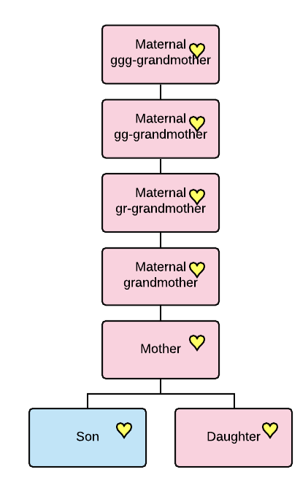
Mitochondrial DNA is only passed from mothers to their children, never admixed or combined with the DNA of the father, so your mitochondrial DNA today is either exactly the same as that of your ancestors a few generations ago, or very close if a mutation has occurred between when they lived and today’s tester.

One of mitochondrial DNA’s strengths is that it can reach far back in time, it’s message undiluted and uninterrupted by recombination.

The messages from our ancestors are very clear. We just need to understand how to hear what they are telling us.

Step-by-Step Soup to Nuts

We will analyze the mitochondrial DNA results of multiple testers who descend from the LeJeune sisters, Edmee and Catherine, born in 1624 and 1633, respectively, to see what they have to tell their descendants. For a very long time, rumors abounded that their mother was Native American, so we will keep that in mind as we review all matching, Mitotree and mtDNA Discover tools provided by FamilyTreeDNA.

We will also learn how to evaluate seemingly conflicting information.

Soup to nuts – we will incorporate every sliver of information along the way and extract every morsel that can help you. Think of this article as your recipe and the reports and information as ingredients!

To be clear, you don’t HAVE to read all of this or decipher anything if you don’t want to. You can just glance at the matches and be on your way – but if you do – you’re leaving an incredible amount of useful information on the table, along with MANY hints that you can’t find elsewhere.

If there was an out-of-print book about this ancestral line in a rare book collection someplace, as a genealogist, you would drive half-way across the country to access that information. This is your rare book, that updates itself, and you don’t have to do anything other than take a mitochondrial DNA test, or find a cousin to take one for lines you don’t carry..

Come along and join the fun! Your ancestors are waiting!

The LeJeune Question

Recently, I wrote about my ancestor Catherine LeJeune, who was born about 1633, probably in France before her family settled in Acadia, present-day Nova Scotia.

The identity of her parents has been hotly contested and widely debated for a long time.

I intentionally did not address her DNA results in that article because I wanted to establish the historical facts about her life and address her mitochondrial DNA separately. The process we are following to analyze her DNA results is the same process everyone should follow, which is why we are taking this step-by-step approach, complete with detailed explanations.

Often, when people hit a brick wall with an ancestor, especially during European colonization of the Americas, someone suggests that the person surely “must be” Native American. Lack of records is interpreted to add layers of evidence, when, in fact, absence of evidence is not evidence of absence.

For example, for many of the earliest French Acadians, birth and baptism records have NOT been located in France, where massive record loss has been experienced.

Additionally, not all records that do exist have been indexed, transcribed, or digitized. Many are damaged and/or nearly impossible to read. Lack of records does NOT mean that those settlers weren’t French, or in this case, it does NOT indicate that they were Native American. It simply means we are lacking that piece of evidence.

Enter mitochondrial DNA.

This article is focused on how to use mitochondrial DNA to decode these messages from our ancestors. I’m providing a very short summary of the relevant historical factors about the LeJeune sisters so readers can keep this in mind as we review the 17+ tools waiting for us when mitochondrial DNA results are ready.

The First Acadian Settlers

The Acadians were French settlers in what is today Nova Scotia. The first Acadians arrived in LaHeve (LaHave), on the southern coast of Acadia, in 1632 after Acadia was returned to France from English control. There may or may not have been any French families in the original group, but if so, very few. In 1636, another group of settlers arrived, but no LeJeune is on the roster.

At the end of 1636, the fledgling Acadian colony was moved from LaHeve, on the southern coast, to Port Royal, a more protected environment.

While we don’t know exactly when the family of Catherine and Edmee LeJeune arrived, we can bracket the dates. We know that Catherine’s sister, Edmee LeJeune, born about 1624, married another settler, Francois Gautrot, about 1644 in Port Royal, so they had arrived by that time.

Edmee’s 1624 birth year is important for two reasons. First, there were no French settlers in the part of Acadia that became Nova Scotia in 1624, so that clearly demonstrates that Edmee was born in France.

It’s unlikely that Catherine was born in Acadia in 1633 given that the first known families arrived in 1636, and we have their names from the ship roster. Pierre Martin was on the 1636 ship, and Acadian history tells us that his son, Mathieu Martin, was the first French child born in Acadia, about 1636, based on the 1671 census.

We also know that there was an early Acadian man, Jean LeJeune, who was granted land at BelleIsle, near Port Royal, among other Acadian families, but he was deceased before the first Acadian census in 1671. Acadia was under English control again from 1654 to 1670, so Jean LeJeune’s land grant had to have occurred after 1636 and prior to 1654, and is where Catherine LeJeune is found as an adult.

Another source of confusion is that there is a third LeJeune woman, Jeanne LeJeune dit Briard, born about 1659. Her daughter, Catherine Joseph’s 1720 marriage record in Port Royal refers to her mother, Jeanne, as being “d’un nation sauvagé”, giving her parents’ names as Francois Joseph and Jeanne LeJeune “of the Indian Nation.” Jeanne LeJeune dit Briard lived with her first husband in Port Royal, but had relocated to LaHeve by 1708.

You can see why this led to confusion about LeJeune females.

Another male, Pierre LeJeune was associated with LaHeve, which suggests he may have been awarded land there, possibly before the colony moved to Port Royal. One of the reasons that the rumor that Catherine LeJeune had a Native mother is so persistent is the belief that Pierre came over early, as a laborer or soldier, and married a Native woman because there weren’t any European women available.

Pierre may well have arrived as a single man, but there is no shred of evidence to suggest Pierre is the father of the sisters, Catherine LeJeune and Edmee LeJeune. In fact, given that Jeanne was born about 1659, Pierre, if he was her father, may have been born as late as 1627, which makes it impossible for him to have been Catherine and Edmee’s father.

That speculation was before the advent of DNA testing, and before Stephen White discovered that there was also a Jean LeJeune who was awarded land exactly where Catherine is known to have been living a few years later.

While it would be nice to unravel this entire cat’s cradle of confusion, the questions we are seeking to answer definitively here are:

  • Are Catherine LeJeune (born 1633) and Edmee LeJeune (born 1624) actually sisters?
  • Is the mother of Catherine LeJeune and her sister, Edmee LeJeune, Native American or European?
  • Is Jeanne LeJeune dit Briard, born about 1659, “d’un nation sauvagé” another sister of the LeJeune sisters?
  • What else is revealed about the LeJeune sisters and their ancestors? Is there something else we should know?

I’ll provide a summary of the combined evidence after our step-by-step mitochondrial analysis.

Testing for Sisters

Mitochondrial DNA is passed from mothers to all of their children, but only females pass it on.

Since we have two LeJeune females, believed to be sisters, we need mitochondrial DNA from direct matrilineal testers for each woman. This is particularly important because we know unquestionably that Edmee was born in France in 1624, prior to Acadian settlement in New France, so her DNA should be European. If they match, it means that Catherine was born to the same mother who was not Native. If they don’t match, there’s a different message.

In some cases, a match might mean that they were born to females related on the matrilineal line, like first cousins, for example. But in the early days of Acadia, there were no European females other than the handful, less than a dozen, who arrived on the Saint-Jehan in 1636.

Fortunately, we have multiple testers for each woman in two DNA projects at FamilyTreeDNA, the only DNA testing company that provides mitochondrial DNA testing and matching. Testers can join special interest projects, and both the Mothers of Acadia Project, and the Acadian AmerIndian Project have testers who descend from the LeJeune sisters.

I’ve identified 28 descendants of Catherine, and 25 from Edmee, giving us a total of 53 known matrilineal descendants to work with. Not all are shown publicly, in projects. Catherine has a known total of 14 testers, and Edmee has 17 that are shown publicly. All testers are members of haplogroup U6a7a1a.

The fact that the descendants of these women match each other, often exactly, combined with Catholic parish register dispensations for their descendants, when taken together, prove conclusively that Catherine and Edmee were sisters, not paternal half-sisters.

Let’s look at each piece of evidence.

Mitochondrial DNA Results

When the lab finishes processing the mtFull test, the results are posted to the account of the test taker.

Click on any image to enlarge

You’ll see the Maternal Line Ancestry section which displays your mitochondrial mtDNA Results.

The three tabs we will be primarily working with are:

  • mtDNA Matches
  • Matches Maps
  • Discover Haplogroup Reports, which includes another dozen+ reports and an updated Migration Map
  • Advanced Matching

At the bottom right of your page, you’ll see two haplogroup badges.

The one at right is called the “Legacy” haplogroup, which means the haplogroup you were assigned prior to the release of the new Mitotree.

The Mitotree mtDNA Haplogroup, with the green “Beta” at the bottom, is the new Mitotree haplogroup, which I wrote about in a series of articles:

Your old Legacy haplogroup will never change, because it’s the 2016 version that was not updated by the previous tree-keepers. That’s why the FamilyTreeDNA R&D team, me included, developed and birthed the new Mitotree. There were thousands of new haplogroups that could be defined to kick-start our genealogy, so we did.

The mitochondrial tree went from about 5000 branches to over 40,000 in the new Mitotree, each providing additional information to testers.

Not everyone received a new haplogroup, but about 75% of testers did, and another new Mitotree version will be released soon. In order to receive a new haplogroup, testers needed to:

  • Have at least one qualifying, stable mutation that had not been previously used to define a haplogroup
  • Match at least one other person in the same haplogroup branch with the same mutation(s)

In the case of the LeJeune sisters, there were no mutations that met all of the qualifications, so their known descendants did not receive a new haplogroup. That’s fine, though, because it’s not the name but the messages held by the information that’s important – and there’s a LOT to work with.

Let’s start with matches.

Matches

Of course, the first thing everyone does is click to see their matches.

The default is Detail View, but I prefer Table View (top left) because you can see more matches on the same page.

Catherine’s descendant whose matches are shown here has 108 Full Sequence matches, which are labeled as the “Coding Region.” The Coding Regions is the mtFULL test and includes both the HVR1 and HVR2 regions. Viewing Coding Region matches means they have taken the mtFull test, which sequences all 16,569 locations of the mitochondria.

When you click on the “Coding Region”, you are seeing matches to people who took all three test levels, not just the first one or two.

There are three test levels to view:

  1. HVR1
  2. HVR1+HVR2 both
  3. Coding Region, which is in addition to the HVR1+HVR2 regions

You can no longer order three different test levels today, although at one time you could. As costs decreased, it no longer made sense to offer multiple testing levels, and often the HVR1 or HVR1+HVR2 results, which only tested about 500 locations each, would confuse people.

People at the lower HVR1 or HVR1+HVR2 levels, known as mtPlus, can upgrade to the complete mtFull level, and should.

However, because some people only tested at those lower levels, matches are still shown at three levels, with different match thresholds for each level.

Matches at the HVR1 or HVR1+HVR2 levels *might* be entirely irrelevant, reaching back thousands of years. They could also be much more current, and critical to your genealogy, so don’t assume. Just one unstable mutation can cause a mismatch though, and at lower levels, cause you not to match someone with the same ancestor, which is why the full sequence test is so critically important.

For some testers, matches at lower levels sometimes provide the ONLY match to your known ancestor. So don’t skip over them. If you find a critical match there, you can email the tester to see if they will upgrade to the mtFull test.

People who test only at the HVR1 or HVR1+HVR2 level receive a more refined haplogroup after they upgrade, so the haplogroups between the HVR1/HVR2 testers and the full sequence test won’t match exactly. For the LeJeune sisters, the haplogroup for HVR1/HVR2-only testers is U6a and for full sequence testers, it’s U6a7a1a.

While full sequence matches are wonderful, if you’re searching for a particular ancestor and the ONLY place they appear is the HVR1 or HVR1+HVR2 testing levels, you’ll want to pursue the match. You may also want to evaluate lower level matches if their ancestors are from a specific location – like France – even if their earliest known ancestor (EKA) is not your ancestor.

To view your  HVR1 or HVR1+HVR2 matches, just click on either of those links. You’ll see ALL of the results, including everyone who took the full sequence test. In this case, that means that the 217 HVR1 (hypervariable region 1) results will include the 120 coding region (full sequence) tests. I’ve already looked through the full sequence matches, so that’s not what I want.

If you ONLY want to see testers who did NOT take the Full Sequence test, use the Filter option. Select Filter, then the features you seek.

Fortunately, the LeJeune sisters have lots of known descendants at the mtFull level to work with, so we will focus on their full sequence matches.

Your Focus

On the matches page, you’ll be immediately interested in two fields:

  • Maternal Earliest Known Ancestor (EKA) – the direct matrilineal ancestor of your match – unless they got confused and entered someone else
  • Their Tree

Viewing the first several matches only produced one match to someone whose earliest known ancestor (EKA) is listed as Catherine or Edmee LeJeune, but perhaps the next group will be more productive. Note that females’ EKAs, earliest known ancestors, are sometimes challenging, given surname changes. So unfamiliar EKAs could represent generational differences and sometimes offer other hints based on their information.

Shifting to the detail view for a minute, you’ll want to review the genetic distance,  meaning whether you’re an exact match or not.

If you’re not an exact match, a genetic distance of “1 step” means that you match except for one mutation at a specific location.

If you have a genetic distance greater than 3, meaning 4 mutations or more, you won’t be shown as a match on this match list. However, you can still be a haplogroup match, which we’ll discuss in the Discover section.

Essentially, with more than 3 mutations difference, it’s unlikely (but not impossible) that your match is genealogically relevant – meaning you probably won’t be able to identify your most recent common ancestor (MRCA).

However, that doesn’t mean that haplogroup-only matches can’t provide important clues, and we will look under every rock!

A Slight Detour – Confirmation Bias

This is a good place to mention that both ancestors and their location (country) of origin are provided by (some) testers to the best of their ability and understanding.

This tester selected “United States Native American” as the location for their earliest known ancestor. We don’t know why they entered that information. It could be that:

  • The tester did not understand that the maternal country of origin means the direct MATRILINEAL line, not just someplace on the maternal side
  • Selina Sinott was Native on her father’s side, or any line OTHER than her direct matrilineal line.
  • They relied on oral history or made a guess
  • They found the information in someone else’s tree
  • They found all of the LeJeune information confusing (because it is)

The tester has provided no tree, so we can’t do any sleuthing here, but an Ancestry search shows a woman by that name born in 1855 in Starksboro, VT to Louis Senott and Victoria Reya. A further search on Victoria leads me to Marie Lussier who leads me to Marguerite Michel who leads me to Marie Anne Lord (Lore, Laure), who lived in Acadia, whose ancestor is…drum roll…Catherine LeJeune. You get the idea.

Yes, you may need to extend other people’s trees.

The Point

However, and this is the point – if you’re looking for confirmation that the LeJeune sisters were Native American, this ONE tester who entered Native American for an unknown reason is NOT the confirmation you’re looking for. Don’t get sucked into confirmation bias, or into categorically believing what someone else entered without additional information.

You need haplogroup confirmation, but, in this case, you don’t have it. However, if you’re new to genetic genealogy, you don’t know that yet, so hold on. We’re still getting there. This is why we need to review all of the reports.

And trust me, I’m not being critical because there isn’t a single seasoned genealogist who has NOT fallen down the rathole of excited confirmation bias or accepting information without further analysis – me included. We all need to actively guard against it, all the time. Confirm and weigh all of the evidence we do have, and seek missing evidence.

Let’s go back to the match results.

Matches – Haplogroups and Haplotypes

Scrolling down the Table View, the next group of matches shows many more matches to descendants of both Catherine and Edmee LeJeune.

Next, you’ll notice that there’s a Mitotree haplogroup, U6a7a1a, AND an F number. In this case, they are both checked in blue, which means you share the exact same haplogroup with that tester, and the exact same haplotype cluster, which is the F number.

I wrote about haplotype clusters, here.

If NEITHER box is checked, you don’t share either the haplogroup nor the haplotype cluster.

You can match the haplogroup, but not the haplotype cluster, which means the haplogroup box will be checked, but the haplotype cluster will not. If you share the same haplotype cluster, you WILL share the same haplogroup, but the reverse is not true.

What is a Haplotype Cluster, and why do they matter?

Haplotype Clusters

We need to talk about exact matches and what they mean. Yes, I know it seems intuitive, but it isn’t.

There are three types of matches

  • Matching and Genetic Distance on your Match List
  • Haplotype matching
  • Haplogroup matching

Without getting (too much) into the weeds, an Exact Match in the Genetic Distance column on your match list excludes locations 309 and 315 because they are too unstable to be considered reliable for matching. So, 309 and 315 are EXCLUDED from this type of matching. In other words, you may or may not match at either or both of those locations. They are ignored for matching on your match list.

Locations 309 and 315 are also EXCLUDED from haplogroup definitions.

A haplotype F cluster match indicates that everyone in that cluster is an exact match, taking into consideration EVERY mutation, INCLUDING 309 and 315.

309 and 315 Why
Matching and Genetic Distance Excluded Unstable, probably not genealogically relevant and may be deceptive, leading you down a rathole
Haplogroup Definition Excluded Too unstable for tree branching and definition
Haplotype F Clusters Included Might be genealogically useful, so everyone can evaluate the rathole for themselves

Some people think that if they don’t match someone exactly, they can’t have the same ancestor as people who do match exactly, but that’s not true. “Mutations happen” whenever they darned well please. Downstream mutations in stable locations that match between two or more testers will form their own haplogroup branch.

The most distant matches are shown on the last match page, and as you can see below, some descendants of Catherine and Edmee LeJeune have a 1-step difference with our tester, meaning a genetic distance of one, or one mutation (disregarding 309 and 315). One match has a 2-step mutation.

The fact that their F numbers are not the same tells you that their mutations are different from each other, too. If two of those people also matched each other, their F# would be identical.

The mutations that do not (yet) form a haplogroup, and are included in your haplotype cluster, are called Private Variants, and you cannot see the private variants of other people. Clearly, you and anyone in your haplotype cluster share all of the same mutations, including Private Variants.

Evaluating Trees and EKAs

By reviewing the matches, their EKAs, and the trees for the matches of Catherine’s descendants, I was able to create a little mini-tree of sorts. Keep in mind that not everyone with an EKA has a tree, and certainly not everyone who uploaded a tree listed an EKA. So be sure to check both resources. Here’s how to add your EKA, and a one-minute video, here.

The good news is that if your match has a WikiTree link when you click on their tree icon, you know their tree actually reaches back to either Edmee or Catherine if that’s their ancestor, and you’re not dealing with a frustrating, truncated two or three-generation tree, or a private tree. You can add your WikiTree link at FamilyTreeDNA here, in addition to any other tree you’ve linked.

Takeaways from Matches

  • You can identify your common ancestor with other testers. By viewing people’s trees and emailing other testers, you can often reconstruct the trees from the tester back through either Catherine or Edmee LeJeune.
  • Your primary focus should be on the people in your haplotype cluster, but don’t neglect other clusters where you may find descendants of your ancestor.
  • If you see a male EKA name, or something other than a female name in the EKA field, like a location, the tester was confused. Only females pass their mitochondrial DNA to their descendants.
  • If you’re searching for an ancestor whose mitochondrial DNA you don’t carry, use projects and WikiTree to see if you can determine if someone has tested from that line. From viewing the project results, I already knew that the LeJeune sisters had several descendants who had tested.
  • If you’re searching for your ancestor on your match list, and you don’t find them in the full sequence results, use the filter to view people who ONLY took the HVR1 and HVR1+HVR2 tests to see if the results you seek are there. They won’t be on your full sequence match list because they didn’t test at that level. Testers at the lower levels will only have a partial, estimated haplogroup – in this case, U6a.
  • For Edmee and Catherine LeJeune, we have enough testers to ensure that we don’t have just one or two people with the same erroneous genealogy. If you do find someone in a project or at WikiTree claiming descent from the same ancestor, but with a different haplogroup, you’ll need to focus on additional research to verify each step for all testers.

Resources:

Matches Maps

The Matches Map is a great visual resource. That “picture is worth 1000 words” tidbit of wisdom definitely applies here.

Clicking on the Matches Maps displays the locations that your matches entered for their EKA.

In the upper left-hand corner, select “Full Sequence,” and only the full sequence matches will be displayed on the map. All full sequence testers also have HVR1/HVR2 results, so those results will be displayed under that selection, along with people who ONLY took the HVR1 or HVR1/HVR2 tests.

We know that the Acadians originally came from France, and their descendants were forcibly expelled from Nova Scotia in 1755. Families found themselves scattered to various locations along the eastern seaboard, culminating with settlements in Louisiana, Quebec, and in some cases, back in France, so this match distribution makes sense in that context.

Be sure to enlarge the map in case pins are on top of or obscuring each other.

Some people from other locations may be a match, too. Reviewing their information may assist with breaking down the next brick wall. Sometimes, additional analysis reveals that the tester providing the information was confused about what to complete, e.g., male names, and you should disregard that pin.

Takeaways from the Matches Map

  • These results make sense for the LeJeune sisters. I would specifically look for testers with other French EKAs, just in case their information can provide a (desperately needed) clue as to where the LeJeune family was from in France.

  • Reviewing other matches in unexpected locations may provide clues about where ancestors of your ancestor came from, or in this case, where descendants of the LeJeune sisters wound up – such as Marie Josephe Surette in Salem, Massachusetts, Catherine LeJeune’s great-granddaughter.
  • Finding large clusters of pins in an unexpected location suggests a story waiting to be uncovered. My matrilineal ancestor was confirmed in church records in Wirbenz, Germany, in 1647 when she married, but the fact that almost all of my full sequence matches are in Scandinavia, clustered in Sweden and Norway, suggests an untold story, probably involving the 30 Years War in Germany that saw Swedish troop movement in the area where my ancestor lived.
  • For my own mitochondrial DNA test, by viewing trees, EKAs, and other hints, including email addresses, I was able to identify at least a country for 30 of 36 full sequence matches and created my own Google map.
  • You can often add to the locations by creating your own map and including everyone’s results.

Resources:

Mitochondrial DNA Part 4 – Techniques for Doubling Your Useful Matches

Mitochondrial DNA Myth – Mitochondrial DNA is not Useful because the Haplogroups are “Too Old”

Before we move to the Discover Reports, I’m going to dispel a myth about haplogroups, ages, genealogical usefulness, and most recent common ancestors known as MRCAs.

Let me start by saying this out loud. YES, MITOCHONDRIAL DNA IS USEFUL FOR GENEALOGY and NO, OLDER HAPLOGROUPS DO NOT PREVENT MITOCHONDRIAL DNA FROM BEING USEFUL.

Here’s why.

The most recent common ancestor (MRCA) is the person who is the closest common ancestor of any two people.

For example, the mitochondrial DNA MRCA of you and your sibling is your mother.

For your mother and her first cousin, the mitochondrial MRCA is their grandmother on the same side, assuming they both descend from a different daughter. Both daughters carry their mother’s undiluted mitochondrial DNA.

A common complaint about mitochondrial DNA is that “it’s not genealogically useful because the haplogroups are so old” – which is absolutely untrue.

Let’s unravel this a bit more.

The MRCA of a GROUP of people is the first common ancestor of EVERY person in the group with each other.

So, if you’re looking at your tree, the MRCA of you, your sibling, and your mother’s 1C in the example above is also your mother’s grandmother, because your mother’s grandmother is the first person in your tree that ALL of the people in the comparison group descend from.

Taking this even further back in time, your mother’s GGG-grandmother is the MRCA for these five people bolded, and maybe a lot more descendants, too.

At that distance in your tree, you may or may not know the name of the GGG-grandmother and you probably don’t know all of her descendants either.

Eventually, you will hit a genealogical brick wall, but the descendants of that unknown “grandmother” will still match. You have NOT hit a genetic brick wall.

A haplogroup name is assigned to the woman who had a mutation that forms a new haplogroup branch, and she is the MRCA of every person in that haplogroup and all descendant haplogroups.

However, and this is important, the MRCA of any two people, or a group of people may very well be downstream, in your tree, of that haplogroup mother.

As you can clearly see from our example, there are four different MRCAs, depending on who you are comparing with each other.

  • Mom – MRCA of you and your sibling
  • Grandmother – MRCA of you, your sibling, your mom and your mom’s 1C
  • GGG-Grandmother – MRCA of all five bolded descendants
  • Haplogroup formation – MRCA of ALL tested descendants, and all downstream haplogroups, many of whom are not pictured

Many of the testers may, and probably do, form haplotype clusters beneath this haplogroup.

When you are seeking a common ancestor, you really don’t care when everyone in that haplogroup was related, what you seek is the common ancestor between you and another person, or group of people.

If the haplogroup is formed more recently in time, it may define a specific lineage, and in that case, you will care because that haplogroup equates to a woman you can identify genealogically. For example, let’s say that one of Catherine LeJeune’s children formed a specific haplogroup. That would be important because it would be easy to assign testers with that haplogroup to their appropriate lineage. That may well be the case for the two people in haplogroup U6a7a1a2, but lack of a more recent haplogroup for the other testers does not hinder our analysis or reduce mitochondrial DNA’s benefits.

That said, the more people who test, the more possibilities for downstream haplogroup formation. Currently, haplogroup U6a7a1a has 34 unnamed lineages, just waiting for more testers.

Haplogroup ages are useful in a number of ways, but haplogroup usefulness is IN NO WAY DEPRICATED BY THEIR AGE. The haplogroup age is when every single person in that haplogroup shares a common ancestor. That might be useful to know, but it’s not a barrier to genealogy. Unfortunately, hearing that persistent myth causes people to become discouraged, give up and not even bother to test, which is clearly self-defeating behavior. You’ll never know what you don’t know, and you won’t know if you don’t test. That’s my mantra!

The LeJeune sisters provide a clear example.

OK, now on to Discover.

mtDNA Discover

Next, we are going to click through from the mtDNA Results and Tools area on your personal page to Discover Haplogroup Reports. These reports are chapters in your own personal book, handed down from your ancestors.

Discover is also a freely available public tool, but you’ll receive additional and personalized information by clicking through when you are signed into your page at FamilyTreeDNA. Only a subset is available publicly.

mtDNA Discover was released with the new Mitotree and provides fresh information weekly.

Think of Discover as a set of a dozen reports just for your results, with one more, Globetrekker, an interactive haplogroup map, coming soon.

Resources:

When you click through to Discover from your results, Discover defaults to your haplogroup. In this case, that’s U6a7a1a for the LeJeune sisters.

Let’s begin with the first report, Haplogroup Story.

Haplogroup Story

The Haplogroup Story is a landing page that summarizes information about your ancestor’s haplogroup relevant to understanding your ancestor’s history. Please take the time to actually READ the Discover reports, including the information buttons, not just skim them.

Think of Discover as your own personalized book about your ancestors – so you don’t want to miss a word.

You’ll see facts on the left, each one with a little “i” button. Click there or mouse over for more information about how that fact was determined.

When we’re talking about haplogroup U6a7a1a, it sounds impersonal, but we’re really talking about an actual person whose name, in this case, we will never know. We can determine the ancestor of some haplogroups that formed within a genealogical timeframe. The LeJeune ancestor in question is the person in whose generation the final mutation in a long string of mutations created the final “a” in haplogroup U6a7a1a.

Think of these as a long line of breadcrumbs. By following them backwards in time and determining when and where those breadcrumbs were dropped, meaning when and where the mutation occurred, we begin to understand the history of our ancestor – where she was, when, and which cultures and events shaped her life.

U6a7a1a was formed, meaning this ancestor was born, about 50 CE, so about 1950 years ago. This means that the ancestor of ANY ONE PERSON with this haplogroup could have lived anytime between the year 50 CE and the year of their mother’s birth.

This is VERY important, because there is an incredible amount of  misunderstanding about haplogroup ages and what they mean to you.

The year 50 CE is the year that the common ancestor of EVERY PERSON in the haplogroup was born, NOT the year that the common ancestor of any two or more people was born.

By way of illustration, the LeJeune sisters were born in about 1624 and 1633, respectively, not 50 CE, and their most recent common ancestor (MRCA) is their mother, who would have been born between about 1590 and 1608, based on their birth years.

For reference, I’ve created this genealogical tree from individuals who took the mitochondrial DNA test and have identified their mitochondrial lineage on the LeJeune mother’s profile at Wikitree

You can see that both Edmee and Catherine have mitochondrial DNA testers through multiple daughters. I’ve color coded the MRCA individuals within each group, and of course their mother is the MRCA between any two people who each descend from Edmee and Catherine.

Mitochondrial DNA matches to the LeJeune sisters’ descendants could be related to each other anywhere from the current generation (parent/child) to when the haplogroup formed, about 50 CE.

You can easily see that all of these testers, even compared with their most distant relatives in the group, share a common ancestor born between 1590 and about 1608. Other people when compared within the group share MCRAs born about 1717 (blue), 1778 (peach), 1752 (green), 1684 (pink), 1658 (mustard), and 1633 (red).

Soooooo…a haplogroup born in 50 CE does NOT mean that you won’t be able to find any genealogical connection because your common ancestor with another tester was born more than 1900 years ago. It means that the common ancestor of EVERYONE who is a member of haplogroup U6a7a1a (and downstream haplogroups) was born about 50 CE.

The parent haplogroup of U6a7a1a is haplogroup U6a7a1, which was born about 1450 BCE, or about 3450 years ago.

In the graphic, I’ve shown other unknown genealogical lineages from U6a7a1 and also downstream haplogroups.

Haplogroup U6a7a1 is the MRCA, or most recent common ancestor of haplogroup U6a7a1a, and anyone who descends from haplogroup U6a7a1 or any of the 23 downstream lineages from U6a7a1, including 5 descendant haplogroups and 18 unnamed lineages.

The LeJeune haplogroup, U6a7a1a, has 35 descendant lineages. One downstream haplogroup has already been identified – U6a7a1a2 – which means two or more people share at least one common, stable, mutation, in addition to the mutations that form U6a7a1a. Thirty-four other lineages are as yet unnamed.

The fact that there are 34 unnamed lineages means that people with one or more private variants, or unique mutations, are candidates for a new branch to form when someone else tests and matches them, including those variants.

You’re a candidate for a new haplogroup in the future if no one else matches your haplotype cluster number, or, potentially, as the tree splits and branches upstream.

When a second person in a lineage tests, those two people will not only share a common haplotype cluster F#, they will share a new haplogroup too if their common mutation is not excluded because it’s unstable and therefore unreliable.

There are 127 members of haplogroup U6a7a1a today, and their EKAs are noted as being from France, Canada, the US, and other countries that we’ll view on other pages.

Haplogroup U6a7a1a has been assigned two Discover badges:

  • Imperial Age – “an age noted for the formation and global impact of expansive empires in many parts of the world.” In other words, colonization, which is certainly true of the French who battled with the English to colonize New England, Acadia, and New France.
  • mtFull Confirmed (for testers only)

Additionally, the LeJeune sisters have one Rare Notable Connection, and three Rare Ancient Connections, all of which may shed light on their history.

Takeaways from the Haplogroup Story

  • The Haplogroup Story provides an overview of the haplogroup
  • You can easily see how many testers fall into this haplogroup and where they have indicated as the origin of their matrilineal line.
  • The haplogroup may have several new haplogroup seeds – 34 in this case – the number of unnamed lineages
  • You can share this or other Discover pages with others by using the “share page” link in the upper right-hand corner.
  • Don’t be discouraged by the age of the haplogroup, whether it’s recent or older.

Next, let’s look at Country Frequency.

Country Frequency

Country Frequency shows the locations where testers in haplogroup U6a7a1a indicate that their EKA, or earliest known matrilineal ancestor, is found. The Country Frequency information is NOT limited to just your matches, but all testers in haplogroup U6a7a1a, some of whom may not be on your match list. Remember, only people with 3 mutations difference, or fewer, are on your match list.

Haplogroup distribution around the world is very informative as to where your ancestors came from.

There are two tabs under Country Frequency, and I’d like to start with the second one – Table View.

Table View displays all of the user-provided country locations. Note that the Haplogroup Frequency is the percentage of total testers in which this haplogroup is found in this particular country. These frequencies are almost always quite small and are location-based, NOT haplogroup based.

There are now 40,000 haplogroups, and in haplogroup U, the LeJeune sisters are 6 branches down the tree with U6a7a1a.

In total, 127 testers are members of haplogroup U6a7a1a, and 42 of those claim that their ancestor is from France, which comprises 1% of the people who have taken the full sequence mitochondrial DNA test whose ancestor is from that location.

Let’s do the math so you can see how this is calculated and why it’s typically so small. For our example, let’s say that 8000 people in the database have said their matrilineal ancestor is from France. Of the 127 haplogroup U6a7a1a members, 42 say their ancestor is from France. Divide 42 by 8,000, which is 0.00525, and round to the nearest percentage – which is 1%.

The best aspect of this page is that you can see a nice summary of the locations where people indicate that their earliest known U6a7a1a ancestor was found.

Please note that the last entry, “Unknown Origins,” is the bucket that everyone who doesn’t provide a location falls into. That row is not a total but includes everyone who didn’t provide location information.

These location results make sense for the LeJeune sisters – maybe except for Ireland and Belgium. Some people don’t understand the directions, meaning that a matrilineal ancestor or direct maternal ancestor is NOT your literal “oldest” ancestor on your mother’s side of the tree who lived to be 105, but your mother-to-mother-to-mother-to-mother ancestor, so check to see if these people with unusual locations are in your match list and view their tree or reach out to them.

We don’t know why the person who selected Native American made that choice, but I’d bet it has to do with confusion about the “other” LeJeune female, Jeanne LeJeune dit Briard. Based on Catherine and her sister, Edmee LeJeune’s haplogroup through more than 50 testers, U6a7a1a, Native is incorrect.

Of course, that tester wouldn’t have known that if they completed their EKA information before they tested. Perhaps they entered information based on the stories they had heard, or flawed genealogy, and didn’t think to go back and correct it when their results were ready, indicating that Native was mistaken.

On the “Map View” tab, the locations are shown using a heat map, where the highest percentages are the darkest. Here, both France and Canada are the darkest because that’s the most common selection for this haplogroup with 1% each, while the rest of the countries registered with less <1%.

These colors are comparative to each other, meaning that there is no hard and fast line in the sand that says some percentage or greater is always red.

To summarize these two tables, because this is important:

  • The Table View shows you how many people selected a specific country for their ancestor’s location, but the frequency is almost always very low because it’s based on the total number of testers in the entire database, comprised of all haplogroups, with ancestors from that country.
  • The Map View shows you a heat map for how frequently a particular location was selected, as compared to other locations, for this haplogroup.

To view the difference between adjacent haplogroups, I always compare at least one haplogroup upstream. In this case, that’s the parent haplogroup, U6a7a1.

The Parent Haplogroup

If you look at haplogroup U6a7a1, just one haplogroup upstream, you’ll see that for Mauritania, the total number of U6a7a1 descendants tested is only “1”, but the haplogroup frequency in Mauritania is 10% which means that there are only 10 people who have been tested in the database altogether from Mauritania – and one person is haplogroup U6a7a1.

However, due to substantial under-sampling of the Mauritania population, the frequency for Mauritania, 10%, is higher than any other location.

Also, remember, these are user-reported ancestor locations, and we have no idea if or how these people determined that their ancestor is actually from Mauritania.

Please only enter actual known locations. For example, we don’t want haplogroup U6a7a1 members to look at this informatoin, then add Mauritania as their location because now they “know” that their ancestor is from Mauritania.

On the Map View, Mauritania is dark red because the percentage is so high – never mind that there are only 10 testers who report matrilineal ancestors from there, and only one was U6a7a1.

This map illustrates one reason why taking the full sequence test is important. Viewing partial haplogroups can be deceiving.

Catherine and Edmee LeJeune’s matrilineal descendants who only tested at the HVR1 or HVR1+HVR2 level receive a predicted haplogroup of U6a, born about 21,000 years ago. That’s because the full 16,569 locations of the mitochondria need to be tested in order to obtain a full haplogroup, as opposed to about 500 locations in the HVR1 and HVR1/2, each, respectively.

U6a – The Result for HVR1/HVR2-Only Testers

So, let’s look at what haplogroup U6a reveals, given that it’s what early LeJeune descendants who ordered the lower-level tests will see.

In the Table View for U6a, below, you see that the top 5 counties listed by haplogroup frequency are five North African countries.

A total of 801 people are assigned to haplogroup U6a, meaning the majority, 757, report their ancestors to be from someplace else. If two people from the Western Sahara (Sahrawi) comprise 67% of the people who tested, we know there are only three people who have tested and selected that location for their ancestors.

If you didn’t understand how the display works, you’d look at this report and see that the “top 5” countries are North African, and it would be easy to interpret this to mean that’s where Catherine and Edmee’s ancestors are from. That’s exactly how some people have interpreted their results.

Scrolling on down the Table View, 50 testers report France, and 10 report the US, respectively, with France showing a Haplogroup Frequency of 1% and the US <1%.

The balance of U6a testers’ ancestors are from a total of 57 other countries, plus another 366 who did not select a location. Not to mention that U6a was born 21,000 years ago, and a lot has happened between then and the 1620/1630s when Catherine and Edmee were born to a French mother.

The real “problem” of course is that haplogroup U6a is only a partial haplogroup.

The U6a map shows the highest frequency based on the number of testers per country, which is why it’s dark red, but the Table View reports that the actual number of U6a testers reporting any specific country. France has 50. Next is the US, also with 50, which often means people are brick-walled here. You can view the U6a table for yourself, here.

Why is this relevant for Catherine and Edmee LeJeune? It’s very easy to misinterpret the map, and for anyone viewing U6a results instead of U6a7a1a results, it’s potentially genealogically misleading.

Use Country Frequency with discretion and a full understanding of what you’re viewing, especially for partial haplogroups from HVR1/HVR2 results or autosomal results from any vendor.

If someone tells you that the LeJeune sisters are from someplace other than France, ask where they found the information. If they mention Africa, Morocco or Portugal, you’ll know precisely where they derived the information.

This information is also available on your Maternal Line Ancestry page, under “See More,” just beneath the Matches tab. Haplogroup Origins and Ancestral Origins present the same information in a different format.

Discover is a significant improvement over those reports, but you’ll still need to read carefully, understand the message, and digest the information.

Takeaways from Country Frequency

  • Evaluate the results carefully and be sure to understand how the reports work.
  • Use complete, not partial haplogroups when possible.
  • The Haplogroup Frequency is the number of people assigned to this haplogroup divided by the entire number of people in the database who report that country location for their matrilineal ancestor. It is NOT the percentage of people in ONLY haplogroup U6a7a1a from a specific country.
  • Table view shows the number of testers with this haplogroup, with the percentage calculated per the number of people who have tested in that country location.
  • The Map shows the highest frequency based on the number of testers per country.
  • Use the map in conjunction with the haplogroup age to better understand the context of the message.

Globetrekker, which has not yet been released, will help by tracking your ancestors’ paths from their genesis in Africa to where you initially find that lineage.

Before we move on to the Mitotree, let’s take a minute to understand genetic trees.

About Genetic Trees

The Mitotree is a genetic tree, also called a phylogenetic tree, that generally correlates relatively closely with a genealogical tree. The more testers in a particular haplogroup, the more accurate the tree.

FamilyTreeDNA provides this disclaimer information about the genetic tree. The Mitotree you see is a nice and neat published tree. The process of building the tree is somewhat like making sausage – messy. In this case, the more ingredients, the better the result.

The more people that test, the more genetic information is available to build and expand the tree, and the more accurate it becomes.

The recent Mitotree releases have moved the haplogroup “dates” for the LeJeune sisters from about 21,000 years ago for HVR1/HVR2 U6a testers to 50 CE for full sequence testers, and this may well be refined in future tree releases.

Mutations

Mutations and how to interpret them can be tricky – and this short section is meant to be general, not specific.

Sometimes mutations occur, then reverse themselves, forming a “back mutation”, which is usually counted as a branch defining a new haplogroup. If a back mutation happens repeatedly in the same haplogroup, like a drunken sailor staggering back and forth, that mutation is then omitted from haplogroup branch formation, but is still counted as a mismatch between two testers.

A heteroplasmy is the presence of two or more distinct results for a specific location in different mitochondria in our bodies. Heteroplasmy readings often “come and go” in results for different family members, because they are found at varying threshold levels in different family members, causing mismatches. Heteroplasmies are currently counted only if any person has 20% or greater of two different nucleotides. So, if you have a 19% heteroplasmy read for a particular location, and your sister has 21%, you will “not” have a heteroplasmic condition reported, but she will, and the location will be reported as a mismatch.

If you have a heteroplasmy and another family member does not, or vice versa, it’s counted as as a “mismatch,” meaning you and that family member will find yourselves in different haplotype clusters. Hetroplasmies do not presently define new tree branches. I wrote about heteroplasmies, here.

Takeaways from the Genetic Tree Disclaimer

  • DNA is fluid, mutations happen, and all mutations are not created equal.
  • Thankfully, you really don’t need to understand the nitty-gritty underpinnings of this because the scientists at FamilyTreeDNA have translated your results into reports and features that take all of this into consideration.
  • Testing more people helps refine the tree, which fills in the genetic blanks, refining the dates, and expanding branches of the tree.

Resources:

Ok, now let’s look at the Time Tree

Time Tree

The Time Tree displays your haplogroup on the Mitotree timeline. In other words, it shows us how old the haplogroup is in relation to other haplogroups, and testers.

The Time Tree displays the country locations of the ancestors of testers who are members of that and descendant or nearby haplogroups. You can view the haplogroup U6a7a1a Time Tree, here, and follow along if you wish. Of course, keep in mind that the tree is a living, evolving entity and will change and evolve over time as updated tree versions are released.

Mousing over the little black profile image, which is the person in whom this haplogroup was born, pops up information about the haplogroup. Additionally, you’ll see black bars with a hashed line between them. This is the range of the haplogroup formation date. Additional details about the range can be found on the Scientific Details tab, which we’ll visit shortly.

On your Matches tab, remember that each match has both a haplogroup and a haplogroup cluster F# listed.

On the Time Tree, individual testers are shown at right, with their selected country of origin. In this case, you’ll see the person who selected “Native American” at the top, followed by France, Canada, the US, and other flags.

Haplogroup U6a7a1a includes several haplotype clusters, designated by the rounded red brackets. In this view, we can see several people who have haplotype cluster matches. Everyone has a haplotype assignment, but a haplotype cluster is not formed until two people match exactly.

In the Time Tree view, above, you can see two clusters with two members each, and the top of a third cluster at the bottom.

In case you’re wondering why some of the globes are offset a bit, they positionally reflect the birth era of the tester, rounded to the closest 25 years, if the birth year is provided under Account Settings. If not, the current tester position defaults to 1950.

Scrolling down to the next portion of the window shows that the third cluster is VERY large. Inside the cluster, we see Belgium, Canada, and France, but we aren’t even halfway through the cluster yet.

Continuing to scroll, we see the cluster number, F7753329, in the middle of the cluster, along with the French flag, two from Ireland, four from the US, and the beginning of the large unknown group.

In this fourth screenshot, at the bottom of the display, we see the balance of haplotype cluster #F7753329, along with eight more people who are not members of that haplotype cluster, nor any other haplotype cluster.

Finally, at the bottom, we find haplogroup U6a7a1a2, a descendant haplogroup of U6a7a1a. Are they descendants of the LeJeune sisters?

Looking back at our tester’s match list, the two people who belong to the new haplogroup U6a7a1a2 haven’t provided any genealogical information. No EKA or tree, unfortunately. The haplogroup formation date is estimated as about 1483, but the range extends from about 1244-1679 at the 95th percentile. In other words, these two people could be descendants of:

  • Either Catherine or Edmee LeJeune, but not both, since all of their descendants would be in U6a7a1a2.
  • An unknown sister to Catherine and Edmee.
  • A descendant line of an ancestor upstream of Catherine and Edmee.

Takeaways from the Time Tree

  • The visualization of the matches and haplotype clusters illustrates that the majority of the haplogroup members are in the same haplogroup cluster.
  • Given that two women, sisters, are involved, we can infer that all of the mutations in this haplotype cluster were common to their mother as well.
  • Haplotype cluster #F7753329 includes 19 testers from Catherine and 17 from Edmee.
  • Downstream haplogroup U6a7a1a2 was born in a daughter of haplogroup U6a7a1a, as early as 1244 or as late as 1679. Genealogy information from the two testers could potentially tell us who the mutation arose in, and when.
  • As more haplogroup U6a7a1a2 testers provide information, the better the information about the haplogroup will become, and the formation date can be further refined.

Smaller haplotype clusters have a story to tell too, but for those, we’ll move to the Match Time Tree.

Match Time Tree

The Match Time Tree is one of my favorite reports and displays your matches on the Time Tree. This feature is only available for testers, and you must be signed in to view your Match Time Tree.

By selecting “Share Mode”, the system obfuscates first names and photos so you can share without revealing the identity of your matches. I wrote about using “Share Mode” here. I have further blurred surnames for this article.

The Match Time Tree incorporates the tree view, with time, the names of your matches PLUS their EKA name and country, assuming they have entered that information. This is one of the reasons why the EKA information is so important.

This display is slightly different than the Time Tree, because it’s one of the features you only receive if you’ve taken the mtFull test and click through to Discover from your account.

The Time Tree view is the same for everyone, but the Match Time Tree is customized for each tester.

Your result is shown first, along with your haplotype cluster if you are a member of one.

You can easily see the names of the EKAs below the obfuscated testers’ names.

While we immediately know that descendants of both Catherine and Edmee are found in the large cluster #F7753329, we don’t yet know which ancestors are included in other haplotype clusters.

Haplogroup U6a7a1a includes two smaller haplotype clusters with 2 people each.

We know a few things about each of these clusters:

  • The people in each cluster have mutations that separate them from everyone else except the other person in their cluster
  • The results are identical matches to the other person in the cluster, including less reliable locations such as 309 and 315
  • There are other locations that are excluded from haplogroup formation, but are included in matching, unlike 309 and 315.
  • Given that they match only each other exactly, AND they did not form a new haplogroup, we know that their common unique mutation that causes them to match only each other exactly is unreliable or unstable, regardless of whether it’s 309, 315, a heteroplasmy, or another marker on the list of filtered or excluded variants.

Only the tester can see their own mutations. By inference, they know the mutations of the people in their haplotype cluster, because they match exactly.

If you’re a member of a cluster and you’re seeking to determine your common ancestor, you’ll want to analyze each cluster. I’ve provided two examples, below, one each for the red and purple clusters.

Red Haplotype Cluster #F3714849

Only one person in the red cluster has included their EKA, and the tree of the second person only reaches to three generations. Tracking that line backwards was not straightforward due to the 1755 expulsion of the Acadians from Nova Scotia.

The second person listed their EKA as Edmee LeJeune, but they have a private tree at MyHeritage, so their matches can’t see anything. I wonder if they realize that their matches can’t view their tree.

We are left to wonder if both people descend from Edmee LeJeune, and more specifically, a common ancestor more recently – or if the unstable mutation that they share with each other is simply happenstance.

E-mailing these testers would be a good idea.

Purple Haplotype Cluster #F2149611

Evaluating the purple cluster reveals that the common ancestor is Catherine LeJeune. The question is twofold – how are these two people related downstream from Catherine, and how unstable is their common mutation or mutations.

Fortunately, both people have nice trees that track all the way back to Catherine.

Unfortunately, their MRCA is Francoise, the daughter of Catherine. I say unfortunately, because two additional testers also descend from Francoise, and they don’t have the haplotype cluster mutation. This tells us that the cluster mutation is unreliable and probably not genealogically relevant because it occurred in two of Francoise’s children’s lines independently, but not all four.

In other words, that specific mutation just happened to occur in those two people.

This is exactly why some mutations are not relied upon for haplogroup definition.

Takeaways from the Match Time Tree

  • The time tree is a wonderful visualization tool that shows all of your matches, their EKAs and countries, if provided, in haplotype clusters, on the Time Tree. This makes it easy to see how closely people are related and groups them together.
  • On your match page, you can easily click through to view your matches’ trees.
  • You can use both haplotype clusters (sometimes reliable) and downstream haplogroups (reliable) to identify and define lineages on your family tree. For example, if a third person matches the two in haplogroup U6a7a1a2, the child haplogroup of U6a7a1a, and you could determine the common ancestor of any two of the three, you have a good idea of the genealogical placement of the third person as well.
  • You know that if people form a haplotype cluster, but not a new haplogroup, that their common haplotype cluster-defining mutation is less reliable and may not be genealogically relevant.
  • On the other hand, those less reliable mutations may not be reliable enough for haplogroup definition, but may be relevant to your genealogy and could possibly define lineage splits. Notice all my weasel words like “may,” “may not” and “possibly.” Also, remember our purple cluster example where we know that the mutation in question probably formed independently and is simply chance.
  • I can’t unravel the ancestors of the red cluster – and if I were one of those two people, especially if I didn’t know who my ancestor was, I’d care a lot that the other person didn’t provide a useful tree. Don’t forget that you can always reach out via email, offer to collaborate, and ask nicely for information.
  • We need EKAs, so please encourage your matches to enter their EKA, upload a tree or link to a MyHeritage tree, and enter a Wikitree ID in their FamilyTreeDNA profile, all of which help to identify common ancestors.

Resources:

Classic Tree

FamilyTreeDNA invented the Time Tree and Match Time Tree to display your results in a genealogically friendly way, but there is important information to be gleaned from other tree formats as well.

The Classic Tree presents the Mitotree, haplogroup and haplotype information in the more traditional format of viewing phylogenetic trees, combining their beneficial features. There’s a lot packed in here.

In this default view, all of the Display Options are enabled. We are viewing the LeJeune haplogroup, U6a7a1a, with additional information that lots of people miss.

The countries identified as the location of testers’ earliest known ancestors (EKA) are shown.

Listed just beneath the haplogroup name, five people are members of this haplogroup and are NOT in a haplotype cluster with anyone else, meaning they have unique mutations. When someone else tests and matches them, depending on their mutation(s), a new haplogroup may be formed. If they match exactly, then at least a new haplotype cluster will be formed.

Portions of three haplotype clusters are shown in this screenshot, designated by the F numbers in the little boxes.

Additional information is available by mousing over the images to the right of the haplogroup name.

Mousing over the badge explains the era in which the haplogroup was born. Rapid expansion was taking place, meaning that people were moving into new areas.

Mousing over the date explains that the scientists behind the Mitotree are 95% certain about the date range of the birth of this haplogroup, rounded to 50 CE. Remember, your common ancestor with ALL haplogroup members reaches back to this approximate date, but your common ancestor with any one, or a group, of testers is sometime between the haplogroup formation date, 50 CE, and the present day.

Mousing over the year shows the confidence level, and the date range at that level. These dates will probably be refined somewhat in the future.

If haplogroup members have private variants, it’s likely or at least possible that a new branch will split from this one as more people test

Mousing over the star displays the confidence level of the structure of this portion of the Mitotree based on what could be either confusing or conflicting mutations in the tree. For haplogroup U6a7a1a, there’s no question about the topology, because it has a 10 of 10 confidence rating. In other words, this branch is very stable and not going to fall off the tree.

Every haplogroup is defined by at least one mutation that is absent in upstream branches of the tree. Mutations are called variants, because they define how this sample, or branch, varies from the rest of the branches in the Mitotree.

These two mutations, A2672G and T11929C, are the haplogroup-defining mutations for U6a7a1a. Everyone in haplogroup U6a7a1a will have these two mutations in addition to all of the mutations that define directly upstream haplogroups (with extremely rare exceptions). Haplogroup-defining mutations are additive.

There may be more haplogroup-defining mutations than are displayed, so click on the little paper icons to copy to your clipboard.

You can view upstream haplogroups and downstream haplogroups, if there are any, by following the back arrows to upstream haplogroups, and lines to downstream haplogroups.

For example, I clicked on the arrow beside haplogroup U6a7a1a to view its parent haplogroup, U6a7a1, and a second time to view its parent, haplogroup U6a7a. If I click on the back arrow for U6a7a, I’ll continue to climb up the tree.

Beneath U6a7a, you can see the haplogroup branches, U6a7a1a and U6a7a2.

Beneath U6a7a1, you’ll notice:

  • People who don’t share haplotype clusters with anyone
  • Three haplotype clusters
  • Five descendant haplogroups from U6a7a1, including the LeJeune sister’s haplogroup U6a7a1a.

To expand any haplogroup, just click on the “+”.

You may see icons that are unfamiliar. Mouse over the image or click on the “Show Legend” slider at upper right to reveal the decoder ring, I mean, legend.

You can read more about the symbols and how haplogroups are named, here, and see more about types of mutations in the Scientific Details section.

Takeaways from the Classic Tree

  • The Classic Tree provides a quick summary that includes important aspects of a haplogroup, including when it was formed, which mutations caused it’s formation, and each branch’s confidence level.
  • It’s easy to back your way up the tree to see where your ancestor’s founding haplogroups were located, which speaks to your ancestor’s history. Patterns, paths, and consistency are the key.
  • Ancient DNA locations in your tree can provide a very specific location where a haplogroup was found at a given point in time, but that doesn’t necessarily mean that’s where the haplogroup was born, or that they are your ancestor. We will get to that shortly.
  • You can share this page with others using the “Share Page” function at the top right.

Ancestral Path

The Ancestral Path is a stepping-stone chart where you can view essential information about each haplogroup in one row, including:

  • Age and era
  • Number of years between haplogroups
  • Number of subclades
  • Number of modern-day testers who belong to this haplogroup
  • Number of Ancient Connections that belong to this haplogroup, including all downstream haplogroups

This “at a glance” history of your haplogroup is the “at a glance” history of your ancestors.

The number in the column titled “Immediate Descendants”, which is the number of descendant haplogroups, tells a story.

If you see a large, or “larger” number there, that indicates that several “child” haplogroups have been identified. Translated, this means that nothing universally terrible has occurred to wipe most of the line out, like a volcano erupting, or a famine or plague that would constitute a constraining bottleneck event. Your ancestors’ children survived and apparently thrived, creating many descendant downstream haplogroups, known as an expansion event.

If you see a smaller number, such as rows 5, 7, 8, 9, and 13, each of which have only two surviving branches, yours and another, several branches probably didn’t survive to the present day. This may reflect a bottleneck where only a few people survived or the lines became extinct over time, having no descendants today. Either that, or the right people haven’t yet tested. Perhaps they are living in a particularly undersampled region of the world, a tiny village someplace, or there aren’t many left.

The two most recent haplogroups have the most subclades, indicating that your ancestors were successfully reproducing in the not-too-distant past. Mutations occurred because they randomly do, creating new haplogroups, and several haplogroup members have tested today. Hopefully, genealogy can connect us further.

The next column, “Tested Modern Descendants,” tallies the total number of testers as it rolls up the tree. So, each haplogroup includes the testers in its downstream (child) haplogroups. The 127 people in haplogroup U6a7a1a include the two people in haplogroup U6a7a1a2, and the 226 people in haplogroup U6a7a1 include the 127 people in haplogroup U6a7a1a.

Looking at other types of trees and resources for each haplogroup can suggest where our ancestors were at that time, perhaps correlating with world or regional history that pertains to the lives of those ancestors.

In our case, the LeJeune sisters’ ancestors did well between 3450 years ago through the formation of U6a7a1a, about 1950 years ago. 3500 years ago, in Europe, settlements were being fortified, leadership was emerging as complex social patterns formed, and trade networks developed that spanned the continent and beyond.

Between 20,000 and 3,450 years ago, not so much. This correlates to the time when early European farmers were moving from Anatolia, bringing agriculture to Europe en masse. However, they were not the first people in Europe. Early modern humans arrived and lived in small groups about 50,000 years ago.

And they very nearly didn’t survive. Many lines perished.

Takeaways from the Ancestral Path

  • The Ancestral Path shows the stepping stones back to Mitochondrial Eve, dropping hints along the way where expansions occurred, meaning that your ancestors were particularly successful, or conversely, where a bottleneck occurred and the lineage was in jeopardy of extinction.
  • In some cases, where a lot of time has passed between haplogroups, such as 8,000 years between U and U6, we’re seeing the effect of lineages dying out. However, with each new tester, there’s the possibility of a previously undiscovered branch split being discovered. That’s precisely what happened with haplogroup L7.

Migration Map

The Discover Migration Map shows the path that your ancestor took out of Africa, and where your base ancestral haplogroup was formed.

Mousing over the little red circle displays the haplogroup, and the area where it originated. Based on this location where U6 was found some 31,000 years ago, we would expect to find U6 and subgroups scattered across North Africa, the Levant, and of course, parts of Eurasia and Europe.

It’s interesting that, based on what we know using multiple tools, it appears that haplogroup U initially crossed between the Horn of Africa and the Arabian Peninsula, at the present-day Strait of Bab-el-Mandeb. Today, that crossing is about 15 nautical miles, but the sea level was much lower during earlier times in history, including the last glacial maximum. Humans would have seen land across the water, and could potentially have swum, drifted, or perhaps used early boats.

Over the next 10,000+ years, haplogroup U trekked across the Arabian peninsula into what is present-day Iran, probably moving slowly, generation by generation, then turning back westward, likely in a small group of hunter-gatherers, crossing the Nile Delta into North Africa, present-day Egypt.

They probably fished along the Nile. Food would have been plentiful along rivers and the sea.

It’s exciting to know that the ancestors of the LeJeune sisters lived right here, perhaps for millennia.

There’s more, however.

The Migration Map shows the location of the genetically closest Ancient DNA results to your haplogroup, obtained from archaeological excavations. This mapped information essentially anchors haplogroup branches in locations in both space and time.

Ancient DNA samples are represented by tiny brown trowels. Clicking on each trowel provides summary information about the associated sample(s) in that location.

Takeaways from the Migration Map

  • Scientists have estimated the location where your base haplogroup originated. For the LeJeune sisters, that’s haplogroup U6 in North Africa along the Mediterranean Sea.
  • The trowels show the locations of the genetically closest archaeological samples, aka Ancient Connections, in the FamilyTreeDNA data base.
  • These Ancient Connections displayed on the map may change. New samples are added regularly, so your older samples, except for the oldest two, which remain in place for each tester, will roll off your list when genetically closer Ancient Connections become available.
  • There are no Ancient Connections for the LeJeune sisters in France today, but keep in mind that Europe is closely connected. Today’s French border is only about 25 miles as the crow flies from Goyet, Belgium. France, sea to sea, is only about 500 miles across, and at its closest two points, less than 250 miles.
  • Samples found at these locations span a large timeframe.

There’s a LOT more information to be found in the Ancient Connections.

Ancient Connections

Ancient Connections is one of my favorite Discover features. This information would never have been available, nor synthesized into a usable format, prior to the introduction of Mitotree and mtDNA Discover. Ancient Connections unite archaeology with genealogy.

  • The first thing I need to say about Ancient Connections is that it’s unlikely that these individuals are YOUR direct ancestors. Unlikely does not mean impossible, but several factors, such as location and timeframe need to be considered.
  • What is certain is that, based on their mitochondrial haplogroup, you SHARE a common ancestor at some point in time.
  • Ancient samples can be degraded, with missing genetic location coverage. That means that not every mutation or variant may be able to be read.
  • Different labs maintain different quality criteria, and location alignments may vary, at least somewhat, lab to lab. While this is always true, it’s particularly relevant when comparing ancient DNA results which are already degraded.
  • Samples are dated by archaeologists using a variety of methodologies. FamilyTreeDNA relies on the dates and historical eras provided in the academic papers, but those dates may be a range, or contain errors.
  • Obtaining information from ancient DNA samples isn’t as easy or straightforward as testing living people.

However, the resulting information is still VERY useful and incredibly interesting – filling in blanks with data that could never be discerned otherwise.

Many people mistakenly assume that these Ancient Connections are their ancestors, and most of the time, not only is that not the case, it’s also impossible. For example, a woman who lived in 1725 cannot be the ancestor of two sisters who were born in 1624 and 1633, respectively.

When you click on Ancient Connections, you see a maximum of about 30 Ancient Connections. Information about the genetically closest burial is displayed first, with the most distant last on the list.

Please note that the final two are the oldest and will (likely) never change, or “roll off” your list, unless an even older sample is discovered. When new samples become available and are genetically closer, the oldest other samples, other than the oldest two, do roll off to make space for the closer haplogroups and their corresponding samples.

Obviously, you’ll want to read every word about these burials, because nuggets are buried there. I strongly encourage you to read the associated papers, because these publications reveal snippets of the lives of your haplogroup ancestors and their descendants.

The small pedigree at right illustrates the relationship between the ancient sample and the haplogroup of the tester. Three things are listed:

  1. El Agujero 8, the name assigned by the authors of the paper that published the information about this ancient sample
  2. The haplogroup of the LeJeune descendant who tested
  3. The haplogroup of their common ancestor.

If no haplogroup is specifically stated for the ancient sample, the sample is the same haplogroup as the common shared ancestor (MRCA), meaning the tester and the ancient sample share the same haplogroup.

The Time Tree beneath the description shows the tester’s haplogroup, (or the haplogroup being queried), the ancient sample, and their common ancestral haplogroup.

Let’s analyze this first sample, El Agujero 8.

  • The person whose remains were sampled lived about 1375 years ago (I’ve averaged the range), in the Canary Islands, and is part of the Guanche culture.
  • The Guanche are the indigenous people of the Canary Islands, already established there before the arrival of Europeans and the Spanish conquest of the 1400s.
  • The Guanche people are believed to have arrived in the Canaries sometime in the first millennium BCE (2000-3000 years ago) and were related to the Berbers of North Africa.
  • This makes sense if you consider the Migration map and geographic proximity.
  • Haplogroup U6a7a1, the haplogroup of El Agujero 8, is the shared ancestral haplogroup with the LeJeune sisters.
  • That woman, U6a7a1, lived around 1450 BCE, or 3450 years ago, probably someplace in North Africa, the Mediterranean basin, or even in the Nile Delta region, given the correlation between the Canary Islands settlement, the Berbers, and the Migration Map.
  • This does NOT mean that the ancestor of the LeJeune sisters lived in the Canary Islands. It means that a descendant of their MRCA, haplogroup U6a6a1, the shared common ancestor with the LeJeune sisters, lived in the Canary Islands.

Ancient Connections Chart Analysis Methodology

I create an Ancient Connection chart for each haplogroup I’m dealing with. We’re analyzing the LeJeune sisters today, but I track and analyze the haplogroup for every ancestor whose haplogroup I can find, or for whom I can find a descendant to test.

In this chart, YA=years ago and is based on the year 2000. KYA=thousand years ago, so 10 KYA is 10,000 years ago.

Name Person Lived Location & Culture Haplogroup, Date & Age Shared (MRCA) Haplogroup, Date & Age Note
LeJeune Sisters Born 1624 & 1633 French Acadian U6a7a1a,

50 CE,

1950 YA

U6a7a1a,

50 CE,

1950 YA

In Acadia by 1643/44
El Agujero 8 1375 CE Canary Islands, Guanche U6a7a1

1450 BCE, 3450 YA

U6a7a1 1450 BCE, 3450 YA Guanche arrived in Canaries in 1st millennium BCE, related to Berbers
Djebba 20824 6000 BCE Jebba, Bājah, Tunisia, Neolithic U6a3f3’4’5

c 5000 BCE, 7000 YA

U6a1”9

19,000 BCE, 21,000 YA

This archaeology site is on the northernmost point of North Africa
Djebba 20825 5900 BCE Djebba, Bājah, Tunisia, Neolithic U6a1”9

19,000 BCE, 21,000 YA

U6a1”9

19,000 BCE, 21,000 YA

This archaeology site is on the northernmost point of North Africa
Egyptian Mummy 2973 200 BCE Abusir el-Meleq, Giza, Egypt, Ptolemaic Kingdom U6a3h^,

1450 BCE,

3450 YA

U6a1”9

19,000 BCE, 21,000 YA

Nile Delta probably, paper says they share ancestry with near easterners
Egyptian Mummy 2888 100 BCE Abusir el-Meleq, Giza, Egypt, Ptolemaic Kingdom U6a2a’c,

11,000 BCE,

13,000 YA

U6a1”9

19,000 BCE, 21,000 YA

Nile Delta probably, paper says they share ancestry with near easterners
Segorbe Giant (6’3”) 1050 CE Plaza del Almudín, Valencia, Spain, Islamic necropolis burial U6a1a1, 14,000 BCE, 16,000 YA


U6a1”9

19,000 BCE, 21,000 YA

Paper says his genetic makeup is Berber and Islamic Spain, buried in Islamic style on right side facing Mecca.
Sweden Skara 1050 CE Varnhem, Skara, Sweden, Viking Swedish culture U6a1a3a, 7350 BCE, 9350 YA, U6a1”9

19,000 BCE, 21,000 YA

Viking burial


Chapelfield 696 1180 CE Chapelfield, Norwich, England, Ashkenazi Jewish Medieval age U6a1b1b. 400 BCE,

2400 YA


U6a1”9

19,000 BCE, 21,000KYA

Possibly the 1190 antisemitic Norwich massacre
Montana Mina 38 1200 CE Montana Mina, Lanzarote, Spain (Canary Islands), Guanche culture U6a1a1b1 U6a1”9

19,000 BCE, 21,000 YA

Guanche arrived in Canaries in 1st millennium BCE, related to Berbers
Amina 1725 CE Gaillard Center, Charleston, South Carolina, Enslaved African American burials U6a5b’f’g,

9550 BCE, 11,550 YA,

U6a1”9

19,000 BCE, 21,000 YA

Remains of pre-Civil War enslaved Africans unearthed in Charleston, SC
Doukanet el Khoutifa 22577 4400 BCE Doukanet el Khoutifa, Mars, Tunisia, Maghrebi cultural group U6b,

6500 BCE, 8500 YA


U6a’b’d’e, 23,000 BCE, 25,000 YA Late Stone Age, shows some admixture with European Hunter-Gatherers, possibly back and forth from Sicily
Guanche 12 625 CE Tenerife, Spain (Canary Islands), Guanche, Medieval U6b1a1’6’8’9, 1 BCE,

2100 YA

U6a’b’d’e, 23,000 BCE, 25,000 YA Guanche arrived in the Canaries in 1st millennium BCE, related to Berbers
Guanche 14 775 CE Tenerife, Spain (Canary Islands), Guanche, Medieval U6b1a1’6’8’9, 1 BCE,

2100 YA

U6a’b’d’e, 23,000 BCE, 25,000 YA Ditto above
Antocojo 27 875 CE Antocojo, La Gomera, Spain (Canary Islands) U6b1a1’6’8’9, 1 BCE,

2100 YA

U6a’b’d’e, 23,000 BCE, 25,000 YA Ditto above
Guanche 13 900 CE Cave, Tenerife, Spain (Canary Islands), Medieval U6b1a1’6’8’9, 1 BCE,

2100 YA

U6a’b’d’e, 23,000 BCE, 25,000 YA Ditto above
Guanche 1 1090 CE Cave, Tenerife, Spain (Canary Islands), Medieval U6b1a1’6’8’9, 1 BCE,

2100 YA

U6a’b’d’e, 23,000 BCE, 25,000 YA Ditto above
Barranco Majona 30 1325 CE Barranco Majona, La Gomera, Spain (Canary Islands), Guanche late Medieval U6b1a1’6’8’9, 1 BCE,

2100 YA

U6a’b’d’e, 23,000 BCE, 25,000 YA Ditto above
Kostenki 14 36,000 BCE Markina Gora, Kostyonki, Voronezh Oblast, Russia U2,

43,000 BCE, 45,000 YA


U,

43,000 BCE, 45,000 YA

European/Asian steppe earliest hunter-gatherers. Farming didn’t arrive until 10 KYA. Admixture from Asia as well.
Kostenki 12 31,000 BCE Volkovskaya, Voronezh region, Russian Federation. U2c’e,

43,000 BCE, 45,000 YA


U,

43,000 BCE, 45,000 YA

Early hunter-gatherer
Krems 3 29,000 BCE Wachtberg in Krems, Lower Austria, Austria, Gravettian culture U5,

32,000 BCE,

34,000 YA

U,

43,000 BCE, 45,000 YA

Endured the ice age, sophisticated toolmaking, Venus figures, mobile lifestyle, mammoth hunters
Krems Twin 1 28,800 BCE Left bank of the Danube, Krems-Wachtberg, Austria, Gravettian culture U5,

32,000 BCE,

34,000 YA

U,

43,000 BCE, 45,000 YA

Double grave for twins, 1 newborn, one age about 50 days
Krems Twin 2 28,800 BCE Left bank of the Danube, Krems-Wachtberg, Austria, Gravettian culture U5,

32,000 BCE,

34,000 YA

U,

43,000 BCE, 45,000 YA

Ditto above
Vestonice 13 28,900 BCE Pavlovské Hills, South Moravia, Czech Republic, Grevettian culture U8b^,

37,000 BCE, 39,000 YA


U,

43,000 BCE, 45,000 YA

Ice Age Europe, few samples before farming introduced. Believe these Gravettian individuals are from a single founder population before being displaced across a wide European region.
Vestonice 14 28,900 BCE Dolni Vestonice, Brezi, Czech Republic, Gravettian culture U5,

32,000 BCE,

34,000 YA

U,

43,000 BCE, 45,000 YA

Ditto above
Vestonice 16 28,900 BCE Dolni Vestonice, Brezi, Czech Republic, Gravettian culture U5,

32,000 BCE,

34,000 YA

U,

43,000 BCE, 45,000 YA

Ditto above
Grotta delle Mura child 15,100 BCE Grotta delle Mura, Bari, Italy, Paleolithic Italian culture U2”10,

43,000 BCE, 45,000 YA

U,

43,000 BCE, 45,000 YA

This baby, interred in a small shoreline cave, was less than 9 months old and had blue eyes
Goyette Q2 13,100 BCE Troisième Caverne, Goyet, Belgium, Magdaleian culture named after the La Madeleine rock shelter in France U8a,

10,000 BCE,

12,000 YA


U,

43,000 BCE, 45,000 YA

These hunter-gatherer people may have been responsible for the repopulation of Northern Europe. Cave art, such as that at Altamira, in Northern Spain is attributed to the Magdalenian culture.
Villabruna 1 12,000 BCE Villabruna, Italy, Paleolithic culture U5b2b,

9700 BCE,

11,700 YA


U,

43,000 BCE, 45,000 YA

Rock shelter in northern Italy where this man was buried with grave goods typical of a hunter and covered in painted stones with drawings. The walls were painted in red ochre.
Oberkasel 998 12,000 BCE Oberkassel , Bonn, Germany, Western Hunter-Gatherer culture U5b1 U,

43,000 BCE, 45,000 YA

Double burial found in a quarry with 2 domesticated dogs and grave goods. Genis classification was uncertain initially as they were deemed, “close to Neanderthals.”

Creating a chart serves multiple functions.

  1. First, it allows you to track connections methodically. As more become available, older ones fall off the list, but not off your chart.
  2. Second, it allows you to analyze the results more carefully.
  3. Third, it “encourages” you to spend enough time with these ancient humans to understand and absorb information about their lives, travels, and migrations – all of which relate in some way to your ancestors.

When creating this chart, I looked up every shared haplogroup to determine their location and what could be discerned about each one, because their story is the history of the LeJeune sisters, and my history too.

Ok, so I can’t help myself for a minute here. Bear with me while we go on a little Ancient Connections tour. After all, history dovetails with genetics.

How cool is it that the LeJeune sisters’ ancestor, around 20,000 years ago, who lived someplace in the Nile Delta, gave birth to the next 1000 (or so) generations?

Of course, the Great Pyramids weren’t there yet. They were built abotu 4600 years ago.

Those women gave birth to two women about 2200 years ago whose mummified remains were found in the Pyramids at Giza. The associated paper described Egypt in this timeframe as a cultural crossroads which both suffered and benefitted from foreign trade, conquest and immigration from both the Greeks and Romans.

You can read more about burials from this timeframe in The Beautiful Burial in Roman Egypt, here. A crossroads is not exactly what I was expecting, but reading the papers is critically important in understanding the context of the remains. This book is but one of 70 references provided in the paper.

Some burials have already been excavated, and work continues in the expansive pyramid complex.

The Egyptian sun is unforgiving, but Giza eventually gives up her secrets. Will more distant cousins of the LeJeune sisters be discovered as burial chambers continue to be excavated?

We know little about the lives of the women interred at Giza, but the life of another Ancient Connection, Amina, strikes chords much closer to home.

Amina, an enslaved woman, is another descendant of that woman who lived 20,000 years ago. She too is related to the Giza mummies.

Amina was discovered in a previously unknown burial ground in downtown Charleston, SC, that held the remains of enslaved people who had been brought, shackled, from Africa to be sold. Amina’s remains convey her story – that she was kidnapped, forced into the Middle Passage, and miraculously survived. She succumbed around 1725 in Charleston, SC, near the wharf, probably where her prison ship docked.

Charleston was a seaport where more than a quarter million enslaved people disembarked at Gadsden’s Wharf, awaiting their fate on the auction block. The location where Amina’s burial was found is only about 1000 feet from the wharf and is now, appropriately, considered sacred ground. Ohhh, how I’d like to share this information with Amina.

A hundred years earlier, a different ancestor of that women who lived 20,000 years ago gave birth to the mother of the LeJeune sisters, someplace in France.

Moving further back in time, another distant cousin was unearthed at the Kostyonki–Borshchyovo archaeological complex near the Don River in Russia.

Photographed by Andreas Franzkowiak (User:Bullenwächter) – Archäologisches Museum Hamburg und Stadtmuseum Harburg, CC BY-SA 3.0, https://commons.wikimedia.org/w/index.php?curid=58260865

Markina Gora is an incredibly famous location yielding both specimens included here, as well as this famous Venus figurine from the Gravettian culture, dating from about 27,000 years ago.

Bust of Kostenki 14 reconstructed from the burial.

The earliest of these hunter-gatherers in Europe, believed to be a small group of humans, interbred with Neanderthals. Kostenki 14 carried Neanderthal introgression dating back to about 54,000 years ago.

A layer of volcanic ash, thought to be from a volcano near Naples that erupted about 39,000 years ago, is found above the remains, speaking to events that our ancestors survived after this man lived.

I know we’ve traveled far back in history from the LeJeune sisters, but these ancient humans, the MRCA of each upstream haplogroup, are our ancestors, too.

What does all this mean?

At first glance, it’s easy to assume that all of the locations are relevant to our direct ancestors. Not only that, many people assume that all of these people ARE our ancestors. They aren’t.

Creating the Ancient Conenctions Chart should help you gain perspective about how these people are related to you, your ancestors, and each other.

Each individual person is connected to you and your ancestors in various ways – and their stories weave into yours.

Discover provides everyone has a mini-Timeline for each Ancient Connection. It’s easy to see that the tester, who tested in the modern era, since the year 1950, is not descended from El Agujaro 8, who lived in the 1300s and whose common (shared) haplogroup with the tester, U6a7a1, was born between 2100 BCE and 900 BCE, or between 4100 and 2900 years ago. The most probable date is about 3450 years ago.

The Timeline for each ancient sample includes:

  1. Your haplogroup’s mean birth year
  2. Ancient Connection’s birth year
  3. Ancient Connection’s haplogroup mean birth year, if different from the common haplogroup (in the example above, 3 and 4 are the same)
  4. Birth year of your common ancestor (MRCA), which is your common haplogroup

It’s easy to see the relevant information for each sample, but it’s not easy to visualize the trees together, so I’m creating a “rough” tree in Excel to help visualize the “big picture”, meaning all of the Ancient Connections.

How Do I Know Which Ancient Connections Even MIGHT Be My Ancestors and How We Are All Related?

That’s a great question and is exactly why I created this chart in an ancient haplogroup spreadsheet.

Click on any image to enlarge

In this chart, you can see the LeJeune sisters, in red, at the bottom, and their direct line hereditary haplogroups, in purple, descending from haplogroup U at the top.

Branching to the left and right from intersections with their purple hereditary haplogroups are other branches that the LeJeune sisters don’t share directly. However, the ancient remains that carry those haplogroups are “haplocousins” at a distant point in time, with our LeJeune sisters.

There only two burials that carry the same ancestral haplogroup as the LeJeune sisters:

  1. El Agujero 8, haplogroup U6a7a1 who lived in the Canary Islands in the year 1275
  2. Djebba 20825, who lived in Tunisia about 6,100 years ago

Clearly, Djebba, with a common haplogroup that lived about 21,000 years ago cannot be the ancestor of the LeJeune sisters, but they share a common ancestor. If Djebba was an ancestor of the LeJeune sisters, then Djebba would also descend from haplogroup U6a7, born about 20,600 years ago, like the LeJeune sisters do.

A cursory glance might suggest that since the sample, El Agujero 8 lived in the Canary Islands about 1275, haplogroup U6a7a1 was born there. However, if you read the papers associated with all of the samples found in the Canaries, Tunisia, Spain and other locations, you’ll discover that these populations moved back and forth across the Mediterranean. You’ll also discover that the earliest European haplogroup U samples found in Europe are believed to be the founders of haplogroup U in Europe. It’s possible that U6 dispersed into Italy and Spain, regions with significant exchange with North Africa.

It’s extremely unlikely that El Agujero 8, who lived about the year 1275 CE, was the ancestor of the LeJeune sisters, but it’s not entirely impossible. What’s more likely is that they descended from a common population that moved between Spain, the Canaries, and North Africa where other similar burials are found, like Tunisia. We know that Rome largely conquered France during the Gallic Wars (56-50 BCE), so it’s not terribly surprising that we find haplogroup U6a7a1 and descendants scattered throughout Europe, the Iberian peninsula, the Roman empire, and North Africa.

Sometime between the birth of haplogroup U6a7a1, about 3450 years ago, the descendants of that woman found their way both to France before the 1600s and also to the Canaries before 1275.

Takeaways from Ancient Connections

  • I recommend that you read the associated academic papers and publications that provide the Ancient Connections mitochondrial haplogroups. Those publications are chock full of important cultural information.
  • Globetrekker, which won’t be released until some time after the next release of the Mitotree, will help with tracking the path of your ancestors, especially where it’s complex and uncertain.
  • The “haplosisters” and “haplocousins” of the French LeJeune sisters are quite diverse, including Egyptian pyramid burials in Giza, a Muslim necropolis burial in Spain, a Viking in Sweden, indigenous Canary Islanders, a Tunisian site on the Northern-most tip of Africa, a Jewish burial in England, an enslaved woman in South Carolina, the Markina Gora site in Russia, caves in Austria, the Czech Republic, Belgium, Germany and Italy.
  • Ancient Connections are more than just interesting. On another genealogical line, I found a necropolis burial with my ancestor’s haplogroup located about 9 km from where my ancestor is believed to have lived, dating from just a few hundred years earlier.
  • FamilyTreeDNA adds more Ancient Connections weekly.

Resources

Notable Connections

Notable Connections are similar to Ancient Connections, except they are generally based on modern-day or relatively contemporary testers and associated genealogy. Some samples are included in both categories.

Three Notable Connections are included with the public version of Discover, and additional Notable Connections are provided, when available, for testers who click through from their account.

Some Notable Connections may be close enough in time to be useful for genealogy based on their haplogroup, their haplogroup history, and the tester’s history as well.

In this case, the closest two Notable Connections are both included in Ancient Connections, so we know that the rest won’t be closer in time.

The common ancestor, meaning common haplogroup, of Cheddar Man and the rest, reaches all the way back to haplogroup U, born about 45,000 years ago, so these particular Notable Connections can be considered “fun facts.”

However, if the first (closest) notable connection was a famous person who lived in France in the 1600s, and was the same or a close haplogroup, that could be VERY beneficial information.

Takeaways from Notable Connections

  • Mostly, Notable Connections are just for fun – a way to meet your haplocousins.
  • Notable Connections are a nice way to emphasize that we are all connected – it’s only a matter of how far back in time.
  • That said, based on the haplogroup, location and date, you may find Notable Connections that hold hints relevant to your ancestry.

Scientific Details

Scientific Details includes two pages: Age Estimates and Variants.

Scientific Details Age Estimates

Haplogroup ages are calculated using a molecular clock that estimates when the mutation defining a particular haplogroup first arose in a woman.

Since we can’t go back in time, test everyone, and count every single generation between then and now – scientists have to reconstruct the phylogenetic tree.

The more people who test, the more actual samples available to use to construct and refine the Mitotree.

The “mean” is the date calculated as the most likely haplogroup formation date.

The next most likely haplogroup formation range is the 68% band. As you can see, it’s closest to the center.

The 95% and 99% likelihood bands are most distant.

I know that 99% sounds “better” than 68%, but in this case, it isn’t. In fact, it’s just the opposite – 99% takes in the widest range, so it includes nearly all possibile dates, but the center of the range is the location most likely to be accurate.

The full certainty range is the entire 100% range, but is extremely broad. The mean is  the date I normally use, UNLESS WE ARE DEALING WITH CONTEMPORARY DATES.

For example, if the LeJeune sisters’ haplogroup was formed in 1550 CE at the mean, I’d be looking at the entire range. Do their approximate birth years of 1624 and 1633 fall into the 68% range, or the 95% range, and what are the years that define those ranges?

Scientific Details Variants

Next, click on the Variants tab.

To view your haplotype cluster, the F#, and your private variants, slide “Show private variants” at upper right above the black bar to “on.” This feature is only available for testers who sign in and click through to mtDNA Discover from their page.

The Variants tab provides lots of information, beginning with a summary of your:

  • Haplotype cluster F number, which I’ve blurred
  • Private variants, if any
  • End-of-branch haplogroup information

The most granular information is shown first.

Your haplotype cluster number is listed along with any private variants available to form a new haplogroup. In this case, there are no private variants for these haplotype cluster members. Every cluster is different.

Just beneath that, listed individually, are the variants, aka SNPs, aka mutations that identify each haplogroup. The haplogroup with the red square is yours.

Everyone in this haplogroup shares these two mutations: A2672G and T11929C. Because two variants define this haplogroup, it’s possible that one day it will split if future testers have one but not the other variant.

Information in the following columns provides details about each mutation. For example, the first mutation shown for haplogroup U6a7a1a is a transition type SNP mutation in the coding region, meaning it’s only reported in the full sequence test, where the A (Adenine) nucleotide, which is ancestral, mutated to a G (Guanine) nucleotide which is derived. This is essentially before (reference) and after (derived).

If you mouse over the Weight column, you’ll see a brief explanation of how each mutation is ranked. Essentially, rarer mutation types and locations are given more weight than common or less stable mutation types and/or locations.

Mutations with orange and red colors are less stable than green mutations.

Following this list from top to bottom essentially moves you back in time from the most recently born haplogroup, yours, to haplogroup L1”7, the first haplogroup in this line to branch from Mitochondrial Eve, our common ancestor who lived about 143,000 years ago in Africa.

View More

Clicking on the “View More” dropdown exposes additional information about the various types of mutations and Filtered Variants. Filtered Variants, in the current version of the Mitotree, are locations combined with specific mutation types that are excluded from branch formation.

Please note that this list may change from time to time as the tree is updated.

Takeaways from Scientific Details

  • Based on the Age Estimate for haplogroup U6a7a1a, it’s most likely to have formed about the year 29, but could have formed anytime between about 186 BCE and 230 CE. While this range may not be terribly relevant for older haplogroups, ranges are very important for haplogroups formed in a genealogical era.
  • People who are members of this example haplotype cluster do not have any private variants, so they are not candidates to receive a new haplogroup unless the upstream tree structure itself changes, which is always possible.
  • A significant amount of additional scientific information is available on these two tabs.
  • A list of locations currently excluded from haplogroup formation is displayed by clicking on the “View more” dropdown, along with information about various types of mutations. This list will probably change from time to time as the tree is refined.

Compare

Compare is a feature that allows you to compare two haplogroups side by side.

Let’s say we have an additional woman named LeJeune in Acadia, aside from Catherine and Edmee. As it happens, we do, and for a very long time, assumptions were made that these three women were all sisters.

Jeanne LeJeune dit Briard was born about 1659 and died after 1708. She is the daughter of unknown parents, but her father is purported to be Pierre LeJeune born about 1656, but there’s no conclusive evidence about any of that.

Jeanne LeJeune dit Briard married twice, first to Francois Joseph. Their daughter, Catherine Joseph’s marriage record in 1720 lists Jeanne, Catherine’s mother, as “of the Indian Nation.”

Several direct matrilineal descendants of Jeanne LeJeune dit Briard have joined the Acadian AmerIndian DNA Project, revealing her new Mitotree haplogroup as haplogroup A2f1a4+12092, which is Native American.

If Jeanne LeJeune dit Briard born about 1659, and Edmee and Catherine LeJeune, born about 1624 and 1633, respectively, are full or matrilineal half-siblings, their mitochondrial DNA haplogroups would match, or very closely if a new branch had formed in a descendant since they lived.

Let’s use the Compare feature to see if these two haplogroups are even remotely close to each other.

Click on “Compare.”

The first haplogroup is the one you’re searching from, and you’ll choose the one to compare to.

Click on “Search a haplogroup” and either select or type a haplogroup.

The two haplogroups are shown in the little pedigree chart. The origin dates of both haplogroups are shown, with their common shared ancestor (MRCA) positioned at the top. The most recent common, or shared, ancestor between Jeanne LeJeune dit Briard, who was “of the Indian Nation” and Catherine and Edmee LeJeune is haplogroup N+8701, a woman born about 53,000 years ago.

There is absolutely NO QUESTION that these three women DO NOT share the same mother.

Jeanne LeJeune dit Briard is matrilineally Native, and sisters Caterine and Edmee LeJeune are matrilineally European.

Takeaways from Compare

  • The MRCA between Jeanne LeJeune dit Briard and sisters, Edmee and Catherine LeJeune is about 53,000 years ago.
  • Jeanne was clearly not their full or maternal sister.
  • Compare provides an easy way to compare two haplogroups.

Suggested Projects

Projects at FamilyTreeDNA are run by volunteer project administrators. Some projects are publicly viewable, and some are not. Some project results pages are only visible to project members or are completely private, based on settings selected by the administrator.

When testers join projects, they can elect to include or exclude their results from the public project display pages, along with other options.

The “Suggested Projects” report in Discover provides a compilation of projects that others with the haplogroup you’re viewing have joined. Keep in mind that they might NOT have joined due to their mitochondrial DNA. They may have joined because of other genealogical lines.

While these projects aren’t actually “suggested”, per se, for you to join, they may be quite relevant. Viewing projects that other people with this haplogroup have joined can sometimes provide clues about the history of the haplogroup, or their ancestors, and therefore, your ancestors’ journey.

Remember, you (probably) won’t match everyone in your haplogroup on your matches page, or the Match Time Tree, so projects are another avenue to view information about the ancestors and locations of other people in this haplogroup. The projects themselves may provide clues. The haplogroup projects will be relevant to either your haplogroup, or a partial upstream haplogroup.

The haplogroup U6 project includes multiple U6 daughter haplogroups, not just U6a7a1a, and includes testers whose ancestors are from many locations.

The U6 project has labeled one group of 38 members the “Acadian cluster.” Of course, we find many descendants of Catherine and Edmee LeJeune here, along with testers who list their earliest known ancestor (EKA) as a non-Acadian woman from a different location.

The ancestors of Martha Hughes, who lived in Lynn, Massachusetts, and Mary Grant from Bathhurst, New Brunswick may well be descendants of Edmee or Catherine.

Or, perhaps they are a descendant of another person who might be a connection back to France. If you’re the Hughes or Grant tester, you may just have tested your way through a brick wall – and found your way to your LeJeune ancestors. If you’re a LeJeune descendant, you might have found a link through one of those women to France. Clearly, in either case, additional research is warranted.

For descendants of Catherine and Edmee, you’re looking for other testers, probably from France, whose ancestors are unknown or different from Edmee and Catherine. That doesn’t mean their genealogy is accurate, but it does merit investigation.

Check to see if someone with that EKA is on your match list, then check their tree.

For Catherine and Edmee LeJeune, other than Martha and Mary, above, there was only one EKA name of interest – a name of royalty born in 1606. However, research on Marie Bourbon shows that she was not the mother of the LeJeune sisters, so that tester is either incorrect, or confused about what was supposed to be entered in the EKA field – the earliest known direct matrilineal ancestor.

You may also find people in these projects who share your ancestor, but have not upgraded to the full sequence test. They will have a shorter version of the haplogroup – in this case, just U6a. If they are on your match list and their results are important to your research, you can reach out to them and ask if they will upgrade.

If you’re working on an ancestor whose mitochondrial DNA you don’t carry, you can contact the project administrator and ask them to contact that person, offering an upgrade.

Takeaways from Suggested Projects

  • Suggested Projects is a compilation of projects that other people with this haplogroup have joined. Haplogroup-specific projects will be relevant, but others may or may not be.
  • Testers may have joined other projects based on different lineages that are not related to their mitochondrial line.

We’re finished reviewing the 12 Discover reports, but we aren’t finished yet with the LeJeune analysis.

Another wonderful feature offered by FamilyTreeDNA is Advanced Matching, which allows you to search using combinations of tests and criteria. You’ll find Advanced Matching on your dashboard.

Advanced Matching

Advanced Matching, found under “Additional Tests and Tools,” is a matching tool for mitochondrial DNA and other tests that is often overlooked.

You select any combination of tests to view people who match you on ALL of the combined tests or criteria.

Be sure to select “yes” for “show only people I match in all selected tests,” which means BOTH tests. Let’s say you match 10 people on both the mitochondrial DNA and Family Finder tests. By selecting “Yes,” you’ll see only those 10 people. Otherwise you’ll get the list of everyone who matches you on both tests individually. If you have 100 mitochondrial matches, and 2000 autosomal matches, you’ll see all 2100 people – which is not at all what you want. You wanted ONLY the people who match you on both tests – so be sure to select “yes.”

The combination of the FMS, full sequence test, plus Family Finder displays just the people you match on both tests – but keep in mind that it’s certainly possible that you match those people because of different ancestors. This does NOT mean you match on both tests thanks to the LeJeune sisters. You could match another tester because of a different Acadian, or other, ancestor.

This is especially true in endogamous populations, or groups, like the Acadians, with a significant degree of pedigree collapse.

Advanced Matching Tip

You can also select to match within specific projects. This may be especially useful for people who don’t carry the mitochondrial DNA of the LeJeune sisters, but descend from them.

Switching to my own test, I’ve selected Family Finder, and the Acadian AmerIndian Project, which means I’ll see everyone who matches me on the Family Finder test AND is a member of that project.

Given that I’ve already identified the haplogroup of Catherine LeJeune, I can use known haplogroups to filter autosomal matches, especially in focused projects such as the Acadian AmerIndian Project. This helps immensely to identify at least one way you’re related to other testers.

By clicking on the match’s name, I can see their EKA information. By clicking on their trees, I can verify the ancestral line of descent.

Of course, in Acadian genealogy, I’m probably related to these cousins through more than one ancestor, but using Advanced Matching, then sorting by haplogroup is a great way to identify at least one common ancestor!

Takeaways from Advanced Matching

  • Advanced Matching is a wonderful tool, but make sure you’re using it correctly. Click “Yes” to “Show only people I match in all selected tests.” Please note that if you select all three levels of mtDNA test, and you don’t match at the HVR1 level due to a mutation, that person won’t be shown as a match because you don’t match them on all test levels selected. I only select “FMS” and then my second test.
  • You may match someone on either Y-DNA or mitochondrial DNA and the autosomal Family Finder through different ancestral lines.
  • Advanced Matching is a great way to see who you match within a project of specific interest – like the Acadian AmerIndian Project for the LeJeune sisters.
  • You will match people outside of projects, so don’t limit your analysis.

Drum Roll – LeJeune Analysis

It’s finally time to wrap up our analysis.

The original questions we wanted to answer were:

  • Were Edmee and Catherine LeJeune actually sisters?
  • Was their mother Native American?
  • Was the third woman, Jeanne LeJeune dit Briard, also their sister?
  • Are there any other surprises we need to know about?

We now have answers, so let’s review our evidence.

  • Based on the haplogroup of Edmee and Catherine LeJeune both, U6a7a1a, which is clearly NOT of Native American origin, we can conclude that they are NOT Native American through their matrilineal side.
  • Native American haplogroups are subsets of five base haplogroups, and U is not one of them.

There’s other information to be gleaned as well.

  • Based on the haplogroup of Jeanne LeJeune dit Briard, A2f1a4+12092, plus her daughter’s marriage record, we can conclude that (at least) her mother was Native American.
  • Based on Jeanne’s Native American haplogroup alone, we can conclude that she is not the full sister of the Catherine and Edmee LeJeune.
  • Based on Jeanne’s birth date, about 1659, it’s clear that she cannot be the full sibling of Catherine born about 1633, and Edmee LeJeune, born about 1624, and was probably a generation too late to be their paternal half sister. Later lack of dispensations also suggests that they were not half-siblings.
  • Based on the known Acadian history, confirmed by contemporaneous records, we can state conclusively that Edmee LeJeune was born in France and Catherine probably was as well. The first Acadian settlement did not occur until 1632, and the first known families arrived in 1636.
  • Based on the fact that Catherine and Edmee’s haplogroups match, and many of their descendants’ mitochondrial DNA matches exactly, combined with later dispensations, we can conclude that Catherine and Edmee were sisters.
  • We can conclusively determine that Catherine and Edmee were NOT Native on their matrilineal side, and given that they were born in France, their father would have been European as well. However, we cannot determine whether their descendants married someone who was either Native or partially Native.
  • We know that information for partial haplogroup U6a, provided for HVR1 and HVR1+HVR2-only testers is not necessarily relevant for full sequence haplogroup U6a7a1a.
  • The recent Mitotree release has moved the haplogroup “dates” for the LeJeune sisters from about 21,000 years ago for HVR1/HVR2 U6a testers to 50 CE for full sequence testers,. These dates may well be refined in future tree releases.
  • Having multiple testers has provided us with an avenue to garner a massive amount of information about the LeJeune sisters, in spite of the fact that their haplogroup was born about 50 CE.
  • The LeJeune sisters are related to, but not descended from many very interesting Ancient Connections. Using our Ancient Connections spreadsheet, we can rule out all but one Ancient Connection as being a direct ancestor of the LeJeune sisters, but they are all “haplocousins,” and share common ancestors with the sisters.
  • While we cannot rule out the genetically closest Ancient Connection, El Agujero 8, who lived about 1275 CE in the Canary Islands as their direct ancestor, it’s very unlikely. It’s more probable that they share a common ancestor in haplogroup U6a7a1 who lived about 3450 years ago, whose descendants spread both into France by the 1600s and the Canary Islands by the 1200s.

By now, you’re probably thinking to yourself that you know more about my ancestors than your own. The good news is that mitochodnrial DNA testing and mtDNA Discover is available for everyone – so you can learn as much or more about your own ancestors.

Spread Encouragement – Be a Positive Nellie!

Unfortunately, sometimes people are discouraged from mitochondrial DNA testing because they are told that mitochondrial haplogroups are “too old,” and matches “are too distant.” Remember that the MRCA of any two people, or groups of people is sometime between the haplogroup formation date, and the current generation – and that’s the information we seek for genealogy.

Furthermore, it’s those distant matches, beyond the reach of autosomal matching, that we need to break down many brick walls – especially for female ancstors. I offer testing scholarships for ancestors whose mitochondrial DNA is not yet represented. It’s information I can’t obtain any other way, and I’ve broken through many brick walls!

We don’t know what we don’t know, and we’ll never know unless we take the test.

Imagine how much could be gained and how many brick walls would fall if everyone who has tested their autosomal DNA would also take a mitochondrial DNA test.

Which ancestors mitochodrial DNA do you need? The best place to start is with your own, plus your father’s, which gives you both grandmother’s mtDNA and directly up those lines until you hit that brick wall that needs to fall.

Additional Resources

Roberta’s Books:

_____________________________________________________________

Share the Love!

You’re always welcome to forward articles or links to friends and share on social media.

If you haven’t already subscribed (it’s free,) you can receive an e-mail whenever I publish by clicking the “follow” button on the main blog page, here.

You Can Help Keep This Blog Free

I receive a small contribution when you click on some of the links to vendors in my articles. This does NOT increase your price but helps me keep the lights on and this informational blog free for everyone. Please click on the affiliate links in the articles or to the vendors below if you are purchasing products or DNA testing.

Thank you so much.

DNA Purchases and Free Uploads

Genealogy Products and Services

My Books

Genealogy Books

Genealogy Research

The Mystery of the Blue Fugates and Smiths: A Study in Blue Genes and Pedigree Collapse

The story of the Blue Fugates, an Appalachian family, is quite interesting, from a genetic perspective, a genealogical perspective, and a genetic genealogy perspective.

Who Are the Blue Fugates?

Martin Fugate, supposedly an orphan from France, and his bride, Elizabeth Smith, who had married by 1840, have long been attributed as the progenitors of the Blue Fugate Family of Troublesome Creek, in and around Perry County, Kentucky.

Their descendants were known as “The Blue Fugates” and also “The Blue People of Kentucky” because some of their children and descendants carried a recessive autosomal genetic trait, Methemoglobinemia.

Methemoglobinemia causes the skin to appear blue due to an oxygen deficiency in the red blood cells. Some people only exhibit this characteristic, or even just blue tinges in their fingernails and lips, when they are cold or agitated, such as when infants cry. Yet others are very, very blue.

Inheritance

In order for someone to exhibit the autosomal recessive trait of blueness due to Methemoglobinemia, they must inherit a copy of the gene from BOTH PARENTS. That’s why this trait is so rare.

  • If the parents have only one copy each, they are carriers and will not have the condition themselves.
  • If one parent carries either one or two copies, and the other parent does NOT carry a copy, their offspring CANNOT carry two copies of the mutation and will not be blue.
  • If both parents carry a copy, and both parents pass their copy on to their offspring, the offspring will probably exhibit some level of blueness – from just a tinge when they are cold, ill or or upset, to very, very blue.

I’m not a physician, so I’m not delving into the medical specifics of Methemoglobinemia, but suffice it to say that levels of 10-20% of methemoglobin in the blood produce blue skin, higher levels can produce more severe medical conditions, and levels beneath that may not be visually detectible.

What’s important for the genealogy aspect of this story is that both parents must carry a copy AND pass their copy on for the condition to express in their offspring.

We’ve learned a lot since the 1800s when this was first observed in various members of the Fugate family in Perry County, KY, and since the 1960s when this phenomenon was first studied in the Fugate family and their descendants. To be clear, there are also references to the blue Combs and blue Ritchies in and around Perry County – but the common factor is that they have ancestors that descend from the Fugate family AND the Smith family ancestors, both.

During my research, I’ve proven some of what was initially accepted as fact was incorrect – and I’d like to correct the record. Bonus points too, because it’s just such a great genealogy story!

My Interest

I’ve been inordinately interested in the Fugate family for a long time – but not because of their famous blueness.

The Fugate family has been found for more than 225 years alongside my Cook, Claxton, Campbell, and Dobkins families. First, in Russell County, VA, where Josiah Fugate was granted land along Sword’s Creek in 1801 that adjoined Harry Smith, Richard Smith, and others, including my brick-wall ancestor, Joel Cook. Keep in mind that we have never discovered the birth surname of Joel’s wife or Joel’s parents.

Joel’s daughter, Sarah, married James Claxton about 1799 or 1800 in Russell County, and in February of 1802, James Claxton and Zachariah Fugate, among others, were ordered to view and lay out a new road. They were clearly neighbors, living on the same road, and knew each other well. We don’t know who James’ parents were either.

The Fugates first lived adjacent to the Cook, Riley, Stephens, and Claxton families on Mockason Creek in Russell County, then later migrated with the same group of families to Claiborne County where they lived along the Powell River near the Lee County, VA line, and are very closely associated with the Dobkins and Campbell lines.

Sometime between 1802 and 1805, several Russell County families moved 110 miles down the mountain range and settled together on the Powell River in Claiborne County, TN.  About the same time, others from the same cluster moved to what would eventually become Perry County, KY.

In 1805, the Fugates were ordered as road hands on the north side of Wallen’s Ridge in Claiborne County, the part that would become Hancock County in the 1840s, along with James Claxton and several Smiths.

In 1808, James Claxton witnessed a deed to Henley Fugate and John Riley.

The unsubstantiated family rumor, repeated as fact but with no source, has always been that William Fugate married the sister of my John Campbell. If that were true, tracking the Fugates would help me track my Campbells – yet another brick wall. Hence, my early interest in the Fugate family. Until now, I’ve never solved any part of that puzzle.

In 1827, in Claiborne County, Henry Cook, road overseer, is assigned John Riley, Henly Fugate, William Fugate, Fairwick Claxton (son of James who had died in 1815), and others. These families continued to be allied, living close to each other.

In 1842, William Fugate (1799-1855), born to William Fugate and Sarah Jane Stephens in Russell County, is involved in the estate of John Campbell, born about 1772, who had died in 1838. John Campbell was the husband of Jane “Jenny” Dobkins, daughter of Jacob Dobkins (1751-1835).

William Fugate of Claiborne County signed a deposition in 1851 saying he came to Claiborne County, TN, in 1826. Claiborne County is rugged terrain, located on the south side of the Cumberland Gap, where Virginia, Tennessee, and Kentucky intersect.

In 1853, both William Fugate and Jehiel Fugate are neck-deep in lawsuits surrounding the estate of Jacob Dobkins, who died in 1835, lived on Powell River, and whose daughters married John Campbell and his brother George Campbell

I recently discovered that this William Fugate was born about 1799 in Russell County, VA, and according to his son’s death certificate, William’s wife was Nancy Riley, which makes a lot of sense, given the proximity of these families. I must admit, I’m glad to solve this, but I’m also disappointed that he wasn’t married to John Campbell’s sister.

So, why does any of this matter in the Blue Fugate story?

In part, because I knew decades ago that Martin Fugate, of the Kentucky Blue Fugates, was not an orphan from France who had somehow made his way to the eastern shores of Maryland, then to Perry County, KY by 1820 when he supposedly received a land grant. That land grant date doesn’t square with Martin’s birth year of 1820 either, nor his marriage about 1840, both of which are substantiated by the census.

You can see from the information gleaned from Russell County that the Fugate family was there well before 1800. In fact, a Martin Fugate is shown on the 1789 tax list and other Fugates were there earlier, as early as 1771, according to extracted Russell County records in the book “The Fugate Family of Russell County, Virginia” by David Faris. The Fugate descendants continued to press on westward from there. Fugate, unlike Smith, Cook, and even Campbell, is not a common surname.

“Orphan” stories are often early ways that people said “I don’t know”, without saying, “I don’t know where he came from”, so they speculated and said “maybe he was an orphan.” Then that speculation was eventually passed on as fact.

That might have been happening in Perry County in the 1960s, but in Claiborne County in the 1980s, family members were telling me, “Martin waren’t no orphan,” and would roll their eyes and sigh with great exasperation. You could tell this was far from the first time they had had to combat that story. To be clear, the Fugate family lived down along Little Sycamore Creek with my Estes, Campbell and other ancestral families. In the 1980s, I was finding the oldest people possible and talking to them.

Some records in Russell County, where the Fugates of Perry County, KY, and the Fugates of Claiborne County, TN, originated, did and do exist, so could have been researched in the 1960s, but you would have had to know where to look. No one back then knew that the Perry County Fugates originated in Russell County, so they wouldn’t have known to look there. Research wasn’t easy. If they had known to look in Russell County, they would have had to travel there in person to review records. Early records exist in Perry County, too, but in the 1960s, not even the census was available, and people simply didn’t remember back to the early to mid-1800s.

Truthfully, no one would ever have doubted those early stories that had been handed down. They were revered, in all families, and treated as gospel. Those stories were the only connection they had to their ancestors – and the generations inbetween who passed them on. Nope, no one was going to question what Grandpa or Uncle Joe said.

So, in the 1960s, when the Blue Fugates in Perry and adjacent Breathitt County, KY were first studied by Dr. Cawein and his nurse, Ruth Pendergrass, they gathered oral family history and constructed a family pedigree from that information. They documented who was blue from first-hand eye-witness accounts – which would only have stretched back into the late 1800s, best case.

It probably never occurred to anyone to validate or verify earlier information that was provided. Plus, it would have been considered rude. After all, they weren’t genealogists, and they were trying to solve a medical mystery. The information they collected did not conflict with what was known about the disease and how it was transmitted, so they had no reason to doubt its historical accuracy.

The Mystery of the Blue Fugates?

The Blue Fugates were a family renowned for their blue skin – at least some of them had blue skin. That’s part of what makes this story so interesting.

Originally, it was believed that only one progenitor couple was involved, Martin Fugate and his wife, Elizabeth Smith, but now we know there were two. Maybe I should say “at least two.”

Martin Fugate and his bride, Elizabeth Smith, whose first known child was born in 1841, according to the 1850 census, are progenitors of the Blue Fugate Family of Troublesome Creek, but they aren’t the only progenitors.

Martin was not shown in the Perry County, KY 1840 census, but two Zachariah Fugates are present, 8 Fugate families are found in neighboring Breathitt County, more than a dozen in Russell County and surrounding counties in Virginia, and four, including two William Fugates, in Claiborne County, TN. The younger of the two lived next door to John Dobkins, son of deceased Jacob Dobkins.

Martin Fugate (c1820-1899) of Perry County and his second cousin, Zachariah Fugate (1816-1864), who each married a Smith sister, are both progenitors of the Blue Fugates through their common ancestor, their great-grandfather, Martin Fugate, who was born in 1725 and died in 1803 in Russell County, VA.

Obviously, if Martin (c1820-1899) had a Fugate second cousin who also lived in Perry County, Martin wasn’t an orphan. That knowledge is due to more recently available information, like census and other data – and that’s part of what I want to correct.

In 1948, Luke Combs, from Perry County, KY, took his sick wife to the hospital, but Luke’s blueness caused the medical staff to focus on him instead, thinking he was experiencing a medical emergency. He wasn’t. His skin was just blue. In 1974, Dr Charles H. Behlen II said, ‘Luke was just as blue as Lake Louise on a cool summer day.’ The Blue Fugates were “discovered” by the rest of the world, thanks to Luke, but they were nothing new to local people, many of whom did not welcome the notoriety.

In the 1960s, hematologist Madison Cawein III, with the assistance of Ruth Pendergrass, studied 189 members of the extended Fugate family, treated their symptoms, and published his findings. He included a pedigree chart, but not everyone was keen on cooperating with Dr. Cawein’s research project.

The Fugate family history collected for the study was based on two things:

  • Personal knowledge of who respondents knew was blue
  • Remembered oral history beyond the reach of personal knowledge.

That remembered oral history reported that Martin Fugate and Elizabeth Smith’s youngest son, Zachariah Fugate (born in 1871), married his mother’s (older) sister, Mary Smith, (born about 1820), and had a family. I’ve added the dates and information in parentheses, or they would have immediately known that marriage was impossible. Or, more directly, even if they married when Zachariah was 14, Mary would have been 70 years old, and they were certainly not going to produce offspring. This is the second piece of information I want to correct. That marriage never happened, although people were accurate that:

  • Martin Fugate and his wife, Elizabeth Smith, did have a son named Zachariah Fugate
  • One Zachariah Fugate did marry Mary Smith, sister of Elizabeth Smith

It’s just that they were two different Zachariah Fugates, born 75 years apart. Same name confusion strikes again.

I constructed this census table of Martin Fugate with Elizabeth Smith, and Zachariah Fugate with Mary Smith. They lived next door to each other in Perry County – and it seemed that every family reused the same “honoring” names for their children – and had been doing such for generations.

In the 1960s, when the information was being compiled for Dr. Cawein, the census and other documents that genealogists rely on today were not readily available.

Furthermore, genetically, for the mystery Dr. Cawein was attempting to solve, it didn’t really matter, because it was still a Smith female marrying a Fugate male. I know that it made no difference today, but he wouldn’t have known that then. To track down the source of the blueness, he needed to identify who was blue and as much about their ancestors as possible.

The Zachariah Fugate (1816-1864) who married Elizabeth Smith’s sister, Mary Smith, was Martin Fugate’s second cousin by the same name, Zachariah. Both Martin (c1820-1899) and his second cousin, Zachariah (c1816-1864), married to Smith sisters, had blue children, which helps cement the fact that the responsible genes were passed down through BOTH the Fugate and Smith lines, and weren’t just random mutations or caused by environmental or other factors.

Proof

In case you’re wondering exactly how I confirmed that Martin and Zachariah did indeed marry Elizabeth and Mary Smith – their children’s birth and death records confirmed it. These records correlate with the census.

Unlike most states, Kentucky has some pre-1900 birth and death records.

Wilson Fugate’s birth in February, 1855 was recorded, naming both of his parents, Martin Fugate and Elizabeth Smith.

Martin Fugate and Elizabeth Smith’s son, Henley or Hendley, died in 1920, and his death certificate gave the names of both parents. Betty is a nickname for Elizabeth.

On the same page with Wilson Fugate’s birth, we find a birth for Zachariah Fugate and Mary Smith, too.

Hannah Fugate was born in December 1855.

Zachariah Fugate and Mary Smith’s son, Zachariah died in 1921, and his death certificate gives his parents as Zach Fugate and Polly Smith, a nickname for Mary.

There are more death records for children of both sets of parents.

Both couples, Martin Fugate and Elizabeth Smith, and Zachariah Fugate and Mary Smith, are progenitors of the Blue Fugate family.

Of Martin’s 10 known children, 4 were noticeably “blue” and lived long, healthy lives. At least two of Zachariah’s children were blue as well.

Some people reported that Martin, himself, had deep blue skin. If so, then both of his parents would have carried that genetic mutation and passed it to him.

Unfortunately, color photography didn’t exist when Martin (c1820-1899), lived, so we don’t know for sure. For Martin’s children to exhibit blue skin, they would have had to inherit a copy of the gene from both parents, so we know that Martin’s wife, Elizabeth, also inherited the mutation from one of her parents. Ditto for Zachariah Fugate and Mary Smith. The chances of two families who both carry such a rare mutation meeting AND having two of their family members marry are infinitesimally small.

Dr. Cawein’s Paper

In 1964, Dr. Cawein published his findings, but only with a pedigree chart with no names. What was included was an explanation about how remote and deep the hills and hollows were, and that out-migration was almost impossible, explaining the propensity to marry cousins.

Legend:

  • Measured – Found to have elevated methemoglobin
  • Measured – Found to have decreased methemoglobin
  • Not measured – Reported to be “blue”
  • Measured – Found to be normal

Cawein further stated that data was collected by interviewing family members who personally knew the individual in question and could say if they were actually blue.

Cawein erroneously reported that “Martin Fugate was an orphan born about 1800, landed in Maryland, obtained a land grant in Perry County, KY in 1820, and married a local gal. From 1820 to about 1930, the population consisted of small, isolated groups living in creek valleys and intermarriage was quite common.” Bless his heart.

Later, geneticist Ricky Lewis wrote about the Blue Fugates, sharing, among other things, the provenance of that “blue” family photo that circulates on the internet, revealing that it is a composite that was assembled and colorized back in 1982. She also erroneously stated that, “after extensive inbreeding in the isolated community—their son married his aunt, for example—a large pedigree of “blue people” of both sexes arose.” Bless her heart too.

Dr. Lewis is incorrect that their son married his aunt – but she’s right that intermarriage between the families is responsible for the blue descendants. In colonial America, and elsewhere, cousin marriages were fairly common – everyplace. You married who you saw and knew. You saw your family and neighbors, who were generally your extended family. No left-handed apology needed.

Pedigree collapse, sharing the same ancestors in multiple places in your tree, is quite common in genealogy, as is endogamy among isolated populations.

Today, things have changed somewhat. People move into and out of an area. The younger generation moves away a lot more and has for the past 100+ years. Most people know their first cousins, but you could easily meet a second or third cousin and never know you were related.

While early stories reported that Martin Fugate (c1820-1899) was an orphan from France, mysteriously appearing in Kentucky around 1820, later genealogical evidence as well as genetic research proves that Martin Fugate was actually born about 1820, in Russell County, VA and his ancestors, over several generations, had followed the typical migration path across Virginia into Kentucky.

We’ve also proven that Martin’s son, Zachariah (born 1871) was not the Zachariah who married Elizabeth Smith’s sister, Mary, who was 50 years old when Zachariah was born.

What else do we know about these families?

The Back Story

Compared to the Smith story, the Fugate story was “easy.”

Don’t laugh, but I spent several days compiling information and charting this in a way I could see and understand in one view.

I hesitate to share this, but I’m going to because it’s how I think. I also put together a very basic Fugate tree at Ancestry, here. Many children and siblings are missing. I was just trying to get this straight in my mind.

Click to enlarge any image

This spreadsheet is color-coded:

  • The text of each lineage has a specific color. For example, Fugates are blue.
  • Some people (or couples) are found in multiple descendants’ lines and are duplicated in the tree. Duplicated people also have a cell background color. For example, Mahala Richey (Ritchey, Ritchie) is highlighted yellow. James and Alexander Richey have green text and apricot background because they are duplicated.
  • The generation of parents who had blue children is marked with black boxes and the label “Blue Kids.”
  • Only the blue kids for this discussion are listed below those couples.
  • The bluest person was Luna Fugate (1886-1964).
  • While Luna’s husband, John Stacey, also descended from the Smith/Combs line, only one of their children expressed the blue trait. That child’s lips turned blue when they cried. John and Luna were actually related in three ways. Yes, my head hurts.
  • The last known “blue” person was Luna Fugate’s great-grandchild, whose name I’ve obfuscated.

Ok, let’s start with the blue Fugates on our spreadsheet. You’ll probably want to follow along on the chart.

Martin Fugate (1725-1803) and wife Sarah, had several children, but only two, the ones whose grandchildren married Smith sisters are known to have had blue children.

On our chart, you can see that Martin (1725-1803) is blue, and so is Son 1, William Fugate and Sarah Stephens, along with Son 2, Benjamin Fugate and Hannah Devers. Both William and Benjamin are mentioned in Martin’s estate in 1803 in Russell County, VA.

Two generations later, Martin Fugate (c1820-1899) and Elizabeth Smith had four blue children, and Zachariah Fugate (c1816-1864) and Mary Smith had at least two blue children. Furthermore, Zachariah Fugate’s sister, Hannah (1811-1877), married James Monroe Richie.

The Richey’s are green, and you can see them on both the left and right of the chart. Hannah’s husband descended from the same Richey line that Elizabeth Smith did. It was no surprise when their child, Mahala Ritchie (1854-1922), married Levi Fugate, to whom she was related three ways, they became the parents of a blue child. Their daughter, Luna Fugate, was known as “the Bluest of the Blue Fugates.”

Mahala Ritchie (1854-1922) could have inherited her blue gene (or genes) from either her mother Hannah Fugate, or her father, James Monroe Ritchie, or both. We don’t know if Hannah was blue or not.

We do know that Mahala married Levi Fugate, her third cousin through the Fugate line, and her third and fourth cousin also through the Richie and Grigsby lines, respectively. This is the perfect example of pedigree collapse.

You can see the purple Grigsby lines in the center and to the right of the pedigree chart too, with Benjamin Grigsby, highlighted in blue, being common to both lineages.

Zachariah Fugate (1816-1864) and Mary Smith had at least two blue sons, but I am not tracking them further. Suffice it to say that Blue John married Letha Smith, his first cousin, the granddaughter of Richard Smith and Nancy Elitia Combs. Lorenzo, “Blue Anze”, married a Fugate cousin, so it’s no surprise that Zachariah and Mary were also progenitor couples of the Blue Fugates.

Martin’s son, Levi Fugate, married Mahala Ritchie, mentioned above, and had Luna Fugate who would have been personally known to Dr. Cawein. Luna, pictured above, at left, was known as the bluest of the Blue Fugates.

Luna married John Stacey who some thought wasn’t related to Luna, so it was confusing why they had one child that was slightly blue. However, John turns out to be Luna’s second cousin, third cousin once removed and first cousin once removed through three different lines. His great-grandparents were Richard Smith and Nancy Combes. Since one of their children had a slight blue tinge, John, while not visibly blue himself, clearly carried the blue gene.

Where Did the Blue Gene Come From?

The parents of Elizabeth Smith and Mary Smith were Richard Smith and Nancy (Eletia) Combs. His Smith ancestors include both the Richeys and Caldwells.

James Richey (1724-1888) married Margaret Caldwell (1729-1802) and his father, Alexander Richey (1690-1749) married Jeanne Caldwell (1689-1785). While the Caldwell females weren’t closely related, Jeanne was the daughter of Joseph Alexander Caldwell (1657-1730) and Jane McGhie, and Margaret Caldwell (1729-1802) was the great-granddaughter of that couple. The Caldwells are shown in magenta, with both Richey/Caldwell couples shown as duplicates. The Richey are highlighted in apricot, and the Caldwell’s with a light grey background. It was difficult to show how these lines connect, so that’s at the very top of the pedigree chart.

When just viewing the Smith-Combs line, it’s easier to view in the Ancestry pedigree.

The Smith, Richey, Combs, Grigsby, and Caldwell lines are all repeated in different locations in the trees, such as with Hannah Fugate’s husband. These repeated ancestors make it almost impossible for us to determine where in the Smith ancestral tree that blue gene originated.

We don’t know which of these ancestral lines actually contributed the blue gene.

Can We Figure Out Where the Blue Gene Came From?

How could we potentially unravel this mystery?

We know for sure that the blue gene in the Fugate side actually descends from Martin Fugate who was born in 1725, or his wife, Sarah, whose surname is unknown, because their two great-grandchildren, Martin (c1820-1899) and Zachariah (1816-1864) who both married Smith sisters had blue children. For those two intervening generations between Martin Fugate (1725-1803) and those two great-grandsons, that blue gene was quietly being passed along, just waiting for a blue Fugate gene carrier to meet another blue gene carrier. They found them in the Smith sisters.

None of Martin (1725-1803) and Sarah’s other children were known to have had any blue children or descendants. So either they didn’t carry the blue gene, or they didn’t marry someone else who did – that we know of.

We can’t tell on the Smith side if the blue gene descends from the Smith, Richey, Grigsby or Caldwell ancestors, or maybe even an unknown ancestor.

How can we narrow this down?

If a Fugate in another geographic location married someone from one of these lineages, say Grigsby, for example, and they had blue offspring, and neither of them shared any of the other lineages, then we could narrow the blue gene in the Smith line to the Grigsby ancestor.

Unfortunately, in Perry and surrounding counties in Kentucky, that would be almost impossible due to intermarriage and pedigree collapse. Even if you “think you know” that there’s no connection through a third line, given the deep history and close proximity of the families, the possibility of unknown ancestry or an unexpected parent is always a possibility.

Discover

While the blue gene is not connected to either Y-DNA or mitochondrial DNA, we do have the Fugate’s Y-DNA haplogroup and the Smith sisters’ mitochondrial DNA.

Y-DNA

The Big Y-700 haplogroup for the Martin Fugate (c1820-1899) line is R-FTA50432, which you can see, here..

You can see the Blue Fugate Family by clicking on Notable Connections.

If you’re a male Fugate descendant who descends from anyone other than Martin Fugate (c1820-c1899), and you take a Big Y test, you may well discover a new haplogroup upstream of Martin (c1820-1899) that represents your common Fugate ancestor.

If you descend from Martin, you may find youself in either of the two haplogroups shown for Martin’s descendants, or you could split the line to form a new haplogroup.

We don’t have the mitochondrial DNA of Martin Fugate (c1820-1899), which would be the mitochondrial DNA of his mother, Nancy Noble. We also don’t have the the mtDNA of Mary (Polly) Wells, the mother of Zachariah Fugate (c1816-1864). If you descend from either of these women in a direct matrilineal line, through all women, please take a mitochondrial DNA test and reach out. FamilyTreeDNA will add it as a Notable Connection.

We do, however, have the mitochondrial DNA of Elizabeth and Mary Smith

Mitochondrial DNA of Elizabeth and Mary Smith

The mitochondrial DNA of both Elizabeth and Mary Smith follows their mother’s line – Nancy Combs through Nancy (Eletia?) Grigsby. Nancy’s mother is unknown, other than the possible first name of Margaret.

Nancy Grigsby’s descendant is haplogroup K1a61a1, which you can see here.

The Blue Fugates show under Notable Connections.

The Smith sisters’ haplogroup, K1a61a1, tells us immediately that their ancestor is European, eliminating other possibilities.

The time tree on Discover is quite interesting

Haplogroup K1a61a1 was formed about the year 1400. Descendants of this haplogroup are found in the UK, Scotland, England, several unknown locations, and one person who selected Native American, which is clearly in error. Haplogroup K is not Native American.

By focusing on the haplotype clusters, identified by the F numbers in the elongated ovals, our tester may be able to identify the mother of Nancy Grigsby, or upstream lineages that they can work back downstream to find someone who married Thomas Grigsby.

This story is far from over. In fact, a new chapter may just be beginning.

If you’re a Fugate, or a Fugate descendant, there’s still lots to learn, even if autosomal DNA is “challenging,” to say the least, thanks to pedigree collapse. Testing known females lineages can help us sort which lines are which, and reveal their hidden stories.

Other resources if you want to read more about the Fugates: The Blue People of Troublesome Creek, Fugates of Kentucky: Skin Bluer than Lake Louise, Those Old Kentucky Blues: An Interrupted Case Study, and Finding the Famous Paintings of the Blue People of Kentucky.

_____________________________________________________________

Share the Love!

You’re always welcome to forward articles or links to friends and share on social media.

If you haven’t already subscribed (it’s free,) you can receive an e-mail whenever I publish by clicking the “follow” button on the main blog page, here.

You Can Help Keep This Blog Free

I receive a small contribution when you click on some of the links to vendors in my articles. This does NOT increase your price but helps me keep the lights on and this informational blog free for everyone. Please click on the links in the articles or to the vendors below if you are purchasing products or DNA testing.

Thank you so much.

DNA Purchases and Free Uploads

Genealogy Products and Services

My Books

Genealogy Books

Genealogy Research

New Mitotree Haplogroups and How to Utilize Them for Genealogy

Have you received a new Mitotree haplogroup? Or maybe you didn’t? Are you wondering why you might not have received a new haplogroup? How do the new haplogroups work anyway? And how do you work with them?

Great questions!

Approximately 75% of full sequence testers received a new haplogroup with the Mitotree Beta release, which means that about 25% did not. Keep in mind that new sequences are being added to the database, so the tree will be sprouting new haplogroups with each subsequent release.

Check For Your New Haplogroup

Click on any image to enlarge

Sign in to your account at FamilyTreeDNA and look at the Badges in the bottom right corner of your page.

Your Beta haplogroup is your new Mitotree haplogroup, and your Legacy haplogroup is your old one – prior to Mitotree. They may be the same. My haplogroup, shown above, did not change.

This is a good place to note that the tree is not “done,” yet, nor will it ever be. New samples are added daily as more people test and as academic samples from published papers are added to the database as well. Additionally, FamilyTreeDNA is tweaking the algorithm, so the tree branching structure may change from time to time.

When your haplogroup changes, you’ll receive a notification email.

Some people’s haplogroup will remain the same. There can be several reasons why you might not have received a new haplogroup.

Before we discuss that, I’d like to stress that your haplogroup remaining the same isn’t exactly a bad thing because there is SO MUCH new content for everyone. It’s like receiving a whole new book about your mother’s direct matrilineal line.

mtDNA Discover Offers 13 New Reports for Everyone

MtDNA Discover was released with the new Mitotree, and it includes a dozen new reports for EVERY haplogroup.

Discover is available publicly, and also through your FamilyTreeDNA dashboard which provides a customized experience for mtFull testers with additional information that is not available in the free version.

Think of these Discover reports as chapters in your personal book – all about you and your matrilineal ancestors.

The Discover reports are provided in addition to the tools in the mtDNA Results and Tools section of your dashboard on FamilyTreeDNA.

There’s something for everyone, even if you don’t have a new haplogroup. There’s certainly new information that will help with your genealogy and with understanding the history and ancestral journey of your mother’s direct line maternal ancestors.

Three Reasons Why You Might Not Receive a New Haplogroup

Ok, so why might you not have received a new haplogroup?

The first reason that you might not have received a new haplogroup assignment is the simplest. The new tree is only updated periodically.

After your results are returned, and before the next Mitotree version is available, your Mitotree haplogroup Badge will show as “Analyzing.”

If one of your matches is waiting for a new haplogroup, their Mitotree Haplogroup will show as “Pending Analysis.”

There is no published tree-update schedule, but you’ll receive your new haplogroup soon.

However, you can probably determine your new haplogroup quite easily. If you have any exact matches on your mtDNA Match page, their haplogroup will be your haplogroup as well, so check your full sequence mtDNA Matches on your dashboard for a hint.

For, example, here’s one of my exact matches with their haplogroup.

The second reason you might not have a new haplogroup assignment is that you may not have taken the full sequence mitochondrial DNA test – mtFull.

Only testers with full sequence test results can receive an updated haplogroup, because the full mitochondria needs to be tested. The older HVR1/HVR2 Plus tests only tested a fraction of the full sequence – around 1000 locations of the 16,569 locations tested in the full sequence test.

If you have only taken the HVR1 or HVR1/HVR2 level test, you will only have one badge, and it will say “Predicted.”

The haplogroup for the Plus test is predicted at a high level based on those 1000 locations, while the full sequence test tests the entire mitochondria and uses all locations to confirm your most granular and detailed haplogroup possible.

On your dashboard, if both the Plus and Full icons are pink, you have taken the mtFull test. If the “Full” is grey, you have not. You can click on that grey button to upgrade.

You can also navigating to on Add Ons and Upgrades in the top bar to upgrade to the full sequence test.

The third reason why someone might not have received a new haplogroup assignment is if they didn’t match with anyone else who has the same mutations, or variants, for a particular haplogroup.

In other words, if my mitochondrial DNA has had a mutation or two since my assigned haplogroup was formed and no one else has tested that has those exact same mutations, there’s no one else to form a new haplogroup with, but there might be in the future as additional people test and the tree continues to grow.

Think of those additional mutations, called Private Variants, as foundation blocks, or haplogroup seeds since they are still private to you, and not yet used for a haplogroup.

It’s easy to see if you have any Private Variants by clicking on Discover on your mitochondrial dashboard.

Scientific Details – Private Variants, Building Blocks, Haplogroup Seeds

If you have taken the full sequence test, click through to mtDNA Discover from your dashboard. If you aren’t signed in and click through from your dashboard, you won’t be able to see your variants or other information customized for you.

Navigate to Scientific Details, then click on the Variants tab.

Click on image to enlarge

Be sure that “Show private variants” is toggled to “on,” which is blue with a checkmark.

At the very top, you’ll see two things:

  1. Your haplogroup, which is indicated by the solid pink square.
  2. An F number followed by your private variants, if any, and if so, which ones.

I have no private variants or haplogroup seeds available to form a new haplogroup, so I have no ability to receive a more refined haplogroup.

Haplotype Clusters

However, I’m NOT out of luck, because I have something else – a Haplotype Cluster, indicated by having an F#. My Haplotype Cluster is F1752176 and is indicated by the pink outlined box.

I wrote about haplotype clusters in the article, Mitochondrial DNA: What is a Haplotype Cluster and How Do I Find and Use Mine?.

In a nutshell, haplogroups are only formed around reliable, relatively stable mutations, meaning those that are reliable and don’t tend to randomly mutate back and forth.

You may match exactly with a group of other people who share the same haplogroup, PLUS the same unstable mutations that don’t qualify to become haplogroup-defining.

Those groups of two or more people who match exactly on all mutations are members of the same  Haplotype Cluster – and Haplotype Clusters can be INCREDIBLY genealogically useful. In fact, let me go out on a limb here and say that I think they are even more genealogical useful than haplogroups, although both have their strengths. Let’s look at a good example.

Using Haplogroups and Haplotype Clusters Together

My family member, Jim, had a surprise waiting for him in his mitochondrial DNA. When he received his new haplogroup, I took a look to see what new information might be forthcoming.

His legacy haplogroup was V, and his new Mitotree haplogroup is V216a2 which is significantly more refined.

Before Mitotree and Haplotype Clusters, there wasn’t much to differentiate him from his other matches.

Let’s take a look at JUST his genetic information before adding genealogy.

If I click on the Time Tree for haplogroup V216a2, I see two testers with no cluster, meaning no one matches them exactly, and Jim’s cluster number F9712482.

Keep in mind that Jim might not match everyone in his haplogroup – only people at or beneath the matching threshold.

Jim’s new haplogroup, V216a2 was formed about 1056 CE, or about 975 years ago. Note that as the tree changes and becomes more refined, haplogroup formation dates change too. A haplogroup’s birth date is an approximate year when the mutations occurred that define that haplogroup, based on surrounding mutations and mutation rates.

Many people look at a haplogroup, especially one with a birth date of, say, 1056 CE, which is long before the formation of surnames, shrug their shoulders, and give up.

Don’t. Do. That.

So, let me say this as loudly as possible.

A haplogroup’s most recent common ancestor is NOT the EKA (earliest known ancestor) with any individual match. It’s the approximate date when ALL of the people with this haplogroup share a common ancestor.

When looking at haplogroups, don’t let locations thrown you. Keep in mind that country boundaries are fluid. What was at one time Hungary could be Germany or Romania or something else just a few years earlier or later. So don’t discount that information either. Think regions and take into consideration that people move around – and some people enter incorrect genealogy/location information.

Your common ancestor with the people, individually, who share your haplogroup,  is sometime between the haplogroup formation date and today. Everything else is a clue. 

Think about it this way. You share a haplogroup with your mother, and while you are both descended from the woman who lived when your haplogroup was formed – your most recent ancestor with that haplogroup is your mother – not the woman 975 years ago. Your most recent common ancestor (MRCA) with your mother and her sister is your grandmother – a lot closer in time than 1056 CE. 1056 CE the most recent common ancestor (MRCA) date for everyone in the haplogroup, not between you and any one person in particular. The MRCA date for you plus another person is sometime between now and 1056 CE.

So, let’s take a look at Jim’s results.

Finding Jim’s Gold Nugget

Jim has 27 coding region matches, of which six share both his new haplogroup, V216a2, AND Haplotype Cluster F9712482. His other matches are split between three related haplogroups, and multiple haplotype clusters.

Most of his family, meaning three of his grandparents, were from eastern Europe, meaning Germany, Hungary or the Austro-Hungarian empire as it was recorded in American records. Many genealogical records no longer exist in that region, or if they do, you have to know exactly where to look.

We were brick-walled with Jim’s matrilineal great-grandmother, Sophia Smith, who was born about 1877 and seemed to appear out of thin air.

Thanks to the new haplogroups, combined with Haplogroup Clusters, I knew to focus on his matches in this order:

  • Same haplogroup plus same Haplotype Cluster
  • Same haplogroup plus different Haplotype Cluster, because clusters are built around identical but less reliable mutations
  • Related haplogroup – this is unlikely to yield direct genealogical results, but can be very useful in terms of origins

Of Jim’s exact matches with the same Haplotype Cluster, three showed an earliest known ancestor (EKA) and three did not. Three provided a tree, and three did not. Of the trees, one was private and the other two provided no useful insight.

Of the people who provided EKA information, one EKA matches their tree information, one conflicts with their tree. After viewing their tree, it appears that they did not understand that the mitochondrial EKA is the most distant ancestor in your mother’s direct maternal line. They listed someone in their grandmother’s paternal line.

I find this easiest to deal with if I organize the research in a chart for each match.

Match # Earliest Known Ancestor EKA Location Tree Comment
#1 No No No
#2 No No No
#3 No No Yes – Private
#4 Yes – only one name “Egan” with brith and death dates Ireland Yes – Egan is surname of their grandmother EKA person listed tracks up wrong line in tree
#5 Yes Hungary No Elizabeth Schmidt Hornung b1888 d 1930
#6 Yes No Yes – matches EKA Ancestor born NC in 1811, no common names or location

Match #5 provided an EKA, but no tree, showed a country of origin as Hungary, and the identity of her EKA as “Elizabeth Schmidt Hornung b.1888 and d.1930.”

Hmmm…three things of interest here:

  • The location of Hungary, even though the oral history in Jim’s family said his great-grandmother was a Smith from the US, maybe New York. Jim’s family, including Sophia’s husband, was Eastern European. Remember, I couldn’t find any early records for Sophia Smith.
  • Smith is the anglicized version of Schmidt.
  • Hornung may be a married name.

I’m a genealogist, and Jim’s match had provided enough information that I was able to identify her ancestor, Elizabeth Schmidt, and find additional information.

Sure enough, Elizabeth Schmidt immigrated as an adult by herself, married Karl Hornung in Richland County, Ohio, the same location where Jim’s family was living. That information led me to another record, identifying a brother whose marriage license application provided their parents. Elizabeth’s parents were Ignatius Schmidt and Catherine Schlowe, and her sister was Sophia Schmidt, Jim’s great-grandmother. Deeper digging suggests that Ignatius and Catherine were from Timisoara in what is now Romania. I have been unable to confirm with birth, death or marriage records, but that part of Romania was part of the Austro-Hungarian Empire during that timeframe.

Immigration of siblings, alone, at different times after the 1910 census, without their parents, made this particularly difficult, as did cultural and language barriers – but mitochondrial DNA, and Jim’s Haplotype Cluster in particular, provided the key I needed.

Jim’s common ancestor with his Schmidt match is the birth date of Catherine Schlowe, which was probably about 1850 – NOT 1056 CE, which is the haplogroup formation date.

Don’t get discouraged by misinterpreting haplogroup origin information or missing genealogy information. All you need is that one good match. That gold nugget. Don’t forget that you can email your matches and ask for more information.

The Match Time Tree makes all of this easier.

Match Time Tree

The Match Time Tree shows match, haplogroup, location and Haplotype Cluster information all in one place.

It’s easy to use the Match Time Tree to view how all of your matches are grouped, along with their EKA, displayed together in one place.

Here are all of Jim’s matches. They were all originally haplogroup V, but now his matches have been divided into V216, V216a, V216a1, and V216a2 (Jim’s haplogroup).

I’ve obfuscated the names of his matches, but the EKA, when provided, is there. Each person is grouped into their haplotype cluster of exact matches, and the user-provided country of origin for their ancestor is shown by their profile photo.

Jim’s match with the descendant of Elizabeth Schmidt is indicated in the red boxes, and Jim has updated his own EKA and her country of origin.

Who is waiting for you in your match list?

Will extending and building out trees help?

Have you emailed your matches to see what additional information they can provide?

Female ancestors are sometimes the MOST difficult to find, often due to name changes  – so be sure to mine every possible avenue and don’t become discouraged if you don’t immediately see something “familiar.”

Every generation in a female lineage will probably carry a different surname and the match you need may not have researched as far back as your ancestor, or vice versa.

Don’t forget that autosomal matching can play an important role in confirming relationships.

But wait – there’s STILL more about Jim’s ancestors…

There’s Even More to Discover

There’s more to discover about Jim’s ancestors.

Jim’s Discover Ancient Connections tells me that 5200 years ago, Jim shared a common mitochondrial DNA ancestor with two Hungarian and a Slovakian Yamnaya cultural burial whose remains date to about 2800 BCE, or about 4800 years ago.

To be clear, the common haplogroup between Jim and all three burials dates to 5200 years ago, when their common haplogroup was formed, but the remains themselves are from about 4800 years ago – so only about 400 years difference between the haplogroup birth date and when those people lived, died and were buried.

How close are the remains to the location of Jim’s ancestor in Timisoara?

Using Google Maps, I placed the three Yamnaya burial locations (blue pins), plus Timisoara.

The two most distant points, Timisoara to Lesne, Slovakia, walking, is 393 km or 245 miles. The closest burial to Timisoara, located in Sárrétudvari, Hungary, is 157 km  or 119 miles.

So Jim’s ancestors remained in the same general area for someplace between 4,800 and 5,200 years. And, his great-grandmother was born not far from those burials. That alone is an INCREDIBLE find!

So, what happened to the people of the Yamnaya culture? I think we might have gained some insight into that question.

So, there’s even more to discover using Discover.

You don’t know what you don’t know about your matrilineal ancestors, so test your mitochondrial DNA at FamilyTreeDNA and break through those brick walls. I’ve already solved multiple long-standing mysteries and added generations to my own tree.

Plus, I really, REALLY want to know where every single ancestor “came from,” what culture they were a part of, and when. History is part of genealogy – and a part of our ancestral journey that we can’t reach any other way.

Fortunately, your matches, Scientific Details, Time Tree, Match Time Tree, and Ancient Connections help you visualize all of these various situations and aspects of your ancestor’s history, and evaluate your results.

Both haplogroups and Haplotype Clusters provide very fine degrees of granularity that were not previously available. MtDNA Discover adds a dozen new reports, and Ancient Connections allow you to time travel.

Let me know what you discover!

_____________________________________________________________

Share the Love!

You’re always welcome to forward articles or links to friends and share on social media.

If you haven’t already subscribed (it’s free,) you can receive an e-mail whenever I publish by clicking the “follow” button on the main blog page, here.

You Can Help Keep This Blog Free

I receive a small contribution when you click on some of the links to vendors in my articles. This does NOT increase your price but helps me keep the lights on and this informational blog free for everyone. Please click on the links in the articles or to the vendors below if you are purchasing products or DNA testing.

Thank you so much.

DNA Purchases and Free Uploads

Genealogy Products and Services

My Books

Genealogy Books

Genealogy Research

Mitotree is Born

Mitotree is born and I can hardly contain my excitement.

The Million Mito R&D team members, along with many others at FamilyTreeDNA, are proud to introduce the new Mitotree and mtDNA Discover, which were brought to life thanks to one pivotal entrepreneurial figure, Bennett Greenspan, whose support and vision set the ball in motion and made Mitotree possible.

Left to right, the Million Mito science team is:

  • Goran Runfeldt, Head of R&D at FamilyTreeDNA
  • Dr. Paul Maier, Senior Population Geneticist at FamilyTreeDNA
  • Roberta Estes, DNAexplain, scientist, blogger, author, genetic genealogist, and Genographic Affiliate Researcher
  • Dr. Miguel Vilar, Genetic Anthropologist, Lead Scientist with the Genographic Project, and Professor at the University of Maryland
  • Bennett Greenspan, President Emeritus of FamilyTreeDNA, and avid genealogist
  • John Detsikas, Front End Developer who is responsible for the user interface for both Y-DNA Discover and now mtDNA Discover

The Million Mito Project Inception

The Million Mito Project was launched at RootsTech 2020 and encouraged people to test their mitochondrial DNA, both for their genealogy and to help build the database. More than a million samples were candidates, but only high-quality, full sequence results were used. In the process of building the tree, additional samples were incorporated from other public sources for tree construction.

Drum Roll – The Mitotree

A beta version of the Mitotree is being released today, and boy, is this a big deal.

Before we discuss the rest of what’s coming, I need to mention that the Mitotree is now evergreen, meaning that the tree will be updated periodically, as will mtDNA Discover. This lifetime value is included with the cost of your test, so there’s nothing more to purchase.

Haplogroups will change from time to time, as the tree does, so don’t fall in love with yours, and definitely, no tattoos😊

I’m going to be speaking in terms of “we,” meaning the Million Mito team who built the Mitotree and mtDNA Discover, plus an amazing team of FamilyTreeDNA folks who were absolutely essential in getting this out the door and to you.

The Mitotree is new from the ground up, and yes, haplogroup naming consistency with PhyloTree has been maintained where possible.

One of the unanticipated challenges we encountered was that the 2016 PhyloTree had to be recreated, essentially reverse engineered, to determine the rules they used regarding mutations for haplogroup creation. In other words, which mutations were valid and reliable, which weren’t, determining their relative importance, and so forth.

After the existing 2016 tree was recreated, the next hurdle to overcome was that none of the existing phylogenetic software used in academia would scale from 24,000 samples and 5500 subclades to more than a quarter million samples and 40,000 haplogroups, so that software had to be designed and written by R&D team members.

More information about this process will be forthcoming shortly, and a paper will be published with our methodology, but for right now, let’s look at the user experience and what’s being released now.

Here’s what’s coming today and over the next few days.

The beta Mitotree includes:

  • Over 40,000 branches
  • Over 250,000 mtFull Sequences from FTDNA
  • Over 10,000 third-party full sequences from GenBank, 1000 Genomes, etc.
  • Over 1000 Ancient Connections
  • Over 100 Notable Connections

More is on the way.

The new Mitotree is the tree provided in several formats within mtDNA Discover. You can view the public version of the tree, here, or sign on to your FamilyTreeDNA account and click through from your dashboard to see more.

Today’s Releases

The Mitotree doesn’t exist in a vacuum, so several updates and new features will be rolling out today.

  • mtDNA Discover, which includes the new Mitotree
  • New customer haplogroups for those who have taken mtFull sequence tests
  • New mtDNA matches page

New Haplogroups

New haplogroups have been calculated for FamilyTreeDNA customers who have taken the full sequence test. Those who have taken only the HVR1 or HVR1/HVR2 tests are encouraged to upgrade to the full sequence test.

Not everyone will receive a new Mitotree haplogroup that is different from their classic haplogroup, but most people will. Your original haplogroup is displayed with the classic tag, and the new Mitotree haplogroup with the beta tag.

If your classic and Mitotree haplogroups are the same, it means that either you have no more private variants (mutations) available to form a new haplogroup, or no one else from your lineage has tested yet.

New mtDNA Matches Page

If you click on your mtDNA matches, you’ll notice that the page has been redesigned to look and function like the other FamilyTreeDNA match pages.

If you click to view your matches, you’ll be able to view both the “old” classic haplogroup, and your matches’ new Mitotree haplogroup, plus a new haplotype if they have one. We will talk about haplotypes in a minute.

The people you match are the same as before, but matches may be recalculated in the future.

If you click through to the new mtDNA Discover from your dashboard, you’ll be able to view the public portion of mtDNA Discover, plus the additional customized information provided to FamilyTreeDNA mtFull sequence customers.

mtDNA Discover

If you have taken a full sequence test, sign on to your account to view your new haplogroup, then click on the new mtDNA Discover icon on your dashboard.

If you haven’t taken the mtFull sequence test, but the partial HVR1 or HVR2 versions, you can still view mtDNA Discover on your dashboard, but without the mtFull customization.

Customization that occurs exclusively for FamilyTreeDNA mtFull sequence customers includes:

  • Most detailed placement of your branch on Mitotree
  • Haplotype clusters
  • Additional Ancient Connections
  • Additional Notable Connections
  • The Match Time Tree
  • Globetrekker (coming soon)
  • The Group Time Tree (coming soon)

mtDNA Discover is similar to Y-DNA Discover.

You’ll be able to view a dozen new reports about your haplogroup in addition to the tools provided on your dashboard.

The new Mitotree can be viewed in several formats, each with its unique benefit.

  1. Time Tree – a genetic tree that shows when each haplogroup was formed, plus a country flag for where present-day testers report as the location of their earliest known ancestor (EKA)
  2. Classic Tree – a more traditional view of a phylogenetic tree, including the number of testers on each branch, the variants, or mutations that define the haplogroup, the era and approximate date of formation, and other details about the tree topology
  3. Scientific Details Variants Tab – shows the variants that differ in each haplogroup as you reach back in time
  4. Ancestral Path for the selected haplogroup – outlines your path back to early humans, including Denisovans.
  5. Match Time Tree for you and your matches (must be signed in to your account and click on mtDNA Discover icon)
  6. Group Time Tree (coming soon) for those who have joined projects

Match Time Tree

The Match Time Tree is extremely useful because it overlays your matches, plus their earliest known ancestors (EKA), on a genetic Time Tree, by haplogroup and haplotype, so you can see how you may be related, and when.

You can also see your matches that have now fallen into neighboring haplogroups, which suggests that they probably aren’t as genealogically close as people in your haplogroup. However, that’s not always the case, because mutations can occur at any time.

Haplotype Clusters

A haplotype cluster is a new concept introduced specifically for genealogists with the new Mitotree. Haplotypes are identified by numbered “F” groups. Three are shown, below.

There may be groups of people within a haplogroup that have exactly the same mutations, or genetic signature, and no additional mutations. Still, they may not form a new haplogroup. There could be several reasons for not forming a new haplogroup, including known SNP locations where mutations occur that are known to be unstable, such as location  315, which tends to accumulate random insertions and is ignored because of its known instability.

When multiple people share an exactly identical signature, meaning all of the same mutations, they are shown within a haplotype “F” cluster to provide additional specificity to the tree.

The haplotype has been designed to provide additional granularity to the tree and genealogically relevant information. The haplotype “Fxxxxxx” numbers are randomly generated and have no special meaning.

A word of caution here. While the haplotype sequences are identical, it is still possible that another tester from outside the cluster could be a closer relative. For example, they could have accumulated a fast mutating SNP in the last few generations, which would give them a different signature.

Someone who is actually genealogically close to you may be in a different haplotype, or no haplotype at all because no one matches them exactly. For example, if your aunt or sister has a heteroplasmy, they are a close relative and will be in your haplogroup, but won’t be in your haplotype cluster because of the heteroplasmy. So don’t ignore matches who aren’t in your haplotype.

In the above example, under haplogroup V71b, there is one group of three people of unknown origin, meaning they didn’t enter any location for their earliest known ancestor, plus haplotype F9712482 – all of whom are identical matches to each other, but don’t form a new haplogroup.

Beneath V71b is haplogroup V71b1 with nine people, plus two haplotype clusters. F1965416 consists of two people, and F8189900 consists of 16 people.

You can also see haplotype clusters bracketed on any of the Time Trees in mtDNA Discover as well.

More to Come

There’s more information to come in the next few days and weeks, and at RootsTech. I’ll be writing articles when I get back.

For now, take a look to see if you have a new haplogroup. The new haplogroup rollout is being staggered, and you should receive an email when yours has been posted. But there’s no need to wait. Go ahead, sign in and check now, check out mtDNA Discover, and have fun.

Guaranteed, you’ll learn something new, and you may discover the key to a new ancestor!

Resources

Here are additional resources about the new Mitotree, mtDNA Discover, and the associated updates:

_____________________________________________________________

Share the Love!

You’re always welcome to forward articles or links to friends and share on social media.

If you haven’t already subscribed (it’s free,) you can receive an e-mail whenever I publish by clicking the “follow” button on the main blog page, here.

You Can Help Keep This Blog Free

I receive a small contribution when you click on some of the links to vendors in my articles. This does NOT increase your price but helps me keep the lights on and this informational blog free for everyone. Please click on the links in the articles or to the vendors below if you are purchasing products or DNA testing.

Thank you so much.

DNA Purchases and Free Uploads

Genealogy Products and Services

My Books

Genealogy Books

Genealogy Research

FamilyTreeDNA’s New Matrix Shows How Your Matches Are Related to Each Other

Click on any image to enlarge

FamilyTreeDNA’s new reworked Matrix includes relationships, in other words, how your matches are related to each other. But there’s more. It also includes the number of shared segments and the number of cMs shared between your matches.

You can then push those matches through to the chromosome browser to see exactly which segments overlap between you and your matches.

This is a game-changer!!

Why Are These Features Important?

For genealogists, knowing how your matches are related to each other, or not, is a HUGE clue about your common ancestor. Clusters of people who match each other are an important road sign directing you to a specific ancestor who contributed the same DNA segment or segments to all of you.

FamilyTreeDNA just released several VERY cool updates for their Matrix comparison tool. Plus, you get to select a group of 10 people to compare.

The purpose of the Matrix tool is to select Family Finder autosomal matches who are then displayed in a grid matrix for comparison, showing if and how those matches match each other.

Specifically:

  • Do your matches match each other?
  • What is their estimated relationship to each other?
  • How many segments of DNA do they share with each other?
  • How many cMs (centiMorgans) of DNA do they share with each other?

You can then push 7 matches through to the chromosome browser to see if they match on any of the same segments.

Automated Triangulation

If you are comparing bucketed (maternal or paternal) matches, or matches known to belong to the same side of your tree, the shared segments are automatically triangulated.

How cool is this?!!!

Keep in mind, though, that you may be related to someone through multiple ancestors, and they could be from both parent’s sides, so pay attention to the ancestral segment history.

Remember, every segment has its own unique history.

Let’s step through the new Matrix features and see how they work.

Select the Matrix

Navigate to the Matrix tool under “See More” under Autosomal DNA Results and Tools.

Under “Select Matches” you can select “All Matches” to choose from all of your matches, or you can select a grouping of matches to be displayed in the menu, below.

These groupings are shortcuts for you so you don’t have to pick everyone individually. You can also search for a name.

Click on the individuals you want to compare in the Matrix. The people you’ve selected from the group, at left, will appear in the box, at right. That’s who will be compared to each other.

Next, select which type of data will be compared.

I’m selecting “Close Relatives” for this example and “Relationship range.” First, I added my mother so I could see who matches with her.

Then I added the rest of the people I want to compare. In this case, I’ve added my closest matches, even though they are from both sides of my tree.

Relationship Range

I’ve selected “Relationship range,” which will show me how my matches estimated relationships to each other.

Based on the identity of these matches, and how they match each other, I can now determine their ancestral connection.

If I didn’t know who was related maternally and paternally, this grid would remove all doubt became I’m comparing to one of my parents.

If you don’t have a parent, adding close, known relatives on one or both sides will help immensely.

Be sure to make notes about what you’ve discovered on your matches page, and paint to DNAPainter if that’s how you’re tracking your segments to ancestors.

Number of Segments Shared

Now, I’ve selected “Number of segments shared” to compare the same group of people.

You can see the number of shared segments between Mom’s matches. Donald and Cheryl are full siblings.

The display shows how these people match Mom, and each other.

Melissa is Mom’s paternal second cousin. I was able to piece this together with the help of how she matches Mom and Mom’s known paternal first cousins, Cheryl and Donald.

Total cMs Shared

Next, I’m selecting “Total cMs shared” for comparison.

Looking at the number of shared cMs, even if I didn’t know that Donald and Cheryl were full siblings, I would now.

You can also push these through to the chromosome browser. I’ll illustrate in a minute.

Bucketed or Parental Side Matching

My favorite groupings for the new Matrix are the bucketed, meaning parental or maternal “side” matching.”

When your matches are already bucketed, thanks to having linked known matches to their profile card in your tree, the system does a lot of the “side” work for you behind the scenes.

When you select “Maternal, “Paternal” or “Paternal and Maternal” matches, the people who have been bucket to either side, or those related to you on both sides, are listed in the selection box.

I’m selecting 7 of my maternal bucketed matches because I’m going to push them through to the chromosome browser for additional evaluation. I’m not including my mother because I already know these people are related to both me and her, because they are bucketed maternally.

They’re compared in the various matrix configurations.

From the Shared cM comparison table, I can easily click to display matches in the chromosome browser.

If you’re comparing more than 7 people, you’ll need to reduce it to 7. I excluded my Mom because I already know she matches all of them.

Click on the Compare Chromosome Browser at the bottom for the 7 people selected.

I know that cousin Charles descends from Mom’s paternal Lentz line, and has no other connection, so I know that these other cousins who also match me on that same segment are also from Mom’s Lentz line.

I can also tell that the shared segments on chromosome 1 are from Mom’s maternal Lore line.

Shown here are the common ancestors in Mom’s pedigree chart. They are 4 and 5 generations back in time for me.

Look how easy that was!

I love this new Matrix tool.

Triangulation

Because three or more people, including me, match on the same segments, this means they also triangulate.

In the example above, we have two distinct triangulation groups. I’m only showing chromosomes 1-3 for illustration purposes, but there are also more triangulation groups on the other chromosomes. If I add other people, new triangulation groups will form!

Of course, these are my maternal bucketed matches, so I’m safe to reach that conclusion. If my father’s matches were also loaded here, I would have to check the matrix and see if these people also matched each other before I could determine that they triangulate.

Check Your Matches and Upload

Be sure to upload any tests to FamilyTreeDNA that you manage at other vendors, and encourage your cousins to upload too.

This combination of features is unique to FamilyTreeDNA. The more relatives you have available to match, especially when you already know the common ancestor, the better. Be sure to link your matches to their placard in your tree so that FamilyTreeDNA can do the bucketing for you.

Even if you don’t link people, you can still benefit greatly from the new matrix tool by just having your DNA available for matching. The matrix will help you sort out matches and identify who is related to whom, and how.

Take a look! What are you discovering?

_____________________________________________________________

Share the Love!

You’re always welcome to forward articles or links to friends and share on social media.

If you haven’t already subscribed (it’s free,) you can receive an e-mail whenever I publish by clicking the “follow” button on the main blog page, here.

You Can Help Keep This Blog Free

I receive a small contribution when you click on some of the links to vendors in my articles. This does NOT increase your price but helps me keep the lights on and this informational blog free for everyone. Please click on the links in the articles or to the vendors below if you are purchasing products or DNA testing.

Thank you so much.

DNA Purchases and Free Uploads

Genealogy Products and Services

My Books

Genealogy Books

Genealogy Research

2024 Retrospective – Plus New Color Version of Complete Guide to FamilyTreeDNA

I hope 2024 was a great year for you.

2024 was an amazing year that included the release of my new book, Complete Guide to FamilyTreeDNA, and two genealogy-focused trips. I was also able to use Y-DNA to extend multiple paternal lines and break down a mitochondrial brick wall. It hardly gets better than this, but I have a focus list for 2025 already – and I hope you do, too.

But before we move on to 2025, let’s take a look at what was popular in 2024. Did you miss anything? Now is a great time to review, and I’ve assembled a list of this year’s top ten articles for you.

2024 in Review

Each year, I look back at my blog’s end-of-year statistics to see which articles were the most popular. I published 75 articles in 2024, which is an article about every four and a half days.

The Top 10 List isn’t just compiled from this year’s new articles, but the top 10 articles read this year from all 1738 articles that I’ve published over the past 12.5 years. I’ve noted the publication year by the article name.

Four of this year’s top 10 also fall in the all-time top 10. Of course, articles that have been published longer have more time to accrue views.

Article 2024 All Time
Concepts – Calculating Ethnicity Percentages (2017) 1 2
442 Ancient Viking Skeletons Hold DNA Surprised – Does Your Y or Mitochondrial DNA Match? (2020) 2
Ancestral DNA Percentages – How Much of Them is in You? (2017) 3 5
Proving Native American Ancestry Using DNA (2012) 4 1
23andMe Trouble – Step-by-Step Instructions to Preserve Your Data and Matches (2024) 5
DNA Inherited from Grandparents and Great-Grandparents (2020) 6
Ancestry’s ThruLines and Shared Matches Now Require a Subscription (2024) 7
Native American Mitochondrial Haplogroups (2013) 8 10
FamilyTreeDNA Tree Integration with MyHeritage – Step-by-Step Instructions (2024) 9
Y-DNA: Step-by-Step Analysis (2020) 10

Consistently, Native American DNA, ethnicity, and inheritance prove to be overwhelmingly popular topics. This probably explains the success of my book, DNA for Native American Genealogy. It’s timeless, and there are always new people searching! Thank you to everyone who has purchased it.

Of course, articles about this year’s announcements in the genetic genealogy world are always popular. The articles that didn’t make the Top 10 List but are in the 11-20 category include articles from RootsTech, two more Native American articles,  determining full or half-siblingspedigree collapse, the Washington family burial article, plus one about my Acadian ancestors and their DNA.

Thank you to everyone who subscribes, reads, and comments. Please share this article or site link with another genealogist who you think might benefit. As you know, it’s easy to subscribe and completely free.

You can also search for keywords in articles throughout the year to answer questions when you see them on social media or elsewhere. It’s easy and educational to post or send an article link.

Complete Guide to FamilyTreeDNA – Now Available in Color

Are you ready for a good laugh?

As I was reviewing these articles, I thought to myself, “where’s the announcement of the new color version of my book, “The Complete Guide to FamilyTreeDNA”?

I literally forgot to publish that article. How could I?? I mean…seriously. (My excuse is that I was traveling, plus conferences and back-to-back hurricanes.)

So, here’s the (slightly late) mini-announcement.

Initially, in May, The Complete Guide to FamilyTreeDNA was released in a full-color e-pub version, which is available from the publisher here. You can take a look at the table of contents here.

That was followed shortly by the release of the black and white print version, available in the US from the publisher, here, and worldwide from your country’s Amazon. Selling outside the US through Amazon removes the issues of expensive international shipping, VAT tax, and customs, which significantly increases the cost of the book and delays its delivery.

The decision was made to publish initially in black and white due to printing costs, but lots of people requested a color book.

For those who have already purchased the black-and-white version, the publisher has provided a free downloadable PDF with 26 of the most critical pages in color. We really had no idea that people would be eager to purchase a color version, but that has proven to be the case, and we didn’t want earlier purchasers to be disappointed.

Drum Roll

You spoke, and we listened.

In the fall, we released a full-color print-on-demand version of The Complete Guide to FamilyTreeDNA. Again, in the US, the book is available from the publisher, here, and at Amazon elsewhere.

This book truly is comprehensive and includes both DNA education, along with how to use the FamilyTreeDNA tools, many of which are unique in the industry. For example, no other vendor offers either Y-DNA or mitochondrial DNA testing and matching.

You don’t know what you don’t know, and I encourage you to find out!

Thank You!

Thank you so much for your ongoing support. Twelve years strong, going on 13.

Be thinking about what you’d like to see in 2025, because I’m going to be asking you tomorrow!

_____________________________________________________________

Sign Up Now – It’s Free!

If you appreciate this article, subscribe to DNAeXplain for free, to automatically receive new articles by e-mail each week.

Here’s the link. Just look for the black “follow” button on the right-hand side on your computer screen below the black title bar, enter your e-mail address, and you’re good to go!

In case you were wondering, I never have nor ever will share or use your e-mail outside of the intended purpose.

_____________________________________________________________

Follow DNAexplain on Facebook, here.

Share the Love!

You’re always welcome to forward articles or links to friends and share on social media.

If you haven’t already subscribed (it’s free,) you can receive an e-mail whenever I publish by clicking the “follow” button on the main blog page, here.

You Can Help Keep This Blog Free

I receive a small contribution when you click on some of the links to vendors in my articles. This does NOT increase your price but helps me keep the lights on and this informational blog free for everyone. Please click on the links in the articles or to the vendors below if you are purchasing products or DNA testing.

Thank you so much.

DNA Purchases and Free Uploads

Genealogy Products and Services

My Books

Genealogy Books

Genealogy Research