Announcing: The Complete Guide to FamilyTreeDNA; Y-DNA, Mitochondrial, Autosomal and X-DNA

I’m so very pleased to announce the publication of my new book, The Complete Guide to FamilyTreeDNA – Y-DNA, Mitochondrial, Autosomal and X-DNA.

For the first time, the publisher, Genealogical.com, is making the full-color, searchable e-book version available before the hardcopy print version, here. The e-book version can be read using your favorite e-book reader such as Kindle or iBooks.

Update: The hardcopy version was released at the end of May and is available from the publisher in the US and from Amazon internationally.

This book is about more than how to use the FamilyTreeDNA products and interpreting their genealogical meaning, it’s also a primer on the four different types of DNA used for genealogy and how they work:

  • Autosomal DNA
  • Mitochondrial DNA
  • Y-DNA
  • X-DNA

There’s a LOT here, as shown by the table of contents, below

This book is chocked full of great information in one place. As an added bonus, the DNA glossary is 18 pages long.

I really hope you enjoy my new book, in whatever format you prefer.

_____________________________________________________________

Follow DNAexplain on Facebook, here.

Share the Love!

You’re always welcome to forward articles or links to friends and share on social media.

If you haven’t already subscribed (it’s free,) you can receive an e-mail whenever I publish by clicking the “follow” button on the main blog page, here.

You Can Help Keep This Blog Free

I receive a small contribution when you click on some of the links to vendors in my articles. This does NOT increase your price but helps me keep the lights on and this informational blog free for everyone. Please click on the links in the articles or to the vendors below if you are purchasing products or DNA testing.

Thank you so much.

DNA Purchases and Free Uploads

Genealogy Products and Services

My Books

Genealogy Books

Genealogy Research

Why Don’t Our Y-DNA Haplogroups Match?

I’ve been asked this question several times recently, and the answer is resoundingly, “it depends.” There are several reasons why Y-DNA haplogroups might not match and most of them aren’t “bad.”

How Haplogroups Work

Haplogroups are the 79,000+ branches of the Y-DNA phylogenetic tree which you can view here, along with countries where those haplogroups are found. You can think of haplogroups as genetic clans of either closely or distantly related men. Major haplogroup branches have unique letters assigned. Downstream or younger haplogroups are designated by a letter-number sequence that is always preceded by the main haplogroup letter.

Image courtesy FamilyTreeDNA

Major haplogroups were formed tens of thousands of years ago, with more recent haplogroups added as they’ve been discovered. Haplogroups are discovered and added every day thanks to the Big Y-700 test. You can read more about that process, here.

As you look at the pie chart above, you’ll notice that haplogroup R represents about half the men who have tested and has several major subbranches. Every haplogroup R man belongs to all of the branches above his own that lead back to the root of haplogroup R.

Using haplogroup R, which is R-M207, its identifying SNP, as an example, it immediately splits into two branches: R-M173, which has 37,000+ more branches, and R-M479, which has 313 branches. My Estes men fall into a haplogroup several steps beneath R-M173, but they are still members of haplogroups R-M173 and R-M207, even though their descendant haplogroup is R-BY490, which was formed by a mutation that occurred 20,000 years later.

Haplogroup R-M173, then, in turn, leads back to Y-Adam, the first man to have lived and has descendants today.

As we approach the question of why haplogroups of two men might differ, we will review tools to use and how to interpret your findings to reach the appropriate answer for your situation.

What is Your Goal?

You may be looking for a very specific answer, or this may be a more general question.

  • If you’re evaluating closely related men who have different haplogroup assignments, not matching can be very disconcerting. Breathe. There are several perfectly legitimate reasons why they may not match, and we have easy, free analysis tools.
  • If you’re looking at your Y-DNA match list at FamilyTreeDNA, you may or may not match other men closely, but you do “match” at some level if they are on your match list. You may see several different haplogroups in your match list. How closely you match those men is a different question.
  • If you’re looking at autosomal results at FamilyTreeDNA, you may see haplogroups listed for males. You may or may not “match” the haplogroup of men with the same surname. What does this mean, and why don’t you match? Your autosomal match may have nothing to do with your paternal line, or it may be because of your paternal line.

We will cover all of these scenarios.

Where Did You Both Test?

  • Are you comparing apples and apples?
  • Did you both test at the same company?
  • Did you both take the same type or level of test?

These factors all make a difference.

Which Test Did You Take?

There are four types of tests that will provide males with some level of Y-DNA haplogroup.

Autosomal Tests – Some companies include a few Y-DNA location probes in their autosomal test, meaning that they test a few haplogroup-specific Y-DNA locations. LivingDNA, 23andMe, and FamilyTreeDNA’s Family Finder test provide a mid-level Y-DNA haplogroup to customers. The haplogroup that can be determined from these tests depends on a variety of factors, including the vendor, the probes they selected for their chip, the test version, and if that location is successfully read in the test.

Note that FamilyTreeDNA supports autosomal uploads from MyHeritage and Ancestry who do not provide Y-DNA haplogroups to customers, but who do test some Y-DNA locations. Therefore you can upload your autosomal test from those companies to FamilyTreeDNA for free and receive at least a cursory Y-DNA haplogroup.

FamilyTreeDNA is currently processing all of its Family Finder tests, followed by tests uploaded from other vendors, to provide all genetic male testers with a Y-DNA haplogroup at some level. Different vendors and test versions test different Y-DNA SNPs, so your mileage may vary. Y-DNA haplogroups are a free benefit at FamilyTreeDNA.

STR Tests – At FamilyTreeDNA, you can purchase both Y-37 and Y-111 STR (short tandem repeat) Y-DNA tests that provide matching at the number of locations you purchased, plus a predicted haplogroup based on those results. These haplogroup predictions are accurate but are often relatively far back in time.

If you match someone on STR tests, your match may be very recent or before the advent of surnames. For a more specific haplogroup, you need to purchase the Big Y-700 test, which provides at least 700 STR match locations but, more importantly, sequences the entire gold-standard region of the Y-chromosome for the most precise haplogroup and matching possible.

  • When viewing matches of two men who ONLY took STR tests, STR marker matches are more important for genealogy than haplogroups because the haplogroups were formed thousands of years ago.
  • When viewing matches on the Big Y-700 test, haplogroup matching is much more specific and reliable than STR matches because the mutations (SNPs – single nucleotide polymorphisms) that form haplogroups are much more stable than STRs which mutate unpredictably, including back mutations.

SNP Confirmation Tests – Historically, FamilyTreeDNA customers could purchase individual SNPs to confirm a haplogroup, or SNP packs or bundles to do the same for a group of SNPs. With the advent of both the Family Finder haplogroup assignments, and the Big Y-700, these individual tests are no longer necessary or advantageous and are being discontinued.

Big Y-700 Test – At FamilyTreeDNA, the Big Y-700 test provides the most granular and specific haplogroup possible, most often well within a genealogical timeframe. You may be able to tell, based on previously undiscovered mutations, that two people are brothers or father and son, or, depending on who else has tested and when mutations formed, testers may match further back in time. Here’s an example of using the results from multiple testers in the Estes DNA Surname Project.

You can also match men who took the Big Y-500 test which is less specific than the Big Y-700. In the now-obsolete Big Y-500 test, a smaller portion of the Y chromosome was sequenced and testers only received about 500 STR locations. The Big Y-700 test has been enriched to provide a wider range of more specific information. Men who originally took the Big Y-500, then upgraded to the Big Y-700, will very probably have a new haplogroup assignment based on the expanded coverage and increased resolution of the Big Y-700 test. The Big Y-700 ferrets out lineages that the Big Y-500 simply could not, and continues to provide additional value as more men test, which facilitates the formation of new haplogroups.

What Do You Mean by Match?

Matching doesn’t mean you have to have the exact same haplogroup. A perfectly valid match can have a different haplogroup because one haplogroup is more specific or refined than the other. Matching exactly as a result of a predicted STR haplogroup is much less useful than matching closely on a much more recent Big Y-700 haplogroup.

Not all haplogroups are created equal.

I know this is a bit confusing, so let’s look at real-life examples to clarify.

STR to STR or Autosomal to Autosomal Haplogroup Match

Two males might match exactly on a mid-range Family Finder autosomal haplogroup or on a STR-predicted haplogroup like R-M269, which is about 6350 years old.

This haplogroup “match,” even though it might be exact, does not confirm a close match and really only serves to eliminate some other haplogroups and confirm that a closer match is possible. For example, R-M269 men don’t match someone in haplogroup J or E. You may or may not share a surname. You may or may not still “match” if you both upgrade to the Big Y-700.

In this case, a father/son pair would match exactly, as would two men with different surnames whose common ancestor lived 6000 years ago.

Note that if you’re comparing autosomal-derived haplogroups across different vendor platforms, or even different DNA testing chip versions on the same platform, you may see two different haplogroups. Different vendors test different locations. Please note that second cousins and closer will always match on autosomal DNA, but relationships further back than that may not. Y-DNA very reliably reaches far beyond the capabilities of autosomal DNA due to the fact that it is never mixed with the DNA of the other parent – so it never divides or is watered down in time. When comparing two autosomally-generated haplogroups of men who are supposed to be closely related, always check their autosomal match results too.

Use the free Discover Tool to find various categories of information about any haplogroup, including its age. Take a look at R-M269 here.

Using Discover to Compare Haplogroups

You can always use the Discover tool to compare two haplogroups.

Go to Discover (or click through if you’re signed on to your FamilyTreeDNA Y-DNA page), then enter the first haplogroup you’d like to compare.

Click search to view information about that haplogroup.

On the menu bar, at left, click on Compare.

Add the second haplogroup.

I’m selecting E-M35, a completely different branch of the phylogenetic tree.

R-M269 was formed about 6350 years ago, while E-M35 was formed about 25,000 years ago. Their common ancestor was formed about 65,000 years ago. Clearly, these two paternal lineages are not related in anything close to a genealogical timeframe.

These two men would never match on an STR test, but could easily match on an autosomal test on any line OTHER than their direct paternal line.

Now let’s compare two haplogroups that are more closely related.

Haplogroup R-M222 is very common in Ireland, so let’s see how closely related it is to R-M269 which is very common in western Europe.

We see that R-M222 descends from R-M269, so there is no “other haplogroup” involved.

R-M222 was formed about 2100 years ago, around 4250 years after R-M269 was formed.

There are 17 steps between R-M222 and R-M269.

The bottom block shows the lineage from R-M269 back to Y-Adam.

How cool is this??!!

Big Y-700 to Autosomal or STR Haplogroup Comparison

Joe took the Big Y-700 test and discovered that he’s haplogroup R-BY177080.

Joe noticed that his son, who had initially taken an STR test, had been assigned haplogroup R-M269. Then, his son took a Family Finder test and his haplogroup changed to R-FGC8601.

Joe was confused about why he and his son’s haplogroups didn’t match.

First, let’s check Family Finder to confirm the parent/child relationship. Joe’s son is clearly his son.

So why doesn’t Joe’s son’s haplogroup match Joe’s haplogroup? And why did Joe’s son’s haplogroup change?

Joe’s son had not taken a Big Y-700 DNA test, so Joe’s son’s R-M269 haplogroup was initially predicted from his STR test.

Joe’s son’s updated haplogroup, R-FGC8601 was generated by the Family Finder test. Think of this as a bonus. If you’re a male and haven’t yet, you’ll soon receive an email telling you that you’ve received a Family Finder Y-DNA haplogroup. It’s your lucky day!

Family Finder haplogroups always replace STR predicted haplogroups since they are always more specific than predicted STR haplogroups. Big Y-700 haplogroups always replace STR-generated haplogroup predictions and Family Finder haplogroups because they are the most specific.

Let’s compare these results using Discover.

Joe’s son’s original predicted haplogroup was R-M269.

Discover Compare shows us that Joe’s Big Y-700 Haplogroup, R-BY177080, is a descendant of R-M269.

So, they actually do “match,” just several branches further up the tree

Joe’s son’s more precise Family Finder haplogroup was assigned as R-FGC8601.

Discover Compare shows us that Joe’s Big Y-700 haplogroup also descends from R-FGC8601.

You can see that the haplogroup generated by Family Finder is more precise by about 4700 years and improves that comparison.

R-M269 was formed about 6350 years ago, but R-FGC8601 was formed about 1700 years ago.

Joe’s Big Y-700 haplogroup, R-BY177080 was formed about the year 1900, improving the family haplogroup by another 1600 years or so.

Joe’s son’s Family Finder haplogroup moved down the haplotree 21 branches and 4650 years, for free! If Joe’s son were to upgrade to the Big Y-700, they might very well be assigned a new haplogroup that, for the time being, only they share.

Of course, Family Finder doesn’t provide Y-DNA matching so you still need the Y-DNA tests for that important aspect of genealogy.

Big Y to Big Y Comparison

In our next example, a group of men, including a father and son or other very close relative may take the Big Y-700 test and have different haplogroups. If you’re saying, “Whoa Nelly,” hear me out.

George took a Big Y-700 test and discovered that he is haplogroup R-FGC43597. His son and grandsons tested, and they are haplogroup R-FTC50269. What happened? Shouldn’t they all match George?

On George’s Big Y-700 block tree, you can see that a mutation, R-FTC50269, occurred between George and his son. George doesn’t have it, but his son does.

A haplogroup isn’t “named” until there are two men with the same mutation in the same lineage. Therefore, when George’s son initially tested, he would have been assigned to the same haplogroup as George, R-FGC43697, but with one extra variant, or mutation.

Of course, that extra mutation was passed from George’s son to both of his grandsons, so when the first grandson tested, the new haplogroup, R-FTC50269 was assigned as a result of that mutation. Now, George has one haplogroup and his son and grandsons have a different haplogroup, one branch downstream.

Using Discover to check the haplogroup ages and path, we find that indeed, these haplogroups are only one step apart.

Checking Family Finder results can always verify that the match is close or as close as you expected.

Haplogroup Assignments

Haplogroup assignments range from good to better to best.

Good Better Best
STR predicted Yes – but further back in time
SNP Packs (now obsolete) Between good and better
Family Finder autosomal Yes – generally midrange between STR predicted and the Big Y-700
Big Y-500 (need to upgrade) Usually between better and best
Big Y-700 The best – usually within a genealogically relevant timeframe unless your DNA is rare

Where Are You?

Older haplogroups, such as the STR-predicted haplogroups are useful for:

  • Eliminating some potential matches
  • Identifying where that haplogroup originated at that specific point in time. In other words, where your ancestor lived when that haplogroup was born.

If your Y-DNA matches another Y-DNA tester at FamilyTreeDNA, your haplogroups will fall someplace on the same haplogroup branch, although they may be thousands of years apart. STR-predicted haplogroups are “older,” meaning they range in age from about 6500 years to tens of thousands of years ago. They can tell you where the haplogroup originated at that time.

Autosomal haplogroups will be newer, or more recent, than STR-predicted haplogroups, but still (sometimes significantly) older than the Big Y-700 haplogroups..

FamilyTreeDNA provides Y-DNA haplogroups for free for every biological male who either takes the FamilyTreeDNA Family Finder test or uploads an autosomal result from either Ancestry or MyHeritage. Soon, 23andMe uploads will be resumed as well. This means that you will be able to view other men with a similar surname in your Family Finder results and:

  • Rule them out as a paternal line match.
  • Check your STR matches if they have taken a Y-DNA test
  • Check your Big Y-700 test for matches if both men have taken a Big Y test.
  • Encourage your matches to take a Big Y-700 test so you can see how closely you match on your paternal line.
  • Use the Discover Compare and other tools to reveal more information.

Family Finder haplogroups are relatively new, so currently, all new Family Finder testers are receiving haplogroups. Older Family Finder tests are being processed and will be followed by autosomal tests uploaded from other vendors. Haplogroups from autosomal tests are confirmed and will be newer, or more recent, than STR-predicted haplogroups.

The only test that can bring your haplogroup to current, meaning the most refined, recent, personal haplogroup, is the Big Y-700 test. Without taking the Big Y-700 test, you’ll forever be stuck with an older, less informative haplogroup branch. The Big Y-700 allows us to reliably sort families into lineages based on branching mutations.

The Big Y-700 haplogroup is:

  • The most detailed and granular possible.
  • Determined by sequencing the Y chromosome.
  • A test of discovery that continues to provide additional value as more men test and new haplogroups are formed.

Big Y-700 haplogroups generally fall into a genealogically useful timeframe and can be very recent.

The Discover tool and Time Tree provide a wealth of information about your ancestors, including locations, migration paths, ancient DNA, and more.

You Don’t Know What You Don’t Know

Now that you understand how to compare and interpret haplogroup matches, what additional information can you learn?

I always encourage Y-DNA matches to upgrade to the Big Y-700. Why? You don’t know what you don’t know. The article, Bennett Greenspan: Meet My Extended Family & Discover Extraordinary Deep Heritage illustrates the benefits of the Big Y-700 for all matches. Upgrading 12-marker matches is exactly how he made his big breakthrough.

The Big Y-700 test answers many questions beyond simply matching by using Discover and the Group Time Tree.

  • Where were your ancestors?
  • Who do you match, and who were their ancestors?
  • Genetically and genealogically, how do your surname matches fit together?
  • Where were your matches’ ancestors, and when?
  • Which ancient DNA results do you match, and where were they located?
  • What is the history of locations where your ancestors were found along their journey?
  • How closely or distantly are you related to other Big Y-700 matches?
  • Can your matches’ information break down your paternal line brick wall, or at least move it back a few generations?

Where are your Y-DNA results along the spectrum of useful haplogroup information? Do you or your matches need to upgrade? Click here to upgrade or order a Big Y-700 test.

______________________________________________________________

Sign Up Now – It’s Free!

If you appreciate this article, subscribe to DNAeXplain for free, to automatically receive new articles by e-mail each week.

Here’s the link. Look for the black “follow” button on the right side of your computer screen below the black title bar, enter your e-mail address, and you’re good to go!

In case you were wondering, I never have nor ever will share or use your e-mail outside of the intended purpose.

_____________________________________________________________

Follow DNAexplain on Facebook, here.

Share the Love!

You’re always welcome to forward articles or links to friends and share on social media.

If you haven’t already subscribed (it’s free,) you can receive an e-mail whenever I publish by clicking the “follow” button on the main blog page, here.

You Can Help Keep This Blog Free

I receive a small contribution when you click on some of the links to vendors in my articles. This does NOT increase your price but helps me keep the lights on and this informational blog free for everyone. Please click on the links in the articles or to the vendors below if you are purchasing products or DNA testing.

Thank you so much.

DNA Purchases and Free Uploads

Genealogy Products and Services

My Book

Genealogy Books

Genealogy Research

Washington Family Lineage Revealed from Family Burials & Opens the Door for More

I’m excited to share the paper, “Unearthing Who and Y at Harewood Cemetery and inference of George Washington’s Y-chromosomal haplotype” by Cavagnino et al. 2024, and published in iScience, on which I’m a co-author.

When Goran Runfeldt, Head of R&D at FamilyTreeDNA called me last year and asked if I wanted to work on something fun, I had no idea of the significance of the journey I was about to undertake. I was privileged to join the team working on the Washington family story, as told through DNA via excavated family burials.

I’ll tell you upfront that this project is very close to my heart in a very personal way.

Let’s talk about the science first, then I’ll share my exciting personal connection.

The Washington Project

By the time I joined this study, Courtney Cavagnino and the team at Armed Forces DNA Identification Laboratory, a division of the Armed Forces Medical Examiner System (AFMES-AFDIL), had already been hard at work sequencing burials from the Harewood Cemetery in West Virginia for some time.

By Acroterion – Own work, CC BY-SA 3.0, https://commons.wikimedia.org/w/index.php?curid=5598643

The Harewood Cemetery is located on a plantation owned by the Washington family where two grandsons of President George Washington’s brother, and their mother, Lucy Payne, are buried in unmarked graves.

George Washington’s brother, Samuel Washington (1734-1781), had the home designed in 1770 and had moved there before his death in 1781 at the age of 46, from tuberculosis. George Washington (1732-1799) visited his brother there several times.

Samuel Washington’s son, George Steptoe Washington (1771-1809), eventually inherited the property and married Lucy Payne (1769-1846). With Lucy, he had sons Dr. Samuel Walter Washington (1797-1831) and George Steptoe Washington II (1806-1831).

Lucy Payne’s younger sister, Dolley, married James Madison, the future President, in the parlor at Harewood in 1794.

This graphic from the paper shows Samuel Walter Washington’s ancestors. Note that he is related to Augustine Washington and Mary Ball through three different paths.

The FamilyTreeDNA research team redrew the relationships in a more traditional genealogical view.

Image courtesy FamilyTreeDNA. Click to enlarge.

Complicating the analysis, and making it more interesting was the fact that present-day tester, Samuel Walter Washington (SWW) is descended from Augustine Washington, the patriarch of the colonial Washington Family, and his wife, Mary Ball, through three different paths.

The Burials

According to the 1882 last will and testament of Dr. Samuel Walter Washington’s wife, the graves at Harewood were relocated to the Zion Episcopal Churchyard in Charles Town, West Virginia, where gravestones were placed for the Washington males. Therefore, only fragments and small bones were left in the Harewood plantation graves.

The Harewood property still remains in the Washington family, so they had ready access to the cemetery location. The original excavation took place in May of 1999, after using ground-penetrating radar to identify the likely burial locations based on soil disturbances. The original goal was to locate the grave of Samuel Washington, George Washington’s younger brother.

As would be expected, bacteria had contaminated already degraded DNA. This precluded traditional as well as some forensic sequencing methods. DNA capture technology has improved significantly since 1999, so the AFMES-AFDIL team was using a combination of revolutionary technologies to process the remains.

A technique known as hybridization capture using bait panels was combined with NGS sequencing to attempt to obtain about 95,000 nuclear SNPs, similar to those used in traditional autosomal testing. Additionally, the capture was primed for mitochondrial and Y-DNA SNPs for haplogroup determination. Some Y STRs were captured as well. The paper, published today, provides more technical details for those who are interested.

Three Kinds of DNA

We were fortunate to be able to utilize three types of DNA in the analysis.

Each type of DNA, with its specific inheritance characteristics, was critically important for establishing relationships between the burials. The connection to SWW identified the male burials.

  • Y-DNA is passed only from male to male and is not mixed with the DNA of the mother, making it uniquely qualified for male lineage matching.
  • Mitochondrial DNA is passed only from women to both sexes of their offspring, not mixed with the DNA of the father, making mitochondrial DNA uniquely qualified for matrilineal lineage matching.
  • Autosomal DNA is inherited from all ancestral lineages and is divided in each generation. Half is inherited from one’s mother and half from one’s father. Based on both random inheritance and recombination, people, on average, inherit half the amount of autosomal DNA of each ancestor that their parents did.

Y-DNA

Y-DNA is passed from father to son intact, meaning that it is not mixed with the DNA of the mother. Small mutations accrue over time, forming branches of the Y-DNA phylogenetic tree. Those branches have names assigned, called haplogroups. The higher up the tree, the more descendant branches have occurred over time. The further down the tree, the more unique and refined the haplogroup. Haplogroups are formed when two or more men have the same group of unique mutations.

Additionally, a second type of Y-DNA, STRs, or short tandem repeats, is also used for comparison. These mutate much more quickly than SNPs, single-nucleotide polymorphisms, used to determine haplogroups. Both types of Y-DNA are utilized together.

The bait panels were constructed to recover at least some information about the Y-DNA of the male individuals buried in the graves. For comparison purposes, Samuel Walter Washington, the living descendant, took the highly refined Big Y-700 test at FamilyTreeDNA  which tests millions of locations on the Y chromosome – including all of the locations on the bait panels..

Some Y-DNA of the two male burials was recovered and reconstructed. The DNA results matched each other, as would be expected of brothers, and also the Y-DNA of SWW.

This provided a relatively high-level haplogroup designation, R-U152, which was formed about 4500 years ago.

A matching haplogroup at this level does not confirm a close family relationship, but it also doesn’t preclude it.

Fortunately, the Big Y-700 test of SWW was able to reveal significantly more information, including his refined haplogroup of R-FTE201 which was formed about 2000 years ago.

George Washington didn’t have any known children, so we can’t compare his Y-DNA or autosomal DNA directly to either the Harewood burials or SWW.

Barring an unknown paternity event, George Washington’s Y-DNA haplogroup would be the same as that of his brother’s grandsons and the same as present-day tester SWW.

Of course, it’s possible that small mutational differences would have occurred in the past three centuries, since Augustine Washington, the common ancestor of George Washington and SWW, lived, but if so, their haplogroups would be nearly identical.

The Washington family has graciously permitted the Washington lineage to be included in Discover, so if you are haplogroup R, please check to see if the presidential Washington family shows up in your Notable Discover connections in the next few days.

Mitochondrial DNA

Mitochondrial DNA is passed from mothers to all of their children without being admixed with the father’s mitochondrial DNA. Only females pass it on. Therefore, to obtain the mitochondrial DNA of any ancestor, one must descend from that female ancestor through all females. In the current generation, the tester can be a male.

Mitochondrial DNA has been the chosen methodology for the identification and repatriation of military remains for at least two decades. The reason is simple. Mitochondrial DNA is easier to retrieve since thousands of copies live in the cytoplasm of each cell. Only one copy of the 23 pairs of autosomes lives in the nucleus of a cell.

The mitochondria are comprised of 16,569 locations, while the autosomes contain 3 billion pairs, for a total of 6 billion locations across both the maternal and paternal chromosomes. As you can imagine, degraded autosomal DNA is broken into small pieces and mixed together. Think of a blender. Recovering that DNA and then piecing it back together is a massive undertaking.

Furthermore, with military repatriations, the mother or sibling or other relative who shares the mitochondrial DNA of the soldier contributes their mitochondrial DNA to the military for comparison against remains as they are recovered.

One of the ways that the graves of Dr. Samuel Walter Washington and his brother, George Steptoe Washington, were confirmed is that the mitochondrial DNA recovered from those burials matches the mitochondrial DNA of another burial, which was determined to be their mother, Lucy Payne.

While mitochondrial DNA alone is generally not adequate to definitively prove identity, it can be utilized along with other evidence, such as extra mutations in addition to haplogroup-defining mutations, and the geographical location where the remains were recovered.

The AFMES-AFDIL team recovered the full sequence of Lucy Payne’s and her sons’ mitochondrial DNA, which was identified as haplogroup J1c1b1a1 based on unique haplogroup-defining mutations.

Why the AFMES-AFDIL Team?

You may recall that the US government agency involved in this project is the Armed Forces DNA Identification Laboratory. Why, you might wonder, are they involved in the identification of the people interred in the Washington family cemetery?

Did you notice that I said, “mitochondrial DNA has been the chosen methodology” for identification?

The AFMES-AFDIL team is developing and refining multiple techniques that can be utilized to identify badly degraded remains of servicemen.

For example, in this case, there were only small bones, the DNA was severely degraded, and there was significant contamination.

If the mitochondrial DNA was a very common haplogroup, and was perhaps only partially recovered, they could eliminate several possible soldiers as matches, but they could not make a positive ID.

This case was just “problematic” enough to be useful, without being an unknown or unresolvable situation.

The family was involved and supportive. They knew who the candidate burials were in the cemetery and SWW contributed his own DNA for comparison.

SWW’s involvement provided two very important genetic benefits.

  • First, SWW descended from Augustine Washington through the direct paternal line, so his Y-DNA should match that of the two Washington men in the burials.
  • Secondly, SWW was related to the male burials in a short enough time period that he should match them both – one as his direct ancestor – his great-great-grandfather. The second burial was his great-great-grandfather’s brother. He should match his great-great-grandfather more closely than his great-great-grandfather’s brother.
Individual Relationship to SWW Expected percent of DNA Expected cMs of DNA Relationship Degree with Dr. Samuel
Dr. Samuel Walter Washington Great-great-grandfather 100 3500
Christian Marie Washington married Richard Scott Blackburn Washington Great-grandmother 50 1750 First
Samuel Walter Washington Grandfather 25 875 Second
John Augustine Washington Father 12.5 437.5 Third
SWW Present-day tester 6.25 218.75 Fourth

Lucy Payne would be SWW’s Fifth Degree relative, as would Dr. Samuel Walter Washington’s brother.

Full siblings share approximately 50% of the same DNA, so SWW would be expected to match the burial to whom he was more closely related with approximately twice as much autosomal DNA.

Therefore, using pairwise comparisons and kinship predictions, the team was able to discern which burial belonged to Dr. Samuel Walter Washington, because SWW matched that burial more closely.

But it turned out to be not quite that simple.

The Monkey Wrench

Relationships are classified as degree levels, as shown above. For example, children are first-degree relatives of their parents, siblings, and children. Genetic relationship levels are determined by comparing the DNA of two people and result in kinship predictions.

Normally, genealogists don’t think much about relationship degrees because we use the number of shared or overlapping centimorgans (cMs), and DNA testing companies provide kinship predictions.

However, because the AFMES-AFDIL team wasn’t working with the normal autosomal chip, they were only able to utilize a portion of the 95,000 locations, and they needed to “convert” SWWs results to compare to Dr. Samuel Washington and George Steptoe Washington Jr. They also needed to compensate for the fact that they were not able to obtain 100% of the 95,000 SNP locations on any of the burials. Recovered DNA ranged from 50%-85%

However, the burials matched SWW at one relationship degree level higher than expected.

Initially, Goran had asked me to review and work on expanding the genealogy of the Washington family, but now we had a new, very-interesting, wrinkle.

On a call, the team mentioned the disparity in the expected relationship level. I realized that the probable answer was that SWW was descended from Augustine Washington not just once, not twice, but three times, and we were seeing the genetic effects of pedigree collapse.

Those multiple relationships are beneficial when they provide one path to the Washington Y-DNA through a direct line to Augustine through his son, John Augustine, and another shorter path to Dr. Samuel Walter Washington for autosomal matching.

However, multiple relationship paths added complexity to autosomal relationship determination

There was yet a third avenue of descent to SWW through the father of Richard Scott Blackburn Washington, John Augustine Washington II.

In other words, there are three ways that SWW can and did inherit autosomal DNA from the Washington lineage, beginning with Augustine. Carrying extra autosomal DNA would affect the expected degree of relationship, potentially for SWW with both of the male Washington burials.

We needed a methodology to account for that.

Pedigree Collapse

I’m sure that the AFMES-AFDIL team didn’t view pedigree collapse as a benefit, at least not initially. They aren’t genealogists, so they really weren’t thinking about pedigree collapse in the same way genealogists do.

I’ve worked with pedigree collapse many times, but three separate events in the same line within a few generations was challenging in terms of getting the math right. It’s not obvious, and it’s not easy.

With pedigree collapse, it’s not just a simple matter of figuring out the expected percentage of DNA for all three relationships and adding them together because some of that DNA can be expected to be shared, which reduces the matching amount of DNA from the “add-three-together” number. So, the actual expected amount of shared DNA is someplace between the closest relationship, in this case, Dr. Samuel Walter Washington, and the additive result of all three relationships.

Plus, I couldn’t use cMs, so one hand was tied behind my back.

Therefore, we worked together to solve this puzzle.

My article, Pedigree Collapse and DNA – Plus an Easy-Peasy Shortcut is the result of my pedigree collapse calculations for this project – and how to make pedigree collapse easier for you to understand and account for.

It’s also the foundation of what I provided for the AFMES-AFDIL team, which integrated it into their protocol. Of course, when I published my Pedigree Collapse article, I had to remove anything that might have given anything away before the study and resulting paper was ready for publication.

Why the Monkey Wrench is Important

When dealing with unknown remains, we don’t have the luxury of already knowing who the family is and their potential position in the family.

The AFMES-AFDIL team wants to be able to utilize the techniques they are perfecting for the identification and repatriation of military remains as far back as WWII, 80 years ago. That means that those men would have been born nearly a century ago, and if a generation is roughly 20-25 years, the people available today to test may be as many generations removed from WWII veterans as SWW is from Dr. Samuel Walter Washington.

The repatriation team also won’t know if they are dealing with pedigree collapse until they see it. If a potential relationship comes back slightly differently than expected, they will know to consider either endogamy or pedigree collapse. Furthermore, tools that measure runs of homozygosity (ROH) can help inform them of either condition.

I’m glad this monkey wrench crept into the equation, and I was in the right place at the right time to help.

The Conversation

I joined this team someplace midway in the process, so I didn’t initially have the benefit of understanding why Courtney’s team was involved – that they hoped to refine their processes to begin utilizing autosomal DNA for repatriation.

I opined at one point that I was incredibly frustrated that this many years following the use of autosomal DNA for genealogy, the military was just now beginning to consider its use for repatriation, AND that they were not and had not been collecting autosomal DNA from family members of MIA/POW service members.

Courtney hopes this study will open that door sooner rather than later. As far as I’m concerned, next week would be great!

I was shocked that I had fallen into this opportunity, given that I have a POW/MIA family. member.

I’m a Gold Star Family Member

My first cousin, Robert Vernon Estes, Bobby, served in the Army in the Korean conflict. He was captured on November 30, 1950 in the horrific battle later known as “The Gauntlet.” He died on approximately January 31, 1951 in a POW camp someplace near Pugwon, Korea. He was only 19.

I am his namesake, and I also represent him as a Gold Star family member.

I’ve written about Bobby’s story, obtaining and unraveling his military records.

Bobby probably starved to death, as other members of his battalion did.

His mother died shortly after his capture, and he had no sisters to contribute mitochondrial DNA.

I’m the closest family member left now. We shared grandparents.

In July 2021, Bobby was honored by the State of Indiana. He served from White County. I was incredibly proud to be his representative family member.

When I accepted the invitation to assist the AFMES-AFDIL team with the Washington family burials, I had absolutely NO IDEA that their goal was to validate and extend this technology and these techniques to service member repatriation.

Bobby’s mother was adopted, so I have absolutely no ability to locate someone with Bobby’s mitochondrial DNA, which has frustrated me greatly for years. Therefore, if Bobby’s body were returned from North Korea today, his remains would remain unidentified and unclaimed. That possibility breaks my heart.

North Korea, “isn’t even answering the phone right now,” so the hope that Bobby will be returned to us in my lifetime fades a little with each passing day. That’s EXACTLY why it’s so important for the military to adopt and accept autosomal DNA from family members, even if they can’t utilize it today. My DNA and others can be archived for the future. Someday, Bobby and other servicemen may come back home.

Mitochondrial DNA alone couldn’t have solved the Washington mystery. There will be service members like Bobby who have no mitochondrial DNA sample waiting to be matched to them.

Just a few months before Goran asked me if I wanted to assist with a fun project, I had spoken with Bobby’s military representative, begging them to accept my autosomal DNA. No dice – at least not then.

Hopefully soon – very soon, so that we can begin to build the bank.

These men deserve to be identified. They gave their lives, their futures – that’s the least we can do for them.

The very least.

I’m so proud to be a part of this fantastic project. I’m incredibly grateful that Fate decided to put me in the right place at the right time, with the right combination of skills. I hope Courtney succeeds in pushing this door all the way open. It’s past time, and our team has proven beyond a doubt what can be accomplished. Our POW/MIA servicemen, servicewomen, and their families deserve it.

Thank you to my colleagues, Michael Sager and Goran Runfeldt at FamilyTreeDNA,  Courtney Cavagnino, and the AFMES-AFDIL team.

_____________________________________________________________

Follow DNAexplain on Facebook, here.

Share the Love!

You’re always welcome to forward articles or links to friends and share on social media.

If you haven’t already subscribed (it’s free,) you can receive an e-mail whenever I publish by clicking the “follow” button on the main blog page, here.

You Can Help Keep This Blog Free

I receive a small contribution when you click on some of the links to vendors in my articles. This does NOT increase your price but helps me keep the lights on and this informational blog free for everyone. Please click on the links in the articles or to the vendors below if you are purchasing products or DNA testing.

Thank you so much.

DNA Purchases and Free Uploads

Genealogy Products and Services

My Book

Genealogy Books

Genealogy Research

Rootstech 2024: Friends, Discover Tools, Highways of History and the Storm

I didn’t want to open the curtains Saturday morning, given the blizzard warnings that were worsening all day Friday.

I finally screwed up my courage and peeked out.

Indeed, those skies look dark, grey, and foreboding.

Decision Time

I had a decision to make.

I originally planned to stay in Salt Lake City until Sunday, but I had already changed my flight to late Saturday afternoon following my session. I also changed my hotel reservation accordingly.

However, if I packed and checked out, got to the airport, and my flight was canceled, I was likely going to be stranded, potentially at the airport for at least two days. There aren’t any hotels in the Salt Lake City airport, but there are a few nearby. However, probably not enough rooms to accommodate an airport full of stranded people.

Would Uber even be available?

Could I get back into Salt Lake City to check back into the Marriott or any other hotel? Would they have space?

I was at the go-no-go decision point.

It was probably a 50-50 roll of the dice.

I packed and checked out.

It wasn’t snowing yet, but no one doubted that it would. The only questions were when the snow would begin, whether it would begin as rain and freeze into ice before the snow started falling, and how much snow would there be.

Maybe more important to the people at RootsTech – what about flights?

All day, you could see people obsessively checking their flight information on their phones.

I had two speaking engagements scheduled for the day: a morning Y-DNA “Ask Me Anything” panel and my afternoon session, “Highways of History – Flesh out Your Ancestors Using Discover Case Studies.”

The afternoon session was scheduled to end just half an hour before RootsTech closed for the year, so there really was no getting out early.

In for a penny, in for a pound.

Friends in the Expo Hall

I was still trying to visit every booth on the show floor.

I’ll just admit right now that I failed miserably. Not only was I bone tired by this time, but I kept running into people I knew. I realized that this was my last opportunity to see them this year, so I never made it past the halfway point in the Expo Hall.

I did notice that the crowds were very thin. Saturday was Family Day, but apparently, not many people wanted to risk venturing out. Even the locals were concerned which is never a good sign.

The Heritage Theater had a full schedule of events, but there were very few people in the audience through no fault of the speakers or RootsTech.

For those hearty souls who did attend, they received up-close and personal sessions and information from the presenters.

It was nice to see the folks from Family Tree Magazine again. I’ve written for them off and on for years, but had never met the staff in person before.

Be sure to check out their Best Genetic Genealogy Websites and also their Genealogy Books Guide, listed by subject.

When you get there, check out their other “best of” categories and other topics.

Walking on down the aisle, I stopped to talk to the “One Kind Act a Day” people,

Being the skeptic that I am, I kept trying to find the hook, but I couldn’t. It’s a nonprofit that seems to do exactly what it says.

This is absolutely something I can sign up for, so I did and took the pledge.

Doing one kind act a day is easy, so let’s do two!

You can follow them on Facebook, too.

Reclaim the Records is another nonprofit that has successfully advocated and reclaimed more than 60 million records to date that were behind lock and key.

Take a look at their successes and their to-do list.

They style themselves as intellectual freedom fighters. Did you know so many records were still entirely unavailable?

Hey, isn’t that Myko Cleland sitting at the Reclaim booth, on the left? He’s the Director of Content in Europe for MyHeritage, nicknamed the DapperHistorian, and you just never know where you’re going to find him!

How cool is this? Wear What You Love uses sublimation dying to permanently print/infuse your photos on t-shirts or other materials.

This also works on fabric that can be used in quilts but more reliably on polyester fabrics, not cotton.

Hmmm, I have some ideas.

Y-DNA Ask Me Anything at FamilyTreeDNA

The Y-DNA “Ask Me Anything” session began at 10:30. I don’t think attendees realized that FamilyTreeDNA brought the R&D brain trust and you could literally ask them anything. What an opportunity!

Left to right, Michael Sager, FamilyTreeDNA’s well-known Y-DNA phylogeneticist, Dr. Paul Maier, seated, population geneticist, and Goran Runfeldt, standing at right, Head of R&D.

The team reviewed how to use Discover and what can be revealed.

Janine Cloud, Manager of Group Projects, is beside me in the black shirt, seated at far right. Group Projects are important tools for Y-DNA testing and testers.

In addition to the Discover Time Tree, shown on the screen above, a Group Time Tree shows Big Y project members as grouped by the volunteer administrators, along with their earliest known ancestors (EKA.)

Here’s an example from the Estes surname project that I administer. My grouping of participants is shown at left, the Time Tree in the center, and the locations with earliest known ancestors at right. Results are displayed in the order that they are phylogenetically related, helping genealogists immensely.

Here, the team is explaining the Block Tree which displays matches in a different format.

Men displayed together on the same Block Tree branch are more closely related to each other than to men displayed in other branches.

Michael Sager observes while Paul Maier demonstrates Globetrekker, an innovative interactive map that shows the path that one’s male ancestors took on their journey from Africa to where they are most recently found.

One of the attendees had a question and looks on as the team explains their results using Globetrekker.

We tried to get a team photo after the presentation and managed to corral some of the team. You’ve met several already, but Bennett Greenspan, Founder and President Emeritus of FamilyTreeDNA, is to my right as you look at the photo, with Sherman McRae standing between Bennett and Paul.

I particularly like this “generations” photo.

In the rear, Katherine Borges stands with Bennett Greenspan. Bennett obviously founded the company, and Katherine was one of the early administrators. Dr. Lior Rauchberger, CEO of myDNA, which includes FamilyTreeDNA, is seated at left, along with Alex Zawisza, CFO, at right. MyDNA purchased Gene by Gene, which includes FamilyTreeDNA, just over three years ago, and the team has continued to work together for the benefit of FamilyTreeDNA customers.

Lior traveled from Australia to attend RootsTech. He could be seen checking people out at the booth, so he had the opportunity to talk with customers. He said he heard the words “brick wall” more in those three days than ever before, as in, “Thanks to FamilyTreeDNA, I broke down my brick wall.”

We all owe Lior a huge debt of gratitude for his continued commitment to FamilyTreeDNA research, and in particular, the Big Y-700 tools, such as Discover, along with the Million Mito Project which will be released with a similar tool, MitoDiscover.

Thanks Lior!

I turned around to see Stephanie Gilbert, who gave the keynote at the FamilyTreeDNA conference.

Stephanie is an incredibly engaging speaker, and I’m going to recommend her to RootsTech for next year.

It was wonderful to see Schelly Talalay Dardashti, at left. She has worked for MyHeritage since 2006 and administers the Tracing the Tribe – Jewish Genealogy Facebook group, which has more than 73,000 members. Schelly is a wonderful ambassador, always helpful and incredibly knowledgeable.

Between us is Dana Stewart Leeds, creator of the Leeds Method, a technique that launched the autocluster craze by manually grouping matches. I wrote about the Leeds Method, here, in 2018. When you see AutoClusters at Genetic Affairs or the Collins-Leeds method at DNAGedcom, think of and thank Dana. They automated her process, with her permission, of course, creating some of the most useful tools available to genealogists. You can follow Dana here.

I swear, it was brainiac day at RootsTech!

Mags Gaulden, one of the founders of mitoYDNA and who writes at Grandma’s Genes, was working in the FamilyTreeDNA booth and was quite busy – so busy that I almost didn’t manage a picture with her. We never did get to have a meal together. We will have to do better in October when we are both scheduled to be at the East Coast Genetic Genealogy Conference in person. Oops, did I say that out loud???

Save the dates!

GEDmatch – New AutoCluster Endogamy Tool

I’ve emailed back and forth with Tom Osypian with GEDmatch many times now, but I’ve never met him in person, even though we’ve been in the same place before.

This time, I was determined. Although Tom was busy several times when I stopped by the booth, there were fewer people on Saturday, so I stood a fighting chance.

Tom explained that GEDmatch has a new AutoCluster tool developed by Evert-Jan Blom at Genetic Affairs and Jarret Ross from GeneaVlogger that helps with unraveling endogamy. I told him that I already knew because we used my Mom’s autosomal results during testing. Mom is partly endogamous through her grandfather’s Acadian line.

The Acadian cluster in the upper left quadrant looks like an orange blob with no differentiation, where everyone is related to everyone else – because that’s truly how Acadian descendants are connected. As my Acadian cousin once said, “If you’re related to one Acadian, you’re related to all Acadians,” and it’s true.

Evert-Jan needed to optimize clusters for a partially endogamous person without negatively affecting their non-endogamous clusters.

He did a great job separating my Mom’s big orange blob endogamous cluster into these nice, neat mini-clusters.

To take a look, choose AutoCluster Endogamy on GEDmatch and make your preset selection.

There’s a YouTube video about this tool by GeneaVlogger, here.

Next I ran into Patricia Coleman, a fellow genealogist scientist, who wrote an excellent article about finding segment links to the opposite parent using AutoSegment AutoClusters, here. Check out her blog and published papers, here.

We are incredibly fortunate to have such dedicated researchers and scientists in our community.

Unfortunately, I was running out of time on the show floor.

Sisters of Heart

OK, now, I’m going to say something really sappy. Consider yourself warned.

By this time, I needed to find food and quickly eat before my session, which was scheduled to start at 1:15. This meant I needed to be in the room by 12:45.

Janine was doing consultations in the FamilyTreeDNA booth and couldn’t get away for food either.

Thankfully, with the storm approaching, there weren’t long lines at the food vendors. I peeked outside as I walked down the hallway looking for a food booth that wasn’t very busy.

It was ominously dark and gloomy outside, and had begun to snow.

I found the food stand that looked least bad and got in line. Neither Janine nor I knew what was available at the food vendors, but we’ve known each other for enough years and attended enough conferences that we kind of know what the other likes.

I was standing in line taking pictures of the menu and the pre-made foods in the cooler and messaging them to Janine. People must have wondered if I couldn’t find something better to take pictures of. I just chuckled. I’ll spare you the food pictures because they were unremarkable,

They were out of everything Janine thought looked good. Apparently, everyone else thought those items looked good, too. When it was my turn to order, and I had to choose, I messaged Janine that we were sharing a turkey wrap and asked if she wanted fruit.

“YES! Fruit sounds wonderful.”

Great!

I got both items and paid.

“So do chips. Chips sound great, too.”

Perfect.

I paid again.

Then I saw the muffins. Chocolate sour cream swirl muffins with large shiny sugar crystals baked on top.

No need to message Janine about this one.

Yep, I paid for the third time.

Then, I apologized to the people behind me, hoped they didn’t recognize me, and hurried back to the FamilyTreeDNA booth.

Janine’s customer had just finished up, so I sat down in that seat and spread out our goodies on the table between us. The turkey wrap was cut in half, and we shared half of everything.

I love breaking bread and sharing food with my favorite people. There’s something about feeding the body that nourishes the soul and bonds the heart. I can’t explain it, and I really wasn’t thinking about it just then. Both of us just needed a minute to relax and eat before rushing off to do something else.

I asked Janine if she wanted the last part of my half of the turkey wrap. She told me to take the turkey out and eat it because I needed the protein.

Bless her heart. She was right.

I grabbed two forks in the food booth, and we both ate out of the fruit box positioned halfway between us.

Then, after discussing and laughing that the muffin looked like a geode, I cut it into four sections. We ate them on the cupcake paper with forks, like cake. It tasted wonderful. If you’re thinking that I couldn’t finish my turkey wrap, but had plenty of room for chocolate cake, you’d be exactly right!

Someplace in the midst of our impromptu picnic meal, I realized that four years ago at RootsTech 2020, was the last time we would see each other – for years. A week after RootsTech, everything shut down. People died. Both of us had family members who perished in the Covid epidemic.

Everyone was traumatized.

Neither of us knew if we’d ever see each other again, but neither of us verbalized that because – well – we just couldn’t. Some days during that time, it was all any of us could do to simply hold it together.

I realized just how important these very relaxed impromptu moments, built on years of shared space and breaking bread together, really are. It’s exactly why we don’t have any old photos of “normal” things, just special occasions. Normal isn’t special, until it is – when someone is suddenly gone. Then, “normal” is everything.

None of us know which meal together will be the last. We never know when our number will be called, or how. We really only ever have today.

I wish someone had taken a picture of us smiling and eating, sharing our meal with each other, something we’ve done countless times before. Something so normal that we don’t even think about it. I never thought about taking a picture of something so routine, and neither did anyone else. Why would they?

Regardless, that moment is burned into my memory, along with just how precious our time together is.

Then, the moment of quiet respite, eating chocolate muffins and sharing more than food, was over, and the fragile thought bubble was broken by the ticking of the clock. I had to jump up and run off to my next presentation, and a customer approached and asked Janine a question.

Thank Goodness we were both able to return to RootsTech and relish something so absolutely normal once again.

Highways of History – Flesh Out Your Ancestors Using Discover Case Studies

My class on Friday, “DNA Academy,” was full, and sadly, people were being turned away at the door. Saturday’s “Highways of History” class was held in a larger room, but many people stayed home, so the room was only about three-quarters full. I forgot to ask someone to take a picture, so I’ll just share a few slides.

I really enjoy using AI occasionally for images. This was ChatGPTs idea of Highways of History.

Using Big Y DNA results, I provided examples of using the Discover tools to reveal the stories of my ancestors. Not every Discover tool reveals something amazing about each ancestor, but together, they tell a story we can’t unravel any other way.

I seek out men who descend from every male ancestor paternally through all males and offer a scholarship for Big Y-700 testing.

Here are just a few examples of what I’ve found and documented:

  • A descendant of Etienne Hebert (c1626-c1670), my Acadian ancestor, matches an ancient DNA burial found in Metz, France. Etienne and his brother’s children cluster in a group with a common ancestor about 1650, and the ancient burial dates to about the year 500 CE during the time that Metz was a Gallo Celtic Village. Among other things, we learn that their common ancestors were Celtic.

  • An adopted male matches several Estes men. Based on his Big Y-700 mutations, I can place him in the Estes family tree within two generations. His position in the tree is confirmed by autosomal matches to the ancestors of the wife of Joseph Frank Estes. Autosomal matches confirmed the Big Y-700.

  • Germain Doucet, born in France in the late 1500s, had two sons. One was born in France about 1621, and the second in Acadia (now Nova Scotia) was born to either a second or third wife in 1641 and named after Germain. Based on Big Y-700 tests, the son born in 1621 has a European haplogroup, but Germain, born in 1641, has a Native American father, suggesting the possibility that he may have been adopted by the older Germain Doucet. This was quite an unexpected surprise.

  • A Bowling descendant of Hugh Bowling (1591-1651) born in Chorley, Lancashire, England, had almost no English matches. STR matches are from Saudi Arabia, Algeria, Cyprus, Germany, and Portugal, but the highest percentage are from Spain. Furthermore, his ancient Connections are from Hungary, Israel (4), Armenia, Rome, Italy, Turkey, Lebanon, Lincolnshire, and Norwich, England. Local history reveals a Roman Fort just 19 miles away from where Hugh Bowling lived, and the location, now excavated, was a settlement location for Roman Sarmatian soldiers.

  • Thomas Speak was born about 1634 in Downham, Lancashire, near Chorley, England where the family attended church. Big Y-700 testing shows that he and other English Speak men still living in the area share an ancestor about 1300 CE. When we visited in 2012, we discovered that Myles Standish’s family also attended the same church. Saxon Crosses are found in the graveyard outside, dating to circa 800-900 CE. A Standish male’s Big Y-700 test matches the Speak men, with their common ancestor dating to 850 CE, the same time that the Saxons were settling the region.

  • Bennett Greenspan’s Jewish ancestors were found in Ukraine in the mid-1700s, but he wanted to know more about where they came from originally. Were they Ashkenazi or Sephardic, or something else? By upgrading both close and distant matches to the Big Y-700, Bennett discovered that their common ancestors were in Spain in the year 296 when the two lines diverged and his line left. You can read Bennett’s story in more detail, here.

None of these mysteries or brick walls could have been solved without Big Y-700 tests and without the Discover tools.

This session was so much fun, and I can hardly wait to find more male ancestors and test their direct male-line descendants.

Goodbyes

By the time questions were answered, and I packed up my equipment, there were only about 15 minutes left until the Expo Hall closed at 3. Furthermore, I needed to retrieve my coat from the FamilyTreeDNA booth, retrieve my suitcase from the Marriott bellman, and order an Uber. My flight was only about two and a half hours away, assuming it left.

So far, it hadn’t been cancelled or delayed.

I mentioned my flight concerns to a colleague that I ran into on the way to the booth. He happens to live in Salt Lake City and gave me his phone number, with instructions to call if I got stranded.

My first (unspoken) thought was, “Thank you, but I’d never impose like that.” But then, I realized that was crazy and I really should call him if I needed help. What was wrong with me? I didn’t know him well, but I had known him and the company where he works for many years and felt completely safe. We are Facebook friends too, so I’ve joyfully watched him marry and start a family. I would have done exactly the same for him, and yes, I absolutely WOULD have wanted him to call. Plus, if I actually did wind up staying on his couch for a day or so, I would get time to “Grandma” his children, so HUGE BONUS!

You know who you are, and THANK YOU. I felt so much better after that. Genealogists are just the most amazing people!

Then, I ran into Lisa Rhea Baker who very generously gifted me with bracelets made by her veteran daughter as she healed from surgery. The bracelets around my wrist are beaded, and the one joining our hands is knotted in German colors. I’m wearing that one today. What a very talented and generous young lady.

I was very touched and so grateful. I asked her to thank her daughter on my behalf.

I saw Katherine Borges again in the booth as I was retrieving my coat and we quickly took a selfie. Neither of us realized we hadn’t gotten one earlier, although we did manage to have dinner with a small group where we all chattered like magpies.

Last, Goran, Paul and I took a quick selfie as I was preparing to run out the door. It was 3, closing time, and almost no one was left in the Expo Hall. I knew if I missed this flight, I’d not get another one. Everything was full.

I surely miss seeing these guys. Hopefully, I’ll see them again before the next RootsTech!

The Blizzard Strikes

I stepped outside.

The blizzard had begun in earnest. I could see a couple blocks down the street, but huge flakes of snow were pouring down. The wind was blowing viciously, whipping everything, making it difficult to hang onto my laptop rolling bag. The snow was sticking to everything.

At least it wasn’t slick yet, at least not where I was walking. If the wind hadn’t been so strong, it would have been pretty.

Would the plane be able to take off in this wind? The snow was blowing directly sideways now.

The only distance I had to walk was across the street. This is how much snow accumulated on my coat in just a minute or so.

A little later, Goran took this picture.

Ubers were becoming somewhat scarce, so two of us shared and made it to the airport in time for long TSA lines.

The plane was about 45 minutes late, which didn’t surprise me. I heaved a huge sigh of relief when it pulled up to the gate. At least it arrived, and as soon as it was cleaned a bit, we began to board.

Eventually, we pulled out of the gate and began waiting on the tarmac for the plane to be de-iced.

An hour later, we weren’t even halfway to the front of the line. The pilot estimated it would be another 90 minutes or so.

The snow continued to accumulate.

Would the pilot and crew time out and be unable to fly?

If we had to go back, there would be no prayer of getting another crew. Flights were already being canceled.

The woman beside me was ill. I felt awful for her, and it occurred to me that this might also be a reason to return to the gate.

At least the pilot allowed us to unbuckle our seatbelts and go to the restroom as we waited.

My flight had been scheduled to arrive just after midnight. But now, we were more than four hours late. What time would we get in? My poor husband. I told him to go to sleep and I’d just stay in the hotel in the airport. He said no, nothing doing.

I begged him to at least take a nap and recheck the flights at 3 or 4 AM.

The flight was extremely rough. We couldn’t get above or around the storm, and the seatbelt sign was only off for about 10 minutes during the entire flight.

I tried to sleep, but that wasn’t happening, even though I was beyond exhausted.

This is what love looks like. One single car in the cell lot at around 5 AM, as Jim waited patiently for me.

On the way home, in fact, all of the way home, we drove through the most incredible lightning storm I’ve ever seen.

It was someplace between worrisome/terrifying, and fascinating.

This lightning wasn’t reaching toward the earth in bolts. Instead, the entire sky lit up like daylight, horizon to horizon, flashing like an extremely bright strobe. It was so bright that, at times, it was nearly blinding, and the clouds looked like rainbows as the lightning flashed behind and through them. I had never seen anything like this.

This type of “sheet lightning” is crazy rare. Thankfully, it kept us awake and was stunningly beautiful in a very strange, ethereal way. We worried that we would be caught in a hellacious storm and unable to see in the downpour.

Florida is notorious for vicious storms and torrential downpours. It’s also the lightning strike capital of the US and ranks fourth in the world. This area, in particular, is known as Lightning Alley. Our house was struck last year.

As we exited the expressway, just a couple miles from home, the sky unzipped, and torrential rains began. Thankfully, we were spared for most of the drive.

I was incredibly glad to finally be home and hoped that others had been able to either escape the Utah storm or find a room in a hotel that did not lose power on Sunday. Reports said wind gusts in the Utah mountains were measured at 165 miles an hour, but Salt Lake City, tucked into a valley, was spared most of that.

What an incredible week in so very many ways.

I hope you enjoyed coming along with me. Dates have already been announced for RootsTech 2025.

_____________________________________________________________

Follow DNAexplain on Facebook, here.

Share the Love!

You’re always welcome to forward articles or links to friends and share on social media.

If you haven’t already subscribed (it’s free,) you can receive an e-mail whenever I publish by clicking the “follow” button on the main blog page, here.

You Can Help Keep This Blog Free

I receive a small contribution when you click on some of the links to vendors in my articles. This does NOT increase your price but helps me keep the lights on and this informational blog free for everyone. Please click on the links in the articles or to the vendors below if you are purchasing products or DNA testing.

Thank you so much.

DNA Purchases and Free Uploads

Genealogy Products and Services

My Book

Genealogy Books

Genealogy Research

RootsTech 2024: DNA Academy and Ancestry Announcements

March the 1st. Remember that old saying about March? If it enters like a lamb, it will leave like a lion, and vice versa.

Look what greeted us on the morning of the second day of RootsTech.

Whoo boy.

The good news, if there was any, was that this was Friday’s forecast for Saturday, and of course, it might, just might, be wrong. Fingers crossed!

The second day of RootsTech was jam-packed, as you can see in the MyHeritage booth below. I wondered if one reason for the extra-large Friday crowd was the weather forecast for Saturday.

I had just finished my booth talk for MyHeritage titled “Leveraging Triangulation – From 3 to Many” and stepped aside to take a picture.

This half-hour presentation defined triangulation as a three-legged stool and discussed when and how to use triangulation at MyHeritage.

I covered:

  • How to use close relatives, including parents, to determine which side your matches are on.
  • Why you can’t use immediate family members for triangulation.
  • How to use triangulation with Shared Matches and the Chromosome Browser
  • How to use and verify Theories of Family Relativity with triangulation
  • AutoClusters as a triangulation roadmap
  • Using AutoClusters and triangulation to determine which DNA descends from whom
  • Bonus hints

Maybe I should turn this presentation into a blog article. What do you think?

DNA Academy aka An Afternoon in the Life of a Presenter

I only had about 45 minutes between the end of the MyHeritage session and the beginning of my class, “DNA Academy: Pulling it All Together – Tests, Vendors, Tools & You.

I’m very grateful that RootsTech provided the opportunity for this experimental full-afternoon session, which provided the underpinnings for other DNA classes and sessions.

I had practiced and practiced to ensure the slide and topic pacing was fast enough to get through all the slides but not so fast that I would lose people.

Losing someone in a class of this duration means that they miss everything thereafter – and that could be a lot more than your normal 45 to 50-minute class.

Therefore, I needed to be prepared to take questions during the class. That’s always a bit risky because some questions are more like a short story, and you don’t want to run out of time at the end for your slides.

So, yes, I was a bit nervous. I was also concerned about technology gremlins named Murphy that seem to be ever-present. I absolutely did NOT need gremlins attending too.

There was no time between sessions for any kind of a proper lunch. No time to stand in line for food. However, I had to eat since I would have no break until after the class ended at 4, and then only after all of the attendees had left. On Sunday, I had purchased Lunchables at the local grocery store, so I bought a container of fruit and a bag of Doritos at one of those quick grab-it places on the way to my classroom and had a picnic in the back of the room as attendees began filtering in.

I headed for the front of the room with my laptop bag just as the tech person arrived to assist with setup. RootsTech encourages speakers to use RootsTech-provided equipment since they know it’s set up correctly to work with the AV equipment. That makes sense, but I always bring mine, just in case.

RootsTech also generously provided a stool so I wouldn’t have to stand for the entire afternoon.

Our first challenge was that the audio wasn’t working correctly, and never really did. We worked on it until the session started, and I even sent for the tech after the session began.

Eventually, after much fiddling around, I gave up and took the lavalier off. I held it near my mouth for the entire afternoon after finding that “sweet spot” with the assistance of everyone in attendance. We needed to find the mic position where people in the back of the room could hear me, it wasn’t so close it sounded like I was spitting, and we weren’t getting feedback. That seemed to be about a quarter-inch window. It was not ideal, but it worked, and I was very grateful for the audience’s help and patience. Teamwork!

The second challenge was that the RootsTech laptop defaulted to “Presenter View,” which means that your Powerpoint slide is in the upper left quadrant of the laptop screen, the next slide is shown at right, and “speaker notes,” if you’ve created any, appear at the bottom.

I don’t use speaker notes because I don’t want to sound like I’m reading aloud. Therefore, I never use Presenter View. I use the slides to remind me of what to say, and I know what’s coming next.

I initially thought, “Fine, so long as the slide advance works.” It wasn’t until after I began, and after the AV tech was long gone that I realized how small the RootsTech laptop screen was, meaning how SMALL my current slide was. To my horror, I realized that I couldn’t clearly see some portions of my slides.

OH NO!!!

I couldn’t exactly take my glasses off, lean over the podium, and squint. No, that would never do. I also couldn’t move the laptop closer without disrupting the setup and cables.

I also couldn’t see the movie screen to my left that attendees were viewing because I was positioned directly beside the screen and only slightly forward. I could see that the image was showing on the screen, but I couldn’t read anything on the image from that angle.

Crumb!

Therefore, I really had no good or detailed view of my own presentation – for 2.5 hours.

All I can say is that it’s a VERY good thing that I obsessively practice ahead of time, because that’s the ONLY thing that got me through.

I asked for the tech again to assist with the audio issues after trying multiple ways to adjust things myself, and he sent a message back to just move the lavalier up on my clothing. It was already as high as it could be placed, so not helpful.

Why am I telling you this? Often, people often don’t realize how much is beyond the speakers’ control and how much we just roll with the punches as best we can. Attendees are acutely aware of their experience, especially when it’s sub-optimum, and often blame the speaker.

One attendee asked if I could raise the image projection on the screen towards the top. I couldn’t control the image location at all. I knew that if one person couldn’t see because the image was too low on the screen, other people probably couldn’t either, and I felt awful.

Speakers are used to overcoming challenges, but no one wants to attempt to simultaneously overcome and compensate for several issues in the same presentation.

I wound up apologizing more than once to the class. These people had been kind enough to choose this long class and I wanted their experience to be the best possible.

I was very grateful for the people who said something positive afterward and for this person who left feedback on my blog.

A number of people were unhappy because the session wasn’t either live-streamed or recorded. Speakers have no way of knowing or influencing which sessions RootsTech selects for broader consumption. I’m sure they want to livestream a mixture of topics that would interest a variety of people.

I’ve reached out to Legacy Family Tree Webinars to see if they are interested in this class, although I would need to divide it into thirds. I want to leverage this effort and make it available to others who can benefit.

Legacy Family Tree Webinars are free to everyone for the first week, then available in the subscription library.

Does this sound like a good idea?

Ancestry Announcements

After DNA Academy ended, I headed back to the show floor. The second day of RootsTech is always the “late night” with activities until about 7:30. They close earlier, around 5, on the first day, and at 3 on the final day.

I was interested in Ancestry’s announcements and if I had missed anything from the earlier recorded session.

Of course, Ancestry was selling DNA tests. At RootsTech, Ancestry announced that it now has 25 million testers in its database.

Sitting inside the booth, I saw Crista Cowan, the Barefoot Genealogist who is also Ancestry’s corporate genealogist. I noticed the cast on her wrist and felt terrible for her, trying to navigate RootsTech and minor other activities, like, say, eating and presenting and the basic activities of daily living. Been there, done that, and it’s no fun. Crista said that she had discovered that one cannot create PowerPoint slides in a cast, especially when it’s your dominant hand. And I thought I had challenges.

Like I was saying about speakers compensating and making it happen, one way or another…

I’m not going to steal Crista’s thunder about how she became “The Barefoot Genealogist,” but if you don’t know, you can watch her RootsTech presentation here.

So, what else is in Crista’s presentation? What has Ancestry announced?

  • Family Groups. Ancestry announced the ability to create a group of people in a family who are working on a common goal, facilitating collaboration.
  • The Family Groups feature will be available to all accounts, LDS, paid, free, library, whatever.
  • You will be able to assign tasks to people in the group. For example, Mom could be assigned to scan the family photos, upload them, note who they are and other relevant information
  • A “Memories” feature will support either recording or uploading audio which can tell the story of a picture.
  • A new Family Plan, currently only available in the US, allows you to pay for one subscription and add four people. I have seen pricing, but Ancestry has many different plans, and I’m unclear what is and is not included in the Family Plan. So if you’re interested, I’d suggest reaching out to Ancestry.
  • Ancestry continues to add historical records at a rapid pace.

  • Ancestry was indexing 2-3 million records per day. With the launch of the 1950 census, which utilized handwriting recognition and AI, they are now indexing millions more each month, according to Crista’s slide.
  • Ancestry is re-imaging Newspapers.com pages using the same technology, which provides much more than OCR, which is plagued by issues such as image quality and lack of intelligence.
  • One example of new features is that previously, some people were mentioned only by association, such as Mrs. John Doe. Now, Mrs. John Doe can potentially be recognized as Susan Doe or even Susan Jones Doe, based on other articles and information.
  • Ancestry has created a new Stories and Events Index, which indexes the records by category, such as marriages or law and order.
  • However, and this is important, these new re-imaged records are NOT found when you do a global search through Ancestry because, in layman’s terms, there are so many that they crash the system.
  • Ancestry added 16 billion records from newspaper collections last year. You can find a hint or go directly to the newspaper database. Check the specific collection because you may not find the information searching generally.

You can find the Historical Newspapers Collection under the Search tab.

Crista was also being plagued by technical gremlins to this point. It’s obvious that she was well-practiced too, as she barely missed a beat.

Crista encourages people to use the Card Catalog to view the new newspaper record collections.

Here’s what’s showing in my Card Catalog Records Collection view.

  • Moving to DNA announcements, Crista stated that with 25 million people in the database, Ancestry has 88 ethnicity regions and now more than 2500 DNA Communities.

  • The 88 ethnicity regions represent ancestors 500-1000 years ago, while the 2500 communities are formed by a genetic network of people related within approximately 200 years.
  • Ancestry now has 120 million family trees that are mined for location information.
  • Ancestry introduced 203 Communities in Ireland this past year. Crista mentioned that this means that those communities are as granular as counties and that now she knows where to search for her Irish ancestor. I hope she has only one Irish ancestor, and he’s close enough in time. I’m also hoping that the granularity of Communities provides very specific hints.
  • Ancestry added 413 African American Communities in the southern US and Caribbean – some to within a 10-mile radius.
  • Ancestry added 352 Mexico Communities.
  • More Communities are planned to be released every 3-4 months or so during this next year. In other words, you’ll need to check from time to time, as there won’t be a specific large update for everyone.
  • Traits and Communities, by parent, will be added within SideView

If you recall, SideView features now require either a full subscription, or a Plus subscription for DNA features. You can read about that here and here.

Pro Tools

Crista shifted gears here to discuss Pro Tools, which she described as tools that aren’t necessarily for pros, but are new ways to view family history.

Pro Tools is NOT the same as the DNA SideView features that are behind the regular Ancestry subscription or the Plus paywall.

Pro Tools was recently introduced. Crista didn’t mention this in the video, but Pro Tools costs an ADDITIONAL $10 per month, regardless of whether or not you have a full, World, or Plus subscription. In other words, you’ll pay another $120 per year to access Pro Tools

There are two schools of thought about this.

  1. Some people are furious that Ancestry added an entirely new subscription instead of adding these functions to the full or Plus subscription level.
  2. Some people are glad that Ancestry didn’t raise the cost of the full subscription by $120 per year, allowing people NOT to subscribe to these new Pro-Tools features if they don’t want them.

New features will be added under Pro Tools soon.

New shared matches view:

  • The predicted relationship and how many cMs your shared matches share with any other shared match will be available in the first half of 2024.
  • If shared matches triangulate.

Future Enhancements

  • Ability to group shared matches into custom groups with one click using “select all”
  • Ability to sort by your matches’ closest matches
  • Highlight matches that have triangulated shared segments

Nope – No Chromosome Browser

People have been speculating for some time that Ancestry might have been going to add a Chromosome Browser. Nope, they didn’t.

Crista didn’t mention this, but discussion elsewhere revealed that the triangulated segment information will NOT include:

  • The number of triangulated segments
  • The size of triangulated segments
  • Segment location information
  • A chromosome browser

At this point, I have no plan to subscribe to Pro Tools. I feel like Ancestry is essentially teasing us. “Yes, you have a triangulated segment with two other people, but, sorry, we’re not going to tell you where it is.” It’s like they get us right up to the edge of something useful, within sight and sniffing distance, then, boom, dropped like a hot potato. To add insult to injury, we have to pay separately for the teaser, even with a full subscription. The best we could do, I think, is hope that one or some of the triangulated people have a tree so we can determine who the common ancestor or ancestral line might be. If we’re really lucky, there might be a ThruLine formed.

I’ll leave it at that, but I am not one bit happy about the features that are still excluded, and that the included features require yet another subscription.

I realize that after years of saying that segment information violates Ancestry’s perception of privacy, it would be difficult for Ancestry to reverse its position at this point.

Standing in the booth later, someone commented that they were surprised that Ancestry is going to provide estimated relationships between shared matches and shared cM amounts to each other. Crista said that Ancestry had needed to “work out some privacy stuff” first.

Perhaps this is the furthest Ancestry feels that they can move without entirely reversing their long-standing chromosome browser privacy position.

For those who want to work with segment information and a chromosome browser, you can upload your Ancestry DNA file to FamilyTreeDNA, MyHeritage, and GEDmatch. You’ll find step-by-step instructions here.

After visiting the Ancestry booth, I moved on to other vendors on the show floor.

Goldie May

I hadn’t heard of Goldie May until Drew Smith introduced me recently. Thanks Drew!

You can take a look at their genealogy organizational tools, but their best feature for genealogists who give presentations is the ability to blur names in screenshots.

This feature, available under Goldie May Pro for $24 per month, senses names and blurs them along with associated profile photos for you. The lack of blurring is one reason I never do anything live or make “how-to” videos.

Right now, this feature only works for Ancestry pages, but hopefully, it will soon work for pages of other DNA vendors and DNAPainter.

DNAPainter

Speaking of DNAPainter, they are one of my favorite third-party vendors. And just in case you’re wondering, I’m not related to Jonny, and I pay full price for my subscription, just like all of you.

I mention this only because DNAPainter appears in just about every presentation I create about autosomal DNA and matches, regardless of the vendor – except Ancestry, of course.

I saw Jonny sitting at a table, showing someone how to paint their matching segments.

One person who attended the conference agreed to a 10-minute DNAPainter lesson after dinner with a friend – only 10 minutes, though, because he was tired! Although his friend was long asleep, he was still painting at 4 AM  and had surpassed the 50% mark of his painted chromosomes assigned to known ancestors. I think we have a new convert!

You can find DNAPainter instructions here.

On the corner of the table was a shared cM relationship map, one of the free tools that Jonny offers in collaboration with others in the community.

I couldn’t resist taking this picture of Jonny in his very cool striped tennis shoes that look amazingly like painted chromosomes.

I remember the first time I saw Jonny in 2018, looking very nervous at RootsTech, standing by himself in a small booth the first year he introduced DNApainter. I had never heard of DNAPainter.

In 2018, Jonny was a candidate in the new tech innovation contest, which he won. This motivated me to try DNAPainter myself, leading to another award at the beginning of 2019.

How things have changed in six years. Now, EVERYONE knows Jonny Perl. He was included in the 25-year genetic genealogy celebration as someone who has shaped the industry, and he’s no longer standing nervously alone in his booth. Also, he has way cool shoes now!!

In fact, it’s hard to find Jonny alone at any time to take a picture.

I just love success stories!

More Friends on the Show Floor

I knew Judy Russell, The Legal Genealogist, was at RootsTech and presenting, but I hadn’t actually seen her yet. By now, I’m sure almost everyone has had the opportunity to hear Judy speak, but I’ve often said that if Judy were talking about dirt, I’d attend because it would be funny, witty, and educational.

I found Judy, in her second-generation signature pink jacket, hanging out with Janine Cloud in the FamilyTreeDNA booth.

Friday was the late evening at RootsTech. People were getting tired and hungry, and most attendees had already left by 7:30 when the Expo Hall officially closed.

In the center of the hall, near the front, FamilySearch had a “garden” or “park” area with park benches and fun games like chess.

As I was walking out, I noticed Bennett Greenspan, at left, playing park chess with Katherine Borges, Director of ISOGG, the International Society of Genetic Genealogy, at right.

I had a good chuckle as I realized that assembling the DNA of our ancestors and applying it meaningfully to our genealogy is like playing chess.

Warning

We had been hoping all day that the weather forecast would change for the better.

Maybe it wouldn’t snow at all.

Maybe it wouldn’t snow much.

Uh-oh!!

It was cold, and the wind was blowing hard as we exited the Salt Palace, whipping our hair into our faces and eyes.

Everything felt ominous. Even the locals were worried.

Attendees were heading home early, and even those who had to stay and work on Saturday were trying to change their flights to Saturday afternoon in the hope that they could escape before the brunt of the storm hit.

Airlines were contacting passengers with weather advisories, saying they could change their flights without charge. They were hoping to get people out ahead of the storm.

The various weather services showed different scenarios. One reported that it would be 33 degrees and rain until just after lunch, when it would turn to snow.

Another predicted that it would be 31 and blizzard conditions with 4-6 inches of snow and whiteout conditions by noon.

What? “Hurricane-force gusts”? You’re kidding, right? But they weren’t. This was no joke.

No one knew what to expect, and local people were bidding us adieu, saying they weren’t planning to be back on Saturday.

What would we wake up to on Saturday morning? What about flights? And hotel rooms? What would we be facing?

_____________________________________________________________

Follow DNAexplain on Facebook, here.

Share the Love!

You’re always welcome to forward articles or links to friends and share on social media.

If you haven’t already subscribed (it’s free,) you can receive an e-mail whenever I publish by clicking the “follow” button on the main blog page, here.

You Can Help Keep This Blog Free

I receive a small contribution when you click on some of the links to vendors in my articles. This does NOT increase your price but helps me keep the lights on and this informational blog free for everyone. Please click on the links in the articles or to the vendors below if you are purchasing products or DNA testing.

Thank you so much.

DNA Purchases and Free Uploads

Genealogy Products and Services

My Book

Genealogy Books

Genealogy Research

RootsTech 2024 – MyHeritage is ON FIRE with 13 Announcements

I’ve got to tell you, MyHeritage has outdone themselves.

I had a hard time just keeping track of their announcements, which totaled 13 – a baker’s dozen.

You can watch the MyHeritage RootsTech keynote by Aaron Godfrey, here.

However, there are a few things not in the video, so let’s take a look at a quick summary of what’s new.

DNA Uploads with Free Advanced Tools Forever Extended Until March 10th

MyHeritage just extended their DNA upload that includes ALL ADVANCED TOOLS FOR FREE, forever, to March 10th so click here now to upload every kit you manage. This is a great deal. Hint – new ethnicity results are coming soon and you’ll be saving $29 on each kit you upload.

20+ Billion Records

MyHeritage has just passed the 20 billion record mark and is continuing to add. That’s billion, with a B. These records are available to customers with a MyHeritage subscription. If you don’t have a subscription, you can try a MyHeritage Subscription with a Free Trial, here.,

Additionally, right now, subscriptions are 50% off, but I don’t know how long that price lasts.

I love my MyHeritage subscription, and if you try it and don’t like yours, you can cancel and be charged nothing during the 14-day trial period.

I particularly like that the local newspaper where my grandparents lived is available on MyHeritage, and no place else. In addition, MyHeritage has integrated with FamilySearch, which is digitizing and indexing records like wildfire. That collaboration has provided me with information from European sources, including archives.

MyHeritage Wiki

MyHeritage has been working on their new Wiki, a community encyclopedia for genealogy and DNA, for almost a year now, although it was only recently released.

Photo courtesy of MyHeritage

I’ve been honored to write several articles for the newly announced MyHeritage Wiki, including the definition of DNA itself:

Take a look at the new Wiki, here.

You can filter in a number of ways, and you can even sign up to be a contributor.

Check out their blog article, here.

AI Record Finder

The AI Record Finder is the world’s first AI chat-based search engine for historical records.

I should probably tell you that, at this point in time, I do use AI, such as ChatGPT, very cautiously, and I’m inherently suspicious because AI tools sometimes hallucinate. It’s a new technology with lots of glitches and unknowns, so let’s see how MyHeritage is using this tool. It should be much more reliable since it’s in a controlled environment. I need to be convinced. 😊

The AI Record Finder is under the Research Menu. Just type your question about your ancestor.

I’m cheating and giving MyHeritage a tough one. I typed, “Please tell me about Solomon Ferwerda, who died in 1768 in Groningen, the Netherlands.”

MyHeritage returned three possibilities in their database, including their affiliated databases. One is a MyHeritage tree and two are records from FamilySearch.

Don’t limit yourself at this point.

I happen to know “my” Solomon is the first person, but I played around a bit before selecting the “right” Solomon. Why? Because there’s a lot that I don’t know about his life. It’s possible that the second and third records are ALSO the right person, so be sure to review everything.

Clicking on the middle or right record for Solomon shows that, indeed, this record from FamilySearch comes from the Dutch Archival Indexes, so it’s not “just someone’s tree.”

We do know the Ferwerda family is from Leeuwarden, but we don’t know when Solomon was born, nor if he was married twice. I only have the name of his second wife and one child, Jan, who was born the year he died.

The two FamilySearch Dutch archive records are from Leeuwarden, so maybe, just maybe, I’ve discovered something new about Solomon. How exciting!

I need to click through and check this out further.

I didn’t expect to like this tool, but so far, I really do. But wait – there’s more.

AI Ancestor Bio

You can click to have MyHeritage generate an AI bio of an ancestor for you.

The bio takes a few minutes to generate and will be available for download in the chat and will also be emailed to you. You can easily share with others. Getting other people interested in genealogy often encourages them to take a DNA test. DNA tests are still on sale for $39, here.

Solomon Ferwerda’s AI bio was completed quickly and arrived in pdf format. We know so little about him, I knew it would be short. I must say, I really enjoyed the “Historical Context” section that discussed the surrounding events that would have affected his life. That’s incredibly important and would have or could have influenced the decisions he made. Maybe the warfare and political unrest caused him to move from Leeuwarden to Groningen for some reason, where he died the year his son was born.

Here’s Solomon’s bio.

Here’s a link to the RootsTech lecture about the MyHeritage AI tools by Ran Snir, the VP of Product.

MyHeritage blog links for AI Record finder are here and here.

You can watch Telling Your Family’s Story with MyHeritage’s AI Features by Janna Helshtein at Legacy Family Tree Webinars, here.

I can’t wait to play with the MyHeritage AI tools more.

Updated Ethnicity Coming Soon

This is going to make a lot of people happy!

MyHeritage is in the process of updating their ethnicity results, increasing their regions from 42 to 80, with significantly optimized granularity in Europe. I initially misunderstood and thought the new results were available now, but they won’t arrive until summer.

I understand from talking to a Jewish friend involved in MyHeritage’s R&D effort that their own results are substantially improved and that they have now been placed in Armenia where their ancestors are from. They are no longer generically “Jewish.”

New Profile Pages with Hints

Daniel Horowitz said that everyone calls Smart Matches and Record Matches hints, so now MyHeritage has updated profile pages and is adding them to the profile page and officially calling them Hints.

You can still find Smart Matches and Record Matches listed separately under Discoveries, but on everyone’s profile, they are called Hints.

On Solomon’s profile page, scroll down to view his journey based on the information you’ve entered or accepted into your tree.

I did not yet add Leeuwarden, because I’m yet positive those records in Leewarden are his, but if I had, Leeuwarden would also be shown on his journey map. I’ll be incorporating these into my 52 Ancestors stories. I love maps! Maybe I can find old maps to include too,

You can read more about the new profiles and hints, here.

Tree Collaboration with FamilyTreeDNA

Aaron Godfrey announced tree collaboration with FamilyTreeDNA who pre-announced this at their conference in November.

I don’t have specific details about how it works, as this won’t happen for a few months yet, but FamilyTreeDNA customers will port their trees to MyHeritage which allows them to take advantage of MyHeritage’s record collections and such. Existing MyHeritage customers will simply connect their FamilyTreeDNA test to their MyHeritage tree.

FamilyTreeDNA has never been a “tree” company, so this means that users will have one less tree to maintain independently, and they can augment their research with records from MyHeritage.

I talked to Katy Rowe-Schurwanz, the Product Manager at FamilyTreeDNA to confirm that this is NOT a DNA transfer. FamilyTreeDNA matches still occur in the FamilyTreeDNA database, just like always, and MyHeritage matches still occur in the MyHeritage database. If you want matching in both databases, you still have to upload to or test at both. Only the trees are integrated, meaning when you click on a tree at  FamilyTreeDNA, you’ll see the tree displayed on MyHeritage.

The great news is that FamilyTreeDNA features such as Family Matching (bucketing) where you link your DNA matches at FamilyTreeDNA to their profile cards so that maternal/paternal bucketing occurs will still work the same way. The only difference will be that your tree will actually reside at MyHeritage and not at FamilyTreeDNA.

You’ll be able to enjoy the best of both worlds.

We will know more in a few months, and I’ll provide more details when I have them.

Invite Another MyHeritage User to View Your DNA Results

Aaron Godfrey said in the keynote that 2FA (two-factor authentication) at MyHeritage will become mandatory later this month, and with it, MyHeritage is adding the feature of being able to invite another MyHeritage user to view your DNA results. This allows people to collaborate more easily, especially if a different person is managing someone else’s DNA test.

Reimagine Multi-Photo Scanner App

This photo-scanning innovation is for your phone and allows you to scan photos and entire photo album pages – automatically separating and improving the photos. Then, of course, you just tag them to the proper person in your tree like any other photo.

Oh, and did I mention that Reimagine is free? I expected to have to pay when I downloaded the app, but I didn’t, probably because I have a full subscription.

Based on this article, Reimagine is not meant for other types of images, like pages of text or albums of clipped newspaper articles. But guess what? I downloaded the app, and it works just fine for those items! Hallelujah. How I wish I had this last week at the FamilySearch Library when I was finding pages in books I wanted to associate with a specific ancestor.

If you have album pages of photos to scan, this is golden and integrates with the profiles of people into your MyHeritage tree.

I really, really like the idea of having the ability to scan in the palm of my hand. That way if someone has a photo, you don’t have to try to take a photo of it. Gone are the days of literally dragging a laptop and scanner around with me when I’m traveling – just in case. Yes, I actually did and now I don’t have to anymore.

I cringe to think how many opportunities were lost to me before the days of laptops – but not now.

Thank you – THANK YOU, MyHeritage. What a great gift!

You can find the QR code to download the app, here.

OldNews is New News

MyHeritage has introduced a new website for old newspapers called OldNews which you can find here.

This addition doubles the number of newspapers previously available on MyHeritage.

Users can also subscribe separately to Old News for about $99/year.

MyHeritage customers use their normal credentials to sign in to either site, but accessing newspapers not previously integrated into MyHeritage will require an OldNews subscription too.

I had to try it. I entered my mother’s name.

Look, my Mom had a tonsillectomy. I never knew that. It was just a couple of months after she graduated from high school.

I didn’t know Mom spent the summer in Philadelphia, either. She was 19 at that time, and I had heard rumblings that she studied with a “prima ballerina” at the School of American Ballet. Guess where that is? Yep, Philly.

My Mom was a professional tap and ballet dancer before she became my Mom.

Understanding that Mom spent the summer of 1942 on the east coast sheds new light on this and a few other photos in Mom’s photo album, which I can now scan.

Ok, I can’t help myself. I have to enhance this photo at MyHeritage.

Much better. Another tiny piece of Mom’s life brought into focus.

I wonder what else is in OldNews that I don’t know about. Hmmmm…

You can read about OldNews here.

New All-Inclusive Omni Subscription

MyHeritage is launching a new Omni all-inclusive subscription plan that includes most of the MyHeritage products and tools, except for Filae, unless I’m missing something. Omni reportedly costs less than half the price if you were to subscribe to all of these individually. I’ve asked for a comparison chart which I don’t have yet, but I’m told will be coming soon.

Here’s what’s included:

Additionally, I asked MyHeritage about whether or not the advanced DNA tools are included with Omni, and they are. So, add advanced DNA tools to that list.

The following information about the Omni Plan is a screenshot from the MyHeritage blog article, here.

I have not been able to determine the price of an Omni subscription. At RootsTech, you were interested in the Omni plan, you submitted a Google form and a day or so later, you received this email.

I suspect MyHeritage needs to talk to you because how much it costs initially depends on your existing subscriptions, and how much time is left on those.

I reached out to MyHeritage and asked when Omni will be available to purchase, and the answer is “soon.” You can’t sign up just yet.

I have never subscribed to Legacy Family Tree Webinars, even though I’m a webinar presenter and have several webinars available there. My gift to myself is going to be Omni when it’s available because I want Legacy Family Tree Webinars, and I’d love a subscription to OldNews. I already have a full subscription to MyHeritage, and I’d probably use Geni more than I do as a casual user if I had the Omni subscription.

Artifact Testing – Maybe

Unfortunately, I was not able to attend CEO Gilad Japhet’s RootsTech session because his session and mine were at exactly the same time.

However, I asked Aaron Godfrey after Gilad’s session what I had missed that was not in Aaron’s keynote, other than Gilad’s wonderful stories.

Aaron and others told me that Gilad stated that he was personally submitting personal artifacts, such as stamps, to a third-party lab once again, to test the waters to see if DNA can now be extracted from artifacts successfully.

MyHeritage tried this a few years ago, ultimately unsuccessfully. Perhaps this time will be different, but I would not hold my breath, truthfully. Degraded DNA has quality issues, not to mention that the DNA extracted might not be the DNA of the person expected.

I would personally love this, but I am also skeptical at this point. Kudos to Gilad for trying again with his own personal items.

MyHeritage Online RootsTech Booth

MyHeritage has provided several educational videos in their online RootsTech booth, at this link. Be sure to take advantage of this free resource.

Whew, I’m finally done! I told you that MyHeritage had been very, very busy, and I wasn’t kidding. I hope I didn’t miss anything.

_____________________________________________________________

Follow DNAexplain on Facebook, here.

Share the Love!

You’re always welcome to forward articles or links to friends and share on social media.

If you haven’t already subscribed (it’s free,) you can receive an e-mail whenever I publish by clicking the “follow” button on the main blog page, here.

You Can Help Keep This Blog Free

I receive a small contribution when you click on some of the links to vendors in my articles. This does NOT increase your price but helps me keep the lights on and this informational blog free for everyone. Please click on the links in the articles or to the vendors below if you are purchasing products or DNA testing.

Thank you so much.

DNA Purchases and Free Uploads

Genealogy Products and Services

My Book

Genealogy Books

Genealogy Research

Pedigree Collapse and DNA – Plus an Easy-Peasy Shortcut

Pedigree collapse can be responsible for you sharing more DNA than expected with another person.

What is pedigree collapse?

Pedigree collapse occurs when you descend from the same ancestor(s) through more than one path. In other words, you descend from those ancestors through two different children. Therefore, when matching with someone else who descends through those ancestors, you may share more DNA than would be expected from that level of relationship on the surface, meaning without pedigree collapse.

Endogamy is different and means that you descend from a community of ancestors who descend from the same group of ancestors. Often out-marriage is discouraged or otherwise impossible, so all of the group of people share common ancestors, which means they often match on segments without sharing close ancestors. Examples of descent from endogamous populations are Jewish, Amish, Brethren, Acadian, Native Hawaiian, Māori, and Native American people, among others.

I wrote about the difference between pedigree collapse and endogamy in the article, What’s the Difference Between Pedigree Collapse and Endogamy?

I’ve also written about endogamy in the following articles:

Degrees of Consanguinity

If you’re a genealogist, and especially if you’ve worked with Catholic church records, you’ve probably heard of “degrees of sanguinity,” which are prohibited blood relationships in marriage. For example, siblings are prohibited from marrying because they are too closely related, according to church doctrine.

By SVG remake by WClarke based on original by User:Sg647112c – Own work, CC BY-SA 4.0, https://commons.wikimedia.org/w/index.php?curid=54804980

Today, we think of the genetic results of inbreeding, but originally, relationships (and consanguinity) also had to do with inheritance.

Essentially, marriages are prohibited by degree of sanguinity, and that degree is calculated based on this relationship chart. Prohibited degrees of consanguinity changed over time. Sometimes, a priest granted dispensation for a couple to wed who was of a prohibited degree of sanguinity. That’s a genealogy goldmine because it tells you where to look for common ancestors. It also tells you something else – that you may share more DNA with other descendants of that couple than one would otherwise expect.

More Than You Ever Expected

Recently, I’ve been working with an academic research team on a very interesting ancient DNA case that involves pedigree collapse. Doing the genealogy and genetic work on how much DNA was expected in a match without pedigree collapse, and how much was expected with pedigree collapse, was very interesting.

The team was working to confirm relationships between people in a cemetery. The burials shared more DNA than anticipated for who the people were believed to be. Enter pedigree collapse.

I can’t disclose the circumstances just yet – but I will as soon as possible. It’s an extremely interesting story.

We needed to ensure that readers, both academic and more generally understood pedigree collapse and our calculations. Why did burials share higher than expected DNA than indicated by the expected relationships? This puzzle becomes much more interesting when you add in pedigree collapse.

Academic researchers and scientists have access to models and mathematical algorithms that normal air-breathing humans don’t have easy access to.
So, what do you do if you and a match have a known pedigree collapse in your tree? How much DNA can you expect to share, and how do you calculate that?

These are all great questions, so let’s take a look.

I’m sharing the PowerPoint slides I prepared for our team on this topic. I’ve removed anything that would identify or even hint at the project and modified the slides slightly for easier consumption.

This presentation has never been given publicly, so you’re first! It seemed a waste to do this work and not share it!

Pedigree Collapse and DNA

Pedigree collapse occurs when you share an ancestor or ancestors through different pathways. In this case, the person at the bottom is the child of parents who were third cousins, but the father’s grandparents were also first cousins.

First cousin marriages were common in the not-too-distant past. Today, you could easily marry your third or fourth cousin and not even realize it unless someone in your family just happened to be a genealogist.

Genealogists use various tools to calculate the expected amount of shared DNA in relationships – first cousins, siblings, or half-siblings, for example. Both the Shared cM Project at DNAPainter and SegcM at DNA-Sci Tools provide tools.

Take a look at the article, DNA: In Search of…Full and Half-Siblings, for some great examples.

First cousins share common grandparents. Their child inherits DNA from two paths that lead back to the same ancestors. Some of that DNA will be the same, meaning the child will or can inherit the same ancestral segment from both parents, and some will be different segments from those ancestors that the parents do not share with each other.

Inheritance – How It Works

Let’s look at inheritance to see how this happens.

Let’s start with full and half-siblings.

Each child inherits half of their DNA from each parent, but not entirely the same half (unless they are identical twins.)

Therefore, full siblings will match on about 50% of their DNA, which is illustrated by the segments on the chromosome browser. However, and this will be important in a minute, about 25% of their DNA is exactly the same, when compared to each other, on the chromosome inherited from their father and mother at the same location.

On the chromosome browser, you can see that three siblings do match. One sibling (the grey background chromosomes) is the person both other full siblings are being compared to, in the example above.

What you can’t determine is whether they share the exact same DNA on both their mother and father’s Chromosome 1, where the matches overlap, for example. We know they both match their sibling, but the top person could match the sibling due to a match from their paternal chromosome in that location, and the bottom person could match due to their maternal chromosome. There’s no way to know, at least not from that view.

The areas where the siblings share exactly the same DNA on both their maternal and paternal chromosome, both, with each other are called Fully Identical REgions (FIR), as compared to Half Identical Regions (HIR) where the siblings match on either their maternal or paternal copy of the chromosome, but not both.

23andMe used to provide a tool that displayed both types of matches.

Since the data exposure incident at 23andMe, they no longer provide this lovely tool, and since that help page is now gone as well, I doubt this view will ever be returned. Fortunately, I grabbed a screenshot previously.

The dark purple segments are fully identical, meaning that these two full siblings match on both their maternal and paternal chromosomes in that location. The magenta are half identical, which means they match on EITHER the maternal or paternal chromosome in that location but not on both chromosomes. Of course, no color (light grey) means there is no match at that location.

Please note that because 23andMe counts fully identical regions (FIR) twice, their total matching cMs are elevated. The other companies do NOT count those regions twice.
GEDmatch also shows both full and half-identical regions as described more fully, here.
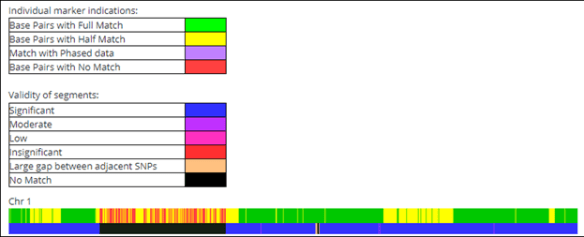
In this full-sibling example from GEDmatch, the green segments are fully identical regions across both the maternal and paternal chromosomes.

The definition of FIR is that two people match on both their mother’s and father’s DNA on the same chromosome. Therefore, in following generations, there technically should not be FIR matches, but in some instances we do find FIR matches outside of full siblings.

Moving down another generation, first cousins may share SOME fully identical DNA, especially if they are from an endogamous population or their mothers are related, but less, and it’s generally scattered.

Here’s my Mom’s GEDmatch comparison to her first cousin. The purple-legend segment shows a match, and the green within that match shows fully identical locations.

You can easily see that these are very scattered, probably representing “chance” or population-based fully identical matching locations within a segment. Comparatively, the green FIR segments for full siblings are dense and compact, indicating a segment that is fully identical.

Evaluating matches for dense FIR segments (known as runs of homozygosity – ROH) is a good indicator of parental relatedness.

Double Cousins

Of course, if these people were double first cousins, where the wives of the siblings were sisters to each other – the first cousins would have large patches of dense green FIR segments.

First cousins share grandparents.

Double first cousins occur when two people share both sets of grandparents, meaning that brothers marry sisters. Normal first cousins share about 12.5% of their DNA, but double first cousins share about 25% of their DNA.

In this case, Sharon and Donna descend from two brothers, James and Henry, who were sons of Joseph and Jane. In this scenario, James and Henry married unrelated women, so Sharon and Donna are first cousins to each other.

Double first cousins share both sets of grandparents so they would inherit FIR from both sets of siblings.

You need to be aware of this, but for now, let’s stick with non-double relationships. You’re welcome!

DNA Inheritance

Here’s a different example of DNA inheritance between two siblings.

  1. You can see that in the first 50 cM segment, both siblings inherited the same DNA from both parents, so they match on both their mother’s and father’s chromosomes. They match on both the 50 cM green and 50 cM pink segments. 23andMe would count that as 100 cMs, but other vendors only count a segment IF it matches, NOT if it matches twice. So, other vendors count this as a 50 cM match.
  2. In column two, these two people don’t match at all because they inherited different DNA from each parent. In this example, Person 1 inherited their maternal grandmother’s segment, and Person 2 inherited their maternal grandfather’s segment.
  3. In column three, our siblings match on their paternal grandmother’s segment.
  4. In column four, no match again.

How much can we expect to inherit at different levels – on average?

Different tools differ slightly, and all tools provide ranges. In our example, I’ve labeled the generations and how much shared DNA we would expect – WITHOUT pedigree collapse.

Ancestral couple Inherited cM Inherited %
Gen 1 – Their children 3500 cM 50
Gen 2 – Grandchildren 1750 cM 25
Gen 3 – Great-Grandchildren 875 cM 12.5
Gen 4 – GG-Grandchildren 437.5 6.25
Gen 5 – GGG-Grandchildren 218.75 3.125
Gen 6 – GGGG-Grandchildren 109.375 1.5625
Gen 7 – GGGG-Grandchildren 54.6875 .078125

Please note that this is inherited DNA, not shared (matching) DNA with another person.

Adding in pedigree collapse, you can see that we have three Gen 1 people involved, three Gen 2 descendants, and two Gen 3 and Gen 4 people.

Each of those people inherit and pass on segments from our original couple at the top.
We have three distinct inheritance paths leading from our original couple to Gen 5.
We have a first cousin marriage at Gen 2, at left, which means that their child, Gen 3, will have an elevated amount of the DNA of their common ancestors.

In Gen 4, two people marry who both descend from a common couple, meaning their child, Gen 5, descends from that couple in three different ways.

Did your eyes just glaze over? Well, mine did, too, which is why I had to draw all of this out on paper before putting it into PowerPoint.

The Gen 5 child inherits DNA from the ancestral couple via three pathways.
The next thing to keep in mind is that just because you inherit the DNA from an ancestor does not mean you match another descendant. Inheritance is not matching.

You must inherit before you can match, but just because you and someone else have inherited a DNA segment from a common ancestor does not guarantee a match. Those segments could be in different locations.

Categories of DNA

When dealing with inheritance and descent, we discuss four categories of DNA.

  • In the first generation, full siblings will, in about 25% of their locations, share the same DNA that has been inherited from both parents on the same chromosome. In other words, they match each other both maternally and paternally at that location. Those are FIR.
  • The DNA you inherit from an ancestor.
  • The DNA that both you and your cousin(s) inherit from a common ancestor and match on the same location. This is shared DNA.
  • The DNA that both you and your cousin(s) inherit from a common ancestor, but it’s not in the same location, so you do not match each other on that segment. Just because you inherit DNA from that ancestor does not necessarily mean that your cousin has the same DNA from that ancestor. This is inherited but not shared.

Inheritance is Not The Same as Matching

Inheritance is not the same thing as matching.

Inheriting our ancestor’s DNA isn’t enough. We need to match someone else who inherited that same segment in order to attribute the segment to that specific ancestor.

Depending on how close or distant the relationship, two people may share a lot of DNA (like full siblings), or one segment in more distant matches, or sometimes none at all. As we reach further back in time, we inherit less and less of our increasingly distant ancestors’ DNA, which means we match increasingly fewer of their descendants. I wrote about determining ancestral percentages in the article,  Ancestral Percentages – How Much of Them is in You?

Based on how much DNA we share with other known relatives, we can estimate relationships.

Pedigree collapse, where one descends from common ancestors more than once, increases the expected amount of inherited DNA, which in turn increases the probability of a shared match with other descendants.

Ancestral Couple Matching Between Shared DNA ~cM Shared DNA ~% Range (Shared cM Project) FIR – Identical DNA
Generation 1 Full Siblings 2600 50 1613-3488 25%
Generation 2 First Cousins 866 12.5 396-1397 0
Generation 3 Second Cousins 229 3.125 41-592 0
Generation 4 Third Cousins 73 0.78125 0-234 0

Here’s an example through third cousins, including expected FIR, fully identical regions where full siblings match each other on both their maternal and paternal chromosomes in the same location.

I provided a larger summary chart incorporating the information from public sources, here, minus FIR.

Of course, double cousins, where two pairs of siblings marry each other, represent another separate level of complexity. DNA-Sci’s Double Cousin Orogen explains this here and also provides a tool.

Double cousins, meaning when two pairs of siblings marry each other, are different from doubly related.

Doubly related means that two people descend from common ancestors through multiple paths, meaning multiple lines of descent. Doubly related is pedigree collapse. Double cousins is pedigree collapse on steroids.

Pedigree Collapse, aka Doubly Related

Calculating expected inherited DNA from multiple lines of descent is a bit more challenging.

A handy-dandy chart isn’t going to help with multiple relationships because the amount of expected shared DNA is based on the number of and distance of relationships.

Please note that this discussion excludes X-DNA matching which has its own inheritance path.

It’s time for math – but I promise I’ll make this relatively easy – pardon the pun.

What’s Behind the Math?

So, here’s the deal. I want you to understand why and how this works. You may not need this information today, but eventually, you probably will. This is one of those “refer back to it” articles for your personal library. Read this once as a conceptual overview, then read it again if you need to work through the relationships.

This is easy if you take it one step at a time.

First, we calculate each path separately.

In the first generation, full siblings inherit identical (FIR) DNA on both their mother’s and father’s chromosomes.

In the second generation, the male inherits the maternal segment, and the female inherits the paternal segment.

In the third generation, their child inherits those segments intact from both of their parents. The child inherits from the ancestral couple twice – once through each parent.

In generation 1, those two segments were FIR, fully identical regions. Both of those men married unrelated wives. When their children, Gen 2, were born, they had either the maternal or paternal segment from their father because they had an entirely different segment in that location from their mother.

However, the child in Gen 3 inherited the original green segment from their father and the original pink segment from their mother – reuniting those FIR segments in later generations.

First Cousin’s Child

Let’s calculate the inheritance for the child of those two first cousins who married.

Ancestral couple Inherited cM Inherited %
Gen 3 – Great-Grandchildren 875 cM 12.5
Total 1750 cM 25

Normally, a Gen 3 person inherits roughly 875 cM, or 12.5% of their great-grandparent’s DNA. However, since their grandparents were first cousins, they inherit about twice that amount, or 1750 cM.

While a Gen 3 person inherits as much as a grandchild (25%) normally would from the original couple, they won’t match on all of that DNA. When matching, we need to subtract some of that DNA out of the equation for two reasons:

  • In the first generation, between siblings, some of their DNA was fully identical and cannot be identified as such.
  • In the second generation, they will each have some parts of the ancestral couple’s DNA that will not match the other person. So, they inherit the same amounts from their common ancestors, but they can only be expected to match on about 25% of that amount two generations later.

However, the child of first cousins who marry inherits more DNA of the common ancestors than they would if their parents weren’t related. It’s just that some of that DNA is the same, potentially on the maternal and paternal chromosomes again, and some won’t match at all.

While matching DNA is the whole point of autosomal DNA testing, fully identical DNA matching regions (FIR) cannot be identified that way. For the most part, other than identifying full and half-siblings, sometimes pedigree collapse, and parent-relatedness, fully identical DNA isn’t terribly useful for genealogy. However, we still need to understand how this works.

It’s OK if you just want to say, “I know we’ll share more DNA due to pedigree collapse,” but if you want to know how much more to expect, keep reading. I’d really like for you to understand use cases and be able to track those segments.

Remember, we will learn a super-easy shortcut at the end, so for now, just read. It’s important to understand why the shortcut works.

Sibling Inheritance Versus Matching

In order to compare apples to apples, sometimes we need to remove some portion of DNA in our calculations.

Remember story problems where you had to “show your work”?

Calculating Expected DNA

Here’s the step-by-step logic.

Ancestral couple Inherited Non-Identical cM Inherited %
Gen 1 first son 3500 50
Gen 1 second son 3500 50
Less identical segments (FIR) -1750 (subtracted from one child for illustration) 25
Gen 2 son 1750 25
Gen 2 daughter married Gen 2 son 875 12.5
Gen 3 – Their child path through Gen 2 son 875 cM 12.5
Gen 3 – Their child path through Gen 2 mother 437.5 cM 6.25
Their child total without removing identical segments 1750 cM 25
Their child total after removing identical segments 1312.5 18.75

Category cMs Most Probable Degree Relationship
No Pedigree Collapse 875 98% Great grandparent or great-grandchild, great or half aunt/uncle, great or half niece/nephew, 1C 3
Pedigree Collapse without identical segment removal 1750 100% Grandparent, grandchild, aunt/uncle, half-sibling, niece/nephew 2
Pedigree Collapse after identical segment removal 1312.5 56% grandparent, grandchild, aunt/uncle, niece/nephew, half-sibling 2

Just because you HAVE this much shared (and/or identical) DNA doesn’t mean you’ll match on that DNA.

Next, let’s look at Gen 5 child who inherited three ways from the ancestors.

If you think, “This will never happen,” remember that it did, which is why I was working through this story problem. It’s not uncommon for families to live in the same area for generations. You married who you saw – generally, your family and neighbors, who were likely also family.

Let’s take a look at that 5th generation child.

The more distantly related, the less pedigree collapse affects matching DNA. That’s not to say we can ignore it.

Here’s our work product. See, this isn’t difficult when you take it step by step, one at a time.

Ancestral couple Inherited Non-Identical cM Inherited %
Gen 3 Child total after removing identical segments 1312.5 18.75
Gen 4 father – half of Gen 3 father 656.25 9.375
Gen 5 child – half of Gen 4 father 328.125 4.6875
Gen 5 child – mother’s side calculated from ancestral couple normally 218.75 3.125
Total for Gen 5 Child 546.875 7.8125

Inheritance Ranges

Lots of factors can affect how much DNA a person in any given generation inherits from an ancestor. The same is true with multiple paths from that same ancestor. How do we calculate multiple path inheritance ranges?

As with any relationship, we find a range, or combined set of ranges for Gen 5 Child based on the multiple pathways back to the common ancestors.

Gen 5 Child Inherited Non-Identical cM Inherited %
Without removing either paternal or maternal identical cMs 656.25 9.375
After removing paternal identical cMs only 546.875 7.8125


After removing maternal cMs only 546.875 7.8125


After removing both paternal and maternal identical cMs 362.50 6.25
Normal Gen 5 no pedigree collapse 218 3.125

What About Matching?

Inheritance and matching are different. Most of the time, two people are unlikely to share all of the DNA they inherited from a particular ancestor. Of course, inheriting through multiple paths increases the likelihood that at least some DNA from that ancestor is preserved and that it’s shared with other descendants.

Two people aren’t expected to match on all of the segments of DNA that they inherit from a particular ancestor. The closer in time the relationship, the more segments they will inherit from that ancestor, which increases the chances of matching on at least one or some segments.

Clearly, pedigree collapse affects matching. It’s most pronounced in closer relationships, but it may also be the only thing that has preserved that ONE matching segment in a more distant relationship.

So, how does pedigree collapse actually affect the likelihood of matching? What can we actually expect to see? Is there a name for this and a mathematical model to assist with calculations?

I’m so glad you asked! It’s called Coefficient of Relationship.

Coefficent of Relationship

My colleague, Diahan Southard, a scientist who writes at YourDNAGuide has authored two wonderful articles about calculating the statistical effects of pedigree collapse.

You can also read another article about the methodology of calculating coefficient of relationship, here, on WaybackMachine.

Diahan is a math whiz. I’m not, so I needed to devise something “quick and dirty” for my own personal use. I promised you a “cheat sheet,” so here’s the methodology.

Two Inheritance Paths – First and Third Cousins

Let’s look at an example where two people are both first cousins and third cousins because their grandparents were also first cousins.

Let’s calculate how these two people are related. They are first cousins and also third cousins.

When calculating the effects of pedigree collapse, we calculate the first relationship normally, then calculate the second relationship and add a portion of the result.

Here’s the math.

Using the Shared cM Project for the expected amount of shared DNA for both relationships, we’ve calculated the expected range for this pedigree collapse relationship.

Tying this back to degrees of relatedness.

Let’s look at ways to do Quick Calculations using the publicly available Shared cM charts and my composite tables, here.

Using Average Shared DNA

This first methodology uses average expected amount of shared, meaning matching, DNA. Please note, I’m not necessarily expecting you to DO this now, just read to follow.

Using Average Inherited DNA

Here’s a second method using average inherited DNA, meaning people wouldn’t be expected to match on all of the inherited DNA – just a portion.

You can’t always use the shared cM charts because all relationships aren’t represented, so you may need to use the amount of expected inherited DNA instead of shared DNA amounts.

Methodology Differences

Remember, none of these methodologies are foolproof because DNA inheritance is random. You may also have additional relationships that you’re aware of.

So, what’s the easiest method? Neither, actually. I’ve found an even easier method based on these proven methodologies.

Easy-Peasy Pedigree Collapse Shortcut Range Calculation in 4 Steps

Now that you understand the science and reasoning behind all of this, you can choose from multiple calculation methodologies after drawing a picture of the relevant tree.

You’re probably wondering, “What’s the easiest way to do this?”

  • These quick calculation methods are the easiest to work with for non-scientists and non-math whizzes. These are the calculations I use because, taking into account random recombination, you can’t do any better than get close.
  • Also, remember, if you’re dealing with double relationships, meaning double first cousins, you’ll need to take that into consideration, too.
  • If endogamy is involved, your matches will be higher yet, and you should use the highest calculations below because you need to be on the highest end of the range – and that may still not be high enough.

In these Easy-Peasy calculations, you calculate for the lowest, then the highest, and that’s your range. Please note that these are options, and truly, one size does not fit all.

  1. For the lowest end of the range, simply use the average of the highest relationship. In this case, that would be 1C, which is 866 cM. Remember that you may not share DNA with third cousins. 10% of third cousins don’t share any DNA, and 50% of fourth cousins don’t.
  2. For the highest end of the range, find the second relationship in the Shared cM chart, divide the average by half, and add to the value from the closest relationship. In this case, half of the 3C value of 76 is 38.
  3. Add 38 to 866 for the highest end of the range of 904.
  4. If there’s yet another path to ANY shared ancestor, add half that amount too to calculate the high end of the range – unless it’s 4C or more distant, then don’t add anything.

You can see that this easy-peasy range calculation for pedigree collapse compares very well to the more complex but still easy calculations.

  • Easy-peasy calculation: 866-904
  • Other calculation methods: 850-903
  • For this same relationship combination, Diahan’s statistical calculation was 850 cM.

Back to Genealogy

What’s the short story about how pedigree collapse affects genealogy?

Essentially, in close generations, meaning within a few generations of two first cousins marrying, descendants can expect to inherit and share significantly more DNA of the common ancestors, but not double the amount. As we move further away from those marriages in time, the effect becomes less pronounced and more difficult to detect. You can see that effect when calculating multiple paths where at the fourth cousin level, or more distant, those cousins have a 50% or greater possibility of not sharing DNA segments.

Of course, with multiple paths to the same ancestor, your chances of inheriting at least some segments from the common ancestor are increased because their DNA descends through multiple paths.

Today, close marriages are much less common and have been for several generations in many cultures, so we see fewer instances where pedigree collapse makes a significant difference.

Within a population or group of people, if pedigree collapse becomes common, meaning that there are multiple paths leading back to common ancestors, like our three-path example, DNA segments from the common ancestors are found among many people. Significant pedigree collapse becomes endogamy, especially if marriage outside of the group is difficult, impossible, or discouraged.

Normally, pedigree collapse is not recorded in actual records. It’s left to genealogists to discover those connections.

The exception, of course, is those wonderful Catholic parish records where the priest granted dispensations. Sometimes, that’s our only hint to earlier genealogy. In the case of the marriage of Marie-Josesphe LePrince to Jacques Forest, the priest wrote “dispense 3-3 consanguinity,” which tells us that they shared great-grandparents. It also tells us that their grandparents were siblings, that the bride and groom were second cousins, and that their children and descendants inherited an extra dose of DNA from their common great-grandparents.

How does that affect me today? Given that I’m their seventh-generation descendant – probably not at all. Of course, they are Acadian, and the Acadians are highly endogamous, which means I match many Acadians because all Acadians share the DNA of just a few founders, making it almost impossible to track segments to any particular ancestor. If it weren’t for endogamy, I would probably match few, if any, of their descendants.

Now, when you see those Catholic church dispensations or otherwise discover pedigree collapse, you can be really excited, because you understand the effects of pedigree collapse and how to calculate resulting matches! You might, just might, have retained a DNA segment from those ancestors because you inherited segments through multiple paths – increasing the probability that one survived.

_____________________________________________________________

Follow DNAexplain on Facebook, here.

Share the Love!

You’re always welcome to forward articles or links to friends and share on social media.

If you haven’t already subscribed (it’s free,) you can receive an email whenever I publish by clicking the “follow” button on the main blog page, here.

You Can Help Keep This Blog Free

I receive a small contribution when you click on some of the links to vendors in my articles. This does NOT increase your price but helps me keep the lights on and this informational blog free for everyone. Please click on the links in the articles or to the vendors below if you are purchasing products or DNA testing.

Thank you so much.

DNA Purchases and Free Uploads

Genealogy Products and Services

My Book

Genealogy Books

Genealogy Research

Bennett Greenspan: Meet My Extended Family & Discover Extraordinary Deep Heritage

“My ancestors are in my soul. I can’t get them out of my mind.”

Bennett Greenspan

“And yes, I brake for cemeteries.”

Bennett Greenspan gave an incredibly interesting presentation at the 15th International Genetic Genealogy Conference held by FamilyTreeDNA in November 2023. Since his retirement in January 2021, he has been able to focus on his genealogy. Once a genealogist, always a genealogist.

Bennett said some things I hadn’t thought about, and now I’m viewing Y-DNA matches with a different perspective – based on how he’s using his results.

Ever since I met him, Bennett’s focus has been to use genetics to unravel his complex Jewish heritage.

The questions that drive Bennett are the same ones that motivate most genealogists:

  1. Who are we?
  2. Where did we come from?
  3. Where were we before we were there?
  4. How did my ancestors get there?

Bennett “lost his family lines” before the mid-1800s due to his Jewish heritage, exacerbated in the 1930s by the devastation wrought by the Holocaust. Families were either killed or scattered to survive. It has been through Y-DNA in particular that he has been able to establish unquestionable and confirmed connections with other Greenspan men, sometimes by similar but different surnames, like Green, and sometimes with other surnames entirely.

When Bennett first started down this path, he tested more than 62 men before actually finding one a decade later that matched his Y-DNA. Bennet commented that it was “a little frustrating.”

Persistence is the key, and sometimes, genealogy is a waiting game, but that’s small comfort to genealogists during that unproductive waiting period.

Eventually, Bennett reassembled his family, at least somewhat, but it was a long journey. Here’s Bennett’s incredible story, including surprises, as he tells it.

Bennett discovered genealogy at age 12 and, like many genealogists, created a pedigree chart by talking to his family.

I love the mark-outs. How many of us still have our first chart with its edits?

This is the young Bennett Greenspan, whose interest in genealogy would one day unlock secrets for all of us!

It was a long way from a decade with no matches to finding his genetic kin in Ukraine.

The Big Y-700 Time Tree shows Bennett’s lineage in Ukraine, but stepping back in time, some descendants of his ancestors are found in adjacent locations.

Bennett was passionately discussing his matches on the time tree and in the Greenspan project, so I visited the Greenspan DNA Project, where the earliest known ancestors of Bennett’s Big Y matches are shown on the Group Time Tree.

Bennett’s closest matches are shown as descendants of haplogroup J-ZS1718. He has additional matches who are not in the Greenspan project. Since this is the Group Time Tree, it only displays the people in that project, along with their earliest known ancestors, Isaac and Usher Greenspan.

12-Marker Matches

Bennett never fails to amaze me. He said something very important and profound about 12-marker matches that I really hadn’t thought about – at least not this way.

As a community, we are often guilty of discounting 12-marker matches, those that don’t match us at 25-markers or above, or with different surnames, as “too far back in time” or otherwise irrelevant. I always look at the names and earliest known ancestors of 12-marker matches, because that person may have tested back in the day when fewer markers were available. But if I don’t recognize something, I move on.

However, Bennett said that, ”Y-12 matches reach back to a common ancestor. 12-marker matches are not a quirk. They are related to you, just further back in time. You share a common ancestor with them, someplace. They may be more distant, but they are still your close matches.”

I’ve been in too much of a hurry for a quick win, and ignoring the (apparently not so) obvious.

Determining when and where their ancestors lived also paves the way to discover yours. Your Y-DNA and theirs were in the same place at the same time.

Of Bennett’s 171 12-marker matches, 107 have upgraded to the Big Y, probably mostly due to his encouragement. This benefits both them and Bennett by fleshing out the history of that entire group of men, including how they got to where they are found in the first available records. The Time Tree shows when Big Y testers shared a common ancestor, and based on Earliest Known Ancestor (EKA) locations, where. This provides further information about the lives of ancestors before contemporary records – in other words – people that we can never identify by name. It’s a window into ancestors before surnames.

Bennett notes that testers need to know their ancestral village or location to be most useful within the project, and of course, they need to enter their EKA information. Location information is how the Migration Map, Matches Map, and Discover tools, including the Time Tree, are built.

What Happened in Spain?

Bennett’s ancestors and those of his 12-marker matches are found in Spain, and as Bennett says, “One son stayed and one left about the year 296.”

While we have no idea of their names, based on the Time Tree combined with the cluster of earliest known ancestors, we know that they were in Spain, and when.

Their family story is revealed in the bifurcation of the tree found beneath haplogroup J-L823, formed about 296 CE. One line stayed in Spain, and Bennett’s line migrated to eastern Europe where that man’s descendants, including Bennett’s family, are found in the Russian Federation, Belarus, Poland, Lithuania, Sweden, Slovakia, Ukraine, Germany, Romania, the Czech Republic, and other eastern European locations. The closer to you in the tree and in time, the more relevant to your more recent ancestral story.

However, Bennett’s deeper ancestry, the migration of his ancestors to Spain, was only revealed by testing those more distantly related men. Those same men could well have been ignored entirely because they only matched at 12 markers.

According to Bennett, “Y-12 markers are important because these are the men most closely related to you in a database of 1 million men.”

How incredibly profound. How much have I been cavalierly overlooking?

How does this actually apply to Bennett’s results?

Bennett’s Spanish Matches

Bennett has the following STR panel matches who indicate that their EKA are from Spain. You can see that they match Bennett on a variety of panels.

  • X = yes, match
  • No = no match
  • Blank = not tested at that level.

In the Big Y GD column, the genetic distance (GD) is displayed as 15/660 where 15 is the number of mismatches, or the cumulative genetic distance ABOVE the 111 panel, and 660 is the number of STR markers above 111 with results.

The Big Y-500 test guaranteed a minimum of 500 total STR markers, and the Big Y-700 guarantees a minimum of 700 total STR markers, plus multiple scans of the balance of the Y chromosome for SNP mutations that define haplogroups. Testers don’t receive the same number of markers because the scan technology sometimes doesn’t read a specific location.

Tester 12 25 37 67 111 Big Y Test Big Y GD Big Y Match Haplogroup
AA X X X No No Yes 15/660 No J-FTD8826
DT X X No No X Yes 17/664 No J-FTE50318
JG X X No No
AR No No X X No No
ELR X X X No No
EL X X Yes 17/666 No J-FTE50318
GC X X X X No No
JC X No No
JLG X X No No No Yes 14/662 No J-FTE23540
MF X X No X No Yes 15/665 No J-FTD91126
MT X X X X No No
BE X X X X X Yes 20/664 No J-BY1795
DR X X X X X Yes 16/660 No J-FTC87344
EC X X X X X Yes 15/665 No J-FTC87344
GM X X No No No Yes 16/650 No J-FTD28153
GM X X X X No Yes 17/664 No J-FTD11019
LS X X No No No Yes 18/666 No J-FTD28153
NE X X X X X Yes 23/597 No J-BY1795
NC X No No
RR X X X No X Yes 22/659 No J-BY1795
TT X X X X X Yes 16/647 No J-FTC87344
XG X X X No No Yes 17/523 No J-BY167283
JA X X No No No Yes 15/646 No J-FTD11019

Of those 23 Spanish matches, sixteen have upgraded to Big Y tests, 14 of which are Big Y-700s, resulting in nine different haplogroups, all of which are descendants of Haplogroup J-L823. How cool is that?

The “Nos” in the Big Y Match Column aren’t mistakes. That’s right – none of these men match Bennett on the Big Y test, meaning they had more than a 30 mutation difference between them and Bennett on the Big Y test.

At first glance, you’d think that Bennett would have been disappointed, but that’s not the case at all! In fact, it was the information provided by these distant Spanish matches that provided Bennett with the information that his line had split sometime around the year 296 CE, with one branch remaining in Spain and his branch migrating to Eastern Europe, where he has lots of matches.

DNA Plus History

What was happening in Spain or the Iberian peninsula that involved the Jewish people about that time? Historical records exist of Jews living in that region before the fall of the Second Temple in about 70 CE, including records of Jews being expelled from Rome in 139 for their “corrupting influence.”

Furthermore, the Ancient DNA Connections for haplogroup J-L823, the most recent common ancestor (MRCA) for all of those branches, includes connections to multiple burials from:

  • Lebanon
  • Iran
  • Rome (from 1-400 CE)
  • Turkey
  • Jordan

Clearly, Bennett’s ancestor was in the Iberian peninsula around or before 296 CE. One branch stayed, winding up in Spain, and one headed for Europe.

Without these matches, some who didn’t match above the 12 or 25 marker level, how would Bennett have EVER known that his Jewish ancestors left the Middle East for Spain in the early years? How would he have known they migrated from Spain to Eastern Europe, and how would he have known that his line did not migrate directly from the Levant to Eastern Europe in the 9th century?

Big Y matches are typically within about 1500 years, but non-matches are still INCREDIBLY valuable. Without them, you can’t completely assemble your family story.

I noticed on the Time Tree that in Bennett’s Eastern European line, one of his ancestor’s brother lineages includes the Katzenellenbogen Rabbinic Lineage derived from ancient DNA samples.

Bennett’s successes have resulted from contacting his matches and encouraging upgrades. So how did he do it? What’s the magic sauce?

Contacting Matches

How to contact matches successfully is a question I see often. In fact, FamilyTreeDNA recently wrote about that in an article, here.

Bennett’s methodology for contacting his matches to encourage an upgrade is that he sends an email explaining why he’s encouraging them to upgrade, followed by a 2nd email three days later.

Bennett tells the recipient that we are at an inflection point in time. “It’s winter, the wind is blowing hard, and many of the leaves are gone.”

In other words, we need to cast the net wider and capture what we can, while we can. Unfortunately, many early testers have died, and with them, chapters of history are perishing.

Collaboration is key. In addition to encouraging upgrades, Bennett also offers Zoom calls to these groups of men to explain the results if they are interested.

What a GREAT idea! I need to begin offering that as well.

Upgrade Request

Bennett reaches out to his matches at various levels, but he expects his closer STR matches, meaning at the 67 and 111 marker level with the fewest mismatches, to match him on a Big Y-700 test and connect someplace between 300-600 years ago, which helps everyone flesh out their tree.

Bennett’s email:

Hello <name>,

Since you have already made a sizable investment in your Y-DNA, you now know that we come from the dominant male Middle Eastern group (Haplogroup J) of men who <subject here>.

What’s really neat is that our Y-DNA has recently been found in an archaeological site in Northwestern Jordan dated to about 4200 years ago. I know this because I upgraded to the Big Y, which tests SNPs, looking at several million locations on the Y chromosome of each man.

One academic customer recently compared this new technology as the difference between looking into space with binoculars versus the Hubble Telescope.

I don’t know if you are familiar with your list of matches at the highest level you’ve tested for, either Y-67 or Y-111. If you are, you should recognize my name and the names of others who have taken the Big Y test.

You’ll see what you’ll gain by letting me upgrade your test for you and determining whether you are related to my line – probably between about 200 years and 500 years.

This might be the second time that I have written to you on this matter; can I presume if I don’t hear from you that you’re not really interested in the Y-DNA subject anymore?

Can I run the test so that I can see how closely we are related – at my expense? (Of course, you get to see how closely related we are, too).

Please reply to me and say “yes.” You don’t even have to put a 🙂 if you don’t want to.

I started this company and this industry over 20 years ago. I predict that you will be happy with the history of YOU that this upgrade will uncover.

Best,

Bennett Greenspan

As you can see, this email can easily be personalized further and adapted to matches at the 37, 25, and 12 marker levels – or even Family Finder matches, now that intermediate-range haplogroups are being reported.

What’s Next?

I’m going back to every one of the kits I sponsored or that represent descendants of one of my ancestors to review their matches again – focusing not just on the closest matches with common surnames, but also on locations – and specifically at lower matching levels. I’ll also be checking their Family Finder matches for male surname matches, or similar surnames.

As is evident from Bennett’s tests, an entire mine of diamonds is out there, just waiting to be unearthed by a Big Y test.

And to think that some people have been advising people to ignore 12-marker matches out-of-hand because they are “entirely irrelevant.” They aren’t – for two reasons.

  1. First, some early testers only tested to that level
  2. Second, because of the deeper history that Big Y tests from those matches will uncover

You can view your Y-DNA matches, upgrade your own Y-DNA test, or order a Big Y-700 test if you haven’t yet tested by clicking here. What’s your next step?

_____________________________________________________________

Follow DNAexplain on Facebook, here.

Share the Love!

You’re always welcome to forward articles or links to friends and share on social media.

If you haven’t already subscribed (it’s free,) you can receive an email whenever I publish by clicking the “follow” button on the main blog page, here.

You Can Help Keep This Blog Free

I receive a small contribution when you click on some of the links to vendors in my articles. This does NOT increase your price but helps me keep the lights on and this informational blog free for everyone. Please click on the links in the articles or to the vendors below if you are purchasing products or DNA testing.

Thank you so much.

DNA Purchases and Free Uploads

Genealogy Products and Services

My Book

Genealogy Books

Genealogy Research

FamilyTreeDNA 2023 Update – Past, Present and Future

At the FamilyTreeDNA International Conference on Genetic Genealogy, held November 3-5 in Houston for group project administrators, product and feature updates were scattered across both days in various presentations.

I’ve combined the updates from FamilyTreeDNA into one article.

I’ve already written two articles that pertain to the conference.

FamilyTreeDNA has already begun rolling the new Y DNA haplogroups from Family Finder autosomal tests, which I wrote about here:

I still have at least two more articles to publish from this conference that was chocked full of wonderful information from a wide range of talented speakers.

Past, Present, and Future with Katy Rowe-Schurwanz

Katy Rowe-Schurwanz, FamilyTreeDNA’s Product Manager, provided an update on what has been accomplished in the four and a half years since the last conference, what’s underway now, and her wish list for 2024.

Please note the word “wish list.” Wish list items are NOT commitments.

Recent Milestones

A lot has been happening at FamilyTreeDNA since the last conference.

Acquisition and Wellness Bundles

As everyone is aware, at the end of 2020, myDNA acquired Gene by Gene, the parent company of FamilyTreeDNA, which included the lab. As a result, the FamilyTreeDNA product menu has expanded, and wellness bundles are now available for FamilyTreeDNA customers.

If you’re interested, you can order the Wellness product in a bundle with a Family Finder test, here.

You can add the Wellness product for $39 if you’ve already tested.

New TIP (Time Prediction) STR Report

Did you notice that the old TIP report for Y DNA STR markers was replaced with an updated version several months ago?

To view the new report, sign on and select your Y DNA matches. At the far right of each match you’ll see these three icons representing a pedigree chart, notes, and the TIP (Time Predictor) report.

The updated TIP report includes wonderful new graphs and age estimates for each match category, which you can read about, here. Each category, such as 67-marker matches, has time estimates in which a common ancestor might have lived at each possible genetic distance.

Math is our friend, and thankfully, someone else has done it for us!

Please note that the Big Y SNP dates are MUCH more accurate for a variety of reasons, not limited to the instability and rapid mutation rate of STR mutations.

MyOrigins3

MyOrigins3, FamilyTreeDNA’s ethnicity offering, added over 60 new reference populations for a total of 90, plus chromosome painting. You can read about MyOrigins features here, and the white paper, here.

This is one of my favorite improvements because it allows me to identify the segment location of my population ancestries, which in turn allows me to identify people who share my minority segments such as Native American and African.

Due to a lack of records, these relationships are often exceedingly difficult to identify, and MyOrigins3 helps immensely.

Additional Releases

Additional products and features released since the last conference include:

Discover

Released in July 2022, Discover is the amazing new free product that details your ancestor’s Y DNA “story” and his walk through time and across the globe.

In the past 18 months, all of the Discover features are new, so I’m only making a brief list here. The great thing is that everyone can use Discover if you know or can discover (pardon the pun) the haplogroup of your ancestral lines. Surname projects are often beneficial for finding your lineages.

  • Haplogroup Story includes haplogroup location, ages derived from the earliest known ancestor (EKA) of your matches, and ancient DNA samples. Please be sure you’ve entered or updated your EKA, and that the information is current. You can find instructions for how to update or add your EKA here.
  • A recent addition to the haplogroup story includes Haplogroup Badges.
  • Country Frequency showing where this haplogroup is found with either a table view or an interactive map
  • Famous and infamous Notable Connections, including Mayflower passengers, Patriots from the American Revolution, US presidents, royal houses, artists, musicians, authors, pirates, sports figures, scientists, and more.

If you know of a proven connection to a notable figure, contact customer support and let them know! Notable connections are added every week.

One famous Discover connection is Ludwig von Beethoven which resulted from a joint academic study between FamilyTreeDNA and academic researchers. It’s quite a story and includes both a mystery and misattributed parentage. You can see if you match on Discover and read about the study, here.

  • Updated Migration Map, including locations of select ancient DNA sites
  • The Time Tree, probably the most popular Discover report, shows the most current version of the Y DNA phylotree, updated weekly, plus scientifically calculated ages for each branch. Tree node locations are determined by your matches and their EKA countries of origin. I wrote about the Time Tree, here.
  • Anticipated in early 2024, the EKA and block tree matches will also be shown on the Time Tree in Discover for individual Big Y testers, meaning they will need to sign in through their kits.
  • The Group Time Tree, visible through group projects, takes the Time Tree a step further by including the names of the EKA of each person on the Time Tree within a specific project. Information is only displayed for project members who have given permission to include their data. You can select specific project groupings to view, or the entire project. I wrote about the Group Time Tree here and here.
  • Globetrekker is an exclusive Big Y mapping feature discussed here, here, here, and here.
  • Ancient Connections includes more than 6,100 ancient Y DNA results from across the globe, which have been individually analyzed and added for matching in Discover. Ancient Connections serve to anchor haplogroups and provide important clues about matches, migration paths and culture. New connections are added weekly or as academic papers with adequate Y DNA coverage are released.
  • Your Ancestral Path, which lists the haplogroups through every step from the tester back to Y Adam and beyond. Additional information for each haplogroup in your path includes “Time Passed” between haplogroups, and “Immediate Descendants,” meaning haplogroups that descend from each subclade. New columns recently added include “Tested Modern Descendants” and “Ancient Connections.”
  • Suggested Projects include surname, haplogroup, and geographic projects. Katy said that people joining projects are more likely to collaborate and upgrade their tests. You can also see which projects other men with this haplogroup have joined, which may well be projects you want to join too.
  • Scientific Details provides additional information, such as each branch’s confidence intervals and equivalent variables (SNPs). You can read more here.
  • Compare Haplogroups is the most recent new feature, added just last month, which allows you to enter any two haplogroups and compare them to determine their most recent common ancestral haplogroup. You can read about Compare Haplogroups, here.

Please note that the Studies feature is coming soon, providing information about studies whose data has been included in Discover.

You can read about Discover here, here, here, and here.

If you’re interested, FamilyTreeDNA has released a one-minute introduction to Y DNA and Discover that would interest new testers, here.

Earliest Known Ancestor (EKA) Improvement

Another improvement is that the earliest known ancestor is MUCH easier to enter now, and the process has been simplified. The EKAs are critical for Discover, so PLEASE be sure you’ve entered and updated your EKA.

Under the dropdown beside your name in the upper right-hand corner of your personal page, select Account Settings, then Genealogy and Earliest Known Ancestors. Complete the information, then click on “Update Location” to find or enter the location on a map to record the coordinates.

It’s easy. Just type or drop a pin and “Save.”

Saving will take you back to the original EKA page. Save that page, too.

Recommended Projects on Haplogroups & SNPs Page

You’re probably aware that Discover suggests projects for Y DNA testers to join, but recommended haplogroup projects are available on each tester’s pages, under the Y DNA Haplotree & SNPs page, in the Y DNA STR results section.

If there isn’t a project for your immediate haplogroup, just scroll up to find the closest upstream project. You can also view this page by Variants, Surnames and Countries.

This is a super easy tool to use to view which surnames are clustered with and upstream of your haplogroup. With Family Finder haplogroups being assigned now, I check my upstream haplogroups almost daily to see what has been added.

For example, my Big Y Estes results are ten branches below R-DF49, but several men, including Estes testers, have been assigned at this level, thanks to Y DNA haplogroups from Family Finder testing. I can now look for these haplogroups in the STR and Family Finder matches lists and see if those men are receptive to Big Y testing.

Abandoned Projects

Sometimes group project administrators can no longer function in that capacity, resulting in the project becoming abandoned. FamilyTreeDNA has implemented a feature to help remedy that situation.

If you discover an abandoned project, you can adopt the project, spruce things up, and select the new project settings. Furthermore, administrators can choose to display this message to recruit co-administrators. I need to do this for several projects where I have no co-admin.

If you are looking for help with your project, you can choose to display the button
through the Project Profile page in GAP. For non-project administrators, if you’d like to help, please email the current project administrators.

New Kit Manager Feature

FamilyTreeDNA has added a “Kit Manager” feature so that an individual can designate another person as the manager of their kit.

This new setting provides an avenue for you to designate someone else as the manager of your DNA test. This alerts FamilyTreeDNA that they can share information with both of you – essentially treating your designated kit manager the same as you.

If you’re the kit manager for someone else, you NEED to be sure this is completed. If that person is unavailable for some reason, and support needs to verify that you have legitimate access to this kit, this form and the Beneficiary form are the ONLY ways they can do that.

If your family member has simply given you their kit number and password, and for some reason, a password reset is required, and their email address is the primary contact – you may be shut out of this kit if you don’t complete this form.

Beneficiary Page

Additionally, everyone needs to be sure to complete the Beneficiary page so that in the event of your demise, FamilyTreeDNA knows who you’ve designated to access and manage your DNA account in perpetuity. If you’ve inherited a kit, you need to add a beneficiary to take over in the event of your death as well.

What is FamilyTreeDNA working on now?

Currently in the Works

Katy moved on to what’s currently underway.

Privacy and Security

Clearly, the unauthorized customer data exposure breach at 23andMe has reverberated through the entire online community, not just genetic genealogy. You can read about the incident here, here, here, and here.

FamilyTreeDNA has already taken several steps, and others are in development and will be released shortly.

Clearly, in this fast-moving situation, everything is subject to change.

Here’s what has happened and is currently planned as of today:

  • Group Project Administrators will be required to reset their password soon.

Why is this necessary?

Unauthorized access was gained to 23andMe accounts by people using the same password for multiple accounts, combined with their email as their user ID. Many people use the same password for every account so that they can remember it. That means that all a hacker needs to do is breach one account, and they can use that same information to “legitimately” sign in to other accounts. There is no way for the vendor to recognize this as unauthorized since they have both your user ID and password.

That’s exactly what happened at 23andMe. In other breaches, this information was exposed, and hackers simply tried the same username and password combination at 23andMe, exposing the entire account of the person whose account they signed in “as.” This includes all of their matches, genetic tree, shared matches, matches of matches, ethnicity, and segments. They could also have downloaded both the match list and the raw DNA file of the compromised account.

At FamilyTreeDNA, project administrators can select their own username, which could be their email, so they will be required to reset their password.

Additional precautions have been put in place on an interim basis:

  • A pause in the ability to download match and segment information.
  • A pause in accepting 23andMe uploads.

Administrators will also be required to use two-factor authentication (2FA.) To date, two of the four major vendors are requiring 2FA. I would not be surprised to see it more broadly. Facebook recently required me to implement 2FA there, too, due to the “reach” of my postings, but 2FA is not required of everyone on Facebook.

Please note that if you received an email or message that is supposedly from any vendor requiring 2FA, GO DIRECTLY TO THAT VENDOR SITE AND SIGN IN.  Never click on a link in an email you weren’t expecting. Bad actors exploit everything.

Customers who are not signing in as administrators are not required to implement 2FA, nor will they be required to reset their password.

Personally, I will implement 2FA as soon as it’s available.

While 2FA is an extra step, it’s easy to get used to, and it has already literally saved one of my friends from an authorized hack on their primary and backup email accounts this week. Another friend just lost their entire account on Facebook because someone signed in as them. Their account was gone within 15 minutes.

2FA is one of those things you don’t appreciate (at all) until it saves you, and then, suddenly, you’re incredibly grateful.

At this point in time, FamilyTreeDNA users will NOT be required to do a password reset or implement 2FA. This is because customers use a kit number for sign-in and not a username or email address. I would strongly recommend changing your password to something “not easy.” Never reuse passwords between accounts.

I really, really want you to visit this link at TechRepublic and scroll down to Figure A, which shows how long it takes a hacker to crack your password. I guarantee you, it’s MUCH quicker than you’d ever expect.

Kim Komando wrote about this topic two years ago, so compare the two charts to see how much easier this has become in just two years.

Again, if you receive an email about resetting your password, don’t click on a link. Sign in independently to the vendor’s system, but DO reset your password.

FamilyTreeDNA also engages in additional security efforts, such as ongoing penetration testing.

New Permissions

Additionally, at FamilyTreeDNA, changes were already in the works to separate out at least two permissions that testers can opt-in to without granting project administrators Advanced rights.

  • Download data
  • Purchase tests

The ability to purchase tests can be very important because it allows administrators to order and pay for tests or upgrades on behalf of this tester anytime in the future.

Family Finder Haplogroups

FamilyTreeDNA has already begun releasing mid-level Y DNA haplogroups for autosomal testers in a staggered rollout of several thousand a day.

I wrote about this in the article, FamilyTreeDNA Provides Y DNA Haplogroups from Family Finder Autosomal Tests, so I’m not repeating all of that information here – just highlights.

  • The Family Finder haplogroup rollout is being staggered and began with customers on the most recent version of the testing chip, which was implemented in March of 2019.
  • Last will be transfers/uploads from third parties.
  • Haplogroups resulting from tests performed in the FTDNA labs will be visible to matches and within projects. They will also be used in both Discover and the haplotree statistics. This includes Family Finder plus MyHeritage and Vitagene uploads.
  • Both MyHeritage and Vitagene are uploaded or “transferred” via an intracompany secure link, meaning FamilyTreeDNA knows that their information is credible and has not been manipulated.
  • Haplogroups derived from tests performed elsewhere will only be visible to the user or a group administrator viewing a kit within a project. They will not be visible to matches or used in trees or for statistics.
  • Any man who has taken a Y DNA STR test will receive a SNP-confirmed, updated haplogroup from their Family Finder test that replaces their predicted haplogroup from the STR test.

Please read this article for more information.

New Discover Tools and Updates

Discover content continues to be updated, and new features are added regularly, creating an increasingly robust user experience.

Soon, group administrators will be able to view all Discover features (like Globetrekker) when viewing kits of project members who have granted an appropriate level of access.

Ancient and Notable connects are added weekly, and a new feature, Study Connections, will be added shortly.

Study Connections is a feature requested by customers that will show you which study your academic matches came from. Today, those results are used in the Y DNA tree, but the source is not detailed.

Anticipated in early 2024, the EKA and block tree matches will also be shown on the Time Tree in Discover for individual Big Y testers (not publicly).

Big Y FaceBook Group

FamilyTreeDNA has ramped up its social media presence. They launched the Big Y Facebook group in July 2023, here, which currently has just under 9000 members. Several project administrators have volunteered their time to help manage the group.

FamilyTreeDNA Blog

In addition, FamilyTreeDNA is publishing at least one blog article each week, and sometimes more. You can view or subscribe here. Some articles are written by FamilyTreeDNA staff, but project administrators and customers author other content.

Multi-Language Support

Translation of the main FamilyTreeDNA website and results pages to Spanish has begun, with more languages planned soon.

Paypal, Payments, and Gift Cards

Paypal has been added as a payment selection, along with a PayPal option that provides the ability to make payments.

Additionally, a gift card can be purchased from the main page.

Million Mito Project & Mitotree

Work on the Million Mito Project is ongoing.

The Million Mito Project was launched in 2020 as a collaborative effort between FamilyTreeDNA’s Research & Development Team and the scientific portion of the Genographic Project. I’m a team member and wrote about the Million Mito Project, here.

We’re picking up from where the Phylotree left off in 2016, analyzing 20 times more mtDNA full sequences and reimagining the mtDNA Haplotree. By examining more mtDNA data and applying the processes that allowed FamilyTreeDNA to build the world’s largest Y DNA Haplotree, we can also create the world’s largest Mitotree.

In 2022, the first update was released, authored by the Million Mito team, with the discovery of haplogroup L7. You can read about this amazing discovery rooted deep in the tree here, here, and here. (Full disclosure: I’m a co-author.)

Not only that, but “Nature Scientific Reports” selected this article as one of five named Editor’s Choice in the Mitogenomics category, here. In the science world, that’s a HUGE deal – like the genetic Emmy.

Here’s one example of the type of improvements that can be expected. Currently, the formation of haplogroup U5a2b2a reaches back to about 5000 years ago, but after reanalysis, current branches originated between 500 and 2,500 years ago, and testers are clustered more closely together.

This is SOOO exciting!!!

Just as Discover for Y DNA results was built one feature at a time, the same will be true for MitoDiscover. That’s my name, not theirs.

As the new Mitotree is rolled out, the user interface will also be updated, and matching will function somewhat differently. Specifically, it’s expected that many more haplogroups will be named, so today’s matching that requires an exact haplogroup match to be a full sequence match will no longer work. That and other matching adjustments will need to be made.

I can hardly wait. I have so many results I need to be able to view in a tree format and to place in a timeframe.

You can be included in this exciting project, learn more about your matrilineal (mother’s) line, and hopefully break down some of those brick walls by taking the full sequence mitochondrial DNA test, here.

After the new Mitotree is rolled out and the Y DNA Family Finder haplogroups are completed, Family Finder customers, where possible, will also receive at least a basic-level mitochondrial haplogroup. Not all upload files from other vendors include mtDNA SNPs in their autosomal files. The mitochondrial Family Finder haplogroup feature isn’t expected until sometime in 2025, after the new tree and MitoDiscover are complete.

The Future

What’s coming later in 2024, or is ongoing?

Privacy Laws

Most people aren’t aware of the new privacy laws in various states, each of which has to be evaluated and complied with.

The effects of these changes will be felt in various areas as they are implemented.

New Kits Opted Out of IGG

Since late August, all new FTDNA kits are automatically opted OUT of Investigative Genetic Genealogy (IGG) by default.

Regular matching consent and IGG matching consent have been separated during onboarding.

Biobanking Separate Consent

Another consent change is to have your sample biobanked. FamilyTreeDNA has always maintained your sample for “roughly 25 years.” You could always ask to have your sample destroyed, but going forward, you will be asked initially if you want your sample to be retained (biobanked.) It’s still free.

Remember, if someone declines the biobanking option, their DNA will be disposed of after testing. They can’t order upgrades without submitting a new sample. Neither can their family after they’re gone. I ordered my mother’s Family Finder test many years after she had gone on to meet our ancestors – and I’m incredibly grateful every single day.

MyHeritage Tree Integration

An exciting change coming next year is tree integration with MyHeritage.

And no, before any rumors get started, FAMILYTREEDNA IS NOT MERGING WITH MYHERITAGE. It’s a beneficial marriage of convenience for both parties.

In essence, one of the primary focuses of MyHeritage is trees, and they do that very well. FamilyTreeDNA is focused on DNA testing and their existing trees have had issues for years. MyHeritage trees are excellent, support pedigree collapse, provide search capabilities that are NOT case sensitive, SmartMatching, and much more.

If you don’t have a MyHeritage account, creating one is free, and you will be able to either port your existing FamilyTreeDNA tree, or begin one there. If you’re already a MyHeritage member, FamilyTreeDNA and MyHeritage are planning together for a smooth integration for you. More detailed information will be forthcoming as the integration progressed and is released to customers.

You’ll be able to connect multiple kits to your tree at MyHeritage, just like you can at FamilyTreeDNA today, which enables family matching, aka bucketing.

You can also have an unlimited number of different trees at MyHeritage on the same account. You’re not limited to one.

After you link your initial FamilyTreeDNA kit to the proper person in your MyHeritage tree, you’ll be able to relink any currently linked kits.

MyHeritage will NOT receive any DNA information or match information from FamilyTreeDNA, and yes, you’ll be able to use the same tree independently at MyHeritage for their DNA matching.

You’ll still be able to view your matches’ trees, except it will actually be the MyHeritage tree that will be opened at FamilyTreeDNA in a new tab.

To the best of my knowledge, this is a win-win-win, and customers of both companies aren’t losing anything.

One concern is that some FamilyTreeDNA testers have passed away and cannot transition their tree, so a view-only copy of their tree will remain at FamilyTreeDNA so that their matches can still see their tree.

Big Y Infrastructure

Katy mentioned that internal discussions are taking place to see what changes could be made to improve things like matching and test processing times.

No changes are planned for SNP or STR coverage, but discussions are taking place about a potential update to the Telomere to Telomere (T2T) reference. No promises about if or when this might occur. The last part of the human genome to be fully sequenced, the T2T reference model includes the notoriously messy and unreliable region of the Y chromosome with many repeats, duplications, gaps, and deletions. Some data from this region is probably salvageable but has previously been omitted due to the inherent problems.

I’m not sure this shouldn’t be in the next section, the Wishlist.

Wishlist

There are lots of good things on the Wishlist – all of which I’d love.

I’d have difficulty prioritizing, but I’d really appreciate some Family Finder features in addition to the items already discussed. I’d also like to see some GAP (administrator) tool updates.

Which items do you want to see most?

Katy said that FamilyTreeDNA is NOT planning to offer a Whole Genome Sequencing (WGS) test anytime soon. So, if you’re holding your breath, please don’t. Based on what Katy did say, WGS is very clearly not a consideration in 2024 and I don’t expect to see it in 2025 either unless something changes drastically in terms of technology AND pricing.

While WGS prices have come down, those consumer tests are NOT scanned at the depth and quality required for advanced tests like the Big Y or even Family Finder. Normally consumer-grade WGS tests are scanned between 2 and 10 times, where the FamilyTreeDNA lab scans up to 30 times in order to obtain a quality read. 30X scans are in the same category as medical or clinical grade whole genome scans. Significantly higher quality scans mean significantly higher prices, too, so WGS isn’t ready for genealogy prime time yet.

Additionally, commercially available WGS tests are returned to the customer “as is,” and you’re left to extract the relevant SNPs and arrange them into files, or find someone else to do that. Not to mention, in order to preserve the integrity of their database, FamilyTreeDNA does not accept Y or mitochondrial DNA uploads.

Recently, I saw two WGS files with a 20-25% no-call rate for the autosomal SNPs required for the Family Finder test. Needless to say, that’s completely unacceptable. Some tools attempt to “fix” that mess by filling in the blanks in the format of either a 23andMe or Ancestry file so you can upload to vendors, but that means you’re receiving VERY unreliable matches.

The reason none of the major four vendors offer WGS testing for genealogists is because it’s not financially feasible nor technologically beneficial. The raw data file alone won’t fit on most home computers. WGS is just not soup yet, and it won’t be for the general consuming public, including relevant tools, for at least a few years.

I’ve had my whole genome sequenced, and trust me, I wish it were feasible now, but it just isn’t.

Suggestions Welcomed

Katy said that if you have suggestions for items NOT on the wishlist today to contact her through support.

I would add that if you wish to emphasize any specific feature or need above others, please send that feedback, politely, to support as well.

Katy ended by thanking the various teams and individuals whose joint efforts together produce the products we use and enjoy today.

Lab Update

Normally, DNA testing companies don’t provide lab updates, but this conference is focused on group project administrators, who are often the most dedicated to DNA testing.

A lab update has become a tradition over the years.

Linda Jones, Lab Manager, provided a lab update.

You may or may not know that the FamilyTreeDNA lab shifted gears and stepped up to handle Covid testing.

Supply-chain shortages interfered, but the lab ran 24×7 between 2020 and 2022.

Today, the lab continues to make improvements to processes with the goal of delivering the highest quality results in a timely manner.

On Monday, after the conference, attendees could sign up for a lab tour. You might say we are a rather geeky bunch and really enjoy the science behind the scenes.

Q&A and Thank You

At the end of the conference, the FamilyTreeDNA management team answered questions from attendees.

Left to right, Daniel Au, CTO; Linda Jones, Lab Manager; Katy Rowe-Schurwanz, Product Manager; Clayton Conder, VP Marketing; Goran Runfeldt, Head of R&D; and Andrew Gefre, Development Manager. Not pictured, Jeremy Balkin, Support Manager; Kelly Jenkins, VP of Operations; and Janine Cloud, Group Projects Manager. Janine is also responsible for conferences and events, without whom there would have been no 2023 FamilyTreeDNA conference. Janine, I can’t thank you enough!

A huge thanks to all of these people and many others, including the presenters, CSRs,  IT, and other FamilyTreeDNA team members for their support during the conference, enabling us to enjoy the conference and replenish the well of knowledge.

_____________________________________________________________

Follow DNAexplain on Facebook, here.

Share the Love!

You’re always welcome to forward articles or links to friends and share on social media.

If you haven’t already subscribed (it’s free,) you can receive an email whenever I publish by clicking the “follow” button on the main blog page, here.

You Can Help Keep This Blog Free

I receive a small contribution when you click on some of the links to vendors in my articles. This does NOT increase your price but helps me keep the lights on and this informational blog free for everyone. Please click on the links in the articles or to the vendors below if you are purchasing products or DNA testing.

Thank you so much.

DNA Purchases and Free Uploads

Genealogy Products and Services

My Book

Genealogy Books

Genealogy Research

FamilyTreeDNA Provides Y DNA Haplogroups from Family Finder Autosomal Tests

Big News! FamilyTreeDNA is delivering holiday gifts early!

Y DNA haplogroups are beginning to be delivered as a free benefit to men who took the Family Finder test at FamilyTreeDNA. This is the first wave of a staggered rollout. Haplogroup results will be delivered to several thousand people at a time, in batches, beginning today.

This is no trivial gift and includes LOTS of information that can be used in various ways for your genealogy. Please feel free to share this article. The new Family Finder haplogroups are another reason to take a Family Finder test and to encourage other family members to do so as well.

How is this Even Possible?

Clearly, Y DNA is not autosomal DNA, so how is it possible to obtain a Y DNA or mitochondrial DNA haplogroup from an autosomal test? Great question!

Many autosomal DNA processing chips include a limited number of targeted Y and mitochondrial DNA SNP locations. Generally, those locations are haplogroup predictive, which is how haplogroup information can be obtained from an autosomal DNA test.

Compared to the actual Y DNA and mitochondrial DNA tests, only a small fraction of the information is available through autosomal tests. Only the full sequence mitochondrial DNA test or the Big Y-700 test will provide you with the full story, including your most refined haplogroup, additional information, and matching with other customers.

Having said that, haplogroups obtained from Family Finder provide important clues and genealogical information that will hopefully whet recipients’ appetites for learning even more.

Delivery Schedule

This first group of men to receive haplogroup results consists of testers who have purchased the Family Finder test since March 2019 when the most recent chip was put into production.

FamilyTreeDNA will be rolling haplogroups out in batches of a few thousand each day until everyone’s is complete, in the following order:

  • Family Finder tests purchased since March 2019 (their V3 chip)
  • Family Finder tests purchased between the fall of 2015 to March 2019 (their V2 chip)
  • Family Finder tests purchased from 2010 to the fall of 2015 (their V1 chip)
  • Autosomal uploads from other vendors for customers who have unlocked the advanced Family Finder features for $19

Uploaded DNA Files from Other Vendors

After the results are available for all males who have tested at FamilyTreeDNA, haplogroups will begin to be rolled out to customers who uploaded autosomal DNA files from other companies, meaning MyHeritage, Vitagene, 23andMe, and Ancestry.

To receive haplogroups for files uploaded from other vendors, the Family Finder advanced tool unlock must have been (or can be) purchased for $19. In addition to haplogroups, the unlock also provides access to the chromosome browser, myOrigins (ethnicity), Chromosome painting for myOrigins ethnicity, and ancient Origins.

Both MyHeritage and Vitagene tests are performed in the Gene by Gene lab. Those “uploads” are actually a secure business-to-business transaction, so the file integrity is assured.

Ancestry and 23andMe DNA files are downloaded from those companies, then uploaded to FamilyTreeDNA. Some people build “composite” files in the format of these companies, so FamilyTreeDNA has no way to assure that the original DNA upload file hasn’t been modified and it is a legitimate, unmodified, file from either 23andMe or Ancestry. Hence, in some situations, they are treated differently.

Both Ancestry and 23andMe utilize different chips than FamilyTreeDNA, covering different SNPs. Those results may vary slightly from results available from native FamilyTreeDNA tests, and will also vary from each other. In other words, there’s no consistency, and therefore haplogroup accuracy cannot be confirmed.

Haplogroups resulting from tests performed in the FamilyTreeDNA lab will be visible to matches and on the SNP pages within projects. They will also be used in both Discover and the haplotree statistics. This includes Family Finder plus MyHeritage and Vitagene DNA file uploads.

Tests performed elsewhere will receive haplogroups that will only be visible to the user, or a group administrator viewing a kit within a project. They will not be visible to matches, used in trees or for statistics.

At their recent conference, FamilyTreeDNA provided this slide during an update about what to expect from Family Finder haplogroups.

Today, only Y DNA haplogroups are being provided, but after the new mitochondrial tree is available, customer haplogroups are updated, and MitoDiscover (my name, not theirs) is released, FamilyTreeDNA is planning to provide mitochondrial DNA haplogroups for Family Finder customers as well. The current haplogroup estimate is late 2024 or even into 2025.

Unfortunately, some of Ancestry’s DNA files don’t include mitochondrial DNA SNPs, so some customers who’ve uploaded Ancestry files won’t receive mitochondrial haplogroups.

STR Haplogroups to be Updated

All FamilyTreeDNA customers who have taken Y DNA STR tests, meaning 12, 25, 37, 67, or 111 markers, receive predicted haplogroups. Often, the Family Finder extracted results can provide a more refined haplogroup.

When that is possible, STR test predicted haplogroup results will be updated to the more refined Family Finder haplogroup.

Furthermore, while STR results are quite reliably predicted, Family Finder results are SNP-confirmed.

Notification

When your Family Finder test has received a haplogroup or your STR-derived haplogroup has been updated, you’ll receive an email notification with a link to a short, less than 2-minute video explaining what you’re receiving.

You can also expect emails in the following days with links to additional short videos. If you’d like to watch the videos now, click here.

You can also check your results, of course. If you should have received an email and didn’t, check your spam folder, and if it’s not there, notify FamilyTreeDNA in case your email has managed to get on the bounce list.

Group project administrators will receive notifications when a haplogroup is updated for a member in a project that they manage. This doesn’t just apply to Family Finder haplogroup updates for STR results – notifications will arrive when Big Y haplogroups are updated, too.

Emails about haplogroup updates will include both the old and the updated haplogroup.

Haplogroups may change as other testers receive results, forming a new haplogroup. The Big Y-700 test is evergreen, meaning as the Y tree grows, testers’ results are updated on an ongoing basis.

New View

Let’s take a look at what customers will receive.

In one of my surname projects, one male has taken a Family Finder test, but not the Y DNA test.

Several other men in that same paternal line, who are clearly related (including his brother), have taken Y DNA tests – both STR and the Big Y-700.

We have men who have taken the Big Y-700 test, STR tests only (no Big Y), and one with only a Family Finder test, so let’s compare all three, beginning with the man who has taken a Family Finder test but no Y DNA tests.

He has now been assigned to haplogroup I-BY1031, thanks to his Family Finder test.

Before today, because he has not taken a Y DNA test, he had no haplogroup or Y DNA Results section on his personal page.

Today, he does. Of course, he doesn’t have STR results or matches, but he DOES have confirmed SNP results, at least part way down the tree.

He can view these results on the Haplotree & SNPs tab or in Discover. Let’s look at both.

Haplotree & SNPs

By clicking on the Haplotree & SNPs link, you can view the results by variants (mutations,) as shown below, or by countries, surnames, or recommended projects for each haplogroup.

Of course, as more Family Finder results are rolled out, the more names and countries will appear on the Haplotree.

Recommended Projects

It’s easy to determine which haplogroup projects would be a good fit for people with these new haplogroups to join.

Just view by Recommended Projects, then scan up that column above the selected haplogroup. You can even just click right there to join. It’s that easy!

Results still won’t show on the public project page, because these testers don’t have STR results to display. Perhaps this will encourage additional testing in order to match with other men.

Download SNP Results

If you’re interested, you can download your SNP results in spreadsheet format.

I’m only showing four of my cousin’s positive SNPs, but FamilyTreeDNA was able to extract 358 positive SNPs to assign him to haplogroup I-BY1031.

Are Family Finder Haplogroups Better Than STR Test Predicted Haplogroups?

How do Family Finder haplogroups stack up against STR-predicted haplogroups?

Viewing the Y DNA results of related cousins who have taken STR tests, but not the Big Y-700, we see that their Y DNA haplogroup was predicted as I-M253.

We also know that the haplogroup determined by the Big Y-700 for this line is I-BY73911.

How can we use this information beneficially, and what does it mean?

Discover

Family Finder haplogroups can access Discover, which I wrote about, here.

Clicking on the Discover link takes you to your haplogroup story.

Let’s look at the new Family Finder Haplogroup Story for this tester.

Haplogroup I-BY1031 is about 3100 years old and is found in England, Sweden, the US, and 14 other countries. Of course, as more Family Finder haplogroups are provided to customers, this information will change for many haplogroups, so check back often.

Of course, you’ll want to review every single tab, which are chapters in your ancestral story! The Time Tree shows your haplogroup age in perspective to other haplogroups and their formation, and Ancient Connections anchors haplogroups through archaeology.

You can share any Discover page in several ways. This is a good opportunity to excite other family members about the discoveries revealed through DNA testing and genealogy. Prices are reduced right now with the Holiday Sale, too, so it’s a great time to gift someone else or yourself.

Compare – How Good is Good?

Ok, so how much better is the Family Finder haplogroup than the STR-predicted haplogroup, and how much better is the Big Y-700 haplogroup than the other two?

I’ll use the Discover “Compare” feature to answer these questions.

First, let’s compare the STR-predicted haplogroup of I-M253 to the Family Finder haplogroup of I-BY1031.

I clicked on Compare and entered the haplogroup I wish to compare to I-BY1031.

I-M253 I-BY1031 I-BY73199
Haplogroup Source STR Predicted Family Finder Big Y-700
Formation Year 2600 BCE 1100 BCE 1750 CE
Age – Years ago 4600 3100 270
Era Stone Age, Metal Age Metal Age Modern
Ancestral Locations England, Sweden, Germany, UK, +100 Sweden, England, US, +14 Netherlands
Tested Descendants 26,572 121 2
Branches 6779 69 0 – this is the pot-of-gold end leaf on the branch today

I created this chart to compare the major features of all three haplogroups.

The STR-predicted haplogroup, I-M253, takes you to about 2,600 BCE, or about 4,600 years ago. The Family Finder haplogroup shifts that significantly to about 1100 BCE, or 3100 years ago, so it’s about 1500 years more recent. However, the Big Y haplogroup takes you home – from 3100 years ago to about 270 years ago.

Notice that there’s a LOT of room for refinement under haplogroup I-M253. A Big Y tester might wind up on any of those 6779 branches, and might well be assigned to a newly formed branch with his test. The Family Finder haplogroup, I-BY1031, which was, by the way, discovered through Big Y testing, moved the autosomal test taker forward 1500 years where there are 121 descendants in 69 branches. The Big Y-700 test is the most refined possible, moving you directly into a genealogically relevant timeframe with a very specific location.

I-M253 is found in over 100 countries, I-BY1031 in 17 and I-BY73199 is found only in one – the Netherlands.

Based on confirmed genealogy, the common ancestor of the two men who have Big Y-700 haplogroup I-BY73199 was a man named Hendrik Jans Ferwerda, born in 1806 in the Netherlands, so 217 years ago. Of course, that haplogroup itself could have been born a generation or two before Hendrik. We simply won’t know for sure until more men test. More testers refine the haplotree, haplogroup ages, and refine our genealogy as well.

Haplogroup Comparison and Analysis

Let’s look at the Discover “Compare” feature of the three haplogroups from my family line from the Netherlands. Please note that your results will differ because every haplogroup is different, but this is a good way to compare the three types of haplogroup results and an excellent avenue to illustrate why testing and upgrades are so important.

The haplogroup ages are according to the Discover Time Tree.

Y-Adam to Haplogroup I1 I-M253 STR Haplogroup  to I-BY1031 Family Finder Haplogroup I-BY1031 Family Finder Haplogroup to BY73199 Big Y Haplogroup
Y-Adam (haplogroup A-PR2921) lived about 234,000 years ago
A0-T
A1
A1b
CT
CF
F
GHIJK
HIJK
IJK
IJ
I
M170
Z2699
L840
I1 I1
I-M253 lived about 4600 years ago
DF29
Z58
Z2041
Z2040
Z382
Y3643
Y2170
FT92441
FT45372
PH1178
BY1031 I-BY1031 lived about 3100 years ago
FT230048
BY65928
BY61100
I-BY73199 lived about 270 years ago

 All of the base haplogroups in the first column leading to Haplogroup I span the longest elapsed time, about 230,000 years, from Y-Adam to I-M253, the STR-predicted haplogroup, but are the least relevant to contemporary genealogy. They do tell us where we came from more distantly.

The second column moves you about 1500 years forward in time to the Family Finder confirmed haplogroup, reducing the location from pretty much everyplace in Europe (plus a few more locations) with more than 6700 branches, to 69 branches in only 17 countries.

With the fewest haplogroups, the third column spans the most recent 2800 years, bringing you unquestionably into the genealogically relevant timeframe, 270 years ago, in only one country where surnames apply.

If we had more testers from the Netherlands or nearby regions, there would probably be more branches on the tree between BY1031 and BY73199, the Big Y-700 haplogroup.

The second column is clearly an improvement over the first column which gets us to I-M253. The Family Finder upgrade from I-M253 to BY1031 provides information about our ancestors 3000-4500 years ago, where they lived and culturally, what they were doing. Ancient Connections enhance that understanding.

But the third column moves into the modern area where surnames are relevant and is the holy grail of genealogy. It’s a journey to get from Adam to the Netherlands in one family 270 years ago, but we can do it successfully between Family Finder and the Big Y-700.

Family Finder Matching

Given that these new haplogroups result from Family Finder, how do these results show in Family Finder matching? How do we know if someone with a haplogroup has taken a Y DNA test or if their haplogroup is from their Family Finder test?

  • All Family Finder haplogroups will show in the results for people who tested at FamilyTreeDNA as soon as they are all rolled out
  • All MyHeritage and Vitagene uploads, because they are processed by the Gene by Gene lab, will be shown IF they have purchased the unlock.
  • No Ancestry or 23andMe haplogroups will be shown to Family Finder matches

To determine whether or not your matches’ haplogroups result from a Y DNA test or a Family Finder haplogroup, on your Family Finder match page, look just beneath the name of your matches.

The first man above received the Family Finder haplogroup. You can see he has no other tests listed. The second man has taken the Big Y-700 test. You can see that he has a different haplogroup, and if you look beneath his name, you’ll see that he took the Big Y-700 test.

For other men, you may see the 67 or 111 marker tests, for example, so you’ll know that they are available for Y-DNA matching. That may be important information because you can then visit the appropriate surname project to see if they happen to be listed with an earliest known ancestor.

After the rollout is complete, If you have a male Family Finder match with no haplogroup shown, you know that:

  • They did not test at FamilyTree DNA
  • If they uploaded from MyHeritage or Vitagene, they did not unlock the advanced Family Finder features
  • Or, they tested at either 23andMe or Ancestry, and uploaded their results

You can always reach out to your match and ask.

How to Use This Information

There are several great ways to utilize this new information.

I have a roadblock with my Moore line. Moore is a common surname with many, many origins, so I have autosomal matches to several Moore individuals who may or may not be from my Moore line.

I do know the base haplogroup of my Moore men, but I do not have a Big Y, unfortunately, and can’t upgrade because the tester is deceased. (I wish I had ordered the Big Y out the gate, but too late now.)

As soon as the results are complete for all of the testers, I’ll be able, by process of elimination to some extent, focus ONLY on the testers who fall into Family Finder haplogroup of my Moore cousins, or at least haplogroup close for Ancestry or 23andMe upload customers. In other words, I can eliminate the rest.

I can then ask the men with a similar haplogroup to my proven Moore cousins for more information, including whether they would be willing to take a Y DNA test.

  • Second, as soon as the Family Finder processing is complete, I will know that all male Family Finder matches and uploads from MyHeritage and Vitagene that have paid for the unlock will have haplogroups displayed on the Family Finder Match page. Therefore, if there’s a male Moore with no haplogroup, I can reach out to see where they tested and if a haplogroup has been assigned, even if it’s from Ancestry or 23andMe and isn’t displayed in Family Finder.

If so, and they share the haplogroup with me, I’ll be able to include or exclude them. If included, I can then ask if they would consider taking a Y DNA test.

  • Third, for lines I don’t yet have Y DNA testers for, I can now peruse my matches, and my cousins’ matches for that line. See items one and two, above. Even if they don’t reply or agree to Y DNA testing, at least now I have SOME haplogroup for that missing line.

Discover will help me flesh out the information I have, narrow regions, find projects, look at ancient DNA for hints, and more.

  • Fourth, the haplogroups themselves. I don’t know how many million tests FamilyTreeDNA has in their database, but if we assume that half of those are male, some percentage won’t have taken a Y DNA test at all. We’ll be able to obtain Y-DNA information for lines where there may be no other living descendant. I have at least one like that. He was the end of the surname line and is deceased, with no sons.

I’m literally ecstatic that I’ll be able to obtain at least something for that line. If it’s anything like my example Netherlands lineage, the Family Finder haplogroup may be able to point me to an important region of Europe – or maybe someplace else very unexpected.

The Bottom Line

Here’s the bottom line. You don’t know what you don’t know – and our ancestors are FULL of surprises.

I can’t even begin to tell you how MUCH I’m looking forward to this haplogroup rollout.

To prepare, I’m making a list of my genealogical lines:

  • If the paternal line, meaning surname line, is represented by any match in any database
  • If that line is represented by a known person in the FamilyTreeDNA database and by whom
  • If they or someone from that line has joined a surname or other FamilyTreeDNA project, and if so, which one
  • If they’ve taken a Y DNA test, and what kind – watch STR results for an updated haplogroup
  • If they’ve taken a Family Finder test – my cousin is a good example of a known individual whose kit I can watch for a new haplogroup
  • Old and new haplogroup, if applicable

If my only relative from that line is in another vendor’s database, I’ll ask if they will upload their file to FamilyTreeDNA – and explain why by sharing this article. (Feel free to do the same.) A Y DNA haplogroup is a good incentive, and I would be glad to pay for the unlock at FamilyTreeDNA for cousins who represent Y and mitochondrial DNA lines I don’t already have.

One way I sweeten the pie is to offer testing scholarships to select lines where I need either the Y DNA or mitochondrial DNA of relevant ancestors. It’s a good thing these haplogroups are being rolled out a few thousand at a time! I need to budget for all the scholarships I’ll want to offer.

I feel like I won the lottery, and FamilyTreeDNA is giving me a free haplogroup encyclopedia of information about my ancestors through my cousins – even those who haven’t taken Y DNA tests. I can’t even express how happy this makes me.

What lines do you want to discover more about, and what is your plan? Tests are on sale now if you need them!

_____________________________________________________________

Follow DNAexplain on Facebook, here.

Share the Love!

You’re always welcome to forward articles or links to friends and share on social media.

If you haven’t already subscribed (it’s free,) you can receive an email whenever I publish by clicking the “follow” button on the main blog page, here.

You Can Help Keep This Blog Free

I receive a small contribution when you click on some of the links to vendors in my articles. This does NOT increase the price you pay but helps me to keep the lights on and this informational blog free for everyone. Please click on the links in the articles or to the vendors below if you are purchasing products or DNA testing.

Thank you so much.

DNA Purchases and Free Uploads

Genealogy Products and Services

My Book

Genealogy Books

Genealogy Research