Native American Y Haplogroup C-P39 Sprouts Branches!

I am extremely pleased to provide an update on the Haplogroup C-P39 Native American Y DNA project. Marie Rundquist and I as co-administrators have exciting discoveries to share.

As it so happens, this announcement comes almost exactly on the 4th anniversary of the founding of this project at Family Tree DNA. We couldn’t celebrate in a better way!

Native American Y DNA Haplogroups

Haplogroup C is one of two core Native American male haplogroups. Of the two, haplogroup Q is much more prevalent, while haplogroup C is rare. Only some branches of both haplogroup Q and haplogroup C are Native American, with other branches of both haplogroups being Asian and European.

C-P39 is the Native American branch of haplogroup C, and because of its rarity, until now, very little was known. There were no known branches.

In February 2016, Marie Rundquist created a focused project testing plan to upgrade at least one man from each family line to the full 111 markers along with a Big Y test in order to determine if further differentiation could be achieved in the C-P39 haplogroup lineage.

Haplogroup C-P39 Sprouts Branches

In November 2016, Marie presented preliminary research findings at the International Genetic Genealogy Conference in Houston, Texas, with a final evaluation being completed and submitted to Family Tree DNA for review in March 2017. As a result, Marie provides the following press release:

April 29, 2017: Based on a recent “Big Y” DNA novel variant submission from the C-P39 Y DNA project, the Y Tree has been updated by Family Tree DNA scientists. With this latest update, in addition to the C-P39 SNP that distinguishes this haplogroup, there are now new, long-awaited, downstream SNPs and subclades, as reflected in the Y Tree that offer new avenues for research by members of this rare, Native American haplogroup. A summary of new C-P39 Y DNA project subclades follows:

  • North American Appalachian Region: C-P39+ C-BY1360+
  • North American Canada – Multiple Surnames: C-P39+ C-Z30765+
  • North American Canada – Multiple Surnames: C-P39+ C-Z30750+
  • North American Canada: Acadia (Nova Scotia): C-P39+ C-Z30750+
  • North American Canada: Acadia (Nova Scotia): C-P39+ C-Z30754+
  • North American Southwest Region: CP39+ C-Z30747+

The following SNP (BY18405+) was found to have been shared only by two C-P39 project members in the entire Big Y system, as reported here:

  • North American Canada Newfoundland: C-P39+ C-BY18405+
  • North American Canada: Gaspe, QC: C-P39+ C-BY18405+

The ancestors of two families represented in the study, one in the Pacific Northwest and another in the North American Southwest did not experience any mutations in the New World and Big Y results are within the current genetic boundaries of the C-P39 SNP haplogroup as noted.

The Family Tree DNA C-P39 Y DNA Project is managed by Roberta Estes, Administrator, Marie Rundquist, Co-Administrator, and Dr. David Pike, Project Advisor. The “Big Y” DNA test is a product of Family Tree DNA.

Reference: https://www.familytreedna.com/public/ydna_C-P39

The New Tree

The new C-P39 tree at Family Tree DNA is shown, below, including all the new SNPs below P39, a grand total of eight new branches on the C-P39 tree.

It’s just so beautiful to see this in black and white – well, green, black and white. It’s really an amazing accomplishment for citizen scientists to be contributing at this level to the field of genetics.

Beneath C-P39, several sub-branches develop.

  • BY1360 which is represented by a gentleman from Appalachia.
  • BY736 which is represented by two downstream SNPs that include the surnames of both King and Brooms from Canada.
  • Z30747 which is represented by a Garcia from the southwest US, following by downstream subgroup Z30750 represented by a Canadian gentleman, and SNP Z30754 represented by the Acadian Doucette family from Nova Scotia.

This haplotree suggests that the SNP carried by the gentleman from Appalachia is the oldest, with the other sub-branches descending from their common ancient lineage. As you might guess, this isn’t exactly what we had anticipated, but therein lies the thrill of discovery and the promise of science.

The Next Step

Just like with traditional genealogy, this discovery begets more questions. Now, testing needs to be done on additional individuals to see if we can further tease apart relationships and perhaps identify patterns to suggest a migration path. This testing will come, in part, from STR marker testing along with Big Y testing for some lines not yet tested at that level.

We’re also hopeful, of course, that anyone who carries haplogroup C-P39 or any downstream branch will join the C-P39 project. Collaboration is key to discovery.

Contributing

If you would like to donate to the C-P39 project general fund to play a critical role in the next steps of discovery, we would be eternally grateful. At this point, we need to fund at least 4 additional Big Y tests, plus several 111 marker upgrades, totaling about $3000. You can contribute to the project general fund at this link:

https://www.familytreedna.com/group-general-fund-contribution.aspx?g=Y-DNAC-P39

Thank you in advance – every little bit helps!

Kudos

I want to personally congratulate Marie for her hard work and dedication over the past year to bring this monumental discovery and tree update to fruition. It’s truly an incredible accomplishment representing countless hours of behind the scenes work.

Marie and I would both like to thank all of our participants, individuals who contributed funds to the testing, Dr. David Pike as a project advisor and, of course, Family Tree DNA, without whom none of this would be possible.

DNA Testing for Native Heritage

If you are male and have not yet Y DNA tested, but believe that you have a Native ancestor on your direct paternal (surname) line, please order at least the 37 marker test at Family Tree DNA. Your results and who you match will tell that story!

People with Native heritage on any ancestral line are encouraged to join the American Indian Project at Family Tree DNA. If you have tested elsewhere, you can download your results to Family Tree DNA for free.

For additional information about DNA testing for Native American heritage, please read Proving Native American Ancestry Using DNA.

______________________________________________________________

Disclosure

I receive a small contribution when you click on some of the links to vendors in my articles. This does NOT increase the price you pay but helps me to keep the lights on and this informational blog free for everyone. Please click on the links in the articles or to the vendors below if you are purchasing products or DNA testing.

Thank you so much.

DNA Purchases and Free Transfers

Genealogy Services

Genealogy Research

Which DNA Test is Best?

If you’re reading this article, congratulations. You’re a savvy shopper and you’re doing some research before purchasing a DNA test. You’ve come to the right place.

The most common question I receive is asking which test is best to purchase. There is no one single best answer for everyone – it depends on your testing goals and your pocketbook.

Testing Goals

People who want to have their DNA tested have a goal in mind and seek results to utilize for their particular purpose. Today, in the Direct to Consumer (DTC) DNA market space, people have varied interests that fall into the general categories of genealogy and medical/health.

I’ve approached the question of “which test is best” by providing information grouped into testing goal categories.  I’ve compared the different vendors and tests from the perspective of someone who is looking to test for those purposes – and I’ve created separate sections of this article for each interest..

We will be discussing testing for:

  • Ethnicity – Who Am I? – Breakdown by Various World Regions
  • Adoption – Finding Missing Parents or Close Family
  • Genealogy – Cousin Matching and Ancestor Search/Verification
  • Medical/Health

We will be reviewing the following test types:

  • Autosomal
  • Y DNA (males only)
  • Mitochondrial DNA

I have included summary charts for each section, plus an additional chart for:

  • Additional Vendor Considerations

If you are looking to select one test, or have limited funds, or are looking to prioritize certain types of tests, you’ll want to read about each vendor, each type of test, and each testing goal category.

Each category reports information about the vendors and their products from a different perspective – and only you can decide which of these perspectives and features are most important to you.

You might want to read this short article for a quick overview of the 4 kinds of DNA used for genetic genealogy and DTC testing and how they differ.

The Big 3

Today, there are three major players in the DNA testing market, not in any particular order:

Each of these companies offers autosomal tests, but each vendor offers features that are unique. Family Tree DNA and 23andMe offer additional tests as well.

In addition to the Big 3, there are a couple of new kids on the block that I will mention where appropriate. There are also niche players for the more advanced genetic genealogist or serious researcher, and this article does not address advanced research.

In a nutshell, if you are serious genealogist, you will want to take all of the following tests to maximize your tools for solving genealogical puzzles. There is no one single test that does everything.

  • Full mitochondrial sequence that informs you about your matrilineal line (only) at Family Tree DNA. This test currently costs $199.
  • Y DNA test (for males only) that informs you about your direct paternal (surname) line (only) at Family Tree DNA. This test begins at $169 for 37 markers.
  • Family Finder, an autosomal test that provides ethnicity estimates and cousin matching at Family Tree DNA. This test currently costs $89.
  • AncestryDNA, an autosomal test at Ancestry.com that provides ethnicity estimates and cousin matching. (Do not confuse this test with Ancestry by DNA, which is not the same test and does not provide the same features.) This test currently costs $99, plus the additional cost of a subscription for full feature access. You can test without a subscription, but nonsubscribers can’t access all of the test result features provided to Ancestry subscribers.
  • 23andMe Ancestry Service test, an autosomal test that provides ethnicity estimates and cousin matching. The genealogy version of this test costs $99, the medical+genealogy version costs $199.

A Word About Third Party Tools

A number of third party tools exist, such as GedMatch and DNAGedcom.com, and while these tools are quite useful after testing, these vendors don’t provide tests. In order to use these sites, you must first take an autosomal DNA test from a testing vendor. This article focuses on selecting your DNA testing vendor based on your testing goals.

Let’s get started!

Ethnicity

Many people are drawn to DNA testing through commercials that promise to ‘tell you who you are.” While the allure is exciting, the reality is somewhat different.

Each of the major three vendors provide an ethnicity estimate based on your autosomal DNA test, and each of the three vendors will provide you with a different result.

Yep, same person, different ethnicity breakdowns.

Hopefully, the outcomes will be very similar, but that’s certainly not always the case. However, many people take one test and believe those results wholeheartedly. Please don’t. You may want to read Concepts – Calculating Ethnicity Percentages to see how varied my own ethnicity reports are at various vendors as compared to my known genealogy.

The technology for understanding “ethnicity” from a genetic perspective is still very new. Your ethnicity estimate is based on reference populations from around the world – today. People and populations move, and have moved, for hundreds, thousands and tens of thousands of years. Written history only reaches back a fraction of that time, so the estimates provided to people today are not exact.

That isn’t to criticize any individual vendor. View each vendor’s results not as gospel, but as their opinion based on their reference populations and their internal proprietary algorithm of utilizing those reference populations to produce your ethnicity results.

To read more about how ethnicity testing works, and why your results may vary between vendors or not be what you expected, click here.

I don’t want to discourage anyone from testing, only to be sure consumers understand the context of what they will be receiving. Generally speaking, these results are accurate at the continental level, and less accurate within continents, such as European regional breakdowns.

All three testing companies provide additional features or tools, in addition to your ethnicity estimates, that are relevant to ethnicity or population groups.

Let’s look at each company separately.

Ethnicity – Family Tree DNA

Family Tree DNA’s ethnicity tool is called myOrigins and provides three features or tools in addition to the actual ethnicity estimate and associated ethnicity map.

Please note that throughout this article you can click on any image to enlarge.

On the myOrigins ethnicity map page, above, your ethnicity percentages and map are shown, along with two additional features.

The Shared Origins box to the left shows the matching ethnic components of people on your DNA match list. This is particularly useful if you are trying to discover, for example, where a particular minority admixture comes from in your lineage. You can select different match types, for example, immediate relatives or X chromosome matches, which have special inheritance qualities.

Clicking on the apricot (mitochondrial DNA) and green (Y DNA) pins in the lower right corner drops the pins in the locations on your map of the most distant ancestral Y and mitochondrial DNA locations of the individuals in the group you have selected in the Shared Origins match box. You may or may not match these individuals on the Y or mtDNA lines, but families tend to migrate in groups, so match hints of any kind are important.

A third unique feature provided by Family Tree DNA is Ancient Origins, a tool released with little fanfare in November 2016.

Ancient Origins shows the ancient source of your European DNA, based on genome sequencing of ancient DNA from the locations shown on the map.

Additionally, Family Tree DNA hosts an Ancient DNA project where they have facilitated the upload of the ancient genomes so that customers today can determine if they match these ancient individuals.

Kits included in the Ancient DNA project are shown in the chart below, along with their age and burial location. Some have matches today, and some of these samples are included on the Ancient Origins map.

Individual Approx. Age Burial Location Matches Ancient Origins Map
Clovis Anzick 12,500 Montana (US) Yes No
Linearbandkeramik 7,500 Stuttgart, Germany Yes Yes
Loschbour 8,000 Luxembourg Yes Yes
Palaeo-Eskimo 4,000 Greenland No No
Altai Neanderthal 50,000 Altai No No
Denisova 30,000 Siberia No No
Hinxton-4 2,000 Cambridgeshire, UK No No
BR2 3,200 Hungary Yes Yes
Ust’-Ishim 45,000 Siberia Yes No
NE1 7,500 Hungary Yes Yes

Ethnicity – Ancestry

In addition to your ethnicity estimate, Ancestry also provides a feature called Genetic Communities.

Your ethnicity estimate provides percentages of DNA found in regions shown on the map by fully colored shapes – green in Europe in the example above. Genetic Communities show how your DNA clusters with other people in specific regions of the world – shown with dotted clusters in the US in this example.

In my case, my ethnicity at Ancestry shows my European roots, illustrated by the green highlighted areas, and my two Genetic Communities are shown by yellow and red dotted regions in the United States.

My assigned Genetic Communities indicate that my DNA clusters with other people whose ancestors lived in two regions; The Lower Midwest and Virginia as well as the Alleghenies and Northeast Indiana.

Testers can then view their DNA matches within that community, as well as a group of surnames common within that community.

The Genetic Communities provided for me are accurate, but don’t expect all of your genealogical regions to be represented in Genetic Communities. For example, my DNA is 25% German, and I don’t have any German communities today, although ancestry will be adding new Genetic Communities as new clusters are formed.

You can read more about Genetic Communities here and here.

Ethnicity – 23andMe

In addition to ethnicity percentage estimates, called Ancestry Composition, 23andMe offers the ability to compare your Ancestry Composition against that of your parent to see which portions of your ethnicity you inherited from each parent, although there are problems with this tool incorrectly assigning parental segments.

Additionally, 23andMe paints your chromosome segments with your ethnic heritage, as shown below.

You can see that my yellow Native American segments appear on chromosomes 1 and 2.

In January 2017, 23andMe introduced their Ancestry Timeline, which I find to be extremely misleading and inaccurate. On my timeline, shown below, they estimate that my most recent British and Irish ancestor was found in my tree between 1900 and 1930 while in reality my most recent British/Irish individual found in my tree was born in England in 1759.

I do not view 23andMe’s Ancestry Timeline as a benefit to the genealogist, having found that it causes people to draw very misleading conclusions, even to the point of questioning their parentage based on the results. I wrote about their Ancestry Timeline here.

Ethnicity Summary

All three vendors provide both ethnicity percentage estimates and maps. All three vendors provide additional tools and features relevant to ethnicity. Vendors also provide matching to other people which may or may not be of interest to people who test only for ethnicity. “Who you are” only begins with ethnicity estimates.

DNA test costs are similar, although the Family Tree DNA test is less at $89. All three vendors have sales from time to time.

Ethnicity Vendor Summary Chart

Ethnicity testing is an autosomal DNA test and is available for both males and females.

Family Tree DNA Ancestry 23andMe
Ethnicity Test Included with $89 Family Finder test Included with $99 Ancestry DNA test Included with $99 Ancestry Service
Percentages and Maps Yes Yes Yes
Shared Ethnicity with Matches Yes No Yes
Additional Feature Y and mtDNA mapping of ethnicity matches Genetic Communities Ethnicity phasing against parent (has issues)
Additional Feature Ancient Origins Ethnicity mapping by chromosome
Additional Feature Ancient DNA Project Ancestry Timeline


Adoption and Parental Identity

DNA testing is extremely popular among adoptees and others in search of missing parents and grandparents.

The techniques used for adoption and parental search are somewhat different than those used for more traditional genealogy, although non-adoptees may wish to continue to read this section because many of the features that are important to adoptees are important to other testers as well.

Adoptees often utilize autosomal DNA somewhat differently than traditional genealogists by using a technique called mirror trees. In essence, the adoptee utilizes the trees posted online of their closest DNA matches to search for common family lines within those trees. The common family lines will eventually lead to the individuals within those common trees that are candidates to be the parents of the searcher.

Here’s a simplified hypothetical example of my tree and a first cousin adoptee match.

The adoptee matches me at a first cousin level, meaning that we share at least one common grandparent – but which one? Looking at other people the adoptee matches, or the adoptee and I both match, we find Edith Lore (or her ancestors) in the tree of multiple matches. Since Edith Lore is my grandmother, the adoptee is predicted to be my first cousin, and Edith Lore’s ancestors appear in the trees of our common matches – that tells us that Edith Lore is also the (probable) grandmother of the adoptee.

Looking at the possibilities for how Edith Lore can fit into the tree of me and the adoptee, as first cousins, we fine the following scenario.

Testing the known child of daughter Ferverda will then provide confirmation of this relationship if the known child proves to be a half sibling to the adoptee.

Therefore, close matches, the ability to contact matches and trees are very important to adoptees. I recommend that adoptees make contact with www.dnaadoption.com. The volunteers there specialize in adoptions and adoptees, provide search angels to help people and classes to teach adoptees how to utilize the techniques unique to adoption search such as building mirror trees.

For adoptees, the first rule is to test with all 3 major vendors plus MyHeritage. Family Tree DNA allows you to test with both 23andMe and Ancestry and subsequently transfer your results to Family Tree DNA, but I would strongly suggest adoptees test on the Family Tree DNA platform instead. Your match results from transferring to Family Tree DNA from other companies, except for MyHeritage, will be fewer and less reliable because both 23andMe and Ancestry utilize different chip technology.

For most genealogists, MyHeritage is not a player, as they have only recently entered the testing arena, have a very small data base, no tools and are having matching issues. I recently wrote about MyHeritage here. However, adoptees may want to test with MyHeritage, or upload your results to MyHeritage if you tested with Family Tree DNA, because your important puzzle-solving match just might have tested there and no place else. You can read about transfer kit compatibility and who accepts which vendors’ tests here.

Adoptees can benefit from ethnicity estimates at the continental level, meaning that regional (within continent) or minority ethnicity should be taken with a very large grain of salt. However, knowing that you have 25% Jewish heritage, for example, can be a very big clue to an adoptee’s search.

Another aspect of the adoptees search that can be relevant is the number of foreign testers. For many years, neither 23andMe, nor Ancestry tested substantially (or at all) outside the US. Family Tree DNA has always tested internationally and has a very strong Jewish data base component.

Not all vendors report X chromosome matches. The X chromosome is important to genetic genealogy, because it has a unique inheritance path. Men don’t inherit an X chromosome from their fathers. Therefore, if you match someone on the X chromosome, you know the relationship, for a male, must be from their mother’s side. For a female, the relationship must be from the mother or the father’s mother’s side. You can read more about X chromosome matching here.

Neither Ancestry nor MyHeritage have chromosome browsers which allow you to view the segments of DNA on which you match other individuals, which includes the X chromosome.

Adoptee Y and Mitochondrial Testing

In addition to autosomal DNA testing, adoptees will want to test their Y DNA (males only) and mitochondrial DNA.

These tests are different from autosomal DNA which tests the DNA you receive from all of your ancestors. Y and mitochondrial DNA focus on only one specific line, respectively. Y DNA is inherited by men from their fathers and the Y chromosome is passed from father to son from time immemorial. Therefore, testing the Y chromosome provides us with the ability to match to current people as well as to use the Y chromosome as a tool to look far back in time. Adoptees tend to be most interested in matching current people, at least initially.

Working with male adoptees, I have a found that about 30% of the time a male will match strongly to a particular surname, especially at higher marker levels. That isn’t always true, but adoptees will never know if they don’t test. An adoptee’s match list is shown at 111 markers, below.

Furthermore, utilizing the Y and mitochondrial DNA test in conjunction with autosomal DNA matching at Family Tree DNA helps narrows possible relatives. The Advanced Matching feature allows you to see who you match on both the Y (or mitochondrial) DNA lines AND the autosomal test, in combination.

Mitochondrial DNA tests the matrilineal line only, as women pass their mitochondrial DNA to all of their children, but only females pass it on. Family Tree DNA provides matching and advanced combination matching/searching for mitochondrial DNA as well as Y DNA. Both genders of children carry their mother’s mitochondrial DNA. Unfortunately, mitochondrial DNA is more difficult to work with because of the surname changes in each generation, but you cannot be descended from a woman, or her direct matrilineal ancestors if you don’t substantially match her mitochondrial DNA.

Some vendors state that you receive mitochondrial DNA with your autosomal results, which is only partly accurate. At 23andMe, you receive a haplogroup but no detailed results and no matching. 23andMe does not test the entire mitochondria and therefore cannot provide either advanced haplogroup placement nor Y or mitochondrial DNA matching between testers.

For additional details on the Y and Mitochondrial DNA tests themselves and what you receive, please see the Genealogy – Y and Mitochondrial DNA section.

Adoption Summary

Adoptees should test with all 4 vendors plus Y and mitochondrial DNA testing.

  • Ancestry – due to their extensive data base size and trees
  • Family Tree DNA – due to their advanced tools, chromosome browser, Y and mitochondrial DNA tests (Ancestry and 23andMe participants can transfer autosomal raw data files and see matches for free, but advanced tools require either an unlock fee or a test on the Family Tree DNA platform)
  • 23andMe – no trees and many people don’t participate in sharing genetic information
  • MyHeritage – new kid on the block, working through what is hoped are startup issues
  • All adoptees should take the full mitochondrial sequence test.
  • Male adoptees should take the 111 marker Y DNA test, although you can start with 37 or 67 markers and upgrade later.
  • Y and mitochondrial tests are only available at Family Tree DNA.

Adoptee Vendor Feature Summary Chart

Family Tree DNA Ancestry 23andMe MyHeritage
Autosomal DNA – Males and Females
Matching Yes Yes Yes Yes – problems
Relationship Estimates* Yes – May be too close Yes – May be too distant Yes – Matches may not be sharing Yes –  problematic
International Reach Very strong Not strong but growing Not strong Small but subscriber base is European focused
Trees Yes Yes No Yes
Tree Quantity 54% have trees, 46% no tree (of my first 100 matches) 56% have trees, 44% no tree or private (of my first 100 matches) No trees ~50% don’t have trees or are private (cannot discern private tree without clicking on every tree)
Data Base Size Large Largest Large – but not all opt in to matching Very small
My # of Matches on 4-23-2017 2,421 23,750 1,809 but only 1,114 are sharing 75
Subscription Required No No for partial, Yes for full functionality including access to matches’ trees, minimal subscription for $49 by calling Ancestry No No for partial, Yes for full functionality
Other Relevant Tools New Ancestor Discoveries
Autosomal DNA Issues Many testers don’t have trees Many testers don’t have trees Matching opt-in is problematic, no trees at all Matching issues, small data base size is problematic, many testers don’t have trees
Contact Methodology E-mail address provided to matches Internal message system – known delivery issues Internal message system Internal message system
X Chromosome Matching Yes No Yes No
Y-DNA – Males Only
Y DNA STR Test Yes- 37, 67, and 111 markers No No No
Y Haplogroup Yes as part of STR test plus additional testing available No Yes, basic level but no additional testing available, outdated haplogroups No
Y Matching Yes No No No
Advanced Matching Between Y and Autosomal Yes No No No
Mitochondrial DNA- Males and Females
Test Yes, partial and full sequence No No No
Mitochondrial DNA Haplogroup Yes, included in test No Yes, basic but full haplogroup not available, haplogroup several versions behind No
Advanced Matching Between Mitochondrial and Autosomal Yes No No No

Genealogy – Cousin Matching and Ancestor Search/Verification

People who want to take a DNA test to find cousins, to learn more about their genealogy, to verify their genealogy research or to search for unknown ancestors and break down brick walls will be interested in various types of testing

Test Type Who Can Test
Y DNA – direct paternal line Males only
Mitochondrial DNA – direct matrilineal line Males and Females
Autosomal – all lines Males and Females

Let’s begin with autosomal DNA testing for genealogy which tests your DNA inherited from all ancestral lines.

Aside from ethnicity, autosomal DNA testing provides matches to other people who have tested. A combination of trees, meaning their genealogy, and their chromosome segments are used to identify (through trees) and verify (through DNA segments) common ancestor(s) and then to assign a particular DNA segment(s) to that ancestor or ancestral couple. This process, called triangulation, then allows you to assign specific segments to particular ancestors, through segment matching among multiple people. You then know that when another individual matches you and those other people on the same segment, that the DNA comes from that same lineage. Triangulation is the only autosomal methodology to confirm ancestors who are not close relatives, beyond the past 2-3 generations or so.

All three vendors provide matching, but the tools they include and their user interfaces are quite different. 

Genealogy – Autosomal –  Family Tree DNA

Family Tree DNA entered DNA testing years before any of the others, initially with Y and mitochondrial DNA testing.

Because of the diversity of their products, their website is somewhat busier, but they do a good job of providing areas on the tester’s personal landing page for each of the products and within each product, a link for each feature or function.

For example, the Family Finder test is Family Tree DNA’s autosomal test. Within that product, tools provided are:

  • Matching
  • Chromosome Browser
  • Linked Relationships
  • myOrigins
  • Ancient Origins
  • Matrix
  • Advanced Matching

Unique autosomal tools provided by Family Tree DNA are:

  • Linked Relationships that allows you to connect individuals that you match to their location in your tree, indicating the proper relationship. Phased Family Matching uses these relationships within your tree to indicate which side of your tree other matches originate from.
  • Phased Family Matching shows which side of your tree, maternal, paternal or both, someone descends from, based on phased DNA matching between you and linked relationship matches as distant as third cousins. This allows Family Tree DNA to tell you whether matches are paternal (blue icon), maternal (red icon) or both (purple icon) without a parent’s DNA. This is one of the best autosomal tools at Family Tree DNA, shown below.

  • In Common With and Not In Common With features allow you to sort your matches in common with another individual a number of ways, or matches not in common with that individual.
  • Filtered downloads provide the downloading of chromosome data for your filtered match list.
  • Stackable filters and searches – for example, you can select paternal matches and then search for a particular surname or ancestral surname within the paternal matches.
  • Common ethnicity matching through myOrigins allows you to see selected groups of individuals who match you and share common ethnicities.
  • Y and mtDNA locations of autosomal matches are provided on your ethnicity map through myOrigins.
  • Advanced matching tool includes Y, mtDNA and autosomal in various combinations. Also includes matches within projects where the tester is a member as well as by partial surname.
  • The matrix tool allows the tester to enter multiple people that they match in order to see if those individuals also match each other. The matrix tool is, in combination with the in-common-with tool and the chromosome browser is a form of pseudo triangulation, but does not indicate that the individuals match on the same segment.

  • Chromosome browser with the ability to select different segment match thresholds to display when comparing 5 or fewer individuals to your results.
  • Projects to join which provide group interaction and allow individuals to match only within the project, if desired.

To read more about how to utilize the various autosomal tools at Family Tree DNA, with examples, click here.

Genealogy – Autosomal – Ancestry

Ancestry only offers autosomal DNA testing to their customers, so their page is simple and straightforward.

Ancestry is the only testing vendor (other than MyHeritage who is not included in this section) to require a subscription for full functionality, although if you call the Ancestry support line, a minimal subscription is available for $49. You can see your matches without a subscription, but you cannot see your matches trees or utilize other functions, so you will not be able to tell how you connect to your matches. Many genealogists have Ancestry subscriptions, so this is minimally problematic for most people.

However, if you don’t realize you need a subscription initially, the required annual subscription raises the effective cost of the test quite substantially. If you let your subscription lapse, you no longer have access to all DNA features. The cost of testing with Ancestry is the cost of the test plus the cost of a subscription if you aren’t already a subscriber.

This chart, from the Ancestry support center, provides details on which features are included for free and which are only available with a subscription.

Unique tools provided by Ancestry include:

  • Shared Ancestor Hints (green leaves) which indicate a match with whom you share a common ancestor in your tree connected to your DNA, allowing you to display the path of you and your match to the common ancestor. In order to take advantage of this feature, testers must link their tree to their DNA test. Otherwise, Ancestry can’t do tree matching.  As far as I’m concerned, this is the single most useful DNA tool at Ancestry. Subscription required.

  • DNA Circles, example below, are created when several people whose DNA matches also share a common ancestor. Subscription required.

  • New Ancestor Discoveries (NADs), which are similar to Circles, but are formed when you match people descended from a common ancestor, but don’t have that ancestor in your tree. The majority of the time, these NADs are incorrect and are, when dissected and the source can be determined, found to be something like the spouse of a sibling of your ancestor. I do not view NADs as a benefit, more like a wild goose chase, but for some people these could be useful so long as the individual understands that these are NOT definitely ancestors and only hints for research. Subscription required.
  • Ancestry uses a proprietary algorithm called Timber to strip DNA from you and your matches that they consider to be “too matchy,” with the idea that those segments are identical by population, meaning likely to be found in large numbers within a population group – making them meaningless for genealogy. The problem is that Timber results in the removal of valid segments, especially in endogamous groups like Acadian families. This function is unique to Ancestry, but many genealogists (me included) don’t consider Timber a benefit.
  • Genetic Communities shows you groups of individuals with whom your DNA clusters. The trees of cluster members are then examined by Ancestry to determine connections from which Genetic Communities are formed. You can filter your DNA match results by Genetic Community.

Genealogy – Autosomal – 23and Me

Unfortunately, the 23andMe website is not straightforward or intuitive. They have spent the majority of the past two years transitioning to a “New Experience” which has resulted in additional confusion and complications when matching between people on multiple different platforms. You can take a spin through the New Experience by clicking here.
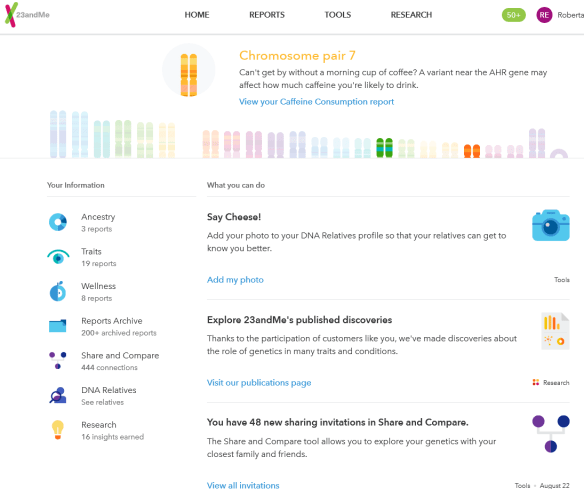
23andMe requires people to opt-in to sharing, even after they have selected to participate in Ancestry Services (genealogy) testing, have opted-in previously and chosen to view their DNA Relatives. Users on the “New Experience” can then either share chromosome data and results with each other individually, meaning on a one by one basis, or globally by a one-time opt-in to “open sharing” with matches. If a user does not opt-in to both DNA Relatives and open sharing, sharing requests must be made individually to each match, and they must opt-in to share with each individual user. This complexity and confusion results in an approximate sharing rate of between 50 and 60%. One individual who religiously works their matches by requesting sharing now has a share rate of about 80% of their matches in the data base who HAVE initially selected to participate in DNA Relatives. You can read more about the 23andMe experience at this link.

Various genetic genealogy reports and tools are scattered between the Reports and Tools tabs, and within those, buried in non-intuitive locations. If you are going to utilize 23andMe for matching and genealogy, in addition to the above link, I recommend Kitty Cooper’s blogs about the new DNA Relatives here and on triangulation here. Print the articles, and use them as a guide while navigating the 23andMe site.

Note that some screens (the Tools, DNA Relatives, then DNA tab) on the site do not display/work correctly utilizing Internet Explorer, but do with Edge or other browsers.

The one genealogy feature unique to 23andMe is:

  • Triangulation at 23andMe allows you to select a specific match to compare your DNA against. Several pieces of information will be displayed, the last of which, scrolling to the bottom, is a list of your common relatives with the person you selected.

In the example below, I’ve selected to see the matches I match in common with known family member, Stacy Den (surnames have been obscured for privacy reasons.)  Please note that the Roberta V4 Estes kit is a second test that I took for comparison purposes when the new V4 version of 23andMe was released.  Just ignore that match, because, of course I match myself as a twin.

If an individual does not match both you and your selected match, they will not appear on this list.

In the “relatives in common” section, each person is listed with a “shared DNA” column. For a person to be shown on this “in common” list, you obviously do share DNA with these individuals and they also share with your match, but the “shared DNA” column goes one step further. This column indicates whether or not you and your match both share a common DNA segment with the “in common” person.

I know this is confusing, so I’ve created this chart to illustrate what will appear in the “Shared DNA” column of the individuals showing on the list of matches, above, shared between me and Stacy Den.

Clicking on “Share to see” sends Sarah a sharing request for her to allow you to see her segment matches.

Let’s look at an example with “yes” in the Shared DNA column.

Clicking on the “Yes” in the Shared DNA column of Debbie takes us to the chromosome browser which shows both your selected match, Stacy in my case, and Debbie, the person whose “yes” you clicked.

All three people, meaning me, Stacy and Debbie share a common DNA segment, shown below on chromosome 17.

What 23andMe does NOT say is that these people. Stacy and Debbie, also match each other, in addition to matching me, which means all three of us triangulate.

Because I manage Stacy’s kit at 23andMe, I can check to see if Debbie is on Stacy’s match list, and indeed, Debbie is on Stacy’s match list and Stacy does match both Debbie and me on chromosome 17 in exactly the same location shown above, proving unquestionably that the three of us all match each other and therefore triangulate on this segment. In our case, it’s easy to identify our common relative whose DNA all 3 of us share.

Genealogy – Autosomal Summary

While all 3 vendors offer matching, their interfaces and tools vary widely.

I would suggest that Ancestry is the least sophisticated and has worked hard to make their tools easy for the novice working with genetic genealogy. Their green leaf DNA+Tree Matching is their best feature, easy to use and important for the novice and experienced genealogist alike.  Now, if they just had that chromosome browser so we could see how we match those people.

Ancestry’s Circles, while a nice feature, encourage testers to believe that their DNA or relationship is confirmed by finding themselves in a Circle, which is not the case.

Circles can be formed as the result of misinformation in numerous trees. For example, if I were to inaccurately list Smith as the surname for one of my ancestor’s wives, I would find myself in a Circle for Barbara Smith, when in fact, there is absolutely no evidence whatsoever that her surname is Smith. Yet, people think that Barbara Smith is confirmed due to a Circle having been formed and finding themselves in Barbara Smith’s Circle. Copying incorrect trees equals the formation of incorrect Circles.

It’s also possible that I’m matching people on multiple lines and my DNA match to the people in any given Circle is through another common ancestor entirely.

A serious genealogist will test minimally at Ancestry and at Family Tree DNA, who provides a chromosome browser and other tools necessary to confirm relationships and shared DNA segments.

Family Tree DNA is more sophisticated, so consequently more complex to use.  They provide matching plus numerous other tools. The website and matching is certainly friendly for the novice, but to benefit fully, some experience or additional education is beneficial, not unlike traditional genealogy research itself. This is true not just for Family Tree DNA, but GedMatch and 23andMe who all three utilize chromosome browsers.

The user will want to understand what a chromosome browser is indicating about matching DNA segments, so some level of education makes life a lot easier. Fortunately, understanding chromosome browser matching is not complex. You can read an article about Match Groups and Triangulation here. I also have an entire series of Concepts articles, Family Tree DNA offers a webinar library, their Learning Center and other educational resources are available as well.

Family Tree DNA is the only vendor to provide Phased Family Matches, meaning that by connecting known relatives who have DNA tested to your tree, Family Tree DNA can then identify additional matches as maternal, paternal or both. This, in combination with pseudo-phasing are very powerful matching tools.

23andMe is the least friendly of the three companies, with several genetic genealogy unfriendly restrictions relative to matching, opt-ins, match limits and such. They have experienced problem after problem for years relative to genetic genealogy, which has always been a second-class citizen compared to their medical research, and not a priority.

23andMe has chosen to implement a business model where their customers must opt-in to share segment information with other individuals, either one by one or by opting into open sharing. Based on my match list, roughly 60% of my actual DNA matches have opted in to sharing.

Their customer base includes fewer serious genealogists and their customers often are not interested in genealogy at all.

Having said that, 23andMe is the only one of the three that provides actual triangulated matches for users on the New Experience and who have opted into sharing.

If I were entering the genetic genealogy testing space today, I would test my autosomal DNA at Ancestry and at Family Tree DNA, but I would probably not test at 23andMe. I would test both my Y DNA (if a male) and mitochondrial at Family Tree DNA.

Thank you to Kitty Cooper for assistance with parent/child matching and triangulation at 23andMe.

Genealogy Autosomal Vendor Feature Summary Chart

Family Tree DNA Ancestry 23andMe
Matching Yes Yes Yes – each person has to opt in for open sharing or authorize sharing individually, many don’t
Estimated Relationships Yes Yes Yes
Chromosome Browser Yes No – Large Issue Yes
Chromosome Browser Threshold Adjustment Yes No Chromosome Browser No
X Chromosome Matching Yes No Yes
Trees Yes Yes – subscription required so see matches’ trees No
Ability to upload Gedcom file Yes Yes No
Ability to search trees Yes Yes No
Subscription in addition to DNA test price No No for partial, Yes for full functionality, minimal subscription for $49 by calling Ancestry No
DNA + Ancestor in Tree Matches No Yes – Leaf Hints – subscription required – Best Feature No
Phased Parental Side Matching Yes – Best Feature No No
Parent Match Indicator Yes No Yes
Sort or Group by Parent Match Yes Yes Yes
In Common With Tool Yes Yes Yes
Not In Common With Tool Yes No No
Triangulated Matches No – pseudo with ICW, browser and matrix No Yes – Best Feature
Common Surnames Yes Yes – subscription required No
Ability to Link DNA Matches on Tree Yes No No
Matrix to show match grid between multiple matches Yes No No
Match Filter Tools Yes Minimal Some
Advanced Matching Tool Yes No No
Multiple Test Matching Tool Yes No multiple tests No multiple tests
Ethnicity Matching Yes No Yes
Projects Yes No No
Maximum # of Matches Restricted No No Yes – 2000 unless you are communicating with the individuals, then they are not removed from your match list
All Customers Participate Yes Yes, unless they don’t have a subscription No – between 50-60% opt-in
Accepts Transfers from Other Testing Companies Yes No No
Free Features with Transfer Matching, ICW, Matrix, Advanced Matching No transfers No transfers
Transfer Features Requiring Unlock $ Chromosome Browser, Ethnicity, Ancient Origins, Linked Relationships, Parentally Phased Matches No Transfers No transfers
Archives DNA for Later Testing Yes, 25 years No, no additional tests available No, no additional tests available
Additional Tool DNA Circles – subscription required
Additional Tool New Ancestor Discoveries – subscription required
Y DNA Not included in autosomal test but is additional test, detailed results including matching No Haplogroup only
Mitochondrial DNA Not included in autosomal test but is additional test, detailed results including matching No Haplogroup only
Advanced Testing Available Yes No No
Website Intuitive Yes, given their many tools Yes, very simple No
Data Base Size Large Largest Large but many do not test for genealogy, only test for health
Strengths Many tools, multiple types of tests, phased matching without parent DNA + Tree matching, size of data base Triangulation
Challenges Website episodically times out No chromosome browser or advanced tools Sharing is difficult to understand and many don’t, website is far from intuitive


Genealogy – Y and Mitochondrial DNA

Two indispensable tools for genetic genealogy that are often overlooked are Y and mitochondrial DNA.

The inheritance path for Y DNA is shown by the blue squares and the inheritance path for mitochondrial DNA is shown by the red circles for the male and female siblings shown at the bottom of the chart.

Y-DNA Testing for Males

Y DNA is inherited by males only, from their father. The Y chromosome makes males male. Women instead inherit an X chromosome from their father, which makes them female. Because the Y chromosome is not admixed with the DNA of the mother, the same Y chromosome has been passed down through time immemorial.

Given that the Y chromosome follows the typical surname path, Y DNA testing is very useful for confirming surname lineage to an expected direct paternal ancestor. In other words, an Estes male today should match, with perhaps a few mutations, to other descendants of Abraham Estes who was born in 1647 in Kent, England and immigrated to the colony of Virginia.

Furthermore, that same Y chromosome can look far back in time, thousands of years, to tell us where that English group of Estes men originated, before the advent of surnames and before the migration to England from continental Europe. I wrote about the Estes Y DNA here, so you can see an example of how Y DNA testing can be used.

Y DNA testing for matching and haplogroup identification, which indicates where in the world your ancestors were living within the past few hundred to few thousand years, is only available from Family Tree DNA. Testing can be purchased for either 37, 67 or 111 markers, with the higher marker numbers providing more granularity and specificity in matching.

Family Tree DNA provides three types of Y DNA tests.

  • STR (short tandem repeat) testing is the traditional Y DNA testing for males to match to each other in a genealogically relevant timeframe. These tests can be ordered in panels of 37, 67 or 111 markers and lower levels can be upgraded to higher levels at a later date. An accurate base haplogroup prediction is made from STR markers.
  • SNP (single nucleotide polymorphism) testing is a different type of testing that tests single locations for mutations in order to confirm and further refine haplogroups. Think of a haplogroup as a type of genetic clan, meaning that haplogroups are used to track migration of humans through time and geography, and are what is utilized to determine African, European, Asian or Native heritage in the direct paternal line. SNP tests are optional and can be ordered one at a time, in groups called panels for a particular haplogroup or a comprehensive research level Y DNA test called the Big Y can be ordered after STR testing.
  • The Big Y test is a research level test that scans the entire Y chromosome to determine the most refined haplogroup possible and to report any previously unknown mutations (SNPs) that may define further branches of the Y DNA tree. This is the technique used to expand the Y haplotree.

You can read more about haplogroups here and about the difference between STR markers and SNPs here, here and here.

Customers receive the following features and tools when they purchase a Y DNA test at Family Tree DNA or the Ancestry Services test at 23andMe. The 23andMe Y DNA information is included in their Ancestry Services test. The Family Tree DNA Y DNA information requires specific tests and is not included in the Family Finder test. You can click here to read about the difference in the technology between Y DNA testing at Family Tree DNA and at 23andMe. Ancestry is not included in this comparison because they provide no Y DNA related information.

Y DNA Vendor Feature Summary Chart

Family Tree DNA 23andMe
Varying levels of STR panel marker testing Yes, in panels of 37, 67 and 111 markers No
Test panel (STR) marker results Yes Not tested
Haplogroup assignment Yes – accurate estimate with STR panels, deeper testing available Yes –base haplogroup by scan – haplogroup designations are significantly out of date, no further testing available
SNP testing to further define haplogroup Yes – can purchase individual SNPs, by SNP panels or Big Y test No
Matching to other participants Yes No
Trees available for your matches Yes No
E-mail of matches provided Yes No
Calculator tool to estimate probability of generational distance between you and a match Yes No
Earliest known ancestor information Yes No
Projects Surname, haplogroup and geographic projects No
Ability to search Y matches Yes No Y matching
Ability to search matches within projects Yes No projects
Ability to search matches by partial surname Yes No
Haplotree and customer result location on tree Yes, detailed with every branch Yes, less detailed, subset
Terminal SNP used to determine haplogroup Yes Yes, small subset available
Haplogroup Map Migration map Heat map
Ancestral Origins – summary by ancestral location of others you match, by test level Yes No
Haplogroup Origins – match ancestral location summary by haplogroup, by test level Yes No
SNP map showing worldwide locations of any selected SNP Yes No
Matches map showing mapped locations of your matches most distant ancestor in the paternal line, by test panel Yes No
Big Y – full scan of Y chromosome for known and previously unknown mutations (SNPs) Yes No
Big Y matching Yes No
Big Y matching known SNPs Yes No
Big Y matching novel variants (unknown or yet unnamed SNPs) Yes No
Filter Big Y matches Yes No
Big Y results Yes No
Advanced matching for multiple test types Yes No
DNA is archived so additional tests or upgrades can be ordered at a later date Yes, 25 years No

Mitochondrial DNA Testing for Everyone

Mitochondrial DNA is contributed to both genders of children by mothers, but only the females pass it on. Like the Y chromosome, mitochondrial DNA is not admixed with the DNA of the other parent. Therefore, anyone can test for the mitochondrial DNA of their matrilineal line, meaning their mother’s mother’s mother’s lineage.

Matching can identify family lines as well as ancient lineage.

You receive the following features and tools when you purchase a mitochondrial DNA test from Family Tree DNA or the Ancestry Services test from 23andMe. The Family Tree DNA mitochondrial DNA information requires specific tests and is not included in the Family Finder test. The 23andMe mitochondrial information is provided with the Ancestry Services test. Ancestry is omitted from this comparison because they do not provide any mitochondrial information.

Mitochondrial DNA Vendor Feature Summary Chart

Family Tree DNA 23andMe
Varying levels of testing Yes, mtPlus and Full Sequence No
Test panel marker results Yes, in two formats, CRS and RSRS No
Rare mutations, missing and extra mutations, insertions and deletions reported Yes No
Haplogroup assignment Yes, most current version, Build 17 Yes, partial and out of date version
Matching to other participants Yes No
Trees of matches available to view Yes No
E-mail address provided to matches Yes No
Earliest known ancestor information Yes No
Projects Surname, haplogroup and geographic available No
Ability to search matches Yes No
Ability to search matches within project Yes No projects
Ability to search match by partial surname Yes No
Haplotree and customer location on tree No Yes
Mutations used to determine haplogroup provided Yes No
Haplogroup Map Migration map Heat map
Ancestral Origins – summary by ancestral location of others you match, by test level Yes No
Haplogroup Origins –match ancestral location summary by haplogroup Yes No
Matches map showing mapped locations of your matches most distant ancestor in the maternal line, by test level Yes No
Advanced matching for multiple test types Yes No
DNA is archived so additional tests or upgrades can be ordered at a later date Yes, 25 years No


Overall Genealogy Summary

Serious genealogists should test with at least two of the three major vendors, being Family Tree DNA and Ancestry, with 23andMe coming in as a distant third.

No genetic genealogy testing regimen is complete without Y and mitochondrial DNA for as many ancestral lines as you can find to test. You don’t know what you don’t know, and you’ll never know if you don’t test.

Unfortunately, many people, especially new testers, don’t know Y and mitochondrial DNA testing for genetic genealogy exists, or how it can help their genealogy research, which is extremely ironic since these were the first tests available, back in 2000.

You can read about finding Y and mitochondrial information for various family lines and ancestors and how to assemble a DNA Pedigree Chart here.

You can also take a look at my 52 Ancestors series, where I write about an ancestor every week. Each article includes some aspect of DNA testing and knowledge gained by a test or tests, DNA tool, or comparison. The DNA aspect of these articles focuses on how to use DNA as a tool to discover more about your ancestors.

Testing for Medical/Health or Traits

The DTC market also includes health and medical testing, although it’s not nearly as popular as genetic genealogy.

Health/medical testing is offered by 23andMe, who also offers autosomal DNA testing for genealogy.

Some people do want to know if they have genetic predispositions to medical conditions, and some do not. Some want to know if they have certain traits that aren’t genealogically relevant, but might be interesting – such as whether they carry the Warrior gene or if they have an alcohol flush reaction.

23andMe was the first company to dip their toes into the water of Direct to Consumer medical information, although they called it “health,” not medicine, at that time. Regardless of the terminology, information regarding Parkinson’s and Alzheimer’s, for example, were provided for customers. 23andMe attempted to take the raw data and provide the consumer with something approaching a middle of the road analysis, because sometimes the actual studies provide conflicting information that might not be readily understood by consumers.

The FDA took issue with 23andMe back in November of 2013 when they ordered 23andMe to discontinue the “health” aspect of their testing after 23andMe ignored several deadlines. In October 2015, 23andMe obtained permission to provide customers with some information, such as carrier status, for 36 genetic disorders.

Since that time, 23andMe has divided their product into two separate tests, with two separate prices. The genealogy only test called Ancestry Service can be purchased separately for $99, or the combined Health + Ancestry Service for $199.

If you are interested in seeing what the Health + Ancestry test provides, you can click here to view additional information.

However, there is a much easier and less expensive solution.

If you have taken the autosomal test from 23andMe, Ancestry or Family Tree DNA, you can download your raw data file from the vendor and upload to Promethease to obtain a much more in-depth report than is provided by 23andMe, and much less expensively – just $5.

I reviewed the Promethease service here. I found the Promethease reports to be very informative and I like the fact that they provide information, both positive and negative for each SNP (DNA location) reported. Promethease avoids FDA problems by not providing any interpretation or analysis, simply the data and references extracted from SNPedia for you to review.

I would be remiss if I didn’t mention that you should be sure you really want to know before you delve into medical testing. Some mutations are simply indications that you could develop a condition that you will never develop or that is not serious. Other mutations are not so benign. Promethease provides this candid page before you upload your data.

Different files from different vendors provide different results at Promethease, because those vendors test different SNP locations in your DNA. At the Promethease webpage, you can view examples.

Traits

Traits fall someplace between genealogy and health. When you take the Health + Ancestry test at 23andMe, you do receive information about various traits, as follows:

Of course, you’ll probably already know if you have several of these traits by just taking a look in the mirror, or in the case of male back hair, by asking your wife.

At Family Tree DNA, existing customers can order tests for Factoids (by clicking on the upgrade button), noted as curiosity tests for gene variants.

Family Tree DNA provides what I feel is a great summary and explanation of what the Factoids are testing on their order page:

“Factoids” are based on studies – some of which may be controversial – and results are not intended to diagnose disease or medical conditions, and do not serve the purpose of medical advice. They are offered exclusively for curiosity purposes, i.e. to see how your result compared with what the scientific papers say. Other genetic and environmental variables may also impact these same physiological characteristics. They are merely a conversational piece, or a “cocktail party” test, as we like to call it.”

Test Price Description
Alcohol Flush Reaction $19 A condition in which the body cannot break down ingested alcohol completely. Flushing, after consuming one or two alcoholic beverages, includes a range of symptoms: nausea, headaches, light-headedness, an increased pulse, occasional extreme drowsiness, and occasional skin swelling and itchiness. These unpleasant side effects often prevent further drinking that may lead to further inebriation, but the symptoms can lead to mistaken assumption that the people affected are more easily inebriated than others.
Avoidance of Errors $29 We are often angry at ourselves because we are unable to learn from certain experiences. Numerous times we have made the wrong decision and its consequences were unfavorable. But the cause does not lie only in our thinking. A mutation in a specific gene can also be responsible, because it can cause a smaller number of dopamine receptors. They are responsible for remembering our wrong choices, which in turn enables us to make better decisions when we encounter a similar situation.
Back Pain $39 Lumbar disc disease is the drying out of the spongy interior matrix of an intervertebral disc in the spine. Many physicians and patients use the term lumbar disc disease to encompass several different causes of back pain or sciatica. A study of Asian patients with lumbar disc disease showed that a mutation in the CILP gene increases the risk of back pain.
Bitter Taste Perception $29 There are several genes that are responsible for bitter taste perception – we test 3 of them. Different variations of this gene affect ability to detect bitter compounds. About 25% of people lack ability to detect these compounds due to gene mutations. Are you like them? Maybe you don’t like broccoli, because it tastes too bitter?
Caffeine Metabolism $19 According to the results of a case-control study reported in the March 8, 2006 issue of JAMA, coffee is the most widely consumed stimulant in the world, and caffeine consumption has been associated with increased risk for non-fatal myocardial infarction. Caffeine is primarily metabolized by the cytochrome P450 1A2 in the liver, accounting for 95% of metabolism. Carriers of the gene variant *1F allele are slow caffeine metabolizers, whereas individuals homozygous for the *1A/*1A genotype are rapid caffeine metabolizers.
Earwax Type $19 Whether your earwax is wet or dry is determined by a mutation in a single gene, which scientists have discovered. Wet earwax is believed to have uses in insect trapping, self-cleaning and prevention of dryness in the external auditory canal of the ear. It also produces an odor and causes sweating, which may play a role as a pheromone.
Freckling $19 Freckles can be found on anyone no matter what the background. However, having freckles is genetic and is related to the presence of the dominant melanocortin-1 receptor MC1R gene variant.
Longevity $49 Researchers at Harvard Medical School and UC Davis have discovered a few genes that extend lifespan, suggesting that the whole family of SIR2 genes is involved in controlling lifespan. The findings were reported July 28, 2005 in the advance online edition of Science.
Male Pattern Baldness $19 Researchers at McGill University, King’s College London and GlaxoSmithKline Inc. have identified two genetic variants in Caucasians that together produce an astounding sevenfold increase of the risk of male pattern baldness. Their results were published in the October 12, 2008 issue of the Journal of Nature Genetics.
Monoamine Oxidase A (Warrior Gene) $49.50 The Warrior Gene is a variant of the gene MAO-A on the X chromosome. Recent studies have linked the Warrior Gene to increased risk-taking and aggressive behavior. Whether in sports, business, or other activities, scientists found that individuals with the Warrior Gene variant were more likely to be combative than those with the normal MAO-A gene. However, human behavior is complex and influenced by many factors, including genetics and our environment. Individuals with the Warrior Gene are not necessarily more aggressive, but according to scientific studies, are more likely to be aggressive than those without the Warrior Gene variant. This test is available for both men and women, however, there is limited research about the Warrior Gene variant amongst females. Additional details about the Warrior Gene genetic variant of MAO-A can be found in Sabol et al, 1998.
Muscle Performance $29 A team of researchers, led by scientists at Dartmouth Medical School and Dartmouth College, have identified and tested a gene that dramatically alters both muscle metabolism and performance. The researchers say that this finding could someday lead to treatment of muscle diseases, including helping the elderly who suffer from muscle deterioration and improving muscle performance in endurance athletes.
Nicotine Dependence $19 In 2008, University of Virginia Health System researchers have identified a gene associated with nicotine dependence in both Europeans and African Americans.

Many people are interested in the Warrior Gene, which I wrote about here.

At Promethease, traits are simply included with the rest of the conditions known to be associated with certain SNPs, such as baldness, for example, but I haven’t done a comparison to see which traits are included.


Additional Vendor Information to Consider

Before making your final decision about which test or tests to purchase, there are a few additional factors you may want to consider.

As mentioned before, Ancestry requires a subscription in addition to the cost of the DNA test for the DNA test to be fully functional.

One of the biggest issues, in my opinion, is that both 23andMe and Ancestry sell customer’s anonymized DNA information to unknown others. Every customer authorizes the sale of their information when they purchase or activate a kit – even though very few people actually take the time to read the Terms and Conditions, Privacy statements and Security documents, including any and all links. This means most people don’t realize they are authorizing the sale of their DNA.

At both 23andMe and Ancestry, you can ALSO opt in for additional non-anonymized research or sale of your DNA, which you can later opt out of. However, you cannot opt out of the lower level sale of your anonymized DNA without removing your results from the data base and asking for your sample to be destroyed. They do tell you this, but it’s very buried in the fine print at both companies. You can read more here.

Family Tree DNA does not sell your DNA or information.

All vendors can change their terms and conditions at any time. Consumers should always thoroughly read the terms and conditions including anything having to do with privacy for any product they purchase, but especially as it relates to DNA testing.

Family Tree DNA archives your DNA for later testing, which has proven extremely beneficial when a family member has passed away and a new test is subsequently introduced or the family wants to upgrade a current test.  Had my mother’s DNA not been archived at Family Tree DNA, I would not have Family Finder results for her today – something I thank Mother and Family Tree DNA for every single day.

Family Tree DNA also accepts transfer files from 23andMe, Ancestry and very shortly, MyHeritage – although some versions work better than others. For details on which companies accept which file versions, from which vendors, and why, please read Autosomal DNA Transfers – Which Companies Accept Which Tests?

If you tested on a compatible version of the 23andMe Test (V3 between December 2010 and November 2013) or the Ancestry V1 (before May 2016) you may want to transfer your raw data file to Family Tree DNA for free and pay only $19 for full functionality, as opposed to taking the Family Finder test. Family Tree DNA does accept later versions of files from 23andMe and Ancestry, but you will receive more matches if you test on the same chip platform that Family Tree DNA utilizes instead of doing a transfer.

Additional Vendor Considerations Summary Chart

Family Tree DNA Ancestry 23andMe
Subscription required in addition to cost of DNA test No Yes for full functionality, partial functionality is included without subscription, minimum subscription is $49 by calling Ancestry No
Customer Support Good and available Available, nice but often not knowledgeable about DNA Poor
Sells customer DNA information No Yes Yes
DNA raw data file available to download Yes Yes Yes
DNA matches file available to download including match info and chromosome match locations Yes No Yes
Customers genealogically focused Yes Yes Many No
Accepts DNA raw data transfer files from other companies Yes, most, see article for specifics No No
DNA archived for later testing Yes, 25 years No No
Beneficiary provision available Yes No No


Which Test is Best For You?

I hope you now know the answer as to which DNA test is best for you – or maybe it’s multiple tests for you and other family members too!

DNA testing holds so much promise for genealogy. I hesitate to call DNA testing a miracle tool, but it often is when there are no records. DNA testing works best in conjunction with traditional genealogical research.

There are a lot of tests and options.  The more tests you take, the more people you match. Some people test at multiple vendors or upload their DNA to third party sites like GedMatch, but most don’t. In order to make sure you reach those matches, which may be the match you desperately need, you’ll have to test at the vendor where they tested. Otherwise, they are lost to you. That means, of course, that eventually, if you’re a serious genealogist, you’ll be testing at all 3 vendors.  Don’t forget about Y and mitochondrial tests at Family Tree DNA.

Recruit family members to test and reach out to your matches.  The more you share and learn – the more is revealed about your ancestors. You are, after all, the unique individual that resulted from the combination of all of them!

Update: Vendor prices updated June 22, 2017.

______________________________________________________________

Disclosure

I receive a small contribution when you click on some of the links to vendors in my articles. This does NOT increase the price you pay but helps me to keep the lights on and this informational blog free for everyone. Please click on the links in the articles or to the vendors below if you are purchasing products or DNA testing.

Thank you so much.

DNA Purchases and Free Transfers

Genealogy Services

Genealogy Research

New Native American Mitochondrial DNA Haplogroups

At the November 2016 Family Tree DNA International Conference on Genetic Genealogy, I was invited to give a presentation about my Native American research findings utilizing the Genographic Project data base in addition to other resources. I was very pleased to be offered the opportunity, especially given that the 2016 conference marked the one year anniversary of the Genographic Project Affiliate Researcher program.

The results of this collaborative research effort have produced an amazing number of newly identified Native American mitochondrial haplogroups. Previously, 145 Native American mitochondrial haplogroups had been identified. This research project increased that number by 79% added another 114 haplogroups, raising the total to 259 Native American haplogroups.

Guilt by Genetic Association

Bennett Greenspan, President of Family Tree DNA, gave a presentation several years ago wherein he described genetic genealogy as “guilt by genetic association.” This description of genetic genealogy is one of the best I have ever heard, especially as it pertains to the identification of ancestral populations by Y and mitochondrial DNA.

As DNA testing has become more mainstream, many people want to see if they have Native ancestry. While autosomal DNA can only measure back in time relative to ethnicity reliably about 5 or 6 generations, Y and mitochondrial DNA due to their unique inheritance paths and the fact that they do not mix with the other parent’s DNA can peer directly back in time thousands of years.

Native American Mitochondrial DNA

Native American mitochondrial DNA consists of five base haplogroups, A, B, C, D and X. Within those five major haplogroups are found many Native as well as non-Native sub-haplogroups. Over the last 15 years, researchers have been documenting haplogroups found within the Native community although progress has been slow for various reasons, including but not limited to the lack of participants with proven Native heritage on the relevant matrilineal genealogical line.

In the paper, “Large scale mitochondrial sequencing in Mexican Americans suggests a reappraisal of Native American origins,” published in 2011, Kumar et al state the following:

For mtDNA variation, some studies have measured Native American, European and African contributions to Mexican and Mexican American populations, revealing 85 to 90% of mtDNA lineages are of Native American origin, with the remainder having European (5-7%) or African ancestry (3-5%). Thus the observed frequency of Native American mtDNA in Mexican/Mexican Americans is higher than was expected on the basis of autosomal estimates of Native American admixture for these populations i.e. ~ 30-46%. The difference is indicative of directional mating involving preferentially immigrant men and Native American women.

The actual Native mtDNA rate in their study of 384 completely sequenced Mexican genomes was 83.3% with 3.1% being African and 13.6% European.

This means that Mexican Americans and those south of the US in Mesoamerica provide a virtually untapped resource for Native American mitochondrial DNA.

The Genographic Project Affiliate Researcher Program

At the Family Tree DNA International Conference in November 2015, Dr. Miguel Vilar announced that the Genographic Project data base would be made available for qualified affiliate researchers outside of academia. There is, of course, an application process and aspiring affiliate researchers are required to submit a research project plan for consideration.

I don’t know if I was the first applicant, but if not, I was certainly one of the first because I wasted absolutely no time in submitting my application. In fact, my proposal likely arrived in Washington DC before Dr. Vilar did!

One of my original personal goals for genetic genealogy was to identify my Native American ancestors. It didn’t take long before I realized that one of the aspects of genetic genealogy where we desperately needed additional research was relative to Native people, specifically within Native language groups or tribes and from individuals who unquestionably know their ancestry and can document that their direct Y or mtDNA ancestors were Native.

Additionally, we needed DNA from pre-European-contact burials to ascertain whether haplogroups found in Europe and Africa were introduced into the Native population post-contact or existed within the Native population as a result of a previously unknown/undocumented contact. Some of both of these types of research has occurred, but not enough.

Slowly, over the years, additional sub-haplogroups have been added for both the Y and mitochondrial Native DNA. In 2007, Tamm et al published the first comprehensive paper providing an overview of the migration pathways and haplogroups in their landmark paper, “Beringian Standstill and the Spread of Native American Founders.” Other research papers have added to that baseline over the years.

beringia map

“Beringian Standstill and the Spread of Native American Founders” by Tamm et al

In essence, whether you are an advocate of one migration or multiple migration waves, the dates of 10,000 to 25,000 years ago are a safe range for migration from Asia, across the then-present land-mass, Beringia, into the Americas. Recently another alternative suggesting that the migration may have occurred by water, in multiple waves, following coastlines, has been proposed as well – but following the same basic pathway. It makes little difference whether the transportation method was foot or kayak, or both, or one or more migration events. Our interest lies in identifying which haplogroups arrived with the Asians who became the indigenous people of the Americas.

Haplogroups

To date, proven base Native haplogroups are:

Y DNA:

  • Q
  • C

Mitochondrial DNA

  • A
  • B
  • C
  • D
  • X

Given that the Native, First Nations or aboriginal people, by whatever name you call them, descended from Asia, across the Beringian land bridge sometime between roughly 10,000 and 25,000 years ago, depending on which academic model you choose to embrace, none of the base haplogroups shown above are entirely Native. Only portions, meaning specific subgroups, are known to be Native, while other subgroups are Asian and often European as well. The descendants of the base haplogroups, all born in Asia, expanded North, South, East and West across the globe. Therefore, today, it’s imperative to test mitochondrial DNA to the full sequence level and undergo SNP testing for Y DNA to determine subgroups in order to be able to determine with certainty if your Y or mtDNA ancestor was Native.

And herein lies the rub.

Certainty is relative, pardon the pun.

We know unquestionably that some haplogroups, as defined by Y SNPs and mtDNA full sequence testing, ARE Native, and we know that some haplogroups have never (to date) been found in a Native population, but there are other haplogroup subgroups that are ambiguous and are either found in both Asia/Europe and the Americas, or their origin is uncertain. One by one, as more people test and we obtain additional data, we solve these mysteries.

Let’s look at a recent example.

Haplogroup X2b4

Haplogroup X2b4 was found in the descendants of Radegonde Lambert, an Acadian woman born sometime in the 1620s and found in Acadia (present day Nova Scotia) married to Jean Blanchard as an adult. It was widely believed that she was the daughter of Jean Lambert and his Native wife. However, some years later, a conflicting record arose in which the husband of Radegonde’s great-granddaughter gave a deposition in which he stated that Radegonde came from France with her husband.

Which scenario was true? For years, no one else tested with haplogroup X2b4 that had any information as to the genesis of their ancestors, although several participants tested who descended from Radegonde.

Finally, in 2016, we were able to solve this mystery once and for all. I had formed the X2b4 project with Marie Rundquist and Tom Glad, hoping to attract people with haplogroup X2b4. Two pivotal events happened.

  • Additional people tested at Family Tree DNA and joined the X2b4 project.
  • Genographic Project records became available to me as an affiliate researcher.

At Family Tree DNA, we found other occurrences of X2b4 in:

  • The Czech Republic
  • Devon in the UK
  • Birmingham in the UK

Was it possible that X2b4 could be both European and Native, meaning that some descendants had migrated east and crossed the Beringia land bridge, and some has migrated westward into Europe?

Dr. Doron Behar in the supplement to his publication, “A Copernican” Reassessment of the Human Mitochondrial DNA Tree from its Root” provides the creation dates for haplogroup X through X2b4 as follows:

native-mt-x2b4

These dates would read 31,718 years ago plus or minus 11,709 (eliminating the numbers after the decimal point) which would give us a range for the birth of haplogroup X from 43,427 years ago to 20,009 years ago, with 31,718 being the most likely date.

Given that X2b4 was “born” between 2,992 and 8,186 years ago, the answer has to be no, X2b4 cannot be found both in the Native population and European population since at the oldest date, 8,100 years ago, the Native people had already been in the Americas between 2,000 and 18,000 years.

Of course, all kinds of speculation could be (and has been) offered, about Native people being taken to Europe, although that speculation is a tad bit difficult to rationalize in the Czech Republic.

The next logical question is if there are documented instances of X2b4 in the Native population in the Americas?

I turned to the Genographic Project where I found no instances of X2b4 in the Native population and the following instances of X2b4 in Europe.

  • Ireland
  • Czech
  • Serbia
  • Germany (6)
  • France (2)
  • Denmark
  • Switzerland
  • Russia
  • Warsaw, Poland
  • Norway
  • Romania
  • England (2)
  • Slovakia
  • Scotland (2)

The conclusion relative to X2b4 is clearly that X2b4 is European, and not aboriginally Native.

The Genographic Project Data Base

As a researcher, I was absolutely thrilled to have access to another 700,000+ results, over 475,000 of which are mitochondrial.

The Genographic Project tests people whose identity remains anonymous. One of the benefits to researchers is that individuals in the public participation portion of the project can contribute their own information anonymously for research by answering a series of questions.

I was very pleased to see that one of the questions asked is the location of the birth of the participant’s most distant matrilineal ancestor.

Tabulation and analysis should be a piece of cake, right? Just look at that “most distant ancestor” response, or better yet, utilize the Genographic data base search features, sort, count, and there you go…

Well, guess again, because one trait that is universal, apparently, between people is that they don’t follow instructions well, if at all.

The Genographic Project, whether by design or happy accident, has safeguards built in, to some extent, because they ask respondents for the same or similar information in a number of ways. In any case, this technique provides researchers multiple opportunities to either obtain the answer directly or to put 2+2 together in order to obtain the answer indirectly.

Individuals are identified in the data base by an assigned numeric ID. Fields that provide information that could be relevant to ascertaining mitochondrial ethnicity and ancestral location are:

native-mt-geno-categories

I utilized these fields in reverse order, giving preference to the earliest maternal ancestor (green) fields first, then maternal grandmother (teal), then mother (yellow), then the tester’s place of birth (grey) supplemented by their location, language and ethnicity if applicable.

Since I was looking for very specific information, such as information that would tell me directly or suggest that the participant was or could be Native, versus someone who very clearly wasn’t, this approach was quite useful.

It also allowed me to compare answers to make sure they made sense. In some cases, people obviously confused answers or didn’t understand the questions, because the three earliest ancestor answers cannot contain information that directly contradict each other. For example, the earliest ancestor place of birth cannot be Ireland and the language be German and the ethnicity be Cherokee. In situations like this, I omitted the entire record from the results because there was no reliable way to resolve the conflicting information.

In other cases, it was obvious that if the maternal grandmother and mother and tester were all born in China, that their earliest maternal ancestor was not very likely to be Native American, so I counted that answer as “China” even though the respondent did not directly answer the earliest maternal ancestor questions.

Unfortunately, that means that every response had to be individually evaluated and tabulated. There was no sort and go! The analysis took several weeks in the fall of 2016.

By Haplogroup – Master and Summary Tables

For each sub-haplogroup, I compiled, minimally, the following information shown as an example for haplogroup A with no subgroup:

native-mt-master-chart

The “Previously Proven Native” link is to my article titled Native American Mitochondrial Haplogroups where I maintain an updated list of haplogroups proven or suspected Native, along with the source(s), generally academic papers, for that information.

In some cases, to resolve ambiguity if any remained, I also referenced Phylotree, mtDNA Community and/or GenBank.

For each haplogroup or subgroup within haplogroup, I evaluated and listed the locations for the Genographic “earliest maternal ancestor place of birth” locations, but in the case of the haplogroup A example above, with 4198 responses, the results did not fit into the field so I added the information as supplemental.

By analyzing this information after completing a master tablet for each major haplogroup and subgroups, meaning A, B, C, D and X, I created summary tables provided in the haplogroup sections in this paper.

Family Tree DNA Projects

Another source of haplogroup information is the various mitochondrial DNA projects at Family Tree DNA.

Each project is managed differently, by volunteers, and displays or includes different information publicly. While different information displayed and lack of standardization does present challenges, there is still valuable information available from the public webpages for each mitochondrial haplogroup referenced.

Challenges

The first challenge is haplogroup naming. For those “old enough” to remember when Y DNA haplogroups used to be called by names such as R1b1c and then R1b1a2, as opposed to the current R-M269 – mitochondrial DNA is having the same issue. In other words, when a new branch needs to be added to the tree, or an entire branch needs to be moved someplace else, the haplogroup names can and do change.

In October and November 2016 when I extracted Genographic project data, Family Tree DNA was on Phylotree version 14 and the Genographic Project was on version 16. The information provided in various academic papers often references earlier versions of the phylotree, and the papers seldom indicate which phylotree version they are using. Phylotree is the official name for the mitochondrial DNA haplogroup tree.

Generally, between Phylotree versions, the haplogroup versions, meaning names, such as A1a, remain fairly consistent and the majority of the changes are refinements in haplogroup names where subgroups are added and all or part of A1a becomes A1a1 or A1a2, for example. However, that’s not always true. When new versions are released, some haplogroup names remain entirely unchanged (A1a), some people fall into updated haplogroups as in the example above, and some find themselves in entirely different haplogroups, generally within the same main haplogroup. For example, in Phylotree version 17, all of haplogroup A4 is obsoleted, renamed and shifted elsewhere in the haplogroup A tree.

The good news is that both Family Tree DNA and the Genographic project plan to update to Phylotree V17 in 2017. After that occurs, I plan to “equalize” the results, hopefully “upgrading” the information from academic papers to current haplogroup terminology as well if the authors provided us with the information as to the haplogroup defining mutations that they utilized at publication along with the entire list of sample mutations.

A second challenge is that not all haplogroup projects are created equal. In fact, some are entirely closed to the public, although I have no idea why a haplogroup project would be closed. Other projects show only the map. Some show surnames but not the oldest ancestor or location. There was no consistency between projects, so the project information is clearly incomplete, although I utilized both the public project pages and maps together to compile as much information as possible.

A third challenge is that not every participant enters their most distant ancestor (correctly) nor their ancestral location, which reduces the relevance of results, whether inside of projects, meaning matches to individual testers, or outside of projects.

A fourth challenge is that not every participant enables public project sharing nor do they allow the project administrators to view their coding region results, which makes participant classification within projects difficult and often impossible.

A fifth challenge is that in Family Tree DNA mitochondrial projects, not everyone has tested to the full sequence level, so some people who are noted as base haplogroup “A,” for example, would have a more fully defined haplogroup is they tested further. On the other hand, for some people, haplogroup A is their complete haplogroup designation, so not all designations of haplogroup A are created equal.

A sixth challenge is that in the Genographic Project, everyone has been tested via probes, meaning that haplogroup defining mutation locations are tested to determine full haplogroups, but not all mitochondrial locations are not tested. This removes the possibility of defining additional haplogroups by grouping participants by common mutations outside of haplogroup defining mutations.

A seventh challenge is that some resources for mitochondrial DNA list haplogroup mutations utilizing the CRS (Cambridge Reference Sequence) model and some utilize the RSRS (Reconstructed Sapiens Reference Sequence) model, meaning that the information needs to be converted to be useful.

Resources

Let’s look at the resources available for each resource type utilized to gather information.

native-mt-resources

The table above summarizes the differences between the various sources of information regarding mitochondrial haplogroups.

Before we look at each Native American haplogroup, let’s look at common myths, family stories and what constitutes proof of Native ancestry.

Family Stories

In the US, especially in families with roots in Appalachia, many families have the “Cherokee” or “Indian Princess” story. The oral history is often that “grandma” was an “Indian princess” and most often, Cherokee as well. That was universally the story in my family, and although it wasn’t grandma, it was great-grandma and every single line of the family carried this same story. The trouble was, it proved to be untrue.

Not only did the mitochondrial DNA disprove this story, the genealogy also disproved it, once I stopped looking frantically for any hint of this family line on the Cherokee rolls and started following where the genealogy research indicated. Now, of course this isn’t to say there is no Native IN that line, but it is to say that great-grandma’s direct matrilineal (mitochondrial) line is NOT Native as the family story suggests. Of course family stories can be misconstrued, mis-repeated and embellished, intentionally or otherwise with retelling.

Family stories and myths are often cherished, having been handed down for generations, and die hard.

In fact, today, some unscrupulous individuals attempt to utilize the family myths of those who “self-identify” their ancestor as “Cherokee” and present the myths and resulting non-Native DNA haplogrouip results as evidence that European and African haplogroups are Native American. Utilizing this methodology, they confirm, of course, that everyone with a myth and a European/African haplogroup is really Native after all!

As the project administrator of several projects including the American Indian and Cherokee projects, I can tell you that I have yet to find anyone who has a documented, as in proven lineage, to a Native tribe on a matrilineal line that does not have a Native American haplogroup. However, it’s going to happen one day, because adoptions of females into tribes did occur, and those adopted females were considered to be full tribal members. In this circumstance, your ancestor would be considered a tribal member, even if their DNA was not Native.

Given the Native tribal adoption culture, tribal membership of an individual who has a non-Native haplogroup would not be proof that the haplogroup itself was aboriginally Native – meaning came from Asia with the other Native people and not from Europe or Africa with post-Columbus contact. However, documenting tribal membership and generational connectivity via proven documentation for every generation between that tribally enrolled ancestor and the tester would be a first step in consideration of other haplogroups as potentially Native.

In Canada, the typical story is French-Canadian or metis, although that’s often not a myth and can often be proven true. We rely on the mtDNA in conjunction with other records to indicate whether or not the direct matrilineal ancestor was French/European or aboriginal Canadian.

In Mexico, the Caribbean and points south, “Spain” in the prevalent family story, probably because the surnames are predominantly Spanish, even when the mtDNA very clearly says “Native.” Many family legends also include the Canary Islands, a stopping point in the journey from Europe to the Caribbean.

Cultural Pressures

It’s worth noting that culturally there were benefits in the US to being Native (as opposed to mixed blood African) and sometimes as opposed to entirely white. Specifically, the Native people received head-right land payments in the 1890s and early 1900s if they could prove tribal descent by blood. Tribal lands, specifically those in Oklahoma owned by the 5 Civilized Tribes (Cherokee, Choctaw, Chickasaw, Creek and Seminole) which had been previously held by the tribe were to be divided and allotted to individual tribal members and could then be sold. Suddenly, many families “remembered” that they were of Native descent, whether they were or not.

Culturally and socially, there may have been benefits to being Spanish over Native in some areas as well.

It’s also easy to see how one could assume that Spain was the genesis of the family if Spanish was the spoken language – so care had to be exercised when interpreting some Genographic answers. Chinese can be interpreted to mean “China” or at least Asia, meaning, in this case, “not Native,” but Spanish in Mexico or south of the US cannot be interpreted to mean Spain without other correlating information.

Language does not (always) equal origins. Speaking English does not mean your ancestors came from England, speaking Spanish does not mean your ancestors came from Spain and speaking French does not mean your ancestors came from France.

However, if your ancestors lived in a country where the predominant language was English, Spanish or French, and your ancestor lived in a location with other Native people and spoke a Native language or dialect, that’s a very compelling piece of evidence – especially in conjunction with a Native DNA haplogroup.

What Constitutes Proof?

What academic papers use as “proof” of Native ancestry varies widely. In many cases, the researchers don’t make a case for what they use as proof, they simply state that they had one instance of A2x from Mexico, for example. In other cases, they include tribal information, if known. When stated in the papers, I’ve included that information on the Native American Mitochondrial Haplogroups page.

Methodology

I have adopted a similar methodology, tempered by the “guilt by genetic association” guideline, keeping in mind that both FTDNA projects and Genographic project public participants all provide their own genealogy and self-identify. In other words, no researcher traveled to Guatemala and took a cheek swab or blood sample. The academic samples and samples taken by the Genographic Project in the field are not included in the Genographic public data base available to researchers.

However, if the participant and their ancestors noted were all born in Guatemala, there is no reason to doubt that their ancestors were also found in the Guatemala region.

Unfortunately, not everything was that straightforward.

Examples:

  • If there were multiple data base results as subsets of base haplogroups previously known to be Native from Mexico and none from anyplace else in the world, I’m comfortable calling the results “Native.”
  • If there are 3 results from Mexico, and 10 from Europe, especially if the European results are NOT from Spain or Portugal, I’m NOT comfortable identifying that haplogroup as Native. I would identify it as European so long as the oldest date in the date ranges identifying when the haplogroup was born is AFTER the youngest migration date. For example, if the haplogroup was born 5,000 years ago and the last known Beringia migration date is 10,000 years ago, people with the same haplogroup cannot be found both in Europe and the Americas indigenously. If the haplogroup birth date is 20,000 years ago and the migration date is 10,000 years ago, clearly the haplogroup CAN potentially be found on both continents as indigenous.
  • In some cases, we have the reverse situation where the majority of results are from south of the US border, but one or two claim Spanish or Portuguese ancestry, which I suspect is incorrect. In this case, I will call the results Native so long as there are a significant number of results that do NOT claim Spanish or Portuguese ancestry AND none of the actual testers were born in Spain or Portugal.
  • In a few cases, the FTDNA project and/or Genographic data refute or at least challenge previous data from academic papers. Future information may do the same with this information today, especially where the data sample is small.

Because of ambiguity, in the master data table (not provided in this paper) for each base haplogroup, I have listed every one of the sub-haplogroups and all the locations for the oldest ancestors, plus any other information provided when relevant in the actual extracted data.

When in doubt, I have NOT counted a result as Native. When the data itself is questionable or unreliable, I removed the result from the data and count entirely.

I intentionally included all of the information, Native and non-Native, in my master extracted data tables so that others can judge for themselves, although I am only providing summary tables here. Detailed information will be provided in a series of articles or in an academic paper after both the Family Tree DNA data base and the Genographic data base are upgraded to Phylotree V17.

The Haplogroup Summary Table

The summary table format used for each haplogroup includes the following columns and labels:

  • Hap = Haplogroup as listed at Family Tree DNA, in academic papers and in the Genographic project.
  • Previous Academic Proven = Previously proven or cited as Native American, generally in Academic papers. A list of these haplogroups and papers is provided in the article, Native American Mitochondrial Haplogroups.
  • Academic Confirmed = Academic paper haplogroup assignments confirmed by the Genographic Project and/or Family Tree DNA Projects.
  • Previous Suspected = Not academically proven or cited at Native, but suspected through any number of sources. The reasons each haplogroup is suspected is also noted in the article, Native American Mitochondrial DNA Haplogroups.
  • Suspected Confirmed = Suspected Native haplogroups confirmed as Native.
  • FTDNA Project Proven = Mitochondrial haplogroup proven or confirmed through FTDNA project(s).
  • Geno Confirmed = Mitochondrial haplogroup proven or confirmed through the Genographic Project data base.

Color Legend:

native-mt-color-legend

Additional Information:

  • Possibly, probably or uncertain indicates that the data is not clear on whether the haplogroup is Native and additional results are needed before a definitive assignment is made.
  • No data means that there was no data for this haplogroup through this source.
  • Hap not listed means that the original haplogroup is not listed in the Genographic data base indicating the original haplogroup has been obsoleted and the haplogroup has been renamed.

The following table shows only the A haplogroups that have now been proven Native, omitting haplogroups proven not to be Native through this process, although the original master data table (not included here) includes all information extracted including for haplogroups that are not Native. Summary tables show only Native or potentially Native results.

Let’s look at the summary results grouped by major haplogroup.

Haplogroup A

Haplogroup A is the largest Native American haplogroup.

native-mt-hap-a-pie

More than 43% of the individuals who carry Native American mitochondrial DNA fall into a subgroup of A.

Like the other Native American haplogroups, the base haplogroup was formed in Asia.

Family Tree DNA individual participant pages provide participants with both a Haplogroup Frequency Map, shown above, and a Haplogroup Migration Map, shown below.

native-mt-migration

The Genographic project provides heat maps showing the distribution of major haplogroups on a continental level. You can see that, according to this heat map from when the Genographic Project was created, the majority of haplogroup A is found in the northern portion of the Americas.

native-mt-hap-a-heat

Additionally, the Genographic Project data base also provides a nice tree structure for each haplogroup, beginning with Mitochondrial Eve, in Africa, noted as the root, and progressing to the current day haplogroups.

native-mt-hap-a-tree-root

native-mt-hap-a-tree

Haplogroup A Projects

I enjoy the added benefit of being one of the administrators, along with Marie Rundquist, of the haplogroup A project at Family Tree DNA, as well as the A10, A2 and A4 projects. However, in this paper, I only included information available on the projects’ public pages and not information participants sent to the administrators privately.

The Haplogroup A Project at Family Tree DNA is a public project, meaning available for anyone with haplogroup A to join, and fully publicly viewable with the exception of the participant’s surname, since that is meaningless when the surname traditionally changes with every generation. However, both the results, complete with the Maternal Ancestor Name, and the map, are visible. HVR1 and HVR2 results are displayed, but coding region results are never available to be shown in projects, by design.

native-mt-hap-a-project

The map below shows all participants for the entire project who have entered a geographic location. The three markers in the Middle East appear to be mis-located, a result of erroneous user geographic location input. The geographic locations are selected by participants indicating the location of their most distant mitochondrial ancestor. All 3 are Spanish surnames and one is supposed to be in Mexico. Please disregard those 3 Middle Eastern pins on the map below.

native-mt-hap-a-project-map

Haplogroup A Summary Table

The subgroups of haplogroup A and the resulting summary data are shown in the table below.

native-mt-hap-a-chart-1

native-mt-hap-a-chart-2

native-mt-hap-a-chart-3

  • Total haplogroups Native – 75
  • Total haplogroups uncertain – 1
  • Total haplogroups probable – 1
  • Total new Native haplogroups – 38, 1 probable.
  • Total new Native haplogroups proven by FTDNA Projects – 9, 1 possibly
  • Total new Native haplogroups proven by Genographic Project – 35, 1 probable

Haplogroup B

Haplogroup B is the second largest Native American haplogroup, with 23.53% of Native participants falling into this haplogroup.

native-mt-hap-b-pie

The Genographic project provides the following heat map for haplogroup B4, which includes B2, the primary Native subgroup.

native-mt-hap-b-heat

The haplogroup B tree looks like this:

native-mt-hap-b-tree-root

native-mt-hap-b-tree

native-mt-hap-b-tree-2

B4 and B5 are main branches.

You will note below that B2 falls underneath B4b.

native-mt-hap-b-tree-3

Haplogroup B Projects

At Family Tree DNA, there is no haplogroup B project, but there is a haplogroup B2 project, which is where the majority of the Native results fall. Haplogroup B Project administrators have included a full project display, along with a map. All of the project participants are shown on the map below.

native-mt-hap-b-project-map

Please note that the pins colored other than violet (haplogroup B) should not be shown in this project. Only haplogroup B pins are violet.

Haplogroup B Summary Table

native-mt-hap-b-chart-1

native-mt-hap-b-chart-2

  • Total haplogroups Native – 63
  • Total haplogroups refuted – 1
  • Total new Native haplogroups – 43
  • Total new Native haplogroups proven by Family Tree DNA projects – 12
  • Total new Native haplogroups proven by Genographic Project – 41

Haplogroup C

Haplogroup C is the third largest Native haplogroup with 22.99% of the Native population falling into this haplogroup.

native-mt-hap-c-pie

Haplogroup C is primarily found in Asia per the Genographic heat map.

native-mt-hap-c-heat

The haplogroup C tree is as follows:

native-mt-hap-c-root

native-mt-hap-c-tree-1

native-mt-hap-c-tree-2

Haplogroup C Project

Unfortunately, at Family Tree DNA, the haplogroup C project has not enabled their project pages, even for project members.

When I first began compiling this data, the Haplogroup C project map was viewable.

native-mt-hap-c-project-map-world

Haplogroup C Summary Table

native-mt-hap-c-chart-1

native-mt-hap-c-chart-2

  • Total haplogroups Native – 61
  • Total haplogroups refuted – 2
  • Total haplogroups possible – 1
  • Total haplogroups probable – 1
  • Total new Native haplogroups – 8
  • Total new Native haplogroups proven by Family Tree DNA projects – 6
  • Total new Native haplogroups proven by Genographic Project – 5, 1 possible, 1 probable

Haplogroup D

Haplogroup D is the 4th largest, or 2nd smallest Native haplogroup, depending on your point of view, with 6.38% of Native participants falling into this haplogroup.

native-mt-hap-d-pie

Haplogroup D is found throughout Asia, into Europe and throughout the Americas.

native-mt-hap-d-heat

Haplogroups D1 and D2 are the two subgroups primarily found in the New World.

native-mt-hap-d-heat-d1

The haplogroup D1 heat map is shown above and D2 is shown below.

native-mt-hap-d-heat-d2

The Tree for haplogroup D is a subset of M.

native-mt-hap-d-tree-root

Haplogroup D begins as a subhaplogroup of M80..

native-mt-hap-d-tree-2

Haplogroup D Projects

D is publicly viewable, but shows testers last name, no ancestor information and no location, so I utilized maps once again.

native-mt-hap-d-project-map

Haplogroup D Summary Table

native-hap-d-chart-1

native-hap-d-chart-2

  • Total haplogroups Native – 50
  • Total haplogroups possibly both – 3
  • Total haplogroups uncertain – 2
  • Total haplogroups probable – 1
  • Total haplogroups refuted – 3
  • Total new Native Haplogroups – 25
  • Total new Native haplogroups proven by Family Tree DNA projects – 2
  • Total new Native haplogroups proven by Genographic Project – 22, 1 probably

Haplogroup X

Haplogroup X is the smallest of the known Native base haplogroups.

native-mt-hap-x-pie

Just over 3% of the Native population falls into haplogroup X.

The heat map for haplogroup X looks very different than haplogroups A-D.

native-mt-hap-x-heat

The tree for haplogroup X shows that it too is also a subgroup of M and N.

native-mt-hap-x-root

native-mt-hap-x-tree

Haplogroup X Project

At Family Tree DNA, the Haplogroup X project is visible, but with no ancestral locations displayed. I utilized the map, which was visible.

native-mt-hap-x-project-map

This map of the entire haplogroup X project tells you immediately that the migration route for Native X was not primarily southward, but east. Haplogroup X is found primarily in the US and in the eastern half of Canada.

Haplogroup X Summary Table

native-mt-hap-x-chart

  • Total haplogroups Native – 10
  • Total haplogroups uncertain, possible or possible both Native and other – 8
  • Total New Native haplogroups – 0

Haplogroup M

Haplogroup M, a very large, old haplogroup with many subgroups, is not typically considered a Native haplogroup.

The Genographic project shows the following heat map for haplogroup M.

native-mt-hap-m-heat

The heat map for haplogroup M includes both North and South America, but according to Dr. Miguel Vilar, Science Manager for the Genographic Project, this is because both haplogroups C and D are subsets of M.

native-mt-hap-m-migration

The haplogroup M migration map from the Genographic Project shows haplogroup M expanding across southern Asia.

native-mt-hap-m-root

The tree for haplogroup M, above, is abbreviated, without the various subgroups being expanded.

native-mt-hap-m1-tree

The M1 and M1a1e haplogroups shown above are discussed in the following section, as is M18b, below.

native-mt-hap-m18b-tree

The Haplogroup M Project

The haplogroup M project at Family Tree DNA shows the worldwide presence of haplogroup M and subgroups.

native-mt-hap-m-project-map

Native Presence

Haplogroup M was originally reported in two Native burials in the Americas. Dr. Ripan Malhi reported haplogroup M (excluding M7, M8 and M9) from two separate skeletons from the same burial in China Lake, British Columbia, Canada, about 150 miles north of the Washington State border, dating from about 5000 years ago. Both skeletons were sequenced separately in 2007, with identical results and are believed to be related.

While some researchers are suspicious of these findings as being incomplete, a subsequent paper in 2013, Ancient DNA-Analysis of Mid-Holocene Individuals from the Northwest Coast of North America Reveals Different Evolutionary Paths for Mitogenomes, which included Mahli as a co-author states the following:

Two individuals from China Lake, British Columbia, found in the same burial with a radiocarbon date of 4950+/−170 years BP were determined to belong to a form of macrohaplogroup M that has yet to be identified in any extant Native American population [24], [26]. The China Lake study suggests that individuals in the early to mid-Holocene may exhibit mitogenomes that have since gone extinct in a specific geographic region or in all of the Americas.

Haplogroup M Summary Table

native-mt-hap-m-chart

One additional source for haplogroup M was found in GenBank noted as M1a1e “USA”, but there were also several Eurasian submissions for M1a1e as well. However, Doron Behar’s dates for M1a1e indicate that the haplogroup was born about 9,813 years ago, plus or minus 4,022 years, giving it a range of 5,971 to 13,835 years ago, meaning that M1a1e could reasonably be found in both Asia and the Americas. There were no Genographic results for M1a1e. At this point, M1a1e cannot be classified as Native, but remains on the radar.

Hapologroup M1 was founded 23,679 years ago +-4377 years. It is found in the Genographic Project in Cuba, Venezuela and is noted as Native in the Midwest US. M1 is also found in Colorado and Missouri in the haplogroup M project at Family Tree DNA, but the individuals did not have full sequence tests nor was additional family information available in the public project.

The following information is from the master data table for haplogroup M potentially Native haplogroups.

Haplogroup M Master Data Table for Potentially Native Haplogroups

The complete master data tables includes all subhaplogroups of M, the partial table below show only the Native haplogroups.

native-mt-hap-m-chart-1

native-mt-hap-m-master-data-chart-2

Haplogroup M18b is somewhat different in that two individuals with this haplogroup at Family Tree DNA have no other matches.  They both have a proven connection to Native families from interrelated regions in North Carolina.

I initiated communications with both individuals who tested at Family Tree DNA who subsequently provided their genealogical information. Both family histories reach back into the late 1700s, one in the location where the Waccamaw were shown on maps in in the early 1700s, and one near the border of Virginia and NC. One participant is a member of the Waccamaw tribe today. A family migration pattern exists between the NC/VA border region and families to the Waccamaw region as well. An affidavit exists wherein the family of the individual from the NC/VA border region is sworn to be “mixed” but with no negro blood.

In summary:

  • Haplogroups M and M1 could easily be both Native as well as Asian/European, given the birth age of the haplogroup.
  • Haplogroup M1a1e needs additional results.
  • Haplogroup M18b appears to be Native, but could also be found elsewhere given the range of the haplogroup birth age. Additional proven Native results could bolster this evidence.
  • In addition to the two individuals with ancestors from North Carolina, M18b is also reported in a Sioux individuals with mixed race ethnicity

The Dark Horse Late Arrival – Haplogroup F

I debated whether I should include this information, because it’s tenuous at best.

The American Indian project at Family Tree DNA includes a sample of F1a1 full sequence result whose most distant matrilineal ancestor is found in Mexico.

Haplogroup F is an Asian haplogroup, not found in Europe or in the Americas.

native-mt-hap-f-heat

native-mt-hap-f-migration

Haplogroup F, according to the Genographic Project, expands across central and southern Asia.

native-mt-hap-f-root

native-mt-hap-f1a1-tree

According to Doron Behar, F1a1 was born about 10,863 years ago +- 2990 years, giving it a range of 7,873 – 13,853.

Is this Mexican F1a1 family Native? If not, how did F1a1 arrive in Mexico, and when? F1a1 is not found in either Europe or Africa.

In August, 2015, an article published in Science, Genomic evidence for the Pleistocene and recent population history of Native Americans by Raghaven et al suggested that a secondary migration occurred from further south in Asia, specifically the Australo-Melanesians, as shown in the diagram below from the paper. If accurate, this East Asian migration originating further south could explain both the haplogroup M and F results.

native-mt-nature-map

A second paper, published in Nature in September 2015 titled Genetic evidence for two founding populations of the Americas by Skoglund et al says that South Americans share ancestry with Australasian populations that is not seen in Mesoamericans or North Americans.

The Genographic project has no results for F1a1 outside of Asia.

I have not yet extracted the balance of haplogroup F in the Genographic project to look for other indications of haplogroups that could potentially be Native.

Haplogroup F Project

The haplogroup F project at Family Tree DNA shows no participants in the Americas, but several in Asia, as far south as Indonesia and also into southern Europe and Russia.

native-mt-hap-f-project-map

Haplogroup F Summary Table

native-mt-hap-f-chart

Haplogroup F1a1 deserves additional attention as more people test and additional samples become available.

Native Mitochondrial Haplogroup Summary

Research in partnership with the Genographic Project as well as the publicly available portions of the projects at Family Tree DNA has been very productive. In total, we now have 259 proven Native haplogroups. This research project has identified 114 new Native haplogroups, or 44% of the total known haplogroups being newly discovered within the Genographic Project and the Family Tree DNA projects.

native-mt-hap-summary

Acknowledgements

______________________________________________________________

Disclosure

I receive a small contribution when you click on some of the links to vendors in my articles. This does NOT increase the price you pay but helps me to keep the lights on and this informational blog free for everyone. Please click on the links in the articles or to the vendors below if you are purchasing products or DNA testing.

Thank you so much.

DNA Purchases and Free Transfers

Genealogy Services

Genealogy Research

Haplogroup X2b4 is European, Not Native American

For many years, there has been a quandary in the genealogy community relative to the genesis of mitochondrial haplogroup X2b4.

The source of this question was the mitochondrial DNA test results of several of Radegonde Lambert’s descendants.

Radegonde Lambert, an Acadian woman, was born about 1621, possibly in Cap-de-Sable, Acadia according to the compiled research of professional genealogist Karen Theriot Reader.  She is thought by some to be the daughter of Jean Lambert, born in France but one of the original Acadian settlers, and a female reported to be a Mi’kmaq (Micmac) Indian, but with no confirmed documentation, despite years of looking.  An alternate origin for Radegonde is that she came to Acadia with her French husband, Jean Blanchard.

The DNA results of Radegonde’s direct matrilineal descendants proved to be haplogroup X2b4, but unfortunately, for a very long time, the ONLY people who took the full sequence mitochondrial DNA and had that haplogroup were descendants of Radegonde or people who did not know where their most distant matrilineal ancestor was originally from. So, the answer was to wait on additional test results – in other words, for more people to test.

Recently, I had reason to look at the results of one of Radegonde’s descendants again, and discovered that enough time has elapsed that new results are in, and based on full sequence matches and other evidence, it appears that X2b4 is indeed European and not Native.

X2b4 Mutations

Haplogroup X2b4 is characterized by several distinctive mutations, as follows.

Haplogroup or Subgroup Required Mutations
X T6221C, C6371T, A13966G, T14470C, T16189C!, C16278T!
X2 T195C!, G1719A
X2b C8393T, G15927A
X2b4 G3705A

Of the above mutations, only two, the mutations at 16189 and at 16278 are found in the HVR1 region, and only the mutation at 195 is found in the HVR2 region. The balance of these mutations are found in the coding region, so a haplogroup cannot be predicted at a higher level that X or perhaps X2 without the full sequence test.

Radegonde’s Mutations

Radegonde’s descendants carry all of these haplogroup defining mutations, and more. In fact, Radegonde’s descendants also have extra mutations at locations 16145 and 16301. We know this because at least a dozen of Radegonde’s descendants match exactly at the full sequence level, with no mutations. In other words, in those descendants, Radegonde’s mitochondrial DNA has remained unchanged for just shy of 400 years – and because they all match exactly, we know what Radegonde’s mitochondrial DNA looked like.

Turning now to other full sequence matches, we find that one of the individuals who matches Radegonde’s descendant with 3 mutations difference is from East Anglia in England, and his ancestors have never lived outside of England. In other words, this isn’t a case of someone whose ancestors immigrated and they may have incorrect genealogy.

Two more full sequence matches live in Norway and their ancestors have never lived elsewhere.

One match’s ancestor, Ally Lyon was born and married in Glenisa, Scotland in 1760.

Another match was born and lives in Germany and her ancestors were born there as well.

In summary, for matches, other than Radegonde and people who don’t know where their match was from, we have ancestors proven to be born in:

  • East Anglia
  • Norway
  • Norway
  • Glenisa, Scotland
  • Germany

Of Radegonde’s descendant’s matches, 5 individuals who tested still live in the country or location where their ancestor was born and their family/ancestors have never lived elsewhere.

Furthermore, there are no Native American mitochondrial DNA matches for haplogroup X2b or X2b4 in either contemporary testers or ancient burials

Base Haplogroups

It’s certainly possible and feasible for Native people to have base haplogroup matches from locations other than America, meaning haplogroup X in this case, but not for full sequence haplogroup matches, like X2b4, which suggest a common ancestor in a much closer timeframe.

Looking at the history of the migration of the Native people, if haplogroup X2b4 was indeed Native, and matched people in Europe, that would mean that haplogroup X2b4 would have been born more than 12,000 years ago when it’s believed that the Native people crossed the land bridge from Asia to the Americas. In order for migration to both the Americas and Europe from a common location to occur, probably in the Altai region of Asia, that date would probably have to be pushed back further, probably more in the range of 15,000 to 25,000 years ago to a common ancestor for descendants to be found in both the New World and Europe. It just isn’t feasible that haplogroup X2b4 was born that long ago.

When Was Haplogroup X Born?

Dr. Doron Behar in the supplement to his publication, “A Copernican” Reassessment of the Human Mitochondrial DNA Tree from its Root” provides the creation dates for haplogroup X through X2b4 as follows:

Haplogroup Created Years Ago Statistical Variance
X 31,718.5 11,709.2
X2 19,233.8 2640.9
X2b 9675.9 2466.0
X2b4 5589.2 2597.2

Statistical variance, in this instance means plus or minus, so this chart would read that haplogroup X was born 31,718 years ago plus or minus 11,709 years, so most likely 31,718 years ago, but sometime between 20,639 and 42,979 years ago. Think of a bell shaped curve with 31,718 in the center, or the highest part of the peak.

X2, on the other hand, was born roughly 19,000 years ago. We do know that haplogroup X2a is indeed Native, as is X2g and possibly X2e. So some of haplogroup X2 went east, incurring mutations that would become Native American haplogroup X2a, X2g and possibly X2e while others went west, winding up in Europe and incurring mutations that would become haplogroup X2b and subclades.

The X2b4 Project

Moving now to the X2b4 haplogroup project at Family Tree DNA, in addition to the X2b4 matches mentioned above for Radegonde’s descendants, we find other occurrences of X2b4 in:

  • The Czech Republic
  • Devon in the UK
  • Birmingham in the UK

The three locations in France, shown on the map below, are individuals who descend from Radegonde Lambert and believe her most distant ancestor to be French, so that is what they entered in their “most distant ancestor” location.

Other locations on the map (below) not noted as X2b4 (above) are X2b, the parent haplogroup of X2b4.

x2b4

Taking a look at the map, below, from the larger haplogroup X project that includes all of haplogroup X and all subclades, we see that haplogroup X is found widely in Europe, including X, X2 and X2b, among other subclades.

mtdna-x-project

National Geographic, Genographic Project

As a National Geographic affiliated researcher, I am privileged to have research access to the Genogaphic Project data base of just under 900,000 international participants.  While the identity of the participants is not held in the data base, their ancestor information, as they have provided, is included.  For haplogroup X2b4, there were 62 results, indicating just how rare this haplogroup is worldwide.  Unfortunately, not everyone provided the place of birth for their earliest known maternal ancestor.

Of the 37 individuals who did provide a birth location for their earliest maternal ancestor, none were Native American and the following locations for places of birth for their earliest maternal ancestor were listed, other than the United States and Canada.  Many of the participants and their grandparents are still living in the regions where their ancestors were born:

  • Ireland
  • Czech
  • Serbia
  • Germany (6)
  • France (2)
  • Denmark
  • Switzerland
  • Russia
  • Warsaw, Poland
  • Norway
  • Romania
  • England (2)
  • Slovakia
  • Scotland (2)

Conclusion

As you can see, based on Radegonde’s descendants full sequence matches in multiple European locations, Dr. Behar’s paper dating the birth of haplogroup X2b4 to approximately 5500 years ago, the Genographic Project X2b4 locations and other X2b and X2b4 haplogroup project members’ matches in Europe, it’s impossible for X2b4 to be Native American.

Therefore, Radegonde Lambert did not have a Native mother. Her mother was very probably French, like the rest of the Acadian immigrants.

Acknowledgements

I would like to thank:

  • nat-geo-logoNational Geographic Society Genographic Project and Dr. Miguel Vilar, Science Manager
  • My Haplogroup X2b4 project co-administrators, Marie Rundquist and Tom Glad
  • The haplogroup X project administrators, Carolyn Benson and Tom Glad
  • Radegonde Lambert’s descendants and others for testing, joining projects, and making their results public for all to share. Without public projects and results, discoveries like this would not be possible.
  • Family Tree DNA for providing the projects and support that enables us to further both scientific and genealogical research.

______________________________________________________________

Disclosure

I receive a small contribution when you click on some of the links to vendors in my articles. This does NOT increase the price you pay but helps me to keep the lights on and this informational blog free for everyone. Please click on the links in the articles or to the vendors below if you are purchasing products or DNA testing.

Thank you so much.

DNA Purchases and Free Transfers

Genealogy Services

Genealogy Research

Further Analysis of Native American Haplogroup C-P39 Planned

Haplogroup C is one of two Native American male haplogroups. More specifically, one specific branch of the haplogroup C tree is Native American which is defined by mutation C-P39 (formerly known as C3b).  Ray Banks shows this branch (highlighted in yellow) along with sub-branches underneath on his tree:

C-P39 Ray Banks Tree

Please note that if you are designated at 23andMe as Y haplogroup C3e, you are probably C-P39. We encourage you to purchase the Y DNA 111 marker test at Family Tree DNA and join the haplogroup C and C-P39 projects.

It was only 11 years, ago in 2004 in the Zegura study, that C-P39 was reported among just a few Native American men in the Plains and Southwest.  Since that time The American Indian DNA project, surname projects and the AmerIndian Ancestry Out of Acadia DNA projects have accumulated samples that span the Canadian and American borders, reaching west to east, so haplogroup C-P39 is not relegated to the American Southwest.  It is, however, still exceedingly rare.

In August of 2012, Marie Rundquist, co-administrator of the haplogroup C-P39 DNA project performed an analysis and subsequent report of the relationships, both genealogical and genetic, of the C-P39 project members.  One of the burning questions is determining how far back in time the common ancestor of all of the C-P39 group members lived.

C-P39 MCRA

When Marie performed the first analysis, in 2012,, there were only 14 members in the project, representing 6 different families, and they had only tested to 67 markers. Most were from Canada.

C-P39 countries

My, how things have changed. We now have more participants, more markers to work with and additional tests to bring to bear on the questions of relatedness, timing and origins.

Today, there are a total of 43 people in the project and their locations include the Pacific Northwest, Appalachia, the Southwest and all across Canada, west to east.

If you are haplogroup C-P39 or C3e at 23andMe, please join the C-P39 project at Family Tree DNA today.  I wrote about how to join a project here, but if you need assistance, just let me know in a comment to the blog and Marie or I will contact you.  (Quick Instructions: sign on to your FTDNA account, click on projects tab on upper left toolbar, click on join, scroll down to Y haplogroup projects, click on C, select C-P39 project and click through to press orange join button.)

Marie is preparing to undertake a new analysis and provides the following announcement:

The C-P39 Y DNA project is pleased to announce a forthcoming updated and revised project report.  The C-P39 project has established a 111-marker baseline for our 2016 study and analysis will include:

  • 111 marker result comparisons
  • geo-locations
  • tribal / family relationships
  • C P39 SNP findings
  • new SNPs and Big Y results

The current C-P39 Y DNA study has a healthy diversity of surnames, geo-locations, and tribal / family lines represented.

The C-P39 Y DNA project will cover the costs of the necessary 111 marker upgrades by way of Family Tree DNA C-P39 Y DNA study project fund.

Thanks to all who have contributed to the project fund and to participants who have funded their own tests to 111 markers as part of our study.  To voluntarily contribute (anonymously if you like) to the C-P39 Y DNA project funds and help our project achieve this goal, please click on the link below and please do make certain that the “C-P39 Y-DNA” pre-selected project is highlighted when you do:

https://www.familytreedna.com/group-general-fund-contribution.aspx?g=Y-DNAC-P39

Thank you to project members contributing DNA test results to the C-P39 study and for encouraging friends and relatives to do the same!  Thank you also to Family Tree DNA management for their ongoing support.

The project needs to raise $3164 to upgrade all project members to 111 markers.  Many participants have already upgraded their own results, for which we are very grateful, but we need all project members at the 111 level if possible.

Please help fund this scientific project if you can.  Every little bit helps.  I’m going to start by making a donation right now!  You can make the donation in memory or in honor of someone or a particular ancestor – or you can be completely anonymous.  Please click on the link above to make your contribution!!!  We thank you and the scientific community thanks you.

______________________________________________________________

Disclosure

I receive a small contribution when you click on some of the links to vendors in my articles. This does NOT increase the price you pay but helps me to keep the lights on and this informational blog free for everyone. Please click on the links in the articles or to the vendors below if you are purchasing products or DNA testing.

Thank you so much.

DNA Purchases and Free Transfers

Genealogy Services

Genealogy Research

The Best and Worst of 2015 – Genetic Genealogy Year in Review

2015 Best and Worst

For the past three years I’ve written a year-in-review article. You can see just how much the landscape has changed in the 2012, 2013 and 2014 versions.

This year, I’ve added a few specific “award” categories for people or firms that I feel need to be specially recognized as outstanding in one direction or the other.

In past years, some news items, announcements and innovations turned out to be very important like the Genographic Project and GedMatch, and others, well, not so much. Who among us has tested their full genome today, for example, or even their exome?  And would you do with that information if you did?

And then there are the deaths, like the Sorenson database and Ancestry’s own Y and mitochondrial data base. I still shudder to think how much we’ve lost at the corporate hands of Ancestry.

In past years, there have often been big new announcements facilitated by new technology. In many ways, the big fish have been caught in a technology sense.  Those big fish are autosomal DNA and the Big Y types of tests.  Both of these have created an avalanche of data and we, personally and as a community, are still trying to sort through what all of this means genealogically and how to best utilize the information.  Now we need tools.

This is probably illustrated most aptly by the expansion of the Y tree.

The SNP Tsunami Growing Pains Continue

2015 snp tsunami

Going from 800+ SNPs in 2012 to more than 35,000 SNPs today has introduced its own set of problems. First, there are multiple trees in existence, completely or partially maintained by different organizations for different purposes.  Needless to say, these trees are not in sync with each other.  The criteria for adding a SNP to the tree is decided by the owner or steward of that tree, and there is no agreement as to the definition of a valid SNP or how many instances of that SNP need to be in existence to be added to the tree.

This angst has been taking place for the most part outside of the public view, but it exists just the same.

For example, 23andMe still uses the old haplogroup names like R1b which have not been used in years elsewhere. Family Tree DNA is catching up with updating their tree, working with haplogroup administrators to be sure only high quality, proven SNPs are added to branches.  ISOGG maintains another tree (one branch shown above) that’s publicly available, utilizing volunteers per haplogroup and sometimes per subgroup.  Other individuals and organizations maintain other trees, or branches of trees, some very accurate and some adding a new “branch” with as little as one result.

The good news is that this will shake itself out. Personally, I’m voting for the more conservative approach for public reference trees to avoid “pollution” and a lot of shifting and changing downstream when it’s discovered that the single instance of a SNP is either invalid or in a different branch location.  However, you have to start with an experimental or speculative tree before you can prove that a SNP is where it belongs or needs to be moved, so each of the trees has its own purpose.

The full trees I utilize are the Family Tree DNA tree, available for customers, the ISOGG tree and Ray Banks’ tree which includes locations where the SNPs are found when the geographic location is localized. Within haplogroup projects, I tend to use a speculative tree assembled by the administrators, if one is available.  The haplogroup admins generally know more about their haplogroup or branch than anyone else.

The bad news is that this situation hasn’t shaken itself out yet, and due to the magnitude of the elephant at hand, I don’t think it will anytime soon. As this shuffling and shaking occurs, we learn more about where the SNPs are found today in the world, where they aren’t found, which SNPs are “family” or “clan” SNPs and the timeframes in which they were born.

In other words, this is a learning process for all involved – albeit a slow and frustrating one. However, we are making progress and the tree becomes more robust and accurate every year.

We may be having growing pains, but growing pains aren’t necessarily a bad thing and are necessary for growth.

Thank you to the hundreds of volunteers who work on these trees, and in particular, to Alice Fairhurst who has spearheaded the ISOGG tree for the past nine years. Alice retired from that volunteer position this year and is shown below after receiving two much-deserved awards for her service at the Family Tree DNA Conference in November.

2015 ftdna fairhurst 2

Best Innovative Use of Integrated Data

2015 smileDr. Maurice Gleeson receives an award this year for the best genealogical use of integrated types of data. He has utilized just about every tool he can find to wring as much information as possible out of Y DNA results.  Not only that, but he has taken great pains to share that information with us in presentations in the US and overseas, and by creating a video, noted in the article below.  Thanks so much Maurice.

Making Sense of Y Data

Estes pedigree

The advent of massive amounts of Y DNA data has been both wonderful and perplexing. We as genetic genealogists want to know as much about our family as possible, including what the combination of STR and SNP markers means to us.  In other words, we don’t want two separate “test results” but a genealogical marriage of the two.

I took a look at this from the perspective of the Estes DNA project. Of course, everyone else will view those results through the lens of their own surname or haplogroup project.

Estes Big Y DNA Results
http://dna-explained.com/2015/03/26/estes-big-y-dna-results/

At the Family Tree DNA Conference in November, James Irvine and Maurice Gleeson both presented sessions on utilizing a combination of STR and SNP data and various tools in analyzing their individual projects.

Maurice’s presentation was titled “Combining SNPs, STRs and Genealogy to build a Surname Origins Tree.”
http://www.slideshare.net/FamilyTreeDNA/building-a-mutation-history-tree

Maurice created a wonderful video that includes a lot of information about working with Y DNA results. I would consider this one of the very best Y DNA presentations I’ve ever seen, and thanks to Maurice, it’s available as a video here:
https://www.youtube.com/watch?v=rvyHY4R6DwE&feature=youtu.be

You can view more of Maurice’s work at:
http://gleesondna.blogspot.com/2015/08/genetic-distance-genetic-families.html

James Irvine’s presentation was titled “Surname Projects – Some Fresh Ideas.” http://www.slideshare.net/FamilyTreeDNA/y-dna-surname-projects-some-fresh-ideas

Another excellent presentation discussing Y DNA results was “YDNA maps Scandinavian Family Trees from Medieval Times and the Viking Age” by Peter Sjolund.
http://www.slideshare.net/FamilyTreeDNA/ydna-maps-scandinavian-family-trees-from-medieval-times-and-the-viking-age

Peter’s session at the genealogy conference in Sweden this year was packed. This photo, compliments of Katherine Borges, shows the room and the level of interest in Y-DNA and the messages it holds for genetic genealogists.

sweden 2015

This type of work is the wave of the future, although hopefully it won’t be so manually intensive. However, the process of discovery is by definition laborious.  From this early work will one day emerge reproducible methodologies, the fruits of which we will all enjoy.

Haplogroup Definitions and Discoveries Continue

A4 mutations

Often, haplogroup work flies under the radar today and gets dwarfed by some of the larger citizen science projects, but this work is fundamentally important. In 2015, we made discoveries about haplogroups A4 and C, for example.

Haplogroup A4 Unpeeled – European, Jewish, Asian and Native American
http://dna-explained.com/2015/03/05/haplogroup-a4-unpeeled-european-jewish-asian-and-native-american/

New Haplogroup C Native American Subgroups
http://dna-explained.com/2015/03/11/new-haplogroup-c-native-american-subgroups/

Native American Haplogroup C Update – Progress
http://dna-explained.com/2015/08/25/native-american-haplogroup-c-update-progress/

These aren’t the only discoveries, by any stretch of the imagination. For example, Mike Wadna, administrator for the Haplogroup R1b Project reports that there are now over 1500 SNPs on the R1b tree at Family Tree DNA – which is just about twice as many as were known in total for the entire Y tree in 2012 before the Genographic project was introduced.

The new Y DNA SNP Packs being introduced by Family Tree DNA which test more than 100 SNPs for about $100 will go a very long way in helping participants obtain haplogroup assignments further down the tree without doing the significantly more expensive Big Y test. For example, the R1b-DF49XM222 SNP Pack tests 157 SNPs for $109.  Of course, if you want to discover your own private line of SNPs, you’ll have to take the Big Y.  SNP Packs can only test what is already known and the Big Y is a test of discovery.

                       Best Blog2015 smile

Jim Bartlett, hands down, receives this award for his new and wonderful blog, Segmentology.

                             Making Sense of Autosomal DNA

segmentology

Our autosomal DNA results provide us with matches at each of the vendors and at GedMatch, but what do we DO with all those matches and how to we utilize the genetic match information? How to we translate those matches into ancestral information.  And once we’ve assigned a common ancestor to a match with an individual, how does that match affect other matches on that same segment?

2015 has been the year of sorting through the pieces and defining terms like IBS (identical by state, which covers both identical by population and identical by chance) and IBD (identical by descent). There has been a lot written this year.

Jim Bartlett, a long-time autosomal researcher has introduced his new blog, Segmentology, to discuss his journey through mapping ancestors to his DNA segments. To the best of my knowledge, Jim has mapped more of his chromosomes than any other researcher, more than 80% to specific ancestors – and all of us can leverage Jim’s lessons learned.

Segmentology.org by Jim Bartlett
http://dna-explained.com/2015/05/12/segmentology-org-by-jim-bartlett/

When you visit Jim’s site, please take a look at all of his articles. He and I and others may differ slightly in the details our approach, but the basics are the same and his examples are wonderful.

Autosomal DNA Testing – What Now?
http://dna-explained.com/2015/08/07/autosomal-dna-testing-101-what-now/

Autosomal DNA Testing 101 – Tips and Tricks for Contact Success
http://dna-explained.com/2015/08/11/autosomal-dna-testing-101-tips-and-tricks-for-contact-success/

How Phasing Works and Determining IBS vs IBD Matches
http://dna-explained.com/2015/01/02/how-phasing-works-and-determining-ibd-versus-ibs-matches/

Just One Cousin
http://dna-explained.com/2015/01/11/just-one-cousin/

Demystifying Autosomal DNA Matching
http://dna-explained.com/2015/01/17/demystifying-autosomal-dna-matching/

A Study Using Small Segment Matching
http://dna-explained.com/2015/01/21/a-study-utilizing-small-segment-matching/

Finally, A How-To Class for Working with Autosomal Results
http://dna-explained.com/2015/02/10/finally-a-how-to-class-for-working-with-autosomal-dna-results/

Parent-Child Non-Matching Autosomal DNA Segments
http://dna-explained.com/2015/05/14/parent-child-non-matching-autosomal-dna-segments/

A Match List Does Not an Ancestor Make
http://dna-explained.com/2015/05/19/a-match-list-does-not-an-ancestor-make/

4 Generation Inheritance Study
http://dna-explained.com/2015/08/23/4-generation-inheritance-study/

Phasing Yourself
http://dna-explained.com/2015/08/27/phasing-yourself/

Autosomal DNA Matching Confidence Spectrum
http://dna-explained.com/2015/09/25/autosomal-dna-matching-confidence-spectrum/

Earlier in the year, there was a lot of discussion and dissention about the definition of and use of small segments. I utilize them, carefully, generally in conjunction with larger segments.  Others don’t.  Here’s my advice.  Don’t get yourself hung up on this.  You probably won’t need or use small segments until you get done with the larger segments, meaning low-hanging fruit, or unless you are doing a very specific research project.  By the time you get to that point, you’ll understand this topic and you’ll realize that the various researchers agree about far more than they disagree, and you can make your own decision based on your individual circumstances. If you’re entirely endogamous, small segments may just make you crazy.  However, if you’re chasing a colonial American ancestor, then you may need those small segments to identify or confirm that ancestor.

It is unfortunate, however, that all of the relevant articles are not represented in the ISOGG wiki, allowing people to fully educate themselves. Hopefully this can be updated shortly with the additional articles, listed above and from Jim Bartlett’s blog, published during this past year.

Recreating the Dead

James Crumley overlapping segments

James and Catherne Crumley segments above, compliments of Kitty Cooper’s tools

As we learn more about how to use autosomal DNA, we have begun to reconstruct our ancestors from the DNA of their descendants. Not as in cloning, but as in attributing DNA found in multiple descendants that originate from a common ancestor, or ancestral couple.  The first foray into this arena was GedMatch with their Lazarus tool.

Lazarus – Putting Humpty Dumpty Back Together Again
http://dna-explained.com/2015/01/14/lazarus-putting-humpty-dumpty-back-together-again/

I have taken a bit of a different proof approach wherein I recreated an ancestor, James Crumley, born in 1712 from the matching DNA of roughly 30 of his descendants.
http://www.slideshare.net/FamilyTreeDNA/roberta-estes-crumley-y-dna

I did the same thing, on an experimental smaller scale about a year ago with my ancestor, Henry Bolton.
http://dna-explained.com/2014/11/10/henry-bolton-c1759-1846-kidnapped-revolutionary-war-veteran-52-ancestors-45/

This is the way of the future in genetic genealogy, and I’ll be writing more about the Crumley project and the reconstruction of James Crumley in 2016.

                         Lump Of Coal Award(s)2015 frown

This category is a “special category” that is exactly what you think it is. Yep, this is the award no one wants.  We have a tie for the Lump of Coal Award this year between Ancestry and 23andMe.

               Ancestry Becomes the J.R. Ewing of the Genealogy World

2015 Larry Hagman

Attribution : © Glenn Francis, http://www.PacificProDigital.com

Some of you may remember J.R. Ewing on the television show called Dallas that ran from 1978 through 1991. J.R. Ewing, a greedy and unethical oil tycoon was one of the main characters.  The series was utterly mesmerizing, and literally everyone tuned in.  We all, and I mean universally, hated J.R. Ewing for what he unfeelingly and selfishly did to his family and others.  Finally, in a cliffhanger end of the season episode, someone shot J.R. Ewing.  OMG!!!  We didn’t know who.  We didn’t know if J.R. lived or died.  Speculation was rampant.  “Who shot JR?” was the theme on t-shirts everyplace that summer.  J.R. Ewing, over time, became the man all of America loved to hate.

Ancestry has become the J.R. Ewing of the genealogy world for the same reasons.

In essence, in the genetic genealogy world, Ancestry introduced a substandard DNA product, which remains substandard years later with no chromosome browser or comparison tools that we need….and they have the unmitigated audacity to try to convince us we really don’t need those tools anyway. Kind of like trying to convince someone with a car that they don’t need tires.

Worse, yet, they’ve introduced “better” tools (New Ancestor Discoveries), as in tools that were going to be better than a chromosome browser.  New Ancestor Discoveries “gives us” ancestors that aren’t ours. Sadly, there are many genealogists being led down the wrong path with no compass available.

Ancestry’s history of corporate stewardship is abysmal and continues with the obsolescence of various products and services including the Sorenson DNA database, their own Y and mtDNA database, MyFamily and most recently, Family Tree Maker. While the Family Tree Maker announcement has been met with great gnashing of teeth and angst among their customers, there are other software programs available.  Ancestry’s choices to obsolete the DNA data bases is irrecoverable and a huge loss to the genetic genealogy community.  That information is lost forever and not available elsewhere – a priceless, irreplaceable international treasure intentionally trashed.

If Ancestry had not bought up nearly all of the competing resources, people would be cancelling their subscriptions in droves to use another company – any other company. But there really is no one else anymore.  Ancestry knows this, so they have become the J.R. Ewing of the genealogy world – uncaring about the effects of their decisions on their customers or the community as a whole.  It’s hard for me to believe they have knowingly created such wholesale animosity within their own customer base.  I think having a job as a customer service rep at Ancestry would be an extremely undesirable job right now.  Many customers are furious and Ancestry has managed to upset pretty much everyone one way or another in 2015.

AncestryDNA Has Now Thoroughly Lost Its Mind
https://digginupgraves.wordpress.com/2015/04/02/ancestrydna-has-now-thoroughly-lost-its-mind/

Kenny, Kenny, Kenny
https://digginupgraves.wordpress.com/2015/04/10/kenny-kenny-kenny/

Dear Kenny – Any Suggestions for our New Ancestor Discoveries?
https://digginupgraves.wordpress.com/2015/04/13/dear-kenny-any-suggestions-for-our-new-ancestor-discoveries/

RIP Sorenson – A Crushing Loss
http://dna-explained.com/2015/05/15/rip-sorenson-a-crushing-loss/

Of Babies and Bathwater
http://www.legalgenealogist.com/blog/2015/05/17/of-babies-and-bathwater/

Facts Matter
http://legalgenealogist.com/blog/2015/05/03/facts-matter/

Getting the Most Out of AncestryDNA
http://dna-explained.com/2015/02/02/getting-the-most-out-of-ancestrydna/

Ancestry Gave Me a New DNA Ancestor and It’s Wrong
http://dna-explained.com/2015/04/03/ancestry-gave-me-a-new-dna-ancestor-and-its-wrong/

Testing Ancestry’s Amazing New Ancestor DNA Claim
http://dna-explained.com/2015/04/07/testing-ancestrys-amazing-new-ancestor-dna-claim/

Dissecting AncestryDNA Circles and New Ancestors
http://dna-explained.com/2015/04/09/dissecting-ancestrydna-circles-and-new-ancestors/

Squaring the Circle
http://legalgenealogist.com/blog/2015/03/29/squaring-the-circle/

Still Waiting for the Holy Grail
http://legalgenealogist.com/blog/2015/04/05/still-waiting-for-the-holy-grail/

A Dozen Ancestors That Aren’t aka Bad NADs
http://dna-explained.com/2015/04/14/a-dozen-ancestors-that-arent-aka-bad-nads/

The Logic and Birth of a Bad NAD (New Ancestor Discovery)
http://dna-explained.com/2015/08/12/the-logic-and-birth-of-a-bad-nad-new-ancestor-discovery/

Circling the Shews
http://legalgenealogist.com/blog/2015/05/24/circling-the-shews/

Naughty Bad NADs Sneak Home Under Cover of Darkness
http://dna-explained.com/2015/08/24/naughty-bad-nads-sneak-home-under-cover-of-darkness/

Ancestry Shared Matches Combined with New Ancestor Discoveries
http://dna-explained.com/2015/08/28/ancestry-shared-matches-combined-with-new-ancestor-discoveries/

Ancestry Shakey Leaf Disappearing Matches: Now You See Them – Now You Don’t
http://dna-explained.com/2015/09/24/ancestry-shakey-leaf-disappearing-matches-now-you-see-them-now-you-dont/

Ancestry’s New Amount of Shared DNA – What Does It Really Mean?
http://dna-explained.com/2015/11/06/ancestrys-new-amount-of-shared-dna-what-does-it-really-mean/

The Winds of Change
http://legalgenealogist.com/blog/2015/11/08/the-winds-of-change/

Confusion – Family Tree Maker, Family Tree DNA and Ancestry.com
http://dna-explained.com/2015/12/13/confusion-family-tree-maker-family-tree-dna-and-ancestry-com/

DNA: good news, bad news
http://legalgenealogist.com/blog/2015/01/11/dna-good-news-bad-news/

Check out the Alternatives
http://legalgenealogist.com/blog/2015/12/09/check-out-the-alternatives/

GeneAwards 2015
http://www.tamurajones.net/GeneAwards2015.xhtml

23andMe Betrays Genealogists

2015 broken heart

In October, 23andMe announced that it has reached an agreement with the FDA about reporting some health information such as carrier status and traits to their clients. As a part of or perhaps as a result of that agreement, 23andMe is dramatically changing the user experience.

In some aspects, the process will be simplified for genealogists with a universal opt-in. However, other functions are being removed and the price has doubled.  New advertising says little or nothing about genealogy and is entirely medically focused.  That combined with the move of the trees offsite to MyHeritage seems to signal that 23andMe has lost any commitment they had to the genetic genealogy community, effectively abandoning the group entirely that pulled their collective bacon out of the fire. This is somehow greatly ironic in light of the fact that it was the genetic genealogy community through their testing recommendations that kept 23andMe in business for the two years, from November of 2013 through October of 2015 when the FDA had the health portion of their testing shut down.  This is a mighty fine thank you.

As a result of the changes at 23andMe relative to genealogy, the genetic genealogy community has largely withdrawn their support and recommendations to test at 23andMe in favor of Ancestry and Family Tree DNA.

Kelly Wheaton, writing on the Facebook ISOGG group along with other places has very succinctly summed up the situation:
https://www.facebook.com/groups/isogg/permalink/10153873250057922/

You can also view Kelly’s related posts from earlier in December and their comments at:
https://www.facebook.com/groups/isogg/permalink/10153830929022922/
and…
https://www.facebook.com/groups/isogg/permalink/10153828722587922/

My account at 23andMe has not yet been converted to the new format, so I cannot personally comment on the format changes yet, but I will write about the experience in 2016 after my account is converted.

Furthermore, I will also be writing a new autosomal vendor testing comparison article after their new platform is released.

I Hate 23andMe
https://digginupgraves.wordpress.com/2015/06/14/i-hate-23andme/

23andMe to Get Makeover After Agreement With FDA
http://dna-explained.com/2015/10/21/23andme-to-get-a-makeover-after-agreement-with-fda/

23andMe Metamorphosis
http://throughthetreesblog.tumblr.com/post/131724191762/the-23andme-metamorphosis

The Changes at 23andMe
http://legalgenealogist.com/blog/2015/10/25/the-changes-at-23andme/

The 23and Me Transition – The First Step
http://dna-explained.com/2015/11/05/the-23andme-transition-first-step-november-11th/

The Winds of Change
http://legalgenealogist.com/blog/2015/11/08/the-winds-of-change/

Why Autosomal Response Rate Really Does Matter
http://dna-explained.com/2015/02/24/why-autosomal-response-rate-really-does-matter/

Heads Up About the 23andMe Meltdown
http://dna-explained.com/2015/12/04/heads-up-about-the-23andme-meltdown/

Now…and not now
http://legalgenealogist.com/blog/2015/12/06/now-and-not-now/

                             Cone of Shame Award 2015 frown

Another award this year is the Cone of Shame award which is also awarded to both Ancestry and 23andMe for their methodology of obtaining “consent” to sell their customers’, meaning our, DNA and associated information.

Genetic Genealogy Data Gets Sold

2015 shame

Unfortunately, 2015 has been the year that the goals of both 23andMe and Ancestry have become clear in terms of our DNA data. While 23andMe has always been at least somewhat focused on health, Ancestry never was previously, but has now hired a health officer and teamed with Calico for medical genetics research.

Now, both Ancestry and 23andMe have made research arrangements and state in their release and privacy verbiage that all customers must electronically sign (or click through) when purchasing their DNA tests that they can sell, at minimum, your anonymized DNA data, without any further consent.  And there is no opt-out at that level.

They can also use our DNA and data internally, meaning that 23andMe’s dream of creating and patenting new drugs can come true based on your DNA that you submitted for genealogical purposes, even if they never sell it to anyone else.

In an interview in November, 23andMe CEO Anne Wojcicki said the following:

23andMe is now looking at expanding beyond the development of DNA testing and exploring the possibility of developing its own medications. In July, the company raised $79 million to partly fund that effort. Additionally, the funding will likely help the company continue with the development of its new therapeutics division. In March, 23andMe began to delve into the therapeutics market, to create a third pillar behind the company’s personal genetics tests and sales of genetic data to pharmaceutical companies.

Given that the future of genetic genealogy at these two companies seems to be tied to the sale of their customer’s genetic and other information, which, based on the above, is very clearly worth big bucks, I feel that the fact that these companies are selling and utilizing their customer’s information in this manner should be fully disclosed. Even more appropriate, the DNA information should not be sold or utilized for research without an informed consent that would traditionally be used for research subjects.

Within the past few days, I wrote an article, providing specifics and calling on both companies to do the following.

  1. To minimally create transparent, understandable verbiage that informs their customers before the end of the purchase process that their DNA will be sold or utilized for unspecified research with the intention of financial gain and that there is no opt-out. However, a preferred plan of action would be a combination of 2 and 3, below.
  2. Implement a plan where customer DNA can never be utilized for anything other than to deliver the services to the consumers that they purchased unless a separate, fully informed consent authorization is signed for each research project, without coercion, meaning that the client does not have to sign the consent to obtain any of the DNA testing or services.
  3. To immediately stop utilizing the DNA information and results from customers who have already tested until they have signed an appropriate informed consent form for each research project in which their DNA or other information will be utilized.

And Now Ancestry Health
http://dna-explained.com/2015/06/06/and-now-ancestry-health/

Opting Out
http://legalgenealogist.com/blog/2015/07/26/opting-out/

Ancestry Terms of Use Updated
http://legalgenealogist.com/blog/2015/07/07/ancestry-terms-of-use-updated/

AncestryDNA Doings
http://legalgenealogist.com/blog/2015/07/05/ancestrydna-doings/

Heads Up About the 23andMe Meltdown
http://dna-explained.com/2015/12/04/heads-up-about-the-23andme-meltdown/

23andMe and Ancestry and Selling Your DNA Information
http://dna-explained.com/2015/12/30/23andme-ancestry-and-selling-your-dna-information/

                      Citizen Science Leadership Award   2015 smile

The Citizen Science Leadership Award this year goes to Blaine Bettinger for initiating the Shared cM Project, a crowdsourced project which benefits everyone.

Citizen Scientists Continue to Push the Edges of the Envelope with the Shared cM Project

Citizen scientists, in the words of Dr. Doron Behar, “are not amateurs.” In fact, citizen scientists have been contributing mightily and pushing the edge of the genetic genealogy frontier consistently now for 15 years.  This trend continues, with new discoveries and new ways of viewing and utilizing information we already have.

For example, Blaine Bettinger’s Shared cM Project was begun in March and continues today. This important project has provided real life information as to the real matching amounts and ranges between people of different relationships, such as first cousins, for example, as compared to theoretical match amounts.  This wonderful project produced results such as this:

2015 shared cM

I don’t think Blaine initially expected this project to continue, but it has and you can read about it, see the rest of the results, and contribute your own data here. Blaine has written several other articles on this topic as well, available at the same link.

Am I Weird or What?
http://dna-explained.com/2015/03/07/am-i-weird-or-what/

Jim Owston analyzed fourth cousins and other near distant relationships in his Owston one-name study:
https://owston.wordpress.com/2015/08/10/an-analysis-of-fourth-cousins-and-other-near-distant-relatives/

I provided distant cousin information in the Crumley surname study:
http://www.slideshare.net/FamilyTreeDNA/roberta-estes-crumley-y-dna

I hope more genetic genealogists will compile and contribute this type of real world data as we move forward. If you have compiled something like this, the Surname DNA Journal is peer reviewed and always looking for quality articles for publication.

Privacy, Law Enforcement and DNA

2015 privacy

Unfortunately, in May, a situation by which Y DNA was utilized in a murder investigation was reported in a sensationalist “scare” type fashion.  This action provided cause, ammunition or an excuse for Ancestry to remove the Sorenson data base from public view.

I find this exceedingly, exceedingly unfortunate. Given Ancestry’s history with obsoleting older data bases instead of updating them, I’m suspecting this was an opportune moment for Ancestry to be able to withdraw this database, removing a support or upgrade problem from their plate and blame the problem on either law enforcement or the associated reporting.

I haven’t said much about this situation, in part because I’m not a lawyer and in part because the topic is so controversial and there is no possible benefit since the damage has already been done. Unfortunately, nothing anyone can say or has said will bring back the Sorenson (or Ancestry) data bases and arguments would be for naught.  We already beat this dead horse a year ago when Ancestry obsoleted their own data base.  On this topic, be sure to read Judy Russell’s articles and her sources as well for the “rest of the story.”

Privacy, the Police and DNA
http://legalgenealogist.com/blog/2015/02/08/privacy-the-police-and-dna/

Big Easy DNA Not So Easy
http://legalgenealogist.com/blog/2015/03/15/big-easy-dna-not-so-easy/

Of Babies and Bathwater
http://www.legalgenealogist.com/blog/2015/05/17/of-babies-and-bathwater/

Facts Matter
http://legalgenealogist.com/blog/2015/05/03/facts-matter/

Genetic genealogy standards from within the community were already in the works prior to the Idaho case, referenced above, and were subsequently published as guidelines.

Announcing Genetic Genealogy Standards
http://thegeneticgenealogist.com/2015/01/10/announcing-genetic-genealogy-standards/

The standards themselves:
http://www.thegeneticgenealogist.com/wp-content/uploads/2015/01/Genetic-Genealogy-Standards.pdf

Ancient DNA Results Continue to Amass

“Moorleiche3-Schloss-Gottorf” by Commander-pirx at de.wikipedia – Own work. Licensed under CC BY-SA 3.0 via Commons

Ancient DNA is difficult to recover and even more difficult to sequence, reassembling tiny little blocks of broken apart DNA into an ancient human genome.

However, each year we see a few more samples and we are beginning to repaint the picture of human population movement, which is different than we thought it would be.

One of the best summaries of the ancient ancestry field was Michael Hammer’s presentation at the Family Tree DNA Conference in November titled “R1B and the Peopling of Europe: an Ancient DNA Update.” His slides are available here:
http://www.slideshare.net/FamilyTreeDNA/r1b-and-the-people-of-europe-an-ancient-dna-update

One of the best ongoing sources for this information is Dienekes’ Anthropology Blog. He covered most of the new articles and there have been several.  That’s the good news and the bad news, all rolled into one. http://dienekes.blogspot.com/

I have covered several that were of particular interest to the evolution of Europeans and Native Americans.

Yamnaya, Light Skinned Brown Eyed….Ancestors?
http://dna-explained.com/2015/06/15/yamnaya-light-skinned-brown-eyed-ancestors/

Kennewick Man is Native American
http://dna-explained.com/2015/06/18/kennewick-man-is-native-american/

Botocudo – Ancient Remains from Brazil
http://dna-explained.com/2015/07/02/botocudo-ancient-remains-from-brazil/

Some Native had Oceanic Ancestors
http://dna-explained.com/2015/07/22/some-native-americans-had-oceanic-ancestors/

Homo Naledi – A New Species Discovered
http://dna-explained.com/2015/09/11/homo-naledi-a-new-species-discovered/

Massive Pre-Contact Grave in California Yields Disappointing Results
http://dna-explained.com/2015/10/20/mass-pre-contact-native-grave-in-california-yields-disappointing-results/

I know of several projects involving ancient DNA that are in process now, so 2016 promises to be a wonderful ancient DNA year!

Education

2015 education

Many, many new people discover genetic genealogy every day and education continues to be an ongoing and increasing need. It’s a wonderful sign that all major conferences now include genetic genealogy, many with a specific track.

The European conferences have done a great deal to bring genetic genealogy testing to Europeans. European testing benefits those of us whose ancestors were European before immigrating to North America.  This year, ISOGG volunteers staffed booths and gave presentations at genealogy conferences in Birmingham, England, Dublin, Ireland and in Nyköping, Sweden, shown below, photo compliments of Catherine Borges.

ISOGG volunteers

Several great new online educational opportunities arose this year, outside of conferences, for which I’m very grateful.

DNA Lectures YouTube Channel
http://dna-explained.com/2015/04/26/dna-lectures-youtube-channel/

Allen County Public Library Online Resources
http://dna-explained.com/2015/06/03/allen-county-public-library-online-resources/

DNA Data Organization Tools and Who’s on First
http://dna-explained.com/2015/09/08/dna-data-organization-tools-and-whos-on-first/

Genetic Genealogy Educational Resource List
http://dna-explained.com/2015/12/03/genetic-genealogy-educational-resource-list/

Genetic Genealogy Ireland Videos
https://www.youtube.com/channel/UCHnW2NAfPIA2KUipZ_PlUlw

DNA Lectures – Who Do You Think You Are
https://www.youtube.com/channel/UC7HQSiSkiy7ujlkgQER1FYw

Ongoing and Online Classes in how to utilize both Y and autosomal DNA
http://www.dnaadoption.com/index.php?page=online-classes

Education Award

2015 smile Family Tree DNA receives the Education Award this year along with a huge vote of gratitude for their 11 years of genetic genealogy conferences. They are the only testing or genealogy company to hold a conference of this type and they do a fantastic job.  Furthermore, they sponsor additional educational events by providing the “theater” for DNA presentations at international events such as the Who Do You Think You Are conference in England.  Thank you Family Tree DNA.

Family Tree DNA Conference

ftdna 2015

The Family Tree DNA Conference, held in November, was a hit once again. I’m not a typical genealogy conference person.  My focus is on genetic genealogy, so I want to attend a conference where I can learn something new, something leading edge about the science of genetic genealogy – and that conference is definitely the Family Tree DNA conference.

Furthermore, Family Tree DNA offers tours of their lab on the Monday following the conference for attendees, and actively solicits input on their products and features from conference attendees and project administrators.

2015 FTDNA lab

Family Tree DNA 11th International Conference – The Best Yet
http://dna-explained.com/2015/11/18/2015-family-tree-dna-11th-international-conference-the-best-yet/

All of the conference presentations that were provided by the presenters have been made available by Family Tree DNA at:
http://www.slideshare.net/FamilyTreeDNA?utm_campaign=website&utm_source=sendgrid.com&utm_medium=email

2016 Genetic Genealogy Wish List

2015 wish list

In 2014, I presented a wish list for 2015 and it didn’t do very well.  Will my 2015 list for 2016 fare any better?

  • Ancestry restores Sorenson and their own Y and mtDNA data bases in some format or contributes to an independent organization like ISOGG.
  • Ancestry provides chromosome browser.
  • Ancestry removes or revamps Timber in order to restore legitimate matches removed by Timber algorithm.
  • Fully informed consent (per research project) implemented by 23andMe and Ancestry, and any other vendor who might aspire to sell consumer DNA or related information, without coercion, and not as a prerequisite for purchasing a DNA testing product. DNA and information will not be shared or utilized internally or externally without informed consent and current DNA information will cease being used in this fashion until informed consent is granted by customers who have already tested.
  • Improved ethnicity reporting at all vendors including ancient samples and additional reference samples for Native Americans.
  • Autosomal Triangulation tools at all vendors.
  • Big Y and STR integration and analysis enhancement at Family Tree DNA.
  • Ancestor Reconstruction
  • Mitochondrial and Y DNA search tools by ancestor and ancestral line at Family Tree DNA.
  • Improved tree at Family Tree DNA – along with new search capabilities.
  • 23andMe restores lost capabilities, drops price, makes changes and adds features previously submitted as suggestions by community ambassadors.
  • More tools (This is equivalent to “bring me some surprises” on my Santa list as a kid.)

My own goals haven’t changed much over the years. I still just want to be able to confirm my genealogy, to learn as much as I can about each ancestor, and to break down brick walls and fill in gaps.

I’m very hopeful each year as more tools and methodologies emerge.  More people test, each one providing a unique opportunity to match and to understand our past, individually and collectively.  Every year genetic genealogy gets better!  I can’t wait to see what 2016 has in store.

Here’s wishing you a very Happy and Ancestrally Prosperous New Year!

2015 happy new year

______________________________________________________________

Disclosure

I receive a small contribution when you click on some of the links to vendors in my articles. This does NOT increase the price you pay but helps me to keep the lights on and this informational blog free for everyone. Please click on the links in the articles or to the vendors below if you are purchasing products or DNA testing.

Thank you so much.

DNA Purchases and Free Transfers

Genealogy Services

Genealogy Research

Top 10 Most Popular Articles of 2015

Wordpress 2015

WordPress, the blogging software I use, provides a year-end summary that is quite interesting.

I really like this report, as I tend to be very focused on what I’m researching and writing, not on stats – so this is a refreshing break and summary. I thought you might be interested too.

The top 10 most viewed posts in 2015 were, in order from least to most:

10thPromethease – Genetic Health Information Alternative – From December 2013

People are beginning to ask about how they can obtain some of the health information that they were previously receiving from 23andMe.  For $5, at Promethease,  you can upload any of the autosomal files from either Family Tree DNA, 23andMe or Ancestry.com.  They will process your raw data and provide you with a report that is available to download from their server for 45 days.  They also e-mail you a copy.

9thX Marks the Spot – From September 2012

When using autosomal DNA, the X chromosome is a powerful tool with special inheritance properties.  Many people think that mitochondrial DNA is the same as the X chromosome.  It’s not.

8thThick Hair, Small Boobs, Shovel Shaped Teeth and More – From February 2013

Yep, there’s a gene for these traits, and more.  The same gene, named EDAR (short for Ectodysplasin receptor EDARV370A), it turns out, also confers more sweat glands and distinctive teeth and is found in the majority of East Asian people.

7thMythbusting – Women, Fathers and DNA – From June 2013

I’m sometimes amazed at what people believe – and not just a few people – but a lot of people.

Recently, I ran across a situation where someone was just adamant that autosomal DNA could not help a female find or identify her father.  That’s simply wrong. Incorrect.  Nada!  This isn’t, I repeat, IS NOT, true of autosomal testing.

6th4 Kinds of DNA for Genetic Genealogy – from October 2012 – This is probably the article I refer people to most often.  It’s the basics, just the basics.

There seems to be a lot of confusion about the different “kinds” of DNA and how they can be used for genetic genealogy.

It used to be simple.  When this “industry” first started, in the year 2000, you could test two kinds of DNA and it was straightforward.  Now we’ve added more DNA, more tools and more testing companies and it’s not quite so straightforward anymore.

5thIs History Repeating Itself at Ancestry? – from August 2012

Is history repeating itself at Ancestry?

I’ve been thinking about whether or not I should publish this posting.  As I write and rewrite it, I still haven’t made up my mind.  It’s one of those sticky wickets, as they are called.  One of the reasons I hesitate is that I have far more questions than answers.

4thWhat is a Haplogroup? – From January 2013

Sometimes we’ve been doing genetic genealogy for so long we forget what it’s like to be new.  I’m reminded, sometimes humorously, by some of the questions I receive.

3rdAutosomal DNA 2015 – Which Test is the Best? – From February 2015

This now obsolete article compared the autosomal tests from Family Tree DNA, Ancestry and 23andMe.  23andMe, as of year end (2015), is in the midst of rewriting their platform, which obsoletes some of the tools they offered previously.   As soon as the 23andMe transition to their new platform is complete, I’ll be writing an updated version of this article for 2016.  Until then, suffice it to say I am recommending Family Tree DNA and Ancestry, in that order.

2ndEthnicity Results – True or Not? – from October 2013

I can’t even begin to tell you how many questions I receive that go something like this:

“I received my ethnicity results from XYZ.  I’m confused.  The results don’t seem to align with my research and I don’t know what to make of them?”

1stProving Native American Ancestry Using DNA – From December 2012 – this has been the most popular article every year since 2012. This doesn’t surprise me, as it’s also the most common question I receive.

Every day, I receive e-mails very similar to this one.

“My family has always said that we were part Native American.  I want to prove this so that I can receive help with money for college.”

Interesting

I was surprised, at first, to see so many older posts, but then I realized they have had more time to accumulate hits.

Of these all-time Top 10, three of them, including the most popular, which is most popular by far, have to do with Native American ancestry, directly or indirectly. The most common questions I receive about ethnicity also relate to the discovery of Native American ancestry.

Thank you everyone for coming along with me on this on this wonderful journey.  It will be exciting to see what 2016 has to offer.  I already have some exciting research planned that I’ll be sharing with you.

Happy New Year everyone!  I’m wishing you new ancestors!

______________________________________________________________

Disclosure

I receive a small contribution when you click on some of the links to vendors in my articles. This does NOT increase the price you pay but helps me to keep the lights on and this informational blog free for everyone. Please click on the links in the articles or to the vendors below if you are purchasing products or DNA testing.

Thank you so much.

DNA Purchases and Free Transfers

Genealogy Services

Genealogy Research

Native American Haplogroup C Update – Progress!!

native border

Haplogroup C-P39 is the Native American branch of Y DNA paternal haplogroup C.  It’s rare as chicken’s teeth.  Most Native American males fall into haplogroup Q, making our haplogroup C-P39 project participants quite unusual and unique.  So are the tools needed to identify branches on the Native American haplogroup C tree.

Last week, Family Tree DNA added a group of 9 SNPs found in haplogroup C to their product offering.  This was done without an announcement and without any fanfare – but it’s really important.  Without the ongoing support of Family Tree DNA, we wouldn’t have the Big Y test, nor the refining SNP tests that can be added to the Big Y in areas where the results are ambiguous.  Individuals who don’t want to purchase the Big Y can purchase these haplogroup defining SNPs individually as well.

The Native defining SNP for haplogroup C is P39.  People who test positive for C-P39 will then want to test Z30750 and Z30764.

  • Z30503
  • Z30601
  • FGC21495
  • Z30750
  • Z30764
  • PF3239
  • Z30729
  • FGC263
  • FGC31712

However, because haplogroup C-P39 is so rare – and to date – we have found several new SNPs in every man who has taken the Big Y test – and because those new, never before discovered SNPs are the bread crumbs that we need to follow to discover how our ancestors settled and dispersed across the Americas – we strong recommend the Big Y test at Family Tree DNA for all C-P39 men.  The Big Y test doesn’t just look at known SNP locations, it scans the entire Y chromosome for mutations.  Therefore, it’s both a genealogy and a research tool.

To that end, we very much want to fund this testing from the project coffers where necessary to advance our understanding.  Just to whet your appetite, we have participants now across Canada and also in the American Southwest.  We desperately want these men to take the Big Y test so we can get a much clearer picture of how they are related, and how many mutations they have individually – but don’t share – because that is how we estimate when they last shared a common ancestor.  In other words, the mutations build the branches of the tree.

This week, we’ve ordered another new C-P39 Big Y test.  If you are C-P39 – Native American haplogroup C – and have not yet taken the Big Y – please consider doing so.

If you are Native American and haplogroup C – please join the C-P39 and the American Indian projects.  You can do so from your home page at Family Tree DNA by clicking on the “Projects” tab at the upper left of your personal page, then on “join projects.”  You can search for the word “Indian” in the project list to find the American Indian project and scrolling down to the Y haplogroup projects and clicking on C will take you to the C-P39 link.

project join

If you can contribute to funding these Big Y tests, please do – even small amounts help.  The link to donate directly to the C-P39 project is: https://www.familytreedna.com/group-general-fund-contribution.aspx?g=Y-DNAC-P39

Each individual who takes the Big Y test is also encouraged to upgrade to 111 markers.  We need as much information as we can get.

Marie Rundquist and I are co-administrators of the C-P39 project, and she wrote the following verbiage in honor of the 5 year anniversary of the first discovery of what is now C-P39 in the Native Community.  We, as a community, have come a very long way in just 5 years!

It was in 2010, five years ago, when Keith Doucet first tested for the C P39 Y DNA (formerly C3b) Native American DNA type in the Amerindian Ancestry out of Acadia Family Tree DNA study — with numbers of Doucets (and Doucettes!) having the same, Native American, C P39 Y DNA result.  It’s amazing when you think of our journey and how much this research has benefitted our knowledge of our history in North America!

Who can ever forget Keith Doucet’s discovery? http://www.familyheritageresearchcommunity.org/doucet_dna.html

Or Emile Broome’s Y DNA discovery, also from 2010? http://www.familyheritageresearchcommunity.org/broome_dna.html

…and the subsequent discoveries of related Doucets and Doucettes and other project members from all regions of the US and Canada who tested in our project and whose results showed the same Native American C P39 Y DNA haplogroup type?

There is great similarity among the DNA test results for our C P39 Y DNA candidates despite differences in geographic locations and surnames, with testers from across the United States, including the American Southwest, the North East, the South, and Canada compared.  Initial Big Y DNA test results for project members have shown remarkable similarity as well.  Additional Big Y test results for tests underway and the availability of 9 new SNPs for our project members help us discover whether this trend is amplified by the additional tests or if we (the C P39 Y DNA project) can distinguish downstream uniqueness among our participants. The C P39 Y DNA test has received the generous support of its members, Family Tree DNA leadership and scientists, product managers, and volunteer administrators in establishing our superior C P39 Y DNA baseline and we are grateful for your support.

Visit the C P39 Y DNA project site to learn more. https://www.familytreedna.com/public/ydna_C-P39/

Thank you to our project members for your continued participation!  And thank you to Family Tree DNA for their ongoing dedication, research and support.  Collectively, we discover more of our history every day!

native border

______________________________________________________________

Disclosure

I receive a small contribution when you click on some of the links to vendors in my articles. This does NOT increase the price you pay but helps me to keep the lights on and this informational blog free for everyone. Please click on the links in the articles or to the vendors below if you are purchasing products or DNA testing.

Thank you so much.

DNA Purchases and Free Transfers

Genealogy Services

Genealogy Research

Some Native Americans Had Oceanic Ancestors

This week has seen a flurry of new scientific and news articles.  What has been causing such a stir?  It appears that Australian or more accurately, Australo-Melanese DNA has been found in South America’s Native American population. In addition, it has also been found in Aleutian Islanders off the coast of Alaska.  In case you aren’t aware, that’s about 8,500 miles as the crow flies.  That’s one tired crow.  As the person paddles or walks along the shoreline, it’s even further, probably about 12,000 miles.

Aleutians to Brazil

Whatever the story, it was quite a journey and it certainly wasn’t all over flat land.

This isn’t the first inkling we’ve had.  Just a couple weeks ago, it was revealed that the Botocudo remains from Brazil were Polynesian and not admixed with either Native, European or African.  This admixture was first discovered via mitochondrial DNA, but full genome sequencing confirmed their ancestry and added the twist that they were not admixed – an extremely unexpected finding.  This is admittedly a bit confusing, because it implies that there were new Polynesian arrivals in the 1600s or 1700s.

Unlikely as it seems, it obviously happened, so we set that aside as relatively contemporary.

The findings in the papers just released are anything but contemporary.

The First Article

The first article in Science, “Genomic evidence for the Pleistocene and recent population history of Native Americans” by Raghaven et al published this week provides the following summary (bolding is mine):

How and when the Americas were populated remains contentious. Using ancient and modern genome-wide data, we find that the ancestors of all present-day Native Americans, including Athabascans and Amerindians, entered the Americas as a single migration wave from Siberia no earlier than 23 thousand years ago (KYA), and after no more than 8,000-year isolation period in Beringia. Following their arrival to the Americas, ancestral Native Americans diversified into two basal genetic branches around 13 KYA, one that is now dispersed across North and South America and the other is restricted to North America. Subsequent gene flow resulted in some Native Americans sharing ancestry with present-day East Asians (including Siberians) and, more distantly, Australo-Melanesians. Putative ‘Paleoamerican’ relict populations, including the historical Mexican Pericúes and South American Fuego-Patagonians, are not directly related to modern Australo-Melanesians as suggested by the Paleoamerican Model.

This article in EurekAlert and a second one here discuss the Science paper.

Raghaven 2015

Migration map from the Raghaven paper.

The paper included the gene flow and population migration map, above, along with dates.

The scientists sequenced the DNA of 31 living individuals from the Americas, Siberia and Oceana as follows:

Siberian:

  • Altai – 2
  • Buryat – 2
  • Ket – 2
  • Kiryak – 2
  • Sakha – 2
  • Siberian Yupik – 2

North American Native:

  • Tsimshian (number not stated, but by subtraction, it’s 1)

Southern North American, Central and South American Native:

  • Pima – 1
  • Huichol -1
  • Aymara – 1
  • Yakpa – 1

Oceana:

  • Papuan – 14

The researchers also state that they utilized 17 specimens from relict groups such as the Pericues from Mexico and Fuego-Patagonians from the southernmost tip of South America.  They also sequenced two pre-Columbian mummies from the Sierra Tarahumara in northern Mexico.  In total, 23 ancient samples from the Americas were utilized.

They then compared these results with a reference panel of 3053 individuals from 169 populations which included the ancient Saqqaq Greenland individual at 400 years of age as well as the Anzick child from Montana from about 12,500 years ago and the Mal’ta child from Siberia at 24,000 years of age.

Not surprisingly, all of the contemporary samples with the exception of the Tsimshian genome showed recent western Eurasian admixture.

As expected, the results confirm that the Yupik and Koryak are the closest Eurasian population to the Americas.  They indicate that there is a “clean split” between the Native American population and the Koryak about 20,000 years ago.

They found that “Athabascans and Anzick-1, but not the Greenlandis Inuit and Saqqaq belong to the same initial migration wave that gave rise to present-day Amerindians from southern North America and Central and South America, and that this migration likely followed a coastal route, given our current understanding of the glacial geological and paleoenvironmental parameters of the Late Pleistocene.”

Evidence of gene flow between the two groups was also found, meaning between the Athabascans and the Inuit.  Additionally, they found evidence of post-split gene flow between Siberians and Native Americans which seems to have stopped about 12,000 years ago, which meshes with the time that the Beringia land bridge was flooded by rising seas, cutting off land access between the two land masses.

They state that the results support all Native migration from Siberia, contradicting claims of an early migration from Europe.

The researchers then studied the Karitiana people of South America and determined that the two groups, Athabascans and Karitiana diverged about 13,000 years ago, probably not in current day Alaska, but in lower North America.  This makes sense, because the Clovis Anzick child, found in Montana, most closely matches people in South America.

By the Clovis period of about 12,500 years ago, the Native American population had already split into two branches, the northern and southern, with the northern including Athabascan and other groups such as the Chippewa, Cree and Ojibwa.  The Southern group included people from southern North America and Central and South America.

Interestingly, while admixture with the Inuit was found with the Athabascan, Inuit admixture was not found among the Cree, Ojibwa and Chippewa.  The researchers suggest that this may be why the southern branch, such as the Karitiana are genetically closer to the northern Amerindians located further east than to northwest coast Amerindians and Athabascans.

Finally, we get to the Australian part.  The researchers when trying to sort through the “who is closer to whom” puzzle found unexpected results.  They found that some Native American populations including Aleutian Islanders, Surui (Brazil) and Athabascans are closer to Australo-Melanesians compared to other Native Americans, such as Ojibwa, Cree and Algonquian and South American Purepecha (Mexico), Arhuaco (Colombia) and Wayuu (Colombia, Venezuela).  In fact, the Surui are one of the closest populations to East Asians and Australo-Melanese, the latter including Papuans, non-Papuan Melanesians, Solomon Islanders and hunter-gatherers such as Aeta. The researchers acknowledge these are weak trends, but they are nonetheless consistently present.

Dr. David Reich, from Harvard, a co-author of another paper, also published this past week, says that 2% of the DNA of Amazonians is from Oceana.  If that is consistent, it speaks to a founder population in isolation, such that the 2% just keeps getting passed around in the isolated population, never being diluted by outside DNA.  I would suggest that is not a weak signal.

The researchers suggest that the variance in the strength of this Oceanic signal suggests that the introduction of the Australo-Melanese occurred after the initial peopling of the Americas.  The ancient samples cluster with the Native American groups and do not show the Oceanic markers and show no evidence of gene flow from Oceana.

The researchers also included cranial morphology analysis, which I am omitting since cranial morphology seems to have led researchers astray in the past, specifically in the case of Kennewick man.

One of the reasons cranial morphology is such a hotly debated topic is because of the very high degree of cranial variance found in early skeletal remains.  One of the theories evolving from the cranial differences involving the populating of the Americans has been that the Australo-Melanese were part of a separate and earlier migration that gave rise to the earliest Americans who were then later replaced by the Asian ancestors of current day Native Americans.  If this were the case, then the now-extinct Fuego-Patagonains samples from the location furthest south on the South American land mass should have included DNA from Oceana, but it didn’t.

The Second Article

A second article published this week, titled “’Ghost population’ hints at long lost migration to the Americas” by Ellen Callaway discusses similar findings, presented in a draft letter to Nature titled “Genetic evidence for two founding populations of the Americas” by Skoglund et al.  This second group discovers the same artifact Australo-Melanesian DNA in Native American populations but suggests that it may be from the original migration and settlement event or that there may have been two distinct founding populations that settled at the same time or that there were two founding events.

EurekAlert discusses the article as well.

It’s good to have confirmation and agreement between the two labs who happened across these results independently that the Australo-Melanesian DNA is present in some Native populations today.

Their interpretations and theories about how this Oceanic DNA arrived in some of the Native populations vary a bit, but if you read the details, it’s really not quite as different as it first appears from the headlines.  Neither group claims to know for sure, and both discuss possibilities.

Questions remain.  For example, if the founding group was small, why, then, don’t all of the Native people and populations have at least some Oceanic markers?  The Anzick Child from 12,500 years ago does not.  He is most closely related to the tribes in South America, where the Oceanic markers appear with the highest frequencies.

In the Harvard study, the scientists fully genome sequenced 63 individuals without discernable evidence of European or African ancestors in 21 Native American populations, restricting their study to individuals from Central and South America that have the strongest evidence of being entirely derived from a homogenous First American ancestral population.

Their results show that the two Amazonian groups, Surui and Karitians are closest to the “Australasian populations, the Onge from the Andaman Island in the Bay of Bengal (a so-called ‘Negrito’ group), New Guineans, Papuans and indigenous Australians.”  Within those groups, the Australasian populations are the only outliers – meaning no Africans, Europeans or East Asian DNA found in the Native American people.

When repeating these tests, utilizing blood instead of saliva, a third group was shown to also carry these Oceanic markers – the Xavante, a population from the Brazilian plateau that speaks a language of the Ge group that is different from the Tupi language group spoke by the Karitians and Surui.

Skoglund 2015-2

The closest populations that these Native people matched in Oceana, shown above on the map from the draft Skoglund letter, were, in order, New Guineans, Papuans and Andamanese.  The researchers further state that populations from west of the Andes or north of the Panama isthmus show no significant evidence of an affinity to the Onge from the Andaman Islands with the exception of the Cabecar (Costa Rica).

That’s a very surprising finding, given that one would expect more admixture on the west, which is the side of the continent where the migration occurred.

The researchers then compared the results with other individuals, such as Mal’ta child who is known to have contributed DNA to the Native people today, and found no correlation with Oceanic DNA.  Therefore, they surmised that the Oceanic admixture cannot be explained by a previously known admixture event.

They propose that a mystery population they have labeled as “Population Y” (after Ypykuera which means ancestor in the Tupi language family) contributed the Australasian lineage to the First Americans and that is was already mixed into the lineage by the time it arrived in Brazil.

According to their work, Population Y may itself have been admixed, and the 2% of Oceanic DNA found in the Brazilian Natives may be an artifact of between 2 and 85% of the DNA of the Surui, Karitiana and Xavante that may have come from Population Y.  They mention that this result is striking in that the majority of the craniums that are more Oceanic in Nature than Asiatic, as would be expected from people who migrated from Siberia, are found in Brazil.

They conclude that the variance in the presence or absence of DNA in Native people and remains, and the differing percentages argue for more than one migration event and that “the genetic ancestry of Native Americans from Central and South America cannot be due to a single pulse of migration south of the Late Pleistocene ice sheets from a homogenous source population, and instead must reflect at least two streams of migration or alternatively a long drawn out period of gene flow from a structured Beringian or Northeast Asian source.”

Perhaps even more interesting is the following statement:

“The arrival of population Y ancestry in the Americas must in any scenario have been ancient: while Population Y shows a distant genetic affinity to Andamanese, Australian and New Guinean populations, it is not particularly closely related to any of them, suggesting that the source of population Y in Eurasia no longer exists.”

They further state they find no admixture indication that would suggest that Population Y arrived in the last few thousand years.

So, it appears that perhaps the Neanderthals and Denisovans were not the only people who were our ancestors, but no longer exist as a separate people, only as an admixed part of us today.  We are their legacy.

The Take Away

When I did the Anzick extractions, we had hints that something of this sort might have been occurring.  For example, I found surprising instances of haplogroup M, which is neither European, African nor Native American, so far as we know today.  This may have been a foreshadowing of this Oceanic admixture.  It may also be a mitochondrial artifact.  Time will tell.  Perhaps haplogroup M will turn out to be Native by virtue of being Oceanic and admixed thousands of years ago.  There is still a great deal to learn.  Regardless of how these haplogroups and Oceanic DNA arrived in Brazil in South America and in the Aleutian Islands off of Alaska, one thing is for sure, it did.

We know that the Oceanic DNA found in the Brazilian people studied for these articles is not contemporary and is ancient.  This means that it is not related to the Oceanic DNA found in the Botocudo people, who, by the way, also sport mitochondrial haplogroups that are within the range of Native people, meaning haplogroup B, but have not been found in other Native people.  Specifically, haplogroups B4a1a1 and B4a1a1a.  Additionally, there are other B4a1a, B4a1b and B4a1b1 results found in the Anzick extract which could also be Oceanic.  You can see all of the potential and confirmed Native American mitochondrial DNA results in my article “Native American Mitochondrial Haplogroups” that I update regularly.

We don’t know how or when the Botocudo arrived, but the when has been narrowed to the 1600s or 1700s.  We don’t know how or when the Oceanic DNA in the Brazilian people arrived either, but the when was ancient.  This means that Oceanic DNA has arrived in South America at least twice and is found among the Native peoples both times.

We know that some Native groups have some Oceanic admixture, and others seem to have none, in particular the Northern split group that became the Cree, Ojibwa, Algonquian, and Chippewa.

We know that the Brazilian Native groups are most closely related to Oceanic groups, but that the first paper also found Oceanic admixture in the Aleutian Islands.  The second paper focused on the Central and South American tribes.

We know that the eastern American tribes, specifically the Algonquian tribes are closely related to the South Americans, but they don’t share the Oceanic DNA and neither do the mid-continent tribes like the Cree, Ojibwa and Chippewa.  The only Paleolithic skeleton that has been sequenced, Anzick, from 12,500 years ago in Montana also does not carry the Oceanic signature.

In my opinion, the disparity between who does and does not carry the Oceanic signature suggests that the source of the Oceanic DNA in the Native population could not have been a member of the first party to exit out of Beringia and settle in what is now the Americas.  Given that this had to be a small party, all of the individuals would have been thoroughly admixed with each other’s ancestral DNA within just a couple of generations.  It would have been impossible for one ancestor’s DNA to only be found in some people.  To me, this argues for one of two scenarios.

First, a second immigration wave that joined the first wave but did not admix with some groups that might have already split off from the original group such as the Anzick/Montana group.

Second, multiple Oceanic immigration events.  We still have to consider the possibility that there were multiple events that introduced Oceanic DNA into the Native population.  In other words, perhaps the Aleutian Islands Oceanic DNA is not from the same migration event as the Brazilian DNA which we know is not from the same event as the Botocudo.  I would very much like to see the Oceanic DNA appear in a migration path of people, not just in one place and then the other.  We need to connect the dots.

What this new information does is to rule out the possibility that there truly was only one wave of migration – one group of people who settled the Americas at one time.  More likely, at least until the land bridge submerged, is that there were multiple small groups that exited Beringia over the 8,000 or so years it was inhabitable.  Maybe one of those groups included people from Oceana.  Someplace, sometime, as unlikely as it seems, it happened.

The amazing thing is that it’s more than 10,000 miles from Australia to the Aleutian Islands, directly across the Pacific.  Early adventurers would have likely followed a coastal route to be sustainable, which would have been significantly longer.  The fact that they survived and sent their DNA on a long adventure from Australia to Alaska to South America – and it’s still present today is absolutely amazing.

Australia to Aleutians

We know we still have a lot to learn and this is the tip of a very exciting iceberg.  As more contemporary and ancient Native people have their full genomes sequenced, we’ll learn more answers.  The answer is in the DNA.  We just have to sequence enough of it and learn how to understand the message being delivered.

______________________________________________________________

Disclosure

I receive a small contribution when you click on some of the links to vendors in my articles. This does NOT increase the price you pay but helps me to keep the lights on and this informational blog free for everyone. Please click on the links in the articles or to the vendors below if you are purchasing products or DNA testing.

Thank you so much.

DNA Purchases and Free Transfers

Genealogy Services

Genealogy Research

DNA Testing Strategy for Adoptees and People with Uncertain Parentage

Adoptees aren’t the only people who don’t know who their parents are.  There are many people who don’t know the identity of one of their two parents…and it’s not always the father.  Just this week, I had someone who needed to determine which of two sisters was her mother.  Still, the “who’s your Daddy” crowd, aside from adoptees, is by far the largest.

The DNA testing strategy for both of these groups of people is the same, with slight modifications for male or female. Let’s take a look.

Males have three kinds of DNA that can be tested and then compared to other participants’ results.  The tests for these three kinds of DNA provide different kinds of information which is useful in different ways.  For example, Y DNA testing may give you a surname, if you’re a male, but the other two types of tests can’t do that, at least not directly.

Females only have two of those kinds of DNA that can be tested.  Females don’t have a Y chromosome, which is what makes males male genetically.

adopted pedigree

If you look at this pedigree chart, you can see that the Y chromosome, in blue, is passed from the father to the son, but not to daughters.  It’s passed intact, meaning there is no admixture from the mother, who doesn’t have a Y chromosome, because she is female.  The Y chromosome is what makes males male.

The second type of DNA testing is mitochondrial, represented by the red circles.  It is passed from the mother to all of her children, of both genders, intact – meaning her mitochondrial DNA is not admixed with the mtDNA of the father.  Woman pass their mtDNA on to their children, men don’t.

Therefore when you test either the Y or the mtDNA, you get a direct line view right down that branch of the family tree – and only that direct line on that branch of the tree.  Since there is no admixture from spouses in any generation, you will match someone exactly or closely (allowing for an occasional mutation or two) from generations ago.  Now, that’s the good and the bad news – and where genealogical sleuthing comes into play.

On the chart above, the third kind of DNA testing, autosomal DNA, tests your DNA from all of your ancestors, meaning all of those boxes with no color, not just the blue and red ones, but it does include the blue and red ancestors too.  However, autosomal DNA (unlike Y and mtDNA) is diluted by half in each generation, because you get half of your autosomal DNA from each parent, so only half of the parents DNA gets passed on to each child.

Let’s look at how these three kinds of DNA can help you identify your family members.

Y DNA

Since the Y DNA typically follows the paternal surname, it can be extremely helpful for males who are searching for their genetic surname.  For example, if your biological father’s surname is Estes, assuming he is not himself adopted or the product of a nonpaternal event (NPE) which I like to refer to as undocumented adoptions, his DNA will match that of the Estes ancestral line.  So, if you’re a male, an extremely important test will be the Y DNA test from Family Tree DNA, the only testing company to offer this test.

Let’s say that you have no idea who your bio-father is, but when your results come back you see a preponderance of Estes men whom you match, as well as your highest and closest matches being Estes.

By highest, I mean on the highest panel you tested – in this case 111 markers.  And by closest, I mean with the smallest genetic distance, or number of mutations difference.  On the chart below, this person matches only Estes males at 111 markers, and one with only 1 mutation difference (Genetic Distance.)  Please noted that I’ve redacted first names.

Hint for Mr. Hilbert, below – there is a really good chance that you’re genetically Estes on the direct paternal side – that blue line.

Estes match ex

The next step will be to see which Estes line you match the most closely and begin to work from there genealogically.  In this case, that would be the first match with only one difference.  Does your match have a tree online?  In this case, they do – as noted by the pedigree chart icon.  Contact this person.  Where did their ancestors live?  Where did their descendants move to?  Where were you born?  How do the dots connect?

The good news is, looking at their DNA results, you can see that your closest match has also tested autosomally, indicated by the FF icon, so you can check to see if you also match them on the Family Finder test utilizing the Advanced Matching Tool.  That will help determine how close or distantly related you are to the tester themselves.  This gives you an idea how far back in their tree you would have to look for a common ancestor.

Another benefit is that your haplogroup identifies your deep ancestral clan, for lack of a better word.  In other words, you’ll know if your paternal ancestor was European, Asian, Native American or African – and that can be a hugely important piece of information.  Contrary to what seems intuitive, the ethnicity of your paternal (or any) ancestor is not always what seems evident by looking in the mirror today.

Y DNA – What to order:  From Family Tree DNA, the 111 marker Y DNA test.  This is for males only.  Family Tree DNA is the only testing company to provide this testing.  Can you order fewer markers, like 37 or 67?  Yes, but it won’t provide you with as much information or resolution as ordering 111 markers.  You can upgrade later, but you’ll curse yourself for that second wait.

FTDNA Y

Mitochondrial DNA

Males and females both can test for mitochondrial DNA.  Matches point to a common ancestor directly up the matrilineal side of your family – your mother, her mother, her mother – those red circles on the chart.  These matches are more difficult to work with genealogically, because the surnames change in every generation.  Occasionally, you’ll see a common “most distant ancestor” between mitochondrial DNA matches.

Your mitochondrial DNA is compared at three levels, but the most accurate and detailed is the full sequence level which tests all 16,569 locations on your mitochondria.  The series of mutations that you have forms a genetic signature, which is then compared to others.  The people you match the most closely at the full sequence level are the people with whom you are most likely to be genealogically related to a relevant timeframe.

You also receive your haplogroup designation with mitochondrial DNA testing which will place you within an ethnic group, and may also provide more assistance in terms of where your ancestors may have come from.  For example, if your haplogroup is European and you match only people from Norway….that’s a really big hint.

Using the Advanced Matching Tool, you can also compare your results to mitochondrial matches who have taken the autosomal Family Finder test to see if you happen to match on both tests.  Again, that’s not a guarantee you’re a close relative on the mitochondrial side, but it’s a darned good hint and a place to begin your research.

Mitochondrial DNA – What to Order:  From Family Tree DNA, the mitochondrial full sequence test.  This is for males and females both.  Family Tree DNA is the only company that provides this testing.

FTDNA mtDNA

Autosomal DNA

Y and mitochondrial DNA tests one line, and only one line – and shoots like a laser beam right down that line, telling you about the recent and deep history of that particular lineage.  In other words, those tests are deep and not wide.  They can tell you nothing about any of your other ancestors – the ones with no color on the pedigree chart diagram – because you don’t inherit either Y or mtDNA from those ancestors.

Autosomal DNA, on the other hand tends to be wide but not deep.  By this I mean that autosomal DNA shows you matches to ancestors on all of your lines – but only detects relationships back a few generations.  Since each child in each generation received half of their DNA from each parent – in essence, the DNA of each ancestor is cut in half (roughly) in each generation.  Therefore, you carry 50% of the DNA of your parents, approximately 25% of each grandparent, 12.5% of the DNA of each great-grandparent, and so forth.  By the time you’re back to the 4th great-grandparents, you carry only about 1% of the DNA or each of your 64 direct ancestors in that generation.

What this means is that the DNA testing can locate common segments between you and your genetic cousins that are the same, and if you share the same ancestors,  you can prove that this DNA in fact comes from a specific ancestor.  The more closely you are related, the more DNA you will share.

Another benefit that autosomal testing provides is an ethnicity prediction.  Are these predictions 100% accurate?  Absolutely not!  Are they generally good in terms of identifying the four major ethnic groups; African, European, Asian and Native American?  Yes, so long at the DNA amounts you carry of those groups aren’t tiny.  So you’ll learn your major ethnicity groups.  You never know, there may be a surprise waiting for you.

FTDNA myOrigins

The three vendors who provide autosomal DNA testing and matching all provide ethnicity estimates as well, and they aren’t going to agree 100%.  That’s the good news and often makes things even more interesting.  The screen shot below is the same person at Ancestry as the person above at Family Tree DNA.

Ancestry ethnicity

If you’re very lucky, you’ll test and find an immediate close match – maybe even a parent, sibling or half-sibling.  It does happen, but don’t count on it.  I don’t want you to be disappointed when it doesn’t happen.  Just remember, after you test, your DNA is fishing for you 24X7, every single hour of every single day.

If you’re lucky, you may find a close relative, like an uncle or first cousin.  You share a common grandparent with a first cousin, and that’s pretty easy to narrow down.  Here’s an example of matching from Family Tree DNA.

FTDNA close match

If you’re less lucky, you’ll match distantly with many people, but by using their trees, you’ll be able to find common ancestors and then work your way forward, based on how closely you match these individuals, to the current.

Is that a sometimes long process?  Yes.  Can it be done?  Absolutely.

If you are one of the “lottery winner” lucky ones, you’ll have a close match and you won’t need to do the in-depth genealogy sleuthing.  If you are aren’t quite as lucky, there are people and resources to help you, along with educational resources.  www.dnaadoption.com provides tools and education to teach you how to utilize autosomal DNA tools and results.

Of course, you won’t know how lucky or unlucky you are unless you test.  Your answer, or pieces of your answer, may be waiting for you.

Unlike Y and mtDNA testing, Family Tree DNA is not the only company to provide autosomal of testing, although they do provide autosomal DNA testing through their Family Finder test.

There are two additional companies that provide this type of testing as well, 23andMe and Ancestry.com.  You should absolutely test with all three companies, or make sure your results are in all three data bases.  That way you are fishing in all of the available ponds directly.

If you have to choose between testing companies and only utilize one, it would be a very difficult choice.  All three have pros and cons.  I wrote about that here.  The only thing I would add to what I had to say in the comparison article is that Family Tree DNA is the only one of the three that is not trying to obtain your consent to sell your DNA out the back door to other entities.  They don’t sell your DNA, period.  You don’t have to grant that consent to either Ancestry or 23andMe, but be careful not to click on anything you don’t fully understand.

Family Tree DNA accepts transfers of autosomal data into their data base from Ancestry.  They also accept transfers from 23andMe if you tested before December of 2013 when 23andMe reduced the number of locations they test on their V4 chip

Autosomal DNA:  What to Order

Ancestry.com’s DNA product at http://www.ancestry.com – they only have one and it’s an autosomal DNA test

23andMe’s DNA product at http://www.23andMe.com – they only have one and it’s an autosomal DNA test

Family Tree DNA – either transfer your data from Ancestry or 23andMe (if you tested before December 2013), or order the Family Finder test. My personal preference is to simply test at Family Tree DNA to eliminate any possibility of a file transfer issue.

FTDNA FF

Third Party Autosomal Tools

The last part of your testing strategy will be to utilize various third party tools to help you find matches, evaluate and analyze results.

GedMatch

At GedMatch, the first thing you’ll need to do is to download your raw autosomal data file from either Ancestry or Family Tree DNA and upload the file to www.gedmatch.com.  You can also download your results from 23andMe, but I prefer to utilize the files from either of the other two vendors, given a choice, because they cover about 200,000 additional DNA locations that 23andMe does not.

Ancestry.com provides you with no tools to do comparisons between your DNA and your matches.  In other words, no chromosome browser or even information like how much DNA you share.  I wrote about that extensively in this article, and I don’t want to belabor the point here, other than to say that GedMatch levels the playing field and allows you to eliminate any of the artificial barriers put in place by the vendors.  Jim Bartlett just wrote a great article about the various reasons why you’d want to upload your data to Gedmatch.

GedMatch provides you with many tools to show to whom you are related, and how.  Used in conjunction with pedigree charts, it is an invaluable tool.  Now, if we could just convince everyone to upload their files.  Obviously, not everyone does, so you’ll still need to work with your matches individually at each of the vendors and at GedMatch.

GedMatch is funded by donations or an inexpensive monthly subscription for the more advanced tools.

DNAGEDCOM.com

Another donation based site is http://www.dnagedcom.com which offers you a wide range of analytical tools to assist with making sense of your matches and their trees.  DNAGEDCOM works closely with the adoption community and focuses on the types of solutions they need to solve their unique types of genealogy puzzles.  While everyone else is starting in the present and working their way back, adoptees are starting with the older generations and piecing them together to come forward to present.  Their tools aren’t just for adoptees though.  Tools such as the Autosomal DNA Segment Analyzer are great for anyone.  Visit the site and take a look.

Third Party Y and Mitochondrial Tools – YSearch and MitoSearch

Both www.ysearch.org and www.mitosearch.org are free data bases maintained separately from Family Tree DNA, but as a courtesy by Family Tree DNA.  Ysearch shows only a maximum of 100 markers for Y DNA and Mitosearch doesn’t show the coding region of the mitochondrial DNA, but they do allow users to provide their actual marker values for direct comparison, in addition to other tools.

Furthermore, some people who tested at other firms, when other companies were doing Y and mtDNA testing, have entered their results here, so you may match with people who aren’t matches at Family Tree DNA.  Those other data bases no longer exist, so Ysearch or Mitosearch is the only place you have a prayer of matching anyone who tested elsewhere.

You can also adjust the match threshold so that you can see more distant matches than at Family Tree DNA.  You can download your results to Ysearch and Mitosearch from the bottom of your Family Tree DNA matches page.

Mitosearch upload

Answer the questions at Mito or Ysearch, and then click “Save Information.”  When you receive the “500” message that an error has occurred at the end of the process, simply close the window.  Your data has been added to the data base and you can obtain your ID number by simply going back to your match page at Family Tree DNA and clicking on the “Upload to Ysearch” or Mitosearch link again on the bottom of your matches page.  At that point, your Y or mitosearch ID will be displayed.  Just click on “Search for Genetic Matches” to continue matching.

Get Going!

Now that you have a plan, place your orders and in another 6 to 8 weeks, you’ll either solve the quandry or at least begin to answer your questions.  Twenty years ago you couldn’t have begun to unravel your parentage using DNA.  Now, it’s commonplace.  Your adventure starts today.

Oh, and congratulations, you’ve just become a DNA detective!

I wish you success on your journey – answers, cousins, siblings and most importantly, your genetic family.  Hopefully, one day it will be you writing to me telling me how wonderful it was to meet your genetic family for the first time, and what an amazing experience it was to look across the dinner table and see someone who looks like you.

______________________________________________________________

Disclosure

I receive a small contribution when you click on some of the links to vendors in my articles. This does NOT increase the price you pay but helps me to keep the lights on and this informational blog free for everyone. Please click on the links in the articles or to the vendors below if you are purchasing products or DNA testing.

Thank you so much.

DNA Purchases and Free Transfers

Genealogy Services

Genealogy Research