Genealogy Tree Replacement – Should I or Shouldn’t I?

Eventually, every serious genealogist faces the question of tree replacement at vendors – whether they should do it at all, and if so, how to proceed safely.

I’ve started to write this article a couple of times now, but I hesitate to publish articles when I haven’t tried all the different scenarios.

In this case, I haven’t, but I’m sharing what I DO know and why I’ve made the choice I have so that you can do your own research on the rest. Keep in mind that software changes from time to time, so information that you find online about this topic may be stale and it’s always best to confirm with the vendor in question before making a major change.

I use RootsMagic on my computer for my master tree, but I also have trees at Ancestry, MyHeritage, and Family Tree DNA so that I can derive the maximum benefit from those DNA/research platforms. This, of course, leads to the challenge of keeping multiple trees up to date – and the inevitable question of replacing trees.

Why Might You Want to Replace a Tree?

Let’s say you uploaded a tree from your genealogy software on your computer years ago to the various sites and now you’ve made a lot of changes.

Or, let’s say you didn’t want to upload your entire tree originally, so you created an abbreviated tree at the various sites.

Initially, that’s what I did, creating a direct line ancestors-only tree to upload. I had incorporated lots of non-documented information into my tree on my computer over the past many decades and I certainly didn’t want to share information online without verifying. I don’t want to be “THAT” person who spreads bad information, even unintentionally.

Now, let’s say you’ve continued your research and you want to share more than the original tree you uploaded or created at a vendor. You don’t want to update individual trees in 3 or 4 places though.

Or, let’s say that while you originally included an ancestors-only tree, now you want to add children and extend to current so that ThruLines at Ancestry, Theories of Family Relativity at MyHeritage and Phased Family Matching at Family Tree DNA can work more effectively. I uploaded my original “ancestors only” trees before those products were introduced.

What are the effects of deleting an existing tree and uploading a new tree at the various vendors? Should you or shouldn’t you?

Deleting Trees – BAD IDEA

First, if you ARE going to replace your tree, DON’T delete your existing tree first.

Deleting a tree breaks all of the links you’ve established – both to records, connected DNA kits, and some DNA tools. Any notes or groupings will be gone as well. Let’s look at each vendor individually.

Please keep in mind that there may be additional issues that I’m not aware of because I have not personally deleted my primary tree at any vendor.

Ancestry – If you delete an existing tree, your ThruLines will be gone and will likely regenerate differently with a new tree. Of course, that may be part of why you want to upload a new tree. Any documents you’ve saved to people in your existing tree will be gone and the links to those documents as well.

You can, of course, download the documents to your computer one by one. Downloading your tree does NOT download associated documents from Ancestry. Conversely, uploading trees doesn’t either, no matter where you upload it.

You can sync some desktop genealogy software applications with Ancestry. Both RootsMagic and Family Tree Maker synchronize your tree on your desktop with your Ancestry tree. Some software is better suited in synchronizing “both directions” than others. Syncing issues in user groups are quite prevalent.

Warning: I do not sync. If you’re going to try syncing between the two sources, I would recommend experimenting on a tree that is NOT your primary tree either at Ancestry or on your desktop, and reading extensively before attempting. Check user groups for the software in question to see what issues are being encountered. Also, be sure you have a current backup and check that synchronizing worked correctly before proceeding further.

If you delete your tree at Ancestry and upload a new tree, you will need to reconnect your DNA test or tests that you manage under the DNA tab, then the settings gear at right.

You’ll then need to redo any work such as TreeTags, notes, comments or saving records that you’ve already performed.

In essence, you’re uploading a blank slate.

MyHeritage – If you delete an existing tree, your Theories of Family Relativity. any Smart Matches, notes or records will be deleted along with any photos that you’ve linked. Furthermore, your DNA kits associated with people in your tree will lose their names when they become disconnected.

MyHeritage provides free software called Family Tree Builder for your desktop that does synchronize your tree with MyHeritage, including records.

MyHeritage has also collaborated with members of the Church of Jesus Christ of Latter-day Saints (LDS) to import a portion of their tree from FamilySearch into MyHeritage, and keep the trees synchronized.

Caveat: I have not used the Family Tree Builder software or the LDS sync feature.

If you delete your tree and upload a new tree, you’ll need to reconnect your DNA and that of any kits you manage to your tree. In order NOT to lose the names on your kits, do that in reverse order, meaning upload the new tree, reassign the DNA kit to the proper person on the new tree before deleting the old tree.  Beware of same name people when making this assignment.

You can reassign kits under the DNA tab, “Manage DNA kits,” then the three dots at right of the kit you want to reassign.

MyHeritage runs the Theories of Family Relativity (TOFR) algorithm periodically, every few months. You won’t get new TOFR until they run the software again. If you delete your tree, be prepared to wait on TOFR and redo everything you’ve currently done to anyone in your tree.

Just like with Ancestry, you’re uploading a blank slate.

Family Tree DNA – If you delete your tree, links to any DNA tests that you have connected to the appropriate people in your tree will be broken. Assigning family members to their proper place in your tree is required for Family Matching to function.

Family Matching utilizes the DNA of relatives you’ve linked in your tree by comparing in common segment matches between you, them, and other people to identify shared matches as maternal or paternal.

If you delete your tree and upload a new tree, you will need to reconnect your family members under the myTree tab at the top of your page. You can connect matches for the Family Finder autosomal test, Y DNA, and mitochondrial – whichever tests you’ve taken. If you only have a few matches that you’ve linked, relinking is no problem. If you have a lot, it’s more time-consuming.

Beware: Uploading very large trees is problematic due to file size and/or bandwidth. Call support before attempting.

My recommendation would be to include direct line ancestors, their spouses, descendants of those ancestors with spouses, but not unrelated (to you) spouses trees. In other words, your sister-in-law’s family isn’t relevant to your genetic genealogy.

23andMe – 23andMe does not support trees in the traditional sense, so uploading is not possible. You can, however, link to a current public tree that you’ve created elsewhere which can be viewed by your matches. To enter a tree link, look under the settings option (gear), then under “Edit enhanced profile.”

click to enlarge

When providing a link, be sure the tree you link to is public, not private.

Alternatives

At both Ancestry and MyHeritage, which are the two vendors who offer genealogical records and the ability to save records to people in your tree, you can upload multiple trees to the same account, presuming you have a current subscription.

If you don’t have the option to sync through your desktop software, or aren’t comfortable doing so, you can upload a more robust tree, but keep in mind that any records you save to the new tree will be lost if you delete that one in the future too.

If you’re going to upload a new tree, upload the new tree BEFORE deleting the old tree.

Connect any records person by person before deleting the old tree. That way, you don’t have to search for those records all over again.

I would let the old tree sit idle for some time so that you know you’ve retrieved everything. There’s no rush to delete the old tree.

Of course, a third methodology is to maintain multiple trees. That’s actually what I do. Here’s why.

My Methodology

I use the third alternative that certainly isn’t ideal, but I maintain four separate trees. I hear you cringing, but it really isn’t as awful as it sounds – and it’s infinitely better than redoing everything because I’m an active researcher and have thousands of connected records.

  • One tree lives on my computer where I update information and add new people, including speculative – although they are clearly noted as such. I also include massive notes – in some cases much longer than notes fields at vendors typically allow. I download documents to a folder on my computer with that person’s name from all subscription sites. I also write my 52 Ancestor’s articles using documentation from all sites that I compile in one place on my system. I also back up my system religiously, meaning every night, automatically.
  • One tree lives at Ancestry where I add links to my 52 Ancestor stories, save documents found at Ancestry and extend lines as I work on them. I don’t add extensive side branches. I have included all of my direct ancestors for at least 10 generations, or as far back as I can document, along with their children and grandchildren to enable Thrulines and green leaf hints.
  • One tree lives at MyHeritage where I upload and link many photos because I can easily enhance and colorize them and see my ancestors more clearly. I link ancestors in my tree to my published ancestor stories, save documents and use the same approach with the MyHeritage tree that I do with Ancestry, including extending families for my ancestors to enable the formation of Theories of Family Relatively. I methodically work all of my DNA matches and AutoClusters, recording my findings in comments.
  • One tree lives at Family Tree DNA where I include all of my direct line ancestors to about 10 generations. I extend each ancestral branch to include each DNA match as I identify our common ancestor and how my match fits into my tree. At Family Tree DNA, linking each match to the proper place in their tree enables additional people to be assigned as maternal or paternal which is their methodology of triangulation.

Summary – To Replace or Not to Replace?

Yes, I’m painfully aware that maintaining 4 trees is a pain in the patoot, but each vendor, except for 23andMe of course, provides important features that are sacrificed with the deletion and replacement of trees. The more you take advantage of the vendor’s features, the more difficult it is to redo your work.

The only tree I would consider replacing would be the one at Family Tree DNA because there are no genealogy records attached. Genealogy research records are not a business they’re in.

The only useful portion at FamilyTreeDNA is the ancestral line and the branches that descend to other testers and I simply add those branches manually as needed.

Having said that, I would never replace any tree, anyplace, with my “master tree” that lives on my computer system.

If you are considering replacing your tree, particularly at either Ancestry or MyHeritage, I strongly suggest that you contact support at the vendor in question to discuss the ramifications BEFORE you take that step.

Once done, there is no “undo” button, so be sure that you really want to make that decision and proceed in well-thought-out, measured, “no regret” steps.

_____________________________________________________________

Disclosure

I receive a small contribution when you click on some of the links to vendors in my articles. This does NOT increase the price you pay but helps me to keep the lights on and this informational blog free for everyone. Please click on the links in the articles or to the vendors below if you are purchasing products or DNA testing.

Thank you so much.

DNA Purchases and Free Transfers

Genealogy Products and Services

Genealogy Research

Books

Introducing DNA Tidbits – DNA Tidbit #1: Triangulation

I know this winter is going to be difficult, but don’t lose heart. I have a plan.

Covid is already spiking and many families have already canceled holiday plans. This situation, combined with the seasonal darkness and cold will make things even more difficult for people in the northern hemisphere. I’ve been trying to think of some way to help make things better, to lift our collective spirits – and I’ve come up with an idea.

Drum roll please…

Today, I’m introducing the first of what will be weekly “DNA Tidbits” – fun genealogy+DNA tasks that might, just might, reveal buried treasure.

You know, tidbits, as in those wonderful tiny little nuggets of luscious goodness that tide you over until you can eat the whole thing, whatever your “thing” is. No, wait…eat the whole thing – that’s not what I meant to say:) Tidbits are about pacing ourselves, right??!!

DNA Tidbits will be enjoyable to do together because we can share our findings. They will range from introductory to a little more complex so everyone can play, and learn.

We will be jumping around between different vendors and third-party tools, so this might be a good time to be sure you’re in the 4 major databases, FamilyTreeDNA, MyHeritage, Ancestry, and 23andMe, either by testing or by transfer, where possible.

Here’s a step-by-step article about how to transfer results to both FamilyTreeDNA and MyHeritage, which are the only two testing vendors that accept transfers:

DNA Tidbits

DNA tidbits will be different from my regular articles in that they aren’t going to be detailed educational lessons on HOW to do specific things. That’s already handled in lots of articles on my blog that are keyword searchable.

Keyword Searchable

For example, if you want to read about triangulation, what it is, and how to use triangulation at the various vendors, use the search box on the blog and type in “triangulation.”

click to enlarge

You’ll find educational and instructional articles along with other articles where I’ve mentioned triangulation, plus lots of examples.

DNA Tidbit #1 – Triangulation

A DNA Tidbit challenge will read something like this:

Challenge: Go to each of the three testing vendors, FamilyTreeDNA, MyHeritage, and 23andMe who provide triangulation, plus GedMatch. View your 5 highest matches that triangulate. Triangulation, of course, means that three people – you, a match plus someone else (not a direct relative meaning not parents or siblings) all match each other on the same segment.

Can you tell how the person or people you triangulate with match? Through which ancestral line? You might be able to discern this by viewing each triangulated match to see:

  • Who else they match in common with you. If they triangulate with you and your first cousin who you already know, that’s a huge hint as to the ancestral line.
  • Who else they match on that same segment.
  • Ancestors share by you and those matches. Look at their surnames, trees, and other tools to see if you can identify common ancestors.

How can or does this help your genealogy?

Have you painted those segments at DNAPainter? That’s yet another way to achieve triangulation.

Triangulation Instructions

When I’ve written articles about how to perform the various tasks referenced in a DNA Tidbit, I’ll include links to instructions.

Why is Ancestry missing from this list?

Because Ancestry doesn’t have a chromosome browser or triangulation, which is why checking at GedMatch is important. At least some Ancestry customers will upload their DNA files to GedMatch and not elsewhere.

Community

During these next few months when we won’t be able to see members of our own families, our genealogy community will be more important than ever. Be sure to post a comment sharing your outcome for each week’s Tidbit. Did you find something unexpected?

Trust me, you’ll inspire others and we all need positive inspiration right now!

This triangulation exercise is DNA Tidbit #1.

I’ll go first with a couple of examples to help you along the way. This is probably more detailed than future Tidbits because Tidbits are designed to be quick for you and me, both. Can’t do everything? That’s OK, do something.

There are no tidbit or chocolate police!

DNA Tidbit #1 – Triangulation Results

Family Tree DNA – My top 5 triangulated autosomal matches are people assigned to one parent or the other. That’s how triangulation occurs at Family Tree DNA. I’ve skipped the people whose relationships I’ve already identified, which I track by notes, and selected my top 5 that I haven’t previously identified. Their note icon is grey meaning nothing recorded there.

click to enlarge

Unfortunately, Christopher has uploaded no tree. He is, however, assigned to my paternal side with a sizeable piece of matching DNA across multiple segments.

Looking at who we match in common, I can discern immediately that we connect through my great-grandparents, Lazarus Estes and Elizabeth Vannoy because we match people who descend from both of those lines upstream of that couple.

Christopher and I match on three significant segments.

  • The first segment also matches a cousin who descends through Lazarus and Elizabeth.
  • The second segment matches a cousin who descends from the Campbell/Dodson line which is Lazarus Estes’s mother’s line.
  • The third segment matches a cousin who also descends through the Campbell line so this segment can be attributed to Elizabeth Campbell of the Elizabeth Campbell/Lazarus Dodson marriage. That means, in generational order, this segment descends to me through my father, his father William George Estes, his father Lazarus Estes, his mother Rutha Dodson, and her mother Elizabeth Campbell and her parents John Campbell and Jenny Dobkins.

Next, I viewed these matches in the chromosome browser of course, and in the matrix tool.

I made a note on the match at FamilyTreeDNA and painted these segments at DNA Painter, noting how I identified the segments.

Unfortunately, none of my top 5 triangulated matches had trees that were productive in terms of identifying a common ancestor.

Have you gotten this far? Good job. Eat a strawberry or chocolate tidbit.

MyHeritage – I chose Jason from my match list, the first person with whom I did not have a note indicating I’ve already worked with the match.

I reviewed the DNA match to see if Jason and I share triangulated segments with other people, indicated by the purple icon on my shared matches with Jason.

click to enlarge

Jason and I triangulate with my cousin Buster, which tells me that we share a common ancestor from either the Lazarus Estes or Elizabeth Vannoy lines, my paternal grandfather’s parents They are my most recent common ancestors with Buster.

However, as I scan on down the list of shared matches that Jason and I triangulate with, I see several people from my paternal grandmother’s side who do not share ancestors with my paternal grandfather’s side. My grandparents were not related to each other.

This indicates that Jason and I are related through two different lines that lived in the same area and intermarried.

I might need two pieces of chocolate for this one!

I need to send Jason a message. He doesn’t have a tree, but I bet he knows at least some of his genealogy since this connection seems to be within the past few generations based on the amount of DNA we share.

23andMe is more difficult because you can’t quickly see which matches have notes. Notes only appear after you’ve clicked on the match, and then at the very bottom of that page after scrolling to the end. Instead, I use the stars to indicate that I’ve worked with the match.

I click on the star to turn it yellow after I’ve analyzed a match, in addition to making notes.

My first match at 23andMe with no yellow star is RA.

Checking who I match in common with RA, I can see that 23andMe has assigned RA to my father’s side of my genetic tree, as a descendant of Lazarus Estes and Elizabeth Vannoy. Keep in mind that this tree is not uploaded, but genetically created by 23andMe with the customer adding the appropriate names of their ancestors in their proper position. This relationship tree can be incorrect, but it’s certainly a useful tool.

click to enlarge

Clicking “Find Relatives in Common” on my match page with RA, I see that RA and I do share DNA, meaning triangulate, with several relatives on my list. That’s what “Shared” means in this context at 23andMe – shared same segment.

Unfortunately, RA has not entered any additional information such as a tree link, family surnames, or locations.

I’ll message RA for more information as soon as I finish my next bite of chocolate.

GEDmatch is a bit different because your match list is not pre-generated, meaning there is no stored match list so no ability to create and save notes for matches.

At GEDmatch, I did a One-to-Many comparison which allowed me to view my match list.

In the far right column, you can see the testing company and test version. A=Ancestry, F=FTDNA, and M=23andMe along with the version when it says the results were migrated to the current platform. Otherwise, you’ll see the name of the testing company your match uploaded from more recently.

I selected an Ancestry match since I’ll match the people from MyHeritage and FamilyTreeDNA at their respective sites that already have triangulation capability. I will match close matches at 23andMe, but 23andMe caps matches at 1500 (unless you’re on the V5 chip WITH a subscription), so some matches may be here that aren’t there.

Ancestry testers are my best bet for finding new triangulated matches at GEDmatch because Ancestry doesn’t support triangulation on their own platform.

Based on my match’s name, I think the first person on this match list that I can’t identify is the same match, Christopher, that I was working with at Family Tree DNA. He uploaded 4 different files to GEDmatch, including an Ancestry file. This tells me he might have a nice tree at Ancestry since he’s obviously interested enough in genealogy to test multiple places😊

I went back to the main GEDmatch menu and selected Triangulation from the Tier 1 (paid subscription) options. Triangulation selects your closest matches and indeed, Christopher was among the triangulated groups with other people I recognize, providing immediate hints as to how we are related.

Next, I’m going to run over to Ancestry to see if indeed, I can find Christopher and view his tree there.

Unfortunately, I can’t find Christopher at Ancestry by the name he used elsewhere, although I do see a good candidate using initials but who has a private tree☹

Time for another chocolate!

Fortunately, I have Christopher’s email from GEDmatch and FamilyTreeDNA, so I can send him a friendly email introducing myself and asking about his genealogy.

DNA Tidbit #1 – Summary

Surprisingly, with reviewing just 5 triangulated matches at each vendor, I found a LOT to work with and discovered the ancestral lines through which several people are related to me, even if I can’t isolate exactly which ancestor. I painted each of those matches at DNAPainter. I’m currently sitting at 90% of my segments painted, which means they are identified with a specific ancestral line. Every identified match gets me closer to 100%.

I’m left with the distinct impression that after I find genealogical connections with these closest matches, that the leftover matches that triangulate will be the ones to break down brick walls.

Those will be the matches I really need to concentrate on, because somehow these people DO all match each other too, and the common ancestor they share between themselves may be the clue I desperately need. You know, the key to those people waiting just behind that brick wall of burned records and no last names.

Making that discovery will, indeed, be cause to celebrate with more than tidbits!!!

_____________________________________________________________

Disclosure

I receive a small contribution when you click on some of the links to vendors in my articles. This does NOT increase the price you pay but helps me to keep the lights on and this informational blog free for everyone. Please click on the links in the articles or to the vendors below if you are purchasing products or DNA testing.

Thank you so much.

DNA Purchases and Free Transfers

Genealogy Products and Services

Genealogy Research

Books

Holiday DNA Sales Have Started Early

Wow – the sales started early this year! I understand that Black Friday has morphed into the month of November. I’m good with that!

I’m not really surprised because many people are spending more time at home and let’s face it, genealogy is a great at-home activity. I’m glad the sales are starting earlier and running longer because it encourages more people to become engaged.

Genealogy can even help you produce holiday gifts for others in a myriad of ways. Not just purchasing DNA kits for yourself and family members but creating stories or giving them a book you’ve created with photos of grandma and grandpa’s life, perchance.

Of course, DNA is a HUGE part of genealogy. Even if you’re not going to be able to see Uncle Joe this Thanksgiving, you can certainly have a fun Zoom session and document him swabbing or spitting for his DNA test! Make memories, one way or another

Let’s see what the vendors are offering. Then, be sure to read to the end for a surprise.

FamilyTreeDNA – Early Bird Holiday Sale

click to enlarge

FamilyTreeDNA has more products to offer than any of the other vendors with autosomal, Y DNA and mitochondrial DNA tests, each offering something unique.

Y DNA focuses only on your direct patrilineal (surname) line if you are a male. Mitochondrial DNA follows your matrilineal (mother’s mother’s mother’s) line for both sexes. The Family Finder autosomal test traces all ancestral lines. You can read a quick article about these different tests and how they work in this article:

The Family Finder test uses matches to known family members like parents, aunts, uncles and cousins to assign other matches who match both you and your family member to either maternal or paternal sides of your tree.

You can also use Genetic Affairs AutoCluster, AutoTree and AutoPedigree tools at FamilyTreeDNA to get even more mileage out of your DNA tests.

If you were an early tester with Y and mitochondrial DNA, you can upgrade now to a more robust test to receive more granular results.

click to enlarge

Have you noticed the ancient DNA articles I’ve been writing recently?

Your most refined haplogroup revealed only in the Big Y-700 or mitochondrial mtFull Sequence test allows you to compare your haplogroup with ancient samples most effectively. I promise you, there will be more articles upcoming! These are just pure joy, connecting back in time.

The FamilyTreeDNA sale ends November 24th. Please click here to order or upgrade.

MyHeritage

MyHeritageDNA includes lots of features that other vendors don’t have, such as integrated AutoClusters and Theories of Family Relativity (TOFR) which connects you and your matches through a network of common records and trees. TOFR is surprisingly accurate, either pointing the way to or identifying common ancestors.

I wrote about how to use these and other included tools to unravel your genealogy in this recent article, with a free companion webinar:

Additionally, MyHeritage has a strong focus in Europe that includes lots of European testers – perfect for people whose ancestors are emigrants from another country.

MyHeritageDNA is on sale now for $49, a $30 savings, plus free shipping if you purchase two or more kits. Please click here to order.

This sale ends November 25th.

Ancestry

Best known for their large database, AncestryDNA offers ThruLines which takes advantage of their database size to suggest common ancestors for you and your matches based on multiple trees. I wrote about ThruLines in this article:

The AncestryDNA test is on sale now for $59, a $40 savings, with free US shipping. Please click here to order.

Sale ends November 23rd.

23andMe

23andMe is best known in the genealogy community for the accuracy of their Ancestry Composition, known as ethnicity results, which they paint on your chromosomes.

23andMe also creates a “genetic tree” between you and your closest matches based on who does and who does not match each other, and how they match each other. I wrote about genetic trees and subsequently, how they solved one mystery in these two articles.

While the genetic tree technology isn’t perfected yet, it’s certainly the direction of the future and can provide insight into how you and others are related and where to look for them in your actual genealogy tree.

The 23andMe Ancestry only test is available for a 10% reduction in price at $88.95. Please click here to order.

Of course, 23andMe also offers a health product that includes the ancestry product.

The 23andMe Health + Ancestry test is available for $99, a saving of 50%. Please click here to order.

These sale prices end November 26th.

Surprise!!!

I have an early holiday gift for you too.

Beginning later this week, I’m publishing the first article in a new interactive series aptly named…drum roll…“DNA Tidbits.”

Indeed, there is fruit-of-the-vine to be harvested and that’s exactly what we are going to do – in small steps! Tidbits.

Just like everything else on this blog, it’s completely free of course and we are going to have lots of FUN!

Let me give you a hint – you’ll probably want to have test results at all of these companies because the Tidbits will be bouncing around a bit – so if you need to buy something, please click on the links below.

Thank you and I can’t wait to get started!

_____________________________________________________________

Disclosure

I receive a small contribution when you click on some of the links to vendors in my articles. This does NOT increase the price you pay but helps me to keep the lights on and this informational blog free for everyone. Please click on the links in the articles or to the vendors below if you are purchasing products or DNA testing.

Thank you so much.

DNA Purchases and Free Transfers

Genealogy Products and Services

Genealogy Research

Books

More Losses at 23andMe – Including No Ethnicity Update for V2, V3 or V4 Chip Customers

12-31-2020: Update to this article. 23andMe has reversed their position and provided ethnicity updates to both V3 and V4 chip testers. The status of V2 kits is unclear. Those kits show an update date in early December, but no update tag and nothing has changed in their ethnicity results. Additionally, 23andMe has restored the matches that were removed – although it’s unclear whether or not they have simply restored existing matches or if the previous threshold of 2000 matches is back in place as well. They have also restored some search functionality, such as within user-entered notes, but not all functionality. For example, you still cannot search matches by haplogroup.

Original article begins here:

Did you test with 23andMe prior to August 2017? If you were among the millions of customers who tested in the decade between 2007 and 2017, you tested on the V1-V4 chip.

Unfortunately, 23andMe has made the decision to no longer provide ethnicity updates for customers who have NOT tested on the current V5 chip.

Moving to the V5 chip is not an upgrade – it’s a completely new test that customers must purchase and spit-to-submit again. This means that if your family member that you purchased a test for died, you’re just out of luck. Too bad – so sad.

Last week, 23andMe published this article detailing their new ethnicity improvements. Everyone was excited, but then the article ended with this spoiler at the very bottom.

click to enlarge

I still can’t believe my eyes.

What – No Ethnicity Updates?????

In this industry, no company that I can recall has EVER failed to update ethnicity for earlier chips. Especially given that ethnicity is the hook that companies have used to entice many, many customers to test.

When FamilyTreeDNA changed from the Affymetrix chip to the Illumina chip in 2011, they retested every single customer FOR FREE.

FamilyTreeDNA, MyHeritage, and Ancestry have continued to update results for all customers on any chip level. Those companies would be publicly skewered alive if they did anything else.

As far as I’m concerned, this is a betrayal of the trust of 23andMe customers.

We know now that companies can easily utilize imputation for equalizing different chips for genealogy purposes. All three other major companies do exactly that with their own tests and in the case of MyHeritage and FamilyTreeDNA, with transfers from the other three major companies, including 23andMe’s current and older chip levels. Of course, imputation “fills in blanks” with “realistic values,” which is not appropriate for medical testing – and the underlying goal of 23andMe is medical research, not genealogy

Therefore, genealogy customers are being penalized in an effort to force them to the V5 chip if they want to view their new ethnicity updates or have more than 1500 matches, and then, only with a subscription.

This “sales strategy” is simply not acceptable.

Matches Restricted

This no-ethnicity-update revelation comes on the heels of 23andMe reducing the match threshold to 1500 FOR ALL CUSTOMERS unless customers have tested on the V5 chip AND subscribe, both.

I wrote about that change, here.

That’s Not All – No Search by Common Surname or Ancestral Location

The genealogy community continues to discover more losses. Hat tip to my blog subscriber who noticed that customers can no longer search by common surname or ancestral location.

23andMe confirmed that change in an email saying:

  • You can search for profile names and current locations in the DNA Relatives search section.

Wow, I don’t want my matches knowing where I currently live. is that really what’s happening? Surely not.

But sure enough, here’s one of my matches, minus their name of course.

This gives me cold chills. This information should never, ever, be available unless the tester gives it directly to another specific person.

Why would 23andMe ever implement a feature like this that causes potential physical security risks to their customers? I’d wager most people have no idea that this information is displayed to all of their matches. Fortunately, it’s only displayed if you specifically enter the information.

To check your location status, remove or update this information, click on the down arrow beside your name in the upper right-hand corner of your 23andMe page, then on “Settings”.

Scroll down and click on “Edit Enhanced Profile.”

click to enlarge

Make any changes.

click to enlarge

This is also the section where you enter other information that will help you connect with matches in a meaningful way. Be sure to share a link to a family tree someplace. While 23andMe is discontinuing some of the features that are important for genealogists, that makes it even more important to utilize the remaining features.

23andMe also confirmed that:

  • You can no longer search for family surnames, other locations, or any other user entered information.

This change is infinitely sad, because surnames, especially unusual ones are critically important to genealogists, and in combination with locations.

You can filter by ancestor birthplaces, but that only means through the grandparent level.

Not terribly useful for genealogists, and the US is a very big place. Knowing someone’s grandparents were born in the US is not helpful. However, if I have an ancestor from a location like Germany, this might be more useful.

You can also filter by SOME of your family surnames, but not all of them. Apparently, only your top 20 in terms of how many people share that surname. Just take a guess which one is highest on my list. Probably yours too.

My own surname and that of all 4 of my grandparents is missing from this list. I don’t find an ancestral surname until one of my great-grandparents’ surnames, Miller, appears. This list is really only a list of the most common surnames in the US that I happen to have in my genealogy.

No Haplogroup Search

Another feature that has disappeared is the ability to search your DNA Relatives by haplogroup. Granted, they were only partial haplogroups, but they could rule out a lineage connection to your direct matrilineal line or, if a male, your patrilineal line. If you knew your grandparents or other haplogroup lineages, you could do the same for them.

But not anymore

Where Are the Genealogists?

How has 23andMe moved so far away from the genealogy community? This feels like death by 1000 tiny cuts. Whittling away our features along with our trust.

At one time, 23andMe had a genealogy ambassadors program where experienced genealogical ambassadors represented the genealogy community and provided input. Unfortunately, 23andMe dissolved the program a year or so ago, but then again, they didn’t seem to listen much to their ambassadors anyway.

Health AND Ancestry

23andMe is increasingly pushing the health AND ancestry test on the V5 chip. I’d wager their medical and research partners want specific data on this chip that’s not available on previous versions.

When clicking on my V4 account, the upgrade available is only for both health and ancestry. There is no “ancestry only” test available like there used to be.

The $99 price for the V5 upgrade is the same for my V3 kit. Yes, I tested twice (three times actually on V2, V3, and V4) to understand the matching differences between the V3 and the V4 chip.

Truthfully, given the way 23andMe is treating their current clients, I have absolutely no desire to gift them with my health information to turn into revenue.

Consent or WithDraw Consent to Share Genetic Information

While 23andMe can utilize research information from surveys in some ways without your explicit consent, assuming you answer their surveys, which I do not, they currently don’t share your genetic data unless you opt-in to consent.

I’m not comfortable with not knowing who is using my DNA information and for what research purpose – but your comfort level may vary. 23andMe’s “designer baby” patent in 2013 ended my participation in research.

If you click on “Research,” then “Surveys and Studies,” 23andMe will remind you if you haven’t opted in for research.

You can check your current consent status by scrolling to the bottom of this page after you sign in.

click to enlarge

You will see your current consent status, and you have the ability to update your status with a different choice. Please read every document provided before consenting.

You can also access your Research Consent and other account settings by clicking on the down arrow by your name, at the far right top, and then on “Settings.”

Research Consent is very near the bottom, under Preferences.

click to enlarge

May the Fleas of 1000 Camels Infest Your Armpits

May fleas infest your armpits, 23andMe, for removing the services and features that genealogists purchased and expect to continue to receive. Worse yet, you’ve damaged our collective credibility, because we’ve been recommending 23andMe to our family members and friends for years now, and purchasing kits for them, all in good faith. Now, we get the opportunity to apologize to our family members for your behavior. We trusted you, and we shouldn’t have.

In the past, 23andMe has always updated ethnicity for everyone. New medical and health reports weren’t always added, ostensibly because the necessary genetic locations weren’t on older chips, but genealogy features and updates were never held hostage before – nor was existing functionality removed except for trees.

In retrospect, the removal of trees was probably the first sign that 23andMe was seriously moving away from genealogists and was only paying lip-service in order to obtain our DNA for the very lucrative medical research business.

I haven’t always agreed with the decisions made by 23andMe in the past, but this time, I feel that 23andMe is intentionally acting disingenuously – blatantly arm-twisting their long-time genealogy customers by withholding updates we have every right to expect. Odd way to treat the community that stood by 23andMe and kept buying tests while the FDA had their health and medical reports shut down for two years, from 2013 to 2015 when they finally reached an agreement and began selling their health product again.

As a customer, your only recourse, other than complaining, which I encourage you to do (customercare@23andMe.com), is to opt-out of research consent. 23andMe may not hear our voices or care about our ethnicity or matches, but I bet they will notice the revocation of consent. Our DNA is a cash-cow for 23andMe as a DNA-broker.

Your other alternative to receive your updated ethnicity results, of course, is to purchase an upgrade and pay to test, again. Just like the only way to get more than 1500 matches is to upgrade plus pay a subscription fee – and then you’re still limited to 5000 matches. Upgrade or not, you won’t receive the other features they’ve removed.

Truthfully, there’s no way in bloody h*ll that a company is going to get me to spend MORE money by abusing my trust and attempting to strong-arm me in this fashion. Nada. That’s simply not going to happen.

I’d wager that treating genealogists in this manner is a very short-sighted strategy. We talk within this community and make recommendations to each other. 23andMe is generating a great deal of bad-will right now.

I left wondering what else existing customers will lose, and when the V5 customers will be arm-twisted to purchase a new test, yet again.

_____________________________________________________________

Disclosure

I receive a small contribution when you click on some of the links to vendors in my articles. This does NOT increase the price you pay but helps me to keep the lights on and this informational blog free for everyone. Please click on the links in the articles or to the vendors below if you are purchasing products or DNA testing.

Thank you so much.

DNA Purchases and Free Transfers

Genealogy Products and Services

Genealogy Research

23andMe Changes – Download Matches Now or Lose Many

Recently, 23andMe implemented a new subscription model. In their new model, which requires retesting (with a new sample) on the V5 chip, you can pay a yearly subscription fee of $29 to receive up to 4500 matches.

The subscription service is by invitation, which you can see at this link, excerpt below:

click to enlarge

Current Customers Losing Matches and Losing Out

Unfortunately, without notice to customers, 23andMe is reducing (or has already reduced) the match cap for current, existing, customers from 2000 matches to 1500.

In the past, the 2000 cap was minus the number of matches that had not opted-in to sharing. The new 1500 cap is the top 1500 that HAVE opted-in to sharing.

In my case, I went from over 1700 matches to 1500.

In the past, you could actually retain more than 2000 matches if you had issued a sharing invitation or corresponded with your match. Now, all of that work is gone. One of my friends had more than 4700 matches through years of work and now has 1500.

This purge may not have happened to you yet, as they seem to be rolling through the database in stages. Check your matches and if you have more than 1500, work with them immediately.

More Features are Gone

Furthermore, other features have been removed, such as the ability to sort by haplogroup and notes and possibly more. I haven’t tested everything. What’s clear is that current customers are losing matches, features, and are being “downgraded.”

That’s very unfortunate, as this appears to be arm-twisting in order to encourage people to upgrade to the V5 chip and subscription service to retain existing matches.

Many people can’t upgrade because they have died. For example, if you manage a parent’s kit who is deceased, this purge will hurt you immensely because even if you do upgrade, you’ll not be able to phase your matches against their kit.

Preserving Matches

Unless you upgrade and subscribe, you can’t do anything to preserve your actual matches above 1500, but what you can do is to download your matches in spreadsheet format which, for now, still contains your previous matches.

This opportunity won’t last long, as 23andMe support has replied to an inquiry that they will soon be adjusting the download list to match your new 1500 match list.

We don’t know when this will happen, as 23andMe has communicated absolutely nothing about these changes to customers, so download now.

Downloading Your “Aggregate Data”

click to enlarge

On your DNA Relatives page, scroll to the very bottom.

Click on “Download aggregate data.”

A file will be downloaded to your system which will include a significant amount of information from your matches’ profiles. Of course, important information such as matches-in-common won’t be there, but at least something will be.

Download now before it’s too late.

Opinion

23andMe has always been focused on health, with genealogists being a means to an end. That’s why our matches have been limited and functions such as trees, similar to features at the other three major vendors, have never been implemented. This isn’t news.

23andMe has disregarded questions about where my DNA is being stored, which studies it was included in, and for what purposes before they implemented the opt-in system for medical research, as opposed to the opt-out system.

I opted out of research years ago, because I’m not comfortable not knowing how my DNA is being utilized, and by whom. Furthermore, I have an issue with the amount of money 23andMe is being paid for the DNA information I paid to test. 23andMe states that they have received $791 million in venture capital and lists their investors, here. With 12 million customers, that’s about $66 per customer or $99 for opted-in customer.

That being said, I have previously upgraded from V2 to V3 to V4, paying to retest each time, in part, so that I could write about my experiences for my blog followers.

This time, I’m not upgrading and I’m done. They’ve gone too far by reducing the match cap by 25% of the matches we were previously allowed, an artificial barrier not imposed by any other vendor. And that’s assuming you had done nothing to prevent matches from rolling off your list previously. Not only that, but this purge has been done without notice of any type.

I won’t be removing my DNA, because it’s already there (and I’ve paid for it 3 times), but I won’t be answering any questions for the 23andMe surveys which they aggregate for the data, I won’t be spending any money to upgrade, and I certainly won’t be recommending 23andMe except for adoptees and people seeking unknown close family who haven’t found their answers elsewhere.

As Kenny Rogers said; “Know when to hold ‘em, know when to fold ‘em, know when to walk away…”

_____________________________________________________________

Disclosure

I receive a small contribution when you click on some of the links to vendors in my articles. This does NOT increase the price you pay but helps me to keep the lights on and this informational blog free for everyone. Please click on the links in the articles or to the vendors below if you are purchasing products or DNA testing.

Thank you so much.

DNA Purchases and Free Transfers

Genealogy Products and Services

Genealogy Research

Quick Tip – Trees, Death Dates and Unintentionally “Private” Ancestors

I manage trees for a number of DNA tests for my relatives at various vendors. DNA and trees work hand-in-hand to identify common ancestors, providing hints to direct you along that path.

If you don’t have a tree at the sites that support trees, meaning FamilyTreeDNA, Ancestry and MyHeritage, please either create one or upload a GEDCOM file from your genealogy software. Many of the features provided by those vendors depend on both your DNA results and the tree you’re linked to. While 23andMe does not support trees, you can include a link to a tree in another site under “settings,” then “enhanced profile” – so do that.

In many cases, especially for Y and mitochondrial DNA at Family Tree DNA, I only enter the relevant line for the tests taken. That way, anyone who matches my cousin can check their tree and easily view the relevant line for the test.

Often, especially if the person tested at my request, I’m the one who has done the genealogy and I don’t research the wives or collateral lines that are not relevant to the test that was taken. I don’t want to do a lot of maintenance work to export only a small branch from my desktop software, so I create each tree by hand from scratch.

Of course, if they have taken a Family Finder test, I upload a more robust tree for them that includes as much of their various lines as I know.

Uploading or creating trees helps us and other genealogists break through their brick walls too.

Ned Matched John – But Encountered a “Privacy” Roadblock

Recently, another Estes tester, we’ll call him Ned, matched the Y DNA of my cousin, John, and emailed me, saying that John’s entire tree was private. I told him that I had not made John’s tree private, so Ned sent me a screenshot.

click to enlarge

There’s no dispute – while the tree itself isn’t private, every single person in the tree is.

What could be causing this? In other words, how do I fix it? That’s not AT ALL what I intended.

Let’s Check the Privacy Settings

The first thing to do, of course, is to check the settings – so I signed in to John’s account.

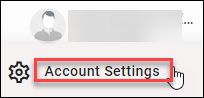
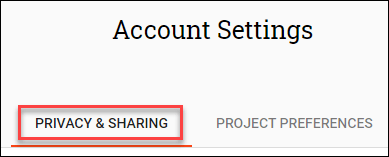
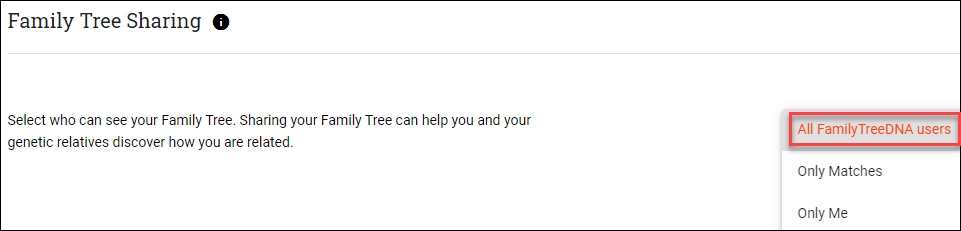
I checked the privacy settings, located under Account Settings just below the user name of the kit, after you sign in.

According to the Privacy and Sharing settings, John’s tree is not private.

click to enlarge

That seemed odd, so I checked John’s tree myself. It looks fine to me, so I wonder what might be wrong?

click to enlarge

Nothing is showing as private from John’s perspective from within his account.

I decided to send Ned a direct sharing link to see if that made any difference.

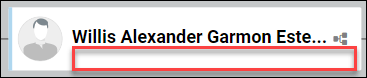
The link I shared with Ned made no difference, but reading the information in the red box did! Yay for documentation!

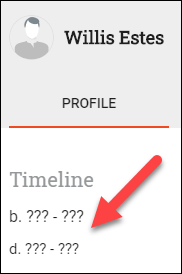
I had not filled in the birth or death dates of the people in question or marked them as deceased. Yes, I know – my bad.

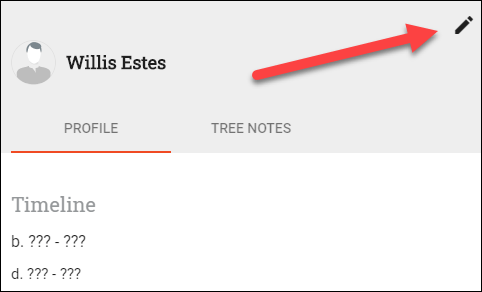
I clicked on the profile and then “View Profile” to verify.

Sure enough – no dates. To edit the profile, click on the pencil.

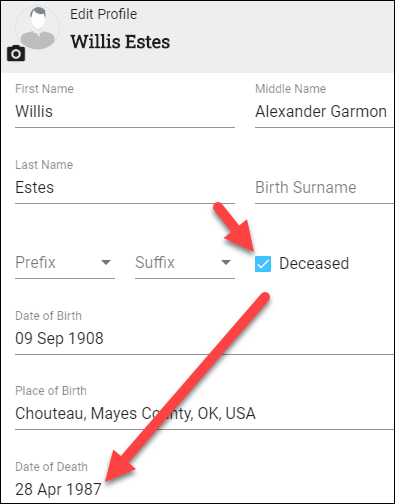
In order to cause the death date and death location fields to display, you must check the “Deceased” box which then turns blue.

Even if you don’t know the death date or location, marking the person as deceased allows their information to be displayed, such as their name, and NOT to be marked as private.

If you do NOT click the deceased box, the person’s profile WILL be marked “private” and will not be shown to anyone except you, the tester, if you sign in. You’ll have no idea that it isn’t showing to other people when you had intended to share all along.

click to enlarge

I marked each person as deceased and added death dates and locations while I was working on the tree.

Did that take care of the problem?

Let’s take a look from Ned’s perspective.

click to enlarge

Sure did.

In order for people to display, you need to kill them off, again😊

Tree Privacy

Every vendor has a combination of features that control tree privacy and security. You will be able to mark the entire tree private or shareable. You may be able to make it searchable, or not, depending on the vendor.

No vendor will display known living people to others – but the calculations they use to determine who may be living, unless you specifically mark them as deceased, will vary.

Be sure to check all of those factors, and find a way to view the tree from someone else’s perspective to check and be sure it’s functioning the way you expect.

I would never have known that all of John’s ancestors were private if Ned hadn’t contacted me.

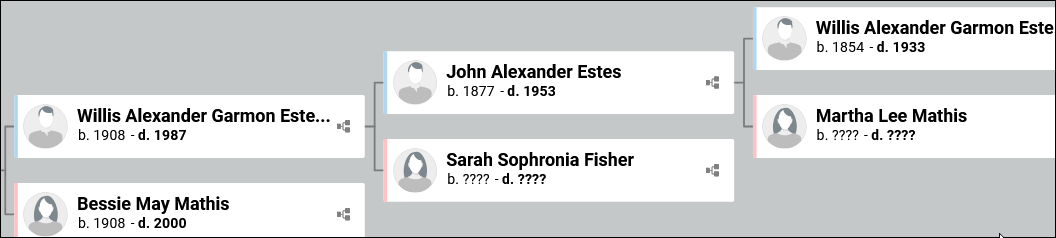
At Family Tree DNA, if you view your own tree and you notice that neither dates nor question marks appear in the date field on the pedigree page – that means you have not marked these people as deceased – so no information for them will show to anyone else.

If you see any dates or question marks beneath the names of people on your tree – then that individual’s profile will show and is not private, unless you have marked the entire tree as private.

Check your trees to see if you have an unknown issue. Those valuable trees provide critical information to your matches. They may not contact you to ask why your tree is private – in fact – most won’t. They assume it’s a choice you meant to make.

Be sure you’re not unintentionally driving cousins away. You never know who’s going to have that crucial piece of information or photo, and you want all of your cousin-bait to function as intended!

_____________________________________________________________

Disclosure

I receive a small contribution when you click on some of the links to vendors in my articles. This does NOT increase the price you pay but helps me to keep the lights on and this informational blog free for everyone. Please click on the links in the articles or to the vendors below if you are purchasing products or DNA testing.

Thank you so much.

DNA Purchases and Free Transfers

Genealogy Products and Services

Genealogy Research

Ancestry Releases Updated Ethnicity Estimates – Hope You Still Have Your Kilt!

Ancestry has been rolling out their new DNA ethnicity results over the past couple of weeks. By now, pretty much all customers have updated results.

When you sign on and click on your DNA tab, you’ll see a message at the top that tells you whether you have new results or they are coming soon.

I wrote about how ethnicity results are calculated in the article, Ethnicity Testing – A Conundrum. You might want to take a minute and read the article because it applies to methods generally and is not specific to any one vendor.

Ethnicity analysis is quite accurate at the continental level, plus Jewish, but less so within continents like Europe. Your results will vary from vendor to vendor and from update to update with the same vendor over time.

To be very clear, your DNA doesn’t change – and neither does your genealogy, obviously – but the evaluation methods used by various vendors change as more people test, reference populations grow, and the vendors improve their algorithms.

Of course, “improve” is subjective. Changes that “improve” one person’s results have the exact opposite effect on other people.

The Eye of the Beholder

Every time vendors release new population or ethnicity results, everyone runs to check. Then – queue up either “they finally got it right” or teeth gnashing! 😊

Everyone hopes for “better” results – but expectations vary widely and how people determine what “better” means to them is quite subjective.

So yes, the accuracy of the results is truly in the eye of the beholder and often related to how much genealogy they’ve actually done. Surprises in your genealogy can equal surprises in your ethnicity too.

Quantitative Analysis

First, let’s be very clear – you do NOT inherit exactly half of the DNA of each of your distant ancestors in each generation. So you might have NO DNA of an ancestor several generations back in time and multiple segments contributed by another ancestor in the same generation. I wrote about how inheritance actually works in the article, Concepts: Inheritance.

Obviously, if you don’t carry a specific ancestor’s DNA, you also don’t carry any genetic markers for any portion of their ethnic heritage either.

Measuring

The best you can do in terms of ancestral ethnicity percentage expectations is to methodically analyze your tree for the geographic and ethnic heritage of your ancestors.

I explained how I calculated realistic ethnicity estimate percentages in the article, Concepts – Calculating Ethnicity Percentages.

In summary, I made a spreadsheet of my 64 great-great-great-great-great-grandparents, each of which, if the DNA was divided in exactly half and passed to the next generation, would contribute 1.56% of my DNA.

Vendors can typically measure geographically-associated DNA less than 1%. At some point, however, the segments are simply too small to reliably identify and associate with a geographic location or population.

Over time, how different vendors refer to and label different parts of the world both vary and change.

Region Names and Ancestral Assignment

I created a spreadsheet where I track both my “expected” DNA based on my genealogy and the amount of reported DNA from that region by each vendor. As I added vendor results, I sometimes had to add categories since their categories aren’t exactly the same as mine. You’ll observe this in the following sections.

You might notice the “inferred” category. I wrote about this in the Calculating Ethnicity Percentages article, but the inferred locations stem from situations like an unknown wife of a man who is living in England or Germany. We can probably infer that they are from that same country.

In the US, an earlier era spouse’s ethnicity might be inferred from marrying a Scot’s-Irish person, living in a Scots-Irish community or being a member of a Scots-Irish church, for example. Chances are very high that a Scots-Irish man’s wife is also from the “British Isles” someplace.

When creating my spreadsheet, I was intentionally conservative in my genealogical estimates.

Ancestry Update in General

Are there any trends or themes in this most recent Ancestry update? As a matter of fact, yes.

Everybody’s Scottish it seems. I hope you didn’t trade your kilt in for that liederhosen a few years ago, because it looks like you just might need that kilt again.

In fact, Ancestry wrote a blog article about why so many people now have Scotland as an ethnicity location, or have a higher percentage if they already showed Scotland before. I had to laugh, because let me summarize the net-net of the Ancestry article for you, the British Isles is “all mixed up,” meaning highly admixed of course. That’s pretty much the definition of my genealogy!

Another theme is that many testers have Scandinavian origins again.

Back in 2012, Ancestry had a “Scandinavian problem,” and pretty much everyone was Scandinavian in that release, even if they had nary a drop of Scandinavian ancestry. And no, not every person has an unknown paternity event and if they did, the Scandinavians cannot possibly be responsible for all of them. The Viking prowess was remarkable, but not THAT remarkable.

Eight years later, Scandinavian is back.

So, how did Ancestry do on my percentages?

Well, I’m Not Scottish…

In the greatest of ironies, I now show no Scottish at all. My calculations show 5.46%, and it’s probably higher because I descend from Scots-Irish that I can’t place in a location.

I guess I need to turn in my Campbell tartan along with a few others.

I do, however, have Norway back again, but no Scandinavian genealogy.

This chart shows all of the Ancestry updates over time, including this latest, plus a range column for this update.

In addition to the 2020 percentage numbers, I’ve included the ranges shown by Ancestry in the far right column for the 2020 update.

Ranges

When viewing your own results, be sure to click on the right arrow for a population to view the range.

You’ll be able to view the range and additional information.

In this case, Ancestry is confident that I have at least 35% DNA from England & Northwest Europe, and perhaps as much as 41%.

You’ll note that my range for the questionable Scandinavia is 0-5. The only two ethnicities that have ranges that do not include zero are England & Northwestern Europe and Germanic Europe.

My Opinion

I know that I have Native American heritage and that it’s reflected in my ethnicity – or should be.

23andMe results, below, shows me the chromosome locations of Native American segments, and when I track those segments back in time, they track to the ancestors in the Acadian population known to have married Native American partners as reflected in church records. Those ancestors were proven as Native through Y and mitochondrial DNA of their descendants which you can view in the Acadian AmerIndian DNA Project, here.

I wrote about using ethnicity segments identified at 23andMe with DNAPainter to triangulate ancestors in the article, Native American and Minority Ancestors Identified Using DNAPainter Plus Ethnicity Segments.

For me personally, including my Native heritage in my ethnicity results is important. I can’t “do” anything much with that at Ancestry, other than view my match’s shared ethnicity. Since my Native heritage doesn’t show at Ancestry, I can’t use it at all genetically.

Why is this important? Looking at a match on my Acadian line and seeing that we share at least some Native heritage MIGHT, just MIGHT be a hint about a common ancestor. Of course, that’s just a clue, because we might both be native from different sources. If my Native ethnicity is missing at Ancestry, I can’t do that. It’s worth noting that in 2017, Ancestry did report my Native heritage and other vendors do as well.

23andMe provides detailed, downloadable, segment information that translates into useful genealogical information. FamilyTreeDNA has announced that they will be providing ethnicity segment information as well after their new myOrigins release.

The Big 4

How do the Big 4 vendors stack up relative to my genealogy and ethnicity?

And for Native American heritage?

I took the liberty of highlighting which vendor is the closest to my estimated genealogy percentages, but want to remind you that these percentages will only be exactly accurate if the DNA is passed exactly in half in each generation, which doesn’t happen. Therefore, my genealogy is an educated estimate as well. Still, the results shouldn’t be WAY off.

An appropriate sanity check would be that my genealogy analysis and the DNA ethnicity results are relatively close. Many people think they are a lot more of something because those are the family stories they heard – but when they do the analysis, they realize that they might expect a different mixture. For example, my aunt told me that my paternal grandmother’s Appalachian family line was German and Jewish – and they are neither. However, German and Jewish lived in my head for a long time and that was what I initially expected to find.

What’s Next?

Both MyHeritage and Family Tree DNA are slated to release new versions of their population genetics tools – so you’ll be seeing new estimates from both vendors “soon.” Both announced at RootsTech they would deliver new results later in the year, and while I don’t have a release date for either vendor – keep in mind that both FamilyTreeDNA and MyHeritage have brought new labs online from scratch in record time in a humanitarian effort to fight Covid. This critically important work has assuredly interrupted their development schedules. You can read about that here and here.

Kudos to both vendors. Ethnicity can wait.

_____________________________________________________________

Disclosure

I receive a small contribution when you click on some of the links to vendors in my articles. This does NOT increase the price you pay but helps me to keep the lights on and this informational blog free for everyone. Please click on the links in the articles or to the vendors below if you are purchasing products or DNA testing.

Thank you so much.

DNA Purchases and Free Transfers

Genealogy Products and Services

Genealogy Research

Deleting DNA Results or Closing Your Account Does NOT Automatically = Destroying Your Original DNA Sample

First and foremost, I want to state unequivocally that I am NOT advocating closing your account at any of the testing vendor sites. That’s not the purpose of this article. In fact, I encourage everyone to use each tool to extract every drop of information possible.

The purpose is to educate and inform you that IF you close your account and/or delete your DNA RESULTS from your account, even if the vendor in question says that the action is irreversible and you will need to resubmit a new sample and purchase a new test if you change your mind, that does NOT necessarily mean that your physical DNA sample itself will be destroyed unless you take separate action to request sample destruction. It also does not automatically reverse any previously-granted research permissions.

Many people presume that if they delete their results and/or close their account, that automatically means that their original spit or swab sample is destroyed – and that’s not necessarily true.

First, we need to understand the difference between:

  • A DNA sample
  • A DNA raw data results file, also referred to as a download file
  • DNA matches or a match file

The Difference Between a DNA Sample, Results and Download Files, and Matches

There are three distinct parts of the DNA testing process that people often confuse. It’s important to understand these distinct pieces because you interact with them differently and vendors do as well. In other words, deleting your DNA results file, or closing your account does not necessarily mean that your original sample is destroyed unless you request (and confirm) that separately.

DNA Sample – The DNA sample itself is the swab or vial of spit that you submit to the vendor for processing. That sample is sent to a lab where DNA is extracted and processed on a specific DNA chip that produces a file with roughly 700,000 locations for autosomal tests.

After your DNA results are processed and the vendor knows that they do not need to rerun your sample, how or if your DNA sample is stored, and where, is a function of each specific vendor and their policies.

One vendor, Family Tree DNA archives your DNA sample vials for 25 years as a free benefit so that you (or your heirs should you pass away) can order additional products or upgrades. FamilyTreeDNA offers various levels of Y DNA and mitochondrial DNA testing along with autosomal (Family Finder) results – so there are several upgrade avenues.

This short article, 4 Kinds of DNA for Genetic Genealogy, explains the difference between various kinds of DNA tests.

It’s less obvious why a vendor who does not offer genealogical DNA products other than autosomal testing would retain a customer’s actual DNA sample. The other three vendors, while they don’t currently offer additional genealogy DNA products, do offer health upgrades and purchase options. They may be retaining samples so that their customers could potentially upgrade and they would have a sample on-hand to rerun, if necessary.

Both MyHeritage and 23andMe offer a combined ancestry/genealogy plus health product initially, or customers can purchase the health add-on later. FamilyTreeDNA offers a high-end comprehensive Exome health product for existing customers, the Tovana Genome Report, but it’s a different test altogether and requires a fresh DNA sample. (Update – this information is no longer valid in 2021. Both Ancestry and FamilyTreeDNA have discontinued their health products.)

Furthermore, both Ancestry and 23andMe either conduct health/medical research internally and/or participate in research partnerships with outside entities and may be hoping that their customers will opt-in to research.

Regardless of the underlying reason why, keep in mind that your actual sample is likely being archived someplace, assuming there is any left after processing, unless you request that your sample be destroyed.

Refer to each vendor’s Terms and Conditions, their Privacy Policy along with any other linked documents to gain insight into how each vendor operates. Furthermore, one of those documents will provide instructions for how to request the destruction of your actual DNA sample, should you choose to do so.

All vendors change the contents of their Terms and Conditions along with other legal documents from time to time, so be sure to refer to the current version.

The DNA sample itself is NOT the same thing as the output from the processing, which is the DNA raw data results file.

DNA Raw Data Results File – The DNA results file contains only a small fraction of the three billion locations found in the human genome. Autosomal DNA tests include only about 700,000 (plus or minus) selected locations produced by the chip the vendor is utilizing. The output of the laboratory process is referred to as a raw data file or the DNA results file. People sometimes refer to this as the download file as well, because it’s the file you can download from each vendor.

The results in a raw data file look like this:

When you download and transfer your file from one vendor to another, the raw data file is what you are transferring. You can find instructions for downloading your data file from each vendor, here.

  • The DNA raw data or download file is NOT your actual DNA, which is what is extracted from the liquid in the vial.
  • The raw data or download file is NOT a list of your matches, which may or may not be a separate file available for downloading, depending on the vendor.

The raw data file only contains letters representing your two genotyped nucleotides (T, A, C or G) for the rsid (accession #) for each genetic address or position tested. Each genetic address contains two SNPs, or single nucleotide polymorphisms. You don’t need to understand the details, just that one nucleotide at that address is received from your mother and one from your father.

The example above shows my first 4 locations in my raw data file. You can see that I received an A from both parents at the first two locations, and a G from both parents and the second two locations.

Match File

The values in your DNA results file are compared to other people in the vendor’s database. If enough contiguous locations match, typically more than 500 matching SNPs, plus additional cM (centiMorgan) threshold match criteria, shown below, you are determined to be a match with that other person. You will each be placed on the other person’s match list, and the vendor will then provide additional processing based on the signature features they offer to their clients.

Of the four main vendors, three, Family Tree DNA, MyHeritage and 23andMe allow customers to download a match file in spreadsheet format that provides additional information about each match. Ancestry, unfortunately, does not.

You cannot upload your match file to other vendors – only your raw data file gets uploaded which the vendor then processes in the same way they would if you had tested at their company.

If someone on your match list wants to be included in the database at another vendor, they will either need to test at that vendor or transfer their file to that vendor. Every vendor has people in their database that the other vendors don’t have, so it behooves all genealogists to be in each of the four databases either by testing directly or uploading their raw data files as a transfer.

Of the four main vendors, FamilyTreeDNA and MyHeritage both accept transfers from other vendors and provide free matching, but 23andMe and Ancestry do not. Note that both FamilyTreeDNA and MyHeritage do charge for advanced features, $19 and $29, respectively, but in both cases, it’s significantly less than the cost of a test.

Deleting Results and Closing Accounts

Again, I am NOT advocating that anyone should close accounts at any vendor. In fact, I would discourage DNA deletion. Some people delete their DNA or close their accounts when other options would better serve their purposes. However, if you decide to do so, you need to be aware of the following:

  • If you have a genealogical tree/records research account at Ancestry or MyHeritage, you can delete your DNA results but maintain your genealogy research account, if you desire. You will lose the benefits of having a DNA test at that vendor if you delete your DNA test.
  • At those two vendors, if you delete your DNA, that does not automatically affect the genealogy side of your account except for combined features like ThruLines at Ancestry and Theories of Family Relativity at MyHeritage.
  • If you DOWNLOAD your DNA file, that does NOT delete the file at the original testing vendor unless you do so separately. Downloading only means that you download a copy of the file. Your original raw data results file is still at the vendor, UNLESS YOU CHOOSE TO DELETE YOUR RESULTS. Do not delete your results file unless you want to lose your matches and no longer participate in DNA testing or DNA-related features at that vendor.
  • If you are planning to delete your DNA results at a particular vendor, download a raw data file first, and verify that the file works correctly by uploading the file to one of the vendors that accepts transfers. Save the raw data file permanently on your computer. This preserves at least some of your testing investment and allows you to utilize your DNA results file elsewhere.
  • If you delete your DNA results at any of the major vendors, you cannot restore the results file at that vendor without repurchasing and resubmitting a new DNA test. For vendors who accept transfers, you could potentially re-upload your file as a transfer, but you would need to pay for advanced features.
  • If you delete your DNA results at vendors who do NOT offer additional genealogical research services, meaning at 23andMe and Family Tree DNA, there is no reason to maintain an account at that vendor.

If you delete your results or close your account at any vendor, it DOES mean that:

  • The DNA result you’ve deleted along with corresponding matches and other features are permanently gone. You cannot change your mind. Delete=permanent.
  • At FamilyTreeDNA, you can delete one kind of DNA test without deleting all types of DNA tests for a particular individual. For example, you could delete a Y DNA result but not delete mitochondrial or the autosomal Family Finder test.
  • You will have to pay to retest should you change your mind.

If you delete your results or close the DNA portion of your account, it DOES NOT necessarily mean that:

  • Your DNA sample is destroyed.
  • You’ve revoked any permissions previously given for participation in research.

You will need to perform both of these tasks separately and independently of deleting your DNA file at a vendor and/or closing your account.

Every Vendor is Different

The process of requesting sample destruction and revoking research permissions is different at each vendor, with or without closing your account.

Every vendor’s terms and conditions are separate and different. Some vendors may automatically close your account if you request sample destruction, and others won’t. Some may automatically delete your sample if you close your account, but I know for certain that’s not uniformly true.

Terms and conditions, as well as standard procedures, change over time as well.

I’m not telling you which vendors operate in which ways, because this article will someday be dated and vendor policies change. I don’t want to take the chance of leading someone astray in the future.

Therefore, if you wish to have your sample destroyed and/or revoke any research permissions previously granted, I strongly suggest that you call the vendor’s customer support and convey specifically what you want, and why. The vendor may offer alternatives to achieve what you desire without deleting your sample and account.

To delete your sample and/or account, you may need to provide your request in writing.

Request verification in writing that your sample has been destroyed and that any previously granted research authority/permission has been rescinded.

Research Permission

Please note that you can rescind previously granted research permission WITHOUT affecting your account in any other way. However, the reverse is not true – deleting your sample and closing your account does not automatically rescind previously-granted research permission.

You can only rescind permission for future research, not research already underway or completed that includes your DNA and corresponding answers to research questions.

Extra Steps

I hope you will continue to enjoy the results of your DNA tests for years to come. New features and benefits are added regularly, as are new matches – any one of which has the potential to break down that pesky brick wall. Equally as important, at least to me, is the legacy I’m leaving with my combined tree, DNA, and research work for future generations.

However, what’s right for me may not be right for you. If you make a different decision, be sure that you fully understand the different parts of DNA testing along with the various options and steps you may need to take to achieve your goal.

_____________________________________________________________

Disclosure

I receive a small contribution when you click on some of the links to vendors in my articles. This does NOT increase the price you pay but helps me to keep the lights on and this informational blog free for everyone. Please click on the links in the articles or to the vendors below if you are purchasing products or DNA testing.

Thank you so much.

DNA Purchases and Free Transfers

Genealogy Products and Services

Genealogy Research

23andMe Genetic Tree Provides Critical Clue to Solve 137-Year-Old Disappearance Mystery

DNA can convey messages from the great beyond – from times past and people that died long before we were born.

I had the most surprising experience this week. It began with receiving an email with the sender name of my long-time research buddy, cousin Garmon Estes.

It’s all the more surprising because not only did Garmon never own a computer, despite my ceaseless encouragement, he passed over in 2013 at the age of 85. So, imagine my shock to open my email to see a message from Garmon. Queue up spooky music😊

As it turned out, Garmon’s nephew is also Garmon. I had communicated with the family off and on over the years since the death of Garmon the elder. Garmon, the younger, had written to tell me that the second “great brick wall” that haunted his Uncle Garmon had fallen – and how that happened, thanks to DNA.

Garmon, the Elder

Estes Garmon

Garmon Estes, the elder

I first met Garmon the elder, via letter, back in the 1970s or maybe early 80s. He was an experienced genealogist and I was beginning.

At that time, Garmon had been chasing the identity of the father of our common ancestor, John R. Estes, for decades, and I was just embarking on what would become a lifelong adventure, or perhaps it could better be called an obsession.

John R. Estes had moved from some unknown location to Claiborne County, Tennessee with his wife and family about 1820. That’s pretty much all we knew at that time. Garmon had spent decades before the age of online records researching every John Estes he could find. I can’t even begin to tell you how many John Esteses existed that needed to be eliminated as candidates.

Garmon lived in California, far from Tennessee. I lived in Indiana, then Michigan – significantly closer. He began caring for his ill spouse, and I began traveling to dusty courthouses, sometimes reading musty books page by yellowed page, extracting everything Estes. Garmon worked from his local Family History Center when he could and wrote letters.

Between our joint sleuthing and many theories that we both composed and subsequently shot down, we narrowed John R. Estes’s location of origin to Halifax County, Virginia. However, there were multiple John Esteses living there at the same time, about the same age, none using middle initials reliably, and some not at all. How inconsiderate!

I began perusing every possible record. I had eliminated some Johns as candidates, most often because they clearly remained in the community after our John had moved to Claiborne County. Late one night, in our local family history center, I found that fateful clue – John R. Estes noted as (S.G.) short for “son of George,” on just one tax list. All it takes is that one gold-nugget record.

It was after 10 PM when I left the Family History Center and even later when I got home. I debated whether I should call Garmon or not, but I decided that indeed, he would want to know immediately, even if I did call at an inconvenient time or wake him up.

The discovery of John’s father, of course, opened the door for much more research, and it solved one of Garmon’s two brick walls that had haunted his genealogy life.

He never solved the second one, but it wasn’t for lack of trying.

What Happened to Willis Alexander Garmon Estes?

Willis Alexander Garmon Estes was born on December 21, 1854, in Lenoir, Roane County, TN. His nickname was Willie.

Willie married Martha Lee Mathis in 1874 and they had 4 children beginning with the first child born the next year in Roane County. Sometime between 1875 and the birth of the second child in 1877, they migrated to Greenwood, Wise County, Texas where their next two children were born in 1877 and 1881.

Martha was pregnant for their fourth child in 1883 when something very strange happened. Willie disappeared, and I do mean literally and completely. Just poof, gone.

Not sure what to do, Martha’s father, who lived in Missouri, went to Texas to retrieve his pregnant daughter and her children and took her and the children home to Missouri where their last child was born that September.

Willie was only 28 when he vanished. The family, of course, had many stories about what happened. Texas at that time was pretty much the “wild west” and the stories about Willie reflected exactly that.

Texas was sometimes the refuge of outlaws and shady characters. One story revealed that Willie had shot a man back in Tennessee and the family fled to Louisiana, then Texas. Of course, that doesn’t tell us why he disappeared in Texas, but it opens the door to speculation and casts doubt on his character, perhaps.

Another story was that he was shot by Indians.

A third story stated that Willie settled in Indian Territory north of the Red River, now Oklahoma, and that he had an altercation with an Indian over the supposed theft of firewood, although who was accusing who was unclear. Willie shot the Indian, then had to flee for his life, leaving his pregnant wife and children as a posse of Indian Police surrounded his house. Willie supposedly promised Martha that he would return, but never did. It was reported that he was shot in Mexico, but no further details emerged.

Aren’t these just maddeningly vague???

Yet another story was that Willie headed for the goldfields of California, struck it rich, and was murdered on the way back home. The details varied, but one version had him murdered by a traveling companion on the trail. Another had him becoming ill and dying in a hospital in St. Louis where his wife went to search for him, to no avail. That might explain why she went back to Missouri, Garmon postulated. And yet a third version was some hybrid of the two where “someone” tried to find Willie’s family for years to reveal what had happened, and where, but was never successful. Of course, how did the family know about this if the mystery person was unable to find the family? But I digress.

Garmon desperately wanted to solve that mystery. He wanted closure.

I didn’t realize that the genealogy bug had bitten Garmon’s nephew too, but it clearly has. Garmon would be so proud.

With Garmon the younger’s permission, I’m publishing “the rest of the story,” Connecting the Dots, as written by Garmon the younger, with a few technical interjections from me involving DNA from time to time.

Connecting the Dots

In 2015, My dad Richard Estes, my brother Corey Estes, and I took a trip to Texas and Oklahoma to see if we could find out more about Willis Alexander Garmon Estes’ disappearance.

Estes greenwood

We visited Greenwood, Texas and nearby Decatur where we looked at historical records at the Wise County Clerk Office. We also went up to Oklahoma City to see the state archives and to Tishomingo to look at any records that might be available.

Estes Oklahoma history.png

Interestingly enough, we did not find any clues as to the disappearance of Willis Alexander Garmon Estes. There were no newspaper articles or criminal records concerning any incidents with Willis Alexander Garmon Estes. The only new information that we found was a couple of land deeds showing that Willis Alexander Garmon Estes’ brother Fielding had bought and sold land in Wise County during the time that Willis Alexander Garmon Estes was living in Greenwood.

We left empty-handed on our trip but our curiosity remained strong and we began talking to each other about going on another trip to Tennessee to speak with Estes family members in Loudon County to see if they might know something about Willis Alexander Garmon’s disappearance.

DNA Testing

In December of 2018, my wife, children, and I had our DNA tested using the service 23andMe. We received test results within a month of sending in saliva samples. The results did not reveal anything unusual.

Fast forward to October 2019. 23andMe introduced a new Family Tree feature that automatically creates a family tree based on the DNA results that you share with relatives in 23andMe. This was a fascinating feature and I noticed that all of my family members were automatically placed into the correct position on the family tree without me having to do anything.

[Roberta’s note – this is not always the case, so don’t necessarily expect the same level of accuracy. The tree is a wonderful innovative feature, just treat family placement as hints and not facts.]

Every few weeks as more and more people had their DNA tested on 23andMe, new relatives were added to the family tree.

In February 2020, I noticed something interesting under the location of Willis Alexander Garmon Estes on the family tree. A woman by the name of Edna appeared as a descendent of Willis Alexander Garmon Estes. The first thing I did was to try and get in contact with her on 23andMe. No luck. Next, I thought maybe she was the descendent of one of Willis Alexander Garmon’s sons (James, John, or George). However, after researching the descendants of each of those lines, Edna’s name did not appear.

The next step I took was to look up as many Ednas by that last name on ancestry.com as I could find and trace their ancestry back to see where it led.

There were two Ednas by that last name in the United States whose age matched the one on 23andMe. I traced both of their ancestry lines back to the 1800’s. Neither one had Willis Alexander Garmon Estes as an ancestor.

Breakthrough

During the middle of March 2020, when I was quarantined at home from work due to the COVID-19 virus, I took another look at Edna’s family lines. I noticed there was a gentleman by the name of James Henry Houston mentioned as an ancestor.

The interesting thing about James was that he was born on the same day, same year, and in the same county as Willis Alexander Garmon Estes. James Henry Houston was born on December 26, 1854 in Loudon County, Tennessee. This seemed like possibly more than a coincidence, so I dived into the data a little bit more.

I looked at federal census records to find out more about James Henry Houston’s past. Strangely there were no official records of him until May 12, 1889 when he married Allie Ona Taylor in Erath, Texas. Normally, if someone is born in 1854, they would show up in one of the federal census records of 1860, 1870, or 1880. James Henry Houston does not show up in any official federal census records until 1900.

According to ancestry records, James Henry Houston married Allie Ona Taylor in 1889 and resided in the Hood County region of Texas until 1910. During this time, he raised 8 children with his wife Allie.

In 1920, the federal census placed him and Allie in Whitehall, Montana. The last federal census he appears in is 1930. He lived in Pomona, California where he died in 1933 at the age of 78.

At this point, I thought it was highly likely that James Henry Houston and Willis Alexander Garmon Estes were the same person. If my hunch was correct then a photo of James Henry Houston would most likely show a resemblance to his son, my great grandfather John Alexander Estes.

Estes James Henry Houston

The photos above show a remarkable similarity in the eyes, nose, mouth, and facial structure between the two men. To me, the photo and historical evidence is enough to conclude that Willis Alexander Garmon Estes is James Henry Houston.

Garmon’s Concluding Thoughts

As I reflect on the fact that Willis Alexander Garmon Estes renamed himself James Henry Houston and moved from Wise County down to Hood County, Texas – approximately 60 miles distance to marry and raise a new family, many more questions come to mind.

What exactly happened to cause Willis Alexander Garmon Estes to leave his wife and children behind? Was it simply a marital dispute or did it involve a criminal offense and running from the law as was mentioned in the family lore?

Did my great grandfather know that his father lived in Pomona in 1930, which was only 6 miles away from where he was living in Rancho Cucamonga? Were there other family members that knew what happened but promised not to tell anyone else? We may never know.

Finally, I want to add one more piece to the story that I found fascinating. On ancestry.com, many of the family trees for James Henry Houston state that the mother and father of James Henry Houston was Jennie Bray and Henry Houston. No information is given for their birthdates or where they came from. The mother and father of Willis Alexander Garmon Estes was Jennie McVey and William Estes. The names Jennie Bray and Jennie McVey are very similar. In order to hide his true identity, James Henry Houston would have to make up a surname for his father since he called himself Houston, not Estes. Willis Alexander Garmon Estes had a brother named John Houston Estes. This might explain why James Henry Houston chose to use the surname Houston rather than another name.

Congratulations Garmon

I know this made Garmon the elder puff up with pride for Garmon the younger’s sleuthing skills and leap for joy at the solve. Garmon, the elder, had two main genealogy goals throughout his entire life. One was solved while he was living, but it took another generation to solve this one.

Great job, Garmon!

About the 23andMe Genetic Tree

23andMe is the only vendor to construct a “trial balloon” genetic tree based only on how the tester matches people and how they do, or don’t, match each other. This occurs with no input from testers in the form of genealogical trees of identifying how people are related to the tester.

Family Tree DNA has Phased Family Matching, MyHeritage has Theories of Family Relativity, and Ancestry has ThruLines which all do some sort of DNA+tree+relationship connectivity, but since 23andMe does not support user-created or uploaded trees, anything they produce has to be using DNA alone.

On one hand, it’s frustrating for genealogists, but on the other hand, there is sometimes a benefit to a different “all genetic” approach.

Of course, the only information that 23andMe has to utilize unless your parents have tested is how closely you match your matches and how closely your matches match each other. This allows 23andMe to place your matches at least in a “neighborhood” on your tree, at least approximately accurate, unless your parents are related to each other and that shared DNA causes things to get dicey quickly.

I wrote about 23andMe’s new relationship triangulation tree when it was first introduced in September 2019, nearly a year ago, here. The launch was rocky for a number of reasons, and if you’ve done genealogy for a long time, your research goals are likely to be further back in time than this 4 generation relationship tree will reveal.

23andMe tree

Click to enlarge

This is what my relationship tree looked like at the time the function was launched. You’ll note that 23andMe places relationships back in time 4 generations, to your great-great-grandparents, meaning that you might have 3rd or even 4th cousins showing up on your genetic tree.

I initially had a total of 18 people placed on my tree, with 3 being close family, 4 being accurate, 4 unknown, 1 uncertain and 6, or one third, inaccurate.

Keep in mind that 23andMe doesn’t make any provision to accommodate or take into account half-relationships, like half-brother or half-sister, either currently or historically. Therefore, descendant placement predictions can be “off” because half-siblings only carry the DNA from one common parent, instead of two, making those relationships appear more distant than they really are.

In Garmon’s case, his great-great-grandfather is the ancestor who was MIA, so the genetic tree has the potential to work well for this purpose.

Estes 23andme tree today

click to enlarge

Today, my tree looks somewhat different, with only 14 people displayed instead of 18, and 6 waiting in the wings to see if I can help 23andMe figure out how and where to place them.

Since the initial launch, customers have been given the opportunity to add their ancestors’ names to their nodes. This works just fine so long as nobody married more than once and had children from both marriages.

Estes Willie Alexander today

click to enlarge


Here’s a closer image of the left-hand side of my tree where I’ve super-imposed the location of Willis Alexander Garmon Estes and Edna, as they are related to Garmon the Younger, at bottom right. Ignore the other names – I only utilized my own tree for an example tree structure.

One more generation and it’s unlikely that 23andMe would have made the connection between Edna and Garmon the younger.

Not only does this illustrate the perfect reason to test the oldest generations in your family, but also never to ignore an unknown match that seems to be within the past 3 or 4 generations. You never know what mysteries you might unravel.

Four generations actually reaches back in time quite substantially. In my case, my great-great-grandparents were born in 1805, 1810, 1812, 1813, 1815, 1816, 1818 (2), 1820, 1822, 1827, 1829, 1830, 1832, 1841 and 1848.

If you have mysteries within your closest 4 generations to unravel, the genetic tree at 23andMe might provide valuable clues, but only if you’re willing to do the requisite work to figure out HOW these people match you.

You can’t transfer your DNA file TO 23andMe, so if you want to have your results in the 23andMe database, you’ll need to test there.

Acknowledgments: Thank you to Garmon Estes, the younger, for generously sharing this story and allowing publication. My heart was warmed to see your generational research trip.

Thank you to Garmon Estes, the elder, for being my research partner for so many years. You can finally RIP now, although somehow I suspect you already have these answers.

_____________________________________________________________

Disclosure

I receive a small contribution when you click on some of the links to vendors in my articles. This does NOT increase the price you pay but helps me to keep the lights on and this informational blog free for everyone. Please click on the links in the articles or to the vendors below if you are purchasing products or DNA testing.

Thank you so much.

DNA Purchases and Free Transfers

Genealogy Products and Services

Genealogy Research

Search Techniques for Y and Mitochondrial DNA Test Candidates

I utilize DNA matches in various ways, some of which are a little unusual. In many cases, I mine autosomal DNA matches to search for people whose Y and mitochondrial DNA can provide descendants, including me and them, with additional insights into our common ancestors.

Y and mitochondrial DNA connects testers to their ancestors in ways that autosomal cannot. It’s a different type of DNA, not combined with the DNA of the other parent, so it’s not diluted and halved in each generation like autosomal DNA. Y and mitochondrial lines each descend from only one ancestral line, rich in historical information, with the ability to reach far back in time along with the ability to connect testers recently.

You First

The very first thing you can do to further your own research is to test yourself in three ways:

  • Autosomal DNA – Test at all 4 primary testing vendors, meaning FamilyTreeDNA, MyHeritage, Ancestry and 23andMe. The reason for testing at (or transferring to) multiple vendors is because they each have a unique focus and tools. Perhaps more importantly, they each have different people in their databases. Each testing company has benefits. FamilyTreeDNA has people who tested as long as 20 years ago and are no longer available for testing. MyHeritage has many European testers and you’ll find matches there that you won’t find elsewhere if your ancestors came from Europe. Ancestry has the largest database, but fewer advanced tools.
  • Full Sequence Mitochondrial DNA – Available at FamilyTreeDNA, this test allows focus solely on your matrilineal line, meaning your mother’s mother’s mother’s line directly without confusion introduced by DNA from other lines.
  • Y DNA – For males only, also available at FamilyTreeDNA, provides focus on the direct patrilineal, or surname, line.

Obviously, if you haven’t upgraded your own Y and mitochondrial DNA tests to the highest level possible, the first thing you can do is to test or upgrade to the highest level where you receive the most refined amount of information.

(There’s a sale at FamilyTreeDNA right now, lasting until August 31, 2020, so it’s a great time to upgrade or order Y and mitochondrial. Check it out here.)

Different Kinds of DNA Serve Different Genealogical Purposes

Let’s look, briefly at how the various types of DNA tests benefit genealogy. Autosomal tests that you and family members can take will help you find other family members to test for specific Y and mitochondrial DNA lines.

Remember that you can test family members in addition to yourself, so if you’re a female, you may want to recruit your father or an uncle or brother to represent your patrilineal line DNA. If you’d like to read a brief article about the different types of DNA and their benefits, 4 Kinds of DNA for Genetic Genealogy is a good resource.
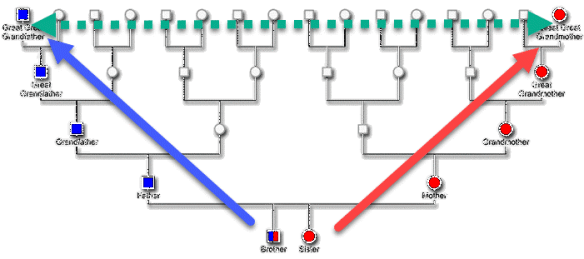
Y and Mito Pedigree.png

In this image, you can see that if you’re a male you can test for both your Y (blue-square) and mitochondrial DNA (red-circle) ancestral lines. If you’re a female, you can test only your mitochondrial DNA because females don’t have a Y chromosome. Both males and females, of course, can test (green) autosomal DNA which reveals a different type of connection to all of your ancestral lines, but with autosomal, you have to figure out which people match you on which lines.

Y and mitochondrial DNA provides you with a different type of information about laser-focused specific lines that you can’t obtain through autosomal testing, and reaches back in time far beyond the curtain when surnames were adopted.
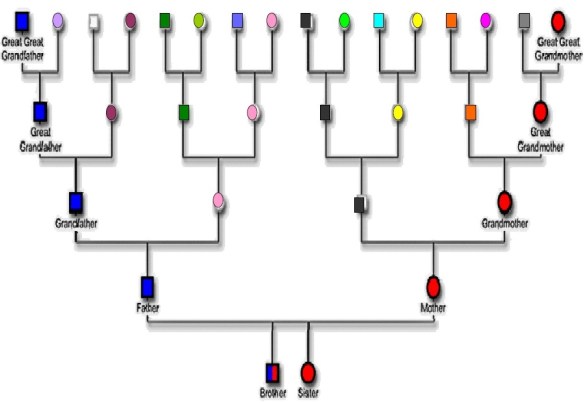
personal pedigree

You personally can only test for the red-circle mitochondrial DNA line, and perhaps the blue-square Y DNA line if you’re a male. Unless you find family members to test for the Y and mitochondrial DNA of your ancestors, you’re leaving valuable information unresearched. That means all those colored boxes and squares that aren’t blue or red.

I’ve solved MANY brick walls using both Y and mitochondrial DNA, often in conjunction with autosomal.

Let’s take a look at each type of DNA testing a little more in-depth, so that you understand how each one works and why they are important to genealogy.

The Specifics

Y DNA – Y DNA descends through the direct male paternal line and is inherited by men only. You match against other Y DNA testers, hopefully finding surname links.

The Big Y test and upgrade at FamilyTreeDNA provides testers with all 111 traditional STR markers, plus another 589+ STRs available only in the Big Y test, plus a scan of the balance of the rest of the Y chromosome that is useful for genealogy. SNP results are increasingly being used for genealogy, in addition to STRs.

SNPs group men into genetic lineages and STRs help with defining and refining the closest generations when matching to each other. Often, the benefits of these two tests overlap, which is why I recommend that males test to the Big Y-700 level which provides 700+ STR markers plus all SNPs with mutations that define ancestral lineages.

Y DNA haplogroups, derived from SNPs, reveal the geographic part of the world where the lineage originated, such as Europe, the Americas, Asia and Africa, as well as a migration path across the continents based on where SNPs are and were historically found. Ancient DNA samples are being added to the database.

If you or a family member took an earlier Y DNA test, you can upgrade to the Big Y-700 today which provides you with matching for both the STR markers and separately, SNP markers, along with other genealogical tools.

You can order or upgrade your Y DNA here. Don’t forget family members accounts you may control. They may agree to have their kit upgraded too.

To upgrade, sign in to your account, and click on your desired upgrade level under Y DNA testing.
ymt y upgrade.png

Then click on upgrades.

ymt upgrade.png

I wrote about Y DNA in these recent articles:

I have more Y DNA articles planned for the future.

You can search for additional articles by going to the main page of this blog and enter “Y DNA” into the search box for additional articles already published.

Many features such as the matches maps, haplogroup origins and ancestral origins pages are the same for Y DNA results as mitochondrial DNA results. You can view mitochondrial articles here.

Mitochondrial DNA (mtDNA) – Mitochondrail DNA descends through the direct matrilineal line to both sexes of children. Everyone has mitochondrial DNA and it is inherited matrilineally by you from your mother, from her mother, from her mother, etc.

The FMS or full mitochondrial sequence DNA test tests the entire mitochondria that provides information about your direct matrilineal line. Family Tree DNA provides matching, which can sometimes lead to genealogical breakthroughs such as when I identified Lydia Brown, the mother of my Phoebe Crumley and then a couple years later, her mother, Phoebe Cole – via mitochondrial DNA. Those discoveries led us to her mother, Mary Mercy Kent, via genealogy records. All we needed was to punch our way through that initial brick wall – and mitochondrial DNA was our battering ram.

Additionally, you’ll receive a full haplogroup designation which allows you to look back in time before the advent of surnames and identifies the location where your ancestral line came from. For those seeking confirmation of Native American heritage, Y and mitochondrial DNA provides unquestionable proof and doesn’t wash out in time as autosomal DNA does.

Mitochondrial DNA includes haplogroups, matching and other genealogical tools.

You can order or upgrade you or a family member’s mitochondrial DNA here.

To upgrade, sign in to your account, and click on the desired upgrade level.

ymt mt upgrade

Then click on Upgrade if you’re upgrading or Add On if you’re ordering a new product for yourself.

ymt add ons upgrades.png

I wrote several mitochondrial DNA articles and compiled them into a summary article for your convenience.

Autosomal DNA – With autosomal DNA testing, you test once and there’s not an upgrade unless the vendor changes DNA testing platforms, which is rare. Each of the four vendors compares your DNA with all other people who’ve taken that test, or transferred from other companies. They match you with descendants from all of your ancestral lines. While the Y and mtDNA tests look back deeply in time as well as recently on one specific line, the autosomal tests are broad but not deep, spanning all ancestral lines, but limited to approximately 10 generations.

Each autosomal vendor has unique benefits and focus as well as shortcomings. I’ve listed the major points for each vendor relative to searching for Y and mitochondrial
DNA testing candidates. It’s important to understand the advantages of each vendor because it will help you understand the testers you are most likely to find in each database and may help focus your search.

FamilyTreeDNA’s Family Finder

  • Because FamilyTreeDNA archives customer’s DNA for 25 years, many people who tested Y or mitochondrial DNA 20 years ago and are now deceased upgraded to autosomal tests when they became available, or have been upgraded by family members since. These early testers often reach back another generation or so into the past to people born a century ago.
  • Advanced autosomal matching integrates with Y and mitochondrial DNA along with surname and other projects
  • Phased Family Matching provides the ability to link family members that match you to your tree which allows Family Tree DNA to group matches as paternal or maternal by utilizing matching segments to the same side of your family
  • Genetic Affairs, a third-party tool available for testers, builds common trees by reading the trees of your matches and comparing their trees with your own to identify common ancestors.
  • Genetic Affairs builds trees and pedigrees of your matches by searching for common ancestors in your MATCHES trees, even if you have no tree or don’t share those ancestors in your tree. This functionality includes Y and mitochondrial DNA if you have tested. This facilitates discovery of common ancestors of the people who you match, which may well lead you to ancestral discoveries as well.
  • Genetic Affairs offers clustering of your shared matches.
  • DNA file transfers are accepted from other vendors, free, with a $19 one time fee to unlock advanced tools.
  • Family Tree DNA has tested people worldwide, with a few location exceptions, since inception in the year 2000.
  • No direct triangulation, but Phased Family Matching provides maternal and paternal side triangulation when matches can be grouped into maternal and paternal sides.
  • Matches and segment match information are available for download.
  • The great thing about the advanced matching tool at Family Tree DNA is that it facilitates searching for people who match you on different kinds of tests, so it helps determine the potential closeness or distance of Y and mitochondrial relationships.

MyHeritage

Ancestry

  • Ancestry has the largest database, but did not begin testing until 2012 and did not test widely outside of the US/UK for some time. They now sell tests in 34 countries. Their testers are primarily focused in the US, Canada, England, Scotland, Ireland, and diaspora, with some overlap into Europe.
  • Ancestry offers ThruLines, a tool that connects testers whose DNA matches with common ancestors in their trees.
  • Ancestry does not provide a chromosome browser, a tool provided by the other three primary testing companies, nor do they provide triangulation or matching segment location information necessary to confirm that you match on the same segment with other people.
  • Ancestry has issued cease and desist orders to third party tools that perform functions such as clustering, autotrees, autopedigrees or downloading of matches. Ancestry does not provide these types of features for their users.
  • Ancestry does not accept transfers, so if you want to be in Ancestry’s database, you must test with Ancestry.
  • No Y or mitochondrial DNA testing available.
  • Match list is not available for download.

23andMe

  • The primary focus of 23andMe has always been health testing, so many people who test at 23andMe are not interested in genealogy.
  • 23andMe tests are sold in about 50 countries, but not worldwide.
  • 23andMe provides a chromosome browser, triangulation, segment information and a beta genetically constructed tree for close matches.
  • 23andMe does NOT support a genealogical tree either uploaded or created on their site, making tree comparisons impossible.
  • Genetic Affairs AutoCluster works at 23andMe, but AutoTree and AutoPedigree do not because 23andMe does not support trees.
  • 23andMe does make match files available for downloading.
  • No Y or mitochondrial DNA full testing or matching, but basic haplogroups are provided.
  • 23andMe caps matches at 2000, less any matches that have opted out of matching. My matches currently number 1770.
  • 23andMe does not accept transfers from other vendors, so if you want to be in their database, you must test with 23andMe.

Reaching Out to Find Testers

Unfortunately, we only carry the mitochondrial DNA of our mother and only men carry the Y DNA of their father. That means if we want to obtain that DNA information about our other family lines, we have to find people who descend appropriately from the ancestor in question and test that person.

I’ll share with you how I search for people who descend from each ancestor. After finding that person, I explain the situation, why the different kinds of tests are important, and offer a testing scholarship for the Y or mtDNA test at Family Tree DNA if they have not already taken that test. If they’ve tested their autosomal DNA elsewhere. I also explain that they can transfer their autosomal DNA file for free too and will receive new matches.

Here’s an article with links to upload/download instructions for each testing company. Feel free to share.

Each DNA testing company has different features, but you can use all of the companies to find people descended in the appropriate way from each ancestor. It’s easier if you know how to utilize each vendor’s tools to optimize your chances of success. I’m going to step you through the search process with hints and tips for each vendor.

Finding Y DNA and Mitochondrial DNA Candidates at FamilyTreeDNA

Because FamilyTreeDNA tests for both Y and mitochondrial DNA and has for 20 years, you stand a better chance of finding a candidate there who may have already tested, so that’s where I always begin.

Y DNA

Let’s say, for example, that I need to find a male descendant of my Ferverda line in order to ask them to test for Y DNA. The person can be descended from either a close relative, if I know of one, or a more distant relative that I don’t know, but need to find through searching other ways.

Search for Surnames and Projects at Family Tree DNA

First, search the FamilyTreeDNA website for your goal surname among existing testers, and then the appropriate surname project to see if your line has already tested.

ymt ferverda

On the main page, here, scroll down to until you see the prompt, above, and enter the surname. Be sure to consider alternate spellings too.

ymt ferverda search.png

In this case, I see that there is a Ferverda surname project with 18 people, and scrolling on down, that 4 people with this specific surname have tested.

ymt results.png

However, searching for an alternate spelling, the way it’s spelled in the Netherlands, I find that another 10 people have tested.

ymt ferwerda

Of course, some may be females, but they probably know males by that surname.

First, I’m going to check the Ferverda DNA project to see if a Ferverda male from my line has tested, and if so, to what level.

Click on the project link in the search results to see the DNA Project.

ymt admin.png

Note two things. First, the administrator’s name, as you may need this later. If you click on their name, their email address is displayed.

Second, click on DNA Results and select Y DNA if you’re presented with a choice. If the project has a public facing page, and most do, you’ll see something like the following information.

ymt project

Hey look, it’s my lucky day, given that both of these men descend from my ancestor. I happen to know that they have both taken the Big Y test, because I’m the project administrator, but you won’t know that. One way to get an idea is if they have less than the full 111 markers showing, they probably haven’t taken the Big Y, because a 111 upgrade is included in the Big Y test today.

You have three options at this point to contact one of these men:

  • See if the people are on your own autosomal DNA match list, or the match lists of kits from that family that you manage. If so, you can view their email address and contact them. If you haven’t yet tested autosomally, meaning the Family Finder test, at Family Tree DNA, you can transfer autosomal tests from elsewhere, for free, which means you will be viewing matches within hours or a couple days. Otherwise, you can order a Family Finder test, of course.
  • If the person with the Ferverda or Ferwerda surname is not on your Family Finder match list, reach out to the project administrator with a note to the person you want to contact and ask the administrator to forward your email to the project member.
  • If the administrator doesn’t answer, contact Family Tree DNA support and make the same request.

Checking Family Finder, one of those people is on my match list and I’m pretty sure it’s the right person, because when I click on his profile, not only does the haplogroup match the DNA project, but so does the ancestor.

ymt ferverda profile.png

Searching Family Finder

If there isn’t a DNA project match you can identify as your direct line ancestor, you can search your Family Finder matches for the surname to find a male with that surname. If your match has a tree, see if your ancestor or ancestral line is showing, then note whether they have taken a Y DNA test. They may have taken a Y test, but have not joined a project or not entered any “earliest known ancestor.” You can see which tests they’ve taken by looking at the little tabs above their profile on their tree, or on their profile card.

ymt ferverda tree

click to enlarge

Regardless, you’re now in touch with a potential contact.

Don’t dismiss females with that surname, or people who show that surname in their ancestral surname list. Women with the surname you’re looking for may have husbands, fathers, brothers or uncles who descend from the line you are seeking.

ymt search field.png

Utilize Genetic Affairs

My ace in the hole at FamilyTreeDNA is the Genetic Affairs AutoTree and AutoPedigree function.

Genetic Affairs is a third-party tool that you can use to assist with analysis of your matches at FamilyTreeDNA.

ymt genetic affairs

click to enlarge

At Genetic Affairs, selecting AutoTree generates trees where common ancestors of you and your matches, or your matches to each other, are displayed.

Your goal is to identify people descended from a common ancestor either directly paternally through all males for Y DNA or through all females to the current generation, which can be males, for mitochondrial DNA.

This article provides step-by-step instructions for the Genetic Affairs AutoTree and AutoPedigree functions.

Mitochondrial DNA

Mitochondrial DNA lineages are a bit more challenging because the surname changes every generation and DNA projects are unlikely to help.

The AutoTree/AutoPedigree report through Genetic Affairs serves the same purpose for mitochondrial DNA – building trees that intersect with a common ancestor. I generally drop the “minimum size of the largest DNA segment shared with the match” to 7 cM for this report. My goal running this report for this purpose isn’t to analyze autosomal DNA, but to find testing candidates based on how my matches descend from a specific ancestor, so I want to include as many matches as possible.

Family Finder Can Refine Y and mtDNA Information

In some cases, a Family Finder test can refine a potential relationship between two people who match on either Y DNA or mitochondrial. Additionally, you may want to encourage, or gift, specific matches with an upgrade to see if they continue to match you at higher testing levels.

Let’s say that two men match closely on a Y DNA test, but you’d like to know how far back the common ancestor lived.

ymt y matches.png

In this instance, you can see that the second match has taken a BIg Y and a Family Finder test, but the exact match (genetic distance of 0) has not. If the first individual cannot provide much genealogy, having them take a Family Finder test would help at least rule out a relationship through second cousins and would give you at least some idea how far back in time your common ancestor may have lived. If you do match on Family Finder, you receive an estimate of your relationship and can check the match level possibilities using the DNAPainter Shared cM Tool. If they upgrade to the Big Y-700 test, you may be able to differentiate your line from theirs, or confirm when and where a split occurred – or that there is no split.

This same autosomal testing scenario works for mitochondrial DNA.

For people who have taken both tests, Family Finder plus either Y or mitochondrial DNA, the Advanced Matching menu allows you to select combinations of tests and projects to query.

ymt advanced

click to enlarge

Finding Y and Mitochondrial DNA Candidates at MyHeritage

MyHeritage provides a wonderful tool called Theories of Family Relativity (TOFR) which finds common ancestors between you and your DNA matches, even if the ancestor is not in both trees, so long as a path exists between the two testers’ trees using other trees or research documents, such as census records. Of course, you’ll need to verify accuracy.

ymt tofr.png

At MyHeritage, select DNA Matches, then “Has Theory of Family Relativity.”

ymt mh ferverda

click to enlarge

You can see that I have 65 matches with a Theory of Family Relativity. Additionally, I can then search by surname.

ymt mh ferverda tree.png

click to enlarge

If I am looking for a Ferverda Y DNA candidate, I’ve found one thanks to this TOFR.

If you don’t find a tree where your match descends from your ancestor in the desired way, you can also widen the search by de-selecting Theories of Family Relativity and instead selecting SmartMatchs or shared surname combined with the name of your ancestor. There are many search and filter combinations available.

Let’s look at a mitochondrial DNA example where I’m searching for a descendant of Elizabeth Speaks who married Samuel Clarkson/Claxton.

ymt smartmatches

click to enlarge

In this case, I have one SmartMatch, which means that someone by the name of Elizabeth Speaks is found in my matches tree. I need to look to see if it’s the RIGHT Elizabeth Speaks and if my match descends through all females to the current generation. If so, I’ve found my mitochondrial DNA candidate and I can leave them a message.

You can also view SmartMatches (without a DNA match) from your own tree.

I can go to that person in my tree, click on their profile, and see how many SmartMatches I have. Clicking on 13 SmartMatches allows me to view those matches and I can click through to the connected trees.

ymt mt speaks.png

I can also click on “research this person” to discover more.

If you’re still not successful, don’t give up quite yet, because you can search in the records for trees that shows the person whom you seek. A SmartMatch is only created if the system thinks it’s the same person in both trees. Computers are far from perfect.

ymt mh trees

click to enlarge

Narrow the search as much as possible to make it easier to find the right individual, and then view the trees for descent in the proper manner.

Another wonderful tool at MyHeritage is the Genetic Affairs AutoCluster tool, built-in for MyHeritage users.

ymt mh cluster.png

The above cluster shows that one person carries the surname of Elizabeth’s husband. Viewing the accompanying spreadsheet for the AutoCluster run reveals that indeed, I’ve already identified a couple of matches as descendants of the desired ancestral couple. The spreadsheet shows links to their trees, my notes and more.

ymt cluster ss

Clusters show you where to look. Without the cluster, I had only identified two people as descendants of this ancestral couple. I found several more candidates to evaluate and two mitochondrial candidates are found in this cluster.

Finding Y and Mitochondrial DNA Candidates at 23andMe

23andMe is a little more tricky because they don’t support either uploaded or created user trees which makes finding descendants of a particular ancestor quite challenging.

However, 23andMe attempts to create a tree of your closer relatives genetically. which you can find under “DNA Relatives,” under the Ancestry tab, then “Family Tree” at the top.

I’ve added the names of my ancestors when I can figure out who the match is. Please note that this “created tree” is seldom exactly accurate, but there are often enough hints that you’ll be able to piece together at least some of the rest.

Here’s part of my “created” tree at 23andMe. I’m at far right.

ymt23 tree.png

click to enlarge

If you’re a genealogist, your eyes are going to glaze over about now, because the “people” aren’t in the correct locations – with maternal and paternal sides of the tree swapped. Also, please note, the locations in which they place people are estimates AND 23andMe does NOT take into account or provide for half-relationships.

That said, you can still obtain candidates for Y and mitochondrial DNA testing.

In this case, I’m searching for a mitochondrial DNA candidate for Evaline Miller, my grandfather’s mother or a Y DNA candidate for the Ferverda line.

I can tell by the surname of the male match, Ferverda, that he probably descends through a son, making him a Y DNA candidate.

Both Cheryl and Laura are possible mitochondrial DNA candidates for Evaline Miller, based on this tree, depending of course on how they actually do descend.

I can contact all of my matches, but in the event that they don’t answer, I’m not entirely out of luck. If I can determine EXACTLY how the match descends, and they descend appropriately for mitochondrial DNA, I can view the match to see at least a partial haplogroup. Since 23andMe only uses relatively close matches when constructing your tree, I’m relatively likely to recognize the names of the testers and may have them in my genealogy program.

By clicking on the Ferverda male, I can see that his Y haplogroup is I-Z58. That’s not nearly as refined as the Y DNA information at Family Tree DNA, but it’s something if I have nothing else and he doesn’t answer my query that would include the offer of a Y DNA test at Family Tree DNA.

ymt 23 hap

You can search at 23andMe by surname, but unless your match has entered their ancestral surnames and you recognize surnames that fit together, without a tree, unless your match answers your query, it’s very difficult to determine how you connect.

ymt 23 search.png

You can also view “Relatives in Common,” hoping to recognize someone you know as a common match.

ymt relatives in common

Please note that 23andMe does allow testers to enter a link to a tree, but few do.

ymt tree link.png

It’s worth checking, and be sure to enter your own tree link location.

Finding Y and Mitochondrial DNA Candidates at Ancestry

Ancestry’s ThruLines provides an excellent tool to find both Y and mitochondrial DNA participants.

Ancestry organizes their ThruLines by ancestor.

ymt thrulines

click to enlarge

Select your desired Ancestor, someone whose DNA you seek. Clearly, Y DNA candidates are very easy because you simply choose any male ancestor in the correct line with the surname and look for a male match with the appropriate surname.

In this case, I’m selecting Martha Ruth Dodson, because I need her mitochondrial DNA.

ymt dodson.png

By clicking on her “card” I then see my matches assigned to her ThruLine.

Ymt ancestry thruline

Obviously, for mitochondrial DNA, I’m looking for someone descended through all females, so Martha’s daughter, Elizabeth Estes’s son Robert won’t work, but her daughter, Louisa Vannoy, at left is the perfect candidate. Thankfully, my cousin whom I match, at bottom left is descended through all females to the current generation, which can be male or female, so is a mitochondrial DNA candidate.

Finding Y and Mitochondrial DNA Candidates in Trees in General

I’ve utilized the combination of trees and DNA matches at FamilyTreeDNA through Genetic Affairs, Ancestry and MyHeritage, but you can also simply search for people who descend from the same ancestor based on their tree alone at the vendors who support trees as part of genealogical records. This includes both Ancestry and MyHeritage but also sites like Geneanet which is becoming increasingly popular, especially in Europe. (I have not worked extensively with Geneanet yet but plan to take it for a test drive soon.)

My reason for utilizing DNA matches+trees first is that the person has already been introduced to the concept that DNA can help with genealogy, and has obviously embraced DNA testing at least once. Not only that, with the assist of a Theory of Family Relativity, ThruLine or genetic Affairs automation tools, it’s much easier to find appropriate candidates.

Finding Y and Mitochondrial DNA Candidates at WikiTree

If you reach beyond DNA testing companies, WikiTree provides a valuable feature which allows people to specify that they descend from a particular ancestor, and if they have DNA tested, how they descend – including Y DNA, mitochondrial DNA and autosomal.

Here’s an example on the profile of John Y. Estes at WikiTree, one of my Estes ancestors.

ymt wiki.png

If someone descends appropriately for either Y or mitochondrial DNA line, and has taken that test, their information is listed.

In this case, there are two Y DNA testers and two autosomal, but no mitochondrial DNA which would have descended from John’s mother, of course.

You can click on the little green arrow icon to see how any DNA tested person descends from the ancestor whose profile you are accessing.

ymt wiki compare

Of course, the same surname for males is a good indication that the man in question is descended from that paternal line, but check to be sure, because some males took their mother’s surname for various reasons.

Here’s my line-of-descent from John Y. Estes. I can click on anyone else whose DNA information is listed as well to see how they descend from John. If they descend from John through all females, then they obviously descend from his wife though all females too which means they are a mitochondrial DNA candidate for her.

ymt wiki relationship.png

click to enlarge

Clicking on autosomal testers may reveal someone appropriately descended from the ancestor in question.

You can then click on any ancestor shown to view their profile, and any DNA tested descendants.

By clicking on name of the descendant whose DNA test you are interested in, you’ll be able to view their profile. Look for the Collaboration section where you can send them a private message that will be delivered by email from WikiTree.

ymt collaborate

Finding Y and Mitochondrial DNA Candidates at GedMatch

One final avenue to find Y and mitochondrial DNA candidates is through GedMatch, It’s probably the least useful option, though, because the major vendors all have some sort of tree function, except for 23andMe, and for some reason, many people have not uploaded GEDCOM files (trees) to GEDmatch.

Therefore, if you can find someone on GedMatch that tested elsewhere perhaps, such as LivingDNA who also provides a base haplogroup, or 23andMe, and they uploaded a GEDCOM file (tree) to GedMatch, you can utilize the GEDmatch “Find common ancestors” automated tree-matching functionality.

gedmatch mrca matches

click to enlarge

GEDmatch produces a list of your matches with common ancestors in their trees, allowing you to select the appropriate ancestor or lineage.

I wrote step-by-step instructions in the article, GEDmatch Introduces Automated Tree Matching.

Additionally, GEDmatch includes the Genetic Affairs AutoCluster tool in their Tier1 subscription offering,

ymt gedmatch.png

Gedmatch users who know their Y and mitochondrial haplogroup can enter that information in their profile and it will be reflected on the autosomal match list.

ymt gedmatch hap

Summary Chart

In summary, each testing vendor has a different focus and unique tools that can be used to search for Y and mitochondrial DNA candidates. Additionally, two other resources, WikiTree and GEDmatch, although not DNA testing vendors, can lead to discovering Y and mtDNA candidates as well.

I’ve created a quick-reference chart.

  Family Tree DNA MyHeritage Ancestry 23andMe Wikitree GEDmatch
Y DNA Test Yes No No No, partial haplogroup provided No test, listed by ancestor No, user entered
mtDNA Test Yes No No No, partial haplogroup provided No test, listed by ancestor No, user entered
DNA Projects Yes No No No Some Some
Strengths other than mentioned categories 20 year worldwide customer base, phased family matching European focus, SmartMatches, wide variety of filters Largest autosomal database Genetic tree beta DNA by ancestor May include users not found elsewhere who tested outside the major companies
Drawbacks No direct triangulation or tree matching No Genetic Affairs AutoTree or AutoPedigree Can’t download matches, no triangulation, clusters, AutoTree, or AutoPedigree No trees, 2000 match limit “One tree” may be incorrect Few trees, no AutoTree or AutoPedigree
Clustering Genetic Affairs Included in advanced tools No, prohibited Genetic Affairs N/A Included in Tier1
Genetic Affairs AutoTree & AutoPedigree Yes No No No, no tree support N/A No
Tree matching between users No, through Genetic Affairs Theories of Family Relativity ThruLines No Not directly MRCA common ancestors in Tier1

Now it’s your turn. Which Y and mitochondrial DNA lines can you find today?

Happy Hunting!

_____________________________________________________________

Disclosure

I receive a small contribution when you click on some of the links to vendors in my articles. This does NOT increase the price you pay but helps me to keep the lights on and this informational blog free for everyone. Please click on the links in the articles or to the vendors below if you are purchasing products or DNA testing.

Thank you so much.

DNA Purchases and Free Transfers

Genealogy Products and Services

Genealogy Research