Into the Silence

I really want to encourage each and every one of you to work and speak “into the silence.”

What do I mean by that?

When we document something, write something or make something – we do so alone. Just like I’m doing right this minute. I’m writing “into the silence” because I’m writing on faith that people will read and, fingers-crossed, enjoy and utilize my articles.

Often, we write or create with the hope that some particular person, or persons, will appreciate our endeavors. Maybe we created a loving holiday or birthday gift for someone special.

Or, perhaps, our goal is less specific and more intangible.

Think, for example, of a journal.

Each person who writes in a journal generally isn’t journaling for someone else. If so, the “someone else” is a matter of faith – that they *will* exist someday in the future. Journaling is private and the eventual consumer, if they ever exist, is a byproduct of the journaling process, an accident.

In essence, the diarist is writing into the silence because the future is uncertain. Those future readers may not exist. That journal may not survive.

I ask you to ponder how grateful you would be, today, for your great-grandmother’s journal detailing everyday life in her house and garden. Her trips to the market, how and when she did laundry, did it rain or snow, are the tomatoes ripe, who misbehaved at church, along with her thoughts on what was happening in her life and neighborhood.

Or your great-grandfather’s journal about his time separated from his family while in the military serving his country. Did he serve in the Civil War or in WWI, living in a tent-hospital during the 1918 Spanish Flu pandemic? What was that experience like on a personal level?

Maybe letters from your ancestor as they made their way to a new country, seasick the entire time, but filled with hope.

What I’d give for any of those!

Today, maybe you’ve created a book about one of your ancestral lines. Or, maybe you took weeks to sort out, assemble, scan, and organize the photos of your grandparents to share with your siblings.

And perhaps no one even bothered to acknowledge your gift or say thank you. Did they even look at them? Do they care, at all?

That would leave anyone somewhat dejected with hurt feelings.

But if you think about it, what you’re really doing is writing, creating, into the silence.

Not their silence today. No, not that.

But the larger silence of time and space that exists between you and future generations. Without your endeavors, they have no opportunity to glimpse today, or your shared past.

This silence – this silence is what connects you. The umbilical cord that links them to their ancestors through you.

That document, or collage, or scrapbook, or quilt – whatever you created out of love will, hopefully, be passed along. A form of prayer on wings – winging its way to the future with a mission of its own.

The person who will most cherish that gift across time, who will love you for it even though they will never meet you, hasn’t yet been born.

So, I encourage you to continue to honor your ancestors, to tell their stories, to document their lives – and your own.

Yes, someone will care.

Speak into the silence by testing your DNA and making sure it’s available for future genealogists. By researching and documenting your ancestral lines. By ensuring that your work is photographed if it’s a quilt or scrapbook. By placing stories and other writing into repositories where they will be available for those listening future generations even if the current generations seem to be stone-cold deaf.

In my case, my 52 Ancestors stories fall into that category. I’ve written one each week for 320 weeks now, more than six years as hard as that is to believe, and I’m no place near finished. I search for the Y and mitochondrial DNA of each ancestor and document discoveries.

I’m planning to compile the articles, by family line, into books. I will probably use a self-publishing platform such as LuLu.com to assure that their stories are available indefinitely. I’ve linked each ancestor’s story to the proper ancestor on my tree at Ancestry and MyHeritage and I’m in the process at WikiTree as well.

I’ll be donating the books, when created, to various local and regional libraries and genealogy/historical societies, along with both the Allen County Public Library and Family History Library in Salt Lake City.

Remember that activities, pictures, stories, and memories that seem mundane to you today will be someone else’s goldmine happy-dance one day.

It’s not so much the silence we’re speaking into, but acting to honor the past and present for future generations – on faith that someone “out there” will care. We are being that ancestor who we wish would have left something, anything, telling us about their lives and family. How they felt, what they did, what was transpiring around them.

Especially in difficult and trying times, keep on doing what you’re doing and answering that call.

Be encouraged, take heart, and know that your efforts today will cause your name to be spoken with gratitude long after you’ve left this realm.

Johann Rudolph Muller (circa 1630-1692), Swiss Blacksmith in Grossheppach, Germany – 52 Ancestors #320

Rudolph Muller lived in Grossheppach, Germany, sometimes known as Heppach, in the 1600s.

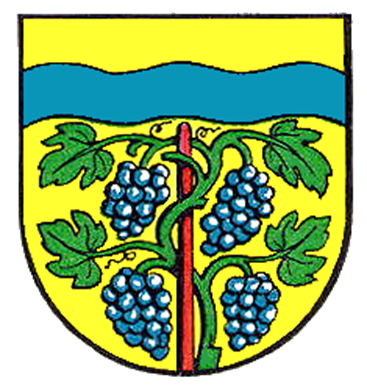
While Grossheppach is located in the middle of the wine region, as seen in this photo and the village shield, Rudolph didn’t work in the vineyards. Nor was he a miller, as his surname would suggest. Rudolph was a blacksmith.

The Village Blacksmith

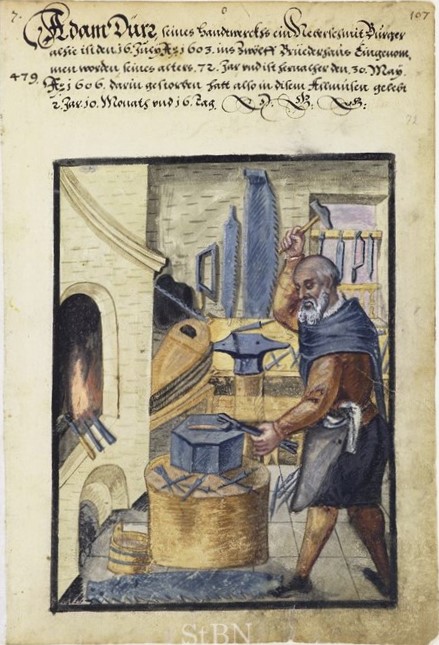
This 1606 print of a German blacksmith shows us what Rudolph’s blacksmith’s shop would have looked like, and the tools he would have worked with. Google translate provides us with the following”

Work block; Anvil; Hammer; Pliers; Poker; bucket

Description: The brother works a glowing metal tip with a hammer, which he holds on the anvil with pliers. Further metal points lie next to the anvil and on a table in the background of the workshop. There is a second anvil here. Various saws hang on the wall and on the wall bracket in the window opening, a large saw blade lies on the ground in the foreground, while a poker and metal spikes lie in the fireplace.

The art of medieval blacksmithing is described here and here.

One thing is for sure. It was beastly hot, especially in the summers, probably outright miserable from time to time, and dangerous. Notice the bucket which would have contained water, on the floor.

Rudolph was probably burned in one way or another almost daily. Metals were scalding hot after being taken out of the forge, and hammering caused hot sparks flying everyplace. I shudder to think about his unprotected eyes.

Unknown to them then, carbon dioxide poisoning is also a concern for blacksmiths, but I’d wager their shops were probably pretty open due to heat.

They didn’t have safety goggles back then, or welder’s gloves. While this man is wearing long sleeves and some type of apron, I think, his legs are bare as are his hands and face.

I wonder if Rudolph might have been hard of hearing in his later years due to the noise of years of constant pounding.

Rudolph died at 59 years of age. No cause of death was entered, but I can’t help but wonder why he died.

Rudolph’s First Appearance

The first record we find is the birth of Rudolph’s daughter, named Sibilla, in 1661, in the Grossheppach church records. That daughter passed away and is not to be confused with the second daughter named Sibilla, born in 1672 who survived and is also my ancestor. I can’t help but wonder if the fact that they attempted that name twice means she was named after the mother of either Rudolph or Margaretha.

Both Rudolph and his first wife, Margaretha, were born in Switzerland, as determined by their death records, which means that either they married in Switzerland and subsequently settled in Heppach, or they met and married in Heppach.

Baptisms records begin in Grossheppach in 1558 and marriage records in 1564. Part of 1627 is missing due to an epidemic, according to this site. Deaths begin in 1648, immediately after the Thirty Years War.

Therefore, if Rudolph and Margaretha had married in Grossheppach, there should have been a record, so we can probably presume they married in Switzerland sometime between 1650 and 1660, and may have had their first children before arriving in Grossheppach.

Grossheppach

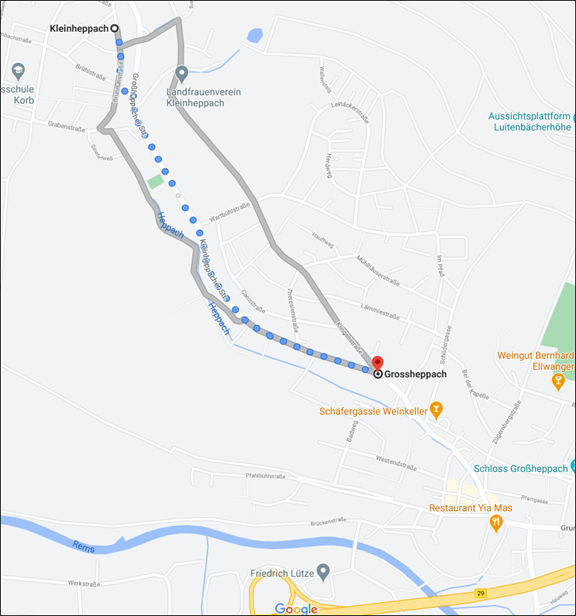
All early villages grew up beside a stream, the life-giver, and nourisher to people and animals. You can see the little stream of Heppach as it exists today, here, connecting Grossheppach with its neighbor village, Kleinheppach. The word grossen translates to “huge” and klein means “small.” There doesn’t seem to be a translation for heppach.

The stream named Heppach connects those two villages and looks quite small today. This early drawing shows the Rems River, not the stream of Heppach that empties into the Rems.

This drawing, made in 1686 from Kieser’s forest map would have been created during the time that Rudolph was the village smith. In fact, his house would have been one of those shown. The village wasn’t large, about 55 homes, as best I can tell, with maybe between 5 and 7 inhabitants each.

The church, as always, was in the center of the village and the cemetery would have been located outside, in the churchyard.

By 1686, Rudolph would have buried at least two children there and would bury his wife just three short years later. But in 1686, Rudolph and his family would have been living happily in one of these houses, going about the routine of daily life in the village.

An artist drawing the village would have been quite an interesting event. Perhaps Rudolph and the other villagers would have watched the artist as he worked, or listened in the evenings at the pub as he told tall tales about other German villages he had visited. Did they look at their own houses on the map and comment?

Another view shows the village from the opposite perspective.

The same area today, for comparison. That little river island looks to be long gone, or under the bridge.

I can locate the original Kirschstrasse on this current map, along with the castle for orientation. The church, with a different steeple, is located at the end of Kirschstrasse and matches up with an 1832 map.

The orderly rows on the hillsides are vineyards as seen looking down at the region from the top of one of the hills.

The map below shows the distant hills with the villages clustered in valleys along the streams.

These villages were not isolated.

Rudolph’s daughter married Johann Georg Lenz from Beutelsbach, across the Rems River, and spent her adult life living there, but she was clearly within walking distance of her family members. It’s less than 3 miles from Beutelsbach to Kleinheppach, north of Grossheppach.

You can view more photos of Grossheppach here and here

History and Vineyards

The vineyards in Grossheppach reach back into time immemorial. As with any location, geography and climate dictate what can be grown, and agriculture defines the occupation and lifestyle of the residents. Viticulture has sustained the Grossheppach residents, along with their neighbors, probably since humans have inhabited this valley and figured out what happens when you ferment grapes.

Historical information is found on the Wayback machine, translated as follows:

The first mention of this village [vineyards] is when the knight ‘Fridericus miles de Heggebach’ in 1279, Master Rudolf (doctor in Esslingen) bequeathed three “Jauchert vineyards” from Großheppach to the Bebenhausen monastery in addition to his house in Esslingen.

A castle site mentioned in 1485 once had a wooden castle on which Staufer ministerials – the Knights of Heppach – sat; they are first mentioned in a document in 1236 [where Grossheppach was identified as Hegnesbach.] The monastery Gundelsbach was founded by a hermit in 1359 for the St. Pauls hermits, to which houses and farms have been attached since 1470. The church consecrated to St. Aegidius – a foundation of Waiblingen – was raised to an independent parish in 1489. In 1769 the church received a so-called ‘Welsche Bell’ as a tower dome.

Note that Welsche likely refers to the colloquial term for “French-speaking Swiss, their portion of Switzerland known also as Welschland.

Next to the church, the renaissance castle is a landmark of Großheppach. It was built in 1592 by the Württemberg Chancellor Dr. Martin Eichmann from a town house; at the same time he acquired various rights on site. The castle property later passed into the hands of the noble families von Abel, von Goeben and von Gaisberg.

During the uprising of the ‘poor Konrad’ in 1514 (see also the local history of Beutelsbach), Großheppach saw peasant revolutionaries in its corridors. On Easter Monday 1514, the goat Peter moved with a group of farmers to the Rems between Beutelsbach and Großheppach in order to subject the newly introduced weights of the Duke of Württemberg to a ‘water test’: the weights promptly sank below what the farmers saw as a judgment of God. They marched against castles, cities and monasteries, but were soon blown up. The leader of the Großheppacher Fähnlein, Klaus Schlechthin, later took part in the peasant uprising of 1525 and was captured in the Battle of Böblingen and executed by running the gauntlet.

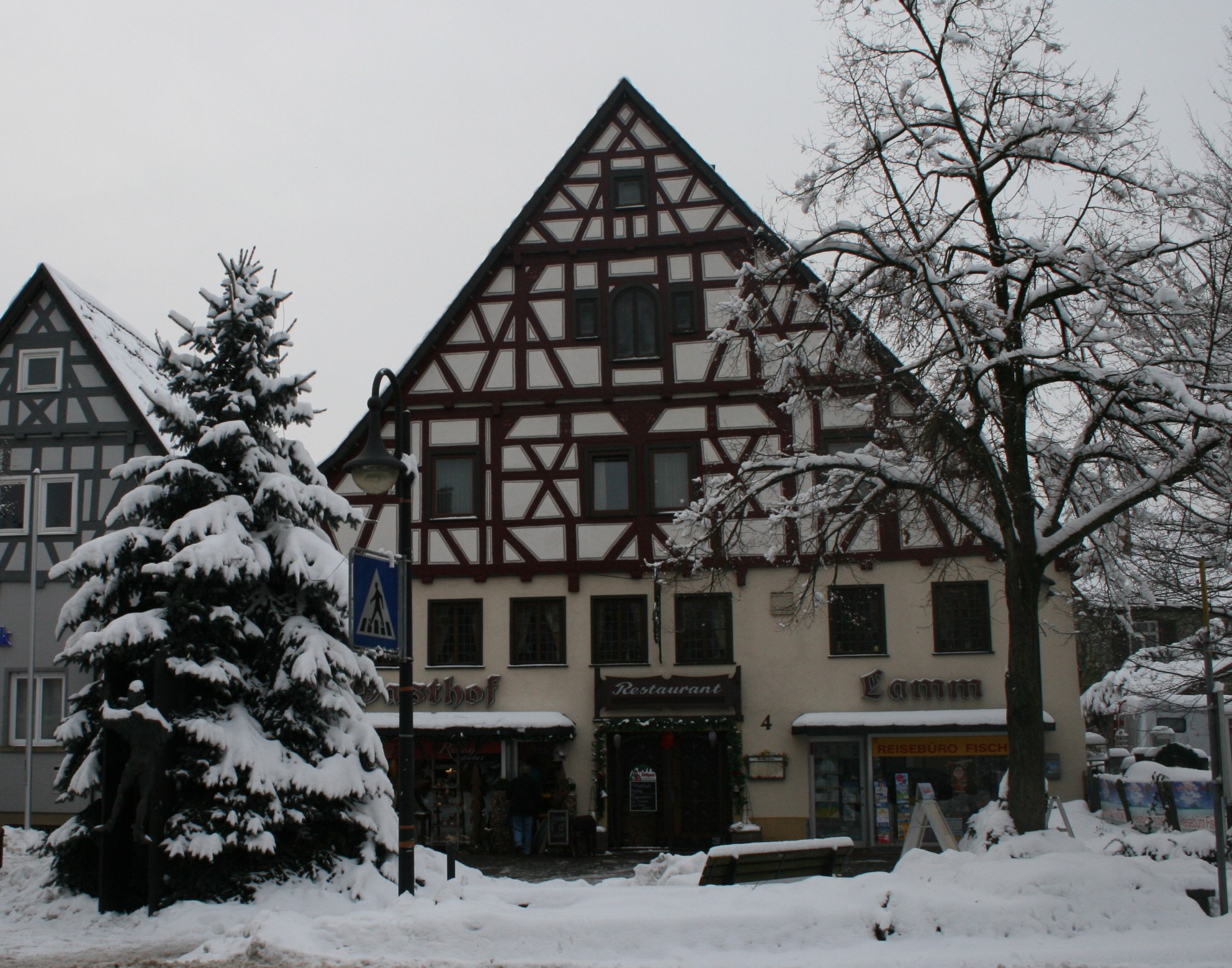
During the Thirty Years’ War, on January 21, 1643, there was a skirmish between the imperial and Swedes at the Remsbrücke, where around 300 soldiers were killed. In the War of the Spanish Succession [1701-1714], Großheppach was again the starting point for warlike ventures. On June 13, 1704, the greatest generals of the time – Prince Eugene of Savoy, the English military leader Marlborough and Margrave Ludwig von Baden – held a council of war on the operations of the Battle of Höchstädt here in the Lamm Inn, which still exists today.

The listed buildings of the Häckermühle and the town hall from the 16th and 17th centuries are well worth seeing.

Rudolph’s Life

The only evidence we have of Rudolph’s age is the age at which his wife had their last child which was born in 1675. If Margaretha was 43 at that time, she would have been born about 1632, so we can assume he was born sometime around 1630, or perhaps slightly earlier.

Rudolph would have married between 1650 and 1660, most likely, and they would have packed up their cart, maybe hitched up a mule and walked from someplace in Switzerland to Germany, assuredly after all danger from the Thirty Years War had abated.

Most German villages had been heavily depopulated during the war, although Grossheppach did not appear to have been abandoned. In the best-case scenarios, German villages lost only one-third of their population. Some lost 50%, and some were entirely destroyed and depopulated.

This settlement pattern suggests that Rudolph came from the German-speaking portion of Switzerland.

By Marco Zanoli (sidonius 13:20, 18 June 2006 (UTC)) – Swiss Federal Statistical Office; census of 2000, CC BY-SA 4.0, https://commons.wikimedia.org/w/index.php?curid=875011

How might Rudolph and Margaretha have made the journey to Grossheppach?

While we don’t know Rudolph and Margaretha’s departure point in Switzerland, we do know that the Bernese Oberland was far more Protestant than much of the rest of Switzerland.

The mountains southwest of Bern marked the dividing line between the German and French-speaking regions of Switzerland. Regardless of where they originated in the German-speaking region, it was not a short journey and was probably a one-way trip – forever leaving family behind.

This trek was likely not undertaken by water unless they navigated the Rhine, then backtracked down the Neckar (against the flow) followed by the Rems.

Perhaps German villages issued advertisements or notices that they were looking for specific skilled trades. Maybe Rudolph knew that Grossheppach needed a blacksmith. It’s certainly possible that they joined with other family members, either as they journeyed or joined those who had already settled in Germany.

Rudolph’s daughter, Veronica’s death record gives us the closest approximation with the phrase, “Switzerland Cand.”

Seelenregister (Register of Souls) Grossheppach Evangelical Church

Veronica (spouse of Johann Jacob Mahler); died 11 January 1708, aged 41 years, 6 months.

Father: Rudolph Müller, citizen and farrier (smith) from Switzerland Cand (Kanton?); died 1692.

Mother: Margaretha, born in Switzerland, a chambermaid; died 23 March 1711, about 71 years of age.

Note by Tom who performed these translations: This Margaretha is Veronica’s step-mother. Her birth mother died in 1689 and was also named Margaretha.

If anyone has any further idea what “Cand” might mean other than perhaps Canton, or which Canton, I’d be forever grateful.

I do wonder if the newlywed couple set off for Germany on a great adventure, arriving before their first child did. Of course, they could have married a few years earlier and had already begun their family when they decided to leave, which meant travel would have been more difficult. If so, there are no marriage records for those earlier children in Grossheppach, although, clearly they could have married in nearby villages.

Children

  • One way or another, Rudolph and Margaretha had settled in and welcomed a baby, Sibilla in May of 1661.
  • Heartbreak followed a few months later. Sibilla died in October, when she was just 24 weeks old, the first family member to be buried in the cemetery beside the church.
  • In August of 1662, Hans Rudolph, named for his father, joined the family. Johann Rudolph Muller married in 1696 to Anna Barbara Mercklin and died sometime between July 1718 and January 1735. We don’t have the Y DNA of Rudolph Muller, which is passed from father to son. If Hans Rudolph and Anna Barbara had sons, who had sons, whose descendants carry the Muller (or derivative) surname today through all males, I have a DNA testing scholarship for that Muller male.
  • 1663 saw Anna Magdalena baptized in February. She married Jacob(y) Sonntag on August 14, 1688.
  • Anna Margaretha was baptized in October 1664.
  • Veronica was born in July 1666 and married in 1690 to Hanss Jacob Mahler the local tailor. She died on January 11, 1708.
  • Son, Hanss Jacob Muller, was born in August 1668. Cousin Wolfram, living in Grossheppach indicates that one Hans Jacob died in 1675, but with no parents listed. If he did not die and had male children who have direct line male descendants today, they would qualify for the Y DNA scholarship as well.
  • Anna Barbara’s baptism is recorded in December 1669 and died in October 1679.
  • There is almost three years before the birth of Sibilla which makes me wonder if they lost a child.
  • September of 1672 welcomed the second daughter named Sibilla who married Johann Georg Lenz/Lentz in 1698 in Beutelsbach, living the rest of her life there as a midwife.
  • Jerg Lienhardt was born in September of 1674 and died in January of 1675 at 18 weeks of age.

That was the last child and the last church entry for 15 years. But on October 30th of 1689, Margaretha, Rudolph’s wife, died.

We don’t know exactly how many children were living at this time. There were no marriage records yet, and the oldest child, Hans Rudolph, Rudolph’s namesake wouldn’t marry until a few years later. He would have been age 27, living and working at home when his mother died.

At least two daughters were living; Veronica who would have been 23, and Sibila, the youngest, who would have been 17. It’s possible that up to four other children were living as well. Rudolph wasn’t alone, nor did he have a number of small children.

A year later, almost exactly, on October 28, 1690, Rudolph’s daughter, Veronica married the local tailor, Hanss Jacob Mahler.

Perhaps that wedding made Rudolph ponder marriage again and realize that he did not want to remain a widower forever. Or, perhaps his daughter had done a good deal of the cooking and domestic work and simple logic kicked in when a local woman was widowed and started looking admiringly in his direction. Necessity often plays cupid.

Rudolph did what most people of that time did if their spouse died. He remarried.

Marriage: 11 August 1691 Grossheppach Evangelical Church

Johann Rudolph Müller, from here with Mrs. Anna Margaretha Berger(in), surviving widow of Herr Berger, former court bailiff? from here.

However, Rudolph didn’t live much longer himself, passing away in July of 1692.

Burial: 28 July 1692 Grossheppach Evangelical Church

Joh(ann) Rüdolph Müller was buried.

I sure wish they had recorded Rudolph’s age and birth location. Just a few strokes of the pen could have told us so much.

Rudolph’s second wife, Margaretha, not to be confused with his first wife of the same name, died in 1711.

Burial: 23 March 1711 was buried Margaretha, surviving widow of Rüdolph Müller, former smith and citizen here……..Knauss(in)…..aged 71 years.

Marriage: 12 Nov 1678 Grossheppach Evangelical Church

H(err) Johannes Heinrich Berger, …master and juror here with Margretha Knauss were married.

Given that Margaretha (born Knauss) married previously in 1678, at the age of 38, she likely had a child or two, and Rudolph probably had step-children that would still have been at home when he married Margaretha in 1691.

The Sweet Spot

Rudolph was born during the Thirty Years War, but in Switzerland where the residents were unaffected. Switzerland was an oasis of peace and prosperity. No one wanted Switzerland to fall, because the Swiss provided mercenaries to many other countries. In essence, that was payment for keeping the war off of their land.

Brave or hopeful, or both, he moved to Grossheppach as a relatively young man, probably as a newlywed.

Rudolph’s children did not marry during his lifetime, so he never got to know any of his grandchildren, but he did manage to actually live in the “sweet spot” in German history.

Rudolph didn’t live in the Palatinate which was constantly being overrun by the French in the 1670s, 1680s, and 1690s. I don’t know why he chose Grossheppach instead of the Palatinate, but that was either smart or fortuitous.

Rudolph died before the beginning of the War of Spanish Succession in 1701, so he avoided warfare for his entire lifetime – a rare event for any German in the 1600s.

The Lamm Inn

Grossheppach seemed to be a quiet village. After a long day standing and pounding at the forge, Rudolph probably walked a few feet to the Lamm Inn, across from the church which existed then and still exists today as a restaurant. Trust me, I’d like nothing better right about now!

Cousin Wolfram, who lives in Grossheppach tells us that the Lamm Inn was the only inn in the village in olden times.

Of course, given that wine was produced locally, Rudolph wouldn’t have been drinking German beer, but whatever was available from the cool wine cellar. His body probably ached, and he was hot and thirsty, so he would have been grateful for anything cold, along with warm friendships.

Oh Rudolph, I so want to visit you.

To sit in the Lamm Inn where you sat.

To walk on the cobblestone streets where you walked for more than 30 years.

To discover which home was yours, and maybe, if I could be so lucky, the remnants of your forge.

To sit in the church where you assuredly sat, every Sunday, along with too many more “funeral days.” Maybe I would luck into “your pew.” I would close my eyes and feel your spirit nearby.

I want to stroll the churchyard, knowing that you are there, somewhere, along with Margaretha.

Would you know that I am visiting? That some part of your DNA has come home to connect with your ashes and dust?

And, if I listen oh-so-carefully, will you whisper in my ear where, in Switzerland, you were born?

_____________________________________________________________

Disclosure

I receive a small contribution when you click on some of the links to vendors in my articles. This does NOT increase the price you pay but helps me to keep the lights on and this informational blog free for everyone. Please click on the links in the articles or to the vendors below if you are purchasing products or DNA testing.

Thank you so much.

DNA Purchases and Free Transfers

Genealogy Products and Services

Genealogy Research

Books

myDNA Merges With FamilyTreeDNA and Gene by Gene

2021 is starting out with an exciting announcement in the genetic genealogy world. A marriage!

Dr. Lior Rauchberger, CEO of Australian company, myDNA, has announced a merger with well-known genetic genealogy company, FamilyTreeDNA along with the parent company that owns their DNA processing lab, Gene by Gene.

click to enlarge images

Bennett Greenspan and Max Blankfeld, founders of both Houston-based companies, FamilyTreeDNA and Gene by Gene, will retain board seats in the merged organization, while Rauchberger will be the CEO of the organization.

Here’s the full press release.

I spoke with Bennett, and he assured me that myDNA has every intention of maintaining and investing in the genealogy side of the house. He indicated that both companies felt that this was a very compatible marriage.

I didn’t know anything about myDNA previously, but like any genealogist, I’ve done some research.

Who is myDNA?

According to their website, myDNA, founded in 2007, is focused on personal health management.

Their approach seems to be a bit different than health and wellness tests I’ve seen before.

The myDNA test is a functional pathology test that reports on how genetic factors may influence the ways in which medications affect individuals. Different people metabolize and eliminate medications differently, and at various speeds.

myDNA testing provides customers with the ability to work with their physicians to tailor their medications to maximize benefits and minimize side effects.

I’m not surprised that FamilyTreeDNA has, one way or another, added a health component to the menu. As I mentioned in my Genetic Genealogy at 20 Years article earlier this week, all three of the other major players have a health/medical aspect of their products.

You can take a look at what myDNA offers, here, and here, for yourself, and at an example report, here.

The myDNA products also offer ways to make sustainable lifestyle changes, DNA based meal plans and workouts customized for your goals.

I don’t have any personal experience with myDNA, but I will as soon as I order a test.

Benefits and Opportunities

I see several potential benefits to the genetic genealogy community, including:

  • myDNA customers may provide a pool of new customers (and matches) who might possibly be interested in genealogy, aka, YDNA, mitochondrial DNA, and autosomal testing.

I would presume that these tests will soon be offered as options to myDNA customers. Australia, in addition to its aboriginal population, consists of immigrants from the British Isles and elsewhere. I actually discovered the DNA match down under who broke through my decades-old Speak family brick wall in Lancashire.

  • myDNA customers, even if they aren’t interested in genealogy, per se, may be interested in more general “where did I come from,” personal history type of information.

This might include interesting Y and mitochondrial DNA migration map “journeys,” along with ethnicity. I’m thinking along the lines of “myY,” “myMito” and the already existing  “myOrigins,” Perhaps something similar to the less in-depth, but still quite interesting (now-defunct) Genographic product test results.

Adding FamilyTreeDNA tools for myDNA customers would benefit both sides of the equation. Every additional person who tests helps the scientific research aspect, meaning building both the Y and mitochondrial trees, which in turn helps traditional genealogy customers.

Conversely, FamilyTreeDNA customers may want to easily add some of the myDNA products and have them available through one single customer portal.

I’m extremely hopeful about opportunities for the genetic genealogy side of the house. Specifically, my fingers are crossed that myDNA will invest in:

  • Website infrastructure which will improve performance.
  • Enhancing current and adding new advanced genealogy tools and products that aren’t just pieces, but provide us with innovative solutions.

And yes, I have suggestions. Like a kid in the toy store, I have a long wish list of features I’d love to see😊.

I’d like to hear your (positively constructed) wish list as well.

I’m excited about this new opportunity!

Customer Notification

Customers will be notified via e-mail in the next 48 hours or so. If you don’t receive an e-mail, check your spam folder or sign on to your account. If you’ve changed your e-mail recently, sign in to be sure your e-mail address is current.

_____________________________________________________________

Disclosure

I receive a small contribution when you click on some of the links to vendors in my articles. This does NOT increase the price you pay but helps me to keep the lights on and this informational blog free for everyone. Please click on the links in the articles or to the vendors below if you are purchasing products or DNA testing.

Thank you so much.

DNA Purchases and Free Transfers

Genealogy Products and Services

Genealogy Research

Books

Genetic Genealogy at 20 Years: Where Have We Been, Where Are We Going and What’s Important?

Not only have we put 2020 in the rear-view mirror, thankfully, we’re at the 20-year, two-decade milestone. The point at which genetics was first added to the toolbox of genealogists.

It seems both like yesterday and forever ago. And yes, I’ve been here the whole time,  as a spectator, researcher, and active participant.

Let’s put this in perspective. On New Year’s Eve, right at midnight, in 2005, I was able to score kit number 50,000 at Family Tree DNA. I remember this because it seemed like such a bizarre thing to be doing at midnight on New Year’s Eve. But hey, we genealogists are what we are.

I knew that momentous kit number which seemed just HUGE at the time was on the threshold of being sold, because I had inadvertently purchased kit 49,997 a few minutes earlier.

Somehow kit 50,000 seemed like such a huge milestone, a landmark – so I quickly bought kits, 49,998, 49,999, and then…would I get it…YES…kit 50,000. Score!

That meant that in the 5 years FamilyTreeDNA had been in business, they had sold on an average of 10,000 kits per year, or 27 kits a day. Today, that’s a rounding error. Then it was momentous!

In reality, the sales were ramping up quickly, because very few kits were sold in 2000, and roughly 20,000 kits had been sold in 2005 alone. I know this because I purchased kit 28,429 during the holiday sale a year earlier.

Of course, I had no idea who I’d test with that momentous New Year’s Eve Y DNA kit, but I assuredly would find someone. A few months later, I embarked on a road trip to visit an elderly family member with that kit in tow. Thank goodness I did, and they agreed and swabbed on the spot, because they are gone today and with them, the story of the Y line and autosomal DNA of their branch.

In the past two decades, almost an entire generation has slipped away, and with them, an entire genealogical library held in their DNA.

Today, more than 40 million people have tested with the four major DNA testing companies, although we don’t know exactly how many.

Lots of people have had more time to focus on genealogy in 2020, so let’s take a look at what’s important? What’s going on and what matters beyond this month or year?

How has this industry changed in the last two decades, and where it is going?

Reflection

This seems like a good point to reflect a bit.

Professor Dan Bradley reflecting on early genetic research techniques in his lab at the Smurfit Institute of Genetics at Trinity College in Dublin. Photo by Roberta Estes

In the beginning – twenty years ago, there were two companies who stuck their toes in the consumer DNA testing water – Oxford Ancestors and Family Tree DNA. About the same time, Sorenson Genomics and GeneTree were also entering that space, although Sorenson was a nonprofit. Today, of those, only FamilyTreeDNA remains, having adapted with the changing times – adding more products, testing, and sophistication.

Bryan Sykes who founded Oxford Ancestors announced in 2018 that he was retiring to live abroad and subsequently passed away in 2020. The website still exists, but the company has announced that they have ceased sales and the database will remain open until Sept 30, 2021.

James Sorenson died in 2008 and the assets of Sorenson Molecular Genealogy Foundation, including the Sorenson database, were sold to Ancestry in 2012. Eventually, Ancestry removed the public database in 2015.

Ancestry dabbled in Y and mtDNA for a while, too, destroying that database in 2014.

Other companies, too many to remember or mention, have come and gone as well. Some of the various company names have been recycled or purchased, but aren’t the same companies today.

In the DNA space, it was keep up, change, die or be sold. Of course, there was the small matter of being able to sell enough DNA kits to make enough money to stay in business at all. DNA processing equipment and a lab are expensive. Not just the equipment, but also the expertise.

The Next Wave

As time moved forward, new players entered the landscape, comprising the “Big 4” testing companies that constitute the ponds where genealogists fish today.

23andMe was the first to introduce autosomal DNA testing and matching. Their goal and focus was always medical genetics, but they recognized the potential in genealogists before anyone else, and we flocked to purchase tests.

Ancestry settled on autosomal only and relies on the size of their database, a large body of genealogy subscribers, and a widespread “feel-good” marketing campaign to sell DNA kits as the gateway to “discover who you are.”

FamilyTreeDNA did and still does offer all 3 kinds of tests. Over the years, they have enhanced both the Y DNA and mitochondrial product offerings significantly and are still known as “the science company.” They are the only company to offer the full range of Y DNA tests, including their flagship Big Y-700, full sequence mitochondrial testing along with matching for both products. Their autosomal product is called Family Finder.

MyHeritage entered the DNA testing space a few years after the others as the dark horse that few expected to be successful – but they fooled everyone. They have acquired companies and partnered along the way which allowed them to add customers (Promethease) and tools (such as AutoCluster by Genetic Affairs), boosting their number of users. Of course, MyHeritage also offers users a records research subscription service that you can try for free.

In summary:

One of the wonderful things that happened was that some vendors began to accept compatible raw DNA autosomal data transfer files from other vendors. Today, FamilyTreeDNA, MyHeritage, and GEDmatch DO accept transfer files, while Ancestry and 23andMe do not.

The transfers and matching are free, but there are either minimal unlock or subscription plans for advanced features.

There are other testing companies, some with niche markets and others not so reputable. For this article, I’m focusing on the primary DNA testing companies that are useful for genealogy and mainstream companion third-party tools that complement and enhance those services.

The Single Biggest Change

As I look back, the single biggest change is that genetic genealogy evolved from the pariah of genealogy where DNA discussion was banned from the (now defunct) Rootsweb lists and summarily deleted for the first few years after introduction. I know, that’s hard to believe today.

Why, you ask?

Reasons varied from “just because” to “DNA is cheating” and then morphed into “because DNA might do terrible things like, maybe, suggest that a person really wasn’t related to an ancestor in a lineage society.”

Bottom line – fear and misunderstanding. Change is exceedingly difficult for humans, and DNA definitely moved the genealogy cheese.

From that awkward beginning, genetic genealogy organically became a “thing,” a specific application of genealogy. There was paper-trail traditional genealogy and then the genetic aspect. Today, for almost everyone, genealogy is “just another tool” in the genealogist’s toolbox, although it does require focused learning, just like any other tool.

DNA isn’t separate anymore, but is now an integral part of the genealogical whole. Having said that, DNA can’t solve all problems or answer all questions, but neither can traditional paper-trail genealogy. Together, each makes the other stronger and solves mysteries that neither can resolve alone.

Synergy.

I fully believe that we have still only scratched the surface of what’s possible.

Inheritance

As we talk about the various types of DNA testing and tools, here’s a quick graphic to remind you of how the different types of DNA are inherited.

  • Y DNA is inherited paternally for males only and informs us of the direct patrilineal (surname) line.
  • Mitochondrial DNA is inherited by everyone from their mothers and informs us of the mother’s matrilineal (mother’s mother’s mother’s) line.
  • Autosomal DNA can be inherited from potentially any ancestor in random but somewhat predictable amounts through both parents. The further back in time, the less identifiable DNA you’ll inherit from any specific ancestor. I wrote about that, here.

What’s Hot and What’s Not

Where should we be focused today and where is this industry going? What tools and articles popped up in 2020 to help further our genealogy addiction? I already published the most popular articles of 2020, here.

This industry started two decades ago with testing a few Y DNA and mitochondrial DNA markers, and we were utterly thrilled at the time. Both tests have advanced significantly and the prices have dropped like a stone. My first mitochondrial DNA test that tested only 400 locations cost more than $800 – back then.

Y DNA and mitochondrial DNA are still critically important to genetic genealogy. Both play unique roles and provide information that cannot be obtained through autosomal DNA testing. Today, relative to Y DNA and mitochondrial DNA, the biggest challenge, ironically, is educating newer genealogists about their potential who have never heard about anything other than autosomal, often ethnicity, testing.

We have to educate in order to overcome the cacophony of “don’t bother because you don’t get as many matches.”

That’s like saying “don’t use the right size wrench because the last one didn’t fit and it’s a bother to reach into the toolbox.” Not to mention that if everyone tested, there would be a lot more matches, but I digress.

If you don’t use the right tool, and all of the tools at your disposal, you’re not going to get the best result possible.

The genealogical proof standard, the gold standard for genealogy research, calls for “a reasonably exhaustive search,” and if you haven’t at least considered if or how Y
DNA
and mitochondrial DNA along with autosomal testing can or might help, then your search is not yet exhaustive.

I attempt to obtain the Y and mitochondrial DNA of every ancestral line. In the article, Search Techniques for Y and Mitochondrial DNA Test Candidates, I described several methodologies to find appropriate testing candidates.

Y DNA – 20 Years and Still Critically Important

Y DNA tracks the Y chromosome for males via the patrilineal (surname) line, providing matching and historical migration information.

We started 20 years ago testing 10 STR markers. Today, we begin at 37 markers, can upgrade to 67 or 111, but the preferred test is the Big Y which provides results for 700+ STR markers plus results from the entire gold standard region of the Y chromosome in order to provide the most refined results. This allows genealogists to use STR markers and SNP results together for various aspects of genealogy.

I created a Y DNA resource page, here, in order to provide a repository for Y DNA information and updates in one place. I would encourage anyone who can to order or upgrade to the Big Y-700 test which provides critical lineage information in addition to and beyond traditional STR testing. Additionally, the Big Y-700 test helps build the Y DNA haplotree which is growing by leaps and bounds.

More new SNPs are found and named EVERY SINGLE DAY today at FamilyTreeDNA than were named in the first several years combined. The 2006 SNP tree listed a grand total of 459 SNPs that defined the Y DNA tree at that time, according to the ISOGG Y DNA SNP tree. Goran Rundfeldt, head of R&D at FamilyTreeDNA posted this today:

2020 was an awful year in so many ways, but it was an unprecedented year for human paternal phylogenetic tree reconstruction. The FTDNA Haplotree or Great Tree of Mankind now includes:

37,534 branches with 12,696 added since 2019 – 51% growth!
defined by
349,097 SNPs with 131,820 added since 2019 – 61% growth!

In just one year, 207,536 SNPs were discovered and assigned FT SNP names. These SNPs will help define new branches and refine existing ones in the future.

The tree is constructed based on high coverage chromosome Y sequences from:
– More than 52,500 Big Y results
– Almost 4,000 NGS results from present-day anonymous men that participated in academic studies

Plus an additional 3,000 ancient DNA results from archaeological remains, of mixed quality and Y chromosome coverage at FamilyTreeDNA.

Wow, just wow.

These three new articles in 2020 will get you started on your Y DNA journey!

Mitochondrial DNA – Matrilineal Line of Humankind is Being Rewritten

The original Oxford Ancestor’s mitochondrial DNA test tested 400 locations. The original Family Tree DNA test tested around 1000 locations. Today, the full sequence mitochondrial DNA test is standard, testing the entire 16,569 locations of the mitochondria.

Mitochondrial DNA tracks your mother’s direct maternal, or matrilineal line. I’ve created a mitochondrial DNA resource page, here that includes easy step-by-step instructions for after you receive your results.

New articles in 2020 included the introduction of The Million Mito Project. 2021 should see the first results – including a paper currently in the works.

The Million Mito Project is rewriting the haplotree of womankind. The current haplotree has expanded substantially since the first handful of haplogroups thanks to thousands upon thousands of testers, but there is so much more information that can be extracted today.

Y and Mitochondrial Resources

If you don’t know of someone in your family to test for Y DNA or mitochondrial DNA for a specific ancestral line, you can always turn to the Y DNA projects at Family Tree DNA by searching here.

The search provides you with a list of projects available for a specific surname along with how many customers with that surname have tested. Looking at the individual Y DNA projects will show the earliest known ancestor of the surname line.

Another resource, WikiTree lists people who have tested for the Y DNA, mitochondrial DNA and autosomal DNA lines of specific ancestors.

Click on images to enlarge

On the left side, my maternal great-grandmother’s profile card, and on the right, my paternal great-great-grandfather. You can see that someone has tested for the mitochondrial DNA of Nora (OK, so it’s me) and the Y DNA of John Estes (definitely not me.)

MitoYDNA, a nonprofit volunteer organization created a comparison tool to replace Ysearch and Mitosearch when they bit the dust thanks to GDPR.

MitoYDNA accepts uploads from different sources and allows uploaders to not only match to each other, but to view the STR values for Y DNA and the mutation locations for the HVR1 and HVR2 regions of mitochondrial DNA. Mags Gaulden, one of the founders, explains in her article, What sets mitoYDNA apart from other DNA Databases?.

If you’ve tested at nonstandard companies, not realizing that they didn’t provide matching, or if you’ve tested at a company like Sorenson, Ancestry, and now Oxford Ancestors that is going out of business, uploading your results to mitoYDNA is a way to preserve your investment. PS – I still recommend testing at FamilyTreeDNA in order to receive detailed results and compare in their large database.

CentiMorgans – The Word of Two Decades

The world of autosomal DNA turns on the centimorgan (cM) measure. What is a centimorgan, exactly? I wrote about that unit of measure in the article Concepts – CentiMorgans, SNPs and Pickin’ Crab.

Fortunately, new tools and techniques make using cMs much easier. The Shared cM Project was updated this year, and the results incorporated into a wonderfully easy tool used to determine potential relationships at DNAPainter based on the number of shared centiMorgans.

Match quality and potential relationships are determined by the number of shared cMs, and the chromosome browser is the best tool to use for those comparisons.

Chromosome Browser – Genetics Tool to View Chromosome Matches

Chromosome browsers allow testers to view their matching cMs of DNA with other testers positioned on their own chromosomes.

My two cousins’ DNA where they match me on chromosomes 1-4, is shown above in blue and red at Family Tree DNA. It’s important to know where you match cousins, because if you match multiple cousins on the same segment, from the same side of your family (maternal or paternal), that’s suggestive of a common ancestor, with a few caveats.

Some people feel that a chromosome browser is an advanced tool, but I think it’s simply standard fare – kind of like driving a car. You need to learn how to drive initially, but after that, you don’t even think about it – you just get in and go. Here’s help learning how to drive that chromosome browser.

Triangulation – Science Plus Group DNA Matching Confirms Genealogy

The next logical step after learning to use a chromosome browser is triangulation. If fact, you’re seeing triangulation above, but don’t even realize it.

The purpose of genetic genealogy is to gather evidence to “prove” ancestral connections to either people or specific ancestors. In autosomal DNA, triangulation occurs when:

  • You match at least two other people (not close relatives)
  • On the same reasonably sized segment of DNA (generally 7 cM or greater)
  • And you can assign that segment to a common ancestor

The same two cousins are shown above, with triangulated segments bracketed at MyHeritage. I’ve identified the common ancestor with those cousins that those matching DNA segments descend from.

MyHeritage’s triangulation tool confirms by bracketing that these cousins also match each other on the same segment, which is the definition of triangulation.

I’ve written a lot about triangulation recently.

If you’d prefer a video, I recorded a “Top Tips” Facebook LIVE with MyHeritage.

Why is Ancestry missing from this list of triangulation articles? Ancestry does not offer a chromosome browser or segment information. Therefore, you can’t triangulate at Ancestry. You can, however, transfer your Ancestry DNA raw data file to either FamilyTreeDNA, MyHeritage, or GEDmatch, all three of which offer triangulation.

Step by step download/upload transfer instructions are found in this article:

Clustering Matches and Correlating Trees

Based on what we’ve seen over the past few years, we can no longer depend on the major vendors to provide all of the tools that genealogists want and need.

Of course, I would encourage you to stay with mainstream products being used by a significant number of community power users. As with anything, there is always someone out there that’s less than honorable.

2020 saw a lot of innovation and new tools introduced. Maybe that’s one good thing resulting from people being cooped up at home.

Third-party tools are making a huge difference in the world of genetic genealogy. My favorites are Genetic Affairs, their AutoCluster tool shown above, DNAPainter and DNAGedcom.

These articles should get you started with clustering.

If you like video resources, here’s a MyHeritage Facebook LIVE that I recorded about how to use AutoClusters:

I created a compiled resource article for your convenience, here:

I have not tried a newer tool, YourDNAFamily, that focuses only on 23andMe results although the creator has been a member of the genetic genealogy community for a long time.

Painting DNA Makes Chromosome Browsers and Triangulation Easy

DNAPainter takes the next step, providing a repository for all of your painted segments. In other words, DNAPainter is both a solution and a methodology for mass triangulation across all of your chromosomes.

Here’s a small group of people who match me on the same maternal segment of chromosome 1, including those two cousins in the chromosome browser and triangulation sections, above. We know that this segment descends from Philip Jacob Miller and his wife because we’ve been able to identify that couple as the most distant ancestor intersection in all of our trees.

It’s very helpful that DNAPainter has added the functionality of painting all of the maternal and paternal bucketed matches from Family Tree DNA.

All you need to do is to link your known matches to your tree in the proper place at FamilyTreeDNA, then they do the rest by using those DNA matches to indicate which of the rest of your matches are maternal and paternal. Instructions, here. You can then export the file and use it at DNAPainter to paint all of those matches on the correct maternal or paternal chromosomes.

Here’s an article providing all of the DNAPainter Instructions and Resources.

DNA Matches Plus Trees Enhance Genealogy

Of course, utilizing DNA matching plus finding common ancestors in trees is one of the primary purposes of genetic genealogy – right?

Vendors have linked the steps of matching DNA with matching ancestors in trees.

Genetic Affairs take this a step further. If you don’t have an ancestor in your tree, but your matches have common ancestors with each other, Genetic Affairs assembles those trees to provide you with those hints. Of course, that common ancestor might not be relevant to your genealogy, but it just might be too!

click to enlarge

This tree does not include me, but two of my matches descend from a common ancestor and that common ancestor between them might be a clue as to why I match both of them.

Ethnicity Continues to be Popular – But Is No Shortcut to Genealogy

Ethnicity is always popular. People want to “do their DNA” and find out where they come from. I understand. I really do. Who doesn’t just want an answer?

Of course, it’s not that simple, but that doesn’t mean it’s not disappointing to people who test for that purpose with high expectations. Hopefully, ethnicity will pique their curiosity and encourage engagement.

All four major vendors rolled out updated ethnicity results or related tools in 2020.

The future for ethnicity, I believe, will be held in integrated tools that allow us to use ethnicity results for genealogy, including being able to paint our ethnicity on our chromosomes as well as perform segment matching by ethnicity.

For example, if I carry an African segment on chromosome 1 from my father, and I match one person from my mother’s side and one from my father’s side on that same segment – one or the other of those people should also have that segment identified as African. That information would inform me as to which match is paternal and which is maternal

Not only that, this feature would help immensely tracking ancestors back in time and identifying their origins.

Will we ever get there? I don’t know. I’m not sure ethnicity is or can be accurate enough. We’ll see.

Transition to Digital and Online

Sometimes the future drags us kicking and screaming from the present.

With the imposed isolation of 2020, conferences quickly moved to an online presence. The genealogy community has all pulled together to make this work. The joke is that 2020’s most used phrase is “can you hear me?” I can vouch for that.

Of course while the year 2020 is over, the problem isn’t and is extending at least through the first half of 2021 and possibly longer. Conferences are planned months, up to a year, in advance and they can’t turn on a dime, so don’t even begin to expect in-person conferences until either late in 2021 or more likely, 2022 if all goes well this year.

I expect the future will eventually return to in-person conferences, but not entirely.

Finding ways to be more inclusive allows people who don’t want to or can’t travel or join in-person to participate.

I’ve recorded several sessions this year, mostly for 2021. Trust me, these could be a comedy, mostly of errors😊

I participated in four MyHeritage Facebook LIVE sessions in 2020 along with some other amazing speakers. This is what “live” events look like today!

Screenshot courtesy MyHeritage

A few days ago, I asked MyHeritage for a list of their LIVE sessions in 2020 and was shocked to learn that there were more than 90 in English, all free, and you can watch them anytime. Here’s the MyHeritage list.

By the way, every single one of the speakers is a volunteer, so say a big thank you to the speakers who make this possible, and to MyHeritage for the resources to make this free for everyone. If you’ve ever tried to coordinate anything like this, it’s anything but easy.

Additonally, I’ve created two Webinars this year for Legacy Family Tree Webinars.

Geoff Rasmussen put together the list of their top webinars for 2020, and I was pleased to see that I made the top 10! I’m sure there are MANY MORE you’d be interested in watching. Personally, I’m going to watch #6 yet today! Also, #9 and #22. You can always watch new webinars for free for a few days, and you can subscribe to watch all webinars, here.

The 2021 list of webinar speakers has been announced here, and while I’m not allowed to talk about something really fun that’s upcoming, let’s just say you definitely have something to look forward to in the springtime!

Also, don’t forget to register for RootsTech Connect which is entirely online and completely free, February 25-27, here.

Thank you to Penny Walters for creating this lovely graphic.

There are literally hundreds of speakers providing sessions in many languages for viewers around the world. I’ve heard the stats, but we can’t share them yet. Let me just say that you will be SHOCKED at the magnitude and reach of this conference. I’m talking dumbstruck!

During one of our zoom calls, one of the organizers says it feels like we’re constructing the plane as we’re flying, and I can confirm his observation – but we are getting it done – together! All hands on deck.

I’ll be presenting an advanced session about triangulation as well as a mini-session in the FamilySearch DNA Resource Center about finding your mother’s ancestors. I’ll share more information as it’s released and I can.

Companies and Owners Come & Go

You probably didn’t even notice some of these 2020 changes. Aside from the death of Bryan Sykes (RIP Bryan,) the big news and the even bigger unknown is the acquisition of Ancestry by Blackstone. Recently the CEO, Margo Georgiadis announced that she was stepping down. The Ancestry Board of Directors has announced an external search for a new CEO. All I can say is that very high on the priority list should be someone who IS a genealogist and who understands how DNA applies to genealogy.

Other changes included:

In the future, as genealogy and DNA testing becomes ever more popular and even more of a commodity, company sales and acquisitions will become more commonplace.

Some Companies Reduced Services and Cut Staff

I understand this too, but it’s painful. The layoffs occurred before Covid, so they didn’t result from Covid-related sales reductions. Let’s hope we see renewed investment after the Covid mess is over.

In a move that may or may not be related to an attempt to cut costs, Ancestry removed 6 and 7 cM matches from their users, freeing up processing resources, hardware, and storage requirements and thereby reducing costs.

I’m not going to beat this dead horse, because Ancestry is clearly not going to move on this issue, nor on that of the much-requested chromosome browser.

Later in the year, 23andMe also removed matches and other features, although, to their credit, they have restored at least part of this functionality and have provided ethnicity updates to V3 and V4 kits which wasn’t initially planned.

It’s also worth noting that early in 2020, 23andMe laid off 100 people as sales declined. Since that time, 23andMe has increasingly pushed consumers to pay to retest on their V5 chip.

About the same time, Ancestry also cut their workforce by about 6%, or about 100 people, also citing a slowdown in the consumer testing market. Ancestry also added a health product.

I’m not sure if we’ve reached market saturation or are simply seeing a leveling off. I wrote about that in DNA Testing Sales Decline: Reason and Reasons.

Of course, the pandemic economy where many people are either unemployed or insecure about their future isn’t helping.

The various companies need some product diversity to survive downturns. 23andMe is focused on medical research with partners who pay 23andMe for the DNA data of customers who opt-in, as does Ancestry.

Both Ancestry and MyHeritage provide subscription services for genealogy records.

FamilyTreeDNA is part of a larger company, GenebyGene whose genetics labs do processing for other companies and medical facilities.

A huge thank you to both MyHeritage and FamilyTreeDNA for NOT reducing services to customers in 2020.

Scientific Research Still Critical & Pushes Frontiers

Now that DNA testing has become a commodity, it’s easy to lose track of the fact that DNA testing is still a scientific endeavor that requires research to continue to move forward.

I’m still passionate about research after 20 years – maybe even more so now because there’s so much promise.

Research bleeds over into the consumer marketplace where products are improved and new features created allowing us to better track and understand our ancestors through their DNA that we and our family members inherit.

Here are a few of the research articles I published in 2020. You might notice a theme here – ancient DNA. What we can learn now due to new processing techniques is absolutely amazing. Labs can share files and information, providing the ability to “reprocess” the data, not the DNA itself, as more information and expertise becomes available.

Of course, in addition to this research, the Million Mito Project team is hard at work rewriting the tree of womankind.

If you’d like to participate, all you need to do is to either purchase a full sequence mitochondrial DNA kit at FamilyTreeDNA, or upgrade to the full sequence if you tested at a lower level previously.

Predictions

Predictions are risky business, but let me give it a shot.

Looking back a year, Covid wasn’t on the radar.

Looking back 5 years, neither Genetic Affairs nor DNAPainter were yet on the scene. DNAAdoption had just been formed in 2014 and DNAGedcom which was born out of DNAAdoption didn’t yet exist.

In other words, the most popular tools today didn’t exist yet.

GEDmatch, founded in 2010 by genealogists for genealogists was 5 years old, but was sold in December 2019 to Verogen.

We were begging Ancestry for a chromosome browser, and while we’ve pretty much given up beating them, because the horse is dead and they can sell DNA kits through ads focused elsewhere, that doesn’t mean genealogists still don’t need/want chromosome and segment based tools. Why, you’d think that Ancestry really doesn’t want us to break through those brick walls. That would be very bizarre, because every brick wall that falls reveals two more ancestors that need to be researched and spurs a frantic flurry of midnight searching. If you’re laughing right now, you know exactly what I mean!

Of course, if Ancestry provided a chromosome browser, it would cost development money for no additional revenue and their customer service reps would have to be able to support it. So from Ancestry’s perspective, there’s no good reason to provide us with that tool when they can sell kits without it. (Sigh.)

I’m not surprised by the management shift at Ancestry, and I wouldn’t be surprised to see several big players go public in the next decade, if not the next five years.

As companies increase in value, the number of private individuals who could afford to purchase the company decreases quickly, leaving private corporations as the only potential buyers, or becoming publicly held. Sometimes, that’s a good thing because investment dollars are infused into new product development.

What we desperately need, and I predict will happen one way or another is a marriage of individual tools and functions that exist separately today, with a dash of innovation. We need tools that will move beyond confirming existing ancestors – and will be able to identify ancestors through our DNA – out beyond each and every brick wall.

If a tester’s DNA matches to multiple people in a group descended from a particular previously unknown couple, and the timing and geography fits as well, that provides genealogical researchers with the hint they need to begin excavating the traditional records, looking for a connection.

In fact, this is exactly what happened with mitochondrial DNA – twice now. A match and a great deal of digging by one extremely persistent cousin resulting in identifying potential parents for a brick-wall ancestor. Autosomal DNA then confirmed that my DNA matched with 59 other individuals who descend from that couple through multiple children.

BUT, we couldn’t confirm those ancestors using autosomal DNA UNTIL WE HAD THE NAMES of the couple. DNA has the potential to reveal those names!

I wrote about that in Mitochondrial DNA Bulldozes Brick Wall and will be discussing it further in my RootsTech presentation.

The Challenge

We have most of the individual technology pieces today to get this done. Of course, the combined technological solution would require significant computing resources and processing power – just at the same time that vendors are desperately trying to pare costs to a minimum.

Some vendors simply aren’t interested, as I’ve already noted.

However, the winner, other than us genealogists, of course, will be the vendor who can either devise solutions or partner with others to create the right mix of tools that will combine matching, triangulation, and trees of your matches to each other, even if you don’t’ share a common ancestor.

We need to follow the DNA past the current end of the branch of our tree.

Each triangulated segment has an individual history that will lead not just to known ancestors, but to their unknown ancestors as well. We have reached critical mass in terms of how many people have tested – and more success would encourage more and more people to test.

There is a genetic path over every single brick wall in our genealogy.

Yes, I know that’s a bold statement. It’s not future Jetson’s flying-cars stuff. It’s doable – but it’s a matter of commitment, investment money, and finding a way to recoup that investment.

I don’t think it’s possible for the one-time purchase of a $39-$99 DNA test, especially when it’s not a loss-leader for something else like a records or data subscription (MyHeritage and Ancestry) or a medical research partnership (Ancestry and 23andMe.)

We’re performing these analysis processes manually and piecemeal today. It’s extremely inefficient and labor-intensive – which is why it often fails. People give up. And the process is painful, even when it does succeed.

This process has also been made increasingly difficult when some vendors block tools that help genealogists by downloading match and ancestral tree information. Before Ancestry closed access, I was creating theories based on common ancestors in my matches trees that weren’t in mine – then testing those theories both genetically (clusters, AutoTrees and ThruLines) and also by digging into traditional records to search for the genetic connection.

For example, I’m desperate to identify the parents of my James Lee Clarkson/Claxton, so I sorted my spreadsheet by surname and began evaluating everyone who had a Clarkson/Claxton in their tree in the 1700s in Virginia or North Carolina. But I can’t do that anymore now, either with a third-party tool or directly at Ancestry. Twenty million DNA kits sold for a minimum of $79 equals more than 1.5 billion dollars. Obviously, the issue here is not a lack of funds.

Including Y and mitochondrial DNA resources in our genetic toolbox not only confirms accuracy but also provides additional hints and clues.

Sometimes we start with Y DNA or mitochondrial DNA, and wind up using autosomal and sometimes the reverse. These are not competing products. It’s not either/or – it’s *and*.

Personally, I don’t expect the vendors to provide this game-changing complex functionality for free. I would be glad to pay for a subscription for top-of-the-line innovation and tools. In what other industry do consumers expect to pay for an item once and receive constant life-long innovations and upgrades? That doesn’t happen with software, phones nor with automobiles. I want vendors to be profitable so that they can invest in new tools that leverage the power of computing for genealogists to solve currently unsolvable problems.

Every single end-of-line ancestor in your tree represents a brick wall you need to overcome.

If you compare the cost of books, library visits, courthouse trips, and other research endeavors that often produce exactly nothing, these types of genetic tools would be both a godsend and an incredible value.

That’s it.

That’s the challenge, a gauntlet of sorts.

Who’s going to pick it up?

I can’t answer that question, but I can say that 23andMe can’t do this without supporting extensive trees, and Ancestry has shown absolutely no inclination to support segment data. You can’t achieve this goal without segment information or without trees.

Among the current players, that leaves two DNA testing companies and a few top-notch third parties as candidates – although – as the past has proven, the future is uncertain, fluid, and everchanging.

It will be interesting to see what I’m writing at the end of 2025, or maybe even at the end of 2021.

Stay tuned.

_____________________________________________________________

Disclosure

I receive a small contribution when you click on some of the links to vendors in my articles. This does NOT increase the price you pay but helps me to keep the lights on and this informational blog free for everyone. Please click on the links in the articles or to the vendors below if you are purchasing products or DNA testing.

Thank you so much.

DNA Purchases and Free Transfers

Genealogy Products and Services

Genealogy Research

Books

Sibilla Muller (1672-1746), Midwife and Typhoid – 52 Ancestors #319

Sibilla Muller was born September 6th, 1672 in Grossheppach to Rudolph Muller and his wife, Margaretha.

Grossheppach isn’t far from Beutelsbach where Sibilla’s future husband lived. He probably walked the short distance to court her regularly.

Marriage

Sibylla married Johann Georg Lenz, a vinedresser, in 1698. We are fortunate that while they were married in the church in Beutelsbach, her home church in Grossheppach also recorded the marriage the following week. I don’t know, of course, but I’d wager that the newlywed couple attended the bride’s church the Sunday following their wedding, taking with them news of the good tidings of their marriage.

Johann Georg was turning 25 in a couple of weeks. Sibilla was already 25 and would turn 26 that September. High time to marry and start a family.

My friend, Tom, translates the Beutelsbach record:

The Purification (of Mary) (February 2nd), (married):

Hanss Georg Lentz, legitimate son of Hanss Lentz, citizen and vinedresser from here and Sibilla, legitimate, surviving daughter of the late Johann Rudolph Müller, former smith from Hoppach (Grossheppach).

Next, the Heppach record:

1st Sunday after Epiphany in the local church was proclaimed, Hanss Jerg Lentz, legitimate son of Hanss Lentz, citizen in Beutelsbach and Sibylla, surviving, legitimate daughter of the late Hanss Rudolph Muller, citizen and smith here; were married in Beutelsbach on the 2nd of February (1698).

Why would the couple marry in the groom’s church instead of the bride’s church, as was the custom?

Perhaps because her parents were deceased, and his father was still living?

Sibilla’s mother had died in 1689 and her father in 1692. The young couple made their home in Beutelsbach where he could tend the vines in the vineyard, as his ancestors had done for generations. They probably lived with his father.

Sibilla, also spelled Sibylla, died May 28, 1746 when she was 73 years old from a combination of asthma and typhoid, at least as best I can tell from present-day translations combined with older names for known illnesses.

Martin Goll compiled family information for Sibilla, here. Using an automated translation tool, we discover:

Daughter of Joh. Rudolf Müller, gew, blacksmith Heppach.

Can print and read something written. Has 8 1/2 year in Großheppach served here all. About 1740 was chosen for Midwife. Due to the head disease.

Cause of death: Asthma and typhoid

Profession: midwife

I don’t know what head disease translates to in modern terms. I don’t understand this translation in its entirety, but I can pick out relevant pieces.

The word “gew” did not translate.

It’s interesting, if this translation is literal then Sibilla did not begin her midwife career until 1740 when she was already 68 years old. I wonder if this translated strangely. Or maybe the 8.5 years in Grossheppach refers to midwifing there before Beutelsbach.

Maybe I can learn more by researching midwifery in Germany in that era.

Midwifery

According to the book, The Art of Midwifery, midwives in southern Germany in the 1600s and 1700s were actually public employees. Furthermore, midwife was the “best” career for women, of which there were very few, providing the midwives with a degree of independence not normally allowed women.

Most midwives were the wives or widows of artisans, minor city officials or day laborers. Many were not wealthy enough to own their own homes. They were respectable, but certainly not bourgeois, and were generally referred to by their clients and in municipal notes as either “Weib” or “Mutter,” not the more respectable “Frau.”

Midwives were actually sworn public officials beginning in 1489 in nearby Stuttgart, so probably in Beutelsbach as well about that time. The city councils took care to regulate the midwives, issuing, and changing ordinances.

Midwives were different from other women in this context, not to mention that they were actually paid. In the city and village payment records, midwives were listed right after surgeons and apothecaries, but of course, they were paid much less. Midwives received 2 to 8 gulden per year while the city barber-surgeons received 10-25 gulden. In the 16th and 17th centuries, the pay disparity increased.

Therefore, midwives earned money, but not enough to support themselves. Perhaps this was a subtle, or maybe not-so-subtle way to control these women, lest they become *too* independent.

Sometimes, when midwives performed additional responsibilities, such as caring for pregnant women during times of the plague, or in the city hospital, the midwife would receive a grant or additional money from the council – not because she deserved it, of course, but as a sign “of our goodwill and not their rights,” to quote municipal council records.

Sometimes midwives had to approach the council directly to request payment. They generally did not employ the supplicatory language common for women asking assistance but directly requested either salary increases or “the payment of rye and wood which is due to us.” It strikes me that they shouldn’t have had to ask at all, but perhaps that’s my 21st-century perspective showing through.

It’s also worth noting that a midwife who moved into a city or town would often ask specifically to be granted citizenship – a status not normally accorded to women specifically and which was accompanied by obligatory rights and responsibilities. Sometimes citizenship was offered in order to entice a midwife and her husband to move to a town. Apparently, a good midwife was in demand.

I wonder if this might be related to the commentary about Sibilla being in Heppach for eight and a half years. Perhaps as that village’s midwife before becoming midwife in Beutelsbach about 1840.

Wealthy women might want to arrange for their own midwife instead of receiving the services of the midwife selected by the council. Midwives who didn’t have a husband to rely on for income often took private clients in addition to their civic duty.

Wealthy women paid fees comparable with the fees that barber-surgeons received.

The cost of a simple, uncomplicated birth was similar to that of a circumcision. (I’m sorry, but this comparison just makes me cringe.)

A more difficult birth, such as a breech birth or twins was comparable to setting a bone or removing tonsils. (This made me cringe too, for other reasons.)

These comparisons are fascinating because I would not think of them as equivalent.

Midwives had to study as an apprentice with an experienced midwife for generally a year or more, then pass an examination in order to be licensed.

Sometimes physicians, who did not deliver babies and were not trained to do so, decided who was qualified to become a midwife.

As time passed, another layer of bureaucracy was added in many places in order to minimize the appearances of midwives who were considered to be “peasants” before the council. Upper-class women known as “honorable women” were paid to “manage” the midwives so that the councils didn’t have to deal with them directly. Both “honorable women” who knew nothing at all about the practice of midwifery and physicians participated in the quizzing, testing, and selection of midwives.

The questions in such an examination reveal the level of knowledge which city councils hoped every new midwife would have. First came questions about her training and experience. With whom had she studied and for how long? Had she had children herself? How many births had she seen or taken part in? Then came questions about the content of her training. What food, drink and baths will help a woman have an easy birth? How does she know if a woman is pregnant and does not simply have some other kind of swelling? How does she know whether the fetus is healthy or sick, alive or dead? What is the normal position for birth, and how is this to be brought about in the case of abnormal presentation? What should be done with the umbilical cord and afterbirth, especially to make sure that the latter has emerged? How are the new mother and infant to be best taken care of, and what advice should she give the new mother?

The doctors judged the prospective midwife’s answers about the medical aspects of delivery and pre and post-natal care while the ‘honourable women’ assessed her morality and character. Though the questions appear sensible, it is important to remember that the physicians holding the examination had received all their training through the reading of classical medical texts and perhaps observing a single autopsy on a female cadaver; they were thus testing the skills of women who may have observed or assisted in as many as a hundred deliveries, while they had never even witnessed the birth of a live child.

Additional Responsibilities and Expectations

Midwives were expected to determine if the mother was in need of food or clothing, in the case of indigent women in particular.

Another responsibility of midwives was the emergency baptism. The first known ordinance about midwives stated that if the midwife determined that a child was near death that she should perform an emergency baptism or “she would have to answer to God for her laziness and irresponsibility.”

I recall at least one instance in the church record where it was recorded that the grandmother performed an emergency baptism of a child immediately following birth.

Religious differences entered this realm, because when babies were supposed to be baptized, and in what way was deemed critically important – especially if they had to be rebaptized, just in case the child survived and/or the midwife might have performed the baptism incorrectly. At one point, “rebaptism,” because it was related to the “radical” Anabaptist religions, carried the death penalty, so everyone was walking on eggshells. It was perceived that the midwife literally held the destiny of the child’s soul in her hands.

Municipalities varied in their requirements – but some passed ordinances requiring the midwife to seek out a member of the clergy, a councilman, or in one case, the mayor, before baptizing an ailing child to be absolutely positive that the baptism was done correctly. Of course, the midwife had to weigh the responsibility of protecting the child’s soul by baptizing the baby without seeking permission-disguised-as-assistance and following the “rules,” which might mean the baby died without being baptized at all. The city that enacted the ordinance requiring midwives to seek out the mayor reported exactly zero cases of that actually happening. Apparently, midwives had plenty of common sense in addition to birthing skills.

In some cases, during a difficult birth that might or would result in a deceased child, such as when hooks had to be utilized to extract the infant from the birth canal, the child was actually baptized by pushing something with either “holy water” for Catholics or “baptismal water” for Protestants, into the mother’s vagina to reach the head of the child before it died. I have heard these colloquially called “sponge baptisms.”

I can only imagine what the mother was going through as this occurred, understanding exactly why, and that she herself was also on the verge of death.

It was up to the midwife to report the identity of the father if the birth was illegitimate and the father was previously unidentified. Midwives weren’t always trusted, so often one of the “honorable women” was sent to monitor illegitimate births where the father was unknown. It was believed that the mother would “exclaim the name of the father during the pains of birth.”

In larger cities, especially as guilds and others began to regulate the morality of their members, midwives were expected to report on any child that was born “prematurely,” or full-term, before 9 months had elapsed after the wedding.

Several church records over the years have commented about the bride being pregnant, although clearly, not all pregnancies were evident yet when the wedding occurred.

Additionally, midwives were entirely prevented from assisting with an abortion or participating in infanticide. Mothers who engaged in strenuous physical activity were suspected of attempting an abortion, as were women who took herbs or drugs.

Midwives were forbidden from burying a deceased child or fetus. Any child that died during or as a result of childbirth was to be observed by “3 or 4 unsuspecting female persons.”

Not only was it bad enough if your baby died, but 3 or 4 non-family members were requested to come into your house to view your dead baby. Peachy.

If something foul was suspected in the death of a child or fetus, the midwife was required to take a barber-surgeon with her to inspect the deceased child. The physician or barber-surgeon would possibly perform an autopsy which midwives were not allowed to do.

While the midwife could not normally bury a deceased child, since these already-dead babies had not been baptized and were therefore relegated to hell, the midwife was allowed to bury them since nothing more could be done for their souls and “no one would have worried about the type of funeral such a child received.”

I had to read that section more than once because even though I realize their beliefs were different then, the callousness of that way of thinking is still quite shocking.

The word of a midwife could easily condemn another woman.

Anytime witchcraft accusations were on the increase, so were accusations of abortion and infanticide. Some midwives were even accused of causing deaths through “natural” methods or witchcraft.

As if the midwife didn’t have enough to worry about, eventually, they were also responsible for attempting to enforce the desired level of morality.

As cities enacted more stringent sumptuary codes in the sixteenth century, midwives were required to inform parents about laws that governed baptisms so they would not, for example, spend too much money on the infant’s baptism gown or invite too many people to the baptismal feast.

Interestingly, this tells us a bit about what happened, socially, surrounding a baptism. In a small village like Beutelsbach, I wonder if the entire village attended the baptismal feast. Everyone would have been related.

I also wonder if baptismal gowns became heirlooms and were passed from child to child within the family.

How Many Babies Did Sibilla Deliver?

Beutelsbach was not a large village.

I counted the baptisms in the church book in Beutelsbach in 1740-1745. Of course, if there had been deaths where Sibilla baptized the child before it died, that child would probably not have been recorded in the births/baptisms – but then again – who knows. I did not look through the deaths to see if any children that died on the day they were born were also recorded in births.

Suffice it to say that assuredly, Sibilla had to perform at least a few emergency baptisms as infant death was rather common.

Year Number of births/baptisms
1740 40
1741 35
1742 36
1743 40
1744 49
1745 33

I stopped counting at the end of 1745 because Sibilla died midway through 1746.

Sibilla would have averaged about 39 births per year, or one birth every 9 or 10 days. if she was a midwife for 8.5 years, that equates to about 330 births.

At least some of those deliveries would have been close family members – grandchildren and children of her husband’s family members who had been living in Beutelsbach for generations. Some of her family members probably also lived in the same village since Heppach was only a half-hour walk or a mile or so away.

This birth information also tells us something about the size of the village in those years.

How Large was Beutelsbach?

A couple whose child did not die would have a baby every 18-24 months. For ease of math, let’s figure that couple would have a child in the baptismal register every other year.

Therefore, the number of child-bearing couples is double the yearly birth rate, or about 78. Granted, some couples appeared more often, but some couples had “aged out” of bearing children, so the number of households was likely not more than double the number of reproducing couples. Therefore, the village probably had about 150 houses, assuming each family lived separately. If each household had an average of 7 residents at any one time, the village had a total of about 1000 people.

This 1797 map of southwest Germany shows Beautelsbach, along with Grossheppach. Note the cemetery beside the church, which is difficult to see, right beside the cemetery. The actual village is located at 11 o’clock, above the blue pin, and the cemetery is at the end of the U-shaped street, on the way out of town. Based on a wider view of this map, I believe the little black dots aren’t houses, but are small stands of forest. Notice the rows of vineyards on the hillsides.

Children

Sibilla had 8 children herself, all born in Beutelsbach, the first child arriving just 10 days or so before her first wedding anniversary. No need for the midwife to report Sibilla to the council, although I suspect most midwives were discrete and understanding.

  • Anna Barbara Lenz was born on January 23, 1699, and died July 15, 1770. She married Johann George Vollmer on October 26, 1729, and had 9 children. Given that 2 of her children were born in 1740 or later, it’s probable that Sibilla delivered at least these two of her own grandchildren. Three of these grandchildren died before Sibilla.

I would think that delivering your own grandchild who subsequently died would be doubly difficult. Thankfully, none of these children died at birth, but one died about 10 days later. Did Sibilla wonder if she could have or should have done anything differently, even if the death was clearly not her fault and had nothing to do with delivery?

There is a comment about Anna Barbara being in the house in 1746 with the “heated illness,” which is typhoid. This is when Sibilla died as well and is clearly remembered many years later. Anna Barbara could read and write.

  • Johannes Lenz born December 15, 1700, died December 24, 1700.

This must have been a miserable Christmas for Sibilla.

  • Jakob Lenz born April 1, 1702 died July 8, 1702.
  • Johann Adam Lenz born July 1, 1703, died July 11, 1746, just a few weeks after his mother died of typhoid. He too was a vinedresser. Martin Goll says, “When he was already married he had to be under occupation for 7 weeks, but deserted there because he already had a brother in the war.” He could read and write.

Johann Adam married Maria Katharina Bauer in 1735 and had 7 children before his own death 11 years later of typhoid. His last child was born two months after his death.

At least three of Johann Adam’s children were probably welcomed into the world by his mother. Two of his children died before he and his mother passed away, one that she would have delivered died about 2 weeks later, probably also of typhoid.

  • Margaretha Lenz born October 21, 1704, died March 15, 1717, at the age of 12. No cause of death is given, but I have to wonder why she died.
  • Johann Georg Lenz born December 2, 1707, died January 26, 1710, of smallpox. Smallpox was highly contagious and deadly about 30% of the time.
  • Elizabetha Lenz was born in 1709. Nothing more is known but she likely died. Some records are missing during this time.
  • Johann Jakob Lenz born July 25, 1712, died March 8, 1793, of a “sore throat.” Can read and write. Has served here and in Stetten for many years. Was elected as a Grenadier in 1734, was Captain of the Roman Company, and bought out in 1742.

Johann Jakob married Catharina Beerwarth on April 25, 1741, and had one child who was born and died a few days later in 1742. Sibilla likely delivered this child and knew there was a problem of some sort. Three months later, Catharina died too.

Johann Jakob remarried on November 12, 1744, to Katharina Haag in Heiningen. There was some question about his marriage certificate and military service at the time he was married and his first child was born. His mother may have delivered this child. The child was baptized in Beutelsbach but could have actually been born in Heiningen.

Typhoid

Clearly, Sibilla’s household and apparently the household of at least one adult child experienced an outbreak of typhoid during 1746. Typhoid is bacterial and treatable with antibiotics today, but it likely infected the entire village, if not the entire region.

In the book, A brief history of epidemic and pestilential diseases; with the principal phenomena of the physical world, which precede and accompany them, and observations deduced from the facts stated. : In two volumes, we find:

At Zurich in Switzerland and in Saxony prevailed a very malignant dysentery. Indeed for a number of years, at this period, dysentery was epidemic in many parts of Europe and America.

Typhoid is a person-to-person transmitted bacterial disease that can be passed through water, often through wells located in close proximity to septic pits. This 1939 conceptual illustration shows various ways that the typhoid bacteria could contaminate a well, creating a never-ending cycle of infection. Wells in German villages were generally in the center of the town, shared by all residents. Waterways, meaning creeks and rivers would be even more susceptible to contamination from fecal runoff.

Typhoid is mentioned decades later in reference to one of Sibilla’s adult children who did not die, so the outbreak must have been widespread and devastating.

I counted the deaths from 1744 through 1747 in the church records. It appears that the records may be incomplete in 1746 and 1747, with at least a couple of months missing from both years. The records are at least in disarray. This likely reflects the chaos of what was occurring in the village and it’s certainly possible that the Reverend and his family were ill too.

Year Deaths recorded in the church book
1744 34
1745 28
1746 71
1747 66

The death rate began to increase in April of 1746, rapidly, so the contamination must have occurred in March since typhoid takes about a month to kill its victims. Sibilla died on May 28th.

Life and Death

As I write this, in the midst of a pandemic at the very end of 2020, I’m struck by several thoughts.

Sibilla was one of the few women of her time who actually had a career, and one that paid, even if the pay was minimal and not on par with other medical providers. I’m so proud of her.

Clearly, Sibilla was well-respected or she would not have been asked to be a midwife and continued in that role until her death.

I wonder if Sibilla caught typhoid in the process of midwifing.

I wonder how much was understood of hygiene and the role of washing hands in both the prevention of infection during childbirth and as well as the prevention of transmission of disease. Based on later writings, I suspect that correlation had not yet been made.

Sibilla must have been concerned as she felt the first of the Typhoid symptoms that would have started about the end of April. Headache, low fever, weakness, fatigue, muscle aches, sweating, dry cough, loss of appetite – then progressing into more serious symptoms including a very high fever – then into death roughly 4 weeks later on May 28th.

At some point, Sibilla’s symptoms went from “not feeling well” to a nagging worry, to knowing, to being alarmed, to being terrified, to being so sick she just wanted to die.

According to WebMD:

People with acute illness can contaminate the surrounding water supply through stool, which contains a high concentration of the bacteria. Contamination of the water supply can, in turn, taint the food supply. The bacteria can survive for weeks in water or dried sewage.

About 3%-5% of people become carriers of the bacteria after the acute illness. Others suffer a very mild illness that goes unrecognized. These people may become long-term carriers of the bacteria — even though they have no symptoms — and be the source of new outbreaks of typhoid fever for many years.

This surely makes the moniker, “Typhoid Mary” much more understandable.

Given how many people died, that suggests that the entire village had to be sick. No wonder the burial records are incomplete and in disarray. And God help anyone who delivered a baby during this time.

Given what we are living through now, I don’t think I’ve ever felt such camaraderie with any ancestor before. While I’m not entirely surprised at that feeling, I am amazed to have that connection because of uncontrolled, fatal illness. The difference is, of course, that in 1746, they didn’t understand about transmission and how to prevent it. It would have, of course, required the entire village (and maybe neighbor villages too) to adopt those same prevention measures. Perhaps that would have meant boiling their drinking and cooking water at that time along with hygiene routines that included more hand-washing.

We do clearly understand what’s needed today, although many in our modern “village” refused and still refuse to take the proper precautions to protect everyone and modify their behaviors accordingly – just for long enough to get the current pandemic under control. Maybe small German villages would have had a better conformance rate, especially if the minister preached it from the pulpit and everyone literally knew and were related to people who were suffering and dying.

Sibilla and her son’s burial entries both convey the story of their deaths – as do so many others in the village. Her daughter’s death entry, 24 years later mentions that she lived through the 1746 “heated illness” as typhoid was described because fevers topped 104, followed by delirium, seizures, and death as the brain overheated and fried.

One day, the obituaries or burial entries for those of us who don’t succumb to Covid will also reflect that we lived through the epidemic of 2020, the dark winter of our time.

Sibilla, if she’s watching, must be incredulous and wondering why our “village” refuses to do the simple things we can, before it’s too late. After all, we have the advantage of knowledge. Knowledge of how the dread illness spread and how to protect themselves is something Sibilla and her family didn’t have and would have given anything for – and an opportunity we are collectively squandering.

It does, indeed, take a village.

_____________________________________________________________

Disclosure

I receive a small contribution when you click on some of the links to vendors in my articles. This does NOT increase the price you pay but helps me to keep the lights on and this informational blog free for everyone. Please click on the links in the articles or to the vendors below if you are purchasing products or DNA testing.

Thank you so much.

DNA Purchases and Free Transfers

Genealogy Products and Services

Genealogy Research

Books

Y DNA Resources and Repository

I’ve created a Y DNA resource page with the information in this article, here, as a permanent location where you can find Y DNA information in one place – including:

  • Step-by-step guides about how to utilize Y DNA for your genealogy
  • Educational articles and links to the latest webinars
  • Articles about the science behind Y DNA
  • Ancient DNA
  • Success stories

Please feel free to share this resource or any of the links to individual articles with friends, genealogy groups, or on social media.

If you haven’t already taken a Y DNA test, and you’re a male (only males have a Y chromosome,) you can order one here. If you also purchase the Family Finder, autosomal test, those results can be used to search together.

What is Y DNA?

Y DNA is passed directly from fathers to their sons, as illustrated by the blue arrow, above. Daughters do not inherit the Y chromosome. The Y chromosome is what makes males, male.

Every son receives a Y chromosome from his father, who received it from his father, and so forth, on up the direct patrilineal line.

Comparatively, mitochondrial DNA, the pink arrow, is received by both sexes of children from the mother through the direct matrilineal line.

Autosomal DNA, the green arrow, is a combination of randomly inherited DNA from many ancestors that is inherited by both sexes of children from both parents. This article explains a bit more.

Y DNA has Unique Properties

The Y chromosome is never admixed with DNA from the mother, so the Y chromosome that the son receives is identical to the father’s Y chromosome except for occasional minor mutations that take place every few generations.

This lack of mixture with the mother’s DNA plus the occasional mutation is what makes the Y chromosome similar enough to match against other men from the same ancestors for hundreds or thousands of years back in time, and different enough to be useful for genealogy. The mutations can be tracked within extended families.

In western cultures, the Y chromosome path of inheritance is usually the same as the surname, which means that the Y chromosome is uniquely positioned to identify the direct biological patrilineal lineage of males.

Two different types of Y DNA tests can be ordered that work together to refine Y DNA results and connect testers to other men with common ancestors.

FamilyTreeDNA provides STR tests with their 37, 67 and 111 marker test panels, and comprehensive STR plus SNP testing with their Big Y-700 test.

click to enlarge

STR markers are used for genealogy matching, while SNP markers work with STR markers to refine genealogy further, plus provide a detailed haplogroup.

Think of a haplogroup as a genetic clan that tells you which genetic family group you belong to – both today and historically, before the advent of surnames.

This article, What is a Haplogroup? explains the basic concept of how haplogroups are determined.

In addition to the Y DNA test itself, Family Tree DNA provides matching to other testers in their database plus a group of comprehensive tools, shown on the dashboard above, to help testers utilize their results to their fullest potential.

You can order or upgrade a Y DNA test, here. If you also purchase the Family Finder, autosomal test, those results can be used to search together.

Step-by-Step – Using Your Y DNA Results

Let’s take a look at all of the features, functions, and tools that are available on your FamilyTreeDNA personal page.

What do those words mean? Here you go!

Come along while I step through evaluating Big Y test results.

Big Y Testing and Results

Why would you want to take a Big Y test and how can it help you?

While the Big Y-500 has been superseded by the Big Y-700 test today, you will still be interested in some of the underlying technology. STR matching still works the same way.

The Big Y-500 provided more than 500 STR markers and the Big Y-700 provides more than 700 – both significantly more than the 111 panel. The only way to receive these additional markers is by purchasing the Big Y test.

I have to tell you – I was skeptical when the Big Y-700 was introduced as the next step above the Big Y-500. I almost didn’t upgrade any kits – but I’m so very glad that I did. I’m not skeptical anymore.

This Y DNA tree rocks. A new visual format with your matches listed on their branches. Take a look!

Educational Articles

I’ve been writing about DNA for years and have selected several articles that you may find useful.

What kinds of information are available if you take a Y DNA test, and how can you use it for genealogy?

What if your father isn’t available to take a DNA test? How can you determine who else to test that will reveal your father’s Y DNA information?

Family Tree DNA shows the difference in the number of mutations between two men as “genetic distance.” Learn what that means and how it’s figured in this article.

Of course, there were changes right after I published the original Genetic Distance article. The only guarantees in life are death, taxes, and that something will change immediately after you publish.

Sometimes when we take DNA tests, or others do, we discover the unexpected. That’s always a possibility. Here’s the story of my brother who wasn’t my biological brother. If you’d like to read more about Dave’s story, type “Dear Dave” into the search box on my blog. Read the articles in publication order, and not without a box of Kleenex.

Often, what surprise matches mean is that you need to dig further.

The words paternal and patrilineal aren’t the same thing. Paternal refers to the paternal half of your family, where patrilineal is the direct father to father line.

Just because you don’t have any surname matches doesn’t necessarily mean it’s because of what you’re thinking.

Short tandem repeats (STRs) and single nucleotide polymorphisms (SNPs) aren’t the same thing and are used differently in genealogy.

Piecing together your ancestor’s Y DNA from descendants.

Haplogroups are something like our pedigree charts.

What does it mean when you have a zero for a marker value?

There’s more than one way to break down that brick wall. Here’s how I figured out which of 4 sons was my ancestor.

Just because you match the right line autosomally doesn’t mean it’s because you descend from the male child you think is your ancestor. Females gave their surnames to children born outside of a legal marriage which can lead to massive confusion. This is absolutely why you need to test the Y DNA of every single ancestral line.

When the direct patrilineal line isn’t the line you’re expecting.

You can now tell by looking at the flags on the haplotree where other people’s ancestral lines on your branch are from. This is especially useful if you’ve taken the Big Y test and can tell you if you’re hunting in the right location.

If you’re just now testing or tested in 2018 or after, you don’t need to read this article unless you’re interested in the improvements to the Big Y test over the years.

2019 was a banner year for discovery. 2020 was even more so, keeping up an amazing pace. I need to write a 2020 update article.

What is a terminal SNP? Hint – it’s not fatal😊

How the TIP calculator works and how to best interpret the results. Note that this tool is due for an update that incorporates more markers and SNP results too.

You can view the location of the Y DNA and mitochondrial DNA ancestors of people whose ethnicity you match.

Tools and Techniques

This free public tree is amazing, showing locations of each haplogroup and totals by haplogroup and country, including downstream branches.

Need to search for and find Y DNA candidates when you don’t know anyone from that line? Here’s how.

Yes, it’s still possible to resolve this issue using autosomal DNA. Non-matching Y DNA isn’t the end of the road, just a fork.

Science Meets Genealogy – Including Ancient DNA

Haplogroup C was an unexpected find in the Americas and reaches into South America.

Haplogroup C is found in several North American tribes.

Haplogroup C is found as far east as Nova Scotia.

Test by test, we made progress.

New testers, new branches. The research continues.

The discovery of haplogroup A00 was truly amazing when it occurred – the base of the phylotree in Africa.

The press release about the discovery of haplogroup A00.

In 2018, a living branch of A00 was discovered in Africa, and in 2020, an ancient DNA branch.

Did you know that haplogroups weren’t always known by their SNP names?

This brought the total of SNPs discovered by Family Tree DNA in mid-2018 to 153,000. I should contact the Research Center to see how many they have named at the end of 2020.

An academic paper split ancient haplogroup D, but then the phylogenetic research team at FamilyTreeDNA split it twice more! This might not sound exciting until you realize this redefines what we know about early man, in Africa and as he emerged from Africa.

Ancient DNA splits haplogroup P after analyzing the remains of two Jehai people from West Malaysia.

For years I doubted Kennewick Man’s DNA would ever be sequenced, but it finally was. Kennewick Man’s mitochondrial DNA haplogroup is X2a and his Y DNA was confirmed to Q-M3 in 2015.

Compare your own DNA to Vikings!

Twenty-seven Icelandic Viking skeletons tell a very interesting story.

Irish ancestors? Check your DNA and see if you match.

Ancestors from Hungary or Italy? Take a look. These remains have matches to people in various places throughout Europe.

The Y DNA story is no place near finished. Dr. Miguel Vilar, former Lead Scientist for National Geographic’s Genographic Project provides additional analysis and adds a theory.

Webinars

Y DNA Webinar at Legacy Family Tree Webinars – a 90-minute webinar for those who prefer watching to learn! It’s not free, but you can subscribe here.

Success Stories and Genealogy Discoveries

Almost everyone has their own Y DNA story of discovery. Because the Y DNA follows the surname line, Y DNA testing often helps push those lines back a generation, or two, or four. When STR markers fail to be enough, we can turn to the Big Y-700 test which provides SNP markers down to the very tip of the leaves in the Y DNA tree. Often, but not always, family-defining SNP branches will occur which are much more stable and reliable than STR mutations – although SNPs and STRs should be used together.

Methodologies to find ancestral lines to test, or maybe descendants who have already tested.

DNA testing reveals an unexpected mystery several hundred years old.

When I write each of my “52 Ancestor” stories, I include genetic information, for the ancestor and their descendants, when I can. Jacob was special because, in addition to being able to identify his autosomal DNA, his Y DNA matches the ancient DNA of the Yamnaya people. You can read about his Y DNA story in Jakob Lenz (1748-1821), Vinedresser.

Please feel free to add your success stories in the comments.

What About You?

You never know what you’re going to discover when you test your Y DNA. If you’re a female, you’ll need to find a male that descends from the line you want to test via all males to take the Y DNA test on your behalf. Of course, if you want to test your father’s line, your father, or a brother through that father, or your uncle, your father’s brother, would be good candidates.

What will you be able to discover? Who will the earliest known ancestor with that same surname be among your matches? Will you be able to break down a long-standing brick wall? You’ll never know if you don’t test.

You can click here to upgrade an existing test or order a Y DNA test.

Share the Love

You can always forward these articles to friends or share by posting links on social media. Who do you know that might be interested?

_____________________________________________________________

Disclosure

I receive a small contribution when you click on some of the links to vendors in my articles. This does NOT increase the price you pay but helps me to keep the lights on and this informational blog free for everyone. Please click on the links in the articles or to the vendors below if you are purchasing products or DNA testing.

Thank you so much.

DNA Purchases and Free Transfers

Genealogy Products and Services

Genealogy Research

Books

Most Popular Articles of 2020

We all know that 2020 was a year like no other, right? So, what were we reading this year as we spent more time at home?

According to my blog stats, these are the ten most popular articles of 2020.

2020 Rank Blog Article Name Publication Date/Comment
1 Concepts – Calculating Ethnicity Percentages Jan 11, 2017
2 Proving Native American Ancestry Using DNA December 18, 2012
3 Ancestry to Remove DNA Matches Soon – Preservation Strategies with Detailed Instructions Now obsolete article – July 16, 2020
4 Ancestral DNA Percentages – How Much of Them is in You? June 27, 2017
5 Full or Half Siblings? April 3, 2019
6 442 Ancient Viking Skeletons Hold DNA Surprises – Does Your Y or Mitochondrial DNA Match? September 18, 2020
7 Migration Pedigree Chart March 25, 2016
8 DNA Inherited from Grandparents and Great-Grandparents January 14, 2020
9 Optimizing Your Tree at Ancestry for More Hints and DNA ThruLines February 22, 2020
10 Phylogenetic Tree of Novel Coronavirus (hCoV-19) Covid-19 March 12, 2020

Half of these articles were published this year, and half are older.

One article is now obsolete. The Ancestry purge has already happened, so there’s nothing to be done now.

Let’s take a look at the rest and what messages might be held in these popular selections.

Ethnicity

I’m not the least bit surprised by ethnicity being the most popular topic, nor that Concepts – Calculating Ethnicity Percentages is the most popular article. Not only is ethnicity a perennially favorite, but all four major vendors introduced something new this year.

By the way, my perennial caveat still applies – ethnicity is only an estimate😊

While Genetic Groups isn’t actually ethnicity, per se, it’s a layer on top of ethnicity that provides you with locations where your ancestors might have been from and migrated to, based on genetic clusters. Clusters are defined by the locations of ancestors of other people within that genetic cluster.

There’s actually good news at 23andMe. Since this article was published in October, 23andMe has indeed updated the V3 and V4 kits with new ethnicity updates. 23andMe had originally stated they weren’t going to do that, clearly in the hope that people would pay to retest by purchasing the V5 Health + Ancestry test. I’m so glad to see their reversal.

Viewing the older V2 kits, the “updated” date at the bottom of their Ancestry Composition page says they were updated on December 9th or 10th, but I don’t see a difference and they don’t have the “updated” icon like the V3 and V4 kits do.

23andMe made another reversal too and also restored the original matches. They had reduced the number of matches to 1500 for non-Health+Ancestry testers who don’t also subscribe. If you wanted between 1500 and 5000 matches, you had to retest and subscribe for $29 per year. (It’s worth noting that I have over 5000 matches at all of the other vendors.)

To date, 23andMe has restored previous matches and also restored some but not all of the search functionality that they had removed.

What isn’t clear is whether 23andMe will continue to add to this number of matches until the tester reaches the earlier limit of 2000, or whether they have simply restored the previous matches, but the match total will not increase unless you have a subscription.

Consumer feedback works – so thanks to everyone who provided feedback to 23andMe.

Native American Ancestry

The article, Proving Native American Ancestry Using DNA, written 8 years ago, only 5 months after launching this blog, has been in the top 10 every year since I’ve been counting.

I created a Native American reference and resource page too, which you can find here.

I’ll also be publishing some new articles after the first of the year which I promise you’ll find VERY INTERESTING. Something to look forward to.

Understanding Autosomal DNA

2020 has seen more people delving into genealogy + DNA testing which means they need to understand both the results and the concepts underlying their results.

Whooohooo – more people in the pool. Jump on in – the water’s fine!

The articles Ancestral DNA Percentages – How Much of Them is in You? and DNA Inherited from Grandparents and Great-Grandparents both explain how DNA is passed from your ancestors to you.

These are great basic articles if you’re looking to help someone new, and so is First Steps When Your DNA Results are Ready – Sticking Your Toe in the Genealogy Water.

I always look forward to the end of January because there will be lots of matches from holiday gifts being posted. Feel free to forward any of these articles to your new matches. It’s always fun helping new people because you just never know when they might be able to help you.

Surprises

With more and more people testing, more and more people are receiving “surprises” in their results. Need to figure out the difference between full and half-siblings? Then Full or Half Siblings? is the article for you.

Trying to discern other relationships? My favorite tool is the Shared cM Project tool at DNAPainter, here.

Vikings

Who doesn’t want to know if they are related to the ancient Vikings??? You can make that discovery in the article, 442 Ancient Viking Skeletons Hold DNA Surprises – Does Your Y or Mitochondrial DNA Match?. Not only is this just plain fun, but I snuck in a little education too.

Of course, you’ll need to have your Y DNA or mitochondrial DNA results, which you can easily order, here. If you’re unsure and would like to read a short article about the different kinds of DNA and how they can help you, 4 Kinds of DNA for Genetic Genealogy is perfect.

Do you think your DNA isn’t Viking because your ancestors aren’t from Scandinavia? Guess again!

Those Vikings didn’t stay home, and they didn’t restrict their escapades to the British Isles either.

This drawing depicts Viking ships besieging Paris in the year 845. Vikings voyaged into Russia and as far as the Mediterranean.

Have a child studying at home? This might be an interesting topic!

Migration Pedigree Chart

Another just plain fun idea is the Migration Pedigree Chart.

I created this migration pedigree chart in a spreadsheet, but you can also create a pedigree chart in genealogy software with whatever “names” you want. This will also help you figure out the estimated percentages of ethnicity you might reasonably expect.

Another idea for helping kids learn at home and they might accidentally learn about figuring percentages in the process.

ThruLines

ThruLines is the Ancestry tool that assists DNA testers with trees connect the dots to common ancestors with their matches. There are ways to optimize your tree to improve your connections, both in terms of accuracy and the number of Thrulines that form.

Optimizing Your Tree at Ancestry for More Hints and DNA ThruLines provides step by step instructions, which reminds me – I need to write a similar article for MyHeritage’s Theories of Family Relativity. I keep meaning to…

Covid

You know, it wouldn’t be 2020 if I didn’t HAVE to mention that word.

I’m glad to know that people were and hopefully still are educating themselves about Covid. Phylogenetic Tree of Novel Coronavirus (hCoV-19) Covid-19 reflected early information about the novel virus and our first efforts to sequence the DNA. Of course, as expected, just like any other organism, mutations have occurred since then.

Goodness knows, we are all tired of Covid and the resulting safety protocols. Keep on keeping on. We need you on the other side.

Stay home, mask up when you must leave, stay away from other people outside your family that you live with, wash your hands, and get vaccinated as soon as you can.

And until we can all see each other in person again, hopefully, sooner than later, keep on doing genealogy.

Locked in the Library

Be careful what you ask for.

Remember that dream where you’re locked in a library? Remember saying you don’t have enough time for genealogy?

Well, now you are and now you do.

The library is your desk with your computer or maybe your laptop on a picnic table in the yard.

DNA results, matches, and research tools are the books and you’re officially locked in for at least a few more weeks. Free articles like these are your guide.

Hmmm, pandemic isolation doesn’t sound so bad now, does it??

We’ll just rename it “genealogy library lock-in.”

Happy New Year!

What can you discover?

_____________________________________________________________

Disclosure

I receive a small contribution when you click on some of the links to vendors in my articles. This does NOT increase the price you pay but helps me to keep the lights on and this informational blog free for everyone. Please click on the links in the articles or to the vendors below if you are purchasing products or DNA testing.

Thank you so much.

DNA Purchases and Free Transfers

Genealogy Products and Services

Genealogy Research

Books

Merry or Happy Whatever Holiday You Celebrate Near the Winter Solstice

Yes, I know 2020 has been hell on wheels. 2020 itself has become analogous with bad things and is sort of a defacto swear word.

You just say, “2020” and everyone knows exactly what you mean.

Thankfully, it’s almost over! The year anyway.

Today, of all days, I want to share a different flavor message with you.

A Perspective of Hope and Gratitude

I’m writing this in a home with no twinkling Christmas tree, with no family members visiting, no grandchildren chattering, no crinkling of wrapping paper, and fewer family members than we began with this year.

And yes, I miss my family and the holiday festivities and traditions desperately – BUT – and this is huge….

I’m safe.

You’re safe, or at least I hope you are.

I’m extremely, extremely fortunate to be in a house that IS safe.

In a location that IS safe.

I’m blessed to have the ability to stay home SAFE.

It’s not a violation of my rights, but a sacred privilege.

To have the luxury of making the safe decision to shelter at home is an opportunity denied to many.

I don’t have to face Covid and the possibility of getting infected myself in a hospital as a front-line medical worker. Or as an EMT, or public safety officer, grocery store worker or others who have no choice in the matter.

For many, it’s work or starve – literally – a choice they are also making for their other family members, including children.

Children.

Children in America with no food. Let that sink in for a minute.

Several of my family members, including my children and their spouses, don’t have the luxury of safety because of the nature of their jobs, and I’m desperately worried about them.

I’m not forced to face or deal with unmasked people risking the safety and very lives of others.

And while I’m unhappy and inconvenienced staying at home and missing out on the things I’d like to be doing – my level of frustration is extremely, extremely minor in the grand scheme of things. A minuscule tradeoff for the ability to protect myself and others, saving lives.

I’m not being evicted because I’ve lost my job and can’t pay my rent.

I have heat and water and light and food. My family members and pets have food too.

My Christmas tree isn’t put up because I didn’t feel festive – not because I lost it in an eviction or because I no longer have a home to put it in.

No photo description available.

This year’s tree will simply have to be a Facebook memory of my tree from a happier time. Reflecting on the past that I took for granted, but certainly don’t now, hoping for the future, and simply trying to be grateful for what I have today.

Sometimes it takes misfortune to really bring the message of gratitude home.

My house did not burn to the ground, in the midst of a pandemic, like my friend’s house did.

My kids and grandkids aren’t suffering.

We are all staying safe, separately, together.

I have seen them in parking lots and on outdoor hikes a few times this year and we’ve made memories, nonetheless. Differently, than we would have preferred, but safely. Responsibly. No one risked the health of anyone else.

It’s not the best of circumstances – but it’s far, far from the worst.

I have multiple friends and family members who have died from and others who are severely debilitated by Covid.

And through all of this, I can’t help but think of my ancestors who died young, during plagues, of infections and situations now preventable or treatable, particularly with the advent of antibiotics in the era of modern medicine.

How blessed they would view our lives – given that we DO have the ability to understand the source of this plague and CAN do something about it. Simple things really, wearing masks, staying home, washing our hands, and soon, to take vaccines.

We can wage this war without marching off, killing others, and destroying the countryside. Although, ironically, Covid has now killed more people than Vietnam, Korea, and WWI, combined and is approaching the mortality of WWII – yet we don’t think of Covid as a war. Nonetheless, it is.

Instead of fighting in mortal combat, all we need to do is simply stay at home. It’s that simple. What our ancestors would have given for this opportunity.

Instead, they died. The church records tell their story, along with that of their entire village.

They died in childbirth, died of infections, died in wave after wave of pandemics such as the Black Death and recurring illnesses like typhoid and smallpox that wiped out one third to one half of the population, over and over again.

Many people were blamed for bringing these plagues into their villages by “witchcraft.”

Ignorance, too, is deadly in more ways than one.

Those who moved away from the homeland were truly alone, never seeing or talking to their family again. If you moved away and your family or spouse died – unless you could find someone else to marry quickly, especially if you were a woman, you too were relegated to destitution, poverty, and death.

Even in this current “worst of times,” we are so much better off than our ancestors. 2020 has certainly provided me with a different perspective of their world.

We have so much to be thankful for – beginning with the opportunity and means to keep ourselves safe. Such simple things, really.

I’m incredibly grateful for Skype, Zoom, Facetime, and other technologies that make being together, safely-distanced, possible. Apart doesn’t necessarily mean disconnected now.

These apps may even be responsible for encouraging some people to stay home that would have otherwise risked traveling, exposing and infecting themselves and others.

Yes, while 2020 has been “difficult,” to put it mildly, and the first half of 2021 will likely be even worse while Covid continues to spike, those of us who can stay home and stay safe until it’s our turn for that life-saving vaccine are indeed the blessed, even if we are the unhappy, complaining and sometimes ungrateful blessed.

Having Said That…

I want to share my heartfelt condolences and concern for those who:

  • Have lost family members
  • Are truly alone
  • Aren’t safe
  • Don’t have enough food
  • Are suffering, either physically or mentally

Because there are many, many…so many.

We don’t necessarily know who they are, because sometimes suffering isn’t evident.

And sometimes, it is, especially if we are cognizant and look.

I hope we all take this time to reflect on others, notice their need, and reach out to help to relieve their suffering, as best we can.

  • Drop off food. Safely, on porches.
  • Reach out to say hello and convey that we care.
  • Help with technology. My husband is coordinating Zoom calls for families.
  • Provide supportive assistance to solve problems, such as suggesting and arranging for grocery or prescription pickup and delivery.
  • Provide other types of assistance, safely.
  • And the animals. Don’t forget the animals who are entirely dependent on people.

Additionally, we can contribute to organizations and reputable charities that work collectively to assist people in need. Food banks come to mind right now.

My “gifts” this year, with the exception of small things delivered by no-contact “porch Santas” to family members have all been in the form of donations of one flavor or another to assist those not so fortunate.

Light, Prayer, Hope

It is for all of us that I walk in the labyrinth this winter solstice – the longest, darkest day of the year, carrying this single candle of light.

Hope for the future

For light in our life

For brighter days

For 2021

For humanity

For all of us, collectively

And individually

For you…

Introducing Genetic Groups at MyHeritage

Click on all images to enlarge…

Happy Holidays from MyHeritage. The long-awaited Genetic Groups are here!!!

Woohoo!

MyHeritage has been working on this product for at least two years. Gilad mentioned it in Oslo two years ago this fall.

This project was massive in scope.

Genetic Groups are built upon the MyHeritage ethnicity estimates, adding another layer of specificity which is greatly improved. Yes, I know, their ethnicity estimates needed improvement and they are working on a 2021 update. However, Genetic Groups adds a great deal of dimension not able to be achieved with ethnicity alone.

I don’t want to give anything away…but MyHeritage absolutely NAILED IT with my Dutch ancestry, identifying a small Province in the Netherlands, Friesland, only about 20 miles by 20 miles.

How is that even possible???

I can’t wait to show you!

Are you ready to take a tour? I suggest reading through this article once first, then utilizing these handy step-by-step instructions after you get the lay of the land.

If you need to quickly upload a DNA kit to MyHeritage from another vendor, you can do that now, too, while you’re reading and digesting this article. File transfer Instructions here.

How Did They Do It?

The MyHeritage ethnicity estimates are built on the MyHeritage Founder Populations project, which you can read about here.

MyHeritage has the benefit of having more than 92 million members. Of course, not everyone has tested their DNA although I certainly wish they would!

For ethnicity estimates, MyHeritage focused on about 5000 people who have DNA tested and whose ancestors are from specific regions of the world. From those groups, they derived 42 founder populations from which they distilled their ethnicities.

Since then, they have continued to target-test specific populations, such as the Yemenites and people from Greece, among others.

For the record, the ethnicity estimates themselves have not changed today, although they received a facelift, but the new Genetic Groups enhance ethnicity regions substantially.

This is my original ethnicity – the new one is more robust and includes diaspora regions in the US.

Light gray regions are defined regions, but where I have no reported ethnicity.

Ethnicity tells you where your base population DNA is found in the highest frequency.

Genetic Groups Are Different Than Ethnicity

Genetic Groups tell you about how you relate to the people in certain regions, as determined by a combination of DNA PLUS common genealogy that together form Genetic Groups.

99% of people who have DNA tested do have at least one Genetic Group. I have 10.

Genetic Groups were created in two steps:

  • MyHeritage ran a massive supercluster of sorts of all of their customers who have taken or transferred DNA tests to create genetic clusters. As you might imagine, all those tests created thousands of clusters.
  • Then, MyHeritage used artificial intelligence to search for location commonalities of the direct ancestors in the trees of people in each genetic cluster.

If you are a MyHeritage member, then you’re part of this research!

If you have DNA tested, but not uploaded or created a tree, please do so. Trees help you and others too.

More than 2100 Genetic Groups

One of the reasons Genetic Groups took so long in development is because MyHeritage discovered thousands upon thousands of discrete and overlapping clusters. They whittled that list down to just over 2100 Genetic Groups, both large and small, evaluating the trees of the people in the cluster. If a substantial number showed a direct ancestor with that specific region, then the Genetic Group was “valid” and could be included in the final product.

Every Genetic Group has its own individual story, written after analyzing the group members, their distribution and their trees.

You’ll find your Genetic Groups underneath your Ethnicity Estimate tab.

Confidence Levels

All Genetic Groups are not created equal, nor are all Genetic Groups large. Confidence bands were assigned to help customers evaluate their Genetic Groups.

You can see that in my case, at the highest confidence level, which is the default, only 4 genetic groups are displayed, but I have a total of 10 genetic groups.

If I move the confidence bar to medium, then low, smaller groups, subgroups or groups with a lower confidence factor are displayed.

Clicking on the information “i” displays this information about confidence levels.

I’m excited to see two Dutch Genetic Groups.

I have several lines from the Netherlands – some from the 1600s into New Netherlands and some from the mid-1800s into Indiana.

Selecting Your Clusters

To find your Genetic Groups, click either on the Genetic Group from the list to the left, beneath your ethnicities, or click on the outlined region on the map.

Before going further, you’ll want to enable Family Tree Events to make the experience much more meaningful to your own genealogy.

Family Tree Events

Enabling family tree events drops pins on the map where a significant event occurred in your ancestors’ lives, based on your tree.

Checking the “events” box on the right side of your map drops pins on the map from your ancestors in your tree both on your ethnicity-only map, and on the Genetic Groups map, separately.

I checked the box, and now you can see my family events overlayed over the ethnicity circles.

Here, the same pins, but with both ethnicity and Genetic Groups included.

It’s a good idea to do this periodically and take a look. I discovered an issue – but the issue is mine, not theirs.

If you see something that looks odd, click on the pin. I knew immediately what had happened when I saw the ancestors involved.

These are my Acadian ancestors. Apparently, (my bad,) I had used the term broadly – Acadia – as a location.

While Acadia is a historical location, geo-coding today recognized the current location of Acadia Valley in Saskatchewan, Canada.

I need to clean this up and at least reflect Nova Scotia.

Ok, now I’m ready to drill down in a Genetic Group.

Select A Genetic Group

Keep in mind that Friesland is only about 20 by 20 miles, so a relatively small spot on the globe. Truthfully, I was skeptical that any genetic genealogy company could be this specific – accurately. There’s absolutely no question in my mind that there’s no way to be this specific using ethnicity alone.

I want to view the Genetic Group from the Friesland region of the Netherlands, so I clicked on that group name.

This group is low confidence for some reason, but that doesn’t mean it’s not relevant for me. Let’s take a look. (Remember to click to enlarge images.)

The heat map shows me where people from Friesland have immigrated.

The group information tells me the number of kits used to form the group – 2349, and the DNA kits linked to family trees – 1267. Based on the MyHeritage criteria, I know that many of these do in fact have a family connection to Friesland.

The default timeline displayed is 1900-1950. Each group includes different time periods, and information for each time period on the slider bar to the left.

I want to view the map from 1850-1900 when my Ferverda family immigrated to Indiana.

I didn’t realize that people from Friesland immigrated so widely.

My family event pins don’t mean that all of these people are associated with the Netherlands – they just provide clues to me about what might be a correlation between Friesland immigration and where my ancestors lived.

Genetic Group Information

Within each group, you can take a look at the:

  • Top places for each time period
  • Common surnames
  • Common given names
  • Common ethnicities
  • Related groups

Let’s take a look at the Friesland information.

Indeed, I do have ancestors from both Leeuwarden and Sneek, about 15 miles apart, plus other places in Friesland.

And yes, I have two of those surnames too.

I think I have all of these given names, but then again, they are quite common, and I have all 3 of those ethnicities.

Scandinavian has always baffled me, but this may actually help solve the riddle of why I continue to have Scandinavian ethnicity results. The Dutch people from this region tend to group with Scandinavians, which does make at least some sense given the location of my ancestors in the maritime Province of Friesland.

A picture is worth a thousand words. Several of my families are from the barrier islands off the coast too, which would be perfect stopovers for sailors and ships from throughout the region.

There’s more than one way to view your results.

Viewing in “All Available Regions”

If you scroll all the way to the bottom of your ethnicity results, below your last Genetic Group, you’ll see “Show all available regions.”

Click on this arrow to display differently, with the Genetic Groups clustered by ethnicity. If you’re wondering how to display your family tree events on your ethnicity-only map, you’ll find that functionality here, again, at the far right of your screen.

You can see my Genetic Groups clustered beneath their corresponding ethnicity.

This allows you to view which Genetic Groups have common ethnicities.

In other words, I can click on Scandinavian ethnicity and see which Genetic Groups fall into that category.

Remember, the first step of forming a Genetic Group is a genetic cluster, followed by confirming family trees. This provides us with the information that many of the people from Friesland have a significant amount of DNA that clusters with Scandinavian.

How does this stack up against my actual genealogy?

Looking at my genealogy, 14% of my ancestry comes from the Netherlands. Of course, we know that our ancestor’s DNA is not passed to us in 50% divisions every generation (except we do inherit 50% of each parents’ autosomal DNA from chromosomes 1-22.) However, I would expect more than 3.5% of my total DNA to be from these ancestors. This could be because the people in Friesland are themselves a mixture of Scandinavian and other regional ethnicities, such as North and West European which might translate to a more specific Genetic Group.

It’s worth a look to see what other groups might be found in this region, even if I’m not identified as a member. (Yes, I know I do have a second Dutch Genetic Group – I’m showing this as a research example.) Worst case, you’ve learned something about how ethnicities and Genetic Groups interact, even if they aren’t yours.

Exploring Genetic Groups Within Ethnicity Regions

By mousing over each Genetic Group, you can see the outline of the genetic group overlayed onto the map, along with the ethnicity.

You can see that the “Germany (Lower Saxony), Sweden, Denmark and Netherlands” Genetic Group overlaps with both the Scandinavian ethnicity blue region, and where my ancestors are found in the Netherlands. I think I’d like to explore that a little more.

Select the genetic group of your choice by clicking on the group name.

Let’s check on those ancestors who immigrated from Friesland to Indiana in the 1860s.

The first thing you’ll see is information about the group itself. Remember, this is not a group assigned to me by MyHeritage, but additional spelunking I’m doing on my own.

257 DNA kits were used to form this group, and of those, 103 have trees linked to this Genetic Group’s region, meaning “Germany (Lower Saxony), Sweden, Denmark and Netherlands.”

For each location, you will see a dropdown box of time periods. In this case, we’re looking at 1900-1950, but there are other time ranges available.

Timelines and Additional Information

All Genetic Groups have a timeline. By dropping down and looking at the timeline, you can view the heat map migration patterns observed in the timeframe for the ancestors of people in that particular group.

While these places “fit,” they aren’t nearly as close as the Friesland Genetic Group. Anderson is the English version of one of my surnames from the 1600s into the New Netherlands.

I do have some of these surnames, but these have been Anglicized and mine aren’t.

Scrolling on down shows related Genetic Groups.

This group seems to be very closely affiliated genetically with Scandinavia.

Music and Description

While you’re visiting your ethnicity, be sure to take time to read the description about your ethnicity regions and listen to a music sample.

In my case, the Dutch are conveniently located adjacent Scandinavia, the North Sea and share borders with Germany, so it makes sense that I would have both Scandinavian, Germanic and Northwest Europe ethnic heritage.

Furthermore, these regions overlap. Of course, people have migrated and milled around Europe for millennia.

Matches and More

While you can’t match to other people by Genetic Group, at least not yet (hint, hint MyHeritage,) you can sort your matches by a combination of both the tester’s location and ethnicity, combined.

I have a total of 12,838 matches.

If I filter my results by my Scandinavian ethnicity, I have 5,138 matches.

However, if I add a location filter of the Netherlands, I now have a total of 210 matches which is a lot more manageable and relevant.

Remember that the location is the current location of the tester themselves, not the location of their ancestors in their tree. I would love to be able to filter by ancestral location too (another hint, MyHeritage😊.)

Comparing those 210 matches against my mother and known maternal line cousins tells me immediately if this match is valid, and on which side.

I can tell you without looking further that this is a Ferverda line match, and yes, from Bauke Hendrik Ferverda (Ferwerda) who immigrated with his second wife and children in the 1860s, settling in northern Indiana. His first wife, my ancestor, Geertje Harmens de Jong had died in the Netherlands.

Of course, now I want to know how these matches match me and from which ancestor upsteam of Bauke and Geertje.

I do have one Theory of Family Relativity triangulated match with a 5th cousin and our common ancestors are indeed from Friesland.

I think I’ll run an AutoCluster now and see if known cousins and any of these matches are included in clusters which would provide additional hints for me to work with.

Genetic Groups and You

If you have not yet DNA tested at or transferred to MyHeritage, now’s the time.

You can order a kit, at this link, or better yet, if you have already tested elsewhere, you can upload your DNA file from that other vendor to MyHeritage right now, at this link.

The transfer is free, but you will need to pay the $29 unlock fee for the advanced tools. Transferring is cheaper than retesting, provides immediate gratification (hours as compared to weeks) and you can start right now.

If you need download instructions from other vendors, and upload instructions at MyHeritage, that’s right here.

Have fun and let me know what you find!

_____________________________________________________________

Disclosure

I receive a small contribution when you click on some of the links to vendors in my articles. This does NOT increase the price you pay but helps me to keep the lights on and this informational blog free for everyone. Please click on the links in the articles or to the vendors below if you are purchasing products or DNA testing.

Thank you so much.

DNA Purchases and Free Transfers

Genealogy Products and Services

Genealogy Research

Books

  • com – lots of wonderful genealogy research books

Bryan Sykes Finally Meets Eve’s 7 Daughters

Professor Bryan Sykes who studied Otzi the Iceman in 1994 and would go on to author the first genetics book written for public consumption, The Seven Daughters of Eve, passed away on December 10 at age 73. You can read his obituary here.

In 1994, Dr. Bryan Sykes worked on the frozen mummy in the Otztal Alps on the Austrian/Swiss border who would become affectionately known as Otzi.

Sykes initially identified Otzi’s mitochondrial DNA as a member of base haplogroup K. Sykes then identified a living Irish lady with the same sequence. Now we know that while base haplogroup K isn’t terribly common, it’s also not rare and millions of people share haplogroup K, upstream of Otzi.

At that time, however, Sykes suggested Otzi might have been a wayward Irishman. Science has advanced substantially since then and we’ve learned an incredible amount.

Eventually, scientists would determine that Otzi was actually haplogroup K1o, where the “o” stands for Otzi, whose line appears to now be extinct. You can read more, here.

Sykes’ first book, The Seven Daughters of Eve, published in 2001 was followed by other books, none of which garnered the mass appeal of The Seven Daughters book which captured our imaginations. Sykes described 7 European haplogroups and wrote a fictional storyline about how each one exited Africa, what they experienced, and how they migrated to Europe.

This was ground-breaking work at the time.

Ironically, Sykes never named or described haplogroup L or subclades, the true mother lineages in Africa, nor haplogroups M or N, daughters of haplogroup L3 from which all other non-L haplogroups spring.

He initially described and named:

  • Ursula – haplogroup U
  • Xenia – haplogroup X
  • Helena – haplogroup H
  • Velda – haplogroup V
  • Tara – haplogroup T
  • Katrine – haplogroup K
  • Jasmine – haplogroup J

We were captivated by not only their stories, but the fact that they had names and our ancestors seemed to come alive. At that point in time, Sykes believed that these 7 haplogroups were the foundation from which all other haplogroups sprang.

click to enlarge

Phylotree Build 17 published in 2016 shows just how far science has progressed since that time. The Million Mito Project is working to update the tree today.

Although eventually, many of Bryan’s early theories were disproven, his work provided a foundation on which future discoveries were built and the field evolved. All scientists, especially early innovators have to be willing to be “wrong” and have their work improved upon. It’s part of the deal and doesn’t take away from Bryan’s legacy of innovation and inspiration.

My Introduction to Consumer Genetics

I studied genetics in college as part of a science curriculum, but never really connected the dots to either genealogy or ever thought of testing myself for fun. Consumer genetics had not yet been born, and even medical genetics was in its infancy.

Eve’s 7 daughters hadn’t yet been defined or named, and genetics was disconnected from me or anyone I knew, except for peas, cats’ and dogs’ coat and eye color, and humans that had a mutation that caused a significant issue.

In 2001, I lay in bed one night reading the ads in the back of Science News, a weekly news magazine, when I saw the ad for Sykes book that promised to reveal the paths of Eve’s daughters out of Africa. I ordered the book right away and stayed up all night reading when it arrived. It was that good!

I was hooked.

The Seven Daughters of Eve

The Seven Daughters of Eve merged science, my family, and storytelling. All three of which were my loves and manifested themselves in genealogy. Not only was I hooked, but I desperately wanted to know to which clan I belonged. This was genealogy on steroids!

So, apparently, did a lot of other people, because that narrative was something every single person reading the book could relate to.

At the back of each of the Seven Daughters books, readers could tear out a page and send a check for roughly $800 US with the promise of receiving an envelope a few weeks later with a genetic map identifying your clan – meaning which of Eve’s daughters was your “mother.”

I ripped that page out of the back and wrote a check – only to have my husband inform me that he, too, wanted to know his clan. I couldn’t then, and still can’t believe I spent that much money on a “frivolous” DNA test. Little did I know that was just the beginning😊.

Just before the launch of his book, Sykes founded Oxford Ancestors, one of the first companies to test the mitochondrial, and some years later the Y DNA of consumers who could then see who they matched. Oxford Ancestors still exists but has struggled over the years. (I do not recommend them today.)

About 3 months later, I received a single sheet of paper in an envelope, signed by Dr. Sykes at the University of Oxford, and I was THRILLED to learn that I was in Jasmine’s clan. I opened the book and read that section again – because now that was MY story. Of course, today I know it wasn’t exactly accurate but no one knew that then.

I called my Mom. It was her story too. She called my brother. It’s his story too. I told both of my children, who didn’t care one iota – but it’s their story too and hope springs eternal.

Today, I can purchase about 6 full-sequence mitochondrial DNA tests that test 16,569 locations for the cost of a test that at that time only revealed my base haplogroup, “J,” by testing 400 locations.

Still, I was overjoyed and connected to the past across the bridge of time in a place and time that genealogy could never reach. Or so I thought. Clearly, genetic testing has improved immensely and genetics doesn’t just reach across that bridge today, genetics and genealogy are completely intertwined.

Bryan’s book was my initial inspiration – he lured many of the early genealogists and science buffs into the genetics spiderweb where we have gratefully been living ever since. Genetics has done more to unveil my ancestors and their past than any other tool. Bryan turned that tap on with a tiny drip-drip, which, by comparison, today is a tsunami of millions of testers across several major testing companies taking autosomal tests in addition to mitochondrial and Y DNA.

While paper-trail evidence reaches back a few hundred years, assuming the records still exist, DNA in its various forms reaches back hundreds, then thousands, then tens of thousands of years – connecting us to the rest of humanity by following a breadcrumb trail of mutations back in time.

Sykes’ Later Years

In 2013 and 2014, Sykes analyzed residue from creatures purported to be the Yeti and Bigfoot in his Oxford lab. He attributed the samples to bears and other primates on BBC News. Other researchers disagreed with his analysis, and with each other, and the topic became controversial.

Bryan relished publicity and was never afraid of leading and sometimes bleeding-edge research. In order to succeed, one must be willing to take risks, and Dr. Sykes clearly did. It was his vivre la vie and contagious excitement that inspired others to begin their own journeys of discovery.

While many people don’t know of or about Bryan Sykes today, in the early days, few people didn’t feel strongly about Bryan’s work, one way or the other. Bryan was simply glad that people were talking about genetics. Lots of consumers became enamored and curious and the earliest seeds of the direct-to-consumer genetics industry were planted.

Now that Bryan has progressed to the other side, I’m sure that he is quizzing all of the daughters of Eve about how they are related to each other, where they lived, when they moved, to where, who they married, and is asking everyone to DNA test. Bryan, I have a few requests if you meet up with my ancestors…

Go with the flow Bryan, and thank you.

_____________________________________________________________

Disclosure

I receive a small contribution when you click on some of the links to vendors in my articles. This does NOT increase the price you pay but helps me to keep the lights on and this informational blog free for everyone. Please click on the links in the articles or to the vendors below if you are purchasing products or DNA testing.

Thank you so much.

DNA Purchases and Free Transfers

Genealogy Products and Services

Genealogy Research

Books