FamilyTreeDNA 2023 Update – Past, Present and Future

At the FamilyTreeDNA International Conference on Genetic Genealogy, held November 3-5 in Houston for group project administrators, product and feature updates were scattered across both days in various presentations.

I’ve combined the updates from FamilyTreeDNA into one article.

I’ve already written two articles that pertain to the conference.

FamilyTreeDNA has already begun rolling the new Y DNA haplogroups from Family Finder autosomal tests, which I wrote about here:

I still have at least two more articles to publish from this conference that was chocked full of wonderful information from a wide range of talented speakers.

Past, Present, and Future with Katy Rowe-Schurwanz

Katy Rowe-Schurwanz, FamilyTreeDNA’s Product Manager, provided an update on what has been accomplished in the four and a half years since the last conference, what’s underway now, and her wish list for 2024.

Please note the word “wish list.” Wish list items are NOT commitments.

Recent Milestones

A lot has been happening at FamilyTreeDNA since the last conference.

Acquisition and Wellness Bundles

As everyone is aware, at the end of 2020, myDNA acquired Gene by Gene, the parent company of FamilyTreeDNA, which included the lab. As a result, the FamilyTreeDNA product menu has expanded, and wellness bundles are now available for FamilyTreeDNA customers.

If you’re interested, you can order the Wellness product in a bundle with a Family Finder test, here.

You can add the Wellness product for $39 if you’ve already tested.

New TIP (Time Prediction) STR Report

Did you notice that the old TIP report for Y DNA STR markers was replaced with an updated version several months ago?

To view the new report, sign on and select your Y DNA matches. At the far right of each match you’ll see these three icons representing a pedigree chart, notes, and the TIP (Time Predictor) report.

The updated TIP report includes wonderful new graphs and age estimates for each match category, which you can read about, here. Each category, such as 67-marker matches, has time estimates in which a common ancestor might have lived at each possible genetic distance.

Math is our friend, and thankfully, someone else has done it for us!

Please note that the Big Y SNP dates are MUCH more accurate for a variety of reasons, not limited to the instability and rapid mutation rate of STR mutations.

MyOrigins3

MyOrigins3, FamilyTreeDNA’s ethnicity offering, added over 60 new reference populations for a total of 90, plus chromosome painting. You can read about MyOrigins features here, and the white paper, here.

This is one of my favorite improvements because it allows me to identify the segment location of my population ancestries, which in turn allows me to identify people who share my minority segments such as Native American and African.

Due to a lack of records, these relationships are often exceedingly difficult to identify, and MyOrigins3 helps immensely.

Additional Releases

Additional products and features released since the last conference include:

Discover

Released in July 2022, Discover is the amazing new free product that details your ancestor’s Y DNA “story” and his walk through time and across the globe.

In the past 18 months, all of the Discover features are new, so I’m only making a brief list here. The great thing is that everyone can use Discover if you know or can discover (pardon the pun) the haplogroup of your ancestral lines. Surname projects are often beneficial for finding your lineages.

  • Haplogroup Story includes haplogroup location, ages derived from the earliest known ancestor (EKA) of your matches, and ancient DNA samples. Please be sure you’ve entered or updated your EKA, and that the information is current. You can find instructions for how to update or add your EKA here.
  • A recent addition to the haplogroup story includes Haplogroup Badges.
  • Country Frequency showing where this haplogroup is found with either a table view or an interactive map
  • Famous and infamous Notable Connections, including Mayflower passengers, Patriots from the American Revolution, US presidents, royal houses, artists, musicians, authors, pirates, sports figures, scientists, and more.

If you know of a proven connection to a notable figure, contact customer support and let them know! Notable connections are added every week.

One famous Discover connection is Ludwig von Beethoven which resulted from a joint academic study between FamilyTreeDNA and academic researchers. It’s quite a story and includes both a mystery and misattributed parentage. You can see if you match on Discover and read about the study, here.

  • Updated Migration Map, including locations of select ancient DNA sites
  • The Time Tree, probably the most popular Discover report, shows the most current version of the Y DNA phylotree, updated weekly, plus scientifically calculated ages for each branch. Tree node locations are determined by your matches and their EKA countries of origin. I wrote about the Time Tree, here.
  • Anticipated in early 2024, the EKA and block tree matches will also be shown on the Time Tree in Discover for individual Big Y testers, meaning they will need to sign in through their kits.
  • The Group Time Tree, visible through group projects, takes the Time Tree a step further by including the names of the EKA of each person on the Time Tree within a specific project. Information is only displayed for project members who have given permission to include their data. You can select specific project groupings to view, or the entire project. I wrote about the Group Time Tree here and here.
  • Globetrekker is an exclusive Big Y mapping feature discussed here, here, here, and here.
  • Ancient Connections includes more than 6,100 ancient Y DNA results from across the globe, which have been individually analyzed and added for matching in Discover. Ancient Connections serve to anchor haplogroups and provide important clues about matches, migration paths and culture. New connections are added weekly or as academic papers with adequate Y DNA coverage are released.
  • Your Ancestral Path, which lists the haplogroups through every step from the tester back to Y Adam and beyond. Additional information for each haplogroup in your path includes “Time Passed” between haplogroups, and “Immediate Descendants,” meaning haplogroups that descend from each subclade. New columns recently added include “Tested Modern Descendants” and “Ancient Connections.”
  • Suggested Projects include surname, haplogroup, and geographic projects. Katy said that people joining projects are more likely to collaborate and upgrade their tests. You can also see which projects other men with this haplogroup have joined, which may well be projects you want to join too.
  • Scientific Details provides additional information, such as each branch’s confidence intervals and equivalent variables (SNPs). You can read more here.
  • Compare Haplogroups is the most recent new feature, added just last month, which allows you to enter any two haplogroups and compare them to determine their most recent common ancestral haplogroup. You can read about Compare Haplogroups, here.

Please note that the Studies feature is coming soon, providing information about studies whose data has been included in Discover.

You can read about Discover here, here, here, and here.

If you’re interested, FamilyTreeDNA has released a one-minute introduction to Y DNA and Discover that would interest new testers, here.

Earliest Known Ancestor (EKA) Improvement

Another improvement is that the earliest known ancestor is MUCH easier to enter now, and the process has been simplified. The EKAs are critical for Discover, so PLEASE be sure you’ve entered and updated your EKA.

Under the dropdown beside your name in the upper right-hand corner of your personal page, select Account Settings, then Genealogy and Earliest Known Ancestors. Complete the information, then click on “Update Location” to find or enter the location on a map to record the coordinates.

It’s easy. Just type or drop a pin and “Save.”

Saving will take you back to the original EKA page. Save that page, too.

Recommended Projects on Haplogroups & SNPs Page

You’re probably aware that Discover suggests projects for Y DNA testers to join, but recommended haplogroup projects are available on each tester’s pages, under the Y DNA Haplotree & SNPs page, in the Y DNA STR results section.

If there isn’t a project for your immediate haplogroup, just scroll up to find the closest upstream project. You can also view this page by Variants, Surnames and Countries.

This is a super easy tool to use to view which surnames are clustered with and upstream of your haplogroup. With Family Finder haplogroups being assigned now, I check my upstream haplogroups almost daily to see what has been added.

For example, my Big Y Estes results are ten branches below R-DF49, but several men, including Estes testers, have been assigned at this level, thanks to Y DNA haplogroups from Family Finder testing. I can now look for these haplogroups in the STR and Family Finder matches lists and see if those men are receptive to Big Y testing.

Abandoned Projects

Sometimes group project administrators can no longer function in that capacity, resulting in the project becoming abandoned. FamilyTreeDNA has implemented a feature to help remedy that situation.

If you discover an abandoned project, you can adopt the project, spruce things up, and select the new project settings. Furthermore, administrators can choose to display this message to recruit co-administrators. I need to do this for several projects where I have no co-admin.

If you are looking for help with your project, you can choose to display the button
through the Project Profile page in GAP. For non-project administrators, if you’d like to help, please email the current project administrators.

New Kit Manager Feature

FamilyTreeDNA has added a “Kit Manager” feature so that an individual can designate another person as the manager of their kit.

This new setting provides an avenue for you to designate someone else as the manager of your DNA test. This alerts FamilyTreeDNA that they can share information with both of you – essentially treating your designated kit manager the same as you.

If you’re the kit manager for someone else, you NEED to be sure this is completed. If that person is unavailable for some reason, and support needs to verify that you have legitimate access to this kit, this form and the Beneficiary form are the ONLY ways they can do that.

If your family member has simply given you their kit number and password, and for some reason, a password reset is required, and their email address is the primary contact – you may be shut out of this kit if you don’t complete this form.

Beneficiary Page

Additionally, everyone needs to be sure to complete the Beneficiary page so that in the event of your demise, FamilyTreeDNA knows who you’ve designated to access and manage your DNA account in perpetuity. If you’ve inherited a kit, you need to add a beneficiary to take over in the event of your death as well.

What is FamilyTreeDNA working on now?

Currently in the Works

Katy moved on to what’s currently underway.

Privacy and Security

Clearly, the unauthorized customer data exposure breach at 23andMe has reverberated through the entire online community, not just genetic genealogy. You can read about the incident here, here, here, and here.

FamilyTreeDNA has already taken several steps, and others are in development and will be released shortly.

Clearly, in this fast-moving situation, everything is subject to change.

Here’s what has happened and is currently planned as of today:

  • Group Project Administrators will be required to reset their password soon.

Why is this necessary?

Unauthorized access was gained to 23andMe accounts by people using the same password for multiple accounts, combined with their email as their user ID. Many people use the same password for every account so that they can remember it. That means that all a hacker needs to do is breach one account, and they can use that same information to “legitimately” sign in to other accounts. There is no way for the vendor to recognize this as unauthorized since they have both your user ID and password.

That’s exactly what happened at 23andMe. In other breaches, this information was exposed, and hackers simply tried the same username and password combination at 23andMe, exposing the entire account of the person whose account they signed in “as.” This includes all of their matches, genetic tree, shared matches, matches of matches, ethnicity, and segments. They could also have downloaded both the match list and the raw DNA file of the compromised account.

At FamilyTreeDNA, project administrators can select their own username, which could be their email, so they will be required to reset their password.

Additional precautions have been put in place on an interim basis:

  • A pause in the ability to download match and segment information.
  • A pause in accepting 23andMe uploads.

Administrators will also be required to use two-factor authentication (2FA.) To date, two of the four major vendors are requiring 2FA. I would not be surprised to see it more broadly. Facebook recently required me to implement 2FA there, too, due to the “reach” of my postings, but 2FA is not required of everyone on Facebook.

Please note that if you received an email or message that is supposedly from any vendor requiring 2FA, GO DIRECTLY TO THAT VENDOR SITE AND SIGN IN.  Never click on a link in an email you weren’t expecting. Bad actors exploit everything.

Customers who are not signing in as administrators are not required to implement 2FA, nor will they be required to reset their password.

Personally, I will implement 2FA as soon as it’s available.

While 2FA is an extra step, it’s easy to get used to, and it has already literally saved one of my friends from an authorized hack on their primary and backup email accounts this week. Another friend just lost their entire account on Facebook because someone signed in as them. Their account was gone within 15 minutes.

2FA is one of those things you don’t appreciate (at all) until it saves you, and then, suddenly, you’re incredibly grateful.

At this point in time, FamilyTreeDNA users will NOT be required to do a password reset or implement 2FA. This is because customers use a kit number for sign-in and not a username or email address. I would strongly recommend changing your password to something “not easy.” Never reuse passwords between accounts.

I really, really want you to visit this link at TechRepublic and scroll down to Figure A, which shows how long it takes a hacker to crack your password. I guarantee you, it’s MUCH quicker than you’d ever expect.

Kim Komando wrote about this topic two years ago, so compare the two charts to see how much easier this has become in just two years.

Again, if you receive an email about resetting your password, don’t click on a link. Sign in independently to the vendor’s system, but DO reset your password.

FamilyTreeDNA also engages in additional security efforts, such as ongoing penetration testing.

New Permissions

Additionally, at FamilyTreeDNA, changes were already in the works to separate out at least two permissions that testers can opt-in to without granting project administrators Advanced rights.

  • Download data
  • Purchase tests

The ability to purchase tests can be very important because it allows administrators to order and pay for tests or upgrades on behalf of this tester anytime in the future.

Family Finder Haplogroups

FamilyTreeDNA has already begun releasing mid-level Y DNA haplogroups for autosomal testers in a staggered rollout of several thousand a day.

I wrote about this in the article, FamilyTreeDNA Provides Y DNA Haplogroups from Family Finder Autosomal Tests, so I’m not repeating all of that information here – just highlights.

  • The Family Finder haplogroup rollout is being staggered and began with customers on the most recent version of the testing chip, which was implemented in March of 2019.
  • Last will be transfers/uploads from third parties.
  • Haplogroups resulting from tests performed in the FTDNA labs will be visible to matches and within projects. They will also be used in both Discover and the haplotree statistics. This includes Family Finder plus MyHeritage and Vitagene uploads.
  • Both MyHeritage and Vitagene are uploaded or “transferred” via an intracompany secure link, meaning FamilyTreeDNA knows that their information is credible and has not been manipulated.
  • Haplogroups derived from tests performed elsewhere will only be visible to the user or a group administrator viewing a kit within a project. They will not be visible to matches or used in trees or for statistics.
  • Any man who has taken a Y DNA STR test will receive a SNP-confirmed, updated haplogroup from their Family Finder test that replaces their predicted haplogroup from the STR test.

Please read this article for more information.

New Discover Tools and Updates

Discover content continues to be updated, and new features are added regularly, creating an increasingly robust user experience.

Soon, group administrators will be able to view all Discover features (like Globetrekker) when viewing kits of project members who have granted an appropriate level of access.

Ancient and Notable connects are added weekly, and a new feature, Study Connections, will be added shortly.

Study Connections is a feature requested by customers that will show you which study your academic matches came from. Today, those results are used in the Y DNA tree, but the source is not detailed.

Anticipated in early 2024, the EKA and block tree matches will also be shown on the Time Tree in Discover for individual Big Y testers (not publicly).

Big Y FaceBook Group

FamilyTreeDNA has ramped up its social media presence. They launched the Big Y Facebook group in July 2023, here, which currently has just under 9000 members. Several project administrators have volunteered their time to help manage the group.

FamilyTreeDNA Blog

In addition, FamilyTreeDNA is publishing at least one blog article each week, and sometimes more. You can view or subscribe here. Some articles are written by FamilyTreeDNA staff, but project administrators and customers author other content.

Multi-Language Support

Translation of the main FamilyTreeDNA website and results pages to Spanish has begun, with more languages planned soon.

Paypal, Payments, and Gift Cards

Paypal has been added as a payment selection, along with a PayPal option that provides the ability to make payments.

Additionally, a gift card can be purchased from the main page.

Million Mito Project & Mitotree

Work on the Million Mito Project is ongoing.

The Million Mito Project was launched in 2020 as a collaborative effort between FamilyTreeDNA’s Research & Development Team and the scientific portion of the Genographic Project. I’m a team member and wrote about the Million Mito Project, here.

We’re picking up from where the Phylotree left off in 2016, analyzing 20 times more mtDNA full sequences and reimagining the mtDNA Haplotree. By examining more mtDNA data and applying the processes that allowed FamilyTreeDNA to build the world’s largest Y DNA Haplotree, we can also create the world’s largest Mitotree.

In 2022, the first update was released, authored by the Million Mito team, with the discovery of haplogroup L7. You can read about this amazing discovery rooted deep in the tree here, here, and here. (Full disclosure: I’m a co-author.)

Not only that, but “Nature Scientific Reports” selected this article as one of five named Editor’s Choice in the Mitogenomics category, here. In the science world, that’s a HUGE deal – like the genetic Emmy.

Here’s one example of the type of improvements that can be expected. Currently, the formation of haplogroup U5a2b2a reaches back to about 5000 years ago, but after reanalysis, current branches originated between 500 and 2,500 years ago, and testers are clustered more closely together.

This is SOOO exciting!!!

Just as Discover for Y DNA results was built one feature at a time, the same will be true for MitoDiscover. That’s my name, not theirs.

As the new Mitotree is rolled out, the user interface will also be updated, and matching will function somewhat differently. Specifically, it’s expected that many more haplogroups will be named, so today’s matching that requires an exact haplogroup match to be a full sequence match will no longer work. That and other matching adjustments will need to be made.

I can hardly wait. I have so many results I need to be able to view in a tree format and to place in a timeframe.

You can be included in this exciting project, learn more about your matrilineal (mother’s) line, and hopefully break down some of those brick walls by taking the full sequence mitochondrial DNA test, here.

After the new Mitotree is rolled out and the Y DNA Family Finder haplogroups are completed, Family Finder customers, where possible, will also receive at least a basic-level mitochondrial haplogroup. Not all upload files from other vendors include mtDNA SNPs in their autosomal files. The mitochondrial Family Finder haplogroup feature isn’t expected until sometime in 2025, after the new tree and MitoDiscover are complete.

The Future

What’s coming later in 2024, or is ongoing?

Privacy Laws

Most people aren’t aware of the new privacy laws in various states, each of which has to be evaluated and complied with.

The effects of these changes will be felt in various areas as they are implemented.

New Kits Opted Out of IGG

Since late August, all new FTDNA kits are automatically opted OUT of Investigative Genetic Genealogy (IGG) by default.

Regular matching consent and IGG matching consent have been separated during onboarding.

Biobanking Separate Consent

Another consent change is to have your sample biobanked. FamilyTreeDNA has always maintained your sample for “roughly 25 years.” You could always ask to have your sample destroyed, but going forward, you will be asked initially if you want your sample to be retained (biobanked.) It’s still free.

Remember, if someone declines the biobanking option, their DNA will be disposed of after testing. They can’t order upgrades without submitting a new sample. Neither can their family after they’re gone. I ordered my mother’s Family Finder test many years after she had gone on to meet our ancestors – and I’m incredibly grateful every single day.

MyHeritage Tree Integration

An exciting change coming next year is tree integration with MyHeritage.

And no, before any rumors get started, FAMILYTREEDNA IS NOT MERGING WITH MYHERITAGE. It’s a beneficial marriage of convenience for both parties.

In essence, one of the primary focuses of MyHeritage is trees, and they do that very well. FamilyTreeDNA is focused on DNA testing and their existing trees have had issues for years. MyHeritage trees are excellent, support pedigree collapse, provide search capabilities that are NOT case sensitive, SmartMatching, and much more.

If you don’t have a MyHeritage account, creating one is free, and you will be able to either port your existing FamilyTreeDNA tree, or begin one there. If you’re already a MyHeritage member, FamilyTreeDNA and MyHeritage are planning together for a smooth integration for you. More detailed information will be forthcoming as the integration progressed and is released to customers.

You’ll be able to connect multiple kits to your tree at MyHeritage, just like you can at FamilyTreeDNA today, which enables family matching, aka bucketing.

You can also have an unlimited number of different trees at MyHeritage on the same account. You’re not limited to one.

After you link your initial FamilyTreeDNA kit to the proper person in your MyHeritage tree, you’ll be able to relink any currently linked kits.

MyHeritage will NOT receive any DNA information or match information from FamilyTreeDNA, and yes, you’ll be able to use the same tree independently at MyHeritage for their DNA matching.

You’ll still be able to view your matches’ trees, except it will actually be the MyHeritage tree that will be opened at FamilyTreeDNA in a new tab.

To the best of my knowledge, this is a win-win-win, and customers of both companies aren’t losing anything.

One concern is that some FamilyTreeDNA testers have passed away and cannot transition their tree, so a view-only copy of their tree will remain at FamilyTreeDNA so that their matches can still see their tree.

Big Y Infrastructure

Katy mentioned that internal discussions are taking place to see what changes could be made to improve things like matching and test processing times.

No changes are planned for SNP or STR coverage, but discussions are taking place about a potential update to the Telomere to Telomere (T2T) reference. No promises about if or when this might occur. The last part of the human genome to be fully sequenced, the T2T reference model includes the notoriously messy and unreliable region of the Y chromosome with many repeats, duplications, gaps, and deletions. Some data from this region is probably salvageable but has previously been omitted due to the inherent problems.

I’m not sure this shouldn’t be in the next section, the Wishlist.

Wishlist

There are lots of good things on the Wishlist – all of which I’d love.

I’d have difficulty prioritizing, but I’d really appreciate some Family Finder features in addition to the items already discussed. I’d also like to see some GAP (administrator) tool updates.

Which items do you want to see most?

Katy said that FamilyTreeDNA is NOT planning to offer a Whole Genome Sequencing (WGS) test anytime soon. So, if you’re holding your breath, please don’t. Based on what Katy did say, WGS is very clearly not a consideration in 2024 and I don’t expect to see it in 2025 either unless something changes drastically in terms of technology AND pricing.

While WGS prices have come down, those consumer tests are NOT scanned at the depth and quality required for advanced tests like the Big Y or even Family Finder. Normally consumer-grade WGS tests are scanned between 2 and 10 times, where the FamilyTreeDNA lab scans up to 30 times in order to obtain a quality read. 30X scans are in the same category as medical or clinical grade whole genome scans. Significantly higher quality scans mean significantly higher prices, too, so WGS isn’t ready for genealogy prime time yet.

Additionally, commercially available WGS tests are returned to the customer “as is,” and you’re left to extract the relevant SNPs and arrange them into files, or find someone else to do that. Not to mention, in order to preserve the integrity of their database, FamilyTreeDNA does not accept Y or mitochondrial DNA uploads.

Recently, I saw two WGS files with a 20-25% no-call rate for the autosomal SNPs required for the Family Finder test. Needless to say, that’s completely unacceptable. Some tools attempt to “fix” that mess by filling in the blanks in the format of either a 23andMe or Ancestry file so you can upload to vendors, but that means you’re receiving VERY unreliable matches.

The reason none of the major four vendors offer WGS testing for genealogists is because it’s not financially feasible nor technologically beneficial. The raw data file alone won’t fit on most home computers. WGS is just not soup yet, and it won’t be for the general consuming public, including relevant tools, for at least a few years.

I’ve had my whole genome sequenced, and trust me, I wish it were feasible now, but it just isn’t.

Suggestions Welcomed

Katy said that if you have suggestions for items NOT on the wishlist today to contact her through support.

I would add that if you wish to emphasize any specific feature or need above others, please send that feedback, politely, to support as well.

Katy ended by thanking the various teams and individuals whose joint efforts together produce the products we use and enjoy today.

Lab Update

Normally, DNA testing companies don’t provide lab updates, but this conference is focused on group project administrators, who are often the most dedicated to DNA testing.

A lab update has become a tradition over the years.

Linda Jones, Lab Manager, provided a lab update.

You may or may not know that the FamilyTreeDNA lab shifted gears and stepped up to handle Covid testing.

Supply-chain shortages interfered, but the lab ran 24×7 between 2020 and 2022.

Today, the lab continues to make improvements to processes with the goal of delivering the highest quality results in a timely manner.

On Monday, after the conference, attendees could sign up for a lab tour. You might say we are a rather geeky bunch and really enjoy the science behind the scenes.

Q&A and Thank You

At the end of the conference, the FamilyTreeDNA management team answered questions from attendees.

Left to right, Daniel Au, CTO; Linda Jones, Lab Manager; Katy Rowe-Schurwanz, Product Manager; Clayton Conder, VP Marketing; Goran Runfeldt, Head of R&D; and Andrew Gefre, Development Manager. Not pictured, Jeremy Balkin, Support Manager; Kelly Jenkins, VP of Operations; and Janine Cloud, Group Projects Manager. Janine is also responsible for conferences and events, without whom there would have been no 2023 FamilyTreeDNA conference. Janine, I can’t thank you enough!

A huge thanks to all of these people and many others, including the presenters, CSRs,  IT, and other FamilyTreeDNA team members for their support during the conference, enabling us to enjoy the conference and replenish the well of knowledge.

_____________________________________________________________

Follow DNAexplain on Facebook, here.

Share the Love!

You’re always welcome to forward articles or links to friends and share on social media.

If you haven’t already subscribed (it’s free,) you can receive an email whenever I publish by clicking the “follow” button on the main blog page, here.

You Can Help Keep This Blog Free

I receive a small contribution when you click on some of the links to vendors in my articles. This does NOT increase your price but helps me keep the lights on and this informational blog free for everyone. Please click on the links in the articles or to the vendors below if you are purchasing products or DNA testing.

Thank you so much.

DNA Purchases and Free Uploads

Genealogy Products and Services

My Book

Genealogy Books

Genealogy Research

2018 – The Year of the Segment

Looking in the rear view mirror, what a year! Some days it’s been hard to catch your breath things have been moving so fast.

What were the major happenings, how did they affect genetic genealogy and what’s coming in 2019?

The SNiPPY Award

First of all, I’m giving an award this year. The SNiPPY.

Yea, I know it’s kinda hokey, but it’s my way of saying a huge thank you to someone in this field who has made a remarkable contribution and that deserves special recognition.

Who will it be this year?

Drum roll…….

The 2018 SNiPPY goes to…

DNAPainter – The 2018 SNiPPY award goes to DNAPainter, without question. Applause, everyone, applause! And congratulations to Jonny Perl, pictured below at Rootstech!

Jonny Perl created this wonderful, visual tool that allows you to paint your matches with people on your chromosomes, assigning the match to specific ancestors.

I’ve written about how to use the tool  with different vendors results and have discovered many different ways to utilize the painted segments. The DNA Painter User Group is here on Facebook. I use DNAPainter EVERY SINGLE DAY to solve a wide variety of challenges.

What else has happened this year? A lot!

Ancient DNA – Academic research seldom reports on Y and mitochondrial DNA today and is firmly focused on sequencing ancient DNA. Ancient genome sequencing has only recently been developed to a state where at least some remains can be successfully sequenced, but it’s going great guns now. Take a look at Jennifer Raff’s article in Forbes that discusses ancient DNA findings in the Americas, Europe, Southeast Asia and perhaps most surprising, a first generation descendant of a Neanderthal and a Denisovan.

From Early human dispersals within the Americas by Moreno-Mayer et al, Science 07 Dec 2018

Inroads were made into deeper understanding of human migration in the Americas as well in the paper Early human dispersals within the Americas by Moreno-Mayer et al.

I look for 2019 and on into the future to hold many more revelations thanks to ancient DNA sequencing as well as using those sequences to assist in understanding the migration patterns of ancient people that eventually became us.

Barbara Rae-Venter and the Golden State Killer Case

Using techniques that adoptees use to identify their close relatives and eventually, their parents, Barbara Rae-Venter assisted law enforcement with identifying the man, Joseph DeAngelo, accused (not yet convicted) of being the Golden State Killer (GSK).

A very large congratulations to Barbara, a retired patent attorney who is also a genealogist. Nature recognized Ms. Rae-Venter as one of 2018’s 10 People Who Mattered in Science.

DNA in the News

DNA is also represented on the 2018 Nature list by Viviane Slon, a palaeogeneticist who discovered an ancient half Neanderthal, half Denisovan individual and sequenced their DNA and He JianKui, a Chinese scientist who claims to have created a gene-edited baby which has sparked widespread controversy. As of the end of the year, He Jiankui’s research activities have been suspended and he is reportedly sequestered in his apartment, under guard, although the details are far from clear.

In 2013, 23andMe patented the technology for designer babies and I removed my kit from their research program. I was concerned at the time that this technology knife could cut two ways, both for good, eliminating fatal disease-causing mutations and also for ethically questionable practices, such as eugenics. I was told at the time that my fears were unfounded, because that “couldn’t be done.” Well, 5 years later, here we are. I expect the debate about the ethics and eventual regulation of gene-editing will rage globally for years to come.

Elizabeth Warren’s DNA was also in the news when she took a DNA test in response to political challenges. I wrote about what those results meant scientifically, here. This topic became highly volatile and politicized, with everyone seeming to have a very strongly held opinion. Regardless of where you fall on that opinion spectrum (and no, please do not post political comments as they will not be approved), the topic is likely to surface again in 2019 due to the fact that Elizabeth Warren has just today announced her intention to run for President. The good news is that DNA testing will likely be discussed, sparking curiosity in some people, perhaps encouraging them to test. The bad news is that some of the discussion may be unpleasant at best, and incorrect click-bait at worst. We’ve already had a rather unpleasant sampling of this.

Law Enforcement and Genetic Genealogy

The Golden State Killer case sparked widespread controversy about using GedMatch and potentially other genetic genealogy data bases to assist in catching people who have committed violent crimes, such as rape and murder.

GedMatch, the database used for the GSK case has made it very clear in their terms and conditions that DNA matches may be used for both adoptees seeking their families and for other uses, such as law enforcement seeking matches to DNA sequenced during a criminal investigation. Since April 2018, more than 15 cold case investigations have been solved using the same technique and results at GedMatch. Initially some people removed their DNA from GedMatch, but it appears that the overwhelming sentiment, based on uploads, is that people either aren’t concerned or welcome the opportunity for their DNA matches to assist apprehending criminals.

Parabon Nanolabs in May established a genetic genealogy division headed by CeCe Moore who has worked in the adoptee community for the past several years. The division specializes in DNA testing forensic samples and then assisting law enforcement with the associated genetic genealogy.

Currently, GedMatch is the only vendor supporting the use of forensic sample matching. Neither 23anMe nor Ancestry allow uploaded data, and MyHeritage and Family Tree DNA’s terms of service currently preclude this type of use.

MyHeritage

Wow talk about coming onto the DNA world stage with a boom.

MyHeritage went from a somewhat wobbly DNA start about 2 years ago to rolling out a chromosome browser at the end of January and adding important features such as SmartMatching which matches your DNA and your family trees. Add triangulation to this mixture, along with record matching, and you’re got a #1 winning combination.

It was Gilad Japhet, the MyHeritage CEO who at Rootstech who christened 2018 “The Year of the Segment,” and I do believe he was right. Additionally, he announced that MyHeritage partnered with the adoption community by offering 15,000 free kits to adoptees.

In November, MyHeritage hosted MyHeritage LIVE, their first user conference in Oslo, Norway which focused on both their genealogical records offerings as well as DNA. This was a resounding success and I hope MyHeritage will continue to sponsor conferences and invest in DNA. You can test your DNA at MyHeritage or upload your results from other vendors (instructions here). You can follow my journey and the conference in Olso here, here, here, here and here.

GDPR

GDPR caused a lot of misery, and I’m glad the implementation is behind us, but the the ripples will be affecting everyone for years to come.

GDPR, the European Data Protection Regulation which went into effect on May 25,  2018 has been a mixed and confusing bag for genetic genealogy. I think the concept of users being in charge and understanding what is happened with their data, and in this case, their data plus their DNA, is absolutely sound. The requirements however, were created without any consideration to this industry – which is small by comparison to the Googles and Facebooks of the world. However, the Googles and Facebooks of the world along with many larger vendors seem to have skated, at least somewhat.

Other companies shut their doors or restricted their offerings in other ways, such as World Families Network and Oxford Ancestors. Vendors such as Ancestry and Family Tree DNA had to make unpopular changes in how their users interface with their software – in essence making genetic genealogy more difficult without any corresponding positive return. The potential fines, 20 million plus Euro for any company holding data for EU residents made it unwise to ignore the mandates.

In the genetic genealogy space, the shuttering of both YSearch and MitoSearch was heartbreaking, because that was the only location where you could actually compare Y STR and mitochondrial HVR1/2 results. Not everyone uploaded their results, and the sites had not been updated in a number of years, but the closure due to GDPR was still a community loss.

Today, mitoydna.org, a nonprofit comprised of genetic genealogists, is making strides in replacing that lost functionality, plus, hopefully more.

On to more positive events.

Family Tree DNA

In April, Family Tree DNA announced a new version of the Big Y test, the Big Y-500 in which at least 389 additional STR markers are included with the Big Y test, for free. If you’re lucky, you’ll receive between 389 and 439 new markers, depending on how many STR markers above 111 have quality reads. All customers are guaranteed a minimum of 500 STR markers in total. Matching was implemented in December.

These additional STR markers allow genealogists to assemble additional line marker mutations to more granularly identify specific male lineages. In other words, maybe I can finally figure out a line marker mutation that will differentiate my ancestor’s line from other sons of my founding ancestor😊

In June, Family Tree DNA announced that they had named more than 100,000 SNPs which means many haplogroup additions to the Y tree. Then, in September, Family Tree DNA published their Y haplotree, with locations, publicly for all to reference.

I was very pleased to see this development, because Family Tree DNA clearly has the largest Y database in the industry, by far, and now everyone can reap the benefits.

In October, Family Tree DNA published their mitochondrial tree publicly as well, with corresponding haplogroup locations. It’s nice that Family Tree DNA continues to be the science company.

You can test your Y DNA, mitochondrial or autosomal (Family Finder) at Family Tree DNA. They are the only vendor offering full Y and mitochondrial services complete with matching.

2018 Conferences

Of course, there are always the national conferences we’re familiar with, but more and more, online conferences are becoming available, as well as some sessions from the more traditional conferences.

I attended Rootstech in Salt Lake City in February (brrrr), which was lots of fun because I got to meet and visit with so many people including Mags Gaulden, above, who is a WikiTree volunteer and writes at Grandma’s Genes, but as a relatively expensive conference to attend, Rootstech was pretty miserable. Rootstech has reportedly made changes and I hope it’s much better for attendees in 2019. My attendance is very doubtful, although I vacillate back and forth.

On the other hand, the MyHeritage LIVE conference was amazing with both livestreamed and recorded sessions which are now available free here along with many others at Legacy Family Tree Webinars.

Family Tree University held a Virtual DNA Conference in June and those sessions, along with others, are available for subscribers to view.

The Virtual Genealogical Association was formed for those who find it difficult or impossible to participate in local associations. They too are focused on education via webinars.

Genetic Genealogy Ireland continues to provide their yearly conference sessions both livestreamed and recorded for free. These aren’t just for people with Irish genealogy. Everyone can benefit and I enjoy them immensely.

Bottom line, you can sit at home and educate yourself now. Technology is wonderful!

2019 Conferences

In 2019, I’ll be speaking at the National Genealogical Society Family History Conference, Journey of Discovery, in St. Charles, providing the Special Thursday Session titled “DNA: King Arthur’s Mighty Genetic Lightsaber” about how to use DNA to break through brick walls. I’ll also see attendees at Saturday lunch when I’ll be providing a fun session titled “Twists and Turns in the Genetic Road.” This is going to be a great conference with a wonderful lineup of speakers. Hope to see you there.

There may be more speaking engagements at conferences on my 2019 schedule, so stay tuned!

The Leeds Method

In September, Dana Leeds publicized The Leeds Method, another way of grouping your matches that clusters matches in a way that indicates your four grandparents.

I combine the Leeds method with DNAPainter. Great job Dana!

Genetic Affairs

In December, Genetic Affairs introduced an inexpensive subscription reporting and visual clustering methodology, but you can try it for free.

I love this grouping tool. I have already found connections I didn’t know existed previously. I suggest joining the Genetic Affairs User Group on Facebook.

DNAGedcom.com

I wrote an article in January about how to use the DNAGedcom.com client to download the trees of all of your matches and sort to find specific surnames or locations of their ancestors.

However, in December, DNAGedcom.com added another feature with their new DNAGedcom client just released that downloads your match information from all vendors, compiles it and then forms clusters. They have worked with Dana Leeds on this, so it’s a combination of the various methodologies discussed above. I have not worked with the new tool yet, as it has just been released, but Kitty Cooper has and writes about it here.  If you are interested in this approach, I would suggest joining the Facebook DNAGedcom User Group.

Rootsfinder

I have not had a chance to work with Rootsfinder beyond the very basics, but Rootsfinder provides genetic network displays for people that you match, as well as triangulated views. Genetic networks visualizations are great ways to discern patterns. The tool creates match or triangulation groups automatically for you.

Training videos are available at the website and you can join the Rootsfinder DNA Tools group at Facebook.

Chips and Imputation

Illumina, the chip maker that provides the DNA chips that most vendors use to test changed from the OmniExpress to the GSA chip during the past year. Older chips have been available, but won’t be forever.

The newer GSA chip is only partially compatible with the OmniExpress chip, providing limited overlap between the older and the new results. This has forced the vendors to use imputation to equalize the playing field between the chips, so to speak.

This has also caused a significant hardship for GedMatch who is now in the position of trying to match reasonably between many different chips that sometimes overlap minimally. GedMatch introduced Genesis as a sandbox beta version previously, but are now in the process of combining regular GedMatch and Genesis into one. Yes, there are problems and matching challenges. Patience is the key word as the various vendors and GedMatch adapt and improve their required migration to imputation.

DNA Central

In June Blaine Bettinger announced DNACentral, an online monthly or yearly subscription site as well as a monthly newsletter that covers news in the genetic genealogy industry.

Many educators in the industry have created seminars for DNACentral. I just finished recording “Getting the Most out of Y DNA” for Blaine.

Even though I work in this industry, I still subscribed – initially to show support for Blaine, thinking I might not get much out of the newsletter. I’m pleased to say that I was wrong. I enjoy the newsletter and will be watching sessions in the Course Library and the Monthly Webinars soon.

If you or someone you know is looking for “how to” videos for each vendor, DNACentral offers “Now What” courses for Ancestry, MyHeritage, 23andMe, Family Tree DNA and Living DNA in addition to topic specific sessions like the X chromosome, for example.

Social Media

2018 has seen a huge jump in social media usage which is both bad and good. The good news is that many new people are engaged. The bad news is that people often given faulty advice and for new people, it’s very difficult (nigh on impossible) to tell who is credible and who isn’t. I created a Help page for just this reason.

You can help with this issue by recommending subscribing to these three blogs, not just reading an article, to newbies or people seeking answers.

Always feel free to post links to my articles on any social media platform. Share, retweet, whatever it takes to get the words out!

The general genetic genealogy social media group I would recommend if I were to select only one would be Genetic Genealogy Tips and Techniques. It’s quite large but well-managed and remains positive.

I’m a member of many additional groups, several of which are vendor or interest specific.

Genetic Snakeoil

Now the bad news. Everyone had noticed the popularity of DNA testing – including shady characters.

Be careful, very VERY careful who you purchase products from and where you upload your DNA data.

If something is free, and you’re not within a well-known community, then YOU ARE THE PRODUCT. If it sounds too good to be true, it probably is. If it sounds shady or questionable, it’s probably that and more, or less.

If reputable people and vendors tell you that no, they really can’t determine your Native American tribe, for example, no other vendor can either. Just yesterday, a cousin sent me a link to a “tribe” in Canada that will, “for $50, we find one of your aboriginal ancestors and the nation stamps it.” On their list of aboriginal people we find one of my ancestors who, based on mitochondrial DNA tests, is clearly NOT aboriginal. Snake oil comes in lots of flavors with snake oil salesmen looking to prey on other people’s desires.

When considering DNA testing or transfers, make sure you fully understand the terms and conditions, where your DNA is going, who is doing what with it, and your recourse. Yes, read every single word of those terms and conditions. For more about legalities, check out Judy Russell’s blog.

Recommended Vendors

All those DNA tests look yummy-good, but in terms of vendors, I heartily recommend staying within the known credible vendors, as follows (in alphabetical order).

For genetic genealogy for ethnicity AND matching:

  • 23andMe
  • Ancestry
  • Family Tree DNA
  • GedMatch (not a vendor because they don’t test DNA, but a reputable third party)
  • MyHeritage

You can read about Which DNA Test is Best here although I need to update this article to reflect the 2018 additions by MyHeritage.

Understand that both 23andMe and Ancestry will sell your DNA if you consent and if you consent, you will not know who is using your DNA, where, or for what purposes. Neither Family Tree DNA, GedMatch, MyHeritage, Genographic Project, Insitome, Promethease nor LivingDNA sell your DNA.

The next group of vendors offers ethnicity without matching:

  • Genographic Project by National Geographic Society
  • Insitome
  • LivingDNA (currently working on matching, but not released yet)

Health (as a consumer, meaning you receive the results)

Medical (as a contributor, meaning you are contributing your DNA for research)

  • 23andMe
  • Ancestry
  • DNA.Land (not a testing vendor, doesn’t test DNA)

There are a few other niche vendors known for specific things within the genetic genealogy community, many of whom are mentioned in this article, but other than known vendors, buyer beware. If you don’t see them listed or discussed on my blog, there’s probably a reason.

What’s Coming in 2019

Just like we couldn’t have foreseen much of what happened in 2018, we don’t have access to a 2019 crystal ball, but it looks like 2019 is taking off like a rocket. We do know about a few things to look for:

  • MyHeritage is waiting to see if envelope and stamp DNA extractions are successful so that they can be added to their database.
  • www.totheletterDNA.com is extracting (attempting to) and processing DNA from stamps and envelopes for several people in the community. Hopefully they will be successful.
  • LivingDNA has been working on matching since before I met with their representative in October of 2017 in Dublin. They are now in Beta testing for a few individuals, but they have also just changed their DNA processing chip – so how that will affect things and how soon they will have matching ready to roll out the door is unknown.
  • Ancestry did a 2018 ethnicity update, integrating ethnicity more tightly with Genetic Communities, offered genetic traits and made some minor improvements this year, along with adding one questionable feature – showing your matches the location where you live as recorded in your profile. (23andMe subsequently added the same feature.) Ancestry recently said that they are promising exciting new tools for 2019, but somehow I doubt that the chromosome browser that’s been on my Christmas list for years will be forthcoming. Fingers crossed for something new and really useful. In the mean time, we can download our DNA results and upload to MyHeritage, Family Tree DNA and GedMatch for segment matching, as well as utilize Ancestry’s internal matching tools. DNA+tree matching, those green leaf shared ancestor hints, is still their strongest feature.
  • The Family Tree DNA Conference for Project Administrators will be held March 22-24 in Houston this year, and I’m hopeful that they will have new tools and announcements at that event. I’m looking forward to seeing many old friends in Houston in March.

Here’s what I know for sure about 2019 – it’s going to be an amazing year. We as a community and also as individual genealogists will be making incredible discoveries and moving the ball forward. I can hardly wait to see what quandaries I’ve solved a year from now.

What mysteries do you want to unravel?

I’d like to offer a big thank you to everyone who made 2018 wonderful and a big toast to finding lots of new ancestors and breaking down those brick walls in 2019.

Happy New Year!!!

______________________________________________________________

Disclosure

I receive a small contribution when you click on some (but not all) of the links to vendors in my articles. This does NOT increase the price you pay but helps me to keep the lights on and this informational blog free for everyone. Please click on the links in the articles or to the vendors below if you are purchasing products or DNA testing.

Thank you so much.

DNA Purchases and Free Transfers

Genealogy Services

Genealogy Research

2017 – The Year of DNA

Every year for the past 17 years has been the year of DNA for me, but for many millions, 2017 has been the year of DNA. DNA testing has become a phenomenon in its own right.

It was in 2013 that Spencer Wells predicted that 2014 would be the “year of infection.” Spencer was right and in 2014 DNA joined the ranks of household words. I saw DNA in ads that year, for the first time, not related to DNA testing or health as in, “It’s in our DNA.”

In 2014, it seemed like most people had heard of DNA, even if they weren’t all testing yet. John Q. Public was becoming comfortable with DNA.

In 2017 – DNA Is Mainstream  

If you’re a genealogist, you certainly know about DNA testing, and you’re behind the times if you haven’t tested.  DNA testing is now an expected tool for genealogists, and part of a comprehensive proof statement that meets the genealogical proof standard which includes “a reasonably exhaustive search.”  If you haven’t applied DNA, you haven’t done a reasonably exhaustive search.

A paper trail is no longer sufficient alone.

When I used to speak to genealogy groups about DNA testing, back in the dark ages, in the early 2000s, and I asked how many had tested, a few would raise their hands – on a good day.

In October, when I asked that same question in Ireland, more than half the room raised their hand – and I hope the other half went right out and purchased DNA test kits!

Consequently, because the rabid genealogical market is now pretty much saturated, the DNA testing companies needed to find a way to attract new customers, and they have.

2017 – The Year of Ethnicity

I’m not positive that the methodology some of the major companies utilized to attract new consumers is ideal, but nonetheless, advertising has attracted many new people to genetic genealogy through ethnicity testing.

If you’re a seasoned genetic genealogist, I know for sure that you’re groaning now, because the questions that are asked by disappointed testers AFTER the results come back and aren’t what people expected find their way to the forums that genetic genealogists peruse daily.

I wish those testers would have searched out those forums, or read my comparative article about ethnicity tests and which one is “best” before they tested.

More ethnicity results are available from vendors and third parties alike – just about every place you look it seems.  It appears that lots of folks think ethnicity testing is a shortcut to instant genealogy. Spit, mail, wait and voila – but there is no shortcut.  Since most people don’t realize that until after they test, ethnicity testing is becoming ever more popular with more vendors emerging.

In the spring, LivingDNA began delivering ethnicity results and a few months later, MyHeritage as well.  Ethnicity is hot and companies are seizing a revenue opportunity.

Now, the good news is that perhaps some of these new ethnicity testers can be converted into genealogists.  We just have to view ethnicity testing as tempting bait, or hopefully, a gateway drug…

2017 – The Year of Explosive Growth

DNA testing has become that snowball rolling downhill that morphed into an avalanche.  More people are seeing commercials, more people are testing, and people are talking to friends and co-workers at the water cooler who decide to test. I passed a table of diners in Germany in July to overhear, in English, discussion about ethnicity-focused DNA testing.

If you haven’t heard of DTC, direct to consumer, DNA testing, you’re living under a rock or maybe in a third world country without either internet or TV.

Most of the genetic genealogy companies are fairly closed-lipped about their data base size of DNA testers, but Ancestry isn’t.  They have gone from about 2 million near the end of 2016 to 5 million in August 2017 to at least 7 million now.  They haven’t said for sure, but extrapolating from what they have said, I feel safe with 7 million as a LOW estimate and possibly as many as 10 million following the holiday sales.

Advertising obviously pays off.

MyHeritage recently announced that their data base has reached 1 million, with only about 20% of those being transfers.

Based on the industry rumble, I suspect that the other DNA testing companies have had banner years as well.

The good news is that all of these new testers means that anyone who has tested at any of the major vendors is going to get lots of matches soon. Santa, it seems, has heard about DNA testing too and test kits fit into stockings!

That’s even better news for all of us who are in multiple data bases – and even more reason to test at all of the 4 major companies who provide autosomal DNA matching for their customers: Family Tree DNA, Ancestry, MyHeritage and 23andMe.

2017 – The Year of Vendor and Industry Churn

So much happened in 2017, it’s difficult to keep up.

  • MyHeritage entered the DNA testing arena and began matching in September of 2016. Frankly, they had a mess, but they have been working in 2017 to improve the situation.  Let’s just say they still have some work to do, but at least they acknowledge that and are making progress.
  • MyHeritage has a rather extensive user base in Europe. Because of their European draw, their records collections and the ability to transfer results into their data base, they have become the 4th vendor in a field that used to be 3.
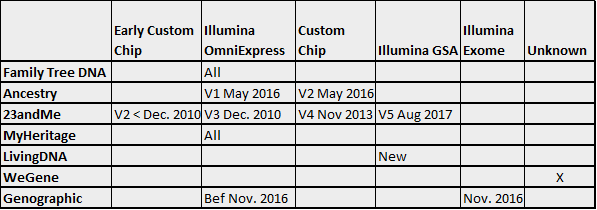
  • In March 2017, Family Tree DNA announced that they were accepting transfers of both the Ancestry V2 test, in place since May of 2016, along with the 23andMe V4 test, available since November 2013, for free. MyHeritage has since been added to that list. The Family Tree DNA announcement provided testers with another avenue for matching and advanced tools.
  • Illumina obsoleted their OmniExpress chip, forcing vendors to Illumina’s new GSA chip which also forces vendors to use imputation. I swear, imputation is a swear word. Illumina gets the lump of coal award for 2017.
  • I wrote about imputation here, but in a nutshell, the vendors are now being forced to test only about 20% of the DNA locations available on the previous Illumina chip, and impute or infer using statistics the values in the rest of the DNA locations that they previously could test.
  • Early imputation implementers include LivingDNA (ethnicity only), MyHeritage (to equalize the locations of various vendor’s different chips), DNA.Land (whose matching is far from ideal) and 23andMe, who seems, for the most part, to have done a reasonable job. Of course, the only way to tell for sure at 23andMe is to test again on the V5 chip and compare to V3 and V4 chip matches. Given that I’ve already paid 3 times to test myself at 23andMe (V2, 3 and 4), I’m not keen on paying a 4th time for the V5 version.
  • 23andMe moved to the V5 Illumina GSA chip in August which is not compatible with any earlier chip versions.
  • Needless to say, the Illumina chip change has forced vendors away from focusing on new products in order to develop imputation code in order to remain backwards compatible with their own products from an earlier chip set.
  • GedMatch introduced their sandbox area, Genesis, where people can upload files that are not compatible with the traditional vendor files.  This includes the GSA chip results (23andMe V5,) exome tests and others.  The purpose of the sandbox is so that GedMatch can figure out how to work with these files that aren’t compatible with the typical autosomal test files.  The process has been interesting and enlightening, but people either don’t understand or forget that it’s a sandbox, an experiment, for all involved – including GedMatch.  Welcome to living on the genetic frontier!

  • I assembled a chart of who loves who – meaning which vendors accept transfers from which other vendors.

  • I suspect but don’t know that Ancestry is doing some form of imputation between their V1 and V2 chips. About a month before their new chip implementation in May of 2016, Ancestry made a change in their matching routine that resulting in a significant shift in people’s matches.

Because of Ancestry’s use of the Timber algorithm to downweight some segments and strip out others altogether, it’s difficult to understand where matching issues may arise.  Furthermore, there is no way to know that there are matching issues unless you and another individual have transferred results to either Family Tree DNA or GedMatch, neither of which remove any matching segments.

  • Other developments of note include the fact that Family Tree DNA moved to mitochondrial DNA build V17 and updated their Y DNA to hg38 of the human reference genome – both huge undertakings requiring the reprocessing of customer data. Think of both of those updates as housekeeping. No one wants to do it, but it’s necessary.
  • 23andMe FINALLY finished transferring their customer base to the “New Experience,” but many of the older features we liked are now gone. However, customers can now opt in to open matching, which is a definite improvement. 23andMe, having been the first company to enter the genetic genealogy autosomal matching marketspace has really become lackluster.  They could have owned this space but chose not to focus on genealogy tools.  In my opinion, they are now relegated to fourth place out of a field of 4.
  • Ancestry has updated their Genetic Communities feature a couple of times this year. Genetic Communities is interesting and more helpful than ethnicity estimates, but neither are nearly as helpful as a chromosome browser would be.

  • I’m sure that the repeated requests, begging and community level tantrum throwing in an attempt to convince Ancestry to produce a chromosome browser is beyond beating a dead horse now. That dead horse is now skeletal, and no sign of a chromosome browser. Sigh:(
  • The good news is that anyone who wants a chromosome browser can transfer their results to Family Tree DNA or GedMatch (both for free) and utilize a chromosome browser and other tools at either or both of those locations. Family Tree DNA charges a one time $19 fee to access their advanced tools and GedMatch offers a monthly $10 subscription. Both are absolutely worth every dime. The bad news is, of course, that you have to convince your match or matches to transfer as well.
  • If you can convince your matches to transfer to (or test at) Family Tree DNA, their tools include phased Family Matching which utilizes a combination of user trees, the DNA of the tester combined with the DNA of family matches to indicate to the user which side, maternal or paternal (or both), a particular match stems from.

  • Sites to keep your eye on include Jonny Perl’s tools which include DNAPainter, as well as Goran Rundfeldt’s DNA Genealogy Experiment.  You may recall that in October Goran brought us the fantastic Triangulator tool to use with Family Tree DNA results.  A few community members expressed concern about triangulation relative to privacy, so the tool has been (I hope only temporarily) disabled as the involved parties work through the details. We need Goran’s triangulation tool! Goran has developed other world class tools as well, as you can see from his website, and I hope we see more of both Goran and Jonny in 2018.
  • In 2017, a number of new “free” sites that encourage you to upload your DNA have sprung up. My advice – remember, there really is no such thing as a free lunch.  Ask yourself why, what’s in it for them.  Review ALL OF THE documents and fine print relative to safety, privacy and what is going to be done with your DNA.  Think about what recourse you might or might not have. Why would you trust them?

My rule of thumb, if the company is outside of the US, I’m immediately slightly hesitant because they don’t fall under US laws. If they are outside of Europe or Canada, I’m even more hesitant.  If the company is associated with a country that is unfriendly to the US, I unequivocally refuse.  For example, riddle me this – what happens if a Chinese (or fill-in-the-blank country) company violates an agreement regarding your DNA and privacy?  What, exactly, are you going to do about it from wherever you live?

2017 – The Year of Marketplace Apps

Third party genetics apps are emerging and are beginning to make an impact.

GedMatch, as always, has continued to quietly add to their offerings for genetic genealogists, as had DNAGedcom.com. While these two aren’t exactly an “app”, per se, they are certainly primary players in the third party space. I use both and will be publishing an article early in 2018 about a very useful tool at DNAGedcom.

Another application that I don’t use due to the complex setup (which I’ve now tried twice and abandoned) is Genome Mate Pro which coordinates your autosomal results from multiple vendors.  Some people love this program.  I’ll try, again, in 2018 and see if I can make it all the way through the setup process.

The real news here are the new marketplace apps based on Exome testing.

Helix and their partners offer a number of apps that may be of interest for consumers.  Helix began offering a “test once, buy often” marketplace model where the consumer pays a nominal price for exome sequencing ($80), significantly under market pricing ($500), but then the consumer purchases DNA apps through the Helix store. The apps access the original DNA test to produce results. The consumer does NOT receive their downloadable raw data, only data through the apps, which is a departure from the expected norm. Then again, the consumer pays a drastically reduced price and downloadable exome results are available elsewhere for full price.

The Helix concept is that lots of apps will be developed, meaning that you, the consumer, will be interested and purchase often – allowing Helix to recoup their sequencing investment over time.

Looking at the Helix apps that are currently available, I’ve purchased all of the Insitome products released to date (Neanderthal, Regional Ancestry and Metabolism), because I have faith in Spencer Wells and truthfully, I was curious and they are reasonably priced.

Aside from the Insitome apps, I think that the personalized clothes are cute, if extremely overpriced. But what the heck, they’re fun and raise awareness of DNA testing – a good thing! After all, who am I to talk, I’ve made DNA quilts and have DNA clothing too.

Having said that, I’m extremely skeptical about some of the other apps, like “Wine Explorer.”  Seriously???

But then again, if you named an app “I Have More Money Than Brains,” it probably wouldn’t sell well.

Other apps, like Ancestry’s WeRelate (available for smartphones) is entertaining, but is also unfortunately EXTREMELY misleading.  WeRelate conflates multiple trees, generally incorrectly, to suggest to you and another person on your Facebook friends list are related, or that you are related to famous people.  Judy Russell reviews that app here in the article, “No, actually, we’re not related.” No.  Just no!

I feel strongly that companies that utilize our genetic data for anything have a moral responsibility for accuracy, and the WeRelate app clearly does NOT make the grade, and Ancestry knows that.  I really don’t believe that entertaining customers with half-truths (or less) is more important than accuracy – but then again, here I go just being an old-fashioned fuddy dud expecting ethics.

And then, there’s the snake oil.  You knew it was going to happen because there is always someone who can be convinced to purchase just about anything. Think midnight infomercials. The problem is that many consumers really don’t know how to tell snake oil from the rest in the emerging DNA field.

You can now purchase DNA testing for almost anything.  Dating, diet, exercise, your taste in wine and of course, vitamins and supplements. If you can think of an opportunity, someone will dream up a test.

How many of these are legitimate or valid?  Your guess is as good as mine, but I’m exceedingly suspicious of a great many, especially those where I can find no legitimate scientific studies to back what appear to be rather outrageous claims.

My main concern is that the entire DTC testing industry will be tarred by the brush of a few unethical opportunists.

2017 – The Year of Focus on Privacy and Security

With increased consumer exposure comes increased notoriety. People are taking notice of DNA testing and it seems that everyone has an opinion, informed or not.  There’s an old saying in marketing; “Talk about me good, talk about me bad, just talk about me.”

With all of the ads have come a commensurate amount of teeth gnashing and “the-sky-is-falling” type reporting.  Unfortunately, many politicians don’t understand this industry and open mouth only to insert foot – except that most people don’t realize what they’ve done.  I doubt that the politicians even understand that they are tasting toe-jam, because they haven’t taken the time to research and understand the industry. Sound bites and science don’t mix well.

The bad news is that next, the click-bait-focused press picks up on the stories and the next time you see anyone at lunch, they’re asking you if what they heard is true.  Or, let’s hope that they ask you instead of just accepting what they heard as gospel. Hopefully if we’ve learned anything in this past year, it’s to verify, verify, verify.

I’ve been an advocate for a very long time of increased transparency from the testing companies as to what is actually done with our DNA, and under what circumstances.  In other words, I want to know where my DNA is and what it’s being used for.  Period.

Family Tree DNA answered that question succinctly and unquestionably in December.

Bennett Greenspan: “We could probably make a lot of money by selling the DNA data that we’ve been collecting over the years, but we feel that the only person that should have your DNA information is you.  We don’t believe that it should be sold, traded or bartered.”

You can’t get more definitive than that.

DTC testing for genetic genealogy must be a self-regulating field, because the last thing we need is for the government to get involved, attempting to regulate something they don’t understand.  I truly believe government interference by the name of regulation would spell the end of genetic genealogy as we know it today.  DNA testing for genetic genealogy without sharing results is entirely pointless.

I’ve written about this topic in the past, but an update is warranted and I’ll be doing that sometime after the first of the year.  Mostly, I just need to be able to stay awake while slogging through the required reading (at some vendor sites) of page after page AFTER PAGE of legalese😊

Consumers really shouldn’t have to do that, and if they do, a short, concise summary should be presented to them BEFORE they purchase so that they can make a truly informed decision.

Stay tuned on this one.

2017 – The Year of Education

The fantastic news is that with all of the new people testing, a huge, HUGE need for education exists.  Even if 75% of the people who test don’t do anything with their results after that first peek, that still leaves a few million who are new to this field, want to engage and need some level of education.

In that vein, seminars are available through several groups and institutes, in person and online.  Almost all of the leadership in this industry is involved in some educational capacity.

In addition to agendas focused on genetic genealogy and utilizing DNA personally, almost every genealogy conference now includes a significant number of sessions on DNA methods and tools. I remember the days when we were lucky to be allowed one session on the agenda, and then generally not without begging!

When considering both DNA testing and education, one needs to think about the goal.  All customer goals are not the same, and neither are the approaches necessary to answer their questions in a relevant way.

New testers to the field fall into three primary groups today, and their educational needs are really quite different, because their goals, tools and approaches needed to reach those goals are different too.

Adoptees and genealogists employ two vastly different approaches utilizing a common tool, DNA, but for almost opposite purposes.  Adoptees wish to utilize tests and trees to come forward in time to identify either currently living or recently living people while genealogists are interested in reaching backward in time to confirm or identify long dead ancestors. Those are really very different goals.

I’ve illustrated this in the graphic above.  The tester in question uses their blue first cousin match to identify their unknown parent through the blue match’s known lineage, moving forward in time to identify the tester’s parent.  In this case, the grandparent is known to the blue match, but not to the yellow tester. Identifying the grandparent through the blue match is the needed lynchpin clue to identify the unknown parent.

The yellow tester who already knows their maternal parent utilizes their peach second cousin match to verify or maybe identify their maternal great-grandmother who is already known to the peach match, moving backwards in time. Two different goals, same DNA test.

The three types of testers are:

  • Curious ethnicity testers who may not even realize that at least some of the vendors offer matching and other tools and services.
  • Genealogists who use close relatives to prove which sides of trees matches come from, and to triangulate matching segments to specific ancestors. In other words, working from the present back in time. The peach match and line above.
  • Adoptees and parent searches where testers hope to find a parent or siblings, but failing that, close relatives whose trees overlap with each other – pointing to a descendant as a candidate for a parent. These people work forward in time and aren’t interested in triangulation or proving ancestors and really don’t care about any of those types of tools, at least not until they identify their parent.  This is the blue match above.

What these various groups of testers want and need, and therefore their priorities are different in terms of their recommendations and comments in online forums and their input to vendors. Therefore, you find Facebook groups dedicated to Adoptees, for example, but you also find adoptees in more general genetic genealogy groups where genealogists are sometimes surprised when people focused on parent searches downplay or dismiss tools such as Y DNA, mitochondrial DNA and chromosome browsers that form the bedrock foundation of what genealogists need and require.

Fortunately, there’s room for everyone in this emerging field.

The great news is that educational opportunities are abundant now. I’m listing a few of the educational opportunities for all three groups of testers, in addition to my blog of course.😊

Remember that this blog is fully searchable by keyword or phrase in the little search box in the upper right hand corner.  I see so many questions online that I’ve already answered!

Please feel free to share links of my blog postings with anyone who might benefit!

Note that these recommendations below overlap and people may well be interested in opportunities from each group – or all!!

Ethnicity

Adoptees or Parent Search

Genetic Genealogists

2018 – What’s Ahead? 

About midyear 2018, this blog will reach 1000 published articles. This is article number 939.  That’s amazing even to me!  When I created this blog in July of 2012, I wasn’t sure I’d have enough to write about.  That certainly has changed.

Beginning shortly, the tsunami of kits that were purchased during the holidays will begin producing matches, be it through DNA upgrades at Family Tree DNA, Big Y tests which were hot at year end, or new purchases through any of the vendors.  I can hardly wait, and I have my list of brick walls that need to fall.

Family Tree DNA will be providing additional STR markers extracted from the Big Y test. These won’t replace any of the 111 markers offered separately today, because the extraction through NGS testing is not as reliable as direct STR testing for those markers, but the Big Y will offer genealogists a few hundred more STRs to utilize. Yes, I said a few hundred. The exact number has not yet been finalized.

Family Tree DNA says they will also be introducing new “qualify of life improvements” along with new privacy and consent settings.  Let’s hope this means new features and tools will be released too.

MyHeritage says that they are introducing new “Discoveries” pages and a chromosome browser in January.  They have also indicated that they are working on their matching issues.  The chromosome browser is particularly good news, but matching must work accurately or the chromosome browser will show erroneous information.  Let’s hope January brings all three features.

LivingDNA indicates that they will be introducing matching in 2018.

2018 – What Can You Do?

What can you do in 2018 to improve your odds of solving genealogy questions?

  • Test relatives
  • Transfer your results to as many data bases as possible (among the ones discussed above, after reading the terms and conditions, of course)
  • If you have transferred a version of your DNA that does not produce full results, such as the Ancestry V2 or 23andMe V4 test to Family Tree DNA, consider testing on the vendor’s own chip in order to obtain all matches, not just the closest matches available from an incompatible test transfer.
  • Test Y and mitochondrial DNA at Family Tree DNA.
  • Find ways to share the stories of your ancestors.  Stories are cousin bait.  My 52 Ancestors series is living proof.  People find the stories and often have additional facts, information or even photos. Some contacts qualify for DNA testing for Y or mtDNA lines. The GREAT NEWS is that Amy Johnson Crow is resuming the #52Ancestors project for 2018, providing hints and tips each week! Who knows what you might discover by sharing?! Here’s how to start a blog if you need some assistance.  It’s easy – really!
  • Focus on the brick walls that you want to crumble and then put together both a test and analysis plan. That plan could include such things as:

o   Find out if a male representing a Y line in your tree has tested, and if not, search through autosomal results to see if a male from that paternal surname line has tested and would be amenable to an upgrade.

o   Mitochondrial DNA test people who descend through all females from various female ancestors in order to determine their origins. Y and mtDNA tests are an important part of a complete genealogy story – meaning the reasonably exhaustive search!

o   Autosomal DNA test family members from various lines with the hope that matches will match you and them both.

o   Test family members in order to confirm a particular ancestor – preferably people who descend from another child of that ancestor.

o   Making sure your own DNA is in all 4 of the major vendors’ data bases, plus GedMatch. Look at it this way, everyone who is at GedMatch or at a third party (non-testing) site had to have tested at one of the major 4 vendors – so if you are in all of the vendor’s data bases, plus GedMatch, you’re covered.

Have a wonderful New Year and let’s make 2018 the year of newly discovered ancestors and solved mysteries!

______________________________________________________________

Disclosure

I receive a small contribution when you click on some of the links to vendors in my articles. This does NOT increase the price you pay but helps me to keep the lights on and this informational blog free for everyone. Please click on the links in the articles or to the vendors below if you are purchasing products or DNA testing.

Thank you so much.

DNA Purchases and Free Transfers

Genealogy Services

Genealogy Research

2013’s Dynamic Dozen – Top Genetic Genealogy Happenings

dna 8 ball

Last year I wrote a column at the end of the year titled  “2012 Top 10 Genetic Genealogy Happenings.”  It’s amazing the changes in this industry in just one year.  It certainly makes me wonder what the landscape a year from now will look like.

I’ve done the same thing this year, except we have a dozen.  I couldn’t whittle it down to 10, partly because there has been so much more going on and so much change – or in the case of Ancestry, who is noteworthy because they had so little positive movement.

If I were to characterize this year of genetic genealogy, I would call it The Year of the SNP, because that applies to both Y DNA and autosomal.  Maybe I’d call it The Legal SNP, because it is also the year of law, court decisions, lawsuits and FDA intervention.  To say it has been interesting is like calling the Eiffel Tower an oversized coat hanger.

I’ll say one thing…it has kept those of us who work and play in this industry hopping busy!  I guarantee you, the words “I’m bored” have come out of the mouth of no one in this industry this past year.

I’ve put these events in what I consider to be relatively accurate order.  We could debate all day about whether the SNP Tsunami or the 23andMe mess is more important or relevant – and there would be lots of arguing points and counterpoints…see…I told you lawyers were involved….but in reality, we don’t know yet, and in the end….it doesn’t matter what order they are in on the list:)

Y Chromosome SNP Tsunami Begins

The SNP tsumani began as a ripple a few years ago with the introduction at Family Tree DNA of the Walk the Y program in 2007.  This was an intensively manual process of SNP discovery, but it was effective.

By the time that the Geno 2.0 chip was introduced in 2012, 12,000+ SNPs would be included on that chip, including many that were always presumed to be equivalent and not regularly tested.  However, the Nat Geo chip tested them and indeed, the Y tree became massively shuffled.  The resolution to this tree shuffling hasn’t yet come out in the wash.  Family Tree DNA can’t really update their Y tree until a publication comes out with the new tree defined.  That publication has been discussed and anticipated for some time now, but it has yet to materialize.  In the mean time, the volunteers who maintain the ISOGG tree are swamped, to say the least.

Another similar test is the Chromo2 introduced this year by Britain’s DNA which scans 15,000 SNPs, many of them S SNPs not on the tree nor academically published, adding to the difficulty of figuring out where they fit on the Y tree.  While there are some very happy campers with their Chromo2 results, there is also a great deal of sloppy science, reporting and interpretation of “facts” through this company.  Kind of like Jekyll and Hyde.  See the Sloppy Science section.

But Walk the Y, Chromo2 and Geno 2.0, are only the tip of the iceburg.  The new “full Y” sequencing tests brought into the marketspace quietly in early 2013 by Full Genomes and then with a bang by Family Tree DNA with the their Big Y in November promise to revolutionize what we know about the Y chromosome by discovering thousands of previously unknown SNPs.  This will in effect swamp the Y tree whose branches we thought were already pretty robust, with thousands and thousands of leaves.

In essence, the promise of the “fully” sequenced Y is that what we might term personal or family SNPs will make SNP testing as useful as STR testing and give us yet another genealogy tool with which to separate various lines of one genetic family and to ratchet down on the time that the most common recent ancestor lived.

http://dna-explained.com/2013/03/31/new-y-dna-haplogroup-naming-convention/

http://dna-explained.com/2013/11/10/family-tree-dna-announces-the-big-y/

http://dna-explained.com/2013/11/16/what-about-the-big-y/

http://www.yourgeneticgenealogist.com/2013/11/first-look-at-full-genomes-y-sequencing.html

http://cruwys.blogspot.com/2013/12/a-first-look-at-britainsdna-chromo-2-y.html

http://cruwys.blogspot.com/2013/11/yseqnet-new-company-offering-single-snp.html

http://cruwys.blogspot.com/2013/11/the-y-chromosome-sequence.html

http://cruwys.blogspot.com/2013/11/a-confusion-of-snps.html

http://cruwys.blogspot.com/2013/11/a-simplified-y-tree-and-common-standard.html

23andMe Comes Unraveled

The story of 23andMe began as the consummate American dotcom fairy tale, but sadly, has deteriorated into a saga with all of the components of a soap opera.  A wealthy wife starts what could be viewed as an upscale hobby business, followed by a messy divorce and a mystery run-in with the powerful overlording evil-step-mother FDA.  One of the founders of 23andMe is/was married to the founder of Google, so funding, at least initially wasn’t an issue, giving 23andMe the opportunity to make an unprecedented contribution in the genetic, health care and genetic genealogy world.

Another way of looking at this is that 23andMe is the epitome of the American Dream business, a startup, with altruism and good health, both thrown in for good measure, well intentioned, but poorly managed.  And as customers, be it for health or genealogy or both, we all bought into the altruistic “feel good” culture of helping find cures for dread diseases, like Parkinson’s, Alzheimer’s and cancer by contributing our DNA and responding to surveys.

The genetic genealogy community’s love affair with 23andMe began in 2009 when 23andMe started focusing on genealogy reporting for their tests, meaning cousin matches.  We, as a community, suddenly woke up and started ordering these tests in droves.  A few months later, Family Tree DNA also began offering this type of testing as well.  The defining difference being that 23andMe’s primary focus has always been on health and medical information with Family Tree DNA focused on genetic genealogy.  To 23andMe, the genetic genealogy community was an afterthought and genetic genealogy was just another marketing avenue to obtain more people for their health research data base.  For us, that wasn’t necessarily a bad thing.

For awhile, this love affair went along swimmingly, but then, in 2012, 23andMe obtained a patent for Parkinson’s Disease.  That act caused a lot of people to begin to question the corporate focus of 23andMe in the larger quagmire of the ethics of patenting genes as a whole.  Judy Russell, the Legal Genealogist, discussed this here.  It’s difficult to defend 23andMe’s Parkinson’s patent while flaying alive Myriad for their BRCA patent.  Was 23andMe really as altruistic as they would have us believe?

Personally, this event made me very nervous, but I withheld judgment.  But clearly, that was not the purpose for which I thought my DNA, and others, was being used.

But then came the Designer Baby patent in 2013.  This made me decidedly uncomfortable.  Yes, I know, some people said this really can’t be done, today, while others said that it’s being done anyway in some aspects…but the fact that this has been the corporate focus of 23andMe with their research, using our data, bothered me a great deal.  I have absolutely no issue with using this information to assure or select for healthy offspring – but I have a personal issue with technology to enable parents who would select a “beauty child,” one with blonde hair and blue eyes and who has the correct muscles to be a star athlete, or cheerleader, or whatever their vision of their as-yet-unconceived “perfect” child would be.  And clearly, based on 23andMe’s own patent submission, that is the focus of their patent.

Upon the issuance of the patent, 23andMe then said they have no intention of using it.  They did not say they won’t sell it.  This also makes absolutely no business sense, to focus valuable corporate resources on something you have no intention of using?  So either they weren’t being truthful, they lack effective management or they’ve changed their mind, but didn’t state such.

What came next, in late 2013 certainly points towards a lack of responsible management.

23andMe had been working with the FDA for approval the health and medical aspect of their product (which they were already providing to consumers prior to the November 22nd cease and desist order) for several years.  The FDA wants assurances that what 23andMe is telling consumers is accurate.  Based on the letter issued to 23andMe on November 22nd, and subsequent commentary, it appears that both entities were jointly working towards that common goal…until earlier this year when 23andMe mysteriously “somehow forgot” about the FDA, the information they owed them, their submissions, etc.  They also forgot their phone number and their e-mail addresses apparently as well, because the FDA said they had heard nothing from them in 6 months, which backdates to May of 2013.

It may be relevant that 23andMe added the executive position of President and filled it in June of 2013, and there was a lot of corporate housecleaning that went on at that time.  However, regardless of who got housecleaned, the responsibility for working with the FDA falls squarely on the shoulders of the founders, owners and executives of the company.  Period.  No excuses.  Something that critically important should be on the agenda of every executive management meeting.   Why?  In terms of corporate risk, this was obviously a very high risk item, perhaps the highest risk item, because the FDA can literally shut their doors and destroy them.  There is little they can do to control or affect the FDA situation, except to work with the FDA, meet deadlines and engender goodwill and a spirit of cooperation.  The risk of not doing that is exactly what happened.

It’s unknown at this time if 23andMe is really that corporately arrogant to think they could simply ignore the FDA, or blatantly corporately negligent or maybe simply corporately stupid, but they surely betrayed the trust and confidence of their customers by failing to meet their commitments with and to the FDA, or even communicate with them.  I mean, really, what were they thinking?

There has been an outpouring of sympathy for 23andme and negative backlash towards the FDA for their letter forcing 23andMe to stop selling their offending medical product, meaning the health portion of their testing.  However, in reality, the FDA was only meting out the consequences that 23andMe asked for.  My teenage kids knew this would happen.  If you do what you’re not supposed to….X, Y and Z will, or won’t, happen.  It’s called accountability.  Just ask my son about his prom….he remembers vividly.  Now why my kids, or 23andMe, would push an authority figure to that point, knowing full well the consequences, utterly mystifies me.  It did when my son was a teenager and it does with 23andMe as well.

Some people think that the FDA is trying to stand between consumers and their health information.  I don’t think so, at least not in this case.  Why I think that is because the FDA left the raw data files alone and they left the genetic genealogy aspect alone.  The FDA knows full well you can download your raw data and for $5 process it at a third party site, obtaining health related genetic information.  The difference is that Promethease is not interpreting any data for you, only providing information.

There is some good news in this and that is that from a genetic genealogy perspective, we seem to be safe, at least for now, from government interference with the testing that has been so productive for genetic genealogy.  The FDA had the perfect opportunity to squish us like a bug (thanks to the opening provided by 23andMe,) and they didn’t.

The really frustrating aspect of this is that 23andMe was a company who, with their deep pockets in Silicon Valley and other investors, could actually afford to wage a fight with the FDA, if need be.  The other companies who received the original 2010 FDA letter all went elsewhere and focused on something else.  But 23andMe didn’t, they decided to fight the fight, and we all supported their decision.  But they let us all down.  The fight they are fighting now is not the battle we anticipated, but one brought upon themselves by their own negligence.  This battle didn’t have to happen, and it may impair them financially to such a degree that if they need to fight the big fight, they won’t be able to.

Right now, 23andMe is selling their kits, but only as an ancestry product as they work through whatever process they are working through with the FDA.  Unfortunately, 23andMe is currently having some difficulties where the majority of matches are disappearing from some testers records.  In other cases, segments that previously matched are disappearing.  One would think, with their only revenue stream for now being the genetic genealogy marketspace that they would be wearing kid gloves and being extremely careful, but apparently not.  They might even consider making some of the changes and enhancements we’ve requested for so long that have fallen on deaf ears.

One thing is for sure, it will be extremely interesting to see where 23andMe is this time next year.  The soap opera continues.

I hope for the sake of all of the health consumers, both current and (potentially) future, that this dotcom fairy tale has a happy ending.

Also, see the Autosomal DNA Comes of Age section.

http://dna-explained.com/2013/10/05/23andme-patents-technology-for-designer-babies/

http://www.thegeneticgenealogist.com/2013/10/07/a-new-patent-for-23andme-creates-controversy/

http://dna-explained.com/2013/11/13/genomics-law-review-discusses-designing-children/

http://www.thegeneticgenealogist.com/2013/06/11/andy-page-fills-new-president-position-at-23andme/

http://dna-explained.com/2013/11/25/fda-orders-23andme-to-discontinue-testing/

http://dna-explained.com/2013/11/26/now-what-23andme-and-the-fda/

http://dna-explained.com/2013/12/06/23andme-suspends-health-related-genetic-tests/

http://www.legalgenealogist.com/blog/2013/11/26/fooling-with-fda/

Supreme Court Decision – Genes Can’t Be Patented – Followed by Lawsuits

In a landmark decision, the Supreme Court determined that genes cannot be patented.  Myriad Genetics held patents on two BRCA genes that predisposed people to cancer.  The cost for the tests through Myriad was about $3000.  Six hours after the Supreme Court decision, Gene By Gene announced that same test for $995.  Other firms followed suit, and all were subsequently sued by Myriad for patent infringement.  I was shocked by this, but as one of my lawyer friends clearly pointed out, you can sue anyone for anything.  Making it stick is yet another matter.  Many firms settle to avoid long and very expensive legal battles.  Clearly, this issue is not yet resolved, although one would think a Supreme Court decision would be pretty definitive.  It potentially won’t be settled for a long time.

http://dna-explained.com/2013/06/13/supreme-court-decision-genes-cant-be-patented/

http://www.legalgenealogist.com/blog/2013/06/14/our-dna-cant-be-patented/

http://dna-explained.com/2013/09/07/message-from-bennett-greenspan-free-my-genes/

http://www.thegeneticgenealogist.com/2013/06/13/new-press-release-from-dnatraits-regarding-the-supreme-courts-holding-in-myriad/

http://www.legalgenealogist.com/blog/2013/08/18/testing-firms-land-counterpunch/

http://www.legalgenealogist.com/blog/2013/07/11/myriad-sues-genetic-testing-firms/

Gene By Gene Steps Up, Ramps Up and Produces

As 23andMe comes unraveled and Ancestry languishes in its mediocrity, Gene by Gene, the parent company of Family Tree DNA has stepped up to the plate, committed to do “whatever it takes,” ramped up the staff both through hiring and acquisitions, and is producing results.  This is, indeed, a breath of fresh air for genetic genealogists, as well as a welcome relief.

http://dna-explained.com/2013/08/07/gene-by-gene-acquires-arpeggi/

http://dna-explained.com/2013/12/05/family-tree-dna-listens-and-acts/

http://dna-explained.com/2013/12/10/family-tree-dnas-family-finder-match-matrix-released/

http://www.haplogroup.org/ftdna-family-finder-matches-get-new-look/

http://www.haplogroup.org/ftdna-family-finder-new-look-2/

http://www.haplogroup.org/ftdna-family-finder-matches-new-look-3/

Autosomal DNA Comes of Age

Autosomal DNA testing and analysis has simply exploded this past year.  More and more people are testing, in part, because Ancestry.com has a captive audience in their subscription data base and more than a quarter million of those subscribers have purchased autosomal DNA tests.  That’s a good thing, in general, but there are some negative aspects relative to Ancestry, which are in the Ancestry section.

Another boon to autosomal testing was the 23andMe push to obtain a million records.  Of course, the operative word here is “was” but that may revive when the FDA issue is resolved.  One of the down sides to the 23andMe data base, aside from the fact that it’s not genealogist friendly, is that so many people, about 90%, don’t communicate.  They aren’t interested in genealogy.

A third factor is that Family Tree DNA has provided transfer ability for files from both 23andMe and Ancestry into their data base.

Fourth is the site, GedMatch, at www.gedmatch.com which provides additional matching and admixture tools and the ability to match below thresholds set by the testing companies.  This is sometimes critically important, especially when comparing to known cousins who just don’t happen to match at the higher thresholds, for example.  Unfortunately, not enough people know about GedMatch, or are willing to download their files.  Also unfortunate is that GedMatch has struggled for the past few months to keep up with the demand placed on their site and resources.

A great deal of time this year has been spent by those of us in the education aspect of genetic genealogy, in whatever our capacity, teaching about how to utilize autosomal results. It’s not necessarily straightforward.  For example, I wrote a 9 part series titled “The Autosomal Me” which detailed how to utilize chromosome mapping for finding minority ethnic admixture, which was, in my case, both Native and African American.

As the year ends, we have Family Tree DNA, 23andMe and Ancestry who offer the autosomal test which includes the relative-matching aspect.  Fortunately, we also have third party tools like www.GedMatch.com and www.DNAGedcom.com, without which we would be significantly hamstrung.  In the case of DNAGedcom, we would be unable to perform chromosome segment matching and triangulation with 23andMe data without Rob Warthen’s invaluable tool.

http://dna-explained.com/2013/06/21/triangulation-for-autosomal-dna/

http://dna-explained.com/2013/07/13/combining-tools-autosomal-plus-y-dna-mtdna-and-the-x-chromosome/

http://dna-explained.com/2013/07/26/family-tree-dna-levels-the-playing-field-sort-of/

http://dna-explained.com/2013/08/03/kitty-coopers-chromsome-mapping-tool-released/

http://dna-explained.com/2013/09/29/why-dont-i-match-my-cousin/

http://dna-explained.com/2013/10/03/family-tree-dna-updates-family-finder-and-adds-triangulation/

http://dna-explained.com/2013/10/21/why-are-my-predicted-cousin-relationships-wrong/

http://dna-explained.com/2013/12/05/family-tree-dna-listens-and-acts/

http://dna-explained.com/2013/12/09/chromosome-mapping-aka-ancestor-mapping/

http://dna-explained.com/2013/12/10/family-tree-dnas-family-finder-match-matrix-released/

http://dna-explained.com/2013/12/15/one-chromosome-two-sides-no-zipper-icw-and-the-matrix/

http://dna-explained.com/2013/06/02/the-autosomal-me-summary-and-pdf-file/

DNAGedcom – Indispensable Third Party Tool

While this tool, www.dnagedcom.com, falls into the Autosomal grouping, I have separated it out for individual mention because without this tool, the progress made this year in autosomal DNA ancestor and chromosomal mapping would have been impossible.  Family Tree DNA has always provided segment matching boundaries through their chromosome browser tool, but until recently, you could only download 5 matches at a time.  This is no longer the case, but for most of the year, Rob’s tool saved us massive amounts of time.

23andMe does not provide those chromosome boundaries, but utilizing Rob’s tool, you can obtain each of your matches in one download, and then you can obtain the list of who your matches match that is also on your match list by requesting each of those files separately.  Multiple steps?  Yes, but it’s the only way to obtain this information, and chromosome mapping without the segment data is impossible

A special hats off to Rob.  Please remember that Rob’s site is free, meaning it’s donation based.  So, please donate if you use the tool.

http://www.yourgeneticgenealogist.com/2013/01/brought-to-you-by-adoptiondna.html

I covered www.Gedmatch.com in the “Best of 2012” list, but they have struggled this year, beginning when Ancestry announced that raw data file downloads were available.  GedMatch consists of two individuals, volunteers, who are still struggling to keep up with the required processing and the tools.  They too are donation based, so don’t forget about them if you utilize their tools.

Ancestry – How Great Thou Aren’t

Ancestry is only on this list because of what they haven’t done.  When they initially introduced their autosomal product, they didn’t have any search capability, they didn’t have a chromosome browser and they didn’t have raw data file download capability, all of which their competitors had upon first release.  All they did have was a list of your matches, with their trees listed, with shakey leaves if you shared a common ancestor on your tree.  The implication, was, and is, of course, that if you have a DNA match and a shakey leaf, that IS your link, your genetic link, to each other.  Unfortunately, that is NOT the case, as CeCe Moore documented in her blog from Rootstech (starting just below the pictures) as an illustration of WHY we so desperately need a chromosome browser tool.

In a nutshell, Ancestry showed the wrong shakey leaf as the DNA connection – as proven by the fact that both of CeCe’s parents have tested at Ancestry and the shakey leaf person doesn’t match the requisite parent.  And there wasn’t just one, not two, but three instances of this.  What this means is, of course, that the DNA match and the shakey leaf match are entirely independent of each other.  In fact, you could have several common ancestors, but the DNA at any particular location comes only from one on either Mom or Dad’s side – any maybe not even the shakey leaf person.

So what Ancestry customers are receiving is a list of people they match and possible links, but most of them have no idea that this is the case, and blissfully believe they have found their genetic connection.  They have found a genealogical cousin, and it MIGHT be the genetic connection.  But then again, they could have found that cousin simply by searching for the same ancestor in Ancestry’s data base.  No DNA needed.

Ancestry has added a search feature, allowed raw data file downloads (thank you) and they have updated their ethnicity predictions.  The ethnicity predictions are certainly different, dramatically different, but equally as unrealistic.  See the Ethnicity Makeovers section for more on this.  The search function helps, but what we really need is the chromosome browser, which they have steadfastly avoided promising.  Instead, they have said that they will give us “something better,” but nothing has materialized.

I want to take this opportunity, to say, as loudly as possible, that TRUST ME IS NOT ACCEPTABLE in any way, shape or form when it comes to genetic matching.  I’m not sure what Ancestry has in mind by the way of “better,” but it if it’s anything like the mediocrity with which their existing DNA products have been rolled out, neither I nor any other serious genetic genealogist will be interested, satisfied or placated.

Regardless, it’s been nearly 2 years now.  Ancestry has the funds to do development.  They are not a small company.  This is obviously not a priority because they don’t need to develop this feature.  Why is this?  Because they can continue to sell tests and to give shakey leaves to customers, most of whom don’t understand the subtle “untruth” inherent in that leaf match – so are quite blissfully happy.

In years past, I worked in the computer industry when IBM was the Big Dog against whom everyone else competed.  I’m reminded of an old joke.  The IBM sales rep got married, and on his wedding night, he sat on the edge of the bed all night long regaling his bride in glorious detail with stories about just how good it was going to be….

You can sign a petition asking Ancestry to provide a chromosome browser here, and you can submit your request directly to Ancestry as well, although to date, this has not been effective.

The most frustrating aspect of this situation is that Ancestry, with their plethora of trees, savvy marketing and captive audience testers really was positioned to “do it right,” and hasn’t, at least not yet.  They seem to be more interested in selling kits and providing shakey leaves that are misleading in terms of what they mean than providing true tools.  One wonders if they are afraid that their customers will be “less happy” when they discover the truth and not developing a chromosome browser is a way to keep their customers blissfully in the dark.

http://dna-explained.com/2013/03/21/downloading-ancestrys-autosomal-dna-raw-data-file/

http://dna-explained.com/2013/03/24/ancestry-needs-another-push-chromosome-browser/

http://dna-explained.com/2013/10/17/ancestrys-updated-v2-ethnicity-summary/

http://www.thegeneticgenealogist.com/2013/06/21/new-search-features-at-ancestrydna-and-a-sneak-peek-at-new-ethnicity-estimates/

http://www.yourgeneticgenealogist.com/2013/03/ancestrydna-raw-data-and-rootstech.html

http://www.legalgenealogist.com/blog/2013/09/15/dna-disappointment/

http://www.legalgenealogist.com/blog/2013/09/13/ancestrydna-begins-rollout-of-update/

Ancient DNA

This has been a huge year for advances in sequencing ancient DNA, something once thought unachievable.  We have learned a great deal, and there are many more skeletal remains just begging to be sequenced.  One absolutely fascinating find is that all people not African (and some who are African through backmigration) carry Neanderthal and Denisovan DNA.  Just this week, evidence of yet another archaic hominid line has been found in Neanderthal DNA and on Christmas Day, yet another article stating that type 2 Diabetes found in Native Americans has roots in their Neanderthal ancestors. Wow!

Closer to home, by several thousand years is the suggestion that haplogroup R did not exist in Europe after the ice age, and only later, replaced most of the population which, for males, appears to have been primarily haplogroup G.  It will be very interesting as the data bases of fully sequenced skeletons are built and compared.  The history of our ancestors is held in those precious bones.

http://dna-explained.com/2013/01/10/decoding-and-rethinking-neanderthals/

http://dna-explained.com/2013/07/04/ancient-dna-analysis-from-canada/

http://dna-explained.com/2013/07/10/5500-year-old-grandmother-found-using-dna/

http://dna-explained.com/2013/10/25/ancestor-of-native-americans-in-asia-was-30-western-eurasian/

http://dna-explained.com/2013/11/12/2013-family-tree-dna-conference-day-2/

http://dna-explained.com/2013/11/22/native-american-gene-flow-europe-asia-and-the-americas/

http://dna-explained.com/2013/12/05/400000-year-old-dna-from-spain-sequenced/

http://www.thegeneticgenealogist.com/2013/10/16/identifying-otzi-the-icemans-relatives/

http://cruwys.blogspot.com/2013/12/recordings-of-royal-societys-ancient.html

http://cruwys.blogspot.com/2013/02/richard-iii-king-is-found.html

http://dna-explained.com/2013/12/22/sequencing-of-neanderthal-toe-bone-reveals-unknown-hominin-line/

http://dna-explained.com/2013/12/26/native-americans-neanderthal-and-denisova-admixture/

http://dienekes.blogspot.com/2013/12/ancient-dna-what-2013-has-brought.html

Sloppy Science and Sensationalist Reporting

Unfortunately, as DNA becomes more mainstream, it becomes a target for both sloppy science or intentional misinterpretation, and possibly both.  Unfortunately, without academic publication, we can’t see results or have the sense of security that comes from the peer review process, so we don’t know if the science and conclusions stand up to muster.

The race to the buck in some instances is the catalyst for this. In other cases, and not in the links below, some people intentionally skew interpretations and results in order to either fulfill their own belief agenda or to sell “products and services” that invariably report specific findings.

It’s equally as unfortunate that much of these misconstrued and sensationalized results are coming from a testing company that goes by the names of BritainsDNA, ScotlandsDNA, IrelandsDNA and YorkshiresDNA. It certainly does nothing for their credibility in the eyes of people who are familiar with the topics at hand, but it does garner a lot of press and probably sells a lot of kits to the unwary.

I hope they publish their findings so we can remove the “sloppy science” aspect of this.  Sensationalist reporting, while irritating, can be dealt with if the science is sound.  However, until the results are published in a peer-reviewed academic journal, we have no way of knowing.

Thankfully, Debbie Kennett has been keeping her thumb on this situation, occurring primarily in the British Isles.

http://dna-explained.com/2013/08/24/you-might-be-a-pict-if/

http://cruwys.blogspot.com/2013/12/the-british-genetic-muddle-by-alistair.html

http://cruwys.blogspot.com/2013/12/setting-record-straight-about-sara.html

http://cruwys.blogspot.com/2013/09/private-eye-on-britainsdna.html

http://cruwys.blogspot.com/2013/07/private-eye-on-prince-williams-indian.html

http://cruwys.blogspot.com/2013/06/britainsdna-times-and-prince-william.html

http://cruwys.blogspot.com/2013/03/sense-about-genealogical-dna-testing.html

http://cruwys.blogspot.com/2013/03/sense-about-genetic-ancestry-testing.html

Citizen Science is Coming of Age

Citizen science has been slowing coming of age over the past few years.  By this, I mean when citizen scientists work as part of a team on a significant discovery or paper.  Bill Hurst comes to mind with his work with Dr. Doron Behar on his paper, A Copernican Reassessment of the Human Mitochondrial DNA from its Root or what know as the RSRS model.  As the years have progressed, more and more discoveries have been made or assisted by citizen scientists, sometimes through our projects and other times through individual research.  JOGG, the Journal of Genetic Genealogy, which is currently on hiatus waiting for Dr. Turi King, the new editor, to become available, was a great avenue for peer reviewed publication.  Recently, research projects have been set up by citizen scientists, sometimes crowd-funded, for specific areas of research.  This is a very new aspect to scientific research, and one not before utilized.

The first paper below includes the Family Tree DNA Lab, Thomas and Astrid Krahn, then with Family Tree DNA and Bonnie Schrack, genetic genealogist and citizen scientist, along with Dr. Michael Hammer from the University of Arizona and others.

http://dna-explained.com/2013/03/26/family-tree-dna-research-center-facilitates-discovery-of-ancient-root-to-y-tree/

http://dna-explained.com/2013/04/10/diy-dna-analysis-genomeweb-and-citizen-scientist-2-0/

http://dna-explained.com/2013/06/27/big-news-probable-native-american-haplogroup-breakthrough/

http://dna-explained.com/2013/07/22/citizen-science-strikes-again-this-time-in-cameroon/

http://dna-explained.com/2013/11/30/native-american-haplogroups-q-c-and-the-big-y-test/

http://www.yourgeneticgenealogist.com/2013/03/citizen-science-helps-to-rewrite-y.html

Ethnicity Makeovers – Still Not Soup

Unfortunately, ethnicity percentages, as provided by the major testing companies still disappoint more than thrill, at least for those who have either tested at more than one lab or who pretty well know their ethnicity via an extensive pedigree chart.

Ancestry.com is by far the worse example, swinging like a pendulum from one extreme to the other.  But I have to hand it to them, their marketing is amazing.  When I signed in, about to discover that my results had literally almost reversed, I was greeted with the banner “a new you.”  Yea, a new me, based on Ancestry’s erroneous interpretation.  And by reversed, I’m serious.  I went from 80% British Isles to 6% and then from 0% Western Europe to 79%. So now, I have an old wrong one and a new wrong one – and indeed they are very different.  Of course, neither one is correct…..but those are just pesky details…

23andMe updated their ethnicity product this year as well, and fine tuned it yet another time.  My results at 23andMe are relatively accurate.  I saw very little change, but others saw more.  Some were pleased, some not.

The bottom line is that ethnicity tools are not well understood by consumers in terms of the timeframe that is being revealed, and it’s not consistent between vendors, nor are the results.  In some cases, they are flat out wrong, as with Ancestry, and can be proven.  This does not engender a great deal of confidence.  I only view these results as “interesting” or utilize them in very specific situations and then only using the individual admixture tools at www.Gedmatch.com on individual chromosome segments.

As Judy Russell says, “it’s not soup yet.”  That doesn’t mean it’s not interesting though, so long as you understand the difference between interesting and gospel.

http://dna-explained.com/2013/08/05/autosomal-dna-ancient-ancestors-ethnicity-and-the-dandelion/

http://dna-explained.com/2013/10/04/ethnicity-results-true-or-not/

http://www.legalgenealogist.com/blog/2013/09/15/dna-disappointment/

http://cruwys.blogspot.com/2013/09/my-updated-ethnicity-results-from.html?utm_source=feedburner&utm_medium=email&utm_campaign=Feed%3A+Cruwysnews+%28Cruwys+news%29

http://dna-explained.com/2013/10/17/ancestrys-updated-v2-ethnicity-summary/

http://dna-explained.com/2013/10/19/determining-ethnicity-percentages/

http://www.thegeneticgenealogist.com/2013/09/12/ancestrydna-launches-new-ethnicity-estimate/

http://cruwys.blogspot.com/2013/12/a-first-look-at-chromo-2-all-my.html

Genetic Genealogy Education Goes Mainstream

With the explosion of genetic genealogy testing, as one might expect, the demand for education, and in particular, basic education has exploded as well.

I’ve written a 101 series, Kelly Wheaton wrote a series of lessons and CeCe Moore did as well.  Recently Family Tree DNA has also sponsored a series of free Webinars.  I know that at least one book is in process and very near publication, hopefully right after the first of the year.  We saw several conferences this year that provided a focus on Genetic Genealogy and I know several are planned for 2014.  Genetic genealogy is going mainstream!!!  Let’s hope that 2014 is equally as successful and that all these folks asking for training and education become avid genetic genealogists.

http://dna-explained.com/2013/08/10/ngs-series-on-dna-basics-all-4-parts/

https://sites.google.com/site/wheatonsurname/home

http://www.yourgeneticgenealogist.com/2012/08/getting-started-in-dna-testing-for.html

http://dna-explained.com/2013/12/17/free-webinars-from-family-tree-dna/

http://www.thegeneticgenealogist.com/2013/06/09/the-first-dna-day-at-the-southern-california-genealogy-society-jamboree/

http://www.yourgeneticgenealogist.com/2013/06/the-first-ever-independent-genetic.html

http://cruwys.blogspot.com/2013/10/genetic-genealogy-comes-to-ireland.html

http://cruwys.blogspot.com/2013/03/wdytya-live-day-3-part-2-new-ancient.html

http://cruwys.blogspot.com/2013/03/who-do-you-think-you-are-live-day-3.html

http://cruwys.blogspot.com/2013/03/who-do-you-think-you-are-live-2013-days.html

http://genealem-geneticgenealogy.blogspot.com/2013/03/the-surnames-handbook-guide-to-family.html

http://www.isogg.org/wiki/Beginners%27_guides_to_genetic_genealogy

A Thank You in Closing

I want to close by taking a minute to thank the thousands of volunteers who make such a difference.  All of the project administrators at Family Tree DNA are volunteers, and according to their website, there are 7829 projects, all of which have at least one administrator, and many have multiple administrators.  In addition, everyone who answers questions on a list or board or on Facebook is a volunteer.  Many donate their time to coordinate events, groups, or moderate online facilities.  Many speak at events or for groups.  Many more write articles for publications from blogs to family newsletters.  Additionally, there are countless websites today that include DNA results…all created and run by volunteers, not the least of which is the ISOGG site with the invaluable ISOGG wiki.  Without our volunteer army, there would be no genetic genealogy community.  Thank you, one and all.

2013 has been a banner year, and 2014 holds a great deal of promise, even without any surprises.  And if there is one thing this industry is well known for….it’s surprises.  I can’t wait to see what 2014 has in store for us!!!  All I can say is hold on tight….

______________________________________________________________

Disclosure

I receive a small contribution when you click on some of the links to vendors in my articles. This does NOT increase the price you pay but helps me to keep the lights on and this informational blog free for everyone. Please click on the links in the articles or to the vendors below if you are purchasing products or DNA testing.

Thank you so much.

DNA Purchases and Free Transfers

Genealogy Services

Genealogy Research

Now What? – 23andMe and the FDA

I’m sure everyone reading this knows by now that 23andMe has been ordered to stop marketing their DNA test until they comply with previous FDA requirements.  I wrote about this earlierForbes and several others have weighed in too.  The Forbes article is particularly interesting because it is written by Matthew Herper who has covered the FDA for 13 years, so has significant perspective.

Since that time, a firestorm of questions, comments and emotions have been forthcoming, from all directions.  As consumers, we feel trapped, caught in the middle of a battle, along with our DNA and results.  And sadly, it looks like the battle didn’t have to occur, had 23andMe not ignored the FDA for months after promising results it never delivered.   I want to make a couple of comments, then talk about what we, as consumers, can do to prepare for the worst case.

But before I do that, I want to make it very clear that I don’t expect that the worst case scenario will happen.  What would that be?  23andMe going out of business.  I don’t think that will happen.  Even though they, according to the FDA letter, have been negligent in taking care of business and meeting their commitments, they have bright minds and deep pockets….and 15 days to make some sort of conciliatory peace with the FDA.  Now I’m not a psychic, but I’m betting that 23andMe headquarters is very busily figuring out all of the things they need to do to put this ugly public chapter behind them.  Of course, I could be wrong.  This could be the death knell for 23andMe.  But I don’t think so, unless they cannot prove the accuracy of their product or they continue to ignore the FDA and fail to meet commitments.

Most of the questions and concerns voiced today by consumers revolve around what will happen to results they already have on the 23andMe website.

There is no reason to think that the results would be removed as long as the website is functional.  And their website is their link with the world, so as long as there is 23andMe, there will be a website.

However, the unthinkable has happened before, and 23andMe appears to have been somewhat negligent, so, just in case, what can we do?

1. Print your health results for future reference

On your personal page at 23andMe, select the “Health Overview” option which will then display your elevated risks in each of 4 option categories..

23andMe FDA1

For each of the 4 sections, Health Risks, Inherited Conditions, Traits and Drug Response, there is a blue link at the bottom that says “see all 122 risk reports,” for example.  Click on the “see all” link and then simply print the results in each of the 4 categories.  If you want to preserve any of the more detailed information in any of the categories, you’ll have to use screen shots.

2. Download your raw data file

Regardless of what you do, or don’t, do with these results, they are yours.  After downloading your file, you can simply save the results for later, you can upload them to donation based www.gedmatch.com (when GedMatch is again accepting files, currently estimated to be Dec.1) or you can transfer your file to Family Tree DNA to add your results to their data base and avail yourself of their matches and tools.  Right now, the transfer price for either 23andMe or Ancestry files is only $49, which is significantly less than taking a new test at $99 (although the $99 test currently comes with a $100 restaurant.com giftcard.)  This gives you the ability to find new matches with people who haven’t tested at 23andMe.

23andme fda2

To download your raw data file at 23andMe, sign on to your account, then click on your name in the upper right hand corner of the screen, then on “Browse Raw Data,” then on “Download” in the upper right hand corner of the screen.  You’ll then be prompted for your password again and the answer to your secret question.  Default will be set to download all data.  Leave it that way.  You’ll then be asked if you want to open the file or save it.  Save it.  On a Windows PC, if you don’t direct otherwise, it will be saved in the Downloads directory with a file name where the word “genome_” preceeds the name of the person who tested.  Mine is “genome_Roberta_Estes_Full_20131125XXXXXX.

Word of Warning…..

In the past month, 3 of the 5 files I’ve downloaded from 23andMe have been incomplete.  I’ve been working with 23andMe for three very frustrating weeks now via e-mail to try to figure out why they are incomplete.  So far, I have no answers and I’ve asked if these incomplete files have affected my (and my families) results posted at 23andMe.  To date, I’m still getting their standard reply about not being responsible for third party upload sites, which of course is not the question I asked, at all.

A normal 23andMe file will have about 950,000 rows on a spreadsheet, each one representing a single location tested.  23andMe confirmed this number last week.  For example, I have 991,000 plus change and my niece has 960,000 plus change.  All 3 of the incomplete files have only 574,515 lines each, exactly.  And yes, all of them are build 37, and no, they did not test at the same time.  I even downloaded them a second, third and fourth time, from different locations using different computers, etc.  The files are simply massively incomplete.

These incomplete files cannot be uploaded and utilized by other tools (www.gedmatch.com) or firms, including Family Tree DNA because 40% of the data is missing.

Given this experience, the FDA’s concerns about accuracy have certainly given me pause to reflect….

You can get a good idea as to whether your file is complete or not by the zipped file size when it downloads.  The zipped size of the incomplete files is around 5K (4901 to be exact) and the zipped size of the correct files is about 8K (8262 and 8013K to be exact).

Good luck getting help if your file is incomplete.  In order to contact the 23andMe customer service department, you have to jump through hoops, stand on your head, pat your stomach and rub your foot at the same time while chewing gum and blowing bubbles.  Ok, tiny exaggeration.  You really only have to click on “help” then use the “what’s your question” function, and then at the end of that exercize when you don’t receive the answer you need, you can submit a question to them via a form….but not until you go through that process.  They’ll get back with you in about a week with a canned reply and then you can begin the back and forth dialogue, with 2-3 day intervals between each e-mail.

3. Contact your matches

If you haven’t contacted all of your matches already, now would be a wonderful time to send invitations.  I send a message with each one that includes my e-mail address.  Unfortunately, you are forced to utilize the in-house messaging system at 23andMe, so unless you’ve exchanged e-mail addresses with your matches, if the 23andMe system goes away, you have no way to contact anyone ever again.

4. Send your e-mail address to all of the people who have already accepted match requests

Obviously, this is for the same reason.  Otherwise, your ability to communicate with your matches will disappear if the website does.  Personally I far prefer e-mail rather than the messaging system anyway, so this is not a wasted opportunity.

I want to say, again, that I don’t believe that anything horrible will happen to 23andMe.  I don’t want to be an alarmist.  They have deep pockets and lots of lawyers.  They may get a slap on the hand, but in the long run, I think they’ll be around in one form or another, assuming, of course, that they can prove their results are accurate.  I do have to ask myself why 23andMe has been unable to do this in 5 years.  Was it just not a priority, corporate arrogance, or is there a real problem lurking?  However, as for my data and results, better safe than sorry, and we should  probably be taking these steps anyway.  I’m glad I downloaded the data files for my family, because it has exposed a problem that I otherwise wouldn’t have known existed.  Hopefully, I’ll still have time to get it resolved.

______________________________________________________________

Disclosure

I receive a small contribution when you click on some of the links to vendors in my articles. This does NOT increase the price you pay but helps me to keep the lights on and this informational blog free for everyone. Please click on the links in the articles or to the vendors below if you are purchasing products or DNA testing.

Thank you so much.

DNA Purchases and Free Transfers

Genealogy Services

Genealogy Research

FDA Orders 23andMe to Discontinue Testing

23andme logo

Never, ever, mess with the big guns.

The FDA has issued a cease and desist letter to 23andMe and ordered the firm to stop selling their DNA tests based on concerns of accuracy, failure to comply with FDA requirements and the fact that they are providing “specific health recommendations” to their clients.

Here is the actual letter.

“The Food and Drug Administration (FDA) is sending you this letter because you are marketing the 23andMe Saliva Collection Kit and Personal Genome Service (PGS) without marketing clearance or approval in violation of the Federal Food, Drug and Cosmetic Act.

Therefore, 23andMe must immediately discontinue marketing the PGS until such time as it receives FDA marketing authorization for the device.”

Normally, the DTC (direct to consumer) test concerns voiced are about people misinterpreting their results, or being frightened by them, without the involvement of a physician.  In other words, the move until now has been to force you to visit a doctor to obtain a prescription for this type of test.  Of course, the underlying assumption is that the physician will then be available and have expertise in all of the areas that the test covers.  That, of course, would mean another follow-up visit, and if all you really wanted was the genealogically relevant results, this would in effect kill that part of their business.  In fact, it would probably kill the business entirely, at least under the current marketing model.

The FDA says that the product that 23andMe sells is a medical device, especially since it involves important medical information such as the detection of the BRCA-related breast cancer gene and sensitivity to the blood-thinner, warfarin.

Again from the FDA to 23andMe letter:

“Some of the uses for which PGS is intended are particularly concerning, such as assessments for BRCA-related genetic risk and drug responses (e.g., warfarin sensitivity, clopidogrel response, and 5-fluorouracil toxicity) because of the potential health consequences that could result from false positive or false negative assessments for high-risk indications such as these.”

The FDA wants 23andMe to show that these tests are accurate.  They are concerned, for example, that the BRCA test provided by 23andMe might provide either a false positive or, even worse, a false negative.  A false positive would, of course, provide an individual with a great deal of angst, but they would certainly immediately visit a physician who would prescribe industry-standard follow-up testing where the “false positive” would be caught.  A false negative, on the other hand, might mask a deadly situation, delaying detection until too late.

The FDA states that they have been working with 23and Me who has failed to provide the necessary proof.  From the looks of this letter, and understanding there are two sides to every story, it looks like 23and Me has not taken the FDA seriously.

“As part of our interactions with you, including more than 14 face-to-face and teleconference meetings, hundreds of email exchanges, and dozens of written communications, we provided you with specific feedback on study protocols and clinical and analytical validation requirements, discussed potential classifications and regulatory pathways (including reasonable submission timelines), provided statistical advice, and discussed potential risk mitigation strategies. As discussed above, FDA is concerned about the public health consequences of inaccurate results from the PGS device; the main purpose of compliance with FDA’s regulatory requirements is to ensure that the tests work.

However, even after these many interactions with 23andMe, we still do not have any assurance that the firm has analytically or clinically validated the PGS for its intended uses, which have expanded from the uses that the firm identified in its submissions. In your letter dated January 9, 2013, you stated that the firm is “completing the additional analytical and clinical validations for the tests that have been submitted” and is “planning extensive labeling studies that will take several months to complete.” Thus, months after you submitted your 510(k)s and more than 5 years after you began marketing, you still had not completed some of the studies and had not even started other studies necessary to support a marketing submission for the PGS. It is now eleven months later, and you have yet to provide FDA with any new information about these tests.  You have not worked with us toward de novo classification, did not provide the additional information we requested necessary to complete review of your 510(k)s, and FDA has not received any communication from 23andMe since May. Instead, we have become aware that you have initiated new marketing campaigns, including television commercials that, together with an increasing list of indications, show that you plan to expand the PGS’s uses and consumer base without obtaining marketing authorization from FDA.”

I do believe the FDA has their undivided attention now.

“Therefore, 23andMe must immediately discontinue marketing the PGS until such time as it receives FDA marketing authorization for the device.”

23andMe has 15 days to reply and if they don’t, it could get even uglier.

“Please notify this office in writing within fifteen (15) working days from the date you receive this letter of the specific actions you have taken to address all issues noted above. Include documentation of the corrective actions you have taken. If your actions will occur over time, please include a timetable for implementation of those actions. If corrective actions cannot be completed within 15 working days, state the reason for the delay and the time within which the actions will be completed. Failure to take adequate corrective action may result in regulatory action being initiated by the Food and Drug Administration without further notice. These actions include, but are not limited to, seizure, injunction, and civil money penalties.”

Yep, never mess with the big guns.

In 2010, five different companies, including 23andMe, were served with warning letters when Pathway Genomics announced it would sell its DNA testing product at Walgreen, a plan that never came to fruition after the warning letter.  However, this is the first letter of this type to be served on a genomics testing company.

What’s next?  We just don’t know.  23andMe has yet to comment, but it looks from this letter like they have limited choices at the moment.

Stay tuned for the next episode of the Wild West in DTC Testing.

______________________________________________________________

Disclosure

I receive a small contribution when you click on some of the links to vendors in my articles. This does NOT increase the price you pay but helps me to keep the lights on and this informational blog free for everyone. Please click on the links in the articles or to the vendors below if you are purchasing products or DNA testing.

Thank you so much.

DNA Purchases and Free Transfers

Genealogy Services

Genealogy Research