4 Generation Inheritance Study

I’ve recently had the opportunity to perform two, 4-generation, inheritance studies.

In both of these cases, we have the DNA of 4 generations: grandmother, parent, child and grandchild or grandchildren.  I’ll be using the second study because there are two great-grandchildren to compare.

Let me introduce you to the players.

4 gen pedigree

I wanted, with real data, to address some assertions and assumptions that I see being made periodically in the genetic genealogy community.  We need to know if these hold up to scrutiny, or not.  Besides that, it’s just fun to see what happens to DNA with 4 generations and 5 people to compare.

What kinds of information are we looking to confirm or refute in this study?

1 – That small segments don’t occur within a couple generations, meaning that that DNA can’t be or isn’t broken into small segments that quickly.

2 – That small segments can never be used genealogically and are not useful.

3 – That DNA is most of the time passed in 50% packages.  While this is true in the first generation, meaning a child does receive half of each parent’s DNA, they do not receive 25% of each grandparent’s DNA.

4 – That segments over a certain threshold, like 5 or 7 cM, are all reliable as IBD (identical by descent.)

5 – That segments under a certain threshold, like 5 or 7 cM are all unreliable and should never be used, in fact, cannot ever be used and should be discarded.

6 – That there is a rule that you cannot have more than two crossovers per chromosome.

All individuals tested at Family Tree DNA and we’ll be using the FTDNA chromosome browser for comparisons.

First, let’s look at the amount of expected DNA matching versus the actual amount of DNA matching, per generation.  The entire number of cM being measured is 6766.2, per the ISOGG Autosomal Statistics Wiki page.

Expected vs Actual Inheritance Chart

This chart compares the expected versus actual amount of DNA shared between person 1 and person 2,

Person 1 Person 2 Expected DNA Match cM/% Actual DNA Match
Grandmother Parent (grandmother’s child) 3383.1 / 50% 3384.03 / 50.01%
Grandmother Pink Child (grandmother’s grandchild) 1691.5 / 25% 1670.64 / 24.69%
Grandmother Blue Grandchild (grandmother’s great-grandchild) 845.775 / 12.5% 704.84 / 10.39%
Grandmother Green Grandchild (grandmother’s great-grandchild) 845.775 / 12.5% 842.64 / 12.45%

Chromosome Data

Now, let’s take a look at our chromosome data.  Keep in mind, everyone is being compared to the oldest generation – in this case – the great-grandmother’s DNA.

Legend

  • The background chromosome belongs to the great-grandmother of the youngest generation – meaning everyone is being compared to her.
  • Grandparent = orange – because the child receives 50% of each parent’s DNA, the orange child of the great-grandmother will match her DNA 100%.
  • Grandchild = pink – since the grandchild is being compared to the grandparent, and not their parent, we will see how much of the grandmother’s DNA the pink child received. The dark spaces are the “ghost image” of the grandfather’s DNA – identified by the lack of the grandmother’s DNA in that location.
  • Oldest great grandchild = blue
  • Youngest great grandchild = green

The two great grandchildren are full siblings.  None of the parents involved are related to each other or to other generational spouses.  This has been confirmed both by genealogy pedigree chart and by utilizing the tools at GedMatch for comparisons to each other as well as the “are your parents related” tool.

The first comparison, below, shows the 4 individuals compared to the great grandmother’s DNA at the Family Tree DNA with the match default set at 5cM

4 gen ftdna default

The image below, shows the same individuals after dropping the match criteria to 1cM.  Several small colored segments appear.

4 gen ftdna 1 cm

I downloaded all of the matching data for these individuals into a spreadsheet so that I could work with the actual chromosomal data.  I’m not boring you with that here, but I have used the raw matching data for the actual comparisons.

Crossover

Let’s talk about what a crossover is, because understanding crossovers are important

Crossover example 1 – A crossover is where you start/stop receiving DNA from one grandparent or the other.  This is easy to see if we look at chromosome 1.

4 gen crossover

In this example, the parent is orange and the child is pink but they are both being compared to the grandparent of the pink person, the mother of the orange person.

What this means is that while the orange person will always match the grey background chromosome of their mother, the pink person will only match their grandmother on the portion of the DNA they received from their mother that was from their grandmother.  The pink person received their grandfather’s DNA in some locations, and not their grandmother’s.  Where that transition happens is called a crossover and it is where the colored segment stops, as noted by the arrows above, and the back background begins, indicating no match to the grandmother.

You can see that the matches span the center of the chromosome where the grey area indicates there is no data being read.  There is also a second small grey area to the right of the center.  Ignore these grey areas.  They are in essence DNA deserts where there isn’t enough DNA to be read or useful.  Family Tree DNA (and other vendors) stitch the data on both sides together, so to speak, and matches on both sides of this area are considered to be contiguous matches.

You can see that the pink person has two crossover areas where they stopped receiving DNA from the mother’s mother (background chromosome being compared against) and instead started receiving DNA from the mother’s father.  How do we know that?  There only two people who contributed the orange parent’s DNA that the pink child inherited.  If the pink child did not inherit the orange parent’s Mom’s DNA on this segment, then the pink child had to have inherited the orange parent’s Dad’s DNA.

Crossover example 2 – A second kind of crossover is where you are still receiving DNA from the same parent, but from different ancestors on that parental line

I’ve created a chart to illustrate this phenomenon

The names in the charts at the bottom are the people who tested today.  All of these individuals are known cousins who are from my mother’s side.  The name at the top is the common ancestor of all of the testers.

In the first situation, in locations 1-5, Me, Charlie and David match.  None of the three of us match our cousin, Mary on those locations.  However, moving to locations 6-10, Me, Charlie and Mary match each other, but not David.  Looking at our pedigree charts, we can see that the cousins are matching on different ancestral lines.

4 gen generational crossover

Me, Charlie and David share a wife’s line, Sally (wife of John), that Mary does not share.  Me, Charlie and Mary share common DNA from George, a male further upstream in that line.  George’s son John married Sally.  Mary descends from George through a different child, which is why she does not match any of us on the segments we received from Sally, John’s wife.

Location Me Charlie David Mary
1 Sally Sally Sally No match
2 Sally Sally Sally No match
3 Sally Sally Sally No match
4 Sally Sally Sally No match
5 Sally Sally Sally No match
6 George George No match George
7 George George No match George
8 George George No match George
9 George George No match George
10 George George No match George

If you’re just looking at the question, “do Charlie and I match?” the answer would of course be yes, but until we look at a broader spectrum of cousins, we won’t know that our match is actually from two different people in the same descendancy line and that we have an ancestor crossover between locations 5 and 6.  However, we’re still receiving our DNA from the same parent, but which ancestor of that parent contributed the DNA has switched

How prevalent are crossovers?

Number of Crossover Events

These are all parent/child crossovers where the DNA donor switched.  We can only determine that this happened because we can compare generationally against the grey background great grandmother to the youngest generation

  • Orange parent to Pink child – 49
  • Pink child to Blue child – 47
  • Pink child to Green child – 39

The most segmented chromosome, chromosome 1, has 5 separate matching segments for the blue great grandchild (as compared to the great-grandmother), or 10 crossover events (because neither end was at the beginning or end, although start and end numbers are sometimes “fuzzy”).  You can see where a crossover event occurs when the DNA goes from matching to non-matching.

4 gen chr 1 crossovers

Results

I downloaded all of our matching data into a spreadsheet so that I can work with the segment matches individually.

Looking at the data, there are a few things that jump out immediately:

  • On chromosomes 4 and 14, the pink child received none of the orange grandmother’s DNA. That means that the pink child had to have received the grandfather’s DNA for all of chromosome 15. So, if anyone thinks that the 50% rule really works uniformly across generations – here’s concrete proof that it doesn’t. Furthermore, this occurred for an entire chromosome – twice out of 23 chromosomes, or 8.7% of the time.
  • On chromosome 11, the exact opposite happened. The pink child received all of the grandmother’s chromosome, but barely gave any to their blue child. The blue child received their mother’s DNA in that location. On chromosome 13, the pink child received almost all of the grandmother’s DNA.
  • Please note that while the averages of expected versus inherited DNA work out pretty closely, when averaging across all 23 chromosomes, as shown in the Expected vs Actual Inheritance Chart, the individual chromosomes and how much of which grandparent’s or great-grandparent’s DNA is inherited varies wildly from none to 100%.
  • There are several locations on 10 different chromosomes where the DNA has been passed generationally intact 2 or 3 times, without division.
  • Several small segments have been created within 3 transmission events.There are small green and blue segments on several different chromosomes which reflect very small amounts of the great grandmother’s DNA inherited by the green and blue great-grandchildren. This conclusively dismisses the theory that small segments aren’t ever created within a couple of generations.
  • Chromosome 10 is very choppy, including small blue and green grandchild segments that match the orange grandparent and the great-grandmother without having matches to the pink child. This means that those unconnected blue and green small segments are either identical by chance or there is a read issue with the pink person’s DNA on this chromosome.
  • There are a total of 31 small segments, meaning under 7cM. Of those, a total of 10 do not triangulate, meaning they match the grandmother but they do not match their parent.  The 7 pink segments appear to triangulate, but without another generation of transmission (like the blue and green great-grandchildren), or without the grandfather’s DNA, or without triangulation with a known relative on that segment, it’s impossible to tell for sure. Therefore, 14, or 45% are valid segments and do triangulate.
  • There are a total of 92 chromosomal transmission events that took place, meaning that 23 chromosomes got passed from the background person to their orange child, 23 from the orange child to their pink child, 23 from the pink child to the blue grandchild and 23 from the pink child to the green grandchild.
  • Furthermore, based on this limited study, at least 32.26% of the small segments do not triangulate and are not IBD, but are instead identical by chance.
  • In three instances, the exact DNA (from the great grandmother) was given to both the green and blue great grandchildren. In eight other events, the same DNA, without division, was given from a parent to one child.
  • There are several instances, on chromosomes 3, 4, 9, 14, 15, 16, 20, and 22 where the pink child passed none of their grandmother’s DNA to their child, even though they inherited the grandmother’s DNA.

Individual Chromosomes and Their Messages

I’d like to walk through several chromosomes and chat a little bit about what we’re seeing.

Chromosome 1

4 gen chr 1

First, I’d like to illustrate the difference between chromosome matches at the default level (the first chromosome, above) and at the 1cM level (the lower chromosome.)  At the lower match threshold, you will see additional small segment matches that are not shown at the higher threshold, noted by red arrows.

Let’s take a look at the messages held by our individual chromosomes.

On all of these chromosomes, you’ll see that the orange child matches thier mother, the background person being compared against, exactly, on every location that is measured.  Half of everyone’s DNA comes from their mother, so all of their DNA will match to her on any given chromosome.  Remember, we are only measuring matching DNA (half identical segments) – so the other half of the person’s DNA that matches their father is not shown.

I have left the orange segments in the graphics, even though they all match on the entire chromosome length, so you can see the continuity from generation to generation.  Pink is the orange person’s child, so you can see that the pink child inherited part of the DNA the orange person inherited from their mother, but not all.  The part that is black in the pink row, as compared to the orange segment, means that the pink child inherited that DNA from their grandfather at those locations – and not the grandmother being compared against

In one instance, on chromosome 1, the pink child gave their grandmother’s DNA to both of their children.  You can see that to the far left with the red arrow.

4 gen chr 1 grandmother transmission

You can also see that the blue grandchild only received a small part of their great grandmother’s DNA, but the green grandchild received a much larger segment.

In one area, the pink child clearly received their grandmother’s DNA, but didn’t give any of it to either the blue or green grandchild, shown below at the red arrow.  There is no blue or green matching the great-grandmother’s DNA.

4 gen chr 1 no transmission

To the right of the arrow, top, above, you can see where the pink child contributed their grandmother’s DNA to their blue child, but not to the green child.  The pink child contributed their other parent’s DNA in that instance, bottom, above, because their child does not match their orange mother – so that DNA had to come from the grandfather.

On the chromosome match that includes the smaller segments, below, you can see there are a total of 5 segments not shown with the higher threshold.

4 gen chr 1 small segments

The first two arrows, on the left, point to small segments shared by the blue and green grandchildren with their great-grandmother and their pink parent – so these triangulate and they are fine.

The third arrow, on the right hand side pointing to the green segment that does not match with the pink parent indicates a match that is identical by chance.  We’ll talk more about this in chromosome 3.

The fourth arrow, at the far right, shows a small segment of orange DNA that was passed to their pink child, but the pink child did not pass it on to either of their children.  This segment could be a legitimate segment by descent, but it could also be by chance.  We’ll talk about that more on chromosome 8.

Chromosome 2

4 gen chr 2

Chromosome 2 shows two small segments.  You can see that the pink child gave a significant portion of their grandmother’s DNA to the blue child, but only two small segments to the green child in that region, at the red arrows.  They do triangulate though, because they match their parents.  See how nicely the DNA stacks up between all of the generations.

Chromosome 3

4 gen chr 3

The pink child inherited very little of the grandmother’s DNA in this region.  Of the small amount the pink child did inherit, the pink child gave even less of it to their children.  One small piece to the green grandchild, shown at right, and none to the blue grandchild.

Why, then, is there a lonely blue segment on this comparison chromosome showing that the blue great-grandchild matches their orange grandmother and their great-grandmother, but not their pink parent?  This is the first example of an identical by chance segment (or a read error in the pink parent’s file).

4 gen chr 3 small seg

Three Kinds of DNA Match Segments

There are three kinds of DNA segment matches.

  1. Identical by descent (IBD) where you receive the segment from your ancestors and we can track it as far back up the tree as we have living people. This is the example where the small segment of the great-grandchildren (blue or green) match their parent (pink), their grandparent (orange) and their great-grandmother’s background chromosome being compared against.
  2. Identical by state (IBS) which sometimes is used to mean not identical by descent. What it actually means is that you can still match and receive the DNA from your ancestors, but the segment may be very prevalent in a specific community or ethnic group. An alternative explanation is that the DNA ‘state’ is so common that everyone in that area has it, so it’s virtually useless in identifying ancestors, because you can’t really tell which lines it came from. So IBS does triangulate, because it did come from a common ancestor, but you may match a large number of people at this location. Portions of chromosome 6 are known to fall into this category.  More often than not, I hear IBS used to indicate that there is a match, but the common ancestor isn’t known or hasn’t yet been identified.
  3. Identical by chance (IBC) is where a specific DNA combination is a match, but it’s not a match because it was handed down ancestrally, but simply by the luck of the draw.  Because everyone carries the DNA of both parents, sometimes people can match you by zigzagging back and forth between your father’s and mother’s DNA.  These matches aren’t ancestral, but just by luck or chance.  Shorter matches, meaning small segments, are much more likely to be identical by chance than longer matches. When you have both parents DNA, you can easily eliminate IBC segments because they won’t triangulate – as we have just demonstrated on chromosome 3.

You can read more about this here and here.

Chromosome 4

4 gen chr 4

Chromosome 4 is particularly interesting because the orange person matches their background mother, of course, but apparently their pink child inherited this entire chromosome from the pink person’s grandfather – because the pink person does not match their grandmother – there are no pink matching segments to the background grandmother.

Chromosome 5

On chromosome 5, the pink child matches the grandmother on almost the entire chromosome, except for a small part to the left of center.

4 gen chr 5

You may notice that there is a segment of blue that appears to extend beyond the pink bar at the left arrow – which would mean that the blue area matches the great-grandmother without matching the pink parent.  The segments on the chromosome map are not exactly to scale, and the beginnings and ends are sometimes what is referred to as fuzzy.  This means that they are not exact measurements but that they in essence the absence or presence of DNA in a bucket of a specific size.  If any part of your DNA is in that bucket, then your start or stop segment are the edges of that bucket.  In this case, the entire match is 47.51cM for the pink child and 49.82 for the blue grandchild, so the difference may or may not be relevant.

Although this actually is a small matching segment, or non-matching segment, you would never notice this if you were just looking at the blue grandchild matching to the great grandmother.  It’s only with the introduction of the parent’s pink DNA that you notice that the blue great grandchild’s DNA match with the great grandmother extends beyond that of the parent.

Chromosome 6

4 gen chr 6

Chromosome 6 is rather unremarkable except that the orange person seems to have had a read or file error of some sort.  The orange results are shown in two separate pieces, but we know that the orange person must match their mother 100%.  We know this issue is in the orange person’s file, because their pink child and both of the blue and green grandchildren match the background person, the orange persons’ mother, with no break in their DNA.

Chromosome 7

4 gen chr 7

Chromosome 7 shows another example of 5 generations matching with the stacking of orange, blue, green and pink against the background person’s chromosome, at right.  It also shows another example an identical by chance match, with the blue grandchild showing a match to their great-grandmother but no match to their pink parents, near the center at the red arrow.

Chromosome 8

4 gen chr 8

Chromosome 8 shows another example of the pink child having inherited a small segment of their grandmother’s DNA, but not passing it on to their children.

How do we know if this is a legitimate IBD segment, or if it something else?  Since the pink child will match their mother 100%, and they didn’t pass it on tho their children, how can we prove that the small pink segment where they match their grandmother is  IBD.

How could we prove this one way or the other?

First of all, it probably doesn’t matter, except as a matter of interest – or unless of course this one segment is THE one you need to identify that colonial ancestor.  If this was a normal match, we could just see if the match matched the child and the parent too, which would immediately phase the match against their parent – but we can’t do that when matching to a grandparent because the child will always match their parent 100%.

If you have the grandfather’s DNA at Family Tree DNA, you could compare the pink grandchild to their grandfather. On chromosome 8, the grandfather’s DNA in the pink row is identified by the dark grey – because it’s where the pink grandchild does not match their grandmother – so they must match their grandfather on that segment because their orange parent only had two pieces of DNA to give them, the piece from their mother or the piece from their father.

Therefore, if this is a valid segment, then you won’t see at match in the grandfather’s DNA on same portion of the segment.  If you see a match to both the grandmother and the grandfather, it’s likely that the small segment match to the grandmother is not identical by descent –  you but really don’t know for sure.

How could that be?  I asked David Pike that question and he pointed out that in one case, he discovered that the grandparents both shared the same DNA segment.  The child inherited it from one parent or the other, and passed it on to their child, but since the mother’s and father’s DNA was identical, there is no way to tell which grandparent the segment actually came from.  And in this case, the segment would match both grandparents.  That is a trait of endogamy and of IBS, or identical by population.  If you’re saying, BOO, HISS, about now, I totally understand.

After talking to David, I also realized that if your DNA at those locations just happens to be all homozygous, for example, all Ts, on both sides, for a run of SNPs in a row, and if your parents and grandparents have Ts in either location, you will match them…and anyone else who does too.

So here we have an example of a match that could be IBD if it truly is a small segment by descent and you don’t match the other grandparent at that location.  It could be IBC or IBS (by population) if you match both of your grandparents on this segment – but it might be IBD.  It’s IBD from one and IBC/IBS from the other – but which one is which?

However, since I don’t have the grandfather’s DNA at Family Tree DNA, my only other alternative is to move to GedMatch and create a phased kit for the grandfather by subtracting the grandmother’s DNA from her orange child, which will give me the DNA the orange child received from their father.  Then I can compare the pink grandchild to the grandfather’s phased kit – which is the father’s DNA that the orange child received.  This is fine, even if it is only half of the grandfather’s DNA – it s the half that the pink child’s mother received and passed a portion to the pink child.

I would suggest doing this entire exercise on either Family Tree DNA or on the GedMatch platform, and not jumping back and forth between the two.  The start and stop segments aren’t exactly the same, and sometimes the segments read differently, creating more segments at GedMatch than at FTDNA.  I’m not saying that is wrong, just that it isn’t consistent between the two platforms and when you are dealing with small segments, in particular, you need consistency.

Chromosome 9

4 gen chr 9

On chromosome 9, the pink child received little of the grandmother’s DNA, and gave none of it to their green child.  And yes, if you have a good eye the blue child’s right boundary is slightly beyond the their pink parents – so – you already know what that means.  Either a fuzzy boundary or a slight piece of DNA that happened to match with the great-grandmother identical by chance (IBC.)

Chromosome 10

4 gen chr 10

This chromosome is incredibly interesting because it’s comprised of all small segments.  In fact, this is the exact reason why you NEED to look at the 1cM range.  At the default setting, if there are no matches except the orange person to their mother.  It looks like none of the grandmother’s DNA was passed to the pink child, but in fact, may not be the case.  There are three segments passed to the pink child, although the pink child did not pass these on to either of their children.  See the discussion on segment 8 about how to tell for sure, if you need to.

The blue and green segments, since they do not match their pink parent are not IBD but are instead IBC.  The really interesting part of this is that in one case, the blue and green grandchildren’s DNA matches the orange grandmother on the same segments exactly, but does not match the pink parent.

How can this possible be, you ask, barring a file read issue?  Good question.  Remember, each child inherits half of their parent’s DNA.  In this case, both children apparently inherited the same DNA from both parents, but it wasn’t the orange DNA, but that of the pink child’s father.

It just happened, when the blue and green children’s DNA combined with that of their mother, it just happens to read as a match, for a small segment.  You can read about how this might happen in the article, “How Phasing Works and Determining IBD Versus IBS Matches.”

Unfortunately, all these comparisons can do is to tell us simply what does and does not match – they can’t tell us why.  Sometimes, based on other comparisons, like phasing and triangulation, we can figure out the “why” part of the puzzle – and sometimes, we can’t.

Chromosome 11

4 gen chr 11

On chromosome 11, the pink child inherited all of the grandmother’s DNA through their orange parent, but gave less than half to their green child and a small segment to the blue child.  The pink child gave the exact same segment in the center to both their blue and green children.

Chromosome 12

4 gen chr 12

On chromosome 12, the pink child inherited little of their grandmother’s DNA, but passed every bit of what they inherited to both of their children, shown by the nice stack at right.  The start and stop locations are exact between the three.

However, in addition, we have three small segments where the green and blue grandchildren match their orange grandmother without matching their pink parent – so those are IBC.

Chromosome 13

4 gen chr 13

The pink child inherited almost all of their grandmother’s entire chromosome, except for a very small bit at the far right end.  The pink child passed almost their entire chromosome 13 to their green child, but only a small amount to the blue child.

Chromosome 14

4 gen chr 14

This story is easy.  The pink child inherited their grandfather’s entire chromosome 14 because they do not match their grandmother’s DNA at all.

Chromosome 15

4 gen chr 15

This is a very “normal” chromosome.  The pink child inherited about half of their grandmother’s DNA and gave about half of what they inherited to their green child.  Of course, their blue child got left out altogether – but that looks to be a lot more “normal” than we once thought.

I am skipping chromosome 16-22, because they are more of what you’ve already seen and is, by now, quite familiar  Plus, you can take a look at the full chromosome comparison graphic and do your own analysis.

X Chromosome

The X chromosome is a bit different, and I’d like to take a look at that.

4 gen X

The X chromosome has special inheritance properties that other chromosomes don’t have.  In particular, women inherit an X just like they inherit their other chromosomes from 1-22 – one from Mom and one from Dad.  Men, however, only receive an X from their mother.  Therefore, there are relatives that you cannot inherit any X DNA from.  I wrote about this here and here along with examples and charts.

In this example, the inheritance path is such that it does not affect what can and cannot be inherited since we are comparing to a great-grandmother, but in other situations,  this would not be the case.

One last observation about the X chromosome.  I have found matching on the X to be particularly unreliable, and have found several situations, where, due to those special inheritance properties, we know beyond any doubt that the common ancestor on the X cannot be the same ancestor as has triangulated on the other chromosomes.  So word to the wise – be very vigilant and hesitant to draw conclusions from X matching.  I never utilize the X without corroborating autosomal matches and even then, I’m very reticent.

In Summary

On the average, we do inherit about half of our DNA from in each generation from each ancestral generation.  But the average and the actuality of what happens is two entirely different things.  Averages are made up of all of the outliers, and if you are one of those outliers, the average isn’t really relevant to you.  Kind of reminds me of “one size fits all” which really means “one size fits almost nobody well” and “everyone is some shade of unhappy.”

I wrote about generational inheritance and how it doesn’t always work the way we think, or expect.  It’s very important to pay close attention to your own DNA and not rely on averages unless you have absolutely no other choice – and only then understanding the averages are likely wrong in one direction or the other – but it’s the best we’ve got, under the circumstances.

So what can we apply to our genealogy from this little experiment.

  1. Some of the small segments across 4 generations are valid, meaning identical by descent or IBD.
  2. At least one third of the small segments aren’t valid and are identical by chance, or IBC.
  3. Without some form of triangulation or parental phasing, it’s impossible to tell which small segments are and are not valid, or identical by descent.
  4. Small segments are indeed formed within a 2 or 3 generation span, so they are not always a results of many generations of dividing.
  5. However, the further back in time your ancestor, the more likely that they will only be represented in your DNA by small segments, if any.
  6. Many small segments are valid and are not a result of IBC.  However, most are not and one needs to understand how to recognize signs of an IBC vs an IBD match.
  7. Disregarding small segments uniformly is like throwing away the only clues you may have to your most distant ancestors – which are likely your brick walls.
  8. The largest segment that was not valid was 3.14cM and 600 SNPs.
  9. The smallest valid segment was 1.25cM and 500 SNPs.

Getting the Most Out of Your DNA Experience

There is a lot more information available to us in our DNA results than is first apparent.  It takes a bit of digging and you need to understand how autosomal DNA works in order to ferret out those secrets.  Don’t discount or ignore evidence because it’s more difficult to use – meaning small segments.  The very piece or breadcrumb you need to solve a long-standing mystery may indeed be right there waiting for you.  Learn how to use your DNA information effectively and accurately – including those small segments.

You need to test every cousin you can find and convince to swab or spit.  It’s those cousin matches that help immensely with triangulation and confirming the validity of all DNA segments, matching them back to common ancestors.  You are building walkways or maybe pathways back in time, with your DNA as the steppingstones.  Genetic genealogy is not a one person endeavor.  It takes a village, hopefully of cousins willing to DNA test!

______________________________________________________________

Disclosure

I receive a small contribution when you click on some of the links to vendors in my articles. This does NOT increase the price you pay but helps me to keep the lights on and this informational blog free for everyone. Please click on the links in the articles or to the vendors below if you are purchasing products or DNA testing.

Thank you so much.

DNA Purchases and Free Transfers

Genealogy Services

Genealogy Research

Ethnicity Testing and Results

I have written repeatedly about ethnicity results as part of the autosomal test offerings of the major DNA testing companies, but I still receive lots of questions about which ethnicity test is best, which is the most accurate, etc.  Take a look at “Ethnicity Percentages – Second Generation Report Card” for a detailed analysis and comparison.

First, let’s clarify which testing companies we are talking about.  They are:

Let’s make this answer unmistakable.

  1. Some of the companies are somewhat better than others relative to ethnicity – but not a lot.
  2. These tests are reasonably reliable when it comes to a continent level test – meaning African, European, Asian and sometimes, Native American.
  3. These tests are great at detecting ancestry over 25% – but if you know who your grandparents are – you already have that information.
  4. The usefulness of these tests for accurately providing ethnicity information diminishes as the percentage of that minority admixture declines.  Said another way – as your percentage of a particular ethnicity decreases, so does the testing companies’ ability to find it.
  5. Intra-continental results, meaning within Europe, for example, are speculative, at best.  Do not expect them to align with your known genealogy.  They likely won’t – and if they do at one vendor – they won’t at others.  Which one is “right”?  Who knows – maybe all of them when you consider population movement, migration and assimilation.
  6. As the vendors add to and improve their data bases, reference populations and analysis tools, your results change. I discussed how vendors determine your ethnicity percentages in the article, “Determining Ethnicity Percentages.”
  7. Sometimes unexpected results, especially continent level results, are a factor of ancient population mixing and migrations, not recent admixture – and it’s impossible to tell the difference. For example, the Celts, from the Germanic area of Europe also settled in the British Isles. Attila the Hun and his army, from Asia, invaded and settled in what is today, Germany, as well as other parts of Eastern Europe.
  8. Ethnicity tests are unreliable in consistently detecting minority admixture. Minority in this context means a small amount, generally less than 5%.  It does not refer to any specific ethnicity. Having said that, there are very few reference data base entries for Native American populations.  Most are from from Canada and South America.

In the context of ethnicity, what does unreliable mean?

Unreliable means that the results are not consistent and often not reproducible across platforms, especially in terms of minority admixture.  For example, a German/Hungarian family member shows Native American admixture at low percentages, around 3%, at some, but not all, vendors.  His European family history does not reflect Native heritage and in fact, precludes it.  However, his results likely reflect Native American from a common underlying ancestral population, the Yamnaya, between the Asian people who settled Hungary and parts of Germany and also contributed to the Native American population.

Unreliable can also mean that different vendors, measuring different parts of your DNA, can assign results to different regions.  For example, if you carry Celtic ancestry, would you be surprised to see Germanic results and think they are “wrong?”  Speaking of Celts, they didn’t just stay put in one region within Europe either.  And who were the Celts and where did they ‘come from’ before they were Celts.  All of this current and ancient admixture is carried in your DNA.  Teasing it out and the meaning it carries is the challenge.

Unreliable may also mean that the tests often do not reflect what is “known” in terms of family history.  I put the word “known” in quotes here, because oral history does not constitute “known” and it’s certainly not proof.  For the most part, documented genealogy does constitute “known” but you can never “know” about an undocumented adoption, also referred to as a “nonparental event” or NPE.  Yes, that’s when one or both parents are not who you think they are based on traditional information.  With the advent of DNA testing, NPEs can, in some instances, be discovered.

So, the end result is that you receive very interesting information about your genetic history that often does not correlate with what you expected – and you are left scratching your head.

However, in some cases, if you’re looking for something specific – like a small amount of Native American or African ancestry, you, indeed, can confirm it through your DNA – and can confirm your family history.  One thing is for sure, if you don’t test, you will never know.

Minority Admixture

Let’s take a look at how ethnicity estimates work relative to minority admixture.

In terms of minority admixture, I’m referring to admixture that is several generations back in your tree.  It’s often revealed in oral history, but unproven, and people turn to genetic genealogy to prove those stories.

In my case, I have several documented Native American lines and a few that are not documented.  All of these results are too far back in time, the 1600s and 1700s, to realistically be “found” in autosomal admixture tests consistently.  I also have a small amount of African admixture.  I know which line this comes from, but I don’t know which ancestor, exactly.  I have worked through these small percentages systematically and documented the process in the series titled, “The Autosomal Me.”  This is not an easy or quick process – and if quick and easy is the type of answer you’re seeking – then working further, beyond what the testing companies give you, with small amounts of admixture, is probably not for you.

Let’s look at what you can expect in terms of inheritance admixture.  You receive 50% of your DNA from each parent, and so forth, until eventually you receive very little DNA (or none) from your ancestors from many generations back in your tree.

Ethnicity DNA table

Let’s put this in perspective.  The first US census was taken in 1790, so your ancestors born in 1770 should be included in the 1790 census, probably as a child, and in following censuses as an adult.  You carry less than 1% of this ancestor’s DNA.

The first detailed census listing all family members was taken in 1850, so most of your ancestors that contributed more than 1% of your DNA would be found on that or subsequent detailed census forms.

These are often not the “mysterious” ancestors that we seek.  These ancestors, whose DNA we receive in amounts over 1%, are the ones we can more easily track through traditional means.

The reason the column of DNA percentages is labeled “approximate” is because, other than your parents, you don’t receive exactly half of your ancestor’s DNA.  DNA is not divided exactly in half and passed on to subsequence generations, except for what you receive from your parents.  Therefore, you can have more or less of any one ancestor’s individual DNA that would be predicted by the chart, above.  Eventually, as you continue to move further out in your tree, you may carry none of a specific ancestor’s DNA or it is in such small pieces that it is not detected by autosomal DNA testing.

The Vendors

At least two of the three major vendors have made changes of some sort this year in their calculations or underlying data bases.  Generally, they don’t tell us, and we discover the change by noticing a difference when we look at our results.

Historically, Ancestry has been the worst, with widely diverging estimates, especially within continents.  However, their current version is picking up both my Native and African.  However, with their history of inconsistency and wildly inaccurate results, it’s hard to have much confidence, even when the current results seem more reasonable and in line with other vendors.  I’ve adopted a reserved “wait and see” position with Ancestry relative to ethnicity.

Family Tree DNA’s Family Finder product is in the middle with consistent results, but they don’t report less than 1% admixture which is often where those distant ancestors’ minority ethnicity would be found, if at all.  However, Family Tree DNA does provide Y and mitochondrial mapping comparisons, and ethnicity comparisons to your matches that are not provided by other vendors.

Ethnicity DNA matches

In this view, you can see the matching ethnicity percentages for those whom you match autosomally.

23andMe is currently best in terms of minority ethnicity detection, in part, because they report amounts less than 1%, have a speculative view, which is preferred by most genetic genealogists and because they paint your ethnicity on your chromosomes, shown below.  You can see that both chromosome 1 and 2 show Native segments.

Ethnicity 23andMe chromosome

So, looking at minority admixture only – let’s take a look at today’s vendor results as compared to the same vendors in May 2014.

Ethnicity 2014-2015 compare

The Rest of the Story

Keep in mind, we’re only discussing ethnicity here – and there is a lot more to autosomal DNA testing than ethnicity – for example – matching to cousins, tools, such as a chromosome browser (or lack thereof), trees, ease of use and ability to contact your matches.  Please see “Autosomal DNA 2015 – Which Test is the Best?”  Unless ethnicity is absolutely the ONLY reason you are DNA testing, then you need to consider the rest of the story.

And speaking of the rest of the story, National Geographic has been pretty much omitted from this discussion because they have just announced a new upgrade, “Geno 2.0: Next Generation,” to their offering, which promises to be a better biogeographical tool.  I hope so – as National Geographic is in a unique position to evaluate populations with their focus on sample collection from what is left of unique and sometimes isolated populations.  We don’t have much information on the new product yet, and of course, no results because the new test won’t be released until in September, 2015.  So the jury is out on this one.  Stay tuned.

GedMatch – Not A Vendor, But a Great Toolbox

Finally, most people who are interested in ethnicity test at one (or all) of the companies, utilize the rest of the tools offered by that company, then download their results to www.gedmatch.com, a donation based site, and make use of the numerous contributed admixture tools there.

Ethnicity GedMatch

GedMatch offers lots of options and several tools that provide a wide range of focus.  For example, some tools are specifically written for European, African, Asian or even comparison against ancient DNA results.

Ethnicity ancient admixture

Conclusion

So what is the net-net of this discussion?

  1. There is a lot more to autosomal DNA testing than just ethnicity – so take everything into consideration.
  2. Ethnicity determination is still an infant and emerging field – with all vendors making relatively regular updates and changes. You cannot take minority results to the bank without additional and confirming research, often outside of genetic genealogy. However, mitochondrial or Y DNA testing, available only through Family Tree DNA, can positively confirm Native or minority ancestry in the lines available for testing. You can create a DNA Pedigree Chart to help identify or eliminate Native lines.
  3. If the ancestors you seek are more than a few generations removed, you may not carry enough of their ethnic DNA to be identified.
  4. Your “100% Cherokee” ancestor was likely already admixed – and so their descendants may carry even less Native DNA than anticipated.
  5. You cannot prove a negative using autosomal DNA (but you can with both Y and mitochondrial DNA). In other words, a negative autosomal ethnicity result alone, meaning no Native heritage, does NOT mean your ancestors were not Native. It MIGHT mean they weren’t Native. It also might mean that they were either very admixed or the Native ancestry is too far back in your tree to be found with today’s technology. Again, mitochondrial and Y DNA testing provide confirmed ancestry identification for the lines they represent. Y is the male paternal (surname) line and mitochondrial is the matrilineal line of both males and females – the mother’s, mother’s, mother’s line, on up the tree until you run out of mothers.
  6. It is very unlikely that you will be able to find your tribe, although it is occasionally possible. If a company says they can do this, take that claim with a very big grain of salt. Your internal neon warning sign should be flashing about now.
  7. If you’re considering purchasing an ethnicity test from a company other than the four I mentioned – well, just don’t.  Many use very obsolete technology and oversell what they can reliably provide.  They don’t have any better reference populations available to them than the major companies and Nat Geo, and let’s just say there are ways to “suggest” people are Native when they aren’t. Here are two examples of accidental ways people think they are Native or related – so just imagine what kind of damage could be done by a company that was intentionally providing “marginal” or misleading information to people who don’t have the experience to know that because they “match” someone who has a Native ancestor doesn’t mean they share that same Native ancestor – or any connection to that tribe. So, stay with the known companies if you’re going to engage in ethnicity testing. We may not like everything about the products offered by these companies, but we know and understand them.

My Recommendation

By all means, test.

Test with all three companies, 23andMe, Family Tree DNA and Ancestry – then download your results from either Family Tree DNA or Ancestry (who test more markers than 23andMe) to GedMatch and utilize their ethnicity tools.  When I’m looking for minority admixture, I tend to look for consistent trends – not just at results from any one vendor or source.

If you have already tested at Ancestry, or you tested at 23andMe on the V3 chip, prior to December 2013, you can download your raw data file to Family Tree DNA and pay just $39.  Family Tree DNA will process your raw data within a couple days and you will then see your myOrigins ethnicity results as interpreted by their software.  Of course, that’s in addition to having access to Family Tree DNA‘s other autosomal features, functions and tools.  The transfer price of $39 is significantly less expensive than retesting.

Just understand that what you receive from these companies in terms of ethnicity is reflective of both contemporary and ancient admixture – from all of your ancestral lines.  This field is in its infancy – your results will change from time to time as we learn – and the only part of ethnicity that is cast in concrete is probably your majority ancestry which you can likely discern by looking in the mirror.  The rest – well – it’s a mystery and an adventure.  Welcome aboard to the miraculous mysterious journey of you, as viewed through the DNA of your ancestors!

______________________________________________________________

Disclosure

I receive a small contribution when you click on some of the links to vendors in my articles. This does NOT increase the price you pay but helps me to keep the lights on and this informational blog free for everyone. Please click on the links in the articles or to the vendors below if you are purchasing products or DNA testing.

Thank you so much.

DNA Purchases and Free Transfers

Genealogy Services

Genealogy Research

Cilantro – Love It or Hate It

This falls into the “just for fun” category.

I received this e-mail from 23andMe a few weeks ago.

cilantro

I found this interesting, so I clicked on the “see my report” link.

cilantro2

I don’t like cilantro, but it doesn’t taste like soap to me, just bitter.

cilantro3

This genetic connection was reported in two papers written by 23andMe and is found on two different genetic locations, one described above, and one, below.

cilantro4

On this same page, my family and cousins were listed by group of who carries which version of the gene. I found that interesting, so I decided to ask and see how reality stacked up to genetic prediction.

I texted my kids to see if they liked Cilantro, and the fact that they were excited, thinking I had found a new recipe to try, gave me the answer.  They both do.  I don’t.  Let’s see how this stacks up to those two marker values and their cumulative predictions.

Rs2741762 Rs3930459 Actually Likes or Dislikes
Son Typical odds like/dislike Higher odds of disliking Likes
Daughter Typical odds like/dislike Typical odds like/dislike Likes
Me Lower odds of disliking Higher odds of disliking Dislikes

Looking at this information, my son should probably dislike Cilantro, my daughter would have normal odds of liking or disliking it, and if I averaged, I’d fall in the middle too, but that’s not how it worked out in real life.

______________________________________________________________

Disclosure

I receive a small contribution when you click on some of the links to vendors in my articles. This does NOT increase the price you pay but helps me to keep the lights on and this informational blog free for everyone. Please click on the links in the articles or to the vendors below if you are purchasing products or DNA testing.

Thank you so much.

DNA Purchases and Free Transfers

Genealogy Services

Genealogy Research

A Study Utilizing Small Segment Matching

There has been quite a bit of discussion in the last several weeks, both pro and con, about how to use small matching DNA segments in genetic genealogy.  A couple of people are even of the opinion that small segments can’t be used at all, ever.  Others are less certain and many of us are working our way through various scenarios.  Evidence certainly exists that these segments can be utilized.

I’ve been writing foundation articles, in preparation for this article, for several weeks now.  Recently, I wrote about how phasing works and determining IBD versus IBS matches and included guidelines for telling the difference between the different kinds of matches.  If you haven’t read that article, it’s essential to understanding this article, so now would be a good time to read or review that article.

I followed that with a step by step article, Demystifying Autosomal DNA Matching, on how to do phasing and matching in combination with the guidelines about how to determine IBD (identical by descent) versus IBS (identical by chance) and identical by population matches when evaluating your own matches.

Now that we understand IBS, IBD, Phasing and how matching actually works on a case by case basis, let’s look at applying those same matching and IBS vs IBD guidelines to small data segments as well.

A Little History

So those of you who haven’t been following the discussion on various blogs and social media don’t feel like you’ve been dropped into the middle of a conversation with no context, let me catch you up.

On Thanksgiving Day, I published an article about identifying one of my ancestors, after many years of trying, Sarah Hickerson.

That article spurred debate, which is just fine when the debate is about the science, but it subsequently devolved into something less pleasant.  There are some individuals with very strong opinions that utilizing small segments of DNA data can “never be done.”

I do not agree with that position.  In fact, I strongly disagree and there are multiple cases with evidence to support small segments being both accurate and useful in specific types of genealogical situations.  We’ll take a look at several.

I do agree that looking at small segment data out of context is useless.  To the best of my knowledge, no genealogist begins with their smallest segments and tries to assemble them, working from the bottom up.  We all begin with the largest segments, because they are the most useful and the closest connections in our tree, and work our way down.  Generally, we only work with small segments when we have to – and there are times that’s all we have.  So we need to establish guidelines and ways to know if those small segments are reliable or not.  In other words, how can we draw conclusions and how much confidence can we put in those conclusions?

Ultimately, whether you choose to use or work with small segment data will be your own decision, based on your own circumstances.  I simply wanted to understand what is possible and what is reasonable, both for my own genealogy and for my readers.

In my projects, I haven’t been using small segment data out of context, or randomly.  In other words, I don’t just pick any two small segment matches and infer or decide that they are valid matches.  Fortunately, by utilizing the IBD vs IBS guidelines, we have tools to differentiate IBD (Identical by Descent) segments from IBS (Identical by State) by chance segments and IBD/IBS by population for matching segments, both large and small.

Studying small segment data is the key to determining exactly how small segments can reasonably be utilized.  This topic probably isn’t black or white, but shades of gray – and assuming the position that something can’t be done simply assures that it won’t be.

I would strongly encourage those involved and interested in this type of research to retain those small segments, work with them and begin to look for patterns.  The only way we, as a community, are ever going to figure out how to work with small segments successfully and reliably is to, well, work with them.

Discussing the science and scenarios surrounding the usage of small data segments in various different situations is critical to seeing our way through the forest.  If the answers were cast in concrete about how to do this, we wouldn’t be working through this publicly today.

Negative personal comments and inferences have no place in the scientific community.  It discourages others from participating, and serves to stifle research and cooperation, not encourage it.  I hope that civil scientific discussions and comparisons involving small segment data can move forward, with decorum, because they are critically needed in order to enhance our understanding, under varying circumstances, of how to utilize small segment data.  As Judy Russell said, disagreeing doesn’t have to be disagreeable.

Two bloggers, Blaine Bettinger and CeCe Moore wrote articles following my Hickerson article.  Blaine subsequently wrote a second article here.  Felix Immanuel wrote articles here and here.

A few others have weighed in, in writing, as well although most commentary has been on Facebook.  Israel Pickholtz, a professional genealogist and genetic consultant, stated on his blog, All My Foreparents, the following:

It is my nature to distrust rules that put everything into a single category and that’s how I feel about small segments. Sometimes they are meaningful and useful, sometimes not.

When I reconstructed my father’s DNA using Lazerus (described last week in Genes From My Father), I happily accepted all small segments of whatever size because those small segments were in the DNA of at least one of his children and at least one of his brother/sister/first cousin. If I have a particular small segment, I must have received it from my parents. If my father’s brother (or sister) has it as well, then it is eminently clear to me that I got it from my father and that it came to him and his brother from my grandfather. And it is not reasonable to say that a sliver of that small segment might have come from my mother, because my father’s people share it.

After seeing Israel’s commentary about Lazarus, I reconstructed the genome of both Roscoe and John Ferverda, brothers, which includes both large and small segments.  Working with the Ferverda DNA further, I wrote an article, Just One Cousin, about matching between two siblings and a first cousin, which includes lots of small data segments, some of which were proven to triangulate, meaning they are genuine, and some which did not.  There are lots more examples in the demystifying article, as well.

What Not To Do 

Before we begin, I want to make it very clear that am not now, and never have, advocated that people utilize small data segments out of context of larger matching segments and/or at least suspected matching genealogy.  For example, I have never implied or even hinted that anyone should go to GedMatch, do a “one to many” compare at 1 cM and then contact people informing them that they are related.  Anyone who has extrapolated what I’ve written to mean that either simply did not understand or intentionally misinterpreted the articles.

Sarah Hickerson Revisited

If I thought Sarah Hickerson caused me a lot of heartburn in the decades before I found her, little did I know how much heartburn that discovery would cause.

Let’s go back to the Sarah Hickerson article that started the uproar over whether small data segments are useful at all.

In that article, I found I was a member of a new Ancestry DNA Circle for Charles Hickerson and Mary Lytle, the parents of Sarah Hickerson.

Ancestry Hickerson match

Because there are no tools at Ancestry to prove DNA connections, I hurried over to Family Tree DNA looking for any matches to Hickersons for myself and for my Vannoy cousins who also (potentially) descended from this couple.  Much to my delight, I found  several matches to Hickersons, in fact, more than 20 – a total of 614 rows of spreadsheet matches when I included all of my Vannoy cousins who potentially descend from this couple to their Hickerson matches.  There were 64 matching clusters of segments, both small and large.  Some matches were as large as 20cM with 6000 SNPs and more than 20 were over 10cM with from 1500 to 6000 SNPs.  There were also hundreds of small segments that matched (and triangulated) as well.

By the time I added in a few more Vannoy cousins that we’ve since recruited, the spreadsheet is now up to 1093 rows and we have 52 Vannoy-Hickerson TRIANGULATED CLUSTERS utilizing only Family Tree DNA tools.

Triangulated DNA, found in 3 or more people at the same location who share a common ancestor is proven to be from that ancestor (or ancestral couple.)  This is the commonly accepted gold standard of autosomal DNA triangulation within the industry.

Here’s just one example of a cluster of three people.  Charlene and Buster are known (proven, triangulated) cousins and Barbara is a descendant of Charles Hickerson and Mary Lytle.

example triang

What more could you want?

Yes, I called this a match.  As far as I’m concerned, it’s a confirmed ancestor.  How much more confirmed can you get?

Some clusters have as many as 25 confirmed triangulated members.

chr 13 group

Others took issue with this conclusion because it included small segment data.  This seems like the perfect opportunity in which to take a look at how small segments do, or don’t stand up to scrutiny.  So, let’s do just that.  I also did the same type of matching comparison in a situation with 2 siblings and a known cousin, here.

To Trash…or Not To Trash

Some genetic genealogists discard small segments entirely, generally under either 5 or 7cM, which I find unfortunate for several reasons.

  1. If a person doesn’t work with small segments, they really can’t comment on the lack of results, and they’ll never have a success because the small segments will have been discarded.
  2. If a person doesn’t work with small segments, they will never notice any trends or matches that may have implications for their ancestry.
  3. If a person doesn’t work with small segments, they can’t contribute to the body of evidence for how to reasonably utilize these segments.
  4. If a person doesn’t work with small segments, they may well be throwing the baby out with the bathwater, but they’ll never know.
  5. They encourage others to do the same.

The Sarah Hickerson article was not meant as a proof article for anything – it was meant to be an article encouraging people to utilize genetic genealogy for not only finding their ancestor and proving known connections, but breaking down brick walls.  It was pointing the way to how I found Sarah Hickerson.  It was one of my 52 Ancestors Series, documenting my ancestors, not one of the specifically educational articles.  This article is different.

If you are only interested in the low hanging fruit, meaning within the past 5 or 6 generations, and only proving your known pedigree, not finding new ancestors beyond that 5-6 generation level, then you can just stop reading now – and you can throw away your small segments.  But if you want more, then keep reading, because we as a community need to work with small segment data in order to establish guidelines that work relative to utilizing small segments and identifying the small segments that can be useful, versus the ones that aren’t.

I do not believe for one minute that small segments are universally useless.  As Israel said, if his family did not receive those segments from a common family member, then where did they all get those matching segments?

In fact, utilizing triangulated and proven DNA relationships within families is how adoptees piece together their family trees, piggybacking off of the work of people with known pedigrees that they match genetically.  My assumption had been that the adoptee community utilized only large DNA segments, because the larger the matching segments, generally the closer in time the genealogy match – and theoretically the easier to find.

However, I discovered that I was wrong, and the adoptee community does in fact utilize small segments as well.  Here’s one of the comments posted on my Chromosome Browser War blog article.

“Thanks for the well thought out article, Roberta, I have something to add from the folks at DNAadoption. Adoptees are not just interested in the large segments, the small segments also build the proof of the numerous lines involved. In addition, the accumulation of surnames from all the matches provides a way to evaluate new lines that join into the tree.”

Diane Harman-Hoog (on behalf of the 6 million adoptees in this country, many of who are looking for information on medical records and family heritage).

Diane isn’t the only person who is working with small segment data.  Tim Janzen works with small segments, in particular on his Mennonite project, and discusses small segments on the ISOGG WIKI Phasing page.  Here is what Tim has to say:

“One advantage of Family Finder is that FF has a 1 cM threshold for matching segments. If a parent and a child both have a matching segment that is in the 2 to 5 cM range and if the number of matching SNPs is 500 or more then there is a reasonably high likelihood that the matching segment is IBD (identical by descent) and not IBS (identical by state).”

The same rules for utilizing larger segment data need to be applied to small segment data to begin with.

Are more guidelines needed for small segments?  I don’t know, but we’ll never know if we don’t work with many individual situations and find the common methods for success and identify any problematic areas.

Why Do Small Segments Matter?

In some cases, especially as we work beyond the 6 generation level, small segments may be all we have left of a specific ancestor.  If we don’t learn to recognize and utilize the small segments available to us, those ancestors, genetically speaking, will be lost to us forever.

As we move back in time, the DNA from more distant ancestors will be divided into smaller and smaller segments, so if we ever want the ability to identify and track those segments back in time to a specific ancestor, we have to learn how to utilize small segment data – and if we have deleted that data, then we can’t use it.

In my case, I have identified all of my 5th generation ancestors except one, and I have a strong lead on her.  In my 6th generation, however, I have lots of walls that need to be broken through – and DNA may be the only way I’ll ever do that.

Let’s take a look at what I can expect when trying to match people who also descend from an ancestor 5 generations back in time.  If they are my same generation, they would be my fourth cousins.

Based on the autosomal statistics chart at ISOGG, 4th cousins, on the average, would expect to share about 13.28 cM of DNA from their common ancestor.  This would not be over the match threshold at FTDNA of approximately 20 cM total, and if those segments were broken into three pieces, for example, that cousin would not show as a match at either FTDNA or 23andMe, based on the vendors’ respective thresholds.

% Shared DNA Expected Shared cM Relationship
0.781% 53.13 Third cousins, common ancestor is 4 generations back in time
0.391% 26.56 Third cousins once removed
20 cm Family Tree DNA total cM Threshold
0.195% 13.28 Fourth cousins, common ancestor is 5 generations back in time
7 cM 23andMe individual segment cM match threshold
0.0977% 6.64 Fourth cousins once removed
0.0488% 3.32 Fifth cousins, common ancestor is 6 generations back in time
0.0244 1.66 Fifth cousins once removed

If you’re lucky, as I was with Hickerson, you’ll match at least some relative who carries that ancestral DNA line above the threshold, and then they’ll match other cousins above the threshold, and you can build a comparison network, linking people together, in that fashion.  And yes you may well have to utilize GedMatch for people testing at various different vendors and for those smaller segment comparisons.

For clarification, I have never “called” a genealogy match without supporting large segment data.  At the vendors, you can’t even see matches if they don’t have larger segments – so there is no way to even know you would match below the threshold.

I do think that we may be able to make calls based on small segments, at least in some instances, in the future.  In fact, we have to figure out how to do this or we will rarely be able to move past the 5th or 6th generation utilizing genetics.

At the 5th generation, or third cousins, one expects to see approximately 26 cM of matching DNA, still over the threshold (if divided correctly), but from that point further back in time, the expected shared amount of DNA is under the current day threshold.  For those who wonder why the vendors state that autosomal matches are reliable to about the 5th or 6th generation, this is the answer.

I do not discount small segments without cause.  In other words, I don’t discount small segments unless there is a reason.  Unless they are positively IBS by chance, meaning false, and I can prove it, I don’t disregard them.  I do label them and make appropriate notes.  You can’t learn from what’s not there.

Let me give you an example.  I have one area of my spreadsheet where I have a whole lot of segments, large and small, labeled Acadian.  Why?  Because the Acadians are so intermarried that I can’t begin to sort out the actual ancestor that DNA came from, at least not yet…so today, I just label them “Acadian.”

This example row is from my master spreadsheet.  I have my Mom’s results in my spreadsheet, so I can see easily if someone matches me and Mom both. My rows are pink.  The match is on Mom’s side, which I’ve color coded purple.  I don’t know which ancestor is the most recent common ancestor, but based on the surnames involved, I know they are Acadian.  In some cases, on Acadian matches, I can tell the MRCA and if so, that field is completed as well.

Me Mom acadian

As a note of interest, I inherited my mother’s segment intact, so there was no 50% division in this generation.

I also have segments labeled Mennonite and Brethren.  Perhaps in the future I’ll sort through these matches and actually be able to assign DNA segments to specific ancestors.  Those segments aren’t useless, they just aren’t yet fully analyzed.  As more people test, hopefully, patterns will emerge in many of these DNA groupings, both small and large.

In fact, I talked about DNA patterns and endogamous populations in my recent article, Just One Cousin.

For me, today, some small segment matches appear to be central European matches.  I say “appear to be,” because they are not triangulated.  For me this is rather boring and nondescript – but if this were my African American client who is trying to figure out which line her European ancestry came from, this could be very important.  Maybe she can map these segments to at least a specific ancestral line, which she would find very exciting.

Learning to use small segments effectively has the potential to benefit the following groups of people:

  • People with colonial ancestry, because all that may be left today of colonial ancestors is small segments.
  • People looking to break down brick walls, not just confirm currently known ancestors.
  • People looking for minority ancestors more than 5 or 6 generations back in their trees.
  • Adoptees – although very clearly, they want to work with the largest matches first.
  • People working with ethnic identification of ancestors, because you will eventually be able to track ethnicity identifying segments back in time to the originating ancestor(s).

Conversely, people from highly endogamous groups may not be helped much, if at all, by small segments because they are so likely to be widely shared within that population as a group from a common ancestor much further back in time.  In fact, the definition of a “small segment” for people with fully endogamous families might be much larger than for someone with no known endogamy.

However, if we can identify segments to specific populations, that may help the future accuracy of ethnicity testing.

Let’s go back and take a look at the Hickerson data using the same format we have been using for the comparisons so far.

Small Segment Examples

These Hickerson/Vannoy examples do not utilize random small segment matches, but are utilizing the same matching rules used for larger matches in conjunction with known, triangulated cousin groups from a known ancestor.  Many cousins, including 2 brothers and their uncle all carry this same DNA.  Like in Israel’s case, where did they get that same DNA if not from a common ancestor?

In the following examples, I want to stress that all of the people involved DO HAVE LARGER SEGMENT MATCHES on other chromosomes, which is how we knew they matched in the first place, so we aren’t trying to prove they are a match.  We know they are.  Our goal is to determine if small segments are useful in the same situation, proving matches, as with larger segments.  In other words, do the rules hold true?  And how do we work with the data?  Could we utilize these small segment matches if we didn’t have larger matching segments, and if so, how reliable would they be?

There is a difference between a single match and a triangulated group:

  • Matches between two people are suggestive of a common ancestor but could be IBS by chance or population..
  • Multiple matches, such as with the 6 different Hickersons who descend from Charles Hickerson and Mary Lytle, both in the Ancestry DNA Circle and at Family Tree DNA, are extremely suggestive of a specific common ancestor.
  • Only triangulated groups are proof of a common ancestor, unless the people are  closely related known relatives.

In our Hickerson/Vannoy study, all participants match at least to one other (but not to all other) group members at Family Tree DNA which means they match over the FTDNA threshold of approximately 20 cM total and at least one segment over 7.7cM and 500 SNPs or more.

In the example below, from the Hickerson article, the known Vannoy cousins are on the left side and the Hickerson matches to the Vannoy cousins are across the top.  We have several more now, but this gives you an idea of how the matching stacked up initially.  The two green individuals were proven descendants from Charles Hickerson and Mary Lytle.

vannoy hickerson higginson matrix

The goal here is to see how small data segments stack up in a situation where the relationship is distant.  Can small segments be utilized to prove triangulation?  This is slightly different than in the Just One Cousin article, where the relationship between the individuals was close and previously known.  We can contrast the results of that close relationship and small segments with this more distant connection and small segments.

Sarah Hickerson and Daniel Vannoy

The Vannoy project has a group of about a dozen cousins who descend from Elijah Vannoy who have worked together to discover the identify of Elijah’s parents.  Elijah’s father is one of 4 Vannoy men, all sons of the same man, found in Wilkes County, NC. in the late 1700s.  Elijah Vannoy is 5 generations upstream from me.

What kind of evidence do we have?  In the paper genealogy world, I have ruled out one candidate via a Bible record, and probably a second via census and tax records, but we have little information about the third and fourth candidates – in spite of thoroughly perusing all existent records.  So, if we’re ever going to solve the mystery, short of that much-wished-for Vannoy Bible showing up on e-Bay, it’s going to have to be via genetic genealogy.

In addition to the dozen or so Vannoy cousins who have DNA tested, we found 6 individuals who descend from Sarah Hickerson’s parents, Charles Hickerson and Mary Lytle who match various Vannoy cousins.  Additionally, those cousins match another 21 individuals who carry the Hickerson or derivative surnames, but since we have not proven their Hickerson lineage on paper, I have not utilized any of those additional matches in this analysis.  Of those 26 total matches, at Family Tree DNA, one Hickerson individual matches 3 Vannoy cousins, nine Hickerson descendants match 2 Vannoy cousins and sixteen Hickerson descendants match 1 Vannoy cousin.

Our group of Vannoy cousins matching to the 6 Charles Hickerson/Mary Lytle descendants contains over 60 different clusters of matching DNA data across the 22 chromosomes.  Those 6 individuals are included in 43 different triangulated groups, proving the entire triangulation group shares a common ancestor.  And that is BEFORE we add any GedMatch information.

If that sounds like a lot, it’s not.  Another recent article found 31 clusters among siblings and their first cousin, so 60 clusters among a dozen known Vannoy cousins and half a dozen potential Hickerson cousins isn’t unusual at all.

To be very clear, Sarah Hickerson and Daniel Vannoy were not “declared” to be the parents of Elijah Vannoy, born in 1784, based on small segment matches alone.  Larger segment matches were involved, which is how we saw the matches in the first place.  Furthermore, the matches triangulated.  However, small segments certainly are involved and are more prevalent, of course, than large segments.  Some cousins are only connected by small segments.  Are they valid, and how do we tell?  Sometimes it’s all we have.

Let me give you the classic example of when small segments are needed.

We have four people.  Person A and B are known Vannoy cousins and person C and D are potential Hickerson cousins.  Potential means, in this case, potential cousins to the Vannoys.  The Hickersons already know they both descend from Charles Hickerson and Mary Lytle.

  • Person A matches person C on chromosome 1 over the matching threshold.
  • Person B matches person D on chromosome 2 over the matching threshold.

Both Vannoy cousins match Hickerson cousins, but not the same cousin and not on the same segments at the vendor.  If these were same segment matches, there would be no question because they would be triangulated, but they aren’t.

So, what do we do?  We don’t have access to see if person C and D match each other, and even if we did, they don’t match on the same segments where they match persons A and B, because if they did we’d see them as a match too when we view A and B.

If person A and B don’t match each other at the vendor, we’re flat out of luck and have to move this entire operation to GedMatch, assuming all 4 people have or are willing to download their data.

a and b nomatch

If person A and B match each other at the vendor, we can see their small segment data as compared to each other and to persons C and D, respectively which then gives us the ability to see if A matches C on the same small segment as B matches D.

a and b match

If we are lucky, they will all show a common match on a small segment – meaning that A will match B on a small segment of chromosome 3, for example, and A will match C on that same segment.  In a perfect world, B will also match D on that same segment, and you will have 4 way triangulation – but I’m happy with the required 3 way match to triangulate.

This is exactly what happened in the article, Be Still My H(e)art.  As you can see, three people match on chromosomes 1 and 8, below – two of whom are proven cousins and the third was the wife surname candidate line.
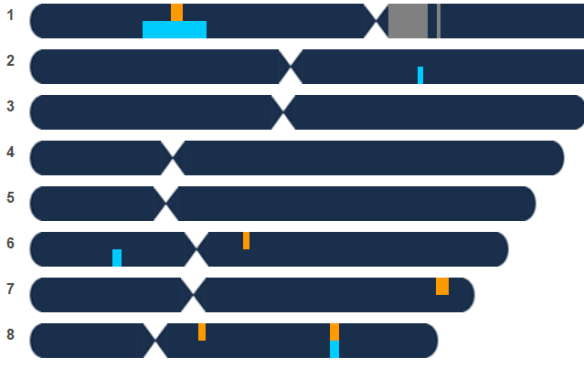
Younger Hart 1-8

The example I showed of chromosome 2 in the Hickerson article was where all participants of the 5 individuals shown on the chromosome browser were matching to the Vannoy participant.  I thought it was a good visual example.  It was just one example of the 60+ clusters of cousin matches between the dozen Vannoy cousins and 6 Hickerson descendants.

This example was criticized by some because it was a small segment match.  I should probably have utilized chromosome 15 or searched for a better long segment example, but the point in my article was only to show how people that match stack up together on the chromosome browser – nothing more.   Here’s the entire chromosome, for clarity.

hickerson vannoy chr 2

Certainly, I don’t want to mislead anyone, including myself.  Furthermore, I dislike being publicly characterized as “wrong” and worse yet, labeled “irresponsible,” so I decided to delve into the depths of the data and work through several different examples to see if small segment data matching holds in various situations.  Let’s see what we found.

Chromosome 15

I selected chromosome 15 to work with because it is a region where a lot of Vannoy descendants match – and because it is a relatively large segment.  If the Hickersons do match the Vannoys, there’s a fairly good change they might match on at least part of that segment.  In other words, it appears to be my best bet due to sheer size and the number of Elijah Vannoy’s descendants who carry this segment.  In addition to the 6 individuals above who matched on chromosome 15, here are an additional 4.  As you can see, chromosome 15 has a lot of potential.

Chrom 15 Vannoy

The spreadsheet below shows the sections of chromosome 15 where cousins match.  Green individuals in the Match column are descendants of Charles Hickerson and Mary Lytle, the parents of Sarah Hickerson.  The balance are Vannoys who match on chromosome 15.

chr 15 matches ftdna v4

As you can see, there are several segments that are quite large, shown in yellow, but there are also many that are under the threshold of 7cM, which are all  segments that would be deleted if you are deleting small segments.  Please also note that if you were deleting small segments, all of the Hickerson matches would be gone from chromosome 15.

Those of you with an eagle eye will already notice that we have two separate segments that have triangulated between the Vannoy cousins and the Hickerson descendants, noted in the left column by yellow and beige.  So really, we could stop right here, because we’ve proven the relationship, but there’s a lot more to learn, so let’s go on.

You Can’t Use What You Can’t See

I need to point something out at this point that is extremely important.

The only reason we see any segment data below the match threshold is because once you match someone on a larger segment at Family Tree DNA, over the threshold, you also get to view the small segment data down to 1cM for your match with that person. 

What this means is that if one person or two people match a Hickerson descendant, for example you will see the small segment data for their individual matches, but not for anyone that doesn’t match the participant over the matching threshold.

What that means in the spreadsheet above, is that the only Hickerson that matches more than one Vannoy (on this segment) is Barbara – so we can see her segment data (down to 1cM ) as compared to Polly and Buster, but not to anyone else.

If we could see the smaller segment data of the other participants as compared to the Hickerson participants, even though they don’t match on a larger segment over the matching threshold, there could potentially be a lot of small segment data that would match – and therefore triangulate on this segment.

This is the perfect example of why I’ve suggested to Family Tree DNA that within projects or in individuals situations, that we be allowed to reduce the match threshold – especially when a specific family line match is suspected.

This is also one of the reasons why people turn to GedMatch, and we’ll do that as well.

What this means, relative to the spreadsheet is that it is, unfortunately, woefully incomplete – and it’s not apples to apples because in some cases we have data under the match threshold, and in some, we don’t.  So, matches DO count, but nonmatches where small segment data is not available do NOT count as a non-match, or as disproof.  It’s only negative proof IF you have the data AND it doesn’t match.

The Vannoys match and triangulate on many segments, so those are irrelevant to this discussion other than when they match to Hickerson DNA.  William (H), descends from two sons of Charles Hickerson and Mary Lytle.  Unfortunately, he only matches one Vannoy, so we can only see his small segments for that one Vannoy individual, William (V).  We don’t know what we are missing as compared to the rest of the Vannoy cousins.

To see William (H)’s and William (V)’s DNA as compared to the rest of the Vannoy cousins, we had to move to GedMatch.

Matching Options

Since we are working with segments that are proven to be Vannoy, and we are trying to prove/disprove if Daniel Vannoy and Sarah Hickerson are the parents of Elijah through multiple Hickerson matches, there are only a few matching options, which are:

  1. The Hickerson individuals will not triangulate with any of the Vannoy DNA, on chromosome 15 or on other chromosomes, meaning that Sarah Hickerson is probably not the mother of Elijah Vannoy, or the common ancestor is too far back in time to discern that match at vendor thresholds.
  2. The Hickerson individuals will not triangulate on this segment, but do triangulate on other segments, meaning that this segment came entirely from the Vannoy side of the family and not the Hickerson side of the family. Therefore, if chromosome 15 does not triangulate, we need to look at other chromosomes.
  3. The Hickerson individuals triangulate with the Vannoy individuals, confirming that Sarah Hickerson is the mother of Elijah Vannoy, or that there is a different common unknown ancestor someplace upstream of several Hickersons and Vannoys.

All of the Vannoy cousins descend from Elijah Vannoy and Lois McNiel, except one, William (V), who descends from the proven son of Sarah Hickerson and Daniel Vannoy, so he would be expected to match at least some Hickerson descendants.  The 6 Hickerson cousins descend from Charles Hickerson and Mary Lytle, Sarah’s parents.

hickerson vannoy pedigree

William (H), the Hickerson cousin who descends from David, brother to Sarah Hickerson, is descended through two of David Hickerson’s sons.

I decided to utilize the same segment “mapping comparison” technique with a spreadsheet that I utilized in the phasing article, because it’s easy to see and visualize.

I have created a matching spreadsheet and labeled the locations on the spreadsheet from 25-100 based on the beginning of the start location of the cluster of matches and the end location of the cluster.

Each individual being compared on the spreadsheet below has a column across the top.  On the chart below, all Hickerson individuals are to the right and are shown with their cells highlighted yellow in the top row.

Below, the entire colorized chart of chromosome 15 is shown, beginning with location 25 and ending with 100, in the left hand column, the area of the Vannoy overlap.  Remember, you can double click on the graphics to enlarge.  The columns in this spreadsheet are not fully expanded below, but they are in the individual examples.

entire chr 15 match ss v4

I am going to step through this spreadsheet, and point out several aspects.

First, I selected Buster, the individual in the group to begin the comparison, because he was one of the closest to the common ancestor, Elijah Vannoy, genealogically, at 4 generations.  So he is the person at Family Tree DNA that everyone is initially compared against.

Everyone who matches Buster has their matching segments shown in blue.  Buster is shown furthest left.

When participants match someone other than Buster, who they match on that segment is typed into their column.  You can tell who Buster matches because their columns are blue on matching locations.  Here’s an example.

Me Buster match

You can see that in my column, it’s blue on all segments which means I match Buster on this entire region.  In addition, there are names of Carl, Dean, William Gedmatch and Billie Gedmatch typed into the cell in the first row which means at that location, in addition to Buster, I also match Carl and Dean at Family Tree DNA and William (descended from the son of Daniel Vannoy and Sarah Hickerson) at Gedmatch and Billie (a Hickerson) at Gedmatch.  Their name is typed into my column, and mine into theirs.  Please note that I did not run everyone against everyone at GedMatch.  I only needed enough data to prove the point and running many comparisons is a long, arduous process even when GedMatch isn’t experiencing problems.

On cells that aren’t colorized blue, the person doesn’t match Buster, but may still match other Vannoy cousin segments.  For example, Dean, below, matches Buster on location 25-29, along with some other cousins.  However, he does not match Buster on location 30 where he instead matches Harold and Carl who also don’t match Buster at that location. Harold, Carl and Dean do, however, all descend from the same son of Elijah so they may well be sharing DNA from a Vannoy wife at this location, especially since no one who doesn’t share that specific wife’s line matches those three at this location.

Me Buster Dean match

Remember, we are not working with random small data segments, but with a proven matching segment to a common Vannoy ancestor, with a group of descendants from a possible/probable Hickerson ancestor that we are trying to prove/disprove.  In other words, you would expect either a lot of Hickerson matches on the same segments, if Hickerson is indeed a Vannoy ancestral family, or virtually none of them to match, if not.

The next thing I’d like to point out is that these are small segments of people who also have larger matching segments, many of whom do triangulate on larger segments on other chromosomes.  What we are trying to discern is whether small segment matches can be utilized by employing the same matching criteria as large segment matching.  In other words, is small segment data valid and useful if it meets the criteria for an IBD match?

For example, let’s look at Daniel.  Daniel’s segments on chromosome 15, were it not for the fact that he matches on larger segments on other chromosomes, would not be shown as matches, because they are not individually over the match threshold.

Look at Daniel’s column for Polly and Warren.

Daniel matches 2

The segments in red show a triangulated group where Daniel and Warren, or Daniel, Warren and Polly match.  The segments where all 3 match are triangulated.

This proves, unquestionably, that small segments DO match utilizing the normal prescribed IBD matching criteria.  This spreadsheet, just for chromosome 15, is full of these examples.

Is there any reason to think that these triangulated matches are not identical by descent?  If they are not IBD, how do all of these people match the same DNA? Chance alone?  How would that be possible?  Two people, yes, maybe, but 3 or more?  In some cases, 5 or 6 on the same segment?  That is simply not possible, or we have disproven the entire foundation that autosomal DNA matching is based upon.

The question will soon be asked if small segments that triangulate can be useful when there are no larger matching segments to put the match over the initial vendor threshold.

Triangulated Groups

As you can see, most of the people and segments on the spreadsheet, certainly the Elijah descendants, are heavily triangulated, meaning that three or more people match each other on the same locations.  Most of this matching is over the vendor threshold at Family Tree DNA.

You can see that Buster, Me, Dean, Carl and Harold all match each other on the same segments, on the left half of the spreadsheet where our names are in each other’s columns.

triangulated groups

Remember when I said that the spreadsheet was incomplete?  This is an example.  David and Warren don’t match each other at a high enough total of segments to get them over the matching threshold when compared to each other, so we can’t see their small segment data as compared to each other.  David matches Buster, but Warren doesn’t, so I can’t even see them both in relationship to a common match.  There are several people who fall into this category.

Let’s select one individual to use as an example.

I’ve chosen the Vannoy cousin, William(V), because his kit has been uploaded to Gedmatch, he has Vannoy matches and because William is proven to descend from Sarah Hickerson and Daniel Vannoy through their son Joel – so we expect some Hickerson DNA to match William(V).

If William (V) matches the Hickersons on the same DNA locations as he matches to Elijah’s descendants, then that proves that Elijah’s descendant’s DNA in that location is Hickerson DNA.

At GedMatch, I compared William(V) with me and then with Dean using a “one to one” comparison at a low threshold, simply because I wanted as much data as I could get.  Family Tree DNA allows for 1 cM and I did the same, allowing 100 SNPs at GedMatch.  Family Tree DNA’s lowest SNP threshold is 500.

In case you were wondering, even though I did lower the GedMatch threshold below the FTDNA minimum, there were 45 segments that were above 1cM and above 500 SNPs when matching me to William(V), which would have been above the lowest match threshold at FTDNA (assuming we were over the initial match threshold.)  In other words, had we not been below the original match threshold (20cM total, one segment over 7.7cM), these segments would have been included at FTDNA as small segments.  As you can see in the chart below, many triangulated.

I colorized the GedMatch matches, where there were no FTDNA matches, in dark red text.  This illustrates graphically just how much is missed when the small segments are ignored in cases with known or probable cousins.  In the green area, the entry that says “Me GedMatch” could not be colorized red (because you can’t colorize only part of the text of a cell) so I added the Gedmatch designation to differentiate between a match through FTDNA and one from GedMatch.  I did the same with all Gedmatch matches, whether colorized or not.

Let’s take a look and see how small segments from GedMatch affect our Hickerson matching.  Note that in the green area, William (V) matches William (H), the Hickerson descendant, and William (V) matches to me and Dean as well.  This triangulates William (V)’s Hickerson DNA and proves that Elijah’s descendants DNA includes proven Hickerson segments.

William (V) gedmatch matches v2

In this next example, I matched William (H), the Hickerson cousin (with no Vannoy heritage) against both Buster and me.

William (H) gedmatch me buster

Without Gedmatch data, only two segments of chromosome 15 are triangulated between Vannoy and Hickerson cousins, because we can’t see the small data segments of the rest of the cousins who don’t match over the threshold.

You can see here that nearly the entire chromosome is triangulated using small segments.  In the chart below, you can see both William(V) and William (H) as they match various Vannoy cousins.  Both triangulate with me.

William V and William H

I did the same thing with the Hickerson descendant, Billie, as compared to both me and Dean, with the same type of results.

The next question would be if chromosome 15 is a pileup area where I have a lot of IBS matches that are really population based matches.  It does not appear to be.  I have identified an area of my chromosomes that may be a pileup area, but chromosome 15 does not carry any of those characteristics.

So by utilizing the small segments at GedMatch for chromosome 15 that we can’t otherwise see, we can triangulate at least some of the Hickerson matches.  I can’t complete this chart, because several individuals have not uploaded to GedMatch.

Why would the Hickerson descendant match so many of the Vannoy segments on chromosome 15?  Because this is not a random sample.  This is a proven Vannoy segment and we are trying to see which parts of this segment are from a potential Hickerson mother or the Vannoy father.  If from the Hickerson mother, then this level of matching is not unexpected.  In fact, it would be expected.  Since we cheated and saw that chromosome 15 was already triangulated at Family Tree DNA, we already knew what to expect.

In the spreadsheet below, I’ve added the 2 GedMatch comparisons, William (V) to me and Dean, and William (H) to me and Buster.  You can see the segments that triangulate, on the left.  We could also build “triangulated groups,” like GedMatch does.  I started to do this, but then stopped because I realized most cells would be colored and you’d have a hard time seeing the individual triangulated segments.  I shifted to triangulating only the individuals who triangulate directly with the Hickerson descendant, William(H), shown in green.  GedMatch data is shown in red.

chr 15 with gedmatch

I would like to make three points.

1.  This still is not a complete spreadsheet where everyone is compared to everyone.  This was selectively compared for two known Hickerson cousins, William (V) who descends from both Vannoys and Hickersos and William (H) who descends only from Hickersons.

2. There are 25 individually triangulated segments to the Hickerson descendant on just this chromosome to the various Vannoy cousins.  That’s proof times 25 to just one Hickerson cousin.

3.  I would NEVER suggest that you select one set of small segments and base a decision on that alone.  This entire exercise has assembled cumulative evidence.  By the same token, if the rules for segment matching hold up under the worst circumstances, where we have an unknown but suspected relationship and the small segments appear to continue to follow the triangulation rules, they could be expected to remain true in much more favorable circumstances.

Might any of these people have random DNA matches that are truly IBS by chance on chromosome 15?  Of course, but the matching rules, just like for larger segments, eliminates them.  According to triangulation rules, if they are IBS by chance, they won’t triangulate.  If they do triangulate, that would confirm that they received the same DNA from a common ancestor.

If this is not true, and they did not receive their common DNA from a common ancestor, then it disproves the fundamental matching rule upon which all autosomal DNA genetic genealogy is based and we all need to throw in the towel and just go and do something else.

Is there some grey area someplace?  I would presume so,  but at this point, I don’t know how to discern or define it, if there is.  I’ve done three in-depth studies on three different families over the past 6 weeks or so, and I’ve yet to find an area (except for endogamous populations that have matches by population) where the guidelines are problematic.  Other researchers may certainly make different discoveries as they do the same kind of studies.  There is always more to be discovered, so we need to keep an open mind.

In this situation, it helps a lot that the Hickerson/Vannoy descendants match and triangulate on larger segments on other chromosomes.  This study was specifically to see if smaller segments would triangulate and obey the rules. We were fortunate to have such a large, apparently “sticky” segment of Vannoy DNA on chromosome 15 to work with.

Does small segment matching matter in most cases, especially when you have larger segments to utilize?  Probably not. Use the largest segments first.  But in some cases, like where you are trying to prove an ancestor who was born in the 1700s, you may desperately need that small segment data in order to triangulate between three people.

Why is this important – critically important?  Because if small segments obey all of the triangulation rules when larger segments are available to “prove” the match, then there is no reason that they couldn’t be utilized, using the same rules of IBD/IBS, when larger segments are not available.  We saw this in Just One Cousin as well.

However, in terms of proof of concept, I don’t know what better proof could possibly be offered, within the standard genetic genealogy proofs where IBD/IBS guidelines are utilized as described in the Phasing article.  Additional examples of small segment proof by triangulation are offered in Just One Cousin, Lazarus – Putting Humpty Dumpty Together Again, and in Demystifying Autosomal DNA Matching.

Raising Elijah Vannoy and Sarah Hickerson from the Dead

As I thought more about this situation, I realized that I was doing an awful lot of spreadsheet heavy lifting when a tool might already be available.  In fact, Israel’s mention of Lazarus made me wonder if there was a way to apply this tool to the situation at hand.

I decided to take a look at the Lazarus tool and here is what the intro said:

Generate ‘pseudo-DNA kits’ based on segments in common with your matches. These ‘pseudo-DNA kits’ can then be used as a surrogate for a common ancestor in other tests on this site. Segments are included for every combination where a match occurs between a kit in group1 and group2.

It’s obvious from further instructions that this is really meant for a parent or grandparent, but the technique should work just the same for more distant relatives.

I decided to try it first just with the descendants of Elijah Vannoy.  At first, I thought that recreated Elijah would include the following DNA:

  • DNA segments from Elijah Vannoy
  • DNA segments from Elijah Vannoy’s wife, Lois McNiel
  • DNA segments that match from Elijah’s descendants spouse’s lines when individuals come from the same descendant line. This means that if three people descend from Joel Vannoy and Phoebe Crumley, Elijah’s son and his wife, that they would match on some DNA from Phoebe, and that there was no way to subtract Phoebe’s DNA.

After working with the Lazarus tool, I realized this is not the case because Lazarus is designed to utilize a group of direct descendants and then compare the DNA of that group to a second group of know relatives, but not descendants.

In other words, if you have a grandson of a man, and his brother.  The DNA shared by the brother and the grandson HAS to be the DNA contributed to that grandson by his grandfather, from their common ancestor, the great grandfather.  So, in our situation above, Phoebe’s DNA is excluded.

The chart below shows the inheritance path for Lazarus matching.

Lazarus inheritance

Because Lazarus is comparing the DNA of Son Doe with Brother Doe – that eliminates any DNA from the brother’s wives, Sarah Spoon or Mary – because those lines are not shared between Brother Doe and Son Doe.  The only shared ancestors that can contribute DNA to both are Father Doe and Methusaleh Fisher.

The Lazarus instructions allow you to enter the direct descendants of the person/couple that you are reconstructing, then a second set of instructions asks for remaining relatives not directly descended, like siblings, parents, cousins, etc. In other words, those that should share DNA through the common ancestor of the person you are recreating.

To recreate Elijah, I entered all of the Vannoy cousins and then entered William (V) as a sibling since he is the proven son of Daniel Vannoy and Sarah Hickerson.

Here is what Lazarus produced.

lazarus elijah 1

Lazarus includes segments of 4cM and 500 SNPs.

The first thing I thought was, “Holy Moly, what happened to chromosome 15?”  I went back and looked, and sure enough, while almost all of the Elijah descendants do match on chromosome 15, William (V), kit 156020, does not match above the Lazarus threshold I selected.  So chromosome 15 is not included.  Finding additional people who are known to be from this Vannoy line and adding them to the “nondescendant” group would probably result in a more complete Elijah.

lazarus elijah 2

Next, to recreate Sarah Hickerson, I added all of the Vannoy cousins plus William (V) as descendants of Sarah Hickerson and then I added just the one Hickerson descendant, William, as a sibling.  William’s ancestor is proven to be the sibling of Sarah.

I didn’t know quite what to expect.

Clearly if the DNA from the Hickerson descendant didn’t match or triangulate with DNA from any of the Vannoy cousins at this higher level, then Sarah Hickerson wasn’t likely Elijah’s mother.  I wanted to see matching, but more, I wanted to see triangulation.

lazarus elijah 3

I was stunned.  Every kit except two had matches, some of significant size.

lazarus elijah 4

lazarus elijah 5 v2

Please note that locations on chromosomes 3, 4 and 13, above, are triangulated in addition to matching between two individuals, which constitutes proof of a common ancestor.  Please also note that if you were throwing away segments below 7cM, you would lose all of the triangulated matches and all but two matches altogether.

Clearly, comparing the Vannoy DNA with the Hickerson DNA produced a significant number of matches including three triangulated segments.

lazarus elijah 6

Where Are We?

I never have, and I never would recommend attempting to utilize random small match segments out of context.  By out of context, I mean simply looking at all of your 1cM segments and suggesting that they are all relevant to your genealogy.  Nope, never have.  Never would.

There is no question that many small segments are IBS by chance or identical by population.  Furthermore, working with small segments in endogamous populations may not be fruitful.

Those are the caveats.  Small segments in the right circumstances are useful.  And we’ve seen several examples of the right circumstances.

Over the past few weeks, we have identified guidelines and tools to work with small segments, and they are the same tools and guidelines we utilize to work with larger segments as well.  The difference is size.  When working with large segments, the fact that they are large serves an a filter for us and we don’t question their authenticity.  With all small segments, we must do the matching and analysis work to prove validity.  Probably not worthwhile if you have larger segments for the same group of people.

Working with the Vannoy data on chromosome 15 is not random, nor is the family from an endogamous population.  That segment was proven to be Vannoy prior to attempts to confirm or disprove the Hickerson connection.  And we’ve gone beyond just matching, we’ve proven the ancestral link by triangulation, including small segments.  We’ve now proven the Hickerson connection about 7 ways to Sunday.  Ok, maybe 7 is an exaggeration, but here is the evidence summed up for the Vannoy/Hickerson study from multiple vendors and tools:

  • Ancestry DNA Circle indicating that multiple Hickerson descendants match me and some that don’t match me, match each other. Not proof, but certainly suggestive of a common ancestor.
  • A total of 26 Hickerson or derivative family name matches to Vannoy cousins at Family Tree DNA. Not proof, but again, very suggestive.
  • 6 Charles Hickerson/Mary Lytle descendants match to Vannoy cousins at Family Tree DNA. Extremely suggestive, needs triangulation.
  • Triangulation of segments between Vannoy and Hickerson cousins at Family Tree DNA. Proof, but in this study we were only looking to determine whether small segment matches constituted proof.
  • Triangulation of multiple Hickerson/Vannoy cousins on chromosome 15 at GedMatch utilizing small segments and one to one matching. More proof.
  • Lazarus, at higher thresholds than the triangulation matching, when creating Sarah Hickerson, still matched 19 segments and triangulated three for a total of 73.2cM when comparing the Hickerson descendant against the Vannoy cousins. Further proof.

So, can small segment matching data be useful? Is there any reason NOT to accept this evidence as valid?

With proper usage, small segment data certainly looks to provide value by judiciously applying exactly the same rules that apply to all DNA matching.  The difference of course being that you don’t really have to think about utilizing those tools with large segment matches.  It’s pretty well a given that a 20cM match is valid, but you can never assume anything about those small segment matches without supporting evidence. So are larger segments easier to use?  Absolutely.

Does that automatically make small segments invalid?  Absolutely not.

In some cases, especially when attempting to break down brick walls more than 5 or 6 generations in the past, small segment data may be all we have available.  We must use it effectively.  How small is too small?  I don’t know.  It appears that size is really not a factor if you strictly adhere to the IBD/IBS guidelines, but at some point, I would think the segments would be so small that just about everyone would match everyone because we are all humans – so the ultimate identical by population scenario.

Segments that don’t match an individual and either or both parents, assuming you have both parents to test, can safely be disregarded unless they are large and then a look at the raw data is in order to see if there is a problem in that area.  These are IBS by chance.  IBS segments by chance also won’t triangulate further up the tree.  They can’t, because they don’t match your parents so they cannot come from an ancestor.  If they don’t come from an ancestor, they can’t possibly match two other people whose DNA comes from that ancestor on that segment.

If both parents aren’t available, or your small segments do match with your parents, I would suggest that you retain your small segments and map them.

You can’t recognize patterns if the data isn’t present and you won’t be able to find that proverbial needle in the haystack that we are all looking for.

Based on what we’ve seen in multiple case studies, I would conclude that small segment data is certainly valid and can play a valid role in a situation where there is a known or suspected relationship.

I would agree that attempting to utilize small segment data outside the context of a larger data match is not optimal, at least not today, although I wish the vendors would provide a way for us to selectively lower our thresholds.  A larger segment match can point the way to smaller segment matches between multiple people that can be triangulated.  In some situations, like the person A, B, C, D Hickerson-Vannoy situation I described earlier in this article, I would like to be able to drop the match threshold to reveal the small segment data when other matches are suggestive of a family relationship.

In the Hickerson situation, having the ability to drop the matching thresholds would have been the key to positively confirming this relationship within the vendor’s data base and not having to utilize third party tools like GedMatch – which require the cooperation of all parties involved to download their raw data files.  Not everyone transferred their data to Gedmatch in my Vannoy group, but enough did that we were able to do what we needed to do.  That isn’t always the case.  In fact, I have an nearly identical situation in another line but my two matches at Ancestry have declined to download their data to Gedmatch.

This not the first time that small segment data has played a successful role in finding genealogy solutions, or confirming what we thought we knew – although in all cases to date, larger segments matched as well – and those larger segment matches were key and what pointed me to the potential match that ultimately involved the usage of the small segments for triangulation.

Using larger data segments as pointers probably won’t be the case forever, especially if we can gain confidence that we can reliably utilize small segments, at least in certain situations.  Specifically, a small segment match may be nothing, but a small segment triangulated match in the context of a genealogical situation seems to abide by all of the genetic genealogy DNA rules.

In fact, a situation just arose in the past couple weeks that does not include larger segments matching at a vendor.

Let’s close this article by discussing this recent scenario.

The Adoptee

An adoptee approached me with matching data from GedMatch which included matches to me, Dean, Carl and Harold on chromosome 15, on segments that overlap, as follows.

adoptee chr 15

On the spreadsheet above, sent to me by the adoptee, we can see some matches but not all matches. I ran the balance of these 4 people at GedMatch and below is the matching chart for the segment of chromosome 15 where the adoptee matches the 4 Vannoy cousins plus William(H), the Hickerson cousin.

  Me Carl Dean Harold Adoptee
Me NA FTDNA FTDNA GedMatch GedMatch
Carl FTDNA NA FTDNA FTDNA GedMatch
Dean FTDNA FTDNA NA FTDNA GedMatch
Harold GedMatch FTDNA FTDNA NA GedMatch
Adoptee GedMatch GedMatch GedMatch GedMatch NA
William (H) GedMatch GedMatch GedMatch GedMatch GedMatch

I decided to take the easy route and just utilize Lazarus again, so I added all of the known Vannoy and Hickerson cousins I utilized in earlier Lazarus calculations at Gedmatch as siblings to our adoptee.  This means that each kit will be compared to the adoptees DNA and matching segments will be reported.  At a threshold of 300 SNPs and 4cM, our adoptee matches at 140cM of common DNA between the various cousins.

adoptee vannoy match

Please note that in addition to matching several of the cousins, our adoptee also triangulates on chromosomes 1, 11, 15, 18, 19 and 21.  The triangulation on chromosome 21 is to two proven Hickerson descendants, so he matches on this line as well.

I reduced the threshold to 4cM and 200 SNPs to see what kind of difference that would make.

adoptee vannoy match low threshold

Our adoptee picked up another triangulation on chromosome 1 and added additional cousins in the chromosome 15 “sticky Vannoy” cluster and the chromosome 18 cluster.

Given what we just showed about chromosome 15, and the discussions about IBD and IBS guidelines and small matching segments, what conclusions would you draw and what would you do?

  1. Tell the adoptee this is invalid because there are no qualifying large match segments that match at the vendors.
  2. Tell the adoptee to throw all of those small segments away, or at least all of the ones below 7cM because they are only small matching segments and utilizing small matching segments is only a folly and the adoptee is only seeing what he wants to see – even though the Vannoy cousins with whom he triangulates are proven, triangulated cousins.
  3. Check to see if the adoptee also matches the other cousins involved, although he does clearly already exceeds the triangulation criteria to declare a common ancestor of 3 proven cousins on a matching segment. This is actually what I did utilizing Lazarus and you just saw the outcome.

If this is a valid match, based on who he does and doesn’t match in terms of the rest of the family, you could very well narrow his line substantially – perhaps by utilizing the various Vannoy wives’ DNA, to an ancestral couple.  Given that our adoptee matches both the Vannoys and the Hickersons, I suspect he is somehow descended from Daniel Vannoy and Sarah Hickerson.

In Conclusion

What is the acceptable level to utilize small segments in a known or suspected match situation?

Rather than look for a magic threshold number, we are much better served to look at reliable methods to determine the difference between DNA passed from our ancestors to us, IBD, and matches by chance.  This helps us to establish the reliability of DNA segments in individual situations we are likely to encounter in our genealogy.  In other words, rather that throw the entire pile of wheat away because there is some percentage of chaff in the wheat, let’s figure out how to sort the wheat from the chaff.

Fortunately, both parental phasing and triangulation eliminate the identical by chance segments.

Clearly, the smaller the segments, even in a known match situation, the more likely they are identical by population, given that they triangulate.  In fact, this is exactly how the Neanderthal and Denisovan genomes have been reconstructed.

Furthermore, given that the Anzick DNA sample is over 12,000 years old, Identical by population must be how Anzick is matching to contemporary humans, because at least some of these people do clearly share a common ancestor with Anzick at some point, long ago – more than 12,000 years ago.  In my case, at least some of the Anzick segments triangulate with my mother’s DNA, so they are not IBS by chance.  That only leaves identical by population or identical by descent, meaning within a genealogical timeframe, and we know that isn’t possible.

There are yet other situations where small segment matches are not IBS by chance nor identical by population.  For example, I have a very hard time believing that the adoptee situation is nothing but chance.  It’s not a folly.  It’s identical by descent as proven by triangulation with 10 different cousins – all on segments below the vendor matching thresholds.

In fact, it’s impossible to match the Vannoy cousins, who are already triangulated individually, by chance.  While the adoptee match is not over the vendor threshold, the segments are not terribly small and they do all triangulate with multiple individuals who also triangulate with larger segments, at the vendors and on different chromosomes.

This adoptee triangulated match, even without the Hickerson-Vannoy study disproves the blanket statement that small segments below 5cM cannot be used for genealogy.  All of these segments are 7.1cM or below and most are below 5.

This small segment match between my mother and her first cousins also disproves that segments under 5cM can never be used for genealogy.

Two cousins combined

This small segment passed from my mother to me disproves that statement too – clearly matching with our cousin, Cheryl.  If I did not receive this from my mother, and she from her parent, then how do we match a common cousin???

me mother small seg

More small segment proof, below, between my mother and her second cousin when Lazarus was reconstructing my mother’s father.

2nd cousin lazarus match

And this Vannoy Hickerson 4 cousin triangulated segment also disproves that 5cM and below cannot be used for genealogy.

vannoy hickerson triang

Where did these small segments come from if not a common ancestor, either one or several generations ago?  If you look at the small segment I inherited from my mother and say, “well, of course that’s valid, you got it from your mother” then the same logic has to apply that she inherited it from her parent.  The same logic then applies that the same small segment, when shared by my mother’s cousin, also came from the their common grandparents.  One cannot be true without the others being true.  It’s the same DNA. I got it from my mother.  And it’s only a 1.46cM segment, shown in the examples above.

Here are my observations and conclusions:

  • As proven with hundreds of examples in this and other articles cited, small segments can be and are inherited from our ancestors and can be utilized for genetic genealogy.
  • There is no line in the sand at 7cM or 5cM at which a segment is viable and useful at 5.1cM and not at 4.9cM.
  • All small segment matches need to be evaluated utilizing the guidelines set forth for IBD versus IBS by chance versus identical by population set forth in the articles titled How Phasing Works and Determining IBD Versus IBS Matches and Demystifying Autosomal DNA Matching.
  • When given a choice, large segment matches are always easier to use because they are seldom IBS by chance and most often IBD.
  • Small segment matches are more likely to be IBS by chance than larger matches, which is why we need to judiciously apply the IBD/IBS Guidelines when attempting to utilize small segment matches.
  • All DNA matches, not just small segments, must be triangulated to prove a common ancestor, unless they are known close relatives, like siblings, first cousins, etc.
  • When working in genetic genealogy, always glean the information from larger matches and assemble that information.  However, when the time comes that you need those small segments because you are working 5, 6 or 7 generations back in time, remember that tools and guidelines exist to use small segments reliably.
  • Do not attempt to use small segments out of context.  This means that if you were to look only at your 1cM matches to unknown people, and you have the ability to triangulate against your parents, most would prove to be IBS by chance.  This is the basis of the argument for why some people delete their small segments.  However, by utilizing parental phasing, phasing against known family members (like uncles, aunts and first cousins) and triangulation, you can identify and salvage the useable small segments – and these segments may be the only remnants of your ancestors more than 5 or 6 generations back that you’ll ever have to work with.  You do not have to throw all of them away simply because some or many small segments, out of context, are IBS by chance.  It doesn’t hurt anything to leave them just sit in your spreadsheet untouched until the day that you need them.

Ultimately, the decision is yours whether you will use small segments or not – and either decision is fine.  However, don’t make the decision based on the belief that small segments under some magic number, like 5cM or 7cM are universally useless.  They aren’t.

Whether small segments are too much work and effort in your individual situation depends on your personal goals for genetic genealogy and on factors like whether or not you descend from an endogamous population.  People’s individual goals and circumstances vary widely.  Some people test at Ancestry and are happy with inferential matching circles and nothing more.  Some people want to wring every tidbit possible out of genealogy, genetic or otherwise.

I hope everyone will begin to look at how they can use small segment data reliably instead of simply discarding all the small segments on the premise that all small segment data is useless because some small segments are not useful.  All unstudied and discarded data is indeed useless, so discarding becomes a self-fulfilling prophecy.

But by far, the worst outcome of throwing perfectly good data away is that you’ll never know what genetic secrets it held for you about your ancestors.  Maybe the DNA of your own Sarah Hickerson is lurking there, just waiting for the right circumstances to be found.

______________________________________________________________

Disclosure

I receive a small contribution when you click on some of the links to vendors in my articles. This does NOT increase the price you pay but helps me to keep the lights on and this informational blog free for everyone. Please click on the links in the articles or to the vendors below if you are purchasing products or DNA testing.

Thank you so much.

DNA Purchases and Free Transfers

Genealogy Services

Genealogy Research

Demystifying Autosomal DNA Matching

dna word cluster4

What, exactly, is an autosomal DNA match?

Answer:  It’s Relative

I’m sorry, I just had to say that.

But truthfully, it is.

I know this sounds like a very basic question, and it is, but the answer sometimes isn’t as straightforward as we would like for it to be.

Plus, there are differences in quality of matches and types of matches.  If you want to sigh right about now, it’s OK.

We’ve talked a lot about matching in various recent articles.  I have several people who follow this blog religiously, and who would rather read this than, say, do dishes (who wouldn’t).  One of our regulars recently asked me the question, “what, exactly, is a match and how do I tell?”

Darned good question and I wish someone had explained this to me so I wouldn’t have had to figure it out.

In the computer industry, where I spent many years, we have what we call flow charts or wernier diagrams which in essence are logic paths that lead to specific results or outcomes depending on the answers at different junctions.

flow chart

I had a really hard time deciding whether to use the beer decision-making flow chart or the procrastinator flow chart, but the procrastinator flow chart was just one big endless loop, so I decided on the beer.

What I’m going to do is to step you through the logic path of finding and evaluating a match, determining whether it’s valid, identical by descent or chance, when possible, and how to work with your matches and what they mean.

Let me also say that while I use and prefer Family Tree DNA, these matching techniques are universal and apply to results from 23andMe as well, but not for Ancestry who gives you no browser or tools to compare your DNA to anyone else.  So, you can’t compare your results at Ancestry.

Comparing DNA results is the lynchpin of genetic genealogy.  You’re dead in the water without it.  If you have tested at Ancestry, you can always transfer your results to Family Tree DNA, where you do have tools, and to GedMatch as well.  You’re always better, in terms of genealogy, to fish in as many ponds as possible.

Before we talk about how to work with matches, for those who need to figure out how to find matches at Family Tree DNA and 23andMe, I wrote about that in the Chromosome Browser War article.  This article focuses on working with matching DNA after you have found that you are a match to someone – and what those matches might mean.

Matching Thresholds

All autosomal DNA vendors have matching thresholds.  People who meet or exceed those thresholds will be shown on your match list.  People who do not meet the initial threshold will not be considered as a match to you, and therefore will not be on your match list.

Currently, at Family Tree DNA, their match threshold to be shown as a match is about 20cM of total matching DNA and a single segment of about 7.7cM with 500 SNPs or over. The words “about” are in there because there is some fuzziness in the rules based on certain situations.

After you meet that criteria and you are shown as a match to an individual, when you download your matching data, your matches to them on each chromosome will be shown to the 1cM and 500 SNP level

At 23andMe, the threshold is 7cMs/700 SNPs for the first segment.  However, 23andMe has an upper limit of people who can match you at about 1000 matches.  This can be increased by the number of people you are communicating or sharing with.  However, your smallest matches will be dropped from your list when you hit your threshold.  This means that it’s very likely that at least some of your matches are not showing if you have in excess of 1000 matches total.  This means that your personal effective cM/SNP match threshold at 23andMe may be much higher.

Step 1 – Downloading Your Matching Segments

For this comparison, I’m starting with two fresh files from Family Tree DNA, one file of my own matches and one of my mother’s matches.  My mother died before autosomal DNA testing was available, so her results are only at Family Tree DNA (and now downloaded to GedMatch,) because her DNA was archived there.  Thank you Family Tree DNA, 100,000 times thank you!!!

At Family Tree DNA, the option to download all matches with segment information is on the chromosome browser tab, at the top, at the right, shown below.

ftdna download button

If you have your parents DNA available to test and it hasn’t been tested, order a kit for them today.  If either or both parents have been tested, download their results into the same spreadsheet with yours and color code them in a way you will understand.

In my case, I only have my mother’s results, and I color coded my matches pink, because I’m the daughter.  However, if I had both parents, I might have colored coded Mother pink and Dad blue.

Whatever color coding you do, it’s forever in your master spreadsheet, so make a note of what it is.  In my case, it’s part of the match column header.  Why is it in my column header?  Because I screwed up once and reversed them in a download.

Step 2 – Preparing and Sorting Your Spreadsheet

In my master DNA spreadsheet, I have the following columns,

dna master header

The green cell matches are matches to me from 23andMe.  My cousin, Cheryl also tested at 23andMe before autosomal testing was offered at Family Tree DNA.

The Source column, in my spreadsheet, means any source other than FTDNA.  The Ignore column is an extraneous number generated at one time by downloads.  I could delete that column now.

The “Side” column is which side the match is from, Mom or Dad.  Mom’s I can identify easily, because I have her DNA to compare to.  I don’t identify a match as Dad’s without having identified an ancestral line, because I don’t have his DNA to compare to.

And no, you can’t just assume that if it doesn’t match Mom, it’s an automatic match to Dad because you may have some IBS, identical by chance, matches.

The Common Ancestors/Comments column is just that.  I include things like when I e-mailed someone, if the match is triangulated and if so, with whom, etc.

In my master spreadsheet, the first “name” column (of who tested) is deleted, but I’ve left it in the working spreadsheet (below) with my mother for illustration purposes.  That way, neither of us has to remember who is pink!

Step 3 – Reviewing IBD and IBS Guidelines

If you need a refresher on, phasing, IBD, identical by descent, IBS which can mean either identical by chance or identical by population, it would be a good time to read or reread the article titled How Phasing Works and Determining IBD Versus IBS Matches.

Let’s briefly review the IBD vs IBS guidelines, because we’ll be applying them in this article.

Identical by Chance – Can be determined if an individual you match does not match to one of your parents, if parents are available.  If parents are not available for matching, IBS by chance segments won’t triangulate with other known genealogical matches on a common segment.

Identical by Descent – Can be suggested if a common ancestor (or ancestral line) can be determined between any two people who are not known relatives. If the two people are known close relatives, and their DNA matches, identical by descent is proven.  IBD can be proven with previously unknown family or genealogical matches when any three people descending from that same ancestor or ancestral line all match each other on the same segment of DNA.  Three way matching is called triangulation.

Identical by Population – Can be determined when multiple people triangulate with you on a specific segment of DNA, but the triangulated groups are from proven different lineages and are not otherwise related.  This is generally found in smaller segments from similar regions of the world.  Identical by population is identical by descent, but the ancestors are so far back in time that they cannot be determined and may contribute the same DNA to multiple lineages.  This is particularly evident in Jewish genealogy and other endogamous groups.

Step 4 – Determining Parental Side and IBS by Chance

The first thing to do, if you have either or both parents, is to determine whether your matches phase to your parents or are IBS by chance.

In this context, phasing means determining whether a particular match is to your father’s side of the family or to your mother’s side of the family.

Remember, at every address in your DNA, you will have two valid matches to different lines, one from your mother and one from your father.  The address on your DNA consists of the chromosome number which equates to the street name, and then the start and end locations, which consists of a range of addresses on that street.  Think of it as the length of your property on the street.

First, let’s look at my situation with only my mother’s DNA for comparison.

It’s easy to tell one of three things.

  1. Do mother and I both match the person? If so, that means that DNA match is from mother’s side of the family. Mark it as such. They are green, below.
  2. If the individual does not match me and mother, both, and only matches me, then the match is either on my father’s side or it’s IBS by chance. Those matches are blue below. Because I don’t have my father’s DNA, I can’t tell any more at this step.
  3. Notice the matches that are Mom’s but not to me. That means that I did not receive that DNA from Mom, or I received a small part, but it’s not over the lowest matching threshold at Family Tree DNA of 1cM and 500 SNPs.

match mom

In this next scenario, you can see that mother and I both match the same individual, but not on all segments.  I selected this particular match between me, my mother and Alfred because it has some “problems” to work through.

match mom2

The segments shown in green above are segments that Mom carries that I don’t.  This means that I didn’t receive them from mother.  This also means they could be  matching to Alfred legitimately, or are IBS by chance.  I can’t tell anything more about them at this point, so I’ve just noted what they are.  I usually mark these as “mother only” in my master spreadsheet.

match mom3

The first of the two green rows above show a match but it’s a little unusual.  My segment is larger than my mothers.  This means that one of five things has happened.

  1. Part of this segment is a valid match.  At the end, where we don’t match, the match extends IBS by chance a bit at the end, in my case, when matching Alfred. The valid match portion would end where my mother’s segment ends, at 16,100,293
  2. There is a read error in one of the files.
  3. The boundary locations are fuzzy, meaning vendor calculations like ‘healing’ for no calls, etc..
  4. I also match to my father’s line.
  5. Recombination has occurred, especially possible in an endogamous population, reconnecting identical by population segments between me and Alfred at the end of the segment where I don’t match my mother’s segment, so from 16,100,293 to 16,250,884.

Given that this is a small segment, the most likely scenario would be the first, that this is partly valid and partly IBS by chance.  I just make the note by that row.

The second green segment above isn’t an exact match, but if my segment “fits within” the boundaries of my mother’s segments, then we know I inherited the entire segment from her.  Once again, my boundaries are off a bit from hers, but this time it’s the beginning.  The same criteria applies as in 1-5, above.

match mom4

The green segments above are where I match Alfred, but my mother does not.  This means that these segments are either IBS by chance or that they will match my father.  I don’t know which, so I simply label them.  Given that they are all small segments, they are likely IBS by chance, but we don’t know that.  If we had my father’s DNA, we would be able to phase against him, too, but we don’t.

Now, if I was to leave this discussion here, you might have the impression that all small segment matches have problems, but they don’t.  In fact, here’s a much more normal “rea life” situation where mother and I are both matching to our cousin, Cheryl, Mom’s first cousin.  These matches include both large and small segments.  Let’s take a look and see what we can tell about our matches.

match mom complete

Roberta and Barbara have a total of 83 DNA matches to Cheryl.

Some matches will be where Barbara matches Cheryl and Roberta doesn’t.  That’s normal, Barbara is Roberta’s mother and Roberta only inherits half of Barbara’s DNA.  These rows where only Barbara, the mother, matches Cheryl are not colorized in the Start, End, cM and SNP columns, so they show as white.

Some matches will be exact matches.  That too is normal.  In some cases, Barbara passes all of a particular segment of DNA to Roberta.  These matches are colored purple.

Some of these matches are partial matches where Roberta inherited part of the segment of DNA from Barbara.  These are colored green. There are two additional columns at right where the percentage of DNA that Roberta inherited from Barbara on these segments is calculated, both for cM and SNPs.

Some of the matches are where Roberta matches Cheryl and Barbara doesn’t.  Cheryl is not known to be related to Roberta on her father’s side, so assuming that statement is correct, these matches would be IBS, identical by state, meaning identical by chance and can be disregarded at legitimate matches.  These are colored rust.  Note that most of these are small segments, but one segment is 8.8cM and 2197 SNPs.  In this case, if this segment becomes important for any reason, I would be inclined to look at the raw data file of Barbara to see if there were no calls or a problem with reads in this region that would prevent an otherwise legitimate match.

Let’s look at how these matches stack up.

Number Percent (rounded) Comment
Exact Matches 26 31 100% of the DNA
Barbara Only 20 24 0% of the DNA
Partial Matches 29 35 11-98% of the actual DNA matches
Roberta Only (IBS by chance) 7 8 Not a valid match

I think it’s interesting to note that while, on the average, 50% of the DNA of any segment is passed to the child, in actuality, in this example of partial inheritance, meaning the green rows, inheritance was never actually 50%.  In fact, the SNP and cM percentages inherited for the same segment varied, and the actual amounts ranged from 11-98% of the DNA of the parent being inherited by the child.  The average of these events was 54.57143 (cM) and 54.21429 (SNPs) however.

On top of that, in 13 (26 rows) instances, Roberta inherited all of Barbara’s DNA in that sequence, and in 20 cases, Roberta inherited none of Barbara’s DNA in that sequence.

This illustrates that while the average of something may be 50%, none of the actual individual values may be 50% and the values themselves may include the entire range of possibilities.  In this case, 11-98% were the actual percentage ranges for partial matches.

Matching Both Parents

I don’t have my father’s DNA, but I’m creating this next example as if I did.

match both parents

Matches to mother are marked in green.

I have two matches where I match my father, so we can attribute those to his side, which I’ve done and marked in orange.

The third group of matches to me, at the bottom, to Julio, Anna, Cindy and George don’t match either parent, so they must be IBS by chance.

I label IBS by chance segments, but I don’t delete them because if I download again, I’ll have to go through this same analysis process if I don’t leave them in my spreadsheet

Step 5 – How Much of the DNA is a Match?

One person asked, “exactly how do I tell how much DNA is matching, especially between three people.”  That’s a very valid question, especially since triangulation requires matching of three people, on the same segment, proven to a common ancestral line.

Let’s look at the match of both me and my mother to Don, Cheryl and Robin.

match mom part

In this example, we know that Don, Cheryl and Robin all match me on my mother’s side, because they all three match me and my mother, both on the same segment.

How do we determine that we match on the same segment?

I have sorted this spreadsheet in order of end location, then start location, then chromosome number so that the entire spreadsheet is in chromosome order, then start location, then end location.

We can see that both mother and I match Cheryl partially on this segment of chromosome 1, but not exactly.  The start location is slightly different, but the end location matches exactly.

The area where we all three match, meaning me, Mom and Cheryl, begins at 176,231,846 and ends at the common endpoint of 178,453,336

On the chart below, you can see that mother and I also both match Don, Cheryl’s brother, on part of this same segment, but not all of the same segment.

match mom part2

The common matching areas between me, Mom and Don begins at 176,231,846 and ends at 178,453,336.

Next, let’s look at the third person, Robin.

Mom and I both match Robin on part of this same overlapping segment as well.  Note that my segment extends beyond Mom’s, but that does not invalidate the portion that does match between Robin, Mom and I.

match mom part3

Our common match area begins at the same location, but ends at 178,453,336, the same location as the common end area with Don and Cheryl

Step 6 – What Do Matches Mean? IBD vs IBS in Action

So, let’s look at various types of matches and what they tell us.

match mom example

Looking at our matching situation above, let’s apply the various IBD/IBS rules and guidelines and see what we have

1. Are these matches identical by chance?  No.  How do we know?

a. Because they all match both me and a parent.

2. Are these matches identical by descent? Yes. How do we know?

a. Because we all match each other on this segment, and we know the common ancestor of Cheryl, Don, Barbara and me is Hiram Ferverda and Evaline Miller.  We know that Robin descends from the same ancestral Miller line.

3. Are these matches identical by population.  We don’t know, but there is no reason at this point to think so. Why?

a. Because looking at my master spreadsheet, I see no evidence that these segments are also assigned to other lineages. These individuals are also triangulated on a large number of other, much larger, segments as well.

4. Are these matches triangulated, meaning they are proven to a common ancestor? Yes. How do we know?

a. Documented genealogy of Hiram Ferverda and Evaline Miller. Don, Barbara, Cheryl and me are known family since birth.
b. Documented genealogy of Robin to the same ancestral family, even though Robin was previously unknown before DNA matching.
c. Even without the documented genealogy, Robin matches a set of two triangulation groups of people documented to the same ancestral line, which means she has to descend from that same line as well.

In our case, clearly these individuals share a common ancestor and a common ancestral line.  Even though these are small segments on chromosome 1, there are much larger matching segments on other chromosomes, and the same rules still apply.  The difference might be at some point smaller segments are more likely to be identical by population than larger segments.  Larger segments, when available, are always safer to use to draw conclusions.  Larger groups of matching individuals with known common genealogy on the same segments are also the safest way to draw conclusions.

Step 7 – Matching With No Parents

Sometimes you’re just not that lucky.  Let’s say both of your parents have passed and you have no DNA from them.

That immediately eliminates phasing and the identical by chance test by comparing to your parents, so you’ll have to work with your matches, including your identical by chance segments.

A second way to “phase” part of your DNA to a side of your family is by matching with known cousins or any known family member.

In the situation above, matching to Cheryl, Don and Robin, let’s remove my mother and see what we have.

match no mom

In this case, I still match to both of my first cousins, once removed, Cheryl and Don.  Given that Cheryl and Don are both known cousins, since forever, I don’t feel the need for triangulation proof in this case – although the three of us are triangulated to our common ancestor.  In other words, the fact that my mother does match them at the expected 1st cousin level is proof enough in and of itself if we only had one cousin to test.  We know our common ancestor is Cheryl and Don’s grandparents, who are my great-grandparents, Hiram Ferverda and Evaline Miller.

When I looked at Robin’s pedigree chart and saw that Robin descended from Philip Jacob Miller and wife Magdalena, I knew that this segment was a Miller side match, not a Ferverda match.

Therefore, matching with someone whose genealogy goes beyond the common ancestor of Cheryl, Don and me proves this line through 4 more generations.  In other words, this DNA segment came through the following direct line to reach Me, Mother, Cheryl and Don.

  • Philip Jacob Miller and Magdalena
  • Daniel Miller
  • David Miller
  • John David Miller
  • Evaline Louise Miller who married Hiram Ferverda

Clearly, we know from the earlier chart that my mother carried this DNA too, but even if we didn’t know that, she obviously had to have carried this segment or I would not carry it today.

So, even though in this example, our parents aren’t directly available for IBS testing and elimination, we can determine that anyone who matches both me and Cheryl or me and Don will have also matched mother on that segment, so we have, in essence, phased those people by triangulation, not by direct parental matching.

Step 8 – Triangulation Groups

What else does this match group tell us?

It tells us that anyone else who matches me and any one of our triangulation group on that segment also descends from the Miller descendant clan, one way or another.

Why do they have to match me AND one of the triangulation group members on that segment?  Because I have two sides to my DNA, my Mom’s side and my Dad’s side.  Matching me plus another person from the triangulation group proves which side the match is on – Mom’s or Dad’s.

We were able to phase to eliminate any identical by chance segments people on Mom’s side, so we know matches to both of us are valid.

On Dad’s side, there are some IBS by chance people (or segments) thrown in for good measure because I don’t have my Dad’s DNA to eliminate them out of the starting gate.  Those IBS segments will have to be removed in time by not triangulating with proven triangulated groups they should triangulate with, if they were valid matches.

When you map matches on your chromosome spreadsheet, this is what you’re doing.  Over time, you will be able to tell when you receive a new match by who they match and where they fall on your spreadsheet which ancestral line they descend from.

GedMatch also includes a triangulation utility.  It’s a great tool, because it produces trios of people for your top 400 matches.  The results are two kits that triangulate to the third person whose kit number you are matching against.

The output, below, shows you the chromosome number followed by the two kit numbers (obscured) that triangulate at this location, and then the start and end location followed by the matching cMs.  The result is triangulation groups that “slide to the right.”

gedmatch triang group3

In the example above, all of the triangulation matches to me above the red arrow include either Mother, my Ferverda cousins or the Miller group that we discussed in the Just One Cousin article.  In other words they are all related via a common ancestor.

You can tell a great deal about triangulation groups by who is, and isn’t in them using deductive reasoning.  And once you’ve figured out the key to the group, you have the key to the entire group.

In this case, Mom is a member of the first triangulation group, so I know this group is from her side and not Dad’s side.  Both Ferverda cousins are there, so I know it’s Mom’s Dad’s side of the family.  The Miller cousins are there, so I know it’s the Miller side of Mom’s Dad’s side of the family.

Please also note that while this entire group triangulates within itself, that the group manages to slide right and the first triangulated group of 3 in the list may not overlap the DNA of the last triangulated group of 3.  In fact, because you can see the start and end points, you can tell that these two triangulated groups don’t overlap.  The multiple triangulation groups all do match some portion of the group above and below them (in this case,) and as a composite group, they slide to the right. Because each group overlaps with the group above and below them, they all connect together in a genetic chain.  Because there is an entire group that are triangulated together, in multiple ways, we know that it is one entire group.

This allows me to map that entire segment on my Mom’s side of my DNA, from 10,369,154 to 41,685,667 to this group because it is contiguously connected to me, triangulated and unbroken.  The most distant ancestor listed will vary based upon the known genealogy of the three people being triangulated  For example, part of this segment, may come from Philip Jacob Miller himself, the line’s founder,, but another part could come from his son’s wife, who is also my ancestor.  Therefore, the various pieces of this group segment may eventually be attributed to different ancestors from this particular line based upon the oldest common ancestor of the three people who have triangulated.

In our example above, the second group starts where the red arrow is pointing.  I have absolutely no idea which ancestor this second group comes from – except – I know it does not come from my mother’s side because her kit number isn’t there.

Neither are any of my direct line Estes or Vannoy relatives, so it’s probably not through that line either.  My Bolton cousins are also missing, so we’ve probably eliminated several possible lines, 3 of 4 great grandparents, based on who is NOT in the match group.  See the value of testing both close and distant cousins?  In this case, the family members not only have to test, they also have to upload their results to GedMatch.

Conversely, we could quickly identify at least a base group by the presence in the triangulation groups of at least one my known cousins or people with whom I’ve identified my common ancestor.  Two from the same line would be even better!!!

Endogamy

The last thing I want to show you is an example of what an endogamous group looks like when triangulated.

gedmatch endogamy

This segment of chromosome 9 is an Acadian matching group to my Mom – and the list doesn’t stop here – this is just the size of the screen shot.  These matches continue for pages.

How do I know this group is Acadian?  In part, because this group also triangulates with my known Lore cousin who also descends from the same Acadian ancestor, Antoine Lore, son of Honore Lore and Marie Lafaille.  Additionally, I’ve worked with some of these people and we have confirmed Honore Lore and Marie Lafaille as our common ancestor as well.  In other cases, we’ve confirmed upstream ancestors.

Unfortunately, the Acadians are so intermarried that it’s very difficult to sort through the most distant genetic ancestor because there tend to be multiple most distant ancestors in everyone’s trees.  There is a saying that if you’re related to one Acadian, you’re related to all Acadians and it’s the truth.  Just ask my cousin Paul who I’m related to 137 different ways.

Matches to endogamous groups tend to have very, very long lists of matches, even triangulated, which means proven, matches.

Oh, and by the way, just for the record, this lengthy group includes some of my proven Acadian matches that were trimmed, meaning removed, from my match list when Ancestry did their big purge due to their new and improved phasing.  So if there was ever any doubt that we did in fact lose at least some valid matches, the proof lies right here, in the triangulation of those exact same people at GedMatch

Summary

I hope this step by step article has helped take the Greek, or maybe the geek, out of matching.  Once you think of it in a step by step logical basis, it makes a lot of sense and allows you to reasonably judge the quality of your matches.

The rule of thumb has been that larger matches tend to be “legitimate” and smaller matches are often discarded en masse because they might be problematic.  However, we’ve seen situations where some larger matches may not be legitimate and some smaller matches clearly are.  In essence, the 50% average seldom applies exactly and rules of thumb don’t apply in individuals situations either.  Your situation is unique with every match and now you have tools and guidelines to help you through the matching maze.

And hey, since we made it to the end, I think we should celebrate with that beer!!!

beer

______________________________________________________________

Disclosure

I receive a small contribution when you click on some of the links to vendors in my articles. This does NOT increase the price you pay but helps me to keep the lights on and this informational blog free for everyone. Please click on the links in the articles or to the vendors below if you are purchasing products or DNA testing.

Thank you so much.

DNA Purchases and Free Transfers

Genealogy Services

Genealogy Research

Lazarus – Putting Humpty Dumpty Back Together Again

Recently, GedMatch introduced a tool, Lazarus, to figuratively raise the dead by combining the DNA of descendants, siblings and other relatives of long-dead ancestors to recreate their genome.  Kind of like piecing Humpty Dumpty back together again.

Humpty Dumpty

Blaine Bettinger wrote about using Lazarus here and here where he recreated the genome of his grandmother.  I’d like to use Lazarus to see how it works with one pair of siblings and a first cousin.  Blaine was fortunate to have 4 siblings.  I have a much smaller group of people to work with, so let’s see what we can do and how successful we are, or aren’t.  But first, lets talk about the basics and how we can reconstruct an ancestor.

The Basics

An individual has 6766.2 cM of DNA.  Both parents give half of their DNA to each child, but not exactly the same parental DNA is contributed to each child.  A random process selects which half of the parents’ DNA is given to each child.  Different children will have some of the same DNA from their parents, and some different DNA from each parent.

Obviously, the DNA contributed to each child from a parent is a combination of the DNA given to the parent by the grandparents.  Approximately half of the grandparent’s DNA is given to each child.  In many cases, the DNA contributed to the child from the grandparents is not actually divided evenly, and we receive all or nothing of individual segments, not half.  Half is an average that works pretty well most of the time.  It’s a statistic, and we all know about statistics…right???

Therefore, children carry 3383cM of each parent’s DNA.  Each sibling carries half of the same DNA from their parents.  From the ISOGG autosomal DNA statistics chart, each sibling actually carries 25% of exactly the same DNA from both parents, 50% where they inherited half of the same DNA from one parent and different DNA from the other parent, and 25% where the siblings don’t share any of the identical DNA from their parents. This averages 50%.

This chart, also from ISOGG, sums up what percentage of the same DNA different relatives can expect to carry.

cousin percents

Recreating Ferverda Brothers

I have a situation where I have a person, Barbara, and two of her first cousins, Cheryl and Don, who are siblings.  This is the same family we discussed in the Just One Cousin article.

Miller Ferverda chart

In this case, Cheryl and Don share 50% of Roscoe’s DNA.

Barbara shares 12.5% of Hiram and Evaline’s DNA with Cheryl and 12.5% with Don, but not the same 12.5%.  Since siblings share 50% of their DNA, Barbara should share about 12.5% of Cheryl’s DNA and an additional 6.25% that the Cheryl didn’t receive from Roscoe, but that Don did.

Translating that into cMs, Barbara should share about 850 cM with Cheryl and an additional 425 cM with Don, for an approximate total of 1275 cM.

At http://www.gedmatch.com, I selected the Tier 1 (subscription or donation) option of Lazarus and was presented with this menu.

lazarus menu

My first attempt was to recreate Barbara’s father, John W. Ferverda.  I allowed 100 SNPs and 4cM because I was hoping to be able to accumulate more than the required 1500cM of matching DNA for the kit to be utilized as a “real kit,” available for one-to-many matching.

100SNP 4cM 200SNP 4cM 300SNP 4cM 400SNP 4cM 500SNP 4cM 600SNP 4cM 700SNP 4cM
John W. Ferverda 1330.7 cM 1370.2 cM 1360.0 cM 1353.5 cM 1338.7 cM 1336.2 cM 1322.9 cM

I then experimented with the various SNP levels, leaving the cM at 4.

The resulting number of cM of just over 1300, no matter how you slice and dice it, is very near the expected approximation of 1275.

Using the Lazarus tool, I created “John Ferverda” by listing Barbara as his descendant and both Cheryl and Don as cousins.

To create “Roscoe Ferverda,” I reversed the positions of the individuals, listing Don and Cheryl as descendants and Barbara as the cousin.

Lazarus options

These two created individuals, “John” and “Roscoe” should be exactly the same, and, thankfully, they were.

Both recreated “John” and “Roscoe” represent a common set of DNA from the parents of both of these men, Hiram Ferverda and Evaline Miller based on the matching DNA of their descendants, Barbara, Cheryl and Don.

The way Lazarus works is that all kits in Group 1, the descendants, are compared with Group 2, other relatives but not descendants.  The descendants will carry some of Roscoe’s DNA, but also the DNA of Roscoe’s wife, the mother of Don and Cheryl.  By comparing against known relatives but not direct descendants, Lazarus effectively narrows the DNA to that contributed only by the common ancestor of group 1 and group 2.  In this case, that common ancestor would be John and Roscoe’s parents, Hiram Ferverda and Evaline Miller.  By comparing the descendant and non-descendant-but-otherwise-related groups, you effectively subtract out the mother’s DNA from the descendants – in this case meaning the DNA of John Ferverda’s wife and Roscoe Ferverda’s wife.

In other words, the descendants, above, are NOT compared to each other, but instead, to each one of the not-descendant-but-otherwise-related group.

Unfortunately, none of the kits generated was over the 1500 cM threshold.  I remembered that there is also a second cousin, Rex, whose DNA we can add because he descends from the parents of Evaline Miller.

Adding Rex to the mix brought the resulting “Roscoe” kit to 1589.7 cM and the resulting “John” kit to 1555.7 cM, both now barely over the 1500 threshold – but over just the same and that’s all that matters.  Soon, we’ll be able to utilize both of these kits for direct matching as a “person” at GedMatch.  Now how cool is that???

You receive four pieces of output information when you create a Lazarus kit.

First, a comparison between the descendants (Group 1 above, Kit 2 below) and each of the cousins and related-but-not-descendants individuals (Group 2 above, Kit 1 below), by chromosome.

John W. Ferverda

Processed: 2015/01/09 17:32:41
Name: John W. Ferverda
SNP threshold = 100 cM
Threshold = 4.0 cM
Batch processing will be performed if resulting kit achieves required threshold of 1500 cM.

Contributions:

Kit 1

Kit 2

Chr

Start

End

cM

F9141

M133930

1

72017

5703284

14.8

F9141

M133930

1

17271101

18589169

4.1

F9141

M133930

1

32804999

65722466

37.8

F9141

M133930

1

242601404

247174776

8.5

Obviously, these are only snippets of the output for chromosome 1.  You receive a chart of this same information for all of the chromosomes of the people being compared.

Second, a chart that shows the resulting matching segments.

Resulting Segments:

Chr

Start

End

cM

1

742429

5694404

14.8

1

17285357

18588145

4.1

1

38226163

43823334

7.2

1

43975578

54990495

8.0

1

55040097

62847030

12.1

1

76341094

85237614

8.7

1

242606491

247179501

8.5

At the bottom of this second set of numbers is the all-important total cM.  This is the only place you will find this number

Total cM: 1555.7

Third, a list of the original kits that have match results between the two groups.

Original Kits match with result:

Kit

Chr

Start

End

cM

F9141

1

742429

5700507

14.8

F9141

1

10899689

12530765

4.5

F9141

1

35075204

65714854

35.3

F9141

1

76334120

85252045

8.7

F9141

1

242606379

247169190

8.5

M133930

1

742429

5705356

14.8

M133930

1

35075956

65714854

35.3

M133930

1

242606491

247165725

8.5

F50000

1

10899689

12530765

4.5

F153785

1

742584

5700507

14.8

F153785

1

76337055

85252045

8.7

F153785

1

242606379

247169190

8.5

And finally, a summary.

196074 single allele SNPs were derived for the resulting kit.
37068 bi-allelic SNPs were derived for the resulting kit.
233142 total SNPs were derived for the resulting kit.
Kit number of Result: LX056148
Kit Name: John Ferverda 8
Your Lazarus file has been generated.

Is this as good as the real McCoy, meaning swabbing John and Roscoe?  Of course not, but John and Roscoe aren’t available for swabbing.  In fact, John and Roscoe are both probably finding this pretty amusing from someplace on the other side, watching their children “recreate” them!

I can hear them now, shaking their heads, “Well I never….”

They should have known if they left Cheryl and me here, together, unsupervised that we would do something like this!!!

______________________________________________________________

Disclosure

I receive a small contribution when you click on some of the links to vendors in my articles. This does NOT increase the price you pay but helps me to keep the lights on and this informational blog free for everyone. Please click on the links in the articles or to the vendors below if you are purchasing products or DNA testing.

Thank you so much.

DNA Purchases and Free Transfers

Genealogy Services

Genealogy Research

Anzick (12,707-12,556), Ancient One, 52 Ancestors #42

anzick burial location

His name is Anzick, named for the family land, above, where his remains were found, and he is 12,500 years old, or more precisely, born between 12,707 and 12,556 years before the present.  Unfortunately, my genealogy software is not prepared for a birth year with that many digits.  That’s because, until just recently, we had no way to know that we were related to anyone of that age….but now….everything has changed ….thanks to DNA.

Actually, Anzick himself is not my direct ancestor.  We know that definitively, because Anzick was a child when he died, in present day Montana.

anzick on us map

Anzick was loved and cherished, because he was smeared with red ochre before he was buried in a cave, where he would be found more than 12,000 years later, in 1968, just beneath a layer of approximately 100 Clovis stone tools, shown below.  I’m sure his parents then, just as parents today, stood and cried as the laid their son to rest….never suspecting just how important their son would be some 12,500 years later.

anzick clovis tools

From 1968 until 2013, the Anzick family looked after Anzick’s bones, and in 2013, Anzick’s DNA was analyzed.

DNA analysis of Anzick provided us with his mitochondrial haplogroup,  D4h3a, a known Native American grouping, and his Y haplogroup was Q-L54, another known Native American haplogroup.  Haplogroup Q-L54 itself is estimated to be about 16,900 years old, so this finding is certainly within the expected range.  I’m not related to Anzick through Y or mitochondrial DNA.

Utilizing the admixture tools at GedMatch, we can see that Anzick shows most closely with Native American and Arctic with a bit of east Siberian.  This all makes sense.

Anzick MDLP K23b

Full genome sequencing was performed on Anzick, and from that data, it was discovered that Anzick was related to Native Americans, closely related to Mexican, Central and South Americans, and not closely related to Europeans or Africans.  This was an important discovery, because it in essence disproves the Solutrean hypothesis that Clovis predecessors emigrated from Southwest Europe during the last glacial maximum, about 20,000 years ago.

anzick matches

The distribution of these matches was a bit surprising, in that I would have expected the closest matches to be from North America, in particular, near to where Anzick was found, but his closest matches are south of the US border.  Although, in all fairness, few people in Native tribes in the US have DNA tested and many are admixed.

This match distribution tells us a lot about population migration and distribution of the Native people after they left Asia, crossed Beringia on the land bridge, now submerged, into present day Alaska.

This map of Beriginia, from the 2008 paper by Tamm et all, shows the migration of Native people into (and back from) the new world.

beringia map

Anzick’s ancestors crossed Beringia during this time, and over the next several thousand years, found their way to Montana.  Some of Anzick’s relatives found their way to Mexico, Central and South America.  The two groups may have split when Anzick’s family group headed east instead of south, possibly following the edges of glaciers, while the south-moving group followed the coastline.

Recently, from Anzick’s full genome data, another citizen scientist extracted the DNA locations that the testing companies use for autosomal DNA results, created an Anzick file, and uploaded the file to the public autosomal matching site, GedMatch.  This allowed everyone to see if they matched Anzick.  We expected no, or few, matches, because after all, Anzick was more than 12,000 years old and all of his DNA would have washed out long ago due to the 50% replacement in every generation….right?  Wrong!!!

What a surprise to discover fairly large segments of DNA matching Anzick in living people, and we’ve spent the past couple of weeks analyzing and discussing just how this has happened and why.  In spite of some technical glitches in terms of just how much individual people carry of the same DNA Anzick carried, one thing is for sure, the GedMatch matches confirm, in spades, the findings of the scientists who wrote the recent paper that describes the Anzick burial and excavation, the subsequent DNA processing and results.

For people who carry known Native heritage, matches, especially relatively large matches to Anzick, confirm not only their Native heritage, but his too.

For people who suspect Native heritage, but can’t yet prove it, an Anzick match provides what amounts to a clue – and it may be a very important clue.

In my case, I have proven Native heritage through the Micmac who intermarried with the Acadians in the 1600s in Nova Scotia.  Given that Anzick’s people were clearly on a west to east movement, from Beringia to wherever they eventually wound up, one might wonder if the Micmac were descended from or otherwise related to Anzick’s people.  Clearly, based on the genetic affinity map, the answer is yes, but not as closely related to Anzick as Mexican, Central and South Americans.

After several attempts utilizing various files, thresholds and factors that produced varying levels of matching to Anzick, one thing is clear – there is a match on several chromosomes.  Someplace, sometime in the past, Anzick and I shared a common ancestor – and it was likely on this continent, or Beringia, since the current school of thought is that all Native people entered the New World through this avenue.  The school of thought is not united in an opinion about whether there was a single migration event, or multiple migrations to the new word.  Regardless, the people came from the same base population in far northeast Asia and intermingled after arriving here if they were in the same location with other immigrants.

In other words, there probably wasn’t much DNA to pass around.  In addition, it’s unlikely that the founding population was a large group – probably just a few people – so in very short order their DNA would be all the same, being passed around and around until they met a new population, which wouldn’t happen until the Europeans arrived on the east side of the continent in the 1400s.  The tribes least admixed today are found south of the US border, not in the US.  So it makes sense that today the least admixed people would match Anzick the most closely – because they carry the most common DNA, which is still the same DNA that was being passed around and around back then.

Many of us with Native ancestors do carry bits and pieces of the same DNA as Anzick.  Anzick can’t be our ancestor, but he is certainly our cousin, about 500 generations ago, using a 25 year generation, so roughly our 500th cousin.  I had to laugh at someone this week, an adoptee who said, “Great, I can’t find my parents but now I have a 12,500 year old cousin.”  Yep, you do!  The ironies of life, and of genealogy, never fail to amaze me.

Utilizing the most conservative matching routine possible, on a phased kit, meaning one that combines the DNA shared by my mother and myself, and only that DNA, we show the following segment matches with Anzick.

Chr Start Location End Location Centimorgans (cM) SNPs
2 218855489 220351363 2.4 253
4 1957991 3571907 2.5 209
17 53111755 56643678 3.4 293
19 46226843 48568731 2.2 250
21 35367409 36761280 3.7 215

Being less conservative produces many more matches, some of which are questionable as to whether they are simply convergence, so I haven’t utilized the less restrictive match thresholds.

Of those matches above, the one on chromosomes 17 matches to a known Micmac segment from my Acadian lines and the match on chromosome 2 also matches an Acadian line, but I share so many common ancestors with this person that I can’t tell which family line the DNA comes from.

There are also Anzick autosomal matches on my father’s side.  My Native ancestry on his side reaches back to colonial America, in either Virginia or North Carolina, or both, and is unproven as to the precise ancestor and/or tribe, so I can’t correlate the Anzick DNA with proven Native DNA on that side.  Neither can I associate it with a particular family, as most of the Anzick matches aren’t to areas on my chromosome that I’ve mapped positively to a specific ancestor.

Running a special utility at GedMatch that compared Anzick’s X chromosome to mine, I find that we share a startlingly large X segment.  Sometimes, the X chromosome is passed for generations intact.

Interestingly enough, the segment 100,479,869-103,154,989 matches a segment from my mother exactly, but the large 6cM segment does not match my mother, so I’ve inherited that piece of my X from my father’s line.

Chr Start Location End Location Centimorgans (cM) SNPs
X 100479869 103154989 1.4 114
X 109322285 113215103 6.0 123

This tells me immediately that this segment comes from one of the pink or blue lines on the fan chart below that my father inherited from his mother, Ollie Bolton, since men don’t inherit an X chromosome from their father.  Utilizing the X pedigree chart reduces the possible lines of inheritance quite a bit, and is very suggestive of some of those unknown wives.

olliex

It’s rather amazing, if you think about it, that anyone today matches Anzick, or that we can map any of our ancestral DNA that both we and Anzick carry to a specific ancestor.

Indeed, we do live in exciting times.

Honoring Anzick

On a rainy Saturday in June, 2014, on a sagebrush hillside in Montana, in Native parlance, our “grandfather,” Anzick was reburied, bringing his journey full circle.  Sarah Anzick, a molecular biologist, the daughter of the family that owns the land where the bones were found, and who did part of the genetic discovery work on Anzick, returns the box with his bones for reburial.

anzick bones

More than 50 people, including scientists, members of the Anzick family and representatives of six Native American tribes, gathered for the nearly two-hour reburial ceremony. Tribe members said prayers, sang songs, played drums and rang bells to honor the ancient child. The bones were placed in the grave and sprinkled with red ocher, just like when his parents buried him some 12,500 years before.

Participants at the reburial ceremony filled in the grave with handfuls, then shovelfuls of dirt and covered it with stones. A stick tied with feathers marks Anzick’s final resting place.

Sarah Anzick tells us that, “At that point, it stopped raining. The clouds opened up and the sun came out. It was an amazing day.”

I wish I could have been there.  I would have, had I known.  After all, he is part of me, and I of him.

anzick grave'

Welcome to the family, Anzick, and thank you, thank you oh so much, for your priceless, unparalleled gift!!!

tobacco

If you want to read about the Anzick matching journey of DNA discovery, here are the articles I’ve written in the past two weeks.  It has been quite a roller coaster ride, but I’m honored and privileged to be doing this research.  And it’s all thanks to an ancient child named Anzick.

______________________________________________________________

Disclosure

I receive a small contribution when you click on some of the links to vendors in my articles. This does NOT increase the price you pay but helps me to keep the lights on and this informational blog free for everyone. Please click on the links in the articles or to the vendors below if you are purchasing products or DNA testing.

Thank you so much.

DNA Purchases and Free Transfers

Genealogy Services

Genealogy Research

Tenth Annual Family Tree DNA Conference Wrapup

baber summary

This slide, by Robert Baber, pretty well sums up our group obsession and what we focus on every year at the Family Tree DNA administrator’s conference in Houston, Texas.

Getting to Houston, this year, was a whole lot easier than getting out of Houston. They had storms yesterday and many of us spent the entire day becoming intimately familiar with the airport.  Jennifer Zinck, of Ancestor Central, is still there today and doesn’t have a flight until late.

And this is how my day ended, after I finally got out of Houston and into my home airport. This isn’t at the airport, by the way.  Everything was fine there, but I made the apparent error of stopping at a Starbucks on the way home.  This is the parking lot outside an hour or so later.  What can I say?  At least I had my coffee, and AAA rocks, as did the tow truck driver and my daughter for getting out of bed to come and rescue me!!!  Hmmm, I think maybe things have gone full circle.  I remember when I used to go and rescue her:)

jeep tow

So far, today hasn’t improved any, so let’s talk about something much more pleasant…the conference itself.

Resources

One of the reasons I mentioned Jennifer Zinck, aside from the fact that she’s still stuck in the airport, is because she did a great job actually covering the conference as it happened. Since I had some time yesterday to visit with her since our gates weren’t terribly far apart, I asked her how she got that done.  I took notes too, and photos, but she turned out a prodigious amount of work in a very short time.  While I took a lightweight MacBook Air, she took her regular PC that she is used to typing on, and she literally transcribed as the sessions were occurring.  She just added her photos later, and since she was working on a platform that she was familiar with, she could crop and make the other adjustments you never see but we perform behind the scenes before publishing a photo.

On the other hand, I struggled with a keyboard that works differently and is a different size than I’m used to as well as not being familiar with the photo tools to reduce the size of pictures, so I just took rough notes and wrote the balance later.  Having familiar tools make such a difference.  I think I’ll carry my laptop from now on, even though it is much heavier.  Kudos to Jennifer!

I was initially going to summarize each session, but since Jen did such a good job, I’m posting her links. No need to recreate a wheel that doesn’t need to be recreated.

http://www.ancestorcentral.com/decennial-conference-on-genetic-genealogy/

ISOGG, the International Society of Genetic Genealogy is not affiliated with Family Tree DNA or any testing company, but Family Tree DNA is generous enough to allow an ISOGG meeting on Sunday before the first conference session.

http://www.ancestorcentral.com/decennial-conference-on-genetic-genealogy-isogg-meeting/

http://www.ancestorcentral.com/decennial-conference-on-genetic-genealogy-sunday/

You can find my conference postings here:

http://dna-explained.com/2014/10/11/tenth-annual-family-tree-dna-conference-opening-reception/

http://dna-explained.com/2014/10/12/tenth-annual-family-tree-dna-conference-day-2/

http://dna-explained.com/2014/10/13/tenth-annual-family-tree-dna-conference-day-3/

Several people were also posting on a twitter feed as well.

https://twitter.com/search?q=%23FTDNA2014&src=tyah

Those of you where are members of the ISOGG Yahoo group for project administrators can view photos posted by Katherine Borges in that group and there are also some postings on the Facebook ISOGG group as well.

Now that you have the links for the summaries, what I’d like to do is to discuss some of the aspects I found the most interesting.

The Mix

When I attended my first conference 10 years ago, I somehow thought that for the most part, the same group of people would be at the conferences every year. Some were, and in fact, a handful of the 160+ people attending this conference have attended all 10 conferences.  I know of two others for certain, but there were maybe another 3 or so who stood up when Bennett asked for everyone who had been present at all 10 conferences to stand.

Doug Mumma, the very first project administrator was with us this weekend, and still going strong. Now, if Doug and I could just figure out how we’re related…

Some of the original conference group has passed on to the other side where I’m firmly convinced that one of your rewards is that you get to see all of those dead ends of your tree. If we’re lucky, we get to meet them as well and ask all of those questions we have on this side.  We remember our friends fondly, and their departure sadly, but they enriched us while they were here and their memories make us smile.  I’m thinking specifically of Kenny Hedgepath and Leon Little as I write this, but there have been others as well.

The definition of a community is that people come and go, births, deaths and moves.

This year, about half of the attendees had never attended a conference before. I was very pleased to see this turn of events – because in order to survive, we do need new people who are as crazy as we are…er….I mean as dedicated as we are.

isogg reception

ISOGG traditionally hosts a potluck reception on Saturday evening. Lots of putting names with faces going on here.

Collaboration

I asked people about their favorite part of the conference or their favorite session. I was surprised at the number of people who said lunches and dinners.  Trust me, the food wasn’t that wonderful, so I asked them to elaborate.  In essence, the most valuable aspect of the conference was working with and talking to other administrators.

bar talk

It’s not like we don’t talk online, but there is somehow a difference between online communications and having a group discussion, or a one-on-one discussion. Laptops were out and in use everyplace, along with iPads and other tools.  It was so much fun to walk by tables and hear snippets of conversations like “the mutation at location 309.1….” and “null marker at 425” and “I ordered a kit for my great uncle…..”

I agree, as well. I had pre-arranged two dinners before arriving in order to talk with people with whom I share specific interests.  At lunches, I either tried to sit with someone I specifically needed to talk to, or I tried to meet someone new.

I also asked people about their specific goals for the next year. Some people had a particular goal in mind, such as a specific brick wall that needs focus.  Some, given that we are administrators, had wider-ranging project based goals, like Big Y testing certain family groups, and a surprising number had the goal of better utilizing the autosomal results.

Perhaps that’s why there were two autosomal sessions, an introduction by Jim Bartlett and then Tim Janzen’s more advanced session.

Autosomal DNA Results

jim bartlett

Note the cool double helix light fixture behind the speakers.

tim janzen

Tim specifically mentioned two misconceptions which I run across constantly.

Misconception 1 – A common surname means that’s how you match.  Just because you find a common surname doesn’t mean that’s your DNA match.  This belief is particularly prevalent in the group of people who test at Ancestry.com.

Misconception 2 – Your common ancestor has to be within the past 6 generations.  Not true, many matches can be 6-10th cousins because there are so many descendants of those early ancestors, even as many as 15 generations back.

Tim also mentioned that endogamous relationships are a tough problem with no easy answer. Polynesians, Ashkenazi Jews, Low German Mennonites, Acadians, Amish, and island populations.  Do I ever agree with him!  I have Brethren, Mennonite and Acadian in the same parent’s line.

Tim has been working with the Mennonite DNA project now for many years.

Tim included a great resource slide.

tim slide1

Tim has graciously made his entire presentation available for download.

tim slide2

There are probably a dozen or so of us that are actively mapping our ancestors, and a huge backlog of people who would like to. As Tim pointed out with one of his slides, this is not an easy task nor is it for the people who simply want to receive “an answer.”

tim slide3

I will also add that we “mappers” are working with and actively encouraging Family Tree DNA to develop tools so that the mapping is less spreadsheet manual work and more automated, because it certainly can be.

Upload GEDCOM Files

If you haven’t already, upload your GEDCOM to Family Tree DNA.  This is becoming an essential part of autosomal matching.  Furthermore, Family Tree DNA will utilize this file to construct your surname list and that will help immensely determining common surnames and your common ancestor with your Family Finder matches.  If you have sponsored tests for cousins, then upload a GEDCOM file for them or at least construct a basic tree on their Family Tree DNA page.

Ethics

Family Tree DNA always tries to provide a speaker about ethics, and the only speakers I’ve ever felt understood anything about what we want to do are Judy Russell and Blaine Bettinger.  I was glad to see Blaine presenting this year.

blaine bettinger

The essence of Blaine’s speech is that ethics isn’t about law. Law is cut and dried.  Ethics isn’t, and there are no ethics police.

Sometimes our decisions are colored necessarily by right and wrong.  Sometimes those decisions are more about the difference between a better and a worse way.

As a community, we want to reduce negative press coverage and increase positive coverage. We want to be proactive, not reactive.

Blaine stresses that while informed consent is crucial, that DNA doesn’t reveal secrets that aren’t also revealed by other genealogical forms of research. DNA often reveals more recent secrets, such as adoptions and NPEs, so it’s possibly more sensitive.

Two things need to govern our behavior. First, we need to do only things that we would be comfortable seeing above the fold in the New York Times.  Second, understand that we can’t make promises about topics like anonymity or about the absence of medical information, because we don’t know what we don’t know.

The SNP Tsunami

One of my concerns has been and remains the huge number of new SNPs that have been discovered over the past year or so with the Big Y by Family Tree DNA and  corresponding tests from other vendors.

When I say concern, I’m thrilled about this new technology and the advances it is allowing us to make as a community to discover and define the evolution of haplogroups. My concern is that the amount of data is overwhelming.  However, we are working through that, thanks to the hours and hours of volunteer work by haplogroup administrators and others.

Alice Fairhurst, who volunteers to maintain the ISOGG haplotree, mentioned that she has added over 10,000 SNPs to the Y tree this year alone, bringing the total to over 14,000. Those SNPs are fully vetted and placed.  There are many more in process and yet more still being discovered.  On the first page of the Y SNP tree, the list of SNP sources and other critical information, such as the criteria for a SNP to be listed, is provided.

isogg tree3

isogg snps

isogg snps 2014

So, if you’re waiting for that next haplotree poster, give it up because there isn’t a printing press that big, unless you want wallpaper.

isogg new development 2014

These slides are from Alice’s presentation. The ISOGG tree provides an invaluable resource for not only the genetic genealogy community, but also researchers world-wide.

As one example of how the SNP tsunami has affected the Y tree, Alice provided the following summary of R-U106, one of the two major branches of haplogroup R.

From the ISOGG 2006 Y tree, this was the entire haplogroup R Y tree. You can see U106 near the bottom with 3 sub-branches.  While this probably makes you chuckle today, remember that 2006 was only 8 years ago and that this tree didn’t change much for several years.

2006 entire tree

2007 was the same.

2008 u106 tree

2008 shows 5 subclades and one of the subclades had 2 subclades.

2009 u106 tree

2009 showed a total of 12 sub-branches and 2010 added one more.

2011 however, showed a large change. U106 in 2011 had 44 subgroups total and became too large to show on one screen shot.  2012 shows 99 subclades, if I counted accurately.  The 2014 U106 tree is shown below.

before big y

after big y

u106 now

u106 now2

There’s another slide too, but I didn’t manage to get the picture.  You get the idea though…

As you can imagine, for Family Tree DNA, trying to keep up with all of the haplogroups, not just one subgroup like U106 is a gargantuan task that is constantly changing, like hourly. Their Y tree is currently the National Geographic tree, and while they would like to update it, I’m sure, the definition of “current tree” is in a constant state of flux.  Literally, Mike Walsh, one of the admins in the R-L21 group uploads a new tree spreadsheet several times every day.

In order to deal attempt to deal with this, and to encourage people who don’t want to do a Big Y discovery type test, but do want to ferret out their location on their assigned portion of the tree, Family Tree DNA is reintroducing the Backbone tests.

They are starting with M222, also known as the Niall of the 9 Hostages haplogroup which is their beta for the new product and new process. You can see the provisional tree and results in the two slides they provided, below.  I apologize for the quality, but it was the best I could do.

M222

m222 pie

Haplogroup administrators are going to be heavily involved in this process. Family Tree DNA is putting SNP panels together that will help further define the tree and where various SNPs that have been recently discovered, and continue to be discovered, will fall on the tree.

As Big Y tests arrive, haplogroup project administrators typically assemble a spreadsheet of the SNPS and provisionally where they fall on the tree, based on the Big Y results.

What Bennett asked is for the admins to work with Family Tree DNA to assemble a testing panel based on those results. The goal is for the cost to be between $1.50 and $2 (US) for each SNP in the panel, which will reduce the one-off SNP testing and provide a much more complete and productive result at a far reduced price as compared to the current $29 or $39 per individual SNP.

If you are a haplogroup administrator, get in touch with Family Tree DNA to discuss your desired backbone panels. New panels, when it’s your turn, will take about 2 weeks to develop.

Keep in mind that the following SNPs, according to Bennett, are not optimal for panels:

  • Palindromic regions
  • Often mutating regions designated as .1, .2, etc.
  • SNPs in STRs

Nir Leibovich, the Chief Business Officer, also addressed the future and the Big Y to some extent in his presentation.

nir leibovich

ftdna future 2014

Utilizing the Big Y for Genealogy

In my case, during the last sale, I ordered several Big Y tests for my Estes family line because I have several genealogically documented lines from the original Estes family in Kent, England through our common ancestor, Robert Estes born in 1555 and his wife Anne Woodward. The participants also agreed to extend their markers to 111 markers as well.  When the results are back, we’ll be able to compare them on a full STR marker set, and also their SNPs.  Hopefully, they will match on their known SNPs and there will be some new novel variants that will be able to suffice as line marker mutations.

We need more BIG Y tests of these types of genealogically confirmed trees that have different sons’ lines from a distant common ancestor to test descendant lines. This will help immensely to determine the actual, not imputed, SNP mutation rate and allow us to extrapolate the ages of haplogroups more accurately.  Of course, it also goes without saying that it helps to flesh out the trees.

I personally expect the next couple of years will be major years of discovery. Yes, the SNP tsumani has hit land, but it’s far from over.

Research and Development

David Mittleman, Chief Scientific Officer, mentioned that Family Tree DNA now has their own R&D division where they are focused on how to best analyze data. They have been collaborating with other scientists.  A haplogroup G1 paper will be published shortly which states that SNP mutation rates equate to Sanger data.

FTDNA wants to get Big Y data into the public domain. They have set up consent for this to be done by uploading into NCBI.  Initially they sent a survey to a few people that  sampled the interest level.  Those who were interested received a release document.  If you are interested in allowing FTDNA to utilize your DNA for research, be it mitochondrial, Y or autosomal, please send them an e-mail stating such.

Don’t Forget About Y Genealogy Research

It’s very easy for us to get excited about the research and discovery aspect of DNA – and the new SNPs and extending haplotrees back in time as far as possible, but sometimes I get concerned that we are forgetting about the reason we began doing genetic genealogy in the first place.

Robert Baber’s presentation discussed the process of how to reconstruct a tree utilizing both genealogy and DNA results. It’s important to remember that the reason most of our participants test is to find their ancestors, not, primarily, to participate in the scientific process.

Robert baber

edward baber

Robert has succeeded in reconstructing 110 or 111 markers of the oldest known Baber ancestor, shown above. I wrote about how to do this in my article titled, Triangulation for Y DNA.

Not only does this allow us to compare everyone with the ancestor’s DNA, it also provides us with a tool to fit individuals who don’t know specific genealogical line into the tree relatively accurately. When I say relatively, the accuracy is based on line marker mutations that have, or haven’t, happened within that particular family.

Jim illustrated how to do this as well, and his methodology is available at the link on his slide, below.

baber method

I had to laugh. I’ve often wondered what our ancestors would think of us today.  Robert said that that 11 generations after Edward Baber died, he flew over church where Edward was buried and wondered what Edward would have thought about what we know and do today – cars, airplanes, DNA, radio, TV etc..  If someone looked in a crystal ball and told Edward what the future held 11 generations later, he would have thought that they were stark raving mad.

Eleven generations from my birth is roughly the year 2280. I’m betting we won’t be trying to figure out who our ancestors were through this type of DNA analysis then.  This is only a tiny stepping stone to an unknown world, as different to us as our world is to Edward Baber and all of our ancestors who lived in a time where we know their names but their lives and culture are entirely foreign to ours.

Publications

When the Journal of Genetic Genealogy was active, I, along with other citizen scientists published regularly.  The benefit of the journal was that it was peer reviewed and that assured some level of accuracy and because of that, credibility, and it was viewed by the scientific community as such.  My co-authored works published in JOGG as well as others have been cited by experts in the academic community.  It other words, it was a very valuable journal.  Sadly, it has fallen by the wayside and nothing has been published since 2011.  A new editor was recruited, but given their academic load, they have not stepped up to the plate.  For the record, I am still hopeful for a resurrection, but in the mean time, another opportunity has become available for genetic genealogists.

Brad Larkin has founded the Surname DNA Journal, which, like JOGG, is free to both authors and subscribers. In case you weren’t aware, most academic journal’s aren’t.  While this isn’t a large burden for a university, fees ranging from just over $1000 to $5000 are beyond the budget of genetic genealogists.  Just think of how many DNA tests one could purchase with that money.

brad larkin

surname dna journal

Brad has issued a call for papers. These papers will be peer reviewed, similarly to how they were reviewed for JOGG.

call for papers

Take a look at the articles published in this past year, since the founding of Surname DNA Journal.

The citizen science community needs an avenue to publish and share. Peer reviewed journals provide us with another level of credibility for our work. Sharing is clearly the lynchpin of genetic genealogy, as it is with traditional genealogy. Give some thought about what you might be able to contribute.

Brad Larkin solicited nominations prior to the conference and awarded a Genetic Genealogist of the Year award. This year’s award was dually presented to Ian Kennedy in Australia, who, unfortunately, was not present, and to CeCe Moore, who just happened to follow Brad’s presentation with her own.

Don’t Forget about Mitochondrial DNA Either

I believe that mitochondrial DNA the most underutilized DNA tool that we have, often because how to use mitochondrial DNA, and what it can tell you, is poorly understood. I wrote about this in an article titled, Mitochondrial, The Maligned DNA.

Given that I work with mitochondrial DNA daily when I’m preparing client’s Personalized DNA Reports (orderable from your personal page at Family Tree DNA or directly from my website), I know just how useful mitochondrial can be and see those examples regularly. Unfortunately, because these are client reports, I can’t write about them publicly.

CeCe Moore, however, isn’t constrained by this problem, because one of the ways she contributes to genetic genealogy is by working with the television community, in particular Genealogy Roadshow and the PBS series, Finding Your Roots. Now, I must admit, I was very surprised to see CeCe scheduled to speak about mitochondrial DNA, because the area of expertise where she is best known is autosomal DNA, especially in conjunction with adoptee research.

cece moore

cece mtdna

During the research for the production of these shows, CeCe has utilized mitochondrial DNA with multiple celebrities to provide information such as the ethnic identification of the ancestor who provided the mitochondrial DNA as Native American.

Autosomal DNA testing has a broad but shallow reach, across all of your lines, but just back a few generations.  Both Y and mitochondrial DNA have a very deep reach, but only on one specific line, which makes them excellent for identifying a common ancestor on that line, as well as the ethnicity of that individual.

I have seen other cases, where researchers connected the dots between people where no paper trail existed, but a relationship between women was suspected.

CeCe mentioned that currently there are only 44,000 full sequence results in the Family Tree DNA data base and and 185K total HVR1, HVR2 and full sequence tests. Y has half a million.  We need to increase the data base, which, of course increases matches and makes everyone happier.  If you haven’t tested your mitochondrial DNA to the full sequence level, this would be a great time!

There are several lessons on how to utilize mitochondrial DNA at this ISOGG link.

I’m very hopeful that CeCe’s presentation will be made available as I think her examples are quite powerful and will serve to inspire people.  Actually, since CeCe is in the “movie business,” perhaps a short video clip could be made available on the FTDNA website for anyone who hasn’t tested their mitochondrial DNA so they can see an example of why they should!

myOrigins

I would be fibbing to you if I told you I am happy with myOrigins. I don’t feel that it is as sensitive as other methods for picking up minority admixture, in particular, Native American, especially in small amounts.  Unfortunately, those small amounts are exactly what many people are looking for.

If someone has a great-great-great-great grandparent that is Native, they carry about 1%, more or less, of the Native ancestor’s DNA today. A 4X great grandparent puts their birth year in the range of 1800-1825 – or just before the Trail of Tears.  People whose colonial American families intermarried with Native families did so, generally, before the Trail of Tears.  By that time, many tribes were already culturally extinct and those east of the Mississippi that weren’t extinct were fighting for their lives, both literally and figuratively.

We really need the ability to develop the most sensitive testing to report even the smallest amounts of Native DNA and map those segments to our chromosomes so that we can determine who, and what line in our family, was Native.

I know that Family Tree DNA is looking to improve their products, and I provided this feedback to them. Many people test autosomally only for their ethnicity results and I surely would love to have those people’s results available as matches in the FTDNA data base.

Razib Khan has been working with Family Tree DNA on their myOrigins product and spoke about how the myOrigins data is obtained.

razib kahn

my origins pieces

Given that all humans are related, one way or another, far enough back in time, myOrigins has to be able to differentiate between groups that may not be terribly different. Furthermore, even groups that appear different today may not have been historically.  His own family, from India, has no oral history of coming from the East, but the genetic data clearly indicates that they did, along with a larger group, about 1000 years ago.  This may well be a result of the adage that history is written by the victors, or maybe whatever happened was simply too long ago or unremarkable to be recorded.

Razib mentioned that depending on the cluster and the reference samples, that these clusters and groups that we see on our myOrigins maps can range from 1000-10,000 years in age.

relatedness of clusters

The good news is that genetics is blind to any preconceived notions. The bad news is that the software has to fit your results to the best population, even though it may not be directly a fit.  Hopefully, as we have more and better reference populations, the results will improve as well.

my origin components

pca chart

Razib showed a PCA (principal components analysis) graph, above. These graphs chart reference populations in different quadrants.  Where the different populations overlap is where they share common historic ancestors.  As you can see, on this graph with these reference populations, there is a lot of overlap in some cases, and none in others.

Your personal results would then be plotted on top of the reference populations. The graph below shows me, as the white “target” on a PCA graph created by Doug McDonald.

my pca chart

The Changing Landscape

A topic discussed privately among the group, and primarily among the bloggers, is the changing landscape of genetic genealogy over the past year or so.  In many ways I think the bloggers are the canaries in the mine.

One thing that clearly happened is that the proverbial tipping point occurred, and we’re past it. DNA someplace along the line became mainstream.  Today, DNA is a household word.  At gatherings, at least someone has tested, and most people have heard about DNA testing for genealogy or at least consumer based DNA testing.

The good news in all of this is that more and more people are testing. The bad news is that they are typically less informed and are often impulse purchasers.  This gives us the opportunity for many more matches and to work with new people.  It also means there is a steep learning curve and those new testers often know little about their genealogy.  Those of us in the “public eye,” so to speak, have seen an exponential spike in questions and communications in the past several months.  Unfortunately, many of the new people don’t even attempt to help themselves before asking questions.

Sometimes opportunity comes with work clothes – for them and us both.

I was talking with Spencer about this at the reception and he told me I was stealing his presentation.  He didn’t seem too upset by this:)

spencer and me

I had to laugh, because this falls clearly into the “be careful what you wish for, you may get it” category. The Genographic project through National Geographic is clearly, very clearly, a critical component of the tipping point, and this was reflected in Spencer’s presentation.  Although I covered quite a bit of Spencer’s presentation in my day 2 summary, I want to close with Spencer here.  I also want to say that if you ever have the opportunity to hear Spencer speak, please do yourself the favor and be sure to take that opportunity.  Not only is he brilliant, he’s interesting, likeable and very approachable.  Of course, it probably doesn’t hurt that I’ve know him now for 9 years!  I’ve never thought to have my picture taken with Spencer before, but this time, one of my friends did me the favor.

I have to admit, I love talking to Spencer, and listening to him. He is the adventurer through whom we all live vicariously.  In the photo below, Spencer along with his crew, drove from London to Mongolia.  Not sure why he is standing on the top of the Land Rover, but I’m sure he will tell us in his upcoming book about that journey,

spencer on roof

I’m warning you all now, if I win the lottery, I’m going on the world tour that he hosts with National Geographic, and of course, you’ll all be coming with me via the blog!

Spencer talked about the consumer genomics market and where we are today.

spencer genomics

Spencer mentioned that genetic genealogy was a cottage industry originally. It was, and it was even smaller than that, if possible.  It actually was started by Bennett and his cell phone.  I managed to snap a picture of Bennett this weekend on the stage looking at his cell, and I thought to myself, “this is how it all started 14 years ago.”  Just look where we are today.  Thank you Michael Hammer for telling Bennett that you received “lots of phone calls from crazy genealogists like you.”

bennett first office

So, where exactly are we today?  In 2013, the industry crossed the millionth kit line.  The second millionth kit was sold in early summer 2014 and the third million will be sold in 2015.  No wonder we feel like a tidal wave has hit.  It has.

Why now?

DNA has become part of national consciousness.  Businesses advertise that “it’s in our DNA.”  People are now comfortable sharing via social media like facebook and twitter.  What DNA can do and show you, the secrets it can unlock is spreading by word of mouth.  Spencer termed this the “viral spread threshold” and we’ve crossed that invisible line in the sand.  He terms 2013 as the year of infection and based on my blog postings, subscriptions, hits, reach and the number of e-mails I receive, I would completely agree.  Hold on tight for the ride!

Spencer talked about predictions for near term future and said a 5 year plan is impossible and that an 18 month plan is more realistic. He predicts that we will continue to see exponential growth over the next several years.  He feels that genetic genealogy testing will be primary driver of growth because medical or health testing is subject to the clinical utility trap being experienced currently by 23andMe.  The Big 4 testing companies control 99% of consumer market in US (Ancestry, 23andMe, Family Tree DNA and National Geographic.)

Spencer sees a huge international market potential that is not currently being tapped. I do agree with him, but many in European countries are hesitant, and in some places, like France, DNA testing that might expose paternity is illegal.  When Europeans see DNA testing as a genealogical tool, he feels they will become more interested.  Most Europeans know where their ancestral village is, or they think they do, so it doesn’t have the draw for them that it does for some of us.

Ancestry testing (aka genetic genealogy as opposed to health testing) is now a mature industry with 100% growth rate.

Spencer also mentioned that while the Genographic data base is not open access, that affiliate researchers can send Nat Geo a proposal and thereby gain research access to the data base if their proposal is approved. This extends to citizen scientists as well.

spencer near term

Michael Hammer

You’ll notice that Michael Hammer’s presentation, “Ancient and Modern DNA Update, How Many Ancestral Populations for Europe,” is missing from this wrapup. It was absolutely outstanding, and fascinating, which is why I’m writing a separate article about his presentation in conjunction with some additional information.  So, stay tuned.

Testing, More Testing

It’s becoming quite obvious that the people who are doing the best with genetic genealogy are the ones who are testing the most family members, both close and distant. That provides them with a solid foundation for comparison and better ways to “drop matches” into the right ancestor box.  For example, if someone matches you and your mother’s sister, Aunt Margaret, especially if your mother is not available to test, that’s a very important hint that your match is likely from your mother’s line.

So, in essence, while initially we would advise people to test the oldest person in a generational line, now we’ve moved to the “test everyone” mentality.  Instead of a survey, now we need a census.  The exception might be that the “child” does not necessarily need to be tested because both parents have tested.  However, having said that, I would perhaps not make that child’s test a priority, but I would eventually test that child anyway.  Why?  Because that’s how we learn.  Let me give you an example.

I was sitting at lunch with David Pike. were discussing autosomal DNA generational transmission and inheritance.  He pulled out his iPad, passed it to me, and showed me a chromosome (not the X) that has been passed entirely intact from one generation to the next.  Had the child not been tested, we would never have known that.  Now, of course, if you’ll remember the 50% rule, by statistical prediction, the child should get half of the mother’s chromosome and half of the father’s, but that’s not how it worked.  So, because we don’t know what we don’t know, I’m now testing everyone I can find and convince in my family.  Unfortunately, my family is small.

Full genome testing is in the future, but we’re not ready yet. Several presenters mentioned full genome testing in some context.  Here’s the bottom line.  It’s not truly full genome testing today, only 95-96%.  The technology isn’t there yet, and we’re still learning.  In a couple of years, we will have the entire genome available for testing, and over time, the prices will fall.  Keep in mind that most of our genome is identical to that of all humans, and the autosomal tests today have been developed in order to measure what is different and therefore useful genealogially.  I don’t expect big breakthroughs due to full genome testing for genetic genealogy, although I could be wrong.  You can, however, count me in, because I’m a DNA junkie.  When the full genome test is below $1000, when we have comparison tools and when the coverage won’t necessitate doing a second or upgrade test a few years later, I’ll be there.

Thank you

I want to offer a heartfelt thank you to Max Blankfeld and Bennett Grenspan, founders of Family Tree DNA, shown with me in the photo below, for hosting and subsidizing the administrator’s conference – now for a decade. I look forward to seeing them, and all of the other attendees, next year.

I anticipate that this next decade will see many new discoveries resulting in tools that make our genealogy walls fall.  I can’t help but wonder what the article I’ll be writing on the 20th anniversary looking back at nearly a quarter century of genetic genealogy will say!

roberta, max and bennett

______________________________________________________________

Disclosure

I receive a small contribution when you click on some of the links to vendors in my articles. This does NOT increase the price you pay but helps me to keep the lights on and this informational blog free for everyone. Please click on the links in the articles or to the vendors below if you are purchasing products or DNA testing.

Thank you so much.

DNA Purchases and Free Transfers

Genealogy Services

Genealogy Research

Elizabeth Day (c 1667 – 1699), Murdered, 52 Ancestors #40

rose1

Elizabeth Day, her married name, was my 7th great-grandmother.

  • Roberta Estes
  • William Sterling Estes
  • William George Estes and Ollie Bolton
  • Lazarus Estes and Elizabeth Vannoy
  • Joel Vannoy and Phoebe Crumley
  • Elijah Vannoy and Lois McNiel
  • William McNiel and Elizabeth Shepherd
  • Robert Shepherd and Sarah Rash
  • George Shepherd and Elizabeth Mary Angelique Day(e)
  • Thomas Day (1651-1706) and Elizabeth (murdered 1699), last name unknown

We don’t know Elizabeth’s surname, nor do we know when she was born, nor where, although probably in Virginia.  We don’t know exactly when she married Thomas Day, but it was sometime after 1687 and before 1698.  She had one child before her death in early 1699.  It’s her death that we know the most about.

Elizabeth was murdered, horrifically murdered, beaten to death, very likely at the hands of her husband, Thomas Day.  And we only discovered this terrible fact, some 314 years after it happened.  Talk about a well-kept family secret.

Thomas Day was born about 1651 in Rappahannock, Virginia and died in 1706 in Essex County, VA.  Daughter, Elizabeth Mary Angelica Day, believed to be the only child of Thomas and Elizabeth, per his will, married George Shepherd about 1725.  They lived in Spotsylvania County, Virginia.  Their son, Robert would marry Sarah Rash and they would settle in Wilkes County, beginning the Shepherd line in western NC.

In 1676, Thomas Day married widow Dorothy Young Hudson in Old Rappahannock County, Virginia. Dorothy was the daughter of Robert and Anne Parry Young. Dorothy (b. ca. 1646, d. bef. 1698) was the widow of Edward Hudson with whom she had three children: Serania/Lurana, Anne, and William.

Early records show that Thomas Day purchased land from William Hudson and wife Rebecca Woodnut Hudson located in Essex County, Virginia in 1687. He also purchased 189 acres in Essex County, Virginia from a John Brookes in 1693.

Before 1698, Thomas married a second time to Elizabeth. Thomas and Elizabeth had one daughter, Elizabeth Mary Angelica Day, born between 1687 and 1699.  I suspect her birth was closer to the 1698 timeframe, because her eventual husband was born around 1700.

Thomas Indicted

Thomas Day was indicted for the murder of his wife, Elizabeth, in 1699. Exactly what transpired concerning this event is not completely clear.

According to recorded testimony, it appears that a neighbor, Mary Hodges, visited the Day home and found Elizabeth Day’s dead body lying on a bed. She had been severely beaten, and Thomas Day also had wounds on his face. Thomas Day said his wife died about two hours before sunrise, but he did not know what had happened to her. He told Hodges that his facial wounds resulted from hitting his head over a “potrack.” A jury indicted Day for the murder of his wife, but he was acquitted. A man named John Smith was later found guilty of Elizabeth’s murder and was executed.

Nothing is recorded concerning Smith’s relation to the Day’s or his motive–only that he was found guilty and executed (presumably hanged).

Testimony concerning this case follows:

Essex Co., VA Deeds and Wills BK 10, Part 1, 1699-1702; page 31A; 10 Feb 1699;

The deposition of Judith Davy aged 27 years or thereabout, being Examd and swoorn saith that upon ye 9th of this instant and going to ye house of Tho. Days of Ffarnham in ye Essex County at ye request of Mary Hodge, her neighbour and seeing ye Days wife lying dead upon ye bed in a most horrod and barborey mannor all gored in blood this depo. asked him how his wife cam to be in that condition who mad answer he know not. Thy Depot. further asked him if he and his wife had been quarrelling who replyed that he and his wife had not had an angry word this many a day also they Depot further asked him if anybody had been lately thoto who answered nither did he see anhbody also they Depot. asked him how he burned his eyes who replyed again ye pott rack and being asked a little while after by this depot. how he hurt himself he answered the Lord Knows, I know not and this Depot. saith furthor that ye Sd. Tho. Day had then and at the same time his face and eyes most greviously bruised and further saith not.

Judith Davy

Sworne before me ye Day and yeare above written; Rich’d. Covington

The deposition of Elizabeth Aeres, aged thirty-eight years or thereabout, being Examined and Sworne saith that upon the ninth of this instant that going to the house of Tho. Daye of Ffarnham parrish in Essex County at the request of Mary Hodge, he neighbour and seeing the sd. Days wife lying dead upon the bed in a most horrod and barboriy mannor all Gored in Blood thy deponent asked him how his wife came to lie in that condition who made answer he knew not this Depo’t further asked him if he and his wife had been quarrelling who replyed that he and his wife had not had an angry word this many day also thy depont. further asked him if anybody had been lately there who answered no neither did he see anybody also this dDepont. asked him how he hurt his Eyes who replyed against the potrack and being asked a little while after by thy depont’ how he hurt himself he answered the Lord knows I know not and thy Depont saith further if the sd. Thomas Daye had then at the same time his face and eyes most greviously brused with severall wound and bruses upon his head and further saith not.

Elizabeth Aeres

Sworn before me the day and yeare above written By me Rich’d Covington in ye Place of A Coroner

The Deposition of Mary Hodges aged seaventy five yeares or thereabouts being Examined and Sworne saith that upon the ninth of this Instant coming from the house of Mr. Tho. Covingtons and going to Tho. Days of Ffarnham Parish in Essex County seeing the sd. Day setting upon a counch by the fire seemed melancholy asked him how he did who answered he did not know his face and eyes being most greviously brused he presently after tould me that his wife was dead. Your Depot asked him how she came to die who presently replyed she died about two houres before day of morning. Your depot further asked him how his face came to be in that condition who tould me he cut it against the potrack that was over the fire upon which I went to the woman, his wife as she lay on the bed and found her dead your depont. seeing her lying in a most horrod and barborous manor all gored in blood upon….Your depont. took Days wife by one of her shoose which was upon her foot and found her legg to be somewhat limber and the sd. Day requesting her to strip her dead body I told him I may not able of myself to perform it and further told him I would goe for more assistance and call of Judith Davy my daughter in law and Elizabeth Aeres which accordingly I did and ye depont. further saith not.

Mary Hodges

Sworn before me the day and yeare above written. Rich’d Covington in Place of Coronor.

An Inquisition

An Inquisition….taken at ye house of Thomas Dayes in Ffarnham Parish in Essex County ye 10 day of February in ye yeare 1699 before me. Rich’d Covington one of his Majesties Justices of ye Peace for ye County of Essex upon view of the body of Elizabeth day ye wife of Thomas Day….then and there lying dead and ye Jurors being good and lawfull men and Sworne to trye and inquire in ye behalfe of our Sovereigne Lord & King how and in what manner ye Eliza Day came by her death and they upon their oath say that ye Elizabeth Day was much beaten and bruised with both her eyes exstreem black with many other bruses on her face and bruise on her right eare and a hole underneath ye smae eare and we of the juror say..ye cause of ye sd. Eliza Days death and wee of ye Jurors further say that Tho. Day at ye same time was much brused and beaten having both his Eyes Extreemly brused and black several cuts in his head and further upon his Examination would not confess anything how Elizabeth his wife came by them blows and wounds now how he came to be soo beaten himself so we Jurors say that in ye parish and county aforsd and on the eight or ninth of this instant to wit: in ye dwelling house of ye sd. Tho. Day that ye Sd. Eliza. Day was barbarously murdered and by all manner of Circumstances we can find or gather that ye aforesaid Thom. Day is Guilty of ye murdering ye said Elizabeth Day. In Reffereance to ye Same I Rich’d Covington as afforsd togeather with the jurory aforsd: have put our hands and seales ye day and date above written.

Richard Covington in ye Place of Coronor

Sam. Farry, Tho. Ewell, Henry Perkins, Richd. Taylor, Tho. Crants, Tho. Johnsone, Tho. Greene, Wm. Price, Sam. Coates, John Brooks, Tho. Cooper, Henry Geare, Jeffrey Dyer, Tho. Williamson February 10, 1699.

Thomas Day of Essex Co., VA was charged with murdering his wife Elizabeth Day. He was acquitted in the Aprill Generall Court 1700.

Subsequently, John Smith was found guilty of murdering Elizabeth Day and was executed. October Generall Court 1700.

Thomas Day’s Death

Thomas Day didn’t live long himself.  He was ill when he made his will.  It’s unclear who his daughter lived with after his wife’s death and after his death as well.  It’s presumed that he had only the one child because no other children are known or mentioned in the will.

Thomas Day died between December 5, 1705 (the date of his will) and February 11, 1706 (when his will was probated), ironicly, possibly 7 years to the day after his wife’s death. At the writing of his will, an ailing Thomas Day had placed himself and his daughter Elizabeth (still a minor) in the care of John Fargason.

Reflecting

I can’t even begin to imagine how or why Thomas Day was acquitted of Elizabeth’s death.  Looking at the depositions, some 300+ years removed, it appears obvious and nearly conclusive that Thomas murdered Elizabeth.  Maybe that’s because today we understand much better the profile of wife abusers.

Perhaps research into the life and social standing of Thomas Day might reveal more information and shed more light on this situation.  Records in the Virginia archives might contain more information as well.

I find it extremely hard to believe that Thomas did not murder his wife.  In fact, how could he NOT have been the murderer, given the circumstances?  The description of her wounds, the severity and the continuous beating that had to have occurred in order to inflict those grave wounds would have been unlikely to have been inflicted by someone simply wanting to get her out of the way, like for a robbery.  Those are wounds of passion, of anger, and it looks like she put up a hellatious fight as well – literally, fighting for her life.  Sadly, a battle she did not win.  Thomas had obviously been in a fight as his own face and eyes were bruised.  This was a crime of passion.  Added to that was the fact that Thomas’s wife had died in the night, and he had not sought assistance from anyone.  He was found sitting on the couch by the fireplace hours after she died.  If he had found her bloody and beaten, he would have gone for help, but he didn’t.  Instead, he watched her die and left her lying on the bed in a pool of her own blood for the neighbor to find in the morning, stating that he didn’t know what happened.

Even if Thomas didn’t directly murder Elizabeth, meaning that a stranger broke in, beat them both, killed Elizabeth but not Thomas, and left the house – Thomas still has some culpability for Elizabeth’s death, since he was clearly conscious and knew when she died, according to what he told 3 separate witnesses.  So he wasn’t asleep or unaware, yet he did nothing before she died to try to help her.  He clearly knew she was badly injured.  Had she survived, she surely would have named him as the person who beat her.  Nor was Thomas distraught by her death.  There was no sobbing at her bedside.

So Thomas Day not only killed his wife, he is also responsible for the death of John Smith in 1700 who was hung for Elizabeth’s murder.  In essence, if Thomas murdered Elizabeth, he murdered John Smith too.  All of this makes me wonder how his first wife died, assuming that his first marriage ended with his wife’s death.

Chances are that Thomas and Elizabeth’s child, Elizabeth Mary Angelica Day, never knew her mother, for whom she was named, or was too small to remember her.  She may well have been in the house when her father murdered her mother, and depending on her age at the time, might well remember the event.  She could also have been an infant.  If she was, then she likely didn’t remember either her mother or her father very well as he died just a few years later, in 1706, as an invalid.  Somehow Thomas’s death not long after Elizabeth’s seems like karmic justice.  If he did in fact murder Elizabeth, we can wish him a long and miserable death, dreading and fearing his own passing, knowing that he would face sure and certain retribution for his actions in the court of ultimate truth.  There is no other justice to be wrought for Elizabeth – none.

As she grew up, Elizabeth, the daughter, would have known that her mother was murdered, and even though her father was acquitted, she surely would have known about the circumstances surrounding her mother’s death.  People talk.

When she married George Shepherd about 1727, she may have been all too happy to leave the Essex County area and settle in Spotsylvania County, Virginia, striking out for a new location where she could leave the past behind.  In essence, she had been raised an orphan under the storm cloud of her mother’s terrible death and her father’s inferred guilt.

How her mother’s death must have haunted her.  To lose your mother is bad enough, but to know she died horrifically, and possibly, or probably, at the hands of your own father, is an unspeakable burden for anyone, let alone a child.  How could she embrace the memory of her father who took her mother from her?  In essence, she lost both parents when her mother died, and her father again at his own death.  Of course, it’s also possible that whoever raised her shielded her from the truth, and perhaps that is why this story never descended through the family.  Maybe Elizabeth never knew the extent of her father’s involvement.  Maybe she never knew the terrible truth about how her mother died.

Elizabeth’s DNA

Elizabeth’s one daughter, Elizabeth had two daughters.  We don’t know much about either of them.

Ann Shepherd was born about 1737 in Spotsylvania County and is reported, by some, to have married a Benjamin Holliday or Holloway.

Elizabeth Shepherd was born about 1745 in Spotsylvania County and married Gabriel Shelton.

I have a DNA scholarship for anyone descended from either of these women to the current generation through all women.  The current generation can be either male or female, because women contribute their mitochondrial DNA to all of their children, but only the females pass it on.

I’d love nothing more than to honor Elizabeth by telling more of her story held in her DNA.

Honoring Elizabeth

I wanted to find a way to honor Elizabeth Day.  Regardless of who killed her, she was certainly, unquestionably, a victim.  Her life was taken from her in a most heinous way.

I must admit that it bothers me that some of Thomas Day is in me, even though it is only .39%.  I would still probably carry at least some of his actual DNA, likely about 3,000 of the 700,000 autosomal SNPs tested at Family Tree DNA.  Maybe that explains a bit of my flash temper.

Death or abuse at the hands of one who is supposed to love and protect you is the ultimate betrayal, second only to a betrayal by a parent I think.  Reading the depositions about her death chilled me to the core, knowing what she probably tolerated day to day before the abuse escalated to the point where he killed her.  It probably wasn’t the first time she had been abused.  I could feel her dread and fear.  Perhaps she couldn’t leave.  Maybe she had no place to go.  We’ll never know.  All we know is the outcome, that she died, horribly.  At some point during that terrible night, she realized that the man she loved, whose child she had borne, was killing her – that indeed, she would die, as consciousness slipped away.  Were her last thoughts wondering what would happen to her defenseless daughter, left through her death to her murderous husband?

This was very difficult for me to read and to deal with.

I posted a query about discovering an ancestor you don’t like to the Cumberland Gap list and we discussed dealing with the emotional aftermath of finding ancestors that you don’t really care for – like Thomas Day, and the horrible knowledge of what he very likely did.  Many of the people who participated in that conversation had examples much more current, such as parents and grandparents.

Someone suggested creating a memorial, a virtual cemetery on Find-A-Grave for Elizabeth so that she is not forgotten and is memorialized.  In addition, someone made the following commentary.

“You are most honest and ethical Roberta!  Each of us, if we shake our family tree long and hard enough, will have a few nuts fall out.  Chuck offered good advice. Honor the victim and realize that while you share some of the same genetics, you are not the abuser. The question of nature/nurture will always loom unanswered. We don’t know what causes one member of a family to do monstrous things and another to be acclaimed in their community for their selfless acts of bravery and/or generosity. Do your best to live in the here and now and enjoy this moment. Every shining act that you commit proves the darkness did not win. We can’t change the past but we CAN affect the future.”

That is great advice.

Another person wrote, “We must memorialize if for no one other than ourselves. It is a necessary ritual for all the Pearl Harbors, the Dachaus, Trade Centers, tears, parental betrayals, abandonments and broken promises, the innocent humans of their day and standing insufficiently for each stance of human fragility.  We can raise one in the dancing flame of a candle set near the window, a wish upon a star, or by placing a marker on an unmarked grave—cyber or otherwise We must never lose the trail for the tears.  Darkness is defined by DAY.”  Indeed, in this case, it was.

We can’t bring Elizabeth back and make it possible for her to live out her life.  We can’t restore to her what was taken from her, or her child.  We can’t change the actions or calm the anger of her attacker that night, or mitigate their ripple effect.  We can be aware and wary of the anger issue in our ancestral line, and we can make sure the darkness does not win.

For Elizabeth:

elizabethday2

http://www.findagrave.com/cgi-bin/fg.cgi?page=gr&GRid=114762168

The Virginia research compiled by a cousin at http://www.danielprophecy.com/daye.html.

rose2

______________________________________________________________

Disclosure

I receive a small contribution when you click on some of the links to vendors in my articles. This does NOT increase the price you pay but helps me to keep the lights on and this informational blog free for everyone. Please click on the links in the articles or to the vendors below if you are purchasing products or DNA testing.

Thank you so much.

DNA Purchases and Free Transfers

Genealogy Services

Genealogy Research


Ancient DNA Matches – What Do They Mean?

The good news is that my three articles about the Anzick and other ancient DNA of the past few days have generated a lot of interest.

The bad news is that it has generated hundreds of e-mails every day – and I can’t possibly answer them all personally.  So, if you’ve written me and I don’t reply, I apologize and  I hope you’ll understand.  Many of the questions I’ve received are similar in nature and I’m going to answer them in this article.  In essence, people who have matches want to know what they mean.

Q – I had a match at GedMatch to <fill in the blank ancient DNA sample name> and I want to know if this is valid.

A – Generally, when someone asks if an autosomal match is “valid,” what they really mean is whether or not this is a genealogically relevant match or if it’s what is typically referred to as IBS, or identical by state.  Genealogically relevant samples are referred to as IBD, or identical by descent.  I wrote about that in this article with a full explanation and examples, but let me do a brief recap here.

In genealogy terms, IBD is typically used to mean matches over a particular threshold that can be or are GENEALOGICALLY RELEVANT.  Those last two words are the clue here.  In other words, we can match them with an ancestor with some genealogy work and triangulation.  If the segment is large, and by that I mean significantly over the threshold of 700 SNPs and 7cM, even if we can’t identify the common ancestor with another person, the segment is presumed to be IBD simply because of the math involved with the breakdown of segment into pieces.  In other words, a large segment match generally means a relatively recent ancestor and a smaller segment means a more distant ancestor.  You can readily see this breakdown on this ISOGG page detailing autosomal DNA transmission and breakdown.

Unfortunately, often smaller segments, or ones determined to be IBS are considered to be useless, but they aren’t, as I’ve demonstrated several times when utilizing them for matching to distant ancestors.  That aside, there are two kinds of IBS segments.

One kind of IBS segment is where you do indeed share a common ancestor, but the segment is small and you can’t necessarily connect it to the ancestor.  These are known as population matches and are interpreted to mean your common ancestor comes from a common population with the other person, back in time, but you can’t find the common ancestor.  By population, we could mean something like Amish, Jewish or Native American, or a country like Germany or the Netherlands.

In the cases where I’ve utilized segments significantly under 7cM to triangulate ancestors, those segments would have been considered IBS until I mapped them to an ancestor, and then they suddenly fell into the IBD category.

As you can see, the definitions are a bit fluid and are really defined by the genealogy involved.

The second kind of IBS is where you really DON’T share an ancestor, but your DNA and your matches DNA has managed to mutate to a common state by convergence, or, where your Mom’s and Dad’s DNA combined form a pseudo match, where you match someone on a segment run long enough to be considered a match at a low level.  I discussed how this works, with examples, in this article.  Look at example four, “a false match.”

So, in a nutshell, if you know who your common ancestor is on a segment match with someone, you are IBD, identical by descent.  If you don’t know who your common ancestor is, and the segment is below the normal threshold, then you are generally considered to be IBS – although that may or may not always be true.  There is no way to know if you are truly IBS by population or IBS by convergence, with the possible exception of phased data.

Data phasing is when you can compare your autosomal DNA with one or both parents to determine which half you obtained from whom.  If you are a match by convergence where your DNA run matches that of someone else because the combination of your parents DNA happens to match their segment, phasing will show that clearly.  Here’s an example for only one location utilizing only my mother’s data phased with mine.  My father is deceased and we have to infer his results based on my mother’s and my own.  In other words, mine minus the part I inherited from my mother = my father’s DNA.

My Result My Result Mother’s Result Mother’s Result Father’s Inferred Result Father’s Inferred Result
T A T G A

In this example of just one location, you can see that I carry a T and an A in that location.  My mother carries a T and a G, so I obviously inherited the T from her because I don’t have a G.  Therefore, my father had to have carried at least an A, but we can’t discern his second value.

This example utilized only one location.  Your autosomal data file will hold between 500,000 and 700,000 location, depending on the vendor you tested with and the version level.

You can phase your DNA with that of your parent(s) at GedMatch.  However, if both of your parents are living, an easier test would be to see if either of your parents match the individual in question.  If neither of your parents match them, then your match is a result of convergence or a data read error.

So, this long conversation about IBD and IBS is to reach this conclusion.

All of the ancient specimens are just that, ancient, so by definition, you cannot find a genealogy match to them, so they are not IBD.  Best case, they are IBS by population.  Worse case, IBS by convergence.  You may or may not be able to tell the difference.  The reason, in my example earlier this week, that I utilized my mother’s DNA and only looked at locations where we both matched the ancient specimens was because I knew those matches were not by convergence – they were in fact IBS by population because my mother and I both matched Anzick.

ancient compare5

Q – What does this ancient match mean to me?

A – Doggone if I know.  No, I’m serious.  Let’s look at a couple possibilities, but they all have to do with the research you have, or have not, done.

If you’ve done what I’ve done, and you’ve mapped your DNA segments to specific ancestors, then you can compare your ancient matching segments to your ancestral spreadsheet map, especially if you can tell unquestionably which side the ancestral DNA matches.  In my case, shown above, the Clovis Anzik matched my mother and me on the same segment and we both matched Cousin Herbie.  We know unquestionably who our common ancestor is with cousin Herbie – so we know, in our family line, which line this segment of DNA shared with Anzick descends through.

ancient compare6

If you’re not doing ancestor mapping, then I guess the Anzick match would come in the category of, “well, isn’t that interesting.”  For some, this is a spiritual connection to the past, a genetic epiphany.  For other, it’s “so what.”

Maybe this is a good reason to start ancestor mapping!  This article tells you how to get started.

Q – Does my match to Anzick mean he is my ancestor?

A – No, it means that you and Anzick share common ancestry someplace back in time, perhaps tens of thousands of years ago.

Q – I match the Anzick sample.  Does this prove that I have Native American heritage? 

A – No, and it depends.  Don’t you just hate answers like this?

No, this match alone does not prove Native American heritage, especially not at IBS levels.  In fact, many people who don’t have Native heritage match small segments?  How can this be?  Well, refer to the IBS by convergence discussion above.  In addition, Anzick child came from an Asian population when his ancestors migrated, crossing from Asia via Beringia.  That Eurasian population also settled part of Europe – so you could be matching on very small segments from a common population in Eurasia long ago.  In a paper just last year, this was discussed when Siberian ancient DNA was shown to be related to both Native Americans and Europeans.

In some cases, a match to Anzick on a segment already attributed to a Native line can confirm or help to confirm that attribution.  In my case, I found the Anzick match on segments in the Lore family who descend from the Acadians who were admixed with the Micmac.  I have several Anzick match segments that fit that criteria.

A match to Anzick alone doesn’t prove anything, except that you match Anzick, which in and of itself is pretty cool.

Q – I’m European with no ancestors from America, and I match Anzick too.  How can that be?

A – That’s really quite amazing isn’t it.  Just this week in Nature, a new article was published discussing the three “tribes” that settled or founded the European populations.  This, combined with the Siberian ancient DNA results that connect the dots between an ancient population that contributed to both Europeans and Native Americans explains a lot.

3 European Tribes

If you think about it, this isn’t a lot different than the discovery that all Europeans carry some small amount of Neanderthal and Denisovan DNA.

Well, guess what….so does Anzick.

Here are his matches to the Altai Neanderthal.

Chr Start Location End Location Centimorgans (cM) SNPs
2 241484216 242399416 1.1 138
3 19333171 21041833 2.6 132
6 31655771 32889754 1.1 133

He does not match the Caucasus Neanderthal.  He does, however, match the Denisovan individual on one location.

Chr Start Location End Location Centimorgans (cM) SNPs
3 19333171 20792925 2.1 107

Q – Maybe the scientists are just wrong and the burial is not 12,500 years old,  maybe just 100 years old and that’s why the results are matching contemporary people.

A – I’m not an archaeologist, nor do I play one…but I have been closely involved with numerous archaeological excavations over the past decade with The Lost Colony Research Group, several of which recovered human remains.  The photo below is me with Anne Poole, my co-director, sifting at one of the digs.

anne and me on dig

There are very specific protocols that are followed during and following excavation and an error of this magnitude would be almost impossible to fathom.  It would require  kindergarten level incompetence on the part of not one, but all professionals involved.

In the Montana Anzick case, in the paper itself, the findings and protocols are both discussed.  First, the burial was discovered directly beneath the Clovis layer where more than 100 tools were found, and the Clovis layer was undisturbed, meaning that this is not a contemporary burial that was buried through the Clovis layer.  Second, the DNA fragmentation that occurs as DNA degrades correlated closely to what would be expected in that type of environment at the expected age based on the Clovis layer.  Third, the bones themselves were directly dated using XAD-collagen to 12,707-12,556 calendar years ago.  Lastly, if the remains were younger, the skeletal remains would match most closely with Native Americans of that region, and that isn’t the case.  This graphic from the paper shows that the closest matches are to South Americans, not North Americans.

anzick matches

This match pattern is also confirmed independently by the recent closest GedMatch matches to South Americans.

Q – How can this match from so long ago possibly be real?

A – That’s a great question and one that was terribly perplexing to Dr. Svante Paabo, the man who is responsible for producing the full genome sequence of the first, and now several more, Neanderthals.  The expectation was, understanding autosomal DNA gets watered down by 50% in every generation though recombination, that ancient genomes would be long gone and not present in modern populations.  Imagine Svante’s surprise when he discovered that not only isn’t true, but those ancient DNA segmetns are present in all Europeans and many Asians as well.  He too agonized over the question about how this is possible, which he discussed in this great video.  In fact he repeated these tests over and over in different ways because he was convinced that modern individuals could not carry Neanderthal DNA – but all those repeated tests did was to prove him right.  (Paabo’s book, Neanderthal Man, In Search of Lost Genomes is an incredible read that I would highly recommend.)

What this means is that the population at one time, and probably at several different times, had to be very small.  In fact, it’s very likely that many times different pockets of the human race was in great jeopardy of dying out.  We know about the ones that survived.  Probably many did perish leaving no descendants today.  For example, no Neanderthal mitochondrial DNA has been found in any living or recent human.

In a small population, let’s say 5 males and 5 females who some how got separated from their family group and founded a new group, by necessity.  In fact, this could well be a description of how the Native Americans crossed Beringia.  Those 5 males and 5 females are the founding population of the new group.  If they survive, all of the males will carry the men’s haplogroups – let’s say they are Q and C, and all of the descendants will carry the mitochondrial haplogroups of the females – let’s say A, B, C, D and X.

There is a very limited amount of autosomal DNA to pass around.  If all of those 10 people are entirely unrelated, which is virtually impossible, there will be only 10 possible combinations of DNA to be selected from.  Within a few generations, everyone will carry part of those 10 ancestor’s DNA.  We all have 8 ancestors at the great-grandparent level.  By the time those original settlers’ descendants had great-great-grandparents – of which each one had 16, at least 6 of those original people would be repeated twice in their tree.

There was only so much DNA to be passed around.  In time, some of the segments would no longer be able to be recombined because when you look at phasing, the parents DNA was exactly the same, example below.  This is what happens in endogamous populations.

My Result My Result Mother’s Result Mother’s Result Father’s Result Father’s  Result
T T T T T T

Let’s say this group’s descendants lived without contact with other groups, for maybe 15,000 years in their new country.  That same DNA is still being passed around and around because there was no source for new DNA.  Mutations did occur from time to time, and those were also passed on, of course, but that was the only source of changed DNA – until they had contact with a new population.

When they had contact with a new population and admixture occurred, the normal 50% recombination/washout in every generation began – but for the previous 15,000 years, there had been no 50% shift because the DNA of the population was, in essence, all the same.  A study about the Ashkenazi Jews that suggests they had only a founding population of about 350 people 700 years ago was released this week – explaining why Ashkenazi Jewish descendants have thousands of autosomal matches and match almost everyone else who is Ashkenazi.  I hope that eventually scientists will do this same kind of study with Anzick and Native Americans.

If the “new population” we’ve been discussing was Native Americans, their males 15,000 year later would still carry haplogroups Q and C and the mitochondrial DNA would still be A, B, C, D and X.  Those haplogroups, and subgroups formed from mutations that occurred in their descendants, would come to define their population group.

In some cases, today, Anzick matches people who have virtually no non-Native admixture at the same level as if they were just a few generations removed, shown on the chart below.

anzick gedmatch one to all

Since, in essence, these people still haven’t admixed with a new population group, those same ancient DNA segments are being passed around intact, which tells us how incredibly inbred this original small population must have been.  This is known as a genetic bottleneck.

The admixture report below is for the first individual on the Anzick one to all Gedmatch compare at 700 SNPs and 7cM, above.  In essence, this currently living non-admixed individual still hasn’t met that new population group.

anzick1

If this “new population” group was Neanderthal, perhaps they lived in small groups for tens of thousands of years, until they met people exiting Africa, or Denisovans, and admixed with them.

There weren’t a lot of people anyplace on the globe, so by virtue of necessity, everyone lived in small population groups.  Looking at the odds of survival, it’s amazing that any of us are here today.

But, we are, and we carry the remains, the remnants of those precious ancestors, the Denisovans, the Neanderthals and Anzick.  Through their DNA, and ours, we reach back tens of thousands of years on the human migration path.  Their journey is also our journey.  It’s absolutely amazing and it’s no wonder people have so many questions and such a sense of enchantment.  But it’s true – and only you can determine exactly what this means to you.

______________________________________________________________

Disclosure

I receive a small contribution when you click on some of the links to vendors in my articles. This does NOT increase the price you pay but helps me to keep the lights on and this informational blog free for everyone. Please click on the links in the articles or to the vendors below if you are purchasing products or DNA testing.

Thank you so much.

DNA Purchases and Free Transfers

Genealogy Services

Genealogy Research