New “Share” Features at FamilyTreeDNA Blur Match Information and Make Sharing Easy

Have you ever wished you didn’t have to blur or otherwise redact each name and other sensitive information in order to share your DNA match results? Or maybe you’d like to share fun Discover pages? Well, you got your wish!

FamilyTreeDNA has introduced a new “Share” feature in two locations. The first Share feature is available in your personal account after signing in, and two additional features can be found in Discover.

  1. “Share Mode” on your personal page obfuscates the names and photos of your matches.
  2. “Share Mode” in Discover obfuscates the names and photos of your matches on your Match Time Tree.
  3. “Share Page” in Discover shares publicly available pages to social media or provides a sharing link for you.

These are extremely easy to use and help immensely, allowing you to share screenshots on social media and with family without revealing the names of your matches.

I’ll show you, step-by-step, how to use all three.

“Share Mode” in Your Personal Account

When you want to enable Share Mode, you just toggle it on.

Sign in to your account at FamilyTreeDNA.

Select Account Settings beneath your name in the upper right-hand corner.

Under Privacy and Sharing, toggle Share Mode to “ON.” Default is “OFF.”

Sharing turns itself back off each time you sign out, so you’ll need to do this each time you sign on and want to share.

To see the results, let’s take a look at my match page. Sharing works the same way for Y-DNA matching, mitochondrial or Family Finder.

Not only does Share obfuscate your matches’ names, it also blurs their picture, and your information as well, at upper right.

This is wonderful for presenters!

Using “Share Mode” in Discover

On your dashboard, for either Y-DNA or mitochondrial DNA, select “Discover Haplogroup Reports” in the appropriate section.

Discover has two ways to share.

You can share your Match Time Tree, or other pages – using different tools.

Only one Discover page, the Match Time Tree, contains potentially sensitive match information. There’s a “Share Mode” for the Match Time Tree that blurs private information.

However, you may want to share your other Discover reports on social media. “Share Page” provides a quick and easy way to share any publicly available page.

Let’s look at both of those options.

Discover “Share Page”

Every page in Discover, except for the Match Time Tree and Globetrekker, has a “Share Page” icon at the top.

You can share any Discover page on social media (except as noted below), whether you’ve clicked through to Discover from your dashboard, or you’re using the public version of Discover.

In this case, I clicked on “Share Page” to share my Haplogroup Story page to Facebook. On your social media platform of choice, or by sharing the link, your friends can click through to see the page you’ve shared – minus your name and photo.

Please note that there are four Discover pages that either do not share or will display reduced information when using “Share Page,” as follows:

  • Globetrekker is an amazing animated video of your ancestors’ trek across the planet which is reserved for FamilyTreeDNA clients who purchase the Big-Y test or the mtFull, full sequence mitochondrial DNA test. Globetrekker does not use the “Share Page” feature, and is not yet released for mtDNA Discover.
  • Ancient Connections uses the “Share Page” feature, but only publicly displays a few ancient DNA haplogroup matches. Several more are reserved for testers who have taken either the Big-Y or mitochondrial DNA full sequence test, and click through from their dashboard. In a kit I just checked, two or three displayed when shared publicly, but the tester had more than 20 when clicking through his dashboard.
  • Notable Connections uses the “Share Page” feature and functions like Ancient Connections.
  • The Match Time Tree does not use the “Share Page” feature, which populates to social media, but there is a “Share Mode” option which blurs your matches’ sensitive information, similar to your personal page. After blurring, you can take screen shots to share.

Discover Share Mode for the Match Time Tree

The Match Time Tree on Discover is an extension of matching – meaning that your matches are placed on the Time Tree with names of tester-provided Earliest Known Ancestors (EKA) and their country of origin listed.

To view your Match Time Tree, click through to Discover from your FamilyTreeDNA dashboard, then select “Match Time Tree.”

You need to enable “Share Mode” within Discover, even if you had it enabled on your personal page. Toggle “Share Mode” to ON at the top of your Match Time Tree page.

Enabling “Share Mode” obfuscates the names and photos of people on your match list, who now appear on your Discover Time Tree in their proper place. You’re there too!

To share this page publicly, you’ll need to take a screenshot – so please don’t forget to enable “Share Mode” within Discover before doing this.

Benefits of Sharing

The best thing we can do for DNA testing, speaking broadly, is to encourage additional testers who are excited about what they can discover.

Sharing our pages and discoveries on social media is a great way to generate excitement.

Who do you know that might be excited to discover that they share an ancestor with Leo Tolstoy or maybe “Wild Bill” Hickock, even if it’s hundreds of years ago?

How about discovering that an Ancient Connection is a Viking man who was buried in Shestovista, Ukraine about a thousand years ago, and you two shared an ancestor about 1900 years ago? Might that provide a clue about your genealogy? What was the life of your ancestor like?

Or, maybe your friends and relatives would be excited to view the path their ancestors took, marching across the map, until their ancestor arrives on the globe where their haplogroup is most recently anchored?

Trying to get Uncle John or Aunt Mary to test? What kind of information would they think is cool?

A scientist I know especially loves the Ancient Connections that extend far beyond the reach of surnames.

One of my ancestral lines has an ancient DNA match just 9 kilometers from the town where they are rumored to have originated in France. Along the ancient Roman road. How else would I have EVER made this discovery?

The more people that test, the larger the matching pool – and the better for all genealogists.

Thank you to FamilyTreeDNA for introducing “Share Mode,” which makes sharing matches with other researchers effortless, and for “Share Page” within Discover, which makes sharing publicly a breeze!

Who can you share and collaborate with?

______________________________________________________________

Sign Up Now – It’s Free!

If you appreciate this article, subscribe to DNAeXplain for free, to automatically receive new articles by e-mail each week.

Here’s the link. Just look for the black “follow” button on the right-hand side on your computer screen below the black title bar, enter your e-mail address, and you’re good to go!

In case you were wondering, I never have nor ever will share or use your e-mail outside of the intended purpose.

_____________________________________________________________

Share the Love!

You’re always welcome to forward articles or links to friends and share on social media.

If you haven’t already subscribed (it’s free,) you can receive an e-mail whenever I publish by clicking the “follow” button on the main blog page, here.

You Can Help Keep This Blog Free

I receive a small contribution when you click on some of the links to vendors in my articles. This does NOT increase your price but helps me keep the lights on and this informational blog free for everyone. Please click on the links in the articles or to the vendors below if you are purchasing products or DNA testing.

Thank you so much.

DNA Purchases and Free Uploads

Genealogy Products and Services

My Books

Genealogy Books

Genealogy Research

RootsTech 2025 – The Year of Discover and the New Mitotree

Last week, RootsTech was a whirlwind and full of discoveries – which, ironically, was the 2025 theme.

I always take you along with me and share the RootsTech experience, start to finish, so here’s my 2025 “feet on the ground” report.

I might, just might, have overcommitted myself. I taught the half-day DNA Academy,  three more sessions, plus several other commitments such as book signings, get-togethers, and interviews.

One class, “DNA for Native American Genealogy,” was a live webinar from the floor of the expo hall. You can watch that here for free, if you’re interested.

Unfortunately, none of my other sessions were recorded, but I’ll see what other alternative options may be available to bring those to you.

Additionally, I did two book signings at the GenealogyBank booth, along with two other authors, Drew Smith and Sunny Morton. I’m sorry, I don’t have any pictures. I should have asked someone to take some.

There were long lines and books sold out. Still, you can order either of my books, The Complete Guide to FamilyTreeDNA – Y-DNA, Mitochondrial, Autosomal and X-DNA or DNA for Native American Genealogy, at Genealogical.com. Thank you to GenealogyBank for being so welcoming.

The book signing was particularly fun because people shared their success stories or their hopes of what they want to achieve. I met a couple of new cousins too! Even people waiting in line were helping each other with information about research resources.

I had created my “RootsTech plan” for sessions I wanted to attend, but I was only able to actually attend one of those. Several were happening at the same time as mine, or directly before or after. As a presenter, you arrive early to get set up and make sure everything is working correctly.

Then, after your session, attendees have questions and are interested in your topic, which is a good thing. So essentially, you can’t attend sessions either before or after your session either.

Before I share photos, I’d like to share something else.

It’s About the People

I have never attended RootsTech for the classes, although there are wonderful offerings – and I have enjoyed them immensely.

Having said that, for me, the best part of RootsTech is the people. People I know and love but never get to see – many of whom I met in-person at RootsTech initially. I get to meet my blog followers. I meet with or reconnect with friends and cousins from around the world. I am privileged to talk with people about their challenges and their victories – when they’ve broken through a brick wall using DNA that they could never have otherwise achieved. People collaborating and helping each other. It’s all beautiful.

The reason I started blogging in the first place, and the reason all 1750 articles are free, is because I wanted to help people do just that – confirm ancestors, find ancestors, and connect with their fsmily.

My cousins that I’ve met through genealogy are some of my closest friends and closest family members. Outliving everyone is a mixed blessing but it makes me extremely grateful for my various cousins since all of my siblings and close family, with the exception of the next generation, have transitioned to the land of the ancestors.

So, yea, for me, RootsTech is about connecting and reconnecting with the people.

That’s also why I never get anything done because I’m always talking with someone.

Additionally, this particular RootsTech was a celebration.

Mitotree Release

Just a few days before RootsTech, the Million Mito Team at FamilyTreeDNA released the brand new Mitotree, 5 years in the making, reconstructing the tree of humankind to reflect our combined heritage more accurately.

At RootsTech 2020, I was honored to announce the Million Mito Project, and the new Mitotree initiative was born.

At some point, I will write about the deep, personal significance of the Mitotree for me,  but for now, suffice it to say that there is something profoundly moving about rewriting the tree of humankind and in doing so, giving a voice to our ancestors from long ago. Yes, I know many of them are thousands or even tens of thousands of years old, but had they not survived, we would not be here today. Now we can identify who they are and that they lived.

Million Mito Team, left to right, Goran Runfeldt, Dr. Paul Maier, me, Dr. Miguel Vilar, Bennett Greenspan, John Detsikas

Our amazing Dream Team has given life to our ancestors and said their names once again, even if their name is a mitochondrial DNA haplogroup. Four team members, Goran, Paul, me and Bennett were at RootsTech. Where else can you actually approach and speak with the actual scientists?

When I say RootsTech is about the people, I know that I am related to every single individual at RootsTech, it’s just a matter of how far back in time. So are you.

Just think about the significance of that for a minute.

Every. Single. Person.

The other end of the mitochondrial DNA spectrum is genealogy, of course, and the new Mitotree with it’s haplotype clusters brings mitochondrial DNA results into the genealogical timeframe. In future articles, I’ll be writing about each one of the new tools, what they mean, and how to use them.

Dr. Paul Maier, lead scientist doing most of the hard science behind Mitotree, had the much-deserved honor of introducing the Mitotree to genealogists at RootsTech.

I’m not sure the audience understood they were witnessing history unfold, but they clearly were. We needed a drum roll and some balloons!

This wasn’t like most vendor announcements of a new product or feature – this was a major scientific achievement that led to genealogical benefits.

In celebration, I asked my friend to make double helix zipper pulls so that I could give them to colleagues, friends and cousins that I ran into at RootsTech. It’s my way of celebrating and sharing the joy!

Five years is a very long time to work on a project. The Mitotree is a massive accomplishment. Every customer at FamilyTreeDNA who has taken the full sequence test received their new haplogroup either the week before or during RootsTech, AND, the second updated version of the tree was released too.

While this is truly wonderful, the true highlight is the testimonials – seeing how Mitotree is actually helping people break through their brick walls.

Here’s just one.

Breathless Testimonial

I’m going to try to convey this exactly as it happened.

A lady that I don’t know literally runs up to me in the hallway. This isn’t unusual. She was so excited that what she said was one long breathless sentence, which I’m going to try to reconstruct here, although I’m adding a bit of punctuation. I also can’t remember how many “greats” were attached to the “grandmother,” but you’ll get the idea.

Roberta, Roberta, I’m so excited – I just wanted to let you know – I found my ancestor using mitochondrial DNA. I got my new haplogroup and I had like 47 matches before but now they are clustered together so I could focus…and there were three matches in my cluster…and one of them had an EKA but the other didn’t…so I built out the EKA matches’ tree and guess what??? They were from the same place and then I found that her great-great-grandmother’s sister is my great-great-grandmother but she had her surname so now I have more generations too. OMG I ‘m so excited I could never have broken through this wall without mtDNA because I had no surname. This is THE MOST CONSEQUENTIAL DNA TEST I’VE EVER TAKEN, and I’ve taken them all. Thank you, thank you!

And with that she quickly hugged me and ran off to something she was obviously late for.

I never got to say one word, which was fine, but I stood there with tears in my eyes, thinking to myself, “This – this is what it’s all about.”

It doesn’t get better than this!

I want to hear your stories too. I just scaled my fourth brick wall last night using the new Mitotree and mtDNA Discover features.

RootsTech Week

RootsTech week started early for me – as in leaving the house at 3 AM Sunday. I fly on Sunday because the flights are cheaper and because the pre-conference meetings and events begin on Monday.

We took off into the dawn, jetting our way westward through the azure blue sky.

I have never gotten over the majesty and beauty of the Rocky Mountains.

And then, of course, the Great Salt Lake, for which Salt Lake City is named.

Looking at the Salt Palace across the street from the Marriott hotel. The silver building is the new Hyatt which is attached to the conference center behind the windmills which extends another very long block to the right, out of view. The mountain range is visible in the distance, and the beautiful sunset.

Speaking of the Marriott hotel, several people have asked if it was any better this year, and if I got trapped in the fire exit again, like last year.

No, I didn’t get stuck because I didn’t tempt fate again. It looked just the same though, so I’m presuming nothing has changed. Furthermore, there was no heat in my room, so they gave me a space heater and a pass to the concierge level – which they did not do last year.

That was kind of them, but food ran out, and there was only one poor server in the restaurant. I’m not even going to mention the nauseating thing that happened with my food. Let’s just say I’m not picky, but I will NEVER eat there again, and that makes it particularly difficult because there’s very little close by, especially when you’re exhausted.

I’m hoping that RootsTech will negotiate someplace different for speakers in the future. I’ve stayed in a lot of Marriotts and most of them are just fine. I have never had issues like this with any of them, let alone repeat issues year after year.

The good news is that we’re not there for the hotel, and the fun began on Monday.

Monday

My interviews began on Monday morning with “Mondays with Myrt” at the FamilySearch Library, which you can view here beginning about 16 minutes.

Mondays with Myrt is a RootsTech tradition and Myrt incorporates people present in person and tuning in virtually as well. Left to right, Kirsty Gray from England, John Tracy Cunningham, me and Myrt. Kirsty had a huge breakthrough that she shared with us just a few minutes after it happened.

I met John at the ECGGS Conference last October. He’s one of the few people I know whose 8 great-grandparents were born in the same county. I’m so jealous. Mine were either born in or first generation immigrants from four countries.

Sometimes the broadcast waiting area is just as much fun as the actual broadcast – in part because it’s the first day of RootsTech week and everyone is so excited to see their friends that they haven’t seen in forever. Call is a reunion!

Do Kirsty Gray and I look like we’re about to get into mischief?

Behind me is the first group of folks to be interviewed.

Pat Richley-Erickson, aka Myrt, Cheryl Hudson Passey, Laura Wilkinson Hedgecock, and Jenny Horner Hawran.

This is the livestream room at the FamilySearch Library. The waiting area for the next group is to the right, and the three presently being interviewed are sitting on the left beside Myrt.

For those who know Gordon, aka Mr. Myrt, he’s coordinating interviewees outside the livestream room. His job is herding cats and he’s the nicest cat-herder you’ll ever meet!

Pre-RootsTech Library Research

I love the FamilySearch Library. It feels like coming home to me.

So many passionate genealogists at every level – learning and searching. Lots of volunteer helpers available, too.

Normally, I create a research plan for the library, but I had been so utterly slammed between preparing my several RootsTech sessions and the Mitotree release that I hadn’t really been able to prepare anything.

I did, however, have a group of ancestors in mind that settled in the Oley Valley in Pennsylvania, so I decided to focus on the Berks County books.

I won’t bore you with the details, but among other things, I found confirmation that the Hoch surname is also the same as High and Hoy, which explains some very confusing Y-DNA results. So even though I didn’t get much productive time there, I did find something very useful in the land records.

I also ran into cousins and friends, of course, which is why I didn’t get more actual research done.

I knew Judy Nimer Muhn, at left, was going to be at RootsTech as a speaker, and I knew we connected through Acadian lines, but we never took the time to really piece together that puzzle.

My cousins, Mark and Manny were also coming for RootsTech, and to visit the library, for the first time. Mark, Manny and I visited Nova Scotia together in the summer of 2024, chasing our ancestors.

You know, fate is a funny thing.

We all descend from Acadian, Francois Savoie who was born about 1621 in France, but settled in Acadia, today’s Nova Scotia. Mark, Manny and I knew that we are cousins through Francois, but Judy and I did not. Mark, Manny and I ran into a local historian, Charlie Thibodeau, the Acadian Peasant, last year, outside of Port Royal. It just so happened that he was taking another couple to see the remains of the Savoie homestead deep in the salt marshes at BelleIsle.

We asked if we could join them, and Charlie was kind enough to include us. It was a long, brutally hot, tick-infested hike through the swamp, but oh so worth it!

We also found the well, located between three homesteads.

The year before, Judy had been in the same place in Nova Scotia, found the same man, Charlie, at the BelleIsle Hall Acadian Cultural Centre, and he had taken her to the remains of the same homestead.

And here we all four are in Utah.

What are the chances?

Needless to say, we had a LOT to talk about, and still do. Unfortunately, I wasn’t able to get to Judy’s talk, but Mark and Manny attended.

I ran into Katy Rowe-Schurwanz, the FamilyTreeDNA Product Manager at the library too, and look what she’s wearing – a mitochondrial DNA scarf. How cool is that!

The rest of Tuesday and most of Wednesday morning were spent trying to update my several presentations to reflect newly released information by various vendors and practicing the timing of the presentations. I had another interview, and more people were arriving.

I found time to visit Eva’s Bakery about 3 blocks from the Salt Palace. If you’re ever in Salt Lake City, Eva’s is a must! Lunch is wonderful, and so are their French pastries.

Wednesday is “tech prep” day at RootsTech, along with speaker instructions and then the Speaker Dinner.

Steve Rockwood, President and CEO of FamilySearch always delivers an inspirational message and this year did not disappoint.

If you’ve wondered about RootsTech conference stats, they provided this information. I can’t even imagine trying to coordinate all of this – and that’s not including the vendors, expo hall, technology in the presentation rooms, food, security and so much more.

Last year, in 2024, the final attendance numbers were more than 16,000 people in person and 4 million virtual attendees. I noticed a few days ago that there were more than half a million people participating in Relatives at RootsTech, which is still live until April 12th.

On Wednesday evening, after the Speaker’s Dinner, vendors in the Expo Hall were putting the final touches on their booths and preparing for the thousands of excited genealogists who would descend Thursday morning.

Discover

This year’s RootsTech theme was “discover” and attendees were greeted with this display just inside the door.

Attendees listed their discoveries on Post-its and could either post them on the board or plastic boxes, or on the green tree.

I placed my discovery from the day before at the library on the Rootstech tree.

Some people place their wishes here, kind of like a technology wishing well.

I couldn’t help but think of the new Mitotree, now forever green and growing, so I posted a second discovery, “Mitotree.”

Thursday – Opening Day

For those who don’t know, the Salt Palace Convention Center is two lengthy blocks long, a block wide, and two or three stories high, depending on whether you are in the front or rear portion. In other words, it’s massive and you need a map!

The huge Expo Hall with vendors is located in the center on the first floor and vendors have aisle addresses. The show floor is always very busy, and this year was no exception. One of the things I love is that spontaneous conversations just spring up between people who often find commonalities – common ancestors, common locations, and more. People compliment each other and join others at tables. It’s like a big family gathering of sorts.

I always try to walk the entire Expo Hall, because I really enjoy seeing the vendors and their wares, but this year, I never actually had enough time to traverse all the aisles. I took several pictures as I was passing through and running into people, but not nearly enough. I know I missed a lot, but there just wasn’t enough time and I arrived at RootsTech already tired.

However, the energy of RootsTech is like no place else and just infects you.

It’s like you can’t drink from the genealogy firehose fast enough!

Let’s Take a Walk

Ok, come along on a walk with me.

Left to right, Lianne Kruger, a speaker, and Courtney, in the FamilyTreeDNA booth. I believe they said they are cousins.

Daniel Horowitz, genealogist extraordinaire, in the MyHeritage booth. More about MyHeritage’s announcements shortly.

Geoff Rasmussen in the Legacy Family Tree Webinars booth. For those who don’t know, there’s lots of good material at Legacy, and the freshly recorded webinars are always free for a week.

Several vendors offer booth talks, including MyHeritage. I love their photo tools and use their site in some capacity almost daily.

One of the RootsTech traditions is ribbons. Collect one, collect ‘em all. Liv’s ribbons almost reach the floor. I think she wins!

Selfies are also a RootsTech tradition. Me, here with Jonny Perl of DNAPainter fame. I owe Jonny an apology as he asked me if I had a minute, and I had to say no because I was on the way to one of my own classes. I never got back to his booth to view his new features. Sorry Jonny – don’t take it personally!

Jonny released a new Ancestral tree version titled Places, so take a look here at his blog. I need to go look at my ancestors Places.

You’ll find this new feature under Ancestral Trees, Places. These are my most recent 8 generations. Just think of all those brave souls who climbed on a ship and sailed for the unknown. Check this feature out and have fun.

In a booth talk, Dave Vance, Executive Vice-President and General Manager at FamilyTreeDNA is speaking about the three types of DNA, which are, of course, Y-DNA, mitochondrial and autosomal DNA – all useful for genealogy in different ways.

Dave is explaining how in-common-with matches, also known as shared matches, operate with the chromosome browser. You can use the chromosome browser, shared matches, the new Matrix Tool, and download your match segment information at FamilyTreeDNA, a combination of features not available at any other vendor.

WikiTree, a free a moderated one-world-tree is one of my favorite genealogy tools. One of their best features is that you find your ancestor, and in addition to lots of sources, their Y-DNA, mitochondrial DNA, and those who are related autosomally are listed. Here’s my grandfather, for example.

Several DNA connections are listed. The further back in my tree, the more DNA connections are found, becuase those ancestors have more descendants.

WikiTree volunteers were wandering around taking pictures of “WikiTreers” holding fun signs.

Paul Woodbury, a long time researcher with Legacy Tree Genealogists, who specializes in DNA. I don’t take private clients anymore, and regularly refer people to Legacy Tree.

Me with Janine Cloud taking our annual RootsTech selfie. Janine, the Group Projects Manager at FamilyTreeDNA and I co-administer one of those projects and accidentally discovered a few years ago that we are cousins too. How fun is this!!!

I wanted this shirt, but by the time I got back to the booth, it was too late. I’m going to order it online from Carlisle Creations, in case you want one too. This is so me.

Land records are critically important to genealogists. Rebecca Whitman’s class was about plotting land plats. What she’s holding is a surveyor’s chain. You’ve read about chain carriers? This is what they carried to measure land boundaries – literally metes and bounds. Some of my best discoveries have been thanks to land records.

The only session I actually got to attend was Gilad Japhet’s “What’s New and Exciting at MyHeritage.” For those who don’t know, Gilad is the founder and CEO of MyHeritage and it’s always great to hear about the new features straight from the top executive who is, himself, a seasoned genealogist. That’s why he started MyHeritage in the first place – 22 years ago in his living room.

Gilad had several wonderful announcements, but the one I’m most excited about is their new Cousin Finder. Cousin Finder finds and reveals cousins who are DNA candidates if they have not yet taken a DNA test.

I’ll be writing more about the MyHeritage announcements soon, but you can read their blog about Cousin Finder now, here, and their Roundup here about the rest of their announcements!

My Last Class – Reveal Your Maternal Ancestors & Their Stories

My last class at the end of the final day of RootsTech was “Reveal Your Maternal Ancestors & Their Stories – Solving Mitochondrial DNA Puzzles.”

Had I tried to coordinate this presentation with International Women’s Day, I could never have done it, but fate winked and here I was.

I’m often asked what it’s like from the presenters’ perspective. This is one of the smaller ballrooms. My earlier sessions were in larger rooms, maybe 3 times this size. I took this picture about 15 minutes before the session started as people were beginning to drift in.

The amazing RootsTech techs had me wired up to microphones and had verified that the audio and video equipment was working correctly, so now it was just waiting.

My cousin, John Payne, who co-administers the Speaks surname project with me, came by and took this great picture of the two of us. We’ve made huge inroads connecting the various Speake(s) lines in America, plus finally proving our home village in England, thanks to the Big Y-700 test, followed by church records. All is takes, sometimes, is that one critical match.

As I sat there, waiting to begin the mitochondrial DNA session, I couldn’t help but reflect upon all of the women who came before me and how fortunate I was to have been in the right place at the right time to be a member of the Million Mito team.

These are my direct matrilineal ancestors who give me, and my daughter, pictured at left, their mitochondrial DNA. I felt them with me as I sat there, waiting.

The woman at furthest right, Barbara Drechsel (1848-1930), immigrated to Indiana from Germany as a child with her parents in the 1850s. Before her came thousands of generations of women with no photos, of course, and no names before Barbara Freiberger, another eight generations earlier, born about 1621 in Germany.

Before that, which was before church and other records, prior to the 30 Years War, this lineage came from Scandinavia where some of my exact matches are still found today.

Before beginning, I said a positive affirmation and thanked my ancestors – so very honored to introduce them. I know they were proud of me, a member of the team that opened the door to the distant past. I wouldn’t be here if not for every one of their lives.

In this session, I would discuss, for the first time ever, the new Mitotree and my/our connection to all of humanity some 7000 generations ago, more or less.

The mutations we carry over those generations form an unbroken chain of breadcrumbs, connecting us to mitochondrial Eve who lived about 145,000 years ago. We revealed that breakthrough finding in the Haplogroup L7 paper, published in 2022.

I’m still in absolute awe that we have been able to both reach that far back in time AND, at the same time, make the newest haplogroups and haplotype clusters genealogically relevant. I will write more about that soon, but for now, I wrote about the Mitotree release here and you can find articles by Katy Rowe-Schurwanz here and here.

I’m very excited about my new mitochondrial DNA results for my ancestral lines that I track and have already made headway on several.

I’m not the only one.

Not only was I excited about my results, many other people have had breakthroughs too, including Mark Thompson, one of our genealogy AI experts who also spoke at RootsTech. I particularly love his AI generated image.

If you haven’t yet, check your mitochondrial DNA results.

It’s a Wrap

Another year done, another RootsTech under our belts. Hopefully everyone is over the “conference crud” by now and are busily applying their newfound knowledge.

You can view either live-cast sessions or RootsTech webinars, here.

I saw a meme posted sometime during the conference that coined the term “exhausterwhelmulated,” a combination of exhausted, overwhelmed and overstimulated at the same time.

I added exhilarated and elated to the mix and asked ChatGPT to draw me a picture of someone at a genealogy conference feeling those simultaneous emotions.

ChatGPT titled this request “Genealogy Conference Overload,” which made me laugh.

The first two attempts looked like the person had a headache, which I fully understood, so I asked ChatGPT to make the person look happy to be there.

This person, carrying a coffee like I often do, looks like they have just discovered the great irony that they have chased the wrong ancestor for some 20 years – with “laugh or I’ll cry” mania being their overwhelm “go to” in that minute.

This one made me laugh too!

Yes, indeed, I think every single one of us, especially at RootsTech, has experienced this exact adrenaline-fueled emotion.

We leave with a VERY long to-do list, exhausted but full of anticipation and buoyed by excitement. Filled with so much gratitude for our cousins and fellow genealogists, the speakers, vendors, DNA to solve thorny problems, new tools and records, FamilySearch who sponsors RootsTech itself and their amazing employees, plus the legions of the volunteers who make it all work.

Thank you! Thank you! Thank you!

_____________________________________________________________

Share the Love!

You’re always welcome to forward articles or links to friends and share on social media.

If you haven’t already subscribed (it’s free,) you can receive an e-mail whenever I publish by clicking the “follow” button on the main blog page, here.

You Can Help Keep This Blog Free

I receive a small contribution when you click on some of the links to vendors in my articles. This does NOT increase your price but helps me keep the lights on and this informational blog free for everyone. Please click on the links in the articles or to the vendors below if you are purchasing products or DNA testing.

Thank you so much.

DNA Purchases and Free Uploads

Genealogy Products and Services

My Books

Genealogy Books

Genealogy Research

FamilyTreeDNA’s New Matrix Shows How Your Matches Are Related to Each Other

Click on any image to enlarge

FamilyTreeDNA’s new reworked Matrix includes relationships, in other words, how your matches are related to each other. But there’s more. It also includes the number of shared segments and the number of cMs shared between your matches.

You can then push those matches through to the chromosome browser to see exactly which segments overlap between you and your matches.

This is a game-changer!!

Why Are These Features Important?

For genealogists, knowing how your matches are related to each other, or not, is a HUGE clue about your common ancestor. Clusters of people who match each other are an important road sign directing you to a specific ancestor who contributed the same DNA segment or segments to all of you.

FamilyTreeDNA just released several VERY cool updates for their Matrix comparison tool. Plus, you get to select a group of 10 people to compare.

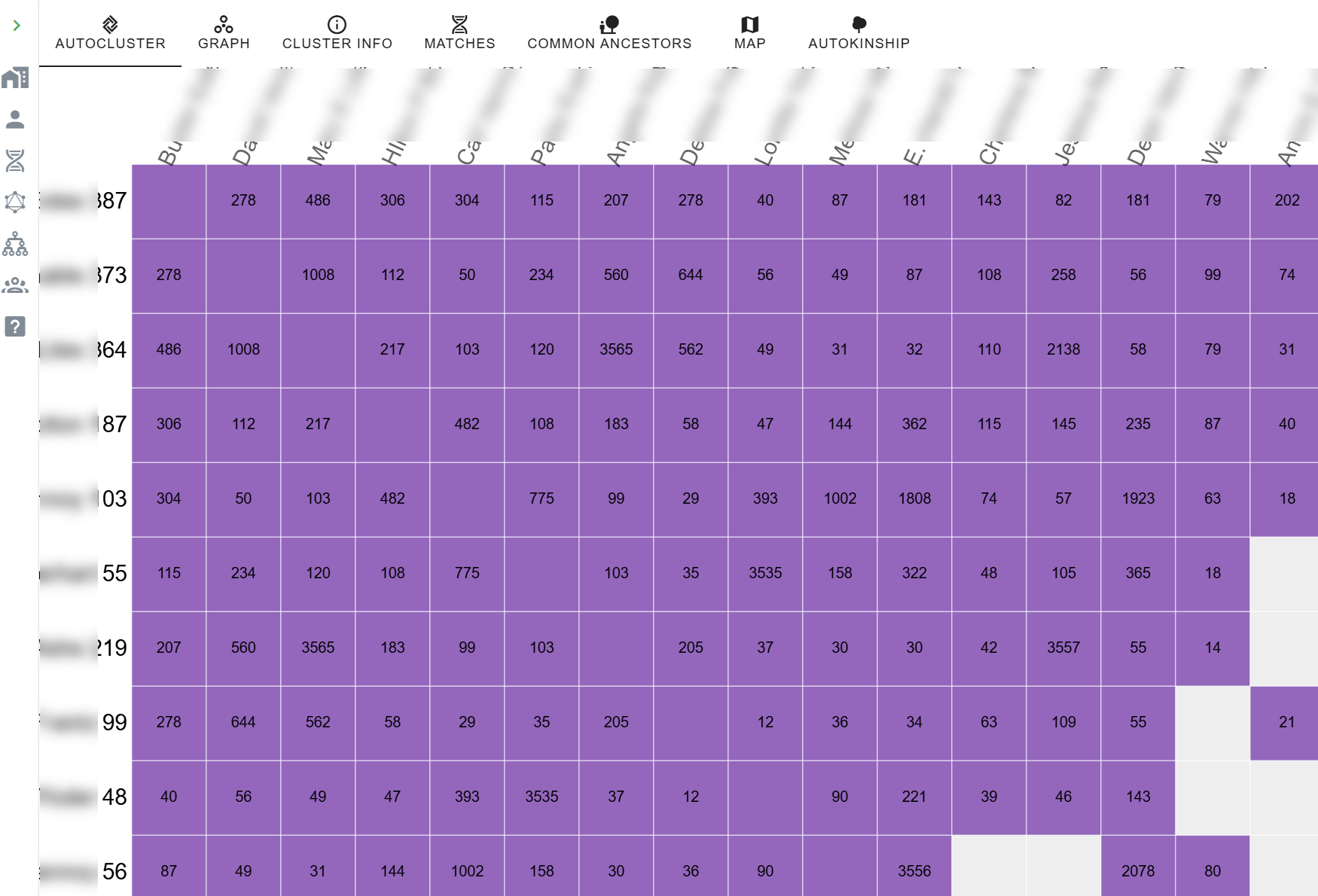
The purpose of the Matrix tool is to select Family Finder autosomal matches who are then displayed in a grid matrix for comparison, showing if and how those matches match each other.

Specifically:

  • Do your matches match each other?
  • What is their estimated relationship to each other?
  • How many segments of DNA do they share with each other?
  • How many cMs (centiMorgans) of DNA do they share with each other?

You can then push 7 matches through to the chromosome browser to see if they match on any of the same segments.

Automated Triangulation

If you are comparing bucketed (maternal or paternal) matches, or matches known to belong to the same side of your tree, the shared segments are automatically triangulated.

How cool is this?!!!

Keep in mind, though, that you may be related to someone through multiple ancestors, and they could be from both parent’s sides, so pay attention to the ancestral segment history.

Remember, every segment has its own unique history.

Let’s step through the new Matrix features and see how they work.

Select the Matrix

Navigate to the Matrix tool under “See More” under Autosomal DNA Results and Tools.

Under “Select Matches” you can select “All Matches” to choose from all of your matches, or you can select a grouping of matches to be displayed in the menu, below.

These groupings are shortcuts for you so you don’t have to pick everyone individually. You can also search for a name.

Click on the individuals you want to compare in the Matrix. The people you’ve selected from the group, at left, will appear in the box, at right. That’s who will be compared to each other.

Next, select which type of data will be compared.

I’m selecting “Close Relatives” for this example and “Relationship range.” First, I added my mother so I could see who matches with her.

Then I added the rest of the people I want to compare. In this case, I’ve added my closest matches, even though they are from both sides of my tree.

Relationship Range

I’ve selected “Relationship range,” which will show me how my matches estimated relationships to each other.

Based on the identity of these matches, and how they match each other, I can now determine their ancestral connection.

If I didn’t know who was related maternally and paternally, this grid would remove all doubt became I’m comparing to one of my parents.

If you don’t have a parent, adding close, known relatives on one or both sides will help immensely.

Be sure to make notes about what you’ve discovered on your matches page, and paint to DNAPainter if that’s how you’re tracking your segments to ancestors.

Number of Segments Shared

Now, I’ve selected “Number of segments shared” to compare the same group of people.

You can see the number of shared segments between Mom’s matches. Donald and Cheryl are full siblings.

The display shows how these people match Mom, and each other.

Melissa is Mom’s paternal second cousin. I was able to piece this together with the help of how she matches Mom and Mom’s known paternal first cousins, Cheryl and Donald.

Total cMs Shared

Next, I’m selecting “Total cMs shared” for comparison.

Looking at the number of shared cMs, even if I didn’t know that Donald and Cheryl were full siblings, I would now.

You can also push these through to the chromosome browser. I’ll illustrate in a minute.

Bucketed or Parental Side Matching

My favorite groupings for the new Matrix are the bucketed, meaning parental or maternal “side” matching.”

When your matches are already bucketed, thanks to having linked known matches to their profile card in your tree, the system does a lot of the “side” work for you behind the scenes.

When you select “Maternal, “Paternal” or “Paternal and Maternal” matches, the people who have been bucket to either side, or those related to you on both sides, are listed in the selection box.

I’m selecting 7 of my maternal bucketed matches because I’m going to push them through to the chromosome browser for additional evaluation. I’m not including my mother because I already know these people are related to both me and her, because they are bucketed maternally.

They’re compared in the various matrix configurations.

From the Shared cM comparison table, I can easily click to display matches in the chromosome browser.

If you’re comparing more than 7 people, you’ll need to reduce it to 7. I excluded my Mom because I already know she matches all of them.

Click on the Compare Chromosome Browser at the bottom for the 7 people selected.

I know that cousin Charles descends from Mom’s paternal Lentz line, and has no other connection, so I know that these other cousins who also match me on that same segment are also from Mom’s Lentz line.

I can also tell that the shared segments on chromosome 1 are from Mom’s maternal Lore line.

Shown here are the common ancestors in Mom’s pedigree chart. They are 4 and 5 generations back in time for me.

Look how easy that was!

I love this new Matrix tool.

Triangulation

Because three or more people, including me, match on the same segments, this means they also triangulate.

In the example above, we have two distinct triangulation groups. I’m only showing chromosomes 1-3 for illustration purposes, but there are also more triangulation groups on the other chromosomes. If I add other people, new triangulation groups will form!

Of course, these are my maternal bucketed matches, so I’m safe to reach that conclusion. If my father’s matches were also loaded here, I would have to check the matrix and see if these people also matched each other before I could determine that they triangulate.

Check Your Matches and Upload

Be sure to upload any tests to FamilyTreeDNA that you manage at other vendors, and encourage your cousins to upload too.

This combination of features is unique to FamilyTreeDNA. The more relatives you have available to match, especially when you already know the common ancestor, the better. Be sure to link your matches to their placard in your tree so that FamilyTreeDNA can do the bucketing for you.

Even if you don’t link people, you can still benefit greatly from the new matrix tool by just having your DNA available for matching. The matrix will help you sort out matches and identify who is related to whom, and how.

Take a look! What are you discovering?

_____________________________________________________________

Share the Love!

You’re always welcome to forward articles or links to friends and share on social media.

If you haven’t already subscribed (it’s free,) you can receive an e-mail whenever I publish by clicking the “follow” button on the main blog page, here.

You Can Help Keep This Blog Free

I receive a small contribution when you click on some of the links to vendors in my articles. This does NOT increase your price but helps me keep the lights on and this informational blog free for everyone. Please click on the links in the articles or to the vendors below if you are purchasing products or DNA testing.

Thank you so much.

DNA Purchases and Free Uploads

Genealogy Products and Services

My Books

Genealogy Books

Genealogy Research

Six Ways to Figure Out How We’re Related

In my latest Webinar, Six Ways to Figure Out How We’re Related, I discuss the various tools from Ancestry, FamilyTreeDNA, MyHeritage, and 23andMe – plus clusters from Genetic Affairs and the amazing DNAPainter.

This webinar lives in the Legacy Family Tree Webinar library, but as part of the “webtember” lineup, you can view it for free through the end of September.

It’s always exciting to discover a new match at one of the DNA testing companies, which, of course, begs the question of how you’re related.

So, what are the six ways to figure out how you’re related, and how do you use them?

Come along for a step-by-step guide!

Shared Matches

We begin with how each vendor handles shared matches, what that feature is called, where to find the information, and how to interpret what they are telling you.

23andMe goes a step further and creates a genetic tree, of sorts, although that functionality has changed since their breach last October.

Bucketing and Sides

Two vendors go a step further and provide unique tools to divide your matches maternally and paternally.

FamilyTreeDNA buckets your matches maternally and paternally (or both) based on matches you link to their profile cards in your tree. FamilyTreeDNA then uses your linked matches to triangulate with other matches and assign your matches accordingly, providing a maternal and paternal match list. Bucketing, also known as Family Matching, is one of my favorite tools.

Note that linking matches at FamilyTreeDNA requires that you have transferred your tree to MyHeritage. I wrote about that and provided instructions here and here, and produced a complimentary webinar, too.

Ancestry also divides your matches by parent, but they use a different technique based on their Sideview technology and either ethnicity or shared matches.

Surnames and Locations

Surnames and locations, either separately or together, provide HUGE hints!

MyHeritage provides a nice summary for each of your matches that includes ancestral surnames, a map of locations in common, and “Smart Matches” which shows you people in common in both of your trees. There are several ways to use these tools.

FamilyTreeDNA also provides a list of surnames. You can view either the surnames in common with a match, or all of their ancestral surnames, with locations if provided. The tester enters these surnames, and we review how to complete that step.

Ancestry also provides shared surnames, with clickable links to the number of people in your matches tree with that surname, plus common locations.

X-DNA

X-DNA is probably the most underutilized DNA matching tool. While each of the vendors actually test the X chromosome, only one, FamilyTreeDNA, provides X-matching. You can obtain X-matching results by uploading your DNA file to FamilyTreeDNA. I’ve provided upload/download instructions for all companies, here.

X-DNA has a very unique inheritance pattern because males only inherit an X chromosome from their mother which limits the number of potential common ancestors for any two testers. In other words, X-DNA matching does half your work for you!

Clustering Technology – AutoClusters, the Matrix and DNAPainter

In the past few years, match clustering has become a very useful tool. Clustering shows which of your matches match you and each other.

Genetic Affairs offers several flavors of these clusters, and both MyHeritage and GEDmatch have incorporated Genetic Affairs clusters into their product offerings.

If you haven’t used AutoClusters yet, by all means, try them out.

FamilyTreeDNA offers the Matrix, a slightly different version of clustering. You can select 10 people from your match list to see if they also match each other. Shared matches don’t automatically mean triangulation between you and those two people, or even that all three people descend from the same line. However, if the people are bucketed to your same side (parent) and they share common segments with you in the chromosome browser, they triangulate.

You’ll want to paint those matches to DNAPainter to determine which ancestor you share, especially if they haven’t provided a tree.

DNAPainter provides your chromosomes as the “canvas” upon which to paint your matches in order to correlate segments with ancestors and identify common ancestral lines with mystery matches.

Three vendors, FamilyTreeDNA, MyHeritage, and GEDmatch provide segment information with matches for you to paint. I illustrate how I walk segments back in time, identifying our most distant common ancestor possible.

Theories of Family Relativity and ThruLines

Both MyHeritage and Ancestry provide a combination of DNA matching and tree triangulation, where they search the trees of your DNA matches to find common ancestors with you – although their implementation is different.

MyHeritage’s Theories of Family Relativity provides varying theories about common ancestors for you and a specific match using both trees and historical documents. You can review the various pathways and confirm or reject theories. I love this tool.

Ancestry’s Thrulines functions a bit differently, showing you all of your matches that descend from a common ancestor in all your matches’ trees. Sometimes, the trees are incorrect, but Theories of Family Relativity and ThruLines should still be used as hints.

I showed how ThruLines helped me discover what happened to one of my ancestor’s grandchildren who was lost to the family at his mother’s death – and to all of us since. Not anymore.

Bonus – Y-DNA and Mitochondrial DNA at FamilyTreeDNA

Only FamilyTreeDNA offers both Y-DNA and Mitochondrial DNA testing and matching. All of the tools above pertain to autosomal DNA testing, which is named Family Finder at FamilyTreeDNA. Illustrated by the green arrow below, autosomal DNA testing measures and compares the DNA you inherited from each ancestral line, but that’s not the only game in town.

Y-DNA, in blue, for males, tracks the direct paternal line, which is the surname line in Western cultures. Mitochondrial DNA, in red, is passed from mothers to all of their children. Therefore, everyone can test, revealing matches and information about their mother’s direct matrilineal lineage.

Y-DNA testing includes the amazing Discover tool with a baker’s dozen different reports, including ancient DNA. Mitochondrial DNA will soon have its own MitoDiscover after the rollout of the new Mitotree.

Both tests include “Matches Maps” to help you determine how you are related to your matches, as well as where your ancestors came from before the advent of surnames.

The Advanced Matching feature allows you to select multiple tests to see if your matches match you on combined types of tests.

Tune In

Now that you know what we cover in the webinar, please tune in to see how to use these awesome tools. Be sure to fish in all four “ponds” plus GEDmatch, where you may find people who didn’t test at a company that provides a chromosome browser or matching segment information.

Tools provided by the DNA testing vendors facilitate multiple ways to determine how we match and which ancestor(s) we have in common.

You can watch the webinar, here.

Additionally, subscribers to Legacy Family Tree Webinars have access to the 25-page syllabus with even more information!

A Legacy Family Tree Webinar subscription normally costs $49.95 per year, but through the end of September, there’s a coupon code good for 20% off. Just click here, then enter webtember24 at the checkout.

Enjoy!

_____________________________________________________________

Follow DNAexplain on Facebook, here.

Share the Love!

You’re always welcome to forward articles or links to friends and share on social media.

If you haven’t already subscribed (it’s free,) you can receive an e-mail whenever I publish by clicking the “follow” button on the main blog page, here.

You Can Help Keep This Blog Free

I receive a small contribution when you click on some of the links to vendors in my articles. This does NOT increase your price but helps me keep the lights on and this informational blog free for everyone. Please click on the links in the articles or to the vendors below if you are purchasing products or DNA testing.

Thank you so much.

DNA Purchases and Free Uploads

Genealogy Products and Services

My Books

Genealogy Books

Genealogy Research

Great News – Both e-Pub and Print Version of “The Complete Guide to FamilyTreeDNA” Now Available Worldwide  

  • Anyone, anyplace, can order the full-color, searchable, e-pub version of The Complete Guide to FamilyTreeDNA – Y-DNA, Mitochondrial, Autosomal and X-DNA from the publisher, Genealogical.com, here.
  • Customers within the US can order the black and white print book from the publisher, here.
  • Customers outside the US can order the print book from their country’s Amazon website. The publisher does not ship print books outside the US due to customs, shipping costs, and associated delays. They arranged to have the book printed by an international printer so that it can be shipped directly to Amazon for order fulfillment without international customers incurring additional expenses and delays. If you ordered the book previously from Amazon and a long delivery time was projected, that should be resolved now and your book should be arriving soon.

Comprehensive

This book is truly comprehensive and includes:

  • 247 pages
  • More than 267 images
  • 288 footnotes
  • 12 charts
  • 68 tips
  • Plus, an 18-page glossary

To view the table of contents, click here. To order, click here.

Thank you, everyone, for your patience and your support.

_____________________________________________________________

Follow DNAexplain on Facebook, here.

Share the Love!

You’re always welcome to forward articles or links to friends and share on social media.

If you haven’t already subscribed (it’s free,) you can receive an e-mail whenever I publish by clicking the “follow” button on the main blog page, here.

You Can Help Keep This Blog Free

I receive a small contribution when you click on some of the links to vendors in my articles. This does NOT increase your price but helps me keep the lights on and this informational blog free for everyone. Please click on the links in the articles or to the vendors below if you are purchasing products or DNA testing.

Thank you so much.

DNA Purchases and Free Uploads

Genealogy Products and Services

My Books

Genealogy Books

Genealogy Research

Complete Guide to FamilyTreeDNA Released in Hardcopy

Just what many of you have been waiting for! The hardcopy print version of the Complete Guide to FamilyTreeDNA has just been released.

As shown in the table of contents below, The Complete Guide to FamilyTreeDNA contains lots of logically organized information! It includes basic education about genetic genealogy and how it works, instructions on using the FamilyTreeDNA tests and tools, plus an extensive glossary.

Enjoy!

_____________________________________________________________

Follow DNAexplain on Facebook, here.

Share the Love!

You’re always welcome to forward articles or links to friends and share on social media.

If you haven’t already subscribed (it’s free,) you can receive an e-mail whenever I publish by clicking the “follow” button on the main blog page, here.

You Can Help Keep This Blog Free

I receive a small contribution when you click on some of the links to vendors in my articles. This does NOT increase your price but helps me keep the lights on and this informational blog free for everyone. Please click on the links in the articles or to the vendors below if you are purchasing products or DNA testing.

Thank you so much.

DNA Purchases and Free Uploads

Genealogy Products and Services

My Books

Genealogy Books

Genealogy Research

Announcing: The Complete Guide to FamilyTreeDNA; Y-DNA, Mitochondrial, Autosomal and X-DNA

I’m so very pleased to announce the publication of my new book, The Complete Guide to FamilyTreeDNA – Y-DNA, Mitochondrial, Autosomal and X-DNA.

For the first time, the publisher, Genealogical.com, is making the full-color, searchable e-book version available before the hardcopy print version, here. The e-book version can be read using your favorite e-book reader such as Kindle or iBooks.

Update: The hardcopy version was released at the end of May and is available from the publisher in the US and from Amazon internationally.

This book is about more than how to use the FamilyTreeDNA products and interpreting their genealogical meaning, it’s also a primer on the four different types of DNA used for genealogy and how they work:

  • Autosomal DNA
  • Mitochondrial DNA
  • Y-DNA
  • X-DNA

There’s a LOT here, as shown by the table of contents, below

This book is chocked full of great information in one place. As an added bonus, the DNA glossary is 18 pages long.

I really hope you enjoy my new book, in whatever format you prefer.

_____________________________________________________________

Follow DNAexplain on Facebook, here.

Share the Love!

You’re always welcome to forward articles or links to friends and share on social media.

If you haven’t already subscribed (it’s free,) you can receive an e-mail whenever I publish by clicking the “follow” button on the main blog page, here.

You Can Help Keep This Blog Free

I receive a small contribution when you click on some of the links to vendors in my articles. This does NOT increase your price but helps me keep the lights on and this informational blog free for everyone. Please click on the links in the articles or to the vendors below if you are purchasing products or DNA testing.

Thank you so much.

DNA Purchases and Free Uploads

Genealogy Products and Services

My Books

Genealogy Books

Genealogy Research

Comparing DNA Results – Different Tests at the Same Testing Company

Several people have asked about different tests at the same DNA testing company. They wondered if matching is affected, meaning whether your matches are different if you have two different tests at the same company. Specifically, they asked if you are better off purchasing a test AT a DNA testing vendor that allows uploads, rather than uploading a test from a different vendor. Does it make a difference to the tester or their matches? Do they have the same matches?

These are great questions, and the answer isn’t conclusive. It varies based on several factors.

Having multiple tests at the same DNA testing company can occur in three ways:

  • The same person tests twice at the same DNA testing company.
  • The same person tests once at the DNA testing company and uploads a test from a different testing company. Only two of the primary four DNA testing companies accept uploads from other vendors – FamilyTreeDNA and MyHeritage.
  • The same person uploads two different files from other DNA testing companies to the DNA testing company in question. For example, the DNA company could be FamilyTreeDNA and the two uploaded DNA files could be from either MyHeritage, 23andMe or Ancestry.

All DNA testing companies allow users to download their raw DNA data files. This enables the tester to upload their DNA file to the vendors who accept uploaded files. Both FamilyTreeDNA and MyHeritage provide matching for free, but advanced tools require a small unlock fee of $19 and $29, respectively.

Testing Company Accepts Uploads from Other Companies Download Upload Instructions
23andMe No Instructions here
Ancestry No Instructions here
FamilyTreeDNA Yes, some Instructions here
MyHeritage Yes, some Instructions here

I wrote about developing a DNA testing and transfer/upload strategy, here, and about which companies accept which tests, here.

Not all DNA files are created equal. Therefore, not all files from vendors are compatible with other vendors for various reasons.

Multiple Tests at the Same DNA Testing Company

I have at least two tests at each of the four major vendors. I did this for research purposes, meaning to write articles to share with you.

If you actually test twice at a vendor, meaning purchase two separate tests and take them yourself, you will have two test results at that testing company. At some companies, specifically 23andMe, if you purchase a new test through their “upgrade” procedure, you won’t have two tests, just the newer one.

However, if you’re testing at the DNA testing company, and also uploading, I generally don’t recommend more than one test at each vendor. All it really does is clog up people’s match lists with no or little additional benefit. At 23andMe, with their restrictions on the size of your match list, if everyone had two tests, the effective match limit would be half of their stated limit of about 1500 matches for earlier testers and about 5000 for current testers with subscriptions.

So, in essence, I’m telling you to “do as I say, not as I do.” We all have better things to do with our money rather pay for the same test twice. If you haven’t tested your Y-DNA or mitochondrial DNA, that’s much more beneficial than two autosomal tests at one vendor.

Chips and Chip Evolution

Before we begin the side-by-side comparison, let’s briefly discuss DNA testing chips and how they work.

Each DNA testing company purchases DNA processing equipment. Illumina is the big dog in this arena. Illumina defines the capacity and structure of each chip. In part, how the testing companies use that capacity, or space on each chip, is up to each company. This means that the different testing companies test many of the same autosomal DNA SNP locations, but not all of the same locations.

Furthermore, the individual testing companies can specify a number of “other” locations to be included on their chip, up to the chip maximum size limit. The testing companies who offer Y-DNA or mitochondrial DNA haplogroups from autosomal tests use part of their chip array space for selected known haplogroup-defining SNP locations. This does NOT mean that Y-DNA or mitochondrial DNA is autosomal, just that the testing company used part of their chip array space to target these SNPs in your genome. Of course, for your most refined haplogroup and Y-DNA or mitochondrial DNA matching, you have to take those specific tests at FamilyTreeDNA .

This means that each testing company includes and reports many of the same, but also some different SNP locations when they scan your DNA.

In the lab, after your DNA is extracted from either your saliva or the cheek swab, it’s placed on this array chip which is then placed in the processing equipment.

There are several steps in processing your DNA. Each DNA location specified on the chip is scanned and read multiple times, and the results are recorded. The final output is the raw DNA results file that you see if/when you download your raw DNA file.

Here’s an example from my file. The RSID is the reference SNP cluster ID which is the naming convention used for specific SNPs. It’s not relevant to you, but it is to the lab, along with the chromosome number and position, which is in essence the address on the chromosome.

In the Result column, your file reports one nucleotide (T, A, C or G) that you inherited from each parent at each tested position. They are not listed in “parent order” because your DNA is not organized in that fashion. There’s no way for the lab to know which nucleotide came from which parent, unless they are the same, of course. You can read about nucleotides, here.

When you upload your raw DNA file to a different DNA testing company (vendor), they have to work with a file that isn’t entirely compatible with the files they generate, or the other files uploaded from other DNA testing companies.

In addition to dealing with different file formats and contents from multiple DNA vendors, companies change their own chips and file structure from time to time. In some cases, it’s a forced change by the chip manufacturer. Other times, the vendors want to include different locations or make improvements. For example, with 23andMe’s focus on health, they probably add new medically related SNP locations regularly. Regardless of why, some DNA files include locations not included in other files and are not 100% compatible.

Looking at the first few entries in my example file above, let’s say that the testing vendor included the first ten positions, but an uploaded file from another company did not. Or perhaps the chip changed, and a different version of the company’s own file contains different positions.

DNA testing companies have to “fill in the blanks” for compatibility, and they do this using a technique called imputation. Illumina forced their customers to adopt imputation in 2017 when they dropped the capacity of their chip. I was initially quite skeptical, but imputation has worked surprisingly well. Some of the matching differences you will see when comparing the results of two different DNA files is a result of imputation.

I wrote about imputation in an early article here. Please note the companies have fixed many issues with imputation and improved matching greatly, but the concepts and imputation processes still apply. The downloaded raw data files are your results BEFORE imputation, meaning that it’s up to any company where you upload to process your raw file in the same way they would process a file that they generated. A lot goes on behind the scenes when you upload a file to a DNA testing company.

At both 23andMe and Ancestry, you know that all of your matches tested there, meaning they did not upload a file from another testing company. You don’t know and can’t tell what chip was utilized when your matches tested. The only way to determine a chip testing version, aside from knowing the date or remembering the chip version from when you tested, is to look at the beginning of the raw data download file, although not all files contain that information.

Ok, now that you understand the landscape, let’s look at my results at each company.

23andMe

I tested twice at 23andMe on two different chip versions, V3 and V4, which tested some different locations of my DNA. Neither of these chips is the current version. I originally tested twice to evaluate the differences between the two test versions which you can read about, here.

23andMe named their ethnicity results Ancestry Composition.

They last updated my V3 test’s Ancestry Composition results on July 28, 2021.

The percentages are shown at left, and the country locations are highlighted at right for my 23andMe V3 test.

Click to enlarge any graphic

The 23andMe V4 test was also updated for the last time on July 28, 2021.

The ethnicity results differ substantially between the two chip versions, even though they were both updated on the same date.

In October of 2020, in an effort to “encourage” their customers to pay for a new test on their V5 chip, 23andMe announced that there would be no ethnicity updates on older tests. So, I really don’t know for sure when my tests were actually updated. Just note how different the results are. It’s also worth mentioning that 23andMe does not show trace amounts on their map, so even though my Indigenous American results were found, they aren’t displayed on the map.

Indigenous is, however, shown in yellow on their DNA Chromosome Painting.

No other testing company restricts updates, penalizing their customers who purchased earlier versions of tests.

Matches at 23andMe

23andMe limits your matches to about 1500 unless you have purchased the current test, including health AND pay for an annual $69 subscription which buys you about 5000 matches. I have not purchased this test.

Your number of actual matches displayed/retained is also affected by how many people you have communicated with, or at least initiated communications with. 23andMe does not roll those people off of your match list.

I have 1803 matches on both of my tests, meaning I’ve reached out to about 300 people who would have otherwise been removed from my match list. 23andMe retains your highest matches, deleting lower matches after you reach the maximum match threshold.

I’ve randomly evaluated several of the same matches at each vendor, at least five maternal and five paternal, separated by a blank row. I wanted to determine whether they match me on the same number of centimorgans, meaning the same amount of DNA, on both tests, and the same number of segments.

Match 23and Me V3 23and Me V4
Patricia 292 cM – 12 segments Same as V3
Joe 148 cM, 8 segments Same
Emily 73 cM, 4 segs 72 cM, 4 seg
Roland 27 cM, 1 seg Same
Ian 62 cM, 4 seg Same
Stacy 469 cM, 16 segments 482 cM, 16 segments
Harold 134 cM, 6 segments Same
Dean 69 cM, 3 seg Same
Carl 95 cM, 4 seg Same
Debbie 83 cM, 4 seg 84 cM, 4 seg

As you can see, the matches are either exact or xclose.

Please note that bolded matches are also found at another company. I will include a summary table at the end comparing the same match across multiple vendors.

23and Me Summary

The 23andMe V3 and V4 match results are very close. Since the match limit is the same, and the results are so close between tests, they are essentially identical in terms of matching.

The ethnicity results are similar, but the V4 test reflects a broader region. Italian baffles me in both versions.

Ethnicity should never be taken at face value at any DNA testing company, especially with smaller percentages which could be noise or a combination of other regions which just happens to resemble Italy, in my case.

I don’t know what type of comparison the current chip would yield since I suspect it has more medical and less genealogical SNPs on board.

Reprocessing Tests

This is probably a good place to note that it’s very expensive for any company to update their customer’s ethnicity results because every single customer’s DNA results file must be completely rerun. Note that this does not mean their DNA itself is retested. The output raw data file is reprocessed using a new algorithm.

Rerunning means reprocessing that specific portion of every test, meaning the vendors must rent “time in the cloud.” We are talking millions of dollars for each run. I don’t know how much it costs per test, but think about the expense if it takes $1 to rerun each test in the vendor’s database. Ancestry has more than 20 million tests.

While we, as consumers, are always chomping at the bit for new and better ethnicity results – the testing companies need to be sure it really is “better,” not just different before they invest the money to reprocess and update results.

This is probably why 23andMe decided to cease updating older kits. The newer tests require a subscription which is recurring revenue.

The same is true when DNA testing companies need to rematch their entire user base. This happens when the criteria for matching changes. For example, Ancestry purged a large number of matches for all of their customers back in 2020. While match algorithm changes necessitate rematching, with associated costs, this change also provided Ancestry with the huge benefit of eliminating approximately half of their customer’s matches. This freed up storage space, either physically in their data center or space rented in the cloud, representing substantial cost-savings.

How long can a DNA testing company reasonably be expected to continue investing in a product which never generates additional revenue but for which the maintenance and reinvestment costs never end?

Ancestry and MyHeritage both hope to offset the expenses of maintaining their customer’s DNA tests and providing free updates by selling subscriptions to their record services. 23andMe wants you to purchase a new test and a yearly subscription. FamilyTreeDNA wants you to purchase a Big Y-DNA and mitochondrial DNA test.

OK, now let’s look at my matches at Ancestry.

Ancestry

I’ve taken two Ancestry tests, V1 and V2. There were some differences, which I wrote about here and here. V2 is no longer the current chip.

Except for 23andMe who wants their customers to purchase their most current test, the other companies no longer routinely announce new chip versions. They just go about their business. The only way you know that a vendor actually changed something is when the other companies who accept uploads suddenly encounter an issue with file formats. It always takes a few weeks to sort that out.

My Ancestry V1 test’s ethnicity results don’t show my Native American ethnicity.

Ancestry results were updated in June 2022

However, my V2 results do include Native American ethnicity.

Matches at Ancestry

I have many more matches on my V1 test at Ancestry because I took steps to preserve my smaller matches when Ancestry initiated its massive purge in 2020. I wrote about that here and here.

Ancestry’s SideView breaks matches down into maternal, paternal, and unassigned based on your side selection. You tell Ancestry which side is which. You may be able to determine which “side” is maternal or paternal either by your ethnicity or shared matches. While SideView is not always accurate, it’s a good place to begin.

Match Category Ancestry V1 Test Ancestry V2 Test
Maternal 15,587 15,116
Paternal 42,247 41,870
Both 2 2
Unassigned 48,999 4,127
Total 106,835 61,115

Ancestry either displays all your matches or your matches by side, which I used to compile the table above. I suspect that Ancestry is not assigning any of the smaller preserved matches to “sides” based on the numbers above.

Ancestry implemented a process called Timber that removes DNA that they feel is “too matchy,” meaning you match enough people in this region that they think it’s a pileup region for you personally, and therefore not useful. In some cases, enough DNA is removed causing that person to no longer be considered a match because they fall beneath the match threshold. I am not a fan of Timber.

Your match amount shown is AFTER Timber has removed those segments. Unweighted shared DNA is your pre-Timber match amount.

You can view the Unweighted shared DNA by clicking on the amount of shared DNA on your match list.

You can read Ancestry’s Matching White Paper, here.

Let’s take a look at my matches. I’ve listed both weighted and unweighted where they are different.

Match Ancestry V1 Ancestry V2
Michael 755 cM, 35 seg 737 cM, 33 seg
Edward 66 cM, 4 seg (unweighted 86 cM) 65 cM, 4 seg (unweighted 86 cM)
Tom 59 cM, 3 seg (unweighted 63) Same
Jonathon 43 cM, 4 seg, (unweighted 52 cM) Same
Matthew 20 cM, 2 seg (unweighted 35 cM) Same
Harold 132 cM, 7 seg 135 cM, 6 seg
Dean 67 cM, 4 seg (unweighted 78 cM) 66 cM, 4 seg (unweighted 78 cM)
Debbie 93 cM, 5 seg Same
Valli 142 cM, 3 seg Same
Jared 20 cM, 1 seg (unweighted 22 cM) Same

Timber only removes DNA when the match is under 90 cM. Almost every match under 90 cM has some DNA removed.

Ancestry Summary

The results of the two Ancestry tests are very close.

In some circumstances, no DNA is removed by Timber, so the unweighted is the same as the weighted. However, in other cases, a significant amount is removed. 15 cM of Matthew’s 35 cM was removed by Timber, reducing his total to 20 cM.

Remember that Ancestry does not show shared matches unless they are greater than 20 cM, which is different than any other DNA testing company.

At one point, Ancestry was selling a health test that was also a genealogy test. That test utilized a different chip that is not accepted for uploads by other vendors. The results of that test might well be different that the “normal” Ancestry tests focused on genealogy. The Ancestry health test is no longer offered.

Companies that Accept Uploads

DNA testing companies that accept uploaded DNA files from other DNA testing companies need to process the uploaded file, just like a file that is generated in their own lab. Of course, they must deal with the differences between uploaded files and their own file format. The processing includes imputation and formulates the uploaded file so that it works with the tools that they provide for their customers, including ethnicity (by whatever name they use) matching, family matching (bucketing), advanced matching, the match matrix, triangulation, AutoClusters, Theories of Family Relativity, and other advanced tools.

Of course, the testing company accepting uploads can only work with the DNA locations provided by the original DNA testing company in the uploaded file.

Matching and some additional tools are free to uploaders, but advanced tools require an inexpensive unlock.

FamilyTreeDNA

I took a test at FamilyTreeDNA, plus uploaded a copy of both of my Ancestry DNA files.

FamilyTreeDNA named their population (ethnicity) test myOrigins and the current version is V3. I wrote about the rollout and comparison in September of 2020, here.

My DNA test taken at FamilyTreeDNA, above, reveals Native American segments that match reference populations found both in North and South America and the Caribbean Islands.

At FamilyTreeDNA, my Ancestry V1 uploaded file results show Native American population matches only in North America.

Interestingly, my Ancestry V1 file processed AT Ancestry did not reveal Native American ancestry, but the same file uploaded to and processed at FamilyTreeDNA did show Native American results, reflecting the difference between the vendors’ internal algorithms and reference populations utilized.

My myOrigins results from my Ancestry V2 uploaded file at FamilyTreeDNA also include my North American Native American segments. The V2 test also showed Native American ethnicity at Ancestry, so clearly something changed in Ancestry’s algorithm, locations tested, and/or reference populations between V1 and V2.

Fortunately, FamilyTreeDNA provides both chromosome painting and a population download file so I can match those Native segments with my autosomal matches to identify which of my ancestors contributed those specific segments.

One of my Native segments is shown in pink on Chromosome1. My mother has a Native segment in exactly the same location, so I know that this segment originated with my mother’s ancestors.

I downloaded the myOrigins population segment file and painted my results at DNAPainter, along with the matches where I can identify our common ancestor. This allowed me to pinpoint the ancestral line that contributed this Native segment in my maternal line. You can read about using DNAPainter, here.

FamilyTreeDNA Matches

I have significantly more matches at FamilyTreeDNA on their test than on either of my Ancestry tests that I uploaded. However, nearly the same number are maternally or paternally assigned through Family Matching, with the remainder unassigned. You can read about Family Matching here.

Match Category FamilyTreeDNA Test Ancestry V1 at FamilyTreeDNA Ancestry V2 at FamilyTreeDNA
Paternal 3,479 3,572 3,422
Maternal 1,549 1,536 1,477
Both 3 3 3
All 8,154 6,397 6,579

Family matching, aka bucketing, automatically assigns my matches as maternal and paternal by linking known relatives to their place in my tree.

I completed the following match chart using my original test taken at FamilyTreeDNA, plus the same match at FamilyTreeDNA for both of my Ancestry tests.

In other words, Cheryl matched me at 467 cM on 21 segments on the original test taken at FamilyTreeDNA. She matched me on 473 cM and 21 segments on my Ancestry V1 test uploaded to FamilyTreeDNA and on 483 cM and 22 segments on the Ancestry V2 test uploaded to FamilyTreeDNA.

Match FamilyTreeDNA Ancestry V1 at FTDNA Ancestry V2 at FTDNA
Cheryl 467 cM, 21 seg 473 cM, 21 seg 483 cM, 22 seg
Patricia 195 cM, 11 seg 189 cM, 11 seg 188 cM, 11 seg
Tom 77 cM, 4 seg 71 cM, 4 seg 76 cM, 4 seg
Thomas 72 cM, 3 seg 71 cM, 3 seg 74 cM, 3 seg
Roland 29 cM, 1 seg 35 cM, 2 seg 35 cM, 2 seg
Rex 62 cM, 4 seg 55 cM, 3 seg 57 cM, 3 seg
Don 395 cM, 18 seg 362 cM, 15 seg 398 cM, 18 seg
Ian 64 cM, 4 seg 56 cM, 4 seg 64 cM, 4 seg
Stacy 490 cM, 18 seg 494 cM, 15 seg 489 cM, 14 seg
Harold 127 cM, 5 cM 133 cM, 6 seg 143 cM, 6 seg
Dean 81 cM, 4 seg 75 cM, 3 seg 83 cM, 4 seg
Carl 103 cM, 4 seg 101 cM, 4 seg 102 cM, 4 seg
Debbie 99 cM, 5 seg 97 cM, 5 seg 99 cM, 5 seg
David 373 cM, 16 seg 435 cM, 19 seg 417 cM, 18 seg
Amos 176 cM, 7 seg 177 cM. 8 seg 177 cM, 7 seg
Buster 387 cM, 15 seg 396 cM, 16 seg 402 cM, 17 seg
Charlene 461 cM, 21 seg 450 cM, 21 seg 448 cM, 20 seg
Carol 65 cM, 6 seg 64 cM, 6 seg 65 cM, 6 seg

I have tested many of my cousins at FamilyTreeDNA and encouraged others to test or upload. I’ve attempted to include enough people so that I can have common matches at least at one other DNA testing company for comparison.

FamilyTreeDNA Summary

The matches are relatively close, with a few being exact.

Interestingly, some of the segment counts are different. In most cases, this results from one segment being broken into multiple segments by one or more of the tests, but not always. In the couple that I checked, the entire segment seems to descend from the same ancestral couple, so the break is likely a result of not all of the same DNA locations being tested, plus the limits of imputation.

MyHeritage

I have two tests at MyHeritage. One taken at MyHeritage, and an uploaded file from FamilyTreeDNA.

MyHeritage displays both ethnicity results and Genetic Groups which maps groups of people that you match. I left the Genetic Groups setting at the highest confidence level. Shifting it to lower displays additional Genetic Groups, some of which overlap with or are within ethnicity regions.

My test taken at MyHeritage, above, shows several ethnicities and Genetic Groups, but no Native American.

My FamilyTreeDNA kit processed at MyHeritage shows the same ethnicity regions, one additional Genetic Group, plus Native American heritage in the Amazon which is rather surprising given that I don’t show Native in North American regions where I’m positive my Native ancestors lived.

MyHeritage Matching

At MyHeritage, I compared the results of the test I took with MyHeritage, and a test I uploaded from FamilyTreeDNA. Fewer than half of my matches can be assigned to a parent via shared matching.

Matches MyHeritage Test FamilyTreeDNA at MyHeritage
Paternal 4,422 6,501
Maternal 2,660 3,655
Total 13,233 16,147

I have rounded my matches at MyHeritage to the closest cM.

Match MyHeritage Test FamilyTreeDNA at MyHeritage
Michael 801 cM, 32 seg 823 cM, 31 segments
Cheryl 467 cM, 23 seg 477 cM, 23 seg
Roland No match 28 cM, 1 seg
Patty 156 cM, 9 seg 151 cM, 9 seg
Rex 43 cM, 4 seg 53 cM, 3 seg
Don 369 cM, 16 seg 382 cM, 17 seg
 
David 449 cM, 17 seg 460 cM, 17 seg
Charlene 454 cM, 23 seg 477 cM, 24 seg
Buster 408 cM, 15 seg 410 cM, 16 seg
Amos 183 cM, 8 seg Same
Carol 78 cM, 6 seg 87 cM, 7 seg

MyHeritage Summary

I was surprised to discover that Roland had no match with the MyHeritage test, but did with the FamilyTreeDNA test. I wonder if this is a searching or matching glitch, especially since both companies use the same chip. 28 cM in one segment is a reasonably large match, and even if it was divided in two, it would still be over the matching threshold. I know this is a valid match because Roland triangulates with me and several cousins, I’m positive of our common ancestor, and he also matches me at both FamilyTreeDNA and 23andMe.

Other than that, the matches are reasonably close, with one being exact.

Your Matches Aren’t Everyplace

I unsuccessfully searched for someone who was a match to me in all four databases. Ancestry does not permit match downloads, so I had to search manually. People don’t always use the same names in different databases.

Surprisingly, I was unable to find one match who is in all of the databases. Many people only suggest testing at Ancestry because they have the largest database, but if you look at the following comparison chart that I’ve created, you’ll see that 16 of 26 people, or 62% were not at Ancestry. Conversely, many people were at Ancestry and not elsewhere. I could not find five maternal and five paternal matches at Ancestry that I could identify as matches in another database. 40% were not elsewhere.

If you think for one minute that it doesn’t matter for genealogy if you’re in all four major databases, please reconsider. It surely does matter.

Every single vendor has matches that the others don’t. Substantial, important matches. I have found first and second-cousin matches in every database that weren’t elsewhere.

Many of the original testers have passed away and can’t test again. My mother can never test at either 23andMe or Ancestry, but she is at both FamilyTreeDNA and MyHeritage because I could upgrade her kit at FamilyTreeDNA after she died. I uploaded her to MyHeritage. Of course, because she is a generation closer to our ancestors, she has many valuable matches that I don’t.

Each vendor provides either an email address or a messaging platform for you to contact your matches. Don’t be discouraged if they don’t answer. Just today, I received a reply that was years in the making.

Genealogists hope for immediate gratification, but we are actually in this for the long game. Play it with every tool at your disposal.

The Answer

Does it matter if you test at a DNA testing company, or upload a file?

I know this was a very long answer to what my readers hoped was a simple yes or no question.

There is no consistent answer at either FamilyTreeDNA or MyHeritage, the two DNA testing companies that accept uploads. Be sure you’re in both databases. My closest two matches that I did not test were found at MyHeritage. Here’s a direct link to upload at MyHeritage.

Of the vendors, those two should be the closest to each other because they are both processed in the GenebyGene lab, but again, the actual chip version, when the test was originally taken, and each vendor’s internal processing will result in differences. Neither the original test at the DNA testing company nor the uploaded files have consistently higher or lower matches. Neither type of test or upload appears to be universally more or less accurate. Differences in either direction seem to occur on a match-by-match basis. Many are so close as to be virtually equivalent, with a few seemingly random exceptions. Of course, we always have to consider Timber.

If you upload, unlock the advanced features at both FamilyTreeDNA and MyHeritage.

If you upload to a DNA testing company, you may discover in the future that some features and functions will only be available to original testers.

Personally, if I had the option, I would test at the company directly simply because it eliminates or at least reduces the possibility of future incompatibilities – with the exception of 23andMe which has chosen to not provide consistent updates to older tests. I’m incredibly grateful I didn’t test my mother or now deceased family members at 23andMe, and only there. I would be heartsick, heartbroken, and furious.

Our DNA is an extremely valuable resource for our genealogy. It’s the gift that truly keeps on giving, day after day, even when other records don’t exist. Be sure you and your family members are in each database one way or another, and test your Y-DNA (for males) and mitochondrial DNA (for everyone) to have a complete arsenal at your disposal.

_____________________________________________________________

Follow DNAexplain on Facebook, here.

Share the Love!

You’re always welcome to forward articles or links to friends and share on social media.

If you haven’t already subscribed (it’s free,) you can receive an email whenever I publish by clicking the “follow” button on the main blog page, here.

You Can Help Keep This Blog Free

I receive a small contribution when you click on some of the links to vendors in my articles. This does NOT increase the price you pay but helps me to keep the lights on and this informational blog free for everyone. Please click on the links in the articles or to the vendors below if you are purchasing products or DNA testing.

Thank you so much.

DNA Purchases and Free Uploads

Genealogy Products and Services

My Book

Genealogy Books

Genealogy Research

Concepts: Your Matches on the Same Segment are NOT Necessarily Related to Each Other

Just because two (or more) people match you on the same segment does NOT mean they are related to each other.

This is a fundamental concept of DNA matching and of using a chromosome browser.

I want to make this concept crystal clear.

This past week, I’ve had two people contact me with the same question that’s based up on a critical misunderstanding, or maybe just lack of understanding.

It’s not intuitive – in fact, it’s counter-intuitive. I understand why they don’t understand.

It seems logical that if two or more people show up as a match to you on the chromosome browser, on the same segment, you’ve hit a home run and all you need to do is to identify their common ancestor who will also be your common ancestor, or at least related. Right?

NOT SO FAST!

Let’s walk through this, step-by-step. Once you “get it,” you’ll never forget it, and you can use this to help other people understand too. Please notice there are lots of links here to other articles I’ve written if you need refreshers or help with terms.

Yay! – I’ve Got Matches

OK, so you’ve just discovered that you have a close match with three people, on the same segment. You’re thrilled! Maybe you’re trying to identify your grandparent, so first or second cousin matches are VERY exciting for you.

They are also close enough matches with large enough segments that you don’t need to worry about false positive matches, meaning identical by chance.

Let’s take a look. I’m using FamilyTreeDNA because that’s where the majority of my family has tested, plus they have a nice chromosome browser and their unique matrix tool.

We have three nice-sized matches to people estimated to be my first or second cousins. I’ve selected all three and compared them in the chromosome browser. The large red match is 87 cM and the blue and teal matches are 39 cM each, and completely within the 87 cM segment, so completely overlapping.

I’ve hit the mother-lode, right?

All I need to do is identify THEIR common ancestor and I’ll surely find mine.

Right???

Nope

Just because they all three match ME on this same segment does NOT mean they all match each other and are from the same side of my family. All three people DO NOT NECESSARILY have the same ancestor. From this information alone, we cannot tell.

I know this seems counterintuitive, especially since you’re seeing them all on MY chromosomes – which are the background pallet.

However, remember that I have two chromosomes. One from my father and one from my mother.

These matches are ALWAYS FROM THE PERSPECTIVE OF THE TESTER.

So, I’m going to see matches in exactly the same location – matches on my mother’s chromosome and matches on my father’s chromosomes – painted on the same segment locations of my chromosome.

Let’s prove that in the simplest of ways.

Mom and Dad

This is my kit, compared with my Dad and Mom.

I only took a screen shot of my first several chromosomes, but you can see that I match both of my parents on the full length of each chromosome – on the same exact segments.

I am the background – the pallet upon which my matches are painted.

First, my father is painted, then my mother – their match to me displayed on my chromosomes.

I assure you, my father and mother are NOT related to each other. I’ll prove it.

I could simply select one parent, then look for the other parent on the shared matches list.

Or, I could use the Matrix tool, especially if I wanted to see if a group of people are related to me and also to each other.

The Matrix

The Matrix tool is available under “See More,” in the Autosomal DNA Results & Tools section.

The Matrix allows you to select 10 or fewer matches to see if they are matches to each other. We already know they are matches to you.

I added my parents into the matrix.

My parents do not match each other, meaning they are not genetically related, because their intersecting cell is not blue.

Next, let’s select those three other people I match and see if they match each other.

Yes indeed, we can see that Cheryl and Donald match each other, but Amos matches NEITHER Cheryl nor Don. Yet, the segments of Cheryl and Donald, who had the 39 cM blue and teal segments on the chromosome browser fall entirely within Amos’s 87 cM segment.

Therefore, if Cheryl and Donald do not match Amos, that means that Cheryl and Donald are from one side of my family, and Amos is from the other. This is absolutely true in this instance because we are comparing the exact same segment on my DNA, so everyone has to match me maternally or paternally, or by chance (IBC.) The segment size alone removes the possibility of IBC.

Each parent gave me one copy of chromosome 4, so everyone who matches me on chromosome 4 must match one or the other parent on that chromosome segment.

I’ve added my parents back into the comparison, at the bottom, with the three matches on chromosome 4. Now you can see that same segment again, and everyone matches me, parents included, of course.

There’s no way to tell the difference whether the blue, red and teal match is on my mother’s or father’s side without additional information.

Again, let’s prove it.

Everybody, Let’s Dance

I added my Mom and Dad back into the matrix.

You can see that Mom and Cheryl and Donald all match each other, plus me of course, by inference because these are my matches.

You can see that Amos and my Dad match each other, and me of course, but not the other people.

Settled

So, we’ve settled that, right.

In my case, I could provide this great example, because I do in fact have parental tests to use for comparison.

You can see when I remove my Dad and Amos that Cheryl and Donald and my Mom all match each other. If I were to remove my Mom, Cheryl and Donald would match each other.

If I remove Mom, Donald and Cheryl, Dad and Amos match each other.

Of course, you may not have either of your parents’ DNA to use as an anchor for matching. You may, in fact, be searching for a parent or close relative.

If you do have “anchor people,” by all means, use them. In fact, upload or create a tree, link your anchor people and as many others as possible to their profiles in your tree at FamilyTreeDNA so your matches will be automatically bucketed, meaning assigned maternally or paternally. FamilyTreeDNA is the only company that offers linking and triangulated bucketing.

But, if you’re searching for your parents or know nothing about your family, you won’t have an anchor point, so what’s next?

What’s Next?

Using a combination of matching, shared matches and the matrix, you can create your own grouping of matches.

My suggestion is to start with your 10 closest matches.

Pull all 10 into the matrix.

Remember, you will match these people across your chromosomes. The only question the matrix answers is “do my matches match each other,” and a “yes” doesn’t’ necessarily mean they match each other on the same line you match either or both of them on.

I’ve noted how each person is related to me.

You can see that there’s a large block of matches on my paternal side. Some are labeled “Father- both.” These people are related both maternally and paternally to my father, because either the families intermarried, or they are descendants of my paternal grandparents.

Three, Donald, Dennis and Cheryl are related on my mother’s side, but it’s worth noting that Dennis doesn’t match Cheryl or Donald. That doesn’t mean he’s not on my mother’s side, it simply means he descends through her maternal line, not the paternal line like Donald and Cheryl. Remember, we’re not comparing people who match on the same chromosome this time – we’re comparing my closest matches across all chromosomes, so it makes sense that my mother’s maternal matches won’t match her paternal matches, but they would both match Mom if she were in the matrix. Clearly they all match me or they would not be in my match list in the first place.

You could also run a Genetic Affairs AutoCluster or AutoTree to cluster your matches for you into groups, although you can’t select specifically which individuals to include, except by upper and lower thresholds.

Regardless of the method you select, you still need to do the homework to figure out the common ancestors, but it’s a lot easier knowing who also match each other.

Circling Back to the Beginning

Now, when you see those two or three or more people all matching you on the same segment on the chromosome browser, you KNOW that you can’t immediately assume they match you and therefore are all related to each other. It’s possible, and even probable that some of them will match you because they match your mother’s chromosome and some will match your father’s chromosome – so they are from different sides of your family.

The Matrix tool shows you, for groups of 10 or less, who also matches each other.

What you are doing by determining if multiple people share common segments and match each other is triangulation. I wrote about triangulation at each company in the articles below:

Unfortunately, Ancestry does not provide a chromosome browser, so triangulation is not possible, but Ancestry does provide shared matching with some caveats. However, some Ancestry customers do upload their DNA file to FamilyTreeDNA, MyHeritage or GEDmatch. You can find step-by-step download/upload instructions for all vendors, here.

Additional Resources

You’ve probably noticed there are lots of links in this article to other articles that I’ve written. You might want to go back and take a look at those if you’re in the process of educating yourself or need help wrapping your head around the “same segment address – two parents – your matches are not created equal” phenomenon.

Here are a couple of additional articles that will help you understand matching on both parents’ sides, and how to get the most out of matching, segments, triangulation and chromosome browsers.

I prepared a triangulation resource summary article, here:

Enjoy!!
____________________________________________________________

Follow DNAexplain on Facebook, here or follow me on Twitter, here.

Share the Love!

You’re always welcome to forward articles or links to friends and share on social media.

If you haven’t already subscribed (it’s free,) you can receive an email whenever I publish by clicking the “follow” button on the main blog page, here.

You Can Help Keep This Blog Free

I receive a small contribution when you click on some of the links to vendors in my articles. This does NOT increase the price you pay but helps me to keep the lights on and this informational blog free for everyone. Please click on the links in the articles or to the vendors below if you are purchasing products or DNA testing.

Thank you so much.

DNA Purchases and Free Uploads

Genealogy Products and Services

My Book

Genealogy Books

Genealogy Research

DNA: In Search of…Full and Half-Siblings

This is the fifth article in our series of articles about searching for unknown close family members, specifically; parents, grandparents, or siblings. However, these same techniques can be applied by genealogists to identify ancestors further back in time as well.

Please note that if a family member has tested and you do NOT see their results, ask them to verify that they have chosen to allow matching and for other people to view them in their match list. That process varies at different vendors.

You can also ask if they can see you in their results.

All Parties Need to Test

Searching for unknown siblings isn’t exactly searching, because to find them, they, themselves, or their descendant(s) must have taken a DNA test at the same vendor where you tested or uploaded a DNA file.

You may know through any variety of methods that they exist, or might exist, but if they don’t take a DNA test, you can’t find them using DNA. This might sound obvious, but I see people commenting and not realizing that the other sibling(s) must test too – and they may not have.

My first questions when someone comments in this vein are:

  1. Whether or not they are positive their sibling actually tested, meaning actually sent the test in to the vendor, and it was received by the testing company. You’d be surprised how many tests are living in permanent residence on someone’s countertop until it gets pushed into the drawer and forgotten about.
  2. If the person has confirmed that their sibling has results posted. They may have returned their test, but the results aren’t ready yet or there was a problem.
  3. AND that both people have authorized matching and sharing of results. Don’t hesitate to reach out to your vendor’s customer care if you need help with this.

Sibling Scenarios

The most common sibling scenarios are when one of two things happens:

  • A known sibling tests, only to discover that they don’t match you in the full sibling range, or not at all, when you expected they would
  • You discover a surprise match in the full or half-sibling range

Let’s talk about these scenarios and how to determine:

  • If someone is a sibling
  • If they are a full or half-sibling
  • If a half-sibling, if they descend from your mother or father

As with everything else genetic, we’ll be gathering and analyzing different pieces of evidence along the way.

Full and Half-Siblings

Just to make sure we are all on the same page:

  • A full sibling is someone who shares both parents with you.
  • A half-sibling is someone who shares one parent with you, but not the other parent.
  • A step-sibling is someone who shares no biological parents with you. This situation occurs when your parent marries their parent, after you are both born, and their parent becomes your step-parent. You share neither of your biological parents with a step-sibling, so you share no DNA and will not show up on each other’s match lists.
  • A three-quarters sibling is someone with whom you share one parent, but two siblings are the other parent. For example, you share the same mother, but one brother fathered you, and your father’s brother fathered your sibling. Yes, this can get very messy and is almost impossible for a non-professional to sort through, if even then. (This is not a solicitation. I do not take private clients.) We will not be addressing this situation specifically.

Caution

With any search for unknown relatives, you have no way of knowing what you will find.

In one’s mind, there are happy reunions, but you may experience something entirely different. Humans are human. Their stories are not always happy or rosy. They may have made mistakes they regret. Or they may have no regrets about anything.

Your sibling may not know about you or the situation under which you, or they, were born. Some women were victims of assault and violence, which is both humiliating and embarrassing. I wrote about difficult situations, here.

Your sibling or close family member may not be receptive to either you, your message, or even your existence. Just be prepared, because the seeking journey may not be pain-free for you or others, and may not culminate with or include happy reunions.

On the other hand, it may.

Please step back and ponder a bit about the journey you are about to undertake and the possible people that may be affected, and how. This box, once opened, cannot be closed again. Be sure you are prepared.

On the other hand, sometimes that box lid pops off, and the information simply falls in your lap one day when you open your match list, and you find yourself sitting there, in shock, staring at a match, trying to figure out what it all means.

Congratulations, You Have a Sibling!

This might not be exactly what runs through your mind when you see that you have a very close match that you weren’t expecting.

The first two things I recommend when making this sort of discovery, after a few deep breaths, a walk, and a cup of tea, are:

  • Viewing what the vendor says
  • Using the DNAPainter Shared cM Relationship Chart

Let’s start with DNAPainter.

DNAPainter

DNAPainter provides a relationship chart, here, based on the values from the Shared cM Project.

You can either enter a cM amount or a percentage of shared DNA. I prefer the cM amount, but it doesn’t really matter.

I’ll enter 2241 cM from a known half-sibling match. To enter a percent, click on the green “enter %.”

As you can see, statistically speaking, this person is slightly more likely to be a half-sibling than they are to be a full sibling. In reality, they could be either.

Looking at the chart below, DNAPainter highlights the possible relationships from the perspective of “Self.”

The average of all the self-reported relationships is shown, on top, so 2613 for a full sibling. The range is shown below, so 1613-3488 for a full sibling.

In this case, there are several possibilities for two people who share 2241 cM of DNA.

I happen to know that these two people are half-siblings, but if I didn’t, it would be impossible to tell from this information alone.

The cM range for full siblings is 1613-3488, and the cM range for half-siblings is 1160-2436.

  • The lower part of the matching range, from 1160-1613 cM is only found in half-siblings.
  • The portion of the range from 1613-2436 cM can be either half or full siblings.
  • The upper part of the range, from 2436-3488 cM is only found in full siblings.

If your results fall into the center portion of the range, you’re going to need to utilize other tools. Fortunately, we have several.

If you’ve discovered something unexpected, you’ll want to verify using these tools, regardless. Use every tool available. Ranges are not foolproof, and the upper and lower 10% of the responses were removed as outliers. You can read more about the shared cM Project, here and here.

Furthermore, people may be reporting some half-sibling relationships as full sibling relationships, because they don’t expect to be half-siblings, so the ranges may be somewhat “off.”

Relationship Probability Calculator

Third-party matching database, GEDmatch, provides a Relationship Probability Calculator tool that is based on statistical probability methods without compiled user input. Both tools are free, and while I haven’t compared every value, both seem to be reasonably accurate, although they do vary somewhat, especially at the outer ends of the ranges.

When dealing with sibling matches, if you are in all four databases, GEDmatch is a secondary resource, but I will include GEDmatch when they have a unique tool as well as in the summary table. Some of your matches may be willing to upload to GEDmatch if the vendor where you match doesn’t provide everything you need and GEDmatch has a supplemental offering.

Next, let’s look at what the vendors say about sibling matches.

Vendors

Each of the major vendors reports sibling relationships in a slightly different way.

Sibling Matches at Ancestry

Ancestry reports sibling relationships as Sister or Brother, but they don’t say half or full.

If you click on the cM portion of the link, you’ll see additional detail, below

Ancestry tells you that the possible relationships are 100% “Sibling.” The only way to discern the difference between full and half is by what’s next.

If the ONLY relationship shown is Sibling at 100%, that can be interpreted to mean this person is a full sibling, and that a half-sibling or other relationship is NOT a possibility.

Ancestry never stipulates full or half.

The following relationship is a half-sibling at Ancestry.

Ancestry identifies that possible range of relationships as “Close Family to First Cousin” because of the overlaps we saw in the DNAPainter chart.

Clicking through shows that there is a range of possible relationships, and Ancestry is 100% sure the relationship is one of those.

DNAPainter agrees with Ancestry except includes the full-sibling relationship as a possibility for 1826 cM.

Sibling Matches at 23andMe

23andMe does identify full versus half-siblings.

DNAPainter disagrees with 23andMe and claims that anyone who shares 46.2% of their DNA is a parent/child.

However, look at the fine print. 23andMe counts differently than any of the other vendors, and DNAPainter relies on the Shared cM Project, which relies on testers entering known relationship matching information. Therefore, at any other vendor, DNAPainter is probably exactly right.

Before we understand how 23andMe counts, we need to understand about half versus fully identical segments.

To determine half or full siblings, 23andMe compares two things:

  1. The amount of shared matching DNA between two people
  2. Fully Identical Regions (FIR) of DNA compared to Half Identical Regions (HIR) of DNA to determine if any of your DNA is fully identical, meaning some pieces of you and your sibling’s DNA is exactly the same on both your maternal and paternal chromosomes.

Here’s an example on any chromosome – I’ve randomly selected chromosome 12. Which chromosome doesn’t matter, except for the X, which is different.

Your match isn’t broken out by maternal and paternal sides. You would simply see, on the chromosome browser, that you and your sibling match at these locations, above.

In reality, though, you have two copies of each chromosome, one from Mom and one from Dad, and so does your sibling.

In this example, Mom’s chromosome is visualized on top, and Dad’s is on the bottom, below, but as a tester, you don’t know that. All you know is that you match your sibling on all of those blue areas, above.

However, what’s actually happening in this example is that you are matching your sibling on parts of your mother’s chromosome and parts of your father’s chromosome, shown above as green areas

23andMe looks at both copies of your chromosome, the one you inherited from Mom, on top, and Dad, on the bottom, to see if you match your sibling on BOTH your mother’s and your father’s chromosomes in that location.

I’ve boxed the green matching areas in purple where you match your sibling fully, on both parents’ chromosomes.

If you and your sibling share both parents, you will share significant amounts of the same DNA on both copies of the same chromosomes, meaning maternal and paternal. In other words, full siblings share some purple fully identical regions (FIR) of DNA with each other, while half-siblings do not (unless they are also otherwise related) because half-siblings only share one parent with each other. Their DNA can’t be fully identical because they have a different parent that contributed the other copy of their chromosome.

Total Shared DNA Fully Identical DNA from Both Parents
Full Siblings ~50% ~25%
Half Siblings ~25% 0
  • Full siblings are expected to share about 50% of the same DNA. In other words, their DNA will match at that location. That’s all the green boxed locations, above.
  • Full siblings are expected to share about 25% of the same DNA from BOTH parents at the same location on BOTH copies of their chromosomes. These are fully identical regions and are boxed in purple, above.

You’ll find fully identical segments about 25% of the time in full siblings, but you won’t find fully identical segments in half-siblings. Please note that there are exceptions for ¾ siblings and endogamous populations.

You can view each match at 23andMe to see if you have any completely identical regions, shown in dark purple in the top comparison of full siblings. Half siblings are shown in the second example, with less total matching DNA and no FIR or completely identical regions.

Please note that your matching amount of DNA will probably be higher at 23andMe than at other companies because:

  • 23andMe includes the X chromosome in the match totals
  • 23andMe counts fully identical matching regions twice. For full siblings, that’s an additional 25%

Therefore, a full sibling with an X match will have a higher total cM at 23andMe than the same siblings elsewhere because not only is the X added into the total, the FIR match region is added a second time too.

Fully Identical Regions (FIR) and Half Identical Regions (HIR) at GEDmatch

At GEDMatch, you can compare two people to each other, with an option to display the matching information and a painted graphic for each chromosome that includes FIR and HIR.

If you need to know if you and a match share fully identical regions and you haven’t tested at 23andMe, you can both upload your DNA data file to GEDmatch and use their One to One Autosomal DNA Comparison.

On the following page, simply enter both kit numbers and accept the defaults, making sure you have selected one of the graphics options.

While GEDmatch doesn’t specifically tell you whether someone is a full or half sibling, you can garner additional information about the relationship based on the graphic at GEDmatch.

GEDMatch shows both half and fully identical regions.

The above match is between two full siblings using a 7 cM threshold. The blue on the bottom bar indicates a match of 7 cM or larger. Black means no match.

The green regions in the top bar indicate places where these two people carry the same DNA on both copies of their chromosome 1. This means that both people inherited the same DNA from BOTH parents on the green segments.

In the yellow regions, the siblings inherited the same DNA from ONE parent, but different DNA in that region from the other parent. They do match each other, just on one of their chromosomes, not both.

Without a tool like this to differentiate between HIR and FIR, you can’t tell if you’re matching someone on one copy of your chromosome, or on both copies.

In the areas marked with red on top, which corresponds to the black on the bottom band, these two siblings don’t match each other because they inherited different DNA from both parents in that region. The yellow in that region is too scattered to be significant.

Full siblings generally share a significant amount of FIR, or fully identical regions of DNA – about 25%.

Half siblings will share NO significant amount of FIR, although some will be FIR on very small, scattered green segments simply by chance, as you can see in the example, below.

This half-sibling match shares no segments large enough to be a match (7 cM) in the black section. In the blue matching section, only a few small green fragments of DNA match fully, which, based on the rest of that matching segment, must be identical by chance or misreads. There are no significant contiguous segments of fully identical DNA.

When dealing with full or half-siblings, you’re not interested in small, scattered segments of fully identical regions, like those green snippets on chromosome 6, but in large contiguous sections of matching DNA like the chromosome 1 example.

GEDmatch can help when you match when a vendor does not provide FIR/HIR information, and you need additional assistance.

Next, let’s look at full and half-siblings at FamilyTreeDNA

Sibling Matches at FamilyTreeDNA

FamilyTreeDNA does identify full siblings.

Relationships other than full siblings are indicated by a range. The two individuals below are both half-sibling matches to the tester.

The full range when mousing over the relationship ranges is shown below.

DNAPainter agrees except also gives full siblings as an option for the two half-siblings.

FamilyTreeDNA also tells you if you have an X match and the size of your X match.

We will talk about X matching in a minute, which, when dealing with sibling identification, can turn out to be very important.

Sibling Matches at MyHeritage

MyHeritage indicates brother or sister for full siblings

MyHeritage provides other “Estimated relationships” for matches too small to be full siblings.

DNAPainter’s chart agrees with this classification, except adds additional relationship possibilities.

Be sure to review all of the information provided by each vendor for close relationships.

View Close Known Relationships

The next easiest step to take is to compare your full or half-sibling match to known close family members from your maternal and paternal sides, respectively. The closer the family members, the better.

It’s often not possible to determine if someone is a half sibling or a full sibling by centiMorgans (cMs) alone, especially if you’re searching for unknown family members.

Let’s start with the simplest situation first.

Let’s say both of your parents have tested, and of course, you match both of them as parents.

Your new “very close match” is in the sibling range.

The first thing to do at each vendor is to utilize that vendor’s shared matches tool and see whether your new match matches one parent, or both.

Here’s an example.

Close Relationships at FamilyTreeDNA

This person has a full sibling match, but let’s say they don’t know who this is and wants to see if their new sibling matches one or both of their parents.

Select the match by checking the box to the left of the match name, then click on the little two-person icon at far right, which shows “In Common” matches

You can see on the resulting shared match list that both of the tester’s parents are shown on the shared match list.

Now let’s make this a little more difficult.

No Parents, No Problem

Let’s say neither of your parents has tested.

If you know who your family is and can identify your matches, you can see if the sibling you match matches other close relatives on both or either side of your family.

You’ll want to view shared matches with your closest known match on both sides of your tree, beginning with the closest first. Aunts, uncles, first cousins, etc.

You will match all of your family members through second cousins, and 90% of your third cousins. You can view additional relationship percentages in the article, How Much of Them is in You?.

I recommend, for this matching purpose, to utilize 2nd cousins and closer. That way you know for sure if you don’t share them as a match with your sibling, it’s because the sibling is not related on that side of the family, not because they simply don’t share any DNA due to their distance.

In this example, you have three sibling matches. Based on your and their matches to the same known first and second cousins, you can see that:

  • Sibling 1 is your full sibling, because you both match the same maternal and paternal first and second cousins
  • Sibling 2 is your paternal half-sibling because you both match paternal second cousins and closer, but not maternal cousins.
  • Sibling 3 is your maternal half-sibling because you both match maternal second cousins and closer, but not paternal cousins.

Close Relationships at Ancestry

Neither of my parents have tested, but my first cousin on my mother’s side has. Let’s say I have a suspected sibling or half-sibling match, so I click on the match’s name, then on Shared Matches.

Sure enough, my new match also matches my first cousin that I’ve labeled as “on my mother’s side.”

If my new match in the sibling range also matches my second cousins or closer on my father’s side, the new match is a full sibling, not a half-sibling.

Close Relationships at MyHeritage

Comparing my closest match provided a real surprise. I wonder if I’ve found a half-sibling to my mother.

Now, THIS is interesting.

Hmmm. More research is needed, beginning with the age of my match. MyHeritage provides ages if the MyHeritage member authorizes that information to be shared.

Close Relationships at 23andMe

Under DNA Relatives, click on your suspected sibling match, then scroll down and select “Find Relatives in Common.”

The Relatives in Common list shows people that match both of you.

The first common match is very close and a similar relationship to my closest match on my father’s side. This would be expected of a sibling. I have no common matches with this match to anyone on my mother’s side, so they are only related on my father’s side. Therefore they are a paternal half-sibling, not a full sibling.

More Tools Are Available

Hopefully, by now, you’ve been able to determine if your mystery match is a sibling, and if so, if they are a half or full sibling, and through which parent.

We have some additional tools that are relevant and can be very informative in some circumstances. I suggest utilizing these tools, even if you think you know the answer.

In this type of situation, there’s no such thing as too much information.

X Matching

X matching, or lack thereof, may help you determine how you are related to someone.

There are two types of autosomal DNA. The X chromosome versus chromosomes 1-22. The X chromosome (number 23) has a unique inheritance path that distinguishes it from your other chromosomes.

The X chromosome inheritance path also differs between men and women.

Here’s my pedigree chart in fan form, highlighting the ancestors who may have contributed a portion of their X chromosome to me. In the closest generation, this shows that I inherited an X chromosome from both of my parents, and who in each of their lines could have contributed an X to them.

The white or uncolored positions, meaning ancestors, cannot contribute any portion of an X chromosome to me based on how the X chromosome is inherited.

You’ll notice that my father inherited none of his X chromosome from any of his paternal ancestors, so of course, I can’t inherit what he didn’t inherit. There are a very limited number of ancestors on my father’s side whom I can inherit any portion of an X chromosome from.

Men receive their Y chromosome from their fathers, so men ONLY receive an X chromosome from their mother.

Therefore, men MUST pass their mother’s X chromosome on to their female offspring because they don’t have any other copy of the X chromosome to pass on.

Men pass no X chromosome to sons.

We don’t need to worry about a full fan chart when dealing with siblings and half-siblings.

We only need to be concerned with the testers plus one generation (parents) when utilizing the X chromosome in sibling situations.

These two female Disney Princesses, above, are full siblings, and both inherited an X chromosome from BOTH their mother and father. However, their father only has one X (red) chromosome to give them, so the two females MUST match on the entire red X chromosome from their father.

Their mother has two X chromosomes, green and black, to contribute – one from each of her parents.

The full siblings, Melody, and Cinderella:

  • May have inherited some portion of the same green and black X chromosomes from their mother, so they are partial matches on their mother’s X chromosome.
  • May have inherited the exact same full X chromosome from their mother (both inherited the entire green or both inherited the entire black), so they match fully on their mother’s X chromosome.
  • May have inherited the opposite X from different maternal grandparents. One inherited the entire green X and one inherited the entire black X, so they don’t match on their mother’s X chromosome.

Now, let’s look at Cinderella, who matches Henry.

This female and male full sibling match can’t share an X chromosome on the father’s side, because the male’s father doesn’t contribute an X chromosome to him. The son, Henry, inherited a Y chromosome instead from his father, which is what made them males.

Therefore, if a male and female match on the X chromosome, it MUST be through HIS mother, but could be through either of her parents. In a sibling situation, an X match between a male and female always indicates the mother.

In the example above, the two people share both of their mother’s X chromosomes, so are definitely (at least) maternally related. They could be full siblings, but we can’t determine that by the X chromosome in this situation, with males.

However, if the male matches the female on HER father’s X chromosome, there a different message, example below.

You can see that the male is related to the female on her father’s side, where she inherited the entire magenta X chromosome. The male inherited a portion of the magenta X chromosome from his mother, so these two people do have an X match. However, he matches on his mother’s side, and she matches on her father’s side, so that’s clearly not the same parent.

  • These people CAN NOT be full siblings because they don’t match on HER mother’s side too, which would also be his mother’s side if they were full siblings.
  • They cannot be maternal half-siblings because their X DNA only matches on her father’s side, but they wouldn’t know that unless she knew which side was which based on share matches.
  • They cannot be paternal half-siblings because he does not have an X chromosome from his father.

They could, however, be uncle/aunt-niece/nephew or first cousins on his mother’s side and her father’s side. (Yes, you’re definitely going to have to read this again if you ever need male-female X matching.)

Now, let’s look at X chromosome matching between two males. It’s a lot less complicated and much more succinct.

Neither male has inherited an X chromosome from their father, so if two males DO match on the X, it MUST be through their mother. In terms of siblings, this would mean they share the same mother.

However, there is one slight twist. In the above example, you can see that the men inherited a different proportion of the green and black X chromosomes from their common mother. However, it is possible that the mother could contribute her entire green X chromosome to one son, Justin in this example, and her entire black X chromosome to Henry.

Therefore, even though Henry and Justin DO share a mother, their X chromosome would NOT match in this scenario. This is rare but does occasionally happen.

Based on the above examples, the X chromosome may be relevant in the identification of full or half siblings based on the sexes of the two people who otherwise match at a level indicating a full or half-sibling relationship.

Here’s a summary chart for sibling X matching.

X Match Female Male
Female Will match on shared father’s full X chromosome, mother’s X is the same rules as chromosomes 1-22 Match through male’s mother, but either of female’s parents. If the X match is not through the female’s mother, they are not full siblings nor maternal half-siblings. They cannot have an X match through the male’s father. They are either full or half-siblings through their mother if they match on both of their mother’s side. If they match on his mother’s side, and her father’s side, they are not siblings but could be otherwise closely related.
Male Match through male’s mother, but either of female’s parents. If the X match is not through the female’s mother, they are not full siblings nor maternal half-siblings. They cannot have an X match through the male’s father. They are either full or half-siblings through their mother if they match on both or their mother’s side. If they match on his mother’s side, and her father’s side, they are not siblings but could be otherwise closely related. Both males are related on their mother’s side – either full or half-siblings.

Here’s the information presented in a different way.

DOES match X summary:

  • If a male DOES match a female on the X, he IS related to her through HIS mother’s side, but could match her on her mother or father’s side. If their match is not through her mother, then they are not full siblings nor maternal half-siblings. They cannot match through his father, so they cannot be paternal half-siblings.
  • If a female DOES match a female on the X, they could be related on either side and could be full or half-siblings.
  • If a male DOES match a male on the X, they ARE both related through their mother. They may also be related on their father’s side, but the X does not inform us of that.

Does NOT match X summary:

  • If a male does NOT match a female on the X, they are NOT related through HIS mother and are neither full siblings nor maternal half-siblings. Since a male does not have an X chromosome from his father, they cannot be paternal half-siblings based on an X match.
  • If a male does NOT match a male, they do NOT share a mother.
  • If a female does NOT match another female on the X, they are NOT full siblings and are NOT half-siblings on their paternal side. Their father only has one X chromosome, and he would have given the same X to both daughters.

Of the four autosomal vendors, only 23andMe and FamilyTreeDNA report X chromosome results and matching, although the other two vendors, MyHeritage and Ancestry, include the X in their DNA download file so you can find X matches with those files at either FamilyTreeDNA or GEDMatch if your match has or will upload their file to either of those vendors. I wrote step-by-step detailed download/upload instructions, here.

X Matching at FamilyTreeDNA

In this example from FamilyTreeDNA, the female tester has discovered two half-sibling matches, both through her father. In the first scenario, she matches a female on the full X chromosome (181 cM). She and her half-sibling MUST share their father’s entire X chromosome because he only had one X, from his mother, to contribute to both of his daughters.

In the second match to a male half-sibling, our female tester shares NO X match because her father did not contribute an X chromosome to his son.

If we didn’t know which parents these half-sibling matches were through, we can infer from the X matching alone that the male is probably NOT through the mother.

Then by comparing shared matches with each sibling, Advanced Matches, or viewing the match Matrix, we can determine if the siblings match each other and are from the same or different sides of the family.

Under Additional Tests and Tools, Advanced Matching, FamilyTreeDNA provides an additional tool that can show only X matches combined with relationships.

Of course, you’ll need to view shared matches to see which people match the mother and/or match the father.

To see who matches each other, you’ll need to use the Matrix tool.

At FamilyTreeDNA, the Matrix, located under Autosomal DNA Results and Tools, allows you to select your matches to see if they also match each other. If you have known half-siblings, or close relatives, this is another way to view relationships.

Here’s an example using my father and two paternal half-siblings. We can see that the half-siblings also match each other, so they are (at least) half-siblings on the paternal side too.

If they also matched my mother, we would be full siblings, of course.

Next, let’s use Y DNA and mitochondrial DNA.

Y DNA and Mitochondrial DNA

In addition to autosomal DNA, we can utilize Y DNA and mitochondrial DNA (mtDNA) in some cases to identify siblings or to narrow or eliminate relationship possibilities.

Given that Y DNA and mitochondrial DNA both have distinctive inheritance paths, full and half-siblings will, or will not, match under various circumstances.

Y DNA

Y DNA is passed intact from father to son, meaning it’s not admixed with any of the mother’s DNA. Daughters do not inherit Y DNA from their father, so Y DNA is only useful for male-to-male comparisons.

Two types of Y DNA are used for genealogy, STR markers for matching, and haplogroups, and both are equally powerful in slightly different ways.

Y DNA at FamilyTreeDNA

Men can order either 37 or 111 STR marker tests, or the BIg Y which provides more than 700 markers and more. FamilyTreeDNA is the only one of the vendors to offer Y DNA testing that includes STR markers and matching between men.

Men who order these tests will be compared for matching on either 37, 111 or 700 STR markers in addition to SNP markers used for haplogroup identification and assignment.

Fathers will certainly match their sons, and paternal line brothers will match each other, but they will also match people more distantly related.

However, if two men are NOT either full or half siblings on the paternal side, they won’t match at 111 markers.

If two men DON’T match, especially at high marker levels, they likely aren’t siblings. The word “likely” is in there because, very occasionally, a large deletion occurs that prevents STR matching, especially at lower levels.

Additionally, men who take the 37 or 111 marker test also receive an estimated haplogroup at a high level for free, without any additional testing.

However, if men take the Big Y-700 test, they not only will (or won’t) match on up to 700 STR markers, they will also receive a VERY refined haplogroup via SNP marker testing that is often even more sensitive in terms of matching than STR markers. Between these two types of markers, Y DNA testing can place men very granularly in relation to other men.

Men can match in two ways on Y DNA, and the results are very enlightening.

If two men match on BOTH their most refined haplogroup (Big Y test) AND STR markers, they could certainly be siblings or father/son. They could also be related on the same line for another reason, such as known or unknown cousins or closer relationships like uncle/nephew. Of course, Y DNA, in addition to autosomal matching, is a powerful combination.

Conversely, if two men don’t have a similar or close haplogroup, they are not a father and son or paternal line siblings.

FamilyTreeDNA offers both inexpensive entry-level testing (37 and 111 markers) and highly refined advanced testing of most of the Y chromosome (Big Y-700), so haplogroup assignments can vary widely based on the test you take. This makes haplogroup matching and interpretation a bit more complex.

For example, haplogroups R-M269 and I-BY14000 are not related in thousands of years. One is haplogroup R, and one is haplogroup I – completely different branches of the Y DNA tree. These two men won’t match on STR markers or their haplogroup.

However, because FamilyTreeDNA provides over 50,000 different haplogroups, or tree branches, for Big Y testers, and they provide VERY granular matching, two father/son or sibling males who have BOTH tested at the Big Y-700 level will have either the exact same haplogroup, or at most, one branch difference on the tree if a mutation occurred between father and son.

If both men have NOT tested at the Big Y-700 level, their haplogroups will be on the same branch. For example, a man who has only taken a 37/111 marker STR test may be estimated at R-M269, which is certainly accurate as far as it goes.

His sibling who has taken a Big Y test will be many branches further downstream on the tree – but on the same large haplogroup R-M269 branch. It’s essential to pay attention to which tests a Y DNA match has taken when analyzing the match.

The beauty of the two kinds of tests is that even if one haplogroup is very general due to no Big Y test, their STR markers should still match. It’s just that sometimes this means that one hand is tied behind your back.

Y DNA matching alone can eliminate the possibility of a direct paternal line connection, but it cannot prove siblingship or paternity alone – not without additional information.

The Advanced Matching tool will provide a list of matches in all categories selected – in this case, both the 111 markers and the Family Finder test. You can see that one of these men is the father of the tester, and one is the full sibling.

You can view haplogroup assignments on the public Y DNA tree, here. I wrote about using the public tree, here.

In addition, recently, FamilyTreeDNA launched the new Y DNA Discover tool, which explains more about haplogroups, including their ages and other fun facts like migration paths along with notable and ancient connections. I wrote about using the Discover tool, here.

Y DNA at 23andMe

Testers receive a base haplogroup with their autosomal test. 23andMe tests a limited number of Y DNA SNP locations, but they don’t test many, and they don’t test STR markers, so there is no Y DNA matching and no refined haplogroups.

You can view the haplogroups of your matches. If your male sibling match does NOT share the same haplogroup, the two men are not paternal line siblings. If two men DO share the same haplogroup, they MIGHT be paternal siblings. They also might not.

Again, autosomal close matching plus haplogroup comparisons include or exclude paternal side siblings for males.

Paternal side siblings at 23andMe share the same haplogroup, but so do many other people. These two men could be siblings. The haplogroups don’t exclude that possibility. If the haplogroups were different, that would exclude being either full or paternal half-siblings.

Men can also compare their mitochondrial DNA to eliminate a maternal relationship.

These men are not full siblings or maternal half-siblings. We know, unquestionably, because their mitochondrial haplogroups don’t match.

23andMe also constructs a genetic tree, but often struggles with close relative placement, especially when half-relationships are involved. I do not recommend relying on the genetic tree in this circumstance.

Mitochondrial DNA

Mitochondrial DNA is passed from mothers to all of their children, but only females pass it on. If two people, males or females, don’t match on their mitochondrial DNA test, with a couple of possible exceptions, they are NOT full siblings, and they are NOT maternal half-siblings.

Mitochondrial DNA at 23andMe

23andMe provides limited, base mitochondrial haplogroups, but no matching. If two people don’t have the same haplogroup at 23andMe, they aren’t full or maternal siblings, as illustrated above.

Mitochondrial DNA at FamilyTreeDNA

FamilyTreeDNA provides both mitochondrial matching AND a much more refined haplogroup. The full sequence test (mtFull), the only version sold today, is essential for reliable comparisons.

Full siblings or maternal half-siblings will always share the same haplogroup, regardless of their sex.

Generally, a full sibling or maternal half-sibling match will match exactly at the full mitochondrial sequence (FMS) level with a genetic distance of zero, meaning fully matching and no mismatching mutations.

There are rare instances where maternal siblings or even mothers and children do not match exactly, meaning they have a genetic distance of greater than 0, because of a mutation called a heteroplasmy.

I wrote about heteroplasmies, here.

Like Y DNA, mitochondrial DNA cannot identify a sibling or parental relationship without additional evidence, but it can exclude one, and it can also provide much-needed evidence in conjunction with autosomal matching. The great news is that unlike Y DNA, everyone has mitochondrial DNA and it comes directly from their mother.

Once again, FamilyTreeDNA’s Advanced Matching tool provides a list of people who match you on both your mitochondrial DNA test and the Family Finder autosomal test, including transfers/uploads, and provides a relationship.

You can see that our tester matches both a full sibling and their mother. Of course, a parent/child match could mean that our tester is a female and one of her children, of either sex, has tested.

Below is an example of a parent-child match that has experienced a heteroplasmy.

Based on the comparison of both the mitochondrial DNA test, plus the autosomal Family Finder test, you can verify that this is a close family relationship.

You can also eliminate potential relationships based on the mitochondrial DNA inheritance path. The mitochondrial DNA of full siblings and maternal half-siblings will always match at the full sequence and haplogroup level, and paternal half-siblings will never match. If paternal half-siblings do match, it’s happenstance or because of a different reason.

Sibling Summary and Checklist

I’ve created a quick reference checklist for you to use when attempting to determine whether or not a match is a sibling, and, if so, whether they are half or full siblings. Of course, these tools are in addition to the DNAPainter Shared cM Tool and GEDmatch’s Relationship Predictor Calculator.

FamilyTreeDNA Ancestry 23andMe MyHeritage GEDmatch
Matching Yes Yes Yes Yes Yes
Shared Matches Yes – In Common With Yes – Shared Matches Yes – Relatives in Common Yes – Review DNA Match Yes – People who match both or 1 of 2 kits
Relationship Between Shared Matches No No No Yes, under shared match No
Matches Match Each Other* Yes, Matrix No Yes, under “View DNA details,” then, “compare with more relatives” Partly, through triangulation Yes, can match any kits
Full Siblings Yes Sibling, implies full Yes Brother, Sister, means full No
Half Siblings Sibling, Uncle/Aunt-Niece/Nephew, Grandparent-Grandchild Close Family – 1C Yes Half sibling, aunt/uncle-niece-nephew No
Fully Identical Regions (FIR) No No Yes No Yes
Half Identical Regions (HIR) No No Yes No Yes
X matching Yes No Yes No Yes
Unusual Reporting or Anomalies No No, Timber is not used on close relationships X match added into total, FIR added twice No Matching amount can vary from vendors
Y DNA Yes, STRs, refined haplogroups, matching No High-level haplogroup only, no matching No No, only if tester enters haplogroup manually
Mitochondrial DNA Yes, full sequence, matching, refined haplogroup No High-level haplogroup only, no matching No No, only if tester enters haplogroup manually
Combined Tools (Autosomal, X, Y, mtDNA) Yes No No No No

*Autoclusters through Genetic Affairs show cluster relationships of matches to the tester and to each other, but not all matches are included, including close matches. While this is a great tool, it’s not relevant for determining close and sibling relationships. See the article, AutoClustering by Genetic Affairs, here.

Additional Resources

Some of you may be wondering how endogamy affects sibling numbers.

Endogamy makes almost everything a little more complex. I wrote about endogamy and various ways to determine if you have an endogamous heritage, here.

Please note that half-siblings with high cM matches also fall into the range of full siblings (1613-3488), with or without endogamy. This may be, but is not always, especially pronounced in endogamous groups.

As another resource, I wrote an earlier article, Full or Half Siblings, here, that includes some different examples.

Strategy

You have a lot of quills in your quiver now, and I wish you the best if you’re trying to unravel a siblingship mystery.

You may not know who your biological family is, or maybe your sibling doesn’t know who their family is, but perhaps your close relatives know who their family is and can help. Remember, the situation that has revealed itself may be a shock to everyone involved.

Above all, be kind and take things slow. If your unexpected sibling match becomes frightened or overwhelmed, they may simply check out and either delete their DNA results altogether or block you. They may have that reaction before you have a chance to do anything.

Because of that possibility, I recommend performing your analysis quickly, along with taking relevant screenshots before reaching out so you will at least have that much information to work with, just in case things go belly up.

When you’re ready to make contact, I suggest beginning by sending a friendly, short, message saying that you’ve noticed that you have a close match (don’t say sibling) and asking what they know about their family genealogy – maybe ask who their grandparents are or if they have family living in the area where you live. I recommend including a little bit of information about yourself, such as where you were born and are from.

I also refrain from using the word adoption (or similar) in the beginning or giving too much detailed information, because it sometimes frightens people, especially if they know or discover that there’s a painful or embarrassing family situation.

And, please, never, ever assume the worst of anyone or their motives. They may be sitting at their keyboard with the same shocked look on their face as you – especially if they have, or had, no idea. They may need space and time to reach a place of acceptance. There’s just nothing more emotionally boat-capsizing in your life than discovering intimate and personal details about your parents, one or both, especially if that discovery is disappointing and image-altering.

Or, conversely, your sibling may have been hoping and waiting just for you!

Take a deep breath and let me know how it goes!

Please feel free to share this article with anyone who could benefit.

_____________________________________________________________

Follow DNAexplain on Facebook, here or follow me on Twitter, here.

Share the Love!

You’re always welcome to forward articles or links to friends and share on social media.

If you haven’t already subscribed (it’s free,) you can receive an email whenever I publish by clicking the “follow” button on the main blog page, here.

You Can Help Keep This Blog Free

I receive a small contribution when you click on some of the links to vendors in my articles. This does NOT increase the price you pay but helps me to keep the lights on and this informational blog free for everyone. Please click on the links in the articles or to the vendors below if you are purchasing products or DNA testing.

Thank you so much.

DNA Purchases and Free Uploads

Genealogy Products and Services

My Book

Genealogy Books

Genealogy Research