RootsTech 2026 – The Wind Beneath Our Wings

I started writing this article on Sunday evening, the day after RootsTech ended, and I’m basking in the afterglow. Also, my back and feet may never forgive me.

As a tongue-in-cheek comment, I think someone coined the word “exhausterwhelmulated” and defined it as being exhausted, overwhelmed, and overstimulated all at once. Yep, that’s me.

However, I need to add another couple of words to this – gratitude and joy.

Gratitude and Joy

I’m going to try to express this without sounding too sappy.

Do you recall the joy you used to feel when you spotted a relative you loved dearly but didn’t get to see often? Think of the unbridled joy as you piled out of your parents’ car and spotted your grandmother coming out of the door because she saw the car pull up. You ran as fast as your little legs could carry you directly into her arms, and got hugged so tightly it nearly squeezed the breath out of you.

I don’t know what the word for that would be, but it’s similar to how RootsTech feels.

Let me explain. Continue reading

MyHeritage Whole Genome Sequencing (WGS) Results and Comparison

I’m excited to receive my low-pass whole-genome sequencing test results from MyHeritage. When MyHeritage initially introduced their new test, I wrote about what that means in the article, MyHeritage Introduces a Low-Pass Whole Genome Autosomal DNA Test and Why It Matters.

In that article, I said I was ordering a WGS test and would publish a comparison of the new test with the two tests I’ve previously taken with MyHeritage, plus a test I uploaded to MyHeritage from FamilyTreeDNA in 2016.

Before I review these comparative results with you, I want to properly set expectations.

What To Expect from the MyHeritage Whole Genome Sequence (WGS) Test

From Ran Snir, Vice President of Product Management for MyHeritage DNA:

  1. Those who take a MyHeritage DNA test now are all sequenced with WGS and will receive the same access to features and results as those who have taken a MyHeritage DNA test and were genotyped with an old chip in the past. In fact, all samples processed by the lab in December were already processed with WGS.
  2. The transition to WGS does not introduce new features and capabilities immediately.
  3. The new WGS technology has minor implications when it comes to the ethnicity estimate results and DNA Matches, but people should not expect to get “something completely different”.
  4. The transition to WGS and having more people processed with it opens the door for deeper research and more insights. It will allow MyHeritage to drastically improve its phasing, imputation and matching algorithms. This will take time as MyHeritage needs to amass a lot of data first. In the long run, MyHeritage plans to improve the product, build new features and introduce new capabilities which will be based on learnings from WGS.

Thank you, Ran.

In this article, I am not focusing on ethnicity, but on DNA matches, which I depend on to help me unravel those pesky genealogy puzzles.

Also, please note, some features I’m discussing here are free with the purchase of a DNA test, and others require a subscription at some level. I have a subscription, and I use it nearly every day.

Coupon Code for a $20 DNA Test

That said, if you already know you want to order the WGS test, or you’re a new tester, use this special coupon code at checkout to reduce the test to $20 through the end of February 2026. That’s a great value!

Coupon Code: RobertaFeb26

Now, let’s look at my results when comparing the WGS test to the results of my other three tests at MyHeritage.

How does the new WGS test fare?

My Results

Before ordering my WGS test from MyHeritage, I already had three tests at MyHeritage to choose from.

MyHeritage allows you to select between different tests, including uploads and tests you’ve taken at MyHeritage at different times. There’s absolutely no need to delete older tests there, and in fact, I recommend that you don’t. This article illustrates why.

My four tests include:

  • FamilyTreeDNA (FTDNA) test uploaded to MyHeritage in 2016
  • MyHeritage health test taken in 2019
  • MyHeritage test taken in June 2024
  • MyHeritage low-pass whole genome test (WGS) taken in December 2025
FTDNA 2016 MH Health 2019 MH 2024 MH WGS
Total Matches 19,722 17,179 17,767 17,676
TOFR 128 111 108 Not ready

This chart shows the total number of matches and Theories of Family Relativity for each test in January 2026.

What Are Theories of Family Relativity (TOFR)?

I have several very useful Theories of Family Relativity (TOFR) where MyHeritage uses trees and other documentation, such as census records, to connect you and your DNA matches to common ancestors. TOFR is one of MyHeritage’s most beneficial tools.

In this example, my match only provided their father’s name, but that name was linked to our common ancestors by connecting through a FamilySearch tree. Often, multiple potential relationships and paths are shown. Like with any other tool, each theory needs to be reviewed for accuracy.

Please note that TOFR is only run periodically and has not yet been calculated for the WGS test results. I’m sure that will happen soon.

Evaluating Matches

I wanted to know if (and how) the same people matched me on the different tests, including the new low-pass whole genome (WGS).

  • Are there differences?
  • Are the differences slight or pronounced?
  • Do some people match me on some tests, and not others?
  • Do some people match me on earlier tests, but not the WGS?
  • Do some people match me on the WGS, but not earlier tests?
  • What is the takeaway from all of this?

To compare the results of all four tests, I created a side-by-side comparison spreadsheet.

The Spreadsheet

I created a spreadsheet where I recorded 434 individual matches by entering information in the following columns:

  • A – Match number that I assigned
  • B – Match source (more about this in a minute)
  • C – FTDNA 2016 test matching number of cMs
  • D – MH 2019 matching number of cMs
  • E – MH 2024 Health matching number of cMs
  • F – MH Low Pass Whole Genome Sequencing (WGS) matching number of cMs
  • G – Relationship if known
  • H – Common Ancestor if known

I included several other columns in my spreadsheet for my own genealogical research purposes that show my matches’ tree size, and the actual lineage from them to our common ancestor couple. However, for comparing matches and accuracy, I’ve utilized the columns indicated above.

Match Sources

I wanted to compare different types of matches, meaning not just the closest or the most distant, or only the matches I can identify. These are the sources of the matches I compared.

  • Cousin Finder – I actually started a spreadsheet back in October 2025 when I was using Cousin Finder to find cousins, meaning people with common ancestors identified by MyHeritage. Twenty-eight of the 378 people that MyHeritage identified as cousins are DNA matches, so those were the first matches I entered into this comparison spreadsheet, along with our most recent common ancestors.
  • TOFR – All Theories of Family Relativity begin with DNA matches, then connect you and your matches together using trees and/or documents, when possible. Because matches vary with each of the tests, so do the TOFRs. WGS theories aren’t yet calculated, but the matches are, so I’ve included TOFR matches here.
  • Family Kits – These 15 matches are family members’ tests that I manage and match, so I clearly know how we’re related.
  • Top 100/150 – The first group of matches, other than the above categories, were the top 100 matches using the FamilyTreeDNA 2016 kit, which was my first test at MyHeritage. All tests continue to accumulate matches over time, so it just made sense to start here.

However, after I finished transcribing each of those 100 matches into the spreadsheet and started transcribing the top 100 matches for the MyHeritage 2019 test, I quickly realized that the top 100 matches were not the same between tests. Therefore, I used the top 100 matches from all 4 tests. For every name included from any test in the top 100, I included the matching cM amount from all four tests. This means that in total, there are more than 100 in the “Top 100”, so now it’s called the Top 100/150, but all of the top 100 matches from each of the four tests are included in the spreadsheet. In total, there are about 220 in that category.

  • Bottom 100 – Last, I included the bottom 100 matches on the FTDNA 2016 kit, meaning I listed those and searched for them on the other tests. If I had included the bottom 100 from all four tests, it would have been more like the bottom 350.

When I finished listing all of these matches, I had 434 to work with for this comparison. .

Minimum Matching

The minimum MyHeritage reported match is 8 cM, and at that level, a surprising number of tests don’t match either parent, although some clearly match with close relatives on that parent’s side, which means that either:

  • Those tests (either mine or the match’s, or both) were uploaded and imputed
  • Some portion of the parents’ test did not read
  • These are not valid matches, meaning they are identical by chance, not by descent.

About Imputation

Imputation is a widely used technology among vendors to bridge small sections of unread DNA. This is useful when comparing files from different vendors for matching.

Vendors use imputation internally too.

For example, vendors often use different DNA chips in the lab. They sometimes change chips internally, as well, for a variety of reasons. Regardless of why, the same locations aren’t always read, or aren’t read successfully. Imputation levels the playing field, allowing backwards compatibility, and compatibility for matching across platforms. Imputation fills in the blanks to equalize those files, allowing them to be compared for matching.

Let me give you an example. Let’s say you have the letters c_t, where the middle letter between c and t is missing. In English, there are a limited number of letters that can be. To begin with, it must be a vowel. In this case, it has to be either a, o or u. Next, looking at context, if the surrounding words are “the c_t chased a mouse,” the missing word is not cut or cot. It’s almost certainly cat, so the “a” is filled in using imputation.

Imputation usually works well, but occasionally it can extend matching areas improperly. This has always been true, and it’s still true with the new low-pass WGS test. The new WGS test only scans the genome twice to keep the test affordable. Any “no read” area must be imputed. I wrote about imputation here.

Ok, back to the MyHeritage comparison!

Test Comparison Methodology

If you’re recreating this process with your own results:

  • Color-code the column headers for the various tests
  • Label them clearly so you can easily differentiate between tests
  • Freeze your top row

Select the test you want to search for matches, and record the people you want to cross-check. I began the process with my FTDNA test that I uploaded to MyHeritage in 2016.

I entered the matches on my spreadsheet, recording the matching cM amount. Then I selected the other tests, one by one, and searched for the same match name.

In this case, I started with the FTDNA 2016 test. Jane Jones (not her real name) matched me at 744 cM.

Then I selected the MyHeritage 2019 test, searched for Jane’s name, and recorded the match amount – 739 cM. I did the same with the 2024 test, and last, the WGS test.

When searching by surname at MyHeritage, don’t always expect the person to be at the top of the list where you might expect. Be sure to scroll down a bit, even to page two, especially with common names. MyHeritage also displays people with the same surname in their trees.

Match Analysis

As we work through these match results, keep in mind that the comparison percentage numbers only pertain to the 434 people that I’ve selected to compare across all four tests. This is NOT the total amount in any category for all of my matches. There’s no way to make that determination without manually comparing every single match for all four tests – which is why I selected what I felt was a representative sample.

You’ll quickly discover that many people DON’T MATCH you on all the DNA tests. You’ll notice as I give examples that I’ve colored coded some cells for my own use in both interpreting matches as well as sorting them. For example, People who don’t match on that test were labeled “none” and colored bright blue. Eventually, I simply entered “0” instead of the word “none” so I could perform math functions on those cells. I retained the blue so I could filter by cell color. You get the idea.

Using the new WGS test, 16 people (3.7% of 434) match me ONLY on the WGS test, but do NOT match me on any of the other tests.

Interestingly enough, they are all in the Top 100/150 category for the WGS test. Those match results range from 45 cMs to 53 cMs.

That’s NOT a trivial amount of DNA. It’s rather confusing how someone could match at that level on the WGS test, but not at all on the others.

Equally as interesting is that two of those 16 WGS matches don’t match either of my parents.

So, let’s say this another way to be clear – I only see these matches on the WGS test, and none of the other tests.

How Many People Match Me on Only One Test?

Ok, so how many people match me on ONLY one test?

FTDNA 2016 Only Matches MH 2019 Only Matches MH 2024 Only Matches MH WGS Only Matches
44 (10.1%) 3 (0.7%) 3 (0.7%) 16 (3.7%)
  • 44 people match me ONLY on the FamilyTreeDNA 2016 uploaded test.
  • 3 people match me ONLY on the MyHeritage 2019 and 2024 tests, respectively, but not the same three people
  • 16 people match me ONLY on the MyHeritage WGS test

Extrapolating these percentages to the rest of my matches suggests the following number of people would match ONLY on this test in the entire match list for each test.

FTDNA 2016 MH Health 2019 MH 2024 MH WGS
Total Matches 19,722 17,179 17,767 17,676
Extrapolated Matches on Only This Test 10.1% or 1992 matches 0.7% or 120 matches 0.7% or 124 matches 3.7% or 654 matches

 How Many People DON’T Match Me on a Specific Test?

Now, how many people DON’T match me on a specific test?

No FTDNA Match No MH 2019 Match No MH 2024 Match No MH WGS Match
36 (8.3%) 117 (27%) 126 (30%) 96 (22%)
  • 36 people don’t match me on the FamilyTreeDNA test, but do match me on at least one other test at MyHeritage
  • 117 people don’t match on the 2019 MyHeritage test, but do match on at least one other test at MyHeritage
  • 126 people don’t match on the 2024 MyHeritage test, but do match on at least one other test at MyHeritage
  • 96 people don’t match me on the WGS test, but do match me on at least one other test at MyHeritage

Extrapolating these percentages provides an extrapolated number of matches that I don’t match on any specific test, but that I do match on at least one other test.

FTDNA 2016 MH Health 2019 MH 2024 MH WGS
Total Matches 19,722 17,179 17,767 17,676
Extrapolated # That Don’t Match on This Test 8.3% or 1637 matches 27% or 4638 matches 39% or 5330 matches 22% or 3,889 matches

How Many Match Me On All Tests

  • 195 matches, or 44.9%, nearly half of my matches, match on all four tests at some level.
  • Out of those, 68, or 15.7% of the total number of matches match me at exactly the same cM level across all 4 tests. That’s pretty remarkable.

The Largest Differences Between Tests

Another question might be how large the difference is between the various matches.

I calculated the largest differences between the highest and lowest match values between the four tests, and placed that value in column G. This means that I subtracted the lowest value of the four tests on this particular match, from the highest value.

In the first row, that means I subtracted 0, the MH 2019 test value, from 75, the WGS test value. The difference between the lowest and highest values is 75 cMs.

Next, I sorted, highest to lowest in column G, so the largest difference is displayed at the top.

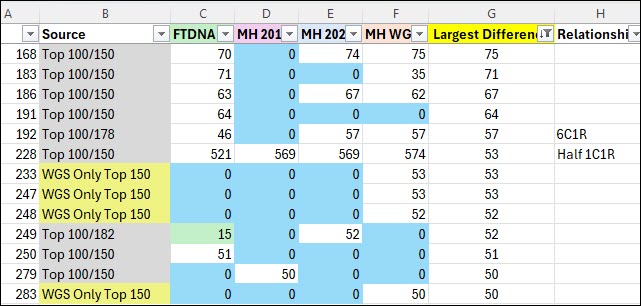
I was VERY surprised to see a difference as high as 75 cM, so let’s evaluate the results where the difference is 50 cM or greater. Thirteen matches fall into this category.

  • Entry 168 – The largest difference at 75 cM. This person matches me at 70, 74 and 75 cM, but not at all on the 2019 test, which caused me to go back and check again. Did I spell the name correctly? Yes, I did. We don’t know why I don’t match this person on the 2019 test, but the other matching cM values are very close so they look to be correct.
  • Entry 183 – I match this person on both the FamilyTreeDNA uploaded test at 71 cMs, and the WGS test at 35 cMs, around half as much on the WGS test as the FamilyTreeDNA test. I don’t match them at all on either the MyHeritage 2019 or 2024 kits. I have no explanation.
  • Entry 186 – Like entry 168, we match on three of four tests at 62, 63 and 67 cMs, with the non-matching test being the 2019 test. I would presume that this match is accurate as well.
  • Entry 191 – This one is interesting because I match this person on the FamilyTreeDNA uploaded test at 64 cMs, but none of the other tests.
  • Entry 192 – We match at 57 cMs on both the WGS and the 2024 tests, but not the 2019 test, where we don’t match at all. The match on the FamilyTreeDNA test is 11 cMs lower, at 46 cMs.
  • Entry 228 – This person is my half 1C1R, and I match them on all the tests, of course. However, there’s a 53 cM difference between the WGS and the FamilyTreeDNA uploaded test. In a relationship this close, 53 cM is a small percentage and won’t affect matching, but it’s not an insignificant amount of DNA.
  • Entries 233, 247, 248 and 283 – I match these people ONLY on the WGS test at 50, 52 and 53 cMs, so if I hadn’t taken the WGS test, I wouldn’t match them at all. Without additional research, we can’t tell if this is a legitimate match or not, but 50-53 cM would be a lot to be imputed or to be identical by chance. These people also match one of my parents’ tests, which eliminates the identical by chance possibility, meaning some of the DNA matches my mother and some matches my father – at least on my end. We can’t determine if this match is identical by chance on their side. I’ve never seen a 50+ cM segment (or even close) that is identical by chance, though.
  • Entry 249 – Matches on the FamilyTreeDNA test at 15 cM, and the MyHeritage 2024 test at 52 cM, but not the others.
  • Entry 250 – Matches at 51 cM on the FamilyTreeDNA test, but not on any of the MyHeritage tests.
  • Entry 279 – Matches only on the MyHeritage 2019 test at 50 cM.

Difference Range

Next, let’s review the entire range of differences, meaning the largest matching difference for any one person across all four tests, by group. I’m including all 434 here so you can judge for yourself.

  • 50-75 cM difference – 13 matches analyzed above

  • 45-49 cM difference – 22 matches

  • 40-44 cM difference – 11 matches

  • 35-39 cM difference – 9 matches

  • 30-34 cM difference – 10 matches

  • 25-29 cM difference – 12 matches

  • 20-24 cM difference – 26 matches

  • 16-19 cM difference – 28 matches

  • 13-15 cM difference – 29 matches

  • 9-12 cM difference – 29 matches

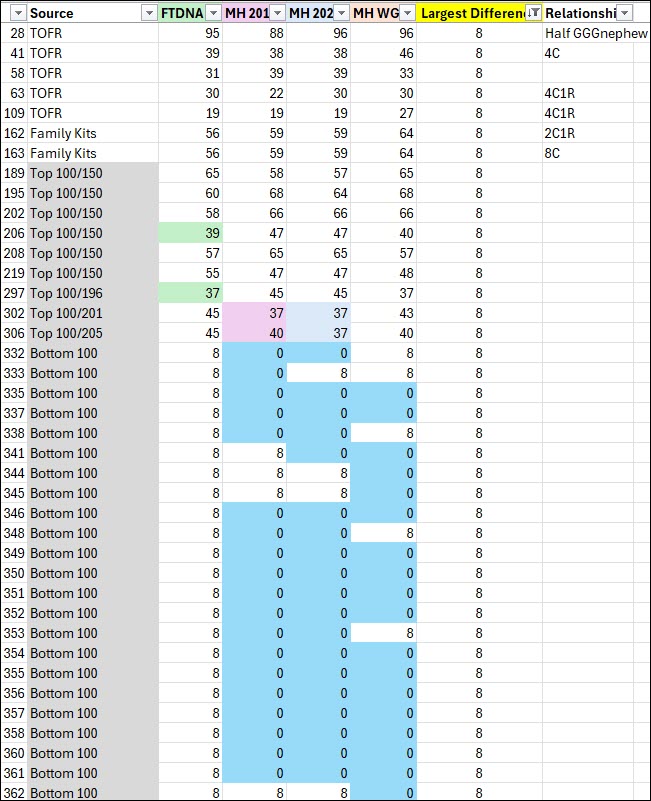
  • 8 cM difference – 78 matches

The 8 cM difference has the most of any value or category because this is the lowest level of matching at MyHeritage. Many tests have a minimum level match on a test or tests, and no others.

  • 6-7 cM match difference – 41 matches

The match differences at 5 cM and below are inconsequential. 57 matches fall into this category.

Commentary

One of the indicators of a valid match is if a parent has tested and also matches,

Of these 434 matches, 35 match neither parent, and most of those are at the smallest match level, meaning 8 cM. Of all the match amounts, that would be the least reliable, and most likely to be a false positive match, or identical by chance.

However, that’s not universally the case. Some WGS results match people at significantly higher levels, but don’t match parents. Two WGS matches match people at 47 and 49 cMs, respectively, and not on any of the other tests. Those two WGS matches don’t match either parent.

After reviewing all 434 selected matches, it appears that both the FamilyTreeDNA 2016 test, and the WGS test produce the most consistent and reliable results of the four tests.

44 people, or 10%, match on BOTH the WGS and the FTDNA tests, but neither of the other two tests. A total of 13.8% match EITHER the FTDNA test OR the WGS test, but not the others.

Conclusions

I think we can draw several conclusions from this comparison.

First, let’s evaluate the number of matches. Looking at the differences between the total number of matches between the various tests, especially the three MyHeritage tests, over time, isn’t that great. That’s exactly why you can’t depend on these numbers as an accurate comparison.

FTDNA 2016 MH Health 2019 MH 2024 MH WGS
Total Matches 19,722 17,179 17,767 17,676

There are only a few hundred differences between the three MyHeritage tests, and about 2000 between the FamilyTreeDNA test uploaded in 2016 and the various MyHeritage tests. That’s a substantial difference.

The difference number of matches between tests may seem irrelevant, especially the MyHeritage tests, until you realize that those who match AREN’T ALL THE SAME PEOPLE. In other words, comparing the MyHeritage 2024 test with the WGS test only shows a difference of 91 matches. This DOES NOT mean that the MyHeritage 2024 test and the WGS test have 17,676 of the same people who match both tests, and that the 2024 test simply has 91 more matches than the WGS test.

As we’ve seen, many people who appear on any one match list don’t appear on other match lists.

Our analysis showed that 44.9% of my 434 matches compared appear on all match lists, which means that more than half of my matches appear on one or more match lists, and not the others. Therefore, just comparing the number of matches isn’t really relevant. You need to compare the people included on all the different tests, which is why I created my spreadsheet and included people from a wide variety of sources.

3.7% of my matches on the WGS test were not on any other test, which extrapolates to approximately 654 of my total WGS matches that I wouldn’t receive any other way.

I care a great deal about those matches, especially since at least some appear to be high value.

Yes, I absolutely, positively want those matches, especially when you consider that some of the matching differences are as high as 75 cM. A 75 cM match can be in the second, third or fourth cousin range.

Realistically, they may or may not be valid or useful matches – but if I don’t have the opportunity to compare them, I’ll never know.

Should You Purchase the WGS Test If You’ve Already Tested?

So, now for the question you’re surely asking yourself.

Truthfully, when I ordered my test back in December, I was ambivalent. I only ordered it to do this comparison for my blog readers – and I really dislike spending money on something that I don’t think will benefit me.

Note the words “don’t think.”

I’ve changed my mind, for several reasons, and I’m glad I ordered the test.

The thing that changed my mind was that I received a nontrivial amount of matches on the WGS test that I didn’t receive on any of the others – even if some of them turn out to be identical by chance.

Since we can’t go back in time and take the earlier tests, and MyHeritage no longer accepts uploads from other vendors, our decision now is whether or not we should take the new WGS test, or not, especially if we already have a DNA test at MyHeritage.

If you’re a new tester, by all means, test at all four of the main vendors. DNA matching is the best thing since sliced bread.

However, the people I’m really speaking to here are those who already have a test of some sort at MyHeritage.

Here’s the bottom line:

  • You will receive WGS matches that you didn’t receive on your other test – and vice versa, so don’t delete your older test at MyHeritage
  • Some of those new WGS matches may well be high-value matches – as was illustrated in the “differences” I discovered.
  • Given the differences in who is included in the match list, your TOFR will be different too – perhaps leading to a brick wall breakthrough. I have two that I’m just itching to solve.
  • Use matches, shared matches and TOFR from ALL of your tests at MyHeritage.

My Biggest Regret

As Ran Snir said, new features and developments at MyHeritage will be based on the WGS test. We don’t know what those developments might be, or when they will become available. But it’s very clear that while testers on the older testing platforms will receive as much as MyHeritage can give them, the MyHeritage DNA future is being build on the WGS platform. I want to be there and benefit from new discoveries.

My biggest regret is that my parents aren’t around to take the new WGS test – and neither are several other family members.

Of the 15 family members whose tests I manage at MyHeritage, 9 are deceased, and I think that four more are as well. Two others are now quite elderly and are no longer able to consent or retest.

Your closest family members are your DNA anchors, identifying lineages and pointing you in specific directions, guiding your research.

The very best thing you can do for your genetic genealogy is to test your grandparents if they are living, and your parents. If they aren’t available, test your closest relatives such as grandparents, siblings, aunts, uncles and first cousins.

Preparing for the Future

So, here’s my advice:

  • Take the WGS test yourself in order to glean as much information as possible and to benefit from future developments.
  • Retest any relatives whose tests you manage on the WGS platform, if possible.
  • Test your close family members and anyone you know whose DNA test could help you identify ancestral lineages.

Why is testing your relatives important?

Close relatives will carry some of the DNA from your mutual ancestors that you don’t.

Having the known DNA of your ancestors means that you can evaluate and analyze the trees of the entire group of people who match those identified DNA segments to see if you can break down an upstream brick wall.

I’ve been successful doing this for some time – and am in the process again by combining DNA matches and traditional records research.

Coupon Code for $20 DNA Test

MyHeritage has been kind enough to provide a limited-time coupon code (RobertaFeb26) for my readers which DROPS YOUR PRICE for the DNA test to $20 through February 28th at midnight.

This is the absolute lowest price I’ve ever seen for a DNA test.

You’ll receive the following features that are included with every test:

  • Ethnicity and ethnicity map
  • DNA matches and the ability to contact them
  • Shared ancestral surnames
  • Chromosome browser
  • cM Explainer

In addition, with this code you’ll receive both Shared DNA Matches and Shared Ancestral Places that usually require a subscription.

Normally, a subscription is required to access:

  • Trees of DNA matches
  • Shared DNA Matches (free now with the coupon code)
  • Shared ancestral places (free now with the coupon code)
  • AutoClusters
  • Theory of Family Relativity (TOFR)

If you’re interested in trying a subscription, click here to purchase a MyHeritage subscription with a free trial.

Here’s the link to purchase the DNA test, and here’s the coupon code to enter at checkout: RobertaFeb26

And yes, absolutely feel free to share the coupon code with your family, friends, and anyone else who might benefit.

Let me know how your results compare when you receive them.

_____________________________________________________________

Share the Love!

You’re always welcome to forward articles or links to friends and share on social media.

Subscribe!

If you haven’t already subscribed, it’s free. You’ll receive an e-mail whenever I publish by clicking the “follow” button at the top of the main blog page, here.

Help Keep This Blog Free

I receive a small commission when you click a vendor link in my articles and purchase that item. This does NOT increase your price but helps me keep the lights on and this informational blog free for everyone. Please click on the affiliate links in the articles or to the vendors below if you are purchasing products or DNA testing.

Thank you so much.

DNA Purchases and Free Uploads

Genealogy Products and Services

My Books

Genealogy Books

Genealogy Research

AutoKinship by Genetic Affairs Builds Family Trees from Your Matches at FamilyTreeDNA, and More

Genetic Affairs released a new AutoKinship tool designed for FamilyTreeDNA’s autosomal Family Finder matches, which also incorporates information from other sources. I must have fallen asleep at the wheel, because AutoKinship has been available for more than six months now.

I’ve been testing this tool with my matches, and it’s an immense help to those of us trying to untangle complicated family relationships using DNA evidence. I don’t know about you, but I have a long list of brick well where I could use help!

How to Use This Guide

This article is long and there are many steps involved – but it’s well worth it at the end.

My suggestion for using this article effectively is to read it through, at least once, to see what you’re going to be doing, and why.

Then, after you get things set up at Genetic Affairs, and any files you want to include, come back and use this article as a step-by-step guide to navigate these new tools.

Here’s the bottom line. The Genetic Affairs tools use matches, along with shared and bucketed matches at FamilyTreeDNA, plus their archived trees, in addition to external GEDCOM files and other information that you can provide in order to create customized, focused clusters and potential family trees for your clustered matches.

These tools combine DNA matching with internal and external trees for the composite best of both types of information.

So grab your favorite drink and let’s get started.

FamilyTreeDNA

AutoKinship works in conjunction with FamilyTreeDNA’s tools, such as Shared Matching, the Matrix tool, and Family Matching, also known as bucketing, which assigns parental sides to your matches using linked matches.

Linked matches are your matches whose relationship to you is known. If you haven’t already, link them to their profile card on your tree by clicking on “Link on Family Tree.” This allows FamilyTreeDNA, by using triangulation, to “bucket” your matches either maternally or paternally – meaning if they are related to you on your maternal side, paternal side, or both.

In my cousin Patricia’s case, the little pink icon by her profile picture shows that she has been bucketed maternally. That occurred when I linked my mother’s DNA to my tree because Patricia matches us both, plus other linked maternal cousins, on the same segments. For bucketing to occur, you don’t have to do anything except link known relatives to their proper place in your tree. FamilyTreeDNA does the rest by assigning your matches either maternally or paternally if they match on common segments.

Upload DNA Files to FamilyTreeDNA from Other Vendors

If you have not taken the Family Finder test at FamilyTreeDNA or uploaded your DNA file from 23andMe (Dec 2010 to present), Ancestry (May 2012 to present), or MyHeritage (March 2019 to May 7, 2025) to FamilyTreeDNA, you should do so now to take advantage of their tools, plus AutoKinship at Genetic Affairs.

What is AutoKinship and Why is it Different?

AutoKinship takes traditional clustering and kicks it up several notches. Instead of just showing you which matches cluster together, it actually attempts to build family trees based on the shared DNA amounts between your matches.

AutoKinship looks at how much DNA your matches share with you, and with each other, and uses that information to predict their relationships. Then AutoKinship builds potential family trees showing how everyone might connect. Additionally, you get to provide input in the process.

The timing couldn’t be better, especially since FamilyTreeDNA recently launched their updated Matrix tool, showing how your matches are related to each other. I wrote about that, here.

Two Steps

There are two primary steps in the AutoKinship process that build on each other. However, within these steps, there are many stepping-stones, so I’ve documented each one.

We’re going to use these tools, one at a time, in order.

I suggest that you join the Genetic Affairs User Group on Facebook for additional support and information.

Using AutoKinship with FamilyTreeDNA

The AutoKinship functionality for FamilyTreeDNA provides an automated approach using both AutoCluster and AutoKinship, together, then AutoLineage, where you can refine the information in a number of ways.

🔹 Step 1: Automated AutoKinship via Genetic Affairs

The first step involves running the AutoKinship tool directly from the Genetic Affairs members’ site. This process is fully automated:

  • It starts with the FamilyTreeDNA AutoCluster option, which groups DNA matches into shared clusters based on their connections to each other.
  • AutoKinship is then automatically launched on each cluster, adding the DNA tester and generating relationship hypotheses among the group.
  • Several family tree models are produced, showing how the matches and the tester could be connected based on shared DNA and cluster structure.

This step is ideal for getting quick insights into how groups of matches may relate.

🔹 Step 2: Refined Clustering & Relationship Analysis Using AutoLineage

After the automated run, downloadable files for AutoLineage are generated. These files allow you to re-import the match, shared matches, and tree data into the AutoLineage web application for further analysis.

This second step offers greater control and customization:

  • You can redo the clustering, optionally tweaking parameters to fine-tune how matches are grouped.
  • You can redo the common ancestor analysis, optionally tweaking parameters to fine-tune the discovery of MRCAs
  • The AutoKinship tool within AutoLineage becomes available again, this time with additional functionality:
    • Define known relationships between matches, such as parent-child or cousin relationships
    • Define generational information, for instance, if you know certain matches are not on the same generational level
    • Integrate MRCA (Most Recent Common Ancestor) data from reconstructed trees, e.g., from the Find Common Ancestors module.

This enhanced phase is especially useful for integrating genealogical trees for targeted clusters.

By combining both steps, automated clustering with AutoKinship, and manual refinement with known or tree-derived relationships using AutoLineage – you can leverage your FamilyTreeDNA data for in-depth relationship exploration.

Let’s Take AutoKinship for a Spin

As always, I’ll walk you through this process step by step, using my own DNA results as an example.

Getting Started

First things first – you’ll need to be a member of Genetic Affairs, so sign up for their free membership, here. Genetic Affairs’ customers purchase “credits” to spend on various features and reports, but you receive 200 free to start.

The automated AutoKinship analysis available on the Genetic Affairs website can be run using credits from the free tier – perfect for exploring the tool without any commitment. This allows users to generate relationship trees for FamilyTreeDNA clusters right away.

To access the more advanced features in the AutoLineage desktop application—including refined clustering, manual relationship input, and integration of MRCA data from reconstructed trees – you’ll need an active subscription.

To get started, sign in to the Genetic Affairs member site, here.

Let’s walk through the process step by step.

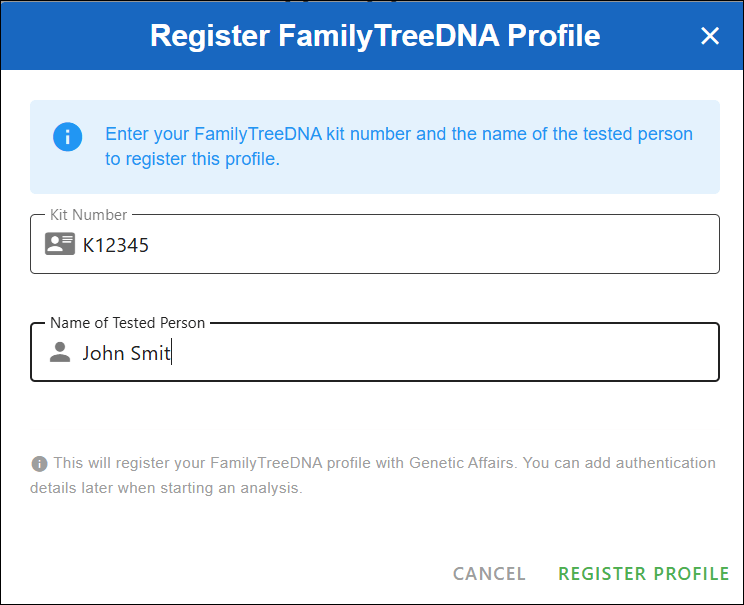
We’ll begin by registering a FamilyTreeDNA profile at Genetic Affairs. Click on Register a new website to get started.

FamilyTreeDNA account passwords are not stored at Genetic Affairs.

After clicking “Register profile,” you’ll see a message asking you to double-check the credentials for the kit you’re about to use. This is also a good time to log in to your FamilyTreeDNA account directly to make sure there are no pending actions — such as enabling two-factor authentication or accepting updated terms of service.

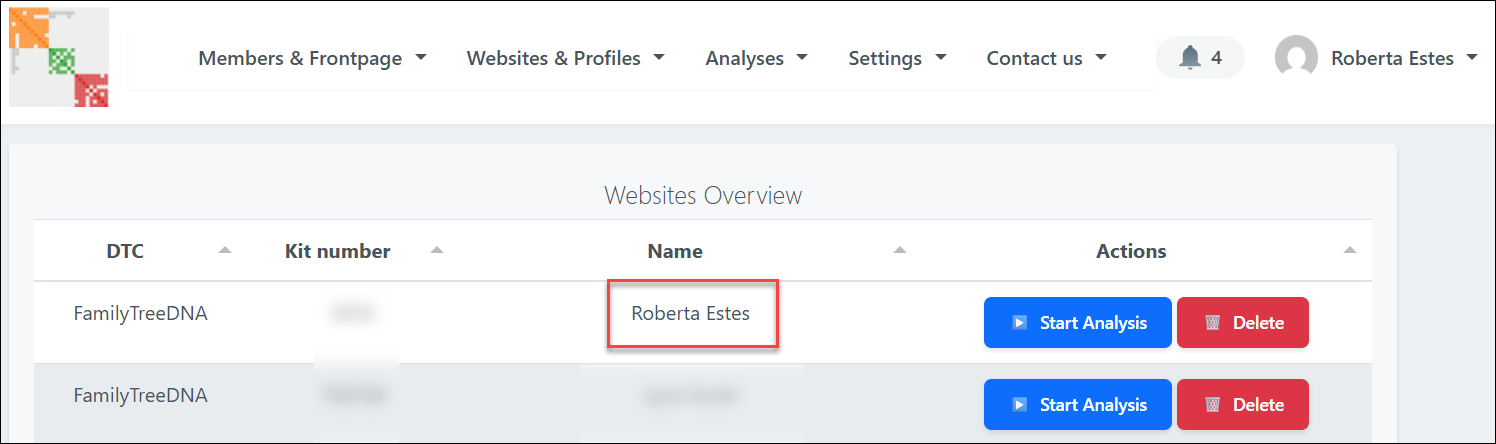
Once you click “I understand, continue,” you’ll see a list of all registered FamilyTreeDNA profiles at Genetic Affairs.

Locate the kit you want to analyze and click the blue “Start analysis” button.
This opens a guided wizard that walks you through each step of the setup.

First, select AutoKinship and click “Next.”

You’ll then be asked to define several thresholds:

  • Minimum and maximum shared cM
  • Minimum size of the largest segment
  • Minimum cluster size

A quick word of caution here: selecting a very low minimum cM value may actually reduce the number of usable matches. That’s because the system must download shared match data until it either reaches that threshold, or a preset timer expires, which can limit how much data is downloaded. When in doubt, start conservatively. You can always rerun the analysis later and change the parameters. Unfortunately, there’s no way to simoly “get everything” in one run which is, of course, what everyone would do.

Click “Next” to continue.

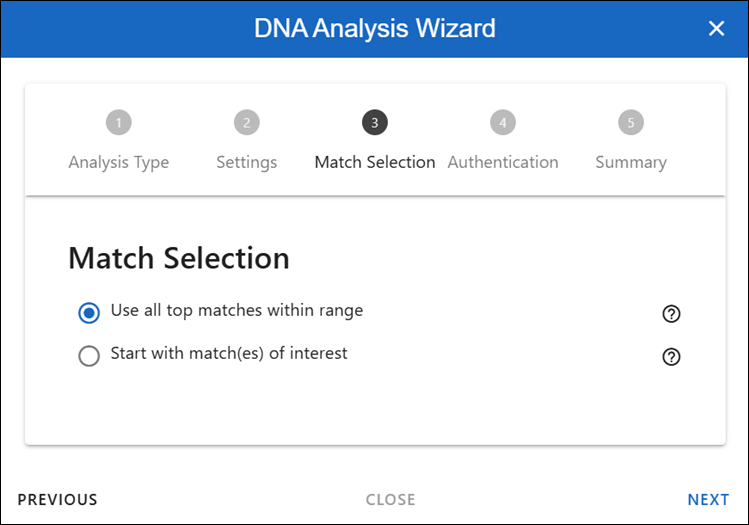
This section determines which matches will be included in the analysis.
For your first run, I recommend using the top matches within the selected range. This provides a strong foundation and usually produces the clearest results.

Later, once you’re more familiar with the output, you may want to experiment by analyzing only the shared matches of a specific person or group. For now, keep it simple and click “Next.”

Here, you’ll enter your FamilyTreeDNA password (twice) so the system can retrieve the required data.

If you use two-factor authentication, you can enter the 2FA code here, as well. To do that, log in to your FamilyTreeDNA account, retrieve the code from your email, and paste it into the wizard.

Then click “Next.”

You’ll now see a summary of all the settings you’ve chosen. Take a moment to review everything. When you’re ready, click Perform analysis” in the bottom right corner.

At this point, the Genetic Affairs servers take over and begin processing your data.

The Results Arrive

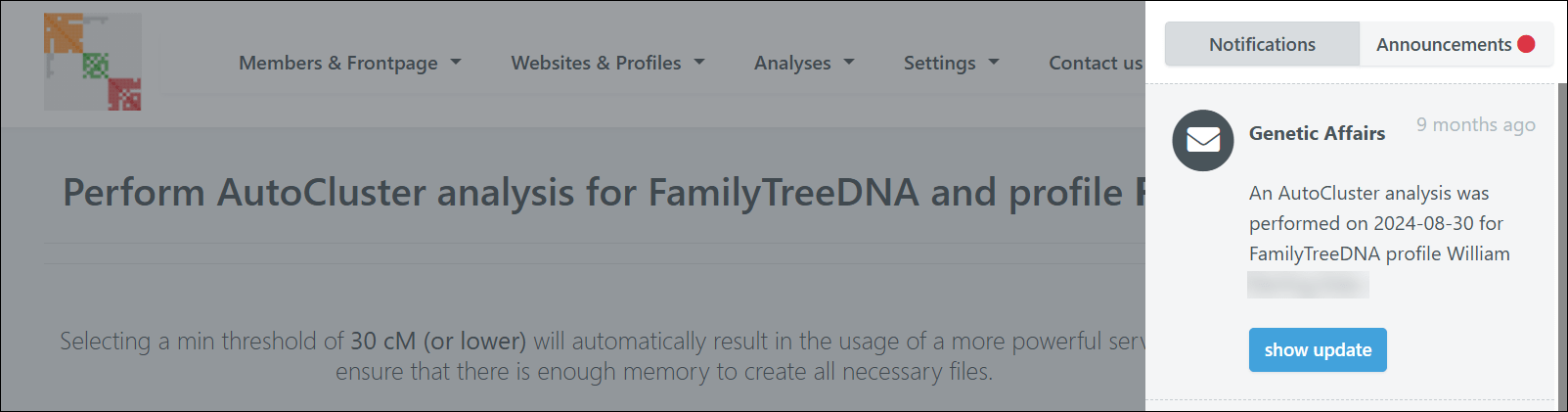
When your report is ready, you’ll receive an email with a download link. You can also access it through the notification panel in the top right corner of the Genetic Affairs site.

Downloading the report will result in a zipped file. Save it in a location on your computer where you can find it.

Critical Step

This step is critical and will save you a great deal of frustration: If you’re using a PC, you MUST extract or unzip the files before you can properly use them. I can’t tell you how many people skip this step and then wonder why they’re receiving error messages. Ask me how I know!

This is your zipped file.

If you try to open the HTML file while it’s still zipped, it might appear to work at first, but when you click on any links within the file, you’ll receive an error.

If this happens to you, close everything, right-click on that yellow zipped folder, select “extract all,” and then try again.

Now you’re set up, so on to the fun part – viewing the results.

Exploring Your Results

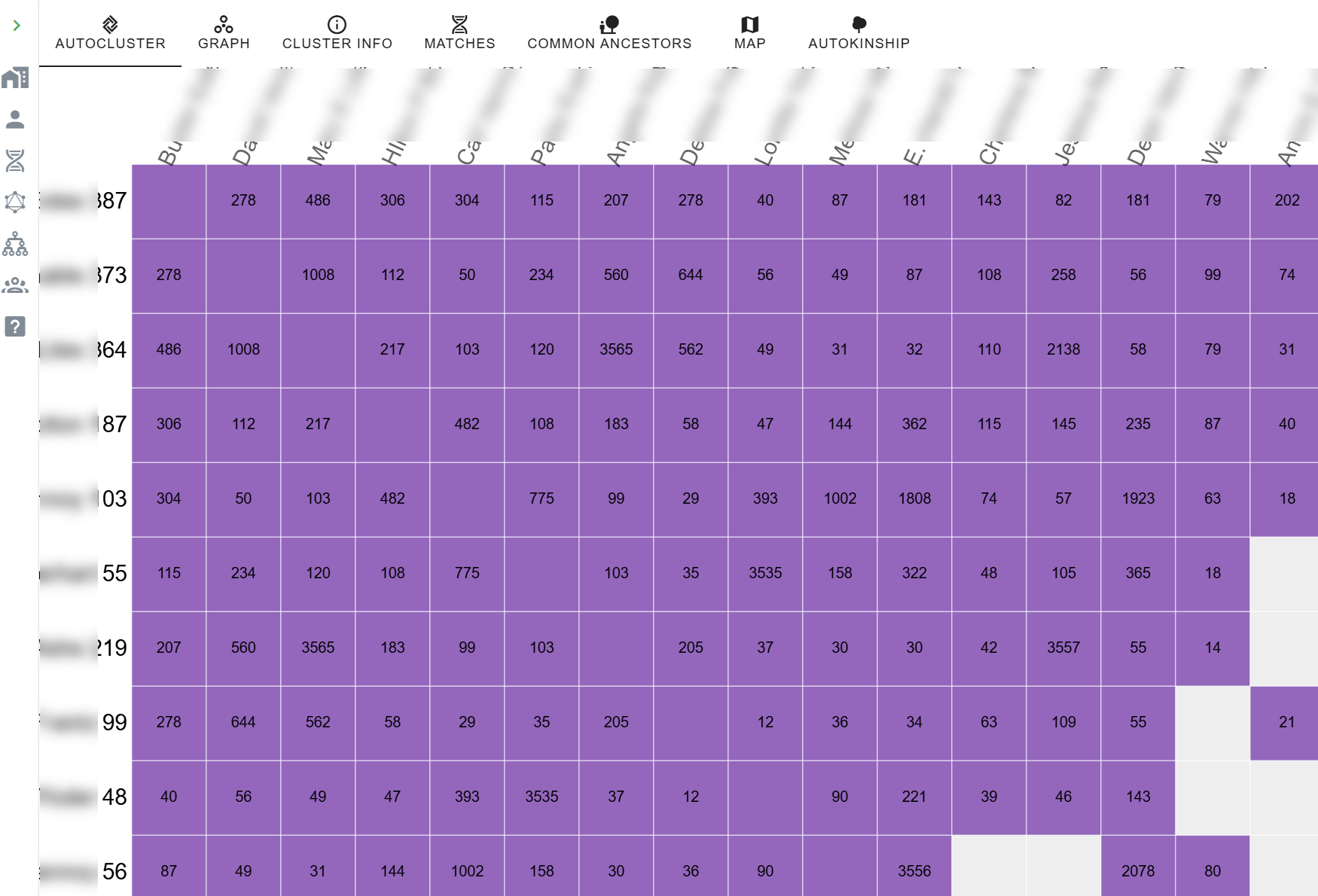
Once you have everything properly extracted and open the HTML file, you’ll watch your AutoCluster literally fly into place on your screen. I love this part. It’s like watching my family fly into place. I wish the actual genealogy research was this easy.

The new Genetic Affairs reports include significantly more information than previous versions.

You can change what’s displayed using the dropdown menu.

By default, you’ll see the shared cM amounts between your matches, but you can change this to show paternal or maternal information if you’ve identified those lineages by linking your matches.

In my case, my maternal line has fewer matches because my mother’s ancestry includes both recent Dutch and German immigrants, so the majority of my high cM matches are US-centric on my father’s side. My father’s ancestors have been in this country since colonial times, and a lot of testers in the US are looking back to the old country for their origins.

Therefore, in my first several clusters, I see squares with the symbol P, indicating they are paternal matches – designated as such through linked family matches, aka bucketing.

You can see the faint Ps inside the orange cells.

Here’s a close-up so you can see the “P” for paternal. If you haven’t linked your matches, you won’t have bucketed matches. Your Genetic Affairs results don’t require bucketing – it’s just a really beneficial feature.

You can change your AutoCluster settings in several ways. I tend to start with the defaults and then modify from there.

Genetic Affairs functions based on the amount of server time a particular tool takes, so it’s not possible to just “run everything,” or trust me, I would.

The Common Ancestor Magic

In your report, scroll down several sections, and you’ll find Common Ancestors – my favorite feature.

This section shows you the common ancestors that have been identified between your matches’ trees.

Looking at the Common Ancestors cluster report, you can click on three things for each cluster:

  • FamilyTreeDNA Trees of Cluster #
  • Common Ancestors of Cluster #
  • Common Locations of Cluster #

Let’s examine the reconstructed trees based on the common ancestor analysis. The first cluster shows some of my close DNA matches that are descendants of my Vannoy line.

You can see that there are six testers, in addition to me, who descend from Joel Vannoy.

Next, scroll down to the AutoKinship section of your report.

The AutoKinship Analysis

The real treasure lies in the AutoKinship analysis, which is presented in a small table on the main HTML page. When you click on the AutoKinship results for any cluster, you’ll see reconstructed trees based on the shared DNA amounts between matches, meaning between you and each of them, and between each other.

You can see that I have 10 reports available based on the cluster numbers indicated.

I clicked on Cluster 1, which shows some of my close DNA matches who are Vannoy line descendants. This includes testers both with and without trees.

Since the AutoKinship algorithm doesn’t have access to age information, it sometimes struggles with generational differences – but the relationship predictions are still remarkably useful.

Alternative trees are also provided, giving you multiple hypotheses to investigate.

Some matches may not be integrated because of incompatible relationships.

The Next Step with AutoLineage – Adding Genealogical Trees to the Mix

We’ve seen AutoTree and AutoKinship. The new upgraded AutoLineage adds genealogical tree information to genetic information by allowing the user to:

  • Import other trees
  • Integrate most recent common ancestors (MRCAs) in AutoKinship trees
  • Set known relationships
  • Provide generational information.

AutoLineage, Genetic Affairs’ online clustering and tree-building tool, has been around for several years but was recently upgraded to create trees based on shared DNA and incorporate genealogical evidence.

This is where the proverbial rubber meets the road.

Setting Up AutoLineage

Return to the home page at Genetic Affairs and select AutoLineage.

If you’re new to this tool, you’ll see a simplified workflow on the start page that walks you through the process.

First, create a profile representing the DNA test taker – in my case, that’s me.

After creating the profile, you’ll be redirected to the landing page of the profile. From there, you can register DNA tests linked to the profile. From the home page, you can see the different profiles.

You’ll register a new FamilyTreeDNA test specifically for each user whose kit you manage and who took a test.

FamilyTreeDNA is the only DNA testing company for which Genetic Affairs runs automated analyses on their site.

Additionally, you can:

Importing the Data

After registering a FamilyTreeDNA test, you are redirected to the overview of this DNA page, where matches are imported.

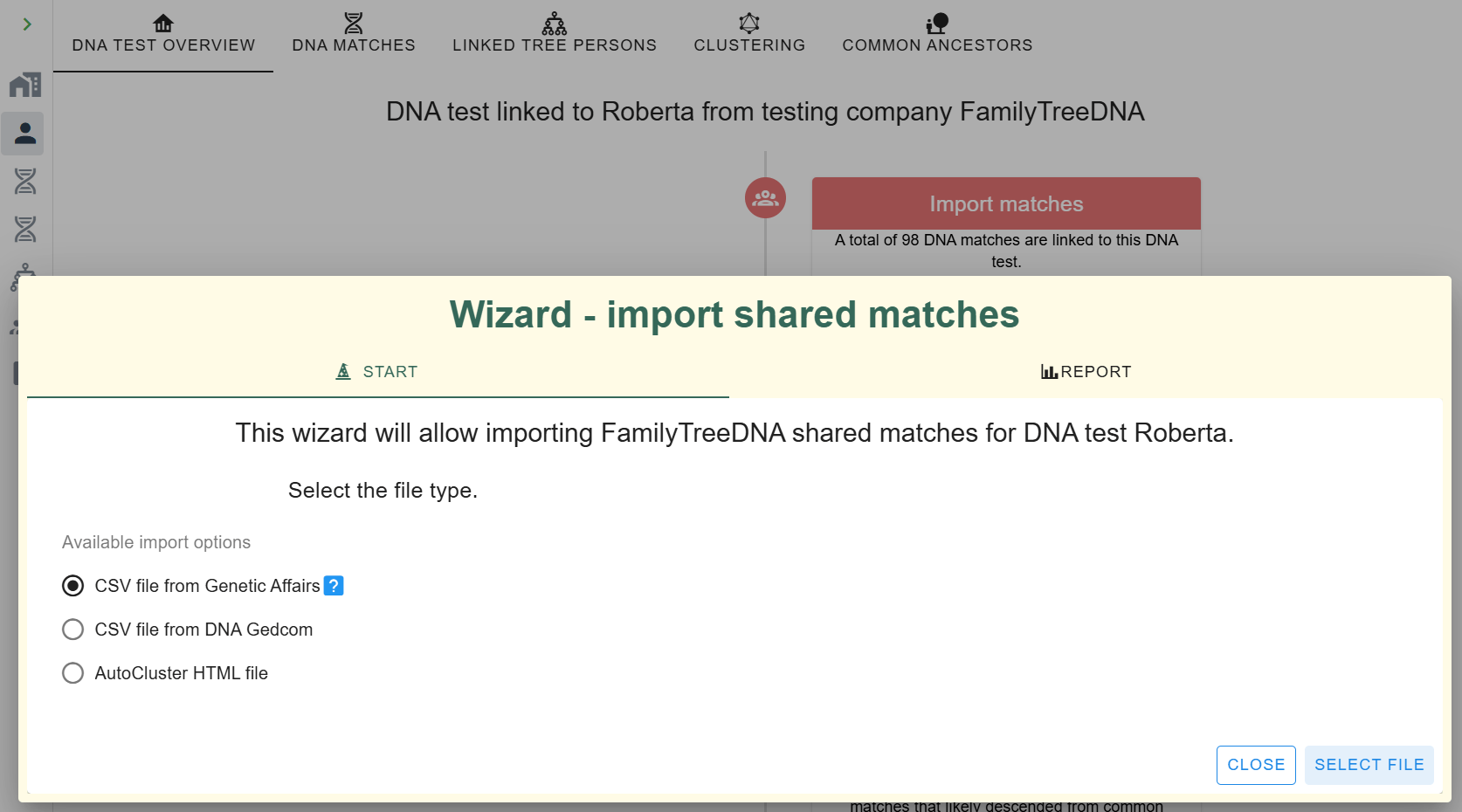
Click on “Import matches” and select the CSV file from Genetic Affairs. Here’s where that AutoKinship report we generated earlier comes in handy. The unzipped report contains match and shared match information that we can import directly into AutoLineage.

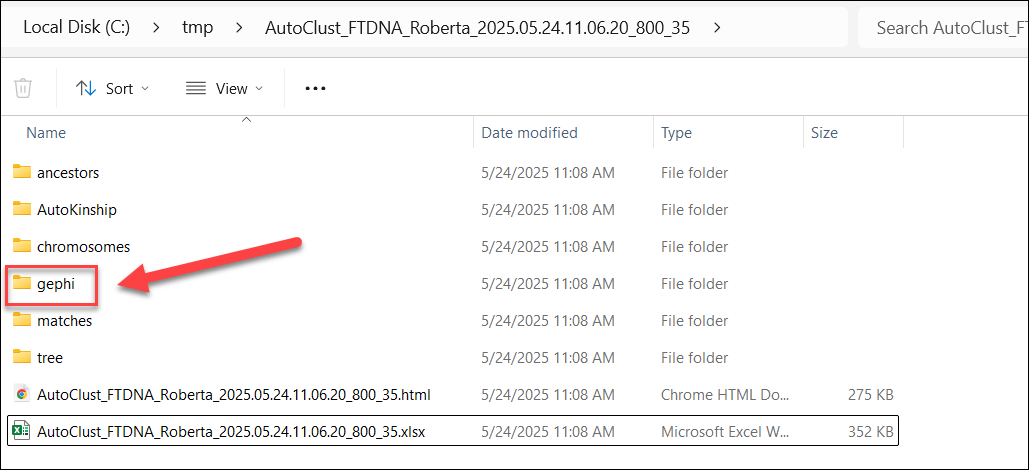
Navigate to the gephi folder in your report and select the nodes.csv file to import your matches.

After importing the matches, a short dialog shows how many matches were imported.

After closing the dialog box, the DNA matches pane is opened.

You’ll see your DNA matches that were downloaded.

Next, import the shared match information from the edges.csv file in the same gephi folder.

Once both data sets are imported, you’ll see that the ICW (In Common With) column has populated, showing how many shared matches are available for each DNA match.

Clustering in AutoLineage

Now, with the shared match data loaded, you can perform your own clustering analysis.

The wizard allows you to set parameters for which matches to include based on:

  • The amount of shared cMs
  • Weighted or unweighted clustering
  • How much DNA is shared between shared matches

You can also define the cluster characteristics, from sparse to very dense clusters.

Last, you can select the coloring scheme. After setting the parameters, click on “Start Clustering,” at bottom right.

After clustering is finished, the clustering chart is displayed. It looks fairly similar to the ones obtained automatically from Genetic Affairs, but with some differences.

The first thing I noticed is that the large orange cluster 1 in the automated clustering is now mostly represented by the purple cluster 4.

Let’s zoom in on this cluster. By looking more closely at the numbers contained in each cluster, you can already make an estimated guess about the richness in relationship information for cluster members. This cluster has lots of close relationships. Clusters whose matches only share a small amount of DNA with each other are not the best candidates for an AutoKinship analysis because they most likely share a distant common ancestor. Unless, of course, it’s a distant ancestor you’re searching for. (Hello brick wall.)

Adding and Importing Tree Information

Now that we have the new clusters, we could continue to directly run the tree reconstruction on these clusters using the shared DNA information, but let’s wait  since we want to include the tree information as well to guide this process.

To use common ancestors, we need to import the available trees that are linked to the DNA matches. Luckily, just like (shared) match information, the tree information is provided with the automated analysis as well. Let’s import the data.

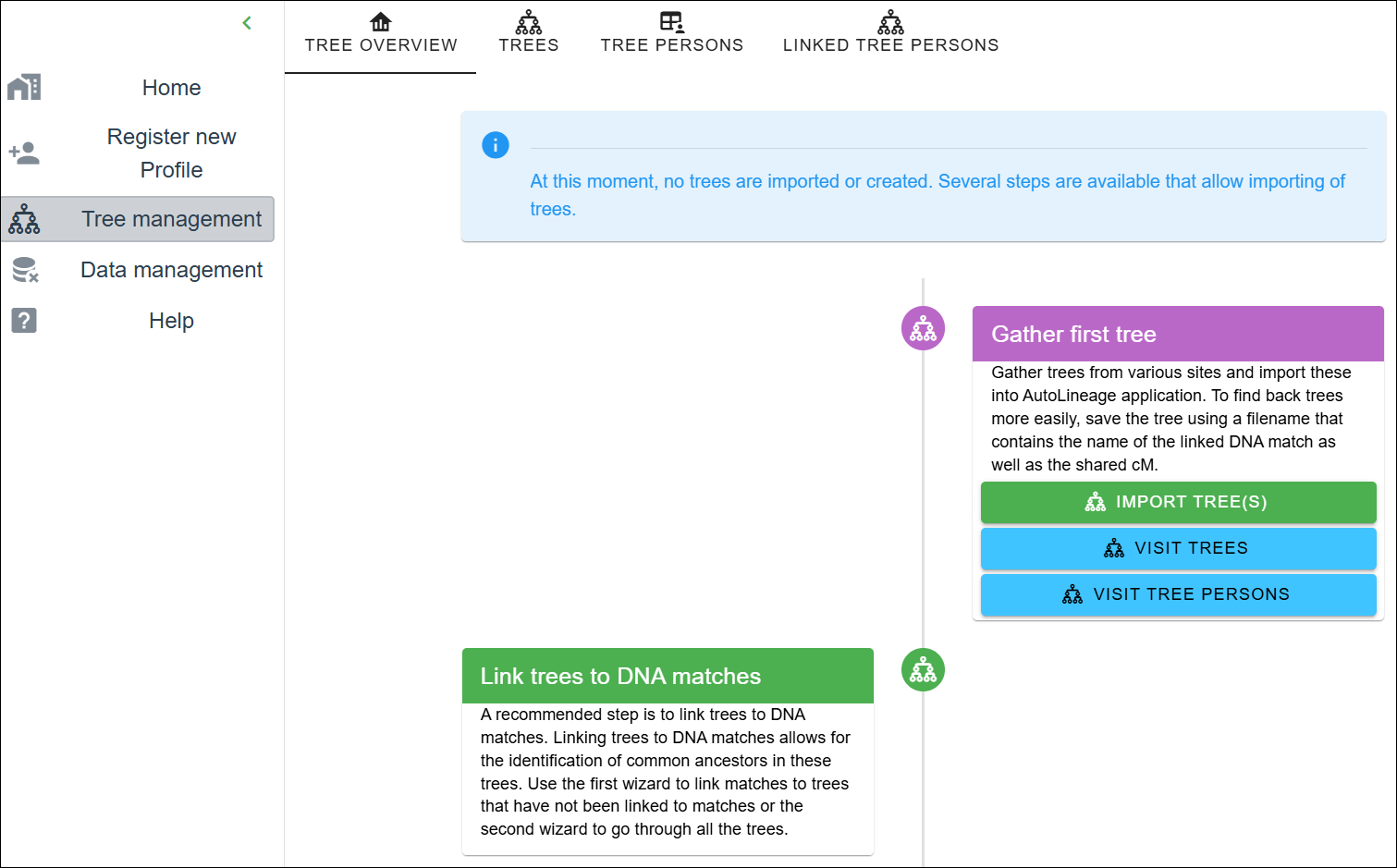
First, navigate to the tree management page. As you can see, no trees have been created or imported. Let’s start the wizard by clicking on the “Import Trees” button.

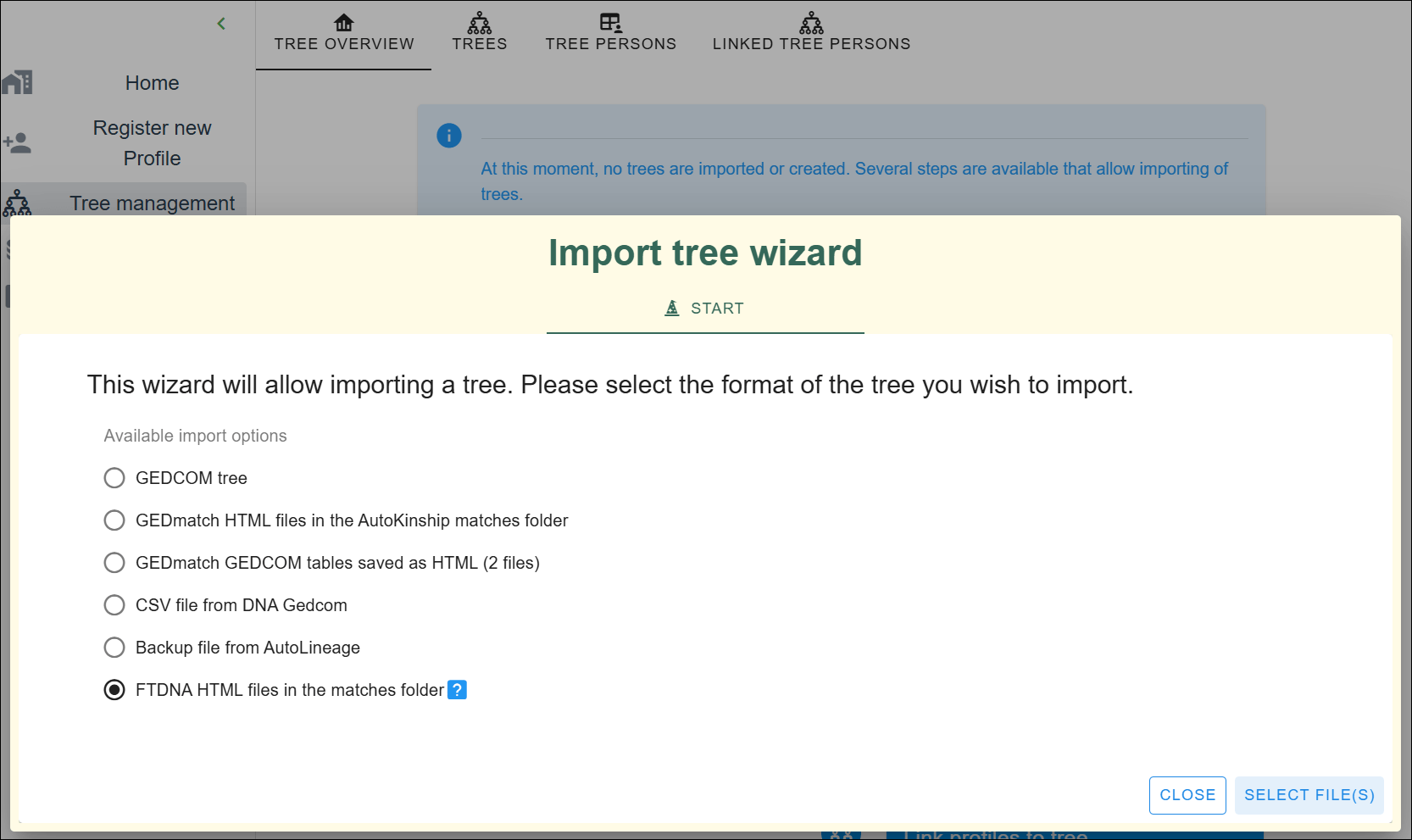
An “Import tree” wizard pops up, providing different ways to import tree information. It’s also possible to import GEDCOM files or tree data from other resources, but for now, I’m only using the archived trees at FamilyTreeDNA.

Click on the last option and select the files.

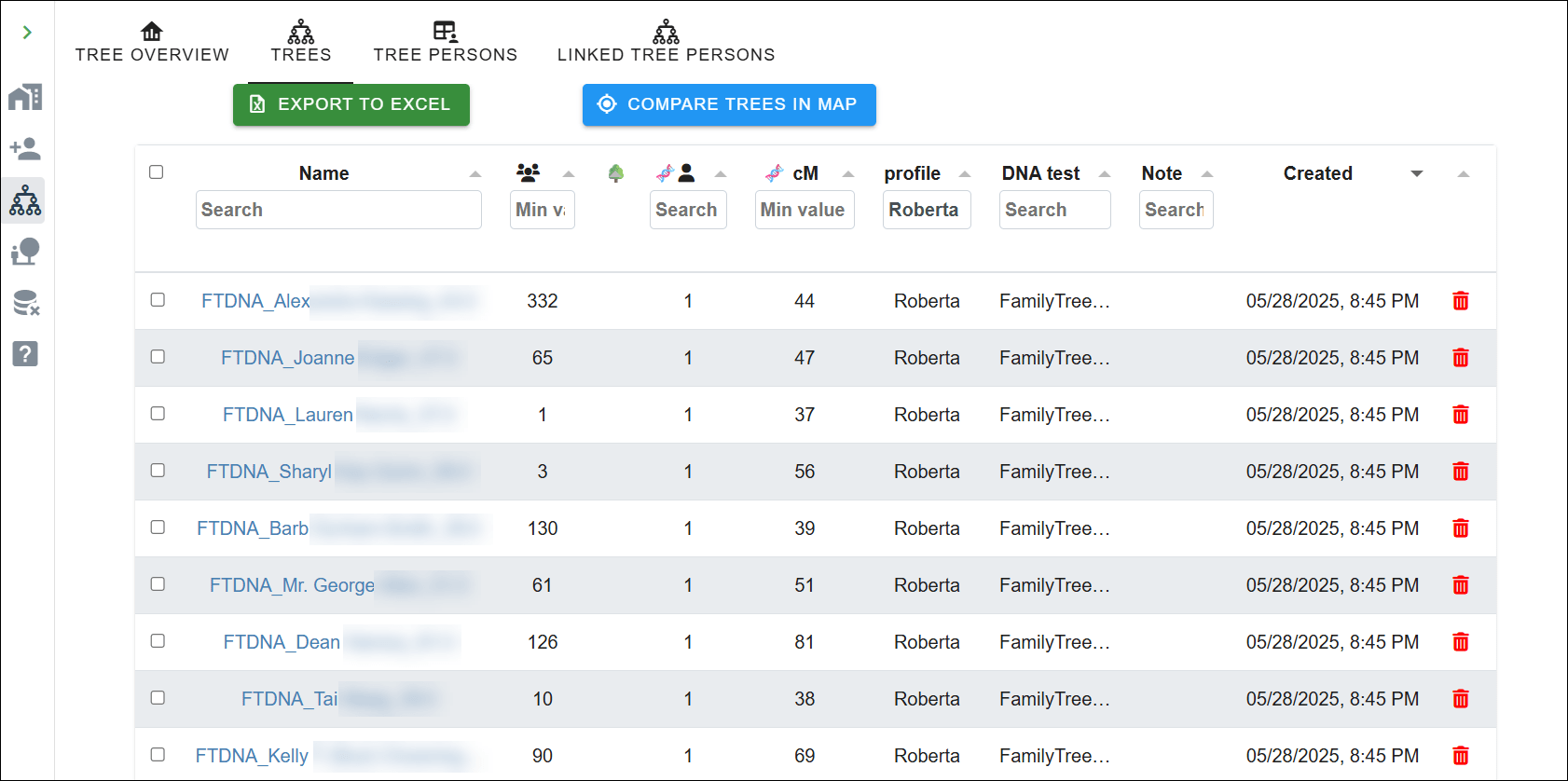
Navigate to the matches folder and select the HTML files contained in the folder.

Each file represents a DNA match report, some of which have a tree associated with them.

After importing the trees, they are automatically associated with the concerned DNA matches (using the unique identifier present in each file name). The tree overview page shows which tree is linked to a profile or DNA test, and the amount of DNA shared with the linked DNA match.

If you have created trees for your matches based on your own research (like quick and dirty trees), now is the time to import these using the “Import Tree” wizard again. This is a wonderful feature, because it means you’re not entirely dependant on your match having uploaded a tree themselves.

If you don’t import trees from GEDCOMs, you don’t need the linking wizard.

Click on the “Import Tree” wizard and select the GEDCOM option.

Now that we have imported additional trees, we need to associate them with DNA matches.

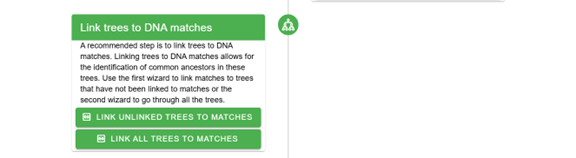
You can use a wizard to link the unlinked trees to the DNA matches, or link them from each DNA match. The wizard will try to guestimate, based on the content of the tree file name, which DNA match could be associated with the tree. Change the search criteria if it does not provide the correct results.

TIP: Save the GEDCOM files with the name of the linked DNA match as well the shared cM, which speeds up the importing process

Don’t forget to import your own tree. I imported my GEDCOM file from my computer genealogy software and associated it with my profile so it’s included in the common ancestor identification. You can easily upload your GEDCOM from your computer software, or download your tree from either Ancestry or MyHeritage to upload here.

Visit the profile, and select the tree pane. The tree pane only shows a single individual and allows you to add ancestors to it manually. To associate that individual with an existing tree, click on “Link to Existing Tree”.

A wizard will be displayed, which shows all available trees on the left side. Sort by clicking on the “Created” column to display the most recent trees.

Next, you need to select the root person.

I selected my tree.

Next, the right side of the wizard fills with the people in the selected tree. Select the root person, which is me, and click on “Save” in the lower right corner.

Finding Common Ancestors

Now that we have associated a tree with the profile and imported trees for the FamilyTreeDNA matches, it’s time to locate some common ancestors. Fingers crossed!

Go back to the profile and select the profile overview. Scroll down to the “Find common ancestors” section and click on the “Find common ancestors” button.

The “common ancestors” wizard shows trees that are associated with this profile in the table on the left and provides information about the different steps on the right. You can change the settings to make the search more restrictive or more relaxed.

After running the common ancestor identification, a dialog shows the number of trees and tree persons that were used, and the number of common ancestors that were identified.

After the analysis runs, you’ll be able to view all reconstructed trees or filter them based on common ancestors, trees, or linked DNA matches.

Common ancestors, not surprisingly, often align closely with what the automated analysis discovered.

All six testers are now shown descending from our common ancestor, in the approximate location where they will fit in our common tree.

But we aren’t quite finished yet.

The Final AutoKinship Analysis

Finally, we’ve arrived. The earlier steps were necessary to pave the way.

We have the common ancestors and clusters, and it’s time to go back to the clusters to begin the reconstruction of trees using trees combined with DNA.

Click on the profile and go to the clustering results pane. Select the 1x view, which will show the clustering chart.

Now select the matches pane that shows the different matches that are contained in each cluster. Scroll down until you reach your cluster of interest, which is four for me.

After clicking on any cluster, you’ll be redirected to a cluster view with only the information for that particular cluster.

Let’s view purple cluster 4, which looks fairly dense, with only a couple of empty cells, indicating that these shared matches with white cells did not share (enough) DNA with each other to be included in the cluster. Now select the matches pane in the dashboard at the top of this cluster, which displays the matches linked to this specific cluster. As you can see, a button is now available that allows us to run the AutoKinship analysis. Click on the button.

Single cluster matches are displayed.

Now back to the wizard.

The wizard provides several important parameters:

  • Maximum number of generations between DNA matches
  • Number of trees to analyze in each iteration
  • Final number of trees to keep
  • Whether to include known relationships and/or MRCA (Most Recent Common Ancestor) relationships

In this example, MRCA relationships were found because we performed the common ancestor identification that resulted in common ancestors between the matches of this cluster.

If you know specific relationships between matches, you can set those manually. Sometimes you might not know the exact relationship, but if you can estimate that a match is one or more generations older or younger than yourself, you can set that too.

In addition to setting the relationship between the test taker (indicated in green in the table) and the DNA matches, it’s also possible to set the relationship between shared matches, if known.

The Hybrid Results

After the analysis has finished, an overview of the identified trees is presented.

The final result is a blended tree where DNA evidence fills in the blanks for matches who haven’t uploaded trees, or you haven’t provided a tree, and known genealogy supports the structure where it exists. This hybrid approach gives us the best of both worlds – the precision of documented genealogy combined with the discovery power of DNA analysis.

I particularly like this approach, because when I identify how a DNA match is related to me from any vendor, I enter their lineage in my desktop genealogy software. Therefore, using that GEDCOM file is the most complete source of my identified relatives.

Testers 1-6 were shown using the regular AutoTree, without the integrated tree, but an additional 11 matches were placed for consideration using all available tools.

I was using this as an experiment because I know how most people in this cluster are related, and those are all placed accurately. There is one person, located on the branch between 1 and 5, who I had no idea how they fit into this puzzle. Now, at least I know where to look.

I can’t imagine trying to do all of this manually.

Why This Matters

For those of us dealing with unknown parent or grandparent situations, poorly documented lines, non-existent trees, or just plain stubborn brick walls, this combination of tools is nothing short of amazing. You can now explore relationship hypotheses even when traditional documentation is scarce.

The reconstructed trees show how common ancestor information provides the template, while the AutoLineage tool fills gaps using shared DNA information. The updated AutoLineage is the genealogical assistant that never gets tired and can deal with relationship possibilities much more effectively than traditional hand-based methods.

In Summary

If you haven’t explored Genetic Affairs recently, give it a look. The integration between AutoKinship and AutoLineage represents a significant step forward in DNA analysis.

While AutoKinship offers valuable insights on its own, its full potential is truly unlocked when you export the data into AutoLineage. The combination creates a comprehensive analysis that was previously impossible.

For researchers dealing with complex family relationships or challenging genealogical puzzles, this hybrid approach that combines matches at FamilyTreeDNA with DNA evidence and genealogical trees could be the key to breaking through stubborn brick walls that nothing else has budged.

Last but not least, I suggest reading Dr. Patricia Coleman’s blog articles about these tools and her methodologies here and here. Patricia works extensively with these tools, and I often recommend her for private autosomal research consultations. Patricia’s 2026 RootsTech Session, DNA Case Study: Finding an 1877 Birth Father with Genetic Affairs, BanyanDNA, and No Birth Record, details her work solving a long-standing problem for my cousin in the Speaks family.

_____________________________________________________________

Share the Love!

You’re always welcome to forward articles or links to friends and share on social media.

Subscribe!

If you haven’t already subscribed, it’s free. You’ll receive an e-mail whenever I publish by clicking the “follow” button at the top of the main blog page, here.

Help Keep This Blog Free

I receive a small commission when you click a vendor link in my articles and purchase that item. This does NOT increase your price but helps me keep the lights on and this informational blog free for everyone. Please click on the affiliate links in the articles or to the vendors below if you are purchasing products or DNA testing.

Thank you so much.

DNA Purchases and Free Uploads

Genealogy Products and Services

My Books

Genealogy Books

Genealogy Research

Marie Josèphe LePrince (1715-after 1787), A Grandmother’s Choice to Preserve Acadian Culture – 52 Ancestors #468

The surnames Prince, Le Prince, and LePrince are used interchangeably in Acadian records and genealogical sources, as are Marie Josèphe and Marie-Josèphe, with or without a hyphen.

Marie Josèphe LePrince was born to Jean LePrince and Jeanne Blanchard on November 3, 1715, in Port Royal and baptized the same day. In her baptism record, her surname is written as simply Prince.

Her maternal half-sister, Marie D’Aigre, about 11, was her godmother, and her mother’s brother, Guillaume Blanchard, born about 1690, who would have been about 24, the son of Marie Josèphe’s grandfather by the same name, was her godfather. The only other Guillaume Blanchard this could have been was Marie’s grandfather, born about 1650, who would have been 65 in 1715. Generally, though not always, a younger person was preferred as a godparent because they were more likely to be available to fulfill the godparental obligations should both parents perish.

Upheaval

Marie Josèphe was born in the midst of upheaval.

In 1713, following the 1710 English conquest of Port Royal, Acadia was ceded by the Treaty of Utrecht to the English. In subsequent years, the English, at first, wanted the French to leave, but reconsidered when they realized they would starve without the Acadian farmers to feed them.

Initially, the Acadians staunchly refused to leave, then they changed their minds and wanted to leave and escape the oppressive English, even going so far as trying to cut a road to walk from Port Royal to Les Mines. However, by 1717 they had tentatively decided to stay and ceased attempting to reach Les Mines by land.

In 1720, when Marie Josèphe was five years old, Port Royal was renamed Annapolis Royal, although I’d bet that the Acadians refused to EVER call it anything but Port Royal. An uneasy peace had been established, allowing the Acadians the freedom to practice Catholicism without interference. They could now leave, if they wished, but they couldn’t take anything with them.

The English and Acadians were constantly at odds with one another.

The primary sticking point in the English/Acadian relationship was, and remained, the requirement that the Acadians sign an unconditional loyalty oath to the British Crown. The Acadians refused, not wanting to ever find themselves in the position of having to fight their own French countrymen, or the Mi’kmaq, not to mention that they felt it was in their best interest to remain neutral.

From time to time, the English renewed the requirement that the Acadians sign an oath, and the Acadians would, once again, refuse. Marie Josèphe would have heard these discussions and incessant bickering about the Acadian relationship with the English – at church, at home, and anyplace Acadians gathered.

By 1725, when Marie Josèphe was 10 years old, a new English governor permitted the Acadians to take a more lenient oath, which alleviated many of their concerns. They agreed, the men signed, and everyone was greatly relieved. However, in 1729, the English decided that the 1725 oath was too lenient and declared it void.

I can hear the Acadian men screaming across the years. They would have felt betrayed and indignant.

Marie Josèphe’s father, Jean LePrince lived on the south side of the river, just above Bloody Creek, so named after a 1711 ambush. In 1729, Marie Josèphe’s husband-to-be, Jacques Forest, son of Rene Forest, who lived on the next farm over, according to this 1733 map, was 22 and probably a strapping, handsome young man.

Marie-Joseph was only 14, but I’d wager that she had already “noticed” Jacques. Many Acadian girls married about that age, but she wouldn’t marry for another five years.

In 1729, the men were required to sign a new, much stricter oath of allegiance, but they refused.

However, Governor Phillips, an earlier governor who returned in 1730, simply wanted this entire ordeal to be over. He had the Acadians sign a new oath. That oath itself was two pages in length, and the language on the first page sounded quite strict:

“I sincerely promise and swear, as a Christian, that I will be utterly faithful and will truly obey His Majesty King George the Second, whom I acknowledge as the sovereign Lord of Nova Scotia and Acadia. So help me God.”

The second page included the concessions that the Acadians wanted:

“… that the inhabitants, when they have sworn hereto, will not be obliged to take up arms against France or against the Savages, and the said Inhabitants have further promised that they will not take up arms against the King of England or against its government.”

The priest and a notary signed as witnesses to the signatures.

Governor Phillips only sent the first page back to England, along with their signatures on a third page. The second page that held the language that made the Acadians happy was never sent. No one on either side of the Atlantic knew the difference, save Phillips, and he certainly wasn’t talking.

All parties probably collectively heaved a sigh of relief. Everyone was happy – because no one but the Governor knew what really happened, how that second page had somehow been “lost.”

Peace in Acadia, at least for a time, had finally arrived, just in time for Marie-Josephe LePrince to marry and start her family.

By the time Jacques Forest had finally proposed to Marie Josèphe, and had asked her father for her hand in marriage, things seemed almost normal again in Acadia.

Salt-marsh dykes were patched, animals fed, crops sewn, and food prepared. One of two churches was attended every Sunday, plus whenever another pressing event, such as a wedding, funeral, or baptism summoned the faithful Acadians.

Funerals were held whenever the need arose, of course, generally the day following the death. Baptisms generally occurred as soon as possible, but marriages could be planned. Marriage celebrations, which often included music and flowers, were avoided during solemn, penitential seasons. Actual marriage vows could be administered anytime by the priest, but any accompanying celebration would have to take place another time. Typically, the entire marriage event was scheduled for a time outside those sacred dates.

Marriage

Perhaps Marie Josèphe LePrince and Jacques DeForest married in the dead of winter because there was less to be done then than during the other three seasons. People would have had more time for celebration. Since marriage was avoided during Advent, Lent, the festivals of Trinity, and other Holy or Feast Days, they wisely chose around those blackout dates and before the planting of spring crops.

The parish registers of St. Jean-Baptiste in Annapolis Royal record that on Friday January 25, 1734, the priest, De St. Poncy de La Vernède, married Jacques Forest, age 25, whose parents were René Forest and Françoise Dugas, to Marie Josèphe Le Prince who was 18. Her parents are given as Jean Le Prince and Jeanne Blanchard.

Witnesses were Claude Granger, Pierre Lanoue, Antoine Beliveau, René Forest, the groom’s father, and Pierre Granger.

The priest had to “dispense 3-3 consanguinity,” indicating that the bride and groom were related in the not too distant past. This article explains about Cannon law, but 3-3 consanguinity means they shared great-grandparents. Sure enough, looking at the pedigree chart for both the bride and groom, they do.

Not counting the bride and groom, their common ancestors are Etienne Hebert and Marie Gaudet, three steps up the tree for both people.

Home

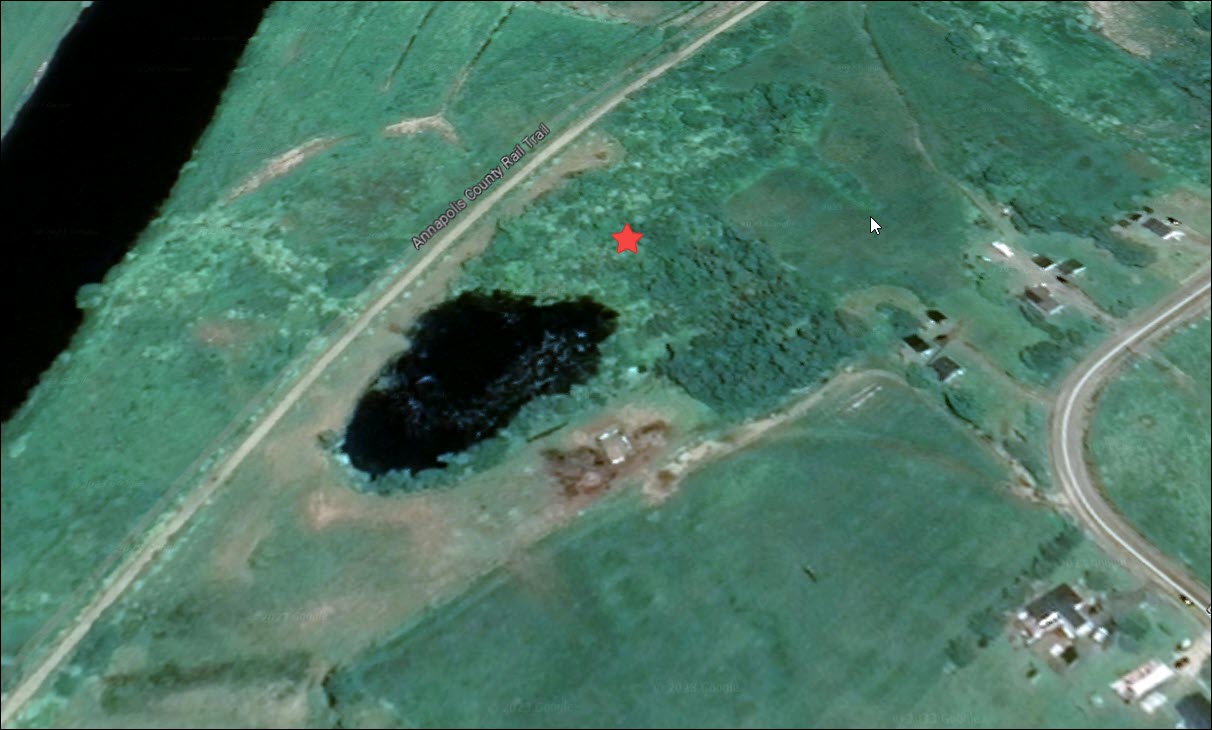
The newlyweds probably lived someplace in or near the Rene Forest village, off of present-day Brickyard Road in Nova Scotia.

You can see on this 1733 map that Jacques’ father, Rene Forest is the neighbor of Marie Josèphe’s father, Jean Prince.

Mapannapolis shows the location using their GIS system.

Overlaid onto an aerial map today, the Forest Village was located along today’s rail trail, with the bend in Brickyard Road showing at right.

The LePrince land was located near Button Brook, across from today’s Bridgetown, about a mile from the Forest land, as the crow flies, or perhaps less.

Back then, the preferred mode of transportation for everyone was canoe.

Life Along the River

By the time Marie Josèphe was born, these families had been living here for four generations. It was the only home they knew. The far-off place called France was simply family lore that their great-grandparents had passed to their grandparents, who told their parents, who, eventually told them.

France seemed like another fairytale world from long ago – completely disconnected from Acadia – because it was.

Marie Josèphe Le Prince’s Children

The first several years of their marriage would have been spent blissfully living along the shore of the beautiful Annapolis River. For generations, Acadians had farmed the salt marshes. Marie Josèphe and Jacques took up the plow and scythe and did the same.

After their 1734 marriage, like typical Acadian couples, Marie Josèphe LePrince and Jacques DeForest settled down and began both farming and a family. They lived on this land, between their families.

Their first baby arrived about 14 months after their wedding.

Victor Forest was born on April 9, 1735. A supplemental baptismal was performed on July 25th of the same year, which means that for some reason, his parents could not have him baptized by the priest when he was born, so he would have been baptized by a neighbor or perhaps the midwife until a proper baptism could take place. Godparents were Jean LePrince, his maternal grandfather, and Francoise Dugas, his paternal grandmother. What a joyful day that must have been!

It was quite a distance, at least 10 miles, not including paddling the bends of the river, from the area where Marie Josèphe Le Prince and Jacques Forest lived to the Catholic church in Annapolis Royal. They probably worshipped at the Mass House, St. Laurent, right across the river, which was very close to where her mother, Jeanne Blanchard, was raised.

The same priest would have performed baptisms in both locations and recorded them together in one parish register. Sometimes the priest indicated that the location was St. Laurent, but often not.

  • Victor, born in 1735 is probably the same Victor Forest found after the Expulsion in Connecticut in 1763, married, with 3 children.
  • Marie Josèphe’s next child, Joseph Forest was born on February 8, 1737 in Annapolis Royal and a supplemental baptism was performed on June 9, 1737. Godparents were Honnoré Le Prince, Marie Josèphe’s brother, and Catherine Joseph Forest, Jacques’ sister. It would have been quite cold in February which is probably why they didn’t brave the river for an immediate baptism.

Some have suggested that this Joseph is the Benoist Forest recorded in Connecticut who petitioned to go to France in 1763.

  • Anne Forest was born and baptized on April 15, 1739, in Annapolis Royal. Godparents were Joseph Le Prince, Marie Josèphe’s brother, and Anne Forest, Jacques’ sister.
  • Pierre Forest was born and baptized on July 8, 1741, in Annapolis Royal. Godparents were Pierre Le Prince, Marie Josèphe’s brother, and Elisabeth Godet, sometimes called Isabelle, Marie Josèphe’s second cousin, and Jacques’ third cousin.

These families had lived on both sides of this river for generations, and Godparents who were typically family members or very close friends were one way of assuring that someone was designated, and agreed in front of God and everyone present, to parent orphan children should the unthinkable occur.

  • Marie Josèphe Forest was born and baptized on March 15, 1743, in Annapolis Royal. Godparents were Jean Forest, brother of Jacques and also the husband of the other godparent, Anne Richard, daughter of Marie Josèphe’s aunt.
  • Félicité Forest was born on November 13, 1745, and baptized two days later on November 15, 1745. Godparents were Pierre Bastarache, who lived just upriver, and Felicité Bourgeois.
  • Marguerite Forest (Laforet) was born and baptized on January 16, 1748, in Annapolis Royal. Marguerite is the only one of Marie Josèphe’s children we conclusively know anything about after the 1755 Expulsion – aside from the fact that this Acadian family was exiled to Connecticut.

Marguerite Forest married Francois LaFay (Lafaille) someplace in New England on November 10, 1767, before a justice of the peace due to the lack of a priest. Their marriage was revalidated on June 23, 1792, at Sainte-Marguerite-de-Blairfindie in Quebec. She died in L’Acadie, Quebec, on February 16, 1819, at age 71.

  • Charles Tranquille Forest was born on February 14, 1750, and baptized the same day in Annapolis Royal. Godparents were Joseph Hebert and Marie Beliveau. He may have been the Charles Fores, “about 20 years of age” who died on August 7, 1770 and was buried at Sainte-Geneviève church in Montreal. The witnesses were Joseph Lefebre and Joseph Hetier.
  • Michel Forest was born and baptized on June 9, 1753, in Annapolis Royal. Godparents were Isidore Beliveau and Anne Forest.

Marie Josèphe and Jacques had baptized nine children over a period of 18 years. None of their children had yet married, so we really don’t know if these children survived to adulthood, although we find no burials in the parish records.

Their lives were about to change in a way that they could only have imagined in their worst nightmares.

Given that Marie Josèphe’s last known child was born in June of 1753, and she was only 38, it’s probable that she had at least one if not two or maybe even three or four more children.

The 1755 Expulsion Order

It was in the heat of the summer, July 28, 1755, that the horrific Expulsion order was signed by Governor Charles Lawrence of Nova Scotia, and with the drying of the ink, their fates were sealed.

The order was first read to the horrified Acadian men who had been summoned and gathered in the church at Grand Pré on September 5th, 1755.

The Acadian men were held hostage in the church for around five weeks while the women were rounded up separately, ordered to gather their children, and prepare for departure as soon as the transport ships arrived. More than half of the people herded onto the ships were children.

From the museum at Grand Pré.

The reading was followed by the agonizing deportation itself.

According to John Winslow’s journal, the women were in great distress, carrying their children while others pushed their decrepit parents in their carts towards the ships with all their goods.

Everything, absolutely everything, was stripped away from the Acadians and forfeited to the English.

By December, the same process was being carried out against the Acadians in Port Royal where Marie Josèphe and her family lived.

Walk the Wharf

The Acadians were rounded up like so many cattle, and herded onto English transport ships waiting in the river in Annapolis Royal, formerly Port Royal, at the foot of the fort.

The English wanted the Acadians’ land for much more pliable and cooperative New England settlers – and they extracted it from the Acadians in a horrific, genocidal, clean sweep.

The families were forced to leave their homes and livestock behind. They could hear their pets and livestock, calling to be fed and milked – but there was nothing they could do to save them. They couldn’t even save themselves.

They carried what they could as they walked to the end of the wharf, overseen by English soldiers, but the ships were overcrowded, and they were forced to leave everything they carried beside the wharf.

Forced below deck in cramped quarters, with no provisions for bathroom facilities, many died. Some ships sank during a winter crossing that one could argue was meant to thin the population. The last thing the Acadians saw were their homes and farms burning, and in many cases, their family members being forced to board different ships. Not only did many never find each other again, we have never found them in records since, either.

Poor Marie Josèphe, with however many of her nine children were living, and very probably heavily pregnant. We can only hope that she managed to keep all nine of her children with her, and they weren’t separated onto different ships.

On December 8th, early in the morning, they sailed away from Port Royal, forever, amid incredibly crowded and abhorrent conditions.

God help Marie Josèphe if she delivered a baby on that horrific transport ship, below deck, in the freezing cold, surrounded by filthy frigid seawater and death amid the slurry of human excrement.

I can’t even go there. If she did deliver a child under those circumstances, the baby assuredly perished.

We have absolutely no way of knowing whether or not Marie Josèphe had any children after 1755, or if they survived.

The ship that Marie Josèphe and Jacques were on landed someplace in Connecticut. Let’s hope that they were on the ship, Elizabeth, with her 280 unwilling passengers that arrived on January 21, 1756. Three people had died, so 277 paupers were now totally dependent on the charity of others for their mere existence.

If they weren’t on the ship, Elizabeth, then they may have been among the unfortunate people aboard the ship, Edward, with 278 passengers. The Edward was blown off course by a violent storm. She finally landed at Antigua with gravely ill passengers. Several had already died at sea, and more perished in Antigua. The ship eventually continued on to Connecticut, arriving on May 22, 1756, with only about 180 people. Roughly 100 had been claimed by malaria and other maladies.

Upon arrival, the refugees were forced to burn all of their remaining possessions on the beach before being allowed ashore, in case of contamination. The officials didn’t know what kind of diseases had killed so many, and they certainly didn’t want them sharing whatever they had with people in Connecticut.

There may have been a third ship, Two Sisters, that also departed Annapolis Royal on December 8th, along with the other two, with 280 people aboard, but there is no further record, although one record suggests another ship arrived on January 22nd and another possibly on the 30th.

Yet another vessel reportedly left with between 250 and 280 unwilling passengers, but never arrived. It could have sunk, or may have been replaced by the Elizabeth, but we will never know. Records are very sparse, confusing, and inconclusive.

There is no Port Royal roster of Acadians either before the Expulsion, when boarding ships, or after landing, but some families have been tentatively reconstructed from later records.

The last thing the Acadians saw of Port Royal was smoke as the English burned their homes, barns, and farms so there was no question in their minds that there was nothing left to return “home” to. The English hoped this would prevent the Acadians from trying.

Exile in Connecticut

Fortunately, Jacques and Marie Josèphe, along with their family, wound up in Connecticut. This luck of the draw fell in their favor for a change.

According to Acadie:

“In general, the approximately 1,000 Acadians deported to Connecticut were treated with respect. A law concerning their distribution throughout the settlement was adopted by the colonial Legislature in advance of their arrival, which allowed the citizens to prepare themselves for cohabitation. In some cases, Connecticut citizens made unoccupied homes available to Acadian families. Others funded the trip of Acadians wishing to resettle in Quebec via the Albany, Hudson, and Richelieu rivers through lakes George and Champlain.”

Little is known about the exile of the Forest family in Connecticut after the 1755 Expulsion, although we can piece a little together. The commentary above regarding Lake Champlain and the Richelieu River may be important.

We do know that both Jacques and Marie Josèphe survived, because Jacques eventually signed a petition requesting relocation to France. Under the Treaty of Paris of 1763, Acadian exiles had 19 months to leave British North America for any French colony.

The Acadians quickly signed petitions requesting transportation to Nova Scotia, Quebec, France, or the French West Indies.

Jacques, with 10 family members, petitioned for removal to France.

Also on the list were Victor Forest and Benoist (possibly Joseph) Forest with their families. The petition for transportation to France was denied for all 666 Acadians who signed the petition. Some migrated to Saint Domingue, some to Louisiana, New Brunswick, or Quebec, and others remained in Connecticut.

Reconstructing the Family Using the Petition

The only glimpse we have of Jacques Forest and family in Connecticut is the petition after the 1763 Treaty of Paris. Some have reported that the petition date was actually in 1767, but that doesn’t make sense because it’s outside the 19-month window.

In 1763, Marie Josèphe’s known children would have been:

  • Victor – age 28
  • Joseph – age 26
  • Anne – age 24
  • Pierre – age 22
  • Marie Josèphe – age 20
  • Felicite – age 18
  • Marguerite – age 15
  • Charles – age 13
  • Michel – age 10

Here’s what we do know:

  • Jacques Fourest indicated that his family consisted of 10 people, which one must presume included both he and Marie Josèphe plus 8 children. He was petitioning for passage to France.
  • Adjacent his request is Mathieu Forest with 6 people. Mathieu is probably the son of Rene Forest, so is Jacques’ brother.
  • Marie Josèphe and Jacques’ presumed son, Victor, asks for passage for 5, which would include himself, his wife, and 3 children.
  • Listed beside Victor is Benoist, with 5 persons. Benoist could be Joseph, as there was no baptism for a Benoist or anything similar.
  • Two further down the list is Jean-Pierre Fouret, with 7 persons, who would be another brother of Jacques Forest.

Thus, this leaves us with Jacques Forest and Marie Josèphe LePrince, excluding Victor and Benoist, assuming they are their children. We know of a total of 9 births through 1753, which leaves (at least) 7 children at home, assuming everyone lived and no more were born after arrival in Connecticut. By the way, neither of those assumptions are safe. Therefore, one of three things has occurred:

  • Benoist is not their child, so Joseph, now age 30, is still at home, has died, lives elsewhere, or did not petition for removal to France.
  • Benoist is their child, and they had another child in either 1755 or after, who survived.
  • They are raising someone else’s child or children.

Assuming the Jacque who petitioned for removal with a family of 10 is our Jacque, that tells us that 7 or 8 of their children are still living at home. Other than Victor, their children in 1767 would have been 30, 28, 26, 24, 22, 19, and 14. Of course, we can’t account for any children born after they arrived in Connecticut.

For all nine of their children to survive that hellish winter crossing in the worst possible conditions seems nearly impossible. Yet, on the ship, Elizabeth, only three people are reported to have died. Perhaps they were fortunate, and not only did all of their children survive that passage, they survived everything else too.

The fact that they have that many surviving children suggests strongly that they were NOT on the Edward that was blown off course to Antigua, where more than one third of the passengers perished.

That’s at least some small relief. What they did have to endure was bad enough.

We know almost nothing about what happened to the Forest family after 1763, except for daughter Marguerite, who married Françoise Lafaille (Lafay) and ultimately settled in L’Acadie, Province of Quebec, and possibly Charles Forest, who may have died in the same province in 1770 at age 20.

We don’t know when or where Jacques Forest or deForest died, but it was likely in Connecticut. By 1767, he would have been about 60 years old, and given the one tidbit we know about Marguerite, the family likely remained there for at least the rest of Jacques and Marie Josèphe’s lives.

I can’t help but wonder how many of my unknown autosomal DNA matches that I absolutely cannot place, but cluster with distant Acadian cousins, are due to the displaced family members who “disappeared” in Connecticut and elsewhere.

Marie Josèphe’s Daughter, Marguerite DeForest

Marguerite DeForest, born in 1748, was exiled along with her family to Connecticut. She married Francois Lafay in the colonies in 1767 and had her first 10 children wherever it was that they lived.

Her eldest daughter, Marie Lafay (LaFaille), was born about 1767, so would have known her grandparents, or at least her grandmother, Marie Josèphe, well.

After moving north to L’Acadie, Quebec, along the Richelieu River, about 1788, Marie later told Protestant Missionaries that her elderly grandmother, who would have been Marie Josèphe LePrince, became upset in about 1787 because her grandchildren were losing both their Catholic religion and their culture. Marie had been educated in Protestant schools, given that Catholicism could not be practiced in the colonies.

Therefore, the rest of Marie Josèphe’s children would have been educated in Protestant schools as well. Marie indicated that she was leaning towards the Protestant religion, herself, which would have been her grandmother’s nightmare come true. Especially given how much the Acadians had sacrificed to maintain their freedom to worship as Catholics.

Marie said that her grandmother made the decision to “send the family back to Canada,” which is how they wound up in L’Acadie, south of the St. Lawrence River, across from Montreal.

Marie Josèphe would have been 77 years old in 1787. What we don’t know is whether Marie Josèphe stayed behind in New England or accompanied all or part of her family who relocated.

Either way, by the 1790 census in Connecticut, Marie Josèphe (LePrince) Forest, DeForest, or any similar spelling or recognizable name is not to be found. If she was still living, she was probably residing with someone else, but we have no idea who or where. It’s also possible that she was living in Massachusetts or another location in New England.

Marie Josèphe’s granddaughter, Marie LaFay, was given a Bible by Pliny Moore who was associated first with Sheffield and Spencertown, Massachusetts, then with Vermont and Champlain, New York, which is just down the Richelieu River and across the border from the location in L’Acadie, Quebec where the LaFay family settled.

Pliny Moore, about 8 years older than Marie, may well have been her heartthrob. He was an American military Lieutenant, a Baptist, and then a Congregational Church leader. Marie LaFay cherished that Bible for the rest of her life, even after it was taken away from her and she was forbidden to read it. As an adult, Marie eventually converted away from the Catholic Church.

This connection to Pliny, along with “a fearful disappointment”, described by Marie, was likely the motivating factor for Marie Josèphe to become upset in 1787 because her children were “losing their religion and culture.” That’s when Marie Josèphe decided that her family needed to remove themselves from under the influence of a location where Catholicism could not be freely practiced. Her granddaughter, after all, was at risk, which probably meant the rest of her grandchildren were too.

Marie confessed years later that she had encouraged her father to make the 1788 trip to Canada following that “fearful disappointment.”

I strongly suspect that Marie had marital aspirations towards Pliny, an affection that was not returned in the same way. Pliny married someone else in January 1787, in Vermont.

It’s worth noting here that in 1816,  Marie somehow obtained Bibles for all of her children from Pliny, who was then living in Champlain, New York on Lake Champlain, near the mouth of the Richelieu River, about 60 miles away.

Marie Josèphe’s Final Years

From granddaughter Marie’s information, we know that Marie Josèphe LePrince was living in 1787 and wanted her children to move to Canada. We know that Marie encouraged her father, Francois Lafay (Lafaille), to visit Canada and select a site there. We know that Marie’s family, including both parents and their 10 children relocated to Canada in 1788.

In July 1788, Marie Josèphe’ daughter, Marguerite DeForest and her husband had three of their children baptized into the Catholic Church, and in September, the family rented a farm, clearly settling in permanently.

On January 6th of 1789, Marie and two of her sisters were baptized into the Catholic Church at Ste. Marguerite de Blairfindie at Saint-Jean-sur-Richelieu, on the Richelieu River, which empties into Lake Champlain.

If Marie Josèphe was lucky, she was present for those baptisms, closing the loop on restoring their Acadian heritage. She never returned home to her beloved Acadia along the river in Nova Scotia, but the new L’Acadie, built by many of the same families, was the next best thing.

All of this information, combined, probably places Marie Josèphe’s death after 1787 and before 1790, although nothing is certain.

Of course, there would be no death records in the States, but if Marie Josèphe went to Quebec with her daughter’s family and died there in 1788 or after, it’s likely that her death and burial would have been recorded in the parish register. Of course, parish registers aren’t necessarily complete, and she may have remained wherever she was living – which I suspect was someplace near enough to Lake Champlain that Marie had the opportunity to meet Pliny.

Marie Josèphe was probably incredibly relieved that her daughter and grandchildren had made it back to a French, Catholic, Acadian environment. Perhaps that relieved her mind enough that she was free to “go on” and meet her maker.

All things considered, it’s amazing that Marie Josèphe overcame so many obstacles to live so long. Given what she faced, before the days of modern medicine, it’s remarkable that she lived to be at least 72.

In the closing days of her life, Marie Josèphe LePrince was able to salvage at least something of her Acadian heritage by returning her daughter, along with her grandchildren, back to an Acadian resettlement region of Canada.

In L’Acadie, Marie Josèphe’s beloved Acadian culture, including their Catholic faith, endured and did not perish!

_____________________________________________________________

Share the Love!

You’re always welcome to forward articles or links to friends and share on social media.

Subscribe!

If you haven’t already subscribed, it’s free. You’ll receive an e-mail whenever I publish by clicking the “follow” button at the top of the main blog page, here.

Help Keep This Blog Free

I receive a small commission when you click a vendor link in my articles and purchase that item. This does NOT increase your price but helps me keep the lights on and this informational blog free for everyone. Please click on the affiliate links in the articles or to the vendors below if you are purchasing products or DNA testing.

Thank you so much.

DNA Purchases and Free Uploads

Genealogy Products and Services

My Books

Genealogy Books

Genealogy Research

A Forest of Fathers: FamilyTreeDNA’s Y-DNA Tree Tops 100,000 Branches

Congratulations to FamilyTreeDNA and all of their customers who contributed to this absolutely monumental milestone. The Y-DNA tree has now reached 100,000 branches.

Chart courtest of FamilyTreeDNA

I knew they were getting close because the official January numbers were 99,777.

Congratulations to the entire team, but especially to Michael Sager, Senior Phylogeneticist, who has been the chief architect of the tree “forever.” This is definitely his baby.

Here’s Michael in 2020 at RootsTech discussing the Y-DNA tree construction methodology.

The Y-DNA tree is built using the results of 698,000 individual Y-DNA testers, plus thousands of both academic and ancient results.

These 100,000 tree branches are built from 857,000 variants, known as SNP mutations. Think of those as a huge 857,000-piece puzzle that Michael Sager has spent the past decade assembling into the Y-DNA tree of mankind, reaching all the way back to Y-DNA Adam.

In the tree today, haplogroup A-PR2021, named for variant or SNP (single nucleotide polymorphism) PR2921, is Y-DNA Adam, who lived in Africa about 234,000 years ago.

Click on any image to enlarge

FamilyTreeDNA has made their entire Y-DNA tree public and free, and that’s in addition to the baker’s dozen reports available through Discover for each haplogroup.

Let’s take a look!

The Public Y-DNA Tree by Country

You can view the public Y-DNA tree, here, and can select to view the tree by:

  • Variants (mutations) that define each haplogroup
  • Country
  • Surname

For example, here is the oldest, or top portion of the tree, using “by Country,” the first of three options.

Notice two things at far right:

  • There may be a “+” when there are too many countries to display
  • The 3 dots

Clicking on the three dots provides you with the option for a “Country Report” or “Surname Report” for that specific haplogroup.

The Country Report shows the number of haplogroup members from each country. Remember that countries are self-reported by the testers. The country should be the location where the tester’s earliest known paternal ancestor (EKA) was living or from.

You can see how many people are members of this specific branch, and in the next column, how many people are members of this branch plus all “son” or downstream branches. One column excludes new haplogroup letters (when a different base haplogroup is formed), and the other includes all downstream haplogroups, even if the beginning branch letter changes. The final “Distribution” column shows the percentage of people in that haplogroup who originated from each country.

In this case, 43% are from the US, which probably means that they are brick-walled here, given that the only people originally “from” the United States were Native Americans who fall into specific subclades of haplogroups C and Q.

If you’d like more information about A-V148, or any other haplogroup, you can go to Discover and enter a haplogroup name. I always check the Ancient Connections because archaeological remains anchor haplogroups in a particular place at a particular time. We’ll cover more about Discover in a minute.

The Public Y-DNA Tree by Variant

This haplotree view “by Variant” shows the variants, or SNP mutations, that identify each haplogroup.

You can see that Haplogroup A-PR2921, the granddaddy of the tree, is based on only one mutation, PR2921, which is also the haplogroup name. This means two things:

  • Every haplogroup beneath this branch on the tree also has the mutation, PR2921, which is how we know it’s the “original” founding mutation
  • This haplogroup cannot be split further, because there are no additional variants

For example, look at the branch, A-L1090, the first “child haplogroup” of A-PR2921. A-L1090 has the 26 mutations displayed, plus more, for a total of 695.

This means that as more men test, there are literally more than 695 opportunities for various men to match on a unique subset of those mutations, plus new mutations never discovered before, forming new haplogroups.

Some lines have died out over time, and others may be quite rare. This is the perfect example of why it’s important for every male to take the Big Y test, aside from genealogy.

Looking on down the tree to the next haplogroup “generation,” we can see that haplogroup A-V148 has 21 descendant haplogroups, but its sibling subclade, A-V168 has 99,967 – essentially the rest of the tree.

The Public Y-DNA Tree by Surname

Viewing the tree “by Surname” can be very useful. Surnames are shown beside their haplogroup if there are two or more individuals:

  • With the same spelling of the surname who are assigned to this haplogroup
  • Who are members of a public DNA Group Project
  • Who have given permission for their information to be displayed publicly within the project

You can see that haplogroup A-V148 has one surname showing – Goddard.

Haplogroup A-M31 shows four: Bass, Johnson, Evans and Cruise.

Clicking on the three dots shows the Surname Report.

This report reveals that there are seven men with the Goddard surname and no other surnames are currently lissted for this haplogroup.

You might be a member of this haplogroup even if your surname isn’t Goddard. Surnames were only adopted in the past few hundred years, and many have changed during that time for a wide variety of reasons, including spelling variations. Not everyone who is in the matching database has joined a project, so they may show up on your match list, but not be visible here.

Since we know that several Goddard men are in some project, how do we figure out which project or projects they have joined?

Discover’s Suggested Projects

Go to Discover and enter the haplogroup. Click the big orange “Search” button, which will display the Haplogroup Story page for that haplogroup.  .

From the Discover menu at left, select “Suggested Projects”.

For haplogroup A-V148, 10 projects are listed based on which projects members of this haplogroup have joined or on project administrator settings. Those projects alone may provide ancestral hints. Many people, if not most, join multiple projects, such as haplogroup projects, surname projects, and geographic or ethnic projects.

You can click through to any of the projects listed for any haplogroup to take a look. I use my browser search function to search for specific surnames on project pages.

You may find that someone who descends from your ancestor has tested and is waiting for you to match them – plus other genealogical hints as well.

Is Your Surname in the Database?

How can you tell whether your surname is in the database? That’s a great question!

In the public tree, there’s a “Search by Surname” feature. I searched for Estes, and discovered that Estes appears on 8 different branches of haplogroup R. Next, I need to click on haplogroup R, which is directly beneath the search box.

This doesn’t mean there are only 8 men who have tested, but that they are found on 8 different tree branches.

Remember that men who obtain a Family Finder haplogroup are also included on the free Public Tree, so I’ll probably find some Estes men on higher branches of the tree than they would appear if they had taken a Big Y-700 DNA test. Hopefully, they will upgrade, which will help them and all Estes descendants by piecing together our Estes lineages.

Sure enough, using my browser search to search for “Estes”, I discovered the name included with 500 other surnames in haplogroup R-L21, in R-DF49, in R-1690, and then the goldmine – four haplogroups that have ONLY the surname Estes listed.

These are our Estes twigs on the haplotree’s branches, and define four lines that begin with Silvester Estes born in 1522 in Kent, England. These haplogroups are how we proved where our line originated, and how we place testers who are uncertain about their genealogy on their correct tree branches today.

Don’t forget about both the surname and country reports available to the right when searching by surname in the Public Tree. You can also navigate to Discover to learn more about any of these haplogroups in which your surname appears.

Iff you’re an Estes male, you may or may not land in one of these haplogroups. You might even be a member of a different lineage altogether. The only way you’ll know is to take the Big Y-700 test, or minimally, the introductory 37 and 111 marker tests to view your matches. These entry-level tests provide a predicted haplogroup based on STR markers, but you’ll only be placed in your proper place in the tree with the definitive Big Y-700 test. I wrote about the difference between STRs and SNPs here.

Obviously, Y-DNA is only applicable to biologically male testers who have a Y chromosome, and you’ll only see surnames on the tree if multiple people with that exact surname have tested and joined projects, but there’s one more place to look if you want to see how many people with your surname have tested at FamilyTreeDNA.

Group Projects Search

In the footer of every FamilyTreeDNA page, under Community, you’ll find “Group Projects.” No, I don’t know why they buried this tool here, because I find it very useful, and you’ll never find it if you don’t know where to look. But now you do!

Enter the surname you are seeking and click “Search.”

You’ll see at the bottom of the search results page that 391 people whose surname is spelled exactly “Estes” have taken a DNA test at FamilyTreeDNA.

Clearly, some will be males, and others female, and they may have:

  • Taken the autosomal Family Finder test
  • Uploaded an autosomal test from another vendor
  • Taken the mitochondrial DNA direct matrilineal test (your mother’s mother’s mother’s direct line through all females)
  • Taken a Y-DNA test (males only) for the direct patrilineal (surname) line

Lots of people in the database will be descended from Estes ancestors, but won’t carry the surname. This search is an invaluable resource for genealogists seeking their ancestors’ surnames and lineages. Check it out by entering the surnames of your four grandparents and see what’s there!

I use this search tool, combined with projects to find actual testers who represent my ancestral lines and their haplogroups. Then I search the public tree and use Discover to learn about my ancestors. Which brings me back to why this milestone is so important.

Congratulations on a HUGE Milestone for Mankind

The trip to 100,000 haplotree branches was a long and sometimes challenging road. What an amazing accomplishment! Today, the tree is growing at warp speed, but it began with “horses and buggies” in 2003.

  • In 2003, the YCC Consortium published a paper defining the structure of the Y-DNA tree which, then, consisted of 153 branches based only on 243 SNPs. That’s all that had been discovered in academia at the time. But citizen science was coming into its own and many more haplogroup discoveries would soon follow, thanks to our testing pioneers.
  • In 2006, ISOGG committed to developing and maintaining a public, manually curated haplotree based on SNPs discovered at different labs. The ISOGG tree was published annually, with the final version released in July 2020.
  • In 2006, there were about 250 branches on the Y-DNA tree and SNP discoveries were rare events. Today, with the Big Y-700, new SNP discoveries occur at the rate of several hundred per week, thanks to the testing public.
  • In 2010, the YCC consortium released its final tree that included only 440 branches.
  • In 2013, FamilyTreeDNA introduced the Big Y test, which used the newer NGS (next generation sequencing) scanning technique instead of targeting specific locations on the Y-chromosome. The Big Y-700 test scans millions of locations in the gold standard region of the Y chromosome. It reads known Y-DNA SNP locations for haplogroup placement, but also identifies mutations not previously discovered that are often lineage-specific. That’s the key to identifying new haplogroups. Haplogroups are literally named after their SNP.
  • 2018 was a banner year. There were 17,966 branches on the tree.
  • By 2018, the haplotree was benefiting from what was termed a “SNP tsunami,” which rapidly expanded the tree. In June, 2018, FamilyTreeDNA named their 100,000th SNP. That too was a huge milestone, which I wrote about, here. Not every SNP discovered becomes its own haplogroup, of course, but they all must be placed appropriately on the tree.
  • In September of 2018, FamilyTreeDNA introduced their Public Tree.
  • That avalanche of SNP discovery meant that the volunteer-maintained ISOGG tree was struggling mightily to keep up with the onslaught, publishing one final tree in 2020. The landscape had changed. A yearly, independent tree that compiled information from multiple sources was no longer necessary. Haplogroup and SNP discoveries were being made almost exclusively at FamilyTreeDNA, who publishes and maintains their Y-DNA tree organically as SNPs are discovered and added to the tree.
  • In December 2021, the FamilyTreeDNA Y-DNA haplotree reached 50,000 branches. I wrote about that milestone, here.
  • In just over four years, that has doubled at a rate of about about 1000 new branches per month. That’s mind-boggling!
  • On February 5, 2026, the haplotree reached 100,000 branches! I checked earlier today (Feb. 6th) and there are already 39 more haplogroups. No moss growing under their feet. They’ve reached for the treetops and gone beyond!

Reaching 100,000 branches on the Y-DNA tree is an absolutely amazing achievement, both scientifically and genealogically. Perhaps best of all, reconstructing the lineage and paths of our ancestors is the only way we can reach indefinitely back in time. Beyond surnames and far beyond what autosomal DNA can touch.

Based on that, we can add genetic anthropology to the fields that have benefited immensely from the achievements of the tree. Conversely, genetic anthropology has contributed to the construction of the tree with the sequencing of ancient DNA results, allowing thousands of ancient samples to be incorporated.

Every contemporary haplogroup descends from Y-DNA Adam. Given that Adam lived at least 234,000 years ago, that represents about 9,360 direct-line ancestors (at 25 years per generation) for each one of us. At 20 years per generation, we have 11,700. Wouldn’t Y-line Adam be utterly dumbstruck to learn that he has 8 billion descendants, of which slightly more than half are males who still carry his defining haplogroup mutation, A-PR2021!

Thanks to the FamilyTreeDNA public Y-DNA tree and searches, plus the amazing Discover tools, we can now peel back the curtain of time on both recent and distant ancestors by walking our haplogroups back one at a time until we meet our earliest ancestor of all – Adam

Want to Meet Adam? Here’s How You Can Participate

You can participate in building the Y-DNA tree of humankind and meet Adam by taking a Big Y-700 DNA test, which you can order here. If you’re a female, you can sponsor a Y-DNA test for a male relative, such as a father, uncle, or brother who represents one of your surname lines. But don’t stop with your own paternal line – reach out and make those same discoveries for all of your ancestral lines! Your ancestors are waiting to meet you!!

_____________________________________________________________

Share the Love!

You’re always welcome to forward articles or links to friends and share on social media.

Subscribe!

If you haven’t already subscribed, it’s free. You’ll receive an e-mail whenever I publish by clicking the “follow” button at the top of the main blog page, here.

Help Keep This Blog Free

I receive a small commission when you click a vendor link in my articles and purchase that item. This does NOT increase your price but helps me keep the lights on and this informational blog free for everyone. Please click on the affiliate links in the articles or to the vendors below if you are purchasing products or DNA testing.

Thank you so much.

DNA Purchases and Free Uploads

Genealogy Products and Services

My Books

Genealogy Books

Genealogy Research

Getting Ready for RootsTech 2026

RootsTech, March 5-7, 2026, will be here before you know it. Behind the scenes, people are scurrying around like crazy!

Let’s take a peek!

You’d Think January Would Be Quiet…

January seems like it would be a quiet, “down” time, after the holidays, but for many of us, it’s not. It would seem like the holidays would be a time to relax and catch up, but I always get further behind and face a ton of emails in January. (I’m still very behind with those.)

No small part of my January issue is self-imposed, though not all of it.

Let me explain.

  • I’ve always strived for one industry or technical blog article each week. Something about a tool, a product, a how-to article, industry news, something useful and educational. I can’t write an article without using and understanding the tools, so these articles take a substantial amount of time to prepare.
  • I also strive for one “52 Ancestors” article each week, typically published on the weekend. While these articles reconstruct the lives of my ancestors, they include a great deal of genealogy research, instructional content, and a substantial amount of history that affected the lives of anyone who lived in that location or during that time. While the topic is my ancestor, these articles are useful far beyond my own genealogy.

As an aside, many people read these articles as a short-story series. Working on each article draws me close to each ancestor individually. I literally walk through their life beside them – joys, sorrows, deaths, where they lived, what was happening around them – birth to burial.

  • Of course, then there’s “everything else.” Other articles, interviews, my contractual work, collaborating with others, and of course, some smidgen of personal time.

January is Different

But the reason January is different, on steroids, is threefold:

  • It’s the month that speakers begin planning and preparing for sessions they will be giving during the rest of the year.
  • For US business owners, it’s when we begin gathering the information for business taxes, which are due March 15th, a week after RootsTech, which means that we have to get the information to our preparer long before RootsTech. I’m not exaggerating to say this is one of my LEAST favorite activities ever.
  • However, the third challenge is RootsTech itself.

RootsTech 2026

RootsTech, held March 5-7 this year in Salt Lake City, is the granddaddy of all genealogy conferences. I’m fortunate to be able to attend and present – and I’m grateful for that opportunity. But there’s a huge amount of prep, and while some of it happens in December, most of it falls in January.

I’m often asked about what it takes to create a presentation, or put more bluntly, “Why does it take so long? All you have to do is throw together a few Powerpoints.” So, here’s the backstory.

I can’t speak for other presenters, but every 45-minute presentation that I create takes about a week.

If you’re stunned, every one of my slides includes images and often graphics that I create. The slide content needs to be balanced, readable, and not distracting form the point I’m trying to make. It needs to flow smoothly from the prior slide, and to the next one.

It goes without saying that I have to verify everything, sometimes with a vendor, sometimes making sure features still work the way I think they do, or did, the logic is accurate, and that any math maths.

Many screenshots used for articles and presentations need to be blurred, and I need to be sure I don’t accidentally compromise someone’s privacy.

It seems there are 1000 little things. Ok, so maybe only 100!

Syllabus: Oh, you want a syllabus too? Well, that’s another document which often has to be formatted in a specific way, and must be between x and y pages long. Some requirements for different conferences are very specific, down to the font.

The presentation must “fit” into its allocated time, say, generally 45 or 50 minutes, without me talking at 150 MPH with the audience feeling rushed, and provide enough information to be both useful and entertaining. This means that presenters must practice, refine, practice. You get the drift.

Additionally, when working in a tech field, like DNA, vendors change things, often, and you need to review your presentation just before the conference to be sure the screenshots and information are still current. Speakers watch every announcement between presentation creation and the conference with an eye to changes. I swear, it never fails that the night before, I’m always trying to update my presentation because a vendor updated their website. One time it was literally at the podium. That was way too close for comfort.

RootsTech must manage and coordinate hundreds of presenters, their presentations and syllabi, lots of technology, and massive logistics. In order to do so:

  • Pre-recorded sessions are due to RootsTech at the end of December.
  • For other speakers, copies of their PowerPoint presentations and syllabi are due by January 25th so RootsTech can review, check for any issues, and make any last-minute changes. (Hint – you may not see another blog article for the next 10 days.)

All things considered, RootsTech does a great job, but last-minute schedule changes do occur, so be sure to check your planned schedule closer to and daily during RootsTech.

My 2026 RootsTech Sessions

Pre-Recorded Session:

  • X-DNA Basics for Genealogists, a recorded session that will be available in the FamilyTreeDNA virtual booth, which means that everyone will be able to watch. The great news is that the vendor booths and their contents will be visible in the Expo Hall, both in person and virtually, entirely free. You don’t need to register to attend RootsTech to view the vendor booths, but there’s no reason not to, because online registration is free.

Live-Streamed Session:

  • I’ll be presenting Mapping Maternal Connections: Where Science Meets Genealogy on the Updated mtDNA Tree of Humankind for FamilyTreeDNA as a member of the R&D team that developed the new Mitotree. This will be a fun session that explains why mitochondrial DNA matters, covers the latest update, and how the new Mitotree, along with Discover, provides genealogists with new tools to break through brick walls.

The date and time for this session have not yet been confirmed, so check the schedule moving forward.

You must register for RootsTech Online to access live-streamed sessions remotely. They are added to the RootsTech on-demand library for later viewing.

In-Person Sessions

I’m fortunate to have two in-person sessions this year. Neither are being live-streamed or recorded, so I hope to see you in person.

  • Mitochondrial DNA to Z: My Results Are Back, Now What? Everyone is excited when their DNA test results are back, but what do you do next? How do you use them most effectively? What do those numbers means and why are they important? If these questions sound familiar, this is just the class for you. We will take results, step-by-step through all of the reports and tools and help you interpret what they mean and how to use them for genealogy using a case study.

This session is currently scheduled on March 5th, at 4:30 PM, Mountain Time. Please see the Schedule Warning section below.

  • Y-DNA to Z: My Results Are Back, Now What? Would you like to understand how to use your Y-DNA results for genealogy? What do those numbers mean and why are they important? This is just the class for you. We will take Y-DNA results, including the Big Y-700, step-by-step through all of the reports and tools and help you interpret what they mean and how to use them for genealogy. We’ll close with “next steps”, so you have a plan to understand your own Y-DNA message, PLUS how to create a genetic tree to reveal the messages from your other ancestors too. Females don’t have a Y chromosome, but we have fathers, brothers and male family members to test.

This session is currently scheduled on March 6th, at 3 PM, Mountain Time. Please see the Schedule Warning below.

Schedule Warning!!

When viewing sessions on the RootsTech website, the date and time displayed on your computer is the date and time that the event occurs USING YOUR LOCAL TIME!! The RootsTech website uses the time on your computer and adjusts the RootsTech session time displayed to your local time.

That’s fine if you’re attending online, but it’s NOT fine if you’re trying to plan an in-person schedule around travel time and other commitments.

For example, here’s the time displayed for my Y-DNA session. You can see that it says 5 PM, which is GMT-5, and that’s the time where I live, not in Salt Lake City which, during RootsTech, is GMT-7.

This session is NOT available virtually, so anyone who wants to attend will need to do so in person in Salt Lake City. However, the local time, in Salt Lake City, that this session will be taking place is 3 PM, not 5 PM.

In prior years, when I’ve scheduled these sessions in my phone, I wound up having to go back and change the time of every session after arriving in SLC – so that just adds to the confusion. Check your phone after arriving to be sure your sessions are shown in their correct time slot.

One more possible glitch this year is that Salt Lake City time changes at 2 AM on the day following RootsTech. Be sure to factor this time difference into your schedule if you’re planning to fly on Sunday, March 8, the day after RootsTech.

Bottom line – when planning your RootsTech events, be sure to calculate the local time and not your system time, unless you’ll be attending virtually. Also, be sure to check your schedule often in case either schedule or room changes have been made.

Register

Be sure to register for RootsTech. Online is free, and in-person only costs $129 for a 3-day pass, which is a great value for everything that’s offered.

When you register for RootsTech, you’ll be able to use their complimentary conference schedule planning feature which is infinitely helpful. If you’re planning to attend any session, adding it to your RootsTech calendar helps RootsTech with room size planning – getting the right speakers in the right rooms to properly accommodate the audience size.

If you have more questions, here’s the RootsTech FAQ.

Personal Note

On a personal note, RootsTech isn’t just a conference, it’s a clan gathering, a homecoming for genealogists where we meet and mingle with other genealogists. Where we find cousins, both new and old. It’s a place to bask in the genealogy glow with our peeps and discuss historical events, new technology, old maps and common ancestors. It’s a reunion, a place of excited greetings and infinite hugs.

Me with Mags Gaulden in 2018

I know this sounds sappy, but it’s absolutely true. It’s the only place many of us see each other. We have a great deal of fun and cherish every minute!

Come make some priceless memories.

I hope to see you there!

_____________________________________________________________

Share the Love!

You’re always welcome to forward articles or links to friends and share on social media.

Subscribe!

If you haven’t already subscribed, it’s free. You’ll receive an e-mail whenever I publish by clicking the “follow” button at the top of the main blog page, here.

Help Keep This Blog Free

I receive a small commission when you click a vendor link in my articles and purchase that item. This does NOT increase your price but helps me keep the lights on and this informational blog free for everyone. Please click on the affiliate links in the articles or to the vendors below if you are purchasing products or DNA testing.

Thank you so much.

DNA Purchases and Free Uploads

Genealogy Products and Services

My Books

Genealogy Books

Genealogy Research

Y-DNA Results at 20 Years: Answers, Lessons, Methods, and Workarounds

Our goal as genealogists is always to learn what we don’t know and reveal anything we should know.

I’m going to share the evolution of four tests, purchased exactly twenty years ago. I haven’t cherry-picked these, so you’re getting the raw story. Successes, challenges and regrets, plus a few hacks to help you out when you’ve hit a roadblock.

I’m also sharing how I work around some issues – like tests that haven’t been (and can’t be) upgraded to Big Y tests.

DNA testing has come a long way from an infant science two decades ago, when we were tentatively establishing a new industry – one that today has evolved into a staple for serious genealogists.

On New Year’s Eve, 2005, exactly 20 years ago, I was doing the same thing I was doing at midnight in 2025 – genealogy.

That was long before the days of social media and chat groups, so some of us geeky types were discussing our genealogy research on the now-obsoleted RootsWeb e-mail list.

I Was Planning for 2006 Travel

I realized that I was going to be traveling during 2006 and would be asking several men to take a Y-DNA test, so I should purchase several kits while they were still on sale.

Then I got a bit giddy when I realized that I could actually celebrate the New Year by making those purchases right at midnight.

And I did too – I hit it right on the dot.

I mean, for a genealogist, what better way to celebrate? Right?

What I didn’t know is that, quite by accident, I managed to score kit 50,000. That seemed like such a milestone!

And now, I can’t believe it’s been 20 years. How is that even possible?

After I went to bed in the wee hours of January 1, 2026, I decided I needed to check in on the kits I purchased on that fateful New Year’s Eve, 2005, and see how they are doing. What were my goals, aspirations and expectations? Did we accomplish them then? Have we now?

What has happened in the past twenty years?

Let’s take a look, beginning with kit 50,000.

Kit 50,000 – Mr. Miller

Mr. Miller is my mother’s second cousin, so the perfect person to represent our Miller line.

Goals and Questions:

  • Do we descend from Johann Michael Miller born in 1692 in Germany? At that time, we did not know his birth location, and only knew that the line was German. Later research would add two additional generations and place his grandfather, Heinsman Mueller in Schwarzenmatt, Switzerland before 1655.
  • Does the Elder Jacob Miller (born about 1710 in Germany), a Brethren minister, match the Johann Michael Miller line? They were both Brethren, clearly knew each other, and were found in some of the same locations. The answer is conclusively no; the lineages are not the same based on both STR and Big Y-700 tests.

2005 – 12-marker test – $99

  • Initial 2006 haplogroup – R-M269 – about 6,500 years old
  • 2025 haplogroup – R-BY56132 – about 350 years old, obtained via DNA match to another Miller tester

That a HUGE difference!

2006 matches – no Y-DNA matches.

Remember, this was early, with less than 50,000 results in the database, compared to just under 700,000 SNP-confirmed testers today, not to mention probably double many more STR-only testers.

Haplogroups for STR testers are predicted based on marker values and are not SNP tested or confirmed. The Big Y tests, SNP tests and SNP packs which are no longer available, and haplogroups assigned through Family Finder are SNP confirmed.

2025 matches – 2 (yes two) 12-marker matches, both Millers. At 25 markers, he has 7 matches, all Millers.

I created the Miller-Brethren Project in September 2006 for any Miller line that was of the Brethren faith, hoping to differentiate between families with the same names in the same place.

2009 – upgraded to 67 markers – $148

In 2009, I upgraded Mr. Miller to 67 markers and recruited two other Miller males from our believed line. They all matched at 25 markers and above, confirming the lineage to our ancestor, Johann Michael Miller/Mueller. Whew! That one was close, because there was a great deal of consternation and confusion about these lineages.

2011 – added Family Finder – $289

Mr. Miller’s haplogroup today, confirmed by Family Finder, is still same as his predicted R-M269 from his STR results. Unfortunately, the kit has never been upgraded to the Big Y test, and I desperately want our personal lineage haplogroup. However, all is not lost because he matches several males from the same lineage who have been assigned to haplogroup R-BY56132 through the Big Y-700 test.

Every haplogroup is publicly viewable in Discover, but testers can see additional information and features when they click through to Discover from their own account – including the Match Time Tree, Globetrekker, and more Ancient and Notable DNA Connections.

Discover provides an informative Haplogroup Story, an overview before viewing the dozen reports available in the left sidebar about that haplogroup’s history and lineage. You can take a look, here.

From Discover, we learn that the Miller haplogroup was born (or branches off from) its parent haplogroup about the year 1650 CE, so when the Millers were still living in either Switzerland or Germany. If we match males from either of those locations, they would probably match us upstream at R-BY115568. Their genealogy would certainly help our genealogy!

Ancient Connections, which are ancient DNA matches, extend beyond surnames, revealing connections to both the Yamnaya and Moros cultures and shared ancestry with Bronze Age Balkan burials.

Viewing the Ancient Connections tab, we learn that remains related to or upstream of our haplogroup were excavated in Albania, Germany, Hungary, Bulgaria, the North Banat and Mokrin in Serbia, and Macedonia. The closest genetic connections are shown first.

New Goal: Would love to test and match with Mueller men from Steindwenden, Germany, Schwarzenmatt, Switzerland, or anyplace near either location.

Kit 49,999 – Mr. Estes

Goals and Questions:

  • Do we connect with the Abraham Estes (c1647-1720) lineage?
  • Was there more than one early colonial Estes line?
  • If so, were they related?
  • Did our line come from Kent, England?

2005 – 25-marker test – $150

2006 matches –  54 12-marker matches

2025 matches – 326 12-marker matches

2006 matches – 4 25-marker matches – one to a known cousin, two more to other Estes males

2025 matches – 30 25-marker matches, including several Estes men

Crucial – this tester matched an Eastes male who lived in Kent and whose ancestors never left. This confirmed our oral history and early research suggesting that Abraham Estes’s origins were in Kent.

  • Original 2006 haplogroup – R-M269 – about 6.500 years old
  • Current Haplogroup – R-L151 – about 5,000 years old, SNP confirmed from the Family Finder test
  • Match Haplogroup – R-ZS3700 – about 250 years old obtained from STR match to multiple Big Y testers who shares same ancestor

In 2012, we added the Family Finder test for $199, which answered questions about whether multiple half-siblings were actually descended from a close relative of the tester. Family Finder also allowed people descended from this line, but who don’t carry the Estes Y-DNA to confirm their relationship to the Estes family.

This tester has not upgraded to the Big Y-700, but does match at the STR level with those who have taken that test.

Today, the Eastes male from Kent who subsequently upgraded to the Big Y-700 forms the base of the Estes family genetic tree, and others in the American lines form descendant branches based on the Big Y-700 test!

This includes some men whose genealogy we can’t yet connect vis the paper trail, such as kit 491887, shown in lavender below, but we know where he connects genetically. We were able to place him due to his Big Y-700 test results.

Thanks to the man from Kent whose results appear in the pink column, we know that both the Massachusetts and the Virginia immigrants descend from the Estes line in Kent, based on haplogroup R-BY490.

The Massachusetts line carries only R-BY482, so R-BY490 occurred in the generation between Robert b 1555 and Sylvester b 1600. Because the descendant of Sylvester’s brother Robert, born in 1603, does NOT carry the BY490 SNP, so we know exactly where and when it was introduced.

In Abraham’s lineage, two additional branches have been discovered. R-ZS3700, and within that haplogroup, R-BY154784.

All of this structure was built beginning with kit 9,993, followed by 49,999 (for my line), which is not shown in the chart above because there is no Big Y test, but whose STRs do match with kit 9,993, our very first Estes male to test.

Discover shows that R-ZS3700, the defining haplogroup of the Moses Estes lineage, kit 9,993, was born about 1750, which is within the genetic range of about 1600 to about 1820. Moses Estes, the man in whom this SNP originated, was actually born in 1711. The genetic tree closely matches the genealogy tree.

Ancient Connections reveals that we share distant ancestors from about 4400 years ago with Iron Age burials in Scotland, Cambridgeshire, Denmark, Dorset, Cornwall, Bedfordshire, Oxfordshire, Yorkshire, and Iceland. In other words, the Estes lineage has been in England for a very, very long time.

One of the upstream parent haplogroups, R-S252, dating from about 4500 years ago, was found in an Anglo-Saxon burial at Cliff’s End Farm, a mortuary and ritual Bronze Age site in Kent, England.

Cliffsend is only about 10 miles from Deal, where many Estes family records are found, and about 5 miles from Sandwich where Abraham Estes, the immigrant, was a weaver, next to the village of Worth, where he was married in 1672.

Kit 49,998 – Mr. Moore

Goals and Questions:

  • I was desperate to test a male from my Moore family in Halifax County, VA, and was very fortunate to locate Mr. Moore when I visited in person. I had to work on his genealogy, but once I was able to connect him, he was excited to test.
  • Could we connect our line with other Virginia lines, or eliminate them from consideration?

2005 -12 marker test – $99

2006 matches – 37 12-marker matches, two of whom were Moore men. One was a man I believed to be from my James Moore and William Moore line, and one we suspected, but really didn’t know. Many records from that time period are missing, and people were moving to the next frontier, with no connection to where they came from.

Mr. Moore’s matches, combined with his genealogy, confirmed what we thought we knew, but we still needed more.

  • Original 2006 haplogroup – J-M172 – about 28,000 years old
  • Current Haplogroup – J-M241 – about 8,600 years old, obtained from Family Finder
  • Match Haplogroup – J-Z631 – about 2,950 years old, obtained from matches to other Moore men who took the Family Finder test
  • Big Y Match Haplogroup – J-BY136349 – about 1,300 years old, obtained from a 111-marker Moore match to a non-Moore man who has taken a Big Y test

In 2012, we added Family Finder for $199, which provided invaluable matches to known Moore lineage family members, including Mr. Estes, kit 49,999. That makes perfect sense, since they are 4C1R.

2025 matches – 276 12-marker matches, of which five are Moore men, none of whom have taken the Big Y-DNA test.

One Moore match, who has not responded to emails, shows his paternal Moore ancestor as having been born in Scotland.

Three of Mr. Moore’s matches whose haplogroups were determined by Family Finder are J-Z631, which is closer to the present time than Mr. Moore’s haplogroup.

Why might that be?

Different autosomal DNA testing chips were used by different vendors at different times. Mr. Moore and the three other Moore men all took a Family Finder test at FamilyTreeDNA, but at different times when different chips were in use. That’s probably why the haplogroup assignment is different. The other reason could be that one of the SNP locations was missed in the autosomal DNA test. The haplogroup designation from the Family Finder test is a recent freebie, so was never actually intended to be a feature.

That’s all fine and dandy, but I STILL need a Moore Big Y tester to reveal more information about my line.

Workarounds for No Big Y Testers

Without a Big Y-700 Moore tester, is there something else we can try to obtain at least a somewhat more refined haplogroup?

Perhaps.

Without at least one Big Y-700 test, the next two things can do are:

  • Hope that someone has included at least some genealogy for you to follow.
  • One of the 111 marker matches will help by sharing if they have any Moore matches at that level. Remember, this kit, 49,998, only has 12 marker matches.

In this case, there is one match with a tree, but I hit the same genealogical brick wall that they did.

They, and now I am stuck with John Moore, born between 1851 and 1860, possibly in Sullivan County, TN. He was married to Mary, Polly, Mollie (take your pick based on the census and death certificates) Whitaker, who died between 1900 and 1910. John Moore died on September 25, 1936, in Sullivan County, TN, with several children and a brother named Bob Moore who lived in nearby Bristol listed in a brief obituary. I’m doing the “quick and dirty” tree thing, here, hoping to perhaps track his Moore back further than I have my own so we can connect – but so far – no cigar. I’m not finished yet, but this one is challenging. I’m always hopeful that I’ll find some hint about where James Moore (c1718-c1798) came from before Prince Edward and Amelia County, VA.

Eliminating Other Moore Lines

I certainly don’t have as much information as I want about my own Moore line, but I do have something. How can I use this to eliminate other potential Moore lines?

Checking the Moore Surname Project, I use the browser search and located the group of my James Moore testers.

These six men are candidates for Big Y upgrades.

I can also use the browser search to locate other groups of Moore men that have tested and I know we’re not related to.

For example, here’s another group of Moore men that we aren’t related but – but here’s the catch. This is the “other” James Moore that appears in Halifax County, and whose land is located right across the road from my James Moore. I kid you not. I could have SWORN these two Moore lines were the same, but they are not. This line track back to Thomas Moore born in 1720 and who married Mary Farrar. Using genealogy and projects, combined with what we do know, we can eliminate many possibilties.

Ok, let’s set genealogy aside for a minute.

Working With Alternative Haplogroups

What else can we do if we cannot upgrade either our tester or convince other Moore men to upgrade to the Big Y-700?

If a tester has higher level STR matches, meaning 67 or 111, and they match anyone with a Big Y-700 test, they will likely be in the same area of the genetic tree, but probably not the same branch, and possibly not within hundreds to the low thousands of years. This approach is an extremely poor substitute for the Big Y test and should never be used unless there is absolutely no other alternative. Think of it as sitting proxy at home, watching the Jumbotron on your TV, versus sitting behind home plate in the ballpark. It will do if you have no other choice.

That said, let’s see what we have. Our Moore Family Finder SNP is J-Z631, which is about 2,950 years old.

Our J-Z631 haplogroup story shows that the majority are found in Germany, followed by England, and the Ancient Connections are associated with the Roman era in the Balkans and Sicily. Burials from that era were found in Rome, Montenegro, Hungary, Poland, Serbia, Croatia, and Trapani, Italy.

Next, let’s look at one of the Moore men’s 111 matches, who has been assigned the Big Y-700 haplogroup of J-BY136349.

This is quite interesting, because this haplogroup has few testers, but the Ancient Connections are found in some of the same locations.

Next question – how are these two haplogroups related? Let’s see, using Discover’s Compare feature.

Wow, I didn’t expect to discover that J-BY136349 (111 marker match to a non-Moore man) is a descendant of J-Z631 (Moore haplogroup from Family Finder) and is about 2,200 years closer to the present time. Our Moore men, if we can ever find a Big Y-700 tester, will likely be someplace near J-BY136349.

Goals:

  • To upgrade at least one of Mr. Moore’s matches to the Big Y-700, and for some new Moore male to match so we can figure out which Virginia line, and which European line our Moore family descends from.
  • To break through the John Moore brick wall in Sullivan County, TN to see if we can track that lineage further back in time – informing us of our Moore line.

Kit 49,994 – Mr. Speaks

Goals and Questions:

  • To find and test any Speak/Speaks tester for our line.
  • Were the two Thomas Speaks in Maryland in the 1700s related?
  • Were various Speaks lines, by various spellings, throughout the country, related?
  • Where did we “come from?”

Twenty years ago, we had no Speaks males to test until Joyce, one of our long-time genealogy experts, located one man. She visited him and explained why his DNA was important. I provided a scholarship, and the rest, as they say, is history.

Not long after, another Speaks man tested, but did not match our original tester. Everyone was shocked. No one expected that result, and it only confused matters even more.

We needed tie-breakers, meaning other men from both of the known sons of immigrant, Thomas Speake (1633-1681).

At this point, we had far more questions than answers.

The Speaks Family Association had a whole list of questions, in part due to a lack of early records in Maryland, combined with burned southern states in later generations. That list was growing, not shrinking.

How many Speaks lines were there anyway? Had we stumbled across a descendants from the “other” Thomas Speaks in Maryland? I can’t answer that question now, and the answer is no, we had not accidentally found the other Thomas. That Thomas’s will and estate shows he had no sons other than a son Thomas who is not our Thomas, based on the fact that he died before his father. That also means there are no males from his line to test. You can read more, here, if you’re interested.

Did men with the surname Speak, Speaks and similar spellings all descend from the same Maryland line? Apparently not, or maybe not, based on those early results.

Could we determine through which men various testers descend?

At that time, we didn’t even dream that we’d be able to obtain Y-DNA from various men in the Lancashire villages where we thought our line might have originated. That was still years in the future. Our big breakthrough came after a Speaks man from New Zealand tested, and knew the name of the Lancashire village, Gisburn, where his grandfather was born. Working with local historical societies in England, we made that trip happen in 2014 and learned even more about differing Speaks lines.

In other words, in 2005, we were starting from scratch with pockets of men in various locations across the US who shared the same or similar surnames.

2005 – 25-marker – $150

  • Initial haplogroup – I-M170 – about 28,000 years old
  • Current 2025 haplogroup – I-FTA13986 – about 250 years old, obtained from a Big Y test

2014 – 111-marker upgrade – $184

2024 – Family Finder and the Big Y

2006 matches – Mr. Speaks had no 12 or 25-marker matches, which was discouraging. In fact, Mr. Speaks wouldn’t have any matches until the Family Association began actively recruiting testers a few years later. As it turns out, the Speaks family line has a rather unique DNA signature.

Today, Mr. Speak has 61 12-marker matches, and 54 25-marker matches, but it’s his Big Y results that confirm his placement in the tree as a descendant of John Speake the Innkeeper, son of Thomas Speake the immigrant.

Initially, we did the best we could, placing people in the tree based on STR results, but STRs did not provide the granularity we needed to define lines conclusively. STR mutations tend to back-mutate and aren’t always reliable.

Fast forward to January 2026.

The Speaks DNA project now has 48 Y-DNA testers, of which 32 fall into the Lancashire Speaks line we were seeking.

The Speak Family Association funded several Big Y-700 tests and upgrades for critical men in known lines.

Additionally, we’ve finally placed the elusive Aaron Lucky Speaks line, found in North Carolina, without any connecting documents back to Maryland. DNA connected him!

We’ve also eliminated several lines that were possibly connected to the Lancashire/Maryland line, thanks to DNA testing.

The Speak Family DNA Project Time Tree shows the Big Y testers with their self-identified earliest known ancestors (EKA) placed on branches of the genetic Time Tree.

Shifting to Discover, we see that Lancashire SNP, I-BY14004, which defines our Speak line, is associated with Medieval Britain, the early Slavs, and a historical Romanian culture.

Checking Ancient Connections, our ancestors are associated with burials from Yorkshire, Croatia, Romania, Denmark, Italy, the Czech Republic, France, Germany, and more, dating from about 4500 years ago.

Today, if a Speak/Speaks male takes a Big Y-700 test, we can assign his location in the tree very closely, and can tell him definitively which lines he does not descend from.

The Speaks project also welcomes all Speaks descendants, from any line, who have taken or uploaded autosomal DNA tests.

Regrets

Yes, I have regrets – learned in the school of hard knocks.

  1. My largest regret is that I didn’t test all of “my” kits at the highest level possible initially.
  2. My second regret is that I didn’t reach out to matches much earlier (when they still might answer) to inquire about genealogy and offer scholarships for upgrades. My testers need someone from that same line to match at the Big Y level. In some cases, I need that person to upgrade because my tester cannot. The longer you wait, the less likely you’ll receive a response.

Many tests, especially early tests, cannot be upgraded for various reasons:

  • Deceased tester
  • Lost the ability to contact the tester – obsolete or bounced email
  • Tester does not want to upgrade or does not reply to emails
  • Last vial available was already used and tester cannot provide another
  • Last vial was tested and failed

Solutions

  • Buy the most advanced test immediately. I literally have a kit available at all times.
  • Upgrade to the newest relevant tests as soon as they are introduced. In this case, that would be the Big Y-700 today and the Family Finder when it was introduced.
  • If the tester is deceased and you can contact the family, after offering condolences, ask for brothers, sons, or nephews who would be willing to retest.
  • Offer DNA testing scholarships either personally, through family associations, or through surname projects.
  • Request extra vials be sent to the tester so they can be returned and stored for future use.

There’s one more thing you need to do too.

Permissions

Testers can grant various forms of permission to other people, which allows their tests to be upgraded later. One man even sent me an affidavit stating I could do so after he died. Today, that’s not necessary because FamilyTreeDNA provides a Beneficiary service.

Permissions can be granted under the tester’s Account Settings.

  • Ask the tester to designate a Beneficiary which can be a Group Project Administrator. That means any person who is a group project administrator of a project the tester belongs to, after they are deceased.
  • Ask the tester to assign a Kit Manager who literally manages their kit on their behalf.

Under Project Preferences, project members can grant Advanced Access to individual project administrators by name. Advanced Access provides the ability for that specific administrator to act on behalf of the tester, including ordering upgrades and additional tests, so long as the administrator pays for them, which they often do with project funds.

Looking Back

I have absolutely no regrets about purchasing any of the tests I’ve bought over the years.

I look at it this way – if someone told me that a book about my ancestral line was in a library, and it held the undisputed truth about that one line – I’d spend far more than what I’ve spent on any one DNA test to obtain it. There’s simply no other way to conclusively unravel direct paternal vines, both within a genealogical timeframe, and before.

I want to know everything. Not just since the advent of surnames, but where my ancestors came from before that, and before that, and before that. I want to read about the culture and history of the land where my ancestors lived. What did they survive to travel to the next frontier? And where was that next frontier, and when?

Their own Y-DNA, passed down to their direct male descendants holds those secrets, just waiting to be revealed.

What’s Next?

  • Check your own and any Y-DNA tests that you sponsor or manage to see how they’re doing and what’s new.
  • Check surname projects at FamilyTreeDNA, here, to see if your ancestral surnames are represented any other information, similar to my Moore line.
  • Check your ancestor at WikiTree to see if anyone has entered a haplogroup for that ancestor, which tells you that someone has tested. The haplogroup may not be current, but it gives you a connection and someplace to start.
  • Check your autosomal matches at FamilyTreeDNA and any other vendor to see if you match surnames of interest. If the match is male, reach out and see if they descend from your line, and if they haven’t taken a Y-DNA test, would they be willing. If your match is female, reach out to see if it’s your line, and if so, if they know of males who have tested or would be willing.
  • If you’re a male and have not yet tested your Y-DNA, by all means, order that test now, by clicking here! Then make sure to join your surname project!

Is there something new and wonderful waiting for you?

_____________________________________________________________

Share the Love!

You’re always welcome to forward articles or links to friends and share on social media.

Subscribe!

If you haven’t already subscribed, it’s free. You’ll receive an e-mail whenever I publish by clicking the “follow” button at the top of the main blog page, here.

Help Keep This Blog Free

I receive a small commission when you click a vendor link in my articles and purchase that item. This does NOT increase your price but helps me keep the lights on and this informational blog free for everyone. Please click on the affiliate links in the articles or to the vendors below if you are purchasing products or DNA testing.

Thank you so much.

DNA Purchases and Free Uploads

Genealogy Products and Services

My Books

Genealogy Books

Genealogy Research

2025 Genetic Genealogy Retrospective: Wow – What a Year!

2025 has been quite a year in genetic genealogy. Genetic genealogy, per se, really isn’t a separate “thing” anymore. DNA testing is now an integral part of genealogy, with the potential to answer questions that nothing else can!

The 76 articles I wrote in 2025 fall into multiple categories and focus on different topics based on what was happening in the industry.

From my perspective, here are the most notable announcements and trends in genetic genealogy, and genealogy more broadly.

#1 for 2025 – Mitochondrial DNA: The Million Mito Project Released the New Mitotree, Updates, and mtDNA Discover

The biggest genealogy news items this year, both industry-wide and genealogy-changing are definitely the release of the new Mitotree, plus two tree updates. But that’s not all.

In addition, full sequence mitochondrial DNA testers received new Mitotree haplogroups, if appropriate, and everyone received a haplotype – a new feature. Along with Mitotree, FamilyTreeDNA introduced mtDNA Discover which provides 13 individual reports based on your haplogroup and matches.

It’s no wonder that mitochondrial DNA articles led the pack with the most views based on the eleven articles about that topic. If you haven’t yet tested your mitochondrial DNA at FamilyTreeDNA, there’s no better time! You never know what you’re going to discover and the more testers, the more matches for everyone.

You don’t know what you don’t know, and you’ll never know if you don’t test. Remember, mitochondrial DNA is for both males and females and tests your mother’s direct matrilineal line (mother to mother to mother, etc.) – reaching beyond known surnames.  Click here to order or upgrade.

#2 – MyHeritage Low Pass Whole Genome Sequence Test Charges into the Future

Another big hitter is the new MyHeritage low-pass whole genome test (WGS) test. It’s new and innovative, but we haven’t seen comparative results yet.

My results from the new low-pass whole genome test just came back, and I haven’t had the opportunity to review them yet, as compared to the earlier tests. That said, I do have roughly the same number of matches, but I need to determine if they are the same matches, and how well they track. I’ll be working on that review soon.

The new whole genome test may be more about future proofing and preparedness than additional current benefit – but we will see. I definately wanted to take the whole genome test so I can receive and benefit from whatever new is coming down the pike.

MyHeritage allows you to maintain multiple DNA tests on your account, so the new whole genome won’t “replace” your older or uploaded test. That way, you can easily compare the results of the whole genome against any DNA test that you curently have at MyHeritage.

Click here to order the new test.

#3 – 23andMe Experiences Problems

On a less positive note, but still quite newsworthy is the bankruptcy of 23andMe and subsequent repurchase of 23andMe by the original founder after setting up a new nonprofit. I have real mixed feelings about this topic. However, 23andMe was really never about genealogy, and now, matching segment information is no longer available. Those searching for unknown parents or family may want to test there if they are unsuccessful elsewhere.

Best Genealogy Tool

The FamilySearch full text search continues to have a HUGE impact for genealogists. This tool is not one-and-done, but provides increasing amounts of rich information as more records are added to the “fully scanned” collection. If you haven’t tried it, please do. It’s a game-changer and continues to improve.

A Cautionary Word About AI – Artificial Intelligence

AI is such a hot topic right now that I feel it needs to be included.

The FamilySearch full text search uses a form of AI. However, you’ll quickly notice that it can’t read everything, gets words and names wrong, and if you actually need to fully depend on it for accuracy, you cannot. (That said, it’s still an amazing tool, and I’m not picking on FamilySearch.)

Aside from FamilySearch, AI in its current form is both wonderful and terrible. I’ll be writing about AI in the new year, but for now, don’t ever rely on AI for anything that you can’t verity. It’s your assistant, not an expert, no matter how insistent it is. Never trust and always verify.

This is ESPECIALLY TRUE WHEN RELATED TO GENETICS and genetic related topics. I can’t even begin to tell you how very wrong it has been, and how much people fall in love with inaccurate results. No, just no – at least for now.

You need to know your AI tool, your skill set, your understanding of AI broadly, the tool’s limitations, and yours, and that’s all before verifying the actual AI results. If you want to educate yourself, and everyone should, treat yourself to anything, anyplace by either Mark Thompson or Steve Little, the dynamic AI duo. They offer YouTube videos and classes in a wide variety of places – but keep in mind that AI tools and technology literally change every few weeks.

AI is, indeed, a specialty all unto itself, much like genetic genealogy. And right now, it’s not soup yet, but it is cooking.

Tried and True Genetic Genealogy Staples – DNAPrint and Genetic Affairs

I haven’t written about either one this year, but I use both DNAPainter and Genetic Affairs regularly.

I consistently paint segments from matches at both MyHeritage, FamilyTreeDNA, and GEDmatch that are newly identified to an ancestor or ancestral couple at DNAPainter.

Unfortunately, neither Ancestry nor 23andMe provide matching cM location information for your matches (chromosome browser), but you may find some people who have tested at those companies at both FamilyTreeDNA and GEDmatch if they have uploaded to either of those vendors. Both vendors provide segment information and a Chromosome Browser, enabling you to paint that information to DNAPainter when you can identify your common ancestor.

MyHeritage also provides a Chromosome Browser, but unfortunately, no longer accepts uploads from any other vendor. You can paint segments from MyHeritage, but no longer upload DNA files to MyHeritage.

Thanks to DNAPainter, I have 90% of my segments identified to specific ancestors – which is actually rather remarkable given that my mother’s grandfather was a Dutch immigrant, and her great-grandparents on her other side were German immigrants, meaning we don’t have many matches on either of those lines.

Genetic Affairs continues to develop new, advanced clustering tools, one of which I’ll be reviewing soon.

Major Vendor Releases

Aside from what’s listed above, most of the major vendors released new features.

MyHeritage released a VERY COOL new tool called Cousin Finder that finds your relatives in the MyHeritage database, whether they match you on a DNA test, or not. They may not have even taken a DNA test. Cousin Finder identifies your common ancestor and shows your relationships. It’s a wonderful way to initiate communications, discuss your common ancestors, and ask about DNA testing.

Of my 378 Cousin Finder matches, only 23 (about 6%) are on my DNA match list, so that leaves 355 people to message, several of whom represent Y-DNA and mtDNA lines I don’t have. You can bet I’ll be offering testing scholarships.

Additionally, MyHeritage released a new ethnicity version.

FamilyTreeDNA, in addition to the new Mitotree, Discover, and associated features, released a new match matrix so you can see if and how selected matches are related to each other in a grid format. In other words, you can create your own cluster.

A new built-in “Share” feature blurs private information to make sharing easier both on the website and in Discover.

Discover improvements include thousands of new Y-DNA and mtDNA tree branches, plus thousands of new Ancient DNA samples. Discover is evergreen, so once you’ve taken that Big Y-700 test or the mitochondrial DNA test, your learning never stops as more content is added.

Tree integration with WikiTree is super-easy and means you don’t have to choose between trees. You can choose to retain your archived tree at FamilyTreeDNA, or move your tree to MyHeritage, PLUS link yourself to your family at WikiTree.

Ancestry released match clustering and a new beta pedigree view of ThruLines, but that’s back in the shop for more work. I’d expect to see it rereleased in 2026.

Conferences

RootsTech is the granddaddy of genealogy conferences, and it’s always fun to attend and write about the experience. Many vendors release new tools or products during the conference.

The ECGGC (East Coast Genetic Genealogy Conference), held in the fall, is the only conference that focuses entirely on genetic genealogy, new tools, how to use existing tools, and more. The 2025 conference was virtual and provided a great deal of focused content. Attendees particularly appreciate the deep dive in a particular topic presented in DNA Academy.

I’ll be at RootsTech in 2026, will write about that soon, and hope to see you there.

Concepts, Techniques and Plain Old Genealogy

In the past, my Concepts series and genealogy “how to” articles have been very popular, so, in 2025, I penned a half-dozen articles focusing on frequently asked questions about relationships and DNA.

For example, how does one go about finding DNA testing candidates? The number of options may surprise you and includes both Cousin Finder and Relatives at RootsTech.

By testing ONE PERSON for either Y-DNA or mitochondrial DNA that represents an ancestor, you actually receive information about that entire lineage of ancestors. So, on my Estes line, by locating an Estes male from my line to test, I received relevant information for every Estes male in my line, back to and beyond the progenitor.

Eventually, we hit a brick wall in every line, and those tools are the perfect way to break through those brick walls.

Other articles discuss things like how to use Discover’s Ancient Connections, and the difference between half and full relationships, both in your tree and genetically. Plus, what does a cousin “once removed” mean anyway? And why do I care?

Another question I receive is how far back, based on the shared amount of DNA, should I look in my matches’ trees for our common ancestor? In other words, how many generations back should I click? That article was fun and produced some unexpected results.

Memorial Articles

Because we are part of a community, I write memorial articles when one of our friends passes on. This year, sadly, Schelly Talalay Dardashti, well-known Jewish genealogist, and another very close friend joined the ancestors, so I’ve recognized the best in both of their lives which constitutes their legacy.

Be the Storyteller

Last, but not least, I wrote about my ancestors in the “52 Ancestors” series, which launched several years ago with Amy Johnson Crow’s challenge to write about one ancestor per week. She hosts this every year, and you can join (free) now.

I’m now on ancestor #467, so yes, it’s addictive, but it’s also AMAZING how many wonderful cousins I’ve met who have information that I did not. Not only that, but after publishing about an ancestor, I’ve discovered that I’m related to people I’ve known for years. We were SOOOooo excited!

I’ve been writing about the lives of my ancestors for several years now, and the articles include attempts to identify Y-DNA and mtDNA testers for each ancestor, where appropriate. There’s so much to learn that can’t be revealed any other way.

Plus, people seem to like the “mystery” and “short story” aspect, and I salt each story with the history of the region and relevant historical events of the timeframe. You might find your ancestors here too, or other helpful information.

Find a way to share about your ancestors!

Do You Have Suggestions for 2026 Topics?

Do you have suggestions or requests for article topics in 2026? If so, please comment on this article and let me know.

Check Out the 2025 List

Here’s the list of the 2025 articles. Did you miss something fun? Enjoy!

  Title Category Date Link
1 Welcome to 2025 – Opportunities and New Genetic Genealogy Articles Welcome, general 1-2-2025 https://dna-explained.com/2025/01/02/welcome-to-2025-opportunities-and-new-genetic-genealogy-articles/
2 Anne Doucet (1713-1791), Oceans, Rivers, and Perseverance – 52 Ancestors #438 52 Ancestors 1-4-2025 https://dna-explained.com/2025/01/04/anne-doucet-1713-1791-oceans-rivers-and-perseverance-52-ancestors-438/
3 Register for RootsTech 2025 Now RootsTech 1-16-2025 https://dna-explained.com/2025/01/16/register-for-rootstech-2025-now/
4 What IS the McNeil Family History, by George Franklin McNeil – 52 Ancestors #439 52 Ancestors 1-19-2025 https://dna-explained.com/2025/01/20/what-is-the-mcneil-family-history-by-george-franklin-mcneil-52-ancestors-439/
5 Jean Garceau dit Tranchemontagne (c1785-1711), Soldier from Saint Marseault – 52 Ancestors #440 52 Ancestors 1-29-2025 https://dna-explained.com/2025/01/29/jean-garceau-dit-tranchemontagne-c1785-1711-soldier-from-saint-marseault-52-ancestors-440/
6 Memories Resurface When the Old Family Home Gets a Facelift Genealogy 2-3-2025 https://dna-explained.com/2025/02/03/memories-resurface-when-the-old-family-home-gets-a-facelift/
7 MyHeritage Introduces Ethnicity v2.5 MyHeritage 2-6-2025 https://dna-explained.com/2025/02/06/myheritage-introduces-ethnicity-v2-5/
8 Relatives at RootsTech Reveals Cousins and Provides DNA Candidates RootsTech, techniques 2-8-2025 https://dna-explained.com/2025/02/08/relatives-at-rootstech-reveals-cousins-and-provides-dna-candidates/
9 FamilyTreeDNA’s New Matrix Shows How Your Matches Are Related to Each Other FamilyTreeDNA 2-12-2025 https://dna-explained.com/2025/02/12/familytreednas-new-matrix-shows-how-your-matches-are-related-to-each-other/
10 René Doucet (c1680-c1731), Lifetime of Incessant Upheaval – 52 Ancestors #441 52 Ancestors 2-15-2024 https://dna-explained.com/2025/02/16/rene-doucet-c1680-c1731-lifetime-of-incessant-upheaval-52-ancestors-441/
11 Lineages Versus Ancestors – How to Find and Leverage Yours Techniques 2-23-2025 https://dna-explained.com/2025/02/23/lineages-versus-ancestors-how-to-find-and-leverage-yours/
12 Mitotree is Born Mitochondrial DNA 2-25-2025 https://dna-explained.com/2025/02/25/mitotree-is-born/
13 RootsTech 2025 – The Year of Discover and the New Mitotree RootsTech, Mitochondrial DNA 3-14-2025 https://dna-explained.com/2025/03/15/rootstech-2025-the-year-of-discover-and-the-new-mitotree/
14 Pierre Doucet (c1621-1713), Walking History Book Lived to Nearly 100 – 52 Ancestors #442 3-16-2025 https://dna-explained.com/2025/03/16/pierre-doucet-c1621-1713-walking-history-book-lived-to-nearly-!100-52-ancestors-442/
15 Welcome to the New FamilyTreeDNA mtDNA Group Mitochondrial DNA 3-17-2025 https://dna-explained.com/2025/03/17/welcome-to-the-new-familytreedna-mtdna-group/
16 23andMe Files for Bankruptcy – What You Need to Know! 23andMe 3-24-2025 https://dna-explained.com/2025/03/25/23andme-files-for-bankruptcy-what-you-need-to-know/
17 New “Share” Features at FamilyTreeDNA Blur Match Information and Make Sharing Easy FamilyTreeDNA 4-1-2025 https://dna-explained.com/2025/04/01/new-share-features-at-familytreedna-blur-match-information-and-make-sharing-easy/
18 The Chauvet Cave: Trip Back in Time with Prehistoric European Humans – Are We Related? History, DNA 4-6-2025 https://dna-explained.com/2025/04/06/the-chauvet-cave-trip-back-in-time-with-prehistoric-european-humans-are-we-related/
19 DNA for Native American Genealogy Webinar & Companion Book Native American 4-8-2025 https://dna-explained.com/2025/04/08/dna-for-native-american-genealogy-webinar-companion-book/
20 Marie Levron (c1686-1727), Tragedy from Cradle to Grave – 52 Ancestors #443 52 Ancestors 4-14-2025 https://dna-explained.com/2025/04/14/marie-levron-c1686-1727-tragedy-from-cradle-to-grave-52-ancestors-443/
21 Mitochondrial DNA: What is a Haplotype Cluster and How Do I Find and Use Mine Mitochondrial DNA 4-14-2025 https://dna-explained.com/2025/04/14/mitochondrial-dna-what-is-a-haplotype-cluster-and-how-do-i-find-and-use-mine/
22 New Mitotree Haplogroups and How to Utilize Them for Genealogy Mitochondrial DNA 4-23-2025 https://dna-explained.com/2025/04/23/new-mitotree-haplogroups-and-how-to-utilize-them-for-genealogy/
23 Sir Francois Levron dit Nantois(c1651-1714), and Acadia’s Pirate – 52 Ancestors #444 52 Ancestors 4-26-2025 https://dna-explained.com/2025/04/27/sir-francois-levron-dit-nantois-c1651-1714-and-acadias-pirate-52-ancestors-444/
24 Catherine Savoie (c1661-c1722/25), Whispered Threads Weave a Tapestry of Life – 52 Ancestors #445 52 Ancestors 5-4-2025 https://dna-explained.com/2025/05/04/catherine-savoie-c1661-c1722-5-whispered-threads-weave-a-tapestry-of-life-52-ancestors-445/
25 Discover’s Ancient Connections – How Are You Related? Discover, Ancient DNA 5-8-2025 https://dna-explained.com/2025/05/08/discovers-ancient-connections-how-are-you-related/
26 Mother’s Day and Legacies 52 Ancestors, Genealogy 5-10-2025 https://dna-explained.com/2025/05/11/mothers-day-and-legacies/
27 The Mystery of the Blue Fugates and Smiths: A Study in Blue Genes and Pedigree Collapse Genetics, Genealogy 5-18-1015 https://dna-explained.com/2025/05/19/the-mystery-of-the-blue-fugates-and-smiths-a-study-in-blue-genes-and-pedigree-collapse/
28 Regeneron Wins Bid for Bankrupt 23andMe – Wedding Planned 23andMe 5-19-2023 https://dna-explained.com/2025/05/19/regeneron-wins-bid-for-bankrupt-23andme-wedding-planned/
29 Francois Savoie’s Homestead Rediscovered – 52 Ancestors #446 52 Ancestors 5-24-2025 https://dna-explained.com/2025/05/24/francois-savoies-homestead-rediscovered-52-ancestors-446/
30 Memorial Day – Some Gave All Memorial 5-25-2025 https://dna-explained.com/2025/05/25/memorial-day-some-gave-all/
31 Mitotree Webinar – What It Is, How We Did It, and What Mitotree Means to You Mitochondrial DNA 6-4-2025 https://dna-explained.com/2025/06/04/mitotree-webinar-what-it-is-how-we-did-it-and-what-mitotree-means-to-you/
32 Catherine LeJeune (c1633-1671/1686), Meet Your Grandchildren – 52 Ancestors #447 52 Ancestors 6-7-2025 https://dna-explained.com/2025/06/07/catherine-lejeune-c1633-1671-1686-meet-your-grandchildren-52-ancestors-447/
33 Mitotree Q&A for Everyone Mitochondrial DNA 6-11-2025 https://dna-explained.com/2025/06/11/mitotree-qa-for-everyone/
34 Father’s Day: Bravery and Love 52 Ancestors, Genealogy 6-14-2025 https://dna-explained.com/2025/06/14/fathers-day-bravery-and-love/
35 Francoise Bourgeois (c1659-1693/1697), High Drama in Beaubassin and Terror at Port Royal – 52 Ancestors #448 52 Ancestors 6-16-2025 https://dna-explained.com/2025/06/16/francoise-bourgeois-c1659-1693-97-high-drama-in-beaubassin-and-terror-at-port-royal-52-ancestors-448/
36 Requesting Suggestions for RootsTech 2026 Topics RootsTech 6-18-2025 https://dna-explained.com/2025/06/18/requesting-suggestions-for-rootstech-2026-topics/
37 FamilyTreeDNA and WikiTree Collaboration – In Two Easy Steps!! FamilyTreeDNA, WikiTree 6-25-2025 https://dna-explained.com/2025/06/25/familytreedna-and-wikitree-collaboration-in-two-easy-steps/
38 Jacques Bourgeois (c1620-c1700), Surgeon of Port Royal – 52 Ancestors #449 52 Ancestors 7-1-2025 https://dna-explained.com/2025/07/01/jacques-bourgeois-c1620-c1700-surgeon-of-port-royal-52-ancestors-449/
39 TTAM, a Nonprofit Formed by 23andMe’s Founder Now Plans to Buy 23andMe 23andMe 7-1-2025 https://dna-explained.com/2025/07/01/ttam-a-nonprofit-formed-by-23andmes-founder-now-plans-to-buy-23andme/
40 Jacques Bourgeois: Complex Acadian, Founder of Beaubassin – 52 Ancestors #450 52 Ancestors 7-6-2025 https://dna-explained.com/2025/07/06/jacques-bourgeois-complex-acadian-founder-of-beaubassin-52-ancestors-450/
41 How to Use Ancestry’s New Match Clusters and What They Mean Ancestry 7-10-2025 https://dna-explained.com/2025/07/10/how-to-use-ancestrys-new-match-clusters-and-what-they-mean/
42 Walk with Your Ancestors: Peace, Light and Healing in an Abandoned Medieval Village History 7-21-2025 https://dna-explained.com/2025/07/21/walk-with-your-ancestors-peace-light-and-healing-in-an-abandoned-medieval-village/
43 Jeanne Trahan (c1629-c1699), Life in Chinon, La Heve, Port Royal, and Beaubassin – 52 Ancestors #451 52 Ancestors 8-2-2025 https://dna-explained.com/2025/07/28/jeanne-trahan-c1629-c1699-life-in-chinon-la-heve-port-royal-and-beaubassin-52-ancestors-451/
44 Wherefore Art Thou, Oh Ancestor – New Generation Tree Chart Suggests Where to Look in Your Matches’ Trees Techniques, Genetics, Genealogy 8-2-2025 https://dna-explained.com/2025/08/02/wherefore-art-thou-oh-ancestor-new-generation-tree-chart-suggests-where-to-look-in-your-matches-trees/
45 Guillaume Trahan (c1601-1625), More Than Meets the Eye – 52 Ancestors #452 52 Ancestors 8-13-2025 https://dna-explained.com/2025/08/13/guillaume-trahan-c1601-c1684-more-than-meets-the-eye-52-ancestor-452/ 
46 The East Coast Genetic Genealogy Conference – ECGGC – Register Now for the Best of the Best ECGGC Conference 8-14-2025 https://dna-explained.com/2025/08/14/the-east-coast-genetic-genealogy-conference-ecggc-register-now-for-the-best-of-the-best/
47 Schelly Talalay Dardashti – May Her Memory Be a Blessing Memorial 8-17-2025 https://dna-explained.com/2025/08/17/schelly-talalay-dardashti-may-her-memory-be-a-blessing/
48 Francoise Corbineau (c1609-c1665), Bride in Chinon, Founder of Acadia – 52 Ancestors #453 52 Ancestors 8-25-2025 https://dna-explained.com/2025/08/23/francoise-corbineau-c1609-c1665-bride-in-chinon-founder-of-acadia-52-ancestors-453/
49 Nicolas Trahan (c1570->1632), Life in the Heart of French Wine Country – 52 Ancestors #454 52 Ancestors 8-31-2015 https://dna-explained.com/2025/08/31/nicolas-trahan-c1570-1632-life-in-the-heart-of-french-wine-country-52-ancestors-454/
50 Mitochondrial DNA A-Z: A Step-by-Step Guide to Matches, Mitotree, and mtDNA Discover Mitochondrial DNA, Discover, Genealogy, Techniques 10-2-2025 https://dna-explained.com/2025/09/02/mitochondrial-dna-a-z-a-step-by-step-guide-to-matches-mitotree-and-mtdna-discover/
51 Renée Desloges (c1570-1627/1632), Fragments of Life in Montreuil-Bellay – 52 Ancestors #454 (this is actually 455) 52 Ancestors 9-6-2025 https://dna-explained.com/2025/09/06/renee-desloges-c1570-1627-1632-fragments-of-life-in-montreuil-bellay-52-ancestors-454/
52 Best Mitochondrial DNA Presentation EVER – You’re Invited to DNA Academy!! Mitochondrial DNA 9-9-2025 https://dna-explained.com/2025/09/09/best-mitochondrial-dna-presentation-ever-youre-invited-to-dna-academy/
53 Unfillable Shoes Memorial – Douglas Rhodenbaugh 9-14-2025 https://dna-explained.com/2025/09/14/unfillable-shoes/
54 Concepts: What Does a Cousin “Once Removed” Mean? Concepts, Genealogy 9-24-2025 https://dna-explained.com/2025/09/24/concepts-what-does-a-cousin-once-removed-mean/
55 Daniel Vannoy (1752-after 1820), “Lived in the Boundary of the Cherokee Indians” – Say What??? 52 Ancestors 9-29-2025 https://dna-explained.com/2025/09/29/daniel-vannoy-1752-after-1820-lived-in-the-boundary-of-the-cherokee-indians-say-what/
56 Daniel Vannoy and the Strange Case of the Two Sarahs – 52 Ancestors #457 52 Ancestors 10-5-2025 https://dna-explained.com/2025/10/06/daniel-vannoy-and-the-strange-case-of-the-two-sarahs-52-ancestors-457/
57 Cousin Finder – MyHeritage’s Innovative New Tool Finds Your Relatives MyHeritage 10-9-2025 https://dna-explained.com/2025/10/09/cousin-finder-myheritages-innovative-new-tool-finds-your-relatives/
58 Sarah Hickerson Vannoy (c1761 – after 1826), Threw More than Shade – 52 Ancestors #458 52 Ancestors https://dna-explained.com/2025/10/13/sarah-hickerson-vannoy-c1761-after-1826-threw-more-than-shade-52-ancestors-458/
59 MyHeritage Introduces a Low-Pass Whole Genome Autosomal DNA Test & Why It Matters MyHeritage 10-14-2025 https://dna-explained.com/2025/10/14/myheritage-introduces-a-low-pass-whole-genome-autosomal-dna-test-why-it-matters/
60 Henriette Pelletret (c1640 – before 1694), Life Death in the Shadow of the Fort – 52 Ancestors #459 52 Ancestors 10-21-2025 https://dna-explained.com/2025/10/21/henriette-pelletret-c1640-before-1694-life-and-death-in-the-shadow-of-the-fort-52-ancestor-459/
61 Cheat Sheet: Mitochondrial Matches, Haplotype Clusters, and Haplogroups Mitochondrial DNA 10-22-2025 https://dna-explained.com/2025/10/22/cheat-sheet-mitochondrial-matches-haplotype-clusters-and-haplogroups/
62 Simon Pelletret (1610-1642/1645): A Walk Through Port Royal – 52 Ancestors #460 52 Ancestors 10-27-2025 https://dna-explained.com/2025/10/27/simon-pelletret-c1610-1642-1645-a-walk-through-port-royal-52-ancestors-460/
63 Perrine Bourg (c1626-1693/1698): Phoenix Rising from the Ashes – 52 Ancestors #461 52 Ancestors 11-2-2025 https://dna-explained.com/2025/11/02/perrine-bourg-c1626-1693-1698-phoenix-rising-from-the-ashes-52-ancestors-461/
64 Concepts: What is a Half Relationships, Life Half First Cousins, Anyway? Concepts, Genealogy 11-4-2025 https://dna-explained.com/2025/11/04/concepts-what-is-a-half-relationship-like-half-first-cousins-anyway/
65 Marie Broussard (1686-after 1752), Life Across the River from Port Royal – 52 Ancestors #462 52 Ancestors 11-10-2025 https://dna-explained.com/2025/11/10/marie-broussard-1686-after-1752-life-across-the-river-from-port-royal-52-ancestors-462/
66 Francois Broussard (1653-1716), Intractable Acadian – 52 Ancestors #463 52 Ancestors 11-22-2025 https://dna-explained.com/2025/11/22/francois-broussard-1653-1716-intractable-acadian-52-ancestors-463/
67 Mitotree Sprouts 12,773 New Branches and Includes Ancient DNA Mitochondrial DNA 11-24-2025 https://dna-explained.com/2025/11/24/mitotree-sprouts-12773-new-branches-and-includes-ancient-dna/
68 Catherine Richard (c1663 – after 1714), Mother of Beausoleil, Acadian Freedom Fighters – 52 Ancestors #464 52 Ancestors 11-29-2025 https://dna-explained.com/2025/11/29/catherine-richard-c1663-after-1714-mother-of-beausoleil-acadian-freedom-fighters-52-ancestors-464/
69 Ancestry’s ThruLines Has a New Pedigree View Ancestry 12-2-2025 https://dna-explained.com/2025/12/03/ancestrys-thrulines-has-a-new-pedigree-view/
70 Ancestry Reverts ThruLines to the Original View Ancestry 12-6-2025 https://dna-explained.com/2025/12/06/ancestry-reverts-thrulines-to-the-original-view/
71 Michel Richard (c1630-1686/1689), Carefree Acadian – 52 Ancestors #465 52 Ancestors 12-7-2025 https://dna-explained.com/2025/12/08/michel-richard-dit-sansoucy-c1630-1686-1689-carefree-acadian-52-ancestors-465/ 
72 Mitochondrial DNA: How Do I Know if I’m a Candidate to Receive a New Haplogroup? Mitochondrial DNA 12-9-2025 https://dna-explained.com/2025/12/09/mitochondrial-dna-how-do-i-know-if-im-a-candidate-to-receive-a-new-haplogroup/
73 Heavens Ablaze: the 1833 Leonid Meteor Storm and Your Ancestors History, Genealogy 12-15-2025 https://dna-explained.com/2025/12/15/heavens-ablaze-the-1833-leonid-meteor-storm-and-your-ancestors/
74 Madelaine Blanchard (c1643 – 1678/1683), Gone Too Soon – 52 Ancestors #466 52 Ancestors 12-20-2025 https://dna-explained.com/2025/12/20/madelaine-blanchard-c1643-1678-1683-gone-too-soon-52-ancestors-466/
75 Soar Inspiration 12-24-2025 https://dna-explained.com/2025/12/24/soar/

_____________________________________________________________

Share the Love!

You’re always welcome to forward articles or links to friends and share on social media.

Subscribe!

If you haven’t already subscribed, it’s free. You’ll receive an e-mail whenever I publish by clicking the “follow” button at the top of the main blog page, here.

Help Keep This Blog Free

I receive a small commission when you click a vendor link in my articles and purchase that item. This does NOT increase your price but helps me keep the lights on and this informational blog free for everyone. Please click on the affiliate links in the articles or to the vendors below if you are purchasing products or DNA testing.

Thank you so much.

DNA Purchases and Free Uploads

Genealogy Products and Services

My Books

Genealogy Books

Genealogy Research

Daniel Vannoy and the Strange Case of the Two Sarahs – 52 Ancestors #457

Last week, I thought I had put Daniel Vannoy to bed in the best way that could be done, all things considered, with the amazing breakthrough article, Daniel Vannoy (1752-after 1820), “Lived in the Boundary of the Cherokee Indians” – Say What?. That insight arrived courtesy of Wilkes County, NC historian, Jason Duncan.

Well, guess again, Daniel wasn’t finished yet – even though I thought he was. I swear, that man STILL has a mind of his own!

Now, que Cousin Carol and “Cleanup on aisle 4.”

Cousin Carol and I have been collaborating on and off for at least 30 years, and probably longer. Let’s put it this way, Carol’s now fully adult child was shoving business cards, aka play credit cards, into the disc drive of Carol’s new computer, and disrupted our research at one time. The accompanying pictures of our little “purchaser” were so cute though – how could we not laugh?

Carol did a lot of transcribing old records back in the day and excels at finding extremely obscure information.

Daniel Vannoy is Carol’s ancestor too, so after she read my article last week, she proceeded to see what else she could unearth.

This is not the first time Carol has cleaned up an ancestor after me – or found information that I had missed altogether, or wasn’t available at the time I looked.

Truthfully, I LOVE it when cousins do exactly that. I don’t know if Carol searched differently than I did, used different keywords, had more patience, is simply more skilled, or what, but a few days later, Carol sent me another document that fills in a key piece of Daniel’s life.

Well, in this case, the end of his life.

But like everything else with Daniel, there’s more to the story, and the whole thing is strange.

Really strange!

Daniel’s Death

Using FamilySearch’s full text search, Carol discovered a document that Daniel signed on September 24, 1826, in Fayette County, Georgia, where he left “everything” to one Sarah Evins.

Wait! What?

We left Daniel in Hall County, Georgia in 1820 as an old man.

What is he doing running around Georgia six years later? In a different county? What gives?

Daniel must have been very ill, because this does not read like a normal document – neither a deed or a will.

A deed normally says explicitly what is being deeded, including a land description or the goods involved.

A will normally begins with something like, “I, so and so, being weak of body but sound of mind…” and then goes on to explicitly state exactly what property is being given to various people, even if it is one person.

That’s not how Daniel’s document reads.

After the date, September 24th, which was a Sunday, this says:

Know all men by these presents that I do this day make over all my property that is now in my possession all that (ever?) will hereafter come to me unto Sarah (Marewere, Murewere, Mureweve or maybe Murewood) Evins.

Signed Daniel Vannoy

Witnesses:

Mathew T. Bishop
Aaron Tilghman
Nancy Tilghman

I wish I could make out Sarah’s “middle” name, which is either her birth surname, or another clue to her identity. I’m guessing, based on the ages of the people involved and a later hint that she was the widow of an Evans male in the area.

The Justice

One of the witnesses, Aaron Tilghman, took himself to find one of the Justices of the Fayette County Inferior Court on October 2nd to swear a deposition that he saw Daniel sign the document – and that he saw the other two witness sign as a witnesses as well.

Apparently, court was not in session right then, so Aaron sought out and found a justice to witness his deposition. That’s also quite unusual.

Personally came before me James Strawn one of the Justices of the Inferior Court for said county Aaron Tilghman who being duly sworn deposeth and saith that he saw Daniel Vannoy sign seal and deliver the written instrument of writing and that he also signed the same as a subscribing witness and said Matthew T. Bishop signed the same and Nancy Tilghman do so likewise. Sworn to and subscribed before me this 2nd day of October 1826.

Signed by both Aaron Tilghman and James Strawn J. C.

Recorded October 10th 1826 by Hiram Strawn Clk

October 2nd was a Monday, so he hadn’t been able to get this taken care of for a week and a day. There was no mention of Daniel being deceased, but neither was he present when the Justice witnessed Aaron’s deposition.

The Witnesses

Aaron Tilghman and Nancy Clecker were married in Fayetteville, Fayette Co., GA on May 11, 1823. Aaron was born in 1785, and Nancy was born about 1803.

Matthew T. Bishop, the third witness, was living in John B. Garrison’s district on the 1826 Fayette County tax list, along with one Evans man.

Aaron Tilghman lived in Libins Wharton’s District on the waters of Beaver Dam, adjoining Oliver. Four Evans men live in that district as well.

There is no Daniel or Sarah anyplace on the Fayette County tax list in 1826.

We don’t know, but I’m presuming that the witnesses lived near Daniel and probably were at his house when he signed the document.

Recording the Document

This document was recorded with the Fayette County Clerk on October 10, 1826.

It appears that they weren’t clear whether this was a will or a deed either.

Here’s the reverse index entry.

In the reverse index, this document is categorized as a will.

Based on the other entries, the “Date Recorded” looks to be the probate date.

October 10th was a Tuesday.

Unfortunately, the Fayette County Inferior Court records have not been indexed nor have they been included in the FamilySearch full-text AI-assisted search – yet. Hopefully soon. Some Fayette County record viewing is restricted to FamilySearch facilities. The Fayette County property search seems to be nonfunctional. Daniel may still be hiding!

Fayette County probate records are shown beginning in 1823, but the actual records prior to 1827 seem to be for Henry County, and there is no mention of either Vannoy or Sarah Evins/Evans in 1827 or beyond. Very frustrating. I so wanted to have a peek into Daniel’s final years by viewing the inventory of his estate.

Based on the information we do have, Daniel Vannoy was clearly alive but probably knew death was imminent on September 24th and didn’t know how he was going to leave his worldly possessions to a woman who was not his wife.

This could have been an urgent issue, especially if some of the property normally assumed to be his was actually hers.

The best way to handle the situation? Just give her everything. And that’s exactly what Daniel did in one sentence.

Two Sarahs, One Wife

To be clear, without a will, Daniel’s holdings, whatever they may have been, would have descended to his wife and children, under court supervision. An administrator would have been appointed to handle the inventory and distribution of his assets, after any “just debts” were paid. That’s the normal process. Keep in mind that Daniel left Wilkes County decades earlier owing the court.

Daniel may or may not have known whether Sarah Hickerson Vannoy, his wife, was still living back in Wilkes County, NC. He would either have known or could have assumed that at least some of his children, and probably several grandchildren, were living.

In other words, if Daniel wanted to leave something to someone other than his legal heirs, it had to be in writing and bulletproof. Hence the deposition by Aaron Tilghman in front of a court justice was an attempt at legal armor – anticipating a potential fight.

Does that mean Daniel had something worth fighting for? It might seem so. If all Daniel had was a cow, a legal document might not have been so critical.

Daniel swore his deed/will or whatever it was, and Aaron hightailed it to town to find a justice to take his deposition that he saw Daniel sign, and saw the other witnesses sign too.

Who of Daniel’s Family Was Living?

Would Daniel have known if his wife, Sarah was living or had already passed over?

  • In 1812, we know that Daniel was writing back and forth with his brother, Nathaniel, in Wilkes County, NC. We know that Nathaniel was still living in 1826, but he would have been about 76 by then. He died in 1835 in Greenville, SC, living with his daughter, but we don’t know when he made that move. Daniel may or may not have been still corresponding with Nathaniel.
  • Daniel’s sister, Rachel, died between 1780 and 1787, so not corresponding with her.
  • Daniel’s brother, Abraham, disappeared from the picture about 1770 and probably died.
  • Daniel’s brother, Andrew, died in 1809, so Daniel clearly wasn’t corresponding with him either.
  • Daniel’s brother, Francis, had migrated to Knox County, Kentucky many years earlier and died in 1822, so Daniel wasn’t writing to him, if he ever had.
  • Daniel’s sisters, Hannah and Catherine, who may or may not have married Baker men, may or may not have been living. I’d wager they were not based on the fact that none of the early genealogies mention them other than very briefly in passing, if at all.
  • Daniel’s sister, Susannah, who had married John Long, died about 1812, so he wasn’t communicating with her.

Of Daniel’s siblings, we know that most have died. Only Nathaniel is living, for certain, but we don’t know when he moved away, if they maintained their communication, and if Nathaniel would have known about Sarah. Only one of Nathaniel’s children remained in Wilkes County. The frontier beckoned to most of them sooner or later.

Daniel’s wife, Sarah Hickerson, is unquestionably living in 1819 (more about this later) and is probably the Sarah Vannoy who is on the 1820 census, although the age categories appear to be incorrect. What else is new?

Sarah wasn’t the only person with a legal interest in Daniel’s estate. His children did, and if his child had died, their descendants would have shared in their parent’s lawful share of Daniel’s estate.

Of Daniel’s known children:

  • Elijah Vannoy married Lois McNiel about 1809 and had moved to Claiborne County, TN by about 1812. Daniel probably knew that Elijah had pulled up stakes because he was writing to Nathaniel in 1812, but we have no idea if Daniel had any communication with Elijah, or if Elijah heard news through family members back in Wilkes County.
  • Daniel’s son, Joel, married twice and became the sheriff in Wilkes County. I’d wager that Daniel was aware of Joel’s position, and perhaps that’s why such painstaking care was taken to be sure that Daniel and his witnesses covered every base possible prior to Daniel’s death.
  • We know that Daniel had two daughters born between 1787, but they may have died young. If not, we don’t know who they are.
  • We know that Daniel had a daughter born sometime around 1800 who may have been Susanna, and if so, she married George McNiel, and lived to about 1883.
  • We know that one daughter, Marthea, was living in 1819 and was at her mother’s house when men came and took her. We don’t know anything else, but if Marthea was alive in 1826, she would have clearly been a legal heir.

What we do know, beyond a doubt, is that Daniel Vannoy and Sarah Hickerson Vannoy never legally divorced. I’d guess you could call their situation a “frontier divorce,” although it’s unclearly if Sarah agreed to that arrangement. If Daniel abandoned his family, had no assets to pay his fine at court, but later acquired assets that he left to someone else – I’d wager his name was mud in both the Vannoy and Hickerson families, and in Wilkes County more broadly.

Death Notification

As I pondered this situation further, I realized that unlike today, when children and parents moved to different locations, they had to depend on unreliable communications, such as letters which could take months to arrive – if ever. Plus, both parties had to be able to read and write.

Bad news didn’t travel fast back then and might not have traveled at all.

Given that Daniel abandoned his family in Wilkes County, lived outside of the boundary of the US on Cherokee lands, and moved to another similar location after 1820, it’s questionable that anyone in Wilkes County, NC or Claiborne County, TN was notified of Daniel’s passing. It seems that Daniel took pains to prevent them from inheriting anything.

Furthermore, the only person who would probably have known anything about Daniel’s past, at least enough to know where and to whom to write – if she even could read and write – was the second Sarah. It was not in second Sarah’s interest to notify Daniel’s family, even if they held any affection for him.

Suffice it to say that the ultimate irony would be if the second non-wife Sarah notified the still-wife Sarah of Daniel’s demise. That would surely have stirred up a hornet’s nest and caused all kinds of questions to be asked about whatever those possessions were that Daniel took such pains to leave to the second Sarah.

I’d wager none of that happened, and as far as his children were concerned, either as Daniel aged and his brothers died or moved, or when he died, communications slowed, then simply stopped. Everyone had gone on with their lives in one way or another. The people he left behind probably thought about him from time to time and assumed he had died, which, of course, was eventually true.

Daniel’s youngest children would never have known him, and his oldest ones would only have retained vague memories from childhood. By 1826, Daniel hadn’t been a part of their lives in more than a quarter century – so there was nothing to miss except for long-ago lost opportunity.

Daniel Had Moved

In 1820, Daniel was living in a household in Hall County, Georgia with four other people over the age of 16. It’s virtually impossible that Daniel owned land prior to 1820, since until 1817, that land belonged to the Cherokee. In 1818, Return J. Meigs, the Indian Agent, petitioned the government, asking for pity for a small list of white “intruders,” Daniel among them.

The Georgia land lottery, which awarded formerly Cherokee and Creek lands in Hall County to whites, took place in late 1820, after the census, so until then, and thereafter unless they won land or purchased it from a lucky winner, the families living there were squatters. The Cherokee people in Hall County had already left or become citizens.

It appears from records that in 1819 and 1820, after the lottery was established by a legislative act, a list of eligible recipients was compiled. According to the Georgia archives, the actual land lottery took place by random drawing at the state capital between September 1 and December 2, 1820.

Lots to be awarded were located in Hall County districts 8-12 and were 250 acres each, with an $18 fee to register the lot.

Daniel’s move to Fayette County probably had to do with the lottery, which would have awarded the Cherokee lands on which he lived to someone else – even if he had been a lottery winner. Winners didn’t get to choose where their land was located. You got what you got.

Fayette County was formed in 1821 from lands taken from the Creek, and the first land lottery there took place in 1821 when the county was formed. There’s no record that either Carol or I could find indicating that Daniel owned land, which he could potentially have either obtained through that lottery, or by purchase after the lottery. Lottery winners still had to pay to register and claim their land, and some winners sold the land because they couldn’t afford the registration fee.

Qualifications for the Land Lottery

Not everyone qualified to put their name in the hat. Qualifications for the drawing included being a US citizen who had been a Georgia resident for at least three years. To register, one had to go to the courthouse and apply.

To qualify to obtain one draw ticket, the would-be landowner had to:

  • Be at least 18
  • Or a widow
  • Or a family of minor orphans whose father was deceased
  • Or a family of one or two orphans whose parents were both deceased

Two tickets went to people who were:

  • A married man with a wife or son under 18, or an unmarried daughter
  • A widow or orphan whose husband or father was killed in the Revolutionary War, the War of 1812, or an Indian war
  • A family of 3 or more orphans whose parents were both deceased
  • The child or children of a person in the penitentiary

People ineligible to participate were:

  • Any winner of any previous Georgia land lottery
  • Anyone in the penitentiary
  • Citizens drafted into any of the aforementioned wars but who refused to serve either in person or by substitute
  • A tax defaulter or someone who absconded for debt. This might have excluded Daniel, but they would have to have known, and it’s unclear whether this means in Georgia or more broadly.
  • Any person who resided upon the lottery territory previous to the extinguishment of the Indian title to the land. This, alone, would clearly exclude Daniel, and may have been why, in 1818, Return J. Meigs was asking for pity on a few “intruders” who had lived there for several years.

There seemed to be a lot of corruption baked into this process. Maybe that explains how the men who were living in Hall County in the 1820 census, before the lottery, are the same families living there after, and generations later.

Regardless, Daniel moved to Fayette County.

That means that my earlier assumption that Daniel was buried at or near Yellow Creek Cemetery in Hall County is wrong. He may have attended the adjacent church, probably attended funerals there, but he’s not buried there himself.

Daniel’s Homestead

Given that the land in Hall County where Daniel lived was part of the lottery, he would have either needed to purchase it from the winner, or move. That meant that Daniel lost any house he had built or any improvements he made on the Cherokee lands where he lived in Hall County, but didn’t own.

Daniel’s cabin may have looked something like this cabin built by a Cherokee in Cave Spring, Georgia, possibly either Avery Vann, a Scottish trader who married a Cherokee woman, or their son, David Vann, who was a sub-chief of the Cherokee people. It’s also possible that Daniel’s home was smaller and one-story.

In a 1908 article in the Atlanta University Press, this cabin was identified to the 1860s in Fayette County. Daniel’s five enslaved people probably lived in a similar structure.

Daniel would have lost all of his improvements, including outbuildings such as barns for livestock. He would have taken his “moveable assets” and literally moved on down the road.

For whatever reason, Daniel selected another area where the Creek people had lost their land to the US government. Given what had just happened in Hall County, I have to wonder why he would do this again.

Fayette County, Georgia

How Daniel chose the next place to move is unknown, but Fayette County was being formed out of lands ceded by the Creek in 1821, just about the time that Daniel would have been trying to figure out someplace to live.

It stood to reason that sometime soon, the lands in Fayette and the other new counties established from Creek land would be coming available in the land lottery, which they did, in 1822.

It’s not like Hall County and Fayette County were next door neighbors. We don’t actually know where in these two counties that Daniel lived, so his move could have been as close as 75 miles, or maybe as far as a hundred. We know it’s in this vicinity someplace.

Daniel didn’t live in Fayette County on Creek land prior to the land being ceded, so maybe he wasn’t excluded from being eligible for that lottery.

Or maybe the reason he moved to Fayette County is because it was newly ceded and he thought it would be mostly vacant. Beginning in 1822, white settlers literally began pouring in, resulting in clashes with the Creek who had not yet removed. It’s also possible that he did win land, or purchased land from a winner.

In 1822, when Fayette was being first settled, Daniel would have been 70 years old.

Fayetteville became the county seat, and Atlanta, in neighboring Gwinnett County, didn’t yet exist. During the Civil War, which began only 35 years after Daniel died, the final chapters of the Battle of Atlanta occurred in Fayette County.

While today, much of Fayette County is urban and suburban, when Daniel selected that location, settlers quickly became cotton planters, leveraging the labor of enslaved people to pick and process the crop. We know from the 1820 census that while Daniel was living on Cherokee lands, he did own 5 enslaved people. One could assume he took them with him.

There is a Georgia 1826 tax list, and there are no records of a Daniel Vannoy, or any Vannoy, or a Sarah Evins, Evans, or anything similar, in any county.

I tried tracking Sarah Evans forward in time, but she is not to be found in the 1830 census either.

Who Was Sarah?

I wish I could decipher Sarah’s middle name in the deed/will that Daniel signed. The closest I can get is perhaps Murwood, but I can’t find any record of a Murwood, or similar, female marrying an Evans male anyplace. I suspect that many of the settlers to that region, perhaps like Daniel, might have been hoping to disappear and not leave many records.

One Sarah Evans appears in the Georgia Tax Digests 1787-1900 for the years 1814, 1815, and 1817 with two enslaved people and no other property. I can’t tell which county, and there’s no way of knowing if it’s the same woman. This might explain part of how there were five enslaved people in Daniel’s household in 1820.

If this is the same Sarah, that really only tells us that she was widowed, and that she and Daniel never married – which we already know.

Of course, the answer to “why not” is that Daniel clearly knew that he was already married. I wonder if Sarah Evins, Sarah-the-second, knew.

The 1827 Land Lottery

The next Georgia land lottery took place in 1827, not long after Daniel’s death, and on the list of winners, we find one Sarah Vannoy who resides in Fayette County. Sarah gives her last name as Vannoy and lists herself as a widow.

One thing that may have helped Sarah is that the requirement that excluded anyone who had previously lived on Indian lands appears to be gone. It’s also not clear if that meant anyone living on any Indian lands, or just the Indian lands being distributed in the current lottery. Regardless, Sarah had no need to be concerned about that, or Daniel’s past debts, and she apparently obtained land. I say apparently, because not all sources agree and the Georgia Archives does not have an online list.

Section 1, District 32, Lot 15 – Vannoy, Sarah – widow – Fayette County, (residence), Hortons (Capt. Dist.) Lee County

Is Sarah claiming to be Daniel’s widow here? It surely appears that way.

Based on this, Sarah was probably substantially younger than Daniel. Daniel was 74 years and 8 months old in October of 1826. Just four months shy of three-quarters of a century. He’s listed on the 1820 census in the “over 45” category. If one of the women in the household is Sarah, then she is probably one of the two females aged 26-44. If she was 44 in 1820, she would have been about 50 when Daniel died.

I sure would like to know what happened to Sarah’s land? It’s possible that she simply sold it, but she still had to live someplace.

I’d further like to confirm that Daniel did not receive any lands in 1822 in Fayette County. Unfortunately, the complete Land Lottery records are only available hardcopy, or at a physical FamilySearch center or affiliated library, and there’s not one close by.

Sarah appears to have won land in Lee County, GA, but their records for this time period no longer exist, so we’ll never know what happened to Sarah’s land, or who her heirs might have been.

Closure for Daniel

At least, now, we have both more information and a wee bit of closure about Daniel.

  • We know that apparently Daniel’s wife and final partner were both named Sarah, not that this is confusing or anything.
  • We know that the second Sarah (Murwood? Evins), who lived in Fayette County, listed herself as a widow, using the Vannoy surname, in the 1827 land lottery. She clearly thought of herself as Daniel’s wife, or it was beneficial (or maybe less embarrassing) to be his widow.
  • We know this cannot be the first Sarah, because in 1826, her name was Evins, with an “M” word for her middle, perhaps her maiden name. Plus, if the original Sarah Hickerson Vannoy was still living, she would not have been a resident of the state of Georgia for three years, and living in Fayette County.
  • If the original Sarah Hickerson Vannoy was living in Fayette County, GA, after Daniel abandoned her and their children back around 1800, I’d wager we’d know about it because he would not have died a natural death. Plus, Daniel wouldn’t have needed to sign anything to leave things to his wife and children because that would have happened automatically.
  • We know that although Daniel lived in Hall County when the Cherokee ceded the land in 1817, and in 1820, he had moved to Fayette County sometime before 1826.
  • I surely wish I could figure out where in Fayette County Daniel lived, because if I could, I might be able to figure out where he is buried. I’d love to take a Google Street View drive down the road where he lived, and to the cemetery where he finally got to rest in peace.
  • We may not know where Daniel is buried, but we do know that he was alive on September 24, 1826, although perhaps barely able to whisper his wishes and sign his name one final time. He’s probably still alive on October 2nd, because if he had already passed, the deed/will document would have been filed that day, in addition to the justice witnessing the deposition of Aaron Tilghman.
  • Thanks to Carol’s amazing find, we now know Daniel’s death date within a week, which is downright miraculous, all things considered. He died sometime between October 2nd and 9th, 1826. It’s ironic that we know Daniel’s exact birth date, and very nearly his exact death date, but entire decades of his life are missing about which we have absolutely no information. It’s normally the other way around, with approximate birth and death years, but detailed land records and such.
  • By October 10th, 1826, Daniel’s journey on earth was complete. His funeral had been preached, his body buried, and he had gone on to visit the ancestors on the other side. His will, such as it was, was filed, and the second Sarah began life as Daniel’s “widow.”
  • Perhaps the first Sarah began life as Daniel’s widow that day too – except she might not have known, and for her, it wasn’t any different than the last 26 or 27 years had been.

Or, conversely, maybe the first Sarah was at the heard of the line, in front of Daniel’s ancestors, waiting there, on the other side, to have a word with him.

_____________________________________________________________

Share the Love!

You’re always welcome to forward articles or links to friends and share on social media.

If you haven’t already subscribed (it’s free,) you can receive an e-mail whenever I publish by clicking the “follow” button on the main blog page, here.

You Can Help Keep This Blog Free

I receive a small contribution when you click on some of the links to vendors in my articles. This does NOT increase your price but helps me keep the lights on and this informational blog free for everyone. Please click on the affiliate links in the articles or to the vendors below if you are purchasing products or DNA testing.

Thank you so much.

DNA Purchases and Free Uploads

Genealogy Products and Services

My Books

Genealogy Books

Genealogy Research

Mitochondrial DNA A–Z: A Step-by-Step Guide to Matches, Mitotree, and mtDNA Discover

People have been asking for a step-by-step guide for mitochondrial DNA, and here it is!

This article steps testers through all their results, page by page, including a dozen Discover reports, explaining what the information in each tool means. There’s SO MUCH great content provided, and you’ll want to absorb every tidbit.

This is meant to be a roadmap for you – a recipe card to follow to get the most out of your results.

You can either read through this article once, then sign on to your own account, or sign on now and follow along. Yes, this article is long, but it’s also a one-stop shop when you want information about any page or feature. Refer back to this article as needed, and feel free to forward it to others when they receive their results.

I’ve also provided additional resources for you at each step of the way, along with many tips and suggestions to help you help yourself.

I’m using the LeJeune sisters of Acadia as my example – in part because there were several questions about their heritage – including whether they were actually sisters, whether they were Native American, and if a third woman was also a sister.

Think about why you tested, and what you hope to learn so you know where to focus.

Everyone has their own motivation for testing, and we all want to extract as much information as possible. Some answers are genetic – thanks to mitochondrial, Y-DNA, and autosomal testing. Some answers are historical and genealogical. All of them need to mesh nicely together and confirm each other.

When they don’t, if they don’t, we need to understand how to discern the truth.

Every Ancestor Has a Mitochondrial DNA Story to Tell You

Sometimes it’s not our own results we’re analyzing, but the results of another tester – a cousin whose mitochondrial DNA represents a particular shared ancestor. We aren’t restricted to just our own mitochondrial DNA to decipher our ancestors’ stories.

What messages and secrets do those ancestors have to tell us? Our results read like the very best mystery novel ever – except it’s not a novel – it’s fact. And it’s ours!
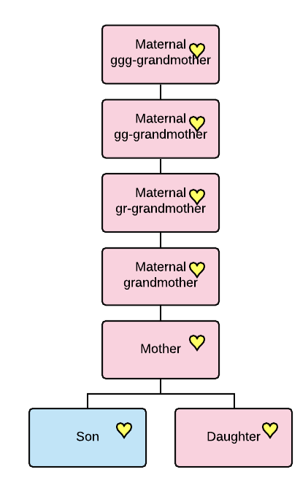
Mitochondrial DNA is only passed from mothers to their children, never admixed or combined with the DNA of the father, so your mitochondrial DNA today is either exactly the same as that of your ancestors a few generations ago, or very close if a mutation has occurred between when they lived and today’s tester.

One of mitochondrial DNA’s strengths is that it can reach far back in time, it’s message undiluted and uninterrupted by recombination.

The messages from our ancestors are very clear. We just need to understand how to hear what they are telling us.

Step-by-Step Soup to Nuts

We will analyze the mitochondrial DNA results of multiple testers who descend from the LeJeune sisters, Edmee and Catherine, born in 1624 and 1633, respectively, to see what they have to tell their descendants. For a very long time, rumors abounded that their mother was Native American, so we will keep that in mind as we review all matching, Mitotree and mtDNA Discover tools provided by FamilyTreeDNA.

We will also learn how to evaluate seemingly conflicting information.

Soup to nuts – we will incorporate every sliver of information along the way and extract every morsel that can help you. Think of this article as your recipe and the reports and information as ingredients!

To be clear, you don’t HAVE to read all of this or decipher anything if you don’t want to. You can just glance at the matches and be on your way – but if you do – you’re leaving an incredible amount of useful information on the table, along with MANY hints that you can’t find elsewhere.

If there was an out-of-print book about this ancestral line in a rare book collection someplace, as a genealogist, you would drive half-way across the country to access that information. This is your rare book, that updates itself, and you don’t have to do anything other than take a mitochondrial DNA test, or find a cousin to take one for lines you don’t carry..

Come along and join the fun! Your ancestors are waiting!

The LeJeune Question

Recently, I wrote about my ancestor Catherine LeJeune, who was born about 1633, probably in France before her family settled in Acadia, present-day Nova Scotia.

The identity of her parents has been hotly contested and widely debated for a long time.

I intentionally did not address her DNA results in that article because I wanted to establish the historical facts about her life and address her mitochondrial DNA separately. The process we are following to analyze her DNA results is the same process everyone should follow, which is why we are taking this step-by-step approach, complete with detailed explanations.

Often, when people hit a brick wall with an ancestor, especially during European colonization of the Americas, someone suggests that the person surely “must be” Native American. Lack of records is interpreted to add layers of evidence, when, in fact, absence of evidence is not evidence of absence.

For example, for many of the earliest French Acadians, birth and baptism records have NOT been located in France, where massive record loss has been experienced.

Additionally, not all records that do exist have been indexed, transcribed, or digitized. Many are damaged and/or nearly impossible to read. Lack of records does NOT mean that those settlers weren’t French, or in this case, it does NOT indicate that they were Native American. It simply means we are lacking that piece of evidence.

Enter mitochondrial DNA.

This article is focused on how to use mitochondrial DNA to decode these messages from our ancestors. I’m providing a very short summary of the relevant historical factors about the LeJeune sisters so readers can keep this in mind as we review the 17+ tools waiting for us when mitochondrial DNA results are ready.

The First Acadian Settlers

The Acadians were French settlers in what is today Nova Scotia. The first Acadians arrived in LaHeve (LaHave), on the southern coast of Acadia, in 1632 after Acadia was returned to France from English control. There may or may not have been any French families in the original group, but if so, very few. In 1636, another group of settlers arrived, but no LeJeune is on the roster.

At the end of 1636, the fledgling Acadian colony was moved from LaHeve, on the southern coast, to Port Royal, a more protected environment.

While we don’t know exactly when the family of Catherine and Edmee LeJeune arrived, we can bracket the dates. We know that Catherine’s sister, Edmee LeJeune, born about 1624, married another settler, Francois Gautrot, about 1644 in Port Royal, so they had arrived by that time.

Edmee’s 1624 birth year is important for two reasons. First, there were no French settlers in the part of Acadia that became Nova Scotia in 1624, so that clearly demonstrates that Edmee was born in France.

It’s unlikely that Catherine was born in Acadia in 1633 given that the first known families arrived in 1636, and we have their names from the ship roster. Pierre Martin was on the 1636 ship, and Acadian history tells us that his son, Mathieu Martin, was the first French child born in Acadia, about 1636, based on the 1671 census.

We also know that there was an early Acadian man, Jean LeJeune, who was granted land at BelleIsle, near Port Royal, among other Acadian families, but he was deceased before the first Acadian census in 1671. Acadia was under English control again from 1654 to 1670, so Jean LeJeune’s land grant had to have occurred after 1636 and prior to 1654, and is where Catherine LeJeune is found as an adult.

Another source of confusion is that there is a third LeJeune woman, Jeanne LeJeune dit Briard, born about 1659. Her daughter, Catherine Joseph’s 1720 marriage record in Port Royal refers to her mother, Jeanne, as being “d’un nation sauvagé”, giving her parents’ names as Francois Joseph and Jeanne LeJeune “of the Indian Nation.” Jeanne LeJeune dit Briard lived with her first husband in Port Royal, but had relocated to LaHeve by 1708.

You can see why this led to confusion about LeJeune females.

Another male, Pierre LeJeune was associated with LaHeve, which suggests he may have been awarded land there, possibly before the colony moved to Port Royal. One of the reasons that the rumor that Catherine LeJeune had a Native mother is so persistent is the belief that Pierre came over early, as a laborer or soldier, and married a Native woman because there weren’t any European women available.

Pierre may well have arrived as a single man, but there is no shred of evidence to suggest Pierre is the father of the sisters, Catherine LeJeune and Edmee LeJeune. In fact, given that Jeanne was born about 1659, Pierre, if he was her father, may have been born as late as 1627, which makes it impossible for him to have been Catherine and Edmee’s father.

That speculation was before the advent of DNA testing, and before Stephen White discovered that there was also a Jean LeJeune who was awarded land exactly where Catherine is known to have been living a few years later.

While it would be nice to unravel this entire cat’s cradle of confusion, the questions we are seeking to answer definitively here are:

  • Are Catherine LeJeune (born 1633) and Edmee LeJeune (born 1624) actually sisters?
  • Is the mother of Catherine LeJeune and her sister, Edmee LeJeune, Native American or European?
  • Is Jeanne LeJeune dit Briard, born about 1659, “d’un nation sauvagé” another sister of the LeJeune sisters?
  • What else is revealed about the LeJeune sisters and their ancestors? Is there something else we should know?

I’ll provide a summary of the combined evidence after our step-by-step mitochondrial analysis.

Testing for Sisters

Mitochondrial DNA is passed from mothers to all of their children, but only females pass it on.

Since we have two LeJeune females, believed to be sisters, we need mitochondrial DNA from direct matrilineal testers for each woman. This is particularly important because we know unquestionably that Edmee was born in France in 1624, prior to Acadian settlement in New France, so her DNA should be European. If they match, it means that Catherine was born to the same mother who was not Native. If they don’t match, there’s a different message.

In some cases, a match might mean that they were born to females related on the matrilineal line, like first cousins, for example. But in the early days of Acadia, there were no European females other than the handful, less than a dozen, who arrived on the Saint-Jehan in 1636.

Fortunately, we have multiple testers for each woman in two DNA projects at FamilyTreeDNA, the only DNA testing company that provides mitochondrial DNA testing and matching. Testers can join special interest projects, and both the Mothers of Acadia Project, and the Acadian AmerIndian Project have testers who descend from the LeJeune sisters.

I’ve identified 28 descendants of Catherine, and 25 from Edmee, giving us a total of 53 known matrilineal descendants to work with. Not all are shown publicly, in projects. Catherine has a known total of 14 testers, and Edmee has 17 that are shown publicly. All testers are members of haplogroup U6a7a1a.

The fact that the descendants of these women match each other, often exactly, combined with Catholic parish register dispensations for their descendants, when taken together, prove conclusively that Catherine and Edmee were sisters, not paternal half-sisters.

Let’s look at each piece of evidence.

Mitochondrial DNA Results

When the lab finishes processing the mtFull test, the results are posted to the account of the test taker.

Click on any image to enlarge

You’ll see the Maternal Line Ancestry section which displays your mitochondrial mtDNA Results.

The three tabs we will be primarily working with are:

  • mtDNA Matches
  • Matches Maps
  • Discover Haplogroup Reports, which includes another dozen+ reports and an updated Migration Map
  • Advanced Matching

At the bottom right of your page, you’ll see two haplogroup badges.

The one at right is called the “Legacy” haplogroup, which means the haplogroup you were assigned prior to the release of the new Mitotree.

The Mitotree mtDNA Haplogroup, with the green “Beta” at the bottom, is the new Mitotree haplogroup, which I wrote about in a series of articles:

Your old Legacy haplogroup will never change, because it’s the 2016 version that was not updated by the previous tree-keepers. That’s why the FamilyTreeDNA R&D team, me included, developed and birthed the new Mitotree. There were thousands of new haplogroups that could be defined to kick-start our genealogy, so we did.

The mitochondrial tree went from about 5000 branches to over 40,000 in the new Mitotree, each providing additional information to testers.

Not everyone received a new haplogroup, but about 75% of testers did, and another new Mitotree version will be released soon. In order to receive a new haplogroup, testers needed to:

  • Have at least one qualifying, stable mutation that had not been previously used to define a haplogroup
  • Match at least one other person in the same haplogroup branch with the same mutation(s)

In the case of the LeJeune sisters, there were no mutations that met all of the qualifications, so their known descendants did not receive a new haplogroup. That’s fine, though, because it’s not the name but the messages held by the information that’s important – and there’s a LOT to work with.

Let’s start with matches.

Matches

Of course, the first thing everyone does is click to see their matches.

The default is Detail View, but I prefer Table View (top left) because you can see more matches on the same page.

Catherine’s descendant whose matches are shown here has 108 Full Sequence matches, which are labeled as the “Coding Region.” The Coding Regions is the mtFULL test and includes both the HVR1 and HVR2 regions. Viewing Coding Region matches means they have taken the mtFull test, which sequences all 16,569 locations of the mitochondria.

When you click on the “Coding Region”, you are seeing matches to people who took all three test levels, not just the first one or two.

There are three test levels to view:

  1. HVR1
  2. HVR1+HVR2 both
  3. Coding Region, which is in addition to the HVR1+HVR2 regions

You can no longer order three different test levels today, although at one time you could. As costs decreased, it no longer made sense to offer multiple testing levels, and often the HVR1 or HVR1+HVR2 results, which only tested about 500 locations each, would confuse people.

People at the lower HVR1 or HVR1+HVR2 levels, known as mtPlus, can upgrade to the complete mtFull level, and should.

However, because some people only tested at those lower levels, matches are still shown at three levels, with different match thresholds for each level.

Matches at the HVR1 or HVR1+HVR2 levels *might* be entirely irrelevant, reaching back thousands of years. They could also be much more current, and critical to your genealogy, so don’t assume. Just one unstable mutation can cause a mismatch though, and at lower levels, cause you not to match someone with the same ancestor, which is why the full sequence test is so critically important.

For some testers, matches at lower levels sometimes provide the ONLY match to your known ancestor. So don’t skip over them. If you find a critical match there, you can email the tester to see if they will upgrade to the mtFull test.

People who test only at the HVR1 or HVR1+HVR2 level receive a more refined haplogroup after they upgrade, so the haplogroups between the HVR1/HVR2 testers and the full sequence test won’t match exactly. For the LeJeune sisters, the haplogroup for HVR1/HVR2-only testers is U6a and for full sequence testers, it’s U6a7a1a.

While full sequence matches are wonderful, if you’re searching for a particular ancestor and the ONLY place they appear is the HVR1 or HVR1+HVR2 testing levels, you’ll want to pursue the match. You may also want to evaluate lower level matches if their ancestors are from a specific location – like France – even if their earliest known ancestor (EKA) is not your ancestor.

To view your  HVR1 or HVR1+HVR2 matches, just click on either of those links. You’ll see ALL of the results, including everyone who took the full sequence test. In this case, that means that the 217 HVR1 (hypervariable region 1) results will include the 120 coding region (full sequence) tests. I’ve already looked through the full sequence matches, so that’s not what I want.

If you ONLY want to see testers who did NOT take the Full Sequence test, use the Filter option. Select Filter, then the features you seek.

Fortunately, the LeJeune sisters have lots of known descendants at the mtFull level to work with, so we will focus on their full sequence matches.

Your Focus

On the matches page, you’ll be immediately interested in two fields:

  • Maternal Earliest Known Ancestor (EKA) – the direct matrilineal ancestor of your match – unless they got confused and entered someone else
  • Their Tree

Viewing the first several matches only produced one match to someone whose earliest known ancestor (EKA) is listed as Catherine or Edmee LeJeune, but perhaps the next group will be more productive. Note that females’ EKAs, earliest known ancestors, are sometimes challenging, given surname changes. So unfamiliar EKAs could represent generational differences and sometimes offer other hints based on their information.

Shifting to the detail view for a minute, you’ll want to review the genetic distance,  meaning whether you’re an exact match or not.

If you’re not an exact match, a genetic distance of “1 step” means that you match except for one mutation at a specific location.

If you have a genetic distance greater than 3, meaning 4 mutations or more, you won’t be shown as a match on this match list. However, you can still be a haplogroup match, which we’ll discuss in the Discover section.

Essentially, with more than 3 mutations difference, it’s unlikely (but not impossible) that your match is genealogically relevant – meaning you probably won’t be able to identify your most recent common ancestor (MRCA).

However, that doesn’t mean that haplogroup-only matches can’t provide important clues, and we will look under every rock!

A Slight Detour – Confirmation Bias

This is a good place to mention that both ancestors and their location (country) of origin are provided by (some) testers to the best of their ability and understanding.

This tester selected “United States Native American” as the location for their earliest known ancestor. We don’t know why they entered that information. It could be that:

  • The tester did not understand that the maternal country of origin means the direct MATRILINEAL line, not just someplace on the maternal side
  • Selina Sinott was Native on her father’s side, or any line OTHER than her direct matrilineal line.
  • They relied on oral history or made a guess
  • They found the information in someone else’s tree
  • They found all of the LeJeune information confusing (because it is)

The tester has provided no tree, so we can’t do any sleuthing here, but an Ancestry search shows a woman by that name born in 1855 in Starksboro, VT to Louis Senott and Victoria Reya. A further search on Victoria leads me to Marie Lussier who leads me to Marguerite Michel who leads me to Marie Anne Lord (Lore, Laure), who lived in Acadia, whose ancestor is…drum roll…Catherine LeJeune. You get the idea.

Yes, you may need to extend other people’s trees.

The Point

However, and this is the point – if you’re looking for confirmation that the LeJeune sisters were Native American, this ONE tester who entered Native American for an unknown reason is NOT the confirmation you’re looking for. Don’t get sucked into confirmation bias, or into categorically believing what someone else entered without additional information.

You need haplogroup confirmation, but, in this case, you don’t have it. However, if you’re new to genetic genealogy, you don’t know that yet, so hold on. We’re still getting there. This is why we need to review all of the reports.

And trust me, I’m not being critical because there isn’t a single seasoned genealogist who has NOT fallen down the rathole of excited confirmation bias or accepting information without further analysis – me included. We all need to actively guard against it, all the time. Confirm and weigh all of the evidence we do have, and seek missing evidence.

Let’s go back to the match results.

Matches – Haplogroups and Haplotypes

Scrolling down the Table View, the next group of matches shows many more matches to descendants of both Catherine and Edmee LeJeune.

Next, you’ll notice that there’s a Mitotree haplogroup, U6a7a1a, AND an F number. In this case, they are both checked in blue, which means you share the exact same haplogroup with that tester, and the exact same haplotype cluster, which is the F number.

I wrote about haplotype clusters, here.

If NEITHER box is checked, you don’t share either the haplogroup nor the haplotype cluster.

You can match the haplogroup, but not the haplotype cluster, which means the haplogroup box will be checked, but the haplotype cluster will not. If you share the same haplotype cluster, you WILL share the same haplogroup, but the reverse is not true.

What is a Haplotype Cluster, and why do they matter?

Haplotype Clusters

We need to talk about exact matches and what they mean. Yes, I know it seems intuitive, but it isn’t.

There are three types of matches

  • Matching and Genetic Distance on your Match List
  • Haplotype matching
  • Haplogroup matching

Without getting (too much) into the weeds, an Exact Match in the Genetic Distance column on your match list excludes locations 309 and 315 because they are too unstable to be considered reliable for matching. So, 309 and 315 are EXCLUDED from this type of matching. In other words, you may or may not match at either or both of those locations. They are ignored for matching on your match list.

Locations 309 and 315 are also EXCLUDED from haplogroup definitions.

A haplotype F cluster match indicates that everyone in that cluster is an exact match, taking into consideration EVERY mutation, INCLUDING 309 and 315.

309 and 315 Why
Matching and Genetic Distance Excluded Unstable, probably not genealogically relevant and may be deceptive, leading you down a rathole
Haplogroup Definition Excluded Too unstable for tree branching and definition
Haplotype F Clusters Included Might be genealogically useful, so everyone can evaluate the rathole for themselves

Some people think that if they don’t match someone exactly, they can’t have the same ancestor as people who do match exactly, but that’s not true. “Mutations happen” whenever they darned well please. Downstream mutations in stable locations that match between two or more testers will form their own haplogroup branch.

The most distant matches are shown on the last match page, and as you can see below, some descendants of Catherine and Edmee LeJeune have a 1-step difference with our tester, meaning a genetic distance of one, or one mutation (disregarding 309 and 315). One match has a 2-step mutation.

The fact that their F numbers are not the same tells you that their mutations are different from each other, too. If two of those people also matched each other, their F# would be identical.

The mutations that do not (yet) form a haplogroup, and are included in your haplotype cluster, are called Private Variants, and you cannot see the private variants of other people. Clearly, you and anyone in your haplotype cluster share all of the same mutations, including Private Variants.

Evaluating Trees and EKAs

By reviewing the matches, their EKAs, and the trees for the matches of Catherine’s descendants, I was able to create a little mini-tree of sorts. Keep in mind that not everyone with an EKA has a tree, and certainly not everyone who uploaded a tree listed an EKA. So be sure to check both resources. Here’s how to add your EKA, and a one-minute video, here.

The good news is that if your match has a WikiTree link when you click on their tree icon, you know their tree actually reaches back to either Edmee or Catherine if that’s their ancestor, and you’re not dealing with a frustrating, truncated two or three-generation tree, or a private tree. You can add your WikiTree link at FamilyTreeDNA here, in addition to any other tree you’ve linked.

Takeaways from Matches

  • You can identify your common ancestor with other testers. By viewing people’s trees and emailing other testers, you can often reconstruct the trees from the tester back through either Catherine or Edmee LeJeune.
  • Your primary focus should be on the people in your haplotype cluster, but don’t neglect other clusters where you may find descendants of your ancestor.
  • If you see a male EKA name, or something other than a female name in the EKA field, like a location, the tester was confused. Only females pass their mitochondrial DNA to their descendants.
  • If you’re searching for an ancestor whose mitochondrial DNA you don’t carry, use projects and WikiTree to see if you can determine if someone has tested from that line. From viewing the project results, I already knew that the LeJeune sisters had several descendants who had tested.
  • If you’re searching for your ancestor on your match list, and you don’t find them in the full sequence results, use the filter to view people who ONLY took the HVR1 and HVR1+HVR2 tests to see if the results you seek are there. They won’t be on your full sequence match list because they didn’t test at that level. Testers at the lower levels will only have a partial, estimated haplogroup – in this case, U6a.
  • For Edmee and Catherine LeJeune, we have enough testers to ensure that we don’t have just one or two people with the same erroneous genealogy. If you do find someone in a project or at WikiTree claiming descent from the same ancestor, but with a different haplogroup, you’ll need to focus on additional research to verify each step for all testers.

Resources:

Matches Maps

The Matches Map is a great visual resource. That “picture is worth 1000 words” tidbit of wisdom definitely applies here.

Clicking on the Matches Maps displays the locations that your matches entered for their EKA.

In the upper left-hand corner, select “Full Sequence,” and only the full sequence matches will be displayed on the map. All full sequence testers also have HVR1/HVR2 results, so those results will be displayed under that selection, along with people who ONLY took the HVR1 or HVR1/HVR2 tests.

We know that the Acadians originally came from France, and their descendants were forcibly expelled from Nova Scotia in 1755. Families found themselves scattered to various locations along the eastern seaboard, culminating with settlements in Louisiana, Quebec, and in some cases, back in France, so this match distribution makes sense in that context.

Be sure to enlarge the map in case pins are on top of or obscuring each other.

Some people from other locations may be a match, too. Reviewing their information may assist with breaking down the next brick wall. Sometimes, additional analysis reveals that the tester providing the information was confused about what to complete, e.g., male names, and you should disregard that pin.

Takeaways from the Matches Map

  • These results make sense for the LeJeune sisters. I would specifically look for testers with other French EKAs, just in case their information can provide a (desperately needed) clue as to where the LeJeune family was from in France.

  • Reviewing other matches in unexpected locations may provide clues about where ancestors of your ancestor came from, or in this case, where descendants of the LeJeune sisters wound up – such as Marie Josephe Surette in Salem, Massachusetts, Catherine LeJeune’s great-granddaughter.
  • Finding large clusters of pins in an unexpected location suggests a story waiting to be uncovered. My matrilineal ancestor was confirmed in church records in Wirbenz, Germany, in 1647 when she married, but the fact that almost all of my full sequence matches are in Scandinavia, clustered in Sweden and Norway, suggests an untold story, probably involving the 30 Years War in Germany that saw Swedish troop movement in the area where my ancestor lived.
  • For my own mitochondrial DNA test, by viewing trees, EKAs, and other hints, including email addresses, I was able to identify at least a country for 30 of 36 full sequence matches and created my own Google map.
  • You can often add to the locations by creating your own map and including everyone’s results.

Resources:

Mitochondrial DNA Part 4 – Techniques for Doubling Your Useful Matches

Mitochondrial DNA Myth – Mitochondrial DNA is not Useful because the Haplogroups are “Too Old”

Before we move to the Discover Reports, I’m going to dispel a myth about haplogroups, ages, genealogical usefulness, and most recent common ancestors known as MRCAs.

Let me start by saying this out loud. YES, MITOCHONDRIAL DNA IS USEFUL FOR GENEALOGY and NO, OLDER HAPLOGROUPS DO NOT PREVENT MITOCHONDRIAL DNA FROM BEING USEFUL.

Here’s why.

The most recent common ancestor (MRCA) is the person who is the closest common ancestor of any two people.

For example, the mitochondrial DNA MRCA of you and your sibling is your mother.

For your mother and her first cousin, the mitochondrial MRCA is their grandmother on the same side, assuming they both descend from a different daughter. Both daughters carry their mother’s undiluted mitochondrial DNA.

A common complaint about mitochondrial DNA is that “it’s not genealogically useful because the haplogroups are so old” – which is absolutely untrue.

Let’s unravel this a bit more.

The MRCA of a GROUP of people is the first common ancestor of EVERY person in the group with each other.

So, if you’re looking at your tree, the MRCA of you, your sibling, and your mother’s 1C in the example above is also your mother’s grandmother, because your mother’s grandmother is the first person in your tree that ALL of the people in the comparison group descend from.

Taking this even further back in time, your mother’s GGG-grandmother is the MRCA for these five people bolded, and maybe a lot more descendants, too.

At that distance in your tree, you may or may not know the name of the GGG-grandmother and you probably don’t know all of her descendants either.

Eventually, you will hit a genealogical brick wall, but the descendants of that unknown “grandmother” will still match. You have NOT hit a genetic brick wall.

A haplogroup name is assigned to the woman who had a mutation that forms a new haplogroup branch, and she is the MRCA of every person in that haplogroup and all descendant haplogroups.

However, and this is important, the MRCA of any two people, or a group of people may very well be downstream, in your tree, of that haplogroup mother.

As you can clearly see from our example, there are four different MRCAs, depending on who you are comparing with each other.

  • Mom – MRCA of you and your sibling
  • Grandmother – MRCA of you, your sibling, your mom and your mom’s 1C
  • GGG-Grandmother – MRCA of all five bolded descendants
  • Haplogroup formation – MRCA of ALL tested descendants, and all downstream haplogroups, many of whom are not pictured

Many of the testers may, and probably do, form haplotype clusters beneath this haplogroup.

When you are seeking a common ancestor, you really don’t care when everyone in that haplogroup was related, what you seek is the common ancestor between you and another person, or group of people.

If the haplogroup is formed more recently in time, it may define a specific lineage, and in that case, you will care because that haplogroup equates to a woman you can identify genealogically. For example, let’s say that one of Catherine LeJeune’s children formed a specific haplogroup. That would be important because it would be easy to assign testers with that haplogroup to their appropriate lineage. That may well be the case for the two people in haplogroup U6a7a1a2, but lack of a more recent haplogroup for the other testers does not hinder our analysis or reduce mitochondrial DNA’s benefits.

That said, the more people who test, the more possibilities for downstream haplogroup formation. Currently, haplogroup U6a7a1a has 34 unnamed lineages, just waiting for more testers.

Haplogroup ages are useful in a number of ways, but haplogroup usefulness is IN NO WAY DEPRICATED BY THEIR AGE. The haplogroup age is when every single person in that haplogroup shares a common ancestor. That might be useful to know, but it’s not a barrier to genealogy. Unfortunately, hearing that persistent myth causes people to become discouraged, give up and not even bother to test, which is clearly self-defeating behavior. You’ll never know what you don’t know, and you won’t know if you don’t test. That’s my mantra!

The LeJeune sisters provide a clear example.

OK, now on to Discover.

mtDNA Discover

Next, we are going to click through from the mtDNA Results and Tools area on your personal page to Discover Haplogroup Reports. These reports are chapters in your own personal book, handed down from your ancestors.

Discover is also a freely available public tool, but you’ll receive additional and personalized information by clicking through when you are signed into your page at FamilyTreeDNA. Only a subset is available publicly.

mtDNA Discover was released with the new Mitotree and provides fresh information weekly.

Think of Discover as a set of a dozen reports just for your results, with one more, Globetrekker, an interactive haplogroup map, coming soon.

Resources:

When you click through to Discover from your results, Discover defaults to your haplogroup. In this case, that’s U6a7a1a for the LeJeune sisters.

Let’s begin with the first report, Haplogroup Story.

Haplogroup Story

The Haplogroup Story is a landing page that summarizes information about your ancestor’s haplogroup relevant to understanding your ancestor’s history. Please take the time to actually READ the Discover reports, including the information buttons, not just skim them.

Think of Discover as your own personalized book about your ancestors – so you don’t want to miss a word.

You’ll see facts on the left, each one with a little “i” button. Click there or mouse over for more information about how that fact was determined.

When we’re talking about haplogroup U6a7a1a, it sounds impersonal, but we’re really talking about an actual person whose name, in this case, we will never know. We can determine the ancestor of some haplogroups that formed within a genealogical timeframe. The LeJeune ancestor in question is the person in whose generation the final mutation in a long string of mutations created the final “a” in haplogroup U6a7a1a.

Think of these as a long line of breadcrumbs. By following them backwards in time and determining when and where those breadcrumbs were dropped, meaning when and where the mutation occurred, we begin to understand the history of our ancestor – where she was, when, and which cultures and events shaped her life.

U6a7a1a was formed, meaning this ancestor was born, about 50 CE, so about 1950 years ago. This means that the ancestor of ANY ONE PERSON with this haplogroup could have lived anytime between the year 50 CE and the year of their mother’s birth.

This is VERY important, because there is an incredible amount of  misunderstanding about haplogroup ages and what they mean to you.

The year 50 CE is the year that the common ancestor of EVERY PERSON in the haplogroup was born, NOT the year that the common ancestor of any two or more people was born.

By way of illustration, the LeJeune sisters were born in about 1624 and 1633, respectively, not 50 CE, and their most recent common ancestor (MRCA) is their mother, who would have been born between about 1590 and 1608, based on their birth years.

For reference, I’ve created this genealogical tree from individuals who took the mitochondrial DNA test and have identified their mitochondrial lineage on the LeJeune mother’s profile at Wikitree

You can see that both Edmee and Catherine have mitochondrial DNA testers through multiple daughters. I’ve color coded the MRCA individuals within each group, and of course their mother is the MRCA between any two people who each descend from Edmee and Catherine.

Mitochondrial DNA matches to the LeJeune sisters’ descendants could be related to each other anywhere from the current generation (parent/child) to when the haplogroup formed, about 50 CE.

You can easily see that all of these testers, even compared with their most distant relatives in the group, share a common ancestor born between 1590 and about 1608. Other people when compared within the group share MCRAs born about 1717 (blue), 1778 (peach), 1752 (green), 1684 (pink), 1658 (mustard), and 1633 (red).

Soooooo…a haplogroup born in 50 CE does NOT mean that you won’t be able to find any genealogical connection because your common ancestor with another tester was born more than 1900 years ago. It means that the common ancestor of EVERYONE who is a member of haplogroup U6a7a1a (and downstream haplogroups) was born about 50 CE.

The parent haplogroup of U6a7a1a is haplogroup U6a7a1, which was born about 1450 BCE, or about 3450 years ago.

In the graphic, I’ve shown other unknown genealogical lineages from U6a7a1 and also downstream haplogroups.

Haplogroup U6a7a1 is the MRCA, or most recent common ancestor of haplogroup U6a7a1a, and anyone who descends from haplogroup U6a7a1 or any of the 23 downstream lineages from U6a7a1, including 5 descendant haplogroups and 18 unnamed lineages.

The LeJeune haplogroup, U6a7a1a, has 35 descendant lineages. One downstream haplogroup has already been identified – U6a7a1a2 – which means two or more people share at least one common, stable, mutation, in addition to the mutations that form U6a7a1a. Thirty-four other lineages are as yet unnamed.

The fact that there are 34 unnamed lineages means that people with one or more private variants, or unique mutations, are candidates for a new branch to form when someone else tests and matches them, including those variants.

You’re a candidate for a new haplogroup in the future if no one else matches your haplotype cluster number, or, potentially, as the tree splits and branches upstream.

When a second person in a lineage tests, those two people will not only share a common haplotype cluster F#, they will share a new haplogroup too if their common mutation is not excluded because it’s unstable and therefore unreliable.

There are 127 members of haplogroup U6a7a1a today, and their EKAs are noted as being from France, Canada, the US, and other countries that we’ll view on other pages.

Haplogroup U6a7a1a has been assigned two Discover badges:

  • Imperial Age – “an age noted for the formation and global impact of expansive empires in many parts of the world.” In other words, colonization, which is certainly true of the French who battled with the English to colonize New England, Acadia, and New France.
  • mtFull Confirmed (for testers only)

Additionally, the LeJeune sisters have one Rare Notable Connection, and three Rare Ancient Connections, all of which may shed light on their history.

Takeaways from the Haplogroup Story

  • The Haplogroup Story provides an overview of the haplogroup
  • You can easily see how many testers fall into this haplogroup and where they have indicated as the origin of their matrilineal line.
  • The haplogroup may have several new haplogroup seeds – 34 in this case – the number of unnamed lineages
  • You can share this or other Discover pages with others by using the “share page” link in the upper right-hand corner.
  • Don’t be discouraged by the age of the haplogroup, whether it’s recent or older.

Next, let’s look at Country Frequency.

Country Frequency

Country Frequency shows the locations where testers in haplogroup U6a7a1a indicate that their EKA, or earliest known matrilineal ancestor, is found. The Country Frequency information is NOT limited to just your matches, but all testers in haplogroup U6a7a1a, some of whom may not be on your match list. Remember, only people with 3 mutations difference, or fewer, are on your match list.

Haplogroup distribution around the world is very informative as to where your ancestors came from.

There are two tabs under Country Frequency, and I’d like to start with the second one – Table View.

Table View displays all of the user-provided country locations. Note that the Haplogroup Frequency is the percentage of total testers in which this haplogroup is found in this particular country. These frequencies are almost always quite small and are location-based, NOT haplogroup based.

There are now 40,000 haplogroups, and in haplogroup U, the LeJeune sisters are 6 branches down the tree with U6a7a1a.

In total, 127 testers are members of haplogroup U6a7a1a, and 42 of those claim that their ancestor is from France, which comprises 1% of the people who have taken the full sequence mitochondrial DNA test whose ancestor is from that location.

Let’s do the math so you can see how this is calculated and why it’s typically so small. For our example, let’s say that 8000 people in the database have said their matrilineal ancestor is from France. Of the 127 haplogroup U6a7a1a members, 42 say their ancestor is from France. Divide 42 by 8,000, which is 0.00525, and round to the nearest percentage – which is 1%.

The best aspect of this page is that you can see a nice summary of the locations where people indicate that their earliest known U6a7a1a ancestor was found.

Please note that the last entry, “Unknown Origins,” is the bucket that everyone who doesn’t provide a location falls into. That row is not a total but includes everyone who didn’t provide location information.

These location results make sense for the LeJeune sisters – maybe except for Ireland and Belgium. Some people don’t understand the directions, meaning that a matrilineal ancestor or direct maternal ancestor is NOT your literal “oldest” ancestor on your mother’s side of the tree who lived to be 105, but your mother-to-mother-to-mother-to-mother ancestor, so check to see if these people with unusual locations are in your match list and view their tree or reach out to them.

We don’t know why the person who selected Native American made that choice, but I’d bet it has to do with confusion about the “other” LeJeune female, Jeanne LeJeune dit Briard. Based on Catherine and her sister, Edmee LeJeune’s haplogroup through more than 50 testers, U6a7a1a, Native is incorrect.

Of course, that tester wouldn’t have known that if they completed their EKA information before they tested. Perhaps they entered information based on the stories they had heard, or flawed genealogy, and didn’t think to go back and correct it when their results were ready, indicating that Native was mistaken.

On the “Map View” tab, the locations are shown using a heat map, where the highest percentages are the darkest. Here, both France and Canada are the darkest because that’s the most common selection for this haplogroup with 1% each, while the rest of the countries registered with less <1%.

These colors are comparative to each other, meaning that there is no hard and fast line in the sand that says some percentage or greater is always red.

To summarize these two tables, because this is important:

  • The Table View shows you how many people selected a specific country for their ancestor’s location, but the frequency is almost always very low because it’s based on the total number of testers in the entire database, comprised of all haplogroups, with ancestors from that country.
  • The Map View shows you a heat map for how frequently a particular location was selected, as compared to other locations, for this haplogroup.

To view the difference between adjacent haplogroups, I always compare at least one haplogroup upstream. In this case, that’s the parent haplogroup, U6a7a1.

The Parent Haplogroup

If you look at haplogroup U6a7a1, just one haplogroup upstream, you’ll see that for Mauritania, the total number of U6a7a1 descendants tested is only “1”, but the haplogroup frequency in Mauritania is 10% which means that there are only 10 people who have been tested in the database altogether from Mauritania – and one person is haplogroup U6a7a1.

However, due to substantial under-sampling of the Mauritania population, the frequency for Mauritania, 10%, is higher than any other location.

Also, remember, these are user-reported ancestor locations, and we have no idea if or how these people determined that their ancestor is actually from Mauritania.

Please only enter actual known locations. For example, we don’t want haplogroup U6a7a1 members to look at this informatoin, then add Mauritania as their location because now they “know” that their ancestor is from Mauritania.

On the Map View, Mauritania is dark red because the percentage is so high – never mind that there are only 10 testers who report matrilineal ancestors from there, and only one was U6a7a1.

This map illustrates one reason why taking the full sequence test is important. Viewing partial haplogroups can be deceiving.

Catherine and Edmee LeJeune’s matrilineal descendants who only tested at the HVR1 or HVR1+HVR2 level receive a predicted haplogroup of U6a, born about 21,000 years ago. That’s because the full 16,569 locations of the mitochondria need to be tested in order to obtain a full haplogroup, as opposed to about 500 locations in the HVR1 and HVR1/2, each, respectively.

U6a – The Result for HVR1/HVR2-Only Testers

So, let’s look at what haplogroup U6a reveals, given that it’s what early LeJeune descendants who ordered the lower-level tests will see.

In the Table View for U6a, below, you see that the top 5 counties listed by haplogroup frequency are five North African countries.

A total of 801 people are assigned to haplogroup U6a, meaning the majority, 757, report their ancestors to be from someplace else. If two people from the Western Sahara (Sahrawi) comprise 67% of the people who tested, we know there are only three people who have tested and selected that location for their ancestors.

If you didn’t understand how the display works, you’d look at this report and see that the “top 5” countries are North African, and it would be easy to interpret this to mean that’s where Catherine and Edmee’s ancestors are from. That’s exactly how some people have interpreted their results.

Scrolling on down the Table View, 50 testers report France, and 10 report the US, respectively, with France showing a Haplogroup Frequency of 1% and the US <1%.

The balance of U6a testers’ ancestors are from a total of 57 other countries, plus another 366 who did not select a location. Not to mention that U6a was born 21,000 years ago, and a lot has happened between then and the 1620/1630s when Catherine and Edmee were born to a French mother.

The real “problem” of course is that haplogroup U6a is only a partial haplogroup.

The U6a map shows the highest frequency based on the number of testers per country, which is why it’s dark red, but the Table View reports that the actual number of U6a testers reporting any specific country. France has 50. Next is the US, also with 50, which often means people are brick-walled here. You can view the U6a table for yourself, here.

Why is this relevant for Catherine and Edmee LeJeune? It’s very easy to misinterpret the map, and for anyone viewing U6a results instead of U6a7a1a results, it’s potentially genealogically misleading.

Use Country Frequency with discretion and a full understanding of what you’re viewing, especially for partial haplogroups from HVR1/HVR2 results or autosomal results from any vendor.

If someone tells you that the LeJeune sisters are from someplace other than France, ask where they found the information. If they mention Africa, Morocco or Portugal, you’ll know precisely where they derived the information.

This information is also available on your Maternal Line Ancestry page, under “See More,” just beneath the Matches tab. Haplogroup Origins and Ancestral Origins present the same information in a different format.

Discover is a significant improvement over those reports, but you’ll still need to read carefully, understand the message, and digest the information.

Takeaways from Country Frequency

  • Evaluate the results carefully and be sure to understand how the reports work.
  • Use complete, not partial haplogroups when possible.
  • The Haplogroup Frequency is the number of people assigned to this haplogroup divided by the entire number of people in the database who report that country location for their matrilineal ancestor. It is NOT the percentage of people in ONLY haplogroup U6a7a1a from a specific country.
  • Table view shows the number of testers with this haplogroup, with the percentage calculated per the number of people who have tested in that country location.
  • The Map shows the highest frequency based on the number of testers per country.
  • Use the map in conjunction with the haplogroup age to better understand the context of the message.

Globetrekker, which has not yet been released, will help by tracking your ancestors’ paths from their genesis in Africa to where you initially find that lineage.

Before we move on to the Mitotree, let’s take a minute to understand genetic trees.

About Genetic Trees

The Mitotree is a genetic tree, also called a phylogenetic tree, that generally correlates relatively closely with a genealogical tree. The more testers in a particular haplogroup, the more accurate the tree.

FamilyTreeDNA provides this disclaimer information about the genetic tree. The Mitotree you see is a nice and neat published tree. The process of building the tree is somewhat like making sausage – messy. In this case, the more ingredients, the better the result.

The more people that test, the more genetic information is available to build and expand the tree, and the more accurate it becomes.

The recent Mitotree releases have moved the haplogroup “dates” for the LeJeune sisters from about 21,000 years ago for HVR1/HVR2 U6a testers to 50 CE for full sequence testers, and this may well be refined in future tree releases.

Mutations

Mutations and how to interpret them can be tricky – and this short section is meant to be general, not specific.

Sometimes mutations occur, then reverse themselves, forming a “back mutation”, which is usually counted as a branch defining a new haplogroup. If a back mutation happens repeatedly in the same haplogroup, like a drunken sailor staggering back and forth, that mutation is then omitted from haplogroup branch formation, but is still counted as a mismatch between two testers.

A heteroplasmy is the presence of two or more distinct results for a specific location in different mitochondria in our bodies. Heteroplasmy readings often “come and go” in results for different family members, because they are found at varying threshold levels in different family members, causing mismatches. Heteroplasmies are currently counted only if any person has 20% or greater of two different nucleotides. So, if you have a 19% heteroplasmy read for a particular location, and your sister has 21%, you will “not” have a heteroplasmic condition reported, but she will, and the location will be reported as a mismatch.

If you have a heteroplasmy and another family member does not, or vice versa, it’s counted as as a “mismatch,” meaning you and that family member will find yourselves in different haplotype clusters. Hetroplasmies do not presently define new tree branches. I wrote about heteroplasmies, here.

Takeaways from the Genetic Tree Disclaimer

  • DNA is fluid, mutations happen, and all mutations are not created equal.
  • Thankfully, you really don’t need to understand the nitty-gritty underpinnings of this because the scientists at FamilyTreeDNA have translated your results into reports and features that take all of this into consideration.
  • Testing more people helps refine the tree, which fills in the genetic blanks, refining the dates, and expanding branches of the tree.

Resources:

Ok, now let’s look at the Time Tree

Time Tree

The Time Tree displays your haplogroup on the Mitotree timeline. In other words, it shows us how old the haplogroup is in relation to other haplogroups, and testers.

The Time Tree displays the country locations of the ancestors of testers who are members of that and descendant or nearby haplogroups. You can view the haplogroup U6a7a1a Time Tree, here, and follow along if you wish. Of course, keep in mind that the tree is a living, evolving entity and will change and evolve over time as updated tree versions are released.

Mousing over the little black profile image, which is the person in whom this haplogroup was born, pops up information about the haplogroup. Additionally, you’ll see black bars with a hashed line between them. This is the range of the haplogroup formation date. Additional details about the range can be found on the Scientific Details tab, which we’ll visit shortly.

On your Matches tab, remember that each match has both a haplogroup and a haplogroup cluster F# listed.

On the Time Tree, individual testers are shown at right, with their selected country of origin. In this case, you’ll see the person who selected “Native American” at the top, followed by France, Canada, the US, and other flags.

Haplogroup U6a7a1a includes several haplotype clusters, designated by the rounded red brackets. In this view, we can see several people who have haplotype cluster matches. Everyone has a haplotype assignment, but a haplotype cluster is not formed until two people match exactly.

In the Time Tree view, above, you can see two clusters with two members each, and the top of a third cluster at the bottom.

In case you’re wondering why some of the globes are offset a bit, they positionally reflect the birth era of the tester, rounded to the closest 25 years, if the birth year is provided under Account Settings. If not, the current tester position defaults to 1950.

Scrolling down to the next portion of the window shows that the third cluster is VERY large. Inside the cluster, we see Belgium, Canada, and France, but we aren’t even halfway through the cluster yet.

Continuing to scroll, we see the cluster number, F7753329, in the middle of the cluster, along with the French flag, two from Ireland, four from the US, and the beginning of the large unknown group.

In this fourth screenshot, at the bottom of the display, we see the balance of haplotype cluster #F7753329, along with eight more people who are not members of that haplotype cluster, nor any other haplotype cluster.

Finally, at the bottom, we find haplogroup U6a7a1a2, a descendant haplogroup of U6a7a1a. Are they descendants of the LeJeune sisters?

Looking back at our tester’s match list, the two people who belong to the new haplogroup U6a7a1a2 haven’t provided any genealogical information. No EKA or tree, unfortunately. The haplogroup formation date is estimated as about 1483, but the range extends from about 1244-1679 at the 95th percentile. In other words, these two people could be descendants of:

  • Either Catherine or Edmee LeJeune, but not both, since all of their descendants would be in U6a7a1a2.
  • An unknown sister to Catherine and Edmee.
  • A descendant line of an ancestor upstream of Catherine and Edmee.

Takeaways from the Time Tree

  • The visualization of the matches and haplotype clusters illustrates that the majority of the haplogroup members are in the same haplogroup cluster.
  • Given that two women, sisters, are involved, we can infer that all of the mutations in this haplotype cluster were common to their mother as well.
  • Haplotype cluster #F7753329 includes 19 testers from Catherine and 17 from Edmee.
  • Downstream haplogroup U6a7a1a2 was born in a daughter of haplogroup U6a7a1a, as early as 1244 or as late as 1679. Genealogy information from the two testers could potentially tell us who the mutation arose in, and when.
  • As more haplogroup U6a7a1a2 testers provide information, the better the information about the haplogroup will become, and the formation date can be further refined.

Smaller haplotype clusters have a story to tell too, but for those, we’ll move to the Match Time Tree.

Match Time Tree

The Match Time Tree is one of my favorite reports and displays your matches on the Time Tree. This feature is only available for testers, and you must be signed in to view your Match Time Tree.

By selecting “Share Mode”, the system obfuscates first names and photos so you can share without revealing the identity of your matches. I wrote about using “Share Mode” here. I have further blurred surnames for this article.

The Match Time Tree incorporates the tree view, with time, the names of your matches PLUS their EKA name and country, assuming they have entered that information. This is one of the reasons why the EKA information is so important.

This display is slightly different than the Time Tree, because it’s one of the features you only receive if you’ve taken the mtFull test and click through to Discover from your account.

The Time Tree view is the same for everyone, but the Match Time Tree is customized for each tester.

Your result is shown first, along with your haplotype cluster if you are a member of one.

You can easily see the names of the EKAs below the obfuscated testers’ names.

While we immediately know that descendants of both Catherine and Edmee are found in the large cluster #F7753329, we don’t yet know which ancestors are included in other haplotype clusters.

Haplogroup U6a7a1a includes two smaller haplotype clusters with 2 people each.

We know a few things about each of these clusters:

  • The people in each cluster have mutations that separate them from everyone else except the other person in their cluster
  • The results are identical matches to the other person in the cluster, including less reliable locations such as 309 and 315
  • There are other locations that are excluded from haplogroup formation, but are included in matching, unlike 309 and 315.
  • Given that they match only each other exactly, AND they did not form a new haplogroup, we know that their common unique mutation that causes them to match only each other exactly is unreliable or unstable, regardless of whether it’s 309, 315, a heteroplasmy, or another marker on the list of filtered or excluded variants.

Only the tester can see their own mutations. By inference, they know the mutations of the people in their haplotype cluster, because they match exactly.

If you’re a member of a cluster and you’re seeking to determine your common ancestor, you’ll want to analyze each cluster. I’ve provided two examples, below, one each for the red and purple clusters.

Red Haplotype Cluster #F3714849

Only one person in the red cluster has included their EKA, and the tree of the second person only reaches to three generations. Tracking that line backwards was not straightforward due to the 1755 expulsion of the Acadians from Nova Scotia.

The second person listed their EKA as Edmee LeJeune, but they have a private tree at MyHeritage, so their matches can’t see anything. I wonder if they realize that their matches can’t view their tree.

We are left to wonder if both people descend from Edmee LeJeune, and more specifically, a common ancestor more recently – or if the unstable mutation that they share with each other is simply happenstance.

E-mailing these testers would be a good idea.

Purple Haplotype Cluster #F2149611

Evaluating the purple cluster reveals that the common ancestor is Catherine LeJeune. The question is twofold – how are these two people related downstream from Catherine, and how unstable is their common mutation or mutations.

Fortunately, both people have nice trees that track all the way back to Catherine.

Unfortunately, their MRCA is Francoise, the daughter of Catherine. I say unfortunately, because two additional testers also descend from Francoise, and they don’t have the haplotype cluster mutation. This tells us that the cluster mutation is unreliable and probably not genealogically relevant because it occurred in two of Francoise’s children’s lines independently, but not all four.

In other words, that specific mutation just happened to occur in those two people.

This is exactly why some mutations are not relied upon for haplogroup definition.

Takeaways from the Match Time Tree

  • The time tree is a wonderful visualization tool that shows all of your matches, their EKAs and countries, if provided, in haplotype clusters, on the Time Tree. This makes it easy to see how closely people are related and groups them together.
  • On your match page, you can easily click through to view your matches’ trees.
  • You can use both haplotype clusters (sometimes reliable) and downstream haplogroups (reliable) to identify and define lineages on your family tree. For example, if a third person matches the two in haplogroup U6a7a1a2, the child haplogroup of U6a7a1a, and you could determine the common ancestor of any two of the three, you have a good idea of the genealogical placement of the third person as well.
  • You know that if people form a haplotype cluster, but not a new haplogroup, that their common haplotype cluster-defining mutation is less reliable and may not be genealogically relevant.
  • On the other hand, those less reliable mutations may not be reliable enough for haplogroup definition, but may be relevant to your genealogy and could possibly define lineage splits. Notice all my weasel words like “may,” “may not” and “possibly.” Also, remember our purple cluster example where we know that the mutation in question probably formed independently and is simply chance.
  • I can’t unravel the ancestors of the red cluster – and if I were one of those two people, especially if I didn’t know who my ancestor was, I’d care a lot that the other person didn’t provide a useful tree. Don’t forget that you can always reach out via email, offer to collaborate, and ask nicely for information.
  • We need EKAs, so please encourage your matches to enter their EKA, upload a tree or link to a MyHeritage tree, and enter a Wikitree ID in their FamilyTreeDNA profile, all of which help to identify common ancestors.

Resources:

Classic Tree

FamilyTreeDNA invented the Time Tree and Match Time Tree to display your results in a genealogically friendly way, but there is important information to be gleaned from other tree formats as well.

The Classic Tree presents the Mitotree, haplogroup and haplotype information in the more traditional format of viewing phylogenetic trees, combining their beneficial features. There’s a lot packed in here.

In this default view, all of the Display Options are enabled. We are viewing the LeJeune haplogroup, U6a7a1a, with additional information that lots of people miss.

The countries identified as the location of testers’ earliest known ancestors (EKA) are shown.

Listed just beneath the haplogroup name, five people are members of this haplogroup and are NOT in a haplotype cluster with anyone else, meaning they have unique mutations. When someone else tests and matches them, depending on their mutation(s), a new haplogroup may be formed. If they match exactly, then at least a new haplotype cluster will be formed.

Portions of three haplotype clusters are shown in this screenshot, designated by the F numbers in the little boxes.

Additional information is available by mousing over the images to the right of the haplogroup name.

Mousing over the badge explains the era in which the haplogroup was born. Rapid expansion was taking place, meaning that people were moving into new areas.

Mousing over the date explains that the scientists behind the Mitotree are 95% certain about the date range of the birth of this haplogroup, rounded to 50 CE. Remember, your common ancestor with ALL haplogroup members reaches back to this approximate date, but your common ancestor with any one, or a group, of testers is sometime between the haplogroup formation date, 50 CE, and the present day.

Mousing over the year shows the confidence level, and the date range at that level. These dates will probably be refined somewhat in the future.

If haplogroup members have private variants, it’s likely or at least possible that a new branch will split from this one as more people test

Mousing over the star displays the confidence level of the structure of this portion of the Mitotree based on what could be either confusing or conflicting mutations in the tree. For haplogroup U6a7a1a, there’s no question about the topology, because it has a 10 of 10 confidence rating. In other words, this branch is very stable and not going to fall off the tree.

Every haplogroup is defined by at least one mutation that is absent in upstream branches of the tree. Mutations are called variants, because they define how this sample, or branch, varies from the rest of the branches in the Mitotree.

These two mutations, A2672G and T11929C, are the haplogroup-defining mutations for U6a7a1a. Everyone in haplogroup U6a7a1a will have these two mutations in addition to all of the mutations that define directly upstream haplogroups (with extremely rare exceptions). Haplogroup-defining mutations are additive.

There may be more haplogroup-defining mutations than are displayed, so click on the little paper icons to copy to your clipboard.

You can view upstream haplogroups and downstream haplogroups, if there are any, by following the back arrows to upstream haplogroups, and lines to downstream haplogroups.

For example, I clicked on the arrow beside haplogroup U6a7a1a to view its parent haplogroup, U6a7a1, and a second time to view its parent, haplogroup U6a7a. If I click on the back arrow for U6a7a, I’ll continue to climb up the tree.

Beneath U6a7a, you can see the haplogroup branches, U6a7a1a and U6a7a2.

Beneath U6a7a1, you’ll notice:

  • People who don’t share haplotype clusters with anyone
  • Three haplotype clusters
  • Five descendant haplogroups from U6a7a1, including the LeJeune sister’s haplogroup U6a7a1a.

To expand any haplogroup, just click on the “+”.

You may see icons that are unfamiliar. Mouse over the image or click on the “Show Legend” slider at upper right to reveal the decoder ring, I mean, legend.

You can read more about the symbols and how haplogroups are named, here, and see more about types of mutations in the Scientific Details section.

Takeaways from the Classic Tree

  • The Classic Tree provides a quick summary that includes important aspects of a haplogroup, including when it was formed, which mutations caused it’s formation, and each branch’s confidence level.
  • It’s easy to back your way up the tree to see where your ancestor’s founding haplogroups were located, which speaks to your ancestor’s history. Patterns, paths, and consistency are the key.
  • Ancient DNA locations in your tree can provide a very specific location where a haplogroup was found at a given point in time, but that doesn’t necessarily mean that’s where the haplogroup was born, or that they are your ancestor. We will get to that shortly.
  • You can share this page with others using the “Share Page” function at the top right.

Ancestral Path

The Ancestral Path is a stepping-stone chart where you can view essential information about each haplogroup in one row, including:

  • Age and era
  • Number of years between haplogroups
  • Number of subclades
  • Number of modern-day testers who belong to this haplogroup
  • Number of Ancient Connections that belong to this haplogroup, including all downstream haplogroups

This “at a glance” history of your haplogroup is the “at a glance” history of your ancestors.

The number in the column titled “Immediate Descendants”, which is the number of descendant haplogroups, tells a story.

If you see a large, or “larger” number there, that indicates that several “child” haplogroups have been identified. Translated, this means that nothing universally terrible has occurred to wipe most of the line out, like a volcano erupting, or a famine or plague that would constitute a constraining bottleneck event. Your ancestors’ children survived and apparently thrived, creating many descendant downstream haplogroups, known as an expansion event.

If you see a smaller number, such as rows 5, 7, 8, 9, and 13, each of which have only two surviving branches, yours and another, several branches probably didn’t survive to the present day. This may reflect a bottleneck where only a few people survived or the lines became extinct over time, having no descendants today. Either that, or the right people haven’t yet tested. Perhaps they are living in a particularly undersampled region of the world, a tiny village someplace, or there aren’t many left.

The two most recent haplogroups have the most subclades, indicating that your ancestors were successfully reproducing in the not-too-distant past. Mutations occurred because they randomly do, creating new haplogroups, and several haplogroup members have tested today. Hopefully, genealogy can connect us further.

The next column, “Tested Modern Descendants,” tallies the total number of testers as it rolls up the tree. So, each haplogroup includes the testers in its downstream (child) haplogroups. The 127 people in haplogroup U6a7a1a include the two people in haplogroup U6a7a1a2, and the 226 people in haplogroup U6a7a1 include the 127 people in haplogroup U6a7a1a.

Looking at other types of trees and resources for each haplogroup can suggest where our ancestors were at that time, perhaps correlating with world or regional history that pertains to the lives of those ancestors.

In our case, the LeJeune sisters’ ancestors did well between 3450 years ago through the formation of U6a7a1a, about 1950 years ago. 3500 years ago, in Europe, settlements were being fortified, leadership was emerging as complex social patterns formed, and trade networks developed that spanned the continent and beyond.

Between 20,000 and 3,450 years ago, not so much. This correlates to the time when early European farmers were moving from Anatolia, bringing agriculture to Europe en masse. However, they were not the first people in Europe. Early modern humans arrived and lived in small groups about 50,000 years ago.

And they very nearly didn’t survive. Many lines perished.

Takeaways from the Ancestral Path

  • The Ancestral Path shows the stepping stones back to Mitochondrial Eve, dropping hints along the way where expansions occurred, meaning that your ancestors were particularly successful, or conversely, where a bottleneck occurred and the lineage was in jeopardy of extinction.
  • In some cases, where a lot of time has passed between haplogroups, such as 8,000 years between U and U6, we’re seeing the effect of lineages dying out. However, with each new tester, there’s the possibility of a previously undiscovered branch split being discovered. That’s precisely what happened with haplogroup L7.

Migration Map

The Discover Migration Map shows the path that your ancestor took out of Africa, and where your base ancestral haplogroup was formed.

Mousing over the little red circle displays the haplogroup, and the area where it originated. Based on this location where U6 was found some 31,000 years ago, we would expect to find U6 and subgroups scattered across North Africa, the Levant, and of course, parts of Eurasia and Europe.

It’s interesting that, based on what we know using multiple tools, it appears that haplogroup U initially crossed between the Horn of Africa and the Arabian Peninsula, at the present-day Strait of Bab-el-Mandeb. Today, that crossing is about 15 nautical miles, but the sea level was much lower during earlier times in history, including the last glacial maximum. Humans would have seen land across the water, and could potentially have swum, drifted, or perhaps used early boats.

Over the next 10,000+ years, haplogroup U trekked across the Arabian peninsula into what is present-day Iran, probably moving slowly, generation by generation, then turning back westward, likely in a small group of hunter-gatherers, crossing the Nile Delta into North Africa, present-day Egypt.

They probably fished along the Nile. Food would have been plentiful along rivers and the sea.

It’s exciting to know that the ancestors of the LeJeune sisters lived right here, perhaps for millennia.

There’s more, however.

The Migration Map shows the location of the genetically closest Ancient DNA results to your haplogroup, obtained from archaeological excavations. This mapped information essentially anchors haplogroup branches in locations in both space and time.

Ancient DNA samples are represented by tiny brown trowels. Clicking on each trowel provides summary information about the associated sample(s) in that location.

Takeaways from the Migration Map

  • Scientists have estimated the location where your base haplogroup originated. For the LeJeune sisters, that’s haplogroup U6 in North Africa along the Mediterranean Sea.
  • The trowels show the locations of the genetically closest archaeological samples, aka Ancient Connections, in the FamilyTreeDNA data base.
  • These Ancient Connections displayed on the map may change. New samples are added regularly, so your older samples, except for the oldest two, which remain in place for each tester, will roll off your list when genetically closer Ancient Connections become available.
  • There are no Ancient Connections for the LeJeune sisters in France today, but keep in mind that Europe is closely connected. Today’s French border is only about 25 miles as the crow flies from Goyet, Belgium. France, sea to sea, is only about 500 miles across, and at its closest two points, less than 250 miles.
  • Samples found at these locations span a large timeframe.

There’s a LOT more information to be found in the Ancient Connections.

Ancient Connections

Ancient Connections is one of my favorite Discover features. This information would never have been available, nor synthesized into a usable format, prior to the introduction of Mitotree and mtDNA Discover. Ancient Connections unite archaeology with genealogy.

  • The first thing I need to say about Ancient Connections is that it’s unlikely that these individuals are YOUR direct ancestors. Unlikely does not mean impossible, but several factors, such as location and timeframe need to be considered.
  • What is certain is that, based on their mitochondrial haplogroup, you SHARE a common ancestor at some point in time.
  • Ancient samples can be degraded, with missing genetic location coverage. That means that not every mutation or variant may be able to be read.
  • Different labs maintain different quality criteria, and location alignments may vary, at least somewhat, lab to lab. While this is always true, it’s particularly relevant when comparing ancient DNA results which are already degraded.
  • Samples are dated by archaeologists using a variety of methodologies. FamilyTreeDNA relies on the dates and historical eras provided in the academic papers, but those dates may be a range, or contain errors.
  • Obtaining information from ancient DNA samples isn’t as easy or straightforward as testing living people.

However, the resulting information is still VERY useful and incredibly interesting – filling in blanks with data that could never be discerned otherwise.

Many people mistakenly assume that these Ancient Connections are their ancestors, and most of the time, not only is that not the case, it’s also impossible. For example, a woman who lived in 1725 cannot be the ancestor of two sisters who were born in 1624 and 1633, respectively.

When you click on Ancient Connections, you see a maximum of about 30 Ancient Connections. Information about the genetically closest burial is displayed first, with the most distant last on the list.

Please note that the final two are the oldest and will (likely) never change, or “roll off” your list, unless an even older sample is discovered. When new samples become available and are genetically closer, the oldest other samples, other than the oldest two, do roll off to make space for the closer haplogroups and their corresponding samples.

Obviously, you’ll want to read every word about these burials, because nuggets are buried there. I strongly encourage you to read the associated papers, because these publications reveal snippets of the lives of your haplogroup ancestors and their descendants.

The small pedigree at right illustrates the relationship between the ancient sample and the haplogroup of the tester. Three things are listed:

  1. El Agujero 8, the name assigned by the authors of the paper that published the information about this ancient sample
  2. The haplogroup of the LeJeune descendant who tested
  3. The haplogroup of their common ancestor.

If no haplogroup is specifically stated for the ancient sample, the sample is the same haplogroup as the common shared ancestor (MRCA), meaning the tester and the ancient sample share the same haplogroup.

The Time Tree beneath the description shows the tester’s haplogroup, (or the haplogroup being queried), the ancient sample, and their common ancestral haplogroup.

Let’s analyze this first sample, El Agujero 8.

  • The person whose remains were sampled lived about 1375 years ago (I’ve averaged the range), in the Canary Islands, and is part of the Guanche culture.
  • The Guanche are the indigenous people of the Canary Islands, already established there before the arrival of Europeans and the Spanish conquest of the 1400s.
  • The Guanche people are believed to have arrived in the Canaries sometime in the first millennium BCE (2000-3000 years ago) and were related to the Berbers of North Africa.
  • This makes sense if you consider the Migration map and geographic proximity.
  • Haplogroup U6a7a1, the haplogroup of El Agujero 8, is the shared ancestral haplogroup with the LeJeune sisters.
  • That woman, U6a7a1, lived around 1450 BCE, or 3450 years ago, probably someplace in North Africa, the Mediterranean basin, or even in the Nile Delta region, given the correlation between the Canary Islands settlement, the Berbers, and the Migration Map.
  • This does NOT mean that the ancestor of the LeJeune sisters lived in the Canary Islands. It means that a descendant of their MRCA, haplogroup U6a6a1, the shared common ancestor with the LeJeune sisters, lived in the Canary Islands.

Ancient Connections Chart Analysis Methodology

I create an Ancient Connection chart for each haplogroup I’m dealing with. We’re analyzing the LeJeune sisters today, but I track and analyze the haplogroup for every ancestor whose haplogroup I can find, or for whom I can find a descendant to test.

In this chart, YA=years ago and is based on the year 2000. KYA=thousand years ago, so 10 KYA is 10,000 years ago.

Name Person Lived Location & Culture Haplogroup, Date & Age Shared (MRCA) Haplogroup, Date & Age Note
LeJeune Sisters Born 1624 & 1633 French Acadian U6a7a1a,

50 CE,

1950 YA

U6a7a1a,

50 CE,

1950 YA

In Acadia by 1643/44
El Agujero 8 1375 CE Canary Islands, Guanche U6a7a1

1450 BCE, 3450 YA

U6a7a1 1450 BCE, 3450 YA Guanche arrived in Canaries in 1st millennium BCE, related to Berbers
Djebba 20824 6000 BCE Jebba, Bājah, Tunisia, Neolithic U6a3f3’4’5

c 5000 BCE, 7000 YA

U6a1”9

19,000 BCE, 21,000 YA

This archaeology site is on the northernmost point of North Africa
Djebba 20825 5900 BCE Djebba, Bājah, Tunisia, Neolithic U6a1”9

19,000 BCE, 21,000 YA

U6a1”9

19,000 BCE, 21,000 YA

This archaeology site is on the northernmost point of North Africa
Egyptian Mummy 2973 200 BCE Abusir el-Meleq, Giza, Egypt, Ptolemaic Kingdom U6a3h^,

1450 BCE,

3450 YA

U6a1”9

19,000 BCE, 21,000 YA

Nile Delta probably, paper says they share ancestry with near easterners
Egyptian Mummy 2888 100 BCE Abusir el-Meleq, Giza, Egypt, Ptolemaic Kingdom U6a2a’c,

11,000 BCE,

13,000 YA

U6a1”9

19,000 BCE, 21,000 YA

Nile Delta probably, paper says they share ancestry with near easterners
Segorbe Giant (6’3”) 1050 CE Plaza del Almudín, Valencia, Spain, Islamic necropolis burial U6a1a1, 14,000 BCE, 16,000 YA


U6a1”9

19,000 BCE, 21,000 YA

Paper says his genetic makeup is Berber and Islamic Spain, buried in Islamic style on right side facing Mecca.
Sweden Skara 1050 CE Varnhem, Skara, Sweden, Viking Swedish culture U6a1a3a, 7350 BCE, 9350 YA, U6a1”9

19,000 BCE, 21,000 YA

Viking burial


Chapelfield 696 1180 CE Chapelfield, Norwich, England, Ashkenazi Jewish Medieval age U6a1b1b. 400 BCE,

2400 YA


U6a1”9

19,000 BCE, 21,000KYA

Possibly the 1190 antisemitic Norwich massacre
Montana Mina 38 1200 CE Montana Mina, Lanzarote, Spain (Canary Islands), Guanche culture U6a1a1b1 U6a1”9

19,000 BCE, 21,000 YA

Guanche arrived in Canaries in 1st millennium BCE, related to Berbers
Amina 1725 CE Gaillard Center, Charleston, South Carolina, Enslaved African American burials U6a5b’f’g,

9550 BCE, 11,550 YA,

U6a1”9

19,000 BCE, 21,000 YA

Remains of pre-Civil War enslaved Africans unearthed in Charleston, SC
Doukanet el Khoutifa 22577 4400 BCE Doukanet el Khoutifa, Mars, Tunisia, Maghrebi cultural group U6b,

6500 BCE, 8500 YA


U6a’b’d’e, 23,000 BCE, 25,000 YA Late Stone Age, shows some admixture with European Hunter-Gatherers, possibly back and forth from Sicily
Guanche 12 625 CE Tenerife, Spain (Canary Islands), Guanche, Medieval U6b1a1’6’8’9, 1 BCE,

2100 YA

U6a’b’d’e, 23,000 BCE, 25,000 YA Guanche arrived in the Canaries in 1st millennium BCE, related to Berbers
Guanche 14 775 CE Tenerife, Spain (Canary Islands), Guanche, Medieval U6b1a1’6’8’9, 1 BCE,

2100 YA

U6a’b’d’e, 23,000 BCE, 25,000 YA Ditto above
Antocojo 27 875 CE Antocojo, La Gomera, Spain (Canary Islands) U6b1a1’6’8’9, 1 BCE,

2100 YA

U6a’b’d’e, 23,000 BCE, 25,000 YA Ditto above
Guanche 13 900 CE Cave, Tenerife, Spain (Canary Islands), Medieval U6b1a1’6’8’9, 1 BCE,

2100 YA

U6a’b’d’e, 23,000 BCE, 25,000 YA Ditto above
Guanche 1 1090 CE Cave, Tenerife, Spain (Canary Islands), Medieval U6b1a1’6’8’9, 1 BCE,

2100 YA

U6a’b’d’e, 23,000 BCE, 25,000 YA Ditto above
Barranco Majona 30 1325 CE Barranco Majona, La Gomera, Spain (Canary Islands), Guanche late Medieval U6b1a1’6’8’9, 1 BCE,

2100 YA

U6a’b’d’e, 23,000 BCE, 25,000 YA Ditto above
Kostenki 14 36,000 BCE Markina Gora, Kostyonki, Voronezh Oblast, Russia U2,

43,000 BCE, 45,000 YA


U,

43,000 BCE, 45,000 YA

European/Asian steppe earliest hunter-gatherers. Farming didn’t arrive until 10 KYA. Admixture from Asia as well.
Kostenki 12 31,000 BCE Volkovskaya, Voronezh region, Russian Federation. U2c’e,

43,000 BCE, 45,000 YA


U,

43,000 BCE, 45,000 YA

Early hunter-gatherer
Krems 3 29,000 BCE Wachtberg in Krems, Lower Austria, Austria, Gravettian culture U5,

32,000 BCE,

34,000 YA

U,

43,000 BCE, 45,000 YA

Endured the ice age, sophisticated toolmaking, Venus figures, mobile lifestyle, mammoth hunters
Krems Twin 1 28,800 BCE Left bank of the Danube, Krems-Wachtberg, Austria, Gravettian culture U5,

32,000 BCE,

34,000 YA

U,

43,000 BCE, 45,000 YA

Double grave for twins, 1 newborn, one age about 50 days
Krems Twin 2 28,800 BCE Left bank of the Danube, Krems-Wachtberg, Austria, Gravettian culture U5,

32,000 BCE,

34,000 YA

U,

43,000 BCE, 45,000 YA

Ditto above
Vestonice 13 28,900 BCE Pavlovské Hills, South Moravia, Czech Republic, Grevettian culture U8b^,

37,000 BCE, 39,000 YA


U,

43,000 BCE, 45,000 YA

Ice Age Europe, few samples before farming introduced. Believe these Gravettian individuals are from a single founder population before being displaced across a wide European region.
Vestonice 14 28,900 BCE Dolni Vestonice, Brezi, Czech Republic, Gravettian culture U5,

32,000 BCE,

34,000 YA

U,

43,000 BCE, 45,000 YA

Ditto above
Vestonice 16 28,900 BCE Dolni Vestonice, Brezi, Czech Republic, Gravettian culture U5,

32,000 BCE,

34,000 YA

U,

43,000 BCE, 45,000 YA

Ditto above
Grotta delle Mura child 15,100 BCE Grotta delle Mura, Bari, Italy, Paleolithic Italian culture U2”10,

43,000 BCE, 45,000 YA

U,

43,000 BCE, 45,000 YA

This baby, interred in a small shoreline cave, was less than 9 months old and had blue eyes
Goyette Q2 13,100 BCE Troisième Caverne, Goyet, Belgium, Magdaleian culture named after the La Madeleine rock shelter in France U8a,

10,000 BCE,

12,000 YA


U,

43,000 BCE, 45,000 YA

These hunter-gatherer people may have been responsible for the repopulation of Northern Europe. Cave art, such as that at Altamira, in Northern Spain is attributed to the Magdalenian culture.
Villabruna 1 12,000 BCE Villabruna, Italy, Paleolithic culture U5b2b,

9700 BCE,

11,700 YA


U,

43,000 BCE, 45,000 YA

Rock shelter in northern Italy where this man was buried with grave goods typical of a hunter and covered in painted stones with drawings. The walls were painted in red ochre.
Oberkasel 998 12,000 BCE Oberkassel , Bonn, Germany, Western Hunter-Gatherer culture U5b1 U,

43,000 BCE, 45,000 YA

Double burial found in a quarry with 2 domesticated dogs and grave goods. Genis classification was uncertain initially as they were deemed, “close to Neanderthals.”

Creating a chart serves multiple functions.

  1. First, it allows you to track connections methodically. As more become available, older ones fall off the list, but not off your chart.
  2. Second, it allows you to analyze the results more carefully.
  3. Third, it “encourages” you to spend enough time with these ancient humans to understand and absorb information about their lives, travels, and migrations – all of which relate in some way to your ancestors.

When creating this chart, I looked up every shared haplogroup to determine their location and what could be discerned about each one, because their story is the history of the LeJeune sisters, and my history too.

Ok, so I can’t help myself for a minute here. Bear with me while we go on a little Ancient Connections tour. After all, history dovetails with genetics.

How cool is it that the LeJeune sisters’ ancestor, around 20,000 years ago, who lived someplace in the Nile Delta, gave birth to the next 1000 (or so) generations?

Of course, the Great Pyramids weren’t there yet. They were built abotu 4600 years ago.

Those women gave birth to two women about 2200 years ago whose mummified remains were found in the Pyramids at Giza. The associated paper described Egypt in this timeframe as a cultural crossroads which both suffered and benefitted from foreign trade, conquest and immigration from both the Greeks and Romans.

You can read more about burials from this timeframe in The Beautiful Burial in Roman Egypt, here. A crossroads is not exactly what I was expecting, but reading the papers is critically important in understanding the context of the remains. This book is but one of 70 references provided in the paper.

Some burials have already been excavated, and work continues in the expansive pyramid complex.

The Egyptian sun is unforgiving, but Giza eventually gives up her secrets. Will more distant cousins of the LeJeune sisters be discovered as burial chambers continue to be excavated?

We know little about the lives of the women interred at Giza, but the life of another Ancient Connection, Amina, strikes chords much closer to home.

Amina, an enslaved woman, is another descendant of that woman who lived 20,000 years ago. She too is related to the Giza mummies.

Amina was discovered in a previously unknown burial ground in downtown Charleston, SC, that held the remains of enslaved people who had been brought, shackled, from Africa to be sold. Amina’s remains convey her story – that she was kidnapped, forced into the Middle Passage, and miraculously survived. She succumbed around 1725 in Charleston, SC, near the wharf, probably where her prison ship docked.

Charleston was a seaport where more than a quarter million enslaved people disembarked at Gadsden’s Wharf, awaiting their fate on the auction block. The location where Amina’s burial was found is only about 1000 feet from the wharf and is now, appropriately, considered sacred ground. Ohhh, how I’d like to share this information with Amina.

A hundred years earlier, a different ancestor of that women who lived 20,000 years ago gave birth to the mother of the LeJeune sisters, someplace in France.

Moving further back in time, another distant cousin was unearthed at the Kostyonki–Borshchyovo archaeological complex near the Don River in Russia.

Photographed by Andreas Franzkowiak (User:Bullenwächter) – Archäologisches Museum Hamburg und Stadtmuseum Harburg, CC BY-SA 3.0, https://commons.wikimedia.org/w/index.php?curid=58260865

Markina Gora is an incredibly famous location yielding both specimens included here, as well as this famous Venus figurine from the Gravettian culture, dating from about 27,000 years ago.

Bust of Kostenki 14 reconstructed from the burial.

The earliest of these hunter-gatherers in Europe, believed to be a small group of humans, interbred with Neanderthals. Kostenki 14 carried Neanderthal introgression dating back to about 54,000 years ago.

A layer of volcanic ash, thought to be from a volcano near Naples that erupted about 39,000 years ago, is found above the remains, speaking to events that our ancestors survived after this man lived.

I know we’ve traveled far back in history from the LeJeune sisters, but these ancient humans, the MRCA of each upstream haplogroup, are our ancestors, too.

What does all this mean?

At first glance, it’s easy to assume that all of the locations are relevant to our direct ancestors. Not only that, many people assume that all of these people ARE our ancestors. They aren’t.

Creating the Ancient Conenctions Chart should help you gain perspective about how these people are related to you, your ancestors, and each other.

Each individual person is connected to you and your ancestors in various ways – and their stories weave into yours.

Discover provides everyone has a mini-Timeline for each Ancient Connection. It’s easy to see that the tester, who tested in the modern era, since the year 1950, is not descended from El Agujaro 8, who lived in the 1300s and whose common (shared) haplogroup with the tester, U6a7a1, was born between 2100 BCE and 900 BCE, or between 4100 and 2900 years ago. The most probable date is about 3450 years ago.

The Timeline for each ancient sample includes:

  1. Your haplogroup’s mean birth year
  2. Ancient Connection’s birth year
  3. Ancient Connection’s haplogroup mean birth year, if different from the common haplogroup (in the example above, 3 and 4 are the same)
  4. Birth year of your common ancestor (MRCA), which is your common haplogroup

It’s easy to see the relevant information for each sample, but it’s not easy to visualize the trees together, so I’m creating a “rough” tree in Excel to help visualize the “big picture”, meaning all of the Ancient Connections.

How Do I Know Which Ancient Connections Even MIGHT Be My Ancestors and How We Are All Related?

That’s a great question and is exactly why I created this chart in an ancient haplogroup spreadsheet.

Click on any image to enlarge

In this chart, you can see the LeJeune sisters, in red, at the bottom, and their direct line hereditary haplogroups, in purple, descending from haplogroup U at the top.

Branching to the left and right from intersections with their purple hereditary haplogroups are other branches that the LeJeune sisters don’t share directly. However, the ancient remains that carry those haplogroups are “haplocousins” at a distant point in time, with our LeJeune sisters.

There only two burials that carry the same ancestral haplogroup as the LeJeune sisters:

  1. El Agujero 8, haplogroup U6a7a1 who lived in the Canary Islands in the year 1275
  2. Djebba 20825, who lived in Tunisia about 6,100 years ago

Clearly, Djebba, with a common haplogroup that lived about 21,000 years ago cannot be the ancestor of the LeJeune sisters, but they share a common ancestor. If Djebba was an ancestor of the LeJeune sisters, then Djebba would also descend from haplogroup U6a7, born about 20,600 years ago, like the LeJeune sisters do.

A cursory glance might suggest that since the sample, El Agujero 8 lived in the Canary Islands about 1275, haplogroup U6a7a1 was born there. However, if you read the papers associated with all of the samples found in the Canaries, Tunisia, Spain and other locations, you’ll discover that these populations moved back and forth across the Mediterranean. You’ll also discover that the earliest European haplogroup U samples found in Europe are believed to be the founders of haplogroup U in Europe. It’s possible that U6 dispersed into Italy and Spain, regions with significant exchange with North Africa.

It’s extremely unlikely that El Agujero 8, who lived about the year 1275 CE, was the ancestor of the LeJeune sisters, but it’s not entirely impossible. What’s more likely is that they descended from a common population that moved between Spain, the Canaries, and North Africa where other similar burials are found, like Tunisia. We know that Rome largely conquered France during the Gallic Wars (56-50 BCE), so it’s not terribly surprising that we find haplogroup U6a7a1 and descendants scattered throughout Europe, the Iberian peninsula, the Roman empire, and North Africa.

Sometime between the birth of haplogroup U6a7a1, about 3450 years ago, the descendants of that woman found their way both to France before the 1600s and also to the Canaries before 1275.

Takeaways from Ancient Connections

  • I recommend that you read the associated academic papers and publications that provide the Ancient Connections mitochondrial haplogroups. Those publications are chock full of important cultural information.
  • Globetrekker, which won’t be released until some time after the next release of the Mitotree, will help with tracking the path of your ancestors, especially where it’s complex and uncertain.
  • The “haplosisters” and “haplocousins” of the French LeJeune sisters are quite diverse, including Egyptian pyramid burials in Giza, a Muslim necropolis burial in Spain, a Viking in Sweden, indigenous Canary Islanders, a Tunisian site on the Northern-most tip of Africa, a Jewish burial in England, an enslaved woman in South Carolina, the Markina Gora site in Russia, caves in Austria, the Czech Republic, Belgium, Germany and Italy.
  • Ancient Connections are more than just interesting. On another genealogical line, I found a necropolis burial with my ancestor’s haplogroup located about 9 km from where my ancestor is believed to have lived, dating from just a few hundred years earlier.
  • FamilyTreeDNA adds more Ancient Connections weekly.

Resources

Notable Connections

Notable Connections are similar to Ancient Connections, except they are generally based on modern-day or relatively contemporary testers and associated genealogy. Some samples are included in both categories.

Three Notable Connections are included with the public version of Discover, and additional Notable Connections are provided, when available, for testers who click through from their account.

Some Notable Connections may be close enough in time to be useful for genealogy based on their haplogroup, their haplogroup history, and the tester’s history as well.

In this case, the closest two Notable Connections are both included in Ancient Connections, so we know that the rest won’t be closer in time.

The common ancestor, meaning common haplogroup, of Cheddar Man and the rest, reaches all the way back to haplogroup U, born about 45,000 years ago, so these particular Notable Connections can be considered “fun facts.”

However, if the first (closest) notable connection was a famous person who lived in France in the 1600s, and was the same or a close haplogroup, that could be VERY beneficial information.

Takeaways from Notable Connections

  • Mostly, Notable Connections are just for fun – a way to meet your haplocousins.
  • Notable Connections are a nice way to emphasize that we are all connected – it’s only a matter of how far back in time.
  • That said, based on the haplogroup, location and date, you may find Notable Connections that hold hints relevant to your ancestry.

Scientific Details

Scientific Details includes two pages: Age Estimates and Variants.

Scientific Details Age Estimates

Haplogroup ages are calculated using a molecular clock that estimates when the mutation defining a particular haplogroup first arose in a woman.

Since we can’t go back in time, test everyone, and count every single generation between then and now – scientists have to reconstruct the phylogenetic tree.

The more people who test, the more actual samples available to use to construct and refine the Mitotree.

The “mean” is the date calculated as the most likely haplogroup formation date.

The next most likely haplogroup formation range is the 68% band. As you can see, it’s closest to the center.

The 95% and 99% likelihood bands are most distant.

I know that 99% sounds “better” than 68%, but in this case, it isn’t. In fact, it’s just the opposite – 99% takes in the widest range, so it includes nearly all possibile dates, but the center of the range is the location most likely to be accurate.

The full certainty range is the entire 100% range, but is extremely broad. The mean is  the date I normally use, UNLESS WE ARE DEALING WITH CONTEMPORARY DATES.

For example, if the LeJeune sisters’ haplogroup was formed in 1550 CE at the mean, I’d be looking at the entire range. Do their approximate birth years of 1624 and 1633 fall into the 68% range, or the 95% range, and what are the years that define those ranges?

Scientific Details Variants

Next, click on the Variants tab.

To view your haplotype cluster, the F#, and your private variants, slide “Show private variants” at upper right above the black bar to “on.” This feature is only available for testers who sign in and click through to mtDNA Discover from their page.

The Variants tab provides lots of information, beginning with a summary of your:

  • Haplotype cluster F number, which I’ve blurred
  • Private variants, if any
  • End-of-branch haplogroup information

The most granular information is shown first.

Your haplotype cluster number is listed along with any private variants available to form a new haplogroup. In this case, there are no private variants for these haplotype cluster members. Every cluster is different.

Just beneath that, listed individually, are the variants, aka SNPs, aka mutations that identify each haplogroup. The haplogroup with the red square is yours.

Everyone in this haplogroup shares these two mutations: A2672G and T11929C. Because two variants define this haplogroup, it’s possible that one day it will split if future testers have one but not the other variant.

Information in the following columns provides details about each mutation. For example, the first mutation shown for haplogroup U6a7a1a is a transition type SNP mutation in the coding region, meaning it’s only reported in the full sequence test, where the A (Adenine) nucleotide, which is ancestral, mutated to a G (Guanine) nucleotide which is derived. This is essentially before (reference) and after (derived).

If you mouse over the Weight column, you’ll see a brief explanation of how each mutation is ranked. Essentially, rarer mutation types and locations are given more weight than common or less stable mutation types and/or locations.

Mutations with orange and red colors are less stable than green mutations.

Following this list from top to bottom essentially moves you back in time from the most recently born haplogroup, yours, to haplogroup L1”7, the first haplogroup in this line to branch from Mitochondrial Eve, our common ancestor who lived about 143,000 years ago in Africa.

View More

Clicking on the “View More” dropdown exposes additional information about the various types of mutations and Filtered Variants. Filtered Variants, in the current version of the Mitotree, are locations combined with specific mutation types that are excluded from branch formation.

Please note that this list may change from time to time as the tree is updated.

Takeaways from Scientific Details

  • Based on the Age Estimate for haplogroup U6a7a1a, it’s most likely to have formed about the year 29, but could have formed anytime between about 186 BCE and 230 CE. While this range may not be terribly relevant for older haplogroups, ranges are very important for haplogroups formed in a genealogical era.
  • People who are members of this example haplotype cluster do not have any private variants, so they are not candidates to receive a new haplogroup unless the upstream tree structure itself changes, which is always possible.
  • A significant amount of additional scientific information is available on these two tabs.
  • A list of locations currently excluded from haplogroup formation is displayed by clicking on the “View more” dropdown, along with information about various types of mutations. This list will probably change from time to time as the tree is refined.

Compare

Compare is a feature that allows you to compare two haplogroups side by side.

Let’s say we have an additional woman named LeJeune in Acadia, aside from Catherine and Edmee. As it happens, we do, and for a very long time, assumptions were made that these three women were all sisters.

Jeanne LeJeune dit Briard was born about 1659 and died after 1708. She is the daughter of unknown parents, but her father is purported to be Pierre LeJeune born about 1656, but there’s no conclusive evidence about any of that.

Jeanne LeJeune dit Briard married twice, first to Francois Joseph. Their daughter, Catherine Joseph’s marriage record in 1720 lists Jeanne, Catherine’s mother, as “of the Indian Nation.”

Several direct matrilineal descendants of Jeanne LeJeune dit Briard have joined the Acadian AmerIndian DNA Project, revealing her new Mitotree haplogroup as haplogroup A2f1a4+12092, which is Native American.

If Jeanne LeJeune dit Briard born about 1659, and Edmee and Catherine LeJeune, born about 1624 and 1633, respectively, are full or matrilineal half-siblings, their mitochondrial DNA haplogroups would match, or very closely if a new branch had formed in a descendant since they lived.

Let’s use the Compare feature to see if these two haplogroups are even remotely close to each other.

Click on “Compare.”

The first haplogroup is the one you’re searching from, and you’ll choose the one to compare to.

Click on “Search a haplogroup” and either select or type a haplogroup.

The two haplogroups are shown in the little pedigree chart. The origin dates of both haplogroups are shown, with their common shared ancestor (MRCA) positioned at the top. The most recent common, or shared, ancestor between Jeanne LeJeune dit Briard, who was “of the Indian Nation” and Catherine and Edmee LeJeune is haplogroup N+8701, a woman born about 53,000 years ago.

There is absolutely NO QUESTION that these three women DO NOT share the same mother.

Jeanne LeJeune dit Briard is matrilineally Native, and sisters Caterine and Edmee LeJeune are matrilineally European.

Takeaways from Compare

  • The MRCA between Jeanne LeJeune dit Briard and sisters, Edmee and Catherine LeJeune is about 53,000 years ago.
  • Jeanne was clearly not their full or maternal sister.
  • Compare provides an easy way to compare two haplogroups.

Suggested Projects

Projects at FamilyTreeDNA are run by volunteer project administrators. Some projects are publicly viewable, and some are not. Some project results pages are only visible to project members or are completely private, based on settings selected by the administrator.

When testers join projects, they can elect to include or exclude their results from the public project display pages, along with other options.

The “Suggested Projects” report in Discover provides a compilation of projects that others with the haplogroup you’re viewing have joined. Keep in mind that they might NOT have joined due to their mitochondrial DNA. They may have joined because of other genealogical lines.

While these projects aren’t actually “suggested”, per se, for you to join, they may be quite relevant. Viewing projects that other people with this haplogroup have joined can sometimes provide clues about the history of the haplogroup, or their ancestors, and therefore, your ancestors’ journey.

Remember, you (probably) won’t match everyone in your haplogroup on your matches page, or the Match Time Tree, so projects are another avenue to view information about the ancestors and locations of other people in this haplogroup. The projects themselves may provide clues. The haplogroup projects will be relevant to either your haplogroup, or a partial upstream haplogroup.

The haplogroup U6 project includes multiple U6 daughter haplogroups, not just U6a7a1a, and includes testers whose ancestors are from many locations.

The U6 project has labeled one group of 38 members the “Acadian cluster.” Of course, we find many descendants of Catherine and Edmee LeJeune here, along with testers who list their earliest known ancestor (EKA) as a non-Acadian woman from a different location.

The ancestors of Martha Hughes, who lived in Lynn, Massachusetts, and Mary Grant from Bathhurst, New Brunswick may well be descendants of Edmee or Catherine.

Or, perhaps they are a descendant of another person who might be a connection back to France. If you’re the Hughes or Grant tester, you may just have tested your way through a brick wall – and found your way to your LeJeune ancestors. If you’re a LeJeune descendant, you might have found a link through one of those women to France. Clearly, in either case, additional research is warranted.

For descendants of Catherine and Edmee, you’re looking for other testers, probably from France, whose ancestors are unknown or different from Edmee and Catherine. That doesn’t mean their genealogy is accurate, but it does merit investigation.

Check to see if someone with that EKA is on your match list, then check their tree.

For Catherine and Edmee LeJeune, other than Martha and Mary, above, there was only one EKA name of interest – a name of royalty born in 1606. However, research on Marie Bourbon shows that she was not the mother of the LeJeune sisters, so that tester is either incorrect, or confused about what was supposed to be entered in the EKA field – the earliest known direct matrilineal ancestor.

You may also find people in these projects who share your ancestor, but have not upgraded to the full sequence test. They will have a shorter version of the haplogroup – in this case, just U6a. If they are on your match list and their results are important to your research, you can reach out to them and ask if they will upgrade.

If you’re working on an ancestor whose mitochondrial DNA you don’t carry, you can contact the project administrator and ask them to contact that person, offering an upgrade.

Takeaways from Suggested Projects

  • Suggested Projects is a compilation of projects that other people with this haplogroup have joined. Haplogroup-specific projects will be relevant, but others may or may not be.
  • Testers may have joined other projects based on different lineages that are not related to their mitochondrial line.

We’re finished reviewing the 12 Discover reports, but we aren’t finished yet with the LeJeune analysis.

Another wonderful feature offered by FamilyTreeDNA is Advanced Matching, which allows you to search using combinations of tests and criteria. You’ll find Advanced Matching on your dashboard.

Advanced Matching

Advanced Matching, found under “Additional Tests and Tools,” is a matching tool for mitochondrial DNA and other tests that is often overlooked.

You select any combination of tests to view people who match you on ALL of the combined tests or criteria.

Be sure to select “yes” for “show only people I match in all selected tests,” which means BOTH tests. Let’s say you match 10 people on both the mitochondrial DNA and Family Finder tests. By selecting “Yes,” you’ll see only those 10 people. Otherwise you’ll get the list of everyone who matches you on both tests individually. If you have 100 mitochondrial matches, and 2000 autosomal matches, you’ll see all 2100 people – which is not at all what you want. You wanted ONLY the people who match you on both tests – so be sure to select “yes.”

The combination of the FMS, full sequence test, plus Family Finder displays just the people you match on both tests – but keep in mind that it’s certainly possible that you match those people because of different ancestors. This does NOT mean you match on both tests thanks to the LeJeune sisters. You could match another tester because of a different Acadian, or other, ancestor.

This is especially true in endogamous populations, or groups, like the Acadians, with a significant degree of pedigree collapse.

Advanced Matching Tip

You can also select to match within specific projects. This may be especially useful for people who don’t carry the mitochondrial DNA of the LeJeune sisters, but descend from them.

Switching to my own test, I’ve selected Family Finder, and the Acadian AmerIndian Project, which means I’ll see everyone who matches me on the Family Finder test AND is a member of that project.

Given that I’ve already identified the haplogroup of Catherine LeJeune, I can use known haplogroups to filter autosomal matches, especially in focused projects such as the Acadian AmerIndian Project. This helps immensely to identify at least one way you’re related to other testers.

By clicking on the match’s name, I can see their EKA information. By clicking on their trees, I can verify the ancestral line of descent.

Of course, in Acadian genealogy, I’m probably related to these cousins through more than one ancestor, but using Advanced Matching, then sorting by haplogroup is a great way to identify at least one common ancestor!

Takeaways from Advanced Matching

  • Advanced Matching is a wonderful tool, but make sure you’re using it correctly. Click “Yes” to “Show only people I match in all selected tests.” Please note that if you select all three levels of mtDNA test, and you don’t match at the HVR1 level due to a mutation, that person won’t be shown as a match because you don’t match them on all test levels selected. I only select “FMS” and then my second test.
  • You may match someone on either Y-DNA or mitochondrial DNA and the autosomal Family Finder through different ancestral lines.
  • Advanced Matching is a great way to see who you match within a project of specific interest – like the Acadian AmerIndian Project for the LeJeune sisters.
  • You will match people outside of projects, so don’t limit your analysis.

Drum Roll – LeJeune Analysis

It’s finally time to wrap up our analysis.

The original questions we wanted to answer were:

  • Were Edmee and Catherine LeJeune actually sisters?
  • Was their mother Native American?
  • Was the third woman, Jeanne LeJeune dit Briard, also their sister?
  • Are there any other surprises we need to know about?

We now have answers, so let’s review our evidence.

  • Based on the haplogroup of Edmee and Catherine LeJeune both, U6a7a1a, which is clearly NOT of Native American origin, we can conclude that they are NOT Native American through their matrilineal side.
  • Native American haplogroups are subsets of five base haplogroups, and U is not one of them.

There’s other information to be gleaned as well.

  • Based on the haplogroup of Jeanne LeJeune dit Briard, A2f1a4+12092, plus her daughter’s marriage record, we can conclude that (at least) her mother was Native American.
  • Based on Jeanne’s Native American haplogroup alone, we can conclude that she is not the full sister of the Catherine and Edmee LeJeune.
  • Based on Jeanne’s birth date, about 1659, it’s clear that she cannot be the full sibling of Catherine born about 1633, and Edmee LeJeune, born about 1624, and was probably a generation too late to be their paternal half sister. Later lack of dispensations also suggests that they were not half-siblings.
  • Based on the known Acadian history, confirmed by contemporaneous records, we can state conclusively that Edmee LeJeune was born in France and Catherine probably was as well. The first Acadian settlement did not occur until 1632, and the first known families arrived in 1636.
  • Based on the fact that Catherine and Edmee’s haplogroups match, and many of their descendants’ mitochondrial DNA matches exactly, combined with later dispensations, we can conclude that Catherine and Edmee were sisters.
  • We can conclusively determine that Catherine and Edmee were NOT Native on their matrilineal side, and given that they were born in France, their father would have been European as well. However, we cannot determine whether their descendants married someone who was either Native or partially Native.
  • We know that information for partial haplogroup U6a, provided for HVR1 and HVR1+HVR2-only testers is not necessarily relevant for full sequence haplogroup U6a7a1a.
  • The recent Mitotree release has moved the haplogroup “dates” for the LeJeune sisters from about 21,000 years ago for HVR1/HVR2 U6a testers to 50 CE for full sequence testers,. These dates may well be refined in future tree releases.
  • Having multiple testers has provided us with an avenue to garner a massive amount of information about the LeJeune sisters, in spite of the fact that their haplogroup was born about 50 CE.
  • The LeJeune sisters are related to, but not descended from many very interesting Ancient Connections. Using our Ancient Connections spreadsheet, we can rule out all but one Ancient Connection as being a direct ancestor of the LeJeune sisters, but they are all “haplocousins,” and share common ancestors with the sisters.
  • While we cannot rule out the genetically closest Ancient Connection, El Agujero 8, who lived about 1275 CE in the Canary Islands as their direct ancestor, it’s very unlikely. It’s more probable that they share a common ancestor in haplogroup U6a7a1 who lived about 3450 years ago, whose descendants spread both into France by the 1600s and the Canary Islands by the 1200s.

By now, you’re probably thinking to yourself that you know more about my ancestors than your own. The good news is that mitochodnrial DNA testing and mtDNA Discover is available for everyone – so you can learn as much or more about your own ancestors.

Spread Encouragement – Be a Positive Nellie!

Unfortunately, sometimes people are discouraged from mitochondrial DNA testing because they are told that mitochondrial haplogroups are “too old,” and matches “are too distant.” Remember that the MRCA of any two people, or groups of people is sometime between the haplogroup formation date, and the current generation – and that’s the information we seek for genealogy.

Furthermore, it’s those distant matches, beyond the reach of autosomal matching, that we need to break down many brick walls – especially for female ancstors. I offer testing scholarships for ancestors whose mitochondrial DNA is not yet represented. It’s information I can’t obtain any other way, and I’ve broken through many brick walls!

We don’t know what we don’t know, and we’ll never know unless we take the test.

Imagine how much could be gained and how many brick walls would fall if everyone who has tested their autosomal DNA would also take a mitochondrial DNA test.

Which ancestors mitochodrial DNA do you need? The best place to start is with your own, plus your father’s, which gives you both grandmother’s mtDNA and directly up those lines until you hit that brick wall that needs to fall.

Additional Resources

Roberta’s Books:

_____________________________________________________________

Share the Love!

You’re always welcome to forward articles or links to friends and share on social media.

If you haven’t already subscribed (it’s free,) you can receive an e-mail whenever I publish by clicking the “follow” button on the main blog page, here.

You Can Help Keep This Blog Free

I receive a small contribution when you click on some of the links to vendors in my articles. This does NOT increase your price but helps me keep the lights on and this informational blog free for everyone. Please click on the affiliate links in the articles or to the vendors below if you are purchasing products or DNA testing.

Thank you so much.

DNA Purchases and Free Uploads

Genealogy Products and Services

My Books

Genealogy Books

Genealogy Research