2025 Genetic Genealogy Retrospective: Wow – What a Year!

2025 has been quite a year in genetic genealogy. Genetic genealogy, per se, really isn’t a separate “thing” anymore. DNA testing is now an integral part of genealogy, with the potential to answer questions that nothing else can!

The 76 articles I wrote in 2025 fall into multiple categories and focus on different topics based on what was happening in the industry.

From my perspective, here are the most notable announcements and trends in genetic genealogy, and genealogy more broadly.

#1 for 2025 – Mitochondrial DNA: The Million Mito Project Released the New Mitotree, Updates, and mtDNA Discover

The biggest genealogy news items this year, both industry-wide and genealogy-changing are definitely the release of the new Mitotree, plus two tree updates. But that’s not all.

In addition, full sequence mitochondrial DNA testers received new Mitotree haplogroups, if appropriate, and everyone received a haplotype – a new feature. Along with Mitotree, FamilyTreeDNA introduced mtDNA Discover which provides 13 individual reports based on your haplogroup and matches.

It’s no wonder that mitochondrial DNA articles led the pack with the most views based on the eleven articles about that topic. If you haven’t yet tested your mitochondrial DNA at FamilyTreeDNA, there’s no better time! You never know what you’re going to discover and the more testers, the more matches for everyone.

You don’t know what you don’t know, and you’ll never know if you don’t test. Remember, mitochondrial DNA is for both males and females and tests your mother’s direct matrilineal line (mother to mother to mother, etc.) – reaching beyond known surnames.  Click here to order or upgrade.

#2 – MyHeritage Low Pass Whole Genome Sequence Test Charges into the Future

Another big hitter is the new MyHeritage low-pass whole genome test (WGS) test. It’s new and innovative, but we haven’t seen comparative results yet.

My results from the new low-pass whole genome test just came back, and I haven’t had the opportunity to review them yet, as compared to the earlier tests. That said, I do have roughly the same number of matches, but I need to determine if they are the same matches, and how well they track. I’ll be working on that review soon.

The new whole genome test may be more about future proofing and preparedness than additional current benefit – but we will see. I definately wanted to take the whole genome test so I can receive and benefit from whatever new is coming down the pike.

MyHeritage allows you to maintain multiple DNA tests on your account, so the new whole genome won’t “replace” your older or uploaded test. That way, you can easily compare the results of the whole genome against any DNA test that you curently have at MyHeritage.

Click here to order the new test.

#3 – 23andMe Experiences Problems

On a less positive note, but still quite newsworthy is the bankruptcy of 23andMe and subsequent repurchase of 23andMe by the original founder after setting up a new nonprofit. I have real mixed feelings about this topic. However, 23andMe was really never about genealogy, and now, matching segment information is no longer available. Those searching for unknown parents or family may want to test there if they are unsuccessful elsewhere.

Best Genealogy Tool

The FamilySearch full text search continues to have a HUGE impact for genealogists. This tool is not one-and-done, but provides increasing amounts of rich information as more records are added to the “fully scanned” collection. If you haven’t tried it, please do. It’s a game-changer and continues to improve.

A Cautionary Word About AI – Artificial Intelligence

AI is such a hot topic right now that I feel it needs to be included.

The FamilySearch full text search uses a form of AI. However, you’ll quickly notice that it can’t read everything, gets words and names wrong, and if you actually need to fully depend on it for accuracy, you cannot. (That said, it’s still an amazing tool, and I’m not picking on FamilySearch.)

Aside from FamilySearch, AI in its current form is both wonderful and terrible. I’ll be writing about AI in the new year, but for now, don’t ever rely on AI for anything that you can’t verity. It’s your assistant, not an expert, no matter how insistent it is. Never trust and always verify.

This is ESPECIALLY TRUE WHEN RELATED TO GENETICS and genetic related topics. I can’t even begin to tell you how very wrong it has been, and how much people fall in love with inaccurate results. No, just no – at least for now.

You need to know your AI tool, your skill set, your understanding of AI broadly, the tool’s limitations, and yours, and that’s all before verifying the actual AI results. If you want to educate yourself, and everyone should, treat yourself to anything, anyplace by either Mark Thompson or Steve Little, the dynamic AI duo. They offer YouTube videos and classes in a wide variety of places – but keep in mind that AI tools and technology literally change every few weeks.

AI is, indeed, a specialty all unto itself, much like genetic genealogy. And right now, it’s not soup yet, but it is cooking.

Tried and True Genetic Genealogy Staples – DNAPrint and Genetic Affairs

I haven’t written about either one this year, but I use both DNAPainter and Genetic Affairs regularly.

I consistently paint segments from matches at both MyHeritage, FamilyTreeDNA, and GEDmatch that are newly identified to an ancestor or ancestral couple at DNAPainter.

Unfortunately, neither Ancestry nor 23andMe provide matching cM location information for your matches (chromosome browser), but you may find some people who have tested at those companies at both FamilyTreeDNA and GEDmatch if they have uploaded to either of those vendors. Both vendors provide segment information and a Chromosome Browser, enabling you to paint that information to DNAPainter when you can identify your common ancestor.

MyHeritage also provides a Chromosome Browser, but unfortunately, no longer accepts uploads from any other vendor. You can paint segments from MyHeritage, but no longer upload DNA files to MyHeritage.

Thanks to DNAPainter, I have 90% of my segments identified to specific ancestors – which is actually rather remarkable given that my mother’s grandfather was a Dutch immigrant, and her great-grandparents on her other side were German immigrants, meaning we don’t have many matches on either of those lines.

Genetic Affairs continues to develop new, advanced clustering tools, one of which I’ll be reviewing soon.

Major Vendor Releases

Aside from what’s listed above, most of the major vendors released new features.

MyHeritage released a VERY COOL new tool called Cousin Finder that finds your relatives in the MyHeritage database, whether they match you on a DNA test, or not. They may not have even taken a DNA test. Cousin Finder identifies your common ancestor and shows your relationships. It’s a wonderful way to initiate communications, discuss your common ancestors, and ask about DNA testing.

Of my 378 Cousin Finder matches, only 23 (about 6%) are on my DNA match list, so that leaves 355 people to message, several of whom represent Y-DNA and mtDNA lines I don’t have. You can bet I’ll be offering testing scholarships.

Additionally, MyHeritage released a new ethnicity version.

FamilyTreeDNA, in addition to the new Mitotree, Discover, and associated features, released a new match matrix so you can see if and how selected matches are related to each other in a grid format. In other words, you can create your own cluster.

A new built-in “Share” feature blurs private information to make sharing easier both on the website and in Discover.

Discover improvements include thousands of new Y-DNA and mtDNA tree branches, plus thousands of new Ancient DNA samples. Discover is evergreen, so once you’ve taken that Big Y-700 test or the mitochondrial DNA test, your learning never stops as more content is added.

Tree integration with WikiTree is super-easy and means you don’t have to choose between trees. You can choose to retain your archived tree at FamilyTreeDNA, or move your tree to MyHeritage, PLUS link yourself to your family at WikiTree.

Ancestry released match clustering and a new beta pedigree view of ThruLines, but that’s back in the shop for more work. I’d expect to see it rereleased in 2026.

Conferences

RootsTech is the granddaddy of genealogy conferences, and it’s always fun to attend and write about the experience. Many vendors release new tools or products during the conference.

The ECGGC (East Coast Genetic Genealogy Conference), held in the fall, is the only conference that focuses entirely on genetic genealogy, new tools, how to use existing tools, and more. The 2025 conference was virtual and provided a great deal of focused content. Attendees particularly appreciate the deep dive in a particular topic presented in DNA Academy.

I’ll be at RootsTech in 2026, will write about that soon, and hope to see you there.

Concepts, Techniques and Plain Old Genealogy

In the past, my Concepts series and genealogy “how to” articles have been very popular, so, in 2025, I penned a half-dozen articles focusing on frequently asked questions about relationships and DNA.

For example, how does one go about finding DNA testing candidates? The number of options may surprise you and includes both Cousin Finder and Relatives at RootsTech.

By testing ONE PERSON for either Y-DNA or mitochondrial DNA that represents an ancestor, you actually receive information about that entire lineage of ancestors. So, on my Estes line, by locating an Estes male from my line to test, I received relevant information for every Estes male in my line, back to and beyond the progenitor.

Eventually, we hit a brick wall in every line, and those tools are the perfect way to break through those brick walls.

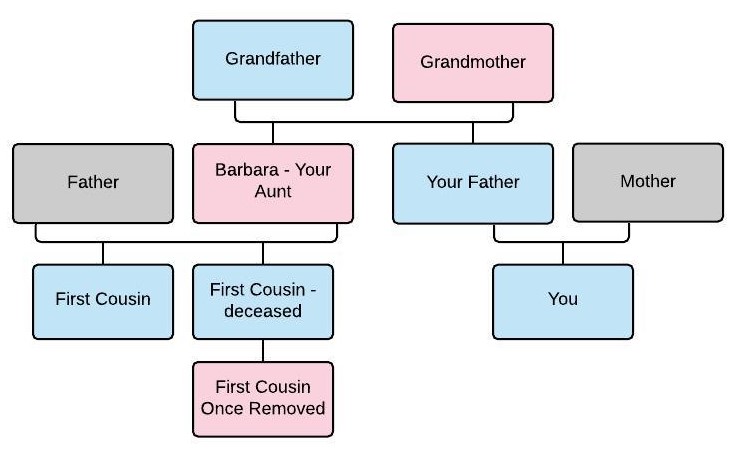
Other articles discuss things like how to use Discover’s Ancient Connections, and the difference between half and full relationships, both in your tree and genetically. Plus, what does a cousin “once removed” mean anyway? And why do I care?

Another question I receive is how far back, based on the shared amount of DNA, should I look in my matches’ trees for our common ancestor? In other words, how many generations back should I click? That article was fun and produced some unexpected results.

Memorial Articles

Because we are part of a community, I write memorial articles when one of our friends passes on. This year, sadly, Schelly Talalay Dardashti, well-known Jewish genealogist, and another very close friend joined the ancestors, so I’ve recognized the best in both of their lives which constitutes their legacy.

Be the Storyteller

Last, but not least, I wrote about my ancestors in the “52 Ancestors” series, which launched several years ago with Amy Johnson Crow’s challenge to write about one ancestor per week. She hosts this every year, and you can join (free) now.

I’m now on ancestor #467, so yes, it’s addictive, but it’s also AMAZING how many wonderful cousins I’ve met who have information that I did not. Not only that, but after publishing about an ancestor, I’ve discovered that I’m related to people I’ve known for years. We were SOOOooo excited!

I’ve been writing about the lives of my ancestors for several years now, and the articles include attempts to identify Y-DNA and mtDNA testers for each ancestor, where appropriate. There’s so much to learn that can’t be revealed any other way.

Plus, people seem to like the “mystery” and “short story” aspect, and I salt each story with the history of the region and relevant historical events of the timeframe. You might find your ancestors here too, or other helpful information.

Find a way to share about your ancestors!

Do You Have Suggestions for 2026 Topics?

Do you have suggestions or requests for article topics in 2026? If so, please comment on this article and let me know.

Check Out the 2025 List

Here’s the list of the 2025 articles. Did you miss something fun? Enjoy!

  Title Category Date Link
1 Welcome to 2025 – Opportunities and New Genetic Genealogy Articles Welcome, general 1-2-2025 https://dna-explained.com/2025/01/02/welcome-to-2025-opportunities-and-new-genetic-genealogy-articles/
2 Anne Doucet (1713-1791), Oceans, Rivers, and Perseverance – 52 Ancestors #438 52 Ancestors 1-4-2025 https://dna-explained.com/2025/01/04/anne-doucet-1713-1791-oceans-rivers-and-perseverance-52-ancestors-438/
3 Register for RootsTech 2025 Now RootsTech 1-16-2025 https://dna-explained.com/2025/01/16/register-for-rootstech-2025-now/
4 What IS the McNeil Family History, by George Franklin McNeil – 52 Ancestors #439 52 Ancestors 1-19-2025 https://dna-explained.com/2025/01/20/what-is-the-mcneil-family-history-by-george-franklin-mcneil-52-ancestors-439/
5 Jean Garceau dit Tranchemontagne (c1785-1711), Soldier from Saint Marseault – 52 Ancestors #440 52 Ancestors 1-29-2025 https://dna-explained.com/2025/01/29/jean-garceau-dit-tranchemontagne-c1785-1711-soldier-from-saint-marseault-52-ancestors-440/
6 Memories Resurface When the Old Family Home Gets a Facelift Genealogy 2-3-2025 https://dna-explained.com/2025/02/03/memories-resurface-when-the-old-family-home-gets-a-facelift/
7 MyHeritage Introduces Ethnicity v2.5 MyHeritage 2-6-2025 https://dna-explained.com/2025/02/06/myheritage-introduces-ethnicity-v2-5/
8 Relatives at RootsTech Reveals Cousins and Provides DNA Candidates RootsTech, techniques 2-8-2025 https://dna-explained.com/2025/02/08/relatives-at-rootstech-reveals-cousins-and-provides-dna-candidates/
9 FamilyTreeDNA’s New Matrix Shows How Your Matches Are Related to Each Other FamilyTreeDNA 2-12-2025 https://dna-explained.com/2025/02/12/familytreednas-new-matrix-shows-how-your-matches-are-related-to-each-other/
10 René Doucet (c1680-c1731), Lifetime of Incessant Upheaval – 52 Ancestors #441 52 Ancestors 2-15-2024 https://dna-explained.com/2025/02/16/rene-doucet-c1680-c1731-lifetime-of-incessant-upheaval-52-ancestors-441/
11 Lineages Versus Ancestors – How to Find and Leverage Yours Techniques 2-23-2025 https://dna-explained.com/2025/02/23/lineages-versus-ancestors-how-to-find-and-leverage-yours/
12 Mitotree is Born Mitochondrial DNA 2-25-2025 https://dna-explained.com/2025/02/25/mitotree-is-born/
13 RootsTech 2025 – The Year of Discover and the New Mitotree RootsTech, Mitochondrial DNA 3-14-2025 https://dna-explained.com/2025/03/15/rootstech-2025-the-year-of-discover-and-the-new-mitotree/
14 Pierre Doucet (c1621-1713), Walking History Book Lived to Nearly 100 – 52 Ancestors #442 3-16-2025 https://dna-explained.com/2025/03/16/pierre-doucet-c1621-1713-walking-history-book-lived-to-nearly-!100-52-ancestors-442/
15 Welcome to the New FamilyTreeDNA mtDNA Group Mitochondrial DNA 3-17-2025 https://dna-explained.com/2025/03/17/welcome-to-the-new-familytreedna-mtdna-group/
16 23andMe Files for Bankruptcy – What You Need to Know! 23andMe 3-24-2025 https://dna-explained.com/2025/03/25/23andme-files-for-bankruptcy-what-you-need-to-know/
17 New “Share” Features at FamilyTreeDNA Blur Match Information and Make Sharing Easy FamilyTreeDNA 4-1-2025 https://dna-explained.com/2025/04/01/new-share-features-at-familytreedna-blur-match-information-and-make-sharing-easy/
18 The Chauvet Cave: Trip Back in Time with Prehistoric European Humans – Are We Related? History, DNA 4-6-2025 https://dna-explained.com/2025/04/06/the-chauvet-cave-trip-back-in-time-with-prehistoric-european-humans-are-we-related/
19 DNA for Native American Genealogy Webinar & Companion Book Native American 4-8-2025 https://dna-explained.com/2025/04/08/dna-for-native-american-genealogy-webinar-companion-book/
20 Marie Levron (c1686-1727), Tragedy from Cradle to Grave – 52 Ancestors #443 52 Ancestors 4-14-2025 https://dna-explained.com/2025/04/14/marie-levron-c1686-1727-tragedy-from-cradle-to-grave-52-ancestors-443/
21 Mitochondrial DNA: What is a Haplotype Cluster and How Do I Find and Use Mine Mitochondrial DNA 4-14-2025 https://dna-explained.com/2025/04/14/mitochondrial-dna-what-is-a-haplotype-cluster-and-how-do-i-find-and-use-mine/
22 New Mitotree Haplogroups and How to Utilize Them for Genealogy Mitochondrial DNA 4-23-2025 https://dna-explained.com/2025/04/23/new-mitotree-haplogroups-and-how-to-utilize-them-for-genealogy/
23 Sir Francois Levron dit Nantois(c1651-1714), and Acadia’s Pirate – 52 Ancestors #444 52 Ancestors 4-26-2025 https://dna-explained.com/2025/04/27/sir-francois-levron-dit-nantois-c1651-1714-and-acadias-pirate-52-ancestors-444/
24 Catherine Savoie (c1661-c1722/25), Whispered Threads Weave a Tapestry of Life – 52 Ancestors #445 52 Ancestors 5-4-2025 https://dna-explained.com/2025/05/04/catherine-savoie-c1661-c1722-5-whispered-threads-weave-a-tapestry-of-life-52-ancestors-445/
25 Discover’s Ancient Connections – How Are You Related? Discover, Ancient DNA 5-8-2025 https://dna-explained.com/2025/05/08/discovers-ancient-connections-how-are-you-related/
26 Mother’s Day and Legacies 52 Ancestors, Genealogy 5-10-2025 https://dna-explained.com/2025/05/11/mothers-day-and-legacies/
27 The Mystery of the Blue Fugates and Smiths: A Study in Blue Genes and Pedigree Collapse Genetics, Genealogy 5-18-1015 https://dna-explained.com/2025/05/19/the-mystery-of-the-blue-fugates-and-smiths-a-study-in-blue-genes-and-pedigree-collapse/
28 Regeneron Wins Bid for Bankrupt 23andMe – Wedding Planned 23andMe 5-19-2023 https://dna-explained.com/2025/05/19/regeneron-wins-bid-for-bankrupt-23andme-wedding-planned/
29 Francois Savoie’s Homestead Rediscovered – 52 Ancestors #446 52 Ancestors 5-24-2025 https://dna-explained.com/2025/05/24/francois-savoies-homestead-rediscovered-52-ancestors-446/
30 Memorial Day – Some Gave All Memorial 5-25-2025 https://dna-explained.com/2025/05/25/memorial-day-some-gave-all/
31 Mitotree Webinar – What It Is, How We Did It, and What Mitotree Means to You Mitochondrial DNA 6-4-2025 https://dna-explained.com/2025/06/04/mitotree-webinar-what-it-is-how-we-did-it-and-what-mitotree-means-to-you/
32 Catherine LeJeune (c1633-1671/1686), Meet Your Grandchildren – 52 Ancestors #447 52 Ancestors 6-7-2025 https://dna-explained.com/2025/06/07/catherine-lejeune-c1633-1671-1686-meet-your-grandchildren-52-ancestors-447/
33 Mitotree Q&A for Everyone Mitochondrial DNA 6-11-2025 https://dna-explained.com/2025/06/11/mitotree-qa-for-everyone/
34 Father’s Day: Bravery and Love 52 Ancestors, Genealogy 6-14-2025 https://dna-explained.com/2025/06/14/fathers-day-bravery-and-love/
35 Francoise Bourgeois (c1659-1693/1697), High Drama in Beaubassin and Terror at Port Royal – 52 Ancestors #448 52 Ancestors 6-16-2025 https://dna-explained.com/2025/06/16/francoise-bourgeois-c1659-1693-97-high-drama-in-beaubassin-and-terror-at-port-royal-52-ancestors-448/
36 Requesting Suggestions for RootsTech 2026 Topics RootsTech 6-18-2025 https://dna-explained.com/2025/06/18/requesting-suggestions-for-rootstech-2026-topics/
37 FamilyTreeDNA and WikiTree Collaboration – In Two Easy Steps!! FamilyTreeDNA, WikiTree 6-25-2025 https://dna-explained.com/2025/06/25/familytreedna-and-wikitree-collaboration-in-two-easy-steps/
38 Jacques Bourgeois (c1620-c1700), Surgeon of Port Royal – 52 Ancestors #449 52 Ancestors 7-1-2025 https://dna-explained.com/2025/07/01/jacques-bourgeois-c1620-c1700-surgeon-of-port-royal-52-ancestors-449/
39 TTAM, a Nonprofit Formed by 23andMe’s Founder Now Plans to Buy 23andMe 23andMe 7-1-2025 https://dna-explained.com/2025/07/01/ttam-a-nonprofit-formed-by-23andmes-founder-now-plans-to-buy-23andme/
40 Jacques Bourgeois: Complex Acadian, Founder of Beaubassin – 52 Ancestors #450 52 Ancestors 7-6-2025 https://dna-explained.com/2025/07/06/jacques-bourgeois-complex-acadian-founder-of-beaubassin-52-ancestors-450/
41 How to Use Ancestry’s New Match Clusters and What They Mean Ancestry 7-10-2025 https://dna-explained.com/2025/07/10/how-to-use-ancestrys-new-match-clusters-and-what-they-mean/
42 Walk with Your Ancestors: Peace, Light and Healing in an Abandoned Medieval Village History 7-21-2025 https://dna-explained.com/2025/07/21/walk-with-your-ancestors-peace-light-and-healing-in-an-abandoned-medieval-village/
43 Jeanne Trahan (c1629-c1699), Life in Chinon, La Heve, Port Royal, and Beaubassin – 52 Ancestors #451 52 Ancestors 8-2-2025 https://dna-explained.com/2025/07/28/jeanne-trahan-c1629-c1699-life-in-chinon-la-heve-port-royal-and-beaubassin-52-ancestors-451/
44 Wherefore Art Thou, Oh Ancestor – New Generation Tree Chart Suggests Where to Look in Your Matches’ Trees Techniques, Genetics, Genealogy 8-2-2025 https://dna-explained.com/2025/08/02/wherefore-art-thou-oh-ancestor-new-generation-tree-chart-suggests-where-to-look-in-your-matches-trees/
45 Guillaume Trahan (c1601-1625), More Than Meets the Eye – 52 Ancestors #452 52 Ancestors 8-13-2025 https://dna-explained.com/2025/08/13/guillaume-trahan-c1601-c1684-more-than-meets-the-eye-52-ancestor-452/ 
46 The East Coast Genetic Genealogy Conference – ECGGC – Register Now for the Best of the Best ECGGC Conference 8-14-2025 https://dna-explained.com/2025/08/14/the-east-coast-genetic-genealogy-conference-ecggc-register-now-for-the-best-of-the-best/
47 Schelly Talalay Dardashti – May Her Memory Be a Blessing Memorial 8-17-2025 https://dna-explained.com/2025/08/17/schelly-talalay-dardashti-may-her-memory-be-a-blessing/
48 Francoise Corbineau (c1609-c1665), Bride in Chinon, Founder of Acadia – 52 Ancestors #453 52 Ancestors 8-25-2025 https://dna-explained.com/2025/08/23/francoise-corbineau-c1609-c1665-bride-in-chinon-founder-of-acadia-52-ancestors-453/
49 Nicolas Trahan (c1570->1632), Life in the Heart of French Wine Country – 52 Ancestors #454 52 Ancestors 8-31-2015 https://dna-explained.com/2025/08/31/nicolas-trahan-c1570-1632-life-in-the-heart-of-french-wine-country-52-ancestors-454/
50 Mitochondrial DNA A-Z: A Step-by-Step Guide to Matches, Mitotree, and mtDNA Discover Mitochondrial DNA, Discover, Genealogy, Techniques 10-2-2025 https://dna-explained.com/2025/09/02/mitochondrial-dna-a-z-a-step-by-step-guide-to-matches-mitotree-and-mtdna-discover/
51 Renée Desloges (c1570-1627/1632), Fragments of Life in Montreuil-Bellay – 52 Ancestors #454 (this is actually 455) 52 Ancestors 9-6-2025 https://dna-explained.com/2025/09/06/renee-desloges-c1570-1627-1632-fragments-of-life-in-montreuil-bellay-52-ancestors-454/
52 Best Mitochondrial DNA Presentation EVER – You’re Invited to DNA Academy!! Mitochondrial DNA 9-9-2025 https://dna-explained.com/2025/09/09/best-mitochondrial-dna-presentation-ever-youre-invited-to-dna-academy/
53 Unfillable Shoes Memorial – Douglas Rhodenbaugh 9-14-2025 https://dna-explained.com/2025/09/14/unfillable-shoes/
54 Concepts: What Does a Cousin “Once Removed” Mean? Concepts, Genealogy 9-24-2025 https://dna-explained.com/2025/09/24/concepts-what-does-a-cousin-once-removed-mean/
55 Daniel Vannoy (1752-after 1820), “Lived in the Boundary of the Cherokee Indians” – Say What??? 52 Ancestors 9-29-2025 https://dna-explained.com/2025/09/29/daniel-vannoy-1752-after-1820-lived-in-the-boundary-of-the-cherokee-indians-say-what/
56 Daniel Vannoy and the Strange Case of the Two Sarahs – 52 Ancestors #457 52 Ancestors 10-5-2025 https://dna-explained.com/2025/10/06/daniel-vannoy-and-the-strange-case-of-the-two-sarahs-52-ancestors-457/
57 Cousin Finder – MyHeritage’s Innovative New Tool Finds Your Relatives MyHeritage 10-9-2025 https://dna-explained.com/2025/10/09/cousin-finder-myheritages-innovative-new-tool-finds-your-relatives/
58 Sarah Hickerson Vannoy (c1761 – after 1826), Threw More than Shade – 52 Ancestors #458 52 Ancestors https://dna-explained.com/2025/10/13/sarah-hickerson-vannoy-c1761-after-1826-threw-more-than-shade-52-ancestors-458/
59 MyHeritage Introduces a Low-Pass Whole Genome Autosomal DNA Test & Why It Matters MyHeritage 10-14-2025 https://dna-explained.com/2025/10/14/myheritage-introduces-a-low-pass-whole-genome-autosomal-dna-test-why-it-matters/
60 Henriette Pelletret (c1640 – before 1694), Life Death in the Shadow of the Fort – 52 Ancestors #459 52 Ancestors 10-21-2025 https://dna-explained.com/2025/10/21/henriette-pelletret-c1640-before-1694-life-and-death-in-the-shadow-of-the-fort-52-ancestor-459/
61 Cheat Sheet: Mitochondrial Matches, Haplotype Clusters, and Haplogroups Mitochondrial DNA 10-22-2025 https://dna-explained.com/2025/10/22/cheat-sheet-mitochondrial-matches-haplotype-clusters-and-haplogroups/
62 Simon Pelletret (1610-1642/1645): A Walk Through Port Royal – 52 Ancestors #460 52 Ancestors 10-27-2025 https://dna-explained.com/2025/10/27/simon-pelletret-c1610-1642-1645-a-walk-through-port-royal-52-ancestors-460/
63 Perrine Bourg (c1626-1693/1698): Phoenix Rising from the Ashes – 52 Ancestors #461 52 Ancestors 11-2-2025 https://dna-explained.com/2025/11/02/perrine-bourg-c1626-1693-1698-phoenix-rising-from-the-ashes-52-ancestors-461/
64 Concepts: What is a Half Relationships, Life Half First Cousins, Anyway? Concepts, Genealogy 11-4-2025 https://dna-explained.com/2025/11/04/concepts-what-is-a-half-relationship-like-half-first-cousins-anyway/
65 Marie Broussard (1686-after 1752), Life Across the River from Port Royal – 52 Ancestors #462 52 Ancestors 11-10-2025 https://dna-explained.com/2025/11/10/marie-broussard-1686-after-1752-life-across-the-river-from-port-royal-52-ancestors-462/
66 Francois Broussard (1653-1716), Intractable Acadian – 52 Ancestors #463 52 Ancestors 11-22-2025 https://dna-explained.com/2025/11/22/francois-broussard-1653-1716-intractable-acadian-52-ancestors-463/
67 Mitotree Sprouts 12,773 New Branches and Includes Ancient DNA Mitochondrial DNA 11-24-2025 https://dna-explained.com/2025/11/24/mitotree-sprouts-12773-new-branches-and-includes-ancient-dna/
68 Catherine Richard (c1663 – after 1714), Mother of Beausoleil, Acadian Freedom Fighters – 52 Ancestors #464 52 Ancestors 11-29-2025 https://dna-explained.com/2025/11/29/catherine-richard-c1663-after-1714-mother-of-beausoleil-acadian-freedom-fighters-52-ancestors-464/
69 Ancestry’s ThruLines Has a New Pedigree View Ancestry 12-2-2025 https://dna-explained.com/2025/12/03/ancestrys-thrulines-has-a-new-pedigree-view/
70 Ancestry Reverts ThruLines to the Original View Ancestry 12-6-2025 https://dna-explained.com/2025/12/06/ancestry-reverts-thrulines-to-the-original-view/
71 Michel Richard (c1630-1686/1689), Carefree Acadian – 52 Ancestors #465 52 Ancestors 12-7-2025 https://dna-explained.com/2025/12/08/michel-richard-dit-sansoucy-c1630-1686-1689-carefree-acadian-52-ancestors-465/ 
72 Mitochondrial DNA: How Do I Know if I’m a Candidate to Receive a New Haplogroup? Mitochondrial DNA 12-9-2025 https://dna-explained.com/2025/12/09/mitochondrial-dna-how-do-i-know-if-im-a-candidate-to-receive-a-new-haplogroup/
73 Heavens Ablaze: the 1833 Leonid Meteor Storm and Your Ancestors History, Genealogy 12-15-2025 https://dna-explained.com/2025/12/15/heavens-ablaze-the-1833-leonid-meteor-storm-and-your-ancestors/
74 Madelaine Blanchard (c1643 – 1678/1683), Gone Too Soon – 52 Ancestors #466 52 Ancestors 12-20-2025 https://dna-explained.com/2025/12/20/madelaine-blanchard-c1643-1678-1683-gone-too-soon-52-ancestors-466/
75 Soar Inspiration 12-24-2025 https://dna-explained.com/2025/12/24/soar/

_____________________________________________________________

Share the Love!

You’re always welcome to forward articles or links to friends and share on social media.

Subscribe!

If you haven’t already subscribed, it’s free. You’ll receive an e-mail whenever I publish by clicking the “follow” button at the top of the main blog page, here.

Help Keep This Blog Free

I receive a small commission when you click a vendor link in my articles and purchase that item. This does NOT increase your price but helps me keep the lights on and this informational blog free for everyone. Please click on the affiliate links in the articles or to the vendors below if you are purchasing products or DNA testing.

Thank you so much.

DNA Purchases and Free Uploads

Genealogy Products and Services

My Books

Genealogy Books

Genealogy Research

DNA Academy Webinar Series Released

Great news! Legacy Family Tree Webinars has just released DNA Academy.

DNA Academy is a three-part series designed to introduce the basics of DNA for genetic genealogy and how Y-DNA, X-DNA, mitochondrial and autosomal DNA can be utilized. Each of these different types of DNA serves a different function for genealogists – and reveals different matches and hints for genealogy.

  1. DNA Academy Part 1 introduces genetic genealogy basics, then, Ancestry’s DNA tools – including their new pricing structure for DNA features. Click here to view.
  2. DNA Academy Part 2 covers FamilyTreeDNA’s products. Click here to view the webinar, which includes:
    1. Y-DNA for males which tracks the direct paternal line
    2. Mitochondrial DNA for everyone which tracks your direct maternal line – your mother’s mother’s mother’s lineage
    3. Autosomal DNA which includes matches from all of your ancestral lines and along with X-DNA matching, which has a very distinctive inheritance path.
  3. DNA Academy Part 3 includes MyHeritage, 23andMe, and third-party tools such as DNAPainter and Genetic Affairs. Click here to view.

Legacy Family Tree Webinars has graciously made Part 2, the FamilyTreeDNA class, free through August 22nd for everyone – so be sure to watch now.

After August 22nd, Part 2 will join Part 1 and Part 3 in the webinar library for subscribers with more than 2240 webinars for $49.95 per year.

_____________________________________________________________

Follow DNAexplain on Facebook, here.

Share the Love!

You’re always welcome to forward articles or links to friends and share on social media.

If you haven’t already subscribed (it’s free,) you can receive an e-mail whenever I publish by clicking the “follow” button on the main blog page, here.

You Can Help Keep This Blog Free

I receive a small contribution when you click on some of the links to vendors in my articles. This does NOT increase your price but helps me keep the lights on and this informational blog free for everyone. Please click on the links in the articles or to the vendors below if you are purchasing products or DNA testing.

Thank you so much.

DNA Purchases and Free Uploads

Genealogy Products and Services

My Books

Genealogy Books

Genealogy Research

Great News – Both e-Pub and Print Version of “The Complete Guide to FamilyTreeDNA” Now Available Worldwide  

  • Anyone, anyplace, can order the full-color, searchable, e-pub version of The Complete Guide to FamilyTreeDNA – Y-DNA, Mitochondrial, Autosomal and X-DNA from the publisher, Genealogical.com, here.
  • Customers within the US can order the black and white print book from the publisher, here.
  • Customers outside the US can order the print book from their country’s Amazon website. The publisher does not ship print books outside the US due to customs, shipping costs, and associated delays. They arranged to have the book printed by an international printer so that it can be shipped directly to Amazon for order fulfillment without international customers incurring additional expenses and delays. If you ordered the book previously from Amazon and a long delivery time was projected, that should be resolved now and your book should be arriving soon.

Comprehensive

This book is truly comprehensive and includes:

  • 247 pages
  • More than 267 images
  • 288 footnotes
  • 12 charts
  • 68 tips
  • Plus, an 18-page glossary

To view the table of contents, click here. To order, click here.

Thank you, everyone, for your patience and your support.

_____________________________________________________________

Follow DNAexplain on Facebook, here.

Share the Love!

You’re always welcome to forward articles or links to friends and share on social media.

If you haven’t already subscribed (it’s free,) you can receive an e-mail whenever I publish by clicking the “follow” button on the main blog page, here.

You Can Help Keep This Blog Free

I receive a small contribution when you click on some of the links to vendors in my articles. This does NOT increase your price but helps me keep the lights on and this informational blog free for everyone. Please click on the links in the articles or to the vendors below if you are purchasing products or DNA testing.

Thank you so much.

DNA Purchases and Free Uploads

Genealogy Products and Services

My Books

Genealogy Books

Genealogy Research

Complete Guide to FamilyTreeDNA Released in Hardcopy

Just what many of you have been waiting for! The hardcopy print version of the Complete Guide to FamilyTreeDNA has just been released.

As shown in the table of contents below, The Complete Guide to FamilyTreeDNA contains lots of logically organized information! It includes basic education about genetic genealogy and how it works, instructions on using the FamilyTreeDNA tests and tools, plus an extensive glossary.

Enjoy!

_____________________________________________________________

Follow DNAexplain on Facebook, here.

Share the Love!

You’re always welcome to forward articles or links to friends and share on social media.

If you haven’t already subscribed (it’s free,) you can receive an e-mail whenever I publish by clicking the “follow” button on the main blog page, here.

You Can Help Keep This Blog Free

I receive a small contribution when you click on some of the links to vendors in my articles. This does NOT increase your price but helps me keep the lights on and this informational blog free for everyone. Please click on the links in the articles or to the vendors below if you are purchasing products or DNA testing.

Thank you so much.

DNA Purchases and Free Uploads

Genealogy Products and Services

My Books

Genealogy Books

Genealogy Research

Announcing: The Complete Guide to FamilyTreeDNA; Y-DNA, Mitochondrial, Autosomal and X-DNA

I’m so very pleased to announce the publication of my new book, The Complete Guide to FamilyTreeDNA – Y-DNA, Mitochondrial, Autosomal and X-DNA.

For the first time, the publisher, Genealogical.com, is making the full-color, searchable e-book version available before the hardcopy print version, here. The e-book version can be read using your favorite e-book reader such as Kindle or iBooks.

Update: The hardcopy version was released at the end of May and is available from the publisher in the US and from Amazon internationally.

This book is about more than how to use the FamilyTreeDNA products and interpreting their genealogical meaning, it’s also a primer on the four different types of DNA used for genealogy and how they work:

  • Autosomal DNA
  • Mitochondrial DNA
  • Y-DNA
  • X-DNA

There’s a LOT here, as shown by the table of contents, below

This book is chocked full of great information in one place. As an added bonus, the DNA glossary is 18 pages long.

I really hope you enjoy my new book, in whatever format you prefer.

_____________________________________________________________

Follow DNAexplain on Facebook, here.

Share the Love!

You’re always welcome to forward articles or links to friends and share on social media.

If you haven’t already subscribed (it’s free,) you can receive an e-mail whenever I publish by clicking the “follow” button on the main blog page, here.

You Can Help Keep This Blog Free

I receive a small contribution when you click on some of the links to vendors in my articles. This does NOT increase your price but helps me keep the lights on and this informational blog free for everyone. Please click on the links in the articles or to the vendors below if you are purchasing products or DNA testing.

Thank you so much.

DNA Purchases and Free Uploads

Genealogy Products and Services

My Books

Genealogy Books

Genealogy Research

Why Don’t Our Y-DNA Haplogroups Match?

I’ve been asked this question several times recently, and the answer is resoundingly, “it depends.” There are several reasons why Y-DNA haplogroups might not match and most of them aren’t “bad.”

How Haplogroups Work

Haplogroups are the 79,000+ branches of the Y-DNA phylogenetic tree which you can view here, along with countries where those haplogroups are found. You can think of haplogroups as genetic clans of either closely or distantly related men. Major haplogroup branches have unique letters assigned. Downstream or younger haplogroups are designated by a letter-number sequence that is always preceded by the main haplogroup letter.

Image courtesy FamilyTreeDNA

Major haplogroups were formed tens of thousands of years ago, with more recent haplogroups added as they’ve been discovered. Haplogroups are discovered and added every day thanks to the Big Y-700 test. You can read more about that process, here.

As you look at the pie chart above, you’ll notice that haplogroup R represents about half the men who have tested and has several major subbranches. Every haplogroup R man belongs to all of the branches above his own that lead back to the root of haplogroup R.

Using haplogroup R, which is R-M207, its identifying SNP, as an example, it immediately splits into two branches: R-M173, which has 37,000+ more branches, and R-M479, which has 313 branches. My Estes men fall into a haplogroup several steps beneath R-M173, but they are still members of haplogroups R-M173 and R-M207, even though their descendant haplogroup is R-BY490, which was formed by a mutation that occurred 20,000 years later.

Haplogroup R-M173, then, in turn, leads back to Y-Adam, the first man to have lived and has descendants today.

As we approach the question of why haplogroups of two men might differ, we will review tools to use and how to interpret your findings to reach the appropriate answer for your situation.

What is Your Goal?

You may be looking for a very specific answer, or this may be a more general question.

  • If you’re evaluating closely related men who have different haplogroup assignments, not matching can be very disconcerting. Breathe. There are several perfectly legitimate reasons why they may not match, and we have easy, free analysis tools.
  • If you’re looking at your Y-DNA match list at FamilyTreeDNA, you may or may not match other men closely, but you do “match” at some level if they are on your match list. You may see several different haplogroups in your match list. How closely you match those men is a different question.
  • If you’re looking at autosomal results at FamilyTreeDNA, you may see haplogroups listed for males. You may or may not “match” the haplogroup of men with the same surname. What does this mean, and why don’t you match? Your autosomal match may have nothing to do with your paternal line, or it may be because of your paternal line.

We will cover all of these scenarios.

Where Did You Both Test?

  • Are you comparing apples and apples?
  • Did you both test at the same company?
  • Did you both take the same type or level of test?

These factors all make a difference.

Which Test Did You Take?

There are four types of tests that will provide males with some level of Y-DNA haplogroup.

Autosomal Tests – Some companies include a few Y-DNA location probes in their autosomal test, meaning that they test a few haplogroup-specific Y-DNA locations. LivingDNA, 23andMe, and FamilyTreeDNA’s Family Finder test provide a mid-level Y-DNA haplogroup to customers. The haplogroup that can be determined from these tests depends on a variety of factors, including the vendor, the probes they selected for their chip, the test version, and if that location is successfully read in the test.

Note that FamilyTreeDNA supports autosomal uploads from MyHeritage and Ancestry who do not provide Y-DNA haplogroups to customers, but who do test some Y-DNA locations. Therefore you can upload your autosomal test from those companies to FamilyTreeDNA for free and receive at least a cursory Y-DNA haplogroup.

FamilyTreeDNA is currently processing all of its Family Finder tests, followed by tests uploaded from other vendors, to provide all genetic male testers with a Y-DNA haplogroup at some level. Different vendors and test versions test different Y-DNA SNPs, so your mileage may vary. Y-DNA haplogroups are a free benefit at FamilyTreeDNA.

STR Tests – At FamilyTreeDNA, you can purchase both Y-37 and Y-111 STR (short tandem repeat) Y-DNA tests that provide matching at the number of locations you purchased, plus a predicted haplogroup based on those results. These haplogroup predictions are accurate but are often relatively far back in time.

If you match someone on STR tests, your match may be very recent or before the advent of surnames. For a more specific haplogroup, you need to purchase the Big Y-700 test, which provides at least 700 STR match locations but, more importantly, sequences the entire gold-standard region of the Y-chromosome for the most precise haplogroup and matching possible.

  • When viewing matches of two men who ONLY took STR tests, STR marker matches are more important for genealogy than haplogroups because the haplogroups were formed thousands of years ago.
  • When viewing matches on the Big Y-700 test, haplogroup matching is much more specific and reliable than STR matches because the mutations (SNPs – single nucleotide polymorphisms) that form haplogroups are much more stable than STRs which mutate unpredictably, including back mutations.

SNP Confirmation Tests – Historically, FamilyTreeDNA customers could purchase individual SNPs to confirm a haplogroup, or SNP packs or bundles to do the same for a group of SNPs. With the advent of both the Family Finder haplogroup assignments, and the Big Y-700, these individual tests are no longer necessary or advantageous and are being discontinued.

Big Y-700 Test – At FamilyTreeDNA, the Big Y-700 test provides the most granular and specific haplogroup possible, most often well within a genealogical timeframe. You may be able to tell, based on previously undiscovered mutations, that two people are brothers or father and son, or, depending on who else has tested and when mutations formed, testers may match further back in time. Here’s an example of using the results from multiple testers in the Estes DNA Surname Project.

You can also match men who took the Big Y-500 test which is less specific than the Big Y-700. In the now-obsolete Big Y-500 test, a smaller portion of the Y chromosome was sequenced and testers only received about 500 STR locations. The Big Y-700 test has been enriched to provide a wider range of more specific information. Men who originally took the Big Y-500, then upgraded to the Big Y-700, will very probably have a new haplogroup assignment based on the expanded coverage and increased resolution of the Big Y-700 test. The Big Y-700 ferrets out lineages that the Big Y-500 simply could not, and continues to provide additional value as more men test, which facilitates the formation of new haplogroups.

What Do You Mean by Match?

Matching doesn’t mean you have to have the exact same haplogroup. A perfectly valid match can have a different haplogroup because one haplogroup is more specific or refined than the other. Matching exactly as a result of a predicted STR haplogroup is much less useful than matching closely on a much more recent Big Y-700 haplogroup.

Not all haplogroups are created equal.

I know this is a bit confusing, so let’s look at real-life examples to clarify.

STR to STR or Autosomal to Autosomal Haplogroup Match

Two males might match exactly on a mid-range Family Finder autosomal haplogroup or on a STR-predicted haplogroup like R-M269, which is about 6350 years old.

This haplogroup “match,” even though it might be exact, does not confirm a close match and really only serves to eliminate some other haplogroups and confirm that a closer match is possible. For example, R-M269 men don’t match someone in haplogroup J or E. You may or may not share a surname. You may or may not still “match” if you both upgrade to the Big Y-700.

In this case, a father/son pair would match exactly, as would two men with different surnames whose common ancestor lived 6000 years ago.

Note that if you’re comparing autosomal-derived haplogroups across different vendor platforms, or even different DNA testing chip versions on the same platform, you may see two different haplogroups. Different vendors test different locations. Please note that second cousins and closer will always match on autosomal DNA, but relationships further back than that may not. Y-DNA very reliably reaches far beyond the capabilities of autosomal DNA due to the fact that it is never mixed with the DNA of the other parent – so it never divides or is watered down in time. When comparing two autosomally-generated haplogroups of men who are supposed to be closely related, always check their autosomal match results too.

Use the free Discover Tool to find various categories of information about any haplogroup, including its age. Take a look at R-M269 here.

Using Discover to Compare Haplogroups

You can always use the Discover tool to compare two haplogroups.

Go to Discover (or click through if you’re signed on to your FamilyTreeDNA Y-DNA page), then enter the first haplogroup you’d like to compare.

Click search to view information about that haplogroup.

On the menu bar, at left, click on Compare.

Add the second haplogroup.

I’m selecting E-M35, a completely different branch of the phylogenetic tree.

R-M269 was formed about 6350 years ago, while E-M35 was formed about 25,000 years ago. Their common ancestor was formed about 65,000 years ago. Clearly, these two paternal lineages are not related in anything close to a genealogical timeframe.

These two men would never match on an STR test, but could easily match on an autosomal test on any line OTHER than their direct paternal line.

Now let’s compare two haplogroups that are more closely related.

Haplogroup R-M222 is very common in Ireland, so let’s see how closely related it is to R-M269 which is very common in western Europe.

We see that R-M222 descends from R-M269, so there is no “other haplogroup” involved.

R-M222 was formed about 2100 years ago, around 4250 years after R-M269 was formed.

There are 17 steps between R-M222 and R-M269.

The bottom block shows the lineage from R-M269 back to Y-Adam.

How cool is this??!!

Big Y-700 to Autosomal or STR Haplogroup Comparison

Joe took the Big Y-700 test and discovered that he’s haplogroup R-BY177080.

Joe noticed that his son, who had initially taken an STR test, had been assigned haplogroup R-M269. Then, his son took a Family Finder test and his haplogroup changed to R-FGC8601.

Joe was confused about why he and his son’s haplogroups didn’t match.

First, let’s check Family Finder to confirm the parent/child relationship. Joe’s son is clearly his son.

So why doesn’t Joe’s son’s haplogroup match Joe’s haplogroup? And why did Joe’s son’s haplogroup change?

Joe’s son had not taken a Big Y-700 DNA test, so Joe’s son’s R-M269 haplogroup was initially predicted from his STR test.

Joe’s son’s updated haplogroup, R-FGC8601 was generated by the Family Finder test. Think of this as a bonus. If you’re a male and haven’t yet, you’ll soon receive an email telling you that you’ve received a Family Finder Y-DNA haplogroup. It’s your lucky day!

Family Finder haplogroups always replace STR predicted haplogroups since they are always more specific than predicted STR haplogroups. Big Y-700 haplogroups always replace STR-generated haplogroup predictions and Family Finder haplogroups because they are the most specific.

Let’s compare these results using Discover.

Joe’s son’s original predicted haplogroup was R-M269.

Discover Compare shows us that Joe’s Big Y-700 Haplogroup, R-BY177080, is a descendant of R-M269.

So, they actually do “match,” just several branches further up the tree

Joe’s son’s more precise Family Finder haplogroup was assigned as R-FGC8601.

Discover Compare shows us that Joe’s Big Y-700 haplogroup also descends from R-FGC8601.

You can see that the haplogroup generated by Family Finder is more precise by about 4700 years and improves that comparison.

R-M269 was formed about 6350 years ago, but R-FGC8601 was formed about 1700 years ago.

Joe’s Big Y-700 haplogroup, R-BY177080 was formed about the year 1900, improving the family haplogroup by another 1600 years or so.

Joe’s son’s Family Finder haplogroup moved down the haplotree 21 branches and 4650 years, for free! If Joe’s son were to upgrade to the Big Y-700, they might very well be assigned a new haplogroup that, for the time being, only they share.

Of course, Family Finder doesn’t provide Y-DNA matching so you still need the Y-DNA tests for that important aspect of genealogy.

Big Y to Big Y Comparison

In our next example, a group of men, including a father and son or other very close relative may take the Big Y-700 test and have different haplogroups. If you’re saying, “Whoa Nelly,” hear me out.

George took a Big Y-700 test and discovered that he is haplogroup R-FGC43597. His son and grandsons tested, and they are haplogroup R-FTC50269. What happened? Shouldn’t they all match George?

On George’s Big Y-700 block tree, you can see that a mutation, R-FTC50269, occurred between George and his son. George doesn’t have it, but his son does.

A haplogroup isn’t “named” until there are two men with the same mutation in the same lineage. Therefore, when George’s son initially tested, he would have been assigned to the same haplogroup as George, R-FGC43697, but with one extra variant, or mutation.

Of course, that extra mutation was passed from George’s son to both of his grandsons, so when the first grandson tested, the new haplogroup, R-FTC50269 was assigned as a result of that mutation. Now, George has one haplogroup and his son and grandsons have a different haplogroup, one branch downstream.

Using Discover to check the haplogroup ages and path, we find that indeed, these haplogroups are only one step apart.

Checking Family Finder results can always verify that the match is close or as close as you expected.

Haplogroup Assignments

Haplogroup assignments range from good to better to best.

Good Better Best
STR predicted Yes – but further back in time
SNP Packs (now obsolete) Between good and better
Family Finder autosomal Yes – generally midrange between STR predicted and the Big Y-700
Big Y-500 (need to upgrade) Usually between better and best
Big Y-700 The best – usually within a genealogically relevant timeframe unless your DNA is rare

Where Are You?

Older haplogroups, such as the STR-predicted haplogroups are useful for:

  • Eliminating some potential matches
  • Identifying where that haplogroup originated at that specific point in time. In other words, where your ancestor lived when that haplogroup was born.

If your Y-DNA matches another Y-DNA tester at FamilyTreeDNA, your haplogroups will fall someplace on the same haplogroup branch, although they may be thousands of years apart. STR-predicted haplogroups are “older,” meaning they range in age from about 6500 years to tens of thousands of years ago. They can tell you where the haplogroup originated at that time.

Autosomal haplogroups will be newer, or more recent, than STR-predicted haplogroups, but still (sometimes significantly) older than the Big Y-700 haplogroups..

FamilyTreeDNA provides Y-DNA haplogroups for free for every biological male who either takes the FamilyTreeDNA Family Finder test or uploads an autosomal result from either Ancestry or MyHeritage. Soon, 23andMe uploads will be resumed as well. This means that you will be able to view other men with a similar surname in your Family Finder results and:

  • Rule them out as a paternal line match.
  • Check your STR matches if they have taken a Y-DNA test
  • Check your Big Y-700 test for matches if both men have taken a Big Y test.
  • Encourage your matches to take a Big Y-700 test so you can see how closely you match on your paternal line.
  • Use the Discover Compare and other tools to reveal more information.

Family Finder haplogroups are relatively new, so currently, all new Family Finder testers are receiving haplogroups. Older Family Finder tests are being processed and will be followed by autosomal tests uploaded from other vendors. Haplogroups from autosomal tests are confirmed and will be newer, or more recent, than STR-predicted haplogroups.

The only test that can bring your haplogroup to current, meaning the most refined, recent, personal haplogroup, is the Big Y-700 test. Without taking the Big Y-700 test, you’ll forever be stuck with an older, less informative haplogroup branch. The Big Y-700 allows us to reliably sort families into lineages based on branching mutations.

The Big Y-700 haplogroup is:

  • The most detailed and granular possible.
  • Determined by sequencing the Y chromosome.
  • A test of discovery that continues to provide additional value as more men test and new haplogroups are formed.

Big Y-700 haplogroups generally fall into a genealogically useful timeframe and can be very recent.

The Discover tool and Time Tree provide a wealth of information about your ancestors, including locations, migration paths, ancient DNA, and more.

You Don’t Know What You Don’t Know

Now that you understand how to compare and interpret haplogroup matches, what additional information can you learn?

I always encourage Y-DNA matches to upgrade to the Big Y-700. Why? You don’t know what you don’t know. The article, Bennett Greenspan: Meet My Extended Family & Discover Extraordinary Deep Heritage illustrates the benefits of the Big Y-700 for all matches. Upgrading 12-marker matches is exactly how he made his big breakthrough.

The Big Y-700 test answers many questions beyond simply matching by using Discover and the Group Time Tree.

  • Where were your ancestors?
  • Who do you match, and who were their ancestors?
  • Genetically and genealogically, how do your surname matches fit together?
  • Where were your matches’ ancestors, and when?
  • Which ancient DNA results do you match, and where were they located?
  • What is the history of locations where your ancestors were found along their journey?
  • How closely or distantly are you related to other Big Y-700 matches?
  • Can your matches’ information break down your paternal line brick wall, or at least move it back a few generations?

Where are your Y-DNA results along the spectrum of useful haplogroup information? Do you or your matches need to upgrade? Click here to upgrade or order a Big Y-700 test.

______________________________________________________________

Sign Up Now – It’s Free!

If you appreciate this article, subscribe to DNAeXplain for free, to automatically receive new articles by e-mail each week.

Here’s the link. Look for the black “follow” button on the right side of your computer screen below the black title bar, enter your e-mail address, and you’re good to go!

In case you were wondering, I never have nor ever will share or use your e-mail outside of the intended purpose.

_____________________________________________________________

Follow DNAexplain on Facebook, here.

Share the Love!

You’re always welcome to forward articles or links to friends and share on social media.

If you haven’t already subscribed (it’s free,) you can receive an e-mail whenever I publish by clicking the “follow” button on the main blog page, here.

You Can Help Keep This Blog Free

I receive a small contribution when you click on some of the links to vendors in my articles. This does NOT increase your price but helps me keep the lights on and this informational blog free for everyone. Please click on the links in the articles or to the vendors below if you are purchasing products or DNA testing.

Thank you so much.

DNA Purchases and Free Uploads

Genealogy Products and Services

My Book

Genealogy Books

Genealogy Research

Top Ten RootsTech 2022 DNA Sessions + All DNA Session Links

The official dates of RootsTech 2022 were March 3-5, but the sessions and content in the vendor booths are still available. I’ve compiled a list of the sessions focused on DNA, with web links on the RootsTech YouTube channel

YouTube reports the number of views, so I was able to compile that information as of March 8, 2022.

I do want to explain a couple of things to add context to the numbers.

Most speakers recorded their sessions, but a few offered live sessions which were recorded, then posted later for participants to view. However, there have been glitches in that process. While the sessions were anticipated to be available an hour or so later, that didn’t quite happen, and a couple still aren’t posted. I’m sure the presenters are distressed by this, so be sure to watch those when they are up and running.

The Zoom rooms where participants gathered for the live sessions were restricted to 500 attendees. The YouTube number of views does not include the number of live viewers, so you’ll need to add an additional number, up to 500.

When you see a number before the session name, whether recorded or live, that means that the session is part of a series. RootsTech required speakers to divide longer sessions into a series of shorter sessions no longer than 15-20 minutes each. The goal was for viewers to be able to watch the sessions one after the other, as one class, or separately, and still make sense of the content. Let’s just say this was the most challenging thing I’ve ever done as a presenter.

For recorded series sessions, these are posted as 1, 2 and 3, as you can see below with Diahan Southard’s sessions. However, with my live session series, that didn’t happen. It looks like my sessions are a series, but when you watch them, parts 1, 2 and 3 are recorded and presented as one session. Personally, I’m fine with this, because I think the information makes a lot more sense this way. However, it makes comparisons difficult.

This was only the second year for RootsTech to be virtual and the conference is absolutely HUGE, so live and learn. Next year will be smoother and hopefully, at least partially in-person too.

When I “arrived” to present my live session, “Associating Autosomal DNA Segments With Ancestors,” my lovely moderator, Rhett, told me that they were going to livestream my session to the RootsTech page on Facebook as well because they realized that the 500 Zoom seat limit had been a problem the day before with some popular sessions. I have about 9000 views for that session and more than 7,400 of them are on the RootsTech Facebook page – and that was WITHOUT any advance notice or advertising. I know that the Zoom room was full in addition. I felt kind of strange about including my results in the top ten because I had that advantage, but I didn’t know quite how to otherwise count my session. As it turns out, all sessions with more than 1000 views made it into the top ten so mine would have been there one way or another. A big thank you to everyone who watched!

I hope that the RootsTech team notices that the most viewed session is the one that was NOT constrained by the 500-seat limited AND was live-streamed on Facebook. Seems like this might be a great way to increase session views for everyone next year. Hint, hint!!!

I also want to say a huge thank you to all of the presenters for producing outstanding content. The sessions were challenging to find, plus RootsTech is always hectic, even virtually. So, I know a LOT of people will want to view these informative sessions, now that you know where to look and have more time. Please remember to “like” the session on YouTube as a way of thanking your presenter.

With 140 DNA-focused sessions available, you can watch a new session, and put it to use, every other day for the next year! How fun is that! You can use this article as your own playlist.

Please feel free to share this article with your friends and genealogy groups so everyone can learn more about using DNA for genealogy.

Ok, let’s look at the top 10. Drum roll please…

Top 10 Most Viewed RootsTech Sessions

Session Title Presenter YouTube Link Views
1 1. Associating Autosomal DNA Segments With Ancestors Roberta Estes (live) https://www.youtube.com/watch?v=_IHSCkNnX48


~9000: 1019 + 500 live viewers + 7,400+ Facebook
2 1. What to Do with Your DNA Test Results in 2022 (part 1 of 3) Diahan Southard https://www.youtube.com/watch?v=FENAKAYLXX4 7428
3 Who Is FamilyTreeDNA? FamilyTreeDNA – Bennett Greenspan https://www.youtube.com/watch?v=MHFtwoatJ-A 2946
4 2. What to Do with Your DNA Test Results in 2022 (part 2 of 3) Diahan Southard https://www.youtube.com/watch?v=mIllhtONhlI 2448
5 Latest DNA Painter Releases DNAPainter Jonny Perl (live) https://www.youtube.com/watch?v=iLBThU8l33o 2230 + live viewers
6 DNA Painter Introduction DNAPainter – Jonny Perl https://www.youtube.com/watch?v=Rpe5LMPNmf0 1983
7 3. What to Do with Your DNA Test Results in 2022 (part 3 of 3) Diahan Southard https://www.youtube.com/watch?v=hemY5TuLmGI 1780
8 The Tree of Mankind Age Estimates Paul Maier https://www.youtube.com/watch?v=jjkL8PWAEwk 1638
9 A Sneak Peek at FamilyTreeDNA Coming Attractions FamilyTreeDNA (live) https://www.youtube.com/watch?v=K9sKqNScvnE 1270 + live viewers


10 Extending Time Horizons with DNA Rob Spencer (live) https://www.youtube.com/watch?v=wppXD1Zz2sQ 1037 + live viewers


All DNA-Focused Sessions

I know you’ll find LOTS of goodies here. Which ones are your favorites?

  Session Presenter YouTube Link Views
1 Estimating Relationships by Combining DNA from Multiple Siblings Amy Williams https://www.youtube.com/watch?v=xs1U0ohpKSA 201
2 Overview of HAPI-DNA.org Amy Williams https://www.youtube.com/watch?v=FjNiJgWaBeQ 126
3 How do AncestryDNA® Communities help tell your story? | Ancestry® Ancestry https://www.youtube.com/watch?v=EQNpUxonQO4 183


4 AncestryDNA® 201 Ancestry – Crista Cowan https://www.youtube.com/watch?v=lbqpnXloM5s


494
5 Genealogy in a Minute: Increase Discoveries by Attaching AncestryDNA® Results to Family Tree Ancestry – Crista Cowan https://www.youtube.com/watch?v=iAqwSCO8Pvw 369
6 AncestryDNA® 101: Beginner’s Guide to AncestryDNA® | Ancestry® Ancestry – Lisa Elzey https://www.youtube.com/watch?v=-N2usCR86sY 909
7 Hidden in Plain Sight: Free People of Color in Your Family Tree Cheri Daniels https://www.youtube.com/watch?v=FUOcdhO3uDM 179
8 Finding Relatives to Prevent Hereditary Cancer ConnectMyVariant – Dr. Brian Shirts https://www.youtube.com/watch?v=LpwLGgEp2IE 63
9 Piling on the chromosomes Debbie Kennett https://www.youtube.com/watch?v=e14lMsS3rcY 465
10 Linking Families With Rare Genetic Condition Using Genealogy Deborah Neklason https://www.youtube.com/watch?v=b94lUfeAw9k 43
11 1. What to Do with Your DNA Test Results in 2022 Diahan Southard https://www.youtube.com/watch?v=FENAKAYLXX4 7428
12 1. What to Do with Your DNA Test Results in 2022 Diahan Southard https://www.youtube.com/watch?v=hemY5TuLmGI 1780
13 2. What to Do with Your DNA Test Results in 2022 Diahan Southard https://www.youtube.com/watch?v=mIllhtONhlI 2448
14 DNA Testing For Family History Diahan Southard https://www.youtube.com/watch?v=kCLuOCC924s 84


15 Understanding Your DNA Ethnicity Estimate at 23andMe Diana Elder


https://www.youtube.com/watch?v=xT1OtyvbVHE 66
16 Understanding Your Ethnicity Estimate at FamilyTreeDNA Diana Elder https://www.youtube.com/watch?v=XosjViloVE0 73
17 DNA Monkey Wrenches Katherine Borges https://www.youtube.com/watch?v=Thv79pmII5M 245
18 Advanced Features in your Ancestral Tree and Fan Chart DNAPainter – Jonny Perl https://www.youtube.com/watch?v=4u5Vf13ZoAc 425
19 DNA Painter Introduction DNAPainter – Jonny Perl https://www.youtube.com/watch?v=Rpe5LMPNmf0 1983
20 Getting Segment Data from 23andMe DNA Matches DNAPainter – Jonny Perl https://www.youtube.com/watch?v=8EBRI85P3KQ 134
21 Getting segment data from FamilyTreeDNA DNA matches DNAPainter – Jonny Perl https://www.youtube.com/watch?v=rWnxK86a12U 169
22 Getting segment data from Gedmatch DNA matches DNAPainter – Jonny Perl https://www.youtube.com/watch?v=WF11HEL8Apk 163
23 Getting segment data from Geneanet DNA Matches DNAPainter – Jonny Perl https://www.youtube.com/watch?v=eclj8Ap0uK4 38
24 Getting segment data from MyHeritage DNA matches DNAPainter – Jonny Perl https://www.youtube.com/watch?v=9rGwOtqbg5E 160
25 Inferred Chromosome Mapping: Maximize your DNA Matches DNAPainter – Jonny Perl https://www.youtube.com/watch?v=tzd5arHkv64 688
26 Keeping track of your genetic family tree in a fan chart DNAPainter – Jonny Perl https://www.youtube.com/watch?v=W3Hcno7en94 806


27 Mapping a DNA Match in a Chromosome Map DNAPainter – Jonny Perl https://www.youtube.com/watch?v=A61zQFBWaiY 423
28 Setting up an Ancestral Tree and Fan Chart and Exploring Tree Completeness DNAPainter – Jonny Perl https://www.youtube.com/watch?v=lkJp5Xk1thg 77
29 Using the Shared cM Project Tool to Evaluate DNA Matches DNAPainter – Jonny Perl https://www.youtube.com/watch?v=vxhn9l3Dxg4 763
30 Your First Chromosome Map: Using your DNA Matches to Link Segments to Ancestors DNAPainter – Jonny Perl https://www.youtube.com/watch?v=tzd5arHkv64 688
31 DNA Painter for absolute beginners DNAPainter (Jonny Perl) https://www.youtube.com/watch?v=JwUWW4WHwhk 1196
32 Latest DNA Painter Releases DNAPainter (live) https://www.youtube.com/watch?v=iLBThU8l33o 2230 + live viewers
33 Unraveling your genealogy with DNA segment networks using AutoSegment from Genetic Affairs Evert-Jan Blom https://www.youtube.com/watch?v=rVpsJSqOJZI


162
34 Unraveling your genealogy with genetic networks using AutoCluster Evert-Jan Blom https://www.youtube.com/watch?v=ZTKSz_X7_zs 201


35 Unraveling your genealogy with reconstructed trees using AutoTree & AutoKinship from Genetic Affairs Evert-Jan Blom https://www.youtube.com/watch?v=OmDQoAn9tVw 143
36 Research Like a Pro with DNA – A Genealogist’s Guide to Finding and Confirming Ancestors with DNA Family Locket Genealogists https://www.youtube.com/watch?v=NYpLscJJQyk 183
37 How to Interpret a DNA Network Graph Family Locket Genealogists – Diana Elder https://www.youtube.com/watch?v=i83WRl1uLWY 393
38 Find and Confirm Ancestors with DNA Evidence Family Locket Genealogists – Nicole Dyer https://www.youtube.com/watch?v=DGLpV3aNuZI 144
39 How To Make A DNA Network Graph Family Locket Genealogists – Nicole Dyer https://www.youtube.com/watch?v=MLm_dVK2kAA 201
40 Create A Family Tree With Your DNA Matches-Use Lucidchart To Create A Picture Worth A Thousand Words Family Locket Genealogists – Robin Wirthlin https://www.youtube.com/watch?v=RlRIzcW-JI4 270
41 Charting Companion 7 – DNA Edition Family Tree Maker https://www.youtube.com/watch?v=k2r9rkk22nU 316


42 Family Finder Chromosome Browser: How to Use FamilyTreeDNA https://www.youtube.com/watch?v=w0_tgopBn_o 750


43 FamilyTreeDNA: 22 Years of Breaking Down Brick Walls FamilyTreeDNA https://www.familysearch.org/rootstech/session/familytreedna-22-years-of-breaking-down-brick-walls Not available
44 Review of Autosomal DNA, Y-DNA, & mtDNA FamilyTreeDNA  – Janine Cloud https://www.youtube.com/watch?v=EJoQVKxgaVY 77
45 Who Is FamilyTreeDNA? FamilyTreeDNA – Bennett Greenspan https://www.youtube.com/watch?v=MHFtwoatJ-A 2946
46 Part 1: How to Interpret Y-DNA Results, A Walk Through the Big Y FamilyTreeDNA – Casimir Roman https://www.youtube.com/watch?v=ra1cjGgvhRw 684


47 Part 2: How to Interpret Y-DNA Results, A Walk Through the Big Y FamilyTreeDNA – Casimir Roman https://www.youtube.com/watch?v=CgqcjBD6N8Y


259
48 Big Y-700: A Brief Overview FamilyTreeDNA – Janine Cloud https://www.youtube.com/watch?v=IefUipZcLCQ 96
49 Mitochondrial DNA & The Million Mito Project FamilyTreeDNA – Janine Cloud https://www.youtube.com/watch?v=5Zppv2uAa6I 179
50 Mitochondrial DNA: What is a Heteroplasmy FamilyTreeDNA – Janine Cloud https://www.youtube.com/watch?v=ZeGTyUDKySk 57
51 Y-DNA Big Y: A Lifetime Analysis FamilyTreeDNA – Janine Cloud https://www.youtube.com/watch?v=E6NEU92rpiM 154
52 Y-DNA: How SNPs Are Added to the Y Haplotree FamilyTreeDNA – Janine Cloud https://www.youtube.com/watch?v=CGQaYcroRwY 220
53 Family Finder myOrigins: Beginner’s Guide FamilyTreeDNA – Katy Rowe https://www.youtube.com/watch?v=VrJNpSv8nlA 88
54 Mitochondrial DNA: Matches Map & Results for mtDNA FamilyTreeDNA – Katy Rowe https://www.youtube.com/watch?v=YtA1j01MOvs 190
55 Mitochondrial DNA: mtDNA Mutations Explained FamilyTreeDNA – Katy Rowe https://www.youtube.com/watch?v=awPs0cmZApE 340


56 Y-DNA: Haplotree and SNPs Page Overview FamilyTreeDNA – Katy Rowe https://www.youtube.com/watch?v=FOuVhoMD-hw 432
57 Y-DNA: Understanding the Y-STR Results Page FamilyTreeDNA – Katy Rowe https://www.youtube.com/watch?v=gCeZz1rQplI 148
58 Y-DNA: What Is Genetic Distance? FamilyTreeDNA – Katy Rowe https://www.youtube.com/watch?v=qJ6wY6ILhfg 149
59 DNA Tools: myOrigins 3.0 Explained, Part 1 FamilyTreeDNA – Paul Maier https://www.youtube.com/watch?v=ACgY3F4-w78 74


60 DNA Tools: myOrigins 3.0 Explained, Part 2 FamilyTreeDNA – Paul Maier https://www.youtube.com/watch?v=h7qU36bIFg0 50
61 DNA Tools: myOrigins 3.0 Explained, Part 3 FamilyTreeDNA – Paul Maier https://www.youtube.com/watch?v=SWlGPm8BGyU 36
62 African American Genealogy Research Tips FamilyTreeDNA – Sherman McRae https://www.youtube.com/watch?v=XdbkM58rXIQ 153


63 Connecting With My Ancestors Through Y-DNA FamilyTreeDNA – Sherman McRae https://www.youtube.com/watch?v=xbo1XnLkuQU 200
64 Join The Million Mito Project FamilyTreeDNA (Join link) https://www.familysearch.org/rootstech/session/join-the-million-mito-project link
65 View the World’s Largest mtDNA Haplotree FamilyTreeDNA (Link to mtDNA tree) https://www.familytreedna.com/public/mt-dna-haplotree/L n/a
66 View the World’s Largest Y Haplotree FamilyTreeDNA (Link to Y tree) https://www.familytreedna.com/public/y-dna-haplotree/A link
67 A Sneak Peek at FamilyTreeDNA Coming Attractions FamilyTreeDNA (live) https://www.youtube.com/watch?v=K9sKqNScvnE 1270 + live viewers


68 DNA Upload: How to Transfer Your Autosomal DNA Data FamilyTreeDNA -Katy Rowe https://www.youtube.com/watch?v=CS-rH_HrGlo 303
69 Family Finder myOrigins: How to Compare Origins With Your DNA Matches FamilyTreeDNA -Katy Rowe https://www.youtube.com/watch?v=7mBmWhM4j9Y 145
70 Join Group Projects at FamilyTreeDNA FamilyTreeDNA link to learning center article) https://www.familysearch.org/rootstech/session/join-group-projects-at-familytreedna link


71 Product Demo – Unraveling your genealogy with reconstructed trees using AutoKinship GEDmatch https://www.youtube.com/watch?v=R7_W0FM5U7c 803
72 Towards a Genetic Genealogy Driven Irish Reference Genome Gerard Corcoran https://www.youtube.com/watch?v=6Kx8qeNiVmo 155


73 Discovering Biological Origins in Chile With DNA: Simple Triangulation Gonzalo Alexis Luengo Orellana https://www.youtube.com/watch?v=WcVby54Uigc 40
74 Cousin Lynne: An Adoption Story International Association of Jewish Genealogical Societies https://www.youtube.com/watch?v=AptMcV4_B4o 111
75 Using DNA Testing to Uncover Native Ancestry Janine Cloud https://www.youtube.com/watch?v=edzebJXepMA 205
76 1. Forensic Genetic Genealogy Jarrett Ross https://www.youtube.com/watch?v=0euIDZTmx5g 58
77 Reunited and it Feels so Good Jennifer Mendelsohn https://www.youtube.com/watch?v=X-hxjm7grBE 57


78 Genealogical Research and DNA Testing: The Perfect Companions Kimberly Brown https://www.youtube.com/watch?v=X82jA3xUVXk 80
79 Finding a Jewish Sperm Donor Kitty Munson Cooper https://www.youtube.com/watch?v=iKRjFfNcpug 164
80 Using DNA in South African Genealogy Linda Farrell https://www.youtube.com/watch?v=HXkbBWmORM0 141
81 Using DNA Group Projects In Your Family History Research Mags Gaulden https://www.youtube.com/watch?v=0tX7QDib4Cw 165
82 2. The Expansion of Genealogy Into Forensics Marybeth Sciaretta https://www.youtube.com/watch?v=HcEO-rMe3Xo 35


83 DNA Interest Groups That Keep ’em Coming Back McKell Keeney (live) https://www.youtube.com/watch?v=HFwpmtA_QbE 180 plus live viewers
84 Searching for Close Relatives with Your DNA Results Mckell Keeney (live) https://www.familysearch.org/rootstech/session/searching-for-close-relatives-with-your-dna-results Not yet available
85 Top Ten Reasons To DNA Test For Family History Michelle Leonard https://www.youtube.com/watch?v=1B9hEeu_dic 181
86 Top Tips For Identifying DNA Matches Michelle Leonard https://www.youtube.com/watch?v=-3Oay_btNAI 306
87 Maximising Messages Michelle Patient https://www.youtube.com/watch?v=4TRmn0qzHik 442
88 How to Filter and Sort Your DNA Matches MyHeritage https://www.youtube.com/watch?v=fmIgamFDvc8 88
89 How to Get Started with Your DNA Matches MyHeritage https://www.youtube.com/watch?v=JPOzhTxhU0E 447


90 How to Track DNA Kits in MyHeritage` MyHeritage https://www.youtube.com/watch?v=2W0zBbkBJ5w 28


91 How to Upload Your DNA Data to MyHeritage MyHeritage https://www.youtube.com/watch?v=nJ4RoZOQafY 82
92 How to Use Genetic Groups MyHeritage https://www.youtube.com/watch?v=PtDAUHN-3-4 62
My Story: Hope MyHeritage https://www.youtube.com/watch?v=qjyggKZEXYA 133
93 MyHeritage Keynote, RootsTech 2022 MyHeritage https://www.familysearch.org/rootstech/session/myheritage-keynote-rootstech-2022 Not available
94 Using Labels to Name Your DNA Match List MyHeritage https://www.youtube.com/watch?v=enJjdw1xlsk 139


95 An Introduction to DNA on MyHeritage MyHeritage – Daniel Horowitz https://www.youtube.com/watch?v=1I6LHezMkgc 60
96 Using MyHeritage’s Advanced DNA Tools to Shed Light on Your DNA Matches MyHeritage – Daniel Horowitz https://www.youtube.com/watch?v=Pez46Xw20b4 110
97 You’ve Got DNA Matches! Now What? MyHeritage – Daniel Horowitz https://www.youtube.com/watch?v=gl3UVksA-2E 260
98 My Story: Lizzie and Ayla MyHeritage – Elizbeth Shaltz https://www.youtube.com/watch?v=NQv6C8G39Kw 147
99 My Story: Fernando and Iwen MyHeritage – Fernando Hermansson https://www.youtube.com/watch?v=98-AR0M7fFE 165


100 Using the Autocluster and the Chromosome Browser to Explore Your DNA Matches MyHeritage – Gal Zruhen https://www.youtube.com/watch?v=a7aQbfP7lWU 115


101 My Story : Kara Ashby Utah Wedding MyHeritage – Kara Ashby https://www.youtube.com/watch?v=Qbr_gg1sDRo 200
102 When Harry Met Dotty – using DNA to break down brick walls Nick David Barratt https://www.youtube.com/watch?v=8SdnLuwWpJs 679
103 How to Add a DNA Match to Airtable Nicole Dyer https://www.youtube.com/watch?v=oKxizWIOKC0 161
104 How to Download DNA Match Lists with DNAGedcom Client Nicole Dyer https://www.youtube.com/watch?v=t9zTWnwl98E 124
105 How to Know if a Matching DNA Segment is Maternal or Paternal Nicole Dyer https://www.youtube.com/watch?v=-zd5iat7pmg 161
106 DNA Basics Part I Centimorgans and Family Relationships Origins International, Inc. dba Origins Genealogy https://www.youtube.com/watch?v=SI1yUdnSpHA 372
107 DNA Basics Part II Clustering and Connecting Your DNA Matches Origins International, Inc. dba Origins Genealogy https://www.youtube.com/watch?v=ECs4a1hwGcs 333
108 DNA Basics Part III Charting Your DNA Matches to Get Answers Origins International, Inc. dba Origins Genealogy https://www.youtube.com/watch?v=qzybjN0JBGY 270
109 2. Using Cluster Auto Painter Patricia Coleman https://www.youtube.com/watch?v=-nfLixwxKN4 691
110 3. Using Online Irish Records Patricia Coleman https://www.youtube.com/watch?v=mZsB0l4z4os 802
111 Exploring Different Types of Clusters Patricia Coleman https://www.youtube.com/watch?v=eEZBFPC8aL4 972


112 The Million Mito Project: Growing the Family Tree of Womankind Paul Maier https://www.youtube.com/watch?v=cpctoeKb0Kw 541
113 The Tree of Mankind Age Estimates Paul Maier https://www.youtube.com/watch?v=jjkL8PWAEwk 1638
114 Y-DNA and Mitochondrial DNA Testing Plans Paul Woodbury https://www.youtube.com/watch?v=akymSm0QKaY 168
115 Finding Biological Family Price Genealogy https://www.youtube.com/watch?v=4xh-r3hZ6Hw 137
116 What Y-DNA Testing Can Do for You Richard Hill https://www.youtube.com/watch?v=a094YhIY4HU 191
117 Extending Time Horizons with DNA Rob Spencer (live) https://www.youtube.com/watch?v=wppXD1Zz2sQ 1037 + live viewers
118 DNA for Native American Ancestry by Roberta Estes Roberta Estes https://www.youtube.com/watch?v=EbNyXCFfp4M 212
119 1. Associating Autosomal DNA Segments With Ancestors Roberta Estes (live) https://www.youtube.com/watch?v=_IHSCkNnX48


~9000: 1019 + 500 live viewers + 7,400+ Facebook
120 1. What Can I Do With Ancestral DNA Segments? Roberta Estes (live) https://www.youtube.com/watch?v=Suv3l4iZYAQ 325 plus live viewers


121 Native American DNA – Ancient and Contemporary Maps Roberta Estes (live) https://www.youtube.com/watch?v=dFTl2vXUz_0 212 plus 483 live viewers


122 How Can DNA Enhance My Family History Research? Robin Wirthlin https://www.youtube.com/watch?v=f3KKW-U2P6w 102
123 How to Analyze a DNA Match Robin Wirthlin https://www.youtube.com/watch?v=LTL8NbpROwM 367
124 1. Jewish Ethnicity & DNA: History, Migration, Genetics Schelly Talalay Dardashti https://www.youtube.com/watch?v=AIJyphGEZTA 82


125 2. Jewish Ethnicity & DNA: History, Migration, Genetics Schelly Talalay Dardashti https://www.youtube.com/watch?v=VM3MCYM0hkI 72
126 Ask us about DNA Talking Family History (live) https://www.youtube.com/watch?v=kv_RfR6OPpU 96 plus live viewers
127 1. An Introduction to Visual Phasing Tanner Blair Tolman https://www.youtube.com/watch?v=WNhErW5UVKU


183
128 2. An Introduction to Visual Phasing Tanner Blair Tolman https://www.youtube.com/watch?v=CRpQ8EVOShI 110


129 Common Problems When Doing Visual Phasing Tanner Blair Tolman https://www.youtube.com/watch?v=hzFxtBS5a8Y 68
130 Cross Visual Phasing to Go Back Another Generation Tanner Blair Tolman https://www.youtube.com/watch?v=MrrMqhfiwbs 64
131 DNA Basics Tanner Blair Tolman https://www.youtube.com/watch?v=OCMUz-kXNZc 155
132 DNA Painter and Visual Phasing Tanner Blair Tolman https://www.youtube.com/watch?v=2-eh1L4wOmQ 155
133 DNA Painter Part 2: Chromosome Mapping Tanner Blair Tolman https://www.youtube.com/watch?v=zgOJDRG7hJc 172
134 DNA Painter Part 3: The Inferred Segment Generator Tanner Blair Tolman https://www.youtube.com/watch?v=96ai8nM4lzo


100
135 DNA Painter Part 4: The Distinct Segment Generator Tanner Blair Tolman https://www.youtube.com/watch?v=Pu-WIEQ_8vc 83
136 DNA Painter Part 5: Ancestral Trees Tanner Blair Tolman https://www.youtube.com/watch?v=dkYDeFLduKA 73
137 Understanding Your DNA Ethnicity Results Tanner Blair Tolman https://www.youtube.com/watch?v=4tAd8jK6Bgw 518
138 What’s New at GEDmatch Tim Janzen https://www.youtube.com/watch?v=AjA59BG_cF4


515
139 What Does it Mean to Have Neanderthal Ancestry? Ugo Perego https://www.youtube.com/watch?v=DshCKDW07so 190
140 Big Y-700 Your DNA Guide https://www.youtube.com/watch?v=rIFC69qswiA 143
141 Next Steps with Your DNA Your DNA Guide – Diahan Southard (live) https://www.familysearch.org/rootstech/session/next-steps-with-your-dna Not yet available

Additions:

142  Adventures of an Amateur Genetic Genealogist – Geoff Nelson https://www.familysearch.org/rootstech/session/adventures-of-an-amateur-genetic-genealogist     291 views

____________________________________________________________

Sign Up Now – It’s Free!

If you enjoyed this article, subscribe to DNAeXplain for free, to automatically receive new articles by email each week.

Here’s the link. Just look for the little grey “follow” button on the right-hand side on your computer screen below the black title bar, enter your e-mail address, and you’re good to go!

In case you were wondering, I never have nor ever will share or use your e-mail outside of the intended purpose.

_____________________________________________________________

Follow DNAexplain on Facebook, here or follow me on Twitter, here.

Share the Love!

You’re always welcome to forward articles or links to friends and share on social media.

If you haven’t already subscribed (it’s free,) you can receive an email whenever I publish by clicking the “follow” button on the main blog page, here.

You Can Help Keep This Blog Free

I receive a small contribution when you click on some of the links to vendors in my articles. This does NOT increase the price you pay but helps me to keep the lights on and this informational blog free for everyone. Please click on the links in the articles or to the vendors below if you are purchasing products or DNA testing.

Thank you so much.

DNA Purchases and Free Uploads

Genealogy Products and Services

My Book

Genealogy Books

Genealogy Research

RootsTech Launches “Relatives at RootsTech” App – Are We Related?

FamilySearch has launched their updated “Relatives at RootsTech” app just in time for RootsTech’s opening day, February 18th.

You can see how this works for yourself, here, AND see if we are related, according to the trees at FamilySearch. Click on this link and find out IF we’re related and how distantly. Starting February 18th, we’ll be able to find out HOW we’re related.

And yes, before you say it, those trees aren’t always accurate, but one of three situations will occur:

  • The connection is accurate.
  • It’s not accurate and you can correct it as a service to yourself all that follow.
  • The tree contains new information that will serve as a hint for you and lead to either condition one or two, above.

When you click on my link, you’ll be prompted to set up or update your own account, or you can simply enter www.familysearch.org/en/connect.

Please be sure to register for Full Access RootsTech, for free, while you’re there.

OK, here’s how this works.

Connect

You can click on “Join Event,” or you can scroll down for more info about other things you can do.

More Info

You can see who else shares a surname.

You can see how Relatives at RootsTech works.

You can see how many other people have signed up for this app and where they live.

On Valentines Day, more than 360,000 people had signed up for RootsTech itself, and that number is rising rapidly now. Last year, attendance reached over 1 million and this year’s signups are slightly ahead of last year’s at this time.

I hope all of the attendees sign up for Relatives at RootsTech so we can all see how we’re related.

Join Event

When you click on “Join Event,” you’ll be promoted to either join FamilySearch or update your profile to grant permission for FamilySearch to display your connection to your cousins.

You can personalize the experience by uploading a photo.

I uploaded a portrait so people will recognize me. We can’t see each other in person this year, but we can at least smile when we see our cousins’ photos.

You’ll be asked for some pretty basic information.

Starting on February 18th, you’ll be able to see exactly how you’re related to your cousins.

In the couple hours it took me to write this article, the total participants signed up for the Relatives at RootsTech app increased by more than 2,500 to 15,640.

Register for RootsTech

Be sure to register for RootsTech when you’re updating your profile.

RootsTech is totally free with a dynamite lineup. Why wouldn’t anyone sign up for All Access?

Keynotes

One of the other generous speakers, Dr. Penny Walters, created this collage of the keynote speakers including Thais Pacholek, Molly Yeh, Azumah Nelson, Diego Torres, Matthew Modine, Apollonia Poilane, Maysoon Zayid, Elder Ulisses Soares and his wife, Sister Rosana Soares.

#chooseconnection

RootsTech encourages us to #chooseconnection and see how we’re connected to each other, to history and to our homeland. Ironically, I didn’t know this when I was creating my sessions. My session, “Native American DNA – Ancient and Contemporary Maps” speaks to connection in just about every way possible. I hope you will join me for this session and several more too.

The speaker session agenda will be released soon, and you will be able to create an individual playlist.

After you update your account so that you can connect with others, you’ll be prompted to share. I posted this link to both Facebook and Twitter, and of course, I’m sharing with you here.

Beginning on February 18th and continuing beyond RootsTech, until March 25th, you’ll be able to see exactly how you are related to your cousins who have also signed up and opted in!

I have to tell you, several people have already commented, telling me we are cousins. I didn’t know we shared ancestors. I’m having so doggone much fun!

So, are we related?

Here’s the link to see for yourself. Let me know. I can’t wait to find out exactly how.

I’m starting a RootsTech friends spreadsheet to track exactly how I’m related to whom. Some of you HAVE to have info that I don’t and vice versa. That’s what sharing is all about, and maybe our DNA matches too!

Maybe you’d like to start a spreadsheet and keep track too. Be sure to collect contact information so you can connect after the conference. How many cousins will you find at RootsTech?

Are you doing anything special to prepare? Please share in the comments and let’s make this the best RootsTech ever.

_____________________________________________________________

Follow DNAexplain on Facebook, here or follow me on Twitter, here.

Share the Love!

You’re always welcome to forward articles or links to friends and share on social media.

If you haven’t already subscribed (it’s free,) you can receive an email whenever I publish by clicking the “follow” button on the main blog page, here.

You Can Help Keep This Blog Free

I receive a small contribution when you click on some of the links to vendors in my articles. This does NOT increase the price you pay but helps me to keep the lights on and this informational blog free for everyone. Please click on the links in the articles or to the vendors below if you are purchasing products or DNA testing.

Thank you so much.

DNA Purchases and Free Uploads

Genealogy Products and Services

My Book

Genealogy Books

Genealogy Research

A Triangulation Checklist Born From the Question; “Why NOT Use Close Relatives for Triangulation?”

One of my readers asked why we don’t use close relatives for triangulation.

This is a great question because not using close relatives for triangulation seems counter-intuitive.

I used to ask my kids and eventually my students and customers if they wanted the quick short answer or the longer educational answer.

The short answer is “because close relatives are too close to reliably form the third leg of the triangle.” Since you share so much DNA with close relatives, someone matching you who is identical by chance can also match them for exactly the same reason.

If you trust me and you’re good with that answer, wonderful. But I hope you’ll keep reading because there’s so much to consider, not to mention a few gotchas. I’ll share my methodology, techniques, and workarounds.

We’ll also discuss absolutely wonderful ways to utilize close relatives in the genetic genealogical process – just not for triangulation.

At the end of this article, I’ve provided a working triangulation checklist for you to use when evaluating your matches.

Let’s go!

The Step-by-Step Educational Answer😊

Some people see “evidence” they believe conflicts with the concept that you should not use close relatives for triangulation. I understand that, because I’ve gone down that rathole too, so I’m providing the “educational answer” that explains exactly WHY you should not use close relatives for triangulation – and what you should do.

Of course, we need to answer the question, “Who actually are close relatives?”

I’ll explain the best ways to best utilize close relatives in genetic genealogy, and why some matches are deceptive.

You’ll need to understand the underpinnings of DNA inheritance and also of how the different vendors handle DNA matching behind the scenes.

The purpose of autosomal DNA triangulation is to confirm that a segment is passed down from a particular ancestor to you and a specific set of your matches.

Triangulation, of course, implies 3, so at least three people must all match each other on a reasonably sized portion of the same DNA segment for triangulation to occur.

Matching just one person only provides you with one path to that common ancestor. It’s possible that you match that person due to a different ancestor that you aren’t aware of, or due to chance recombination of DNA.

It’s possible that your or your match inherited part of that DNA from your maternal side and part from your paternal side, meaning that you are matching that other person’s DNA by chance.

I wrote about identical by descent (IBD), which is an accurate genealogically meaningful match, and identical by chance (IBC) which is a false match, in the article Concepts – Identical by…Descent, State, Population and Chance.

I really want you to understand why close relatives really shouldn’t be used for triangulation, and HOW close relative matches should be used, so we’re going to discuss all of the factors that affect and influence this topic – both the obvious and little-understood.

  • Legitimate Matches
  • Inheritance and Triangulation
  • Parental Cross-Matching
  • Parental Phasing
  • Automatic Phasing at FamilyTreeDNA
  • Parental Phasing Caveats
  • Pedigree Collapse
  • Endogamy
  • How Many Identical-by-Chance Matches Will I Have?
  • DNA Doesn’t Skip Generations (Seriously, It Doesn’t)
  • Your Parents Have DNA That You Don’t (And How to Use It)
  • No DNA Match Doesn’t Mean You’re Not Related
  • Imputation
  • Ancestry Issues and Workarounds
  • Testing Close Relatives is VERY Useful – Just Not for Triangulation
  • Triangulated Matches
  • Building Triangulation Evidence – Ingredients and a Recipe
  • Aunts/Uncles
  • Siblings
  • How False Positives Work and How to Avoid Them
  • Distant Cousins Are Best for Triangulation & Here’s Why
  • Where Are We? A Triangulation Checklist for You!
  • The Bottom Line

Don’t worry, these sections are logical and concise. I considered making this into multiple articles, but I really want it in one place for you. I’ve created lots of graphics with examples to help out.

Let’s start by dispelling a myth.

DNA Doesn’t Skip Generations!

Recently, someone emailed to let me know that they had “stopped listening to me” in a presentation when I said that if a match did not also match one of your parents, it was a false match. That person informed me that they had worked on their tree for three years at Ancestry and they have “proof” of DNA skipping generations.

Nope, sorry. That really doesn’t happen, but there are circumstances when a person who doesn’t understand either how DNA works, or how the vendor they are using presents DNA results could misunderstand or misinterpret the results.

You can watch my presentation, RootsTech session, DNA Triangulation: What, Why and How, for free here. I’m thrilled that this session is now being used in courses at two different universities.

DNA really doesn’t skip generations. You CANNOT inherit DNA that your parents didn’t have.

Full stop.

Your children cannot inherit DNA from you that you don’t carry. If you don’t have that DNA, your children and their descendants can’t have it either, at least not from you. They of course do inherit DNA from their other parent.

I think historically, the “skipping generations” commentary was connected to traits. For example, Susie has dimples (or whatever) and so did her maternal grandmother, but her mother did not, so Susie’s dimples were said to have “skipped a generation.” Of course, we don’t know anything about Susie’s other grandparents, if Susie’s parents share ancestors, recessive/dominant genes or even how many genetic locations are involved with the inheritance of “dimples,” but I digress.

DNA skipping generations is a fallacy.

You cannot legitimately match someone that your parent does not, at least not through that parent’s side of the tree.

But here’s the caveat. You can’t match someone one of your parents doesn’t with the rare exception of:

  • Relatively recent pedigree collapse that occurs when you have the same ancestors on both sides of your tree, meaning your parents are related, AND
  • The process of recombination just happened to split and recombine a segment of DNA in segments too small for your match to match your parents individually, but large enough when recombined to match you.

We’ll talk about that more in a minute.

However, the person working with Ancestry trees can’t make this determination because Ancestry doesn’t provide segment information. Ancestry also handles DNA differently than other vendors, which we’ll also discuss shortly.

We’ll review all of this, but let’s start at the beginning and explain how to determine if our matches are legitimate, or not.

Legitimate Matches

Legitimate matches occur when the DNA of your ancestor is passed from that ancestor to their descendants, and eventually to you and a match in an unbroken pathway.

Unbroken means that every ancestor between you and that ancestor carried and then passed on the segment of the ancestor’s DNA that you carry today. The same is true for your match who carries the same segment of DNA from your common ancestor.

False positive matches occur when the DNA of a male and female combine randomly to look like a legitimate match to someone else.

Thankfully, there are ways to tell the difference.

Inheritance and Triangulation

Remember, you inherit two copies of each of your chromosomes 1-22, one copy from your mother and one from your father. You inherit half of the DNA that each parent carries, but it’s mixed together in you so the labs can’t readily tell which nucleotide, A, C, T, or G you received from which parent. I’m showing your maternal and paternal DNA in the graphic below, stacked neatly together in a column – but in reality, it could be AC in one position and CA in the next.

For matching all that matters is the nucleotide that matches your match is present in one of those two locations. In this case, A for your mother’s side and C for your father’s side. If you’re interested, you can read more about that in the article, Hit a Genealogy Home Run Using Your Double-Sided Two-Faced Chromosomes While Avoiding Imposters.

You can see in this example that you inherited all As from your Mom and all Cs from your Dad.

  • A legitimate maternal match would match you on all As on this particular example segment.
  • A legitimate paternal match would match you on all Cs on this particular segment.
  • A false positive match will match you on some random combination of As and Cs that make it look like they match you legitimately, but they don’t.
  • A false positive match will NOT match either your mother or your father.

To be very clear, technically a false positive match DOES match your DNA – but they don’t match your DNA because you share a common ancestor with your match. They match you because random recombination on their side causes you to match each other by chance.

In other words, if part of your DNA came from your Mom’s side and part from your Dad’s but it randomly fell in the correct positional order, you’d still match someone whose DNA was from only their mother or father’s side. That’s exactly the situation shown above and below.

Looking at our example again, it’s evident that your identical by chance (IBC) match’s A locations (1, 3, 5, 7 & 9) will match your Mom. C locations (2, 4, 6 8, & 10) will match your Dad, but the nonmatching segments interleaved in-between that match alternating parents will prevent your match from matching either of your parents. In other words, out of 10 contiguous locations in our example, your IBC match has 5 As alternated with 5 Cs, so they won’t match either of your parents who have 10 As or 10 Cs in a row.

This recombination effect can work in either direction. Either or both matching people’s DNA could be randomly mixed causing them to match each other, but not their parents.

Regardless of whose DNA is zigzagging back and forth between maternal and paternal, the match is not genealogical and does not confirm a common ancestor.

This is exactly why triangulation works and is crucial.

If you legitimately match a third person, shown below, on your maternal side, they will match you, your first legitimate maternal match, and your Mom because they carry all As. But they WON’T match the person who is matching you because they are identical by chance, shown in grey below.

The only person your identical by chance match matches in this group is you because they match you because of the chance recombination of parental DNA.

That third person WILL also match all other legitimate maternal matches on this segment.

In the graphic above, we see that while the grey identical by chance person matches you because of the random combination of As from your mother and Cs from your father, your legitimate maternal matches won’t match your identical by chance match.

This is the first step in identifying false matches.

Parental Cross-Matching

Removing the identical by chance match, and adding in the parents of your legitimate maternal match, we see that your maternal match, above, matches you because you both have all As inherited from one parent, not from a combination of both parents.

We know that because we can see the DNA of both parents of both matches in this example.

The ideal situation occurs when two people match and they have both had their parents tested. We need to see if each person matches the other person’s parents.

We can see that you do NOT match your match’s father and your match does NOT match your father.

You do match your match’s mother and your match does match your mother. I refer to this as Parental Cross-matching.

Your legitimate maternal matches will also match each other and your mother if she is available for testing.

All the people in yellow match each other, while the two parents in gray do not match any of your matches. An entire group of legitimate maternal matches on this segment, no matter how many, will all match each other.

If another person matches you and the other yellow people, you’ll still need to see if you match their parents, because if not, that means they are matching you on all As because their two parents DNA combined just happened, by chance, to contribute an A in all of those positions.

In this last example, your new match, in green, matches you, your legitimate match and both of your mothers, BUT, none of the four yellow people match either of the new match’s parents. You can see that the new green match inherited their As from the DNA of their mother and father both, randomly zigzagging back and forth.

The four yellow matches phase parentally as we just proved with cross matching to parents. The new match at first glance appears to be a legitimate match because they match all of the yellow people – but they aren’t because the yellow people don’t match the green person’s parents.

To tell the difference between legitimate matches and identical by chance matches, you need two things, in order.

  • Parental matching known as parental phasing along with parental cross-matching, if possible, AND
  • Legitimate identical by descent (IBD) triangulated matches

If you have the ability to perform parental matching, called phasing, that’s the easiest first step in eliminating identical by chance matches. However, few match pairs will have parents for everyone. You can use triangulation without parental phasing if parents aren’t available.

Let’s talk about both, including when and how close relatives can and cannot be used.

Parental Phasing

The technique of confirming your match to be legitimate by your match also matching one of your parents is called parental phasing.

If we have the parents of both people in a match pair available for matching, we can easily tell if the match does NOT match either parent. That’s Parental Cross Matching. If either match does NOT match one of the other person’s parents, the match is identical by chance, also known as a false positive.

See how easy that was!

If you, for example, is the only person in your match pair to have parents available, then you can parentally phase the match on your side if your match matches your parents. However, because your match’s parents are unavailable, your match to them cannon tbe verified as legitimate on their side. So you are not phased to their parents.

If you only have one of your parents available for matching, and your match does not match that parent, you CANNOT presume that because your match does NOT match that parent, the match is a legitimate match for the other, missing, parent.

There are four possible match conditions:

  • Maternal match
  • Paternal match
  • Matches neither parent which means the match is identical by chance meaning a false positive
  • Matches both parents in the case of pedigree collapse or endogamy

If two matching people do match one parent of both matches (parental cross-matching), then the match is legitimate. In other words, if we match, I need to match one of your parents and you need to match one of mine.

It’s important to compare your matches’ DNA to generationally older direct family members such as parents or grandparents, if that’s possible. If your grandparents are available, it’s possible to phase your matches back another generation.

Automatic Phasing at FamilyTreeDNA

FamilyTreeDNA automatically phases your matches to your parents if you test that parent, create or upload a GEDCOM file, and link your test and theirs to your tree in the proper places.

FamilyTreeDNA‘s Family Matching assigns or “buckets” your matches maternally and paternally. Matches are assigned as maternal or paternal matches if one or both parents have tested.

Additionally, FamilyTreeDNA uses triangulated matches from other linked relatives within your tree even if your parents have not tested. If you don’t have your parents, the more people you identify and link to your tree in the proper place, the more people will be assigned to maternal and paternal buckets. FamilyTreeDNA is the only vendor that does this. I wrote about this process in the article, Triangulation in Action at Family Tree DNA.

Parental Phasing Caveats

There are very rare instances where parental phasing may be technically accurate, but not genealogically relevant. By this, I mean that a parent may actually match one of your matches due to endogamy or a population level match, even if it’s considered a false positive because it’s not relevant in a genealogical timeframe.

Conversely, a parent may not match when the segment is actually legitimate, but it’s quite rare and only when pedigree collapse has occurred in a very specific set of circumstances where both parents share a common ancestor.

Let’s take a look at that.

Pedigree Collapse

It’s not terribly uncommon in the not-too-distant past to find first cousins marrying each other, especially in rather closely-knit religious communities. I encounter this in Brethren, Mennonite and Amish families often where the community was small and out-marrying was frowned upon and highly discouraged. These families and sometimes entire church congregations migrated cross-country together for generations.

When pedigree collapse is present, meaning the mother and father share a common ancestor not far in the past, it is possible to inherit half of one segment from Mom and the other half from Dad where those halves originated with the same ancestral couple.

For example, let’s say the matching segment between you and your match is 12 cM in length, shown below. You inherited the blue segment from your Dad and the neighboring peach segment from Mom – shown just below the segment numbers. You received 6 cM from both parents.

Another person’s DNA does match you, shown in the bottom row, but they are not shown on the DNA match list of either of your parents. That’s because the DNA segments of the parents just happened to recombine in 6 cM pieces, respectively, which is below the 7 cM matching threshold of the vendor in this example.

If the person matched you at 12 cM where you inherited 8 cM from one parent and 4 from the other, that person would show on one parent’s match list, but not the other. They would not be on the parent’s match list who contributed only 4 cM simply because the DNA divided and recombined in that manner. They would match you on a longer segment than they match your parent at 8 cM which you might notice as “odd.”

Let’s look at another example.

click to enlarge image

If the matching segment is 20 cM, the person will match you and both of your parents on different pieces of the same segment, given that both segments are above 7 cM. In this case, your match who matches you at 20 cM will match each of your parents at 10 cM.

You would be able to tell that the end location of Dad’s segment is the same as the start location of Mom’s segment.

This is NOT common and is NOT the “go to” answer when you think someone “should” match your parent and does not. It may be worth considering in known pedigree collapse situations.

You can see why someone observing this phenomenon could “presume” that DNA skipped a generation because the person matches you on segments where they don’t match your parent. But DNA didn’t skip anything at all. This circumstance was caused by a combination of pedigree collapse, random division of DNA, then random recombination in the same location where that same DNA segment was divided earlier. Clearly, this sequence of events is not something that happens often.

If you’ve uploaded your DNA to GEDmatch, you can select the “Are your parents related?” function which scans your DNA file for runs of homozygosity (ROH) where your DNA is exactly the same in both parental locations for a significant distance. This suggests that because you inherited the exact same sequence from both parents, that your parents share an ancestor.

If your parents didn’t inherit the same segment of DNA from both parents, or the segment is too short, then they won’t show as “being related,” even if they do share a common ancestor.

Now, let’s look at the opposite situation. Parental phasing and ROH sometimes do occur when common ancestors are far back in time and the match is not genealogically relevant.

Endogamy

I often see non-genealogical matching occur when dealing with endogamy. Endogamy occurs when an entire population has been isolated genetically for a long time. In this circumstance, a substantial part of the population shares common DNA segments because there were few original population founders. Much of the present-day population carries that same DNA. Many people within that population would match on that segment. Think about the Jewish community and indigenous Americans.

Consider our original example, but this time where much of the endogamous population carries all As in these positions because one of the original founders carried that nucleotide sequence. Many people would match lots of other people regardless of whether they are a close relative or share a distant ancestor.

People with endogamous lines do share relatives, but that matching DNA segment originated in ancestors much further back in time. When dealing with endogamy, I use parental phasing as a first step, if possible, then focus on larger matches, generally 20 cM or greater. Smaller matches either aren’t relevant or you often can’t tell if/how they are.

At FamilyTreeDNA, people with endogamy will find many people bucketed on the “Both” tab meaning they triangulate with people linked on both sides of the tester’s tree.

An example of a Jewish person’s bucketed matches based on triangulation with relatives linked in their tree is shown above.

Your siblings, their children, and your children will be related on both your mother’s and father’s sides, but other people typically won’t be unless you have experienced either pedigree collapse where you are related both maternally and paternally through the same ancestors or you descend from an endogamous population.

How Many Identical-by-Chance Matches Will I Have?

If you have both parents available to test, and you’re not dealing with either pedigree collapse or endogamy, you’ll likely find that about 15-20% of your matches don’t match your parents on the same segment and are identical by chance.

With endogamy, you’ll have MANY more matches on your endogamous lines and you’ll have some irrelevant matches, often referred to as “false positive” matches even though they technically aren’t, even using parental phasing.

Your Parents Have DNA That You Don’t

Sometimes people are confused when reviewing their matches and their parent’s match to the same person, especially when they match someone and their parent matches them on a different or an additional segment.

If you match someone on a specific segment and your parents do not, that’s a false positive FOR THAT SEGMENT. Every segment has its own individual history and should be evaluated individually. You can match someone on two segments, one from each parent. Or three segments, one from each parent and one that’s identical by chance. Don’t assume.

Often, your match will match both you and your parent on the same segment – which is a legitimate parentally phased match.

But what if your match matches your parent on a different segment where they don’t match you? That’s a false positive match for you.

Keep in mind that it is possible for one of your matches to match your parent on a separate or an additional segment that IS legitimate. You simply didn’t inherit that particular segment from your parent.

That’s NOT the same situation as someone matching you that does NOT match one of your parents on the same segment – which is an identical by chance or false match.

Your parent having a match that does not match you is the reverse situation.

I have several situations where I match someone on one segment, and they match my parent on the same segment. Additionally, that person matches my parent on another segment that I did NOT inherit from that parent. That’s perfectly normal.

Remember, you only inherit half of your parent’s DNA, so you literally did NOT inherit the other half of their DNA. Your mother, for example, should have twice as many matches as you on her side because roughly half of her matches won’t match you.

That’s exactly why testing your parents and close family members is so critical. Their matches are as valid and relevant to your genealogy as your own. The same is true for other relatives, such as aunts and uncles with whom you share ALL of the same ancestors.

You need to work with your family member’s matches that you don’t share.

No DNA Match Doesn’t Mean You’re Not Related

Some people think that not matching someone on a DNA test is equivalent to saying they aren’t related. Not sharing DNA doesn’t mean you’re not related.

People are often disappointed when they don’t match someone they think they should and interpret that to mean that the testing company is telling them they “aren’t related.” They are upset and take issue with this characterization. But that’s not what it means.

Let’s analyze this a bit further.

First, not sharing DNA with a second cousin once removed (2C1R) or more distant does NOT mean you’re NOT related to that person. It simply means you don’t share any measurable DNA ABOVE THE VENDOR THRESHOLD.

All known second cousins match, but about 10% of third cousins don’t match, and so forth on up the line with each generation further back in time having fewer cousins that match each other.

If you have tested close relatives, check to see if that cousin matches your relatives.

Second, it’s possible to match through the “other” or unexpected parent. I certainly didn’t think this would be the case in my family, because my father is from Appalachia and my mother’s family is primarily from the Netherlands, Germany, Canada, and New England. But I was wrong.

All it took was one German son that settled in Appalachia, and voila, a match through my mother that I surely thought should have been through my father’s side. I have my mother’s DNA and sure enough, my match that I thought should be on my father’s side matches Mom on the same segment where they match me, along with several triangulated matches. Further research confirmed why.

I’ve also encountered situations where I legitimately match someone on both my mother’s and father’s side, on different segments.

Third, imputation can be important for people who don’t match and think they should. Imputation can also cause matching segment length to be overreported.

Ok, so what’s imputation and why do I care?

Imputation

Every DNA vendor today has to use some type of imputation.

Let me explain, in general, what imputation is and why vendors use it.

Over the years, DNA processing vendors who sell DNA chips to testing companies have changed their DNA chips pretty substantially. While genealogical autosomal tests test about 700,000 DNA locations, plus or minus, those locations have changed over time. Today, some of these chips only have 100,000 or so chip locations in common with chips either currently or previously utilized by other vendors.

The vendors who do NOT accept uploads, such as 23andMe or Ancestry, have to develop methods to make their newest customers on their DNA processing vendor’s latest chip compatible with their first customer who was tested on their oldest chip – and all iterations in-between.

Vendors who do accept transfers/uploads from other vendors have to equalize any number of vendors’ chips when their customers upload those files.

Imputation is the scientific way to achieve this cross-platform functionality and has been widely used in the industry since 2017.

Imputation, in essence, fills in the blanks between tested locations with the “most likely” DNA found in the human population based on what’s surrounding the blank location.

Think of the word C_T. There are a limited number of letters and words that are candidates for C_T. If you use the word in a sentence, your odds of accuracy increase dramatically. Think of a genetic string of nucleotides as a sentence.

Imputation can be incorrect and can cause both false positive and false negative matches.

For the most part, imputation does not affect close family matches as much as more distant matches. In other words, imputation is NOT going to cause close family members not to match.

Imputation may cause more distant family members not to match, or to have a false positive match when imputation is incorrect.

Imputation is actually MUCH less problematic than I initially expected.

The most likely effect of imputation is to cause a match to be just above or below the vendor threshold.

How can we minimize the effects of imputation?

  • Generally, the best result will be achieved if both people test at the same vendor where their DNA is processed on the same chip and less imputation is required.
  • Upload the results of both people to both MyHeritage and FamilyTreeDNA. If your match results are generally consistent at those vendors, imputation is not a factor.
  • GEDmatch does not use imputation but attempts to overcome files with low overlapping regions by allowing larger mismatch areas. I find their matches to be less accurate than at the various vendors.

Additionally, Ancestry has a few complicating factors.

Ancestry Issues

AncestryDNA is different in three ways.

  • Ancestry doesn’t provide segment information so it’s impossible to triangulate or identify the segment or chromosome where people match. There is no chromosome browser or triangulation tool.
  • Ancestry down-weights and removes some segments in areas where they feel that people are “too matchy.” You can read Ancestry’s white papers here and here.

These “personal pileup regions,” as they are known, can be important genealogically. In my case, these are my mother’s Acadian ancestors. Yes, this is an endogamous population and also suffers from pedigree collapse, but since this is only one of my mother’s great-grandparents, this match information is useful and should not be removed.

  • Ancestry doesn’t show matches in common if the shared segments are less than 20cM. Therefore, you may not see someone on a shared match list with a relative when they actually are a shared match.

If two people both match a third person on less than a 20 cM segment at Ancestry, the third person won’t appear on the other person’s shared match list. So, if I match John Doe on 19 cM of DNA, and I looked at the shared matches with my Dad, John Doe does NOT appear on the shared match list of me and my Dad – even though he is a match to both of us at 19 cM.

The only way to determine if John Doe is a shared match is to check my Dad’s and my match list individually, which means Dad and I will need to individually search for John Doe.

Caveat here – Ancestry’s search sometimes does not work correctly.

Might someone who doesn’t understand that the shared match list doesn’t show everyone who shares DNA with both people presume that the ancestral DNA of that ancestor “skipped a generation” because John Doe matches me with a known ancestor, and not Dad on our shared match list? I mean, wouldn’t you think that a shared match would be shown on a tab labeled “Shared Matches,” especially since there is no disclaimer?

Yes, people can be forgiven for believing that somehow DNA “skipped” a generation in this circumstance, especially if they are relatively inexperienced and they don’t understand Ancestry’s anomalies or know that they need to or how to search for matches individually.

Even if John Doe does match me and Dad both, we still need to confirm that it’s on the same segment AND it’s a legitimate match, not IBC. You can’t perform either of these functions at Ancestry, but you can elsewhere.

Ancestry WorkArounds

To obtain this functionality, people can upload their DNA files for free to both FamilyTreeDNA and MyHeritage, companies that do provide full shared DNA reporting (in common with) lists of ALL matches and do provide segment information with chromosome browsers. Furthermore, both provide triangulation in different ways.

Matching is free, but an inexpensive unlock is required at both vendors to access advanced tools such as Family Matching (bucketing) and triangulation at Family Tree DNA and phasing/triangulation at MyHeritage.

I wrote about Triangulation in Action at FamilyTreeDNA, here.

MyHeritage actually brackets triangulated segments for customers on their chromosome browser, including parents, so you get triangulation and parental phasing at the same time if you and your parent have both tested or uploaded your DNA file to MyHeritage. You can upload, for free, here.

In this example, my mother is matching to me in red on the entire length of chromosome 18, of course, and three other maternal cousins triangulate with me and mother inside the bracketed portion of chromosome 18. Please note that if any one of the people included in the chromosome browser comparison do not triangulate, no bracket is drawn around any others who do triangulate. It’s all or nothing. I remove people one by one to see if people triangulate – or build one by one with my mother included.

I wrote about Triangulation in Action at MyHeritage, here.

People can also upload to GEDmatch, a third-party site. While GEDmatch is less reliable for matching, you can adjust your search thresholds which you cannot do at other vendors. I don’t recommend routinely working below 7 cM. I occasionally use GEDmatch to see if a pedigree collapse segment has recombined below another vendor’s segment matching threshold.

Do NOT check the box to prevent hard breaks when selecting the One-to-One comparison. Checking that box allows GEDmatch to combine smaller matching segments into mega-segments for matching.

I wrote about Triangulation in Action at GEDmatch, here.

Transferring/Uploading Your DNA 

If you want to transfer your DNA to one of these vendors, you must download the DNA file from one vendor and upload it to another. That process does NOT remove your DNA file from the vendor where you tested, unless you select that option entirely separately.

I wrote full step-by-step transfer/upload instructions for each vendor, here.

Testing Close Relatives Is VERY Useful – Just Not for Triangulation

Of course, your best bet if you don’t have your parents available to test is to test as many of your grandparents, great-aunts/uncles, aunts, and uncles as possible. Test your siblings as well, because they will have inherited some of the same and some different segments of DNA from your parents – which means they carry different pieces of your ancestors’ DNA.

Just because close relatives don’t make good triangulation candidates doesn’t mean they aren’t valuable. Close relatives are golden because when they DO share a match with you, you know where to start looking for a common ancestor, even if your relative matches that person on a different segment than you do.

Close relatives are also important because they will share pieces of your common ancestor’s DNA that you don’t. Their matches can unlock the answers to your genealogy questions.

Ok, back to triangulation.

Triangulated Matches

A triangulated match is, of course, when three people all descended from a common ancestor and match each other on the same segment of DNA.

That means all three people’s DNA matches each other on that same segment, confirming that the match is not by chance, and that segment did descend from a common ancestor or ancestral couple.

But, is this always true? You’re going to hate this answer…

“It depends.”

You knew that was coming, didn’t you! 😊

It depends on the circumstances and relationships of the three people involved.

  • One of those three people can match the other two by chance, not by descent, especially if two of those people are close relatives to each other.
  • Identical by chance means that one of you didn’t inherit that DNA from one single parent. That zigzag phenomenon.
  • Furthermore, triangulated DNA is only valid as far back as the closest common ancestor of any two of the three people.

Let’s explore some examples.

Building Triangulation Evidence – Ingredients and a Recipe

The strongest case of triangulation is when:

  • You and at least two additional cousins match on the same segment AND
  • Descend through different children of the common ancestral couple

Let’s look at a valid triangulated match.

In this first example, the magenta segment of DNA is at least partially shared by four of the six cousins and triangulates to their common great-grandfather. Let’s say that these cousins then match with two other people descended from different children of their great-great-great-grandparents on this same segment. Then the entire triangulation group will have confirmed that segment’s origin and push the descent of that segment back another two generations.

These people all coalesce into one line with their common great-grandparents.

I’m only showing 3 generations in this triangulated match, but the concept is the same no matter how many generations you reach back in time. Although, over time, segments inherited from any specific ancestor become smaller and smaller until they are no longer passed to the next generation.

In this pedigree chart, we’re only tracking the magenta DNA which is passed generation to generation in descendants.

Eventually, of course, those segments become smaller and indistinguishable as they either aren’t passed on at all or drop below vendor matching thresholds.

This chart shows the average amount of DNA you would carry from each generational ancestor. You inherit half of each parent’s DNA, but back further than that, you don’t receive exactly half of any ancestor’s DNA in any generation. Larger segments are generally cut in two and passed on partially, but smaller segments are often either passed on whole or not at all.

On average, you’ll carry 7 cM of your eight-times-great-grandparents. In reality, you may carry more or you may not carry any – and you are unlikely to carry the same segment as any random other descendants but we know it happens and you’ll find them if enough (or the right) descendants test.

Putting this another way, if you divide all of your approximate 7000 cM of DNA into 7 cM segments of equal length – you’ll have 1000 7 cM segments. So will every other descendant of your eight-times-great-grandparent. You can see how small the chances are of you both inheriting that same exact 7 cM segment through ten inheritance/transmission events, each. Yet it does happen.

I have several triangulated matches with descendants of Charles Dodson and his wife, Anne through multiple of their 9 (or so) children, ten generations back in my tree. Those triangulated matches range from 7-38 cM. It’s possible that those three largest matches at 38 cM could be related through multiple ancestors because we all have holes in our trees – including Anne’s surname.

Click to enlarge image

It helps immensely that Charles Dodson had several children who were quite prolific as well.

Of course, the further back in time, the more “proof” is necessary to eliminate other unknown common ancestors. This is exactly why matching through different children is important for triangulation and ancestor confirmation.

The method we use to confirm the common ancestor is that all of the descendants who match the tester on the same segment all also match each other. This greatly reduces the chances that these people are matching by chance. The more people in the triangulation group, the stronger the evidence. Of course, parental phasing or cross-matching, where available is an added confirmation bonus.

In our magenta inheritance example, we saw that three of the males and one of the females from three different descendants of the great-grandparents all carry at least a portion of that magenta segment of great-grandpa’s DNA.

Now, let’s take a look at a different scenario.

Why can’t siblings or close relatives be used as two of the three people needed for triangulation?

Aunts and Uncles

We know that the best way to determine if a match is valid is by parental phasing – your match also matching to one of your parents.

If both parents aren’t available, looking for close family matches in common with your match is the next hint that genealogists seek.

Let’s say that you and your match both match your aunt or uncle in common or their children.

You and your aunts or uncles matching DNA only pushes your common ancestor back to your grandparents.

At that point, your match is in essence matching to a segment that belongs to your grandparents. Your matches’ DNA, or your grandparents’ DNA could have randomly recombined and you and your aunt/cousins could be matching that third person by chance.

Ok, then, what about siblings?

Siblings

The most recent common ancestor (MRCA) of you and someone who also matches your sibling is your parents. Therefore, you and your sibling actually only count as one “person” in this scenario. In essence, it’s the DNA of your parent(s) that is matching that third person, so it’s not true triangulation. It’s the same situation as above with aunts/uncles, except the common ancestor is closer than your grandparents.

The DNA of your parents could have recombined in both siblings to look like a match to your match’s family. Or vice versa. Remember Parental Cross-Matching.

If you and a sibling inherited EXACTLY the same segment of your Mom’s and Dad’s DNA, and you match someone by chance – that person will match your sibling by chance as well.

In this example, you can see that both siblings 1 and 2 inherited the exact same segments of DNA at the same locations from both of their parents.

Of course, they also inherited segments at different locations that we’re not looking at that won’t match exactly between siblings, unless they are identical twins. But in this case, the inherited segments of both siblings will match someone whose DNA randomly combined with green or magenta dots in these positions to match a cross-section of both parents.

How False Positives Work and How to Avoid Them

We saw in our first example, displayed again above, what a valid triangulated match looks like. Now let’s expand this view and take a look more specifically at how false positive matches occur.
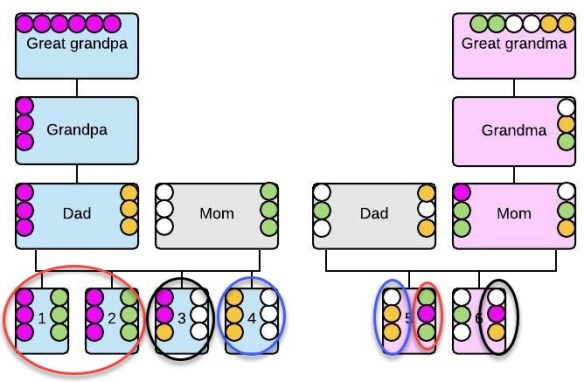
On the left-hand (blue) side of this graphic, we see four siblings that descend through their father from Great-grandpa who contributed that large magenta segment of DNA. That segment becomes reduced in descendants in subsequent generations.

In downstream generations, we can see gold, white and green segments being added to the DNA inherited by the four children from their ancestor’s spouses. Dad’s DNA is shown on the left side of each child, and Mom’s on the right.

  • Blue Children 1 and 2 inherited the same segments of DNA from Mom and Dad. Magenta from Dad and green from Mom.
  • Blue Child 3 inherited two magenta segments from Dad in positions 1 and 2 and one gold segment from Dad in position 3. They inherited all white segments from Mom.
  • Blue Child 4 inherited all gold segments from Dad and all white segments from Mom.

The family on the blue left-hand side is NOT related to the pink family shown at right. That’s important to remember.

I’ve intentionally constructed this graphic so that you can see several identical by chance (IBC) matches.

Child 5, the first pink sibling carries a white segment in position 1 from Dad and gold segments in positions 2 and 3 from Dad. From Mom, they inherited a green segment in position 1, magenta in position 2 and green in position 3.

IBC Match 1 – Looking at the blue siblings, we see that based on the DNA inherited from Pink Child 5’s parents, Pink Child 5 matches Blue Child 4 with white, gold and gold in positions 1-3, even though they weren’t inherited from the same parent in Blue Child 4. I circled this match in blue.

IBC Match 2 – Pink Child 5 also matches Blue Children 1 and 2 (red circles) because Pink Child 5 has green, magenta, and green in positions 1-3 and so do Blue Children 1 and 2. However, Blue Children 1 and 2 inherited the green and magenta segments from Mom and Dad respectively, not just from one parent.

Pink Child 5 matches Blue Children 1, 2 and 4, but not because they match by descent, but because their DNA zigzags back and forth between the blue children’s DNA contributed by both parents.

Therefore, while Pink Child 5 matches three of the Blue Children, they do not match either parent of the Blue Children.

IBC Match 3 – Pink Child 6 matches Blue Child 3 with white, magenta and gold in positions 1-3 based on the same colors of dots in those same positions found in Blue Child 3 – but inherited both paternally and maternally.

You can see that if we had the four parents available to test, that none of the Pink Children would match either the Blue Children’s mother or father and none of the Blue Children would match either of the Pink Children’s mother or father.

This is why we can’t use either siblings or close family relatives for triangulation.

Distant Cousins Are Best for Triangulation & Here’s Why

When triangulating with 3 people, the most recent common ancestor (MRCA) intersection of the closest two people is the place at which triangulation turns into only two lines being compared and ceases being triangulation. Triangle means 3.

If siblings are 2 of the 3 matching people, then their parents are essentially being compared to the third person.

If you, your aunt/uncle, and a third person match, your grandparents are the place in your tree where three lines converge into two.

The same holds true if you’re matching against a sibling pair on your match’s side, or a match and their aunt/uncle, etc.

The further back in your tree you can push that MRCA intersection, the more your triangulated match provides confirming evidence of a common ancestor and that the match is valid and not caused by random recombination.

That’s exactly what the descendants of Charles Dodson have been able to do through triangulation with multiple descendants from several of his children.

It’s also worth mentioning at this point that the reason autosomal DNA testing uses hundreds/thousands of base pairs in a comparison window and not 3 or 6 dots like in my example is that the probability of longer segments of DNA simply randomly matching by chance is reduced with length and SNP density which is the number of SNP locations tested within that cM range.

Hence a 7 cM/500 SNP minimum is the combined rule of thumb. At that level, roughly half of your matches will be valid and half will be identical by chance unless you’re dealing with endogamy. Then, raise your threshold accordingly.

Ok, So Where are We? A Triangulation Checklist for You!

I know this has been a relatively long educational article, but it’s important to really understand that testing close relatives is VERY important, but also why we can’t effectively use them for triangulation.

Here’s a handy-dandy summary matching/triangulation checklist for you to use as you work through your matches.

  • You inherit half of each of your parents’ DNA. There is no other place for you to obtain or inherit your DNA. There is no DNA fairy sprinkling you with DNA from another source:)
  • DNA does NOT skip generations, although in occasional rare circumstances, it may appear that this happened. In this situation, it’s incumbent upon you, the genealogist, to PROVE that an exception has occurred if you really believe it has. Those circumstances might be pedigree collapse or perhaps imputation. You’ll need to compare matches at vendors who provide a chromosome browser, triangulation, and full shared match list information. Never assume that you are the exception without hard and fast proof. We all know about assume, right?
  • Your siblings inherit half of your parents’ DNA too, but not the same exact half of your parent’s DNA that you other siblings did (unless they are identical twins.) You may inherit the exact same DNA from either or both of your parents on certain segments.
  • Your matches may match your parents on different or an additional segment that you did not inherit.
  • Every segment has an individual history. Evaluate every matching segment separately. One matching segment with someone could be maternal, one paternal, and one identical by chance.
  • You can confirm matches as valid if your match matches one of your parents, and you match one of your match’s parents. Parental Phasing is when your match matches your parent. Parental Cross-Matching is when you both match one of each other’s parents. To be complete, both people who match each other need to match one of the parents of the other person. This rule still holds even if you have a known common ancestor. I can’t even begin to tell you how many times I’ve been fooled.
  • 15-20% (or more with endogamy) of your matches will be identical by chance because either your DNA or your match’s DNA aligns in such a way that while they match you, they don’t match either of your parents.
  • Your siblings, aunts, and uncles will often inherit the same DNA as you – which means that identical by chance matches will also match them. That’s why we don’t use close family members for triangulation. We do utilize close family members to generate common match hints. (Remember the 20 cM shared match caveat at Ancestry)
  • While your siblings, aunts, and uncles are too close to use for triangulation, they are wonderful to identify ancestral matches. Some of their matches will match you as well, and some will not because your close family members inherited segments of your ancestor’s DNA that you did not. Everyone should test their oldest family members.
  • Triangulate your close family member’s matches separately from your own to shed more light on your ancestors.
  • Endogamy may interfere with parental phasing, meaning you may match because you and/or your match may have inherited some of the same DNA segment(s) from both sides of your tree and/or more DNA than might otherwise be expected.
  • Pedigree collapse needs to be considered when using parental phasing, especially when the same ancestor appears on both sides of your family tree. You may share more DNA with a match than expected.
  • Conversely, with pedigree collapse, your match may not match your parents, or vice versa, if a segment happens to have recombined in you in a way that drops the matching segments of your parents beneath the vendor’s match threshold.
  • While you will match all of your second cousins, you will only match approximately 90% of your third cousins and proportionally fewer as your relationship reaches further back in time.
  • Not being a DNA match with someone does NOT mean you’re NOT related to them, unless of course, you’re a second cousin (2C) or closer. It simply means you don’t carry any common ancestral segments above vendor thresholds.
  • At 2C or closer, if you’re not a DNA match, other alternative situations need to be considered – including the transfer/upload of the wrong person’s DNA file.
  • Imputation, a scientific process required of vendors may interfere with matching, especially in more distant relatives who have tested on different platforms.
  • Imputation artifacts will be less obvious when people are more closely related, meaning closer relatives can be expected to match on more and larger segments and imputation errors make less difference.
  • Imputation will not cause close relatives, meaning 2C or closer, to not match each other.
  • In addition to not supporting segment matching information, Ancestry down-weights some segments, removes some matching DNA, and does not show shared matches below 20cM, causing some people to misinterpret their lack of common matches in various ways.
  • To resolve questions about matching issues at Ancestry, testers can transfer/upload their DNA files to MyHeritage, FamilyTreeDNA, and GEDmatch and look for consistent matches on the same segment. Start and end locations may vary to some extent between vendors, but the segment size should be basically in the same location and roughly the same size.
  • GEDmatch does not use imputation but allows larger non-matching segments to combine as a single segment which sometimes causes extremely “generous” matches. GEDmatch matching is less reliable than FamilyTreeDNA or MyHeritage, but you can adjust the matching thresholds.
  • The best situation for matching is for both people to test at the same vendor who supports and provides segment data and a chromosome browser such as 23andMe, FamilyTreeDNA, or MyHeritage.
  • Siblings cannot be used for triangulation because the most recent common ancestor (MRCA) between you and your siblings is your parents. Therefore, the “three” people in the triangulation group is reduced to two lines immediately.
  • Uncles and aunts should not be used for triangulation because the most recent common ancestors between you and your aunts and uncles are your grandparents.
  • Conversely, you should not consider triangulating with siblings and close family members of your matches as proof of an ancestral relationship.
  • A triangulation group of 3 people is only confirmation as far back as when two of those people’s lines converge and reach a common ancestor.
  • Identical by chance (IBC) matching occurs when DNA from the maternal and paternal sides are mixed positionally in the child to resemble a maternal/paternal side match with someone else.
  • Identical by chance DNA admixture (when compared to a match) could have occurred in your parents or grandparent’s generation, or earlier, so the further back in time that people in a triangulation group reach, the more reliable the triangulation group is likely to be.
  • The larger the segments and/or the triangulation group, the stronger the evidence for a specific confirmed common ancestor.
  • Early families with a very large number of descendants may have many matching and triangulated members, even 9 or 10 generations later.
  • While exactly 50% of each ancestor’s DNA is not passed in each generation, on average, you will carry 7 cM of your ancestors 10 generations back in your tree. However, you may carry more, or none.
  • The percentage of matching descendants decreases with each generation beyond great-grandparents.
  • The ideal situation for triangulation is a significant number of people, greater than three, who match on the same reasonably sized segment (7 cM/500 SNP or larger) and descend from the same ancestor (or ancestral couple) through different children whose spouses in descendant generations are not also related.
  • This means that tree completion is an important factor in match/triangulation reliability.
  • Triangulating through different children of the ancestral couple makes it significantly less likely that a different unknown common ancestor is contributing that segment of DNA – like an unknown wife in a descendant generation.

Whew!!!

The Bottom Line

Here’s the bottom line.

  1. Don’t use close relatives to triangulate.
  2. Use parents for Parental Phasing.
  3. Use Parental Cross-Matching when possible.
  4. Use close relatives to look for shared common matches that may lead to triangulation possibilities.
  5. Triangulate your close relatives’ DNA in addition to your own for bonus genealogical information. They will match people that you don’t.
  6. For the most reliable triangulation results, use the most distant relatives possible, descended through different children of the common ancestral couple.
  7. Keep this checklist of best practices, cautions, and caveats handy and check the list as necessary when evaluating the strength of any match or triangulation group. It serves as a good reminder for what to check if something seems “off” or unusual.

Feel free to share and pass this article (and checklist) on to your genealogy buddies and matches as you explain triangulation and collaborate on your genealogy.

Have fun!!!

_____________________________________________________________

Disclosure

I receive a small contribution when you click on some of the links to vendors in my articles. This does NOT increase the price you pay but helps me to keep the lights on and this informational blog free for everyone. Please click on the links in the articles or to the vendors below if you are purchasing products or DNA testing.

Thank you so much.

DNA Purchases and Free Transfers

Genealogy Products and Services

Books

Genealogy Research

Haplogroup Matching: What It Does (and Doesn’t) Mean

“Our haplogroups (sort of) match, so that means we’re related, right?”

Well, maybe.

It depends.

Great Question

This is an oft-asked great question. Of course, the answer varies depending on the context of the question and what is meant by “related.” A haplogroup match may or may not be a valid match for genealogy. A “match” or a “not match” can mean different things.

The questions people often ask include:

  • Does a haplogroup have to match exactly in order for another person to either be considered a match to you?
  • If they don’t match exactly, can they still be considered as a possible match?
  • Conversely, can we rule someone out as a match on a specific genealogical line based on haplogroup alone?

These questions often arise in relation to DNA testing at Family Tree DNA, sometimes when people are trying to compare results to people who have haplogroup estimates, either at FamilyTreeDNA or from testing elsewhere.

In other words, if one person is haplogroup J and someone else is J1, either at the same vendor or at another, what does that tell us? This question pertains to both Y DNA and mitochondrial DNA tests no matter where you’ve tested.

Family Tree DNA offers different levels of Y DNA testing. Interpreting those match results can sometimes be confusing. The same is true for mitochondrial DNA, especially if your matches have not taken the full mitochondrial sequence (mtFull) test.

You might be comparing apples and oranges, or you might be comparing a whole orange (detailed test) with a few slices (haplogroup estimate.) How can you know, and how can you make sense of the results?

If you’re comparing a haplogroup between sources, such as a partial haplogroup determined by testing through a company like 23andMe or LivingDNA to complete tests taken at FamilyTreeDNA, the answer can be less than straightforward.

I discussed the difference between autosomal-based haplogroup assignments and actual testing of both Y DNA and mitochondrial DNA which result in haplogroup assignments, here. In a nutshell, both LivingDNA and 23andMe provide a high-level (base) haplogroup estimates based on a few specific probes when you purchase an autosomal test, but that’s not the same as deeper testing of the Y chromosome or mitochondrial DNA.

The answer to whether your haplogroup has to match is both “yes”, and “no.” Don’t you hate it when this happens?

Let’s look at different situations. But to begin with, there is at least one common answer.

Yes, Your Base Haplogroup Must Match

To even begin to look further for a common ancestor on either your Y DNA line (direct patrilineal) or direct mitochondrial matrilineal line (your mother’s mother’s mother’s line on up the tree), your base haplogroup much match.

In other words, you and your matches must all be in the same base haplogroup. Haplogroups are defined by the presence of specific combinations of mutations which are called SNPs (single nucleotide polymorphisms) in the Y DNA.

Click to enlarge images

All of these men on the Y DNA matches page are a branch of haplogroup R as shown under the Y-DNA Haplogroup column. There are more matches on down the page (not shown here) with more and different haplogroups. However, you’ll notice that all matches are a subset of haplogroup R, the base haplogroup.

The same is true for mitochondrial DNA haplogroups. You can see in this example that people who have not tested at the FMS (full mitochondrial sequence) level have a less specific haplogroup. The entire mitochondria must be tested in order to obtain a full haplogroup, such as J1c2f, as opposed to haplogroup J.

The Y DNA Terminal SNP Might Not Match

For Y DNA testers, when looking at your matches, even to close relatives, you may not have the same exact haplogroup because:

  • Some people may have tested at different levels
  • Some people in recent generations may have developed a SNP specific to their line.

In other words, haplogroups, testing level, and known genealogy all need to be considered, especially when the haplogroups are “close to each other” on the tree.

For Y DNA, FamilyTreeDNA:

  • Provides all testers with base haplogroup estimates based on STR tests, meaning 12-111 marker panels. These are very accurate estimates, but are also very high level.
  • Offers or has offered in the past both individual SNP tests and SNP packs or bundles that test individual SNPs indicating their presence or absence. This confirms a SNP or haplogroup, but only to that particular level.
  • Offers the Big Y-700 test, along with upgrades to previous Big Y test levels. There have been 3 versions of the Big Y test over time. The Big Y reads the entire gold standard region of the Y chromosome, reporting the known (named) SNP mutations customers do and don’t have. Additionally, the test reports any unnamed SNPs which are considered private variants until multiple men on the same branch of the Y DNA tree test with the same mutation. At that point, the mutation is named and becomes a haplogroup.

That’s why the answer is “no,” your haplogroup does not have to match exactly for you to actually be a match to each other.

A father and son could test, with one having an estimated haplogroup of R-M269 and the other taking the Big Y-700 resulting in a very different Terminal SNP, quite distant on the tree. Conversely, both men could take the Big Y and the son could have a different terminal SNP than the father because a mutation occurred between them. An autosomal DNA test would confirm that they are in fact, father and son.

However, a father and son who test and are placed in different base haplogroups – one in haplogroup I, and the other in haplogroup R, for example, has a very different situation. Their autosomal test would likely confirm that they are not father and son.

Having said this about paternity, especially if haplogroups are estimated and specific Y DNA SNP testing has not been done, don’t have a premature freak-out moment. Look at autosomal DNA, assuming you DO want to know. Y DNA alone should never be used to infer paternity without autosomal testing.

Let’s look at some examples.

Matches and Haplogroups

In the example shown above, you can see that several people have taken the Big Y test, so their SNP will be shown on further down the haplotree than those testers who have not. These are a leaf, not a branch.

You can see by looking at the Terminal SNP column, at far right, that people who have either taken the Big Y, or had any positive SNP test will have a value in the Terminal SNP column.

Anyone who has NOT taken the Big Y or taken a SNP test will have their base haplogroup estimated based on their STR tests. In this case, that estimate is R-M269. People with estimated haplogroups will not show anything in the Terminal SNP column.

It’s possible that if all of these men took the Big Y test that at least some would share the same Terminal SNP, and others might be closely related, only a branch or so different on the tree.

These men in this example are all descendants of Robert Estes born in England in 1555. All have Estes surnames, except for one man who is seeking the identity of his paternal line.

Let’s Look at the Tree

Our tester in the screenshot is haplogroup R-ZS3700 and matches men in the following haplogroups:

  • R-M269
  • R-L21
  • R-BY490
  • R-BY154784

There are a few additional haplogroups not shown because they are further down on his match list, so let’s just work with these for now.

After determining that these men are on the same branch of the Y tree, haplogroup R, the real question is how closely they are related and how close or far distant their terminal SNPs are located. More distance means the common ancestor is further back in time.

However, looks can be deceiving, especially if not everyone has tested to the same level.

The haplogroup furthest up in the tree, meaning the oldest, is R-M269, followed by the man who took the single SNP test for R-L21. Notice that R-M269 has more than 15,000 branches, so while this haplogroup could be used to rule out a match, R-M269 alone isn’t useful to determine genealogical matching.

There are a lot of branches between R-L21 and the next haplogroup on the tree.

Finally, here we go. Our tester is haplogroup R-ZS3700 that has one descendant branch. R-ZS3700 is a branch of R-BY490 that has 2 branches.

R-BY154784 is the last SNP on this branch of the tree. Our tester matches this man too.

Another way of viewing these matches is on the Block Tree provided for Big Y testers.

In this view, you can see that the Estes men all match back to about 18 “SNP generations” ago according to the legend at left, but they don’t match men further back in time who have taken the Big Y test.

Notice the up-arrow where haplogroups R-L21 and R-M269 are shown across the top of the display.

If you click on R-L21, you’ll see that that it appears about 61 SNP generations back in time.

Haplogroup R-M269 appears even further back in time, about 174 SNP generations.

The only reason you will match someone at either the R-L21 or R-M269 level is because you both descend from a common long-ago ancestral branch, hundreds to thousands of years in the past. You and they would both need to take either the Big Y-700 test for Y DNA, or the full sequence mitochondrial DNA test in order to determine your full haplogroup and see your list of matches based on those full sequences.

Public Trees

You can view FamilyTreeDNA‘s extensive public Y DNA tree by haplogroup, here.

You can view their public mitochondrial DNA tree by haplogroup, here.

And the Answer Is…

As you can see, there is no single answer to the question of haplogroup relationships. The answer is also partly defined by the context in which the question is asked.

  1. For two men to be “related” on the Y DNA patrilineal line, yes, minimally, the base haplogroup does have to match. Base haplogroups are defined by the leading letter, like “R” in the examples above.
  2. “Related” based on base haplogroup only can be hundreds or thousands of years back in time, but additional testing can resolve that question.
  3. “Related” can mean before the advent of surnames. However, a match to a man with the same surname suggests a common ancestor with that surname in the past several hundred years. That match could, however, be much closer in time.
  4. For two men to be closely related, assuming they have taken the same version of Big Y test, their haplogroup branches need to be fairly closely adjacent on the haplotree. FamilyTreeDNA will be introducing haplogroup aging soon, meaning SNP/haplogroup branch dates on their haplotree. At that time, the “distance” between men will be easier to understand.
  5. You can exclude a genealogical relationship on the direct paternal line if the two men involved have a different base haplogroup. This question often occurs when people are trying to understand if they “might match” with someone whose haplogroup has been estimated.
  6. This holds true as well for mitochondrial DNA haplogroups and matching.

And there you have it, six answers about what haplogroup matching does and does not mean.

The bottom line is that haplogroups can be a great starting point and you can sometimes eliminate people as potential matches.

However, to confirm genealogical matches, you’ll always need more granular testing that includes actual Y DNA or mitochondrial DNA matching based on marker mutation results, not just haplogroups.

_____________________________________________________________

Disclosure

I receive a small contribution when you click on some of the links to vendors in my articles. This does NOT increase the price you pay but helps me to keep the lights on and this informational blog free for everyone. Please click on the links in the articles or to the vendors below if you are purchasing products or DNA testing.

Thank you so much.

DNA Purchases and Free Transfers

Genealogy Products and Services

Genealogy Research

Books