Jacques LePrince (c1646-1691/3): Acadian Mystery Man – 52 Ancestors #470

Despite my attempts at clarity, the early life of Jacques Le Prince remains a mystery, as does his death.

We can’t prove anything about Jacques’ early years at this point, but there are possibilities that need to be considered and evaluated.

It’s likely that Jacques was born in France, around 1646, according to a later census.

The Carignan Regiment?

A man named Jacques Prince, or LePrince, was a member of the 1300-man Carignan Regiment, which was dispatched to New France from 1665 to 1667 to fight the Haudenosaunee, an Iroquoian confederacy. Their numbers were impressive, but the French soldiers were ill-prepared for the type of fighting they would encounter on the frontier.

After peace was declared in 1667, most of the soldiers returned to France, but not all. France offered attractive incentives for those who wished to stay and settle, including land, a year’s worth of provisions, and a sum of money dependent upon the soldier’s rank.

About 400 stayed, and 283 are known to have married near Quebec where many Acadians would one day take refuge after the 1755 Expulsion, including Jacques’ grandchildren.

However, that leaves about 120 Carignan soldiers unaccounted for.

One Jacques LePrince is on the regimental list of soldiers in the Laubia company.

A WikiTree contributor provides the following summary. I have fixed the broken links in this version.

According to an article by Chantal Gaillardetz Bourque, “Les Prince,” [7] and to various compiled genealogies, a soldier named Jacques Leprince (or Prince) appears in lists associated with the Carignan-Salières Regiment. There was a Jacques Leprince or Prince in the regiment’s list of soldiers.

It is claimed that he embarked from La Rochelle aboard “Le Saint-Sébastien” on 24 May 1665 and arrived at Québec on 12 September 1665. Two days later, members of the Laubias Company reportedly traveled to Trois-Rivières aboard La Justice, where they remained until about 1668.

A Jacques Leprince, aged 25, is said to appear in the 1666 census of Trois-Rivières as a servant in the household of the notary Sévérin Ameau. Stephen White questions whether this individual can be identified with the Jacques Leprince who later married Marguerite Hébert in Acadie. [1] It is also believed that after being discharged from the Regiment, Jacques went to Acadia, around 1667.

The website migrations.fr, citing Roy and Malchelosse, notes that the surname Leprince does not appear in the official roster of the Laubias Company, but is mentioned elsewhere in the same source.

(My note.) Page 111 in the same volume for soldiers not included on the roll who returned to France or remained in Canada. The soldiers are listed by their nicknames. This means that if this is our Jacques, his actual surname may not have been Prince or LePrince. We need a LePrince man proven to descend from Jacques through all males who is willing to take a Big Y-700 test. I’m offering a  DNA testing scholarship, so please reach out.

From this, some authors infer that the soldier and the Acadian settler were the same person; however, no direct documentary link has been demonstrated. [9]

Other writers further hypothesize that Jacques Leprince was born about 1641 in Normandy, the son of Nicolas Leprince, seigneur de la Bretonnière, and Judith Hurault. This lineage is based on interpretive readings of heraldic material rather than on contemporary civil or parish records.

Another person also states, with no evidence, that Jacques was actually named Jacques Nicolas LePrince and was born in St. Malo.

Cousin Mark did a deep dive into the French records at Filae and reports:

There is absolutely no evidence that Jacques Le Prince was born in Normandy or the son of anyone from there.

The soldier Jacques Le Prince recorded in the 1666 census for Trois-Rivières as domestique for the notary Sévérin Ameau shows an age of 25, so born about 1641, not 1646.

On 3 Nov 1667 he appears as witness to the marriage of Noël Laurence dit l’Orange, a soldier in the Lafouille Company, at Trois-Rivières; he is identified as “soldat nommé LePrince de la compagnie de Loubias”. Likely the same Jacques Le Prince appears as a witness on 15 Apr 1671, to the marriage of Paul Daze, an immigrant from Loudun and an older widow Françoise Goubillo, which raises an interesting thought. This Jacques Le Prince no longer appears in the records of Québec.

While PRDH and others have linked the soldier Jacques Le Prince with Acadian Jacques Le Prince, there is no additional evidence to do so. Stephen White had reason to wonder if the two are the same.

It is even possible that Le Prince was a “dit” name given to the soldier, just as Julien Lore/Lord dit La Montagne was usually referred to by his “dit” name in Acadia. There are several family trees on Filae.com with a Jacques Prince/Le Prince scattered throughout Southwest France, the recruitment area for the Carignan-Salières Regiment and the Loubias/Laubia company. It was not Normandy.

This information makes me wonder if there were actually two men named Jacques LePrince in the Quebec area at the same time. One, a soldier, while the other, is, at the same time, a valet for the notary. It seems impossible that one person is serving in both positions at the same time, but I don’t know.

Is this the same Jacques Le Prince or Prince that married Marguerite Hebert in Acadia sometime between 1671 and 1678? We don’t know.

Keep two things in mind:

  • The English had captured Port Royal in Acadia in 1654, but it was returned to France by treaty in 1667. However, it wasn’t until September of 1670 that the new French governor was established, marking the effective return of Acadia to French control. It’s unlikely that Jacques LePrince, the soldier, would have made his way to Port Royal until after it was firmly under French rule.
  • Jacques LePrince, who may or may not be our Jacques LePrince, witnessed a marriage in April of 1671, in Trois-Rivieres.

What We Do Know

The first actual record that we have that positively includes “our” Jacques LePrince in Port Royal, or anyplace, is the 1678 Acadian census.

Jacques “La Prence” and Marguerite Hebert are listed with one child, a female, 2 arpents of land, and 8 cattle. Their household is located far upriver, between Olliver Daigre and his wife, Marie Godet, and neighbor, Jean Hebert, northeast of Bridgetown today.

Essentially, Jacques LePrince and his family inhabit one of the furthest homesteads from Port Royal, some 18 miles upstream as the crow flies, but Jacques would have been paddling a canoe through all of the twists and turns in the river – so probably more like 25 miles to get to town, or church.

This census suggests that Jacques and Marguerite Hebert were married by at least 1677 if they had an infant daughter. The child’s age is not recorded.

However, there’s evidence to suggest that they might have been married by 1671. In the 1671 census, Marguerite Hebert, age 19, is listed with her widowed mother, and the census indicates that she is one of two married daughters. In the 1671 census, typically the married children are listed with their parents, PLUS in their own household – but there is no hint of Marguerite in any other household, nor is Jacques LePrince listed. The other married daughter, Marie Hebert, age 20 with three children, is living next door with her husband Michel de Forest.

Relative to Jacques LePrince, there are two flies in this ointment.

The first Acadian census was taken in the spring of 1671 following the new governor’s arrival in September of 1670. We know the census was taken sometime in the spring of 1671, because the passengers on the ship, L’Oranger, which left La Rochelle in the spring, so probably arrived May-ish, were not recorded in the census. This includes Pierre Arsenault, Martin Benoit and wife Marie Chaussegros, and possibly Francois Broussard which means they arrived after the census had already been taken.

Therefore, if Jacques LePrince was witnessing a marriage in Trois Rivieres in mid-April 1671, he probably didn’t have a wife in Port Royal. Not to mention that those locations are hundreds of miles apart, and transportation was challenging. While an overland walking route is shown above, it would have been very dangerous and quite long. The typical journey was on a ship, traveling down the Saint Lawrence River, crossing the open sea, then circumnavigating Nova Scotia to Port Royal. The trip took between one and three months, depending on the weather.

I’m not saying that the Jacques in Quebec isn’t the Jacques in Port Royal, I’m saying we need to consider this possibility carefully, all things considered.

The second potential fly is that the 1671 census says that Marguerite Hebert, age 19, was married – but it doesn’t say to whom. It’s possible that she had married but was  widowed by 1671, but had remarried by the 1678 census when she is found with Jacques LePrince.

It’s also possible that Jacques LePrince was on the ship, L’Oranger that arrived in Port Royal from France later in 1671 with 50 new colonists.

If Jacques and Marguerite had children before their daughter, Marguerite, was born around the time the 1678 census was taken, those earlier children had all died prior to the 1678 census.

In 1678, Jacques La Prence and Marguerite Hebert are living between Oliver Daigre and his wife, Marie Godet, and Jean Hebert. In 1715, Jacques’ son, Jean LePrince would marry the widow of Oliver Daigre’s son, Oliver. Jean Hebert is Marguerite’s brother.

In 2024, I located the Daigle homestead near Button Brook, east of Bridgetown.

The Daigle homestead is shown here on the MapAnnapolis map.

In the 1686 Port Royal census, Jacques LePrince is age 40, so born about 1646, and shown with his wife, Marguerite Hebert, 35, with 4 children, 5 sheep, and 3 hogs. Children’s ages and names are listed for other Acadian couples, but frustratingly, not for Jacques and Marguerite’s children. No land is listed either, nor does Jacques own a gun, which is very difficult to believe. We really can’t tell where he’s living based on his neighbors, although it’s likely that they are living in the same location as 1678. I suspect they are living very remotely – and the census taker simply didn’t visit. Hence, the omission of data.

Jacques’ name is also absent from the 1690 mandatory loyalty oath to the English crown, forcibly signed under duress in Port Royal by all the Acadian men. The English clearly weren’t coming to find him in the hinterlands.

The Move to Minas

It’s difficult to know whether to interpret the lack of his 1690 signature as evidence of the fact that he lived so far away, meaning upriver beyond Bridgetown, or evidence that he had already taken his family and settled at Minas, which is also possible. If he hadn’t already left, the unprovoked 1690 attack on Port Royal by the English, followed a few months later by a second pirate attack, may have been what prompted that move.

In the 1686 census, 10 families had already settled at “Baye des Mines,” including Marguerite’s brother, Etienne (Estienne in the census) Hebert, who married Jeanne Comeau, and Marguerite’s sister, Catherine Hebert, who married Philippe Pinet.

By the 1693 census, Jacques Le Prince and his family had moved to Minas, and Jacques had died, probably either in Minas or Pisiquid, but we will never know for sure. Both are possibilities. It’s also possible, but extremely unlikely, that Jacques died in Port Royal and Marguerite joined her family in in the Minas Basin.

Marguerite Hebert, Jacques’ widow, is listed in the census as age 40, with:

  • Daughter Marguerite, 15 (so born about 1678)
  • Twins Francois and Jacques, 13 (born about 1680)
  • Estienne, 5 (born about 1685)
  • Francoise, 1 (born about 1692)

Francoise may be incorrect. Francoise may have been their youngest son, Jean LrPrince, unless Francoise died young and Jean was actually born in 1693 after the census had already been recorded.

Another child;s name was misrecorded too. Based on later marriage records, the twin named Jacques here was actually named Antoine.

Were their children mis-recorded because they were newcomers to the area, or perhaps because they were living very remotely again?

This tells us that Jacques LePrince died between 1691 when Marguerite would have become pregnant for the child who was listed as “1” in 1693, and when the census was taken that year. Unfortunately, there are no parish registers prior to 1707, so Jacques’ death is not recorded.

If daughter Marguerite was 15 in 1693, then she would have been born about 1678, which correlates with the 1678 census when one female child was listed.

This means that Marguerite and Jacques were probably married by 1676 or 1677, or if they married earlier, prior to the 1671 census, their children born between their wedding and Marguerite’s birth about 1678 had all died.

Life at Grand Pre and Minas

Pierre Melanson and his family led the way to Minas between 1682 and 1684, followed by others. The first families to settle in Grand Pre in the Minas Basin would have selected land close to each other. One of the first group activities was probably to dig a well and build a small church, home of the St. Charles aux Mines Parish, founded in 1686. Of course, that church was probably improved and expanded in later years before being destroyed by the English in 1755.

The church at Grand Pre has been rebuilt and preserved, welcoming visitors today.

Inside the church, mirrors are beautifully engraved with the names of the early families as recorded in the parish register. Our Le Prince family is honored here, shown to the right of my black bag.

I don’t know if this was the intention or not, but as I looked at their name, and me, in the mirror, I’m looking at a little bit of them.

Jacques LePrince would have worshipped here. At least his youngest child, and perhaps more of his children, would have been baptized here if they actually lived at Minas when the family first moved to the Basin from the Riviere Dauphin, as the Annapolis River was called then.

Ten households consisting of 57 people were recorded in the 1686 census.

Probably encouraged by Marguerite’s siblings who had already made the move, Jacques and his family arrived sometime during the next seven years, likely with a group of Port Royal families who made the journey together. When the next census was taken in 1693, there were 307 people living in 55 homes. The population had increased more than fivefold.

The labor, as well as the fruits of that labor, were shared.

Jacques probably helped plant this orchard, but he never lived long enough to reap those benefits. His wife and children may have.

If he didn’t plant this orchard, he surely planted one similar.

A community well was dug which tells us that the inhabitants lived in close proximity.

This particular well is believed to have been used to water livestock.

How many times did Jacques dip the wooden bucket in the well for fresh water?

Standing beside the church, as Jacques surely did, we see the Bay of Fundy in the distance, across the salt marsh fields.

The millstone lying beside the church today speaks of grinding crops – wheat, oats, barley, rye and sometimes buckwheat. Grains essential to their survival and particularly suitable for production in the rich reclaimed marshlands.

Flowers line the walkway between the church, the well, and the cemetery.

If Jacques died in close proximity to the church, and a priest was available, his funeral mass would have been celebrated in this sacred place.

A stone cross marks the location of the cemetery and honors the Acadians who are buried here. This cemetery location was confirmed when coffins were found in the late 1800s.

Incomplete parish records show about 170 burials, but historians believe there are probably around 400 located between the church and the road.

Graves would have been marked with white crosses when they were fresh, but anything left was destroyed by the English during and after the Expulsion.

This French Willow tree was probably standing when Jacques and the Acadian men were fetching water from the well and planting the orchard.

This tree probably was too. They may have been planted by the Acadians.

Initially, Jacques may have lived within walking distance of the church.

We don’t know when settlers migrated away from the Minas area to Pisiquid and the Riviere Hebere.

We don’t know where or how Jacques died. He was still a relatively young man, between 45 years old in 1691, and 47 in 1693, his bracketed death dates.

Jacques could have perished in the sea, the river, or in the back country. If so, there would have been no funeral or graveyard burial.

He could have died at home, perhaps from a farming accident, an infection or illness that we have medicines to effectively treat today.

If the family actually did live at Minas, at least initially, and not distantly, he would have been buried in the cemetery beside the church in Grand Pre, in consecrated ground.

Today, we can sit quietly and reflect, knowing that their graves surround us.

Perhaps Jacques’ spirit came to visit in the form of this raptor. Was he carrying a message?

Do they know we’ve come to visit them?

Given the early date of Jacques LePrince’s death, it’s possible that the original settlement group was still clustered together and the next wave of settlers had not yet begun reaching out further to establish homesteads.

That said, we really don’t know exactly when the new frontier summoned several families to move on. We do know that Jacques certainly wasn’t concerned about living some distance away from the main village.

We also know, from priests’ records, that Father Jean Buisson de Saint-Cosme served Minas from 1692-1698. There were significant periods when the area, especially the villages established further east, at or near Pisiquid, were without priests or churches.

Riviere Hebere

Based on this 1755 map of Minas, it’s possible that the Jacques LePrince and Marguerite Hebert family lived a significant distance away from Minas and Grand-Pré itself, near the arrow indicating the Riviere Hebere.

When did the early families settle at Pisiquid, relatively distant from Minas? Did family groups settle into small villages there directly, and not establish themselves at Minas first?

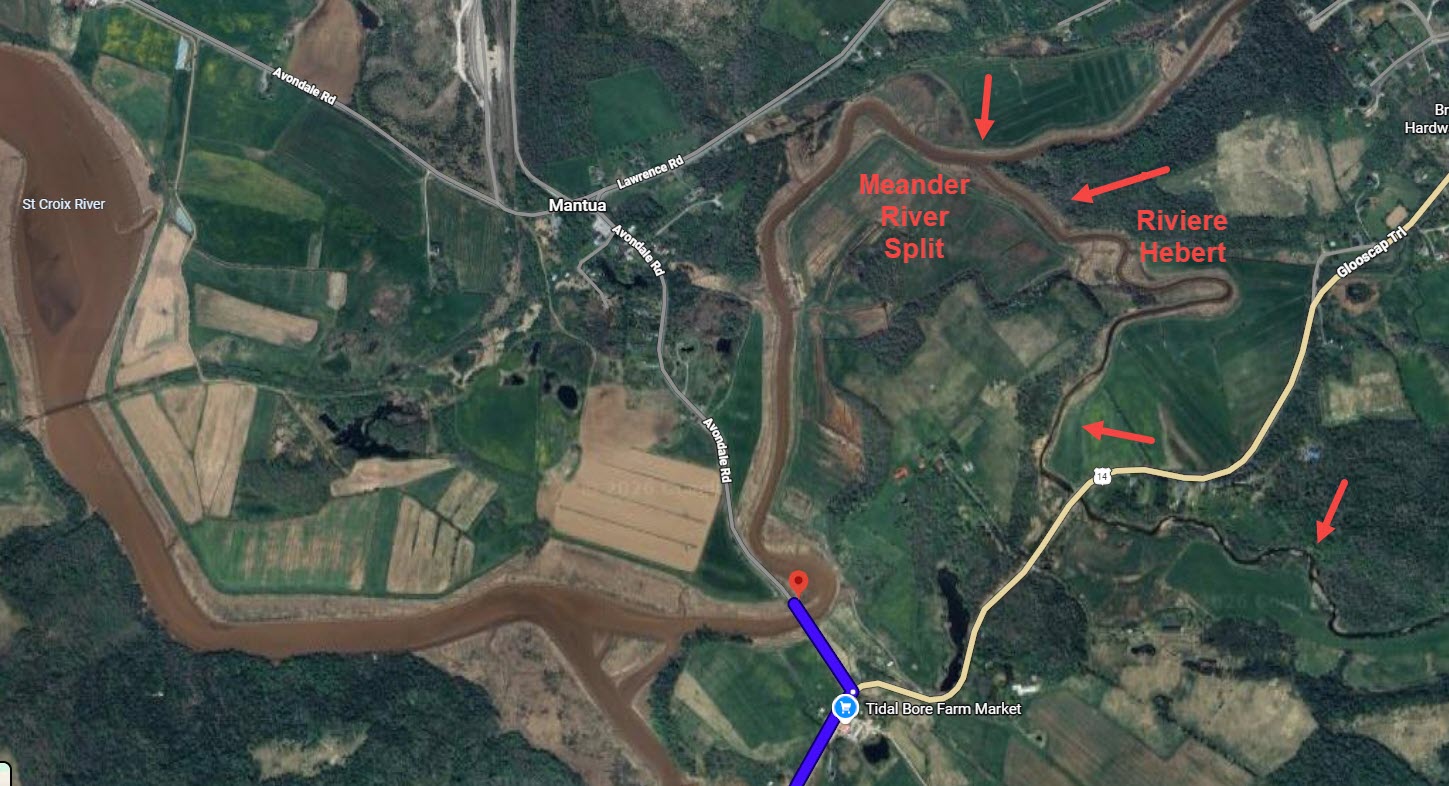
Today, the Riviere Hebere, now the Herbert River, is beyond the St. Croix River that branches into the Meander River, then branches again into the Herbert River to the east of Mantua.

Tidal bore rivers provided fertile salt marshes that were dyked and drained using sluices.

The Grand-Pré National Historic Site provides a wonderful museum that, among other things, illustrates the Acadian farming practices.

Sluices let the rainwater escape as the wooden flap opens, then closes to prevent seawater from flooding the fields.

Remnants of the old aboiteau drainage systems are regularly unearthed, more than 300 years later.

This area would have felt quite familiar to Jacques LePrince and the Acadians, as it is located on a tidal bore river that required dyking and draining through a complex series of aboiteau and sluices – just like Port Royal.

You can read more about the Herbert River, here. Be sure to download the pdf file for wonderful maps.

Tidal rivers always look brown thanks to the constant churn of the mud from the bottom of the river as the tide rushes in and out twice each day.

The Herbert River stretches many miles inland but loses the tidal bore effect at the point where the brown coloration changes on the map. Acadians were experts at reclaiming and farming tidal marshland. In fact, the more marsh, the better, so they would have settled and farmed the area near the Meander River split.

If, in fact, Jacques LePrince did live among the Hebert family in the remote area near Mantua, it’s no wonder the census taker listed his children incorrectly. The census taker may have been the priest, and you can bet the only time those in the remotest regions saw the priest was when he passed through from time to time, baptizing babies and hoping for a friendly place to stay. Maybe he asked someone who came to town, “Who else lives out there?”, and recorded what they said.

The overarching theme, to this point in Jacques’ life, is that he lived in the most remote part of Port Royal at Paradis Terrestre, possibly followed by the most remote part of the Minas Basin at Pisiquid.

The curves of the Meander River as seen from Avondale Road near the Mantua Bridge, although we don’t know if this was considered part of the Riviere Hebere at the time. It’s still quite remote, and there are few roads.

As I look at this tidal river, I can’t help but wonder if Jacques got too close when the tide was rushing in or out. It’s quite dangerous, and nothing like the tidal river at Bridgetown which is barely visible and quite tame by comparison. This YouTube video is taken at nearby Moncton, but you can see the huge wave and the person riding the surf in front of it. This video shows the smaller tidal bore on the St. Croix River further inland.

Crossing the Mantua Bridge. You can see progressive photos of the tidal bore, here. This is probably very close to, or where the Hebert family village was located, and where Jacques would have lived if they had established homes here before he died.

By the time you’ve driven just a mile or so further east of the bridge, the terrain has changed and is no longer primarily salt marsh, although it’s still tidal to some extent. I see marshlands to the right, but not on the left-hand side.

This part of the Herbert River shoreline would probably not have been cultivated by the Acadians.

The Herbert River is heavily forested here and would have been the abode of the friendly Mi’kmaq people. Today, there are hiking trails.

Remote Parishes and Parishioners

The original parish at Pisiquid, Sainte Famille, was established in 1698. Priests traveled throughout the region and served several parishes. If Jacques lived here when he died, his Acadian neighbors would simply have taken care of business and buried him someplace dry.

When no priest was available in a remote location, a community elder or family member would have lead prayers, prayed the rosary, and said funeral liturgies, similar to a memorial service or less formal celebration of life, today.

The family may have held a veillée, similar to a wake, where the family surrounds the deceased all night, lighting candles, praying the rosary and singing hymns. This served as a form of protection and support for the family, especially in the absence of clergy.

The following day, the family or a neighbor would perform a “dry” funeral, sprinkling holy water if it was available on the casket and grave, before a reading and the burial. When a priest did visit, often months later, he would officially bless the deceased person, maybe perform a funeral mass, and record the burial in the parish register that he carried with him.

In 1996, a work crew accidentally unearthed bones on Gabriel Road in the Mountain View Subdivision near Falmouth. More than two dozen graves were identified along with artifacts dating to the 1700s. Additional analysis of the site showed roughly 300 burials and the lot next door was identified as the original location of the Sainte Famille church.

The church would have been located in the center of the Acadian community. While the original families may have initially used a house or barn as a church, they would have established a graveyard with the first community death, and the ground would have been consecrated as soon as possible. The subsequent church was probably built adjacent to the cemetery.

A memorial park was established at 419 Gabriel Road between the homes.

While closer than Minas, this location was still far from what would eventually be marked on the map as the Riviere Hebere. It was also difficult to get there from the east side of the river, which is why another parish. L’Assumption, was established in 1722 in the location where Fort Pisiquid, then eventually Fort Edward, would one day be located. This church was torn down in 1750 when the English erected Fort Edward, but there are assuredly burials there as well.

That’s still not convenient to the families living at Riviere Hebere – at least six miles distant.

Interestingly enough, there were also two known family chapels, one at Ville Foret and one in the Trahan Village. We don’t know when they came into use, but it’s very likely that no one transported their deceased family members across heavily tidal rivers to Sainte Famille once they had established their homesteads in the furthest eastern area of Pisiquid. It’s most likely that the LePrince family worshipped in the Trahan Chapel, or perhaps in their own home in a personal chapel that has evaded recorded history.

Did the early Acadian group settle at Saint Famille and then spread further east? Where was Jacques Le Prince living when he died, leaving his wife, Marguerite Hebert, with a 15-year-old daughter, 13-year-old twin boys, a 5-year-old, a daughter shown as one, plus Jean, his youngest son who was either mis-recorded as Francoise, or was born in 1693 after the census, to a mother who was already widowed?

Jean was the son Jacques would never know.

Fortunately for Marguerite, in 1693, after Jacques had died, of the 55 households in Minas, 7 held her closest relatives, including:

  • Her brother, Estienne Hebert (already there in 1686)
  • Her sister, Catherine Hebert, who married Philippe Pinet (already there by 1686)
  • Her brother, Michel Hebert, 24, married to Isabelle Pelerin
  • Her sister, Martine Hebert, 27, married to Nicolas Barillet or Barrieu
  • Her brother, Jean Hebert, 33, married to Jeanne Doiron
  • Her nephew, Jean Hebert, 40, who married Anne Doucet
  • Her niece, Catherine Hebert, 32, married to Jacques LeBlanc

Marguerite would have needed all the support she could get without Jacques. To the best of our knowledge, she never remarried.

It appears that when they moved to Minas, Jacques did not sell his land upriver from Port Royal. Truthfully, few would have wanted to be that distant from other settlers, market and trade opportunities, the mill, or the church. Maybe the famly wasn’t sure they wanted to stay in Minas and decided to try it out, retaining the option to return.

Two Decades Later, Jean LePrince Returns to Paradis Terrestre 

Jacques’ youngest son, Jean LePrince, born either just before or just after his death, returned to Port Royal in 1715 to marry and farmed what appears to be his father’s land near present-day Bridgetown. Then, Bridgetown was known as the Gaudet Village. An important tidbit is found in an article written by Vincent Prince in 1968 where he states of his extensive research:

First, tradition holds, according to Monsignor Louis Richard and Lucien Serre, that Jean Prince inherited the land that his father had kept at Port-Royal when he moved to Pisiguit after 1686. Moreover, thanks to a member of the Genealogical Society Canadian-French, Mr. Marcel Dubois, married to a Doucet, I was able, recently, to become acquainted with old papers preserved in the archives of this Doucet family concerning certain transactions carried out by Jean Prince.

These contracts identify the exact location of Jean’s land, northeast of Port Royal.

Given the landmark of “Paradis Terrestre”, which still exists today, and a description of the waterways, I was able to locate the land that probably belonged to Jacques LePrince.

Looking south.

Looking north, across the Riviere Dauphin (Annapolis River) in the distance, viewing North Mountain on the horizon. If this is not Jacques’ exact land, then his land was nearby.

It was this mountain range over which Jacques’ grandchildren would escape in the bitter winter of 1755, first to Morden beach, then on to Quebec.

Jacques’ son, Jean, along with about 200 other refugees who escaped the brutal English didn’t survive the winter on Morden Beach, where this cross stands today, but some of Jean’s children did.

Had Jacques disposed of this land when he took his family to Minas, then Jean’s family would not have been living in the best possible escape point in all of the Annapolis River Valley. So, two generations and half a century later, Jacques saved them! But I digress…

As we continue to sift through the clues, it’s also worth noting that Vincent Prince’s narrative mentioned Jacques LePrince moving to Pisiquid, not Minas. Of course, we don’t know if Vincent had informatoin that we do not.

The road from Minas, past where Fort Edward (originally called Pisiquid Post and Pisiquid Fort) would be constructed in 1750, and passing the Riviere Hebere, is labeled as “Road to Pizaquid.”

You can see the same family groupings that we find at Port Royal.

Foret is Forest, who owned land near Jacques LePrince and the Heberts, all neighbors living upriver from Port Royal on this 1733 map.

Piziquid, spelled multiple ways, reflected the Mi’kmaq place name of Pesikitk which means “to flow splitwise” or “junction of waters,” and refers to the Avon River basin and fork area, including the St. Croix River.

This 1744 map shows the broader region, including Les Mines, the basin, “le Grand Praye ou les Mines”, which is Grand Pre, the Pigiquit river, the “Pigiguit Village Sauvage” which is the Mi’kmaq village standing where Assumption Parish was established in 1722, and Fort Edward would be built in 1750, then the Riviere St. Crois to the right. The settlement at Cobeguit (Cobequid) is shown to the right of the Minas Basin.

You can read more about the early settlement of Pisiquid in an article by archaeologist Jonathan Fowler, here.

One Final Hint – Maybe

Although beginning a decade after Jacques’ death, we have records the marriages of four of Jacques’ children.

Records exist in the St. Charles aux Mines Parish in Grand Pre beginning in 1707.

In the “Mines” parish registers, we find three LePrince marriages:

  • Antoine Prince, (Jacques Prince, decd, and Marguerite Hebert, of the parish of des Mines), married May 23, 1712 Anne Trahan (Guillaume Trahan and <omitted>, habitants of Piguguit) witnesses Jacques Terriot, signed, Pierre Forets, signed, Guillaume Trahan, mark, Francois Michel, mark, Antoine Prince, mark, Anne Trahan, mark. Triple wedding with Louis Sire/Marie Joseph Michel and Francois Prince/Catherine Benois (SGA-1,11)
  • Francois Prince (<omitted> and Marguerite Hebert) married May 23, 1712 Catherine Benois (Martin Benois and Marie Chosegros of Pigiguit) witnesses Jacques Terriot, signed, Pierre Forets, signed, Guillaume Trahan, mark, Francois Rimbauld, mark, Pierre Benois, mark, Francois Michel, mark, Francois Prince, mark, Catherine Benois, mark. Triple wedding with Louis Sire/Marie Joseph Michel and Francois Prince/Catherine Benois (SGA-1,11)

Interestingly, Jacques and Marguerite are listed as members of the “des Mines” parish, not Saint Famille at Pisiquid. This strongly suggests they were originally members there, so may have initially lived in Minas.

This triple wedding was performed by the priest of St. Charles aux Mines, and must have sufficed as a joyful regional reunion. Both brides, Anne Trahan, and Marie Chosegros lived at Pisiguit. The Trahan family is one of the neighbors of the Hebert family at Pisiquid, as is the Foret family.

Jacques’ daughter, Marguerite, married in 1734.

  • Marguerite LePrince (Jacques LePrince and Marguerite Hebert, both decd) married 27 April 1734 (dispensation for third degree consanguinity) Jean Hebert, habitant of Cobedic (Jean Hebert and Anne Doucet, both decd) witnesses A. Bourg, priest writes for Alexandre Bourg, Jacques LeBlanc, signed, Pierre LeBlanc, mark, Bellile, signed, Jean Hebert, mark, Marguerite LePrince, mark (SGA-2, 201-202)

Cobedic is also referred to as Cobequid

In the 1751 Acadian census for this area, there are four Jean Heberts, and all four are living among the 20 families at “Riviere des Mines ou Riviere des Hebert.”

It’s also worth noting that there are no LePrince burials in the St. Charles aux Mines parish register, which suggests that they were not living at Minas. Furthermore, you can’t court and marry people you don’t see – so that’s probably why there was a double wedding of the LePrince boys to brides from Pisiquid. It was a long way to travel for a wedding, so three couples took advantage of the opportunity when the stars aligned, the weather was good, and the priest was present.

The parish registers for both Pisiquid and Cobequid are lost, and only two burials at Pisiquid are recorded in the St. Charles aux Mines register.

In 1715, Jacques’ youngest child, Jean LePrince, married in Port Royal. Jacques was listed as deceased, but Jean’s mother, Marguerite was listed as a resident at Minas.

We know that Jacques’s wife, Marguerite, died sometime between 1715 and 1734, and there is no burial record in the existing Minas register, so it stands to reason that she was living at, and eventually buried someplace else – probably at Pisiquid.

At least one child died after the family moved to the Minas region. In the 1693 census, Estienne was 5 years old, but we find no further record. No marriage and no burial. If the family lived at Minas, and Estienne died, he would have been buried in the St. Charles aux Mines cemetery. If Estienne died at Pisiquid, no record remains.

If Francoise LePrince was recorded correctly in 1693, and wasn’t mistakenly entered in place of Jean, she died too. Again, there’s no record in the Minas parish register.

Last, there are no baptisms for Jean LePrince, nor any of the children of either Francois LePrince or Antoine LePrince who married in 1712, yet we know conclusively that they had children.

While we don’t know where the family was living in 1692 or 1693 when Jacques died, they were assuredly living in Pisiquid after 1707 when other records should have been showing up in Minas parish registers if they lived there.

In 1714, both Antoine LePrince and Francois LePrince are recorded in the census “de la Riviere Pisiguit.”

I wish we had a more definitive answer for Jacques’ early life, as well as the end of his life – an event that, tragically, occurred far too soon, leaving a young family.

We will just have to settle for a rosary that would have assuredly graced Jacques’ life and probably his home altar, left by an Acadian descendant on the base of the cross honoring all Acadians at Horton’s Landing, overlooking the Minas basin at Grand Pre.

_____________________________________________________________

Share the Love!

You’re always welcome to forward articles or links to friends and share on social media.

Subscribe!

If you haven’t already subscribed, it’s free. You’ll receive an e-mail whenever I publish by clicking the “follow” button at the top of the main blog page, here.

Help Keep This Blog Free

I receive a small commission when you click a vendor link in my articles and purchase that item. This does NOT increase your price but helps me keep the lights on and this informational blog free for everyone. Please click on the affiliate links in the articles or to the vendors below if you are purchasing products or DNA testing.

Thank you so much.

DNA Purchases and Free Uploads

Genealogy Products and Services

My Books

Genealogy Books

Genealogy Research

Jean LePrince (1692-1750/1762): Lawsuits, Contracts, Conflict and Redemption – 52 Ancestors #469

Jean LePrince was born to Jacques Le Prince and Marguerite Hebert around 1692 probably in Minas, based on the 1693 census. He could also have been born in Grand-Pré, which is only about 10 miles from various portions of Minas, also known as Les Mines.

Grand-Pré was settled about 1680, and Les Mines about 1682.

In 1686, Jean’s parents were living in Port Royal, but by 1692, they had relocated. The Heberts were one of the founding families in the Minas basin, which included Grand-Pré and Les Mines.

This map was drawn in 1755, 63 years after Jean was born, but you can see the location of the Riviere Hebere. This may well be where the Hebert family lived, which would include Marguerite, who would have settled among her family.

Sadly, Jean LePrince never knew his father, because his father died sometime after his conception in either 1691 or early 1692, and before the 1693 census where his mother is shown as a widow in Minas. To be clear, there is no differentiation in the census between Grand-Pré and Minas.

Marguerite Hebert, widow of Jacques LePrince, age 40, is recorded with daughter Marguerite, 15, Francois and Jacques, 13-year-old twins, Estienne, 4 and Francoise 1. She is one of two widows living among 52 households, with a total of 307 residents.

Jean was apparently misrecorded as Francoise, unless Jean’s mother was pregnant with him when the census was taken. Two other children’s names or ages were misrecorded as well. This makes me wonder if the person who took the census didn’t actually know the family, or didn’t know them well, and was recording the children’s names from memory – or based on what other people told them. This might suggest that the family didn’t actually live in Grand-Pré where the church was located, because it would have been easy for the census-taker to visit their home there. If they lived more remotely, the temptation to record the family members without visiting would have been greater. Apparently, census-takers haven’t changed much over time.

Jean LePrince Marries

We know for sure that Jean LePrince was the son of Jacque LePrince and Marguerite Hebert because his marriage record to Jeanne Blanchard in Port Royal, on January 30, 1715, tells us as much.

In 1715, Jean’s mother was still living in Mines. Jean, about 23 years old, probably met the widow, Jeanne Blanchard, while trading or visiting relatives in Port Royal.

Jean LePrince did not sign his marriage document, but his wife, Jeanne Blanchard signed with a mark, as did Guillaume Blanchard and Emmanuel Hebert. Guillaume Blanchard , J Dugas and Bernard Godet all signed with signatures as witnesses.

Jeanne Blanchard was the widow of Olivier D’Aigre, Daigre or Daigle, and was about a decade older than Jean LePrince. When they married, she had six children ranging in age from 5 to 14. Olivier Daigle had died in September of 1709, and Jeanne had not remarried.

At his wedding, Jean LePrince became the stepfather to Jeanne’s children, the eldest of whom had been born when Jean was about 9.

Jean and Jeanne had five more children who were baptized by the local priest. .

We know that Jean LePrince stayed in the Port Royal region because he was present for the marriages of his children in 1734, 1738, 1740, 1747 and 1750.

On November 24, 1738, Jean’s son, Honoré Le Prince, age 22, married Isabelle Forest, age 28. Both her father, René Forest, and Jean LePrince signed.

Jean signed again in 1747 when his son, Jean Baptiste LePrince, married Judith Richard.

Jean actually signed for three of his children’s marriages, but did not sign in 1750. However, he is not listed as deceased in Pierre LePrince’s 1750 marriage record in the parish register.

Interestingly, Jean’s three eldest children married children of his neighbors, René Forest and his wife, Francoise Dugas.

Jean’s Land

We know where Jean’s land was located, thanks to a 1733 map.

When I visited Nova Scotia in 2024, I was able to locate at least the general area where Jean LePrince lived and raised his children.

A cemetery is located beside the road today.

The LePrince land is someplace near Button Brook on the south side of the Annapolis Royal River.

It’s difficult to pinpoint an exact location using the old maps. Jean would have farmed his wife’s deceased husband’s land, too.

Acadian homes stood on the high ground, with the saltmarsh dykes draining the land closer to the river.

This land looks deceptively tranquil – and it is today. But it wasn’t back when Jean lived there.

Conflict

Conflict between the English and Acadians was a constant state of affairs, but it worsened in 1720 when the English began to speak of expelling the Acadians because they would not swear their loyalty to the English monarch.

In 1713, the Treaty of Utrecht had ceded Acadia to Britain, and Port Royal officially became Annapolis Royal. The British “encouraged” the Acadians to leave and resettle in territory still controlled by France, but they refused because the English stipulated that they had to leave their land with no compensation and couldn’t take anything with them.

The Acadians stood firm in their resolve.

By 1720, things had cooled a bit. The Acadians had decided they wanted to leave, but the English refused to let them because they had wizely realized they needed the Acadian farmers to feed the English troops stationed at the fort in Port Royal. The English, especially not soldiers, had no idea how to farm salt marshes.

By 1720, the Acadians had decided that neutrality was the best position possible.

The Acadians were characterized as stubborn and recalcitrant, and, in 1721, as insolvent and treacherous.

The demands to sign a loyalty oath to the English monarchy continued, as did the Acadians’ staunch refusal. An earlier oath that they had signed was determined to be too lenient and declared void.

Everyone is angry and frustrated.

Confusion Reigns

There’s a great deal of confusion surrounding Jean’s life, the division and distribution of Jean’s land, and his death. Let’s start with his land.

Thanks to a WikiTree volunteer, Cindy, I was able to obtain an article written by Vincent Prince in 1968 and published in French in 1971, which I had translated. Vincent researched the LePrince/Prince family extensively, gaining access to documents that I certainly don’t have access to, nor have I ever seen discussed elsewhere. He did an incredible amount of work before any of this information was available online. Long before “online” existed.

Thankfully, he shared his work.

Jean’s story, according to Vincent (indented), with slight modifications for readability. Additional comments and research by me and Mark:

In December 1729, Jean’s name appears first in the list of the Acadians of Port-Royal who request permission to sign the oath of allegiance, then a few days later, among these same inhabitants who actually swear the oath in question.

This is the infamous oath where page one bonds the Acadians with a loyalty oath to the English, page two lists the conditions and exceptions desired by the Acadians, and page three contains the signatures and witnesses’ signatures. The English commander only sent pages one and three to England, but the Acadians never knew – so everyone thought they got what they wanted. Relative peace blanketed the valley, at least for a while.

On November 11, 1731, one again notes the name of Jean Prince at the bottom of the document where the citizens of the Annapolis Royal River respond in the negative to the order that had been given to them by the English authorities to have their lands surveyed. (With regard to the oath of allegiance and the refusal to have the lands surveyed, see Placide Gaudet, “Les Prince,” in History and Genealogy of the Acadians, pp. 129, 131, and 133.)

This latter document would alone suffice to demonstrate that Jean Prince was indeed a farmer. But we have several other proofs.

First, tradition holds, according to Monsignor Louis Richard and Lucien Serre, that Jean Prince inherited the land that his father had kept at Port-Royal when he moved to Pisiguit after 1686. Moreover, thanks to a member of the Genealogical Society Canadian-French, Mr. Marcel Dubois, married to a Doucet, I was able, recently, to become acquainted with old papers preserved in the archives of this Doucet family concerning certain transactions carried out by Jean Prince.

Five Contracts

These are five contracts of sale or transfer of lands, of which the originals have been preserved to our days.

    • In the first contract, dated October 1, 1731, one sees that the couple Jean Prince and Jeanne Blanchard bought from Jean-Baptiste Préjean, at the price of forty livres tournois, a tract of land in the upper of the Annapolis Royal River extending from “the aboiteau that one made to divert the stream of the Lower Meadow situated in the upper of the said river,” as well as the share that Jean-Baptiste Préjean possessed in “a point that is along the large stream of the earthly paradise of the low land.”

This contract provides that Jean Prince, in partnership with others, may build a mill along the river.

Jean-Baptiste Préjean was born in 1692, and married Marie Gaudet in 1716. His father, Jean Préjean would have been about 80 years old in 1731, and died two years later.

When Jean LePrince purchased this land, it was located on the far upper reaches of the river, beyond most family villages. Note that the “Paradis Terrestre”, earthly paradise, on the map below, just to the right of the Bastarche land. Given this description, it’s possible that Jean owned land on both sides of the river, and that this contract actually refers to two different tracts of land.

This land was known for its beauty, hence it’s name, “Paradis Terrestre.”.

Jean LePrince’s land, according to several maps, would have been across the river from the Gaudet Village, present-day Bridgetown, established by Jean Gaudet. Jean LePrince’s grandmother was Marie Gaudet.

This is most likely the location of Jean’s stream, based on the various descriptions and maps. His house would have been located on the higher ground to one side or the other, or towards the rear.

On the north side of the road, today, the stream meanders to the river, just out of sight here. I wonder if the aboiteau mentioned still exists. Most do, today appearing as a burm or slight rise in the terrain.

In order to be able to build a mill, Jean would have needed a reasonable water source, and this is the only stream on the south side of the river in this area that meets that criteria, although there is another candidate stream located about two miles further east, near the “Paradise” area on the south side of the river.

There is no historical evidence of a mill actually being built that far upstream, but then again, with this family, anything is possible. However, it seems like Jean was plagued with chronic problems.

    • The second contract is one of sharing or subdivision of the property of Jean Prince between his five children. It is dated April 13, 1742.

Note that this is just 11 years after Jean LePrince, or Prince as it’s written here, acquired the property from Jean-Baptiste Préjean. This is highly unusual. In 1742, Jean’s children would have been ages, 27 (daughter), 25, 23, 21, and 19 (sons). This also doesn’t say if it’s one property, or all of Jean’s property, whatever that might be.

    • As for the third contract, dated January 19, 1746, it makes a new division or redistribution of these same properties among the four sons of Jean.

This is even more unusual and suggests that either none of his sons had actually “taken possession,” or they were all living on the land and farming it jointly. It also appears to cut Jean’s eldest child, daughter Marie Josephe Le Prince, who had married Jacques Forest in 1734, out of the land distribution. I wonder if this was a result of, or caused, family friction.

    • The fourth contract, dated July 3, 1752, settles a division of land held in common up to that time with Bernard Pellerin and the two younger sons of Jean Prince.
    • Finally, the fifth contract, which is in fact an appendix to the first, constitutes a transfer by Jeanne Blanchard, wife of Jean Prince, of the share that reverted to her of lands acquired by Jean-Baptiste Préjean and Alexandre Pellerin, to her two younger sons, Jean-Baptiste and Pierre, for the price of thirty-three livres, six sols. This appendix bears the date July 3, 1752, the same as the fourth contract.

Bernard and Alexandre Pellerin were brothers, but I find no connection between the Pellerin family and either Jeanne Blanchard, Jean LePrince, Oliver Daigle, or Jean-Baptiste Préjean

Vincent remarks that “a precise study of these contracts would undoubtedly establish quite precisely the place where Jean Prince and his children lived at Port-Royal. The abundance of photocopies of originals would allow volunteers to undertake such a study.” I wonder where that “abundance of photocopies of originals” is located today.

In 1752, if Jean was living, he would have been about 60 years old. The fact that his wife was involved with this distribution suggests that Jean might have been deceased by this date. But then again, that’s what Vincent thought about the 1742 contract, and we know that Jean was alive many years later.

Vincent continues:

Jean Prince had three lawsuits

Jean Prince was therefore truly a farmer. He was probably also quite typical of the average Acadian. It has been said, in fact, of the Acadians that they were very religious and very hardworking; they were also stubborn and quarrelsome. Rameau de Saint-Père has left us this portrait that could flatter them. They did not disdain small lawsuits. Jean Prince had at least three, two of which he certainly lost. (20)

In the first lawsuit, Jean claimed and asserted that he had inherited from the estate of the widow Richard at L’Anse-Contre (uncertain reading of place name; appears to read L’Ancontre or similar), notably [the share] of Pierre Dupuis. Unfortunately for him, the widow Richard had made a will before witnesses, a will that he claimed was contrary and whose authenticity was recognized by the Council of His Majesty at Annapolis Royal, on January 22, 1731.

Pierre Dupuis was married to Jeanne Richard, whose mother was Isabelle Petitpas, who was married to Alexandre Richard. Pierre had died in 1709, and Isabelle died in October 1729, which meant that Pierre’s wife would have been an heir of Isabelle and Alexandre.

Pierre Dupuis owned the land near Centrelea, along the river, a few miles further west of Jean LePrince’s land.

Note that this is only about ten months before Jean acquired the land from Jean-Baptiste Préjean. Perhaps Jean had designs on the Richard land, and when that failed, he bought the Préjean land.

In the second lawsuit, which took place before the same tribunal on January 28, 1732, Jean is accused by Jacques Goupil of having abused his good faith in a land exchange. Goupil maintained that the land Jean Prince had transferred to him in this exchange belonged already to him, Jacques Goupil. The Council of His Majesty referred the matter to arbitration, but unfortunately, the result of this arbitration is not known.

For the third lawsuit, which also took place before this Council of His Majesty, on February 21, 1735, Jean Prince was finally condemned, jointly with Pierre Dupuis and Baptiste Richard, to pay damages caused by the animals of Jean Bastrache to the harvest of Jacques Goupil, because proof was made that these three neighbors had not seen to the maintenance of their common fence.

(20) Nova Scotia Archives, III Original Minutes of His Majesty’s Council at Annapolis Royal, 1720–1739, printed by authority of the Legislative Assembly, Halifax, N.S., McAlpine Publishing Co. Ltd., 1908. Pages 206, 212, 233 and 332-337.

Several of the landowners we’ve been discussing are indicated on this map by MapAnnapolis. Jean Bastarche is Jean LePrince’s neighbor, as is the Richard family.

Jean LePrince’s wife, Jeanne Blanchard, was the widow of Oliver Daigle (D’Aigre, Daigre), who was also the son of an Oliver Daigle. It’s possible that Jean LePrince was farming the Daigle land after their 1715 marriage, until he purchased the Prejean land in 1731. At that point, he would have been farming all of that land.

This also tells us unquestionably that in 1735, these families were sharing or at least owned a common fenceline, so they are clearly neighbors.

Another 1733 map, although dark and difficult to read, includes the names of the family “villages,” along with the individual homes. The Jean LePrince grouping has four houses, which suggests that multiple generations were probably farming that land.

Although I had never heard of Jacques Goupil before this contract, as it turns out, Jacques, whose surname was also spelled Gouzil, married Marie Daigre in 1711, the sister-in-law of Jeanne Blanchard. Marie Daigre and Jacques Goupil/Gouzil had four children, the youngest of whom was born on December 13, 1719 and died 15 days later. Marie also died about this time, because she had no more children and is not found in any further records.

Based upon the lawsuit in 1732, my guess would be that Jacques Goupil actually owned the right to his wife’s share of property, probably the Daigre land – and Jean LePrince attempted to transfer Jacques’ own land to him?

It would appear from all of this, taken together, that Jean LePrince may not have been a particularly upstanding citizen.

Jean’s Transactions Aren’t Normal

Vincent Prince deduced, based on the 1742 contract where Jean’s land is being distributed among his children, that he died shortly thereafter.

Normally, I would agree, but Jean’s transactions and those of his wife are anything but normal for the time and place in which he lived.

Remember that Jeanne Blanchard was a widow, roughly a decade older than Jean LePrince, with land that she had owned with her previous husband, Oliver Daigle, when Jean married her in 1715. She had been widowed for six years, farming on her own, and was clearly a resourceful and capable woman. That doesn’t mean she didn’t welcome a new partner.

Jean hadn’t grown up in Port Royal, so she wouldn’t have known him well.

By 1720, when the widow Richard died, and by 1731 when Jean LePrince is taken to court for attempting to defraud her heirs of her land, Jeanne was 50 and Jean was about 40.

Based on what appears to be two instances of fraudulent or shady land deals, or attempts at fraud anyway, it’s possible that by 1742, in order to protect her children’s future inheritance, Jeanne insisted that Jean divide up his land – if not in actuality, then at least legally.

Vincent indicated that Jean signed that document, and thought, based on the fact that Jean apparently did not sign future documents, that he had died.

However, we know that’s not the case.

Based on everything we know so far, my guess would be that this is the result of a contentious relationship in which Jeanne laid down the law.

We know for a fact that Jean LePrince was alive in 1738, 1740, 1747 because he actually signed the parish register as a witness for his children’s marriages in those years.

Jean After 1747

Jean’s last child married on February 3, 1750, in Port Royal.

Jean did not sign as a witness, but he is also NOT listed as deceased, which would be expected and the norm if he had died.

In February 1750, Jean would be about 58 and was apparently still living.

What happened to him?

Let’s take a look at several possibilities.

Grand-Pré

Did Jean LePrince go to Grand-Pré?

Jean grew up in that area, so it’s reasonable to assume he maintained contact with people there, and might possibly have decided to relocate back to Grand-Pré or Minas.

But did he?

There is a Jean LePrince on the Grand-Pré Expulsion list in 1755.

John Winslow, the British Army officer charged with removing the Acadians from their land compiled a list of Acadian men, their children, and property prior to the Expulsion. His goal was to inventory the people to assure that no one was left behind, not because he was charitable, but because they didn’t want any trouble from Acadians hiding in the woods after the rest were shipped away.

In addition, Winslow listed their assets that would be confiscated in the name of the English King. Those soldiers were probably licking their chops.

Jean LePrince (column 2 entry 296) is shown on the 1755 list of Acadians in the Grand-Pré area compiled by Winslow prior to the removal. Jean is shown in the village of Grand LeBlanc with no sons and no daughters, 2 oxen, 3 cows, 7 young cattle, 7 sheep, 15 hogs and 1 horse.

Grand LeBlanc, as one might imagine, was the location of a group of interrelated LeBlanc families. In Port Royal, the LeBlancs lived across the river from Jean, a couple of miles downstream towards Port Royal, near BelleIsle. Many Acadian families had settled in and near Grand-Pré, as his own parents had done 65 years earlier.

The residents of Grand LeBlanc Village lived along the Upland Ridge, overlooking the church, slightly right of center, where the men were held after the expulsion orders were read to them. You can see the bay, at left, where the terrified Acadians were forced upon horribly crowded ships that sailed for destinations unknown.

This suggests a couple of very different alternatives about the Jean LePrince on Winslow’s list.

  • Unmarried men did not begin farming their own land until they married. Therefore, this Jean was not a young, unmarried man.
  • He’s not listed with any children, so either he was newly married, or substantially older, and his children had already flown the nest.

Who might this Jean LePrince have been?

Antoine LePrince was the brother of (our) Jean LePrince. He married Anne Trahan, and they had a son named Jean LePrince born in 1725 who married Marie Osite LeBlanc around 1753 in Grand-Pré. We don’t actually know when they married, but given the location where they lived, “Grand LeBlanc,” this would make sense.

I was very hopeful that this Jean LePrince, especially given that he had no children but did have livestock, might actually be “our” Jean. Alas, since this Jean LePrince is found in 1756 in Pennsylvania with one child, and in 1763 with 9 children, he is very clearly a younger man. This Jean LePrince eventually migrated to Quebec with his family and died there in 1781.

While this wasn’t our Jean LePrince, it was his nephew, probably his namesake. Our Jean may well have even stood with him at his baptism in 1725, as his godfather.

This cross marks the Grand-Pré deportation site.

God rest their souls.

Back to Our Jean

So, where does this leave us with our Jean?

We know he was unquestionably alive on February 8, 1747 when he signed for his son, Jean Baptiste, to marry. He is not mentioned as deceased on February 3, 1750, when his son, Pierre, married, but he did not sign the parish register for him.

Was Jean ill? Or absent?

Did he survive to 1755 when all Acadians were forced upon ships to be scattered to the winds?

Did he die before that?

Is he buried either in the old cemetery in the Gaudet village in what is today Bridgetown, or at the Mass House across the river near BelleIsle? It would have been a long way to transport a body for a burial in Port Royal.

Jean’s Reported Death

On February 16, 1762, in Bécancour, Quebec, Jean LePrince, Jean’s namesake son, married Marie Madeleine Bourg.

The parish entry says:

Year 1762, the fifteenth of February, after having published three banns of marriage between Jean LePrince, son of Jean LePrince and of Jeanne Blanchard, deceased of Port-Royal, his father and mother, and Marie Madeleine Bourg, widow of Pierre Richard, daughter of Michel Bourg and of Marie Cormier, her father and mother, also deceased, residents of Beaubassin, after having obtained dispensation for the third degree [of consanguinity], we received their mutual consent of marriage and gave them the nuptial blessing, in the presence of the parents and a large number of other persons, they declared not knowing how to sign.

This entry tells us two things.

  • That Jean LePrince is assuredly deceased by February 1762, as is his wife, Jeanne Blanchard.
  • It also suggests that they both died in Port Royal, so before the 1755 Expulsion, but that’s not actually what it says.

It’s also possible that Jean-Baptiste, with the confusion surrounding the Expulsion, didn’t know where his parents wound up. This also doesn’t say they died IN Port Royal, it says they were “of” Port Royal, in Acadia, which was true no matter where they died.

Jean LePrince, the son who remarried in 1762, was exiled someplace in 1755, and if either of his parents were living, they were too. They may NOT have been sent to the same place as any of their children. People were simply herded onto ships. For all we know, the family was separated, never to be reunited this side of the grave.

Escape!!!

When searching for information about Jean’s children, something caught my attention.

All four of Jean’s sons, and their families (with the exception of one grandchild), somehow escaped deportation from Port Royal in 1755.

Sometimes people think, because they can’t find their ancestor after deportation that they excaped into the woods, but often, there’s no proof or even a suggestion of that fate.

This situation is different.

  • Jean’s eldest child, daughter Marie Josephe LePrince who married Jacques LeForest was exiled to Connecticut with her family. Jacques’s name is found on a 1763 list asking for repatriation to France. Based on what follows, we know that she was separatef from all of her siblings.
  • Honore LePrince, Jean’s oldest son, married Isabelle Forest and somehow escaped the English during the roundup at Port Royal in 1755. Honore reportedly died in Canada in 1756 (according to Acadians in Grey), and between 1760 and 1762 according to his daughter’s marriage records where he is listed as deceased in 1762. His widow, Isabelle, proceeded on to Bécancour, across from Trois-Rivieres, where she died in September of 1767.
  • Joseph LePrince married Anne Forest, Isabelle’s sister, and they too escaped the expulsion. They were in Quebec City by January of 1758 when their daughter died of smallpox and was buried the following day. Joseph’s wife died as well, and in 1761 he married an Acadian widow, Madeleine LeBlanc, at Ste.-Crois-de-Lothbiniere between Quebec City and Trois-Rivieres. Joseph died in Bécancour in May 1781.
  • Jean-Baptiste LePrince, whose 1762 marriage is noted above, was in Quebec City in September 1756 when his four-year-old daughter died. Jean-Baptiste died in Bécancour in March of 1787.
  • Pierre LePrince married Felicite Bourgeois and they were in Quebec in 1756 when two of their daughters died. Their seven-month-old baby died in August, and their not-quite-three-year-old daughter died a month later. Pierre died in January 1758. Felicite moved on to Bécancour with their last living child, an older daughter, where she remarried in 1760.

Why were so many people perishing in Quebec in the 1750s? Canada, including Nova Scotia suffered from a terrible smallpox epidemic that spanned man years and claimed many victims.

That just seems so unfair, given what it would have taken to escape the English in Nova Scotia.

What Was Goiing on in Port Royal?

Reading the parish registers from Port Royal (Annapolis Royal) in 1755, there were some early death and burials, but it looks like the registers were no longer maintained by spring. We know that the original expulsion order was given in July, in Grand Pre, so the Acadians in Port Royal certainly had notice that the same fate was certainly going to await them.

Some people might have felt like there had been so many threats and conflicts over the decades with the English that this time would be no different. Things would work out and blow over – except they didn’t.

Maybe Jean’s recalcitrance and the traits that caused him to be somewhat “difficult”, “rough around the edges” and noncomplaint are the same qualities that saved his family.

Given that there’s no burial record for either Jean or his wife at Port Royal, it’s certainly possible that he devised some scheme for evading the British. Maybe it helped that his land was the furthest away from Port Royal, some 15 miles or so upriver, which means they were also the least visible to the English. Perhaps no one noticed him making preparations. It’s also possible thta the Mi’kmaq people assisted the upriver Acadians.

We know for sure that the ship, Pembroke, manned by only six English sailors, and separated from the rest of the deportation ships on December 8th, 1755 by bad weather, was commandeered by the Acadian passengers, sailed up the St. John River, where they encountered problems, then scuttled and burned the ship. After a winter of trials and tribulations, they made their way to Quebec in 1756.

However, based on the reconstruction of the Pembroke’s passenger list, it seems unlikely that the entire LePrince family was on that ship. They were probably together, elsewhere. They may have simply taken refuge in the woods and made their way across land to Quebec. They may have walked to Les Mines and proceeded from there, either by water or on foot. However, considering the number of children, it’s highly doubtful that they walked the entire distance.

It’s also possible that they escaped in the later summer and early fall by boat, abandoning their farms when they saw the proverbial handwriting on the wall.

Maybe all the English found of them was an abandoned homestead.

Were Jean and his family some of the 300 or so Acadian families who escaped with Pierre Melanson upriver and over North Mountain to Aylesford, where many died, then on to the Morden beach site where they spent the winter? Less than one third of the Acadians survived that 40 miles, mid-winter trek, between inadequate shelter and starvation.

In the spring, their Mi’kmaq allies helped the survivors escape to Chignecto, across the bay, on the border of Nova Scotia and New Brunswick, where they were evantually able to escape to Quebec.

Before leaving, the Acadians erected a cross to honor their fallen family members, known as the French Cross, which stood until about 1820. This cross was rebuild on the beach and stands today. I can’t help but wonder if Jean is buried nearby. He was not a young man.

Were the Acadians marking the location of their deceased family members, or praying for mercy and deliverance? Maybe some of each.

We will never know if this was the LePrince family path to Quebec, but given that they were all together, if Jean LePrince and his wife, Jeanne Blanchard were still living – I’d give it 100% odds that they would have chosen to rebel and not comply. I can see Jean, even in his 60s, leading the charge. Compliance was not his strong suit – and that might just have saved his family from the English – but not from the deadly, invisible smallpox.

But wait, there’s one more possibility…

One More Twist

Just when you think Jean LePrince (the father) can’t get any more confusing…he does.

From Vincent once again, in footnote 22:

In a letter he wrote me on September 24, 1966, Bona Arsenault transmitted to me the information, following one of my genealogical investigations, that Patrick Gaillant, of Rimouski, in a recent study on François (uncertain whether this refers to François Prince specifically, but context suggests so), had interested himself in unpublished notes concerning a certain number of Acadian families who had stayed in the region of Nantes, following the Dispersion of 1755.

One of these notes was the death record which reads: “Jean Le Prince, husband of Jacqueline Guérin, deceased at Saint-Servan-de-Saint-Malo, on December 31, 1766, at the age of 73 years and 3 months.” Bona Arsenault intended to give the proof that this Jean Prince, husband of Jeanne Blanchard, would be simply the second husband of Jacqueline Guérin.

Evidently, this Guérin would be from the first Acadian marriage; there is confusion in the text and the identification is uncertain. On the other hand, Jean Prince, husband of Jeanne Blanchard, did not have, it seems, a son named Jean. It is nevertheless possible that Jean-Baptiste, son of Jean-Baptiste, was established at Bécancour, near Nicolet.

Moreover, Jean Prince of Saint-Malo, it must be noted, was a son of the first ancestor. But, then, this first ancestor would have had two wives in the same region and, consequently, a name from one and from the other he would have borne none in any Acadian registry document of the period? … At least this Jean LePrince of Saint-Malo would not truly be of Acadian origin …

That’s a lot to process, so let me dissect it a bit.

Nantes

It’s well known that many of the Acadian families eventually wound up in Nantes, beginning in 1758, and from there, some went on to Saint-Malo.

These murals in Nantes honor their journey.

Nantes is twinned to Martinville, LA., where many Acadians eventually settled.

France welcomed her lost children back home, and attempted to help them establish new lives.

Many of those refugees came from Isle Saint-Jean (Prince Edward Island) following the fall of Louisbourg. Others came from Isle Royale (Cape Breton Island) and some from Grand-Pré who had first landed in Virginia, only to be rejected by that colony, and then held as prisoners-of-war in British seaports. Eventually, they were released and sent on to France as well.

Saint-Malo

In Saint-Malo, more than 1100 Acadian refugees had arrived by 1762, mostly having been released from British port cities. Their numbers continued to grow between then and 1773 when the Acadian families began to move elsewhere.

I wrote about the Acadians in Saint Malo, extensively here.

If Jean made it to Saint-Malo, assuming he was originally exiled from Port Royal and not someplace else, he would have endured the Virginia rejection along with being held prisoner for some time in England.

He was not a young man. This description provided by the priest is critically important.

Jean Le Prince, husband of Jacqueline Guérin, deceased at Saint-Servan-de-Saint-Malo, on December 31, 1766, at the age of 73 years and 3 months.

If this is our Jean, he would have been 63 or so when he boarded that ship at the wharf in Port Royal.

He was at least 66 when he arrived in Nantes and older when he would have arrived in Saint-Malo.

If he did make it to Saint-Malo, a heavily fortified French seaport city, he would have passed into the city through the city gates.

Someplace along the line, if this is our Jean, his wife had died, and he had remarried.

There’s no evidence of the death of Jeanne Blanchard or Jean LePrince’s or a remarriage being recorded in Port Royal. The records do reach into 1755, but records aren’t always complete. Plus, he could have remarried anyplace along the way.

Did a different Jean LePrince live among the Acadian community in Saint-Servan, a small village just a stone’s throw from Saint-Malo? Or is this “our” Jean?

Jean would have been buried in the Chapelle Saint-Saveur de Saint-Malo/Hotel-Dieu Cemetery, a now defunct cemetery built on the site of the chapel of the former hospital. This area was bombed heavily during WWII. The Hotel Chateaubriand was built adjacent the hospital location, where I accidentally stayed during a visit before I had any idea I had family connections there. You can see the city wall to the right.

Looking from the other direction, the hotel and Chateaubriand restaurant is the white building at right, the city wall and towers are to the left, and the hospital was where the cars are parked today. The chapel of the hospital was located where the Chateaubriand restaurant stands.

Is this coincidence even remotely possible?

Bona Arseneau, I think, was arguing that this Jean LePrince who died in Saint-Malo in 1766 wasn’t an Acadian, but was a son of a French man whose son was the first Acadian immigrant (Jacques LePrince.) His logic is difficult to follow, so I turned to Cousin Mark for help.

Cousin Mark’s research skills saved the day once again.

Mark found the original Jean LePrince burial entry, not on the 31st, but a couple of pages back, on December 22nd.

Mark:

When I didn’t find him on the last page for the year, I went back every page until I did. He died “le jour hier” the 21st. Present was his son Jean Le Prince and a Pierre Sertel.

Translation:

Jean Leprince, husband of Jacqueline Guérin, aged seventy-three years and three months, who died yesterday, was buried in the cemetery of this church today, the twenty-third of December 1766, in the presence of Jean Leprince, his son, Pierre Sertel, his nephew, and several others, among whom signed Jean Leprince.

J. M. Navet, priest.

Mark checked to see if he could find a marriage between Jacqueline Guérin and any LePrince in the Filae database. He found 72 marriages for Jacqueline or Jacquette Guérin beginning in 1720, within 200 km of Saint-Malo. None were to a LePrince or anything similar. He also noted that there were a huge number of Jean LePrinces in Filae.

Here’s the problem:

  • Jean LePrince did not have a son by the first name of Jean.
  • He did have a son named Jean-Baptiste LePrince born about 1721. However, we accounted for him, above, in 1762 in Bécancour where he said both of his parents are deceased. Assuming that Jean in Bécancour actually KNEW that his father was deceased, then this Jean LePrince who died in Saint-Malo in 1766 cannot be our Jean LePrince.
  • All of the children of our Jean LePrince were born in Port Royal following his 1715 marriage. There is no “space” where another child might fit. His children were born every two years, based on parish baptism records, through 1723, when his wife was 42.
  • I also can’t find any record of a Pierre Sertel, or anything similar, who would be Jean’s nephew.

Where does this leave us?

The chances of two unrelated or distantly Jean LePrince’s being found in the Acadian community in Saint-Malo in 1766 are relatively low, but it’s certainly not zero. We do know that there are other LePrince family members from Acadia who DID wind up in Saint-Malo, but none of them are candidates to be this man.

The age given for Jean LePrince who died on December 31, 1766 is 73 years and 3 months. That subtracts to September 30, 1693. This is uncannily close to the birth of our Jean LePrince who is recorded in the 1693 census by the wrong name, Francoise. That said, Jean could also have been born in 1693, after that child. His mother is listed as a widow in 1693, but she could have been pregnant at the time. We just don’t know.

This would be easier to square if:

  • Jean LePrince from Acadia had a son named Jean
  • We could find a connection with a nephew named Pierre Sertel
  • His wife was not named Jacqueline Guerin
  • If there was a marriage record for (our) Jean LePrince and Jacqueline Guerin
  • Jean (Jean-Baptiste) LePrince’s marriage record in Bécancour in 1762 hadn’t given his parents’ names correctly and said Jean LePrince was deceased
  • There was a death record for Jean’s wife, Jeanne Blanchard, in Port Royal or elsewhere

Regardless of how compelling it is to find a Jean LePrince in Saint-Malo, with other Acadian families, some with the same surname, and born at almost exactly the same time – this does NOT appear to be our Jean. In fact, if the points above are all accurate, this man in Saint-Malo CANNOT be our Jean.

Saint-Malo, in our hunt for Jean LePrince, was a red herring – although if you descend from Jean LePrince’s siblings, you’ll find his sister-in-law along with several nieces and nephews seeking refuge there.

Bless all their hearts.

I found this seashell heart in the sand on the beach in Saint-Malo, which is so representative of our Acadian family members who lived there and the grace of the French people who helped them establish new lives.

When Did Jean LePrince Die?

After all this, we still don’t know when Jean passed away.

We can, however, bracket the years.

  • We know for sure that Jean was alive in 1747 because he signed his son’s marriage document in Port Royal.
  • He was probably alive in 1750, because he was not marked as deceased in the parish register when his child married.
  • He may have been alive in 1752 when his land was being sorted – or perhaps not.
  • There was no death/burial record for Jean or his wife in Port Royal prior to the 1755 exile – although clearly records may have been somewhat incomplete. However, it’s less likely that BOTH of them would be omitted.
  • Jean LePrince’s son, Jean-Baptiste, who was called Jean LePrince when he remarried in Quebec in 1762 gives his parents’ names, so we know he’s their son. The register says his parents are “of Port Royal” and that they are both deceased.

Jean’s life was contentious and his death, mysterious.

Based on missing death records in Port Royal, I’m inclined to think that Jean died either very close to the actual Expulsion, with a hurried, unrecorded burial, or that he died during or after the Expulsion.

This would validate his son’s 1762 marriage register and explain the other evidence.

  • He was dead by 1762.
  • He was “of” Port Royal.
  • He was not the Jean LePrince in either Grand-Pré nor in Saint-Malo.

I would suggest that a death date of “about 1755”, or broadly between 1750 and 1762 would be accurate.

There has been a lot of information about dates, research and analysis in this article. This is my best effort to prove or disprove various rumors and theories so that future researchers at least know what I found down the ratholes I’ve been inhabiting.

However, I’m left wondering about Jean LePrince, the man.

Redemption

I cannot help but wonder if Jean was, at heart, a troubled man. The shadows surrounding him are dark — yet those very shadows may, in the end, have saved his family.

Three lawsuits and five “unusual” contracts over twenty-one years speak of more than ordinary business. They don’t read like a simple man trying to make his way in the world. They provide evidence of strained relationships within the community, distrust, contention, and carry the unmistakable scent of chronic defiance.

Conflict, it seems, was never far from his door.

Whatever the genesis of his path, whether a result of temperament, circumstance, or a volatile combination of both, turbulence and conflict seem to have been his constant companions.

And yet, herein lies the supreme irony. If Jean survived the Expulsion, it may well have been because of those very same qualities – stubborn resolve, refusal to bend, and unwillingness to comply, probably fueled by righteous anger.

I can see him pounding his fist on the table and hear him shouting, “Hell NO,” in French, of course, when the English demanded loyalty oaths – and eventually, when they demanded everything.

He would rather die than board those ships – and perhaps he did.

Yet the very characteristics that complicated Jean’s life, made it difficult, and rendered peace elusive, may also have been what made him impossible to break. Perhaps, in the end, it was his unrelenting defiance and dogged persistence that saved his family — traits that once caused problems, but facing the horror of the Expulsion, became his redemption.

As the Acadian world unraveled around him and those ships loomed dark and threatening on the horizon, promising disaster, Jean’s unbreakable spirit — call it stubbornness or bravery — was the one thing no one could strip from him.

It was this steely resolve that stepped with his family into the void of the unknown – facing either death or deliverance, together.

____________________________________________________________

Share the Love!

You’re always welcome to forward articles or links to friends and share on social media.

Subscribe!

If you haven’t already subscribed, it’s free. You’ll receive an e-mail whenever I publish by clicking the “follow” button at the top of the main blog page, here.

Help Keep This Blog Free

I receive a small commission when you click a vendor link in my articles and purchase that item. This does NOT increase your price but helps me keep the lights on and this informational blog free for everyone. Please click on the affiliate links in the articles or to the vendors below if you are purchasing products or DNA testing.

Thank you so much.

DNA Purchases and Free Uploads

Genealogy Products and Services

My Books

Genealogy Books

Genealogy Research

Getting Ready for RootsTech 2026

RootsTech, March 5-7, 2026, will be here before you know it. Behind the scenes, people are scurrying around like crazy!

Let’s take a peek!

You’d Think January Would Be Quiet…

January seems like it would be a quiet, “down” time, after the holidays, but for many of us, it’s not. It would seem like the holidays would be a time to relax and catch up, but I always get further behind and face a ton of emails in January. (I’m still very behind with those.)

No small part of my January issue is self-imposed, though not all of it.

Let me explain.

  • I’ve always strived for one industry or technical blog article each week. Something about a tool, a product, a how-to article, industry news, something useful and educational. I can’t write an article without using and understanding the tools, so these articles take a substantial amount of time to prepare.
  • I also strive for one “52 Ancestors” article each week, typically published on the weekend. While these articles reconstruct the lives of my ancestors, they include a great deal of genealogy research, instructional content, and a substantial amount of history that affected the lives of anyone who lived in that location or during that time. While the topic is my ancestor, these articles are useful far beyond my own genealogy.

As an aside, many people read these articles as a short-story series. Working on each article draws me close to each ancestor individually. I literally walk through their life beside them – joys, sorrows, deaths, where they lived, what was happening around them – birth to burial.

  • Of course, then there’s “everything else.” Other articles, interviews, my contractual work, collaborating with others, and of course, some smidgen of personal time.

January is Different

But the reason January is different, on steroids, is threefold:

  • It’s the month that speakers begin planning and preparing for sessions they will be giving during the rest of the year.
  • For US business owners, it’s when we begin gathering the information for business taxes, which are due March 15th, a week after RootsTech, which means that we have to get the information to our preparer long before RootsTech. I’m not exaggerating to say this is one of my LEAST favorite activities ever.
  • However, the third challenge is RootsTech itself.

RootsTech 2026

RootsTech, held March 5-7 this year in Salt Lake City, is the granddaddy of all genealogy conferences. I’m fortunate to be able to attend and present – and I’m grateful for that opportunity. But there’s a huge amount of prep, and while some of it happens in December, most of it falls in January.

I’m often asked about what it takes to create a presentation, or put more bluntly, “Why does it take so long? All you have to do is throw together a few Powerpoints.” So, here’s the backstory.

I can’t speak for other presenters, but every 45-minute presentation that I create takes about a week.

If you’re stunned, every one of my slides includes images and often graphics that I create. The slide content needs to be balanced, readable, and not distracting form the point I’m trying to make. It needs to flow smoothly from the prior slide, and to the next one.

It goes without saying that I have to verify everything, sometimes with a vendor, sometimes making sure features still work the way I think they do, or did, the logic is accurate, and that any math maths.

Many screenshots used for articles and presentations need to be blurred, and I need to be sure I don’t accidentally compromise someone’s privacy.

It seems there are 1000 little things. Ok, so maybe only 100!

Syllabus: Oh, you want a syllabus too? Well, that’s another document which often has to be formatted in a specific way, and must be between x and y pages long. Some requirements for different conferences are very specific, down to the font.

The presentation must “fit” into its allocated time, say, generally 45 or 50 minutes, without me talking at 150 MPH with the audience feeling rushed, and provide enough information to be both useful and entertaining. This means that presenters must practice, refine, practice. You get the drift.

Additionally, when working in a tech field, like DNA, vendors change things, often, and you need to review your presentation just before the conference to be sure the screenshots and information are still current. Speakers watch every announcement between presentation creation and the conference with an eye to changes. I swear, it never fails that the night before, I’m always trying to update my presentation because a vendor updated their website. One time it was literally at the podium. That was way too close for comfort.

RootsTech must manage and coordinate hundreds of presenters, their presentations and syllabi, lots of technology, and massive logistics. In order to do so:

  • Pre-recorded sessions are due to RootsTech at the end of December.
  • For other speakers, copies of their PowerPoint presentations and syllabi are due by January 25th so RootsTech can review, check for any issues, and make any last-minute changes. (Hint – you may not see another blog article for the next 10 days.)

All things considered, RootsTech does a great job, but last-minute schedule changes do occur, so be sure to check your planned schedule closer to and daily during RootsTech.

My 2026 RootsTech Sessions

Pre-Recorded Session:

  • X-DNA Basics for Genealogists, a recorded session that will be available in the FamilyTreeDNA virtual booth, which means that everyone will be able to watch. The great news is that the vendor booths and their contents will be visible in the Expo Hall, both in person and virtually, entirely free. You don’t need to register to attend RootsTech to view the vendor booths, but there’s no reason not to, because online registration is free.

Live-Streamed Session:

  • I’ll be presenting Mapping Maternal Connections: Where Science Meets Genealogy on the Updated mtDNA Tree of Humankind for FamilyTreeDNA as a member of the R&D team that developed the new Mitotree. This will be a fun session that explains why mitochondrial DNA matters, covers the latest update, and how the new Mitotree, along with Discover, provides genealogists with new tools to break through brick walls.

The date and time for this session have not yet been confirmed, so check the schedule moving forward.

You must register for RootsTech Online to access live-streamed sessions remotely. They are added to the RootsTech on-demand library for later viewing.

In-Person Sessions

I’m fortunate to have two in-person sessions this year. Neither are being live-streamed or recorded, so I hope to see you in person.

  • Mitochondrial DNA to Z: My Results Are Back, Now What? Everyone is excited when their DNA test results are back, but what do you do next? How do you use them most effectively? What do those numbers means and why are they important? If these questions sound familiar, this is just the class for you. We will take results, step-by-step through all of the reports and tools and help you interpret what they mean and how to use them for genealogy using a case study.

This session is currently scheduled on March 5th, at 4:30 PM, Mountain Time. Please see the Schedule Warning section below.

  • Y-DNA to Z: My Results Are Back, Now What? Would you like to understand how to use your Y-DNA results for genealogy? What do those numbers mean and why are they important? This is just the class for you. We will take Y-DNA results, including the Big Y-700, step-by-step through all of the reports and tools and help you interpret what they mean and how to use them for genealogy. We’ll close with “next steps”, so you have a plan to understand your own Y-DNA message, PLUS how to create a genetic tree to reveal the messages from your other ancestors too. Females don’t have a Y chromosome, but we have fathers, brothers and male family members to test.

This session is currently scheduled on March 6th, at 3 PM, Mountain Time. Please see the Schedule Warning below.

Schedule Warning!!

When viewing sessions on the RootsTech website, the date and time displayed on your computer is the date and time that the event occurs USING YOUR LOCAL TIME!! The RootsTech website uses the time on your computer and adjusts the RootsTech session time displayed to your local time.

That’s fine if you’re attending online, but it’s NOT fine if you’re trying to plan an in-person schedule around travel time and other commitments.

For example, here’s the time displayed for my Y-DNA session. You can see that it says 5 PM, which is GMT-5, and that’s the time where I live, not in Salt Lake City which, during RootsTech, is GMT-7.

This session is NOT available virtually, so anyone who wants to attend will need to do so in person in Salt Lake City. However, the local time, in Salt Lake City, that this session will be taking place is 3 PM, not 5 PM.

In prior years, when I’ve scheduled these sessions in my phone, I wound up having to go back and change the time of every session after arriving in SLC – so that just adds to the confusion. Check your phone after arriving to be sure your sessions are shown in their correct time slot.

One more possible glitch this year is that Salt Lake City time changes at 2 AM on the day following RootsTech. Be sure to factor this time difference into your schedule if you’re planning to fly on Sunday, March 8, the day after RootsTech.

Bottom line – when planning your RootsTech events, be sure to calculate the local time and not your system time, unless you’ll be attending virtually. Also, be sure to check your schedule often in case either schedule or room changes have been made.

Register

Be sure to register for RootsTech. Online is free, and in-person only costs $129 for a 3-day pass, which is a great value for everything that’s offered.

When you register for RootsTech, you’ll be able to use their complimentary conference schedule planning feature which is infinitely helpful. If you’re planning to attend any session, adding it to your RootsTech calendar helps RootsTech with room size planning – getting the right speakers in the right rooms to properly accommodate the audience size.

If you have more questions, here’s the RootsTech FAQ.

Personal Note

On a personal note, RootsTech isn’t just a conference, it’s a clan gathering, a homecoming for genealogists where we meet and mingle with other genealogists. Where we find cousins, both new and old. It’s a place to bask in the genealogy glow with our peeps and discuss historical events, new technology, old maps and common ancestors. It’s a reunion, a place of excited greetings and infinite hugs.

Me with Mags Gaulden in 2018

I know this sounds sappy, but it’s absolutely true. It’s the only place many of us see each other. We have a great deal of fun and cherish every minute!

Come make some priceless memories.

I hope to see you there!

_____________________________________________________________

Share the Love!

You’re always welcome to forward articles or links to friends and share on social media.

Subscribe!

If you haven’t already subscribed, it’s free. You’ll receive an e-mail whenever I publish by clicking the “follow” button at the top of the main blog page, here.

Help Keep This Blog Free

I receive a small commission when you click a vendor link in my articles and purchase that item. This does NOT increase your price but helps me keep the lights on and this informational blog free for everyone. Please click on the affiliate links in the articles or to the vendors below if you are purchasing products or DNA testing.

Thank you so much.

DNA Purchases and Free Uploads

Genealogy Products and Services

My Books

Genealogy Books

Genealogy Research

Jean Blanchard (c1611 – 1686/90), First Footfall to Final Farewell – 52 Ancestors #467

Before I share Jean Blanchard’s life story, I’m going to confess right up front that while all of my ancestors’ stories move me, this one was particularly heartwrenching. Incredibly emotional. Just get the box of tissues and a cuppa tea and settle in. We’re going on a journey together, and we’re visiting Jean.

I was as shocked at what I discovered as you’re going to be.

Meet Jean

Jean Blanchard was among the founding Acadians in Port Royal.

He was born about 1611 and probably arrived in Acadia around 1639 or 1640, but possibly a few years earlier or later. By 1642, he had married Radegonde Lambert, who was born in the 1620s in France. They settled down in Port Royal to raise their family, with their first child born about 1643.

Jean Blanchard has been a difficult ancestor to write about because there is so much misinformation about him floating around in well-meaning but unsourced files and trees. I’m not repeating any of that, except to say that I’ll vote with the late Stephen A. White, renowned Acadian genealogist and researcher, who assigns no parents to Jean, despite decades of rumors and conflated information that states otherwise. For discussion, please see Jean Blanchard’s WikiTree profile, here.

Cousin Mark’s research later in this article provides additional information, never before reported.

The French Depositions

One source of information about the Blanchard family are the Belle-Ile-en-Mer depositions given by Acadian refugees who were attempting to resettle in France a dozen traumatic years after the 1755 Expulsion – long after Jean’s death.

From Stephen A. White, translated to English with slight edits for punctuation and clarity:

Jean Blanchard came from France with his wife, according to Jean LeBlanc, husband of his great-granddaughter Françoise Blanchard (Doc. inéd., Vol. III, p. 43).

The deposition of Françoise’s nephews, Joseph Trahan and Simon-Pierre Trahan, is to the same effect (ibid., p. 123). Both depositions mistakenly give Guillaume as the ancestor’s given name. Jean LeBlanc’s deposition makes an additional error regarding the name of Jean Blanchard’s wife, calling her Huguette Poirier.

The censuses of 1671 and 1686, meanwhile, clearly show that she [Jean Blanchard’s wife] was named Radegonde Lambert (see DGFA-1, pp. 143-144).

The source of these errors is probably a simple confusion arising from the fact that Jean LeBlanc’s wife’s grandfather, Martin Blanchard, had a brother, Guillaume Blanchard, who was married to a woman named Huguette, as this writer explained in an article published in 1984 (SHA, Vol. XV, pp. 116-117).

This Huguette was not named Poirier, however, but Gougeon, although her mother, Jeanne Chebrat, had married a man named Jean Poirier before she wed Huguette’s father, Antoine Gougeon, and all her male-line descendants in Acadia were Poiriers.

Unfortunately, we do not know just what questions Jean LeBlanc asked in trying to establish the Blanchard lineage, but he might certainly have had the impression that Huguette was a Poirier from the fact that so many of her relatives were Poiriers, including her grandnephew Joseph, who was also on Belle-Île in 1767 (see Doc. inéd., Vol. III, pp. 13-15).

Keep in mind that the 1767 depositions were given more than 150 years after Jean Blanchard was born, and about 75 or 80 years after his death.

While Jean Blanchard is reported to have come from France with his wife, Radegonde Lambert, we know of other instances in depositions where that statement means that both people individually came from France, not necessarily married to each other, or even arriving at the same time. We know from Jean Blanchard’s Y-DNA and Radegonde’s mitochondrial DNA, that, unquestionably, neither of them were Native American.

Jean LeBlanc, who gave one of the depositions, was the husband of Jean Blanchard’s great-granddaughter, Françoise Blanchard, who was born in 1707 in Grand-Pré, Nova Scotia. Her father, René Blanchard, Martin Blanchard’s son, was born in 1677, so he would have known Jean Blanchard, and would have been between 10 and 17 when Jean died.

However, René Blanchard may not have known his grandfather well, because we know that Jean’s son, Martin Blanchard, lived in Port Royal, and Jean Blanchard had relocated 15 miles or so upriver to BelleIsle before René was born about 1677. That’s 15 miles before roads or automobiles – 15 miles by canoe.

Françoise Blanchard’s two nephews, sons of her sister, Marie Blanchard, also provided depositions and are another generation removed from Jean.

This means that the information provided in those depositions needed to be handed down correctly, and remembered accurately for either three or four generations, respectively.

There were no written records that survived the 1755 Expulsion with the Acadians, so all of their information was based on memories and oral history alone.

Can you name your great-grandparents without a memory aid? Could someone who was not a genealogist?

When I started working on genealogy, I only knew the names of my mother’s grandparents. Fortunately, my mother knew the full names of my father’s parents and of her own grandparents. Beyond that was a mystery. Several of my great-great-grandparents remained elusive for decades, and then the information I initially found wasn’t accurate.

Fortunately, for Acadian researchers, new information occasionally surfaces and continues to be discovered.

We have many resources available today, such as transcribed French parish registers, so let’s take a look at Cousin Mark’s laborious work attempting to locate Jean Blanchard’s birth record which would provide us with the names of his parents.

The Blanchard Surname in France

From Cousin Mark:

Unfortunately for origin research, Blanchard is a fairly common surname in France.

Steven Cormier points this out on his Acadians in Grey website in discussing the hundreds of Blanchards that settled Louisiana, both Acadian and non-Acadian French.

Geneviève Massignon includes Blanchard as one of the common surnames found in the parish records of the seigneury of Menou d’Aulnay. Several Blanchards are listed in the Jousserand censitaire, as you show in the Jean Gaudet article. I see named a Maurice Blanchard (heirs), Pasquier Blanchard and a François Blanchard.

So, let’s start with them in the Loudunais.

I accessed Filae.com, the only database I know of for the early records that have been reviewed by the various genealogical societies in France. As you know, there are no indexes at the departmental archives themselves. I selected 1560 through 1660 and locations within 200km of Loudun. For comparison, La Rochelle is 134km from Loudun, and Nantes is 126km, as the crow flies.

There was only one Maurice Blanchard shown, who was born in 1658, so no luck there.

There was also only one Pasquier, as a father in 1639, in a village just south of Orleans, so fairly distant from Loudun.

As expected, François had many more entries, 287 in fact. So, focusing at 20km from Loudun, which includes Martaizé and La Chaussée, the latter at 14km, I found eleven entries, seven from the same couple, one of which was a double entry as the child was also named François. Between 1589 and 1604, he and Sara Chesneau baptized six children, one named Jean in 1604, all at the Protestant Temple in Loudun. Yes indeed, there was a Protestant Temple in Loudun and I’ve previously gone through the records for it. 1604 seems a little too early for our Jean Blanchard who is recorded as having been born in 1611 in two Acadian censuses, but who knows?

I also reviewed any other records for a Jean Blanchard, first within 20km and then within 200km. In addition to the above Jean, there was another Jean who is shown as father to three baptized children, the mother named Françoise Neveu. The children are René in 1634, Pierre in 1637, and Jeanne in January 1642. All three were baptized at Loudun’s Saint-Pierre-du-Marché. Given the date of the last baptism, it is possible, but unlikely, that our Jean was the father. In addition, there is a Jehan Blanchard listed as the father in 1630 at Les Trois-Moutiers, close to Loudun, to a child named Mathurin Blanchard, whose mother was named Toinette Lacompte.

Looking at a 200km range, there were 984 entries, which includes the five within 20km. Yes, a lot of Jean Blanchards!  So I narrowed the date range to 1600 through 1650. That reduced it to 666. And then just baptisms between 1600 and 1620. Now down to 119, but these included baptisms where a Jean Blanchard is named as father, which Filae doesn’t separate out. A few were double entries, and I counted 34 birth/baptisms, including the one from 1604 Loudun.

There was only one from 1611, April 18th, in fact, interestingly, from Ivoy-le-Pré, in the Cher department, north of Bourges, smack dab in the middle of France. The father was an Estienne Blanchard, and the mother a Magdeleine Chrestien. There were three from 1610, one of which was from the Deux-Sèvres department next door to Vienne, one from 1612, and one from 1613. While one of the 1610 baptisms was from La Peyratte, Deux-Sèvres, on the road from Loudun to La Rochelle, the others were not close to the Loudunais.

Next, I looked at marriages between 1620 and 1650, again first at 20km and then 200km. There was no Jean Blanchard married near Loudun during this time period. Within 200km there were 42 marriages for a Jean Blanchard, 12 after 1644. Of course, none was with a Lambert. But interestingly, one was with a Nicole Pellerin in 1638 in the Loiret department.

While Filae.com contains entries for early parish records, they are limited before 1700, and for that period, most all from genealogical societies that have taken the time and effort to search through original archival material. As we know, many such records are lost, and many that are found are illegible. We are entirely reliant on these societies, which means we don’t know how complete the searches were. When I searched through parish records page by page for the Loudun and elsewhere, I found several that were not noted by these societies. In addition, all the Paris records went up in flames during one of their several revolutions. So, I must assume that there are a large percentage of parish records, surely a majority, that are missing from the Filae database.

Jean Blanchard was assuredly baptized in France, somewhere, but we can only speculate regarding any one of the several records now available.

Also remaining speculative is whether he married in France or Acadia and whether it was a second marriage to Radegonde. I regret not having found more suggestive records than the above. Sigh.

I’m extremely grateful to Mark for his incredibly thorough research and sifting through thousands of documents on our behalf.

Jean Blanchard is one of the ancestors that Mark and I share.

Now, let’s visit Acadia, where Jean spent most of his life.

The Acadian Civil War

Most people have never heard of the Acadian Civil War, but it was very real to the settlers who participated in and suffered through it.

If there is blame to be placed, it lies with the French officials who, apparently ignorant of geography in distant Acadia, meted out portions of this new land to different men, followed predictably by misunderstandings about who controlled what.

With this statement, I’m giving everyone the benefit of the doubt – because regardless of the motivation, the results were the same.

Isaac de Razilly, Lieutenant-General of Acadia, at right, died unexpectedly in 1635 in La Hève, today’s LaHave, which was at that time a tiny outpost on the southern coast of Nova Scotia that served as the seat of Acadia.

Sign in the lovely museum at LaHave.

In 1632, Razilly brought “300 hommes d’elite” to La Hève. This group included six Capuchins, lots of men who were to engage in fur trading, and possibly some noblemen.

No roster has ever been discovered, but it’s clearly possible that Jean Blanchard was among them and would have viewed this harbor from the La Hève beach. Even if Jean didn’t live in La Hève, it still remained an outpost for decades, so it’s not unlikely that Jean would have visited during fishing or trading expeditions at one point or another.

There may or may not have been a dozen colonist families that arrived with Razilly. If so, they would have lived in the habitations on the spit of land, shown above to the right of the beach, not far from the fort which succumbed to coastal erosion decades ago.

Razilly formed a good relationship with Charles La Tour, another Frenchman who controlled other parts of the Acadian coastline.

After Isaac de Razilly’s unexpected death, his brother back in France inherited his assets and retained Charles Menou d’Aulnay, Isaac’s right-hand-man, to act on his behalf in Acadia. Eventually, d’Aulnay bought out the Razilly family interest in Acadia.

In April 1636, d’Aulnay’s ship, St. Jehan, transported several settlers to La Hève, and it wasn’t long thereafter that d’Aulnay moved the seat of Acadia to Port Royal, on the other side of Nova Scotia.

On this 1609 map drawn by Champlain, what would one day become, Port Royal, the seat of Acadia, is noted by the map legend “H,” at center right, which says it is a place of cultivation where wheat is grown. Clearly d’Aulnay knew it was fertile, being farmed and somewhat protected from the direct Atlantic.

Charles de La Tour, a Protestant, was granted territory by King Louis XIV, and d’Aulnay, a Catholic, was granted a different portion of Acadia; but their territories overlapped, fueling escalating animosity between the two men.

After d’Aulnay’s move to Port Royal, the two warring Acadian factions were separated only by a few miles of easily-crossed water.

La Tour had fortified his headquarters, Fort Saint Marie, also known as Fort La Tour, at the mouth of the St. John River in 1631 and clearly felt that d’Aulnay, a latecomer to Port Royal, was an interloper.

La Tour sought support from the English in Massachusetts, which he readily received because he allowed them to fish and harvest lumber along the shores of the Bay of Fundy at no charge, whereas d’Aulnay insisted on payment.

La Tour told the New Englanders that d’Aulnay was planning to attack his fort, which may or may not have been true. John Winthrop, Governor of the Massachusetts Bay Colony, appealed to wealthy merchants and coughed up a sizeable loan for La Tour to fortify his fort and add men, probably in the form of mercenaries, to aid in his defense.

We don’t know if there was truth in La Tour’s allegations or not, but we do know that it wasn’t d’Aulnay that launched the first attack.

The 1640 Attack

In 1640, La Tour left Saint John, sailed across the Bay of Fundy, and then attacked d’Aulnay at Port Royal. D’Aulnay prevailed despite his captain being killed. La Tour gave up the fight, and d’Aulnay proceeded to follow him back to St. John and blockade his fort. Clearly, there’s more about this scenario that hasn’t been handed down through history, and I’d surely love to know the details.

During this timeframe, d’Aulnay was busily recruiting settlers, soldiers, and laborers, but we don’t know for sure whether Jean Blanchard was yet in Acadia by 1640 – although there are hints.

Based on the birth of Jean’s first known child in 1643, he was probably in Acadia and married no later than 1642.

Stephen White believed, based on Jean’s land assignment along the waterfront with the earliest settlers in Port Royal, including Michel Boudrot, who signed as syndic in 1639, that Jean Blanchard was already present when Port Royal became the capital under d’Aulnay.

In 1640, Blanchard, then 29, was in his prime. He would also have been part of a 1642 blockade of St. John by d’Aulnay, followed by the 1643 Battle of Port Royal.

Life was certainly “interesting” in early Port Royal.

Fear and Trepidation

In 1643, Jean Blanchard was about 32, and his wife was expecting or had just given birth to a child. Their first, or at least the first one that lived to the 1671 census.

Jean may have been wondering what he had gotten himself into. He lived on the Port Royal waterfront where he could literally watch ships, friend or foe, sail up the river, right in front of his house.

Standing on his land by the river, this was his view as he looked towards the distant mouth of the river that served as an entrance from and exit to the sea.

Every single day, Jean would have squinted through the mist and fog or maybe sleet and snow, looking across the river to see who was approaching.

Is that a ship?

What flag are they flying?

Friend or enemy?

Do I need to sound the alarm?

Where’s my family?

The 1643 Battle of Port Royal

There is some discrepancy about which of the following events occurred in 1642 and which in 1643, but all of these events occurred during those two years.

La Tour was absent from his fort across the bay more than he was present – often traveling to Boston for months at a time to trade and visit with his English merchant friends.

La Tour was in New England during the first half of 1643, and d’Aulnay took advantage of the opportunity to blockade La Tour’s fort for five months. La Tour, of course, got wind of this and returned on July 14th with four ships and 270 men to recover his fort, which he did. He then attacked d’Aulnay at Port Royal, but somehow couldn’t actually catch him. Port Royal was in a better defensive position.

La Tour succeeded in freeing his fort, only to be unsuccessful in capturing d’Aulnay, but nonetheless, he remained furious.

Next, LaTour chased d’Aulnay to Penobscot Bay near present-day Castine, Maine, where d’Aulnay was forced to run two of his ships aground.

In the resulting skirmish, d’Aulnay lost another smaller ship, and three men from each side died. Satisfied with the damage he had inflicted, La Tour proceeded on to Boston to trade. D’Aulnay was left licking his wounds, burying the dead, and fuming as he returned to Port Royal.

Later in 1643, La Tour, on his way back from Boston, attacked Port Royal again, killing three men and injuring 7, while La Tour only lost one man.

This 1686 map, although drawn more than 40 years later, shows the main street in town, along with the water mill and fort.

La Tour burned the mill at Port Royal, which was probably very near Blanchard’s home. Bent on destruction and revenge, his men rampaged through the town, killed livestock, seized furs, gunpowder, and other supplies, but La Tour did not directly attack the fort, which was only defended by 20 soldiers. We don’t know why he hesitated, but perhaps because it was a French fort that actually belonged to the King.

I expected that there would be a lot more than 20 soldiers guarding the fort, and La Tour probably did too. This provides some indication of the lack of a defensive force at Port Royal. The French had not resupplied the Acadians there for some time, but La Tour was clandestinely being supported by New England.

Perseverance

This entire situation seems very unfair and quite uneven, the balance tipping in favor of La Tour. The fact that the Port Royal Acadians persevered is a testament to their resilience and determination.

Some years later, this trait would be characterized as “stubbornness,” but whatever. It served our ancestors well, and we would not be here had they not been determined in the face of seemingly insurmountable adversity.

I’m grateful for their perseverance, by whatever name.

What transpired next, though, was ugly.

Easter Sunday 1645

In 1645, Jean Blanchard was approximately 34. The preceding several years had probably been a highly anxious period in his life, although he likely would never have admitted it. He had a young family, his wife was pregnant with their second child, and he would have watched the river like a hawk for signs of approaching ships he didn’t know.

Word had come that La Tour was in Boston, and d’Aulnay decided the time was ripe.

On April 13th, Easter Sunday, d’Aulnay gathered every man, which would have consisted of all soldiers and every Acadian man who could carry a gun – reportedly about 200 in total, and boarded ships at Port Royal.

Jean would have waved goodbye to his wife, not knowing if he would return. His eyes were probably watering from salt spray. Yes, that was it – salt spray.

D’Aulnay crossed the Bay and attacked La Tour’s fort, once again, in his absence.

Greatly outnumbered, La Tour’s wife, Francoise-Marie Jacquelin, only 23 or 24 years old, commanded the soldiers and defended the fort for five days. Ultimately, she had to negotiate surrender terms, which included granting quarter to all soldiers in the garrison if they surrendered, which they did. The terms were agreed upon and accepted by both parties.

In spite of the agreement, in which d’Aulnay agreed that the soldiers would not be harmed, he immediately broke the treaty and proceeded to hang all 47 of La Tour’s soldiers, except one who served as the executioner. He forced Françoise-Marie to watch, while standing on the scaffold, with a noose around her neck. She died three weeks later as a hostage.

The death of La Tour’s brave young wife and the execution of his soldiers signaled the end of warfare between La Tour and d’Aulnay. La Tour sought refuge and lived in exile in Quebec for several years.

For the next five years, d’Aulnay administered all of Acadia and recruited new settlers from France. Port Royal grew, and Acadians lived in peace.

Karma Visits

Jean Blanchard was 39 or 40, when, in 1650, d’Aulnay drowned in an accident. One might say karma paid him a visit.

This turn of events may have been very upsetting to Jean, given that he had been recruited by d’Aulnay or d’Aulnay on behalf of Razilly, fought side by side with d’Aulnay multiple times, and had clearly participated in the 1645 capture of La Tour’s fort and execution of his soldiers with d’Aulnay.

D’Aulnay’s demise meant that the governorship was now available, which prompted La Tour to return from Quebec. That alone must have made Jean’s blood run cold, along with the other Acadian men in Port Royal. Was there going to be another war? Worse yet, were they going to be ruled by the man whose wife and entire garrison they had killed?

What happened next is simply jaw-dropping.

Wedding Bells

As incredible as this sounds – in 1653 d’Aulnay’s widow, Jean Motin, married Charles LaTour in an effort to end the division and unite Acadia. It worked, at least for a while.

The next challenge for Acadia did not come from another French contingent. It arrived in the form of English ships, and a united Acadia stood a much better chance than a divided Acadia.

The English Strike

In 1654, Jean was 43. We don’t know how many children were living at that time, but Radegonde would have given birth to about six children by 1654. Five survived beyond 1671.

The waterfront in Port Royal, where Jean lived, was just about the most dangerous place he could have lived in 1654.

However, he had probably already obtained land at BelleIsle from La Borgne prior to 1654 in order to expand his agricultural production – not to mention it was much safer upriver. Jean still owned the land at Port Royal, so he could have farmed both or farmed the one in Port Royal while he dyked and drained the saltmarsh at BelleIsle.

On July 14, 1654, the English sailed up the river and unexpectedly attacked Port Royal.

English Colonel, Robert Sedgwick, commissioned by Oliver Cromwell, was prepared to attack New Netherlands when a peace agreement was reached. “All dressed up with no place to go,” Sedgwick decided to attack Acadia instead.

Sedgwick first reached La Tour’s fort at Saint John on July 13th and took that, capturing La Tour in the process. He then sailed across the bay, where Port Royal’s governor, Emmanuel Le Borgne, was known to be quite friendly with the English and had been accused by La Tour of conspiring with them.

Port Royal was entirely unprepared for an attack, especially of this magnitude.

Sedgewick had 533 New England militia members, plus 200 professional soldiers sent by Oliver Cromwell. About 130 soldiers at Port Royal attempted to defend the fort, but the English killed five and forced the rest to retreat into the fort. The English probably had more soldiers than the entire population of Port Royal and the surrounding area, including women and children.

The resulting siege lasted until August 8th, when Le Borgne surrendered with conditions very generous to the English, and to himself – perhaps “too generous”. By this time, 113 Acadians were being held captive by the English, along with 23 cannons, 500 weapons, 50 barrels of gunpowder, and Le Borgne’s own ship, the Chateaufort, which was loaded to capacity with alcohol.

In the surrender conditions, Le Borgne was allowed to keep his ship, plus the alcohol, which was quite valuable, and return to France. His sons were allowed to remain at Port Royal “as hostages” to watch over his property in Port Royal and elsewhere in Acadia, which he was also allowed to retain. Many Acadians accused him of treason and blamed him for the capture of Port Royal and the ensuing savagery.

Sedgewick’s men were unleashed and tore through Port Royal, defacing the church, smashing windows, floors, and paneling before burning the church and then killing the settlers’ livestock just because they could.

Sedgewick and Le Borgne’s handiwork would not be undone for another 16 years when Acadia was returned to French control through the Treaty of Ryswick. However, the actual transition didn’t occur until 1670. One of the first things the French did was to order a census. Thank goodness for us they did!

The 1671 Census

The 1671 Acadian census is the earliest actual individual record of Jean Blanchard, who is noted in that document as Jehan.

Jehan Blanchard was a 60-year-old laborer, aka farmer, so he was born about 1611. His wife, Radegonde Lambert, is 42, so born about 1629. Radegonde’s age is one reason why many believe they married in Port Royal, about 1642 when she would have been 13. In 1671, they have six children, and three are married.

  • Martin Blanchard, age 24, is married to Françoise LeBlanc, daughter of their neighbor, Daniel LeBlanc, at BelleIsle. They have no children, so they have probably recently married.
  • Madelaine Blanchard is 28, married to Michel Richard, and they have seven children.
  • Anne Blanchard, 26, listed only as the widow of Francois Gudcin (Guerin), is living next to her parents and has five children between the ages of 12 and 2.

Jean Blanchard and Radegonde Lambert’s three unmarried children are Guillaume, 21, Bernard, 18, and Marie, 15. The family has 12 cattle and 9 sheep and farms 5 arpents of land.

It’s very unusual that they have no children under the age of 15. Radegonde would be expected to have children every 18-24 months, so they should have had at least seven more children. Their absence speaks of at least seven small coffins buried in the churchyard and a great deal of grief.

By 1671 when this census was taken, based on his surrounding neighbors, Jean and family are almost certainly living upriver. However, Jean’s son, Martin, is living beside Jehan LaBatte, listed as a farmer, but who was also the military engineer. We know that LaBatte lived in the town of Port Royal along the waterfront.

This, combined with LaBatte’s 1702 map and information discovered from 1705 documents, leads me to believe that Martin Blanchard is living on the original land allocated to Jean Blanchard beside the fort in Port Royal.

Where is that land?

Jean Blanchard’s Land in Port Royal

In 1702, Labatte drew this plan of Fort Royal (today’s Fort Anne) at Port Royal as it would look when complete. He also noted the ancient fort perimeter inside the new fort, along with landmarks, according to the notation in the legend at upper left.

The pink squares outside the fort are the buildings that LaBatte expects to remain AFTER the fort is built. He doesn’t say this, but it appears that the outline-only squares near the fort’s walls are existing buildings that will need to be removed.

Jean, a laborer, initially lived beside the fort in the heart of Port Royal, near and beside other Acadian founding families. The location of his property indicates that he was among the earliest pioneers.

Had Jean not been in Port Royal when it was first established, he could not have received one of the prime pieces of waterfront, fort-side, real estate. Unfortunately, none of those early records survive but later information presented by Nicole Barrieau in her 1994 thesis reconstructs the earliest waterfront owners.

When the new fort was being constructed in 1705, several lots were expropriated to accommodate the expansion of the fort’s footprint, including one owned by Jean Blanchard, which was located between Simon Pelletret and Guillaume Trahan, founding families of Acadia.

These families were among the earliest arrivals, establishing themselves in Port Royal when Charles d’Aulnay relocated the seat of Acadia from La Hève to Port Royal between 1636 and 1639. Jean Blanchard’s neighbor, Guillaume Trahan, arrived in Acadia in 1636, and Michel Boudrot signed a document in Port Royal in 1639, so it stands to reason that the men who received these fort-side premier real estate lots were the earliest arrivals and settlers in Port Royal.

For purposes of clarification, there is a Louis Blanchard among the 1636 St. Jehan passengers, a vintner from La Rochelle. He is not married, and there is no indication that Louis and Jean Blanchard are the same person. Furthermore, there are no known vintners in Port Royal, and Blanchard is a very common surname. If one Blanchard arrived, it’s certainly conceivable that others from the same family followed, or perhaps others with the same surname but of no relationship.

We also know that most of the 1636 men either died or returned to France at some point, because their surnames are never found again in Acadia.

The Port Royal Waterfront

Using Nicole’s map, aerial photos, and my own photos taken while walking these lands in 2024, it appears that Jean Blanchard’s land is probably the land where the Queen’s Wharf stood more than a century later, in 1755.

Imagine my shock when I made this discovery. It was a “steal your breath,” unbelievable, moment.

Let’s take a walk with Jean as our guide.

This is the location where, on or about December 8th, 1755, the Acadians were rounded up by the English, marched to the waterfront beside the fort where they were divided and forced onto ships, forever dispossessed of their lands.

How fateful is it that this is Jean’s land – this parcel that he once owned – that singularly represents both the beginning and end of Acadia?

I have cold chills.

Standing on Jean’s property, where the Queen’s Wharf connects the water with the land and the past with the present, I looked out over the area where his salt marsh fields once stood. The timeless view he would have seen directly in front of his home.

His family would have had a front row seat to every ship’s arrival, and every battle as well.

This wharf was the last place that Port Royal Acadians stood together, touching the rich earth of their homeland, as they were forced to board ships on a bitter winter day, leaving anything they carried stacked on the wharf to blow in the winds. Then forced to watch their homes and property burn, so they knew beyond a doubt there was nothing to return to.

English sailors and settlers who were awarded their lands and took their place months later described those abandoned belongings, still waiting dockside, representing the ghostly remains of lives lost and destroyed.

Jean’s descendants, along with hundreds of others, were scattered to the winds on overcrowded ships that were intentionally sent in different directions, landing in distant colonies. Many, passengers died due to the miserable, squalid, freezing conditions. Some ships were blown off course in horrific storms, winding up in the Caribbean, and some simply sank. Many people were never heard from again. To this day, we have no idea what became of them.

Jean owned this very ground – the place that became the tragically sacred site marking the literal end of French Acadia, where his descendants were forced to walk at gunpoint.

This is where Acadia in Port Royal both began and ended.

It’s where we return to bear witness.

Tracing Jean’s Land

The white statue in the distance is visible in the aerial photo above and serves as a visual anchor to identify Jean’s land.

In this photo, standing on his land, part way out on the wharf near the river’s edge, I’m looking straight back into what was originally the town of Port Royal where Jean’s home would have stood – before the fort’s stone and earthen ramparts and glacis were expanded in 1705 to encompass his original land and bury it beneath the fortifications.

Standing on his land by the river, even today, you can see remnants of the saltmarsh Jean would have drained to grow wheat and pasture his cattle.

The beautiful Rivière Dauphin flows to the sea just beyond. No wonder the Acadians were willing to fight to their death to keep and protect this land. No wonder they resisted any and all coercive measures to force them to leave. Until they were literally kidnapped and held as hostages, overpowered and taken away against their will.

Their hot tears watered this wharf as the world they knew ended.

When Jean lived on this land and dyked it for farming, the little freshwater stream, still visible as it meanders its way to the river, would have nourished his family.

The 3-chimney garrison, visible to the right of and behind the white statue, would have stood in the old fort, adjacent his home. It’s here that the soldiers retreated in 1654 when being attacked by the English.

The original garrison was eventually replaced by this one with three chimneys.

The original bricks and a few timbers of the original structure remain and were incorporated into the later garrison, which is now the Fort Anne museum.

Cousin Mark and me, enjoying a glorious day in front of the remains of the original garrison, visiting our ancestors. Trust me, there’s nothing on earth like bonding with much-loved cousins on your ancestors’ lands, rich with history – our history.

This might be a good place to note that when Mark and I were standing there, we didn’t yet know the location of Jean’s land, or that he even owned land in Port Royal. We knew that Jean Blanchard had lived upriver. It was later on during that trip that Mark texted me the 1705 map while he was attending a reunion, and we didn’t have time while we were in Annapolis Royal to overlay those lots on today’s fort.

How I wish we had! I’d have taken a lot more photos, and probably shed buckets more tears.

Looking towards town from near the garrison, the bridge over the culvert beside the rampart with the white monument would have been the south end of Jean Blanchard’s land. This is very likely where his house would have been built. The fields and grazing area were always closest to the river, and the homestead was built on the highest ground.

Standing beside the white monument, overlooking the river and hills on the other side, much as Jean would have done.

In the 1686 census, Jean was living upriver, but his son Martin was farming this land in Port Royal. By 1705, when the land was expropriated, Martin had already moved on to the next frontier.

Fifty years after Jean obtained this land, a new fort had been built, its bastions, ramparts, and glacis covering Jean’s original land, except for the wharf that would become the location representing the collective grief of all Acadians.

The joy of new beginnings as Jean stepped ashore, and the agony of betrayal and removal. All in one sacred place.

Today, the remains of Queen’s Wharf have been preserved and stabilized by Parks Canada, but there are no signs indicating where it is, or that this small spit of land is the expulsion wharf, infused with agony and heartache. I discovered it quite by accident, wandering around, and a Park Ranger confirmed its genesis.

No wonder I was so drawn here.

When I laid these yellow roses on the Queen’s Wharf to honor my Acadian ancestors, collectively, I had no idea I was actually laying them directly on my ancestor’s land.

I placed roses for the more than 2000 Acadians whose feet trod here in sorrow, many never to see their families again, at least not until death. I placed them for the ache in my heart that I can still feel some 270 years later.

I swear, Jean summoned me here to hear his voice as he revealed the chapters in his life. In the lives of Acadians in Port Royal. To show me the wharf on his original land, his hand touching mine, where everything changed in the blink of an eye. I felt his presence. I just didn’t know it was him at the time.

Otherwise, the chances of the stars aligning, bringing me here, to this exact place, to place those roses, are astronomical…

The 1678 Census

In the 1678 census, Jean and Radegonde appear to be living in the same location, given that Antoine Hebert, their neighbor in 1671 still lives four houses away.

The primary difference is that their son, Guillaume, who was not married in 1671, is now married to Hugette Gougeon and they, along with their three children, live with Jean and Radegonde. Jean Blanchard is still listed as the head of household, so this appears to be a case of the young couple setting up housekeeping with Guillaume’s parents to help farm. All of Jean’s children have married or died, so the only children living in Jean and Radegonde’s household are grandchildren.

As grandparents, they probably enjoyed the laughter and joy that babies and grandchildren bring.

At 67, after a life of hard manual labor, not to mention several battles, Jean Blanchard probably wasn’t feeling any too spry.

The 1686 Census

In the 1686 census, Jean Blanchard, age 75, and Radegonde Lambert, 65, live next door to their son Guillaume and his family. No land or livestock is assigned to Jean, but Guillaume has 4 guns, 16 cattle, 20 sheep, and lives on 5 arpents of land, the exact amount farmed by Jean Blanchard in 1671.

We don’t know when Jean moved upriver from Port Royal, but based on the neighbors who are known to live just north of the BelleIsle Marsh, Jean has very clearly been living there since at least 1671, and probably substantially earlier, possibly before 1654. No land was appropriated to the Acadians by the English from 1654 to 1670, and we know that several Acadian families had already moved upriver by 1654.

Moving Upriver

We now know that Jean started life in Acadia along the river, beside the fort, in Port Royal, but subsequently moved upriver. When, and why?

In 1653, Nicolas Denys, an English captive held at Port Royal said that there were about 270 residents living in the Port Royal area, and that they were mostly families brought by de Razilly. That would include d’Aulnay who was Isaac Razilly’s right-hand-man in Acadia. D’Aulnay served as Governor after Razilly’s 1635 death, which is when he decided to relocate the seat of Acadia, along with the settlers, from rocky La Hève that faced the open Atlantic, to fertile Port Royal, sheltered and protected by the Dauphin River and surrounding hills.

If indeed Jean Blanchard did arrive with Razilly, who died in 1636, he would have married Radegonde Lambert in Acadia, not in France, given that she was only about seven years old in 1636.

Denys recorded in his journal that the Acadians had “multiplied much at Port Royal.” He also added that many had abandoned their houses in the town of Port Royal and settled along the river on farms, specifically around the BelleIsle Marsh.

Ocean-going vessels could not navigate the river above Port Royal and knew better than to foolishly brave the river’s boar tide and rocks beyond Hogg Island.

Based on what happened in 1654, that decision to relocate upriver was probably an incredibly fortuitous decision for those who had already made the move.

Brenda Dunn, in her book, A History of Port Royal / Annapolis Royal 1605-1800, explains the move of families away from the fort after it was captured by the British in 1654:

“During the years of British rule, most of the Port-Royal population moved upriver away from the town. Using the agricultural practices initiated under D’Aulnay, the Acadians dyked and cultivated extensive salt marshes along the river and raised livestock. Through necessity, residents had reached an accommodation with New England traders who had become their sole source for the goods that they could not produce themselves… New England traders exchanged their goods for Acadian produce and furs… There were seventy to eighty families in the Port Royal area in 1665.”

I don’t know how Brenda calculated the number of families in 1665, as there was no census. There seemed to be about 45 families in 1653, assuming two parents and four children per family based on the 1671 census. In 1671, there were 392 people in 68 households, corresponding to an average of 6 people per household, so Brenda’s estimate might have been high.

Regardless, there really weren’t very many people living in and near Port Royal. Within a generation or two, they were all related.

Cobequid

A new fort had been planned in Port Royal since about 1697 when Port Royal once again reverted to the French after being captured by the English again in 1690.

The Acadians were already looking to other areas to expand their settlements.

Cobequid Village is today’s Truro, NS, at far right on this 1755 English map used to identify Acadian settlements prior to the Expulsion.

November 1, 1699 extract from a letter from Mathieu de Goutin concerning the founding of Chipoudy: “Guillaume Blanchard and other settlers from Port-Royal came here two days ago to take up grants …”

December 27, 1699: Chartering of a ship by Guillaume Blanchard to his associates Jean Labat and Christophe Cahouet, at a rate of thirty livres per month.

In the 1700 census, it appears that Jean Blanchard’s son, Martin Blanchard, is still living on Jean’s Port Royal land, based on the neighbors, and that Guillaume is still living at BelleIsle on Jean’s land there.

By 1701, according to the census, Martin Blanchard was one of only three families who had relocated to Cobequid, today’s Truro, shown above. In Martin’s case, he was probably motivated because the drawings for the new fort showed that it was unquestionably going to take his Port Royal land, and many of the Acadians were putting down roots on the new Acadian frontiers. Opportunity was calling!

Cobequid was similar to Port Royal, in that there were substantial marshlands to be dyked and drained along the arm of the Bay of Fundy that experienced twice daily bore tides. Acadians were experts at managing this environment.

The potential in Cobequid for salt marsh farming was endless, and stretched as far as the eye could see.

In 1701 or 1702, work on the fort in Port Royal began again, using the new design that caused Jean Blanchard’s original land to be expropriated. Apparently, anticipating that this was going to occur, Martin Blanchard had already moved on to the next frontier at Cobequid, although both Martin and Guillaume were clearly scouting the area.

October 2, 1702 extract from a report by Mathieu de Goutin concerning the founding of Les Mines requested that Guillaume Blanchard be granted a half league on either side of the Petitcoudiac River: “the said Blanchard has a sailing vessel, and grown sons, sons-in-law and nephews, who will put the Pecoudiak the land along the Petitcoudiac River to use and will settle there many people, and in three years the colony will draw support from them…”

Three years is how long it took for salt marsh land to be usable for farming after the salt was washed out after dyking and draining.

In the 1703 Cobequid census, we find Martin Blanchard, his wife and 5 children, plus 18 additional households. Four couples appear to be newly married, and two are single men, perhaps seeking their fortune.

By 1705, when Jean Blanchard’s Port Royal land was expropriated, Martin was already settled and farming in Cobequid where he died about 1717. As early as 1699, he knew he was losing his home, and he didn’t have a backup plan, so he became one of the founding families at Cobequid where land was plentiful.

Based on the various censuses, Guillaume Blanchard never made the move to Cobequid, or elsewhere – but he didn’t actually need to move, because he lived on and farmed his father’s land in BelleIsle.

Martin, on the other hand, needed to move, so we find him in Cobequid by 1701.

BelleIsle

We know that Jean Blanchard moved near or perhaps even beside the Daniel LeBlanc family on the east side of the BelleIsle marshes. In fact, the road where he likely lived is named Marshlands.

Jean was probably granted land on both sides of this road.

Looking towards the marsh and the river beyond the marsh.

Looking towards the hills to the north from today’s main road.

Jean’s son, Martin Blanchard, married Daniel LeBlanc’s daughter around 1670 or 1671, not long before the census given that they didn’t yet have children.

The LeBlanc family has placed a memorial marker, map, and stone near this location.

The stone doesn’t mark the exact location of Daniel’s home, but the neighborhood, which was also the neighborhood where Jean Blanchard lived.

According to the various censuses, the LeBlanc, Gaudet and Blanchard families lived in very close proximity, here.

The grassy semi-swampy area between the main road and Marshlands Road is the likely location of many of the LeBlanc and Blanchard homesteads.

It was here, in the warm sunshine, with the mountains in the distance, that Jean lived out the golden years of his life.

Jean Blanchard began his life in France where he lived until he was a young adult. He  may have lived at La Hève for a few years, but no more than 5 or 6 at most. He lived beside the fort in Port Royal for at least a dozen years, and perhaps as many as 30. Then, he lived upriver at BelleIsle for between 20 and 40 years.

Jean Blanchard Departs This World

We don’t know exactly when Jean Blanchard died, but we do know that both he and Radegonde passed away between the 1686 and the 1693 census.

Jean had probably already crossed over to the other side by the time that the English captured Port Royal again in May of 1690. Both Guillaume and Martin Blanchard signed the required loyalty oath, but Jean’s signature is conspicuously absent, suggesting that he had already passed. He would have been about 79 years old.

It’s possible that when the soldiers rounded up the Acadian men that they skipped Jean because he was old and frail and couldn’t travel to the Catholic Church in Port Royal where the Acadian men were sequestered and forced to sign the oath. Regardless, Jean was definitely gone by the 1693 census, as was his wife.

For a man who sailed across the ocean, spent the first few years fighting in the Acadian Civil War, followed by the 1654 fall of Acadia to the English, carved a homestead and farm from nothing, either two or three times –  Jean lived an incredibly long life, somewhere between 75 and 82 years.

Jean’s Burial

While most researchers assume that Jean Blanchard and Radegonde Lambert are buried at Port Royal, in the cemetery behind the garrison, I don’t think so.

Mass House 1757 map

When Acadia fell to the English in 1654, and the Catholic church was burned, there was no reason for the Acadians from 15 miles or so upriver to continue to travel to Port Royal if they didn’t have to. Not only was traveling that distance inconvenient, it was unsafe in the winter, and when people died, they needed to be buried regardless of the weather. The Acadians established a “Mass House”, later named St. Laurent, in their neighborhood at BelleIsle.

Mass House 1733 map

On early maps, this little church is shown right beside the LeBlanc Village, which would have been located very close to where Jean Blanchard and Radegonde Lambert lived, less than a mile away, if that far.

When Jean died, he would have been living with or beside his son, Guillaume, who lived near the Mass House. Jean would have been buried in the little churchyard the next day, after mass was said. If a priest wasn’t available, they did the best they could.

The LeBlanc and Blanchard families lived in the area at left, and the Mass House was located in the area at right.

Unfortunately, we don’t know the exact location of the Mass House, nor its adjacent cemetery, but we do know the general area. The photo above shows the location shown on the 1733-1753 map.

This is the approximate location shown on the 1757 map.

We will likely never know where Jean is buried, but his spirit remains in Acadia, the land that he founded.

Beginning to End

This panoramic photo, standing on Jean’s land, overlooking the Queen’s Wharf, signifies both the beginning and the end of the Acadian chapter at Port Royal.

Although the Acadians were brutally dispossessed of their land and heritage, their spirit did not die.

It lives on in every single one of their descendants today. Beginning to end. Just like Jean Blanchard.

Courtesy Jennifer and Charlie Thibodeau

At Fort Anne, in December 2024, on the 269th anniversary of their forced departure, a monument was placed on the rampart beside Queen’s Wharf, perhaps on Jean’s land, and dedicated to the memory of our Acadian ancestors.

Courtesy Jennifer and Charlie Thibodeau

If you listen closely, you can still hear them – their footfalls in the snow, the echoes of their anguish as they were forced to board the ships, being forever separated from their families and loved-ones, and their whispered prayers for deliverance.

Jean’s grandchildren and their children, forced from the very shore where he built his home and his life. The exact place where he stood, gingerly placing his foot on Acadian soil and gazing hopefully into the distant future, before Port Royal was anything more than a field.

This hallowed land where Jean’s life in Acadia had begun, more than a century earlier.

_____________________________________________________________

Share the Love!

You’re always welcome to forward articles or links to friends and share on social media.

Subscribe!

If you haven’t already subscribed, it’s free. You’ll receive an e-mail whenever I publish by clicking the “follow” button at the top of the main blog page, here.

Help Keep This Blog Free

I receive a small commission when you click a vendor link in my articles and purchase that item. This does NOT increase your price but helps me keep the lights on and this informational blog free for everyone. Please click on the affiliate links in the articles or to the vendors below if you are purchasing products or DNA testing.

Thank you so much.

DNA Purchases and Free Uploads

Genealogy Products and Services

My Books

Genealogy Books

Genealogy Research

2025 Genetic Genealogy Retrospective: Wow – What a Year!

2025 has been quite a year in genetic genealogy. Genetic genealogy, per se, really isn’t a separate “thing” anymore. DNA testing is now an integral part of genealogy, with the potential to answer questions that nothing else can!

The 76 articles I wrote in 2025 fall into multiple categories and focus on different topics based on what was happening in the industry.

From my perspective, here are the most notable announcements and trends in genetic genealogy, and genealogy more broadly.

#1 for 2025 – Mitochondrial DNA: The Million Mito Project Released the New Mitotree, Updates, and mtDNA Discover

The biggest genealogy news items this year, both industry-wide and genealogy-changing are definitely the release of the new Mitotree, plus two tree updates. But that’s not all.

In addition, full sequence mitochondrial DNA testers received new Mitotree haplogroups, if appropriate, and everyone received a haplotype – a new feature. Along with Mitotree, FamilyTreeDNA introduced mtDNA Discover which provides 13 individual reports based on your haplogroup and matches.

It’s no wonder that mitochondrial DNA articles led the pack with the most views based on the eleven articles about that topic. If you haven’t yet tested your mitochondrial DNA at FamilyTreeDNA, there’s no better time! You never know what you’re going to discover and the more testers, the more matches for everyone.

You don’t know what you don’t know, and you’ll never know if you don’t test. Remember, mitochondrial DNA is for both males and females and tests your mother’s direct matrilineal line (mother to mother to mother, etc.) – reaching beyond known surnames.  Click here to order or upgrade.

#2 – MyHeritage Low Pass Whole Genome Sequence Test Charges into the Future

Another big hitter is the new MyHeritage low-pass whole genome test (WGS) test. It’s new and innovative, but we haven’t seen comparative results yet.

My results from the new low-pass whole genome test just came back, and I haven’t had the opportunity to review them yet, as compared to the earlier tests. That said, I do have roughly the same number of matches, but I need to determine if they are the same matches, and how well they track. I’ll be working on that review soon.

The new whole genome test may be more about future proofing and preparedness than additional current benefit – but we will see. I definately wanted to take the whole genome test so I can receive and benefit from whatever new is coming down the pike.

MyHeritage allows you to maintain multiple DNA tests on your account, so the new whole genome won’t “replace” your older or uploaded test. That way, you can easily compare the results of the whole genome against any DNA test that you curently have at MyHeritage.

Click here to order the new test.

#3 – 23andMe Experiences Problems

On a less positive note, but still quite newsworthy is the bankruptcy of 23andMe and subsequent repurchase of 23andMe by the original founder after setting up a new nonprofit. I have real mixed feelings about this topic. However, 23andMe was really never about genealogy, and now, matching segment information is no longer available. Those searching for unknown parents or family may want to test there if they are unsuccessful elsewhere.

Best Genealogy Tool

The FamilySearch full text search continues to have a HUGE impact for genealogists. This tool is not one-and-done, but provides increasing amounts of rich information as more records are added to the “fully scanned” collection. If you haven’t tried it, please do. It’s a game-changer and continues to improve.

A Cautionary Word About AI – Artificial Intelligence

AI is such a hot topic right now that I feel it needs to be included.

The FamilySearch full text search uses a form of AI. However, you’ll quickly notice that it can’t read everything, gets words and names wrong, and if you actually need to fully depend on it for accuracy, you cannot. (That said, it’s still an amazing tool, and I’m not picking on FamilySearch.)

Aside from FamilySearch, AI in its current form is both wonderful and terrible. I’ll be writing about AI in the new year, but for now, don’t ever rely on AI for anything that you can’t verity. It’s your assistant, not an expert, no matter how insistent it is. Never trust and always verify.

This is ESPECIALLY TRUE WHEN RELATED TO GENETICS and genetic related topics. I can’t even begin to tell you how very wrong it has been, and how much people fall in love with inaccurate results. No, just no – at least for now.

You need to know your AI tool, your skill set, your understanding of AI broadly, the tool’s limitations, and yours, and that’s all before verifying the actual AI results. If you want to educate yourself, and everyone should, treat yourself to anything, anyplace by either Mark Thompson or Steve Little, the dynamic AI duo. They offer YouTube videos and classes in a wide variety of places – but keep in mind that AI tools and technology literally change every few weeks.

AI is, indeed, a specialty all unto itself, much like genetic genealogy. And right now, it’s not soup yet, but it is cooking.

Tried and True Genetic Genealogy Staples – DNAPrint and Genetic Affairs

I haven’t written about either one this year, but I use both DNAPainter and Genetic Affairs regularly.

I consistently paint segments from matches at both MyHeritage, FamilyTreeDNA, and GEDmatch that are newly identified to an ancestor or ancestral couple at DNAPainter.

Unfortunately, neither Ancestry nor 23andMe provide matching cM location information for your matches (chromosome browser), but you may find some people who have tested at those companies at both FamilyTreeDNA and GEDmatch if they have uploaded to either of those vendors. Both vendors provide segment information and a Chromosome Browser, enabling you to paint that information to DNAPainter when you can identify your common ancestor.

MyHeritage also provides a Chromosome Browser, but unfortunately, no longer accepts uploads from any other vendor. You can paint segments from MyHeritage, but no longer upload DNA files to MyHeritage.

Thanks to DNAPainter, I have 90% of my segments identified to specific ancestors – which is actually rather remarkable given that my mother’s grandfather was a Dutch immigrant, and her great-grandparents on her other side were German immigrants, meaning we don’t have many matches on either of those lines.

Genetic Affairs continues to develop new, advanced clustering tools, one of which I’ll be reviewing soon.

Major Vendor Releases

Aside from what’s listed above, most of the major vendors released new features.

MyHeritage released a VERY COOL new tool called Cousin Finder that finds your relatives in the MyHeritage database, whether they match you on a DNA test, or not. They may not have even taken a DNA test. Cousin Finder identifies your common ancestor and shows your relationships. It’s a wonderful way to initiate communications, discuss your common ancestors, and ask about DNA testing.

Of my 378 Cousin Finder matches, only 23 (about 6%) are on my DNA match list, so that leaves 355 people to message, several of whom represent Y-DNA and mtDNA lines I don’t have. You can bet I’ll be offering testing scholarships.

Additionally, MyHeritage released a new ethnicity version.

FamilyTreeDNA, in addition to the new Mitotree, Discover, and associated features, released a new match matrix so you can see if and how selected matches are related to each other in a grid format. In other words, you can create your own cluster.

A new built-in “Share” feature blurs private information to make sharing easier both on the website and in Discover.

Discover improvements include thousands of new Y-DNA and mtDNA tree branches, plus thousands of new Ancient DNA samples. Discover is evergreen, so once you’ve taken that Big Y-700 test or the mitochondrial DNA test, your learning never stops as more content is added.

Tree integration with WikiTree is super-easy and means you don’t have to choose between trees. You can choose to retain your archived tree at FamilyTreeDNA, or move your tree to MyHeritage, PLUS link yourself to your family at WikiTree.

Ancestry released match clustering and a new beta pedigree view of ThruLines, but that’s back in the shop for more work. I’d expect to see it rereleased in 2026.

Conferences

RootsTech is the granddaddy of genealogy conferences, and it’s always fun to attend and write about the experience. Many vendors release new tools or products during the conference.

The ECGGC (East Coast Genetic Genealogy Conference), held in the fall, is the only conference that focuses entirely on genetic genealogy, new tools, how to use existing tools, and more. The 2025 conference was virtual and provided a great deal of focused content. Attendees particularly appreciate the deep dive in a particular topic presented in DNA Academy.

I’ll be at RootsTech in 2026, will write about that soon, and hope to see you there.

Concepts, Techniques and Plain Old Genealogy

In the past, my Concepts series and genealogy “how to” articles have been very popular, so, in 2025, I penned a half-dozen articles focusing on frequently asked questions about relationships and DNA.

For example, how does one go about finding DNA testing candidates? The number of options may surprise you and includes both Cousin Finder and Relatives at RootsTech.

By testing ONE PERSON for either Y-DNA or mitochondrial DNA that represents an ancestor, you actually receive information about that entire lineage of ancestors. So, on my Estes line, by locating an Estes male from my line to test, I received relevant information for every Estes male in my line, back to and beyond the progenitor.

Eventually, we hit a brick wall in every line, and those tools are the perfect way to break through those brick walls.

Other articles discuss things like how to use Discover’s Ancient Connections, and the difference between half and full relationships, both in your tree and genetically. Plus, what does a cousin “once removed” mean anyway? And why do I care?

Another question I receive is how far back, based on the shared amount of DNA, should I look in my matches’ trees for our common ancestor? In other words, how many generations back should I click? That article was fun and produced some unexpected results.

Memorial Articles

Because we are part of a community, I write memorial articles when one of our friends passes on. This year, sadly, Schelly Talalay Dardashti, well-known Jewish genealogist, and another very close friend joined the ancestors, so I’ve recognized the best in both of their lives which constitutes their legacy.

Be the Storyteller

Last, but not least, I wrote about my ancestors in the “52 Ancestors” series, which launched several years ago with Amy Johnson Crow’s challenge to write about one ancestor per week. She hosts this every year, and you can join (free) now.

I’m now on ancestor #467, so yes, it’s addictive, but it’s also AMAZING how many wonderful cousins I’ve met who have information that I did not. Not only that, but after publishing about an ancestor, I’ve discovered that I’m related to people I’ve known for years. We were SOOOooo excited!

I’ve been writing about the lives of my ancestors for several years now, and the articles include attempts to identify Y-DNA and mtDNA testers for each ancestor, where appropriate. There’s so much to learn that can’t be revealed any other way.

Plus, people seem to like the “mystery” and “short story” aspect, and I salt each story with the history of the region and relevant historical events of the timeframe. You might find your ancestors here too, or other helpful information.

Find a way to share about your ancestors!

Do You Have Suggestions for 2026 Topics?

Do you have suggestions or requests for article topics in 2026? If so, please comment on this article and let me know.

Check Out the 2025 List

Here’s the list of the 2025 articles. Did you miss something fun? Enjoy!

  Title Category Date Link
1 Welcome to 2025 – Opportunities and New Genetic Genealogy Articles Welcome, general 1-2-2025 https://dna-explained.com/2025/01/02/welcome-to-2025-opportunities-and-new-genetic-genealogy-articles/
2 Anne Doucet (1713-1791), Oceans, Rivers, and Perseverance – 52 Ancestors #438 52 Ancestors 1-4-2025 https://dna-explained.com/2025/01/04/anne-doucet-1713-1791-oceans-rivers-and-perseverance-52-ancestors-438/
3 Register for RootsTech 2025 Now RootsTech 1-16-2025 https://dna-explained.com/2025/01/16/register-for-rootstech-2025-now/
4 What IS the McNeil Family History, by George Franklin McNeil – 52 Ancestors #439 52 Ancestors 1-19-2025 https://dna-explained.com/2025/01/20/what-is-the-mcneil-family-history-by-george-franklin-mcneil-52-ancestors-439/
5 Jean Garceau dit Tranchemontagne (c1785-1711), Soldier from Saint Marseault – 52 Ancestors #440 52 Ancestors 1-29-2025 https://dna-explained.com/2025/01/29/jean-garceau-dit-tranchemontagne-c1785-1711-soldier-from-saint-marseault-52-ancestors-440/
6 Memories Resurface When the Old Family Home Gets a Facelift Genealogy 2-3-2025 https://dna-explained.com/2025/02/03/memories-resurface-when-the-old-family-home-gets-a-facelift/
7 MyHeritage Introduces Ethnicity v2.5 MyHeritage 2-6-2025 https://dna-explained.com/2025/02/06/myheritage-introduces-ethnicity-v2-5/
8 Relatives at RootsTech Reveals Cousins and Provides DNA Candidates RootsTech, techniques 2-8-2025 https://dna-explained.com/2025/02/08/relatives-at-rootstech-reveals-cousins-and-provides-dna-candidates/
9 FamilyTreeDNA’s New Matrix Shows How Your Matches Are Related to Each Other FamilyTreeDNA 2-12-2025 https://dna-explained.com/2025/02/12/familytreednas-new-matrix-shows-how-your-matches-are-related-to-each-other/
10 René Doucet (c1680-c1731), Lifetime of Incessant Upheaval – 52 Ancestors #441 52 Ancestors 2-15-2024 https://dna-explained.com/2025/02/16/rene-doucet-c1680-c1731-lifetime-of-incessant-upheaval-52-ancestors-441/
11 Lineages Versus Ancestors – How to Find and Leverage Yours Techniques 2-23-2025 https://dna-explained.com/2025/02/23/lineages-versus-ancestors-how-to-find-and-leverage-yours/
12 Mitotree is Born Mitochondrial DNA 2-25-2025 https://dna-explained.com/2025/02/25/mitotree-is-born/
13 RootsTech 2025 – The Year of Discover and the New Mitotree RootsTech, Mitochondrial DNA 3-14-2025 https://dna-explained.com/2025/03/15/rootstech-2025-the-year-of-discover-and-the-new-mitotree/
14 Pierre Doucet (c1621-1713), Walking History Book Lived to Nearly 100 – 52 Ancestors #442 3-16-2025 https://dna-explained.com/2025/03/16/pierre-doucet-c1621-1713-walking-history-book-lived-to-nearly-!100-52-ancestors-442/
15 Welcome to the New FamilyTreeDNA mtDNA Group Mitochondrial DNA 3-17-2025 https://dna-explained.com/2025/03/17/welcome-to-the-new-familytreedna-mtdna-group/
16 23andMe Files for Bankruptcy – What You Need to Know! 23andMe 3-24-2025 https://dna-explained.com/2025/03/25/23andme-files-for-bankruptcy-what-you-need-to-know/
17 New “Share” Features at FamilyTreeDNA Blur Match Information and Make Sharing Easy FamilyTreeDNA 4-1-2025 https://dna-explained.com/2025/04/01/new-share-features-at-familytreedna-blur-match-information-and-make-sharing-easy/
18 The Chauvet Cave: Trip Back in Time with Prehistoric European Humans – Are We Related? History, DNA 4-6-2025 https://dna-explained.com/2025/04/06/the-chauvet-cave-trip-back-in-time-with-prehistoric-european-humans-are-we-related/
19 DNA for Native American Genealogy Webinar & Companion Book Native American 4-8-2025 https://dna-explained.com/2025/04/08/dna-for-native-american-genealogy-webinar-companion-book/
20 Marie Levron (c1686-1727), Tragedy from Cradle to Grave – 52 Ancestors #443 52 Ancestors 4-14-2025 https://dna-explained.com/2025/04/14/marie-levron-c1686-1727-tragedy-from-cradle-to-grave-52-ancestors-443/
21 Mitochondrial DNA: What is a Haplotype Cluster and How Do I Find and Use Mine Mitochondrial DNA 4-14-2025 https://dna-explained.com/2025/04/14/mitochondrial-dna-what-is-a-haplotype-cluster-and-how-do-i-find-and-use-mine/
22 New Mitotree Haplogroups and How to Utilize Them for Genealogy Mitochondrial DNA 4-23-2025 https://dna-explained.com/2025/04/23/new-mitotree-haplogroups-and-how-to-utilize-them-for-genealogy/
23 Sir Francois Levron dit Nantois(c1651-1714), and Acadia’s Pirate – 52 Ancestors #444 52 Ancestors 4-26-2025 https://dna-explained.com/2025/04/27/sir-francois-levron-dit-nantois-c1651-1714-and-acadias-pirate-52-ancestors-444/
24 Catherine Savoie (c1661-c1722/25), Whispered Threads Weave a Tapestry of Life – 52 Ancestors #445 52 Ancestors 5-4-2025 https://dna-explained.com/2025/05/04/catherine-savoie-c1661-c1722-5-whispered-threads-weave-a-tapestry-of-life-52-ancestors-445/
25 Discover’s Ancient Connections – How Are You Related? Discover, Ancient DNA 5-8-2025 https://dna-explained.com/2025/05/08/discovers-ancient-connections-how-are-you-related/
26 Mother’s Day and Legacies 52 Ancestors, Genealogy 5-10-2025 https://dna-explained.com/2025/05/11/mothers-day-and-legacies/
27 The Mystery of the Blue Fugates and Smiths: A Study in Blue Genes and Pedigree Collapse Genetics, Genealogy 5-18-1015 https://dna-explained.com/2025/05/19/the-mystery-of-the-blue-fugates-and-smiths-a-study-in-blue-genes-and-pedigree-collapse/
28 Regeneron Wins Bid for Bankrupt 23andMe – Wedding Planned 23andMe 5-19-2023 https://dna-explained.com/2025/05/19/regeneron-wins-bid-for-bankrupt-23andme-wedding-planned/
29 Francois Savoie’s Homestead Rediscovered – 52 Ancestors #446 52 Ancestors 5-24-2025 https://dna-explained.com/2025/05/24/francois-savoies-homestead-rediscovered-52-ancestors-446/
30 Memorial Day – Some Gave All Memorial 5-25-2025 https://dna-explained.com/2025/05/25/memorial-day-some-gave-all/
31 Mitotree Webinar – What It Is, How We Did It, and What Mitotree Means to You Mitochondrial DNA 6-4-2025 https://dna-explained.com/2025/06/04/mitotree-webinar-what-it-is-how-we-did-it-and-what-mitotree-means-to-you/
32 Catherine LeJeune (c1633-1671/1686), Meet Your Grandchildren – 52 Ancestors #447 52 Ancestors 6-7-2025 https://dna-explained.com/2025/06/07/catherine-lejeune-c1633-1671-1686-meet-your-grandchildren-52-ancestors-447/
33 Mitotree Q&A for Everyone Mitochondrial DNA 6-11-2025 https://dna-explained.com/2025/06/11/mitotree-qa-for-everyone/
34 Father’s Day: Bravery and Love 52 Ancestors, Genealogy 6-14-2025 https://dna-explained.com/2025/06/14/fathers-day-bravery-and-love/
35 Francoise Bourgeois (c1659-1693/1697), High Drama in Beaubassin and Terror at Port Royal – 52 Ancestors #448 52 Ancestors 6-16-2025 https://dna-explained.com/2025/06/16/francoise-bourgeois-c1659-1693-97-high-drama-in-beaubassin-and-terror-at-port-royal-52-ancestors-448/
36 Requesting Suggestions for RootsTech 2026 Topics RootsTech 6-18-2025 https://dna-explained.com/2025/06/18/requesting-suggestions-for-rootstech-2026-topics/
37 FamilyTreeDNA and WikiTree Collaboration – In Two Easy Steps!! FamilyTreeDNA, WikiTree 6-25-2025 https://dna-explained.com/2025/06/25/familytreedna-and-wikitree-collaboration-in-two-easy-steps/
38 Jacques Bourgeois (c1620-c1700), Surgeon of Port Royal – 52 Ancestors #449 52 Ancestors 7-1-2025 https://dna-explained.com/2025/07/01/jacques-bourgeois-c1620-c1700-surgeon-of-port-royal-52-ancestors-449/
39 TTAM, a Nonprofit Formed by 23andMe’s Founder Now Plans to Buy 23andMe 23andMe 7-1-2025 https://dna-explained.com/2025/07/01/ttam-a-nonprofit-formed-by-23andmes-founder-now-plans-to-buy-23andme/
40 Jacques Bourgeois: Complex Acadian, Founder of Beaubassin – 52 Ancestors #450 52 Ancestors 7-6-2025 https://dna-explained.com/2025/07/06/jacques-bourgeois-complex-acadian-founder-of-beaubassin-52-ancestors-450/
41 How to Use Ancestry’s New Match Clusters and What They Mean Ancestry 7-10-2025 https://dna-explained.com/2025/07/10/how-to-use-ancestrys-new-match-clusters-and-what-they-mean/
42 Walk with Your Ancestors: Peace, Light and Healing in an Abandoned Medieval Village History 7-21-2025 https://dna-explained.com/2025/07/21/walk-with-your-ancestors-peace-light-and-healing-in-an-abandoned-medieval-village/
43 Jeanne Trahan (c1629-c1699), Life in Chinon, La Heve, Port Royal, and Beaubassin – 52 Ancestors #451 52 Ancestors 8-2-2025 https://dna-explained.com/2025/07/28/jeanne-trahan-c1629-c1699-life-in-chinon-la-heve-port-royal-and-beaubassin-52-ancestors-451/
44 Wherefore Art Thou, Oh Ancestor – New Generation Tree Chart Suggests Where to Look in Your Matches’ Trees Techniques, Genetics, Genealogy 8-2-2025 https://dna-explained.com/2025/08/02/wherefore-art-thou-oh-ancestor-new-generation-tree-chart-suggests-where-to-look-in-your-matches-trees/
45 Guillaume Trahan (c1601-1625), More Than Meets the Eye – 52 Ancestors #452 52 Ancestors 8-13-2025 https://dna-explained.com/2025/08/13/guillaume-trahan-c1601-c1684-more-than-meets-the-eye-52-ancestor-452/ 
46 The East Coast Genetic Genealogy Conference – ECGGC – Register Now for the Best of the Best ECGGC Conference 8-14-2025 https://dna-explained.com/2025/08/14/the-east-coast-genetic-genealogy-conference-ecggc-register-now-for-the-best-of-the-best/
47 Schelly Talalay Dardashti – May Her Memory Be a Blessing Memorial 8-17-2025 https://dna-explained.com/2025/08/17/schelly-talalay-dardashti-may-her-memory-be-a-blessing/
48 Francoise Corbineau (c1609-c1665), Bride in Chinon, Founder of Acadia – 52 Ancestors #453 52 Ancestors 8-25-2025 https://dna-explained.com/2025/08/23/francoise-corbineau-c1609-c1665-bride-in-chinon-founder-of-acadia-52-ancestors-453/
49 Nicolas Trahan (c1570->1632), Life in the Heart of French Wine Country – 52 Ancestors #454 52 Ancestors 8-31-2015 https://dna-explained.com/2025/08/31/nicolas-trahan-c1570-1632-life-in-the-heart-of-french-wine-country-52-ancestors-454/
50 Mitochondrial DNA A-Z: A Step-by-Step Guide to Matches, Mitotree, and mtDNA Discover Mitochondrial DNA, Discover, Genealogy, Techniques 10-2-2025 https://dna-explained.com/2025/09/02/mitochondrial-dna-a-z-a-step-by-step-guide-to-matches-mitotree-and-mtdna-discover/
51 Renée Desloges (c1570-1627/1632), Fragments of Life in Montreuil-Bellay – 52 Ancestors #454 (this is actually 455) 52 Ancestors 9-6-2025 https://dna-explained.com/2025/09/06/renee-desloges-c1570-1627-1632-fragments-of-life-in-montreuil-bellay-52-ancestors-454/
52 Best Mitochondrial DNA Presentation EVER – You’re Invited to DNA Academy!! Mitochondrial DNA 9-9-2025 https://dna-explained.com/2025/09/09/best-mitochondrial-dna-presentation-ever-youre-invited-to-dna-academy/
53 Unfillable Shoes Memorial – Douglas Rhodenbaugh 9-14-2025 https://dna-explained.com/2025/09/14/unfillable-shoes/
54 Concepts: What Does a Cousin “Once Removed” Mean? Concepts, Genealogy 9-24-2025 https://dna-explained.com/2025/09/24/concepts-what-does-a-cousin-once-removed-mean/
55 Daniel Vannoy (1752-after 1820), “Lived in the Boundary of the Cherokee Indians” – Say What??? 52 Ancestors 9-29-2025 https://dna-explained.com/2025/09/29/daniel-vannoy-1752-after-1820-lived-in-the-boundary-of-the-cherokee-indians-say-what/
56 Daniel Vannoy and the Strange Case of the Two Sarahs – 52 Ancestors #457 52 Ancestors 10-5-2025 https://dna-explained.com/2025/10/06/daniel-vannoy-and-the-strange-case-of-the-two-sarahs-52-ancestors-457/
57 Cousin Finder – MyHeritage’s Innovative New Tool Finds Your Relatives MyHeritage 10-9-2025 https://dna-explained.com/2025/10/09/cousin-finder-myheritages-innovative-new-tool-finds-your-relatives/
58 Sarah Hickerson Vannoy (c1761 – after 1826), Threw More than Shade – 52 Ancestors #458 52 Ancestors https://dna-explained.com/2025/10/13/sarah-hickerson-vannoy-c1761-after-1826-threw-more-than-shade-52-ancestors-458/
59 MyHeritage Introduces a Low-Pass Whole Genome Autosomal DNA Test & Why It Matters MyHeritage 10-14-2025 https://dna-explained.com/2025/10/14/myheritage-introduces-a-low-pass-whole-genome-autosomal-dna-test-why-it-matters/
60 Henriette Pelletret (c1640 – before 1694), Life Death in the Shadow of the Fort – 52 Ancestors #459 52 Ancestors 10-21-2025 https://dna-explained.com/2025/10/21/henriette-pelletret-c1640-before-1694-life-and-death-in-the-shadow-of-the-fort-52-ancestor-459/
61 Cheat Sheet: Mitochondrial Matches, Haplotype Clusters, and Haplogroups Mitochondrial DNA 10-22-2025 https://dna-explained.com/2025/10/22/cheat-sheet-mitochondrial-matches-haplotype-clusters-and-haplogroups/
62 Simon Pelletret (1610-1642/1645): A Walk Through Port Royal – 52 Ancestors #460 52 Ancestors 10-27-2025 https://dna-explained.com/2025/10/27/simon-pelletret-c1610-1642-1645-a-walk-through-port-royal-52-ancestors-460/
63 Perrine Bourg (c1626-1693/1698): Phoenix Rising from the Ashes – 52 Ancestors #461 52 Ancestors 11-2-2025 https://dna-explained.com/2025/11/02/perrine-bourg-c1626-1693-1698-phoenix-rising-from-the-ashes-52-ancestors-461/
64 Concepts: What is a Half Relationships, Life Half First Cousins, Anyway? Concepts, Genealogy 11-4-2025 https://dna-explained.com/2025/11/04/concepts-what-is-a-half-relationship-like-half-first-cousins-anyway/
65 Marie Broussard (1686-after 1752), Life Across the River from Port Royal – 52 Ancestors #462 52 Ancestors 11-10-2025 https://dna-explained.com/2025/11/10/marie-broussard-1686-after-1752-life-across-the-river-from-port-royal-52-ancestors-462/
66 Francois Broussard (1653-1716), Intractable Acadian – 52 Ancestors #463 52 Ancestors 11-22-2025 https://dna-explained.com/2025/11/22/francois-broussard-1653-1716-intractable-acadian-52-ancestors-463/
67 Mitotree Sprouts 12,773 New Branches and Includes Ancient DNA Mitochondrial DNA 11-24-2025 https://dna-explained.com/2025/11/24/mitotree-sprouts-12773-new-branches-and-includes-ancient-dna/
68 Catherine Richard (c1663 – after 1714), Mother of Beausoleil, Acadian Freedom Fighters – 52 Ancestors #464 52 Ancestors 11-29-2025 https://dna-explained.com/2025/11/29/catherine-richard-c1663-after-1714-mother-of-beausoleil-acadian-freedom-fighters-52-ancestors-464/
69 Ancestry’s ThruLines Has a New Pedigree View Ancestry 12-2-2025 https://dna-explained.com/2025/12/03/ancestrys-thrulines-has-a-new-pedigree-view/
70 Ancestry Reverts ThruLines to the Original View Ancestry 12-6-2025 https://dna-explained.com/2025/12/06/ancestry-reverts-thrulines-to-the-original-view/
71 Michel Richard (c1630-1686/1689), Carefree Acadian – 52 Ancestors #465 52 Ancestors 12-7-2025 https://dna-explained.com/2025/12/08/michel-richard-dit-sansoucy-c1630-1686-1689-carefree-acadian-52-ancestors-465/ 
72 Mitochondrial DNA: How Do I Know if I’m a Candidate to Receive a New Haplogroup? Mitochondrial DNA 12-9-2025 https://dna-explained.com/2025/12/09/mitochondrial-dna-how-do-i-know-if-im-a-candidate-to-receive-a-new-haplogroup/
73 Heavens Ablaze: the 1833 Leonid Meteor Storm and Your Ancestors History, Genealogy 12-15-2025 https://dna-explained.com/2025/12/15/heavens-ablaze-the-1833-leonid-meteor-storm-and-your-ancestors/
74 Madelaine Blanchard (c1643 – 1678/1683), Gone Too Soon – 52 Ancestors #466 52 Ancestors 12-20-2025 https://dna-explained.com/2025/12/20/madelaine-blanchard-c1643-1678-1683-gone-too-soon-52-ancestors-466/
75 Soar Inspiration 12-24-2025 https://dna-explained.com/2025/12/24/soar/

_____________________________________________________________

Share the Love!

You’re always welcome to forward articles or links to friends and share on social media.

Subscribe!

If you haven’t already subscribed, it’s free. You’ll receive an e-mail whenever I publish by clicking the “follow” button at the top of the main blog page, here.

Help Keep This Blog Free

I receive a small commission when you click a vendor link in my articles and purchase that item. This does NOT increase your price but helps me keep the lights on and this informational blog free for everyone. Please click on the affiliate links in the articles or to the vendors below if you are purchasing products or DNA testing.

Thank you so much.

DNA Purchases and Free Uploads

Genealogy Products and Services

My Books

Genealogy Books

Genealogy Research

Soar

Many people are struggling this year, often in ways that aren’t visible to anyone else. For countless reasons, the holidays can be especially difficult, especially in the face of loss, and when grief and long-held pain rise uninvited to the surface.

Keep in mind that most people will never let on. Often plastering on their happy face or retreating into silence – especially if something painful happens. Pain doesn’t just include things that occurred recently, but can be layered over time, like a cake or an onion. And sometimes all it takes is one harsh word, or too many memories, to pull you back to that awful place.

I hope you’re not among those battling sadness or despair this holiday season. But if you are, I’ve written this article of encouragement particularly for you. That said, it applies to everyone, because we’re all human and after all, this is the holidays! Trust me – this ends on a postive note. But first, I need to explain.

When I was young, my environment was bathed in “can’t”.

You’re too young…

You’re a female, so you can’t…

Ladies don’t…

We’re not going to waste a perfectly good advanced-placement (college prep) seat on a girl…

You’re too fat, skinny… (or fill in the blank)

You can’t…

We don’t hire…

So glad you’re a female, so we can pay you less… (Yes, this really happened more than once.)

You’re not <something> enough! (Says it all!)

The voices, if there were any, saying I was good enough, smart enough, talented enough, or even simply welcome, were drowned out by the others, and the toxic culture I was steeped in, where all of this was “normal.” If any encouraging voices were there, I couldn’t hear them in the cacophony of both direct and implied criticism.

Every single one landed like a blow, bruising my heart.

People either don’t understand, or don’t care that words can cut deeper than any knife ever could. Directly into your soul. Inflicting wounds that don’t heal and instead fester over time.

Words you hear again and again when the next person says something similar. No matter how many years later.

One Voice

But there was one voice. The man who fate sent to become the wind beneath my wings. The man who secured his forever legacy through his encouragement and kindness when no one else was there.

When he uttered those life-altering words to me, I was a young, single mother, having escaped a horrifically abusive marriage and was battling my way through college by working two jobs. I was both incredibly tired and unbelievably discouraged.

I repeatedly heard “can’t”, “shouldn’t”, and saw the disapproving glances everywhere. People were incredulous that I even considered the possibility that I could or should. What was wrong with me anyway?

They were all perfectly willing to explain what I “should” be doing, “shouldn’t” be doing, or best case, treating me like I was invisible. Silence still conveys a message, but it’s one notch better than continuing to be beaten with a hammer.

I heard a lot of “If you would just…” or “You should…”

Not one person encouraged me or asked if they could help.

Except him.

God bless that man for changing my life.

The Decision

I was visiting my folks one hot August day when I was trying to make what I knew would be a life-changing decision.

No female was ever encouraged to make something better of her life, let alone move away to do so. If you absolutely HAD TO go to college, you should be a teacher or nurse, a traditional female career. Certainly NOT an engineer, scientist, or something similar. Even applying for admission to those schools earned you a battle that required a warrior to win.

I worked very hard, maintaining stellar grades despite numerous challenges, and received an offer for a professional position as a systems engineer. My dream job. That was exactly what I had worked towards. The catch was that I’d have to move out of state.

Me, and my two young children.

Alone.

I was terrified. Not that there was much support where I lived, but my folks were there, and I knew my way around. The devil you know versus one far away. In a new place, I’d literally be starting over again.

In the echo chamber of my mind, all those negative words and criticisms that I had been peppered with all of my life were bouncing around.

“You’ll never make anything of yourself.” (Teacher)

“Girls don’t become scientists. <snicker> Pick something else.” (Different teacher)

“Why would you do that to your children?” (To give them a better life, so they don’t have to deal with this.)

“Why don’t you just settle down and get married?” (Hello, I did that once already.)

“Just do what your husband says.” (Neighbor, after the police were called when the former husband beat me.)

“Why can’t you just behave?” (Family member)

“Girls like you are the reason there’s unemployment. You’re taking all the jobs that belong to men.” (Quote from my brother’s mouth. I can’t even. And no, he was not kidding.)

My Dad

The most unlikely person you’d ever expect to be an advocate in these circumstances would be an old Hoosier farmer – but there he was.

Dad, seated with Spot, Mom in blue, with her Aunt Eloise Lore about 1980

My stepfather, Dean Long.

A man of very few words. The local prankster who graduated from high school, married, and stayed on the farm. He never set foot out of Indiana until he came to visit me, button-busting proud, a year or so later – in that distant state.

That fateful day is forever burned into my mind.

I was sitting on the blue and white metal lawn furniture in the yard outside the back door on the farm, “snapping beans.” The beans were in a towel in my lap. The bucket on one side was for the ends and strings that would be fed to the hogs, and the other bucket was for the beans that would be snapped into bite-sized pieces and cooked.

Mom was inside, probably cooking.

Dad had been at the barn, doing something.

My oldest child was playing on a tree swing nearby, and the youngest was inside napping.

It was beastly hot. No AC in that farmhouse.

I was rolling the various options around in my head, like a worry stone, wrapped in my fear, uncertainty, and insecurity. I kept hearing all of those things I had been told forever, over and over again. I was terrified.

What should I do?

What if I failed?

What if something bad happened to my children?

Of course, I had a logical “answer” for each of these things, and I fully realized that the only way “out” of systemic and generational poverty was through applied education.

However, logic and emotion are two entirely different animals, and I didn’t know how much was fear. Was I being foolish? Or wise? I had no idea.

This was truly the fork in the road, and I knew it.

Based on all of those voices, it seemed like heresy to even try, but then again, how could I NOT try?

I knew that my mother did not want me to move. No one wants their child to move away. She wanted me to be happy and safe, but there, where I could snap beans on Sunday afternoon and she could watch her grandchildren play outside the window, not someplace else.

But I wasn’t safe, by any definition of the word, and neither were my children.

An entire audience of people would love to see me fail and get my “comeuppance”, being one of those “liberated women,” and all.

If I didn’t take advantage of the opportunity, fighting so hard and against nearly insurmountable odds for my education would have been for naught. All those late nights. Multiple jobs. I wasn’t fighting only for myself, but for opportunities for my children in some place where opportunity existed – which was not where I lived. I didn’t want my daughter to endure what I had – and be expected to just shut up and take it.

Haven’t our ancestors been seeking better opportunities for generations?

I certainly wasn’t the only one, but I was very alone as I sat there, mulling the options and possibilities, both positive and negative.

I had talked to my parents about my looming decision and its ramifications, but I still had no idea what to do. I knew deciding either way would change my life – my children’s lives – and probably the lives of my parents too.

Dad was walking up from the barn towards the house. The small, uneven, sidewalk had a slight incline, so he moved slowly. He always wore overalls in the barn and took them off in the mudroom, between the back step and the kitchen. There was a sink there too for washing up.

Dad walked up beside me. I looked up and smiled at him, that smile that says, “I’m smiling externally, but I’m really very torn inside.”

My eyes were probably puffy. That decision-making process was agony.

Dad stopped and said:

Bobbi, don’t ever let anyone tell you that you can’t do something. You can do anything you set your mind to. You’re going to change the world.

I just looked at him, incredulous and truly speechless.

In an affectionate gesture, he thunked me gently on the shoulder with his thumb in passing, then just shuffled on into the house. The screen door clacking shut behind him.

Not another word was said.

He didn’t need to say any more.

He said it all.

Hot tears streamed down my cheeks, dripping onto the beans. I didn’t know why then, but I do now.

That may well have been the first time I had ever received direct, outright encouragement from anyone. Not only that, but he had complete faith in me. Far, far more faith than I had in myself.

My Dad saved me that day.

He is directly responsible for me taking that terrifying leap into the unknown future… a journey that, step by step, year by year, led me here.

He became the wind beneath my wings and sealed his legacy that day.

So, when you have the opportunity, choose words of kindness and encouragement.

Be that wind, lifting others up.

Soar

You don’t need permission to fly.

Ignore the naysayers.

Fill your life with those who are the wind beneath your wings.

Listen for that one uplifting voice in the darkness.

That clarion call.

Everyone has wings.

A majestic eagle,

A raven carrying light into the world,

A sparrow battered by the storm,

Or a graceful butterfly.

The wings are yours.

The sky belongs to no one.

It beckons you to take flight

Even when the wind is faint

And the night feels long.

Believe you can.

Because you can

Soar!

Madelaine Blanchard (c1643 – 1678/1683), Gone Too Soon – 52 Ancestors #466

Madelaine (also spelled Madeleine) Blanchard was born to Jean Blanchard and Radegonde Lambert about 1643, probably in Port Royal, Acadia.

Madelaine grew up right beside the fort, on the waterfront in Port Royal, at least for the first several years of her life. Her family’s home stood right about here, on the other side of the erosion-prevention boulders, back on higher ground out of the photo at right. Every Acadian had at least some access to the waterfront, and her family’s was here.

Madelaine would have scampered down to the river, perhaps searched for pretty rocks, taken off her shoes, and waded in the water.

How do we know where the Blanchard land was located?

Locating the Blanchard Land

When a new fort was being built in 1705, several lots were expropriated, including one owned by Jean Blanchard, which was located between Simon Pelletret and Guillaume Trahan, founding families of Acadia.

These families were among the earliest arrivals, establishing themselves in Port Royal when Charles d’Aulnay relocated the seat of Acadia from La Hève to Port Royal between 1636 and 1640. Their neighbor, Guillaume Trahan, arrived in Acadia in 1636, so it stands to reason that the men who received these fort-side premier real estate lots were the earliest arrivals and settlers in Port Royal.

Madelaine would have grown up playing along the Port Royal waterfront, as viewed here from across the river.

Born about 1643, Madeleine was an infant, or not yet born, during the Acadian Civil War from 1640-1645, but she would have been an eyewitness to the events of 1654.

The English Invasion

In July of 1654, when Madelaine was about 11, the English sailed up the river and anchored right in front of her home, in the part of the river shown above.

The Acadians had one day’s advance warning, because Emmanuel Le Borgne had been in the process of attacking the rival French fort of Saint John, across the bay, when the English arrived to do the same. French on French warfare was an ugly family feud, but the English attack was another matter altogether.

For better or worse, instead of staying to help defend Fort Saint John against the English, Le Borgne scooted back home to Port Royal.

After taking Fort Saint John, the English arrived in Port Royal to find French soldiers and Acadian men poised to ambush. The 130 men in Port Royal tried their best to fend off the British, but had absolutely no chance against more than 530 English soldiers. They quickly had to retreat into the fort, and the English laid Port Royal under siege.

We have no idea where the women and children were sheltering, although they may well have been inside the fort too, in the garrison. That’s the typical arrangement. There wasn’t much of anyplace else other than the woods and hills behind the town, or someplace upriver.

The English siege lasted approximately four weeks, from July 13th to August 8th, when Port Royal surrendered.

Given the circumstances, the capitulation terms were generous. The Acadians were to remain unharmed, could retain their property, including homes and livestock, and were permitted to continue worshiping as Catholics. The French soldiers and administrators would be sent back to France, and all property belonging to the French King would become the property of the English.

The English were now in command, but they had not planned ahead for how they would administer Port Royal. Major Robert Sedgwick had not originally planned to attack the French, but did so when the war with the Dutch was settled and New Netherlands became off limits. His warships were ready, and his men itching to go – so he headed for the French Acadian ports.

Sedgwick left a small contingent of Redcoat soldiers at the garrison in Port Royal, and an Acadian delegation in charge. Aside from the English coming and going from time to time, as far as a child like Madelaine was concerned, not much changed.

After the siege was over, Madelaine would have returned home from wherever she had taken shelter with her mother and siblings, but I’d wager that she was forever wary of English ships and English soldiers.

The English would rule Acadia for the next 16 years, but Madeleine was busy with other things.

Madeleine Marries

Madeleine was about 13 in 1656 when she married Michel Richard dit Sansoucy, who probably arrived as a soldier, either with Charles d’Aulnay before his 1650 death, or with Emmanuel Le Borgne, his successor, prior to the 1654 fall of Acadia.

While 13 sounds young today, it wasn’t uncommon for Acadian brides to marry early. There were probably few marriage candidates in Port Royal at the time, so one needed to strike while the iron was hot and a good candidate was available and interested.

Nicolas Denys, an English captive held at Port Royal, said that there were about 270 residents there, and that they were mostly families brought by de Razilly. That would include d’Aulnay who was Razilly’s right-hand-man in Acadia. D’Aulnay served as Governor after Razilly’s 1635 death, which is when he decided to move the seat of Acadia, along with the settlers, from rocky La Hève to fertile Port Royal.

A decade or so later, in 1653, Denys recorded that the Acadians had “multiplied much at Port Royal.” He also added that many had abandoned their houses in the town of Port Royal and settled along the river on farms, specifically around the BelleIsle Marsh. Maybe that’s where the women and children sheltered in 1654. Soldiers never braved the river’s boar tide and rocks beyond Hogg Island at Port Royal. Ocean-going ships could not navigate the river above Port Royal.

The small number of residents in 1654 likely amounted to approximately 30 families, or 60 parents, leaving about 210 children, or roughly 7 per family. Those children would range in age from newborn to approximately 20, implying that there were 10 people in each year age bracket from 0 to 20, with an average of 5 males and 5 females. Therefore, Madeleine either needed to marry a widower, or one of the older male candidates, who typically didn’t marry until they were 25ish.

Michel Richard would have had his choice of a widow or maybe a total of 10 females who were old enough to marry.

That’s not much selection.

We know very little about the earliest church in Port Royal, but the Acadian families knew each other quite well and would have either gathered together in the church, or in the priest’s home, to witness Madelaine and Michel’s marriage and celebrate the joining of their lives.

Weddings were probably social events as well.

1671 Census

In 1667, Acadia was returned to French control via treaty, although functionally that didn’t occur until 1670.

The first Acadian census was taken in 1671, where we obtain our first glimpse of Madelaine herself.

In her parents’ census entry, it’s noted that three of their children are married. Fortunately, French and Acadian women retained their birth surnames, so locating Madeleine in the census was easy.

Madeleine Blanchard, 28, is married to Michel Richard, a farmer, 41, and they have seven children. Rene is 14, so born about 1657, Pierre is 10, Catherine is 8, Martin is 6, Alexandre is 3, and Madeleine has just given birth to twin daughters, Anne and Magdeleine, who are five weeks old.

Madeleine and Michel have 15 cattle, 14 sheep, and farm 14 arpents of land.

It’s challenging to determine precisely where they are living because they are listed beside Abraham Dugas on one side, who we know is the armorer and lives beside the fort, and beside Charles Melanson on the other side, who lives across the river and is married to Abraham Dugas’s daughter. It’s likely that the census taker was canoeing back and forth across the river and not listing residents in house-to-house order.

What the Census Doesn’t Say

There’s a tale of heartbreak hidden in this census, told by blank spaces.

Madelaine would have given birth to another child who should have been 12 and one who should have been 4 – and that’s assuming that each of those children lived long enough to be weaned. Madelaine could have given birth to more children if the baby died shortly after birth, so she would have become pregnant quickly, leaving just a year between births.

There’s also room for a possible child who died in 1670.

By 1671, Madeleine had already buried at least two, if not three, children, the first one when she was only 16, the second at 24, the third one just the year before, when she was 27. I wonder if any of those births were twins, too. Twins are often born underweight.

Childbirth was dangerous for women and children alike, and only about half of the children born survived to marry.

The 1678 Census

The 1678 census is somewhat unusual for Michel Richard and Madeleine Blanchard. Based on the neighbors, they are almost assuredly living in the town of Port Royal.

  1. Their oldest daughter, Catherine Richard, has married Francois Broussard. The newlywed couple has five cattle, but no land, and are listed beside her parents, Michel Richard and Madeleine Blanchard. How do you graze five cows with no land?
  2. Michel Richard and Madeleine Blanchard are listed with no additional information – no children, no livestock, nothing. That’s very odd.
  3. Next, we find Germain Doucet and Marie Landry with a normal listing, including their children, livestock, and land.
  4. Then, the census shows Michel Richard without Madeleine’s name, but WITH four boys and five girls, plus 21 cattle on 10 arpents of land.
  5. Next is Michel Boudrot “at the brook”, who we know lives beside the fort and beside Abraham Dugas.

So, what exactly does this mean? No one else is listed twice, let alone once with and once without a spouse.

Madeleine Blanchard Dies

Based on the next census, taken in 1686, Michel Richard, now 56, has remarried to Jeanne Babin, who is 18. They have been married for at least three years because they have a child who is 2.

This tells us that Madelaine had died by 1683 when Michel remarried.

The strange 1678 census entry might indicate that Madelaine died sometime during the census. Or maybe not.

Michel Richard’s children in the 1686 census who would have been born to Madeleine Blanchard include: Martin, 19, Alexandre, 17, Marie, 12 (born 1674), Cecile, 10 (born 1676), and Marguerite, 7 (born 1679).

Madeleine’s youngest child, Marguerite, is shown as age 7 in 1686, so born in 1679, but in two later censuses, she is shown as born in 1677. This date, which is the most critical for determining Madelaine’s death year, is uncertain because it brackets 1678.

Can we determine anything more?

Unfortunately, the 1678 census only provides a count of children by sex. Let’s retrofit this information for Madelaine’s family.

We know that daughter, Catherine Richard, was married because she was living next door. This leaves a total of 5 girls in the household. Using the 1671 and 1678 censuses, we can account for all daughters, including the youngest, Marguerite. Therefore, we know Marguerite was NOT born in 1679, unless an unknown child was born in 1677 or 1678 and had died by 1686.

Madelaine’s children are as follows:

Child Birth – Death Marriage/Spouse # of Children
Rene Richard 1657 – before 1693 in Port Royal Married Magdelaine Landry about 1680 5 children
Unknown child 1659 – before 1671
Pierre Richard 1661 – after Jan. 1739 in Grand Pre Married Marguerite Landry about 1686 In Minas by 1693 – 10 children
Catherine Richard* 1663 – after 1714 in Port Royal Married Francois Broussard about 1678 11 children
Martin Richard 1665 – before Feb. 1748 in Beaubassin Married Marguerite Bourg about 1691 In Beaubassin by 1695 – 10 children
Unknown child 1667 – before 1671
Alexandre 1668 – October 1709 in Port Royal Married Isabelle Petitpas about 1690 9 children
Possible child 1670 – 1670
Twin, Anne Richard 1671 – 1745 in Grand Pre Married Germain Terriot about 1686 In Minas by 1693 – 11 children
Twin, Magdeleine Richard 1671 – after July 1729 in Grand Pre Married Charles Babin in 1686 In Grand Pre by 1688 – 12 children
Unknown child 1673
Marie-Joseph Richard 1674 – 1709 in Pisiquit Married Michel Vincent about 1689 In Pisiquit by 1690 – 8 children
Cecile Richard 1676 – after 1731 in Pisiquit Married Pierre Forest about 1692 in Pisiquit 9 children
Marguerite Richard 1678 – after June 1731 maybe in Minas Married Jean LeBlanc about 1698 In Grand Pre by 1699 – 10 children

*Catherine Richard’s first child born in 1678 or 1679 may have been born before Catherine’s mother, Madeleine, died. Sadly that child died soon after birth, as did Catherine’s second child born about 1680. Catherine’s first child that lived was born about 1681, although it’s very unlikely that her mother lived that long, given that Madelaine’s last known child that lived, Marguerite, had been born by the 1678 census.

In 1678, Madeleine Blanchard was 35 years old and had given birth recently, within the year, to Marguerite. She had nine children at home, and her oldest daughter had married and was living next door.

Madeleine may have died in 1678, or she may have died anytime between 1678 and 1683 when her husband remarried. Had she been alive during the intervening years, she would have been expected to have borne a child in both 1680 and 1682. For all we know, she did, and they died as well.

If Madeleine did not die in 1678, she would have buried her first grandchild, standing beside her distraught daughter, Catherine, who was only about 15. She may well have buried a second grandbaby too, a year or two later, if she lived long enough. Maybe Madeleine and Catherine bonded in an incredibly sad way – they may both have buried multiple children in a very short timeframe. First children for Catherine, the daughter, and last children for Madeleine, the mother.

One way or another, Catherine’s mother, Madelaine, was gone by 1683, joining several of her children and her first grandchildren, too.

Magdelaine’s Funeral

Michel and their children would have made their way to the church beside the fort, within sight of their home. The parish priest, probably Father Louis Petit, would have given Madeleine’s Requiem Mass, in Latin, of course, focusing on Christ’s resurrection and Madelaine’s soul. The service would have included scripture, hymns, communion, and prayers for the departed.

He would have offered the Holy Sacrifice of the Eucharist for the faithful, making Christ present with them on that day.

Then Madeleine’s sons would have lifted their mother’s coffin, lovingly carrying it into the churchyard, and lowering her mortal remains into the earth, where she rests today in an unmarked grave.

Tears watered the soil.

Catherine named her first surviving child, born about 1681, after her mother. If they were both exceedingly lucky, Magdelaine lived long enough to welcome that baby and enjoy her for at least a few months.

Catherine probably helped raise her remaining siblings left behind by their mother’s passing, especially given that her new stepmother was three years younger than Catherine, and Michel may not have remarried right away.

I feel like Madelaine’s life was somehow unfairly short-circuited. She endured a great deal of sorrow but was never able to enjoy grandchildren, which, in Acadia, were assuredly among the finer things in life.

Madelaine was simply gone much, much too soon, leaving a sorrowing family to carry on without her.

_____________________________________________________________

Share the Love!

You’re always welcome to forward articles or links to friends and share on social media.

Subscribe!

If you haven’t already subscribed, it’s free. You’ll receive an e-mail whenever I publish by clicking the “follow” button at the top of the main blog page, here.

Help Keep This Blog Free

I receive a small commission when you click a vendor link in my articles and purchase that item. This does NOT increase your price but helps me keep the lights on and this informational blog free for everyone. Please click on the affiliate links in the articles or to the vendors below if you are purchasing products or DNA testing.

Thank you so much.

DNA Purchases and Free Uploads

Genealogy Products and Services

My Books

Genealogy Books

Genealogy Research

Heavens Ablaze: The 1833 Leonid Meteor Storm and Your Ancestors

“The Falling Stars, Nov. 13, 1833.” Bible Readings for the Home Circle, p. 323. Review and Herald Publishing Association. 1914.

Every year during meteor showers, I think of my ancestors and wonder how they interpreted the 1833 Leonid meteor super-event and how it affected them. During the night of November 12th and the early morning of November 13th, 1833, the meteor shower turned into a storm, and was known as “the night of the falling stars,” and similar descriptions.

I began this article thinking about each of my ancestors who were alive then and, based on what I know about their lives, pondering what they might have thought and how they might have reacted. Where did they watch from? How much could they see? Did it affect their lives, and if so, how?

I had no idea I had 69 ancestors who were living in 1833, so I’ve narrowed the focuse of this article to the ancestors on my father’s side, in part because we actually have a local account.

The Night the Stars Fell

Beginning late on November 12, 1833, a Tuesday, and overnight, the heavens rained meteors at a rate of from 50,000 per hour to more than 240,000 per hour.

Most meteors are actually tiny fragments of rock the size of a pebble that burn up when entering the Earth’s atmosphere, emitting colors based on their chemical composition, sometimes resulting in vibrant streaks across the sky.

By Edmund Weiß – E. Weiß: “Bilderatlas der Sternenwelt”, Public Domain, https://commons.wikimedia.org/w/index.php?curid=562733

Fortunately, the 1833 storm is recorded in a number of drawings, paintings, newspaper articles, journals, and oral history.

Reports varied from around the world, but the event was described as a “rain of fire,” and a “tempest of falling stars.” With thousands every minute streaking across the night sky for hours on end, meteors were also described as “falling like snowflakes from the skies.”

The meteor shower began normally around midnight, but within a couple of hours, the sky was entirely filled with a display described in the New York Evening Post as “magnificent beyond conception.”

The Leonids are caused by the Earth passing through a cloud of space debris in the tail of Comet 55P/Temple-Tuttle, but people had no idea at the time. They thought the stars were literally falling out of the sky. Never before had there been a meteor shower of this magnitude, and it was frightening. Why was it happening?

Was it supernatural?

Was it God speaking?

Was it a prophecy?

Was it a warning?

Was it an answer?

Was the earth about to end?

Was Judgement Day here?

So many questions, with everyone left to decide the answers for themselves.

The most common reaction was fear and dread. Many people believed the end-times was approaching or had arrived, or the display was a sign of prophecy, as noted in this article by the Joseph Smith Foundation.

Some cultures measured time from that event of historic proportions.

For example, the Lakota marked time by the Leonids, but the 1833/1834 winter event was astounding, as detailed here. Battiste Good was the Lakota winter count-keeper, and recorded the meteor shower as the single event that would define that year in Lakota history.

The Library of Congress wrote an interesting blog article about the 1833 Leonid shower, or storm, that you can read, here.

Mary A. Hansard from Tazewell, Tennessee

Mary Hansard was born in 1825, died in 1899 in Claiborne County, Tennessee. She wrote a book, Old Time Tazewell, detailing local history. Cousin Travis Chumley extracted Mary’s entry about the Leonid meteor shower of 1833, and posted this excerpt in his historical Appalachian series.

In the year 1833 a most remarkable phenomenon occurred. I suppose that it is recorded in history. It was called the falling of the meteors. It happened in the night, and as I was only a small child, I was not an eyewitness to the awful scene. I heard my parents and others describe it next morning, as being the most awful sight that was ever looked upon with mortal eye. They said that the firmament on high was one solid glare of fire and light, and it looked as though every star in the sky was falling to the ground, and that they were certain the Day of Judgment was at hand. There were many wicked men on their knees that night praying to the Lord, and calling on others to pray for them, that had never been known to bow in prayer before. Such wild confusion had never been seen in Tazewell before. Next morning after all was over there seemed to be a solemn gloom resting on everyone’s countenance. It seemed that they were expecting more to occur. But everything moved on as usual. But I do not suppose that the scenes of that night were ever erased from the memory of those that were eye witnesses to the frightful event.

Where Were Our Ancestors?

I wondered where my ancestors lived in November of 1833. How old were they, and what did they think?

Were they frightened, as Mary Hansard reported, or perhaps enchanted?

My great-great-grandparents’ generation was living at the time, as were some of their parents, along with a few grandparents. In some cases, three generations were alive, and only three more would have brought the story to my father’s generation. How I wish they had kept a diary, but many couldn’t read or write. They probably told the story for a generation or two, until it was lost in time.

The Cumberland Gap Contingent

My father’s family was from the Cumberland Gap region, which includes families that lived in Claiborne County, Tennessee, Hancock County, Tennessee, which was formed from Claiborne in 1844, and Lee County, Virginia. Many lived in the Powell River Valley, shown above from the summit atop the Cumberland Gap.

  • John Y. Estes, Civil War Veteran, was born in 1818 in Halifax County, Virginia, to John R. Estes and Nancy Ann Moore, but had moved with his family to Claiborne County as a child. In 1833, he was 15 years old and living either in Estes Holler, near today’s Pleasant View Church, or across the Clinch River in Grainger County. There are no existing church records from nearby churches from this period, and there’s nothing to indicate that this family was particularly religious, so perhaps John was awakened and called outside by his parents to stare up at the sky in awe, side by side with his siblings.

  • John R. Estes, War of 1812 veteran, was born around 1787 in Halifax County, VA to George Estes and Mary Younger. He moved his family to the new frontier in Claiborne County, Tennessee about 1820. In 1826, he obtained land someplace close to the Indian Boundary line, but it’s unclear if he ever actually lived on that land. In 1833, a few years shy of 50 years old, he was probably living in Estes Holler, and would have witnessed the meteor shower in the skies between the mountain ridges, accompanies by his wife, Nancy Ann Moore, and their nine children. In Halifax County, John was probably a Methodist, since his father-in-law was a Methodist minister.

  • Nancy Ann Moore was born about 1785 in Virginia to the Reverend William Moore and Lucy, whose surname is unknown. Nancy Ann made the trek to Claiborne County with her husband and oldest five children around 1820. They settled someplace along Little Sycamore Road, probably in what would come to be known as Estes Holler, shown above. Did she gather her children close, fearing the worst? Her father was a Methodist minister, so she had assuredly grown up hearing the prophecies of Judgement Day.

Methodists, caught in the Second Great Awakening, interpreted the dramatic 1833 Leonid meteor shower as a powerful sign of Jesus’s Second Coming and the End Times, fulfilling Bible prophecies that stars would fall from heaven, sparking intense spiritual fervor, fear of judgment, and many conversions.

  • John Y. Estes’s wife, Martha “Ruthy” Dodson was born in 1820 in Alabama to Lazarus Dodson and Elizabeth Campbell. We believe that Ruthy’s mother died before 1830, when her father, Lazarus Dodson, brought his children back to Claiborne County, TN. In the 1830 census, Ruthy’s Campbell grandparents have four young children living with them. In 1833, Ruthy would have been 13 and would either have been terrified or fascinated by the night sky show. Did she equate the meteor shower with a message from her mother?

  • Lazarus Dodson (Jr.) was born around 1795 in Hawkins County, TN to Lazarus Dodson (Sr.) and Jane, whose surname is unknown. By 1833, he had returned from Alabama with his children after his wife, Elizabeth Campbell, died. By 1833, he would have been about 38 years old and was living just below Cumberland Gap on Gap Creek Road, now Tipprell Road. He was involved in the founding of Gap Creek Church, above. Interestingly, in 1833, he sold his land to David Cottrell and moved to Pulaski County, KY – although we don’t know when that move took place because those records are anything but clear. We will never know, of course, but I wonder what the meteor shower would have looked like from the Pinnacle of Cumberland Gap, directly above his land, some 2400 feet above sea level, and probably more than 1000 feet above his home. If I had been Lazarus, I would have ridden to the top to take a look for myself.

  • We know that Lazarus Dodson Jr’s father died in 1826, but his mother, Jane, whose surname is unknown, was born about 1760 and died sometime between 1830 and 1840, probably in McMinn County, TN. It’s unclear when Jane was living in Claiborne County, where she would have attended Gap Creek Church, just down the holler, or was living in McMinn County. In 1833, if she were living, she would have been in her 70s and most likely residing with one of her children. I wonder how she would have interpreted this heavenly spectacle from her view overlooking the road descending from Cumberland Gap. The Cottrell cemetrey above, now on LMU land, was once theirs. Were some people so fearful that they had heart attacks and died?

  • Elizabeth Campbell died before 1833, but her parents John Campbell and Jane “Jenny” Dobkins were still living. John Campbell was born about 1772 in Hawkins County, TN, moved to Claiborne County about 1802 and set up housekeeping on what is today Little Sycamore Road, right beside the Liberty Baptist Church. While Liberty had not yet been established at that time, there is a long-lost Baptist church back on Little Ridge, shown above, behind his house shown in the holler. Everyone in the neighborhood would have attended there. In 1833, John was about 50 and, like his neighbors, was a farmer. Was he wondering if the meteors were hitting the ground and damging his crops, or was he worrying about something different entirely?

  • Jane “Jenny” Dobkins was born around 1780 in Dunsmore County, VA to Jacob Dobkins and Dorcas Johnson. She married John Campbell around 1795 in Hawkins County, TN. As newlyweds, they moved to Claiborne County where, by 1833, at 53, she was raising her orphaned Dodson grandchildren in the log cabin portion of the home above, plus three of her own children who were still at home. What did Jenny tell her young grandchildren? Did she explain the phenomenon in terms of religion, or perhaps reassure them that their mother was looking over them?

  • Jacob Dobkins was a Revolutionary War Veteran who had been an Indian Scout on the frontier, barely escaping death. He was born about 1751 in Augusta County, VA, but was one of the first settlers in Claiborne County after the county was formed, obtaining prime farmland along the Powell River. In 1833, he would have been in his early 80s, maybe 82 or 83, and after what he had gone through in the war, I imagine nothing much phased him.

  • Dorcas Johnson was born around 1750, but much about her early life remains a mystery. She married Jacob Dobkins, setting out to homesteaded in the State of Franklin, then Jefferson County, TN, and then in a small log cabin, in Claiborne County around 1802. The cabin is shown above before it was dismantled. Dorcas was clearly one formidable woman. In March of 1833, at age 83ish, she was a sworn chain carrier for her grandson’s survey. After everything she had survived, she probably took a look at the meteors, thought, “Wow, those are cool,” peacefully enjoyed them for a while sitting on her porch in a rocking chair before going inside and back to bed. A few little meteors, or a lot, weren’t going to ruffle this woman’s feathers. Nosireee…

  • Joel Vannoy was born in 1813 in Claiborne County. He grew up in the portion that is now Hancock County, near the intersection of Little Sycamore and Mulberry Gap Roads, shown above. In 1833, Joel was 20 and still living at home, farming with his father, Elijah Vannoy on very steep, rocky terrain, on the side of Wallen Ridge. In his adult life, Joel struggled with mental health issues with symptoms that suggest paranoid schizophrenia. Given his challenges later in life, and that his diagnosis was “preachin’, swearin’ and threatenin’ to fight,” I can’t help but wonder how he interpreted the meteor sky show.

  • Elijah Vannoy was born about 1784 in Wilkes County, NC, married Lois McNiel, then moved across the mountains to Claiborne County, TN in about 1812. They settled on Mulberry Creek, with Elijah doing all of the normal pioneer things, like serving as a juror at court. However, beginning around 1820, Elijah began experiencing difficulties and lost his land entirely in 1834. So, in 1833, Elijah would have been struggling terribly and may have suffered from the same mental illness that his son would later exhibit. Elijah would have watched the meteors with Joel, and Lois if she was still living, along the rest of their nine children. He may well have believed the world was ending, because in a sense, his was. It’s beyond me how he managed to farm this incredibly steep land.

  • Phebe Crumley was born in 1818 in either Greene County or Claiborne County, TN to William Crumley the third and Lydia Brown. In 1833, she was 16 and living with her parents, either in Pulaski County, KY, or near Blackwater, on the Lee County/Claiborne County line. We have no records of the family’s involvement with a church, but many people joined churches in response to the meteors. Regardless, she would have told stories about that night into the late 1800s, before her death in 1900.

  • William Crumley the third, a War of 1812 veteran, was born in 1788 in Frederick County, VA, to William Crumley II and a woman whose name is unknown, but who had died by 1817 when his father remarried. William sold his land in Green County in 1822, was in Pulaski County, KY before 1830, and was living near Mulberry Gap Church, shown above, in Claiborne, now Hancock County, near or just over the Lee County, VA border, not long after.

  • William Crumley II was born about 1767 in Frederick County, VA, but had moved to the Territory South of the Ohio by about 1793, then to Greene County, TN by about 1795. He was probably raised as a Quaker, but as an adult, worshipped as a Methodist and helped establish Wesley’s Church in Greene County in 1797. His exact path to Lee County, Va, just across the border from Claiborne/Hancock County, TN is uncertain, mostly due to the fact that both he and his son had the same name. Regardless, it appears that in 1830, this William was living in Lee County, VA, near Blackwater, shown above. Would his religious leanings have influenced his interpretation of the meteor storm?

Some Quakers viewed the meteor shower as a Divine sign. Others encouraged scientific observation, and recognized it as a natural phenomenon, but still emphasized its spiritual meaning as an “inner light.”

  • Margaret Herrell was born about 1810 in Wilkes County, NC, to William Herrell and Mary McDowell. Her parents moved to the border region between Lee County, VA, and Claiborne County, TN on the Powell River by 1812. The Herrel land is shown above. In 1833, Margaret would have been 23 years old and had been married since about 1829. Her first child was born in early 1830, and her second known child arrived sometime in 1833. It’s quite interesting that on Sunday, December 1, 1833, Margaret was “received by experience,” into the Thompson Settlement Baptist Church. This means Margaret had undergone some sort of religious awakening, was baptized in the cold Powell river, and joined the church. Given that the sky rained stars just two and a half weeks earlier, I would be surprised if those two events weren’t connected. Margaret probably interpreted the meteor shower as a divine event, which convinced her to join the closest church, some 15 miles distant.

Baptists interpreted the brilliant meteor shower as awe-inspiring display by God that indicated fulfillment of the Biblical prophecy, specifically Matthew 24:29 and Revelation 6:13, signaling the imminent Second Coming of Christ and the End Times, which created a sense of urgency.

William Miller, who founded a sect called the Millerites, was a Baptist preacher who predicted that the end of the world would occur around 1843-1844. The “stars falling” became a key piece of evidence for his followers.

  • William Herrell, a War of 1812 veteran, was born around 1790 in Wilkes County, NC, and had moved his family to the northern-most portion of Claiborne County, TN before 1812. In 1833, William was about 43 years old and was living in a location on the Powell River known as Herrell’s Bend. One of the Herrell homes is shown above. William is quite the quandary, because while the meteor shower caused many people to reassess their lives, not so with William. In the 1830 census, William did not own any other humans, but William’s son, named Cannon, was born to an enslaved girl, Harriett, about November 1834, or perhaps somewhat earlier. William continued to have a “black wife” and a “white wife” for the rest of his life, living on opposite sides of his property and traveling back and forth between the two. Members of both families recount that he would live with one until she got mad at him, then go live with the other one until the same thing happened there too. However, there are no other known children borne by Harriett – so perhaps the meteor shower instilled at least a little fear of God in William. Or, maybe Harriett had children that died, or were sold.

  • Mary McDowell was born around 1785 in Wilkes County, NC, to Michael McDowell and Isabel, whose last name is not known. By 1833, Mary was living with her husband, William Herrell, five of her six known children ranging in age from 17 down to four, plus an enslaved girl, Harriett, also about 16 or 17, who gave birth to her husband’s child. There’s no possible way that either Mary or Harriett were happy with the situation, but neither of those women had any agency to do anything about it either. How did either, or both of them, interpret the meteor shower? Did that night sky display have anything to do with why William never fathered another child with Harriett, and perhaps why he built her a house? After Harriett’s death between 1840 and 1850, Mary raised Harriett’s son, Cannon, as her own, and as an adult, Cannon took care of Mary and his half-sister, who never married. The Herrell Cemetery, near their homes, with many unmarked graves, is shown above.

  • Michael McDowell was born about 1747, probably in Botetourt County, Virginia. After serving in the Revolutionary War, he settled in Wilkes County, NC, then, in 1809 or 1810, he forged on with the Herrell family to Claiborne County, TN. Michael settled on a peninsula of extremely rugged land in the Powell River aptly named Slanting Misery, shown above, looking towards the Claxton land across the Powell River. In 1832, when Michael applied for a Revolutionary War Pension, one of his witnesses was the Reverend James Gilbert of the Thompson Settlement Church, with whom Michael says he has a good relationship. By the time 1833 rolled around, Michael was 86 years old and still living on his relatively inaccessible, mountainous land. He was clearly thinking about the afterlife, though, because Michael deeded his land to two male McDowell men that year, “for love,” who are presumed to be sons or close family members. We don’t know whether the land transfer occurred before or after the meteor shower, because, of course, that deed book is missing. If Michael thought God was coming for him immediately upon seeing the stars falling, he was mistaken. He didn’t pass away until July of 1840 and may have been living with the Reverend Nathan S. McDowell at the time.

  • Isabel, spelled Isbell, whose surname we don’t know, was born around 1753, probably in Virginia. She and Michael McDowell settled for some time in Wilkes County, NC but Michael was a bit of a rabble-rouser, and by 1810 or so, they headed over the mountains to Claiborne County, TN. Isabel was about 60 by then, and in 1833, she would have been 80ish. In the 1830 census, a female, age 70-80 is living with Michael, and in 1840, it looks like Isabel is living with her daughter, Mary McDowell Herrell. Isabel’s children were all married by 1833 of course, except for her youngest daughter, Sally, born before 1790, who never married. No church records exist, but we do know that Nathan S. McDowell, her probable son or family member, was a minister in Claiborne County at the Big Springs Baptist Church, above, and was reported to have a “very crabbed disposition.” Closer to home, Isabel’s husband was close to the Reverend James Gilbert of the Thompson Settlement Church. I bet the discussions in November of 1833 were interesting in those mountains, especially if the interpretations of the two ministers didn’t quite align.

  • Samuel Claxton/Clarkson, a Civil War veteran, was born in 1827 in Claiborne County, TN, near the Harrells and McDowells, on Claxton Bend in the Powell River. In 1833, he would have been only 6 years old and may have stared at the Heavens in awe. He would have taken his cues in terms of “meaning” from his parents, Fairwick/Fairwix Claxton and Agnes Muncy, and the other adults around him. Samuel died a protracted, miserable death 43 years later as a result of his service in the war, and I hope that he was at least able to regale his children with stories about how the stars fell plum out of the sky one winter night a long time ago.

  • Fairwix Claxton was born around 1799 in Claxton Bend on the Powell River to James Lee Clarkson/Claxton and Sarah Cook. By 1833, he was married with five children. Fairwix and his siblings were trying to sort out his father’s land, above, on which his mother was still living. Estates can bring out the worst in people. Perhaps the meteor shower served as a stark reminder that Divinity is watching and was a wake-up call to whoever needed a rather remarkable reminder to be kind. Fairwick did not join a church until 1851.

  • Sarah Cook was born about 1775 in Russell County, VA where she met and married her husband, James Lee Clarkson/Claxton. They moved down the mountain range, settling along the Powell River, above, where she had eight children before James’s death in the War of 1812. Sarah never remarried and conducted business as any man of her time. By 1833, Sarah would have been about 58 years old, with two young adult children yet unmarried. She lived among and near the rest of her children and grandchildren on Claxton land. There is no evidence of a church affiliation. Sarah was very much a no-nonsense woman, so perhaps she thought that all of the superstition was bunk, and falling stars were simply that, stunningly beautiful, awe-inspiring, falling stars. The Claxton land looking across the Claxton Cemetery from the road, above.

  • Agnes Muncy was born in 1803, probably in Virginia to Samuel Muncy and Anne Nancy Workman. Agnes married Fairwick Claxton about 1819 or 1820 and they settled at Claxton Bend on the banks of the Powell River, near the Lee Co., VA, border with Claiborne County, TN. In her early life, Agnes probably attended the Thompson Settlement Church, as many of her neighbors and family members did. Something happened in September or October of 1833, perhaps a revival or “Camp Meeting”, although those were normally held in August, that caused a large number of people to join Thompson Settlement “by experience.” Perhaps, for these folks, the meteor shower was a “thank goodness” or maybe a confirmation of their choice. Later in life, Agnes was one of the founders of Rob Camp, a church located closer to where she lived.

  • Samuel Muncy was probably born around 1765, give or take a few years in either direction, in Montgomery County, VA. His twisty turny path would eventually take him to Lee County, and then by 1800 on the Powell River on the North side of Wallen’s Ridge, shown above. By 1833, Samuel, then 68 or 70, joined the Thompson Settlement Church on November 1st. This would have made more sense had it been December 1st. Obviously, Samuel had been thinking about the hereafter – and the meteor shower probably confirmed whatever spurred him to join the church.

  • Anne Nancy Workman was born between about 1761, probably in York Co., PA on Walker’s Creek. By 1788, she was marrying Samuel Muncy in Montgomery County, VA. Along with Samuel’s parents, the newlyweds hitched up the wagon, loaded with their possessions, and moved on down the Appalachian Range to Lee County, VA. We know the identity of three of Anne’s children, all of whom stayed in the Powell River/Wallen’s Ridge area of Lee County and Claiborne Co., TN. On September 1, 1833, Anne Workman was baptized in the Powell River, shown above, and joined Thompson Settlement “by experience,” a month before her husband joined, along with two of her three known children. A few weeks later, when the meteors appeared in the sky, they all probably heaved a sigh of relief because they knew that when the Rapture occurred, as the meteors were assuredly prophesying, they were saved.

  • Nicholas Speaks, a War of 1812 veteran, was born about 1782 in Charles County, MD. Ironically, he was born Catholic, although someplace along the way, he became a Methodist. He moved with his father to Rowan Co., NC, then Iredell County, where he was orphaned. Nicholas wound up in Washington County, VA where he met and married Sarah Faires. Two decades later, they made their way to Lee County, VA to establish a Methodist Church on Glade Branch, now Speaks Branch. By 1833, their older children had married, but other than their eldest, remained nearby. Their youngest child was seven. Given Nicholas’s unquestionable devotion, I would presume that he interpreted the meteor shower as a Biblical or Divine message and as the fulfillment of Biblical prophecy. Given his Catholic upbringing, I wonder if he automatically crossed himself occasionally, “just in case”, especially in times of intense emotion. Did he remember that ancient Catholic traditions link the August Perseids meteors, the Tears of St. Lawrence, to martyrdom? After the 1833 meteors made their appearance, Nicholas probably fervently prepared his parishioners in this beautiful little white church for the imminent arrival of Judgement Day. I would love to sit in those wooden pews to hear his message.

  • Sarah Faires was born about 1786 in Washington County, Virginia where she married Nicholas Speaks in 1804. In 1823, they packed a wagon and moved to the next frontier, where they built a one-room cabin, shown above in the 1970s before the wood was salvaged and incorporated into a newer cabin. By 1828, Nicholas had established what is now called the Speaks Chapel Methodist Church. When the meteor shower occurred in 1833, Nicholas had been preaching for at least five years, but probably closer to 13. Sarah may have felt that God was answering a prayer, but which prayer, for what, and in what way? Maybe she had prayed for her oldest son, Charles, to return home from Henry County, Indiana so he could be with the family when the end came – a prayer that was answered.

Henry County, Indiana

  • Elizabeth “Betty” Speaks, shown above with her husband, Samuel Claxton, was born in July of 1832, probably in Henry County, Indiana to Charles Speak/Speaks and Ann McKee. Elizabeth would only have been 16 months old when the meteor shower occurred, so probably slept through the entire thing.

  • Charles Speaks was born about 1804 in Washington County, VA to the Methodist minister, Nicholas Speak/Speaks and Sarah Faires. In 1823, when Charles was 19, his family made their way to Lee County, Virginia, and settled on Glade Branch where the family built what is today the Speak Chapel Methodist Church. Given that daughter, Elizabeth, is recorded as having been born in Indiana, and Charles is found in Henry County, Indiana in the 1830 census, it’s certainly possible that Charles and his family were not in Virginia in 1833. He had returned by 1839 when Nicholas Speak deeded the church’s land to the church’s trustees, and Charles is listed as one. Regardless of where Charles lived in 1833, given his religious convictions, the meteors probably moved him deeply. It may even have been what prompted Charles to pull up stakes and move his family back to Virginia where he spent the remainder of his days before joining other family members in the Speaks Cemetery, above.

  • Anne McKee was born about 1805 in Washington County, VA, to Andrew McKee and Elizabeth, whose surname is unknown, and was probably living in Henry County, in East-central Indiana, in 1833. Anne converted from Presbyterianism to Methodism when she married Charles Speak. At that time, the Presbyterians looked down on the Methodists for their “emotional exhorting,” which probably became even more pronounced in November of 1833. Anne had six children between the ages of 16 months and nine years. Her older children would have been quite curious about the stars falling from the sky, especially if they heard the accompanying cracks, pops, and whistles. Perhaps Anne explained that God was speaking to them.

The Virginia Contingent

  • George Estes, a three-time Revolutionary War veteran, was born in 1763 in Amelia County, VA, but had moved to Halifax County with his parents as a child. In 1833, he was 70 years old and must certainly have been in awe of the night sky. Never had he seen anything like this in his seven decades upon the earth. Several of George’s children lived on his or adjacent land, on what is now known as Estes Street in South Boston, Virginia, shown above, across from the Oak Ridge Cemetery which was originally part of his land. George’s daughter and her five children were probably living with him. Did they come and wake their grandfather, or did he learn about the celestial show the next morning and then watch on the following night to see if there was going to be a repeat performance?

  • Joseph Preston Bolton was born in 1816 in Giles County, VA to Henry Bolton and Nancy Mann. In 1833, he would have been 17, still living with his parents, and had not yet married. Joseph assuredly attended the local Baptist church that his father had helped found, and where his brother-in-law was the minister. What did Joseph think about the “falling stars”? Nestled between mountain ranges near Fincastle, VA, shown above, was he able to see the full display, or was some of it obscured by forest, mountains or clouds?

  • Henry Bolton was born in 1759 in London, England, became an indentured servant upon arrival in the colonies, and served in the Revolutionary War, reportedly caring for George Washington’s horse. By the 1830 census, he had moved from Botetourt County, VA a few miles away to Giles County, where he was living in 1833. We know Henry had a Bible, because he recorded genealogical events there. It was reported that Henry was a member and deacon of the Mill Creek Baptist Church, above, near Fincastle, VA, where his son-in-law was a minister. In 1833, Henry was 74 years old, but still had several children living at home. Did the entire family gather at the church during or after the meteor storm? Did they believe, as many did, that the End Times was approaching and the stars were omens?

  • Nancy Mann was born about 1780 and married the older Henry Bolton as his second wife in 1798 while living in Botetourt County. By 1833, they were living in Giles County on today’s heavily forested Stoney Creek Road. Nancy was 53, and her youngest of 14 children was 7 years old. Although meteors had been falling for time immemorial, nothing in recorded history, before or since, has rivaled the “night of the falling stars” that Nancy and her children would have witnessed.

  • Ann McKee’s mother, Elizabeth, whose surname we don’t know, was born about 1767, probably in Virginia. Based on the fact that Ann’s family was Presbyterian, her mother probably was as well. It would be very unusual for a mother to be a different religious denomination from the rest of her family. We know that Ann was living in 1830, but either deceased or living with one of her children by 1840. In 1833, she would have been about 60 and enjoying her grandchildren. Perhaps they all watched out the window of this old frontier “station” together and then later loved hearing their grandmother retell the story, over and over, of the night the stars fell from the sky.

Presbyterians, like other denominations, interpreted the incredibly rare and intense storm as the literal fulfillment of the Biblical prophecy of “stars falling from Heaven.” Many churches and groups of people held impromptu prayer meetings, believing they would not live to see morning.

In New Salem, Illinois, a devout Presbyterian deacon named Henry Onstot ran to alert his 24-year-old neighbor, pounded on his door, and urgently awakened him, declaring “Arise, Abraham – the day of judgment has come.”

Alarmed, Abraham lept out of bed and rushed to the window. Through the breath-taking meteor shower, he spotted the constellations, and realized that, indeed, the world was fine because the constellations were still in place.

Who was Abraham? Why, the future President, Abraham Lincoln, who concluded that the display was simply meteors. The spectacular event impressed Lincoln deeply though, because during the Civil War, he used the meteor shower as a metaphor for the Union itself, opining that beneath the chaos and falling fire of battle, the foundation remained solid and unchanged, and would endure.

_____________________________________________________________

Share the Love!

You’re always welcome to forward articles or links to friends and share on social media.

Subscribe!

If you haven’t already subscribed, it’s free. You’ll receive an e-mail whenever I publish by clicking the “follow” button at the top of the main blog page, here.

Help Keep This Blog Free

I receive a small commission when you click a vendor link in my articles and purchase that item. This does NOT increase your price but helps me keep the lights on and this informational blog free for everyone. Please click on the affiliate links in the articles or to the vendors below if you are purchasing products or DNA testing.

Thank you so much.

DNA Purchases and Free Uploads

Genealogy Products and Services

My Books

Genealogy Books

Genealogy Research

Michel Richard dit Sansoucy (c1630 – 1686/1689), Carefree Acadian – 52 Ancestors #465

Michel Richard was born about 1630, according to the Acadian census. We know he was born in France, because the first French settlers had not arrived in Acadia by 1630.

What we don’t know is where, or the identity of his parents.

Bona Arsenault, in his 1978 edition of HISTOIRE ET GENEALOGIE DES ACADIENS; 1625-1810, quoted on WikiTree and by Karen Theriot Reader, states that:

Michel Richard dit Sansoucy, born in 1639, originally from the Saintonge [an old province in the west part of France, now largely Charente-Inferieure. Its capital was Saintes]. Michel arrived in Acadia with the expedition of Emmanuel Le Borgne and de Guilbault in 1652 or 1651; he was with sieur de Saint-Mas, representative of Le Borgne. (Footnote cites Bona Arsenault’s own Histoire des Acadiens; and Louis Richard, in the Memoires de la Société Généalogique Canadienne-Francoise, vol. VI, no 1 (Jan 1954).)

Unfortunately, no sources were provided, and we know that the 1639 birth year is incorrect. No evidence has surfaced to confirm this location information, so for now, it remains unproven. As more parish records are transcribed and translated, Michel’s family information may come to light, although Richard is not an uncommon surname in France.

Sansoucy

Michel’s dit name or nickname is interesting. Sansoucy, means carefree, or without cares. It does not seem to be a place name, so it would either be a military nickname or indicative of Michel’s personality.

I like to think of him in this light!

A Brother by the Same Name

Michel probably had a younger brother, by the same name, who also settled in Port Royal, marrying Francoise Boudrot about 1663, and having two children with her before passing away, probably about 1667. Francoise remarried to Etienne Robichaud about 1668.

Francoise’s two children by Richard, Madeleine Richard Robichaud, born about 1664, and Charles Richard dit Cadet Robichaud, born about 1667, were known by the surname of their step-father, Etienne Robichaud. However, Charles used the dit name of “Cadet” signifying “the younger” and Y-DNA testing of several descendants has confirmed that indeed, he is genetically descended from the Richard line, not the Robichaud line.

These Big Y-700 tests from the French Heritage DNA Project show that the Richard and Robichaud men from these genealogy lines descend from the same genetic lineage. The common haplogroup, R-FT137222, formed about 1637, with a range that extends in both directions.

Cadet would indicate that both Richard brothers had the same name – a situation not unheard of and found in other Acadian families too, especially if they are half-siblings. We find this same situation occurring in “our” Michel Richard “dit Sansoucy” line, with two sons being named Alexandre. The older Alexander Richard was born about 1668 to Madeleine (Madelaine) Blanchard, and the younger Alexandre Richard was born about 1686 to second wife, Jeanne Babin.

I think the phrase, “It’s complicated,” could sum up the Richard family.

Port Royal

In the 1671 census, Michel is enumerated with Abraham Dugas on one side, and Charles Melanson on the other. Those two men lived directly across the river from each other.

Here, I’m standing on or near the Melanson land, looking across the Riviere du Port Royal at the Dugas land, at left, which is just west of the fort.

Michel Richard was listed as a 41-year-old laborer, or ploughman, wife Madeleine Blanchard, 28, along with seven children, Rene, 14, Pierre, 10, Catherine, 8, Martin, 6, Alexandre, 3, and twins, Anne and Magdeleine, 5 weeks. They have 15 cattle, 14 sheep, and are farming 14 arpents of land.

Twins, especially twins who both lived, are rare.

The census suggests Michel’s birth in 1630, Madeleine’s in 1643, and their marriage about 1656, so after the initial fall of Acadia in 1654.

Taken together, this tells us that Michel Richard was in Acadia prior to the fall and would have been a witness to and participant in those events.

The 1654 Fall of Acadia

In 1654, Michel would have been about 24 years old. He probably arrived in Acadia as a laborer, craftsman, or perhaps even a soldier. If he arrived with his parents or other family members, other than “Cadet” Richard, there was no trace of them by 1671.

Tensions had been escalating in the North Atlantic between the French, English, and Dutch colonies as extensions of their home countries.

In the summer of 1654, Oliver Cromwell in England was outfitting the English colonists in Boston with ships and soldiers to attack the Dutch in New Netherlands, today’s New York.

By the time they were prepared to attack, Major Robert Sedgwick was informed that the war had been settled, and peace was at hand. The trouble was that Sedgwick was prepared for battle, and had been authorized to take other territories belonging to the French after attacking New Netherlands, if time permitted. Given that he could no longer attack New Netherlands, that’s all the encouragement he needed.

He set out to capture all three Acadian forts: Saint John, Port Royal (now Annapolis Royal, NS), and Pentagouet (now Castine, Maine).

On July 14th, after Fort Saint John surrendered, Sedgwick crossed the Baie Française, now the Bay of Fundy, and attacked Port Royal, which was under the control of Emmanuel Le Borgne. Le Borgne had been at Saint John the day before attacking rival Charles La Tour when Sedgwick arrived there. Le Borgne quickly retreated to Port Royal, which gave him a day to prepare for Sedgwick’s arrival. It wasn’t much time, but better than nothing.

Le Borgne’s men lay in wait and ambushed Sedgwick, killing one and wounding six more. The more experienced professional English soldiers quickly returned fire, ambushed the ambushers, giving them no time to reload, and killed five men. We don’t know if those five men were French soldiers or Acadians.

The French soldiers and Acadians retreated into the fort, where the English laid siege to Port Royal. Knowing that the combined forces of about 200 men in Port Royal stood no chance against the 750 English and colonial soldiers, they surrendered on August 8th.

Le Borgne obtained generous surrender terms, meaning that the Acadians were to remain unharmed, keep their homes and belongings, be allowed to continue to worshiping as Catholics, and the French soldiers were to be transported back to France. Nevertheless, the English captured 113 men, more than 23 cannons, 500 weapons, and more than 50 barrels of gunpowder. In violation of the agreement, the Sedgwick had the Acadians’ livestock slaughtered.

It’s unclear whether all 113 captives were French soldiers, or a mixture of soldiers and Acadians. It’s unlikely that Michel was a French soldier, or he would have been sent back to France at this time, so he must have arrived in a different capacity.

Le Borgne’s own ship had been captured too, laden with a valuable cargo of alcohol. The surrender terms allowed him to keep the ship, AND his alcohol. He, as a French administrator, returned to France, but his sons were allowed to remain in Acadian, and he was allowed to keep his property. These suspiciously generous terms for Le Borgne personally fueled accusations of treason. The fact that Le Borgne had somehow escaped on July 13th from Saint John when the English were attacking, instead of fighting to defend Fort Saint John, furthered those accusations.

Regardless, Acadia was now under English control and would remain so until it was returned to the French in 1667 under the Treaty of Ryswick. In 1670, the transfer was completed, and was followed by the 1671 Acadian census, which provides us with a glimpse of what happened in Acadia between 1654 and 1670.

The next census in Acadia took place seven years later, in 1678.

The 1678 Census

The 1678 census was much less specific than the earlier one. We have the name of the head of household, the wife, the number of children by sex, and how much livestock they owned.

Michel Richard’s neighbors, in order, are shown as:

  • Jean Labat and Renee Gautrot – Labat was a military engineer who was sent to oversee the reconstruction of the fort. He lived in Port Royal, on the waterfront.
  • Rene Landry and Perrine Bourg
  • E(tienne) Pellerin and Jeanne Savoye – the Pellerin family lived in Port Royal and eventually owned Hogg Island.
  • Francois Brossard and Catherine Richard – Michel Richard’s newly married daughter.
  • Michel Richard and Madeleine Blanchard (their names only)
  • Germain Doucet and Marie Landry – lived in Port Royal
  • Michel Richard (no wife’s name, but the balance of his family and livestock are listed). Four boys, five girls, living on 10 arpents of land with 21 cattle.
  • Michael Boudrot at the brook – Michael Boudrot was the neighbor of Abraham Dugas.

This strongly suggests that the couple lived in Port Royal, and not yet upriver.

Additionally, there’s a very interesting note that indicates that Michel had three separate plots of land:

  • Sans Soucy, 29, 1 arpent of high land, bordering at one end of the river, part the other end on the North wood on one side Anthoine Hebert, Denis Godet.
  • 6 arpents at Port Royal, Lyon Rampat? Bordering on Germain then on the meadow and the petite Riviere then on Renee Landry
  • 3 arpents at gros Cap on Claude Terriot, Barnabe Martin at the road then at the river, 260 frontage

What types of information can we extract from this?

  • Michel’s age is not 29, which would place his birth in 1649, an impossibility given his first child’s birth in 1657. He would have been 48 or maybe 49, not 29. Perhaps this was misread or misrecorded.
  • Anthoine Hebert lives upriver beside Daniel LeBlanc at BelleIsle and so does the Godet (Gaudet) family, on the North side of the river.
  • Gros cap, “large cape,” may be the town of Port Royal itself, or the point of land where it sits, given that the Chemin du Cap is the road leading to the south out of Port Royal.
  • Renee Landry lives beside Jean Labat in Port Royal.
  • Germain Doucet lives on the other side of Michel Richard in the 1678 census in Port Royal.
  • We know, based on Nicole Barrieau’s thesis, that Michel Richard’s land was not among that expropriated in 1705 in Port Royal when the new fort was built, so his land was either further east along the waterfront, on the south side of the main road, along the Cape Path, or had already been settled in another way by 1705.

In 1671 and through 1678, based on the neighbors in the census, and the 1678 census notes, we can determine that Michel lived someplace along the waterfront in Port Royal for most of his life. This makes sense, given that we know that he was in Acadia before it fell in 1654.

Acadians in Gray, authored by Steven Cormier, states, in part, that:

First came Michel Richard dit Sansoucy, a young soldier born in the Saintonge region of France in c1630. He appeared at Port-Royal in the early 1650s in the entourage of Emmanuel Le Borgne. When his term of service ended, he remained in the colony, took up farming, obtained two grants of land from Le Borgne “at some ten to fifteen miles from the fort” on the upper Rivière au Dauphin, now the Annapolis River.

I very much wish Mr. Cormier had provided sources for this information.

Researcher Paul LeBlanc, prior to his death, believed that Michel’s dit name was derived from the location of Saintonge, although a male from Saintonge would be known as a “Saintongese.”

One of the pieces of land referenced by Cormier may be the land where Michel Richard’s son, the younger Alexandre Richard, eventually lived, near Bridgetown. Alexandre married Marie Levron about 1711, whose parents lived directly across the River from Port Royal.

Port Royal in 1686

What was Port Royal like in 1686?

We are fortunate that Labat drew a map in 1686 to encourage investment and settlement in Port Royal.

The church and cemetery are shown in this drawing.

The church is shown with the number #2, and above the church, the cemetery is annotated with #4.

The fort where Michel Richard would have served, assuming he did arrive as a soldier with Le Bourg, is shown in ruins, labeled #3, on the water, by the boats.

If Michel lived upriver in 1686, instead of in Port Royal, they lived in the BelleIsle area where 1500 arpents of prime marshland was awarded by a succession of stakeholders over the years.

Madeleine Blanchard Dies

Based on the 1686 census, Madeleine Blanchard died between 1678 and 1683 when Michel Richard remarried to Jeanne Babin. Jeanne was 15 at the time, so born about 1667, and Michel was 52.

In 1667, Michel had 10 living children, ranging in age from 20 down to 3. He needed a wife, even if his new wife was younger than his four eldest children.

In the 1686 census, we find Michel Richard, age 56, Jeanne Babin, 18, with children: Martin, 19, Alexandre, 17, Marie, 12, Cecile, 10, Marguerite, 7, and Michel, 2. Five other children are married. Marguerite was the last child born to Madeleine Blanchard, and Michel, age 2, is Michel’s first child with Jeanne Babin.

In addition to the blended family, they have two guns, 16 cattle, 30 sheep, and eight hogs on 12 arpents of land.

Based on the neighbors, it appears that Michel is probably living upriver by 1686, but that’s anything but certain. The census taker may not have been recording in the order that people lived. He may also have been paddling back and forth across the river.

The 1693 Census

By the 1693 census, Jeanne Babin has remarried to Laurent Doucet, and they have a three-year-old child, suggesting that they married about 1689.

We know that Michel Richard and Jeanne’s second child, Alexandre Richard, was born about 1686, which places Michel’s death sometime between 1686 and 1689.

Michel’s Funeral

Michel died before the Catholic church, which stood beside the fort in Port Royal, was burned in 1690 during another attack by the English.

His funeral would have been held in the church with the priest saying mass. His coffin would have been carried outside, where he was laid to rest in the cemetery in the churchyard, surrounded by his family and fellow Acadians.

Lost beneath the ramparts of the reconstructed fort today, when Michel was buried, a simple little church and adjacent cemetery behind the ramparts served the Acadian population and the French soldiers, all of whom were Catholic.

Michel was laid to rest within view of the garrison where he may have served, and assuredly defended in 1654. All that’s left of his grave today is mist and memories.

Belle-Ile-en-Mer

After the Expulsion of the Acadians in 1755, a decade later, in 1765, a group of 78 refugee Acadian families made their way to the French Island of Belle-Île-en-Mer where each family gave depositions about the origins of their ancestors.

The French were trying to determine how to help settle the refugees and whether they were actually French descendants. Clearly, they were. The French King settled the Acadian families in four regions on the island, providing them with housing and livestock.

The resulting depositions provide a plethora of information about the earliest Acadian ancestors. Of course, a few generations removed, not everything was perfectly accurate.

According to Stephen A. White, Genealogist,Centre d’études acadiennes January 17, 2005:

In four separate depositions, Michel Richard is mentioned by his Sansoucy dit name. He married Madeleine Blanchard at Port Royal, according to Pierre Doucet, the husband of Michel’s great-granddaughter Marie-Blanche Richard. (Doc. inéd., Vol. III, pp. 53-54).

Pierre mistakenly called his wife’s great-grandmother Anne, instead of Madeleine, but the 1671 census shows her true given name (see DGFA-1, pp. 1373-1374).

Three other depositions confirm the French origin of Michel Richard dit Sansoucy, although two of these attribute the given names of René to him and Marie to his wife, one from his great-grandson Pierre Richard (Doc. inéd., Vol. II, p. 191) and the other from Joseph LeBlanc dit Le Maigre, on behalf of his son Joseph, whose wife Angélique Daigre was another great-grandchild of the ancestor (ibid., p. 178).

The last deposition, from Pierre Trahan, whose father-in-law’s first wife was Michel Richard’s daughter, provides no given name for the ancestor and does not mention his spouse at all (ibid., Vol. III, p. 111).

Michel Richard’s Land in Acadia

Alexander Richard, the youngest son of Michel Richard, lived on land upriver, near present-day Bridgetown in 1710, according to the Labat map. This is probably the land granted to his father, Michel, assuming that Steven Cormier is right about Michel being granted land about 15 miles, or so, upriver. It fits that description exactly.

Michel Richard had two sons named Alexandre, the older one by Madeleine Blanchard, and the younger one by Jeanne Babin.

For a long time, I mistakenly assumed that the Alexandre Richard who lived on this land was Michel’s eldest son, Alexandre (c1668-1709), not his youngest, born about 1686. His eldest died in 1709, so it clearly cannot be him living on that land in 1710.

On this reconstructed Acadian map from MapAnnapolis, Alexandre Richard is shown living near present-day Bridgetown. The Gaudet, Petitpas, and Bastarche familes also owned land nearby, settling near Bridgetown and intermarrying.

There’s another possibility to be considered, too.

Based on the 1671 census location of Antoine Babin, this could have been his land before his grandson, the younger Alexandre Richard, farmed it. Antoine died about 1687, leaving 11 children. It’s a stretch to think that his middle daughter, Jeanne, inherited his land, then passed it to her son nearly a quarter century later.

The proximity of the Richard and Babin land to each other is probably more a function of the fact that Michel Richard and Antoine Babin were both granted land, probably by Le Borgne, anout the same time, and may have selected it together. After all, Michel Richard married Antoine’s daughter not long before both men died. Antoine and Michel were about the same age.

Alexandre Richard would have inherited the land from someone. His mother, Jeanne Babin, would have held it after Michel’s death. Her older son, Michel Richard Jr., settled in Beaubassin, so it makes perfect sense for this land to descend to Jeanne Babin, then on to Alexandre, her other son by Michel Richard Sr.. Michel Sr. and Jeanne Babin only had two children.

Perhaps Alexandre’s father, Michel Richard Sr., died before he was able to develop the land, but he was trying to leave something to one of his sons. Maybe specifically the youngest son, whom he knew he would never be able to raise. Michel was 56 when Alexandre was born. For all we know, Michel may have been ill and it’s possible that he died even before Alexandre’s birth.

Of course, the land needed to be dyked and drained for at least three years before it could be farmed, but that could wait until Alexandre was old enough.

I like to think of Michel walking here, selecting the land, imagining his grandchildren playing in the sunshine decades in the future.

This map may be slightly skewed. I used the 1710 original map and landmarks to attempt to locate Alexander’s property more precisely in preparation for a 2024 visit, so let’s see what we have.

Of course, it doesn’t help that some of the geography has been changed in the intervening three centuries. Roads have been laid, rivers have flooded, changing their courses, and, of course, those original maps weren’t 100% accurate.

It was easy to match up both the east bend in the river and the Bridgetown bend, although the Bridgetown bend has changed a bit. I should probably have turned one of these maps upsidedown.

Alexander Richard’s property was probably someplace near or between the two red stars.

Unfortunately, the view from the Harvest Highway and also from 201 is very obscured by trees.

Perhaps the best view of both sides is from the bridge itself.

This is looking south, but keeping in mind that the Acadians specialized in farming reclaimed marshland. The view looking north probably overlooks Alexandre’s fields.

Click to enlarge any image

You can see the river running beneath the bridge on the highway, where that first car is located, just before the sign. The fields between this bridge and the river would have been Alexandre’s.

Alexandre, and possibly Michel before him, would have worked these fields, as seen from the bridge over the Annapolis River.

The fields visible on both the left and right sides of the bridge, on the south side of the river, would probably have been his.

The location of the house and barn today, above the fields, is probably near the same place as it was then.

On the northeast side of the intersection of 101 and 201, there’s a small dirt road that serves one farm and also provides utility road access.

I drove up this road until I reached a fence with a warning sign, and the road began to deteriorate substantially.

This well-manicured field is still farmed.

I can see Alexandre tending the crops and farm animals, remembering his father fondly.

The father he never knew, who died when he was just a toddler.

The father who provided for him, even from the other side of death.

I returned to Highway 201, the road along the south side of the river, and turned towards the east bend.

Based on the river bends and the distance between easily identified landmarks, the Richard land may have been as far east as the red arrow.

These fields are hundreds of years old – drained by Alexander Richard and his neighbors and possibly begun by Michel.

Acadian men worked together on these tasks. Everyone helped everyone.

This model shows Acadian farmland. It takes at least three years after a salt marsh is dyked for the salt to wash out so it can be cultivated, and the dykes must be maintained to keep the fields salt-free.

Notice the stream, which is one of the cornerstone anchor landmarks I used to align this Google map with the 1710 map when searching for Alexandre’s land.

Michel Richard’s Legacy

I drove by, looking towards the river over the reclaimed marshland, thinking about Michel.

Did he ever dream that his descendant would return to find him, some three and a half centuries later? WikiTree, which doesn’t include all of his descendants, shows nearly 200,000. That’s ten times the size of the entire county where Annapolis Royal is located today, half the size of the Halifax, Nova Scotia, metropolitan region and one quarter of the population of all of Nova Scotia. That’s incredible for a humble Acadian farmer.

Everyone wants to leave a legacy. Sansoucy, carefree, is what pops into my mind when I soak in this sun-drenched summertime landscape, picturing Michel walking here.

Indeed, perhaps Michel Richard’s legacy of land enabled his son, Alexandre, to be Sansoucy too.

Perhaps a little of his Sansoucy has been passed down to all of us.

_____________________________________________________________

Share the Love!

You’re always welcome to forward articles or links to friends and share on social media.

Subscribe!

If you haven’t already subscribed (it’s free,) you can receive an e-mail whenever I publish by clicking the “follow” button on the main blog page, here.

Help Keep This Blog Free

I receive a small contribution when you click on some of the links to vendors in my articles. This does NOT increase your price but helps me keep the lights on and this informational blog free for everyone. Please click on the affiliate links in the articles or to the vendors below if you are purchasing products or DNA testing.

Thank you so much.

DNA Purchases and Free Uploads

Genealogy Products and Services

My Books

Genealogy Books

Genealogy Research

Catherine Richard (c1663 – after 1714), Mother of Beausoleil, Acadian Freedom Fighters – 52 Ancestors #464

Catherine Richard was born about 1663 in Port Royal, now Annapolis Royal, Nova Scotia, to Michel Richard dit Sansoucy and Madeleine Blanchard. When Catherine was born, Acadia had been settled by the French but had fallen to the English in 1654. France could no longer send settlers, and neither did England. Until 1670, Acadia lived in limbo in terms of growth, with no new settlement.

We know that Catherine was born in Acadia because she was listed in the first Acadian census, in 1671, with her parents, who had to have been there before 1654.

Michel Richard, a farmer, age 41, is listed with his wife, Madeleine Blanchard, age 28, and their seven children: Rene, 14, Pierre, 10, Martin, 6, Alexandre, 3, Catherine, 8, twins Anne and Magdeleine, 5 weeks. In addition, the family had 15 cattle, 14 sheep, and was farming 14 arpents of land.

This tells us that Catherine was born about 1663.

The next census was taken in 1678. Catherine had recently married François Broussard. No church records exist from this timeframe, but two things indicate that they married in either 1677 or 1678.

First, Catherine would have been about 15, old enough to marry, but not old enough to have been married very long. The newlyweds lived beside her parents in or near Port Royal, with five cattle, probably helping farm her parents’ land.

Secondly, their first child had not yet arrived, strongly suggesting that the couple had been married for less than a year, and probably less than nine months. The census generally took place in the late fall or winter, so it’s likely that they married early in 1678, before the census, but not long enough to have welcomed their first baby.

The other sad possibility is that their first child had arrived, but died.

Their first child known to have lived was Madeleine Broussard, born about 1681 or 1682.

This tells an even sadder tale.

If Catherine gave birth to her first child in 1679, and the baby died immediately after birth, she could have had a second child in 1680 who perished before Madeleine arrived in 1681 or 1682.

It’s crushing to lose any child, but your first baby, perhaps even more so, especially for a young mother.

Thankfully, Catherine’s mother was close by when she had to bury her child in the cemetery by the Catholic church in Port Royal, now this green area sheltering unmarked graves. At least, I hope her mother was with her.

We don’t know when that first baby, or babies, died. Only that it was before the 1686 census.

We do know that Catherine’s mother died after the 1678 census, and before 1682 or 1683 when Michel Richard remarried.

In the 1686 census. Michel Richard, age 56, lived with his new wife, Jeanne Babin, 18, along with his five children from his first marriage. The youngest of those was Marguerite, age 7. His youngest child was Michel, age 2, which suggests that Michel Sr. married Jeanne Babin about 1683.

That tells us that Catherine’s mother, Magdeleine Blanchard, had died sometime between 1679 when her youngest child, Marguerite, was born, and 1682/1683 when Catherine’s father married Jeanne Babin, who would have been 15 or 16 at the time. Jeanne, her new step-mother, was around five years younger than Catherine. Catherine’s new half-sibling arrived in 1684.

This sequence of events makes me wonder if Catherine’s mother died in childbirth in about 1681, which meant that Catherine could well have buried her mother and one or two of her own children in short succession.

Catherine hadn’t even seen her 20th birthday when her mother joined her babies.

Graves too close together, and now disappeared into the mist of time.

Catherine was fortunate that both of her maternal grandparents, Jean Blanchard and Radegonde Lambert, lived beyond the 1686 census. Catherine would have known them well and perhaps took refuge there after her mother passed away. They died sometime between the 1686 and the 1693 censuses. They would have been aged, born about 1611 and 1621, respectively, but perhaps that meant they had available time to comfort a grieving granddaughter who needed her mother, who was gone too soon.

In 1686, Catherine Richard was listed as age 22, with husband François Broussard, 33, and two children, Magdelaine, age five, and Pierre, age three, along with an 11-day-old daughter who had not yet been baptized and was therefore not yet named.

Catherine’s half-brother, Michel Richard, named after their father, was about the same age as her son, Pierre Broussard.

Catherine and François Broussard were doing well with one gun, seven cattle, six sheep, and five hogs, but there’s no land attributed to them, which is rather odd. How do you keep livestock with no land? It was either unrecorded, or they lived on someone else’s land.

The “spaces” in this census, after Catherine’s 1678 marriage and before Madeleine’s 1681 birth, tell us that a child or perhaps two children were born during this time, but died before the 1686 census. It’s also possible that since her son, Pierre was three, that another child had been born in 1684 or 1685 and died, especially if the 1686 census was taken late in the year.

Catherine’s father, Michel Richard, was present in the 1686 census, but had died by 1689 when his second wife, Jean Babin, remarried. That’s both of Catherine’s parents gone within a decade, along with multiple children, both grandparents, and a sibling.

Catherine had a really rough decade.

Port Royal in 1686

We are fortunate that military engineer, Jean Labat drew a map of Port Royal in 1686 with the goal of encouraging investment and settlement in the town itself.

While we don’t know where Catherine lived growing up, then lived initially with her husband, based on the census, we know it was probably in one of these locations in the town of Port Royal.

The church where she worshiped, baptized her babies, and buried family members is shown near the ruined fort.

While things were going well for Catherine in 1686, her life was turned upside down in the late spring of 1690.

The 1690 Depredations

Spring would have sprung by May in Port Royal.

Birds were chirping, fresh green leaves unfurling on the trees, and apple blossoms bursting forth with their sweet fragrance and promise of fruit later in the year.

May 19th was a Friday in 1690. Catherine probably heard something as she went about her morning chores and looked up from what she was doing to see what the commotion was about.

Looking out over the river, from where the bastions stand today, she would have been met with a frightening sight.

The river was filled with English warships, with cannons mounted. Four, five, half a dozen – and more in the distance – it doesn’t matter. Too many.

Living beside the river, in the shadow of the ruined fort, Catherine would have known that she and her family were in jeopardy. If François were at home, she would have alerted him immediately, if he didn’t already know, and would have gathered her children and headed for safety – wherever that might have been.

In 1690, Catherine, only 26 years old, had at least three children, 9, 7 and 4. She would have borne another child in 1688, but we don’t know if that child lived to 1690. Perhaps more problematic is that Catherine gave birth to another child in 1690, but we don’t know when. Given the May arrival of the English, Catherine either had a newborn baby, or was pregnant, trying to shepherd her family away from the town and the remnants of the fort.

There were only 90 French soldiers lodged in the garrison, but the fort itself had been torn down to be rebuilt, and there were only 19 muskets among all the soldiers. Most of the Acadian men were gone, maybe fishing or hunting. Only 3 came when the cannon was sounded to summon help.

They would surely all die.

Governor Meneval knew this, so he and the priest negotiated the best surrender terms possible, on board the English warship, anchored in the river.

Two days later, terms were reached and agreed upon, surrendering and relinquishing the fort and town, but preserving the property of the Acadian residents and granting them the right to worship as Catholics.

However, as soon as the fort and Port Royal were surrendered, the English soldiers were turned loose on a plundering rampage, for 12 long days, desecrating the church and stealing most everything of value.

Just a few weeks later, in June, English pirates followed, at least once if not twice, and proceeded to pick the place clean of anything that was left, killed the livestock, burned homes and the church, and murdered people, including two families who were locked in their homes before they were set on fire.

The upriver homes were spared, but Catherine and her family didn’t live upriver, at least not yet. Their home was assuredly burned to the ground. I hope and pray that the child who would have been born in 1688 didn’t perish as a result of the 1690 depredations. I shudder to even think…

I don’t know if Catherine was a rock, or a wreck, or a rock, doing what needed to be done, then a wreck.

What she had endured by the age of 27 is unfathomable.

The Family Grows

The next census, in 1693, shows François Brosard (sic), 39, Catherine 29, Marie, 11, Pierre, 9, Marie, 7, Catherine-Josephe, 3, 15 cattle, 20 sheep, 16 hogs, and one gun, farming seven arpents of land. Was Catherine pregnant and ready to deliver, or had she had a baby in 1692 that died?

Shades of 1690

Another spring day in May. What is it about May?

The winter ice on the river was gone, and the Atlantic had calmed from its winter storms.

Catherine looked out at the river again. Ever since Acadia fell to the English three years ago, English ships appeared regularly in the river as they came to check on the Acadians.

This time was different. Catherine saw a group of frigates. English ships always made her nervous, but a group was a harbinger of nothing good.

Sure enough, the English had arrived to punish the Acadians for the transgression of living with a pirate in their midst. Pierre Maisonnat dit Baptiste, a French privateer who lived in Port Royal and was a royal pain in the side of the English. Not only had he been arming and employing the Acadians as his crew, he was preying on the English shipping lanes, brazenly, often within sight of Boston, capturing their ships and goods.

Privateer, or pirate, is a matter of perspective. The French governor of the rest of France’s North American colonies had commissioned Baptiste to protect the balance of Acadia and harass the English, so he was no pirate as far as the French were concerned.

Baptiste was an irreverent rascal, committing bigamy, among other vices, but the Acadians loved him anyway. At least most Acadians. A few were concerned that he would bring the wrath of the English down upon all of them.

And then there was the father of Madeleine Bourg, his 16-year-old bride that he wed while married to at least one other woman. Her father probably wasn’t the least bit happy with Baptiste either. After their marriage was annulled, after Madeleine had his baby, Baptiste brazenly brought his French wife to Acadia, too.

The Acadians overlooked a lot, a surprising amount actually, because Baptiste was a very beneficial friend. The enemy of my enemy is my friend. Although, in all fairness, in addition to fighting alongside them in 1690, he was probably in no small part responsible for their survival. So no one complained too much and he wasn’t ostracized for bigamy as one would have expected.

Of course, the English despised Baptiste, and they had a score to settle with the Acadians who had the AUDACITY to provide cover for Baptiste and his escapades.

The English ransacked Port Royal again, killed livestock, burned a dozen homes and three barns full of grain.

The Acadians might have been unarmed in 1690 when the English took Acadia, but they were not in 1693. Baptiste, alone, had 15 guns, and he probably saw to it that every Acadian household had at least one.

Baptiste, brazenly, probably lived right in the heart of the business district, within sight of his ship in the river, engaging in trade and likely played an outsized role in keeping the Port Royal economy alive.

The English came to run him off.

They failed.

Baptiste wasn’t going anyplace, and he encouraged resistance among the Acadians, who didn’t need much encouragement.

Was Catherine’s home burned again in 1693? If a dozen homes were burned in Port Royal, it’s likely. Even if not, after three or four attacks in three years – it had become abundantly clear that anyone who didn’t absolutely NEED to live in the town of Port Royal was incurring a great deal of risk for no return.

The exodus upriver to safer lands continued.

In 1697, Acadia was returned to French control in the Treaty of Ryswick, and the next census occurred the following year, in 1698.

Beausoleil

We don’t know how or when Beausoleil got its name. It’s clearly a place, where Catherine Richard and her husband, François Broussard, moved to raise their family, upriver about 10 miles, just beyond BelleIsle, near Hebb’s Landing today.

Beausoleil also became part of the name of two of their sons, who then gave it to a location in New Brunswick, then another in Louisiana decades later. So, which came first, the name or the location, and why? We will never know.

François Broussard and Catherine Richard made the move to Beausoleil between the 1693 and the 1698 census.

In 1698, Françoise, age 45, and Catherine, age 35, have Madeleine, 18, Pierre, 15, Marie, 13, Catherine 7, Elisabeth 5, François, 3, and Claude, one-half. They have 15 cattle, 20 sheep, 14 hogs, on 16 arpents of land, with two fruit trees. Additionally, they have two guns and a servant, so all things considered, they are doing very well.

Catherine’s two fruit trees, now ancient, probably still stand someplace on this peninsula of land extending into the Annapolis River.

Hebb’s Landing Road is dirt and all but abandoned today – and would be were it not for a lonely farmhouse and Oxbow Dr., a private dirt road that stretches to the river.

This beautiful little freshwater brook, descending from the hills to the north, dissecting the marshlands as it flows lazily to the river, assuredly nourished Catherine and our family.

Port Royal was a rather compact space beside the fort, with limited room for farming and marshland. Based on both the number of arpents of land being farmed, and the neighbors, by 1698, Catherine and François were clearly living upriver, just beyond BelleIsle, at Beausoleil.

This placename would become part of the Broussard family.

Not only was there more land available, it was more productive, and a much safer location. Looking towards the river, their land is still being farmed today.

Looking back the other way, away from the river and towards the hills to the north, one can see an old farm facing this historic road, which the new road bypassed.

I can’t help but wonder if this is where or near where Catherine and François established their homestead, too. Homes tended to be built on the closest high ground above the marshes.

Port Royal, due to its location right beside the fort, was a bullseye for the English, or anyone else for that matter, who wished to attack the fort.

Catherine’s family had moved to the safety of the glorious blue river and the peaceful saltmarshes where you can hear birds sing, probably near her Blanchard grandparents.

How many attacks does it take to convince one to move? How many times being burned out?

By 1698, Catherine was living here, at Beausoleil, beneath the “beautiful sun.”

In the 1700 census, François (listed as Jean), is 46, Catherine is 36, Marie, 18, Pierre, 16, Marie-Anne, 14, Catherine, 10, François, 6, Claude, 5, Isabelle, 4, Françoise 3, and Alexandre, 1, with 24 cattle, 26 sheep, and one gun on 15 arpents of land.

Two different census transcriptions show a slightly different family structure. There is no further evidence of Isabelle, either earlier in 1698 when she would have been 2, or after 1701. She is listed in both 1700 and 1701, so unlikely to simply be an error. Perhaps Catherine was raising someone else’s child. After all, that’s the entire point of Godparents.

Sadly, Catherine’s daughter, Françoise, is gone, so she died between the 1700 and 1701 census. She could be buried at either the graveyard in Port Royal, or at St. Laurent in BelleIsle where many of the BelleIsle Acadians worshipped and were buried. My bet would be that little Françoise, just 6, was buried here, at St. Laurent.

About 1702, Catherine gave birth to her son, Joseph Broussard, here, near Hebb’s Landing.

The 1703 census only recorded the head of household, if he had a wife, and the number of male and female children, plus the number of arms-bearers.

François Brossard lived with his wife, five boys, three girls, with one arms-bearer in the home, which would have been him.

The family is not found on the 1707 census. Based on other information, we believe that Catherine and François went to Chipoudy to establish that village on the next frontier. Some of their children married and remained there, but Catherine and Françoise had returned by 1714.

It appears that they were absent for the 1707 English raid and burning of Port Royal, again.

The next trial for Acadia that would involve Catherine, one way or another, would be in 1710 in Port Royal.

Port Royal Falls

English ships had attacked Port Royal again in 1707, but failed to take the town. They inflicted a lot of damage, but ultimately retreated, burning many if not most homes in the town, and between the town and the mouth of the Riviere du Port Royal that opened into the sea a few miles downriver.

The English returned in October of 1710 and would not be foiled again. They simply overran Port Royal. With more than 35 warships carrying more than 2000 men, there were more than four times as many soldiers as the entire population of the Annapolis River Valley – including men, women, and children.

The 300 ill-prepared French soldiers at the fort stood absolutely no prayer of holding the fort or protecting the town. For eight days, they tried, but ultimately, a heartbreaking surrender was the only answer.

The French soldiers and administrators boarded the English ships that were supposed to return them to France, and the English left about 500 soldiers at the garrison in their place.

Winter was descending upon Acadia. The Acadians were unable to feed the English soldiers, and the English had brought no supplies or provisions.

Half of the English soldiers either died or deserted, and when Samuel Vetch, the British Commander, returned from Boston in early 1711, having gone to beg for food and supplies, he found only about 250 remaining men.

The order of these next events is unclear.

A group of five Acadian men from the “haute Riviere”, or upper river, were jailed by Vetch either before he left for Boston, or after his return, for capturing an English soldier.

Catherine’s husband was one of them. He was listed as “François Broussard of Chipoudy,” and was listed with Germain Bourgeois from Beaubassin and three men from Port Royal. One of those men was Pierre LeBlanc, their neighbor in the 1714 census, who lived at BelleIsle on the upper river.

We don’t know why François was identified as “of Chipoudy.” In other words, we don’t know if he was living there full-time with his wife and family, or if he was going back and forth, like many men did during this timeframe. We also don’t know if Catherine was in Chipoudy or upriver at Beausoleil.Given their absence in the 1707 census, I strongly suspect they were living there. Chipoudy was not included in that census.

What followed must have terrified Catherine and made her blood run cold.

The word “jailed” in this context meant something entirely different.

Germain Bourgeois was “jailed” too. Jail, in this case, was probably the old powder magazine in the fort, known ominously as “The Black Hole.”

Germain’s descendants carried the story that he was held here, where he was deprived of the most basic human necessities, including food. Germain died in this hellhole.

When the fort fell in 1710, the local priest was taken as hostage to Boston and did not return until the late fall of 1711.

On June 21, 1711, the Battle of Bloody Creek occurred when between 50 and 150 “Wabanaki warriors” ambushed a group of 70 English soldiers just a mile or so further upriver from Beausoleil, at the mouth of what would be named Bloody Creek. The farther the English soldiers ventured from the fort, the more jeopardy they were in.

I do not doubt for one minute that the Acadian men allowed the “warriors” to attack the English soldiers without joining in.

Sixteen soldiers were killed, nine were injured, and the rest were captured.

This is probably the incident that was referred to, resulting in those five men being jailed. I’m actually surprised it was only five.

The priest, after he returned in the late fall, penciled in the parish register that Germain Bourgeois died while he, the priest, was held captive in Boston.

If Germain died in the Black Hole, the other men must have been held there with him. Under the same horrific conditions.

Catherine must have been utterly terrified, even if she was still in Chipoudy. Word traveled fast.

This is the “newer” better powder magazine that, in 1708, replaced the older, abandoned “black hole” that was smaller, wet, and even more claustrophobic, if that was even possible.

Catherine must have known, every minute of every day and night, what was happening to those men in the black hole.

When Germain was brought out, dead, was there any news at all of the rest of the captives? Were they ill? Had they gone mad in the utter and complete darkness for weeks or months? Confined, starving, with a dying man.

We don’t know when, why or how those men were released. But we do know that François didn’t perish there.

The last and final Acadian census, taken in 1714 under English rule, shows “Broussard”, no first name, with a wife and five sons, who, based upon the neighbors, was clearly living upriver, beside Pierre LeBlanc, another of the five men who were jailed.

It may have been generally calmer upriver, but that clearly wasn’t universally the case.

In addition to this drama, in 1697, their neighbor, Pierre LeBlanc had married Marguerite Bourg, the wronged wife of Baptiste, the pirate. Her first marriage with Baptiste was annulled after his bigamy was revealed, BUT, in the 1700 census, Baptiste, with his earlier wife, was living right beside Pierre LeBlanc and Marguerite. The local grapevine must have been constantly abuzz.

And now I wonder, did Baptiste have anything to do with their arrest?

If François was already an angry Acadian, I can only imagine his frame of mind after the final fall of Acadia to the English in 1710, followed by his time in the Black Hole in 1711, and the horrific circumstances of Germaine’s death.

The brevity of François Broussard’s census entry, without even a first name, may reflect his justifiably uncooperative and rebellious attitude – the seeds of which he passed on to at least some of their children.

Catherine’s Children

Like most Acadian women, Catherine was probably defined by her roles as wife and mother. Part of a mother’s story is told through her children.

I’ve assembled a table to keep track of Catherine’s children over time. Their information is reflected below, beginning with the 1686 census where Catherine first appears with children.

Based on Catherine’s marriage in about 1678, as noted in that census where she and François had no children, we must infer that her first two children born in 1678 and 1680, plus a third who was born about 1684, perished before 1686.

Name Birth 1686 1693 1698 1700 1701 1703 1714 Died
Unknown 1678
Unknown 1680
Magdelaine, Madeleine 1681 5 Marie 11 18 18 20 M Jan 1704 Bef 1731
Pierre 1683 3 9 15 16 18 1B M Jan 1709 Aft 1746
Unknown 1684
Marie-Anne 1686 11 days 7 13 14 16 3G M 1703 Aft 1752
Unknown 1688
Catherine-Josephe 1690 3 7 10 10/11 2G M 1708 1730-1732
Unknown 1692
Elizabeth 1693 5 7 8 1G M Jan 1714 1718
François 1695 3 6 5 2B 5B 1717
Claude 1698 1/2 3 3 3B 4B Aft 1763
Isabelle 1696 4 7
Françoise 1698 2 gone
Alexandre 1699 1 2 4B 3B 1765
Unknown boy 1701
Joseph 1702 5B 2B 1765
Unknown 1704
Jean-Baptiste 1705 1B 1770
  • Catherine’s daughter, Magdelaine Broussard, married Pierre Landry in 1704, and the couple settled in Pisiquit. She died sometime before November 1731, when her son François married in Pisiguit. She would have been about 50.
  • Pierre Broussard married Marguerite Bourg in 1709 and lived in Port Royal through 1720. By 1722, he was living in Port Toulouse on Île Royale. He died sometime after June 1746, when he was mentioned in his son Charles’ marriage record in Grand Pre. He would have been about 63 at that time.
  • Marie Broussard married Rene Doucet in 1702 and lived her life across the river from Port Royal. In 1714, her brother, Pierre Broussard was her neighbor. She died after January 1752 when her daughter, Cecile, married in Port Royal. Marie may well have been caught up in the Expulsion in 1755 when she would have been 69 years old.
  • Catherine Josephe Broussard married Charles Landry in 1708. In the 1714 census, they are living beside the Widow Thibodeau, the widow of Pierre Thibodeau, the miller with whom François Broussard, Catherine Josephe’s father, established Chipoudy before both men returned to Port Royal. Catherine Josephe then remarried in Port Royal in February 1729, at age 39, to Jean Prejean, age 23, but only had one child with him. That baby was born in February 1730 in Port Royal. Jean Prejean remarried in August of 1732 in Grand Pre, so we know that Catherine Joseph died between February 1730 and August 1732, at about age 41, probably in Port Royal, where her children grew up and married.
  • Elizabeth Broussard married Pierre Bourg in January 1714 in Port Royal. In the 1714 census, they are living beside Abraham Bourg, in the Bourg village, near her sister Marie and brother Pierre. Their first child, born in March of 1715, had not yet arrived. Elizabeth gave birth to her third child on November 23, 1718, and was then buried on December 8, 1718, just 16 days later. She was only 25. Who raised her children? Her husband, Pierre Bourg, remarried in 1727 on Ile Royal, but Elizabeth’s children later married in Port Royal, so they did not go to live with him.
  • François Broussard never married and died in November 1717 in Port Royal. He was probably buried where his father was buried 11 months earlier. At 22 years of age, he was listed as a “young boy” in the parish register, which makes me wonder if he suffered from a developmental challenge.
  • Claude Broussard married Anne Babin in 1718 in Grand Pre, but their children were born in Port Royal, so they apparently moved back. He remarried to Marie Dugas in 1754 in Port Royal and is last found in Upper Marlboro, MD in July of 1763 when he was about 66. His children scattered to the winds: Maryland, Cape Breton, NS, Saint Malo, France, Bretagne, and Louisiana. Some simply disappeared. His younger children were living with his older sons and wound up in France.
  • In 1764, Alexandre Broussard, after fighting the Expulsion, then being held captive by the English, arrived with his family and his brother Joseph’s family on the island of Hispanola, where many Acadians perished due to tropical diseases. A few months later, in February 1765, they arrived in Louisiana. Alexandre was buried on September 18, 1765 in Louisiana, probably due to a yellow fever epidemic which took most of his family and many in the rest of the Acadian community in Attakapas – including his brother, Joseph. Alexandre was about 66 when he died.
  • Joseph Broussard dit Beausoleil, the legendary Acadian freedom fighter, married Agnes Thibodeau in 1725 in Port Royal, but settled in Chipoudy. He died in October 1765 in Attakapas, Louisiana, at age 63, very likely of the yellow-fever epidemic that took his brother and his brother’s wife. Both he and his brother had resisted the English until 1761, were hostages with their families until 1764 when they made their way to Santo Domingo, then to Louisiana.
  • Catherine’s youngest child, Jean-Baptiste Broussard, married about 1724 or 1725 to Cecile Babin. They lived in Port Royal. Of Catherine’s children, he also lived the longest. His wife died in 1747 in Port Royal, and he may have gone north to Pisiquid after that. He appeared to be in that area when the English began the Expulsions in 1755, because he evaded capture for some time, heading deeper into New Brunswick, then finally making his way to Camp d’Esperance in Miramichi. In 1763, Jean-Baptiste was able to return to the Annapolis Royal area, but some of his children were deceased. In 1766, he made his way to Quebec with two of his adult children and their families, where he died at Mascouche in July of 1770 at 65.

Of Catherine’s 10 known children, meaning those who did not die as children, and for whom we have names, the oldest three disappeared from the records around the time of the Expulsion, three died in Port Royal, one is last found in Maryland, one died in Quebec, and two founded the Cajun community in Louisiana.

Life before modern medicine was difficult, uncertain and often short. Based on the census, it looks like Catherine lost seven children.

Freedom Fighters

Two of Catherine’s sons became renowned Freedom Fighters and are still revered today.

Both Alexandre and Joseph Broussard, born about two years apart, both integrated the name “Beausoleil” as a dit name, and became resistance fighters.

Alexander may have settled on his father’s land in Chipoudy where he was living by about 1728.

By Darjeering 112 – Own work, CC BY-SA 3.0, https://commons.wikimedia.org/w/index.php?curid=31181484

By February 1741, Alexandre was living on the Petitcoudiac River, a tidal river above Shepody, in New Brunswick, where he is found in 1755, along with his brother, Joseph, and two of his sons.

What occurred during the Expulsion is best told by combining the information from both Alexandre and Joseph.

Alexandre was initially caught up in the 1755 deportations and was sent to South Carolina with his son, Victor. However, they both escaped, as told by Stephen A. White:

Regarding the escape of Alexandre and Victor Broussard from South Carolina, all that is quite true. Dr. Milling’s book quotes the announcement from the South Carolina Gazette of Feb. 19, 1756, that said Alexandre and Victor were missing and were being sought as fugitives. But Alexandre and Victor weren’t among the Acadians who came up the coast from Georgia. Instead, they went inland, through the river system, eventually reaching Québec and returning to Acadia from there. Alexandre’s route is confirmed by Gamaliel Smethurst’s journal, written in 1761, which was first published in 1774, and republished in the Collections of the New Brunswick Historical Society in 1906. Alexandre and his son Victor and their families were later among the Acadians who were held at Halifax, where they were all listed in 1763. From Halifax they went to the West Indies, and then on to Louisiana, where they arrived early in 1765.

It’s unclear whether Joseph was deported to South Carolina too, but he organized an armed resistance, fighting a guerrilla war.

Both families escaped deportation by hiding in the woods near the Petitcodiac River, although Joseph engaged in hand-to-hand combat at Fort Beausejour in June of 1755. It was at this time that Joseph earned recognition as one of the bravest and most enterprising of the Acadians.

They managed to escape notice for the next three years, until, in July of 1758, the English discovered their encampment.

The English burned their homes, but only took 24 women and four men prisoners. It’s unclear why they didn’t take the rest, but perhaps they thought that they would starve without food or shelter during the winter.

Joseph escaped, narrowly, but his son, Jean Gregoire, age 32, died on July 1st during the ambush. Around them, over the next year, pockets of Acadian resistance fell, one by one.

A year later, by September of 1759, with no food, crops, or essentials to see them through the upcoming winter, the two Broussard brothers, plus two other Acadian men, visited Fort Cumberland, the former Fort Beausejour, on November 16th  with a surrender petition. They represented about 700 Acadian refugees throughout the area who were facing famine.

Commander Joseph Frye said he could feed one-third of the 190 Petitcodiac Acadians represented by Beausoleil and that the rest would have to wait until spring to come into the fort.

Then, on November 3rd and 4th, a horrific storm, the most violent storm ever known, at least at that time, struck. Vast damage occurred, destroying shelters, fields, and killing people. The dykes were broken, the seawater flooded the fields, ruining them, and the floodwaters washed away what was left of homes.

Seeing the handwriting on the wall, all of the remaining Acadians now wanted to surrender, but couldn’t.

Some Acadians were taken into the fort, but others were promised assistance or passage if they swore an oath of allegiance to England. One way or another, most Acadians were taken into custody and held in Halifax as prisoners, which was a far better fate than what awaited them othewise.

Acadian prisoners in Halifax were utilized on work details and such, but Alexandre’s son, Jean-Baptiste, was still detained as a prisoner. It’s unclear why. Either he had refused to work for the English, or perhaps he was insubordinate.

Not all Acadian rebels had surrendered, and stragglers from the northern woods of New Brunswick continued to be brought to Halifax.

In July 1762, Joseph Broussard appeared as a prisoner being held at Fort Edward, Nova Scotia, and was moved to Halifax, while his wife and children remained at Fort Edward.

In August of 1763, Alexandre and his wife and four children were listed as prisoners of the English at Halifax. His son, Joseph Gregoire, was alive in 1755, but was deceased by August 12, 1763, when his wife was listed as a widow and prisoner. Alexandre’s daughter, Marguerite, died sometime during the same time period.

In 1763, the Acadians held in Halifax were released by the Treaty of Paris.

Joseph, dit Beausoleil, returned to the Pisiquid area in 1763 when he was found with “compromising documents” in his possession, in which the Acadians were invited to move to French territory. He was arrested immediately and taken to Halifax where he spent the following year in captivity.

In November of 1764, the English government encouraged the Acadians who wished to remain in Nova Scotia to swear an oath of allegiance to the British Crown, but many refused, hoping instead to settle in French-controlled territory.

At the end of November 1764, Beausoleil let that group of roughly 600 oath-refusing Acadians to either Saint-Dominique, the French side of the island of Hispanola, or Santo Domingo, the Spanish side of Hispanola, present-day Haiti. Many died from tropical diseases and the climate, so Beausoleil continued on, in February 1765, to New Orleans, which was, at that time, held by the Spanish.

At some point on this journey, Joseph’s wife died.

Now, he had lost his beloved Acadia, countless family members, and his wife.

Louisiana

They arrived in Louisiana by February 28, 1765, when a letter from Commissioner Nicolas Foucault of New Orleans was written to the French government stating that 193 Acadians had arrived from Santo Domingo.

If they started out as 600, only 32% survived at the end of three months. That’s brutal!

Alexandre and two of his sons are found on a list of Acadian men exchanging money in New Orleans.

Obtaining permission from the Spanish to settle in the Opelousas region, they would have arrived in early March and begun to unload the ship at Pointe Coupee, now New Roads, on the Mississippi River above Baton Rouge. We know for sure they were there, because one of Alexandre’s granddaughters was baptized there on April 24th, where they say they are passing through on their way to live in the new settlement at Attakapas.

On April 4, 1765, Alexandre, his sons, Victor and Jean-Baptiste, and his brother, Joseph “Beausoleil,” along with four other Acadian men, signed a contract agreeing to raise cattle in the Attakapas district. Each man received 8 cows and 1 bull, supplied by a retired French army officer whom they would repay at the end of six years, plus a portion of their profits.

Unfortunately, neither Joseph, Alexander, nor Victor lived to see that day.

Alexandre Broussard died on September 18th, 1765, following his wife’s death on September 4th. Most of the rest of his family died within a year from Yellow Fever.

  • Alexandre’s daughter, Madeleine, died on May 16, 1765, age 33, leaving three children and was probably pregnant for the fourth.
  • Alexandre’s daughter, Marie Theotiste, died on July 26, 1765, age 27.
  • Alexandre’s son, Anselme’s wife, Madeleine Marguerite Dugas was buried on October 6, 1765, and Anselme died not long after. Their only child had been born at sea on the way to Haiti, just a few months earlier.
  • Alexandre’s daughter-in-law, Ursule Trahan, widow of Joseph Gregoire Broussard, died October 19, 1765, and was buried the same day, along with her new husband.
  • Alexandre’s son, Victor, with whom he had survived so much, died sometime after his wife, Elizabeth LeBlanc, who was buried on October 29, 1765. His son, Jean Joseph, died on September 4th, and his daughter Agnes died before the next April when Victor appears on the census, with no wife and no children.

Joseph dit Beausoleil Broussard was buried on the 20th at Camp Beausoleil in the Attakapas District and is believed to be buried near Bayou Teche, likely in the general vicinity of Loreauville, Louisiana. The New Acadia Project seeks to locate the earliest settlements and burial sites.

  • Joseph’s son, Raphael, died sometime during this time, probably before August 14, 1765. His son, Joseph, died before May 1765, and a second child may have perished too.
  • Joseph’s daughter, Isabelle, lost her son sometime during the Expulsion and before arriving in Louisiana.
  • Joseph’s daughter, Marguerite, gave birth to son, Joseph Dugas, after arrival in Louisiana and buried him in October of 1765.

The Broussard brothers, in particular Beausoleil, had risked it all – repeatedly – and by the time they died, had lost most of their family.

Despite the personal cost incurred during the decade straight from Hell, they led the Acadians to a land of freedom, no longer hunted and hated by the English.

These brave sojourning Acadians had now arrived in a place called “home,” and were the founding Cajun families!

Catherine would have been so proud!!!

But back to Acadia. When did their mother, Catherine Richard, pass?

Catherine’s Passing

We know that Catherine was alive in the 1714 census.

Her husband, François Broussard, a decade her elder, was buried on the very last day of 1716. It’s certainly possible that he had not been well since the 1711 Black Hole incident. He certainly wasn’t elderly, about 58 when he was jailed in 1711, and about 63 in 1716 when he died.

The 1717 death entry for Catherine’s son says nothing about either parent, and neither does her daughter’s 1718 entry. That could mean both parents are deceased, or it could mean absolutely nothing.

Most, but not all, of the Port Royal parish registers are available after 1702. However, that’s not universal, and it’s certainly possible that Catherine died anytime after the 1714 census.

Many trees show her death in the vicinity of 1755 when the Expulsion occurred, but there are absolutely no sources anywhere for this information. I suspect that because her death entry was not found, someone speculated, “Oh, it must have been around the time of the Expulsion,” or, “She must have died during the Expulsion,” which may or may not be true.

If Catherine did live to 1755, she would have been 92 years old, or so. That’s not impossible, but it’s extremely unlikely.

It’s much more probable that Catherine died among her family and was buried where she lived, along the river, beside or at least near François Broussard and several of her children that she laid to rest. Probably here, at St. Laurent.

Given what happened to the Acadians in and after 1755, I certainly hope that Catherine ended her mortal journey on this earth surrounded by family, friends, and at least some modicum of peace.

_____________________________________________________________

Share the Love!

You’re always welcome to forward articles or links to friends and share on social media.

Subscribe!

If you haven’t already subscribed (it’s free,) you can receive an e-mail whenever I publish by clicking the “follow” button on the main blog page, here.

Help Keep This Blog Free

I receive a small contribution when you click on some of the links to vendors in my articles. This does NOT increase your price but helps me keep the lights on and this informational blog free for everyone. Please click on the affiliate links in the articles or to the vendors below if you are purchasing products or DNA testing.

Thank you so much.

DNA Purchases and Free Uploads

Genealogy Products and Services

My Books

Genealogy Books

Genealogy Research