Combined DNA Matches + Tree Matches at MyHeritage

In the 2018 year in review article I wrote a couple days ago, a reader commented that they didn’t realize that MyHeritage had combined DNA matching with tree matching.

They have and it’s super easy.

DNA and Tree Matching in 4 Easy Steps

Here’s how to see your combined matches in 4 short steps.

  1. Sign on and click on DNA Matches.

  1. Click on the little filter icon.

  1. Click on “All tree details.”

  1. Then, click on “Has Smart Matches.”

That’s it!

DNA Matches Plus SmartMatches

Voila – using this filter setting, the only matches you will see are your DNA matches that are also SmartMatches, meaning the other person shares a common ancestor (or more) in a tree with you. You’ll see a combination of both features. We’ll use my match with Michael as an example.

Scroll down to review all of your information in common with this match including:

  • Summary Information (estimated relationship, % match, shared cM match, number of shared segments, largest segment in cM,)

  • Shared Ancestors

  • Shared Ancestral Surnames

  • Shared Ancestral Places

  • Shared DNA Matches, including triangulation indicated by the purple circled segment icon at right

MIchael matches my mother too, so if I didn’t already know which parental side Michael matched me on, I do now. Triangulating with multiple other relatives assures me of a valid match.

  • Pedigree charts

  • Shared Ethnicities

  • Chromosome Browser – Shared DNA Segments

Who do you match, share ancestors and triangulate with?

Testing at or Transferring to MyHeritage

You can either test at MyHeritage or transfer a DNA file from other vendors to MyHeritage.

To order a DNA test, click here.

To transfer a DNA file to MyHeritage, click here.

The article, MyHeritage Step by Step Guide: How to Upload-Download Files provides you with easy to follow instructions.

Have fun😊

______________________________________________________________

Disclosure

I receive a small contribution when you click on some (but not all) of the links to vendors in my articles. This does NOT increase the price you pay but helps me to keep the lights on and this informational blog free for everyone. Please click on the links in the articles or to the vendors below if you are purchasing products or DNA testing.

Thank you so much.

DNA Purchases and Free Transfers

Genealogy Services

Genealogy Research

2018 – The Year of the Segment

Looking in the rear view mirror, what a year! Some days it’s been hard to catch your breath things have been moving so fast.

What were the major happenings, how did they affect genetic genealogy and what’s coming in 2019?

The SNiPPY Award

First of all, I’m giving an award this year. The SNiPPY.

Yea, I know it’s kinda hokey, but it’s my way of saying a huge thank you to someone in this field who has made a remarkable contribution and that deserves special recognition.

Who will it be this year?

Drum roll…….

The 2018 SNiPPY goes to…

DNAPainter – The 2018 SNiPPY award goes to DNAPainter, without question. Applause, everyone, applause! And congratulations to Jonny Perl, pictured below at Rootstech!

Jonny Perl created this wonderful, visual tool that allows you to paint your matches with people on your chromosomes, assigning the match to specific ancestors.

I’ve written about how to use the tool  with different vendors results and have discovered many different ways to utilize the painted segments. The DNA Painter User Group is here on Facebook. I use DNAPainter EVERY SINGLE DAY to solve a wide variety of challenges.

What else has happened this year? A lot!

Ancient DNA – Academic research seldom reports on Y and mitochondrial DNA today and is firmly focused on sequencing ancient DNA. Ancient genome sequencing has only recently been developed to a state where at least some remains can be successfully sequenced, but it’s going great guns now. Take a look at Jennifer Raff’s article in Forbes that discusses ancient DNA findings in the Americas, Europe, Southeast Asia and perhaps most surprising, a first generation descendant of a Neanderthal and a Denisovan.

From Early human dispersals within the Americas by Moreno-Mayer et al, Science 07 Dec 2018

Inroads were made into deeper understanding of human migration in the Americas as well in the paper Early human dispersals within the Americas by Moreno-Mayer et al.

I look for 2019 and on into the future to hold many more revelations thanks to ancient DNA sequencing as well as using those sequences to assist in understanding the migration patterns of ancient people that eventually became us.

Barbara Rae-Venter and the Golden State Killer Case

Using techniques that adoptees use to identify their close relatives and eventually, their parents, Barbara Rae-Venter assisted law enforcement with identifying the man, Joseph DeAngelo, accused (not yet convicted) of being the Golden State Killer (GSK).

A very large congratulations to Barbara, a retired patent attorney who is also a genealogist. Nature recognized Ms. Rae-Venter as one of 2018’s 10 People Who Mattered in Science.

DNA in the News

DNA is also represented on the 2018 Nature list by Viviane Slon, a palaeogeneticist who discovered an ancient half Neanderthal, half Denisovan individual and sequenced their DNA and He JianKui, a Chinese scientist who claims to have created a gene-edited baby which has sparked widespread controversy. As of the end of the year, He Jiankui’s research activities have been suspended and he is reportedly sequestered in his apartment, under guard, although the details are far from clear.

In 2013, 23andMe patented the technology for designer babies and I removed my kit from their research program. I was concerned at the time that this technology knife could cut two ways, both for good, eliminating fatal disease-causing mutations and also for ethically questionable practices, such as eugenics. I was told at the time that my fears were unfounded, because that “couldn’t be done.” Well, 5 years later, here we are. I expect the debate about the ethics and eventual regulation of gene-editing will rage globally for years to come.

Elizabeth Warren’s DNA was also in the news when she took a DNA test in response to political challenges. I wrote about what those results meant scientifically, here. This topic became highly volatile and politicized, with everyone seeming to have a very strongly held opinion. Regardless of where you fall on that opinion spectrum (and no, please do not post political comments as they will not be approved), the topic is likely to surface again in 2019 due to the fact that Elizabeth Warren has just today announced her intention to run for President. The good news is that DNA testing will likely be discussed, sparking curiosity in some people, perhaps encouraging them to test. The bad news is that some of the discussion may be unpleasant at best, and incorrect click-bait at worst. We’ve already had a rather unpleasant sampling of this.

Law Enforcement and Genetic Genealogy

The Golden State Killer case sparked widespread controversy about using GedMatch and potentially other genetic genealogy data bases to assist in catching people who have committed violent crimes, such as rape and murder.

GedMatch, the database used for the GSK case has made it very clear in their terms and conditions that DNA matches may be used for both adoptees seeking their families and for other uses, such as law enforcement seeking matches to DNA sequenced during a criminal investigation. Since April 2018, more than 15 cold case investigations have been solved using the same technique and results at GedMatch. Initially some people removed their DNA from GedMatch, but it appears that the overwhelming sentiment, based on uploads, is that people either aren’t concerned or welcome the opportunity for their DNA matches to assist apprehending criminals.

Parabon Nanolabs in May established a genetic genealogy division headed by CeCe Moore who has worked in the adoptee community for the past several years. The division specializes in DNA testing forensic samples and then assisting law enforcement with the associated genetic genealogy.

Currently, GedMatch is the only vendor supporting the use of forensic sample matching. Neither 23anMe nor Ancestry allow uploaded data, and MyHeritage and Family Tree DNA’s terms of service currently preclude this type of use.

MyHeritage

Wow talk about coming onto the DNA world stage with a boom.

MyHeritage went from a somewhat wobbly DNA start about 2 years ago to rolling out a chromosome browser at the end of January and adding important features such as SmartMatching which matches your DNA and your family trees. Add triangulation to this mixture, along with record matching, and you’re got a #1 winning combination.

It was Gilad Japhet, the MyHeritage CEO who at Rootstech who christened 2018 “The Year of the Segment,” and I do believe he was right. Additionally, he announced that MyHeritage partnered with the adoption community by offering 15,000 free kits to adoptees.

In November, MyHeritage hosted MyHeritage LIVE, their first user conference in Oslo, Norway which focused on both their genealogical records offerings as well as DNA. This was a resounding success and I hope MyHeritage will continue to sponsor conferences and invest in DNA. You can test your DNA at MyHeritage or upload your results from other vendors (instructions here). You can follow my journey and the conference in Olso here, here, here, here and here.

GDPR

GDPR caused a lot of misery, and I’m glad the implementation is behind us, but the the ripples will be affecting everyone for years to come.

GDPR, the European Data Protection Regulation which went into effect on May 25,  2018 has been a mixed and confusing bag for genetic genealogy. I think the concept of users being in charge and understanding what is happened with their data, and in this case, their data plus their DNA, is absolutely sound. The requirements however, were created without any consideration to this industry – which is small by comparison to the Googles and Facebooks of the world. However, the Googles and Facebooks of the world along with many larger vendors seem to have skated, at least somewhat.

Other companies shut their doors or restricted their offerings in other ways, such as World Families Network and Oxford Ancestors. Vendors such as Ancestry and Family Tree DNA had to make unpopular changes in how their users interface with their software – in essence making genetic genealogy more difficult without any corresponding positive return. The potential fines, 20 million plus Euro for any company holding data for EU residents made it unwise to ignore the mandates.

In the genetic genealogy space, the shuttering of both YSearch and MitoSearch was heartbreaking, because that was the only location where you could actually compare Y STR and mitochondrial HVR1/2 results. Not everyone uploaded their results, and the sites had not been updated in a number of years, but the closure due to GDPR was still a community loss.

Today, mitoydna.org, a nonprofit comprised of genetic genealogists, is making strides in replacing that lost functionality, plus, hopefully more.

On to more positive events.

Family Tree DNA

In April, Family Tree DNA announced a new version of the Big Y test, the Big Y-500 in which at least 389 additional STR markers are included with the Big Y test, for free. If you’re lucky, you’ll receive between 389 and 439 new markers, depending on how many STR markers above 111 have quality reads. All customers are guaranteed a minimum of 500 STR markers in total. Matching was implemented in December.

These additional STR markers allow genealogists to assemble additional line marker mutations to more granularly identify specific male lineages. In other words, maybe I can finally figure out a line marker mutation that will differentiate my ancestor’s line from other sons of my founding ancestor😊

In June, Family Tree DNA announced that they had named more than 100,000 SNPs which means many haplogroup additions to the Y tree. Then, in September, Family Tree DNA published their Y haplotree, with locations, publicly for all to reference.
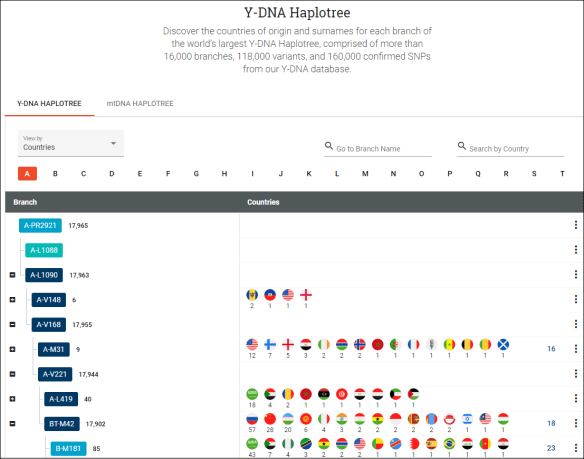
I was very pleased to see this development, because Family Tree DNA clearly has the largest Y database in the industry, by far, and now everyone can reap the benefits.

In October, Family Tree DNA published their mitochondrial tree publicly as well, with corresponding haplogroup locations. It’s nice that Family Tree DNA continues to be the science company.

You can test your Y DNA, mitochondrial or autosomal (Family Finder) at Family Tree DNA. They are the only vendor offering full Y and mitochondrial services complete with matching.

2018 Conferences

Of course, there are always the national conferences we’re familiar with, but more and more, online conferences are becoming available, as well as some sessions from the more traditional conferences.

I attended Rootstech in Salt Lake City in February (brrrr), which was lots of fun because I got to meet and visit with so many people including Mags Gaulden, above, who is a WikiTree volunteer and writes at Grandma’s Genes, but as a relatively expensive conference to attend, Rootstech was pretty miserable. Rootstech has reportedly made changes and I hope it’s much better for attendees in 2019. My attendance is very doubtful, although I vacillate back and forth.

On the other hand, the MyHeritage LIVE conference was amazing with both livestreamed and recorded sessions which are now available free here along with many others at Legacy Family Tree Webinars.

Family Tree University held a Virtual DNA Conference in June and those sessions, along with others, are available for subscribers to view.

The Virtual Genealogical Association was formed for those who find it difficult or impossible to participate in local associations. They too are focused on education via webinars.

Genetic Genealogy Ireland continues to provide their yearly conference sessions both livestreamed and recorded for free. These aren’t just for people with Irish genealogy. Everyone can benefit and I enjoy them immensely.

Bottom line, you can sit at home and educate yourself now. Technology is wonderful!

2019 Conferences

In 2019, I’ll be speaking at the National Genealogical Society Family History Conference, Journey of Discovery, in St. Charles, providing the Special Thursday Session titled “DNA: King Arthur’s Mighty Genetic Lightsaber” about how to use DNA to break through brick walls. I’ll also see attendees at Saturday lunch when I’ll be providing a fun session titled “Twists and Turns in the Genetic Road.” This is going to be a great conference with a wonderful lineup of speakers. Hope to see you there.

There may be more speaking engagements at conferences on my 2019 schedule, so stay tuned!

The Leeds Method

In September, Dana Leeds publicized The Leeds Method, another way of grouping your matches that clusters matches in a way that indicates your four grandparents.

I combine the Leeds method with DNAPainter. Great job Dana!

Genetic Affairs

In December, Genetic Affairs introduced an inexpensive subscription reporting and visual clustering methodology, but you can try it for free.

I love this grouping tool. I have already found connections I didn’t know existed previously. I suggest joining the Genetic Affairs User Group on Facebook.

DNAGedcom.com

I wrote an article in January about how to use the DNAGedcom.com client to download the trees of all of your matches and sort to find specific surnames or locations of their ancestors.

However, in December, DNAGedcom.com added another feature with their new DNAGedcom client just released that downloads your match information from all vendors, compiles it and then forms clusters. They have worked with Dana Leeds on this, so it’s a combination of the various methodologies discussed above. I have not worked with the new tool yet, as it has just been released, but Kitty Cooper has and writes about it here.  If you are interested in this approach, I would suggest joining the Facebook DNAGedcom User Group.

Rootsfinder

I have not had a chance to work with Rootsfinder beyond the very basics, but Rootsfinder provides genetic network displays for people that you match, as well as triangulated views. Genetic networks visualizations are great ways to discern patterns. The tool creates match or triangulation groups automatically for you.

Training videos are available at the website and you can join the Rootsfinder DNA Tools group at Facebook.

Chips and Imputation

Illumina, the chip maker that provides the DNA chips that most vendors use to test changed from the OmniExpress to the GSA chip during the past year. Older chips have been available, but won’t be forever.

The newer GSA chip is only partially compatible with the OmniExpress chip, providing limited overlap between the older and the new results. This has forced the vendors to use imputation to equalize the playing field between the chips, so to speak.

This has also caused a significant hardship for GedMatch who is now in the position of trying to match reasonably between many different chips that sometimes overlap minimally. GedMatch introduced Genesis as a sandbox beta version previously, but are now in the process of combining regular GedMatch and Genesis into one. Yes, there are problems and matching challenges. Patience is the key word as the various vendors and GedMatch adapt and improve their required migration to imputation.

DNA Central

In June Blaine Bettinger announced DNACentral, an online monthly or yearly subscription site as well as a monthly newsletter that covers news in the genetic genealogy industry.

Many educators in the industry have created seminars for DNACentral. I just finished recording “Getting the Most out of Y DNA” for Blaine.

Even though I work in this industry, I still subscribed – initially to show support for Blaine, thinking I might not get much out of the newsletter. I’m pleased to say that I was wrong. I enjoy the newsletter and will be watching sessions in the Course Library and the Monthly Webinars soon.

If you or someone you know is looking for “how to” videos for each vendor, DNACentral offers “Now What” courses for Ancestry, MyHeritage, 23andMe, Family Tree DNA and Living DNA in addition to topic specific sessions like the X chromosome, for example.

Social Media

2018 has seen a huge jump in social media usage which is both bad and good. The good news is that many new people are engaged. The bad news is that people often given faulty advice and for new people, it’s very difficult (nigh on impossible) to tell who is credible and who isn’t. I created a Help page for just this reason.

You can help with this issue by recommending subscribing to these three blogs, not just reading an article, to newbies or people seeking answers.

Always feel free to post links to my articles on any social media platform. Share, retweet, whatever it takes to get the words out!

The general genetic genealogy social media group I would recommend if I were to select only one would be Genetic Genealogy Tips and Techniques. It’s quite large but well-managed and remains positive.

I’m a member of many additional groups, several of which are vendor or interest specific.

Genetic Snakeoil

Now the bad news. Everyone had noticed the popularity of DNA testing – including shady characters.

Be careful, very VERY careful who you purchase products from and where you upload your DNA data.

If something is free, and you’re not within a well-known community, then YOU ARE THE PRODUCT. If it sounds too good to be true, it probably is. If it sounds shady or questionable, it’s probably that and more, or less.

If reputable people and vendors tell you that no, they really can’t determine your Native American tribe, for example, no other vendor can either. Just yesterday, a cousin sent me a link to a “tribe” in Canada that will, “for $50, we find one of your aboriginal ancestors and the nation stamps it.” On their list of aboriginal people we find one of my ancestors who, based on mitochondrial DNA tests, is clearly NOT aboriginal. Snake oil comes in lots of flavors with snake oil salesmen looking to prey on other people’s desires.

When considering DNA testing or transfers, make sure you fully understand the terms and conditions, where your DNA is going, who is doing what with it, and your recourse. Yes, read every single word of those terms and conditions. For more about legalities, check out Judy Russell’s blog.

Recommended Vendors

All those DNA tests look yummy-good, but in terms of vendors, I heartily recommend staying within the known credible vendors, as follows (in alphabetical order).

For genetic genealogy for ethnicity AND matching:

  • 23andMe
  • Ancestry
  • Family Tree DNA
  • GedMatch (not a vendor because they don’t test DNA, but a reputable third party)
  • MyHeritage

You can read about Which DNA Test is Best here although I need to update this article to reflect the 2018 additions by MyHeritage.

Understand that both 23andMe and Ancestry will sell your DNA if you consent and if you consent, you will not know who is using your DNA, where, or for what purposes. Neither Family Tree DNA, GedMatch, MyHeritage, Genographic Project, Insitome, Promethease nor LivingDNA sell your DNA.

The next group of vendors offers ethnicity without matching:

  • Genographic Project by National Geographic Society
  • Insitome
  • LivingDNA (currently working on matching, but not released yet)

Health (as a consumer, meaning you receive the results)

Medical (as a contributor, meaning you are contributing your DNA for research)

  • 23andMe
  • Ancestry
  • DNA.Land (not a testing vendor, doesn’t test DNA)

There are a few other niche vendors known for specific things within the genetic genealogy community, many of whom are mentioned in this article, but other than known vendors, buyer beware. If you don’t see them listed or discussed on my blog, there’s probably a reason.

What’s Coming in 2019

Just like we couldn’t have foreseen much of what happened in 2018, we don’t have access to a 2019 crystal ball, but it looks like 2019 is taking off like a rocket. We do know about a few things to look for:

  • MyHeritage is waiting to see if envelope and stamp DNA extractions are successful so that they can be added to their database.
  • www.totheletterDNA.com is extracting (attempting to) and processing DNA from stamps and envelopes for several people in the community. Hopefully they will be successful.
  • LivingDNA has been working on matching since before I met with their representative in October of 2017 in Dublin. They are now in Beta testing for a few individuals, but they have also just changed their DNA processing chip – so how that will affect things and how soon they will have matching ready to roll out the door is unknown.
  • Ancestry did a 2018 ethnicity update, integrating ethnicity more tightly with Genetic Communities, offered genetic traits and made some minor improvements this year, along with adding one questionable feature – showing your matches the location where you live as recorded in your profile. (23andMe subsequently added the same feature.) Ancestry recently said that they are promising exciting new tools for 2019, but somehow I doubt that the chromosome browser that’s been on my Christmas list for years will be forthcoming. Fingers crossed for something new and really useful. In the mean time, we can download our DNA results and upload to MyHeritage, Family Tree DNA and GedMatch for segment matching, as well as utilize Ancestry’s internal matching tools. DNA+tree matching, those green leaf shared ancestor hints, is still their strongest feature.
  • The Family Tree DNA Conference for Project Administrators will be held March 22-24 in Houston this year, and I’m hopeful that they will have new tools and announcements at that event. I’m looking forward to seeing many old friends in Houston in March.

Here’s what I know for sure about 2019 – it’s going to be an amazing year. We as a community and also as individual genealogists will be making incredible discoveries and moving the ball forward. I can hardly wait to see what quandaries I’ve solved a year from now.

What mysteries do you want to unravel?

I’d like to offer a big thank you to everyone who made 2018 wonderful and a big toast to finding lots of new ancestors and breaking down those brick walls in 2019.

Happy New Year!!!

______________________________________________________________

Disclosure

I receive a small contribution when you click on some (but not all) of the links to vendors in my articles. This does NOT increase the price you pay but helps me to keep the lights on and this informational blog free for everyone. Please click on the links in the articles or to the vendors below if you are purchasing products or DNA testing.

Thank you so much.

DNA Purchases and Free Transfers

Genealogy Services

Genealogy Research

Ethnicity is Just an Estimate – Yes, Really!

Lots of people will have received DNA tests as gifts over the holidays. This pleases me to no end, because I know I’ll match any number of them and maybe, just maybe, those matches will help me fill in those pesky blanks in my tree or break down brick walls.

However, for the most part, those testers probably aren’t genealogists, at least not yet. They are most likely curious about “who they are” or didn’t even realize they might be curious about anything until they unwrapped that gift and discovered a DNA test inside.

Let’s hope they test with one of the major 4 companies, being Family Tree DNA, MyHeritage, Ancestry or 23andMe. (Sale prices are still in effect.) Some additional firms are certainly reputable and provide ethnicity only tests (meaning no matching), such as the Genographic Project, LivingDNA and Insitome, but then there are also a growing number of questionable pop-up DNA testing, upload sites and interpretation “services.” And yes, I’m using that word loosely. Buyer beware.

For genealogists, the gold is in the cousin matching. We already know that DNA is more than ethnicity, and ethnicity is far more than percentages.

Ethnicity, for the most part, is a shiny red bauble that the magic wand of advertising transforms from a diamond in the rough into the glittery Hope diamond with a free kilt to lederhosen conversion (or vice versa) thrown in to boot.

Ethnicity bauble

Yay – Results are Back

Everyone who received DNA test kits during the holiday season has hopefully spit or swabbed and mailed and is now waiting excitedly. Waiting is always the hardest part!

Soon, they will be discussing their ethnicity results. Reactions will vary, swinging like a pendulum – and you may well get to help interpret.

  • Some people will be thrilled because their results will confirm what they see or believe and their family stories. For example, if their family carries oral history of a Native American ancestor and their DNA ethnicity results show Native American heritage, they’ll be thrilled.
  • Some people will be pleasantly surprised with whatever information they receive – treating their ethnicity results as a nice package to unwrap, regardless of what’s inside.
  • Another large group will be confused? My mother said her grandmother was French! Why don’t I see France? Substitute <country of your choice> for French/France.
  • And then we have the truly upset. The distraught. The entirely disbelieving. “My great-grandmother was a full-blood Cherokee. Why don’t I show Native American? These tests are wrong!”
  • Some people will doubt their parentage based on ethnicity results alone. This is NOT under any circumstances appropriate. Please have them read Ethnicity and Physical Features are NOT Accurate Predictors of Parentage or Heritage.

Explanations

To help people understand, you may need to explain about how Native Americans, especially east of the Mississippi were admixed very early in our national history, so their “fully Native” ancestor probably wasn’t.

You can explain about how autosomal DNA is diluted in each generation since their Native (or French, or Italian, etc.) ancestor lived – to the point that the Native DNA might not show today.

You can talk about reference populations, or the lack thereof, and that people in France and Israel can’t legally take DNA tests for recreational purposes.

You can educate people about how we all need to research our genealogy, and how, as Blaine Bettinger writes in this classic article, we have both a genetic and genealogical tree. The ancestors are always there in our tree, but we may not have inherited measurable DNA from a particular individual if they are several generations back in time.

If that coveted Native ancestor doesn’t appear in their DNA, then they need to look in their family tree. She or he might be waiting there, AND, they may still be able to prove their Native heritage using either Y or mitochondrial DNA testing at Family Tree DNA.

There’s more than one kind of DNA and more than one way to prove Native heritage.

The Underlying Truth

But the truth of the matter is, while each and every one of those statements above is entirely valid, the fundamental truth about ethnicity testing is that…

Ethnicity percentages.png

Yes, really.

Let’s take a look at some of the reasons why.

Size Matters

Everyone in the Americas (except for Native American, First Nations or aboriginal peoples) wants to know where their ancestors “came from.” As genealogists, we deal with no records, damaged records, misplaced records, burned records, rapid westward migration with no links “back home” and at least three wars on our soil. It’s no wonder that we often can’t track those ancestors back across the pond or even to the shore.

Therefore, we hope that DNA testing can help us bridge that gap. And indeed, both Y and mitochondrial DNA testing is wonderful for doing just that for matrilineal and patrilineal lines.

But ethnicity results, in most cases, are really only useful for making continental-level discoveries. What we really want, refinement and granularity to the country level within Europe, for example, isn’t really feasible.

Size is part of the reason why. Look at the size of the contiguous 48 US states as compared to Europe, courtesy thetruesize.com.

Ethnicity US over Europe.png

Would you expect to be able to tell the genetic difference between people that live in Washington State from people that live in Idaho? That’s roughly the same distance as from the UK to Germany. France is located down in California and Nevada.

Can you tell the difference genetically between people who live in Washington State from California or Nevada? That idea sounds rather preposterous when you look at it that way. Now, is it any wonder that your ancestor’s “French” doesn’t show up, but German does?

Ethnicity Texas over Europe

Here’s Texas compared to Europe. Can you tell the people in Dallas from the people who live in San Antonio from the people who live in Houston, genetically? That’s the same difference as Germany, Italy and Austria. The Czech Republic is over near Shreveport. You get the drift.

Western European Countries are the Size of US States

Western European countries are even more difficult.

Ethnicity states over Europe

How about discerning the difference between Indiana and Illinois residents, or Illinois and Missouri? European countries are the size of medium sized US states. Larger states, like Texas cover most of the Iberian Peninsula including Spain and Portugal and reach over into Morocco.

To make this relatively small region even more complex, people have moved freely across these areas for thousands of years. The people from the Russian Steppes moved into Eastern Europe displacing and assimilating with the hunter-gatherer population that had resided there for millennia.

The Germanic tribes moved towards the coast and into the British Isles. The people from “Indiana and Ohio” moved into “Illinois” and then that entire group populated parts of Scandinavia. According to a recent genetic paper, some of those “New Yorkers” and on east moved into Scandinavia too.

Oh, and the Sephardic Jewish people moved from the Middle East into “Texas” aka Spain and then on up to “Indiana, Ohio and Pennsylvania” some 500 years ago to join their Ashkenazi brethren. Fortunately, Jewish people generally stayed together and didn’t intermarry or assimilate much into the local population, so we can still identify them genetically.

Europe is indeed a great melting pot.

Ethnicity Alaska and states over Europe and Asia

Adding the largest US state, Alaska onto the map makes the rest of the states and their corresponding European countries look really tiny.

Ethnicity is Really Only Reliable at a Continental Level

Ethnicity really is only reliable at a continental level, plus Jewish and in particular, Ashkenazi. Very small or trace percentages may not be reliable at all. We’ll discuss ways to prove or disprove minority admixture in my next article, Minority Ethnicity Percentages – True or False?.

This continental-level-only phenomenon is more understandable if you look at a world map.

Ethnicity continents

It’s extremely difficult to discern any reliable level of granularity between regions as tiny as US states in Europe, no matter how badly testers want to know. Of course, that doesn’t keep the testing companies from trying, and kudos to them. As they make improvements, your intra-continental estimates will change over time – so don’t fall in love with them. And don’t trade that lederhosen for a kilt or vice versa – or get that Viking tattoo just yet.

It’s much more reasonable to rely on ethnicity estimates based on much larger regions, where people after migration have been separated from people in the other regions for a much longer period of time, allowing time for unique mutations to develop.

Less admixture happens with greater geographic distance. People who aren’t neighborly don’t produce offspring because begetting requires proximity. Mutations that occurred after the populations split into different regions are found only in the new or the old populations, but not both – at least not in high frequencies. Of course, population boundaries are fluid and people (continue to) move from place to place, back and forth.

What You Can Do!

When your family and friends begin to discuss their confusion or disappointment with their ethnicity results, you’ll have this article to explain the situation visually. Please feel free to share and encourage them to learn more.

Sometimes it’s difficult to be the cold voice of reason in a positive way, but there is so much more to learn. I always hope to spark curiosity about why, and then provide ways that the person can fall in love with discovering their ancestors and ancestry.

Another good resource is the article, Ethnicity Testing – A Conundrum which explains how DNA ethnicity testing actually works – in terms that everyone can understand.

If your family is wondering what happened to their Native American DNA, you’re not alone. I’ve put together a page of Native American Resources to help everyone!

Have fun, enjoy and let’s hope that newly baptized ethnicity testers will like the water enough to engage in a bit of genealogy. You can encourage them by helping construct their first tree by recording what they know about their parents and grandparents. Maybe give them a taste of success by helping them find a record or two. Give them a taste of genealogy crack.

You never know, it just might be habit forming!

______________________________________________________________

Disclosure

I receive a small contribution when you click on some (but not all) of the links to vendors in my articles. This does NOT increase the price you pay but helps me to keep the lights on and this informational blog free for everyone. Please click on the links in the articles or to the vendors below if you are purchasing products or DNA testing.

Thank you so much.

DNA Purchases and Free Transfers

Genealogy Services

Genealogy Research

When DNA Leads You Astray

I’m currently going through what I refer to as “the great purge.”

This occurs when you can’t stand the accumulated piles and boxes of “stuff” and the file drawers are full, so you set about throwing away and giving away. (Yes, I know you just cringed. Me too.)

The great news is that I’ve run across so much old (as in decades old) genealogy from when I first began this journey. I used to make lists of questions and a research “to do” list. I was much more organized then, but there were also fewer “squirrel moments” available online to distract me with “look here, no, over here, no, wait….”

Most of those questions on my old genealogy research lists have (thankfully) since been answered, slowly, one tiny piece of evidence at a time. Believe me, that feeling is very rewarding and while on a daily basis we may not think we’re making much progress; in the big picture – we’re slaying that dragon!

However, genealogy is also fraught with landmines. If I had NOT found the documentation before the days of DNA testing, I could easily have been led astray.

“What?”, you ask, but “DNA doesn’t lie.” No, it doesn’t, but it will sure let you kid yourself about some things.

DNA is a joker and has no problem allowing you to fool yourself and by virtue of that, others as well.

Joke’s On Me

Decades ago, Aunt Margaret told me that her grandmother’s mother was “a Rosenbalm from up on the Lee County (VA) border.”

Now, at that time, I had absolutely NO reason to doubt what she said. After all, it’s her grandmother, Margaret Claxton/Clarkson who she knew personally, who didn’t pass away until my aunt was in her teens. Plenty close enough to know who Margaret Claxton’s mother was. Right?

DNA Astray Rosenbalm

Erroneous pedigree chart. Rebecca Rosenbalm is NOT the mother of Elizabeth Claxton/Clarkson.

I filled Rebecca Rosenbalm’s name into the appropriate space on my pedigree chart, was happy and smugly smiling like a Cheshire cat, right up until I accidentally discovered that the information was just plain wrong.

Uh oh….

Time Rolls On

As records became increasingly available, both in transcribed fashion and online, Hancock County, TN death certificates eventually could be obtained, one way or another. Being a dutiful genealogist, I collected all relevant documents for my ancestors, contentedly filing them in the “well that’s done” category – that is right up until Margaret Clarkson Bolton’s death certificate stopped me dead in my tracks.

margaret clarkson bolton death

Oops

Margaret’s mother wasn’t listed as Rebecca Rosenbalm, nor Rebecca anyone. She was listed as Betsy Speaks. Or was it Spears? In our family, Betsy is short for Elizabeth.

Who the heck was Elizabeth Speaks, or Spears. This was one fine monkey wrench!

A trip to Hancock County, Tennessee was in order.

I dug through dusty deed and court records, sifted through the archives in basements and the old jail building where I just KNEW my ancestors had inhabited cells at one time or another.

Yes, my ancestor’s records really were in jail!

Records revealed that the woman in question was Elizabeth Speaks, not Spears, although the Spears family did live in the area and had “married in” to many local families. Nothing is ever simple and our ancestors do have a perverse sense of humor.

Elizabeth Speak(s) was the daughter of Charles Speak, and the Speak family lived a few miles across the border into Lee County, Virginia. This high mountain land borders two states and three counties, so records are scattered among them – not to mention two fires in the Hancock County courthouse make research challenging.

Why?

I asked my Aunt Margaret who was still living at the time about this apparent discrepancy and she told me that the Rosenbalms “up in Rose Hill, Virginia” told her that her grandmother, Margaret Claxton/Clarkson was kin to them, so Margaret had assumed (there’s that word again) that Margaret Claxton’s mother was their Rebecca Rosenbalm.

Wrong!

The Kernel of Truth

Like so many family stories, there is a kernel of truth, surrounded by a multitude errors. Distilling the grain of truth is the challenge of course.

Margaret Claxton’s mother was Elizabeth (Betsy) Speak and her father was Charles Speak. Charles Speak’s sister, Rebecca married William Henderson Rosenbalm in 1854, had 4 children and died in February 1859. So there indeed was a woman named Rebecca (Speaks) Rosenbalm who had died young and wasn’t well known.

Rebecca’s sister Frances “Fanny” Speak also married that same William Henderson Rosenbalm in November 1859, a few months after Rebecca had died. Fannie also had 4 children, one of which was also named Rebecca Rosenbalm. Do you see a trend here?

So, indeed there were 7 living Rosenbalm children who were first cousins to Elizabeth Speak who married Samuel Claxton and lived a dozen miles away, over the mountains and across the Powell River. Now a dozen miles might not sound like much today, but in the mountains during horse and wagon days – 10 miles wasn’t trivial and required a multi-day commitment for a visit. In other words, the next generation of the family knew of their cousins but didn’t know them well.

The following generation included my Aunt Margaret who was told by those cousins that she was related to them through the Rosenbalm family. While, that was true for the Rosenbalm cousins, it was not true for Aunt Margaret who was related to the Rosenbalms through their common Speak ancestor.

Here’s what the family tree really looks like, only showing the lines under discussion.

DNA astray correct pedigree

You can see why Aunt Margaret might not know specifics. She was actually several generations removed from the common ancestor. She knew THAT they were related, but not HOW they were related and there were several Rebecca’s in several branches of the family.

Why Does This Matter?

You’ve probably guessed by now that someplace in here, there’s a moral to this story, so here it is!

You may have already surmised that I have autosomal DNA matches to cousins through the Rosenbalm/Speaks line.

DNA astray pedigree match

This is one example, but there are more, some being double cousins meaning two of Nicholas Speak’s 11 children’s descendants have intermarried. Life is a lot more complex in those hills and hollers than people think – and unraveling the relationships, both paper and genetic (which are sometimes two different things) is challenging.

DNA astray chromosome 10.png

I match this fourth cousin once removed (4C1R) on a healthy 18 cM segment on chromosome 10.

Wrong Conclusions

Now, think back to where I was originally in my research. I knew that Margaret Claxton/Clarkson was my aunt’s grandmother. I knew nothing at all about the Speak family and had never heard that surname.

Had I ONLY been looking to confirm the Rosenbalm connection, I certainly would have confirmed that I’m related to the Rosenbalm family descendants with this match. Except the conclusion that I descend from a Rosenbalm ancestor would have been WRONG. What we share are the Speak ancestors.

So really, the DNA didn’t lie, but unless I dissected what the DNA match was really telling me carefully and methodically with NO PRECONCEIVED NOTIONS, I would have “confirmed” erroneous information. Or, at least I would have thought that I confirmed it.

I would actually have been doing something worse meaning convincing myself of “facts” that weren’t accurate, which means I would have then been spreading around those cancerous bad trees. Guaranteed, I do NOT want to be that person.

Foolers

I can tell you here and now that I have found several matches that were foolers because I share multiple ancestors with a person that I match, even if those multiple ancestors aren’t known to either or both of us. Every single DNA segment has its own unique history. I match one individual on two segments, one segment through my mom and one segment through my dad. Fortunately, we’ve identified both ancestors now, but imaging my initial surprise and confusion, especially given that my parents don’t share any common ancestors, communities or locations.

We have to evaluate all of the evidence to confirm that the conclusion being drawn in accurate.

DNA astray painting

One of the sanity checks I use, in addition to triangulation, is to paint my matches with known ancestors on my chromosomes using DNAPainter. Here’s the match to my cousin, and it overlaps with other people who share the same ancestor couple. Several matches are obscured behind the black box. If I discover someone that I supposedly match from a different ancestor couple sharing this segment of my father’s DNA, that’s a red neon flashing sign that something is wrong and I need to figure out what and why.

Ignoring this problem and hoping it will go away doesn’t work. I’ve tried😊

Three possible things can be wrong:

  1. The segment is identical by chance, not by descent. With a segment of 18 cM, that’s extremely unlikely. Triangulation with other people on this same segment on the same parent’s side should eliminate most false matches over 7cM. The larger the match, the more likely it is NOT identical by chance, meaning that it IS identical by descent or genealogically relevant.
  2. The segment is accurately matched but the genealogy is confused – such as my Rosenbalm example. This can happen with multiple ancestors, or descent from the same family but through an unknown connection. Looking for other connections to this family and sorting through matches’ trees often provides hints that resolve this situation. In my case, I might have noticed that I matched other people who descended from Nicholas Speak, which would not have been the case had I descended through the Rosenbalm family.
  3. The third scenarios is that the genealogy is plain flat out wrong. Yea, I know this one hurts. Get the saw ready.

The Devil in the Details

Always evaluate your matches in light of what you don’t know, not in order to confirm what you think you know. Play the devil’s advocate – all the time. After all, the devil really is in the details.

______________________________________________________________

Disclosure

I receive a small contribution when you click on some (but not all) of the links to vendors in my articles. This does NOT increase the price you pay but helps me to keep the lights on and this informational blog free for everyone. Please click on the links in the articles or to the vendors below if you are purchasing products or DNA testing.

Thank you so much.

DNA Purchases and Free Transfers

Genealogy Services

Genealogy Research

Finding Mary Younger’s Mitochondrial DNA – 52 Ancestors #219

Ah, the blessings of cousins.

The Y and mitochondrial DNA of our ancestors can provide us with a smorgasbord of information. Unfortunately, we only carry the Y and mitochondrial DNA of one or two lines. If you’re a female, you carry the mitochondrial DNA (mtDNA) of your matrilineal line only, and if you’re a male, you carry the paternal (patrilineal meaning surname) Y DNA line (blue squares) in addition to your mother’s matrilineal line (red circles.) You can read about the difference between maternal versus matrilineal and paternal versus patrilineal here.

Y and mito

Therefore, to collect the rest of the haplogroups and match information about our ancestral lines, meaning those with no color above, we must depend on cousins who descend from those ancestors in such a way that they carry the desired Y or mtDNA.

For men, their surname is generally reflective of the Y DNA inheritance path, presuming that neither the surname nor the Y DNA was changed, intentionally or otherwise – meaning adoption or name changes, for example.

Women contribute their mitochondrial DNA to both genders of their children, but only females pass it on to the next generation.

This inheritance path assures that neither the Y nor mitochondrial DNA is admixed with the DNA of the other parent, meaning the DNA changes little if at all generation to generation and we can see back a very long distance into the past by following the stair-step mutations that have accumulated over hundreds and thousands of years.

Think of it as your genetic periscope!

Recently a press article reported that in very limited cases with a medically co-presenting mitochondrial disease, the father’s mitochondrial DNA is found in children. Blaine Bettinger explained further here. It’s actually not new news and you really don’t need to worry about this in regard to genealogy.

Mary Younger

When I originally wrote Mary Younger’s 52 Ancestors article, I didn’t know anything about her mitochondrial DNA because no one from that line had yet tested.

In that article, I detailed her descendants as best I could, and of those descendants, who would carry Mary’s mitochondrial DNA.

A cousin, Lynn, read the article and replied that indeed, she descends from Mary through all females – and was willing to DNA test. Thank you Lynn!!!

Mary’s mtDNA Dispells a Myth

Lynn’s results came back and told us that Mary Younger’s mitochondrial DNA is haplogroup H1a3a.

Often in early genealogy research, when a colonial lineage brick wall was encountered, the comment that “maybe she was Indian,” was made. Sometimes those comments fanned the flames of myths that took hold like wildfire and are reflected today in many online trees. The “maybe” became quickly omitted and the comment was elevated from the realm of speculation to gospel.

Mary Younger was born about 1766, probably in either Essex or King and Queen County to Marcus Younger and his wife, Susannah whose surname we don’t know. Therefore, Susannah would have been born between 1720 and 1746.

There’s a persistent rumor that Susannah’s surname was Hart and there is some reason to suspect that it may have been, but the bottom line is that we don’t know.

If Susannah’s surname IS Hart, we don’t know which Hart individual was her father, although Anthony Hart (1755-1832) and Marcus Younger were both associated with one Robert Hart, believed to be Anthony’s father, but that too is unproven. The King and Queen County courthouse burned and that’s where the Hart land was located, so most records are gone. Bummer.

There is some amount of suspicion that Anthony Hart and Susannah that married Marcus Younger were siblings. To make matters even worse, Marcus and Susannah Younger’s son, John Younger married Lucy Hart – so autosomal DNA from that line will match the Hart line and not (necessarily) because of Susannah. Therefore, John Younger’s line can’t be used for comparisons to the Hart line for either mitochondrial or autosomal. However, cousin Lynn’s DNA as Mary Younger’s direct matrilineal descendant can be utilized for both mitochondrial and autosomal comparisons.

What we do know, from Mary Younger’s mitochondrial DNA alone is that Susannah through her matrilineal line was NOT Native American. Haplogroup H1a3a is European, unquestionably European.

We can dispel that Native American myth forever, at least about this particular line.

Lynn’s H1a3a Matches

What can we tell about haplogroup H1a3a and in particular, Lynn’s matches?

Mary Younger matches map

None of Lynn’s three exact matches have completed their geographical information for their most distant known ancestor. These match maps are such powerful tools if people would only complete the information.

Other than the three with no information, so aren’t shown on the map – the matches on the map in the US aren’t terribly relevant unless specific clusters suggest a particular migration path. In this case, nothing of note, although those 3 Canadian maritime matches are curious. I don’t know if there is any useful information there or not.

However, Europe is different, because those matches are fairly tightly clustered.

All of Lynn’s matches are either in the British Isles or in Scandinavia. This could suggest either that descendants of her ancestors, hundreds or thousands of years ago migrated to both locations, or it could mean that the English locations are perhaps showing a Viking influence.

Lynn’s matches themselves are unremarkable other than the fact that her only rare mutation occurs in the coding region, which means that we really do need the full sequence test to make use of this information. She has 107 full sequence matches, of which three are exact, providing the following most distant ancestor information.

  • Martha Patsy Terry was born in 1805 in North Carolina and died after 1865 in Alabama
  • Sarah Emma Doyle was born in 1824 in Fayette County, TN and died in 1890 in Cass Co., Texas.
  • The third match says “information needed.” Well, me too😊

The only person with one mutation difference shows their most distant ancestor with a name and birth of 1534. They apparently misunderstood what was being asked, because if you look at their tree, their most distant matrilineal ancestor is Margaret Moore born in NC, died in Texas, and who had daughter Dicie Moore in 1830 in Tennessee.

Unfortunately, these matches aren’t terribly helpful either, at least not today.

Two of the three exact matches have trees which I checked for the surname of Hart and Younger and looked for geographic proximity.

Checking advanced matches by selecting both Family Finder and the Full Sequence mitochondrial matches shows no individual who matches on both tests.

Haplogroup H1a3a

If Lynn’s mtDNA matches aren’t being productive, what can I tell about haplogroup H1a3a itself?

Doron Behar in his 2012 paper placed the age of H1a3a at 3859 years, give or take 1621 years, so therefore haplogroup H1a3a was born between 1238 and 6480 years ago. An exact match with no additional mutations could be from long ago. Fortunately, Lynn does have a few additional mutations, so her exact matches share mutations since the birth of haplogroup H1a3a.

Using the Family Tree DNA mitochondrial tree and searching for H1a3a, we discover the following information.

Mary Younger H1a3a

Haplogroup H1a3a is found in a total of 21 countries. The most common location is Germany, which isn’t reflected in Lynn’s matches.

Mary Younger mtDNA countries

This is especially interesting, because it suggests that the haplogroup itself may have spread from the Germanic region of Europe into both England and Sweden. Lynn’s matches are only found in those diaspora regions, not in Germany itself. To me, this also suggests that the people still in Germany have accrued several mutations as compared to Mary Younger’s DNA. They are no longer considered a match since their common ancestor is far enough back in time that they have accumulated several mutations difference from cousin Lynn today. Conversely, the people closer in time that share some of those mutations do qualify as matches.

And no, haplogroup H1a3a is not Native American, in spite of the one person who had indicated such (the feather icon.) Many people record “American” or “Native American” because they believe, before testing, that they have Native American on “that side,” as opposed in that specific line. Of course, the maternal side could mean any one of many ancestors – as opposed to the matrilineal line which is directly your mother’s mother’s mother’s line until you run out of direct line mothers in your tree.

What we know now is that sometime between 1200 and 6500 years ago, the haplogroup defining mutations between H1a3 and H1a3a occurred, probably someplace in Germanic Europe. From there, people migrated to both the British Isles and portions of Scandinavia.

Given that we find Susannah in the early 1700s in King and Queen County, Virginia, it would be a reasonable working hypothesis that she was English (or at least from the British Isles) and not Scandinavian. Alexander Younger, the grandfather of Marcus Younger was from Scotland and many of the early era colonial settlers in that region were English.

Hopefully, time and more DNA testers will eventually tell more of Susannah’s tale – either through mitochondrial or autosomal DNA matches, or both.

What About You?

If you haven’t yet tested your mitochondrial DNA, now would be a great time. In fact, you can click here to order the mtFull test. Who knows what you might learn. Are there specific questions you’d like to answer about dead end female lines? Mitochondrial DNA is one way to circumvent a surname/genealogical blockade – at least partially.

If you don’t carry the mitochondrial DNA line that you need, sponsor a test for a cousin. You’ll get to meet a really cool person to share information with, like Lynn, and learn about your common genealogical bond as well as your ancestor’s DNA.

______________________________________________________________

Disclosure

I receive a small contribution when you click on some (but not all) of the links to vendors in my articles. This does NOT increase the price you pay but helps me to keep the lights on and this informational blog free for everyone. Please click on the links in the articles or to the vendors below if you are purchasing products or DNA testing.

Thank you so much.

DNA Purchases and Free Transfers

Genealogy Services

Genealogy Research

AutoClustering by Genetic Affairs

The company Genetic Affairs launched a few weeks ago with an offer to regularly visit your vendor accounts at Family Tree DNA, Ancestry and 23andMe, and compile a spreadsheet of your matches, download it, and send it to you in an e-mail. They then update your match list at regular intervals of your choosing.

I didn’t take advantage of this, mostly because Ancestry doesn’t provide me with segment information and while 23andMe and Family Tree DNA both do, I maintain a master spreadsheet that the new matches wouldn’t integrate with. Granted, I could sort by match date and add only the new ones to my master spreadsheet, but it was never a priority. That was yesterday.

AutoClustering

That changed this week. Genetic Affairs introduced a new AutoClustering tool that provides users with clustered matches. I’m salivating and couldn’t get signed up quickly enough.

Please note that I’ve cropped the names for this article – the Genetic Affairs display shows you the entire name.

In short, each tiny square node represents a three-way match, between you and both of the people in the intersection of the grid. This does NOT mean they are triangulated, but it does mean there’s a really good chance they would triangulate. Think of this as the Family Tree DNA matrix on steroids and automated.

This tool allows me by using my mother’s test as well to actually triangulate my matches. If they are on my mother’s side of the tree, match me and mother both, and are in the match matrix, they must triangulate on my mother’s side of my tree if they both match me on the same segment.

With this information, I can check the chromosome browser, comparing my chromosomes to those other two individuals in the matrix to see if we share a common segment – or I can simply sort the spreadsheet provided with the AutoCluster results. Suddenly that delivery service is extremely convenient!

No, this service is not free, but it’s quite reasonable. I’m going to step through the process. Note that at times, the website seemed to be unresponsive especially when moving from one step to another. Refreshing the page remedied the problem.

Account Setup

Go to www.geneticaffairs.com. Click on Register to set up your account, which is very easy.

After registering, move to step 2, “Add website.”

Add websites where you have accounts. All of your own profiles plus the other people’s that you manage at both Ancestry and 23andMe are included when you register that site in your profile.

You’ll need your signon information and password for each site.

At Family Tree DNA, you’ll need to add a new website for each account since every account has its own kit number and password.

I added my own account and my mother’s account since mother’s DNA is every bit as relevant to my genealogy as my own, AND, I only received half of her DNA which means she will have many matches that I don’t.

When you’re finished adding accounts, click on “Websites and Profiles” at the top to open the website tab of your choosing and click on the blue circular arrows AutoCluster link. You are telling the system to go out and gather your matches from the vendor and then cluster your matches together, generating an AutoCluster graphic file.

There are several more advanced options, but I’m going to run initially with Approach A, the default level. This will exclude my closest matches. Your closest matches will fall into multiple cluster groups, and the software is not set up to accommodate that – so they will wind up as a grey nonclustered square. That’s not all bad, but you’ll want to experiment to see which parameters are best for you.

If you have half-siblings, you may want to work with alternate settings because that half-sibling is important in terms of phasing your matches to maternal or paternal sides.

Asking me if “I’m sure” always causes me to really sit back and think about what I’ve done. Like, do I want to delete my account. In this case, it’s “overworry” because the system is just asking if you want to spend 25 credits, which is less than a dollar and probably less than a quarter. Right now, you’re using your free initial credits anyway.

The first time you set up an account, Genetic Affairs signs in to your account to assure that your login information is accurate.

I selected my profile and my mother’s profile at Family Tree DNA, plus one profile each at 23andMe and Ancestry. I have two profiles at both 23andMe (V3 and V4) and Ancestry (V1 and V2).

When making my selections, I wasn’t clear about the meaning of “minimum DNA match” initially, but it means fourth cousin and closer, NOT fourth and more distant.

My recommendation until you get the hang of things is to use the first default option, at least initially, then experiment.

Welcome

While I was busy ordering AutoClusters, Genetic Affairs was sending me a welcome e-mail.

Hello Roberta Estes,

Thank you for joining Genetic Affairs! We hope you will enjoy our services.

We have a manual available as well as a frequently asked questions section that both provide background information how to use our website.

You currently have 200 credits which can be supplemented using single payments and/or monthly subscriptions. Check out our prices page for more information concerning our rates.

Please let us know if anything is unclear, we can be reached using the contact form.

The great news is that everyone begins with 200 free credits which may last you for quite some time.  Or not. Consider them introductory crack from your new pusher.

Options

Genetic affairs will sign on your account at either Ancestry, 23andMe or Family Tree DNA, or all 3, periodically and provide you with match information about your new matches at each website. You select the interval when you configure your account. After each update, you can order a new AutoCluster if you wish.

Each update, and each AutoCluster request has a cost in points, sold as credits, associated with the service.

To purchase credits after you use your initial 200, you will need to enter your credit card information in the Settings Page, which is found in the dropdown (down arrow) right beside your profile photo.

You can select from and enroll in several plans.

Prices which varies by how often you want updates to be performed and for how many accounts. To see the various service offerings and cost, click here.

Here’s an example calculation for weekly updates:

This is exactly what I need, so it looks like this service will cost me $2.16 per month, plus any Autoclustering which is 25 credits each time I AutoCluster. Therefore, I’ll add another 100 credits for a total of $3.16 per month.

It looks like the $5 per month package will do for me. But don’t worry about that right now, because you’re enjoying your free crack, um, er, credits.

Ok, the e-mail with my results has just arrived after the longest 10 minutes on earth, so let’s take a look!

The Results E-mail

In a few minutes (or longer) after you order, an e-mail with the autoclustering results will arrive. Check your spam filter. Some of my e-mails were there, and some reports simply had to be reordered. One report never arrived after being ordered 3 times.

The e-mail when it arrives states the following:

Hello Roberta Estes,

For profile Roberta Estes: An AutoCluster analysis has been performed (access it through the attached HTML file).

As requested, cM thresholds of 250 cM and 50 cM were used. A total number of 176 matches were identified that were used for a AutoCluster analysis. There should be two CSV files attached to this email and if enough matches can be clustered, an additional HTML file. The first CSV file contains all matches that were identified. The second CSV file contains a spreadsheet version of the AutoCluster analysis. The HTML file will contain a visual representation of the AutoCluster analysis if enough matches were present for the clustering analysis. Please note that some files might be displayed incorrectly when directly opened from this email. Instead, save them to your local drive and open the files from there.

Attached I found 3 files:

  • Matches list
  • Autocluster grid csv file
  • Autocluster html file that shows the cluster itself

The Match Spreadsheet

The first thing that will arrive in your e-mail is a spreadsheet of your matches for the account you configured and ordered an AutoCluster for.

In the e-mail, your top 20 matches are listed, which initially confused me, because I wondered if that means they are not in the spreadsheet. They are.

At 23andMe, I initially selected 5th cousins and closer, which was the most distant match option provided. I had a total of 1233 matches.

23andMe caps your account at 2000 (unless you have communicated with people who are further than 2000 away, in which case they remain on your list), but you can’t modify the Genetic Affairs profile to include any people more distant than 5th cousins

Note that the 23andMe download shows you information about your match, but NOT the actual matching segment information☹

At Ancestry, I selected 4th cousin and closer and I received a total of 2698 matches. I could select “distant cousin” which would result in additional matches being downloaded and a different autoclustering diagram. I may experiment with this with my V2 account and compare them side by side.

This Ancestry information provides an important clue for me, because the matches I work with are generally only my Shared Ancestor Hints matches. If the Viewed field equals false, this tells  me immediately that I didn’t have a shared ancestor hint – but now because of the clustering, I know where they might fit.

At Family Tree DNA, I selected 4th cousin, but I could have selected 5th cousins. I have a total of 1500 matches.

This report does include the segment information (Yay!) and my only wish here would be to merge the two downloads available at Family Tree DNA, meaning the segment information and the match information. I’d like to know which of these are assigned to maternal or paternal buckets, or both.

AutoClustering

The Autocluster csv file is interesting in that it shows who matches whom. It’s the raw data used to construct the colored grid.

My matches are numbered in their column. For example, person M.B. is person 1. Every person that matches person 1 is noted at left with a 1 in that column.  Look at the second person under the Name column, C. W., who matches person 1 (M.B.), 2 (C.W.), 3 (T.F.), 4 (purple) and 5 (A.D.).

All of these people are in the same cluster, number 3, which you’ll see below.

The AutoCluster Graph

Finally, we get to the meat of the matter, the cluster graph.

Caveat – I experienced a significant amount of difficulty with both my account and my graph. If your graph does not display correctly, save the file to your system and click to open the file from your hard drive. Try Edge or Internet explorer if Chrome doesn’t work correctly. If it still doesn’t display accurately, notify GeneticAffairs at info@geneticaffairs.com. Consider this software release late alpha or early beta. Personally, I’m just grateful for the tool.

When you first open the html file, you’ll be able to see your matches “fly” into place. That’s pretty cool. Actually, that’s a metaphor for what I want all of my genealogy to do.

This grid shows the people who match me and each other as well, so a trio – although this does NOT mean the three of us match on the same segment.

The first person is Debbie, a known cousin on my father’s side. She and all of the other 12 people match me and each other as well and are shown in the orange cluster at the top left.

I know that my common ancestor couple with Debbie is Lazarus Estes and Elizabeth Vannoy, so it’s very likely that all of these same people share the same ancestral line, although perhaps not the same ancestral couple. For example, they could descend from anyone upstream of Lazarus and Elizabeth. Some may have known ancestors on either the Estes or Vannoy side, which will help determine who the actual oldest common ancestors are.

You’ll notice people in grey squares that aren’t in the cluster, but match me and Debbie both. This means that they would fall into two different clusters and the software can’t accommodate that. You may find your closest relatives in this grey never-never-land. Don’t ignore the grey squares because they are important too.

The second green cluster is also on my father’s side and represents the Vannoy line. My common ancestor with several matches is Joel Vannoy and Phoebe Crumley.

Working my way through each cluster, I can discern which common ancestor I match by recognizing my cousins or people who I’ve already shared genealogy with.

The third red cluster is on my mother’s side and I know that it’s my Jacob Lentz and Fredericka Ruhle line. I can verify this by looking at my mother’s AutoCluster file to see if the same people appear in her cluster.

You can also view this grid by name, # of shared matches and the # of shared cMs with the tester. Those displays are nice but not nearly as informative at the AutoClusters.

Scroll for More Match Information

Be sure to scroll down below the grid (yes, there is something below the grid!) and read the text where you’re provided a list of people who qualify to be included in the clusters, but don’t match anyone else at the criteria selection level you chose – so they aren’t included in the grid. This too is informative.  For example, my cousin Christine is there which tells me that our mutual line may not be represented by a cluster. This isn’t surprising, since our common ancestor immigrated in the 1850s – so not a lot of descendants today.

You’re also provided with AutoCluster match information, including whether or not your match has a tree. I do have notes on my matches at Family Tree DNA for several of these people, but unfortunately, the file download did not pick those notes up.

However, the fact that these matches are displayed “by cluster” is invaluable.

You can bet your socks that I’m clicking on the “tree” hotlink and signing on to FTDNA right now to see if any of these people have recognizable ancestors (or surnames) of either Elizabeth Vannoy or Lazarus Estes, or upstream. Some DO! Glory be!

Better yet, their DNA may descend from one of my dead-ends in this line, so I’ll be carefully recording any genealogical information that I can obtain to either confirm the known ancestors or break through those stubborn walls.

Dead ends would become evident by multiple people in the cluster sharing a different ancestor than one you’re already familiar with. Look carefully for patterns. Could this be the key to solving the mystery of who the mother of Nancy Ann Moore is? Or several other brick walls that I’d love to fall, just in time for Christmas. Who doesn’t have brick walls?

By signing on to Family Tree DNA and looking carefully at the trees and surnames of the people in each group, I was able to quickly identify the common line and assign an ancestor to most of the matching groups.

This also means I’ll now be able to make notes on these matches at Family Tree DNA paint these in DNAPainter! (I’ve written several articles about using DNAPainter which you can read by entering DNAPainter into the search box on this blog.)

Mom’s Acadian Cluster

Endogamy is always tough and this tool isn’t any different. Lots of grey squares which mean people would fit into multiple clusters. That’s the hallmark of endogamy.

My Mom’s largest clustered group is Acadian, which is endogamous, and her orange cluster has a very interesting subgroup structure.

If you look, the larger loosely connected orange group extends quite some way down the page, but within that group, there seems to be a large, almost solid orange group in the lower right. I’m betting that almost solid group to the right lower part of the orange region represents a particular ancestral line within the endogamous Acadian grouping.

Also of interest, my Mom’s green cluster is the same as my red Jacob Lentz/Frederica Ruhle cluster group, with many of the same individuals. This confirms that these people match me and that other person on Mom’s side, so whoever in this group matches me and any other person on the same segment is triangulated to my Mom’s side of my genealogy.

You can also use this information in conjunction with your parental bucketing at Family Tree DNA.

In Summary

I’m still learning about this tool, it’s limitations and possibilities. The software is new and not bug-free, but the developer is working to get things straightened out. I don’t think he expected such a deluge of desperate genealogists right away and we’ve probably swamped his servers and his inbox.

I haven’t yet experimented with changing the parameters to see who is included and who isn’t in various runs. I’ll be doing that over the next several days, and I’ll be applying the confirmed ancestral segments I discover in DNAPainter!

This is going to be a lot of fun. I may not surface again until 2019😊

______________________________________________________________

Disclosure

I receive a small contribution when you click on some (but not all) of the links to vendors in my articles. This does NOT increase the price you pay but helps me to keep the lights on and this informational blog free for everyone. Please click on the links in the articles or to the vendors below if you are purchasing products or DNA testing.

Thank you so much.

DNA Purchases and Free Transfers

Genealogy Services

Genealogy Research

Whole Genome Sequencing – Is It Ready for Prime Time?

Dante Labs is offering a whole genomes test for $199 this week as an early Black Friday special.

Please note that just as I was getting ready to push the publish button on this article, Veritas Genetics also jumped on the whole sequencing bandwagon for $199 for the first 1000 testers Nov. 19 and 20th. In this article, I discuss the Dante Labs test. I have NOT reviewed Veritas, their test nor terms, so the same cautions discussed below apply to them and any other company offering whole genome sequencing. The Veritas link is here.

Update – Veritas provides the VCF file for an additional $99, but does not provide FASTQ or BAM files, per their Tweet to me.

I have no affiliation with either company.

$199 (US) is actually a great price for a whole genome test, but before you click and purchase, there are some things you need to know about whole genome sequencing (WGS) and what it can and can’t do for you. Or maybe better stated, what you’ll have to do with your own results before you can utilize the information for genealogical purposes.

The four questions you need to ask yourself are:

  • Why do you want to consider whole genome testing?
  • What question(s) are you trying to answer?
  • What information do you seek?
  • What is your testing goal?

I’m going to say this once now, and I’ll say it again at the end of the article.

Whole genome sequencing tests are NOT A REPLACEMENT FOR GENEALOGICAL DNA TESTS for mitochondrial, Y or autosomal testing. Whole genome sequencing is not a genealogy magic bullet.

There are both pros and cons of this type of purchase, as with most everything. Whole genome tests are for the most experienced and technically savvy genetic genealogists who understand both working with genetics and this field well, who have already taken the vendors’ genealogy tests and are already in the Y, mitochondrial and autosomal comparison data bases.

If that’s you or you’re interested in medical information, you might want to consider a whole genome test.

Let’s start with some basics.

What Is Whole Genome Sequencing?

Whole Genome Sequencing will sequence most of your genome. Keep in mind that humans are more than 99% identical, so the only portions that you’ll care about either medically or genealogically are the portions that differ or tend to mutate. Comparing regions where you match everyone else tells you exactly nothing at all.

Exome Sequencing – A Subset of Whole Genome

Exome sequencing, a subset of whole genome sequencing is utilized for medical testing. The Exome is the region identified as the portions most likely to mutate and that hold medically relevant information. You can read about the benefits and challenges of exome testing here.

I have had my Exome sequenced twice, once at Helix and once at Genos, now owned by NantOmics. Currently, NantOmics does not have a customer sign-in and has acquired my DNA sequence as part of the absorption of Genos. I’ll be writing about that separately. There is always some level of consumer risk in dealing with a startup.

Helix sequences your Exome (plus) so that you can order a variety of DNA based or personally themed products from their marketplace, although I’m not convinced about the utility of even the legitimacy of some of the available tests, such as the “Wine Explorer.”

On the other hand, the world-class The National Geographic Society’s Genographic Project now utilizes Helix for their testing, as does Spencer Well’s company, Insitome.

You can also pay to download your Exome sequence data separately for $499.

Autosomal Testing for Genealogy

Both whole genome and Exome testing are autosomal testing, meaning that they test chromosomes 1-22 (as opposed to Y and mitochondrial DNA) but the number of autosomal locations varies vastly between the various types of tests.

The locations selected by the genealogy testing companies are a subset of both the whole genome and the Exome. The different vendors that compare your DNA for genealogy generally utilize between 600,000 and 900,000 chip-specific locations that they have selected as being inclined to mutate – meaning that we can obtain genealogically relevant information from those mutations.

Some vendors (for example, 23andMe and Ancestry) also include some medical SNPs (single nucleotide polymorphisms) on their chips, as both have formed medical research alliances with various companies.

Whole genome and Exome sequencing includes these same locations, BUT, the whole genome providers don’t compare the files to other testers nor reduce the files to the locations useful for genealogical comparisons. In other words, they don’t create upload files for you.

The following chart is not to scale, but is meant to convey the concept that the Exome is a subset of the whole genome, and the autosomal vendors’ selected SNPs, although not the same between the companies, are all subsets of the Exome and full genome.

I have not had my whole genome sequenced because I have seen no purpose for doing so, outside of curiosity.

This is NOT to imply that you shouldn’t. However, here are some things to think about.

Whole Genome Sequencing Questions

Coverage – Medical grade coverage is considered to be 30X, meaning an average of 30 scans of every targeted location in your genome. Some will have more and some will have less. This means that your DNA is scanned thirty different times to minimize errors. If a read error happens once or twice, it’s unlikely that the same error will happen several more times. You can read about coverage here and here.

Genomics Education Programme [CC BY 2.0 (https://creativecommons.org/licenses/by/2.

Here’s an example where the read length of Read 1 is 18, and the depth of the location shown in light blue is 4, meaning 4 actual reads were obtained. If the goal was 30X, then this result would be very poor. If the goal was 4X then this location is a high quality result for a 4X read.

In the above example, if the reference value, meaning the value at the light blue location for most people is T, then 4 instances of a T means you don’t have a mutation. On the other hand, if T is not the reference value, then 4 instances of T means that a mutation has occurred in that location.

Dante Labs coverage information is provided from their webpage as follows:

Other vendors coverage values will differ, but you should always know what you are purchasing.

Ownership – Who owns your data? What happens to your DNA itself (the sample) and results (the files) under normal circumstances and if the company is sold. Typically, the assets of the company, meaning your information, are included during any acquisition.

Does the company “share, lease or sell” your information as an additional revenue stream with other entities? If so, do they ask your permission each and every time? Do they perform internal medical research and then sell the results? What, if anything, is your DNA going to be used for other than the purpose for which you purchased the test? What control do you exercise over that usage?

Read the terms and conditions carefully for every vendor before purchasing.

File Delivery – Three types of files are generated during a whole genome test.

The VCF (Variant Call Format) which details your locations that are different from the reference file. A reference file is the “normal” value for humans.

A FASTQ file which includes the nucleotide sequence along with a corresponding quality score. Mutations in a messy area or that are not consistent may not be “real” and are considered false positives.

The BAM (Binary Alignment Map) file is used for Y DNA SNP alignment. The output from a BAM file is displayed in Family Tree DNA’s Big Y browser for their customers. Are these files delivered to you? If so, how? Family Tree DNA delivers their Big Y DNA BAM files as free downloads.

Typically whole genome data is too large for a download, so it is sent on a disc drive to you. Dante provides this disc for BAM and FASTQ files for 59 Euro ($69 US) plus shipping. VCF files are available free, but if you’re going to order this product, it would be a shame not to receive everything available.

Version – Discoveries are still being made to the human genome. If you thought we’re all done with that, we’re not. As new regions are mapped successfully, the addresses for the rest change, and a new genomic map is created. Think of this as street addresses and a new cluster of houses is now inserted between existing houses. All of the houses are periodically renumbered.

Today, typically results are delivered in either of two versions: hg19(GRVH37) or hg38(GRCH38). What happens when the next hg (human genome) version is released?

When you test with a vendor who uses your data for comparison as a part of a product they offer, they must realign your data so that the comparison will work for all of their customers (think Family Tree DNA and GedMatch, for example), but a vendor who only offers the testing service has no motivation to realign your output file for you. You only pay for sequencing, not for any after-the-fact services.

Platform – Multiple sequencing platforms are available, and not all platforms are entirely compatible with other competing platforms. For example, the Illumina platform and chips may or may not be compatible with the Affymetrix platform (now Thermo Fisher) and chips. Ask about chip compatibility if you have a specific usage in mind before you purchase.

Location – Where is your DNA actually being sequenced? Are you comfortable having your DNA sent to that geographic location for processing? I’m personally fine with anyplace in either the US, Canada or most of Europe, but other locations maybe not so much. I’d have to evaluate the privacy policies, applicable laws, non-citizen recourse and track record of those countries.

Last but perhaps most important, what do you want to DO with this file/information?

Utilization

What you receive from whole genome sequencing is files. What are you going to do with those files? How can you use them? What is your purpose or goal? How technically skilled are you, and how well do you understand what needs to be done to utilize those files?

A Specific Medical Question

If you have a particular question about a specific medical location, Dante allows you to ask the question as soon as you purchase, but you must know what question to ask as they note below.

You can click on their link to view their report on genetic diseases, but keep in mind, this is the disease you specifically ask about. You will very likely NOT be able to interpret this report without a genetic counselor or physician specializing in this field.

Take a look at both sample reports, here.

Health and Wellness in General

The Dante Labs Health and Wellness Report appears to be a collaborative effort with Sequencing.com and also appears to be included in the purchase price.

I uploaded both my Exome and my autosomal DNA results from the various testing companies (23andMe V3 and V4, Ancestry V1 and V2, Family Tree DNA, LivingDNA, DNA.Land) to Promethease for evaluation and there was very little difference between the health-related information returned based on my Exome data and the autosomal testing vendors. The difference is, of course, that the Exome coverage is much deeper (and therefore more reliable) because that test is a medical test, not a consumer genealogy test and more locations are covered. Whole genome testing would be more complete.

I wrote about Promethease here and here. Promethease does accept VCF files from various vendors who provide whole genome testing.

None of these tests are designed or meant for medical interpretation by non-professionals.

Medical Testing

If you plan to test with the idea that should your physician need a genetics test, you’re already ahead of the curve, don’t be so sure. It’s likely that your physician will want a genetics test using the latest technology, from their own lab, where they understand the quality measures in place as well as how the data is presented to them. They are unlikely to accept a test from any other source. I know, because I’ve already had this experience.

Genealogical Comparisons

The power of DNA testing for genealogy is comparing your data to others. Testing in isolation is not useful.

Mitochondrial DNA – I can’t tell for sure based on the sample reports, but it appears that you receive your full sequence haplogroup and probably your mutations as well from Dante. They don’t say which version of mitochondrial DNA they utilize.

However, without the ability to compare to other testers in a database, what genealogical benefit can you derive from this information?

Furthermore, mitochondrial DNA also has “versions,” and converting from an older to a newer version is anything but trivial. Haplogroups are renamed and branches sawed from one part of the mitochondrial haplotree and grafted onto another. A testing (only) vendor that does not provide comparisons has absolutely no reason to update your results and can’t be expected to do so. V17 is the current build, released in February 2016, with the earlier version history here.

Family Tree DNA is the only vendor who tests your full sequence mitochondrial DNA, compares it to other testers and updates your results when a new version is released. You can read more about this process, here and how to work with mtDNA results here.

Y DNA – Dante Labs provides BAM files, but other whole genome sequencers may not. Check before you purchase if you are interested in Y DNA. Again, you’ll need to be able to analyze the results and submit them for comparison. If you are not capable of doing that, you’ll need to pay a third party like either YFull or FGS (Full Genome Sequencing) or take the Big Y test at Family Tree DNA who has the largest Y Database worldwide and compares results.

Typically whole genome testers are looking for Y DNA SNPs, not STR values in BAM files. STR (short tandem repeat) values are the results that you receive when you purchase the 37, 67 or 111 tests at Family Tree DNA, as compared to the Big Y test which provides you with SNPs in order to resolve your haplogroup at the most granular level possible. You can read about the difference between SNPs and STRs here.

As with SNP data, you’ll need outside assistance to extract your STR information from the whole genome sequence information, none of which will be able to be compared with the testers in the Family Tree DNA data base. There is also an issue of copy-count standardization between vendors.

You can read about how to work with STR results and matches here and Big Y results here.

Autosomal DNA – None of the major providers that accept transfers (MyHeritage, Family Tree DNA, GedMatch) accept whole genome files. You would need to find a methodology of reducing the files from the whole genome to the autosomal SNPs accepted by the various vendors. If the vendors adopt the digital signature technology recently proposed in this paper by Yaniv Erlich et al to prevent “spoofed files,” modified files won’t be accepted by vendors.

Summary

Whole genome testing, in general, will and won’t provide you with the following:

Desired Feature Whole Genome Testing
Mitochondrial DNA Presumed full haplogroup and mutations provided, but no ability for comparison to other testers. Upload to Family Tree DNA, the only vendor doing comparisons not available.
Y DNA Presume Y chromosome mostly covered, but limited ability for comparison to other testers for either SNPs or STRs. Must utilize either YFull or FGS for SNP/STR analysis. Upload to Family Tree DNA, the vendor with the largest data base not available when testing elsewhere.
Autosomal DNA for genealogy Presume all SNPs covered, but file output needs to be reduced to SNPs offered/processed by vendors accepting transfers (Family Tree DNA, MyHeritage, GedMatch) and converted to their file formats. Modified files may not be accepted in the future.
Medical (consumer interest) Accuracy is a factor of targeted coverage rate and depth of actual reads. Whole genome vendors may or may not provide any analysis or reports. Dante does but for limited number of conditions. Promethease accepts VCF files from vendors and provides more.
Medical (physician accepted) Physician is likely to order a medical genetics test through their own institution. Physicians may not be willing to risk a misdiagnosis due to a factor outside of their control such as an incompatible human genome version.
Files VCF, FASTQ and BAM may or may not be included with results, and may or may not be free.
Coverage Coverage and depth may or may not be adequate. Multiple extractions (from multiple samples) may or may not be included with the initial purchase (if needed) or may be limited. Ask.
Updates Vendors who offer sequencing as a part of a products that include comparison to other testers will update your results version to the current reference version, such as hg38 and mitochondrial V17. Others do not, nor can they be expected to provide that service.
Version Inquire as to the human genome (hg) version or versions available to you, and which version(s) are acceptable to the third party vendors you wish to utilize. When the next version of the human genome is released, your file will no longer be compatible because WGS vendors are offering sequencing only, not results comparisons to databases for genealogy.
Ownership/Usage Who owns your sample? What will it be utilized for, other than the service you ordered, by whom and for what purposes? Will you we able to authorize or decline each usage?
Location Where geographically is your DNA actually being sequenced and stored? What happens to your actual DNA sample itself and the resulting files? This may not be the location where you return your swab kit.

The Question – Will I Order?

The bottom line is that if you are a genealogist, seeking genetic information for genealogical purposes, you’re much better off to test with the standard and well know genealogy vendors who offer compatibility and comparisons to other testers.

If you are a pioneer in this field, have the technical ability required to make use of a whole genome test and are willing to push the envelope, then perhaps whole genome sequencing is for you.

I am considering ordering the Dante Labs whole genome test out of simple curiosity and to upload to Promethease to determine if the whole genome test provides me with something potentially medically relevant (positive or negative) that autosomal and Exome testing did not.

I’m truly undecided. Somehow, I’m having trouble parting with the $199 plus $69 (hard drive delivery by request when ordering) plus shipping for this limited functionality. If I was a novice genetic genealogist or was not a technology expert, I would definitely NOT order this test for the reasons mentioned above.

A whole genome test is not in any way a genealogical replacement for a full sequence mitochondrial test, a Y STR test, a Y SNP test or an autosomal test along with respective comparison(s) in the data bases of vendors who don’t allow uploads for these various functions.

The simple fact that 30X whole genome testing is available for $199 plus $69 plus shipping is amazing, given that 15 years ago that same test cost 2.7 billion dollars. However, it’s still not the magic bullet for genealogy – at least, not yet.

Today, the necessary integration simply doesn’t exist. You pay the genealogy vendors not just for the basic sequencing, but for the additional matching and maintenance of their data bases, not to mention the upgrading of your sequence as needed over time.

If I had to choose between spending the money for the WGS test or taking the genealogy tests, hands down, I’d take the genealogy tests because of the comparisons available. Comparison and collaboration is absolutely crucial for genealogy. A raw data file buys me nothing genealogically.

If I had not previously taken an Exome test, I would order this test in order to obtain the free Dante Health and Wellness Report which provides limited reporting and to upload my raw data file to Promethease. The price is certainly right.

However, keep in mind that once you view health information, you cannot un-see it, so be sure you do really want to know.

What do you plan to do? Are you going to order a whole genome test?

______________________________________________________________

Disclosure

I receive a small contribution when you click on some (but not all) of the links to vendors in my articles. This does NOT increase the price you pay but helps me to keep the lights on and this informational blog free for everyone. Please click on the links in the articles or to the vendors below if you are purchasing products or DNA testing.

Thank you so much.

DNA Purchases and Free Transfers

Genealogy Services

Genealogy Research

Veterans Day Ancestor Lineup

This Veterans Day stands apart from the rest, marking the 100th anniversary of the end of WWI.

I wondered how many of my direct line male ancestors served in some capacity.

I decided to make a chart tracking what I know of their service along with their Y DNA which represents that surname lineage. This was a fun project and will provide a discussion topic with family members at that not-too-distant holiday dinner.

Do you know how many ancestors you have that served their country?

Creating and sharing a chart like this just might result in a male descended from that same ancestor, or ancestral line who carries the surname today and is willing to Y DNA test. What a wonderful way to fill in that missing portion of your ancestor’s history.

If you are a male, carry the surname and descend from one of the men (or direct paternal lines) below, I have a DNA testing scholarship for you!

Name Birth Death Service Y DNA
William Sterling Estes October 1, 1901, 2 or 3 August 27, 1963 Army, WWI, 3 tours of duty R-ZS3700
John Y. Estes Dec. 29, 1818 September 19, 1895 Civil War, CSA, POW R-ZS3700
Samuel Claxton June 6, 1827 Dec. 5, 1876 Civil War, North, died as a result of injuries R-JFS2001
Jacob Kirsch May 1, 1841 July 23, 1917 Civil War, unproven, wife applied for pension We have a tester
John R. Estes Mar-June, 1787 May 30, 1885 War of 1812, bounty land R-ZS3700
George Estes Feb. 3, 1763 July 1859 Revolutionary War, 3 enlistments R-ZS3700
Moses Estes 1711 1787 French and Indian War R-ZS3700
Marcus Younger Before 1740 1816 Revolutionary War Contributor I1-M253
Jacob Dobkins 1751 Augusta Co., VA March 4, 1833 Claiborne Co., TN Revolutionary War DNA Testing Scholarship Available
Lazarus Dodson 1760 1826 Claiborne Co., TN Revolutionary War R-P25
Capt. John Dobkins After 1787 Augusts Co., VA Revolutionary War DNA Testing Scholarship Available
William McNiel 1760/61 1830 Revolutionary War R-DF104
Rev. George McNiel 1720 June 7, 1805 Revolutionary War, unproven, Battle of King’s Mountain R-DF104
William Crumley III 1788 Feb. 18, 1859 War of 1812 I-M223
Henry Bolton 1759 Nov. 24, 1846 Revolutionary War, Pennsylvania Militia R-BBY69454
William Harrell 1789/90 October 8, 1859 War of 1812 I-P37
John Harrold 1761 1828/30 Revolutionary War I-P37
Michael McDowell 1747 After 1840 Revolutionary War R-Z16432
James Lee Clarkson/Claxton about 1775 Feb. 20, 1815, Fort Decatur, GA War of 1812, died in service R-JFS2001
Samuel Muncy 1740 ? Dunsmore’s War I-Y92887
Col. Robert Craven 1696 May 1782 French and Indian War R-M269
Abraham Workman April 27, 1708 1813 Militia I-M253
Jan Derik Woertman 1665 Revolutionary War I-M253
Nicholas Speak March 3, 1782 August 4, 1804 War of 1812 I-BY14004
Gideon Faires Before 1748 March 1821 Revolutionary War, Campaign Against the Cherokees DNA Testing Scholarship Available
Philip Jacob Miller 1726 September 1799 Rev War Militia R-CTS7822
Johann Nicholas Schaeffer Jan. 3, 1736 Jan. 20, 1796 Revolutionary War R-U106
William Hall June 8, 1651 July 11, 1727 Militia Uncertain if descendant has tested – may be scholarship available

I was surprised that there were 28 veterans. One, James Lee Claxton, died in the War of 1812 and Samuel Claxton, his grandson, died as a result of his service in the Civil War.

Philip Jacob Miller was a Brethren and managed to serve in the militia in spite of that.

Several men served in frontier forts.

Two men, my father and George Estes served 3 terms each.

Furthermore, all men in colonial times were militia members, so in essence, they all served in some capacity.

I’m sure there are more veterans whose service records I just haven’t discovered yet.

Discovering Your Veterans’ Haplogroups

If you would like to compile the Y haplogroups of your service veterans, or any other male lines, first check the Y DNA projects at Family Tree DNA to see if anyone has tested in your line by clicking here and scrolling down until you see the area to enter the surname you’re searching for.

Check the surname project to determine if any of the most distant ancestors listed are yours.

Then, find a male who carries that surname in your family line to Y DNA test to confirm a match to your surname line. No one listed from your line yet? Not everyone joins projects, so be sure to test. You’ll never know what you’ll learn.

I’m upgrading several of my Y lines to Big Y tests one by one. As genealogists, we want every scrap of information about our ancestors and what better tool to tell stories about the past than their own DNA.

______________________________________________________________

Disclosure

I receive a small contribution when you click on some of the links to vendors in my articles. This does NOT increase the price you pay but helps me to keep the lights on and this informational blog free for everyone. Please click on the links in the articles or to the vendors below if you are purchasing products or DNA testing.

Thank you so much.

DNA Purchases and Free Transfers

Genealogy Services

Genealogy Research

Ethnicity – Far More than Percentages!

Since ethnicity results have been in the news recently, I thought this might be a good time to talk about how to squeeze more out of your ethnicity results than just percentages.

You do know there’s more, right? You can tell a lot more about where your ethnicity came from by who you match, and how. Vendors provide that information too, but you need to know where to look. Plus, I have some tips about how to use this information effectively.

Genealogists are always trying to squeeze every last drop of information out of every DNA test, so I’d like to illustrate how I use ethnicity in combination with shared matches at Ancestry, Family Tree DNA, MyHeritage and 23andMe. Each vendor has a few unique features and tools as well, plus people in their databases that other vendors don’t have.

Come along and see what you might discover!

Ancestry

Ancestry recently introduced a new ethnicity comparison feature so let’s start there. Ancestry’s new tool:

  • Compares the ethnicity of you and a match side by side.
  • Shows Shared Migrations
  • Shows you common matches with that person.

At Ancestry, I have a V1 (older) and a V2 (newer) test, so I’m comparing my own V1 to my own V2 test for purposes of illustration.

To start, click on DNA Matches. You’ll see a new blue compare button, beneath the green View Match button, at right.

Clink on any image to enlarge

Click on the blue Compare button. You’ll see a side by side display, shown below.

My V1, at left, compared to my V2 test, at right. My V2 test results do not have a photo uploaded, so you just see my initials. It’s interesting to note that even though these are both me, just tested on different chips, that my ethnicity doesn’t match exactly, although it’s mighty close.

Next, you’ll see the shared migrations between the two people being compared. This helps determine where your common ancestor might be found.

Last, you’ll see the shared matches between you and the other person. This means that those people match both you and the person you’re comparing against, suggesting a potential common ancestor.

On your matches page, you can also sort your matches by your regions.

Where Did Your Ethnicity Come From?

Ethnicity comparisons can be helpful, especially if you’re a person who carries DNA from different continents. I do not suggest trying to compare intra-continental estimates in the same way. It’s simply too difficult for vendors to separate DNA from locations that all border each other where countries are the size of states in the US, such as the Netherlands, Germany, France and Switzerland for example.

As I’ve said before, ethnicity results are only estimates, but they are relatively accurate at the continental level, plus Jewish, as illustrated below.

To be specific, these regions are the easiest for vendors to tell apart from the other regions:

  • European
  • African
  • Native American (North American, South American, Central American and Siberian in conjunction with the Americas)
  • Asian
  • Jewish

For example, if you are 30% African, 35% Native American and 35% European, you could use this information to form a hypothesis about how you match a particular individual or group of individuals.

If the person you match is 50% Asian and 50% African, it’s most likely that the region you match them on is the common African side.

Of course, the next step would be to look at the shared matches to see if those matches include your known relatives with African heritage. This is one reason I always encourage testing of relatives. Who you and your known relative both match tells you a lot about where the common ancestor of a matching group of individuals is found in your tree. For example, if someone matches you and a first cousin, then the common ancestor of the three people is on the side of your tree that you share with the first cousin.

Not exactly sure, or dealing with smaller amounts of continental ethnicity? There’s another way to work with ethnicity.

Ethnicity Match Chart

Make an Ethnicity Match Chart that includes the ethnicity of each person in the match group, as follows.

In this example, the only category in which all people fall is African, so that’s where I’d look in my tree first for a family connection.

Keep in mind that you match person 1, and people 2-4 match both you and person 1.

That does NOT mean that:

  • Person 2, 3 or 4 match each other.
  • Any of those people share the same ancestor with each other. Yes, you can match due to different ancestors that might not have anything to do with each other.
  • These people match on any of the same segments. You can’t view segments at Ancestry. You’ll have to transfer your results to Family Tree DNA, MyHeritage or GedMatch to do that.

Next, look at the trees for each person in the common match group and see if you can discern any common genealogy or even common geography. The best hints of course, at Ancestry, are those green leaf Shared Ancestor Hints. If you find a common ancestor or line, you’re well on your way to identifying how those people are related to you and potentially your match as well.

You could also use this methodology as an adaptation of or in tandem with the Leeds Method that I wrote about here.

Comparing Segments – Yes, You’ll Need To

Ancestry doesn’t offer a chromosome browser, but Family Tree DNA, MyHeritage, 23andMe and GedMatch all do, allowing you to view segments and triangulate. I always suggest uploading Ancestry results to GedMatch, Family Tree DNA and MyHeritage. 23andMe does not accept uploads.

You’ll find instructions for downloading from Ancestry here, uploading to Family Tree DNA here, and to MyHeritage here.

Other Vendors

Each vendor offers their own version of ethnicity comparison. All vendors offer in common with (ICW) and shared match tools too, so you can create your Ethnicity Match Chart for a specific group of people from any vendor’s results – although I don’t mix vendor results on one chart. Plus, every vendor has people in their matching database that no other vendor has, so fish in every pond.

Family Tree DNA

Family Tree DNA offers shared ethnicity information on the myOrigins map. To view, click on MyOrigins, then on View MyOrigins Map.

Testers who opt in can view their ethnicity as compared to their matches’ ethnicity. You can also sort by ethnicity as well as use the pin function at bottom right to drop Y and mtDNA most distant ancestor pins on the map.

Please note that this is NOT where your match lives, but is the location of their most distant matrilineal (mtDNA) or patrilineal (surname) known individual.

If you’re looking for Native American matches, for example, you might look for someone with some percentage of Native American autosomal DNA and/or Native American Y or mitochondrial haplogroups. Click on any pin to view that person and their ethnicity that matches yours. You can also search for a specific individual to see how your ethnicity lines up.

On your match list, look for common surnames with those matches, see who you match in common and check your matches’ trees.

Linking your DNA matches to their location in your tree enables you to participate in Phased Family Matching, meaning you can then select people that are assigned to your maternal or paternal sides to view in the chromosome browser.

When viewing all maternal (red icon) or all paternal (blue icon) matches together on the chromosome browser, the segments are automatically mathematically triangulated. All you need to do is identify the common ancestor!

I love Phased Family Matches. Family Tree DNA is the only vendor to offer this feature and to incorporate Y and mitochondrial DNA.

MyHeritage

MyHeritage provides multiple avenues for comparison, allowing users to select matches by their ethnicity, country or to simply compare their ethnicity to each other. To view matches by ethnicity, click on the Filter button, but note that not all ethnicity locations are included. You can also combine options, such as looking for anyone from the Netherlands with Nigerian DNA.

To view your matches ethnicity as compared to yours, click on the match and scroll down.

Look for people you match in common as well as the triangulation icon, shown at right, below. Another feature, SmartMatches (a filter option) sort for people who have common ancestors with you in trees.

I love triangulation and DNA SmartMatches and MyHeritage is the only vendor to offer this combination of tools!

23andMe

At 23andMe, you can see your ethnicity beside that of your match by clicking on DNA Relatives, on the Ancestry tab, then click on the person you wish to compare to. In my case, I’ve also taken the V3 and V4 test at 23andMe, so I’m comparing to myself.

At 23andMe, you can view which portions of your segments are attributed to which ethnicity. Under the Ancestry tab, click Ancestry Composition and scroll down to view your Ancestry Composition Chromosome Painting.

You can see my Native American segments on chromosomes 1 and 2.

Click on Scientific Details, then scroll to the bottom to download your ethnicity raw data that includes the segment detail for the location of those specific segments.

Utilizing these chromosome and segment locations with any other vendor who supports a chromosome browser, and determining which side that ethnicity descends through allows you to identify matches who should also carry segments of that same ethnicity at that same location.

Here’s my Native segment on chromosome 2 from the download file. Remember, you have two copies of every chromosome – and in my case, only one of those copies on Chromosome 2 is Native. I know it’s from my mother, so anyone matching me on my maternal side at this location on chromosome 2 should also have a Native segment, and our common ancestor is the source of our common Native American heritage.

23andMe is the only vendor to identify ethnicity segments.

23andMe does show matches in common and common matching segments on the chromosome browser, but they don’t support trees.

Your Turn!

If you carry ethnicity from multiple continents (plus Jewish), what hints can you derive from using your ethnicity as a match tool?

______________________________________________________________

Disclosure

I receive a small contribution when you click on some of the links to vendors in my articles. This does NOT increase the price you pay but helps me to keep the lights on and this informational blog free for everyone. Please click on the links in the articles or to the vendors below if you are purchasing products or DNA testing.

Thank you so much.

DNA Purchases and Free Transfers

Genealogy Services

Genealogy Research

Family Tree DNA’s New Chromosome Browser

Family Tree DNA has released their new, updated chromosome browser with a completely new look and feel. It’s quite different from the previous version, so let’s take a test drive.

The first thing you notice is a new link on your personal page in the Family Finder section.

You can access the chromosome browser in one of two ways.

  • Matches button
  • Clicking on the Chromosome Browser button

Either way, you eventually get to the same place.

Matches

By viewing your matches, you can now select a total of 7 people, increased from 5 previously, to compare to you in the chromosome browser.

After selecting the people you want to view in the chromosome browser, click on the Chromosome Brower button above your matches, just like before.

Note that on your Matches page, the other tools, such as In Common With (ICW), Not In Common With (NICW), Search by name, Search by ancestral surname, the list of ancestral surnames for each match and other information is exactly where it has always been located. Nothing else changed on the Match page except your ability to select 7 people instead of just 5.

The Chromosome Browser

The new chromosome browser tool looks different. A lot different. It’s also much more intuitive.

If you make match selections on your match page and click the chromosome browser button, you see the following page reflecting your choices. The link no longer immediately compares the individuals in the chromosome browser.

Your match list is shown to the right of the selected individuals, shown at left.

This is also the page where you land if you click the Chromosome Browser button on your dashboard.

From Your Dashboard

If you don’t click on your Matches button first, and click directly on the Chromosome Browser button, this is what you’ll see.

Your matches are shown at right, and when you select them, they will appear on the list at left.

Select as many as 7. You’ll see them appear to the left as you make your selections.

Features

To aid in your selection, you can utilize the filter above the matches to view only specific levels of matches.

The “name search,” at upper right, searches for an individual match with that first or last name.

However, if you enter the full name, it finds that individual person, so if you know you want to compare Uncle Rex Doe’s kit, you just search for his name as Rex, Doe or Rex Doe.

This page does NOT search the ancestral surnames. If you want to do that, you need to work from the matches page which does search for people with that ancestral surname in their Ancestral Surname List.

I’m very glad to see this new search feature for matches at the browser level. It makes searching for a particular match a LOT easier.

Notice that not all of the match information is available on this page. X matching, match date, linked relationships and ancestral surnames are only available on the Matches page.

The icons for contacting matches, notes and the tree are also only available on the Matches page.

However, a new field is available here, the number of shared segments. This number includes segments to the 1cM level so long as they are 500 SNPs or larger. For most (nonresearch) purposes, I generally use segments of 7cM or larger, although I do sometimes want to see smaller segments.

At right, the In Common With and Not In Common With functions are available by clicking on the three dots:

In Common With and Not In Common With

The In Common With (ICW) and Not In Common With (NICW) features have been greatly improved.

By selecting an individual, such as William Sterling Estes in this example, then clicking the In Common With (ICW) link, I see all of the people I match in common with William Sterling Estes. Furthermore, the system now automatically puts William Sterling Estes into my match list. By making additional selections from that ICW list and adding them to the list, I can then easily compare my DNA, that of William Sterling Estes and the people that we both match to determine if we have common matching chromosome segments.

The Not In Common With feature works exactly the same way.

Compare

To view the new chromosome browser, click on the orange compare button at the bottom of the list. It’s so large you can’t miss it!

Chromosome Browser Format

The new chromosome browser itself looks a LOT different. To begin with, the color and design of the chromosomes themselves has changed. There is now space for 7 people in the comparison on each chromosome, plus you as the “background” person that those 7 are being compared to.

Chromosomes 1-5 with 7 matches being compared to me are shown below. At the top of the page, the colors of the segments are coded by the colors at the top of the profile placards of the matches I selected.

You can view information about any individual by clicking on their profile button.

By clicking on the Update Selected Matches button, at right above the chromosomes, you can change the individuals being compared.

Now, let’s take a look at how to interpret these matches.

Reading the Results

As before, the centromere is notated by the little white “waists” in each chromosome, and the light grey represents regions not tested, so you won’t see matches there.

Please note that you can click any image to enlarge.

Notice Charlene, the navy blue person match on my chromosome 1.

Reading left to right, we have:

  • At the beginning of the chromosome, dark grey tested region with no match
  • Beginning with the red box, navy blue match region
  • Light grey untested region, crossing centromere and continuing until small navy blue region
  • The entire small tested region is navy blue, indicating a match
  • Small light grey untested region
  • Dark grey tested region that does not match
  • Navy blue region that does match to the end of the red box
  • Dark grey tested region that does not match to the end of the chromosome

We would read this as 2 matching segments, not 3, with the first large navy segment and the tiny middle navy segment forming one contiguous segment across the centromere and untested regions. The third navy part of that chromosome is a separate matching segment, because it’s separated from the first two by a darker grey area that is tested but does not match.

By positioning your cursor over the colored portions of the chromosome, and waiting for a second or so, the information about that specific segment will appear.

Please note that you can click to enlarge any graphic.

Downloading Just These Matching Segments

Clicking on Download Segments, the blue link at right just above chromosome 1 downloads just the information in a csv file for the people currently being compared in the browser. It does not download all of your matches. That feature is elsewhere.

Options

The default minimum centiMorgans display view is still 5, and you can select 1, 5, 7 or 10. All matches displayed are 500 SNPs or larger.

Detailed Segment Data

Another new feature is the Detailed Segment Data tab. Click to view.

In essence, this is the same information as the csv download file, except you don’t have to download the file and you don’t have to know anything about Excel. However, you can’t sort this data by chromosome like you can in a spreadsheet.

You can select which DNA match you wish to view, one by one.

I hope that Family Tree DNA will add the feature of being able to sort each column.

Downloading All Matches

For those interested in downloading all matches, not just the matches displayed, you can perform that function at the bottom of your matches page:

Or at the bottom of the initial Chromosome Browser selection page, but BEFORE you click on compare.

Quick Reference Feature Navigation Chart

I’m always grateful for new features and updates, but sometimes new features feel a bit like someone rearranged the furniture in the room while you were sleeping. I’ve created a quick reference chart to show you what’s available where and to help you navigate.

Summary

I like the updated chromosome browser as well as the new In Common With feature. The new browser facilitates 7 comparisons at once and is a LOT more user friend with new ease-of-use features. The new ICW page eliminates several steps and confusion that exists when trying to use the function from the Matches page.

I’m hoping that this update is a new skin in preparation for more nifty new features, such as triangulation. Hint, hint, Family Tree DNA. Christmas is coming😊

______________________________________________________________

Disclosure

I receive a small contribution when you click on some of the links to vendors in my articles. This does NOT increase the price you pay but helps me to keep the lights on and this informational blog free for everyone. Please click on the links in the articles or to the vendors below if you are purchasing products or DNA testing.

Thank you so much.

DNA Purchases and Free Transfers

Genealogy Services

Genealogy Research