Katharina Gockeler (1612-1677), One Child Survived – 52 Ancestors #369

Catharina or Katharina Gockeler was born in Schnait, Germany on October 9, 1612, to Hans Gockeler and his wife, Katharina, whose surname is unknown.

(Update – her parents were Wolff Gockeler and wife, Barbara, not Hans and Katherina. See the Wolff Gockeler article.)

For some time, Katharina’s surname was recorded as Lenz. She did marry a Lenz man, but in a small German village, it certainly wouldn’t be unheard of for the bride’s surname to be the same since families had resided in that area for generations. Martin Goll, the local historian, discovered that her surname was Gockeler, not Lenz, and provided me with updated information. A HUGE thank you to Martin for this and all of his other research which he has generously shared.

Katharina’s Childhood

Photo courtesy of cousin Wolfram.

Katharina’s parents and godparents stood beside the minister at the baptismal font before the alter in St. Wendelin Church as baby Katharina was baptized.

Hans Lenz, the baker, would have been attending church that day too. He lived where the red star is located, just a few feet away, across the market square from the church in Schnait.

Hans Lenz had a son, also named Hans Lenz, who was born on January 24, 1602. Hans the younger would have been ten years old at the time and was likely attending church with his parents. During Katharina’s baptism, he was probably squirming and fidgeting in that hard wooden pew, the way 10-year-old boys do, not very patiently waiting for church to be over.

I wonder if Hans remembered being present at Katharina‘s baptism. If Hans was a normal boy, he was probably either annoyed at having to stay late for the baptism, or distracted by a bug, leaf, or some such. However, 23 years later, Hans Lenz would marry that baby girl.

A lot would happen during that 23 years, though.

Schnait

Schnait, shown here in 1685, was a beautiful, quaint, village, nestled between hills, just a block or two in either direction.

Most residents were vinedressers, tending the vineyards on the rolling hillsides outside town, except for the obligatory butcher, baker, and candlestick maker in every village, plus the minister, of course.

The Gockelers had family in neighboring Beutelsbach, as did most families in Schnait, according to early records. Prior to 1570, Schnait was too small to have its own church, so the families in Schnait worshipped in Beutelsbach and were quite intertwined.

The War Begins

In 1618, the 30 Years‘ War changed everyone‘s life – causing terror for the next three decades. Nothing would ever be the same.

Of course, when the war began, no one knew how long it would last, or if Schnait and this part of Germany would be directly involved.

Katherina would have been six years old. Perhaps her parents tried, at least at first, to shield her from what was going on so she wouldn’t be afraid. Soon enough, though, everyone knew. And everyone was afraid.

Unfortunately, the war came to their doorstep and barged into their homes as an unwelcome guest. Catholic and Protestant Princes faced off against one another, their armies battling for decades on German soil. Wurttemberg was a central battlefield of the war, with its population declining by 57% during that time.

Starvation, illness, displacement, and the actual war itself, of course – all took a terrible toll.

The Plague

In 1626, a plague swept through the region, fueled by military conditions, battles, troop movements, and the behavior of the soldiers. Plague and illness were rampant in the camps, and the soldiers moved from place to place, marching across the countryside, again and again.

Celebrations and rituals of normalcy would have been most welcome.

Daydreaming

It’s likely that, a few years later, Katharina attended the wedding of Hans Lenz the younger when he married the Schnait church minister’s daughter, Agnes Eyb, about 1627. The girls certainly knew each other, even though Agnes was older than Katharina by 11 years. Perhaps Katharina looked up to Agnes as the Reverend’s daughter. They had known each other all of their lives and may have been related in one way or another, or many.

At 13, Katharina may have sat during weddings imagining herself as the beautiful blushing bride, one day marrying the love of her life.

God willing, and the war didn’t interfere, one day, it would be her turn.

The war, and thoughts of the war, permeated everything. Even a young girl’s daydreams.

That damned war.

Beutelsbach

Hans Lenz, the baker, and his bride settled up the road in Beutelsbach, while Katherina continued to live in Schnait with her parents.

Infant mortality hovered around 50% during normal times when a war was not taking place, but lack of food, marauding soldiers, pillaging, burning, and the destruction of homes and sometimes entire villages caused the infant mortality rate to rise steeply.

The war dragged on, with soldiers coming and going, taking whatever they wanted, and laying waste to wide swaths of the countryside. Everyone was in danger, all of the time, no matter which side the soldiers were on.

Pressure began to build leading up to the horrific Battle of Nordlingen, arguably the most important battle of the war, fought in September of 1634 not far from Beutelsbach, involving 58,000 soldiers.

Someplace between 12,000 and 16,000 were killed, mostly Protestants, with another 4,000 Protestant soldiers taken captive. How does anyone even begin to bury that many bodies?

The Protestant troops lost that battle, soundly beaten, routed, defeated, making the situation infinitely worse for the German Protestant towns, now occupied by angry, emboldened Catholic soldiers in direct, daily conflict with villagers.

What could possibly go wrong in that pressure-cooker?

By 1634, soldiers were quartered in Beutelsbach. After the Battle of Nordlingen, citizens and village authorities alike were reduced to either begging or bribing soldiers NOT to burn their homes – meaning that in most cases, the pitiful residents had literally nothing of any value left, and no food. Soldiers on both sides took everything.

Until that time, because Hans was a baker and vintner, his property was probably spared because the soldiers enjoyed eating and drinking. Armies run on their stomachs. In other words, Hans was useful to them, but after Nordlingen, that wouldn’t matter anymore.

Fire!

On December 6, 1634, three months after Nordlingen fell, the anger boiled over, and their greatest fear was realized.

Beutelsbach was torched by the soldiers. Anyone who resisted was brutally killed.

Katharina would have watched from Schnait, a mile or so away, as flames rose up and licked the sky. Black smoke billowed over the landscape, for hours, and pretty much everything, save the walled and fortified church, was consumed.

Residents in both locations were cousins probably hundreds of ways. In other words, there wasn’t anyone you weren’t related to, and often, closely.

There was nothing they could do in Schnait while Beutelsbach burned, except to gather as safely as possible, probably in the church, pray, and prepare to shelter any survivors.

God, let there be survivors.

The Schnait minister’s sister was Hans Lenz’s wife, Agnes, living in Beutelsbach.

Agnes was severely burned and was brought to her brother’s home in Schnait. Three days, later, on November 9th, she died and was buried in the Schnait churchyard the following day after her brother preached her funeral. Her brother scribed an agonizing entry in the church “Book of the Dead“ about his “dear sister“ who was burned in the great fire set by the soldiers. His grief-stricken entry is how we know what happened, and when Beutelsbach burned.

Agnes left behind her husband, Hans, and probably young children, if any survived.

Agnes and Hans had been married about seven years, so she would have given birth to at least 3 or 4 children in Beutelsbach, where they lived, although Beutelsbach church records don’t exist for this timeframe.

It’s likely that Hans and Agnes’s children either died as babies, children, or during that horrific fire.

It’s also possible that one of their children outlived Agnes. Martin Goll believes that Georg Lenz (1627-1663), who became a barber-surgeon in Beutelsbach was their child.

If that’s the case, then when Katharina Gockler married the widower, Hans Lenz, sometime about 1635, she would have raised her friend, Agnes’s child or perhaps children as well.

Katharina Marries Hans

As Katharina sat in the church watching Hans and Agnes exchange wedding vows when she was 13 years old, never in her wildest dreams would she have imagined for one minute that SHE would one day marry Hans.

In fact, if Katharina were dreaming about someone as her eventual groom, it would have been some cute boy closer to her age, sitting a pew or two over, thinking about frogs, not a man a decade older at 23.

Yet, it would come to be. Rising from the ashes.

A few months after the fire, sometime about 1635, Katharina Gockler married the widower, Hans Lenz. Again, we have no church records.

Given the circumstances when they began their married life, they did surprisingly well. The war was in its 17th year, give or take, and must have seemed “normal” in a terrible way. They had known nothing else as adults, and war had been a fact of life for most of Katharina’s lifetime – since she was six years old.

Katharina moved to Beutelsbach, where Hans was the baker and vintner, and, as a team, they started over.

Martin believes that a good portion of Hans Lenz‘s wealth came in some way from his wife, Katherina. During his lifetime, Hans built a new house at Siftstrasse 17, pictured above, which still stands today. Additionally, he had at least eight vineyards with just under one hectare, or about 2.5 acres. Most families made do with about one-tenth of that, or a quarter-acre vineyard.

Children

We know that Katharina had four children, based on either records after the war or their church death records as adults, where her name is spelled both Catharina and Katharina. We have no records of children who were born and died during the war, except inferences by silent, vacant spaces in the too-large gap years between births of known children, all of whom were born and died in Beutelsbach. If they died elsewhere after the war, we have no record of them.

  • If Hans and Katherina were married about 1635, they would have had about five children, every 18 months to two years, before having the first child who lived. How soul-crushing for Katharina. I wonder if she dreaded each pregnancy, fearing the death of yet another baby.

Finally, finally, a son was born and survived. Katharina must have been ecstatic and held her breath daily, praying for the best, but fearing the worst.

  • Hans Lenz, my ancestor, also a baker who became a vintner, was born in 1645, during the war, and died on January 22, 1725. He married Barbara Sing in 1669 in Beutelsbach and had 11 children, 6 of which survived to adulthood. Barbara was living for the births of her first six grandchildren, which must have brought her immense joy.
  • Daughter, Katharina Lenz was born on October 26, 1646, and died on October 13, 1689, outliving her mother. She was described as “simple“ in the church records. After her parents’ deaths, she lived with her brother, Hans, who utilized her share of their inheritance to care for her.
  • Another child would have been born in 1648, the year the war finally ended.
  • Maria Lenz was born on January 5, 1650, and died a week later. Another small wooden cross in the churchyard.
  • Another child was probably born in 1652.
  • A daughter, born on March 9, 1654, was also named Maria. She died in 1677 at the age of 23. Martin Goll found no spouse or children for her.

By 1654, Katharina would have been 42. Her childbearing years were over.

Only one of her children would live to reproduce. Lucky for me!

After the War

After the war ended in 1648, Katharina and Hans did quite well for themselves. By the time Hans died 19 years later, in 1667, he had accumulated a significant legacy to leave to his children and grandchildren – a total of 5 houses, ten vineyards, and over 15,000 liters of wine in his cellars. No, that’s not a typo.

Katharina died in Beutelsbach on October 25, 1677, outliving Hans by two months shy of a decade.

Given that her daughter, Maria, died in the same year, although we don’t have a date, I wonder if the plague or pestilence, as epidemics were then known, savaged Beutelsbach once again. Katharina’s granddaughter was born on July 27, 1677, and we have no further entry. I wonder if she died as well. Two additional grandchildren, ages 6 and 7, died two days apart in July of 1678.

This war was with an unseen organism, a germ of some description. One they couldn’t see and probably didn’t know how to fight.

Final Rest

Katharina would have been laid to rest just a few feet from their home in Beutelsbach, probably in the churchyard following her funeral service inside, near her husband and children. Hopefully, it was a beautiful fall day.

Early graves always surrounded the church, but this 1825 map shows that a second cemetery was in use by then, a block or so away from the church and where Katharina Gockeler lived for more than 40 years.

The Beutelsbach church cemetery had been in use since at least 1321 and probably since about 1080, when we know the collegiate church was formed. Given the early date, many regular and plague burials existed in the churchyard. Were graves being reused in Europe at that time, or would villagers have been unwilling or superstitious about digging up plague or smallpox victims, perhaps?

Was the new cemetery utilized because the old one was full, or maybe there were just too many people to bury at one time at some point – like possibly the 1634 fire?

Red stars mark the churchyard, the home where Hans and Katharina lived, and the cemetery. Martin Goll’s red border shows the properties owned by Hans Lenz at his death that were inherited by his son, Hans.

The individual “farms“ and garden plots adjacent to homes are marked with tiny trees, so it’s easy to miss the subtle crosses in the cemetery if you don’t look closely. It appears that today, the cemetery is expanded as needed where those trees used to stand.

As you can see on the map above, the cemetery on the 1825 map is still in use. It’s unknown exactly where Katharina rests, in that cemetery or the churchyard, but we‘re within a few feet, either way.

I can’t help but look at those two burial locations, and in my mind’s eye, view bits of my DNA dotting the landscape, like twinkling stars, if the DNA of those ancestors that I carry today could fluoresce.

Part of me is there with them, and I carry part of them in me today.

_____________________________________________________________

Follow DNAexplain on Facebook, here or follow me on Twitter, here.

Share the Love!

You’re always welcome to forward articles or links to friends and share on social media.

If you haven’t already subscribed (it’s free,) you can receive an email whenever I publish by clicking the “follow” button on the main blog page, here.

You Can Help Keep This Blog Free

I receive a small contribution when you click on some of the links to vendors in my articles. This does NOT increase the price you pay but helps me to keep the lights on and this informational blog free for everyone. Please click on the links in the articles or to the vendors below if you are purchasing products or DNA testing.

Thank you so much.

DNA Purchases and Free Uploads

Genealogy Products and Services

My Book

Genealogy Books

Genealogy Research

How to Download Your DNA Match Lists & Segment Files

If you’ve taken an autosomal DNA test and you’re working to determine how your matches are related to you, meaning which ancestors you share, you’ll want to download your DNA match list.

There are three types of files that you can potentially download from each of the major autosomal DNA testing vendors.

Raw DNA file – If you want to upload your DNA file to another vendor for matching at their site (MyHeritage and FamilyTreeDNA,) you’ll need to download your raw data file from the vendor where you tested. I provided step-by-step instructions for this process at each of the vendors, here.

DNA Segment File – This file contains the segment information with each of your matches, including the start and end locations of your matching segment(s), the total number of matching (shared) centiMorgans (cM) above the vendor’s matching threshold, and sometimes the longest segment.

If you want to sort a spreadsheet to look for all of your matches on specific areas of chromosomes, this is the best way to achieve that goal. I use this information at DNAPainter when painting the segments of matches with whom I can identify a common ancestor.

You may be able to download filtered lists or individual match data as well, as opposed to an entire match list spreadsheet, but the methodology varies at each vendor.

Ancestry does not provide segment information at all. 23and Me combines this information with the next file.

Match List – This file will contain your list of matches along with other information about the matches which you will find genealogically helpful. I find using this file easier than viewing each match separately at the vendors when trying to obtain an overview or when searching for a particular surname in either my match list or their ancestral surnames.

I can also sort by haplogroup, for example, which can sometimes help immensely if that information is available.

Ancestry does not facilitate or allow downloading your match list. 23andMe combines this information with your matching DNA segments in one file.

Here’s a handy-dandy summary by testing vendor.

Vendor Raw DNA File DNA Segment File Match List
23andMe Yes, instructions here Yes, instructions in this article Yes, instructions in this article
FamilyTreeDNA Yes, instructions here Yes, instructions in this article Yes, instructions in this article
MyHeritage Yes, instructions here Yes, instructions in this article Yes, instructions in this article
Ancestry Yes, instructions here No, does not provide No, does not provide

I’ve written step-by-step instructions for how to download your Match List and DNA Segment file(s) at each vendor.

23andMe

Please note that 23and Me is the only vendor to limit your matches, which means you will only receive a file containing:

  • 1500 matches if you tested before the V5 chip, so before August 9, 2017, and have not established communications with matches that would have rolled off of your list otherwise. (I have 1805 matches, so have established contact with 305 that would otherwise have rolled off the end.)
  • 1500 if you tested on the V5 chip, so beginning August 9, 2017, but did not establish communications OR did not purchase the health option, OR did not purchase the yearly membership. If you established communications, those matches won’t roll off, and if you purchase the membership, the match threshold is raised. You may still need to establish contact to keep people from rolling off the larger list as well.
  • 5000-ish (23andMe doesn’t say exactly) if you tested on the V5 chip for BOTH ancestry and healthy AND purchased the yearly membership.

You will only receive match information for people who are listed on your restricted match list, not people who have rolled off as closer matches arrived. Therefore, I encourage you to retain your old match lists because some of your matches will be gone each time you download.

23andMe combines your match list with your segment file.

Sign on and select DNA Relatives on the toolbar.

Next, select “See all relatives.”

Scroll to the very bottom and click on Request DNA Relatives Data Download.

Your file will be prepared, and you’ll receive an email when the file is ready to be downloaded. Mine only took a minute or two, and I simply waited on my 23andMe page until the message appeared.

Save and open the downloaded file, and you’ll see a variety of information about each of your matches, in closest-match-first order, including:

  • Match name
  • Chromosome segment match information, including start and end locations, genetic distance (centiMorgans cMs,) and SNPs
  • Maternal and paternal sides if your parent or parents have tested
  • Number of matching segments
  • Relationship information
  • Birth year
  • Percent shared DNA
  • Haplogroups
  • Notes you’ve made
  • Family surnames
  • Family locations
  • 4 Grandparents’ birth country
  • Family Tree URL, external to 23andMe, if provided by tester

FamilyTreeDNA

At FamilyTreeDNA, your match list and segment information are contained in two separate files.

Sign on and click on Family Finder Matches under Autosomal DNA Results and Tools.

You’ll see your matches. At the top of your match list, on the right side, click on “Export CSV.”

You can select “All Matches” or “Filtered Matches.”

If you haven’t selected a filter, you won’t be able to make that selection. Generally, you want the entire match list.

Your match list will be prepared and downloaded.

You’ll find:

  • Match name
  • Relationship information
  • Shared DNA total
  • Longest segment
  • Linked relationship if you have linked that person to their profile card in your tree
  • Ancestral surnames
  • Haplogroups if tested
  • Notes you’ve made
  • Bucketing – Paternal, maternal, both, none
  • X-Match amount

Note – If you’re a male, valid X matches (meaning matches that are not identical by chance,) will always be on your maternal side because you received your Y chromosome from your father instead of a copy of his X. I wrote about X matching, here.

If your match is a male, an X match will always be through his mother’s line.

Segment information is available in a separate download on the chromosome browser page.

Under Autosomal DNA Results and Tools, click on the Chromosome Browser.

You’ll be able to select people to compare in the chromosome browser, but to download all of your matching segments to all of your matches, click on “Download All Segments.”

If you select people to compare your relationship, and then click on “Download Segments,” you’ll only be downloading the segments for the people you are comparing.

To download all of your segments, be sure the “All” is showing in the link and download before selecting anyone for comparison.

MyHeritage

MyHeritage also provides two separate files for matches and chromosome segment information.

Select DNA matches, then the 3-dot menu, then “Export DNA Matches.”

If you also want your individual segment information for your matches, also order the second file on that menu, “Export shared DNA segment info for shared DNA matches.”.

You’ll see a message that your report is being prepared and will be sent to the email address on file.

If your file doesn’t appear in your email box, check your spam folder.

Your match list provides:

  • Match name
  • Age
  • Country
  • Contact link
  • DNA managed by (if not the tester)
  • Contact link for DNA manager
  • Relationship information
  • Total cM
  • Percent of matching DNA
  • Number of matching segments
  • Largest segment
  • Has tree and tree manager
  • Number of people in their tree
  • Tree link and link to contact tree manager
  • Number of SmartMatches
  • Shared ancestral surnames
  • All ancestral surnames
  • Notes you’ve made
  • Has Theory of Family Relativity

Now that you have these files, what do you do with them?

Evaluating

Is there anything that stands out as remarkable, perhaps that you didn’t know or notice before? Patterns that might be informative?

I had a huge brick wall on my mother’s side that has since fallen, but retrospectively, had I reviewed these lists when that wall was still standing firm, there was a huge hint just waiting for me.

My mother has a very unexpected Acadian line through her great-grandfather, Anthony Lore, so 12.5% of her heritage.

On my match list, I see a large number of French surnames, but I didn’t know of any French ancestors on either side of my tree. Many surnames repeat, such as LeBlanc, d’Entremont (which is really unusual), Landry, and deForest. Why were these people on my match list? This is definitely smoke, and there must be fire someplace, but where?

Looking at the locations associated with these matches’ ancestors would have provided additional clues.

However, simply googling my great-grandfather’s surname in combination with those French surnames I listed above produced these 3 top search results.

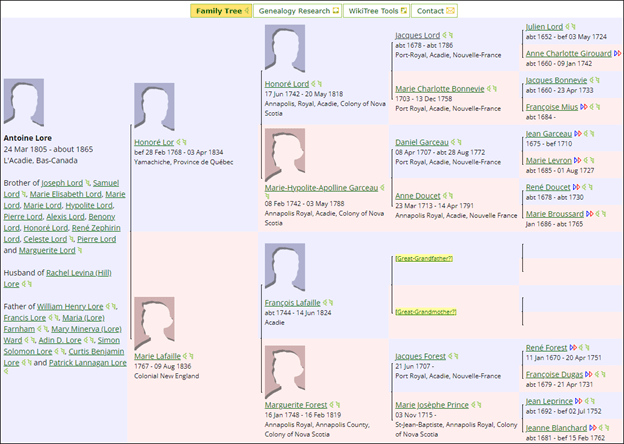
Yes, you guessed it. Anthony turned out to be “Antoine” and Lore is spelled in a variety of ways, including Lord. His family is Acadian.

That’s Anthony Lore, which is how he was listed on the death certificate of his son, in the software on my computer, above, and here is Antoine Lore at WikiTree, below.

As you can see, that brick wall falling opened a whole new group of ancestors, and along with it, my appreciation of endogamy😊

Match lists facilitate viewing the big picture and can be a very useful tool for people seeking unknowns or trying to group people together in a variety of ways.

Do you have any brick walls that need to fall?

How can or do you utilize your match lists?

_____________________________________________________________

Follow DNAexplain on Facebook, here or follow me on Twitter, here.

Share the Love!

You’re always welcome to forward articles or links to friends and share on social media.

If you haven’t already subscribed (it’s free,) you can receive an email whenever I publish by clicking the “follow” button on the main blog page, here.

You Can Help Keep This Blog Free

I receive a small contribution when you click on some of the links to vendors in my articles. This does NOT increase the price you pay but helps me to keep the lights on and this informational blog free for everyone. Please click on the links in the articles or to the vendors below if you are purchasing products or DNA testing.

Thank you so much.

DNA Purchases and Free Uploads

Genealogy Products and Services

My Book

Genealogy Books

Genealogy Research

Barbara Eckhardt (1614-1684), US President’s 10th Great-Grandmother – 52 Ancestors #368

Barbara Eckhardt was born about 1614 in the quaint winemaking village of Beutelsbach, Germany to Johannes Eckhardt and Elisabetha Baurencontz.

Barbara was the fifth child born to her parents, but only the second one to live. Her older sister, Anna Maria, born in 1611, was three years old when Barbara was born. Those two girls must have been quite close, given their proximity in age and that they were the only two daughters that survived.

I suspect that a child was born between those two girls, and went to rest in the churchyard, within the protective walls, where no gravestones remain today.

In 1615, another child was born to Barbara’s parents, and died, buried in the churchyard where generations of family members rested.

In 1618, the 30 Years’ War, a religious conflict between Catholic and Protestant states in the Holy Roman Empire erupted in Prague and spread like wildfire, with Germany bearing the brunt of the devastation during the next three decades. Three decades – that’s an entire generation. Before it was over, 8 million would perish in brutal warfare and its aftermath. Some parts of Germany were entirely depopulated.

Barbara’s mother had another baby in 1618. Nothing more is known of that child, but we can well imagine his fate.

In 1619 and 1622, two more children joined the family, and miraculously, survived. I suspect that another child was born in 1620, but after the war began, the church records were destroyed, and the only way we know about survivors was if they later died in Beutelsbach, after the end of the war. Records partially resumed in 1646.

Barbara’s schooling was assuredly disrupted, if she had any education at all, given that soldiers on both sides were pillaging and robbing all of the villages in this part of Germany. Barbara would have been unable to read or write.

In 1626, after the Battle of Nordlingen, a resounding defeat for the Protestants, soldiers garrisoned in Beutelsbach, where they remained for years, taking whatever they wanted. As bad as things were, they got even worse in 1634.

FIRE!!!

By 1634, the war had been raging for 16 long years, and the soldiers had been quartered in Beutelsbach for 8 years. Barbara would have been 20 years old on that cold, tragic day, in the late fall or early winter.

Beuteslbach town elders had been bribing the soldiers not to burn their village, but for some reason, that was no longer effective. Maybe the soldiers wanted more money than existed or could be raised. Maybe someone was angry. Tensions were constantly high, like a wire stretched taut, and nerves were ragged, so who knows what snapped.

The soldiers burned Beutelsbach, killing anyone who resisted. We don’t know if every home in Beutelsbach burned, or just most of them. We know the church was spared, but again, the church was fortified behind a wall.

People died, although with only a few exceptions, such as Agnes Eyb, wife of Hans Lenz, we don’t know exactly who died that day. Beutelsbach church records don’t exist from this time period.

As the flames began consuming the village, Barbara would have smelled smoke. Soon, blood-curdling screams would have been audible everyplace in town – agonizing screams as people and animals burned and were murdered.

Sheer terror.

Barbara would have heard the roar of the fire and homes collapsing, all around her.

Thoughts raced through her mind, like a mad scramble.

What should she do?

Resist?

The soldiers were killing anyone who resisted.

Try to assist the injured?

Could they be helped?

For God’s sake, they are family members.

Barbara had known everyone in the village for her entire life.

Or should she run?

Where would she go?

Was anyplace safe?

Could anything be saved?

OMG where’s my mother, brother, grandmother…

The residents must have wondered why God had foresaken them.

Barbara, along with her parents and older sister, Anna, probably rushed with their two younger siblings, Johannes Eckhardt, 15, and Cyriakus (Ceyer) Eckhardt, 12, from wherever they lived, racing up the church steps through the gate into the fortified churchyard and on into the church itself.

The doors slammed shut and were bolted.

If necessary, Beutelsbach citizens who made it that far would defend the church together, the last stand, or all die together trying.

They would have been protected, at least to some extent, from the soldiers who were slaughtering anyone who resisted, but they would have heard the carnage around them.

Was that someone’s voice they recognized?

They would have begged for God’s intercession – for him to save them, their family members, and their village. They would have bargained their life in exchange for someone else’s who was missing – not among them in the church.

Prayers and beseeching God for a miracle lasted for hours as the village burned.

Finally, the horror of the fire and wailing outside the church would subside to a whimper, then an eerie silence.

It was over, but was anything left? Whoever wasn’t in the church was probably dead or horribly injured.

They emerged to witness a nightmare scenario.

Could they even have funerals, or was a mass grave dug and hasty prayers said under the mocking eyes of the “victorious” soldiers?

We don’t know what happened in the aftermath of the fire. The residents would have had to find shelter someplace. Many, shellshocked, would have walked to a nearby village where they had relatives.

What else could they have done?

We do know, thanks to historian Martin Goll, that the number of Beutelsbach residents declined by about 50% during the war instead of growing as would normally have been expected. It was even worse elsewhere.

Martin reports that the Plague followed the fire, and people starved.

Yet, love somehow blossomed.

Wedding Bells

A war might be raging, and the village burned, but love found a way.

In 1636, Barbara Eckhardt would marry the butcher, Hans Sang (Sing) who lived up the road a mile or so, in the next village, Endersbach.

Barbara’s family may have sought shelter there after the fire, which would have allowed the young people daily proximity to each other to court.

Perhaps Hans helped Barbara’s family, or maybe her family even sought refuge with his. Regardless, they assuredly would have seen each other in church.

Barbara Eckhardt and Hans Sang, after saying their vows, settled in Beutelsbach. It’s likely that Beuelsbach needed a butcher after the fire.

Barbara and Hans set up housekeeping in the house adjoining the steps into the churchyard. They probably built this home, shown with the small red arrow in the drawing, below, literally on the ashes of whatever was there before. Perhaps it was where her parents had lived before the fire.

In this Beutelsbach drawing from 1760, 130 years later, you can see the circular church gate into the churchyard, and the adjacent building where Barbara lived with her family.

Family

Barbara had 7 children, well, that’s 7 that we know of. There are a lot of gaps between the children we know about that assuredly equate to children who died.

Barbara’s first child was probably born about 1637, following her 1636 marriage, and could have been Hans.

  • Hans Sing was noted in the church record as a “simpleton, with weak intellect, but he can repeat prayers.” He died in 1687 in Beutelsbach, which is how we know he existed at all.
  • Michael Sing was born in 1639 in Beutelsbach, married Anna Maria Schilling, and died on March 7, 1725, also in Beutelsbach. He was a butcher, like his father, as was his only surviving son, Johann Georg Sing.
  • Hans Georg Sing was born in 1640 in Beutelsbach, married Margaretha Ziegler in 1665, and died on January 21, 1676, in Grosheppach. He, too, was a butcher.
  • At least two children would have been born, likely in 1642 and 1644.
  • Barbara Sing, my ancestor, was born in 1645 in Endersbach, married Hans Lenz, a vintner, and baker, and died on July 10, 1686, in Beutelsbach. The fact that Barbara was born in Endersbach causes me to wonder if the family had to shelter again outside of Beutelsbach.
  • Another child was probably born, and died, in 1647
  • Anna Sing, also my ancestor, was born on March 6, 1648, in Beutelsbach, married Bartholomaus Kraft in 1666, and died on March 6, 1728, in Beutelsbach of a stroke.

In October 1648, the 30 Years’ War finally ended. For the first time in her life, Barbara was finally able to relax. She didn’t have to constantly be on alert for the smell of smoke, meaning that the town was burning again.

  • Her next child was probably born in 1650.
  • Martin Sing was born on May 15, 1652, in Beutelsbach and died early.
  • Another child was probably born in 1654.
  • Jakob Sing was born on April 30, 1655, in Beutelsbach and died there on July 17, 1713. Martin found no records of a spouse, nor of any children. Jakob would have been born when his mother was 41 years old, so it’s possible that he too suffered from a disability.

Plague

From 1682-1684, the Plague once again swept through Europe. Barbara, “hausfrau of Hans Singen,” died on April 7, 1684, followed by her husband, Hans, eleven days later, on April 18th.

An incredibly sad time for her family, many of whom were probably ill themselves.

At Barbara’s death, she had five living children and 12 known grandchildren, although there were likely more, specifically by the son who settled in Grossheppach, or other children who may have moved away.

Barbara’s Presidential Legacy

There was one child, though, that would secure Barbara’s place in history, and no, it wasn’t one of her sons.

  • Daughter Anna Sing (1648-1728) married Bartholomaus Krafft (1643-1713.)
  • Their son Johann Georg Krafft (1767-1724) married Anna Catharina Ritter (1673-1701.)
  • Their daughter Maria Margaretha Krafft (1700-1747) married Johann Martin Wolflin (1690-1745.)

These couples, above, are also my ancestors. I’m doubly descended from Barbara through both of her daughters, so Anna Sing is my ancestor too.

However, my ancestor, Johann Ludwig Wolflin is Johann Conrad Wolflin’s brother, so our common lineage bifurcates here.

The Presidential line continues:

  • Johann Conrad Wolflin (1729-1794) was born in Besigheim, Germany, immigrated in 1750, and died in Middletown, Dauphin Co., PA, where his surname was spelled variously, including Woelfle and Wolfle, then became Anglicized to Wolfley, which is how it must have sounded. He married Anna Catherine Shockey (1783-1803) in Pennsylvania and served in the Revolutionary War with his sons John and Jacob.
  • Their son Ludwig Wolfley (1766-1822) married Anna Maria Toot (1786-1841.)
  • Their son George Wolfley (1807-1879) married Nancy Perry (1812-1894.)
  • Their son Robert Wolfley (1834-1895) married Rachel Abbott (1835-1911.)
  • Their daughter Della L. Wolfley (1863-1906) married Charles Thomas Payne (1861-1940.)
  • Their son Rolla Charles Payne (1892-1968) married Leona B. McCurry (1897-1968.)
  • Their daughter Madelyn Lee Payne (1922-2008) married Stanley Armour Dunham (1918-1992.)
  • Ann Dunham (1942-1995) married Barack Obama I (1935-1982.)

Their son, Barack Hussein Obama II, became the 44th President of the United States and served two terms, from January 2009 through January 2017.

I’m incredibly grateful to Martin Goll for his research and paper (in German) on President Obama’s line in Beutelsbach, and for connecting the dots to his immigrant ancestor. I benefitted immensely, given that this is my lineage too.

You can view President Obama’s detailed genealogy, here.

Of course, this means that Barack Obama is my cousin, and we share multiple ancestral lines.

After signing in, using WikiTree’s Relationship tool, above, I determined that Barack and I are 7C1R.

All of my Lentz Cousins are related to President Obama as well. So are all of my closer cousins who descend from Margaret Elisabeth Lentz, who married John David Miller, whose daughter Evaline Miller married Hiram Ferverda, and gave birth to my grandfather, John Whitney Ferverda.

This pedigree chart shows my Lentz line back to Jacob Lentz, who married Fredericka Ruhle, the immigrants in our line, from whom my American Lentz cousins descend. Johanna Fredericka Ruhle, shipwrecked on the way to the US in 1818/1819, was the granddaughter of Johann Ludwig Wolflin whose brother immigrated to Pennsylvania in 1750 and established Barack Obama’s line.

How cool is this! Barbara Eckhardt’s legacy, and indeed that of many Beutelsbach families (and ancestors,) is American President Barack Obama.

_____________________________________________________________

Follow DNAexplain on Facebook, here or follow me on Twitter, here.

Share the Love!

You’re always welcome to forward articles or links to friends and share on social media.

If you haven’t already subscribed (it’s free,) you can receive an email whenever I publish by clicking the “follow” button on the main blog page, here.

You Can Help Keep This Blog Free

I receive a small contribution when you click on some of the links to vendors in my articles. This does NOT increase the price you pay but helps me to keep the lights on and this informational blog free for everyone. Please click on the links in the articles or to the vendors below if you are purchasing products or DNA testing.

Thank you so much.

DNA Purchases and Free Uploads

Genealogy Products and Services

My Book

Genealogy Books

Genealogy Research

In Search of…Vendor Features, Strengths, and Testing Strategies

This is the third in our series of articles about searching for unknown close family members, specifically; parents, grandparents, or siblings. However, these same techniques can be applied to ancestors further back in time too.

In this article, we are going to discuss your goals and why testing or uploading to multiple vendors is advantageous – even if you could potentially solve the initial mystery at one vendor. Of course, the vendor you test with first might not be the vendor where the mystery will be solved, and data from multiple vendors might just be the combination you need.

Testing Strategy – You Might Get Lucky

I recommended in the first article that you go ahead and test at the different vendors.

Some people asked why, and specifically, why you wouldn’t just test at one vendor with the largest database first, then proceed to the others if you needed to.

That’s a great question, and I want to discuss the pros and cons in this article more specifically.

Clearly, that is one strategy, but the approach you select might differ based on a variety of considerations:

  • You may only be interested in obtaining the name of the person you are seeking – or – you may be interested in finding out as much as possible.
  • You may find that your best match at one company is decidedly unhelpful, and may even block you or your efforts, while someone elsewhere may be exactly the opposite.
  • Solving your mystery may be difficult and painful at one vendor, but the answer may be infinitely easier at a different vendor where the answer may literally be waiting.
  • There may not be enough, or the right information, or matches, at any one vendor, but the puzzle may be solvable by combining information from multiple vendors and tests. Every little bit helps.
  • You may have a sense of urgency, especially if you hope to meet the person and you’re searching for parents, siblings or grandparents who may be aging.
  • You may be cost-sensitive and cannot afford more than one test at a time. Fortunately, our upload strategy helps with that too. Also, watch for vendor sales or bundles.

From the time you order your DNA test, it will be about 6-8 weeks, give or take a week or two in either direction, before you receive results.

When those results arrive, you might get lucky, and the answer you seek is immediately evident with no additional work and just waiting for you at the first testing company.

If that’s the case, you got lucky and hit the jackpot. If you’re searching for both parents, that means you still have one parent to go.

Unidentified grandparents can be a little more difficult, because there are four of them to sort between.

If you discover a sibling or half-sibling, you still need to figure out who your common parent is. Sometimes X, Y, and mitochondrial DNA provides an immediate answer and is invaluable in these situations.

It’s more likely that you’ll find a group of somewhat more distant relatives. You may be able to figure out who your common grandparents or great-grandparents are, but not your parent(s) initially. Often, the closer generation or two is actually the most difficult because you’re dealing with contemporary records which are not publicly available, fewer descendants, and the topic may be very uncomfortable for some people. It’s also complicated because you’re often not dealing with “full” relationships, but “half,” as in half-sibling, half-niece, half-1C, etc.

You may spend a substantial amount of time trying to solve this puzzle at the first vendor before ordering your next test.

That second test will also take about 6-8 weeks, give or take. I recommend that you order the first two autosomal tests, now.

Order Your First Two Autosomal Tests

The two testing companies with the largest autosomal databases for comparison, Ancestry, and 23andMe, DO NOT accept DNA file uploads from other companies, so you’ll need to test with each individually.

Fortunately, you CAN transfer your autosomal DNA tests to both MyHeritage and FamilyTreeDNA, for free.

You will have different matches at each company. Some people will be far more responsive and helpful than others.

I recommend that you go ahead and order both the Ancestry and 23andMe tests initially, then upload the first one that comes back with results to both FamilyTreeDNA and MyHeritage. Complete, step-by-step download/upload instructions can be found here.

You can also upload your DNA file to a fifth company, Living DNA, but they are significantly smaller and heavily focused on England and Great Britain. However, if that’s where you’re searching, this might be where you find important matches.

You can also upload to GEDMatch, a popular third-party database, but since you’re going to be in the databases of the four major testing companies, there is little to be gained at GEDMatch in terms of people who have not tested at one of the major companies. Do NOT upload to GEDMatch INSTEAD of testing or uploading to the four major sites, as GEDMatch only has a small fraction of the testers in each of the vendor databases.

What GEDMatch does offer is a chromosome browser – something that Ancestry does NOT offer, along with other clustering tools which you may find useful. I recommend GEDMatch in addition to the others, if needed or desired.

Ordering Y and Mitochondrial DNA Tests

We reviewed the basics of the different kinds of DNA, here.

Some people have asked why, if autosomal DNA shows relatives on all of your lines, would one would want to order specific tests that focus on just one line?

It just so happens that the two lines that Y and mitochondrial DNA test ARE the two lines you’re seeking – direct maternal – your mother (and her mother), and direct paternal, your father (and his father.)

These two tests are different kinds of DNA tests, testing a different type of DNA, and provide very focused information, and matches, not available from autosomal DNA tests.

For men, Y DNA can reveal your father’s surname, which can be an invaluable clue in narrowing paternal candidates. Knowing that my brother’s Y DNA matched several men with the surname of Priest made me jump for joy when he matched a woman of that same last name at another vendor.

Here’s a quote from one of the members of a Y DNA project where I’m the volunteer administrator:

“Thank you for your help understanding and using all 4 kinds of my DNA results. By piecing the parts together, I identified my father. Specifically, without Y DNA testing, and the Big Y test, I would not have figured out my parental connection, and then that my paternal line had been assigned to the wrong family. STR testing gave me the correct surname, but the Big Y test showed me exactly where I fit, and disproved that other line. I’m now in touch with my father, and we both know who our relatives are – two things that would have never happened otherwise.”

If you fall into the category of, “I want to know everything I can now,” then order both Y and mitochondrial DNA tests initially, along with those two autosomal tests.

You will need to order Y (males only) and mitochondrial DNA tests separately from the autosomal Family Finder test, although you should order on the same account as your Family Finder test at FamilyTreeDNA.

If you take the Family Finder autosomal test at FamilyTreeDNA or upload your autosomal results from another vendor, you can simply select to add the Y and mitochondrial DNA tests to your account, and they will send you a swab kit.

Conversely, you can order either a Y or mitochondrial DNA test, and then add a Family Finder or upload a DNA file if you’ve already taken an autosomal DNA test to that account too. Note – these might not be current prices – check here for sales.

You will want all 3 of your tests on the same account so that you can use the Advanced Matches feature.

Using Advanced Matches, you’ll be able to view people who match you on combinations of multiple kinds of tests.

For example, if you’re a male, you can see if your Y DNA matches also match you on the Family Finder autosomal test, and if so, how closely?

Here’s an example.

In this case, I requested matches to men with 111 markers who also match the tester on the Family Finder test. I discovered both a father and a full sibling, plus a few more distant matches. There were ten total combined matches to work with, but I’ve only shown five for illustration purposes.

This information is worth its weight in gold.

Is the Big Y Test Worth It?

People ask if the Big Y test is really worth the extra money.

The answer is, “it depends.”

If all you’re looking for are matching surnames, then the answer is probably no. A 37 or 111 marker test will probably suffice. Eventually, you’ll probably want to do the Big Y, though.

If you’re looking for exact placement on the tree, with an estimated distance to other men who have taken that test, then the answer is, “absolutely.” I wish the Big Y test had been available back when I was hunting for my brother’s biological family.

The Big Y test provides a VERY specific haplogroup and places you very accurately in your location on the Y DNA tree, along with other men of your line, assuming they have tested. You may find the surname, as well as being placed within a generation or a few of current in that family line.

Additionally, the Discover page provides estimates of how far in the past you share a common ancestor with other people that share the same haplogroup. This can be a HUGE boon to a male trying to figure out his surname line and how closely in time he’s related to his matches.

Big Y NPE Examples

Y DNA SNP mutations tested with the Big Y test accrue a mutation about every generation, or so. Sometimes we see mutations in every generation.

Here’s an example from my Campbell line. Haplogroups are listed in the top three rows.

I created this spreadsheet, but FamilyTreeDNA provides a block tree for Big Y testers. I’ve added the genealogy of the testers, with the various Big Y testers at the bottom and common ancestors above, in bold.

We have two red NPE lines showing. The MacFarlane tester matches M. Campbell VERY closely, and two Clark males match W. Campbell and other Campbells quite closely. We utilized autosomal plus the Y results to determine where the unknown parentage events occurred. Today, if you’re a Clark or MacFarlane male, or a male by any other surname who was fathered by a Y chromosome Campbell male (by any surname), you’ll know exactly where you fit in this group of testers on your direct paternal line.

Y DNA is important because men often match other men with the same surname, which is a HUGE clue, especially in combination with autosomal DNA results. I say “often,” because it’s possible that no one in your line has tested, or that your father’s surname is not his biological surname either.

Y and mitochondrial DNA matches can be HUGELY beneficial pieces of information either by confirming a close autosomal relationship on that line, or eliminating the possibility.

Lineage-Specific Population Information

In addition to matching other people, both Y and mitochondrial DNA tests provide you with lineage-specific population or “ethnicity” information for this specific line which helps you focus your research.

For example, if you view the Y DNA Haplogroup Origins shown for this tester, you’ll discover that these matches are Jewish.

The tester might not be Jewish on any other genealogical line, but they definitely have Jewish ancestry on their Y DNA, paternal, line.

The same holds true for mitochondrial DNA as well. The main difference with mitochondrial DNA is that the surname changes with each generation, haplogroups today (pre-Million Mito) are less specific, and fewer people have been tested.

Y and Mitochondrial DNA Benefits

Knowing your Y and mitochondrial DNA haplogroups not only arm you with information about yourself, they provide you with matching tools and an avenue to include or exclude people as your direct line paternal or maternal ancestors.

Your Y and mitochondrial DNA can also provide CRITICALLY IMPORTANT information about whether that direct line ancestor belonged to an endogamous population, and where they came from.

For example, both Jewish and Native populations are endogamous populations, meaning highly intermarried for many generations into the past.

Knowing that helps you adjust your autosomal relationship analysis.

Why Order Multiple Tests Initially Instead of Waiting?

If you’ve been adding elapsed time, two autosomal tests (Ancestry and 23andMe), two uploads (to FamilyTreeDNA and MyHeritage,) a Y DNA test, and a mitochondrial DNA test, if all purchased serially, one following the other, means you’ll be waiting approximately 6-8 months.

Do you want to wait 6-8 months for all of your results? Can you afford to?

Part of this answer has to do with what, exactly, you’re seeking, and how patient you are.

Only you can answer that question.

A Name or Information?

Are you seeking the name or identity of a person, or are you seeking information about that person?

Most people don’t just want to put a name to the person they are seeking – they want to learn about them and the rest of the family that door opens.

You will have different matches at each company. Even after you identify the person you seek, the people you match may have trees you can view, with family photos and other important information. (Remember, you can’t see living people in trees.) Your matches may have first-person information about your relative and may know them if they are living, or have known them.

Furthermore, you may have the opportunity to meet that person. Time delayed may not be able to be recovered or regained.

One cousin that I assisted discovered that his father had died just six weeks before he broke through that wall and made the connection.

Working with data from all vendors simultaneously will allow you to combine that data and utilize it together. Using your “best” matches at each company, augmented by X, Y, and/or mitochondrial DNA, can make MUCH shorter work of this search.

Your closest autosomal matches are the most important and insightful. In this series, I will be working with the top 15 autosomal results at each vendor, at least initially. This approach provides me with the best chance of meaningful close relationship discoveries.

Data and Vendor Results Integration

Here’s a table of my two closest maternal and paternal matches at the four major vendors. I can assign these to maternal or paternal sides, because I know the identity of my parents, and I know some of these people. If an adoptee was doing this, the top 4 could all be from one parent, which is why we work with the top 15 or so matches.

Vendor Closest Maternal Closest Paternal Comments
Ancestry 1C, 1C1R Half-1C, 2C I recognized both of the maternal and neither of the paternal.
23andMe 2C, 2C 1C1R, half-gr-niece Recognized both maternal, one paternal
MyHeritage Mother uploaded, 1C Half-niece, half-1C Recognized both maternal, one paternal
FamilyTreeDNA Mother tested, 1C1R Parent/child, half-gr-niece uploaded Recognized all 4

To be clear, I tested my mother’s mitochondrial DNA before she passed away, but because FamilyTreeDNA archives DNA samples for 25 years, as the owner/manager of her DNA kit, I was able to order the Family Finder test after she had passed away. Her tests are invaluable today.

Then, years later, I uploaded her results to MyHeritage.

If I was an adopted child searching for my mother, I would find her results in both databases today. She’ll never be at either 23andMe or Ancestry because she passed away before she could test there and they don’t accept uploads.

Looking at the other vendors, my half-niece at MyHeritage is my paternal half-sibling’s daughter. My half-sibling is deceased, so this is as close as I’ll ever get to matching her.

At 23andMe, the half-great-niece is my half-siblings grandchild.

It’s interesting that I have no matches to descendants of my other half-sibling, who is also deceased. Maybe I should ask if any of his children or grandchildren have tested. Hmmmm…..

You can see that I stand a MUCH BETTER chance of figuring out close relatives using the combined closest matches of all four databases instead of the top matches from just one database. It doesn’t matter if the database is large if the right person or people didn’t test there.

Combine Resources

I’ll be providing analysis methodologies for working with results from all of the vendors together, just in case your answer is not immediately obvious. Taking multiple DNA tests facilitates using all of these tools immediately, not months later. Solving the puzzle sooner means you may not miss valuable opportunities.

You may also discover that the door slams shut with some people, or they may not respond to your queries, but another match may be unbelievably helpful. Don’t limit your possibilities.

Let’s take a look at the strengths of each vendor.

Vendor Strengths and Things to Know

Every vendor has product strengths and idiosyncracies that the others do not. All vendors provide matches and shared matches. Each vendor provides ethnicity tools which certainly can be useful, but the features differ and will be covered elsewhere.

  • AncestryAncestry has the largest autosomal database and includes ThruLines, but no Y or mitochondrial DNA testing, no clusters, no chromosome browser, no triangulation, and no X chromosome matching or reporting. Ancestry provides genealogical records, advanced tools, and full tree access to your matches’ trees with an Ancestry subscription. Ancestry does not allow downloading your match list or segment match information, but the other vendors do.
  • 23andMe 23andMe has the second largest database. They provide triangulation and genetic trees that include your closest matches. Many people test at 23andMe for health and wellness information, so 23andMe has people in their database who are not specifically interested in genealogy and probably won’t have tested elsewhere, but may be invaluable to your search. 23andMe provides Y and mtDNA high-level haplogroups only, but no matching or other haplogroup information. If you purchase a new test or have a V5 ancestry+health current test, you can expand your matches from a limit of 1500 to about 5000 with an annual membership. For seeking close relatives, you don’t need those features, but you may want them for genealogy. 23andMe is the only vendor that limits their customers’ matches.
  • MyHeritageMyHeritage has the third largest database that includes lots of European testers. MyHeritage provides triangulation, Theories of Family Relativity, and an integrated cluster tool* but does not report X matches and does not offer Y or mitochondrial DNA testing. MyHeritage accepts autosomal DNA file uploads from other testing companies for free and provides access to advanced DNA features for a one-time unlock fee. MyHeritage includes genealogical records and full feature access to advanced DNA tools with a Complete Subscription. (Free 15 days trial subscription, here.)
  • FamilyTreeDNA Family Finder (autosomal)FamilyTreeDNA is the oldest DNA testing company, meaning their database includes people who initially tested 20+ years ago and have since passed away. This, in essence, gets you one generation further back in time, with the possibility of stronger matches. Their Family Matching feature buckets and triangulates your matches, assigning them to your maternal or paternal sides if you link known matches to their proper place in your tree, even if your parents have not tested. FamilyTreeDNA accepts uploads from other testing companies for free and provides advanced DNA features for a one time unlock fee.
  • FamilyTreeDNAFamilyTreeDNA is the only company that offers both Y and mitochondrial DNA testing products that include matching, integration with autosomal test results, and other tools. These two tests are lineage-specific and don’t have to be sorted from your other ancestral lines.

I wrote about using Y DNA results, here.

I wrote about using mitochondrial DNA results, here.

*Third parties such as Genetic Affairs provide clustering tools for both 23andMe and FamilyTreeDNA. Clustering is integrated at MyHeritage. Ancestry does not provide a tool for nor allow third-party clustering. If the answer you seek isn’t immediately evident, Genetic Affairs clustering tools group people together who are related to each other, and you, and create both genetic and genealogical trees based on shared matches. You can read more about their tools, here.

Fish in all the Ponds and Use All the Bait Possible

Here’s the testing and upload strategy I recommend, based on the above discussion and considerations. The bottom line is this – if you want as much information as possible, as quickly as possible, order the four tests in red initially. Then transfer the first autosomal test results you receive to the two companies identified in blue. Optionally, GEDMatch may have tools you want to work with, but they aren’t a testing company.

What When Ancestry 23andMe MyHeritage FamilyTreeDNA
Order autosomal Initially X X    
Order Y 111 or Big-Y DNA test if male Initially       X
Order mitochondrial DNA test Initially if desired       X
Upload free autosomal When Ancestry or 23andMe results are available     X X
Unlock Advanced Tools When you upload     $29 $19
Optional GEDMatch free upload If desired, can subscribe for advanced tools

When you upload an autosomal DNA file to a vendor site, only upload one file per site, per tester. Otherwise, multiple tests simply glom up everyone’s match list with multiple matches to the same person.

Multiple vendor sites will hopefully provide multiple close matches, which increase your opportunity to discover INFORMATION about your family, not just the identity of the person you seek.

Or maybe you prefer to wait and order these DNA tests serially, waiting until one set of results is back and you’re finished working with them before ordering the next one. If so, that means you’re a MUCH more patient person than me. 😊

Our next article in this series will be about endogamy, how to know if it applies to you, and what that means to your search.

_____________________________________________________________

Follow DNAexplain on Facebook, here or follow me on Twitter, here.

Share the Love!

You’re always welcome to forward articles or links to friends and share on social media.

If you haven’t already subscribed (it’s free,) you can receive an email whenever I publish by clicking the “follow” button on the main blog page, here.

You Can Help Keep This Blog Free

I receive a small contribution when you click on some of the links to vendors in my articles. This does NOT increase the price you pay but helps me to keep the lights on and this informational blog free for everyone. Please click on the links in the articles or to the vendors below if you are purchasing products or DNA testing.

Thank you so much.

DNA Purchases and Free Uploads

Genealogy Products and Services

My Book

Genealogy Books

Genealogy Research

Hans Sang (1614-1684); Survived the 30 Years’ War, But Not the Plague – 52 Ancestors #367

Hans Sang (Sing) was born in 1614 in Endersbach to Johannes Sang and Anna Enssle.

He was assuredly baptized in the former Collegiate Church, which still stands. The tower was constructed in 1729.

Hans would never have remembered a childhood without warfare.

In 1618, when Hans was only four years old, the Thirty Years’ War erupted, devastating this part of Germany. More than two-thirds of the residents perished, succumbing to warfare, starvation, plague, and other opportunistic diseases like dysentery and cholera.

Hans, however, was one of the lucky survivors.

Hans would one day become a butcher, which means he had to apprentice with someone. We don’t know his father’s occupation, which could have been a butcher as well.

We don’t know when Hans’ parents died, according to this genealogy based on church and civil documents, but based on the fact that his last known sibling was born in 1625, it would appear that both of his parents were living for at least the first 11 years of Hans’s life.

Records from that time are scarce to non-existent. What the soldiers didn’t burn, they destroyed or stole. It’s a miracle that the church itself wasn’t burned. The rest of the town may have been. For all we know, the minister may have died or been killed, with no replacement. In other words, there may have been no one to record anything.

The war raged around Hans. Perhaps the fact that he was a butcher’s apprentice saved him. Armies had to eat.

In 1634, Hans would have been 20 years old. In German culture, not quite of age to marry, but living in a warzone would have changed the norms of the day.

Endersbach, with her church marked by a red star in the center of town, above, was a mile or so down the road from Beutelsbach, her center marked with a red pin.

In fact, the families of the two towns intermingled regularly and had likely been related for centuries. Endersbach is first found in records in 1278 as Andrespach, so had been in existence for hundreds of years, as had Beutelsbach – both settlements along the Rems River.

Soldiers had been quartering in Beutelsbach for some time, and probably in Endersbach too. Pillaging was a given, but town elders, as well as the citizens, paid the soldiers as much as they could come up with to protect the town from burning.

Apparently, the payment either wasn’t enough, or something else happened, because in the late fall or early winter of 1634, neighboring Beutelsbach burned to the ground. The church was fortified, so it’s certainly possible that at least some of the residents took shelter within the church walls, inside the church, which held.

Would Endersbach burn too?

Did Endersbach burn?

The Endersbach church was also a walled church, built between 1468 and 1491 with the intention that the residents would all shelter within the church that could be much more easily defended than individual homes, clustered in the village. Homes also served as farms, with a barn, livestock and fields stretching out directly behind the house. Houses abutted each other for protection.

Fortified churches were built as defensive structures and incorporated military features, such as thick walls, battlements, and embrasures probably initially constructed to withstand the Ottoman invasions of the 1400s and 1500s.

By Silesia711 – Own work, CC BY-SA 4.0, https://commons.wikimedia.org/w/index.php?curid=62263490

You can see portions of the remaining Endersbach church wall in this contemporary photo.

When Beutelsbach burned, the Endersbach residents likely filled their leather fire buckets with water, shown below, gathered their families, and quickly ran to the church.

Probably a lot of praying occurred that day, not just for their own protection, but for their neighbors and relatives whose homes they could see burning in the distance as thick, acrid smoke drifted over the vineyards on its way to Endersbach.

There was never any doubt who was in charge during a war.

Following the torching of Beutelsbach, the local residents would have had to take up residence someplace else, at least for a while. Some probably sheltered with family and friends in Endersbach.

Heartache and disease accompanied them, with unsanitary conditions causing illness and death among those who didn’t burn or die defending their homes.

Perhaps that’s when Hans Sang or Sing took a shine to Barbara Eckhardt whose family was from Beutelsbach. Did her family seek refuge in Endersbach?

Hans and Barbara married sometime in 1636, in Beutelsbach, where Hans became a citizen.

Two years after that devastating fire, I’m sure Beutelsbach was still trying to recover and rebuild – still in the midst of a war. Regardless of everything else, life had to go on in some way. People still married, began families, and shepherded the next generation into the world.

We don’t know if every house burned, but we do know that Beutelsbach lost about 50% of its residents, perhaps more.

If the local butcher was one of those who perished or was burned out, Beutelsbach would have encouraged Hans, the butcher’s apprentice from neighboring Endersbach, to take up residence. Of course, Barbara’s attention would have sweetened that deal and made Beutelsbach look very attractive to Hans – a win-win for everyone.

Even though Beutelsbach church records weren’t kept again until after 1646, we do know something about Hans and Barbara’s children who survived and remained in Beutelsbach. Their death records often give an age, therefore revealing at least the year they were born.

After their marriage, life became at least somewhat normal, as normal as life can be during a war that has lasted your entire lifetime. Children were born, and some died. Everyone went to church on Sundays. Birthdays accumulated. Christmas was celebrated, and candles lit the church beautifully.

Hans did quite well for himself as the Beutelsbach butcher. His home and butcher shop was right at the base of Beutelsbach’s fortified church wall at Marktplatz 8.

The seam in the roof, just to the right of the red car, divides Marktpfalz 8, at left, from Marketpfalz 10. As you can see, it’s actually a small residence, snugged up against the church wall on one side.

Hans and Barbara lived in the last house before the church, or the first house when leaving the church. It was easy to pick up meat on the way past.

All homes were clustered in the center of town, their barns and field stretching out behind, as you can see on this 1832 Beutelsbach map. Vineyards, tended by the citizens, were located on the hillsides.

Unfortunately, in 1832, Marktpfalz 8 no longer existed, unless the numbering has shifted. The space is vacant on the map, so has apparently been rebuilt. It appears that the neighboring property, Marktpfalz 10, remains the same with a recognizable footprint.

However, it’s probably not the marketing and retail opportunity that made this location so desirable to Hans.

If Beutelsbach was to be attacked or burn again, all Hans and Barbara needed to do was grab their kids and literally run outside their front door and up the steps to be inside the wall.

Attribution by qwesy qwesy. You can see the number 8 on the grey door.

No one was closer to safety. We don’t know how many times they sheltered in the safety of the church, but we can say with certainty that they did during the first dozen years of their marriage as the war continued, day in and day out, swirling around them.

No wonder Hans and his bride set up housekeeping in Beutelsbach. Opportunity among chaos.

When the 30 Years’ War finally ended in 1648, Hans was 39 or 40 years old. He would have seen literally generations of soldiers marching through both Endersbach and Beutelsbach, up and down the roads, pillaging as they went. It didn’t matter which “side” the soldiers represented; no one was safe. Fear and running for safety was the only life Hans had ever known. The war was finally, finally, over.

I can only imagine the celebrations throughout Germany.

This print from Nuremberg shows a fireworks display celebrating the end of the war.

Martin Goll, a historian, and descendant who lives in Beutelsbach today, tells us that by the time Hans died, on April 18, 1684, he was a wealthy man, at least compared to other Beutelsbach residents.

Hans Sang or Sing had defied the odds. He lived through a brutal war that lasted three decades and took two-thirds of the people living in this part of Germany. He managed to not hurt himself badly enough as a butcher to perish of infection, didn’t starve to death, evaded or survived the plague, dysentery, and typhoid, well, right up until he didn’t.

Against incredible odds, Hans lived to be 70 years old – and then, and then – he died from the Plague. He wasn’t alone. Eleven days earlier, his wife, Barbara, died as well.

Ironically, this would be the Plague’s last stand in most of Europe for many years before it would rear its ugly head again.

I’d wager that many people in Beutelsbach died in the days and weeks surrounding Hans and Barbara’s deaths. Many more were probably quite ill, but recovered.

Did the minister survive? If so, was he well enough to perform funerals? Were the dead buried, then the funerals following at a later time?

Were Hans and Barbara’s funerals combined?

I’d love to hear what the minister had to say at Hans’s funeral before he was buried in the churchyard, inside the wall, just a few feet from his modest home that he shared with Barbara for nearly half a century. Surely, they were buried side by side, Hans joining Barbara a few days after she departed this life.

Those early graves aren’t marked in the churchyard today. We simply know that they are there, silent sentries to ensuing generations.

But wait, that’s not the end of Hans’ story – there’s more. There is something else that would cement Hans Sing’s place in history – just not in his lifetime. Hans never knew about this, because it hadn’t happened yet.

Hans Sing is the ancestor of a United States President. And yes, that means that President is my cousin.

I’ll tell you “the rest of the story” when I write about his wife, Barbara Eckhardt.

_____________________________________________________________

Follow DNAexplain on Facebook, here or follow me on Twitter, here.

Share the Love!

You’re always welcome to forward articles or links to friends and share on social media.

If you haven’t already subscribed (it’s free,) you can receive an email whenever I publish by clicking the “follow” button on the main blog page, here.

You Can Help Keep This Blog Free

I receive a small contribution when you click on some of the links to vendors in my articles. This does NOT increase the price you pay but helps me to keep the lights on and this informational blog free for everyone. Please click on the links in the articles or to the vendors below if you are purchasing products or DNA testing.

Thank you so much.

DNA Purchases and Free Uploads

Genealogy Products and Services

My Book

Genealogy Books

Genealogy Research

DNA: In Search of…What Do You Mean I’m Not Related to My Family? – and What Comes Next?

Welcome to the second in our series of articles about how to search for unknown family members.

I introduced the series in the article, DNA: In Search of…New Series Launches.

This article addresses the question of “How did this happen?” and introduces the tools we need to answer that question. I’ve combined two articles into one because I really didn’t want to leave you hanging after introducing you to the problem.

We discuss the various kinds of DNA tests, when they are appropriate for your biological sex, and how one can use them to discover information about the person or people you’re seeking.

In other words, we begin at the point of making the discovery that there is something amiss, then review possible glitches. Once we confirm there is someone you need to search for, we discuss how to use genetic testing reasonably and in a planned fashion to solve that mystery.

Please note that I am NOT referring to unexpected ethnicity results in this article. This article refers to your match list and who you do and don’t match on that list. We will discuss ethnicity and how it can help you in a different context in a future article.

The Unknown

Some people have known all their lives that they were adopted, or that they didn’t know the identity of one parent, generally their father.

Other people have made or will make that discovery in a different way. Sometimes, that realization happens when they take an autosomal DNA test and don’t match people they expect to match, either not at all or in a different way.

For example:

  • You might not match a parent or a sibling.
  • You could match only people on your mother’s side, but no known relatives on your father’s side.
  • Your parents or siblings have tested, but you don’t match any of them.
  • Your immediate family hasn’t tested, but your first and second cousins have tested, and you don’t match any of them.
  • You recognize no people, families, or family names on your match list.
  • You think you know your genealogy, but nothing on your match list looks familiar.
  • If your parents and close relatives haven’t tested, not recognizing families might be explained if your family is part of a community of undertested individuals.
  • You might not recognize anyone or surnames if you know absolutely nothing about your family genealogy.
  • Sometimes, a sibling is reported as a half-sibling instead of a full sibling, which is an unexpected finding. This means that you only share one parent, not two. I wrote about this in the article Full or Half Siblings. The non-matching parent is generally the father. The question that follows is, which one of you, if not both, weren’t fathered by the man you thought was your biological father?

These discoveries are generally unexpected and unwelcome – a horrible shock followed by some level of disbelief.

I’ve been there.

My half-brother turned out to not be my half-brother, so we weren’t biologically related at all, although that didn’t change how much I loved him one iota.

Later, I did identify his father, but it was too late for them. My brother had passed on by that time.

Ironically, his biological family would have welcomed him with open arms.

If you’re interested, I wrote about our journey in a series of articles:

The Shock of Discovery

It’s difficult discovering that your full sibling isn’t a full sibling or not a sibling at all, but it’s even worse when you discover that one or both of your parents are not your biological parent(s) when you weren’t expecting that. Obviously, sometimes those two shockers accompany each other.

And no, if you don’t match your parents, siblings, first or second cousins, DNA tests can’t be “that” wrong in terms of matching. That’s generally the first question everyone asks.

Yes, we have seen a couple of instances of test mix-ups at the labs, many years ago, among the millions of tests taken. Better quality control procedures were introduced, and a mix-up hasn’t happened in a very long time. However, if you really think that’s a possibility, or you need peace of mind – order another test from the same vendor. If the second test comes back with the same match list as the first test, there is no lab mix-up.

Or, you can order a test from another vendor – something you’re going to need anyway to solve the mystery and for your genealogy. Hint – the two vendors you must test at directly are Ancestry and 23andMe because they don’t accept uploads. If you’re going to order another test, make it one or both of those.

Before deciding you’ve discovered a genetic disconnect, let’s take a deep breath and look at a couple of other possibilities first.

Be Sure the Vial or Transfer Wasn’t Confused

If you’re encountering a situation where you’re not matching relatives that you know have tested, or for some reason, you suspect something isn’t right, the first things that need to be considered are:

  • Are you positive that your relative(s) have taken a DNA test? You wouldn’t believe how many times someone has told me that they don’t match their mother/father/sibling and come to find out, their family member hasn’t tested. Did they order a test but never send it in? Did they send it in, but their results arent’ back yet?
  • Are you positive that your relative(s) tested at the same company where you did? Many times we discover that they’ve tested, but at a different company. Have your relative show you their results, take a screenshot, or give you their login to confirm you’re at the same vendor.
  • Are you missing all of your relatives or just one or two in the same line? If the answer is one or two, they, not you, may have a disconnect, especially if you match other people on the same side of your family.
  • Did you and a friend or spouse both swab or spit at the same time? If so, is there any possibility that your and their vials were inadvertently swapped when you put them in envelopes and mailed them?

If there is any doubt, check with that other person and see if they are experiencing the same issue. If you look at their results, you may recognize your own family. I’ve seen this occur at family reunions and at the holidays, where several DNA tests were taken by various family members.

  • This last situation is much more common and is caused by confusing files during a download/upload to another vendor. Do you manage multiple kits, and did you inadvertently download the wrong DNA file, or upload the wrong person’s DNA file to a different vendor?

If so, you’re looking at someone else’s results, thinking they are your own. If that person is a cousin, you may be even more confused because you may match some of the same people, just at very different levels. This could make your sibling look like a half-sibling or first cousin, for example.

If there is any possibility of an upload mix-up, or any doubt whatsoever:

  1. Delete the suspect file at the vendor where you uploaded the DNA file
  2. Delete the downloaded files from your computer
  3. Start over by downloading the DNA file again from the original vendor
  4. Label the downloaded file clearly, and immediately, with the tester’s name and date.
  5. Upload the new file to the target vendor before you download another person’s DNA file.

Step-by-step upload/download instructions can be found, here.

Not Parent Expected

If you discover that one of two parents is not the expected biological parent, you’ve discovered a genetic disconnect that is known by a number of different terms. Initially, the term NPE was used, but other terms have been added over the years, and they are sometimes used differently, depending on who is speaking.

  • NPE – Non-Parental Event, Not Parent Expected
  • MPE – Misattributed Paternal/Parental Event or Misattributed Parentage Experience
  • Undocumented Adoption – Regardless of how the situation occurred, it was not documented.

Please, please do NOT jump to conclusions and make assumptions about infidelity and duplicity. There can be many reasons for this occurrence, including:

  • Agreed upon “open” relationships
  • Intentional impregnation when one partner is infertile
  • Surrogacy
  • Infidelity
  • Rape
  • Sperm donor
  • Adoption
  • Unknown first marriage, with step-father raising a child as his own
  • Illegitimate birth of a child before marriage
  • Lifestyle choices
  • Intoxication
  • Coercion

In other words, the situation may have been known to the involved parties, even if they did not share that information with you or others. Prior to the last 20 years, no one would ever have considered that this information might ever be revealed. Social norms and judgments were very different a generation or more ago.

I wrote about this in the article, Things That Need To Be said: Adoption, Adultery, Coercion, Rape, and DNA.

Of course, these events could happen in any generation, but the closer to you, in time, the more evident it will be when looking at your matches.

Now that we’ve determined that we have an unknown parent or grandparent, how do we sort this out?

Let’s Start with the Basics

I’m going to begin by explaining the basics of the different kinds of tests, and when each test can be used.

In this series, we will be focused on searching for six individuals, separately – both parents and all four grandparents.

You will be able to use the same techniques for ancestors in more distant generations by following the same instructions and methodologies, just adapting to include more matches to reach further back in time.

We will be taking the search step-by-step in each article.

Four Kinds of DNA

For genealogy, we can work with four kinds of DNA:

We can potentially use each of these when searching for unknown ancestors, including parents and grandparents. Each type of DNA has specific characteristics and uses in different situations because it’s inherited differently by the son and daughter, below.

In these examples, everything is from the perspective of the son and daughter.

Y DNA testing is only available to males, because only males have a Y chromosome which is inherited directly from the father, shown by the blue arrow. In other words, the son has the father’s Y chromosome (and generally his surname,) but the daughter does not.

The Y chromosome can provide surnames and very close matches, or reach far back in time, or both. Ideally, Y DNA is used in conjunction with autosomal testing when searching for unknown individuals.

Mitochondrial DNA can be tested by everyone since males and females both receive mitochondrial DNA from their mother, passed to her from her direct maternal line, shown by the pink arrows and the yellow hearts. Both the son and daughter can test for their mother’s mitochondrial DNA.

Both Y DNA and mitochondrial DNA can reach far back in time, but can also be informative of recent connections. Neither are ever mixed with the DNA of the other parent, so the DNA is not diluted over the generations.

Think of Y DNA and mitochondrial DNA as having the ability to provide recent genealogy information and connections, plus a deep dive on just one particular line. Fortunately, when you’re looking for parents, the lines they test are the direct maternal (or matrilineal) line and the direct paternal (or patrilineal) lines.

Both Y DNA and mitochondrial DNA tests are deep, not broad. One line each.

Y DNA and mitochondrial DNA will both be able to tell you if that specific ancestral line is European, African, Native American, Asian, Jewish, and so forth. Additionally, both offer matching at FamilyTreeDNA, information about where other testers’ ancestors are found in the world, and more.

If you want more information about what these tests have to offer, now, I provide a Y DNA Resource page, here, and a Mitochondrial DNA Resource page, here.

Autosomal DNA is the DNA contributed to you on chromosomes 1-22 by your ancestors from across all your ancestral lines in your tree, shown by the green arrow.

Everyone receives half of their autosomal DNA from each parent, with the exception of the X chromosome, which we’ll discuss in a minute.

This means that because the parent’s DNA is cut in half in each generation, the contributions of more distant ancestors’ DNA are reduced over time, with each generational division, until it’s no longer discernable or disappears altogether.

Autosomal DNA is broad across many lines, but not deep.

This figure provided by Dr. Paul Maier at FamilyTreeDNA, in the MyOrigins 3.0 White Paper, illustrates that by the 7th generation, you won’t receive DNA from a few of your ancestors. Some may be contained in segments too small to be reported by DNA testing vendors.

Translated, this means that autosomal DNA matching is most reliable in the closest generations, which is where we are working.

There is no documented occurrence of second cousins who don’t match each other. 90% of third cousins match, and about 50% of fourth cousins. I wrote about that in the article, Why Don’t I Match My Cousin?

The 23rd Chromosome – Sex Determination

Autosomal DNA generally refers to chromosomes 1-22. The 23rd chromosome is the sex selection chromosome.

Males have a Y chromosome contributed by their father, and an X contributed by their mother. The Y chromosome is what makes males, male.

Females have an X chromosome contributed by both their mother and father, which recombines just like chromosomes 1-22, but women have no Y chromosome.

In this graphic, you can see that a male child receives the father’s Y chromosome and the mother’s X. The female child receives an X chromosome from both parents.

Only FamilyTreeDNA and 23andMe report X chromosome results by including them with their autosomal DNA test.

Let’s take a look at how the X chromosome works in a little more detail.

X Chromosome DNA is another type of autosomal DNA, meaning it can be inherited from both parents in some circumstances. However, the X chromosome has a different inheritance path which means we analyze it differently for genealogy.

The father gives an X or a Y chromosome to his offspring, but not both.

If the child inherits the Y chromosome from the father, the child becomes a male. If the child inherits the X chromosome from the father, the child becomes a female.

Men only receive an X chromosome from their mother since they receive a Y chromosome from their father. Men can inherit a mixture of their mother’s X chromosomes that were contributed to their mother from both her mother (peach) and father (green.) Conversely, men can inherit their maternal grandmother’s or maternal grandfather’s X chromosome intact.

In this example, the mother and father have three sons. None of the sons can inherit an X chromosome from their father, whose X chromosome is shown in yellow. The father gives the sons his Y chromosome, not shown here, instead of an X, which is how they become males. Males only inherit their X chromosome from their mother.

The mother inherited one copy of her X chromosome from her father, shown in green, and one copy from her mother, shown in peach.

  1. The first son inherited his maternal grandfather’s green X chromosome, intact, from his mother, and none of his maternal grandmother’s peach X chromosome.
  2. The second son inherited a portion of his maternal grandmother’s peach X chromosome and a portion of his maternal grandfather’s green X chromosome. I’ve shown the portions as half, but the division could vary.
  3. The third son inherited his maternal grandmother’s peach X chromosome, intact, and none of his maternal grandfather’s green X chromosome.

This means if you match a man on his X chromosome, assuming it’s a valid match and not identical by chance, that match MUST come from his mother’s line.

In a future article, I’ll provide some X-specific fan charts and tips to help you easily discern potential X inheritance paths.

Women inherit an X chromosome from both their mother and father. They inherit their father’s X chromosome intact that he received from his mother, because he only has one X to give his daughter. Therefore, daughters inherit their paternal grandmother’s X chromosome from their father, because he passes on exactly what he received from his mother.

In this graphic, the father and mother have three daughters. You can see that each daughter receives the father’s yellow X chromosome that he inherited from his mother.

He doesn’t have a second copy of an X chromosome to mix with his mother’s.

Women inherit their mother’s X chromosome in the same fashion that men do. You can see in our example that:

  • The first daughter inherited her father’s yellow X chromosome, plus her maternal grandmother’s peach X chromosome, intact, and none of her maternal grandfather’s green X chromosome.
  • The second daughter inherited her father’s yellow X chromosome, plus part of her maternal grandfather’s green X chromosome and part of her maternal grandmother’s peach X chromosome from her mother. The portions of the mother’s pink and green chromosomes inherited by the daughter can vary widely.
  • The third daughter inherited her father’s yellow X chromosome, plus her maternal grandfather’s green X chromosome, intact, which is his mother’s X chromosome, of course. This daughter inherited none of her maternal grandmother’s peach X chromosome.

Women inherit two X chromosomes, one from each parent, while men only inherit one X, contributed from their mother. This means that X matches have different inheritance paths for women and men.

Because the X inheritance path involves the mother, many people confuse mitochondrial DNA inheritance with X inheritance. I wrote about that in the article, X Matching and Mitochondrial DNA is NOT the Same Thing.

Testing Strategies and Vendor Strengths

In the next article, we will be discussing detailed testing strategies based on multiple factors:

  • Who you are searching for in your tree
  • Who, other than you, is available to test
  • Sex of the tester(s)
  • Vendor strengths and unique offerings
  • Urgency, or not
  • Using combinations of vendor results and why you want to

Getting lucky may be what you hope for, but it’s not a strategy.😊

_____________________________________________________________

Follow DNAexplain on Facebook, here or follow me on Twitter, here.

Share the Love!

You’re always welcome to forward articles or links to friends and share on social media.

If you haven’t already subscribed (it’s free,) you can receive an email whenever I publish by clicking the “follow” button on the main blog page, here.

You Can Help Keep This Blog Free

I receive a small contribution when you click on some of the links to vendors in my articles. This does NOT increase the price you pay but helps me to keep the lights on and this informational blog free for everyone. Please click on the links in the articles or to the vendors below if you are purchasing products or DNA testing.

Thank you so much.

DNA Purchases and Free Uploads

Genealogy Products and Services

My Book

Genealogy Books

Genealogy Research

Hans Lenz (1602-1667), Baker and Vintner During the Thirty Years’ War – 52 Ancestors #366

Hans Lenz was born on January 24, 1602 in the small village of Schnait, (Weinstadt) Germany to Johannes Lenz and Margarethe Vetterle.

Schait was a small village alongside the Rems River, nestled between hillside vineyards with a central church built about 1570, and maybe 40 houses. This drawing from 1685 in Andreas Kieser’s forest register book shows Schnait, with the Protestant church as its heart.

While Schnait looks peaceful and idyllic, a lot transpired in the years between 1602 and 1685.

Truthfully, Hans was lucky to have been born at all. In 1595, the plague swept through the region. Had either of his parents perished, Hans would never have existed.

Plague and warfare were a constant threat, not to mention dysentery and various illnesses that swept half the children away from their parents, and that’s in good times.

Hans was the firstborn child of his parents, arriving the year after their marriage. He probably had several siblings, but we don’t know who they were.

We know little about Schnait in the years between 1602 and 1618, but it’s likely that Hans was confirmed in the church when he was 12 or 13 years old, in about 1614 or 1615.

The minister who confirmed Hans was probably his future father-in-law.

In 1618, the 30 Years’ War began, which was both dynastic and religious, and would devastate Germany over the next three decades.

By Straty_ludnościowe_po_wojnie_30letniej.PNG: Mix321derivative work: Schoolinf3456 – This file was derived from: Straty ludnościowe po wojnie 30letniej.PNG:, GFDL, https://commons.wikimedia.org/w/index.php?curid=18755096

This region, marked with a red star on the 30 Years’ War Depopulation map above, saw massive declines in population. All locations in this part of Germany saw population reductions greater than 66%. Some villages were entirely burned and abandoned, their residents murdered.

It’s difficult to refer to anyone who lived in Germany during this time as fortunate, but comparatively, Hans Lenz was.

Hans Lenz was a baker.

Schnait was not burned to the ground during the war, so it’s possible that the “old bake house,” shown below, is the original baker’s home.

Historical bakery in “Haldenstraße 7” By Silesia711 – Own work, CC BY-SA 4.0, https://commons.wikimedia.org/w/index.php?curid=67028703

The baker was only located just a few steps from the church at Haldenstrasse 7. Perhaps people stopped and picked up baked goods on their way to and from church.

A village only needed one baker, and a baker’s oven would have been very specialized and expensive to construct. This was most likely where Hans either lived or apprenticed.

Generally, sons apprenticed with their father and stepped into their professions as adults. Of course, given the surrounding vineyards, everyone was involved in the wine culture.

What goes better with wine than bread!

Today, vineyards growing specialty grapes still surround Schnait which remains a small village. This satellite image only shows a total of about 2-3 miles across. The ancient vineyards follow the contours of the hillsides.

As an adult, Hans Lenz relocated to Beutelsbach, just a mile or so to the north. Perhaps they needed a baker. Those two villages were very closely associated.

Prior to 1570, Schnait was too small to have its own church so all of the Schnait residents attended church in neighboring Beutelsbach, just a short walk up the road.

Historian Martin Goll lives in Beutelsbach and also descends from the Lenz family. His primary language is German, and his correspondence is translated into English. I’m extremely grateful for his in-depth research on these families and the history of both villages.

Martin tells us that Hans Lenz “was one of the rich people in this time. He married the daughter of the reverend. Usually, a Reverend belonged to the upper class. It was impossible to marry in[to] such a family, if you have not been a member of an upper class family. So, Hans Lenz must have [had] parents which were coming from the upper class.”

But all was not peaceful in the Rems Valley.

In 1626, when Hans was 24, another epidemic broke out before the Battle of Nordlingen, pictured above, which occurred about 55 miles away on September 6th and was catastrophic for the Protestants.

After the battle, Beutelsbach became an army camp for the fortified town of Schorndorf.

By the time Hans married, in 1627, everyone was probably sick and tired of warfare.

In 1627, Hans was 25 years old and married Agnes Eyb, the daughter of the local reverend in Schnait. They were probably married by her father, or her brother who became the pastor after their father died.

Their only surviving child, George Lenz (1627-1663), was born later that year.

At some point, the young couple moved up the road to Beutelsbach, perhaps shortly after their marriage.

Perhaps the bakery protected the family, at least to some extent, for a little while.

Soldiers routinely raided farms and homesteads, but they might not have been so willing to burn the bakery. Everyone needs to eat.

However, their good fortune did not last.

In 1634, Beutelsbach was plundered and set on fire. Anyone who resisted was killed.

Martin tells us that “Agnes Eyb died during the 30 Years’ War. She left Beutelsbach before she died and went to Schnait, where her brother was the reverend at this time. She died in Schnait three days after she arrived, because she was injured when the house in Beutelsbach was burned.”

At the time Agnes died, her brother, Mathias Jacob Eyb was the pastor in Schnait and writes of his sister’s death in the Book of the Dead, “Young Hans Lenz’s wife, Agnes, died, who had been my dear sister, on December 9, 1634 and then was buried on the 10th.”

War is Hell.

Hans and Agnes had moved to Beutelsbach – and their home burned when the soldiers torched the town. People could probably see Beutelsbach burning for miles in every direction. It would serve as a warning to anyone else who considered resisting.

Unfortunately, we have almost no information about their children, with one exception. Martin reports that “The only son of the pastor’s daughter, George Lenz, becomes a surgeon in Beutelsbach, which was almost an academic degree by the standards of the time.”

Surgeons were the barbers of the day, plus they “bled” people as needed.

Given that Hans and Agnes were married from sometime in 1627 until her death on December 9, 1634, it’s likely that they had either 3 or 4 children. I can’t help but wonder if those children died when the town burned too, or had they already perished? Was Agnes pregnant or did she have a babe in arms when her home was set aflame? Was it burned at night when people were sleeping? Did she make the “mistake” of resisting, or was she simply in the wrong place at the wrong time?

How did Hans survive? Maybe he was gone, or fighting. Or did they, along with other residents, seek shelter inside the church walls?

Who took Agnes to her brother’s in Schnait?

Nearly everyone in Schnait and Beutelsbach was related, probably many times over. They would have watched Beutelsbach burn in horror, wondering if the soldiers would burn Schnait next.

A peasant begs for mercy in front of his burning farm; by the 1630s, being caught in the open by soldiers from either side was tantamount to a death sentence.

After Beutelsbach was plundered and burned, the next challenge was famine and plague, which spread easily because people were hungry and ate anything, down to and including sawdust and acorns, which proved fatal.

I can’t even imagine the level of desperation.

Martin’s research indicates that even with the horrors of war, Beutelsbach and Schnait fared better than most. By 1650, the population of Schnait had only declined by about one-third, and in neighboring Beutelsbach, by about half.

Let that sink in for a minute. They were the lucky ones because “only one-third” and “only half” of the residents perished.

By comparison, about one-third survived in neighboring towns, meaning two-thirds died. Both Schorndorf and Waiblingen were burned completely, with the exception of a few houses that somehow escaped, with a maximum of 20% of the population surviving.

It was a horrific time.

Martin says that there were no Beutelsbach church records that survived between 1620 and 1646, having been stolen or destroyed by the soldiers.

In 1634, when Agnes died of her burns, Hans Lenz would have been left with his surviving small child, who was 6 or 7 years old, to raise, and a bakery to rebuild, but mostly, he had to find a way to simply survive.

Update: The next paragraph is incorrect. Katharina’s birth surname was NOT Lenz. I am leaving the original text in case others find the same erroneous information. I am working with Martin Goll to publish the correct information in Katherina’s own article.

The next year, in 1635, Hans Lenz married Katharina Lenz (Note update – her surname is not Lenz,) also from Schnait.

For the first decade of their marriage, from 1635 to 1645, Hans and Katharina had no children that survived, which might well have been related to the ongoing war.

Martin tells us that Hans had another problem too. His bakery was repeatedly pillaged. It’s unclear whether Hans was able to come up with enough money to prevent his bakery from being burned or if that’s what happened in 1634 when Agnes died. He must have passionately hated the soldiers.

In order to avoid the torch, community assets had to be handed over to soldiers, and if that was not enough, the local authorities had to confiscate tangible private assets.

According to Martin, “In Beutelsbach, the man in charge was the custodian Johann Jakob Schmierer (1593-1660). He demanded this money, violently and brutally if necessary. Apparently, he was also thinking of himself and his own advantage. Because of this, Hans Lenz had trouble with soldiers in the quarters who claimed that Schmierer had sold them wine but had not delivered the amount paid to Lenz. This information shows that Hans was not only a baker but also ran a wine trade. The monastery custodian “ruled” the wine in the monastery cellar. He probably had Hans Lenz as his “negotiator” and got him into trouble by delivering too little, so the soldiers certainly had the upper hand.”

Soldiers always have the upper hand.

The Thirty Years’ War is considered to be the most destructive war in European history. While many civilians didn’t perish in direct warfare, they were by far the most frequent victims, with 4.5 to 8 million deaths, mostly from the effects of the war. Another source places the reduction of the population of the Holy Roman Empire by 7 million people, but that may also include those who left. People died from military action (3%), starvation (12%), bubonic plague (64%), typhus (4%), and dysentery (5%), plus unrecorded causes of death.

Hans would survive to see the end of the Thirty Years’ War, in 1648, and live another 19 years beyond.

Hans would have been 46 years old when the Peace of Westphalia treaties were signed in Munster after weeks of negotiation.

The difference in dress between the nobles who were both the instigators and beneficiaries of the war, and the people living in the countryside is telling.

Here’s the Dutch envoy arriving in Munster for negotiations. Contrast that to the farmer begging for his life and the houses of villagers burning, leaving them with nothing if they survived.

The residents of Schnait and Beutelsbach, along with the rest of Germany, must have rejoiced as soon as the word reached their ears. The horror was finally over. Hans had lived his entire adult life either amidst the fighting or fearing it. Soldiers quartered in his village and business, his home was pillaged several times and burned at least once, and his wife perished. Who knows how many family members he lost, directly or indirectly, in addition to his first wife.

In some way, Hans was able to acquire several vineyards. Martin speculated that perhaps Katharina’s parents were wealthy and the vineyards escaped destruction during the war, stating, “Hans was able to rebuild his property which was damaged during the 30 Years’ War. When he died, he owned 5 houses and 10 wine yards, much more than the average.”

Hans’ only son with Katharina, Hans Lenz (1645-1725), would build upon that fortune. In addition to his father’s houses and vineyards, the son built a new house and died with more than 1500 liters of wine in the cellar and a net worth of almost 15,000 guilders.

Martin marked Hans’ property on the Beutelsbach map, above, in red.

The lower buildings still exist today.

From 1650-1659, Hans was listed as a bread examiner, viewer, or inspector on the list of citizens. Who knew there was such a thing?!

Hans Lenz died on Christmas Eve, 1667 in Beutelsbach.

In the German tradition, the family would have gathered to celebrate Christmas on Christmas Eve, either at home or at church, or both. I wonder if Hans had been ill, or if he died suddenly, either at home during the festivities or in church during the services.

Perhaps Krampus, the Christmas demon, visited and stole Hans away!

Hans was 65 years old and left three living children from his marriage with Katherina. His son George had already died four years earlier. It’s unknown whether or not Katharina was still living.

If Hans was buried at the traditional time, his funeral service would have been held on Christmas Day, and he would have been buried inside the walled churchyard, just a few feet away from his home at 17 Stiftstrasse and the bakery he rebuilt after the war.

Perhaps Hans is resting within the very walls that saved him.

_____________________________________________________________

Follow DNAexplain on Facebook, here or follow me on Twitter, here.

Share the Love!

You’re always welcome to forward articles or links to friends and share on social media.

If you haven’t already subscribed (it’s free,) you can receive an email whenever I publish by clicking the “follow” button on the main blog page, here.

You Can Help Keep This Blog Free

I receive a small contribution when you click on some of the links to vendors in my articles. This does NOT increase the price you pay but helps me to keep the lights on and this informational blog free for everyone. Please click on the links in the articles or to the vendors below if you are purchasing products or DNA testing.

Thank you so much.

DNA Purchases and Free Uploads

Genealogy Products and Services

My Book

Genealogy Books

Genealogy Research

DNA: In Search of… New Series Launches

Today, I’m excited to announce a new series titled “DNA: In Search of…”

I receive queries every single day about how to search for either unknown parents or unknown grandparents using genetic genealogy.

While some of the techniques are the same when searching for these different people, others vary and depend on a combination of factors: Continue reading

DNA-eXplained Celebrates Tenth Anniversary!

This blog, DNA-eXplained, is celebrating its 10th anniversary today. How time flies!

I never thought for a minute about a 10th anniversary when I launched that first article.

I started blogging to teach people and literally “explain” about genetic genealogy – which is why I selected the name DNA-eXplained. Over time, it has also been nicknamed DNAeXplain, which is fine.

I hoped to be able to answer questions once, with graphics and examples, instead of over and over again off-the-cuff. I needed someplace where people could be referred for answers. Blogging seemed like the perfect medium for achieving exactly that.

Blogs allow writers to publish content attractively and react to changes and announcements quickly.

Blogs encourage readers to subscribe for email delivery or use RSS reader aggregation and can publish to social media.

Content can be located easily using browser searches.

Everything, all content, is indexed and searchable by keyword or phrase.

Blogging certainly seemed like the right solution. Still, I was hesitant.

I vividly remember working at my desk that day, a different desk in a different location, and anguishing before pressing the “publish” button that first time. Was I really, REALLY sure? I had the sense that I was sitting in one of those life-defining fork-in-the-road moments and once embarked upon, there would be no turning back.

I’m so glad I closed my eyes and pushed that button!

I knew we were going to be in for an incredible journey. Of course, I had no idea where that roller coaster ride was going, but we would be riding together, regardless. What a journey it has been!

A decade later, I’ve had the opportunity to meet and become friends with so many of you, both online and in person. I’ve met countless cousins I never knew I had, thanks to various blog articles, including the 52 Ancestors series which has turned out to be 365 and counting.

I am incredibly grateful for this opportunity! I thought I was giving to others, yet I’ve been greatly enriched by this experience and all of you.

So much has changed in all of our lives.

Looking Back

Today, as I look back at that very short first article, I can’t help but think just how unbelievably far we’ve come.

There was one Y and mitochondrial DNA testing vendor in 2012, FamilyTreeDNA, and that’s still the case today.

There were three autosomal testing companies, 23andMe, FamilyTreeDNA, and Ancestry, in addition to the Genographic Project, which was sunset in 2019 after an amazing 15-year run. GEDmatch was two years old in 2012 and had been formed to fill the need for advanced autosomal matching tools. In 2016, MyHeritage joined the autosomal testing market. All of those companies have since been acquired.

In 2012, FamilyTreeDNA broke ground by accepting uploaded DNA files from other vendors. Autosomal DNA tests cost about $300 although prices were dropping. I don’t anticipate prices dropping much further now, because companies have to maintain a reasonable profit margin to stay in business.

In 2013, when DNA-eXplained celebrated its first anniversary, I had published 162 articles.

That first year was VERY busy with lots of innovation occurring in the industry. You can read my end-of-year article, 2012 Top 10 Genetic Genealogy Happenings if you’d like to reminisce a bit. For comparison, here’s my Genetic Genealogy at 20 Years summary.

The World is Our Oyster

In the past decade, I’ve penned articles in a wide variety of locations, in several countries, on 5 continents.

I’ve written in my offices, of course, but also in cars, on buses, trains, and planes. I’ve crafted several articles on ships while cruising. In fact, writing is one of my favorite “sea-day” things to do, often sitting on deck if it’s a nice day.

I’ve written in cemeteries, which shouldn’t surprise you, on the hood of my car, and cross-legged on the floor at innumerable conferences.

I’ve composed at picnic tables and in countless hotel lobbies, libraries, laboratories, restaurants, and coffee shops. And, in at least 3 castles.

I’ve written while on archaeology digs, balancing my laptop on my knees while sitting on an inverted bucket, trying to keep dirt, sand, and ever-present insects away.

I’ve even written in hospitals, both as a visitor and a patient. Yea, I might not have told you about that.

I’ve pretty much taken you with me everyplace I’ve gone for the past decade. And we are no place near finished!

Today

This article is number 1531 which means I’ve published an article every 2.3 days for a decade. Truthfully, I’m stunned. I had no idea that I have been that prolific. I never have writer’s block. In fact, I have the opposite problem. So many wonderful topics to write about and never enough time.

A huge, HUGE thank you to all of my readers. Writers don’t write if people don’t read!

DNA-eXplained has received millions and millions of views and is very popular, thanks to all of you.

There have been more than 48,000 comments, 4,800 a year or about 13 each day, and yes, I read every single one before approving it for publication.

Akismet, my spam blocker only reports for 45 months, but in that time alone, there have been about 100,000 attempted SPAM comments. That equates to about 75 each day and THANK GOODNESS I don’t have to deal with those.

WordPress doesn’t count “pages,” as such, but if my articles average 10 pages each, and each page averages 500 words, then we’re looking at someplace between 7 and 8 million words. That’s 13 times the size of War and Peace😊. Not only do I write each article, but I proofread it several times too.

Peering Into the Future

Genetic genealogy as a whole continues to produce the unexpected and solve mysteries.

Tools like triangulation in general, Family Matching at FamilyTreeDNA, genetic trees at 23andMe, Theories of Family Relativity at MyHeritage, and ThruLines at Ancestry have provided hints and tools to both suggest and confirm relationships and break through brick walls.

Ethnicity chromosome painting at both 23andMe and FamilyTreeDNA help unravel ancestral mysteries, especially for people with combinations of fundamentally different ancestries, as does Genetic Communities at Ancestry and Genetic Groups at MyHeritage.

Third-party tools that we love today weren’t even a twinkle in a developer’s eye in 2012. Products like DNAPainter, Genetic Affairs, and DNAGedcom pick up where the vendors leave off and are widely utilized by genealogists.

I hope that all of our vendors continue to invest in product development and provide the genetic genealogy community with new and innovative tools that assist us with breaking down those pesky brick walls.

Primarily, though, I hope you continue to enjoy your genealogy journey and make steady progress, with a rocket boost from genetic testing.

The vendors can provide wonderful tools, but it’s up to us to use them consistently, wringing out every possible drop. Don’t neglect paternal (male surname) Y DNA and matrilineal mitochondrial DNA testing for people who carry those important lines for your ancestors. All 4 kinds of DNA have a very specific and unique genealogical use.

I encourage you to test every relative you can and check their and your results often. New people test every single day. You never know where that critical piece of information will come from, or when that essential puzzle piece will drop into place.

Be sure to upload to both FamilyTreeDNA and MyHeritage (plus GEDMatch) so you are in the database of all the vendors. (Instructions here.) Fate favors the prepared.

Thank You!!

Thank you from the bottom of my heart for supporting me by reading and sharing my articles with your friends, organizations, and family members, by purchasing through the affiliate links, by buying my book, and by graciously sharing your own experiences.

Thank you for your suggestions and questions which plant the seeds of new articles and improvements.

I hope you’ve made progress with your research, unraveled some thorny knots, and that you’ve enjoyed this decade as much as I have. Tell me in the comments what you enjoyed the most or found most useful?

Here’s to another wonderful 10 years together!

___________________________________________________________

Follow DNAexplain on Facebook, here or follow me on Twitter, here.

Share the Love!

You’re always welcome to forward articles or links to friends and share on social media.

If you haven’t already subscribed (it’s free,) you can receive an email whenever I publish by clicking the “follow” button on the main blog page, here.

You Can Help Keep This Blog Free

I receive a small contribution when you click on some of the links to vendors in my articles. This does NOT increase the price you pay but helps me to keep the lights on and this informational blog free for everyone. Please click on the links in the articles or to the vendors below if you are purchasing products or DNA testing.

Thank you so much.

DNA Purchases and Free Uploads

Genealogy Products and Services

My Book

Genealogy Books

Genealogy Research


Seriously, Addie Browning (1909-1996) is NOT my Father’s Wife – 52 Ancestors #365

Those of you who have followed the escapades and stories about my father know quite well that he was…well…how do I put this graciously? Let’s just say a “ladies man.”

Are you sitting down?

He was married a stunning 13 times. Well, I guess I should put “married” in quotes, because he was not legally married to at least three of those women, and there is at least one more he claimed to have been married to, but no evidence of a marriage has emerged, at least not yet.

My father wasn’t the only player, though, because of the 5 children he believed were his, at least one wasn’t and another one is doubtful:

In this composite photo, my Dad is shown at different ages. Edna and I are positively my father’s children.

  • The first child, Lee Devine, born in 1920 probably was his child, but is long-deceased and had no children, so that can’t be confirmed. I’m left looking for resemblances in photographs. I think I look like Lee.
  • The second and fifth children, my sister Edna and I are my father’s children, as confirmed by DNA.

  • The third child, Violet, was probably not his child, given that I know unquestionably where he was for the first 5-6 weeks of her mother’s pregnancy. And yes, I do mean positively. Unless Violet was born several weeks early, she was almost assuredly not my father’s biological child. The challenge for me is that I have only one very grainy photo and I think she resembles my father more than I do. She looks a great deal like Edna. An artist was kind enough to restore this photo, as best could be achieved without knowing what she looked like.
  • The fourth child, Dave, sadly, was not my father’s son, also proven by DNA. He’s still my brother nonetheless.

I keep watching DNA matches for more potential children, or their children, and now maybe their grandchildren.

All Things Considered…

All things considered…given what I just told you…I wasn’t exactly surprised when another “wife” surfaced a few years back.

Mind you, it was only in trees, so I was pretty dismissive at first.

My initial reaction was, “No, that can’t be right, that’s not my Dad,” but then I remembered just who I was dealing with.

Still, I glanced at the tree and presumed that someone had made a same-name error. It’s easy enough to do.

However, as I began to gather wives for my father like flowers for a bouquet of a dozen roses, one by one, I realized that maybe, just maybe he had more wives, and more children, just waiting to be discovered. And maybe Addie Browning was one of them.

I began to hope, actually. I’d love to have another sibling. It’s nothing short of amazing that given his propensity for getting married that there were only 5 children attributed to him.

Harlan County, Kentucky

The roads from Tennessee to Ohio, Indiana, Illinois and Michigan were well-traveled. Many southern families moved north in the early 1900s to work. My grandparents were tenant farmers in Indiana beginning in about 1912 – going back “home” as needed to Tennessee.

A few years later, my grandparents divorced and my father joined the military, his ticket “out,” although “out” was only to Michigan.

Over time, for reasons unknown, my father not only traveled back to Claiborne County and eastern Tennessee, he continued his travels on South, to Georgia and Florida, among other places.

Still, he always returned to his parents’ homes.

His mother, Ollie Bolton had moved to Chicago when he was a teenager where she lived until her death in 1955.

His father, William George Estes, had moved back south and settled in Harlan County, Kentucky a few years later, not terribly far from the Cumberland Gap. He and his new bride lived up on Black Mountain, the highest and most remote mountain peak in Kentucky, nestled up against the Virginia border and not far, as the crow flies, from Tennessee.

By iLoveMountains.org – Kentucky Side of Black MountainUploaded by LongLiveRock, CC BY 2.0, https://commons.wikimedia.org/w/index.php?curid=24273071

Black Mountain was rugged, rough, coal mining country. The residents were clannish. Many if not most of the people who lived there were related to one another.

1920

By 1920, my father had been in the Army since 1917 and his first two children, Lee and Edna were on the way. No, they weren’t twins. Two different women were pregnant, and their children were born 3 months apart. Lots of drama in his life!

His father, my grandfather, Will, had remarried to a woman 21 years his junior who just happened to be his first wife’s cousin. According to the census, they were living in Claiborne County, Tennessee, and had an 18-month-old baby.

In the 1930 census, Will had divorced, remarried again, to his second wife’s cousin, taken up moonshining, and was living in a shack high up on Black Mountain with his third wife and their two young children. The census taker managed to miss several of the most remote residences. I’m guessing that no government official was welcome on that part of Black Mountain. In the 1920s, Harlan County had the highest murder rate of any place in the country, fueled by a lethal combination of anger and moonshine.

We know Will was living in Harlan County as early as 1925 when his daughter was born.

Given that William George Estes, my grandfather was well known on Black Mountain and among the Harlan County miners, it wouldn’t be much of a stretch to presume that a younger William Estes, a miner, found in the same county, might be his son by the same name.

Yes, there’s that dangerous word – presume.

That’s exactly what I found and has been perpetuating and spawning itself through online trees.

We need evidence. Facts. Trees are not evidence but some trees may contain valuable hints and sources.

Evidence

Ok, what actual evidence do we have? Let’s start with the census.

You can see that on the 1930 census, one William Estes, age 28, so born about 1902, was a coal miner in Harlan County and married to Addie. They had recently married, since their last birthdays in November, and children had not yet blessed their marriage. At least, no children are listed as living with them.

Then a decade later, in the 1940 census, they are still married and have children who were supposedly 12 (but absent in the 1930 census,) 7, 5, 3, and 6 months.

These children were born in approximately 1928, 1933, 1935, 1937, and 1939.

In 1950, the census shows us that William is still working in the coal mine and they had three more children.

The newest children were born about 1943, 1944, and 1949.

These dates are important.

My Father

My father’s first name was William and he was known as Bill. He was born about 1902, sometime between 1901 and 1903, depending on which document you reference and what suited his fancy at the time. The only consistent part is the date, October 1.

Addie’s William was born about the same time, also in Tennessee.

I can certainly understand why someone attached the wrong William to poor Addie.

I really scrutinized these records closely, because my father was married to more than one woman at a time, at least twice. Yea, I know, that sounds like a country song doesn’t it!

Apparently, he came and went and was home long enough to not arouse “enough” suspicion, at least not initially, and of course long enough to have children. Just because he was married to someone else, living someplace else, didn’t mean he wasn’t also married and living elsewhere. How did he even begin to keep all that straight? Normally, he got caught pretty quickly and moved on to the next lucky wife.

Was the William Estes who was married to Addie my father?

I really had to know. I’d love to dismiss this out of hand, but I just can’t.

Let’s look at the evidence and compare what we know, side by side.

1925-1930

Even though William and Addie appear in the 1930 census together and were recently married, based on later records, they already had a child born three years earlier on April 9, 1927. The conception date would have been on or about July 17, 1926.

In the late 1920s, my father was in Michigan and Illinois. He enlisted in the Army for a third term in 1926, but in 1927 got himself into trouble and spent some time in the brig in Fort Leavenworth, Kansas, and then in Michigan. He was released on June 29, 1928.

Violet, his third child, was born on February 5, 1929, in Benton Harbor, Michigan. Her date of conception, assuming a typical 40-week pregnancy, would have been on May 15, 1928, almost 6 weeks before he was released from jail, in another county. He needed to have the opportunity to meet Violet’s mother in Muskegon. Even if it was love at first sight – Violet’s mother appeared to have been at least 6 weeks pregnant by the time she met my father.

However, he was in hot water for another reason in 1928.

He had married Cora Edmonds on August 6th, 1927, in Benton Harbor, Michigan under an assumed name. Cora filed for divorce on March 27, 1929, and he went to jail, again, a few days later – unrelated to the divorce. I’m guessing the divorce was related to his relationship with Violet’s mother. He believed that Violet was his child. Both then and years later.

In case you’re wondering how this all happened, my father was an alcoholic. He was, given alcohol as a child to quell hunger pangs when they had no food, and enable sleep, as were his siblings who also became alcoholics.

My father carried that addiction into his adult life and made some exceedingly poor decisions. While those decisions clearly affected his life, dramatically, and those around him, he was, in the words of Virgie, both his first and last love, “not all bad.”

He was a tortured soul, abandoned by his parents when he was about 13, along with his younger brother. His indiscretions for the most part had to do with drinking, having sex, and getting married, sometimes without benefit of divorce. That’s not an excuse for his behavior, but perhaps an explanation and an aid to understanding.

In April 1930, when William Estes appeared in the census with Addie in Harlan County, TN, my father was enumerated in the census in jail, in Michigan, where he had been since 1929. My dad was crafty, but even he wasn’t that good. There is no way he was incarcerated in Michigan at the same time he was enumerated in the census in Kentucky, teleporting back and forth.

Then, I thought, what if he really wasn’t in Harlan County and he was simply reported as living there. People do that.

Let’s Dig Deeper

While the William Estes in Harlan County, married to Addie, was having children in 1928, 1933, 1935, and 1939, my father was still indisposed. In other words, he could not have been having children with Addie.

My father is missing in the 1940 census, although based on letters he wrote to a judge, it appears that he remained indisposed until March of 1942.

Addie had children in 1943, 1944, and 1949.

In 1943, my father was living in Muncie, Indiana, and then Chicago, Illinois.

In 1944, he was married to Dortha or Dorothy Kilpatrick (although I don’t know where) and began working at the Eastern State Mental Hospital in Knoxville, TN, in late December. He gave his voting address as Claiborne Co., TN, where most of his family lived, and his residence as Harlan County, KY where his father was living.

In 1945, he traveled to Georgia where he remained until 1948 when he returned to Chicago. In 1949 he married Ellen Billings Copak in Chicago.

In the 1950 census, he is shown living with Ellen and her daughters in Chicago, working in a furniture store, while Addie’s husband is living in Harlan County, with her, still working in the coal mines – just like he has been reliably doing ever since they married in 1930.

Addie and William had their last baby in 1949

Delayed Birth Certificates

Both men were born at home in Tennessee and had to obtain delayed birth certificates.

My father’s middle name was Sterling. He obtained his birth certificate in April 1952, showing his birth location as Hancock County, just up the road from Estes Holler and where his mother’s parents lived.

His address was Fort Wayne, Indiana where my brother, Dave, would be born three years later. Ellen, his wife, lived in Fort Wayne for the rest of her life.

On the back of his birth certificate, his father, William George Estes signed the document and gave his address as Lynch, Kentucky, the closest town to his home.

The William Estes married to Addie Browning obtained his delayed birth certificate 7 years earlier, in 1945.

He was born in Claiborne County, TN, probably in Estes Holler.

His father signed his certificate as Theo Estes, with his mark.

What about death records?

My father died in 1963, in Indiana, listing his wife and father.

The William Estes in Harlan County died in 1975.

The Kentucky death index is shown above.

The Social Security Death Index shows the same death date and a specific location, Cawood in Harlan County.

What about military records?

Addie’s husband served in the Army from 1920-1923 according to the Department of Veterans Affairs.

My father’s three enlistment dates are shown together on the back of the application submitted for a military headstone.

And finally, if that wasn’t enough, the William Estes in Harlan County registered for the draft in February of 1942, providing his wife’s name, employer, birth date, and location.

It’s interesting that the men looked different too. There would have been no mistaking them in person.

The William Estes married to Addie seemed to be a small man.

My father registered for the draft as well, on March 20th, giving his mother’s Chicago address.

My father was 5’11”, 172 pounds, brown eyes, black hair, and dark complected.

Addie’s husband was 5’4”, 138 pounds with blue eyes, brown hair, and a ruddy complexion. Clearly not the same man.

Not the Same Man

No one, but no one, after seeing all of this compiled evidence together could ever reasonably conclude that these two men are the same. Nor is Addie’s husband my father.

But, and here’s the complicating part – the two William Esteses are kin to each other.

And, the DNA of their descendants could and probably would match each other.

WHAT???

Nothing, but nothing is ever easy in my family.

Remember way back at the beginning of this article I mentioned that many if not most people in areas like this are related to each other. That’s true in this case too.

While the William Estes who lived in Cawood and was married to Addie is NOT the son of William George Estes who lived up on Black Mountain above Lynch, they are related.

First, I’d like to note that while they lived in the same county, the additional information we’ve discovered has provided us with more specific locations. Cawood, where William and Addie lived near the Crummies mine is about 45 miles and an hour away (today, on paved roads) from where William George Estes lived, “up above” Lynch.

In this case, the same county name does not indicate close proximity or the same community.

Estes Hollow, where both men were born or once lived is a fair distance from both. About 70 miles for William George if he crossed on over Black Mountain and about the same distance for William Estes who lived in Cawood.

The mines were big employers and many men from Appalachia migrated to the area. One of William George Estes’s sons, Estel, joined his father in the bootlegging business and worked in the coalmines before he went north for easier work and the promise of a better future.

Who is the William Estes Married to Addie?

As it turned out, I already had the William Estes who married Addie Browning in my genealogy software, but without his wife or children. Most of this information was provided by Uncle George Estes back in the 1980s. George was born in 1911 and knew these people. According to Uncle George, William’s middle initial was “T”, probably for Theo, and he was called Willie, while my Dad was called Bill and William George Estes was called Will.

William T. Estes, Addie’s husband, was the second cousin once removed (2C1R) of William George Estes. He was third cousins with my father. Their fathers assuredly knew each other and probably grew up as playmates in Estes Holler. Theo and William George were probably born within sight of each other’s cabins.

John R. Estes settled in Estes Holler, which is how it received its name. His descendants obtained land grants, bought land and cleared it, and continue to farm there today.

Estes Holler includes everything on either side of the road between the Springdale Lodge and the red star indicating the land where Jechonias Estes lived. John Y. Estes, his brother lived to the left of the star, a little higher up on the mountainside.

Everyone in these hollows knew each other. William T. Estes and William George Estes unquestionably did too. I’d wager that my father knew William T. Estes who was married to Addie as well.

Both of those men would probably get a chuckle that they are now being conflated into one man, my father, online.

Willie probably wouldn’t be any too happy about that.

A Great Bad Example

This is a great example of why one cannot do same-name associations without a LOT of corroborating evidence that the assigned identities are correct.

It’s also an example of why “just DNA matching” with someone is not confirmation of HOW you’re related to that person.

Today, I would probably match several of the children of Willie Estes and Addie.

According to the DNAPainter Shared cM Tool, the range for 4th cousins could be anyplace from 0-139 cM, with an average of 35.

Looking at the entire 139 cM range of possible relationships, at first glance, one might assume a closer relationship.

This is the perfect example of “don’t’ glance and assume.” Assuming is just so tempting and we’ve all done it! Here’s the argument that you’d hear from someone who has committed the great assume sin.

Their names are the same, William’s father lived in the same county, and their descendants’ DNA matches, so OF COURSE this is the right man. William Estes married to Addie has to be the son of William George Estes.

While these first three individual points are accurate, combined, they do NOT prove that the William married to Addie is the son of William George Estes, nor that the William Estes married to Addie is my father.

In order to bring the full picture into focus, one must consider the rest of the evidence, meaning following that paper trail and documentation for both men, tieing them to their parents, and accounting for their locations at various critical junctures. That, along with the actual matching cM amount and where it falls in the range of possible relationships.

No place is 139 cMs, the highest possible match in the 4C range, equivalent to half-siblings, half-niece/nephew, or even half-great-niece/nephew.

“I match, therefore I am,” is not a thing. It’s more like, “I match, therefore I might be, somehow.”

DNA matching is a launching pad, not a conclusion. Same with trees.

In Summary

If I had any residual doubt in my mind about this relationship, I could attempt to recruit one of William and Addie’s children or grandchildren to test. While I may well match them, I certainly won’t match them at the high level I’d expect of a half-sibling.

I would encourage anyone who marries my Dad to Addie in a tree and is a descendant to take a DNA test and see if we match at a half-sibling level or at 4th cousin level. Of course, we may not match at all which is possible for 4th cousins, but not for half-siblings, half-niece/nephews, or even half-great-niece/nephews.

In the meantime, I’m going to nicely provide this article link to anyone who marries Addie to my Dad in their trees, hoping they will be pleased to receive accurate information and we can stop the propagation of errors.

It would be nice to stop receiving “tree hints” about my father and Addie.

Heaven knows, Dad has more than enough wives already! He doesn’t need an accidental one.

_____________________________________________________________

Follow DNAexplain on Facebook, here or follow me on Twitter, here.

Share the Love!

You’re always welcome to forward articles or links to friends and share on social media.

If you haven’t already subscribed (it’s free,) you can receive an email whenever I publish by clicking the “follow” button on the main blog page, here.

You Can Help Keep This Blog Free

I receive a small contribution when you click on some of the links to vendors in my articles. This does NOT increase the price you pay but helps me to keep the lights on and this informational blog free for everyone. Please click on the links in the articles or to the vendors below if you are purchasing products or DNA testing.

Thank you so much.

DNA Purchases and Free Uploads

Genealogy Products and Services

My Book

Genealogy Books

Genealogy Research