Cherokee Mother of John Red Bank Payne

John Red Bank Payne

There is nothing I love more than a happy ending.  Second to that perhaps is to know that my blog or work helped someone, and in particularly, helped someone document their Native heritage.  In doing so, this confirms and unveils one more of our elusive Native people in early records.

I recently received a lovely thank you note from Shawn Potter.  We had exchanged notes earlier, after I wrote “The Autosomal Me” series, about how to utilize small segments of Native American (and Asian) DNA to identify Native American lines and/or ancestors.  This technique is called Minority Admixture Mapping (MAP) and was set forth in detail in various articles in the series.

Shawn’s note said:  “I’ve been doing more work on this segment and others following your method since we exchanged notes.  I’m pretty sure I’ve found the source of this Native American DNA — an ancestor named John Red Bank Payne who lived in North Georgia in the late 18th and 19th centuries.  Many of his descendants believe on the basis of circumstantial evidence that his mother was Cherokee.  I’ve found 10 descendants from four separate lines that inherited matching Native American DNA, pointing to one of his parents as the source.”

Along with this note, Shawn attached a beautiful 65 page book he had written for his family members which did document the Native DNA, but in the context of his family history.  He included their family story, the tales, the genealogical research, the DNA evidence and finally, a chapter of relevant Cherokee history complete with maps of the area where his ancestors lived. It’s a beautiful example of how to present something like this for non-DNA people to understand.  In addition, it’s also a wonderful roadmap, a “how to” book for how to approach this subject from a DNA/historical/genealogical perspective.  As hard as it is for me to sometimes remember, DNA is just a tool to utilize in the bigger genealogy picture.

Shawn has been gracious enough to allow me to reprint some of his work here, so from this point on, I’ll be extracting from his document.  Furthermore, Elizabeth Shown Mills would be ecstatic, because Shawn has fully documented and sourced his document.  I am not including that information here, but I’m sure he would gladly share the document itself with any interested parties.  You can contact Shawn at shpxlcp@comcast.net.

From the book, “Cherokee Mother of John Red Bank Payne” by Shawn Potter and Lois Carol Potter:

Descendants of John Red Bank Payne describe his mother as Cherokee. Yet, until now, some have questioned the truth of this claim because genealogists have been unable to identify John’s mother in contemporary records. A recent discovery, however, reveals both John Red Bank Payne and his sister Nancy Payne inherited Native American DNA.

Considering information from contemporary records, clues from local tradition, John’s name itself, and now the revelation that John and his sister inherited Native American DNA, there seems to be sufficient evidence to say John Red Bank Payne’s mother truly was Cherokee. The following summary describes what we know about John, his family, and his Native American DNA.

John Red Bank Payne was born perhaps near present-day Canton, Cherokee County, Georgia, on January 24, 1754, married Ann Henslee in Caswell County, North Carolina, on March 5, 1779, and died in Carnesville, Franklin County, Georgia, on December 14, 1831.

John’s father, Thomas Payne, was born in Westmorland County, Virginia, about 1725, and owned property in Halifax and Pittsylvania counties, Virginia, as well as Wilkes County, North Carolina, and Franklin County, Georgia.  Several factors suggest Thomas travelled with his older brother, William, to North Georgia and beyond, engaging in the deerskin trade with the Cherokee Nation during the mid 1700s. Thomas Payne died probably in Franklin County, Georgia, after February 23, 1811.

Contemporary records reveal Thomas had four children (William, John, Nancy, and Abigail) by his first wife, and nine children (Thomas, Nathaniel, Moses, Champness, Shrewsbury, Zebediah, Poindexter, Ruth, and Cleveland) by his second wife Yanaka Ayers.  Thomas married Yanaka probably in Halifax County, Virginia, before September 20, 1760.

Local North Georgia tradition identifies the first wife of Thomas Payne as a Cherokee woman. Anna Belle Little Tabor, in History of Franklin County, Georgia, wrote that “Trader Payne” managed a trading post on Payne’s Creek, and “one of his descendants, an offspring of his Cherokee marriage, later married Moses Ayers whose descendants still live in the county.”

Descendants of John Red Bank Payne also cite his name Red Bank, recorded in his son’s family Bible, as evidence of his Cherokee heritage.  Before the American Revolution, British Americans rarely defied English legal prohibitions against giving a child more than one Christian name.  So, the very existence of John’s name Red Bank suggests non-English ethnicity. On the other hand, many people of mixed English-Cherokee heritage were known by their Cherokee name as well as their English first and last names during this period.

Furthermore, while the form of John’s middle name is unlike normal English names, Red Bank conforms perfectly to standard Cherokee names.  It also is interesting to note, Red Bank was the name of a Cherokee village located on the south side of Etowah River to the southwest of present-day Canton, Cherokee County, Georgia.

While some believe the above information from contemporary records and clues from local tradition, as well as John’s name Red Bank, constitute sufficient proof of John’s Cherokee heritage, recently discovered DNA evidence confirms at least one of John’s parents had Native American ancestry. Ten descendants of John Red Bank Payne and his sister Nancy Payne, representing four separate lineages, inherited six segments of Native American DNA on chromosomes 2, 3, 5, 8, 13, and 18 (see Figure 1 for the relationship between these descendants; Figures 2-7 for images of their shared Native American DNA; and http://dna-explained.com/2013/06/02/the-autosomal-me-summary-and-pdf-file/ for an explanation of this method of identifying Native American chromosomal segments).

Upon careful reflection, there seems sufficient reason to believe John Red Bank Payne’s mother truly was Cherokee.

Roberta’s note:  I have redacted the surnames of current testers.

Payne chart

Chromosome 2, Segment 154-161

In this segment, Bert P, Rosa P, Nataan S, Cynthia S, and Kendall S inherited matching Native American DNA described as Amerindian, Siberian, Southeast Asian, and Oceanian by the Eurogenes V2 K15 admixture tool, and as North Amerind, Mesoamerican, South America Amerind, Arctic Amerind, East Siberian, Paleo Siberian, Samoedic, and East South Asian by the Magnus Ducatus Lituaniae Project World22 admixture tool. Since their common ancestors were Thomas Payne and his wife, the source of this Native American DNA must be either Thomas Payne or his wife. See Figures 2a-2g.

Note: Since Native Americans and East Asians share common ancestors in the pre-historic past, their DNA is similar to each other in many respects. This similarity often causes admixture tools to interpret Native American DNA as various types of East Asian DNA. Therefore, the presence of multiple types of East Asian DNA together with Native American DNA tends to validate the presence of Native American DNA.

Payne graph 1

Payne graph 2

Payne graph 3

Payne graph 4

Payne graph 5

Roberta’s Summary:  Shawn continues to document the other chromosome matches in the same manner.  In total, he has 10 descendants of Thomas Payne and his wife, who it turns out, indeed was Cherokee, as proven by this exercise in combination with historical records.  These people descend through 2 different children.  Cynthia and Kendall descend through daughter Nancy Payne, and the rest of the descendants descend through different children of John Red Bank Payne.  All of the DNA segments that Shawn utilized in his report share Native/Asian segments in both of these family groups, the descendants of both Nancy and John Red Bank Payne.

Shawn’s success in this project hinged on two things.  First, being able to test multiple (in this case, two) descendants of the original couple.  Second, he tested several people and had the tenacity to pursue the existence of Native DNA segments utilizing the Minority Admixture Mapping (MAP) technique set forth in “The Autosomal Me” series.  It certainly paid off.  Shawn confirmed that the wife of Thomas Payne was, indeed Native, most likely Cherokee since he was a Cherokee trader, and that today’s descendants do indeed carry her heritage in their DNA.

Great job Shawn!!  Wouldn’t you love to be his family member and one of the recipients of these lovely books about your ancestor! Someone’s going to have a wonderful Christmas!

______________________________________________________________

Disclosure

I receive a small contribution when you click on some of the links to vendors in my articles. This does NOT increase the price you pay but helps me to keep the lights on and this informational blog free for everyone. Please click on the links in the articles or to the vendors below if you are purchasing products or DNA testing.

Thank you so much.

DNA Purchases and Free Transfers

Genealogy Services

Genealogy Research

One Chromosome, Two Sides, No Zipper – ICW and the Matrix

ZipperThe questions I’ve received most often since the release of the new Family Finder Matrix from Family Tree DNA has to do with matches.  Specifically, what the “In Common With” feature is telling you versus what the Family Finder “Matrix” is telling you and how to utilize all of this information together.  At the bottom of this confusion is often a fundamental lack of understanding of how matching occurs and what it means in different contexts.

Let’s talk about this, step by step.

The “in common with” function (called triangulation for a few weeks, but now labeled “run common matches” ) shows you every person that you and one of your matches, match with in common.  I’ll be running this option for my matches with cousin David, shown below.

zipper 1

Here’s an example of my matches in common with my cousin, David.

Zipper 2

The Family Finder Matrix takes this information a bit further and shows you whether or not the people involved with this match, match each other as well.

In this case, I happen to know that my cousins Harold, Carl and Dean will match each other on my father’s side, as will my cousin David.  Warren doesn’t have firm genealogy, but from this, we can tell that he is indeed connected to this family group because he matches me, David, Harold and Carl, but not Dean and not Nova.  We have no idea how Nova connects to this line, if she does.  Notice that Nova does not match any of the other people in this group in the matrix below.  That means that my and David’s common ancestor with her is likely not from this same ancestral line shared by Harold, Carl and Dean.

zipper 3

From this point forward, I would drop back to my trusty downloaded full match spreadsheet that I maintain to see if indeed any of these people match me and my known cousins on the same segments.  If so, that confirms a family/ancestor relationship.   On the snipped from my spreadsheet below, you can see that Warren indeed matches both Buster and David and I, but not on the same segments.  Nova didn’t match any grouping on the same segments.  However, Buster and David both match me on the same portion of chromosome 19, so this confirms that we do share a common ancestor.  In this case, we also know, from our genealogy that the common ancestor is Lazarus Estes and wife, Elizabeth Vannoy.  Based on our multiple cousin matches, we can say that Warren is somehow connected to this line, but we can’t say how.

Zipper 4

I’ve had comments like “I have everything I need on my spreadsheet – I can see where all of my matches match me.”  And indeed, you can, but it’s not everything you need.  Here’s why.

Without additional information, you can’t tell, by just looking at your spreadsheet whether two people who match you on the same segment are matching on your Mom or Dad’s side.  For example, above, I know that both David and Buster are from my Dad’s line, but if I didn’t know that, one of them could be from Mom’s line and one could be from Dad’s, and while they are both related to me, on the same chromosome, they would, in that case, not be related to each other.  So, my spreadsheet of matches tells me clearly THAT people match me, and where, but it doesn’t tell me HOW or on which side.  For that, I need additional tools like ICW, the Matrix and plain old genealogy research.

This is the fundamental concept of matching and in a nutshell, why it’s so difficult.

Every Chromosome Has Two Sides

There are two sides to every chromosome, Mom’s side and Dad’s side.  Except nature has played a cruel trick on us and not installed a zipper.  There are no Mom and Dad labels.  There is no dividing that DNA or those matches in half magically, except by determing who they match, and how they do or don’t match each other.

When we match ourselves against our parents, for example, we then know immediately which half of our DNA came from which parent, but if you don’t have any parents available to match against, then you have to use genealogy or cousin matches to figure that out.

I talk about that in the Chromosome Mapping aka Ancestor Mapping article.

I’m going to use spreadsheets as examples here.  It think they are easier to see and understand, plus, I can manipulate them easily to reflect different situations.

Example 1 – The Very Basics of Matching

At each DNA location, or address, you have two alleles, one from each parent.  These alleles can have one of 4 values, or nucleotides, at each location, represented by the abbreviations T, A, C and G, short for Thymine, Adenine, Cytosine and Guanine.  That’s it, you’re done with all the science words now, so keep reading:)

On any given chromosome, from locations 1-20, you have the following DNA, in our example.

From Mom, you received all As and from Dad, all Cs.  You know that because I’m telling you, but remember, the matching software doesn’t know that because there is no zipper in your DNA.  All the software sees are that you have both an A and an C in location 1 and either an A or C is considered a match.

Zipper 5

In fact, this is what the software sees.  Be aware that in this case, AC=CA.

Zipper 6

Easy so far, right?

Example Two – Mom’s Known Cousin and Dad’s Known Cousin

Now you have two cousins, Mary and Myrtle.  You know, from having known them all of your life and sharing lots of Thanksgiving turkey that they are your family and you know clearly which side of your family they descend from.  Both of your cousins, Mary and Myrtle match you at the same locations on this chromosome, from 5-15.

But Mary is your mother’s cousin, and Myrtle is your Dad’s cousin.  So even though they both match you on the same exact chromosome and the same location, they do not match each other.  Well, let’s put it this way, if they also match each other, then you have an entirely different family genetic genealogy problem, called endogamy, and yes, you might be your own grandpa…but I digress.  But we’re going to assume for this discussion that your mother and father are not related to each other and do not share common ancestors.

Zipper 7

Still easy, right?

Example Three – An Unknown Cousin

Next, we have Martha.  You don’t know Martha, and you don’t know how she is related, but she obviously is.  Martha matches you, but she does not match Myrtle at all, and she doesn’t match Mary on enough overlapping chromosomes to be considered a match to her.  You can see their common match here between Mary and Martha in location 5.  In this case, as it turns out, Martha IS a cousin to Mary on Mom’s side, but we can’t tell that from this information because they don’t match in enough common locations to be above the matching threshold.  With this information, you can’t draw any conclusions.  You will have to wait to see who else Martha matches and look on your spreadsheet to see if Martha matches any of your known cousins and you on common segments which would confirm a common ancestor.  Your download spreadsheet will contain much more detailed information because once you match on any segment above the match threshold of about 7.7cM (plus a few other factors,) all matching segments of 1cM or above are downloaded – so you have a lot of information to work with.

But using both the ICW and matrix tools, Mary might cluster with other cousins on Mom’s side which would provide us with clues as to her relationship.  In fact, the first thing I’d do is to run an ICW with Mary and then utilize the Matrix tool to further define those relationships.

Zipper 8

Still not difficult.

Example Four – A “False Match”

Next we have Jeremy who is also a match to you.

Zipper 9

If you look at how Jeremy matches, you can see that he is actually matching on both sides, Mom’s and Dad’s side, but randomly.  Technically, he is a match to you, because he does match one or the other of your nucleotides at each location, A or C, but without a zipper, we have no idea HOW that DNA is divided in you between Mom and Dad.  In other words, the software doesn’t know that Mom was all A and Dad was all C, unless we’ve phased the data against your parents AND the software knows how to utilize that information.

However, if your parents are one of your matches, you can immediately see which side the match falls on, if either.  In this case, Jeremy doesn’t fall on either side because he is simply a circumstantial match, also known as a match my convergence or a false match.  This is also called IBS, or identical by state, as opposed to IBD, identical by descent.  The smaller the segment you show as a match, especially if there is no clustering, the more likely the match is to be IBS instead of the genealogically desirable IBD.

When people ask how someone can match a child but not a parent, this is the answer.  He matches you on 11 segments, circumstantially, but he only matches your parents on 5 and 6 segments, respectively, which often (but not always) puts him under the matching threshold.  Jeremy may also match Mary, depending on the thresholds.

This is also how someone can match in the “in common with” tool, but not be a match to anyone on the match list in the Matrix.  In fact, this is the power of these multiple tools.

This also doesn’t mean this match is entirely useless, because you DO match.  It may simply not be relevant genealogically.  In “The Autosomal Me” series, I’ve utilized very small match segments that in fact very probably ARE reflective of a common population and not of recent ancestry.  In my Native American research, this is exactly what I was looking for.  You may not be able to utilize this information today, but don’t entirely discount it either.  Just set it aside and move on to a more productive match.

Example Five – Common Matches, Different Ancestors

This situation provides clues, but no proof.

Mary and Joyce both match me on Mom’s segments, but they do not match each other.  They don’t match me on the same segments, so this indicates that they are probably from different ancestors in my Mother’s lines.  As more matches appear, the clusters of people and their genealogy will make this more apparent.

In order to determine which ancestors, I’ll need to work on the genealogy of both Mary and Joyce and see who else they also match on the same segments.  Sometimes the secret of the genealogy match is in the genealogy research or descent of your matches.
Zipper 10

Example Six – Clusters of Cousins

In this example, no one matches Dad, so he’s just out for now.  Susie and Mary match mom on the same segment, which proves that the three of these people share a common ancestor.  Mom and Joyce match each other too, but Joyce doesn’t match Mary and Susie, so they won’t cluster together on the matrix.  However, on the ICW tool, all three women, Joyce, Mary and Susie will match me and Mom.

Using the ICW tool if I were to ICW with Mom, you would see this list:

  • Joyce
  • Mary
  • Susie

The question then becomes, are Joyce, Mary and Susie related to each other, or not.  If so, and to me and Mom, then that indicates a common ancestor within the match group, like me, Joyce and Mom.  The second group doesn’t match the first group – me, Mary, Mom and Susie.  Using these tools together, these people clearly fall into two match groups, the green and blue on the spreadsheet below.  But remember, the match routine doesn’t know which side your As and Cs came from.  All it knows is that you match these people.  But based on these groups and my download spreadsheet common segment matches, I can tell that I’m working with two ancestral lines.

Zipper 11

My matrix for these people would look like this:

Zipper 12

My master matching spreadsheet would now look like this.

zipper 13

When we started, all I would have been able to see is that all of these people matched Mom and Dad and I on the same segments. By utilizing the various tools, I was able to sort into groups and eventually, subgroups.

In fact, you can see below that within Mom’s pink group, there is also the smaller cluster of Mary, Susie, me and Mom.

Zipper 14

For Jeremy and Martha, we can’t do any more right now, so I’ve recorded what we do know and set them aside.

Here, you can see the matches sorted by chromosome, start and end segment.

zipper 16

It looks a lot different than where we started, shown below, when all we had was a list of people who matched each other with no additional information.  We’ve added a lot!

zipper 17

In Summary – Creating the Zipper

So, where are we with this?

By utilizing all of the tools at your disposal, including the ICW tool, the Family Finder Matrix, your matching spreadsheet and your genealogical information, you’re in essence creating that zipper that divides half of your DNA into Mom’s side and Dad’s side.  Then into grandma’s and grandpa’s side, and on up the pedigree chart.

Each of these tools can tell you something unique and important.

The ICW tool tells you who matches you and another person, in common.  It doesn’t tell you if they also match each other.  This tool can provide extremely important clustering information.  For example, if I see unknown cousin Martha clustered with a whole group of known Estes descendants, then that’s a pretty good clue about how I’m related to Martha.  If, on the other hand, I find Martha clustered with people from both sides of my family, well, my Mom and Dad just might be related to each other or their ancestors went to or came from the same places.

By utilizing the Matrix tool, I can tell which of my matches are actually matching each other too, so that puts Martha in a much smaller group, or maybe eliminates her from certain groups.

By then utilizing my downloaded match spreadsheet, on which I record every known tidbit of genealogy information, even generalities like, “family from NC” if that’s the best I can get, I can then see where Martha matches me and others on the same segments, and based on the information in the ICW and the Matrix and my genealogy info, I may be able to slot Martha into a family group.  On a great day – I’ll be able to be more specific and tell her which family group – like we were able to do with my newly found cousin, Loujean.

So, I hope you’ve enjoyed learning how to install a chromosome zipper.  Now you can happily go about unzipping all of that genealogy information held in your DNA, that piece by piece, we’re slowing revealing.

zipper final

______________________________________________________________

Disclosure

I receive a small contribution when you click on some of the links to vendors in my articles. This does NOT increase the price you pay but helps me to keep the lights on and this informational blog free for everyone. Please click on the links in the articles or to the vendors below if you are purchasing products or DNA testing.

Thank you so much.

DNA Purchases and Free Transfers

Genealogy Services

Genealogy Research

Family Tree DNA’s Family Finder Match Matrix Released

Wow, today is a great day in genetic genealogy-land.  After the conference in Houston, which ended just a month ago today, a small group met with the Family Tree DNA team and explained what we, as users, need, and why.  We walked through lots of scenarios and everyone did a lot of explaining.  The whiteboard was full.  We were hopeful.

Bennett made a commitment, publicly, at the conference, to do whatever it took.  However, I never expected this feature, the Family Finder Match Matrix, which was very high on the priority list, to make it out the door this soon.  Less than one month later.  Hats off to the Family Tree DNA team!  YOU ROCK!!!

Why is this so important?  Because you have two halves to your chromosome, and there is no magic zipper to divide Mom’s half from Dad’s half.  So you’re going to match with people who come from Mom’s side, Dad’s side, and some who just happen to match because of random recombination.  The best way to figure this out is to see which of your matches match each other as well.

So, in a nutshell, here’s how this works.

  • If your matches match you, but not your other matches as revealed in the “In Common With” feature, they are questionable matches.  To find who you match in common with one of your matches, use this crossover icon on your matches page:

ftdna 12-4

  • If your matches match you and each other, then they are very likely important genealogical matches.
  • If your matches match you and each other, and you can identify the lineage based on which of your cousins or other family members they match, you’ve got a hugely valuable piece of information.  I discussed this in yesterday’s article, Chromosome Mapping aka Ancestor Mapping.

Here’s the release today from Family Tree DNA.  And even better news, they have promised to keep us apprised on new features to come ON A WEEKLY BASIS!!!

From Family Tree DNA:

Today, we are happy to release our new BETA Family Finder – Matrix page. The Matrix tool can tell you if two or more of your matches match each other. This is most useful when you discover matches with wholly or partly overlapping DNA segments on the Family Finder – Chromosome Browser page.

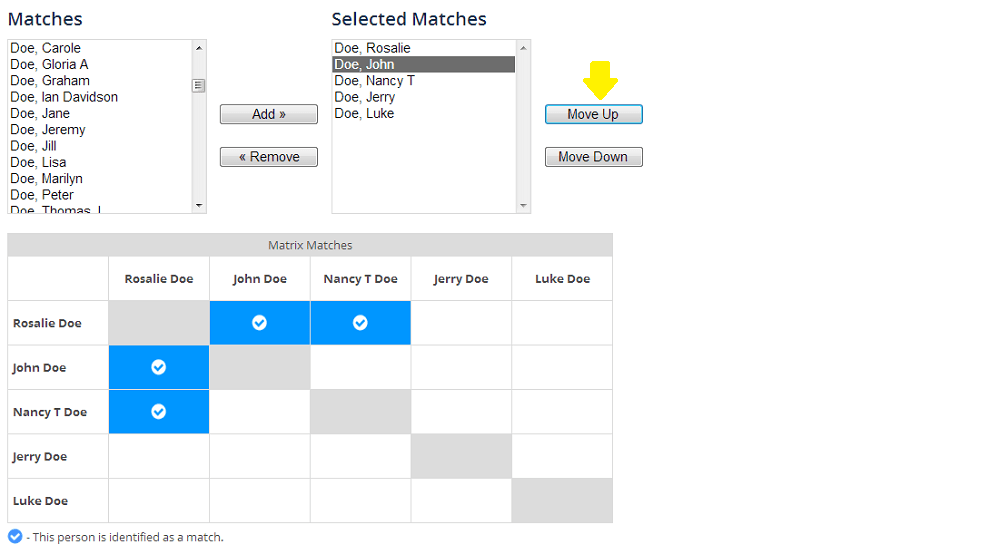
Due to privacy concerns, the suggested relationship of your two matches (if related) is not revealed. However, we can tell you whether they are related according to our Family Finder program. To use it, you select up to 10 names from the Match list on the left side of the page and add them to the Selected Matches list on the right side of the page. A grid will populate below the lists. It will indicate whether there is a match (a blue check mark) or there is not a match (an empty white tile).

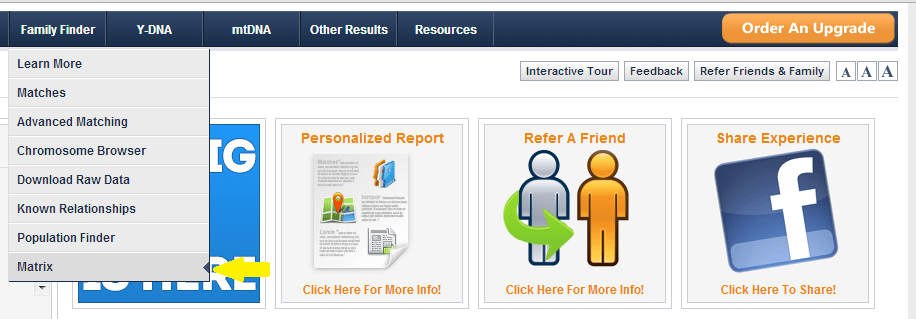
You access the BETA Family Finder – Matrix page through the Family Finder menu in your myFTDNA account.

matrix 1

The page starts out with two list areas: Matches and Selected Matches. You add Matches to the Selected Matches list by clicking on a name and then on the Add button.

matrix 2

Here is a screenshot of the BETA Family Finder – Matches page with a few matches added to the Selected Matches list.

matrix 3

You can change the order of names in the matrix by clicking on a name and then either the Move Up or the Move Down button.

Matrix 4

To remove someone from the Selected Matches list, click on their name and then the Remove button.

______________________________________________________________

Disclosure

I receive a small contribution when you click on some of the links to vendors in my articles. This does NOT increase the price you pay but helps me to keep the lights on and this informational blog free for everyone. Please click on the links in the articles or to the vendors below if you are purchasing products or DNA testing.

Thank you so much.

DNA Purchases and Free Transfers

Genealogy Services

Genealogy Research

Chromosome Mapping aka Ancestor Mapping

This article really should be called “Identifying Prodigal Great-Grandpa by Ancestor Mapping Your Chromosomes,” because that’s what we’re going to be doing.  It’s fun to map your ancestors to your chromosomes, but there is also a purpose and benefit to be derived.  So you can have guilt-free fun because you’re being productive too!  Oh, and yes, you can work on finding Prodigal Great-Grandpa.

I constantly receive questions similar to this:

“How can I find the identity of my mother’s mother’s father?  My great-grandmother went to her grave with this secret.  That’s one eighth of my ancestry.  What can I do?  How can I find out?”

The answer is that it’s not easy, but it is sometimes possible.  Note the word sometimes.  A good part of the definition of “sometimes” is how willing you are to do the requisite work and if you are lucky or not.  Luck favors those who work hard.  And let’s face it, you’ll never know if you don’t try.  I mean, Prodigal Great-Grandpa is not going to text you from the other side with his name and date of birth.

What we’re going to do is basically work through a process of elimination.  The term for what we are going to do is called chromosome mapping your ancestors or more simply, chromosome mapping or ancestor mapping. In essence, you are going to map your own chromosomes based on which ancestor contributed that part of your DNA.

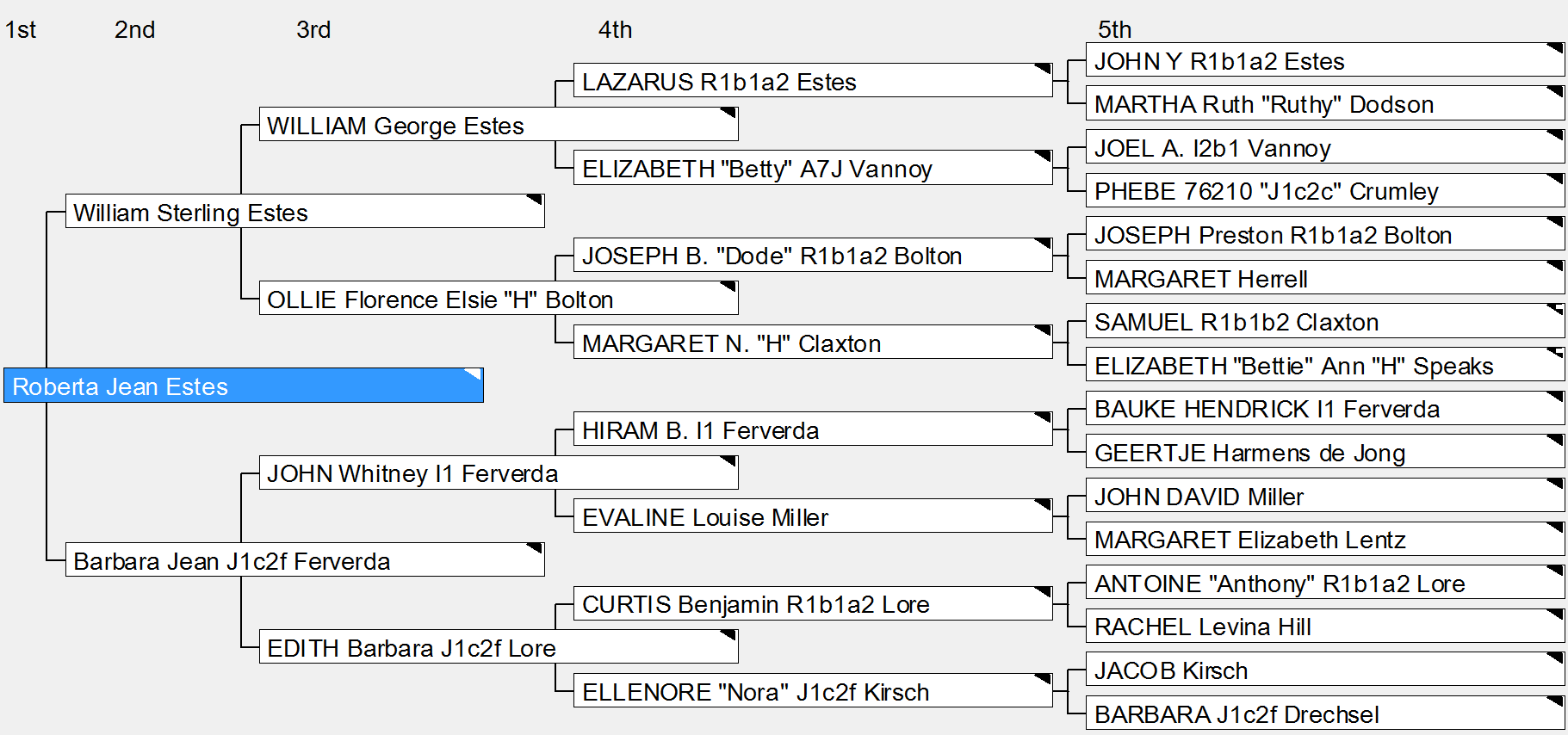
I have simplified this process greatly in order to explain the concept in a way you can easily follow.  I’m going to use my own pedigree chart as an example.  We’ll pretend we don’t know the identity of Curtis Benjamin Lore.  And yes, for those of you wondering, all of these people are deceased.

Mapping pedigree chart

I realize that you are going to have more than the 32 autosomal matches shown on my example spreadsheet.  You’re also not going to be able to find common ancestry with many of your matches due to things like dead ends, incorrect ancestry, segments identical by state (IBS) or DNA that comes from older ancestors that is not recognizable today after name changes in many generations when descended through females.  There are lots of reasons why you might not be able to find genealogy matches.  It’s the other matches, the ones where you can decipher and determine your common ancestor that help a great deal, and that is where we’ll focus.  These are the ones that matter and the keys to identifying Prodigal Great-Grandpa.

In my example here, we live in a perfect world.  We are looking to map the DNA of my 8 great-grandparents in order to figure out the identity of mother’s mother’s father.  Of course, there is no Y-DNA to test in this instance, so we must rely on autosomal DNA.  Ok, so maybe it’s not such a perfect world.  In a perfect world, you’d be a male trying to find the identity of your father’s father’s father and you could test your own Y-DNA – but then we wouldn’t have a good story nor would we need autosomal DNA.  And most people aren’t that fortunate.

Three generations isn’t that far back – or four – if you count yourself as the first generation.  If you’re quite lucky, you can test one or both of your parents, and maybe even a grandparent or great-aunt or uncle.  Failing that, you should be able to find some cousins from your various lines to test.  This entire exercise will be much MUCH easier for you if you can test multiple people descended from each of the 4 couples involved because you’ll be able to tell which lines your matches do, and don’t, match based on which cousins they also match.  Take DNA test kits to family reunions!

Obviously, you won’t be able to test anyone directly descended from your unknown great-grandfather, except perhaps his children.  The more of his children you can test, either directly or through their children, if deceased, the better your chance of identifying your Prodigal Great-Grandfather because each child inherits some different DNA from their parents.  In my case, we’re going to presume that there are no other known children, other than my grandmother.  So how do we find Prodigal Great-Grandpa?

First, download all of your matches with corresponding segment data from your testing vendor, either 23andMe or Family Tree DNA, into a spreadsheet.  Ancestry does not allow you to do this, which is a significant drawback in terms of testing at Ancestry.  You can do this today at 23andMe and at Family Tree DNA most easily by utilizing www.dnagedcom.com download software.  You can also do this directly at Family Tree DNA on the Chromosome Browser page.

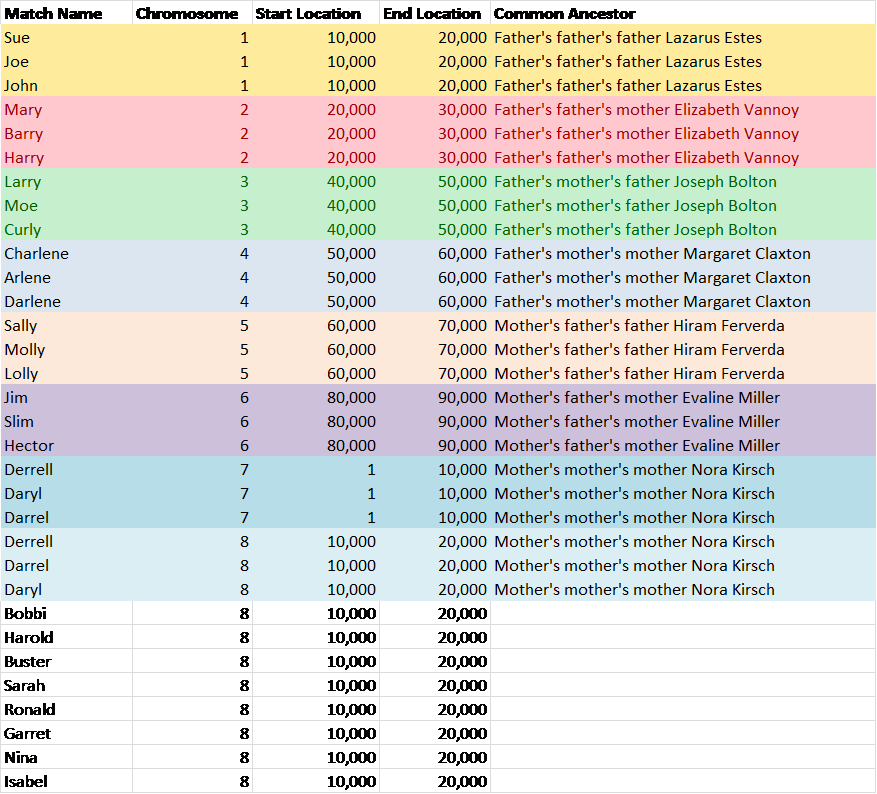
Your spreadsheet will look something like this, but without the colors.  That’s what you’ll be adding, along with the Common Ancestor column.

Mapping spreadsheet

Step 1 – Identify a common ancestor with those individuals you match on common DNA segments.  This is really two steps, the common ancestor part, and the common DNA segment part.  If these people are on your match list, we already know you have a common DNA segment over the vendor’s match threshold.  The presumption here is that if you have 3 people that match on the same segment from the same ancestor, that’s a confirmed “yes” that this particular DNA segment is descended from that ancestor.  You can also label these with only two confirmed descendants from the same ancestor, but I like to see three to be sure, especially if here is any doubt whatsoever that you’re dealing with the same ancestral family.  For example, if you are dealing with 2 people who carry the same surname from the same location, but you can’t quite find the common ancestor – you’ll need 3 matches to identify this segment.

In this case, I was able to test cousins so I know that on chromosome 1, Sue, Joe and John all match me on the same segment and they are all descended from Lazarus Estes.  I know this because one of them descends from Lazarus Estes and his wife, Elizabeth Vannoy, but the other two, Joe and John descend from an Estes upstream of Lazarus, let’s say, his father, John Y. Estes, through another child, which allows me to positively identify this segment as coming not just from the couple, Lazarus Estes and Elizabeth Vannoy, but from Lazarus specifically.

I’ve colored this segment mustard to represent Lazarus and so that you can visually see the difference between the 8 ancestors we’re working with.

2.  Repeat the same process with your other matches, hopefully utilizing cousins, to identify DNA segments of your other ancestors.  I’m only showing a very small subset of all of my DNA on my spreadsheet, and all matches are the exact same 10,000 cM blocks and only on one chromosome, for illustration purposes, but as you work through your matches, you’ll be able to color more and more of your DNA and assign it to different ancestral couples.  Each of your chromosomes will have different colors as different parts of each chromosome come from different ancestors.

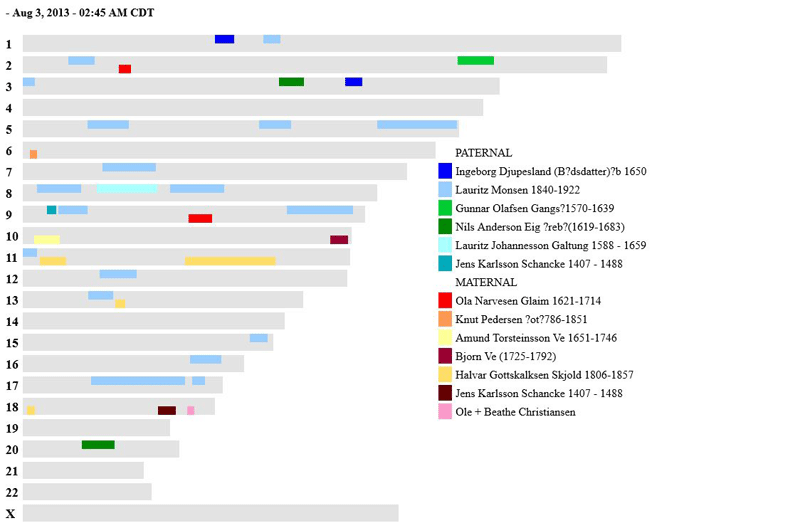
Kitty Cooper released a tool to utilize AFTER you do this hard grunt-work part that paints a pretty picture of your ancestors mapped on to your various chromosomes.  Here’s her example.  Notice that each chromosome has 2 sides, Mom’s and Dad’s inheritance side.  We’re going to use that to our advantage and it’s one facet of how we’re going to find Prodigal Great-Grandpa .

mapping kitty cooper

In my case (not this example), I have several segments that I can’t identify to a particular couple, but I can assign it to a group.  This is my Acadian group and is terribly admixed because of extensive intermarriage.  I also have a “Mennonite” segment labeled in the same way for the same reason.  So while I don’t know specifically who, I do know where and that helps a lot too.  But in our perfect world in our example, we don’t have any of that.

3. Now that I have most of my genome colored in and assigned to ancestors, except for Prodigal Great-Grandpa, I can see where all new matches fall.  Let’s say I get a new match on chromosome 1 in the segments between 10,000 and 20,000 and they also match Sue, Joe and John.  Even if the new match is an adoptee and has no genealogy, I can tell them which line they descend from.  And let me tell you, there is no greater gift.  This is exactly how we told new cousin Loujean she descended from the Younger line.

However, if someone matches me on this chromosome 1 segment but NOT Sue, Joe and John, since Sue,Joe, John and I all match on the entire segment from 10,000-20,000, then the new match has to be matching me on my other parent’s side (or is IBS – identical by state, a circumstantial match.)  Never forget that you have two “sides” to each chromosome – Mom’s and Dad’s (except for the X chromosome in males which we are not addressing here.)

4.  The only part of my match spreadsheet left uncolored, since this is a perfect world, would be the part that would probably come from my Prodigal Great-Grandfather.  So let’s look at chromosome 8 and map it.

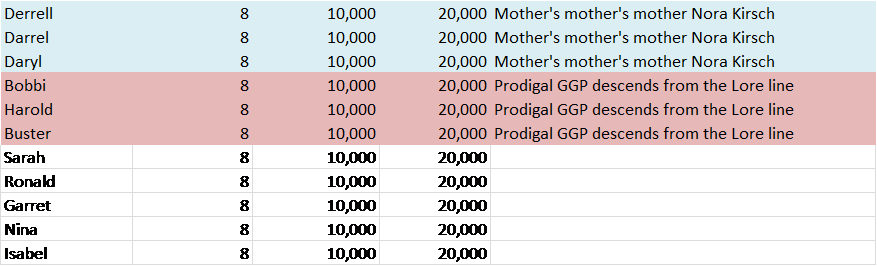
What we don’t know, and have to determine, is whether or not some of these parts of chromosome 8 really belong to ancestors identified in color above.  However, remember that we are dealing with fairly close matches, only 3 generations, and in some cases, only 2 generations, depending on which cousins tested.  So let’s say you found several cousins to test because grandma had a large family.  Based on the test results of several of your aunts and uncles along with other people descended from great-grandma’s ancestral lines, you are able to map most of the DNA of your great-grandmother.  In this case, we mapped this segment of chromosome 8 to my three cousins, Derrell, Darrell and Daryl.  (Yes, I really do have those cousins.)

The result is that now I have 8 matches that do match me, and based on other cousin matches, do descend from Great-Grandma/Great-Grandpa but don’t match the Derrell trio indicating Great-Grandma’s line.  What this tells me is that the people who aren’t assigned, because they don’t match my cousins Derrell, Daryl and Darrel, or any other distant groups, must then be from Prodigal Great-Grandpa’s side or are “problem matches.”  Problem matches are those that are IBS (Identical by State) or have a technical issue and we’re not going to deal with that here, because this is a perfect world and we’re only concerned with people whose genealogy we have and that match each other.  By this definition, problem matches are automatically eliminated.  So let’s look at the 8 people above who don’t match me or the Derrell cousins on Great-Grandma’s/Great-Grandpa’s side, beginning with Bobbi and ending with Isabel.

5.  Now we turn to genealogy.  We know that these 8 people all share a common ancestral line with Prodigal Great-Grandpa, we just don’t know who that is.  Let’s say that of this group, we discover that Bobbi, Harold and Buster are all related to each other, and glory be, they all know who their common ancestor is, or at least the common ancestral line.  Let’s say that Bobbi and Buster are first cousins in the Lore line and that Harold matches them closely as well, but he is descended from a Lore ancestor further upstream from Bobbi and Buster.  Therefore, we can now say, positively, that Prodigal Great-Grandpa descended somehow from the Lore line.

We still don’t know how Sarah, Ronald, Garret, Nina and Isabel connect to Prodigal Great-Grandpa, and that’s OK.  We can simply leave them uncolored for now.  We can select a color for Bobbi, Harold and Buster and assign then to Prodigal Great-Grandpa who descends from the Lore line.

Mapping PGG Lore

6.  Now it’s time for that luck to kick in.  We don’t know that Prodigal Great-Grandpa carried the surname Lore.  His mother could have been a Lore, or any of his ancestors.  All we have is a common surname and a common ancestor between three people who all match me on the same segment.  So, let’s assemble a tree of our cousins to see if we can narrow the scope of maybe who and where and then let’s get busy with the census and other records.  Geography is important.  Begatting requires proximity and many times, we can find the begatter in the neighborhood.  Also, check your genealogy software data base for this surname.  You may find the surname in an allied line.  Remember, families married their neighbors and often intermarried as well.

Sure enough, look there, in our perfect world, we discover that Nora Kirsch is working in her parents inn named the Kirsch House on the Ohio River in 1880.  The Kirsch House was also a boarding house, and a restaurant and pub.  One of their boarders in 1880 was none other than Benjamin Lore.  Hmmm.  Surely makes you wonder.  Further research on Benjamin Lore shows that he was a wildcat oilfield well driller working in the county where Nora lived and became something of a local legend for discovering the “Blue Lick” water well.  Well, now we have a name, proximity and maybe an opportunity.

7.  Well, peachy, but what next?  Further research on Benjamin Lore shows that he was married in the census, but where was his wife?  In previous census records, we find Benjamin Lore in Warren County, PA with his parents.  In the Warren County records, we find that he married Mary Bills, and additional research shows in 1880 a Mary Lore with 2 children, but no husband.  Court records show they later divorced, with 4 children.  Find those children!!!  They are the key to confirming the identity of Benjamin Lore as Prodigal Great-Grandpa.  If Benjamin’s other children had children about the same time as grandmother, each line should have 3 generations between Benjamin and the current generation.  Benjamin’s great-grandchildren through his first wife would be half-second cousins to me which would be the same as second cousins once removed.  They of course would be a generation closer to my mother whose DNA I also happen to have.
ISOGG has a wonderful Autosomal DNA Statistics page, and here you can see that second cousins once removed would share about 1.5% of their DNA in what is hopefully a large enough segment to match some of the cousins that have already tested.   My mother’s generation, first cousins once removed would share approximately 6.25%.

Mapping cousin chart

Benjamin’s descendants through his first wife may not match all of my cousins, but they will, hopefully, match some of the descendants of Prodigal Great-Grandpa, confirming, as best we can, that Benjamin Lore was grandmother’s father.  The best litmus test of course is how closely they would match the closest generations, like mother or great-aunts/uncles, if they were living.

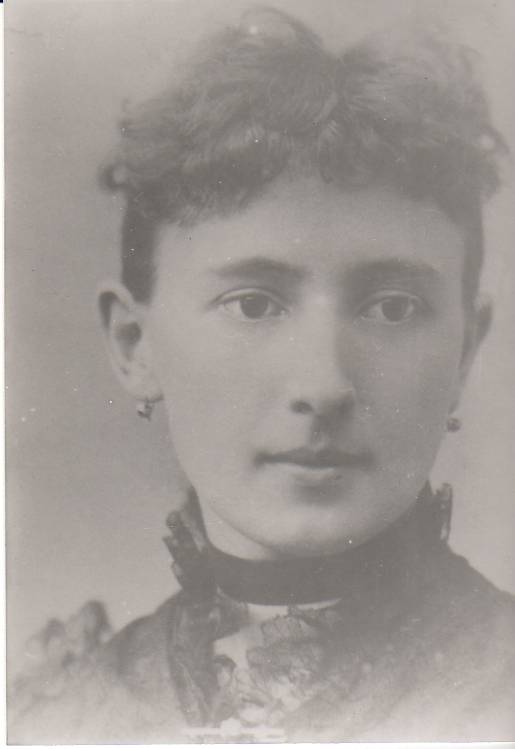
Full Disclosure Note:  I used my own ancestors for purposes of illustration, even though Curtis Benjamin Lore (shown at right) was not prodigal in quite the way I portrayed in this article, well, at least not from my family’s perspective.  However, he was no saint Lore, CBeither and he may well have other descendants looking for him in this exact situation.  Aside from what we do know, there is the rumor of an illegitimate son showing up on his widow’s doorstep looking for him, albeit, a little too late.  We know that Curtis Benjamin (known as C.B.) Lore did marry Nora Kirsch in Dearborn County, Indiana, in 1888.  These photos are their “wedding photos” but interestingly, there is no photo of them together.

We also know that Curtis Benjamin Lore married Mary Bills in Warren County, PA., had four Lore children, 3 males (Sid, John Curtis and Herbert Judson Lore) and one female (Maud who married a Hendrickson), none of whom we have never been able to find.  Also, Curtis Benjamin Lore was not divorced from Mary until, ahem, after he was married to Nora Kirsch when Mary filed for divorce on the grounds of desertion.Kirsch, Nora

Apparently, his marriage to Nora Kirsch (pictured at right) fell, literally, according to the secret family story, into the “shotgun” category, so one has to understand that his choice of marriage versus death was fairly defensible.  I’m sure Nora’s father, a crusty old Civil War veteran, had no idea that he was already married or Curtis Benjamin would have been on the business end of that shotgun and marriage would not have been a choice.

The family took great care that this “uncomfortable” shotgun marriage situation never be discovered, to the point of falsifying the marriage date in the family Bible and also by “adjusting” the birth of the child by a year, also recorded incorrectly in the family Bible.  Were it not for the fact that I checked the church records in Dearborn County, I would never have discovered the discrepancy.  A child cannot be baptized months before it is born.  I might note that it was only AFTER this discovery that my mother was forthcoming with the “family secret” about the shotgun wedding.  Birth certificates were not issued at that time and my grandmother’s delayed birth certificate was issued based on the falsified family Bible information.

Benjamin probably would not have been bothered by this revelation at all, given what we know about him, but I’m sure Nora’s parents rolled over in their grave once or twice when I made the discovery and now that I’m, ugh, discussing it, and publicly at that.

Rogues and handsome scoundrels.  They are colorful and interesting aren’t they and provide a great amount of spice for family stories.  Hopefully these tools will help you find yours!!!

______________________________________________________________

Disclosure

I receive a small contribution when you click on some of the links to vendors in my articles. This does NOT increase the price you pay but helps me to keep the lights on and this informational blog free for everyone. Please click on the links in the articles or to the vendors below if you are purchasing products or DNA testing.

Thank you so much.

DNA Purchases and Free Transfers

Genealogy Services

Genealogy Research

Be Still my H(e)art…

You’re not going to believe this.  I’m not sure I believe it.

Remember, I closed my article on the Younger family yesterday by saying that I was hopeful that I might solve the mystery of who Marcus Younger’s wife, Susanna, was?  Well, I said that, but I had no real expectation that it would really happen, not after one already huge breakthrough.  I began working through cousin Larry’s matches, sending e-mails, and within six hours or so, I had several replies, one of which was this:

“Hello my name is Andrea. Thank you for sending me this email. I am new to genealogy and have a large interest in my family history. Younger is not a known surname for me, although Hart is. My oldest known Hart ancestor is Anthony Hart born in Oct 1755 in King and Queen, Virginia. He was my 5th great grandfather. He lived in Halifax Virginia in 1840 with his children and grandchildren. How is the surname Hart related to Younger?”

Oh Andrea, let me tell you.  You have made my day, my decade, my 30 years, and yes, indeed, this is the second jackpot hit in two days in the same family line.  I shoulda bought a lottery ticket but I think I’d rather have this:)

It has always been speculated that Marcus Younger’s wife, Susanna, was a Hart.  In fact, it was speculated that she was the possible sister of that one and the same Anthony Hart in Halifax County, Virginia, based on this tax record from King and Queen County, Va. just before Marcus Younger moved to Halifax County.  Robert Hart is believed to be Anthony’s father, but that is unproven.

1785

Alterations of land in King and Queen County

Proprietor’s Name                     QT Land                     of whom had

Anthony Hart                               190a                         Robert Hart

Anthony Hart                                94a                          Marcus Younger

There are a couple of other records in which they appear together too.

Unfortunately, King and Queen County is a burned county.

Now, we have a couple of pretzel twists that need to be considered.  In Larry’s line, Marcus’s son John married Lucy Hart who is mentioned in Anthony Hart’s Revolutionary War pension application in 1832.  So Larry could be expected to match Andrea regardless of who Marcus’s wife was.

However, I don’t descend from the same line as Larry and Andrea matches me as well.  I descend from Marcus through his daughter, Mary, sister to John who married Lucy Hart.  So, I should NOT match Andrea unless I too carry some Hart DNA.  But I do, in two distinct places where I also match Larry.  On the chromosome browser below, Andrea is orange, I am blue and we are being compared to Larry.  You can see that we all 3 match on the same segments on chromosomes 1 and 8.

younger hart 1

Additionally, Andrea matches other cousins descended from my Younger line.

Furthermore, Andrea and David (from the previous article whose pedigree proved that Marcus and Thomas Younger are related) both match Lawson, but they don’t match each other.  This makes perfect sense.  David descends from Thomas Younger, who has no known Hart connection.  So David matches Larry because of the Younger line and Andrea matches Larry because of the Hart line.

You can see in the chromosome browser view below that indeed, both Andrea, orange, and David, blue match Larry, but in no location do they match each other in addition to matching Larry.  No place does their DNA show one under the other, overlapping, when compared to Larry.

younger hart 2

Turning now to the spreadsheet where I can see all of the people who match both Larry and David together, I want to know who else Andrea matches.

First, I confirmed that Andrea does not match anyone else from the Alexander Younger line through sons Thomas and James, and she does not.  If she had, that would put a very big fly in the ointment and would prevent any conclusion about Marcus’s wife.  But since she doesn’t, that obstacle is removed.

Andrea does match the following people on several segments:

  • Me
  • Loujean, our newly found adoptee cousin whose closest autosomal match is Larry
  • Larry
  • Buster, my cousin, who also descends through Marcus’s daughter, Mary

We are all four descended from the Marcus line and she doesn’t match anyone who descends from the Thomas or Alexander lines, which makes perfect sense since Anthony Hart looks to be the probable brother of Marcus Younger’s wife, Susannah, based on the historical records and some relationship is now confirmed by the DNA.

Am I ready to call this a positive match yet and Susannah a Hart?  Technically, I probably could, but I’m rather conservative and I’m just not quite ready to give an unconditional thumbs up.  To make myself feel entirely warm and fuzzy, I’d love to see another Hart match for me or my cousins not descended through John’s line. I’d also love to be able to reconstruct the Hart family back in Queen and King and Essex Counties and have some additional paper document to go along with the results.  That would certainly be easier to accomplish were the Queen and King records not burned.  This family lived on the border between the two and had records in both counties.

Truly, I’m left speechless about my good fortune this weekend.  I’m happy dancing a hole in the floor.

happy dance 2

But I’m also left wondering how many other answers are really there, in the DNA of the people we match and I just haven’t worked with the matches effectively.  Maybe those walls are just waiting to fall….waiting for me to notice them.  Maybe yours are too.

Update: Please note that as of August 2019, this connection is still not proven. Still hoping!

______________________________________________________________

Disclosure

I receive a small contribution when you click on some of the links to vendors in my articles. This does NOT increase the price you pay but helps me to keep the lights on and this informational blog free for everyone. Please click on the links in the articles or to the vendors below if you are purchasing products or DNA testing.

Thank you so much.

DNA Purchases and Free Transfers

Genealogy Services

Genealogy Research

Why DNA Test?

puzzle pieces

Sometimes I receive a question that just stops me in my tracks.  This past week, when a very experienced genealogist ask me “Why do you guys DNA test anyway?,” I was so dumbstruck as to be almost speechless.  Well, almost, but not quite, and I recovered quickly.

I did manage to stifle the urge to say “because we can,” but there would have been some truth in that statement.

For me, DNA testing is just a fact of life, ingrained into every molecule of my being, so I had to think a bit before answering.

Why do we do this anyway???

  1. Because we can!  Ok, I just had to say it, to get it out of my system.  But in reality, it’s true, because you don’t know what you don’t know.  And it’s low hanging fruit.  For between $49 and $99, at Family Tree DNA you can take a multitude of tests, but primarily  Y DNA, mitochondrial DNA and autosomal.  And with that, you can find out what it is that you don’t know.  The story of “Finding Anne Marie” is the perfect example. In fact, it has been turned into a book.
  2. We test to discover if we are related paternally (Y-DNA) to others of the same or similar surnames.  This also means that we can eliminate researching any lines that you don’t match.  So we do it so we can stop barking up the wrong tree, and hopefully, bark up the right one.  This article about Triangulation for Y DNA talks about surname matching.  This paternal Y test was one of the first and is still probably the primary DNA genealogy test done today.
  3. We can test relationship theories.  For example, let’s say that we don’t know who the father of our ancestor is, but there are 4 male candidates, all brothers, in the county at the time our ancestor was born.  Certainly, being rabid genealogists, we’ve already done the genealogy work, like check tax records, census schedules, church records and anything local, but now we need big guns because those resources didn’t reveal parentage.   This story about the Perez family in Guam and in Hawaii illustrates this beautifully and uses both Y DNA in combination with autosomal.  In the case of the 4 brothers above, we can search for their wives surnames in our matches and see if we can identify which couple by using the wive’s lines’ DNA.
  4. We test to find out about our ancient ancestry.  What “clan” or haplogroup did we come from?  There are a number of tests we can take to discover if we are Native American, for example, or African.  Some tests, like the autosomal tests, look back only a few generations, so they are broad, not deep, and some, like the Y and mitochondrial tests are very deep, going back hundreds of generations, but not broad at all, focusing like a laser beam on only that one specific direct line.  This article about “Proving Native American Ancestry Using DNA” tells about the various kinds of tests and how they can help with genealogy.
  5. We test to create a DNA pedigree chart that parallels and integrates with our genealogy pedigree chart.  Every ancestor and their DNA has an ancient story to tell that would be silenced without DNA.  In essence, we recover ancestry otherwise lost to us. How else would you ever find out that you descend from Vikings or Niall of the 9 Hostages?
  6. We test to better understand our genesis.  For example, we want to map our chromosomes to know which one came from which ancestor.  Ok, maybe number 6 only applies to geeky genealogists – but there appear to be a lot of us out there.  Kitty Cooper’s new mapping tool is quite popular.
  7. We test to find our family.  Just today, I “met” a cousin I match autosomally  and we discovered that we have some of the same “coureur du bois” stories in our Acadian families.  The difference is that she knew what they were, and I didn’t.  Click – that’s the sound of a puzzle piece falling into place.
  8. Some people test to prove paternity, or find biological parents or siblings.  Over the past couple of years, several great adoption tools and groups have been formed as we’ve learned to work more effectively with autosomal DNA.
  9. We test because it’s fun.  It adds another dimension and several more tools to the addiction we love, genealogy.
  10. Some test to discover more about their health traits.  For some, this health information is just a side benefit, but you never know when that health information will have a profound influence on your life.
  11. Some people want to participate in scientific research.  This is probably not a primary reason to test, but it does motivate a lot of people and this is one field where an individual can still actively participate and make a difference, sometimes a huge difference.
  12. Some people, like Lenny Trujillo, want to leave a legacy and what a legacy he has left.  This is one of the most common reasons people order the Personalized DNA Reports.  In some cases, their DNA line ends with them, but in others, it’s a way of leaving information for future generations.  Many people have these reports bound and give them as family-wide gifts.
  13. We test because we want to find the location in Europe, or wherever “the old country” is for our family, that our immigrant ancestors came from.  The Speaks family is a great example.  The American group had tested and confirmed the DNA of the original immigrant, but we didn’t know where the Speaks family came from, although we believed they immigrated from England.  Another Speaks family member, from Australia, tested, and matched the American group.  The difference was that our Australian cousin knew exactly where his English ancestor was from.  Through DNA testing, we found the home of our Speaks family in Gisburn, Lancashire, England.  You can read about it in “The Speak Family – 3 Continents and a Dash of Luck.”
  14. We want to prove or disprove our oral history.  In many cases, that history includes some type of minority admixture.  By minority, I mean not our primary ethnicity.  In the series, “The Autosomal Me,” I described in agonizing detail how to use tiny bits of DNA to do just that, and to identify which family lines contributed that minority admixture.  In my case, both Native and African.  Native had always been a part of our family’s oral history, but the African was initially a surprise.
  15. We test because we’re curious about where we came from, who we are related to, what they know about our ancestors that we might not.  As I’ve said before, “It’s About the Journey.”  Inquiring minds want to know…..

And it all starts with a DNA test!

______________________________________________________________

Disclosure

I receive a small contribution when you click on some of the links to vendors in my articles. This does NOT increase the price you pay but helps me to keep the lights on and this informational blog free for everyone. Please click on the links in the articles or to the vendors below if you are purchasing products or DNA testing.

Thank you so much.

DNA Purchases and Free Transfers

Genealogy Services

Genealogy Research

Kitty Cooper’s Chromsome Mapping Tool Released

I haven’t had time to try this yet, but I can hardly wait.  Kitty Cooper’s chromosome mapping tool enables those who have taken one of the autosomal tests from Family Tree DNA or 23andMe and downloaded matches to map the segments that you know are associated with certain ancestral lines on your chromosomes with a color key.

The genetic genealogy community has been anxiously waiting for this tool.  You can find it here:  http://kittymunson.com/dna/ChromosomeMapper.php

Until now, we were relegated to keeping this kind of information on a spreadsheet.  I covered how to do this in my blog on Autosomal Triangulation and also in one of the Autosomal Me segments.

vannoy table 1

But thanks to Kitty, we can take the information above and make it look like the example below from Kitty’s blog.

kitty's chromosome mapping

We can’t think you enough Kitty!!!  Way to go!  Woohoo!

______________________________________________________________

Disclosure

I receive a small contribution when you click on some of the links to vendors in my articles. This does NOT increase the price you pay but helps me to keep the lights on and this informational blog free for everyone. Please click on the links in the articles or to the vendors below if you are purchasing products or DNA testing.

Thank you so much.

DNA Purchases and Free Transfers

Genealogy Services

Genealogy Research