About Roberta Estes

Scientist, author, genetic genealogist. Documenting Native Heritage through contemporaneous records and DNA.

Honoré Lore or Lord’s 1818 Estate Inventory Provides a Window Into His Life

Honoré Lore, or Lord (1742-1818) lived an incredibly interesting life. He was born near Annapolis Royal in Nova Scotia, survived the Acadian exile, and served in the Revolutionary War at Fort Albany in New York before settling in Quebec in the late 1780s.

Honoré outlived two wives, Appoline Garceau and Suzanne Lafaille, having seven children with each. He married Marguerite Babin when he was 61 years old and brought forth eight more children with her. Marguerite was his wife at his death in 1818 at the age of 76.

After publishing Honore’s life story, two readers contacted me with additional information.

Justine and Suzanne located and transcribed Honoré’s estate inventory and other documents, each contributing different pieces of the pie. I didn’t realize Honoré had an inventory, and not speaking French or being familiar with French-Canadian documents, I was absolutely over the moon and oh so grateful to both Suzanne and Justine. I can’t thank these ladies enough.

From Suzanne Lesage:

I was curious of how Justine got to the inventories. Last fall, BAnQ totally revamped their website and have improved a lot the accessibility of the documents with genealogists in mind. Going back to the page she mentions, I did a search all “Lord” in the Montreal area and got a list of 6, with this one on top. The good news is there was indeed an inventory for Honoré who died in 1818 – the bad news is that it is not yet available on-line at BAnQ…

1 – Honoré Lord & Marguerite Babin

Notaires

Titre de l’instrument : Inventaires après décès de la région de Montréal, 1791-1840 (2003) Détails

Nom du défunt : Lord

Préonom du défunt : Honoré

Nom du conjoint : Babin

Prénom du conjoint : Marguerite

Profession :

Résidence : Saint-Luc

Nom du notaire : Dandurand, Roger-François Année de l’acte : 1818 Date de l’acte : 1818-09-22 Remarque :

Source : Archives nationales à Montréal, CN601,S107, disponible sur microfilm

But FamilySearch comes to the rescue…

https://www.familysearch.org/ark:/61903/3:1:3QHV-L3V7-L97Q?i=136&cat=675092

Image 137

The script is quite good, so transcription should not be too difficult. Any details you are interested in? It seems he had a will (name of notaries Edm Henry &  RF Dandurand?) where his children were the heirs, but his widow could stay put until her death.

Suzanne Lesage GFA

GFA stands for Généalogiste de filiation agréée and is the first level of formal recognition for genealogists in Quebec.

I explained to Suzanne that essentially, I can’t transcribe the documents because unless you know the language, and know what to expect, transcribing handwriting is almost impossible – at least for me.

If I had French text, as in typed out, I could do the translation using online tools. Thankfully, Suzanne took pity on me.

Poor Roberta … Ok then – let’s start with who was there.

Between Suzanne and Justine, we wound up with a reasonable transcription to contemporary French, which I then translated using Google translate. Not everything translated perfectly, of course, and I’m more than happy to make corrections.

Le 22 septembre 1818 inventaire des biens qui étaient communs entre Honoré Lord, défunt et Marguerite Babin sa veuve

Translation:

September 22, 1818 inventory of property that was common between Honoré Lord, deceased, and Marguerite Babin, his widow

Image 138

L’an 1818 le 22e jour du mois de septembre à midi à la requête de Marguerite Babin veuve de Honoré Lord demeurant en la paroisse de Saint-Luc, tant en son propre nom comme commune en biens avec son défunt mari qu’en celui comme tutrice à Rose, Augustin, Claire, Maryse (or Moyse for Moise), Catherine et Modeste Lord enfants encore mineurs issus du dit mariage.

En présence de Jean Lord, leur frère consanguin, subrogé tuteur des dits mineurs.

Plus de François Lafaye, oncle maternel et tuteur et Julien Lord frère et subrogé tuteur de Jacques Lord, enfant encore mineur issu du 2nd mariage du dit défunt Honoré Lord et défunte Suzanne Lafaye.

English translation:

The year 1818 on the 22nd day of September at noon at the request of Marguerite Babin, widow of Honoré Lord, residing in the parish of Saint-Luc, both in her own name as common property with her late husband and in that as guardian to Rose, Augustin, Claire, Maryse, Catherine and Modeste Lord, still minor children from the said marriage.

In the presence of Jean Lord, their consanguineous brother, subrogated guardian of said minors.

Plus François Lafaye, maternal uncle and guardian and Julien Lord brother and subrogated guardian of Jacques Lord, still minor child from the 2nd marriage of the said deceased Honoré Lord and the deceased Suzanne Lafaye.

Image 138 Second Half

En plus la dite veuve comme tutrice à ses dits enfants, Jean Lord comme subrogé tuteur, François Lafaye comme tuteur de Jacques Lord et Julien Lord comme son subrogé tuteur par avis de testament homologué en justice.

Pour la conservation des biens et droits des susdites parties et de tous autres qu’il appartiendra, par les notaires soussignés, va être procédé à l’inventaire exact de tous les biens demeurés après le décès dudit Honoré Lord, trouvés en

la maison où il est décédé, située en ladite

English translation:

In addition the said widow as guardian of her said children, Jean Lord as subrogated guardian, François Lafaye as guardian of Jacques Lord and Julien Lord as his subrogated guardian by notice of will approved in court.

For the conservation of property and rights of the above-mentioned parties and all others he will belong, by the undersigned notaries, an exact inventory will be carried out of all property remaining after the death of the said Honoré Lord, found in the house where he died, located in the said

Image 139

ladite paroisse et à nous montrés et enseignés par lad. Marguerite Babin, après erment par elle tout présentement entre nos mains prêté de tout montrer et enseigner, sans en cacher ni détourner aucunes choses, se soumettant où il se trouverait le contraire aux peines en tels cas introduites qui lui ont été expliquées par nous notaires qu’elle a dit bien savoir. Les biens sujets à prisée estimés par Les sieurs Victor Girouard et Denis Loupris notables de ladite paroisse St Luc, priseurs choisis par les susdites parties, lesquels à ce présents ont promis le tout priser et estimer dans sa juste valeur, suivant le meilleur de leur connaissance, eu égard au tems présent, la criée non comprise attendu que les parties sont d’accord de les faire vendre publiquement dès jeudy prochain. Fait et passé maison dudit défunt, en ladite paroisse St Luc, les jour et an que dessus et ont François Lafaye et Denis Loupris signé avec les notaires, quant aux autres parties et l’autre des priseurs ont déclaré ne savoir signer de ce enquis, ont fait leurs marques.

English Translation:

said parish and showed and taught us by lad. Marguerite Babin, after oath by her now in our hands ready to show and teach everything, without hide or divert anything, submitting where he would be contrary to the penalties in such cases introduced which were explained to him by we notaries that she said she knew well. Goods subject to price estimated by Mr. Victor Girouard and Denis Loupris notables of the said St Luc parish, auctioneers chosen by the above-mentioned parties, which at this present have promised to take it all and estimate in its fair value, following the best of their knowledge, having regard in the present tense, the auction not included whereas the parties agree to have them sold publicly as soon as next Thursday.

Made and passed in the house of the said deceased, in the said St Luc parish, the day and year above and have François Lafaye and Denis Loupris signed with the notaries, as for the others parties and the other of the auctioneers declared not know how to sign this inquiry, have made their brands.

Suzanne’s Quick translate – the widow for herself and as tutor of her minor children, and Jean Lord their brother (subrogé tuteur = deputy guardian according to Google). And François Lafaye, uncle of Jacques Lord, who was there for the interest of Jacques the minor child of the first wife – Suzanne – apparently the will had to be probated.

Image 140 Signatures

Marques lecture faite: Marguerite Babin/sa marque

Jean Lord/ sa marque                     Julien Lord/sa marque

Victor Girouard/sa marque François Lafay [signature]

Du Loupret [signature]

Dandurand [signature notaire]

This seems like a very complex situation, yet probably not that unusual. Indeed Roberta, you will beg for a computer!

You can be very glad for these inventories. Can you imagine nowadays someone going through your house listing everything down to the pillowcases and the forks, and not only listing them, but appraising their quality and pricing them?

An interesting fact is that although Quebec had been under British rule for more than 50 years, they allowed the French legal system in Quebec and Louisiana (still is to this day). Sometimes we hate the French for their lengthy papers, but this document is a goldmine to reconstruct the life of our ancestors.

I was going to suggest using “transkribus” and decided to give it a try for page 2 of the “Inventaire”

Text Recognition powered by transkribus.ai

lade srarisse a à nous montrez eten seignes par lade. Mangurité s’Dabine cepris derment parelle taut présentement entre nos mains preté de tout mantrer chenacienes, aans en cacher ni deteurner aucunes choses se commettent où il se trouverait le contraire aux feines en tels cas introduites qui lui ont été expliquées par nous snataires qu’elle a etit bien davoir Les 1 diens sujets à finisée, estimés par les Srs Victoy Girouna Denes confires, chotables de lad. Banoisse & sue presente choisis par les auso. pranties, lesquels ce ci présents ont paromes détant finiser à eatimes sans sa Luste valeur suivant le meilleur de leur Connaissance en égard au tems présent La bénüe non comprise attendu que les parties dont d’accond de les faize vendre publiquement des Veudy Brochain etait a preché maison desd. defeunt en lad paaroise dt duc, les Lour et an que depus et ent Fmançais Pafaire damis confirêt signé avec les notaires; quent aux autres parlies d l’autre des pniseurs cnt déclaré ne savoir signer, de ce onques ent fait leurs Marques

Which I correct to:

la dite paroisse à nous montre et enseigner par la dte Marguerite Babin après serment par elle tout présentement entre nos mains preté de tout montrer et enseigner, sans en cacher ni detourner aucunes choses de soummettre où il se trouverait le contraire aux peines en tels cas introduites qui lui ont été expliquées par nous notaires qu’elle a dit bien savoir Les d Biens sujets à prisés estimés par les Srs Victor Girouard & Denis Lonprêt, notables de lad. paroisse St Luc priseurs, choisis par les sudtes parties lesquels ici présents ont promis le tout priser a estimers dans sa juste valeur suivant le meilleur de leur Connaissance en égard au tems présent La Criée non comprise attendu que les parties sont d’accord de les faire vendre publiquement dès Jeudy prochain Fait a (Marché?) maison dudt défunt en lad.

paroisse StLuc, les saux etanque dessus et ont François Lafaye & Denis Lonprêt signé avec les notaires; quant aux autres Parties & l’autre priseur ont déclaré ne savoir signer, de ce enquis ont fait leurs marques.

I am not convinced yet…I think this is what Ancestry uses to transcribe the Canadian Census.

Suzanne’s Quick translate:

The widow swears she is not hiding anything – they hire, chosen by the heirs, two appraisers – one of whom cannot sign – and announce that there will be a public auction the following Thursday.

Public Sale

This may finish you… After the inventory, the next act is the public sale of all the goods and farm animals with the names of those who bought them! The widow got to bid on her own things to buy them back from the inheritance! If I understand correctly, two men – the local Innkeeper and a neighboring farmer were to bid on her behalf.

The actual inventory begins with image 140 and continues through image 169. The first portion is the inventory or items, and the later part details who purchased what.

This estate is quite large.

Roberta’s note – This is gold to me. I can hardly wait. I couldn’t sleep.

Image 140 Part 2

Premièrement dans la maison s’est Trouvé et a été prisé et estimé aux livres et Sols ancien cours, savoir

English translation using Google:

First in the house was found and was prized and esteemed in books and old course floors, know.

Note – the list of inventory items begins here. French is in the left column, and English is in the right. There are several items that didn’t translate well, so if anyone has any corrections or explanations, please let me know by referencing the image number.

Une petite marmitte de fonte prisée 2 livres 8 sols A small, prized cast iron pot 2 livres 8 sols 2£ 8s
Item une moyenne ditto et

Son couvercle 48 sols

Item an average ditto and

Its lid 48 sols 2£ 8s

2£ 8s
Item un canard de fonte

30 sols

Item a cast iron duck

30 sols 1£ 10s

1£ 10s
Item une grande marmitte

3 livres

Item a large pot

3 pounds £3

Item un fanat/favat de fer blanc

24 sols

Item a tin fanat/favat

24 sols 1£ 4s

1£ 4s
Item une paire fers à repasser

48 sols

Item a pair irons

48 sols 2£ 8s

2£ 8s
Item un antonnoir et un

moule à chandelle fer blanc

15 sols

Item a funnel and a

tinplate candle mold

15 sols 15s

15s
Item quatre faucilles 40s Item four sickles 40s £2
Item deux haches 40s

chaque

Item two axes 40s

each £4

Item deux grattes 20s

chaque

Item two  scrapers

each £2

Image 141 Page 4

Item une équerre de fer et une

egolline 4£

Item an iron square and a

egolline £4

Item une poële à frire 3£ Item a frying pan £3
Item un demi minot 4

livres

Item half a pound £4
Item 6 bouteilles 20s Item 6 bottles 20s
Item 2 bouteilles et une

cruche 20s

Item 2 bottles and one

Jug 20s

Item 10 assiettes de fayence

30s

Item 10 earthenware plates

30s

1£ 10s
Item 4 tasses et 4

cuillers à thé 15s

Item 4 cups and 4

teaspoons 15s

15s
Item une vieille theyère d’étain

et 2 goblets de crystal 20 sols

Item an old tin sheera

and 2 goblets of crystal 20 sols

Item un chandellier de fer et

un poids de plomb d’une livre

20s

Item an iron candlestick and

a lead weight of one pound

20s

Item 9 cuillers d’étain, 4

fourchettes et 2 couteaux

avec une paire 30s

Item 9 pewter spoons, 4

forks and 2 knives

with a pair 30s

1£ 10s
Item une herminette 3£ Item an adze £3
Item une ferée 30s Item a fairy 30s 1£ 10s
Item une fourche de fer

40s

Item an iron fork

40s

Item 4 bizeaux 48s Item 4 wedges 48s 2£ 8s
Item un gros sarrière/tarrière 15s Item a big quarry / quarrier 15s 15s
Item un compas et une petite

lime 20s

Item a compass and a small

lime 20s

Item une tinette et des ferailles

Item a tin and scraps

£4

Image 141 Page 5

Item une paire de traits de fer

Item a pair of iron bolts

£3

Item un lot de tuilles faulx

30s

Item a lot of faux tiles

30s

1£ 10s
Item 3 manches et 2 faulx

30s

Item 3 sleeves and 2 scythes

30s

1£ 10s
Item un vieu quart rempli

de divers articles 30s

Item an old quarter filled

various items 30s

1£ 10s
Item 2 paires baiches

et chaines 40s chaque

Item 2 pairs of basins

and chains 40s each

Item un petit baril 20s Item a small barrel 20s
Item une vieille baratte et du

sel 15s

Item an old churn and some

salt 15s

15s
Item 2 paniers 6s

chaque

Item 2 baskets 6s

each

12s
Item des membres de sleigh et

un morceau de bois de noyer

24s

Item members of sleigh and

a piece of walnut wood

24s

1£ 4s
Item 5 poches 100s Item 5 pockets 100s
Item 6 dittos 6£ Item 6 dittos £6
Item un vieu sac 5s Item an old bag 5s 5s
Item un collier et une paire de

traits 6£

Item a necklace and a pair of

features £6

Item un vieu harnois et un

vieu collier 6£

Item an old harness and a

old necklace £6

Item un ditto et ditto 9£ Item one ditto and ditto £9
Item 2 peaux de vau

30s

Item 2 cowhides

30s

1£ 10s
Item un petit rouet 6£ Item a small spinning wheel £6
Item un dévidoir 10s Item a dispenser 10s 10s
Item un filet à sauntes

40s

Item un filet à sauntes 40s

Image 143 Page 6

Item un lot de fève en gousse

40s

Item a batch of bean pods

40s

Item un vieu quart et de la

plume 40s

Item an old quarter and

feather 40s

Item 2 manteaux 30s Item 2 coats 30s 1£ 10s
Item un seau feré et un goblet

30s

Item a bucket and a goblet

30s

1£ 10s
Item une huche 3£ Item a hutch £3
Item un coffre 3£ Item a chest £3
Item 4 vieilles chaises 40s Item 4 old chairs 40s
Item un lot de 6 fioles 6s Item a batch of 6 vials 6s 6s
Item un miroir la glasse fendue

en deux 3£

Item a mirror with split glass

in two £3

Item une armoire 18£ Item a wardrobe £18 18£
Item un dressoir 40s Item a 40s dresser
Item un vieux poële de fonte à fourneau et 4 feuilles de tuyau 90£ Item an old cast iron stove and 4 sheets of pipe £90 90£
Item une table 30s Item a table 30s 1£ 10s
Item une vieille ditto 10s Item an old ditto 10s 10s
Item 2 barils 40s

chaque

Item 2 barrels 40s each


Item une baratte 30s Item a churn 30s 1£ 10s
Item une chaudière et un coudoir

30s

Item a boiler and an elbow rest

30s

Item une ditto seule 20s Item a single ditto 20s
Item 20 terrines 24s Item 20 terrines 24s 1£ 4s
Item 10 ( 6 ?) plats prisés 20s Item 10 (6?) popular dishes 20s
Item un grand plat 10s Item a large dish 10s 10s
Item 3 dittos 20s Item 3 dittos 20s

Image 144 Page 7

Item une grande charrette et une paire

de roues 18£

Item a large cart and a pair of wheels £18 18£
Item une petite ditto et ses roues 36£ Item a small ditto and its wheels £36 36£
Item un vieu tombereau 30s Item an old dumper 30s 1£ 10s
Item une charrue et ses ferrements

12£

Item a plow and its fittings

£12

12£
Item un grand auge 10s Item a large trough 10s 10s
Item 12 poteaux et une sablière

12£

Item 12 posts and a sand pit

£12

12£
Item 3 herses de bois 10s

chaque

Item 3 wooden harrows 10s

each

1£ 10s
Item une traine et son travail

12£

Item a train and its work

£12

12£
Item une vieille ditto 9£ Item an old ditto £9
Item 26 bottes de lin 12£ Item 26 bales of linen £12 12£
Item une vieille calèche 24£ Item an old carriage £24 24£
Item une tasserie de pois en gousse

120£

Item a cup of peas in pods

£120

120£
Item 200 gerbes d’avoine

18£ le cent

Item 200 sheaves of oats

£18 per cent

36£
Item 1000 gerbes de bled

30£ le cent

Item 1000 sheaves of corn

£30 per cent

300£
Item 600 bottes de foin à

18£ le cent

Item 600 bales of hay

£18 per cent

108£

Les animaux et bestiaux

Animals and livestock

18 poules 9£ 18 hens £9
Item 9 couples de dinde

48s le couple

Item 9 pairs of turkey

48s the couple

10£ 16s
Item 6 jeunes cochons 6£

chaque

Item 6 young pigs £6

each

36£

Image 145 Page 8

Item 3 vieux cochons 18£

chaque

Item 3 old pigs £18

each

54£
Item un cochon à l’engrais 36£ Item a fattening pig £36 36£
Item 8 vieux moutons 12£

chaque

Item 8 old sheep £12

each

96£
Item 5 jeunes dittos 6£

chaque

Item 5 young dittos £6

each

30£
Item 3 chevaux dont un

blanc, le second noir et le dernier

gris, 108£ chaque

Item 3 horses including one

white, the second black and the last

grey, £108 each

324£
Item une vache, une corne cassée

60£

Item a cow, a broken horn

60£

60£
Item une brune nez noir

54£

Item a brunette black nose

£54

54£
Item une ditto rouge

48£

Item a red ditto

£48

48£
Item une ditto brune

48£

Item a brown ditto

£48

48£
Item une ditto roux et blanc

36£

Item a red and white ditto

£36

36£
Item une taure rouge

24£

Item a red heifer

£24

24£
Item une taure caille

18£

Item a quail heifer

£18

18£
Item 2 vaux de l’année

24£

Item 2 worth of the year £24 24£
Item une génisse 9£ Item a heifer £9
Item une paire de bœufs

120£

Item a pair of oxen

£120

120£

Encore dans la maison

Still in the house

Un lit de plume, une paillasse,

Un traversin, 2 oreillers

2 drapes et une courtepointe

Et couchette 48£

A feather bed, a pallet,

A bolster, 2 pillows

2 drapes and a quilt

And berth £48

48£

Image 146 Page 9

Item une boete et une paillasse

et un drap, 4£

Item a box and a pallet

and a sheet, £4

Item un autre lit de plume

30£

Item another feather bed

£30

30£
Item 4 nappes de toile

du pays, 30s chaque

Item 4 canvas tablecloths

of the country, 30s each

Item un drap de laine et une

vieille courtepointe d’indienne

Item a woolen cloth and a

old Indian quilt

£3

Item une bouteille et un verre

10s

Item a bottle and a glass

10s

10s

Ce fait ayant vaqué sans interruption jusqu’à 4h de relevée, la vacation a cessé et adjournée sine die par rapport aux dettes actives, celles passives, les immeubles et papiers – Et tout le contenu ci-dessus du consentement des parties intéressées a été laissé en la garde et possession de ladite veuve qui s’en est volontairement chargée pour le représenter toutes fois quantes et à qui il appartiendra.Fait et passé maison dudit défunt, les jour et an que dessus et ont comme ci-devant signé – lecture faite.

English Translation:

This fact having continued without interruption up to 4 hours off, the session ceased and adjourned sine die in relation to active debts, passive debts, buildings and papers – And all the above contents of the consent of interested parties was left in the custody and possession of the said widow who voluntarily took charge to represent it all times as and to who it will belong to. Made and passed in the house of the said deceased, the days and year that above and have as above signed – reading done.

Jean Lord (sa marque)                    Marguerite Babin (sa marque)

Victor Girouard (sa marque)           Julien Lord (sa marque

François Lafay [signature]  Du Loupret [signature]

Dandurand [signature notaire]

Image 147 Page 10

L’an 1818, le 26 du mois de septembre à 10 heures du matin, à la requête de Marguerite Babin veuve d’Honoré Lord et tutrice aux 6 enfants issus de sondit mariage, en présence de Jean Lord subrogé tuteur desdits mineurs, plus de François Lafaye comme tuteur et Julien Lord comme subrogé tuteur de Jacques Lord, enfant encore mineur issu du mariage dudit Honoré Lord et défunte Suzanne Lafaye, par les notaires soussignés va être procédé à la continuation de l’inventaire ci-dessus conformément à l’adjournement donnée le 22 du mois courant, au bas du procès-verbal de la précédente vacation – comme suit, savoir

Les dettes actives

Ladite veuve déclare qu’il est du à ladite communauté par Joseph Boudreau pour reliquat du prix de vente d’une terre que ledit défunt lui a vendue 300£ ancien cours de cette province

English Translation:

The year 1818, the 26th of month of September at 10 a.m., at the request of widow Marguerite Babin of Honoré Lord and guardian of the 6 children born of his said marriage, in the presence of Jean Lord subrogated guardian of said minors, more of François Lafaye as tutor and Julien Lord as substitute guardian of Jacques Lord, still a minor child born of the marriage of the said Honoré Lord and late Suzanne Lafaye, by the undersigned notaries will be carried out to the continuation of the inventory above in accordance with the adjournment given the 22nd of the current month, at the bottom of the minutes of the previous vacation – as follows, know

Active debts

The said widow declares that it is due to the said community by Joseph Boudreau for remainder of the sale price of land that the said deceased sold to him 300£ old price of this province

300£

Ensuivent les dettes passives

Passive debts follow

Ladite veuve déclare que ladite communauté doit, savoir A M. Richard Wheeler par

compte

The said widow declares that the said community must, know To Mr. Richard Wheeler by account 30£ 19s


Item au docteur Léonard Pour médicaments durant La maladie du défunt et par Compte Item to Doctor Leonard For medications during The illness of the deceased and Account 39£

Image 148 Page 11

Item à M. JM Raymond marchand pour ballance de compte de marchandises Item to Mr. JM Raymond merchant for balance of merchandise account 88£ 13s
Item à la fabrique de la paroisse St Luc pour reliquat de vente d’un banc dans l’église Item at the parish factory St Luc for remaining sales from a bench in the church 2£ 8s
Item au Docteur Doucet par compte de médicaments durant la maladie du défunt cent trente trois [sic] livres 8s


Item to Doctor Doucet per medication count during the illness of the deceased one hundred and thirty three [sic] pounds 8s 153£ 8s [sic]
Item à Jean Lord Item to Jean Lord 24£ 2s
Item encore à la fabrique de la paroisse St Luc pour enterrement

et frais funéraires dudit défunt

Item still in the factory St Luc parish for burial and funeral expenses of said deceased


27£
Item à M. Jourdain LaBrosse Par compte de marchandises Item to Mr. Jourdain LaBrosse By merchandise account


19£
384£ 10s


Ensuivent les immeubles

Seulement une seixième partie indivise [ajout en marge : dans la moitié aussi indivise] d’une terre de 3 arpents de front sur 30 arpents de profondeur, située dans la seigneurie de la Prairie La Madeleine, tenant par devant au chemin qui conduit à St Jean, en profondeur en représentant Pierre Noël Terrien, d’un côté à la veuve François Brosseau et d’autre côté à Victor Girouard, et une pareille partie des bâtiments dessus construits Quant au restant de la terre [en marge: et bâtiments une moitié desdits bâtiments et cinq sixèmes d’iceux], un arpent et demi de large sur sa profondeur est propre audit défunt, ainsi que 5 sixièmes de l’autre arpent et demi sur sa profondeur

Se trouvent conquets de la seconde communauté

English Translation

Next are the buildings

Only an undivided sixth part [marginal addition: in the equally undivided half] of a land of 3 acres of frontage out of 30 acres of depth, located in the lordship de la Prairie La Madeleine, holding from the front to the path which leads to St Jean, in depth by representing Pierre Noël Terrien, on one side to the widow François Brosseau and on the other hand to Victor Girouard, and a similar part of the buildings built on it As for the rest of the land [in the margin: and buildings one half of the said buildings and five sixths of them], one acre and a half wide by its depth is own deceased audit, as well as 5 sixths of the other acre and a half on its depth. They find themselves conquered by the second community.

I’d love to know where this land was located.

Image 149 Page 12

de biens dudit défunt Honoré Lord et Suzanne Lafaye – les bâtiments désignés en l’inventaire des biens de la communauté dudit Honoré Lord et Suzanne Lafaye

Il y a encore une terre conquit de la communauté de biens dudit Honoré Lord et ladit Suzanne Lafaye située audit lieu de la paroisse St Luc, à l’Est du chemin qui conduit à St Jean, y tenant par devant, par derrière et d’un côté à Denis Laupret et d’autre côté à

[blanc] sur laquelle se trouve une grange construite – et laquelle grange a été construite par amême et des deniers de la communauté dudit défunt Honoré Lord et sa présente veuve – même qu’il a été mis et fait de plus sur ladite terre durant ladite dernière communauté 200 perches et les piquets pour les employer et 4 arpents de fossé. Pour constater la valeur du tout, les susdites parties ont choisi et nommé les sieurs Victor Girard et Denis Louprit personnes expertes qui ont évalué,

Savoir

English Transation:

property of the said deceased Honoré Lord and Suzanne Lafaye – the buildings designated in the inventory of the property of the community of the said Honoré Lord and Suzanne Lafaye. There is still a land conquered by the community property of the said Honoré Lord and the said Suzanne Lafaye located at the said place of the parish of St Luc, to the East of the path which leads to St Jean, holding there from the front, from behind and on one side to Denis Laupret and on the other side to [white] on which there is a barn built – and which barn was built by himself and with money from the community of the said deceased Honoré Lord and his present widow – even though he was put and made more on said land during said last community 200 poles and the stakes to use them and 4 acres of ditch. To see the value of the whole, the above-mentioned parties have chosen and named the gentlemen Victor Girard and Denis Louprit expert people who evaluated,

Know

La grange 600£ The barn £600 600£
Item les perches et piquets Item poles and stakes 36£
Item les 4 arpents de fossés

12£

Item the 4 acres of ditches

£12

12£
648£

Il faut encore observer que pendant cette dernière communauté audit Honoré Lord et sa présente veuve [en marge : il a été paié] savoir à Henry Lord pour ses droits mobiliers au chef de feue Suzanne Lafaye sa mère de principal 515£ 18s 9 deniers, et d’intérêt sur cette somme 135£ fesant 650£ 18s 9d – 650 £ 18s 9d

English Translation

It must also be observed that during this last community audit Honoré Lord and his present widow [in the margin: it was paid] know to Henry Lord for his movable rights to the head of the fire Suzanne Lafaye, her principal’s mother 515£ 18s 9 pence, and interest on this sum 135£ costing £650 18s 9d – £650 18s 9d

1298£ 18s 9d

Image 150 Page 13

Rapport des sommes à rembourser à ladite Dernière communauté ci

English Translation

Report of the sums to be reimbursed to the said

Last community here

1298£ 18s 9d


Item à Louise Lord femme de Pierre Babin pour ses droits du chef de Suzanne Lafaille sa mère, de capital Pareille somme de 515£ 18s 9 deniers, Et d’intérêt durant 11 années 340£ 9s 10 deniers, fesant 856£ 8s 9d


Item to Louise Lord, wife of Pierre Babin for his rights as head of Suzanne Lafaille her mother, capital Same sum of £515 18s 9 pence, And interest for 11 years £340 9s 10 pence, weighing £856 8s 9d 856£ 8s 9d
Item à Julien Lord ses droits Mobiliers aussi échus du chef De feue Suzanne Lafaye sa Mère, de capital même somme De 515£ 18s 9d, et l’intérêt à constater


Item to Julien Lord his rights Furniture also from the chef From the late Suzanne Lafaye

Mother, same capital Of £515 18s 9d, and the interest to be noted

515£ 18s 9d
Item enfin à Charles Hissiau et [blanc] Lorde sa femme Du chef de ladite Suzanne Lafaye Mère de ladite [blanc] Lord en Acompte des droits mobiliers Qu’elle a recevoir Item finally to Charles Hissiau and [blank] Lorde his wife From the head of the said Suzanne Lafaye Mother of the said [blank] Lord in Deposit of movable rights That she received


240£
Il faudra encore observer En partage que durant cette communauté Ledit défunt Honoré Lord a vendu Une terre qui lui étoit propre à Jean Baptiste Sire pour la somme de 1800£ de 20s cours ancien


It will still be necessary to observe Sharing only during this community The said  deceased Honoré Lord sold A land that was his own Jean Baptiste Sire for the sum of

1800£ of 20s old course


2 955£ 6s 1d


1800£

Image 151 Page 14

S’ensuivent les titres Primo, l’expédition du contrat de mariage entre Honoré Lord et Marguerite Babin devant Maître Pinsonant/Pinsonaut et son confrère notaires le 11 du mois de février 1804 Inventorié et cotté – 1

Secondement l’inventaire des biens qui ont été communs entre Honoré Lord et Suzanne Lafaye sa défunte femme fait par les mêmes notaires le 3 de février 1804 – inventorié et cotté 2

Troisièmement le procès-verbal de la vente publique des effets mobiliers communs

entre Honoré Laure et feue Suzanne Lafaye dressé par les mêmes notaires le 10 février 1804 Inventorié et cotté trois – 3

Quatrièmement partage d’une terre entre Honoré Lord et ses enfants, devant Maître

Décoigne notaire le 7 de août 1810 inventorié et cotté – 4

Cinquièmement vente de droits successifs immobiliers maternels par Jean Baptiste

Lord à Honoré Lord son père devant Maître Demetot notaire, le 2 janvier 1815 inventorié – 5

Sixièmement vente de portion de terre par Marie Charlotte Laure à Honoré Lord son père devant Maître Pinsonaut notaire le 1er juillet 1802 Inventorié et cotté – 6

Septièmement vente par Pierre Dussault et Marguerite Laure son épouse à Honoré

Laure frère (ou père ???) et beau-frère (ou beau-père ???) devant Maître

English Translation:

The titles follow

First, sending the marriage contract between Honoré Lord and Marguerite Babin

in front of Maître Pinsonant/Pinsonaut and his fellow notary on February 11, 1804

Inventoried and listed – 1

Secondly, the inventory of goods which were common between Honoré Lord and Suzanne Lafaye his late wife made by the same notaries on the 3rd of February 1804 – inventoried and side 2

(RJE – Can we find this document and the following two?)

Thirdly the minutes of the public sale of common movable effects between Honoré Laure and the late Suzanne Lafaye drawn up by the same notaries February 10, 1804

Inventoried and rated three – 3

Fourth division of land between Honore Lord and his children, before Master Discoigne notary on August 7, 1810 inventoried and quoted – 4

Fifth sale of successive rights maternal real estate by Jean Baptiste Lord to Honoré Lord his father before Maître Demetot, notary, on 2 January 1815 inventoried – 5

Sixth sale of portion of land by Marie Charlotte Laure to Honoré Lord his father before Master Pinsonaut notary July 1, 1802 Inventoried and listed – 6

Seventh sale by Pierre Dussault and Marguerite Laure his wife to Honoré Laure brother (or father???) and brother-in-law (or father-in-law???) in front of Master

Image 152 Page 15

Maître Baussa notaire le 14 juin 1800

Inventorié et cotté – 8

Neuvièmement vente par Gabriel Christie écuyer d’une terre de 3 arpents

de front sur 30 arpents de profondeur à Thomas Donets devant Maître Lublin ( ?) notaire

le 28 septembre 1792 inventorié – 9

Vente par Ed. W. Gray écuyer Sheriff du district de Montreal au Général Christie, en date du 29 Juillet 1789, inventorié et cotté – 10

Ce fait ayant vaqué sans interruption jusqu’à 5h de relevée, ne s’étant plus rien trouvé à inventorier, la vacation a cessé et tout le contenu au présent, du consentement des parties, a été laissé en la garde et possession de ladite veuve qui s’en est volontairement chargée pour le représenter toutes fois, quantes et à qui il appartiendra Et attendu que par le testament solemnel dudit défunt Honoré Lord reçu par Edme Henry et R. H. Dandurand

notaires le [blanc] ,

ledit Honoré Lord auroit légué [en marge : la propriété de tous ses biens] aux enfants issus de son mariage avec sa présente veuve mais la jouissance et usufruit à sadite veuve durant sa viduité seulement, pour plus grande sûreté

English Translation

Maître Baussa notary on June 14, 1800

Inventoried and listed – 8

Ninth sale by Gabriel Christie Squire of a land of 3 acres front on 30 acres of depth to Thomas Donets before Master Lublin (?) notary September 28, 1792 inventoried – 9

Sale by Ed. W. Gray Esquire Sheriff of the Montreal district General Christie, dated 29

July 1789, inventoried and quoted – 10

This fact having passed without interruption up to 5 a.m. raised, having found nothing to be inventoried, the sale has ceased and all content in the present tense, from consent of the parties, was left in the custody and possession of the said widow who voluntarily took care of it to represent it all times, quantes and who it will belong to.

And expected that by the will solemn memorial of the said deceased Honoré Lord received by Edme Henry and R. H. Dandurand

notaries on [blank],

the said Honoré Lord would have bequeathed [in the margin: the ownership of all his property] to the children from his marriage to his present widow but enjoyment and usufruct to said widow during her viduality only, for greater safety

Image 153 Page 16

Sûreté de la conservation et entretien d’iceux, sont intervenus et furent présents devant les notaires soussignés les sieurs Richard Wheeler aubergiste, et Antoine Wheeler Brosseau cultivateur tous deux de la paroisse St Luc dans le comté de Huntingdon, dans le district de Montréal, lesquels se sont volontairement rendus pleiges et cautions pour ladite Marguerite Babin veuve, envers et au profit de sesdits auxquels ils ont conjointement et solidairement les uns pour les autres et un d’eux seuls pour tous, sans division, discussion ni fidéjussion à quoi ils renoncent, promis de bailler, payer et livrer quand dus seront tous et chacun les droits successifs, mobiliers et immobiliers afférants auxdits enfants du chef de leurdit défunt père et dont ladite veuve a droit de jouir durant sa viduité comme [en marge : dit est ci-devant] à titre d’usufruit et précaire par et en vertu du testament de leurdit défunt père sus-cité à peine etc.

Et pour sûreté lesdites cautions ainsi Que ladite veuve affectent et hipothèquent

Dis ce jour tous leurs biens immeubles présents et à venir.

Et pour l’exécution des présentes ont élu leurs domiciles irrévocables en leurs présentes demeures auxquels lieux veulent et consentent etc. Nonobstant etc. car ainsi etc. promettant etc.

English Translation

Safety of conservation and maintenance of these, intervened and were present before the undersigned notaries Richard Wheeler innkeeper, and Antoine Wheeler Brosseau cultivator both of the parish of St Luc in the county of Huntingdon, in the district of Montreal, who voluntarily surrendered pledges and deposits for the said Marguerite Babin widow, to and for the benefit of these to whom they jointly and in solidarity for each other and one of them alone for all, without division, discussion or discontent with what they give up, promise to yawn, pay and deliver when due everyone will have the rights successive, movable and immovable relating to the said children of the chief of their said late father and of whom the said widow has the right to enjoy during his widowhood as [in the margin: said is above] as usufruct and precarious by and under the will of their said late father mentioned above etc. And for safety the said sureties as well That the said widow affects and mortgages Tell this day all their real estate present and future.

And for the execution of these have elected their irrevocable domicile in their present homes to which places want and consent etc. Notwithstanding etc. because so etc. promising etc.

Image 154 Page 17

obligeant etc. renonçant etc.

Fait et passé maison dudit défunt en la paroisse St Luc les jour et an que dessus, et a ledit sieur Wheeler signé avec les notaires, quant audit Antoine Brosseau et ladite veuve, ainsi que ledit Jean Lord subrogé tuteur à ce présent, ont déclaré ne savoir signer de ce enquis ont fait leurs marques lecture faite.

Jean Lord (sa marque)        Marguerite Babin (sa marque)

Antoine Brosseau (sa marque)

Richard Wheeler [signature]

Dandurand [signature]

English Translation:

Page 17 (view 154)

obliging etc. renouncing etc.

Made and passed in the house of the said deceased in the parish of St Luc on the day and year that above, and has the said Mr. Wheeler signed with the notaries, as for audit Antoine Brosseau and the said widow, as well as the said John Lord subrogated guardian of this present, have declared not knowing how to sign this inquiry have made their mark reading done.

Jean Lord (his brand) Marguerite Babin (his brand)

Antoine Brosseau (his brand)

Richard Wheeler [signature]

Dandurand [signature]

The Sale

Image 155 

Le 24 et 25 septembre 1818

Vente publique des biens meubles de la communauté d’entre Marguerite Babin et Honoré Lords, son défunt mari

English Translation

September 24 and 25, 1818

Public sale of goods community furniture of among Marguerite Babin and Honoré Lords, her late husband.

Roberta’s note: What follows are the images of the record of the sale. Honore’s son, Honore, is my ancestor, and he apparently purchased three things. One is a box of « compiled items and two old sheep. Of course, based on the earlier information, it appears that he also wound up with either all of or part of the farm.

I can’t help but wonder if Marguerite remained there or exactly how that worked out. She purchased a great number of things from his estate. At that time, a man’s entire estate was put up for sale.

I remember my Dad’s sale, and even though we really didn’t want all that “stuff,” it was still an extremely emotional day, watching his life be disassembled in pieces and partitioned out to the highest bidder.

Thankfully, my Mom didn’t have to buy her things back, but there were still a significant number of hard feelings over events surrounding that sale.

Image 156

I do not speak fluent French anymore, but the text above states that this is the sale of Honoré Lord’s estate and that Jean Lord, son of Honoré is the brother of the six minor children.

Something about Francois Lafaye and Jacques Lord, minor child of Honore Lord and Suzanne Lafaye, also Julien Lord, his brother. I believe this means that Francois is essentially the guardian of these children. Francois is the uncle of Honoré’s children with Suzanne. In 1818, Jacques turned 19 in July, and Julien turned 23 in March.

At the end of this page, it says something about the door of the church.

Image 157

In various places in this document, Francoise Lafaye, free (brother), purchases items for the minor son. I don’t know why some names are struck through.

The word “veuve” means widow. She clearly bid on several items, but some items apparently were purchased by others whose names are struck through and veuve written in.

This must have been traumatic for Honoré’s wife and children.

Image 158

Image 159

Image 160

Image 161

Image 162

Image 163

Image 164

Image 165 

Total: 1838£ 5s

Image 166 :

Avenant le 25 septembre

Animaux

Animals

Image 167

Image 168

Image 169 :

Total : 1821£ 6s

I scanned through the names on these images, and one thing I found remarkable is that few, if any, of Honoré’s adult children purchased items from his estate. There are a couple of people with the Lafaye surname, his second wife’s family, also the family of his daughter-in-law, but not nearly as many as I would have expected.

This causes me to wonder if most people, those whose names were lined out, purchased on behalf of the widow to keep the items from the homestead within the family, for her use.

My friend, Justine, who is a native-French speaker took a look at the translations performed by Suzanne and attempted to find the referenced land records. I would LOVE to know where Honoré lived.

From Justine:

Since I had the time, I had a closer look at Honoré Lord’s inventory in 1818, especially the papers listed at the end.

I misspelled some of the notaries’ names and can’t find them on the BanQ website so I am afraid it is a dead end.

Here are my notes :

– Theophile Pinsonnault from La Prairie (Montreal) is not online on BanQ, but I have not checked FamilySearch. Those acts would be the most interesting for you: if you find them, do not hesitate to ask me for a transcription.

– several deeds are relating to a land in the « prairie de la Madeleine » :

7/08/1810 (notary Louis Decoigne, Lacadie district of Iberville): land sharing between the children and their father : https://www.familysearch.org/ark:/61903/3:1:3QHV-53LJ-Z9L3-M?cat=1215614 (several children mentioned)

28/09/1792 (notary Peter LUKIN, not Lublin, Montreal): sale of the same land by Gabriel Christie to Thomas Donets

https://numerique.banq.qc.ca/patrimoine/details/52327/4171362?docref=P7YPvKx5TbfhTdGJyzu8jA

Weirdly enough, the sale from Donets to Honoré is not mentioned.

The Deed

Honoré’s second wife, Suzanne Lafay (Lafaille) died on August 7, 1803 leaving children ranging in age from 12 to 4 years of age. Her two youngest children died in the last two years of her life.

Her children were Henri, Louise Marie married Peter Babin in 1803, Julien, Suzanne married Charles Ficiault in 1814, and Jacques Lord.

Honoré had five living children with his first wife, Appoline Garceau, who died in 1788. Those children are Honoré, Marie Anne who married Antoine Brousseau 1788, Francois, Charlotte “Marguerite” who married Pierre-Victor Dussault 1797, and Jean-Baptiste Lore (Lord).

On July 10, 1810, Honoré would have been 68 years old. He remarried Marguerite Babin in 1804, so this deed was not in response to his marriage.

And of course, I wonder how the children from his first marriage were provided for. When their mother died, Honoré was still getting settled in Canada after years of exile in the States and serving in the Revolutionary War in New York.

He wouldn’t have been terribly well off in the 1780s. I’m guessing he slowly amassed farm animals and perhaps property too, over the years.

I can’t help but wonder if his eldest son, Honoré, his namesake, wound up with his land. Someplace, there’s probably a clue.

On one hand, his eldest son, who was born in 1768, was not included in the deed above and was 50 years old by the time his father died. He was clearly already well established, had been married for 29 years, and had 15 children. It’s unlikely that he needed his father’s farm.

On the other hand, the eldest son traditionally inherited the land.

However, If Honoré’s son, Honoré, was provided for, what about the other 4 or 5 children from that marriage who were still living when their father died in 1818?

Image 1792 #777 page 1

Very rough translation limited to the names of the individuals involved:

Honoré Lord of St. Luc parish, father of Henry, Louise, Julien, Susanne, and Jaques Lord his minor children from his marriage with Susanne Lafaille, his deceased wife.

Image 1793, page 2

Image 1794, page 3

This document includes a bonus – the signature of Honoré. Apparently Honoré could not sign his name, so signed with a mark. In fact, only one of three men could, including Honoré’s brother-in-law, Francois Lafay.

Until this deed, we didn’t know if Honoré could sign his name or not. Honoré was born in Acadia, Nova Scotia, a dozen years before the removal. The Lord family lived upriver, so he probably spent his days working on the farm, not learning to read and write from the priest. Of course, that’s assuming any children were learning to read and write in that time and place – and I’m not sure that’s true.

The families were horrifically rounded up, forced onto ships, and deported to shores unknown in the winter of 1755. Clearly, all Honoré’s family could do was to survive. He never learned to read or write as an adult, but by then, he probably didn’t need to. The priests read the Bible and interpreted the results for their parishioners, notaries took care of anything legal, and Honoré spent his life working on his farm after he and Appoline arrived in Ste. Marguerite de Blairfindie with their children about 1787.

Inventory Provides Silent Testimony to a Successful Life

Honoré lived a long life and didn’t die suddenly, based on the sizeable medical bills owed to the local doctor. It’s remarkable that his youngest child was just two years and three weeks old at his death.

Based on the lengthy inventory of his estate, plus some telling items, Honoré was anything but poor. To his credit, in addition to the normally expected farm tools and pots and pans, he had a pair of oxen, an old carriage, 3 horses, 18 cows including one with a broken horn, sheep, pigs, hens, pairs of turkeys, tables, chairs, two feather beds, iron candlesticks, pewter silverware, 4 chairs, a hutch, chest, wardrobe, 11 dishes and a “small, prized cast iron stove.”

Items noted as still in the house, aside from the beds and barest of furniture included a spinning wheel, 2 coats, a pen and plume, a bolster, 2 pillows, quilt, 2 drapes (for the bed), a sheet, a mirror, a bottle, tablecloth, a quilt and lastly, specifically noted, “an old Indian quilt.”

What I wouldn’t give to know the story of that old quilt. Where did it come from?
What did it look like? Is there any possibility that it belonged to Honoré’s grandmother, Francoise d’Azy Mius, the daughter of an unnamed Mi’kmaq woman? Could it possibly have survived the Grand Dérangement?

All told, Honoré’s inventory tells the tale of a man who started with nothing and built a relatively comfortable life for the time and place in which he lived. He owned land and livestock and left an inheritance for his many children. Not bad for a man who was forcibly deported with his family at the age of 13 with nothing except their lives.

_____________________________________________________________

Follow DNAexplain on Facebook, here.

Share the Love!

You’re always welcome to forward articles or links to friends and share on social media.

If you haven’t already subscribed (it’s free,) you can receive an email whenever I publish by clicking the “follow” button on the main blog page, here.

You Can Help Keep This Blog Free

I receive a small contribution when you click on some of the links to vendors in my articles. This does NOT increase your price but helps me keep the lights on and this informational blog free for everyone. Please click on the links in the articles or to the vendors below if you are purchasing products or DNA testing.

Thank you so much.

DNA Purchases and Free Uploads

Genealogy Products and Services

My Book

Genealogy Books

Genealogy Research

What Subjects Should We Explore in 2024?

DNA testing is all about solving genealogy puzzles!

After we test, we need to fully understand what those test results are telling us.

To help, I need to know about your genealogy dreams! Who are you dreaming of finding, and what tools do you need to understand better to achieve that goal?

I have some articles planned for 2024, but I’d like to know what topics you’d like to see covered.

Of course, I always cover “breaking news” in genetic genealogy. I’ll be covering RootsTech as well.

Here are a few articles that I have in the works for 2024.

  • DNA and Pedigree Collapse
  • Big Y March of the Ages, by Dr. Paul Maier from the FamilyTreeDNA Conference
  • Highlights from Ancient Connections, by Dr. Miguel Vilar from the FamilyTreeDNA Conference
  • Meet My Extended Family – Leveraging Y DNA Testing, by Bennett Greenspan from the FamilyTreeDNA Conference

Focus

To help focus my efforts, I made a list of my own “genealogy dreams” by reviewing each ancestor and asking myself what I need to know about their life. For example, do I have the Y-DNA and mitochondrial DNA haplogroups for each line? How can I figure out who their parents are? Do I have representatives of this line in every database? How can I address each of these things?

I’ve already started my 2024 research from a focus list I created. So far, I’ve:

  • Upgraded two cousins who took a Y-DNA test to the Family Finder, so I can use those two tests together. I need to know how closely related those two men might be, and who they match in common.
  • Upgraded a cousin to the Big Y-700 from a Y-67, hoping to discover when two lines from our common, unknown ancestor, split. That may help me know where to look, and when.
  • Encouraged a 95-year-old cousin to upload their Ancestry DNA test to FamilyTreeDNA and join the appropriate surname project. They did! Now we can compare their results within a project, which may very well solve a long-standing mystery of an unknown father all the way back in 1809! Fingers crossed!
  • Asked several cousins to also upload their DNA files to both FamilyTreeDNA and MyHeritage. You’ll find free step-by-step instructions for how to do that, here.

It’s Your Turn

What mysteries are you focused on solving using DNA? Who are you searching for in your tree?

Please note that already published articles are available by using the search function on the main DNAexplain blog page, here. Those articles may prove quite helpful.

What topics would you like to see covered in 2024 that will assist with your journey?

Here’s to a wonderful 2024 and finding lots of ancestors!

_____________________________________________________________

Follow DNAexplain on Facebook, here.

Share the Love!

You’re always welcome to forward articles or links to friends and share on social media.

If you haven’t already subscribed (it’s free,) you can receive an email whenever I publish by clicking the “follow” button on the main blog page, here.

You Can Help Keep This Blog Free

I receive a small contribution when you click on some of the links to vendors in my articles. This does NOT increase your price but helps me keep the lights on and this informational blog free for everyone. Please click on the links in the articles or to the vendors below if you are purchasing products or DNA testing.

Thank you so much.

DNA Purchases and Free Uploads

Genealogy Products and Services

My Book

Genealogy Books

Genealogy Research

Uncle William Claxton’s Remarkable Century – 53 Ancestors #416

As a genealogist, we are always cautious when we hear reports of someone who lives to be over 100 years old. Sometimes we find “evidence,” but the “go to” is always that we’re actually looking at something else. Either two people by the same name or perhaps misremembered. In other words, we actually presume that the story is incorrect or maybe embellished, and we have to work to prove that the person actually did reach that age.

Especially before the days of modern medicine, without medications like antibiotics, living to be a centenarian required an incredible amount of luck many times over. Winning both the genetic and lady luck lottery.

By way of example, the story that “Grandpappy Estes lived to be 109” turned out to have grown after his death. Based on George Estes’s Revolutionary War pension application and the reporting of his death, we actually have been able to reconstruct his age. Grandpappy Estes was born in 1763 and died in 1859 at the age of 96.

His son, John R. Estes also “lived to be over 100,” except he was actually 98 when he died. Many of his grandchildren lived into their 90s too, with a few approaching 100.

Longevity certainly does run in this family line. Two of John R.’s great-great-granddaughters, my aunts, lived to be 99.

Of course, today, ages are much easier to confirm with birth and death records. Even before that, census data helped a lot, but was nonspecific and often didn’t exactly correlate from one census to another.

I truly believe that sometimes people didn’t know what year, or day, they were born. Reading old depositions, sometimes birth and age information wasn’t specific and didn’t seem to be important.

Of course, the older one gets, the more often one needs to do math to determine their age, so someone’s age sometimes becomes “fuzzy” as memory fades. It’s easy to see how people began to simply remember someone as achieving that century milestone. All in all, it was remarkable to become anyplace near that aged – so family members could be forgiven for remembering their revered elder in the most favorable or remarkable of circumstances.

Enter William Claxton.

William isn’t my ancestor, but he’s the son of my ancestors, Fairwick/Fairwix Clarkson/Claxton and Agnes Muncy, on my paternal grandmother’s side of the tree.

William, it appears, was quite a colorful character.

Uncle William

Years ago, one of my cousins, Daryl, was chasing information about William Claxton and his first wife, Martha Patsy Gillus Walker.

Things get complicated and confusing quickly.

Martha’s first husband was not William Claxton, but was Henry Claxton, the son of James Lee Claxton and Sarah Cook. Henry died in August of 1838 at age 23.

Martha then married her second husband, William Claxton in July of 1843. William is the son of Fairwix/Fairwick Claxton, the son of James Lee Clarkson or Claxton. William Claxton was Henry Claxton’s nephew, so Martha married her deceased husband’s nephew.

Both Claxton men that Martha married were born in 1815. Fairwix was the oldest child of James Lee Clarkson, and Henry was the youngest, born the same year as Fairwick’s oldest child, William. Did you get all that?

Adding to the confusion just a bit is that Martha and Henry had three children, Edward Hilton, Angeline, and Flora Jane Claxton/Clarkson who later appear on the census with Martha and William after they married. Given that the children’s surnames were Claxton or Clarkson, it’s very easy and even normal without contradictory evidence to presume they were William’s children, but they weren’t.

That was only revealed in the pension re-application after the Civil War for James Lee Clarkson’s widow Sarah’s benefits that had been suspended during that war. Afterward, as her executor, Fairwick, her son, applied for her back benefits and had to include a statement of loyalty from all of her descendants.

Initially, there wasn’t any reason to think this was a banyan tree version of genealogy, but slowly, in trickles, the truth started seeping out, tidbit by tidbit, here and there.

It took years, and I mean decades, of unraveling to sort through this, and some of the findings are rather remarkable, seemingly more related to a tall tale than the truth. Seriously, though, who could make something this convoluted up?

The Census

William Claxton/Clarkson was recorded in several censuses during his lifetime.

In 1850, William, 29, was living in Hancock County, TN, with his wife, Martha, and all of their combined children. He was born about 1831, according to the census taker, and can read and write.

I should probably have mentioned that the Claxton surname is consistently butchered, too. We don’t even know what it “should” be. Y-DNA testing shows us that we match other men in other counties by the surname spelling of Claxton, but James Lee’s War of 1812 documents are filed under Clarkson. It’s also spelled Clarkston from time to time, and in the 1850 census, it’s spelled Caxton.

In 1850, William was living beside his brother, Samuel Claxton, my ancestor, who was living beside their widowed grandmother, Sarah Cook Claxton.

The identity of John Helloms, who was living with Sarah, has never been figured out, although there has been lots of speculation that he was her brother. The problem is that in a deposition, she says her father is Joel Cook, so John can’t be her brother since he’s five years younger than Sarah and her father, Joel Cook, was still alive past 1805.

In 1858, according to the Rob Camp Baptist Church notes, William Claxton was baptized in August, along with his brother Samuel and William’s stepson who was also his first cousin, Edward Hilton Clarkson.

In 1860, William is living in the same place and is listed as age 37, so born about 1823 and has apparently only aged eight years in a decade. He can read and write.

Of course, the Civil War disrupted everything, and families were cleaved cleanly in two. Martha Gillis Walker was the “adopted” daughter of Edward “Ned” Walker Jr., who died in 1860. His descendant, Phillip Walker, reports that in the lawsuits regarding Edward’s estate, there’s a mention of William Clarkson by Henry Walker, Ned’s oldest son and estate administrator. Henry said that William had gone bankrupt during the war and had been loaned some money from the estate that he felt William would never be able to repay. The general sense was that Bill was broke and would always be broke. Perhaps this was part of why he moved away.

By 1870, William had moved to Claiborne County, the adjacent county to the west. He’s 49 in the census, so born about 1821 and living with Martha and their children. He doesn’t own real estate, has some personal property, and cannot read or write.

We know from other records that he probably lived near Cave Springs, some 15 miles from where he was born and lived in 1850 and 1860. That’s 15 miles through the mountains on dirt roads. By today’s standards, not far away, but times were different back then. In essence, he had moved away and wasn’t really part of the nuclear family anymore.

The Lawsuit

According to the lawsuit, William wasn’t there to help when needed during the last seven years of his father, Fairwick’s life, when the rest of the family was tending his farm for him as best they could. Fairwick died in 1874.

William was Fairwick’s eldest child. His two younger brothers had died prior to and during the Civil War. Brother Samuel was the next eldest, and he was gravely ill and incapacitated due to his Civil War service and died in 1876 as a result.

Samuel was followed by two sisters, then John, who also died in the war. Their youngest sibling was a sister who had died, probably in the 1860s.

Feeling completely betrayed and abandoned by William, his only remaining, healthy son, in his hour of need, Fairwick wrote William and the rest of his family, other than Samuel and two grandchildren who did help him, entirely out of his will.

In 1874, Fairwick died, and in 1875, William, then living in Union County, TN, some 45 miles away, filed suit against Samuel contesting Fairwick’s will. That suit made it all the way to the Tennessee Supreme Court in 1878, which is the only reason we have this information. The Hancock County records no longer exist.

To say this lawsuit succeeded in destroying what was left of the family is an understatement.

My heart aches for William and Samuel’s mother, Agnes Muncy, who had to testify about what happened in Fairwick’s last years, as well as about the death of her son Samuel and the deaths of her other children.

She also testified in a deposition about what Fairwick told her about the division of his land:

He and my self were alone and he said he wanted his business wound up that he intended to make three deeds one to Samuel Clarkson, one to Rebecca Wolf and one to Nancy Ferry (was then). I asked him what he intended to do with his other children and he said he would do by them as they had done by him they had left him in a bad condition and he had nothing for them. I persuaded him to leave some land for them and he said I need not talk to him for he would not.

Essentially, Agnes lost all five of her sons, four to death and William to distance, both physical and that imposed by his choices and the resulting heartache.

Union County

In 1880, William was still living in Union County, TN, and is listed as age 57.

We know he lives near Maynardville, in part because Martha, who died in 1884, is buried in the Campbell-Clarkston cemetery there.

In 1880, William was living beside his son, Jonathan Clarkson, and George Campbell from Claiborne County, who had married his daughter, Matilda, in 1869. William’s age, 57, suggests his birth about 1823.

My cousin, Daryl, was given this picture of Matilda Clarkson Campbell, who we originally thought was the person marked with the X – but it isn’t. Daryl later figured out, with assistance, that the people are, left to right in the rear, Dora Campbell (with the X), born 1890, and Matilda Haynes Campbell, born 1873. Front row, left to right: Broda Campbell born 1898, George Campbell born 1845, Matilda Clarkson/Claxton born 1846, Jesse Campbell, born 1875, and William McTeer Campbell born 1872. This photo would have been taken about 1899, given that Broda was born in January of 1898.

Broda and Jesse are the children of Matilda Haynes and William McTeer Campbell. William Campbell is the son of George Campbell and Matilda Claxton, the older seated couple, whose youngest daughter, Dora is standing behind them with the X. In other words, this is a three-generation photo. William Claxton would have still been living, but is not in the picture, but Martha Patsy Gillus Walker had already died.

According to the census, Martha Gillis Walker was older than William Claxton. She died in 1884. Today, the Campbell-Clarkston cemetery outside of Maynardville has been destroyed. When Cousin Daryl was researching, it was reported that only three stones remained and that the rest were either gone or broken. The top is broken and lost from hers, but the dates remain.

Mar. 8, 1815 – Feb. 15, 1884

In addition to Martha, others buried in that cemetery are reported to be:

  • Harvey Clarkston, July 16, 1826 – Nov 26, 1886. Noted as the son of A. P. and M. Clarkston. I have no idea who this might be, but that early date seems like he’s important to unraveling this family.
  • Jonathan McTeer “Mack” Clarkston, July 3, 1849 – August 23, 1928 – the son of William Clarkson and Martha Walker.
  • William Campbell, 1807-1870 – the identity of William and his wife, Martha, below, are unknown.
  • Martha Campbell, 1820 – ? – Noted as “wife of William Campbell, Mother of George Campbell. This may be true, but Martha Nevils and James Campbell were the parents of the George Campbell who married Matilda Clarkson/Claxton, so it’s not this couple.
  • E. Clarkston, March 15, 1819 – October 3, 1895 – I have no idea who this is, but the early date seems important.

Who are these people? The oldest ones died before the days of death certificates, which began after 1900. Sorting out these connections seems important and might lead to answers in earlier generations. If anyone knows, please clue me in.

William Remarries into the Manning Family

On August 17, 1888, in Claiborne County, William Clarkston married Lizer (probably Elizabeth) Jane Manning, born in 1837 to William Mannon. Hancock County had yet to split from Claiborne, which would occur in the 1840s.

Even though disowned, William was apparently still somehow connected with the Hancock County Clarkson family, because in 1884, a transaction took place between William’s step-son, Edward Hilton Clarkson, and William Mannon.

1884, Feb 21 – E.H. Clarkson and Mary his wife of Hancock Co. to William Mannon of the same for $12 land in the 14th civil district of Hancock on the N side of Powell’s River bounded by Herel’s corner, Yearys and E.H. Clarkson’s conditional line, containing 2 acres more or less.  E.H. and Mary sign with their marks. Witness J.N. Thomas and R.D. Green

This is a piece of the original family land where Fairwick Claxton lived on the Powell River and adjoins the Herrell land. I have absolutely no idea how E. H. Clarkson obtained these 2 acres of land, especially given that he had been living in Union County with William and his mother. 

This could have been Edward’s inheritance from his father, Henry, that finally trickled down to him.

Henry did have a land claim adjacent Fairwix and Sarah’s grants. We do know that the earliest Mannon was living in fairly close proximity to Sarah, the widow of James Lee Clarkson – but that’s a story for another day.

The Hancock County courthouse burned, twice, so remaining records are sporadic.

Two Hancock County Clarkson Cemeteries

Not that it’s confusing, but the original Claxton/Clarkson Cemetery is located on the land owned by Fairwick, where James had originally settled with Sarah, and a second Clarkson Cemetery is located further north, near the Mannon/Manning land.

Due to Edward’s involvement in this transaction, for a long time I thought this was the land where the northern Clarkson Cemetery is located, which is near the Manning Cemetery. However, given the land description and location, it’s clearly not. The confusing factor is that William Mannon is involved with and lived near the northern Clarkson Cemetery and purchased the two acres of E. H.’s land that was the original Claxton family land claim several miles away.

However, E. H. Clarkson IS buried in the newer, northern Clarkson Cemetery near the Manning Cemetery, which is very probably where he lived. I told you this was confusing.

We will visit that cemetery in a few minutes. Let’s get back to William who is now married to Liza Manning, and missing from the census.

Twenty Year Gap

The 1890 census is missing, and I can’t find William Claxton anyplace in 1900. He would have been someplace around 77 by that time, so it would have been reasonable to think he had died.

But nope, he didn’t. He was just AWOL.

In 1910, William is still in Union County living with his son, Mack, whose name is really Jonathan McTeer Clarkson. William’s age is given as 85, so born in about 1825, and he’s listed as a widower again. This suggests that his second wife, Liza Manning, is probably buried in the Campbell-Clarkston Cemetery in Union County.

The Newspaper Article

Whoever would have thought William Claxton would have wound up in the newspaper.

Travis Chumley, a native of Claiborne County posts the most interesting photos and historical tidbits in his Facebook feed.

I searched his feed by surname and came up with this gem.

In the Sunday Telegram on April 23, 1916, in Clarksburg, WV, they marveled that “Uncle William” Claxton was 103 years old and had never worn a coat nor called a doctor. I’m here to tell you, it gets cold in those hills and hollers. It snows.

But that wasn’t the only place William’s story was published. William went viral, at least for that time, and the story was picked up in Atlanta, Georgia, Laramie, Wyoming, and probably more locations. Ironically, I’m not sure which of the local papers originated this story, but surely one of them did. Uncle William was famous!

For those who aren’t “southern,” Uncle and Aunt are terms of respect and affection for an older person. For example, my “Uncle George” was a term of endearment for an elderly second cousin once removed (2C1R) who helped me immensely when I first began my genealogy journey. Yea, “Uncle” is much simpler, and everyone “down home” understands. So Uncle and Aunt may or may not be your actual uncle and aunt, or they might be. Is it any wonder our genealogy is confused?

Newspaper articles are full of gold nuggets. William walked 10 miles a day with no or little fatigue. First, why? I can’t even do that today. I don’t know, of course, but based on the culture in the hills at the time, I’d bet he smoked unfiltered cigarettes, too.

Albert is indeed his son, so that’s accurate, although William did live in Union County for some years – from about 1874 through at least 1910. However, he may have gone back and forth between Union and Claiborne.

This article is definitely about the right William Claxton/Clarkson. It’s interesting to note that the old man was deaf.

In the final census before his death, taken on January 30, 1920, William lives with Robert and Emma Patterson. Robert is 63, and William’s relationship to him is listed as grandfather-in-law. William is noted as being 103 and widowed – so born about 1817. He can no longer read and write.

Claxton Reunion – Dinner on the Ground. Held at the William Richie and Flora Claxton Gray home

I came across this photo of the Claxton Reunion that reportedly includes William and his son, Albert, at the home of Albert’s daughter, Flora Claxton (1881-1965), who married William Richie Gray in September 1909.

“Uncle William” Claxton died in 1920. If these children at left are really Ruby and Caltha Grey who were born in 1922 and 1924, respectively, then the William in this photo is not our “Uncle William.”

Posted on Ancestry by a descendant, this photo shows Flora revisiting Albert’s homestead in Ousley Hollow, which is located on Straight Creek, probably today’s Ousley Lane, which runs through “Ousley Holler” in Claiborne County. This is where “Uncle William” lived with his son.

The old log cabin in Ousley Hollow doesn’t look terribly different than the old Clarkson Home adjacent to the northern Clarkson Cemetery in Hancock County, TN, the part that was originally Claiborne, where Edward Hilton Clarkson lived.

The Northern Clarkson Cemetery

Mary Parkey (1927-2000) and I visited this cemetery in 1992 during our great adventure. This cemetery is on private land and you can’t find it if you don’t know exactly where it is and have someone generous enough to escort you.

Both Edward Hilton Clarkson and his sister, Flora Jane Clarkson Chadwell are buried there.

Mary Parkey said that Edward’s wife, Mary Marlene Martin whom he married in 1860, is buried here in an unmarked grave as well, having died in 1893. Edward clearly maintained his connections with the Hancock County families because Mary’s parents were Anson Cook Martin and Margaret Herrell whose family lived adjacent James Clarkson’s original land.

Today, both the northern Clarkson and Manning cemeteries are under the stewardship of the Manning family. I really think this should be called the Edward Hilton Clarkson Cemetery.

William Mannon donated the land for the Mt. Zion Baptist Church, where E. H. Clarkson served as moderator, which is also located nearby.

Clarkson/Claxton Cabin in Hancock County

Edward Hilton Clarkson was the moderator of the Mt. Zion Church for many years.

This land was quite rugged and extremely remote when Boyd Manning took Mary Parkey and me back to the cemetery on his tractor back in 1992.

We climbed aboard the back of the tractor at Boyd’s barn, then he drove down a rough path part way. Towards the end, the tractor could go no further, so we trekked through the woods and overgrowth the rest of the way.

After we were finished at the cemetery, we walked down a steep incline, down a hill to the old Clarkson home, snugged into the holler. I believe this is the roof, still remaining today, but I can’t tell for sure.

No access road was available, and there’s no road to that structure today, either.

None of us knew how those abandoned vehicles managed to get there. Boyd said that once they got there, they never got out.

It was very steep up to the closest path, which wasn’t at all a road. We climbed.

The abandoned home looks like it has been enlarged at least once.

Unfortunately, the early Hancock County deeds are gone, so we may never know exactly how Edward came to own this land, assuming he did. It’s clear that he lived here.

The interior looked like someone just walked away – or died. Dishes were still sitting in the kitchen, and canned goods were eerily waiting for someone to come home and make dinner.

This house had been abandoned for years, probably decades, when we visited.

There was no running water, and one wire for electricity had been strung at some point, held up with nails. Wash tubs sat beneath a lean-to with a roof, and water was carried from the spring.

Every desirable homestead had a fresh spring or well. The Clarksons were lucky, and this spring is probably why they chose this location. Less desirable properties obtained their water from a spring or creek downstream of others, but you never knew if the water was contaminated by the time it got to you.

The cool water runs out of this small cave and pools below.

I actually considered purchasing this property many years ago, with the goal of restoring the cabin in a peaceful location that I could visit from time to time. Maybe escape to was more like it. I think the cabin was a lost cause, truthfully, but I surely wanted to own a piece of family land. I thought my ancestors had owned this land, but now I know better – although it was the land of James Claxton’s grandchild, Edward. Ironically, Edward’s wife, Mary Martin, was also the child of a different ancestor of mine, Margaret Herrell. The DNA of my ancestors is scattered and buried here.

This wasn’t where William Claxton was born, nor his father or grandfather. The original Claxton land was about five miles away.

I wouldn’t find the original Claxton/Clarkson land in the Clarkson bend of the Powell River for another 15 years. 

William’s Burial

FindaGrave suggests that William Claxton/Clarkson is buried in the Campbell-Clarkson Cemetery in Union County, but he’s not.

I would have expected him to be buried maybe someplace on Straight Creek in western Claiborne County, given that’s where he was living in 1920, but he’s not there either. Surprisingly, he’s buried at Cave Springs.

Cousin Daryl took this photo years ago and confirmed his birth and death dates on the stone in person.

The last testimony to William’s advanced age is this stone, which gives his birth day and year as September 20, 1815, and his death as June 29, 1920.

If these dates are indeed accurate, William was three months shy of his 105th birthday, an incredible milestone. He would have actually been 104 when the census was taken earlier that year, so that’s mighty close.

William’s Trail

I mapped William Claxton’s life, as best we know. Granted, there are gaps.

William Claxton/Clarkson was born on the old Claxton homeplace, just down the road from Camp Jubilee in what was then Claiborne County, but is now Hancock.

After 1860, but before 1870, he moved to someplace near Cave Springs in Claiborne County, near where the Campbell family lived, then on to Union County, where the Campell-Claxton Cemetery is located on Rosewood Lane.

Some years later, between 1910 and 1920, he had moved back to Ousley Hollow on Straight Creek, along present-day Ousley Lane, and then, finally, was buried back at Cave Springs.

Intrigue

The Claxton family is one of suspense and intrigue.

There are people who seem to be important buried in the Clarkston-Campbell Cemetery in Union County, but we have no idea who they are.

I still can’t figure out who the father of James Lee Clarkson/Claxton is. Or where James came from before Russell County as a young adult around 1795. Daryl and I always thought the unusual middle name McTeer descended from the Campbell line, but now it looks like it may have somehow come through the Claxton/Clarkson line.

James Lee Claxton’s father-in-law, Joel Cook, disappears into thin air.

James’s widow, Sarah Cook, is found in the census with John Helloms in 1850. Who the heck is that and why is he living with her? Some widows cared for people who could not care for themselves, but this seems different.

Sarah was somehow connected with William Hulloms, who died in Claiborne County in 1820. Sarah is the administrator of his will. Why is that? That’s very unusual. Are those two men connected? If so, how? And how are they connected to Sarah?

What’s Next?

All I can say is that one tiny tidbit has finally turned up – in the most unexpected place. And it’s one juicy morsel.

Stay tuned. I have a collaborator, and we’re digging as fast as we can.

We might have a lead.

Or, perhaps, we have one more mystery on our hands.

One thing’s for sure – Uncle William, who assuredly knew those answers, isn’t telling!

_____________________________________________________________

Follow DNAexplain on Facebook, here.

Share the Love!

You’re always welcome to forward articles or links to friends and share on social media.

If you haven’t already subscribed (it’s free,) you can receive an email whenever I publish by clicking the “follow” button on the main blog page, here.

You Can Help Keep This Blog Free

I receive a small contribution when you click on some of the links to vendors in my articles. This does NOT increase your price but helps me keep the lights on and this informational blog free for everyone. Please click on the links in the articles or to the vendors below if you are purchasing products or DNA testing.

Thank you so much.

DNA Purchases and Free Uploads

Genealogy Products and Services

My Book

Genealogy Books

Genealogy Research
Winning the War with Grinch

I really considered saying nothing this holiday season because it’s been really a difficult year

However, I’ve always been quite transparent with my readers, so I invite you to listen while I talk to myself.

Do you talk to yourself?

Sometimes I have to.

You see, 2023 has been one devil of a year.

Let me give you just a few lowlights.

  • I’ve had Covid twice and RSV once. Yes, I took the vaccines, which is probably why it didn’t kill me.
  • I have a very close family member with horribly debilitating long Covid, and he has had it for almost a year. Not only can he not work, he can’t even stay awake through a meal. Forget doing anything enjoyable. If anyone dares to say anything about how Covid isn’t real or long-Covid is just laziness, I’ll not only ban you from my blog, I’ll curse you with fleas to your armpits and private region for the duration of what I hope is your very long flea-ridden life.
  • A young family member took her own life after being bullied at school. And yes, the school knew about the bullying and DID NOTHING. Not only do I remain furious, but the family is beyond devastated. I can’t even imagine Christmas at their home right now.

I just can’t even…

  • A month later, my closest family member, other than my immediate family, died unexpectedly when I was quite ill with RSV. Cheryl, my sister-cousin.
  • I can’t even begin to explain the huge hole in my heart. She’s the last of my generation. Saying goodbye was both extremely difficult and very cathartic. No mixed emotions here. Being the last one standing does a number on your psyche.
  • Then, my house was struck by lightning. This is beginning to sound like a really bad country song isn’t it?
  • I’m not even going to begin to list everything that got fried. Let’s just say it would be easier to list what wasn’t fried and even that list is dwindling. We’ve become good friends with the electrician, is all that I can say.

Ok, enough of that. See, I’m already talking to myself. I’ve been doing a lot of talking and swearing and muttering under my breath this year.

I truly thought that losing 22 people to Covid, including my husband’s best friend and some very close family members over the past 2-3 years, was the bottom of that barrel. Covid isn’t “over,” but not as many people are perishing now. Or maybe we aren’t counting anymore.

I also lost four very close family members in another devastating event during that time.

Anyway, I thought “everything” would be better by now. Less trying. Fewer disasters. At some point, surely, the worst would have to be behind us.

We can’t even get past one issue or challenge before the next one arrives, screaming, “Hold my beer!” Hey, at least the tornado bounced OVER my house.

We aren’t discussing the flood, though. We were spared this year, but so many weren’t. People around here are building arks.

And the floors. If anyone even mentions floors to me, I’m liable to launch either into an apoplectic fit or a sobbing breakdown. We are now on the 7th round of packing up and moving around the house from room to room to remediate floor issues. Yes, 7. That’s not a typo.

Some days, we have multiple disasters or multiple work crews stepping over each other here while I’m trying to work.

I don’t want to leave you with the idea that everything has been bad this year because that isn’t the case, but the year has been pretty much saturated with ongoing issues and disasters.

I was glad to be just about to usher 2023 out the door with a swift goodbye, but 2023 wasn’t done with me yet.

As I watch my social media feed, I’ve realized that many other people are experiencing this same thing – which is why I’ve decided to invite you to follow along as I talk to myself.

Meet Grinch

This brings us to Grinch.

Meet grinch.

Grinch looks like this, at least at my house this year.

After electronics take a huge power surge, like a lightning strike, some electronic parts and appliances fail immediately, and others fail more slowly. It’s like they are stressed, but they don’t give up the ghost right away.

After the initial hit (while we were traveling AND had Covid), I paid to repair the heat pump, which serves as a combined heating and AC unit.

Well, it turned out that I was throwing money away because right after Thanksgiving, we started having issues again.

So, after several service calls and a few parts, two very expensive pieces of the unit failed one after the other.

We were now facing the “fix or replace” decision.

I don’t need a stress test because receiving the quote for the repair started heart palpitations, followed by the quote for the new unit. Since I lived through that, I’ll probably live to see the century mark.

The new unit comes with a warranty. Parts and labor don’t, yet cost two-thirds as much as the new unit.

Couldn’t get parts for six weeks, best case.

And – we were freezing because we had no heat. It was a 4-quilt, 3-cat night, and I was still cold. The good news is that we had hot water, because I really needed hot showers.

So, the decision was made, and the installation of a new unit was scheduled for December 21st. Merry Christmas. Well, those aren’t exactly the words I said.

However, the day before the installation, the experienced technician we really had confidence in quit. My anxiety level leaped right off the charts. I swear, the Grinch has secretly moved in.

The following day, the installation was on once again, staffed with other people, but everything had to be torn out first. The floor crew was here, too. Four trucks in the driveway and one on the street. I had to go sit in the car for some silence.

Regardless, I could hear my checkbook screaming.

Yes, the Grinch visited and stole the Christmas spirit for a month or so.

When the crew finished installing the new unit, they hauled the broken parts away, hopefully removing Grinch, too.

Thank goodness for multiple credit cards is all that I can say.

I’ve had to tell myself to take a deep breath and just breathe more than once.

So, now that I’ve told you about that evil Grinch, let me tell you what’s NOT wrong, and what I did to combat Grinch.

Grinch can put a huge damper on things, but Grinch CANNOT steal everything.

Holiday Spirit

Whether you celebrate Solstice, Hannukah, Christmas, or something else, the holiday season embodies a spirit of celebration, love, positivity, and generosity.

Gifts and colorful decorations remind people that others care.

Those who can, do for others who cannot.

I’ve been that single Mom with no help, so I stuck some cash in an envelope and gifted our favorite server – who is also a single young mom whose mother died.

My first thought was that I couldn’t afford it, because, you know – evil Grinch and the heat pump. But guess what? Trust me, that heat pump cost so much that the cash I put in that envelope for her isn’t going to matter one iota. Not to me. However, it did matter to her.

She exclaimed, joyfully, “Oh, now I can get my daughter a stocking.” I wished I had put more in there.

At least I HAVE a house, and I CAN replace the heat pump, and I’m NOT debilitated by Covid. I’m also NOT sleeping on the sidewalk in the cold or begging for food for my dog. (Yes, I bought the dog food and gave the guy something for himself too. Yes, I also know it might have been a scam, but it also might not have been. If it was a scam, he deserves an Oscar. I’d rather risk the $ than risk allowing another human and his dog to starve in the cold.)

There’s something else too.

My path through the valley of the Shadow of the Grinch is strewn with boulders, but so far, I’ve been able to navigate them. Alright, I have a few bruises on my shins and my credit cards have been brutalized, but I’ve survived.

This is NOT a life sentence of cold and misery. I’m not condemned.

Ancestral Life

Historian Travis Chumley posts daily photos of life in Appalachia from the first half of the 20th century on Facebook. These photos are of common people – workers, miners, farmers, women keeping house, and children.

Their everyday lives.

These are the lives of my ancestors on my father’s side.

My ancestors were poor, and some lived in grinding poverty – the kind that never leaves your soul.

I’ve been spared and remain spared that fate.

I searched Travis’s feed for both my family surnames and their locations, by county. I also searched the UNT Library collection, here, too, along with the Library of Congress photos.

Let me share this part of the story with you.

Harlan County, 1946

My grandfather lived in a shack up on Black Mountain in Harlan County, Kentucky.

The shacks were numbered. They lived in shack #74 for years, as listed on their child’s death certificate and the census.

Moonshine still – 1940s in Claiborne County.

My grandfather, along with his eldest son made moonshine for the miners. Their young daughters delivered it in a wagon during Prohibition. Yes, most of this family line suffered from alcoholism, a “gift” that descended generationally.

Miner’s home in 1946 in Bell Co. KY. This is one of the nicer homes.

Kerosene lamps. String beans on a thread were how beans were dried, which you can see at right, and newspapers served for wallpaper and insulation. These shacks were people’s homes but were not insulated. Snow drifted in through the cracks in the roof and windows. One family told me that their puppy froze one night, in bed with their three sons.

Bell County, Kentucky, 1946…

Mrs. Leanore Miller, widow of a miner, with a picture of her husband. She said, “there’s more widows and orphans in this holler than men at work”. Kentucky Straight Creek Coal Company, Four Mile, Bell County, Kentucky…

Source
National Archives Russell Lee photographer

Life was unrelenting, and there was no avenue of escape.

Wash day about 1920. Water was carried from the spring. Often clothes were boiled because they were worn for so long between washes. Notice the washboard. The Claxton land still had remnants of wash day down along the creek, long abandoned when we found it in the 1980s.

Everything was done wearing those long skirts, even in the heat of summer. Many women died when their skirts caught fire.

Walking the coffin up the mountainside.- 1940.

Medicine was scarce, and people were often afraid to turn to doctors. Not only was medicine unfamiliar, many women wouldn’t allow a man to treat them.

Death was common. Coffins were handmade in the barn, neighbors dug the grave, and family members were buried in cemeteries “up the hill.” My great-grandparents were buried on the same day, some say together, in the flu epidemic of 1918. They put one body in the barn to wait for the other person to die.

If you didn’t have medicine as a resource, then you were left with prayer. People went to church in wagons. The lucky ones got to ride in trucks like this lady in Springdale, TN, in 1940.

My cousin first took me “up the mountain” in the back of his truck that looked a lot like this, except without the roof.

Oklahoma in 1895.

After Tennessee and sometimes Missouri, the next frontier for many was Oklahoma and Texas. The government divided much of the tribal land and granted individual allotments to Native families. That started the next land rush of settlers who were eager to purchase land for pennies on the dollar.

Some made the journey with their entire family and belongings in a Conestoga wagon, but many of the Native people who were forced onto the Trail of Tears decades earlier, walking during the winter, didn’t make it.

A hitchhiking family waiting along the highway in Macon, Georgia, in 1937. The father repairs sewing machines, lawnmowers, etc. He is leaving Macon, where a license is required for such work (twenty-five dollars), and heading back for Alabama.

Source
Farm Security Administration Dorothea Lange photographer

Everything that family owned was in those bags.

Depression-era home, Wayne County, Michigan 1937

This isn’t in the South, but many people from Appalachia went north seeking work in factories or on farms.

1937 was the year my grandfather’s youngest child starved to death up on Black Mountain.

West Virginia 1937

Life was tough, and many were impoverished. This young woman is picking alongside the road for pieces of coal that fell off of trucks. Some scavenged along train tracks for the same reason. Coal and wood were both used to heat homes.

Walking to school, 1921

Notice that this girl is wearing a coat and hat but is barefoot. My aunt told me that they had one pair of shoes that the children shared for “good” and everyone was mad when the foot of the largest child stretched the shoes out. They went everyplace barefoot.

Clothes were shared in hand-me-down fashion from child to child until nothing was left. Scraps and remnants were often remade and repurposed.

Tennessee, March 1936…

Mother and daughter of an impoverished family of nine… FSA photographer Carl Mydans found them living in a field just off US Route 70, near the Tennessee River.

Source
Farm Security Administration

This mother’s skirt is made from a coarse feed sack, and her top appears to be a sweater in tatters. The baby doesn’t look much better. This is what hopelessness looks like.

I can’t help but wonder what happened to these people.

Scott’s Run, West Virginia. Miner’s child.

This boy was digging coal from mine refuse on the road side. The picture was taken December 23, 1936 on a cold day; Scott’s Run was buried in snow. The child was barefoot and seemed to be used to it. He was a quarter mile from his home.

Source
Records of the Work Projects Administration Lewis Hine photographer

This is no life to aspire to.

Many tried to leave, or did leave, but often what awaited them wasn’t any better.

Florida, 1939

“Buddy,” youngest child of migrant packinghouse worker from Tennessee, sitting on the only bed for six people, which is rolled out on the ground at night and pushed into the back during the day. Belle Glade, Florida.

Source
Farm Security Administration (Marion Post Walcott photographer

I don’t even have any commentary about this one except to say thank the Lord because there but for the grace of God and some amount of good luck goes every family.

Claiborne County outhouse in field. Clark, Joe. [Outhouse in an Open Field], photograph, undated, crediting UNT Libraries Special Collections.

Photograph of a wooden outhouse in an open field. A line of fence posts can be seen in the middle ground of the photo while trees are scattered throughout the background.

I grew up on a farm, and yes, we had an outhouse, but by that time, it was only used for emergencies.

In the south, everyone had outhouses. Many were still in use when I first visited Claiborne County in the 1980s.

Attitude Shift

All of this makes my first-world problems look privileged and trivial by comparison.

If my ancestors can and did survive that as routine life, I can assuredly survive this. I’m embarrassed to admit that I’ve been whining, grousing and complaining so much.

This is why I talk to myself. To remind myself that:

  • My country isn’t under attack.
  • My friends and family aren’t starving.
  • We have clothes and food.
  • There’s no outhouse outside, because there’s plumbing inside, including multiple bathrooms.
  • We don’t have to find wood or pick coal from the side of the road for heat.
  • I have shoes.
  • My children had shoes, and they didn’t have to share them.
  • I may have to pack up my belongings and shuffle them around my house to fix the floors, repeatedly, but I have more than a few suitcases of belongings.
  • And I have floors – that I don’t have to sleep on.
  • I’m no longer that single mother trying to figure out how to acquire the things that I know my kids asked Santa for.
  • I no longer need to ration food from Friday to Friday to have enough to get to the next payday.
  • I no longer have to live in terror of any “strange” noise my car makes, knowing I can’t afford to fix it.
  • I have the ability to alleviate some of that suffering and those challenges for others through various means.

Grinch, I hate to tell you this, but you’re outta here. You’ve been evicted – run right out of town!

This is a Grinch-free zone now!

My Wishes for You

The best that life has to offer

Tranquility.

Kindness

Safety.

Wisdom

The wisdom to know when to walk away

Time

Time to do what you need to do

Time to do what you want to do

May your lightning bolt

Be one of awakening

Freedom from fear

Warmth

Family

Someone who loves you

Unconditionally

Loving another

Unconditionally

Fur family who loves you,

And that you love

Hope

The ability to help others,

Change lives,

Make a difference

The willingness to reach out with love

The desire to give

Motivation

Grace

Gratitude

Both given and received

The satisfaction of bringing joy to others

Great gifts,

But most of all

 I wish you peace

And Inspiration

That you may find your Calling

Or it finds you

And know that you are doing the work of the Divine

Not just for this day

Or month

But until the end of time

Happy Holidays, and no Grinch!

What’s Changed? –  Autosomal DNA Vendor Feature Changes Since the 23andMe Data Compromise

The 23andMe customer data compromise has reverberated throughout the technology industry, not limited to DNA testing.

The 23andMe compromise has provided the impetus for reflection and security and policy reviews at each DNA testing vendor.

That’s a good thing.

What has been and remains challenging is keeping track of which features have been disabled and are no longer available at each vendor as the vendors, including 23andMe, attempt to right themselves from this blow. Unfortunately, or maybe fortunately, we can’t just return to “business as usual.”

Some of these feature removals may only be paused, and a few have already returned. Some may never be resumed.

We don’t really know yet.

If you’re having trouble keeping track, welcome to the club.

The features that have been disabled are features that were exploited at 23andMe or could have been exploited by bad actors who signed on “as you,” exposing not only your data but that of your matches in one way or another.

To be very clear, there was no data leak or compromise at any other vendor, but some other vendors provide(d) similar features for their customers. Every vendor offering DNA testing to genealogists had to stop, pause, and reevaluate their security measures. That’s exactly what they should have done. Genetic genealogy is a team sport where compromising one person’s account exposes at least some information about thousands more individuals.

Every company has proceeded somewhat differently based on how their features work.

I’ve compiled a chart listing the four primary vendors alphabetically, with affected features.

The Scorecard

In this chart, “Not available” means the feature was available before the 23andMe incident but is not currently available.

Feature 23andMe Ancestry FamilyTreeDNA MyHeritage
Two-factor Authentication (2FA)[1] Required Required Will be required for project administrators and available for all users[2] Will be required soon.
Forced Password Reset Yes No May be required for project administrators. Yes
Match information download[3] Not available Never was available Not available until after 2FA implementation Not available
Matching segment download[4] Not available Never was available Not available until after 2FA implementation Not available
Shared matches[5] Not available Available[6] Available Available
Shared matches who match each other Not available Never was available Available thru Matrix, but not segments Partially available through triangulation
Shared matches match segments Not available Never was available Never was available Never was available
Shared matches relationship to each other Not available Never was available Never was available Predicted available
Triangulation Not available Never was available Available[7] Available
Chromosome Browser Not available Never was available Available Available
Daily matching or browse rate limited[8] No No No Yes
Shared ethnicity with matches[9] Not available Available Available by opt-in Not available
Filter matches by ethnicity Never was available Never was available Never was available Not available


Accepts 23andMe DNA file uploads Not applicable Never was available Paused Not restricted but not available because 23andMe does not currently allow the download of your raw data file

Other features remain unchanged, so they are not mentioned.

I think I accounted for everything that has changed, including some features already resumed at MyHeritage.

23andMe has not stated if or when they will return any of the functionality that has been removed.

FamilyTreeDNA plans to return their paused features after 2FA has been implemented in early 2024.

Please note that this information may change at any time.

_____________________________________________________________

Follow DNAexplain on Facebook, here.

Share the Love!

You’re always welcome to forward articles or links to friends and share on social media.

If you haven’t already subscribed (it’s free,) you can receive an email whenever I publish by clicking the “follow” button on the main blog page, here.

You Can Help Keep This Blog Free

I receive a small contribution when you click on some of the links to vendors in my articles. This does NOT increase your price but helps me keep the lights on and this informational blog free for everyone. Please click on the links in the articles or to the vendors below if you are purchasing products or DNA testing.

Thank you so much.

DNA Purchases and Free Uploads

Genealogy Products and Services

My Book

Genealogy Books

Genealogy Research
[1] There has been a great deal of gnashing of teeth surrounding 2FA and how it’s implemented at each vendor. If you experience issues, please contact the vendor in question.

[2] At FamilyTreeDNA, testers utilize a kit number as their username, not their name or email. No place is the kit number publicly associated with the user’s name. In the 23andMe breach, the user’s email and passwords had been exposed in earlier breaches, so the hacker simply tried the same username and password at 23andMe, with great success. That scenario cannot occur at FamilyTreeDNA because the username is not their email address, which is why 2FA is not required for users. Administrators can select their username, so they will be required to utilize 2FA soon.

[3] This means information about your DNA matches other than your matching segments, such as email address, maternal or paternal matches, notes, surnames, and other relevant information.

[4] Matching segment information for each match. Used for triangulation, ancestor identification, and at DNAPainter.

[5] Shared matches between you and another match.

[6] Ancestry has recently announced that they will require a membership to view several features available with a DNA test, including Common Ancestors (ThruLines), Notes, Trees, Groups, and filtering matches by unviewed status. These features will not be available to DNA testers without an Ancestry subscription.

[7] Available if maternal/paternal matching is enabled. When matching, each individual who matches the tester and other testers and is bucketed on the same maternal/paternal side will triangulate on at least one segment.

[8] This is to prevent data scraping if a bad actor gains access to your account.

[9] The 23andMe data was reported to have focused on both Jewish and Chinese customers

CRI Genetics Nailed for Deceptive Practices by Federal Trade Commission

Recently, CRI Genetics got their hands slapped badly by the Federal Trade Commission, to the tune of $700,000, and barred from continuing several deceptive practices.

Please read the FTC press release, here and the actual 40-page FTC report detailing CRI’s deceptive activities, here.

You can read the Better Business Bureau string of complaints about the same things at CRI, here.

The range and magnitude of CRI’s misrepresentation to customers and potential customers to convince them to purchase DNA tests is astounding.

I’ve known for a very long time that CRI was “shady,” at best, and have discouraged people from testing there.

Tall Tales

You might ask yourself why CRI is so successful at selling these tall tales.

The answer is that people believe what they are told, and CRI “appears” to give you so much more than the other testing companies. CRI also spams the news waves with “testimonials,” ads, and articles about their successes. For example, google “CRI genetics oldest DNA in America.”

Any extraordinary claim should be a huge red flag. As genealogists, we know that extraordinary claims require extraordinary scrutiny and extraordinary confirming evidence.

For example, a YouTube video was shown in my feed a couple years ago where CRI genetics claimed to be able to trace one’s ancestry back 52 generations.

Yes, 52. That’s not a typo.

Apparently, the FTC noticed the same thing because they mention exactly that and a whole lot more in their press release. Here’s a snippet:

The complaint charges that CRI violated the FTC Act, California’s Unfair Competition Law, Business and Professions Code, and the state’s False Advertising Law, Business and Professions code in several ways. First, CRI allegedly made false claims on its websites and social media that its ancestry reports were more accurate and detailed than other major DNA testing companies, such as Ancestry DNA and 23andMe.

The agencies say that CRI also misrepresented that its ancestry testing reports would show consumers exactly where their relatives are from and when they were there dating back 50 plus generations, with an accuracy rate of more than 90 percent. The company ran ads featuring a prominent genetic scientist who developed CRI’s algorithm for matching DNA, which it falsely claimed was patented, according to the complaint.

When customers receive results from CRI, regardless of how inaccurate they are, customers LIKE what they are told. From the customer’s perspective, they received more than from reputable companies.

I can’t tell you how many people have been upset with me and others when we explain after the fact that, no, they do NOT have whatever CRI was claiming.

Let me give you an example.

Let’s say that CRI says they can track your DNA 17,000 years in the past. What CRI doesn’t say is that they are referring to either a mitochondrial DNA or a Y-DNA base-level or high-level haplogroup. Genealogists can get that exact same thing PLUS matching and a lot more if they take mitochondrial or Y DNA tests. With some vendors, (FamilyTreeDNA and 23andMe), they can obtain their extracted haplogroups from autosomal tests.

For Y DNA and mitochondrial tests, 17,000 years is NOT genealogically useful, even though it might make the tester feel “special,” depending on how CRI presents the information. The full sequence mitochondrial DNA test and the Big Y-700 both get you a LOT closer in time than 20,000 years, both provide matching, and both are useful genealogically.

I will also say that some shady companies pay people for positive reviews, testimonials, and inclusion in articles. This is exactly why I do not accept paid advertising or include any vendor’s product for pay, although I do include affiliate links for some companies that I deem to be reputable. All of my affiliate links are listed at the bottom of every article, so you never have to wonder. Almost every company offers affiliate links, but I only include companies that I use and trust, regardless of whether or not they offer affiliate programs.

Whenever I see one of the CRI testimonial videos, I wonder how much the person was paid.

Sometimes Older is Not Better

Sometimes, “older” is actually not “better.” It depends on the context. I have my father’s Y DNA back into the 1700s and my own mitochondrial DNA into Germany in the 1600s and 1700s. I can also track both back further in time using partial or base-level haplogroups, and have.

Base-level haplogroups give much “older” results than more refined haplogroups. For example, mitochondrial haplogroup J1 is about 27,000 years old, J1c, its subgroup, is about 13,000 years old, J1c2 is about 9700 years old, and J1c2f is about 2000 years old, according to Behar’s 2012 paper. J1 is not a “better” haplogroup than J1c2f – certainly not for genealogy.

Using that same logic, that older is better, forget about 17,000 years – we can take you back all the way to Y-line Adam and mitochondrial Eve from whom we all descend.

I wrote about my mitochondrial DNA lineage, here, and my father’s Y-DNA, here and here.

Why Don’t Influencers Say More?

You might be asking yourself why bloggers and influencers haven’t specifically called CRI (and others) out.

The answer is litigation.

No one wants to get sued. Regardless of whether you can “win” or not, the legal fees are exorbitant, and yes, at least one shady company (not CRI) has a history of litigation.

So, when we provide a list of reputable companies, trust us.

When we tell you that we “don’t recommend” a different company, trust us. We don’t necessarily know who “you” are, so we often don’t feel comfortable saying more.

Not every major influencer likes every company, but if you find one company consistently omitted from everyone’s recommendations – that’s a huge red flag and should cause you to wonder why. It’s not always because they are shady, but it’s likely not a random omission.

If you find a company omitted from my blog articles, trust me. You can also ask about the company, and if I say I don’t recommend them, trust that there’s a good reason.

In essence, trust me as a genealogist. If there was ANY COMPANY anyplace that could responsibly track my ancestry 50+ generations, or 17,000 years as they claimed – I’d absolutely be the first person in line and you would know about it immediately.

Tracking a base-level haplogroup, and tracking my “ancestry” are two entirely different things.

Fortunately, I know what CRI isn’t saying, and how they are trying to bait customers. But others clearly don’t, and this type of behavior gives the entire industry a black eye.

The sad part is that CRI is still out there operating. I’m seeing ads on YouTube, ostensibly as happy customers, and on FaceBook as well.

The articles are still out there too. The FTC report stated that CRI’s gross revenue from 2017-2021 was “as much as 42.8 million,” so maybe a $700,000 fine truly was just a slap on the wrist.

Caveat emptor – buyer beware.

Recommended DNA Testing Companies

I recommend staying with the following testing companies, listed in alphabetical order:

These DNA testing companies are reputable. All provide autosomal tests, including matching and advanced tools. Each one has unique strengths and different business models.

This list does not include or extend to third-party tools, just direct DNA testing companies.

The holiday sales are in full swing, and it’s a great time to purchase a DNA test from one or all of these reputable companies.

_____________________________________________________________

Follow DNAexplain on Facebook, here.

Share the Love!

You’re always welcome to forward articles or links to friends and share on social media.

If you haven’t already subscribed (it’s free,) you can receive an email whenever I publish by clicking the “follow” button on the main blog page, here.

You Can Help Keep This Blog Free

I receive a small contribution when you click on some of the links to vendors in my articles. This does NOT increase your price but helps me keep this informational blog free for everyone. Please click on the links in the articles or to the vendors below if you are purchasing products or DNA testing.

Thank you so much.

DNA Purchases and Free Uploads

Genealogy Products and Services

My Book

Genealogy Books

Genealogy Research

FamilyTreeDNA 2023 Update – Past, Present and Future

At the FamilyTreeDNA International Conference on Genetic Genealogy, held November 3-5 in Houston for group project administrators, product and feature updates were scattered across both days in various presentations.

I’ve combined the updates from FamilyTreeDNA into one article.

I’ve already written two articles that pertain to the conference.

FamilyTreeDNA has already begun rolling the new Y DNA haplogroups from Family Finder autosomal tests, which I wrote about here:

I still have at least two more articles to publish from this conference that was chocked full of wonderful information from a wide range of talented speakers.

Past, Present, and Future with Katy Rowe-Schurwanz

Katy Rowe-Schurwanz, FamilyTreeDNA’s Product Manager, provided an update on what has been accomplished in the four and a half years since the last conference, what’s underway now, and her wish list for 2024.

Please note the word “wish list.” Wish list items are NOT commitments.

Recent Milestones

A lot has been happening at FamilyTreeDNA since the last conference.

Acquisition and Wellness Bundles

As everyone is aware, at the end of 2020, myDNA acquired Gene by Gene, the parent company of FamilyTreeDNA, which included the lab. As a result, the FamilyTreeDNA product menu has expanded, and wellness bundles are now available for FamilyTreeDNA customers.

If you’re interested, you can order the Wellness product in a bundle with a Family Finder test, here.

You can add the Wellness product for $39 if you’ve already tested.

New TIP (Time Prediction) STR Report

Did you notice that the old TIP report for Y DNA STR markers was replaced with an updated version several months ago?

To view the new report, sign on and select your Y DNA matches. At the far right of each match you’ll see these three icons representing a pedigree chart, notes, and the TIP (Time Predictor) report.

The updated TIP report includes wonderful new graphs and age estimates for each match category, which you can read about, here. Each category, such as 67-marker matches, has time estimates in which a common ancestor might have lived at each possible genetic distance.

Math is our friend, and thankfully, someone else has done it for us!

Please note that the Big Y SNP dates are MUCH more accurate for a variety of reasons, not limited to the instability and rapid mutation rate of STR mutations.

MyOrigins3

MyOrigins3, FamilyTreeDNA’s ethnicity offering, added over 60 new reference populations for a total of 90, plus chromosome painting. You can read about MyOrigins features here, and the white paper, here.

This is one of my favorite improvements because it allows me to identify the segment location of my population ancestries, which in turn allows me to identify people who share my minority segments such as Native American and African.

Due to a lack of records, these relationships are often exceedingly difficult to identify, and MyOrigins3 helps immensely.

Additional Releases

Additional products and features released since the last conference include:

Discover

Released in July 2022, Discover is the amazing new free product that details your ancestor’s Y DNA “story” and his walk through time and across the globe.

In the past 18 months, all of the Discover features are new, so I’m only making a brief list here. The great thing is that everyone can use Discover if you know or can discover (pardon the pun) the haplogroup of your ancestral lines. Surname projects are often beneficial for finding your lineages.

  • Haplogroup Story includes haplogroup location, ages derived from the earliest known ancestor (EKA) of your matches, and ancient DNA samples. Please be sure you’ve entered or updated your EKA, and that the information is current. You can find instructions for how to update or add your EKA here.
  • A recent addition to the haplogroup story includes Haplogroup Badges.
  • Country Frequency showing where this haplogroup is found with either a table view or an interactive map
  • Famous and infamous Notable Connections, including Mayflower passengers, Patriots from the American Revolution, US presidents, royal houses, artists, musicians, authors, pirates, sports figures, scientists, and more.

If you know of a proven connection to a notable figure, contact customer support and let them know! Notable connections are added every week.

One famous Discover connection is Ludwig von Beethoven which resulted from a joint academic study between FamilyTreeDNA and academic researchers. It’s quite a story and includes both a mystery and misattributed parentage. You can see if you match on Discover and read about the study, here.

  • Updated Migration Map, including locations of select ancient DNA sites
  • The Time Tree, probably the most popular Discover report, shows the most current version of the Y DNA phylotree, updated weekly, plus scientifically calculated ages for each branch. Tree node locations are determined by your matches and their EKA countries of origin. I wrote about the Time Tree, here.
  • Anticipated in early 2024, the EKA and block tree matches will also be shown on the Time Tree in Discover for individual Big Y testers, meaning they will need to sign in through their kits.
  • The Group Time Tree, visible through group projects, takes the Time Tree a step further by including the names of the EKA of each person on the Time Tree within a specific project. Information is only displayed for project members who have given permission to include their data. You can select specific project groupings to view, or the entire project. I wrote about the Group Time Tree here and here.
  • Globetrekker is an exclusive Big Y mapping feature discussed here, here, here, and here.
  • Ancient Connections includes more than 6,100 ancient Y DNA results from across the globe, which have been individually analyzed and added for matching in Discover. Ancient Connections serve to anchor haplogroups and provide important clues about matches, migration paths and culture. New connections are added weekly or as academic papers with adequate Y DNA coverage are released.
  • Your Ancestral Path, which lists the haplogroups through every step from the tester back to Y Adam and beyond. Additional information for each haplogroup in your path includes “Time Passed” between haplogroups, and “Immediate Descendants,” meaning haplogroups that descend from each subclade. New columns recently added include “Tested Modern Descendants” and “Ancient Connections.”
  • Suggested Projects include surname, haplogroup, and geographic projects. Katy said that people joining projects are more likely to collaborate and upgrade their tests. You can also see which projects other men with this haplogroup have joined, which may well be projects you want to join too.
  • Scientific Details provides additional information, such as each branch’s confidence intervals and equivalent variables (SNPs). You can read more here.
  • Compare Haplogroups is the most recent new feature, added just last month, which allows you to enter any two haplogroups and compare them to determine their most recent common ancestral haplogroup. You can read about Compare Haplogroups, here.

Please note that the Studies feature is coming soon, providing information about studies whose data has been included in Discover.

You can read about Discover here, here, here, and here.

If you’re interested, FamilyTreeDNA has released a one-minute introduction to Y DNA and Discover that would interest new testers, here.

Earliest Known Ancestor (EKA) Improvement

Another improvement is that the earliest known ancestor is MUCH easier to enter now, and the process has been simplified. The EKAs are critical for Discover, so PLEASE be sure you’ve entered and updated your EKA.

Under the dropdown beside your name in the upper right-hand corner of your personal page, select Account Settings, then Genealogy and Earliest Known Ancestors. Complete the information, then click on “Update Location” to find or enter the location on a map to record the coordinates.

It’s easy. Just type or drop a pin and “Save.”

Saving will take you back to the original EKA page. Save that page, too.

Recommended Projects on Haplogroups & SNPs Page

You’re probably aware that Discover suggests projects for Y DNA testers to join, but recommended haplogroup projects are available on each tester’s pages, under the Y DNA Haplotree & SNPs page, in the Y DNA STR results section.

If there isn’t a project for your immediate haplogroup, just scroll up to find the closest upstream project. You can also view this page by Variants, Surnames and Countries.

This is a super easy tool to use to view which surnames are clustered with and upstream of your haplogroup. With Family Finder haplogroups being assigned now, I check my upstream haplogroups almost daily to see what has been added.

For example, my Big Y Estes results are ten branches below R-DF49, but several men, including Estes testers, have been assigned at this level, thanks to Y DNA haplogroups from Family Finder testing. I can now look for these haplogroups in the STR and Family Finder matches lists and see if those men are receptive to Big Y testing.

Abandoned Projects

Sometimes group project administrators can no longer function in that capacity, resulting in the project becoming abandoned. FamilyTreeDNA has implemented a feature to help remedy that situation.

If you discover an abandoned project, you can adopt the project, spruce things up, and select the new project settings. Furthermore, administrators can choose to display this message to recruit co-administrators. I need to do this for several projects where I have no co-admin.

If you are looking for help with your project, you can choose to display the button
through the Project Profile page in GAP. For non-project administrators, if you’d like to help, please email the current project administrators.

New Kit Manager Feature

FamilyTreeDNA has added a “Kit Manager” feature so that an individual can designate another person as the manager of their kit.

This new setting provides an avenue for you to designate someone else as the manager of your DNA test. This alerts FamilyTreeDNA that they can share information with both of you – essentially treating your designated kit manager the same as you.

If you’re the kit manager for someone else, you NEED to be sure this is completed. If that person is unavailable for some reason, and support needs to verify that you have legitimate access to this kit, this form and the Beneficiary form are the ONLY ways they can do that.

If your family member has simply given you their kit number and password, and for some reason, a password reset is required, and their email address is the primary contact – you may be shut out of this kit if you don’t complete this form.

Beneficiary Page

Additionally, everyone needs to be sure to complete the Beneficiary page so that in the event of your demise, FamilyTreeDNA knows who you’ve designated to access and manage your DNA account in perpetuity. If you’ve inherited a kit, you need to add a beneficiary to take over in the event of your death as well.

What is FamilyTreeDNA working on now?

Currently in the Works

Katy moved on to what’s currently underway.

Privacy and Security

Clearly, the unauthorized customer data exposure breach at 23andMe has reverberated through the entire online community, not just genetic genealogy. You can read about the incident here, here, here, and here.

FamilyTreeDNA has already taken several steps, and others are in development and will be released shortly.

Clearly, in this fast-moving situation, everything is subject to change.

Here’s what has happened and is currently planned as of today:

  • Group Project Administrators will be required to reset their password soon.

Why is this necessary?

Unauthorized access was gained to 23andMe accounts by people using the same password for multiple accounts, combined with their email as their user ID. Many people use the same password for every account so that they can remember it. That means that all a hacker needs to do is breach one account, and they can use that same information to “legitimately” sign in to other accounts. There is no way for the vendor to recognize this as unauthorized since they have both your user ID and password.

That’s exactly what happened at 23andMe. In other breaches, this information was exposed, and hackers simply tried the same username and password combination at 23andMe, exposing the entire account of the person whose account they signed in “as.” This includes all of their matches, genetic tree, shared matches, matches of matches, ethnicity, and segments. They could also have downloaded both the match list and the raw DNA file of the compromised account.

At FamilyTreeDNA, project administrators can select their own username, which could be their email, so they will be required to reset their password.

Additional precautions have been put in place on an interim basis:

  • A pause in the ability to download match and segment information.
  • A pause in accepting 23andMe uploads.

Administrators will also be required to use two-factor authentication (2FA.) To date, two of the four major vendors are requiring 2FA. I would not be surprised to see it more broadly. Facebook recently required me to implement 2FA there, too, due to the “reach” of my postings, but 2FA is not required of everyone on Facebook.

Please note that if you received an email or message that is supposedly from any vendor requiring 2FA, GO DIRECTLY TO THAT VENDOR SITE AND SIGN IN.  Never click on a link in an email you weren’t expecting. Bad actors exploit everything.

Customers who are not signing in as administrators are not required to implement 2FA, nor will they be required to reset their password.

Personally, I will implement 2FA as soon as it’s available.

While 2FA is an extra step, it’s easy to get used to, and it has already literally saved one of my friends from an authorized hack on their primary and backup email accounts this week. Another friend just lost their entire account on Facebook because someone signed in as them. Their account was gone within 15 minutes.

2FA is one of those things you don’t appreciate (at all) until it saves you, and then, suddenly, you’re incredibly grateful.

At this point in time, FamilyTreeDNA users will NOT be required to do a password reset or implement 2FA. This is because customers use a kit number for sign-in and not a username or email address. I would strongly recommend changing your password to something “not easy.” Never reuse passwords between accounts.

I really, really want you to visit this link at TechRepublic and scroll down to Figure A, which shows how long it takes a hacker to crack your password. I guarantee you, it’s MUCH quicker than you’d ever expect.

Kim Komando wrote about this topic two years ago, so compare the two charts to see how much easier this has become in just two years.

Again, if you receive an email about resetting your password, don’t click on a link. Sign in independently to the vendor’s system, but DO reset your password.

FamilyTreeDNA also engages in additional security efforts, such as ongoing penetration testing.

New Permissions

Additionally, at FamilyTreeDNA, changes were already in the works to separate out at least two permissions that testers can opt-in to without granting project administrators Advanced rights.

  • Download data
  • Purchase tests

The ability to purchase tests can be very important because it allows administrators to order and pay for tests or upgrades on behalf of this tester anytime in the future.

Family Finder Haplogroups

FamilyTreeDNA has already begun releasing mid-level Y DNA haplogroups for autosomal testers in a staggered rollout of several thousand a day.

I wrote about this in the article, FamilyTreeDNA Provides Y DNA Haplogroups from Family Finder Autosomal Tests, so I’m not repeating all of that information here – just highlights.

  • The Family Finder haplogroup rollout is being staggered and began with customers on the most recent version of the testing chip, which was implemented in March of 2019.
  • Last will be transfers/uploads from third parties.
  • Haplogroups resulting from tests performed in the FTDNA labs will be visible to matches and within projects. They will also be used in both Discover and the haplotree statistics. This includes Family Finder plus MyHeritage and Vitagene uploads.
  • Both MyHeritage and Vitagene are uploaded or “transferred” via an intracompany secure link, meaning FamilyTreeDNA knows that their information is credible and has not been manipulated.
  • Haplogroups derived from tests performed elsewhere will only be visible to the user or a group administrator viewing a kit within a project. They will not be visible to matches or used in trees or for statistics.
  • Any man who has taken a Y DNA STR test will receive a SNP-confirmed, updated haplogroup from their Family Finder test that replaces their predicted haplogroup from the STR test.

Please read this article for more information.

New Discover Tools and Updates

Discover content continues to be updated, and new features are added regularly, creating an increasingly robust user experience.

Soon, group administrators will be able to view all Discover features (like Globetrekker) when viewing kits of project members who have granted an appropriate level of access.

Ancient and Notable connects are added weekly, and a new feature, Study Connections, will be added shortly.

Study Connections is a feature requested by customers that will show you which study your academic matches came from. Today, those results are used in the Y DNA tree, but the source is not detailed.

Anticipated in early 2024, the EKA and block tree matches will also be shown on the Time Tree in Discover for individual Big Y testers (not publicly).

Big Y FaceBook Group

FamilyTreeDNA has ramped up its social media presence. They launched the Big Y Facebook group in July 2023, here, which currently has just under 9000 members. Several project administrators have volunteered their time to help manage the group.

FamilyTreeDNA Blog

In addition, FamilyTreeDNA is publishing at least one blog article each week, and sometimes more. You can view or subscribe here. Some articles are written by FamilyTreeDNA staff, but project administrators and customers author other content.

Multi-Language Support

Translation of the main FamilyTreeDNA website and results pages to Spanish has begun, with more languages planned soon.

Paypal, Payments, and Gift Cards

Paypal has been added as a payment selection, along with a PayPal option that provides the ability to make payments.

Additionally, a gift card can be purchased from the main page.

Million Mito Project & Mitotree

Work on the Million Mito Project is ongoing.

The Million Mito Project was launched in 2020 as a collaborative effort between FamilyTreeDNA’s Research & Development Team and the scientific portion of the Genographic Project. I’m a team member and wrote about the Million Mito Project, here.

We’re picking up from where the Phylotree left off in 2016, analyzing 20 times more mtDNA full sequences and reimagining the mtDNA Haplotree. By examining more mtDNA data and applying the processes that allowed FamilyTreeDNA to build the world’s largest Y DNA Haplotree, we can also create the world’s largest Mitotree.

In 2022, the first update was released, authored by the Million Mito team, with the discovery of haplogroup L7. You can read about this amazing discovery rooted deep in the tree here, here, and here. (Full disclosure: I’m a co-author.)

Not only that, but “Nature Scientific Reports” selected this article as one of five named Editor’s Choice in the Mitogenomics category, here. In the science world, that’s a HUGE deal – like the genetic Emmy.

Here’s one example of the type of improvements that can be expected. Currently, the formation of haplogroup U5a2b2a reaches back to about 5000 years ago, but after reanalysis, current branches originated between 500 and 2,500 years ago, and testers are clustered more closely together.

This is SOOO exciting!!!

Just as Discover for Y DNA results was built one feature at a time, the same will be true for MitoDiscover. That’s my name, not theirs.

As the new Mitotree is rolled out, the user interface will also be updated, and matching will function somewhat differently. Specifically, it’s expected that many more haplogroups will be named, so today’s matching that requires an exact haplogroup match to be a full sequence match will no longer work. That and other matching adjustments will need to be made.

I can hardly wait. I have so many results I need to be able to view in a tree format and to place in a timeframe.

You can be included in this exciting project, learn more about your matrilineal (mother’s) line, and hopefully break down some of those brick walls by taking the full sequence mitochondrial DNA test, here.

After the new Mitotree is rolled out and the Y DNA Family Finder haplogroups are completed, Family Finder customers, where possible, will also receive at least a basic-level mitochondrial haplogroup. Not all upload files from other vendors include mtDNA SNPs in their autosomal files. The mitochondrial Family Finder haplogroup feature isn’t expected until sometime in 2025, after the new tree and MitoDiscover are complete.

The Future

What’s coming later in 2024, or is ongoing?

Privacy Laws

Most people aren’t aware of the new privacy laws in various states, each of which has to be evaluated and complied with.

The effects of these changes will be felt in various areas as they are implemented.

New Kits Opted Out of IGG

Since late August, all new FTDNA kits are automatically opted OUT of Investigative Genetic Genealogy (IGG) by default.

Regular matching consent and IGG matching consent have been separated during onboarding.

Biobanking Separate Consent

Another consent change is to have your sample biobanked. FamilyTreeDNA has always maintained your sample for “roughly 25 years.” You could always ask to have your sample destroyed, but going forward, you will be asked initially if you want your sample to be retained (biobanked.) It’s still free.

Remember, if someone declines the biobanking option, their DNA will be disposed of after testing. They can’t order upgrades without submitting a new sample. Neither can their family after they’re gone. I ordered my mother’s Family Finder test many years after she had gone on to meet our ancestors – and I’m incredibly grateful every single day.

MyHeritage Tree Integration

An exciting change coming next year is tree integration with MyHeritage.

And no, before any rumors get started, FAMILYTREEDNA IS NOT MERGING WITH MYHERITAGE. It’s a beneficial marriage of convenience for both parties.

In essence, one of the primary focuses of MyHeritage is trees, and they do that very well. FamilyTreeDNA is focused on DNA testing and their existing trees have had issues for years. MyHeritage trees are excellent, support pedigree collapse, provide search capabilities that are NOT case sensitive, SmartMatching, and much more.

If you don’t have a MyHeritage account, creating one is free, and you will be able to either port your existing FamilyTreeDNA tree, or begin one there. If you’re already a MyHeritage member, FamilyTreeDNA and MyHeritage are planning together for a smooth integration for you. More detailed information will be forthcoming as the integration progressed and is released to customers.

You’ll be able to connect multiple kits to your tree at MyHeritage, just like you can at FamilyTreeDNA today, which enables family matching, aka bucketing.

You can also have an unlimited number of different trees at MyHeritage on the same account. You’re not limited to one.

After you link your initial FamilyTreeDNA kit to the proper person in your MyHeritage tree, you’ll be able to relink any currently linked kits.

MyHeritage will NOT receive any DNA information or match information from FamilyTreeDNA, and yes, you’ll be able to use the same tree independently at MyHeritage for their DNA matching.

You’ll still be able to view your matches’ trees, except it will actually be the MyHeritage tree that will be opened at FamilyTreeDNA in a new tab.

To the best of my knowledge, this is a win-win-win, and customers of both companies aren’t losing anything.

One concern is that some FamilyTreeDNA testers have passed away and cannot transition their tree, so a view-only copy of their tree will remain at FamilyTreeDNA so that their matches can still see their tree.

Big Y Infrastructure

Katy mentioned that internal discussions are taking place to see what changes could be made to improve things like matching and test processing times.

No changes are planned for SNP or STR coverage, but discussions are taking place about a potential update to the Telomere to Telomere (T2T) reference. No promises about if or when this might occur. The last part of the human genome to be fully sequenced, the T2T reference model includes the notoriously messy and unreliable region of the Y chromosome with many repeats, duplications, gaps, and deletions. Some data from this region is probably salvageable but has previously been omitted due to the inherent problems.

I’m not sure this shouldn’t be in the next section, the Wishlist.

Wishlist

There are lots of good things on the Wishlist – all of which I’d love.

I’d have difficulty prioritizing, but I’d really appreciate some Family Finder features in addition to the items already discussed. I’d also like to see some GAP (administrator) tool updates.

Which items do you want to see most?

Katy said that FamilyTreeDNA is NOT planning to offer a Whole Genome Sequencing (WGS) test anytime soon. So, if you’re holding your breath, please don’t. Based on what Katy did say, WGS is very clearly not a consideration in 2024 and I don’t expect to see it in 2025 either unless something changes drastically in terms of technology AND pricing.

While WGS prices have come down, those consumer tests are NOT scanned at the depth and quality required for advanced tests like the Big Y or even Family Finder. Normally consumer-grade WGS tests are scanned between 2 and 10 times, where the FamilyTreeDNA lab scans up to 30 times in order to obtain a quality read. 30X scans are in the same category as medical or clinical grade whole genome scans. Significantly higher quality scans mean significantly higher prices, too, so WGS isn’t ready for genealogy prime time yet.

Additionally, commercially available WGS tests are returned to the customer “as is,” and you’re left to extract the relevant SNPs and arrange them into files, or find someone else to do that. Not to mention, in order to preserve the integrity of their database, FamilyTreeDNA does not accept Y or mitochondrial DNA uploads.

Recently, I saw two WGS files with a 20-25% no-call rate for the autosomal SNPs required for the Family Finder test. Needless to say, that’s completely unacceptable. Some tools attempt to “fix” that mess by filling in the blanks in the format of either a 23andMe or Ancestry file so you can upload to vendors, but that means you’re receiving VERY unreliable matches.

The reason none of the major four vendors offer WGS testing for genealogists is because it’s not financially feasible nor technologically beneficial. The raw data file alone won’t fit on most home computers. WGS is just not soup yet, and it won’t be for the general consuming public, including relevant tools, for at least a few years.

I’ve had my whole genome sequenced, and trust me, I wish it were feasible now, but it just isn’t.

Suggestions Welcomed

Katy said that if you have suggestions for items NOT on the wishlist today to contact her through support.

I would add that if you wish to emphasize any specific feature or need above others, please send that feedback, politely, to support as well.

Katy ended by thanking the various teams and individuals whose joint efforts together produce the products we use and enjoy today.

Lab Update

Normally, DNA testing companies don’t provide lab updates, but this conference is focused on group project administrators, who are often the most dedicated to DNA testing.

A lab update has become a tradition over the years.

Linda Jones, Lab Manager, provided a lab update.

You may or may not know that the FamilyTreeDNA lab shifted gears and stepped up to handle Covid testing.

Supply-chain shortages interfered, but the lab ran 24×7 between 2020 and 2022.

Today, the lab continues to make improvements to processes with the goal of delivering the highest quality results in a timely manner.

On Monday, after the conference, attendees could sign up for a lab tour. You might say we are a rather geeky bunch and really enjoy the science behind the scenes.

Q&A and Thank You

At the end of the conference, the FamilyTreeDNA management team answered questions from attendees.

Left to right, Daniel Au, CTO; Linda Jones, Lab Manager; Katy Rowe-Schurwanz, Product Manager; Clayton Conder, VP Marketing; Goran Runfeldt, Head of R&D; and Andrew Gefre, Development Manager. Not pictured, Jeremy Balkin, Support Manager; Kelly Jenkins, VP of Operations; and Janine Cloud, Group Projects Manager. Janine is also responsible for conferences and events, without whom there would have been no 2023 FamilyTreeDNA conference. Janine, I can’t thank you enough!

A huge thanks to all of these people and many others, including the presenters, CSRs,  IT, and other FamilyTreeDNA team members for their support during the conference, enabling us to enjoy the conference and replenish the well of knowledge.

_____________________________________________________________

Follow DNAexplain on Facebook, here.

Share the Love!

You’re always welcome to forward articles or links to friends and share on social media.

If you haven’t already subscribed (it’s free,) you can receive an email whenever I publish by clicking the “follow” button on the main blog page, here.

You Can Help Keep This Blog Free

I receive a small contribution when you click on some of the links to vendors in my articles. This does NOT increase your price but helps me keep the lights on and this informational blog free for everyone. Please click on the links in the articles or to the vendors below if you are purchasing products or DNA testing.

Thank you so much.

DNA Purchases and Free Uploads

Genealogy Products and Services

My Book

Genealogy Books

Genealogy Research
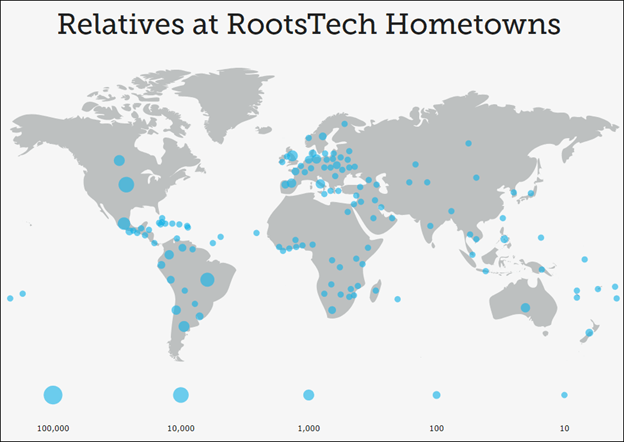
23andMe Concludes Their Investigation – 6.9 Million Customers’ Data Exposed

On October 10th, 23andMe filed a document with the SEC stating that a “threat actor” (hacker) had accessed about 0.1% of their user accounts. That amounts to about 14,000 compromised users, according to their May 2023 earnings report where they state that they have about 14 million users. In addition, the hacker accessed their matches, and potentially matches of matches, through DNA Relatives.

I wrote about the initial compromise in three articles as information unfolded.

  1. 23andMe User Accounts Exposed – Change Your Password Now
  2. The 23andMe Data Exposure – New Info, Considerations and A Pause Strategy
  3. 23andMe: DNA Relatives, Connections, Event History Report and Other Security Tools

I expected that 23andMe would provide additional information directly to their customers as their investigation proceeded and concluded.

They have not published a new blog article nor notified customers directly.

They updated their original October 6th blog article on both December 1st and 5th, stating that their investigation has concluded and the results.

23andMe stated that:

  • They have concluded their investigation and will be notifying affected customers as required by law.

This is a bit confusing because they already HAD notified many people of the original compromise event, that their data had been affected, and forced a password reset. I’m unclear whether this means an additional notification will be sent, or that the earlier notification is what they were referencing.

I’m also curious about the “as required by law” comment, as laws vary widely between countries and even states sometimes. Are they only notifying people to the extent required by law where the customer lives? This would seem both impractical and confusing when some people receive breach notices, and others do not when both are equally affected. Or is 23andMe trying to say they are complying with applicable laws?

  • They verified that the compromise was via credential stuffing, where names (email addresses, in this case) and passwords exposed in previously compromised websites were used to sign into 23andMe accounts.
  • In addition to the entire account information of those 14,000 compromised individuals, all of their DNA Relatives (matches) and information about those relatives were exposed and scraped. In other words, all of your matches and everything you could see about them.

This is also confusing because, in additional details, 23andMe states that the hacker (threat actor) “used the compromised credential stuffed accounts to access the information included in approximately 5.5 million DNA Relatives profiles and 1.4 million Family Tree features profiled, each of which were connected to the compromised accounts.”

The math doesn’t add up. Every test (account) has one AI-generated family tree. If 1.4 million family trees were exposed, and each fully compromised account has one family tree, doesn’t that mean that (minimally) 1.4 million accounts were exposed, not 14,000? That’s 100 times more than 14,000 accounts. Is the decimal in the wrong place?

Is 23andMe perhaps counting the number of people in those trees? I find it difficult to believe that everyone’s trees have 100 people. Mine only has 15 people, and all of them are my highest matches on my DNA Relatives match list, so they are already included in that breach number of 5.5 million. Assuredly, 23andMe is not double counting exposed individuals, so they would not be counted in both places.

Adding together 1.4 million family trees and 5.5 million exposed DNA Relatives, a total of 6.9 million customers have had data exposed in this breach. Apparently,1.4 million people were directly exposed, or their trees could not have been exposed because no one can see your 23andMe-provided tree other than you, and 5.5 million exposures via DNA Relatives matching. Exposed information would have also included your matches matching each other, even if their accounts were not directly compromised.

6.9 million is approximately half of the 23andMe 14 million total customers.

What 23anMe doesn’t say is how many customers, of the 14 million total, actually participate in DNA Relatives. Many of their customers only test for health and traits information, and do not opt-in to DNA matching. Those customers would NOT have trees generated, so would NOT be included in that 1.4 million trees generated, nor the 5.5 million exposed DNA Relatives. Those customers would be in addition to those numbers.

To be clear, you can’t assume that you’re in the clear just because you’re not using the genealogy aspect of 23andMe. Of course, it’s very unlikely that any customers not involved with genealogy will ever see this article.

Protections

23andMe has implemented additional industry-standard security protections for customers to prevent a recurrence.

  • Forced password reset.
  • Added two-factor authentication (2FA) that they are calling both 2SV, two-step verification, and MSV, multiple-step verification, which you can read about in their blog post, here.
  • Provided a Privacy and Security Help Center, here.

Why This Matters

I realize that many people are very unhappy about 2FA, MFA, or 2SV, which are different names for the same thing. However, given the magnitude of this exposure, it’s the responsible step for 23andMe to take.

Those techniques are based on something you know plus something you have or have access to. The something you know is your sign-in and password, and the something you have access to is your phone or email to retrieve a code. A bad actor, unless they stole your phone or have also compromised your email account, won’t be able to obtain the six-digit 2FA number mailed or texted to you.

I know this is somewhat inconvenient, but I’d like to explain why this level of security matters.

Let me give you a brief example. Let’s say that I’m a Jewish person, and the threat actor is interested in harming Jewish people. Based on my ethnicity, I can be clearly identified as Jewish. Therefore, my children and closest relatives can also be identified as Jewish. The tree generated by 23andMe tells the hacker how people fit together, and my closest relatives are clearly identified.

Their names are exposed along with, potentially, their locations, photo, birth year, and other clearly personally identifying information.

Don’t want to think about this in terms of Jewish people? Think about it in terms of any “us versus them” discriminatory situation or even in terms of a domestic violence perpetrator or a stalker gaining access to your children’s information.

Now think about identity theft, which seems benign in comparison to your safety and being targeted, but identity theft is still a very real threat and can wreck your life.

The bad actor (and anyone who buys the compromised data – your information) has enough information to do serious harm, one way or another, depending on their motives, to every person whose information they obtain.

That information may be for sale on the dark web or in some data dump somewhere. We don’t know and will never know who has it and their motivation for obtaining it.

Even if you don’t personally care what is exposed about you – due to trees and matches and information that is typically NOT exposed publicly – you’re connected via matching to OTHER PEOPLE whose data has been exposed because they match you – and your data was breached. Like it or not, we’re all in this together.

Genetic genealogy is a team sport. That’s why we love it. That’s why the hacker loves it, too. So do the hacker’s “customers.”

Most websites have moved or will be moving to 2FA shortly. All “social sites” where people interact with each other one way or another are major targets and are moving in the 2FA direction, too. Just this past week, a dear friend’s entire Facebook account was hacked and subsequently permanently disabled, meaning it’s gone, forever, all within 15 minutes. He lost 11 or 12 years of his life, journaled, along with MANY family and other photos that are no longer on his phone or anyplace else.

All of this pales in comparison to what would happen to your bank account, retirement account, or other financial vehicles. If someone reuses passwords in multiple locations, they are likely to continue the behavior across several accounts because they want to be able to remember the password. This increases the chances DRAMATICALLY of becoming a victim.

2FA is a new way of life that protects us all, and yes, it’s inconvenient, but then again, so are seat belts, and everyone wears those.

Don’t blame the companies who are trying to keep us safe, often in spite of ourselves. Companies certainly don’t relish the idea of angering or inconveniencing their customers, which is probably why they didn’t do it sooner. Blame the bad actors who necessitate this step.

Terms of Service Change

While 23andMe didn’t directly notify customers about the results of their investigation, that it is over, or the people whose accounts were directly compromised – they have sent emails about a change in their terms of service (TOS).

23andMe has upgraded their TOS (terms of service), here, to include mandatory arbitration of disputes, which precludes jury trials or class action lawsuits. In all caps, no less.

And yes, if you’re wondering, class action lawsuits have now been filed in both the US and Canada.

I’m not a lawyer, but based on the language, the new TOS appear to affect all 23andMe customers going forward UNLESS YOU NOTIFY 23andME OTHERWISE.

I received this email on December 5th for one of the tests I manage, and it states that the updated TOS go into effect in 30 days UNLESS YOU NOTIFY 23andME, in which case you will be held to the earlier terms.

Here’s the applicable section, as provided by 23andMe in the Dispute Resolution portion of their TOS, here.

If you do NOT agree, click the “notify us” link in the email, which opens a new email to legal@23andme.com to notify 23andMe.

Remaining Unanswered Questions

23andMe stated that they learned about this breach in early October, but as reported in my earlier articles, some of their customers’ data was reportedly available for sale as early as August 2023. 23andMe does not mention this, so we don’t know if that is a different breach, or if those numbers are included in the 6.9 million 23andMe customers whose accounts have been compromised.

I’d like to know if my account was actually compromised, meaning signed in to, or was my account compromised solely through DNA Relatives matching? It makes a difference in terms of how much of my and my family’s information is exposed.

I assumed that 23andMe would provide people with additional information, but to the best of my knowledge, they have not. Has anyone received an email telling you that your account was personally compromised, meaning signed in to? My notification from 23andMe and the others I’ve seen all say the same as mine, sent in late October, below.

After further review, we have identified your DNA Relatives profile as one that was impacted in this incident. Specifically, there was unauthorized access to one or more 23andMe accounts that were connected to you through DNA Relatives. As a result, the DNA Relatives profile information you provided in this feature was exposed to the threat actor.

Based on our investigation so far, we believe only your DNA Relatives profile attributes were exposed.

Did anyone receive an email that says their account was one of those directly compromised, meaning NOT through DNA Relatives?

Return of Features

Many people have been asking about the return of features that were “temporarily” disabled.

  • Relatives in Common – shared matching, meaning three-way matching
  • Your matches matching with each other, or not
  • Triangulation through Relatives in Common – meaning shared common segments
  • Matches Download File, both including and excluding segments
  • Chromosome browser

Sadly, 23andMe has provided no update on this topic.

Unfortunately, these features include nearly all of the tools that genealogists use, except for individual matching, the 23andMe-created genetic tree, and haplogroups.

We’ve lost the ability to determine how our matches match us through shared matching or triangulation. We now have no way to determine which side, maternal or paternal, a match is on because we can’t tell who else they match or “how” we match them.

I know that genealogy hasn’t been a priority for 23andMe for some time. Medical research is their focus. On October 30th, 2023, 23andMe signed another $20 million one-year deal, plus potential future drug royalties, with GSK for access to the 23andMe database of customers who have consented to medical research.

Genealogists have been an important source of testers in the past because many opted-in for medical and drug research. However, unless 23andMe returns the genealogy functionality, they’ve removed nearly all incentives for genealogists to test there.

If genealogists can’t do genealogy, why would genealogists purchase or recommend their test?

I’m glad I did not repurchase the updated DNA test that would allow me to subscribe to a premium membership to receive 5000 matches instead of 1500 matches. Initially, that membership required purchasing a new test, plus $29 per year, but the membership has now been raised to $69 per year. In August 2023, when their original agreement with GSK expired, 23andMe raised their test prices and laid employees off. I wrote about the August changes here.

Of course, that was about the same time as the original August data exposure, which was followed by the October data exposure, assuming those are two discrete events. 23andMe was clearly experiencing significant financial difficulties, and the 1-2 million spent on the data exposure investigation would have added to those woes.

Regardless, without tools, matches simply aren’t useful. There has been no mention of refunds to people who have subscribed and cannot effectively use the higher level of matches they are receiving. Those of us who haven’t subscribed can’t use ours either.

At this point, 23andMe would be my last testing choice of the four major vendors. I probably wouldn’t recommend them unless someone is searching for an immediate family match, such as an unknown parent or close relatives, and has been unsuccessful elsewhere. Without genealogy tools, unless 23andMe can place a match in the genetic tree they provide, or the match is either very close or previously known, there’s no way to determine how you are related.

Clearly, the investigation and security measures had to be their #1 priority, and patience was in order. But now that the investigation is complete, I hope 23andMe gets this straightened out, returns functionality, and provides additional information to their customers soon

______________________________________________________________

Sign Up Now – It’s Free!

If you appreciate this article, subscribe to DNAeXplain for free, to automatically receive new articles by email each week.

Here’s the link. Just look for the black “follow” button on the right-hand side on your computer screen below the black title bar, enter your e-mail address, and you’re good to go!

In case you were wondering, I never have nor ever will share or use your e-mail outside of the intended purpose.

_____________________________________________________________

Follow DNAexplain on Facebook, here.

Share the Love!

You’re always welcome to forward articles or links to friends and share on social media.

If you haven’t already subscribed (it’s free,) you can receive an email whenever I publish by clicking the “follow” button on the main blog page, here.

You Can Help Keep This Blog Free

I receive a small contribution when you click on some of the links to vendors in my articles. This does NOT increase the price you pay but helps me to keep the lights on and this informational blog free for everyone. Please click on the links in the articles or to the vendors below if you are purchasing products or DNA testing.

Thank you so much.

DNA Purchases and Free Uploads

Genealogy Products and Services

My Book

Genealogy Books

Genealogy Research

FamilyTreeDNA Provides Y DNA Haplogroups from Family Finder Autosomal Tests

Big News! FamilyTreeDNA is delivering holiday gifts early!

Y DNA haplogroups are beginning to be delivered as a free benefit to men who took the Family Finder test at FamilyTreeDNA. This is the first wave of a staggered rollout. Haplogroup results will be delivered to several thousand people at a time, in batches, beginning today.

This is no trivial gift and includes LOTS of information that can be used in various ways for your genealogy. Please feel free to share this article. The new Family Finder haplogroups are another reason to take a Family Finder test and to encourage other family members to do so as well.

How is this Even Possible?

Clearly, Y DNA is not autosomal DNA, so how is it possible to obtain a Y DNA or mitochondrial DNA haplogroup from an autosomal test? Great question!

Many autosomal DNA processing chips include a limited number of targeted Y and mitochondrial DNA SNP locations. Generally, those locations are haplogroup predictive, which is how haplogroup information can be obtained from an autosomal DNA test.

Compared to the actual Y DNA and mitochondrial DNA tests, only a small fraction of the information is available through autosomal tests. Only the full sequence mitochondrial DNA test or the Big Y-700 test will provide you with the full story, including your most refined haplogroup, additional information, and matching with other customers.

Having said that, haplogroups obtained from Family Finder provide important clues and genealogical information that will hopefully whet recipients’ appetites for learning even more.

Delivery Schedule

This first group of men to receive haplogroup results consists of testers who have purchased the Family Finder test since March 2019 when the most recent chip was put into production.

FamilyTreeDNA will be rolling haplogroups out in batches of a few thousand each day until everyone’s is complete, in the following order:

  • Family Finder tests purchased since March 2019 (their V3 chip)
  • Family Finder tests purchased between the fall of 2015 to March 2019 (their V2 chip)
  • Family Finder tests purchased from 2010 to the fall of 2015 (their V1 chip)
  • Autosomal uploads from other vendors for customers who have unlocked the advanced Family Finder features for $19

Uploaded DNA Files from Other Vendors

After the results are available for all males who have tested at FamilyTreeDNA, haplogroups will begin to be rolled out to customers who uploaded autosomal DNA files from other companies, meaning MyHeritage, Vitagene, 23andMe, and Ancestry.

To receive haplogroups for files uploaded from other vendors, the Family Finder advanced tool unlock must have been (or can be) purchased for $19. In addition to haplogroups, the unlock also provides access to the chromosome browser, myOrigins (ethnicity), Chromosome painting for myOrigins ethnicity, and ancient Origins.

Both MyHeritage and Vitagene tests are performed in the Gene by Gene lab. Those “uploads” are actually a secure business-to-business transaction, so the file integrity is assured.

Ancestry and 23andMe DNA files are downloaded from those companies, then uploaded to FamilyTreeDNA. Some people build “composite” files in the format of these companies, so FamilyTreeDNA has no way to assure that the original DNA upload file hasn’t been modified and it is a legitimate, unmodified, file from either 23andMe or Ancestry. Hence, in some situations, they are treated differently.

Both Ancestry and 23andMe utilize different chips than FamilyTreeDNA, covering different SNPs. Those results may vary slightly from results available from native FamilyTreeDNA tests, and will also vary from each other. In other words, there’s no consistency, and therefore haplogroup accuracy cannot be confirmed.

Haplogroups resulting from tests performed in the FamilyTreeDNA lab will be visible to matches and on the SNP pages within projects. They will also be used in both Discover and the haplotree statistics. This includes Family Finder plus MyHeritage and Vitagene DNA file uploads.

Tests performed elsewhere will receive haplogroups that will only be visible to the user, or a group administrator viewing a kit within a project. They will not be visible to matches, used in trees or for statistics.

At their recent conference, FamilyTreeDNA provided this slide during an update about what to expect from Family Finder haplogroups.

Today, only Y DNA haplogroups are being provided, but after the new mitochondrial tree is available, customer haplogroups are updated, and MitoDiscover (my name, not theirs) is released, FamilyTreeDNA is planning to provide mitochondrial DNA haplogroups for Family Finder customers as well. The current haplogroup estimate is late 2024 or even into 2025.

Unfortunately, some of Ancestry’s DNA files don’t include mitochondrial DNA SNPs, so some customers who’ve uploaded Ancestry files won’t receive mitochondrial haplogroups.

STR Haplogroups to be Updated

All FamilyTreeDNA customers who have taken Y DNA STR tests, meaning 12, 25, 37, 67, or 111 markers, receive predicted haplogroups. Often, the Family Finder extracted results can provide a more refined haplogroup.

When that is possible, STR test predicted haplogroup results will be updated to the more refined Family Finder haplogroup.

Furthermore, while STR results are quite reliably predicted, Family Finder results are SNP-confirmed.

Notification

When your Family Finder test has received a haplogroup or your STR-derived haplogroup has been updated, you’ll receive an email notification with a link to a short, less than 2-minute video explaining what you’re receiving.

You can also expect emails in the following days with links to additional short videos. If you’d like to watch the videos now, click here.

You can also check your results, of course. If you should have received an email and didn’t, check your spam folder, and if it’s not there, notify FamilyTreeDNA in case your email has managed to get on the bounce list.

Group project administrators will receive notifications when a haplogroup is updated for a member in a project that they manage. This doesn’t just apply to Family Finder haplogroup updates for STR results – notifications will arrive when Big Y haplogroups are updated, too.

Emails about haplogroup updates will include both the old and the updated haplogroup.

Haplogroups may change as other testers receive results, forming a new haplogroup. The Big Y-700 test is evergreen, meaning as the Y tree grows, testers’ results are updated on an ongoing basis.

New View

Let’s take a look at what customers will receive.

In one of my surname projects, one male has taken a Family Finder test, but not the Y DNA test.

Several other men in that same paternal line, who are clearly related (including his brother), have taken Y DNA tests – both STR and the Big Y-700.

We have men who have taken the Big Y-700 test, STR tests only (no Big Y), and one with only a Family Finder test, so let’s compare all three, beginning with the man who has taken a Family Finder test but no Y DNA tests.

He has now been assigned to haplogroup I-BY1031, thanks to his Family Finder test.

Before today, because he has not taken a Y DNA test, he had no haplogroup or Y DNA Results section on his personal page.

Today, he does. Of course, he doesn’t have STR results or matches, but he DOES have confirmed SNP results, at least part way down the tree.

He can view these results on the Haplotree & SNPs tab or in Discover. Let’s look at both.

Haplotree & SNPs

By clicking on the Haplotree & SNPs link, you can view the results by variants (mutations,) as shown below, or by countries, surnames, or recommended projects for each haplogroup.

Of course, as more Family Finder results are rolled out, the more names and countries will appear on the Haplotree.

Recommended Projects

It’s easy to determine which haplogroup projects would be a good fit for people with these new haplogroups to join.

Just view by Recommended Projects, then scan up that column above the selected haplogroup. You can even just click right there to join. It’s that easy!

Results still won’t show on the public project page, because these testers don’t have STR results to display. Perhaps this will encourage additional testing in order to match with other men.

Download SNP Results

If you’re interested, you can download your SNP results in spreadsheet format.

I’m only showing four of my cousin’s positive SNPs, but FamilyTreeDNA was able to extract 358 positive SNPs to assign him to haplogroup I-BY1031.

Are Family Finder Haplogroups Better Than STR Test Predicted Haplogroups?

How do Family Finder haplogroups stack up against STR-predicted haplogroups?

Viewing the Y DNA results of related cousins who have taken STR tests, but not the Big Y-700, we see that their Y DNA haplogroup was predicted as I-M253.

We also know that the haplogroup determined by the Big Y-700 for this line is I-BY73911.

How can we use this information beneficially, and what does it mean?

Discover

Family Finder haplogroups can access Discover, which I wrote about, here.

Clicking on the Discover link takes you to your haplogroup story.

Let’s look at the new Family Finder Haplogroup Story for this tester.

Haplogroup I-BY1031 is about 3100 years old and is found in England, Sweden, the US, and 14 other countries. Of course, as more Family Finder haplogroups are provided to customers, this information will change for many haplogroups, so check back often.

Of course, you’ll want to review every single tab, which are chapters in your ancestral story! The Time Tree shows your haplogroup age in perspective to other haplogroups and their formation, and Ancient Connections anchors haplogroups through archaeology.

You can share any Discover page in several ways. This is a good opportunity to excite other family members about the discoveries revealed through DNA testing and genealogy. Prices are reduced right now with the Holiday Sale, too, so it’s a great time to gift someone else or yourself.

Compare – How Good is Good?

Ok, so how much better is the Family Finder haplogroup than the STR-predicted haplogroup, and how much better is the Big Y-700 haplogroup than the other two?

I’ll use the Discover “Compare” feature to answer these questions.

First, let’s compare the STR-predicted haplogroup of I-M253 to the Family Finder haplogroup of I-BY1031.

I clicked on Compare and entered the haplogroup I wish to compare to I-BY1031.

I-M253 I-BY1031 I-BY73199
Haplogroup Source STR Predicted Family Finder Big Y-700
Formation Year 2600 BCE 1100 BCE 1750 CE
Age – Years ago 4600 3100 270
Era Stone Age, Metal Age Metal Age Modern
Ancestral Locations England, Sweden, Germany, UK, +100 Sweden, England, US, +14 Netherlands
Tested Descendants 26,572 121 2
Branches 6779 69 0 – this is the pot-of-gold end leaf on the branch today

I created this chart to compare the major features of all three haplogroups.

The STR-predicted haplogroup, I-M253, takes you to about 2,600 BCE, or about 4,600 years ago. The Family Finder haplogroup shifts that significantly to about 1100 BCE, or 3100 years ago, so it’s about 1500 years more recent. However, the Big Y haplogroup takes you home – from 3100 years ago to about 270 years ago.

Notice that there’s a LOT of room for refinement under haplogroup I-M253. A Big Y tester might wind up on any of those 6779 branches, and might well be assigned to a newly formed branch with his test. The Family Finder haplogroup, I-BY1031, which was, by the way, discovered through Big Y testing, moved the autosomal test taker forward 1500 years where there are 121 descendants in 69 branches. The Big Y-700 test is the most refined possible, moving you directly into a genealogically relevant timeframe with a very specific location.

I-M253 is found in over 100 countries, I-BY1031 in 17 and I-BY73199 is found only in one – the Netherlands.

Based on confirmed genealogy, the common ancestor of the two men who have Big Y-700 haplogroup I-BY73199 was a man named Hendrik Jans Ferwerda, born in 1806 in the Netherlands, so 217 years ago. Of course, that haplogroup itself could have been born a generation or two before Hendrik. We simply won’t know for sure until more men test. More testers refine the haplotree, haplogroup ages, and refine our genealogy as well.

Haplogroup Comparison and Analysis

Let’s look at the Discover “Compare” feature of the three haplogroups from my family line from the Netherlands. Please note that your results will differ because every haplogroup is different, but this is a good way to compare the three types of haplogroup results and an excellent avenue to illustrate why testing and upgrades are so important.

The haplogroup ages are according to the Discover Time Tree.

Y-Adam to Haplogroup I1 I-M253 STR Haplogroup  to I-BY1031 Family Finder Haplogroup I-BY1031 Family Finder Haplogroup to BY73199 Big Y Haplogroup
Y-Adam (haplogroup A-PR2921) lived about 234,000 years ago
A0-T
A1
A1b
CT
CF
F
GHIJK
HIJK
IJK
IJ
I
M170
Z2699
L840
I1 I1
I-M253 lived about 4600 years ago
DF29
Z58
Z2041
Z2040
Z382
Y3643
Y2170
FT92441
FT45372
PH1178
BY1031 I-BY1031 lived about 3100 years ago
FT230048
BY65928
BY61100
I-BY73199 lived about 270 years ago

 All of the base haplogroups in the first column leading to Haplogroup I span the longest elapsed time, about 230,000 years, from Y-Adam to I-M253, the STR-predicted haplogroup, but are the least relevant to contemporary genealogy. They do tell us where we came from more distantly.

The second column moves you about 1500 years forward in time to the Family Finder confirmed haplogroup, reducing the location from pretty much everyplace in Europe (plus a few more locations) with more than 6700 branches, to 69 branches in only 17 countries.

With the fewest haplogroups, the third column spans the most recent 2800 years, bringing you unquestionably into the genealogically relevant timeframe, 270 years ago, in only one country where surnames apply.

If we had more testers from the Netherlands or nearby regions, there would probably be more branches on the tree between BY1031 and BY73199, the Big Y-700 haplogroup.

The second column is clearly an improvement over the first column which gets us to I-M253. The Family Finder upgrade from I-M253 to BY1031 provides information about our ancestors 3000-4500 years ago, where they lived and culturally, what they were doing. Ancient Connections enhance that understanding.

But the third column moves into the modern area where surnames are relevant and is the holy grail of genealogy. It’s a journey to get from Adam to the Netherlands in one family 270 years ago, but we can do it successfully between Family Finder and the Big Y-700.

Family Finder Matching

Given that these new haplogroups result from Family Finder, how do these results show in Family Finder matching? How do we know if someone with a haplogroup has taken a Y DNA test or if their haplogroup is from their Family Finder test?

  • All Family Finder haplogroups will show in the results for people who tested at FamilyTreeDNA as soon as they are all rolled out
  • All MyHeritage and Vitagene uploads, because they are processed by the Gene by Gene lab, will be shown IF they have purchased the unlock.
  • No Ancestry or 23andMe haplogroups will be shown to Family Finder matches

To determine whether or not your matches’ haplogroups result from a Y DNA test or a Family Finder haplogroup, on your Family Finder match page, look just beneath the name of your matches.

The first man above received the Family Finder haplogroup. You can see he has no other tests listed. The second man has taken the Big Y-700 test. You can see that he has a different haplogroup, and if you look beneath his name, you’ll see that he took the Big Y-700 test.

For other men, you may see the 67 or 111 marker tests, for example, so you’ll know that they are available for Y-DNA matching. That may be important information because you can then visit the appropriate surname project to see if they happen to be listed with an earliest known ancestor.

After the rollout is complete, If you have a male Family Finder match with no haplogroup shown, you know that:

  • They did not test at FamilyTree DNA
  • If they uploaded from MyHeritage or Vitagene, they did not unlock the advanced Family Finder features
  • Or, they tested at either 23andMe or Ancestry, and uploaded their results

You can always reach out to your match and ask.

How to Use This Information

There are several great ways to utilize this new information.

I have a roadblock with my Moore line. Moore is a common surname with many, many origins, so I have autosomal matches to several Moore individuals who may or may not be from my Moore line.

I do know the base haplogroup of my Moore men, but I do not have a Big Y, unfortunately, and can’t upgrade because the tester is deceased. (I wish I had ordered the Big Y out the gate, but too late now.)

As soon as the results are complete for all of the testers, I’ll be able, by process of elimination to some extent, focus ONLY on the testers who fall into Family Finder haplogroup of my Moore cousins, or at least haplogroup close for Ancestry or 23andMe upload customers. In other words, I can eliminate the rest.

I can then ask the men with a similar haplogroup to my proven Moore cousins for more information, including whether they would be willing to take a Y DNA test.

  • Second, as soon as the Family Finder processing is complete, I will know that all male Family Finder matches and uploads from MyHeritage and Vitagene that have paid for the unlock will have haplogroups displayed on the Family Finder Match page. Therefore, if there’s a male Moore with no haplogroup, I can reach out to see where they tested and if a haplogroup has been assigned, even if it’s from Ancestry or 23andMe and isn’t displayed in Family Finder.

If so, and they share the haplogroup with me, I’ll be able to include or exclude them. If included, I can then ask if they would consider taking a Y DNA test.

  • Third, for lines I don’t yet have Y DNA testers for, I can now peruse my matches, and my cousins’ matches for that line. See items one and two, above. Even if they don’t reply or agree to Y DNA testing, at least now I have SOME haplogroup for that missing line.

Discover will help me flesh out the information I have, narrow regions, find projects, look at ancient DNA for hints, and more.

  • Fourth, the haplogroups themselves. I don’t know how many million tests FamilyTreeDNA has in their database, but if we assume that half of those are male, some percentage won’t have taken a Y DNA test at all. We’ll be able to obtain Y-DNA information for lines where there may be no other living descendant. I have at least one like that. He was the end of the surname line and is deceased, with no sons.

I’m literally ecstatic that I’ll be able to obtain at least something for that line. If it’s anything like my example Netherlands lineage, the Family Finder haplogroup may be able to point me to an important region of Europe – or maybe someplace else very unexpected.

The Bottom Line

Here’s the bottom line. You don’t know what you don’t know – and our ancestors are FULL of surprises.

I can’t even begin to tell you how MUCH I’m looking forward to this haplogroup rollout.

To prepare, I’m making a list of my genealogical lines:

  • If the paternal line, meaning surname line, is represented by any match in any database
  • If that line is represented by a known person in the FamilyTreeDNA database and by whom
  • If they or someone from that line has joined a surname or other FamilyTreeDNA project, and if so, which one
  • If they’ve taken a Y DNA test, and what kind – watch STR results for an updated haplogroup
  • If they’ve taken a Family Finder test – my cousin is a good example of a known individual whose kit I can watch for a new haplogroup
  • Old and new haplogroup, if applicable

If my only relative from that line is in another vendor’s database, I’ll ask if they will upload their file to FamilyTreeDNA – and explain why by sharing this article. (Feel free to do the same.) A Y DNA haplogroup is a good incentive, and I would be glad to pay for the unlock at FamilyTreeDNA for cousins who represent Y and mitochondrial DNA lines I don’t already have.

One way I sweeten the pie is to offer testing scholarships to select lines where I need either the Y DNA or mitochondrial DNA of relevant ancestors. It’s a good thing these haplogroups are being rolled out a few thousand at a time! I need to budget for all the scholarships I’ll want to offer.

I feel like I won the lottery, and FamilyTreeDNA is giving me a free haplogroup encyclopedia of information about my ancestors through my cousins – even those who haven’t taken Y DNA tests. I can’t even express how happy this makes me.

What lines do you want to discover more about, and what is your plan? Tests are on sale now if you need them!

_____________________________________________________________

Follow DNAexplain on Facebook, here.

Share the Love!

You’re always welcome to forward articles or links to friends and share on social media.

If you haven’t already subscribed (it’s free,) you can receive an email whenever I publish by clicking the “follow” button on the main blog page, here.

You Can Help Keep This Blog Free

I receive a small contribution when you click on some of the links to vendors in my articles. This does NOT increase the price you pay but helps me to keep the lights on and this informational blog free for everyone. Please click on the links in the articles or to the vendors below if you are purchasing products or DNA testing.

Thank you so much.

DNA Purchases and Free Uploads

Genealogy Products and Services

My Book

Genealogy Books

Genealogy Research

Geneanet DNA to End on December 20, 2023

Today, Geneanet announced that they are discontinuing all DNA features on their platform.

Geneanet was purchased by Ancestry more than three years ago and offered DNA uploads and matching, with a chromosome browser, beginning in 2020. They did not offer DNA testing, so anyone who uploaded has to have tested elsewhere, meaning they are in another database somewhere.

Geneanet announced that:

  • As of today, DNA uploads will no longer be accepted.
  • On December 20th, in exactly 30 days, the entire DNA section will be permanently deleted, including your DNA file that you uploaded.

They don’t give any reason other than the DNA program didn’t meet their expectations, and they will focus on other customer-requested features now.

My initial reaction was that this might be due to the 23andMe data exposure issue that I wrote about here, here, and here. However, given the 7-week delay, I think that’s unlikely. Additionally, Geneanet is encouraging people to download their matches now, before the deletion. During this same time, other genealogy DNA companies have removed or restricted match downloads, which makes the 23andMe issue seem like an unlikely catalyst for their decision.

Geneanet states that none of its premium member features will be affected by this decision.

If Geneanet’s pending DNA exit affects you, you might want to take whatever action you deem appropriate, now, before the holidays distract you and you forget about it altogether.

Many people used Geneanet for its European focus to connect with European DNA matches. If this applies to you, I suggest that you upload your DNA files to both MyHeritage (here) and FamilyTreeDNA (here) if you haven’t already done so. MyHeritage has a significant European customer base, thanks to their abundant genealogy research records, and FamilyTreeDNA has many European testers with its 23-year history and European project offerings.

While the Geneanet exit from DNA may be inconvenient, it’s not a disastrous loss. You can find those Geneanet DNA matches elsewhere because they didn’t test at Geneanet.

You can read Geneanet’s blog posting, here.

_____________________________________________________________

Follow DNAexplain on Facebook, here.

Share the Love!

You’re always welcome to forward articles or links to friends and share on social media.

If you haven’t already subscribed (it’s free,) you can receive an email whenever I publish by clicking the “follow” button on the main blog page, here.

You Can Help Keep This Blog Free

I receive a small contribution when you click on some of the links to vendors in my articles. This does NOT increase the price you pay but helps me to keep the lights on and this informational blog free for everyone. Please click on the links in the articles or to the vendors below if you are purchasing products or DNA testing.

Thank you so much.

DNA Purchases and Free Uploads

Genealogy Products and Services

My Book

Genealogy Books

Genealogy Research