Family Tree DNA Dashboard Gets a New Skin

I signed into an account at FamilyTreeDNA and a surprise was waiting for me. FamilyTreeDNA molted and the dashboard on everyone’s personal page has a new look and feel.

New dashboard

Click to enlarge

The various tests along with results are at the right, and other information including updates, projects and badges are on the left.

New dashboard 2

Click to enlarge

Additional features, tests, tools and family trees are at the bottom.

New dashboard 3

Click to enlarge

Unfortunately, the tree is now at the very bottom – out of sight which means it will be more out of mind than it already is. We need more people to participate in trees, not fewer☹

But there are lots of improvements. Let’s step through each new feature and take a look.

Tutorial

At the very top of the page, under the gear setting at far right, you’ll see several options.

New dashboard tutorial.png

The first option is “View Tutorial” and that’s where I suggest that you start. The quick tutorial shows you how to rearrange your dashboard and how to add Quick Links – two new features.

Rearranging the Furniture

New dashboard rearrange.png

By clicking on “Rearrange Dashboard” you can move the test blocks around.

New dashboard move

Click to enlarge

When you click on “Rearrange,” the boxes appear with dotted lines around them and all you have to do is click on one and pull it where you want, then click to place and release it.

When finished, click on “Exit Rearrange.” This is easy and you can’t hurt anything, so experiment.

Previous Version

Don’t like the new dashboard at all, click on “View Previous Version,” but please don’t do that yet, because I think you’re going to like what comes next.

New dashboard previous.png

Quick Links

New dashboard quick links.png

At upper left, you can add up to 5 Quick Links, one at a time. These would be the functions you access the most.

New dashboard add quick links.png

Let’s see, what do I do most? That’s easy, Family Finder matches, then linking people in my family tree, then Y DNA and mitochondrial DNA matches, then the Big Y Block Tree.

New dashboard quick links 5

Click to enlarge

Now all I have to do is click on one of these links.

Format Changes

Now, all tools are shown full size on the product tabs. Previously, Advanced Matching, the Matrix and the Data Download were located in small print beneath the feature tabs. They’ve been moved up with the rest where they are much more visible and easy to notice.

New dashboard format

Click to enlarge

The Learning Center is shown as well.

Upgrades

Another feature I like is that it’s easy to see at a glance what level of each test you’ve taken. In the upper right corner of each product where there are different levels, the tests you’ve taken are darkened. In the example above, the tester has taken all of the Y DNA tests. If he had not, the Big Y, for example, would be light gray, as illustrated below, and all he would have to do to order an upgrade is to click on the gray Big Y box.

Unfortunately, there’s nothing that says “Upgrade” and I’m concerned that clicked on the greyed out box is not intuitive.

One thing you can’t tell is whether or not you’ve taken the original Big Y, the Big Y-500 or the Big Y-700. Perhaps this change will be made soon, because people are upgrading from the Big Y and the Big Y-500 to the Big Y-700. There’s so much more to learn and the Big Y-700 results have branched many trees.

New dashboard upgrade.png

Tests you haven’t taken aren’t obvious unless you actually click on the shopping cart icon. While you can see tests that offer upgrades, such as the Y DNA, if the person hasn’t taken the Family Finder, it’s not obvious anyplace that this test is available for purchase.

I don’ t know about you, but I really WANT people to upgrade to Family Finder if they’ve taken Y DNA or mitochondrial DNA tests, or to Y DNA or mitochondrial DNA if they’ve taken the Family Finder test. I hope Family Tree DNA adds a visible upgrade button that lists available tests for each tester.

Partner Applications

If you click on Partner Applications, you’ll see Geni. Some people mistakenly think that if you connect with Geni, that somehow feeds your tree at Family Tree DNA. To be very clear, IT DOES NOT. You can connect to Geni, but you still need to either build a tree or upload a Gedcom file to Family Tree DNA.

New dashboard partner apps.png

Public Haplotrees

At the bottom of everyone’s pages, you’ll find Public Haplotrees.

New dashboard public haplotrees.png

Clicking on this link takes you to the wonderful Y DNA and mitochondrial DNA haplotrees, complete with country flags and reports.

New dashboard Y haplotree.png

I wrote about how to use the public Y tree here and the public mitochondrial tree here.

MyFamilyTree

You can access your own tree either at the top of the page, or now at the bottom.

New dashboard myTree.png

New dashboard myTree 2

Click to enlarge

I would like to see the tree icon moved to the top where everyone sees it, since trees are integral and important to all three kinds of DNA tests. Everyone needs trees.

Badges

The haplogroup designations, along with any other badges, are much more visible now, shown on the left-hand side of the page.

New dashboard badges.png

Furthermore, the badge says whether or not the testing has been sufficient to confirm the haplogroup, or if it is predicted.

Projects

Just above badges, we find myProjects. I love that the projects are now displayed in such a prominent place. I hope that people will think to join projects, or look to see what’s available now that it’s in the middle of the page and not just as a link in the top banner.

New dashboard projects.png

Clicking on the project name takes you to the public display.

You can also still access projects from the top as well.

New dashboard projects 2.png

Updates

Another aspect of the new interface that I like is myUpdates.

Found at the top left, just below Quick Links, this new communications box provides the latest information from Family Tree DNA to you.

For my account, I see the following:

New dashboard myUpdates.png

New surveys with this update are the Family Ancestry survey, the Y DNA survey and the mtDNA survey. Of course, I don’t have a Y DNA survey because as a female, I don’t have a Y chromsome.

I want to review the surveys in depth, so I’ll be writing an article very shortly – but in the mean time, you need to know that these answers ARE FINAL, meaning that once you submit them, you can never change them. Please be vigilant and accurate, because these surveys are important so that the resulting science is reliable for all customers.

Security and Privacy

On the previous version of the personal page, your personal information, genealogical questions, privacy and security were located just beneath your profile photo.

New dashboard old.png

Not so now. In fact, they are completely obscured in the down arrow under your name at far right, NOT in the gear showing beneath your name.

New dashboard gear.png

Intuitively, I looked under the gear, above, but that’s not the place. It’s another gear. The Account Settings gear that you see drop down by clicking on your name, shown below, is NOT the same gear as you’re seeing above.

New dashboard account settings.png

Yes, I know this is confusing at first, but it’s not when you realize that there are two separate gears and if one doesn’t show the option you’re looking for, just click on the other one.

Click on the “Account Settings” gear by first clicking on your name to access the following information:

  • Account Information: contact information, beneficiary, password
  • Genealogy: surnames, earliest known ancestors
  • Privacy and Sharing: profile, matching preferences, origins, family trees
  • Project Preferences: sharing and authorizations by project
  • Notification Preferences: e-mail notifications by test and for projects

I hope that things like the surnames and earliest known ancestors will be moved to a much more visible location with prompts for people to complete. It was hard enough before to encourage people to complete this information and now the option to access these tabs is entirely invisible.

The earliest known ancestor and surnames are critical to the matches maps, to the EKA (earliest known ancestor) fields in both the Y and mitochondrial DNA displays and to the surname matching for Family Finder matches. Having testers complete this information means a much more meaningful and productive experience for all testers.

These three functions, in particular, are too important to have “out of sight, out of mind.”

Project Administrators

If you are a project administrator or have written instructions for your family or groups of people about to how to manage pages, change account settings, or join projects – you need to review and update your documents.

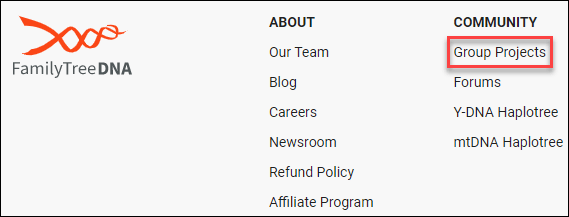
Group Project Search

A new group project search function has been added at the bottom of the main Family Tree DNA page, if you are not signed in.

New dashboard group projects.png

You can access the page, here.

New dashboard search page.png

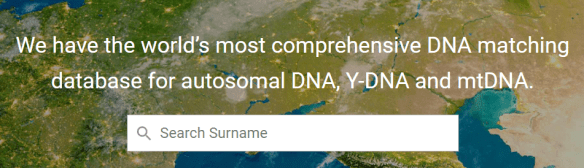
I’m not sure that a potential customer will understand that they are supposed to enter a surname to find a project – or the benefits of doing so. I hope this can be changed to add instructions to enter a surname or topic, and add wording to more closely reflect the search function on the main page.

However, most people will still access the surname search in the center of the main Family Tree DNA page where it does say “search surname.”

New dashboard surname search.png

I would also like to see an “ancestor search” added so that people can see if someone with their ancestors has already tested. This would encourage testing.

Summary

In summary, I like these features of the new dashboard:

  • I like the fact that the icons and features are all the same size in the space for that product – like advanced matching , the matrix and the learning center.
  • I like that the dashboard can be rearranged.
  • I like that the projects are showing clearly at left.
  • I like the new myUpdates section.
  • I like the Quick Links.
  • I like the larger, more noticeable badges that tell testers whether their haplogroup is predicted or confirmed. It might be nice to have a popup explaining how testers can confirm a predicted haplogroup and the associated benefits.
  • I like the fact that testers can see at a glance the level of their testing for each product, which also means they can quickly see if an upgrade is available.
  • I like the fact that this version is much more friendly towards handheld devices such as iPads and phones.

Improvements I recommend are:

  • Add the Account Settings back to the main page.
  • Move the trees from the bottom to the top to encourage user participation.
  • Add back the familiar blue upgrade button. People aren’t going to look in the shopping cart for a menu.
  • Add a feature at the top that shows clearly for the 3 main products, Y DNA, mitochondrial DNA and Family Finder if one of those 3 has not been ordered and is available for the tester to order.
  • Separate Big Y into Big YBig Y-500 and Big Y-700 buttons, providing Big Y and Big Y-500 testers with an upgrade avenue.
  • Add a popup at the top to encourage people to build a tree or upload a Gedcom file.
  • Add a popup at the top to encourage people to test other family members and to link testers in their tree so that they can enjoy phased matches assigned via matches to maternal and paternal family members.
  • Add a popup at the top to coach people to complete the various functions that enhance the user experience including:
    • Earliest Known Ancestor
    • Surnames
    • Matches Map information
    • Sharing
    • Joining projects

The new features are certainly welcome and a great start.

I hope these improvements are added quickly, because I fear that we lose opportunities every day when people don’t understand or don’t add information initially, then never sign in again.

We need to help testers and family members understand not only THAT they need to provide this information, or that they can upgrade their tests, but WHY that’s important and beneficial.

_______________________________________________________

Disclosure

I receive a small contribution when you click on some of the links to vendors in my articles. This does NOT increase the price you pay but helps me to keep the lights on and this informational blog free for everyone. Please click on the links in the articles or to the vendors below if you are purchasing products or DNA testing.

Thank you so much.

DNA Purchases and Free Transfers

Genealogy Services

Genealogy Research

Hot on the Trail of Elizabeth (c1720 – 1758/1782) Ulrich’s Parents, Thanks to Mitochondrial DNA – 52 Ancestors #255

I’m so close to discovering the identify of Elizabeth Ulrich’s family that I can taste it – but I’m not quite there. Maybe you’re the person who has the critical piece information that solves this puzzle.

I’m looking for several things – and any single one would help:

  • Information about the Heinrich Angle (Henry Angle or Engle) family of Pennsylvania and Maryland in the 1700s. There’s more information about this mystery man later in this article.
  • Information about Mary Elizabeth Angle born about 1740, the wife of Johann Jacob Brumbaugh who was reportedly the daughter of Henry Angle of Washington County, MD.
  • Any descendant of Hans and Christina Berchtol born in Krottelbach Germany and died in either Konken or Steinwenden. The descent needs to be through all females to the current generation which can be male. Their two daughters, other than Susanna Agnes Berchtol who married Johann Michael Mueller, were Ursula born about 1696 and Barbara (Barbel) born about 1693. It’s not known if these sisters survived and there is nothing to suggest they immigrated from Germany. I know this is a long shot, but it’s the best bet to obtain the mitochondrial DNA of Susanna Agnes Berchtol given that she has no proven daughters. I’ve always wondered if Elizabeth Ulrich was actually a Berchtol and the only way to prove or disprove this is through mitochondrial DNA.

berchtol-miller-mtdna

  • There is a suggestion that Susanna Agnes Berchtol and Michael Miller had a daughter, Barbara Miller who married John Garber and died in Shenandoah County, Virginia about 1808. Autosomal DNA suggests this as well, but unfortunately these Brethren families are so heavily intermarried, with several missing wives, that concusions can’t be made based on autosomal matches, at least not yet. I would like to find anyone descended from Barbara through all females as well. If that person’s mitochondrial DNA matches that of Elizabeth Ulrich, that’s a huge piece of evidence. If this is you, please contact me – I have a DNA testing scholarship for you!
  • Direct matrilineal descendants of any of the families mentioned in the History of the Church of the Brethren in the Southern District Pennsylvania that would have founded the York County congregation about 1738 and before 1745 including “Leatherman, Martin, Ulrich (Stephen Sr.), Greib/Gripe/Cripe, Becker, Stutzman, Dierdorff and Bigler.” Two additional Mennonite families in that same vicinity who married into the Miller line were Berchto/Bechtol/Bechtel and Garver/Garber. Direct matrilineal descendants mean through all females to the current generation, which can be males.

We Have Elizabeth Ulrich’s Mitochondrial DNA (YAY!!!)

Recently, a cousin, Craig, found my original article about Elizabeth Ulrich, born about 1720, either in Pennsylvania or Germany. She died after 1758, possibly before 1766 but definately before 1782 when Stephen Ulrich remarried. It’s important to remember that these people didn’t speak English, so Elizabeth would have had to have spoken German to communicate with her husband.

The great news is that Craig is her direct matrilineal descendant through all females, meaning he carries her mitochondrial DNA which is haplogroup U2e1. That’s the key to finding her family!

Craig descends from Elizabeth’s daughter, Hannah Ulrich who married a Puterbaugh and I’m incredibly grateful that he contacted me!

Craig’s Matches

Elizabeth Ulrich’s DNA matches a person whose ancestor is Elizabeth Rench born in 1787, who married Abraham Deeter and died in 1858.

Elizabeth Ulrich mtDNA match.png

Elizabeth Rench was the daughter of Catherine Brumbaugh and Peter Rench born in 1762 in Hagerstown, MD and died in 1818 in Miami County, Ohio.

Johann Jacob Brumbaugh’s wife was reportedly Mary Elizabeth Angle, daughter of Henry Angle of Washington County, MD and who died in 1806 in Bedford County, PA.

Henry Angle’s wife is said to be possibly Elizabeth Diehl.

A second mitochondrial DNA match also descends through Elizabeth Rench although Catherine’s surname is shown in this tree, below, as Clary. This person’s earliest known ancestor is listed as Mary Elizabeth Angle though, so Clary appears to be in error – a phenomenon not uncommon in trees.

Elizabeth Ulrich mtDNA match tree

Click to enlarge

Note the line above Peter Rench – Susanna Ulrich, daughter of Daniel, son of Stephen Ulrich and Elizabeth. These Brethren families were definitely intermarried a couple of generations later.

If you’re thinking to yourself, these are Brethren names and the exact Brethren migration path, from Frederick County, Maryland, through Bedford County, PA and on to Miami County, Ohio – you’re exactly right.

And of course, Elizabeth Ulrich and her family were Brethren and followed that exact same path too.

Where is Elizabeth Ulrich?

Elizabeth married Stephen Ulrich (Jr.) in roughly 1742, the same year he bought land in York County, PA. Based on this marriage date, it stands to reason that Elizabeth’s parents also lived in York County, or nearby, at this time. They were almost assuredly either Brethren or Mennonite.

By 1751, Elizabeth and Stephen Ulrich had moved to Frederick Co., MD, along with a number of other Brethren families, including Michael Miller. Hagerstown, the same place that Catherine Brumbaugh and Peter Rench lived was located in Frederick County at that time.

Washington County, MD whose seat is Hagerstown was formed in 1776 from Frederick County.

Now, we have the same group of Brethren families in the same county in Maryland at the same time.

Mary Elizabeth Angle

FindAGrave shows the following information for Mary Elizabeth Angle Brumbaugh.

Mary Elizabeth Angle Brumbaugh FindAGrave.png

Of course, we all know to interpret sites like FindAGrave as hints and not confirmation of anything without additional sources. It’s a great hint though!

Brumbaugh History

We find the following informatoin in the North American Family Histories.

Brumbaugh history.png

Brumbaugh history 2.png

I would love to see the 1780 deed mentioned above. It’s not available in the deed books for Frederick County on Family Search unless you’re in a Family History Center.

Getting out my Brethren Encyclopedia, on page 219, we find:

Brumbach Family (Brumbaugh)

Most Brethren members of the family descend from these immigrants. Johann Jacob Brumbach, (arrived Philadelphia, Aug 31, 1750 on the ship Nancy) : Johannes Henrich Brumbach (Philadelphia Sept 30 1754 on the Neptune or the later’s two recorded immigrant sons, Conrad and Johannes (Philadelphia, October 7 1765 on the ship Countess of Sussex). Jacob Brumbach settled in Frederick Co., MD, married Mary Elizbeth Angle, daughter of immigrant Henry Angle, and joined the Brethren. Other principle settlements were in Washington Co., MA, Franklin, Bedford and Huntington Co PA. From these points the family spread westward into Ohio and were among the first settlers in Elkhart and Kosciusko Co, Indiana.

There is a Georg Engel who arrives in Philadelphia in 1737, but of course without significant additional information, there is no way of knowing if he is connected.

Is This a Red Herring?

There is no way of knowing without more information if this is “something” or a red herring. The geography and Brethren connection make me suspect it’s “something,” but we need a lot more than my suspicions combined with circumstantial evidence, no matter how strong. Even with mitochondrial DNA evidence.

We do know that Elizabeth Ulrich, wife of Stephen, was born about 1720, but we don’t know if that occurred in the US or abroad. We know that she was probably married to Stephen in York County, PA about 1742 or so because that’s where her husband’s father, also Stephen Ulrich (Sr.), had purchased land.

Without looking for an Engle, Angle or Diehl, we can’t connect the dots in that region. In the book, History of the Church of the Brethren of the Eastern District of Pennsylvania, on page 382, we see that there are two Engle men in that area in 1800, so they may have been there earlier too, although the earliest records are incomplete. There is no Diehl mentioned that early, but Mennonite families are not recorded in this book and they did live nearby the Brethren – and intermarried.

It’s also worth noting that present day York County, across the river from Lancaster County, PA is only about 100 miles from Philadelphia, a primary port for immigrant arrivals, along with Baltimore, about 50 miles distant.

Additional Sources

Apparently in the Palmer Papers, Heinerich Engel’s wife was reported as a Diehl.

Heinrich Angle wife.png

Also, in the Brethren Digest V9 Issue 63 where Mary Elizabeth Angle was discussed, according to the note about the wife of Henry Angle. I have sent the person who posted the note a message.

I e-mailed the Fendrick Library who holds the Palmer papers and they have kindly offered to copy the relevant page for me.

I contacted the Brethren Heritage Center where a volunteer asked who published the Brethren Digest. Good question. I’ve been unable to determine the answer, so the name of the publication may possibly be misquoted. If anyone recognizes this or has more information, including the article itself, please contact me.

Henry Angle’s Will

In this document, which is a poor copy I found posted on Ancestry, Heinerich Angle’s 1810 will confirms that he was Brethren, but his daughter appears to be “Mary Brewer,” not Mary Brumbaugh, although this is clearly a transcription of the original. This does call Mary’s identity into question along with Henry as the father of Mary Elizabeth Brumbaugh.

Heinrich Angle 1810 will.png

Furthermore, if Mary was born in 1740, her father would have been born between before 1720, so a will dated in 1810 means that Henry would have been very old – in his 90s. Not impossible, but unlikely. Is this perhaps the wrong Henry Angle?

I tend to think so, because if Mary Elizabeth Angle Brumbaugh died in 1806, as shown on her tombstone, then her father would not have mentioned her in a will written in 1810, not to mention by the name Mary Brewer.

The 1790 census isn’t much help, as it shows Henry Angle of Washington County, MD with 3 males over 16, 2 males under 16 and 5 females. This suggests that he’s not an elderly man, but it’s not conclusive. One of the other males over 16 could be an adult son and one of the women could be the son’s wife, so we can’t really get an idea of Henry Angle’s age.

If Mary Elizabeth Angle born 1740 who married Johann Jacob Brumbaugh is the daughter of Henry Angle who died after 1810, then Elizabeth born circa 1725 who married Stephen Ulrich couldn’t have been Mary Elizabeth Angle’s sister. For that to happen, Henry and his wife would have been born in 1700 or before in order to have a daughter born circa 1720/1725 which puts him at 110 years old in 1810. While I’m open to a man dying in his 90s, I’m not buying that he lived to 110.

Therefore, Elizabeth could have been this Henry Angle’s wife’s sister or aunt, but not his daughter – IF Mary Elizabeth Angle Brumbaugh’s father is the same Henry Angle that died in 1810. I don’t think that he is, given that he called his daughter Mary Brewer and Mary Elizabeth Angle Brumbaugh died in 1806. I suspect this Henry Angle may be the son of the earlier Henry Angle, and therefore the brother of Mary Elizabeth Angle who married Jacob Brumbaugh.

Until proven otherwise, I’ll assume the 1810 will is NOT for the man whose daughter is Mary Elizabeth Angle that married Johann Jacob Brumbaugh. Dang all these “same names” anyway!

Therefore, Elizabeth Ulrich could potentially be the daughter of Henry (Heinrich) Angle and his wife, just not the one who died in or after 1810.

If Mary Elizabeth Angle was Heinrich Angle’s daughter, it’s also unlikely that he had a second daughter named Elizabeth, but without primary documentation of some sort, there’s no way to know Elizabeth’s complete name, or if Mary Elizabeth’s is actually accurate.

Some of my DNA matches on Ancestry show Henry (Heinrich) Angle in their trees, but show a death of March 14, 1780 – however, all without documentation. is wife, Elizabeth Diehl is shown born in 1714 and dying in 1767, also without documentatoin or sources. If this information is accurate, clearly Elizabeth Diehl cannot be the mother of Elizabeth Ulrich who was born in the 1720s and married Stephen Ulrich in about 1742.

Therefore, if Elizabeth Ulrich is related to Elizabeth Diehl, and those dates are remotely accurate, she would have to be her sister, not her daughter. Of course, the dates may not be accurate.

Mary Elizabeth Angle Who Married Johann Jacob Brumbaugh

The Palmer Papers reportedly state that Heinerich Angle’s (also spelled Engle) wife was a Diehl.

If she was a Diehl, and if her sister or daughter was Elizabeth who was to married Stephen Ulrich (Ullery) in about 1742 in York County, PA, then Elizabeth’s Diehl father would have had to have been in that area too. Lots of “ifs.”

Henry Angle pedigree.png

Could this work? Yes.

Does it work? I don’t know.

We need more information.

At the suggestion of a Diehl researcher, I checked the book, “Diehl Families of America,” by E.H. Diehl printed in 1915, with no luck.

Possibilities

What are the possibilities?

  • This is a red herring and the exact full sequence DNA match to another Brethren family in the same time and place is happenstance. I know that’s unlikely, but it’s certainly possible, as much as I’d like to believe that it’s not.
  • Elizabeth, Stephen Ulrich’s wife and Henry Angle’s wife are related, but back in Germany.
  • Heinrich Angle’s wife was a Diehl and finding her parents and family will provide us with the information we need to connect the dots to Elizabeth who married Stephen Ulrich. Wouldn’t that be a dream come true!
  • Heinrich Angle’s wife was not a Diehl after all.
  • Obtaining the mitochondrial DNA of the other Brethren and Mennonite families mentioned at the beginning of this article will rule them in or out. Tests might provide a mitochondrial DNA match with families known to be in the same church, and pietist German immigrant group in York County. Or, conversely, a non-match would rule out those same families. Sometimes negative evidence is quite valuable to rule out possibilities.

Options

  • Perhaps Craig, the mitochondrial descendant of Elizabeth Ulrich has another mitochondrial DNA match that leads someplace – anyplace. I’ve checked the full sequence and lower level matches and no other match leads anyplace useful. They are reflective of German heritage in general but all encounter brick walls in other locations. Rats!
  • Autosomal DNA links to a Diehl family. This is certainly a possibility. Craig has not taken the Family Finder test, but I and many others have. Everyone descended from Elizabeth married to Stephen Ulrich can check their results for any Diehl descendants – especially from Heinrich (Henry) Diehl from Maryland. However, given the level of Brethren intermarriage, finding a Diehl may result from later intermarriage. I have about 75 Diehl matches between Family Tree DNA, MyHeritage and Ancestry, and they are mostly interrelated in my Brethren line in some fashion, many in multiple ways.
  • Wait for more mitochondrial matches. Waiting is not my strong suit, but sometimes we don’t have a choice and one never knows what each new day will bring. After all, it brought Craig!
  • Dig through the relevant records in Frederick and Washington County, Maryland along with York County, PA.
  • Locate the missing records mentioned earlier in this article.
  • Find someone who has actually researched this specific Angle/Diehl family. Is this person you?

Do you have any information on a Diehl line in the Brethren/Mennonite part of Pennsylvania, including Philadelphia, from the early mid-1700s? How about from Baltimore or Frederick or Washington County, Maryland, the area associated with Heinrich Angle?

Please let me know if you do.

Eventually, we will solve this puzzle! We’re adding evidence piece by piece. I so wish Elizabeth could just tell us the answer.

______________________________________________________________

Disclosure

I receive a small contribution when you click on some of the links to vendors in my articles. This does NOT increase the price you pay but helps me to keep the lights on and this informational blog free for everyone. Please click on the links in the articles or to the vendors below if you are purchasing products or DNA testing.

Thank you so much.

DNA Purchases and Free Transfers

Genealogy Services

Genealogy Research

Crossovers: Frequency and Inheritance Statistics – Male Versus Female Matters

Recently, a reader asked if I had any crossover statistics.

They were asking about the number of crossovers, meaning divisions on each chromosome, of the parent’s DNA when a child is created. In other words, how many segments of your maternal and paternal grandparent’s DNA do you inherit from your mother and father – and are those numbers somehow different?

Why would someone ask that question, and how is it relevant for genealogists?

What is a Crossover and Why is it Important?

We know that every child receives half of their autosomal DNA from their father, and half from their mother. Conversely that means that each parent can only give their child half of their own DNA that they received from their parents. Therefore, each parent has to combine some of the DNA from their father’s chromosome and their mother’s chromosome into a new chromosome that they contribute to their child.

Crossovers are breakpoints that are created when the DNA of the person’s parents is divided into pieces before being recombined into a new chromosome and passed on to the person’s child.

I’m going to use the following real-life scenario to illustrate.

Crossover pedigree.png

The colors of the people above are reflected on the chromosome below where the DNA of the blue daughter, and her red and green parents are compared to the DNA of the tester. The tester is shown as the gray background chromosomes in the chromosome browser. The backgroud person is whose results we are looking at.

My granddaughter has tested her DNA, as have her parents and 3 of her 4 grandparents along with 2 great-grandparents, shown as red and green in the diagram above.

Here’s an example utilizing the FamilyTreeDNA chromosome browser.

Crossover example chr 1.png

On my granddaughter’s chromosome 1, on the chromosome brower above, we see two perfect examples of crossovers.

There’s no need to compare her DNA against that of her parent, the son in the chart above, because we already know she matches the full length of every chromosome with both of her parents.

However, when comparing my granddaughter’s DNA against the grandmother (blue) and her grandmother’s parents, the great-grandmother shown in red and great-grandfather shown in green, we can see that the granddaughter received her blue segments from the grandmother.

The grandmother had to receive that entire blue segment from either her mother, in red, or her father, in green. So, every blue segment must have an exactly matching red segment, green segment or combination of both.

The first red box at left shows that the blue segment was inherited partially from the grandmother’s red mother and green father. We know that because the tester matches the red great-grandmother on part of that blue segment and the green great-grandfather on a different part of the entire blue segment that the tester inherited from her blue grandmother.

The middle colored region, not boxed, shows the entire blue segment was inherited from the red great-grandmother and the blue grandmother passed that intact through her son to her granddaughter.

The third larger red boxed area encompassing the entire tested region to the right of the centromere was inherited by the granddaughter from her grandmother (blue segment) but it was originally from the blue grandmother’s red mother and green father.

The Crossover

The areas on this chromosome where the blue is divided between the red and green, meaning where the red and green butt up against each other is called a crossover. It’s literally where the DNA of the blue daughter crosses over between DNA contributed by her red mother and green father.

Crossover segments.png

In other words, the crossover where the DNA divided between the blue grandmother’s parents when the grandmother’s son was created is shown by the dark arrows above. The son gave his daughter that exact same segment from his mother and it’s only by comparing the tester’s DNA against her great-grandparents that we can see the crossover.

Crossover 4 generations.png

What we’re really seeing is that the segments inherited by the grandmother from her parents two different chromosomes were combined into one segment that the grandmother gave to her son. The son inherited the green piece and the red piece on his maternal chromosome, which he gave intact to his daughter, which is why the daughter matches her grandmother on that entire blue segment and matches her great-grandparents on the red and green pieces of their individual DNA.

Inferred Matching Segments

Crossover untested grandfather.png

The entirely uncolored regions are where the tester does not match her blue grandmother and where she would match her grandfather, who has not tested, instead of her blue grandmother.

The testers father only received his DNA from his mother and father, and if his daughter does not match his mother, then she must match his untested father on that segment.

Looking at the Big Inheritance Picture

The tester’s full autosomal match between the blue grandmother, red great-grandmother and green great-grandfather is shown below.

Crossover autosomes.png

In light of the discussion that follows, it’s worth noting that chromosomes 4 and 20 (orange arrows) were passed intact from the blue grandmother to the tester through two meiosis (inheritance) events. We know this because the tester matches the green great-grandfather’s DNA entirely on these two chromosomes that he passed to his blue daughter, her son and then the tester.

Let’s track this for chromosomes 4 and 20:

  • Meiosis 1 –The tester matches her blue grandmother, so we know that there was no crossover on that segment between the father and the tester.
  • Meiosis 2 – The tester matches her green great-grandfather along the entire chromosome, proving that it was passed intact from the grandmother to the tester’s father, her son.
  • What we don’t know is whether there were any crossovers between the green great-grandfather when he passed his parent or parents DNA to the blue grandmother, his daughter. In order to determine that, we would need at least one of the green great-grandfather’s parents, which we don’t have. We don’t know if the green great-grandfather passed on his maternal or paternal copy of his chromosome, or parts of each to the blue great-grandmother, his daughter.

Meiosis Events and the Tree

So let’s look at these meiosis or inheritance events in a different way, beginning at the bottom with the pink tester and counting backwards, or up the tree.

Crossover meiosis events.png

By inference, we know that chromosomes 11, 16 and 22 (purple arrows) were also passed intact, but not from the blue grandmother. The tester’s father passed his father’s chromosome intact to his daughter. That’s the untested grandfather again. We know this because the tester does not match her blue grandmother at all on either of these three chromosomes, so the tester must match her untested grandfather instead, because those are the only two sources of DNA for the tester’s father.

A Blip, or Not?

If you’ve noticed that chromosome 14 looks unusual, in that the tester matches her grandmother’s blue segment, but not either of her great-grandparents, which is impossible, give yourself extra points for your good eye.

In this case, the green great-grandfather’s kit was a transfer kit in which that portion of chromosome 14 was not included or did not read accurately. Given that the red great-grandmother’s kit DID read in that region and does not match the tester, we know that chromosome 14 would actually have a matching green segment exactly the size of the blue segment.

However, in another situation where we didn’t know of an issue with the transfer kit, it is also possible that the granddaughter matched a small segment of the blue grandmother’s DNA where they were identical by chance. In that case, chromosome 14 would actually have been passed to the tester intact from her father’s father, who is untested.

Every Segment has a Story

Looking at this matching pattern and our ability to determine the source of the DNA back several generations, originating from great-grandparents, I hope you’re beginning to get a sense of why understanding crossovers better is important to genealogists.

Every single segment has a story and that story is comprised of crossovers where the DNA of our ancestors is combined in their offspring. Today, we see the evidence of these historical genetic meiosis or division/recombination events in the start and end points of matches to our genetic cousins. Every start and end point represents a crossover sometime in the past.

What else can we tell about these events and how often they occur?

Of the 22 autosomes, not counting the X chromosome which has a unique inheritance pattern, 17 chromosomes experienced at least one crossover.

What does this mean to me as a genealogist and how can I interpret this type of information?

Philip Gammon

You may remember our statistician friend Philip Gammon. Philip and I have collaborated before authoring the following articles where Philip did the heavy lifting.

I discussed crossovers in the article Concepts – DNA Recombination and Crossovers, also in collaboration with Philip, and showed several examples in a Four Generation Inheritance Study.

If you haven’t read those articles, now might be a good time to do so, as they set the stage for understanding the rest of this article.

The frequency of chromosome segment divisions and their resulting crossovers are key to understanding how recombination occurs, which is key to understanding how far back in time a common ancestor between you and a match can expect to be found.

In other words, everything we think we know about relationships, especially more distant relationships, is predicated on the rate that crossovers occur.

The Concepts article references the Chowdhury paper and revealed that females average about 42 crossovers per child and males average about 27 but these quantities refer to the total number of crossovers on all 22 autosomes and reveal nothing about the distribution of the number of crossovers at the individual chromosome level.

Philip Gammon has been taking a closer look at this particular issue and has done some very interesting crossover simulations by chromosome, which are different sizes, as he reports beginning here.

Crossover Statistics by Philip Gammon

For chromosomes there is surprisingly little information available regarding the variation in the number of crossovers experienced during meiosis, the process of cell division that results in the production of ova and sperm cells. In the scientific literature I have been able to find only one reference that provides a table showing a frequency distribution for the number of crossovers by chromosome.

The paper Broad-Scale Recombination Patterns Underlying Proper Disjunction in Humans by Fledel-Alon et al in 2009 contains this information tucked away at the back of the “Supplementary methods, figures, and tables” section. It was likely not produced with genetic genealogists in mind but could be of great interest to some. The columns X0 to X8 refer to the number of crossovers on each chromosome that were measured in parental transmissions. Separate tables are shown for male and female transmissions because the rates between the two sexes differ significantly. Note that it’s the gender of the parent that matters, not the child. The sample size is quite small, containing only 288 occurrences for each gender.

A few years ago I stumbled across a paper titled Escape from crossover interference increases with maternal age by Campbell et al 2015. This study investigated the properties of crossover placement utilising family groups contained within the database of the direct-to-consumer genetic testing company 23andMe. In total more than 645,000 well-supported crossover events were able to be identified. Although this study didn’t directly report the observed frequency distribution of crossovers per chromosome, it did produce a table of parameters that accurately described the distribution of inter-crossover distances for each chromosome.

By introducing these parameters into a model that I had developed to implement the equations described by Housworth and Stahl in their 2003 paper Crossover Interference in Humans I was able to derive tables depicting the frequency of crossovers. The following results were produced for each chromosome by running 100,000 simulations in my crossover model:

Crossover transmissions from female to child.png

Transmissions from female parent to child, above.

Crossover transmissions male to child.png

Transmissions from male parent to child.

To be sure that we understand what these tables are revealing let’s look at the first row of the female table. The most frequent outcome for chromosome #1 is that there will be three crossovers and this occurs 27% of the time. There were instances when up to 10 crossovers were observed in a single meiosis but these were extremely rare. Cells that are blank recorded no observations in the 100,000 simulations. On average there are 3.36 crossovers observed on chromosome #1 in female to child transmissions i.e. the female chromosome #1 is 3.36 Morgans (336 centimorgans) in genetic length.

Blaine Bettinger has since examined crossover statistics using crowdsourced data in The Recombination Project: Analyzing Recombination Frequencies Using Crowdsourced Data, but only for females. His sample size was 250 maternal transmissions and Table 2 in the report presents the results in the same format as the tables above. There is a remarkable degree of conformity between Blaine’s measurements and the output from my simulation model and also to the earlier Fledel-Alon et al study.

The diagrams below are a typical representation of the chromosomes inherited by a child.

Crossovers inherited from mother.jpg

The red and orange (above) are the set of chromosomes inherited from the mother and the aqua and green (below) from the father. The locations where the colours change identify the crossover points.

It’s worth noting that all chromosomes have a chance of being passed from parent to child without recombination. These probabilities are found in the column for zero crossovers.

In the picture above the mother has passed on two red chromosomes (#14 and #20) without recombination from one of the maternal grandparents. No yellow chromosomes were passed intact.

Similarly, below, the father has passed on a total of five chromosomes that have no crossover points. Blue chromosomes #15, #18 and #21 were passed on intact from one paternal grandparent and green chromosomes #4 and #20 from the other.

Crossovers inherited from father.jpg

It’s quite a rare event for one of the larger chromosomes to be passed on without recombination (only a 1.4% probability for chromosome #1 in female transmissions) but occurs far more frequently in the smaller chromosomes. In fact, the male chromosome #21 is passed on intact more often (50.6% of the time) than containing DNA from both of the father’s parents.

However, there is nothing especially significant about chromosome #21.

The same could be said for any region of similar genetic length on any of the autosomes i.e. the first 52 cM of chromosome #1 or the middle 52 cM of chromosome #10 etc. From my simulations I have observed that on average 2.8 autosomes are passed down from a mother to child without a crossover and an average of 5.1 autosomes from a father to child.

In total (from both parents), 94% of offspring will inherit between 4 and 12 chromosomes containing DNA exclusively from a single grandparent. In the 100,000 simulations the child always inherited at least one chromosome without recombination.

Back to Roberta

If you have 3 generations who have tested, you can view the crossovers in the grandchild as compared to either one or two grandparents.

If the child doesn’t match one grandparent, even if their other grandparent through that parent hasn’t tested, you can certainly infer that any DNA where the grandchild doesn’t match the available grandparent comes from the non-tested “other” grandparent on that side.

Let’s Look at Real-Life Examples

Using the example of my 2 granddaughters, both of their parents and 3 of their 4 grandparents have tested, so I was able to measure the crossovers that my granddaughters experienced from all 4 of their grandparents.

Maternal Crossovers Granddaughter 1 Granddaughter 2 Average
Chromosome 1 6 2 3.36
Chromosome 2 4 2 3.17
Chromosome 3 3 2 2.71
Chromosome 4 2 2 2.59
Chromosome 5 2 1 2.49
Chromosome 6 4 2 2.36
Chromosome 7 3 1 2.23
Chromosome 8 2 2 2.11
Chromosome 9 3 1 1.95
Chromosome 10 4 2 2.08
Chromosome 11 3 0 1.93
Chromosome 12 3 3 2.00
Chromosome 13 1 1 1.52
Chromosome 14 3 1 1.38
Chromosome 15 4 1 1.44
Chromosome 16 2 2 1.58
Chromosome 17 2 2 1.53
Chromosome 18 2 0 1.40
Chromosome 19 2 1 1.18
Chromosome 20 0 1 1.19
Chromosome 21 0 1 0.74
Chromosome 22 1 0 0.78
Total 56 30 41.71

Looking at these results, it’s easy to see just how different inheritance between two full siblings can be. Granddaughter 1 has 56 crossovers through her mother, significantly more than the average of 41.71. Granddaughter 2 has 30, significantly less than average.

The average of the 2 girls is 43, very close to the total average of 41.71.

Note that one child received 2 chromosomes intact from her mother, and the other received 3.

Paternal Crossovers Granddaughter 1 Granddaughter 2 Average
Chromosome 1 2 2 1.98
Chromosome 2 3 2 1.85
Chromosome 3 2 2 1.64
Chromosome 4 0 1 1.46
Chromosome 5 1 2 1.46
Chromosome 6 2 1 1.41
Chromosome 7 1 2 1.36
Chromosome 8 1 1 1.23
Chromosome 9 1 3 1.26
Chromosome 10 3 2 1.30
Chromosome 11 0 1 1.20
Chromosome 12 1 1 1.32
Chromosome 13 2 1 1.02
Chromosome 14 1 0 0.97
Chromosome 15 1 2 1.01
Chromosome 16 0 1 1.02
Chromosome 17 0 0 1.06
Chromosome 18 1 1 0.98
Chromosome 19 1 1 1.00
Chromosome 20 0 0 0.99
Chromosome 21 0 0 0.52
Chromosome 22 0 0 0.63
Total 23 26 26.65

Granddaughter 2 had slightly more paternal crossovers than did granddaughter 1.

One child received 7 chromosomes intact from her father, and the other received 5.

Chromosome Granddaughter 1 Maternal Granddaughter 1 Paternal
Chromosome 1 6 2
Chromosome 2 4 3
Chromosome 3 3 2
Chromosome 4 2 0
Chromosome 5 2 1
Chromosome 6 4 2
Chromosome 7 3 1
Chromosome 8 2 1
Chromosome 9 3 1
Chromosome 10 4 3
Chromosome 11 3 0
Chromosome 12 3 1
Chromosome 13 1 2
Chromosome 14 3 1
Chromosome 15 4 1
Chromosome 16 2 0
Chromosome 17 2 0
Chromosome 18 2 1
Chromosome 19 2 1
Chromosome 20 0 0
Chromosome 21 0 0
Chromosome 22 1 0
Total 56 23

Comparing each child’s maternal and paternal crossovers side by side, we can see that Granddaughter 1 has more than double the number of maternal as compared to paternal crossovers, while Granddaughter 2 only had slightly more.

Chromosome Granddaughter 2 Maternal Granddaughter 2 Paternal
Chromosome 1 2 2
Chromosome 2 2 2
Chromosome 3 2 2
Chromosome 4 2 1
Chromosome 5 1 2
Chromosome 6 2 1
Chromosome 7 1 2
Chromosome 8 2 1
Chromosome 9 1 3
Chromosome 10 2 2
Chromosome 11 0 1
Chromosome 12 3 1
Chromosome 13 1 1
Chromosome 14 1 0
Chromosome 15 1 2
Chromosome 16 2 1
Chromosome 17 2 0
Chromosome 18 0 1
Chromosome 19 1 1
Chromosome 20 1 0
Chromosome 21 1 0
Chromosome 22 0 0
Total 30 26

Granddaughter 2 has closer to the same number of maternal and paternal of crossovers, but about 8% more maternal.

Comparing Maternal and Paternal Crossover Rates

Given that males clearly have a much, much lower crossover rate, according to the Philip’s chart as well as the evidence in just these two individual cases, over time, we would expect to see the DNA segments significantly LESS broken up in male to male transmissions, especially an entire line of male to male transmissions, as compared to female to female linear transmissions. This means we can expect to see larger intact shared segments in a male to male transmission line as compared to a female to female transmission line.

  G1 Mat G2 Mat Mat Avg G1 Pat G2 Pat Pat Avg
Gen 1 56 30 41.71 23 26 26.65
Gen 2 112 60 83.42 46 52 53.30
Gen 3 168 90 125.13 69 78 79.95
Gen 4 224 120 166.84 92 104 106.60

Using the Transmission rates for Granddaughter 1, Granddaughter 2, and the average calculated by Philip, it’s easy to see the cumulative expected average number of crossovers vary dramatically in every generation.

By the 4th generation, the maternal crossovers seen in someone entirely maternally descended at the rate of Grandchild 1 would equal 224 crossovers meaning that the descendant’s DNA would be divided that many times, while the same number of paternal linear divisions at 4 generations would only equal 92.

Yet today, we would never look at 2 people’s DNA, one with 224 crossovers compared to one with 92 crossovers and even consider the possibility that they are both only three generations descended from an ancestor, counting the parents as generation 1.

What Does This Mean?

The number of males and females in a specific line clearly has a direct influence on the number of crossovers experienced, and what we can expect to see as a result in terms of average segment size of inherited segments in a specific number of generations.

Using Granddaughter 1’s maternal crossover rate as an example, in 4 generations, chromosome 1 would have incurred a total of 24 crossovers, so the DNA would be divided into in 25 pieces. At the paternal rate, only 8 crossovers so the DNA would be in 9 pieces.

Chromosome 1 is a total of 267 centimorgans in length, so dividing 267 cM by 25 would mean the average segment would only be 10.68 cM for the maternal transmission, while the average segment divided by 9 would be 29.67 cM in length for the paternal transmission.

Given that the longest matching segment is a portion of the estimated relationship calculation, the difference between a 10.68 cM maternal linear segment match and a 29.67 paternal linear cM segment match is significant.

While I used the highest and lowest maternal and paternal rates of the granddaughters, the average would be 19 and 29, respectively – still a significant difference.

Maternal and Paternal Crossover Average Segment Size

Each person has an autosomal total of 3374 cM on chromosomes 1-22, excluding the X chromosome, that is being compared to other testers. Applying these calculations to all 22 autosomes using the maternal and paternal averages for 4 generations, dividing into the 3374 total we find the following average segment centiMorgan matches:

Crossovers average segment size.png

Keep in mind, of course, that the chart above represents 3 generations in a row of either maternal or paternal crossovers, but even one generation is significant.

The average size segment of a grandparent’s DNA that a child receives from their mother is 80.89 cM where the average segment of a grandparent’s DNA inherited from their father is 1.57 times larger at 126.6 cM.

Keep the maternal versus paternal inheritance path in mind as you evaluate matches to cousins with identified common ancestors, especially if the path is entirely or mostly maternal or paternal.

For unknown matches, just keep in mind that the average that vendors calculate and use to predict relationships, because they can’t and don’t have “inside knowledge” about the inheritance path, may or may not be either accurate or average. They do the best they can do with the information they have at hand.

Back to Philip again who provides us with additional information.

Maternal Versus Paternal Descent

Along a predominantly maternal path the DNA is likely to be inherited in more numerous smaller segments while along a predominantly paternal path it will likely be in fewer but larger segments. So matches who descend paternally from a common ancestor and carry the surname are not likely to carry more DNA from that common male ancestor than someone who descends from a mixed or directly maternal line. In fact, someone descending from an ancestor down an all-male path is more likely to inherit no DNA at all from that ancestor than someone descending down an all-female path. This is because the fewer segments there are the higher the risk is that a person won’t pass on any of them. Of course, there’s also a greater chance that all of the segments could be passed on. Fewer segments leads to more variation in the amount of DNA inherited but not a higher average amount of DNA inherited.

Gammon 3X great-grandparents.png

The chart above shows the spread in the amount of DNA inherited from a 3xgreat-grandparent, down all-maternal, all-paternal and down all possible paths. The average in each case is 3.125% i.e. 1 part in 32 but as expected the all-paternal path shows much more variation. Compared to the all-maternal path, on the all-paternal you are more likely to inherit either less than 2.0% or more than 5.0%. In 50,000 simulations there were 14 instances where a 3xgreat-grandchild did not inherit any DNA down the all-paternal path. There were no cases of zero DNA inherited down the all-maternal path.

One way to think about this is to consider a single chromosome. If at least one crossovers occurs in the meiosis some DNA from each grandparent will be passed down to the grandchild but when it is passed on without recombination, as occurs more frequently in paternal than maternal meiosis, all of the DNA from one grandparent is passed on but none at all from the other. When this happens, there is no bias toward either the grandfather’s or the grandmother’s chromosome being passed on. It’s just as likely that the segment coming down the all-paternal path will be lost entirely as it is that it will be passed on in full.

______________________________________________________________

Disclosure

I receive a small contribution when you click on some of the links to vendors in my articles. This does NOT increase the price you pay but helps me to keep the lights on and this informational blog free for everyone. Please click on the links in the articles or to the vendors below if you are purchasing products or DNA testing.

Thank you so much.

DNA Purchases and Free Transfers

Genealogy Services

Genealogy Research

MyHeritage LIVE 2019 Day 2 and Party

Let’s start out with some trivia.

Did you know that the Hilton Amsterdam is the home of this famous photo?

MyHeritage Live Beatles

No, well me either. I’m glad someone told me on Sunday. Kind of explains the Beatles themed party Saturday evening.

MyHeritage Live Beatles suite

As for the Beatlemania party, I’ll save those photos for last😊

Please note that I’m still traveling and these photos are rather rough – so please keep that in mind.

MyHeritage LIVE Day 2

There was lots to see and do on Sunday – a DNA track, a genealogy track and also a hands-on lab series.

MyHeritage Live shoe

I floated between several sessions hoping to improve my search skills in the morning. It was difficult to choose, but fortunately, you don’t have to because they are all going to be available shortly at Legacy Tree Webinars.

MyHeritage Live Alon Carmel

I popped into The WorldWide DNA Web by Alon Carmel to learn a bit more about the upcoming ethnicity release.

I also attended Evaluating Your Smart Matches and Record Matches by James Tanner. My phone decided to misbehave and I don’t have any photos of this session. I had never heard James speak before and I encourage you to watch his session when the webinars become available.

I understand from others that his session in the afternoon, Developing Your Own Research Plan at MyHeritage, was excellent, especially for someone just starting out.

The session I found the most interesting from Day 2 of the #MyHeritageLIVE conference was the one dealing with the MyHeritage health test.

MyHeritage Live Yaniv Erlich

First, I found the scientific aspect fascinating as presented by Dr. Yaniv Erlich (PhD, not MD).

MyHeritage Live Gilad audience

Gilad Japhet, MyHeritage CEO, joined us in the audience.

MyHeritage Live vantage

As you probably know, MyHeritage added the Health test earlier this year. I ordered mine and have been waiting to finish writing the article until after this conference.

MyHeritage Live health summary 3

MyHeritage reports on 27 conditions, including 14 diseases and 13 carrier reports.

I feel it’s particularly important that in the US, the test is physician ordered. This means that when you order the test, you answer a few questions that are automatically submitted to PWNHealth where they are reviewed by a physician to determine if a genetic health test is appropriate for you.

The test is then run in a CLIA certified lab – meaning the test is a medical grade test.

Then, the results are reviewed by a physician. If your results are in the high risk range, a second test is performed using a different type of technology to verify the results before they are returned to you – at no charge to you.

If the results are in the high risk range and would be concerning, you are provided with a genetic counseling session – also at no charge.

I feel this is particularly important.

Yaniv provided additional detail which I will include in my upcoming article.

Yaniv said something that I think is particularly relevant – seeing the results in black and white sometimes encourages people to make decisions and act in a different way than simply hearing your physician say to live a healthy lifestyle during your yearly physical.

My Own Experience

I had not told anyone at MyHeritage about my own experience with genetic health testing before the MyHeritage LIVE conference.

The day before the MyHeritage Health Panel discussion, I decided that I was going to tell my own story during the session if the opportunity arose and it was appropriate. I think it’s important, not just to me, but perhaps to you too.

MyHeritage Live health panel

The health panel included Geoff Rasmussen as moderator, at left, Diahan Southard, me and Yaniv Erlich, left to right.

I’m not intimidated by much, but talking about your own health publicly can be daunting. People are very sensitive and often embarrassed by health topics, especially ones like type two diabetes and weight because they are sometimes viewed as character defects, not health issues. In any case, I was a bit nervous.

However, I decided when I launched my blog 7 years ago that I was going to be transparent. I really think stories like mine can help others.

I have two points to make.

  1. Genetics isn’t destiny.

With very few exceptions, genetics isn’t destiny. You may have a genetic predisposition for a disease, but you may also be able to mitigate that disease with lifestyle and environmental changes. You may want to monitor that aspect of your health more closely. You have choices.

Forewarned is forearmed.

  1. Knowledge is power.

My sister had breast cancer and underwent a radical mastectomy in 1988.

Several years ago, I took a medical genetics health test.

We thought my sister was cancer free and had dodged that bullet. She and her husband were traveling when I received a phone call from my brother-in-law that my sister had experienced a heart attack. She died the next day.

Some years ago, I took a direct-to-consumer medical test focused on health results to see if I too carried a predisposition for breast cancer. I was relieved to discover that I do not, BUT – I discovered something I didn’t expect. I carried an elevated risk for heart disease.

Not in the red (danger) range, but knowing that my sister died of a heart attack in addition to this elevated risk was enough to get my attention in a way that nothing else ever had before.

I knew I had to do something.

I was heavy.

So was my sister.

I was not able to lose weight and keep it off.

Neither was my sister.

I knew I had to do something about this, and I decided after much deliberation to have bariatric surgery to facilitate weight loss. If you’re thinking for one minute that I took the “easy way out,” you’re sorely mistaken. Regardless of the methodology, I was and remain successful and that’s all that matters.

Now, a decade later, I not only lost a significant amount of weight, I’ve kept it off. My BMI is normal, I’m not diabetic and I’m healthier and feel better than I did before the surgery.

My quality of life is greatly improved and the chances of me developing obesity-related diseased are greatly reduced – including heart disease and diabetes, although I don’t have an elevated genetic risk for that.

However, obesity itself is a risk factor for diabetes, without genetics. No risk factors also doesn’t mean you won’t get the disease. It only means there’s not a currently known genetic element.

Yaniv showed a chart that indicated that people at high risk of diabetes are more sensitive to high BMI. Furthermore, if you have high risk of either heart disease or diabetes, you need to and can minimize the risk of the other factor.

These predispositions are not a death sentence, BUT DOING NOTHING IS! Sooner than later.

I will be writing an article shorting detailing my results and including several slides from Yaniv’s session. I want to be sure I fully understand them before publication, so I’ll need to follow up with Yaniv before completing that article.

I know I had made the right decision for me, but seeing the actual data confirmed it.

Furthermore, it’s not just about me. I have a husband, two children and grandchildren and I want to spend as much quality time with them as possible in this lifetime.

There are two critical words there.

Quality and time.

I know that not everyone wants to know about their health predispositions. I understand and it’s a personal decision for everyone.

I hope you’ll consider health testing.

There are more perspectives than mine, and more topics were covered during the panel discussion – such as differing opinions as to whether children should be tested. I hope you’ll view the session when they become available through Legacy Tree Webinars. All panelists had important points worth considering and things I hadn’t thought about.

Party

Now for Beatlemania.

I’m actually not a big party person, but MyHeritage provided props for party-goers and everyone had fun. Some folks danced. Some hung out and others sat in the lobby chatting.

MyHeritage Live Jonny Perl and Evert-Jan Blom.png

Here are Jonny Perl (DNAPainter) and Evert-Jan Blom (Genetic Affairs) talking.

MyHeritage Live Jonny and EJ

And later at the party in their Beatlemania garb.

MyHeritage Live Geoff Rasmussen and Daniel Horowitz.png

Geoff Rasmussen of Legacy Tree Webinars and Daniel Horowitz of MyHeritage.

MyHeritage Live Marianne Melcherts

Marianne Melcherts of MyHeritage (who you can find in the MyHeritage Facebook Users’ Group) and me. Yes, we’re both Dutch or have Dutch heritage.

MyHeritage Live Marianne dutch field.png

Here – this is better!

MyHeritage Live Ran Snir

Cheese and tulips. Ran Snir of MyHeritage (right) and someone whose name escapes me at the moment. (Sorry.)

MyHeritage Live Texas couple.png

Everyone was having so much fun! These lovely folks came from Texas.

MyHeritage Live lace hat.png

The folk dancers were amazing. Look at that lace cap.

MyHeritage Live Dutch folk dancers.png

Even the dancers had fun.

What’s Next?

MyHeritage Live Aaron Godfrey.png

Aaron Godfrey provided the closing session.

MyHeritage Live Aaron numbers.png

This event was an amazing success. I can’t wait to see how many people tuned in by livestream.

MyHeritage Live Germany.png

Aaron had one more story for us.

MyHeritage Live Germany father.png

A 99 year old lady DNA tested to find her biological father and found a close match. There was a family rumor…

The family wanted to meet her.

MyHeritage Live reunion

On her birthday.

MyHeritage Live best birthday.png

At a surprise party!

MyHeritage Live 99 and counting.png

I swear, MyHeritage needs to start including boxes of tissues in the goody bags! Don’t wait to DNA test. You never know who’s waiting for you!

I hope you’ve enjoyed coming along with me to #MyHeritageLIVE 2019 in Amsterdam.

But wait – there’s one more announcement!

MyHeritage Live 2020.png

Yes, there is going to be a MyHeritage LIVE 2020.

MyHeritage Live Israel.png

The plan is for Israel, although a date won’t be announced until a venue can be finalized.

Lots of conference attendees were very excited and already making plans to attend.

In closing, I hope you’ll do the following:

Start making at least tentative plans for Israel!

Have fun and enjoy your genealogy. More and more records are becoming available every single day and may hold gems for you.

______________________________________________________________

Disclosure

I receive a small contribution when you click on some of the links to vendors in my articles. This does NOT increase the price you pay but helps me to keep the lights on and this informational blog free for everyone. Please click on the links in the articles or to the vendors below if you are purchasing products or DNA testing.

Thank you so much.

DNA Purchases and Free Transfers

Genealogy Services

Genealogy Research

MyHeritage LIVE 2019 Amsterdam Day 1

MyHeritage Live goodies

Please forgive the “roughness” of this article. Our days here at MyHeritage LIVE are jam packed.

First, look online for the hashtag #MyHeritageLIVE to see postings of photos on social media by other people.

Don’t forget that the sessions are being livestreamed for free.  The live stream is available on the MyHeritage LIVE website and on the MyHeritage Facebook page, so please tune in from 9:00 a.m. Amsterdam time on September 7th. If you need help calculating the time difference to your local time zone, you can use https://www.thetimezoneconverter.com/.

The sessions will also be available at Legacy Tree Webinars soon after the conference.

I’m posting photos from my phone during the conference when I can on my Facebook page, https://www.facebook.com/DNAexplain/. To see more photos, check there and like the page, please.

Yesterday afternoon, four of us walked in the old part of the city, visiting a museum and enjoying the atmosphere and cuisine. I promise a nice newsy article soon.

MyHeritage Live 4 musketeers

We had so much fun just hanging out. That’s part of the wonderfulness of conferences and associated reunions. Martin McDowell, right, and Maurice Gleeson, left and I have been in 5 countries together now. Next year, maybe we’ll make it 6 or 7!

MyHeritage Live University of Amsterdam

MyHeritage sponsored a canal tour for all conference attendees.

MyHeritage Live canal tour

We had SO MUCH FUN. Amsterdam is a city of water, canals, boats bridges with flowers, bicycles and old buildings – and this picture has it all. It’s also the land of my ancestors so in essence, I’m coming home.

World Premiere – The Missing Piece

The conference started last evening with a movie and feel-good session about 2 sisters, both adopted having been abandoned in South Korea, discovering each other and reuniting.

MyHeritage live audience

The front row was a veritable who’s who in the (genetic) genealogy community. Everyone was excited about the movie.

MyHeritage live missing piece

Kim and Christine were adopted 47 years ago, one in the US and one in Belgium. It was unknown that they were sisters since they were discovered 6 weeks apart in a train station.

MyHeritage live sisters

The never-before-seen movie follows their emotional journey.

MyHeritage live sisters meeting

They both traveled back to South Korea and met for the first time on the same train platform where they had been discovered.

MyHeritage live sisters hugs

There wasn’t a dry eye in the place.

MyHeritage live sisters on stage

The sisters joined us. They had not seen the movie before, so they say it for the first time with us as well. We could hear them giggling.

MyHeritage Live sisters with audience

It was very nice for conference attended to be able to talk to Kim and Christine.

Saturday – Conference Day 1

MyHeritage Live 2019 Gilad Japhet

Gilad Japhet with Daniel Horowitz getting ready.

MyHeritage live Gilad welcome

Gilad Japhet opened the conference with a lovely session that started out with a heartwarming story of reunification. Yes, another one.

MyHeritage Live DNAQuest

MyHeritage has contributed 20,000 free tests for adoptes.

MyHeritage Live reunions

Gilad helps people himself, yes, personally.

MyHeritage Live Tribal Quest

Another MyHeritage pro-bono initiative is Tribal Quest. I can’t even begin to tell you how this speaks to my heart.

MyHeritage Live Health

Next, Gilad spoke about MyHeritage Health and the benefits available to people who wish to take control of the factors in their life that they can. For the most part, predisposition is not fate – and we can influence factors to help prevent or screen aggressively for diseases.

MyHeritage Live health summary

MyHeritage will be adding more diseases and expanding their tests.

MyHeritage Live SNPedia

MyHeritage acquired both SNPedia and Promethease.

SNPedia is the wiki of SNPs.

MyHeritage Live Promethease

Promethease is a search engine that searched SNPedia and reports their findings to you based on your DNA tests.

As of today, Promethease is free for the balance of 2019. You can upload your results and see what SNPs are in the database that may affect your results.

Do be aware that some vendors do not clinically verify their results, so false positives are possible and do happen.

In November 2019, two things will happen.

  • People who have uploaded and stored their results to Promethease will have them uploaded into MyHeritage to expand their database by about 10%. If people do not want their results uploaded, they can delete them before November.
  • Europeans affected by GDPR will be given an option to have their results uploaded into MyHeritage.

This will be good for MyHeritage users because the more matches, the more information can be gleaned.

MyHeritage Live education

MyHeritage has formed an education site.

MyHeritage Live education summary

I can’t wait to check this out.

MyHeritage Live Theory of Family Relativity

Gilad reviewed Theory of Family Relativity. He mentioned that soon, they will appear and update spontaneously.

MyHeritage Live TOFR summary

I hope they add a feature allowing us to dismiss incorrect theories and provide documentation as to why.

MyHeritage Live ethnicity estimates

Better ethnicity estimates are on the way, and these are way cool.

MyHeritage Live migrations

Gilad explained that these will be in two parts, and that the regions will provide migration information every 50 years, the top surnames in that regional group, and a new features to be release slightly later that will be “beyond admixture” that will be specific enough to be able to identify Mormons, Mennonites and such.

If this is as good as Gilad thinks it will be, maybe it will actually assist genealogy and end the love-hate relationship genealogists have with ethnicity estimates.

MyHeritage Live ethnicity summary

Gilad says they will be particularly useful for people with European heritage.

MyHeritage Live Dutch football.png

MyHeritage is increasing their visibility in the Netherlands.

MyHeritage Live record collections

They are bringing lots of European records online.

MyHeritage Live free text matching

MyHeritage is introducing new free-text matching technology to provide intelligent matching, not just work matching.

MyHeritage Live Europe books

This was a great opening to kick off the day.

If you have not yet tested your DNA or transferred it to MyHeritage, now is the time.

Here’s a link to the article I wrote with step by step instructions about how to download your data file from other vendors and upload to MyHeritage.

MyHeritage Live Future of DNA panel

Maya Lerner, VP of Product, left, above, offered a session earlier in the day that expanded on the products touched on by Gilad in the opening keynote.

In the afternoon she hosted a panel discussion that included Blaine Bettinger, myself and Yaniv Erlich. Interesting thoughts on the future of DNA. We all talked about better tools. Blaine and I agreed that our hopes are that one day, our DNA will tell us who our ancestors are. Photo is courtesy Yvette Hoitink whose session about finding Dutch records was lovely.

MyHeritage Live Yvette Hoitink

All I can say is that I’m glad she is my own personal Dutch genealogist. Fortunately for others, I don’t employ her full time and she has time for other people too😊

MyHeritage Live Dutch collection

MyHeritage is bringing many Dutch collections online.

MyHeritage Live Dutch resources

Yvette put her presentation online for you along with a handout!

MyHeritage Live Blaine Bettinger

Blaine talked about one of my favorite subjects, mapping chromosomes.

MyHeritage Live chromosome mapping

Any in case you’re wondering, yes, I did get permission for photography from the speakers and from Gilad personally for the conference as a whole.

MyHeritage Live chromosome mapping 3 steps

I hope everyone is mapping their DNA segments to ancestral couples.

Party

And of course the party in the evening. Beatlemania.

MyHeritage Live beatle

Here’s a teaser picture, but the rest will have to wait until the next article. I have to run because I’m missing sessions this morning, but thankfully I can watch them later at Legacy Tree Webinars.

I hope you’re watching the livestreams.

______________________________________________________________

Disclosure

I receive a small contribution when you click on some of the links to vendors in my articles. This does NOT increase the price you pay but helps me to keep the lights on and this informational blog free for everyone. Please click on the links in the articles or to the vendors below if you are purchasing products or DNA testing.

Thank you so much.

DNA Purchases and Free Transfers

Genealogy Services

Genealogy Research

MyHeritage LIVE 2019 Sessions to be Live Streamed this Weekend

MyHeritage Live 2019

Great news!

Today, MyHeritage announced that they have once again arranged for the MyHeritage LIVE conference sessions to be live streamed.

While the Friday activities won’t be available online, the regular conference sessions on both Saturday and Sunday, Sept 7 and 8 will be for FREE. Please note that the sessions will begin VERY early in the US.

The live stream will be available on the MyHeritage LIVE website and on the MyHeritage Facebook page, so please tune in from 9:00 a.m. Amsterdam time on September 7th. If you need help calculating the time difference to your local time zone, you can use https://www.thetimezoneconverter.com/.

Make sure to visit the conference website to see the full schedule.

I will be blogging about the conference as I can, but you can tune in to see the conference proceedings real time.

There’s an amazing lineup of speakers and I can’t wait!

Gilad Japhet, MyHeritage CEO always makes announcements at conferences. Care to speculate about what might be in store for us?

I hope you can join us online to see for yourself.

Mitochondrial DNA Resources – Everything You Need to Know

Mitochondrial DNA Resources

Recently, I wrote a multi-part series about mitochondrial DNA – start to finish – everything you need to know.

I’ve assembled several articles in one place, and I’ll add any new articles here as well.

Please feel free to share this resource or any of the links to individual articles with friends, genealogy groups or on social media.

What the Difference Between Mitochondrial and Other Types of DNA?

Mitochondrial DNA is inherited directly from your matrilineal line, only, meaning your mother’s mother’s mother’s mother – on up your family tree until you run out of direct line mothers that you’ve identified. The great news is even if you don’t know the identities of those people in your tree, you carry their mitochondrial DNA which can help identify them.

Here’s a short article about the different kinds of DNA that can be used for genealogy.

Why Mitochondrial DNA?

Let’s start out with why someone might want to test their mitochondrial DNA.

After you purchase a DNA test, swab, return the kit and when the lab finishes processing your test, you’ll receive your results on your personal page at FamilyTreeDNA, the only company that tests mitochondrial DNA at the full sequence level and provides matching with tens of thousands of other testers.

What About Those Results?

People want to understand how to use all of the different information provided to testers. These articles provide a step-by-step primer.

Mitochondrial DNA personal page update

Sign in to your Family Tree DNA account and use these articles as a guideline to step through your results on your personal page.

We begin with an overview. What is mitochondrial DNA, how it is inherited and why is it useful for genealogy?

Next, we look at your results and decode what all the numbers mean. It’s easy, really!

Our ancestors lived in clans, and our mitochondrial DNA has its own versions of clans too – called haplogroups. Your full haplogroup can be very informative.

Sometimes there’s more than meets the eye. Here are my own tips and techniques for more than doubling the usefulness of your matches.

You’ll want to wring every possible advantage out of your tests, so be sure to join relevant projects and use them to their fullest extent.

Do you know how to utilize advanced matching? It’s a very powerful tool. If not, you will after these articles.

Mitochondrial DNA Information for Everyone

FamilyTreeDNA maintains an extensive public mitochondrial DNA tree, complete with countries of origin for all branches. You don’t need to have tested to enjoy the public tree.

However, if you have tested, take a look to see where the earliest known ancestors of your haplogroup matches are located based on the country flags.

Mitochondrial resources haplotree

These are mine. Where are yours?

What Can Mitochondrial DNA Do for You?

Some people mistakenly think that mitochondrial DNA isn’t useful for genealogy. I’m here to testify that it’s not only useful, it’s amazing! Here are three stories from my own genealogy about how I’ve used mitochondrial DNA to learn more about my ancestors and in some cases, break right through brick walls.

It’s not only your own mitochondrial DNA that’s important, but other family members too.

My cousin tested her mitochondrial DNA to discover that her direct matrilineal ancestor was Native American, much to her surprise. The great news is that her ancestor is my ancestor too!

Searching for Native American Ancestors?

If you’re searching for Native American or particular ancestors, mitochondrial DNA can tell you specifically if your mitochondrial DNA, or that of your ancestors (if you test a direct matrilineal descendant,) is Native, African, European, Jewish or Asian. Furthermore, your matches provide clues as to what country your ancestor might be from and sometimes which regions too.

Did you know that people from different parts of the world have distinctive haplogroups?

You can discover your ancestors’ origins through their mitochondrial DNA.

You can even utilize autosomal segment information to track back in time to the ancestor you seek. Then you can obtain that ancestor’s mitochondrial DNA by selectively testing their descendants or finding people who have already tested that descend from that ancestor. Here’s how.

You never know what you’re going to discover when you test your mitochondrial DNA. I discovered that although my earliest known matrilineal ancestor is found in Germany, her ancestors were from Scandinavia. My cousin discovered that our common ancestor is Mi’kmaq.

What secrets will your mitochondrial DNA reveal?

You can test or upgrade your mitochondrial DNA by clicking here.

______________________________________________________________

Disclosure

I receive a small contribution when you click on some of the links to vendors in my articles. This does NOT increase the price you pay but helps me to keep the lights on and this informational blog free for everyone. Please click on the links in the articles or to the vendors below if you are purchasing products or DNA testing.

Thank you so much.

DNA Purchases and Free Transfers

Genealogy Services

Genealogy Research

Dean Long: Wishing You a Good…Death – 52 Ancestors #254

Dean Long 1970s.jpg

I’ve been trying to figure out how to say this for some time now, so I’m just going to come right out and say it.

I certainly wish you a good life, but I also wish you a good death.

Let me explain.

A quarter century ago today, on Sunday of Labor Day weekend, my much-beloved step-father, Dean Long whom I called Dad, slipped away from us – after removing his own tracheostomy tube.

He took that drastic action because his life, and his slow, tortuous death had become untenable. He was ready to end his own suffering and check out.

Dean Long obituary extract.png

Of course, obituaries never tell us about actions like that. They focus on the positive and the family members – generally saying nothing at all about the final chapters of the person’s life.

Especially if it was less than wonderful.

Dean Long death certificate.png

I assure you, death from “end stage COPD” or slow oxygen starvation is less than wonderful.

Punctuation Marks

Our lives are punctuated by major events – the first of which, of course, is our birth. We have absolutely no control or input over that event.

Throughout our lives, other milestones occur – loves, marriages perhaps, births of family members, deaths of loved ones and eventually, our own passing over as our light winks out.

We do control the intervening events, at least to some extent, by our own choices.

But then, there’s death. We may or may not influence our own death, the cause and or the timing. Death may be sudden and swift, an accident perhaps, or long and lingering. It may be as a direct result of our choices, or not.

Landmarks

Each relationship has its own landmark events. My relationship with Dad was divided into three sections, the first being before he came into my life.

I didn’t know him until I was a tween, and he didn’t start dating Mom until I was a teen.

The transition into part 2 occurred in 1972 when he became my stepfather.

Mom Dean wedding

He had lost his own daughter as an infant who would have been about my age, before his wife’s death, so our unification as a family was a blessing for both of us.

For the next 22 years, our relationship was marked by seasons on the farm and normal family events. I gave him 2 grandchildren, he “gave me away” at my wedding.

Wedding me with Dad

He had faith and confidence in me when no one else did. He told me I could do anything I set my mind to, and I believed him.

The third stage has been since his passing, life without him.

A Personal Demon

Dad lived through hell with the slow, inevitable deaths of his daughter and wife. His only remaining child, a son, had issues that eventually would claim him too.

Dad had chronic health challenges himself, bleeding ulcers, then believed to have been brought on by stress. No one ever doubted that, given what he was living through on a daily basis at the time the ulcers developed.

Dad’s first wife and family were called into a hospital room more than once to be informed of the grim news that he wasn’t going to make it.

Like a cat with 9 lives, miraculously, somehow, he did. But Dad wasn’t immortal, and eventually became his own worst enemy. He ran out of lives and miracles.

Dean smoking.jpg

Dad smoked.

Dean Long smoking ad.jpg

When he was young, smoking was popular and fashionable. We can thank the tobacco industry for that. He was hooked.

Dean Long smoking ad glamorous.jpg

After they were married, Mom quit smoking, but Dad never did. Nicotine is incredibly addictive – the fourth most addictive substance in the world according to American Addiction Centers. Knowing people who have and haven’t kicked the habit, I can vouch for that statement. Even 30 years later Mom said she WANTED to smoke. She just didn’t.

Problems Begin

In the 1980s, Dad began to develop breathing problems. At first, he chalked it up to age and his other pre-existing health issues. By then he was, after all, 60.

He ignored it as long as possible as the symptoms gradually worsened, until ignoring them wasn’t possible anymore. One day in the early 1990s he had an “incident” at home. How my mother who was only a slip of a woman managed to drag him out of the house, shove his limp body into the car and drive the 25 miles or so to the nearest hospital emergency room is beyond me, but she did.

There was little hope. Mom thought sure he was dead and alternated between yelling at him not to give up and praying as she drove like a bat out of hell.

In spite of his condition, the ER staff revived him – barely. He remained hospitalized for weeks, and when finally released, he hadn’t had a cigarette since that fateful day.

He was told that if he stopped smoking permanently, as in didn’t start again, he would probably have several good years left, but if he did not, he would die of COPD, Chronic Obstructive Pulmonary Disorder, then known as Emphysema. I’ll spare you the photo, but if you’d like to see what lung tissue of a smoker with COPD looks like, click here.

It’s no wonder he couldn’t breathe.

Back to the Barn

Dad was a life-long farmer, and even though he had officially been “retired” for years, unless the farmer moves away from the farm itself, they never really retire.

Dad leased the land to his nephew, but he still kept his workshop at the barn which was his regular respite from all things worldly.

It was also a place where Dad could smoke without anyone knowing. Except of course, we did know. The smell gave him away.

He wound up in and out of the hospital for the next year or two, always swearing he wouldn’t smoke again, and always doing it anyway.

Labor Day, 1994

My life was a mess in 1994, from one end to the other. Every way imaginable – in addition to Dad’s illness.

My (now former) husband suffered a massive stroke in June of 1993, but hadn’t died. I was supporting the family and trying to earn enough to pay his gargantuan bills, PLUS being the caregiver for a severely disabled husband who could never be left alone, not even for a minute.

In early summer, not long after Father’s Day, Dad became ill again. The routine was disturbingly familiar – the hospital, intensive care, tubes, machines endlessly beeping and sleep-deprived prayers.

A few weeks later, Dad was sent to a “rehab hospital” where it was hoped he would recover enough to go home, or at least to a nursing home.

Dad wasn’t improving this time. Mom said he was getting worse and it didn’t look good. She was a wreck. Mom and Dad both needed me.

My friend who was a nurse came to stay with my husband so my daughter and I could go and visit Dad one last time. My son was at college and headed for the hospital directly from there.

Dad had been on a ventilator to assist his breathing, but a permanent tracheostomy was installed during his hospital stay, causing him not to be able to talk.

Dad, quite irritated with the trach, and that he was still alive and miserable, was done with both – and removed his own trach tube.

How he managed to find enough strength to do that is also beyond me – but he was one determined man, and he did.

That event in the rehab hospital caused him to be sent back to the regular hospital where he refused all treatment except for comfort care.

At least now he could talk to people.

The family had gathered and we were sleeping in shifts on the floor in the family lounge, taking turns sitting by his side. As the sun rose on Sunday morning of Labor Day weekend, Dad drifted in and out of fitful sleep. My daughter and I had not left the hospital in 2 days and we needed to go to the farm to take a shower.

Dad hadn’t yet passed away – in spite of removing his trach. Maybe there really was at least a glimmer of hope.

We told Dad we’d be back in an hour. He tried to make a joke about how difficult it was to die and how he wasn’t doing a very good job. My eyes filled with tears to see him that way, so small and weak and vulnerable, yet still trying to be jovial to make us laugh.

A man of very few words who rarely expressed emotion, he told us he loved us. That should have clued me.

As I walked into the farmhouse 20 minutes later, the phone was ringing. There was no need to go back to the hospital. Dad was gone. He had chosen his time and departed.

We turned around and went back anyway, for Mom.

Apparently, Dad was waiting for us to leave because he knew how upsetting it would be for my daughter and me to see him pass. He told Mom as much. Then he shut his eyes.

His last act on this earth was one of generosity – even in his death.

That was the story of those 22 years I spent as his daughter – he was always thinking about Mom and me.

Thankfully, Mom was sitting beside him, holding his hand, telling him to “go on.”

Somehow, I think he was waiting for me at the farm that day, by the time I arrived. I knew he was with me. I was not alone.

His Own Terms

In one way, Dad died on his own terms. He removed the trach and decided enough was enough.

But in another very crucial way, he did not. No one would ever choose to slowly suffocate.

Yes, you could say that he asked for it by continuing to smoke – and indeed he did.

Addictions are like that – you don’t think about the long-term consequences because you’re only going to do it “just this once” to quiet the cravings. Of course, there is always another “just this once.”

But by the time we had arrived at Labor Day weekend in 1994, the only thing Dad had control over was removing that trach tube. There was no turning back time.

Anger, Sadness, Grief

I loved and still do love Dad incredibly, but I was angry with him too. It seemed like his death was so senseless and futile.

He could have lived longer had he only been able to walk away from those evil cigarettes, if not in the early 1970s when Mom quit, then at least later.

But he was unable to do that.

He suffered terribly, and so did we.

I know one thing – if there was anything that could have motivated Dad enough to stop smoking, it would have been me, Mom and my kids. He told me that he felt he had failed us – although we reassured him that he had not and we loved him regardless.

I didn’t, but I wanted to say that he had only failed himself. I didn’t have to. He knew that. I didn’t want him to think I was disappointed in him.

It wasn’t his own death that concerned him, but what would happen to Mom.

Everyone suffered during Dad’s prolonged illness, his actual death, and the ramifications to the family afterwards. Those lasted more than another twenty years – beyond Mom’s death – and his death colored the quality of the rest of her life.

Thank goodness we had those 22 years, less 18 days, together as a family.

A Quarter Century

It’s been a quarter century ago this morning that he left us.

As I ponder this past 25 years, of course I grieve his actual passing and life without him. He was a Godsend to my family. A quiet, inspirational giant of humanity among men.

However, I’m also struck with the sadness and horrific slowness of his death.

In 1990 when my sister died, it wasn’t slow, but quick and sudden. We were shocked and no one except her husband got to say goodbye. In fact, I’m not positive that he did.

I used to think I didn’t know which was worse, sudden departure with no goodbyes or a more protracted exit, allowing goodbyes.

Clearly, there’s a range for everything. No one, but no one wants a prolonged suffering tortuous death. Just as clearly, very few would opt for an impaired life with little quality or becoming a burden on the family.

Some people might prefer a happy medium, with a little “notice” in order to get their affairs in order and say a proper goodbye, whatever that is for them.

We may or may not have influence or control over the circumstances of our death.

Our “affairs” should always be in order.

Wishing You a Good Death

Perhaps the nicest thing I can do for you is to wish you a “good death” when you’re the most vulnerable and no longer in control of your life. Whatever it is that “good death” means to you.

I know what it means for me.

I’ve prepared, well, except for my genealogy which is probably never going to be “done.” I have a lot more research to do, so I hope I’m graced with a lot more time to finish😊

Wills and other documents have been put in place because eventually, we all need them.

I know that the last time I see people may actually “be” the last time I see them – due to either their demise or mine.

Every time we get in the car to run an errand, we risk our lives at some level. I don’t know about you, but I’m not willing to stay home. I accept whatever level of risk is inherent with full comprehension that one day, somehow, someplace, my 9 lives will expire too.

I try to live my life with the understanding that if I get my way, my “good death” will be quick and sudden. Preferably sleeping with a cat or two laying on me, with no one bothered with hospitals and such. That means that one fateful day, an otherwise routine interaction with my family will in fact be their final memory of me. That’s how I’ll be remembered. I always try to keep that in mind and choose my words so that neither I nor they will have regrets.

May you experience a wonderful life, living every day and each experience to its fullest potential. Reaping every opportunity that life has to offer.

And when the time comes, may you also be blessed with a “good death.”

heart swirl

____________________________________________________________________________________________

Disclosure

I receive a small contribution when you click on some of the links to vendors in my articles. This does NOT increase the price you pay but helps me to keep the lights on and this informational blog free for everyone. Please click on the links in the articles or to the vendors below if you are purchasing products or DNA testing.

Thank you so much.

DNA Purchases and Free Transfers

Genealogy Services

Genealogy Research

Sale Reminder, Conference Speaking Schedule, RootsTech Signup Opens Soon – and Oh Those Yearbooks

I’d like to share a few newsy things with you.

First, a quick reminder about the summer sales at FamilyTreeDNA and MyHeritage that end soon.

Additionally, you can still sign up for the MyHeritage LIVE conference next week in Amsterdam and yes, I’ll be presenting at RootsTech 2020. Registration opens soon.

I’ll be presenting at two additional conferences this year, in North Carolina and Sweden, but after that, thankfully, my schedule slows down a bit.

And yearbooks, oh those pictures of big hair and old boyfriends!!!

So, this is actually more of a newsletter😊

Family Tree DNA

Labor Day FTDNA.png

Just a quick reminder that the Summer Sale at FamilyTreeDNA ends in another two days – at the end of August.

Almost everything is on sale, including the autosomal Family Finder test for $59.

However, of particular interest for Y chromosome carriers (men), the Big Y-700 is on sale for purchase or upgrade.

When the Big Y-700 was first introduced in January of 2019, there was some skepticism about how effective the new test would be, and how much added benefit testers would receive as compared to the Big Y-500. The results have been nothing short of amazing.

This test is a rerun, not an upgrade, because the chemistry and processes are truly new and improved.

The proof is in the pudding, as they say, and many, literally tens of thousands of new SNPS that divide the Y DNA tree have been discovered. While this is all good for science, which I discussed here, it’s also genealogically relevant – so it’s good for you too.

My own Estes line has branched and I’m desperately hoping for a similar branch in the Campbell line to help identify which of several Campbell men is the father of my brick wall. I’m so close after all these years I can taste it!

FamilyTreeDNA provided the following comparative information as to recent growth of the Y DNA and mitochondrial DNA public trees.

Public Haplotree Updated Statistic Previous Statistic
mtDNA Haplotree • 170,000 mtFull Sequences • 150,000 mtFull Sequences
Y-DNA Haplotree • 20,000 branches • 16,000 branches
• 150,000 variants • 118,000 variants
• 170,000 confirmed SNPs • 160,000 confirmed SNPs

That’s huge growth since early 2019 and all because of people like you and me testing at the Big Y and full sequence mitochondrial DNA levels.

If you’re wondering how to interpret your results, don’t forget about my new educational mitochondrial series and the upcoming Y DNA series as well.

Family Tree DNA Sale Pricing!

Here’s a chart with the regular and sale prices for each product so you can see just how much you’re saving.

Test Sale Price Regular Price Savings
Y37 $129 $169 $40
Y67 $199 $268 $69
Y111 $299 $359 $60
Big Y-700 $499 $649 $150
Family Finder $59 $79 $20
mtFull mitochondrial full sequence $149 $199 $50
Bundles
Family Finder + Y37 $178 $248 $70
Family Finder + mtFull $198 $278 $80
Family Finder + Y67 + mtFull $387 $546 $159
Family Finder + Y111 + mtFull $487 $637 $150
Family Finder + Y37 + mtFull $317 $447 $130
Family Finder + Y67 $248 $347 $99
Family Finder + Y111 $348 $438 $90
Y37 + mtFull $268 $368 $100
Y67 + mtFull $338 $467 $129
Y111 + mtFull $438 $558 $120
Upgrades
Y12 to Y37 $99 $109 $10
Y12 to Y67 $169 $199 $30
Y12 to Y111 $279 $359 $80
Y25 to Y37 $49 $59 $10
Y25 to Y67 $139 $159 $20
Y25 to Y111 $239 $269 $30
Y37 to Y67 $89 $109 $20
Y37 to Y111 $178 $228 $50
Y67 to Y111 $89 $99 $10
Y12 to Big Y-700 $489 $629 $140
Y25 to Big Y-700 $489 $599 $110
Y37 to Big Y-700 $459 $569 $110
Y67 to Big Y-700 $399 $499 $100
Y111 to Big Y-700 $349 $449 $100
Big Y-500 to Big Y-700 $229 $249 $20
mtDNA (HVR1) to mtFull $139 $159 $20
mtPlus (HVR1+HVR2) to mtFull $129 $159 $30

To purchase any of the tests, or upgrade, click on any link above, or here.

MyHeritage Sale and Conference

The MyHeritage sale continues through September 3rd at the sale price of $59.

Labor Day MyHeritage.png

I’m excited, because I hope lots of new people will test at MyHeritage, or transfer there.  They have lots of European testers, and that’s just what I need to “jump the pond.”

The MyHeritage Theories of Family Relativity tool, combined with their triangulation feature, is bearing lots of fruit – connecting people to each other and to their ancestors.

Just yesterday I received an e-mail notification that I have a new Theory and the match to my newly discovered cousin will help me identify others who share that same DNA. Of course, common DNA segments are the breadcrumbs to ancestors.

To order the MyHeritage test, click here, or to transfer a file from a test at another vendor, click here.

You can also order the new MyHeritage ancestry plus health test, here. I wrote about that test, here. I have my results, and I’m pleased.

I wrote a step-by-step article with instructions for how to transfer to MyHeritage easily, here.

MyHeritage LIVE Conference

MyHeritage LIVE 2019 7 days.png

I’ll be at the MyHeritage LIVE conference beginning next week in Amsterdam and will be your imbedded reporter there. I hope to meet many of you, especially those from Europe.

Speakers are listed here. And yes, I’m on two panels, The Future of DNA Testing at 4:45 on Saturday, September 7th, and DNA Testing for Health at 3:00 on Sunday.

You can still register. The coupon code for 10% off is Roberta10. Just enter it at checkout when you sign up, here.

RootsTech 2020

RootsTech 2020 speaker.jpg

I’m presenting 2 sessions at RootsTech 2020 February 26-29 in Salt Lake City, plus at least a couple of guest “booth talks” in various vendor booths.

I’ll write more about this later, but registration opens on September 18th. Not only that, but if you want to stay at the conference hotels, or anyplace close, you’ll need to make those reservations early. I found out the hard way, trust me.

North Carolina Genealogical Society

I’ll be presenting both the keynote and other sessions November 1-2 with the North Carolina Genealogical Society in Raleigh, NC. The flyer with the schedule is here, but their website seems to be experiencing difficulty today.

If you’re interested in DNA, the Lost Colony of Roanoke, or have NC ancestors, this is a great opportunity. Please be sure to say hello if you’re at the Raleigh conference.

Archaeogenetics and Genetic Genealogy Conference in Umea, Sweden

I can hardly wait for my visit to Umea, Sweden to keynote the International Archaeogenetics and Genetic Genealogy Conference hosted by the University of Umea, November 13-14. The schedule is here, but note that only day 1 is in English, except for my session on day 2.

This conference is focused on science and promises to be absolutely amazing! I can hardly wait. I hope to see a number of friends from Scandinavia and meet those of you from that region that might be able to attend. I also hope to see the Aurora Borealis durign my visit!

You can sign up here. Let me know if you’re planning to attend.

Enjoy the Holiday and Torture Your Family with Old Pictures😊

Monday is Labor Day in the US, so enjoy the holiday.

Roberta Estes 1971.jpg

Oh, by the way, Ancestry’s new US yearbook collection is available for free through September 2nd. Are you there? Who can you find? Anything interesting you could take to that Labor Day cookout with your family?

Here’s the link. The indexing has been done using OCR scan technology of course, so if you’re not finding what you want in this collection, the MyHeritage yearbook collection is free too, here, also without a subscription, and includes universities.

Have fun!

______________________________________________________________

Disclosure

I receive a small contribution when you click on some of the links to vendors in my articles. This does NOT increase the price you pay but helps me to keep the lights on and this informational blog free for everyone. Please click on the links in the articles or to the vendors below if you are purchasing products or DNA testing.

Thank you so much.

DNA Purchases and Free Transfers

Genealogy Services

Genealogy Research

Native American & Minority Ancestors Identified Using DNAPainter Plus Ethnicity Segments

Ethnicity is always a ticklish subject. On one hand we say to be leery of ethnicity estimates, but on the other hand, we all want to know who our ancestors were and where they came from. Many people hope to prove or disprove specific theories or stories about distant ancestors.

Reasons to be cautious about ethnicity estimates include:

  • Within continents, like Europe, it’s very difficult to discern ethnicity at the “country” level because of thousands of years of migration across regions where borders exist today. Ethnicity estimates within Europe can be significantly different than known and proven genealogy.
  • “Countries,” in Europe, political constructs, are the same size as many states in the US – and differentiation between those populations is almost impossible to accurately discern. Think of trying to figure out the difference between the populations of Indiana and Illinois, for example. Yet we want to be able to tell the difference between ancestors that came from France and Germany, for example.

Ethnicity states over Europe

  • All small amounts of ethnicity, even at the continental level, under 2-5%, can be noise and might be incorrect. That’s particularly true of trace amounts, 1% or less. However, that’s not always the case – which is why companies provide those small percentages. When hunting ancestors in the distant past, that small amount of ethnicity may be the only clue we have as to where they reside at detectable levels in our genome.

Noise in this case is defined as:

  • A statistical anomaly
  • A chance combination of your DNA from both parents that matches a reference population
  • Issues with the reference population itself, specifically admixture
  • Perhaps combinations of the above

You can read about the challenges with ethnicity here and here.

On the Other Hand

Having restated the appropriate caveats, on the other hand, we can utilize legitimate segments of our DNA to identify where our ancestors came from – at the continental level.

I’m actually specifically referring to Native American admixture which is the example I’ll be using, but this process applies equally as well to other minority or continental level admixture as well. Minority, in this sense means minority ethnicity to you.

Native American ethnicity shows distinctly differently from African and European. Sometimes some segments of DNA that we inherit from Native American ancestors are reported as Asian, specifically Siberian, Northern or Eastern Asian.

Remember that the Native American people arrived as a small group via Beringia, a now flooded land bridge that once connected Siberia with Alaska.

beringia map

By Erika Tamm et al – Tamm E, Kivisild T, Reidla M, Metspalu M, Smith DG, et al. (2007) Beringian Standstill and Spread of Native American Founders. PLoS ONE 2(9): e829. doi:10.1371/journal.pone.0000829. Also available from PubMed Central., CC BY 2.5, https://commons.wikimedia.org/w/index.php?curid=16975303

After that time, the Native American/First Nations peoples were isolated from Asia, for the most part, and entirely from Europe until European exploration resulted in the beginning of sustained European settlement, and admixture beginning in the late 1400s and 1500s in the Americas.

Family Inheritance

Testing multiple family members is extremely useful when working with your own personal minority heritage. This approach assumes that you’d like to identify your matches that share that genetic heritage because they share the same minority DNA that you do. Of course, that means you two share the same ancestor at some time in the past. Their genealogy, or your combined information, may hold the clue to identifying your ancestor.

In my family, my daughter has Native American segments that she inherited from me that I inherited from my mother.

Finding the same segment identified as Native American in several successive generations eliminates the possibility that the chance combination of DNA from your father and mother is “appearing” as Native, when it isn’t.

We can use segment information to our benefit, especially if we don’t know exactly who contributed that DNA – meaning which ancestor.

We need to find a way to utilize those Native or other minority segments genealogically.

23andMe

Today, the only DNA testing vendor that provides consumers with a segment identification of our ethnicity predictions is 23andMe.

If you have tested at 23andMe, sign in and click on Ancestry on the top tab, then select Ancestry Composition.

Minority ethnicity ancestry composition.png

Scroll down until you see your painted chromosomes.

Minority ethnicity chromosome painting.png

By clicking on the region at left that you want to see, the rest of the regions are greyed out and only that region is displayed on your chromosomes, at right.

Minority ethnicity Native.png

According to 23andMe, I have two Native segments, one each on chromosomes 1 and 2. They show these segments on opposite chromosomes, meaning one (the top for example) would be maternal or paternal, and the bottom one would be the opposite. But 23andMe apparently could not tell for sure because neither my mother nor father have tested there. This placement also turned out to be incorrect. The above image was my initial V3 test at 23andMe. My later V4 results were different.

Versions May Differ

Please note that your ethnicity predictions may be different based on which test you took which is dictated by when you took the test. The image above is my V3 test that was in use at 23andMe between 2010 and November 2013, and the image below is my V4 test in use between November 2013 and August 2017.

23andMe apparently does not correct original errors involving what is known as “strand swap” where the maternal and paternal segments are inverted during analysis. My V4 test results are shown below, where the strands are correctly portrayed.

Minority ethnicity Native V4.png

Note that both Native segments are now on the lower chromosome “side” of the pair and the position on the chromosome 1 segment has shifted visually.

Minority ethnicity sides.png

I have not tested at 23andMe on the current V5 GSA chip, in use since August 9, 2017, but perhaps I should. The results might be different yet, with the concept being that each version offers an improvement over earlier versions as science advances.

If your parents have tested, 23andMe makes adjustments to your ethnicity estimates accordingly.

Although my mother can’t test at 23andMe, I happen to already know that these Native segments descend from my mother based on genealogical and genetic analysis, combined. I’m going to walk you through the process.

I can utilize my genealogy to confirm or refute information shown by 23andMe. For example, if one of those segments comes from known ancestors who were living in Germany, it’s clearly not Native, and it’s noise of some type.

We’re going to utilize DNAPainter to determine which ancestors contributed your minority segments, but first you’ll need to download your ethnicity segments from 23andMe.

Downloading Ethnicity Segment Data

Downloading your ethnicity segments is NOT THE SAME as downloading your raw DNA results to transfer to another vendor. Those are two entirely different files and different procedures.

To download the locations of your ethnicity segments at 23andMe, scroll down below your painted ethnicity segments in your Ancestry Composition section to “View Scientific Details.”

MInority ethnicity scientific details.png

Click on View Scientific Details and scroll down to near the bottom and then click on “Download Raw Data.” I leave mine at the 50% confidence level.

Minority ethnicity download raw data.png

Save this spreadsheet to your computer in a known location.

In the spreadsheet, you’ll see columns that provide the name of the segment, the chromosome copy number (1 or 2) and the chromosome number with start and end locations.

Minority ethnicity download.png

You really don’t care about this information directly, but DNAPainter does and you’ll care a lot about what DNAPainter does for you.

DNAPainter

I wrote introductory articles about DNAPainter:

If you’re not familiar with DNAPainter, you might want to read these articles first and then come back to this point in this article.

Go ahead – I’ll wait!

Getting Started

If you don’t have a DNAPainter account, you’ll need to create one for free. Some features, such as having multiple profiles are subscription based, but the functionality you’ll need for one profile is free.

I’ve named this example profile “Ethnicity Demo.” You’ll see your name where mine says “Ethnicity Demo.”

Minority ethnicity DNAPainter.png

Click on “Import 23andme ancestry composition.”

You will copy and paste all the spreadsheet rows in the entire downloaded 23andMe ethnicity spreadsheet into the DNAPainter text box and make your selection, below. The great news is that if you discover that your assumption about copy 1 being maternal or paternal is incorrect, it’s easy to delete the ethnicity segments entirely and simply repaint later. Ditto if 23andMe changes your estimate over time, like they have mine.

Minority ethnicity DNAPainter sides.png

I happen to know that “copy 2” is maternal, so I’ve made that selection.

You can then see your ethnicity chromosome segments painted, and you can expand each one to see the detail. Click on “Save Segments.”

MInority ethnicity DNAPainter Native painting

Click to enlarge

In this example, you can see my Native segments, called by various names at different confidence levels at 23andMe, on chromosome 1.

Depending on the confidence level, these segments are called some mixture of:

  • East Asian & Native American
  • North Asian & Native American
  • Native American
  • Broadly East Asian & Native American

It’s exactly the same segment, so you don’t really care what it’s called. DNAPainter paints all of the different descriptions provided by 23andMe, at all confidence levels as you can see above.

The DNAPainter colors are different from 23andMe colors and are system-selected. You can’t assign the colors for ethnicity segments.

Now, I’m moving to my own profile that I paint with my ancestral segments. To date, I have 78% of my segments painted by identifying cousins with known common ancestors.

On chromosomes 1 and 2, copy 2, which I’ve determined to be my mother’s “side,” these segments track back to specific ancestors.

Minority ethnicity maternal side

Click to enlarge

Chromosome 1 segments, above, track back to the Lore family, descended from Antoine (Anthony) Lore (Lord) who married Rachel Hill. Antoine Lore was Acadian.

Minority ethnicity chromosome 1.png

Clicking on the green segment bar shows me the ancestors I assigned when I painted the match with my Lore family member whose name is blurred, but whose birth surname was Lore.

The Chromosome 2 segment, below, tracks back to the same family through a match to Fred.

Minority ethnicity chromosome 2.png

My common ancestors with Fred are Honore Lore and Marie Lafaille who are the parents of Antoine Lore.

Minority ethnicity common ancestor.png

There are additional matches on both chromosomes who also match on portions of the Native segments.

Now that I have a pointer in the ancestral direction that these Native American segments arrived from, what can traditional genealogy and other DNA information tell me?

Traditional Genealogy Research

The Acadian people were a mixture of English, French and Native American. The Acadians settled on the island of Nova Scotia in 1609 and lived there until being driven out by the English in 1755, roughly 6 or 7 generations later.

Minority ethnicity Acadian map.png

The Acadians intermarried with the Mi’kmaq people.

It had been reported by two very qualified genealogists that Philippe Mius, born in 1660, married two Native American women from the Mi’kmaq tribe given the name Marie.

The French were fond of giving the first name of Marie to Native women when they were baptized in the Catholic faith which was required before the French men were allowed to marry the Native women. There were many Native women named Marie who married European men.

Minority ethnicity Native mitochondrial tree

Click to enlarge

This Mius lineage is ancestral to Antoine Lore (Lord) as shown on my pedigree, above.

Mitochondrial DNA has revealed that descendants from one of Philippe Mius’s wives, Marie, carry haplogroup A2f1a.

However, mitochondrial tests of other descendants of “Marie,” his first wife, carry haplogroup X2a2, also Native American.

Confusion has historically existed over which Marie is the mother of my ancestor, Francoise.

Karen Theroit Reader, another professional genealogist, shows Francoise Mius as the last child born to the first Native wife before her death sometime after 1684 and before about 1687 when Philippe remarried.

However, relative to the source of Native American segments, whether Francoise descends from the first or second wife doesn’t matter in this instance because both are Native and are proven so by their mitochondrial DNA haplogroups.

Additionally, on Antoine’s mother’s side, we find a Doucet male, although there are two genetic male Doucet lines, one of European origin, haplogroup R-L21, and one, surprisingly, of Native origin, haplogroup C-P39. Both are proven by their respective haplogroups but confusion exists genealogically over who descends from which lineage.

On Antoine’s mother’s side, there are several unidentified lineages, any one or multiples of which could also be Native. As you can see, there are large gaps in my tree.

We do know that these Native segments arrived through Antoine Lore and his parents, Honore Lore and Marie LaFaille. We don’t know exactly who upstream contributed these segments – at least not yet. Painting additional matches attributable to specific ancestral couples will eventually narrow the candidates and allow me to walk these segments back in time to their rightful contributor.

Segments, Traditional Research and DNAPainter

These three tools together, when using continent-level segments in combination with painting the DNA segments of known cousins that match specific lineages create a triangulated ethnicity segment.

When that segment just happens to be genealogically important, this combination can point the researchers in the right direction knowing which lines to search for that minority ancestor.

If your cousins who match you on this segment have also tested with 23andMe, they should also be identified as Native on this same segment. This process does not apply to intracontinental segments, meaning within Europe, because the admixture is too great and the ethnicity predictions are much less reliable.

When identifying minority admixture at the continental level, adding Y and mitochondrial DNA testing to the mix in order to positively identify each individual ancestor’s Y and mitochondrial DNA is very important in both eliminating and confirming what autosomal DNA and genealogy records alone can’t do. The base haplogroup as assigned at 23andMe is a good start, but it’s not enough alone. Plus, we only carry one line of mitochondrial DNA and only males carry Y DNA, and only their direct paternal line.

We need Y and mitochondrial DNA matching at FamilyTreeDNA to verify the specific lineage. Additionally, we very well may need the Y and mitochondrial DNA information that we don’t directly carry – but other cousins do. You can read about Y and mitochondrial DNA testing, here.

I wrote about creating a personal DNA pedigree chart including your ancestors’ Y and mitochondrial DNA here. In order to find people descended from a specific ancestor who have DNA tested, I utilize:

  • WikiTree resources and trees
  • Geni trees
  • FamilySearch trees
  • FamilyTreeDNA autosomal matches with trees
  • AncestryDNA autosomal matches and their associated trees
  • Ancestry trees in general, meaning without knowing if they are related to a DNA match
  • MyHeritage autosomal matches and their trees
  • MyHeritage trees in general

At both MyHeritage and Ancestry, you can view the trees of your matches, but you can also search for ancestors in other people’s trees to see who might descend appropriately to provide a Y or mitochondrial DNA sample. You will probably need a subscription to maximize these efforts. My Heritage offers a free trial subscription here.

If you find people appropriately descended through WikiTree, Geni or FamilySearch, you’ll need to discuss DNA testing with them. They may have already tested someplace.

If you find people who have DNA tested through your DNA matches with trees at Ancestry and MyHeritage, you’ll need to offer a Y or mitochondrial DNA test to them if they haven’t already tested at FamilyTreeDNA.

FamilyTreeDNA is the only vendor who provides the Y DNA and mitochondrial DNA tests at the higher resolution level, beyond base haplogroups, required for matching and for a complete haplogroup designation.

If the person has taken the Family Finder autosomal test at FamilyTreeDNA, they may have already tested their Y DNA and mtDNA, or you can offer to upgrade their test.

Projects

Checking projects at FamilyTreeDNA can be particularly useful when trying to discover if anyone from a specific lineage has already tested. There are many, special interest projects such as the Acadian AmerIndian Ancestry project, the American Indian project, haplogroup projects, surname projects and more.

You can view projects alphabetically here or you can click here to scroll down to enter the surname or topic you are seeking.

Minority ethnicity project search.png

If the topic isn’t listed, check the alphabetic index under Geographical Projects.

23andMe Maternal and Paternal Sides

If possible, you’ll want to determine which “side” of your family your minority segments originate come from, unless they come from both. you’ll want to determine whether chromosome side one 1 or 2 is maternal, because the other one will be paternal.

23andMe doesn’t offer tree functionality in the same way as other vendors, so you won’t be able to identify people there descended from your ancestors without contacting each person or doing other sleuthing.

Recently, 23andMe added a link to FamilySearch that creates a list of your ancestors from their mega-shared tree for 7 generations, but there is no tree matching or search functionality. You can read about the FamilySearch connection functionality here.

So, how do you figure out which “side” is which?

Minority ethnicity minority segment.png

The chart above represents the portion of your chromosomes that contains your minority ancestry. Initially, you don’t know if the minority segment is your mother’s pink chromosome or your father’s blue chromosome. You have one chromosome from each parent with the exact same addresses or locations, so it’s impossible to tell which side is which without additional information. Either the pink or the blue segment is minority, but how can you tell?

In my case, the family oral history regarding Native American ancestry was from my father’s line, but the actual Native segments wound up being from my mother, not my father. Had I made an assumption, it would have been incorrect.

Fortunately, in our example, you have both a maternal and paternal aunt who have tested at 23andMe. You match both aunts on that exact same segment location – one from your father’s side, blue, and one from your mother’s side, pink.

You compare your match with your maternal aunt and verify that indeed, you do match her on that segment.

You’ll want to determine if 23andMe has flagged that segment as Native American for your maternal aunt too.

You can view your aunt’s Ancestry Composition by selecting your aunt from the “Your Connections” dropdown list above your own ethnicity chromosome painting.

Minority ethnicity relative connections.png

You can see on your aunt’s chromosomes that indeed, those locations on her chromosomes are Native as well.

Minority ethnicity relative minority segments.png

Now you’ve identified your minority segment as originating on your maternal side.

Minority ethnicity Native side.png

Let’s say you have another match, Match 1, on that same segment. You can easily tell which “side” Match 1 is from. Since you know that you match your maternal aunt on that minority segment, if Match 1 matches both you and your maternal aunt, then you know that’s the side the match is from – AND that person also shares that minority segment.

You can also view that person’s Ancestry Composition as well, but shared matching is more reliable,especially when dealing with small amounts of minority admixture.

Another person, Match 2, matches you on that same segment, but this time, the person matches you and your paternal aunt, so they don’t share your minority segment.

Minority ethnicity match side.png

Even if your paternal aunt had not tested, because Match 2 does not match you AND your maternal aunt, you know Match 2 doesn’t share your minority segment which you can confirm by checking their Ancestry Composition.

Download All of Your Matches

Rather than go through your matches one by one, it’s easiest to download your entire match list so you can see which people match you on those chromosome locations.

Minority ethnicity download aggregate data.png

You can click on “Download Aggregate Data” at 23andMe, at the bottom of your DNA Relatives match list to obtain all of your matches who are sharing with you. 23andMe limits your matches to 2000 or less, the actual number being your highest 2000 matches minus the people who aren’t sharing. I have 1465 matches showing and that number decreases regularly as new testers at 23andMe are focused on health and not genealogy, meaning lower matches get pushed off the list of 2000 match candidates.

You can quickly sort the spreadsheet to see who matches you on specific segments. Then, you can check each match in the system to see if that person matches you and another known relative on the minority segments or you can check their Ancestry Composition, or both.

If they share your minority segment, then you can check their tree link if they have one, included in the download, their Family Search information if included on their account, or reach out to them to see if you might share a known ancestor.

The key to making your ethnicity segment work for you is to identify ancestors and paint known matches.

Paint Those Matches

When searching for matches whose DNA you can attribute to specific ancestors, be sure to check at all 4 places that provide segment information that you can paint:

At GedMatch, you’ll find some people who have tested at the other various vendors, including Ancestry, but unfortunately not everyone uploads. Ancestry doesn’t provide segment information, so you won’t be able to paint those matches directly from Ancestry.

If your Ancestry matches transfer to GedMatch, FamilyTreeDNA or MyHeritage you can view your match and paint your common segments. At GedMatch, Ancestry kit numbers begin with an A. I use my Ancestry kit matches at GedMatch to attempt to figure out who that match is at Ancestry in order to attempt to figure out the common ancestor.

To Paint, You Must Test

Of course, in order to paint your matches that you find in various databases, you need to be in those data bases, meaning you either need to test there or transfer your DNA file.

Transfers

If you’d like to test your DNA at one vendor and download the file to transfer to another vendor, or GedMatch, that’s possible with both FamilyTreeDNA and MyHeritage who both accept uploads.

You can transfer kits from Ancestry and 23andMe to both FamilyTreeDNA and MyHeritage for free, although the chromosome browsers, advanced tools and ethnicity require an unlock fee (or alternatively a subscription at MyHeritage). Still, the free transfer and unlock for $19 at FamilyTreeDNA or $29 at MyHeritage is less than the cost of testing.

Here’s a quick cheat sheet.

DNA vendor transfer cheat sheet 2019

From time to time, as vendor file formats change, the ability to transfer is temporarily interrupted, but it costs nothing to try a transfer to either MyHeritage or FamilyTreeDNA, or better yet, both.

In each of these articles, I wrote about how to download your data from a specific vendor and how to upload from other vendors if they accept uploads.

Summary Steps

In order to use your minority ethnicity segments in your genealogy, you need to:

  1. Test at 23andMe
  2. Identify which parental side your minority ethnicity segments are from, if possible
  3. Download your ethnicity segments
  4. Establish a DNAPainter account
  5. Upload your ethnicity segments to DNAPainter
  6. Paint matches of people with whom you share known common ancestors utilizing segment information from 23andMe, FamilyTreeDNA, MyHeritage and AncestryDNA matches who have uploaded to GedMatch
  7. If you have not tested at either MyHeritage or FamilyTreeDNA, upload your 23andMe file to either vendor for matching, along with GedMatch
  8. Focus on those minority segments to determine which ancestral line they descend through in order to identify the ancestor(s) who provided your minority admixture.

Have fun!

______________________________________________________________

Disclosure

I receive a small contribution when you click on some of the links to vendors in my articles. This does NOT increase the price you pay but helps me to keep the lights on and this informational blog free for everyone. Please click on the links in the articles or to the vendors below if you are purchasing products or DNA testing.

Thank you so much.

DNA Purchases and Free Transfers

Genealogy Services

Genealogy Research