2019: The Year and Decade of Change

2019 ends both a year and a decade. In the genealogy and genetic genealogy world, the overwhelmingly appropriate word to define both is “change.”

Everything has changed.

Millions more records are online now than ever before, both through the Big 3, being FamilySearch, MyHeritage and Ancestry, but also through multitudes of other sites preserving our history. Everyplace from National Archives to individual blogs celebrating history and ancestors.

All you need to do is google to find more than ever before.

I don’t know about you, but I’ve made more progress in the past decade that in all of the previous ones combined.

Just Beginning?

If you’re just beginning with genetic genealogy, welcome! I wrote this article just for you to see what to expect when your DNA results are returned.

If you’ve been working with genetic genealogy results for some time, or would like a great review of the landscape, let’s take this opportunity to take a look at how far we’ve come in the past year and decade.

It’s been quite a ride!

What Has Changed?

EVERYTHING

Literally.

A decade ago, we had Y and mitochondrial DNA, but just the beginning of the autosomal revolution in the genetic genealogy space.

In 2010, Family Tree DNA had been in business for a decade and offered both Y and mitochondrial DNA testing.

Ancestry offered a similar Y and mtDNA product, but not entirely the same markers, nor full sequence mitochondrial. Ancestry subsequently discontinued that testing and destroyed the matching database. Ancestry bought the Sorenson database that included Y, mitochondrial and autosomal, then destroyed that data base too.

23andMe was founded in 2006 and began autosomal testing in 2007 for health and genealogy. Genealogists piled on that bandwagon.

Family Tree DNA added autosomal to their menu in 2010, but Ancestry didn’t offer an autosomal product until 2012 and MyHeritage not until 2016. Both Ancestry and MyHeritage have launched massive marketing and ad campaigns to help people figure out “who they are,” and who their ancestors were too.

Family Tree DNA

2019 FTDNA

Family Tree DNA had a banner year with the Big Y-700 product, adding over 211,000 Y DNA SNPs in 2019 alone to total more than 438,000 by year end, many of which became newly defined haplogroups. You can read more here. Additionally, Family Tree DNA introduced the Block Tree and public Y and public mitochondrial DNA trees.

Anyone who ignores Y DNA testing does so at their own peril. Information produced by Y DNA testing (and for that matter, mitochondrial too) cannot be obtained any other way. I wrote about utilizing mitochondrial DNA here and a series about how to utilize Y DNA begins in a few days.

Family Tree DNA remains the premier commercial testing company to offer high resolution and full sequence testing and matching, which of course is the key to finding genealogy solutions.

In the autosomal space, Family Tree DNA is the only testing company to provide Phased Family Matching which uses your matches on both sides of your tree, assuming you link 3rd cousins or closer, to assign other testers to specific parental sides of your tree.

Family Tree DNA accepts free uploads from other testing companies with the unlock for advanced features only $19. You can read about that here and here.

MyHeritage

MyHeritage, the DNA testing dark horse, has come from behind from their late entry into the field in 2016 with focused Europeans ads and the purchase of Promethease in 2019. Their database stands at 3.7 million, not as many as either Ancestry or 23andMe, but for many people, including me – MyHeritage is much more useful, especially for my European lines. Not only is MyHeritage a genealogy company, piloted by Gilad Japhet, a passionate genealogist, but they have introduced easy-to-use advanced tools for consumers during 2019 to take the functionality lead in autosomal DNA.

2019 MyHeritage.png

You can read more about MyHeritage and their 2019 accomplishments, here.

As far as I’m concerned, the MyHeritage bases-loaded 4-product “Home Run” makes MyHeritage the best solution for genetic genealogy via either testing or transfer:

  • Triangulation – shows testers where 3 or more people match each other. You can read more, here.
  • Tree Matching – SmartMatching for both DNA testers and those who have not DNA tested
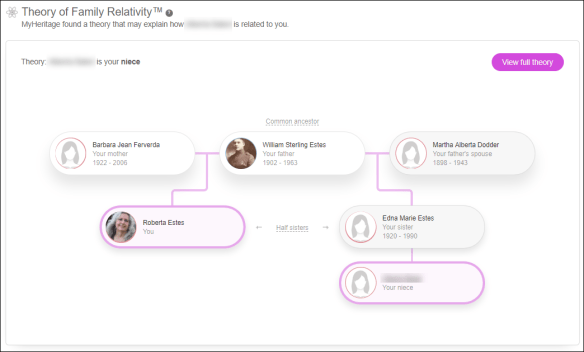
  • Theories of Family Relativity – a wonderful new tool introduced in February. You can read more here.
  • AutoClusters – Integrated cluster technology helps you to visualize which groups of people match each other.

One of their best features, Theories of Family Relativity connects the dots between people you DNA match with disparate trees and other documents, such as census. This helps you and others break down long-standing brick walls. You can read more, here.

MyHeritage encourages uploads from other testing companies with basic functions such as matching for free. Advanced features cost either a one-time unlock fee of $29 or are included with a full subscription which you can try for free, here. You can read about what is free and what isn’t, here.

You can develop a testing and upload strategy along with finding instructions for how to upload here and here.

23andMe

Today, 23andMe is best known for health, having recovered after having had their wings clipped a few years back by the FDA. They were the first to offer Health results, leveraging the genealogy marketspace to attract testers, but have recently been eclipsed by both Family Tree DNA with their high end full Exome Tovana test and MyHeritage with their Health upgrade which provides more information than 23andMe along with free genetic counseling if appropriate. Both the Family Tree DNA and MyHeritage tests are medically supervised, so can deliver more results.

23andMe has never fully embraced genetic genealogy by adding the ability to upload and compare trees. In 2019, they introduced a beta function to attempt to create a genetic tree on your behalf based on how your matches match you and each other.

2019 23andMe.png

These trees aren’t accurate today, nor are they deep, but they are a beginning – especially considering that they are not based on existing trees. You can read more here.

The best 23andMe feature for genealogy, as far as I’m concerned, is their ethnicity along with the fact that they actually provide testers with the locations of their ethnicity segments which can help testers immensely, especially with minority ancestry matching. You can read about how to do this for yourself, here.

23andMe generally does not allow uploads, probably because they need people to test on their custom-designed medical chip. Very rarely, once that I know of in 2018, they do allow uploads – but in the past, uploaders do not receive all of the genealogy features and benefits of testing.

You can however, download your DNA file from 23andMe and upload elsewhere, with instructions here.

Ancestry

Ancestry is widely known for their ethnicity ads which are extremely effective in recruiting new testers. That’s the great news. The results are frustrating to seasoned genealogists who get to deal with the fallout of confused people trying to figure out why their results don’t match their expectations and family stories. That’s the not-so-great news.

However, with more than 15 million testers, many of whom DO have genealogy trees, a serious genealogist can’t *NOT* test at Ancestry. Testers do need to be aware that not all features are available to DNA testers who don’t also subscribe to Ancestry’s genealogy subscriptions. For example, you can’t see your matches’ trees beyond a 5 generation preview without a subscription. You can read more about what you do and don’t receive, here.

Ancestry is the only one of the major companies that doesn’t provide a chromosome browser, despite pleas for years to do so, but they do provide ThruLines that show you other testers who match your DNA and show a common ancestor with you in their trees.

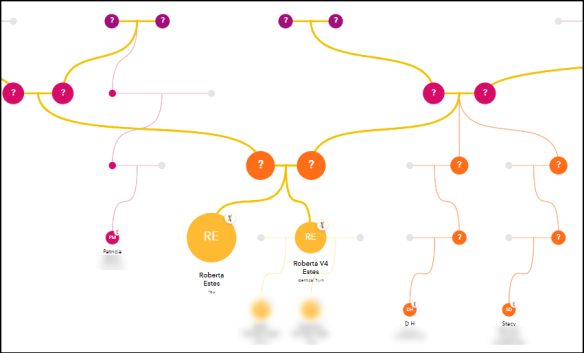
2019 Ancestry.png

ThruLines will also link partial trees – showing you ancestral descendants from the perspective of the ancestor in question, shown above. You can read about ThruLines, here.

Of course, without a chromosome browser, this match is only as good as the associated trees, and there is no way to prove the genealogical connection. It’s possible to all be wrong together, or to be related to some people through a completely different ancestor. Third party tools like Genetic Affairs and cluster technology help resolve these types of issues. You can read more, here.

You can’t upload DNA files from other testing companies to Ancestry, probably due to their custom medical chip. You can download your file from Ancestry and upload to other locations, with instructions here.

Selling Customers’ DNA

Neither Family Tree DNA, MyHeritage nor Gedmatch sell, lease or otherwise share their customers’ DNA, and all three state (minimally) they will not in the future without prior authorization.

All companies utilize their customers’ DNA internally to enhance and improve their products. That’s perfectly normal.

Both Ancestry and 23andMe sell consumers DNA to both known and unknown partners if customers opt-in to additional research. That’s the purpose of all those questions.

If you do agree or opt-in, and for those who tested prior to when the opt-in began, consumers don’t know who their DNA has been sold to, where it is or for what purposes it’s being utilized. Although anonymized (pseudonymized) before sale, autosomal results can easily be identified to the originating tester (if someone were inclined to do so) as demonstrated by adoptees identifying parents and law enforcement identifying both long deceased remains and criminal perpetrators of violent crimes. You can read more about re-identification here, although keep in mind that the re-identification frequency (%) would be much higher now than it was in 2018.

People are widely split on this issue. Whatever you decide, to opt-in or not, just be sure to do your homework first.

Always read the terms and conditions fully and carefully of anything having to do with genetics.

Genealogy

The bottom line to genetic genealogy is the genealogy aspect. Genealogists want to confirm ancestors and discover more about those ancestors. Some information can only be discovered via DNA testing today, distant Native heritage, for example, breaking through brick walls.

This technology, as it has advanced and more people have tested, has been a godsend for genealogists. The same techniques have allowed other people to locate unknown parents, grandparents and close relatives.

Adoptees

Not only are genealogists identifying people long in the past that are their ancestors, but adoptees and those seeking unknown parents are making discoveries much closer to home. MyHeritage has twice provided thousands of free DNA tests via their DNAQuest program to adoptees seeking their biological family with some amazing results.

The difference between genealogy, which looks back in time several generations, and parent or grand-parent searches is that unknown-parent searches use matches to come forward in time to identify parents, not backwards in time to identify distant ancestors in common.

Adoptee matching is about identifying descendants in common. According to Erlich et al in an October 2018 paper, here, about 60% of people with European ancestry could be identified. With the database growth since that time, that percentage has risen, I’m sure.

You can read more about the adoption search technique and how it is used, here.

Adoptee searches have spawned their own subculture of sorts, with researchers and search angels that specialize in making these connections. Do be aware that while many reunions are joyful, not all discoveries are positively received and the revelations can be traumatic for all parties involved.

There’s ying and yang involved, of course, and the exact same techniques used for identifying biological parents are also used to identify cold-case deceased victims of crime as well as violent criminals, meaning rapists and murderers.

Crimes Solved

The use of genetic genealogy and adoptee search techniques for identifying skeletal remains of crime victims, as well as identifying criminals in order that they can be arrested and removed from the population has resulted in a huge chasm and division in the genetic genealogy community.

These same issues have become popular topics in the press, often authored by people who have no experience in this field, don’t understand how these techniques are applied or function and/or are more interested in a sensational story than in the truth. The word click-bait springs to mind although certainly doesn’t apply equally to all.

Some testers are adamantly pro-usage of their DNA in order to identify victims and apprehend violent criminals. Other testers, not so much and some, on the other end of the spectrum are vehemently opposed. This is a highly personal topic with extremely strong emotions on both sides.

The first such case was the Golden State Killer, which has been followed in the past 18 months or so by another 100+ solved cases.

Regardless of whether or not people want their own DNA to be utilized to identify these criminals and victims, providing closure for families, I suspect the one thing we can all agree on is that we are grateful that these violent criminals no longer live among us and are no longer preying on innocent victims.

I wrote about the Golden State Killer, here, as well as other articles here, here, here and here.

In the genealogy community, various vendors have adopted quite different strategies relating to these kinds of searches, as follows:

  • Ancestry, 23andMe and MyHeritage – have committed to fight all access attempts by law enforcement, including court ordered subpoenas.
  • MyHeritage, Family Tree DNA and GedMatch allow uploads, so forensic kits, meaning kits from deceased remains or rape kits could be uploaded to search for matches, the same as any other kit. Law Enforcement uploads violate the MyHeritage terms of service. Both Family Tree DNA and GEDmatch have special law enforcement procedures in place. All three companies have measures in place to attempt to detect unauthorized forensic uploads.
  • Family Tree DNA has provided a specific Law Enforcement protocol and guidelines for forensic uploads, here. All EU customers were opted out earlier in 2019, but all new or existing non-EU customers need to opt out if they do not want their DNA results available for matching to law enforcement kits.
  • GEDmatch was recently sold to Verogen, a DNA forensics company, with information, here. Currently GEDMatch customers are opted-out of matching for law enforcement kits, but can opt-in. Verogen, upon purchase of GEDmatch, required all users to read the terms and conditions and either accept the terms or delete their kits. Users can also delete their kits or turn off/on law enforcement matching at any time.

New Concerns

Concerns in late 2019 have focused on the potential misuse of genetic matching to potentially target subsets of individuals by despotic regimes such as has been done by China to the Uighurs.

You can read about potential risks here, here and here, along with a recent DoD memo here.

Some issues spelled out in the papers can be resolved by vendors agreeing to cryptographically sign their files when customers download. Of course, this would require that everyone, meaning all vendors, play nice in the sandbox. So far, that hasn’t happened although I would expect that the vendors accepting uploads would welcome cryptographic signatures. That pretty much leaves Ancestry and 23andMe. I hope they will step up to the plate for the good of the industry as a whole.

Relative to the concerns voiced in the papers and by the DoD, I do not wish to understate any risks. There ARE certainly risks of family members being identified via DNA testing, which is, after all, the initial purpose even though the current (and future) uses were not foreseen initially.

In most cases, the cow has already left that barn. Even if someone new chooses not to test, the critical threshold is now past to prevent identification of individuals, at least within the US and/or European diaspora communities.

I do have concerns:

  • Websites where the owners are not known in the genealogical community could be collecting uploads for clandestine purposes. “Free” sites are extremely attractive to novices who tend to forget that if you’re not paying for the product, you ARE the product. Please be very cognizant and leery. Actually, just say no unless you’re positive.
  • Fearmongering and click-bait articles in general will prevent and are already causing knee-jerk reactions, causing potential testers to reject DNA testing outright, without doing any research or reading terms and conditions.
  • That Ancestry and 23andMe, the two major vendors who don’t accept uploads will refuse to add crypto-signatures to protect their customers who download files.

Every person needs to carefully make their own decisions about DNA testing and participating in sharing through third party sites.

Health

Not surprisingly, the DNA testing market space has cooled a bit this past year. This slowdown is likely due to a number of factors such as negative press and the fact that perhaps the genealogical market is becoming somewhat saturated. Although, I suspect that when vendors announce major new tools, their DNA kit sales spike accordingly.

Look at it this way, do you know any serious genealogists who haven’t DNA tested? Most are in all of the major databases, meaning Ancestry, 23andMe, FamilyTreeDNA, MyHeritage and GedMatch.

All of the testing companies mentioned above (except GEDmatch who is not a testing company) now have a Health offering, designed to offer existing and new customers additional value for their DNA testing dollar.

23andMe separated their genealogy and health offering years ago. Ancestry and MyHeritage now offer a Health upgrade. For existing customers, FamilyTreeDNA offers the Cadillac of health tests through Tovana.

I would guess it goes without saying here that if you really don’t want to know about potential health issues, don’t purchase these tests. The flip side is, of course, that most of the time, a genetic predisposition is nothing more and not a death sentence.

From my own perspective, I found the health tests to be informative, actionable and in some cases, they have been lifesaving for friends.

Whoever knew genealogy might save your life.

Innovative Third-Party Tools

Tools, and fads, come and go.

In the genetic genealogy space, over the years, tools have burst on the scene to disappear a few months later. However, the last few years have been won by third party tools developed by well-known and respected community members who have created tools to assist other genealogists.

As we close this decade, these are my picks of the tools that I use almost daily, have proven to be the most useful genealogically and that I feel I just “couldn’t live without.”

And yes, before you ask, some of these have a bit of a learning curve, but if you are serious about genealogy, these are all well worthwhile:

  • GedMatch – offers a wife variety of tools including triangulation, half versus fully identical segments and the ability to see who your matches also match. One of the tools I utilize regularly is segment search to see who else matches me on a specific segment, attached to an ancestor I’m researching. GedMatch, started by genealogists, has lasted more than a decade prior to the sale in December 2019.
  • Genetic Affairs – a barn-burning newcomer developed by Evert-Jan Blom in 2018 wins this years’ “Best” award from me, titled appropriately, the “SNiPPY.”.

Genetic Affairs 2019 SNiPPY Award.png

Genetic Affairs offers clustering, tree building between your matches even when YOU don’t have a tree. You can read more here.

2019 genetic affairs.png

Just today, Genetic Affairs released a new cluster interface with DNAPainter, example shown above.

  • DNAPainter – THE chromosome painter created by Jonny Perl just gets better and better, having added pedigree tree construction this year and other abilities. I wrote a composite instructional article, here.
  • DNAGedcom.com and Genetic.Families, affiliated with DNAAdoption.org – Rob Warthen in collaboration with others provides tools like clustering combined with triangulation. My favorite feature is the gathering of all direct ancestors of my matches’ trees at the various vendors where I’ve DNA tested which allows me to search for common surnames and locations, providing invaluable hints not otherwise available.

Promising Newcomer

  • MitoYDNA – a non-profit newcomer by folks affiliated with DNAAdoption and DNAGedcom is designed to replace YSearch and MitoSearch, both felled by the GDPR ax in 2018. This website allows people to upload their Y and mitochondrial DNA results and compare the values to each other, not just for matching, which you can do at Family Tree DNA, but also to see the values that do and don’t match and how they differ. I’ll be taking MitoYDNA for a test drive after the first of the year and will share the results with you.

The Future

What does the future hold? I almost hesitate to guess.

  • Artificial Intelligence Pedigree Chart – I think that in the not-too-distant future we’ll see the ability to provide testers with a “one and done” pedigree chart. In other words, you will test and receive at least some portion of your genealogy all tidily presented, red ribbon untied and scroll rolled out in front of you like you’re the guest on one of those genealogy TV shows.

Except it’s not a show and is a result of DNA testing, segment triangulation, trees and other tools which narrow your ancestors to only a few select possibilities.

Notice I said, “the ability to.” Just because we have the ability doesn’t mean a vendor will implement this functionality. In fact, just think about the massive businesses built upon the fact that we, as genealogists, have to SEARCH incessantly for these elusive answers. Would it be in the best interest of these companies to just GIVE you those answers when you test?

If not, then these types of answers will rest with third parties. However, there’s a hitch. Vendors generally don’t welcome third parties offering advanced tools and therefore block those tools, even though they are being used BY the customer or with their explicit authorization to massage their own data.

On the other hand, as a genealogist, I would welcome this feature with open arms – because as far as I’m concerned, the identification of that ancestor is just the first step. I get to know them by fleshing out their bones by utilizing those research records.

In fact, I’m willing to pony up to the table and I promise, oh-so-faithfully, to maintain my subscription lifelong if one of those vendors will just test me. Please, please, oh pretty-please put me to the test!

I guess you know what my New Year’s Wish is for this and upcoming years now too😊

What About You?

What do you think the high points of 2019 have been?

How about the decade?

What do you think the future holds?

Do you care to make any predictions?

Are you planning to focus on any particular goal or genealogy problem in 2020?

______________________________________________________________

Disclosure

I receive a small contribution when you click on some of the links to vendors in my articles. This does NOT increase the price you pay but helps me to keep the lights on and this informational blog free for everyone. Please click on the links in the articles or to the vendors below if you are purchasing products or DNA testing.

Thank you so much.

DNA Purchases and Free Transfers

Genealogy Products and Services

Genealogy Research

Fun DNA Stuff

  • Celebrate DNA – customized DNA themed t-shirts, bags and other items

Are You DNA Testing the Right People?

We often want to purchase DNA kits for relatives, especially during the holidays when there are so many sales. (There are links for free shipping on tests in addition to sale prices at the end of this article. If you already know who to test, pop on down to the Sales section, now.)

Everyone is on a budget, so who should we test to obtain results that are relevant to our genealogy?

We tell people to test as many family members as possible – but what does that really mean?

Testing everyone may not be financially viable, nor necessary for genealogy, so let’s take a look at how to decide where to spend YOUR testing dollars to derive the most benefit.

It’s All Relative😊

When your ancestors had children, those children inherited different pieces of your ancestors’ DNA.

Therefore, it’s in your best interest to test all of the direct descendants generationally closest to the ancestor that you can find.

It’s especially useful to test descendants of your own close ancestors – great-great-grandparents or closer – where there is a significant possibility that you will match your cousins.

All second cousins match, and roughly 90% (or more) of third cousins match.

Percent of cousins match.png

This nifty chart compiled by ISOGG shows the probability statistics produced by the major testing companies regarding cousin matching relationships.

My policy is to test 4th cousins or closer. The more, the merrier.

Identifying Cousins

  • First cousins share grandparents.
  • Second cousins share great-grandparents.
  • Third cousins share great-great-grandparents.

The easiest way for me to see who these cousins might be is to open my genealogy software on my computer, select my great-great-grandparent, and click on descendants. Pretty much all software has a similar function.

The resulting list shows all of the descendants of that ancestor that I’ve entered in my software. Most genealogists already have or could construct this information with relative ease. These are the cousins you need to be talking to anyway, because they will have photos and stories that you don’t. If you don’t know them, there’s never been a better time to reach out and introduce yourself.

Who to test descendants software

Click to enlarge

People You Already Know

Sometimes it’s easier to start with the family you already know and may see from time to time. Those are the people who will likely be the most beneficial to your genealogy.

Who to test 1C.png

Checking my tree at FamilyTreeDNA, Hiram Ferverda and Evaline MIller are my great-grandparents. All of their children are deceased, but I have a relationship with the children born to their son, Roscoe. Both Cheryl and her brother carry parts of Hiram and Eva’s DNA their son John Ferverda (my grandfather) didn’t inherit, and therefore that I can’t carry.

Therefore, it’s in my best interest to gift my cousin, Cheryl and her brother, both, with DNA kits. Turns out that I already have and my common matches with both Cheryl and her brother are invaluable because I know that people who match me plus either one of them descend from the Ferverda or Miller lines. This relationship and linking them on my tree, shown above, allows Family Tree DNA to perform phased Family Matching which is their form of triangulation.

It’s important to test both siblings, because some people will match me plus one but not the other sibling.

Who’s Relevant?

Trying to convey the concept of who to test and not to test, and why, is sometimes confusing.

Many family members may want to test, but you may only be willing to pay for those tests that can help your own genealogy. We need to know who can best benefit our genealogy in order to make informed decisions.

Let’s look at example scenarios – two focused on grandparents and two on parents.

In our example family, a now-deceased grandmother and grandfather have 3 children and multiple grandchildren. Let’s look at when we test which people, and why.

Example 1: Grandparents – 2 children deceased, 1 living

In our first example, Jane and Barbara, my mother, are deceased, but their sibling Harold is living. Jane has a living daughter and my mother had 3 children, 2 of which are living. Who should we test to discover the most about my maternal grandparents?

Please note that before making this type of a decision, it’s important to state the goal, because the answer will be different depending on your goal at hand. If I wanted to learn about my father’s family, for example, instead of my maternal grandparents, this would be an entirely different question, answer, and tree.

Descendant test

Click to enlarge

The people who are “married in” but irrelevant to the analysis are greyed out. In this case, all of the spouses of Jane, Barbara and Harold are irrelevant to the grandmother and grandfather shown. We are not seeking information about those spouses or their families.

The people I’ve designated with the red stars should be tested. This is the “oldest” generation available. Harold can be tested, so his son, my first cousin, does not need to test because the only part of the grandparent’s DNA that Harold’s son can inherit is a portion of what his father, Harold, carries and gave to him.

Unfortunately, Jane is deceased but her daughter, Liz, is available to test, so Liz’s son does not need to.

I need to test, as does my living brother and the children of my deceased brother in order to recover as much as possible of my mother’s DNA. They will all carry pieces of her DNA that I don’t.

The children of anyone who has a red star do NOT need to test for our stated genealogical purpose because they only carry a portion of thier parent’s DNA, and that parent is already testing.

Those children may want to test for their own genealogy given that they also have a parent who is not relevant to the grandfather and grandmother shown. In my case, I’m perfectly happy to facilitate those tests, but not willing to pay for the children’s tests if the relevant parent is living. I’m only willing to pay for tests that are relevant to my genealogical goals – in this case, my grandparents’ heritage.

In this scenario, I’m providing 5 tests.

Of course, you may have other family factors in play that influence your decision about how many tests to purchase for whom. Family dynamics might include things like hurt feelings and living people who are unwilling or unable to test. I’ve been known to purchase kits for non-biologically related family members so that people could learn how DNA works.

Example 2: Grandparents – 2 children living, one deceased

For our second example, let’s change this scenario slightly.

Descendant test 2

Click to enlarge

From the perspective of only my grandparents’ genealogy, if my mother is alive, there’s no reason to test her children.

Barbara and Harold can test. Since Jane is deceased, and she had only one child, Liz is the closest generationally and can test to represent Jane’s line. Liz’s son does not need to test since his mother, the closest relative generationally to the grandparents is available to test.

In this scenario, I’m providing 3 tests.

Example 3: My Immediate Family – both parents living

In this third example, I’m looking from strictly MY perspective viewing my maternal grandparents (as shown above) AND my immediate family meaning the genealogical lines of both of my parents. In other words, I’ve combined two goals. This makes sense, especially if I’m going to be seeing a group of people at a family gathering. We can have a swab party!

Descendants - parents alive

Click to enlarge

In the situation where my parents are both living, I’m going to test them in addition to Harold and Liz.

I’m testing myself because I want to work using my own DNA, but that’s not really necessary. My parents will both have twice as many matches to other people as I do – because I only inherited half of each parent’s DNA.

In this scenario, I’m providing 5 tests.

Example 4: My Immediate Family – one parent living, one deceased

Descendants - father deceased

Click to enlarge

In our last example, my mother is living but my father is deceased. In addition to Harold and Liz who reflect the DNA of my maternal grandparents, I will test myself, my mother my living brother and my deceased brother’s child.

Because my father is deceased, testing as many of my father’s descendants as possible, in addition to myself, is the only way for me to obtain some portion of his DNA. My siblings will have pieces of my parent’s DNA that I don’t.

I’m not showing my father’s tree in this view, but looking at his tree and who is available to test to provide information about his side of the family would be the next logical step. He may have siblings and cousins that are every bit as valuable as the people on my mother’s side.

Applying this methodology to your own family, who is available to test?

Multiple Databases

Now that you know WHO to test, the next step is to make sure your close family members test at each of the major providers where your DNA is as well.

I test everyone at Family Tree DNA because I have been testing family members there for 19 years and many of the original testers are deceased now. The only way new people can compare to those people is to be in the FamilyTreeDNA data base.

Then, with permission of course, I transfer all kits, for free, to MyHeritage. Matching is free, but if you don’t have a subscription, there’s an unlock fee of $29 to access advanced tools. I have a full subscription, so all tools are entirely free for the kits I transfer and manage in my account.

Transferring to Family Tree DNA and matching there is free too. There’s an unlock fee of $19 for advanced tools, but that’s a good deal because it’s substantially less than a new test.

Neither 23andMe nor Ancestry accept transfers, so you have to test at each of those companies.

The great news is that both Ancestry and 23andMe tests can be transferred to  MyHeritage and FamilyTreeDNA.

Before purchasing tests, check first by asking your relatives or testing there yourself to be sure they aren’t already in those databases. If they took a “spit in a vial” test, they are either at 23andMe or Ancestry. If they took a swab test, it’s MyHeritage or FamilyTreeDNA.

I wrote about creating a testing and transfer strategy in the article, DNA Testing and Transfers – What’s Your Strategy? That article includes a handy dandy chart about who accepts which versions of whose files.

Sales

Of course, everything is on sale since it’s the holidays.

Who are you planning to test?

______________________________________________________________

Disclosure

I receive a small contribution when you click on some of the links to vendors in my articles. This does NOT increase the price you pay but helps me to keep the lights on and this informational blog free for everyone. Please click on the links in the articles or to the vendors below if you are purchasing products or DNA testing.

Thank you so much.

DNA Purchases and Free Transfers

Genealogy Products and Services

Genealogy Research

Fun DNA Stuff

  • Celebrate DNA – customized DNA themed t-shirts, bags and other items

Big Y News and Stats + Sale

I must admit – this past January when FamilyTreeDNA announced the Big Y-700, an upgrade from the Big Y-500 product, I was skeptical. I wondered how much benefit testers would really see – but I was game to purchase a couple upgrades – and I did. Then, when the results came back, I purchased more!

I’m very pleased to announce that I’m no longer skeptical. I’m a believer.

The Big Y-700 has produced amazing results – and now FamilyTreeDNA has decoupled the price of the BAM file in addition to announcing substantial sale prices for their Thanksgiving Sale.

I’m going to discuss sale pricing for products other than the Big Y in a separate article because I’d like to focus on the progress that has been made on the phylogenetic tree (and in my own family history) as a result of the Big Y-700 this year.

Big Y Pricing Structure Change

FamilyTreeDNA recently anounced some product structure changes.

The Big Y-700 price has been permanently dropped by $100 by decoupling the BAM file download from the price of the test itself. This accomplishes multiple things:

  • The majority of testers don’t want or need the BAM file, so the price of the test has been dropped by $100 permanently in order to be able to price the Big Y-700 more attractively to encourage more testers. That’s good for all of us!!!
  • For people who ordered the Big Y-700 since November 1, 2019 (when the sale prices began) who do want the BAM file, they can purchase the BAM file separately through the “Add Ons and Upgrades” page, via the “Upgrades” tab for $100 after their test results are returned. There will also be a link on the Big Y-700 results page. The total net price for those testers is exactly the same, but it represents a $100 permanent price drop for everyone else.
  • This BAM file decoupling reduces the initial cost of the Big Y-700 test itself, and everyone still has the option of purchasing the BAM file later, which will make the Big Y-700 test more affordable. Additionally, it allows the tester who wants the BAM file to divide the purchase into two pieces, which will help as well.
  • The current sale price for the Big Y-700 for the tester who has taken NO PREVIOUS Y DNA testing is now just $399, formerly $649. That’s an amazing price drop, about 40%, in the 9 months since the Big Y-700 was introduced!
  • Upgrade pricing is available too, further down in this article.
  • If you order an upgrade from any earlier Big Y to the Big Y-700, you receive an upgraded BAM file because you already paid for the BAM file when you ordered your initial Big Y test.
  • The VCF file is still available for download at no additional cost with any Big Y test.
  • There is no change in the BAM file availability for current customers. Everyone who ordered before November 1, 2019 will be able to download their BAM file as always.

The above changes are permanent, except for the sale price.

2019 has been a Banner Year

I know how successful the Big Y-700 has been for kits and projects that I manage, but how successful has it been overall, in a scientific sense?

I asked FamilyTreeDNA for some stats about the number of SNPs discovered and the number of branches added to the Y phylotree.

Drum roll please…

Branches Added This Year Total Tree Branches Variants Added to Tree This Year Total Variants Added to Tree
2018 6,259 17,958 60,468 132.634
2019 4,394 22.352 32,193 164,827

The tests completed in 2019 are only representative for 10 months, through October, and not the entire year.

Haplotree Branches

Not every SNP discovered results in a new branch being added to the haplotree, but many do. This chart shows the number of actual branches added in 2018 and 2019 to date.

Big Y 700 haplotree branches.png

These stats, provided by FamilyTreeDNA, show the totals in the bottom row, which is a cumulative branch number total, not a monthly total. At the end of October 2019, the total number of individual branches were 22,352.

Big Y 700 haplotree branches small.png

This chart, above, shows some of the smaller haplogroups.

Big Y 700 haplotree branches large.png

This chart shows the larger haplogroups, including massive haplogroup R.

Haplotree Variants

The number of variants listed below is the number of SNPs that have been discovered, named and placed on the tree. You’ll notice that these numbers are a lot larger than the number of branches, above. That’s because roughly 168,000 of these are equivalent SNPs, meaning they don’t further branch the tree – at least not yet. These 168K variants are the candidates to be new branches as more people test and the tree can be further split.

Big Y 700 variants.png

These numbers also don’t include Private Variants, meaning SNPs that have not yet been named.

If you see Private Variants listed in your Big Y results, when enough people have tested positive for the same variant, and it makes sense, the variants will be given a SNP name and placed on the tree.

Big Y 700 variants small.png

The smaller haplogroups variants again, above, followed by the larger, below.

Big Y 700 variants large.png

Upgrades from the Big Y, or Big Y-500 to Big Y-700

Based on what I see in projects, roughly one third of the Big Y and Big Y-500 tests have upgraded to the Big Y-700.

For my Estes line, I wondered how much value the Big Y-700 upgrade would convey, if any, but I’m extremely glad I upgraded several kits. As a result of the Big Y-700, we’ve further divided the sons of Abraham, born in 1747. This granularity wasn’t accomplished by STR testing and wasn’t accomplished by the Big Y or Big Y-500 testing alone – although all of these together are building blocks. I’m ECSTATIC since it’s my own ancestral line that has the new lineage defining SNP.

Big Y 700 Estes.png

Every Estes man descended from Robert born in 1555 has R-BY482.

The sons of the immigrant, Abraham, through his father, Silvester, all have BY490, but the descendants of Silvester’s brother, Robert, do not.

Moses, son of Abraham has ZS3700, but the rest of Abraham’s sons don’t.

Then, someplace in the line of kit 831469, between Moses born in 1711 and the present-day tester, we find a new SNP, BY154784.

Big Y 700 Estes block tree.png

Looking at the block tree, we see the various SNPs that are entirely Estes, except for one gentleman who does not carry the Estes surname. I wrote about the Block Tree, here.

Without Big Y testing, none of these SNPs would have been found, meaning we could never have split these lines genealogically.

Every kit I’ve reviewed carries SNPs that the Big Y-700 has been able to discern that weren’t discovered previously.

Every. Single. One.

Now, even someone who hasn’t tested Y DNA before can get the whole enchilada – meaning 700+ STRs, testing for all previously discovered SNPs, and new branch defining SNPs, like my Estes men – for $399.

If a new Estes tester takes this test, without knowing anything about his genealogy, I can tell him a great deal about where to look for his lineage in the Estes tree.

Reduced Prices

FamilyTreeDNA has made purchasing the Big Y-700 outright, or upgrading, EXTREMELY attractive.

Test Price
Big Y-700 purchase with no previous Y DNA test


$399
Y-12 upgrade to Big Y-700 $359
Y-25 upgrade to Big Y-700 $349
Y-37 upgrade to Big Y-700 $319
Y-67 upgrade to Big Y-700 $259
Y-111 upgrade to Big Y-700 $229
Big Y or Big Y-500 upgrade to Big Y-700 $189

Note that the upgrades include all of the STR markers as yet untested. For example, the 12-marker to Big Y-700 includes all of the STRs between 25 and 111, in addition to the Big Y-700 itself. The Big Y-700 includes:

  • All of the already discovered SNPs, called Named Variants, extending your haplogroup all the way to the leaf at the end of your branch
  • Personal and previously undiscovered SNPs called Private Variants
  • All of the untested STR markers inclusive through 111 markers
  • A minimum of a total of 700 STR markers, including markers above 111 that are only available through Big Y-700 testing

With the refinements in the Big Y test over the past few years, and months, the Big Y is increasingly important to genealogy – equally or more so than traditional STR testing. In part, because SNPs are not prone to back mutations, and are therefore more stable than STR markers. Taken together, STRs and SNPs are extremely informative, helping to break down ancestral brick walls for people whose genealogy may not reach far back in time – and even those who do.

If you are a male and have not Y DNA tested, there’s never been a better opportunity. If you are a female, find a male on a brick wall line and sponsor a scholarship.

Click here to order or upgrade!

______________________________________________________________

Disclosure

I receive a small contribution when you click on some of the links to vendors in my articles. This does NOT increase the price you pay but helps me to keep the lights on and this informational blog free for everyone. Please click on the links in the articles or to the vendors below if you are purchasing products or DNA testing.

Thank you so much.

DNA Purchases and Free Transfers

Genealogy Services

Genealogy Research

Hit a Genetic Genealogy Home Run Using Your Double-Sided Two-Faced Chromosomes While Avoiding Imposters

Do you want to hit a home run with your DNA test, but find yourself a mite bewildered?

Yep, those matches can be somewhat confusing – especially if you don’t understand what’s going on. Do you have a nagging feeling that you might be missing something?

I’m going to explain chromosome matching, and its big sister, triangulation, step by step to remove any confusion, to help you sort through your matches and avoid imposters.

This article is one of the most challenging I’ve ever written – in part because it’s a concept that I’m so familiar with but can be, and is, misinterpreted so easily. I see mistakes and confusion daily, which means that resulting conclusions stand a good chance of being wrong.

I’ve tried to simplify these concepts by giving you easy-to-use memory tools.

There are three key phrases to remember, as memory-joggers when you work through your matches using a chromosome browser: double-sided, two faces and imposter. While these are “cute,” they are also quite useful.

When you’re having a confusing moment, think back to these memory-jogging key words and walk yourself through your matches using these steps.

These three concepts are the foundation of understanding your matches, accurately, as they pertain to your genealogy. Please feel free to share, link or forward this article to your friends and especially your family members (including distant cousins) who work with genetic genealogy. 

Now, it’s time to enjoy your double-sided, two-faced chromosomes and avoid those imposters:)

Are you ready? Grab a nice cup of coffee or tea and learn how to hit home runs!

Double-Sided – Yes, Really

Your chromosomes really are double sided, and two-faced too – and that’s a good thing!

However, it’s initially confusing because when we view our matches in a chromosome browser, it looks like we only have one “bar” or chromosome and our matches from both our maternal and paternal sides are both shown on our one single bar.

How can this be? We all have two copies of chromosome 1, one from each parent.

Chromosome 1 match.png

This is my chromosome 1, with my match showing in blue when compared to my chromosome, in gray, as the background.

However, I don’t know if this blue person matches me on my mother’s or father’s chromosome 1, both of which I inherited. It could be either. Or neither – meaning the dreaded imposter – especially that small blue piece at left.

What you’re seeing above is in essence both “sides” of my chromosome number 1, blended together, in one bar. That’s what I mean by double-sided.

There’s no way to tell which side or match is maternal and which is paternal without additional information – and misunderstanding leads to misinterpreting results.

Let’s straighten this out and talk about what matches do and don’t mean – and why they can be perplexing. Oh, and how to discover those imposters!

Your Three Matches

Let’s say you have three matches.

At Family Tree DNA, the example chromosome browser I’m using, or at any vendor with a chromosome browser, you select your matches which are viewed against your chromosomes. Your chromosomes are always the background, meaning in this case, the grey background.

Chromosome 1-4.png

  • This is NOT three copies each of your chromosomes 1, 2, 3 and 4.
  • This is NOT displaying your maternal and paternal copies of each chromosome pictured.
  • We CANNOT tell anything from this image alone relative to maternal and paternal side matches.
  • This IS showing three individual people matching you on your chromosome 1 and the same three people matching you in the same order on every chromosome in the picture.

Let’s look at what this means and why we want to utilize a chromosome browser.

I selected three matches that I know are not all related through the same parent so I can demonstrate how confusing matches can be sorted out. Throughout this article, I’ve tried to explain each concept in at least two ways.

Please note that I’m using only chromsomes 1-4 as examples, not because they are any more, or less, important than the other chromosomes, but because showing all 22 would not add any benefit to the discussion. The X chromosome has a separate inheritance path and I wrote about that here.

Let’s start with a basic question.

Why Would I Want to Use a Chromosome Browser?

Genealogists view matches on chromosome browsers because:

  • We want to see where our matches match us on our chromosomes
  • We’d like to identify our common ancestor with our match
  • We want to assign a matching segment to a specific ancestor or ancestral line, which confirmed those ancestors as ours
  • When multiple people match us on the same location on the chromosome browser, that’s a hint telling us that we need to scrutinize those matches more closely to determine if those people match us on our maternal or paternal side which is the first step in assigning that segment to an ancestor

Once we accurately assign a segment to an ancestor, when anyone else matches us (and those other people) on that same segment, we know which ancestral line they match through – which is a great head start in terms of identifying our common ancestor with our new match.

That’s a genetic genealogy home run!

Home Runs 

There are four bases in a genetic genealogy home run.

  1. Determine whether you actually match someone on the same segment
  2. Which is the first step in determining that you match a group of people on the same segment
  3. And that you descend from a common ancestor
  4. The fourth step, or the home run, is to determine which ancestor you have in common, assigning that segment to that ancestor

If you can’t see segment information, you can’t use a chromosome browser and you can’t confirm the match on that segment, nor can you assign that segment to a particular ancestor, or ancestral couple.

The entire purpose of genealogy is to identify and confirm ancestors. Genetic genealogy confirms the paper trail and breaks down even more brick walls.

But before you can do that, you have to understand what matches mean and how to use them.

The first step is to understand that our chromosomes are double-sided and you can’ t see both of your chromosomes at once!

Double Sided – You Can’t See Both of Your Chromosomes at Once

The confusing part of the chromosome browser is that it can only “see” your two chromosomes blended as one. They are both there, but you just can’t see them separately.

Here’s the important concept:

You have 2 copies of chromosomes 1 through 22 – one copy that you received from your mother and one from your father, but you can’t “see” them separately.

When your DNA is sequenced, your DNA from your parents’ chromosomes emerges as if it has been through a blender. Your mother’s chromosome 1 and your father’s chromosome 1 are blended together. That means that without additional information, the vendor can’t tell which matches are from your father’s side and which are from your mother’s side – and neither can you.

All the vendor can tell is that someone matches you on the blended version of your parents. This isn’t a negative reflection on the vendors, it’s just how the science works.

Chromosome 1.png

Applying this to chromosome 1, above, means that each segment from each person, the blue person, the red person and the teal person might match you on either one of your chromosomes – the paternal chromosome or the maternal chromosome – but because the DNA of your mother and father are blended – there’s no way without additional information to sort your chromosome 1 into a maternal and paternal “side.”

Hence, you’re viewing “one” copy of your combined chromosomes above, but it’s actually “two-sided” with both maternal and paternal matches displayed in the chromosome browser.

Parent-Child Matches

Let’s explain this another way.

Chromosome parent.png

The example above shows one of my parents matching me. Don’t be deceived by the color blue which is selected randomly. It could be either parent. We don’t know.

You can see that I match my parent on the entire length of chromosome 1, but there is no way for me to tell if I’m looking at my mother’s match or my father’s match, because both of my parents (and my children) will match me on exactly the same locations (all of them) on my chromosome 1.

Chromosome parent child.png

In fact, here is a combination of my children and my parents matching me on my chromosome 1.

To sort out who is matching on paternal and maternal chromosomes, or the double sides, I need more information. Let’s look at how inheritance works.

Stay with me!

Inheritance Example

Let’s take a look at how inheritance works visually, using an example segment on chromosome 1.

Chromosome inheritance.png

In the example above:

  • The first column shows addresses 1-10 on chromosome 1. In this illustration, we are only looking at positions, chromosome locations or addresses 1-10, but real chromosomes have tens of thousands of addresses. Think of your chromosome as a street with the same house numbers on both sides. One side is Mom’s and one side is Dad’s, but you can’t tell which is which by looking at the house numbers because the house numbers are identical on both sides of the street.
  • The DNA pieces, or nucleotides (T, A, C or G,) that you received from your Mom are shown in the column labeled Mom #1, meaning we’re looking at your mother’s pink chromosome #1 at addresses 1-10. In our example she has all As that live on her side of the street at addresses 1-10.
  • The DNA pieces that you received from your Dad are shown in the blue column and are all Cs living on his side of the street in locations 1-10.

In other words, the values that live in the Mom and Dad locations on your chromosome streets are different. Two different faces.

However, all that the laboratory equipment can see is that there are two values at address 1, A and C, in no particular order. The lab can’t tell which nucleotide came from which parent or which side of the street they live on.

The DNA sequencer knows that it found two values at each address, meaning that there are two DNA strands, but the output is jumbled, as shown in the First and Second read columns. The machine knows that you have an A and C at the first address, and a C and A at the second address, but it can’t put the sequence of all As together and the sequence of all Cs together. What the sequencer sees is entirely unordered.

This happens because your maternal and paternal DNA is mixed together during the extraction process.

Chromosome actual

Click to enlarge image.

Looking at the portion of chromosome 1 where the blue and teal people both match you – your actual blended values are shown overlayed on that segment, above. We don’t know why the blue and the teal people are matching you. They could be matching because they have all As (maternal), all Cs (paternal) or some combination of As and Cs (a false positive match that is identical by chance.)

There are only two ways to reassemble your nucleotides (T, A, C, and G) in order and then to identify the sides as maternal and paternal – phasing and matching.

As you read this next section, it does NOT mean that you must have a parent for a chromosome browser to be useful – but it does mean you need to understand these concepts.

There are two types of phasing.

Parental Phasing

  • Parental Phasing is when your DNA is compared against that of one or both parents and sorted based on that comparison.

Chromosome inheritance actual.png

Parental phasing requires that at least one parent’s DNA is available, has been sequenced and is available for matching.

In our example, Dad’s first 10 locations (that you inherited) on chromosome 1 are shown, at left, with your two values shown as the first and second reads. One of your read values came from your father and the other one came from your mother. In this case, the Cs came from your father. (I’m using A and C as examples, but the values could just as easily be T or G or any combination.)

When parental phasing occurs, the DNA of one of your parents is compared to yours. In this case, your Dad gave you a C in locations 1-10.

Now, the vendor can look at your DNA and assign your DNA to one parent or the other. There can be some complicating factors, like if both your parents have the same nucleotides, but let’s keep our example simple.

In our example above, you can see that I’ve colored portions of the first and second strands blue to represent that the C value at that address can be assigned through parental phasing to your father.

Conversely, because your mother’s DNA is NOT available in our example, we can’t compare your DNA to hers, but all is not lost. Because we know which nucleotides came from your father, the remaining nucleotides had to come from your mother. Hence, the As remain after the Cs are assigned to your father and belong to your mother. These remaining nucleotides can logically be recombined into your mother’s DNA – because we’ve subtracted Dad’s DNA.

I’ve reassembled Mom, in pink, at right.

Statistical/Academic Phasing

  • A second type of phasing uses something referred to as statistical or academic phasing.

Statistical phasing is less successful because it uses statistical calculations based on reference populations. In other words, it uses a “most likely” scenario.

By studying reference populations, we know scientifically that, generally, for our example addresses 1-10, we either see all As or all Cs grouped together.

Based on this knowledge, the Cs can then logically be grouped together on one “side” and As grouped together on the other “side,” but we still have no way to know which side is maternal or paternal for you. We only know that normally, in a specific population, we see all As or all Cs. After assigning strings or groups of nucleotides together, the algorithm then attempts to see which groups are found together, thereby assigning genetic “sides.” Assigning the wrong groups to the wrong side sometimes happens using statistical phasing and is called strand swap.

Once the DNA is assigned to physical “sides” without a parent or matching, we still can’t identify which side is paternal and which is maternal for you.

Statistical or academic phasing isn’t always accurate, in part because of the differences found in various reference populations and resulting admixture. Sometimes segments don’t match well with any population. As more people test and more reference populations become available, statistical/academic phasing improves. 23andMe uses academic phasing for ethnicity, resulting in a strand swap error for me. Ancestry uses academic phasing before matching.

By comparison to statistical or academic phasing, parental phasing with either or both parents is highly accurate which is why we test our parents and grandparents whenever possible. Even if the vendor doesn’t use our parents’ results, we certainly can!

If someone matches you and your parent too, you know that match is from that parent’s side of your tree.

Matching

The second methodology to sort your DNA into maternal and paternal sides is matching, either with or without your parents.

Matching to multiple known relatives on specific segments assigns those segments of your DNA to the common ancestor of those individuals.

In other words, when I match my first cousin, and our genealogy indicates that we share grandparents – assuming we match on the appropriate amount of DNA for the expected relationship – that match goes a long way to confirming our common ancestor(s).

The closer the relationship, the more comfortable we can be with the confirmation. For example, if you match someone at a parental level, they must be either your biological mother, father or child.

While parent, sibling and close relationships are relatively obvious, more distant relationships are not and can occur though unknown or multiple ancestors. In those cases, we need multiple matches through different children of that ancestor to reasonably confirm ancestral descent.

Ok, but how do we do that? Let’s start with some basics that can be confusing.

What are we really seeing when we look at a chromosome browser?

The Grey/Opaque Background is Your Chromosome

It’s important to realize that you will see as many images of your chromosome(s) as people you have selected to match against.

This means that if you’ve selected 3 people to match against your chromosomes, then you’ll see three images of your chromosome 1, three images of your chromosome 2, three images of your chromosome 3, three images of your chromosome 4, and so forth.

Remember, chromosomes are double-sided, so you don’t know whether these are maternal or paternal matches (or imposters.)

In the illustration below, I’ve selected three people to match against my chromosomes in the chromosome browser. One person is shown as a blue match, one as a red match, and one as a teal match. Where these three people match me on each chromosome is shown by the colored segments on the three separate images.

Chromosome 1.png

My chromosome 1 is shown above. These images are simply three people matching to my chromosome 1, stacked on top of each other, like cordwood.

The first image is for the blue person. The second image is for the red person. The third image is for the teal person.

If I selected another person, they would be assigned a different color (by the system) and a fourth stacked image would occur.

These stacked images of your chromosomes are NOT inherently maternal or paternal.

In other words, the blue person could match me maternally and the red person paternally, or any combination of maternal and paternal. Colors are not relevant – in other words colors are system assigned randomly.

Notice that portions of the blue and teal matches overlap at some of the same locations/addresses, which is immediately visible when using a chromosome browser. These areas of common matching are of particular interest.

Let’s look closer at how chromosome browser matching works.

What about those colorful bars?

Chromosome Browser Matching

When you look at your chromosome browser matches, you may see colored bars on several chromosomes. In the display for each chromosome, the same color will always be shown in the same order. Most people, unless very close relatives, won’t match you on every chromosome.

Below, we’re looking at three individuals matching on my chromosomes 1, 2, 3 and 4.

Chromosome browser.png

The blue person will be shown in location A on every chromosome at the top. You can see that the blue person does not match me on chromosome 2 but does match me on chromosomes 1, 3 and 4.

The red person will always be shown in the second position, B, on each chromosome. The red person does not match me on chromosomes 2 or 4.

The aqua person will always be shown in position C on each chromosome. The aqua person matches me on at least a small segment of chromosomes 1-4.

When you close the browser and select different people to match, the colors will change and the stacking order perhaps, but each person selected will always be consistently displayed in the same position on all of your chromosomes each time you view.

The Same Address – Stacked Matches

In the example above, we can see that several locations show stacked segments in the same location on the browser.

Chromosome browser locations.png

This means that on chromosome 1, the blue and green person both match me on at least part of the same addresses – the areas that overlap fully. Remember, we don’t know if that means the maternal side or the paternal side of the street. Each match could match on the same or different sides.

Said another way, blue could be maternal and teal could be paternal (or vice versa,) or both could be maternal or paternal. One or the other or both could be imposters, although with large segments that’s very unlikely.

On chromosome 4, blue and teal both match me on two common locations, but the teal person extends beyond the length of the matching blue segments.

Chromosome 3 is different because all three people match me at the same address. Even though the red and teal matching segments are longer, the shared portion of the segment between all three people, the length of the blue segment, is significant.

The fact that the stacked matches are in the same places on the chromosomes, directly above/below each other, DOES NOT mean the matches also match each other.

The only way to know whether these matches are both on one side of my tree is whether or not they match each other. Do they look the same or different? One face or two? We can’t tell from this view alone.

We need to evaluate!

Two Faces – Matching Can be Deceptive!

What do these matches mean? Let’s ask and answer a few questions.

  • Does a stacked match mean that one of these people match on my mother’s side and one on my father’s side?

They might, but stacked matches don’t MEAN that.

If one match is maternal, and one is paternal, they still appear at the same location on your chromosome browser because Mom and Dad each have a side of the street, meaning a chromosome that you inherited.

Remember in our example that even though they have the same street address, Dad has blue Cs and Mom has pink As living at that location. In other words, their faces look different. So unless Mom and Dad have the same DNA on that entire segment of addresses, 1-10, Mom and Dad won’t match each other.

Therefore, my maternal and paternal matches won’t match each other either on that segment either, unless:

  1. They are related to me through both of my parents and on that specific location.
  2. My mother and father are related to each other and their DNA is the same on that segment.
  3. There is significant endogamy that causes my parents to share DNA segments from their more distant ancestors, even though they are not related in the past few generations.
  4. The segments are small (segments less than 7cM are false matches roughly 50% of the time) and therefore the match is simply identical by chance. I wrote about that here. The chart showing valid cM match percentages is shown here, but to summarize, 7-8 cMs are valid roughly 46% of the time, 8-9 cM roughly 66%, 9-10 cM roughly 91%, 10-11 cM roughly 95, but 100 is not reached until about 20 cM and I have seen a few exceptions above that, especially when imputation is involved.

Chromosome inheritance match.png

In this inheritance example, we see that pink Match #1 is from Mom’s side and matches the DNA I inherited from pink Mom. Blue Match #2 is from Dad’s side and matches the DNA I inherited from blue Dad. But as you can see, Match #1 and Match #2 do not match each other.

Therefore, the address is only half the story (double-sided.)

What lives at the address is the other half. Mom and Dad have two separate faces!

Chromosome actual overlay

Click to enlarge image

Looking at our example of what our DNA in parental order really looks like on chromosome 1, we see that the blue person actually matches on my maternal side with all As, and the teal person on the paternal side with all Cs.

  • Does a stacked match on the chromosome browser mean that two people match each other?

Sometimes it happens, but not necessarily, as shown in our example above. The blue and teal person would not match each other. Remember, addresses (the street is double-sided) but the nucleotides that live at that address tell the real story. Think two different looking faces, Mom’s and Dad’s, peering out those windows.

If stacked matches match each other too – then they match me on the same parental side. If they don’t match each other, don’t be deceived just because they live at the same address. Remember – Mom’s and Dad’s two faces look different.

For example, if both the blue and teal person match me maternally, with all As, they would also match each other. The addresses match and the values that live at the address match too. They look exactly the same – so they both match me on either my maternal or paternal side – but it’s up to me to figure out which is which using genealogy.

Chromosome actual maternal.png

Click to enlarge image

When my matches do match each other on this segment, plus match me of course, it’s called triangulation.

Triangulation – Think of 3

If my two matches match each other on this segment, in addition to me, it’s called triangulation which is genealogically significant, assuming:

  1. That the triangulated people are not closely related. Triangulation with two siblings, for example, isn’t terribly significant because the common ancestor is only their parents. Same situation with a child and a parent.
  2. The triangulated segments are not small. Triangulation, like matching, on small segments can happen by chance.
  3. Enough people triangulate on the same segment that descends from a common ancestor to confirm the validity of the common ancestor’s identity, also confirming that the match is identical by descent, not identical by chance.

Chromosome inheritance triangulation.png

The key to determining whether my two matches both match me on my maternal side (above) or paternal side is whether they also match each other.

If so, assuming all three of the conditions above are true, we triangulate.

Next, let’s look at a three-person match on the same segment and how to determine if they triangulate.

Three Way Matching and Identifying Imposters

Chromosome 3 in our example is slightly different, because all three people match me on at least a portion of that segment, meaning at the same address. The red and teal segments line up directly under the blue segment – so the portion that I can potentially match identically to all 3 people is the length of the blue segment. It’s easy to get excited, but don’t get excited quite yet.

Chromosome 3 way match.png

Given that three people match me on the same street address/location, one of the following three situations must be true:

  • Situation 1- All three people match each other in addition to me, on that same segment, which means that all three of them match me on either the maternal or paternal side. This confirms that we are related on the same side, but not how or which side.

Chromosome paternal.png

In order to determine which side, maternal or paternal, I need to look at their and my genealogy. The blue arrows in these examples mean that I’ve determined these matches to all be on my father’s side utilizing a combination of genealogy plus DNA matching. If your parent is alive, this part is easy. If not, you’ll need to utilize common matching and/or triangulation with known relatives.

  • Situation 2 – Of these three people, Cheryl, the blue bar on top, matches me but does not match the other two. Charlene and David, the red and teal, match each other, plus me, but not Cheryl.

Chromosome maternal paternal.png

This means that at least either my maternal or paternal side is represented, given that Charlene and David also match each other. Until I can look at the identity of who matches, or their genealogy, I can’t tell which person or people descend from which side.

In this case, I’ve determined that Cheryl, my first cousin, with the pink arrow matches me on Mom’s side and Charlene and David, with the blue arrows, match me on Dad’s side. So both my maternal and paternal sides are represented – my maternal side with the pink arrow as well as my father’s side with the blue arrows.

If Cheryl was a more distant match, I would need additional triangulated matches to family members to confirm her match as legitimate and not a false positive or identical by chance.

  • Situation 3 – Of the three people, all three match me at the same addresses, but none of the three people match each other. How is this even possible?

Chromosome identical by chance.png

This situation seems very counter-intuitive since I have only 2 chromosomes, one from Mom and one from Dad – 2 sidesof the street. It is confusing until you realize that one match (Cheryl and me, pink arrow) would be maternal, one would be paternal (Charlene and me, blue arrow) and the third (David and me, red arrows) would have DNA that bounces back and forth between my maternal and paternal sides, meaning the match with David is identical by chance (IBC.)

This means the third person, David, would match me, but not the people that are actually maternal and paternal matches. Let’s take a look at how this works

Chromosome maternal paternal IBC.png

The addresses are the same, but the values that live at the addresses are not in this third scenario.

Maternal pink Match #1 is Cheryl, paternal blue Match #2 is Charlene.

In this example, Match #3, David, matches me because he has pink and blue at the same addresses that Mom and Dad have pink and blue, but he doesn’t have all pink (Mom) nor all blue (Dad), so he does NOT match either Cheryl or Charlene. This means that he is not a valid genealogical match – but is instead what is known as a false positive – identical by chance, not by descent. In essence, a wily genetic imposter waiting to fool unwary genealogists!

In his case, David is literally “two-faced” with parts of both values that live in the maternal house and the paternal house at those addresses. He is a “two-faced imposter” because he has elements of both but isn’t either maternal or paternal.

This is the perfect example of why matching and triangulating to known and confirmed family members is critical.

All three people, Cheryl, Charlene and David match me (double sided chromosomes), but none of them match each other (two legitimate faces – one from each parent’s side plus one imposter that doesn’t match either the legitimate maternal or paternal relatives on that segment.)

Remember Three Things

  1. Double-Sided – Mom and Dad both have the same addresses on both sides of each chromosome street.
  2. Two Legitimate Faces – The DNA values, nucleotides, will have a unique pattern for both your Mom and Dad (unless they are endogamous or related) and therefore, there are two legitimate matching patterns on each chromsome – one for Mom and one for Dad. Two legitimate and different faces peering out of the houses on Mom’s side and Dad’s side of the street.
  3. Two-Faced Imposters – those identical by chance matches which zig-zag back and forth between Mom and Dad’s DNA at any given address (segment), don’t match confirmed maternal and paternal relatives on the same segment, and are confusing imposters.

Are you ready to hit your home run?

What’s Next?

Now that we understand how matching and triangulation works and why, let’s put this to work at the vendors. Join me for my article in a few days, Triangulation in Action at Family Tree DNA, MyHeritage, 23andMe and GedMatch.

We will step through how triangulation works at each vendor. You’ll have matches at each vendor that you don’ t have elsewhere. If you haven’t transferred your DNA file yet, you still have time with the step by step instructions below:

______________________________________________________________

Disclosure

I receive a small contribution when you click on some of the links to vendors in my articles. This does NOT increase the price you pay but helps me to keep the lights on and this informational blog free for everyone. Please click on the links in the articles or to the vendors below if you are purchasing products or DNA testing.

Thank you so much.

DNA Purchases and Free Transfers

Genealogy Services

Genealogy Research

DNA Results – First Glances at Ethnicity and Matching!

People who have worked with genetic genealogy for a long time often forget what it’s like to be a new person taking a DNA test.

Recently, someone asked me what a tester actually sees after they take a DNA test and their results are ready. Good question, especially for someone trying to decide what might work for them.

I’m going to make this answer very simple. For each of the 4 major vendors, I’m going to show what a customer sees when they first sign in and view their results. Not everything or every tool, just their main page along with the initial matching and ethnicity pages.

Please feel free to share this article with people who are new and might be interested. It’s easy to follow along.

I do want to stress that this is just the beginning, not the end game and that every vendor has much more to offer if you take advantage of their tools.

Best of all, it’s so much FUN to learn about your heritage and your ancestry, plus meeting cousins and family members you may not have known that you had.

I’ve been gifted with photos of my grandparents and great-grandparents that I had no idea existed before meeting new family members.

I hope that all the new testers will become excited and that their results are just a tiny first step!

The Vendors

I’m going to take a look at:

Each vendor offers DNA matching to others in their database, plus ethnicity estimates. Yes, ethnicity is only an estimate.

Family Tree DNA

Family Tree DNA was the first and still the only genetic genealogy testing company to offer a full range of DNA testing products, launching in the year 2000. Today they stand out as the “science company,” offering both Y and mitochondrial DNA testing in addition to their Family Finder test which is comparable with the tests offered by Ancestry, 23andMe and MyHeritage.

Your personal page at Family Tree DNA shows the following tools for the Family Finder test.

Glances Family Tree DNA home

The two options we’ll look at today are your Matches and myOrigins, which is your ethnicity estimate.

Click on Matches to view whose DNA matches you. In my case, on the page below, you can see that I have a total of 4610 matches, of which 986 have been assigned to my paternal side, 842 to my maternal side, and 4 to both sides. In my case, the 4 assigned to both sides are my children and grandchildren, which makes perfect sense,

Glances Family Tree DNA matches

You can click to enlarge this graphic.

The green box above the matches indicates additional tools which provide information such as who I match in common with another person. I can see, for example, who I match in common with a first cousin which is very helpful in determining which ancestor those matches are related through.

The red box and circle show information provided to me about each match.

Family Tree DNA is able to divide my matches into “Maternal,” “Paternal” and “Both” buckets because they encourage me to link DNA matches on my tree. This means that I connect my mother to her location on my tree so that Family Tree DNA knows that people that match Mother and me both are related on my mother’s side of the tree.

Your matches don’t have to be your parents for linking to work. The more people you link, the more matches Family Tree DNA can put into buckets for you, especially if your parents aren’t available to test. Plus, your aunts and uncles inherited parts of your grandparent’s DNA that your parents didn’t, so they are super important!

Figuring out which side your matches come from, and which ancestor is first step in genetic genealogy!

You can see, above, that my mother is “assigned” on my maternal side and my son matches me on both.

“Bucketing” is a great, innovative feature. But there’s more.

The tan rounded rectangle includes ancestral surnames, with the ones that you and your match have in common shown in bold.

Based on the amount of DNA that I share with a match, and other scientific calculations, a relationship range is calculated, with the linked relationship reflecting where I’ve put that person on my tree.

If your match has uploaded or created a tree, you can view their tree (if they share) by clicking on the little blue pedigree icon, above, circled in tan between the two arrows.

Glances Family Tree DNA tree

Here’s my tree with my family members who have DNA tested attached in the proper places in my tree. Of course, there are a lot more connected people that I’m not showing in this view.

Advanced features include tools like a matching matrix and a chromosome browser where you can view the segments that actually match.

Family Tree DNA Ethnicity

To view your ethnicity estimate, click on myOrigins and you’ll see the following, along with people you match in the various regions if they have given permission for that information to be shared with their matches:

Glances Family Tree DNA myOrigins

MyHeritage

MyHeritage has penetrated the European market quite well, so if your ancestors are from the US or Europe, MyHeritage is a wonderful resource. They offer both DNA testing and records via subscription, combining genetic matches and genealogical records into a powerful tool.

Glances MyHeritage home

At MyHeritage, when you sign in, the DNA tab is at the top.

Clicking on DNA Matches shows you the following match list:

Glances MyHeritage matches

To review all of the information provided for each match, meaning who they match in common with you, their ancestral surnames, their tree and matching details, you’ll click on “Review DNA Match.”

MyHeritage provides a special tool called Theories of Family Relativity which connects you with others and your common ancestors. In essence, MyHeritage uses DNA, trees and records to weave together at least some of your family lines, quite accurately.

Here’s a simple example where MyHeritage has figured out that one of the testers is my niece and has drawn our connection for us.

Theory match 2

Theories of Family Relativity is a recently released world-class tool, easy to use but can solve very complex problems. I wrote about it here.

Advanced DNA tools include a chromosome browser and triangulation, a feature which shows you when three people match on a common segment, indicating genetically that you all 3 share a common ancestor from whom you inherited that common piece of DNA.

MyHeritage Ethnicity

To view your ethnicity estimate at MyHeritage, simply click on Ethnicity Estimate on the menu.

Glances MyHeritage ethnicity.png

23andMe

23andMe is better known for their health offering, although they were the first commercial company to offer autosomal commercial testing. However, they don’t support trees, which for genealogists are essential. Furthermore, they limit the number of your matches to your 2000 closest matches, but if some of those people don’t choose to be included in matching, they are subtracted from your 2000 total allowed. Due to this, I have only 1501 matches, far fewer matches at 23andMe than at any of the other vendors.

Glances 23andMe home

At 23andMe when you sign on, under the Ancestry tab you’ll see DNA Relatives which are your matches and Ancestry Composition which is your ethnicity estimate.

Glances 23andMe matches

While you don’t see all of the information on this primary DNA page that you do with the other vendors, with the unfortunate exception of trees, it’s there, just not on the initial display.

23andMe also provides some advanced tools such as a chromosome browser and triangulation.

23andMe Ethnicity

What 23andMe does exceptionally well is ethnicity estimates.

To view your ethnicity at 23andMe, click on Ancestry Composition.

Glances 23andMe ethnicity

23andMe refines your ethnicity estimates if your parents have tested and shows you a composite of your ethnicity with your matches. However, I consider their ethnicity painting of your chromosomes to be their best feature.

Glances 23andMe chromosome painting

You can see, in my case, the two Native American segments on chromosomes 1 and 2, subsequently proven to be accurate via documentation along with Y and mitochondrial DNA tests at Family Tree DNA. The two chromosomes shown don’t equate necessarily to maternal and paternal.

I can download this information into a spreadsheet, meaning that I can then compare matches at other companies to these ethnicity segments on my mother’s side. If my matches share these segments, they too descend from our common Native American ancestor. How cool is that!!!

Ancestry

Ancestry’s claim to fame is that they have the largest DNA database for autosomal results. Because of that, you’ll have more matches at Ancestry, but if you’re a genealogist or someone seeking an unknown family member, the match you NEED might just be found in one of the other databases, so don’t assume you can simply test at one company and find everything you need.

You don’t know what you don’t know.

Glances Ancestry home

At Ancestry, when you sign on, you’ll see the DNA tab. Click on DNA Story.

Glances Ancestry DNA tab

Scrolling past some advertising, you’ll see DNA Story, which is your Ethnicity Estimate and DNA Matches.

ThruLines, at right, is a tool similar to MyHeritage’s Theories of Family Relativity, but not nearly as accurate. However, Thrulines are better than they were when first released in February. I wrote about ThruLines here.

Glances Ancestry matches

Clicking on DNA Matches shows me information about my matches, in red, their trees or lack thereof in green, and information I can enter including ways to group my matches, in tan.

One of Ancestry’s best features is the green leaf, at the bottom in the green box, accompanied by the smiley face (that I added.) That means that this match’s tree indicates that we have a common ancestor. However, the smiley face is immediately followed by the sad face when I noticed the little lock, which means their tree is private and they aren’t sharing it with me.

If DNA testers forget and don’t connect their tree to their DNA results, you’ll see “unlinked tree.”

Like other vendors, Ancestry offers other tools as well, including the ability to define your own colored tags. You can see that I’ve tagged the matches at far right in the gold box with the little colored dots. I was able to define those dots and they have meanings such as common ancestor identified, messaged, etc.

Ancestry Ethnicity

To view your ethnicity estimate, click on “View Your DNA Story.”

Glances Ancestry ethnicity

You’ll see your ethnicity estimate and communities of matches that Ancestry has defined. By clicking on the community, you can see the ancestors in your tree that plot on the map into that community, along with a timeline. Seeing a community doesn’t necessarily mean your ancestor lived there, but that you match a group of people who are from that community.

Sharing Information

You might be thinking to yourself that it would be a lot easier if you could just test at one vendor and share the results in the other databases. Sometimes you can.

There is a central open repository at GedMatch, but clearly not everyone uploads there, so you still need to be in the various vendors’ data bases. GedMatch doesn’t offer testing, but offers additional tools, flexibility and open access not provided by the testing vendors.

Of these four vendors, Family Tree DNA and MyHeritage accept transferred files from other vendors, while Ancestry and 23andMe do not.

Transferring

If you’re interested in transferring, meaning downloading your results from one vendor and uploading to another, I wrote a series of how-to transfer articles here:

Enjoy your new matches and have fun!

______________________________________________________________

Disclosure

I receive a small contribution when you click on the link to one of the vendors in my articles. This does NOT increase the price you pay but helps me to keep the lights on and this informational blog free for everyone. Please click on the links in the articles or to the vendors below if you are purchasing products or DNA testing.

Thank you so much.

DNA Purchases and Free Transfers

Genealogy Services

Genealogy Research

23andMe Step by Step Guide: How to Upload-Download DNA Files

In this Upload-Download series, we’ll cover each major vendor:

  • How to download raw data files from the vendor
  • How to upload raw data files to the vendor, if possible
  • Other mainstream vendors where you can upload this vendor’s files

Please note that downloading your DNA file from any vendor does not affect your matching results at that vendor. You are only downloading a copy of your raw DNA file.

Uploading TO 23andMe

This part is easy with 23andMe, because 23andMe doesn’t accept any other vendor’s files. There is no ability to upload TO 23andMe. You have to test with 23andMe if you want DNA results from 23andMe.

Downloading FROM 23andMe

In order to upload your autosomal DNA file to another testing vendor, or GedMatch, for either matching or ethnicity, you’ll need to first download the DNA file from 23andMe.

Download Step 1

Sign on to your account at 23andMe.

Under your name at the upper right-hand corner of your page, by clicking on the little circle with your initials, you’ll see “Resources.” Click there.

Download Step 2

Then, select Browse Raw Data.

Download Step 3

Next, click on Browse Raw data at the top of the page.

Complete the information.

Download Step 4

Don’t think you’re done, because you’re not.

Scroll down and accept the terms and conditions, at the bottom.

You’ll see the following message saying an e-mail will be sent to you.

Download Step 5

A few minutes later, an e-mail will arrive that says this:

23andMe download 5

Click on the green button in the e-mail which will take you back to 23andMe to sign in.

Download Step 6

After you sign in, you’ll see that your download file is ready. Click on “Download Raw Data” and you will see the following.

23andMe download 6

Your raw data file will be downloaded to your computer where you’ll need to store it in a location and by a name that you can find.

The file name will be something like “genome_Roberta_Estes_v2_v3_Full_xxxxxxxx” where the xs is a long number. I would suggest adding the word 23andMe to the front when you save the file on your system.

Most vendors want an unopened zip file, so if you want to open your file, first copy it to another name. Otherwise, you’ll have to download again.

23andMe DNA File Uploads to Other Vendors

23andMe files can be in one any one of four formats:

  • V2 – the earliest tests taken at 23andMe. V2 test takers were offered an upgrade to V3.
  • V3 – V3 files beginning December 2010 through December 2013
  • V4 – V4 files beginning December 2013 through August 2017
  • V5 – V5 files beginning August 2017 through present, August 2021

The changes in the files due to chip differences sometimes cause issues with uploads to other vendors who utilize other testing chips.

From below to >>>>>>> Family Tree DNA Accepts * MyHeritage Accepts** GedMatch Accepts *** Ancestry Accepts LivingDNA Accepts ****
23andMe V2 No Yes Yes No Yes
23andMe V3 Yes Yes Yes No Yes
23andMe V4 Yes Yes Yes No Yes
23andMe V5 Yes Yes Yes No Yes

* The upload to Family Tree DNA and matching is free, but advanced tools including the chromosome browser and ethnicity require a one-time $19 unlock fee.

** At MyHeritage, the upload and matching is free, but advanced tools require a one-time $29 unlock fee unless you are a MyHeritage subscriber. You can upload here and try a free subscription here.

*** At GedMatch, matching is free, but the more advanced features require a Tier 1 subscription for $10 per month.

**** LivingDNA accepts files, but they use a different chip and their matching is still a work-in-process.

23andMe Testing and DNA File Upload Strategy

My recommendation, if you’ve tested at 23andMe, depending on your test version, is as follows:

  • V2 – Upgrade, which means retest at 23andMe to a newer test version, or simply test at another vendor
  • V3, V4, or V5 – Upload to Family Tree DNA, MyHeritage and GedMatch

Step by Step Upload Instructions

I wrote step-by-step upload instructions for:

Have fun!

Please note that this article was updated in November 2024.

_____________________________________________________________

Disclosure

I receive a small contribution when you click on some of the links to vendors in my articles. This does NOT increase the price you pay but helps me to keep the lights on and this informational blog free for everyone. Please click on the links in the articles or to the vendors below if you are purchasing products or DNA testing.

Thank you so much.

DNA Purchases and Free Transfers

Genealogy Products and Services

Books

Genealogy Research

Mitochondrial DNA Bulldozes Brick Wall

I’m doing that happy dance today – leaping for joy – and am I EVER glad I’ve sponsored so many mitochondrial DNA tests. Today, I’m incredibly thankful for one particular DNA test.

Think mitochondrial DNA doesn’t work or isn’t effective for genealogy?

Think again.

Often, when people ask on social media if they should test mitochondrial DNA, there is a chorus of Negative Nellie’s chanting, “No, don’t bother with that test, mitochondrial DNA is useless.” That’s terribly discouraging, depriving people of knowledge they can’t obtain any other way.

When people heed that advice, it becomes a self-fulfilling prophecy. When people don’t test and don’t provide genealogical information that would go along with a mitochondrial DNA test, mitochondrial DNA is much less useful than it could be if people actually tested their full sequence mitochondrial DNA at Family Tree DNA, not just for their haplogroup at 23andMe or Living DNA. There’s a huge difference.

Family Tree DNA tests the full mitochondria and provides matching to other testers which is critical for genealogical purposes. In fact, Elizabeth Shown Mills wrote about using this exact same technique here.

mtDNA not useless

And by the way, this is not an isolated outlier case either. In fact, mitochondrial DNA from this same line was used previously to prove who Phoebe Crumley’s mother was.

If people hadn’t tested, then these walls would not have fallen. Every person who doesn’t take a mitochondrial DNA test is depriving themselves, and others, of critical historical information and clues.

It’s all about CLUES and sometimes that big brick-wall-breaking boulder falls into your lap out of the blue one day.

Today was that day!

Phoebe’s Family Found

I’ll be writing a more detailed article about my ancestor, Phoebe, shortly, but for now, I’d like to share exactly how mitochondrial DNA broke through this brick wall that I truly believed was permanent. I’ll walk you through the various steps so you can follow the same path. Do you have female ancestors without families in your tree? Start thinking about the possibilities!

DNA Pedigree Chart

Let’s start with my DNA Pedigree Chart.

I know many people look at my DNA Pedigree Chart and think it’s a bit over the edge, but identifying the family of Jotham Brown’s wife, Phoebe, would absolutely NOT have been possible without this valuable tool and the fact that I’ve been “collecting” my ancestors’ DNA.

As you can see, any time I find the opportunity to test either the Y DNA line, or the mitochondrial line of any of my ancestors, I do. I’ve been quite successful in that quest over the years thanks to many cousins.

The brick wall that fell is an ancestor of Elizabeth Vannoy and her mother, Phoebe Crumley, shown on my DNA Pedigree Chart, boxed in red, with their haplogroup, J1c2c.

A Proxy Tester

Elizabeth Vannoy, being my great-grandmother on my father’s side, doesn’t’ share her mitochondrial DNA with me, so I had to find a proxy tester.

My cousin Debbie knew another cousin, David, whose mother was Lucy, granddaughter of Elizabeth Vannoy. David agreed to test, back in…are you ready for this…2006. Yes, almost 13 years ago. Sometimes DNA is a waiting game.

Cherokee?

At that time, the family rumor was that Elizabeth Vannoy was “Cherokee.” Yea, I know, everyone with ancestors who lived east of the Mississippi has that same rumor – but the best way to actually find out if this is true is to test the relevant family line members’ Y and mitochondrial DNA. Native American haplogroups are definitive and haplogroup J1c2c is unquestionably not Native, so that myth was immediately put to death. (You can read about Native American haplogroups here.)

However, Elizabeth’ Vannoy’s mitochondrial DNA has patiently remained in the Family Tree DNA database, accumulating matches. Truthfully, I’ve been focused elsewhere, and since we had a brick wall with Jotham Brown’s wife, Phoebe (c1750-c1803), which had not yielded to traditional genealogy research, I had moved on and checked cousin David’s matches from time to time to see if anything interesting had turned up.

I thought there was nothing new…but there was! However, it would take my cousins to serve as a catalyst.

Cousin Rita

On New Year’s Eve of 2016, I received an e-mail from a previously unknown cousin, Rita, who was also descended from Jotham Brown and Phoebe. Rita was born a Brown and over the next two years, not only tested her Brown line’s Y DNA which matched Jotham Brown’s line, but also connected her family via paper trail once she knew where to look. She’s a wonderful researcher.

Cousin Stevie

Another researcher who lives in Greene County, Tennessee has doggedly researched the Brown, Crumley, Cooper and associated Johnson lines. It was rumored and pretty much believed for years, because of the very close family associations and migration routes that Phoebe was Zopher Johnson’s daughter. I worked through this mountain of information in late 2015, reaching the conclusion that I really didn’t think Phoebe was Zopher’s daughter, but since there were no known daughters and Zopher’s wife’s surname was unknown, there was no way of finding matrilineal descendants to test. That door was slammed shut. I thought permanently.

However, Stevie had previously recruited two men from the proven Jotham Brown line to Y DNA test who matched a third Brown man whose line descended from the Long Island, Sylvanus Brown family.  Wow, Long Island is a long way from Greene County, TN. Adding to the evidence, our Jotham Brown named one of his sons Sylvanus, a rather unusual name.

This revelation allowed us to track the Brown line forward in time from the Sylvanus on Long Island, providing significant pieces of evidence that Jotham indeed descended from this line.

At that point, we all congratulated ourselves on at least finding an earlier location to work with and went on about solving other mysteries.

Rita’s Theory

I think Rita must be on vacation between Christmas and New Years every year, because I heard from her again on December 28th this year. It took me a few days to reply, due to the Holiday Crud being gifted to me, but am I EVER glad that I did.

Rita, it seems, has spent the last several months sifting through records and looking for migration patterns of families from Long Island. Can you say “desperate genealogist.” I’m not going to steal her thunder, because this part of the journey is hers and hers alone, but suffice it to say she wrote me with a theory.

Joseph Cole was found in Botetourt County, VA along with many of the families that eventually settled in Frederick County, VA and then migrated on together to Greene County, TN. In other words, she’s using the Elizabeth Shown Mills FAN (friends and neighbors) concept to spread the net wider and look for people that might be somehow connected. I took this same approach in Halifax County, VA several years ago with my Estes line very successfully.

Rita discovered that Joseph’s father John Cole also migrated from Long Island through New Jersey into Virginia and settled with this same group. Hmmm, Long Island, same place as Sylvanus Brown. Interesting…

John Cole, it turns out, had a daughter Phebe, who married a Jotham Bart, according to a Presbyterian church book in New Jersey where they settled for a short time in their migration journey. The church records referenced are transcribed, not original.

Jotham Brown, who is known to connect to the Brown family found on Long Island, is found migrating with this same group, and Rita wondered if indeed, Jotham Bart was really Jotham Brown and Phoebe was actually the daughter of John Cole and wife, Mary Mercy Kent.

Still being in the grips of the Holiday Crud, I asked Rita if John Cole and his wife had any proven daughters who would be candidates to have descendants mitochondrial DNA test.

Lydia Cole

While Rita was searching for daughters of Mary Mercy Kent and John Cole, I had sufficiently escaped the grim reaper to check cousin David’s mitochondrial DNA matches, just on the off chance that some useful gem of information was buried there.

David has 16 full sequence matches, of which 7 are exact matches, meaning a genetic distance of 0, a perfect match. Keep in mind that a perfect match can still be hundreds of years in the past, but it can also be much closer in time. Just because it can be further in the past doesn’t mean that it is. You match your mother, her sisters and their children, and that’s clearly very recent.

What was waiting was shocking. Holy chimloda!

Phoebe's sister, Lydia Cole

The Earliest Known Ancestor of one of David’s exact matches is Lydia Cole, born in 1781 in Virginia and died in 1864 in Ohio. The tester, Pete (not his real name,) had a tree. Thank you, thank you!!

Pete was stuck at Lydia Cole, obviously, but his tree provided me with Lydia’s husband’s name.

Oh, and by the way, guess what our Phoebe, born about 1750, named her daughter? Yep, Lydia.

Should I have noticed this hint sooner and dug deeper. Yes, I surely should have – Pete’s test was taken in 2012 so this information was there waiting for 6 years.

Is Lydia Cole too good to be true? Perhaps. Is she related? Of course the first thing good genealogists do is try to poke holes in the story. Better me than someone else. Let’s see what we can find.

Ancestry

Desperate to find out more about Lydia Cole, I checked Ancestry’s trees, understanding just how flakey these can be. Regardless, they are great clues and some are well sourced. Other people’s trees are at least a place to start looking.

Phoebe's sister, Lydia Cole at ancestry

There was Lydia with her father, John Cole and Mary Mercy Kent, the exact same couple Rita had hypothesized as Phoebe’s parents!

Lydia’s marriage was sourced and sure enough she married William Powell Simmons in Frederick County, VA in 1801, where Jotham Brown and Phoebe, his wife lived. It appears, according to Rita, that John Cole and his entire family settled there.

What a nice little bow on this package – at least for now. Am I done? Heck no…this journey is just beginning. You know how genealogy works – when you solve one mystery, you just add two more! Plus, there’s that little issue of verification, finding the relevant documents, etc. I know, details, right?

Is it possible that Lydia Cole isn’t really Phoebe’s sister? Yes, it’s possible. There is a roughly 30 year birth difference – although we all know how fluid these early dates can be.

DNA alone this far in the past can’t prove anything without additional evidence. It’s theoretically possible that Lydia’s mother was another close relative of Phoebe’s mother, somehow – explaining why Lydia and Phoebe would match so closely on such rare mitochondrial DNA. It’s possible, but not terribly likely.

Preliminary autosomal research also shows connections to the Cole family through other descendants of John Cole – so the evidence is mounting.

There’s a lot more research to do – verifying records, discovering more about Phoebe and John Cole and Mary Mercy Kent. I think Rita is already in the car on the way to Virginia😊

We can now follow Phoebe’s family’s migration from Long Island through New Jersey to Virginia. We now know the identity, pending confirmation, of both of Phoebe’s parents and can track those lines back in time. We know roughly when and where Phoebe was born. We can put the Brown and Cole families in the same place and time on Long Island.

All, thanks to mitochondrial DNA tests at Family Tree DNA confirming Rita’s hypothesis.

What a glorious day!!!

What Can Mitochondrial DNA Do For You?

Mitochondrial DNA is anything but useless. If you’re thinking, “yes, but David only had 16 matches total, and the only possible useful ones were the 7 exact matches because the rest are too far back,” – you’d be mistaken.

One of David’s matches is a distance of 2, meaning two mutations, and that’s the match that confirmed that Clarissa Marinda Crumley was the sister of our Phoebe Crumley, proving that Lydia Brown was indeed Phoebe’s mother, NOT Elizabeth Johnson who apparently married a different William Crumley just a few months before Phoebe’s birth. I wrote about unraveling that mystery here.

If you haven’t mitochondrial DNA tested, what critical information are you missing? You don’t know what you don’t know. If everyone would test, just think how many brick walls would fall.

If you haven’t tested, please do so today. Here’s a summary of what you can learn – as if you needed any more encouragement after Phoebe’s story.

  • Matching to other testers – you can’t solve genealogical puzzles like this without matching – which is the primary and incredibly important difference between “haplogroup only” tests elsewhere and Family Tree DNA’s full sequence test.
  • Lineage identification – Native American, African, European, Asian through haplogroup assignment and matching
  • Haplogroup Origins – countries where other people’s ancestors with your haplogroup are found, much more granular than the haplogroup lineage identification
  • Migration Path – in deeper history, where your ancestor came from
  • Settlement Path – more recent history by looking at where your matches ancestors were from
  • Ancestral Matches Map – your matches Earliest Known Ancestor’s locations
  • Ancestral Origins – locations of your matches earliest known matrilineal ancestor, which is how I discovered my own matrilineal ancestors are Scandinavian even though my earliest known ancestor is found in Germany
  • Combined matching with autosomal test results through Advanced Matching

I want to thank my cousins and wonderful collaborators, Debbie, Rita, Stevie and in particular, David for testing – along with Pete, Lydia Cole’s descendant.

Sometimes it does take a village! Test those cousins.

______________________________________________________________

Disclosure

I receive a small contribution when you click on some (but not all) of the links to vendors in my articles. This does NOT increase the price you pay but helps me to keep the lights on and this informational blog free for everyone. Please click on the links in the articles or to the vendors below if you are purchasing products or DNA testing.

Thank you so much.

DNA Purchases and Free Transfers

Genealogy Services

Genealogy Research

Pass the DNA, Please

I know that sometimes understanding who inherits what kind of DNA from whom can be confusing, especially with four kinds of DNA to keep track of.

Let’s Make This Easy

In a nutshell:

  • Y DNA is passed from the father to male children only (blue boxes). This is the paternal surname line.
  • Mitochondrial DNA is passed from women to all of their children, but only females pass it on (red circles).

  • Half of each parent’s autosomal DNA (chromosomes 1-22) inherited from ancestral lines, meaning all lines shown above, is passed to each child – but not the same exact half is passed to different children.
  • The X chromosome has a distinct inheritance pattern that is helpful to genealogists, but is often confused with mitochondrial DNA.

You can read about the X chromosome’s unique inheritance path in the article X Matching and Mitochondrial DNA is Not the Same Thing, along with some helpful fan charts.

Let’s look at this a different way.

Mother Passes DNA to Children

Father Passes DNA to Children

Ordering Tests

You can order any of the various DNA tests, including matching to other testers, from the following vendors:

I recommend that you test with or transfer to each of the vendors.

Autosomal Transfers

Have you already taken an autosomal DNA test and want to transfer between vendors? Here’s a handy-dandy chart for you.

For more information about transfers, including when the various chips were in use, please read Autosomal DNA Transfers – Which Companies Accept Which Tests?

______________________________________________________________

Disclosure

I receive a small contribution when you click on some of the links to vendors in my articles. This does NOT increase the price you pay but helps me to keep the lights on and this informational blog free for everyone. Please click on the links in the articles or to the vendors below if you are purchasing products or DNA testing.

Thank you so much.

DNA Purchases and Free Transfers

Genealogy Services

Genealogy Research

Quick Tip – Working With Match Notifications from Family Tree DNA

Have you ever wondered WHY you received yet another match notification e-mail from Family Tree DNA?  Do you have trouble finding the new match they are referring to?

When you receive a match notification from Family Tree DNA that you have new matches, it’s exciting, ESPECIALLY if you have a high resolution match.

However, sometimes match notifications can be confusing, so here are 4 quick tips for you to get the most out of those match notifications.

Of course, the first thing you want to do is to click on the blue “VIEW MY MATCHES” link to see who’s new in the genetic neighborhood.

However, you may not see a new match when you first view your page. Here are some reasons why and the resolution is super easy.

Tip 1 – Your Match May Show at Different Levels

Both mitochondrial and Y DNA matching occurs at different levels depending on two things:

  • The level that you have tested
  • The level at which the match occurred

This means that in the case of the notification above, I’m only going to find my match at the HVR1 or entry level results of my mitochondrial DNA.

However, when you click to sign in to your account through the e-mail message link, you AUTOMATICALLY see your highest level tested first.

This match is for my HVR1 level, but the first match screen I see upon signing in is full sequence results, so I won’t see my new match at this level.

Many people don’t think about the fact that they’re looking at their highest testing level, and the match may be at a lower testing level.

If your match matches you at the highest level, they are likely, but not guaranteed to match you at the lower levels too.

Whether you do or don’t match at lower levels depends on where the various mutations fall in the tested portion of your genome.

In other words, you could match at the full mitochondrial sequence level, but NOT at the HVR1 or HVR2 levels – and vice versa of course.

This is true for both mitochondrial and Y DNA which both test at various levels.

Tip 2 – Select Dropdowns to See Other Levels

You’ll notice the dropdown box, below.

Be sure to view your matches at the level that the e-mail indicates.  In my case, I need to switch to the HVR1 level.

Look, there’s my new match!  I can tell that the first person only tested at the HVR1 and HVR2 levels, and not at the full sequence level, so there is no possibility that I’ll match them at that level.

That is, unless they upgrade.

I’m going to contact my match and ask about their earliest known ancestor.  They didn’t provide that information, nor do they have a tree, so I’m going to suggest both.  If we find some commonality at that level, maybe they’ll become inspired to upgrade to the full mitochondrial level test and we can see if we continue to match there as well.

Men’s Y DNA results have different drop down match level options of course, but in essence the concept of matching at different levels is the same.

Tip 3 – Match Thresholds

Both Y and mitochondrial DNA have different matching criteria at various testing levels.

The mitochondrial DNA match threshold is shown below:

This explains why a match might show at a higher testing level, but not at a lower level. If you have one mutation and the mismatching piece of DNA occurs in the HVR1 mitochondrial region where one mismatch means you won’t be considered a match, you’ll match at the full sequence level but not at either the HVR1 or HVR2 levels.

Mismatches are shown as genetic distance on your matches page. In other words a genetic distance of 1 means you mismatch at 1 location at that testing level.  You can read about genetic distance here.

Y DNA match thresholds are shown in the table below:

For Y DNA, if your one mutation occurs in the first 12 markers, you won’t be shown as a match at that level (unless you are both in a common DNA project,) but you will be shown at higher match levels as a match.

Tip 4 – Changing Match Notifications

What, you don’t want so many match notifications?

You do have the ability to disable match notifications at any level, but be aware that DISABLING MATCH NOTIFICATIONS ALSO DISABLES MATCHING at that level. Therefore, I don’t recommend disabling match notifications beyond the HVR1 or 12 marker tests, and I personally don’t have any disabled. I do not want to miss that fateful match under any circumstances!

To change your notifications, click on the orange “Manage Personal Information” link below your profile picture on your personal page.

Then, click on “Match and E-Mail Settings” where you’ll see the following:

If you make changes, be sure to click the orange “Save” button, or it won’t.

Summary

When you receive a new match notification from Family Tree DNA, don’t forget to check each level for matching. Sorting by match date will show you which matches are the most recent.

Look for common ancestors, surnames (Y DNA) and locations.  Reach out to your matches and most of all, enjoy!

______________________________________________________________

Disclosure

I receive a small contribution when you click on some of the links to vendors in my articles. This does NOT increase the price you pay but helps me to keep the lights on and this informational blog free for everyone. Please click on the links in the articles or to the vendors below if you are purchasing products or DNA testing.

Thank you so much.

DNA Purchases and Free Transfers

Genealogy Services

Genealogy Research

X Matching and Mitochondrial DNA is Not the Same Thing

Recently, I’ve noticed a lot of confusion surrounding X DNA matching and mitochondrial DNA. Some folks think they are the same thing, but they aren’t at all.

It’s easy to become confused by the different types of DNA that we can use for genealogy, so I’ll try to explain these differences two or three different ways – and hopefully one of them will be just the ticket for you.

Both Associated with Females

I suspect the confusion has to do with the fact that mitochondrial DNA and the X chromosome are both associated in some manner with female inheritance. However, that isn’t always true in the strictest sense, as women also inherit an X chromosome from their father.

Males Inherit:

  • An X chromosome from their mother
  • Mitochondrial DNA from their mother

Females Inherit:

  • An X chromosome from their mother
  • An X chromosome from their father
  • Mitochondrial DNA from their mother

The difference, as you can quickly see, is that females inherit an X chromosome from both parents, while males only inherit the X from their mothers. That’s because males inherit the Y chromosome from their father instead – which is what makes males male.

As a quick overview about inheritance works, you might want to read the article, 4 Kinds of DNA for Genetic Genealogy.

The good news is that both mitochondrial DNA and the X chromosome have very specific inheritance paths that can be very useful to genealogy, once you understand how they work.

Who Gets What?

Mitochondrial DNA Inheritance

Mitochondrial DNA is inherited by both genders of children from their mothers. Mitochondrial DNA is NEVER recombined with the mitochondrial DNA of the father – so it’s passed intact. That’s why both males and females can test for their direct matrilineal line through their mitochondrial DNA.

In the pedigree chart above, you can see that mtDNA (red circles) is passed directly down the matrilineal line, while Y DNA is passed directly down the patrilineal (surname) line (blue squares.)

I’ve written an in-depth article titled, Mitochondrial DNA – Your Mom’s Story that might be useful to read, as well as Working with Y DNA – Your Dad’s Story.

The X Chromosome

The X Chromosome is autosomal, meaning that it recombines in every generation. If you are a female, the X recombines just like any other autosome, meaning chromosomes 1-22. You receive a copy from each parent.

The 23rd pair of chromosomes is the X and Y chromosomes which convey gender. Males receive an X from their mother and Y from their father. The Y chromosome makes males male. Females receive an X chromosome from both parents, just like the rest of chromosomes 1-22.

Inheritance Pathways

If you are a male, the inheritance path of the X chromosome is a bit different from that of a female, because you inherit your X only from your mother.

Females inherit their father’s ONLY X chromosome intact, which he inherited from his mother. Females inherit their X chromosome from their mother in the normal autosomal way. A mother has two X chromosomes, so the mother can give a child either chromosome entirely or parts of both of her X chromosomes.

Because of the different ways that males and females inherit the X chromosome, the inheritance path is different than chromosomes 1-22, portions of which you can inherit from any of your ancestors. Conversely, you can only inherit portions of your X chromosome from certain ancestors. You can read about more about this in the article, X Marks the Spot.

Female X inheritance chart. For male distribution, look at my father’s side of the tree.

My own colorized X chromosome chart is shown above, produced from my genealogy software and Charting Companion. An X match MUST COME from one of the ancestors in the pink and blue colored quadrants. It’s very unlikely that I would inherit parts of my X chromosome from all of these ancestors, but these ancestors are the only candidates from whom my X originated. In other words, genealogically, these are the only ancestors for me to investigate when I have an X DNA match with someone.

Because of this unbalanced distribution of the X chromosome, if you are a male and you match someone on the X chromosome, assuming it’s a legitimate match and not a match by chance, then you know the match MUST come from your mother’s side of the family, and only from her pink and blue colored ancestors – looking at my father’s half of the tree as an example.

If you are a female the match can come from either side, but only from a restricted number of individuals – those colored pink or blue, as shown above.

X chart with Y line included in purple, for males, and mitochondrial line in green.

My mitochondrial line, shown on the X chart would consist of only the women on the bottom row, extending to the right from me, colored in green above. My father’s Y DNA line would be the purple region, extending along the bottom at left. Of course, I don’t have a Y chromosome, because I’m female.

Of the individuals carrying the purple Y DNA, the only one with an X chromosome that a female could inherit would be the father. A female would inherit both the mtDNA of all of the green women, plus could also inherit an X chromosome (or part of an X) from them too.

For males, looking at my father’s half of the chart. He can inherit no X chromosome from any of the purple Y DNA portion, because those men gave him their Y chromosome. My father would inherit his mitochondrial DNA from his direct matrilineal line, shown in yellow, below.

X chart with mitochondrial inheritance line for mother (and child) shown in green, for father shown in yellow.  Both yellow and green lines can contribute to the X chromosome for males and females.

In my father’s case, the females in his tree that he can inherit an X chromosome from are quite limited, but people who have the opportunity to pass their X chromosome to my father are never restricted to only the people that pass his mitochondrial DNA to him. However, the X chromosome contributors always include the mitochondrial DNA contributors for both males and females.

In my father’s case, above, he inherits his X chromosome from his mother, who can only inherit her X from the people on his side of the chart shown in yellow, blue or pink. In essence, the people in yellow or to the left of the yellow with any color.

As his daughter, I can inherit from any of those ancestors as well, since he gives me his only X, who he inherited from his mother. I also inherit an X from my mother from anyone who is green, pink or blue on her side of my chart.

As you can see, my X can come from many fewer ancestors on my father’s side than on my mother’s side.

It just happens that ancestors in the mitochondrial line also are able to contribute an X chromosome and either gender can inherit parts of their X chromosome from any female upstream of their mother in the direct matrilineal line. However, only the direct matrilineal line (yellow for your father and green for your mother) contributes mitochondrial DNA. None of the other ancestors contribute mtDNA to this male or female, although females contribute their mtDNA to other individuals in the tree. For a more detailed discussion on inheritance, please read the article, “Concepts – ‘Who to Test Series”.

Special Treatment for X Matches

While the generally accepted threshold for autosomal DNA is about 7cM, for X DNA, there appears to be a much higher incidence of false matches at higher levels than the rest of the chromosomes, as documented by Philip Gammon as in his Match-Maker-Breaker tool.  This appears to have to do with SNP density.

I would encourage genetic genealogists to consider someplace between 10 and 15 cM as an acceptable threshold for an X chromosome match. This of course does not mean that smaller segment matching can’t be relevant, it’s just that X matches are less likely to be relevant at levels below 10-15 cM than the rest of the chromosomes.

Summary

As you can see, the mitochondrial DNA is passed from one line only – the direct matrilineal line – green to my mother and then me, yellow to my father. The mitochondrial DNA has absolutely NOTHING to do with the X chromosome, as they are entirely different kinds of DNA. It just so happens that the individuals who contribute mitochondrial DNA are also some of the ancestors who can contribute an X chromosome to either males or females.

The yellow and green ancestors always contribute mitochondrial DNA, but the pink and blue NEVER contribute mitochondrial DNA to the father and mother in our chart.

The X chromosome has a very distinctive inheritance path, shown in the first fan chart, that will help identify potential ancestors who may have contributed your X chromosome – which is wonderful for genealogists. If your ancestor is not colored pink or blue, in the first chart, they did not contribute anything to your X chromosome – so an X match MUST come from a pink or blue ancestor (which includes yellow and green in the later charts.)

By color, the people in the fan chart provide the following:

  • Purple – Y chromosome to father only.  Y is passed on to a male child, but not to females.
  • Yellow – Mitochondrial always to father. X always from mother to males but X can come from either yellow or pink and blue ancestors upstream.
  • Green – Mitochondrial always to the mother.  Females receive an X chromosome from their green mother and also from their father, who received his X chromosome from his yellow mother.
  • PInk and blue on father’s side – contribute to the father’s X chromosome, in addition to yellow.
  • Pink and blue on mother’s side – contribute to the mother’s X chromosome, in addition to green.


If you are a male and see an X match on your father’s side of the tree, you know that match is either actually coming from your mother’s side of the tree, or the match is false, meaning identical by chance.

The great news is that X matching is another tool with special attributes in the genealogist’s toolbox, along with both mitochondrial and Y DNA.

Your X chromosome test is included as part of the Family Finder test. You can order the Family Finder or the mitochondrial DNA tests here.

______________________________________________________________

Disclosure

I receive a small contribution when you click on some of the links to vendors in my articles. This does NOT increase the price you pay but helps me to keep the lights on and this informational blog free for everyone. Please click on the links in the articles or to the vendors below if you are purchasing products or DNA testing.

Thank you so much.

DNA Purchases and Free Transfers

Genealogy Services

Genealogy Research