About Roberta Estes

Scientist, author, genetic genealogist. Documenting Native Heritage through contemporaneous records and DNA.

Ancestry’s ProTools – See How Much DNA Your Matches Share and Their Relationship to Each Other

Ancestry reports that a ProTools subscription is available to all US users now – and with it, access to additional DNA match information. Oh, happy day!!

ProTools is Ancestry’s new offering that provides DNA testers with:

  • How you and any selected DNA match are BOTH related to your mutually shared matches
  • How much DNA a selected match and any shared match share with each other

Please note that ProTools does NOT include a chromosome browser, and the location of your matching DNA is NOT revealed. Shared matches and shared DNA does NOT equate to triangulation because the matches may be on different segments or due to different ancestors altogether.

Shared matching means that you match person 1 and person 2, and that person 1 and person 2 also match each other. It does not mean that you match on the same segment or because of the same ancestor.

Even if you don’t have or want ProTools, you need to read this article so you understand what your matches who subscribe to ProTools can now see about you and your relatives, especially your close relatives.

How Do I Find ProTools?

To determine if ProTools is available to you, click on any match in your DNA match list. You’ll see normal match information, displayed below.

At the bottom, you’ll see a banner inviting you to upgrade to ProTools.

ProTools provides multiple features for $10 per month ($120 per year), in addition to your regular or AncestryDNA Plus subscription.

ProTools includes other features as well, which I’m not reviewing today in order to focus specifically on the new enhanced Shared Matches feature.

I subscribed to ProTools and immediately had access to the new features.

Now, I see the “Pro” label beside Shared Matches.

Click on Shared Matches.

ProToolsShared Matches

By clicking on Shared Matches, I can now see how my match, ER, and I are both related to people we match in common. Said another way, if ER and I both match someone, say Susan, a grid now displays how I’m related to Susan and how ER is related to Susan according to Ancestry’s DNA prediction calculations. I also see how much DNA our shared match, Susan, shares with each of us.

Ancestry has calculated my estimated relationship to my first match, Susan, as my First-cousin-1-time-removed (1C1R) or Half-first-cousin, which is genetically equivalent, on my paternal side.

Ancestry has estimated that ER is also the 1C1R of Susan and they share 395 cM of DNA. How ER is related to Susan, and how much DNA they share, is new information that I didn’t have access to before ProTools.

Ancestry had already calculated that ER and I are Half-1st-cousins-two-times-removed.

Viewing ThruLines shows me that ER is my Half-1st-cousin-once-removed, so either the relationship estimate (based on DNA only) or ThruLines (based on trees) is inaccurate, or maybe both. However, they are both close to each other.

Using the trees of both ER and Susan, if they have trees, helps immensely in working out relationships. If Susan is ER’s first cousin once removed, that means that she shares a common grandfather with ER and with me. They are both paternal side matches and some flavor of first cousin to me, so that means our common ancestor has to be William George Estes.

Now that I can see how my matches are related to each other, I can easily work out the possibilities of how the three of us are related – even without seeing anyone’s trees or ThruLines.

Of course, in more distant generations, it’s much more difficult to sort out relationships without trees. That also means that multiple shared relationships are important, and you’re likely to find links among several testers to common ancestors.

I finally solved one pesky relationship that has been bugging me for a very long time. My match’s mother was identified as such, which led to additional and closer shared matches that helped solve the mystery.

Caution – Children’s Names and Relationships Exposed

Given Ancestry’s previous privacy policies, I was surprised to see that the names of my matches’ living children (or parents) are identified as such. Of course, I’m presuming here that “child” means 18 or older per Ancestry’s Terms and Conditions.

Here are two examples of shared matches with their relationship to my match clearly identified as their child.

This isn’t an anomaly or a bug – it’s just how the feature works.

Under the circumstances, this makes me uncomfortable given that my cousin, the parent, may NOT have ProTools and has absolutely NO IDEA that his matches with ProTools can see the name of his daughter and son and that they are identified as his children.

I’m not upset about the enhanced ProTools shared match feature itself. Conversely, I love it. I’m concerned that people without ProTools don’t realize this information is revealed, because it wasn’t previously. Before ProTools, no one would ever have a reason to suspect that anyone could identify someone on Ancestry as their child.

This seems like a significant policy shift for Ancestry, who has traditionally been extremely careful about not providing identifying information about living relatives. I’m surprised this feature was implemented without informing customers who may be affected or without perhaps obtaining opt-in for that level of exposure.

Then, it occurred to me that maybe my cousin’s children are now deceased.

I checked my cousin’s tree to see if his children’s names were revealed there, indicating they had passed away. Neither his name nor those of his children are provided in his tree, so I’m presuming they are all alive and well. That’s a relief.

Given that Ancestry has steadfastly refused to provide a chromosome browser for years due to privacy concerns, I’m actually shocked to see a child’s name and identifying relationship revealed. A chromosome browser reveals much less.

Disparity

Placing this enhanced Shared Match feature of ProTools behind a paywall, meaning not providing it to everyone who took a DNA test, creates a significant disparity between the ProTool subscribers and those without.

  • In some other countries, ProTools isn’t available yet.
  • Many people don’t check results regularly and would have no idea that ProTools even exists.
  • People who don’t subscribe to ProTools won’t know that people who do subscribe can view this information because it wasn’t previously available.
  • People who have others manage their DNA kit are entirely unaware.

If you don’t subscribe to ProTools, how would you ever know that your matches with ProTools have access to this information?

People who don’t have access to ProTools shared matches, meaning those who don’t live in the US, don’t subscribe to ProTools, don’t sign in regularly, or have someone else manage their DNA kit, have absolutely no idea that all of their matches who subscribe to ProTools now have access to the names and confirmed relationships of their children and close relatives who have also taken DNA tests.

I was unable to find any way to opt out of having a parental or close relationship revealed to shared matches. Even if the relationship wasn’t noted as “son” or “daughter,” based on the amount of shared DNA, a parental relationship is obvious. This is relevant not just for your test but also for any tests you manage for others.

I hope that Ancestry informs its customers about this change. I really like the new enhanced shared match feature, and I certainly don’t want to jeopardize it. The community has waited a very long time for additional information that helps us identify common ancestors and figure out how and where our matches fit into our tree.

However, everyone who has taken a DNA test needs to be informed so that they understand the privacy changes and the additional information now provided to shared matches who subscribe to ProTools.

_____________________________________________________________

Follow DNAexplain on Facebook, here.

Share the Love!

You’re always welcome to forward articles or links to friends and share on social media.

If you haven’t already subscribed (it’s free,) you can receive an e-mail whenever I publish by clicking the “follow” button on the main blog page, here.

You Can Help Keep This Blog Free

I receive a small contribution when you click on some of the links to vendors in my articles. This does NOT increase your price but helps me keep the lights on and this informational blog free for everyone. Please click on the links in the articles or to the vendors below if you are purchasing products or DNA testing.

Thank you so much.

DNA Purchases and Free Uploads

Genealogy Products and Services

My Books

Genealogy Books

Genealogy Research

Françoise Dugas (1679-after 1751): Goodbye Port Royal – 52 Ancestors #426

Françoise was born about 1679 in Port Royal, the daughter of Claude Dugas and Françoise Bourgeois.

The first record we find of Françoise Dugas is the 1686 census, where she is living with her parents and seven siblings on eight arpents of land in Port Royal, on the peninsula of what is now Nova Scotia. They have 25 head of cattle, 9 sheep, and 11 hogs. She is 8 years old. The family is doing well.

It looks like they may be living near or even in the Melancon/Melanson Settlement, today a historic site, given that in the census, they are living beside Charles Melancon who has married Marie Dugas, a sibling to Claude.

The 1690 Upheaval

In 1690, Françoise was about 10 years old, give or take a year.

Warfare between England and France on the soil of Acadia was just the way life was. An odd form of normal. Always on edge. Always watchful but at the same time carrying out the routines of everyday life. Everyday life is what fed your family. Protecting your farm enabled you to feed your family. The English were always trying to take Acadia, and then the French were always trying to take it back. Rinse and repeat.

Having reverted to French control in 1670, English warships attacked Acadia once again in May of 1690, surprising the unprepared Acadians.

Before approaching the town, William Phips, the fleet’s commander, made contact with Pierre Melanson dit Laverdure, a bilingual French Huguenot. Phips determined the town’s condition, then weighed anchor and sailed further into the bay and up to the town, today’s Annapolis Royal, where the fort was located.

Given where they lived, Françoise would have seen the huge ships passing by. Was she fascinated or terrified?

Fort Anne, which normally stood sentry over the town and harbor, was being torn down and rebuilt. Less than 70 French soldiers were in the garrison, 42 of whom were absent at that time. The French couldn’t defend themselves and surrendered.

After the surrender, the English breached the surrender terms, plundered and burned the town and fort, and desecrated the church after promising they wouldn’t.

In Phips own words, “We cut down the cross, rifled the Church, pulled down the High-Altar, breaking their images,” and on May 23rd, “kept gathering Plunder both by land and water, and also under ground in their Gardens.”

Clearly, the English meant business and behaved in an incredibly cruel manner – unlike the style of warfare the Acadians had been used to in the past. 28 homes and the church succumbed to flames, but the mills and upriver farms were spared, whatever “upriver” meant. Was the Dugas home burned? I would guess that it was, given that we know they lived near the fort and town.

Many Acadians hid in the forest. Françoise may well have been among them. Phips threatened them, and fearing slaughter, they came out of the woods and returned to their homes.

Following the devastation, the English required a loyalty oath to the English King. Phips ordered that his soldiers “burn, kill and destroy” anyone who refused to take and sign the oath.

Men signed out of self-preservation. Françoise’s father, Claude Dugas, and her future husband, René Forest, both signed. They had little choice if they wanted to keep their farms, livestock, and their lives – or whatever of that was left.

Françoise witnessed all of this as a young child.

Later Censuses

Changes from the 1686 to the 1693 census may well have resulted from the English burning so many homes in 1690 and the subsequent pirate attacks that resulted in more devastation.

In 1693, Françoise was 14 and is listed in the census with her parents and her elderly grandparents, Abraham Dugast and Marguerite Doucet, on 26 arpents of land – quite a bit more than in 1686. She now has 10 siblings. The family owns 4 guns but only owned one 7 years earlier and has 20 cattle, 30 sheep, and 15 pigs. This is clearly a combined household. In the 1686 census, her grandparents had been living alone.

In 1697, the French once again took control of Acadia.

The next census in which Françoise appears is 1698, after she married René Forest. His age is listed as 28, and hers as 20, which, based on their children’s ages, means she married at about 17 in about 1695. Daughter Marie is 2, and Marguerite is 1. They are doing well, especially for a young couple, with 18 cattle, 22 sheep, and 2 hogs. Unlike before, the census lists 40 fruit trees, and her husband owns 2 guns.

Five years later, in 1701, Françoise, now 22, has two more children: Marie is 5, Marguerite is 4, Joseph is 3, and Francois is 1. They farm 6 arpents of land, have 1 gun, 23 cattle, 18 sheep, and 3 hogs.

Two years later, in 1703, they reportedly have 4 sons and 4 daughters with one arms-bearer, who is clearly René.

In 1707, they had 4 males under 14, 2 girls less than 12, 8 arpents of land, 14 cattle, 24 sheep, and 15 hogs. They also had one gun.

In 1714, the last census, which, unlike the others, was ordered by the English, they had 10 children, 5 boys and 5 girls. Very little information is contained in the census, probably due to what happened in 1711,

Acadia Falls

In our mind’s eye, we see a peaceful census taker visiting each farm, climbing out of his canoe, waving as he approaches the house, and chatting with his neighbors. That belies what was actually going on in Acadia during this entire time. Acadia was never peaceful.

For example, let’s look at what happened in 1711 that clearly affected all of the Acadians.

Françoise Dugas’s aunt, Madeleine Dugas (1664-1738) married Germain Bourgeois (1650-1711) about 1682 in Port Royal. By 1686, they were living in Beaubassin with the other Bourgeois family members, who had created a village there.

The men from this village, eventually called Bourgeois Village, visited Port Royal from time to time. Among other reasons, their family members lived there.

On September 24, 1710, the English once again attacked Port Royal with 5 warships and 3400 troops. The Acadians, with 300 soldiers, which consisted of all able-bodied men, stood absolutely no chance. A siege began. The English blockaded Port Royal. Battles ensued for the next month, but on October 12th, the beleaguered Acadians surrendered. The British allowed the soldiers, which would have assuredly included René Forest and the rest of the Acadian men, to surrender the fort and leave, with their flag flying,

One of the terms of surrender stated that inhabitants within cannon-shot, 3 English miles, could stay for 2 years. This meant they had two years to move their “moveable items” to a French territory, which at that time was any of the rest of Acadia, including the Minas Basin. 481 Acadians pledged allegiance to the Queen of England, and the French troops left Port Royal, now renamed by the English to Annapolis Royal.

It would always be Port Royal to the Acadians.

450 English soldiers remained, but they clearly didn’t want to be there. By June of 1711, only 100 were left – the rest having either deserted or died.

By Verne Equinox – Own work, CC BY 3.0, https://commons.wikimedia.org/w/index.php?curid=10531352

On June 21st, a contingent of British soldiers was ambushed and killed at “Bloody Creek,” upriver about 15 miles, and ironically, where René Forest’s Village would later be drawn on a map.

Sixteen British were killed, 9 injured, and the rest captured, supposedly by the Mi’kmaq – although the Indians and Acadians were very closely allied.

About this same time, Acadians Guillaume Bourgeois, Jean Comeau, and Pierre LeBlanc of Annapolis, Germain Bourgeois of Beaubassin, and Francois Brassard of Chipody (who were passing through Annapolis) were arrested, reportedly for capturing a British soldier.

A descendant reports that Germain was held in the subterranean Black Hole at Fort Anne, originally a powder magazine, for several weeks. While his son, Guillaume, and the others were released, Germain died as a result. I can’t even begin to fathom that torture.

Writ large, we don’t know the outcome of this incident, but I decided to see if I could locate any corroborating evidence. As it turns out, the parish death records provide a clue.

Germain Bourgeois 1711 death

The priest, Father Durand, had been kidnapped and taken to Boston in January 1711, so deaths during his absence were not recorded on the day that they occurred. Nonetheless, we find that the priest later entered a burial record for Germain Bourgeois and the others who had perished during this time. “Died 1711, died during Durand’s captivity at Boston.”

A Bourgeois book by Paul-Pierre Bourgeois, page 72, states that Germain “d 1711, Port Royal, en prison comme hôtage du serment d’àllégence (61a)”. This translates into something like “he died in prison as a hostage for the oath of allegiance.”

To add insult to injury, without a priest, there was no one to perform the traditional Catholic Mass for Germain. The family would have made do, somehow, and buried him in the cemetery near his parents, who had died just a few years earlier – if they were able to have a funeral at all.

Françoise would have attended whatever service they had, standing by her mother and aunt who had children ranging in age from 28 to the baby, who was just three.

He died for being in the wrong place at the wrong time – and Acadian. There was no evidence he had been involved in the capture of the soldier.

Organizing the Census Data

The only avenue we have to discern birth dates of individuals born before parish records began is to correlate their ages across multiple census years. That’s also how we determine how many children were born to a family.

Françoise is with her parents in 1686 and 1693, but married before the 1698 census.

Family Member Birth Year 1686 1693 1698 1701 1703 1707 1714
Françoise Dugas 1679 6 – born 1680 14 – born 1679 20 – born 1678 22 – born 1679 4F & 4M 4M<14, 2F<12 5F & 5M


Rene Forest 1670 28 31
Marie Forest 1696 2 born 1696 5 F1 F1 F1
Marguerite Forest 1697 1 born 1697 4 F2 F2 F2
Joseph Forest 1698 3 born 1698 M1 M1 M1
Francois Forest 1700 1 born 1700 M2 M2 M2
Unknown male Forest 1701 M3 gone
Unknown male Forest 1701/2 M4 gone
Unknown female Forest 1702/3 F3 gone
Unknown female Forest 1702/3 F4 gone gone
Mathieu Rene Forest Jan 1704 M3 M3
Jacques Forest June 1707 M4 M4
Marie Madeleine Forest June 1709 F3
Elisabeth Forest 1710 F4
Unknown male Forest 1711/2 M5
Catherine Josephe Forest May 1713 F5
Anne Forest May 1715
Pierre Forest July 1717
Jean Pierre Forest July 1719
Space for child Forest 1721
Charles Forest Oct 1723

The number of children listed in the census, especially in 1703 is confusing. If they had four named children with ages listed in 1701, two males and two females –  how did they have 8 children, four of each, two years later?

Four years later, in 1707, they had six children, but we know that children died often.

I suspect 1703 is simply wrong, or someone else’s children were counted as theirs that day. Unfortunately, 1703 doesn’t include the children’s names and ages.

As best we can tell, Françoise had at least 15 children, probably 18 and possibly 20. We only know the names of 13. We know for sure that four died as children, and another four may have died as adults before Françoise.

After their marriage, René and Françoise have the following resources listed in the census.

Item 1698 1701 1707
Arpents of land 16 6 8
Fruit Trees 40
Cattle 18 12 14
Sheep 22 18 24
Hogs 2 3 15
Guns 2 1 1

It’s interesting that in 1698, they have 16 arpents of land under cultivation and 40 fruit trees. Almost every family has fruit trees listed. Champlain’s men brought apple seeds with them in 1605, and by 1633, trees were planted in the Annapolis Valley.

In 1701, less land is listed, and no fruit trees – but neither are fruit trees listed for any other family. Maybe that accounts for the difference in the amount of land under cultivation, too. No fruit trees are listed in 1707 either, so 1698 provides us with a special glimpse of life in Acadia.

Françoise’s Children?

Like most women of that era, Françoise spent most of her adult life caring for her husband and children. Life, especially life with children, required a partnership between two people. One worked the fields and took care of things, literally, outside the house, and the other bore and nursed the children, made clothes, cooked, and kept the household in order. Families were large, in part due to the lack of modern birth control and the tenets of the Catholic church, combined with the need for children to become “hands” to help their parents.

Children raised in a farm culture looked forward to being old enough to help in some capacity. Being permitted to do different chores were rites of passage.

Marie de Forest was born about 1696, died Feb 1, 1770, in Montreal, Quebec, married Joseph Robichaud (Robichaux) (c 1794-1768) on Feb 7, 1718, in Port Royal, and had 9 children.

Marie Forest Robichaux marriage

Marguerite Forest was born about 1697 (per the 1698 census) and died May 27, 1747 in Port Royal, about 47 years old (per her death record). Witnesses were Claude Bourgeois and Francois Forest, her brother, and she was buried the following day.

She married on January 19, 1724 to Pierre Bastarache (1702-1751) and had 6 children. The last child was born in 1738 when she would have been 41 years old.

One of her sons, Michel Bastarche, was deported to SC with his brother, but they returned to Acadia quickly by 1756. He died there at age 89. Apparently, his two sisters remained in Acadia.

Joseph Forest was born about 1698, died January 10, 1732 in Port Royal, aged about 32, married Marie Jeanne Guillebaud (1701-1763) on November 25, 1720 and had 4 children. His wife remarried in 1737 to Francois Girouard and had two additional children. She was buried on November 27, 1763 in Cherbourg, Manche, Normandy.

Joseph Forest Guilbaud 1720 marriage

On July 6, 1723, Marie Joseph Forest was born to Joseph Forest and Marie Guilbaud with godparents Charles Guilbaud, father of Marie Guilbaud, and her grandmother, Françoise Dugas, mother of Joseph Forest.

Francois de Forest was born about 1701, died October 22, 1777 and was buried two days later at L’Assomption, Quebec, Canada, aged about 77. He married Jeanne Girouard (1709-1767) on October 20, 1727, age 26, with witnesses Alexandre Girouard, Antoine Blanchard, René Forest and Pierre Le Blanc, son of the late Pierre Le Blanc. They had 9 children.

1701/1702 child or children unknown

Parish records in Port Royal begin in 1702. Four years between children tells us that a child was born about 1702 and died.

The first child whose birth is recorded in the church records is Mathieu.

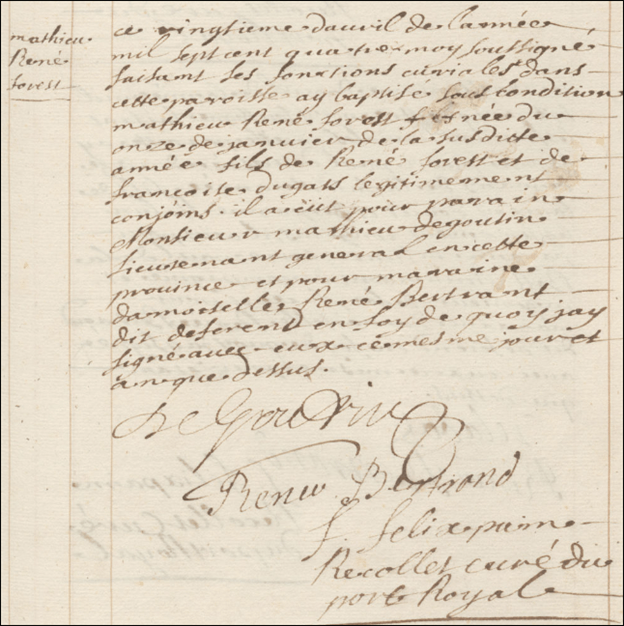
Mathieu René Forest was born January 11, 1704, and was baptized on April 20th with godparents Mathieu de Goutin, lieutenant general of this province, and Renee Bertrant dit de Forest (who is this person?). Is the name Bertrant a clue to a different surname and is Forest entirely a dit name?

Forest Mathieu 1704 birth

Mathieu married on January 19, 1728, to Marie Madeleine Guilbeau (born 1712) with witnesses René Forest, Joseph Forest, brother of the groom, Jacques Forst, son of the said René Forest and brother of the groom, Charles Guilbaut, and Charles Guilbaut, the son, brother of the bride. They had two known children, born in 1728 and 1740. He appeared on the 1763 census of Connecticut.

Jacques Forest was born June 21, 1707 and baptized on July 19th in Port Royal with godparents Sieur de Teinville, lieutenant of a company and Jeanne Dugast, wife of La Forest.

He married on January 25, 1734, to Marie Josephe LePrince (born in 1715) with wintesses Claude Granger, Pierre Lanoue, Ambroise Beliveau, René Forest, Pierre Granger.

Jacques Forest and his family were deported to Connecticut in 1755 where he appears on the 1763 census.

Marie Madeleine (Magdelaine) Forest was born June 30, 1709, and was baptized on July 3rd with godparents Francois Dugast and Magdelaine Dugast, wife of Jean Hebert.  She married Pierre Guilbeau (1704-1758) on January 21, 1731, with witnesses Charles Guilbaut, son of Charles Guilbaut, brother of the groom, Alexandre Guilbaut, son of Charles Guilbaut, brother of the groom, René Forest and Jacques Forest, his son.

Forest Marie Madeleine Guilbaut 1731 marriage

She died on March 27, 1758, the day after Easter, in Quebec, age 48, and was buried the next day in Bellechassse. Her husband and three children died in the same week. Her son, Jean-Baptiste, age 16, died the same day as his mother. Her husband died 9 days later, on April 5, 1758. Joseph died three days before his father, on April 2nd, about age 7, and Ursule, 14 years old, died the day after her father, on April 6th. What an incredibly grief-filled week. I wonder what took the family and if neighbors were dying, too. I can’t imagine being the two barely adult children left and having to deal with the magnitude of this loss. 

Elisabeth (sometimes Isabel) Forest was born about 1710 and died on September 12, 1767 in Becancour, Nicolet, Quebec. She married under the name of Isabelle to Honore LePrince (1717 – c 1756), son of Jean Le Prince and Jeanne Blanchard on November 24, 1738, in Port Royal with witnesses René Forest, father of the bridge, Jean Le Prince, father of the groom, Pierre Forest, Paul Blanchard, Joseph Le Prince.

Forest Isabelle LePrince 1738 marriage

They had two known children. Their daughter, Marie Jeanne Victoire, married Francois Cornier in Becancour, Nicolet, Quebec, on January 7, 1760, so they were there by then. Another daughter married another Cormier male in the same place in 1771.

Catherine Josephe Forest was born on May 17, 1713 in Port Royal and was baptized the same day with godparents Claude Girouard and Isabelle Broussard.

She married Claude Gaudet (1713-1786) on August 18, 1737 with witnesses René Forest, father of the bride, Bernard Godet, father of the groom, Pierre Forest, Paul Blanchard, Isabelle Forest and Madelene Tibaudot.

Forest Catherine Josephe Godet 1737 marriage

They had 8 known children. Some may have been born after the deportation. This family is on the list of Refugees at Camp L’Esperance in 1756 and 1757. They are at Fort Edward in 1761/1762 with three in their household and settled at St-Jacques-de-Cabahannocer, Louisiana.

Karen Theriot Reader reports that Catharine Josephe died in Louisiana, and her name is recorded on the Acadian memorial Wall of Names where she is listed along with Claude and one child as early Acadian immigrants to Louisiana. Two of their children are known to have died in Louisiana, but the balance are unknown. She does not appear on the January 1, 1777 census at St. James, LA, but Claude died there before May 2, 1786.

Anne Forest was born May 3, 1715, and was baptized the following day with godparents Claude Brossard and Marie Forest.

She married on January 25, 1740, to Joseph LePrince (1719-1781) in Port Royal, son of Jean LePrince and Jeanne Blanchard, with witnesses René Forest, Jean Le Prince, and Simon Le Blanc. He died on May 24, 1781, in Becancour, Nicolet, Quebec, aged 62.

Forest Anne LePrince 1740 marriage

This family escaped the deportation by fleeing to Miramichi in New Brunswick. Her husband and children are noted on the passenger list in Quebec in July 1757, but Anne is not. Anne had died by the time her daughter, Marie-Joseph, born in October 1753 in Port Royal, died in Quebec on January 5, 1758, and probably died during their time in Miramichi.

Pierre Forest was born July 10, 1717 and was baptized provisionally by Claude Teriot. On August 1st he was baptized by the priest in Port Royal with godparents Guillaume Blanchard and Jeanne Richard.

Forest Pierre 1717 baptism

He married on June 30, 1744 to Marie Madeleine Richard (1718-1761) in Port Royal with witnesses René Forest, Prudent Robichaux, Etienne Robicheaux, Simon Richard, and Joseph Richard.

According to the Belle-Ile-en-Mer depositions, he died in 1750 inthe Memramcouk village of Beaubassin.

Jean Pierre de Forest was born July 22, 1719, and was baptized the next day in Port Royal with godparents Francois de Forest and Agnes Godet.

Forest Jean Pierre 1719 baptism

On November 11, 1743, he married Anne Richard (born in 1720) with witnesses René Forest, Bruno Robicheaux, Simon Richard and Joseph Richard.. He was listed in 1763 in the Connecticut census.

Space for 1721 child – unknown

Charles Forest was born On October 23, 1723 and baptized the next day in Port Royal.

Forest Charles 1723 birth

He married on May 10, 1745 to Marie Chaisson in Beaubassin, Acadia, but was then married about 1746 to Marie Josephe Poirier, with whom he had 5 known children. In 1763, he was listed on the Fort Beauséjour census. In 1792, he married again to Marie Josephe Girouard. Karen Reader shows his death in 1805 in Menoudie, Cape Breton, at age 82.

There is significant confusion surrounding two men by the same name – see here.

What Happened to Françoise’s Children?

We have some information about what happened to Françoise’s children by the time the deportation occurred.

The more we are able to learn about the destination of her children and where they eventually wound up, the more hints about where Françoise may have eventually been laid to rest.

Keep in mind that known children does not necessarily equate to all children, especially not for grandchildren born in remote locations in Acadia, or after deportation. Many were simply “lost.”

Child Spouse Death Known Children Deportation
Marie b 1696 Joseph Robichaud m 1718 1770 Pointe-aux-Trembles, Montreal, Quebec 9 Some of her children went to MA, some were prisoners at Halifax, NS, until 1763, and some settled in LA.
Marguerite b 1697 Pierre Bastarache m 1724 May 1747 Port Royal 9 Some children to New Brunswick, others to Clare and Pubnico, NS
Joseph b 1698 Marie Guilbeau m 1720 Jan 1732 Port Royal 4 Some children to Quebec
Francois b 1700 Jeanne Girouard m 1727 Oct 1777 L’Assomption, Province de Québec 9 Some children to MA, CT, Quebec, lower Canada near Montreal
Mathieu Rene b Jan 1704 Madeleine Guilbeau m 1728 Before 1777 Louisiana Unknown CT but left during the Rev War following loyalists back to Canada – this person uncertain
Jacques b June 1707 Marie Josephe Le Prince m 1734 Unknown 9 Deported to CT, one child to l’Acadie, Quebec, the rest still lost
Marie Madeleine b June 1709 Pierre Guilbeau m 1731 Mar 1758 in St-Charles, Bellechasse, Canada 8 Husband + 3 children died the same week she did. One child in New Brunswick and others in Quebec.
Elisabeth b 1710 Honoré Le Prince m 1738 Sept 1767 Bécancour, Québec 5 Some to Quebec and others to Lower Canada near Montreal
Catherine Josephe b 1713 Claude Gaudet m 1737 Louisiana after 1763 8 Escaped to Camp d’Esperance on the Miramichi, only one child survived, after 1763 went to Louisiana.
Anne b May 1715 Joseph (Le) Prince m 1740 Between Oct 1753 and Jan 1758, probably in Miramichi with 3 of her children 7 Escaped to Miramichi in New Brunswick, then to Quebec.
Pierre b Jul 1717 Marie Madeleine Richard m 1744 July 1750 Memramcouk, Beaubassin Unknown
Jean Pierre b Jul 1719 Anne Richard m 1743 After 1763, probably CT Unknown Deported to CT and listed on 1763 census.
Charles b Oct 1723 Marie Chaisson 1745, Marie Josephe Poirier 1746, Marie Josephe Girouard 1790 About 1805 Menoudie, Nova Scotia 6 or 7 Memramcock, then Restigouche, then Chedaik, Point Beausejour. In 1761 Gaspe Refugees. 1763 Fort Beausejouir. Menoudie later.

Françoise had at least 75 grandchildren and probably several more. Unless they were exiled in the same location that she was, she would never have known about any born after the summer of 1755. Furthermore, she would have grieved the absence of every one of these sweet souls. They were ripped away from her. Grandchildren are the light in the life of grandmothers, and hers were gone. She probably prayed every single day for them and that their separation would not be forever.

Many of the deported Acadians never accepted that they weren’t one day going back home

Two of Françoise Dugas’s grandchildren were documented in depositions on Belle-Ile-sur-Mer in France in 1766 and 1767 after deportation. Marie, the daughter of Pierre Richard and Marie Girouard, married Pierre Forest. Her sister, Anne. married Jean Forest.

Françoise’s family was literally tossed to the winds, with leaves falling across the globe. 

Godmother

After the 1714 census, information about Françoise is sparse but some information is found in the Catholic parish registers.

On what must have been an incredibly joyful day, Françoise Dugas stood as the godmother for her first grandchild, a boy, Prudent Robichaux (also spelled Robicheau and Robichaud), born to her eldest daughter, Marie, on Monday, December 19, 1718.

She was probably present for the child’s birth too.

The original parish records were recopied once, above, and they are much more legible than the original below. I always check both. Sometimes whoever made the copy can make out words in the original that I can’t.

Robichaux Prudent 1718 original

Françoise Dugas was mistakenly noted as the wife of René Robichaux instead of René Forest, but it’s clear who was meant. There is no René Robichaux or similar spelling in the St. Jean-Baptiste parish records between 1702 and 1755.

Forest, Marie Josephe 1723 baptism

On Tuesday, July 6, 1723, Françoise stood as the godmother for Marie Josephe Forest, her son Joseph’s first daughter, where she is noted as Joseph’s mother.

Fortunately, the Nova Scotia Archives records are indexed by the name of the primary individuals, meaning those who are being buried, baptized or married. Unfortunately, there’s no every-name index published, even though the individual record transcriptions do show that information.

If we were to check the baptismal records for Françoise’s grandchildren born in Port Royal, beginning with the ones born closest to the 1755 deportation date and working backward, we might discover more instances of her serving as Godmother.

1755 – The Final Battle

You might think that Françoise’s final battle was death, but in this case, it wasn’t.

The final battle was the horrific genocidal eviction of the Acadian people from their homelands in 1755. At least all of the Acadians that the English could find.

By 1755, Acadia reached throughout most of Nova Scotia, stretching entirely across the peninsula from Pubnico through Port Royal, past Halifax, northeast past Louisbourg, and back to the Les Mines basin, including Truro, Grand Pre, and Beaubassin.

The English were determined to take Acadia once again. Not just to oversee or rule the land but literally to “take” all of the land and property, evicting, removing, and essentially robbing the Acadian people of all of their belongings. Their intent was to settle English families who would, of course, be much easier to control.

If Acadian lives were lost in the process – so what.

Ships were sent to round up and forcibly deport the Acadians. No effort was made to keep families together, either on ships or relative to their final destinations.

Many were sent to the colonies, but the colonies weren’t prepared, and some rejected shiploads of destitute people.

For many families, the only connecting glue is if someone was baptized in Acadia and some two decades later, is once again found in the parish records elsewhere, say, Louisiana or Quebec, for example.

My ancestors either died or made it to Quebec, south of Montreal. Many families were simply never heard from again.

Several overloaded ships headed back to ports in Europe, and some sank en route.

Where was Françoise? Was she alive? Where did she go? Was she entirely separated from her family? Did she ever see any of them again?

Françoise’s Death

Françoise died sometime after October 12, 1723, when she stood as godmother. That much we know for sure. She was about 43 then and could certainly have lived many more years.

Françoise may still have been alive when René died and was buried in Port Royal on April 20, 1751. She would have been about 70.

His burial record in Port Royal indicates that two sons and a son-in-law were witnesses on his burial entry: Claude Godet, Mathieu Forest, and François Forest. That tells us that at least these three children were still living in Port Royal, although they would be separated during the deportation 4 years later.

Rene Forest 1751 burial

It doesn’t say he’s the widower of Françoise Dugas, although it does mention her, so she may have outlived him. If so, that means she also outlived at least four of her adult children, plus the ones who died young.

There’s no death record for Françoise before the deportation, Le Grand Dérangement, which probably means she was rounded up and deported at 75 or 76 years of age.

Let’s hope that she managed to get on a ship with at least one of her children.

How her heart must have ached for the children and grandchildren who would disappear into the mists of time, ghosts on other ships, screaming across the water until their voices could no longer be heard. Frantic outstretched arms.

Mémère!

Mémère!

Grandchildren she would only reunite with in the hereafter. She probably heard them in her nightmares, still screaming for her – unable to reach them.

The church where her entire spiritual life had been spent – joys and sorrows – elation as a bride, and tears as she buried those dear to her heart, including that groom more than half a century later. Now, simply disappearing as she could see it behind the fort and garrison, an ever-smaller dot and spire on the horizon, slipping away.

René’s grave – those of her parents, brothers, sisters, their children, her children, and, yes, grandchildren too. The grave where she was supposed to rest beside her beloved family members for eternity. She would never rest in peace now.

There would be no comfort. No peace ever again.

If Françoise lived to see this horrific day, she slowly sailed out of sight of everything she had ever known – into the yawning jaws of the inky abyss. I hope she didn’t realize…but in my heart, I know that that she did.

Goodbye, Port Royal.

_____________________________________________________________

Follow DNAexplain on Facebook, here.

Share the Love!

You’re always welcome to forward articles or links to friends and share on social media.

If you haven’t already subscribed (it’s free,) you can receive an e-mail whenever I publish by clicking the “follow” button on the main blog page, here.

You Can Help Keep This Blog Free

I receive a small contribution when you click on some of the links to vendors in my articles. This does NOT increase your price but helps me keep the lights on and this informational blog free for everyone. Please click on the links in the articles or to the vendors below if you are purchasing products or DNA testing.

Thank you so much.

DNA Purchases and Free Uploads

Genealogy Products and Services

My Books

Genealogy Books

Genealogy Research

Genealogy Proof Series: Extracting and Recording Data So That You Can Find It

This is the second article in the series, Genealogy Proof Series. The first article is:

The first article discussed finding location resources for where your ancestor may have lived. Of course, once you find those resources, you’ll want to start searching for your ancestor, your ancestral surname and recording the information.

So let me stress one thing now. You’re not searching for your ancestor specifically. You’re searching for everyone with that surname because they all have a role in his or her story.

Information

Genealogy research and proving someone is actually your ancestor is all about data. Pieces of data linked together provide information. Information identifies your ancestors and their family members.

How many of you know you once found something but can’t find it now and have no idea where you put it?

What? You too???

This article is about how to search those resources once you find them, who to record, and how so that you’ll be able to analyze the resulting information.

Elizabeth Shown Mills introduced the concept of the FAN Club in 1987, which she documents in her book Evidence Explained – Friends and Neighbors. People found with or near various groups of people will help sort out who is whom, especially in the case of same-named men.

In order to evaluate who is found with various families in a specific location, you need to methodically organize your data as you transcribe it.

Extracting and Recording Your Data

After you have compiled a list of what’s available for your specific counties, you need to extract and transcribe records into a spreadsheet. If you don’t like spreadsheets, you can do the same thing in a table. But it’s critical that you do it someplace.

You’ll also index the information as you go so you can reasonably retrieve it. This is why I utilize spreadsheets – they are made for filtering and sorting.

I’m also going to touch on using AI to help with transcriptions. If you just cringed, please don’t. This is easy, I promise.

Before I share the first screenshot of my spreadsheet, I want to set the stage a bit.

I started this particular spreadsheet 25-30 years ago. There were no guidelines for spreadsheets or for organizing genealogical data. So, I’m going to share the mistakes I made and, with the benefit of hindsight, what I wish I had done differently.

Here are the first four entries (rows) in my Halifax County, VA spreadsheet where I was extracting and recording entries for multiple primary surnames.

  • Estes
  • Younger
  • Combs
  • Rice
  • Moore

In some cases, I had rumors about how these people connected. In other cases, something written decades before with no sources. And in yet other cases, I was the first researcher to plow that ground so I had no idea of who I was looking for. I needed to verify that my ancestor was actually from there before I could figure out who their parents were.

Of course, this means that over the years, I discovered that I needed to research additional surnames that I didn’t initially look for.

Following the Path

My first foray into Halifax County was via an obtuse reference from Claiborne County, Tennessee to my ancestor, John R. Estes, being from Fairfax County, Virginia, not Halifax County.

Thank goodness for this reference, even if it was inaccurate. A local lawyer. P. G. Fulkerson (1840-1929) practiced in Claiborne County. He recorded his remembrances about roughly 300 early families and more than 4,000 people. Beginning in 1979, they were published in a series of “Early Settler” columns in the local newspaper and later indexed. I have many of the newspaper clippings themselves.

What did Mr. Fulkerson say about John R. Estes?

I’m going to scan the article and let AI transcribe it. It’s super easy!

Scan and Transcribe

I scanned this page on my flatbed scanner. Today, I could also take a photo with my phone or a screenshot on a computer.

After scanning the page, I cropped the rightmost column but left the rest to preserve the date.

As an experiment, I scanned the page a second time using my scanner’s OCR (Optical Character Recognition) function, but the results were rather poor. The formatting was off, and lots of words couldn’t be read, as you can see below.

Fixing this would have required as much work as transcribing John Estes’s portion in the first place.

ChatGPT 4o

I took the original article scan and submitted it to ChatGPT

Here’s the entire interaction. I pasted the image and requested a transcription. About 15 seconds later, ChatGPT complied.

The output was text, just like you see above, so I could just copy and paste. Chat GPT was intelligent enough to format correctly and logically fill in the gaps that the scanner OCR hadn’t been able to read.

You can see that this is MUCH better. More importantly, it’s accurately transcribed and easy to confirm. No additional work is needed. I simply deleted the additional text that I didn’t need.

AI is just that easy. You can also use ChatGPT to create a spreadsheet showing the relationships and interactions of the people in the text.

Here’s my request to ChatGPT with the text I want it to process.

There’s a LOT you can do with AI very easily, but for now, let’s move on and work with our extracted information.

Keep AI in mind, though, because you might eventually want to submit everything about a surname to ChatGPT and ask for some type of summary. Always validate the results.

Original Information

Is the original information in the Fulkerson article fully accurate? No, but it gave me something to start with – which was one heck of a lot better than the nothing I had before.

Actually, there’s a LOT of information here:

  • John’s name, including his middle initial. (The middle initial turned out to be important because there were multiple John Esteses in Halifax County, VA.)
  • John’s original location of Fairfax County (Inaccurate, but it was in Virginia. Remember, Fulkerson’s handwritten notes have twice been transcribed. Once typed and then once for publication.)
  • John’s wife’s name – Nancy Moore. (Accurate, except she was called Nancy, Ann, and Nancy Ann Moore in various locations and records.)
  • They married before arriving in Claiborne County. (accurate)
  • When they arrived – prior to 1800. (Inaccurate – it was closer to 1820. He fought in the War of 1812 out of Halifax County.)
  • Location in Claiborne County – Little Sycamore Creek. (accurate)
  • Children’s names (All children are accounted for except the two who died as children before Fulkerson was born.)
  • Children’s spouses’ names. (Two were misspelled, Cloud is Clouse, Rudledge is Rutledge. George married Ollie Pittman, not a Willis. Lucy’s husband was Coleman Rush.)
  • John’s son’s middle initial – John Y. Estes. (That turned out to be important because John R. Estes’s mother’s birth surname was Younger.)
  • Where the children moved to. (Some locations were simply wrong. Others might have been stops on the way to a different location. My ancestor, John Y. Estes, wound up in Texas and never lived in Kentucky, so this error sent me on a wild goose chase.)
  • John’s age of 105 when he died. (He did live to be quite old, about 98 – and his advanced age was certainly part of his legacy.)

Where do I go from here? I didn’t know it at first, but Fairfax County was wrong. I searched but couldn’t find anything there, so I widened my net.

The First Breakthrough

I did a LOT of searching before I eventually found a reference to a marriage record for John R. Estes and Ann Moore in Halifax, not Fairfax County, Virginia. I was suspicious because Nancy is not Ann, but those names are often used synonymously for each other. After I found that record, I still needed to prove it was my John Estes and Nancy Moore.

Today, finding a marriage record is generally much easier because many records are available online by surname, through genealogy sites, such as FamilySearch and others, and by location. Online records were not available at that time.

Back then, I was relegated to library visits, courthouses, and microfilm or microfiche that the LDS church would order into their local Family History Center for me.

Once I located a reference to that marriage record in Halifax County, VA, I knew that I needed to visit the courthouse there. I wanted a copy of the original, plus I needed more information which would only be found in that courthouse. Thank goodness it hadn’t burned.

It might seem like that marriage record was an answer, but really, it was just the starting point for a very long line of questions.

Halifax County, VA Courthouse

Once in Halifax County, I spent two weeks, opening to closing, in the dusty damp basement of this courthouse where I was in Seventh Heaven. Occasionally one of the staff would come to check on me to be sure I was still alive!

There weren’t cell phones or digital cameras, so I took notes on pad after pad after pad of legal paper. I had to get everything that even MIGHT be useful while I was there, because the drive was about 700 miles through treacherous mountains, one way.

It was treacherous on those backroads, but it was also stunningly beautiful, and I never fell out of love with my ancestral connection to this place.

I would transcribe and analyze those handwritten notes later, after I got home. I wasn’t going to waste valuable research time in Halifax County going over the information I had retrieved.

Needless to say, I had to devise a methodology to organize that information. I also made discoveries, some of which necessitated additional trips. However, it was information from those initial forays that provided hints and research fodder.

Important Information

On that first trip, I didn’t realize that additional people were important in documents. I didn’t know which of the many people with the surname of Estes and even more with the surname of Moore were my family – if any.

I didn’t know what was important and what was not, so I began recording everything.

For example, let’s look at the fourth item in my spreadsheet.

  • The item number is my serially assigned number, not to be confused with a spreadsheet row assigned by Excel, which is shown at far left.
  • The source is the book or resource where I found the information. You’ll notice immediately that I did NOT record the page number, and I should have. My bad – but I know now.
  • The year and date, of course.
  • The last and first name of the person in the text, in separate columns to facilitate sorting.
  • Their role in the document – defendant, plaintiff, lawyer, etc.
  • Places, which include roads, waterways, proximity to landmarks, etc. In later spreadsheets, I added a separate column for watercourses.
  • Today, I would also add a column for a link to where I found the info online.
  • I transcribed the full text of the entry and added a separate row, as you can see to the left, for each person in the entry. You can only see 5 here, but all 7 people found in the text have the exact same entry in the spreadsheet, except for their role and their name, of course.

I wish I had a single entry for which surnames I’ve actually searched a document for, the date and how, meaning in person or a book, or what. Let’s say I actively transcribed all of the Estes and Moore items from the index. I happened to find several Combs individuals in those records, but I didn’t search specifically for Combs. I wish I had made note of that because otherwise, I’m missing actual Combs entries.

If you’re thinking to yourself that this process is extremely labor intensive, perhaps obsessive and you won’t need a lot of it eventually – you might well be right. However, YOU DON’T KNOW WHAT YOU DON’T NEED UNTIL LATER. So you also don’t know what you’re missing and I guarantee you, the ONE THING you will need will be in what you don’t have.

Because I did a poor job of documenting what I covered during my first visit, including books where I didn’t find anything, I had to review them again – and sometimes, I found things I had missed or ignored the first time, thinking they weren’t relevant.

If you don’t enter everything, you won’t be able to:

  • Sort to see how many times you find a particular person associated with your family members.
  • Sort for everyone in a particular location, like Birches Creek.
  • Sort for people on Roanoke Road.
  • Sort for someone who witnessed a deed to see what other transactions and interactions they had with people in your spreadsheet, which is really a form of database.

If you don’t enter everything, you’ll be missing a lot of important information.

Secondary Spreadsheets

Sometimes, I create secondary spreadsheets. I find these useful for records such as census, personal tax, and land tax records.

Using those records, I was able to track groups of people, with their locations, correlated with deeds, across time from 1750 through 1817.

The bond for the marriage between John Estes and Ann Moore was provided by John R. Estes and William Moore who would have been a close relative of the bride. The name of William Moore provided me with a “direction” in which to look, which is exactly why I transcribed every document type I could find in that courthouse. On the tax lists, I found two distinct groups of Moore men. William Moore was grouped with a different group of men than the Dan River group of Joseph, John, and Alexander Moore.

Using documents across multiple years, it was easy to group these people together. I quickly discovered that John, Alexander, and Joseph Moore lived on the Dan River, near South Boston, while the William Moore and James Moore group lived on the west side of the county on the second fork of Birches Creek, about 15 miles away from the Dan River group.

Eventually, years later, Y-DNA would confirm that these two groups were not paternally related.

Clearly, this land and tax information won’t fit on the columns of the original Halifax Spreadsheet, so this information is stored on a separate tab titled “Land Tax Summary,” shown above.

I have yet another tab titled “Census.” I do enter placeholders for the appropriate person and year into the original spreadsheet pointing me to the Land/Tax and Census tabs.

As I continued with my research, I was extremely grateful that I had recorded everything, because, as luck would have it, the signatures, marks of those who couldn’t sign, neighbors, and locations were critical to finding my way back to Prince Edward, then Amelia County where this Moore family had come from before settling in Halifax County.

Eventually, it would be revealed that Edward Henderson, a witness to the deed above, was the uncle of Nancy Ann Moore. Nancy’s son, John Y. Estes, would marry a Dodson female. Yes, the Dodsons who migrated to Claiborne and Hawkins County lived down the road from the Birches Creek Moore family in Halifax County. Charles Spradling lived with James Moore at one point and is somehow related, but we still don’t know exactly how.

Can you see how valuable these records that include people we don’t know turn out to be?

When I finished transcribing these records, there were 173 entries for the surname Henderson. Many of these records documented relationships with other people, proximity to land, and inheritance. These, along with other transactions, connected many dots.

If you’re thinking I’ve strayed far from John R. Estes, I really haven’t. These families were all allied in some way. John’s father and grandfather were involved with Nancy Ann Moore’s family. I suspect they attended the same church. William Moore was a minister, and John’s mother’s Younger family and his grandmother’s Combs family lived nearby and probably attended the church that William Moore pastored.

Follow the Path

My Estes ancestral path led to the Combs and Younger families and from Halifax County to King and Queen County and Amelia County, Virginia. The Moores led to the Rice family and to Prince Edward, Amelia, and New Kent Counties.

I did not create a new spreadsheet for those counties. I simply continued to add to the same spreadsheet because often, the same allied families are found in those earlier locations, too.

That FAN network is VERY powerful. Almost no one went to the next frontier alone. You needed other people for survival – and you married who you saw.

In Summary

Most of us aren’t fortunate enough to find the dots already connected. Even if someone else has connected them, especially in today’s copy/paste tree-grafting world, you’ll want to check their sources and records, check the transcriptions, and do your own proof work. We will talk about the Genealogical Proof Standard in this series.

You will find the answers to your brick walls hiding in the groups of family, friends, and neighbors. Recording everything not only provides you with valuable information, now and in the future, it also keeps you from replowing the same field. You won’t have to wonder if you’ve already looked at a particular resource or if you extracted a specific surname.

Now that you know how to extract, transcribe, and record relevant records, you can begin to sift through those location records from our last article.

Our next article will be about surname searching.

_____________________________________________________________

Follow DNAexplain on Facebook, here.

Share the Love!

You’re always welcome to forward articles or links to friends and share on social media.

If you haven’t already subscribed (it’s free,) you can receive an e-mail whenever I publish by clicking the “follow” button on the main blog page, here.

You Can Help Keep This Blog Free

I receive a small contribution when you click on some of the links to vendors in my articles. This does NOT increase your price but helps me keep the lights on and this informational blog free for everyone. Please click on the links in the articles or to the vendors below if you are purchasing products or DNA testing.

Thank you so much.

DNA Purchases and Free Uploads

Genealogy Products and Services

My Books

Genealogy Books

Genealogy Research

Great News – Both e-Pub and Print Version of “The Complete Guide to FamilyTreeDNA” Now Available Worldwide  

  • Anyone, anyplace, can order the full-color, searchable, e-pub version of The Complete Guide to FamilyTreeDNA – Y-DNA, Mitochondrial, Autosomal and X-DNA from the publisher, Genealogical.com, here.
  • Customers within the US can order the black and white print book from the publisher, here.
  • Customers outside the US can order the print book from their country’s Amazon website. The publisher does not ship print books outside the US due to customs, shipping costs, and associated delays. They arranged to have the book printed by an international printer so that it can be shipped directly to Amazon for order fulfillment without international customers incurring additional expenses and delays. If you ordered the book previously from Amazon and a long delivery time was projected, that should be resolved now and your book should be arriving soon.

Comprehensive

This book is truly comprehensive and includes:

  • 247 pages
  • More than 267 images
  • 288 footnotes
  • 12 charts
  • 68 tips
  • Plus, an 18-page glossary

To view the table of contents, click here. To order, click here.

Thank you, everyone, for your patience and your support.

_____________________________________________________________

Follow DNAexplain on Facebook, here.

Share the Love!

You’re always welcome to forward articles or links to friends and share on social media.

If you haven’t already subscribed (it’s free,) you can receive an e-mail whenever I publish by clicking the “follow” button on the main blog page, here.

You Can Help Keep This Blog Free

I receive a small contribution when you click on some of the links to vendors in my articles. This does NOT increase your price but helps me keep the lights on and this informational blog free for everyone. Please click on the links in the articles or to the vendors below if you are purchasing products or DNA testing.

Thank you so much.

DNA Purchases and Free Uploads

Genealogy Products and Services

My Books

Genealogy Books

Genealogy Research

Martin Aucoin (1595-after 1633), Carpenter, Survived the Siege of La Rochelle – 52 Ancestors #425

Martin Aucoin lived in a time of great upheaval in France. Somehow, he survived a religious war, or more precisely stated, wars. He may or may not have made the trip from France to Acadia, today’s Nova Scotia. Whether he died in France, arrived in Acadia, or died trying, he was one of the founding fathers through his two daughters, Michelle and Jeanne Aucoin.

Laleu

Par Patrick Despoix — Travail personnel, CC BY-SA 3.0, https://commons.wikimedia.org/w/index.php?curid=32678016

Martin Aucoin was baptized on August 26, 1595, at Saint-Pierre de Laleu, a church that now lies in ruins.

Par Remi Jouan — Photo taken by Remi Jouan, CC BY 3.0, https://commons.wikimedia.org/w/index.php?curid=8657028

The priest scribed the record of his baptism for posterity. We would find it more than 400 years later.

Martin Aucoin’s 1595 baptism is recorded in Latin, found in La Charente Maritime archives, here.

I don’t read Latin, and certainly not Latin written in 16th-century French script. ChatGPT 4.0 came to my rescue, though.

Transcription:

Die 26 aprilis Anno Domini 1595 Martinus Aucoin filius Martini Aucoin et Barbelleae parochiam Dieslis in Xra fuit sacro sancto baptizatus receptus ab aquae et spiritu sancto abbas mae Joannes Godardus capellaniae S. Johannis in hunc anima

Translation:

On the 26th day of April in the Year of Our Lord 1595 Martin Aucoin, son of Martin Aucoin and Barbelle of the parish of Dieslis in Christ was received into holy baptism by water and the Holy Spirit by Father Joannes Godardus, chaplain of St. John’s in this parish.

Others have interpreted his first name to have been Martinus, the Latin form of Martin, and the surname to have been written as Aucoing. His mother’s name has been interpreted as Suzanne Barboteau.

Unfortunately, the first remaining parish records from this church begin in 1593, although the church itself was much older. It was built in the 12th century, partially rebuilt in the 15th century, half ruined at the end of the 16th century, and restored in 1592 – hence the reason why there weren’t earlier records. The bell tower was restored in the 17th century.

Given the church’s ruined state before 1593, the Aucoin family would have attended services and had their religious needs attended to in another nearby community before this church’s restoration. This strongly suggests that Martin’s family lived in or very near Laleu.

Cousin Mark, who provided this information, also discovered that Lalau is shown on the siege map of La Rochelle from 1627-1628 in Guy Perron’s wonderful blog.

Laleu is shown on the map of the siege to the left. Today, Laleu is part of La Rochelle, although sadly, we were not able to visit the ruins during our recent trip.

The tower and some walls remain, along with the cemetery.

Today’s streets are probably just paved versions of the old cobblestone pathways for donkeys and carts that drew fruits and vegetables to market and supplies back home again when Martin’s family lived there.

Walking along the Rue Notre Dame, the “street” adjacent to the church appears to be an alley, but it’s not.

You can see the centuries of history carved into the mortar and stones of the old buildings, still in use today. Calling this a one lane street is being generous. Note the very small car in the distance.

Some of the little “streets’, like the Rue de Rambouillet, are only large enough for a person.

In even earlier history, before the 1100s, soldiers from the Gallo-Roman empire established ports on the peninsula where Laleu and La Rochelle are found and harvested salt from the salt marshes.

That history was probably forgotten by the time Martin’s parents took their infant child to be baptized, likely the day of or the day after his birth, as was the custom.

I can see Martin’s parents standing inside the church, facing the chancery, as baby Martin was anointed with Holy Water and baptized by the priest – the words of the ritual spoken in Latin, of course.

I wonder if his parents understood Latin. They had surely witnessed hundreds of baptisms.

The ghost of the pillars that would have supported the gabled archways soaring overhead.

The baptismal font was probably towards the front of the church, perhaps near the altar or maybe in one of the side chapels.

Beautiful stained glass windows would have graced the openings, radiating their colorful rays across the church and perhaps baby Martin as well, a blessing message from the sun.

Today, only one side of the church partially remains, along with the rear wall that appears to be stabilized by the bell tower.

Martin and his parents would probably have entered through the door, on the side near the bell tower today.

The small door at the rear of the church would have been where the caskets were carried out of the church for burial in the cemetery outside.

Looking at the left side and rear of the cemetery, we see small buildings that I thought were ossuaries, where the bones in old graves are removed and stored so the graves can be reused. While the practice is foreign to those of us in the US, it’s the tradition in most of Europe, where land is very scarce. Upon further research, it appears that these are not ossuaries but apparently a type of mausoleum or grave house.

That doesn’t mean there wasn’t an ossuary, just that I don’t see one today. Of course, the burials remaining today are contemporary, some reaching back into the 1800s but more from a later date – certainly long after the church was restored the last time. Martin’s parents may repose here, but if so, we don’t know where. Clearly, the early graves are gone, given that this cemetery has been in use for at least 800 years, since the 1200s.

Generations of Martin’s family members may have watered this soil with their DNA and would have lived within a block or so of the church.

The Neighborhood

Directly across the street from the church at 4 Rue de L’Eglise, this ancient building and its walls remain. It appears to be from the time when the church stood, and I can’t help but wonder what it was? Did Martin walk past here? He surely did.

Everyone did because it was across from the church. In a small village, everyone walked past everyone’s house and knew their business, too. Most of the people were probably related.

What was this building? Could Martin’s family have possibly lived here?

It’s labeled as Foucaud Dominique on the map, and further investigation suggests it is or was an osteopath’s office.

The ancient walls surround and are incorporated into the homes and lives of the Laleu residents today, some of which might be descendants of Martin Aucoin and Suzanne Barboteau.

Possible Siblings

French Acadian researcher Jacques Nerrou recorded the following:

The Aucoin family was in La Rochelle in 1570 at the time that Martin (1) AUCOIN was born. He was a locksmith by profession in Cougne parish. He then went to St. Eloy.

During this time period, there seems to have been only one AUCOIN family living in La Rochelle. He married Suzanne BARBOTEAU in 1592. Records found give us the various spellings of this family name: Aucoing, Ancoing, Auconnois, Oguin, Angevin, this last derivation could come from a more ancient form of the name that would have originated in the Angers region.

Birth records were found for four children belonging to this couple:

    • Sebastien, baptized 27/09/1593 at St Pierre Laleu (La Rochelle) as his father, he became a locksmith.
    • Martin (2), baptized 26/04/1595 at St Pierre Laleu (La Rochelle)
    • Francois, Baptized 9/11/1599 at Cougnes
    • Daniel, baptized 17/06/1604 at Cougnes.

Another marriage is reported for Martin Aucoin, the father, to Catherine Hilarin on July 10, 1606 in La Rochelle. If this is accurate, and it’s the same Martin Aucoin, that tells us that Suzanne Barboteau has died

Please note that I have NOT confirmed or verified any of the above information. I have not been able to use the French archives search feature for parish records successfully.

It’s also worth mentioning that there have been heated discussions about the surname and whether Angevin or Langevin is the same as Aucoin or if they are two unrelated families.

If baptism records are available for Aucoin family members, by any spelling, as indicated above, perhaps death records are too. It’s also possible that the witnesses for the various baptisms above can be associated with the records known to belong to our Martin Aucoin found in La Rochelle. That would serve as indirect evidence connecting the dots between these people.

If you have these records, additional information, or can figure out how to use the archives search features, please contact me.

Martin’s Life

Assuming that Martin Aucoin and Suzanne Barboteau are our Martin Aucoin’s parents, we know little more and nothing concrete. The first positive ID of our Martin is in La Rochelle in 1630, just a couple of years after the siege ended.

We can’t say positively that the Martin Aucoin baptized in Laleu in 1595, just 103 years after Columbus “discovered” America, is the same Martin Aucoin that was later found in La Rochelle, but Aucoin is an extremely rare surname, and Martin is not a common first name either. It’s certainly possible that if, indeed, Sebastian, Francois, and Daniel are the brothers of our Martin Aucoin, they named one of their sons Martin after their brother. It’s somewhat unusual that of the 19 children, 10 of whom were males, born to the younger Martin Aucoin found later in Acadia, born about 1650, none were given any of those three names.

About the time our Martin was reaching adulthood, a religious war would shape this part of France, and in particular, La Rochelle, dramatically.

The Edict of Nantes, signed in 1598 by King Kenry IV, granted the minority Protestants called Huguenots rights within the Catholic nation of France. Meant to quell the Wars of Religion in France; two decades later, the results were disappointing for France as a whole and catastrophic for some, especially in La Rochelle.

Catholics and Protestants

This map of La Rochelle was drawn in 1597 when our Martin Aucoin was just a toddler, in a more innocent time before the religious wars would take their toll during the following three decades.

It’s easy to see the city’s walls, the hospital, St. Bartellemy church, and possibly a small adjacent churchyard that equates to a cemetery, but I can’t tell for sure. There are at least four more churches scattered in different parishes, two of which can easily be identified here. At that time, the churches were shared between Catholics and Protestants, which was probably the only thing that saved them.

Several towers are in evidence, including the ones guarding the city gates. The main gate, by the harbor, still stands today.

The three massive towers guarding the harbor and quay, including the one with a terrifying gibbet cage, protected La Rochelle from attack from the sea and provided shelter for merchant ships offloading their wares in the portion of the harbor inside the city walls.

Coming or going, every ship sailed between those sentry towers.

La Rochelle, strategically located, became the Huguenot center of sea power and a hotbed of Protestant resistance to the Catholic government.

Henry IV of France, baptized Catholic but raised Protestant, balanced the interests of both but was assassinated in 1610 by a Catholic zealot. His son, Louis XIII, was only nine years old when his father died, and his mother, Marie de’ Medici, was named as the regent of France during her son’s minority, with the assistance of the powerful Catholic Cardinal Richelieu who would eventually betray her, as would her son. Marie was removed and exiled in 1617 by her son, who was only 16, causing revolts by regional nobles of both faiths, followed by the outbreak of the Thirty Years War in 1618.

In 1621, Louis XIII reestablished Catholicism in a formerly Huguenot region of Béarn, about 270 miles further south, resulting in an uprising and the escalation of tensions in La Rochelle.

The Huguenots were powerful and in control of La Rochelle, which, of course, was a part of France ruled by the French monarchy. While King Henry IV had been flexible and accommodating, his son, Louis XIII, was much less tolerant. The King had flexed his muscle, and La Rochelle certainly knew they might be next in his sights.

They were right. The blockade of La Rochelle took place in 1621 and 1622 during the King’s repression of the Huguenot rebellion.

Fort Louis was built just outside the La Rochelle city walls, guarding the entrance to the city. The King attempted to blockade La Rochelle by preventing Protestant access to the port by land and sea. As a Catholic carpenter, did Martin Aucoin help build this fort?

Isaac de Razilly with Charles de Menou d’Aulnay, men later associated with the founding and settling of Acadia beginning in 1632, commanded the French blockade fleet. Razilly lost an eye in that endeavor. They worked closely with Cardinal Richelieu.

This initial conflict lengthened into a stalemate, which resulted in the Treaty of Montpelier in October of 1622, ending hostilities, at least for the time being.

The Huguenots retained military installations in only two places, La Rochelle being one.

Neither side was happy with the terms of the agreement; both sides ignored it, and the tension reached a boiling point again by 1625 when the Huguenots occupied, and the French then recaptured Ré Island, off the Atlantic coast opposite the entrance to La Rochelle, illustrated above.

Martin would have witnessed all of this upheaval, knowing worse was coming, probably praying daily for the protection of his young family. He had been married about a decade.

In this painting, you can see the harbor and towers of La Rochelle, with Ré Island across the channel.

Perceiving an opportunity, in June of 1627, the English King Charles I sent a fleet of ships with more than 7,000 men to encourage a Huguenot rebellion at La Rochelle. In August, the English soldiers with 600 horses and 24 cannons surrounded the city. On September 10th, La Rochelle fired shots against the French King’s royal troops at Fort Louis, beginning the next Huguenot rebellion.

La Rochelle was the center of Huguenot resistance, aided by the English. Both sides were determined to be victorious.

For the French, Cardinal Richelieu acted as commander when the King was absent.

Cardinal Richelieu is depicted here at the siege of La Rochelle in both armor and his red cardinal cape and hat, standing on a dike.

La Rochelle can be seen here in 1630, completely surrounded by fortifications and troops. The French built a seawall nearly a mile long to prevent all supplies from arriving in La Rochelle

La Rochelle is shown here ringed by forts, with its harbor blocked by a nearly mile-wide blockade. On the peninsula at right, you can see the small village of LaLeu, outside the blockade perimeter. Based on the area left outside the perimeter, one can assume there wasn’t concern about French or Catholic loyalty in those regions.

Laleu looks small on this map.

Laleu looks much more realistic on this map and you can make out the church’s spires. Still, there are only about 43 houses, plus the church, of course. The church was the center of every village and the life of the villagers.

This bird’s-eye view drawn by Jacques Callot shows the area of La Pallice, near the bottom, and Laleu, a small village above LaPallice, during the siege.

I think this would have been Laleu on the Callot map, but I’m not positive.

The English sent two more fleets to resupply the Huguenots and relieve the residents of La Rochelle but were unsuccessful.

After 14 excruciating months, on October 28, 1628, the Huguenots surrendered the city to the French.

Along with other Huguenots, Jean Guitton, the Protestant mayor of La Rochelle, had vowed to defend La Rochelle to the death. Indeed, they did, but the resulting deaths weren’t their own. Instead, the residents died. Shockingly, the population was reduced from 27,000 to 5,000, but in the surrender painting above, the politicians in charge don’t appear emaciated.

After an unconditional surrender, confessing their sins, and asking the King for forgiveness, they were allowed to return to the fold. At 11 PM, the treaty was signed, and the following day, the emissaries from La Rochelle were brought before the King, who said to them, “I forgive you for your rebellions. If you are good and faithful subjects to me, I will be a good prince to you.” The Huguenots of La Rochelle retained their religious freedom, property, and possessions but not their military defenses.

Two days later, the royal troops entered the city and witnessed an utterly horrific spectacle. Only 5000 residents were left alive, and another 1000 would die within the next three months.

The soldiers handed out 10,000 loaves of bread immediately. The next day, they herded cattle and sheep into the city. More than 3000 carts of supplies were escorted by the soldiers, too, but those carts had a secondary purpose. The priest recorded that “so many corpses piled up without burial in the city.” Those corpses were removed from the streets before the King’s arrival on November 1st. They wanted to spare him the painful spectacle of the devastation the blockade had caused. The King was so moved by seeing “the poor inhabitants,” and that was AFTER the cleanup, that he took pity on them and shed tears. Yes, starvation is horrific. The King was staying at Laleu, which was clearly in much better shape than La Rochelle. Still, it must have been terrible in Laleu, too, knowing that people just a few miles away were literally slowly, agonizingly, starving to death.

Unfortunately, the Catholic church records in La Rochelle end in mid-July 1627 with a final entry in the registers of Sainte-Marguerite church. More than 20,000 deaths later, the next known service was held by Cardinal Richelieu on November 1st, in the same church where “all divine services” took place for “all the churches of La Rochelle.” Records indicate that there had been five churches and cemeteries, one for each of the parishes. Sainte-Marguerite was reconsecrated by Cardinal Richelieu, and six days later, burial records were resumed.

It’s unknown how the bodies were disposed of during the siege or before the King’s visit.

Where Was Martin Aucoin During This Time?

We don’t know where Martin was during this time, but we do know a few things.

The fact that the King stayed in Laleu indicates that the town was considered Catholic, loyal, and safe. It would have been in pretty good shape, all things considered.

Martin could have been there.

The church in Laleu was about two and a half miles or an hour away, on foot, from the center of La Rochelle. Of course, the King wouldn’t have been walking. He would either have been riding a horse or in a horse-drawn chariot, accompanied by both an entourage and many soldiers. Martin was probably watching from someplace and may even have been involved in some fashion.

Martin survived the siege, as did his wife, Barbe Minguett, and eldest daughter, Michelle, who, according to the later Acadian census documents, was born about 1618. Michelle’s age suggests that Martin married sometime between 1615, when he would have been 20, and 1617. In addition to daughter, Michelle, Barbe and Martin had son, Francois, who was born about 1622. They probably had more children as well, given the distance between known children.

We know with almost certainty that Barbe Minguet was the mother to both Michelle Aucoin and Jeanne Aucoin who were founders of Acadia, along with their respective husbands. The mitochondrial DNA of their descendants, inherited directly from their mothers all the way back to Barbe, matches.

If Martin Aucoin and his wife and at least two children were living in La Rochelle at the time of the siege, the chances of all four surviving would be nearly impossible. Only about 1 in 6 or 7 people survived. It’s most likely that Martin and his family were living in Laleu or nearby, someplace outside the walls of La Rochelle, during this time.

Furthermore, as a loyal catholic and carpenter, there would have been opportunity in La Rochelle after the siege was over.

The first child born in La Rochelle to Martin and Barbe was daughter Jeanne Aucoin who was baptized in Sainte-Marguerite’s church on November 26, 1630.

The Grim Reaper and a Second Chance

Unfortunately, while Martin and his wife, Barbe Minguet, escaped the grim reaper during the siege months, Barbe succumbed sometime between November 26, 1630, and January 20, 1632, when Martin married Marie Sallé at Saint-Barthélemy church, just a couple of blocks away from Sainte-Marguerite, but in a different parish.

The church of Saint-Barthélemy no longer exists, but the bell tower does and is getting a makeover. The church proper was located where the building with the white shutters sits today.

We know that several people were present at their wedding. The bride’s parents would have come from the neighboring parish of Cougnes, bringing the bride, of course. I can’t help but wonder why they weren’t married in her home church. In addition, there were several witnesses, many of whom were carpenters and other tradesmen. Some may have been relatives.

Again, ChatGPT translate assisted with the transcription, but couldn’t read everything.

The 20th of January of Saints Fabien and Sebastien were married Martin Aucouin, Carpenter, in this parish with Marie Sallé daughter of Jean Denys Sallé and Francoyse Arnaud of the parish of Cougnes and of the consent and ?é in pr Jean and Nicolas Jaque neau ? Locksmith, Arnaud Gyon carpenter, Pierre Dusaut carpenterr, Jony Bichaud butcher Martin Barraud carpenter and Jony Brossard butcher and Antoine Couisau Masson & more’r others

Fousseaume.

Parish Priest of St. Barthelemy Nicolas Jagueneau Louis D’Loyer Pierre elder Arnaud Gion Johing Broussard Bastien Jagueneau

The signature of Arnaud Gyon, a carpenter, on the marriage certificate of Martin Aucoin with Marie Sallé is the same as that on the baptismal certificate of Jeanne Aucoin, daughter of Martin Aucoin and Barbe Minguet in 1630. This confirms that it is the same Martin Aucoin in both documents, even if there is no mention of widowhood in his marriage certificate with Marie Sallé. Furthermore, we later find Marie Sallé in Acadia, living with Michelle Aucoin’s daughter and son-in-law.

Marie Sallé was born about 1610, so she would have been about 22 when she married Martin. Martin’s daughter, Michelle, was already 14, so Marie was just 8 years older than her stepdaughter, 12 years older than Francois, and about 21 years older than baby Jeanne. With the addition of her new son, Jean, a few months later, Marie bore the responsibility of raising four children.

We know they attended Saint-Barthélemy, so let’s take a look at the tower, the only part of the church left today.

Martin probably attended this church while he lived in this parish in La Rochelle after his daughter, Jeanne was born, but before he married Marie. Otherwise, they would probably have been married in Sainte-Marguerite had he lived in that parish.

The bells of Saint-Barthélemy would have summoned the worshipers.

Just ten days after Martin married Marie Sallé, a child, Nicholas Aucoin, was recorded in the burial records of Saint-Barthélemy. The child’s age is not given, and neither are his parents’ names, but given that we know Martin attended this church and no other Aucoin families are present, it makes sense that Nicholas belongs to Martin Aucoin and Barbe Minguet. I can’t help but wonder if this child was born to Martin and Barbe just before her death. Given Jeanne’s birth in November of 1630, Nicholas could have been born literally days to a few weeks before Martin married Marie Sallé in January of 1632, although that really doesn’t seem quite long enough.

This must have been an incredible blow to Martin. Now, the church bells were tolling for his child.

I wonder where Nicholas was buried. Was he an infant, perhaps the last child born to Barbe before her death, or was he older?

Maps of that time don’t show a cemetery adjacent to this church. Besides, after almost 25,000 deaths in the previous few years, there would have been no space left in the cemeteries anyway.

The priest would have had to consecrate ground someplace else for burials.

Martin would probably have looked out these windows, wondering to God why. Why take his wife and children? Why?

Then, his attention drifted back to what the priest was saying, assuming he understood Latin. Regardless, Martin would have understood the rituals. Blessing the child and praising God for taking the child to His glory and happiness of everlasting life.

The priest probably said the Mass of Angels, begging for consolation for the family. He would have worn white robes, not black, because the child had never sinned, and blessed the coffin before it was taken outside for burial where he would bless it once again.

Martin and Marie’s first child, a son, Jean Aucoin, was baptized inside these walls ten months later, on November 10, 1632. It was a much happier day, and they must have been thrilled!

Sadly, he died seven months later, on June 25th, 1633. The priest would have repeated the same ritual that by this time would have been all-too-familiar. Grief seemed to be the staple diet of La Rochelle.

Martin attended the funeral of his son in this church, again staring out what would then have been stained glass windows as the Priest’s voice droned on. Martin had heard funeral services far too many times. He probably knew them by heart.

Did Martin and Marie have more children? Did they move someplace else, to a parish whose registers no longer exist? Maybe more baptisms are waiting to be found.

Marie was only in her early 20s, so she had another 20 childbearing years ahead of her.

Did Martin have siblings? What happened to them? Where are they?

Where were Martin’s parents buried? Were they trapped in La Rochelle and perished during the siege? What happened?

Are there more records for Aucoin family members in this part of France?

Daybreak

Very early, at daybreak, just as the sun rose one April morning in La Rochelle, I traced Martin’s footsteps. I walked to where his daughter, Jeanne Aucoin, was baptized, and then to Saint-Barthélemy, where Martin remarried after Jeanne’s mother died, where Nicholas was buried, then son Jean was baptized and then buried. All those events in this church occurred between January of 1632 and June of 1633.

The shadowy fragments of Martin’s joy and sorrow both linger here.

When I visited that solitary morning, the church was under repair. I walked as far around the church tower as possible, hoping to find a way inside.

No luck.

Around back, I looked inside the dumpster, which held trash and scrap construction materials.

I saw something in the dumpster.

I took a closer look.

There it was.

Stone.

Stone from the church tower where the trajectory of Martin’s life changed.

Tossed away in the refuse pile, just waiting for me.

Be still my heart.

A gift from his heart to my heart.

Yes, Martin, I am here. I came to find you and share your life, your pain, and joy, your path and footsteps with your other descendants.

You know, don’t you?

From my soul to yours.

Thank you.

It hurt my heart to turn and walk away. Tore at my soul.

I kept looking back, tears streaming down my cheeks, until I reached the corner. I paused one final time, took one last look, drinking in what Martin would have seen, etching it in my mind forever, then turned and walked downhill towards the city gate and the quay.

But Martin knew that I was here, and just as I did, he turned and walked away one last time, too.

Acadia

We don’t know for sure if Martin Aucoin set sail for Acadia or if he died before his family immigrated.

Given that we know Marie and three of Martin’s children sailed for Acadia, now Nova Scotia, the church would have been their last stop, offering prayers for safe passage before they sailed between the towers standing sentry, guarding the opening into the harbor.

They would have gathered a few meager belongings, boarded a ship along the quay, and set sail between those towers.

Martin’s family, and Martin, if he sailed with them, would have turned around until the towers and La Rochelle were only a dot on the horizon, then looked forward to nothing but waves and sea. An uncertain future.

The siege and its aftermath clearly played a critical role in the settlement of Acadia. I can picture the destruction and destitution in the city that prompted many to welcome a chance for a better life in New France.

In 1632, de Razilly and d’Aulnay began encouraging settlement at La Hève, Acadia, now LaHave, Nova Scotia. In 1635, the settlement was moved to Port Royal, on the northern side of the peninsula.

Did Martin sail with the rest of his family through those towers, out the harbor, into the westward sun, headed for Acadia?

Or does he rest someplace in La Rochelle, or maybe at sea?

The Other Martin Aucoin

There’s another Acadian named Martin Aucoin. What happened to our Martin Aucoin, born in 1595, may, in part, be told by the story of the younger Martin Aucoin.

The younger Martin Aucoin is recorded in the 1686 census of Les Mines, Acadia, living in Beaubassin, age 35, which means he was born about 1651. In the 1693 census, he’s shown as age 46, so born about 1650. Importantly, he is NOT shown in the earlier Acadian censuses.

This Martin married Marie Gaudet about 1673, given that their first of 19 children, including a set of twins, was born in 1674.

The younger Martin’s burial was recorded in the Grand-Pré register on May 15, 1711, noted as around the age of 60, born about 1650 or 1651, and living on La Riviere des Canards. Unfortunately, this entry does not reveal his parents.

According to the deposition made in 1767 by this Martin’s grandson, Alexandre Aucoin, Martin came from France. (Doc. inéd., Vol. III, p. 106). Five others, all made by widows or widowers of other grandchildren of Martin Aucoin, include statements to the same effect (ibid., Vol. II, pp. 181, 193; Vol. III, pp. 22, 29, 127-128). All six of these depositions indicate that Martin Aucoin married Marie Gaudet. Only one, that of Claude Pitre (ibid., Vol. III, p. 29), adds the detail that their marriage took place at Port-Royal.

What NONE of these depositions says is that Martin Aucoin (the elder) is the father of the younger Martin Aucoin or that Marie Sallé was his mother. However, neither do the depositions for either Jeanne or Michelle. In fact, the elder Martin Aucoin is not mentioned in any of those depositions at all. In 1767, the French were interested in the most recent ancestor arriving in Acadia who was born in France, not necessarily ALL ancestors born in France.

The descendants of both Michelle and Jeanne Aucoin stated that they were born in France and came to Acadia with their spouses. For Martin the younger, it simply says he came from France. If Martin the elder was his father and Marie Sallé, his mother, they and their other children would not have arrived until after the younger Martin’s birth in 1650/1651 and before 1654, assuming the information about him being born in France is accurate. That’s the only possible window because there was no immigration from France to Acadia during the English occupation from 1654 to 1670.

So, if this Martin was born in France and arrived before 1654, he would have arrived as a child with his parents. There is no suggestion of a second Aucoin family. If he arrived after 1670, he may or may not have arrived with family members. There is no record of any Martin Aucoin in the 1671 census. Beaubassin was not founded until 1671-1672, so he wasn’t there yet.

Martin’s wife, Marie Gaudet, lived in Port Royal with her parents, who were shown there in 1671, 1678, 1693, and 1698. Marie is shown with her parents in 1671, age 14.

Martin would have HAD to have been living in Port Royal in 1673 when he married Marie. The couple likely packed up and went with Jacques Bourgeois to Beaubassin shortly thereafter.

So, here are the four possibilities for the Martin Aucoin born about 1650, in no particular order:

  1. Martin came from France, probably as the son of Martin Aucoin and Marie Sallé, between 1650 and 1654, when immigration stopped. If this is the case, Marie would have been about 41 or 42 years old, so having a child when Martin was born is certainly within the realm of possibility.
  2. Martin came from France between 1650-1654, the child of other parents. This is possible, but there is no trace of those other parents, nor is he found in the 1671 census.
  3. Martin came from France after the 1671 census, and before 1673 when he married Marie Gaudet and is therefore not the son of the older Martin Aucoin. This makes the most sense, especially when combined with a note by Stephen A. White, “Given the lack of dispensation, we do not believe that the husband of Marie Gaudet could be the second son of [Martin Aucoin] the carpenter of La Rochelle, but there still exists the possibility that he is related to the sisters Michelle and Jeanne, to a degree more distant.” Unfortunately, White does not identify which marriages he would have expected to find dispensations for. Knowing which marriages and in which generations would help immensely in eliminating potential upstream common ancestors. For example, could the younger Martin Aucoin have been the nephew or great-nephew of the older Martin Aucoin? For how many generations would a dispensation be required in each scenario?
  4. The last possibility is that the depositions regarding the younger Martin coming from France are incorrect and he was born in Acadia, but his parents came from France. This is possible but adds no evidence either way in terms of whether he is the son of the older Martin Aucoin.

Surely, with the same highly unusual name as the older Martin Aucoin, there had to be some connection. Even today, there are only three locations in France with clusters of the Aucoin surname, and one is a result of Alexandre Aucoin’s descendants who were deported back to France, arriving on Belle-Ile-sur-Mer in 1765.

More Upheaval in La Rochelle

It’s easy to imagine La Rochelle as peaceful after the siege, but that wasn’t the case.

By World Imaging – Own work, photographed at Orbigny-Bernon Museum, CC BY-SA 3.0, https://commons.wikimedia.org/w/index.php?curid=11205885

In November 1661, 300 Protestant families were expelled from La Rochelle, probably some 3000 people. We have no reason to associate the Aucoin family with Protestant leanings, but witnessing the heartache and devastation might well encourage young Martin Aucoin to daydream about leaving for more peaceful lands – or at least land he believed to be more peaceful.

Perhaps this event motivated the younger Martin Aucoin, born about 1650, to leave as soon as he was old enough.

The Elder Martin Aucoin

We have two bracketing events defining the possible death of our Martin Aucoin.

We know Martin was alive when he was married in January 1632 and in February when his son was conceived. I’d also presume (I know, unsafe word) that he was alive later in 1632 when baby Jean Aucoin was born to Marie Sallé because otherwise, the father would have been noted as deceased in the baptismal record and in the subsequent death record for the baby in July of 1633.

It has been presumed (that word again) that Martin accompanied his wife, two daughters, and (possibly) one son to Acadia, although nothing more is ever heard about the son, and some researchers believe Francois was misidentified.

The elder Martin Aucoin’s daughter, Michelle, was born about 1618 in France and had her first child with Michael Boudrot about 1642. Michel Boudrot was already in Acadia by 1639, but he was associated with Charles d’Aulnay so it’s possible, given his position of responsibility as a Lieutenant, that he made trips back and forth to La Rochelle for or with d’Aulnay. Given Boudrot’s residence in Acadia, it’s probably most likely that the Martin Aucoin family immigrated about 1641 and Michelle married Boudrot shortly thereafter.

However, and this is a big however, it’s possible that Boudrot traveled back to La Rochelle where he met Michelle and her family. If Martin Aucoin was living, Boudrot could have encouraged the entire family to immigrate. Given what Martin had been through, it probably didn’t take much. If Martin had been thinking about Acadia anyway, the encouragement of a responsible Lieutenant who just happened to be courting his daughter might have been all that was needed.

If Martin had already passed away, Boudrot could have married Michelle and brought her, along with her stepmother and sister, Jeanne, back to Acadia with him. We do not know that the older Martin Aucoin set foot on Acadian soil, although I think it’s likely.

The elder Martin Aucoin’s daughter, Jeanne, was born in 1630 in La Rochelle and had her first child with Francois Girouard in 1648. We don’t know if she was married in Acadia or France, and we don’t really know for sure where her early children were born either. It’s most likely that she immigrated about 1641 with her parents and married Girouard in Acadia.

We know for sure that Martin Aucoin the elder was deceased by 1671 when Marie Sallé is listed in the census as the widow of Jean Claude and is living with the family of François Bourg, whose wife is the daughter of Michelle Aucoin and Michel Boudrot. In 1678, Marie is still living with the same family but is listed alone in 1686, age 86. If she actually was 86, she would have been born about 1600, meaning it’s very unlikely that she had a child in 1650 or 1651, effectively eliminating her as the mother of the younger Martin Aucoin. However, ages of the elderly tend to grow, and who would know exactly?

We have no further information about Jean Claude or when Marie married him, which would provide us with a hint as to when Martin died.

There is no record or suggestion of additional children born to Marie.

I was baffled for some time about why Marie Sallé’s marriage date to Jean Claude was quoted as “after 1651,” with no source given anyplace. I now realize that it’s because there was a presumption that the younger Martin Aucoin, born 1650/1651 was her son, and she remarried after the elder Martin Aucoin died.

Out on a Limb

I’m going out on a limb here.

We have no more information about Martin Aucoin, born in 1595, or his father, Martin Aucoin, assuming that the Martin baptized in 1595 is “our” Acadian Martin Aucoin, the father of both Jeanne and Michelle Aucoin, and husband of both Barbe Minguett and Marie Sallé. There appears to be unverified information about the mother of the Martin baptized in 1595 in Laleu. Following up on her name might, just might, produce additional information – although we are far back in time.

So would finding the records reported by researcher Jacques Nerrou.

Having said all of this, I have a really difficult time believing that the Martin Aucoin in La Rochelle just two years after the siege of La Rochelle ended was NOT the same man as the Martin Aucoin baptized in Laleu – in part simply because he and his wife and at least one child survived that horrific siege – so it’s unlikely they were actually living IN La Rochelle during that time.

Both Martin and Aucoin are unusual names, and when combined, especially when associated with each other, a family connection is very probable.

Given all of the information we do have, I really doubt that the younger Martin Aucoin, born about 1650 or 1651, is the son of Martin Aucoin and Marie Sallé, although he could be.

I think it’s more likely that the younger Martin Aucoin is the nephew or other paternal line relative of the older Martin Aucoin. Perhaps he had no family left in La Rochelle and followed his uncle to Acadia, some 20 or 30 years later.

If they are paternally related Aucoin men, that means that they would share the same Y-line DNA.

Fortunately, one of the descendants of Alexandre Aucoin, grandson of the younger Martin Aucoin, has taken a Y-DNA test. If Martin Aucoin the younger and Martin Aucoin the older share a direct paternal Aucoin male ancestor, the Y-DNA of Martin the younger represents the Y-DNA of Martin the elder. Of course, we will never be able to test direct paternal male descendants of Martin Aucoin the elder, because no sons survived.

Aucoin Y DNA

What does the Y-DNA of Alexandre Aucoin’s descendant tell us?

To begin with, I’m functioning with a handicap because the tester has only tested to the 37-marker level. Although he didn’t know a great deal about his genealogy, I was able to confirm his descent from the younger Martin Aucoin.

The good news is that he matches two other Aucoin men who have taken the Big Y-700 test and are haplogroup I-FTC21121. They also descend from Martin Aucoin born in about 1650. Ironically, they have both connected the dots in their trees from the younger to the elder Martin Aucoin, but there’s no source information. I understand why it seems logical, but given the evidence we have, it’s probably not accurate.

The great news is that they also match several other Aucoin men, but unfortunately, none appear to have descended from France other than through the younger Martin Aucoin.

However, there’s something else of interest.

One match is a man who descends from a French family that immigrated in the 1800s. His progenitor, with a different surname, say “XYZ,” was born in 1766 in Saint-Pierre, du Chemin, Vendée, Pays de la Loire, France.

This location is only about 49 miles from Laleu and LaRochelle where we first find the Aucoin family. Unfortunately, Mr. XYZ has not taken a Big Y test, so we don’t know how long ago they share a paternal ancestor.

The Discover Time Tree shows us that haplogroup I-FTC21121 was formed about 1588, which maps nicely to what we know about the younger Martin Aucoin.

The Aucoin and XYZ families are related, we just don’t know when or how far back in time, although it could be quite distant. Mr. XYZ only has six 12-marker matches and no others. His Y-DNA is clearly quite rare, not to mention that French men can’t test today. His lack of matches could be a function of rarity, lack of testers, or both.

I wonder if Mr. XYZ would agree to upgrade to the Big Y-700 test, because it would be as informative for him as for the younger Martin Aucoin family. We at least know we’re in the right part of France with his match to Martin Aucoin the younger. That test would tell us when their common ancestor lived.

Still, though, it doesn’t answer the question of whether our Martin Aucoin, born in 1595, and the younger Martin Aucoin, born about 1650, are descended from the same paternal line.

However, autosomal DNA might potentially be useful, assuming their common ancestor lived not too long before Martin’s birth. If Mr. XYZ also happens to autosomally match Acadians descended through Jeanne and Michelle Aucoin but NOT descended from Martin Aucoin the younger, that’s a HUGE hint that the two Martin Aucoins were related.

Could we be that lucky? How far out on this branch am I standing anyway???____________________________________________________________

Follow DNAexplain on Facebook, here.

Share the Love!

You’re always welcome to forward articles or links to friends and share on social media.

If you haven’t already subscribed (it’s free,) you can receive an e-mail whenever I publish by clicking the “follow” button on the main blog page, here.

You Can Help Keep This Blog Free

I receive a small contribution when you click on some of the links to vendors in my articles. This does NOT increase your price but helps me keep the lights on and this informational blog free for everyone. Please click on the links in the articles or to the vendors below if you are purchasing products or DNA testing.

Thank you so much.

DNA Purchases and Free Uploads

Genealogy Products and Services

My Books

Genealogy Books

Genealogy Research

Complete Guide to FamilyTreeDNA Released in Hardcopy

Just what many of you have been waiting for! The hardcopy print version of the Complete Guide to FamilyTreeDNA has just been released.

As shown in the table of contents below, The Complete Guide to FamilyTreeDNA contains lots of logically organized information! It includes basic education about genetic genealogy and how it works, instructions on using the FamilyTreeDNA tests and tools, plus an extensive glossary.

Enjoy!

_____________________________________________________________

Follow DNAexplain on Facebook, here.

Share the Love!

You’re always welcome to forward articles or links to friends and share on social media.

If you haven’t already subscribed (it’s free,) you can receive an e-mail whenever I publish by clicking the “follow” button on the main blog page, here.

You Can Help Keep This Blog Free

I receive a small contribution when you click on some of the links to vendors in my articles. This does NOT increase your price but helps me keep the lights on and this informational blog free for everyone. Please click on the links in the articles or to the vendors below if you are purchasing products or DNA testing.

Thank you so much.

DNA Purchases and Free Uploads

Genealogy Products and Services

My Books

Genealogy Books

Genealogy Research

Genealogy Proof Series: Gathering Location Resources

This is the first article in the Genealogy Proof Series.

Most genealogists, even if they don’t realize they are genealogists yet, begin by creating a small tree of their known ancestors. Most people know who their grandparents are, and by asking a few questions, can probably complete another generation or two.

If your parents were born in 1950, your grandparents would have been born about 1920, and your great-grandparents may have been born around 1890. You probably have concrete facts about your parents. Their birthdates, birth location, marriage location, and so forth. They probably have the same information about their parents. However, with each generation reaching back in time, the information becomes less precise and less reliable. Memories fail people, and the information they were provided may not have been accurate in the first place.

For example, my mother told me what she knew about her maternal grandfather, which wasn’t much. He died when my grandmother was 20, several years before my mother was born.

As the information becomes thinner, the need for additional information and confirmation of facts becomes crucial. Furthermore, when utilizing new resources, you may discover information not previously known about close generations. One of the best resources for that is old newspapers.

Our ancestors are more than birth and death dates. I like to piece their life together, complete with historical events, both national and local, and how they influenced and affected their lives.

This first article explains how I gather and utilize location resources for each ancestor.

Before we start, let’s talk for a minute about where we are going and how this series will be organized.

The Genealogy Proof Series Roadmap

It’s difficult to put the steps in a specific order because often, I get very distracted and go right down a rabbit hole.

In other words, I’ll be working on gathering resources for a specific county, but then I find a listing for what I think is my ancestor, and before you know it, I’m off on the chase. I really, really try NOT to do that because it’s actually very distracting to the process as a whole.

It’s also difficult for me to select an order to write these articles. For example, do I write about Leveling Up, determining what you need for each ancestor, first or last?

I’ve chosen to write about that topic last because I want to step through how to gather and use the resources before we get distracted by what you need to do with individuals in your tree. It’s way too easy to go after that bright, shiny object:)

Gathering and Organizing Location Resources: This article is about how to find location resources for the area where your ancestor(s) lived. I suggest starting at the beginning, meaning your closest ancestors. You know where your parents and grandparents lived, so start there.

If you think there’s nothing there that matters because you know everything about your family – I guarantee you surprises are waiting. They may surprise you, touch your heart, or even shock you, and they are just waiting to be discovered. But before you can logically extract everything to do with your family and surname, you need a comprehensive list of what is available for your county and region.

You’ll also need to keep a record of what you looked for in that county, and when, because you may very well need to go back and access those records again in the future.

Recording Your Data: After you have a list of what’s available for your specific counties, in the next article, we’re going to talk about extracting information and recording it in a spreadsheet. If you don’t like spreadsheets, you can do the same thing in a table. But it’s critical that you record it someplace.

You’ll also index and transcribe it as you go so you can reasonably retrieve it. This is why I utilize spreadsheets – they are made for filtering and sorting.

Surname Searching: You’ve found location resources, but where do you find surname resources? For example, what about books written about the Estes surname, or internet resources? Some will be in books or webpages about the location, but certainly not everything.

How do you find additional resources?

Proof Table: Now that you HAVE data about all the people in a region or regions where your ancestors lived, how do you prove that the Moses Estes or George Estes in Halifax County, Virginia is YOUR Moses or George Estes? What about men with the same name? What if there is no definitive proof in ONE document?

We will discuss the Genealogy Proof Standard and create a proof table for every single generation because you need proof for every single generation.

Including DNA.

(If you’re beginning to think you might dislike me by the time this series is finished – I fully understand. If it helps any, some days I’m tired and mad at myself.)

DNA: How and when can you use DNA as part of your proof argument? What about the different types of DNA? When are they useful? Are they conclusive? How do they bolster or refute other evidence?

Can you resolve conflicts between DNA and a paper trail, and if so, how?

Leveling Up: Leveling up is a methodology of determining where you are in the process of evaluating EVERY PIECE OF EVIDENCE available about each ancestor.

You don’t know what you don’t know.

For those of us who have been working on genealogy for a long time, it’s easy not to think about using new resources when they become available. For example, the 1940 and 1950 census, new full-text AI from FamilySearch, and new newspaper resources like OldNews.

What do you need to do yet for each ancestor to bring them to current?

Writing It Up: Now that you HAVE this information assembled, what will you do with it? I fervently hope you’re going to write or record it for posterity. I’ve chosen the 52 Ancestors series that I’ve been writing weekly for several years, but there are other ways, too. Genealogy is about resurrecting and honoring the lives of our ancestors. The more factual information you can saturate the airwaves and internet with, the less “bad information” can take hold. Genealogy is a team sport.

Gathering and Organizing Location Resources

This article is focused on gathering and organizing resources for where your ancestor lived, NOT on retrieving the records in those resources for your ancestor and their surname. The next article will cover retrieving and recording the data using a consistent methodology.

If you’ve followed my blog for some time, you’ll know that I’m a spreadsheet person, but I also use MSWord documents to organize and utilize resources from time to time, especially if the text is long. I have one Word document for every ancestor.

I’m going to use a chart as an example, understanding that you will create your own resource-tracking tool that you’re most comfortable with.

The first consideration is that you probably have at least three ancestors in any specific location. By that, I mean at least two parents and one child. You may have significantly more ancestors and family members from that location.

Conversely, those same ancestors may have moved from location to location – even state to state or cross-country, so you may have multiple locations for the same ancestor(s).

In my family, I have clusters of ancestors in the same county. For example, my early Estes line, along with their wives’ lines including Combs, Younger and Moore, resided in Halifax County, Virginia for about 4 generations or more than 50 years. The first generation, Moses Estes (1711-1787) who moved to Halifax County by 1771 came from someplace else, and the last generation, John R. Estes (1787-1885), moved to Claiborne County, TN about 1820, not long after his marriage.

I searched Halifax County records for at least four surnames and multiple generations.

This means I needed to compile the various resources for Halifax County across a significant amount of time.

Resources for Resources

There are multiple places to find available resources for a specific county and state.

We will use these to complete our own research list by county. In the next article, we’ll be checking each one of these resources for surnames.

FamilySearch Wiki

The first thing I do when beginning to compile resources is check the FamilySearch wiki.

Googling “Halifax County, Virginia FamilySearch wiki” brings up a lovely compilation of resources.

You’ll find general information by category, followed by very specific information and multiple resources for each category.

Click on any image to enlarge

Also note that the county website link is given, along with the county formation history further down the page. Don’t neglect to check each county’s individual resources and parent county, if relevant.

If you’ve checked the wiki, or any resource list before, check back often because things change.

I enter each of the resources into a spreadsheet for that county. This is NOT the same thing as making a list of information discovered for an individual ancestor or surname. We’ll get to that later.

Don’t limit yourself to just the years that you know your ancestor was living in that county because records pertaining to that family may exist before your ancestor arrived and long after they left. Other family members may have preceded them, while lawsuits, deeds, and other records may refer to them decades after they left or died.

Here’s the beginning of a list for Halifax County,

Resource State County Link Year Range Surnames Findings
Virginia Bible Records Virginia Halifax http://usgwarchives.net/va/halifax.htm Estes, Younger, Combs, Moore One was donated by the Tune family.
Halifax Biographies Virginia Halifax http://usgwarchives.net/va/halifax.htm Estes, Younger, Combs, Moore
1782 tax list Virginia Halifax http://usgwarchives.net/va/halifax.htm, http://files.usgwarchives.net/va/halifax/census/1782/1782tax.txt 1782 Estes, Younger, Combs, Moore 5 Estes, 1 Combs, 2 Younger 6 Moore
Slave Draft for Defense of Richmond Virginia Halifax http://usgwarchives.net/va/halifax.htm

http://files.usgwarchives.net/va/halifax/court/1862slavedraft.txt

1862 Estes, Younger, Combs, Moore 2 Younger, 2 Moore

I enter the county and state in two fields, so it’s sortable. If I’m checking multiple counties using the same resource, I enter the resource twice, one for each county and the surnames in that county that I searched for.

For example, this link for Virginia Bible records takes you to a link for Halifax County Bible records on the USGenWeb site. I listed the surnames I checked for. I also noted the Tune donation because I know from prior research that the Tune home is on the old Marcus Younger land and the families intermarried. When you search any county for another surname, be sure to add it to the list so you don’t have to wonder later if you checked for that surname.

For county histories and biographies, check to see if they are available digitally. In the next article, you’ll want to search for and record all instances of your surname, even if it’s NOT your ancestor, because of the FAN club, Friends and Neighbors (thank you ,Elizabeth Shown Mills). Those people may or will help you identify which ancestors are yours. Not to mention fleshing out their lives.

Tax lists are often used to replace or supplement the census. You should be able to determine if the lists are recorded in procession order or alphabetical order. Clearly, procession order is much more relevant because it shows who lives nearby or are neighbors. This may help you identify specific individuals, especially when there are multiple people with the same name. In the case of John Estes in Halifax County, Virginia, the tax list placed “my” John by his father, George, which was a huge clue. Eventually, on a tax list that was stuffed in the back of a deed book in the Clerk’s Office, I found another tax list with the note, “S. G.” by my John’s name, and another note on the “other” John that lived in the north end of the county. “S.G.” meant son of George, as that designation had been used and spelled out for other people elsewhere in the same tax list. I’ve never been so grateful to the taxman in my life!

The Slave Draft for the Defense of Richmond is a fascinating document transcribed by a volunteer from the court minute book.

From Minute Book 20 page 169 Halifax County, Va

At a Court Held for Halifax County on Monday the 4th day of April 1862. Present Beverly Sydnor, Howell Chastain, John M. Craddock, William Moorewell, James Kent, Henry C. Logan, James Richardson, E. A. Coleman, Archer A. Farmer

The court in consideration of the Draft from the Governor of the Commonwealth for laborers on the Public Defense near Richmond do order and direct that the Sheriff of this County do proceed for ___ to require the following named persons to deliver to him the said Sheriff at News Ferry Depot, Boston Depot, Clover Depot and as may be convenient to the parties on ___ the day of ___ at such see hours as he may designate the Slaves between the ages of eighteen and fifty five years directed to be furnished by each person in the said following list and proceed with them to the City of Richmond and deliver them to the Agent of the Confederate Government and take receipt for the Slaves furnished by each person.

Then, by district, the name of the owner, and the number of enslaved persons sent.

This information may provide insight into who enslaved others at that time, which may provide insight into families that were slaveholders historically. Additionally, it may provide important hints and clues for African American researchers who seek their family and may have adopted the surname of their former enslaver after the war.

Also, please note that these records may not be entirely accurate. For example, there’s a list of ministers who performed marriages, and my Rev. William Moore is not listed, but I actually have the list of his marriages, returns made in his own handwriting obtained in the courthouse in Halifax County.

If you remember, I found my way to GenWeb through the FamilySearch Wiki. When I finish listing the GenWeb resources, I need to return to the FamilySearch wiki to list any further resources.

You may find lists of out-of-print books for land and property records and other record types. I sometimes find out-of-print books for sale at www.bookfinder.com.

If you own the book, note that it’s in your own library.

To locate books, check the WorldCat entry, but also check both the FamilySearch Catalog by county, the Fort Wayne Public Library and other book resources as well.

Surnames

While the goal of this exercise is to document and record location resources, if you stumble across surname resources, certainly don’t ignore them and think you’ll find them later – you might not.

I suggest starting either a second spreadsheet, or new tab on this spreadsheet for each surname.

I maintain a separate spreadsheet for each location and one for each surname or group of surnames on the same migration path. For example, my Combs, Estes, Moore, and Younger families are migrating from the Virginia Colony into the new frontiers, so I track them together from Amelia and Prince Edward Counties, where they are first found through Halifax County.

Ok, back to searching for our county resources.

FamilySearch Catalog

To search the FamilySearch Catalog by county, sign in and then click on Search, Catalog, and Place.

I was given the choice of British Colonial America or the United States. I’ll check both to be sure I have all available resources.

Selecting “Land and Property,” one of the items displayed is the Antrim Parish Vestry book. By clicking on that entry, you can see that it’s available in the FamilySearch Library in Salt Lake City. Maybe it’s available elsewhere too. I’ll check in a bit.

I build research lists from these resources routinely.

The entry for deed books shows that some are available online only at either the FamilySearch Library or a Family History Center (camera with key), which may be located near you. Other images are available online with no location requirement, indicated by the camera without a key, just by clicking.

These may or may not be indexed, and an index may be available elsewhere or by using the new FamilySearch Labs AI full text transcription tool. AI is not available for all records yet.

FamilySearch Labs

Next, try FamilySearch labs for additional assistance. I wrote about this new AI full text transcription tool, here.

You’ll see two features which may help you.

Using the “Find Help with AI Search” feature, type in what you’re searching for. I find the Full Text Search” to be much more helpful.

Click on “Go to Experiment.”

Typing “Halifax County, VA” into the search box returns resources from unexpected places. For example, county histories from elsewhere that reference Halifax County, or a Divorce degree, or a deed book from another county.

These are unexpected gold mines that you’d never find otherwise.

Note that this search is literally an exact match, so Halifax County, VA, is NOT the same as Halifax County, Virginia.

However, adding a surname to the location narrows the results substantially.

While normal deed and other books are indexed by the grantor and grantee, the FamilySearch full text search reveals EVERY instance of that name, including when referenced in another document. This feature is an absolute game-changer!

I can hardly wait to revisit my earlier work to see what’s new, but that’s part of the Level Up process.

It’s important to note that FamilySearch is adding new types of records to the AI collection almost daily, so check back often. Not everything uses the full-text transcription feature today, and while it’s quite accurate, it’s not 100%, so read carefully for yourself.

FamilySearch Book Search

You can also search for books by location or surname.

Allen County Public Library

The Allen County Public Library in Fort Wayne, Indiana is one of the largest genealogy libraries in the US. You can search their site for locations, keywords, or surnames, here.

While these resources are generally not available online at this library, they alert you that they exist, and you may be able to find them elsewhere.

The one HUGE exception is the one-of-a-kind PERSI index.

PERSI

The PERSI, or Periodical Source Index is maintained by the Allen County Public Library as well, here.

You can search by location.

Click on a category that displays the results.

At the bottom of each page, you can open a form to request a copy of the article.

Ancestry.com Card Catalog

At Ancestry.com, you can search their Card Catalog by title or location.

Be sure to try different spellings and abbreviations, like VA for Virginia, or remove the word county, etc.

The results display a list of records for Halifax County in their collection.

You can click on the link to this book to search by surname or keyword.

These local histories are wonderful tools for fleshing out your ancestor’s stories because they tell us what was happening in their community during different time periods that would have affected and influenced their lives.

For example, in one of these histories, I discovered that one of the Revolutionary War generals and his troops marched right down the road in front of my ancestor’s home. It’s no wonder that he “contributed” brandy, food, and fodder for their horses.

Newspaper Sites

At Newspapers.com, you can see which papers were available and when.

You can also add a surname or first and last name.

Unless there’s a story about someone’s ancestors, there’s no point in looking for people who lived there in the 1700s and early 1800s. These are the publication dates, so an earlier ancestor could have been included in a 25 or 50-year history column in the local paper.

This same technique works with other genealogy Newspaper sites, too, including MyHeritage with a subscription and separately, their new OldNews site which contains newspapers not included in the MyHeritage subscription.

Also check out the Library of Congress digitized newspaper collection, here.

Newspaper Archive is available with an NGS membership, here.

Fulton County (not limited to Fulton County) and GenealogyBank are two additional newspaper resources.

MyHeritage

At MyHeritage, you can search by location or Newspapers as well.

MyHeritage has one book about Halifax County.

By clicking on the book, you can add additional search criteria.

Estes is mentioned 16 times in this book.

Library of Congress

Don’t forget about the Library of Congress, which has its own Historical Newspapers section, here.

You can also search by county or surname in the search box at the top. The images are all copyright-free.

State Archives

Don’t forget about your state archives.

Most have wonderful search capabilities and specific collections.

For example, the Library of Virginia has been indexing individual county chancery records dating back to the county’s formation. Chancery suits are where you find all the juicy stuff because people are asking for remediation and explaining why.

The index is here, and you can search by a combination of county and surname.

There are 59 records in Halifax County fitting this description, mentioning Estes in any capacity, reaching back as far as 1795.

Don’t neglect later cases because many times later cases tend to be lawsuits filed about much earlier estates and property divisions. They also tend to provide relationships in their narrative.

You’ll also notice that often, the plaintiff and defendant aren’t Estes, but they are clearly mentioned somewhere in that case, perhaps in a deposition.

Clicking on “View Details” displays the entire case file.

The resources at each state library are different and vast, so take a look and check back for new offerings and features.

Google is Your Friend

Google can turn up amazing resources, but it can also lead to some unsafe sites, so be careful and don’t just click without thinking.

Google “Halifax County Virginia genealogy society.” You’ll receive eight results that may have databases, members, or donated materials, but these resources may not be complete. For example, I wrote and donated a Moore genealogy to the local museum, which doubled as a genealogy society, and that “book” isn’t listed anywhere in any resource list.

You’ll often find multiple groups focused on the county of interest. These groups will likely have dedicated and interested volunteers and other researchers.

RootsWeb

Ancestry shut down the RootsWeb mailing lists, but they are still out there even though you can no longer add information.

If you Google “Halifax County, Virginia Rootsweb,” you’ll be shown several pages and entries, some of which may or may not be useful to you.

One link provides a list of the 1860 slaveholders compared to the 1870 African Americans on the census. This could be extremely useful!

Google Books

Another underutilized tool is Google books, found here.

Some of these resources you’ll not find elsewhere.

Also, check out the other Google features, such as Images, Maps, and more, which may lead you to other resources.

I love old maps where sometimes you’ll find old stream names, landmarks, or even settlers’ homes with their name.

Project Gutenberg

Project Gutenberg is an initiative found at the Internet Archive to digitize out-of-copyright books for public consumption.

You can read more here.

Genealogical.com and American Ancestors

Don’t forget about book publishers that specialize in genealogy books like Genealogical.com and American Ancestors. Both are searchable, offer both hardcopy and e-books, and American Ancestors sells used books too.

Facebook

Last but not least, Facebook has many groups, including county-focused genealogy groups.

Sign in to Facebook and then use the Facebook search for the county you want.

Some groups maintain a list of resources.

Be sure to check both “Files” and “Features,” then use the Facebook search function to search for your surname(s) or other relevant locations or keywords in the Discussions.

In Summary

As you step through this process, it’s easiest if you include links to the various sites so that you can extract names in the next step. Links make it easy to return in the future and quickly review to see if anything has been added.

Even if you don’t find anything relevant at the site, be sure to NOTE THAT. That way, you never have to wonder and replow that same infertile ground. For example, if you determine that none of your four surnames are in a book written in 1937, they will never be in that book. If you don’t record that you looked, you’ll be left to wonder a few years from now and you’ll find yourself looking again.

However, a new book about that county might be written in the future, so it’s important to continue to look for new resources.

It’s also important to know that you searched for Estes, Moore, Younger, and Combs in Halifax County because you might, someday in the future, need to search for a new surname, like Hart. This way, you know what you did and did not search for in the past.

Why might you need to search for a new surname? Brick walls fall. Sometimes, the FAN Club turns out to be an important key to unlocking relationships that may extend back in time to earlier locations. People did not live or move in a vacuum.

I’ve made every one of these mistakes and nothing makes me unhappier than having to look something up, AGAIN, because I failed to record what I did.

The same advice holds for hard-copy books in research libraries. If nothing else, I take a picture of the front or inside cover and the index so I know what to record and that nothing was found. I wish I had done that from the beginning. Live and learn.

The biggest lie I’ve ever told myself is, “Of course I’ll remember that!”

Your Turn

It’s your turn now. Happy hunting!

Our next articles in this series will discuss how to record data from these resources so that it is both useful and findable again.

_____________________________________________________________

Follow DNAexplain on Facebook, here.

Share the Love!

You’re always welcome to forward articles or links to friends and share on social media.

If you haven’t already subscribed (it’s free,) you can receive an e-mail whenever I publish by clicking the “follow” button on the main blog page, here.

You Can Help Keep This Blog Free

I receive a small contribution when you click on some of the links to vendors in my articles. This does NOT increase your price but helps me keep the lights on and this informational blog free for everyone. Please click on the links in the articles or to the vendors below if you are purchasing products or DNA testing.

Thank you so much.

DNA Purchases and Free Uploads

Genealogy Products and Services

My Books

Genealogy Books

Genealogy Research

Jeanne Aucoin (1630-1718), Following Her Path in LaRochelle – 52 Ancestors #424

Her name is Jeanne, Jeanne Aucoin, pronounced Ah-QUON. I whisper her name because she is oh so near and dear to my heart.

You see, she is my seventh great-grandmother, and I’ve walked in her footsteps. Trod where she trod. Stood where she stood – and probably cried where she cried – in the old medieval city of La Rochelle.

Something about that changes you.

Her name and spirit flutter across my heart and then across the centuries. Connecting her to me through a timeless linkage.

Stephen White first reported that Jeanne was born in France based on the depositions of her great-grandson, Pierre Richard, and another by Louis Courtin, husband of her great-great-granddaughter, Marie-Josephe Martin, on the French island of Belle-Île-en-Mer, decades after her death.

Today, we know so much more.

Let’s reach back in time and attend Jeanne’s baptism.

Tuesday, November 26, 1630 in La Rochelle

Priests baptize babies every day of the week because babies arrive whenever they and God decide. No one waited until Sunday. Not all babies lived and the babies who perished during the terrible famine caused by the 1627-1628 Siege of La Rochelle were fresh in the minds of everyone.

So much death.

Martin Aucoin and Barbe Minguet have been married just over a dozen years now. Somehow, they had survived the famine. They had brought other children into the world. Michelle, their firstborn, was 12 now, and Francois was 8. Of course, the child born between them and those born since had all perished. They had buried at least three babies since Francois’s birth, although this morning, as Martin prepared to rush to the church, all of that was a blur now.

He tried not to look at the cemetery in the churchyard where his children and countless others rest. There was no room or time to dig individual graves, so many were buried together. Four of every five people in LaRochelle died during the siege.

So much grief.

La Rochelle, once the second largest city in France had shrunk from about 27,000, active, busting residents to 5,000 during the terrible siege when the Huguenots held the city and King Louis XIII and Philippe de Champaigne, known as Cardinal Richelieu, were trying to recover the city for France, and God, of course. Finally, after 14 months of death and horrific famine, Cardinal Richelieu’s soldiers captured and liberated La Rochelle.

Martin remembered it well – all too well. He shuddered every time he thought of it. Finally, there would once again be food and water. It was nothing short of a miracle that they had survived.

Victoriously entering the city, Cardinal Richelieu, in his red vestments, held mass on the morning of November 1st in the Chapelle Saint-Marguerite, the church where Jeanne was about to be baptized just two years later.

This baby would be baptized as a Catholic and live. Yes, she had to live. There had already been far too much death. May God have Mercy on their souls.

Martin crossed himself before snugly swaddling his new daughter on this cold November morning.

Martin quietly slipped down the ancient steps with the carefully bundled baby, watchful not to fall where others had trod for centuries, wearing deep bowl-shaped grooves in the stones, and left the house at first light while Barbe rested. She was still so thin, frail, and exhausted from all those months with no food.

Martin headed out into the empty streets with his warmly wrapped bundle of joy. November is cold on the Atlantic coast and the wind bites, cutting through you like the icy blade of a knife. He’d stop briefly on the way to gather the two required witnesses if they were up, or maybe someone would be at the church.

Martin passed the city gate. Normally busy and bustling with commerce, only one person was up this early and Martin didn’t have time to talk today.

Walking up the street, Martin thought he heard someone call his name, but when he turned around, no one was there. The street was empty in both directions. Must have been his imagination, or, perhaps an ancestor or one of those who had died in the famine walking with him. His protectors. He could use all the protection he could get.

He crossed himself again, just in case.

Martin turned right and headed up the cobblestone street into town. He could hear distant sounds of people rising, a clank here and there, but no one was discernably moving yet.

He could see the sun beginning to rise in the distance.

Martin had to be watchful because, first thing in the morning, people dumped chamber pots out of the windows.

The cobblestones from the ships’ ballast paved the narrow passageways, creating a gutter of sorts in the center designed to drain the contents of chamber pots, rain, and everything else into the bay, just outside the city walls.

Perhaps he’d better walk beneath the palisades in the little piazza where it was safer. After all, he didn’t want to enter the church smelling like “that,” and then there was his newborn daughter to think of.

Martin noticed the spires of another church along the way, but he was headed to his home church.

He hoped that the priest would be awake and perhaps in the church already. This baby was a little small, but otherwise, she seemed to be fine. However, you just never know, and the quicker the baby is baptized, the better.

If the Priest wasn’t in the church saying his morning prayers, Martin would have to tap on the door of the rectory and hope that the priest wasn’t in someone’s home having breakfast or maybe giving last rites. Priests were called by frantic family members at all hours of the day and night.

A few blocks up the street, Martin looked up and to the left, where he saw the bell tower of Saint-Barthelemy of the Great Temple Church.

He had been in that church many times, but not today. The bell would ring soon though, on the hour, announcing morning.

The steps of the church and some of the houses protruded into the streets, so he had to take care not to trip on either the steps or uneven cobblestones. Of course, the horses and animals from the day before would have left their calling cards in the streets too. Lots of landmines to avoid.

Finally, Martin arrived at the church. The church in 1630 isn’t a church today. This simple church started out as a convent for Catholic Nuns in the 12th century, then became a Catholic church that was at one time shared with the Protestants, then a hospital and movie theater.

When Martin arrived that early Tuesday morning, the large, heavy front door wouldn’t have been unlocked yet.

Martin turned the corner and walked up the side street, alongside the church. Le College was across the street, although that’s just a memory today. The tall building in the rear didn’t exist then and in its place was the churchyard, meaning probably the cemetery, in 1630.

Martin hoped that one of the side doors would be open.

Ever since the conflict and resulting siege of the last decade, many of the church doors were barred from the inside for protection.

Surely, one of the doors would be open if the priest were already there. During services, especially when it was beastly hot, the doors would have been latched open.

Were these hooks here that morning, or were they added later? A carpenter, had Martin perhaps repaired these doors at one time? Maybe he replaced this door after the siege?

As the sun’s early rays played on the church’s walls, Martin approached the original doors at left. With one hand, he tugged at the heavy wood anchored with massive hinges to see if they were unlocked. Perhaps Martin was in luck.

Being shifted from arm to arm, the baby, only a few hours old and as yet unnamed, began to cry.

Martin heard someone moving inside the church, heard muted footsteps approach the door. “Qui est là?” Who is there, the Priest queried?

“C’est moi, Martin Aucoin, avec le nouveau-né bébé,“ Martin replied, relieved to find the Priest in the church. “It’s me, Martin Aucoin, with the newborn baby!”

The parishioners entered through the larger door and the clergy through the smaller one. The priest opened the door, saw Martin’s bundle, and was relieved to hear the muffled cry, much like the soft mewing of a kitten. Crying babies were always wonderful signs, blessings, in fact. The Father saw far too many babies that weren’t crying anymore. A few minutes, some Holy Water, and a few tears later, Jeanne was named and baptized.

Jeanne’s baptism was recorded by the Priest later that day, Tuesday, November 26, 1630, in the registers of the Chapelle Ste-Marguerite inside the walls of the old city of La Rochelle, France. Cousin Mark found the baptism document in the Archives Départmentales de la Charente-Maritime; MS 253-La Rochelle; Église Sainte-Marguerite baptisms, 1620-1639, p 68 of 267.

Jeanne’s parents are listed as Martin Aucoin and Barbe Minguett, and the witnesses were Arnoud Giou and Jeanne Riou. Jeanne was clearly named after her Godmother who would bear the responsibility of raising Jeanne and assuring her Catholic education, such as education was, should something happen to Jeanne’s parents. Was Jeanne a relative? Was Arnoud?

Today, the church where Jeanne was baptized is no longer a church but an event venue named the Salle de l’Oratoire, owned by the municipality.

You can still see the location of the alter near where Jeanne would have been baptized, here. Looking at this incredibly beautiful candle-filled church, I can feel Jeanne and her parent’s joy-filled presence here.

More Tragedy

Tragedy wasn’t over.

Something happened to Barbe Minguett.

She died sometime before January 20, 1632 when Martin Aucoin, Jeanne’s father, a carpenter or joiner, remarried to Marie Sallee in the Saint-Barthelemy of the Great Temple Church.

Yes, that church bell tower, #26 on the map below, that Martin passed by before dawn on the way to get Jeanne baptized just 14 months earlier.

Ten days after Martin married Marie Sallee, a child, Nicholas Aucoin, presumably another child of Martin Aucoin and Barbe Minguett who had already died, also passed away.

Barbe and Nicholas were probably buried in the churchyard surrounding what was then Ste. Marguerite, #16 on the map above, along with their earlier children who perished. We don’t know their names, but we do know that several children are “missing” between the children we do know about.

The church is in the lower left-hand corner of the red box, above. The tall building behind the church is shown, as are the buildings to the right. It looks like there’s an enclosed garden with a tree or two behind the house immediately beside the church. Today, you can still trace the lines where the cemetery would have been, which makes me wonder if those buildings on top of hallowed ground are haunted.

There is no adjacent cemetery to Saint Barthelemy, #26.

Marie Sallee, upon her marriage, found herself an immediate mother to at least three children, including the infant, Jeanne. Martin desperately needed a mother for his children.

Martin and Marie’s first child, son Jean Aucoin, was baptized in the Saint-Barthelemy Church on November 10, 1632, just 10 months after their marriage and two weeks and two days shy of Jeanne’s second birthday. Jean’s godparents were Jean Rondeau and Marie Roucon. Sadly, this baby’s death was recorded the following June 25th, 1633, only 7 months old.

This means that Jeanne’s mother, Barbe Minguett died when Jeanne was just a baby, probably before her first birthday and was buried in the cemetery beside the church – now built over.

Growing Up

Jeanne Aucoin was raised by her father and stepmother, Marie Sallee. She probably had additional siblings, but they apparently did not survive in any known records.

We know that Jeanne married Francois Girouard around 1647, but it’s not clear whether or not they married after arriving in Acadia, or in La Rochelle before they left. The same holds true for her sister, Michelle Aucoin, who married Michel Boudrot about 1640 or 1641, given that their first child was born about 1642. We do know that Michel was in Port Royal by 1639 when he was listed as a trustee there and witnessed the baptism of Governor D’Aulnay’s daughter, although nothing precluded him from traveling back to France on business or recruiting additional colonists and marrying Michelle in La Rochelle.

Regardless, one way or another, for reasons unknown, Martin Aucoin’s family decided that they would have a better life across the great Atlantic in Acadia. In preparation, they packed up or sold everything they owned, taking only what they could stow in their portion of the hold of a ship. They probably took only what was essential, including Martin’s carpenter’s tools. Maybe only Martin’s tools. A carpenter would have been very valuable in the fledgling colony.

The Aucoin family would have sailed between the medieval towers standing sentry at the entrance to the port of La Rochelle sometime around 1640, leaving La Rochelle for the New World.

They not only left France, they left their families, if anyone was left, forever.

What an incredibly bittersweet day that must have been. Both exciting and terrifying. Anticipation mixed with fear of the unknown – plus the known dangers of transatlantic travel

I wonder if Martin made one last trip to the cemetery to say a final farewell to Barbe and their children resting with her. Sadly, Jeanne would have had no memory of her mother, but her sister, Michelle, a decade older than Jeanne, would have. Perhaps Jeanne and Michelle went with their father to pay their respects and say one final goodbye to their mother.

Maree Sallee would have said goodbye to her son as well, making one last trip to the church for prayers for safe passage too.

The New World

Weeks later, when Jeanne Aucoin and her family arrived in Nova Scotia, it may have been on the same ship with her future husband, Francois Girouard. Or, maybe they were already married.

For all we know, Martin could have convinced his two daughters and their new husbands to embark together for the New World. Or maybe it was Michel Boudrot who convinced everyone that land and opportunity awaited in Acadia. Six weeks in the cramped shipboard quarters would be uncomfortable, but they expected that their new life would be well worth it.

Michel, supported by d’Aulnay would be telling incredible stories about the wide-open space and limitless opportunities in Acadia – to an audience still stinging from being cramped in a putrid city during that horrid siege. Yes indeed, land and grass and trees and safety seemed like a wonderful, perhaps even God-sent, opportunity. They could never have or achieve any of those things in France. They couldn’t even own a cow.

But maybe things weren’t quite as rosy as they first seemed.

Upon arrival, they found themselves in the midst of conflict between Frenchmen who wanted to control Acadia, and the English who wanted the same thing. Much like a family fight and, at the same time, a fight with the neighbor.

French families had begun arriving in 1632 and initially settled at La Hève on the southern coast of Acadia, now LaHave, Nova Scotia.

In 1635, d’Aulnay, the Governor, moved the settlement from La Hève to Port Royal, later called Annapolis Royal, as seen on this 1768 map, along with Pisiquid (Pigiguid here), at upper right, which plays a role in the life of Jeanne’s descendants.

In 1641, while d’Aulnay was in France, Charles La Tour, another Frenchman, challenged d’Aulnay’s authority, attempting to oust him. In 1645, d’Aulnay captured La Tour’s fort and hung his soldiers. La Tour’s wife died soon thereafter under somewhat mysterious circumstances, and La Tour took refuge in Quebec.

D’Aulnay was now firmly in control until 1650 when he died in a “boating accident.” His widow, Jeanne Motin, married his nemesis, LaTour, in 1653.

Martin Aucoin and his wife, Marie Salee, probably arrived with their children sometime around 1640 or 1641 in the midst of all of this hullabaloo. Having said that, they could have arrived anytime after 1633, when the last record of Martin Aucoin appears in France.

If you’re thinking that this was a lot of high-stakes drama, fitting of any soap opera, you’d be exactly right.

Unfortunately, none of the parish registers survived until 1702, so we don’t know what happened to whom or when, except through indirect records.

Jeanne’s father, Martin Aucoin, died sometime during this period, because Marie Sallee married Jean Claude after 1651. She was listed as age 61 in 1671, then as Claude’s widow in 1678, living with the daughter of Michelle Aucoin, and age 86 in 1686. Even though Marie remarried, she very clearly stayed close to the Aucoin girls. It appears that Marie and Martin had no surviving children.

Based on these records, we know that Marie was born sometime between 1600 and 1610, so would have been having children until around 1645-1655ish. She and Martin probably had several children who perished.

Based on later records, we know when at least some children were born to Jeanne Aucoin and her husband, François Girouard.

  • Son Jacques Girouard was born about 1648, married Marguerite Gautrot, and died in 1703 in Port Royal, Acadia.
  • Daughter Marie Girouard was born about 1650, married Jacques Blou, and died in 1713. They eventually lived near her brother, Germain Girouard, in Beaubassin.
  • Daughter Marie Madeleine Girouard was born about 1654, married Thomas Cornier, and died after 1714. They lived in Beaubassin.
  • Germain Girouard was born about 1656, married Marie Bourgeois in Beaubassin, and died before 1694 in Acadia.
  • Anne Charlotte Girouard was born about 1660 in Port Royal, married Julien Lord, and died in 1742 in Port Royal, Acadia.

By 1686, three of Jeanne’s children, Germain, Marie, and Madelaine, had settled in Beaubassin.

Sadly, Jeanne outlived all but one of her children, Anne Charlotte.

Jeanne had at least 43 known grandchildren and probably more.

The English

A decade or so after the Aucoin family arrived in Acadia, war erupted between the French and English.

By 1653, there were 45-50 households at Port Royal and La Have, combined, where there were estimated to be 300-350 people, including 60 single men. If the Aucoin sisters had arrived single, they had their choice of several beaus.

In 1654, war broke out between France and England, and the English from New England attacked Acadia, seizing La Tour’s fort on the south shore and then Port Royal on the north. Farms were burned, and property was seized. Eventually, the Acadians were allowed to return home, but many didn’t have homes to return to. We have no idea if Jeanne Aucoin and François Girouard’s home was spared, although based on later census records of blended families, it looks doubtful.

There is no record of Martin Aucoin in Acadia. It’s possible that he died as a result of this attack or perhaps near this time.

The English occupied Acadia from 1654 to 1670, during which time no additional French families arrived, and the French already there were forbidden from returning to France.

In 1654, Nicholas Denys, a prisoner at Port Royal, described life in Port Royal and estimated that there were about 270 residents.

“There are numbers of meadows on both shores, and two islands which possess meadows, and which are 3 or 4 leagues from the fort in ascending. There is a great extent of meadows which the sea used to cover, and which the Sieur d’Aulnay had drained. It bears now fine and good wheat, and since the English have been masters of the country, the residents who were lodged near the fort have for the most part abandoned there houses and have gone to settle on the upper part of the river. They have made their clearings below and above this great meadow, which belongs at present to Madame de La Tour. There they have again drained other lands which bear wheat in much greater abundance than those which they cultivated round the fort, good though those were. All the inhabitants there are the ones whome Monsieur le Commandeur de Razilly had brought from France to La Have; since that time they have multiplied much at Port Royal, where they have a great number of cattle and swine.”

The French Governors before the English occupation were:

  • Isaac de Razilly 1632-1635
  • Charles de Menou d’Aulnay 1635-1650
  • Charles de Saint-Etienne de la Tour 1653-1654

France regained control of Acadia in 1670, taking a census in 1671 where 392 people were recorded, although it’s believed to have been undercounted.

In the 1671 census, François Girouard, a farmer, age 50, is shown with wife Jeanne Aucoin, 40. They had three married children, Jacob, 23, Marie, 20 and Marie Magdeleine 17. Unmarried children include Germain, 14, and Anne, 12. They lived on 8 arpents of land with 16 cattle and 6 sheep.

Jeanne’s age of 40 puts her birth at approximately 1631, which meshes with her 1630 baptism in La Rochelle. Jacob’s age of 23 suggests his birth when Jeanne was about 17, or in about 1648.

The 1678 census shows François Girouer and Jeanne Aucoin, no ages given, with 15 “acres” and 18 cattle, according to Lucie LeBlanc Consentino. Additionally, Germain, age 22, is shown in the household. By 1680, Germain was in Beaubassin where he married Marie Bourgeois. Jeanne may never have seen her son again, nor the resulting grandchildren.

The 1686 census at Port Royal (and nearby) shows Françoise Girouard, now age 70, along with Jeanne, 55. None of their children remain in the home, but they have 1 gun, 13 cattle, 16 sheep, and 8 hogs on 5 arpents of land. Daughter Charlotte was living next door with her husband Julien Lord and their children, but had no livestock or land, which suggests that the families are living on the same land.

Hell Arrived in 1690

I wonder if Jeanne ever thought back to La Rochelle and questioned her family’s wisdom in leaving. If so, 1690 might well have been that time.

In May of 1690, Acadia was again savagely attacked, plundered, and burned by the English out of Boston. This would have been the second time Jeanne witnessed this – the first time 36 years earlier, in 1654.

After the initial attack, organized pillaging began. For the next 12 days, the English militiamen ransacked houses and gardens, seized the wheat and clothes of the Acadians, killed their cattle, sacked the church, and demolished, then burned the stockade.

Undefended Acadian farms and homes were burned for no reason and in contravention to the surrender agreement negotiated by the Acadian priest with the English. Acadian soldiers were imprisoned in the church and the governor in his home. Belongings were stolen, and farmland was destroyed, severing any remaining shred of trust.

In Port Royal, the church and 28 homes were then burned, but not the mills and upriver farms.

Because François Girouard and Jeanne Aucoin lived at least somewhat upriver at what is now Tupperville, his farm may possibly have been spared, but based on later census where households have combined, it’s doubtful.

The English were now unquestionably in control and required a loyalty oath.

The Acadians in Port Royal relented when they had no other choice and swore an oath of allegiance, transcribed here, hoping to de-escalate the situation. Francois Girouard is not among the signers. Did he perish during this ordeal? Was he one of the 45 Acadians taken hostage and imprisoned in Boston? He would have been in his 70s and Jeanne would have been 59.

A few weeks later, two English pirates took advantage of the opportunity and burned homes again, killing people and livestock. I think some people just take pleasure in being cruel.

The 1693 census confirms François Girouard’s’ death and the combination of households by showing Jeanne Aucoin, now a widow, age 60, living in the same household with Julien Lord, her son-in-law, age 41, Charlotte, age 33, their 5 children, 20 cattle, 40 sheep and 10 hogs on 20 arpents of land

Son Jacob Giroud, age 46, lives two houses away with his 11 children, 25 cattle, 30 sheep, and 15 hogs on 20 arpents of land, with two guns.

They are living in what is known as the Girouard Village, which is today Tupperville.

A marker there states that Jeanne Aucoin and François Girourard were from what is now Granville Ferry, directly across from Annapolis Royal.

Granville Ferry isn’t far from the Lor/Lord land.

Beautiful Granville Ferry today looking from across the River in Port Royal.

Passing Over

Jeanne was lucky that she enjoyed the company of her sister, Michelle, for most of her life, on both sides of the Atlantic. Michelle died on December 17, 1706, and was buried the next day – just a few days before Christmas. She is noted as being more than 95 years old and the wife of Michel Boudrot.

Despite the many hardships and heartaches that Jeanne faced, she lived a long life. Her burial took place on April 18, 1718, in Port Royal, so she likely died the previous day. She is noted as more than 90 years old, the widow of “Girouer le Pere.”

The original parish records were clearly recopied, above, as the original is found in the Nova Scotia Archives and is shown below.

If Jeanne were 90, she would have been born in 1728, so 90 is close. Often the ages of the super-old are remembered as older than they are. Who would be left that remembered?

Jeanne would then have been buried along with her family members, close to her husband, sister, and children, in the Catholic churchyard’s cemetery at Port Royal. She rests among the unmarked graves in what is known as the Garrison Cemetery at today’s Annapolis Royal.

This may mark the end of Jeanne’s earthly life, but it certainly isn’t the end of her story.

Belle-Île-en-Mer

Jeanne would be happy to know that at least some of her descendants survived the forced deportations – the horrific, genocidal events that began in 1755.

Fortunately, those with some of the most arduous journeys left other types of records because any official records or registries were destroyed.

The Acadians were intentionally strewn to the winds by the English so those tenacious Acadians would not wind up together and continue causing trouble for their conquerors.

Jeanne’s grandson, Honoré Lore, my ancestor, was wandering around someplace in New England during this time, for more than three decades prior to settling in Quebec in the 1780s.

Not all Acadians were deported to the colonies, and some who arrived in some colonial locations were not accepted and ended up being shipped elsewhere.

After the Acadians were expelled, beginning in 1755, many began a long journey that culminated with their arrival back in France on the starkly beautiful, rocky island of Belle-Île-en-Mer in 1765.

It was an incredibly long, deadly, decade.

After their arrival on Belle-Île-en-Mer, the French were trying to figure out what to do with these Acadian refugees who had already been bounced from place to place and imprisoned because of their French heritage, so they asked each family about their ancestry. Fortunately for us, the refugees provided depositions about their family back to the original French settlers who had arrived in Nova Scotia more than a century and several generations earlier.

Today, their descendants, proud Acadians still, live on the island and keep their ancestors’ documents safe and their memory alive.

The 78 Acadian families settled in 120 villages in four regions on Belle-Île-en-Mer where many of the original homes can still be identified to the founding families, including the small stone home of Pierre Richard. Pierre eventually gave the home to his son a few years later when he subsequently left for the next frontier – Louisiana.

Two of Jeanne Aucoin’s descendants gave detailed depositions a dozen years after the 1755 removal when some of the Acadian people were first exiled to Virginia, then to England, then after 1763 to Belle-Île-en-Mer in France. The French government wanted to know as much as possible about the origins of the earliest family members of the Acadian refugees in order to determine who, by virtue of their French ancestry, was eligible for assistance.

Those depositions have been carefully preserved today and are available for their descendants to view..

Lucie LeBlanc Consantino’s website provides the translation of the original depositions which can still be found on Belle-Île-en-Mer, above. Cousin Brian is reviewing his ancestors’ documents with the assistance of Anne-Christine, our tour guide.

We find two depositions from descendants of François Girouard and his wife, Jeanne Aucoin:

On February 9, 1767, appeared Louis Courtin, farmer, living in the village of Aprens de Triboutons, Parish of Sauzon, who, in the presence of Simon P. Daigre, Joseph Babin, Jean Baptiste Le Blanc, and Armand Granger, all Acadians living on this island, stated that he was born in St. Nicolas de Prete Vales, County of Dunois, Diocese of Blois of Jean Baptiste (Courtin) and Marie Anne Pellereau, born at Blois, St. Honore Parish, married at Cork, Ireland on Sept 15, 1761, to Marie Josephe Martin, born at Port Royal in 1740, of Michel Martin and Magdeleine Girouard. Michel Martin issued from Etienne and Marie Comeau, and Etienne issues from Rene Martin, who came from France and married at Port Royal to Marguerite Landry. Both died there. Madeleine Girouard was born at Port Royal of Guillaume and Anne Renauchet. Guillaume issued from Jacques Girouard and Anne Gautrot of Port Royal and Jacques Girouard descended from another Jacques who came from France with Jeanne Aucoin, his wife; both died at Port Royal.

On February 9, 1767, appeared Pierre Richard, from Kbellec, in this Parish, who, in the presence of Honore LeBlanc, Joseph LeBlanc, Oliver Daigre, and Laurent Babin, all Acadians living on this island, witnesses and states that he was born at Port Royal principal town of Acadia on November 15, 1710, of Pierre (Richard) and Madeleine Girouard. Pierre Richard, Sr., died at Port Royal in 1726, son of Rene Richard and Magdeleine Landry, both died there. Rene Richard was the son of another Rene de San Souci who came from France, married at Port Royal to Magdeleine Blanchard, and both died there. Magdeleine Girouard died at Port Royal in 1752 and was the daughter of Jacques (Girouard) and Anne Gautrot, Jacques Girouard is issue of another Jacques dit La Varanne who came from France with his wife Jeanne Aucoin, who settled at Port Royal and both died there.

You might notice that these depositions state François Girouard’s name as Jacques. We can verify the accuracy of his wife and children’s names in the census, thereby confirming that his name was François. In the intervening generations, many devastating events had occurred. Their family had literally been torn apart and uprooted – children ripped from their mother’s arms during the deportation. We can forgive their descendants this error in memory three and four generations later.

What’s interesting here is the phrasing of the information regarding their arrival.

  • “…descended from another Jacques who came from France with Jeanne Aucoin, his wife.”
  • “Jacques dit La Varanne who came from France with his wife Jeanne Aucoin.”

Given that both of these descendants had been exiled together, it’s certainly possible that they had jointly misremembered François’s name or that somehow it hadn’t been passed down correctly. Perhaps his middle name was Jacques, or maybe genealogy just wasn’t that important when the English, then other French commanders, and then the English again, were continually attacking.

How are these people on Belle-Île-en-Mer descended from Jeanne Aucoin? I had to draw this out.

Both of Jeanne’s descendants that wound up back in France descended through son Jacques Girouard and Anne Gautrot who lived near his parents in Acadia. They were deported from Port Royal to Virginia, where the refugees were rejected. The Acadians were shipped to England a few months later, where they were held as prisoners of war for several years.

Regardless of how difficult farming was on hilly, rocky Belle-Île-en-Mer, the Acadians who first had to live in warehouses while things were sorted out, were grateful for anything.

Eventually, the Acadians were granted small portions of land equal to those of other settlers. They were able to build a 27-square-meter one-room house, about 270 square feet, with thatch or slate roofs.

In addition to the descendants of Jeanne Aucoin, several of the families also descended from her sister, Michelle.

Alexandre Aucoin from Mines declared that he descended from Alex Aucoin who died in 1759, the son of Martin Aucoin and Marie Gaudet, and that Martin Aucoin came from France and died with his wife at the Riviere aux Canaards. The relationship between that Martin and Jeanne’s father, Martin, if any, is unclear.

Today, this Acadian cross marks the location of a crossroads meeting location on Belle-Île-en-Mer where Acadians would gather to catch up on the neighborhood news.

The Cajuns, Acadians who traveled on to Louisiana, descend from these families, as do many families who still reside on Belle-Île-en-Mer and those who removed to Saint-Malo, Nantes, and elsewhere.

Pierre Richard

Jeanne, if you’re listening, I want to tell you about the life of your great-grandson, Pierre Richard. Surely you must wonder what happened to him.

Many of your great-grandchildren were scattered to the winds, but we know at least something about Pierre. You knew him as a baby. You held him, rocked him, and sang him beautiful French Acadian lullabies that Acadian women still sing to their children. He was born in 1710, so when you passed from the earth, he was 8 years old.

Pierre never forgot you. He told the story of how you and Francois “dit La Varanne” Girouard traveled from France to Acadia. Of course, when you were telling him the stories of that journey, he had no idea that he, himself, would one day travel back to France. In fact, he lived there and gave a deposition about your origins. I don’t think he knew you were born in La Rochelle 135 years earlier. If so, he didn’t include that in the deposition he provided after he was deported. I’m sure you would never, in your wildest dreams, have imagined that some of your descendants would one day live in France again.

Yes, sadly, Pierre Richard and his family were rounded up and expelled in 1755 from Pisiguit, first to the colonies and then to Liverpool, England in the summer of 1756, and then, back to France. Pierre’s first wife had died before they left England, and he remarried in Morlaix, France, on October 3, 1763, to Francoise Daigre. She had been held in Falmouth. Their child, Anselme Richard was born in Morlaix on February 2, 1765. Two decades later, in 1785, Anselme, his parents, and 3 of his siblings would sail on the ship, “Le Beaumont,” for Louisiana and settle there as Pierre’s final destination – but I’m getting ahead of myself.

Pierre was fortunate that he had not been separated from his wife and children when they were deported from Pisiguit in September of 1755. The family may have originally been sent to Philadelphia or Virginia, arriving two months later. Soon thereafter, 366 Acadians were sent to Liverpool, in England where they were held against their will as prisoners until the end of the Seven Years’ War. Put up after arrival in Liverpool in old potters’ workshops, they were greeted by deadly smallpox. Their numbers were reduced to 224 by the end of 1762.

While they couldn’t leave, they did receive 6 cents a day per adult, 3 cents for children each day, and $1.20 a year for lodging in prison quarters. Catholic parish records of a few Acadians have been found.

The Acadians petitioned to whomever might come to their assistance, and eventually, one of their messages reached the King of France who was impressed by their continued loyalty, despite their circumstances and what they had undergone.

On the last day of December 1762, the French envoy went to the Acadian prison quarters in Liverpool and informed the Acadians that the King had agreed to repatriate them to France. Raucous cheering broke out. “Long live the King.” The envoy recorded that, “They were beside themselves, clapping, raising their hands, hitting the walls, and crying like children.” So loudly that they alarmed the local residents.

That was one incredibly Happy New Year!

The King of France began to arrange for the repatriation of the Acadians, who were destitute and in great need, to both Morlaix and Saint-Malo on the Atlantic coast of France.

On June 7, 1763, the surviving Acadians boarded the king’s ship, L’Esturgeon, and sailed for Morlaix, France.

In July 1763, Brittany, who spoke a different language, proposed to bring the Acadians to Belle-Île-en-Mer, hoping the industrious Acadians would rebuild there.

By 1765, Pierre’s family had arrived on the beautiful island of Belle-Île-en-Mer, which, at that time, was war-torn as a result of English occupation. The King was seeking industrious farmers to repair and rebuild.

By this time, Pierre was 54 years old and surely tired of the constant strife. Initially, 78 families totaling 355 people lived in the King’s warehouses on Belle-Île-en-Mer as they awaited promised land, animals, and tools.

In 1766, Pierre was assigned his plot of land in Kerbellec in the Le Palais district. Although quite small – only 30 meters – an amount that could all be plowed in one day, the Acadians were grateful for their allotment and set about building small homes.

Recently, our group of Acadian descendants visited Belle-Île-en-Mer where we walked in the steps of the Acadians.

Photo courtesy cousin Brian Stevens.

We visited the home where Pierre lived in a cluster of other Acadian families. Regardless of how many children Acadian families had, they all lived in a small house of this size. Some lucky people stored hay in the attic and teenage boys were allowed to sleep there.

Photo courtesy cousin Brian Stevens.

Pierre chiseled the year, 1766, in the block above the doorway. He must have been oh-so-grateful to have any place to call home again.

Most of these homes are still in use, sometimes expanded by joining two small homes that were built sharing a wall.

Photo courtesy cousin Brian Stevens.

The door was only as wide and tall as an adult, meaning a relatively small adult today.

Several Acadian families settled together, sometimes with their homes sharing walls, and usually surrounding a common area in front of their homes.

Photo courtesy cousin Brian Stevens.

This well, just a few feet across the common area, provided life-giving water to Pierre Richard and the families of his three adult children and others who settled there, along with their children and animals.

You can take a look for yourself in this video, with Claude Boudreau, the proprietor of Les Voyages DiasporAcadie, translating for Maryvonne Le Gac, a local Acadian.

Video courtesy of cousin Brian Stevens.

Jeanne, Pierre must have thought about what you went through in your life too. At first, Pierre, along with the rest of the incredibly homesick Acadians, dreamed of returning to their homelands but finally accepted the reality that their homes had been burned, their land was redistributed, and return was not a possibility.

Instead, a new Acadian settlement in Spanish Louisiana became the next dream, and many Acadians, Pierre being one of them, set out for Louisiana where he settled in Acadiana and died sometime after 1785, possibly in Baton Rouge in 1794.

Pierre Richard passed his land and home on Belle-Île-en-Mer to a son before leaving, so some of Pierre’s descendants live in Louisiana, while some continue the Acadian tradition on Belle-Île-en-Mer, hosting cousins who return to find their roots.

Bless this cousin for her hospitality and generosity – helping me find a warm coat for Jim. Oh, and perhaps a smattering of quilt fabric for me.

She even let Jim warm up in her car while she and I went shopping. That might have been just a tad dangerous:)

Did I mention how much fun we had?!!! I hope to see her again soon.

Jeanne Aucoin’s Mitochondrial DNA

We are fortunate to have Jeanne Aucoin’s mitochondrial DNA through her descendants.

Mitochondrial DNA is passed from women to both sexes of their offspring, but it is only passed on by females. Therefore, everyone who descends from Jeanne or Michelle Aucoin carries the mitochondrial DNA of their mother, Barbe Minguett. Several testers descend from one or the other sisters, and their mitochondrial DNA matches exactly.

Because of the lack of records during this time, we don’t have a marriage record for Martin Aucoin and Barbe Minguett, nor do we have Michelle’s baptism record. That means we don’t know for sure that Jeanne and Michelle share the same mother.

While mitochondrial DNA can’t prove with exact certainty that they share the same mother, an exact match can go a long way toward eliminating other possibilities.

If Barbe Minguett was not the mother of both Jeanne and Michelle Aucoin, and their mothers were sisters to each other, or closely related through their direct maternal lines, like perhaps first cousins, the mitochondrial DNA of their matrilineal descendants could and probably would still match. However, the fact that several dispensations of consanguinity in the marriage records of Michelle and Jeanne’s descendants who married, along with their mitochondrial DNA, confirms that, indeed, Jeanne and Michelle were sisters.

Jeanne and Michelle’s mitochondrial DNA falls into haplogroup H which is the most common haplogroup in Europe, although most people fall into a subgroup and the Aucoin sisters do not – at least not yet.

Most of their exact matches descend from people in North America, but at least one exact full sequence match descends from Jeanne Chevoleau who was born before 1760 in Venansault, Vendée, France. If accurate, Jeanne Chevoleau’s birth before 1760 eliminates the possibility that her parents were some of the displaced Acadian families who returned to the Atlantic coastal region of France after the 1763 Peace Treaty followed by the Acadian arrival in 1765.

Venansault isn’t far from La Rochelle where we find Barbe Minguett in the church records.

Other exact matches hail from different locations in France, multiple locations in Canada and the US, two in Bulgaria, and one each in Austria, Germany, Haiti, and Poland.

In addition to 29 exact matches, there are another 142 matches with either one or two differences, and some of those people also descend from the descendants of Michelle and Jeanne Aucoin.

Not every match has recorded their earliest known ancestor’s location so that it can be displayed on the Matches Map. If you descend from either Jeanne or Michelle Aucoin through all females to the current generation, which can be male, please order the mtFull test here, and complete your Earliest Known Ancestor information. You’ll find instructions here.

The Million Mito Team is refining haplogroups. After release, the new mitochondrial haplotree may further define and split Jeanne and Michelle Aucoin’s haplogroup. Some of the extra and missing mutations stem from unstable regions, but some do not, so we’ll see. There are 24 people who match this lineage exactly, and several descendants who have one, two, or three mutations difference. The new tree will assist with determining the age of the mutations.

We may also discover that the Aucoin sisters and their mother, Barbe Minguett, match some ancient DNA samples, which may provide more insight into the history of their and our ancestors.

_____________________________________________________________

Follow DNAexplain on Facebook, here.

Share the Love!

You’re always welcome to forward articles or links to friends and share on social media.

If you haven’t already subscribed (it’s free,) you can receive an e-mail whenever I publish by clicking the “follow” button on the main blog page, here.

You Can Help Keep This Blog Free

I receive a small contribution when you click on some of the links to vendors in my articles. This does NOT increase your price but helps me keep the lights on and this informational blog free for everyone. Please click on the links in the articles or to the vendors below if you are purchasing products or DNA testing.

Thank you so much.

DNA Purchases and Free Uploads

Genealogy Products and Services

My Books

Genealogy Books

Genealogy Research

Genealogy Proof Series: Gathering Resources, Leveling Up, Using the Genealogical Proof Standard and DNA

I am beginning a series about Genealogy Proof – in other words, how do you prove that your ancestor is actually your ancestor?

  • What tools are available?
  • How can you best utilize them?
  • What is leveling up? How do you do it, and why would you want to?
  • What is the genealogy proof standard, GPS, and how can you easily use it?
  • How does DNA play into this equation? How does DNA work with the other tools? Can DNA alone prove an ancestral connection? Can it disprove one, even in the face of other information?

I use these methodologies and tools when writing my 52 Ancestors articles that I typically publish on Sundays.

If you’re wondering how I compile the information for those ancestors, including multiple ancestors from the same region, I’ll address that.

If you’re wondering how I keep everything straight, or at least try to, I’ll share my processes and tools. I’ve made just about every mistake possible, AND I’ll tell you how NOT to retread that path.

If you’re wondering how to utilize the various forms of DNA to either confirm an ancestor, a hypothesis, or maybe disprove an ancestor, I’ll discuss that.

Lastly, we’ll talk about what to do if you made a mistake and got something wrong, or if previously unknown information surfaces that conflicts with earlier information. How do you correct and fix it? Trust me—I’ve been there and done that, too.

As I complete each article, I’ll update this article and post links here.

Articles in the Series

Announcing: The Complete Guide to FamilyTreeDNA; Y-DNA, Mitochondrial, Autosomal and X-DNA

I’m so very pleased to announce the publication of my new book, The Complete Guide to FamilyTreeDNA – Y-DNA, Mitochondrial, Autosomal and X-DNA.

For the first time, the publisher, Genealogical.com, is making the full-color, searchable e-book version available before the hardcopy print version, here. The e-book version can be read using your favorite e-book reader such as Kindle or iBooks.

Update: The hardcopy version was released at the end of May and is available from the publisher in the US and from Amazon internationally.

This book is about more than how to use the FamilyTreeDNA products and interpreting their genealogical meaning, it’s also a primer on the four different types of DNA used for genealogy and how they work:

  • Autosomal DNA
  • Mitochondrial DNA
  • Y-DNA
  • X-DNA

There’s a LOT here, as shown by the table of contents, below

This book is chocked full of great information in one place. As an added bonus, the DNA glossary is 18 pages long.

I really hope you enjoy my new book, in whatever format you prefer.

_____________________________________________________________

Follow DNAexplain on Facebook, here.

Share the Love!

You’re always welcome to forward articles or links to friends and share on social media.

If you haven’t already subscribed (it’s free,) you can receive an e-mail whenever I publish by clicking the “follow” button on the main blog page, here.

You Can Help Keep This Blog Free

I receive a small contribution when you click on some of the links to vendors in my articles. This does NOT increase your price but helps me keep the lights on and this informational blog free for everyone. Please click on the links in the articles or to the vendors below if you are purchasing products or DNA testing.

Thank you so much.

DNA Purchases and Free Uploads

Genealogy Products and Services

My Books

Genealogy Books

Genealogy Research